VOLUME XVI SLICE V Letter to Lightfoot, John (continued 12)
Reading edition
12. Results of Later Mathematical Theory.—Though the theory of diffraction developed by Fresnel, and by other physicists who worked on the same lines, shows a most beautiful agreement with observed facts, yet its foundation, Huygens’s principle, cannot, in its original elementary form, be deemed quite satisfactory. The general validity of the results has, however, been confirmed by the researches of those mathematicians (Siméon Denis Poisson, Augustin Louis Cauchy, Sir G. G. Stokes, Gustav Robert Kirchhoff) who investigated the propagation of vibrations in a more rigorous manner. Kirchhoff13 showed that the disturbance at any point of the aether inside a closed surface which contains no ponderable matter can be represented as made up of a large number of parts, each of which depends upon the state of things at one point of the surface. This result, the modern form of Huygens’s principle, can be extended to a system of bodies of any kind, the only restriction being that the source of light be not surrounded by the surface. Certain causes capable of producing vibrations can be imagined to be distributed all over this latter, in such a way that the disturbances to which they give rise in the enclosed space are exactly those which are brought about by the real source of light.14 Another interesting result that has been verified by experiment is that, whenever rays of light pass through a focus, the phase undergoes a change of half a period. It must be added that the results alluded to in the above, though generally presented in the terms of some particular form of the wave theory, often apply to other forms as well.
13. Rays of Light.—In working out the theory of diffraction it is possible to state exactly in what sense light may be said to travel in straight lines. Behind an opening whose width is very large in comparison with the wave-length the limits between the illuminated and the dark parts of space are approximately determined by rays passing along the borders.
This conclusion can also be arrived at by a mode of reasoning that is independent of the theory of diffraction.15 If linear differential equations admit a solution of the form (5) with A constant, they can also be satisfied by making A a function of the coordinates, such that, in a wave-front, it changes very little over a distance equal to the wave-length λ, and that it is constant along each line conjugate with the wave-fronts. In cases of this kind the disturbance may truly be said to travel along lines of the said direction, and an observer who is unable to discern lengths of the order of λ, and who uses an opening of much larger dimensions, may very well have the impression of a cylindrical beam with a sharp boundary.
A similar result is found for curved waves. If the additional restriction is made that their radii of curvature be very much larger than the wave-length, Huygens’s construction may confidently be employed. The amplitudes all along a ray are determined by, and proportional to, the amplitude at one of its points.
14. Polarized Light.—As the theorems used in the explanation of interference and diffraction are true for all kinds of vibratory motions, these phenomena can give us no clue to the special kind of vibrations in light-waves. Further information, however, may be drawn from experiments on plane polarized light. The properties of a beam of this kind are completely known when the position of a certain plane passing through the direction of the rays, and in which the beam is said to be polarized, is given. “This plane of polarization,” as it is called, coincides with the plane of incidence in those cases where the light has been polarized by reflection on a glass surface under an angle of incidence whose tangent is equal to the index of refraction (Brewster’s law).
The researches of Fresnel and Arago left no doubt as to the direction of the vibrations in polarized light with respect to that of the rays themselves. In isotropic bodies at least, the vibrations are exactly transverse, i.e. perpendicular to the rays, either in the plane of polarization or at right angles to it. The first part of this statement also applies to unpolarized light, as this can always be dissolved into polarized components.
Much experimental work has been done on the production of polarized rays by double refraction and on the reflection of polarized light, either by isotropic or by anisotropic transparent bodies, the object of inquiry being in the latter case to determine the position of the plane of polarization of the reflected rays and their intensity.
In this way a large amount of evidence has been gathered by which it has been possible to test different theories concerning the nature of light and that of the medium through which it is propagated. A common feature of nearly all these theories is that the aether is supposed to exist not only in spaces void of matter, but also in the interior of ponderable bodies.
15. Fresnel’s Theory.—Fresnel and his immediate successors assimilated the aether to an elastic solid, so that the velocity of propagation of transverse vibrations could be determined by the formula v = √(K/ρ), where K denotes the modulus of rigidity and ρ the density. According to this equation the different properties of various isotropic transparent bodies may arise from different values of K, of ρ, or of both. It has, however, been found that if both K and ρ are supposed to change from one substance to another, it is impossible to obtain the right reflection formulae. Assuming the constancy of K Fresnel was led to equations which agreed with the observed properties of the reflected light, if he made the further assumption (to be mentioned in what follows as “Fresnel’s assumption”) that the vibrations of plane polarized light are perpendicular to the plane of polarization.
Let the indices p and n relate to the two principal cases in which the incident (and, consequently, the reflected) light is polarized in the plane of incidence, or normally to it, and let positive directions h and h′ be chosen for the disturbance (at the surface itself) in the incident and for that in the reflected beam, in such a manner that, by a common rotation, h and the incident ray prolonged may be made to coincide with h′ and the reflected ray. Then, if α1 and α2 are the angles of incidence and refraction, Fresnel shows that, in order to get the reflected disturbance, the incident one must be multiplied by
αp = −sin (α1 − α2) / sin (α1 + α2)
(9)
in the first, and by
αn = tan (α1 − α2) / tan (α1 + α2)
(10)
in the second principal case.
As to double refraction, Fresnel made it depend on the unequal elasticity of the aether in different directions. He came to the conclusion that, for a given direction of the waves, there are two possible directions of vibration (§ 6), lying in the wave-front, at right angles to each other, and he determined the form of the wave-surface, both in uniaxal and in biaxal crystals.
Though objections may be urged against the dynamic part of Fresnel’s theory, he admirably succeeded in adapting it to the facts.
16. Electromagnetic Theory.—We here leave the historical order and pass on to Maxwell’s theory of light.
James Clerk Maxwell, who had set himself the task of mathematically working out Michael Faraday’s views, and who, both by doing so and by introducing many new ideas of his own, became the founder of the modern science of electricity,16 recognized that, at every point of an electromagnetic field, the state of things can be defined by two vector quantities, the “electric force” E and the “magnetic force” H, the former of which is the force acting on unit of electricity and the latter that which acts on a magnetic pole of unit strength. In a non-conductor (dielectric) the force E produces a state that may be described as a displacement of electricity from its position of equilibrium. This state is represented by a vector D (“dielectric displacement”) whose magnitude is measured by the quantity of electricity reckoned per unit area which has traversed an element of surface perpendicular to D itself. Similarly, there is a vector quantity B (the “magnetic induction”) intimately connected with the magnetic force H. Changes of the dielectric displacement constitute an electric current measured by the rate of change of D, and represented in vector notation by
C = Ḋ
(11)
Periodic changes of D and B may be called “electric” and “magnetic vibrations.” Properly choosing the units, the axes of coordinates (in the first proposition also the positive direction of s and n), and denoting components of vectors by suitable indices, we can express in the following way the fundamental propositions of the theory.
(a) Let s be a closed line, σ a surface bounded by it, n the normal to σ. Then, for all bodies,
∫ Hsds = 1 ∫ Cn dσ, ∫ Es ds = − 1 d ∫ Bn dσ,
c c dt
where the constant c means the ratio between the electro-magnet and the electrostatic unit of electricity.
From these equations we can deduce:
(α) For the interior of a body, the equations
∂Hz − ∂Hy = 1 Cx, ∂Hx − ∂Hz = 1 Cy, ∂Hy − ∂Hx = 1 Cz
∂y ∂z c ∂z ∂x c ∂x ∂y c
(12)
∂Ez − ∂Ey = − 1 ∂Bz , ∂Ex − ∂Ez = − 1 ∂By , ∂Ey − ∂Ex = − 1 ∂Bz ;
∂y ∂z c ∂t ∂z ∂x c ∂t ∂x ∂y c ∂t
(13)
(ß) For a surface of separation, the continuity of the tangential components of E and H;
(γ) The solenoidal distribution of C and B, and in a dielectric that of D. A solenoidal distribution of a vector is one corresponding to that of the velocity in an incompressible fluid. It involves the continuity, at a surface, of the normal component of the vector.
(b) The relation between the electric force and the dielectric displacement is expressed by
Dx = ε1Ex, Dy = ε2Ey, Dz = ε3Ez,
(14)
the constants ε1, ε2, ε3 (dielectric constants) depending on the properties of the body considered. In an isotropic medium they have a common value ε, which is equal to unity for the free aether, so that for this medium D = E.
(c) There is a relation similar to (14) between the magnetic force and the magnetic induction. For the aether, however, and for all ponderable bodies with which this article is concerned, we may write B = H.
It follows from these principles that, in an isotropic dielectric, transverse electric vibrations can be propagated with a velocity
v = c / √ε.
(15)
Indeed, all conditions are satisfied if we put
Dx = 0, Dy = a cos n (t − xv−1 + l), Dz = 0,
Hx = 0, Hy = 0, Hz = avc−1 cos n (t − xv−1 + l)
(16)
For the free aether the velocity has the value c. Now it had been found that the ratio c between the two units of electricity agrees within the limits of experimental errors with the numerical value of the velocity of light in aether. (The mean result of the most exact determinations17 of c is 3,001·1010 cm./sec., the largest deviations being about 0,008·1010; and Cornu18 gives 3,001·1010 ± 0,003·1010 as the most probable value of the velocity of light.) By this Maxwell was led to suppose that light consists of transverse electromagnetic disturbances. On this assumption, the equations (16) represent a beam of plane polarized light. They show that, in such a beam, there are at the same time electric and magnetic vibrations, both transverse, and at right angles to each other.
It must be added that the electromagnetic field is the seat of two kinds of energy distinguished by the names of electric and magnetic energy, and that, according to a beautiful theorem due to J. H. Poynting,19 the energy may be conceived to flow in a direction perpendicular both to the electric and to the magnetic force. The amounts per unit of volume of the electric and the magnetic energy are given by the expressions
½ (ExDx + EyDy + EzDz),
(17)
and
½ (HxBx + HyBy + HzBz) = ½ H2,
(18)
whose mean values for a full period are equal in every beam of light.
The formula (15) shows that the index of refraction of a body is given by √ε, a result that has been verified by Ludwig Boltzmann’s measurements20 of the dielectric constants of gases. Thus Maxwell’s theory can assign the true cause of the different optical properties of various transparent bodies. It also leads to the reflection formulae (9) and (10), provided the electric vibrations of polarized light be supposed to be perpendicular to the plane of polarization, which implies that the magnetic vibrations are parallel to that plane.
Following the same assumption Maxwell deduced the laws of double refraction, which he ascribes to the unequality of ε1, ε2, ε3. His results agree with those of Fresnel and the theory has been confirmed by Boltzmann,21 who measured the three coefficients in the case of crystallized sulphur, and compared them with the principal indices of refraction. Subsequently the problem of crystalline reflection has been completely solved and it has been shown that, in a crystal, Poynting’s flow of energy has the direction of the rays as determined by Huygens’s construction.
Two further verifications must here be mentioned. In the first place, though we shall speak almost exclusively of the propagation of light in transparent dielectrics, a few words may be said about the optical properties of conductors. The simplest assumption concerning the electric current C in a metallic body is expressed by the equation C = σE, where σ is the coefficient of conductivity. Combining this with his other formulae (we may say with (12) and (13)), Maxwell found that there must be an absorption of light, a result that can be readily understood since the motion of electricity in a conductor gives rise to a development of heat. But, though Maxwell accounted in this way for the fundamental fact that metals are opaque bodies, there remained a wide divergence between the values of the coefficient of absorption as directly measured and as calculated from the electrical conductivity; but in 1903 it was shown by E. Hagen and H. Rubens22 that the agreement is very satisfactory in the case of the extreme infra-red rays.
In the second place, the electromagnetic theory requires that a surface struck by a beam of light shall experience a certain pressure. If the beam falls normally on a plane disk, the pressure is normal too; its total amount is given by c−1(i1 + i2 − i3), if i1, i2 and i3 are the quantities of energy that are carried forward per unit of time by the incident, the reflected, and the transmitted light. This result has been quantitatively verified by E. F. Nicholls and G. F. Hull.23
Maxwell’s predictions have been splendidly confirmed by the experiments of Heinrich Hertz24 and others on electromagnetic waves; by diminishing the length of these to the utmost, some physicists have been able to reproduce with them all phenomena of reflection, refraction (single and double), interference, and polarization.25 A table of the wave-lengths observed in the aether now has to contain, besides the numbers given in § 11, the lengths of the waves produced by electromagnetic apparatus and extending from the long waves used in wireless telegraphy down to about 0.6 cm.
17. Mechanical Models of the Electromagnetic Medium.—From the results already enumerated, a clear idea can be formed of the difficulties which were encountered in the older form of the wave-theory. Whereas, in Maxwell’s theory, longitudinal vibrations are excluded ab initio by the solenoidal distribution of the electric current, the elastic-solid theory had to take them into account, unless, as was often done, one made them disappear by supposing them to have a very great velocity of propagation, so that the aether was considered to be practically incompressible. Even on this assumption, however, much in Fresnel’s theory remained questionable. Thus George Green,26 who was the first to apply the theory of elasticity in an unobjectionable manner, arrived on Fresnel’s assumption at a formula for the reflection coefficient An sensibly differing from (10).
In the theory of double refraction the difficulties are no less serious. As a general rule there are in an anisotropic elastic solid three possible directions of vibration (§ 6), at right angles to each other, for a given direction of the waves, but none of these lies in the wave-front. In order to make two of them do so and to find Fresnel’s form for the wave-surface, new hypotheses are required. On Fresnel’s assumption it is even necessary, as was observed by Green, to suppose that in the absence of all vibrations there is already a certain state of pressure in the medium.
If we adhere to Fresnel’s assumption, it is indeed scarcely possible to construct an elastic model of the electromagnetic medium. It may be done, however, if the velocities of the particles in the model are taken to represent the magnetic force H, which, of course, implies that the vibrations of the particles are parallel to the plane of polarization, and that the magnetic energy is represented by the kinetic energy in the model. Considering further that, in the case of two bodies connected with each other, there is continuity of H in the electromagnetic system, and continuity of the velocity of the particles in the model, it becomes clear that the representation of H by that velocity must be on the same scale in all substances, so that, if ξ, η, ζ are the displacements of a particle and g a universal constant, we may write
Hx = g ∂ξ , Hy = g ∂η , Hz = g ∂ζ .
∂t ∂t ∂t
(19)
By this the magnetic energy per unit of volume becomes
½ g2 { ( ∂ξ ) 2 + ( ∂η ) 2 + ( ∂ζ ) 2 },
∂t ∂t ∂t
and since this must be the kinetic energy of the elastic medium, the density of the latter must be taken equal to g2, so that it must be the same in all substances.
It may further be asked what value we have to assign to the potential energy in the model, which must correspond to the electric energy in the electromagnetic field. Now, on account of (11) and (19), we can satisfy the equations (12) by putting Dx = gc (∂ζ/∂y − ∂η/∂z), &c., so that the electric energy (17) per unit of volume becomes
½ g2c2 { 1 ( ∂ζ − ∂η )2 + 1 ( ∂ξ − ∂ζ )2 + 1 ( ∂η − ∂ξ )2 }.
ε1 ∂y ∂z ε2 ∂z ∂x ε3 ∂x ∂y
This, therefore, must be the potential energy in the model.
It may be shown, indeed, that, if the aether has a uniform constant density, and is so constituted that in any system, whether homogeneous or not, its potential energy per unit of volume can be represented by an expression of the form
½ { L ( ∂ζ − ∂η )2 + M ( ∂ξ − ∂ζ )2 + N ( ∂η − ∂ξ )2 },
∂y ∂z ∂z ∂x ∂x ∂y
(20)
where L, M, N are coefficients depending on the physical properties of the substance considered, the equations of motion will exactly correspond to the equations of the electromagnetic field.
18. Theories of Neumann, Green, and MacCullagh.—A theory of light in which the elastic aether has a uniform density, and in which the vibrations are supposed to be parallel to the plane of polarization, was developed by Franz Ernst Neumann,27 who gave the first deduction of the formulas for crystalline reflection. Like Fresnel, he was, however, obliged to introduce some illegitimate assumptions and simplifications. Here again Green indicated a more rigorous treatment.
By specializing the formula for the potential energy of an anisotropic body he arrives at an expression which, if some of his coefficients are made to vanish and if the medium is supposed to be incompressible, differs from (20) only by the additional terms
2 { L ( ∂ζ ∂η − ∂η ∂ζ ) + M ( ∂ξ ∂ζ − ∂ζ ∂ξ ) + N ( ∂η ∂ξ − ∂ξ ∂η ) }.
∂y ∂z ∂y ∂z ∂z ∂x ∂z ∂x ∂x ∂y ∂x ∂y
(21)
If ξ, η, ζ vanish at infinite distance the integral of this expression over all space is zero, when L, M, N are constants, and the same will be true when these coefficients change from point to point, provided we add to (21) certain terms containing the differential coefficients of L, M, N, the physical meaning of these terms being that, besides the ordinary elastic forces, there is some extraneous force (called into play by the displacement) acting on all those elements of volume where L, M, N are not constant. We may conclude from this that all phenomena can be explained if we admit the existence of this latter force, which, in the case of two contingent bodies, reduces to a surface-action on their common boundary.
James MacCullagh28 avoided this complication by simply assuming an expression of the form (20) for the potential energy. He thus established a theory that is perfectly consistent in itself, and may be said to have foreshadowed the electromagnetic theory as regards the form of the equations for transparent bodies. Lord Kelvin afterwards interpreted MacCullagh’s assumption by supposing the only action which is called forth by a displacement to consist in certain couples acting on the elements of volume and proportional to the components ½ {(∂ζ/∂y) − (∂η/∂z)}, &c., of their rotation from the natural position. He also showed29 that this “rotational elasticity” can be produced by certain hidden rotations going on in the medium.
We cannot dwell here upon other models that have been proposed, and most of which are of rather limited applicability. A mechanism of a more general kind ought, of course, to be adapted to what is known of the molecular constitution of bodies, and to the highly probable assumption of the perfect permeability for the aether of all ponderable matter, an assumption by which it has been possible to escape from one of the objections raised by Newton (§ 4) (see Aether).
The possibility of a truly satisfactory model certainly cannot be denied. But it would, in all probability, be extremely complicated. For this reason many physicists rest content, as regards the free aether, with some such general form of the electromagnetic theory as has been sketched in § 16.
19. Optical Properties of Ponderable Bodies. Theory of Electrons.—If we want to form an adequate representation of optical phenomena in ponderable bodies, the conceptions of the molecular and atomistic theories naturally suggest themselves. Already, in the elastic theory, it had been imagined that certain material particles are set vibrating by incident waves of light. These particles had been supposed to be acted on by an elastic force by which they are drawn back towards their positions of equilibrium, so that they can perform free vibrations of their own, and by a resistance that can be represented by terms proportional to the velocity in the equations of motion, and may be physically understood if the vibrations are supposed to be converted in one way or another into a disorderly heat-motion. In this way it had been found possible to explain the phenomena of dispersion and (selective) absorption, and the connexion between them (anomalous dispersion).30 These ideas have been also embodied into the electromagnetic theory. In its more recent development the extremely small, electrically charged particles, to which the name of “electrons” has been given, and which are supposed to exist in the interior of all bodies, are considered as forming the connecting links between aether and matter, and as determining by their arrangement and their motion all optical phenomena that are not confined to the free aether.31
It has thus become clear why the relations that had been established between optical and electrical properties have been found to hold only in some simple cases (§ 16). In fact it cannot be doubted that, for rapidly alternating electric fields, the formulae expressing the connexion between the motion of electricity and the electric force take a form that is less simple than the one previously admitted, and is to be determined in each case by elaborate investigation. However, the general boundary conditions given in § 16 seem to require no alteration. For this reason it has been possible, for example, to establish a satisfactory theory of metallic reflection, though the propagation of light in the interior of a metal is only imperfectly understood.
One of the fundamental propositions of the theory of electrons is that an electron becomes a centre of radiation whenever its velocity changes either in direction or in magnitude. Thus the production of Röntgen rays, regarded as consisting of very short and irregular electromagnetic impulses, is traced to the impacts of the electrons of the cathode-rays against the anti-cathode, and the lines of an emission spectrum indicate the existence in the radiating body of as many kinds of regular vibrations, the knowledge of which is the ultimate object of our investigations about the structure of the spectra. The shifting of the lines caused, according to Doppler’s law, by a motion of the source of light, may easily be accounted for, as only general principles are involved in the explanation. To a certain extent we can also elucidate the changes in the emission that are observed when the radiating source is exposed to external magnetic forces (“Zeeman-effect”; see Magneto-Optics).
20. Various Kinds of Light-motion.—(a) If the disturbance is represented by
Px = 0, Py = a cos (nt − kx + ƒ), Pz = a′ cos (nt − kx + ƒ′),
so that the end of the vector P describes an ellipse in a plane perpendicular to the direction of propagation, the light is said to be elliptically, or in special cases circularly, polarized. Light of this kind can be dissolved in many different ways into plane polarized components.
There are cases in which plane waves must be elliptically or circularly polarized in order to show the simple propagation of phase that is expressed by formulae like (5). Instances of this kind occur in bodies having the property of rotating the plane of polarization, either on account of their constitution, or under the influence of a magnetic field. For a given direction of the wave-front there are in general two kinds of elliptic vibrations, each having a definite form, orientation, and direction of motion, and a determinate velocity of propagation. All that has been said about Huygens’s construction applies to these cases.
(b) In a perfect spectroscope a sharp line would only be observed if an endless regular succession of simple harmonic vibrations were admitted into the instrument. In any other case the light will occupy a certain extent in the spectrum, and in order to determine its distribution we have to decompose into simple harmonic functions of the time the components of the disturbance, at a point of the slit for instance. This may be done by means of Fourier’s theorem.
An extreme case is that of the unpolarized light emitted by incandescent solid bodies, consisting of disturbances whose variations are highly irregular, and giving a continuous spectrum. But even with what is commonly called homogeneous light, no perfectly sharp line will be seen. There is no source of light in which the vibrations of the particles remain for ever undisturbed, and a particle will never emit an endless succession of uninterrupted vibrations, but at best a series of vibrations whose form, phase and intensity are changed at irregular intervals. The result must be a broadening of the spectral line.
In cases of this kind one must distinguish between the velocity of propagation of the phase of regular vibrations and the velocity with which the said changes travel onward (see below, iii. Velocity of Light).
(c) In a train of plane waves of definite frequency the disturbance is represented by means of goniometric functions of the time and the coordinates. Since the fundamental equations are linear, there are also solutions in which one or more of the coordinates occur in an exponential function. These solutions are of interest because the motions corresponding to them are widely different from those of which we have thus far spoken. If, for example, the formulae contain the factor
e−rx cos (nt − sy + l),
with the positive constant r, the disturbance is no longer periodic with respect to x, but steadily diminishes as x increases. A state of things of this kind, in which the vibrations rapidly die away as we leave the surface, exists in the air adjacent to the face of a glass prism by which a beam of light is totally reflected. It furnishes us an explanation of Newton’s experiment mentioned in § 2.
(H. A. L.)
III. Velocity of Light
The fact that light is propagated with a definite speed was first brought out by Ole Roemer at Paris, in 1676, through observations of the eclipses of Jupiter’s satellites, made in different relative positions of the Earth and Jupiter in their respective orbits. It is possible in this way to determine the time required for light to pass across the orbit of the earth. The dimensions of this orbit, or the distance of the sun, being taken as known, the actual speed of light could be computed. Since this computation requires a knowledge of the sun’s distance, which has not yet been acquired with certainty, the actual speed is now determined by experiments made on the earth’s surface. Were it possible by any system of signals to compare with absolute precision the times at two different stations, the speed could be determined by finding how long was required for light to pass from one station to another at the greatest visible distance. But this is impracticable, because no natural agent is under our control by which a signal could be communicated with a greater velocity than that of light. It is therefore necessary to reflect a ray back to the point of observation and to determine the time which the light requires to go and come. Two systems have been devised for this purpose. One is that of Fizeau, in which the vital appliance is a rapidly revolving toothed wheel; the other is that of Foucault, in which the corresponding appliance is a mirror revolving on an axis in, or parallel to, its own plane.
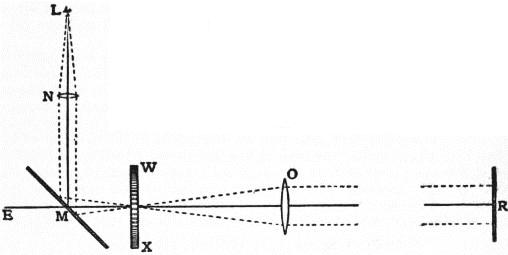
Fig. 1.
The principle underlying Fizeau’s method is shown in the accompanying figs. 1 and 2. Fig. 1 shows the course of a ray of light which, emanating from a luminous point L, strikes the plane surface of a plate of glass M at an angle of about Fizeau. 45°. A fraction of the light is reflected from the two surfaces of the glass to a distant reflector R, the plane of which is at right angles to the course of the ray. The latter is thus reflected back on its own course and, passing through the glass M on its return, reaches a point E behind the glass. An observer with his eye at E looking through the glass sees the return ray as a distant luminous point in the reflector R, after the light has passed over the course in both directions.
In actual practice it is necessary to interpose the object glass of a telescope at a point O, at a distance from M nearly equal to its focal length. The function of this appliance is to render the diverging rays, shown by the dotted lines, nearly parallel, in order that more light may reach R and be thrown back again. But the principle may be conceived without respect to the telescope, all the rays being ignored except the central one, which passes over the course we have described.
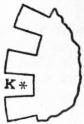
Fig. 2.
Conceiving the apparatus arranged in such a way that the observer sees the light reflected from the distant mirror R, a fine toothed wheel WX is placed immediately in front of the glass M, with its plane perpendicular to the course of the ray, in such a way that the ray goes out and returns through an opening between two adjacent teeth. This wheel is represented in section by WX in fig. 1, and a part of its circumference, with the teeth as viewed by the observer, is shown in fig. 2. We conceive that the latter sees the luminous point between two of the teeth at K. Now, conceive that the wheel is set in revolution. The ray is then interrupted as every tooth passes, so that what is sent out is a succession of flashes. Conceive that the speed of the mirror is such that while the flash is going to the distant mirror and returning again, each tooth of the wheel takes the place of an opening between the teeth. Then each flash sent out will, on its return, be intercepted by the adjacent tooth, and will therefore become invisible. If the speed be now doubled, so that the teeth pass at intervals equal to the time required for the light to go and come, each flash sent through an opening will return through the adjacent opening, and will therefore be seen with full brightness. If the speed be continuously increased the result will be successive disappearances and reappearances of the light, according as a tooth is or is not interposed when the ray reaches the apparatus on its return. The computation of the time of passage and return is then very simple. The speed of the wheel being known, the number of teeth passing in one second can be computed. The order of the disappearance, or the number of teeth which have passed while the light is going and coming, being also determined in each case, the interval of time is computed by a simple formula.
The most elaborate determination yet made by Fizeau’s method was that of Cornu. The station of observation was at the Paris Observatory. The distant reflector, a telescope with a reflector at its focus, was at Montlhéry, distant 22,910 Cornu. metres from the toothed wheel. Of the wheels most used one had 150 teeth, and was 35 millimetres in diameter; the other had 200 teeth, with a diameter of 45 mm. The highest speed attained was about 900 revolutions per second. At this speed, 135,000 (or 180,000) teeth would pass per second, and about 20 (or 28) would pass while the light was going and coming. But the actual speed attained was generally less than this. The definitive result derived by Cornu from the entire series of experiments was 300,400 kilometres per second. Further details of this work need not be set forth because the method is in several ways deficient in precision. The eclipses and subsequent reappearances of the light taking place gradually, it is impossible to fix with entire precision upon the moment of complete eclipse. The speed of the wheel is continually varying, and it is impossible to determine with precision what it was at the instant of an eclipse.
The defect would be lessened were the speed of the toothed wheel placed under control of the observer who, by action in one direction or the other, could continually check or accelerate it, so as to keep the return point of light at the required phase of brightness. If the phase of complete extinction is chosen for this purpose a definite result cannot be reached; but by choosing the moment when the light is of a certain definite brightness, before or after an eclipse, the observer will know at each instant whether the speed should be accelerated or retarded, and can act accordingly. The nearly constant speed through as long a period as is deemed necessary would then be found by dividing the entire number of revolutions of the wheel by the time through which the light was kept constant. But even with these improvements, which were not actually tried by Cornu, the estimate of the brightness on which the whole result depends would necessarily be uncertain. The outcome is that, although Cornu’s discussion of his experiments is a model in the care taken to determine so far as practicable every source of error, his definitive result is shown by other determinations to have been too great by about 1⁄1000 part of its whole amount.
An important improvement on the Fizeau method was made in 1880 by James Young and George Forbes at Glasgow. This consisted in using two distant reflectors which were placed nearly in the same straight line, and at unequal distances. Young and Forbes. The ratio of the distances was nearly 12 : 13. The phase observed was not that of complete extinction of either light, but that when the two lights appeared equal in intensity. But it does not appear that the very necessary device of placing the speed of the toothed wheel under control of the observer was adopted. The accordance between the different measures was far from satisfactory, and it will suffice to mention the result which was
Velocity in vacuo = 301,382 km. per second.
These experimenters also found a difference of 2% between the speed of red and blue light, a result which can only be attributed to some unexplained source of error.
The Foucault system is much more precise, because it rests upon the measurement of an angle, which can be made with great precision.
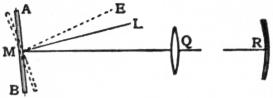
Fig. 3.
The vital appliance is a rapidly revolving mirror. Let AB (fig. 3) be a section of this mirror, which we shall first suppose at rest. A ray of light LM emanating from a source at L, is reflected in the direction MQR to a distant mirror R, from Foucault. which it is perpendicularly reflected back upon its original course. This mirror R should be slightly concave, with the centre of curvature near M, so that the ray shall always be reflected back to M on whatever point of R it may fall. Conceiving the revolving mirror M as at rest, the return ray will after three reflections, at M, R and M again, be returned along its original course to the point L from which it emanated. An important point is that the return ray will always follow the fixed line ML no matter what the position of the movable mirror M, provided there is a distant reflector to send the ray back. Now, suppose that, while the ray is going and coming, the mirror M, being set in revolution, has turned from the position in which the ray was reflected to that shown by the dotted line. If α be the angle through which the surface has turned, the course of the return ray, after reflection, will then deviate from ML by the angle 2α, and so be thrown to a point E, such that the angle LME = 2α. If the mirror is in rapid rotation the ray reflected from it will strike the distant mirror as a series of flashes, each formed by the light reflected when the mirror was in the position AB. If the speed of rotation is uniform, the reflected rays from the successive flashes while the mirror is in the dotted position will thus all follow the same direction ME after their second reflection from the mirror. If the motion is sufficiently rapid an eye observing the reflected ray will see the flashes as an invariable point of light so long as the speed of revolution remains constant. The time required for the light to go and come is then equal to that required by the mirror to turn through half the angle LME, which is therefore to be measured. In practice it is necessary on this system, as well as on that of Fizeau, to condense the light by means of a lens, Q, so placed that L and R shall be at conjugate foci. The position of the lens may be either between the luminous point L and the mirror M, or between M and R, the latter being the only one shown in the figure. This position has the advantage that more light can be concentrated, but it has the disadvantage that, with a given magnifying power, the effect of atmospheric undulation, when the concave reflector is situated at a great distance, is increased in the ratio of the focal length of the lens to the distance LM from the light to the mirror. To state the fact in another form, the amplitude of the disturbances produced by the air in linear measure are proportional to the focal distance of the lens, while the magnification required increases in the inverse ratio of the distance LM. Another difficulty associated with the Foucault system in the form in which its originator used it is that if the axis of the mirror is at right angles to the course of the ray, the light from the source L will be flashed directly into the eye of the observer, on every passage of the revolving mirror through the position in which its normal bisects the two courses of the ray. This may be avoided by inclining the axis of the mirror.
In Foucault’s determination the measures were not made upon a luminous point, but upon a reticule, the image of which could not be seen unless the reflector was quite near the revolving mirror. Indeed the whole apparatus was contained in his laboratory. The effective distance was increased by using several reflectors; but the entire course of the ray measured only 20 metres. The result reached by Foucault for the velocity of light was 298,000 kilometres per second.
The first marked advance on Foucault’s determination was made by Albert A. Michelson, then a young officer on duty at the U.S. Naval Academy, Annapolis. The improvement consisted in using the image of a slit through which the Michelson. rays of the sun passed after reflection from a heliostat. In this way it was found possible to see the image of the slit reflected from the distant mirror when the latter was nearly 600 metres from the station of observation. The essentials of the arrangement are those we have used in fig. 3, L being the slit. It will be seen that the revolving mirror is here interposed between the lens and its focus. It was driven by an air turbine, the blast of which was under the control of the observer, so that it could be kept at any required speed. The speed was determined by the vibrations of two tuning forks. One of these was an electric fork, making about 120 vibrations per second, with which the mirror was kept in unison by a system of rays reflected from it and the fork. The speed of this fork was determined by comparison with a freely vibrating fork from time to time. The speed of the revolving mirror was generally about 275 turns per second, and the deflection of the image of the slit about 112.5 mm. The mean result of nearly 100 fairly accordant determinations was:—
Velocity of light in air 299,828 km. per sec.
Reduction to a vacuum +82
Velocity of light in a vacuum 299,910 ± 50
While this work was in progress Simon Newcomb obtained the official support necessary to make a determination on a yet larger Newcomb. scale. The most important modifications made in the Foucault-Michelson system were the following:—
1. Placing the reflector at the much greater distance of several kilometres.
2. In order that the disturbances of the return image due to the passage of the ray through more than 7 km. of air might be reduced to a minimum, an ordinary telescope of the “broken back” form was used to send the ray to the revolving mirror.
3. The speed of the mirror was, as in Michelson’s experiments, completely under control of the observer, so that by drawing one or the other of two cords held in the hand the return image could be kept in any required position. In making each measure the receiving telescope hereafter described was placed in a fixed position and during the “run” the image was kept as nearly as practicable upon a vertical thread passing through its focus. A “run” generally lasted about two minutes, during which time the mirror commonly made between 25,000 and 30,000 revolutions. The speed per second was found by dividing the entire number of revolutions by the number of seconds in the “run.” The extreme deviations between the times of transmission of the light, as derived from any two runs, never approached to the thousandth part of its entire amount. The average deviation from the mean was indeed less than 1⁄5000 part of the whole.
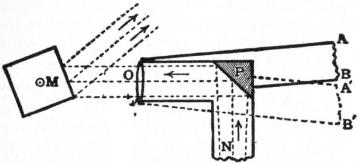
Fig. 4.
To avoid the injurious effect of the directly reflected flash, as well as to render unnecessary a comparison between the directions of the outgoing and the return ray, a second telescope, turning horizontally on an axis coincident with that of the revolving mirror, was used to receive the return ray after reflection. This required the use of an elongated mirror of which the upper half of the surface reflected the outgoing ray, and the lower other half received and reflected the ray on its return. On this system it was not necessary to incline the mirror in order to avoid the direct reflection of the return ray. The greatest advantage of this system was that the revolving mirror could be turned in either direction without break of continuity, so that the angular measures were made between the directions of the return ray after reflection when the mirror moved in opposite directions. In this way the speed of the mirror was as good as doubled, and the possible constant errors inherent in the reference to a fixed direction for the sending telescope were eliminated. The essentials of the apparatus are shown in fig. 4. The revolving mirror was a rectangular prism M of steel, 3 in. high and 1½ in. on a side in cross section, which was driven by a blast of air acting on two fan-wheels, not shown in the fig., one at the top, the other at the bottom of the mirror. NPO is the object-end of the fixed sending telescope the rays passing through it being reflected to the mirror by a prism P. The receiving telescope ABO is straight, and has its objective under O. It was attached to a frame which could turn around the same axis as the mirror. The angle through which it moved was measured by a divided arc immediately below its eye-piece, which is not shown in the figure. The position AB is that for receiving the ray during a rotation of the mirror in the anti-clockwise direction; the position A′B′ that for a clockwise rotation.
In these measures the observing station was at Fort Myer, on a hill above the west bank of the Potomac river. The distant reflector was first placed in the grounds of the Naval Observatory, at a distance of 2551 metres. But the definitive measures were made with the reflector at the base of the Washington monument, 3721 metres distant. The revolving mirror was of nickel-plated steel, polished on all four vertical sides. Thus four reflections of the ray were received during each turn of the mirror, which would be coincident were the form of the mirror invariable. During the preliminary series of measures it was found that two images of the return ray were sometimes formed, which would result in two different conclusions as to the velocity of light, according as one or the other was observed. The only explanation of this defect which presented itself was a tortional vibration of the revolving mirror, coinciding in period with that of revolution, but it was first thought that the effect was only occasional.
In the summer of 1881 the distant reflector was removed from the Observatory to the Monument station. Six measures made in August and September showed a systematic deviation of +67 km. per second from the result of the Observatory series. This difference led to measures for eliminating the defect from which it was supposed to arise. The pivots of the mirror were reground, and a change made in the arrangement, which would permit of the effect of the vibration being determined and eliminated. This consisted in making the relative position of the sending and receiving telescopes interchangeable. In this way, if the measured deflection was too great in one position of the telescopes, it would be too small by an equal amount in the reverse position. As a matter of fact, when the definitive measures were made, it was found that with the improved pivots the mean result was the same in the two positions. But the new result differed systematically from both the former ones. Thirteen measures were made from the Monument in the summer of 1882, the results of which will first be stated in the form of the time required by the ray to go and come. Expressed in millionths of a second this was:—
Least result of the 13 measures 24.819
Greatest result 24.831
Double distance between mirrors 7.44242 km.
Applying a correction of +12 km. for a slight convexity in the face of the revolving mirror, this gives as the mean result for the speed of light in air, 299,778 km. per second. The mean results for the three series were:—
Observatory, 1880-1881 V in air = 299,627
Monument, 1881 V in air = 299,694
Monument, 1882 V in air = 299,778
The last result being the only one from which the effect of distortion was completely eliminated, has been adopted as definitive. For reduction to a vacuum it requires a correction of +82 km. Thus the final result was concluded to be
Velocity of light in vacuo = 299,860 km. per second.
This result being less by 50 km. than that of Michelson, the latter made another determination with improved apparatus and arrangements at the Case School of Applied Science in Cleveland. The result was
Velocity in vacuo = 299,853 km. per second.
So far as could be determined from the discordance of the separate measures, the mean error of Newcomb’s result would be less than ±10 km. But making allowance for the various sources of systematic error the actual probable error was estimated at ±30 km.
It seems remarkable that since these determinations were made, a period during which great improvements have become possible in every part of the apparatus, no complete redetermination of this fundamental physical constant has been carried out.
The experimental measures thus far cited have been primarily those of the velocity of light in air, the reduction to a vacuum being derived from theory alone. The fundamental constant at the basis of the whole theory is the speed of light in a vacuum, such as the celestial spaces. The question of the relation between the velocity in vacuo, and in a transparent medium of any sort, belongs to the domain of physical optics. Referring to the preceding section for the principles at play we shall in the present part of the article confine ourselves to the experimental results. With the theory of the effect of a transparent medium is associated that of the possible differences in the speed of light of different colours.
The question whether the speed of light in vacuo varies with its wave-length seems to be settled with entire certainty by observations of variable stars. These are situated at different distances, some being so far that light must Velocity and wave-length. be several centuries in reaching us from them. Were there any difference in the speed of light of various colours it would be shown by a change in the colour of the star as its light waxed and waned. The light of greatest speed preceding that of lesser speed would, when emanated during the rising phase, impress its own colour on that which it overtook. The slower light would predominate during the falling phase. If there were a difference of 10 minutes in the time at which light from the two ends of the visible spectrum arrived, it would be shown by this test. As not the slightest effect of the kind has ever been seen, it seems certain that the difference, if any, cannot approximate to 1⁄1.000.000 part of the entire speed. The case is different when light passes through a refracting medium. It is a theoretical result of the undulatory theory of light that its velocity in such a medium is inversely proportional to the refractive index of the medium. This being different for different colours, we must expect a corresponding difference in the velocity.
Foucault and Michelson have tested these results of the undulatory theory by comparing the time required for a ray of light to pass through a tube filled with a refracting medium, and through air. Foucault thus found, in a general way, that there actually was a retardation; but his observations took account only of the mean retardation of light of all the wave-lengths, which he found to correspond with the undulatory theory. Michelson went further by determining the retardation of light of various wave-lengths in carbon bisulphide. He made two series of experiments, one with light near the brightest part of the spectrum; the other with red and blue light. Putting V for the speed in a vacuum and V1 for that in the medium, his result was
Yellow light V : V1 = 1.758
Refractive index for yellow 1.64
Difference from theory +0.12
The estimated uncertainty was only 0·02, or 1⁄6 of the difference between observation and theory.
The comparison of red and blue light was made differentially. The colours selected were of wave-length about 0.62 for red and 0.49 for blue. Putting Vr and Vb for the speeds of red and blue light respectively in bisulphide of carbon, the mean result compares with theory as follows:—
Observed value of the ratio Vr, Vb 1.0245
Theoretical value (Verdet) 1.025
This agreement may be regarded as perfect. It shows that the divergence of the speed of yellow light in the medium from theory, as found above, holds through the entire spectrum.
The excess of the retardation above that resulting from theory is probably due to a difference between “wave-speed” and “group-speed” pointed out by Rayleigh. Let fig. 5 represent a short series of progressive undulations of constant period and wave-length. The wave-speed is that required to carry a wave crest A to the position of the crest B in the wave time. But when a flash of light like that measured passes through a refracting medium, the front waves of the flash are continually dying away, as shown at the end of the figure, and the place of each is taken by the wave following. A familiar case of this sort is seen when a stone is thrown into a pond. The front waves die out one at a time, to be followed by others, each of which goes further than its predecessor, while new waves are formed in the rear. Hence the group, as represented in the figure by the larger waves in the middle, moves as a whole more slowly than do the individual waves. When the speed of light is measured the result is not the wave-speed as above defined, but something less, because the result depends on the time of the group passing through the medium. This lower speed is called the group-velocity of light. In a vacuum there is no dying out of the waves, so that the group-speed and the wave-speed are identical. From Michelson’s experiments it would follow that the retardation was about 1⁄14 of the whole speed. This would indicate that in carbon bisulphide each individual light wave forming the front of a moving ray dies out in a space of about 15 wave-lengths.

Fig. 5.
Authorities.—For Foucault’s descriptions of his experiments see Comptes Rendus (September 22 and November 24, 1862), and Recueil de Travaux Scientifiques de Léon Foucault (2 vols., 4to, Paris, 1878). Cornu’s determination is found in Annales de l’Observatoire de Paris, Mémoires, vol. xiii. The works of Michelson and Newcomb are published in extenso in the Astronomical Papers of the American Ephemeris, vols. i. and ii.
(S. N.)
1 The invention of “aethers” is to be carried back, at least, to the Greek philosophers, and with the growth of knowledge they were empirically postulated to explain many diverse phenomena. Only one “aether” has survived in modern science—that associated with light and electricity, and of which Lord Salisbury, in his presidential address to the British Association in 1894, said, “For more than two generations the main, if not the only, function of the word ‘aether’ has been to furnish a nominative case to the verb ‘to undulate.’” (See Aether.)
2 With the Greeks the word “Optics” or Ὀπτικά (from ὄπτομαι, the obsolete present of ὁρῶ, I see) was restricted to questions concerning vision, &c., and the nature of light.
3 It seems probable that spectacles were in use towards the end of the 13th century. The Italian dictionary of the Accademici della Crusca (1612) mentions a sermon of Jordan de Rivalto, published in 1305, which refers to the invention as “not twenty years since”; and Muschenbroek states that the tomb of Salvinus Armatus, a Florentine nobleman who died in 1317, bears an inscription assigning the invention to him. (See the articles Telescope and Camera Obscura for the history of these instruments.)
4 Newton’s observation that a second refraction did not change the colours had been anticipated in 1648 by Marci de Kronland (1595-1667), professor of medicine at the university of Prague, in his Thaumantias, who studied the spectrum under the name of Iris trigonia. There is no evidence that Newton knew of this, although he mentions de Dominic’s experiment with the glass globe containing water.
5 The geometrical determination of the form of the surface which will reflect, or of the surface dividing two media which will refract, rays from one point to another, is very easily effected by using the “characteristic function” of Hamilton, which for the problems under consideration may be stated in the form that “the optical paths of all rays must be the same.” In the case of reflection, if A and B be the diverging and converging points, and P a point on the reflecting surface, then the locus of P is such that AP + PB is constant. Therefore the surface is an ellipsoid of revolution having A and B as foci. If the rays be parallel, i.e. if A be at infinity, the surface is a paraboloid of revolution having B as focus and the axis parallel to the direction of the rays. In refraction if A be in the medium of index µ, and B in the medium of index µ′, the characteristic function shows that µAP + µ′PB, where P is a point on the surface, must be constant. Plane sections through A and B of such surfaces were originally investigated by Descartes, and are named Cartesian ovals. If the rays be parallel, i.e. A be at infinity, the surface becomes an ellipsoid of revolution having B for one focus, µ′/µ for eccentricity, and the axis parallel to the direction of the rays.
6 Young’s views of the nature of light, which he formulated as Propositions and Hypotheses, are given in extenso in the article Interference. See also his article “Chromatics” in the supplementary volumes to the 3rd edition of the Encyclopaedia Britannica.
7 A crucial test of the emission and undulatory theories, which was realized by Descartes, Newton, Fermat and others, consisted in determining the velocity of light in two differently refracting media. This experiment was conducted in 1850 by Foucault, who showed that the velocity was less in water than in air, thereby confirming the undulatory and invalidating the emission theory.
8 Newton, Opticks (London, 1704).
9 Trans. Irish Acad. 15, p. 69 (1824); 16, part i. “Science,” p. 4 (1830), part ii., ibid. p. 93 (1830); 17, part i., p. 1 (1832).
10 This kind of type will always be used in this article to denote vectors.
11 Phil. Trans. (1802), part i. p. 12.
12 Œuvres complètes de Fresnel (Paris, 1866). (The researches were published between 1815 and 1827.)
13 Ann. Phys. Chem. (1883), 18, p. 663.
14 H. A. Lorentz, Zittingsversl. Akad. v. Wet. Amsterdam, 4 (1896), p. 176.
15 H. A. Lorentz, Abhandlungen über theoretische Physik, 1 (1907), p. 415.
16 Clerk Maxwell, A Treatise on Electricity and Magnetism (Oxford, 1st ed., 1873).
17 H. Abraham, Rapports présentés au congrès de physique de 1900 (Paris), 2, p. 247.
18 Ibid., p. 225.
19 Phil. Trans., 175 (1884), p. 343.
20 Ann. d. Phys. u. Chem. 155 (1875), p. 403.
21 Ibid. 153 (1874), p. 525.
22 Ann. d. Phys. 11 (1903), p. 873.
23 Phys. Review, 13 (1901), p. 293.
24 Hertz, Untersuchungen über die Ausbreitung der elektrischen Kraft (Leipzig, 1892).
25 A. Righi, L’Ottica delle oscillazioni elettriche (Bologna, 1897); P. Lebedew, Ann. d. Phys. u. Chem., 56 (1895), p. 1.
26 “Reflection and Refraction,” Trans. Cambr. Phil. Soc. 7, p. 1 (1837); “Double Refraction,” ibid. p. 121 (1839).
27 “Double Refraction,” Ann. d. Phys. u. Chem. 25 (1832), p. 418; “Crystalline Reflection,” Abhandl. Akad. Berlin (1835), p. 1.
28 Trans. Irish Acad. 21, “Science,” p. 17 (1839).
29 Math. and Phys. Papers (London, 1890), 3, p. 466.
30 Helmholtz, Ann. d. Phys. u. Chem., 154 (1875), p. 582.
31 H. A. Lorentz, Versuch einer Theorie der elektrischen u. optischen Erscheinungen in bewegten Körpern (1895) (Leipzig, 1906); J. Larmor, Aether and Matter (Cambridge, 1900).

LIGHTFOOT, JOHN (1602-1675), English divine and rabbinical scholar, was the son of Thomas Lightfoot, vicar of Uttoxeter, Staffordshire, and was born at Stoke-upon-Trent on the 29th of March 1602. His education was received at Morton Green near Congleton, Cheshire, and at Christ’s College, Cambridge, where he was reckoned the best orator among the undergraduates. After taking his degree he became assistant master at Repton in Derbyshire; after taking orders he was appointed curate of Norton-under-Hales in Shropshire. There he attracted the notice of Sir Rowland Cotton, an amateur Hebraist of some distinction, who made him his domestic chaplain at Bellaport. Shortly after the removal of Sir Rowland to London, Lightfoot, abandoning an intention to go abroad, accepted a charge at Stone in Staffordshire, where he continued for about two years. From Stone he removed to Hornsey, near London, for the sake of reading in the library of Sion College. His first published work, entitled Erubhin, or Miscellanies, Christian and Judaical, penned for recreation at vacant hours, and dedicated to Sir R. Cotton, appeared at London in 1629. In September 1630 he was presented by Sir R. Cotton to the rectory of Ashley in Staffordshire, where he remained until June, 1642, when he went to London, probably to superintend the publication of his next work, A Few and New Observations upon the Book of Genesis: the most of them certain; the rest, probable; all, harmless, strange and rarely heard of before, which appeared at London in that year. Soon after his arrival in London he became minister of St Bartholomew’s church, near the Exchange; and in 1643 he was appointed to preach the sermon before the House of Commons on occasion of the public fast of the 29th of March. It was published under the title of Elias Redivivus, the text being Luke i. 17; in it a parallel is drawn between the Baptist’s ministry and the work of reformation which in the preacher’s judgment was incumbent on the parliament of his own day.
Lightfoot was also one of the original members of the Westminster Assembly; his “Journal of the Proceedings of the Assembly of Divines from January 1, 1643 to December 31, 1644,” now printed in the thirteenth volume of the 8vo edition of his Works, is a valuable historical source for the brief period to which it relates. He was assiduous in his attendance, and, though frequently standing almost or quite alone, especially in the Erastian controversy, he exercised a material influence on the result of the discussions of the Assembly. In 1643 Lightfoot published A Handful of Gleanings out of the Book of Exodus, and in the same year he was made master of Catharine Hall by the parliamentary visitors of Cambridge, and also, on the recommendation of the Assembly, was promoted to the rectory of Much Munden in Hertfordshire; both appointments he retained until his death. In 1644 was published in London the first instalment of the laborious but never completed work of which the full title runs The Harmony of the Four Evangelists among themselves, and with the Old Testament, with an explanation of the chiefest difficulties both in Language and Sense: Part I. From the beginning of the Gospels to the Baptism of our Saviour. The second part From the Baptism of our Saviour to the first Passover after followed in 1647, and the third From the first Passover after our Saviour’s Baptism to the second in 1650. On the 26th of August 1645 he again preached before the House of Commons on the day of their monthly fast. His text was Rev. xx. 1, 2. After controverting the doctrine of the Millenaries, he urged various practical suggestions for the repression with a strong hand of current blasphemies, for a thorough revision of the authorized version of the Scriptures, for the encouragement of a learned ministry, and for a speedy settlement of the church. In the same year appeared A Commentary upon the Acts of the Apostles, chronical and critical; the Difficulties of the text explained, and the times of the Story cast into annals. From the beginning of the Book to the end of the Twelfth Chapter. With a brief survey of the contemporary Story of the Jews and Romans (down to the third year of Claudius). In 1647 he published The Harmony, Chronicle, and Order of the Old Testament, which was followed in 1655 by The Harmony, Chronicle, and Order of the New Testament, inscribed to Cromwell. In 1654 Lightfoot had been chosen vice-chancellor of the university of Cambridge, but continued to reside by preference at Munden, in the rectory of which, as well as in the mastership of Catharine Hall, he was confirmed at the Restoration. The remainder of his life was devoted to helping Brian Walton with the Polyglot Bible (1657) and to his own best-known work, the Horae Hebraicae et Talmudicae, in which the volume relating to Matthew appeared in 1658, that relating to Mark in 1663, and those relating to 1 Corinthians, John and Luke, in 1664, 1671 and 1674 respectively. While travelling from Cambridge to Ely (where he had been collated in 1668 by Sir Orlando Bridgman to a prebendal stall), he caught a severe cold, and died at Ely on the 6th of December 1675. The Horae Hebraicae et Talmudicae impensae in Acta Apostolorum et in Ep. S. Pauli ad Romanos were published posthumously.
The Works of Lightfoot were first edited, in 2 vols. fol., by G. Bright and Strype in 1684; the Opera Omnia, cura Joh. Texelii, appeared at Rotterdam in 1686 (2 vols. fol.), and again, edited by J. Leusden, at Franeker in 1699 (3 vols. fol.). A volume of Remains was published at London in 1700. The Hor. Hebr. et Talm. were also edited in Latin by Carpzov (Leipzig, 1675-1679), and again, in English, by Gandell (Oxford, 1859). The most complete edition is that of the Whole Works, in 13 vols. 8vo, edited, with a life, by R. Pitman (London, 1822-1825). It includes, besides the works already noticed, numerous sermons, letters and miscellaneous writings; and also The Temple, especially as it stood in the Days of our Saviour (London, 1650).
See D. M. Welton, John Lightfoot, the Hebraist (Leipzig, 1878),