VOLUME XV SLICE V Joints to Justinian I. (continued 9)
Reading edition
(a) The Bienne, which flows from the fort of Les Rousses by St Claude, the industrial centre of the south Jura, famous for the manufacture of wooden toys, owing to the large quantity of boxwood in the neighbourhood. Septmoncel is busied with cutting of gems, and Morez with watch and spectacle making. Cut off to the east by the great chain, the industrial prosperity of this valley is of recent origin.
(b) The Oignin, which flows from south to north. It receives the drainage of the lake of Nantua, a town noted for combs and silk weaving, and which communicates by the “cluse” of the Lac de Silan with the Valserine valley, and so with the Rhone at Bellegarde, and again with the various routes which meet under the walls of the fort of Les Rousses, while by the Val Romey and the Séran Culoz is easily gained.
(c) The Albarine, connected with Culoz by the “cluse” of Virieu, and by the Furan flowing south with Belley, the capital of the district of Bugey (the old name for the South Jura).
The “cluses” of Nantua and Virieu are now both traversed by important railways; and it is even truer than of old that the keys of the south Jura are Lyons and Geneva. But of course the strategic importance of these gorges is less than appears at first sight, because they can be turned by following the Rhone in its great bend to the south.
The range is mentioned by Caesar (Bell. Gall. i. 2-3, 6 (1), and 8 (1)), Strabo (iv. 3, 4, and 6, 11), Pliny (iii. 31; iv. 105; xvi. 197) and Ptolemy (ii. ix. 5), its name being a word which appears under many forms (e.g. Joux, Jorat, Jorasse, Juriens), and is a synonym for a wood or forest. The German name is Leberberg, Leber being a provincial word for a hill.
Politically the Jura is French (departments of the Doubs, Jura and Ain) and Swiss (parts of the cantons of Geneva, Vaud, Neuchâtel, Bern, Soleure and Basel); but at its north extremity it takes in a small bit of Alsace (Pfirt or Ferrette). In the middle ages the southern, western and northern sides were parcelled out into a number of districts, all of which were gradually absorbed by the French crown, viz., Gex, Val Romey, Bresse and Bugey (exchanged in 1601 by Savoy for the marquisate of Saluzzo), Franche-Comté, or the Free County of Burgundy, an imperial fief till annexed in 1674, the county of Montbéliard (Mömpelgard) acquired in 1793, and the county of Ferrette (French 1648-1871). The northern part of the eastern side was held till 1792 (part till 1797) by the bishop of Basel as a fief of the empire, and then belonged to France till 1814, but was given to Bern in 1815 (as a recompense for its loss of Vaud), and now forms the Bernese Jura, a French-speaking district. The centre of the eastern slope formed the principality of Neuchâtel (q.v.) and the county of Valangin, which were generally held by Burgundian nobles, came by succession to the kings of Prussia in 1707, and were formed into a Swiss canton in 1815, though they did not become free from formal Prussian claims until 1857. The southern part of the eastern slope originally belonged to the house of Savoy, but was conquered bit by bit by Bern, which was forced in 1815 to accept its subject district Vaud as a colleague and equal in the Swiss Confederation. It was Charles the Bold’s defeats at Grandson and Morat which led to the annexation by the confederates of these portions of Savoyard territory.
Authorities.—E. F. Berlioux, Le Jura (Paris, 1880); F. Machacek, Der Schweizer Jura (Gotha, 1905); A. Magnin, Les lacs du Jura (Paris, 1895); J. Zimmerli, “Die Sprachgrenze im Jura” (vol. i. of his Die Deutsch-französische Sprachgrenze in der Schweiz (Basel, 1891). For the French slope see Joanne’s large Itinéraire to the Jura, and the smaller volumes relating to the departments of the Ain, Doubs and Jura, in his Géographies départementales. For the Swiss slope see 3 vols. in the series of the Guides Monod (Geneva); A. Monnier, La Chaux de Fonds et le Haut-Jura Neuchâtelois; J. Monod, Le Jura Bernois; and E. J. P. de la Harpe, Le Jura Vaudois.
(W. A. B. C.)

JURASSIC, in geology, the middle period of the Mesozoic era, that is to say, succeeding the Triassic and preceding the Cretaceous periods. The name Jurassic (French jurassique; German Juraformation or Jura) was first employed by A. Brongniart and A. von Humboldt for the rocks of this age in the western Jura mountains of Switzerland, where they are well developed. It was in England, however, that they were first studied by William Smith, in whose hands they were made to lay the foundations of stratigraphical geology. The names adopted by him for the subdivisions he traced across the country have passed into universal use, and though some of them are uncouth English provincial names, they are as familiar to the geologists of France, Switzerland and Germany as to those of England. During the following three decades Smith’s work was elaborated by W. D. Conybeare and W. Phillips. The Jurassic rocks of fossils of the European continent were described by d’Orbigny, 1840-1846; by L. von Buch, 1839; by F. A. Quenstedt, 1843-1888; by A. Oppel, 1856-1858; and since then by many other workers: E. Benecke, E. Hébert, W. Waagen, and others. The study of Jurassic rocks has continued to attract the attention of geologists, partly because the bedding is so well defined and regular—the strata are little disturbed anywhere outside the Swiss Jura and the Alps—and partly because the fossils are numerous and usually well-preserved. The result has been that no other system of rocks has been so carefully examined throughout its entire thickness; many “zones” have been established by means of the fossils—principally by ammonites—and these zones are not restricted to limited districts, but many of them hold good over wide areas. Oppel distinguished no fewer than thirty-three zonal horizons, and since then many more sub-zonal divisions have been noted locally.
The existence of faunal regions in Jurassic times was first pointed out by J. Marcou; later M. Neumayr greatly extended observations in this direction. According to Neumayr, three distinct geographical regions of deposit can be made out among the Jurassic rocks of Europe: (1) The Mediterranean province, embracing the Pyrenees, Alps and Carpathians, with all the tracts lying to the south. One of the biological characters of this area was the great abundance of ammonites belonging to the groups of Heterophylli (Phylloceras) and Fimbriati (Lytoceras). (2) The central European province, comprising the tracts lying to the north of the Alpine ridge, and marked by the comparative rarity of the ammonites just mentioned, which are replaced by others of the groups Inflati (Aspidoceras) and Oppelia, and by abundant reefs and masses of coral. (3) The boreal or Russian province, comprising the middle and north of Russia, Spitzbergen and Greenland. The life in this area was much less varied than in the others, showing that in Jurassic times there was a perceptible diminution of temperature towards the north. The ammonites of the more southern tracts here disappear, together with the corals.
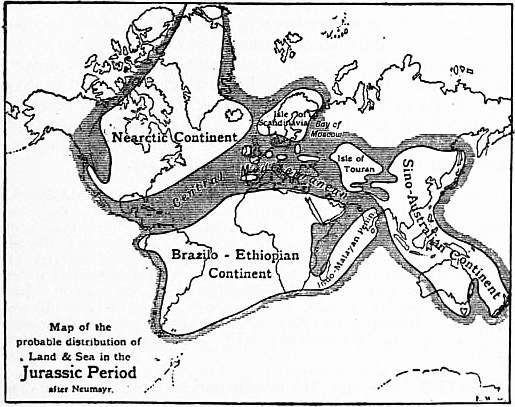
The cause of these faunal regions Neumayr attributed to climatic belts—such as exist to-day—and in part, at least, he was probably correct. It should be borne in mind, however, that although Neumayr was able to trace a broad, warm belt, some 60° in width, right round the earth, with a narrower mild belt to the north and an arctic or boreal belt beyond, and certain indications of a repetition of the climatic zones on the southern side of the thermal equator, more recent discoveries of fossils seem to show that other influences must have been at work in determining their distribution; in short, the identity of the Neumayrian climatic boundaries becomes increasingly obscured by the advance of our knowledge.
The Jurassic period was marked by a great extension of the sea, which commenced after the close of the Trias and reached its maximum during the Callovian and Oxfordian stages; consequently, the Middle Jurassic rocks are much more widely spread than the Lias. In Europe and elsewhere Triassic beds pass gradually up into the Jurassic, so that there is difficulty sometimes in agreement as to the best line for the base of the latter; similarly at the top of the system there is a passage from the Jurassic to the Cretaceous rocks (Alps).
Towards the close of the period elevation began in certain regions; thus, in America, the Sierras, Cascade Mountains, Klamath Mountains, and Humboldt Range probably began to emerge. In England the estuarine Portlandian resulted partly from elevation, but in the Alps marine conditions steadily persisted (in the Tithonian stage). There appears to have been very little crustal disturbance or volcanic activity; tuffs are known in Argentina and California; volcanic rocks of this age occur also in Skye and Mull.
The rocks of the Jurassic system present great petrological diversity. In England the name “Oolites” was given to the middle and higher members of the system on account of the prevalence of oolitic structure in the limestones and ironstones; the same character is a common feature in the rocks of northern Europe and elsewhere, but it must not be overlooked that clays and sandstones together bulk more largely in the aggregate than the oolites. The thickness of Jurassic rocks in England is 4000 to 5000 ft., and in Germany 2000 to 3000 ft. Most of the rocks represent the deposits of shallow seas, but estuarine conditions and land deposits occur as in the Purbeck beds of Dorset and the coals of Yorkshire. Coal is a very important feature among Jurassic rocks, particularly in the Liassic division; it is found in Hungary, where there are twenty-five workable beds; in Persia, Turkestan, Caucasus, south Siberia, China, Japan, Further India, New Zealand and in many of the Pacific Islands.
Being shallow water formations, petrological changes come in rapidly as many of the beds are traced out; sandstones pass laterally into clays, and the latter into limestones, and so on, but a reliable guide to the classification and correlation is found in the fossil contents of the rocks. In the accompanying table a list is given of some of the zonal fossils which regularly occur in the order indicated; other forms are known that are equally useful. It will be noticed that while there is general agreement as to the order in which the zonal forms occur, the line of division between one formation and another is liable to vary according to factors in the personal equation of the authors.
The Jurassic formations stretch across England in a varying band from the mouth of the Tees to the coast of Dorsetshire. They consist of harder sandstones and limestones interstratified with softer clays and shales. Hence they give rise to a characteristic type of scenery—the more durable beds standing out as long ridges, sometimes even with low cliffs, while the clays underlie the level spaces between.
Jurassic rocks cover a vast area in Central Europe. They rise from under the Cretaceous formations in the north-east of France, whence they range southwards down the valleys of the Saône and Rhone to the Mediterranean. They appear as a broken border round the old crystalline nucleus of Auvergne. Eastwards they range through the Jura Mountains up to the high grounds of Bohemia. They appear in the outer chains of the Alps on both sides, and on the south they rise along the centre of the Apennines, and here and there over the Spanish Peninsula. Covered by more recent formations they underlie the great plain of northern Germany, whence they range eastwards and occupy large tracts in central and eastern Russia.
Lower Jurassic rocks are absent from much of northern Russia, the stages represented being the Callovian, Oxfordian and Volgian (of Professor S. Nikitin); the fauna differs considerably from that of western Europe, and the marine equivalents of the Purbeck beds are found in this region. In south Russia, the Crimea and Caucasus, Lias and Lower Jurassic rocks are present. In the Alps, the Lower Jurassic rocks are intimately associated with the underlying Triassic formations, and resemble them in consisting largely of reddish limestones and marbles; the ammonites in this region differ in certain respects from those of western and central Europe. The Oxfordian, Callovian, Corallian and Astartian stages are also present. The Upper Jurassic is mainly represented by a uniform series of limestones, with a peculiar and characteristic fauna, to which Oppel gave the name “Tithonian.” This includes most of the horizons from Kimeridgian to Cretaceous; it is developed on the southern flanks of the Alps, Carpathians, Apennines, as well as in south France and other parts of the Mediterranean basin. A characteristic formation on this horizon is the “Diphya limestone,” so-called from the fossil Terebratula diphya (Pygope janitor) seen in the well-known escarpments (Hochgebirge Kalk). Above the Diphya limestone comes the Stramberg limestone (Stramberg in Moravia), with “Aptychus” beds and coral reefs. The rocks of the Mediterranean basin are on the whole more calcareous than those of corresponding age in north-west Europe; thus the Lias is represented by 1500 ft. of white crystalline limestone in Calabria and a similar rock occurs in Sicily, Bosnia, Epirus, Corfu; in Spain the Liassic strata are frequently dolomitic; in the Apennines they are variegated limestones and marls. The Higher Jurassic beds of Portugal show traces of the proximity of land in the abundant plant remains that are found in them. In Scania the Lias succeeds the Rhaetic beds in a regular manner, and Jurassic rocks have been traced northward well within the polar circle; they are known in the Lofoten Isles, Spitzbergen, east Greenland, King Charles’s Island, Cape Stewart in Scoresby Sound, Grinnell Land, Prince Patrick Land, Bathurst and Exmouth Island; in many cases the fossils denote a climate considerably milder than now obtains in these latitudes.
In the American continent Jurassic rocks are not well developed. Marine Lower and Middle Jurassic beds occur on the Pacific coast (California and Oregon), and in Wyoming, the Dakotas, Colorado, east Mexico and Texas. Above the marine beds in the interior are brackish and fresh-water deposits, the Morrison and Como beds (Atlantosaurus and Baptanodon beds of Marsh). Later Jurassic rocks are found in northern British Columbia and perhaps in Alaska, Wyoming, Utah, Montana, Colorado, the Dakotas, &c. In California some of the gold-bearing, metamorphic slates are of this age. Marine Jurassic rocks have not been clearly identified on the Atlantic side of America. The Patuxent and Arundel formations (non-marine) are doubtfully referred to this period. Lower and Middle Jurassic formations occur in Argentina and Bolivia. Jurassic rocks have been recognized in Asia, including India, Afghanistan, Persia, Kurdistan, Asia Minor, the Caspian region, Japan and Borneo. The best marine development is in Cutch, where the following groups are distinguished from above downwards: the Umia series = Portlandian and Tithonian of south Europe, passing upwards into the Neocomian; the Katrol series = Oxfordian (part) and Kimeridgian; the Chari series = Callovian and part of the Oxfordian; the Patcham series = Bathonian. In the western half of the Salt Range and the Himalayas, Spiti shales are the equivalents of the European Callovian and Kimeridgian. The upper part of the Gondwana series is not improbably Jurassic. On the African continent, Liassic strata are found in Algeria, and Bathonian formations occur in Abyssinia, Somaliland, Cape Colony and western Madagascar. In Australia the Permo-Carboniferous formations are succeeded in Queensland and Western Australia by what may be termed the Jura-Trias, which include the coal-bearing “Ipswich” and “Burrum” formations of Queensland. In New Zealand there is a thick series of marine beds with terrestrial plants, the Mataura series in the upper part of Hutton’s Hokanui system. Sir J. Hector included also the Putakaka series (as Middle Jurassic) and the Flag series with the Catlin’s River and Bastion series below. Jurassic rocks have been recorded from New Guinea and New Caledonia.
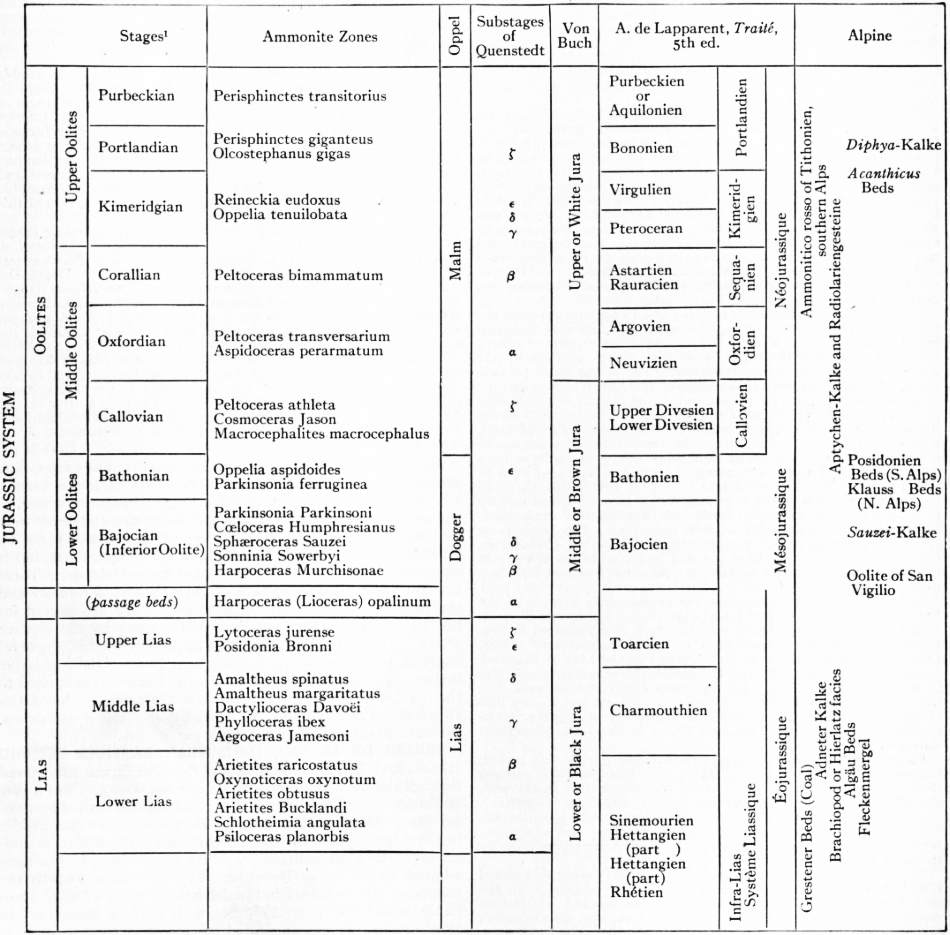
1 Purbeckian from the “Isle” of Purbeck. Aquilonien from Aquilo (Nord). Bononien from Bononia (Boulogne). Virgulien from Exogyra virgula. Pteroceran from Pteroceras oceani. Astartien from Astarte supracorollina. Rauracien from Rauracia (Jura). Argovien from Argovie (Switzerland). Neuvizien from Neuvizy (Ardennes). Divesien from Dives (Calvados). Bathonien from Bath (England). Bajocien from Bayeux (Calvados). Toarcien from Toarcium (Tours). Charmouthien from Charmouth (England). Sinemourien from Sinemurum, Semur (Côte d’Or). Hettangien from Hettange (Lorraine).
Life in the Jurassic Period.—The expansion of the sea during this period, with the formation of broad sheets of shallow and probably warmish water, appears to have been favourable to many forms of marine life. Under these conditions several groups of organisms developed rapidly along new directions, so that the Jurassic period as a whole came to have a fauna differing clearly and distinctly from the preceding Palaeozoic or succeeding Tertiary faunas. In the seas, all the main groups were represented as they are to-day. Corals were abundant, and in later portions of the period covered large areas in Europe; the modern type of coral became dominant; besides reef-building forms such as Thamnastrea, Isastrea, Thecosmilia, there were numerous single forms like Montivaltia. Crinoids existed in great numbers in some of the shallow seas; compared with Palaeozoic forms there is a marked reduction in the size of the calyx with a great extension in the number of arms and pinnules; Pentacrinus, Eugeniacrinus, Apiocrinus are all well known; Antedon was a stalkless genus. Echinoids (urchins) were gradually developing the so-called “irregular” type, Echinobrissus, Holectypus, Collyrites, Clypeus, but the “regular” forms prevailed, Cidaris, Hemicidaris, Acrosalenia. Sponges were important rock-builders in Upper Jurassic times (Spongiten Kalk); they include lithistids such as Cnemediastrum, Hyalotragus, Peronidella; hexactinellids, Tremadictyon, Craticularia; and horny sponges have been found in the Lias and Middle Jurassic.
Polyzoa are found abundantly in some of the beds, Stomatopora, Berenicia, &c. Brachiopods were represented principally by terebratulids (Terebratula, Waldheimia, Megerlea), and by rhynchonellids; Thecae, Lingula and Crania were also present. The Palaeozoic spirifirids and athyrids still lingered into the Lias. More important than the brachiopods were the pelecypods; Ostrea, Exogyra, Gryphaea were very abundant (Gryphite limestone, Gryphite grit); the genus Trigonia, now restricted to Australian waters, was present in great variety; Aucella, Lima, Pecten, Pseudomonotis Gervillia, Astarte, Diceras, Isocardia, Pleuromya may be mentioned out of many others. Amongst the gasteropods the Pleurotomariidae and Turbinidae reached their maximum development; the Palaeozoic Conularia lived to see the beginning of this period (Pleurotomaria, Nerinea, Pteroceras, Cerithium, Turritella).
Cephalopods flourished everywhere; first in importance were the ammonites; the Triassic genera Phylloceras and Lytoceras were still found in the Jurassic waters, but all the other numerous genera were new, and their shells are found with every variation of size and ornamentation. Some are characteristic of the older Jurassic rocks, Arietites, Aegoceras, Amaltheus, Harpoceras, Oxynoticeras, Stepheoceras, and the two genera mentioned above; in the middle stages are found Cosmoceras, Perisphinctes, Cardioceras, Kepplerites Aspidoceras; in the upper stages Olcostephanus, Perisphinctes, Reineckia, Oppelia. So regularly do certain forms characterize definite horizons in the rocks that some thirty zones have been distinguished in Europe, and many of them can be traced even as far as India. Another cephalopod group, the belemnites, that had been dimly outlined in the preceding Trias, now advanced rapidly in numbers and in variety of form, and they, like the ammonites, have proved of great value as zone-indicators. The Sepioids or cuttlefish made their first appearance in this period (Beloteuthis, Geoteuthis,) and their ink-bags can still be traced in examples from the Lias and lithographic limestone. Nautiloids existed but they were somewhat rare.
A great change had come over the crustaceans; in place of the Palaeozoic trilobites we find long-tailed lobster-like forms, Penaeus, Eryon, Magila, and the broad crab-like type first appeared in Prosopon. Isopods were represented by Archaeoniscus and others. Insects have left fairly abundant remains in the Lias of England, Schambelen (Switzerland) and Dobbertin (Mecklenburg), and also in the English Purbeck. Neuropterous forms predominate, but hemiptera occur from the Lias upwards; the earliest known flies (Diptera) and ants (Hymenoptera) appeared; orthoptera, cockroaches, crickets, beetles, &c., are found in the Lias, Stonesfield slate and Purbeck beds.
Fishes were approaching the modern forms during this period, heterocercal ganoids becoming scarce (the Coelacanthidae reached their maximum development), while the homocercal forms were abundant (Gyrodus, Microdon, Lepidosteus, Lepidotus, Dapedius). The Chimaeridae, sea-cats, made their appearance (Squaloraja). The ancestors of the modern sturgeons, garpikes and selachians, Hybodus, Acrodus were numerous. Bony-fish were represented by the small Leptolepis.
So important a place was occupied by reptiles during this period that it has been well described as the “age of reptiles.” In the seas the fish-shaped Ichthyosaurs and long-necked Plesiosaurs dwelt in great numbers and reached their maximum development; the latter ranged in size from 6 to 40 ft. in length. The Pterosaurs, with bat-like wings and pneumatic bones and keeled breast-bone, flew over the land; Pterodactyl with short tail and Rhamphorhyncus with long tail are the best known. Curiously modified crocodilians appeared late in the period (Mystriosaurus, Geosaurus, Steneosaurus, Teleosaurus). But even more striking than any of the above were the Dinosaurs; these ranged in size from a creature no larger than a rabbit up to the gigantic Atlantosaurus, 100 ft. long, in the Jurassic of Wyoming. Both herbivorous and carnivorous forms were present; Brontosaurus, Megalosaurus, Stegosaurus, Cetiosaurus, Diplodocus, Ceratosaurus and Campsognathus are a few of the genera. By comparison with the Dinosaurs the mammals took a very subordinate position in Jurassic times; only a few jaws have been found, belonging to quite small creatures; they appear to have been marsupials and were probably insectivorous (Plagiaulax Bolodon, Triconodon, Phascolotherium, Stylacodon). Of great interest are the remains of the earliest known bird (Archaeopteryx) from the Solenhofen slates of Bavaria. Although this was a great advance beyond the Pterodactyls in avian characters, yet many reptilian features were retained.
Comparatively little change took place in the vegetation in the time that elapsed between the close of the Triassic and the middle of the Jurassic periods. Cycads, Zamites, Podozamites, &c., appeared to reach their maximum; Equisetums were still found growing to a great size and Ginkgos occupied a prominent place; ferns were common; so too were pines, yews, cypresses and other conifers, which while they outwardly resembled their modern representatives, were quite distinct in species. No flowering plants had yet appeared, although a primitive form of angiosperm has been reported from the Upper Jurassic of Portugal.
The economic products of the Jurassic system are of considerable importance; the valuable coals have already been noticed; the well-known iron ores of the Cleveland district in Yorkshire and those of the Northampton sands occur respectively in the Lias and Inferior Oolites. Oil shales are found in Germany, and several of the Jurassic formations in England contain some petroleum. Building stones of great value are obtained from the Great Oolite, the Portlandian and the Inferior Oolite; large quantities of hydraulic cement and lime have been made from the Lias. The celebrated lithographic stone of Solenhofen in Bavaria belongs to the upper portion of this system.
See D’Orbigny, Paléontologie française, Terrain Jurassique (1840, 1846); L. von Buch, “Über den Jura in Deutschland” (Abhand. d. Berlin Akad., 1839); F. A. Quenstedt, Flötzgebirge Württembergs (1843) and other papers, also Der Jura (1883-1888); A. Oppel, Die Juraformation Englands, Frankreichs und s.w. Deutschlands (1856-1858). For a good general account of the formations with many references to original papers, see A. de Lapparent, Traité de géologie, vol. ii. 5th ed. (1906). The standard work for Great Britain is the series of Memoirs of the Geological Survey entitled The Jurassic Rocks of Britain, i and ii. “Yorkshire” (1892); iii. “The Lias of England and Wales” (1893); iv. “The Lower Oolite Rocks of England (Yorkshire excepted)” (1894); v. “The Middle and Upper Oolitic Rocks of England (Yorkshire excepted)” (1895). The map is after that of M. Neumayr, “Die geographische Verbreitung der Juraformation,” Denkschr. d. k. Akad. d. Wiss., Wien, Math. u. Naturwiss., cl. L., Abth. i, Karte 1. (1885).
(J. A. H.)
JURAT (through Fr. from med. Lat. juratus, one sworn, Lat. jurare, to swear), a name given to the sworn holders of certain offices. Under the ancien régime in France, in several towns, of the south-west, such as Rochelle and Bordeaux, the jurats were members of the municipal body. The title was also borne by officials, corresponding to aldermen, in the Cinque Ports, but is now chiefly used as a title of office in the Channel Islands. There are two bodies, consisting each of twelve jurats, for Jersey and the bailiwick of Guernsey respectively. They are elected for life, in Jersey by the ratepayers, in Guernsey by the elective states. They form, with the bailiff as presiding judge, the royal court of justice, and are a constituent part of the legislative bodies. In English law, the word jurat (juratum) is applied to that part of an affidavit which contains the names of the parties swearing the affidavit and the person before whom it was sworn, the date, place and other necessary particulars.
JURIEN DE LA GRAVIÈRE, JEAN BAPTISTE EDMOND (1812-1892), French admiral, son of Admiral Jurien, who served through the Revolutionary and Napoleonic wars and was a peer of France under Louis Philippe, was born on the 19th of November 1812. He entered the navy in 1828, was made a commander in 1841, and captain in 1850. During the Russian War he commanded a ship in the Black Sea. He was promoted to be rear-admiral on the 1st of December 1855, and appointed to the command of a squadron in the Adriatic in 1859, when he absolutely sealed the Austrian ports with a close blockade. In October 1861 he was appointed to command the squadron in the Gulf of Mexico, and two months later the expedition against Mexico. On the 15th of January 1862 he was promoted to be vice-admiral. During the Franco-German War of 1870 he had command of the French Mediterranean fleet, and in 1871 he was appointed “director of charts.” As having commanded in chief before the enemy, the age-limit was waived in his favour, and he was continued on the active list. Jurien died on the 4th of March 1892. He was a voluminous author of works on naval history and biography, most of which first appeared in the Revue des deux mondes. Among the most noteworthy of these are Guerres maritimes sous la république et l’empire, which was translated by Lord Dunsany under the title of Sketches of the Last Naval War (1848); Souvenirs d’un amiral (1860), that is, of his father, Admiral Jurien; La Marine d’autrefois (1865), largely autobiographical; and La Marine d’aujourd’hui (1872). In 1866 he was elected a member of the Academy.
JURIEU, PIERRE (1637-1713), French Protestant divine, was born at Mer, in Orléanais, where his father was a Protestant pastor. He studied at Saumur and Sedan under his grandfather, Pierre Dumoulin, and under Leblanc de Beaulieu. After completing his studies in Holland and England, Jurieu received Anglican ordination; returning to France he was ordained again and succeeded his father as pastor of the church at Mer. Soon after this he published his first work, Examen de livre de la réunion du Christianisme (1671). In 1674 his Traité de la dévotion led to his appointment as professor of theology and Hebrew at Sedan, where he soon became also pastor. A year later he published his Apologie pour la morale des Réformés. He obtained a high reputation, but his work was impaired by his controversial temper, which frequently developed into an irritated fanaticism, though he was always entirely sincere. He was called by his adversaries “the Goliath of the Protestants.” On the suppression of the academy of Sedan in 1681, Jurieu received an invitation to a church at Rouen, but, afraid to remain in France on account of his forthcoming work, La Politique du clergé de France, he went to Holland and was pastor of the Walloon church of Rotterdam till his death on the 11th of January 1713. He was also professor at the école illustre. Jurieu did much to help those who suffered by the revocation of the Edict of Nantes (1685). He himself turned for consolation to the Apocalypse, and succeeded in persuading himself (Accomplissement des prophéties, 1686) that the overthrow of Antichrist (i.e. the papal church) would take place in 1689. H. M. Baird says that “this persuasion, however fanciful the grounds on which it was based, exercised no small influence in forwarding the success of the designs of William of Orange in the invasion of England.” Jurieu defended the doctrines of Protestantism with great ability against the attacks of Antoine Arnauld, Pierre Nicole and Bossuet, but was equally ready to enter into dispute with his fellow Protestant divines (with Louis Du Moulin and Claude Payon, for instance) when their opinions differed from his own even on minor matters. The bitterness and persistency of his attacks on his colleague Pierre Bayle led to the latter being deprived of his chair in 1693.
One of Jurieu’s chief works is Lettres pastorales adressées aux fidèles de France (3 vols., Rotterdam, 1686-1687; Eng. trans., 1689), which, notwithstanding the vigilance of the police, found its way into France and produced a deep impression on the Protestant population. His last important work was the Histoire critique des dogmes et des cultes (1704; Eng. trans., 1715). He wrote a great number of controversial works.
See the article in Herzog-Hauck, Realencyklopädie; also H. M. Baird, The Huguenots and the Revocation of the Edict of Nantes (1895).
JURIS, a tribe of South American Indians, formerly occupying the country between the rivers Iça (lower Putumayo) and Japura, north-western Brazil. In ancient days they were the most powerful tribe of the district, but in 1820 their numbers did not exceed 2000. Owing to inter-marrying, the Juris are believed to have been extinct for half a century. They were closely related to the Passēs, and were like them a fair-skinned, finely built people with quite European features.
JURISDICTION, in general, the exercise of lawful authority, especially by a court or a judge; and so the extent or limits within which such authority is exercisable. Thus each court has its appropriate jurisdiction; in the High Court of Justice in England administration actions are brought in the chancery division, salvage actions in the admiralty, &c. The jurisdiction of a particular court is often limited by statute, as that of a county court, which is local and is also limited in amount. In international law jurisdiction has a wider meaning, namely, the rights exercisable by a state within the bounds of a given space. This is frequently referred to as the territorial theory of jurisdiction. (See International Law; International Law, Private.)
JURISPRUDENCE (Lat. jurisprudentia, knowledge of law, from jus, right, and prudentia, from providere, to foresee), the general term for “the formal science of positive law” (T. E. Holland); see Law. The essential principles involved are discussed below and in Jurisprudence, Comparative; the details of particular laws or sorts of law (Contract, &c.) and of individual national systems of law (English Law, &c.) being dealt with in separate articles.
The human race may be conceived as parcelled out into a number of distinct groups or societies, differing greatly in size and circumstances, in physical and moral characteristics of all kinds. But they all resemble each other in that they reveal on examination certain rules of conduct in accordance with which the relations of the members inter se are governed. Each society has its own system of laws, and all the systems, so far as they are known, constitute the appropriate subject matter of jurisprudence. The jurist may deal with it in the following ways. He may first of all examine the leading conceptions common to all the systems, or in other words define the leading terms common to them all. Such are the terms law itself, right, duty, property, crime, and so forth, which, or their equivalents, may, notwithstanding delicate differences of connotation, be regarded as common terms in all systems. That kind of inquiry is known in England as analytical jurisprudence. It regards the conceptions with which it deals as fixed or stationary, and aims at expressing them distinctly and exhibiting their logical relations with each other. What is really meant by a right and by a duty, and what is the true connexion between a right and a duty, are types of the questions proper to this inquiry. Shifting our point of view, but still regarding systems of law in the mass, we may consider them, not as stationary, but as changeable and changing, we may ask what general features are exhibited by the record of the change. This, somewhat crudely put, may serve to indicate the field of historical or comparative jurisprudence. In its ideal condition it would require an accurate record of the history of all legal systems as its material. But whether the material be abundant or scanty the method is the same. It seeks the explanation of institutions and legal principles in the facts of history. Its aim is to show how a given rule came to be what it is. The legislative source—the emanation of the rule from a sovereign authority—is of no importance here; what is important is the moral source—the connexion of the rule with the ideas prevalent during contemporary periods. This method, it is evident, involves not only a comparison of successive stages in the history of the same system, but a comparison of different systems, of the Roman with the English, of the Hindu with the Irish, and so on. The historical method as applied to law may be regarded as a special example of the method of comparison. The comparative method is really employed in all generalizations about law; for, although the analysis of legal terms might be conducted with exclusive reference to one system, the advantage of testing the result by reference to other systems is obvious. But, besides the use of comparison for purposes of analysis and in tracing the phenomena of the growth of laws, it is evident that for the purposes of practical legislation the comparison of different systems may yield important results. Laws are contrivances for bringing about certain definite ends, the larger of which are identical in all systems. The comparison of these contrivances not only serves to bring their real object, often obscured as it is in details, into clearer view, but enables legislators to see where the contrivances are deficient, and how they may be improved.
The “science of law,” as the expression is generally used, means the examination of laws in general in one or other of the ways just indicated. It means an investigation of laws which exist or have existed in some given society in fact—in other words, positive laws; and it means an examination not limited to the exposition of particular systems. Analytical jurisprudence is in England associated chiefly with the name of John Austin (q.v.), whose Province of Jurisprudence Determined systematized and completed the work begun in England by Hobbes, and continued at a later date and from a different point of view by Bentham.
Austin’s first position is to distinguish between laws properly so called and laws improperly so called. In any of the older writers on law, we find the various senses in which the word is used grouped together as variations of one common meaning. Thus Blackstone advances to his proper subject, municipal laws, through (1) the laws of inanimate matter, (2) the laws of animal nutrition, digestion, &c., (3) the laws of nature, which are rules imposed by God on men and discoverable by reason alone, and (4) the revealed or divine law which is part of the law of nature directly expounded by God. All of these are connected by this common element that they are “rules of action dictated by some superior being.” And some such generalization as this is to be found at the basis of most treatises on jurisprudence which have not been composed under the influence of the analytical school. Austin disposes of it by the distinction that some of those laws are commands, while others are not commands. The so-called laws of nature are not commands; they are uniformities which resemble commands only in so far as they may be supposed to have been ordered by some intelligent being. But they are not commands in the only proper sense of that word—they are not addressed to reasonable beings, who may or may not will obedience to them. Laws of nature are not addressed to anybody, and there is no possible question of obedience or disobedience to them. Austin accordingly pronounces them laws improperly so called, and confines his attention to laws properly so called, which are commands addressed by a human superior to a human inferior.
This distinction seems so simple and obvious that the energy and even bitterness with which Austin insists upon it now seem superfluous. But the indiscriminate identification of everything to which common speech gives the name of a law was, and still is, a fruitful source of confusion. Blackstone’s statement that when God “put matter into motion He established certain laws of motion, to which all movable matter must conform,” and that in those creatures that have neither the power to think nor to will such laws must be invariably obeyed, so long as the creature itself subsists, for its existence depends on that obedience, imputes to the law of gravitation in respect of both its origin and its execution the qualities of an act of parliament. On the other hand the qualities of the law of gravitation are imputed to certain legal principles which, under the name of the law of nature, are asserted to be binding all over the globe, so that “no human laws are of any validity if contrary to this.” Austin never fails to stigmatize the use of “natural laws” in the sense of scientific facts as improper, or as metaphorical.
Having eliminated metaphorical or figurative laws, we restrict ourselves to those laws which are commands. This word is the key to the analysis of law, and accordingly a large portion of Austin’s work is occupied with the determination of its meaning. A command is an order issued by a superior to an inferior. It is a signification of desire distinguished by this peculiarity that “the party to whom it is directed is liable to evil from the other, in case he comply not with the desire.” “If you are able and willing to harm me in case I comply not with your wish, the expression of your wish amounts to a command.” Being liable to evil in case I comply not with the wish which you signify, I am bound or obliged by it, or I lie under a duty to obey it. The evil is called a sanction, and the command or duty is said to be sanctioned by the chance of incurring the evil. The three terms command, duty and sanction are thus inseparably connected. As Austin expresses it in the language of formal logic, “each of the three terms signifies the same notion, but each denotes a different part of that notion and connotes the residue.”
All commands, however, are not laws. That term is reserved for those commands which oblige generally to the performance of acts of a class. A command to your servant to rise at such an hour on such a morning is a particular command, but not a law or rule; a command to rise always at that hour is a law or rule. Of this distinction it is sufficient to say in the meantime that it involves, when we come to deal with positive laws, the rejection of particular enactments to which by inveterate usage the term law would certainly be applied. On the other hand it is not, according to Austin, necessary that a true law should bind persons as a class. Obligations imposed on the grantee of an office specially created by parliament would imply a law; a general order to go into mourning addressed to the whole nation for a particular occasion would not be a law.
So far we have arrived at a definition of laws properly so called. Austin holds superiority and inferiority to be necessarily implied in command, and such statements as that “laws emanate from superiors” to be the merest tautology and trifling. Elsewhere he sums up the characteristics of true laws as ascertained by the analysis thus: (1) laws, being commands, emanate from a determinate source; (2) every sanction is an evil annexed to a command; and (3) every duty implies a command, and chiefly means obnoxiousness to the evils annexed to commands.
Of true laws, those only are the subject of jurisprudence which are laws strictly so called, or positive laws. Austin accordingly proceeds to distinguish positive from other true laws, which are either laws set by God to men or laws set by men to men, not, however, as political superiors nor in pursuance of a legal right. The discussion of the first of these true but not positive laws leads Austin to his celebrated discussion of the utilitarian theory. The laws set by God are either revealed or unrevealed, i.e. either expressed in direct command, or made known to men in one or other of the ways denoted by such phrases as the “light of nature,” “natural reason,” “dictates of nature,” and so forth. Austin maintains that the principle of general utility, based ultimately on the assumed benevolence of God, is the true index to such of His commands as He has not chosen to reveal. Austin’s exposition of the meaning of the principle is a most valuable contribution to moral science, though he rests its claims ultimately on a basis which many of its supporters would disavow. And the whole discussion is now generally condemned as lying outside the proper scope of the treatise, although the reason for so condemning it is not always correctly stated. It is found in such assumptions of fact as that there is a God, that He has issued commands to men in what Austin calls the “truths of revelation,” that He designs the happiness of all His creatures, that there is a predominance of good in the order of the world—which do not now command universal assent. It is impossible to place these propositions on the same scientific footing as the assumptions of fact with reference to human society on which jurisprudence rests. If the “divine laws” were facts like acts of parliament, it is conceived that the discussion of their characteristics would not be out of place in a scheme of jurisprudence.
The second set of laws properly so called, which are not positive laws, consists of three classes: (1) those which are set by men living in a state of nature; (2) those which are set by sovereigns but not as political superiors, e.g. when one sovereign commands another to act according to a principle of international law; and (3) those set by subjects but not in pursuance of legal rights. This group, to which Austin gives the name of positive morality, helps to explain his conception of positive law. Men are living in a state of nature, or a state of anarchy, when they are not living in a state of government or as members of a political society. “Political society” thus becomes the central fact of the theory, and some of the objections that have been urged against it arise from its being applied to conditions of life in which Austin would not have admitted the existence of a political society. Again, the third set in the group is intimately connected with positive laws on the one hand and rules of positive morality which are not even laws properly so called on the other. Thus laws set by subjects in consequence of a legal right are clothed with legal sanctions, and are laws positive. A law set by guardian to ward, in pursuance of a right which the guardian is bound to exercise, is a positive law pure and simple; a law set by master to slave, in pursuance of a legal right, which he is not bound to exercise, is, in Austin’s phraseology, to be regarded both as a positive moral rule and as a positive law.1 On the other hand the rules set by a club or society, and enforced upon its members by exclusion from the society, but not in pursuance of any legal right, are laws, but not positive laws. They are imperative and proceed from a determinate source, but they have no legal or political sanction. Closely connected with this positive morality, consisting of true but not positive laws, is the positive morality whose rules are not laws properly so called at all, though they are generally denominated laws. Such are the laws of honour, the laws of fashion, and, most important of all, international law.
Nowhere does Austin’s phraseology come more bluntly into conflict with common usage than in pronouncing the law of nations (which in substance is a compact body of well-defined rules resembling nothing so much as the ordinary rules of law) to be not laws at all, even in the wider sense of the term. That the rules of a private club should be law properly so called, while the whole mass of international jurisprudence is mere opinion, shocks our sense of the proprieties of expression. Yet no man was more careful than Austin to observe these properties. He recognizes fully the futility of definitions which involve a painful struggle with the current of ordinary speech. But in the present instance the apparent paralogism cannot be avoided if we accept the limitation of laws properly so called to commands proceeding from a determinate source. And that limitation is so generally present in our conception of law that to ignore it would be a worse anomaly than this. No one finds fault with the statement that the so-called code of honour or the dictates of fashion are not, properly speaking, laws. We repel the same statement applied to the law of nature, because it resembles in so many of its most striking features—in the certainty of a large portion of it, in its terminology, in its substantial principles—the most universal elements of actual systems of law, and because, moreover, the assumption that brought it into existence was nothing else than this, that it consisted of those abiding portions of legal systems which prevail everywhere by their own authority. But, though “positive morality” may not be the best phrase to describe such a code of rules, the distinction insisted on by Austin is unimpeachable.
The elimination of those laws properly and improperly so called which are not positive laws brings us to the definition of positive law, which is the keystone of the system. Every positive law is “set by a sovereign person, or sovereign body of persons, to a member or members of the independent political society wherein that person or body is sovereign or superior.” Though possibly sprung directly from another source, it is a positive law, by the institution of that present sovereign in the character of a political superior. The question is not as to the historical origin of the principle, but as to its present authority. “The legislator is he, not by whose authority the law was first made, but by whose authority it continues to be law.” This definition involves the analysis of the connected expressions sovereignty, subjection and independent political society, and of determinate body—which last analysis Austin performs in connexion with that of commands. These are all excellent examples of the logical method of which he was so great a master. The broad results alone need be noticed here. In order that a given society may form a society political and independent, the generality or bulk of its members must be in a habit of obedience to a certain and common superior; whilst that certain person or body of persons must not be habitually obedient to a certain person or body. All the italicized words point to circumstances in which it might be difficult to say whether a given society is political and independent or not. Several of these Austin has discussed—e.g. the state of things in which a political society yields obedience which may or may not be called habitual to some external power, and the state of things in which a political society is divided between contending claimants for sovereign power, and it is uncertain which shall prevail, and over how much of the society. So long as that uncertainty remains we have a state of anarchy. Further, an independent society to be political must not fall below a number which can only be called considerable. Neither then in a state of anarchy, nor in inconsiderable communities, nor among men living in a state of nature, have we the proper phenomena of a political society. The last limitation goes some way to meet the most serious criticism to which Austin’s system has been exposed, and it ought to be stated in his own words. He supposes a society which may be styled independent, which is considerable in numbers, and which is in a savage or extremely barbarous condition. In such a society, “the bulk of its members is not in the habit of obedience to one and the same superior. For the purpose of attacking an external enemy, or for the purpose of repelling an attack, the bulk of its members who are capable of bearing arms submits to one leader or one body of leaders. But as soon as that emergency passes the transient submission ceases, and the society reverts to the state which may be deemed its ordinary state. The bulk of each of the families which compose the given society renders habitual obedience to its own peculiar chief, but those domestic societies are themselves independent societies, or are not united and compacted into one political society by habitual and general obedience to one common superior, and there is no law (simply or strictly so styled) which can be called the law of that society. The so-called laws which are common to the bulk of the community are purely and properly customary laws—that is to say, laws which are set or imposed by the general opinion of the community, but are not enforced by legal or political sanctions.” Such, he says, are the savage societies of hunters and fishers in North America, and such were the Germans as described by Tacitus. He takes no account of societies in an intermediate stage between this and the condition which constitutes political society.
We need not follow the analysis in detail. Much ingenuity is displayed in grouping the various kinds of government, in detecting the sovereign authority under the disguises which it wears in the complicated state system of the United States or under the fictions of English law, in elucidating the precise meaning of abstract political terms. Incidentally the source of many celebrated fallacies in political thought is laid bare. That the question who is sovereign in a given state is a question of fact and not of law or morals or religion, that the sovereign is incapable of legal limitation, that law is such by the sovereign’s command, that no real or assumed compact can limit his action—are positions which Austin has been accused of enforcing with needless iteration. He cleared them, however, from the air of paradox with which they had been previously encumbered, and his influence was in no direction more widely felt than in making them the commonplaces of educated opinion in this generation.
Passing from these, we may now consider what has been said against the theory, which may be summed up in the following terms. Laws, no matter in what form they be expressed, are in the last resort reducible to commands set by the person or body of persons who are in fact sovereigns in any independent political society. The sovereign is the person or persons whose commands are habitually obeyed by the great bulk of the community; and by an independent society we mean that such sovereign head is not himself habitually obedient to any other determinate body of persons. The society must be sufficiently numerous to be considerable before we can speak of it as a political society. From command, with its inseparable incident of sanction, come the duties and rights in terms of which laws are for the most part expressed. Duty means that the person of whom it is predicated is liable to the sanction in case he fails to obey the command. Right means that the person of whom it is predicated may set the sanction in operation in case the command be disobeyed.
We may here interpolate a doubt whether the condition of independence on the part of the head of a community is essential to the legal analysis. It seems to us that we have all the elements of a true law present when we point to a community habitually obedient to the authority of a person or determinate body of persons, no matter what the relations of that superior may be to any external or superior power. Provided that in fact the commands of the lawgiver are those beyond which the community never looks, it seems immaterial to inquire whether this lawgiver in turn takes his orders from somebody else or is habitually obedient to such orders when given. One may imagine a community governed by a dependent legislatorial body or person, while the supreme sovereign whose representative and nominee such body or person may be never directly addresses the community at all. We do not see that in such a case anything is gained in clearness by representing the law of the community as set by the suzerain, rather than the dependent legislator. Nor is the ascertainment of the ultimate seat of power necessary to define political societies. That we get when we suppose a community to be in the habit of obedience to a single person or to a determinate combination of persons.
The use of the word “command” is not unlikely to lead to a misconception of Austin’s meaning. When we say that a law is a command of the sovereign, we are apt to think of the sovereign as enunciating the rule in question for the first time. Many laws are not traceable to the sovereign at all in this sense. Some are based upon immemorial practices, some can be traced to the influence of private citizens, whether practising lawyers or writers on law, and in most countries a vast body of law owes its existence as such to the fact that it has been observed as law in some other society. The great bulk of modern law owes its existence and its shape ultimately to the labours of the Roman lawyers of the empire. Austin’s definition has nothing to do with this, the historical origin of laws. Most books dealing with law in the abstract generalize the modes in which laws may be originated under the name of the “sources” of law, and one of these is legislation, or the direct command of the sovereign body. The connexion of laws with each other as principles is properly the subject matter of historical jurisprudence, the ideal perfection of which would be the establishment of the general laws governing the evolution of law in the technical sense. Austin’s definition looks, not to the authorship of the law as a principle, not to its inventor or originator, but to the person or persons who in the last resort cause it to be obeyed. If a given rule is enforced by the sovereign it is a law.
It may be convenient to notice here what is usually said about the sources of law, as the expression sometimes proves a stumbling-block to the appreciation of Austin’s system. In the corpus juris of any given country only a portion of the laws is traceable to the direct expression of his commands by the sovereign. Legislation is one, but only one, of the sources of law. Other portions of the law may be traceable to other sources, which may vary in effect in different systems. The list given in the Institutes of Justinian of the ways in which law may be made—lex, plebiscitum, principis placita, edicta magistratuum, and so on—is a list of sources. Among the sources of law other than legislation which are most commonly exemplified are the laws made by judges in the course of judicial decisions, and law originating as custom. The source of the law in the one case is the judicial decision, in the other the custom. In consequence of the decisions and in consequence of the custom the rule has prevailed. English law is largely made up of principles derived in each of those ways, while it is deficient in principles derived from the writings of independent teachers, such as have in other systems exercised a powerful influence on the development of law. The responsa prudentum, the opinions of learned men, published as such, did undoubtedly originate an immense portion of Roman law. No such influence has affected English law to any appreciable extent—a result owing to the activity of the courts of the legislature. This difference has profoundly affected the form of English law as compared with that of systems which have been developed by the play of free discussion. These are the most definite of the influences to which the beginning of laws may be traced. The law once established, no matter how, is nevertheless law in the sense of Austin’s definition. It is enforced by the sovereign authority. It was originated by something very different. But when we speak of it as a command we think only of the way in which it is to-day presented to the subject. The newest order of an act of parliament is not more positively presented to the people as a command to be obeyed than are the elementary rules of the common law for which no legislative origin can be traced. It is not even necessary to resort to the figure of speech by which alone, according to Sir Henry Maine (Early History of Institutions, p. 314), the common law can be regarded as the commands of the government. “The common law,” he says, “consists of their commands because they can repeal or alter or restate it at pleasure.” “They command because, being by the assumption possessed of uncontrollable force, they could innovate without limit at any moment.” On the contrary, it may be said that they command because they do as a matter of fact enforce the rules laid down in the common law. It is not because they could innovate if they pleased in the common law that they are said to command it, but because it is known that they will enforce it as it stands.
The criticism of Austin’s analysis resolved itself into two different sets of objections. One relates to the theory of sovereignty which underlies it; the other to its alleged failure to include rules which in common parlance are laws, and which it is felt ought to be included in any satisfactory definition of law. As the latter is to some extent anticipated and admitted by Austin himself, we may deal with it first.
Frederic Harrison (Fortnightly Review, vols. xxx., xxxi.) was at great pains to collect a number of laws or rules of law which do not square with the Austinian definition of law as a command creating rights and duties. Take the rule that “every will must be in writing.” It is a very circuitous way of looking at things, according to Harrison, to say that such a rule creates a specific right in any determinate person of a definite description. So, again, the rule that “a legacy to the witness of a will is void.” Such a rule is not “designed to give any one any rights, but simply to protect the public against wills made under undue influence.” Again, the technical rule in Shelley’s case that a gift to A for life, followed by a gift to the heirs of A, is a gift to A in fee simple, is pronounced to be inconsistent with the definition. It is an idle waste of ingenuity to force any of these rules into a form in which they might be said to create rights.
This would be a perfectly correct description of any attempt to take any of these rules separately and analyse it into a complete command creating specific rights and duties. But there is no occasion for doing anything of the kind. It is not contended that every grammatically complete sentence in a textbook or a statute is per se a command creating rights and duties. A law, like any other command, must be expressed in words, and will require the use of the usual aids to expression. The gist of it may be expressed in a sentence which, standing by itself, is not intelligible; other sentences locally separate from the principal one may contain the exceptions and the modifications and the interpretations to which that is subject. In no one of these taken by itself, but in the substance of them all taken together, is the true law, in Austin’s sense, to be found. Thus the rule that every will must be in writing is a mere fragment—only the limb of a law. It belongs to the rule which fixes the rights of devisees or legatees under a will. That rule in whatever form it may be expressed is, without any straining of language, a command of the legislator. That “every person named by a testator in his last will and testament shall be entitled to the property thereby given him” is surely a command creating rights and duties. After testament add “expressed in writing”; it is still a command. Add further, “provided he be not one of the witnesses to the will,” and the command, with its product of rights and duties, is still there. Each of the additions limits the operation of the command stated imperatively in the first sentence. So with the rule in Shelley’s case. It is resolvable into the rule that every person to whom an estate is given by a conveyance expressed in such and such a way shall take such and such rights. To take another example from later legislation. An English statute passed in 1881 enacts nothing more than this, that an act of a previous session shall be construed as if “that” meant “this.” It would be futile indeed to force this into conformity with Austin’s definition by treating it as a command addressed to the judges, and as indirectly creating rights to have such a construction respected. As it happens, the section of the previous act referred to (the Burials Act 1880) was an undeniable command addressed to the clergy, and imposed upon them a specific duty. The true command—the law—is to be found in the two sections taken together.
All this confusion arises from the fact that laws are not habitually expressed in imperative terms. Even in a mature system like that of England the great bulk of legal rules is hidden under forms which disguise their imperative quality. They appear as principles, maxims, propositions of fact, generalizations, points of pleading and procedure, and so forth. Even in the statutes the imperative form is not uniformly observed. It might be said that the more mature a legal system is the less do its individual rules take the form of commands. The greater portion of Roman law is expressed in terms which would not misbecome scientific or speculative treatises. The institutional works abound in propositions which have no legal significance at all, but which are not distinguished from the true law in which they are embedded by any difference in the forms of expression. Assertions about matters of history, dubious speculations in philology, and reflections on human conduct are mixed up in the same narrative with genuine rules of law. Words of description are used, not words of command, and rules of law assimilate themselves in form to the extraneous matter with which they are mixed up.
It has been said that Austin himself admitted to some extent the force of these objections. He includes among laws which are not imperative “declaratory laws, or laws explaining the import of existing positive law, and laws abrogating or repealing existing positive law.” He thus associates them with rules of positive morality and with laws which are only metaphorically so called. This collocation is unfortunate and out of keeping with Austin’s method. Declaratory and repealing laws are as completely unlike positive morality and metaphorical laws as are the laws which he describes as properly so called. And if we avoid the error of treating each separate proposition enunciated by the lawgiver as a law, the cases in question need give us no trouble. Read the declaratory and the repealing statutes along with the principal laws which they affect, and the result is perfectly consistent with the proposition that all law is to be resolved into a species of command. In the one case we have in the principal taken together with the interpretative statute a law, and whether it differs or not from the law as it existed before the interpretative statute was passed makes no difference to the true character of the latter. It contributes along with the former to the expression of a command which is a true law. In the same way repealing statutes are to be taken together with the laws which they repeal—the result being that there is no law, no command, at all. It is wholly unnecessary to class them as laws which are not truly imperative, or as exceptions to the rule that laws are a species of commands. The combination of the two sentences in which the lawgiver has expressed himself, yields the result of silence—absence of law—which is in no way incompatible with the assertion that a law, when it exists, is a kind of command. Austin’s theory does not logically require us to treat every act of parliament as being a complete law in itself, and therefore to set aside a certain number of acts of parliament as being exceptions to the great generalization which is the basis of the whole system.
Rules of procedure again have been alleged to constitute another exception. They cannot, it is said, be regarded as commands involving punishment if they be disobeyed. Nor is anything gained by considering them as commands addressed to the judge and other ministers of the law. There may be no doubt in the law of procedure a great deal that is resolvable into law in this sense, but the great bulk of it is to be regarded like the rules of interpretation as entering into the substantive commands which are laws. They are descriptions of the sanction and its mode of working. The bare prohibition of murder without any penalty to enforce it would not be a law. To prohibit it under penalty of death implies a reference to the whole machinery of criminal justice by which the penalty is enforced. Taken by themselves the rules of procedure are not, any more than canons of interpretation, complete laws in Austin’s sense of the term. But they form part of the complete expression of true laws. They imply a command, and they describe the sanction and the mode in which it operates.
A more formidable criticism of Austin’s position is that which attacks the definition of sovereignty. There are countries, it is said, where the sovereign authority cannot by any stretch of language be said to command the laws, and yet where law manifestly exists. The ablest and the most moderate statement of this view is given by Sir Henry Maine in Early History of Institutions, p. 380:—
“It is from no special love of Indian examples that I take one from India, but because it happens to be the most modern precedent in point. My instance is the Indian province called the Punjaub, the country of the Five Rivers, in the state in which it was for about a quarter of a century before its annexation to the British Indian Empire. After passing through every conceivable phase of anarchy and dormant anarchy, it fell under the tolerably consolidated dominion of a half-military half-religious oligarchy known as the Sikhs. The Sikhs themselves were afterwards reduced to subjection by a single chieftain belonging to their order, Runjeet Singh. At first sight there could be no more perfect embodiment than Runjeet Singh of sovereignty as conceived by Austin. He was absolutely despotic. Except occasionally on his wild frontier he kept the most perfect order. He could have commanded anything; the smallest disobedience to his commands would have been followed by death or mutilation; and this was perfectly well known to the enormous majority of his subjects. Yet I doubt whether once in all his life he issued a command which Austin would call a law. He took as his revenue a prodigious share of the produce of the soil. He harried villages which recalcitrated at his exactions, and he executed great numbers of men. He levied great armies; he had all material of power, and he exercised it in various ways. But he never made a law. The rules which regulated the lives of his subjects were derived from their immemorial usages, and those rules were administered by domestic tribunals in families or village communities—that is, in groups no larger or little larger than those to which the application of Austin’s principles cannot be effected on his own admission without absurdity.”
So far as the mere size of the community is concerned, there is no difficulty in applying the Austinian theory. In postulating a considerably numerous community Austin was thinking evidently of small isolated groups which could not without provoking a sense of the ridiculous be termed nations. Two or three families, let us suppose, occupying a small island, totally disconnected with any great power, would not claim to be and would not be treated as an independent political community. But it does not follow that Austin would have regarded the village communities spoken of by Maine in the same light. Here we have a great community, consisting of a vast number of small communities, each independent of the other, and disconnected with all the others, so far as the administration of anything like law is concerned. Suppose in each case that the headman or council takes his orders from Runjeet Singh, and enforces them, each in his own sphere, relying as the last resort on the force at the disposal of the suzerain. The mere size of the separate communities would make no sort of difference to Austin’s theory. He would probably regard the empire of Runjeet Singh as divided into small districts—an assumption which inverts no doubt the true historical order, the smaller group being generally more ancient than the larger. But provided that the other conditions prevail, the mere fact that the law is administered by local tribunals for minute areas should make no difference to the theory. The case described by Maine is that of the undoubted possession of supreme power by a sovereign, coupled with the total absence of any attempt on his part to originate a law. That no doubt is, as we are told by the same authority, “the type of all Oriental communities in their native state during their rare intervals of peace and order.” The empire was in the main in each case a tax-gathering empire. The unalterable law of the Medes and Persians was not a law at all but an occasional command. So again Maine puts his position clearly in the following sentences: “The Athenian assembly made true laws for residents on Attic territory, but the dominion of Athens over her subject cities and islands was clearly a tax-taking as distinguished from a legislating empire.” Maine, it will be observed, does not say that the sovereign assembly did not command the laws in the subject islands—only that it did not legislate.
In the same category may be placed without much substantial difference all the societies that have ever existed on the face of the earth previous to the point at which legislation becomes active. Maine is undoubtedly right in connecting the theories of Bentham and Austin with the overwhelming activity of legislatures in modern times. And formal legislation, as he elsewhere shows, comes late in the history of most legal systems. Law is generated in other ways, which seem irreconcilable with anything like legislation. Not only the tax-gathering emperors of the East, indifferent to the condition of their subjects, but even actively benevolent governments have up to a certain point left the law to grow by other means than formal enactments. What is ex facie more opposed to the idea of a sovereign’s commands than the conception of schools of law? Does it not “sting us with a sense of the ridiculous” to hear principles which are the outcome of long debates between Proculians and Sabinians described as commands of the emperor? How is sectarianism in law possible if the sovereign’s command is really all that is meant by a law? No mental attitude is more common than that which regards law as a natural product—discoverable by a diligent investigator, much in the same way as the facts of science or the principles of mathematics. The introductory portions of Justinian’s Institutes are certainly written from this point of view, which may also be described without much unfairness as the point of view of German jurisprudence. And yet the English jurist who accepts Austin’s postulate as true for the English system of our own day would have no difficulty in applying it to German or Roman law generated under the influence of such ideas as these.
Again, referring to the instance of Runjeet Singh, Sir H. Maine says no doubt rightly that “he never did or could have dreamed of changing the civil rules under which his subjects lived. Probably he was as strong a believer in the independent obligatory force of such rules as the elders themselves who applied them.” That too might be said with truth of states to which the application of Austin’s system would be far from difficult. The sovereign body or person enforcing the rules by all the ordinary methods of justice might conceivably believe that the rules which he enforced had an obligatory authority of their own, just as most lawyers at one time, and possibly some lawyers now, believe in the natural obligatoriness, independently of courts or parliaments, of portions of the law of England. But nevertheless, whatever ideas the sovereign or his delegates might entertain as to “the independent obligatory force” of the rules which they enforce, the fact that they do enforce them distinguishes them from all other rules. Austin seizes upon this peculiarity and fixes it as the determining characteristic of positive law. When the rule is enforced by a sovereign authority as he defines it, it is his command, even if he should never so regard it himself, or should suppose himself to be unable to alter it in a single particular.
It may be instructive to add to these examples of dubious cases one taken from what is called ecclesiastical law. In so far as this has not been adopted and enforced by the state, it would, on Austin’s theory, be, not positive law, but either positive morality or possibly a portion of the Divine law. No jurist would deny that there is an essential difference between so much of ecclesiastical law as is adopted by the state and all the rest of it, and that for scientific purposes this distinction ought to be recognized. How near this kind of law approaches to the positive or political law may be seen from the sanctions on which it depended. “The theory of penitential discipline was this: that the church was an organized body with an outward and visible form of government; that all who were outside her boundaries were outside the means of divine grace; that she had a command laid upon her, and authority given to her, to gather men into her fellowship by the ceremony of baptism, but, as some of those who were admitted proved unworthy of their calling, she also had the right by the power of the keys to deprive them temporarily or absolutely of the privilege of communion with her, and on their amendment to restore them once more to church membership. On this power of exclusion and restoration was founded the system of ecclesiastical discipline. It was a purely spiritual jurisdiction. It obtained its hold over the minds of men from the belief, universal in the Catholic church of the early ages, that he who was expelled from her pale was expelled also from the way of salvation, and that the sentence which was pronounced by God’s church on earth was ratified by Him in heaven.” (Smith’s Dictionary of Christian Antiquities, art. “Penitence,” p. 1587.)
These laws are not the laws of the jurists, though they resemble them closely in many points—indeed in all points except that of the sanction by which they are enforced. It is a spiritual not a political sanction. The force which lies behind them is not that of the sovereign or the state. When physical force is used to compel obedience to the laws of the church they become positive laws. But so long as the belief in future punishments or the fear of the purely spiritual punishments of the church is sufficient to procure obedience to them, they are to be regarded as commands, not by the state, but by the church. That difference Austin makes essential. In rejecting spiritual laws from the field of positive law his example would be followed by jurists who would nevertheless include other laws, not ecclesiastical in purpose, but enforced by very similar methods.
Austin’s theory in the end comes to this, that true laws are in all cases obeyed in consequence of the application of regulated physical force by some portion of the community. That is a fair paraphrase of the position that laws are the commands of the sovereign, and is perhaps less objectionable inasmuch as it does not imply or suggest anything about the forms in which laws are enunciated. All rules, customs, practices and laws—or by whatever name these uniformities of human conduct may be called—have either this kind of force at their back or they have not. Is it worth while to make this difference the basis of a scientific system or not? Apparently it is. If it were a question of distinguishing between the law of the law courts and the laws of fashion no one would hesitate. Why should laws or rules having no support from any political authority be termed laws positive merely because there are no other rules in the society having such support?
The question may perhaps be summed up as follows. Austin’s definitions are in strict accordance with the facts of government in civilized states; and, as it is put by Maine, certain assumptions or postulates having been made, the great majority of Austin’s positions follow as of course or by ordinary logical process. But at the other extreme end of the scale of civilization are societies to which Austin himself refuses to apply his system, and where, it would be conceded on all sides, there is neither political community nor sovereign nor law—none of the facts which jurisprudence assumes to exist. There is an intermediate stage of society in which, while the rules of conduct might and generally would be spoken of as laws, it is difficult to trace the connexion between them and the sovereign authority whose existence is necessary to Austin’s system. Are such societies to be thrown out of account in analytical jurisprudence, or is Austin’s system to be regarded as only a partial explanation of the field of true law, and his definitions good only for the laws of a portion of the world? The true answer to this question appears to be that when the rules in any given case are habitually enforced by physical penalties, administered by a determinate person or portion of the community, they should be regarded as positive laws and the appropriate subject matter of jurisprudence. Rules which are not so enforced, but are enforced in any other way, whether by what is called public opinion, or spiritual apprehensions, or natural instinct, are rightly excluded from that subject matter. In all stages of society, savage or civilized, a large body of rules of conduct, habitually obeyed, are nevertheless not enforced by any state sanction of any kind. Austin’s method assimilates such rules in primitive society, where they subserve the same purpose as positive laws in an advanced society, not to the positive laws which they resemble in purpose but to the moral or other rules which they resemble in operation. If we refuse to accept this position we must abandon the attempt to frame a general definition of law and its dependent terms, or we must content ourselves with saying that law is one thing in one state of society and another thing in another. On the ground of clearness and convenience Austin’s method is, we believe, substantially right, but none the less should the student of jurisprudence be on his guard against such assumptions as that legislation is a universal phenomenon, or that the relation of sovereign and subject is discernible in all states of human society. And a careful examination of Maine’s criticism will show that it is devoted not so much to a rectification of Austin’s position as to correction of the misconceptions into which some of his disciples may have fallen. It is a misconception of the analysis to suppose that it involves a difference in juridical character between custom not yet recognized by any judicial decision and custom after such recognition. There is no such difference except in the case of what is properly called “judicial legislation”—wherein an absolutely new rule is added for the first time to the law. The recognition of a custom or law is not necessarily the beginning of the custom or law. Where a custom possesses the marks by which its legality is determined according to well understood principles, the courts pronounce it to have been law at the time of the happening of the facts as to which their jurisdiction is invoked. The fact that no previous instance of its recognition by a court of justice can be produced is not material. A lawyer before any such decision was given would nevertheless pronounce the custom to be law—with more or less hesitation according as the marks of a legal custom were obvious or not. The character of the custom is not changed when it is for the first time enforced by a court of justice, and hence the language used by Maine must be understood in a very limited sense. “Until customs are enforced by courts of justice”—so he puts the position of Austin—they are merely “positive morality,” rules enforced by opinion; but as soon as courts of justice enforce them they become commands of the sovereign, conveyed through the judges who are his delegates or deputies. This proposition, on Austin’s theory, would only be true of customs as to which these marks were absent. It is of course true that when a rule enforced only by opinion becomes for the first time enforceable by a court of justice—which is the same thing as the first time of its being actually enforced—its juridical character is changed. It was positive morality; it is now law. So it is when that which was before the opinion of the judge only becomes by his decision a rule enforceable by courts of justice. It was not even positive morality but the opinion of an individual; it is now law.
The most difficult of the common terms of law to define is right; and, as right rather than duty is the basis of classification, it is a point of some importance. Assuming the truth of the analysis above discussed, we may go on to say that in the notion of law is involved an obligation on the part of some one, or on the part of every one, to do or forbear from doing. That obligation is duty; what is right? Dropping the negative of forbearance, and taking duty to mean an obligation to do something, with the alternative of punishment in default, we find that duties are of two kinds. The thing to be done may have exclusive reference to a determinate person or class of persons, on whose motion or complaint the sovereign power will execute the punishment or sanction on delinquents; or it may have no such reference, the thing being commanded, and the punishment following on disobedience, without reference to the wish or complaint of individuals. The last are absolute duties, and the omission to do, or forbear from doing, the thing specified in the command is in general what is meant by a crime. The others are relative duties, each of them implying and relating to a right in some one else. A person has a right who may in this way set in operation the sanction provided by the state. In common thought and speech, however, right appears as something a good deal more positive and definite than this—as a power or faculty residing in individuals, and suggesting not so much the relative obligation as the advantage or enjoyment secured thereby to the person having the right. J. S. Mill, in a valuable criticism of Austin, suggests that the definition should be so modified as to introduce the element of “advantage to the person exercising the right.” But it is exceedingly difficult to frame a positive definition of right which shall not introduce some term at least as ambiguous as the word to be defined. T. E. Holland defines right in general as a man’s “capacity of influencing the acts of another by means, not of his own strength, but of the opinion or the force of society.” Direct influence exercised by virtue of one’s own strength, physical or otherwise, over another’s acts, is “might” as distinguished from right. When the indirect influence is the opinion of society, we have a “moral right.” When it is the force exercised by the sovereign, we have a legal right. It would be more easy, no doubt, to pick holes in this definition than to frame a better one.2
The distinction between rights available against determinate persons and rights available against all the world, jura in personam and jura in rem, is of fundamental importance. The phrases are borrowed from the classical jurists, who used them originally to distinguish actions according as they were brought to enforce a personal obligation or to vindicate rights of property. The owner of property has a right to the exclusive enjoyment thereof, which avails against all and sundry, but not against one person more than another. The parties to a contract have rights available against each other, and against no other persons. The jus in rem is the badge of property; the jus in personam is a mere personal claim.
That distinction in rights which appears in the division of law into the law of persons and the law of things is thus stated by Austin. There are certain rights and duties, with certain capacities and incapacities, by which persons are determined to various classes. The rights, duties, &c., are the condition or status of the person; and one person may be invested with many status or conditions. The law of persons consists of the rights, duties, &c., constituting conditions or status; the rest of the law is the law of things. The separation is a mere matter of convenience, but of convenience so great that the distinction is universal. Thus any given right may be exercised by persons belonging to innumerable classes. The person who has the right may be under twenty-one years of age, may have been born in a foreign state, may have been convicted of crime, may be a native of a particular county, or a member of a particular profession or trade, &c.; and it might very well happen, with reference to any given right, that, while persons in general, under the circumstances of the case, would enjoy it in the same way, a person belonging to any one of these classes would not. If belonging to any one of those classes makes a difference not to one right merely but to many, the class may conveniently be abstracted, and the variations in rights and duties dependent thereon may be separately treated under the law of persons. The personality recognized in the law of persons is such as modifies indefinitely the legal relations into which the individual clothed with the personality may enter.
T. E. Holland disapproves of the prominence given by Austin to this distinction, instead of that between public and private law. This, according to Holland, is based on the public or private character of the persons with whom the right is connected, public persons being the state or its delegates. Austin, holding that the state cannot be said to have legal rights or duties, recognizes no such distinction. The term “public law” he confines strictly to that portion of the law which is concerned with political conditions, and which ought not to be opposed to the rest of the law, but “ought to be inserted in the law of persons as one of the limbs or members of that supplemental department.”
Lastly, following Austin, the main division of the law of things is into (1) primary rights with primary relative duties, (2) sanctioning rights with sanctioning duties (relative or absolute). The former exist, as it has been put, for their own sake, the latter for the sake of the former. Rights and duties arise from facts and events; and facts or events which are violations of rights and duties are delicts or injuries. Rights and duties which arise from delicts are remedial or sanctioning, their object being to prevent the violation of rights which do not arise from delicts.
There is much to be said for Frederic Harrison’s view (first expressed in the Fortnightly Review, vol. xxxi.), that the rearrangement of English law on the basis of a scientific classification, whether Austin’s or any other, would not result in advantages at all compensating for its difficulties. If anything like a real code were to be attempted, the scientific classification would be the best; but in the absence of that, and indeed in the absence of any habit on the part of English lawyers of studying the system as a whole, the arrangement of facts does not very much matter. It is essential, however, to the abstract study of the principles of law. Scientific arrangement might also be observed with advantage in treatises affecting to give a view of the whole law, especially those which are meant for educational rather than professional uses. As an example of the practical application of a scientific system of classification to a complete body of law, we may point to W. A. Hunter’s elaborate Exposition of Roman Law (1876).
It is impossible to present the conclusions of historical jurisprudence in anything like the same shape as those which we have been discussing. Under the heading Jurisprudence, Comparative, an account will be found of the method and results of what is practically a new science. The inquiry is in that stage which is indicated in one way by describing it as a philosophy. It resembles, and is indeed only part of, the study which is described as the philosophy of history. Its chief interest has been in the light which it has thrown upon rules of law and legal institutions which had been and are generally contemplated as positive facts merely, without reference to their history, or have been associated historically with principles and institutions not really connected with them.
The historical treatment of law displaces some very remarkable misconceptions. Peculiarities and anomalies abound in every legal system; and, as soon as laws become the special study of a professional class, some mode of explaining or reconciling them will be resorted to. One of the prehistorical ways of philosophizing about law was to account for what wanted explanation by some theory about the origin of technical words. This implied some previous study of words and their history, and is an instance of the deep-seated and persistent tendency of the human mind to identify names with the things they represent. The Institutes of Justinian abound in explanations, founded on a supposed derivation of some leading term. Testamentum, we are told, ex eo appellatur quod testatio mentis est. A testament was no doubt, in effect, a declaration of intention on the part of the testator when this was written. But the -mentum is a mere termination, and has nothing to do with mens at all. The history of testaments, which, it may be noted incidentally, has been developed with conspicuous success, gives a totally different meaning to the institution from that which was expressed by this fanciful derivation. So the perplexing subject of possessio was supposed in some way to be explained by the derivation from pono and sedeo—quasi sedibus positio. Posthumi was supposed to be a compound of post and humus. These examples belong to the class of rationalizing derivations with which students of philosophy are familiar. Their characteristic is that they are suggested by some prominent feature of the thing as it then appeared to observers—which feature thereupon becomes identified with the essence of the thing at all times and places.
Another prehistorical mode of explaining law may be described as metaphysical. It conceives of a rule or principle of law as existing by virtue of some more general rule or principle in the nature of things. Thus, in the English law of inheritance, until the passing of the Inheritance Act 1833, an estate belonging to a deceased intestate would pass to his uncle or aunt, to the exclusion of his father or other lineal ancestor. This anomaly from an early time excited the curiosity of lawyers, and the explanation accepted in the time of Bracton was that it was an example of the general law of nature: “Descendit itaque jus quasi ponderosum quid cadens deorsum recta linea vel transversali, et nunquam reascendit ea via qua descendit.” It has been suggested that the “rule really results from the associations involved in the word descent.” It seems more likely, however, that these associations explained rather than that they suggested the rule—that the omission of the lineal ancestor existed in custom before it was discovered to be in harmony with the law of nature. It would imply more influence than the reasoning of lawyers is likely to have exercised over the development of law at that time to believe that a purely artificial inference of this kind should have established so very remarkable a rule. However that may be, the explanation is typical of a way of looking at law which was common enough before the dawn of the historical method. Minds capable of reasoning in this way were, if possible, farther removed from the conceptions implied in the reasoning of the analytical jurists than they were from the historical method itself. In this connexion it may be noticed that the great work of Blackstone marks an era in the development of legal ideas in England. It was not merely the first, as it still remains the only, adequate attempt to expound the leading principles of the whole body of law, but it was distinctly inspired by a rationalizing method. Blackstone tried not merely to express but to illustrate legal rules, and he had a keen sense of the value of historical illustrations. He worked of course with the materials at his command. His manner and his work are obnoxious alike to the modern jurist and to the modern historian. He is accused by the one of perverting history, and by the other of confusing the law. But his scheme is a great advance on anything that had been attempted before; and, if his work has been prolific in popular fallacies, at all events it enriched English literature by a conspectus of the law, in which the logical connexion of its principles inter se, and its relations to historical facts, were distinctly if erroneously recognized.