VOLUME XV SLICE V Joints to Justinian I. (continued 7)
Reading edition
See also Sir W. W. Hunter’s Orissa (1872); and District Gazetteer of Puri (1908).

JUGGLER (Lat. joculator, jester), in the modern sense a performer of sleight-of-hand tricks and dexterous feats of skill in tossing balls, plates, knives, &c. The term is practically synonymous with conjurer (see Conjuring). The joculatores were the mimes of the middle ages (see Drama); the French use of the word jongleurs (an erroneous form of jougleur) included the singers known as trouvères; and the humbler English minstrels of the same type gradually passed into the strolling jugglers, from whose exhibitions the term came to cover loosely any acrobatic, pantomimic and sleight-of-hand performances. In ancient Rome various names were given to what we call jugglers, e.g. ventilatores (knife-throwers), and pilarii (ball-players).
JUGURTHA (Gr. Ἰογόρθας), king of Numidia, an illegitimate son of Mastanabal, and grandson of Massinissa. After his father’s death he was brought up by his uncle Micipsa together with his cousins Adherbal and Hiempsal. Jugurtha grew up strong, handsome and intelligent, a skilful rider, and an adept in warlike exercises. He inherited much of Massinissa’s political ability. Micipsa, naturally afraid of him, sent him to Spain (134 B.C.) in command of a Numidian force, to serve under P. Cornelius Scipio Africanus Minor. He became a favourite with Scipio and the Roman nobles, some of whom put into his head the idea of making himself sole king of Numidia, with the help of Roman money.
In 118 B.C. Micipsa died. By his will, Jugurtha was associated with Adherbal and Hiempsal in the government of Numidia. Scipio had written to Micipsa a strong letter of recommendation in favour of Jugurtha; and to Scipio, accordingly, Micipsa entrusted the execution of his will. None the less, his testamentary arrangements utterly failed. The princes soon quarrelled, and Jugurtha claimed the entire kingdom. Hiempsal he contrived to have assassinated; Adherbal he quickly drove out of Numidia. He then sent envoys to Rome to defend his usurpation on the ground that he was the injured party. The senate decided that Numidia was to be divided, and gave the western, the richer and more populous half, to Jugurtha, while the sands and deserts of the eastern half were left to Adherbal. Jugurtha’s envoys appear to have found several of the Roman nobles and senators accessible to bribery. Having secured the best of the bargain, Jugurtha at once began to provoke Adherbal to a war of self-defence. He completely defeated him near the modern Philippeville, and Adherbal sought safety in the fortress of Cirta (Constantine). Here he was besieged by Jugurtha, who, notwithstanding the interposition of a Roman embassy, forced the place to capitulate, and treacherously massacred all the inhabitants, among them his cousin Adherbal and a number of Italian merchants resident in the town. There was great wrath at Rome and throughout Italy; and the senate, a majority of which still clung to Jugurtha, were persuaded in the same year (111) to declare war. An army was despatched to Africa under the consul L. Calpurnius Bestia, several of the Numidian towns voluntarily surrendered, and Bocchus, the king of Mauretania, and Jugurtha’s father-in-law, offered the Romans his alliance. Jugurtha was alarmed, but having at his command the accumulated treasures of Massinissa, he was successful in arranging with the Roman general a peace which left him in possession of the whole of Numidia. When the facts were known at Rome, the tribune Memmius insisted that Jugurtha should appear in person and be questioned as to the negotiations. Jugurtha appeared under a safe conduct, but he had partisans, such as the tribune C. Baebius, who took care that his mouth should be closed. Soon afterwards he caused his cousin Massiva, then resident at Rome and a claimant to the throne of Numidia, to be assassinated. The treaty was thereupon set aside, and Jugurtha was ordered to quit Rome. On this occasion he uttered the well-known words, “A city for sale, and doomed to perish as soon as it finds a purchaser!” (Livy, Epit. 64). The war was renewed, and the consul Spurius Albinus entrusted with the command. The Roman army in Africa was thoroughly demoralized. An unsuccessful attempt was made on a fortified town, Suthul, in which the royal treasures were deposited. The army was surprised by the enemy in a night attack, and the camp was taken and plundered. Every Roman was driven out of Numidia, and a disgraceful peace was concluded (109).
By this time the feeling at Rome and in Italy against the corruption and incapacity of the nobles had become so strong that a number of senators were prosecuted and Bestia and Albinus sentenced to exile. The war was now entrusted to Quintus Metellus, an able soldier and stern disciplinarian, and from the year 109 to its close in 106 the contest was carried on with credit to the Roman arms. Jugurtha was defeated on the river Muthul, after an obstinate and skilful resistance. Once again, however, he succeeded in surprising the Roman camp and forcing Metellus into winter quarters. There were fresh negotiations, but Metellus insisted on the surrender of the king’s person, and this Jugurtha refused. Numidia on the whole seemed disposed to assert its independence, and Rome had before her the prospect of a troublesome guerrilla war. Negotiations, reflecting little credit on the Romans, were set on foot with Bocchus (q.v.) who for a time played fast and loose with both parties. In 106, Marius was called on by the vote of the Roman people to supersede Metellus, but it was through the perfidy of Bocchus and the diplomacy of L. Cornelius Sulla, Marius’s quaestor, that the war was ended. Jugurtha fell into an ambush, and was conveyed a prisoner to Rome. Two years afterwards, in 104, he figured with his two sons in Marius’s triumph, and in the subterranean prison beneath the Capitol—“the bath of ice,” as he called it—he was either strangled or starved to death.
Though doubtless for a time regarded by his countrymen as their deliverer from the yoke of Rome, Jugurtha mainly owes his historical importance to the full and minute account of him which we have from the hand of Sallust, himself afterwards governor of Numidia.
See A. H. J. Greenidge, Hist. of Rome (1904); T. Mommsen, Hist. of Rome, book iv. ch. v.; the chief ancient authorities (besides Sallust) are Livy, Epit., lxii.-lxvii.; Plutarch, Marius and Sulla; Velleius Paterculus, ii.; Diod. Sic., Excerpta, xxxiv.; Florus, iii. 1. See also Marius, Sulla, Numidia.
JUJU, a West African word held by some authorities to be a corruption of Mandingo gru-gru, a charm. It is more generally believed to have been adapted by the Mandingos directly from Fr. joujou, a toy or plaything. The word, as used by Europeans on the Guinea coast, was originally applied to the objects which it was supposed the negroes worshipped, and was transferred from the objects themselves to the spirits or gods who dwelt in them, and finally to the whole religious beliefs of the West Africans. It is currently used in each of these senses, and more loosely to indicate all the manners and customs of the negroes of the Guinea coast, particularly the power of interdiction exercised in the name of spirits (see Fetishism and Taboo).
JUJUBE. Under this name the fruits of at least two species of Zizyphus are usually described, namely, Z. vulgaris and Z. Jujuba.1 The genus is a member of the natural order Anacardiaceae. The species are small trees or shrubs, armed with sharp, straight, or hooked spines, having alternate leaves, and fruits which are in most of the species edible, and have an agreeable acid taste; this is especially the case with those of the two species mentioned above.
Z. vulgaris is a tree about 20 feet high, extensively cultivated in many parts of Southern Europe, also in Western Asia, China and Japan. In India it extends from the Punjab to the north-western frontier, ascending in the Punjab Himalaya to a height of 6500 feet, and is found both in the wild and cultivated state. The plant is grown almost exclusively for the sake of its fruit, which both in size and shape resembles a moderate-sized plum; at first the fruits are green, but as they ripen they become of a reddish-brown colour on the outside and yellow within. They ripen in September, when they are gathered and preserved by storing in a dry place; after a time the pulp becomes much softer and sweeter than when fresh. Jujube fruits when carefully dried will keep for a long time, and retain their refreshing acid flavour, on account of which they are much valued in the countries of the Mediterranean region as a winter dessert fruit; and, besides, they are nutritive and demulcent. At one time a decoction was prepared from them and recommended in pectoral complaints. A kind of thick paste, known as jujube paste, was also made of a composition of gum arabic and sugar dissolved in a decoction of jujube fruit evaporated to the proper consistency.
Z. Jujuba is a tree averaging from 30 to 50 ft. high, found both wild and cultivated in China, the Malay Archipelago, Ceylon, India, tropical Africa and Australia. Many varieties are cultivated by the Chinese, who distinguish them by the shape and size of their fruits, which are not only much valued as dessert fruit in China, but are also occasionally exported to England.
As seen in commerce jujube fruits are about the size of a small filbert, having a reddish-brown, shining, somewhat wrinkled exterior, and a yellow or gingerbread coloured pulp enclosing a hard elongated stone.
The fruits of Zizyphus do not enter into the composition of the lozenges now known as jujubes which are usually made of gum-arabic, gelatin, &c., and variously flavoured.
1 The med. Lat. jujuba is a much altered form of the Gr. ζίζυφον
JU-JUTSU or JIU-JITSU (a Chino-Japanese term, meaning muscle-science), the Japanese method of offence and defence without weapons in personal encounter, upon which is founded the system of physical culture universal in Japan. Some historians assert that it was founded by a Japanese physician who learned its rudiments while studying in China, but most writers maintain that ju-jutsu was in common use in Japan centuries earlier, and that it was known in the 7th century B.C. Originally it was an art practised solely by the nobility, and particularly by the samurai who, possessing the right, denied to commoners, of carrying swords, were thus enabled to show their superiority over common people even when without weapons. It was a secret art, jealously guarded from those not privileged to use it, until the feudal system was abandoned in Japan, and now ju-jutsu is taught in the schools, as well as in public and private gymnasia. In the army, navy and police it receives particular attention. About the beginning of the 20th century, masters of the art began to attract attention in Europe and America, and schools were established in Great Britain and the United States, as well as on the continent of Europe.
Ju-jutsu may be briefly defined as “an application of anatomical knowledge to the purpose of offence and defence. It differs from wrestling in that it does not depend upon muscular strength. It differs from the other forms of attack in that it uses no weapon. Its feat consists in clutching or striking such part of an enemy’s body as will make him numb and incapable of resistance. Its object is not to kill, but to incapacitate one for action for the time being” (Inazo Nitobe, Bushido: the Soul of Japan).
Many writers translate the term ju-jutsu “to conquer by yielding” (Jap. ju, pliant), and this phrase well expresses a salient characteristic of the art, since the weight and strength of the opponent are employed to his own undoing. When, for example, a big man rushes at a smaller opponent, the smaller man, instead of seeking to oppose strength to strength, falls backwards or sidewise, pulling his heavy adversary after him and taking advantage of his loss of balance to gain some lock or hold known to the science. This element of yielding in order to conquer is thus referred to in Lafcadio Hearn’s Out of the East: “In jiu-jitsu there is a sort of counter for every twist, wrench, pull, push or bend: only the jiu-jitsu expert does not oppose such movements. No; he yields to them. But he does much more than that. He aids them with a wicked sleight that causes the assailant to put out his own shoulder, to fracture his own arm, or, in a desperate case, even to break his own neck or back.”
The knowledge of anatomy mentioned by Nitobe is acquired in order that the combatant may know the weak parts of his adversary’s body and attack them. Several of these sensitive places, for instance the partially exposed nerve in the elbow popularly known as the “funny-bone” and the complex of nerves over the stomach called the solar plexus, are familiar to the European, but the ju-jutsu expert is acquainted with many others which, when compressed, struck, or pinched, cause temporary paralysis of a more or less complete nature. Such places are the arm-pit, the ankle and wrist bones, the tendon running downward from the ear, the “Adam’s apple,” and the nerves of the upper arm. In serious fighting almost any hold or attack is resorted to, and a broken or badly sprained limb is the least that can befall the victim; but in the practice of the art as a means of physical culture the knowledge of the different grips is assumed on both sides, as well as the danger of resisting too long. For this reason the combatant, when he feels himself on the point of being disabled, is instructed to signal his acknowledgment of defeat by striking the floor with hand or foot. The bout then ends and both combatants rise and begin afresh. It will be seen that a victory in ju-jutsu does not mean that the opponent shall be placed in some particular position, as in wrestling, but in any position in which his judgment or knowledge tells him that, unless he yields, he will suffer a disabling injury. This difference existed between the wrestling and the pancratium of the Olympic games. In the pancratium the fight went on until one combatant acknowledged defeat, but, although many a man allowed himself to be beaten into insensibility rather than suffer this humiliation, it was nevertheless held to be a disgrace to kill an opponent.
A modern bout at ju-jutsu usually begins by the combatants taking hold with both hands upon the collars of each other’s jackets or kimonos, after which, upon the word to start being given, the manœuvring for an advantageous grip begins by pushes, pulls, jerks, falls, grips or other movements. Once the wrist, ankle, neck, arm or leg of an assailant is firmly grasped so that added force will dislocate it, there is nothing for the seized man to do, in case he is still on his feet, but go to the floor, often being thrown clean over his opponent’s head. A fall of this kind does not necessarily mean defeat, for the struggle proceeds upon the floor, where indeed most of the combat takes place, and the ju-jutsu expert receives a long training in the art of falling without injury. Blows are delivered, not with the fist, but with the open hand, the exterior edge of which is hardened by exercises.
The physical training necessary to produce expertness is the most valuable feature of ju-jutsu. The system includes a light and nourishing diet, plenty of sleep, deep-breathing exercises, an abundance of fresh air and general moderation in habits, in addition to the actual gymnastic exercises for the purpose of muscle-building and the cultivation of agility of eye and mind as well as of body. It is practised by both sexes in Japan.
Many attempts have been made in England and America to match ju-jutsu experts against wrestlers, mostly of the “catch-as-catch can” school, but these trials have, almost without exception, proved unsatisfactory, since many of the most efficacious tricks of ju-jutsu, such as the strangle holds and twists of wrists and ankles, are accounted foul in wrestling. Nevertheless the Japanese athletes, even when obliged to forgo these, have usually proved more than a match for European wrestlers of their own weight.
See H. Irving Hancock’s Japanese Physical Training (1904); Physical Training for Women by Japanese Methods (1904); The Complete Kano Jiu-jitsu (Jiudo) (1905); M. Ohashi, Japanese Physical Culture (1904); K. Saito, Jiu-jitsu Tricks (1905).
JUJUY, a northern province of the Argentine Republic, bounded N. and N.W. by Bolivia, N.E., E., S. and S.W. by Salta, and W. by the Los Andes territory. Pop. (1895), 49,713; (1905, estimate), 55,450, including many mestizos. Area, 18,977 sq. m., the greater part being mountainous. The province is traversed from N. to S. by three distinct ranges belonging to the great central Andean plateau: the Sierra de Santa Catalina, the Sierra de Humahuaca, and the Sierras de Zenta and Santa Victoria. In the S.E. angle of the province are the low, isolated ranges of Alumbre and Santa Barbara. Between the more eastern of these ranges are valleys of surpassing fertility, watered by the Rio Grande de Jujuy, a large tributary of the Bermejo. The western part, however, is a high plateau (parts of which are 11,500 ft. above sea-level), whose general characteristics are those of the puna regions farther west. The surface of this high plateau is broken, semi-arid and desolate, having a very scanty population and no important industry beyond the breeding of a few goats and the fur-bearing chinchilla. There are two large saline lagoons: Toro, or Pozuelos, in the N., and Casabindo, or Guayatayoc, in the S. The climate is cool, dry and healthy, with violent tempests in the summer season. (For a vivid description of this interesting region, see F. O’Driscoll, “A Journey to the North of the Argentine Republic,” Geogr. Jour. xxiv. 1904.) The agricultural productions of Jujuy include sugar cane, wheat, Indian corn, alfalfa and grapes. The breeding of cattle and mules for the Bolivian and Chilean markets is an old industry. Coffee has been grown in the department of Ledesma, but only to a limited extent. There are also valuable forest areas and undeveloped mineral deposits. Large borax deposits are worked in the northern part of the province, the output in 1901 having been 8000 tons. The province is traversed from S. to N. by the Central Northern railway, a national government line, which has been extended to the Bolivian frontier. It passes through the capital and up the picturesque Humahuaca valley, and promises, under capable management, to be an important international line, affording an outlet for southern Bolivia. The climate of the lower agricultural districts is tropical, and irrigation is employed in some places in the long dry season.
The capital, Jujuy (estimated pop. 1905, 5000), is situated on the Rio Grande at the lower end of the Humahuaca valley, 942 m. from Buenos Aires by rail. It was founded in 1593 and is 4035 ft. above sea-level. It has a mild, temperate climate and picturesque natural surroundings, and is situated on the old route between Bolivia and Tucuman, but its growth has been slow.
JUKES, JOSEPH BEETE (1811-1869), English geologist, was born at Summer Hill, near Birmingham, on the 10th of October 1811. He took his degree at Cambridge in 1836. He began the study of geology under Sedgwick, and in 1839 was appointed geological surveyor of Newfoundland. He returned to England at the end of 1840, and in 1842 sailed as naturalist on board H.M.S. “Fly,” despatched to survey Torres Strait, New Guinea, and the east coast of Australia. Jukes landed in England again in June 1846, and in August received an appointment on the geological survey of Great Britain. The district to which he was first sent was North Wales. In 1847 he commenced the survey of the South Staffordshire coal-field and continued this work during successive years after the close of field-work in Wales. The results were published in his Geology of the South Staffordshire Coal-field (1853; 2nd ed. 1859), a work remarkable for its accuracy and philosophic treatment. In 1850 he accepted the post of local director of the geological survey of Ireland. The exhausting nature of this work slowly but surely wore out even his robust constitution and on the 29th of July 1869 he died. For many years he lectured as professor of geology, first at the Royal Dublin Society’s Museum of Irish Industry, and afterwards at the Royal College of Science in Dublin. He was an admirable teacher, and his Student’s Manual was the favoured textbook of British students for many years. During his residence in Ireland he wrote an article “On the Mode of Formation of some of the River-valleys in the South of Ireland” (Quarterly Journ. Geol. Soc. 1862), and in this now classic essay he first clearly sketched the origin and development of rivers. In later years he devoted much attention to the relations between the Devonian system and the Carboniferous rocks and Old Red Sandstone.
Jukes wrote many papers that were printed in the London and Dublin geological journals and other periodicals. He edited, and in great measure wrote, forty-two memoirs explanatory of the maps of the south, east and west of Ireland, and prepared a geological map of Ireland on a scale of 8 m. to an inch. He was also the author of Excursions in and about Newfoundland (2 vols., 1842); Narrative of the Surveying Voyage of H. M. S. “Fly” (2 vols., 1847); A Sketch of the Physical Structure of Australia (1850); Popular Physical Geology (1853); Student’s Manual of Geology (1857; 2nd ed. 1862; a later edition was revised by A. Geikie, 1872); the article “Geology” in the Ency. Brit. 8th ed. (1858) and School Manual of Geology (1863). See Letters, &c., of J. Beete Jukes, edited, with Connecting Memorial Notes, by his Sister (C. A. Browne) (1871), to which is added a chronological list of Jukes’s writings.
JULIAN (Flavius Claudius Julianus) (331-363), commonly called Julian the Apostate, Roman emperor, was born in Constantinople in 331,1 the son of Julius Constantius and his wife Basilina, and nephew of Constantine the Great. He was thus a member of the dynasty under whose auspices Christianity became the established religion of Rome. The name Flavius he inherited from his paternal grandfather Constantius Chlorus; Julianus came from his maternal grandfather; Claudius had been assumed by Constantine’s family in order to assert a connexion with Claudius Gothicus.
Julian lost his mother not many months after he was born. He was only six when his imperial uncle died; and one of his earliest memories must have been the fearful massacre of his father and kinsfolk, in the interest and more or less at the instigation of the sons of Constantine. Only Julian and his elder half-brother Gallus were spared, Gallus being too ill and Julian too young to excite the fear or justify the cruelty of the murderers. Gallus was banished, but Julian was allowed to remain in Constantinople, where he was carefully educated under the supervision of the family eunuch Mardonius, and of Eusebius, bishop of Nicomedia. About 344 Gallus was recalled, and the two brothers were removed to Macellum, a remote and lonely castle in Cappadocia. Julian was trained to the profession of the Christian religion; but he became early attracted to the old faith, or rather to the idealized amalgam of paganism and philosophy which was current among his teachers, the rhetoricians. Cut off from all sympathy with the reigning belief by the terrible fate of his family, and with no prospect of a public career, he turned with all the eagerness of an enthusiastic temperament to the literary and philosophic studies of the time. The old Hellenic world had an irresistible attraction for him. Love for its culture was in Julian’s mind intimately associated with loyalty to its religion.
In the meantime the course of events had left as sole autocrat of the Roman Empire his cousin Constantius, who, feeling himself unequal to the enormous task, called Julian’s brother Gallus to a share of power, and in March 351 appointed him Caesar. At the same time Julian was permitted to return to Constantinople, where he studied grammar under Nicocles and rhetoric under the Christian sophist Hecebolius. After a short stay in the capital Julian was ordered to remove to Nicomedia, where he made the acquaintance of some of the most eminent rhetoricians of the time, and became confirmed in his secret devotion to the pagan faith. He promised not to attend the lectures of Libanius, but bought and read them. But his definite conversion to paganism was attributed to the neo-platonist Maximus of Ephesus, who may have visited him at Nicomedia. The downfall of Gallus (354), who had been appointed governor of the East, again exposed Julian to the greatest danger. By his rash and headstrong conduct Gallus had incurred the enmity of Constantius and the eunuchs, his confidential ministers, and was put to death. Julian fell under a like suspicion, and narrowly escaped the same fate. For some months he was confined at Milan (Mediolanum) till at the intercession of the empress Eusebia, who always felt kindly towards him, permission was given him to retire to a small property in Bithynia. While he was on his way, Constantius recalled him, but allowed—or rather ordered—him to take up his residence at Athens. The few months he spent there (July-October 355) were probably the happiest of his life.
The emperor Constantius and Julian were now the sole surviving male members of the family of Constantine; and, as the emperor again felt himself oppressed by the cares of government, there was no alternative but to call Julian to his assistance. At the instance of the empress he was summoned to Milan, where Constantius bestowed upon him the hand of his sister Helena, together with the title of Caesar and the government of Gaul.
A task of extreme difficulty awaited him beyond the Alps. During recent troubles the Alamanni and other German tribes had crossed the Rhine; they had burned many flourishing cities, and extended their ravages far into the interior of Gaul. The internal government of the province had also fallen into great confusion. In spite of his inexperience, Julian quickly brought affairs into order. He completely overthrew the Alamanni in the great battle of Strassburg (August 357). The Frankish tribes which had settled on the western bank of the lower Rhine were reduced to submission. In Gaul he rebuilt the cities which had been laid waste, re-established the administration on a just and secure footing, and as far as possible lightened the taxes, which weighed so heavily on the poor provincials. Paris was the usual residence of Julian during his government of Gaul, and his name has become inseparably associated with the early history of the city.
Julian’s reputation was now established. He was general of a victorious army enthusiastically attached to him and governor of a province which he had saved from ruin; but he had also become an object of fear and jealousy at the imperial court. Constantius accordingly resolved to weaken his power. A threatened invasion of the Persians was made an excuse for withdrawing some of the best legions from the Gallic army. Julian recognized the covert purpose of this, yet proceeded to fulfil the commands of the emperor. A sudden movement of the legions themselves decided otherwise. At Paris, on the night of the parting banquet, they forced their way into Julian’s tent, and, proclaiming him emperor, offered him the alternative either of accepting the lofty title or of an instant death. Julian accepted the empire, and sent an embassy with a deferential message to Constantius. The message being contemptuously disregarded, both sides prepared for a decisive struggle. After a march of unexampled rapidity through the Black Forest and down the Danube, Julian reached Sirmium, and was on the way to Constantinople, when he received news of the death of Constantius, who had set out from Syria to meet him, at Mopsucrene in Cilicia (Nov. 3, 361). Without further trouble Julian found himself everywhere acknowledged the sole ruler of the Roman Empire; it is even asserted that Constantius himself on his death-bed had designated him his successor. Julian entered Constantinople on the 11th of December 361.
Julian had already made a public avowal of paganism, of which he had been a secret adherent from the age of twenty. It was no ordinary profession, but the expression of a strong and even enthusiastic conviction; the restoration of the pagan worship was to be the great aim and controlling principle of his government. His reign was too short to show what precise form the pagan revival might ultimately have taken, how far his feelings might have become embittered by his conflict with the Christian faith, whether persecution, violence and civil war might not have taken the place of the moral suasion which was the method he originally affected. He issued an edict of universal toleration; but in many respects he used his imperial influence unfairly to advance the work of restoration. In order to deprive the Christians of the advantages of culture, and discredit them as an ignorant sect, he forbade them to teach rhetoric. The symbols of paganism and of the imperial dignity were so artfully interwoven on the standards of the legions that they could not pay the usual homage to the emperor without seeming to offer worship to the gods; and, when the soldiers came forward to receive the customary donative, they were required to throw a handful of incense on the altar. Without directly excluding Christians from the high offices of state, he held that the worshippers of the gods ought to have the preference. In short, though there was no direct persecution, he exerted much more than a moral pressure to restore the power and prestige of the old faith.
Having spent the winter of 361-362 at Constantinople, Julian proceeded to Antioch to prepare for his great expedition against Persia. His stay there was a curious episode in his life. It is doubtful whether his pagan convictions or his ascetic life, after the fashion of an antique philosopher, gave most offence to the so-called Christians of the dissolute city. They soon grew heartily tired of each other, and Julian took up his winter quarters at Tarsus, from which in early spring he marched against Persia. At the head of a powerful and well-appointed army he advanced through Mesopotamia and Assyria as far as Ctesiphon, near which he crossed the Tigris, in face of a Persian army which he defeated. Misled by the treacherous advice of a Persian nobleman, he desisted from the siege, and set out to seek the main army of the enemy under Shapur II. (q.v.). After a long, useless march he was forced to retreat, and found himself enveloped by the whole Persian army, in a waterless and desolate country, at the hottest season of the year. The Romans repulsed the enemy in many an obstinate battle, but on the 26th of June 363 Julian, who was ever in the front, was mortally wounded. The same night he died in his tent. In the most authentic historian of his reign, Ammianus Marcellinus, we find a noble speech, which he is said to have addressed to his afflicted officers. Soon after his death the rumour spread that the fatal wound had been inflicted by a Christian in the Roman army. The well-known statement, first found in Theodoret (fl. 5th century), that Julian threw his blood towards heaven, exclaiming, “Thou hast conquered, O Galilean!” is probably a development of the account of his death in the poems of Ephraem Syrus.
From Julian’s unique position as the last champion of a dying polytheism, his character has always excited interest. Authors such as Gregory of Nazianzus have heaped the fiercest anathemas upon him; but a just and sympathetic criticism finds many noble qualities in his character. In childhood and youth he had learned to regard Christianity as a persecuting force. The only sympathetic friends he met were among the pagan rhetoricians and philosophers; and he found a suitable outlet for his restless and inquiring mind only in the studies of ancient Greece. In this way he was attracted to the old paganism; but it was a paganism idealized by the philosophy of the time.
In other respects Julian was no unworthy successor of the Antonines. Though brought up in a studious and pedantic solitude, he was no sooner called to the government of Gaul than he displayed all the energy, the hardihood and the practical sagacity of an old Roman. In temperance, self-control and zeal for the public good, as he understood it, he was unsurpassed. To these Roman qualities he added the culture, literary instincts and speculative curiosity of a Greek. One of the most remarkable features of his public life was the perfect ease and mastery with which he associated the cares of war and statesmanship with the assiduous cultivation of literature and philosophy. Yet even his devotion to culture was not free from pedantry and dilettantism. His contemporaries observed in him a want of naturalness. He had not the moral health or the composed and reticent manhood of a Roman, or the spontaneity of a Greek. He was never at rest; in the rapid torrent of his conversation he was apt to run himself out of breath; his manner was jerky and spasmodic. He showed quite a deferential regard for the sophists and rhetoricians of the time, and advanced them to high offices of state; there was real cause for fear that he would introduce the government of pedants in the Roman empire. Last of all, his love for the old philosophy was sadly disfigured by his devotion to the old superstitions. He was greatly given to divination; he was noted for the number of his sacrificial victims. Wits applied to him the joke that had been passed on Marcus Aurelius: “The white cattle to Marcus Caesar, greeting. If you conquer, there is an end of us.”
Bibliography.—The works of Julian, of which there are complete editions by E. Spanheim (Leipzig, 1696) and F. C. Hertlein (Teubner series, 1875-1876), consist of the following: (1) Letters, of which more than eighty have been preserved under his name, although the genuineness of several has been disputed. For his views on religious toleration and his attitude towards Christians and Jews the most important are 25-27, 51, 52, and the fragment in Hertlein, i. 371. The letter of Gallus to Julian, warning him against reverting to heathenism, is probably a Christian forgery. Six new letters were discovered in 1884 by A. Papadopulos Kerameus in a monastery on the island of Chalcis near Constantinople (see Rheinisches Museum, xlii., 1887). Separate edition of the letters by L. H. Heyler (1828); see also J. Bidez and F. Cumont, “Recherches sur la tradition MS. des lettres de l’empereur Julian” in Mémoires couronnés ... publiés par l’Acad. royale de Belgique, lvii. (1898) and F. Cumont, Sur l’authenticité de quelques lettres de Julien (1889). (2) Orations, eight in number—two panegyrics on Constantius, one on the empress Eusebia, two theosophical declamations on King Helios and the Mother of the Gods, two essays on true and false cynicism, and a consolatory address to himself on the departure of his friend Salustius to the East. (3) Caesares or Symposium, a satirical composition after the manner of Seneca’s Apocolocyntosis, in which the deified Caesars appear in succession at a banquet given in Olympus, to be censured for their vices and crimes by old Silenus. (4) Misopogon (the beard-hater), written at Antioch, a satire on the licentiousness of its inhabitants; while at the same time his own person and manner of life are treated in a whimsical spirit. It also contains a charming description of Lutetia (Paris). It owes its name to the ridicule heaped upon his beard by the Antiocheans, who were in the habit of shaving. (5) Five epigrams, two of which (Anth. Pal., ix. 365, 368) are of some interest. (6) Κατὰ Χριστιανῶν (Adversus Christianos) in three books, an attack on Christianity written during the Persian campaign, is lost. Theodosius II. ordered all copies of it to be destroyed, and our knowledge of its contents is derived almost entirely from the Contra Julianum of Cyril, bishop of Alexandria, written sixty years later (see Juliani librorum contra Christianos quae supersunt, ed. C. J. Neumann 1880). English Translations: Select works by J. Duncombe (1784) containing all except the first seven orations (viii. and the fable from vii. are included): the theosophical addresses to King Helios and the Mother of the Gods by Thomas Taylor (1793) and C. W. King in Bohn’s Classical Library (1888); the public letters, by E. J. Chinnock (1901).
Authorities.—1. Ancient: (a) Pagan writers. Of these the most trustworthy and impartial is the historian Ammianus Marcellinus (xv. 8-xxv.), a contemporary and in part an eye-witness of the events he describes (other historians are Zosimus and Eutropius); the sophist Libanius, who in speaking of his imperial friend shows himself creditably free from exaggeration and servility; Eunapius (in his lives of Maximus, Oribasius, the physician and friend of Julian, and Prohaeresius) and Claudius Mamertinus, the panegyrist, are less trustworthy. (b) Christian writers. Gregory of Nazianzus, the author of two violent invectives against Julian; Rufinus; Socrates; Sozomen; Theodoret; Philostorgius; the poems of Ephraem Syrus written in 363; Zonaras; Cedrenus; and later Byzantine chronographers. The impression which Julian produced on the Christians of the East is reflected in two Syriac romances published by J. G. E. Hoffmann, Julianos der Abtrünnige (1880; see also Th. Nöldeke in Zeitschrift der deutschen morgenländischen Gesellschaft [1874], xxviii. 263).
2. Modern. For works before 1878 see R. Engelmann, Scriptores Graeci (8th ed., by E. Preuss, 1880). Of later works the most important are G. H. Rendall, The Emperor Julian, Paganism and Christianity (1879); Alice Gardner, Julian, Philosopher and Emperor (1895); G. Negri, Julian the Apostate (Eng. trans., 1905); E. Müller, Kaiser Flavius Claudius Julianus (1901); P. Allard, Julien l’apostat (1900-1903); G. Mau, Die Religionsphilosophie Kaiser Julians in seinen Reden auf König Helios und die Göttermutter (1907); J. E. Sandys, Hist. of Classical Scholarship (1906), p. 356; W. Christ, Geschichte der griechischen Litteratur (1898), § 603; J. Geffcken, “Kaiser Julianus und die Streitschriften seiner Gegner,” in Neue Jahrb. f. das klassische Altertum (1908), pp. 161-195. The sketch by Gibbon (Decline and Fall, chs. xix., xxii.-xxiv.) and the articles by J. Wordsworth in Smith’s Dictionary of Christian Biography and A. Harnack in Herzog-Hauck’s Realencyklopädie für protestantische Theologie ix. (1901) are valuable, the last especially for the bibliography.
(T. K.; J. H. F.)
1 For the date of Julian’s birth see Gibbon’s Decline and Fall (ed. Bury), ii. 247, note 11. The choice seems to lie between May 331 and May 332. If the former be adopted, Julian must have died in the thirty-third, not the thirty-second, year of his age (as stated in Ammianus Marcellinus, xxv. 3, 23).
JÜLICH (Fr. Juliers), a town of Germany, in the Prussian Rhine province, on the right bank of the Roer, 16 m. N.E. of Aix-la-Chapelle. Pop. (1900), 5459. It contains an Evangelical and two Roman Catholic churches, a gymnasium, a school for non-commissioned officers, which occupies the former ducal palace, and a museum of local antiquities. Its manufactures include sugar, leather and paper. Jülich (formerly also Gülch, Guliche) the capital of the former duchy of that name, is the Juliacum of the Antonini Itinerarium; some have attributed its origin to Julius Caesar. It became a fortress in the 17th century, and was captured by the archduke Leopold in 1609, by the Dutch under Maurice of Orange in 1610, and by the Spaniards in 1622. In 1794 it was taken by the French, who held it until the peace of Paris in 1814. Till 1860, when its works were demolished, Jülich ranked as a fortress of the second class.
Jülich, or Juliers, Duchy of. In the 9th century a certain Matfried was count of Jülich (pagus Juliacensis), and towards the end of the 11th century one Gerhard held this dignity. This Gerhard founded a family of hereditary counts, who held Jülich as immediate vassals of the emperor, and in 1356 the county was raised to the rank of a duchy. The older and reigning branch of the family died in 1423, when Jülich passed to Adolph, duke of Berg (d. 1437), who belonged to a younger branch, and who had obtained Berg by virtue of the marriage of one of his ancestors. Nearly a century later Mary (d. 1543) the heiress of these two duchies, married John, the heir of the duchy of Cleves, and in 1521 the three duchies, Jülich, Berg and Cleves, together with the counties of Ravensberg and La Marck, were united under John’s sway. John died in 1539 and was succeeded by his son William who reigned until 1592.
At the beginning of the 17th century the duchies became very prominent in European politics. The reigning duke, John William, was childless and insane, and several princes were only waiting for his demise in order to seize his lands. The most prominent of these princes were two Protestant princes, Philip Louis, count palatine of Neuburg, who was married to the duke’s sister Anna, and John Sigismund, elector of Brandenburg, whose wife was the daughter of another sister. Two other sisters were married to princes of minor importance. Moreover, by virtue of an imperial promise made in 1485 and renewed in 1495, the elector of Saxony claimed the duchies of Jülich and Berg, while the proximity of the coveted lands to the Netherlands made their fate a matter of great moment to the Dutch. When it is remembered that at this time there was a great deal of tension between the Roman Catholics and the Protestants, who were fairly evenly matched in the duchies, and that the rivalry between France and the Empire was very keen, it will be seen that the situation lacked no element of discord. In March 1609 Duke John William died. Having assured themselves of the support of Henry IV. of France and of the Evangelical Union, Brandenburg and Neuburg at once occupied the duchies. To counter this stroke and to support the Saxon claim, the emperor Rudolph II. ordered some imperialist and Spanish troops to seize the disputed lands, and it was probably only the murder of Henry IV. in May 1610 and the death of the head of the Evangelical Union, the elector palatine, Frederick IV., in the following September, which prevented, or rather delayed, a great European war. About this time the emperor adjudged the duchies to Saxony, while the Dutch captured the fortress of Jülich; but for all practical purposes victory remained with the “possessing princes,” as Brandenburg and Neuburg were called, who continued to occupy and to administer the lands. These two princes had made a compact at Dortmund in 1609 to act together in defence of their rights, but proposals for a marriage alliance between the two houses broke down and differences soon arose between them. The next important step was the timely conversion of the count palatine’s heir, Wolfgang William of Neuburg, to Roman Catholicism, and his marriage with a daughter of the powerful Roman Catholic prince, Duke Maximilian of Bavaria. The rupture between the possessing princes was now complete. Each invited foreign aid. Dutch troops marched to assist the elector of Brandenburg and Spanish ones came to aid the count palatine, but through the intervention of England and France peace was made and the treaty of Xanten was signed in November 1614. By this arrangement Brandenburg obtained Jülich and Berg, the rest of the lands falling to the count palatine. In 1666 the great elector, Frederick William of Brandenburg, made with William, count palatine of Neuburg, a treaty of mutual succession to the duchies, providing that in case the male line of either house became extinct the other should inherit its lands.
The succession to the duchy of Jülich was again a matter of interest in the earlier part of the 18th century. The family of the counts palatine of Neuburg was threatened with extinction and the emperor Charles VI. promised the succession to Jülich to the Prussian king, Frederick William I., in return for a guarantee of the pragmatic sanction. A little later, however, he promised the same duchy to the count palatine of Sulzbach, a kinsman of the count palatine of Neuburg. Then Frederick the Great, having secured Silesia, abandoned his claim to Jülich, which thus passed to Sulzbach when, in 1742, the family of Neuburg became extinct. From Sulzbach the duchy came to the electors palatine of the Rhine, and, when this family died out in 1799, to the elector of Bavaria, the head of the other branch of the house of Wittelsbach. In 1801 Jülich was seized by France, and by the settlement of 1815 it came into the hands of Prussia. Its area was just over 1600 sq. m. and its population about 400,000.
See Kuhl, Geschichte der Stadt Jülich; M. Ritter, Sachsen und der Jülicher Erbfolgestreit (1873), and Der Jülicher Erbfolgekrieg, 1610 und 1611 (1877); A. Müller, Der Jülich-Klevesche Erbfolgestreit im Jahre 1614 (1900) and H. H. Koch, Die Reformation im Herzogtum Jülich (1883-1888).
JULIEN, STANISLAS (1797?-1873), French orientalist, was born at Orleans, probably on the 13th of April 1797. Stanislas Julien, a mechanic of Orleans, had two sons, Noël, born on the 13th of April 1797, and Stanislas, born on the 20th of September 1799. It appears that the younger son died in America, and that Noël then adopted his brother’s name. He studied classics at the collège de France, and in 1821 was appointed assistant professor of Greek. In the same year he published an edition of the Ἑλένης ἁρπαγή of Coluthus, with versions in French, Latin, English, German, Italian and Spanish. He attended the lectures of Abel Rémusat on Chinese, and his progress was as rapid as it had been in other languages. From the first, as if by intuition, he mastered the genius of the language; and in 1824 he published a Latin translation of a part of the works of Mencius (Mang-tse), one of the nine classical books of the Chinese. Soon afterwards he translated the modern Greek odes of Kalvos under the title of La Lyre patriotique de la Grèce. But such works were not profitable in a commercial sense, and, being without any patrimony, Julien was glad to accept the assistance of Sir William Drummond and others, until in 1827 he was appointed sublibrarian to the French institute. In 1832 he succeeded Rémusat as professor of Chinese at the collège de France. In 1833 he was elected a member of the Académie des Inscriptions in the place of the orientalist, Antoine Jean Saint-Martin. For some years his studies had been directed towards the dramatic and lighter literature of the Chinese, and in rapid succession he now brought out translations of the Hoei-lan-ki (L’Histoire du cercle de craie), a drama in which occurs a scene curiously analogous to the judgment of Solomon; the Pih shay tsing ki; and the Tchao-chi kou eul, upon which Voltaire had founded his Orphelin de la Chine (1755). With the versatility which belonged to his genius, he next turned, apparently without difficulty, to the very different style common to Taoist writings, and translated in 1835 Le Livre des récompenses et des peines of Lao-tsze. About this time the cultivation of silkworms was beginning to attract attention in France, and by order of the minister of agriculture Julien compiled, in 1837, a Résumé des principaux traités chinois sur la culture des mûriers, et l’éducation des vers-à-soie, which was speedily translated into English, German, Italian and Russian.
Nothing was more characteristic of his method of studying Chinese than his habit of collecting every peculiarity of idiom and expression which he met with in his reading; and, in order that others might reap the benefit of his experiences, he published in 1841 Discussions grammaticales sur certaines règles de position qui, en chinois, jouent le même rôle que les inflexions dans les autres langues, which he followed in 1842 by Exercices pratiques d’analyse, de syntaxe, et de lexigraphie chinoise. Meanwhile in 1839, he had been appointed joint keeper of the Bibliothèque royale, with the especial superintendence of the Chinese books, and shortly afterwards he was made administrator of the collège de France.
The facility with which he had learned Chinese, and the success which his proficiency commanded, naturally inclined less gifted scholars to resent the impatience with which he regarded their mistakes, and at different times bitter controversies arose between Julien and his fellow sinologues on the one subject which they had in common. In 1842 appeared from his busy pen a translation of the Tao te King, the celebrated work in which Lao-tsze attempted to explain his idea of the relation existing between the universe and something which he called Tao, and on which the religion of Taoism is based. From Taoism to Buddhism was a natural transition, and about this time Julien turned his attention to the Buddhist literature of China, and more especially to the travels of Buddhist pilgrims to India. In order that he might better understand the references to Indian institutions, and the transcriptions in Chinese of Sanskrit words and proper names, he began the study of Sanskrit, and in 1853 brought out his Voyages du pélérin Hiouen-tsang, which is regarded by some critics as his most valuable work. Six years later he published Les Avadânas, contes et apologues Indiens inconnus jusqu’à ce jour, suivis de poésies et de nouvelles chinoises. For the benefit of future students he disclosed his system of deciphering Sanskrit words occurring in Chinese books in his Méthode pour déchiffrer et transcrire les noms sanscrits qui se rencontrent dans les livres chinois (1861). This work, which contains much of interest and importance, falls short of the value which its author was accustomed to attach to it. It had escaped his observation that, since the translations of Sanskrit works into Chinese were undertaken in different parts of the empire, the same Sanskrit words were of necessity differently represented in Chinese characters in accordance with the dialectical variations. No hard and fast rule can therefore possibly be laid down for the decipherment of Chinese transcriptions of Sanskrit words, and the effect of this impossibility was felt though not recognized by Julien, who in order to make good his rule was occasionally obliged to suppose that wrong characters had by mistake been introduced into the texts. His Indian studies led to a controversy with Joseph Toussaint Reinaud, which was certainly not free from the gall of bitterness. Among the many subjects to which he turned his attention were the native industries of China, and his work on the Histoire et fabrication de la porcelaine chinoise is likely to remain a standard work on the subject. In another volume he also published an account of the Industries anciennes et modernes de l’empire chinois (1869), translated from native authorities. In the intervals of more serious undertakings he translated the San tseu King (Le Livre des trois mots); Thsien tseu wen (Le Livre de mille mots); Les Deux cousines; Nouvelles chinoises; the Ping chan ling yen (Les Deux jeunes filles lettrées); and the Dialoghi Cinesi, Ji-tch’ang k’ eou-t’ eou-koa. His last work of importance was Syntaxe nouvelle de la langue chinoise (1869), in which he gave the result of his study of the language, and collected a vast array of facts and of idiomatic expressions. A more scientific arrangement and treatment of his subject would have added much to the value of this work, which, however, contains a mine of material which amply repays exploration. One great secret by which Julien acquired his grasp of Chinese, was, as we have said, his methodical collection of phrases and idiomatic expressions. Whenever in the course of his reading he met with a new phrase or expression, he entered it on a card which took its place in regular order in a long series of boxes. At his death, which took place on the 14th of February 1873, he left, it is said, 250,000 of such cards, about the fate of which, however, little seems to be known. In politics Julien was imperialist, and in 1863 he was made a commander of the legion of honour in recognition of the services he had rendered to literature during the second empire.
See notice and bibliography by Wallon, Mém. de l’Acad. des Inscr. (1884), xxxi. 409-458.
(R. K. D.)
JULIUS, the name of three popes.
Julius I., pope from 337 to 352, was chosen as successor of Marcus after the Roman see had been vacant four months. He is chiefly known by the part which he took in the Arian controversy. After the Eusebians had, at a synod held in Antioch, renewed their deposition of Athanasius they resolved to send delegates to Constans, emperor of the West, and also to Julius, setting forth the grounds on which they had proceeded. The latter, after expressing an opinion favourable to Athanasius, adroitly invited both parties to lay the case before a synod to be presided over by himself. This proposal, however, the Eastern bishops declined to accept. On his second banishment from Alexandria, Athanasius came to Rome, and was recognized as a regular bishop by the synod held in 340. It was through the influence of Julius that, at a later date, the council of Sardica in Illyria was held, which was attended only by seventy-six Eastern bishops, who speedily withdrew to Philippopolis and deposed Julius, along with Athanasius and others. The Western bishops who remained confirmed the previous decisions of the Roman synod; and by its 3rd, 4th and 5th decrees relating to the rights of revision, the council of Sardica endeavoured to settle the procedure of ecclesiastical appeals. Julius on his death in April 352 was succeeded by Liberius.
(L. D.*)
Julius II. (Giuliano della Rovere), pope from the 1st of November 1503 to the 21st of February 1513, was born at Savona in 1443. He was at first intended for a commercial career, but later was sent by his uncle, subsequently Sixtus IV., to be educated among the Franciscans, although he does not appear to have joined that order. He was loaded with favours during his uncle’s pontificate, being made bishop of Carpentras, bishop of Bologna, bishop of Vercelli, archbishop of Avignon, cardinal-priest of S. Pietro in Vincoli and of Sti Dodici Apostoli, and cardinal-bishop of Sabina, of Frascati, and finally of Ostia and Velletri. In 1480 he was made legate to France, mainly to settle the question of the Burgundian inheritance, and acquitted himself with such ability during his two years’ stay that he acquired an influence in the college of cardinals which became paramount during the pontificate of Innocent VIII. A rivalry, however, growing up between him and Roderigo Borgia, he took refuge at Ostia after the latter’s election as Alexander VI., and in 1494 went to France, where he incited Charles VIII. to undertake the conquest of Naples. He accompanied the young king on his campaign, and sought to convoke a council to inquire into the conduct of the pope with a view to his deposition, but was defeated in this through Alexander’s machinations. During the remainder of that pontificate Della Rovere remained in France, nominally in support of the pope, for whom he negotiated the treaty of 1498 with Louis XII., but in reality bitterly hostile to him. On the death of Alexander (1503) he returned to Italy and supported the election of Pius III., who was then suffering from an incurable malady, of which he died shortly afterwards. Della Rovere then won the support of Cesare Borgia and was unanimously elected pope. Julius II. from the beginning repudiated the system of nepotism which had flourished under Sixtus IV., Innocent VIII. and Alexander VI., and set himself with courage and determination to restore, consolidate and extend the temporal possessions of the Church. By dexterous diplomacy he first succeeded (1504) in rendering it impossible for Cesare Borgia to remain in Italy. He then pacified Rome and the surrounding country by reconciling the powerful houses of Orsini and Colonna and by winning the other nobles to his own cause. In 1504 he arbitrated on the differences between France and Germany, and concluded an alliance with them in order to oust the Venetians from Faenza, Rimini and other towns which they occupied. The alliance at first resulted only in compelling the surrender of a few unimportant fortresses in the Romagna; but Julius freed Perugia and Bologna in the brilliant campaign of 1506. In 1508 he concluded against Venice the famous league of Cambray with the emperor Maximilian, Louis XII. of France and Ferdinand of Aragon, and in the following year placed the city of Venice under an interdict. By the single battle of Agnadello the Italian dominion of Venice was practically lost; but as the allies were not satisfied with merely effecting his purposes, the pope entered into a combination with the Venetians against those who immediately before had been engaged in his behalf. He absolved the Venetians in the beginning of 1510, and shortly afterwards placed the ban on France. At a synod convened by Louis XII. at Tours in September, the French bishops announced their withdrawal from the papal obedience and resolved, with Maximilian’s co-operation, to seek the deposition of Julius. In November 1511 a council actually met at Pisa for this object, but its efforts were fruitless. Julius forthwith formed the Holy league with Ferdinand of Aragon and with Venice against France, in which both Henry VIII. and the emperor ultimately joined. The French were driven out of Italy in 1512 and papal authority was once more securely established in the states immediately around Rome. Julius had already issued, on the 18th of July 1511, the summons for a general council to deal with France, with the reform of the Church, and with a war against the Turks. This council, which is known as the Fifth Lateran, assembled on the 3rd of May 1512, condemned the celebrated pragmatic sanction of the French church, and was still in session when Julius died. In the midst of his combats, Julius never neglected his ecclesiastical duties. His bull of the 14th of January 1505 against simony in papal elections was re-enacted by the Lateran council (February 16, 1513). He condemned duelling by bull of the 24th of February 1509. He effected some reforms in the monastic orders; urged the conversion of the sectaries in Bohemia; and sent missionaries to America, India, Abyssinia and the Congo. His government of the Papal States was excellent. Julius is deserving of particular honour for his patronage of art and literature. He did much to improve and beautify Rome; he laid the foundation-stone of St Peter’s (April 18, 1506); he founded the Vatican museum; and he was a friend and patron of Bramante, Raphael and Michelangelo. While moderate in personal expenditure, Julius resorted to objectionable means of replenishing the papal treasury, which had been exhausted by Alexander VI., and of providing funds for his numerous enterprises; simony and traffic in indulgences were increasingly prevalent. Julius was undoubtedly in energy and genius one of the greatest popes since Innocent III., and it is a misfortune of the Church that his temporal policy eclipsed his spiritual office. Though not despising the Machiavellian arts of statecraft so universally practised in his day, he was nevertheless by nature plain-spoken and sincere, and in his last years grew violent and crabbed. He died of a fever on the 21st of February 1513, and was succeeded by Leo X.
See L. Pastor, History of the Popes, vol. vi., trans. by F. I. Antrobus (1898); M. Creighton, History of the Papacy, vol. v. (1901); F. Gregorovius, Rome in the Middle Ages, vol. viii., trans. by Mrs G. W. Hamilton (1900-1902); Hefele-Hergenröther, Conciliengeschichte, vol. viii., 2nd ed.; J. Klaczko, Rome et la renaissance ... Jules II. (1898), trans. into English by J. Dennie (New York, 1903); M. Brosch, Papst Julius II. u. die Gründung des Kirchenstaates (1878); A. J. Dumesnil, Histoire de Jules II. (1873); J. J. I. von Döllinger, Beiträge zur polit., kirchl., u. Cultur-Geschichte der sechs letzten Jahrhunderte, vol. iii. (1882); A. Schulte, Die Fugger in Rom 1495-1523, mit Studien zur Gesch. des kirchlichen Finanzwesens jener Zeit (1904).
(C. H. Ha.)
Julius III. (Giovanni Maria del Monte), pope from 1550 to 1555, was born on the 10th of September 1487. He was created cardinal by Paul III. in 1536, filled several important legations, and was elected pope on the 7th of February 1550, despite the opposition of Charles V., whose enmity he had incurred as president of the council of Trent. Love of ease and desire for peace moved him, however, to adopt a conciliatory attitude, and to yield to the emperor’s desire for the reassembling of the council (September 1551), suspended since 1549. But deeming Charles’s further demands inconvenient, he soon found occasion in the renewal of hostilities to suspend the council once more (April 1552). As an adherent of the emperor he suffered in consequence of imperial reverses, and was forced to confirm Parma to Ottavio Farnese, the ally of France (1552). Weary of politics, and obeying a natural inclination to pleasure, Julius then virtually abdicated the management of affairs, and gave himself up to enjoyment, amusing himself with the adornment of his villa, near the Porta del Popolo, and often so far forgetting the proprieties of his office as to participate in entertainments of a questionable character. His nepotism was of a less ambitious order than that of Paul III.; but he provided for his family out of the offices and revenues of the Church, and advanced unworthy favourites to the cardinalate. What progress reform made during his pontificate was due to its acquired momentum, rather than to the zeal of the pope. Yet under Julius steps were taken to abolish plurality of benefices and to restore monastic discipline; the Collegium Germanicum, for the conversion of Germans, was established in Rome, 1552; and England was absolved by the cardinal-legate Pole, and received again into the Roman communion (1554). Julius died on the 23rd of March 1555, and was succeeded by Marcellus II.
See Panvinio, continuator of Platina, De Vitis Pontiff. Rom.; Ciaconius, Vitae et res gestae summorum Pontiff. Rom. (Rome, 1601-1602) (both contemporaries of Julius III.); Ranke, Popes (Eng. trans., Austin), i. 276 seq.; v. Reumont, Gesch. der Stadt Rom., iii. 2, 503 seq.; Brosch, Gesch. des Kirchenstaates (1880), i. 189 seq.; and extended bibliography in Herzog-Hauck, Realencyklopädie, s.v. “Julius III.”
(T. F. C.)
JULLIEN, LOUIS ANTOINE (1812-1860), musical conductor, was born at Sisteron, Basses Alpes, France, on the 23rd of April 1812, and studied at the Paris conservatoire. His fondness for the lightest forms of music cost him his position in the school, and after conducting the band of the Jardin Turc he was compelled to leave Paris to escape his creditors, and came to London, where he formed a good orchestra and established promenade concerts. Subsequently he travelled to Scotland, Ireland and America with his orchestra. For many years he was a familiar figure in the world of popular music in England, and his portly form with its gorgeous waistcoats occurs very often in the early volumes of Punch. He brought out an opera, Pietro il Grande, at Covent Garden (1852) on a scale of magnificence that ruined him, for the piece was a complete failure. He was in America until 1854, when he returned to London for a short time; ultimately he went back to Paris, where, in 1859, he was arrested for debt and put into prison. He lost his reason soon afterwards, and died on the 14th of March 1860.
JULLUNDUR, or Jalandhar, a city of British India, giving its name to a district and a division in the Punjab. The city is 260 m. by rail N.W. of Delhi. Pop. (1901), 67,735. It is the headquarters of a brigade in the 3rd division of the northern army. There are an American Presbyterian mission, a government normal school, and high schools supported by Hindu bodies.
The District of Jullundur occupies the lower part of the tract known as the Jullundur Doab, between the rivers Sutlej and Beas, except that it is separated from the Beas by the state of Kapurthala. Area, 1431 sq. m. Pop. (1901), 917,587, showing an increase of 1% in the decade; the average density is 641 persons per square mile, being the highest in the province. Cotton-weaving and sugar manufacture are the principal industries for export trade, and silk goods and wheat are also exported. The district is crossed by the main line of the North-Western railway from Phillaur towards Amritsar.
The Jullundur Doab in early times formed the Hindu kingdom of Katoch, ruled by a family of Rajputs whose descendants still exist in the petty princes of the Kangra hills. Under Mahommedan rule the Doab was generally attached to the province of Lahore, in which it is included as a circar or governorship in the great revenue survey of Akbar. Its governors seem to have held an autonomous position, subject to the payment of a fixed tribute into the imperial treasury. The Sikh revival extended to Jullundur at an early period, and a number of petty chieftains made themselves independent throughout the Doab. In 1766 the town of Jullundur fell into the hands of the Sikh confederacy of Faiz-ulla-puria, then presided over by Khushal Singh. His son and successor built a masonry fort in the town, while several other leaders similarly fortified themselves in the suburbs. Meanwhile, Ranjit Singh was consolidating his power in the south, and in 1811 he annexed the Faiz-ulla-puria dominions. Thenceforth Jullundur became the capital of the Lahore possessions in the Doab until the British annexation at the close of the first Sikh war (1846).
The Division of Jullundur comprises the five districts of Kangra, Hoshiarpur, Jullundur, Ludhiana and Ferozepore, all lying along the river Sutlej. Area, 19,410 sq. m. Pop. (1901), 4,306,662.
See Jullundur District Gazetteer (Lahore, 1908).
JULY, the seventh month in the Christian calendar, consisting of thirty-one days. It was originally the fifth month of the year, and as such was called by the Romans Quintilis. The later name of Julius was given in honour of Julius Caesar (who was born in the month); it came into use in the year of his death. The Anglo-Saxons called July Hegmônath, “hay-month,” or Maed-mônath, “mead-month,” the meadows being then in bloom. Another name was aftera lîða, “the latter mild month,” in contradistinction to June, which was named “the former mild month.” Chief dates of the month: 3rd July, Dog Days begin; 15th July, St Swithin; 25th July, St James.
JUMALA, the supreme god of the ancient Finns and Lapps. Among some tribes he is called Num or Jilibeambaertje, as protector of the flocks. Jumala indicates rather godhead than a divine being. In the runes Ukko, the grandfather, the sender of the thunder, takes the place of Jumala.
JUMIÈGES, a village of north-western France, in the department of Seine-Inférieure, 17 m. W. of Rouen by road, on a peninsula formed by a bend of the Seine. Pop. (1906), 244. Jumièges is famous for the imposing ruins of its abbey, one of the great establishments of the Benedictine order. The principal remains are those of the abbey-church, built from 1040 to 1067; these comprise the façade with two towers, the walls of the nave, a wall and sustaining arch of the great central tower and débris of the choir (restored in the 13th century). Among the minor relics, preserved in a small museum in a building of the 14th century, are the stone which once covered the grave of Agnes Sorel, and two recumbent figures of the 13th century, commonly known as the Énervés, and representing, according to one legend, two sons of Clovis II., who, as a punishment for revolt against their father, had the tendons of their arms and legs cut, and were set adrift in a boat on the Seine. Another tradition states that the statues represent Thassilo, duke of Bavaria, and Theodo his son, relegated to Jumièges by Charlemagne. The church of St Pierre, which adjoins the south side of the abbey-church, was built in the 14th century as a continuation of a previous church of the time of Charlemagne, of which a fragment still survives. Among the other ruins, those of the chapter-house (13th century) and refectory (12th and 15th centuries) also survive.
The abbey of Jumièges was founded about the middle of the 7th century by St Philibert, whose name is still to be read on gold and silver coins obtained from the site. The abbey was destroyed by the Normans, but was rebuilt in 928 by William Longsword, duke of Normandy, and continued to exist till 1790. Charles VII. often resided there with Agnes Sorel, who had a manor at Mesnil-sous-Jumièges in the neighbourhood, and died in the monastery in 1450.
JUMILLA, a town of eastern Spain, in the province of Murcia, 40 m. N. by W. of Murcia by road, on the right bank of the Arroyo del Jua, a left-bank tributary of the Segura. Pop. (1900), 16,446. Jumilla occupies part of a narrow valley, enclosed by mountains. An ancient citadel, several churches, a Franciscan convent, and a hospital are the principal buildings. The church of Santiago is noteworthy for its fine paintings and frescoes, some of which have been attributed, though on doubtful authority, to Peter Paul Rubens and other illustrious artists. The local trade is chiefly in coarse cloth, esparto fabrics, wine and farm produce.
JUMNA, or Jamuna, a river of northern India. Rising in the Himalayas in Tehri state, about 5 m. N. of the Jamnotri hot springs, in 31° 3′ N. and 78° 30′ E., the stream first flows S. for 7 m., then S.W. for 32 m., and afterwards due S. for 26 m., receiving several small tributaries in its course. It afterwards turns sharply to the W. for 14 m., when it is joined by the large river Tons from the north. The Jumna here emerges from the Himalayas into the valley of the Dun, and flows in a S.W. direction for 22 m., dividing the Kiarda Dun on the W. from the Dehra Dun on the E. It then, at the 95th mile of its course, forces its way through the Siwalik hills, and debouches upon the plains of India at Fyzabad in Saharanpur district. By this time a large river, it gives off, near Fyzabad, the eastern and western Jumna canals. From Fyzabad the river flows for 65 m. in a S.S.W. direction, receiving the Maskarra stream from the east. Near Bidhauli, in Muzaffarnagar district, it turns due S. for 80 m. to Delhi city, thence S.E. for 27 m. to near Dankaur, receiving the waters of the Hindan river on the east. From Dankaur it resumes its southerly course for 100 m. to Mahaban near Muttra, where it turns E. for nearly 200 m., passing the towns of Agra, Ferozabad and Etawah, receiving on its left bank the Karwan-nadi, and on its right the Banganga (Utanghan). From Etawah it flows 140 m. S.E. to Hamirpur, being joined by the Sengar on its north bank, and on the south by the great river Chambal from the west, and by the Sind. From Hamirpur, the Jumna flows nearly due E., until it enters Allahabad district and passes Allahabad city, below which it falls into the Ganges in 25° 25′ N. and 81° 55′ E. In this last part of its course it receives the waters of the Betwa and the Ken. Where the Jumna and the Ganges unite is the prayag, or place of pilgrimage, where devout Hindus resort in thousands to wash and be sanctified.
The Jumna, after issuing from the hills, has a longer course through the United Provinces than the Ganges, but is not so large nor so important a river; and above Agra in the hot season it dwindles to a small stream. This is no doubt partly caused by the eastern and western Jumna canals, of which the former, constructed in 1823-1830, irrigates 300,000 acres in the districts of Saharanpur, Muzaffarnagar and Meerut, in the United Provinces; while the latter, consisting of the reopened channels of two canals dating from about 1350 and 1628 respectively, extends through the districts of Umballa, Karnal, Hissar, Rohtak and Delhi, and the native states of Patiala and Jind in the Punjab, irrigating 600,000 acres. The headworks of the two canals are situated near the point where the river issues from the Siwāliks.
The traffic on the Jumna is not very considerable; in its upper portion timber, and in the lower stone, grain and cotton are the chief articles of commerce, carried in the clumsy barges which navigate its stream. Its waters are clear and blue, while those of the Ganges are yellow and muddy; the difference between the streams can be discerned for some distance below the point at which they unite. Its banks are high and rugged, often attaining the proportions of cliffs, and the ravines which run into it are deeper and larger than those of the Ganges. It traverses the extreme edge of the alluvial plain of Hindustan, and in the latter part of its course it almost touches the Bundelkhand offshoots of the Vindhyā range of mountains. Its passage is therefore more tortuous, and the scenery along its banks more varied and pleasing, than is the case with the Ganges.
The Jumna at its source near Jamnotri is 10,849 ft. above the sea-level; at Kotnur, 16 m. lower, it is only 5036 ft.; so that, between these two places, it falls at the rate of 314 ft. in a mile. At its junction with the Tons it is 1686 ft. above the sea; at its junction with the Asan, 1470 ft.; and at the point where it issues from the Siwālik hills into the plains, 1276 ft. The catchment area of the river is 118,000 sq. m.; its flood discharge at Allahabad is estimated at 1,333,000 cub. ft. per second. The Jumna is crossed by railway bridges at Delhi, Muttra, Agra and Allahabad, while bridges of boats are stationed at many places.
JUMPING,1 a branch of athletics which has been cultivated from the earliest times (see Athletic Sports). Leaping competitions formed a part of the pentathlon, or quintuple games, of the Olympian festivals, and Greek chronicles record that the athlete Phayllus jumped a distance of 55 Olympian, or more than 30 English, feet. Such a leap could not have been made without weights carried in the hands and thrown backwards at the moment of springing. These were in fact employed by Greek jumpers and were called haltēres. They were masses of stone or metal, nearly semicircular, according to Pausanias, and the fingers grasped them like the handles of a shield. Halteres were also used for general exercise, like modern dumb-bells. The Olympian jumping took place to the music of lutes.
Jumping has always been popular with British athletes, and tradition has handed down the record of certain leaps that border on the incredible. Two forms of jumping are included in modern athletic contests, the running long jump and the running high jump; but the same jumps, made from a standing position, are also common forms of competition, as well as the hop step and jump, two hops and jump, two jumps, three jumps, five jumps and ten jumps, either with a run or from a standing position. These events are again divided into two categories by the use of weights, which are not allowed in championship contests.
In the running long jump anything over 18 ft. was once considered good, while Peter O’Connor’s world’s record (1901) is 24 ft. 11¾ in. The jump is made, after a short fast run on a cinder path, from a joist sunk into the ground flush with the path, the jumper landing in a pit filled with loose earth, its level a few inches below that of the path. The joist, called the “take-off,” is painted white, and all jumps are measured from its edge to the nearest mark made by any part of the jumper’s person in landing.
In the standing long jump, well spiked shoes should be worn, for it is in reality nothing but a push against the ground, and a perfect purchase is of the greatest importance. Weights held in the hands of course greatly aid the jumper. Without weights J. Darby (professional) jumped 12 ft. 1½ in. and R. C. Ewry (American amateur) 11 ft. 47⁄8 in. With weights J. Darby covered 14 ft. 9 in. at Liverpool in 1890, while the amateur record is 12 ft. 9½ in., made by J. Chandler and G. L. Hellwig (U.S.A.). The standing two, three, five and ten jumps are merely repetitions of the single jump, care being taken to land with the proper balance to begin the next leap. The record for two jumps without weights is 22 ft. 2½ in., made by H. M. Johnson (U.S.A.); for three jumps without weights, R. C. Ewry, 35 ft. 7¼ in.; with weights J. Darby, 41 ft. 7 in.
The hop step and jump is popular in Ireland and often included in the programmes of minor meetings, and so is the two hops and a jump. The record for the first, made by W. McManus, is 49 ft. 2½ in. with a run and without weights; for the latter, also with a run and without weights, 49 ft. ½ in., made by J. B. Conolly.
In the running high jump also the standard has improved. In 1864 a jump of 5 ft. 6 in. was considered excellent. The Scotch professional Donald Dinnie, on hearing that M. J. Brooks of Oxford had jumped 6 ft. 2½ in. in 1876, wrote to the newspapers to show that upon a priori grounds such an achievement was impossible. Since then many jumpers who can clear over 6 ft. have appeared. In 1895 M. F. Sweeney of New York accomplished a jump of 6 ft. 55⁄8 in. Ireland has produced many first-class high jumpers, nearly all tall men, P. Leahy winning the British amateur record in Dublin in 1898 with a jump of 6 ft. 4¾ in. The American A. Bird Page, however, although only 5 ft. 6¾ in. in height, jumped 6 ft. 4 in. High jumping is done over a light staff or lath resting upon pins fixed in two uprights upon which a scale is marked. The “take-off,” or ground immediately in front of the uprights from which the spring is made, is usually grass in Great Britain and cinders in America. Some jumpers run straight at the bar and clear it with body facing forward, the knees being drawn up almost to the chin as the body clears the bar; others run and spring sideways, the feet being thrown upwards and over the bar first, to act as a kind of lever in getting the body over. There should be a shallow pit of loose earth or a mattress to break the fall.
The standing high jump is rarely seen in regular athletic meetings. The jumper stands sideways to the bar with his arms extended upwards. He then swings his arms down slowly, bending his knees at the same time, and, giving his arms a violent upward swing, springs from the ground. As the body rises the arms are brought down, one leg is thrown over the bar, and the other pulled, almost jerked, after it. The record for the standing high jump without weights is 6 ft., by J. Darby in 1892.
By the use of a spring-board many extraordinary jumps have been made, but this kind of leaping is done only by circus gymnasts and is not recognized by athletic authorities.
For pole-jumping see Pole-vaulting.
See Encyclopaedia of Sport; M. W. Ford, “Running High Jump,” Outing, vol. xviii.; “Running Broad Jump,” Outing, vol. xix.; “Standing Jumping,” Outing, vol. xix.; “Miscellaneous Jumping,” Outing, vol. xx. Also Sporting and Athletic Register (annual).
1 The verb “to jump” only dates from the beginning of the 16th century. The New English Dictionary takes it to be of onomatopoeic origin and does not consider a connexion with Dan. gumpe, Icel. goppa, &c., possible. The earlier English word is “leap” (O.E. hléapan, to run, jump, cf. Ger. laufen).
JUMPING-HARE, the English equivalent of springhaas, the Boer name of a large leaping south and east African rodent mammal, Pedetes caffer, typifying a family by itself, the Pedetidae. Originally classed with the jerboas, to which it has no affinity, this remarkable rodent approximates in the structure of its skull to the porcupine-group, near which it is placed by some naturalists, although others consider that its true position is with the African scaly-tailed flying squirrels (Anomaluridae). The colour of the creature is bright rufous fawn; the eyes are large; and the bristles round the muzzle very long, the former having a fringe of long hairs. The front limbs are short, and the hind ones very long; and although the fore-feet have five toes, those of the hind-feet are reduced to four. The bones of the lower part of the hind leg (tibia and fibula) are united for a great part of their length. There are four pairs of cheek-teeth in each jaw, which do not develop roots. The jumping-hare is found in open or mountainous districts, and has habits very like a jerboa. It is nocturnal, and dwells in composite burrows excavated and tenanted by several families. When feeding it progresses on all four legs, but if frightened takes gigantic leaps on the hind-pair alone; the length of such leaps frequently reaches twenty feet, or even more. The young are generally three or four in number, and are born in the summer. A second smaller species has been named. (See Rodentia.)
JUMPING-MOUSE, the name of a North American mouse-like rodent, Zapus hudsonius, belonging to the family Jaculidae (Dipodidae), and the other members of the same genus. Although mouse-like in general appearance, these rodents are distinguished by their elongated hind limbs, and, typically, by the presence of four pairs of cheek-teeth in each jaw. There are five toes to all the feet, but the first in the fore-feet is rudimentary, and furnished with a flat nail. The cheeks are provided with pouches. Jumping-mice were long supposed to be confined to North America, but a species is now known from N.W. China. It is noteworthy that whereas E. Coues in 1877 recognized but a single representative of this genus, ranging over a large area in North America, A. Preble distinguishes no fewer than twenty North American species and sub-species, in addition to the one from Szechuen. Among these, it may be noted that Z. insignis differs from the typical Z. hudsonius by the loss of the premolar, and has accordingly been referred to a sub-genus apart. Moreover, the Szechuen jumping-mouse differs from the typical Zapus by the closer enamel-folds of the molars, the shorter ears, and the white tail-tip, and is therefore made the type of another sub-genus. In America these rodents inhabit forest, pasture, cultivated fields or swamps, but are nowhere numerous. When disturbed, they start off with enormous bounds of eight or ten feet in length, which soon diminish to three or four; and in leaping the feet scarcely seem to touch the ground. The nest is placed in clefts of rocks, among timber or in hollow trees, and there are generally three litters in a season. (See Rodentia.)
JUMPING-SHREW, a popular name for any of the terrestrial insectivora of the African family Macroscelididae, of which there are a number of species ranging over the African continent, representing the tree-shrews of Asia. They are small long-snouted gerbil-like animals, mainly nocturnal, feeding on insects, and characterized by the great length of the metatarsal bones, which have been modified in accordance with their leaping mode of progression. In some (constituting the genus Rhyncocyon) the muzzle is so much prolonged as to resemble a proboscis, whence the name elephant-shrews is sometimes applied to the members of the family.
JUNAGARH, or Junagadh, a native state of India, within the Gujarat division of Bombay, extending inland from the southern coast of the peninsula of Kathiawar. Area, 3284 sq. m.; pop. (1901), 395,428, showing a decrease of 19% in the decade, owing to famine; estimated gross revenue, £174,000; tribute to the British government and the gaekwar of Baroda, £4200; a considerable sum is also received as tribute from minor states in Kathiawar. The state is traversed by a railway from Rajkot, to the seaport of Verawal. It includes the sacred mountain of Girnar and the ruined temple of Somnath, and also the forest of Gir, the only place in India where the lion survives. Junagarh ranks as a first-class state among the many chiefships of Kathiawar, and its ruler first entered into engagements with the British in 1807. Nawab Sir Rasul Khanji, K.C.S.I., was born in 1858 and succeeded his brother in 1892.
The modern town of Junagarh (34,251), 60 m. by rail S. of Rajkot, is handsomely built and laid out. In November 1897 the foundation-stones of a hospital, library and museum were laid, and an arts college has recently been opened.
JUNCACEAE (rush family), in botany, a natural order of flowering plants belonging to the series Liliiflorae of the class Monocotyledons, containing about two hundred species in seven genera, widely distributed in temperate and cold regions. It is well represented in Britain by the two genera which comprise nearly the whole order—Juncus, rush, and Luzula, woodrush. They are generally perennial herbs with a creeping underground stem and erect, unbranched, aerial stems, bearing slender leaves which are grass-like or cylindrical or reduced to membranous sheaths. The small inconspicuous flowers are generally more or less crowded in terminal or lateral clusters, the form of the inflorescence varying widely according to the manner of branching and the length of the pedicels. The flowers are hermaphrodite and regular, with the same number and arrangement of parts as in the order Liliaceae, from which they differ in the inconspicuous membranous character of the perianth, the absence of honey or smell, and the brushlike stigmas with long papillae-adaptations to wind-pollination as contrasted with the methods of pollination by insect agency, which characterize the Liliaceae. Juncaceae are, in fact, a less elaborated group of the same series as Liliaceae, but adapted to a simpler and more uniform environment than that larger and much more highly developed family.
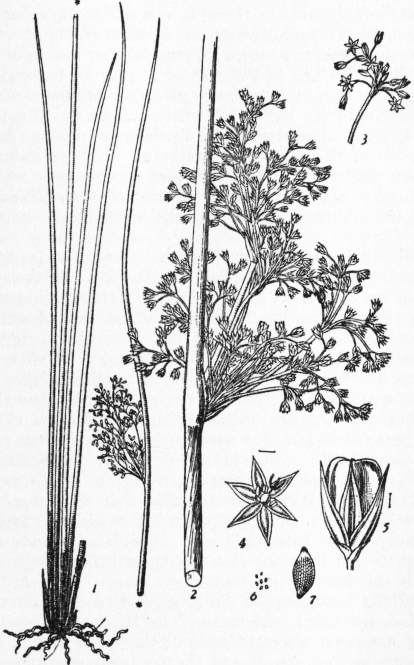
Juncus effusus, common rush.
1. Plant. 2. Inflorescence. 3. End of branch of inflorescence, slightly enlarged. 4. Flower, enlarged. 5. Fruit, enlarged. 6. Seed. 7. Seed, much enlarged.
JUNCTION CITY, a city and the county-seat of Geary county, Kansas, U.S.A., between Smoky Hill and Republican rivers, about 3 m. above their confluence to form the Kansas, and 72 m. by rail W. of Topeka. Pop. (1900), 4695, of whom 545 were foreign-born and 292 were negroes; (1905), 5494; (1910), 5598. Junction City is served by the Union Pacific and the Missouri, Kansas & Texas railways. It is the commercial centre of a region in whose fertile valleys great quantities of wheat, Indian corn, oats and hay are grown and live stock is raised, and whose uplands contain extensive beds of limestone, which is quarried for building purposes. Excellent water-power is available and is partly utilized by flour mills. The municipality owns and operates the water-works. At the confluence of Smoky Hill and Republican rivers and connected with the city by an electric railway is Fort Riley, a U.S. military post, which was established in 1853 as Camp Centre but was renamed in the same year in honour of General Bennett Riley (1787-1853); in 1887 the mounted service school of the U.S. army was established here. Northward from the post is a rugged country over which extends a military reservation of about 19,000 acres. Adjoining the reservation and about 5 m. N.E. of Junction City is the site of the short-lived settlement of Pawnee, where from the 2nd to the 6th of July 1855 the first Kansas legislature met, in a building the ruins of which still remain; the establishment of Pawnee (in December 1854) was a speculative pro-slavery enterprise conducted by the commandant of Fort Riley, other army officers and certain territorial officials, and when a government survey showed that the site lay within the Fort Riley reservation, the settlers were ordered (August 1855) to leave, and the commandant of Fort Riley was dismissed from the army; one of the charges brought against Governor A. H. Reeder was that he had favoured the enterprise. Junction City was founded in 1857 and was chartered as a city in 1859.
JUNE, the sixth month in the Christian calendar, consisting of thirty days. Ovid (Fasti, vi. 25) makes Juno assert that the name was expressly given in her honour. Elsewhere (Fasti, vi. 87) he gives the derivation a junioribus, as May had been derived from majores, which may be explained as in allusion either to the two months being dedicated respectively to youth and age in general, or to the seniors and juniors of the government of Rome, the senate and the comitia curiata in particular. Others connect the term with the gentile name Junius, or with the consulate of Junius Brutus. Probably, however, it originally denoted the month in which crops grow to ripeness. In the old Latin calendar June was the fourth month, and in the so-called year of Romulus it is said to have had thirty days; but at the time of the Julian reform of the calendar its days were only twenty-nine. To these Caesar added the thirtieth. The Anglo-Saxons called June “the dry month,” “midsummer month,” and, in contradistinction to July, “the earlier mild month.” The summer solstice occurs in June. Principal festival days in this month: 11th June, St Barnabas; 24th June, Midsummer Day (Nativity of St John the Baptist); 29th June, St Peter.
JUNEAU, formerly Harrisburg, a mining and trading town picturesquely situated at the mouth of Gold Creek on the continental shore of Gastineau channel, south-east Alaska, and the capital of Alaska. Pop. (1900), 1864 (450 Indians); (1910), 1644. It has a United States custom-house and court-house. The city has fishing, manufacturing and trading interests, but its prosperity is chiefly due to the gold mines in the adjacent Silver Bow basin, the source of Gold Creek, and the site of the great Perseverance mine, and to those on the Treadwell lode on Douglas Island, 2 m. from Juneau. Placer gold was found at the mouth of the creek in 1879, and the city was settled in 1880 by two prospectors named Joseph Juneau and Richard Harris. The district was called Juneau and the camp Harrisburg by the first settlers; exploring naval officers named the camp Rockwell, in honour of Commander Charles Henry Rockwell, U.S.N. (b. 1840). A town meeting then adopted the name of Juneau. The town was incorporated in 1900. In October 1906 the seat of government of Alaska was removed from Sitka to Juneau.
JUNG, JOHANN HEINRICH (1740-1817), best known by his assumed name of Heinrich Stilling, German author, was born in the vlllage of Grund near Hilchenbach in Westphalia on the 12th of September 1740. His father, Wilhelm Jung, schoolmaster and tailor, was the son of Eberhard Jung, charcoal-burner, and his mother was Dortchen Moritz, daughter of a poor clergyman. Jung became, by his father’s desire, schoolmaster and tailor, but found both pursuits equally wearisome. After various teaching appointments he went in 1768 with “half a French dollar” to study medicine at the university of Strassburg. There he met Goethe, who introduced him to Herder. The acquaintance with Goethe ripened into friendship; and it was by his influence that Jung’s first and best work, Heinrich Stillings Jugend was written. In 1772 he settled at Elberfeld as physician and oculist, and soon became celebrated for operations in cases of cataract. Surgery, however, was not much more to his taste than tailoring or teaching; and in 1778 he was glad to accept the appointment of lecturer on “agriculture, technology, commerce and the veterinary art” in the newly established Kameralschule at Kaiserslautern, a post which he continued to hold when the school was absorbed in the university of Heidelberg. In 1787 he was appointed professor of economical, financial and statistical science in the university of Marburg. In 1803 he resigned his professorship and returned to Heidelberg, where he remained until 1806, when he received a pension from the grand-duke Charles Frederick of Baden, and removed to Karlsruhe, where he remained until his death on the 2nd of April 1817. He was married three times, and left a numerous family. Of his works his autobiography Heinrich Stillings Leben, from which he came to be known as Stilling, is the only one now of any interest, and is the chief authority for his life. His early novels reflect the piety of his early surroundings.
A complete edition of his numerous works, in 14 vols. 8vo, was published at Stuttgart in 1835-1838. There are English translations by Sam. Jackson of the Leben (1835) and of the Theorie der Geisterkunde (London, 1834, and New York, 1851); and of Theobald, or the Fanatic, a religious romance, by the Rev. Sam. Schaeffer (1846). See biographies by F. W. Bodemann (1868), J. v. Ewald (1817), Peterson (1890).
JUNG BAHADUR, SIR, Maharajah (1816-1877), prime minister of Nepal, was a grand-nephew of Bhim sena Thapa (Bhim sen Thappa), the famous military minister of Nepal, who from 1804 to 1839 was de facto ruler of the state under the rani Tripuri and her successor. Bhimsena’s supremacy was threatened by the Kala Pandry, and many of his relations, including Jung Bahadur, went into exile in 1838, thus escaping the cruel fate which overtook Bhimsena in the following year. The Pandry leaders, who then reverted to power, were in turn assassinated in 1843, and Matabar Singh, uncle of Jung Bahadur, was created prime minister. He appointed his nephew general and chief judge, but shortly afterwards he was himself put to death. Fateh Jung thereon formed a ministry, of which Jung Bahadur was made military member. In the following year, 1846, a quarrel was fomented, in which Fateh Jung and thirty-two other chiefs were assassinated, and the rani appointed Jung Bahadur sole minister. The rani quickly changed her mind, and planned the death of her new minister, who at once appealed to the maharaja. But the plot failed. The raja and the rani wisely sought safety in India, and Jung Bahadur firmly established his own position by the removal of all dangerous rivals. He succeeded so well that in January 1850 he was able to leave for a visit to England, from which he did not return to Nepal until the 6th of February 1851. On his return, and frequently on subsequent dates, he frustrated conspiracies for his assassination. The reform of the penal code, and a desultory war with Tibet, occupied his attention until news of the Indian Mutiny reached Nepal. Jung Bahadur resisted all overtures from the rebels, and sent a column to Gorakpur in July 1857. In December he furnished a force of 8000 Gurkhas, which reached Lucknow on the 11th of March 1858, and took part in the siege. The moral support of the Nepalese was more valuable even than the military services rendered by them. Jung Bahadur was made a G.C.B., and a tract of country annexed in 1815 was restored to Nepal. Various frontier disputes were settled, and in 1875 Sir Jung Bahadur was on his way to England when he had a fall from his horse in Bombay and returned home. He received a visit from the Prince of Wales in 1876. On the 25th of February 1877 he died, having reached the age of sixty-one. Three of his widows immolated themselves on his funeral pyre.