VOLUME XV SLICE V Joints to Justinian I. (continued 8)
Reading edition
(W. L.-W.)

JUNG-BUNZLAU (Czech, Mladá Boleslav), a town of Bohemia, 44 m. N.N.E. of Prague by rail. Pop. (1900), 13,479, mostly Czech. The town contains several old buildings of historical interest, notably the castle, built towards the end of the 10th century, and now used as barracks. There are several old churches. In that of St Maria the celebrated bishop of the Bohemian brethren, Johann August, was buried in 1595; but his tomb was destroyed in 1621. The church of St Bonaventura with the convent, originally belonging to the friars minor and later to the Bohemian brethren, is now a Piaristic college. The church of St Wenceslaus, once a convent of the brotherhood, is now used for military stores. Jung-Bunzlau was built in 995, under Boleslaus II., as the seat of a gaugraf or royal count. Early in the 13th century it was given the privileges of a town and pledged to the lords of Michalovic. In the Hussite wars Jung-Bunzlau adhered to the Taborites and became later the metropolis of the Bohemian Brethren. In 1595 Bohuslav of Lobkovic sold his rights as over-lord to the town, which was made a royal city by Rudolf II. During the Thirty Years’ War it was twice burned, in 1631 by the imperialists, and in 1640 by the Swedes.
JUNGFRAU, a well-known Swiss mountain (13,669 ft.), admirably seen from Interlaken. It rises on the frontier between the cantons of Bern and of the Valais, and is reckoned among the peaks of the Bernese Oberland, two of which (the Finsteraarhorn, 14,026 ft., and the Aletschhorn, 13,721 ft.) surpass it in height. It was first ascended in 1811 by the brothers Meyer, and again in 1812 by Gottlieb Meyer (son of J. R. Meyer), in both cases by the eastern or Valais side, the foot of which (the final ascent being made by the 1811-1812 route) was reached in 1828 over the Mönchjoch by six peasants from Grindelwald. In 1841 Principal J. D. Forbes, with Agassiz, Desor and Du Châtelier, made the fourth ascent by the 1812 route. It was not till 1865 that Sir George Young and the Rev. H. B. George succeeded in making the first ascent from the west or Interlaken side. This is a far more difficult route than that from the east, the latter being now frequently taken in the course of the summer.
(W. A. B. C.)
JUNGLE (Sans. jangala), an Anglo-Indian term for a forest, a thicket, a tangled wilderness. The Hindustani word means strictly waste, uncultivated ground; then such ground covered with trees or long grass; and thence again the Anglo-Indian application is to forest or other wild growth, rather than to the fact that it is not cultivated.
JUNIN, an interior department of central Peru, bounded N. by Huanuco, E. by Loreto and Cuzco, S. by Huancavelica, and W. by Lima and Ancachs. Pop. (1906 estimate), 305,700. It lies wholly within the Andean zone and has an area of 23,353 sq. m. It is rich in minerals, including silver, copper, mercury, bismuth, molybdenum, lead and coal. The Huallaga and Mantaro rivers have their sources in this department, the latter in Lake Junin, or Chanchaycocha, 13,230 ft. above sea-level. The capital of Junin is Cerro de Pasco, and its two principal towns are Jauja and Tarma (pop., 1906, about 12,000 and 5000 respectively).
JUNIPER. The junipers, of which there are twenty-five or more species, are evergreen bushy shrubs or low columnar trees, with a more or less aromatic odour, inhabiting the whole of the cold and temperate northern hemisphere, but attaining their maximum development in the Mediterranean region, the North Atlantic islands, and the eastern United States. The leaves are usually articulated at the base, spreading, sharp-pointed and needle-like in form, destitute of oil-glands, and arranged in alternating whorls of three; but in some the leaves are minute and scale-like, closely adhering to the branches, the apex only being free, and furnished with an oil-gland on the back. Sometimes the same plant produces both kinds of leaves on different branches, or the young plants produce acicular leaves, while those of the older plants are squamiform. The male and female flowers are usually produced on separate plants. The male flowers are developed at the ends of short lateral branches, are rounded or oblong in form, and consist of several antheriferous scales in two or three rows, each scale bearing three or six almost spherical pollen-sacs on its under side. The female flower is a small bud-like cone situated at the apex of a small branch, and consists of two or three whorls of two or three scales. The scales of the upper or middle series each bear one or two erect ovules. The mature cone is fleshy, with the succulent scales fused together and forming the fruit-like structure known to the older botanists as the galbulus, or berry of the juniper. The berries are red or purple in colour, varying in size from that of a pea to a nut. They thus differ considerably from the cones of other members of the order Coniferae, of Gymnosperms (q.v.), to which the junipers belong. The seeds are usually three in number, sometimes fewer (1), rarely more (8), and have the surface near the middle or base marked with large glands containing oil. The genus occurs in a fossil state, four species having been described from rocks of Tertiary age.
The genus is divided into three sections, Sabina, Oxycedrus and Caryocedrus. Juniperus Sabina is the savin, abundant on the mountains of central Europe, an irregularly spreading much-branched shrub with scale-like glandular leaves, and emitting a disagreeable odour when bruised. The plant is poisonous, acting as a powerful local and general stimulant, diaphoretic, emmenagogue and anthelmintic; it was formerly employed both internally and externally. The oil of savin is now occasionally used criminally as an abortifacient. J. bermudiana, a tree about 40 or 50 ft. in height, yields a fragrant red wood, which was used for the manufacture of “cedar” pencils. The tree is now very scarce in Bermuda, and the “red cedar,” J. virginiana, of North America is employed instead for pencils and cigar-boxes. The red cedar is abundant in some parts of the United States and in Virginia is a tree 50 ft. in height. It is very widely distributed from the Great Lakes to Florida and round the Gulf of Mexico, and extends as far west as the Rocky Mountains and beyond to Vancouver Island. The wood is applied to many uses in the United States. The fine red fragrant heart-wood takes a high polish, and is much used in cabinet-work and inlaying, but the small size of the planks prevents its more extended use. The galls produced at the ends of the branches have been used in medicine, and the wood yields cedar-camphor and oil of cedar-wood. J. thurifera is the incense juniper of Spain and Portugal, and J. phoenicea (J. lycia) from the Mediterranean district is stated by Loudon to be burned as incense.
J. communis, the common juniper (see fig.), and several other species, belong to the section Oxycedrus. The common juniper is a very widely distributed plant, occurring in the whole of northern Europe, central and northern Asia to Kamchatka, and east and west North America. It grows at considerable elevations in southern Europe, in the Alps, Apennines, Pyrenees and Sierra Nevada (4000 to 8000 ft.). It also grows in Asia Minor, Persia, and at great elevations on the Himalayas. In Great Britain it is usually a shrub with spreading branches, less frequently a low tree. In former times the juniper seems to have been a very well-known plant, the name occurring almost unaltered in many languages. The Lat. juniperus, probably formed from juni—crude form of juvenis, fresh, young, and parere, to produce, is represented by Fr. genièvre, Sp. enebro, Ital. ginepito, &c. The dialectical names, chiefly in European languages, were collected by Prince L. L. Bonaparte, and published in the Academy (July 17, 1880, No. 428, p. 45). The common juniper is official in the British pharmacopoeia and in that of the United States, yielding the oil of juniper, a powerful diuretic, distilled from the unripe fruits. This oil is closely allied in composition to oil of turpentine and is given in doses of a half to three minims. The Spiritus juniperi of the British pharmacopoeia is given in doses up to one drachm. Much safer and more powerful diuretics are now in use. The wood is very aromatic and is used for ornamental purposes. In Lapland the bark is made into ropes. The fruits are used for flavouring gin (a name derived from juniper, through Fr. genièvre); and in some parts of France a kind of beer called genévrette was made from them by the peasants. J. Oxycedrus, from the Mediterranean district and Madeira, yields cedar-oil which is official in most of the European pharmacopoeias, but not in that of Britain. This oil is largely used by microscopists in what is known as the “oil-immersion lens.”
The third section, Caryocedrus, consists of a single species, J. drupacea of Asia Minor. The fruits are large and edible: they are known in the East by the name habhel.
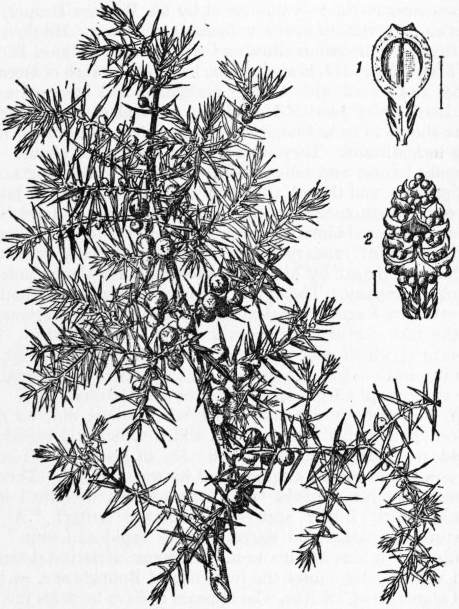
(From Bentley and Trimen’s Medicinal Plants, by permission of J. & A. Churchill.)
Juniper (Juniperus communis).
1. Vertical section of fruit. 2. Male catkin.
JUNIUS, the pseudonym of a writer who contributed a series of letters to the London Public Advertiser, from the 21st of January 1769 to the 21st of January 1772. The signature had been already used by him in a letter of the 21st of November 1768, which he did not include in his collection of the Letters of Junius published in 1772. The name was chosen in all probability because he had already signed “Lucius” and “Brutus,” and wished to exhaust the name of Lucius Junius Brutus the Roman patriot. Whoever the writer was, he wrote under other pseudonyms before, during and after the period between January 1769 and January 1772. He acknowledged that he had written as “Philo-Junius,” and there is evidence that he was identical with “Veteran,” “Nemesis” and other anonymous correspondents of the Public Advertiser. There is a marked distinction between the “letters of Junius” and his so-called miscellaneous letters. The second deal with a variety of subjects, some of a purely personal character, as for instance the alleged injustice of Viscount Barrington the secretary at war to the officials of his department. But the “letters of Junius” had a definite object—to discredit the ministry of the duke of Grafton. This administration had been formed in October 1768, when the earl of Chatham was compelled by ill health to retire from office, and was a reconstruction of his cabinet of July 1766. Junius fought for the return to power of Chatham, who had recovered and was not on good terms with his successors. He communicated with Chatham, with George Grenville, with Wilkes, all enemies of the duke of Grafton, and also with Henry Sampson Woodfall, printer and part owner of the Public Advertiser. This private correspondence has been preserved. It is written in the disguised hand used by Junius.
The letters are of interest on three grounds—their political significance, their style, and the mystery which long surrounded their authorship. As political writings they possess no intrinsic value. Junius was wholly destitute of insight, and of the power to disentangle, define and advocate principles. The matter of his letters is always invective. He began by a general attack on the ministry for their personal immorality or meanness. An ill-judged defence of one of the body—the marquess of Granby, commander-in-chief—volunteered by Sir William Draper, gave him an easy victory over a vulnerable opponent. He then went on to pour acrimonious abuse on Grafton, on the duke of Bedford, on King George III. himself in the letter of the 19th of December 1769, and ended with a most malignant and ignorant assault on Lord Chief Justice Mansfield. Several of his accusations were shown to be unfounded. The practical effect of the letters was insignificant. They were noticed and talked about. They provoked anger and retorts. But the letter to the king aroused indignation, and though Grafton’s administration fell in January 1770, it was succeeded by the long-lived cabinet of Lord North. Junius confessed himself beaten, in his private letter to Woodfall of the 19th of January 1773. He had materially contributed to his own defeat by his brutal violence. He sinned indeed in a large company. The employment of personal abuse had been habitual in English political controversy for generations, and in the 18th century there was a strong taste for satire. Latin literature, which was not only studied but imitated, supplied the inspiration and the models, in the satires of Juvenal, and the speeches of Cicero against Verres and Catiline.
If, however, Junius was doing what others did, he did it better than anybody else—a fact which sufficiently explains his rapid popularity. His superiority lay in his style. Here also he was by no means original, and he was unequal. There are passages in his writings which can be best described in the words which Burke applied to another writer: “A mere mixture of vinegar and water, at once vapid and sour.” But at his best Junius attains to a high degree of artificial elegance and vigour. He shows the influence of Bolingbroke, of Swift, and above all of Tacitus, who appears to have been his favourite author. The imitation is never slavish. Junius adapts, and does not only repeat. The white heat of his malignity animates the whole. No single sentence will show the quality of a style which produces its effect by persistence and repetition, but such a typical passage as follows displays at once the method and the spirit. It is taken from Letter XLIX. to the duke of Grafton, June 22, 1771:—
“The profound respect I bear to the gracious prince who governs this country with no less honour to himself than satisfaction to his subjects, and who restores you to your rank under his standard, will save you from a multitude of reproaches. The attention I should have paid to your failings is involuntarily attracted to the hand which rewards them; and though I am not so partial to the royal judgment as to affirm that the favour of a king can remove mountains of infamy, it serves to lessen at least, for undoubtedly it divides, the burden. While I remember how much is due to his sacred character, I cannot, with any decent appearance of propriety, call you the meanest and the basest fellow in the kingdom. I protest, my Lord, I do not think you so. You will have a dangerous rival in that kind of fame to which you have hitherto so happily directed your ambition, as long as there is one man living who thinks you worthy of his confidence, and fit to be trusted with any share in his government.... With any other prince, the shameful desertion of him in the midst of that distress, which you alone had created, in the very crisis of danger, when he fancied he saw the throne already surrounded by men of virtue and abilities, would have outweighed the memory of your former services. But his majesty is full of justice, and understands the doctrine of compensations; he remembers with gratitude how soon you had accommodated your morals to the necessities of his service, how cheerfully you had abandoned the engagements of private friendship, and renounced the most solemn professions to the public. The sacrifice of Lord Chatham was not lost on him. Even the cowardice and perfidy of deserting him may have done you no disservice in his esteem. The instance was painful, but the principle might please.”
What is artificial and stilted in this style did not offend the would-be classic taste of the 18th century, and does not now conceal the fact that the laboriously arranged words, and artfully counterbalanced clauses, convey a venomous hate and scorn.
The pre-established harmony between Junius and his readers accounts for the rapidity of his success, and for the importance attributed to him by Burke and Johnson, far better writers than himself. Before 1772 there appeared at least twelve unauthorized republications of his letters, made by speculative printers. In that year he revised the collection named “Junius: Stat nominis umbra,” with a dedication to the English people and a preface. Other independent editions followed in quick succession. In 1801 one was published with annotations by Robert Heron. In 1806 another appeared with notes by John Almon. The first new edition of real importance was issued by the Woodfall family in 1812. It contained the correspondence of Junius with H. S. Woodfall, a selection of the miscellaneous letters attributed to Junius, facsimiles of his handwriting, and notes by Dr Mason Good. Curiosity as to the mystery of the authorship began to replace political and literary interest in the writings. Junius himself had been early aware of the advantage he secured by concealment. “The mystery of Junius increases his importance” is his confession in a letter to Wilkes dated the 18th of September 1771. The calculation was a sound one. For two generations after the appearance of the letter of the 21st of January 1769, speculations as to the authorship of Junius were rife, and discussion had hardly ceased in 1910. Joseph Parkes, author with Herman Merivale of the Memoirs of Sir Philip Francis (1867), gives a list of more than forty persons who had been supposed to be Junius. They are: Edmund Burke, Lord George Sackville, Lord Chatham, Colonel Barré, Hugh Macaulay Boyd, Dr Butler, John Wilkes, Lord Chesterfield, Henry Flood, William Burke, Gibbon, W. E. Hamilton, Charles Lloyd, Charles Lee (general in the American War of Independence), John Roberts, George Grenville, James Grenville, Lord Temple, Duke of Portland, William Greatrakes, Richard Glover, Sir William Jones, James Hollis, Laughlin Maclean, Philip Rosenhagen, Horne Tooke, John Kent, Henry Grattan, Daniel Wray, Horace Walpole, Alexander Wedderburn (Lord Loughborough), Dunning (Lord Ashburton), Lieut.-General Sir R. Rich, Dr Philip Francis, a “junto” or committee of writers who used a common name, De Lolme, Mrs Catherine Macaulay (1733-91), Sir Philip Francis, Lord Littleton, Wolfram Cornwall and Gov. Thomas Pownall. In the great majority of cases the attribution is based on nothing more than a vague guess. Edmund Burke denied that he could have written the letters of Junius if he would, or would have written them if he could. Grattan pointed out that he was young when they appeared. More plausible claims, such as those made for Lord Temple and Lord George Sackville, could not stand the test of examination. Indeed after 1816 the question was not so much “Who wrote Junius?” as “Was Junius Sir Philip Francis, or some undiscoverable man?” In that year John Taylor was led by a careful study of Woodfall’s edition of 1812 to publish The identity of Junius with a distinguished living character established, in which he claimed the letters for Sir Philip Francis. He had at first been inclined to attribute them to Sir Philip’s father, Dr Francis, the author of translations of Horace and Demosthenes. Taylor applied to Sir Philip, who did not die till 1818, for leave to publish, and received from him answers which to an unwary person might appear to constitute denials of the authorship, but were in fact evasions.
The reasons for believing that Sir Philip Francis (q.v.) was Junius are very strong. His evasions were only to be expected. Several of the men he attacked lived nearly as long as himself, the sons of others were conspicuous in society, and King George III. survived him. Sir Philip, who had held office, who had been decorated, and who in his later years was ambitious to obtain the governor-generalship of India, dared not confess that he was Junius. The similarity of his handwriting to the disguised hand used by the writer of the letters is very close. If Sir Philip Francis did, as his family maintain, address a copy of verses to a Miss Giles in the handwriting of Junius (and the evidence that he did is weighty) there can be no further question as to the identity of the two. The similarity of Junius and Francis in regard to their opinions, their likes and dislikes, their knowledge and their known movements, amount, apart from the handwriting, almost to proof. It is certain that many felons have been condemned on circumstantial evidence less complete. The opposition to his claim is based on such assertions as that his known handwriting was inferior to the feigned hand of Junius, and that no man can make a disguised hand better than his own. But the first assertion is unfounded, and the second is a mere expression of opinion. It is also said that Francis must have been guilty of baseness if he wrote Junius, but if that explains why he did not avow the authorship it can be shown to constitute a moral impossibility only by an examination of his life.
Authorities.—The best edition of the Letters of Junius, properly so called, with the Miscellaneous Letters, is that of J. Ward (1854). The most valuable contributions to the controversy as to the authorship are: The Handwriting of Junius investigated by Charles Chabot, expert, with preface and collateral evidence by the Hon. E. Twisleton (1871); Memoirs of Sir Philip Francis, K.C.B., by Parkes and Merivale (1867); Junius Revealed by his Surviving Grandson, by H. R. Francis (1894); The Francis Letters, edited by Beata Francis and Eliza Keary, with a note on the Junius controversy by C. F. Keary (1901); and “Francis, Sir Philip,” by Sir Leslie Stephen, in Dict. of Nat. Biog. The case for those who decline to accept the claim of Sir Philip Francis is stated by C. W. Dilke, Papers of a Critic (1875), and Abraham Hayward, More about Junius, Franciscan Theory Unsound (1868).
(D. H.)
JUNIUS, FRANZ (in French, François du Jon), the name of two Huguenot scholars.
(1) Franz Junius (1545-1602) was born at Bourges in France on the 1st of May 1545. He had studied law for two years under Hugo Donellus (1527-1591) when he was given a place in the retinue of the French ambassador to Constantinople, but before he reached Lyons the ambassador had departed. Junius found ample consolation in the opportunities for study at the gymnasium at Lyons. A religious tumult warned him back to Bourges, where he was cured of certain rationalistic principles that he had imbibed at Lyons, and he determined to enter the reformed church. He went in 1562 to study at Geneva, where he was reduced to the direst poverty by the failure of remittances from home, owing to civil war in France. He would accept only the barest sustenance from a humble friend who had himself been a protégé of Junius’s family at Bourges, and his health was permanently injured. The long-expected remittance from home was closely followed by the news of the brutal murder of his father by a Catholic fanatic at Issoudun; and Junius resolved to remain at Geneva, where his reputation enabled him to live by teaching. In 1565, however, he was appointed minister of the Walloon church at Antwerp. His foreign birth excluded him from the privileges of the native reformed pastors, and exposed him to persecution. Several times he barely escaped arrest, and finally, after spending six months in preaching at Limburg, he was forced to retire to Heidelberg in 1567. There he was welcomed by the elector Frederick II., and temporarily settled in charge of the Walloon church at Schönau; but in 1568 his patron sent him as chaplain with Prince William of Orange in his unfortunate expedition to the Netherlands. Junius escaped as soon as he could from that post, and returning to his church remained there till 1573. From 1573 till 1578 he was at Heidelberg, assisting Emmanuel Tremellius (1510-1580), whose daughter he married, in his Latin version of the Old Testament (Frankfort, 1579); in 1581 he was appointed to the chair of divinity at Heidelberg. Thence he was taken to France by the duke of Bouillon, and after an interview with Henry IV. was sent again to Germany on a mission. As he was returning to France he was named professor of theology at Leiden, where he died on the 13th of October 1602.
He was a voluminous writer on theological subjects, and translated and composed many exegetical works. He is best known from his own edition of the Latin Old Testament, slightly altered from the former joint edition, and with a version of the New Testament added (Geneva, 1590; Hanover, 1624). The Opera Theologica Francisci Junii Biturigis were published at Geneva (2 vols., 1613), to which is prefixed his autobiography, written about 1592 (new ed., edited by Abraham Kuypers, 1882 seq.). The autobiography had been published at Leiden (1595), and is reprinted in the Miscellanea Groningana, vol. i., along with a list of the author’s other writings.
(2) Franz Junius (1589-1677), son of the above, was born at Heidelberg, and brought up at Leiden. His attention was diverted from military to theological studies by the peace of 1609 between Spain and the Netherlands. In 1617 he became pastor at Hillegondsberg, but in 1620 went to England, where he became librarian to Thomas Howard, earl of Arundel, and tutor to his son. He remained in England thirty years, devoting himself to the study of Anglo-Saxon, and afterwards of the cognate old Teutonic languages. His work, intrinsically valuable, is important as having aroused interest in a frequently neglected subject. In 1651 he returned to Holland; and for two years lived in Friesland in order to study the old dialect. In 1675 he returned to England, and during the next year resided in Oxford; in 1677 he went to live at Windsor with his nephew, Isaac Vossius, in whose house he died on the 19th of November 1677. He was buried at Windsor in St George’s Chapel.
He was pre-eminently a student. He published De pictura veterum (1637) (in English by the author, 1638; enlarged and improved edition, edited by J. G. Graevius, who prefixed a life of Junius, with a catalogue of architects, painters, &c., and their works, Rotterdam, 1694); Observationes in Willerami Abbatis francicam paraphrasin cantici canticorum (Amsterdam, 1655); Annotationes in harmoniam latino-francicam quatuor evangelistarum, latine a Tatiano confectam (Amsterdam, 1655); Caedmonis monachi paraphrasis poetica geneseos (Amsterdam, 1655) (see criticism under Caedmon); Quatuor D.N.I.C. evangeliorum versiones perantiquae duae, gothica scilicet et anglo-saxonica (Dort, 2 vols., 1665) (the Gothic version in this book Junius transcribed from the Silver Codex of Ulfilas; the Anglo-Saxon version is from an edition by Thomas Marshall, whose notes to both versions are given, and a Gothic glossary by Junius); Etymologicum anglicanum, edited by Edward Lye, and preceded by a life of Junius and George Hickes’s Anglo-Saxon grammar (Oxford, 1743) (its results require careful verification in the light of modern research). His rich collection of ancient MSS., edited and annotated by him, Junius bequeathed to the university of Oxford. Graevius gives a list of them; the most important are a version of the Ormulum, the version of Caedmon, and 9 volumes containing Glossarium v. linguarum septentrionalium.
JUNK. (1) (Through Port. junco, adapted from Javanese djong, or Malayan adjong, ship), the name of the native sailing vessel, common to the far eastern seas, and especially used by the Chinese and Javanese. It is a flat-bottomed, high-sterned vessel with square bows and masts carrying lug-sails, often made of matting. (2) A nautical term for small pieces of disused rope or cable, cut up to make fenders, oakum, &c., hence applied colloquially by sailors to the salt beef and pork used on board ship. The word is of doubtful origin, but may be connected with “junk” (Lat. juncus), a reed, or rush. This word is now obsolete except as applied to a form of surgical appliance, used as a support in cases of fracture where immediate setting is impossible, and consisting of a shaped pillow or cushion stuffed with straw or horsehair, formerly with rushes or reeds.
JUNKER, WILHELM (1840-1892), German explorer of Africa, was born at Moscow on the 6th of April 1840. He studied medicine at Dorpat, Göttingen, Berlin and Prague, but did not practise for long. After a series of short journeys to Iceland, Tunis and Lower Egypt, he remained almost continuously in eastern Equatorial Africa from 1875 to 1886, making first Khartum and afterwards Lado the base of his expeditions, Junker was a leisurely traveller and a careful observer; his main object was to study the peoples with whom he came into contact, and to collect specimens of plants and animals, and the result of his investigations in these particulars is given in his Reisen in Afrika (3 vols., Vienna, 1889-1891), a work of high merit. An English translation by A. H. Keane was published in 1890-1892. Perhaps the greatest service he rendered to geographical science was his investigation of the Nile-Congo watershed, when he successfully combated Georg Schweinfurth’s hydrographical theories and established the identity of the Welle and Ubangi. The Mahdist rising prevented his return to Europe through the Sudan, as he had planned to do, in 1884, and an expedition, fitted out in 1885 by his brother in St Petersburg, failed to reach him. Junker then determined to go south. Leaving Wadelai on the 2nd of January 1886 he travelled by way of Uganda and Tabora and reached Zanzibar in December 1886. In 1887 he received the gold medal of the Royal Geographical Society. As an explorer Junker is entitled to high rank, his ethnographical observations in the Niam-Niam (Azandeh) country being especially valuable. He died at St Petersburg on the 13th of February 1892.
See the biographical notice by E. G. Ravenstein in Proceedings of the Royal Geographical Society (1892), pp. 185-187.
JUNKET, a dish of milk curdled by rennet, served with clotted cream and flavoured with nutmeg, which is particularly associated in England with Devonshire and Cornwall. The word is of somewhat obscure history. It appears to come through O. Fr. jonquette, a rush-basket, from Lat. juncus, rush. In Norman dialect this word is used of a cream cheese. The commonly accepted origin is that it refers to the rush-basket on which such cream cheeses or curds were served. Juncade appears in Rabelais, and is explained by Cotgrave as “spoon-meat, rose-water and sugar.” Nicholas Udall (in his translation of Erasmus’s Apophthegms, 1542) speaks of “marchepaines or wafers with other like junkerie.” The word “junket” is also used for a festivity or picnic.
JUNO, the chief Roman and Latin goddess, and the special object of worship by women at all the critical moments of life. The etymology of the name is not certain, but it is usually taken as a shortened form of Jovino, answering to Jovis, from a root div, shining. Under Greek influence Juno was early identified with the Greek Hera, with whose cult and characteristics she has much in common; thus the Juno with whom we are familiar in Latin literature is not the true Roman deity. In the Aeneid, for example, her policy is antagonistic to the plans of Jupiter for the conquest of Latium and the future greatness of Rome; though in the fourth Eclogue, as Lucina, she appears in her proper rôle as assisting at childbirth. It was under Greek influence again that she became the wife of Jupiter, the mother of Mars; the true Roman had no such personal interest in his deities as to invent family relations for them.
That Juno was especially a deity of women, and represents in a sense the female principle of life, is seen in the fact that as every man had his genius, so every woman had her Juno; and the goddess herself may have been a development of this conception. The various forms of her cult all show her in close connexion with women. As Juno Lucina she was invoked in childbirth, and on the 1st of March, the old Roman New Year’s day, the matrons met and made offerings at her temple in a grove on the Esquiline; hence the day was known as the Matronalia. As Caprotina she was especially worshipped by female slaves on the 7th of July (Nonae Caprotinae); as Sospita she was invoked all over Latium as the saviour of women in their perils, and later as the saviour of the state; and under a number of other titles, Cinxia, Unxia, Pronuba, &c., we find her taking a leading part in the ritual of marriage. Her real or supposed connexion with the moon is explained by the alleged influence of the moon on the lives of women; thus she became the deity of the Kalends, or day of the new moon, when the regina sacrorum offered a lamb to her in the regia, and her husband the rex made known to the people the day on which the Nones would fall. Thus she is brought into close relation with Janus, who also was worshipped on the Kalends by the rex sacrorum, and it may be that in the oldest Roman religion these two were more closely connected than Juno and Jupiter. But in historical times she was associated with Jupiter in the great temple on the Capitoline hill as Juno Regina, the queen of all Junones or queen of heaven, as Jupiter there was Optimus Maximus (see Jupiter), and under the same title she was enticed from Veii after its capture in 392 B.C., and settled in a temple on the Aventine. Thus exalted above all other female deities, she was prepared for that identification with Hera which was alluded to above. That she was in some sense a deity of light seems certain; as Lucina, e.g., she introduced new-born infants “in luminis oras.”
See Roscher’s article “Juno” in his Lexicon of Mythology, and his earlier treatise on Juno and Hera; Wissowa, Religion und Kultus der Römer, 113 foll.; also a fresh discussion by Walter Otto in Philologus for 1905 (p. 161 foll.).
(W. W. F.*)
JUNOT, ANDOCHE, Duke of Abrabantes (1771-1813), French general, was born at Bussy-le-Grand (Côte d’Or), on the 23rd of October 1771. He went to school at Chatillon, and was known among his comrades as a blustering but lovable creature, with a pugnacious disposition. He was studying law in Paris at the outbreak of the Revolution and joined a volunteer battalion. He distinguished himself by his valour in the first year of the Revolutionary wars, and came under the special notice of Napoleon Bonaparte during the siege of Toulon, while serving as his secretary. It is related that as he was taking down a despatch, a shell burst hard by and covered the paper with sand, whereupon he exclaimed, “Bien! nous n’avions pas de sable pour sécher l’encre! en voici!” He remained the faithful companion of his chief during the latter’s temporary disgrace, and went with him to Italy as aide-de-camp. He distinguished himself so much at the battle of Millesimo that he was selected to carry back the captured colours to Paris; returning to Italy he went through the campaign with honour, but was badly wounded in the head at Lonato. Many rash incidents in his career may be traced to this wound, from which he never completely recovered. During the expedition to Egypt he became a general of brigade. His devotion to Bonaparte involved him in a duel with General Lanusse, in which he was again wounded. He had to be left in Egypt to recover, and in crossing to France was captured by English cruisers. On his return to France he was made commandant of Paris, and afterwards promoted general of division. It was at this time that he married Laure Permon (see Junot, Laure). He next served at Arras in command of the grenadiers of the army destined for the invasion of England, and made some alterations in the equipment of the troops which received the praise of the emperor. It was, however, a bitter mortification that he was not appointed a marshal of France when he received the grand cross of the legion of honour. He was made colonel-general of hussars instead and sent as ambassador to Lisbon, his entry into which city resembled a royal progress. But he was so restless and dissatisfied in the Portuguese capital that he set out, without leave, for the army of Napoleon, with which he took part in the battle of Austerlitz, behaving with his usual courage and zeal. But he soon gave fresh offence. Although his early devotion was never forgotten by the emperor, his uncertain temper and want of self-control made it dangerous to employ him at court or headquarters, and he was sent to Parma to put down an insurrection and to be out of the way. In 1806 he was recalled and became governor of Paris. His extravagance and prodigality shocked the government, and some rumours of an intrigue with a lady of the imperial family—it is said Pauline Bonaparte—made it desirable again to send him away. He was therefore appointed to lead an invading force into Portugal. For the first time Junot had a great task to perform, and only his own resources to fall back upon for its achievement. Early in November 1807 he set out from Salamanca, crossed the mountains of Beira, rallied his wearied forces at Abrantes, and, with 1500 men, dashed upon Lisbon, in order, if possible, to seize the Portuguese fleet, which had, however, just sailed away with the regent and court to Brazil. The whole movement only took a month; it was undoubtedly bold and well-conducted, and Junot was made duke of Abrantes and invested with the governorship of Portugal. But administration was his weak point. He was not a civil governor, but a sabreur, brave, truculent, and also dissipated and rapacious, though in the last respect he was far from being the worst offender amongst the French generals in Spain. His hold on Portugal was never supported by a really adequate force, and his own conduct, which resembled that of an eastern monarch, did nothing to consolidate his conquest. After Wellesley encountered him at Vimiera (see Peninsular War) he was obliged to conclude the so-called convention of Cintra, and to withdraw from Portugal with all his forces. Napoleon was furious, but, as he said, was spared the necessity of sending his old friend before a court martial by the fact that the English put their own generals on their trial. Junot was sent back to Spain, where, in 1810-1811, acting under Masséna, he was once more seriously wounded. His last campaign was made in Russia, and he received more than a just share of discredit for it. Napoleon next appointed him to govern Illyria. But Junot’s mind had become deranged under the weight of his misfortunes, and on the 29th of July 1813, at Montbard, he threw himself from a window in a fit of insanity.
JUNOT, LAURE, Duchess of Abrantes (1783-1834), wife of the preceding, was born at Montpellier. She was the daughter of Mme. Permon, to whom during her widowhood the young Bonaparte made an offer of marriage—such at least is the version presented by the daughter in her celebrated Memoirs. The Permon family, after various vicissitudes, settled at Paris, and Bonaparte certainly frequented their house a good deal after the downfall of the Jacobin party in Thermidor 1794. Mlle. Permon was married to Junot early in the consulate, and at once entered eagerly into all the gaieties of Paris, and became noted for her beauty, her caustic wit, and her extravagance. The first consul nicknamed her petite peste, but treated her and Junot with the utmost generosity, a fact which did not restrain her sarcasms and slanders in her portrayal of him in her Memoirs. During Junot’s diplomatic mission to Lisbon, his wife displayed her prodigality so that on his return to Paris in 1806 he was burdened with debts, which his own intrigues did not lessen. She joined him again at Lisbon after he had entered that city as conqueror at the close of 1807; but even the presents and spoils won at Lisbon did not satisfy her demands; she accompanied Junot through part of the Peninsular War. On her return to France she displeased the emperor by her vivacious remarks and by receiving guests whom he disliked. The mental malady of Junot thereafter threatened her with ruin; this perhaps explains why she took some part in the intrigues for bringing back the Bourbons in 1814. She did not side with Napoleon during the Hundred Days. After 1815 she spent most of her time at Rome amidst artistic society, which she enlivened with her sprightly converse. She also compiled her spirited but somewhat spiteful Memoirs, which were published at Paris in 1831-1834 in 18 volumes. Many editions have since appeared.
Of her other books the most noteworthy are Histoires contemporaines (2 vols., 1835); Scènes de la vie espagnole (2 vols., 1836); Histoire des salons de Paris (6 vols., 1837-1838); Souvenirs d’une ambassade et d’un séjour en Espagne et en Portugal, de 1808 à 1811 (2 vols., 1837).
(J. Hl. R.)
JUNTA (from juntar, to join), a Spanish word meaning (1) any meeting for a common purpose; (2) a committee; (3) an administrative council or board. The original meaning is now rather lost in the two derivative significations. The Spaniards have even begun to make use of the barbarism métin, corrupted from the English “meeting.” The word junta has always been and still is used in the other senses. Some of the boards by which the Spanish administration was conducted under the Habsburg and the earlier Bourbon kings were styled juntas. The superior governing body of the Inquisition was the junta suprema. The provincial committees formed to organize resistance to Napoleon’s invasion in 1808 were so called, and so was the general committee chosen from among them to represent the nation. In the War of Independence (1808-1814), and in all subsequent civil wars or revolutionary disturbances in Spain or Spanish America, the local executive bodies, elected, or in some cases self-chosen, to appoint officers, raise money and soldiers, look after the wounded, and discharge the functions of an administration, have been known as juntas.
The form “Junto,” a corruption due to other Spanish words ending in -o, came into use in English in the 17th century, often in a disparaging sense, of a party united for a political purpose, a faction or cabal; it was particularly applied to the advisers of Charles I., to the Rump under Cromwell, and to the leading members of the great Whig houses who controlled the government in the reigns of William III. and Anne.
JUPITER, the chief deity of the Roman state. The great and constantly growing influence exerted from a very early period on Rome by the superior civilization of Greece not only caused a modification of the Roman god on the analogy of Zeus, the supreme deity of the Greeks, but led the Latin writers to identify the one with the other, and to attribute to Jupiter myths and family relations which were purely Greek and never belonged to the real Roman religion. The Jupiter of actual worship was a Roman god; the Jupiter of Latin literature was more than half Greek. This identification was facilitated by the community of character which really belonged to Jupiter and Zeus as the Roman and Greek developments of a common original conception of the god of the light and the heaven.
That this was the original idea of Jupiter, not only in Rome, but among all Italian peoples, admits of no doubt. The earliest form of his name was Diovis pater, or Diespiter, and his special priest was the flamen dialis; all these words point to a root div, shining, and the connexion with dies, day, is obvious (cf. Juno). One of his most ancient epithets is Lucetius, the light-bringer; and later literature has preserved the same idea in such phrases as sub Jove, under the open sky. All days of the full moon (idus) were sacred to him; all emanations from the sky were due to him and in the oldest form of religious thought were probably believed to be manifestations of the god himself. As Jupiter Elicius he was propitiated, with a peculiar ritual, to send rain in time of drought; as Jupiter Fulgur he had an altar in the Campus Martius, and all places struck by lightning were made his property and guarded from the profane by a circular wall. The vintage, which needs especially the light and heat of the sun, was under his particular care, and in the festivals connected with it (Vinalia urbana) and Meditrinalia, he was the deity invoked, and his flamen the priest employed. Throughout Italy we find him worshipped on the summits of hills, where nothing intervened between earth and heaven, and where all the phenomena of the sky could be conveniently observed. Thus on the Alban hill south of Rome was an ancient seat of his worship as Jupiter Latiaris, which was the centre of the league of thirty Latin cities of which Rome was originally an ordinary member. At Rome itself it is on the Capitoline hill that we find his oldest temple, described by Livy (i. 10); here we have a tradition of his sacred tree, the oak, common to the worship both of Zeus and Jupiter, and here too was kept the lapis silex, perhaps a celt, believed to have been a thunderbolt, which was used symbolically by the fetiales when officially declaring war and making treaties on behalf of the Roman state. Hence the curious form of oath, Jovem lapident jurare, used both in public and private life at Rome.
In this oldest Jupiter of the Latins and Romans, the god of the light and the heaven, and the god invoked in taking the most solemn oaths, we may undoubtedly see not only the great protecting deity of the race, but one, and perhaps the only one, whose worship embodies a distinct moral conception. He is specially concerned with oaths, treaties and leagues, and it was in the presence of his priest that the most ancient and sacred form of marriage, confarreatio, took place. The lesser deities, Dius Fidius and Fides, were probably originally identical with him, and only gained a separate existence in course of time by a process familiar to students of ancient religion. This connexion with the conscience, with the sense of obligation and right dealing, was never quite lost throughout Roman history. In Virgil’s great poem, though Jupiter is in many ways as much Greek as Roman, he is still the great protecting deity who keeps the hero in the path of duty (pietas) towards gods, state and family.
But this aspect of Jupiter gained a new force and meaning at the close of the monarchy with the building of the famous temple on the Capitol, of which the foundations are still to be seen. It was dedicated to Jupiter Optimus Maximus, i.e. the best and greatest of all the Jupiters, and with him were associated Juno and Minerva, in a fashion which clearly indicates a Graeco-Etruscan origin; for the combination of three deities in one temple was foreign to the ancient Roman religion, while it is found both in Greece and Etruria. This temple was built on a scale of magnificence quite unknown to primitive Rome, and was beyond doubt the work of Etruscan architects employed, we may presume, by the Tarquinii. Its three cellae contained the statues of the three deities, with Jupiter in the middle holding his thunderbolt. Henceforward it was the centre of the religious life of the state, and symbolized its unity and strength. Its dedication festival fell on the 13th of September, on which day the consuls originally succeeded to office; accompanied by the senate and other magistrates and priests, and in fulfilment of a vow made by their predecessors, they offered to the great god a white heifer, his favourite sacrifice, and after rendering thanks for the preservation of the state during the past year, made the same vow as that by which they themselves had been bound. Then followed the epulum Jovis or feast of Jupiter, in which the three deities seem to have been visibly present in the form of their statues, Jupiter having a couch and each goddess a sella, and shared the meal with senate and magistrates. In later times this day became the central point of the great Roman games (ludi Romani), originally games vowed in honour of the god if he brought a war to a successful issue. When a victorious army returned home, it was to this temple that the triumphal procession passed, and the triumph of which we hear so often in Roman history may be taken as a religious ceremonial in honour of Jupiter. The general was dressed and painted to resemble the statue of Jupiter himself, and was drawn on a gilded chariot by four white horses through the Porta Triumphalis to the Capitol, where he offered a solemn sacrifice to the god, and laid on his knees the victor’s laurels (see Triumph).
Throughout the period of the Republic the great god of the Capitol in his temple looking down on the Forum continued to overshadow all other worships as the one in which the whole state was concerned, in all its length and breadth, rather than any one gens or family. Under Augustus and the new monarchy it is sometimes said that the Capitoline worship suffered to some extent an eclipse (J. B. Carter, The Religion of Numa, p. 160 seq.); and it is true that as it was the policy of Augustus to identify the state with the interests of his own family, he did what was feasible to direct the attention of the people to the worships in which he and his family were specially concerned; thus his temple of Apollo on the Palatine, and that of Mars Ultor in the Forum Augusti, took over a few of the prerogatives of the cult on the Capitol. But Augustus was far too shrewd to attempt to oust Jupiter Optimus Maximus from his paramount position; and he became the protecting deity of the reigning emperor as representing the state, as he had been the protecting deity of the free republic. His worship spread over the whole empire; it is probable that every city had its temple to the three deities of the Roman Capitol, and the fact that the Romans chose the name of Jupiter in almost every case, by which to indicate the chief deity of the subject peoples, proves that they continued to regard him, so long as his worship existed at all, as the god whom they themselves looked upon as greatest.
See Zeus, Roman Religion. Excellent accounts of Jupiter may be found in Roscher’s Mythological Lexicon, and in Wissowa’s Religion und Kultus der Römer (p. 100 seq.).
(W. M. Ra.; W. W. F.*)
JUPITER, in astronomy, the largest planet of the solar system; his size is so great that it exceeds the collective mass of all the others in the proportion of 5 to 2. He travels in his orbit at a mean distance from the sun exceeding that of the earth 5.2 times, or 483,000,000 miles. The eccentricity of this orbit is considerable, amounting to 0.048, so that his maximum and minimum distances are 504,000,000 and 462,000,000 miles respectively. When in opposition and at his mean distance, he is situated 390,000,000 miles from the earth. His orbit is inclined about 1° 18′ 40″ to the ecliptic. His sidereal revolution is completed in 4332.585 days or 11 years 314.9 days, and his synodical period, or the mean interval separating his returns to opposition, amounts to 398.87 days. His real polar and equatorial diameters measure 84,570 and 90,190 miles respectively, so that the mean is 87,380 miles. His apparent diameter (equatorial) as seen from the earth varies from about 32″, when in conjunction with the sun, to 50″ in opposition to that luminary. The oblateness, or compression, of his globe amounts to about 1⁄16; his volume exceeds that of the earth 1390 times, while his mass is about 300 times greater. These values are believed to be as accurate as the best modern determinations allow, but there are some differences amongst various observers and absolute exactness cannot be obtained.
The discovery of telescopic construction early in the 17th century and the practical use of the telescope by Galileo and others greatly enriched our knowledge of Jupiter and his system. Four of the satellites were detected in 1610, but the dark bands or belts on the globe of the planet do not appear to have been noticed until twenty years later. Though Galileo first sighted the satellites and perseveringly studied the Jovian orb, he failed to distinguish the belts, and we have to conclude either that these features were unusually faint at the period of his observations, or that his telescopes were insufficiently powerful to render them visible. The belts were first recognized by Nicolas Zucchi and Daniel Bartoli on the 17th of May 1630. They were seen also by Francesco Fontana in the same and immediately succeeding years, and by other observers of about the same period, including Zuppi, Giovanni Battista Riccioli and Francesco Maria Grimaldi. Improvements in telescopes were quickly introduced, and between 1655 and 1666 C. Huygens, R. Hooke and J. D. Cassini made more effective observations. Hooke discovered a large dark spot in the planet’s southern hemisphere on the 19th of May 1664, and from this object Cassini determined the rotation period, in 1665 and later years, as 9 hours 56 minutes.
The belts, spots and irregular markings on Jupiter have now been assiduously studied during nearly three centuries. These markings are extremely variable in their tones, tints and relative velocities, and there is little reason to doubt that they are atmospheric formations floating above the surface of the planet in a series of different currents. Certain of the markings appear to be fairly durable, though their rates of motion exhibit considerable anomalies and prove that they must be quite detached from the actual sphere of Jupiter. At various times determinations of the rotation period were made as follows:—
Date. Observer. Period. Place of Spot.
1672 J. D. Cassini 9 h. 55 m. 50 s. Lat. 16° S.
1692 ” 9 h. 50 m. Equator.
1708 J. P. Maraldi 9 h. 55 m. 48 s. S. tropical zone
1773 J. Sylvabelle 9 h. 56 m. ” ”
1788 J. H. Schröter 9 h. 55 m. 33.6 s. Lat. 12° N.
1788 ” 9 h. 55 m. 17.6 s. Lat. 20° S.
1835 J. H. Mädler 9 h. 55 m. 26.5 s. Lat. 5° N.
1835 G. B. Airy 9 h. 55 m. 21.3 s. N. tropical zone.
A great number of Jovian features have been traced in more recent years and their rotation periods ascertained. According to the researches of Stanley Williams the rates of motion for different latitudes of the planet are approximately as under:—
Latitude. Rotation Period.
+85° to +28° 9 h. 55 m. 37.5 s.
+28° to +24° 9 h. 54½ m. to 9 h. 56½ m.
+24° to +20° 9 h. 48 m. to 9 h. 49½ m.
+20° to +10° 9 h. 55 m. 33.9 s.
+10° to −12° 9 h. 50 m. 20 s.
−12° to −18° 9 h. 55 m. 40 s.
−18° to −37° 9 h. 55 m. 18.1 s.
−37° to −55° 9 h. 55 m. 5 s.
W. F. Denning gives the following relative periods for the years 1898 to 1905:—
Latitude. Rotation Period.
N.N. temperate 9 h. 55 m. 41.5 s.
N. temperate 9 h. 55 m. 53.8 s.
N. tropical 9 h. 55 m. 30 s.
Equatorial 9 h. 50 m. 27 s.
S. temperate 9 h. 55 m. 19.5 s.
S.S. temperate 9 h. 55 m. 7 s.
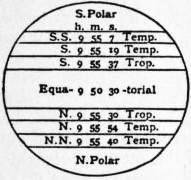
Fig. 1.—Inverted disk of Jupiter, showing the different currents and their rates of rotation.
The above are the mean periods derived from a large number of markings. The bay or hollow in the great southern equatorial belt north of the red spot has perhaps been observed for a longer period than any other feature on Jupiter except the red spot itself. H. Schwabe saw the hollow in the belt on the 5th of September 1831 and on many subsequent dates. The rotation period of this object during the seventy years to the 5th of September 1901 was 9 h. 55 m. 36 s. from 61,813 rotations. Since 1901 the mean period has been 9 h. 55 m. 40 s., but it has fluctuated between 9 h. 55 m. 38 s. and 9 h. 55 m. 42 s. The motion of the various features is not therefore dependent upon their latitude, though at the equator the rate seems swifter as a rule than in other zones. But exceptions occur, for in 1880 some spots appeared in about 23° N. which rotated in 9 h. 48 m. though in the region immediately N. of this the spot motion is ordinarily the slowest of all and averages 9 h. 55 m. 53.8 s. (from twenty determinations). These differences of speed remind us of the sun-spots and their proper motions. The solar envelope, however, appears to show a pretty regular retardation towards the poles, for according to Gustav Spörer’s formula, while the equatorial period is 25 d. 2 h. 15 m. the latitudes 46° N. and S. give a period of 28 d. 15 h. 0 m.
The Jovian currents flow in a due east and west direction as though mainly influenced by the swift rotatory movement of the globe, and exhibit little sign of deviation either to N. or S. These currents do not blend and pass gradually into each other, but seem to be definitely bounded and controlled by separate, phenomena well capable of preserving their individuality. Occasionally, it is true, there have been slanting belts on Jupiter (a prominent example occurred in the spring of 1861), as though the materials were evolved with some force in a polar direction, but these oblique formations have usually spread out in longitude and ultimately formed bands parallel with the equator. The longitudinal currents do not individually present us with an equable rate of motion. In fact they display some curious irregularities, the spots carried along in them apparently oscillating to and fro without any reference to fixed periods or cyclical variations. Thus the equatorial current in 1880 moved at the rate of 9 h. 50 m. 6 s. whereas in 1905 it was 9 h. 50 m. 33 s. The red spot in the S. tropical zone gave 9 h. 55 m. 34 s. in 1879-1880, whereas during 1900-1908 it has varied a little on either side of 9 h. 55 m. 40.6 s. Clearly therefore no fixed period of rotation can be applied for any spot since it is subject to drifts E. or W. and these drifts sometimes come into operation suddenly, and may be either temporary or durable. Between 1878 and 1900 the red spot in the planet’s S. hemisphere showed a continuous retardation of speed.
It must be remembered that in speaking of the rotation of these markings, we are simply alluding to the irregularities in the vaporous envelope of Jupiter. The rotation of the planet itself is another matter and its value is not yet exactly known, though it is probably little different from that of the markings, and especially from those of the most durable character, which indicate a period of about 9 h. 56 m. We never discern the actual landscape of Jupiter or any of the individual forms really diversifying it.
Possibly the red spot which became so striking an object in 1878, and which still remains faintly visible on the planet, is the same feature as that discovered by R. Hooke in 1664 and watched by Cassini in following years. It was situated in approximately the same latitude of the planet and appears to have been hidden temporarily during several periods up to 1713. But the lack of fairly continuous observations of this particular marking makes its identity with the present spot extremely doubtful. The latter was seen by W. R. Dawes in 1857, by Sir W. Huggins in 1858, by J. Baxendell in 1859, by Lord Rosse and R. Copeland in 1873, by H. C. Russell in 1876-1877, and in later years it has formed an object of general observation. In fact it may safely be said that no planetary marking has ever aroused such widespread interest and attracted such frequent observation as the great red spot on Jupiter.
The slight inclination of the equator of this planet to the plane of his orbit suggests that he experiences few seasonal changes. From the conditions we are, in fact, led to expect a prevailing calm in his atmosphere, the more so from the circumstance that the amount of the sun’s heat poured upon each square mile of it is (on the average) less than the 27th part of that received by each square mile of the earth’s surface. Moreover, the seasons of Jupiter have nearly twelve times the duration of ours, so that it would be naturally expected that changes in his atmosphere produced by solar action take place with extreme slowness. But this is very far from being the case. Telescopes reveal the indications of rapid changes and extensive disturbances in the aspect and material forming the belts. New spots covering large areas frequently appear and as frequently decay and vanish, implying an agitated condition of the Jovian atmosphere, and leading us to admit the operation of causes much more active than the heating influence of the sun.
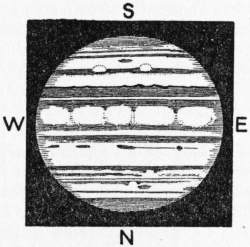
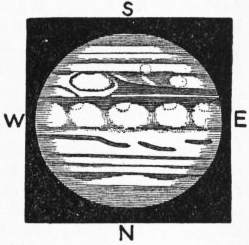
Fig. 2.—Jupiter, 1903, July 10, 2.50 a.m. Fig. 3.—Jupiter, 1906, April 15, 5.50 p.m.
When we institute a comparison between Jupiter and the earth on the basis that the atmosphere of the former planet bears the same relation to his mass as the atmosphere of the earth bears to her mass, we find that a state of things must prevail on Jupiter very dissimilar to that affecting our own globe. The density of the Jovian atmosphere we should expect to be fully six times as great as the density of our air at sea-level, while it would be comparatively shallow. But the telescopic aspect of Jupiter apparently negatives the latter supposition. The belts and spots grow faint as they approach the limb, and disappear as they near the edge of the disk, thus indicating a dense and deep atmosphere. R. A. Proctor considered that the observed features suggested inherent heat, and adopted this conclusion as best explaining the surface phenomena of the planet. He regarded Jupiter as belonging, on account of his immense size, to a different class of bodies from the earth, and was led to believe that there existed greater analogy between Jupiter and the sun than between Jupiter and the earth. Thus the density of the sun, like that of Jupiter, is small compared with the earth’s; in fact, the mean density of the sun is almost identical with that of Jupiter, and the belts of the latter planet may be much more aptly compared with the spot zones of the sun than with the trade zones of the earth.
In support of the theory of inherent heat on Jupiter it has been said that his albedo (or light reflected from his surface) is much greater than the amount would be were his surface similar to that of the moon, Mercury or Mars, and the reasoning has been applied to the large outer planets, Saturn, Uranus and Neptune, as well as to Jupiter. The average reflecting capacity of the moon and five outer planets would seem to be (on the assumption that they possess no inherent light) as follows:—
Moon 0.1736 Jupiter 0.6238 Uranus 0.6400
Mars 0.2672 Saturn 0.4981 Neptune 0.4848
These values were considered to support the view that the four larger and more distant orbs shine partly by inherent lustre, and the more so as spectroscopic analysis indicates that they are each involved in a deep vapour-laden atmosphere. But certain observations furnish a contradiction to Proctor’s views. The absolute extinction of the satellites, even in the most powerful telescopes, while in the shadow of Jupiter, shows that they cannot receive sufficient light from their primary to render them visible, and the darkness of the shadows of the satellites when projected on the planet’s disk proves that the latter cannot be self-luminous except in an insensible degree. It is also to be remarked that, were it only moderately self-luminous, the colour of the light which it sends to us would be red, such light being at first emitted from a heated body when its temperature is raised. Possibly, however, the great red spot, when the colouring was intense in 1878 and several following years, may have represented an opening in the Jovian atmosphere, and the ruddy belts may be extensive rifts in the same envelope. If Jupiter’s actual globe emitted a good deal of heat and light we should probably distinguish little of it, owing to the obscuring vapours floating above the surface. Venus reflects relatively more light than Jupiter, and there is little doubt that the albedo of a planet is dependent upon atmospheric characteristics, and is in no case a direct indication of inherent light and heat.
The colouring of the belts appears to be due to seasonal variations, for Stanley Williams has shown that their changes have a cycle of twelve years, and correspond as nearly as possible with a sidereal revolution of Jupiter. The variations are of such character that the two great equatorial belts are alternately affected; when the S. equatorial belt displays maximum redness the N. equatorial is at a minimum and vice versa.
The most plausible hypothesis with regard to the red spot is that it is of the nature of an island floating upon a liquid surface, though its great duration does not favour this idea. But it is an open question whether the belts of Jupiter indicate a liquid or gaseous condition of the visible surface. The difficulty in the way of the liquid hypothesis is the great difference in the times of rotation between the equatorial portions of the planet and the spots in temperate latitudes. The latter usually rotate in periods between 9 h. 55 m. and 9 h. 56 m., while the equatorial markings make a revolution in about five minutes less, 9 h. 50 m. to 9 h. 51 m. The difference amounts to 7.5° in a terrestrial day and proves that an equatorial spot will circulate right round the enormous sphere of Jupiter (circumference 283,000 m.) in 48 days. The motion is equivalent to about 6000 m. per day and 250 m. per hour.
(W. F. D.)
Satellites of Jupiter.
Jupiter is attended by eight known satellites, resolvable as regards their visibility into two widely different classes. Four satellites were discovered by Galileo and were the only ones known until 1892. In September of that year E. E. Barnard, at the Lick Observatory, discovered a fifth extremely faint satellite, performing a revolution in somewhat less than twelve hours. In 1904 two yet fainter satellites, far outside the other five, were photographically discovered by C. D. Perrine at the Lick Observatory. The eighth satellite was discovered by P. J. Melotte of Greenwich on the 28th of February 1908. It is of the 17th magnitude and appears to be very distant from Jupiter; a re-observation on the 16th of January 1909 proved it to be retrograde, and to have a very eccentric orbit. These bodies are usually numbered in the order of their discovery, the nearest to the sun being V. In apparent brightness each of the four Galilean satellites may be roughly classed as of the sixth magnitude; they would therefore be visible to a keen eye if the brilliancy of the planet did not obscure them. Some observers profess to have seen one or more of these bodies with the naked eye notwithstanding this drawback, but the evidence can scarcely be regarded as conclusive. It does not however seem unlikely that the third, which is the brightest, might be visible when in conjunction with one of the others.
Under good conditions and sufficient telescopic power the satellites are visible as disks, and not mere points of light. Measures of the apparent diameter of objects so faint are, however, difficult and uncertain. The results for the Galilean satellites range between 0″.9 and 1″.5, corresponding to diameters of between 3000 and 5000 kilometres. The smallest is therefore about the size of our moon. Satellite I. has been found to exhibit marked variations in its brightness and aspect, but the law governing them has not been satisfactorily worked out. It seems probable that one hemisphere of this satellite is brighter than the other, or that there is a large dark region upon it. A revolution on its axis corresponding with that of the orbital revolution around the planet has also been suspected, but is not yet established. Variations of light somewhat similar, but less in amount, have been noticed in the second and third satellites.
The most interesting and easily observed phenomena of these bodies are their eclipses and their transits across the disk of Jupiter. The four inner satellites pass through the shadow of Jupiter at every superior conjunction, and across his disk at every inferior conjunction. The outer Galilean satellite does the same when the conjunctions are not too near the line of nodes of the satellites’ orbit. When most distant from the nodes, the satellites pass above or below the shadow and below or above the disk. These phenomena for the four Galilean satellites are predicted in the nautical almanacs.
When one of the four Galilean satellites is in transit across the disk of Jupiter it can generally be seen projected on the face of the planet. It is commonly brighter than Jupiter when it first enters upon the limb but sometimes darker near the centre of the disk. This is owing to the fact that the planet is much darker at the limb. During these transits the shadow of the satellites can also be seen projected on the planet as a dark point.
The theories of the motion of these bodies form one of the more interesting problems of celestial mechanics. Owing to the great ellipticity of Jupiter, growing out of his rapid rotation, the influence of this ellipticity upon the motions of the five inner satellites is much greater than that of the sun, or of the satellites on each other. The inclination of the orbits to the equator of Jupiter is quite small and almost constant, and the motion of each node is nearly uniform around the plane of the planet’s equator.
The most marked feature of these bodies is a relation between the mean longitudes of Satellites I., II. and III. The mean longitude of I. plus twice that of III. minus three times that of II. is constantly near to 180°. It follows that the same relations subsist among the mean motions. The cause of this was pointed out by Laplace. If we put L1 L2 and L3 for the mean longitudes, and define an angle U as follows:—
U = L1 − 3 L2 + 2 L3.
it was shown mathematically by Laplace that if the longitudes and mean motions were such that the angle U differed a little from 180°, there was a minute residual force arising from the mutual actions of the several bodies tending to bring this angle towards the value 180°. Consequently, if the mean motions were such that this angle increased only with great slowness, it would after a certain period tend back toward the value 180°, and then beyond it, exactly as a pendulum drawn out of the perpendicular oscillates towards and beyond it. Thus an oscillation would be engendered in virtue of which the angle would oscillate very slowly on each side of the central value. Computation of the mean longitude from observations has indicated that the angle does differ from 180°, but it is not certain whether this deviation is greater than the possible result of the errors of observation. However this may be, the existence of the libration, and its period if it does exist, are still unknown.
The following are the principal elements of the orbits of the five inner satellites, arranged in the order of distance from Jupiter. The mean longitudes are for 1891, 20th of October, G.M.T., and are referred to the equinox of the epoch, 1891, 2nd of October:—
Satellite V. I. II. III. IV.
Mean Long. 264°.29 313°.7193 39°.1187 171°.2448 62°.2000
Synodic Period 11 h. 58 m. 1 d. 18 h. .48 3d. 13h. .30 7d. 3h. .99 16d. 18m. .09
Mean Distance 106,400 m. 260,000 m. 414,000 m. 661,000 m. 1,162,000 m.
Mass ÷ Mass of Jup. (?) .00002831 .00002324 .00008125 .00002149
Stellar Mag. 13 6.0 6.1 5.6 6.6
The following numbers relating to the planet itself have been supplied mostly by Professor Hermann Struve.
Filar Mic. Heliom.
Equatorial diameter of Jupiter (Dist. 5.2028) 38″.50 37″.50
Polar diameter of Jupiter 36″.02 35″.23
Ellipticity 1 ÷ 15.5 1 ÷ 16.5
Theoretical ellipticity from motion of 900″ in the pericentreof Sat. V 1 ÷ 15.3
Centrifugal force ÷ gravity at equator 0.0900
Mass of Jupiter ÷ Mass of Sun, now used in tables 1 ÷ 1047.34
Inclination of planet’s equator to ecliptic 2° 9′.07 + 0.006t
Inclination of planet’s equator to orbit 3° 4′.80
Long. of Node of equator on ecliptic 336° 21′.47 + 0′.762t
Long. of Node of equator on orbit 135°25′.81 + 0.729t
The longitudes are referred to the mean terrestrial equinox, and t is the time in years from 1900.0.
For the elements of Jupiter’s orbit, see Solar System; and for physical constants, see Planet.
(S. N.)
JUR (Diur), the Dinka name for a tribe of negroes of the upper Nile valley, whose real name is Luoh, or Lwo. They appear to be immigrants, and tradition places their home in the south; they now occupy a district of the Bahr-el-Ghazal between the Bongo and Dinka tribes. Of a reddish black colour, fairer than the Dinka, they are well proportioned, with the hair short. Tattooing is not common, but when found is similar to that of the Dinka; they pierce the ears and nose, and in addition to the ornaments found among the Dinka (q.v.) wear a series of iron rings on the forearm covering it from wrist to elbow. They are mainly agricultural, but hunt and fish to a considerable extent; they are also skilful smiths, smelting their own iron, of which they supply quantities to the Dinka. They are a prosperous tribe and in consequence spinsters are unknown among them. Their chief currency is spears and hoe-blades, and cowrie shells are used in the purchase of wives. Their chief weapons are spears and bows.
See G. Schweinfurth, The Heart of Africa: Travels 1868-1871, trans. G. E. E. Frewer (2nd ed., 1874); W. Junker, Travels in Africa (Eng. ed., 1890-1892).
JURA, a department of France, on the eastern frontier, formed from the southern portion of the old province of Franche-Comté. It is bounded N by the department of Haute-Saône, N.E. by Doubs, E. by Switzerland, S. by Ain, and W. by Saône-et-Loire and Côte d’Or. Pop. (1906), 257,725. Area, 1951 sq. m. Jura comprises four distinct zones with a general direction from north to south. In the S.E. lie high eastern chains of the central Jura, containing the Crêt Pela (4915 ft.), the highest point in the department. More to the west there is a chain of forest-clad plateaus bordered on the E. by the river Ain. Westward of these runs a range of hills, the slopes of which are covered with vineyards. The north-west region of the department is occupied by a plain which includes the fertile Finage, the northern portion of the Bresse, and is traversed by the Doubs and its left affluent the Loue, between which lies the fine forest of Chaux, 76 sq. m. in area. Jura falls almost wholly within the basin of the Rhone. Besides those mentioned, the chief rivers are the Valouze and the Bienne, which water the south of the department. There are several lakes, the largest of which is that of Chalin, about 12 m. E. of Lons-le-Saunier. The climate is, on the whole, cold; the temperature is subject to sudden and violent changes, and among the mountains winter sometimes lingers for eight months. The rainfall is much above the average of France.
Jura is an agricultural department: wheat, oats, maize and barley are the chief cereals, the culture of potatoes and rape being also of importance. Vines are grown mainly in the cantons of Arbois, Poligny, Salins and Voiteur. Woodlands occupy about a fifth of the area: the oak, hornbeam and beech, and, in the mountains, the spruce and fir, are the principal varieties. Natural pasture is abundant on the mountains. Forests, gorges, torrents and cascades are characteristic features of the scenery. Its minerals include iron and salt and there are stone-quarries. Peat is also worked. Lons-le-Saunier and Salins have mineral springs. Industries include the manufacture of Gruyère, Septmoncel and other cheeses (made in co-operative cheese factories or fruitières), metal founding and forging, saw-milling, flour-milling, the cutting of precious stones (at Septmoncel and elsewhere), the manufacture of nails, tools and other iron goods, paper, leather, brier-pipes, toys and fancy wooden-ware and basket-work. The making of clocks, watches, spectacles and measures, which are largely exported, employs much labour in and around Morez. Imports consist of grain, cattle, wine, leaf-copper, horn, ivory, fancy-wood; exports of manufactured articles, wine, cheese, stone, timber and salt. The department is served chiefly by the Paris-Lyon-Méditerranée railway, the main line from Paris to Neuchâtel traversing its northern region. The canal from the Rhone to the Rhine, which utilizes the channel of the Doubs over portions of its course, traverses it for 25 m. Lons-le-Saunier is the chief town of Jura, which embraces four arrondissements named after the towns of Lons-le-Saunier, Dôle, Poligny and St Claude, with 32 cantons and 584 communes. The department forms the diocese of St Claude and part of the ecclesiastical province of Besançon; it comes within the region of the VIIth army corps and the educational circumscription (académie) of Besançon, where is its court of appeal. Lons-le-Saunier, Dôle, Arbois, Poligny, St Claude and Salins, the more noteworthy towns, receive separate notices. At Baume-les-Messieurs, 8 m. N.E. of Lons-le-Saunier, there is an ancient abbey with a fine church of the 12th century.
JURA (“deer island”), an island of the inner Hebrides, the fourth largest of the group, on the west coast of Argyllshire, Scotland. Pop. (1901), 560. On the N. it is separated from the island of Scarba by the whirlpool of Corrievreckan, caused by the rush of the tides, often running over 13 m. an hour, and sometimes accelerated by gales, on the E. from the mainland by the sound of Jura, and on the S. and S.W. from Islay by the sound of Islay. At Kinuachdrach there is a ferry to Aird in Lorne, in Argyllshire, and at Faolin there is a ferry to Port Askaig in Islay. Its area is about 160 sq. m., the greatest length is about 27 m., and the breadth varies from 2 m. to 8 m. The surface is mountainous and the island is the most rugged of the Hebrides. A chain of hills culminating in the Paps of Jura—Beinn-an-Oir (2571 ft.) and Beinn Chaolais (2407 ft.)—runs the whole length of the island, interrupted only by Tarbert loch, an arm of the sea, which forms an indentation nearly 6 m. deep and almost cuts the island in two. Jura derived its name from the red deer which once abounded on it. Cattle and sheep are raised; oats, barley and potatoes are cultivated along the eastern shore, and there is some fishing. Granite is quarried and silicious sand, employed in glass-making is found. The parish of Jura comprises the islands of Balnahua, Fladda, Garvelloch, Jura, Lunga, Scarba and Skervuile.
JURA, a range which may be roughly described as the block of mountains rising between the Rhine and the Rhone, and forming the frontier between France and Switzerland. The gorges by which these two rivers force their way to the plains cut off the Jura from the Swabian and Franconian ranges to the north and those of Dauphiné to the south. But in very early days, before these gorges had been carved out, there were no openings in the Jura at all, and even now its three chief rivers—the Doubs, the Loue and the Ain—flow down the western slope, which is both much longer and but half as steep as the eastern. Some geographers extend the name Jura to the Swabian and Franconian ranges between the Danube and the Neckar and the Main; but, though these are similar in point of composition and direction to the range to the south, it is most convenient to limit the name to the mountain ridges lying between France and Switzerland, and this narrower sense will be adopted here.
The Jura has been aptly described as a huge plateau about 156 m. long and 38 m. broad, hewn into an oblong shape, and raised by internal forces to an average height of from 1950 to 2600 ft. above the surrounding plains. The shock by which it was raised and the vibration caused by the elevation of the great chain of the Alps, produced many transverse gorges or “cluses,” while on the plateaus between these subaerial agencies have exercised their ordinary influence.
Geologically the Jura Mountains belong to the Alpine system; and the same forces which crumpled and tore the strata of the one produced the folds and faults in the other. Both chains owe their origin to the mass of crystalline and unyielding rock which forms the central plateau of France, the Vosges and the Black Forest, and which, between the Vosges and the central plateau, lies at no great depth beneath the surface. Against this mass the more yielding strata which lay to the south and west were crushed and folded, and the Alps and the Jura were carved from the ridges which were raised. But the folding decreases in intensity towards the north; the folding in the Alps is much more violent than the folding in the Jura, and in the Jura itself the folding is most marked along its southern flanks.
The Jura is composed chiefly of Jurassic rocks—it is from this chain that the Jurassic system derives its name—but Triassic, Cretaceous and Tertiary beds take part in its formation. It may be divided into three zones which run parallel to the length of the chain and differ from one another in their structure. The innermost zone, which rises directly from the plain of Switzerland, is the folded Jura (Jura plissé, Kettenjura), formed of narrow parallel undulations which diminish in intensity towards the French border. This is followed by the Jura plateau (Jura tabulaire, Tafeljura), in which the beds are approximately horizontal but are broken up into blocks by fractures or faults. Finally, along its western face there is a zone of numerous dislocations, and the range descends abruptly to the plain of the Saône. This is the Région du vignoble and is well shown at Arbois.
Owing to the convergence of the faults which bound it, the plateau zone decreases in width towards the south, while towards the north it forms a large proportion of the chain. The folded zone is more constant. Along its inner margin the folds are frequently overthrown, leaning towards France, but elsewhere they are simple anticlinals and synclinals, parallel to the length of the chain, and as a rule there is a remarkable freedom from dislocations of any importance, except towards Neuchâtel and Bienne.
The countless blocks of gneiss, granite and other crystalline formations which are found in such numbers on the slopes of the Jura, and go by the name of “erratic blocks” (of which the best known instance—the Pierre à Bot—is 40 ft. in diameter, and rests on the side of a hill 800 ft. above the Lake of Neuchâtel), have been transported thither from the Alps by ancient glaciers, which have left their mark on the Jura range itself in the shape of striations and moraines.
The general direction of the chain is from north-east to south-west, but a careful study reveals the fact that there were in reality two main lines of upheaval, viz. north to south and east to west, the former best seen in the southern part of the range and the latter in the northern; and it was by the union of these two forces that the lines north-east to south-west (seen in the greater part of the chain), and north-west to south-east (seen in the Villebois range at the south-west extremity of the chain), were produced. This is best realized if we take Besançon as a centre; to the north the ridges run east and west, to the south, north and south, while to the east the direction is north-east to south-west.
Before considering the topography of the interior of the Jura, it may be convenient to take a brief survey of its outer slopes.
1. The northern face dominates on one side the famous “Trouée” (or Trench) of Belfort, one of the great geographical centres of Europe, whence routes run north down the Rhine to the North Sea, south-east to the Danube basin and Black Sea, and south-west into France, and so to the Mediterranean basin. It is now so strongly fortified that it becomes a question of great strategical importance to prevent its being turned by means of the great central plateau of the Jura, which, as we shall see, is a network of roads and railways. On the other side it overhangs the “Trouée” of the Black Forest towns on the Rhine (Rheinfelden, Säckingen, Laufenburg and Waldshut), through which the central plain of Switzerland is easily gained. On this north slope two openings offer routes into the interior of the chain—the valley of the Doubs belonging to France, and the valley of the Birse belonging to Switzerland. Belfort is the military, Mülhausen the industrial, and Basel the commercial centre of this slope.
2. The eastern and western faces offer many striking parallels. The plains through which flow the Aar and the Saône have each been the bed of an ancient lake, traces of which remain in the lakes of Neuchâtel, Bienne and Morat. The west face runs mainly north and south like its great river, and for a similar reason the east face runs north-east to south-west. Again, both slopes are pierced by many transverse gorges or “cluses” (due to fracture and not to erosion), by which access is gained to the great central plateau of Pontarlier, though these are seen more plainly on the east face than on the west; thus the gorges at the exit from which Lons-le-Saunier, Poligny, Arbois and Salins are built balance those of the Suze, of the Val de Ruz, of the Val de Travers, and of the Val d’Orbe, though on the east face there is but one city which commands all these important routes—Neuchâtel. This town is thus marked out by nature as a great military and industrial centre, just as is Besançon on the west, which has besides to defend the route from Belfort down the Doubs. These easy means of communicating with the Free County of Burgundy or Franche-Comté account for the fact that the dialect of Neuchâtel is Burgundian, and that it was held generally by Burgundian nobles, though most of the country near it was in the hands of the house of Savoy until gradually annexed by Bern. The Chasseron (5286 ft.) is the central point of the eastern face, commanding the two great railways which join Neuchâtel and Pontarlier. This ridge is in a certain sense parallel to the valley of the Loue on the west face, which flows into the Doubs a little to the south of Dôle, the only important town of the central portion of the Saône basin. The Chasseron is wholly Swiss, as are the lower summits of the Chasseral (5279 ft.), the Mont Suchet (5220 ft.), the Aiguille de Baulmes (5128 ft.), the Dent de Vaulion (4879 ft.), the Weissenstein (4223 ft.), and the Chaumont (3845 ft.), the two last-named points being probably the best-known points in the Jura, as they are accessible by carriage road from Soleure and Neuchâtel respectively. South of the Orbe valley the east face becomes a rocky wall which is crowned by all the highest summits (the first and second Swiss, the rest French) of the chain—the Mont Tendre (5512 ft.), the Dôle (5505 ft.), the Reculet (5643 ft.), the Crêt de la Neige (5653 ft.) and the Grand Crédo (5328 ft.), the uniformity of level being as striking as on the west edge of the Jura, though there the absolute height is far less. The position of the Dôle is similar to that of the Chasseron, as along the sides of it run the great roads of the Col de St Cergues (3973 ft.) and the Col de la Faucille (4341 ft.), the latter leading through the Vallée des Dappes, which was divided in 1862 between France and Switzerland, after many negotiations. The height of these roads shows that they are passages across the chain, rather than through natural depressions.
3. The southern face is supported by two great pillars—on the east by the Grand Crédo and on the west by the ridge of Revermont (2529 ft.) above Bourg en Bresse; between these a huge bastion (the district of Bugey) stretches away to the south, forcing the Rhone to make a long détour. On the two sides of this bastion the plains in which Ambérieu and Culoz stand balance one another, and are the meeting points of the routes which cut through the bastion by means of deep gorges. On the eastern side this great wedge is steep and rugged, ending in the Grand Colombier (5033 ft.) above Culoz, and it sinks on the western side to the valley of the Ain, the district of Bresse, and the plateau of Dombes. The junction of the Ain and the Surand at Pont d’Ain on the west balances that of the Valserine and the Rhone at Bellegarde on the east.
The Jura thus dominates on the north one of the great highways of Europe, on the east and west divides the valleys of the Saône and the Aar, and stretches out to the south so as nearly to join hands with the great mass of the Dauphiné Alps. It therefore commands the routes from France into Germany, Switzerland and Italy, and hence its enormous historical importance.
Let us now examine the topography of the interior of the range. This naturally falls into three divisions, each traversed by one of the three great rivers of the Jura—the Doubs, the Loue and the Ain.
1. In the northern division it is the east and west line which prevails—the Lomont, the Mont Terrible, the defile of the Doubs from St Ursanne to St Hippolyte, and the “Trouée” of the Black Forest towns. It thus bars access to the central plateau from the north, and this natural wall does away with the necessity of artificial fortifications. This division falls again into two distinct portions.
(a) The first is the part east of the deep gorge of the Doubs after it turns south at St Hippolyte; it is thus quite cut off on this side, and is naturally Swiss territory. It includes the basin of the river Birse, and the great plateau between the Doubs and the Aar, on which, at an average height of 2600 ft., are situated a number of towns, one of the most striking features of the Jura. These include Le Locle (q.v.) and La Chaux de Fonds (q.v.), and are mainly occupied with watch-making, an industry which does not require bulky machinery, and is therefore well fitted for a mountain district.
(b) The part west of the “cluse” of the Doubs: of this, the district east of the river Dessoubre, isolated in the interior of the range (unlike the Le Locle plateau), is called the Haute Montagne, and is given up to cheese-making, curing of hams, saw-mills, &c. But little watch-making is carried on there, Besançon being the chief French centre of this industry, and being connected with Geneva by a chain of places similarly occupied, which fringe the west plateau of the Jura. The part west of the Dessoubre, or the Moyenne Montagne, a huge plateau north of the Loue, is more especially devoted to agriculture, while along its north edge metal-working and manufacture of hardware are carried on, particularly at Besançon and Audincourt.
2. The central division is remarkable for being without the deep gorges which are found so frequently in other parts of the range. It consists of the basin of which Pontarlier is the centre, through notches in the rim of which routes converge from every direction; this is the great characteristic of the middle region of the Jura. Hence its immense strategical and commercial importance. On the north-east roads run to Morteau and Le Locle, on the north-west to Besançon, on the west to Salins, on the south-west to Dôle and Lons-le-Saunier, on the east to the Swiss plain. The Pontarlier plateau is nearly horizontal, the slight indentations in it being due to erosion, e.g. by the river Drugeon. The keys to this important plateau are to the east the Fort de Joux, under the walls of which meet the two lines of railway from Neuchâtel, and to the west Salins, the meeting place of the routes from the Col de la Faucille, from Besançon, and from the French plain.
The Ain rises on the south edge of this plateau, and on a lower shelf or step, which it waters, are situated two points of great military importance—Nozeroy and Champagnole. The latter is specially important, since the road leading thence to Geneva traverses one after another, not far from their head, the chief valleys which run down into the South Jura, and thus commands the southern routes as well as those by St Cergues and the Col de la Faucille from the Geneva region, and a branch route along the Orbe river from Jougne. The fort of Les Rousses, near the foot of the Dôle, serves as an advanced post to Champagnole, just as the Fort de Joux does to Pontarlier.
The above sketch will serve to show the character of the central Jura as the meeting place of routes from all sides, and the importance to France of its being strongly fortified, lest an enemy approaching from the north-east should try to turn the fortresses of the “Trouée de Belfort.” It is in the western part of the central Jura that the north and south lines first appear strongly marked. There are said to be in this district no less than fifteen ridges running parallel to each other, and it is these which force the Loue to the north, and thereby occasion its very eccentric course. The cultivation of wormwood wherewith to make the tonic “absinthe” has its headquarters at Pontarlier.
3. The southern division is by far the most complicated and entangled part of the Jura. The lofty ridge which bounds it to the east forces all its drainage to the west, and the result is a number of valleys of erosion (of which that of the Ain is the chief instance), quite distinct from the natural “cluses” or fissures of those of the Doubs and of the Loue. Another point of interest is the number of roads which intersect it, despite its extreme irregularity. This is due to the great “cluses” of Nantua and Virieu, which traverse it from east to west. The north and south line is very clearly seen in the eastern part of this division; the north-east and south-west is entirely wanting, but in the Villebois range south of Ambérieu we have the principal example of the north-west to south-east line. The plateaus west of the Ain are cut through by the valleys of the Valouse and of the Surand, and like all the lowest terraces on the west slope do not possess any considerable towns. The Ain receives three tributaries from the east:—