VOLUME XV SLICE III Japan (part) to Jeveros (continued 6)
Reading edition
On the 27th of September 1779 Jay was appointed minister plenipotentiary to negotiate a treaty between Spain and the United States. He was instructed to endeavour to bring Spain into the treaty already existing between France and the United States by a guarantee that Spain should have the Floridas in case of a successful issue of the war against Great Britain, reserving, however, to the United States the free navigation of the Mississippi. He was also to solicit a subsidy in consideration of the guarantee, and a loan of five million dollars. His task was one of extreme difficulty. Although Spain had joined France in the war against Great Britain, she feared to imperil her own colonial interests by directly encouraging and aiding the former British colonies in their revolt against their mother country, and she had refused to recognize the United States as an independent power. Jay landed at Cadiz on the 22nd of January 1780, but was told that he could not be received in a formally diplomatic character. In May the king’s minister, Count de Florida Bianca, intimated to him that the one obstacle to a treaty was the question of the free navigation of the Mississippi, and for months following this interview the policy of the court was clearly one of delay. In February 1781 Congress instructed Jay that he might make concessions regarding the navigation of the Mississippi, if necessary; but further delays were interposed, the news of the surrender of Yorktown arrived, and Jay decided that any sacrifice to obtain a treaty was no longer advisable. His efforts to procure a loan were not much more successful, and he was seriously embarrassed by the action of Congress in drawing bills upon him for large sums. Although by importuning the Spanish minister, and by pledging his personal responsibility, Jay was able to meet some of the bills, he was at last forced to protest others; and the credit of the United States was saved only by a timely subsidy from France.
In 1781 Jay was commissioned to act with Franklin, John Adams, Jefferson and Henry Laurens in negotiating a peace with Great Britain. He arrived in Paris on the 23rd of June 1782, and jointly with Franklin had proceeded far with the negotiations when Adams arrived late in October. The instructions of the American negotiators were as follows:—
“You are to make the most candid and confidential communications upon all subjects to the ministers of our generous ally, the king of France; to undertake nothing in the negotiations for peace or truce without their knowledge and concurrence; and ultimately to govern yourselves by their advice and opinion, endeavouring in your whole conduct to make them sensible how much we rely on his majesty’s influence for effectual support in every thing that may be necessary to the present security, or future prosperity, of the United States of America.”
Jay, however, in a letter written to the president of Congress from Spain, had expressed in strong terms his disapproval of such dependence upon France, and, on arriving in Paris, he demanded that Great Britain should treat with his country on an equal footing by first recognizing its independence, although the French minister, Count de Vergennes, contended that an acknowledgment of independence as an effect of the treaty was as much as could reasonably be expected. Finally, owing largely to Jay, who suspected the good faith of France, the American negotiators decided to treat independently with Great Britain. The provisional articles, which were so favourable to the United States as to be a great surprise to the courts of France and Spain, were signed on the 30th of November 1782, and were adopted with no important change as the final treaty on the 3rd of September 1783.
On the 24th of July 1784 Jay landed in New York, where he was presented with the freedom of the city and elected a delegate to Congress. On the 7th of May Congress had already chosen him to be secretary for foreign affairs, and in December Jay resigned his seat in Congress and accepted the secretaryship. He continued to act in this capacity until 1790, when Jefferson became secretary of state under the new constitution. In the question of this constitution Jay had taken a keen interest, and as an advocate of its ratification he wrote over the name “Publius,” five (Nos. 2, 3, 4, 5 and 64) of the famous series of papers known collectively as the Federalist (see Hamilton, Alexander). He published anonymously (though without succeeding in concealing the authorship) An Address to the People of New York, in vindication of the constitution; and in the state convention at Poughkeepsie he ably seconded Hamilton in securing its ratification by New York. In making his first appointments to federal offices President Washington asked Jay to take his choice; Jay chose that of chief justice of the Supreme Court, and held this position from September 1789 to June 1795. The most famous case that came before him was that of Chisolm v. Georgia, in which the question was, Can a state be sued by a citizen of another state? Georgia argued that it could not be so sued, on the ground that it was a sovereign state, but Jay decided against Georgia, on the ground that sovereignty in America resided with the people. This decision led to the adoption of the eleventh amendment to the federal constitution, which provides that no suit may be brought in the federal courts against any state by a citizen of another state or by a citizen or subject of any foreign state. In 1792 Jay consented to stand for the governorship of New York State, but a partisan returning-board found the returns of three counties technically defective, and though Jay had received an actual majority of votes, his opponent, George Clinton, was declared elected.
Ever since the War of Independence there had been friction between Great Britain and the United States. To the grievances of the United States, consisting principally of Great Britain’s refusal to withdraw its troops from the forts on the north-western frontier, as was required by the peace treaty of 1783, her refusal to make compensation for negroes carried away by the British army at the close of the War of Independence, her restrictions on American commerce, and her refusal to enter into any commercial treaty with the United States, were added, after war broke out between France and Great Britain in 1793, the anti-neutral naval policy according to which British naval vessels were authorized to search American merchantmen and impress American seamen, provisions were treated as contraband of war, and American vessels were seized for no other reason than that they had on board goods which were the property of the enemy or were bound for a port which though not actually blockaded was declared to be blockaded. The anti-British feeling in the House of Representatives became so strong that on the 7th of April 1794 a resolution was introduced to prohibit commercial intercourse between the United States and Great Britain until the north-western posts should be evacuated and Great Britain’s anti-neutral naval policy should be abandoned. Thereupon Washington, fearing that war might result, appointed Jay minister extraordinary to Great Britain to negotiate a new treaty, and the Senate confirmed the appointment by a vote of 18 to 8, although the non-intercourse resolution which came from the house a few days later was defeated in the senate only by the casting vote of Vice-President John Adams. Jay landed at Falmouth in June 1794, signed a treaty with Lord Grenville on the 19th of November, and disembarked again at New York on the 28th of May 1795. The treaty, known in history as Jay’s Treaty, provided that the north-western posts should be evacuated by the 1st of June 1796, that commissioners should be appointed to settle the north-east and the north-west boundaries, and that the British claims for British debts as well as the American claims for compensation for illegal seizures should be referred to commissioners. More than one-half of the clauses in the treaty related to commerce, and although they contained rather small concessions to the United States, they were about as much as could reasonably have been expected in the circumstances. One clause, the operation of which was limited to two years from the close of the existing war, provided that American vessels not exceeding 70 tons burden might trade with the West Indies, but should carry only American products there and take away to American ports only West Indian products; moreover, the United States was to export in American vessels no molasses, sugar, coffee, cocoa or cotton to any part of the world. Jay consented to this prohibition under the impression that the articles named were peculiarly the products of the West Indies, not being aware that cotton was rapidly becoming an important export from the southern states. The operation of the other commercial clauses was limited to twelve years. By them the United States was granted limited privileges of trade with the British East Indies; some provisions were made for reciprocal freedom of trade between the United States and the British dominions in Europe; some articles were specified under the head of “contraband of war”; it was agreed that whenever provisions were seized as contraband they should be paid for, and that in cases of the capture of a vessel carrying contraband goods such goods only and not the whole cargo should be seized; it was also agreed that no vessel should be seized merely because it was bound for a blockaded port, unless it attempted to enter the port after receiving notice of the blockade. The treaty was laid before the Senate on the 8th of June 1795, and, with the exception of the clause relating to trade with the West Indies, was ratified on the 24th by a vote of 20 to 10. As yet the public was ignorant of its contents, and although the Senate had enjoined secrecy on its members even after the treaty had been ratified, Senator Mason of Virginia gave out a copy for publication only a few days later. The Republican party, strongly sympathizing with France and strongly disliking Great Britain, had been opposed to Jay’s mission, and had denounced Jay as a traitor and guillotined him in effigy when they heard that he was actually negotiating. The publication of the treaty only added to their fury. They filled newspapers with articles denouncing it, wrote virulent pamphlets against it, and burned Jay in effigy. The British flag was insulted. Hamilton was stoned at a public meeting in New York while speaking in defence of the treaty, and Washington was grossly abused for signing it. In the House of Representatives the Republicans endeavoured to prevent the execution of the treaty by refusing the necessary appropriations, and a vote (29th of April, 1795) on a resolution that it ought to be carried into effect stood 49 to 49; but on the next day the opposition was defeated by a vote of 51 to 48. Once in operation, the treaty grew in favour. Two days before landing on his return from the English mission, Jay had been elected governor of New York state; notwithstanding his temporary unpopularity, he was re-elected in April 1798. With the close of this second term of office in 1801, he ended his public career. Although not yet fifty-seven years old, he refused all offers of office and retiring to his estate near Bedford in Westchester county, N.Y., spent the rest of his life in rarely interrupted seclusion. In politics he was throughout inclined toward Conservatism, and after the rise of parties under the federal government he stood with Alexander Hamilton and John Adams as one of the foremost leaders of the Federalist party, as opposed to the Republicans or Democratic-Republicans. From 1821 until 1828 he was president of the American Bible Society. He died on the 17th of May 1829. The purity and integrity of his life are commemorated in a sentence by Daniel Webster: “When the spotless ermine of the judicial robe fell on John Jay, it touched nothing less spotless than itself.”
See The Correspondence and Public Papers of John Jay (4 vols., New York, 1890-1893), edited by H. P. Johnston; William Jay, Life of John Jay with Selections from his Correspondence and Miscellaneous Papers (2 vols., New York, 1833); William Whitelocke, Life and Times of John Jay (New York, 1887); and George Pellew, John Jay (Boston, 1890), in the “American Statesmen Series.”
John Jay’s son, William Jay (1789-1858), was born in New York City on the 16th of June 1789, graduated from Yale in 1807, and soon afterwards assumed the management of his father’s large estate in Westchester county, N.Y. He was actively interested in peace, temperance and anti-slavery movements. He took a prominent part in 1816 in founding the American Bible Society; was a judge of Westchester county from 1818 to 1843, when he was removed from office by the party in power in New York, which hoped, by sacrificing an anti-slavery judge, to gain additional strength in the southern states; joined the American anti-slavery society in 1834, and held several important offices in this organization. In 1840, however, when it began to advocate measures which he deemed too radical, he withdrew his membership, but with his pen he continued his labours on behalf of the slave, urging emancipation in the district of Columbia and the exclusion of slavery from the Territories, though deprecating any attempt to interfere with slavery in the states. He was a member of the American peace society and was its president for several years. His pamphlet, War and Peace: the Evils of the First with a Plan for Securing the Last, advocating international arbitration, was published by the English Peace Society in 1842, and is said to have contributed to the promulgation, by the powers signing the Treaty of Paris in 1856, of a protocol expressing the wish that nations, before resorting to arms, should have recourse to the good offices of a friendly power. Among William Jay’s other writings, the most important are The Life of John Jay (2 vols., 1833) and a Review of the Causes and Consequences of the Mexican War (1849). He died at Bedford on the 14th of October 1858.
See Bayard Tuckerman, William Jay and the Constitutional Movement for the Abolition of Slavery (New York, 1893).
William Jay’s son, John Jay (1817-1894), also took an active part in the anti-slavery movement. He was a prominent member of the free soil party, and was one of the organizers of the Republican party in New York. He was United States minister to Austria-Hungary in 1869-1875, and was a member, and for a time president, of the New York civil service commission appointed by Governor Cleveland in 1883.

JAY, WILLIAM (1769-1853), English Nonconformist divine, was born at Tisbury in Wiltshire on the 6th of May 1769. He adopted his father’s trade of stone-mason, but gave it up in 1785 in order to enter the Rev. Cornelius Winter’s school at Marlborough. During the three years that Jay spent there, his preaching powers were rapidly developed. Before he was twenty-one he had preached nearly a thousand times, and in 1788 he had for a while occupied Rowland Hill’s pulpit in London. Wishing to continue his reading he accepted the humble pastorate of Christian Malford, near Chippenham, where he remained about two years. After one year at Hope chapel, Clifton, he was called to the ministry of Argyle Independent chapel in Bath; and on the 30th of January 1791 he began the work of his life there, attracting hearers of every religious denomination and of every rank, and winning for himself a wide reputation as a brilliant pulpit orator, an earnest religious author, and a friendly counsellor. Sheridan declared him to be the most manly orator he had ever heard. A long and honourable connexion of sixty-two years came to an end in January 1853, and he died on the 27th of December following.
The best-known of Jay’s works are his Morning and Evening Exercises: The Christian contemplated: The Domestic Minister’s Assistant; and his Discourses. He also wrote a Life of Rev. Cornelius Winter, and Memoirs of Rev. John Clarke. An edition of Jay’s Works in 12 vols., 8vo, revised by himself, was issued in 1842-1844, and again in 1856. A new edition, in 8 vols., 8vo, was published in 1876. See Autobiography (1854); S. Wilson’s Memoir of Jay (1854); S. Newth in Pulpit Memorials (1878).
JAY (Fr. géai), a well-known and very beautiful European bird, the Corvus glandarius of Linnaeus, the Garrulus glandarius of modern ornithologists. To this species are more or less closely allied numerous birds inhabiting the Palaearctic and Indian regions, as well as the greater part of America, but not occurring in the Antilles, in the southern portion of the Neotropical Region, or in the Ethiopian or Australian. All these birds are commonly called jays, and form a group of the crows or Corvidae, which may fairly be considered a sub-family, Garrulinae. Indeed there are, or have been, systematists who would elevate the jays to the rank of a family Garrulidae—a proceeding which seems unnecessary. Some of them have an unquestionable resemblance to the pies, if the group now known by that name can be satisfactorily severed from the true Corvinae. In structure the jays are not readily differentiated from the pies; but in habit they are much more arboreal, delighting in thick coverts, seldom appearing in the open, and seeking their food on or under trees. They seem also never to walk or run when on the ground, but always to hop. The body-feathers are commonly loose and soft; and, gaily coloured as are most of the species, in few of them has the plumage the metallic glossiness it generally presents in the pies, while the proverbial beauty of the “jay’s wing” is due to the vivid tints of blue—turquoise and cobalt, heightened by bars of jet-black, an indication of the same style of ornament being observable in the greater number of the other forms of the group, and in some predominating over nearly the whole surface. Of the many genera that have been proposed by ornithologists, perhaps about nine may be deemed sufficiently well established.
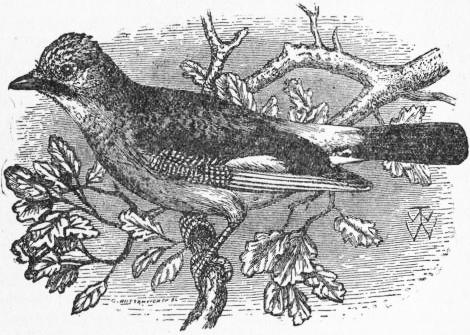
Fig. 1—European Jay.
The ordinary European jay, Garrulus glandarius (fig. 1), has suffered so much persecution in the British Islands as to have become in many districts a rare bird. In Ireland it seems now to be indigenous to the southern half of the island only; in England generally, it is far less numerous than formerly; and in Scotland its numbers have decreased with still greater rapidity. There is little doubt that it would have been exterminated but for its stock being supplied in autumn by immigration, and for its shy and wary behaviour, especially at the breeding-season, when it becomes almost wholly mute, and thereby often escapes detection. No truthful man, however much he may love the bird, will gainsay the depredations on fruit and eggs that it at times commits; but the gardeners and gamekeepers of Britain, instead of taking a few simple steps to guard their charge from injury, deliberately adopt methods of wholesale destruction—methods that in the case of this species are only too easy and too effectual—by proffering temptation to trespass which it is not in jay-nature to resist, and accordingly the bird runs great chance of total extirpation. Notwithstanding the war carried on against the jay, its varied cries and active gesticulations show it to be a sprightly bird, and at a distance that renders its beauty-spots invisible, it is yet rendered conspicuous by its cinnamon-coloured body and pure white tail-coverts, which contrast with the deep black and rich chestnut that otherwise mark its plumage, and even the young at once assume a dress closely resembling that of the adult. The nest, generally concealed in a leafy tree or bush, is carefully built, with a lining formed of fine roots neatly interwoven. Herein from four to seven eggs, of a greenish-white closely freckled, so as to seem suffused with light olive, are laid in March or April, and the young on quitting it accompany their parents for some weeks.
Though the common jay of Europe inhabits nearly the whole of this quarter of the globe south of 64° N. lat., its territory in the east of Russia is also occupied by G. brandti, a kindred form, which replaces it on the other side of the Ural, and ranges thence across Siberia to Japan; and again on the lower Danube and thence to Constantinople the nearly allied G. krynicki (which alone is found in southern Russia, Caucasia and Asia Minor) shares its haunts with it.1 It also crosses the Mediterranean to Algeria and Morocco; but there, as in southern Spain, it is probably but a winter immigrant. The three forms just named have the widest range of any of the genus. Next to them come G. atricapillus, reaching from Syria to Baluchistan, G. japonicus, the ordinary jay of southern Japan, and G. sinensis, the Chinese bird. Other forms have a much more limited area, as G. cervicalis, the local and resident jay of Algeria, G. hyrcanus, found on the southern shores of the Caspian Sea, and G. taevanus, confined to the island of Formosa. The most aberrant of the true jays is G. lidthi, a very rare species, which seems to come from some part of Japan (vide Salvadori, Atti Accad. Torino, vii. 474), though its exact locality is not known.
Leaving the true jays of the genus Garrulus, it is expedient next to consider those of a group named, in 1831, Perisoreus by Prince C. L. Bonaparte (Saggio, &c., Anim. Vertebrati, p. 43) and Dysornithia by Swainson (F. B.-Americana, ii. 495).2
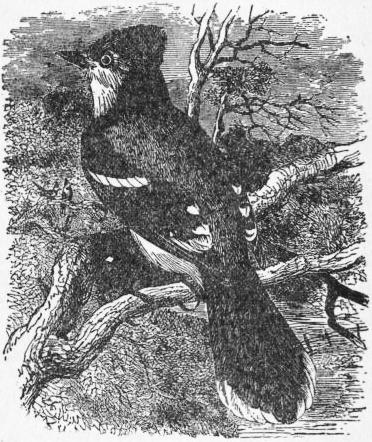
Fig. 2.—American Blue Jay.
This group contains two species—one the Lanius infaustus of Linnaeus and the Siberian jay of English writers, which ranges throughout the pine-forests of the north of Europe and Asia, and the second the Corvus canadensis of the same author, or Canada jay, occupying a similar station in America. The so-called Siberian jay is one of the most entertaining birds in the world. Its versatile cries and actions, as seen and heard by those who penetrate the solitude of the northern forests it inhabits, can never be forgotten by one who has had experience of them, any more than the pleasing sight of its rust-coloured tail, which an occasional gleam of sunshine will light up into a brilliancy quite unexpected by those who have only surveyed the bird’s otherwise gloomy appearance in the glass-case of a museum. It seems scarcely to know fear, obtruding itself on the notice of any traveller who invades its haunts, and, should he halt, making itself at once a denizen of his bivouac. In confinement it speedily becomes friendly, but suitable food for it is not easily found. Linnaeus seems to have been under a misapprehension when he applied to it the trivial epithet it bears; for by none of his countrymen is it deemed an unlucky bird, but rather the reverse. In fact, no one can listen to the cheery sound of its ordinary calls with any but a hopeful feeling. The Canada jay, or “whisky-jack” (the corruption probably of a Cree name), seems to be of a similar nature, but it presents a still more sombre coloration, its nestling plumage,3 indeed, being thoroughly corvine in appearance and suggestive of its being a pristine form.
As though to make amends for the dull plumage of the species last mentioned, North America offers some of the most brilliantly coloured of the sub-family, and the common blue jay4 of Canada and the eastern states of the Union, Cyanurus cristatus (fig. 2), is one of the most conspicuous birds of the Transatlantic woods. The account of its habits by Alexander Wilson is known to every student of ornithology, and Wilson’s followers have had little to do but supplement his history with unimportant details. In this bird and its many allied forms, coloration, though almost confined to various tints of blue, seems to reach its climax, but want of space forbids more particular notice of them, or of the members of the other genera Cyanocitta, Cyanocorax, Xanthura, Psilorhinus, and more, which inhabit various parts of the Western continent. It remains, however, to mention the genus Cissa, including many beautiful forms belonging to the Indian region, and among them the C. speciosa and C. sinensis, so often represented in Oriental drawings, though doubts may be expressed whether these birds are not more nearly related to the pies than to the jays.
(A. N.)
1 Further information will possibly show that these districts are not occupied at the same season of the year by the two forms.
2 Recent writers have preferred the former name, though it was only used sub-generically by its author, who assigned to it no characters, which the inventor of the latter was careful to do, regarding it at the same time as a genus.
3 In this it was described and figured (F. B. Americana, ii. 296, pl. 55) as a distinct species, G. brachyrhynchus.
4 The birds known as blue jays in India and Africa are rollers (q.v.).
JEALOUSY (adapted from Fr. jalousie, formed from jaloux, jealous, Low Lat. zelosus, Gr. ζῆλος, ardour, zeal, from the root seen in ζέειν, to boil, ferment; cf. “yeast”), originally a condition of zealous emulation, and hence, in the usual modern sense, of resentment at being (or believing that one is or may be) supplanted or preferred in the love or affection of another, or in the enjoyment of some good regarded as properly one’s own. Jealousy is really a form of envy, but implies a feeling of personal claim which in envy or covetousness is wanting. The jealousy of God, as in Exod. xx. 5, “For I, the Lord thy God, am a jealous God,” has been defined by Pusey (Minor Prophets, 1860) as the attribute “whereby he does not endure the love of his creatures to be transferred from him.” “Jealous,” by etymology, is however, only another form of “zealous,” and the identity is exemplified by such expressions as “I have been very jealous for the Lord God of Hosts” (1 Kings xix. 10). A kind of glass, thick, ribbed and non-transparent, was formerly known as “jealous-glass,” and this application is seen in the borrowed French word jalousie, a blind or shutter, made of slats of wood, which slope in such a way as to admit air and a certain amount of light, while excluding rain and sun and inspection from without.
JEAN D’ARRAS, a 15th-century trouvère, about whose personal history nothing is known, was the collaborator with Antoine du Val and Fouquart de Cambrai in the authorship of a collection of stories entitled Évangiles de quenouille. They purport to record the narratives of a group of ladies at their spinning, who relate the current theories on a great variety of subjects. The work dates from the middle of the 15th century and is of considerable value for the light it throws on medieval manners.
There were many editions of this book in the 15th and 16th centuries, one of which was printed by Wynkyn de Worde in English, as The Gospelles of Dystaves. A modern edition (Collection Jannet) has a preface by Anatole France.
Another trouvère, Jean d’Arras who flourished in the second half of the 14th century, wrote, at the request of John, duke of Berry, a long prose romance entitled Chronique de la princesse. It relates with many digressions the antecedents and life of the fairy Mélusine (q.v.).
JEAN DE MEUN, or De Meung (c. 1250-c. 1305), whose original name was Jean Clopinel or Chopinel, was born at Meun-sur-Loire. Tradition asserts that he studied at the university of Paris. At any rate he was, like his contemporary, Rutebeuf, a defender of Guillaume de Saint-Amour and a bitter critic of the mendicant orders. Most of his life seems to have been spent in Paris, where he possessed, in the Rue Saint-Jacques, a house with a tower, court and garden, which was described in 1305 as the house of the late Jean de Meung, and was then bestowed by a certain Adam d’Andely on the Dominicans. Jean de Meun says that in his youth he composed songs that were sung in every public place and school in France. In the enumeration of his own works he places first his continuation of the Roman de la rose of Guillaume de Lorris (q.v.). The date of this second part is generally fixed between 1268 and 1285 by a reference in the poem to the death of Manfred and Conradin, executed (1268) by order of Charles of Anjou (d. 1285) who is described as the present king of Sicily. M. F. Guillon (Jean Clopinel, 1903), however, considering the poem primarily as a political satire, places it in the last five years of the 13th century. Jean de Meun doubtless edited the work of his predecessor, Guillaume de Lorris, before using it as the starting-point of his own vast poem, running to 19,000 lines. The continuation of Jean de Meun is a satire on the monastic orders, on celibacy, on the nobility, the papal see, the excessive pretensions of royalty, and especially on women and marriage. Guillaume had been the servant of love, and the exponent of the laws of “courtoisie”; Jean de Meun added an “art of love,” exposing with brutality the vices of women, their arts of deception, and the means by which men may outwit them. Jean de Meun embodied the mocking, sceptical spirit of the fabliaux. He did not share in current superstitions, he had no respect for established institutions, and he scorned the conventions of feudalism and romance. His poem shows in the highest degree, in spite of the looseness of its plan, the faculty of keen observation, of lucid reasoning and exposition, and it entitles him to be considered the greatest of French medieval poets. He handled the French language with an ease and precision unknown to his predecessors, and the length of his poem was no bar to its popularity in the 13th and 14th centuries. Part of its vogue was no doubt due to the fact that the author, who had mastered practically all the scientific and literary knowledge of his contemporaries in France, had found room in his poem for a great amount of useful information and for numerous citations from classical authors. The book was attacked by Guillaume de Degulleville in his Pèlerinage de la vie humaine (c. 1330), long a favourite work both in England and France; by John Gerson, and by Christine de Pisan in her Épître au dieu d’amour; but it also found energetic defenders.
Jean de Meun translated in 1284 the treatise, De re militari, of Vegetius into French as Le livre de Vegèce de l’art de chevalerie1 (ed. Ulysse Robert, Soc. des anciens textes fr., 1897). He also produced a spirited version, the first in French, of the letters of Abelard and Hèloïse. A 14th-century MS. of this translation in the Bibliothèque Nationale has annotations by Petrarch. His translation of the De consolatione philosophiae of Boëtius is preceded by a letter to Philip IV. in which he enumerates his earlier works, two of which are lost—De spirituelle amitié from the De spirituali amicitia of Aelred of Rievaulx (d. 1166), and the Livre des merveilles d’Hirlande from the Topographia Hibernica, or De Mirabilibus Hiberniae of Giraldus Cambrensis (Giraud de Barry). His last poems are doubtless his Testament and Codicille. The Testament is written in quatrains in monorime, and contains advice to the different classes of the community.
See also Paulin Paris in Hist. lit. de la France, xxviii. 391-439, and E. Langlois in Hist. de la langue et de la lit. française, ed. L. Petit de Julleville, ii. 125-161 (1896); and editions of the Roman de la rose (q.v.).
1 Jean de Meun’s translation formed the basis of a rhymed version (1290) by Jean Priorat of Besançon, Li abreyance de l’ordre de chevalerie.
JEANNETTE, a borough of Westmoreland county, Pennsylvania, U.S.A., about 27 m. E. by S. of Pittsburg. Pop. (1890), 3296; (1900), 5865 (1340 foreign-born); (1910), 8077. It is served by the Pennsylvania railroad, and is connected with Pittsburg and Uniontown by electric railway. It is supplied with natural gas and is primarily a manufacturing centre, its principal manufactures being glass, table-ware and rubber goods. Jeannette was founded in 1888, and was incorporated as a borough in 1889.
JEANNIN, PIERRE (1540-1622), French statesman, was born at Autun. A pupil of the great jurist Jacques Cujas at Bourges, he was an advocate at Dijon in 1569 and became councillor and then president of the parlement of Burgundy. He opposed in vain the massacre of St Bartholomew in his province. As councillor to the duke of Mayenne he sought to reconcile him with Henry IV. After the victory of Fontaine-Française (1595), Henry took Jeannin into his council and in 1602 named him intendant of finances. He took part in the principal events of the reign, negotiated the treaty of Lyons with the duke of Savoy (see Henry IV.), and the defensive alliance between France and the United Netherlands in 1608. As superintendent of finances under Louis XIII., he tried to establish harmony between the king and the queen-mother.
See Berger de Xivrey, Lettres missives de Henri IV. (in the Collection inédite pour l’histoire de France), t. v. (1850); P(ierre) S(aumaise), Eloge sur la vie de Pierre Janin (Dijon, 1623); Sainte-Beuve, Causeries du lundi, t. x. (May 1854).
JEBB, JOHN (1736-1786), English divine, was educated at Cambridge, where he was elected fellow of Peterhouse in 1761, having previously been second wrangler. He was a man of independent judgment and warmly supported the movement of 1771 for abolishing university and clerical subscription to the Thirty-nine Articles. In his lectures on the Greek Testament he is said to have expressed Socinian views. In 1775 he resigned his Suffolk church livings, and two years afterwards graduated M.D. at St Andrews. He practised medicine in London and was elected F.R.S. in 1779.
Another John Jebb (1775-1833), bishop of Limerick, is best known as the author of Sacred Literature (London, 1820).
JEBB, SIR RICHARD CLAVERHOUSE (1841-1905), English classical scholar, was born at Dundee on the 27th of August 1841. His father was a well-known barrister, and his grandfather a judge. He was educated at Charterhouse and at Trinity College, Cambridge. He won the Porson and Craven scholarships, was senior classic in 1862, and became fellow and tutor of his college in 1863. From 1869 to 1875 he was public orator of the university; professor of Greek at Glasgow from 1875 to 1889, and at Cambridge from 1889 till his death on the 9th of December 1905. In 1891 he was elected member of parliament for Cambridge University; he was knighted in 1900. Jebb was acknowledged to be one of the most brilliant classical scholars of his time, a humanist in the best sense, and his powers of translation from and into the classical languages were unrivalled. A collected volume, Translations into Greek and Latin, appeared in 1873 (ed. 1909). He was the recipient of many honorary degrees from European and American universities, and in 1905 was made a member of the Order of Merit. He married in 1874 the widow of General A. J. Slemmer, of the United States army, who survived him.
Jebb was the author of numerous publications, of which the following are the most important: The Characters of Theophrastus (1870), text, introduction, English translation and commentary (re-edited by J. E. Sandys, 1909); The Attic Orators from Antiphon to Isaeus (2nd ed., 1893), with companion volume, Selections from the Attic Orators (2nd ed., 1888); Bentley (1882); Sophocles (3rd ed., 1893) the seven plays, text, English translation and notes, the promised edition of the fragments being prevented by his death; Bacchylides (1905), text, translation, and notes; Homer (3rd ed., 1888), an introduction to the Iliad and Odyssey; Modern Greece (1901); The Growth and Influence of Classical Greek Poetry (1893). His translation of the Rhetoric of Aristotle was published posthumously under the editorship of J. E. Sandys (1909). A selection from his Essays and Addresses, and a subsequent volume, Life and Letters of Sir Richard Claverhouse Jebb (with critical introduction by A. W. Verrall) were published by his widow in 1907; see also an appreciative notice by J. E. Sandys, Hist. of Classical Scholarship, iii. (1908).
JEBEIL (anc. Gebal-Byblus), a town of Syria pleasantly situated on a slight eminence near the sea, about 20 m. N. of Beirut. It is surrounded by a wall 1½ m. in circumference, with square towers at the angles, and a castle at the south-east corner. Numerous broken granite columns in the gardens and vineyards that surround the town, with the number of ruined houses within the walls, testify to its former importance. The stele of Jehawmelek, king of Gebal, found here, is one of the most important of Phoenician monuments. The small port is almost choked up with sand and ruins. Pop. 3000, all Moslems.
The inhabitants of the Phoenician Gebal and Greek Byblus were renowned as stonecutters and ship-builders. Arrian (ii. 20. 1) represents Enylus, king of Byblus, as joining Alexander with a fleet, after that monarch had captured the city. Philo of Byblus makes it the most ancient city of Phoenicia, founded by Cronus, i.e. the Moloch who appears from the stele of Jehawmelek to have been with Baalit the chief deity of the city. According to Plutarch (Mor. 357), the ark with the corpse of Osiris was cast ashore at Byblus, and there found by Isis. The orgies of Adonis in the temple of Baalit (Aphrodite Byblia) are described by Lucian, De Dea Syr., cap. vi. The river Adonis is the Nahr al-Ibrahim, which flows near the town. The crusaders, after failing before it in 1099, captured “Giblet” in 1103, but lost it again to Saladin in 1189. Under Mahommedan rule it has gradually (D. G. H.) decayed.
JEBEL (plur. jibāl), also written Gebel with hard g (plur. gibāl), an Arabic word meaning a mountain or a mountain chain. It is frequently used in place-names. The French transliteration of the word is djebel. Jebeli signifies a mountaineer. The pronunciation with a hard g sound is that used in the Egyptian dialect of Arabic.
JEDBURGH, a royal and police burgh and county-town of Roxburghshire, Scotland. Pop. of police burgh (1901), 3136. It is situated on Jed Water, a tributary of the Teviot, 56¼ m. S.E. of Edinburgh by the North British railway, via Roxburgh and St Boswells (49 m. by road), and 10 m. from the border at Catcleuch Shin, a peak of the Cheviots, 1742 ft. high. Of the name Jedburgh there have been many variants, the earliest being Gedwearde (800), Jedwarth (1251), and Geddart (1586), while locally the word is sometimes pronounced Jethart. The town is situated on the left bank of the Jed, the main streets running at right angles from each side of the central market-place. Of the renowned group of Border abbeys—Jedburgh, Melrose, Dryburgh and Kelso—that of Jedburgh is the stateliest. In 1118, according to tradition, but more probably as late as 1138, David, prince of Cumbria, here founded a priory for Augustinian monks from the abbey of St Quentin at Beauvais in France, and in 1147, after he had become king, erected it into an abbey dedicated to the Virgin. Repeatedly damaged in Border warfare, it was ruined in 1544-45 during the English invasion led by Sir Ralph Evers (or Eure). The establishment was suppressed in 1559, the revenues being temporarily annexed to the Crown. After changing owners more than once, the lands were purchased in 1637 by the 3rd earl of Lothian. Latterly five of the bays at the west end had been utilized as the parish church, but in 1873-1875 the 9th marquess of Lothian built a church for the service of the parish, and presented it to the heritors in exchange for the ruined abbey in order to prevent the latter from being injured by modern additions and alterations.
The abbey was built of Old Red sandstone, and belongs mostly to the end of the 12th and the beginning of the 13th centuries. The architecture is mixed, and the abbey is a beautiful example of the Norman and Transition styles. The total length is 235 ft., the nave being 133½ ft. long and 59½ ft. wide. The west front contains a great Norman porch and a fine wheel window. The nave, on each side, has nine pointed arches in the basement storey, nine round arches in the triforium, and thirty-six pointed arches in the clerestory, through which an arcade is carried on both sides. The tower, at the intersection of the nave and transepts, is of unusually massive proportions, being 30 ft. square and fully 100 ft. high; the network baluster round the top is modern. With the exception of the north piers and a small portion of the wall above, which are Norman, the tower dates from the end of the 15th century. The whole of the south transept has perished. The north transept, with early Decorated windows, has been covered in and walled off, and is the burial-ground of the Kerrs of Fernihirst, ancestors of the marquess of Lothian. The earliest tombstone is dated 1524; one of the latest is the recumbent effigy, by G. F. Watts, R.A., of the 8th marquess of Lothian (1832-1870). All that is left of the choir, which contains some very early Norman work, is two bays with three tiers on each side, corresponding to the design of the nave. It is supposed that the aisle, with Decorated window and groined roof, south of the chancel, formed the grammar school (removed from the abbey in 1751) in which Samuel Rutherford (1600-1661), principal of St Mary’s College, St Andrews, and James Thomson, author of The Seasons, were educated. The door leading from the south aisle into a herbaceous garden, formerly the cloister, is an exquisite copy of one which had become greatly decayed. It was designed by Sir Rowand Anderson, under whose superintendence restoration in the abbey was carried out.
The castle stood on high ground at the south end of the burgh, or “town-head.” Erected by David I., it was one of the strongholds ceded to England in 1174, under the treaty of Falaise, for the ransom of William the Lion. It was, however, so often captured by the English that it became a menace rather than a protection, and the townsfolk demolished it in 1409. It had occasionally been used as a royal residence, and was the scene, in November 1285, of the revels held in celebration of the marriage (solemnized in the abbey) of Alexander III. to Joleta, or Yolande, daughter of the count of Dreux. The site was occupied in 1823 by the county prison, now known as the castle, a castellated structure which gradually fell into disuse and was acquired by the corporation in 1890. A house exists in Backgate in which Mary Queen of Scots resided in 1566, and one in Castlegate which Prince Charles Edward occupied in 1745.
The public buildings include the grammar school (built in 1883 to replace the successor of the school in the abbey), founded by William Turnbull, bishop of Glasgow (d. 1454), the county buildings, the free library and the public hall, which succeeded to the corn exchange destroyed by fire in 1898, a loss that involved the museum and its contents, including the banners captured by the Jethart weavers at Bannockburn and Killiecrankie. The old market cross still exists, and there are two public parks. The chief industry is the manufacture of woollens (blankets, hosiery), but brewing, tanning and iron-founding are carried on, and fruit (especially pears) and garden produce are in repute. Jedburgh was made a royal burgh in the reign of David I., and received a charter from Robert I. and another, in 1566, from Mary Queen of Scots. Sacked and burned time after time during the Border strife, it was inevitable that the townsmen should become keen fighters. Their cry of “Jethart’s here!” was heard wherever the fray waxed most fiercely, and the Jethart axe of their invention—a steel axe on a 4-ft. pole—wrought havoc in their hands.
“Jethart or Jeddart justice,” according to which a man was hanged first and tried afterwards, seems to have been a hasty generalization from a solitary fact—the summary execution in James VI.’s reign of a gang of rogues at the instance of Sir George Home, but has nevertheless passed into a proverb.
Old Jeddart, 4 m. S. of the present town, the first site of the burgh, is now marked by a few grassy mounds, and of the great Jedburgh forest, only the venerable oaks, the “Capon Tree” and the “King of the Woods” remain. Dunion Hill (1095 ft.), about 2 m. south-west of Jedburgh, commands a fine view of the capital of the county.
JEEJEEBHOY (Jijibhai), SIR JAMSETJEE (Jamsetji), Bart. (1783-1859), Indian merchant and philanthropist, was born in Bombay in 1783, of poor but respectable parents, and was left an orphan in early life. At the age of sixteen, with a smattering of mercantile education and a bare pittance, he commenced a series of business travels destined to lead him to fortune and fame. After a preliminary visit to Calcutta, he undertook a voyage to China, then fraught with so much difficulty and risk that it was regarded as a venture betokening considerable enterprise and courage; and he subsequently initiated a systematic trade with that country, being himself the carrier of his merchant wares on his passages to and fro between Bombay and Canton and Shanghai. His second return voyage from China was made in one of the East India Company’s fleet, which, under the command of Sir Nathaniel Dance, defeated the French squadron under Admiral Linois (Feb. 15, 1804). On his fourth return voyage from China, the Indiaman in which he sailed was forced to surrender to the French, by whom he was carried as a prisoner to the Cape of Good Hope, then a neutral Dutch possession; and it was only after much delay, and with great difficulty, that he made his way to Calcutta in a Danish ship. Nothing daunted, he undertook yet another voyage to China, which was more successful than any of the previous ones. By this time he had fairly established his reputation as a merchant possessed of the highest spirit of enterprise and considerable wealth, and thenceforward he settled down in Bombay, where he directed his commercial operations on a widely extended scale. By 1836 his firm was large enough to engross the energies of his three sons and other relatives; and he had amassed what at that period of Indian mercantile history was regarded as fabulous wealth. An essentially self-made man, having experienced in early life the miseries of poverty and want, in his days of affluence Jamsetjee Jeejeebhoy developed an active instinct of sympathy with his poorer countrymen, and commenced that career of private and public philanthropy which is his chief title to the admiration of mankind. His liberality was unbounded, and the absorbing occupation of his later life was the alleviation of human distress. To his own community he gave lavishly, but his benevolence was mainly cosmopolitan. Hospitals, schools, homes of charity, pension funds, were founded or endowed by him, while numerous public works in the shape of wells, reservoirs, bridges, causeways, and the like, not only in Bombay, but in other parts of India, were the creation of his bounty. The total of his known benefactions amounted at the time of his death, which took place in 1859, to over £230,000. It was not, however, the amount of his charities so much as the period and circumstances in which they were performed that made his benevolent career worthy of the fame he won. In the first half of the 19th century the various communities of India were much more isolated in their habits and their sympathies than they are now. Jamsetjee Jeejeebhoy’s unsectarian philanthropy awakened a common understanding and created a bond between them which has proved not only of domestic value but has had a national and political significance. His services were recognized first in 1842 by the bestowal of a knighthood upon him, and in 1858 by that of a baronetcy. These were the very first distinctions of their kind conferred by Queen Victoria upon a British subject in India.
His title devolved in 1859 on his eldest son Cursetjee, who, by a special Act of the Viceroy’s Council in pursuance of a provision in the letters-patent, took the name of Sir Jamsetjee Jeejeebhoy as second baronet. At his death in 1877 his eldest son, Menekjee, became Sir Jamsetjee Jeejeebhoy, the third baronet. Both had the advantage of a good English education, and continued the career of benevolent activity and devoted loyalty to British rule which had signalized the life-work of the founder of the family. They both visited England to do homage to their sovereign; and their public services were recognized by their nomination to the order of the Star of India, as well as by appointment to the Legislative Councils of Calcutta and Bombay.
On the death of the third baronet, the title devolved upon his brother, Cowsajee (1853-1908), who became Sir Jamsetjee Jeejeebhoy, fourth baronet, and the recognized leader of the Parsee community all over the world. He was succeeded by his son Rustomjee (b. 1878), who became Sir Jamsetjee Jeejeebhoy, fifth baronet.
Since their emigration from Persia, the Parsee community had never had a titular chief or head, its communal funds and affairs being managed by a public body, more or less democratic in its constitution, termed the Parsee panchayat. The first Sir Jamsetjee, by the hold that he established on the community, by his charities and public spirit, gradually came to be regarded in the light of its chief; and the recognition which he was the first in India to receive at the hands of the British sovereign finally fixed him and his successors in the baronetcy in the position and title of the official Parsee leader.
(M. M. Bh.)
JEFFERIES, RICHARD (1848-1887), English naturalist and author, was born on the 6th of November 1848, at the farmhouse of Coate about 2½ m. from Swindon, on the road to Marlborough. He was sent to school, first at Sydenham and then at Swindon, till the age of fifteen or so, but his actual education was at the hands of his father, who gave him his love for Nature and taught him how to observe. For the faculty of observation, as Jefferies, Gilbert White, and H. D. Thoreau have remarked, several gifts are necessary, including the possession of long sight and quick sight, two things which do not always go together. To them must be joined trained sight and the knowledge of what to expect. The boy’s father first showed him what there was to look for in the hedge, in the field, in the trees, and in the sky. This kind of training would in many cases be wasted: to one who can understand it, the book of Nature will by-and-by offer pages which are blurred and illegible to the city-bred lad, and even to the country lad the power of reading them must be maintained by constant practice. To live amid streets or in the working world destroys it. The observer must live alone and always in the country; he must not worry himself about the ways of the world; he must be always, from day to day, watching the infinite changes and variations of Nature. Perhaps, even when the observer can actually read this book of Nature, his power of articulate speech may prove inadequate for the expression of what he sees. But Jefferies, as a boy, was more than an observer of the fields; he was bookish, and read all the books that he could borrow or buy. And presently, as is apt to be the fate of a bookish boy who cannot enter a learned profession, he became a journalist and obtained a post on the local paper. He developed literary ambitions, but for a long time to come was as one beating the air. He tried local history and novels; but his early novels, which were published at his own risk and expense, were, deservedly, failures. In 1872, however, he published a remarkable letter in The Times, on “The Wiltshire Labourer,” full of original ideas and of facts new to most readers. This was in reality the turning-point in his career. In 1873, after more false starts, Jefferies returned to his true field of work, the life of the country, and began to write for Fraser’s Magazine on “Farming and Farmers.” He had now found himself. The rest of his history is that of continual advance, from close observation becoming daily more and more close, to that intimate communion with Nature with which his later pages are filled. The developments of the later period are throughout touched with the melancholy that belongs to ill-health. For, though in his prose poem called “The Pageant of Summer” the writer seems absolutely revelling in the strength of manhood that belongs to that pageant, yet, in the Story of My Heart, written about the same time, we detect the mind that is continually turned to death. He died at Goring, worn out with many ailments, on the 14th of August 1887. The best-known books of Richard Jefferies are: The Gamekeeper at Home (1878); The Story of My Heart (1883); Life of the Fields (1884), containing the best paper he ever wrote, “The Pageant of Summer”; Amaryllis at the Fair (1884), in which may be found the portraits of his own people; and The Open Air. He stands among the scanty company of men who address a small audience, for whom he read aloud these pages of Nature spoken of above, which only he, and the few like unto him, can decipher.
See Sir Walter Besant, Eulogy of Richard Jefferies (1888); H. S. Salt, Richard Jefferies: a Study (1894); Edward Thomas, Richard Jefferies, his Life and Work (1909).
(W. Be.)
JEFFERSON, JOSEPH (1820-1905), American actor, was born in Philadelphia on the 20th of February 1829. He was the third actor of this name in a family of actors and managers, and the most famous of all American comedians. At the age of three he appeared as the boy in Kotzebue’s Pizarro, and throughout his youth he underwent all the hardships connected with theatrical touring in those early days. After a miscellaneous experience, partly as actor, partly as manager, he won his first pronounced success in 1858 as Asa Trenchard in Tom Taylor’s Our American Cousin at Laura Keene’s theatre in New York. This play was the turning-point of his career, as it was of Sothern’s. The naturalness and spontaneity of humour with which he acted the love scenes revealed a spirit in comedy new to his contemporaries, long used to a more artificial convention; and the touch of pathos which the part required revealed no less to the actor an unexpected power in himself. Other early parts were Newman Noggs in Nicholas Nickleby, Caleb Plummer in The Cricket on the Hearth, Dr Pangloss in The Heir at Law, Salem Scudder in The Octoroon, and Bob Acres in The Rivals, the last being not so much an interpretation of the character as Sheridan sketched it as a creation of the actor’s. In 1859 Jefferson made a dramatic version of the story of Rip Van Winkle on the basis of older plays, and acted it with success at Washington. The play was given its permanent form by Dion Boucicault in London, where (1865) it ran 170 nights, with Jefferson in the leading part. Jefferson continued to act with undiminished popularity in a limited number of parts in nearly every town in the United States, his Rip Van Winkle, Bob Acres, and Caleb Plummer being the most popular. He was one of the first to establish the travelling combinations which superseded the old system of local stock companies. With the exception of minor parts, such as the First Gravedigger in Hamlet, which he played in an “all star combination” headed by Edwin Booth, Jefferson created no new character after 1865; and the success of Rip Van Winkle was so pronounced that he has often been called a one-part actor. If this was a fault, it was the public’s, who never wearied of his one masterpiece. Jefferson died on the 23rd of April 1905. No man in his profession was more honoured for his achievements or his character. He was the friend of many of the leading men in American politics, art and literature. He was an ardent fisherman and lover of nature, and devoted to painting. Jefferson was twice married: to an actress, Margaret Clements Lockyer (1832-1861), in 1850, and in 1867 to Sarah Warren, niece of William Warren the actor.
Jefferson’s Autobiography (New York, 1889) is written with admirable spirit and humour, and its judgments with regard to the art of the actor and of the playwright entitle it to a place beside Cibber’s Apology. See William Winter, The Jeffersons (1881), and Life of Joseph Jefferson (1894); Mrs. E. P. Jefferson, Recollections of Joseph Jefferson (1909).
JEFFERSON, THOMAS (1743-1826), third president of the United States of America, and the most conspicuous apostle of democracy in America, was born on the 13th of April 1743, at Shadwell, Albemarle county, Virginia. His father, Peter Jefferson (1707-1757), of early Virginian yeoman stock, was a civil engineer and a man of remarkable energy, who became a justice of the peace, a county surveyor and a burgess, served the Crown in inter-colonial boundary surveys, and married into one of the most prominent colonial families, the Randolphs. Albemarle county was then in the frontier wilderness of the Blue Ridge, and was very different, socially, from the lowland counties where a few broad-acred families dominated an open-handed, somewhat luxurious and assertive aristocracy. Unlike his Randolph connexions, Peter Jefferson was a whig and a thorough democrat; from him, and probably, too, from the Albemarle environment, his son came naturally by democratic inclinations.
Jefferson carried with him from the college of William and Mary at Williamsburg, in his twentieth year, a good knowledge of Latin, Greek and French (to which he soon added Spanish, Italian and Anglo-Saxon), and a familiarity with the higher mathematics and natural sciences only possessed, at his age, by men who have a rare natural taste and ability for those studies. He remained an ardent student throughout life, able to give and take in association with the many scholars, American and foreign, whom he numbered among his friends and correspondents. With a liberal Scotsman, Dr William Small, then of the faculty of William and Mary and later a friend of Erasmus Darwin, and George Wythe (1726-1806), a very accomplished scholar and leader of the Virginia bar, Jefferson was an habitual member, while still in college, of a partie carrée at the table of Francis Fauquier (c. 1720-1768), the accomplished lieutenant-governor of Virginia. Jefferson was an expert violinist, a good singer and dancer, proficient in outdoor sports, and an excellent horseman. Thorough-bred horses always remained to him a necessary luxury. When it is added that Fauquier was a passionate gambler, and that the gentry who gathered every winter at Williamsburg, the seat of government of the province, were ruinously addicted to the same weakness, and that Jefferson had a taste for racing, it does credit to his early strength of character that of his social opportunities he took only the better. He never used tobacco, never played cards, never gambled, and was never party to a personal quarrel.
Soon after leaving college he entered Wythe’s law office, and in 1767, after five years of close study, was admitted to the bar. His thorough preparation enabled him to compete from the first with the leading lawyers of the colony, and his success shows that the bar had no rewards that were not fairly within his reach. As an advocate, however, he did not shine; a weakness of voice made continued speaking impossible, and he had neither the ability nor the temperament for oratory. To his legal scholarship and collecting zeal Virginia owed the preservation of a large part of her early statutes. He seems to have lacked interest in litigiousness, which was extraordinarily developed in colonial Virginia; and he saw and wished to reform the law’s abuses. It is probable that he turned, therefore, the more willingly to politics; at any rate, soon after entering public life he abandoned practice (1774).
The death of his father had left him an estate of 1900 acres, the income from which (about £400) gave him the position of an independent country gentleman; and while engaged in the law he had added to his farms after the ambitious Virginia fashion, until, when he married in his thirtieth year, there were 5000 acres all paid for; and almost as much more1 came to him in 1773 on the death of his father-in-law. On the 1st of January 1772, Jefferson married Martha Wayles Skelton (1749-1782), a childless widow of twenty-three, very handsome, accomplished, and very fond of music. Their married life was exceedingly happy, and Jefferson never remarried after her early death. Of six children born from their union, two daughters alone survived infancy. Jefferson was emotional and very affectionate in his home, and his generous and devoted relations with his children and grandchildren are among the finest features of his character.
Jefferson began his public service as a justice of the peace and parish vestryman; he was chosen a member of the Virginia house of burgesses in 1769 and of every succeeding assembly and convention of the colony until he entered the Continental Congress in 1775. His forceful, facile pen gave him great influence from the first; but though a foremost member of several great deliberative bodies, he can fairly be said never to have made a speech. He hated the “morbid rage of debate” because he believed that men were never convinced by argument, but only by reflection, through reading or unprovocative conversation; and this belief guided him through life. Moreover it is very improbable that he could ever have shone as a public speaker, and to this fact unfriendly critics have attributed, at least in part, his abstention from debate. The house of burgesses of 1769, and its successors in 1773 and 1774, were dissolved by the governor (see Virginia) for their action on the subject of colonial grievances and inter-colonial co-operation. Jefferson was prominent in all; was a signer of the Virginia agreement of non-importation and economy (1769); and was elected in 1774 to the first Virginia convention, called to consider the state of the colony and advance inter-colonial union. Prevented by illness from attending, Jefferson sent to the convention elaborate resolutions, which he proposed as instructions to the Virginia delegates to the Continental Congress that was to meet at Philadelphia in September. In the direct language of reproach and advice, with no disingenuous loading of the Crown’s policy upon its agents, these resolutions attacked the errors of the king, and maintained that “the relation between Great Britain and these colonies was exactly the same as that of England and Scotland after the accession of James and until the Union; and that our emigration to this country gave England no more rights over us than the emigration of the Danes and Saxons gave to the present authorities of their mother country over England.” This was cutting at the common root of allegiance, emigration and colonization; but such radicalism was too thorough-going for the immediate end. The resolutions were published, however, as a pamphlet, entitled A Summary View of the Rights of America, which was widely circulated. In England, after receiving such modifications—attributed to Burke—as adapted it to the purposes of the opposition, this pamphlet ran through many editions, and procured for its author, as he said, “the honour of having his name inserted in a long list of proscriptions enrolled in a bill of attainder commenced in one of the two houses of parliament, but suppressed in embryo by the hasty course of events.” It placed Jefferson among the foremost leaders of revolution, and procured for him the honour of drafting, later, the Declaration of Independence, whose historical portions were, in large part, only a revised transcript of the Summary View. In June 1775 he took his seat in the Continental Congress, taking with him fresh credentials of radicalism in the shape of Virginia’s answer, which he had drafted, to Lord North’s conciliatory propositions. Jefferson soon drafted the reply of Congress to the same propositions. Reappointed to the next Congress, he signalized his service by the authorship of the Declaration of Independence (q.v.). Again reappointed, he surrendered his seat, and after refusing a proffered election to serve as a commissioner with Benjamin Franklin and Silas Deane in France, he entered again, in October 1776, the Virginia legislature, where he considered his services most needed.
The local work to which Jefferson attributed such importance was a revision of Virginia’s laws. Of the measures proposed to this end he says: “I considered four, passed or reported, as forming a system by which every trace would be eradicated of ancient or future aristocracy, and a foundation laid for a government truly republican”—the repeal of the laws of entail; the abolition of primogeniture and the unequal division of inheritances (Jefferson was himself an eldest son); the guarantee of freedom of conscience and relief of the people from supporting, by taxation, an established church; and a system of general education. The first object was embodied in law in 1776, the second in 1785, the third2 in 1786 (supplemented 1799, 1801). The last two were parts of a body of codified laws prepared (1776-1779) by Edmund Pendleton,3 George Wythe, and Jefferson, and principally by Jefferson. Not so fortunate were Jefferson’s ambitious schemes of education. District, grammar and classical schools, a free state library and a state college, were all included in his plan. He was the first American statesman to make education by the state a fundamental article of democratic faith. His bill for elementary education he regarded as the most important part of the code, but Virginia had no strong middle class, and the planters would not assume the burden of educating the poor. At this time Jefferson championed the natural right of expatriation, and gradual emancipation of the slaves. His earliest legislative effort, in the five-day session of 1769, had been marked by an effort to secure to masters freedom to manumit their slaves without removing them from the state. It was unsuccessful, and the more radical measure he now favoured was even more impossible of attainment; but a bill he introduced to prohibit the importation of slaves was passed in 1778—the only important change effected in the slave system of the state during the War of Independence. Finally he endeavoured, though unsuccessfully, to secure the introduction of juries into the courts of chancery, and—a generation and more before the fruition of the labours of Romilly and his co-workers in England—aided in securing a humanitarian revision of the penal code,4 which, though lost by one vote in 1785, was sustained by public sentiment, and was adopted in 1796. Jefferson is of course not entitled to the sole credit for all these services: Wythe, George Mason and James Madison, in particular, were his devoted lieutenants, and—after his departure for France—the principals in the struggle; moreover, an approving public opinion must receive large credit. But Jefferson was throughout the chief inspirer and foremost worker.
In 1779, at almost the gloomiest stage of the war in the southern states, Jefferson succeeded Patrick Henry as the governor of Virginia, being the second to hold that office after the organization of the state government. In his second term (1780-1781) the state was overrun by British expeditions, and Jefferson, a civilian, was blamed for the ineffectual resistance. Though he cannot be said to have been eminently fitted for the task that devolved upon him in such a crisis, most of the criticism of his administration was undoubtedly grossly unjust. His conduct being attacked, he declined renomination for the governorship, but was unanimously returned by Albemarle as a delegate to the state legislature; and on the day previously set for legislative inquiry on a resolution offered by an impulsive critic, he received, by unanimous vote of the house, a declaration of thanks and confidence. He wished however to retire permanently from public life, a wish strengthened by the illness and death of his wife. At this time he composed his Notes on Virginia, a semi-statistical work full of humanitarian liberalism. Congress twice offered him an appointment as one of the plenipotentiaries to negotiate peace with England, but, though he accepted the second offer, the business was so far advanced before he could sail that his appointment was recalled. During the following winter (1783) he was again in Congress, and headed the committee appointed to consider the treaty of peace. In the succeeding session his service was marked by a report, from which resulted the present monetary system of the United States (the fundamental idea of its decimal basis being due, however, to Gouverneur Morris); and by the honour of reporting the first definitely formulated plan for the government of the western territories,5 that embodied in the ordinance of 1784. He was already particularly associated with the great territory north-west of the Ohio; for Virginia had tendered to Congress in 1781, while Jefferson was governor, a cession of her claims to it, and now in 1784 formally transferred the territory by act of Jefferson and his fellow delegates in congress: a consummation for which he had laboured from the beginning. His anti-slavery opinions grew in strength with years (though he was somewhat inconsistent in his attitude on the Missouri question in 1820-1821). Not only justice but patriotism as well pleaded with him the cause of the negroes,6 for he foresaw the certainty that the race must some day, in some way, be freed, and the dire political dangers involved in the institution of slavery; and could any feasible plan of emancipation have been suggested he would have regarded its cost as a mere bagatelle.
From 1784 to 1789 Jefferson was in France, first under an appointment to assist Benjamin Franklin and John Adams in negotiating treaties of commerce with European states, and then as Franklin’s successor (1785-1789) as minister to France.7 In these years he travelled widely in western Europe. Though the commercial principles of the United States were far too liberal for acceptance, as such, by powers holding colonies in America, Jefferson won some specific concessions to American trade. He was exceedingly popular as a minister. The criticism is even to-day current with the uninformed that Jefferson took his manners,8 morals, “irreligion” and political philosophy from his French residence; and it cannot be wholly ignored. It may therefore be said that there is nothing except unsubstantiated scandal to contradict the conclusion, which various evidence supports, that Jefferson’s morals were pure. His religious views and political beliefs will be discussed later. His theories had a deep and broad basis in English whiggism; and though he may well have found at least confirmation of his own ideas in French writers—and notably in Condorcet—he did not read sympathetically the writers commonly named, Rousseau and Montesquieu; besides, his democracy was seasoned, and he was rather a teacher than a student of revolutionary politics when he went to Paris. The Notes on Virginia were widely read in Paris, and undoubtedly had some influence in forwarding the dissolution of the doctrines of divine rights and passive obedience among the cultivated classes of France. Jefferson was deeply interested in all the events leading up to the French Revolution, and all his ideas were coloured by his experience of the five seething years passed in Paris. On the 3rd of June 1789 he proposed to the leaders of the third estate a compromise between the king and the nation. In July he received the extraordinary honour of being invited to assist in the deliberations of the committee appointed by the national assembly to draft a constitution. This honour his official position compelled him, of course, to decline; for he sedulously observed official proprieties, and in no way gave offence to the government to which he was accredited.
When Jefferson left France it was with the intention of soon returning; but President Washington tendered him the secretaryship of state in the new federal government, and Jefferson reluctantly accepted. His only essential objection to the constitution—the absence of a bill of rights—was soon met, at least partially, by amendments. Alexander Hamilton (q.v.) was secretary of the treasury. These two men, antipodal in temperament and political belief, clashed in irreconcilable hostility, and in the conflict of public sentiment, first on the financial measures of Hamilton, and then on the questions with regard to France and Great Britain, Jefferson’s sympathies being predominantly with the former, Hamilton’s with the latter, they formed about themselves the two great parties of Democrats and Federalists. The schools of thought for which they stood have since contended for mastery in American politics: Hamilton’s gradually strengthened by the necessities of stronger administration, as time gave widening amplitude and increasing weight to the specific powers—and so to Hamilton’s great doctrine of the “implied powers”—of the general government of a growing country; Jefferson’s rooted in colonial life, and buttressed by the hopes and convictions of democracy.
The most perplexing questions treated by Jefferson as secretary of state arose out of the policy of neutrality adopted by the United States toward France, to whom she was bound by treaties and by a heavy debt of gratitude. Separation from European politics—the doctrine of “America for Americans” that was embodied later in the Monroe declaration—was a tenet cherished by Jefferson as by other leaders (not, however, Hamilton) and by none cherished more firmly, for by nature he was peculiarly opposed to war, and peace was a fundamental part of his politics. However deep, therefore, his French sympathies, he drew the same safe line as did Washington between French politics and American politics,9 and handled the Genet complications to the satisfaction of even the most partisan Federalists. He expounded, as a very high authority has said, “with remarkable clearness and power the nature and scope of neutral duty,” and gave a “classic” statement of the doctrine of recognition.10
But the French question had another side in its reaction on American parties.11 Jefferson did not read excesses in Paris as warnings against democracy, but as warnings against the abuses of monarchy; nor did he regard Bonaparte’s coup d’état as revealing the weakness of republics, but rather as revealing the danger of standing armies; he did not look on the war of the coalitions against France as one of mere powers, but as one between forms of government; and though the immediate fruits of the Revolution belied his hopes, as they did those of ardent humanitarians the world over, he saw the broad trend of history, which vindicated his faith that a successful reformation of government in France would insure “a general reformation through Europe, and the resurrection to a new life of their people.” Each of these statements could be reversed as regards Hamilton. It is the key to an understanding of the times to remember that the War of Independence had disjointed society; and democracy—which Jefferson had proclaimed in the Declaration of Independence, and enthroned in Virginia—after strengthening its rights by the sword, had run to excesses, particularly in the Shays’ rebellion, that produced a conservative reaction. To this reaction Hamilton explicitly appealed in the convention of 1787; and of this reaction various features of the constitution, and Hamiltonian federalism generally, were direct fruits. Moreover, independently of special incentives to the alarmist and the man of property, the opinions of many Americans turned again, after the war, into a current of sympathy for England, as naturally as American commerce returned to English ports. Jefferson, however, far from America in these years and unexposed to reactionary influences, came back with undiminished fervour of democracy, and the talk he heard of praise for England, and fearful recoil before even the beginning of the revolution in France, disheartened him, and filled him with suspicion.12 Hating as he did feudal class institutions and Tudor-Stuart traditions of arbitrary rule,13 his attitude can be imagined toward Hamilton’s oft-avowed partialities—and Jefferson assumed, his intrigues—for British class-government with its eighteenth-century measure of corruption. In short, Hamilton took from recent years the lesson of the evils of lax government; whereas Jefferson clung to the other lesson, which crumbling colonial governments had illustrated, that governments derived their strength (and the Declaration had proclaimed that they derived their just rights) from the will of the governed. Each built his system accordingly: the one on the basis of order, the other on individualism—which led Jefferson to liberty alike in religion and in politics. The two men and the fate of the parties they led are understandable only by regarding one as the leader of reaction, the other as in line with the American tendencies. The educated classes characteristically furnished Federalism with a remarkable body of alarmist leaders; and thus it happened that Jefferson, because, with only a few of his great contemporaries, he had a thorough trust and confidence in the people, became the idol of American democracy.
As Hamilton was somewhat officious and very combative, and Jefferson, although uncontentious, very suspicious and quite independent, both men holding inflexibly to opinions, cabinet harmony became impossible when the two secretaries had formed parties about them and their differences were carried into the newspapers;14 and Washington abandoned perforce his idea “if parties did exist to reconcile them.” Partly from discontent with a position in which he did not feel that he enjoyed the absolute confidence of the president,15 and partly because of the embarrassed condition of his private affairs, Jefferson repeatedly sought to resign, and finally on the 31st of December 1793, with Washington’s reluctant consent, gave up his portfolio and retired to his home at Monticello, near Charlottesville.
Here he remained improving his estate (having refused a foreign mission) until elected vice-president in 1796. Jefferson was never truly happy except in the country. He loved gardening, experimented enthusiastically in varieties and rotations of crops and kept meteorological tables with diligence. For eight years he tabulated with painful accuracy the earliest and latest appearance of thirty-seven vegetables in the Washington market. When abroad he sought out varieties of grasses, trees, rice and olives for American experiment, and after his return from France received yearly for twenty-three years, from his old friend the superintendent of the Jardin des plantes, a box of seeds, which he distributed to public and private gardens throughout the United States. Jefferson seems to have been the first discoverer of an exact formula for the construction of mould-boards of least resistance for ploughs. He managed to make practical use of his calculus about his farms, and seems to have been remarkably apt in the practical application of mechanical principles.
In the presidential election of 1796 John Adams, the Federalist candidate, received the largest number of electoral votes, and Jefferson, the Republican candidate, the next largest number, and under the law as it then existed the former became president and the latter vice-president. Jefferson re-entered public life with reluctance, though doubtless with keen enough interest and resolution. He had rightly measured the strength of his followers, and was waiting for the government to “drift into unison” with the republican sense of its constituents, predicting that President Adams would be “overborne” thereby. This prediction was speedily fulfilled. At first the reign of terror and the X. Y. Z. disclosures strengthened the Federalists, until these, mistaking the popular resentment against France for a reaction against democracy—an equivalence in their own minds—passed the alien and sedition laws. In answer to those odious measures Jefferson and Madison prepared and procured the passage of the Kentucky and Virginia resolutions. These resolutions later acquired extraordinary and pernicious prominence in the historical elaboration of the states’-rights doctrine. It is, however, unquestionably true, that as a startling protest against measures “to silence,” in Jefferson’s words, “by force and not by reason the complaints or criticisms, just or unjust, of our citizens against the conduct of our agents,” they served, in this respect, a useful purpose; and as a counterblast against Hamiltonian principles of centralization they were probably, at that moment, very salutary; while even as pieces of constitutional interpretation it is to be remembered that they did not contemplate nullification by any single state, and, moreover, are not to be judged by constitutional principles established later by courts and war. The Federalist party had ruined itself, and it lost the presidential election of 1800. The Republican candidates, Jefferson and Aaron Burr (q.v.), receiving equal votes, it devolved upon the House of Representatives, in accordance with the system which then obtained, to make one of the two president, the other vice-president. Party feeling in America has probably never been more dangerously impassioned than in the three years preceding this election; discount as one will the contrary obsessions of men like Fisher Ames, Hamilton and Jefferson, the time was fateful. Unable to induce Burr to avow Federalist principles, influential Federalists, in defiance of the constitution, contemplated the desperate alternative of preventing an election, and appointing an extra-constitutional (Federalist) president pro tempore. Better counsels, however, prevailed; Hamilton used his influence in favour of Jefferson as against Burr, and Jefferson became president, entering upon his duties on the 4th of March 1801. Republicans who had affiliated with the Federalists at the time of the X. Y. Z. disclosures returned; very many of the Federalists themselves Jefferson placated and drew over. “Believing,” he wrote, “that (excepting the ardent monarchists) all our citizens agreed in ancient whig principles”—or, as he elsewhere expressed it, in “republican forms”—“I thought it advisable to define and declare them, and let them see the ground on which we can rally.” This he did in his inaugural, which, though somewhat rhetorical, is a splendid and famous statement of democracy.16 His conciliatory policy produced a mild schism in his own party, but proved eminently wise, and the state elections of 1801 fulfilled his prophecy of 1791 that the policy of the Federalists would leave them “all head and no body.” In 1804 he was re-elected by 162 out of 176 votes.
Jefferson’s administrations were distinguished by the simplicity that marked his conduct in private life. He eschewed the pomp and ceremonies, natural inheritances from English origins, that had been an innocent setting to the character of his two noble predecessors. His dress was of “plain cloth” on the day of his inauguration. Instead of driving to the Capitol in a coach and six, he walked without a guard or servant from his lodgings—or, as a rival tradition has it, he rode, and hitched his horse to a neighbouring fence—attended by a crowd of citizens. Instead of opening Congress with a speech to which a formal reply was expected, he sent in a written message by a private hand. He discontinued the practice of sending ministers abroad in public vessels. Between himself and the governors of states he recognized no difference in rank. He would not have his birthday celebrated by state balls. The weekly levée was practically abandoned. Even such titles as “Excellency,” “Honourable,” “Mr” were distasteful to him. It was formally agreed in cabinet meeting that “when brought together in society, all are perfectly equal, whether foreign or domestic, titled or untitled, in or out of office.” Thus diplomatic grades were ignored in social precedence and foreign relations were seriously compromised by dinner-table complications. One minister who appeared in gold lace and dress sword for his first, and regularly appointed, official call on the president, was received—as he insisted with studied purpose—by Jefferson in negligent undress and slippers down at the heel. All this was in part premeditated system17—a part of Jefferson’s purpose to republicanize the government and public opinion, which was the distinguishing feature of his administration; but it was also simply the nature of the man. In the company he chose by preference, honesty and knowledge were his only tests. He knew absolutely no social distinctions in his willingness to perform services for the deserving. He held up to his daughter as an especial model the family of a poor but gifted mechanic as one wherein she would see “the best examples of rational living.” “If it be possible,” he said, “to be certainly conscious of anything, I am conscious of feeling no difference between writing to the highest and lowest being on earth.”
Jefferson’s first administration was marked by a reduction of the army, navy, diplomatic establishment and, to the uttermost, of governmental expenses; some reduction of the civil service, accompanied by a large shifting of offices to Republicans; and, above all, by the Louisiana Purchase (q.v.), following which Meriwether Lewis and William Clark, sent by Jefferson, conducted their famous exploring expedition across the continent to the Pacific (see Lewis, Meriwether). Early in his term he carried out a policy he had urged upon the government when minister to France and when vice-president, by dispatching naval forces to coerce Tripoli into a decent respect for the trade of his country—the first in Christendom to gain honourable immunity from tribute or piracy in the Mediterranean. The Louisiana Purchase, although the greatest “inconsistency” of his career, was also an illustration, in corresponding degree, of his essential practicality, and one of the greatest proofs of his statesmanship. It was the crowning achievement of his administration. It is often said that Jefferson established the “spoils system” by his changes in the civil service. He was the innovator, because for the first time there was opportunity for innovation. But mere justice requires attention to the fact that incentive to that innovation, and excuse for it, were found in the absolute one-party monopoly maintained by the Federalists. Moreover, Jefferson’s ideals were high; his reasons for changes were in general excellent; he at least so far resisted the great pressure for office—producing by his resistance dissatisfaction within his party—as not to have lowered, apparently, the personnel of the service; and there were no such blots on his administration as President Adams’s “midnight judges.” Nevertheless, his record here was not clear of blots, showing a few regrettable inconsistencies.18 Among important but secondary measures of his second administration were the extinguishment of Indian titles, and promotion of Indian emigration to lands beyond the Mississippi; reorganization of the militia; fortification of the seaports; reduction of the public debt; and a simultaneous reduction of taxes. But his second term derives most of its historical interest from the unsuccessful efforts to convict Aaron Burr of treasonable acts in the south-west, and from the efforts made to maintain, without war, the rights of neutrals on the high seas. In his diplomacy with Napoleon and Great Britain Jefferson betrayed a painful incorrigibility of optimism. A national policy of “growling before fighting”—later practised successfully enough by the United States—was not then possible; and one writer has very justly said that what chiefly affects one in the whole matter is the pathos of it—“a philosopher and a friend of peace struggling with a despot of superhuman genius, and a Tory cabinet of superhuman insolence and stolidity” (Trent). It is possible to regard the embargo policy dispassionately as an interesting illustration of Jefferson’s love of peace. The idea—a very old one with Jefferson—was not entirely original; in essence it received other attempted applications in the Napoleonic period—and especially in the continental blockade. Jefferson’s statesmanship had the limitations of an agrarian outlook. The extreme to which he carried his advocacy of diplomatic isolation, his opposition to the creation of an adequate navy,19 his estimate of cities as “sores upon the body politic,” his prejudice against manufactures, trust in farmers, and political distrust of the artisan class, all reflect them.
When, on the 4th of March 1809, Jefferson retired from the presidency, he had been almost continuously in the public service for forty years. He refused to be re-elected for a third time, though requested by the legislatures of five states to be a candidate; and thus, with Washington’s prior example, helped to establish a precedent deemed by him to be of great importance under a democratic government. His influence seemed scarcely lessened in his retirement. Madison and Monroe, his immediate successors—neighbours and devoted friends, whom he had advised in their early education and led in their maturer years—consulted him on all great questions, and there was no break of principles in the twenty-four years of the “Jeffersonian system.” Jefferson was one of the greatest political managers his country has known. He had a quick eye for character, was genuinely amiable, uncontentious, tactful, masterful; and it may be assumed from his success that he was wary or shrewd to a degree. It is true, moreover, that, unless tested by a few unchanging principles, his acts were often strikingly inconsistent; and even when so tested, not infrequently remain so in appearance. Full explanations do not remove from some important transactions in his political life an impression of indirectness. But reasonable judgment must find very unjust the stigma of duplicity put upon him by the Federalists. Measured by the records of other men equally successful as political leaders, there seems little of this nature to criticize severely. Jefferson had the full courage of his convictions. Extreme as were his principles, his pertinacity in adhering to them and his independence of expression were quite as extreme. There were philosophic and philanthropic elements in his political faith which will always lead some to class him as a visionary and fanatic; but although he certainly indulged at times in dreams at which one may still smile, he was not, properly speaking, a visionary; nor can he with justice be stigmatized as a fanatic. He felt fervently, was not afraid to risk all on the conclusions to which his heart and his mind led him, declared himself with openness and energy; and he spoke and even wrote his conclusions, how ever bold or abstract, without troubling to detail his reasoning or clip his off-hand speculations. Certain it is that there is much in his utterances for a less robust democracy than his own to cavil at.20 Soar, however, as he might, he was essentially not a doctrinaire, but an empiricist; his mind was objective. Though he remained, to the end, firm in his belief that there had been an active monarchist party,21 this obsession did not carry him out of touch with the realities of human nature and of his time. He built with surety on the colonial past, and had a better reasoned view of the actual future than had any of his contemporaries.
Events soon appraised the ultra-Federalist judgment of American democracy, so tersely expressed by Fisher Ames as “like death ... only the dismal passport to a more dismal hereafter”; and, with it, appraised Jefferson’s word in his first inaugural for those who, “in the full tide of successful experiment,” were ready to abandon a government that had so far kept them “free and firm, on the visionary fear that it might by possibility lack energy to preserve itself.” Time soon tested, too, his principle that that government must prove the strongest on earth “where every man ... would meet invasions of the public order as his own personal concern.” He summed up as follows the difference between himself and the Hamiltonian group: “One feared most the ignorance of the people; the other the selfishness of rulers independent of them.” Jefferson, in short, had unlimited faith in the honesty of the people; a large faith in their common sense; believed that all is to be won by appealing to the reason of voters; that by education their ignorance can be eliminated; that human nature is indefinitely perfectible; that majorities rule, therefore, not only by virtue of force (which was Locke’s ultimate justification of them), but of right.22 His importance as a maker of modern America can scarcely be overstated, for the ideas he advocated have become the very foundations of American republicanism. His administration ended the possibility, probability or certainty—measure it as one will—of the development of Federalism in the direction of class government; and the party he formed, inspired by the creed he gave it, fixed the democratic future of the nation. And by his own labours he had vindicated his faith in the experiment of self-government.
Jefferson’s last years were devoted to the establishment of the university of Virginia at Charlottesville, near his home. He planned the buildings, gathered its faculty—mainly from abroad—and shaped its organization. Practically all the great ideas of aim, administration and curriculum that dominated American universities at the end of the 19th century were anticipated by him. He hoped that the university might be a dominant influence in national culture, but circumstances crippled it. His educational plans had been maturing in his mind since 1776. His financial affairs in these last years gave him grave concern. His fine library of over 10,000 volumes was purchased at a low price by Congress in 1815, and a national contribution ($16,500) just before his death enabled him to die in peace. Though not personally extravagant, his salary, and the small income from his large estates, never sufficed to meet his generous maintenance of his representative position; and after his retirement from public life the numerous visitors to Monticello consumed the remnants of his property. He died on the 4th of July 1826, the fiftieth anniversary of the Declaration of Independence, on the same day as John Adams. He chose for his tomb the epitaph: “Here was buried Thomas Jefferson, author of the Declaration of American Independence, of the statute of Virginia for religious freedom, and father of the university of Virginia.”
Jefferson was about 6 ft. in height, large-boned, slim, erect and sinewy. He had angular features, a very ruddy complexion, sandy hair, and hazel-flecked, grey eyes. Age lessened the unattractiveness of his exterior. In later years he was negligent in dress and loose in bearing. There was grace, nevertheless, in his manners; and his frank and earnest address, his quick sympathy (yet he seemed cold to strangers), his vivacious, desultory, informing talk, gave him an engaging charm. Beneath a quiet surface he was fairly aglow with intense convictions and a very emotional temperament. Yet he seems to have acted habitually, in great and little things, on system. His mind, no less trenchant and subtle than Hamilton’s, was the most impressible, the most receptive, mind of his time in America. The range of his interests is remarkable. For many years he was president of the American philosophical society. Though it is a biographical tradition that he lacked wit, Molière and Don Quixote seem to have been his favourites; and though the utilitarian wholly crowds romanticism out of his writings, he had enough of that quality in youth to prepare to learn Gaelic in order to translate Ossian, and sent to Macpherson for the originals! His interest in art was evidently intellectual. He was singularly sweet-tempered, and shrank from the impassioned political bitterness that raged about him; bore with relative equanimity a flood of coarse and malignant abuse of his motives, morals, religion,23 personal honesty and decency; cherished very few personal animosities; and better than any of his great antagonists cleared political opposition of ill-blooded personality. In short, his kindness of heart rose above all social, religious or political differences, and nothing destroyed his confidence in men and his sanguine views of life.