VOLUME XV SLICE III Japan (part) to Jeveros (continued 4)
Reading edition
The Japanese have also been considered in some quarters to be a bellicose nation. No sooner was the war with Russia over than they were said to be ready and eager to fight with the United States. This is another misrepresentation arising from want of proper knowledge of Japanese character and feelings. Although it is true that within the quarter of a century preceding 1909 Japan was engaged in two sanguinary wars, not to mention the Boxer affair, in which owing to her proximity to the scene of the disturbances she had to take a prominent part, yet neither of these was of her own seeking; in both cases she had to fight or else submit to become a mere cipher in the world, if indeed she could have preserved her existence as an independent state. The Japanese, far from being a bellicose people, deliberately cut off all intercourse with the outside world in order to avoid international troubles, and remained absolutely secluded from the world and at profound peace within their own territory for two centuries and a half. Besides, the Japanese have always regarded the Americans with a special goodwill, due no doubt to the steady liberal attitude of the American government and people towards Japan and Japanese, and they look upon the idea of war between Japan and the United States as ridiculous.
Restrictions upon Japanese emigrants to the United States and to Australia are irritating to the Japanese, because it is a discrimination against them as belonging to the “yellow” race, whereas it has been their ambition to raise themselves above the level of the Eastern nations to an equality with the Western nations, although they cannot change the colour of their skin. When a Japanese even of the highest rank and standing has to obtain a permit from an American immigrant officer before he can enter American territory, is it not natural that he and his countrymen should resent this discrimination as an indignity? But they have too much good sense to think or even dream of going to war upon such a matter; on the contrary, the Japanese government agreed in 1908 to limit the number of emigrants in order to avoid complications.
It may be repeated that it has ever been the ambition of the Japanese people to take rank with the Great Powers of the world, and to have a voice in the council of nations; they demand that they shall not be discriminated against because of the colour of their skin, but that they shall rather be judged by their deeds. With this aim, they have made great efforts: where charges brought against them have any foundation in fact, they have endeavoured to make reforms; where they are false or due to misunderstandings they have tried to live them down, trusting to time for their vindication. They are willing to be judged by the intelligent and impartial world: a fair field and no favour is what they claim, and think they have a right to claim, from the world.
(K.)
Bibliography.—The latest edition of von Wemckstern’s Bibliography of the Japanese Empire contains the names of all important books and publications relating to Japan, which have now become very numerous. A general reference must suffice here to Captain F. Brinkley’s Japan (12 vols., 1904); the works of B. H. Chamberlain, Things Japanese (5th ed., 1905, &c.); W. G. Aston, Hist. of Jap. Literature, &c., and Lafcadio Hearn, Japan: an Interpretation (1904), &c., as the European authors with intimate knowledge of the country who have done most to give accurate and illuminating expression to its development. See also Fifty Years of New Japan, an encyclopaedic account of the national development in all its aspects, compiled by Count Shigenobu Okuma (2 vols., 1907, 1908; Eng. ed. by Marcus B. Huish, 1909).
1 The Taira and the Minamoto both traced their descent from imperial princes; the Tokugawa were a branch of the Minamoto.
2 Daimyō (“great name”) was the title given to a feudal chief.
3 Neither the Liberals nor the Progressists had a working majority in the house of representatives, nor could the ranks of either have furnished men qualified to fill all the administrative posts.
4 The following expression of the Japanese point of view, by a statesman of the writer’s authority and experience, may well supplement the general account of the progress of Japan and its inclusion among the great civilized powers of the world.—(Ed. E. B.)

JAPANNING, the art of coating surfaces of metal, wood, &c., with a variety of varnishes, which are dried and hardened on in stoves or hot chambers. These drying processes constitute the main distinguishing features of the art. The trade owes its name to the fact that it is an imitation of the famous lacquering of Japan (see Japan: Art), which, however, is prepared with entirely different materials and processes, and is in all respects much more brilliant, durable and beautiful than any ordinary japan work. Japanning is done in clear transparent varnishes, in black and in body colours; but black japan is the most characteristic and common style of work. The varnish for black japan consists essentially of pure natural asphaltum with a proportion of gum animé dissolved in linseed oil and thinned with turpentine. In thin layers such a japan has a rich dark brown colour; it only shows a brilliant black in thicker coatings. For fine work, which has to be smoothed and polished, several coats of black are applied in succession, each being separately dried in the stove at a heat which may rise to about 300° F. Body colours consist of a basis of transparent varnish mixed with the special mineral paints of the desired colours or with bronze powders. The transparent varnish used by japanners is a copal varnish which contains less drying oil and more turpentine than is contained in ordinary painters’ oil varnish. Japanning produces a brilliant polished surface which is much more durable and less easily affected by heat, moisture or other influences than any ordinary painted and varnished work. It may be regarded as a process intermediate between ordinary painting and enamelling. It is very extensively applied in the finishing of ordinary iron-mongery goods and domestic iron-work, deed boxes, clock dials and papier-mâché articles. The process is also applied to blocks of slate for making imitation of black and other marbles for chimneypieces, &c., and in a modified form is employed for preparing enamelled, japan or patent leather.
JAPHETH (יפת), in the Bible, the youngest son of Noah1 according to the Priestly Code (c. 450 B.C.); but in the earlier tradition2 the second son, also the “father” of one of the three groups into which the nations of the world are divided.3 In Gen. ix. 27, Noah pronounces the following blessing on Japheth—
“God enlarge (Heb. yapht) Japheth (Heb. yepheth), And let him dwell in the tents of Shem; And let Canaan be his servant.”
This is probably an ancient oracle independent alike of the flood story and the genealogical scheme in Gen. x. Shem is probably Israel; Canaan, of course, the Canaanites; by analogy, Japheth should be some third element of the population of Palestine—the Philistines or the Phoenicians have been suggested. The sense of the second line is doubtful, it may be “let God dwell” or “let Japheth dwell”; on the latter view Japheth appears to be in friendly alliance with Shem. The words might mean that Japheth was an intruding invader, but this is not consonant with the tone of the oracle. Possibly Japheth is only present in Gen. ix. 20-27 through corruption of the text, Japheth may be an accidental repetition of yapht “may he enlarge,” misread as a proper name.
In Gen. x. Japheth is the northern and western division of the nations; being perhaps used as a convenient title under which to group the more remote peoples who were not thought of as standing in ethnic or political connexion with Israel or Egypt. Thus of his descendants, Gomer, Magog,4 Tubal, Meshech, Ashkenaz, Riphath and Togarmah are peoples who are located with more or less certainty in N.E. Asia Minor, Armenia and the lands to the N.E. of the Black Sea; Javan is the Ionians, used loosely for the seafaring peoples of the West, including Tarshish (Tartessus in Spain), Kittim (Cyprus), Rodanim5 (Rhodes). There is no certain identification of Tiras and Elishah.
The similarity of the name Japheth to the Titan Iapetos of Greek mythology is probably a mere accident. A place Japheth is mentioned in Judith ii. 25, but it is quite unknown.
In addition to commentaries and dictionary articles, see E. Meyer, Die Israeliten und ihre Nachbarstämme, pp. 219 sqq.
(W. H. Be.)
1 Gen. v. 32, vi. 10, vii. 13, x. 1; cf. 1 Chron. i. 4.
2 Gen. ix. 27, x. 2, J. c. 850-750 B.C. In ix. 18 Ham is an editorial addition.
3 Gen. x. 1-5; cf. I Chron. i. 5-7. For the significance of the genealogies in Gen. x. see Ham.
4 See Gomer, Gog.
5 So we should read with 1 Chron. i. 7 (LXX.) for Dodanim.
JAR, a vessel of simple form, made of earthenware, glass, &c., with a spoutless mouth, and usually without handles. The word came into English through Fr. jarre or Span, jarra, from Arab, jarrah, the earthenware vessel of Eastern countries, used to contain water, oil, wine, &c. The simple electrical condenser known as a Leyden Jar (q.v.) was so called because of the early experiments made in the science of electricity at Leiden. In the sense of a harsh vibrating sound, a sudden shock or vibrating movement, hence dissension, quarrel or petty strife, “jar” is onomatopoeic in origin; it is also seen in the name of the bird night-jar (also known as the goat-sucker). In the expression “on the jar” or “ajar,” of a door or window partly open, the word is another form of chare or char, meaning turn or turning, which survives in charwoman, one who works at a turn, a job and chore, a job, spell of work.
JARGON, in its earliest use a term applied to the chirping and twittering of birds, but since the 15th century mainly confined to any language, spoken or written, which is either unintelligible to the user or to the hearer. It is particularly applied by uninstructed hearers or readers to the language full of technical terminology used by scientific, philosophic and other writers. The word is O. Fr., and Cotgrave defines it as “gibridge (gibberish), fustian language.” It is cognate with Span. gerigonza, and Ital. gergo, gergone, and probably related to the onomatopoeic O. Fr. jargouiller, to chatter. The root is probably seen in Lat. garrire, to chatter.
JARGOON, or Jargon (occasionally in old writings jargounce and jacounce), a name applied by modern mineralogists to those zircons which are fine enough to be cut as gem-stones, but are not of the red colour which characterizes the hyacinth or jacinth. The word is related to Arab zargun (zircon). Some of the finest jargoons are green, others brown and yellow, whilst some are colourless. The colourless jargoon may be obtained by heating certain coloured stones. When zircon is heated it sometimes changes in colour, or altogether loses it, and at the same time usually increases in density and brilliancy. The so-called Matura diamonds, formerly sent from Matara (or Matura), in Ceylon, were decolorized zircons. The zircon has strong refractive power, and its lustre is almost adamantine, but it lacks the fire of the diamond. The specific gravity of zircon is subject to considerable variation in different varieties; thus Sir A. H. Church found the sp. gr. of a fine leaf-green jargoon to be as low as 3.982, and that of a pure white jargoon as high as 4.705. Jargoon and tourmaline, when cut as gems, are sometimes mistaken for each other, but the sp. gr. is distinctive, since that of tourmaline is only 3 to 3.2. Moreover, in tourmaline the dichroism is strongly marked, whereas in jargoon it is remarkably feeble. The refractive indices of jargoon are much higher than those of tourmaline (see Zircon).
(F. W. R.*)
JARĪR IBN ‘ATĪYYA UL-KHATFĪ (d. 728), Arabian poet, was born in the reign of the caliph ‘Ali, was a member of the tribe Kulaib, a part of the Tamīm, and lived in Irak. Of his early life little is known, but he succeeded in winning the favour of Hajjāj, the governor of Irak (see Caliphate). Already famous for his verse, he became more widely known by his feud with Farazdaq and Akhtal. Later he went to Damascus and visited the court of Abdalmalik (‘Abd ul-Malik) and that of his successor, Walīd. From neither of these did he receive a warm welcome. He was, however, more successful with Omar II., and was the only poet received by the pious caliph.
His verse, which, like that of his contemporaries, is largely satire and eulogy, was published in 2 vols. (Cairo, 1896).
(G. W. T.)
JARKENT, a town of Russian Central Asia, in the province of Semiryechensk, 70 m. W.N.W. of Kulja and near to the Ili river. Pop. (1897), 16,372.
JARNAC, a town of western France in the department of Charente, on the right bank of the river Charente, and on the railway 23 m. W. of Angoulême, between that city and Cognac. Pop. (1906), 4493. The town is well built; and an avenue, planted with poplar trees, leads to a handsome suspension bridge. The church contains an interesting ogival crypt. There are communal colleges for both sexes. Brandy, wine and wine-casks are made in the town. Jarnac was in 1569 the scene of a battle in which the Catholics defeated the Protestants. A pyramid marks the spot where Louis, Prince de Condé, one of the Protestant generals, was slain. Jarnac gave its name to an old French family, of which the best known member is Gui Chabot, comte de Jarnac (d. c. 1575), whose lucky backstroke in his famous duel with Châteigneraie gave rise to the proverbial phrase coup de jarnac, signifying an unexpected blow.
JARO, a town of the province of Iloílo, Panay, Philippine Islands, on the Jaro river, 2 m. N.W. of the town of Iloílo, the capital. Pop. (1903), 10,681. It lies on a plain in the midst of a rich agricultural district, has several fine residences, a cathedral, a curious three-tiered tower, a semi-weekly paper and a monthly periodical. Jaro was founded by the Spanish in 1584. From 1903 until February 1908 it was part of the town or municipality of Iloílo.
JAROSITE, a rare mineral species consisting of hydrous potassium and aluminium sulphate, and belonging to the group of isomorphous rhombohedral minerals enumerated below:—
Alunite K2 [Al(OH)2]6(SO4)4
Jarosite K2 [Fe(OH)2]6(SO4)4
Natrojarosite Na2 [Fe(OH)2]6(SO4)4
Plumbojarosite Pb [Fe(OH)2]8(SO4)4
Jarosite usually occurs as drusy incrustations of minute indistinct crystals with a yellowish-brown colour and brilliant lustre. Hardness 3; sp. gr. 3.15. The best specimens, consisting of crystalline crusts on limonite, are from the Jaroso ravine in the Sierra Almagrera, province of Almeria, Spain, from which locality the mineral receives its name. It has been also found, often in association with iron ores, at a few other localities. A variety occurring as concretionary or mulberry-like forms is known as moronolite (from Gr. μῶρον, “mulberry,” and λίθος, “stone”); it is found at Monroe in Orange county, New York. The recently discovered species natrojarosite and plumbojarosite occur as yellowish-brown glistening powders consisting wholly of minute crystals, and are from Nevada and New Mexico respectively.
(L. J. S.)
JARRAH WOOD (an adaptation of the native name Jerryhl), the product of a large tree (Eucalyptus marginata) found in south-western Australia, where it is said to cover an area of 14,000 sq. m. The trees grow straight in the stem to a great size, and yield squared timber up to 40 ft. length and 24 in. diameter. The wood is very hard, heavy (sp. gr. 1.010) and close-grained, with a mahogany-red colour, and sometimes sufficient “figure” to render it suitable for cabinet-makers’ use. The timber possesses several useful characteristics; and great expectations were at first formed as to its value for ship-building and general constructive purposes. These expectations have not, however, been realized, and the exclusive possession of the tree has not proved that source of wealth to western Australia which was at one time expected. Its greatest merit for ship-building and marine purposes is due to the fact that it resists, better than any other timber, the attacks of the Teredo navalis and other marine borers, and on land it is equally exempt, in tropical countries, from the ravages of white ants. When felled with the sap at its lowest point and well seasoned, the wood stands exposure in the air, earth or sea remarkably well, on which account it is in request for railway sleepers, telegraph poles and piles in the British colonies and India. The wood, however, frequently shows longitudinal blisters, or lacunae, filled with resin, the same as may be observed in spruce fir timber; and it is deficient in fibre, breaking with a short fracture under comparatively moderate pressure. It has been classed at Lloyds for ship-building purposes in line three, table A, of the registry rules.
JARROW, a port and municipal borough in the Jarrow parliamentary division of Durham, England, on the right bank of the Tyne, 6½ m. below Newcastle, and on a branch of the North-Eastern railway. Pop. (1901), 34,295. The parish church of St Paul was founded in 685, and retains portions of pre-Norman work. The central tower is Norman, and there are good Decorated and Perpendicular details in the body of the church. Close by are the scattered ruins of the monastery begun by the pious Biscop in 681, and consecrated with the church by Ceolfrid in 685. Within the walls of this monastery the Venerable Bede spent his life from childhood; and his body was at first buried within the church, whither, until it was removed under Edward the Confessor to Durham, it attracted many pilgrims. The town is wholly industrial, devoted to ship-building, chemical works, paper mills and the neighbouring collieries. It owes its development from a mere pit village very largely to the enterprise of Sir Charles Mark Palmer (q.v.). Jarrow Slake, a river bay, 1 m. long by ½ m. broad, contains the Tyne docks of the North-Eastern railway company. A great quantity of coal is shipped. Jarrow was incorporated in 1875, and the corporation consists of a mayor, 6 aldermen and 18 councillors. Area, 783 acres.
JARRY, NICOLAS, one of the best-known 17th century French calligraphers. He was born at Paris about 1620, and was officially employed by Louis XIV. His most famous work is the Guirlande de Julie (1641). He died some time before 1674.
JARVIS, JOHN WESLEY (1780-1840), American artist, nephew of the great John Wesley, was born at South Shields, England, and was taken to the United States at the age of five. He was one of the earliest American painters to give serious attention to the study of anatomy. He lived at first in Philadelphia, afterwards establishing himself in New York, where he enjoyed great popularity, though his conviviality and eccentric mode of life affected his work. He visited Baltimore, Charleston and New Orleans, entertaining much and painting portraits of prominent people, particularly in New Orleans, where General Andrew Jackson was one of his sitters. He had for assistants at different times both Sully and Inman. He affected singularity in dress and manners, and his mots were the talk of the day. But his work deteriorated, and he died in great poverty in New York City. Examples of his painting are in the collection of the New York Historical Society.
JASHAR, BOOK OF, in Hebrew Sepher ha-yashar, a Hebrew composition mentioned as though well-known in Josh. x. 13 and 2 Sam. i. 18. From these two passages it seems to have been a book of songs relating to important events, but no early collection of the kind is now extant, nor is anything known of it. Various speculations have been put forward as to the name: (1) that it means the book of the upright, i.e. Israel or distinguished Israelites, the root being the same as in Jeshurun; (2) that Jashar (ישר) is a transposition of shîr (שיר, song); (3) that it should be pointed Yashir (ישר, sing; cf. Exod. xv. 1) and was so called after its first word. None of these is very convincing, though support may be found for them all in the versions. The Septuagint favours (1) by its rendering ἐπὶ βιβλίου τοῦ εὐθοῦς in Samuel (it omits the words in Joshua); the Vulgate has in libro justorum in both places; the Syriac in Samuel has Ashīr, which suggests a Hebrew reading ha-shīr (the song), and in Joshua it translates “book of praises.” The Targum on both passages has “book of the law,” an explanation which is followed by the chief Jewish commentators, making the incidents the fulfilment of passages in the Pentateuch. Since it contained the lament of David (2 Sam. i. 18) it cannot have been completed till after his time. If Wellhausen’s restoration of 1 Kings viii. 12 be accepted (from Septuagint 1 Kings viii. 53, ἐν βιβλίῳ τῆς ᾠδῆς) where the reference is to the building of the Temple, the book must have been growing in the time of Solomon. The attempt of Donaldson1 to reconstruct it is largely subjective and uncritical.
In later times when it became customary to compose midrashic works under well-known names, a book of Jashar naturally made its appearance. It need hardly be remarked that this has nothing whatever to do with the older book. It is an anonymous elaboration in Hebrew of the early part of the biblical narrative, probably composed in the 12th century. The fact that its legendary material is drawn from Arabic sources, as well as from Talmud, Midrash and later Jewish works, would seem to show that the writer lived in Spain, or, according to others, in south Italy. The first edition appeared at Venice in 1625, and it has been frequently printed since. It was translated into English by (or for) M. M. Noah (New York, 1840). A work called The Book of ... Jasher, translated ... by Alcuin (1751; 2nd ed., Bristol, 1829), has nothing to do with this or with any Hebrew original, but is a mere fabrication by the printer, Jacob Hive, who put it forward as the book “mentioned in Holy Scripture.”
Bibliography.—M. Heilprin, Historical Poetry of the Ancient Hebrews (New York, 1879), i. 128-131; Mercati, “Una congettura sopra il libro del Giusto,” in Studi e Testi (5, Roma, 1901). On the medieval work see Zunz, Gottesdienstliche Vorträge der Juden (Frankfurt a. M., 1892), 2nd ed., p. 162.
1 Jashar: fragmenta archetypa carminum Hebraicorum (Berlin, 1854). Cf. Perowne’s Remarks on it (Lond. 1855).
JASHPUR, a tributary state of India, in the Central Provinces, having been transferred from Bengal in 1905. The country is divided almost equally into high and low lands. The Uparghat plateau on the east rises 2200 ft. above sea-level, and the hills above it reach their highest point in Ranijula (3527 ft.). The only river of importance is the Ib, in the bed of which diamonds are found, while from time immemorial its sands have been washed for gold. Jashpur iron, smelted by the Kols, is highly prized. Jungles of sál forests abound, harbouring elephant, bison and other wild beasts. Jungle products include lac, silk cocoons and beeswax, which are exported. Area 1948 sq. m.; pop. (1901), 132,114; estimated revenue £8000.
JASMIN, JACQUES (1798-1864), Provençal poet, was born at Agen on the 6th of March 1798, his family name being Boé. His father, who was a tailor, had a certain facility for making doggerel verses, which he sang or recited at fairs and such-like popular gatherings; and Jacques, who used generally to accompany him, was thus early familiarized with the part which he afterwards so successfully filled himself. When sixteen years of age he found employment at a hairdresser’s shop, and subsequently started a similar business of his own on the Gravier at Agen. In 1825 he published his first volume of Papillotos (“Curl Papers”), containing poems in French (a language he used with a certain sense of restraint), and in the familiar Agen patois—the popular speech of the working classes—in which he was to achieve all his literary triumphs. Jasmin was the most famous forerunner in Provençal literature (q.v.) of Mistral and the Félibrige. His influence in rehabilitating, for literary purposes, his native dialect, was particularly exercised in the public recitals of his poems to which he devoted himself. His poetic gift, and his flexible voice and action, fitted him admirably for this double rôle of troubadour and jongleur. In 1835 he recited his “Blind Girl of Castel-Cuillé” at Bordeaux, in 1836 at Toulouse; and he met with an enthusiastic reception in both those important cities. Most of his public recitations were given for benevolent purposes, the proceeds being contributed by him to the restoration of the church of Vergt and other good works. Four successive volumes of Papillotos were published during his lifetime, and contained amongst others the following remarkable poems, quoted in order: “The Charivari,” “My Recollections” (supplemented after an interval of many years), “The Blind Girl,” “Françounetto,” “Martha the Simple,” and “The Twin Brothers.” With the exception of “The Charivari,” these are all touching pictures of humble life—in most cases real episodes—carefully elaborated by the poet till the graphic descriptions, full of light and colour, and the admirably varied and melodious verse, seem too spontaneous and easy to have cost an effort. Jasmin was not a prolific writer, and, in spite of his impetuous nature, would work a long time at one poem, striving to realize every feeling he wished to describe, and give it its most lucid and natural expression. A verse from his spirited poem, “The Third of May,” written in honour of Henry IV., and published in the first volume of Papillotos, is engraved on the base of the statue erected to that king at Nérac. In 1852 Jasmin’s works were crowned by the Académie Française, and a pension was awarded him. The medal struck on the occasion bore the inscription: Au poëte moral et populaire. His title of “Maistre ès Jeux” is a distinction only conferred by the academy of Toulouse on illustrious writers. Pius IX. sent him the insignia of a knight of St Gregory the Great, and he was made chevalier of the Legion of Honour. He spent the latter years of his life on a small estate which he had bought near Agen and named “Papillotos,” and which he describes in Ma Bigno (“My Vine”). Though invited to represent his native city, he refused to do so, preferring the pleasures and leisure of a country life, and wisely judging that he was no really eligible candidate for electoral honours. He died on the 4th of October 1864. His last poem, an answer to Renan, was placed between his folded hands in his coffin.
JASMINE, or Jessamine, botanically Jasminum, a genus of shrubs or climbers constituting the principal part of the tribe Jasminoideae of the natural order Oleaceae, and comprising about 150 species, of which 40 or more occur in the gardens of Britain. The plants of the genus are mostly natives of the warmer regions of the Old World; there is one South American species. The leaves are pinnate or ternate, or sometimes apparently simple, consisting of one leaflet, articulated to the petiole. The flowers, usually white or yellow, are arranged in terminal or axillary panicles, and have a tubular 5- or 8-cleft calyx, a cylindrical corolla-tube, with a spreading limb, two included stamens and a two-celled ovary.
The name is derived from the Persian yásmín. Linnaeus obtained a fancied etymology from ἴα, violets, and ὀσμή, smell, but the odour of its flowers bears no resemblance to that of the violet. The common white jasmine, Jasminum officinale, one of the best known and most highly esteemed of British hardy ligneous climbers, is a native of northern India and Persia, introduced about the middle of the 16th century. In the centre and south of Europe it is thoroughly acclimatized. Although it grows to the height of 12 and sometimes 20 ft., its stem is feeble and requires support; its leaves are opposite, pinnate and dark green, the leaflets are in three pairs, with an odd one, and are pointed, the terminal one larger and with a tapering point. The fragrant white flowers bloom from June to October; and, as they are found chiefly on the young shoots, the plant should only be pruned in the autumn. Varieties with golden and silver-edged leaves and one with double flowers are known.
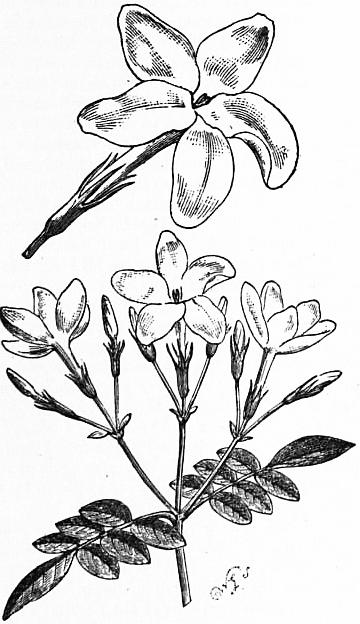
Jasminum grandiflorum; flower, natural size.
The zambak or Arabian jasmine, J. Sambac, is an evergreen white-flowered climber, 6 or 8 ft. high, introduced into Britain in the latter part of the 17th century. Two varieties introduced somewhat later are respectively 3-leaved and double-flowered, and these, as well as that with normal flowers, bloom throughout the greater part of the year. On account of their exquisite fragrance the flowers are highly esteemed in the East, and are frequently referred to by the Persian and Arabian poets. An oil obtained by boiling the leaves is used to anoint the head for complaints of the eye, and an oil obtained from the roots is used medicinally to arrest the secretion of milk. The flowers of one of the double varieties are held sacred to Vishnu, and used as votive offerings in Hindu religious ceremonies. The Spanish, or Catalonian jasmine, J. grandiflorum, a native of the north-west Himalaya, and cultivated both in the old and new world, is very like J. officinale, but differs in the size of the leaflets; the branches are shorter and stouter, and the flowers very much larger, and reddish underneath. By grafting it on two-year-old plants of J. officinale, an erect bush about 3 ft. high is obtained, requiring no supports. In this way it is very extensively cultivated at Cannes and Grasse, in the south of France; the plants are set in rows, fully exposed to the sun; they come into full bearing the second year after grafting; the blossoms, which are very large and intensely fragrant, are produced from July till the end of October, but those of August and September are the most odoriferous.
The aroma is extracted by the process known as enfleurage, i.e. absorption by a fatty body, such as purified lard or olive oil. Square glass trays framed with wood about 3 in. deep are spread over with grease about half an inch thick, in which ridges are made to facilitate absorption, and sprinkled with freshly gathered flowers, which are renewed every morning during the whole time the plant remains in blossom; the trays are piled up in stacks to prevent the evaporation of the aroma; and finally the pomade is scraped off the glass, melted at as low a temperature as possible, and strained. When oil is employed as the absorbent, coarse cotton cloths previously saturated with the finest olive oil are laid on wire-gauze frames, and repeatedly covered in the same manner with fresh flowers; they are then squeezed under a press, yielding what is termed huile antique au jasmin. Three pounds of flowers will perfume 1 ℔ of grease—this is exhausted by maceration in 1 pt. of rectified spirit to form the “extract.” An essential oil is distilled from jasmine in Tunis and Algeria, but its high price prevents its being used to any extent. The East Indian oil of jasmine is a compound largely contaminated with sandalwood-oil.
The distinguishing characters of J. odoratissimum, a native of the Canary Islands and Madeira, consist principally in the alternate, obtuse, ternate and pinnate leaves, the 3-flowered terminal peduncles and the 5-cleft yellow corolla with obtuse segments. The flowers have the advantage of retaining when dry their natural perfume, which is suggestive of a mixture of jasmine, jonquil and orange-blossom. In China J. paniculatum is cultivated as an erect shrub, known as sieu-hing-hwa; it is valued for its flowers, which are used with those of J. Sambac, in the proportion of 10 ℔ of the former to 30 ℔ of the latter, for scenting tea—40 ℔ of the mixture being required for 100 ℔ of tea. J. angustifolium is a beautiful evergreen climber 10 to 12 ft. high, found in the Coromandel forests, and introduced into Britain during the present century. Its leaves are of a bright shining green; its large terminal flowers are white with a faint tinge of red, fragrant and blooming throughout the year.
In Cochin China a decoction of the leaves and branches of J. nervosum is taken as a blood-purifier; and the bitter leaves of J. floribundum (called in Abyssinia habbez-zelim) mixed with kousso is considered a powerful anthelmintic, especially for tapeworm; the leaves and branches are added to some fermented liquors to increase their intoxicating quality. In Catalonia and in Turkey the wood of the jasmine is made into long, slender pipe-stems, highly prized by the Moors and Turks. Syrup of jasmine is made by placing in a jar alternate layers of the flowers and sugar, covering the whole with wet cloths and standing it in a cool place; the perfume is absorbed by the sugar, which is converted into a very palatable syrup. The important medicinal plant known in America as the “Carolina jasmine” is not a true jasmine (see Gelsemium).
Other hardy species commonly cultivated in gardens are the low or Italian yellow-flowered jasmine, J. humile, an East Indian species introduced and now found wild in the south of Europe, an erect shrub 3 or 4 ft. high, with angular branches, alternate and mostly ternate leaves, blossoming from June to September; the common yellow jasmine, J. fruticans, a native of southern Europe and the Mediterranean region, a hardy evergreen shrub, 10 to 12 ft. high, with weak, slender stems requiring support, and bearing yellow, odourless flowers from spring to autumn; and J. nudiflorum (China), which bears its bright yellow flowers in winter before the leaves appear. It thrives in almost any situation and grows rapidly.
JASON (Ἰάσων), in Greek legend, son of Aeson, king of Iolcus in Thessaly. He was the leader of the Argonautic expedition (see Argonauts). After he returned from it he lived at Corinth with his wife Medea (q.v.) for many years. At last he put away Medea, in order to marry Glauce (or Creusa), daughter of the Corinthian king Creon. To avenge herself, Medea presented the new bride with a robe and head-dress, by whose magic properties the wearer was burnt to death, and slew her children by Jason with her own hand. A later story represents Jason as reconciled to Medea (Justin, xlii. 2). His death was said to have been due to suicide through grief, caused by Medea’s vengeance (Diod. Sic. iv. 55); or he was crushed by the fall of the poop of the ship “Argo,” under which, on the advice of Medea, he had laid himself down to sleep (argument of Euripides’ Medea). The name (more correctly Iason) means “healer,” and Jason is possibly a local hero of Iolcus to whom healing powers were attributed. The ancients regarded him as the oldest navigator, and the patron of navigation. By the moderns he has been variously explained as a solar deity; a god of summer; a god of storm; a god of rain, who carries off the rain-giving cloud (the golden fleece) to refresh the earth after a long period of drought. Some regard the legend as a chthonian myth, Aea (Colchis) being the under-world in the Aeolic religious system from which Jason liberates himself and his betrothed; others, in view of certain resemblances between the story of Jason and that of Cadmus (the ploughing of the field, the sowing of the dragon’s teeth, the fight with the Sparti, who are finally set fighting with one another by a stone hurled into their midst), associate both with Demeter the corn-goddess, and refer certain episodes to practices in use at country festivals, e.g. the stone throwing, which, like the βαλλητύς at the Eleusinia and the λιθοβολία at Troezen (Pausanias ii. 30, 4 with Frazer’s note) was probably intended to secure a good harvest by driving away the evil spirits of unfruitfulness.
See articles by C. Seeliger in Roscher’s Lexikon der Mythologie and by F. Durrbach in Daremberg and Saglio’s Dictionnaire des antiquités; H. D. Müller, Mythologie der griechischen Stämme (1861), ii. 328, who explains the name Jason as “wanderer”; W. Mannhardt, Mythologische Forschungen (1884), pp. 75, 130; O. Crusius, Beiträge zur griechischen Mythologie una Religionsgeschichte (Leipzig, 1886).
Later Versions of the Legend.—Les fais et prouesses du noble et vaillant chevalier Jason was composed in the middle of the 15th century by Raoul Lefèvre on the basis of Benoît’s Roman de Troie, and presented to Philip of Burgundy, founder of the order of the Golden Fleece. The manners and sentiments of the 15th century are made to harmonize with the classical legends after the fashion of the Italian pre-Raphaelite painters, who equipped Jewish warriors with knightly lance and armour. The story is well told; the digressions are few; and there are many touches of domestic life and natural sympathy. The first edition is believed to have been printed at Bruges in 1474.
Caxton translated the book under the title of A Boke of the hoole Lyf of Jason, at the command of the duchess of Burgundy. A Flemish translation appeared at Haarlem in 1495. The Benedictine Bernard de Montfaucon (1655-1741) refers to a MS. by Guido delle Colonne, Historia Medeae et Jasonis (unpublished).
The Histoire de la Thoison d’Or (Paris, 1516) by Guillaume Fillastre (1400-1473), written about 1440-1450, is an historical compilation dealing with the exploits of the très chrétiennes maisons of France, Burgundy and Flanders.
JASON OF CYRENE, a Hellenistic Jew, who lived about 100 B.C. and wrote a history of the times of the Maccabees down to the victory over Nicanor (175-161 B.C.). This work is said to have been in five books and formed the basis of the present 2 Macc. (see ch. ii. 19-32).
JASPER, an opaque compact variety of quartz, variously coloured and often containing argillaceous matter. The colours are usually red, brown, yellow or green, and are due to admixture with compounds of iron, either oxides or silicates. Although the term jasper is now restricted to opaque quartz it is certain that the ancient jaspis or ἰάσπις was a stone of considerable translucency. The jasper of antiquity was in many cases distinctly green, for it is often compared with the emerald and other green objects. Jasper is referred to in the Niebelungenlied as being clear and green. Probably the jasper of the ancients included stones which would now be classed as chalcedony, and the emerald-like jasper may have been akin to our chrysoprase. The Hebrew word yashefeh may have designated a green jasper (cf. Assyrian yashpu). Professor Flinders Petrie has suggested that the odem, the first stone on the High Priest’s breastplate, translated “sard,” was a red jasper, whilst tarshish, the tenth stone, may have been a yellow jasper (Hastings’s Dict. Bible, 1902).
Many varieties of jasper are recognized. Riband jasper is a form in which the colours are disposed in bands, as in the well-known ornamental stone from Siberia, which shows a regular alternation of dark red and green stripes. Egyptian jasper is a brown jasper, occurring as nodules in the Lybian desert and in the Nile valley, and characterized by a zonal arrangement of light and dark shades of colour. Agate-jasper is a variety intermediate between true jasper and chalcedony. Basanite, lydite, or Lydian stone, is a velvet-black flinty jasper, used as a touchstone for testing the purity of precious metals by their streak. Porcelain jasper is a clay indurated by natural calcination.
(F. W. R.*)
JASSY (Iaṣiĭ), also written Jasii, Jaschi and Yassy, the capital of the department of Jassy, Rumania; situated on the left bank of the river Bahlui, an affluent of the Jijia, about 10 m. W. of the Pruth and the Russian frontier. Pop. (1900), 78,067. Jassy communicates by rail with Galatz on the Danube, Kishinev in Bessarabia, and Czernowitz in Bukowina. The surrounding country is one of uplands and woods, among which rise the monasteries of Cetaṭuia, Frumoasa, and Galata with its mineral springs, the water-cure establishment of Rapide and the great seminary of Socola. Jassy itself stands pleasantly amid vineyards and gardens, partly on two hills, partly in the hollow between. Its primitive houses of timber and plaster were mostly swept away after 1860, when brick or stone came into general use, and good streets were cut among the network of narrow, insanitary lanes. Jassy is the seat of the metropolitan of Moldavia, and of a Roman Catholic archbishop. Synagogues and churches abound. The two oldest churches date from the reign of Stephen the Great (1458-1504); perhaps the finest, however, are the 17th-century metropolitan, St Spiridion and Trei Erarchi, the last a curious example of Byzantine art, erected in 1639 or 1640 by Basil the Wolf, and adorned with countless gilded carvings on its outer walls and twin towers. The St Spiridion Foundation (due to the liberality of Prince Gregory Ghika in 1727, and available for the sick of all countries and creeds) has an annual income of over £80,000, and maintains hospitals and churches in several towns of Moldavia, besides the baths at Slanic in Walachia. The main hospital in Jassy is a large building, and possesses a maternity institution, a midwifery school, a chemical institute, an inoculating establishment, &c. A society of physicians and naturalists has existed in Jassy since the early part of the 19th century, and a number of periodicals are published. Besides the university, founded by Prince Cuza in 1864, with faculties of literature, philosophy, law, science and medicine, there are a military academy and schools of art, music and commerce; a museum, a fine hall and a theatre; the state library, where the chief records of Rumanian history are preserved; an appeal court, a chamber of commerce and several banks. The city is the headquarters of the 4th army corps. It has an active trade in petroleum, salt, metals, timber, cereals, fruit, wine, spirits, preserved meat, textiles, clothing, leather, cardboard and cigarette paper.
The inscription by which the existence of a Jassiorum municipium in the time of the Roman Empire is sought to be proved, lies open to grave suspicion; but the city is mentioned as early as the 14th century, and probably does derive its name from the Jassians, or Jazygians, who accompanied the Cumanian invaders. It was often visited by the Moldavian court. About 1564, Prince Alexander Lapusneanu, after whom one of the chief streets is named, chose Jassy for the Moldavian capital, instead of Suceava (now Suczawa, in Bukowina). It was already famous as a centre of culture. Between 1561 and 1563 an excellent school and a Lutheran church were founded by the Greek adventurer, Jacob Basilicus (see Rumania: History). In 1643 the first printed book published in Moldavia was issued from a press established by Basil the Wolf. He also founded a school, the first in which the mother-tongue took the place of Greek. Jassy was burned by the Tatars in 1513, by the Turks in 1538, and by the Russians in 1686. By the Peace of Jassy the second Russo-Turkish War was brought to a close in 1792. A Greek insurrection under Ypsilanti in 1821 led to the storming of the city by the Turks in 1822. In 1844 there was a severe conflagration. For the loss caused to the city in 1861 by the removal of the seat of government to Bucharest the constituent assembly voted £148,150, to be paid in ten annual instalments, but no payment was ever made.
JĀTAKA, the technical name, in Buddhist literature, for a story of one or other of the previous births of the Buddha. The word is also used for the name of a collection of 547 of such stories included, by a most fortunate conjuncture of circumstances, in the Buddhist canon. This is the most ancient and the most complete collection of folk-lore now extant in any literature in the world. As it was made at latest in the 3rd century B.C., it can be trusted not to give any of that modern or European colouring which renders suspect much of the folk-lore collected by modern travellers.
Already in the oldest documents, drawn up by the disciples soon after the Buddha’s death, he is identified with certain ancient sages of renown. That a religious teacher should claim to be successor of the prophets of old is not uncommon in the history of religions. But the current belief in metempsychosis led, or enabled, the early Buddhists to make a much wider claim. It was not very long before they gradually identified their master with the hero of each of the popular fables and stories of which they were so fond. The process must have been complete by the middle of the 3rd century B.C.; for we find at that date illustrations of the Jātakas in the bas-reliefs on the railing round the Bharahat tope with the titles of the Jātaka stories inscribed above them in the characters of that period.1 The hero of each story is made into a Bodhisatta; that is, a being who is destined, after a number of subsequent births, to become a Buddha. This rapid development of the Bodhisatta theory is the distinguishing feature in the early history of Buddhism, and was both cause and effect of the simultaneous growth of the Jātaka book. In adopting the folk-lore and fables already current in India, the Buddhists did not change them very much. The stories as preserved to us, are for the most part Indian rather than Buddhist. The ethics they inculcate or suggest are milk for babes; very simple in character and referring almost exclusively to matters common to all schools of thought in India, and indeed elsewhere. Kindness, purity, honesty, generosity, worldly wisdom, perseverance, are the usual virtues praised; the higher ethics of the Path are scarcely mentioned. These stories, popular with all, were especially appreciated by that school of Buddhists that laid stress on the Bodhisatta theory—a school that obtained its chief support, and probably had its origin, in the extreme north-west of India and in the highlands of Asia. That school adopted, from the early centuries of our era, the use of Sanskrit, instead of Pali, as the means of literary expression. It is almost impossible, therefore, that they would have carried the canonical Pali book, voluminous as it is, into Central Asia. Shorter collections of the original stories, written in Sanskrit, were in vogue among them. One such collection, the Jātaka-mālā, by Ārya Sūra (6th century), is still extant. Of the existence of another collection, though the Sanskrit original has not yet been found, we have curious evidence. In the 6th century a book of Sanskrit fables was translated into Pahlavi, that is, old Persian (see Bidpai). In succeeding centuries this work was retranslated into Arabic and Hebrew, thence into Latin and Greek and all the modern languages of Europe. The book bears a close resemblance to the earlier chapters of a late Sanskrit fable book called, from its having five chapters, the Pancha tantra, or Pentateuch.
The introduction to the old Jātaka book gives the life of the historical Buddha. That introduction must also have reached Persia by the same route. For in the 8th century St John of Damascus put the story into Greek under the title of Barlaam and Josaphat. This story became very popular in the West. It was translated into Latin, into seven European languages, and even into Icelandic and the dialect of the Philippine Islands. Its hero, that is the Buddha, was canonized as a Christian saint; and the 27th of November was officially fixed as the date for his adoration as such.
The book popularly known in Europe as Aesop’s Fables was not written by Aesop. It was put together in the 14th century at Constantinople by a monk named Planudes, and he drew largely for his stories upon those in the Jātaka book that had reached Europe along various channels. The fables of Babrius and Phaedrus, written respectively in the 1st century before, and in the 1st century after, the Christian era, also contain Jātaka stories known in India in the 4th century B.C. A great deal has been written on this curious question of the migration of fables. But we are still very far from being able to trace the complete history of each story in the Jātaka book, or in any one of the later collections. For India itself the record is most incomplete. We have the original Jātaka book in text and translation. The history of the text of the Pancha tantra, about a thousand years later, has been fairly well traced out. But for the intervening centuries scarcely anything has been done. There are illustrations, in the bas-reliefs of the 3rd century B.C., of Jātakas not contained in the Jātaka book. Another collection, the Cariyâ piṭaka, of about the same date, has been edited, but not translated. Other collections both in Pali and Sanskrit are known to be extant in MS; and a large number of Jātaka stories, not included in any formal collection, are mentioned, or told in full, in other works.
Authorities.—V. Fausböll, The Jataka, Pali text (7 vols., London, 1877-1897), (Eng. trans., edited by E. B. Cowell, 6 vols., Cambridge, 1895-1907); Cariyâ piṭaka, edited by R. Morris for the Pali Text Society (London, 1882); H. Kern, Jātaka-mālā, Sanskrit text (Cambridge, Mass., 1891), (Eng. trans. by J. S. Speyer, Oxford, 1895); Rhys Davids, Buddhist Birth Stories (with full bibliographical tables) (London, 1880); Buddhist India (chap. xi. on the Jātaka Book) (London, 1903); E. Kuhn, Barlaam und Joasaph (Munich, 1893); A. Cunningham, The Stupa of Bharhut (London, 1879).
(T. W. R. D.)
1 A complete list of these inscriptions will be found in Rhys Davids’s Buddhist India, p. 209.
JATH, a native state of India, in the Deccan division of Bombay, ranking as one of the southern Mahratta jagirs. With the small state of Daphlapur, which is an integral part of it, it forms the Bijapur Agency, under the collector of Bijapur district. Area, including Daphlapur, 980 sq. m. Pop. (1901), 68,665, showing a decline of 14% in the decade. Estimated revenue £24,000; tribute £700. Agriculture and cattle-breeding are carried on; there are no important manufactures. The chief, whose title is deshmukh, is a Mahratta of the Daphle family. The town of Jath is 92 m. S.E. of Satara. Pop. (1901), 5404.
JÁTIVA (formerly written Xativa), or San Felipe de Játiva, a town of eastern Spain, in the province of Valencia, on the right bank of the river Albaida, a tributary of the Júcar, and at the junction of the Valencia-Murcia and Valencia-Albacete railways. Pop. (1900), 12,600. Játiva is built on the margin of a fertile and beautiful plain, and on the southern slopes of the Monte Bernisa, a hill with two peaks, each surmounted by a castle. With its numerous fountains, and spacious avenues shaded with elms or cypresses, the town has a clean and attractive appearance. Its collegiate church, dating from 1414, but rebuilt about a century later in the Renaissance style, was formerly a cathedral, and is the chief among many churches and convents. The town-hall and a church on the castle hill are partly constructed of inscribed Roman masonry, and several houses date from the Moorish occupation. There is a brisk local trade in grain, fruit, wine, oil and rice.
Játiva was the Roman Saetabis, afterwards Valeria Augusta, of Carthaginian or Iberian origin. Pliny (23-79) and Martial (c. 40-102) mention the excellence of its linen cloth. Under the Visigoths (c. 483-711) it became an episcopal see; but early in the 8th century it was captured by the Moors, under whom it attained great prosperity, and received its present name. It was reconquered by James I. of Aragon (1213-1276). During the 15th and 16th centuries, Játiva was the home of many members of the princely house of Borgia or Borja, who migrated hither from the town of Borja in the province of Saragossa. Alphonso Borgia, afterwards Pope Calixtus III., and Rodrigo Borgia, afterwards Pope Alexander VI., were natives of Játiva, born respectively in 1378 and 1431. The painter Jusepe Ribera was also born here in 1588. Owing to its gallant defence against the troops of the Archduke Charles in the war of the Spanish succession, Játiva received the additional name of San Felipe from Philip V. (1700-1746).
JĀTS, or Juts, a people of north-western India, who numbered altogether more than 7 millions in 1901. They form a considerable proportion of the population in the Punjab, Rājputana and the adjoining districts of the United Provinces, and are also widely scattered through Sind and Baluchistan. Some writers have identified the Juts with the ancient Getae, and there is strong reason to believe them a degraded tribe of Rājputs, whose Scythic origin has also been maintained. Hindu legends point to a prehistoric occupation of the Indus valley by this people, and at the time of the Mahommedan conquest of Sind (712) they, with a cognate tribe called Meds, constituted the bulk of the population. They enlisted under the banner of Mahommed bin Kāsim, but at a later date offered a vigorous resistance to the Arab invaders. In 836 they were overthrown by Amran, who imposed on them a tribute of dogs, and used their arms to vanquish the Meds. In 1025, however, they had gathered audacity, not only to invade Mansura, and compel the abjuration of the Mussulman amir, but to attack the victorious army of Mahmūd, laden with the spoil of Somnāth. Chastisement duly ensued: a formidable flotilla, collected at Mūltān, shattered in thousands the comparatively defenceless Jāt boats on the Indus, and annihilated their national pretensions. It is not until the decay of the Mogul Empire that the Jāts again appear in history. One branch of them, settled south of Agra, mainly by bold plundering raids founded two dynasties which still exist at Bharatpur (q.v.) and Dholpur (q.v.). Another branch, settled north-west of Delhi, who adopted the Sikh religion, ultimately made themselves dominant throughout the Punjab (q.v.) under Ranjit Singh, and are now represented in their original home by the Phulkian houses of Patiala (q.v.), Jind (q.v.) and Nabha (q.v.). It is from this latter branch that the Sikh regiments of the Indian army are recruited. The Jāts are mainly agriculturists and cattle breeders. In their settlements on the Ganges and Jumna, extending as far east as Bareilly, they are divided into two great clans, the Dhe and the Hele; while in the Punjab there are said to be one hundred different sections. Their religion varies with locality. In the Punjab they have largely embraced Sikh tenets, while in Sind and Baluchistan they are Mahommedans. In appearance they are not ill-favoured though extremely dark; they have good teeth, and large beards, sometimes stained with indigo. Their inferiority of social position, however, to some extent betrays itself in their aspect, and tends to be perpetuated by their intellectual apathy.
JAUBERT, PIERRE AMÉDÉE ÉMILIEN PROBE (1779-1847), French Orientalist, was born at Aix in Provence on the 3rd of June 1779. He was one of the most distinguished pupils of Silvestre de Sacy, whose funeral Discours he pronounced in 1838. Jaubert acted as interpreter to Napoleon in Egypt in 1798-1799, and on his return to Paris held various posts under government. In 1802 he accompanied Sebastiani on his Eastern mission; and in 1804 he was at Constantinople. Next year he was despatched to Persia to arrange an alliance with the shah; but on the way he was seized and imprisoned in a dry cistern for four months by the pasha of Bayazid. The pasha’s death freed Jaubert, who successfully accomplished his mission, and rejoined Napoleon at Warsaw in 1807. On the eve of Napoleon’s downfall he was appointed chargé d’affaires at Constantinople. The restoration ended his diplomatic career, but in 1818 he undertook a journey with government aid to Tibet, whence he succeeded in introducing into France 400 Kashmir goats. The rest of his life Jaubert spent in study, in writing and in teaching. He became professor of Persian in the collège de France, and director of the école des langues orientales, and in 1830 was elected member of the Académie des Inscriptions. In 1841 he was made a peer of France and councillor of state. He died in Paris on the 28th of January, 1847.
Besides articles in the Journal asiatique, he published Voyage en Arménie et en Perse (1821; the edition of 1860 has a notice of Jaubert, by M. Sédillot) and Éléments de la grammaire turque (1823-1834). See notices in the Journal asiatique, Jan. 1847, and the Journal des débats, Jan. 30, 1847.
JAUCOURT, ARNAIL FRANÇOIS, Marquis de (1757-1852), French politician, was born on the 14th of November 1757 at Tournon (Seine-et-Marne) of a Protestant family, protected by the prince de Condé, whose regiment he entered. He adopted revolutionary ideas and became colonel of his regiment. In the Assembly, to which he was returned in 1791 by the department of Seine-et-Marne, he voted generally with the minority, and his views being obviously too moderate for his colleagues he resigned in 1792 and was soon after arrested on suspicion of being a reactionary. Mme de Staël procured his release from P. L. Manuel just before the September massacres. He accompanied Talleyrand on his mission to England, returning to France after the execution of Louis XVI. He lived in retirement until the establishment of the Consulate, when he entered the tribunate, of which he was for some time president. In 1803 he entered the senate, and next year became attached to the household of Joseph Bonaparte. Presently his imperialist views cooled, and at the Restoration he became minister of state and a peer of France. At the second Restoration he was for a brief period minister of marine, but held no further office. He devoted himself to the support of the Protestant interest in France. A member of the upper house throughout the reign of Louis Philippe, he was driven into private life by the establishment of the Second Republic, but lived to see the Coup d’état and to rally to the government of Louis Napoleon, dying in Paris on the 5th of February 1852.
JAUER, a town of Germany, in the Prussian province of Silesia, 13 m. by rail S. of Leignitz, on the Wüthende Neisse. Pop. (1900), 13,024. St Martin’s (Roman Catholic) church dates from 1267-1290, and the Evangelical church from 1655. A new town-hall was erected in 1895-1898. Jauer manufactures leather, carpets, cigars, carriages and gloves, and is specially famous for its sausages. The town was first mentioned in 1242, and was formerly the capital of a principality embracing about 1200 sq. m., now occupied by the circles of Jauer, Bunzlau, Löweberg, Hirschberg and Schönau. From 1392 to 1741 it belonged to the kings of Bohemia, being taken from Maria Theresa by Frederick the Great. Jauer was formerly the prosperous seat of the Silesian linen trade, but the troubles of the Thirty Years’ War, in the course of which it was burned down three times, permanently injured this.
See Schönaich, Die alte Fürstentumshauptstadt Jauer (Jauer, 1903).
JAUHARĪ (Abu Nasr Ismaeil ibn Ḥammad ul-Jauhari) (d. 1002 or 1010), Arabian lexicographer, was born at Fārāb on the borders of Turkestan. He studied language in Fārāb and Bagdad, and later among the Arabs of the desert. He then settled in Damghan and afterwards at Nīshapūr, where he died by a fall from the roof of a house. His great work is the Kitāb us-Ṣaḥāḥ fil-Lugha, an Arabic dictionary, in which the words are arranged alphabetically according to the last letter of the root. He himself had only partially finished the last recension, but the work was completed by his pupil, Abū Isḥaq Ibrāhīm ibn Ṣāliḥ ul-Warrāq.
An edition was begun by E. Scheidius with a Latin translation, but one part only appeared at Harderwijk (1776). The whole has been published at Tebriz (1854) and at Cairo (1865), and many abridgments and Persian translations have appeared; cf. C. Brockelmann, Geschichte der arabischen Literatur (Weimar, 1898), i. 128 seq.
(G. W. T.)
JAUNDICE (Fr. jaunisse, from jaune, yellow), or Icterus (from its resemblance to the colour of the golden oriole, of which Pliny relates that if a jaundiced person looks upon it he recovers but the bird dies), a term in medicine applied to a yellow coloration of the skin and other parts of the body, depending in most instances on some derangement affecting the liver. This yellow colour is due to the presence in the blood of bile or of some of the elements of that secretion. Jaundice, however, must be regarded more as a symptom of some morbid condition previously existing than as a disease per se.
Cases with jaundice may be divided into three groups.
1. Obstructive Jaundice.—Any obstruction of the passage of bile from the liver into the intestinal canal is sooner or later followed by the appearance of jaundice, which in such circumstances is due to the absorption of bile into the blood. The obstruction is due to one of the following causes: (1) Obstruction by foreign bodies within the bile duct, e.g. gallstones or parasites; (2) inflammation of the duodenum or the lining membrane of the duct; (3) stricture or obliteration of the duct; (4) a tumour growing from the duct; (5) pressure on the duct from without, from the liver or other organ, or tumours arising from them. Obstructions from these causes may be partial or complete, and the degree of jaundice will vary accordingly, but it is to be noted that extensive organic disease of the liver may exist without the evidence of obstructive jaundice.
The effect upon the liver of impediments to the outflow of bile such as those above indicated is in the first place an increase in its size, the whole biliary passages and the liver cells being distended with retained bile. This enlargement, however, speedily subsides when the obstruction is removed, but should it persist the liver ultimately shrinks and undergoes atrophy in its whole texture. The bile thus retained is absorbed into the system, and shows itself by the yellow staining seen to a greater or less extent in all the tissues and many of the fluids of the body. The kidneys, which in such circumstances act in some measure vicariously to the liver and excrete a portion of the retained bile, are apt to become affected in their structure by the long continuance of jaundice.
The symptoms of obstructive jaundice necessarily vary according to the nature of the exciting cause, but there generally exists evidence of some morbid condition before the yellow coloration appears. Thus, if the obstruction be due to an impacted gallstone in the common or hepatic duct, there will probably be the symptoms of intense suffering characterizing hepatic colic (see Colic). In the cases most frequently seen—those, namely, arising from simple catarrh of the bile ducts due to gastro-duodenal irritation spreading through the common duct—the first sign to attract attention is the yellow appearance of the white of the eye, which is speedily followed by a similar colour on the skin over the body generally. The yellow tinge is most distinct where the skin is thin, as on the forehead, breast, elbows, &c. It may be also well seen in the roof of the mouth, but in the lips and gums the colour is not observed till the blood is first pressed from them. The tint varies, being in the milder cases faint, in the more severe a deep saffron yellow, while in extreme degrees of obstruction it may be of dark brown or greenish hue. The colour can scarcely, if at all, be observed in artificial light.
The urine exhibits well marked and characteristic changes in jaundice which exist even before any evidence can be detected on the skin or elsewhere. It is always of dark brown colour resembling porter, but after standing in the air it acquires a greenish tint. Its froth is greenish-yellow, and it stains with this colour any white substance. It contains not only the bile colouring matter but also the bile acids. The former is detected by the play of colours yielded on the addition of nitric acid, the latter by the purple colour, produced by placing a piece of lump sugar in the urine tested, and adding thereto a few drops of strong sulphuric acid.
The contents of the bowels also undergo changes, being characterized chiefly by their pale clay colour, which is in proportion to the amount of hepatic obstruction, and to their consequent want of admixture with bile. For the same reason they contain a large amount of unabsorbed fatty matter, and have an extremely offensive odour.
Constitutional symptoms always attend jaundice with obstruction. The patient becomes languid, drowsy and irritable, and has generally a slow pulse. The appetite is usually but not always diminished, a bitter taste in the mouth is complained of, while flatulent eructations arise from the stomach. Intolerable itching of the skin is a common accompaniment of jaundice, and cutaneous eruptions or boils are occasionally seen. Yellow vision appears to be present in some very rare cases. Should the jaundice depend on advancing organic disease of the liver, such as cancer, the tinge becomes gradually deeper, and the emaciation and debility more marked towards the fatal termination, which in such cases is seldom long postponed. Apart from this, however, jaundice from obstruction may exist for many years, as in those instances where the walls of the bile ducts are thickened from chronic catarrh, but where they are only partially occluded. In the common cases of acute catarrhal jaundice recovery usually takes place in two or three weeks.
The treatment of this form of jaundice bears reference to the cause giving rise to the obstruction. In the ordinary cases of simple catarrhal jaundice, or that following the passing of gallstones, a light nutritious diet (milk, soups, &c., avoiding saccharine and farinaceous substances and alcoholic stimulants), along with counter-irritation applied over the right side and the use of laxatives and cholagogues, will be found to be advantageous. Diaphoretics and diuretics to promote the action of the skin and kidneys are useful in jaundice. In the more chronic forms, besides the remedies above named, the waters of Carlsbad are of special efficacy. In cases other than acute catarrhal, operative interference is often called for, to remove the gallstones, tumour, &c., causing the obstruction.
2. Toxaemic Jaundice is observed to occur as a symptom in certain fevers, e.g. yellow fever, ague, and in pyaemia also as the effect of certain poisons, such as phosphorus, and the venom of snake-bites. Jaundice of this kind is almost always slight, and neither the urine nor the discharges from the bowels exhibit changes in appearance to such a degree as in the obstructive variety. Grave constitutional symptoms are often present, but they are less to be ascribed to the jaundice than to the disease with which it is associated.
3. Hereditary Jaundice.—Under this group there are the jaundice of new-born infants, which varies enormously in severity; the cases in which a slight form of jaundice obtains in several members of the same family, without other symptoms, and which may persist for years; and lastly the group of cases with hypertrophic cirrhosis.
The name malignant jaundice is sometimes applied to that very fatal form of disease otherwise termed acute yellow atrophy of the liver (see Atrophy).
JAUNPUR, a city and district of British India, in the Benares division of the United Provinces. The city is on the left bank of the river Gumti, 34 m. N.W. from Benares by rail. Pop. (1901), 42,771. Jaunpur is a very ancient city, the former capital of a Mahommedan kingdom which once extended from Budaun and Etawah to Behar. It abounds in splendid architectural monuments, most of which belong to the period when the rulers of Jaunpur were independent of Delhi. The fort of Feroz Shah is in great part completely ruined, but there remain a fine gateway of the 16th century, a mosque dating from 1376, and the hammams or baths of Ibrahim Shah. Among other buildings may be mentioned the Atala Masjid (1408) and the ruined Jinjiri Masjid, mosques built by Ibrahim, the first of which has a great cloistered court and a magnificent façade; the Dariba mosque constructed by two of Ibrahim’s governors; the Lal Darwaza erected by the queen of Mahmud; the Jama Masjid (1438-1478) or great mosque of Husain, with court and cloisters, standing on a raised terrace, and in part restored in modern times; and finally the splendid bridge over the Gumti, erected by Munim Khan, Mogul governor in 1569-1573. During the Mutiny of 1857 Jaunpur formed a centre of disaffection. The city has now lost its importance, the only industries surviving being the manufacture of perfumes and papier-mâché articles.
The District of Jaunpur has an area of 1551 sq. m. It forms part of the wide Gangetic plain, and its surface is accordingly composed of a thick alluvial deposit. The whole country is closely tilled, and no waste lands break the continuous prospect of cultivated fields. It is divided into two unequal parts by the sinuous channel of the Gumti, a tributary of the Ganges, which flows past the city of Jaunpur. Its total course within the district is about 90 m., and it is nowhere fordable. It is crossed by two bridges, one at Jaunpur and the other 2 m. lower down. The Gumti is liable to sudden inundations during the rainy season, owing to the high banks it has piled up at its entrance into the Ganges, which act as dams to prevent the prompt outflow of its flooded waters. These inundations extend to its tributary the Saī. Much damage was thus effected in 1774; but the greatest recorded flood took place in September 1871, when 4000 houses in the city were swept away, besides 9000 more in villages along its banks. The other rivers are the Saī, Barna, Pili and Basohi. Lakes are numerous in the north and south; the largest has a length of 8 m. Pop. (1901), 1,202,920, showing a decrease of 5% in the decade. Sugar-refining is the principal industry. The district is served by the line of the Oudh & Rohilkhand railway from Benares to Fyzabad, and by branches of this and of the Bengal & North-Western systems.
In prehistoric times Jaunpur seems to have formed a portion of the Ajodhya principality, and when it first makes an appearance in authentic history it was subject to the rulers of Benares. With the rest of their dominions it fell under the yoke of the Mussulman invaders in 1194. From that time the district appears to have been ruled by a prince of the Kanauj dynasty, as a tributary of the Mahommedan suzerain. In 1388 Mālik Sarwar Khwāja was sent by Mahommed Tughlak to govern the eastern province. He fixed his residence at Jaunpur, made himself independent of the Delhi court, and assumed the title of Sultan-us-Shark, or “eastern emperor.” For nearly a century the Sharki dynasty ruled at Jaunpur, and proved formidable rivals to the sovereigns of Delhi. The last of the dynasty was Sultan Husain, who passed his life in a fierce and chequered struggle for supremacy with Bahlol Lodi, then actual emperor at Delhi. At length, in 1478, Bahlol succeeded in defeating his rival in a series of decisive engagements. He took the city of Jaunpur, but permitted the conquered Husain to reside there, and to complete the building of his great mosque, the Jama Masjid, which now forms the chief ornament of the town. Many other architectural works in the district still bear witness to its greatness under its independent Mussulman rulers. In 1775 the district was made over to the British by the Treaty of Lucknow. From that time nothing occurred which calls for notice till the Mutiny. On the 5th of June 1857, when the news of the Benares revolt reached Jaunpur, the sepoys mutinied. The district continued in a state of complete anarchy till the arrival of the Gurkha force from Azamgarh in September. In November the surrounding country was lost again, and it was not till May 1858 that the last smouldering embers of disaffection were stifled by the repulse of the insurgent leader at the hands of the people themselves.
See A. Führer, The Shargi Architecture of Jaunpur (1889).
JAUNTING-CAR, a light two-wheeled carriage for a single horse, in its commonest form with seats for four persons placed back to back, with the foot-boards projecting over the wheels. It is the typical conveyance for persons in Ireland (see Car). The first part of the word is generally taken to be identical with the verb “to jaunt,” now only used in the sense of to go on a short pleasure excursion, but in its earliest uses meaning to make a horse caracole or prance, hence to jolt or bump up and down. It would apparently be a variant of “jaunce,” of the same meaning, which is supposed to be taken from O. Fr. jancer. Skeat takes the origin of jaunt and jaunce to be Scandinavian, and connects them with the Swedish dialect word ganta, to romp; and he finds cognate bases in such words as “jump,” “high jinks.” The word “jaunty,” sprightly, especially used of anything done with an easy nonchalant air, is a corruption of “janty,” due to confusion with “jaunt.” “Janty,” often spelt in the 17th and 18th centuries “janté” or “jantee,” represents the English pronunciation of Fr. gentil, well-bred, neat, spruce.
JAUREGUI, JUAN (1562-1582), a Biscayan by birth, was in 1582 in the service of a Spanish merchant, Gaspar d’Anastro, who was resident at Antwerp. Tempted by the reward of 80,000 ducats offered by Philip II. of Spain for the assassination of William the Silent, prince of Orange, but being himself without courage to undertake the task, d’Anastro, with the help of his cashier Venero, persuaded Jauregui to attempt the murder for the sum of 2877 crowns. On Sunday the 18th of March 1582, as the prince came out of his dining-room Jauregui offered him a petition, and William had no sooner taken it into his hand than Jauregui fired a pistol at his head. The ball pierced the neck below the right ear and passed out at the left jaw-bone; but William ultimately recovered. The assassin was killed on the spot.
JAURÉGUIBERRY, JEAN BERNARD (1815-1887), French admiral, was born at Bayonne on the 26th of August 1815. He entered the navy in 1831, was made a lieutenant in 1845, commander in 1856, and captain in 1860. After serving in the Crimea and in China, and being governor of Senegal, he was promoted to rear-admiral in 1869. He served on land during the second part of the Franco-German War of 1870-71, in the rank of auxiliary general of division. He was present at Coulmiers, Villépion and Loigny-Poupry, in command of a division, and in Chanzy’s retreat upon Le Mans and the battle at that place in command of a corps. He was the most distinguished of the many naval officers who did good service in the military operations. On the 9th of December he had been made vice-admiral, and in 1871 he commanded the fleet at Toulon; in 1875 he was a member of the council of admiralty; and in October 1876 he was appointed to command the evolutionary squadron in the Mediterranean. In February 1879 he became minister of the navy in the Waddington cabinet, and on the 27th of May following was elected a senator for life. He was again minister of the navy in the Freycinet cabinet in 1880. A fine example of the fighting French seaman of his time, Jauréguiberry died at Paris on the 21st of October 1887.
JÁUREGUI Y AGUILAR, JUAN MARTÍNEZ DE (1583-1641), Spanish poet, was baptized at Seville on the 24th of November 1583. In due course he studied at Rome, returning to Spain shortly before 1610 with a double reputation as a painter and a poet. A reference in the preface to the Novelas exemplares has been taken to mean that he painted the portrait of Cervantes, who, in the second part of Don Quixote, praises the translation of Tasso’s Aminta published at Rome in 1607. Jáuregui’s Rimas (1618), a collection of graceful lyrics, is preceded by a controversial preface which attracted much attention on account of its outspoken declaration against culteranismo. Through the influence of Olivares, he was appointed groom of the chamber to Philip IV., and gave an elaborate exposition of his artistic doctrines in the Discurso poético contra el hablar culto y oscuro (1624), a skilful attack on the new theories, which procured for its author the order of Calatrava. It is plain, however, that the shock of controversy had shaken Jáuregui’s convictions, and his poem Orfeo (1624) is visibly influenced by Góngora. Jáuregui died at Madrid on the 11th of January 1641, leaving behind him a translation of the Pharsalia which was not published till 1684. This rendering reveals Jáuregui as a complete convert to the new school, and it has been argued that, exaggerating the affinities between Lucan and Góngora—both of Cordovan descent—he deliberately translated the thought of the earlier poet into the vocabulary of the later master. This is possible; but it is at least as likely that Jáuregui unconsciously yielded to the current of popular taste, with no other intention than that of conciliating the public of his own day.
JAURÈS, JEAN LÉON (1859- ), French Socialist leader, was born at Castres (Tarn) on the 3rd of September 1859. He was educated at the lycée Louis-le-Grand and the école normale supérieure, and took his degree as associate in philosophy in 1881. After teaching philosophy for two years at the lycée of Albi (Tarn), he lectured at the university of Toulouse. He was elected republican deputy for the department of Tarn in 1885. In 1889, after unsuccessfully contesting Castres, he returned to his professional duties at Toulouse, where he took an active interest in municipal affairs, and helped to found the medical faculty of the university. He also prepared two theses for his doctorate in philosophy, De primis socialismi germanici lineamentis apud Lutherum, Kant, Fichte et Hegel (1891), and De la réalité du monde sensible. In 1902 he gave energetic support to the miners of Carmaux who went out on strike in consequence of the dismissal of a socialist workman, Calvignac; and in the next year he was re-elected to the chamber as deputy for Albi. Although he was defeated at the elections of 1898 and was for four years outside the chamber, his eloquent speeches made him a force in politics as an intellectual champion of socialism. He edited the Petite République, and was one of the most energetic defenders of Captain Alfred Dreyfus. He approved of the inclusion of M. Millerand, the socialist, in the Waldeck-Rousseau ministry, though this led to a split with the more revolutionary section led by M. Guesde. In 1902 he was again returned as deputy for Albi, and during the Combes administration his influence secured the coherence of the radical-socialist coalition known as the bloc. In 1904 he founded the socialist paper, L’Humanité. The French socialist groups held a congress at Rouen in March 1905, which resulted in a new consolidation; the new party, headed by MM. Jaurès and Guesde, ceased to co-operate with the radicals and radical-socialists, and became known as the unified socialists, pledged to advance a collectivist programme. At the general elections of 1906 M. Jaurès was again elected for the Tarn. His ability and vigour were now generally recognized; but the strength of the socialist party, and the practical activity of its leader, still had to reckon with the equally practical and vigorous liberalism of M. Clemenceau. The latter was able to appeal to his countrymen (in a notable speech in the spring of 1906) to rally to a radical programme which had no socialist Utopia in view; and the appearance in him of a strong and practical radical leader had the result of considerably diminishing the effect of the socialist propaganda. M. Jaurès, in addition to his daily journalistic activity, published Les preuves; affaire Dreyfus (1900); Action socialiste (1899); Études socialistes (1902), and, with other collaborators, Histoire socialiste (1901), &c.
JAVA, one of the larger islands of that portion of the Malay Archipelago which is distinguished as the Sunda Islands. It lies between 105° 12′ 40″ (St Nicholas Point) and 114° 35′ 38″ E. (Cape Seloko) and between 5° 52′ 34″ and 8° 46′ 46″ S. It has a total length of 622 m. from Pepper Bay in the west to Banyuwangi in the east, and an extreme breadth of 121 m. from Cape Bugel in Japara to the coast of Jokjakarta, narrowing towards the middle to about 55 m. Politically and commercially it is important as the seat of the colonial government of the Dutch East Indies, all other parts of the Dutch territory being distinguished as the Outer Possessions (Buitenbezittungens). According to the triangulation survey (report published in 1901) the area of Java proper is 48,504 sq. m.; of Madura, the large adjacent and associated island, 1732; and of the smaller islands administratively included with Java and Madura 1416, thus making a total of 50,970 sq. m. The more important of these islands are the following: Pulau Panaitan or Princes Island (Prinseneiland), 47 sq. m., lies in the Sunda Strait, off the south-western peninsula of the main island, from which it is separated by the Behouden Passage. The Thousand Islands are situated almost due N. of Batavia. Of these five were inhabited in 1906 by about 1280 seafarers from all parts and their descendants. The Karimon Java archipelago, to the north of Semarang, numbers twenty-seven islands with an area of 16 sq. m. and a population of about 800 (having one considerable village on the main island). Bavian1 (Bawian), 100 m. N. of Surabaya, is a ruined volcano with an area of 73 sq. m. and a population of about 44,000. About a third of the men are generally absent as traders or coolies. In Singapore and Sumatra they are known as Boyans. They are devout Mahommedans and many of them make the pilgrimage to Mecca. The Sapudi and Kangean archipelagoes are eastward continuations of Madura. The former, thirteen in all, with an area of 58 sq. m. and 53,000 inhabitants, export cattle, dried fish and trepang; and many of the male population work as day labourers in Java or as lumbermen in Sumbawa, Flores, &c. The main island of the Kangians has an area of 19 sq. m.; the whole group 23 sq. m. It is best known for its limestone caves and its buffaloes. Along the south coast the islands are few and small—Klapper or Deli, Trouwers or Tingal, Nusa Kembangan, Sempu and Nusa Barung.
From Sumatra on the W., Java is separated by the Sunda Strait, which at the narrowest is only 14 m. broad, but widens elsewhere to about 50 m. On the E. the strait of Bali, which parts it from the island of that name, is at the northern end not more than 1½ m. across. Through the former strong currents run for the greater part of the day throughout the year, outwards from the Java Sea to the Indian Ocean. In the strait of Bali the currents are perhaps even stronger and are extremely irregular. Pilots with local knowledge are absolutely necessary for vessels attempting either passage. In spite of the strength of the currents the Sunda Strait is steadily being diminished in width, and the process if continued must result in a restoration of that junction of Sumatra and Java which according to some authorities formerly existed.2
In general terms Java may be described as one of the breakwater islands of the Indian Ocean—part of the mountainous rim (continuous more or less completely with Sumatra) of the partially submerged plateau which lies between the ocean on the S. and the Chinese Sea on the N., and has the massive island of Borneo as its chief subaerial portion. While the waves and currents of the ocean sweep away most of the products of denudation along the south coast or throw a small percentage back in the shape of sandy downs, the Java Sea on the north—not more than 50 fathoms deep—allows them to settle and to form sometimes with extraordinary rapidity broad alluvial tracts.3
It is customary and obvious to divide Java into three divisions, the middle part of the island narrowing into a kind of isthmus, and each of the divisions thus indicated having certain structural characteristics of its own. West Java, which consists of Bantam, Krawang and the Preanger Regencies, has an area of upwards of 18,000 sq. m. In this division the highlands lie for the most part in a compact mass to the south and the lowlands form a continuous tract to the north. The main portion of the uplands consists of the Preanger Mountains, with the plateaus of Bandong, Pekalongan, Tegal, Badung and Gurut, encircled with volcanic summits. On the borders of the Preanger, Batavia and Bantam are the Halimon Mountains (the Blue Mountains of the older travellers), reaching their greatest altitudes in the volcanic summits of Gedeh and Salak. To the west lie the highlands of Bantam, which extending northward cut off the northern lowlands from the Sunda Strait. Middle Java is the smallest of the three divisions, having an area of not much more than 13,200 sq. m. It comprises Tegal, Pekalongan, Banyumas, Bagelen, Kedu, Jokjakarta, Surakarta, and thus not only takes in the whole of the isthmus but encroaches on the broad eastern portion of the island. In the isthmus mountains are not so closely massed in the south nor the plains so continuous on the north. The watershed culminating in Slamet lies almost midway between the ocean and the Java Sea, and there are somewhat extensive lowlands in the south. In that part of middle Java which physically belongs to eastern Java there is a remarkable series of lowlands stretching almost right across the island from Semarang in the north to Jokjakarta in the south. Eastern Java comprises Rembang, Madiun, Kediri, Surabaya, Pasuruan and Besuki, and has an area of about 17,500 sq. m. In this division lowlands and highlands are intermingled in endless variety except along the south coast, where the watershed-range forms a continuous breakwater from Jokjakarta to Besuki. The volcanic eminences, instead of rising in lines or groups, are isolated.
For its area Java is one of the most distinctly volcanic regions of the world. Volcanic forces made it, and volcanic forces have continued to devastate and fertilize it. According to R. D. M. Verbeek about 125 volcanic centres can be distinguished, a number which may be increased or diminished by different methods of classification. It is usual to arrange the volcanoes in the following groups: westernmost Java 11 (all extinct); Preanger 50 (5 active); Cheribon 2 (both extinct); Slamet 2 (1 active); middle Java 16 (2 active); Murio 2 (both extinct); Lavu 2 (extinct); Wilis 2 (extinct); east Java 21 (5 active). The active volcanoes of the present time are Gedeh, Tangkuban, Prahu, Gutar, Papandayan, Galung-gung, Slamet, Sendor, Merapi,4 Kalut (or Klut), Bromo, Semeru, Lamongan, Raung, but the activity of many of these is trifling, consisting of slight ejections of steam and scoriae.
The plains differ in surface and fertility, according to their geological formation. Built up of alluvium and diluvium, the plains of the north coast-lands in western and middle Java are at their lowest levels, near the mouths of rivers and the sea, in many cases marshy and abounding in lakes and coral remains, but for the rest they are fertile and available for culture. The plains, too, along the south coast of middle Java—of Banyumas and Bagelen—contain many morasses as well as sandy stretches and dunes impeding the outlet of the rivers. They are, nevertheless, available for the cultivation more particularly of rice, and are thickly peopled. In eastern Java, again, the narrow coast plains are to be distinguished from the wider plains lying between the parallel chains of limestone and between the volcanoes. The narrow plains of the north coast are constituted of yellow clay and tuffs containing chalk, washed down by the rivers from the mountain chains and volcanoes. Like the western plains, they, too, are in many cases low and marshy, and fringed with sand and dunes. The plains, on the other hand, at some distance from the sea, or lying in the interior of eastern Java, such as Surakarta, Madiun, Kediri, Pasuruan, Probolinggo and Besuki, owe their formation to the volcanoes at whose bases they lie, occupying levels as high as 1640 ft. down to 328 ft. above the sea, whence they decline to the lower plains of the coast. Lastly, the plains of Lusi, Solo and Brantas, lying between the parallel chains in Japara, Rembang and Surabaya, are in part the product of rivers formerly flowing at a higher level of 30 to 60 or 70 ft., in part the product of the sea, dating from a time when the northern part of the above-named residencies was an island, such as Madura, the mountains of which are the continuation of the north parallel chain, is still.
The considerable rivers of western Java all have their outlets on the north coast, the chief among them being the Chi (Dutch Tji) Tarum and the Chi Manuk. They are navigable for native boats and rafts, and are used for the transport of coffee and salt. On the south coast the Chi Tanduwi, on the east of the Preanger, is the only stream available as a waterway, and this only for a few miles above its mouth. In middle Java, also, the rivers discharging at the north coast—the Pamali, Chomal, &c.—are serviceable for the purposes of irrigation and cultivation, but are navigable only near their mouths. The rivers of the south coast—Progo, Serayu, Bogowonto, and Upak, enriched by rills from the volcanoes—serve abundantly to irrigate the plains of Bagelen, Banyumas, &c. Their stony beds, shallows and rapids, and the condition of their mouths lessen, however, their value as waterways. More navigable are the larger rivers of eastern Java. The Solo is navigable for large praus, or native boats, as far up as Surakarta, and above that town for lighter boats, as is also its affluent the Gentung. The canal constructed in 1893 at the lower part of this river, and alterations effected at its mouth, have proved of important service both in irrigating the plain and facilitating the river’s outlet into the sea. The Brantas is also navigable in several parts. The smaller rivers of eastern Java are, however, much in the condition of those of western Java. They serve less as waterways than as reservoirs for the irrigation of the fertile plains through which they flow.
The north coast of Java presents everywhere a low strand covered with nipa or mangrove, morasses and fishponds, sandy stretches and low dunes, shifting river-mouths and coast-lines, ports and roads, demanding continual attention and regulation. The south coast is of a different make. The dunes of Banyumas, Bagelen, and Jokjakarta, ranged in three ridges, rising to 50 ft. high, and varying in breadth from 300 to over 1600 ft., liable, moreover, to transformation from tides and the east monsoon, oppose everywhere, also in Preanger and Besuki, a barrier to the discharge of the rivers and the drainage of the coast-lands. They assist the formation of lagoons and morasses. At intervals in the dune coast, running in the direction of the limestone mountains, there tower up steep inaccessible masses of land, showing neither ports nor bays, hollowed out by the sea, rising in perpendicular walls to a height of 160 ft. above sea-level. Sometimes two branches project at right angles from the chain on to the coast, forming a low bay between the capes or ends of the projecting branches, from 1000 to 1600 ft. high. Such a formation occurs frequently along the coast of Besuki, presenting a very irregular coast-line. Of course the north coast is of much greater commercial importance than the south coast.
Geology.—With the exception of a few small patches of schist, supposed to be Cretaceous, the whole island, so far as is known, is covered by deposits of Tertiary and Quaternary age. The ancient “schist formation,” which occurs in Sumatra, Borneo, &c., does not rise to the surface anywhere in Java itself, but it is visible in the island of Karimon Java off the north coast. The Cretaceous schists have yielded fossils only at Banjarnegara, where a limestone with Orbitolina is interstratified with them. They are succeeded unconformably by Eocene deposits, consisting of sandstones with coal-seams and limestones containing Nummulites, Alveolina and Orthophragmina; and these beds are as limited in extent as the Cretaceous schists themselves. Sedimentary deposits of Upper Tertiary age are widely spread, covering about 38% of the surface. They consist of breccias, marls and limestones containing numerous fossils, and are for the most part Miocene but probably include a part of the Pliocene also. They were laid down beneath the sea, but have since been folded and elevated to considerable heights. Fluviatile deposits of late Pliocene age have been found in the east of Java, and it was in these that the remarkable anthropoid ape or ape-like man, Pithecanthropus erectus of Dubois, was discovered. The Quaternary deposits lie horizontally upon the upturned edges of the Tertiary beds. They are partly marine and partly fluviatile, the marine deposits reaching to a height of some 350 ft. above the sea and thus indicating a considerable elevation of the island in recent times.
The volcanic rocks of Java are of great importance and cover about 28% of the island. The eruptions began in the middle of the Tertiary period, but did not attain their maximum until Quaternary times, and many of the volcanoes are still active. Most of the cones seem to lie along faults parallel to the axis of the island, or on short cross fractures. The lavas and ashes are almost everywhere andesites and basalts, with a little obsidian. Some of the volcanoes, however, have erupted leucite rocks. Similar rocks, together with phonolite, occur in the island of Bavian.5
Climate.—Our knowledge of the climate of Batavia, and thus of that of the lowlands of western Java, is almost perfect; but, rainfall excepted, our information as to the climate of Java as a whole is extremely defective. The dominant meteorological facts are simple and obvious: Java lies in the tropics, under an almost vertical sun, and thus has a day of almost uniform length throughout the year.6 It is also within the perpetual influence of the great atmospheric movements passing between Asia and Australia; and is affected by the neighbourhood of vast expanses of sea and land (Borneo and Sumatra). There are no such maxima of temperature as are recorded from the continents. The highest known at Batavia was 96° F. in 1877 and the lowest 66° in the same year. The mean annual temperature is 79°. The warmest months are May and October, registering 79.5° and 79.46° respectively; the coldest January and February with 77.63° and 77.7° respectively. The daily range is much greater; at one o’clock the thermometer has a mean height of 84°; after two o’clock it declines to about 73° at six o’clock; the greatest daily amplitude is in August and the least in January and February. Eastern Java and the inland plains of middle Java are said to be hotter, but scientific data are few. A very slight degree of elevation above the seaboard plains produces a remarkable difference in the climate, not so much in its mere temperature as in its influence on health. The dwellers in the coast towns are surprised at the invigorating effects of a change to health resorts from 300 to 1200 ft. above sea-level; and at greater elevations it may be uncomfortably cold at night, with chilly mists and occasional frosts. The year is divided into two seasons by the prevailing winds: the rainy season, that of the west monsoon, lasting from November to March, and the dry season, that of the east monsoon, during the rest of the year; the transition from one monsoon to another—the “canting” of the monsoons—being marked by irregularities. On the whole, the east monsoon blows steadily for a longer period than the west. The velocity of the wind is much less than in Europe—not more in the annual mean at Batavia than 3 ft. per second, against 12 to 18 ft. in Europe. The highest velocity ever observed at Batavia was 25 ft. Wind-storms are rare and hardly ever cyclonic. There are as a matter of course a large number of purely local winds, some of them of a very peculiar kind, but few of these have been scientifically dealt with. Thunder-storms are extremely frequent; but the loss of life from lightning is probably diminished by the fact that the palm-trees are excellent conductors. At night the air is almost invariably still. The average rainfall at Batavia is 72.28 in. per annum, of which 51.49 in. are contributed by the west monsoon. The amount varies considerably from year to year: in 1889, 1891 and 1897 there were about 47.24 in.; in 1868 and 1877 nearly 51.17, and in 1872 and 1882 no less than 94.8. There are no long tracts of unbroken rainfall and no long periods of continuous drought. The rainfall is heaviest in January, but it rains only for about one-seventh of the time. Next in order come February, March and December. August, the driest month, has from three to five days of rain, though the amount is usually less than an inch and not more than one and a half inches. The popular description of the rain falling not in drops but streams was proved erroneous by J. Wiesner’s careful observations (see Kais. Akad. d. Wiss. Math. Naturw. Cl. Bd. xiv., Vienna, 1895), which have been confirmed by A. Woeikof (“Regensintensität und Regendauer in Batavia” in Z. für Met., 1907). The greatest rainfall recorded in an hour (4.5 in.) is enormously exceeded by records even in Europe. From observations taken for the meteorological authorities at a very considerable number of stations, J. H. Boeseken constructed a map in 1900 (Tijdschr. v. h. Kon. Ned. Aardr. Gen., 1900; reproduced in Veth, Java, iii. 1903). Among the outstanding facts are the following. The south coasts of both eastern and middle Java have a much heavier rainfall than the north. Majalenka has an annual fall of 175 in. In western Java the maximal district consists of a great ring of mountains from Salak and Gedeh in the west to Galung-gung in the east, while the enclosed plateau-region of Chanjur Bandung and Garut are not much different from the seaboard. The whole of middle Java, with the exception of the north coast, has a heavy rainfall. At Chilachap the annual rainfall is 151.43 in., 87.8 in. of which is brought by the south-east monsoon. The great belt which includes the Slamet and the Dieng, and the country on the south coast between Chilachap and Parigi, are maximal. In comparison the whole of eastern Java, with the exception of the mountains from Wilis eastward to Ijen, has a low record which reaches its lowest along the north coast.7