VOLUME XV SLICE III Japan (part) to Jeveros (continued 12)
Reading edition
Soon afterwards at Cana of Galilee Jesus gives His first “sign,” as the evangelist calls it, in the change of water into wine to supply the deficiency at a marriage feast. This scene has all the happy brightness of the early Galilean ministry which St Mark records. It stands in sharp contrast with the subsequent appearance of Jesus in Jerusalem at the Passover, when His first act is to drive the traders from the Temple courts. In this He seems to be carrying the Baptist’s stern mission of purification from the desert into the heart of the sacred city, and so fulfilling, perhaps consciously, the solemn prophecy of Malachi which opens with the words: “Behold, I will send My Messenger, and He shall prepare the way before Me; and the Lord whom ye seek shall suddenly come to His Temple” (Mai. iii. 1-5). This significant action provokes a challenge of His authority, which is answered by a mysterious saying, not understood at the time, but interpreted afterwards as referring to the Resurrection. After this our Lord was visited secretly by a Pharisee named Nicodemus, whose advances were severely met by the words, “Except a man be born again, he cannot see the kingdom of God.” When Nicodemus objected that this was to demand a physical impossibility, he was answered that the new birth was “of water and spirit”—words which doubtless contained a reference to the mission of the Baptist and to his prophecy of One who should baptize with the Holy Spirit. Towards the end of this conversation the evangelist passes imperceptibly from reporting the words of the Lord into an interpretation or amplification of them, and in language which recalls the prologue he unfolds the meaning of Christ’s mission and indicates the crisis of self-judgment which necessarily accompanies the manifestation of the Light to each individual. When he resumes his narrative the Lord has left Jerusalem, and is found baptizing disciples, in even greater numbers than the Baptist himself. Though Jesus did not personally perform the rite, it is plain once again that in this early period He closely linked His own mission with that of John the Baptist. When men hinted at a rivalry between them, John plainly declared “He must increase, and I must decrease”: and the reply of Jesus was to leave Judaea for Galilee.
Away from the atmosphere of contention we find Him manifesting the same broad sympathy and freedom from convention which we have noted in the other Gospels, especially in that of St Luke. He converses with a woman, with a woman moreover who is a Samaritan, and who is of unchaste life. He offers her the “living water” which shall supply all her needs: she readily accepts Him as the expected Messiah, and He receives a welcome from the Samaritans. He passes on to Galilee, where also He is welcomed, and where He performs His second “sign,” healing the son of one of Herod’s courtiers.
But St John’s interest does not lie in Galilee, and he soon brings our Lord back to Jerusalem on the occasion of a feast. The Baptist’s work is now ended; and, though Jesus still appeals to the testimony of John, the new conflict The Ministry at Jerusalem. with the Jewish authorities shows that He is moving now on His own independent and characteristic lines. In cleansing the Temple He had given offence by what might seem an excess of rigour: now, by healing a sick man and bidding him carry his bed on the Sabbath, He offended by His laxity. He answered His accusers by the brief but pregnant sentence: “My Father worketh even until now, and I work.” They at once understood that He thus claimed a unique relation to God, and their antagonism became the more intense: “the Jews therefore sought the more to kill Him, because He had not only broken the Sabbath, but had also said that God was His own Father, making Himself equal to God.” His first reply is then expanded to cover the whole region of life. The Son beholds the Father at work, and works concurrently, doing nothing of Himself. He does the Father’s will. The very principle of life is entrusted to Him. He quickens, and He judges. As Son of Man He judges man.
The next incident is the feeding of the five thousand, which belongs to the Galilean ministry and is recorded by the three other evangelists. St John’s purpose in introducing it is not historical but didactic. It is made the occasion of instruction as to the heavenly food, the flesh and blood of Him who came down from heaven. This teaching leads to a conflict with certain Judaeans who seem to have come from Jerusalem, and it proves a severe test even to the faith of disciples.
The feast of tabernacles brings fresh disputes in Jerusalem, and an attempt is made to arrest Jesus. A climax of indignation is reached when a blind man is healed at the pool of Siloam on the sabbath day. At the feast of the dedication a fresh effort at arrest was made, and Jesus then withdrew beyond the Jordan. Here He learned of the sickness of Lazarus, and presently He returned and came to Bethany to raise him from the dead. The excitement produced by this miracle led to yet another attack, destined this time to be successful, on the life of Jesus. The Passover was at hand, and the last supper of our Lord with His disciples on the evening before the Passover lamb was killed is made the occasion of the most inspiring consolations. Our Lord interprets His relation to the disciples by the figure of a tree and its branches—He is the whole of which they are the parts; He promises the mission of the Holy Spirit to continue His work in the world; and He solemnly commends to His Father the disciples whom He is about to leave.
The account of the trial and the crucifixion differs considerably from the accounts given in the other Gospels. St John’s narratives are in large part personal memories, and in more than one incident he himself figures as the unnamed disciple “whom Jesus loved.” In the Resurrection scenes he also gives incidents in which he has played a part; and the appearances of the risen Lord are not confined either to Jerusalem or to Galilee, but occur in both localities.
If we ask what is the special contribution to history, apart from theology, which St John’s Gospel makes, the answer would seem to be this—that beside the Galilean ministry reported by St Mark there was a ministry to “Jews” (Judaeans) in Jerusalem, not continuous, but occasional, taken up from time to time as the great feasts came round; that its teaching was widely different from that which was given to Galileans, and that the situation created was wholly unlike that which arose out of the Galilean ministry. The Galilean ministry opens with enthusiasm, ripening into a popularity which even endangers a satisfactory result. Where opposition manifests itself, it is not native opposition, but comes from religious teachers who are parts of a system which centres in Jerusalem, and who are sometimes expressly noted as having come from Jerusalem. The Jerusalem ministry on the contrary is never welcomed with enthusiasm. It has to do with those who challenge it from the first. There is no atmosphere of simplicity and teachableness which rejoices in the manifestation of power and sympathy and liberty. It is a witness delivered to a hostile audience, whether they will hear or no. Ultimate issues are quickly raised: keen critics see at once the claims which underlie deeds and words, and the claims in consequence become explicit: the relation of the teacher to God Himself is the vital interest. The conflict which thus arose explains what St Mark’s succinct narrative had left unexplained—the fatal hostility of Jerusalem. It may have been a part of St John’s purpose to give this explanation, and to make other supplements or corrections where earlier narratives appeared to him incomplete or misleading. But he says nothing to indicate this, while on the other hand he distinctly proclaims that his purpose is to produce and confirm conviction of the divine claims of Jesus Christ.
For bibliography see Bible; Christianity; Church History; and the articles on the separate Gospels.
(J. A. R.)

JET (Fr. jais, Ger. Gagat), a substance which seems to be a peculiar kind of lignite or anthracite; often cut and polished for ornaments. The word “jet” probably comes, through O. Fr. jaiet, from the classical gagates, a word which was derived, according to Pliny, from Gagas, in Lycia, where jet, or a similar substance, was originally found. Jet was used in Britain in prehistoric times; many round barrows of the Bronze age have yielded jet beads, buttons, rings, armlets and other ornaments. The abundance of jet in Britain is alluded to by Caius Julius Solinus (fl. 3rd century) and jet ornaments are found with Roman relics in Britain. Probably the supply was obtained from the coast of Yorkshire, especially near Whitby, where nodules of jet were formerly picked up on the shore. Caedmon refers to this jet, and at a later date it was used for rosary beads by the monks of Whitby Abbey.
The Whitby jet occurs in irregular masses, often of lenticular shape, embedded in hard shales known as jet-rock. The jet-rock series belongs to that division of the Upper Lias which is termed the zone of Ammonites serpentinus. Microscopic examination of jet occasionally reveals the structure of coniferous wood, which A. C. Seward has shown to be araucarian. Probably masses of wood were brought down by a river, and drifted out to sea, where becoming water-logged they sank, and became gradually buried in a deposit of fine mud, which eventually hardened into shale. Under pressure, perhaps assisted by heat, and with exclusion of air, the wood suffered a peculiar kind of decomposition, probably modified by the presence of salt water, as suggested by Percy E. Spielmann. Scales of fish and other fossils of the jet-rock are frequently impregnated with bituminous products, which may replace the original tissues. Drops of liquid bitumen occur in the cavities of some fossils, whilst inflammable gas is not uncommon in the jet-workings, and petroleum may be detected by its smell. Iron pyrites is often associated with the jet.
Formerly sufficient jet was found in loose pieces on the shore, set free by the disintegration of the cliffs, or washed up from a submarine source. When this supply became insufficient, the rock was attacked by the jet-workers; ultimately the workings took the form of true mines, levels being driven into the shales not only at their outcrop in the cliffs but in some of the inland dales of the Yorkshire moorlands, such as Eskdale. The best jet has a uniform black colour, and is hard, compact and homogeneous in texture, breaking with a conchoidal fracture. It must be tough enough to be readily carved or turned on the lathe, and sufficiently compact in texture to receive a high polish. The final polish was formerly given by means of rouge, which produces a beautiful velvety surface, but rotten-stone and lampblack are often employed instead. The softer kinds, not capable of being freely worked, are known as bastard jet. A soft jet is obtained from the estuarine series of the Lower Oolites of Yorkshire.
Much jet is imported from Spain, but it is generally less hard and lustrous than true Whitby jet. In Spain the chief locality is Villaviciosa, in the province of Asturias. France furnishes jet, especially in the department of the Aude. Much jet, too, occurs in the Lias of Württemberg, and works have been established for its utilization. In the United States jet is known at many localities but is not systematically worked. Pennsylvanian anthracite, however, has been occasionally employed as a substitute. In like manner Scotch cannel coal has been sometimes used at Whitby. Imitations of jet, or substitutes for it, are furnished by vulcanite, glass, black obsidian and black onyx, or stained chalcedony. Jet is sometimes improperly termed black amber, because like amber, though in less degree, it becomes electric by friction.
See P. E. Spielmann, “On the Origin of Jet,” Chemical News (Dec. 14, 1906); C. Fox-Strangways, “The Jurassic Rocks of Britain, Vol. I. Yorkshire,” Mem. Geol. Surv. (1892); J. A. Bower, “Whitby Jet and its Manufacture,” Journ. Soc. Arts (1874, vol. xxii. p. 80).
JETHRO (or Jether, Exod. iv. 18), the priest of Midian, in the Bible, whose daughter Zipporah became the wife of Moses. He is known as Hobab the son of Reuel the Kenite (Num. x. 29; Judg. iv. 11 ), and once as Reuel (Exod. ii. 18); and if Zipporah is the wife of Moses referred to in Num. xii. 1, the family could be regarded as Cushite (see Cush). Jethro was the priest of Yahweh, and resided at the sacred mountain where the deity commissioned Moses to deliver the Israelites from Egypt. Subsequently Jethro came to Moses (probably at Kadesh), a great sacrificial feast was held, and the priest instructed Moses in legislative procedure; Exod. xviii. 27 (see Exodus) and Num. x. 30 imply that the scene was not Sinai. Jethro was invited to accompany the people into the promised land, and later, we find his clan settling in the south of Judah (Judg. i. 16); see Kenites. The traditions agree in representing the kin of Moses as related to the mixed tribes of the south of Palestine (see Edom) and in ascribing to the family an important share in the early development of the worship of Yahweh. Cheyne suggests that the names of Hobab and of Jonadab the father of the Rechabites (q.v.) were originally identical (Ency. Bib. ii. col. 2101).
JETTY. The term jetty, derived from Fr. jetée, and therefore signifying something “thrown out,” is applied to a variety of structures employed in river, dock and maritime works, which are generally carried out in pairs from river banks, or in continuation of river channels at their outlets into deep water; or out into docks, and outside their entrances; or for forming basins along the sea-coast for ports in tideless seas. The forms and construction of these jetties are as varied as their uses; for though they invariably extend out into water, and serve either for directing a current or for accommodating vessels, they are sometimes formed of high open timber-work, sometimes of low solid projections, and occasionally only differ from breakwaters in their object.
Jetties for regulating Rivers.—Formerly jetties of timber-work were very commonly extended out, opposite one another, from each bank of a river, at intervals, to contract a wide channel, and by concentration of the current to produce a deepening of the central channel; or sometimes mounds of rubble stone, stretching down the foreshore from each bank, served the same purpose. As, however, this system occasioned a greater scour between the ends of the jetties than in the intervening channels, and consequently produced an irregular depth, it has to a great extent been superseded by longitudinal training works, or by dipping cross dikes pointing somewhat upstream (see River Engineering).
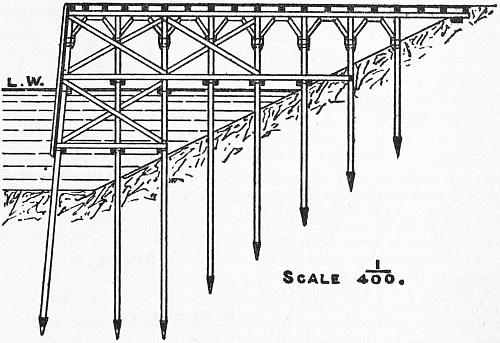
Fig 1.—Timber Jetty across Dock Slope.
Jetties at Docks.—Where docks are given sloping sides, openwork timber jetties are generally carried across the slope, at the ends of which vessels can lie in deep water (fig. 1); or more solid structures are erected over the slope for supporting coal-tips. Pilework jetties are also constructed in the water outside the entrances to docks on each side, so as to form an enlarging trumpet-shaped channel between the entrance, lock or tidal basin and the approach channel, in order to guide vessels in entering or leaving the docks. Solid jetties, moreover, lined with quay walls, are sometimes carried out into a wide dock, at right angles to the line of quays at the side, to enlarge the accommodation; and they also serve, when extended on a large scale from the coast of a tideless sea under shelter of an outlying breakwater, to form the basins in which vessels lie when discharging and taking in cargoes in such a port as Marseilles (see Dock).
Jetties at Entrances to Jetty Harbours.—The approach channel to some ports situated on sandy coasts is guided and protected across the beach by parallel jetties, made solid up to a little above low water of neap tides, on which open timber-work is erected, provided with a planked platform at the top raised above the highest tides. The channel between the jetties was originally maintained by tidal scour from low-lying areas close to the coast, and subsequently by the current from sluicing basins; but it is now often considerably deepened by sand-pump dredging. It is protected to some extent by the solid portion of the jetties from the inroad of sand from the adjacent beach, and from the levelling action of the waves; whilst the upper open portion serves to indicate the channel, and to guide the vessels if necessary (see Harbour). The bottom part of the older jetties, in such long-established jetty ports as Calais, Dunkirk and Ostend, was composed of clay or rubble stone, covered on the top by fascine-work or pitching; but the deepening of the jetty channel by dredging, and the need which arose for its enlargement, led to the reconstruction of the jetties at these ports. The new jetties at Dunkirk were founded in the sandy beach, by the aid of compressed air, at a depth of 22¾ ft. below low water of spring tides; and their solid masonry portion, on a concrete foundation, was raised 53⁄5 ft. above low water of neap tides (fig. 2).
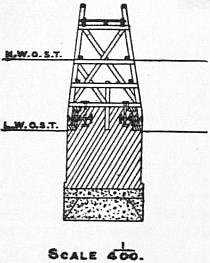
Fig. 2.—Dunkirk East Jetty.
Jetties at Lagoon Outlets.—A small tidal rise spreading tidal water over a large expanse of lagoon or inland back-water causes the influx and efflux of the tide to maintain a deep channel through a narrow outlet; but the issuing current on emerging from the outlet, being no longer confined by a bank on each side, becomes dispersed, and owing to the reduction of its scouring force, is no longer able at a moderate distance from the shore effectually to resist the action of the waves and littoral currents tending to form a continuous beach in front of the outlet. Hence a bar is produced which diminishes the available depth in the approach channel. By carrying out a solid jetty over the bar, however, on each side of the outlet, the tidal currents are concentrated in the channel across the bar, and lower it by scour. Thus the available depth of the approach channels to Venice through the Malamocco and Lido outlets from the Venetian lagoon have been deepened several feet over their bars by jetties of rubble stone surmounted by a small superstructure (fig. 3), carried out across the foreshore into deep water on both sides of the channel. Other examples are provided by the long jetties extended into the sea in front of the entrance to Charleston harbour, formerly constructed of fascines, weighted with stone and logs, but subsequently of rubble stone, and by the two converging rubble jetties carried out from each shore of Dublin bay for deepening the approach to Dublin harbour.
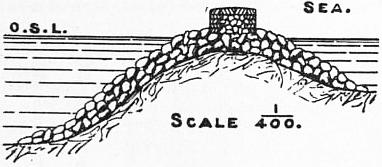
Fig. 3.—Lido Outlet Jetty, Venice.
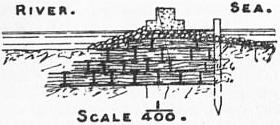
Fig. 4.—Mississippi South Pass Outlet Jetty.
Jetties at the Outlet of Tideless Rivers.—Jetties have been constructed on each side of the outlet of some of the rivers flowing into the Baltic, with the objects of prolonging the scour of the river and protecting the channel from being shoaled by the littoral drift along the shore. The most interesting application of parallel jetties is in lowering the bar in front of one of the mouths of a deltaic river flowing into a tideless sea, by extending the scour of the river out to the bar by a virtual prolongation of its banks. Jetties prolonging the Sulina branch of the Danube into the Black Sea, and the south pass of the Mississippi into the Gulf of Mexico (fig. 4), formed of rubble stone and concrete blocks, and fascine mattresses weighted with stone and surmounted with large concrete blocks respectively, have enabled the discharge of these rivers to scour away the bars obstructing the access to them; and they have also carried the sediment-bearing waters sufficiently far out to come under the influence of littoral currents, which, by conveying away some of the sediment, postpone the eventual formation of a fresh bar farther out (see River Engineering).
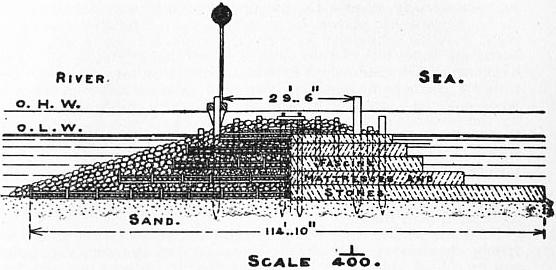
Fig. 5.—River Maas Outlet, North Jetty.
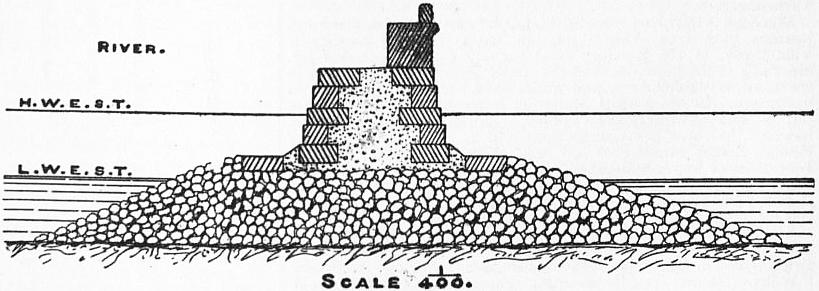
Fig. 6.—River Nervion Outlet, Western Jetty.
Jetties at the Mouth of Tidal Rivers.—Where a river is narrow near its mouth, and its discharge is generally feeble, the sea is liable on an exposed coast, when the tidal range is small, to block up its outlet during severe storms. The river is thus forced to seek another exit at a weak spot of the beach, which along a low coast may be at some distance off; and this new outlet in its turn may be blocked up, so that the river from time to time shifts the position of its mouth. This inconvenient cycle of changes may be stopped by fixing the outlet of the river at a suitable site, by carrying a jetty on each side of this outlet across the beach, thereby concentrating its discharge in a definite channel and protecting the mouth from being blocked up by littoral drift. This system was long ago applied to the shifting outlet of the river Yare to the south of Yarmouth, and has also been successfully employed for fixing the wandering mouth of the Adur near Shoreham, and of the Adour flowing into the Bay of Biscay below Bayonne. When a new channel was cut across the Hook of Holland to provide a straighter and deeper outlet channel for the river Maas, forming the approach channel to Rotterdam, low, broad, parallel jetties, composed of fascine mattresses weighted with stone (fig. 5), were carried across the foreshore into the sea on either side of the new mouth of the river, to protect the jetty channel from littoral drift, and cause the discharge of the river to maintain it out to deep water (see River Engineering). The channel, also, beyond the outlet of the river Nervion into the Bay of Biscay has been regulated by jetties; and by extending the south-west jetty out for nearly half a mile with a curve concave towards the channel the outlet has not only been protected to some extent from the easterly drift, but the bar in front has been lowered by the scour produced by the discharge of the river following the concave bend of the south-west jetty. As the outer portion of this jetty was exposed to westerly storms from the Bay of Biscay before the outer harbour was constructed, it has been given the form and strength of a breakwater situated in shallow water (fig. 6).
(L. F. V.-H.)
JEVER, a town of Germany, in the grand-duchy of Oldenburg, 13 m. by rail N.W. of Wilhelmshaven, and connected with the North Sea by a navigable canal. Pop. (1901), 5486. The chief industries are weaving, spinning, dyeing, brewing and milling; there is also a trade in horses and cattle. The fathers (Die Getreuen) of the town used to send an annual birthday present of 101 plovers’ eggs to Bismarck, with a dedication in verse.
The castle of Jever was built by Prince Edo Wiemken (d. 1410), the ruler of Jeverland, a populous district which in 1575 came under the rule of the dukes of Oldenburg. In 1603 it passed to the house of Anhalt and was later the property of the empress Catherine II. of Russia, a member of this family. In 1814 it came again into the possession of Oldenburg.
See D. Hohnholz, Aus Jevers Vorgangenheit (Jever, 1886); Hagena, Jeverland bis zum Jahr 1500 (Oldenburg, 1902); and F. W. Riemann, Geschichte des Jeverlandes (Jever, 1896).
JEVEROS (Jeberos, Jibaros, Jivaros or Givaros), a tribe of South American Indians on the upper Marañon, Peru, where they wander in the forests. The tribe has many branches and there are frequent tribal wars, but they have always united against a common enemy. Juan de Velasco declares them to be faithful, noble and amiable. They are brave and warlike, and though upon the conquest of Peru they temporarily submitted, a general insurrection in 1599 won them back their liberty. Curious dried human heads, supposed to have been objects of worship, have been found among the Jeveros (see Ethnol. Soc. Trans. 1862, W. Bollaert).