VOLUME XIV SLICE VII Ireland to Isabey, Jean Baptiste (continued 7)
Reading edition
34. Alloy steels have come into extensive use for important special purposes, and a very great increase of their use is to be expected. The chief ones are nickel steel, manganese steel, chrome steel and chrome-tungsten steel. The general order of merit of a given variety or specimen of iron or steel may be measured by the degree to which it combines strength and hardness with ductility. These two classes of properties tend to exclude each other, for, as a general rule, whatever tends to make iron and steel hard and strong tends to make it correspondingly brittle, and hence liable to break treacherously, especially under shock. Manganese steel and nickel steel form an important exception to this rule, in being at once very strong and hard and extremely ductile. Nickel steel, which usually contains from 3 to 3.50% of nickel and about 0.25% of carbon, combines very great tensile strength and hardness, and a very high limit of elasticity, with great ductility. Its combination of ductility with strength and hardening power has given it very extended use for the armour of war-vessels. For instance, following Krupp’s formula, the side and barbette armour of war-vessels is now generally if not universally made of nickel steel containing about 3.25% of nickel, 0.40% of carbon, and 1.50% of chromium, deeply carburized on its impact face. Here the merit of nickel steel is not so much that it resists perforation, as that it does not crack even when deeply penetrated by a projectile. The combination of ductility, which lessens the tendency to break when overstrained or distorted, with a very high limit of elasticity, gives it great value for shafting, the merit of which is measured by its endurance of the repeated stresses to which its rotation exposes it whenever its alignment is not mathematically straight. The alignment of marine shafting, changing with every passing wave, is an extreme example. Such an intermittently applied stress is far more destructive to iron than a continuous one, and even if it is only half that of the limit of elasticity, its indefinite repetition eventually causes rupture. In a direct competitive test the presence of 3.25% of nickel increased nearly sixfold the number of rotations which a steel shaft would endure before breaking.
35. As actually made, manganese steel contains about 12% of manganese and 1.50% of carbon. Although the presence of 1.50% of manganese makes steel relatively brittle, and although a further addition at first increases this brittleness, so that steel containing between 4 and 5.5% can be pulverized under the hammer, yet a still further increase gives very great ductility, accompanied by great hardness—a combination of properties which was not possessed by any other known substance when this remarkable alloy, known as Hadfield’s manganese steel, was discovered. Its ductility, to which it owes its value, is profoundly affected by the rate of cooling. Sudden cooling makes the metal extremely ductile, and slow cooling makes it brittle. Its behaviour in this respect is thus the opposite of that of carbon steel. But its great hardness is not materially affected by the rate of cooling. It is used extensively for objects which require both hardness and ductility, such as rock-crushing machinery, railway crossings, mine-car wheels and safes. The burglar’s blow-pipe locally “draws the temper,” i.e. softens a spot on a hardened carbon steel or chrome steel safe by simply heating it, so that as soon as it has again cooled he can drill through it and introduce his charge of dynamite. But neither this nor any other procedure softens manganese steel rapidly. Yet this very fact that it is unalterably hard has limited its use, because of the great difficulty of cutting it to shape, which has in general to be done with emery wheels instead of the usual iron-cutting tools. Another defect is its relatively low elastic limit.
36. Chrome steel, which usually contains about 2% of chromium and 0.80 to 2% of carbon, owes its value to combining, when in the “hardened” or suddenly cooled state, intense hardness with a high elastic limit, so that it is neither deformed permanently nor cracked by extremely violent shocks. For this reason it is the material generally if not always used for armour-piercing projectiles. It is much used also for certain rock-crushing machinery (the shoes and dies of stamp-mills) and for safes. These are made of alternate layers of soft wrought iron and chrome steel hardened by sudden cooling. The hardness of the hardened chrome steel resists the burglar’s drill, and the ductility of the wrought iron the blows of his sledge.
Vanadium in small quantities, 0.15 or 0.20%, is said to improve steel greatly, especially in increasing its resistance to shock and to often-repeated stress. But the improvement may be due wholly to the considerable chromium content of these so-called vanadium steels.
37. Tungsten steel, which usually contains from 5 to 10% of tungsten and from 1 to 2% of carbon, is used for magnets, because of its great retentivity.
38. Chrome-tungsten or High-speed Steel.—Steel with a large content of both chromium and tungsten has the very valuable property of “red-hardness,” i.e. of retaining its hardness and hence its power of cutting iron and other hard substances, even when it is heated to dull redness, say 600° C. (1112° F.) by the friction of the work which it is doing. Hence a machinist can cut steel or iron nearly six times as fast with a lathe tool of this steel as with one of carbon steel, because with the latter the cutting speed must be so slow that the cutting tool is not heated by the friction above say 250° C. (482° F.), lest it be unduly softened or “tempered” (§ 29). This effect of chromium, tungsten and carbon jointly consists essentially in raising the “tempering temperature,” i.e. that to which the metal, in which by suitable thermal treatment the iron molecules have been brought to the allotropic γ or β state or a mixture of both, can be heated without losing its hardness through the escape of that iron into the α state. In short, these elements seem to impede the allotropic change of the iron itself. The composition of this steel is as follows:—
The usual limits. Apparently the best.
Carbon 0.32 to 1.28 0.68 to 0.67
Manganese 0.03 to 0.30 0.07 to 0.11
Chromium 2.23 to 7.02 5.95 to 5.47
Tungsten 9.25 to 25.45 17.81 to 18.19
39. Impurities.—The properties of iron and steel, like those of most of the metals, are profoundly influenced by the presence of small and sometimes extremely small quantities of certain impurities, of which the most important are phosphorus and sulphur, the former derived chiefly from apatite (phosphate of lime) and other minerals which accompany the iron ore itself, the latter from the pyrite found not only in most iron ores but in nearly all coal and coke. All commercial iron and steel contain more or less of both these impurities, the influence of which is so strong that a variation of 0.01%, i.e. of one part in 10,000, of either of them has a noticeable effect. The best tool steel should not contain more than 0.02% of either, and in careful practice it is often specified that the phosphorus and sulphur respectively shall not exceed 0.04 and 0.05% in the steel for important bridges, or 0.06 and 0.07% in rail steel, though some very prudent engineers allow as much as .085% or even 0.10% of phosphorus in rails.
40. The specific effect of phosphorus is to make the metal cold-short, i.e. brittle in the cold, apparently because it increases the size and the sharpness of demarcation of the crystalline grains of which the mass is made up. The specific effect of sulphur is to make the metal red-short, i.e. brittle, when at a red heat, by forming a network of iron sulphide which encases these crystalline grains and thus plays the part of a weak link in a strong chain.
41. Oxygen, probably dissolved in the iron as ferrous oxide FeO, also makes the metal red-short.
42. Manganese by itself rather lessens than increases the malleableness and, indeed, the general merit of the metal, but it is added intentionally, in quantities even as large as 1.5% to palliate the effects of sulphur and oxygen. With sulphur it forms a sulphide which draws together into almost harmless drops, instead of encasing the grains of iron. With oxygen it probably forms manganous oxide, which is less harmful than ferrous oxide. (See § 35.)
43. Ores of Iron.—Even though the earth seems to be a huge iron meteor with but a thin covering of rocks, the exasperating proneness of iron to oxidize explains readily why this metal is only rarely found native, except in the form of meteorites. They are four important iron ores, magnetite, haematite, limonite and siderite, and one of less but still considerable importance, pyrite or pyrites.
44. Magnetite, Fe3O4, contains 72.41% of iron. It crystallizes in the cubical system, often in beautiful octahedra and rhombic dodecahedra. It is black with a black streak. Its specific gravity is 5.2, and its hardness 5.5 to 6.5. It is very magnetic, and sometimes polar.
45. Haematite, or red haematite, Fe2O3, contains 70% of iron. It crystallizes in the rhombohedral system. Its colour varies from brilliant bluish-grey to deep red. Its streak is always red. Its specific gravity is 5.3 and its hardness 5.5 to 6.5.
46. Limonite, 2Fe2O3, 3H2O, contains 59.9% of iron. Its colour varies from light brown to black. Its streak is yellowish-black, its specific gravity 3.6 to 4.0, and its hardness 5 to 5.5. Limonite and the related minerals, turgite, 2Fe2O3 + H2O, and göthite, Fe2O3 + H2O, are grouped together under the term “brown haematite.”
47. Siderite, or spathic iron ore, FeCO3, crystallizes in the rhombohedral system and contains 48.28% of iron. Its colour varies from yellowish-brown to grey. Its specific gravity is 3.7 to 3.9, and its hardness 3.5 to 4.5. The clayey siderite of the British coal measures is called “clay band,” and that containing bituminous matter is called “black band.”
48. Pyrite, FeS2, contains 46.7% of iron. It crystallizes in the cubic system, usually in cubes, pentagonal dodecahedra or octahedra, often of great beauty and perfection. It is golden-yellow, with a greenish or brownish-black streak. Its specific gravity is 4.83 to 5.2, its hardness 6 to 6.5. Though it contains far too much sulphur to be used in iron manufacture without first being desulphurized, yet great quantities of slightly cupriferous pyrite, after yielding nearly all their sulphur in the manufacture of sulphuric acid, and most of the remainder in the wet extraction of their copper, are then used under the name of “blue billy” or “purple ore,” as an ore of iron, a use which is likely to increase greatly in importance with the gradual exhaustion of the richest deposits of the oxidized ores.
49. The Ores actually Impure.—As these five minerals actually exist in the earth’s crust they are usually more or less impure chemically, and they are almost always mechanically mixed with barren mineral matter, such as quartz, limestone and clay, collectively called “the gangue.” In some cases the iron-bearing mineral, such as magnetite or haematite, can be separated from the gangue after crashing, either mechanically or magnetically, so that the part thus enriched or “concentrated” alone need be smelted.
50. Geological Age.—The Archaean crystalline rocks abound in deposits of magnetite and red haematite, many of them very large and rich. These of course are the oldest of our ores, and from deposits of like age, especially those of the more readily decomposed silicates, has come the iron which now exists in the siderites and red and brown haematites of the later geological formations.
51. The World’s Supply of Iron Ore.—The iron ores of the earth’s crust will probably suffice to supply our needs for a very long period, perhaps indeed for many thousand years. It is true that an official statement, which is here reproduced, given in 1905 by Professor Tornebohm to the Swedish parliament, credited the world with only 10,000,000,000 tons of ore, and that, if the consumption of iron should continue to increase hereafter as it did between 1893 and 1906, this quantity would last only until 1946. How then can it be that there is a supply for thousands of years? The two assertions are not to be reconciled by pointing out that Professor Tornebohm underestimated, for instance crediting the United States with only 1.1 billion tons, whereas the United States Geological Survey’s expert credits that country with from ten to twenty times this quantity; nor by pointing out that only certain parts of Europe and a relatively small part of North America have thus far been carefully explored for iron ore, and that the rest of these two continents and South America, Asia and Africa may reasonably be expected to yield very great stores of iron, and that pyrite, one of the richest and most abundant of ores, has not been included. Important as these considerations are, they are much less important than the fact that a very large proportion of the rocks of the earth’s crust contain more or less iron, and therefore are potential iron ores.
Table II.—Professor Tornebohm’s Estimate of the World’s Ore Supply.
Country. Workable Deposits. Annual Output. Annual Consumption.
tons. tons. tons.
United States 1,100,000,000 35,000,000 35,000,000
Great Britain 1,000,000,000 14,000,000 20,000,000
Germany 2,200,000,000 21,000,000 24,000,900
Spain 500,000,000 8,000,000 1,000,000
Russia and Finland 1,500,000,000 4,000,000 6,000,000
France 1,500,000,000 6,000,000 8,000,000
Sweden 1,000,000,000 4,000,000 1,000,000
Austria-Hungary 1,200,000,000 3,000,000 4,000,000
Other countries 5,000,000 1,000,000
Total 10,000,000,000 100,000,000 100,000,000
Note to Table.—Though this estimate seems to be near the truth as regards the British ores, it does not credit the United States with one-tenth, if indeed with one-twentieth, of their true quantity as estimated by that country’s Geological Survey in 1907.
52. What Constitutes an Iron Ore.—Whether a ferruginous rock is or is not ore is purely a question of current demand and supply. That is ore from which there is reasonable hope that metal can be extracted with profit, if not to-day, then within a reasonable length of time. Rock containing 2½% of gold is ah extraordinarily rich gold ore; that with 2½% of copper is a profitable one to-day; that containing 2½% of iron is not so to-day, for the sole reason that its iron cannot be extracted with profit in competition with the existing richer ores. But it will become a profitable ore as soon as the richer ore shall have been exhausted. Very few of the ores which, are mined to-day contain less than 25% of iron, and some of them contain over 60%. As these richest ores are exhausted, poorer and poorer ones will be used, and the cost of iron will increase progressively if measured either in units of the actual energy used in mining and smelting it, or in its power of purchasing animal and vegetable products, cotton, wool, corn, &c., the supply of which is renewable and indeed capable of very great increase, but probably not if measured in its power of purchasing the various mineral products, e.g. the other metals, coal, petroleum and the precious stones, of which the supply is limited. This is simply one instance of the inevitable progressive increase in cost of the irrecreatable mineral relatively to the recreatable animal and vegetable. When, in the course of centuries, the exhaustion of richer ores shall have forced us to mine, crush and concentrate mechanically or by magnetism the ores which contain only 2 or 3% of iron, then the cost of iron in the ore, measured in terms of the energy needed to mine and concentrate it, will be comparable with the actual cost of the copper in the ore of the copper-mines of to-day. But, intermediate in richness between these two extremes, the iron ores mined to-day and these 2 and 3% ores, there is an incalculably great quantity of ore capable of mechanical concentration, and another perhaps vaster store of ore which we do not yet know how to concentrate mechanically, so that the day when a pound of iron in the ore will cost as much as a pound of copper in the ore costs to-day is immeasurably distant.
53. Future Cost of Ore.—The cost of iron ore is likely to rise much less rapidly than that of coal, because the additions to our known supply are likely to be very much greater in the case of ore than in that of coal, for the reason that, while rich and great iron ore beds may exist anywhere, those of coal are confined chiefly to the Carboniferous formation, a fact which has led to the systematic survey and measurement of this formation in most countries. In short, a very large part of the earth’s coal supply is known and measured, but its iron ore supply is hardly to be guessed. On the other hand, the cost of iron ore is likely to rise much faster than that of the potential aluminium ores, clay and its derivatives, because of the vast extent and richness of the deposits of this latter class. It is possible that, at some remote day, aluminium, or one of its alloys, may become the great structural material, and iron be used chiefly for those objects for which it is especially fitted, such as magnets, springs and cutting tools.
In passing, it may be noted that the cost of the ore itself forms a relatively small part of the cost even of the cruder forms of steel, hardly a quarter of the cost of such simple products as rails, and an insignificant part of the cost of many most important finished objects, such as magnets, cutting tools, springs and wire, for which iron is almost indispensable. Thus, if the use of ores very much poorer than those we now treat, and the need of concentrating them mechanically, were to double the cost of a pound of iron in the concentrated ore ready for smelting, that would increase the cost of rails by only one quarter. Hence the addition to the cost of finished steel objects which is due to our being forced to use progressively poorer and poorer ores is likely to be much less than the addition due to the progressive rise in the cost of coal and in the cost of labour, because of the ever-rising scale of living. The effect of each of these additions will be lessened by the future improvements in processes of manufacture, and more particularly by the progressive replacement of that ephemeral source of energy, coal, by the secular sources, the winds, waves, tides, sunshine, the earth’s heat and, greatest of all, its momentum.
54. Ore Supply of the Chief Iron-making Countries.—The United States mine nearly all of their iron ores, Austria-Hungary, Russia and France mine the greater part of theirs, but none of these countries exports much ore. Great Britain and Germany, besides mining a great deal of ore, still have to import much from Spain, Sweden and in the case of Germany from Luxemburg, although, because of the customs arrangement between these last two countries, this importation is not usually reported. Belgium imports nearly all of its ore, while Sweden and Spain export most of the ore which they mine.
55. Great Britain has many valuable ore beds, some rich in iron, many of them near to beds of coal and to the sea-coast, to canals or to navigable rivers. They extend from Northamptonshire to near Glasgow. About two-thirds of the ore mined is clayey siderite. In 1905 the Cleveland district in North Yorkshire supplied 41% of the total British product of iron ores; Lincolnshire, 14.8%; Northamptonshire, 13.9%; Leicestershire, 4.7%; Cumberland, 8.6%; North Lancashire, 2.7%; Staffordshire, 6.1%; and Scotland, 5.7%. The annual production of British iron ore reached 18,031,957 tons in 1882, but in 1905 it had fallen to 14,590,703 tons, valued at £3,482,184. In addition 7,344,786 tons, or about half as much as was mined in Great Britain, were imported, 78.5% of it from Spain. The most important British ore deposit is the Lower Cleveland bed of oolitic siderite in the Middle Lias, near Middlesborough. It is from 10 to 17 ft. thick, and its ore contains about 30% of iron.
56. Geographical Distribution of the British Works.—Most of the British iron works lie in and near the important coal-fields in Scotland between the mouth of the Clyde and the Forth, in Cleveland and Durham, in Cumberland and Lancashire, in south Yorkshire, Derbyshire, and Lincolnshire, in Staffordshire and Northamptonshire, and in south Wales in spite of its lack of ore.
The most important group is that of Cleveland and Durham, which makes about one-third of all the British pig iron. It has the great Cleveland ore bed and the excellent Durham coal near tidewater at Middlesbrough. The most important seat of the manufacture of cutlery and the finer kinds of steel is at Sheffield.
57. The United States have great deposits of ore in many different places. The rich beds near Lake Superior, chiefly red haematite, yielding at present about 55% of iron, are thought to contain between 1½ and 2 billion tons, and the red and brown haematites of the southern states about 10 billion tons. The middle states, New York, New Jersey and Pennsylvania, are known to have many great deposits of rich magnetite, which supplied a very large proportion of the American ores till the discovery of the very cheaply mined ores of Lake Superior. In 1906 these latter formed 80% of the American production, and the southern states supplied about 13% of it, while the rich deposits of the middle states are husbanded in accordance with the law that ore bodies are drawn on in the order of their apparent profitableness.
The most important American iron-making district is in and about Pittsburg, to whose cheap coal the rich Lake Superior ores are brought nearly 1000 m., about four-fifths of the distance in the large ore steamers of the Great Lakes. Chicago, nearer to the Lake ores, though rather far from the Pittsburg coal-field, is a very important centre for rail-making for the railroads of the western states. Ohio, the Lake Erie end of New York State, eastern Pennsylvania and Maryland have very important works, the ore for which comes in part from Lake Superior and in part from Pennsylvania, New York and Cuba, and the fuel from Pennsylvania and its neighbourhood. Tennessee and Alabama in the south rely on southern ore and fuel.
58. Germany gets about two-thirds of her total ore supply from the great Jurassic “Minette” ore deposit of Luxemburg and Lorraine, which reaches also into France and Belgium. In spite of its containing only about 36% of iron, this deposit is of very great value because of its great size, and of the consequent small cost of mining. It stretches through an area of about 8 m. wide and 40 m. long, and in some places it is nearly 60 ft. thick. There are valuable deposits also in Siegerland and in many other parts of the country.
59. Sweden has abundant, rich and very pure iron ores, but her lack of coal has restricted her iron manufacture chiefly to the very purest and best classes of iron and steel, in making which her thrifty and intelligent people have developed very rare skill. The magnetite ore bodies which supply this industry lie in a band about 180 m. long, reaching from a little north of Stockholm westerly toward the Norwegian frontier, between the latitudes 59° and 61° N. In Swedish Lapland, near the Arctic circle, are the great Gellivara, Kirunavara and Luossavara magnetite beds, among the largest in Europe. From these beds, which in some parts are about 300 ft. thick, much ore is sent to Germany and Great Britain.
60. Other Countries.—Spain has large, rich and pure iron ore beds, near both her northern and her southern sea coast. She exports about 90% of all the iron ore which she mines, most of it to England. France draws most of her iron ore from her own part of the great Minette ore deposit, and from those parts of it which were taken from her when she lost Alsace and Lorraine. Russia’s most valuable ore deposit is the very large and easily mined one of Krivoi Rog in the south, from which comes about half of the Russian iron ore. It is near the Donetz coal-field, the largest in Europe. There are also important ore beds in the Urals, near the border of Finland, and at the south of Moscow. In Austria-Hungary, besides the famous Styrian Erzberg, with its siderite ore bed about 450 ft. thick, there are cheaply mined but poor and impure ores near Prague, and important ore beds in both northern and southern Hungary. Algeria, Canada, Cuba and India have valuable ore bodies.
61. Richness of Iron Ores.—The American ores now mined are decidedly richer than those of most European countries. To make a ton of pig iron needs only about 1.9 tons of ore in the United States, 2 tons in Sweden and Russia, 2.4 tons in Great Britain and Germany, and about 2.7 tons in France and Belgium, while about 3 tons of the native British ores are needed per ton of pig iron.
62. The general scheme of iron manufacture is shown diagrammatically in fig. 6. To put the iron contained in iron ore into a state in which it can be used as a metal requires essentially, first its deoxidation, and second its separation from the other mineral matter, such as clay, quartz, &c. with which it is found associated. These two things are done simultaneously by heating and melting the ore in contact with coke, charcoal or anthracite, in the iron blast furnace, from which issue intermittently two molten streams, the iron now deoxidized and incidentally carburized by the fuel with which it has been in contact, and the mineral matter, now called “slag.” This crude cast iron, called “pig iron,” may be run from the blast furnace directly into moulds, which give the metal the final shape in which it is to be used in the arts; but it is almost always either remelted, following path 1 of fig. 6, and then cast into castings of cast iron, or converted into wrought iron or steel by purifying it, following path 2.
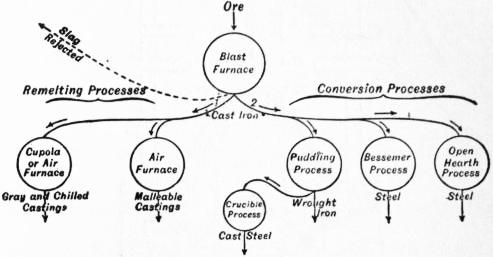
Fig. 6.—General Scheme of Iron Manufacture.
If it is to follow path 1, the castings into which it is made may be either (a) grey or (b) chilled or (c) malleable. Grey iron castings are made by remelting the pig iron either in a small shaft or “cupola” furnace, or in a reverberatory or “air” furnace, with very little change of chemical composition, and then casting it directly into suitable moulds, usually of either “baked,” i.e. oven-dried, or “green,” i.e. moist undried, sand, but sometimes of iron covered with a refractory coating to protect it from being melted or overheated by the molten cast iron. The general procedure in the manufacture of chilled and of malleable castings has been described in §§ 30 and 31.
If the pig iron is to follow path 2, the purification which converts it into wrought iron or steel consists chiefly in oxidizing and thereby removing its carbon, phosphorus and other impurities, while it is molten, either by means of the oxygen of atmospheric air blown through it as in the Bessemer process, or by the oxygen of iron ore stirred into it as in the puddling and Bell-Krupp processes, or by both together as in the open hearth process.
On its way from the blast furnace to the converter or open hearth furnace the pig iron is often passed through a great reservoir called a “mixer,” which acts also as an equalizer, to lessen the variation in composition of the cast iron, and as a purifier, removing part of the sulphur and silicon.
63. Shaping and Adjusting Processes.—Besides these extraction and purification processes there are those of adjustment and shaping. The adjusting processes adjust either the ultimate composition, e.g. carburizing wrought iron by long heating in contact with charcoal (cementation), or the proximate composition or constitution, as in the hardening, tempering and annealing of steel already described (§§ 28, 29), or both, as in the process of making malleable cast iron (§ 31). The shaping processes include the mechanical ones, such as rolling, forging and wire-drawing, and the remelting ones such as the crucible process of melting wrought iron or steel in crucibles and casting it in ingots for the manufacture of the best kinds of tool steel. Indeed, the remelting of cast iron to make grey iron castings belongs here. This classification, though it helps to give a general idea of the subject, yet like most of its kind cannot be applied rigidly. Thus the crucible process in its American form both carburizes and remelts, and the open hearth process is often used rather for remelting than for purifying.
64. The iron blast furnace, a crude but very efficient piece of apparatus, is an enormous shaft usually about 80 ft. high and 20 ft. wide at its widest part. It is at all times full from top to bottom, somewhat as sketched in figs. 7 and 8, of a solid column of lumps of fuel, ore and limestone, which are charged through a hopper at the top, and descend slowly as the lower end of the column is eaten off through the burning away of its coke by means of very hot air or “blast” blown through holes or “tuyeres” near the bottom or “hearth,” and through the melting away, by the heat thus generated, both of the iron itself which has been deoxidized in its descent, and of the other minerals of the ore, called the “gangue,” which unite with the lime of the limestone and the ash of the fuel to form a complex molten silicate called the “cinder” or “slag.”
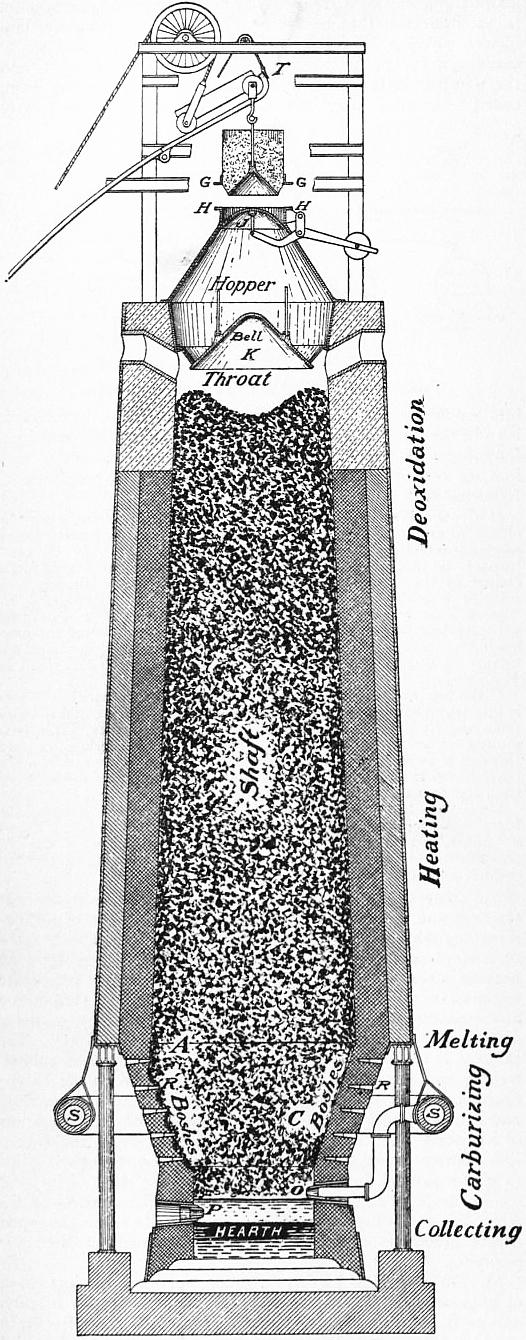
Fig. 7.—Section of Duquesne Blast Furnace.
GG, Flanges on the ore bucket; HH, Fixed flanges on the top of the furnace; J, Counterweighted false bell; K, Main bell; O, Tuyere; P, Cinder notch; RR′, Water cooled boxes; S, Blast pipe; T, Cable for allowing conical bottom of bucket to drop.
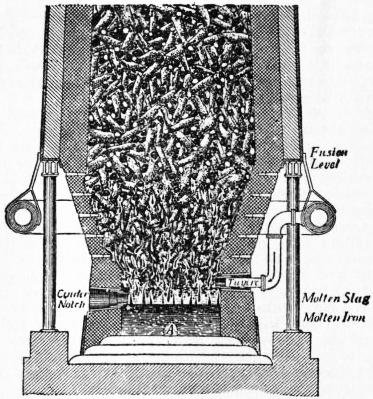
Fig. 8.—Lower Part of the Blast Furnace.

* The ore and lime actually exist here in powder. They are shown in lump form because of the difficulty of presenting to the eye their powdered state.
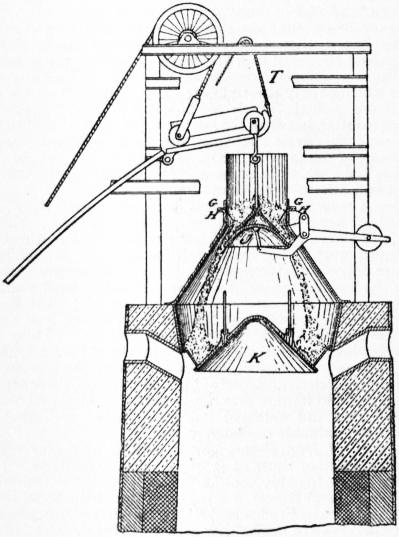
Fig. 9.—Method of transferring charge from bucket to main charging bell, without permitting escape of furnace gas (lettering as in fig. 7).
Interpenetrating this descending column of solid ore, limestone and coke, there is an upward rushing column of hot gases, the atmospheric nitrogen of the blast from the tuyeres, and the carbonic oxide from the combustion of the coke by that blast. The upward ascent of the column of gases is as swift as the descent of the solid charge is slow. The former occupies but a very few seconds, the latter from 12 to 15 hours.
In the upper part of the furnace the carbonic oxide deoxidizes the iron oxide of the ore by such reactions as xCO + FeOx = Fe + xCO2. Part of the resultant carbonic acid is again deoxidized to carbonic oxide by the surrounding fuel, CO2 + C = 2CO, and the carbonic oxide thus formed deoxidizes more iron oxide, &c. As indicated in fig. 7, before the iron ore has descended very far it has given up nearly the whole of its oxygen, and thus lost its power of oxidizing the rising carbonic oxide, so that from here down the atmosphere of the furnace consists essentially of carbonic oxide and nitrogen.
But the transfer of heat from the rising gases to the sinking solids, which has been going on in the upper part of the furnace, continues as the solid column gradually sinks downward to the hearth, till at the “fusion level” (A in fig. 7) the solid matter has become so hot that the now deoxidized iron melts, as does the slag as fast as it is formed by the union of its three constituents, the gangue, the lime resulting from the decomposition of the limestone and the ash of the fuel. Hence from this level down the only solid matter is the coke, in lumps which are burning rapidly and hence shrinking, while between them the molten iron and slag trickle, somewhat as sketched in fig. 8, to collect in the hearth in two layers as distinct as water and oil, the iron below, the slag above.
As they collect, the molten iron is drawn off at intervals through a hole A (fig. 8), temporarily stopped with clay, at the very bottom, and the slag through another hole a little higher up, called the “cinder notch.” Thus the furnace may be said to have four zones, those of (1) deoxidation, (2) heating, (3) melting, and (4) collecting, though of course the heating is really going on in all four of them.
In its slow descent the deoxidized iron nearly saturates itself with carbon, of which it usually contains between 3.5 and 4%, taking it in part from the fuel with which it is in such intimate contact, and in part from the finely divided carbon deposited within the very lumps of ore, by the reaction 2CO = C + CO2. This carburizing is an indispensable part of the process, because through it alone can the iron be made fusible enough to melt at the temperature which can be generated in the furnace, and only when liquid can it be separated readily and completely from the slag. In fact, the molten iron is heated so far above its melting point that, instead of being run at once into pigs as is usual, it may, without solidifying, be carried even several miles in large clay-lined ladles to the mill where it is to be converted into steel.
65. The fuel has, in addition to its duties of deoxidizing and carburizing the iron and yielding the heat needed for melting both the iron and slag, the further task of desulphurizing the iron, probably by the reaction FeS + CaO + C = Fe + CaS + CO.
The desulphurizing effect of this transfer of the sulphur from union with iron to union with calcium is due to the fact that, whereas iron sulphide dissolves readily in the molten metallic iron, calcium sulphide, in the presence of a slag rich in lime, does not, but by preference enters the slag, which may thus absorb even as much as 3% of sulphur. This action is of great importance whether the metal is to be used as cast iron or is to be converted into wrought iron or steel. In the former case there is no later chance to remove sulphur, a minute quantity of which does great harm by leading to the formation of cementite instead of graphite and ferrite, and thus making the cast-iron castings too hard to be cut to exact shape with steel tools; in the latter case the converting or purifying processes, which are essentially oxidizing ones, though they remove the other impurities, carbon, silicon, phosphorus and manganese, are not well adapted to desulphurizing, which needs rather deoxidizing conditions, so as to cause the formation of calcium sulphide, than oxidizing ones.
66. The duty of the limestone (CaCO3) is to furnish enough lime to form with the gangue of the ore and the ash of the fuel a lime silicate or slag of such a composition (1) that it will melt at the temperature which it reaches at about level A, of fig. 7, (2) that it will be fluid enough to run out through the cinder notch, and (3) that it will be rich enough in lime to supply that needed for the desulphurizing reaction FeS + CaO + C = Fe + CaS + CO. In short, its duty is to “flux” the gangue and ash, and wash out the sulphur.
67. In order that the slag shall have these properties its composition usually lies between the following limits: silica, 26 to 35%; lime, plus 1.4 times the magnesia, 45 to 55%; alumina, 5 to 20%. Of these the silica and alumina are chiefly those which the gangue of the ore and the ash of the fuel introduce, whereas the lime is that added intentionally to form with these others a slag of the needed physical properties.
Thus the more gangue the ore contains, i.e. the poorer it is in iron, the more limestone must in general be added, and hence the more slag results, though of course an ore the gangue of which initially contains much lime and little silica needs a much smaller addition of limestone than one of which the gangue is chiefly silica. Further, the more sulphur there is to remove, the greater must be the quantity of slag needed to dissolve it as calcium sulphide. In smelting the rich Lake Superior ores the quantity of slag made was formerly as small as 28% of that of the pig iron, whereas in smelting the Cleveland ores of Great Britain it is usually necessary to make as much as 1½ tons of slag for each ton of iron.
68. Shape and Size of the Blast-Furnace.—Large size has here, as in most metallurgical operations, not only its usual advantage of economy of installation, labour and administration per unit of product, but the further very important one that it lessens the proportion which the outer heat-radiating and hence heat-wasting surface bears to the whole. The limits set to the furnace builder’s natural desire to make his furnace as large as possible, and its present shape (an obtuse inverted cone set below an acute upright one, both of them truncated), have been reached in part empirically, and in part by reasoning which is open to question, as indeed are the reasons which will now be offered reservedly for both size and shape.
First the width at the tuyeres (fig. 7) has generally been limited to about 12½ ft. by the fear that, if it were greater, the blast would penetrate so feebly to the centre that the difference in conditions between centre and circumference would be so great as to cause serious unevenness of working. Of late furnaces have been built even as wide as 17 ft. in the hearth, and it may prove that a width materially greater than 12½ ft. can profitably be used. With the width at the bottom thus limited, the furnace builder naturally tries to gain volume as rapidly as possible by flaring or “battering” his walls outwards, i.e. by making the “bosh” or lower part of his furnace an inverted cone as obtuse as is consistent with the free descent of the solid charge. In practice a furnace may be made to work regularly if its boshes make an angle of between 73° and 76° with the horizontal, and we may assume that one element of this regularity is the regular easy sliding of the charge over this steep slope. A still steeper one not only gives less available room, but actually leads to irregular working, perhaps because it unduly favours the passage of the rising gas along the walls instead of up and through the charge, and thus causes the deoxidation of the central core to lag behind that of the periphery of the column, with the consequence that this central core arrives at the bottom incompletely deoxidized.
In the very swift-running furnaces of the Pittsburg type this outward flare of the boshes ceases at about 12 ft. above the tuyeres, and is there reversed, as in fig. 7, so that the furnace above this is a very acute upright cone, the walls of which make an angle of about 4° with the vertical, instead of an obtuse inverted cone.
In explanation or justification of this it has been said that a much easier descent must be provided above this level than is needed below it. Below this level the solid charge descends easily, because it consists of coke alone or nearly alone, and this in turn because the temperature here is so high as to melt not only the iron now deoxidized and brought to the metallic state, but also the gangue of the ore and the limestone, which here unite to form the molten slag, and run freely down between the lumps of coke. This coke descends freely even through this fast-narrowing space, because it is perfectly solid and dry without a trace of pastiness. But immediately above this level the charge is relatively viscous, because here the temperature has fallen so far that it is now at the melting or formation point of the slag, which therefore is pasty, liable to weld the whole mass together as so much tar would, and thus to obstruct the descent of the charge, or in short to “scaffold.”
The reason why at this level the walls must form an upright instead of an inverted cone, why the furnace must widen downward instead of narrowing, is, according to some metallurgists, that this shape is needed in order that, in spite of the pastiness of the slag in this formative period of incipient fusion, this layer may descend freely as the lower part of the column is gradually eaten away. To this very plausible theory it may be objected that in many slow-running furnaces, which work very regularly and show no sign of scaffolding, the outward flare of the boshes continues (though steepened) far above this region of pastiness, indeed nearly half-way to the top of the furnace. This proves that the regular descent of the material in its pasty state can take place even in a space which is narrowing downwards. To this objection it may in turn be answered that, though this degree of freedom of descent may suffice for a slow-running furnace, particularly if the slag is given such a composition that it passes quickly from the solid state to one of decided fluidity, yet it is not enough for swift-running ones, especially if the composition of the slag is such that, in melting, it remains long in a very sticky condition. In limiting the diameter at the tuyeres to 12½ ft., the height of the boshes to one which will keep their upper end below the region of pastiness, and their slope to one over which the burning coke will descend freely, we limit the width of the furnace at the top of the boshes and thus complete the outline of the lower part of the furnace.
The height of the furnace is rarely as great as 100 ft., and in the belief of many metallurgists it should not be much more than 80 ft. There are some very evident disadvantages of excessive height; for instance, that the weight of an excessively high column of solid coke, ore and limestone tends to crush the coke and jam the charge in the lower and narrowing part of the furnace, and that the frictional resistance of a long column calls for a greater consumption of power for driving the blast up through it. Moreover, this resistance increases much more rapidly than the height of the furnace, even if the rapidity with which the blast is forced through is constant; and it still further increases if the additional space gained by lengthening the furnace is made useful by increasing proportionally the rate of production, as indeed would naturally be done, because the chief motive for gaining this additional space is to increase production.
The reason why the frictional resistance would be further increased is the very simple one that the increase in the rate of production implies directly a corresponding increase in the quantity of blast forced through, and hence in the velocity of the rising gases, because the chemical work of the blast furnace needs a certain quantity of blast for each ton of iron made. In short, to increase the rate of production by lengthening the furnace increases the frictional resistance of the rising gases, both by increasing their quantity and hence their velocity and by lengthening their path.
Indeed, one important reason for the difficulties in working very high furnaces, e.g. those 100 ft. high, may be that this frictional resistance becomes so great as actually to interrupt the even descent of the charge, parts of which are at times suspended like a ball in the rising jet of a fountain, to fall perhaps with destructive violence when some shifting condition momentarily lessens the friction. We see how powerful must be the lifting effect of the rising gases when we reflect that their velocity in a 100 ft. furnace rapidly driven is probably at least as great as 2000 ft. per minute, or that of a “high wind.” Conceive these gases passing at this great velocity through the narrow openings between the adjoining lumps of coke and ore. Indeed, the velocity must be far greater than this where the edge or corner of one lump touches the side of another, and the only room for the passage of this enormous quantity of gas is that left by the roughness and irregularity of the individual lumps.
The furnace is made rather narrow at the top or “stock line,” in order that the entering ore, fuel and flux may readily be distributed evenly. But extreme narrowness would not only cause the escaping gases to move so swiftly that they would sweep much of the fine ore out of the furnace, but would also throw needless work on the blowing engines by throttling back the rising gases, and would lessen unduly the space available for the charge in the upper part of the furnace.
From its top down, the walls of the furnace slope outward at an angle of between 3° and 8°, partly in order to ease the descent of the charge, here impeded by the swelling of the individual particles of ore caused by the deposition within them of great quantities of fine carbon, by the reaction of 2CO = C + CO2. To widen it more abruptly would indeed increase the volume of the furnace, but would probably lead to grave irregularities in the distribution of the gas and charge, and hence in the working of the furnace.
When we have thus fixed the height of the furnace, its diameter at its ends, and the slope of its upper and lower parts, we have completed its outline closely enough for our purpose here.
69. Hot Blast and Dry Blast.—On its way from the blowing engine to the tuyeres of the blast-furnace, the blast, i.e. the air forced in for the purpose of burning the fuel, is usually pre-heated, and in some of the most progressive works is dried by Gayley’s refrigerating process. These steps lead to a saving of fuel so great as to be astonishing at first sight—indeed in case of Gayley’s blast-drying process incredible to most writers, who proved easily and promptly to their own satisfaction that the actual saving was impossible. But the explanation is really so very simple that it is rather the incredulity of these writers that is astonishing. In the hearth of the blast furnace the heat made latent by the fusion of the iron and slag must of course be supplied by some body which is itself at a temperature above the melting point of these bodies, which for simplicity of exposition we may call the critical temperature of the blast-furnace process, because heat will flow only from a hotter to a cooler object. Much the same is true of the heat needed for the deoxidation of the silica, SiO2 + 2C = Si + 2CO2. Now the heat developed by the combustion of coke to carbonic oxide with cold air containing the usual quantity of moisture, develops a temperature only slightly above this critical point; and it is only the heat represented by this narrow temperature-margin that is available for doing this critical work of fusion and deoxidation. That is the crux of the matter. If by pre-heating the blast we add to the sum of the heat available; or if by drying it we subtract from the work to be done by that heat the quantity needed for decomposing the atmospheric moisture; or if by removing part of its nitrogen we lessen the mass over which the heat developed has to be spread—if by any of these means we raise the temperature developed by the combustion of the coke, it is clear that we increase the proportion of the total heat which is available for this critical work in exactly the way in which we should increase the proportion of the water of a stream, initially 100 in. deep, which should flow over a waste weir initially 1 in. beneath the stream’s surface, by raising the upper surface of the water 10 in. and thus increasing the depth of the water to 110 in. Clearly this raising the level of the water by 10% increases tenfold, or by 1000%, the volume of water which is above the level of the weir.
The special conditions of the blast-furnace actually exaggerate the saving due to this widening of the available temperature-margin, and beyond this drying the blast does great good by preventing the serious irregularities in working the furnace caused by changes in the humidity of the air with varying weather.
70. Means of Heating the Blast.—After the ascending column of gases has done its work of heating and deoxidizing the ore, it still necessarily contains so much carbonic oxide, usually between 20 and 26% by weight, that it is a very valuable fuel, part of which is used for raising steam for generating the blast itself and driving the rolling mill engines, &c., or directly in gas engines, and the rest for heating the blast. This heating was formerly done by burning part of the gases, after their escape from the furnace top, in a large combustion chamber, around a series of cast iron pipes through which the blast passed on its way from the blowing engine to the tuyeres. But these “iron pipe stoves” are fast going out of use, chiefly because they are destroyed quickly if an attempt is made to heat the blast above 1000° F. (538° C.), often a very important thing. In their place the regenerative stoves of the Whitwell and Cowper types (figs. 10 and 11) are used. With these the regular temperature of the blast at some works is about 1400° F. (760° C.), and the usual blast temperature lies between 900° and 1200° F. (480° and 650° C.).
Like the Siemens furnace, described in § 99, they have two distinct phases: one, “on gas,” during which part of the waste gas of the blast-furnace is burnt within the stove, highly heating the great surface of brickwork which for that purpose is provided within it; the other, “on wind,” during which the blast is heated by passing it back over these very surfaces which have thus been heated. They are heat-filters or heat-traps for impounding the heat developed by the combustion of the furnace gas, and later returning it to the blast. Each blast-furnace is now provided with three or even four of these stoves, which collectively may be nearly thrice as large as the furnace itself. At any given time one of these is “on wind” and the others “on gas.”
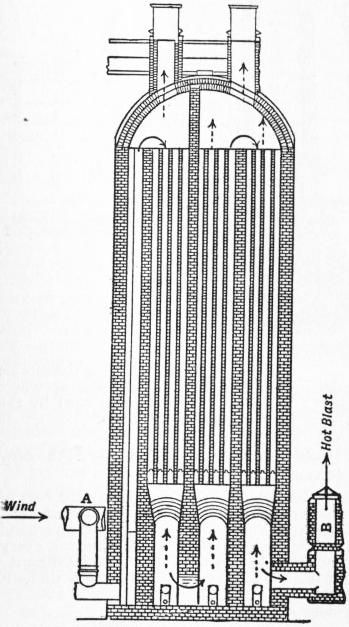
Fig. 10.—Whitwell Hot-Blast Stove, as modified by H. Kennedy. When “on wind,” the cold blast is forced in at A, and passes four times up and down, as shown by means of unbroken arrows, escaping as hot-blast at B. When “on gas,” the gas and air enter at the bottom of each of the three larger vertical chambers, pass once up through the stove, and escape at the top, as shown by means of broken arrows. Hence this is a four-pass stove when on wind, but a one-pass stove when on gas.
The Whitwell stove (fig. 10), by means of the surface of several fire-brick walls, catches in one phase the heat evolved by the burning gas as it sweeps through, and in the other phase returns that heat to the entering blast as it sweeps through from left to right. In the original Whitwell stove, which lacks the chimneys shown at the top of fig. 10, both the burning gas and the blast pass up and down repeatedly. In the H. Kennedy modification, shown in fig. 10, the gas and air in one phase enter at the bottom of all three of the large vertical chambers, burn in passing upwards, and escape at once at the top, as shown by the broken arrows. In the other phase the cold blast, forced in at A, passes four times up and down, as shown by the unbroken arrows, and escapes as hot blast at B. This, then, is a “one-pass” stove when on gas but a “four-pass” one when on wind.
The Cowper stove (Fig. 11) differs from the Whitwell (1) in having not a series of flat smooth walls, but a great number of narrow vertical flues, E, for the alternate absorption and emission of the heat, with the consequence that, for given outside dimensions, it offers about one-half more heating surface than the true Whitwell stove; and (2) in that the gas and the blast pass only once up and once down through it, instead of twice up and twice down as in the modern true Whitwell stoves. As regards frictional resistance, this smaller number of reversals of direction compensates in a measure for the smaller area of the Cowper flues. The large combustion chamber B permits thorough combustion of the gas.
71. Preservation of the Furnace Walls.—The combined fluxing and abrading action of the descending charge tends to wear away the lining of the furnace where it is hottest, which of course is near its lower end, thus changing its shape materially, lessening its efficiency, and in particular increasing its consumption of fuel. The walls, therefore, are now made thin, and are thoroughly cooled by water, which circulates through pipes or boxes bedded in them. James Gayley’s method of cooling, shown in fig. 7, is to set in the brickwork walls several horizontal rows of flat water-cooled bronze boxes, RR′, extending nearly to the interior of the furnace, and tapered so that they can readily be withdrawn and replaced in case they burn through. The brickwork may wear back to the front edges of these boxes, or even, as is shown at R′, a little farther. But in the latter case their edges still determine the effective profile of the furnace walls because the depressions at the back of these edges become filled with carbon and scoriaceous matter when the furnace is in normal working. Each of these rows, of which five are shown in fig. 7, consists of a great number of short segmental boxes.
72. Blast-furnace Gas Engines.—When the gas which escapes from the furnace top is used in gas engines it generates about four times as much power as when it is used for raising steam. It has been calculated that the gas from a pair of old-fashioned blast-furnaces making 1600 tons of iron per week would in this way yield some 16,000 horse-power in excess of their own needs, and that all the available blast-furnace gas in the United States would develop about 1,500,000 horse-power, to develop which by raising steam would need about 20,000,000 tons of coal a year. Of this power about half would be used at the blast-furnaces themselves, leaving 750,000 horse-power available for driving the machinery of the rolling mills, &c.
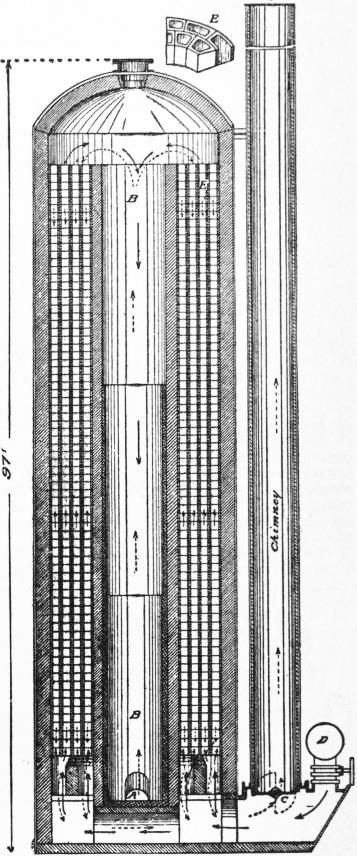
Fig. 11.—Diagram of Cowper Hot-Blast Stove at Duquesne. (After J. Kennedy.) Broken arrows show the path of the gas and air while the stove is “on gas,” and solid arrows that of the blast while it is “on wind.”
A, Entrance for blast-furnace gas. B, B, Combustion chamber. C, Chimney valve. D, Cold blast main. E, Hollow bricks.
This use of the gas engine is likely to have far-reaching results. In order to utilize this power, the converting mill, in which the pig iron is converted into steel, and the rolling mills must adjoin the blast-furnace. The numerous converting mills which treat pig iron made at a distance will now have the crushing burden of providing in other ways the power which their rivals get from the blast-furnace, in addition to the severe disadvantage under which they already suffer, of wasting the initial heat of the molten cast iron as it runs from the blast-furnace. Before its use in the gas engine, the blast-furnace gas has to be freed carefully from the large quantity of fine ore dust which it carries in suspension.
73. Mechanical Appliances.—Moving the raw materials and the products: In order to move economically the great quantity of materials which enter and issue from each furnace daily, mechanical appliances have at many works displaced hand labour wholly, and indeed that any of the materials should be shovelled by hand is not to be thought of in designing new works.
The arrangement at the Carnegie Company’s Duquesne works (fig. 12) may serve as an example of modern methods of handling. The standard-gauge cars which bring the ore and coke to Duquesne pass over one of three very long rows of bins, A, B, and C (fig. 12), of which A and B receive the materials (ore, coke and limestone) for immediate use, while C receives those to be stored for winter use. From A and B the materials are drawn as they are needed into large buckets D standing on cars, which carry them to the foot of the hoist track EE, up which they are hoisted to the top of the furnace. Arrived here, the material is introduced into the furnace by an ingenious piece of mechanism which completely prevents the furnace gas from escaping into the air. The hoist-engineer in the house F at the foot of the furnace, when informed by means of an indicator that the bucket has arrived at the top, lowers it so that its flanges GG (fig. 7) rest on the corresponding fixed flanges HH, as shown in fig. 9. The farther descent of the bucket being thus arrested, the special cable T is now slackened, so that the conical bottom of the bucket drops down, pressing down by its weight the counter-weighted false cover J of the furnace, so that the contents of the bucket slide down into the space between this false cover and the true charging bell, K. The special cable T is now tightened again, and lifts the bottom of the bucket so as both to close it and to close the space between J and K, by allowing J to rise back to its initial place. The bucket then descends along the hoist-track to make way for the next succeeding one, and K is lowered, dropping the charge into the furnace. Thus some 1700 tons of materials are charged daily into each of these furnaces without being shovelled at all, running by gravity from bin to bucket and from bucket to furnace, and being hoisted and charged into the furnace by a single engineer below, without any assistance or supervision at the furnace-top.
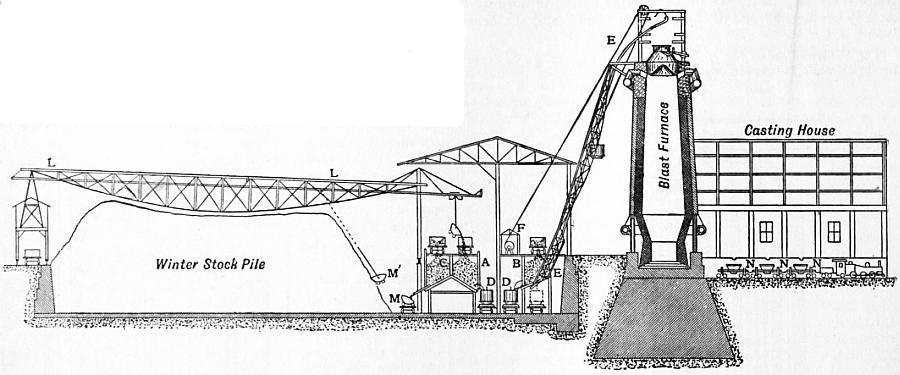
Fig. 12.—Diagram of the Carnegie Blast-Furnace Plant at Duquesne, Pa.
A and B, Bins for stock for immediate use. C, Receiving bin for winter stock pile. D, D, Ore bucket. EE, Hoist-track. F, Hoist-engine house. LL, Travelling crane commanding stock pile. M, Ore bucket receiving ore for stock pile. M′, Bucket removing ore from stock pile. N, N, N, Ladles carrying the molten cast iron to the works, where it is converted into steel by the open hearth process.
The winter stock of materials is drawn from the left-hand row of bins, and distributed over immense stock piles by means of the great crane LL (fig. 12), which transfers it as it is needed to the row A of bins, whence it is carried to the furnace, as already explained.
74. Casting the Molten Pig Iron.—The molten pig iron at many works is still run directly from the furnace into sand or iron moulds arranged in a way which suggests a nursing litter of pigs; hence the name “pig iron.” These pigs are then usually broken by hand. The Uehling casting machine (fig. 13) has displaced this method in many works. It consists essentially of a series of thin-walled moulds, BB, carried by endless chains past the lip of a great ladle A. This pours into them the molten cast iron which it has just received directly from the blast-furnace. As the string of moulds, each thus containing a pig, moves slowly forward, the pigs solidify and cool, the more quickly because in transit they are sprayed with water or even submerged in water in the tank EE. Arrived at the farther sheave C, the now cool pigs are dumped into a railway car.
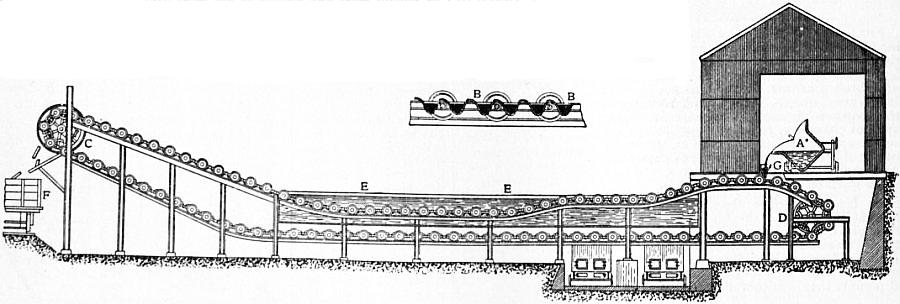
Fig. 13.—Diagram of Pig-Casting Machine.
A, Ladle bringing the cast iron from the blast-furnace. BB, The moulds. C, D, Sheaves carrying the endless chain of moulds. EE, Tank in which the moulds are submerged. F, Car into which the cooled pigs are dropped. G, Distributing funnel.
Besides a great saving of labour, only partly offset by the cost of repairs, these machines have the great merit of making the management independent of a very troublesome set of labourers, the hand pig-breakers, who were not only absolutely indispensable for every cast and every day, because the pig iron must be removed promptly to make way for the next succeeding cast of iron, but very difficult to replace because of the great physical endurance which their work requires.
75. Direct Processes for making Wrought Iron and Steel.—The present way of getting the iron of the ore into the form of wrought iron and steel by first making cast iron and then purifying it, i.e. by first putting carbon and silicon into the iron and then taking them out again at great expense, at first sight seems so unreasonably roundabout that many “direct” processes of extracting the iron without thus charging it with carbon and silicon have been proposed, and some of them have at times been important. But to-day they have almost ceased to exist.
That the blast-furnace process must be followed by a purifying one, that carburization must at once be undone by decarburization, is clearly a disadvantage, but it is one which is far out weighed by five important incidental advantages. (1) The strong deoxidizing action incidental to this carburizing removes the sulphur easily and cheaply, a thing hardly to be expected of any direct process so far as we can see. (2) The carburizing incidentally carburizes the brickwork of the furnace, and thus protects it against corrosion by the molten slag. (3) It protects the molten iron against reoxidation, the greatest stumbling block in the way of the direct processes hitherto. (4) This same strong deoxidizing action leads to the practically complete deoxidation and hence extraction of the iron. (5) In that carburizing lowers the melting point of the iron greatly, it lowers somewhat the temperature to which the mineral matter of the ore has to be raised in order that the iron may be separated from it, because this separation requires that both iron and slag shall be very fluid. Indeed, few if any of the direct processes have attempted to make this separation, or to make it complete, leaving it for some subsequent operation, such as the open hearth process.
In addition, the blast-furnace uses a very cheap source of energy, coke, anthracite, charcoal, and even certain kinds of raw bituminous coal, and owing first to the intimacy of contact between this fuel and the ore on which it works, and second to the thoroughness of the transfer of heat from the products of that fuel’s combustion in their long upward journey through the descending charge, even this cheap energy is used most effectively.
Thus we have reasons enough why the blast-furnace has displaced all competing processes, without taking into account its further advantage in lending itself easily to working on an enormous scale and with trifling consumption of labour, still further lessened by the general practice of transferring the molten cast iron in enormous ladles into the vessels in which its conversion into steel takes place. Nevertheless, a direct process may yet be made profitable under conditions which specially favour it, such as the lack of any fuel suitable for the blast-furnace, coupled with an abundance of cheap fuel suitable for a direct process and of cheap rich ore nearly free from sulphur.
76. The chief difficulty in the way of modifying the blast-furnace process itself so as to make it accomplish what the direct processes aim at, by giving its product less carbon and silicon than pig iron as now made contains, is the removal of the sulphur. The processes for converting cast iron into steel can now remove phosphorus easily, but the removal of sulphur in them is so difficult that it has to be accomplished for the most part in the blast-furnace itself. As desulphurizing seems to need the direct and energetic action of carbon on the molten iron itself, and as molten iron absorbs carbon most greedily, it is hard to see how the blast-furnace is to desulphurize without carburizing almost to saturation, i.e. without making cast iron.
77. Direct Metal and the Mixer.—Until relatively lately the cast iron for the Bessemer and open-hearth processes was nearly always allowed to solidify in pigs, which were next broken up by hand and remelted at great cost. It has long been seen that there would be a great saving if this remelting could be avoided and “direct metal,” i.e. the molten cast iron direct from the blast-furnace, could be treated in the conversion process. The obstacle is that, owing to unavoidable irregularities in the blast-furnace process, the silicon- and sulphur-content of the cast iron vary to a degree and with an abruptness which are inconvenient for any conversion process and intolerable for the Bessemer process. For the acid variety of this process, which does not remove sulphur, this most harmful element must be held below a limit which is always low, though it varies somewhat with the use to which the steel is to be put. Further, the point at which the process should be arrested is recognized by the appearance of the flame which issues from the converter’s mouth, and variations in the silicon-content of the cast iron treated alter this appearance, so that the indications of the flame become confusing, and control over the process is lost. Moreover, the quality of the resultant steel depends upon the temperature of the process, and this in turn depends upon the proportion of silicon, the combustion of which is the chief source of the heat developed. Hence the importance of having the silicon-content constant. In the basic Bessemer process, also, unforeseen variations in the silicon-content are harmful, because the quantity of lime added should be just that needed to neutralize the resultant silica and the phosphoric acid and no more. Hence the importance of having the silicon-content uniform. This uniformity is now given by the use of the “mixer” invented by Captain W. R. Jones.
This “mixer” is a great reservoir into which successive lots of molten cast iron from all the blast-furnaces available are poured, forming a great molten mass of from 200 to 750 tons. This is kept molten by a flame playing above it, and successive lots of the cast iron thus mixed are drawn off, as they are needed, for conversion into steel by the Bessemer or open-hearth process. An excess of silicon or sulphur in the cast iron from one blast-furnace is diluted by thus mixing this iron with that from the other furnaces. Should several furnaces simultaneously make iron too rich in silicon, this may be diluted by pouring into the mixer some low-silicon iron melted for this purpose in a cupola furnace. This device not only makes the cast iron much more uniform, but also removes much of its sulphur by a curious slow reaction. Many metals have the power of dissolving their own oxides and sulphides, but not those of other metals. Thus iron, at least highly carburetted, i.e. cast iron, dissolves its own sulphide freely, but not that of either calcium or manganese. Consequently, when we deoxidize calcium in the iron blast-furnace, it greedily absorbs the sulphur which has been dissolved in the iron as iron sulphide, and the sulphide of calcium thus formed separates from the iron. In like manner, if the molten iron in the mixer contains manganese, this metal unites with the sulphur present, and the manganese sulphide, insoluble in the iron, slowly rises to the surface, and as it reaches the air, its sulphur oxidizes to sulphurous acid, which escapes. Further, an important part of the silicon may be removed in the mixer by keeping it very hot and covering the metal with a rather basic slag. This is very useful if the iron is intended for either the basic Bessemer or the basic open-hearth process, for both of which silicon is harmful.
78. Conversion or Purifying Processes for converting Cast Iron into Steel or Wrought Iron.—As the essential difference between cast iron on one hand and wrought iron and steel on the other is that the former contains necessarily much more carbon, usually more silicon, and often more phosphorus that are suitable or indeed permissible in the latter two, the chief work of all these conversion processes is to remove the excess of these several foreign elements by oxidizing them to carbonic oxide CO, silica SiO2, and phosphoric acid P2O5, respectively. Of these the first escapes immediately as a gas, and the others unite with iron oxide, lime, or other strong base present to form a molten silicate or silico-phosphate called “cinder” or “slag,” which floats on the molten or pasty metal. The ultimate source of the oxygen may be the air, as in the Bessemer process, or rich iron oxide as in the puddling process, or both as in the open-hearth process; but in any case iron oxide is the chief immediate source, as is to be expected, because the oxygen of the air would naturally unite in much greater proportion with some of the great quantity of iron offered to it than with the small quantity of these impurities. The iron oxide thus formed immediately oxidizes these foreign elements, so that the iron is really a carrier of oxygen from air to impurity. The typical reactions are something like the following: Fe3O4 + 4C = 4CO + 3Fe; Fe3O4 + C = 3FeO + CO; 2P + 5Fe3O4 = 12FeO + 3FeO,P2O5; Si + 2Fe3O4 = 3FeO,SiO2 + 3FeO. Beside this their chief and easy work of oxidizing carbon, silicon and phosphorus, the conversion processes have the harder task of removing sulphur, chiefly by converting it into calcium sulphide, CaS, or manganous sulphide, MnS, which rise to the top of the molten metal and there enter the overlying slag, from which the sulphur may escape by oxidizing to the gaseous compound, sulphurous acid, SO2.
79. In the puddling process molten cast iron is converted into wrought iron, i.e. low-carbon slag-bearing iron, by oxidizing its carbon, silicon and phosphorus, by means of iron oxide stirred into it as it lies in a thin shallow layer in the “hearth” or flat basin of a reverberatory furnace (fig. 14), itself lined with iron ore. As the iron oxide is stirred into the molten metal laboriously by the workman or “puddler” with his hook or “rabble,” it oxidizes the silicon to silica and the phosphorus to phosphoric acid, and unites with both these products, forming with them a basic iron silicate rich in phosphorus, called “puddling” or “tap cinder.” It oxidizes the carbon also, which escapes in purple jets of burning carbonic oxide. As the melting point of the metal is gradually raised by the progressive decarburization, it at length passes above the temperature of the furnace, about 1400° C., with the consequence that the metal, now below its melting point, solidifies in pasty grains, or “comes to nature.” These grains the puddler welds together by means of his rabble into rough 80-℔ balls, each like a sponge of metallic iron particles with its pores filled with the still molten cinder. These balls are next worked into merchantable shape, and the cinder is simultaneously expelled in large part, first by hammering them one at a time under a steam hammer (fig. 37) or by squeezing them, and next by rolling them. The squeezing is usually done in the way shown in fig. 15.
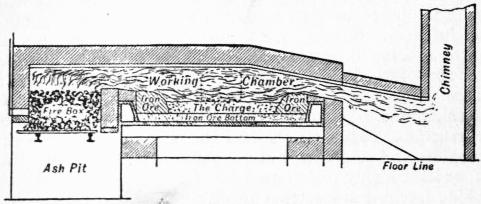
Fig. 14.—Puddling Furnace.
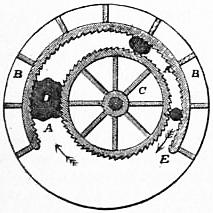
Fig. 15.—Plan of Burden’s Excentric Revolving Squeezer for Puddled Balls.
Here BB is a large fixed iron cylinder, corrugated within, and C an excentric cylinder, also corrugated, which, in turning to the right, by the friction of its corrugated surface rotates the puddled ball D which has just entered at A, so that, turning around its own axis, it travels to the right and is gradually changed from a ball into a bloom, a rough cylindrical mass of white hot iron, still dripping with cinder. This bloom is immediately rolled down into a long flat bar, called “muck bar,” and this in turn is cut into short lengths which, piled one on another, are reheated and again rolled down, sometimes with repeated cutting, piling and re-rolling, into the final shape in which it is actually to be used. But, roll and re-roll as often as we like, much cinder remains imbedded in the iron, in the form of threads and rods drawn out in the direction of rolling, and of course weakening the metal in the transverse direction.
80. Machine Puddling.—The few men who have, and are willing to exercise, the great strength and endurance which the puddler needs when he is stirring the pasty iron and balling it up, command such high wages, and with their little 500-℔ charges turn out their iron so slowly, that many ways of puddling by machinery have been tried. None has succeeded permanently, though indeed one offered by J. P. Roe is not without promise. The essential difficulty has been that none of them could subdivide the rapidly solidifying charge into the small balls which the workman dexterously forms by hand, and that if the charge is not thus subdivided but drawn as a single ball, the cinder cannot be squeezed out of it thoroughly enough.
81. Direct Puddling.—In common practice the cast iron as it runs from the blast-furnace is allowed to solidify and cool completely in the form of pigs, which are then graded by their fracture, and remelted in the puddling furnace itself. At Hourpes, in order to save the expense of this remelting, the molten cast iron as it comes from the blast-furnace is poured directly into the puddling furnace, in large charges of about 2200 ℔, which are thus about four times as large as those of common puddling furnaces. These large charges are puddled by two gangs of four men each, and a great saving in fuel and labour is effected.
Attractive as are these advances in puddling, they have not been widely adopted, for two chief reasons: First, owners of puddling works have been reluctant to spend money freely in plant for a process of which the future is so uncertain, and this unwillingness has been the more natural because these very men are in large part the more conservative fraction, which has resisted the temptation to abandon puddling and adopt the steel-making processes. Second, in puddling iron which is to be used as a raw material for making very fine steel by the crucible process, quality is the thing of first importance. Now in the series of operations, the blast-furnace, puddling and crucible processes, through which the iron passes from the state of ore to that of crucible tool steel, it is so difficult to detect just which are the conditions essential to excellence in the final product that, once a given procedure has been found to yield excellent steel, every one of its details is adhered to by the more cautious ironmasters, often with surprising conservatism. Buyers of certain excellent classes of Swedish iron have been said to object even to the substitution of electricity for water-power as a means of driving the machinery of the forge. In case of direct puddling and the use of larger charges this conservatism has some foundation, because the established custom of allowing the cast iron to solidify gives a better opportunity of examining its fracture, and thus of rejecting unsuitable iron, than is afforded in direct puddling. So, too, when several puddlers are jointly responsible for the thoroughness of their work, as happens in puddling large charges, they will not exercise such care (nor indeed will a given degree of care be so effective) as when responsibility for each charge rests on one man.
82. The removal of phosphorus, a very important duty of the puddling process, requires that the cinder shall be “basic,” i.e. that it shall have a great excess of the strong base, ferrous oxide, FeO, for the phosphoric acid to unite with, lest it be deoxidized by the carbon of the iron as fast as it forms, and so return to the iron, following the general rule that oxidized bodies enter the slag and unoxidized ones the metallic iron. But this basicity implies that for each part of the silica or silicic acid which inevitably results from the oxidation of the silicon of the pig iron, the cinder shall contain some three parts of iron oxide, itself a valuable and expensive substance. Hence, in order to save iron oxide the pig iron used should be nearly free from silicon. It should also be nearly free from sulphur, because of the great difficulty of removing this element in the puddling process. But the strong deoxidizing conditions needed in the blast-furnace to remove sulphur tend strongly to deoxidize silica and thus to make the pig iron rich in silicon.
83. The ”refinery process” of fitting pig iron for the puddling process by removing the silicon without the carbon, is sometimes used because of this difficulty in making a pig iron initially low in both sulphur and silicon. In this process molten pig iron with much silicon but little sulphur has its silicon oxidized to silica and thus slagged off, by means of a blast of air playing on the iron through a blanket of burning coke which covers it. The coke thus at once supplies by its combustion the heat needed for melting the iron and keeping it hot, and by itself dissolving in the molten metal returns carbon to it as fast as this element is burnt out by the blast, so that the “refined” cast iron which results, though still rich in carbon and therefore easy to melt in the puddling process, has relatively little silicon.
84. In the Bessemer or “pneumatic” process, which indeed might be called the “fuel-less” process, molten pig iron is converted into steel by having its carbon, silicon and manganese, and often its phosphorus and sulphur, oxidized and thus removed by air forced through it in so many fine streams and hence so rapidly that the heat generated by the oxidation of these impurities suffices in and by itself, unaided by burning any other fuel, not only to keep the iron molten, but even to raise its temperature from a point initially but little above the melting point of cast iron, say 1150° to 1250° C., to one well above the melting point of the resultant steel, say 1500° C. The “Bessemer converter” or “vessel” (fig. 16) in which this wonderful process is carried out is a huge retort, lined with clay, dolomite or other refractory material, hung aloft and turned on trunnions, DD, through the right-hand one of which the blast is carried to the gooseneck E, which in turn delivers it to the tuyeres Q at the bottom.
There are two distinct varieties of this process, the original undephosphorizing or “acid” Bessemer process, so called because the converter is lined with acid materials, i.e. those rich in silicic acid, such as quartz and clay, and because the slag is consequently acid, i.e. siliceous; and the dephosphorizing or “Thomas” or “basic Bessemer” process, so called because the converter is lined with basic materials, usually calcined dolomite, a mixture of lime and magnesia, bound together with tar, and because the slag is made very basic by adding much lime to it. In the basic Bessemer process phosphorus is readily removed by oxidation, because the product of its oxidation, phosphoric acid, P2O5, in the presence of an excess of base forms stable phosphates of lime and iron which pass into the slag, making it valuable as an artificial manure. But this dephosphorization by oxidation can be carried out only in the case slag is basic. If it is acid, i.e. if it holds much more than 20% of so powerful an acid as silica, then the phosphoric acid has so feeble a hold on the base in the slag that it is immediately re-deoxidized by the carbon of the metal, or even by the iron itself, P2O5 + 5Fe = 2P + 5FeO, and the resultant deoxidized phosphorus immediately recombines with the iron. Now in an acid-lined converter the slag is necessarily acid, because even an initially basic slag would immediately corrode away enough of the acid lining to make itself acid. Hence phosphorus cannot be removed in an acid-lined converter. Though all this is elementary to-day, not only was it unknown, indeed unguessed, at the time of the invention of the Bessemer process, but even when, nearly a quarter of a century later, a young English metallurgical chemist, Sidney Gilchrist Thomas (1850-1885), offered to the British Iron and Steel Institute a paper describing his success in dephosphorizing by the Bessemer process with a basic-lined converter and a basic slag, that body rejected it.
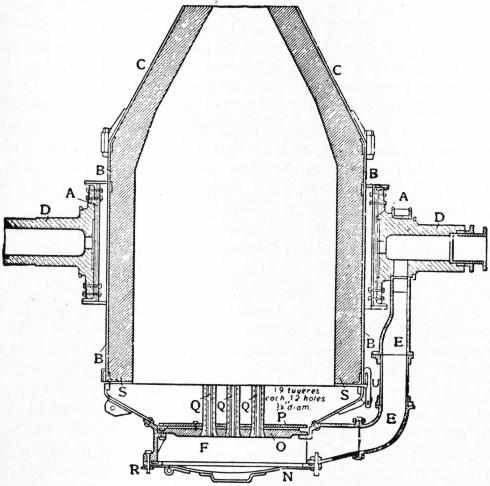
Fig. 16.—12-15 ton Bessemer Converter.
A, Trunnion-ring. B, Main shell. C, Upper part of shell. D, Trunnions. E, Goose-neck. F, Tuyere-box. N, Lid of tuyere-box. O, Tuyere-plate. P, False plate. Q, Tuyeres. R, Keys holding lid of tuyere-box. S, Refractory lining. U, Key-link holding bottom.
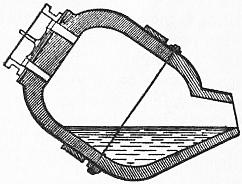
Fig. 17.—Bessemer Converter, turned down in position to receive and discharge the molten metal.
85. In carrying out the acid Bessemer process, the converter, preheated to about 1200° C. by burning coke in it, is turned into the position shown in fig. 17, and the charge of molten pig iron, which sometimes weighs as much as 20 tons, is poured into it through its mouth. The converter is then turned upright into the position shown in fig. 16, so that the blast, which has been let on just before this, entering through the great number of tuyere holes in the bottom, forces its way up through the relatively shallow layer of iron, throwing it up within the converter as a boiling foam, and oxidizing the foreign elements so rapidly that in some cases their removal is complete after 5 minutes. The oxygen of the blast having been thus taken up by the molten metal, its nitrogen issues from the mouth of the converter as a pale spark-bearing cone. Under normal conditions the silicon oxidizes first. Later, when most of it has been oxidized, the carbon begins to oxidize to carbonic oxide, which in turn burns to carbonic acid as it meets the outer air on escaping from the mouth of the converter, and generates a true flame which grows bright, then brilliant, then almost blinding, as it rushes and roars, then “drops,” i.e. shortens and suddenly grows quiet when the last of the carbon has burnt away, and no flame-forming substance remains. Thus may a 20-ton charge of cast iron be converted into steel in ten minutes.4 It is by the appearance of the flame that the operator or “blower” knows when to end the process, judging by its brilliancy, colour, sound, sparks, smoke and other indications.
86. Recarburizing.—The process may be interrupted as soon as the carbon-content has fallen to that which the final product is to have, or it may be continued till nearly the whole of the carbon has been burned out, and then the needed carbon may be added by “recarburizing.” The former of these ways is followed by the very skilful and intelligent blowers in Sweden, who, with the temperature and all other conditions well under control, and with their minds set on the quality rather than on the quantity of their product, can thus make steel of any desired carbon-content from 0.10 to 1.25%. But even with all their skill and care, while the carbon-content is still high the indications of the flame are not so decisive as to justify them in omitting to test the steel before removing it from the converter, as a check on the accuracy of their blowing. The delay which this test causes is so unwelcome that in all other countries the blower continues the blow until decarburization is nearly complete, because of the very great accuracy with which he can then read the indications of the flame, an accuracy which leaves little to be desired. Then, without waiting to test the product, he “recarburizes” it, i.e. adds enough carbon to give it the content desired, and then immediately pours the steel into a great clay-lined casting ladle by turning the converter over, and through a nozzle in the bottom of this ladle pours the steel into its ingot moulds. In making very low-carbon steel this recarburizing proper is not needed; but in any event a considerable quantity of manganese must be added unless the pig iron initially contains much of that metal, in order to remove from the molten steel the oxygen which it has absorbed from the blast, lest this make it redshort. If the carbon-content is not to be raised materially, this manganese is added in the form of preheated lumps of “ferro-manganese,” which contains about 80% of manganese, 5% of carbon and 15% of iron, with a little silicon and other impurities. If, on the other hand, the carbon-content is to be raised, then carbon and manganese are usually added together in the form of a manganiferous molten pig iron, called spiegeleisen, i.e. “mirror-iron,” from the brilliancy of its facets, and usually containing somewhere about 12% of manganese and 4% of carbon, though the proportion between these two elements has to be adjusted so as to introduce the desired quantity of each into the molten steel. Part of the carbon of this spiegeleisen unites with the oxygen occluded in the molten iron to form carbonic oxide, and again a bright flame, greenish with manganese, escapes from the converter.
87. Darby’s Process.—Another way of introducing the carbon is Darby’s process of throwing large paper bags filled with anthracite, coke or gas-carbon into the casting ladle as the molten steel is pouring into it. The steel dissolves the carbon of this fuel even more quickly than water would dissolve salt under like conditions.
88. Bessemer and Mushet.—Bessemer had no very wide knowledge of metallurgy, and after overcoming many stupendous difficulties he was greatly embarrassed by the brittleness or “redshortness” of his steel, which he did not know how to cure. But two remedies were quickly offered, one by the skilful Swede, Göransson, who used a pig iron initially rich in manganese and stopped his blow before much oxygen had been taken up; and the other by a British steel maker, Robert Mushet, who proposed the use of the manganiferous cast iron called spiegeleisen, and thereby removed the only remaining serious obstacle to the rapid spread of the process.
From this many have claimed for Mushet a part almost or even quite equal to Bessemer’s in the development of the Bessemer process, even calling it the “Bessemer-Mushet process.” But this seems most unjust. Mushet had no such exclusive knowledge of the effects of manganese that he alone could have helped Bessemer; and even if nobody had then proposed the use of spiegeleisen, the development of the Swedish Bessemer practice would have gone on, and, the process thus established and its value and great economy thus shown in Sweden, it would have been only a question of time how soon somebody would have proposed the addition of manganese. Mushet’s aid was certainly valuable, but not more than Göransson’s, who, besides thus offering a preventive of redshortness, further helped the process on by raising its temperature by the simple expedient of further subdividing the blast, thus increasing the surface of contact between blast and metal, and thus in turn hastening the oxidation. The two great essential discoveries were first that the rapid passage of air through molten cast iron raised its temperature above the melting point of low-carbon steel, or as it was then called “malleable iron,” and second that this low-carbon steel, which Bessemer was the first to make in important quantities, was in fact an extraordinarily valuable substance when made under proper conditions.
89. Source of Heat.—The carbon of the pig iron, burning as it does only to carbonic oxide within the converter, does not by itself generate a temperature high enough for the needs of the process. The oxidation of manganese is capable of generating a very high temperature, but it has the very serious disadvantage of causing such thick clouds of smoky oxide of manganese as to hide the flame from the blower, and prevent him from recognizing the moment when the blow should be ended. Thus it comes about that the temperature is regulated primarily by adjusting the quantity of silicon in the pig iron treated, 1¼% of this element usually sufficing. If any individual blow proves to be too hot, it may be cooled by throwing cold “scrap” steel such as the waste ends of rails and other pieces, into the converter, or by injecting with the blast a little steam, which is decomposed by the iron by the endothermic reaction H2O + Fe = 2H + FeO. If the temperature is not high enough, it is raised by managing the blast in such a way as to oxidize some of the iron itself permanently, and thus to generate much heat.
90. The basic or dephosphorizing variety of the Bessemer process, called in Germany the “Thomas” process, differs from the acid process in four chief points: (1) that its slag is made very basic and hence dephosphorizing by adding much lime to it; (2) that the lining is basic, because an acid lining would quickly be destroyed by such a basic slag; (3) that the process is arrested not at the “drop of the flame” (§85) but at a predetermined length of time after it; and (4) that phosphorus instead of silicon is the chief source of heat. Let us consider these in turn.
91. The slag, in order that it may have such an excess of base that this will retain the phosphoric acid as fast as it is formed by the oxidation of the phosphorus of the pig iron, and prevent it from being re-deoxidized and re-absorbed by the iron, should, according to von Ehrenwerth’s rule which is generally followed, contain enough lime to form approximately a tetra-calcic silicate, 4CaO,SiO2 with the silica which results from the oxidation of the silicon of the pig iron and tri-calcic phosphate, 3CaO,P2O5, with the phosphoric acid which forms. The danger of this “rephosphorization” is greatest at the end of the blow, when the recarburizing additions are made. This lime is charged in the form of common quicklime, CaO, resulting from the calcination of a pure limestone, CaCO3, which should be as free as possible from silica. The usual composition of this slag is iron oxide, 10 to 16%; lime, 40 to 50%; magnesia, 5%; silica, 6 to 9%; phosphoric acid, 16 to 20%. Its phosphoric acid makes it so valuable as a fertilizer that it is a most important by-product. In order that the phosphoric acid may be the more fully liberated by the humic acid, &c., of the earth, a little silicious sand is mixed with the still molten slag after it has been poured off from the molten steel. The slag is used in agriculture with no further preparation, save very fine grinding.
92. The lining of the converter is made of 90% of the mixture of lime and magnesia which results from calcining dolomite, (Ca,Mg)CO3, at a very high temperature, and 10% of coal tar freed from its water by heating. This mixture may be rammed in place, or baked blocks of it may be laid up like a masonry wall. In either case such a lining is expensive, and has but a short life, in few works more than 200 charges, and in some only 100, though the silicious lining of the acid converter lasts thousands of charges. Hence, for the basic process, spare converters must be provided, so that there may always be some of them re-lining, either while standing in the same place as when in use, or, as in Holley’s arrangement, in a separate repair house, to which these gigantic vessels are removed bodily.
93. Control of the Basic Bessemer Process.—The removal of the greater part of the phosphorus takes place after the carbon has been oxidized and the flame has consequently “dropped,” probably because the lime, which is charged in solid lumps, is taken up by the slag so slowly that not until late in the operation does the slag become so basic as to be retentive of phosphoric acid. Hence in making steel rich in carbon it is not possible, as in the acid Bessemer process, to end the operation as soon as the carbon in the metal has fallen to the point sought, but it is necessary to remove practically all of the carbon, then the phosphorus, and then “recarburize,” i.e. add whatever carbon the steel is to contain. The quantity of phosphorus in the pig iron is usually known accurately, and the dephosphorization takes place so regularly that the quantity of air which it needs can be foretold closely. The blower therefore stops the process when he has blown a predetermined quantity of air through, counting from the drop of the flame; but as a check on his forecast he usually tests the blown metal before recarburizing it.
94. Source of Heat.—Silicon cannot here be used as the chief source of heat as it is in the acid Bessemer process, because most of the heat which its oxidation generates is consumed in heating the great quantities of lime needed for neutralizing the resultant silica. Fortunately the phosphorus, turned from a curse into a blessing, develops by its oxidation the needed temperature, though the fact that this requires at least 1.80% of phosphorus limits the use of the process, because there are few ores which can be made to yield so phosphoric a pig iron. Further objections to the presence of silicon are that the resultant silica (1) corrodes the lining of the converter, (2) makes the slag froth so that it both throws much of the charge out and blocks up the nose of the converter, and (3) leads to rephosphorization. These effects are so serious that until very lately it was thought that the silicon could not safely be much in excess of 1%. But Massenez and Richards, following the plan outlined by Pourcel in 1879, have found that even 3% of silicon is permissible if, by adding iron ore, the resultant silica is made into a fluid slag, and if this is removed in the early cool part of the process, when it attacks the lining of the converter but slightly. Manganese to the extent of 1.80% is desired as a means of preventing the resultant steel from being redshort, i.e. brittle at a red or forging heat. The pig iron should be as nearly free as possible from sulphur, because the removal of any large quantity of this injurious element in the process itself is both difficult and expensive.