VOLUME XIV SLICE VII Ireland to Isabey, Jean Baptiste (continued 5)
Reading edition
At the opening of the session in January 1900 there was a formal reconciliation of the Dillonite, Healyite, and Redmondite or Parnellite factions. It was evident from the speeches made on the occasion that there 1900. was not much cordiality between the various leaders, but the outward solidarity of the party was calculated to bring in renewed subscriptions both at home and from America. It was publicly agreed that England’s difficulty in South Africa was Ireland’s opportunity, and that all should abstain from supporting an amendment to the address which admitted that the war would have to be fought out. Mr John Redmond was chosen chairman, and the alliance of Nationalists and Gladstonian Liberals was dissolved. The United Irish League, founded in Mayo in 1898 by Mr William O’Brien, had recently become a sort of rival to the parliamentary party, its avowed object being to break up the great grass farms, and its methods resembling those of the old Land League.
The most striking event, however, in Ireland in the earlier part of 1900 was Queen Victoria’s visit. Touched by the gallantry of the Irish regiments in South Africa, and moved to some extent, no doubt, by the presence of the duke of Connaught in Dublin as commander-in-chief, the queen determined in April to make up for the loss of her usual spring holiday abroad by paying a visit to Ireland. The last time the queen had been in Dublin was in 1861 with the Prince Consort. Since then, besides the visit of the prince and princess of Wales in 1885, Prince Albert Victor and Prince George of Wales had visited Ireland in 1887, and the duke and duchess of York (afterwards prince and princess of Wales) in 1897; but the lack of any permanent royal residence and the long-continued absence of the sovereign in person had aroused repeated comment. Directly the announcement of the queen’s intention was made the greatest public interest was taken in the project. Shortly before St Patrick’s Day the queen issued an order which intensified this interest, that Irish soldiers might in future wear a sprig of shamrock in their headgear on this national festival. For some years past the “wearing of the green” had been regarded by the army authorities as improper, and friction had consequently occurred, but the queen’s order put an end in a graceful manner to what had formerly been a grievance. The result was that St Patrick’s Day was celebrated in London and throughout the empire as it never had been before, and when the queen went over to Dublin at the beginning of April she was received with the greatest enthusiasm.
The general election later in the year made no practical difference in the strength of parties, but Mr George Wyndham took Mr Gerald Balfour’s place as chief secretary, without a seat in the Cabinet. Both before and after the election the United Irish League steadily advanced, fresh branches continually springing up.
The visit of Mr Redmond and others to America in 1901 was not believed to have brought in much money, and the activity of the League was more or less restrained by want of funds. Boycotting, however, became Recent years. rife, especially in Sligo, and paid agents also promoted an agitation against grass farms in Tipperary, Clare and other southern counties. In Roscommon there was a strike against rent, especially on the property of Lord De Freyne. This was due to the action of the Congested Districts Board in buying the Dillon estate and reducing all the rents without consulting the effect upon others. It was argued that no one else’s tenants could be expected to pay more. Some prosecutions were undertaken, but the government was much criticized for not using the special provisions of the Crimes Act; and in April 1902 certain counties were “proclaimed” under it. In February 1902 Lord Rosebery definitely repudiated Home Rule, and steps to oppose his followers were at once taken among Irish voters in English constituencies.
Lord Cadogan resigned the viceroyalty in July 1902, and was succeeded by Lord Dudley. In November Sir Antony Macdonnell (b. 1844), a member of the Indian Council, became under-secretary to the lord-lieutenant. During a long and successful career in India (1865-1901) Sir Antony had never concealed his Nationalist proclivities, but his appointment, about the form of which there was nothing peculiar, was favoured by Lord Lansdowne and Lord George Hamilton, and ultimately sanctioned by Mr Balfour, who had been prime minister since Lord Salisbury’s resignation in July. About the same time a conference took place in Dublin between certain landlords and some members of the Nationalist party, of whom Mr W. O’Brien was the most conspicuous. Lord Dunraven presided, and it was agreed to recommend a great extension of the Land Purchase system with a view to give the vendor as good an income as before, while decreasing the tenants’ annual burden. This was attempted in Mr Wyndham’s Land Purchase Act of 1903, which gave the tenants a material reduction, a bonus of 12% on the purchase-money being granted to vendors from funds provided by parliament. A judicial decision made it doubtful whether this percentage became the private property of tenants for life on settled estates, but a further act passed in 1904 answered the question in the affirmative. After this the sale of estates proceeded rapidly. In March 1903 was published the report of the Royal Commission on Irish University Education appointed two years before with Lord Robertson as chairman, Trinity College, Dublin, being excluded from the inquiry. The report, which was not really unanimous, was of little value as a basis for legislation. It recommended an examining university with the Queen’s Colleges at Belfast, Cork and Galway, and with a new and well-endowed Roman Catholic college in Dublin.
In August was formed the Irish Reform Association out of the wreckage of the late Land Conference and under Lord Dunraven’s presidency, and it was seen that Sir A. Macdonnell took a great interest in the proceedings. The “Devolution” question. Besides transferring private bill legislation to Dublin on the Scottish plan, to which no one in Ireland objected, it was proposed to hand over the internal expenditure of Ireland to a financial council consisting half of nominated and half of elected members, and to give an Irish assembly the initiative in public Irish bills. This policy, which was called Devolution, found little support anywhere, and was ultimately repudiated both by Mr Wyndham and by Mr Balfour. But a difficult parliamentary crisis, caused by Irish Unionist suspicions on the subject, was only temporarily overcome by Mr Wyndham’s resignation in March 1905. Mr Walter Long succeeded him. One of the chief questions at issue was the position actually occupied by Sir Antony Macdonnell. The new chief secretary, while abstaining from displacing the under-secretary, whose encouragement of “devolution” had caused considerable commotion among Unionists, announced that he considered him as on the footing of an ordinary and subordinate civil servant, but Mr Wyndham had said that he was “invited by me rather as a colleague than as a mere under-secretary to register my will,” and Lord Lansdowne that he “could scarcely expect to be bound by the narrow rules of routine which are applicable to an ordinary member of the civil service.” While Mr Long remained in office no further complication arose, but in 1906 (Sir A. Macdonnell being retained in office by the Liberal government) his Nationalist leanings again became prominent, and the responsibility of the Unionist government in introducing him into the Irish administration became a matter of considerable heart-burning among the Unionist party.
Mr Balfour resigned in December 1905 and was succeeded by Sir Henry Campbell-Bannerman, Lord Aberdeen becoming lord-lieutenant for the second time, with Mr James Bryce as chief secretary. The general election at the beginning of 1906 was disastrous to the Unionist party, and the Liberal government secured an enormous majority. Mr Walter Long, unseated at Bristol, had made himself very popular among Irish Unionists, and a seat was found him in the constituency of South Dublin. Speaking in August 1906 he raised anew the Macdonnell question and demanded the production of all correspondence connected with the under-secretary’s appointment. Sir A. Macdonnell at once admitted through the newspapers that he had in his possession letters (rumoured to be “embarrassing” to the Unionist leaders) which he might publish at his own discretion; and the discussion as to how far his appointment by Mr Wyndham had prejudiced the Unionist cause was reopened in public with much bitterness, in view of the anticipation of further steps in the Home Rule direction by the Liberal ministry. In 1908 Sir Antony resigned and was created a peer as Baron Macdonnell. Soon after the change of government in 1906 a royal commission, with ex-Lord Justice Fry as chairman, was appointed to investigate the condition of Trinity College, Dublin, and another under Lord Dudley to inquire into the question of the congested districts.
Mr Bryce being appointed ambassador to Washington, Mr Birrell faced the session of 1907 as chief secretary. Before he left office Mr Bryce publicly sketched a scheme of his own for remodelling Irish University Education, but his scheme was quietly put on the shelf by his successor and received almost universal condemnation. Mr Birrell began by introducing a bill for the establishment of an Irish Council, which would have given the Home Rulers considerable leverage, but, to the surprise of the English Liberals, it was summarily rejected by a Nationalist convention in Dublin, and was forthwith abandoned. The extreme party of Sinn Fein (“ourselves alone”) were against it because of the power it gave to the government officials, and the Roman Catholic clergy because it involved local control of primary education, which would have imperilled their position as managers. An Evicted Tenants Bill was however passed at the end of the session, which gave the Estates Commissioners unprecedented powers to take land compulsorily. In the late summer and autumn, agitation in Ireland (led by Mr Ginnell, M.P.) took the form of driving cattle off large grass farms, as part of a campaign against what was known as “ranching.” This reckless and lawless practice extended to several counties, but was worst in Galway and Roscommon. The government was determined not to use the Crimes Act, and the result was that offenders nearly always went unpunished, benches of magistrates being often swamped by the chairmen of district councils who were ex officio justices under the act of 1898.
The general election of 1910 placed the Liberal and Unionist parties in a position of almost exact equality in the House of Commons, and it was at once evident that the Nationalists under Mr Redmond’s leadership would hold the balance of power and control the fortunes of Mr Asquith’s government. A small body of “independent Nationalists,” led by Mr William O’Brien and Mr T. M. Healy, voiced the general dislike in Ireland of the Budget of 1909, the rejection of which by the House of Lords had precipitated the dissolution of parliament. But although this band of free-lances was a menace to Mr Redmond’s authority and to the solidarity of the “pledge-bound” Irish parliamentary party, the two sections did not differ in their desire to get rid of the “veto” of the House of Lords, which they recognized as the standing obstacle to Home Rule, and which it was the avowed policy of the government to abolish.
Bibliography.—Ancient: The Annals of the Four Masters, ed. J. O’Donovan (1851), compiled in Donegal under Charles I., gives a continuous account of Celtic Ireland down to 1616. The independent Annals of Lough Cé (Rolls series) end with 1590. The Topographia and Expugnatio of Giraldus Cambrensis (Rolls series) are chiefly valuable for his account of the Anglo-Norman invaders and for descriptions of the country. Sir J. T. Gilbert’s Viceroys of Ireland (Dublin, 1865) gives a connected view of the feudal establishment to the accession of Henry VIII. The Calendar of Documents relating to Ireland in the Public Record Office extends from 1171 to 1307. Christopher Pembridge’s Annals from 1162 to 1370 were published by William Camden and reprinted in Sir J. T. Gilbert’s Chartularies of St Mary’s Abbey (Dublin, 1884). The Annals of Clyn, Dowling and Grace have been printed by the Irish Archaeological Society and the Celtic Society.
For the 16th century see volumes ii. and iii. of the Printed State Papers (1834), and the Calendars of State Papers, Ireland, including that of the Carew MSS. 1515 to 1603. See also Richard Stanihurst’s Chronicle, continued by John Hooker, which is included in Holinshed’s Chronicles; E. Spenser, View of the State of Ireland, edited by H. Morley (1890); Fynes Moryson, History of Ireland (1735); Thomas Stafford, Pacata Hibernia (1810); and R. Bagwell, Ireland under the Tudors (1885-1890).
For the 17th century see the Calendars of Irish State Papers, 1603-1665 (Dublin, 1772); Strafford Letters, edited by W. Knowler (1739): Thomas Carte, Life of Ormonde (1735-1736), and Ormonde Papers (1739); Roger Boyle, earl of Orrery, State letters (1743); the Contemporary History of Affairs in Ireland, 1641-1652 (1879-1880), and History of the Irish Confederation and the War in Ireland, 1641-1649 (1882-1891), both edited by Sir J. T. Gilbert; Edmund Ludlow’s Memoirs, edited by C. H. Firth (1894); the Memoirs of James Touchet, earl of Castlehaven (1815); and Cromwell’s Letters and Speeches, edited by T. Carlyle (1904). See also J. P. Prendergast, The Cromwellian Settlement of Ireland (1870); Denis Murphy, Cromwell in Ireland (1885): M. A. Hickson, Ireland in the 17th Century (1884); Sir John Temple, History of the Irish Rebellion (1812); P. Walsh, History of the Remonstrance (1674); George Story, Impartial History of the Wars of Ireland (1693); Thomas Witherow, Derry and Enniskillen (1873); Philip Dwyer, Siege of Derry (1893); Lord Macaulay, History of England; and S. R. Gardiner, History of England, 1603-1656. Further writings which may be consulted are: The Embassy in Ireland of Rinuccini, 1645-1649, translated from the Italian by A. Hutton (1873); Sir William Petty’s Down Survey, edited by T. A. Larcom (1851), and his Economic Writings, edited by C. H. Hull (1899); Charles O’Kelly’s Macariae Excidium, edited by J. C. O’Callaghan (1850); and A Jacobite Narrative of the War in Ireland, 1688-91, edited by Sir J. T. Gilbert (1892).
For the 18th century J. A. Froude’s English in Ireland and W. E. H. Lecky’s History of England cover the whole ground. See also the Letters 1724-1738 of Archbishop Hugh Boulter, edited by G. Faulkner (1770); the Works of Dean Swift; John Campbell’s Philosophical Survey of Ireland (1778); Arthur Young’s Tour in Ireland (1780); Henry Grattan’s Life of the Right Hon. Henry Grattan (1839-1846); the Correspondence of the Marquess Cornwallis, edited by C. Ross (1859); Wolfe Tone’s Autobiography, edited by R. B. O’Brien (1893); and R. R. Madden’s United Irishmen (1842-1846).
For the 19th and the beginning of the 20th century see the Annual Register; R. M. Martin, Ireland before and after the Union (1848); Sir T. Wyse, Historical Sketch of the late Catholic Association (1829); G. L. Smyth, Ireland, Historical and Statistical (1844-1849); Sir C. E. Trevelyan, The Irish Crisis (1880); N. W. Senior, Journals, Conversations and Essays relating to Ireland (1868); Sir G. C. Lewis, On Local Disturbances in Ireland and on the Irish Church Question (1836); John Morley, Life of W. E. Gladstone; Lord Fitzmaurice, Life of Lord Granville (1905); and R. Barry O’Brien, Life of Parnell (1898). Other authorities are Isaac Butt, Irish Federalism (1870); H. O. Arnold-Forster, The Truth about the Land League (1883); A. V. Dicey, England’s Case against Home Rule (1886); W. E. Gladstone, History of an Idea (1886), and a reply to this by J. E. Webb entitled The Queen’s Enemies in America (1886); and Mrs E. Lynn Linton, About Ireland (1890). See also the Report of the Parnell Special Commission (1890); the Report of the Bessborough Commission (1881), of the Richmond Commission (1881), of the Cowper Commission (1887), and of the Mathew Commission (1893), and the Report of the Congested Districts Board (1899).
For the church in Ireland see: Henry Cotton, Fasti ecclesiae hibernicae (1848-1878); W. M. Brady, The Episcopal Succession (Rome, 1876); R. Mant, History of the Church of Ireland (1840); J. T. Ball, The Reformed Church in Ireland, 1537-1886 (1886); and W. D. Killen, Ecclesiastical History of Ireland (1875). A. Theiner’s Vetera Monumenta (Rome, 1864) contains documents concerning the medieval church, and there are many others in Ussher’s Works, and for a later period in Cardinal Moran’s Spicilegium Ossoriense (1874-1884). The Works of Sir James Ware, edited by Walter Harris, are generally useful, and Alice S. Green’s The Making of Ireland and its Undoing (1908), although written from a partisan standpoint, may also be consulted.
(R. Ba.)
1 The importance of the commerce between Ireland and Gaul in early times, and in particular the trade in wine, has been insisted upon by H. Zimmer in papers in the Abh. d. Berl. Akad. d. Wissenschaften (1909).
2 On the subject of Ptolemy’s description of Ireland see articles by G. H. Orpen in the Journal of the Royal Society of Antiquaries of Ireland (June 1894), and John MacNeill in the New Ireland Review (September 1906).
3 Scholars are only beginning to realize how close was the connexion between Ireland and Wales from early times. Pedersen has recently pointed out the large number of Brythonic and Welsh loan words received into Irish from the time of the Roman occupation of Britain to the beginning of the literary period. Welsh writers now assume an Irish origin for much of the contents of the Mabinogion.
4 It seems probable that the celebrated monastery of Whithorn in Galloway played some part in the reform movement, at any rate in the north of Ireland. Findian of Moville spent some years there.
5 The O’Neills who played such an important part in later Irish history do not take their name from Niall Nóigiallach, though they are descended from him. They take their name from Niall Glúndub (d. 919).
6 At this period it is extremely difficult to distinguish between Norwegians and Danes on account of the close connexion between the ruling families of both countries.
7 This name survives in Fingall, the name of a district north of Dublin city. Dubgall is contained in the proper names MacDougall, MacDowell.
8 In Anglo-Norman times the Scandinavians of Dublin and other cities are always called Ostmen, i.e. Eastmen; hence the name Ostmanstown, now Oxmanstown, a part of the city of Dublin.
9 On the name see K. Meyer Erin, iv. pp. 71-73.
10 Donaban, the son of this Ivar of Waterford, is the ancestor of the O’Donavans, Donoban that of the O’Donovans.
11 The term rath was perhaps applied to the rampart, but both lis and rath are used to denote the whole structure.
12 See D’Arbois de Jubainville, Revue celtique, xxv. 1 ff., 181 ff.
13 The whole question is discussed by Mr J. H. Round in his article on “The Pope and the Conquest of Ireland” (Commune of London, 1899, pp. 171-200), where further references will be found.
IRELAND, CHURCH OF. The ancient Church of Ireland (described in the Irish Church Act 1869 by this its historic title) has a long and chequered history, which it will be interesting to trace in outline. The beginnings of Christianity in Ireland are difficult to trace, but there is no doubt that the first Christian missionary whose labours were crowned with any considerable success was Patrick (fl. c. 450), who has always been reckoned the patron saint of the country. For six centuries the Church of which he was the founder occupied a remarkable position in Western Christendom. Ireland, in virtue at once of its geographical situation and of the spirit of its people, was less affected than other countries by the movements of European thought; and thus its development, social and religious, was largely independent of foreign influences, whether Roman or English. In full communion with the Latin Church, the Irish long preserved many peculiarities, such as their monastic system and the date at which Easter was kept, which distinguished them in discipline, though not conspicuously in doctrine, from the Christians of countries more immediately under papal control (see Ireland: Early History). The incessant incursions of the Danes, who were the scourge of the land for a period of nearly three hundred years, prevented the Church from redeeming the promise of her infancy; and at the date of the English conquest of Ireland (1172) she had lost much of her ancient zeal and of her independence. By this time she had come more into line with the rest of Europe, and the Synod of Cashel put the seal to a new policy by its acknowledgment of the papal jurisdiction and by its decrees assimilating the Church, in ritual and usages, to that of England. There was no thought of a breach of continuity, but the distinctive features of Celtic Christianity gradually disappeared from this time onwards. English influence was strong only in the region round Dublin (known as the Pale); and beyond this district the Irish were not disposed to view with favour any ecclesiastical reforms which had their origin in the sister country. Thus from the days of Henry VIII. the Reformation movement was hindered in Ireland by national prejudice, and it never succeeded in gaining the allegiance of the Irish people as a whole. The policy which directed its progress was blundering and stupid, and reflects little credit on the English statesmen who were responsible for it. No attempt was made to commend the principles of the Reformation to the native Irish by conciliating national sentiment; and the policy which forbade the translation of the Prayer Book into the Irish language, and suggested that where English was not understood Latin might be used as an alternative, was doomed to failure from the beginning. And, in fact, the reformed church of Ireland is to this day the church of a small section only of the population.
The Reformation period begins with the passing of the Irish Supremacy Act 1537. As in England, the changes in religion of successive sovereigns alternately checked and promoted the progress of the movement, although in Ireland the mass of the people were less deeply affected by the religious controversies of the times than in Great Britain. At Mary’s accession five bishops either abandoned, or were deprived of, their sees; but the Anglo-Irish who remained faithful to the Reformation were not subjected to persecution such as would have been their fate on the other side of the Channel. Again, under Elizabeth, while two bishops (William Walsh of Meath and Thomas Leverous of Kildare) were deprived for open resistance to the new order of things, and while stern measures were taken to suppress treasonable plotting against the constitution, the uniform policy of the government in ecclesiastical matters was one of toleration. James I. caused the Supremacy Act to be rigorously enforced, but on political rather than on religious grounds. In distant parts of Ireland, indeed, the unreformed order of service was often used without interference from the secular authority, although the bishops had openly accepted the Act of Uniformity.
The episcopal succession, then, was unbroken at the Reformation. The Marian prelates are admitted on all hands to have been the true bishops of the Church, and in every case they were followed by a line of lawful successors, leading down to the present occupants of the several sees. The rival lines of Roman Catholic titulars are not in direct succession to the Marian bishops, and cannot be regarded as continuous with the medieval Church. The question of the continuity of the pre-Reformation Church with the Church of the Celtic period before the Anglo-Norman conquest of Ireland is more difficult. Ten out of eleven archbishops of Armagh who held office between 1272 and 1439 were consecrated outside Ireland, and there is no evidence forthcoming that any one of them derived his apostolic succession through bishops of the Irish Church. It may be stated with confidence that the present Church of Ireland is the direct and legitimate successor of the Church of the 14th and 15th centuries, but it cannot so clearly be demonstrated that any existing organization is continuous with the Church of St Patrick. In the reign of James I. the first Convocation of the clergy was summoned in Ireland, of which assembly the most notable act was the adoption of the “Irish Articles” (1615). These had been drawn up by Usher, and were more decidedly Calvinistic in tone than the Thirty-nine Articles, which were not adopted as standards in Ireland until 1634, when Strafford forced them on Convocation. During the Commonwealth period the bishoprics which became vacant were not filled; but on the accession of Charles II. the Church was strengthened by the translation of John Bramhall (the most learned and zealous of the prelates) from Derry to the primatial see of Armagh, and the consecration of twelve other bishops, among whom was Jeremy Taylor. The short period during which the policy of James II. prevailed in Ireland was one of disaster to the Church; but under William and Mary she regained her former position. She had now been reformed for more than 100 years, but had made little progress; and the tyrannical provisions of the Penal Code introduced by the English government made her more unpopular than ever. The clergy, finding their ministrations unacceptable to the great mass of the population, were tempted to indolence and non-residence; and although bright exceptions could be named, there was much that called for reform. To William King (1650-1729), bishop of Derry, and subsequently archbishop of Dublin, it was mainly due that the work of the Church was reorganized, and the impulse which he gave it was felt all through the 18th century. His ecclesiastical influence was exerted in direct opposition to Primate Hugh Boulter and his school, who aimed at making the Established Church the instrument for the promotion of English political opinions rather than the spiritual home of the Irish people. In 1800 the Act of Union was passed by the Legislature; and thenceforward, until Disestablishment, there was but one “United Church of England and Ireland.”
Continuous agitation for the removal of Roman Catholic disabilities brought about in 1833 the passing of the Church Temporalities Act, one of the most important provisions of which was the reduction of the number of Irish archbishoprics from four to two, and of bishoprics from eighteen to ten, the funds thus released being administered by commissioners. In 1838 the Tithe Rentcharge Act, which transferred the payment of tithes from the occupiers to the owners of land, was passed, and thus a substantial grievance was removed. It became increasingly plain, however, as years passed, that all such measures of relief were inadequate to allay the dissatisfaction felt by the majority of Irishmen because of the continued existence of the Established Church. Her position had been pledged to her by the Act of Union, and she was undoubtedly the historical representative of the ancient Church of the land; but such arguments proved unavailing in view of the visible fact that she had not gained the affections of the people. The census of 1861 showed that out of a total population of 5,798,967 only 693,357 belonged to the Established Church, 4,505,265 being Roman Catholics; and once this had been made clear, the passing of the Act of Disestablishment was only a question of time. Introduced by Mr Gladstone, and passed in 1869, it became law on the 1st of January 1871.
The Church was thus suddenly thrown on her own resources, and called on to reorganize her ecclesiastical system, as well as to make provision for the maintenance of her future clergy. A convention of the bishops, clergy, and laity was summoned in 1870, and its first act was to declare the adherence of the Church of Ireland to the ancient standards, and her determination to uphold the doctrine and discipline of the Catholic and Apostolic Church, while reaffirming her witness, as Protestant and Reformed, against the innovations of Rome. Under the constitution then agreed on, the supreme governing body of the Church is the General Synod, consisting of the bishops and of 208 clerical and 416 lay representatives of the several dioceses, whose local affairs are managed by subordinate Diocesan Synods. The bishops are elected as vacancies arise, and, with certain restrictions, by the Diocesan Synods, the Primate, whose see is Armagh, being chosen by the bishops out of their own number. The patronage of benefices is vested in boards of nomination, on which both the diocese and the parish are represented. The Diocesan Courts, consisting of the bishop, his chancellor, and two elected members, one clerical and the other lay, deal as courts of first instance with legal questions; but there is an appeal to the Court of the General Synod, composed of three bishops and four laymen who have held judicial office. During the years 1871 to 1878 the revision of the Prayer Book mainly occupied the attention of the General Synod; but although many far-reaching resolutions were proposed by the then predominant Evangelical party, few changes of moment were carried, and none which affected the Church’s doctrinal position. A two-thirds majority of both the lay and clerical vote is necessary before any change can be made in the formularies, and an ultimate veto rests, on certain conditions, with the house of bishops.
The effects of Disestablishment have been partly good and partly evil. On the one hand, the Church has now all the benefits of autonomy and is free from the anomalies incidental to state control. Her laws are definite, and the authority of her judicial courts is recognized by all her members. The place given to the laity in her synods has quickened in them the sense of responsibility so essential to the Church’s progress. And although there are few worldly inducements to men to take orders in Ireland, the clergy are, for the most part, the equals of their predecessors in social standing and in intellectual equipment, while the standard of clerical activity is higher than in pre-Disestablishment days. On the other hand, the vesting of patronage in large bodies like synods, or (as is the case in some districts) in nominators with little knowledge of the Church beyond the borders of their own parish, is not an ideal system, although it is working better as the dangers of parochialism and provinciality are becoming more generally recognized than in the early years of Disestablishment.
The finances are controlled by the Representative Church Body, to which the sum of £7,581,075, sufficient to provide life annuities for the existing clergy (2043 in number), amounting to £596,913, was handed over by the Church Temporalities Commissioners in 1870. So skilfully was this fund administered, and so generous were the contributions of clergy and laity, at and since Disestablishment, that while on 31st December 1906 only 136 annuitants were living, the total assets in the custody of the Representative Church Body amounted at that date to £8,729,941. Of this sum no less than £6,525,952 represented the free-will offerings of the members of the Church for the thirty-seven years ending 31st December 1906. Out of the interest on capital, augmented by the annual parochial assessments, which are administered by the central office, provision has to be made for two archbishops at £2500 per annum, eleven bishops, who receive about £1500 each, and over 1500 parochial clergy. Of the clergy only 338 are curates, while 1161 are incumbents, the average annual income of a benefice being about £240, with (in most cases) a house. The large majority of the clergy receive their training in the Divinity School of Trinity College, Dublin. At the census of 1901 the members of the Church of Ireland numbered 579,385 out of a total population of 4,456,546.
See R. Mant, History of the Church of Ireland (2 vols., London, 1840); Essays on the Irish Church, by various writers (Oxford, 1866); Maziere Brady, The Alleged Conversion of the Irish Bishops (London, 1877); A. T. Lee, The Irish Episcopal Succession (Dublin, 1867); G. T. Stokes, Ireland and the Celtic Church (London, 1888), Ireland and the Anglo-Norman Church (London, 1892), Some Worthies of the Irish Church (London, 1900); T. Olden, The Church of Ireland (London, 1892); J. T. Ball, The Reformed Church of Ireland (London, 1890); H. C. Groves, The Titular Archbishops of Ireland (Dublin, 1897); W. Lawlor, The Reformation in Ireland (London, 1906); Reports of the Representative Church Body (Dublin, 1872-1905).
(J. H. Be.)
IRENAEUS, bishop of Lyons at the end of the 2nd century, was one of the most distinguished theologians of the ante-Nicene Church. Very little is known of his early history. His childhood was spent in Asia Minor, probably at or near Smyrna; for he himself tells us (Adv. haer. iii. 3, 4, and Euseb. Hist. Eccl. v. 20) that as a child he heard the preaching of Polycarp, the aged bishop of Smyrna (d. February 22, 156). But we do not know when this was. He can hardly have been born very long after 130, for later on he frequently mentions having met certain Christian presbyters who had actually seen John, the disciple of our Lord. The circumstances under which he came into the West are also unknown to us; the only thing which is certain is that at the time of the persecution of the Gallic Church under Marcus Aurelius (177) he was a presbyter of the church at Lyons. In 177 or 178 he went to Rome on a mission from this church, to make representations to Bishop Eleutherius in favour of a more lenient treatment of the Montanists (see Montanism.; Eus. v. 4. 2). On his return he was called upon to undertake the direction of the church at Lyons in the place of Bishop Pothinus, who had perished in the persecution (Eus. v. 5. 8). As bishop he carried on a great and fruitful work. Though the statement of Gregory of Tours (Hist. Franc. i. 29), that within a short time he succeeded in converting all Lyons to Christianity, is probably exaggerated, from him at any rate dates the wide spread of Christianity in Lyons and its neighbourhood. He devoted particular attention to trying to reconcile the numerous sects which menaced the existence of the church (see below). In the dispute on the question of Easter, which for a long time disturbed the Christian Church both in West and East, he endeavoured by means of many letters to effect a compromise, and in particular to exercise a moderating influence on Victor, the bishop of Rome, and his unyielding attitude towards the dissentient churches of Africa, thus justifying his name of “peace-maker” (Eirenaios) (Eus. H. E. v. 24. 28). The date of his death is unknown. His martyrdom under Septimius Severus is related by Gregory of Tours, but by no earlier writer.
The chief work of Irenaeus, written about 180, is his “Refutation and Overthrow of Gnosis, falsely so called” (usually indicated by the name Against the Heresies). Of the Greek original of this work only fragments survive; it only exists in full in an old Latin translation, the slavish fidelity of which to a certain extent makes up for the loss of the original text. The treatise is divided into five books: of these the first two contain a minute and well-informed description and criticism of the tenets of various heretical sects, especially the Valentinians; the other three set forth the true doctrines of Christianity, and it is from them that we find out the theological opinions of the author. Irenaeus admits himself that he is not a good writer. And indeed, as he worked, his materials assumed such unmanageable proportions that he could not succeed in throwing them into a satisfactory form. But however clumsily he may have handled his material, he has produced a work which is even nowadays rightly valued as the first systematic exposition of Catholic belief. The foundation upon which Irenaeus bases his system consists in the episcopate, the canon of the Old and New Testaments, and the rule of faith. With their assistance he sets forth and upholds, in opposition to the gnostic dualism, i.e. the severing of the natural and the supernatural, the Catholic monism, i.e. the unity of the life of faith as willed by God. The “grace of truth” (the charisma), which the apostles had called down upon their first disciples by prayer and laying-on of hands, and which was to be imparted anew by way of succession (διαδοχή, successio) to the bishops from generation to generation without a break, makes those who receive it living witnesses of the salvation offered to the faithful by written and spoken tradition. The Scriptures of the Old and New Testaments, rightly expounded by the church alone, give us an insight into God’s plan of salvation for mankind, and explain to us the covenant which He made on various occasions (Moses and Christ; or Noah, Abraham, Moses and Christ). Finally, the “rule of faith” (regula fidei), received at baptism, contains in itself all the riches of Christian truth. To distribute these, i.e. to elucidate the rule of faith as set forth in the creed, and further to point out its agreement with the Scriptures, is the object of Irenaeus as a theologian. Hence he lays the greatest stress on the conception of God’s disposition of salvation towards mankind (oeconomia), the object of which is that mankind, who in Adam were sunk in sin and death, should in Christ, comprised as it were in his person, be brought back to life. God, as the head of the family, so to speak, disposes of all. The Son, the Word (Logos) for ever dwelling with the Father, carries out His behests. The Holy Ghost (Pneuma), however, as the Spirit of wisdom for ever dwelling with the Father, controls what the Father has appointed and the Son fulfilled, and this Spirit lives in the church. The climax of the divine plan of salvation is found in the incarnation of the Word. God was to become man, and in Christ he became man. Christ must be God; for if not, the devil would have had a natural claim on him, and he would have been no more exempt from death than the other children of Adam; he must be man, if his blood were indeed to redeem us. On God incarnate the power of the devil is broken, and in Him is accomplished the reconciliation between God and man, who henceforth pursues his true object, namely, to become like unto God. In the God-man God has drawn men up to Himself. Into their human, fleshly and perishable nature imperishable life is thereby engrafted; it has become deified, and death has been changed into immortality. In the sacrament of the Lord’s Supper it is the heavenly body of the God-man which is actually partaken of in the elements. This exposition by Irenaeus of the divine economy and the incarnation was taken as a criterion by later theologians, especially in the Greek Church (cf. Athanasius, Gregory of Nyssa, Cyril of Alexandria, John of Damascus). He himself was especially influenced by St John and St Paul. Before him the Fourth Gospel did not seem to exist for the Church; Irenaeus made it a living force. His conception of the Logos is not that of the philosophers and apologists; he looks upon the Logos not as the “reason” of God, but as the “voice” with which the Father speaks in the revelation to mankind, as did the writer of the Fourth Gospel. And the Pauline epistles are adopted almost bodily by Irenaeus, according to the ideas contained in them; his expositions often present the appearance of a patchwork of St Paul’s ideas. Certainly, it is only one side of Paul’s thought that he displays to us. The great conceptions of justification and atonement are hardly ever touched by Irenaeus. In Irenaeus is no longer heard the Jew, striving about and against the law, who has had to break free from his early tradition of Pharisaism.
Till recent times whatever other writings and letters of Irenaeus are mentioned by Eusebius appeared to be lost, with the exception of a fragment here or there. Recently, however, two Armenian scholars, Karapet Ter-Měkěrttschian and Erwand Ter-Minassianz, have published from an Armenian translation a German edition (Leipzig, 1907; minor edition 1908) of the work “in proof of the apostolic teaching” mentioned by Eusebius (H. E. v. 26). This work, which is in the form of a dialogue with one Marcianus, otherwise unknown to us, contains a statement of the fundamental truths of Christianity. It is the oldest catechism extant, and an excellent example of how Bishop Irenaeus was able not only to defend Christianity as a theologian and expound it theoretically, but also to preach it to laymen.
Bibliography.—The edition of the Benedictine R. Massuet (Paris, 1710 and 1734, reprinted in Migne, Cursus patrologiae, Series Graeca, vol. v., Paris, 1857) long continued to be the standard one, till it was superseded by the editions of Adolph Stieren (2 vols., Leipzig, 1848-1853) and of W. Wigan Harvey (2 vols., Cambridge, 1857), the latter being the only edition which contains the Syriac fragments. For an English translation see the Ante-Nicene Library. Of modern monographs consult H. Ziegler, Irenaeus, der Bischof von Lyon (Berlin, 1871); Friedrich Loofs, Irenaeus-Handschriften (Leipzig, 1888); Johannes Werner, Der Paulinismus des Irenaeus (Leipzig, 1889); Johannes Kunze, Die Gotteslehre des Irenaeus (Leipzig, 1891); Ernst Klebba, Die Anthropologie des heiligen Irenaeus (Münster, 1894); Albert Dufourcq, Saint Irénée (Paris, 1904); Franz Stoll, Die Lehre des Heil. Irenaeus von der Erlösung und Heiligung (Mainz, 1905); also the histories of dogma, especially Harnack, and Bethune-Baker, An Introduction to the Early History of Christian Doctrine (London, 1903).
(G. K.)
IRENE, the name of several Byzantine empresses.
1. Irene (752-803), the wife of Leo IV., East Roman emperor. Originally a poor but beautiful Athenian orphan, she speedily gained the love and confidence of her feeble husband, and at his death in 780 was left by him sole guardian of the empire and of their ten-year-old son Constantine VI. Seizing the supreme power in the name of the latter, Irene ruled the empire at her own discretion for ten years, displaying great firmness and sagacity in her government. Her most notable act was the restoration of the orthodox image-worship, a policy which she always had secretly favoured, though compelled to abjure it in her husband’s lifetime. Having elected Tarasius, one of her partisans, to the patriarchate (784), she summoned two church councils. The former of these, held in 786 at Constantinople, was frustrated by the opposition of the soldiers. The second, convened at Nicaea in 787, formally revived the adoration of images and reunited the Eastern church with that of Rome. As Constantine approached maturity he began to grow restive under her autocratic sway. An attempt to free himself by force was met and crushed by the empress, who demanded that the oath of fidelity should thenceforward be taken in her name alone. The discontent which this occasioned swelled in 790 into open resistance, and the soldiers, headed by the Armenian guard, formally proclaimed Constantine VI. as the sole ruler. A hollow semblance of friendship was maintained between Constantine and Irene, whose title of empress was confirmed in 792; but the rival factions remained, and Irene, by skilful intrigues with the bishops and courtiers, organized a powerful conspiracy on her own behalf. Constantine could only flee for aid to the provinces, but even there he was surrounded by participants in the plot. Seized by his attendants on the Asiatic shore of the Bosporus, the emperor was carried back to the palace at Constantinople; and there, by the orders of his mother, his eyes were stabbed out. An eclipse of the sun and a darkness of seventeen days’ duration were attributed by the common superstition to the horror of heaven. Irene reigned in prosperity and splendour for five years. She is said to have endeavoured to negotiate a marriage between herself and Charlemagne; but according to Theophanes, who alone mentions it, the scheme was frustrated by Aëtius, one of her favourites. A projected alliance between Constantine and Charlemagne’s daughter, Rothrude, was in turn broken off by Irene. In 802 the patricians, upon whom she had lavished every honour and favour, conspired against her, and placed on the throne Nicephorus, the minister of finance. The haughty and unscrupulous princess, “who never lost sight of political power in the height of her religious zeal,” was exiled to Lesbos and forced to support herself by spinning. She died the following year. Her zeal in restoring images and monasteries has given her a place among the saints of the Greek church.
See E. Gibbon, The Decline and Fall of the Roman Empire (ed. J. Bury, London, 1896), vol. v.; G. Finlay, History of Greece (ed. 1877, Oxford,) vol. ii.; F. C. Schlosser, Geschichte der bilderstürmenden Kaiser des oströmischen Reiches (Frankfort, 1812); J. D. Phoropoulos, Εἰρήνη ἡ αὐτοκράτειρα Ῥωμαίων (Leipzig, 1887); J. B. Bury, The Later Roman Empire (London, 1889), ii. 480-498; C. Diehl, Figures byzantines (Paris, 1906), pp. 77-109.
(M. O. B. C.)
2. Irene (c. 1066-c. 1120), the wife of Alexius I. The best-known fact of her life is the unsuccessful intrigue by which she endeavoured to divert the succession from her son John to Nicephorus Bryennius, the husband of her daughter Anna. Having failed to persuade Alexius, or, upon his death, to carry out a coup d’état with the help of the palace guards, she retired to a monastery and ended her life in obscurity.
3. Irene (d. 1161), the first wife of Manuel Comnenus. She was the daughter of the count of Sulzbach, and sister-in-law of the Roman emperor Conrad II., who arranged her betrothal. The marriage was celebrated at Constantinople in 1146. The new empress, who had exchanged her earlier name of Bertha for one more familiar to the Greeks, became a devoted wife, and by the simplicity of her manner contrasted favourably with most Byzantine queens of the age.
H. v. Kap-Herr, Die abendländische Politik des Kaisers Manuel (Strassburg, 1881).
IRETON, HENRY (1611-1651), English parliamentary general, eldest son of German Ireton of Attenborough, Nottinghamshire, was baptized on the 3rd of November 1611, became a gentleman commoner of Trinity College, Oxford, in 1626, graduated B.A. in 1629, and entered the Middle Temple the same year. On the outbreak of the Civil War he joined the parliamentary army, fought at Edgehill and at Gainsborough in July 1643, was made by Cromwell deputy-governor of the Isle of Ely, and next year served under Manchester in the Yorkshire campaign and at the second battle of Newbury, afterwards supporting Cromwell in his accusations of incompetency against the general. On the night before the battle of Naseby, in June 1645, he succeeded in surprising the Royalist army and captured many prisoners, and next day, on the suggestion of Cromwell, he was made commissary-general and appointed to the command of the left wing, Cromwell himself commanding the right. The wing under Ireton was completely broken by the impetuous charge of Rupert, and Ireton was wounded and taken prisoner, but after the rout of the enemy which ensued on the successful charge of Cromwell he regained his freedom. He was present at the siege of Bristol in the September following, and took an active part in the subsequent victorious campaign which resulted in the overthrow of the royal cause. On the 30th of October 1645 Ireton entered parliament as member for Appleby, and while occupied with the siege of Oxford he was, on the 15th of June 1646, married to Bridget, daughter of Oliver Cromwell. This union brought Ireton into still closer connexion with Cromwell, with whose career he was now more completely identified. But while Cromwell’s policy was practically limited to making the best of the present situation, and was generally inclined to compromise, Ireton’s attitude was based on well-grounded principles of statesmanship. He was opposed to the destructive schemes of the extreme party, disliked especially the abstract and unpractical theories of the Republicans and the Levellers, and desired, while modifying their mutual powers, to retain the constitution of King, Lords and Commons. He urged these views in the negotiations of the army with the parliament, and in the conferences with the king, being the person chiefly entrusted with the drawing up of the army proposals, including the manifesto called “The Heads of the Proposals.” He endeavoured to prevent the breach between the army and the parliament, but when the division became inevitable took the side of the former. He persevered in supporting the negotiations with the king till his action aroused great suspicion and unpopularity. He became at length convinced of the hopelessness of dealing with Charles, and after the king’s flight to the Isle of Wight treated his further proposals with coldness and urged the parliament to establish an administration without him. Ireton served under Fairfax in the second civil war in the campaigns in Kent and Essex, and was responsible for the executions of Lucas and Lisle at Colchester. After the rejection by the king of the last offers of the army, he showed special zeal in bringing about his trial, was one of the chief promoters of “Pride’s Purge,” attended the court regularly, and signed the death-warrant. The regiment of Ireton having been chosen by lot to accompany Cromwell in his Irish campaign, Ireton was appointed major-general; and on the recall of his chief to take the command in Scotland, he remained with the title and powers of lord-deputy to complete Cromwell’s work of reduction and replantation. This he proceeded to do with his usual energy, and as much by the severity of his methods of punishment as by his military skill was rapidly bringing his task to a close, when he died on the 26th of November 1651 of fever after the capture of Limerick. His loss “struck a great sadness into Cromwell,” and perhaps there was no one of the parliamentary leaders who could have been less spared, for while he possessed very high abilities as a soldier, and great political penetration and insight, he resembled in stern unflinchingness of purpose the protector himself. By his wife, Bridget Cromwell, who married afterwards General Charles Fleetwood, Ireton left one son and three daughters.
Bibliography.—Article by C. H Firth in Dict. of Nat. Biog. with authorities there quoted; Wood’s Ath. Oxon. iii. 298, and Fasti, i. 451; Cornelius Brown’s Lives of Notts Worthies, 181; Clarke Papers published by Camden Society; Gardiner’s History of the Civil War and of the Commonwealth.
IRIARTE (or Yriarte) Y OROPESA, TOMÁS DE (1750-1791), Spanish poet, was born on the 18th of September 1750, at Orotava in the island of Teneriffe, and received his literary education at Madrid under the care of his uncle, Juan de Iriarte, librarian to the king of Spain. In his eighteenth year the nephew began his literary career by translating French plays for the royal theatre, and in 1770, under the anagram of Tirso Imarete, he published an original comedy entitled Hacer que hacemos. In the following year he became official translator at the foreign office, and in 1776 keeper of the records in the war department. In 1780 appeared a dull didactic poem in silvas entitled La Música, which attracted some attention in Italy as well as at home. The Fábulas literarias (1781), with which his name is most intimately associated, are composed in a great variety of metres, and show considerable ingenuity in their humorous attacks on literary men and methods; but their merits have been greatly exaggerated. During his later years, partly in consequence of the Fábulas, Iriarte was absorbed in personal controversies, and in 1786 was reported to the Inquisition for his sympathies with the French philosophers. He died on the 17th of September 1791.
He is the subject of an exhaustive monograph (1897) by Emilio Cotarelo y Mori.
IRIDACEAE (the iris family), in botany, a natural order of flowering plants belonging to the series Liliiflorae of the class Monocotyledons, containing about 800 species in 57 genera, and widely distributed in temperate and tropical regions. The members of this order are generally perennial herbs growing from a corm as in Crocus and Gladiolus, or a rhizome as in Iris; more rarely, as in the Spanish iris, from a bulb. A few South African representatives have a shrubby habit. The flowers are hermaphrodite and regular as in Iris (fig. 1) and Crocus (fig. 3), or with a symmetry in the median plane as in Gladiolus. The petaloid perianth consists of two series, each with three members, which are joined below into a longer or shorter tube, followed by one whorl of three stamens; the inferior ovary is three-celled and contains numerous ovules on an axile placenta; the style is branched and the branches are often petaloid. The fruit (fig. 2) is a capsule opening between the partitions and containing generally a large number of roundish or angular seeds. The arrangement of the parts in the flower resembles that in the nearly allied order Amaryllidaceae (Narcissus, Snowdrop, &c.), but differs in the absence of the inner whorl of stamens.
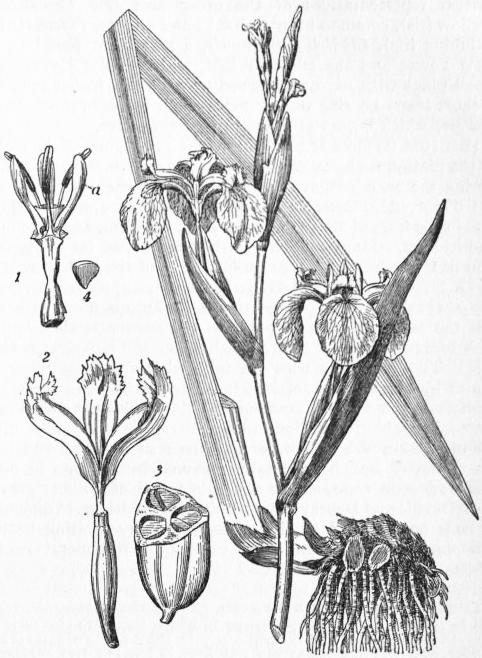
Fig. 1.—Yellow Iris, Iris Pseudacorus.
1. Flower, from which the outer petals and the stigmas have been removed, leaving the inner petals (a) and stamens. 2. Pistil with petaloid stigmas. 3. Fruit cut across showing the three chambers containing seeds. 4. A seed. 1-4 about ½ nat. size.
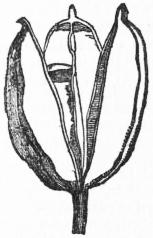
Fig. 2.—Seed-vessel (capsule) of the Flower-de-Luce (iris), opening in a loculicidal manner. The three valves bear the septa in the centre and the opening takes place through the back of the chambers. Each valve is formed by the halves of contiguous carpels.
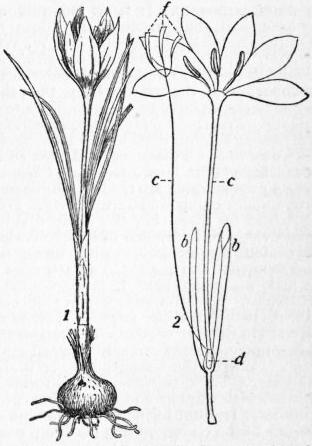
Fig. 3.—1. Crocus in flower, reduced. 2. Flower dissected. b, b′, Upper and lower membranous spathe-like bracts; c, Tube of perianth; d, Ovary; e, Style; f, Stigmas.
The most important genera are Crocus (q.v.), with about 70 species, Iris (q.v.), with about 100, and Gladiolus (q.v.), with 150. Ixia, Freesia (q.v.) and Tritonia (including Montbretia), all natives of South Africa, are well known in cultivation. Sisyrinchium, blue-eyed grass, is a new-world genus extending from arctic America to Patagonia and the Falkland Isles. One species, S. angustifolium, an arctic and temperate North American species, is also native in Galway and Kerry in Ireland. Other British representatives of the order are: Iris Pseudacorus, (yellow iris), common by river-banks and ditches, I. foetidissima (stinking iris), Gladiolus communis, a rare plant found in the New Forest and the Isle of Wight, and Romulea Columnae, a small plant with narrow recurved leaves a few inches long and a short scape bearing one or more small regular funnel-shaped flowers, which occurs at Dawlish in Devonshire.
IRIDIUM (symbol Ir.; atomic weight 193.1), one of the metals of the platinum group, discovered in 1802 by Smithson Tennant during the examination of the residue left when platinum ores are dissolved in aqua regia; the element occurs in platinum ores in the form of alloys of platinum and iridium, and of osmium and iridium. Many methods have been devised for the separation of these metals (see Platinum), one of the best being that of H. St. C Deville and H. J. Debray (Comptes rendus, 1874, 78, p. 1502). In this process the osmiridium is fused with zinc and the excess of zinc evaporated; the residue is then ignited with barium nitrate, extracted with water and boiled with nitric acid. The iridium is then precipitated from the solution (as oxide) by the addition of baryta, dissolved in aqua regia, and precipitated as iridium ammonium chloride by the addition of ammonium chloride. The double chloride is fused with nitre, the melt extracted with water and the residue fused with lead, the excess of lead being finally removed by solution in nitric acid and aqua regia. It is a brittle metal of specific gravity 22.4 (Deville and Debray), and is only fusible with great difficulty. It may be obtained in the spongy form by igniting iridium ammonium chloride, and this variety of the metal readily oxidizes when heated in air.
Two oxides of iridium are known, namely the sesquioxide, Ir2O3, and the dioxide, IrO2, corresponding to which there are two series of salts, the sesqui-salts and the iridic salts; a third series of salts is also known (the iridious salts) derived from an oxide IrO. Iridium sesquioxide, Ir2O3, is obtained when potassium iridium chloride is heated with sodium or potassium carbonates, in a stream of carbon dioxide. It is a bluish-black powder which at high temperatures decomposes into the metal, dioxide and oxygen. The hydroxide, Ir(OH)3, may be obtained by the addition of caustic potash to iridium sodium chloride, the mixture being then heated with alcohol. Iridium dioxide, IrO2, may be obtained as small needles by heating the metal to bright redness in a current of oxygen (G. Geisenheimer, Comptes rendus, 1890, 110, p. 855). The corresponding hydroxide, Ir(OH)4, is formed when potassium iridate is boiled with ammonium chloride, or when the tetrachloride is boiled with caustic potash or sodium carbonate. It is an indigo-blue powder, soluble in hydrochloric acid, but insoluble in dilute nitric and sulphuric acids. On the oxides see L. Wöhler and W. Witzmann, Zeit. anorg. Chem. (1908), 57, p. 323. Iridium sesquichloride, IrCl3, is obtained when one of the corresponding double chlorides is heated with concentrated sulphuric acid, the mixture being then thrown into water. It is thus obtained as an olive green precipitate which is insoluble in acids and alkalis. Potassium iridium sesquichloride, K3IrCl6·3H2O, is obtained by passing sulphur dioxide into a suspension of potassium chloriridate in water until all dissolves, and then adding potassium carbonate to the solution (C. Claus, Jour. prak. Chem., 1847, 42, p. 351). It forms green prisms which are readily soluble in water. Similar sodium and ammonium compounds are known. Iridium tetrachloride, IrCl4, is obtained by dissolving the finely divided metal in aqua regia; by dissolving the hydroxide in hydrochloric acid; and by digesting the hydrated sesquichloride with nitric acid. On evaporating the solution (not above 40° C.) a dark mass is obtained, which contains a little sesquichloride. It forms double chlorides with the alkaline chlorides. For a bromide see A. Gautbier and M. Riess, Ber., 1909, 42, p. 3905. Iridium sulphide, IrS, is obtained when the metal is ignited in sulphur vapour. The sesquisulphide, Ir2S3, is obtained as a brown precipitate when sulphuretted hydrogen is passed into a solution of one of the sesqui-salts. It is slightly soluble in potassium sulphide. The disulphide, IrS2, is formed when powdered iridium is heated with sulphur and an alkaline carbonate. It is a dark brown powder. Iridium forms many ammine derivatives, which are analogous to the corresponding platinum compounds (see M. Skoblikoff, Jahresb., 1852, p. 428; W. Palmer, Ber., 1889, 22, p. 15; 1890, 23, p. 3810; 1891, 24, p. 2090; Zeit. anorg. Chem., 1896, 13, p. 211).
Iridium is always determined quantitatively by conversion into the metallic state. The atomic weight of the element has been determined in various ways, C. Seubert (Ber., 1878, 11, p. 1770), by the analysis of potassium chloriridate obtaining the value 192.74, and A. Joly (Comptes rendus, 1890, 110, p. 1131) from analyses of potassium and ammonium chloriridites, the value 191.78 (O = 15.88).
IRIGA, a town of the province of Ambos Camarines, Luzon, Philippine Islands, on the Bicol river, about 20 m. S.E. of Nueva Cáceres and near the S.W. base of Mt. Iriga, a volcanic peak reaching a height of 4092 ft. above the sea. Pop. (1903) 19,297. Iriga has a temperate climate. The soil in its vicinity is rich, producing rice, Indian corn, sugar, pepper, cacao, cotton, abacá, tobacco and copra. The neighbouring forests furnish ebony, molave, tindalo and other very valuable hardwoods. The language is Bicol.
IRIS, in Greek mythology, daughter of Thaumas and the Ocean nymph Electra (according to Hesiod), the personification of the rainbow and messenger of the gods. As the rainbow unites earth and heaven, Iris is the messenger of the gods to men; in this capacity she is mentioned frequently in the Iliad, but never in the Odyssey, where Hermes takes her place. She is represented as a youthful virgin, with wings of gold, who hurries with the swiftness of the wind from one end of the world to the other, into the depths of the sea and the underworld. She is especially the messenger of Zeus and Hera, and is associated with Hermes, whose caduceus or staff she often holds. By command of Zeus she carries in a ewer water from the Styx, with which she puts to sleep all who perjure themselves. Her attributes are the caduceus and a vase.
IRIS, in botany. The iris flower belongs to the natural order Iridaceae of the class Monocotyledons, which is characterized by a petaloid six-parted perianth, an inferior ovary and only three stamens (the outer series), being thus distinguished from the Amaryllidaceae family, which has six stamens. They are handsome showy-flowered plants, the Greek name having been applied on account of the hues of the flowers. The genus contains about 170 species widely distributed throughout the north temperate zone. Two of the species are British. I. Pseudacorus, the yellow flag or iris, is common in Britain on river-banks, and in marshes and ditches. It is called the “water-flag” or “bastard floure de-luce” by Gerard, who remarks that “although it be a water plant of nature, yet being planted in gardens it prospereth well.” Its flowers appear in June and July, and are of a golden-yellow colour. The leaves are from 2 to 4 ft. long, and half an inch to an inch broad. Towards the latter part of the year they are eaten by cattle. The seeds are numerous and pale-brown; they have been recommended when roasted as a substitute for coffee, of which, however, they have not the properties. The astringent rhizome has diuretic, purgative and emetic properties, and may, it is said, be used for dyeing black, and in the place of galls for ink-making. The other British species, I. foetidissima, the fetid iris, gladdon or roast-beef plant, the Xyris or stinking gladdon of Gerard, is a native of England south of Durham, and also of Ireland, southern Europe and North Africa. Its flowers are usually of a dull, leaden-blue colour; the capsules, which remain attached to the plant throughout the winter, are 2 to 3 in. long; and the seeds scarlet. When bruised this species emits a peculiar and disagreeable odour.
Iris florentina, with white or pale-blue flowers, is a native of the south of Europe, and is the source of the violet-scented orris root used in perfumery. Iris versicolor, or blue flag, is indigenous to North America, and yields “iridin,” a powerful hepatic stimulant. Iris germanica of central Europe, “the most common purple Fleur de Luce” of Ray, is the large common blue iris of gardens, the bearded iris or fleur de luce and probably the Illyrian iris of the ancients. From the flowers of Iris florentina a pigment—the “verdelis,” “vert d’iris,” or iris-green, formerly used by miniature painters—was prepared by maceration, the fluid being left to putrefy, when chalk or alum was added. The garden plants known as the Spanish iris and the English iris are both of Spanish origin, and have very showy flowers. Along with some other species, as I. reticulata and I. persica, both of which are fragrant, they form great favourites with florists. All these just mentioned differ from those formerly named in the nature of the underground stem, which forms a bulb and not a strict creeping rhizome as in I. Pseudacorus, germanica, florentina, &c. Some botanists separate these bulbous irises from the genus Iris, and place them apart in the genus Xiphium, the Spanish iris, including about 30 species, all from the Mediterranean region and the East.
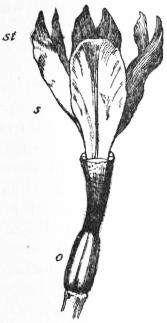

Fig. 1.—Gynoecium of Iris, consisting of an inferior ovary o, and a style, with three petaloid segments s, bearing stigmas st. Fig. 2.—Diagram of Trimerous Symmetrical Flower of Iris, with two whorls of perianth, three stamens in one whorl and an ovary formed of three carpels. The three dots indicate the position of an inner whorl of stamens which is present in the allied families Amaryllidaceae and Liliaceae but absent in Iridaceae.
The iris flower is of special interest as an example of the relation between the shape of the flower and the position of the pollen-receiving and stigmatic surfaces on the one hand and the visits of insects on the other. The large outer petals form a landing-stage for a flying insect which in probing the perianth-tube for honey will first come in contact with the stigmatic surface which is borne on the outer face of a shelf-like transverse projection on the under side of the petaloid style-arm. The anther, which opens towards the outside, is sheltered beneath the over-arching style arm below the stigma, so that the insect comes in contact with its pollen-covered surface only after passing the stigma, while in backing out of the flower it will come in contact only with the non-receptive lower face of the stigma. Thus an insect bearing pollen from one flower will in entering a second deposit the pollen on the stigma, while in backing out of a flower the pollen which it bears will not be rubbed off on the stigma of the same flower.
The hardier bulbous irises, including the Spanish iris (I. Xiphium) and the English iris (I. xiphioides, so called, which is also of Spanish origin), require to be planted in thoroughly drained beds in very light open soil, moderately enriched, and should have a rather sheltered position. Both these present a long series of beautiful varieties of the most diverse colours, flowering in May, June and July, the smaller Spanish iris being the earlier of the two. There are many other smaller species of bulbous iris. Being liable to perish from excess of moisture, they should have a well-drained bed of good but porous soil made up for them, in some sunny spot, and in winter should be protected by a 6-in. covering of half-decayed leaves or fresh coco-fibre refuse. To this set belong I. persica, reticulata, filifolia, Histrio, juncea, Danfordiae Rosenbachiana and others which flower as early as February and March.
The flag irises are for the most part of the easiest culture; they grow in any good free garden soil, the smaller and more delicate species only needing the aid of turfy ingredients, either peaty or loamy, to keep it light and open in texture. The earliest to bloom are the dwarf forms of Iris pumila, which blossom during March, April and May; and during the latter month and the following one most of the larger growing species, such as I. germanica, florentina, pallida, variegata, amoena, flavescens, sambucina, neglecta, ruthenica, &c., produce their gorgeous flowers. Of many of the foregoing there are, besides the typical form, a considerable number of named garden varieties. Iris unguicularis (or stylosa) is a remarkable winter flowering species from Algeria, with sky-blue flowers blotched with yellow, produced at irregular intervals from November to March, the bleakest period of the year.
The beautiful Japanese Iris Kaempferi (or I. laevigata) is of comparatively modern introduction, and though of a distinct type is equally beautiful with the better-known species. The outer segments are rather spreading than deflexed, forming an almost circular flower, which becomes quite so in some of the very remarkable duplex varieties, in which six of these broad segments are produced instead of three. Of this too there are numberless varieties cultivated under names. They require a sandy peat soil on a cool moist subsoil.
What are known as Oncocyclus, or cushion irises, constitute a magnificent group of plants remarkable for their large, showy and beautifully marked flowers. Compared with other irises the “cushion” varieties are scantily furnished with narrow sickle-shaped leaves and the blossoms are usually borne singly on the stalks. The best-known kinds are atrofusca, Barnumae, Bismarckiana, Gatesi, Heylandiana, iberica, Lorteti, Haynei, lupina, Mariae, meda, paradoxa, sari, sofarana and susiana—the last-named being popularly called the “mourning” iris owing to the dark silvery appearance of its huge flowers. All these cushion irises are somewhat fastidious growers, and to be successful with them they must be planted rather shallow in very gritty well-drained soil. They should not be disturbed in the autumn, and after the leaves have withered the roots should be protected from heavy rains until growth starts again naturally.
A closely allied group to the cushion irises are those known as Regelia, of which Korolkowi, Leichtlini and vaga are the best known. Some magnificent hybrids have been raised between these two groups, and a hardier and more easily grown race of garden irises has been produced under the name of Regelio-Cyclus. They are best planted in September or October in warm sunny positions, the rhizomes being lifted the following July after the leaves have withered.
IRISH MOSS, or Carrageen (Irish carraigeen, “moss of the rock”), a sea-weed (Chondrus crispus) which grows abundantly along the rocky parts of the Atlantic coast of Europe and North America. In its fresh condition the plant is soft and cartilaginous, varying in colour from a greenish-yellow to a dark purple or purplish-brown; but when washed and sun-dried for preservation it has a yellowish translucent horn-like aspect and consistency. The principal constituent of Irish moss is a mucilaginous body, of which it contains about 55%; and with that it has nearly 10% of albuminoids and about 15% of mineral matter rich in iodine and sulphur. When softened in water it has a sea-like odour, and from the abundance of its mucilage it will form a jelly on boiling with from 20 to 30 times its weight of water. The jelly of Irish moss is used as an occasional article of food. It may also be used as a thickener in calico-printing and for fining beer. Irish moss is frequently mixed with Gigartina mammillosa, G. acicularis and other sea-weeds with which it is associated in growth.
IRKUTSK, a government of Asiatic Russia, in East Siberia, bounded on the W. by the government of Yeniseisk, on the N. by Yakutsk, on the E. by Lake Baikal and Transbaikalia and on the S. and S.W. by Mongolia; area, 287,061 sq. m. The most populous region is a belt of plains 1200 to 2000 ft. in altitude, which stretch north-west to south-east, having the Sayan mountains on the south and the Baikal mountains on the north, and narrowing as it approaches the town of Irkutsk. The high road, now the Trans-Siberian railway, follows this belt. The south-western part of the government is occupied by mountains of the Sayan system, whose exact orography is as yet not well known. From the high plateau of Mongolia, fringed by the Sayan mountains, of which the culminating point is the snow-clad Munko-sardyk (11,150 ft.), a number of ranges, 7500 to 8500 ft. high, strike off in a north-east direction. Going from south to north they are distinguished as the Tunka Alps, the Kitoi Alps (both snow-clad nearly all the year round), the Ida mountains and the Kuitun mountains. These are, however, by no means regular chains, but on the contrary are a complex result of upheavals which took place at different geological epochs, and of denudation on a colossal scale. A beautiful, fertile valley, drained by the river Irkut, stretches between the Tunka Alps and the Sayan, and another somewhat higher plain, but not so wide, stretches along the river Kitoi. A succession of high plains, 2000 to 2500 ft. in altitude, formed of horizontal beds of Devonian (or Upper Silurian) sandstone and limestone, extends to the north of the railway along the Angara, or Verkhnyaya (i.e. upper) Tunguzka, and the upper Lena, as far as Kirensk. The Bratskaya Steppe, west of the Angara, is a prairie peopled by Buriats. A mountain region, usually described as the Baikal range, but consisting in reality of several ranges running north-eastwards, across Lake Baikal, and scooped out to form the depression occupied by the lake, is fringed on its north-western slope by horizontal beds of sandstone and limestone. Farther north-east the space between the Lena and the Vitim is occupied by another mountain region belonging to the Olekma and Vitim system, composed of several parallel mountain chains running north-eastwards (across the lower Vitim), and auriferous in the drainage area of the Mama (N.E. of Lake Baikal). Lake Baikal separates Irkutsk from Transbaikalia. The principal rivers of the government are the Angara, which flows from this lake northwards, with numerous sharp windings, and receives from the left several large tributaries. as the Irkut, Kitoi, Byelaya, Oka and Iya. The Lena is the principal means of communication both with the gold-mines on its own tributary, the lower Vitim, and with the province of Yakutsk. The Nizhnyaya Tunguzka flows northwards, to join the Yenisei in the far north, and the mountain streams tributary to the Vitim drain the north-east.
The post-Tertiary formations are represented by glacial deposits in the highlands and loess on their borders. Jurassic deposits are met with in a zone running north-westwards from Lake Baikal to Nizhne-udinsk. The remainder of this region is covered by vast series of Carboniferous, Devonian and Silurian deposits—the first two but slightly disturbed over wide areas. All the highlands are built up of older, semi-crystalline Cambro-Silurian strata, which attain a thickness of 2500 ft., and of crystalline slates and limestones of the Laurentian system, with granites, syenites, diorites and diabases protruding from beneath them. Very extensive beds of basaltic lavas and other volcanic deposits are spread along the border ridge of the high plateau, about Munko-sardyk, up the Irkut, and on the upper Oka, where cones of extinct volcanoes are found (Jun-bulak). Earthquakes are frequent in the neighbourhood of Lake Baikal and the surrounding region. Gold is extracted in the Nizhne-udinsk district; graphite is found on the Botu-gol and Alibert mountains (abandoned many years since) and on the Olkhon island of Lake Baikal. Brown coal (Jurassic) is found in many places, and coal on the Oka. The salt springs of Usoliye (45 m. west of Irkutsk), as also those on the Ilim and of Ust-Kutsk (on the Lena), yield annually about 7000 tons of salt. Fireclay, grindstones, marble and mica, lapis-lazuli, granites and various semi-precious stones occur on the Sludyanka (south-west corner of the Baikal).
The climate is severe; the mean temperatures being at Irkutsk (1520 ft), for the year 31° Fahr., for January −6°, for July 65°; at Shimki (valley of the Irkut, 2620 ft.), for the year 24°, for January −17°, for July 63°. The average rainfall is 15 in. a year. Virgin forests cover all the highlands up to 6500 ft.
The population which was 383,578 in 1879, was 515,132 in 1897, of whom 238,997 were women and 60,396 were urban; except about 109,000 Buriats and 1700 Tunguses, they are Russians. The estimated population in 1906 was 552,700. Immigration contributes about 14,000 every year. Schools are numerous at Irkutsk, but quite insufficient in the country districts, and only 12% of the children receive education. The soil is very fertile in certain parts, but meagre elsewhere, and less than a million acres are under crops (rye, wheat, barley, oats, buckwheat, potatoes). Grain has to be imported from West Siberia and cattle from Transbaikalia. Fisheries on Lake Baikal supply every year about 2,400,000 Baikal herring (omul). Industry is only beginning to be developed (iron-works, glass- and pottery-works and distilleries, and all manufactured goods are imported from Russia). The government is divided into five districts, the chief towns of which are Irkutsk (q.v.), Balagansk (pop., 1313 in 1897), Kirensk (2253), Nizhne-udinsk and Verkholensk.
(P. A. K.; J. T. Be.)
IRKUTSK, the chief town of the above government, is the most important place in Siberia, being not only the largest centre of population and the principal commercial depot north of Tashkent, but a fortified military post, an archbishopric of the Orthodox Greek Church and the seat of several learned societies. It is situated in 52° 17′ N. and 104° 16′ E., 3792 m. by rail from St Petersburg. Pop. (1875) 32,512, (1900) 49,106. The town proper lies on the right bank of the Angara, a tributary of the Yenisei, 45 m. below its outflow from Lake Baikal, and on the opposite bank is the Glaskovsk suburb. The river, which has a breadth of 1900 ft., is crossed by a flying bridge. The Irkut, from which the town takes its name, is a small river which joins the Angara directly opposite the town, the main portion of which is separated from the monastery, the castle, the port and the suburbs by another confluent, the Ida or Ushakovka. Irkutsk has long been reputed a remarkably fine city—its streets being straight, broad, well paved and well lighted; but in 1879, on the 4th and 6th of July, the palace of the (then) governor-general, the principal administrative and municipal offices and many of the other public buildings were destroyed by fire; and the government archives, the library and museum of the Siberian section of the Russian Geographical Society were utterly ruined. A cathedral (built of wood in 1693 and rebuilt of stone in 1718), the governor’s palace, a school of medicine, a museum, a military hospital, and the crown factories are among the public institutions and buildings. An important fair is held in December. Irkutsk grew out of the winter-quarters established (1652) by Ivan Pokhabov for the collection of the fur tax from the Buriats. Its existence as a town dates from 1686.
IRMIN, or Irminus, in Teutonic mythology, a deified eponymic hero of the Herminones. The chief seat of his worship was Irminsal, or Ermensul, in Westphalia, destroyed in 772 by Charlemagne. Huge wooden posts (Irmin pillars) were raised to his honour, and were regarded as sacred by the Saxons.
IRNERIUS (Hirnerius, Hyrnerius, Iernerius, Gernerius, Guarnerius, Warnerius, Wernerius, Yrnerius), Italian jurist, sometimes referred to as “lucerna juris.” He taught the “free arts” at Bologna, his native city, during the earlier decades of the 12th century. Of his personal history nothing is known, except that it was at the instance of the countess Matilda, Hildebrand’s friend, who died in 1115, that he directed his attention and that of his students to the Institutes and Code of Justinian; that after 1116 he appears to have held some office under the emperor Henry V.; and that he died, perhaps during the reign of the emperor Lothair II., but certainly before 1140. He was the first of the Glossators (see Gloss), and according to ancient opinion (which, however, has been much controverted) was the author of the epitome of the Novellae of Justinian, called the Authentica, arranged according to the titles of the Code. His Formularium tabellionum (a directory for notaries) and Quaestiones (a book of decisions) are no longer extant. (See Roman Law.)
See Savigny, Gesch. d. röm. Rechts im Mittelalter, iii. 83; Vecchio, Notizie di Irnerio e della sua scuola (Pisa, 1869); Ficker, Forsch, z. Reichs- u. Rechtsgesch. Italiens, vol. iii. (Innsbruck, 1870); and Fitting, Die Anfänge der Rechtsschule zu Bologna (Berlin, 1888).
IRON [symbol Fe, atomic weight 55.85 (O = 16)], a metallic chemical element. Although iron occurs only sparingly in the free state, the abundance of ores from which it may be readily obtained led to its application in the arts at a very remote period. It is generally agreed, however, that the Iron Age, the period of civilization during which this metal played an all-important part, succeeded the ages of copper and bronze, notwithstanding the fact that the extraction of these metals required greater metallurgical skill. The Assyrians and Egyptians made considerable use of the metal; and in Genesis iv. 22 mention is made of Tubal-cain as the instructor of workers in iron and copper. The earlier sources of the ores appear to have been in India; the Greeks, however, obtained it from the Chalybes, who dwelt on the south coast of the Black Sea; and the Romans, besides drawing from these deposits, also exploited Spain, Elba and the province of Noricum. (See Metal-work.)
The chief occurrences of metallic iron are as minute spiculae disseminated through basaltic rocks, as at Giant’s Causeway and in the Auvergne, and, more particularly, in meteorites (q.v.). In combination it occurs, usually in small quantity, in most natural waters, in plants, and as a necessary constituent of blood. The economic sources are treated under Iron and Steel below; in the same place will be found accounts of the manufacture, properties, and uses of the metal, the present article being confined to its chemistry. The principal iron ores are the oxides and carbonates, and these readily yield the metal by smelting with carbon. The metal so obtained invariably contains a certain amount of carbon, free or combined, and the proportion and condition regulate the properties of the metal, giving origin to the three important varieties: cast iron, steel, wrought iron. The perfectly pure metal may be prepared by heating the oxide or oxalate in a current of hydrogen; when obtained at a low temperature it is a black powder which oxidizes in air with incandescence; produced at higher temperatures the metal is not pyrophoric. Péligot obtained it as minute tetragonal octahedra and cubes by reducing ferrous chloride in hydrogen. It may be obtained electrolytically from solutions of ferrous and magnesium sulphates and sodium bicarbonate, a wrought iron anode and a rotating cathode of copper, thinly silvered and iodized, being employed (S. Maximowitsch, Zeit. Elektrochem., 1905, 11, p. 52).
In bulk, the metal has a silvery white lustre and takes a high polish. Its specific gravity is 7.84; and the average specific heat over the range 15°-100° is 0.10983; this value increases with temperature to 850°, and then begins to diminish. It is the most tenacious of all the ductile metals at ordinary temperatures with the exception of cobalt and nickel; it becomes brittle, however, at the temperature of liquid air. It softens at a red heat, and may be readily welded at a white heat; above this point it becomes brittle. It fuses at about 1550°-1600°, and may be distilled in the electric furnace (H. Moissan, Compt. rend., 1906, 142, p. 425). It is attracted by a magnet and may be magnetized, but the magnetization is quickly lost. The variation of physical properties which attends iron on heating has led to the view that the metal exists in allotropic forms (see Iron and Steel, below).
Iron is very reactive chemically. Exposed to atmospheric influences it is more or less rapidly corroded, giving the familiar rust (q.v.). S. Burnie (Abst. J.C.S., 1907, ii. p. 469) has shown that water is decomposed at all temperatures from 0° to 100° by the finely divided metal with liberation of hydrogen, the action being accelerated when oxides are present. The decomposition of steam by passing it through a red-hot gun-barrel, resulting in the liberation of hydrogen and the production of magnetic iron oxide, Fe3O4, is a familiar laboratory method for preparing hydrogen (q.v.). When strongly heated iron inflames in oxygen and in sulphur vapour; it also combines directly with the halogens. It dissolves in most dilute acids with liberation of hydrogen; the reaction between sulphuric acid and iron turnings being used for the commercial manufacture of this gas. It dissolves in dilute cold nitric acid with the formation of ferrous and ammonium nitrates, no gases being liberated; when heated or with stronger acid ferric nitrate is formed with evolution of nitrogen oxides.
It was observed by James Keir (Phil. Trans., 1790, p. 359) that iron, after having been immersed in strong nitric acid, is insoluble in acids, neither does it precipitate metals from solutions. This “passivity” may be brought about by immersion in other solutions, especially by those containing such oxidizing anions as NO′3, ClO′3, less strongly by the anions SO″4 CN′, CNS′, C2H3O′2, OH′, while Cl′, Br′ practically inhibit passivity; H′ is the only cation which has any effect, and this tends to exclude passivity. It is also occasioned by anodic polarization of iron in sulphuric acid. Other metals may be rendered passive; for example, zinc does not precipitate copper from solutions of the double cyanides and sulphocyanides, nickel and cadmium from the nitrates, and iron from the sulphate, but it immediately throws down nickel and cadmium from the sulphates and chlorides, and lead and copper from the nitrates (see O. Sackur, Zeit. Elektrochem., 1904, 10, p. 841). Anodic polarization in potassium chloride solution renders molybdenum, niobium, ruthenium, tungsten, and vanadium passive (W. Muthmann and F. Frauenberger, Sitz. Bayer. Akad. Wiss., 1904, 34, p. 201), and also gold in commercial potassium cyanide solution (A. Coehn and C. L. Jacobsen, Abs. J.C.S., 1907, ii. p. 926). Several hypotheses have been promoted to explain this behaviour, and, although the question is not definitely settled, the more probable view is that it is caused by the formation of a film of an oxide, a suggestion made many years ago by Faraday (see P. Krassa, Zeit. Elektrochem., 1909, 15, p. 490). Fredenhagen (Zeit. physik. Chem., 1903, 43, p. 1), on the other hand, regarded it as due to surface films of a gas; submitting that the difference between iron made passive by nitric acid and by anodic polarization was explained by the film being of nitrogen oxides in the first case and of oxygen in the second case. H. L. Heathcote and others regard the passivity as invariably due to electrolytic action (see papers in the Zeit. physik. Chem., 1901 et seq.).
Compounds of Iron.
Oxides and Hydroxides.—Iron forms three oxides: ferrous oxide, FeO, ferric oxide, Fe2O3, and ferroso-ferric oxide, Fe3O4. The first two give origin to well-defined series of salts, the ferrous salts, wherein the metal is divalent, and the ferric salts, wherein the metal is trivalent; the former readily pass into the latter on oxidation, and the latter into the former on reduction.
Ferrous oxide is obtained when ferric oxide is reduced in hydrogen at 300° as a black pyrophoric powder. Sabatier and Senderens (Compt. rend., 1892, 114, p. 1429) obtained it by acting with nitrous oxide on metallic iron at 200°, and Tissandier by heating the metal to 900° in carbon dioxide; Donau (Monats., 1904, 25, p. 181), on the other hand, obtained a magnetic and crystalline-ferroso-ferric oxide at 1200°. It may also be prepared as a black velvety powder which readily takes up oxygen from the air by adding ferrous oxalate to boiling caustic potash. Ferrous hydrate, Fe(OH)2, when prepared from a pure ferrous salt and caustic soda or potash free from air, is a white powder which may be preserved in an atmosphere of hydrogen. Usually, however, it forms a greenish mass, owing to partial oxidation. It oxidizes on exposure with considerable evolution of heat; it rapidly absorbs carbon dioxide; and readily dissolves in acids to form ferrous salts, which are usually white when anhydrous, but greenish when hydrated.
Ferric oxide or iron sesquioxide, Fe2O3, constitutes the valuable ores red haematite and specular iron; the minerals brown haematite or limonite, and göthite and also iron rust are hydrated forms. It is obtained as a steel-grey crystalline powder by igniting the oxide or any ferric salt containing a volatile acid. Small crystals are formed by passing ferric chloride vapour over heated lime. When finely ground these crystals yield a brownish red powder which dissolves slowly in acids, the most effective solvent being a boiling mixture of 8 parts of sulphuric acid and 3 of water. Ferric oxide is employed as a pigment, as jeweller’s rouge, and for polishing metals. It forms several hydrates, the medicinal value of which was recognized in very remote times. Two series of synthetic hydrates were recognized by Muck and Tommasi: the “red” hydrates, obtained by precipitating ferric salts with alkalis, and the “yellow” hydrates, obtained by oxidizing moist ferrous hydroxide or carbonates. J. van Bemmelen has shown that the red hydrates are really colloids, the amount of water retained being such that its vapour pressure equals the pressure of the aqueous vapour in the superincumbent atmosphere. By heating freshly prepared red ferric hydrate with water under 5000 atmospheres pressure Ruff (Ber., 1901, 34, p. 3417) obtained definite hydrates corresponding to the minerals limonite (30°-42.5°), göthite (42.5°-62.5°), and hydrohaematite (above 62.5°). Thomas Graham obtained a soluble hydrate by dissolving the freshly prepared hydrate in ferric chloride and dialysing the solution, the soluble hydrate being left in the dialyser. All the chlorine, however, does not appear to be removed by this process, the residue having the composition 82Fe(OH)3·FeCl3; but it may be by electrolysing in a porous cell (Tribot and Chrétien, Compt. rend., 1905, 140, p. 144). On standing, the solution usually gelatinizes, a process accelerated by the addition of an electrolyte. It is employed in medicine under the name Liquor ferri dialysati. The so-called soluble meta-ferric hydroxide, FeO(OH)(?), discovered by Péan de St Gilles in 1856, may be obtained by several methods. By heating solutions of certain iron salts for some time and then adding a little sulphuric acid it is precipitated as a brown powder. Black scales, which dissolve in water to form a red solution, are obtained by adding a trace of hydrochloric acid to a solution of basic ferric nitrate which has been heated to 100° for three days. A similar compound, which, however, dissolves in water to form an orange solution, results by adding salt to a heated solution of ferric chloride. These compounds are insoluble in concentrated, but dissolve readily in dilute acids.
Red ferric hydroxide dissolves in acids to form a well-defined series of salts, the ferric salts, also obtained by oxidizing ferrous salts; they are usually colourless when anhydrous, but yellow or brown when hydrated. It has also feebly acidic properties, forming ferrites with strong bases.
Magnetite, Fe3O4, may be regarded as ferrous ferrite, FeO·Fe2O3. This important ore of iron is most celebrated for its magnetic properties (see Magnetism and Compass), but the mineral is not always magnetic, although invariably attracted by a magnet. It may be obtained artificially by passing steam over red-hot iron. It dissolves in acids to form a mixture of a ferrous and ferric salt,1 and if an alkali is added to the solution a black precipitate is obtained which dries to a dark brown mass of the composition Fe(OH)2·Fe2O3; this substance is attracted by a magnet, and thus may be separated from the admixed ferric oxide. Calcium ferrite, magnesium ferrite and zinc ferrite, RO·Fe2O3 (R = Ca, Mg, Zn), are obtained by intensely heating mixtures of the oxides; magnesium ferrite occurs in nature as the mineral magnoferrite, and zinc ferrite as franklinite, both forming black octahedra.
Ferric acid, H2FeO4. By fusing iron with saltpetre and extracting the melt with water, or by adding a solution of ferric nitrate in nitric acid to strong potash, an amethyst or purple-red solution is obtained which contains potassium ferrate. E. Frémy investigated this discovery, made by Stahl in 1702, and showed that the same solution resulted when chlorine is passed into strong potash solution containing ferric hydrate in suspension. Haber and Pick (Zeit. Elektrochem., 1900, 7, p. 215) have prepared potassium ferrate by electrolysing concentrated potash solution, using an iron anode. A temperature of 70°, and a reversal of the current (of low density) between two cast iron electrodes every few minutes, are the best working conditions. When concentrated the solution is nearly black, and on heating it yields a yellow solution of potassium ferrite, oxygen being evolved. Barium ferrate, BaFeO4·H2O, obtained as a dark red powder by adding barium chloride to a solution of potassium ferrate, is fairly stable. It dissolves in acetic acid to form a red solution, is not decomposed by cold sulphuric acid, but with hydrochloric or nitric acid it yields barium and ferric salts, with evolution of chlorine or oxygen (Baschieri, Gazetta, 1906, 36, ii. p. 282).
Halogen Compounds.—Ferrous fluoride, FeF2, is obtained as colourless prisms (with 8H2O) by dissolving iron in hydrofluoric acid, or as anhydrous colourless rhombic prisms by heating iron or ferric chloride in dry hydrofluoric acid gas. Ferric fluoride, FeF3, is obtained as colourless crystals (with 4½H2O) by evaporating a solution of the hydroxide in hydrofluoric acid. When heated in air it yields ferric oxide. Ferrous chloride, FeCl2, is obtained as shining scales by passing chlorine, or, better, hydrochloric acid gas, over red-hot iron, or by reducing ferric chloride in a current of hydrogen. It is very deliquescent, and freely dissolves in water and alcohol. Heated in air it yields a mixture of ferric oxide and chloride, and in steam magnetic oxide, hydrochloric acid, and hydrogen. It absorbs ammonia gas, forming the compound FeCl2·6NH2, which on heating loses ammonia, and, finally, yields ammonium chloride, nitrogen and iron nitride. It fuses at a red-heat, and volatilizes at a yellow-heat; its vapour density at 1300°-1400° corresponds to the formula FeCl2. By evaporating in vacuo the solution obtained by dissolving iron in hydrochloric acid, there results bluish, monoclinic crystals of FeCl2·4H2O, which deliquesce, turning greenish, on exposure to air, and effloresce in a desiccator. Other hydrates are known. By adding ammonium chloride to the solution, evaporating in vacuo, and then volatilizing the ammonium chloride, anhydrous ferrous chloride is obtained. The solution, in common with those of most ferrous salts, absorbs nitric oxide with the formation of a brownish solution.
Ferric chloride, FeCl3, known in its aqueous solution to Glauber as oleum martis, may be obtained anhydrous by the action of dry chlorine on the metal at a moderate red-heat, or by passing hydrochloric acid gas over heated ferric oxide. It forms iron-black plates or tablets which appear red by transmitted and a metallic green by reflected light. It is very deliquescent, and readily dissolves in water, forming a brown or yellow solution, from which several hydrates may be separated (see Solution). The solution is best prepared by dissolving the hydrate in hydrochloric acid and removing the excess of acid by evaporation, or by passing chlorine into the solution obtained by dissolving the metal in hydrochloric acid and removing the excess of chlorine by a current of carbon dioxide. It also dissolves in alcohol and ether; boiling point determinations of the molecular weight in these solutions point to the formula FeCl3. Vapour density determinations at 448° indicate a partial dissociation of the double molecule Fe2Cl6; on stronger heating it splits into ferrous chloride and chlorine. It forms red crystalline double salts with the chlorides of the metals of the alkalis and of the magnesium group. An aqueous solution of ferric chloride is used in pharmacy under the name Liquor ferri perchloridi; and an alcoholic solution constitutes the quack medicine known as “Lamotte’s golden drops.” Many oxychlorides are known; soluble forms are obtained by dissolving precipitated ferric hydrate in ferric chloride, whilst insoluble compounds result when ferrous chloride is oxidized in air, or by boiling for some time aqueous solutions of ferric chloride.
Ferrous bromide, FeBr2, is obtained as yellowish crystals by the union of bromine and iron at a dull red-heat, or as bluish-green rhombic tables of the composition FeBr2·6H2O by crystallizing a solution of iron in hydrobromic acid. Ferric bromide, FeBr3, is obtained as dark red crystals by heating iron in an excess of bromine vapour. It closely resembles the chloride in being deliquescent, dissolving ferric hydrate, and in yielding basic salts. Ferrous iodide, FeI2, is obtained as a grey crystalline mass by the direct union of its components. Ferric iodide does not appear to exist.
Sulphur Compounds.—Ferrous sulphide, FeS, results from the direct union of its elements, best by stirring molten sulphur with a white-hot iron rod, when the sulphide drops to the bottom of the crucible. It then forms a yellowish crystalline mass, which readily dissolves in acids with the liberation of sulphuretted hydrogen. Heated in air it at first partially oxidizes to ferrous sulphate, and at higher temperatures it yields sulphur dioxide and ferric oxide. It is unaltered by ignition in hydrogen. An amorphous form results when a mixture of iron filings and sulphur are triturated with water. This modification is rapidly oxidized by the air with such an elevation of temperature that the mass may become incandescent. Another black amorphous form results when ferrous salts are precipitated by ammonium sulphide.