VOLUME XIII SLICE VII Horticulture to Hudson Bay (continued 5)
Reading edition
The old interpretation “save, now!” which may be a popular etymology, is based on Ps. cxviii. 25 (Heb. hōshī‘ah-nnā), but this does not explain the occurrence of the word in the Gospels, a complicated problem, on which see the articles of J. H. Thayer in Hastings’s Dict. Bib., and more especially T. K. Cheyne, Ency. Bib. s.v.
HOSE (a word common to many Teutonic languages; cf. Dutch, hoos, stocking, Ger. Hose, breeches, tights; the ultimate origin is unknown), the name of an article of dress, used as a covering for the leg and foot. The word has been used for various forms of a long stocking covering both the foot and leg (see Hosiery), and this is the usual modern sense. But it also formerly meant a kind of gaiter covering the leg from the knee to the ankle only, of the long tight covering for the whole of the lower limbs, and later of the short puffed or slashed breeches worn with the doublet—at this period, from the early part of the 16th century onwards, comes the distinction between the “hose” or “trunk hose” and the stocking (see Costume). The term is applied to certain objects resembling such a covering, as in its application to flexible rubber or canvas piping used for conveying water (see Hosepipe), and in botany, to the “sheath” covering, e.g. the ear of corn. The term “hose-in-hose” is thus used in botany for a flower in which the corolla has become doubled, as though a second were inserted in the throat of the first; it occurs sometimes in the primrose.
HOSEA, the son of Beērī, the first in order of the minor prophets of the Old Testament. The name Hosea (הושע, LXX. Ὠσηέ, Vulg. Osee, and so the English version in Rom. ix. 25) ought rather to be written Hoshea, and is identical with that borne by the last king of Ephraim, and by Joshua in Num. xiii. 16, Deut. xxxii. 44. Of the life of Hosea1 we know nothing beyond what can be gathered from his prophecies. That he was a citizen of the northern kingdom appears from the whole tenor of the book, but most expressly from i. 2, where “the land,” the prophet’s land, is the realm of Israel, and vii. 5, where “our king” is the king of Samaria. The date at which Hosea flourished is given in the title, i. 1, by the reigning kings of Judah and Israel. He prophesied (i) in the days of Uzziah, Jotham, Ahaz and Hezekiah, kings of Judah; (2) in the days of Jeroboam the son of Joash, king of Israel. The dates indicated by the title, which may be regarded as editorial, are, for the four kings of the southern kingdom, 789-740, 739-734, 733-721 and 720-693 B.C. respectively; and, for Jeroboam II., 782-743 (cf. Ency. Bib. col. 797-798). The book itself, however, plainly belongs to the period prior to 734 B.C. since, in that year, (a) the Syro-Ephraimitic war began, to which there is here no reference, nor is Assyria yet the open foe it then became; (b) Gilead became Tiglath-Pileser’s (2 Kings xv. 29), whereas it is here described as still part of the territory of Israel (vi. 8; xii. 11; cf. the included place-names of v. 1). On the other hand, the prophet connects with the birth of his eldest child the approaching fall of the house of Jehu (i. 4), thus anticipating the death of Jeroboam II. in 743, and the period of anarchy which followed (2 Kings xv.). Thus the prophetic work of Hosea may be dated, with practical certainty, as beginning from some point previous to 743 and extending not later than 734.2 This is corroborated by the general character of the book. Of its two parts, i.-iii. reflects the wealth and prosperity of the reign of Jeroboam II., whilst iv.-xiv. contains frequent references to the social disorder and anarchy of the subsequent years.
The first part of Hosea’s prophetic work, corresponding to chs. i.-iii., lay in the years of external prosperity immediately preceding the catastrophe of the house of Jehu in or near the year 743. The second part of the book is a summary of prophetic teaching during the subsequent troublous reign of Menahem, and, perhaps, that of his successor, Pekahiah, and must have been completed before 734 B.C. Apart from the narrative in chs. i.-iii., to which we shall presently recur, the book throws little or no light on the details of Hosea’s life. It appears from ix. 7, 8, that his prophetic work was greatly embarrassed by opposition: “As for the prophet, a fowler’s snare is in all his ways, and enmity in the house of his God.” The enmity which had its centre in the sanctuary probably proceeded from the priests (comp. Amos vii.), against whose profligacy and profanation of their office our prophet frequently declaims—perhaps also from the degenerate prophetic gilds which had their seats in the holy cities of the northern kingdom, and with whom Hosea’s elder contemporary Amos so indignantly refuses to be identified (Amos vii. 14). In ch. iv. 5 Hosea seems to comprise priests and prophets in one condemnation, thus placing himself in direct antagonism to all the leaders of the religious life of his nation. He is not less antagonistic to the kings and princes of his day (vii. 3-7, viii. 4, viii. 10 Septuagint, x. 7-15, xiii. 11).3 In view of the familiarity shown with the intrigues of rulers and the doings of priests, it has been conjectured that Hosea held a prominent position, or even (by Duhm) that he was himself a priest (Marti, p. 2).
The most interesting problem of Hosea’s history lies in the interpretation of the story of his married life (chs. i.-iii.). We read in these chapters that God’s revelation to Hosea began when in accordance with a divine command he married a profligate wife, Gomer, the daughter of Diblaim. Three children were born in this marriage and received symbolical names, illustrative of the divine purpose towards Israel, which are expounded in ch. i. In ch. ii. the faithlessness of Israel to Jehovah (Yahweh), the long-suffering of God, the moral discipline of sorrow and tribulation by which He will yet bring back His erring people and betroth it to Himself for ever in righteousness, love and truth, are depicted under the figure of the relation of a husband to an erring spouse. The suggestion of this allegory lies in the prophet’s marriage with Gomer, but the details are worked out quite independently, and under a rich multiplicity of figures derived from other sources. In the third chapter we return to the personal experience of the prophet. His faithless wife had at length left him and fallen, under circumstances which are not detailed, into a state of misery, from which Hosea, still following her with tender affection, and encouraged by a divine command, brought her back and restored her to his house, where he kept her in seclusion, and patiently watched over her for many days, yet not readmitting her to the privileges of a wife.
In these experiences the prophet again recognizes a parallel to Yahweh’s long-suffering love to Israel, and the discipline by which the people shall be brought back to God through a period in which all their political and religious institutions are overthrown. Throughout these chapters personal narrative and prophetic allegory are interwoven with a rapidity of transition very puzzling to the modern reader; but an unbiassed exegesis can hardly fail to acknowledge that chs. i. and iii. narrate an actual passage in the prophet’s life. The names of the three children are symbolical, but Isaiah in like manner gave symbolical names to his sons, embodying prominent points in his prophetic teaching (Shear-jashub, Isa. vii. 3, comp. x. 21; Maher-shalal-hash-baz, viii. 3). And the name of Gomer bath Diblaim is certainly that of an actual person, upon which all the allegorists, from the Targum, Jerome and Ephraem Syrus downwards, have spent their arts in vain, whereas the true symbolical names in the book are perfectly easy of interpretation.4 That the ancient interpreters take the whole narrative as a mere parable is no more than an application of their standing rule that everything in the Biblical history is allegorical which in its literal sense appears offensive to propriety (comp. Jerome’s proem to the book). But the supposed offence to propriety seems to rest on mistaken exegesis and too narrow a conception of the way in which the Divine word was communicated to the prophets.5 There is no reason to suppose that Hosea knowingly married a woman of profligate character. The point of the allegory in i. 2 is plainly infidelity after marriage as a parallel to Israel’s departure from the covenant God, and a profligate wife (אשת זנונים) is not the same thing with an open prostitute (זונה). The marriage was marred by Gomer’s infidelity; and the struggle of Hosea’s affection for his wife with this great unhappiness—a struggle inconceivable unless his first love had been pure and full of trust in the purity of its object—furnished him with a new insight into Yahweh’s dealings with Israel. Then he recognized that the great calamity of his life was God’s own ordinance and appointed means to communicate to him a deep prophetic lesson. The recognition of a divine command after the fact has its parallel, as Wellhausen observes, in Jer. xxxii. 8.
It was in the experiences of his married life, and in the spiritual lessons opened to him through these, that Hosea first heard the revealing voice of Yahweh (i. 2).6 Like Amos (Amos iii. 8), he was called to speak for God by an inward constraining voice, and there is no reason to think that he had any connexion with the recognized prophetic societies, or ever received such outward adoption to office as was given to Elisha. His position in Israel was one of tragic isolation. Amos, when he had discharged his mission at Bethel, could return to his home and to his friends; Hosea was a stranger among his own people, and his home was full of sorrow and shame. Isaiah in the gloomiest days of Judah’s declensions had faithful disciples about him, and knew that there was a believing remnant in the land. Hosea knows no such remnant, and there is not a line in his prophecy from which we can conclude that his words ever found an obedient ear.
As already stated, this prophecy falls into two clearly distinguished sections,7 the former (i.-iii.), already dealt with, accounting for the general standpoint of the latter (iv.-xiv.). It is not possible to make any convincing subdivisions of this latter section (cf. G. A. Smith, i. p. 223) which is best regarded as a series of separate discourses on certain recurrent topics, viz. (a) the cultus, (b) the social disorder and immorality, (c) political tendencies (alliance with either Assyria or Egypt sought).8 In regard to each of these topics, the attitude of the prophet involves the discernment of present guilt, and the assertion of future punishment. For him the present condition of the people contained no germ or pledge of future amendment, and he describes the impending judgment, not as a sifting process (Amos ix. 9, 10) in which the wicked perish and the righteous remain, but as the total wreck of the nation which has wholly turned aside from its God. In truth, while the idolatrous feasts of Ephraim still ran their joyous round, while the careless people crowded to the high places, and there in unbridled and licentious mirth flattered themselves that their many sacrifices ensured the help of their God against all calamity, the nation was already in the last stage of internal dissolution. To the prophet’s eye there was “no truth, nor mercy, nor knowledge of God in the land—nought but swearing, and lying, and killing, and stealing and adultery; they break out, and blood toucheth blood” (iv. 1, 2). The root of this corruption lay in total ignorance of Yahweh, whose precepts were no longer taught by the priests, while in the national calf-worship, and in the local high places, this worship was confounded with the service of the Canaanite Baalim. Thus the whole religious constitution of Israel was undermined. And the political state of the realm was in Hosea’s eyes not more hopeful. The dynasty of Jehu, still great and powerful when the prophet’s labours began, is itself an incorporation of national sin. Founded on the bloodshed of Jezreel, it must fall by God’s vengeance, and the state shall fall with it (i. 4, iii. 4). This sentence stands at the head of Hosea’s predictions, and throughout the book the civil constitution of Ephraim is represented as equally lawless and godless with the corrupt religious establishment. The anarchy that followed on the murder of Zachariah appears to the prophet as the natural decadence of a realm not founded on divine ordinance. The nation had rejected Yahweh, the only helper. And now the avenging Assyrian9 is at hand. Samaria’s king shall pass away as foam on the water. Fortress and city shall fall before the ruthless invader, who spares neither age nor sex, and thistles shall cover the desolate altars of Ephraim.
In our present book of Hosea, this condemnatory judgment on contemporary Israel culminates in a chapter of appeal for penitence, with promise of divine forgiveness. The question of the authenticity of this and of other “restoration” passages10 forms the chief problem for literary criticism presented by the book.11 Amongst the more recent commentators, Davidson, G. A. Smith and Nowack regard Hosea xiv. as written by the prophet, though the second admits its chronological misplacement and the third its later expansion. On the other hand, it is altogether rejected by Cheyne, Wellhausen, Marti and Harper. These claim that the passage reflects the later standpoint of completed punishment, and is therefore inconsistent in the prophet who anticipates that punishment. But the case is different from that of the epilogue to Amos, since Hosea’s personal experience covers forgiveness as well as discipline (Marti consistently, though without ground, rejects this experience also). There seems, therefore, to be no sufficient evidence for denying thoughts of restoration to Hosea, whilst it is highly probable that such passages would be amplified in a later age. Indeed, the importance of these passages for the interpretation of Hosea is apt to be overrated, for, as one of those rejecting them remarks, though Hosea “promised nothing,” yet he “contributed a conception of Yahweh which made such a future not only possible but even probable” (Harper, p. cliii.). We may therefore read the closing chapter as, at least, the explicit statement of a hope implicit in Hosea’s teaching.
Hosea could discern no faithful remnant in Ephraim, yet Ephraim in all his corruption is the son of Yahweh, a child nurtured with tender love, a chosen people, whose past history declares in every episode the watchful and patient affection of his father. And that father is God and not man, the Holy One who will not and cannot sacrifice His love even to the justest indignation (chap. xi.). To the prophet who knows this love of Yahweh, who has learned to understand it in the like experience of his own life, the very ruin of the state of Israel is a step in the loving guidance which makes the valley of trouble a door of hope (ii. 15), and the wilderness of tribulation as full of promise as the desert road from Egypt to Canaan was to Israel of old. Of the manner of Israel’s repentance and conversion Hosea presents no clear image—nay, it is plain that on this point he had nothing to tell. The certainty that the people will at length return and seek Yahweh their God rests, not on any germ of better things in Israel, but on the invincible supremacy of Yahweh’s love. And so the two sides of his prophetic declaration, the passionate denunciation of Israel’s sin and folly, and the not less passionate tenderness with which he describes the final victory of divine love, are united by no logical bond. The unity is one of feeling only, and the sob of anguish in which many of his appeals to a heedless people seem to end turns once and again with sudden revulsion into the clear accents of evangelical promise, which in the closing chapter swell forth in pure and strong cadence out of a heart that has found its rest with God from all the troubles of a stormy life.
The strongly emotional temperament of Hosea suggests comparison with that of Jeremiah, who like himself is the prophet of the decline and fall of a kingdom. The subsequent influence of Hosea on the literature of the Old and New Testaments is very marked. Not only is it seen in the conception of the relation between God and His people as a marriage, which he makes current coin (cf. Marti, p. 15), but still more in the fact that his conception of the divine character becomes the inspiration of the book of Deuteronomy and so of the whole canon of Scripture. “In a special degree, the author of Deuteronomy is the spiritual heir of Hosea.”12
Recent Literature (where references to older works will be found): Cheyne, “Hosea” in Cambridge Bible (1884); W. R. Smith, The Prophets of Israel,2 with Cheyne’s introduction (1895); G. A. Smith, “The Book of the Twelve,” i., in The Expositor’s Bible (1896); Nowack, Die Kleinen Propheten (1897); Wellhausen, Die Kleinen Propheten3 (1898); Smend, Alttest. Religionsgeschichte,2 pp. 204 f. (1899); Davidson, art. “Hosea” in Hastings’ Dictionary of the Bible, ii. pp. 419 f. (1900); Marti, art. “Hosea” in Ency. Biblica, ii. c. 2119 (1901) (a revision of the original article by W. R. Smith, in the Ency. Britannica, partially reproduced above); Marti, Dodekapropheton (1903); W. R. Harper, “Amos and Hosea” in Inter. Critical Commentary (1905) (with copious bibliography).
(W. R. S.; H. W. R.*)
1 Traditions about Hosea.—Beērī, the prophet’s father, is identified by the Rabbins with Beērah (1 Chron. v. 6), a Reubenite prince carried captive by Tiglath-Pileser. This view is already expressed by Jerome, Quaest. in Paralip., and doubtless underlies the statement of the Targum to Chronicles that Beērah was a prophet. For it is a Jewish maxim that when a prophet’s father is named, he, too, was a prophet, and accordingly a tradition of R. Simon makes Isa. viii. 19, 20 a prophecy of Beērī (Ḳimcḥi in loc.; Leviticus Rabba, par. 15). According to the usual Christian tradition, however, Hosea was of the tribe of Issachar, and from an unknown town, Belemoth or Belemon (pseudo-Epiphanius, pseudo-Dorotheus, Ephraem Syr. ii. 234; Chron. Pasch., Bonn ed., i. 276). As the tradition adds that he died there, and was buried in peace, the source of the story lies probably in some holy place shown as his grave. There are other traditions as to the burial-place of Hosea. A Jewish legend in the Shalshelet haqqabala (Carpzov, Introd., pt. iii. ch. vii. § 3) tells that he died in captivity at Babylon, and was carried to Upper Galilee, and buried at צפת, that is, Safed (Neubauer, Géog. du Talmud, p. 227); and the Arabs show the grave of Nebi ’Osha, east of the Jordan, near Es-Salt (Baedeker’s Palestine, p. 337; Burckhardt’s Syria, p. 353).
2 The supposed reference of viii. 9-10 to the tribute paid by Menahem to Tiglath-Pileser (2 Kings xv. 19), and dated, on the monuments, 738 B.C., depends on a corrupt text: read v. 10 with Septuagint.
3 Some scholars hold that his attack is directed against the very principle of monarchy (Nowack, p. 8; Smend, p. 209: “Hosea rejects the kingship in itself”; Wellhausen, p. 125: “The making of kings in Israel is for him, together with the heathen cultus, the fundamental evil”). This view depends on a disputed interpretation of the reference to Gibeah (x. 9; cf. ix. 9); and on the words: “I give thee kings in mine anger, and I take them away in my wrath” (xiii. 11), which may refer to the rise and fall of contemporary kings (cf. Marti, ad loc). In any case, as Wellhausen himself says (p. 132): “He does not start from a dogmatic theory, but simply from historical experience.”
4 Theodorus Mops. remarks very justly, καὶ τὸ ὄνομα καὶ τὸν πατέρα λέγει, ὡς μὴ πλάσμα ψιλόν τι δοκοίη τὸ λεγόμενον, ἱστορία δὲ ἀληθὴς τῶν πραγμάτων.
5 This explanation of the narrative, which is essentially Ewald’s, is now generally accepted. It has the great advantage of supplying a psychological key to the conception of Israel or the land of Israel (i. 2) as the spouse of Yahweh, which dominates these chapters, but in the later part of the book gives way to the personification of the nation as God’s son. This conception has, indeed, formal points of contact with notions previously current, and even with the ideas of Semitic heathenism. On the one hand, it is a standing Hebrew usage to represent the land as mother of its people, while the representation of worshippers as children of their god is found in Num. xxi. 29, where the Moabites are called children of Chemosh, and is early and widespread throughout the Semitic field (cf. Trans. Bib. Arch. vi. 438; Jour. of Phil. ix. 82). The combination of these two notions gives at once the conception of the national deity as husband of the land. On the other hand, the designation of Yahweh as Baal, which, in accordance with the antique view of marriage, means husband as well as lord and owner, was current among the Israelites in early times, perhaps, indeed, down to Hosea’s age (ii. 16). Now it is highly probable that among the idolatrous Israelites the idea of a marriage between the deity and individual worshippers was actually current and connected with the immorality which Hosea often condemns in the worship of the local Baalim whom the ignorant people identified with Yahweh. For we have a Punic woman’s name, ארשתבעל, “the betrothed of Baal” (Euting, Punische Steine, pp. 9, 15), and a similar conception existed among the Babylonians (Herod. i. 181, 182). But Hosea takes the idea of Yahweh as husband, and gives it an altogether different turn, filling it with a new and profound meaning, based on the psychical experiences of a deep human affection in contest with outraged honour and the wilful self-degradation of a spouse. It can hardly be supposed that all that lies in these chapters is an abstract study in the psychology of the emotions. It is actual human experience that gives Hosea the key to divine truth.
6 Davidson (D.B. ii. 422) remarks that “it was not his misfortunes that gave Hosea his prophetic word. Israel’s apostasy was plain to him, and he foreshadowed her doom in Jezreel, the name of his first child, before any misfortunes overtook him. At most, his misfortunes may at a later time have given a complexion to his prophetic thoughts.” Wellhausen (p. 108) objects to the emergence of the call from the experience, on the ground that the name given to the first child gives no indication that Hosea had yet reached his specific message, the infidelity of his wife and of Israel, though it shows him already as a prophet. Marti (p. 15) agrees with Davidson in making the order (a) call, (b) marriage and birth of three children, (c) comprehension of the significance of the marriage for himself and for Israel. The statement made above must be interpreted of Hosea’s specific message from Yahweh, as recorded in his book.
7 Marti disregards this generally accepted division, arguing that (a) i.-iii. was not written earlier than iv.-xiv., (b) iii. is not Hoseanic, (c) ii. is much more akin to iv.-xiv. than to i.-iii. (Comm. p. 1; cf. Enc. Bib. 2123 n.3). He holds that another wife, not Gomer, is intended in iii., which is an allegory referring to Israel, as Gomer referred to Judah. His arguments are not convincing.
8 So, practically, Davidson, D.B. ii. p. 423 seq., where the detailed references will be found.
9 This is too definite for the data; cf. Davidson, l.c. “Hosea has no clear idea of the instrument or means of Israel’s destruction. It is ‘the sword’ (vii. 16, xi. 6), the ‘enemy’ (viii. 3, v. 8-9); or it is natural, internal decay (vii. 8-9, ix. 16), the moth and rottenness (v. 12).”
10 e.g. i. 10-ii. 1, ii. 14 f., iii. 5, v. 15-vi. 3, xi. 10-11.
11 Apart from glosses and minor alterations, the only other critical problem of importance is that of the references to Judah scattered throughout the book (i. 7, iv. 15, v. 5, v. 10 f., vi. 4, 11, viii. 14, x. 11, xi. 12). There is no inherent improbability in some mention of the sister kingdom; but some of the actual references do suggest interpolation, especially i. 7, where the deliverance of Judah from Sennacherib in 701 B.C. seems intended. Each case, as Wellhausen implies, is to be considered on its merits. On these and other suspected passages, cf. Cheyne, Intro. to W. R. Smith’s Prophets of Israel, pp. xvii.-xxii.; Marti, p. 8; Harper, p. clix.
12 Driver, Deuteronomy, p. xxvii.
HOSE-PIPE, or simply “hose,” the name given to flexible piping by means of which water may be conveyed from one place to another. One end of the pipe is connected to the source of the water, while the other end is free, so that the direction of the stream of water which issues from the pipe may be changed at will. The method of manufacture and the strength of the materials used depend naturally upon the particular use to which the finished article is to be put. Simple garden hose is often made of india-rubber or composition, but the hose intended for fire brigade and similar important purposes must be of a much more substantial material. The most satisfactory material is the best long flax, although cotton is also extensively used for many types of this fabric.
The flax fibre, after having been carefully spun into yarn, is boiled twice and then beetled; these two processes remove all injurious matter, and make the yarn soft and lustrous. The yarn is then wound on to large bobbins, and made into a chain; the number of threads in the chain depends upon the size of the hose, which may be anything from half an inch to 15 in. or even more in diameter. When the chain is warped, it is beamed upon the weaver’s beam, and the ends—either double or triple—are drawn through the leaves of the cambs of heddles, passed through the reed and finally tied to the cloth beam. The preparation of the warp for any kind of loom varies very little, but the weaving may vary greatly. In all cases the hose fabric is essentially circular, although it appears quite flat during the weaving operation.
There are very few hand-made fabrics which can compete with the machine-made article, but the very best type of hose-pipe is certainly one of the former class. The cloth can be made much more cheaply in the power-loom than in the hand-loom, but, up to the present, no power-loom has been made which can weave as substantial a cloth as the hand-loom product; the weak part in all hose-pipes is where the weft passes round the sides from top to bottom of the fabric or vice versa, that is, the side corresponding to the selvages in an ordinary cloth; the hand-loom weaver can draw the weft tighter than is possible in the power-loom, hence the threads at the sides can be brought close together, and by this means the fabric is made almost, but not quite, as perfect here as in other parts. It is essential that the warp threads be held tightly in the loom, and to secure this, they pass alternately over and under three or four back rests before reaching the heddles or cambs, which are almost invariably made of wire. Although the warp yarn is made very soft and pliable by boiling and beetling, the weaver always tallows it in order to make it work more easily.

Fig. 1. Fig. 2.
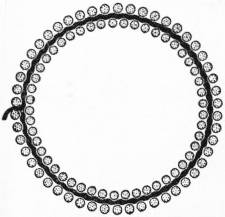
Fig. 3.—Section through the Warp.
The commonest type of hose-pipe is made on the double-plain principle of weaving, the cloth being perfectly plain but woven in such a manner that the pipe is without seams of any kind. Fig. 1 is a design showing two repeats or eight shots in the way of the weft, and six repeats or twenty-four-threads in the way of the warp, consequently the weave is complete on four threads, or leaves, and four picks. Fig. 2 illustrates the method of interlacing the threads and the picks: this figure shows that twenty-three threads only are used, the first thread—shown shaded in fig. 1—having been left out. It is necessary to use a number of threads which is either one less or one more than some multiple of four—the number of threads in the unit weave. The sectional view (fig. 2), although indicating the crossings of the warp and the weft, is quite different from an actual section through the threads: the warp is almost invariably two or three ply, and in addition two or more of these twisted threads pass through the same heddle-eye in the camb; moreover, they are set very closely together—so closely, indeed, that the threads entirely conceal the weft; it is, therefore, impossible to give a correct sectional view with satisfactory clearness, as the threads are so very rank, but fig. 3 gives some idea of the structure of the fabric. This view shows ninety-nine threads and one complete round of weft; this round is, of course, equal to two picks or shots—one pick for the top part of the cloth and one for the bottom part. A comparison of this figure with fig. 2 will, perhaps, make the description clearer. The weft in fig. 3 is thinner than the warp, but, in practice, it is always much thicker, and may consist of from two to seventy threads twisted together.
Hose-pipes are also woven with the three-leaf twill on both sides, and occasionally with the four-leaf twill. These pipes, woven with the twill weaves, are usually lined with a pure rubber tube which is fixed to the inside of the cloth by another layer of rubber after the cloth leaves the loom. Such pipes have usually, but not invariably, a smoother inner surface than those which are unlined, hence, when they are used, less friction is presented to the flow of water, and there is less tendency for the pipe to leak. They are, therefore, suitable for hotels, public buildings and similar places where their temporary use will not result in undue damage to articles of furniture, carpets and general decoration.
The greatest care must be observed in the weaving of these fabrics, the slightest flaw in the structure rendering the article practically useless. After the cloth has been woven, it is carefully examined, and then steeped in a chemical solution which acts as an antiseptic. The cloth is thus effectively preserved from mildew, and is, in addition, made more pliable. Finally the hose-pipe is dried artificially, and then fitted with the necessary couplings and nozzles.
For a more detailed description of circular weaving see Woodhouse and Milne, Textile Design: Pure and Applied.
(T. Wo.)
HOSHANGABAD, a town and district of British India, in the Nerbudda division of the Central Provinces. The town stands on the left bank of the Nerbudda, 1009 ft. above the sea, and has a railway station. Pop. (1901), 14,940. It is supposed to have been founded by Hoshang Shah, the second of the Ghori kings of Malwa, in the 15th century; but it remained an insignificant place till the Bhopal conquest about 1720, when a massive stone fort was constructed, with its base on the river, commanding the Bhopal road. It sustained several sieges during the 18th century, and passed alternately into the hands of the Bhopal and Nagpur rulers. Since 1818 it has been the residence of the chief British officials in charge of the district. It has a government high school, and agricultural school and a brass-working industry.
The District of Hoshangabad has an area of 3676 sq. m. Pop. (1901), 449,165, showing a decrease of 10% in the decade, due to famine. It may be described as a valley of varying breadth, extending for 150 m. between the Nerbudda river and the Satpura mountains. The soil consists chiefly of black basaltic alluvium, often more than 20 ft. deep; but along the banks of the Nerbudda the fertility of the land compensates for the tameness of the scenery. Towards the west, low stony hills and broken ridges cut up the level ground, while the Vindhyas and the Satpuras throw out jutting spurs and ranges. In this wilder country considerable regions are covered with jungle. On the south the lofty range which shuts in the valley is remarkable in mountain scenery, surpassing in its picturesque irregularity the Vindhyan chain in the north. Many streams take their rise amid its precipices, then, winding through deep glens, flow across the plain between sandy banks covered with low jungle till they swell the waters of the Nerbudda. None is of any importance except the Tawa, which is interesting to the geologist on account of the many minerals to be found along its course. The boundary rivers, the Nerbudda and Tapti, are the only considerable waters in Hoshangabad. The principal crops are wheat, millets and oil-seeds. The district is traversed throughout its length by the Great Indian Peninsula railway.
HOSHEA (Heb. for “deliverance”), the last king of Israel, in the Bible. The attempt of his predecessor Pekah to take Jerusalem with the help of his ally Rasun (Rezin) of Damascus was frustrated by the intervention of Tiglath-Pileser IV. (see Ahaz), who attacked Gilead, Galilee and the north frontier, and carried off some of its population (cp. 1 Chron. v. 26). Pekah’s resistance to Assyria led to a conspiracy in which he lost his life, and Hoshea the son of Elah became king (2 Kings xv. 27-30). The Assyrian king held him as his vassal (and indeed claims to have set him on the throne), and exacted from him a yearly tribute. Meanwhile, Damascus was besieged (733-732 B.C.), Raṣun was slain and the inhabitants deported (2 Kings xvi. 9; LXX. omits “to Kir,” but see Amos i. 5). The impending fate of Damascus is illustrated by Isaiah (vii. 16, viii. 4, xvii. 1-11), who also gives a vivid description of the impression left by the Assyrian army (v. 26-30). After the death of Tiglath-Pileser, Israel regained confidence (Isa. ix. 8-x. 4) and took steps to recover its independence. Its policy vacillated—“like a silly dove” (Hos. vii. 11), and at length negotiations were opened with Mizraim. The annual payment of tribute ceased and Shalmaneser IV. (who began to reign in 727 B.C.) at once laid siege to Samaria, which fell at the end of three years (722-721 B.C.). The achievement is claimed by his successor Sargon. Hoshea was killed, the land was again partly depopulated and a governor appointed (2 Kings xviii. 9-12; cp. xvii. 1 sqq.). For other allusions to this period see Hosea, Isaiah.
2 Kings xvii. 3 and 5 imply two attacks by Shalmaneser: in the first of which Hoshea was imprisoned and perhaps blinded (Cheyne, emending, “shut him up” in v. 4), although in v. 6 he is still reigning; see on this Winckler, Keilinschr. u. Alte Test.3 p. 268; Burney, Kings, p. 328 seq.; Skinner, Kings, p. 372 seq. The chronological notes, moreover, are extremely confused; contrast xv. 30 with xvii. 1. The usual identification of So (or Seve), king of Mizraim, with Shabaka of Egypt is difficult, partly on chronological grounds (which Petrie, History of Egypt, pp. 277, 281 sqq. does not remove), and partly because the Ethiopian dominion in Egypt appears to be still weak and divided. The Assyrian records name a certain Sibi as officer, and also Piru (Pharaoh!) as king of Musri, and it is doubtful whether Hoshea’s ally was a petty prince of Egypt or of a N. Arabian district (see Mizraim). If the latter, Hoshea’s policy becomes more intelligible; see Whitehouse, Isaiah, p. 17 seq.; Jews: History; Philistines. On the depopulation of Samaria and the introduction of colonists, see Winckler’s objections, Alttest. Untersuch. pp. 95-107, with Burney’s criticisms, Kings, p. 334 seq.
(S. A. C.)
HOSHIARPUR, a town of British India, in the Jullundur division of the Punjab. Pop. (1901), 17,549. It was founded, according to tradition, about the early part of the 14th century. In 1809 it was occupied by Ranjit Singh. The maharaja and his successors maintained a considerable cantonment 1 m. S.E. of the town, and the British government kept it up for several years after the annexation of the Punjab in 1849. There are manufactures of cotton goods, inlaid woodwork, lacquered ware, shoes and copper vessels.
The District of Hoshiarpur comprises an area of 2244 sq. m.; pop. (1901) 989,782, showing a decrease of 2% in the decade, compared with an increase of 12% during the previous decade. It falls into two nearly equal portions of hill and plain country. Its eastern face consists of the westward slope of the Solar Singhi Hills; parallel with that ridge, a line of lower heights belonging to the Siwalik range traverses the district from south to north, while between the two chains stretches a valley of uneven width, known as the Jaswan Dun. Its upper portion is crossed by the Sohan torrent, while the Sutlej sweeps into its lower end through a break in the hills, and flows in a southerly direction till it turns the flank of the central range, and debouches westwards upon the plains. This western plain consists of alluvial formation, with a general westerly slope owing to the deposit of silt from the mountain torrents in the sub-montane tract. The Beas has a fringe of lowland, open to moderate but not excessive inundations, and considered very fertile. A considerable area is covered by government woodlands, under the care of the forest department. Rice is largely grown, in the marshy flats along the banks of the Beas. Several religious fairs are held, at Anandpur, Mukerian and Chintpurni, all of which attract an enormous concourse of people. The district, owing to its proximity to the hills, possesses a comparatively cool and humid climate. Cotton fabrics are manufactured, and sugar, rice and other grains, tobacco and indigo are among the exports.
The country around Hoshiarpur formed part of the old Hindu kingdom of Katoch In Jullundur. The state was eventually broken up, and the present district was divided between the rajas of Ditarpur and Jaswan. They retained undisturbed possession of their territories until 1759, when the rising Sikh chieftains commenced a series of encroachments upon the hill tracts. In 1815 the aggressive maharaja, Ranjit Singh, forced the ruler of Jaswan to resign his territories in exchange for an estate on feudal tenure; three years later the raja of Ditarpur met with similar treatment. By the close of the year 1818 the whole country from the Sutlej to the Beas had come under the government of Lahore, and after the first Sikh war in 1846 passed to the British government. The deposed rajas of Ditarpur and Jaswan received cash pensions from the new rulers, but expressed bitter disappointment at not being restored to their former sovereign position. Accordingly the outbreak of the second Sikh war, in 1848 found the disaffected chieftains ready for rebellion. They organized a revolt, but the two rajas and the other ringleaders were captured, and their estates confiscated.
HOSIERY, a term used to designate all manufactured textile fabrics which in their process of manufacture have been built on the principle of looping or loop structure. The origin of the term is obvious, being derived from “hose” or stocking, this being one of the earliest garments made by the process of knitting (q.v.). While it still forms one of the staples of the trade, it is only one of a very numerous and diversified range of applications of the entire industry. The elastic structure of knitting makes it very adaptable for all kinds of body or underwear. There is scarcely a single textile article manufactured but can be reproduced on the knitting or loop structure principle. The art of knitting is of very modern origin as compared with that of weaving. No certain allusion to the art occurs before the beginning of the 15th century. In an act of parliament of Henry VII. (1488) knitted woollen caps are mentioned. It is supposed that the art was first practised in Scotland, and thence carried into England, and that caps were made by knitting for some period before the more difficult feat of stocking-making was attempted. In an act of Edward VI. (1553) “knitte hose, knitte peticotes, knitte gloves and knitte sleeves” are enumerated, and the trade of hosiers, among others, included in an act dated 1563. Spanish silk stockings were worn on rare occasions by Henry VIII., and the same much-prized articles are also mentioned in connexion with the wardrobe of Edward VI.
Knitting, or loop formation by mechanical means, is divided into two distinct principles—frame-work knitting and warp knitting. Both principles may be employed in the formation of a large variety of plain and fancy stitches or a combination of the two.
Frame-work Knitting in its simplest form consists of rows of loops supporting each other—built from one continuous thread of yarn and running from one side of the fabric to the other and back (fig. 1). It is on this principle of stitch that the greatest amount of hosiery is built (hose, shirts, pants).
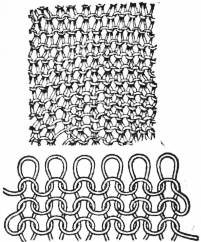
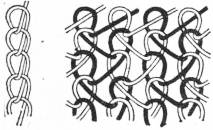
Fig. 1.—The Stitch or Loop Structure of Plain Knitting (back of fabric). Fig. 2.—A Single Thread formed into a Chain of Crocket Work, showing the Loop Structure of the plain Warp-knitted Fabric. It is built up as shown in the diagram by a number of threads running up the fabric.
Warp Knitting in its simplest form consists of rows of loops, but the number of threads employed are equal to the number of loops in the width of the fabric. Thus it will be seen that the threads run lengthwise of the fabric (fig. 2). This principle gives greater scope for reproducing designs in openwork and colour than that of frame-work knitting. For this reason it is largely used in the shawl, glove and fancy hosiery industries.
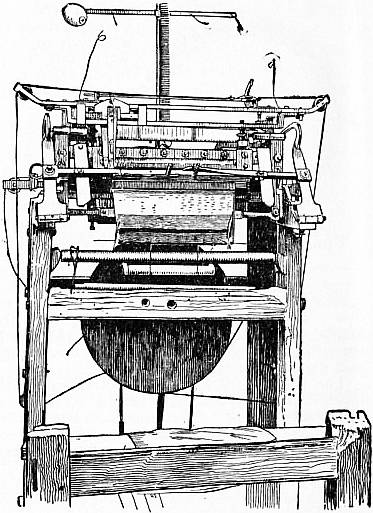
Fig. 3.—Hand Stocking Frame.
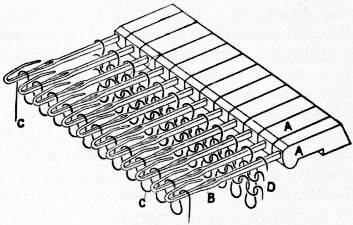
Fig. 4.
A, The leads into which the needles (B) are cast. D, The old loops or work. C, The new loops formed and brought under the beards.
Machinery.—In hand knitting the implements employed (a few needles or wires) are very simple and inexpensive. In the manufacturing industry the most complex and ingenious machinery is used. In 1589 the Rev. William Lee, a graduate of St John’s College, Cambridge, while acting as curate (or vicar) of Calverton, Nottinghamshire, introduced his stocking-frame. This machine was the first mechanical means employed to produce a looped or knitted fabric. This frame or machine of Lee’s was the origin of all the hosiery and lace machines at present in use. One of the most remarkable points about his invention was its completeness and adaptability for the work for which its inventor intended it. The main principles of Lee’s frame are embodied in most of the rotary or power frames of the present day. Fig. 3 shows a hand frame of the present day.
In hand knitting an indefinite number of loops are skewered on a wire or pin, but, in Lee’s frame, an individual hooked or bearded needle is employed for the support and formation of each loop in the breadth of the fabric. This needle consists of a shank with a terminal spring-pointed hook (or beard), the point of which can be pressed at will into a groove or eye in the shank. For method by which the loops are formed on the needles of the frame see fig. 4. This shows a few of Lee’s hooked or bearded needles having the old loops or work hanging round the needle shanks. The thread of yarn which is to form the new row of loops is laid over the needle shanks and waved or looped between each pair of needles. This waving or looping ensures sufficient yarn being drawn and loops of a uniform size being made, so that a regular and level fabric will be produced. The looping or waving is obtained by having thin plates of shaped metal, called sinkers, which have a nose-shaped point and hang between the needles. When looping they have an individual movement downwards between the needles, and as they fall the nose-shaped point carries the yarn down, thus forming the new loop (fig. 5). The size of the loop is regulated by the distance the sinker is allowed to fall. After the thread of yarn has been looped between the needle shanks by the sinkers, the loops are brought forward under the needle beards or hooks. A presser bar is now brought down to close or press all the points of the needle beards into the eye in the shank. Thus all the hook ends of the needles are temporarily closed, with the newly formed loops under them. While in this position, the old loops hanging round the shank are brought forward and landed on to the top of the needle beard and off the needle altogether, being thus left hanging round, or supported by the loops newly formed. The needle beards are now released, and the loops drawn back along the shanks to be in position for next new course of loops. The foregoing is only an outline of how the loops are formed on the needles. It is not necessary here to enter into a description of the complex mechanical movements of Lee’s stocking-frame. The first fabric made by Lee was of a flat, even-selvedged nature, so that garments had to be cut to shape from the fabric. He soon learned to fashion or shape the garment at will, during the process of making, by transferring loops at the edges, inwards to narrow, or outwards to widen. This process at the present day is known as fashioning, and all garments of the best make are shaped or fashioned in this manner. After Lee had practised his new art for a few years at Calverton he removed to London, but on his receiving no help or encouragement from Queen Elizabeth or her successor, King James, he was induced to cross over to France with his frames. There he built up a flourishing industry at Rouen, under the patronage of the French king, Henry IV. Through the murder of this monarch he lost his patronage and died of want about the year 1610. He was buried in an unknown grave in Paris.
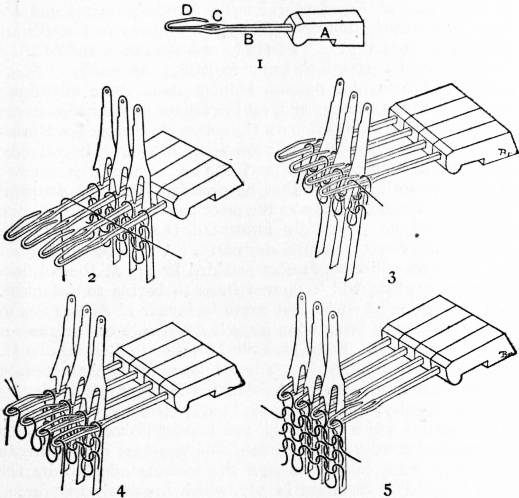
Fig. 5.—Formation of a Loop on a Hand Frame.
1, Bearded needle cast in the lead. A, Lead; B, Shank; C, Eye; D, Beard. 2, The thread is laid over the needles and formed into loops between the needles by means of the sinkers, those new-formed loops being brought under the needle beards (as at 3). 4, The beards pressed or closed to allow the old loops to be passed on to the top. 5, The old loops knocked off the needles and left hanging round the newly formed loops.
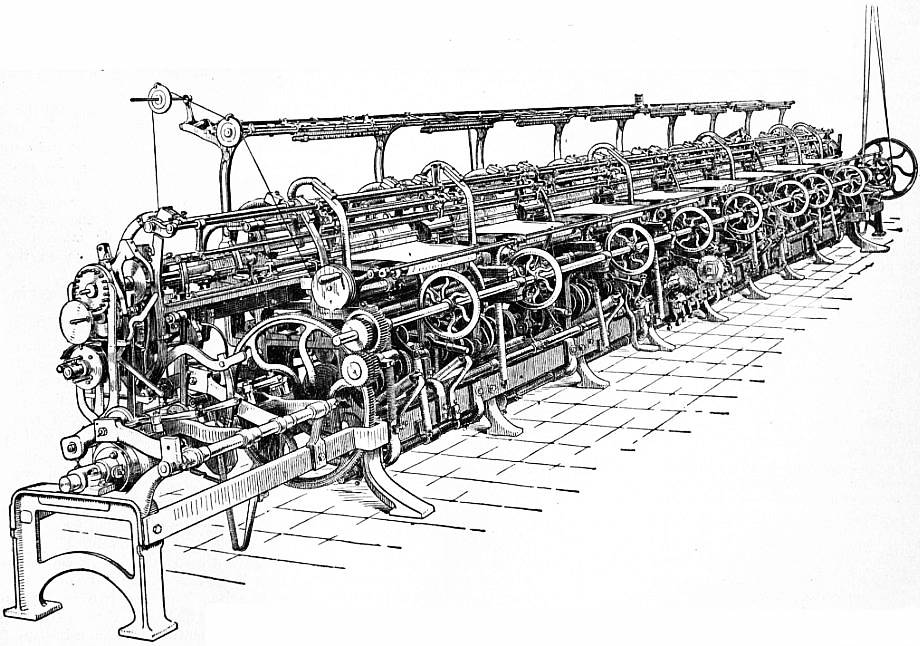
Fig. 7.—Eight at once, 130 gauge, full-fashioned, seamless bosom, sloped shoulder underwear frame, Cotton’s patents. (William Cotton, Ltd., Loughborough.)
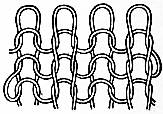
Fig. 6.—A 1/1 Rib Stitch.
A number of improvements had been made on Lee’s frame during the 18th century. The one of greatest importance was the rib machine invented by Jedediah Strutt of Belper in 1758. It was not what could be actually termed an improvement on Lee’s frame, but an addition to it. Lee’s frame was not altered in any way, Strutt’s machine being added to it, and the two being worked in conjunction produced a fabric of a more elastic nature and alike on both sides (fig. 6). Strutt’s machine consisted of a set of needles placed at right angles to and between Lee’s plain needles, with the result that, when knitting, the frame needles drew their loops to one side and the machine needles their loops to the opposite side of the fabric. The first offshoot from frame-work knitting was the invention of the hand warp loom in 1775. It was improved by the addition of the Dawson wheel by William Dawson in 1791. This machine is the origin of the various complex machines now working on this principle. Some of these have Jacquard mechanism attached, and nearly all of them are driven by motive power. About the middle of the 19th century close on 50,000 of Lee’s hand frames were in use, finding employment for nearly 100,000 persons. Many attempts had been made previously to transform Lee’s frame into a power or rotary frame. One of the first and most successful was that invented by Luke Barton in 1857. This frame was fitted with self-acting mechanism for fashioning, and was practically Lee’s frame having rotary shafts with cams added to give the various movements, this type of frame being known as straight bar rotary frames. In 1864 William Cotton of Loughborough altered this frame by reversing the positions of the needles and sinkers. Although made by various builders it is still known as the “Cotton Patent Rotary Frame” (fig. 7). Since 1864 a great number of important improvements and additions have been made to this frame. Single frames are built which will turn off one dozen pairs of hose at once, with the attention of one person. One of the most important inventions in connexion with the hosiery trade was the latch, tumbler, or self-acting needle invented by Matthew Townsend and David Moulding of Leicester in 1858. Previous to this Lee’s type of needle was the only one in use. This latch-needle (fig. 8) consists of a stem having a butt at lower end by which it receives its knitting action from cams, the upper end being turned into a hook. Near the hook end and attached to the stem by a pin is the spoon-shaped latch, which closes over the hook as required. Machines fitted with latch-needles have grooves in which the stem of the needle works. Cams, which act on the needle butts, give the needles their individual knitting action in rotation. This needle is self-acting, in that it is made to draw its own loop, sinkers being dispensed with.
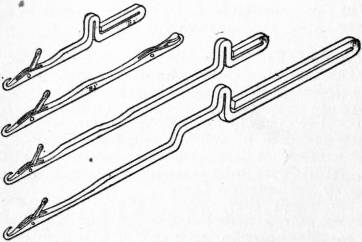
Fig. 8.—Various Shapes of the Latch Needle.
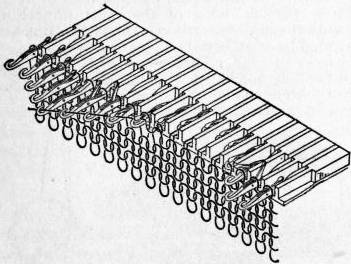
Fig. 9.—Individual Action of the Latch Needle.
Fig. 9 shows the looping action of this needle. The needles when not knitting have a loop round their shank, thus holding the latch open. When about to knit, they are raised individually and in rotation (by the cams acting on the needle butts) to receive the new loop of yarn.
Down till almost the middle of the 19th century only a flat web could be knitted in the machines in use, and for the finishing of stockings, &c., it was necessary to seam up the selvedges of web shaped on the frame (fashioned work), or to cut and seam them from even web (cut work). The introduction of any device by which seamless garments could be fabricated was obviously a great desideratum, and it is a singular fact that a machine capable of doing this was patented in 1816 by Sir Marc I. Brunel. This frame was the origin of the French-German loop-wheel circular frame of the present day. Brunel’s frame was greatly improved by Peter Claussen of Brussels and was shown at an exhibition in Nottingham in 1845. This frame had horizontal placed needles fixed on a rotating rim. A few years later Moses Mellor of Nottingham transformed this type of frame by altering the position of the needles to perpendicular. This is now known as the English loop-wheel circular frame. After the invention of the latch-needle there was a revolution in the hosiery machine-building industry, new types of machines being invented, fitted to work with latch-needles. Among others there was the latch-needle circular frame, invented by Thomas Thompson, which was the origin of the English latch-needle circular frame, a frame largely used for the production of wide circular fabric.
A circular knitting machine of American origin is the type of machine on which is produced the seamless hosiery of to-day. Like the sewing machine it is largely used in the home as well as in the factory. From this machine all the circular automatic power machines for making plain and rib seamless hose and half hose have been developed. The “flat” or “lamb” type of machine, an American invention, was introduced by J. W. Lamb in 1863. This machine has two needle beds or rows of needles sloping at an angle of nearly 90°.
A great many varieties of this type of machine have been invented for the production of all kinds of plain and fancy hosiery. It is built in small sizes to be wrought by hand or in large power machines. A large variety of sewing, seaming and linking machines are employed in the hosiery industry for the purpose of putting together or joining all kinds of hosiery and knitted goods. These machines have almost entirely superseded the sewing or joining of the garments by hand.
The principle centres in Great Britain of the hosiery industry are Leicester and Nottingham and the surrounding districts. It is also an industry of some extent in the south of Scotland.
(T. B.*)
HOSIUS, or Osius (c. 257-359), bishop of Cordova, was born about A.D. 257, probably at Cordova, although from a passage in Zosimus it has sometimes been conjectured that he was believed by that writer to be a native of Egypt. Elected to the see of Cordova before the end of the 3rd century, he narrowly escaped martyrdom in the persecution of Maximian (303-305). In 305 or 306 he attended the council of Illiberis or Elvira (his name appearing second in the list of those present), and upheld its severe canons concerning such points of discipline as the treatment of the lapsed and clerical marriages. In 313 he appears at the court of Constantine, being expressly mentioned by name in a constitution directed by the emperor to Caecilianus of Carthage in that year. In 323 he was the bearer and possibly the writer of Constantine’s letter to Bishop Alexander of Alexandria and Arius his deacon, bidding them cease disturbing the peace of the church; and, on the failure of the negotiations in Egypt, it was doubtless with the active concurrence of Hosius that the council of Nicaea was convened in 325. He certainly took part in its proceedings, and was one of the large number of “confessors” present; that he presided is a very doubtful assertion, as also that he was the principal author of the Nicene Creed. Still he powerfully influenced the judgment of the emperor in favour of the orthodox party. After a period of quiet life in his own diocese, Hosius presided in 343 at the fruitless synod of Sardica, which showed itself so hostile to Arianism; and afterwards he spoke and wrote in favour of Athanasius in such a way as to bring upon himself a sentence of banishment to Sirmium (355). From his exile he wrote to Constantius II. his only extant composition, a letter not unjustly characterized by the great French historian Sebastian Tillemont as displaying gravity, dignity, gentleness, wisdom, generosity and in fact all the qualities of a great soul and a great bishop. Subjected to continual pressure the old man, who was near his hundredth year, was weak enough to sign the formula adopted by the second synod of Sirmium in 357, which involved communion with the Arians but not the condemnation of Athanasius. He was then permitted to return to his diocese, where he died in 359.
See S. Tillemont, Mémoires, vii. 300-321 (1700); Hefele, Conciliengeschichte, vol. i.; H. M. Gwatkin, Studies of Arianism (Cambridge, 1882, 2nd ed., 1900); A. W. W. Dale, The Synod of Elvira (London, 1882); and article s.v. in Herzog-Hauck, Realencyklopädie (3rd ed., 1900), with bibliography.
HOSIUS, STANISLAUS (1504-1579), Polish cardinal, was born in Cracow on the 5th of May 1504. He studied law at Padua and Bologna, and entering the church became in 1549 bishop of Kulm, in 1551 bishop of Ermland, and in 1561 cardinal. Hosius had Jesuit sympathies and actively opposed the Protestant reformation, going so far as to desire a repetition of the St Bartholomew massacre in Poland. Apart from its being “the property of the Roman Church,” he regarded the Bible as having no more worth than the fables of Aesop. Hosius was not distinguished as a theologian, though he drew up the Confessio fidei christiana catholica adopted by the synod of Piotrkow in 1557. He was, however, supreme as a diplomatist and administrator. Besides carrying through many difficult negotiations, he founded the lyceum of Braunsberg, which became the centre of the Roman Catholic mission among Protestants. He died at Capranica near Rome on the 5th of August 1579.
A collected edition of his works was published at Cologne in 1584. Life by A. Eichhorn (Mainz, 1854), 2 vols.
HOSKINS, JOHN (d. 1664), English miniature painter, the uncle of Samuel Cooper, who received his artistic education in Hoskins’s house. His finest miniatures are at Ham House, Montagu House, Windsor Castle, Amsterdam and in the Pierpont Morgan collection. Vertue stated that Hoskins had a son, and Redgrave added that the son painted a portrait of James II. in 1686 and was paid £10, 5s, although it is not supported by any reference in the State Papers. Some contemporary inscriptions on the miniatures at Ham House record them as the work of “Old Hoskins,” but the fact of the existence of a younger artist of the same name is settled by a miniature in the Pierpont Morgan collection, signed by Hoskins, and bearing an authentic engraved inscription on its contemporary frame to the effect that it represents the duke of Berwick at the age of twenty-nine in 1700. The elder Hoskins was buried on the 22nd of February 1664, in St Paul’s, Covent Garden, and as there is no doubt of the authenticity of this miniature or of the signature upon it, it is evident that he had a son who survived him thirty-six years and whose monogram we find upon this portrait. The frame of it has also the royal coat of arms debruised, the batons of a marshal of France, the collar of the Golden Fleece and the ducal coronet.
(G. C. W.)
HOSMER, HARRIET GOODHUE (1830-1908), American sculptor, was born at Watertown, Massachussetts, on the 9th of October 1830. She early showed marked aptitude for modelling, and studied anatomy with her father, a physician, and afterwards at the St Louis Medical College. She then studied in Boston until 1852, when, with her friend Charlotte Cushman, she went to Rome, where from 1853 to 1860 she was the pupil of the English sculptor John Gibson. She lived in Rome until a few years before her death. There she was associated with Nathaniel Hawthorne, Thorwaldsen, Flaxman, Thackeray, George Eliot and George Sand; and she was frequently the guest of the Brownings at Casa Guidi, in Florence. Among her works are “Daphne” and “Medusa,” ideal heads (1853); “Puck” (1855), a spirited and graceful conception which she copied for the prince of Wales, the duke of Hamilton and others; “Oenone” (1855), her first life-sized figure, now in the St Louis Museum of Fine Arts; “Beatrice Cenci” (1857), for the Mercantile Library of St Louis; “Zenobia, Queen of Palmyra, in Chains” (1859), now in the Metropolitan Museum of Art, New York City; “A Sleeping Faun” (1867); “A Waking Faun”; a bronze statue of Thomas H. Benton (1868) for Lafayette Park, St Louis; bronze gates for the earl of Brownlow’s art gallery at Ashridge Hall; a Siren fountain for Lady Marian Alford; a fountain for Central Park, New York City; a monument to Abraham Lincoln; and, for the Columbian Exposition, Chicago, 1893, statues of the queen of Naples as the “heroine of Gaëta,” and of Queen Isabella of Spain. Miss Hosmer died at Watertown, Mass., on the 21st of February 1908.
HOSPICE (Lat. hospitium, entertainment, hospitality, inn, hospes, host), the name usually given to the homes of rest and refuge kept by religious houses for pilgrims and guests. The most famous hospices are those of the Great and Little St Bernard Passes in the Alps.
HOSPITAL (Lat. hospitalis, the adjective of hospes, host or guest), a term now in general use for institutions in which medical treatment is given to the sick or injured. The place where a guest was received, was in Lat. hospitium (Fr. hospice), but the terms hospitalis (sc. domus), hospitale (sc. cubiculum) and hospitalia (sc. cubicula) came into use in the same sense. Hence were derived on the one hand the Fr. hospital, hôpital, applied to establishments for temporary occupation by the sick for the purpose of medical treatment, and hospice to places for permanent occupation by the poor, infirm, incurable or insane; on the other, the form hôtel, which became restricted (except in the ease of hôtel-Dieu) to private or public dwelling-houses for ordinary occupation. In English, while “hostel” retained the earlier sense and “hotel” has become confined to that of a superior inn (q.v.), “hospital” was used both in the sense of a permanent retreat for the poor infirm or for the insane, and also for a regular institution for the temporary reception of sick cases; but modern usage has gradually restricted it mainly to the latter, other words, such as almshouse and asylum, being preferred in the former cases.
The Origin of Hospitals.—In spite of contrary opinions the germ of the hospital system may be seen in pre-Christian times (see Charity and Charities). Pinel goes so far as to declare that there were asylums distinctly set apart for the insane in the temples of Saturn in ancient Egypt. But this is probably an exaggeration, the real historical facts pointing to the existence of medical schools in connexion with the temples generally, to the knowledge that the priests possessed what medical science existed, and finally to the rite of “Incubation,” which involved the visit of sick persons to the temple, in the shade of which they slept, that the god might inform them by dreams of the treatment they ought to follow. The temples of Saturn are known to have existed some 4000 years before Christ; and that those temples were medical schools in their earliest form is beyond question. The reason why no records of these temples have survived is due to the fact that they were destroyed in a religious revolution which swept away the very name of Saturn from the monuments in the country. Professor Georg Ebers of Leipzig, whose possession of that important handbook of Egyptian medicine called the Papyrus Ebers constitutes him an authority, says the Heliopolis certainly had a clinic united to the temple. The temples of Dendera, Thebes and Memphis, are other examples. Those early medical works, the Books of Hermes, were preserved in the shrines. Patients coming to them paid contributions to the priests. The most famous temples in Greece for the cure of disease were those of Aesculapius at Cos and Trikka, while others at Rhodes, Cnidus, Pergamum and Epidaurus were less known but frequented. Thus it is clear that both in Egypt and in Greece the custom of laying the sick in the precincts of the temples was a national practice.
Alexandria again was a famous medical centre. Before describing the European growth of the hospital system in modern times, to which its development in the Roman Empire is the natural introduction, it will be well to dispose very briefly of the facts relating to the hospital system in the East. Harun al-Rashid (A.D. 763-809) attached a college to every mosque, and to that again a hospital. He placed at Bagdad an asylum for the insane open to all believers; and there was a large number of public infirmaries for the sick without payment in that city. Benjamin, the Jewish traveller, notes an efficient scheme for the reception of the sick in A.D. 1173, which had long been in existence. The Buddhists no less than the Mahommedans had their hospitals, and as early as 260 B.C. the emperor Asoka founded the many hospitals of which Hindustan could then boast. The one at Surat, made famous by travellers, and considered to have been built under the emperor’s second edict, is still in existence. These hospitals contained provision so extensive as to be quite comparable to modern institutions. In China the only records that remain are those of books of very early date dealing with the theory of medicine. To return to India, the hospitals of Asoka were swept away by a revival of Brahmanism, and a practical hiatus exists between the hospitals he introduced and those that were refounded by the British ascendancy. Hadrian’s reign contains the first notice of a military hospital in Rome. At the beginning of the Christian era we hear of the existence of open surgeries (of various price and reputation), the specialization of the medical profession, and the presence of women practitioners, often as obstetricians. Iatria, or tabernae-medicae, are described by Galen and Placetus: many towns built them at their own cost. These iatria attended almost entirely to out-patients, and the system of medicine fostered by them continued without much development down to the middle of the 18th century. It is to be noted that these out-patients paid reasonable fees. In Christian days no establishments were founded for the relief of the sick till the time of Constantine. A law of Justinian referring to various institutions connected with the church mentions among them the Nosocomia, which correspond to our idea of hospitals. In A.D. 370 Basil had one built for lepers at Caesarea. St Chrysostom founded a hospital at Constantinople. At Alexandria an order of 600 Parabolani attended to the sick, being chosen for the purpose for their experience by the prelate of the city (A.D. 416). Fabiola, a rich Roman lady, founded the first hospital at Rome possessed of a convalescent home in the country. She even became a nurse herself. St Augustine founded one at his see of Hippo. These Nosocomia fell indeed almost entirely into the hands of the church, which supported them by its revenues when necessary and controlled their administration. Salerno became famous as a school of medicine; its rosiest days were between A.D. 1000 and 1050. Frederick II. prescribed the course for students there, and founded a rival school at Naples. At this period the connexion between monasteries and hospitals becomes a marked one. The crusaders also created another bond between the church and hospital development, as the route they traversed was marked by such foundations. Lepers were some of the earliest patients for whom a specialized treatment was recognized, and in 1118 a leprosarium was built in London for isolation purposes. Russia seems the one country where the interconnexion of hospital and monastery was not to be observed. After the period already reached, the 13th century, hospitals became common enough to demand individual or at any rate national treatment.
History of the Hospital Movement.—We have now to consider the principles upon which the provision of the best form of medical care in hospitals can be secured for all classes of people. Though hospitals cannot be claimed as a direct result of Christianity, no doubt it softened the relations between men, and gradually tended to instil humanitarian views and to make them popular with the civilized peoples of the world. These principles, as civilization grew, education improved, and the tastes and requirements of the common people were developed, made men and women of many races realize that the treatment of disease in buildings set apart exclusively for the care of the sick was, in fact, a necessity in urban districts. The establishment of a hospital freed the streets of the abuses attendant upon beggars and other poor creatures, who made their ailments the chief ground of appeal for alms. As the knowledge of hygiene and of the doctrine of cleanliness and purity in regard not only to dwellings and towns, but also in relation to food of all descriptions, including water, became known and appreciated, hospitals were found to be of even greater importance, if that is possible, to the healthy in crowded communities, than to the sick. It took many centuries before sound hygiene really began to occupy the position of importance which it is now known to possess, not only in regard to the treatment and cure of disease, but to its prevention and eradication. So the history of the world shows, that, whereas a few of the larger towns in most countries contained hospitals of sorts, up to and including the middle ages, it was not until the commencement of the 18th century that inhabitants of important but relatively small towns of from 50,000 to 100,000 inhabitants began to provide themselves with a hospital for the care of the sick. Thus, twenty-three of the principal English counties appear to have had no general hospital prior to 1710, while London itself at that date, so far as the relief of the sick was concerned, was mainly, if not entirely, dependent upon St Bartholomew’s and St Thomas’s Hospitals. These facts are interesting to note, because we are enabled from them to deduce from recent events that hospital buildings in the past, though the planning of most of them was faulty to begin with and became more and more faulty as extensions were added to the original buildings, did in fact suffice to satisfy the requirements of the medical profession for nearly two centuries. In other words, under the old condition of affairs the life of a building devoted to the care of the sick might be considered as at least 150 years. To-day, under the conditions which modern science impose upon the management, probably few hospital buildings are likely to be regarded as efficient for the purpose of treating the sick for more than from 30 to 50 years.
The foregoing statement is based upon the history of British hospitals of importance throughout the country, but the same remark will apply in practice to hospital buildings almost everywhere throughout the world. In truth, hospitals have been more developed and improved in Great Britain than in other countries, though, since the last quarter of the 19th century, German scientists especially have added much to the efficiency of the accommodation for the sick, not only at hospitals but in private clinics, and many German ideas have been accepted and copied by other countries. In Great Britain hospitals for the treatment of general and special diseases are mainly maintained upon what is known as the voluntary system. On the European continent, hospitals as a rule are maintained by the state or municipalities, and this system is so fully developed in Sweden and elsewhere that a sound economical principle has been embroidered upon the hospital system, to the great physical and moral advantage of all classes of the community. The system referred to confers great benefits upon inhabitants in large towns by bringing the poor-law and voluntary institutions into more intimate association, although they may be managed by separate governing bodies. The plan pursued is to demand payment from all patients who are admitted to the hospital under a scale of charges divided into three or four grades. The first grade pays a substantial sum and obtains anything or everything the patient may care to have or to pay for, subject to the control of the medical attendant. The second pays much less, but a remunerative rate, for all they receive at the hospital; and the third and fourth classes are very poor people or paupers, who are paid for on a graduated scale by the poor-law authorities, or the communal government, or the municipality. Under this system well-to-do thrifty artisans and improvident paupers are all treated by one staff, controlled by one administration, and are located in immediate proximity to each other though in separate pavilions. We have no doubt, as the result of many years’ investigation and an accurate knowledge of the working of the system, that this is the true principle to enforce in providing adequate medical relief for large urban populations everywhere throughout the world. It should be accompanied by a system of government insurance, whereby all classes who desire to be thrifty may pay a small annual premium in the days of health, and secure adequate hospital treatment and care when ill. Provided that pay wings were added to the existing voluntary and municipal hospitals, it should be found that the relatively small annual premium of £3 per annum should enable the policyholders to defray the cost of medical treatment in a pay ward or at a consultation department of a great hospital as a matter of business. In the United States of America most large towns have great hospitals, usually known as city hospitals, administered and mainly supported by the municipality. Many such institutions have pay wards, but nowhere, so far as we have been able to discover, has the system of medical relief in its entirety been organized as yet upon the business system we have just referred to.
As to the relative merits and demerits of the systems of government of municipal hospitals and voluntary hospitals a few words may be useful. There can be no doubt that the voluntary hospital in Great Britain has had a remarkable effect for good upon all classes in the making of modern England. The management of these institutions is frequently representative of all classes of the people, while the voluntary system, as the Hospital Sunday collections all over the country, and all over the English-speaking world, prove, has united all creeds in the good work of caring and providing for the sick and injured members of each community. Again the voluntary system makes for efficiency in the administration of all hospitals. Each voluntary hospital is dependent upon its popularity and efficiency, in large measure, for the financial support it receives. In this way an ill-managed voluntary hospital, or one which has ceased to fulfil any useful public purpose, is sure to disappear in due course under the voluntary system. Voluntary hospitals are always open to, as well as supported by, the public, and, owing largely to the example so prominently set by King Edward VII. and members of the royal family, more people every year devote some time in some way to the cause of the hospitals. Attached to the voluntary hospitals are the principal medical and nursing schools upon which the public depend for the supply of doctors and nurses. The education of students and nurses in a clinical hospital makes that hospital the most desirable place for everybody when they are really ill. In such a hospital no patient can be overlooked, no wrong or imperfect diagnosis can long remain undiscovered and unrectified, and nowhere else have the patients so continuous a guarantee that the treatment they receive will be of the best, while the provision made for their comfort and welfare, owing to the unceasing and ever varying quality of the criticism to which the work of everybody, from the senior physician to the humblest official, is subjected in a clinical hospital, is unequalled anywhere else. At a great voluntary hospital, not only do hundreds of medical students and nurses work in the wards, but thousands of people, in the persons of the patients’ friends, and those members of the public who take an interest in hospitals, pass through the wards in the course of every year. Again, each voluntary hospital has to live by competition, a fact which guarantees that everything in the way of new treatment and scientific development shall in due course find its proper place within the walls of such an establishment. Open as they are to the full inspection of everybody whose knowledge and presence can promote efficiency, the voluntary hospitals have shown, especially since the last quarter of the 19th century, a continuous development and improvement. Here the patients are treated with invariable kindness and consideration, as human beings rather than cases, to the great benefit of the whole human family as represented by the officials, the patients and the students, with their relations and friends, the honorary medical officers, hundreds of medical practitioners and nurses, who receive their medical training in the hospitals, and the ever-increasing number of governors and supporters by whose contributions voluntary hospitals live. The great missionary and social value of the voluntary hospitals to the whole community cannot be questioned, and they have been of inestimable value to the churches by inculcating the higher principles of humanity, while removing the many acerbities which might otherwise prevail between rich and poor in large cities.
The voluntary hospitals are attended, however, by certain disadvantages which do not attach to municipal institutions. A municipality which undertakes the provision of hospitals for the entire community is largely able to plan out the urban area, and to provide that each hospital site selected shall not only be suitable for the purpose, but that it shall be so chosen as to contribute to make the whole system of hospital provision easily accessible to all classes who may require its aid. The voluntary hospitals, on the contrary, have grown up without any comprehensive plan of the districts or any real regard to the convenience or necessities of their poorer inhabitants. Voluntary hospital sites were almost invariably selected to suit the convenience of the honorary medical staff and the general convenience of the hospital economy rather than to save the patients and their friends long journeys in search of medical aid. The best of the municipal systems too enables economy to be enforced in the administration by a plan which provides a central office in every town where the number of vacant beds in each hospital is known, so that the average of occupied beds in all the hospitals can be well maintained from an economical point of view. This speedy and ready inter-communication between all hospitals in a great city, which might perfectly well be secured under the voluntary system if the managers could only be brought into active co-operation, prevents delay in the admission of urgent cases, promotes the absence of waste by keeping the average of beds occupied in each establishment high and uniform, and has often proved a real gain to the poor by the diminution in cost to the patients and their friends, who under the best municipal systems can find a hospital within reasonable distance of their home in a large city wherever it may be placed. Another advantage of the municipal system should be that central control makes for economical administration. Unfortunately a close study of this question tends to prove that municipal hospitals for the most part have resulted in a dead monotony of relative inefficiency, often entailing great extravagance in buildings, and accompanied by much waste in many directions. Existing municipal hospital systems are attended by several grave disadvantages. The administration shows a tendency to lag and grow sleepy and inert. The absence of competition, and the freedom from continuous publicity and criticism such as the voluntary hospitals enjoy, make for inefficiency and indifferent work. Rate-supported hospitals, as a rule, are administered by permanent officials who reside in houses usually situated on the hospital sites, and who are paid salaries which attract the younger men, who, once appointed, tend to continue in office for a long period of years. This fixture of tenure is apt to cause a decline in the general interest in the work of the municipal hospital, due mainly to the absence of a continuous criticism from outside, and so the average of efficiency, both in regard to treatment and other important matters, may become lower and lower. Those who have habitually inspected great rate-supported hospitals must have met instances over and over again where a gentleman who has held office for twenty or thirty years has frankly stated that his income is fixed, that his habits have become crystallized, that he finds the work terribly monotonous, and yet, as he hopes ultimately to retire upon a pension, he has felt there was no course open to him but to continue in office, even though he may feel conscientiously that a change would be good for the patients, for the hospital and for himself. Under the voluntary system evils of this kind are seldom or never met with, nor have these latter establishments, within living memory, ever been so conducted as to exhibit the grave scandals which have marred the administration of rate-supported hospitals not only in Great Britain but in other parts of the world. We believe that the more thoroughly the advantages and disadvantages of rate-supported and voluntary hospitals for the care of the sick are weighed and considered, and the more accurate and full the knowledge which is added to the judgment upon which a decision can be based, the more certain will it be that every capable administrator will come to the conclusion that on the whole it is good for the sick and for the whole community that these establishments should, at any rate in Great Britain, be maintained upon the voluntary system. Of course it is essential to have rate-supported hospitals where cases of infectious disease and the poorest of the people who are dependent largely upon the poor-law for their maintenance can be cared for. It is satisfactory to be able to state that of late years the administration of both these types of rate-supported hospitals has greatly improved. The added importance now given all over the country to medical officers of health, and the disposition exhibited, both by parliament and government departments, to make the position of these officers more important and valuable than ever before, have tended largely to improve the administrative efficiency of hospitals for infectious diseases. No doubt the whole community would benefit if residents in every part of the country could be moved to take a personal interest in the infectious hospital in their immediate neighbourhood. Amongst the smaller of these establishments there has been so marked an inefficiency at times as to cause much avoidable suffering. The existence of such inefficiency casts a grave reflection upon the local authorities and others who are responsible for the evils which undoubtedly exist in various places at the present time. Unfortunately knowledge has not yet sufficiently spread to enable the public to overcome its fear and dread of infectious maladies. It is therefore very difficult to induce people to take an active interest in one of these hospitals, but we look forward to the time when, owing to the activity of the medical officers of health who have immediate charge of buildings of this kind, this difficulty may be overcome, when the avoidable dangers and risks and the appalling discomfort which a poor sufferer from a severe infectious disease in a rural district may suddenly have to encounter under existing circumstances, would be rendered impossible.
The poor-law infirmary in large cities, so far as the buildings and equipment are concerned, very often leaves little to desire. Poor-law infirmaries lack, however, the stimulus and the checks and advantages which impartial criticism continuously applied brings to a great voluntary hospital. Such disadvantages might be entirely removed if parliament would decide to throw open every poor-law infirmary for clinical purposes, and to have connected with each such establishment a responsible visiting medical staff, consisting of the best qualified men to be found in the community which each hospital serves. The old prejudice against hospital treatment has disappeared, for the least intelligent members of the population now understand that, when a citizen is sick, there is no place so good as the wards of a well-administered hospital. Looking at the question of hospital provision in Great Britain, and indeed in all countries at the present time, it may be said, that there is everywhere evidence of improvement and development upon the right lines, so that never before in the history of the world has the lot of the sick man or woman been so relatively fortunate and safe as it is in the present day. Probably it is not too much to say that to-day hospitals occupy the most important position in the social economy of nations.
Classification of Hospitals.—Having dealt with hospitals as a whole it may be well very briefly to classify them in groups, and explain as tersely as possible what they represent and how far it may be desirable to eliminate by consolidation or to increase by disintegration the number of special hospitals.
General Hospitals.—These establishments consist of two kinds, (a) clinical and (b) non-clinical, each of which, under the modern system, should include every department of medicine and surgery, and every appliance and means for the alleviation of suffering, the healing of wounds, the reduction of fractures, the removal of mal-formations and foreign growths, the surgical restoration of damaged and diseased organs and bones, and everything of every kind which experience and knowledge prove to be necessary to the rapid cure of disease. The clinical hospital means an institution to which a medical school is attached, where technical instruction is given by able and qualified teachers to medical students and others. A non-clinical hospital is one which is not attached to a medical school, and where no medical instruction is organized.
Special Hospitals.—Up to about 1840 the general hospital was, speaking generally, the only hospital in existence. Twenty years later, as the population increased and medical science became more and more active, some of the more ardent members of the medical profession, especially amongst the younger men, pressed continuously for opportunities to develop the methods of treatment in regard to special diseases for which neither accommodation nor appliances were at that time forthcoming in general hospitals. In a few cases, where the managers of the great general hospitals were men of action and initiative special departments were introduced, and an attempt was made to make them efficient. The conservative spirit which, on the whole, represents the British character for the most part, resulted, however, in a steady resistance being offered by the older members of the medical staffs and existing committees to the advocates of special departments. In the result, especially as such special departments as there were in connexion with general hospitals were too often starved for want of means and men for their development and improvement, the younger spirits called their friends together and began to start special hospitals. To-day every really efficient clinical general hospital has within its walls special departments of almost every description, which have been made as efficient and up-to-date as money and knowledge can make them. Unfortunately the causes already referred to led to the establishment of hundreds of the smaller special hospitals, many of which were started in unsuitable buildings, and some of which have ever since maintained a struggling existence. Others, on the contrary, through the energy of their original promoters and the excellence of the work they have done, have obtained a position of authority and reputation which has had a very important bearing for good upon the development of medical science in the treatment of disease. If the world had to-day to organize the very best system of hospital accommodation which could be evolved, there is no doubt that few or none of the special hospitals would find any place in that system. As matters stand, however, the special hospital has had to be accepted, and nothing which King Edward’s Hospital Fund has done in London has met with greater popularity and professional approval than the labours which its council have undertaken in promoting the amalgamation of the smaller special hospitals of certain kinds, so as to secure the provision of one really efficient special hospital for each speciality. No doubt this policy of amalgamation will be steadily pursued, and in the course of years every great city will gradually reorganize its hospital methods so as to secure that, whether the patients are treated in a general hospital or in a special hospital, the average efficiency in every institution shall be as high and as good as possible.
We will take now the special hospitals in detail.
Cancer Hospitals.—The justification for efficient cancer hospitals must be found in the circumstance that most scientific men of experience believe that, if adequate resources were placed at the disposal of the medical profession, the origin of cancer might be discovered, and so the human race would be freed from one of the most awful diseases which affect humanity. Pending such a discovery the experience of the cancer department connected with the Middlesex Hospital in London proves to demonstration that the provision of adequate and special accommodation for the exclusive treatment of cases of cancer is not only desirable but necessary on humanitarian grounds alone.
Hospitals for Consumption.—For many years it was held that this group of hospitals was not a necessity, and the patients were treated in the ordinary medical wards of the general hospitals. Since the contagious character of tuberculosis became known, and improved methods of treatment have been developed, every one agrees that this type of special hospital is desirable, though it is believed by the more advanced school of scientists that before long it may be happily rendered obsolete owing to the discovery of methods of treatment which will stay the disease at its commencement and restore the patient to health.
Children’s Hospitals.—These hospitals were very much opposed at the outset. There can be no doubt that the children’s ward or wards in a big voluntary hospital is a most valuable asset to the managers, so long as the children are treated in separate wards. There is no reason of course why a hospital should confine its work to the treatment of children, exclusively. Still this special hospital is popular with the public; it has led to many discoveries and developments in the treatment of children’s diseases; on the whole the administration of these establishments has been good; and we believe they will continue to flourish, however many children’s wards may be provided in general hospitals. Children’s hospitals with country branches for the treatment of chronic ailments, such as hip disease, are a valuable addition to the relief of suffering in cities.
Cottage Hospitals.—These hospitals, established originally in 1859 by Mr Albert Napper at Cranleigh, Surrey, have fulfilled a most useful function. Many of them are very efficient both in regard to equipment and treatment. They have become essential to the well-being and adequate medical care of rural populations, as they attract to the country some of the best members of the profession, who are able, with the aid of the cottage hospital, to keep themselves efficient and up-to-date, so that all classes of the community are benefited in this way by this type of hospital.
Ear, Throat and Nose Hospitals.—The history of this type of hospital bears out in every particular the reason we have given above for the establishment of special hospitals in the first instance. There can be no doubt that the best conducted throat hospitals have been beneficial to the poorer inhabitants of great cities.
Fever Hospitals.—Incidentally we have dealt with these institutions, which are usually supported out of the rates and administered by the medical officers of health, who are paid by the county or municipal authorities.
Maternity and Lying-in Hospitals.—This is one of the oldest types of special hospitals, and has done a great deal of good in its time. Owing to modern methods of treatment and hygienic developments the maternity hospital never occupied a stronger position than it does to-day.
Mental Hospitals.—In Great Britain the insane are provided for in asylums (see Insanity, ad fin.), though such establishments, if properly conducted, are essentially hospitals. Scientific and public opinion tend towards the establishment of mental hospitals to which all acute cases of mental disease should be first relegated for treatment and diagnosis before they are consigned to a permanent lunatic hospital. Too little attention on an organized plan has been given to the continuous study of mental disease in its clinical and pathological aspects. It is probable, therefore, that the advent of the mental hospital may lead to important developments in treatment in many ways.
Ophthalmic Hospitals.—Of all special hospitals this is one which would probably be the least necessary, providing general hospitals everywhere were properly equipped and organized. No special hospital has probably been so abused in the material sense by the free relief of patients who could well afford to pay for their treatment at the ophthalmic hospital. Several of the existing ophthalmic hospitals have entailed an enormous expenditure, and their modern equipment is wonderfully efficient.
Orthopaedic Hospitals.—It is very doubtful whether this type o£ hospital is really desirable or necessary. Its necessity may be advocated on the ground that orthopaedic cases may require prolonged treatment, and that the pressure upon the beds of general hospitals by acute cases is nowadays so great as to render the orthopaedic hospital more necessary than ever before.
Paralysis and Epileptic Hospitals.—Seeing that the percentage of those who are at present attacked by paralysis and nervous disease shows a continued tendency to increase under modern conditions of life in large cities, hospitals of this type are necessary, and London at any rate, like most foreign towns of importance, possesses, at present, far too little accommodation for this class of case.
Skin and Photo-Therapy.—Up to the end of the 19th century hospitals for diseases of the skin were a constant cause of scandal and criticism. The introduction of modern methods of treatment by light and electricity, including photo-therapy, has given an importance to this department and treatment which it did not previously possess. We are of opinion that, on the whole, it is better and more economical to treat these cases in properly equipped departments of general hospitals than in separate institutions.
Women’s Hospitals.—These hospitals are not absolutely necessary, but considering their popularity with the women themselves, and that several of them have done excellent work, remembering too that women constitute the majority of the population, there seems to be some reason for their continuance.
The Evolution of the Modern Hospital.—The evolution of the modern hospital affords one of the most marvellous evidences of the advance of scientific and humanitarian principles which the world has ever seen. At the outset hospitals were probably founded by the healthy more for their own comfort than out of any regard for the sick. Nowadays the healthy, whilst they realize that the more efficient they can make the hospital, the more certain, in the human sense, is their own chance of prolonged life and health, are, as the progress of the League of Mercy has shown in recent years, genuinely anxious for the most part to do something as individuals in the days of health in the cause of the sick. Formerly the hospital was merely a building or buildings, very often unsuitable for the purposes to which it was put, where sick and injured people were retained and more frequently than not died. In other words the hygienic condition, the methods of treatment and the hospital atmosphere were all so relatively unsatisfactory as to yield a mortality in serious cases of 40%. Nowadays, despite, or possibly because of, the fact that operative interference is the rule rather than the exception in the treatment of hospital patients, and in consequence of the introduction of antiseptic and aseptic methods, the mortality in hospitals is, in all the circumstances, relatively less, and probably materially less, than it is even amongst patients who are attended in their own homes. Originally hospitals were unsystematic, crowded, ill-organized necessities which wise people refused to enter, if they had any voice in the matter. At the present time in all large cities, and in crowded communities in civilized countries, great hospitals have been erected upon extensive sites which are so planned as to constitute in fact a village with many hundreds of inhabitants. This type of modern hospital has common characteristics. A multitude of separate buildings are dotted over the site, which may cover 20 acres or upwards. In one such institution, within an area of 20 acres, there are 6 m. of drains, 29 m. of water and steam pipes, 3 m. of roof gutters, 42 m. of electric wires, and 42 separate buildings, which to all intents and purposes constitute a series of distinct, isolated hospitals, in no case containing more than forty-six patients. On the continent of Europe buildings of this class are usually of one storey; in the United States, owing to the difficulty of obtaining suitable sites and for reasons of economy, some competent authorities strenuously advocate high buildings with many storeys for town hospitals. In England the majority have two to three storeys each, the ward unit containing a ward for twenty beds and two isolation wards for one and two beds respectively. The two storeys in modern fever hospitals, however, are absolutely distinct—that is, there is no internal staircase going from one ward to the others, for each is entered separately from the outside. This system carries to its extreme limits the principle of separating the patients as much as possible into small groups; the acute cases are usually treated in the upper ward, and as they become convalescent are removed downstairs. In this way the necessity for an entirely separate convalescent block is done away with and the patients are kept under the same charge nurse, an arrangement which promotes necessary discipline. The unit of these hospitals is the pavilion, not the ward, and consists of an acute ward, a convalescent ward, separation wards, nurses’ duty rooms, store-rooms for linen, an open-air balcony upstairs into which beds can be wheeled in suitable weather, and a large airing-ground for convalescent patients directly accessible from the downstairs ward. Each of the pavilions is raised above the ground level, so that air can circulate freely underneath. The wall, floor and air spaces in the scarlet fever wards of one of these hospitals are respectively 12 ft., 156 ft. and 2028 ft. per bed; and in the enteric and diphtheria wards they have been increased to 15 ft., 195 ft. and 2535 ft. respectively. The provision of so large a floor and linear space, especially in the diphtheria wards, is an experiment the effect of which will be watched with considerable interest. A building of this type is a splendid example of the separate pavilion hospital, and is doing great service in the treatment of fevers wherever it has been introduced. Some idea of a hospital village, some of the wards of which we have been describing, may be gathered from the circumstances that it costs from £300,000 to £400,000, that it usually contains from 500 to 700 beds, and that the staff numbers from 350 to 500 persons. The medical superintendent lives in a separate house of his own. The nurses are provided with a home, consisting of several blocks of buildings under the control of the matron; the charge nurses usually occupy the main block; where the dining and general sitting-rooms are placed; the day assistant-nurses another block; and lastly, by a most excellent arrangement, the night nurses, 80 to 120 in number, have one whole block entirely given up to their use. The female servants have a second home under the control of the housekeeper, and the male servants occupy a third home under the supervision of the steward. The two main ideas aimed at are to disconnect the houses occupied by the staff from the infected area, and to place the members of each division of the staff together, but in separate buildings, under their respective heads. These objects are highly to be commended, as they have important bearings upon the well-being and discipline of the whole establishment and constitute a lesson for all who have to do with buildings where a great number of people are constantly employed.