VOLUME XII SLICE IV Grasshopper to Greek Language
Reading edition
Articles in This Slice
GRASSHOPPER GRAY, THOMAS
GRASS OF PARNASSUS GRAY, WALTER DE
GRATE GRAY
GRATIAN GRAYLING
GRATIANUS, FRANCISCUS GRAYS THURROCK
GRATRY, AUGUSTE JOSEPH ALPHONSE GRAZ
GRATTAN, HENRY GRAZZINI, ANTONIO FRANCESCO
GRATTIUS [FALISCUS] GREAT AWAKENING
GRAUDENZ GREAT BARRIER REEF
GRAUN, CARL HEINRICH GREAT BARRINGTON
GRAVAMEN GREAT BASIN
GRAVE GREAT BEAR LAKE
GRAVEL GREAT CIRCLE
GRAVELINES GREAT FALLS
GRAVELOTTE GREAT HARWOOD
GRAVES, ALFRED PERCEVAL GREATHEAD, JAMES HENRY
GRAVESEND GREAT LAKES OF NORTH AMERICA, THE
GRAVINA, GIOVANNI VINCENZO GREAT MOTHER OF THE GODS
GRAVINA GREAT REBELLION
GRAVITATION GREAT SALT LAKE
GRAVY GREAT SLAVE LAKE
GRAY, ASA GREAT SOUTHERN OCEAN
GRAY, DAVID GREAVES, JOHN
GRAY, ELISHA GREBE
GRAY, HENRY PETERS GRECO, EL
GRAY, HORACE GRECO-TURKISH WAR, 1897
GRAY, JOHN DE GREECE
GRAY, JOHN EDWARD GREEK ART
GRAY, PATRICK GRAY GREEK FIRE
GRAY, ROBERT GREEK INDEPENDENCE, WAR OF
GRAY, SIR THOMAS GREEK LANGUAGE
GRASSHOPPER (Fr. sauterelle, Ital. grillo, Ger. Grashüpfer, Heuschrecke, Swed. Gräshoppa), names applied to orthopterous insects belonging to the families Locustidae and Acridiidae. They are especially remarkable for their saltatory powers, due to the great development of the hind legs, which are much longer than the others and have stout and powerful thighs, and also for their stridulation, which is not always an attribute of the male only. The distinctions between the two families may be briefly stated as follows:—The Locustidae have very long thread-like antennae, four-jointed tarsi, a long ovipositor, the auditory organs on the tibiae of the first leg and the stridulatory organ in the wings; the Acridiidae have short stout antennae, three-jointed tarsi, a short ovipositor, the auditory organs on the first abdominal segment, and the stridulatory organ between the posterior leg and the wing. The term “grasshopper” is almost synonymous with Locust (q.v.). Under both “grasshopper” and “locust” are included members of both families above noticed, but the majority belong to the Acridiidae in both cases. In Britain the term is chiefly applicable to the large green grasshopper (Locusta or Phasgonura viridissima) common in most parts of the south of England, and to smaller and much better-known species of the genera Stenobothrus, Gomphocerus and Tettix, the latter remarkable for the great extension of the pronotum, which often reaches beyond the extremity of the body. All are vegetable feeders, and, as in all orthopterous insects, have an incomplete metamorphosis, so that their destructive powers are continuous from the moment of emergence from the egg till death. The migratory locust (Pachytylus cinerascens) may be considered only an exaggerated grasshopper, and the Rocky Mountain locust (Caloptenus spretus) is still more entitled to the name. In Britain the species are not of sufficient size, nor of sufficient numerical importance, to do any great damage. The colours of many of them assimilate greatly to those of their habitats; the green of the Locusta viridissima is wonderfully similar to that of the herbage amongst which it lives, and those species that frequent more arid spots are protected in the same manner. Yet many species have brilliantly coloured under-wings (though scarcely so in English forms), and during flight are almost as conspicuous as butterflies. Those that belong to the Acridiidae mostly lay their eggs in more or less cylindrical masses, surrounded by a glutinous secretion, in the ground. Some of the Locustidae also lay their eggs in the ground, but others deposit them in fissures in trees and low plants, in which the female is aided by a long flattened ovipositor, or process at the extremity of the abdomen, whereas in the Acridiidae there is only an apparatus of valves. The stridulation or “song” in the latter is produced by friction of the hind legs against portions of the wings or wing-covers. To a practised ear it is perhaps possible to distinguish the “song” of even closely allied species, and some are said to produce a sound differing by day and night.
GRASS OF PARNASSUS, in botany, a small herbaceous plant known as Parnassia palustris (natural order Saxifragaceae), found on wet moors and bogs in Britain but less common in the south. The white regular flower is rendered very attractive by a circlet of scales, opposite the petals, each of which bears a fringe of delicate filaments ending in a yellow knob. These glisten in the sunshine and look like a drop of honey. Honey is secreted by the base of each of the scales.
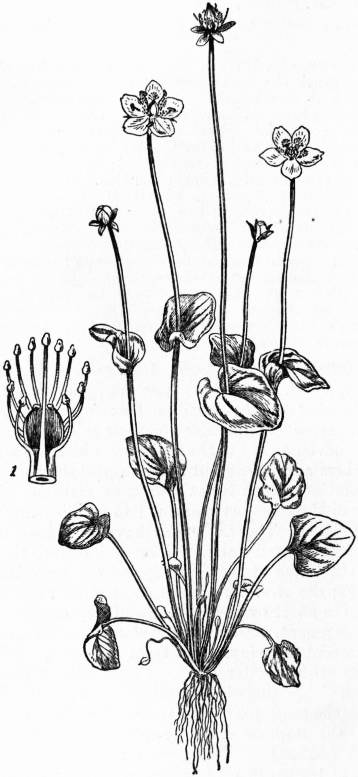
Grass of Parnassus (Parnassia palustris). 1, one of the gland-bearing scales enlarged.
GRATE (from Lat. crates, a hurdle), the iron or steel receptacle for a domestic fire. When coal replaced logs and irons were found to be unsuitable for burning the comparatively small lumps, and for this reason and on account of the more concentrated heat of coal it became necessary to confine the area of the fire. Thus a basket or cage came into use, which, as knowledge of the scientific principles of heating increased, was succeeded by the small grate of iron and fire-brick set close into the wall which has since been in ordinary use in England. In the early part of the 19th century polished steel grates were extensively used, but the labour and difficulty of keeping them bright were considerable, and they were gradually replaced by grates with a polished black surface which could be quickly renewed by an application of black-lead. The most frequent form of the 18th-century grate was rather high from the hearth, with a small hob on each side. The brothers Adam designed many exceedingly elegant grates in the shape of movable baskets ornamented with the paterae and acanthus leaves, the swags and festoons characteristic of their manner. The modern dog-grate is a somewhat similar basket supported upon dogs or andirons, fixed or movable. In the closing years of the 19th century a “well-grate” was invented, in which the fire burns upon the hearth, combustion being aided by an air-chamber below.
GRATIAN (Flavius Gratianus Augustus), Roman emperor 375-383, son of Valentinian I. by Severa, was born at Sirmium in Pannonia, on the 18th of April (or 23rd of May) 359. On the 24th of August 367 he received from his father the title of Augustus. On the death of Valentinian (17th of November 375) the troops in Pannonia proclaimed his infant son (by a second wife Justina) emperor under the title of Valentinian II. (q.v.). Gratian acquiesced in their choice; reserving for himself the administration of the Gallic provinces, he handed over Italy, Illyria and Africa to Valentinian and his mother, who fixed their residence at Milan. The division, however, was merely nominal, and the real authority remained in the hands of Gratian. The eastern portion of the empire was under the rule of his uncle Valens. In May 378 Gratian completely defeated the Lentienses, the southernmost branch of the Alamanni, at Argentaria, near the site of the modern Colmar. When Valens met his death fighting against the Goths near Adrianople on the 9th of August in the same year, the government of the eastern empire devolved upon Gratian, but feeling himself unable to resist unaided the incursions of the barbarians, he ceded it to Theodosius (January 379). With Theodosius he cleared the Balkans of barbarians. For some years Gratian governed the empire with energy and success, but gradually he sank into indolence, occupied himself chiefly with the pleasures of the chase, and became a tool in the hands of the Frankish general Merobaudes and bishop Ambrose. By taking into his personal service a body of Alani, and appearing in public in the dress of a Scythian warrior, he aroused the contempt and resentment of his Roman troops. A Roman named Maximus took advantage of this feeling to raise the standard of revolt in Britain and invaded Gaul with a large army, upon which Gratian, who was then in Paris, being deserted by his troops, fled to Lyons, where, through the treachery of the governor, he was delivered over to one of the rebel generals and assassinated on the 25th of August 383.
The reign of Gratian forms an important epoch in ecclesiastical history, since during that period orthodox Christianity for the first time became dominant throughout the empire. In dealing with pagans and heretics Gratian, who during his later years was greatly influenced by Ambrose, bishop of Milan, exhibited severity and injustice at variance with his usual character. He prohibited heathen worship at Rome; refused to wear the insignia of the pontifex maximus as unbefitting a Christian; removed the altar of Victory from the senate-house at Rome, in spite of the remonstrance of the pagan members of the senate, and confiscated its revenues; forbade legacies of real property to the Vestals; and abolished other privileges belonging to them and to the pontiffs. For his treatment of heretics see the church histories of the period.
Authorities.—Ammianus Marcellinus xxvii.-xxxi.; Aurelius Victor, Epit. 47; Zosimus iv. vi.; Ausonius (Gratian’s tutor), especially the Gratiarum actio pro consulatu; Symmachus x. epp. 2 and 61; Ambrose, De fide, prolegomena to Epistolae 11, 17, 21, Consolatio de obitu Valentiniani; H. Richter, Das weströmische Reich, besonders unter den Kaisern Gratian, Valentinian II. und Maximus (1865); A. de Broglie, L’Église et l’empire romain au IVe siècle (4th ed., 1882); H. Schiller, Geschichte der römischen Kaiserzeit, iii., iv. 31-33; Gibbon, Decline and Fall, ch. 27; R. Gumpoltsberger, Kaiser Gratian (Vienna, 1879); T. Hodgkin, Italy and her Invaders (Oxford, 1892), vol. i.; Tillemont, Hist. des empereurs, v.; J. Wordsworth in Smith’s Dictionary of Christian Biography.
(J. H. F.)
GRATIANUS, FRANCISCUS, compiler of the Concordia discordantium canonum or Decretum Gratiani, and founder of the science of canon law, was born about the end of the 11th century at Chiusi in Tuscany or, according to another account, at Carraria near Orvieto. In early life he appears to have been received into the Camaldulian monastery of Classe near Ravenna, whence he afterwards removed to that of San Felice in Bologna, where he spent many years in the preparation of the Concordia. The precise date of this work cannot be ascertained, but it contains references to the decisions of the Lateran council of 1139, and there is fair authority for believing that it was completed while Pope Alexander III. was still simply professor of theology at Bologna,—in other words, prior to 1150. The labours of Gratian are said to have been rewarded with the bishopric of Chiusi, but if so he appears never to have been consecrated; at least his name is not in any authentic list of those who have occupied that see. The year of his death is unknown.
For some account of the Decretum Gratiani and its history see Canon Law. The best edition is that of Friedberg (Corpus juris canonici, Leipzig, 1879). Compare Schultze, Zur Geschichte der Litteratur über das Decret Gratians (1870), Die Glosse zum Decret Gratians (1872), and Geschichte der Quellen und Litteratur des kanonischen Rechts (3 vols., Stuttgart, 1875).
GRATRY, AUGUSTE JOSEPH ALPHONSE (1805-1872), French author and theologian, was born at Lille on the 10th of March 1805. He was educated at the École Polytechnique, Paris, and, after a period of mental struggle which he has described in Souvenirs de ma jeunesse, he was ordained priest in 1832. After a stay at Strassburg as professor of the Petit Séminaire, he was appointed director of the Collège Stanislas in Paris in 1842 and, in 1847, chaplain of the École Normale Supérieure. He became vicar-general of Orleans in 1861, professor of ethics at the Sorbonne in 1862, and, on the death of Barante, a member of the French Academy in 1867, where he occupied the seat formerly held by Voltaire. Together with M. Pététot, curé of Saint Roch, he reconstituted the Oratory of the Immaculate Conception, a society of priests mainly devoted to education. Gratry was one of the principal opponents of the definition of the dogma of papal infallibility, but in this respect he submitted to the authority of the Vatican Council. He died at Montreux in Switzerland on the 6th of February 1872.
His chief works are: De la connaissance de Dieu, opposing Positivism (1855); La Logique (1856); Les Sources, conseils pour la conduite de l’esprit (1861-1862); La Philosophie du credo (1861); Commentaire sur l’évangile de Saint Matthieu (1863); Jésus-Christ, lettres à M. Renan (1864); Les Sophistes et la critique (in controversy with E. Vacherot) (1864); La Morale et la loi de l’histoire, setting forth his social views (1868); Mgr. l’évêque d’Orléans et Mgr. l’archevêque de Malines (1869), containing a clear exposition of the historical arguments against the doctrine of papal infallibility. There is a selection of Gratry’s writings and appreciation of his style by the Abbé Pichot, in Pages choisies des Grands Écrivains series, published by Armand-Colin (1897). See also the critical study by the oratorian A. Chauvin, L’Abbé Gratry (1901); Le Père Gratry (1900), and Les Derniers Jours du Père Gratry et son testament spirituel, (1872), by Cardinal Adolphe Perraud, Gratry’s friend and disciple.
GRATTAN, HENRY (1746-1820), Irish statesman, son of James Grattan, for many years recorder of Dublin, was born in Dublin on the 3rd of July 1746. He early gave evidence of exceptional gifts both of intellect and character. At Trinity College, Dublin, where he had a distinguished career, he began a lifelong devotion to classical literature and especially to the great orators of antiquity. He was called to the Irish bar in 1772, but never seriously practised the law. Like Flood, with whom he was on terms of friendship, he cultivated his natural genius for eloquence by study of good models, including Bolingbroke and Junius. A visit to the English House of Lords excited boundless admiration for Lord Chatham, of whose style of oratory Grattan contributed an interesting description to Baratariana (see Flood, Henry). The influence of Flood did much to give direction to Grattan’s political aims; and it was through no design on Grattan’s part that when Lord Charlemont brought him into the Irish parliament in 1775, in the very session in which Flood damaged his popularity by accepting office, Grattan quickly superseded his friend in the leadership of the national party. Grattan was well qualified for it. His oratorical powers were unsurpassed among his contemporaries. He conspicuously lacked, indeed, the grace of gesture which he so much admired in Chatham; he had not the sustained dignity of Pitt; his powers of close reasoning were inferior to those of Fox and Flood. But his speeches were packed with epigram, and expressed with rare felicity of phrase; his terse and telling sentences were richer in profound aphorisms and maxims of political philosophy than those of any other statesman save Burke; he possessed the orator’s incomparable gift of conveying his own enthusiasm to his audience and convincing them of the loftiness of his aims.
The principal object of the national party was to set the Irish parliament free from constitutional bondage to the English privy council. By virtue of Poyning’s Act, a celebrated statute of Henry VII., all proposed Irish legislation had to be submitted to the English privy council for its approval under the great seal of England before being passed by the Irish parliament. A bill so approved might be accepted or rejected, but not amended. More recent English acts had further emphasized the complete dependence of the Irish parliament, and the appellate jurisdiction of the Irish House of Lords had also been annulled. Moreover, the English Houses claimed and exercised the power to legislate directly for Ireland without even the nominal concurrence of the parliament in Dublin. This was the constitution which Molyneux and Swift had denounced, which Flood had attacked, and which Grattan was to destroy. The menacing attitude of the Volunteer Convention at Dungannon greatly influenced the decision of the government in 1782 to resist the agitation no longer. It was through ranks of volunteers drawn up outside the parliament house in Dublin that Grattan passed on the 16th of April 1782, amidst unparalleled popular enthusiasm, to move a declaration of the independence of the Irish parliament. “I found Ireland on her knees,” Grattan exclaimed, “I watched over her with a paternal solicitude; I have traced her progress from injuries to arms, and from arms to liberty. Spirit of Swift, spirit of Molyneux, your genius has prevailed! Ireland is now a nation!” After a month of negotiation the claims of Ireland were conceded. The gratitude of his countrymen to Grattan found expression in a parliamentary grant of £100,000, which had to be reduced by one half before he would consent to accept it.
One of the first acts of “Grattan’s parliament” was to prove its loyalty to England by passing a vote for the support of 20,000 sailors for the navy. Grattan himself never failed in loyalty to the crown and the English connexion. He was, however, anxious for moderate parliamentary reform, and, unlike Flood, he favoured Catholic emancipation. It was, indeed, evident that without reform the Irish House of Commons would not be able to make much use of its newly won independence. Though now free from constitutional control it was no less subject than before to the influence of corruption, which the English government had wielded through the Irish borough owners, known as the “undertakers,” or more directly through the great executive officers. “Grattan’s parliament” had no control over the Irish executive. The lord lieutenant and his chief secretary continued to be appointed by the English ministers; their tenure of office depended on the vicissitudes of English, not Irish, party politics; the royal prerogative was exercised in Ireland on the advice of English ministers. The House of Commons was in no sense representative of the Irish people. The great majority of the people were excluded as Roman Catholics from the franchise; two-thirds of the members of the House of Commons were returned by small boroughs at the absolute disposal of single patrons, whose support was bought by a lavish distribution of peerages and pensions. It was to give stability and true independence to the new constitution that Grattan pressed for reform. Having quarrelled with Flood over “simple repeal” Grattan also differed from him on the question of maintaining the Volunteer Convention. He opposed the policy of protective duties, but supported Pitt’s famous commercial propositions in 1785 for establishing free trade between Great Britain and Ireland, which, however, had to be abandoned owing to the hostility of the English mercantile classes. In general Grattan supported the government for a time after 1782, and in particular spoke and voted for the stringent coercive legislation rendered necessary by the Whiteboy outrages in 1785; but as the years passed without Pitt’s personal favour towards parliamentary reform bearing fruit in legislation, he gravitated towards the opposition, agitated for commutation of tithes in Ireland, and supported the Whigs on the regency question in 1788. In 1792 he succeeded in carrying an Act conferring the franchise on the Roman Catholics; in 1794 in conjunction with William Ponsonby he introduced a reform bill which was even less democratic than Flood’s bill of 1783. He was as anxious as Flood had been to retain the legislative power in the hands of men of property, for “he had through the whole of his life a strong conviction that while Ireland could best be governed by Irish hands, democracy in Ireland would inevitably turn to plunder and anarchy.”1 At the same time he desired to admit the Roman Catholic gentry of property to membership of the House of Commons, a proposal that was the logical corollary of the Relief Act of 1792. The defeat of Grattan’s mild proposals helped to promote more extreme opinions, which, under French revolutionary influence, were now becoming heard in Ireland.
The Catholic question had rapidly become of the first importance, and when a powerful section of the Whigs joined Pitt’s ministry in 1794, and it became known that the lord-lieutenancy was to go to Lord Fitzwilliam, who shared Grattan’s views, expectations were raised that the question was about to be settled in a manner satisfactory to the Irish Catholics. Such seems to have been Pitt’s intention, though there has been much controversy as to how far Lord Fitzwilliam (q.v.) had been authorized to pledge the government. After taking Grattan into his confidence, it was arranged that the latter should bring in a Roman Catholic emancipation bill, and that it should then receive government support. But finally it appeared that the viceroy had either misunderstood or exceeded his instructions; and on the 19th of February 1795 Fitzwilliam was recalled. In the outburst of indignation, followed by increasing disaffection in Ireland, which this event produced, Grattan acted with conspicuous moderation and loyalty, which won for him warm acknowledgments from a member of the English cabinet.2 That cabinet, however, doubtless influenced by the wishes of the king, was now determined firmly to resist the Catholic demands, with the result that the country rapidly drifted towards rebellion. Grattan warned the government in a series of masterly speeches of the lawless condition to which Ireland had been driven. But he could now count on no more than some forty followers in the House of Commons, and his words were unheeded. He retired from parliament in May 1797, and departed from his customary moderation by attacking the government in an inflammatory “Letter to the citizens of Dublin.”
At this time religious animosity had almost died out in Ireland, and men of different faiths were ready to combine for common political objects. Thus the Presbyterians of the north, who were mainly republican in sentiment, combined with a section of the Roman Catholics to form the organization of the United Irishmen, to promote revolutionary ideas imported from France; and a party prepared to welcome a French invasion soon came into existence. Thus stimulated, the increasing disaffection culminated in the rebellion of 1798, which was sternly and cruelly repressed. No sooner was this effected than the project of a legislative union between the British and Irish parliaments, which had been from time to time discussed since the beginning of the 18th century, was taken up in earnest by Pitt’s government. Grattan from the first denounced the scheme with implacable hostility. There was, however, much to be said in its favour. The constitution of Grattan’s parliament offered no security, as the differences over the regency question had made evident that in matters of imperial interest the policy of the Irish parliament and that of Great Britain would be in agreement; and at a moment when England was engaged in a life and death struggle with France it was impossible for the ministry to ignore the danger, which had so recently been emphasized by the fact that the independent constitution of 1782 had offered no safeguard against armed revolt. The rebellion put an end to the growing reconciliation between Roman Catholics and Protestants; religious passions were now violently inflamed, and the Orangemen and Catholics divided the island into two hostile factions. It is a curious circumstance, in view of the subsequent history of Irish politics, that it was from the Protestant Established Church, and particularly from the Orangemen, that the bitterest opposition to the union proceeded; and that the proposal found support chiefly among the Roman Catholic clergy and especially the bishops, while in no part of Ireland was it received with more favour than in the city of Cork. This attitude of the Catholics was caused by Pitt’s encouragement of the expectation that Catholic emancipation, the commutation of tithes, and the endowment of the Catholic priesthood, would accompany or quickly follow the passing of the measure.
When in 1799 the government brought forward their bill it was defeated in the Irish House of Commons. Grattan was still in retirement. His popularity had temporarily declined, and the fact that his proposals for parliamentary reform and Catholic emancipation had become the watchwords of the rebellious United Irishmen had brought upon him the bitter hostility of the governing classes. He was dismissed from the privy council; his portrait was removed from the hall of Trinity College; the Merchant Guild of Dublin struck his name off their rolls. But the threatened destruction of the constitution of 1782 quickly restored its author to his former place in the affections of the Irish people. The parliamentary recess had been effectually employed by the government in securing by lavish corruption a majority in favour of their policy. On the 15th of January 1800 the Irish parliament met for its last session; on the same day Grattan secured by purchase a seat for Wicklow; and at a late hour, while the debate was proceeding, he appeared to take his seat. “There was a moment’s pause, an electric thrill passed through the House, and a long wild cheer burst from the galleries.”3 Enfeebled by illness, Grattan’s strength gave way when he rose to speak, and he obtained leave to address the House sitting. Nevertheless his speech was a superb effort of oratory; for more than two hours he kept his audience spellbound by a flood of epigram, of sustained reasoning, of eloquent appeal. After prolonged debates Grattan, on the 26th of May, spoke finally against the committal of the bill, ending with an impassioned peroration in which he declared, “I will remain anchored here with fidelity to the fortunes of my country, faithful to her freedom, faithful to her fall.”4 These were the last words spoken by Grattan in the Irish parliament.
The bill establishing the union was carried through its final stages by substantial majorities. The people remained listless, giving no indications of any eager dislike of the government policy. “There were absolutely none of the signs which are invariably found when a nation struggles passionately against what it deems an impending tyranny, or rallies around some institution which it really loves.”5 One of Grattan’s main grounds of opposition to the union had been his dread of seeing the political leadership in Ireland pass out of the hands of the landed gentry; and he prophesied that the time would come when Ireland would send to the united parliament “a hundred of the greatest rascals in the kingdom.”6 Like Flood before him, Grattan had no leaning towards democracy; and he anticipated that by the removal of the centre of political interest from Ireland the evil of absenteeism would be intensified.
For the next five years Grattan took no active part in public affairs; it was not till 1805 that he became a member of the parliament of the United Kingdom. He modestly took his seat on one of the back benches, till Fox brought him forward to a seat near his own, exclaiming, “This is no place for the Irish Demosthenes!” His first speech was on the Catholic question, and though some doubt had been felt lest Grattan, like Flood, should belie at Westminster the reputation made in Dublin, all agreed with the description of his speech by the Annual Register as “one of the most brilliant and eloquent ever pronounced within the walls of parliament.” When Fox and Grenville came into power in 1806 Grattan was offered, but refused to accept, an office in the government. In the following year he showed the strength of his judgment and character by supporting, in spite of consequent unpopularity in Ireland, a measure for increasing the powers of the executive to deal with Irish disorder. Roman Catholic emancipation, which he continued to advocate with unflagging energy though now advanced in age, became complicated after 1808 by the question whether a veto on the appointment of Roman Catholic bishops should rest with the crown. Grattan supported the veto, but a more extreme Catholic party was now arising in Ireland under the leadership of Daniel O’Connell, and Grattan’s influence gradually declined. He seldom spoke in parliament after 1810, the most notable exception being in 1815, when he separated himself from the Whigs and supported the final struggle against Napoleon. His last speech of all, in 1819, contained a passage referring to the union he had so passionately resisted, which exhibits the statesmanship and at the same time the equable quality of Grattan’s character. His sentiments with regard to the policy of the union remained, he said, unchanged; but “the marriage having taken place it is now the duty, as it ought to be the inclination, of every individual to render it as fruitful, as profitable and as advantageous as possible.” In the following summer, after crossing from Ireland to London when out of health to bring forward the Catholic question once more, he became seriously ill. On his death-bed he spoke generously of Castlereagh, and with warm eulogy of his former rival, Flood. He died on the 6th of June 1820, and was buried in Westminster Abbey close to the tombs of Pitt and Fox. His statue is in the outer lobby of the Houses of Parliament at Westminster. Grattan had married in 1782 Henrietta Fitzgerald, a lady descended from the ancient family of Desmond, by whom he had two sons and two daughters.
The most searching scrutiny of his private life only increases the respect due to the memory of Grattan as a statesman and the greatest of Irish orators. His patriotism was untainted by self-seeking; he was courageous in risking his popularity for what his sound judgment showed him to be the right course. As Sydney Smith said with truth of Grattan soon after his death: “No government ever dismayed him. The world could not bribe him. He thought only of Ireland; lived for no other object; dedicated to her his beautiful fancy, his elegant wit, his manly courage, and all the splendour of his astonishing eloquence.”7
Bibliography.—Henry Grattan, Memoirs of the Life and Times of the Right Hon. H. Grattan (5 vols., London, 1839-1846); Grattan’s Speeches (ed. by H. Grattan, junr., 1822); Irish Parl. Debates; W. E. H. Lecky, History of England in the Eighteenth Century (8 vols., London, 1878-1890) and Leaders of Public Opinion in Ireland (enlarged edition, 2 vols., 1903). For the controversy concerning the recall of Lord Fitzwilliam see, in addition to the foregoing, Lord Rosebery, Pitt (London, 1891); Lord Ashbourne, Pitt: Some Chapters of his Life (London, 1898); The Pelham Papers (Brit. Mus. Add. MSS., 33118); Carlisle Correspondence; Beresford Correspondence; Stanhope Miscellanies; for the Catholic question, W. J. Amhurst, History of Catholic Emancipation (2 vols., London, 1886); Sir Thomas Wyse, Historical Sketch of the late Catholic Association of Ireland (London, 1829); W. J. MacNeven, Pieces of Irish History (New York, 1807) containing an account of the United Irishmen; for the volunteer movement Thomas MacNevin, History of the Volunteers of 1782 (Dublin, 1845); Proceedings of the Volunteer Delegates of Ireland 1784 (Anon. Pamph. Brit. Mus.). See also F. Hardy, Memoirs of Lord Charlemont (London, 1812); Warden Flood, Memoirs of Henry Flood (London, 1838); Francis Plowden, Historical Review of the State of Ireland (London, 1803); Alfred Webb, Compendium of Irish Biography (Dublin, 1878); Sir Jonah Barrington, Rise and Fall of the Irish Nation (London, 1833); W. J. O’Neill Daunt, Ireland and her Agitators; Lord Mountmorres, History of the Irish Parliament (2 vols., London, 1792); Horace Walpole, Memoirs of the Reign of George III. (4 vols., London, 1845 and 1894); Lord Stanhope, Life of William Pitt (4 vols., London, 1861); Thomas Davis, Life of J. P. Curran (Dublin, 1846)—this contains a memoir of Grattan by D. O. Madden, and Grattan’s reply to Lord Clare on the question of the Union; Charles Phillips, Recollections of Curran and some of his Contemporaries (London, 1822); J. A. Froude, The English in Ireland (London, 1881); J. G. McCarthy, Henry Grattan: an Historical Study (London, 1886); Lord Mahon’s History of England, vol. vii. (1858). With special reference to the Union see Castlereagh Correspondence; Cornwallis Correspondence; Westmorland Papers (Irish State Paper Office).
(R. J. M.)
1 W. E. H. Lecky, Leaders of Public Opinion in Ireland, i. 127 (enlarged edition, 2 vols., 1903).
2 Ibid. i. 204.
3 Ibid. i. 241.
4 Grattan’s Speeches, iv. 23.
5 W. E. H. Lecky, History of England in the Eighteenth Century, viii. 491. Cf. Cornwallis Correspondence, iii. 250.
6 W. E. H. Lecky, Leaders of Public Opinion in Ireland, i. 270.
7 Sydney Smith’s Works, ii. 166-167.
GRATTIUS [FALISCUS], Roman poet, of the age of Augustus, author of a poem on hunting (Cynegetica), of which 541 hexameters remain. He was possibly a native of Falerii. The only reference to him in any ancient writer is incidental (Ovid, Ex Ponto, iv. 16. 33). He describes various kinds of game, methods of hunting, the best breeds of horses and dogs.
There are editions by R. Stern (1832); E. Bährens in Poëtae Latini Minores (i., 1879) and G. G. Curcio in Poeti Latini Minori (i., 1902), with bibliography; see also H. Schenkl, Zur Kritik des G. (1898). There is a translation by Christopher Wase (1654).
GRAUDENZ (Polish Grudziadz), a town in the kingdom of Prussia, province of West Prussia, on the right bank of the Vistula, 18 m. S.S.W. of Marienwerder and 37 m. by rail N.N.E. of Thorn. Pop. (1885) 17,336, (1905) 35,988. It has two Protestant and three Roman Catholic churches, and a synagogue. It is a place of considerable manufacturing activity. The town possesses a museum and a monument to Guillaume René Courbière (1733-1811), the defender of the town in 1807. It has fine promenades along the bank of the Vistula. Graudenz is an important place in the German system of fortifications, and has a garrison of considerable size.
Graudenz was founded about 1250, and received civic rights in 1291. At the peace of Thorn in 1466 it came under the lordship of Poland. From 1665 to 1759 it was held by Sweden, and in 1772 it came into the possession of Prussia. The fortress of Graudenz, which since 1873 has been used as a barracks and a military depot and prison, is situated on a steep eminence about 1½ m. north of the town and outside its limits. It was completed by Frederick the Great in 1776, and was rendered famous through its defence by Courbière against the French in 1807.
GRAUN, CARL HEINRICH (1701-1759), German musical composer, the youngest of three brothers, all more or less musical, was born on the 7th of May 1701 at Wahrenbrück in Saxony. His father held a small government post and he gave his children a careful education. Graun’s beautiful soprano voice secured him an appointment in the choir at Dresden. At an early age he composed a number of sacred cantatas and other pieces for the church service. He completed his studies under Johann Christoph Schmidt (1664-1728), and profited much by the Italian operas which were performed at Dresden under the composer Lotti. After his voice had changed to a tenor, he made his début at the opera of Brunswick, in a work by Schürmann, an inferior composer of the day; but not being satisfied with the arias assigned him he re-wrote them, so much to the satisfaction of the court that he was commissioned to write an opera for the next season. This work, Polydorus (1726), and five other operas written for Brunswick, spread his fame all over Germany. Other works, mostly of a sacred character, including two settings of the Passion, also belong to the Brunswick period. Frederick the Great, at that time crown prince of Prussia, heard the singer in Brunswick in 1735, and immediately engaged him for his private chapel at Rheinsberg. There Graun remained for five years, and wrote a number of cantatas, mostly to words written by Frederick himself in French, and translated into Italian by Boltarelli. On his accession to the throne in 1740, Frederick sent Graun to Italy to engage singers for a new opera to be established at Berlin. Graun remained a year on his travels, earning universal applause as a singer in the chief cities of Italy. After his return to Berlin he was appointed conductor of the royal orchestra (Kapellmeister) with a salary of 2000 thalers (£300). In this capacity he wrote twenty-eight operas, all to Italian words, of which the last, Merope (1756), is perhaps the most perfect. It is probable that Graun was subjected to considerable humiliation from the arbitrary caprices of his royal master, who was never tired of praising the operas of Hasse and abusing those of his Kapellmeister. In his oratorio The Death of Jesus Graun shows his skill as a contrapuntist, and his originality of melodious invention. In the Italian operas he imitates the florid style of his time, but even in these the recitatives occasionally show considerable dramatic power. Graun died on the 8th of August 1759, at Berlin, in the same house in which, thirty-two years later, Meyerbeer was born.
GRAVAMEN. (from Lat. gravare, to weigh down; gravis, heavy), a complaint or grievance, the ground of a legal action, and particularly the more serious part of a charge against an accused person. In English the term is used chiefly in ecclesiastical cases, being the technical designation of a memorial presented from the Lower to the Upper House of Convocation, setting forth grievances to be redressed, or calling attention to breaches in church discipline.
GRAVE. (1) (From a common Teutonic verb, meaning “to dig”; in O. Eng. grafan; cf. Dutch graven, Ger. graben), a place dug out of the earth in which a dead body is laid for burial, and hence any place of burial, not necessarily an excavation (see Funeral Rites and Burial). The verb “to grave,” meaning properly to dig, is particularly used of the making of incisions in a hard surface (see Engraving). (2) A title, now obsolete, of a local administrative official for a township in certain parts of Yorkshire and Lincolnshire; it also sometimes appears in the form “grieve,” which in Scotland and Northumberland is used for sheriff (q.v.), and also for a bailiff or under-steward. The origin of the word is obscure, but it is probably connected with the German graf, count, and thus appears as the second part of many Teutonic titles, such as landgrave, burgrave and margrave. “Grieve,” on the other hand, seems to be the northern representative of O.E. gerefa, reeve; cf. “sheriff” and “count.” (3) (From the Lat. gravis, heavy), weighty, serious, particularly with the idea of dangerous, as applied to diseases and the like, of character or temperament as opposed to gay. It is also applied to sound, low or deep, and is thus opposed to “acute.” In music the term is adopted from the French and Italian, and applied to a movement which is solemn or slow. (4) To clean a ship’s bottom in a specially constructed dock, called a “graving dock.” The origin of the word is obscure; according to the New English Dictionary there is no foundation for the connexion with “greaves” or “graves,” the refuse of tallow, in candle or soap-making, supposed to be used in “graving” a ship. It may be connected with an O. Fr. grave, mod. grève, shore.
GRAVEL, or Pebble Beds, the name given to deposits of rounded, subangular, water-worn stones, mingled with finer material such as sand and clay. The word “gravel” is adapted from the O. Fr. gravele, mod. gravelle, dim. of grave, coarse sand, sea-shore, Mod. Fr. grève. The deposits are produced by the attrition of rock fragments by moving water, the waves and tides of the sea and the flow of rivers. Extensive beds of gravel are forming at the present time on many parts of the British coasts where suitable rocks are exposed to the attack of the atmosphere and of the sea waves during storms. The flint gravels of the coast of the Channel, Norfolk, &c., are excellent examples. When the sea is rough the lesser stones are washed up and down the beach by each wave, and in this way are rounded, worn down and finally reduced to sand. These gravels are constantly in movement, being urged forward by the shore currents especially during storms. Large banks of gravel may be swept away in a single night, and in this way the coast is laid bare to the erosive action of the sea. Moreover, the movement of the gravel itself wears down the subjacent rocks. Hence in many places barriers have been erected to prevent the drift of the pebbles and preserve the land, while often it has been found necessary to protect the shores by masonry or cement work. Where the pebbles are swept along to a projecting cape they may be carried onwards and form a long spit or submarine bank, which is constantly reduced in size by the currents and tides which flow across it (e.g. Spurn Head at the mouth of the Humber). The Chesil Bank is the best instance in Britain of a great accumulation of pebbles constantly urged forward by storms in a definite direction. In the shallower parts of the North Sea considerable areas are covered with coarse sand and pebbles. In deeper water, however, as in the Atlantic, beyond the 100 fathom line pebbles are very rare, and those which are found are mostly erratics carried southward by floating icebergs, or volcanic rocks ejected by submarine volcanoes.
In many parts of Britain, Scandinavia and North America there are marine gravels, in every essential resembling those of the sea-shore, at levels considerably above high tide. These gravels often lie In flat-topped terraces which may be traced for great distances along the coast. They are indications that the sea at one time stood higher than it does at present, and are known to geologists as “raised beaches.” In Scotland such beaches are known 25, 50 and 100 ft. above the present shores. In exposed situations they have old shore cliffs behind them; although their deposits are mainly gravelly there is much fine sand and silt in the raised beaches of sheltered estuaries and near river mouths.
River gravels occur most commonly in the middle and upper parts of streams where the currents in times of flood are strong enough to transport fairly large stones. In deltas and the lower portions of large rivers gravel deposits are comparatively rare and indicate periods when the volume of the stream was temporarily greatly increased. In the higher torrents also, gravels are rare because transport is so effective that no considerable accumulations can form. In most countries where the drainage is of a mature type, river gravels occur in the lower parts of the courses of the rivers as banks or terraces which lie some distance above the stream level. Individual terraces usually do not persist for a long space but are represented by a series of benches at about the same altitude. These were once continuous, and have been separated by the stream cutting away the intervening portions as it deepened and broadened its channel. Terraces of this kind often occur in successive series at different heights, and the highest are the oldest because they were laid down at a time when the stream flowed at their level and mark the various stages by which the valley has been eroded. While marine terraces are nearly always horizontal, stream terraces slope downwards along the course of the river.
The extensive deposits of river gravels in many parts of England, France, Switzerland, North America, &c., would indicate that at some former time the rivers flowed in greater volume than at the present day. This is believed to be connected with the glacial epoch and the augmentation of the streams during those periods when the ice was melting away. Many changes in drainage have taken place since then; consequently wide sheets of glacial and fluvio-glacial gravel lie spread out where at present there is no stream. Often they are commingled with sand, and where there were temporary post-glacial lakes deposits of silt, brick clay and mud have been formed. These may be compared to the similar deposits now forming in Greenland, Spitzbergen and other countries which are at present in a glacial condition.
As a rule gravels consist mainly of the harder kinds of stone because these alone can resist attrition. Thus the gravels formed from chalk consist almost entirely of flint, which is so hard that the chalk is ground to powder and washed away, while the flint remains little affected. Other hard rocks such as chert, quartzite, felsite, granite, sandstone and volcanic rocks very frequently are largely represented in gravels, while coal, limestone and shale are far less common. The size of the pebbles varies from a fraction of an inch to several feet; it depends partly on the fissility of the original rocks and partly on the strength of the currents of water; coarse gravels indicate the action of powerful eroding agents. In the Tertiary systems gravels occur on many horizons, e.g. the Woolwich and Reading beds, Oldhaven beds and Bagshot beds of the Eocene of the London basin. They do not essentially differ from recent gravel deposits. But in course of time the action of percolating water assisted by pressure tends to convert gravels into firm masses of conglomerate by depositing carbonate of lime, silica and other substances in their interstices. Gravels are not usually so fossiliferous as finer deposits of the same age, partly because their porous texture enables organic remains to be dissolved away by water, and partly because shells and other fossils are comparatively fragile and would be broken up during the accumulation of the pebbles. The rock fragments in conglomerates, however, sometimes contain fossils which have not been found elsewhere.
(J. S. F.)
GRAVELINES (Flem. Gravelinghe), a fortified seaport town of northern France, in the department of Nord and arrondissement of Dunkirk, 15 m. S.W. of Dunkirk on the railway to Calais. Pop. (1906) town, 1858; commune, 6284. Gravelines is situated on the Aa, 1¼ m. from its mouth in the North Sea. It is surrounded by a double circuit of ramparts and by a tidal moat. The river is canalized and opens out beneath the fortifications into a floating basin. The situation of the port is one of the best in France on the North Sea, though its trade has suffered owing to the nearness of Calais and Dunkirk and the silting up of the channel to the sea. It is a centre for the cod and herring fisheries. Imports consist chiefly of timber from Northern Europe and coal from England, to which eggs and fruit are exported. Gravelines has paper-manufactories, sugar-works, fish-curing works, salt-refineries, chicory-roasting factories, a cannery for preserved peas and other vegetables and an important timber-yard. The harbour is accessible to vessels drawing 18 ft. at high tides. The greater part of the population of the commune of Gravelines dwells in the maritime quarter of Petit-Fort-Philippe at the mouth of the Aa, and in the village of Les Huttes (to the east of the town), which is inhabited by the fisher-folk.
The canalization of the Aa by a count of Flanders about the middle of the 12th century led to the foundation of Gravelines (grave-linghe, meaning “count’s canal.”). In 1558 it was the scene of the signal victory of the Spaniards under the count of Egmont over the French. It finally passed from the Spaniards to the French by the treaty of the Pyrenees in 1659.
GRAVELOTTE, a village of Lorraine between Metz and the French frontier, famous as the scene of the battle of the 18th of August 1870 between the Germans under King William of Prussia and the French under Marshal Bazaine (see Metz and Franco-German War). The battlefield extends from the woods which border the Moselle above Metz to Roncourt, near the river Orne. Other villages which played an important part in the battle of Gravelotte were Saint Privat, Amanweiler or Amanvillers and Sainte-Marie-aux-Chênes, all lying to the N. of Gravelotte.
GRAVES, ALFRED PERCEVAL (1846- ), Irish writer, was born in Dublin, the son of the bishop of Limerick. He was educated at Windermere College, and took high honours at Dublin University. In 1869 he entered the Civil Service as clerk in the Home Office, where he remained until he became in 1874 an inspector of schools. He was a constant contributor of prose and verse to the Spectator, The Athenaeum, John Bull, and Punch, and took a leading part in the revival of Irish letters. He was for several years president of the Irish Literary Society, and is the author of the famous ballad of “Father O’Flynn” and many other songs and ballads. In collaboration with Sir C. V. Stanford he published Songs of Old Ireland (1882), Irish Songs and Ballads (1893), the airs of which are taken from the Petrie MSS.; the airs of his Irish Folk-Songs (1897) were arranged by Charles Wood, with whom he also collaborated in Songs of Erin (1901).
His brother, Charles L. Graves (b. 1856), educated at Marlborough and at Christ Church, Oxford, also became well known as a journalist, author of two volumes of parodies, The Hawarden Horace (1894) and More Hawarden Horace (1896), and of skits in prose and verse. An admirable musical critic, his Life and Letters of Sir George Grove (1903) is a model biography.
GRAVESEND, a municipal and parliamentary borough, river-port and market town of Kent, England, on the right bank of the Thames opposite Tilbury Fort, 22 m. E. by S. of London by the South-Eastern & Chatham railway. Pop. (1901) 27,196. It extends about 2 m. along the river bank, occupying a slight acclivity which reaches its summit at Windmill Hill, whence extensive views are obtained of the river, with its windings and shipping. The older and lower part of the town is irregularly built, with narrow and inconvenient streets, but the upper and newer portion contains several handsome streets and terraces. Among several piers are the town pier, erected in 1832, and the terrace pier, built in 1845, at a time when local river-traffic by steamboat was specially prosperous. Gravesend is a favourite resort of the inhabitants of London, both for excursions and as a summer residence; it is also a favourite yachting centre. The principal buildings are the town-hall, the parish church of Gravesend, erected on the site of an ancient building destroyed by fire in 1727; Milton parish church, a Decorated and Perpendicular building erected in the time of Edward II.; and the county courts. Milton Mount College is a large institution for the daughters of Congregational ministers. East of the town are the earthworks designed to assist Tilbury Fort in obstructing the passage up river of an enemy’s force. They were originally constructed on Vauban’s system in the reign of Charles II. Rosherville Gardens, a popular resort, are in the western suburb of Rosherville, a residential quarter named after James Rosher, an owner of lime works. They were founded in 1843 by George Jones. Gravesend, which is within the Port of London, has some import trade in coal and timber, and fishing, especially of shrimps, is carried on extensively. The principal other industries are boat-building, ironfounding, brewing and soap-boiling. Fruit and vegetables are largely grown in the neighbourhood for the London market. Since 1867 Gravesend has returned a member to parliament, the borough including Northfleet to the west. The town is governed by a mayor, 6 aldermen and 18 councillors. Area, 1259 acres.
In the Domesday Survey “Gravesham” is entered among the bishop of Bayeux’s lands, and a “hythe” or landing-place is mentioned. In 1401 Henry IV. granted the men of Gravesend the sole right of conveying in their own vessels all persons travelling between London and Gravesend, and this right was confirmed by Edward IV. in 1462. In 1562 the town was granted a charter of incorporation by Elizabeth, which vested the government in 2 portreeves and 12 jurats, but by a later charter of 1568 one portreeve was substituted for the two. Charles I. incorporated the town anew under the title of the mayor, jurats and inhabitants of Gravesend, and a further charter of liberties was granted by James II. in 1687. A Thursday market and fair on the 13th of October were granted to the men of Gravesend by Edward III. in 1367; Elizabeth’s charters gave them a Wednesday market and fairs on the 24th of June and the 13th of October, with a court of pie-powder; by the charter of Charles I. Thursday and Saturday were made the market days, and these were changed again to Wednesday and Saturday by a charter of 1694, which also granted a fair on the 23rd of April; the fairs on these dates have died out, but the Saturday market is still held.
From the beginning of the 17th century Gravesend was the chief station for East Indiamen; most of the ships outward bound from London stopped here to victual. A customs house was built in 1782. Queen Elizabeth established Gravesend as the point where the corporation of London should welcome in state eminent foreign visitors arriving by water. State processions by water from Gravesend to London had previously taken place, as in 1522, when Henry VIII. escorted the emperor Charles V. A similar practice was maintained until modern times; as when, on the 7th of March 1863, the princess Alexandra was received here by the prince of Wales (King Edward VII.) three days before their marriage. Gravesend parish church contains memorials to “Princess” Pocahontas, who died when preparing to return home from a visit to England in 1617, and was buried in the old church. A memorial pulpit from the state of Indiana, U.S.A., made of Virginian wood, was provided in 1904, and a fund was raised for a stained-glass window by ladies of the state of Virginia.
GRAVINA, GIOVANNI VINCENZO (1664-1718), Italian littérateur and jurisconsult, was born at Roggiano, a small town near Cosenza, in Calabria, on the 20th of January 1664. He was descended from a distinguished family, and under the direction of his maternal uncle, Gregorio Caloprese, who possessed some reputation as a poet and philosopher, received a learned education, after which he studied at Naples civil and canon law. In 1689 he came to Rome, where in 1695 he united with several others of literary tastes in forming the Academy of Arcadians. A schism occurred in the academy in 1711, and Gravina and his followers founded in opposition to it the Academy of Quirina. From Innocent XII. Gravina received the offer of various ecclesiastical honours, but declined them from a disinclination to enter the clerical profession. In 1699 he was appointed to the chair of civil law in the college of La Sapienza, and in 1703 he was transferred to the chair of canon law. He died at Rome on the 6th of January 1718. He was the adoptive father of Metastasio.
Gravina is the author of a number of works of great erudition, the principal being his Origines juris civilis, completed in 3 vols. (1713) and his De Romano imperio (1712). A French translation of the former appeared in 1775, of which a second edition was published in 1822. His collected works were published at Leipzig in 1737, and at Naples, with notes by Mascovius, in 1756.
GRAVINA, a town and episcopal see of Apulia, Italy, in the province of Bari, from which it is 63 m. S.W. by rail (29 m. direct), 1148 ft. above sea-level. Pop. (1901) 18,197. The town is probably of medieval origin, though some conjecture that it occupies the site of the ancient Blera, a post station on the Via Appia. The cathedral is a basilica of the 15th century. The town is surrounded with walls and towers, and a castle of the emperor Frederick II. rises above the town, which later belonged to the Orsini, dukes of Gravina; just outside it are dwellings and a church (S. Michele) all hewn in the rock, and now abandoned.
Prehistoric remains in the district (remains of ancient settlements, tumuli, &c.) are described by V. di Cicco in Notizie degli scavi (1901), p. 217.
GRAVITATION (from Lat. gravis, heavy), in physical science, that mutual action between masses of matter by virtue of which every such mass tends toward every other with a force varying directly as the product of the masses and inversely as the square of their distances apart. Although the law was first clearly and rigorously formulated by Sir Isaac Newton, the fact of the action indicated by it was more or less clearly seen by others. Even Ptolemy had a vague conception of a force tending toward the centre of the earth which not only kept bodies upon its surface, but in some way upheld the order of the universe. John Kepler inferred that the planets move in their orbits under some influence or force exerted by the sun; but the laws of motion were not then sufficiently developed, nor were Kepler’s ideas of force sufficiently clear, to admit of a precise statement of the nature of the force. C. Huygens and R. Hooke, contemporaries of Newton, saw that Kepler’s third law implied a force tending toward the sun which, acting on the several planets, varied inversely as the square of the distance. But two requirements necessary to generalize the theory were still wanting. One was to show that the law of the inverse square not only represented Kepler’s third law, but his first two laws also. The other was to show that the gravitation of the earth, following one and the same law with that of the sun, extended to the moon. Newton’s researches showed that the attraction of the earth on the moon was the same as that for bodies at the earth’s surface, only reduced in the inverse square of the moon’s distance from the earth’s centre. He also showed that the total gravitation of the earth, assumed as spherical, on external bodies, would be the same as if the earth’s mass were concentrated in the centre. This led at once to the statement of the law in its most general form.
The law of gravitation is unique among the laws of nature, not only in its wide generality, taking the whole universe in its scope, but in the fact that, so far as yet known, it is absolutely unmodified by any condition or cause whatever. All other forms of action between masses of matter, vary with circumstances. The mutual action of electrified bodies, for example, is affected by their relative or absolute motion. But no conditions to which matter has ever been subjected, or under which it has ever been observed, have been found to influence its gravitation in the slightest degree. We might conceive the rapid motions of the heavenly bodies to result in some change either in the direction or amount of their gravitation towards each other at each moment; but such is not the case, even in the most rapidly moving bodies of the solar system. The question has also been raised whether the action of gravitation is absolutely instantaneous. If not, the action would not be exactly in the line adjoining the two bodies at the instant, but would be affected by the motion of the line joining them during the time required by the force to pass from one body to the other. The result of this would be seen in the motions of the planets around the sun; but the most refined observations show no such effect. It is also conceivable that bodies might gravitate differently at different temperatures. But the most careful researches have failed to show any apparent modification produced in this way except what might be attributed to the surrounding conditions. The most recent and exhaustive experiment was that of J. H. Poynting and P. Phillips (Proc. Roy. Soc., 76A, p. 445). The result was that the change, if any, was less than 1⁄10 of the force for one degree change of temperature, a result too minute to be established by any measures.
Another cause which might be supposed to modify the action of gravitation between two bodies would be the interposition of masses of matter between them, a cause which materially modifies the action of electrified bodies. The question whether this cause modifies gravitation admits of an easy test from observation. If it did, then a portion of the earth’s mass or of that of any other planet turned away from the sun would not be subjected to the same action of the sun as if directly exposed to that action. Great masses, as those of the great planets, would not be attracted with a force proportional to the mass because of the hindrance or other effect of the interposed portions. But not the slightest modification due to this cause is shown. The general conclusion from everything we see is that a mass of matter in Australia attracts a mass in London precisely as it would if the earth were not interposed between the two masses.
We must therefore regard the law in question as the broadest and most fundamental one which nature makes known to us.
It is not yet experimentally proved that variation as the inverse square is absolutely true at all distances. Astronomical observations extend over too brief a period of time to show any attraction between different stars except those in each other’s neighbourhood. But this proves nothing because, in the case of distances so great, centuries or even thousands of years of accurate observation will be required to show any action. On the other hand the enigmatical motion of the perihelion of Mercury has not yet found any plausible explanation except on the hypothesis that the gravitation of the sun diminishes at a rate slightly greater than that of the inverse square—the most simple modification being to suppose that instead of the exponent of the distance being exactly −2, it is −2.000 000 161 2.
The argument is extremely simple in form. It is certain that, in the general average, year after year, the force with which Mercury is drawn toward the sun does vary from the exact inverse square of its distance from the sun. The most plausible explanation of this is that one or more masses of matter move around the sun, whose action, whether they are inside or outside the orbit of Mercury, would produce the required modification in the force. From an investigation of all the observations upon Mercury and the other three interior planets, Simon Newcomb found it almost out of the question that any such mass of matter could exist without changing either the figure of the sun itself or the motion of the planes of the orbits of either Mercury or Venus. The qualification “almost” is necessary because so complex a system of actions comes into play, and accurate observations have extended through so short a period, that the proof cannot be regarded as absolute. But the fact that careful and repeated search for a mass of matter sufficient to produce the desired effect has been in vain, affords additional evidence of its non-existence. The most obvious test of the reality of the required modifications would be afforded by two other bodies, the motions of whose pericentres should be similarly affected. These are Mars and the moon. Newcomb found an excess of motions in the perihelion of Mars amounting to about 5″ per century. But the combination of observations and theory on which this is based is not sufficient fully to establish so slight a motion. In the case of the motion of the moon around the earth, assuming the gravitation of the latter to be subject to the modification in question, the annual motion of the moon’s perigee should be greater by 1.5″ than the theoretical motion. E. W. Brown is the first investigator to determine the theoretical motions with this degree of precision; and he finds that there is no such divergence between the actual and the computed motion. There is therefore as yet no ground for regarding any deviation from the law of inverse square as more than a possibility.
(S. N.)
Gravitation Constant and Mean Density of the Earth
The law of gravitation states that two masses M1 and M2, distant d from each other, are pulled together each with a force G. M1M2/d², where G is a constant for all kinds of matter—the gravitation constant. The acceleration of M2 towards M1 or the force exerted on it by M1 per unit of its mass is therefore GM1/d². Astronomical observations of the accelerations of different planets towards the sun, or of different satellites towards the same primary, give us the most accurate confirmation of the distance part of the law. By comparing accelerations towards different bodies we obtain the ratios of the masses of those different bodies and, in so far as the ratios are consistent, we obtain confirmation of the mass part. But we only obtain the ratios of the masses to the mass of some one member of the system, say the earth. We do not find the mass in terms of grammes or pounds. In fact, astronomy gives us the product GM, but neither G nor M. For example, the acceleration of the earth towards the sun is about 0.6 cm/sec.² at a distance from it about 15 × 1012 cm. The acceleration of the moon towards the earth is about 0.27 cm/sec.² at a distance from it about 4 × 1010 cm. If S is the mass of the sun and E the mass of the earth we have 0.6 = GS/(15 × 1012)² and 0.27 = GE/(4 × 1010)² giving us GS and GE, and the ratio S/E = 300,000 roughly; but we do not obtain either S or E in grammes, and we do not find G.
The aim of the experiments to be described here may be regarded either as the determination of the mass of the earth in grammes, most conveniently expressed by its mass ÷ its volume, that is by its “mean density” Δ, or the determination of the “gravitation constant” G. Corresponding to these two aspects of the problem there are two modes of attack. Suppose that a body of mass m is suspended at the earth’s surface where it is pulled with a force w vertically downwards by the earth—its weight. At the same time let it be pulled with a force p by a measurable mass M which may be a mountain, or some measurable part of the earth’s surface layers, or an artificially prepared mass brought near m, and let the pull of M be the same as if it were concentrated at a distance d. The earth pull may be regarded as the same as if the earth were all concentrated at its centre, distant R.
Then
w = G · 4⁄3 πR³Δm/R² = G · 4⁄3 πRΔm,
(1)
and
p = GMm/d².
(2)
By division
Δ = 3M · w .
4πRd² p
If then we can arrange to observe w/p we obtain Δ, the mean density of the earth.
But the same observations give us G also. For, putting m = w/g in (2), we get
G = d² · p · g.
M w
In the second mode of attack the pull p between two artificially prepared measured masses M1, M2 is determined when they are a distance d apart, and since p = G·M1M2/d² we get at once G = pd²/M1M2. But we can also deduce Δ. For putting w = mg in (1) we get
Δ = ¾ g · 1 .
G πR
Experiments of the first class in which the pull of a known mass is compared with the pull of the earth maybe termed experiments on the mean density of the earth, while experiments of the second class in which the pull between two known masses is directly measured may be termed experiments on the gravitation constant.
We shall, however, adopt a slightly different classification for the purpose of describing methods of experiment, viz:—
1. Comparison of the earth pull on a body with the pull of a natural mass as in the Schiehallion experiment.
2. Determination of the attraction between two artificial masses as in Cavendish’s experiment.
3. Comparison of the earth pull on a body with the pull of an artificial mass as in experiments with the common balance.
It is interesting to note that the possibility of gravitation experiments of this kind was first considered by Newton, and in both of the forms (1) and (2). In the System of the World (3rd ed., 1737, p. 40) he calculates that the deviation by a hemispherical mountain, of the earth’s density and with radius 3 m., on a plumb-line at its side will be less than 2 minutes. He also calculates (though with an error in his arithmetic) the acceleration towards each other of two spheres each a foot in diameter and of the earth’s density, and comes to the conclusion that in either case the effect is too small for measurement. In the Principia, bk. iii., prop. x., he makes a celebrated estimate that the earth’s mean density is five or six times that of water. Adopting this estimate, the deviation by an actual mountain or the attraction of two terrestrial spheres would be of the orders calculated, and regarded by Newton as immeasurably small.
Whatever method is adopted the force to be measured is very minute. This may be realized if we here anticipate the results of the experiments, which show that in round numbers Δ = 5.5 and G = 1/15,000,000 when the masses are in grammes and the distances in centimetres.
Newton’s mountain, which would probably have density about Δ/2 would deviate the plumb-line not much more than half a minute. Two spheres 30 cm. in diameter (about 1 ft.) and of density 11 (about that of lead) just not touching would pull each other with a force rather less than 2 dynes, and their acceleration would be such that they would move into contact if starting 1 cm. apart in rather over 400 seconds.
From these examples it will be realized that in gravitation experiments extraordinary precautions must be adopted to eliminate disturbing forces which may easily rise to be comparable with the forces to be measured. We shall not attempt to give an account of these precautions, but only seek to set forth the general principles of the different experiments which have been made.
I. Comparison of the Earth Pull with that of a Natural Mass.
Bouguer’s Experiments.—The earliest experiments were made by Pierre Bouguer about 1740, and they are recorded in his Figure de la terre (1749). They were of two kinds. In the first he determined the length of the seconds pendulum, and thence g at different levels. Thus at Quito, which may be regarded as on a table-land 1466 toises (a toise is about 6.4 ft.) above sea-level, the seconds pendulum was less by 1/1331 than on the Isle of Inca at sea-level. But if there were no matter above the sea-level, the inverse square law would make the pendulum less by 1/1118 at the higher level. The value of g then at the higher level was greater than could be accounted for by the attraction of an earth ending at sea-level by the difference 1/1118 − 1/1331 = 1/6983, and this was put down to the attraction of the plateau 1466 toises high; or the attraction of the whole earth was 6983 times the attraction of the plateau. Using the rule, now known as “Young’s rule,” for the attraction of the plateau, Bouguer found that the density of the earth was 4.7 times that of the plateau, a result certainly much too large.
In the second kind of experiment he attempted to measure the horizontal pull of Chimborazo, a mountain about 20,000 ft. high, by the deflection of a plumb-line at a station on its south side. Fig. 1 shows the principle of the method. Suppose that two stations are fixed, one on the side of the mountain due south of the summit, and the other on the same latitude but some distance westward, away from the influence of the mountain. Suppose that at the second station a star is observed to pass the meridian, for simplicity we will say directly overhead, then a plumb-line will hang down exactly parallel to the observing telescope. If the mountain were away it would also hang parallel to the telescope at the first station when directed to the same star. But the mountain pulls the plumb-line towards it and the star appears to the north of the zenith and evidently mountain pull/earth pull = tangent of angle of displacement of zenith.
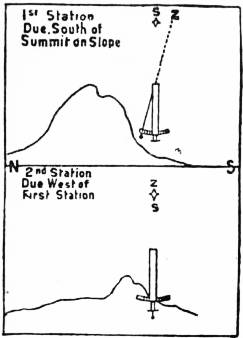
Fig. 1.—Bouguer’s Plumb-line Experiment on the attraction of Chimborazo.
Bouguer observed the meridian altitude of several stars at the two stations. There was still some deflection at the second station, a deflection which he estimated as 1/14 that at the first station, and he found on allowing for this that his observations gave a deflection of 8 seconds at the first station. From the form and size of the mountain he found that if its density were that of the earth the deflection should be 103 seconds, or the earth was nearly 13 times as dense as the mountain, a result several times too large. But the work was carried on under enormous difficulties owing to the severity of the weather, and no exactness could be expected. The importance of the experiment lay in its proof that the method was possible.
Maskelyne’s Experiment.—In 1774 Nevil Maskelyne (Phil. Trans., 1775, p. 495) made an experiment on the deflection of the plumb-line by Schiehallion, a mountain in Perthshire, which has a short ridge nearly east and west, and sides sloping steeply on the north and south. He selected two stations on the same meridian, one on the north, the other on the south slope, and by means of a zenith sector, a telescope provided with a plumb-bob, he determined at each station the meridian zenith distances of a number of stars. From a survey of the district made in the years 1774-1776 the geographical difference of latitude between the two stations was found to be 42.94 seconds, and this would have been the difference in the meridian zenith difference of the same star at the two stations had the mountain been away. But at the north station the plumb-bob was pulled south and the zenith was deflected northwards, while at the south station the effect was reversed. Hence the angle between the zeniths, or the angle between the zenith distances of the same star at the two stations was greater than the geographical 42.94 seconds. The mean of the observations gave a difference of 54.2 seconds, or the double deflection of the plumb-line was 54.2 − 42.94, say 11.26 seconds.
The computation of the attraction of the mountain on the supposition that its density was that of the earth was made by Charles Hutton from the results of the survey (Phil. Trans., 1778, p. 689), a computation carried out by ingenious and important methods. He found that the deflection should have been greater in the ratio 17804 : 9933 say 9 : 5, whence the density of the earth comes out at 9/5 that of the mountain. Hutton took the density of the mountain at 2.5, giving the mean density of the earth 4.5. A revision of the density of the mountain from a careful survey of the rocks composing it was made by John Playfair many years later (Phil. Trans., 1811, p. 347), and the density of the earth was given as lying between 4.5588 and 4.867.
Other experiments have been made on the attraction of mountains by Francesco Carlini (Milano Effem. Ast., 1824, p. 28) on Mt. Blanc in 1821, using the pendulum method after the manner of Bouguer, by Colonel Sir Henry James and Captain A. R. Clarke (Phil. Trans., 1856, p. 591), using the plumb-line deflection at Arthur’s Seat, by T. C. Mendenhall (Amer. Jour. of Sci. xxi. p. 99), using the pendulum method on Fujiyama in Japan, and by E. D. Preston (U.S. Coast and Geod. Survey Rep., 1893, p. 513) in Hawaii, using both methods.
Airy’s Experiment.—In 1854 Sir G. B. Airy (Phil. Trans. 1856, p. 297) carried out at Harton pit near South Shields an experiment which he had attempted many years before in conjunction with W. Whewell and R. Sheepshanks at Dolcoath. This consisted in comparing gravity at the top and at the bottom of a mine by the swings of the same pendulum, and thence finding the ratio of the pull of the intervening strata to the pull of the whole earth. The principle of the method may be understood by assuming that the earth consists of concentric spherical shells each homogeneous, the last of thickness h equal to the depth of the mine. Let the radius of the earth to the bottom of the mine be R, and the mean density up to that point be Δ. This will not differ appreciably from the mean density of the whole. Let the density of the strata of depth h be δ. Denoting the values of gravity above and below by ga and gb we have
gb = G · 4⁄3 πR³Δ = G · 4⁄3πRΔ,
R²
and
ga = G · 4⁄3 πR³Δ + G · 4πhδ
(R + h)²
(since the attraction of a shell h thick on a point just outside it is G · 4π(R + h)²hδ/(R + h)² = G · 4πhδ).
Therefore
ga = G · 4⁄3πRΔ ( 1 − 2h + 3h δ ) nearly,
R R Δ
whence
ga = 1 − 2h + 3h δ ,
gb R R Δ
and
Δ = 3h / ( − 1 + 2h + ga ).
δ R R gb
Stations were chosen in the same vertical, one near the pit bank, another 1250 ft. below in a disused working, and a “comparison” clock was fixed at each station. A third clock was placed at the upper station connected by an electric circuit to the lower station. It gave an electric signal every 15 seconds by which the rates of the two comparison clocks could be accurately compared. Two “invariable” seconds pendulums were swung, one in front of the upper and the other in front of the lower comparison clock after the manner of Kater, and these invariables were interchanged at intervals. From continuous observations extending over three weeks and after applying various corrections Airy obtained gb/ga= 1.00005185. Making corrections for the irregularity of the neighbouring strata he found Δ/δ = 2.6266. W. H. Miller made a careful determination of δ from specimens of the strata, finding it 2.5. The final result taking into account the ellipticity and rotation of the earth is Δ = 6.565.
Von Sterneck’s Experiments.—(Mitth. des K.U.K. Mil. Geog. Inst. zu Wien, ii, 1882, p. 77; 1883, p. 59; vi., 1886, p. 97). R. von Sterneck repeated the mine experiment in 1882-1883 at the Adalbert shaft at Pribram in Bohemia and in 1885 at the Abraham shaft near Freiberg. He used two invariable half-seconds pendulums, one swung at the surface, the other below at the same time. The two were at intervals interchanged. Von Sterneck introduced a most important improvement by comparing the swings of the two invariables with the same clock which by an electric circuit gave a signal at each station each second. This eliminated clock rates. His method, of which it is not necessary to give the details here, began a new era in the determinations of local variations of gravity. The values which von Sterneck obtained for Δ were not consistent, but increased with the depth of the second station. This was probably due to local irregularities in the strata which could not be directly detected.
All the experiments to determine Δ by the attraction of natural masses are open to the serious objection that we cannot determine the distribution of density in the neighbourhood with any approach to accuracy. The experiments with artificial masses next to be described give much more consistent results, and the experiments with natural masses are now only of use in showing the existence of irregularities in the earth’s superficial strata when they give results deviating largely from the accepted value.
II. Determination of the Attraction between two Artificial Masses.
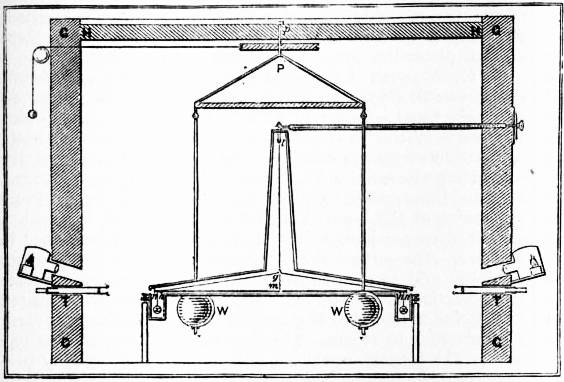
Fig. 2.—Cavendish’s Apparatus. h h, torsion rod hung by wire l g,; x, x, attracted balls hung from its ends; WW, attracting masses.
Cavendish’s Experiment (Phil. Trans., 1798, p. 469).—This celebrated experiment was planned by the Rev. John Michell. He completed an apparatus for it but did not live to begin work with it. After Michell’s death the apparatus came into the possession of Henry Cavendish, who largely reconstructed it, but still adhered to Michell’s plan, and in 1797-1798 he carried out the experiment. The essential feature of it consisted in the determination of the attraction of a lead sphere 12 in. in diameter on another lead sphere 2 in. in diameter, the distance between the centres being about 9 in., by means of a torsion balance. Fig. 2 shows how the experiment was carried out. A torsion rod hh 6 ft. long, tied from its ends to a vertical piece mg, was hung by a wire lg. From its ends depended two lead balls xx each 2 in. in diameter. The position of the rod was determined by a scale fixed near the end of the arm, the arm itself carrying a vernier moving along the scale. This was lighted by a lamp and viewed by a telescope T from the outside of the room containing the apparatus. The torsion balance was enclosed in a case and outside this two lead spheres WW each 12 in. in diameter hung from an arm which could turn round an axis Pp in the line of gl. Suppose that first the spheres are placed so that one is just in front of the right-hand ball x and the other is just behind the left-hand ball x. The two will conspire to pull the balls so that the right end of the rod moves forward. Now let the big spheres be moved round so that one is in front of the left ball and the other behind the right ball. The pulls are reversed and the right end moves backward. The angle between its two positions is (if we neglect cross attractions of right sphere on left ball and left sphere on right ball) four times as great as the deflection of the rod due to approach of one sphere to one ball.
The principle of the experiment may be set forth thus. Let 2a be the length of the torsion rod, m the mass of a ball, M the mass of a large sphere, d the distance between the centres, supposed the same on each side. Let θ be the angle through which the rod moves round when the spheres WW are moved from the first to the second of the positions described above. Let μ be the couple required to twist the rod through 1 radian. Then μθ = 4GMma/d². But μ can be found from the time of vibration of the torsion system when we know its moment of inertia I, and this can be determined. If T is the period μ = 4π²I/T², whence G = π²d²Iθ/T²Mma, or putting the result in terms of the mean density of the earth Δ it is easy to show that, if L, the length of the seconds pendulum, is put for g/π², and C for 2πR, the earth’s circumference, then
Δ = 3⁄2 L Mma T² .
C d²I θ
The original account by Cavendish is still well worth studying on account of the excellence of his methods. His work was undoubtedly very accurate for a pioneer experiment and has only really been improved upon within the last generation. Making various corrections of which it is not necessary to give a description, the result obtained (after correcting a mistake first pointed out by F. Baily) is Δ = 5.448. In seeking the origin of the disturbed motion of the torsion rod Cavendish made a very important observation. He found that when the masses were left in one position for a time the attracted balls crept now in one direction, now in another, as if the attraction were varying. Ultimately he found that this was due to convection currents in the case containing the torsion rod, currents produced by temperature inequalities. When a large sphere was heated the ball near it tended to approach and when it was cooled the ball tended to recede. Convection currents constitute the chief disturbance and the chief source of error in all attempts to measure small forces in air at ordinary pressure.
Reich’s Experiments (Versuche über die mittlere Dichtigkeit der Erde mittelst der Drehwage, Freiberg, 1838; “Neue Versuche mit der Drehwage,” Leipzig Abh. Math. Phys. i., 1852, p. 383).—In 1838 F. Reich published an account of a repetition of the Cavendish experiment carried out on the same general lines, though with somewhat smaller apparatus. The chief differences consisted in the methods of measuring the times of vibration and the deflection, and the changes were hardly improvements. His result after revision was Δ = 5.49. In 1852 he published an account of further work giving as result Δ = 5.58. It is noteworthy that in his second paper he gives an account of experiments suggested by J. D. Forbes in which the deflection was not observed directly, but was deduced from observations of the time of vibration when the attracting masses were in different positions.
Let T1 be the time of vibration when the masses are in one of the usual attracting positions. Let d be the distance between the centres of attracting mass and attracted ball, and δ the distance through which the ball is pulled. If a is the half length of the torsion rod and θ the deflection, δ = aθ. Now let the attracting masses be put one at each end of the torsion rod with their centres in the line through the centres of the balls and d from them, and let T2 be the time of vibration. Then it is easy to show that
δ/d = aθ/d = (T1 − T2) / (T1 + T2).
This gives a value of θ which may be used in the formula. The experiments by this method were not consistent, and the mean result was Δ = 6.25.
Baily’s Experiment (Memoirs of the Royal Astron. Soc. xiv.).—In 1841-1842 Francis Baily made a long series of determinations by Cavendish’s method and with apparatus nearly of the same dimensions. The attracting masses were 12-in. lead spheres and as attracted balls he used various masses, lead, zinc, glass, ivory, platinum, hollow brass, and finally the torsion rod alone without balls. The suspension was also varied, sometimes consisting of a single wire, sometimes being bifilar. There were systematic errors running through Baily’s work, which it is impossible now wholly to explain. These made the resulting value of Δ show a variation with the nature of the attracted masses and a variation with the temperature. His final result Δ = 5.6747 is not of value compared with later results.
Cornu and Baille’s Experiment (Comptes rendus, lxxvi., 1873, p. 954; lxxxvi., 1878, pp. 571, 699, 1001; xcvi., 1883, p. 1493).—In 1870 MM. A. Cornu and J. Baille commenced an experiment by the Cavendish method which was never definitely completed, though valuable studies of the behaviour of the torsion apparatus were made. They purposely departed from the dimensions previously used. The torsion balls were of copper about 100 gm. each, the rod was 50 cm. long, and the suspending wire was 4 metres long. On each side of each ball was a hollow iron sphere. Two of these were filled with mercury weighing 12 kgm., the two spheres of mercury constituting the attracting masses. When the position of a mass was to be changed the mercury was pumped from the sphere on one side to that on the other side of a ball. To avoid counting time a method of electric registration on a chronograph was adopted. A provisional result was Δ = 5.56.
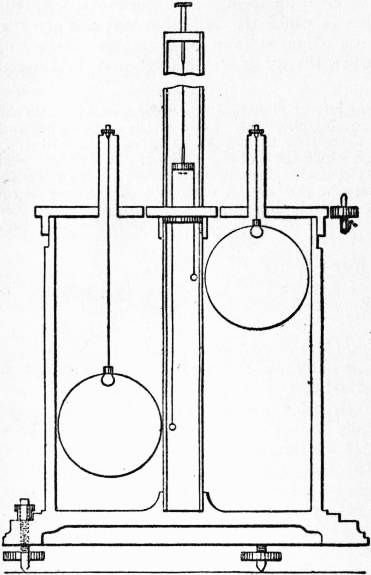
Fig. 3.—Diagram of a Section of Professor Boys’s Apparatus.
Boys’s Experiment (Phil. Trans., A., 1895, pt. i., p. 1).—Professor C. V. Boys having found that it is possible to draw quartz fibres of practically any degree of fineness, of great strength and true in their elasticity, determined to repeat the Cavendish experiment, using his newly invented fibres for the suspension of the torsion rod. He began by an inquiry as to the best dimensions for the apparatus. He saw that if the period of vibration is kept constant, that is, if the moment of inertia I is kept proportional to the torsion couple per radian μ, then the deflection remains the same however the linear dimensions are altered so long as they are all altered in the same proportion. Hence we are driven to conclude that the dimensions should be reduced until further reduction would make the linear quantities too small to be measured with exactness, for reduction in the apparatus enables variations in temperature and the consequent air disturbances to be reduced, and the experiment in other ways becomes more manageable. Professor Boys took as the exactness to be sought for 1 in 10,000. He further saw that reduction in length of the torsion rod with given balls is an advantage. For if the rod be halved the moment of inertia is one-fourth, and if the suspending fibre is made finer so that the torsion couple per radian is also one-fourth the time remains the same. But the moment of the attracting force is halved only, so that the deflection against one-fourth torsion is doubled. In Cavendish’s arrangement there would be an early limit to the advantage in reduction of rod in that the mass opposite one ball would begin seriously to attract the other ball. But Boys avoided this difficulty by suspending the balls from the ends of the torsion rod at different levels and by placing the attracting masses at these different levels. Fig. 3 represents diagrammatically a vertical section of the arrangement used on a scale of about 1/10. The torsion rod was a small rectangular mirror about 2.4 cm. wide hung by a quartz fibre about 43 cm. long. From the sides of this mirror the balls were hung by quartz fibres at levels differing by 15 cm. The balls were of gold either about 5 mm. in diameter and weighing about 1.3 gm. or about 6.5 mm. in diameter and weighing 2.65 gm. The attracting masses were lead spheres, about 10 cm. in diameter and weighing about 7.4 kgm. each. These were suspended from the top of the case which could be rotated round the central tube, and they were arranged so that the radius to the centre from the axis of the torsion system made 65° with the torsion rod, the position in which the moment of the attraction was a maximum. The torsion rod mirror reflected a distant scale by which the deflection could be read. The time of vibration was recorded on a chronograph. The result of the experiment, probably the best yet made, was Δ = 5.527; G = 6.658 × 10⁻⁸.
Braun’s Experiment (Denkschr. Akad. Wiss. Wien, math.- naturw. Cl. 64, p. 187, 1896).—In 1896 Dr K. Braun, S.J., gave an account of a very careful and excellent repetition of the Cavendish experiment with apparatus much smaller than was used in the older experiments, yet much larger than that used by Boys. A notable feature of the work consisted in the suspension of the torsion apparatus in a receiver exhausted to about 4 mm. of mercury, a pressure at which convection currents almost disappear while “radiometer” forces have hardly begun. For other ingenious arrangements the original paper or a short abstract in Nature, lvi., 1897, p. 127, may be consulted. The attracted balls weighed 54 gm. each and were 25 cm. apart. The attracting masses were spheres of mercury each weighing 9 kgm. and brought into position outside the receiver. Braun used both the deflection method and the time of vibration method suggested to Reich by Forbes. The methods gave almost identical results and his final values are to three decimal places the same as those obtained by Boys.
G. K. Burgess’s Experiment (Thèses présentées à la faculté des sciences de Paris pour obtenir le titre de docteur de l’université de Paris, 1901).—This was a Cavendish experiment in which the torsion system was buoyed up by a float in a mercury bath. The attracted masses could thus be made large, and yet the suspending wire could be kept fine. The torsion beam was 12 cm. long, and the attracted balls were lead spheres each 2 kgm. From the centre of the beam depended a vertical steel rod with a varnished copper hollow float at its end, entirely immersed in mercury. The surface of the mercury was covered with dilute sulphuric acid to remove irregularities due to varying surface tension acting on the steel rod. The size of the float was adjusted so that the torsion fibre of quartz 35 cm. long had only to carry a weight of 5 to 10 gm. The time of vibration was over one hour. The torsion couple per radian was determined by preliminary experiments. The attracting masses were each 10 kgm. turning in a circle 18 cm. in diameter. The results gave Δ = 5.55 and G = 6.64 × 10⁻⁸.
Eötvos’s Experiment (Ann. der Physik und Chemie, 1896, 59, P. 354).—In the course of investigations on local variations of gravity by means of the torsion balance, R. Eötvos devised a method for determining G somewhat like the vibration method used by Reich and Braun. Two pillars were built up of lead blocks 30 cm. square in cross section, 60 cm. high and 30 cm. apart. A torsion rod somewhat less than 30 cm. long with small weights at the ends was enclosed in a double-walled brass case of as little depth as possible, a device which secured great steadiness through freedom from convection currents. The suspension was a platinum wire about 150 cm. long. The torsion rod was first set in the line joining the centres of the pillars and its time of vibration was taken. Then it was set with its length perpendicular to the line joining the centres and the time again taken. From these times Eötvos was able to deduce G = 6.65 × 10⁻⁸ whence Δ = 5.53. This is only a provisional value. The experiment was only as it were a by-product in the course of exceedingly ingenious work on the local variation in gravity for which the original paper should be consulted.
Wilsing’s Experiment (Publ. des astrophysikalischen Observ. zu Potsdam, 1887, No. 22, vol. vi. pt. ii.; pt. iii. p. 133).—We may perhaps class with the Cavendish type an experiment made by J. Wilsing, in which a vertical “double pendulum” was used in place of a horizontal torsion system. Two weights each 540 gm. were fixed at the ends of a rod 1 metre long. A knife edge was fixed on the rod just above its centre of gravity, and this was supported so that the rod could vibrate about a vertical position. Two attracting masses, cast-iron cylinders each 325 kgm., were placed, say, one in front of the top weight on the pendulum and the other behind the bottom weight, and the position of the rod was observed in the usual mirror and scale way. Then the front attracting mass was dropped to the level of the lower weight and the back mass was raised to that of the upper weight, and the consequent deflection of the rod was observed. By taking the time of vibration of the pendulum first as used in the deflection experiment and then when a small weight was removed from the upper end a known distance from the knife edge, the restoring couple per radian deflection could be found. The final result gave Δ = 5.579.
J. Joly’s suggested Experiment (Nature xli., 1890, p. 256).—Joly has suggested that G might be determined by hanging a simple pendulum in a vacuum, and vibrating outside the case two massive pendulums each with the same time of swing as the simple pendulum. The simple pendulum would be set swinging by the varying attraction and from its amplitude after a known number of swings of the outside pendulums G could be found.