VOLUME XII SLICE IV Grasshopper to Greek Language (continued 5)
Reading edition
(C. F. A.)
1 Gustavus Adolphus before the battle of the Alte Veste (see Thirty Years’ War).
2 “Making not money but that which they took to be the public felicity to be their end they were the more engaged to be valiant” (Baxter).
3 For the third time within the year the London trained bands turned out in force. It was characteristic of the early years of the war that imminent danger alone called forth the devotion of the citizen soldier. If he was employed in ordinary times (e.g. at Basing House) he would neither fight nor march with spirit.
4 Charles’s policy was still, as before Marston Moor, to “spin out time” until Rupert came back from the north.
5 The ground has been entirely built over for many years.
6 The Puritans had by now disappeared almost entirely from the ranks of the infantry. Per contra the officers and sergeants and the troopers of the horse were the sternest Puritans of all, the survivors of three years of a disheartening war.
7 The tents were evidently issued for regular marches, not for cross-country manœuvres against the enemy. These manœuvres, as we have seen, often took several days. The bon général ordinaire of the 17th and 18th centuries framed his manœuvres on a smaller scale so as not to expose his expensive and highly trained soldiers to discomfort and the consequent temptation to desert.
8 The lord general had during his march thrown out successively two flying columns under Colonel Lilburne to deal with the Lancashire Royalists under the earl of Derby. Lilburne entirely routed the enemy at Wigan on the 25th of August.
9 Fritz Hoenig, Cromwell.
GREAT SALT LAKE, a shallow body of highly concentrated brine in the N.W. part of Utah, U.S.A., lying between 118.8° and 113.2° W. long, and between 40.7° and 41.8° lat. Great Salt Lake is 4218 ft. above sea-level. It has no outlet, and is fed chiefly by the Jordan, the Weber and the Bear rivers, all draining the mountainous country to the E. and S.E. The irregular outline of the lake has been compared to the roughly drawn hand, palm at the S., thumb (exaggerated in breadth) pointing N.E., and the fingers (crowded together and drawn too small) reaching N.
No bathymetric survey of the lake has been made, but the maximum depth is 60 ft. and the mean depth less than 20 ft., possibly as little as 13 ft. The lake in 1906 was approximately 75 m. long., from N.W. to S.E., and had a maximum width of 50 m. and an area of 1750 sq. m. This area is not constant, as the water is very shallow at the margins, and the relation between supply from precipitation, &c., and loss by evaporation is variable, there being an annual difference in the height of the water of 15-18 in. between June (highest) and November (lowest), and besides a difference running through longer cycles: in 1850 the water was lower and the lake smaller than by any previous observations (the area and general outline were nearly the same again in 1906); then the water rose until 1873; and between 1886 and 1902 the fall in level was 11.6 ft. The range of rise and fall from 1845 to 1886 was 13 ft., this being the rise in 1865-1886. With the fall of water there is an increase in the specific gravity, which in 1850 was 1.17, and in September 1901 was 1.179; in 1850 the proportion of solids by weight was 22.282%, in September 1901 it was 25.221; at the earlier of these dates the solids in a litre of water weighed 260.69 grams, at the latter date 302.122 grams. The exact cause of this cyclic variation is unknown: the low level of 1906 is usually regarded as the result of extensive irrigation and ploughing in the surrounding country, which have robbed the lake, in part, of its normal supply of water. It is also to be noted that the rise and fall of the lake level have been coincident, respectively, with continued wet and dry cycles. That the lake will soon dry up entirely seems unlikely, as there is a central trough, 25 to 30 m. wide, about 40 ft. deep, running N.W. and S.E. The area and shore-line of the lake are evidently affected by a slight surface tilt, for during the same generation that has seen the recent fall of the lake level the shore-line is in many cases 2 m. from the old, and fences may be seen a mile or more out in the lake. The lake bed is for the most part clear sand along the margin, and in deeper water is largely coated with crusts of salt, soda and gypsum.
The lake is a novel and popular bathing resort, the specific gravity of the water being so great that one cannot sink or entirely submerge oneself. There are well-equipped bathing pavilions at Garfield and Saltair on the S. shore of the lake about 20 m. from Salt Lake City. The bathing is invigorating; it must be followed by a freshwater bath because of the incrustation of the body from the briny water. The large amount of salt in the water makes both fauna and flora of the lake scanty; there are a few algae, the larvae of an Ephydra and of a Tipula fly, specimens of what seems to be Corixa decolor, and in great quantities, so as to tint the surface of the water, the brine shrimp, Artemia salina (or gracilis or fertilis), notable biologically for the rarity of males, for the high degree of parthenogenesis and for apparent interchangeableness with the Branchipus.
The lake is of interest for its generally mountainous surroundings, save to the N.W., where it skirts the Great Salt Lake Desert, for the mountainous peninsula, the Promontory, lying between thumb and fingers of the hand, shaped like and resembling in geological structure the two islands S. of it, Fremont and Antelope,1 and the Oquirrh range S. of the lake. The physiography of the surrounding country shows clearly that the basin occupied by Great Salt Lake is one of many left by the drying up of a large Pleistocene lake, which has been called lake Bonneville. Well-defined wave-cut cliffs and terraces show two distinct shore-lines of this early lake, one the “Bonneville Shore-line,” about 1000 ft. above Great Salt Lake, and the other, the “Provo Shoreline,” about 625 ft. higher than the present lake. These shorelines and the presence of two alluvial deposits, the lower and the larger of yellow clay 90 ft. deep, and, separated from it by a plane of erosion, the other, a deposit of white marl, 10-20 ft. deep, clearly prove the main facts as to lake Bonneville: a dry basin was first occupied by the shallow waters of a small lake; then, during a long period of excessive moisture (or cold), the waters rose and spread over an area nearly as large as lake Huron with a maximum depth of 1000 ft.; a period of great dryness followed, in which the lake disappeared; then came a second, shorter, but more intense period of moisture, and in this time the lake rose, covered a larger area than before, including W. Utah and a little of S. Idaho and of E. Nevada, about 19,750 sq. m., had a very much broken shore-line of 2550 m. and a maximum depth of 1050 ft. and a mean depth of 800 ft., overflowed the basin at the N., and by a tributary stream through Red Rock Pass at the N. end of the Cache valley poured its waters into the Columbia river system. The great lake was then gradually reduced by evaporation, leaving only shallow bodies of salt water, of which Great Salt Lake is the largest. The cause of the climatic variations which brought about this complex history of the Salt Lake region is not known; but it is worthy of note that the periods of highest water levels were coincident with a great expansion of local valley glaciers, some of which terminated in the waters of lake Bonneville.
Industrially Great Salt Lake is of a certain importance. In early days it was the source of the salt supply of the surrounding country; and the manufacture of salt is now an important industry. The brine is pumped into conduits, carried to large ponds and there evaporated by the sun; during late years the salt has been refined here, being purified of the sulphates and magnesium compounds which formerly rendered it efflorescent and of a low commercial grade. Mirabilite, or Glauber’s salt, is commercially valuable, occurring in such quantities in parts of the lake that one may wade knee-deep in it; it separates from the brine at a temperature between 30° and 20° F. The lake is crossed E. and W. by the Southern Pacific railway’s so-called “Lucin Cut-off,” which runs from Ogden to Lucin on a trestle with more than 20 m. of “fill”; the former route around the N. end of the lake was 43 m. long.
Great Salt Lake was first described in 1689 by Baron La Hontan, who had merely heard of it from the Indians. “Jim” Bridger, a famous mountaineer and scout, saw the lake in 1824, apparently before any other white man. Captain Bonneville described the lake and named it after himself, but the name was transferred to the great Pleistocene lake. John C. Frémont gave the first description of any accuracy in his Report of 1845. But comparatively little was known of it before the Mormon settlement in 1847. In 1850 Captain Howard Stansbury completed a survey, whose results were published in 1852. The most extensive and important studies of the region, however, are those by Grove Karl Gilbert of the United States Geological Survey, who in 1879-1890 studied especially the earlier and greater lake.
See J. E. Talmage, The Great Salt Lake, Present and Past (Salt Lake City, 1900); and Grove Karl Gilbert, Lake Bonneville, monograph 1 of United States Geological Survey (Washington, 1890), containing (pp. 12-19) references to the earlier literature.
1 Besides these islands there are a few small islands farther N., and W. of Antelope, Stansbury Island, which, like Antelope and Fremont Islands, is connected with the mainland by a bar sometimes uncovered, and rarely in more than a foot of water.
GREAT SLAVE LAKE (Athapuscow), a lake of Mackenzie district, Canada. It is situated between 60° 50′ and 62° 55′ N. and 108° 40′ and 117° W., at an altitude of 391 ft. above the sea. It is 325 m. long, from 15 to 50 m. wide, and includes an area of 9770 sq. m. The water is very clear and deep. Its coast line is irregular and deeply indented by large bays, and its north-eastern shores are rugged and mountainous. The western shores are well wooded, chiefly with spruce, but the northern and eastern are dreary and barren. It is navigable from about the 1st of July to the end of October. The Yellow-knife, Hoarfrost, Lockhart (discharging the waters of Aylmer, Clinton-Colden and Artillery Lakes), Tchzudezeth, Du Rocher, Hay (400 m. in length), and Slave rivers empty into Great Slave Lake. The bulk of its water empties by the Mackenzie river into the Arctic Ocean, but a small portion finds its way by the Ark-i-linik river into Hudson’s Bay. It was discovered in 1771 by Samuel Hearne.
GREAT SOUTHERN OCEAN, the name given to the belt of water which extends almost continuously round the globe between the parallel of 40° S. and the Antarctic Circle (66½° S.). The fact that the southern extremity of South America is the only land extending into this belt gives it special physical importance in relation to tides and currents, and its position with reference to the Antarctic Ocean and continent makes it convenient to regard it as a separate ocean from which the Atlantic, Pacific and Indian Oceans may be said to radiate. (See Ocean.)
GREAVES, JOHN (1602-1652), English mathematician and antiquary, was the eldest son of John Greaves, rector of Colemore, near Alresford in Hampshire. He was educated at Balliol College, Oxford, and in 1630 was chosen professor of geometry in Gresham College, London. After travelling in Europe, he visited the East in 1637, where he collected a considerable number of Arabic, Persian and Greek manuscripts, and made a more accurate survey of the pyramids of Egypt than any traveller who had preceded him. On his return to Europe he visited a second time several parts of Italy, and during his stay at Rome instituted inquiries into the ancient weights and measures. In 1643 he was appointed to the Savilian professorship of astronomy at Oxford, but he was deprived of his Gresham professorship for having neglected its duties. In 1645 he essayed a reformation of the calendar, but his plan was not adopted. In 1648 he lost both his fellowship and his Savilian chair on account of his adherence to the royalist party. But his private fortune more than sufficed for all his wants till his death on the 8th of October 1652.
Besides his papers in the Philosophical Transactions, the principal works of Greaves are Pyramidographia, or a Description of the Pyramids in Egypt (1646); A Discourse on the Roman Foot and Denarius (1649); and Elementa linguae Persicae (1649). His miscellaneous works were published in 1737 by Dr Thomas Birch, with a biographical notice of the author. See also Smith’s Vita quorundam erudit. virorum and Ward’s Gresham Professors.
GREBE (Fr. grèbe), the generally accepted name for all the birds of the family Podicipedidae,1 belonging to the group Pygopodes of Illiger, members of which inhabit almost all parts of the world. Some systematic writers have distributed them into several so-called genera, but, with one exception, these seem to be insufficiently defined, and here it will be enough to allow but two—Latham’s Podiceps and the Centropelma of Sclater and Salvin. Grebes are at once distinguishable from all other water-birds by their rudimentary tail and the peculiar structure of their feet, which are not only placed far behind, but have the tarsi flattened and elongated toes furnished with broad lobes of skin and flat blunt nails.
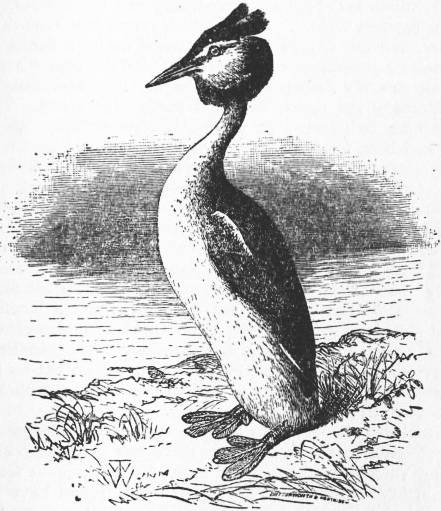
Illustration: Great Crested Grebe.
In Europe are five well-marked species of Podiceps, the commonest and smallest of which is the very well-known dab-chick of English ponds, P. fluviatilis or minor, the little grebe of ornithologists, found throughout the British Islands, and with a wide range in the old world. Next in size are two species known as the eared and horned grebes, the former of which, P. nigricollis, is a visitor from the south, only occasionally showing itself in Britain and very rarely breeding, while the latter, P. auritus, has a more northern range, breeding plentifully in Iceland, and is a not uncommon winter-visitant. Then there is the larger red-necked grebe, P. griseigena, also a northern bird, and a native of the subarctic parts of both Europe and America, while lastly the great crested grebe, P. cristatus or gaunt—known as the loon on the meres and broads of East Anglia and some other parts of England, is also widely spread over the old world. North America is credited with seven species of grebes, of which two (P. griseigena and P. auritus) are admitted to be specifically inseparable from those already named, and two (P. occidentalis and P. californicus) appear to be but local forms; the remaining two (P. dominicus and P. ludovicianus) may, however, be accounted good species, and the last differs so much from other grebes that many systematists make it the type of a distinct genus, Podilymbus. South America seems to possess four or five more species, one of which, the P. micropterus of Gould (Proc. Zool. Society, 1858, p. 220), has been deservedly separated from the genus Podiceps under the name Centropelma by Sclater and Salvin (Exot. Ornithology, p. 189, pl. xcv.), owing to the form of its bill, and the small size of its wings, which renders it absolutely flightless. Lake Titicaca in Bolivia is, so far as is known at present, its only habitat. Grebes in general, though averse from taking wing, have much greater power of flight than would seem possible on examination of their alar organs, and are capable of prolonged aerial journeys. Their plumage is short and close. Above it is commonly of some shade of brown, but beneath it is usually white, and so glossy as to be in much request for muffs and the trimming of ladies’ dresses. Some species are remarkable for the crests or tippets, generally of a golden-chestnut colour, they assume in the breeding season. P. auritus is particularly remarkable in this respect, and when in its full nuptial attire presents an extraordinary aspect, the head (being surrounded, as it were, by a nimbus or aureole, such as that with which painters adorn saintly characters), reflecting the rays of light, glitters with a glory that passes description. All the species seem to have similar habits of nidification. Water-weeds are pulled from the bottom of the pool, and piled on a convenient foundation, often a seminatant growth of bogbean (Menyanthes), till they form a large mass, in the centre of which a shallow cup is formed, and the eggs, with a chalky white shell almost equally pointed at each end, are laid—the parent covering them, whenever she has time to do so, before leaving the nest. Young grebes are beautiful objects, clothed with black, white and brown down, disposed in streaks and their bill often brilliantly tinted. When taken from the nest and placed on dry ground, it is curious to observe the way in which they progress—using the wings almost as fore-feet, and suggesting the notion that they must be quadrupeds instead of birds.
(A. N.)
1 Often, but erroneously, written Podicipidae. The word Podiceps being a contracted form of Podicipes (cf. Gloger, Journal für Ornithologie, 1854, p. 430, note), a combination of podex, podicis and pes, pedis, its further compounds must be in accordance with its derivation.
GRECO, EL, the name commonly given to Dominico Theotocopuli (d. 1614), Cretan painter, architect and sculptor. He was born in Crete, between 1545 and 1550, and announces his Cretan origin by his signature in Greek letters on his most important pictures, especially on the “St Maurice” in the Escorial. He appears to have studied art first of all in Venice, and on arriving in Rome in 1570 is described as having been a pupil of Titian, in a letter written by the miniaturist, Giulio Clovio, addressed to Cardinal Alessandro Farnesi, dated the 15th of November 1570.
Although a student under Titian, he was at no time an exponent of his master’s spirit, and his early historical pictures were attributed to many other artists, but never to Titian. Of his early works, two pictures of “The Healing of the Blind Man” at Dresden and Palma, and the four of “Christ driving the money-changers out of the Temple” in the Yarborough collection, the Cork collection, the National Gallery, and the Beruete collection at Madrid, are the chief. His first authentic portrait is that of his fellow-countryman, Giulio Clovio. It was painted between 1570 and 1578, is signed in Greek characters, and preserved at Naples, and the last portrait he painted under the influence of the Italian school appears to be that of a cardinal now in the National Gallery, of which four replicas painted in Spain are known. He appears to have come to Spain in 1577, but, on being questioned two years later in connexion with a judicial suit, as to when he arrived in the country, and for what purpose he came, declined to give any information. He was probably attracted by the prospect of participating in the decoration of the Escorial, and he appears to have settled down in Toledo, where his first works were the paintings for the high altar of Santo Domingo, and his famous picture of “The Disrobing of Christ” in the sacristy of the cathedral. It was in connexion with this last-named work that he proved refractory, and the records of a law-suit respecting the price to be paid to him give us the earliest information of the artist’s sojourn in Spain. In 1590, he painted the “History of St Maurice” for Philip II., and in 1578, his masterpiece, entitled “The Burial of the Count Orgaz.” This magnificent picture, one of the finest in Spain, is at last being appreciated, and can only be put a little below the masterpieces of Velazquez. It is a strangely individual work, representing Spanish character even more truthfully than did any Spanish artist, and it gathers up all the fugitive moods, the grace and charm, the devices and defects of a single race, and gives them complete stability in their wavering expressions.
Between 1595 and 1600, El Greco executed two groups of paintings in the church of San José at Toledo, and in the hospital of La Caridad, at Illescas. Besides these, he is known to have painted thirty-two portraits, several manuscripts, and many paintings for altar-pieces in Toledo and the neighbourhood. As an architect he was responsible for more than one of the churches of Toledo, and as a sculptor for carvings both in wood and in marble, and he can only be properly understood in all his varied excellences after a visit to the city where most of his work was executed.
He died on the 7th of April 1614, and the date of his death is one of the very few certain facts which we have respecting him. The record informs us that he made no will, that he received the sacraments, and was buried in the church of Santo Domingo. The popular legend of his having gone mad towards the latter part of his career has no foundation in fact, but his painting became more and more eccentric as his life went on, and his natural perversity and love of strange, cold colouring, increased towards the end of his life. As has been well said, “Light with him was only used for emotional appeal, and was focussed or scattered at will.” He was haughtily certain of the value of his own art, and was determined to paint in cold, ashen colouring, with livid, startling effect, the gaunt and extraordinary figures that he beheld with his eccentric genius. His pictures have wonderful visionary quality, admirable invention, and are full of passionate fervency. They may be considered extravagant, but are never commonplace, and are exceedingly attractive in their intense emotion, marvellous sincerity, and strange, chilly colour.
El Greco’s work is typically modern, and from it the portrait-painter, J. S. Sargent, claims to have learnt more than from that of any other artist. It immortalizes the character of the people amongst whom he dwelt, and he may be considered as the initiator of truth and realism in art, a precursor and inspirer of Velazquez.
In his own time he was exceedingly popular, and held in great repute. Sonnets were written in his honour, and he is himself said to have written several treatises, but these have not come down to our time. For more than a generation his work was hardly known, but it is now gaining rapidly in importance, and its true position is more and more recognized. Some examples of the artist’s own handwriting have been discovered in Toledo, and Señor Don Manuel Cossia of Madrid has spent many years collecting information for a work dealing with the artist.
(G. C. W.)
GRECO-TURKISH WAR, 1897. This war between Greece and Turkey (see Greece: Modern History) involved two practically distinct campaigns, in Thessaly and in Epirus. Upon the Thessalian frontier the Turks, early in March, had concentrated six divisions (about 58,000 men), 1500 sabres and 156 guns, under Edhem Pasha. A seventh division was rendered available a little later. The Greeks numbered about 45,000 infantry, 800 cavalry and 96 guns, under the crown prince. On both sides there was a considerable dispersion of forces along the frontier. The Turkish navy, an important factor in the war of 1877-78, had become paralytic ten years later, and the Greek squadron held complete command of the sea. Expeditionary forces directed against the Turkish line of communications might have influenced the course of the campaign; but for such work the Greeks were quite unprepared, and beyond bombarding one or two insignificant ports on the coast-line, and aiding the transport of troops from Athens to Volo, the navy practically accomplished nothing. On the 9th and 10th April Greek irregulars crossed the frontier, either with a view to provoke hostilities or in the hope of fomenting a rising in Macedonia. On the 16th and 17th some fighting occurred, in which Greek regulars took part; and on the 18th Edhem Pasha, whose headquarters had for some time been established at Elassona, ordered a general advance. The Turkish plan was to turn the Greek left and to bring on a decisive action, but this was not carried out. In the centre the Turks occupied the Meluna Pass on the 19th, and the way was practically open to Larissa. The Turkish right wing, however, moving on Damani and the Reveni Pass, encountered resistance, and the left wing was temporarily checked by the Greeks among the mountains near Nezeros. At Mati, covering the road to Tyrnavo, the Greeks entrenched themselves. Here sharp fighting occurred on the 21st and 22nd, during which the Greeks sought to turn the right flank of the superior Turkish central column. On the 23rd fighting was renewed, and the advance guard of the Turkish left column, which had been reinforced, and had pressed back the Greeks, reached Deliler. The Turkish forces had now drawn together, and the Greeks were threatened on both flanks. In the evening a general retreat was ordered, and the loose discipline of the Greek army was at once manifested. Rumours of disaster spread among the ranks, and wild panic supervened. There was nothing to prevent an orderly retirement upon Larissa, which had been fortified and provisioned, and which offered a good defensive position. The general débâcle could not, however, be arrested, and in great disorder the mass of the Greek army fled southwards to Pharsala. There was no pursuit, and the Turkish commander-in-chief did not reach Larissa till the 27th. Thus ended the first phase of the war, in which the Greeks showed tenacity in defence, which proved fruitless by reason of initially bad strategic dispositions entailing far too great dispersion, and also because there was no plan of action beyond a general desire to avoid risking a defeat which might prevent the expected risings in Macedonia and elsewhere. The handling of the Turkish army showed little skill or enterprise; but on both sides political considerations tended to prevent the application of sound military principles.
Larissa being abandoned by the Greeks, Velestino, the junction of the Thessalian railways, where there was a strong position covering Volo, seemed to be the natural rallying point for the Greek army. Here the support of the fleet would have been secured, and a Turkish advance across the Othrys range upon Athens could not have taken place until the flanking position had been captured. Whether by direction or by natural impulse, however, the mass of the Greek troops made for Pharsala, where some order was re-established, and preparations were made to resist attack. The importance of Velestino was recognized by sending a brigade thither by railway from Pharsala, and the inferior Greek army was thus split into two portions, separated by nearly 40 m. On 27th April a Turkish reconnaissance on Velestino was repulsed, and further fighting occurred on the 29th and 30th, in which the Greeks under Colonel Smolenski held their own. Meanwhile the Turks made preparations to attack Pharsala, and on 5th May the Greeks were driven from their positions in front of the town by three divisions. Further fighting followed on the 6th, and in the evening the Greek army retired in fair order upon Domokos. It was intended to turn the Greek left with the first division under Hairi Pasha, but the flanking force did not arrive in time to bring about a decisive result. The abandonment of Pharsala involved that of Velestino, where the Turks had obtained no advantage, and on the evening of the 5th Colonel Smolenski began a retirement upon Halmyros. Again delaying, Edhem Pasha did not attack Domokos till the 17th, giving the Greeks time to entrench their positions. The attack was delivered in three columns, of which the right was checked and the centre failed to take the Greek trenches and suffered much loss. The left column, however, menaced the line of retreat, and the Greek army abandoned the whole position during the night. No effective stand was made at the Furka Pass, which was evacuated on the following night. Colonel Smolenski, who arrived on the 18th from Halmyros, was directed to hold the pass of Thermopylae. The Greek forces being much demoralized, the intervention of the tsar was invoked by telegraph; and the latter sent a personal appeal to the Sultan, who directed a suspension of hostilities. On the 20th an armistice was arranged.
In Epirus at the outbreak of war about 15,000 Greeks, including a cavalry regiment and five batteries, the whole under Colonel Manos, occupied a line of defence from Arta to Peta. The Turks, about 28,000 strong, with forty-eight guns, under Achmet Hifsi Pasha, were distributed mainly at Iannina, Pentepagadia, and in front of Arta. On 18th April the Turks commenced a three days’ bombardment of Arta; but successive attempts to take the bridge were repulsed, and during the night of the 21st they retired on Philippiada, 26 m. distant, which was attacked and occupied by Colonel Manos on the 23rd. The Greeks then advanced to Pentepagadia, meeting with little resistance. Their difficulties now began. After some skirmishing on the 27th, the position held by their advanced force near Homopulos was attacked on the 28th. The attack was renewed on the 29th, and no Greek reinforcements were forthcoming when needed. The Euzones made a good defence, but were driven back by superior force, and a retreat was ordered, which quickly degenerated into panic-stricken flight to and across the Arta. Reinforcements, including 2500 Epirote volunteers, were sent to Arta from Athens, and on 12th May another incursion into Turkish territory began, the apparent object being to occupy a portion of the country in view of the breakdown in Thessaly and the probability that hostilities would shortly end. The advance was made in three columns, while the Epirote volunteers were landed near the mouth of the Luro river with the idea of cutting off the Turkish garrison of Prevesa. The centre column, consisting of a brigade, three squadrons and two batteries, which were intended to take up and hold a defensive position, attacked the Turks near Strevina on the 13th. The Greeks fought well, and being reinforced by a battalion from the left column, resumed the offensive on the following day, and fairly held their own. On the night of the 15th a retreat was ordered and well carried out. The volunteers landed at the mouth of the Luro, were attacked and routed with heavy loss.
The campaign in Epirus thus failed as completely as that in Thessaly. Under the terms of the treaty of peace, signed on 20th September, and arranged by the European powers, Turkey obtained an indemnity of £T4,000,000, and a rectification of the Thessalian frontier, carrying with it some strategic advantage. History records few more unjustifiable wars than that which Greece gratuitously provoked. The Greek troops on several occasions showed tenacity and endurance, but discipline and cohesion were manifestly wanting. Many of the officers were incapable; the campaign was gravely mismanaged; and politics, which led to the war, impeded its operations. On the other hand, the fruits of the German tuition, which began in 1880, and received a powerful stimulus by the appointment of General von der Goltz in 1883, were shown in the Turkish army. The mobilization was on the whole smoothly carried out, and the newly completed railways greatly facilitated the concentration on the frontier. The young school of officers trained by General von der Goltz displayed ability, and the artillery at Pharsala and Domokos was well handled. The superior leading was, however, not conspicuously successful; and while the rank and file again showed excellent military qualities, political conditions and the Oriental predilection for half-measures and for denying full responsibility and full powers to commanders in the field enfeebled the conduct of the campaign. On account of the total want of careful and systematic peace training on both sides, a war which presented several interesting strategic problems provided warnings in place of military lessons.
(G. S. C.)
GREECE,1 an ancient geographical area, and a modern kingdom more or less corresponding thereto, situated at the south-eastern extremity of Europe and forming the most southerly portion of the Balkan Peninsula. The modern kingdom is bounded on the N. by European Turkey and on the E., S. and W. by the Aegean, Mediterranean and Ionian seas. The name Graecia, which was more or less vaguely given to the ancient country by the Romans, seems not to have been employed by any native writer before Aristotle; it was apparently derived by the Romans from the Illyrians, who applied the name of an Epirote tribe (Γραικοί, Graeci) to all their southern neighbours. The names Hellas, Hellenes (Ἕλλας, Ἕλληνες), by which the ancient Greeks called their country and their race, and which are still employed by the modern Greeks, originally designated a small district in Phthiotis in Thessaly and its inhabitants, who gradually spread over the lands south of the Cambunian mountains. The name Hellenes was not universally applied to the Greek race until the post-Homeric epoch (Thucyd. i. 3).
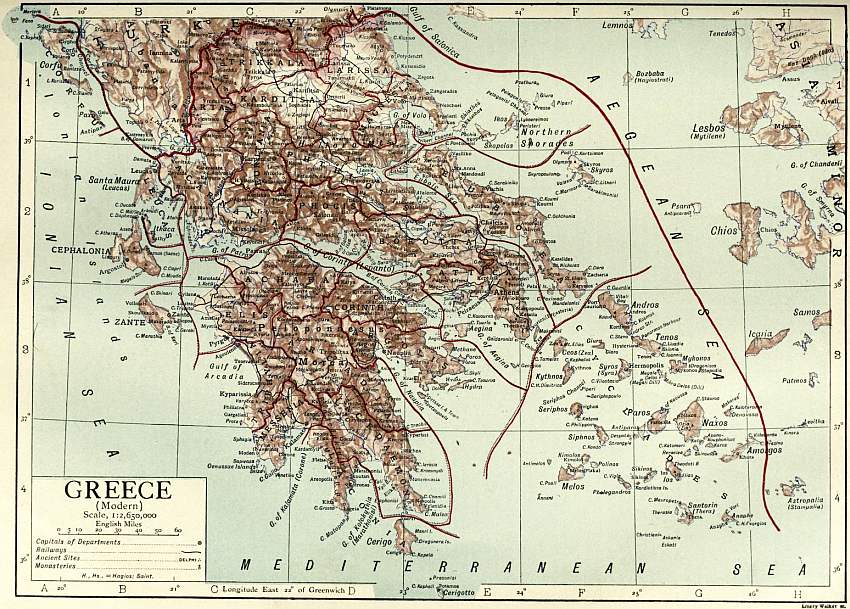
(Click to enlarge.)
1. Geography and Statistics
The ancient Greeks had a somewhat vague conception of the northern limits of Hellas. Thessaly was generally included and Epirus excluded; some writers included some of the southern cantons of Epirus, while others excluded not Extent of ancient Greece. only all that country but Aetolia and Acarnania. Generally speaking, the confines of Hellas in the age of its greatest distinction were represented by a line drawn from the northern shore of the Ambracian Gulf on the W. to the mouth of the Peneus on the E. Macedonia and Thrace were regarded as outside the pale of Hellenic civilization till 386 B.C., when after his conquest of Thessaly and Phocis, Philip of Macedon obtained a seat in the Amphictyonic Council. In another sense, however, the name Hellas expressed an ethnological rather than a geographical unity; it denoted every country inhabited by Hellenes. It thus embraced all the Greek settlements on the coasts and islands of the Mediterranean, on the shores of the Hellespont, the Bosporus and the Black Sea. Nevertheless, the Greek peninsula within the limits described above, together with the adjacent islands, was always regarded as Hellas par excellence. The continental area of Hellas proper was no greater than that of the modern Greek kingdom, which comprises but a small portion of the territories actually occupied by the Greek race. The Greeks have always been a maritime people, and the real centre of the national life is now, as in antiquity, the Aegean Sea or Archipelago. Thickly studded with islands and bordered by deeply indented coasts with sheltered creeks and harbours, the Aegean in the earliest days of navigation invited the enterprise of the mariner; its shores, both European and Asiatic, became covered with Greek settlements and its islands, together with Crete and Cyprus, became Greek. True to their maritime instincts, the Greeks rarely advanced inland to any distance from the sea; the coasts of Macedonia, Thrace and Asia Minor are still mainly Greek, but, except for some isolated colonies, the hinterland in each case lies outside the limits of the race. Continental Greece is divided by its mountain ranges into a number of natural cantons; the existence of physical barriers tended in the earliest times to the growth of isolated political communities, and in the epoch of its ancient independence the country was occupied by seventeen separate states, none of them larger than an ordinary English county. These states, which are noticed separately, were: Thessaly, in northern Greece; Acarnania, Aetolia, Locris, Doris, Phocis, Megaris, Boeotia and Attica in central Greece; and Corinthia, Sicyonia, Achaea, Elis, Messenia, Laconia, Argolis and Arcadia in the Peloponnesus.
Modern Greece, which (including the adjacent islands) extends from 35° 50′ to 39° 54′ N. and from 19° 20′ to 26° 15′ E., comprises all the area formerly occupied by these states. Under the arrangement concluded at Constantinople Extent of modern Greece. on the 21st of July 1832 between Great Britain, France, Russia and Turkey, the northern boundary of Greece was drawn from the Gulf of Arta (Sinus Ambracius) to the Gulf of Volo (S. Pagasaeus), the line keeping to the crest of the Othrys range. Thessaly and part of Acarnania were thus left to Turkey. The island of Euboea, the Cyclades and the northern Sporades were added to the new kingdom. In 1864 the Ionian Islands (q.v.) were ceded by Great Britain to Greece. In 1880 the Conference of Berlin proposed a new frontier, which transferred to Greece not only Thessaly but a considerable portion of southern Epirus, extending to the river Kalamas. This, however, was rejected by Turkey, and the existing boundary was traced in 1881. Starting from the Aegean coast at a point near Platamona, between Mount Olympus and the mouth of the Salambria (Peneus), the line passes over the heights of Kritiri and Zygos (Pindus) and descends the course of the river Arta to its mouth. After the war of 1897 Greece restored to Turkey some strategical points on the frontier possessing no geographical importance. The greatest length of Greece is about 250 m., the greatest breadth 180 m. The country is generally divided into five parts, which are indicated by its natural features:—(i.) Northern Greece, which extends northwards from Mount Othrys and the gulfs of Zeitun (Lamia) and Arta to the Cambunian Mountains, and comprises Thessaly and a small portion of Epirus; (ii.) Central Greece, extending from the southern limits of Northern Greece to the gulfs of Corinth and Aegina; (iii.) the peninsula of the Peloponnesus or Morea, attached to the mainland by the Isthmus of Corinth; (iv.) the Ionian Islands on the west coasts of Epirus and Greece; (v.) The islands of the Aegean Sea, including Euboea, the Cyclades and the northern Sporades.
In the complexity of its contour and the variety of its natural features Greece surpasses every country in Europe, as Europe surpasses every continent in the world. The broken character of its coast-line is unique; except a few districts in Thessaly Physical features. no part of the country is more than 50 m. from the sea. Although the area of Greece is considerably smaller than that of Portugal, its coast-line is greater than that of Spain and Portugal together. The mainland is penetrated by numerous gulfs and inlets, and the adjoining seas are studded with islands. Another characteristic is the number and complexity of the mountain chains, which traverse every part of the country and which, together with their ramifications, cover four-fifths of its surface. The mountain-chains interlace, the interstices forming small enclosed basins, such as the plain of Boeotia and the plateau of Arcadia; the only plain of any extent is that of Thessaly. The mountains project into the sea, forming peninsulas, and sometimes reappearing in rows or groups of islands; they descend abruptly to the coast or are separated from it by small alluvial plains. The portions of the country suitable for human colonization were thus isolated one from the other, but as a rule possessed easy access to the sea. The earliest settlements were generally situated on or around some rocky elevation, which dominated the surrounding plain and was suitable for fortification as a citadel or acropolis; owing to the danger of piratical attacks they were usually at some little distance from the sea, but in the vicinity of a natural harbour. The physical features of the country played an important part in moulding the character of its inhabitants. Protected against foreign invasion by the mountain barriers and to a great extent cut off from mutual intercourse except by sea, the ancient Greek communities developed a marked individuality and a strong sentiment of local patriotism; their inhabitants were both mountaineers and mariners; they possessed the love of country, the vigour and the courage which are always found in highlanders, together with the spirit of adventure, the versatility and the passion for freedom characteristic of a seafaring people. The great variety of natural products as well as the facility of maritime communication tended to the early growth of commercial enterprise, while the peculiar beauty of the scenery, though little dwelt upon in ancient literature, undoubtedly quickened the poetic and artistic instincts of the race. The effects of physical environment are no less noticeable among the modern Greeks. The rural populations of Attica and Boeotia, though descended from Albanian colonists in the middle ages, display the same contrast in character which marked the inhabitants of those regions in ancient times.
In its general aspect the country presents a series of striking and interesting contrasts. Fertile tracts covered with vineyards, olive groves, corn-fields or forests display themselves in close proximity with rugged heights and rocky precipices; the landscape is never, monotonous; its outlines are graceful, and its colouring, owing to the clearness of the air, is at once brilliant and delicate, while the sea, in most instances, adds a picturesque feature, enhancing the charm and variety of the scenery.
The ruling feature in the mountain system of northern Greece is the great chain of Pindus, which, extending southwards from the lofty Shar Dagh (Skardos) near Uskub, forms the backbone of the Balkan peninsula. Reaching the frontier Mountains. of Greece a little S. of lat. 40°, the Pindus range is intersected by the Cambunian Mountains running E. and W.; the eastern branch, which forms the northern boundary of Thessaly, extends to the Gulf of Salonica and culminates in Mount Olympus (9754 ft.) a little to the N. of the Greek frontier; then bending to the S.E. it follows the coast-line, forming a rampart between the Thessalian plain and the sea; the barrier is severed at one point only where the river Salambria (anc. Peneus) finds an exit through the narrow defile of Tempe. South of Tempe the mountain ridge, known as the Mavro Vouno, connects the pyramidal Kissovo (anc. Ossa, 6400 ft.) with Plessidi (anc. Pelion, 5310 ft.); it is prolonged in the Magnesian peninsula, which separates the Gulf of Volo from the Aegean, and is continued by the mountains of Euboea (highest summits, Dirphys, 5725 ft., and Ocha, 4830 ft.) and by the islands of Andros and Tenos. West of Pindus, the Cambunian Mountains are continued by several ridges which traverse Epirus from north to south, enclosing the plain and lake of Iannina; the most westerly of these, projecting into the Adriatic, forms the Acroceraunian promontory terminating in Cape Glossa. The principal pass through the Cambunian Mountains is that of Meluna, through which runs the carriage-road connecting the town of Elassona in Macedonia with Larissa, the capital of Thessaly; there are horse-paths at Reveni and elsewhere. The central chain of Pindus at the point where it is intersected by the Cambunian Mountains forms the mass of Zygos (anc. Lacmon, 7113 ft.) through which a horse-path connects the town of Metzovo with Kalabaka in Thessaly; on the declivity immediately N. of Kalabaka are a series of rocky pinnacles on which a number of monasteries are perched. Trending to the S., the Pindus chain terminates in the conical Mount Velouchi (anc. Tymphrestus, 7609 ft.) in the heart of the mountainous region of northern Greece. From this centre-point a number of mountains radiate in all directions. To the E. runs the chain of Helloro (anc. Othrys; highest summit, Hagios Elias, 5558 ft.) separating the plain of Thessaly from the valley of the Spercheios and traversed by the Phourka pass (2789 ft.); to the S.E. is Mount Katávothra (anc. Oeta, 7080 ft.) extending to the southern shore of the Gulf of Lamia at Thermopylae; to the S.E., S. and S.W. are the mountains of Aetolia and Acarnania. The Aetolian group, which may be regarded as the direct continuation of the Pindus range, includes Kiona (8240 ft.), the highest mountain in Greece, and Vardusi (anc. Korax, 8190 ft.). The mountains of Acarnania with Ὑψηλὴ κορυφή (5215 ft.) rise to the W. of the valley of the Aspropotamo (anc. Achelous). The Aetolian Mountains are prolonged to the S.E. by the double-crested Liakoura (anc. Parnassus; 8064 ft.) in Phocis; by Palaeo Vouno (anc. Helicon, 5738 ft.) and Elateas (anc. Cithaeron, 4626 ft.) respectively W. and S. of the Boeotian plain; and by the mountains of Attica,—Ozea (anc. Parnes, 4626 ft.), Mendeli (anc. Pentelicus or Brilessos, 3639 ft.), Trellovouno (anc. Hymettus, 3369 ft.), and Keratia (2136 ft.)—terminating in the promontory of Sunium, but reappearing in the islands of Ceos, Cythnos, Seriphos and Siphnos. South of Cithaeron are Patera in Megaris (3583 ft.) and Makri Plagi (anc. Geraneia, 4495 ft.) overlooking the Isthmus of Corinth.
The mountains of the Morea, grouped around the elevated central plateau of Arcadia, form an independent system with ramifications extending through the Argolid peninsula on the E. and the three southern promontories of Malea, Taenaron and Acritas. At the eastern end of the northern chain, separating Arcadia from the Gulf of Corinth, is Ziria (anc. Cyllene, 7789 ft.); it forms a counterpart to Parnassus on the opposite side of the gulf. A little to the W. is Chelmos (anc. Aroania, 7725 ft.); farther W., Olonos (anc. Erymanthus, 7297 ft.) and Voïdia (anc. Panachaïcon, 6322 ft.) overlooking the Gulf of Patras. The highest summit in the Argolid peninsula is Hagios Elias (anc. Arachnaeon, 3930 ft.). The series of heights forming the eastern rampart of Arcadia, including Artemision (5814 ft.) and Ktenia (5246 ft.) is continued to the S. by the Malevo range (anc. Parnon, highest summit 6365 ft.) which extends into the peninsula of Malea and reappears in the island of Cerigo. Separated from Parnon by the Eurotas valley to the W., the chain of Taygetus (mod. Pentedaktylon; highest summit Hagios Elias, 7874 ft., the culminating point of the Morea) forms a barrier between the plains of Laconia and Messenia; it is traversed by the Langáda pass leading from Sparta to Kalamata. The range is prolonged to the S. through the arid district of Maina and terminates in Cape Matapan (anc. Taenarum). The mountains of western Arcadia are less lofty and of a less marked type; they include Hagios Petros (4777 ft.) and Palaeócastro (anc. Pholoë, 2257 ft.) N. of the Alpheus valley, Diaphorti (anc. Lycaeus, 4660 ft.), the haunt of Pan, and Nomia (4554 ft.) W. of the plain of Megalopolis. Farther south, the mountains of western Messenia form a detached group (Varvara, 4003 ft.; Mathia, 3140 ft.) extending to Cape Gallo (anc. Acritas) and the Oenussae Islands. In central Arcadia are Apanokrapa (anc. Maenalus, also sacred to Pan) and Roudia (5072 ft.); the Taygetus chain forms the southern continuation of these mountains.
The more noteworthy fortified heights of ancient Greece were the Acrocorinthus, the citadel of Corinth (1885 ft.); Ithome (2631 ft.) at Messene; Larissa (950 ft.) at Argos; the Acropolis of Mycenae (910 ft.); Tiryns (60 ft.) near Nauplia, which also possessed its own citadel, the Palamidhi or Acro-nauplia (705 ft.); the Acropolis of Athens (300 ft. above the mean level of the city and 512 ft. above the sea), and the Cadmea of Thebes (715 ft.).
Greece has few rivers; most of these are small, rapid and turbid, as might be expected from the mountainous configuration of the country. They are either perennial rivers or torrents, the white beds of the latter being dry in summer, and only filled with water Rivers. after the autumn rains. The chief rivers (none of which is navigable) are the Salambria (Peneus) in Thessaly, the Mavropotamo (Cephisus) in Phocis, the Hellada (Spercheios) in Phthiotis, the Aspropotamo (Achelous) in Aetolia, and the Ruphia (Alpheus) and Vasiliko (Eurotas) in the Morea. Of the famous rivers of Athens, the one, the Ilissus, is only a chain of pools all summer, and the other, the Cephisus, though never absolutely dry, does not reach the sea, being drawn off in numerous artificial channels to irrigate the neighbouring olive groves. A frequent peculiarity of the Greek rivers is their sudden disappearance in subterranean chasms and reappearance on the surface again, such as gave rise to the fabled course of the Alpheus under the sea, and its emergence in the fountain of Arethusa in Syracuse. Some of these chasms—“Katavothras”—are merely sieves with herbage and gravel in the bottom, but others are large caverns through which the course of the river may sometimes be followed. Floods are frequent, especially in autumn, and natural fountains abound and gush out even from the tops of the hills. Aganippe rises high up among the peaks of Helicon, and Peirene flows from the summit of Acrocorinthus. The only noteworthy cascade, however, is that of the Styx in Arcadia, which has a fall of 500 ft. During part of the year it is lost in snow, and it is at all times almost inaccessible. Lakes are numerous, but few are of considerable size, and many merely marshes in summer. The largest are Karla (Boebeïs) in Thessaly, Trichonis in Aetolia, Copaïs in Boeotia, Pheneus and Stymphalus in Arcadia.
The valleys are generally narrow, and the plains small in extent, deep basins walled in among the hills or more free at the mouths of the rivers. The principal plains are those of Thessaly, Boeotia, Messenia, Argos, Elis and Marathon. The bottom Plains. of these plains consists of an alluvial soil, the most fertile in Greece. In some of the mountainous regions, especially in the Morea, are extensive table-lands. The plain of Mantinea is 2000 ft. high, and the upland district of Sciritis, between Sparta and Tegea, is in some parts 3000 ft.
Strabo said that the guiding thing in the geography of Greece was the sea, which presses in upon it at all parts with a thousand arms. From the Gulf of Arta on the one side to the Gulf of Volo on the other the coast is indented with a succession Coast. of natural bays and gulfs. The most important are the Gulfs of Aegina (Saronicus) and Lepanto (Corinthiacus), which separate the Morea from the northern mainland of Greece,—the first an inlet of the Aegean, the second of the Ionian Sea,—and are now connected by a canal cut through the high land of the narrow Isthmus of Corinth (3½ m. wide). The outer portion of the Gulf of Lepanto is called the Gulf of Patras, and the inner part the Bay of Corinth; a narrow inlet on the north side of the same gulf, called the Bay of Salona or Itea, penetrates northwards into Phocis so far that it is within 24 geographical miles of the Gulf of Zeitun on the north-east coast. The width of the entrance to the gulf of Lepanto is subject to singular changes, which are ascribed to the formation of alluvial deposits by certain marine currents, and their removal again by others. At the time of the Peloponnesian war this channel was 1200 yds. broad; in the time of Strabo it was only 850; and in our own day it has again increased to 2200. On the coast of the Morea there are several large gulfs, that of Arcadia (Cyparissius) on the west, Kalamata (Messeniacus) and Kolokythia (Laconicus) on the south and Nauplia (Argolicus) on the east. Between Euboea and the mainland lie the channels of Trikeri, Talanti (Euboicum Mare) and Egripo; the latter two are connected by the strait of Egripo (Euripus). This strait, which is spanned by a swing-bridge, is about 180 ft. wide, and is remarkable for the unexplained eccentricity of its tide, which has puzzled ancients and moderns alike. The current runs at the average speed of 5 m. an hour, but continues only for a short time in one direction, changing its course, it is said, ten or twelve times in a day; it is sometimes very violent.
There are no volcanoes on the mainland of Greece, but everywhere traces of volcanic action and frequently visitations of earthquakes, for it lies near a centre of volcanic: agency, the island of Santorin, which has been within recent years in Volcanic action. a state of eruption. There is an extinct crater at Mount Laphystium (Granitsa) in Boeotia. The mountain of Methane, on the coast of Argolis, was produced by a volcanic eruption in 282 B.C. Earthquakes laid Thebes in ruins in 1853, destroyed every house in Corinth in 1858, filled up the Castalian spring in 1870, devastated Zante in 1893 and the district of Atalanta in 1894. There are hot springs at Thermopylae and other places, which are used for sanitary purposes. Various parts of the coast exhibit indications of upheaval within historical times. On the coast of Elis four rocky islets are now joined to the land, which were separate from it in the days of ancient Greece. There are traces of earlier sea-beaches at Corinth, and on the coast of the Morea, and at the mouth of the Hellada. The land has gained so much that the pass of Thermopylae which was extremely narrow in the time of Leonidas and his three hundred, is now wide enough for the motions of a whole army.
(J. D. B.)
Structurally, Greece may be divided into two regions, an eastern and a western. The former includes Thessaly, Boeotia, the island of Euboea, the isthmus of Corinth, and the peninsula of Argolis, and, throughout, the strike of the beds is nearly Geology. from west to east. The western region includes the Pindus and all the parallel ranges, and the whole of the Peloponnesus excepting Argolis. Here the folds which affect the Mesozoic and early Tertiary strata run approximately from N.N.W. to S.S.E.
Up to the close of the 19th century the greater part of Greece was believed to be formed of Cretaceous rocks, but later researches have shown that the supposed Cretaceous beds include a variety of geological horizons. The geological sequence begins with crystalline schists and limestones, followed by Palaeozoic, Triassic and Liassic rocks. The oldest beds which hitherto have yielded fossils belong to the Carboniferous System (Fusulina limestone of Euboea). Following upon these older beds are the great limestone masses which cover most of the eastern region, and which are now known to include Jurassic, Tithonian, Lower and Upper Cretaceous and Eocene beds. In the Pindus and the Peloponnesus these beds are overlaid by a series of shales and platy limestones (Olonos Limestone of the Peloponnesus), which were formerly supposed to be of Tertiary age. It has now been shown, however, that the upper series of limestones has been brought upon the top of the lower by a great overthrust. Triassic fossils have been found in the Olonos Limestone and it is almost certain that other Mesozoic horizons are represented.
The earth movements which produced the mountain chains of western Greece have folded the Eocene beds and must therefore be of post-Eocene date. The Neogene beds, on the other hand, are not affected by the folds, although by faulting without folding they have in some places been raised to a height of nearly 6000 ft. They lie, however, chiefly along the coast and in the valleys, and consist of marls, conglomerates and sands, sometimes with seams of lignite. The Pikermi deposits, of late Miocene age, are famous for their rich mammalian fauna.
Although the folding which formed the mountain chains appears to have ceased, Greece is still continually shaken by earthquakes, and these earthquakes are closely connected with the great lines of fracture to which the country owes its outline. Around the narrow gulf which separates the Peloponnesus from the mainland, earthquakes are particularly frequent, and another region which is often shaken is the south-western corner of Greece, the peninsula of Messene.2
(P. La.)
The vegetation of Greece in general resembles that of southern Italy while presenting many types common to that of Asia Minor. Owing to the geographical configuration of the peninsula and its mountainous surface the characteristic flora of the Flora. Mediterranean regions is often found in juxtaposition with that of central Europe. In respect to its vegetation the country may be regarded as divided into four zones. In the first, extending from the sea-level to the height of 1500 ft., oranges, olives, dates, almonds, pomegranates, figs and vines flourish, and cotton and tobacco are grown. In the neighbourhood of streams are found the laurel, myrtle, oleander and lentisk, together with the plane and white poplar; the cypress is often a picturesque feature in the landscape, and there is a variety of aromatic plants. The second zone, from 1500 to 3500 ft., is the region of the oak, chestnut and other British trees. In the third, from 3500 to 5500 ft., the beech is the characteristic forest tree; the Abies cephalonica and Pinus pinea now take the place of the Pinus halepensis, which grows everywhere in the lower regions. Above 5500 ft. is the Alpine region, marked by small plants, lichens and mosses. During the short period of spring anemones and other wild flowers enrich the hillsides with magnificent colouring; in June all verdure disappears except in the watered districts and elevated plateaus. The asphodel grows abundantly in the dry rocky soil; aloes, planted in rows, form impenetrable hedges. Medicinal plants are numerous, such as the Inula Helenium, the Mandragora Officinarum, the Colchicum napolitanum and the Helleborus orientalis, which still grows abundantly near Aspraspitia, the ancient Anticyra, at the foot of Parnassus.
The fauna is similar to that of the other Mediterranean peninsulas, and includes some species found in Asia Minor but not elsewhere in Europe. The lion existed in northern Greece in the time of Aristotle and at an earlier period in the Morea. The bear Fauna. is still found in the Pindus range. Wolves are common in all the mountainous regions and jackals are numerous in the Morea. Foxes are abundant in all parts of the country; the polecat is found in the woods of Attica and the Morea; the lynx is now rare. The wild boar is common in the mountains of northern Greece, but is almost extinct in the Peloponnesus. The badger, the marten and the weasel are found on the mainland and in the islands. The red deer, the fallow deer and the roe exist in northern Greece, but are becoming scarce. The otter is rare. Hares and rabbits are abundant in many parts of the country, especially in the Cyclades; the two species never occupy the same district, and in the Cyclades some islands (Naxos, Melos, Tenos, &c.) form the exclusive domain of the hares, others (Seriphos, Kimolos, Mykonos, &c.) of the rabbits. In Andros alone a demarcation has been arrived at, the hares retaining the northern and the rabbits the southern portion of the island. The chamois is found in the higher mountains, such as Pindus, Parnassus and Tymphrestus. The Cretan agrimi, or wild goat (Capra nubiana, C. aegagrus), found in Antimelos and said to exist in Taygetus, the jackal, the stellion, and the chameleon are among the Asiatic species not found westward of Greece. There is a great variety of birds; of 358 species catalogued two-thirds are migratory. Among the birds of prey, which are very numerous, are the golden and imperial eagle, the yellow vulture, the Gypaëtus barbatus, and several species of falcons. The celebrated owl of Athena (Athene noctua) is becoming rare at Athens, but still haunts the Acropolis and the royal garden; it is a small species, found everywhere in Greece. The wild goose and duck, the bustard, partridge, woodcock, snipe, wood-pigeon and turtle-dove are numerous. Immense flocks of quails visit the southern coast of the Morea, where they are captured in great numbers and exported alive. The stork, which was common in the Turkish epoch, has now become scarce. There is a great variety of reptiles, of which sixty-one species have been catalogued. The saurians are all harmless; among them the stellion (Stellio vulgaris), commonly called κροκόδειλος in Mykonos and Crete, is believed by Heldreich to have furnished a name to the crocodile of the Nile (Herod. ii. 69). There are five species of tortoise and nine of Amphibia. Of the serpents, which are numerous, there are only two dangerous species, the Vipera ammodytes and the Vipera aspis; the first-named is common. Among the marine fauna are the dolphins, familiar in the legends and sculpture of antiquity; in the clear water of the Aegean they often afford a beautiful spectacle as they play round ships; porpoises and whales are sometimes seen. Sea-fish, of which 246 species have been ascertained, are very abundant.
The climate of Greece, like that of the other countries of the Balkan peninsula, is liable to greater extremes of heat and cold than prevail in Spain and Italy; the difference is due to the general contour of the peninsula, which assimilates its climatic Climate. conditions to those of the European mainland. Another distinctive feature is the great variety of local contrasts; the rapid transitions are the natural effect of diversity in the geographical configuration of the country. Within a few hours it is possible to pass from winter to spring and from spring to summer. The spring is short; the sun is already powerful in March, but the increasing warmth is often checked by cold northerly winds; in many places the corn harvest is cut in May, when southerly winds prevail and the temperature rises rapidly. The great heat of summer is tempered throughout the whole region of the archipelago by the Etesian winds, which blow regularly from the N.E. for forty to fifty days in July and August. This current of cool dry air from the north is due to the vacuum resulting from intense heat in the region of the Sahara. The healthy Etesian winds are generally replaced towards the end of summer by the southerly Libas or sirocco, which, when blowing strongly, resembles the blast from a furnace and is most injurious to health. The sirocco affects, though in a less degree, the other countries of the Balkan peninsula and even Rumania. The mean summer temperature is about 79° Fahr. The autumn is the least healthy season of the year owing to the great increase of humidity, especially in October and November. At the end of October snow reappears on the higher mountains, remaining on the summits till June. The winter is mild, and even in January there are, as a rule, many warm clear days; but the recurrence of biting northerly winds and cold blasts from the mountains, as well as the rapid transitions from heat to cold and the difference in the temperature of sunshine and shade, render the climate somewhat treacherous and unsuitable for invalids. Snow seldom falls in the maritime and lowland districts and frost is rare. The mean winter temperature is from 48° to 55° Fahr. The rainfall varies greatly according to localities; it is greatest in the Ionian Islands (53.34 ins. at Corfu), in Arcadia and in the other mountainous districts, and least on the Aegean littoral and in the Cyclades; in Attica, the driest region in Greece, it is 16.1 ins. The wettest months are November, December and January; the driest July and August, when, except for a few thunder-storms, there is practically no rainfall. The rain generally accompanies southerly or south-westerly winds. In all the maritime districts the sea breeze greatly modifies the temperature; it begins about 9 A.M., attains its maximum force soon after noon, and ceases about an hour after sunset. Greece is renowned for the clearness of its climate; fogs and mists are almost unknown. In most years, however, only four or five days are recorded in which the sky is perfectly cloudless. The natural healthiness of the climate is counteracted in the towns, especially in Athens, by deficient sanitation and by stifling clouds of dust, which propagate infection and are peculiarly hurtful in cases of ophthalmia and pulmonary disease. Malarial fever is endemic in the marshy districts, especially in the autumn.
The area of the country was 18,341 sq. m. before the acquisition of the Ionian Islands in 1864, 19,381 sq. m. prior to the annexation of Thessaly and part of Epirus in 1881, and 24,552 sq. m. at the census in 1896. If we deduct 152 Area and population. sq. m., the extent of territory ceded to Turkey after the war of 1897, the area of Greece in 1908 would be 24,400 sq. m. Other authorities give 25,164 and 25,136 sq. m. as the area prior to the rectification of the frontier in 1898.3 The population in 1896 was 2,433,806, or 99.1 to the sq. m., the population of the territories annexed in 1881 being approximately 350,000; and 2,631,952 in 1907, or 107.8 to the sq. m. (according to the official estimate of the area), showing an increase of 198,146 or 0.81% per annum, as compared with 1.61% during the period between 1896 and 1889; the diminished increase is mainly due to emigration. The population by sex in 1907 is given as 1,324,942 males and 1,307,010 females (or 50.3% males to 49.6 females). The preponderance of males, which was 52% to 48% females in 1896, has also been reduced by emigration; it is most marked in the northern departments, especially in Larissa. Only in the departments of Arcadia, Eurytania, Corinth, Cephalonia, Lacedaemon, Laconia, Phocis, Argolis and in the Cyclades, is the female population in excess of the male.
Neither the census of 1896 nor that of 1889 gave any classification by professions, religion or language. The following figures, which are only approximate, were derived from unofficial sources in 1901:—agricultural and pastoral employments 444,000; industries 64,200; traders and their employés 118,000; labourers and servants 31,300; various professions 15,700; officials 12,000; clergy about 6000; lawyers 4000; physicians 2500. In 1879, 1,635,698 of the population were returned as Orthodox Christians, 14,677 as Catholics and Protestants, 2652 as Jews, and 740 as of other religions. The annexation of Thessaly and part of Epirus is stated to have added 24,165 Mahommedan subjects to the Hellenic kingdom. A considerable portion of these, however, emigrated immediately after the annexation, and, although a certain number subsequently returned, the total Mahommedan population in Greece was estimated to be under 5000 in 1908. A number of the Christian inhabitants of these regions, estimated at about 50,000, retained Turkish nationality with the object of escaping military service. The Albanian population, estimated at 200,000 by Finlay in 1851, still probably exceeds 120,000. It is gradually being absorbed in the Hellenic population. In 1870, 37,598 persons (an obviously untrustworthy figure) were returned as speaking Albanian only. In 1879 the number is given as 58,858. The Vlach population, which has been increased by the annexation of Thessaly, numbers about 60,000. The number of foreign residents is unknown. The Italians are the most numerous, numbering about 11,000. Some 1500 persons, mostly Maltese, possess British nationality.
By a law of 27 November 1899, Greece, which had hitherto been divided into sixteen departments (νόμοι) was redivided into twenty-six departments, as follows:—
Departments. Pop. Departments. Pop.
1 Attica 341,247 14 Corinth 71,229
2 Boeotia 65,816 15 Arcadia 162,324
3 Phthiotis 112,328 16 Achaea 150,918
4 Phocis 62,246 17 Elis 103,810
5 Aetolia and Acarnania 141,405 18 Triphylia 90,523
6 Eurytania 47,192 19 Messenia 127,991
7 Arta 41,280 20 Laconia 61,522
8 Trikkala 90,548 21 Lacedaemon 87,106
9 Karditsa 92,941 22 Corfu 99,571
10 Larissa 95,066 23 Cephalonia 71,235
11 Magnesia 102,742 24 Leucas (with Ithaca) 41,186
12 Euboea 116,903 25 Zante 42,502
13 Argolis 81,943 26 Cyclades 130,378
The population is densest in the Ionian Islands, exceeding 307 per sq. m. The departments of Acarnania, Phocis and Euboea are the most thinly inhabited (about 58, 61 and 66 per sq. m. respectively).
Very little information is obtainable with regard to the movement of the population; no register of births, deaths and marriages is kept in Greece. The only official statistics are found in the periodical returns of the mortality in the twelve principal towns, according to which the yearly average of deaths in these towns for the five years 1903-1907 was approximately 10,253, or 23.8 per 1000; of these more than a quarter are ascribed to pulmonary consumption, due in the main to defective sanitation. Both the birth-rate and death-rate are low, being 27.6 and 20.7 per 1000 respectively. Infant mortality is slight, and in point of longevity Greece compares favourably with most other European countries. The number of illegitimate births is 12.25 per 1000; these are almost exclusively in the towns.
Of the total population 28.5% are stated to live in towns. The population of the principal towns is:—
1896. 1907.
Athens 111,486 167,479
Peiraeus 43,848 73,579
Patras 37,985 37,724
Trikkala 21,149 17,809
Hermopolis (Syra) 18,760 18,132
Corfu 18,581 28,254*
Volo 16,788 23,563
Larissa 15,373 18,001
Zante 14,906 13,580
Kalamata 14,298 15,397
Pyrgos 12,708 13,690
Tripolis 10,465 10,789
Chalcis 8,661 10,958
Laurium 7,926 10,007
* Including suburbs.
No trustworthy information is obtainable with regard to immigration and emigration, of which no statistics have ever been kept. Emigration, which was formerly in the main to Egypt and Rumania, is now almost exclusively to the United States of America. The principal exodus is from Arcadia, Laconia and Maina; the emigrants from these districts, estimated at about 14,000 annually, are for the most part young men approaching the age of military service. According to American statistics 12,431 Greeks arrived in the United States from Greece during the period 1869-1898 and 130,154 in 1899-1907; a considerable number, however, have returned to Greece, and those remaining in the United States at the end of 1907 were estimated at between 136,000 and 138,000; this number was considerably reduced in 1908 by remigration. Since 1896 the tendency to emigration has received a notable and somewhat alarming impulse. There is an increasing immigration into the towns from the rural districts, which are gradually becoming depopulated. Both movements are due in part to the preference of the Greeks for a town life and in part to distaste for military service, but in the main to the poverty of the peasant population, whose condition and interests have been neglected by the government.
Greece is inhabited by three races—the Greeks, the Albanians and the Vlachs. The Greeks who are by far the most numerous, have to a large extent absorbed the other races; the process of assimilation has been especially rapid since Ethnology. the foundation of the Greek kingdom. Like most European nations, the modern Greeks are a mixed race. The question of their origin has been the subject of much learned controversy; their presumed descent from the Greeks of the classical epoch has proved a national asset of great value; during the period of their struggle for independence it won them the devoted zeal of the Philhellenes, it inspired the enthusiasm of Byron, Victor Hugo, and a host of minor poets, and it has furnished a pleasing illusion to generations of scholarly tourists who delight to discover in the present inhabitants of the country the mental and physical characteristics with which they have been familiarized by the literature and art of antiquity. This amiable tendency is encouraged by the modern Greeks, who possess an implicit faith in their illustrious ancestry. The discussion of the question entered a very acrimonious stage with the appearance in 1830 of Fallmerayer’s History of the Morea during the Middle Ages. Fallmerayer maintained that after the great Slavonic immigration at the close of the 8th century the original population of northern Greece and the Morea, which had already been much reduced during the Roman period, was practically supplanted by the Slavonic element and that the Greeks of modern times are in fact Byzantinized Slavs. This theory was subjected to exhaustive criticism by Ross, Hopf, Finlay and other scholars, and although many of Fallmerayer’s conclusions remain unshaken, the view is now generally held that the base of the population both in the mainland and the Morea is Hellenic, not Slavonic. During the 5th and 6th centuries Greece had been subjected to Slavonic incursions which resulted in no permanent settlements. After the great plague of 746-747, however, large tracts of depopulated country were colonized by Slavonic immigrants; the towns remained in the hands of the Greeks, many of whom emigrated to Constantinople. In the Morea the Slavs established themselves principally in Arcadia and the region of Taygetus, extending their settlements into Achaia, Elis, Laconia and the promontory of Taenaron; on the mainland they occupied portions of Acarnania, Aetolia, Doris and Phocis. Slavonic place-names occurring in all these districts confirm the evidence of history with regard to this immigration. The Slavs, who were not a maritime race, did not colonize the Aegean Islands, but a few Slavonic place-names in Crete seem to indicate that some of the invaders reached that island. The Slavonic settlements in the Morea proved more permanent than those in northern Greece, which were attacked by the armies of the Byzantine emperors. But even in the Morea the Greeks, or “Romans” as they called themselves (Ῥωμαῖοι), who had been left undisturbed on the eastern side of the peninsula, eventually absorbed the alien element, which disappeared after the 15th century. In addition to the place-names the only remaining traces of the Slav immigration are the Slavonic type of features, which occasionally recurs, especially among the Arcadian peasants, and a few customs and traditions. Even when allowance is made for the remarkable power of assimilation which the Greeks possessed in virtue of their superior civilization, it is difficult to resist the conclusion that the Hellenic element must always have been the most numerous in order to effect so complete an absorption. This element has apparently undergone no essential change since the epoch of Roman domination. The destructive invasions of the Goths in A.D. 267 and 395 introduced no new ethnic feature; the various races which during the middle ages obtained partial or complete mastery in Greece—the Franks, the Venetians, the Turks—contributed no appreciable ingredient to the mass of the population. The modern Greeks may therefore be regarded as in the main the descendants of the population which inhabited Greece in the earlier centuries of Byzantine rule. Owing to the operation of various causes, historical, social and economic, that population was composed of many heterogeneous elements and represented in a very limited degree the race which repulsed the Persians and built the Parthenon. The internecine conflicts of the Greek communities, wars with foreign powers and the deadly struggles of factions in the various cities, had to a large extent obliterated the old race of free citizens by the beginning of the Roman period. The extermination of the Plataeans by the Spartans and of the Melians by the Athenians during the Peloponnesian war, the proscription of Athenian citizens after the war, the massacre of the Corcyraean oligarchs by the democratic party, the slaughter of the Thebans by Alexander and of the Corinthians by Mummius, are among the more familiar instances of the catastrophes which overtook the civic element in the Greek cities; the void can only have been filled from the ranks of the metics or resident aliens and of the descendants of the far more numerous slave population. Of the latter a portion was of Hellenic origin; when a city was taken the males of military age were frequently put to the sword, but the women and children were sold as slaves; in Laconia and Thessaly there was a serf population of indigenous descent. In the classical period four-fifths of the population of Attica were slaves and of the remainder half were metics. In the Roman period the number of slaves enormously increased, the supply being maintained from the regions on the borders of the empire; the same influences which in Italy extinguished the small landed proprietors and created the latifundia prevailed also in Greece. The purely Hellenic population, now greatly diminished, congregated in the towns; the large estates which replaced the small freeholds were cultivated by slaves and managed or farmed by slaves or freedmen, and wide tracts of country were wholly depopulated. How greatly the free citizen element had diminished by the close of the 1st century A.D. may be judged from the estimate of Plutarch that all Greece could not furnish more than 3000 hoplites. The composite population which replaced the ancient Hellenic stock became completely Hellenized. According to craniologists the modern Greeks are brachycephalous while the ancient race is stated to have been dolichocephalous, but it seems doubtful whether any such generalization with regard to the ancients can be conclusively established. The Aegean islanders are more brachycephalous than the inhabitants of the mainland, though apparently of purer Greek descent. No general conception of the facial type of the ancient race can be derived from the highly-idealized statues of deities, heroes and athletes; so far as can be judged from portrait statues it was very varied. Among the modern Greeks the same variety of features prevails; the face is usually oval, the nose generally long and somewhat aquiline, the teeth regular, and the eyes remarkably bright and full of animation. The country-folk are, as a rule, tall and well-made, though slightly built and rather meagre; their form is graceful and supple in movement. The urban population, as elsewhere, is physically very inferior. The women often display a refined and delicate beauty which disappears at an early age. The best physical types of the race are found in Arcadia, in the Aegean Islands and in Crete.
The Albanian population extends over all Attica and Megaris (except the towns of Athens, Peiraeus and Megara), the greater part of Boeotia, the eastern districts of Locris, the southern half of Euboea and the northern side of Andros, the whole of the islands of Salamis, Hydra, Spetsae and Poros, and part of Aegina, the whole of Corinthia and Argolis, the northern districts of Arcadia and the eastern portion of Achaea. There are also small Albanian groups in Laconia and Messenia (see Albania). The Albanians, who call themselves Shkyipetar, and are called by the Greeks Arvanitae (Ἀρβανῖται), belong to the Tosk or southern branch of the race; their immigration took place in the latter half of the 14th century. Their first settlements in the Morea were made in 1347-1355. The Albanian colonization was first checked by the Turks; in 1454 an Albanian insurrection in the Morea against Byzantine rule was crushed by the Turkish general Tura Khan, whose aid had been invoked by the Palaeologi. With a few exceptions, the Albanians in Greece retained their Christian faith after the Turkish conquest. The failure of the insurrection of 1770 was followed by a settlement of Moslem Albanians, who had been employed by the Turks to suppress the revolt. The Christian Albanians have long lived on good terms with the Greeks while retaining their own customs and language and rarely intermarrying with their neighbours. They played a brilliant part during the War of Independence, and furnished the Greeks with many of their most distinguished leaders. The process of their Hellenization, which scarcely began till after the establishment of the kingdom, has been somewhat slow; most of the men can now speak Greek, but Albanian is still the language of the household. The Albanians, who are mainly occupied with agriculture, are less quick-witted, less versatile, and less addicted to politics than the Greeks, who regard them as intellectually their inferiors. A vigorous and manly race, they furnish the best soldiers in the Greek army, and also make excellent sailors.
The Vlachs, who call themselves Aromâni, i.e. Romans, form another important foreign element in the population of Greece. They are found principally in Pindus (the Agrapha district), the mountainous parts of Thessaly, Othrys, Oeta, the mountains of Boeotia, Aetolia and Acarnania; they have a few settlements in Euboea. They are for the most part either nomad shepherds and herdsmen or carriers (kiradjis). They apparently descend from the Latinized provincials of the Roman epoch who took refuge in the higher mountains from the incursions of the barbarians and Slavs (see Vlachs and Macedonia). In the 13th century the Vlach principality of “Great Walachia” (Μεγάλη Βλαχία) included Thessaly and southern Macedonia as far as Castoria; its capital was at Hypati near Lamia. Acarnania and Aetolia were known as “Lesser Walachia.” The urban element among the Vlachs has been almost completely Hellenized; it has always displayed great aptitude for commerce, and Athens owes many of its handsomest buildings to the benefactions of wealthy Vlach merchants. The nomad population in the mountains has retained its distinctive nationality and customs together with its Latin language, though most of the men can speak Greek. Like the Albanians, the pastoral Vlachs seldom intermarry with the Greeks; they occasionally take Greek wives, but never give their daughters to Greeks; many of them are illiterate, and their children rarely attend the schools. Owing to their deficient intellectual culture they are regarded with disdain by the Greeks, who employ the term βλάχος to denote not only a shepherd but an ignorant rustic.
A considerable Italian element was introduced into the Ionian Islands during the middle ages owing to their prolonged subjection to Latin princes and subsequently (till 1797) to the Venetian republic. The Italians intermarried with the Greeks; Italian became the language of the upper classes, and Roman Catholicism was declared the state religion. The peasantry, however, retained the Greek language and remained faithful to the Eastern Church; during the past century the Italian element was completely absorbed by the Greek population.
The Turkish population in Greece, which numbered about 70,000 before the war of liberation, disappeared in the course of the struggle or emigrated at its conclusion. The Turks in Thessaly are mainly descended either from colonists established in the country by the Byzantine emperors or from immigrants from Asia Minor, who arrived at the end of the 14th century; they derive their name Konariots from Iconium (Konia). Many of the beys or land-owning class are the lineal representatives of the Seljuk nobles who obtained fiefs under the feudal system introduced here and in Macedonia by the Sultan Bayezid I.
Notwithstanding their composite origin, their wide geographical distribution and their cosmopolitan instincts, the modern Greeks are a remarkably homogeneous people, differing markedly in character from neighbouring National character. races, united by a common enthusiasm in the pursuit of their national aims, and profoundly convinced of their superiority to other nations. Their distinctive character, combined with their traditional tendency to regard non-Hellenic peoples as barbarous, has, indeed, to some extent counteracted the results of their great energy and zeal in the assimilation of other races; the advantageous position which they attained at an early period under Turkish rule owing to their superior civilization, their versatility, their wealth, and their monopoly of the ecclesiastical power would probably have enabled them to Hellenize permanently the greater part of the Balkan peninsula had their attitude towards other Christian races been more sympathetic. Always the most civilized race in the East, they have successively influenced their Macedonian, Roman and Turkish conquerors, and their remarkable intellectual endowments bid fair to secure them a brilliant position in the future. The intense patriotic zeal of the Greeks may be compared with that of the Hungarians; it is liable to degenerate into arrogance and intolerance; it sometimes blinds their judgment and involves them in ill-considered enterprises, but it nevertheless offers the best guarantee for the ultimate attainment of their national aims. All Greeks, in whatever country they may reside, work together for the realization of the Great Idea (ἡ Μεγάλη Ἰδέα)—the supremacy of Hellenism in the East—and to this object they freely devote their time, their wealth and their talents; the large fortunes which they amass abroad are often bequeathed for the foundation of various institutions in Greece or Turkey, for the increase of the national fleet and army, or for the spread of Hellenic influence in the Levant. This patriotic sentiment is unfortunately much exploited by self-seeking demagogues and publicists, who rival each other in exaggerating the national pretensions and in pandering to the national vanity. In no other country is the passion for politics so intense; “keen political discussions are constantly going on at the cafés; the newspapers, which are extraordinarily numerous and generally of little value, are literally devoured, and every measure of the government is violently criticized and ascribed to interested motives.” The influence of the journals is enormous; even the waiters in the cafés and domestic servants have their favourite newspaper, and discourse fluently on the political problems of the day. Much of the national energy is wasted by this continued political fever; it is diverted from practical aims, and may be said to evaporate in words. The practice of independent criticism tends to indiscipline in the organized public services; it has been remarked that every Greek soldier is a general and every sailor an admiral. During the war of 1897 a young naval lieutenant telegraphed to the minister of war condemning the measures taken by his admiral, and his action was applauded by several journals. There is also little discipline in the ranks of political parties, which are held together, not by any definite principle, but by the personal influence of the leaders; defections are frequent, and as a rule each deputy in the Chamber makes his terms with his chief. On the other hand, the independent character of the Greeks is favourably illustrated by the circumstance that Greece is the only country in the Balkan peninsula in which the government cannot count on securing a majority by official pressure at the elections. Few scruples are observed in political warfare, but attacks on private life are rare. The love of free discussion is inherent in the strongly-rooted democratic instinct of the Greeks. They are in spirit the most democratic of European peoples; no trace of Latin feudalism survives, and aristocratic pretensions are ridiculed. In social life there is no artificial distinction of classes; all titles of nobility are forbidden; a few families descended from the chiefs in the War of Independence enjoy a certain pre-eminence, but wealth and, still more, political or literary notoriety constitute the principal claim to social consideration. The Greeks display great intellectual vivacity; they are clever, inquisitive, quick-witted and ingenious, but not profound; sustained mental industry and careful accuracy are distasteful to them, and their aversion to manual labour is still more marked. Even the agricultural class is but moderately industrious; abundant opportunities for relaxation are provided by the numerous church festivals. The desire for instruction is intense even in the lowest ranks of the community; rhetorical and literary accomplishments possess a greater attraction for the majority than the fields of modern science. The number of persons who seek to qualify for the learned professions is excessive; they form a superfluous element in the community, an educated proletariat, attaching themselves to the various political parties in the hope of obtaining state employment and spending an idle existence in the cafés and the streets when their party is out of power. In disposition the Greeks are lively, cheerful, plausible, tactful, sympathetic; very affable with strangers, hospitable, kind to their servants and dependants, remarkably temperate and frugal in their habits, amiable and united in family life. Drunkenness is almost unknown, thrift is universally practised; the standard of sexual morality is high, especially in the rural districts, where illegitimacy is extremely rare. The faults of the Greeks must in a large degree be attributed to their prolonged subjection to alien races; their cleverness often degenerates into cunning, their ready invention into mendacity, their thrift into avarice, their fertility of resource into trickery and fraud. Dishonesty is not a national vice, but many who would scorn to steal will not hesitate to compass illicit gains by duplicity and misrepresentation; deceit, indeed, is often practised gratuitously for the mere intellectual satisfaction which it affords. In the astuteness of their monetary dealings the Greeks proverbially surpass the Jews, but fall short of the Armenians; their remarkable aptitude for business is sometimes marred by a certain short-sightedness which pursues immediate profits at the cost of ulterior advantages. Their vanity and egoism, which are admitted by even the most favourable observers, render them jealous, exacting, and peculiarly susceptible to flattery. In common with other southern European peoples the Greeks are extremely excitable; their passionate disposition is prone to take offence at slight provocation, and trivial quarrels not infrequently result in homicide. They are religious, but by no means fanatical, except in regard to politico-religious questions affecting their national aims. In general the Greeks may be described as a clever, ambitious and versatile people, capable of great effort and sacrifice, but deficient in some of the more solid qualities which make for national greatness.
The customs and habits of the Greek peasantry, in which the observances of the classical age may often be traced, together with their legends and traditions, have furnished an interesting subject of investigation to many writers Customs. (see Bibliography below). In the towns the more cosmopolitan population has largely adopted the “European” mode of life, and the upper classes show a marked preference for French manners and usages. In both town and country, however, the influence of oriental ideas is still apparent, due in part to the long period of Turkish domination, in part to the contact of the Greeks with Asiatic races at all epochs of their history. In the rural districts, especially, the women lead a somewhat secluded life and occupy a subject position; they wait at table, and only partake of the meal when the men of the family have been served. In most parts of continental Greece the women work in the fields, but in the Aegean Islands and Crete they rarely leave the house. Like the Turks, the Greeks have a great partiality for coffee, which can always be procured even in the remotest hamlets; the Turkish practice of carrying a string of beads or rosary (comboloio), which provides an occupation for the hands, is very common. Many of the observances in connexion with births, christenings, weddings and funerals are very interesting and in some cases are evidently derived from remote antiquity. Nuptial ceremonies are elaborate and protracted; in some of the islands of the archipelago they continue for three weeks. In the preliminary negotiations for a marriage the question of the bride’s dowry plays a very important part; a girl without a dowry often remains unmarried, notwithstanding the considerable excess of the male over the female population. Immediately after the christening of a female child her parents begin to lay up her portion, and young men often refrain from marrying until their sisters have been settled in life. The dead are carried to the tomb in an open coffin; in the country districts professional mourners are engaged to chant dirges; the body is washed with wine and crowned with a wreath of flowers. A valedictory oration is pronounced at the grave. Many superstitions still prevail among the peasantry; the belief in the vampire and the evil eye is almost universal. At Athens and in the larger towns many handsome dwelling-houses may be seen, but the upper classes have no predilection for rural life, and their country houses are usually mere farmsteads, which they rarely visit. In the more fertile districts two-storeyed houses of the modern type are common, but in the mountainous regions the habitations of the country-folk are extremely primitive; the small stone-built hut, almost destitute of furniture, shelters not only the family but its cattle and domestic animals. In Attica the peasants’ houses are usually built of cob. In Maina the villagers live in fortified towers of three or more storeys; the animals occupy the ground floor, the family the topmost storey; the intermediate space serves as a granary or hay-loft. The walls are loop-holed for purposes of defence in view of the traditional vendetta and feuds, which in some instances have been handed down from remote generations and are maintained by occasional sharp-shooting from these primitive fortresses. In general cleanliness and sanitation are much neglected; the traveller in the country districts is doomed to sleepless nights unless he has provided himself with bedding and a hammock. Even Athens, though enriched by many munificent benefactions, is still without a drainage system or an adequate water supply; the sewers of many houses open into the streets, in which rubbish is allowed to accumulate. The effects of insanitary conditions are, however, counteracted in some degree by the excellent climate. The Aegean islanders contrast favourably with the continentals in point of personal cleanliness and the neatness of their dwellings; their houses are generally covered with the flat roof, familiar in Asia, on which the family sleep in summer. The habits and customs of the islanders afford an interesting study. Propitiatory rites are still practised by the mariners and fishermen, and thank-offerings for preservation at sea are hung up in the churches. Among the popular amusements of the Greeks dancing holds a prominent place; the dance is of various kinds; the most usual is the somewhat inanimate round dance (συρτό or τράτα), in which a number of persons, usually of the same sex, take part holding hands; it seems indentical with the Slavonic kolo (“circle”). The more lively Albanian fling is generally danced by three or four persons, one of whom executes a series of leaps and pirouettes. The national music is primitive and monotonous. All classes are passionately addicted to card-playing, which is forbidden by law in places of public resort. The picturesque national costume, which is derived from the Albanian Tosks, has unfortunately been abandoned by the upper classes and the urban population since the abdication of King Otho, who always wore it; it is maintained as the uniform of the euzones (highland regiments). It consists of a red cap with dark blue tassel, a white shirt with wide sleeves, a vest and jacket, sometimes of velvet, handsomely adorned with gold or black braid, a belt in which various weapons are carried, a white kilt or fustanella of many folds, white hose tied with garters, and red leather shoes with pointed ends, from which a tassel depends. Over all is worn the shaggy white capote. The islanders wear a dark blue costume with a crimson waistband, loose trousers descending to the knee, stockings and pumps or long boots. The women’s costume is very varied; the loose red fez is sometimes worn and a short velvet jacket with rich gold embroidery. The more elderly women are generally attired in black. In the Megara district and elsewhere peasant girls wear on festive occasions a headdress composed of strings of coins which formerly represented the dowry.
Greece is a constitutional monarchy; hereditary in the male line, or, in case of its extinction, in the female. The sovereign, by decision of the conference of London (August 1863), is styled “king of the Hellenes”; the title “king Government. of Greece” was borne by King Otho. The heir apparent is styled ὁ διάδοχος, “the successor”; the title “duke of Sparta,” which has been accorded to the crown prince, is not generally employed in Greece. The king and the heir apparent must belong to the Orthodox Greek Church; a special exception has been made for King George, who is a Lutheran. The king attains his majority on completing his eighteenth year; before ascending the throne he must take the oath to the constitution in presence of the principal ecclesiastical and lay dignitaries of the kingdom, and must convoke the Chamber within two months after his accession. The civil list amounts to 1,125,000 dr., in addition to which it was provided that King George should receive £4000 annually as a personal allowance from each of the three protecting powers, Great Britain, France and Russia. The heir apparent receives from the state an annuity of 200,000 dr. The king has a palace at Athens and other residences at Corfu, Tatoi (on the slopes of Mt Parnes) and Larissa. The present constitution dates from the 29th of October 1864. The legislative power is shared by the king with a single chamber (βουλή) elected by manhood suffrage for a period of four years. The election is by ballot; candidates must have completed their thirtieth year and electors their twenty-first. The deputies (βουλευταί), according to the constitution, receive only their travelling expenses, but they vote themselves a payment of 1800 dr. each for the session and a further allowance in case of an extraordinary session. The Chamber sits for a term of not less than three or more than six months. No law can be passed except by an absolute majority of the house, and one-half of the members must be present to form a quorum; these arrangements have greatly facilitated the practice of obstruction, and often enable individual deputies to impose terms on the government for their attendance. In 1898 the number of deputies was 234. Some years previously a law diminishing the national representation and enlarging the constituencies was passed by Trikoupis with the object of checking the local influence of electors upon deputies, but the measure was subsequently repealed. The number of deputies, however, who had hitherto been elected in the proportion of one to twelve thousand of the population, was reduced in 1905, when the proportion of one to sixteen thousand was substituted; the Chamber of 1906, elected under the new system, consisted of 177 deputies. In 1906 the electoral districts were diminished in number and enlarged so as to coincide with the twenty-six administrative departments (νόμοι); the reduction of these departments to their former number of sixteen, which is in contemplation, will bring about some further diminution in parliamentary representation. It is hoped that recent legislation will tend to check the pernicious practice of bartering personal favours, known as συναλλαγή, which still prevails to the great detriment of public morality, paralysing all branches of the administration and wasting the resources of the state. Political parties are formed not for the furtherance of any principle or cause, but with the object of obtaining the spoils of office, and the various groups, possessing no party watchword or programme, frankly designate themselves by the names of their leaders. Even the strongest government is compelled to bargain with its supporters in regard to the distribution of patronage and other favours. The consequent instability of successive ministries has retarded useful legislation and seriously checked the national progress. In 1906 a law was passed disqualifying junior officers of the army and navy for membership of the Chamber; great numbers of these had hitherto been candidates at every election. This much-needed measure had previously been passed by Trikoupis, but had been repealed by his rival Delyannes. The executive is vested in the king, who is personally irresponsible, and governs through ministers chosen by himself and responsible to the Chamber, of which they are ex-officio members. He appoints all public officials, sanctions and proclaims laws, convokes, prorogues and dissolves the Chamber, grants pardon or amnesty, coins money and confers decorations. There are seven ministries which respectively control the departments of foreign affairs, the interior, justice, finance, education and worship, the army and the navy.