VOLUME XII SLICE IV Grasshopper to Greek Language (continued 6)
Reading edition
The 26 departments or νομοί, into which the country is divided for administrative purposes, are each under a prefect or nomarch (νόμαρχος); they are subdivided into 69 districts or eparchies, and into 445 communes or demes (δῆμοι) Local Administration. under mayors or demarchs (δήμαρχοι). The prefects and sub-prefects are nominated by the government; the mayors are elected by the communes for a period of four years. The prefects are assisted by a departmental council, elected by the population, which manages local business and assesses rates; there are also communal councils under the presidency of the mayors. There are altogether some 12,000 state-paid officials in the country, most of them inadequately remunerated and liable to removal or transferral upon a change of government. A host of office-seekers has thus been created, and large numbers of educated persons spend many years in idleness or in political agitation. A law passed in 1905 secures tenure of office to civil servants of fifteen years’ standing, and some restrictions have been placed on the dismissal and transferral of schoolmasters.
Under the Turks the Greeks retained, together with their ecclesiastical institutions, a certain measure of local self-government and judicial independence. The Byzantine code, based on the Roman, as embodied in the Ἑξάβιβλος Justice. of Armenopoulos (1345), was sanctioned by royal decree in 1835 with some modifications as the civil law of Greece. Further modifications and new enactments were subsequently introduced, derived from the old French and Bavarian systems. The penal code is Bavarian, the commercial French. Liberty of person and domicile is inviolate; no arrest can be made, no house entered, and no letter opened without a judicial warrant. Trial by jury is established for criminal, political and press offences. A new civil code, based on Saxon and Italian law, has been drawn up by a commission of jurists, but it has not yet been considered by the Chamber. A separate civil code, partly French, partly Italian, is in force in the Ionian Islands. The law is administered by 1 court of cassation (styled the “Areopagus”), 5 courts of appeal, 26 courts of first instance, 233 justices of the peace and 19 correctional tribunals.
The judges, who are appointed by the Crown, are liable to removal by the minister of justice, whose exercise of this right is often invoked by political partisans. The administration of justice suffers in consequence, more especially in the country districts, where the judges must reckon with the influential politicians and their adherents. The pardon or release of a convicted criminal is not infrequently due to pressure on the part of some powerful patron. The lamentable effects of this system have long been recognized, and in 1906 a law was introduced securing tenure of office for two or four years to judges of the courts of first instance and of the inferior tribunals. In the circumstances crime is less rife than might be expected; the temperate habits of the Greeks have conduced to this result. A serious feature is the great prevalence of homicide, due in part to the passionate character of the people, but still more to the almost universal practice of carrying weapons. The traditions of the vendetta are almost extinct in the Ionian Islands, but still linger in Maina, where family feuds are transmitted from generation to generation. The brigand of the old-fashioned type (λῃστής, κλέφτης) has almost disappeared, except in the remoter country districts, and piracy, once so prevalent in the Aegean, has been practically suppressed, but numbers of outlaws or absconding criminals (φυγόδικοι) still haunt the mountains, and the efforts of the police to bring them to justice are far from successful. Their ranks were considerably increased after the war of 1897, when many deserters from the army and adventurers who came to Greece as volunteers betook themselves to a predatory life. On the other hand, there is no habitually criminal class in Greece, such as exists in the large centres of civilization, and professional mendicancy is still rare.
Police duties, for which officers and, in some cases, soldiers of the regular army were formerly employed, are since 1906 carried out by a reorganized gendarmerie force of 194 officers and 6344 non-commissioned officers and men, distributed in the twenty-six departments and commanded by an inspector-general resident at Athens, who is aided by a consultative commission. There are male and female prisons at all the departmental centres; the number of prisoners in 1906 was 5705. Except in the Ionian Islands, the general condition of the prisons is deplorable; discipline and sanitation are very deficient, and conflicts among the prisoners are sometimes reported in which knives and even revolvers are employed. A good prison has been built near Athens by Andreas Syngros, and a reformatory for juvenile offenders (ἐφηβεῖον) has been founded by George Averoff, another national benefactor. Capital sentences are usually commuted to penal servitude for life; executions, for which the guillotine is employed, are for the most part carried out on the island of Bourzi near Nauplia; they are often postponed for months or even for years. There is no enactment resembling the Habeas Corpus Act, and accused persons may be detained indefinitely before trial. The Greeks, like the other nations liberated from Turkish rule, are somewhat litigious, and numbers of lawyers find occupation even in the smaller country towns.
The Greeks, an intelligent people, have always shown a remarkable zeal for learning, and popular education has made great strides. So eager is the desire for instruction that schools are often founded in the rural districts on the Education. initiative of the villagers, and the sons of peasants, artisans and small shopkeepers come in numbers to Athens, where they support themselves by domestic service or other humble occupations in order to study at the university during their spare hours. Almost immediately after the accession of King Otho steps were taken to establish elementary schools in all the communes, and education was made obligatory. The law is not very rigorously applied in the remoter districts, but its enforcement is scarcely necessary. In 1898 there were 2914 “demotic” or primary schools, with 3465 teachers, attended by 129,210 boys (5.38% of the population) and 29,119 girls (1.19% of the population). By a law passed in 1905 the primary schools, which had reached the number of 3359 in that year, were reduced to 2604. The expenditure on primary schools is nominally sustained by the communes, but in reality by the government in the form of advances to the communes, which are not repaid; it was reduced in 1905 from upwards of 7,000,000 dr. to under 6,000,000 dr. In 1905 there were 306 “Hellenic” or secondary schools, with 819 teachers and 21,575 pupils (boys only) maintained by the state at a cost of 1,720,096 dr.; and 39 higher schools, or gymnasia, with 261 masters and 6485 pupils, partly maintained by the state (expenditure 615,600 dr.) and partly by benefactions and other means. Besides these public schools there are several private educational institutions, of which there are eight at Athens with 650 pupils. The Polytechnic Institute of Athens affords technical instruction in the departments of art and science to 221 students. Scientific agricultural instruction has been much neglected; there is an agricultural school at Aïdinion in Thessaly with 40 pupils; there are eight agricultural stations (σταθμοί) in various parts of the country. There are two theological seminaries—the Rizari School at Athens (120 pupils) and a preparatory school at Arta; three other seminaries have been suppressed. The Commercial and Industrial Academy at Athens (about 225 pupils), a private institution, has proved highly useful to the country; there are four commercial schools, each in one of the country towns. A large school for females at Athens, the Arsakíon, is attended by 1500 girls. There are several military and naval schools, including the military college of the Euelpides at Athens and the school of naval cadets (τῶν δοκίμων). The university of Athens in 1905 numbered 57 professors and 2598 students, of whom 557 were from abroad. Of the six faculties, theology numbered 79 students, law 1467, medicine 567, arts 206, physics and mathematics 192, and pharmacy 87. The university receives a subvention from the state, which in 1905 amounted to 563,960 dr.; it possesses a library of over 150,000 volumes and geological, zoological and botanical museums. A small tax on university education was imposed in 1903; the total cost to the student for the four years’ course at the university is about £25. Higher education is practically gratuitous in Greece, and there is a somewhat ominous increase in the number of educated persons who disdain agricultural pursuits and manual labour. The intellectual culture acquired is too often of a superficial character owing to the tendency to sacrifice scientific thoroughness and accuracy, to neglect the more useful branches of knowledge, and to aim at a showy dialectic and literary proficiency. (For the native and foreign archaeological institutions see Athens.)
The Greek branch of the Orthodox Eastern Church is practically independent, like those of Servia, Montenegro and Rumania, though nominally subject to the patriarchate of Constantinople. The jurisdiction of the patriarch Religion. was in fact repudiated in 1833, when the king was declared the supreme head of the church, and the severance was completed in 1850. Ecclesiastical affairs are under the control of the Ministry of Education. Church government is vested in the Holy Synod, a council of five ecclesiastics under the presidency of the metropolitan of Athens; its sittings are attended by a royal commissioner. The church can invoke the aid of the civil authorities for the punishment of heresy and the suppression of unorthodox literature, pictures, &c. There were formerly 21 archbishoprics and 29 bishoprics in Greece, but a law passed in 1899 suppressed the archbishoprics (except the metropolitan see of Athens) on the death of the existing prelates, and fixed the total number of sees at 32. The prelates derive their incomes partly from the state and partly from the church lands. There are about 5500 priests, who belong for the most part to the poorest classes. The parochial clergy have no fixed stipends, and often resort to agriculture or small trading in order to supplement the scanty fees earned by their ministrations. Owing to their lack of education their personal influence over their parishioners is seldom considerable. In addition to the parochial clergy there are 19 preachers (ἱεροκήρυκες) salaried by the state. There are 170 monasteries and 4 nunneries in Greece, with about 1600 monks and 250 nuns. In regard to their constitution the monasteries are either “idiorrhythmic” or “coenobian” (see Athos); the monks (καλόγεροι) are in some cases assisted by lay brothers (κοσμικοί). More than 300 of the smaller monasteries were suppressed in 1829 and their revenues secularized. Among the more important and interesting monasteries are those of Megaspelaeon and Lavra (where the standard of insurrection, unfurled in 1821, is preserved) near Kalavryta, St Luke of Stiris near Arachova, Daphne and Penteli near Athens, and the Meteora group in northern Thessaly. The bishops, who must be unmarried, are as a rule selected from the monastic order and are nominated by the king; the parish priests are allowed to marry, but the remarriage of widowers is forbidden. The bulk of the population, about 2,000,000, belongs to the Orthodox Church; other Christian confessions number about 15,000, the great majority being Roman Catholics. The Roman Catholics (principally in Naxos and the Cyclades) have three archbisboprics (Athens, Naxos and Corfu), five bishoprics and about 60 churches. The Jews, who are regarded with much hostility, have almost disappeared from the Greek mainland; they now number about 5000, and are found principally at Corfu. The Mahommedans are confined to Thessaly except a few at Chalcis. National sentiment is a more powerful factor than personal religious conviction in the attachment of the Greeks to the Orthodox Church; a Greek without the pale of the church is more or less an alien. The Catholic Greeks of Syros sided with the Turks at the time of the revolution; the Mahommedans of Crete, though of pure Greek descent, have always been hostile to their Christian fellow-countrymen and are commonly called Turks. On the other hand, that portion of the Macedonian population which acknowledges the patriarch of Constantinople is regarded as Greek, while that which adheres to the Bulgarian exarchate, though differing in no point of doctrine, has been declared schismatic. The constitution of 1864 guarantees toleration to all creeds in Greece and imposes no civil disabilities on account of religion.
Greece is essentially an agricultural country; its prosperity depends on its agricultural products, and more than half the population is occupied in the cultivation of the soil and kindred pursuits. The land in the plains and Agriculture. valleys is exceedingly rich, and, wherever there is a sufficiency of water, produces magnificent crops. Cereals nevertheless furnish the principal figure in the list of imports, the annual value being about 30,000,000 fr. The country, especially since the acquisition of the fertile province of Thessaly, might under a well-developed agricultural system provide a food-supply for all its inhabitants and an abundant surplus for exportation. Thessaly alone, indeed, could furnish cereals for the whole of Greece. Unfortunately, however, agriculture is still in a primitive state, and the condition of the rural population has received very inadequate attention from successive governments. The wooden plough of the Hesiodic type is still in use, especially in Thessaly; modern implements, however, are being gradually introduced. The employment of manure and the rotation of crops are almost unknown; the fields are generally allowed to lie fallow in alternate years. As a rule, countries dependent on agriculture are liable to sudden fluctuations in prosperity, but in Greece the diversity of products is so great that a failure in one class of crops is usually compensated by exceptional abundance in another. Among the causes which have hitherto retarded agricultural progress are the ignorance and conservatism of the peasantry, antiquated methods of cultivation, want of capital, absentee proprietorship, sparsity of population, bad roads, the prevalence of usury, the uncertainty of boundaries and the land tax, which, in the absence of a survey, is levied on ploughing oxen; to these may be added the insecurity hitherto prevailing in many of the country districts and the growing distaste for rural life which has accompanied the spread of education. Large estates are managed under the metayer system; the cultivator paying the proprietor from one-third to half of the gross produce; the landlords, who prefer to live in the larger towns, see little of their tenants, and rarely interest themselves in their welfare. A great proportion of the best arable land in Thessaly is owned by persons who reside permanently out of the country. The great estates in this province extend over some 1,500,000 acres, of which about 500,000 are cultivated. In the Peloponnesus peasant proprietorship is almost universal; elsewhere it is gradually supplanting the metayer system; the small properties vary from 2 or 3 to 50 acres. The extensive state lands, about one-third of the area of Greece, were formerly the property of Mahommedan religious communities (vakoufs); they are for the most part farmed out annually by auction. They have been much encroached upon by neighbouring owners; a considerable portion has also been sold to the peasants. The rich plain of Thessaly suffers from alternate droughts and inundations, and from the ravages of field mice; with improved cultivation, drainage and irrigation it might be rendered enormously productive. A commission has been occupied for some years in preparing a scheme of hydraulic works. Usury is, perhaps, a greater scourge to the rural population than any visitation of nature; the institution of agricultural banks, lending money at a fair rate of interest on the security of their land, would do much to rescue the peasants from the clutches of local Shylocks. There is a difficulty, however, in establishing any system of land credit owing to the lack of a survey. Since 1897 a law passed in 1882 limiting the rate of interest to 8% (to 9% in the case of commercial debts) has to some extent been enforced by the tribunals. In the Ionian Islands the rate of 10% still prevails.
The following figures give approximately the acreage in 1906 and the average annual yield of agricultural produce, no official statistics being available:—
Acres.
Fields sown or lying fallow 3,000,000
Vineyards 337,500
Currant plantations 175,000
Olives (10,000,000 trees) 250,000
Fruit trees (fig, mulberry, &c.) 125,000
Meadows and pastures 7,500,000
Forests 2,000,000
Waste lands 2,875,000
————
16,262,500
The average annual yield is as follows:—
Wheat 350,000,000 kilograms
Maize 100,000,000 ”
Rye 20,000,000 ”
Barley 70,000,000 ”
Oats 75,000,000 ”
Beans, lentils, &c 25,000,000 ”
Currants 350,000,000 Venetian ℔
Sultanina 4,000,000 ”
Wine 3,000,000 hectolitres
Olive oil 300,000 ”
Olives (preserved) 100,000,000 kilograms
Figs (exported only) 12,000,000 ”
Seed cotton 6,500,000 ”
Tobacco 8,000,000 ”
Vegetables and fresh fruits 20,000,000 ”
Cocoons 1,000,000 ”
Hesperidiums (exported only) 4,000,000 ”
Carobs (exported only) 10,000,000 ”
Resin 5,000,000 ”
Beet 12,000,000 ”
Rice is grown in the marshy plains of Elis, Boeotia, Marathon and Missolonghi; beet in Thessaly. The cultivation of vegetables is increasing; beans, peas and lentils are the most common. Potatoes are grown in the upland districts, but are not a general article of diet. Of late years market-gardening has been taken up as a new industry in the neighbourhood of Athens. There is a great variety of fruits. Olive plantations are found everywhere; in 1860 they occupied about 90,000 acres; in 1887, 433,701 acres. The trees are sometimes of immense age and form a picturesque feature in the landscape. In latter years the groves in many parts of the western Morea and Zante have been cut down to make room for currant plantations; the destruction has been deplorable in its consequences, for, as the tree requires twenty years to come into full bearing, replanting is seldom resorted to. Preserved olives, eaten with bread, are a common article of food. Excellent olive oil is produced in Attica and elsewhere. The value of the oil and fruit exported varies from five to ten million francs. Figs are also abundant, especially in Messenia and in the Cyclades. Mulberry trees are planted for the purposes of sericulture; they have been cut down in great numbers in the currant-growing districts. Other fruit trees are the orange, citron, lemon, pomegranate and almond. Peaches, apricots, pears, cherries, &c., abound, but are seldom scientifically cultivated; the fruit is generally gathered while unripe. Cotton in 1906 occupied about 12,500 acres, chiefly in the neighbourhood of Livadia. Tobacco plantations in 1893 covered 16,320 acres, yielding about 3,500,000 kilograms; the yield in 1906 was 9,000,000 kilograms. About 40% of the produce is exported, principally to Egypt and Turkey. More important are the vineyards, which occupied in 1887 an area of 306,421 acres. The best wine is made at Patras, on the royal estate at Decelea, and on other estates in Attica; a peculiar flavour is imparted to the wine of the country by the addition of resin. The wine of Santorin, the modern representative of the famous “malmsey,” is mainly exported to Russia. The foreign demand for Greek wines is rapidly increasing; 3,770,257 gallons were exported in 1890, 4,974,196 gallons in 1894, There is also a growing demand for Greek cognac. The export of wine in 1905 was 20,850,941 okes, value 5,848,544 fr.; of cognac, 363,720 okes, value 1,091,160 fr.
The currant, by far the most important of Greek exports, is cultivated in a limited area extending along the southern shore of the Gulf of Corinth and the seaboard of the Western Peloponnesus, in Zante, Cephalonia and Leucas, and in certain districts of Currants. Acarnania and Aetolia; attempts to cultivate it elsewhere have generally proved unsuccessful. The history of the currant industry has been a record of extraordinary vicissitudes. Previously to 1877 the currant was exported solely for eating purposes, the amounts for the years 1872 to 1877 being 70,766 tons, 71,222 tons, 76,210 tons, 72,916 tons, 86,947 tons, and 82,181 tons respectively. In 1877, however, the French vineyards began to suffer seriously from the phylloxera, and French wine producers were obliged to have recourse to dried currants, which make an excellent wine for blending purposes. The importation of currants into France at once rose from 881 tons in 1877 to 20,999 tons in 1880, and to 70,401 tons in 1889, or about 20,000 tons more than were imported into England in that year. Meanwhile the total amount of currants produced in Greece had nearly doubled in these thirteen years. The country was seized with a mania for currant planting; every other industry was neglected, and olive, orange and lemon groves were cut down to make room for the more lucrative growth. The currant growers, in order to increase their production as rapidly as possible, had recourse to loans at a high rate of interest, and the great profits which they made were devoted to further planting, while the loans remained unpaid. A crisis followed rapidly. By 1891 the French vineyards had to a great extent recovered from the disease, and wine producers in France began to clamour against the competition of foreign wines and wine-producing raisins and currants. The import duty on these was thereupon raised from 6 francs to 15 francs per 100 kilos, and was further increased in 1894 to 25 francs. The currant trade with France was thus extinguished; of a crop averaging 160,000 tons, only some 110,000 now found a market. Although a fresh opening for exportation was found in Russia, the value of the fruit dropped from £15 to £5 per ton, a price scarcely covering the cost of cultivation. In July 1895 the government introduced a measure, since known as the Retention (παρακράτησις) Law, by which it was enacted that every shipper should deliver into depots provided by the government a weight of currants equivalent to 15% of the amount which he intended to export. A later law fixed the quantity to be retained by the state at 10%, which might be increased to 20%, should a representative committee, meeting every summer at Athens, so advise the government. The currants thus taken over by the government cannot be exported unless they are reduced to pulp, syrup or otherwise rendered unsuitable for eating purposes; they may be sold locally for wine-making or distilling, due precautions being taken that they are not used in any other way. The price of exported currants is thus maintained at an artificial figure. The Retention Law, which after 1895 was voted annually, was passed for a period of ten years in 1899. This pernicious measure, which is in defiance of all economic laws, perpetuates a superfluous production, retards the development of other branches of agriculture and burdens the government with vast accumulations of an unmarketable commodity. It might excusably be adopted as a temporary expedient to meet a pressing crisis, but as a permanent system it can only prove detrimental to the country and the currant growers themselves.
In 1899 a “Bank of Viticulture” was established at Patras for the purpose of assisting the growers, to whom it was bound to make advances at a low rate of interest; it undertook the storage and the sale of the retained fruit, from which its capital was derived. The bank soon found itself burdened with an enormous unsaleable stock, while its loans for the most part remained unpaid; meantime over-production, the cause of the trouble, continued to increase, and prices further diminished. In 1903 a syndicate of English and other foreign capitalists made proposals for a monopoly of the export, guaranteeing fixed prices to the growers. The scheme, which conflicted with Anglo-Greek commercial conventions, was rejected by the Theotokis ministry; serious disturbances followed in the currant-growing districts, and M. Theotokis resigned. His successor, M. Rallis, in order to appease the cultivators, arranged that the Currant Bank should offer them fixed minimum prices for the various growths, and guaranteed it a loan of 6,000,000 dr. The resources of the bank, however, gave out before the end of the season, and prices pursued their downward course. Another experiment was then tried; the export duty (15%) was made payable in kind, the retention quota being thus practically raised from 20 to 35%. The only result of this measure was a diminution of the export; in the spring of 1905 prices fell very low and the growers began to despair. A syndicate of banks and capitalists then came forward, which introduced the system now in operation. A privileged company was formed which obtained a charter from the government for twenty years, during which period the retention and export duties are maintained at the fixed rates of 20 and 15% respectively. The company aims at keeping up the prices of the marketable qualities by employing profitably for industrial purposes the unexported surplus and retained inferior qualities; it pays to the state 4,000,000 dr. annually under the head of export duty; offers all growers at the beginning of each agricultural year a fixed price of 115 dr. per 1000 Venetian ℔ irrespective of quality, and pays a price varying from 115 dr. to 145 dr. according to quality at the end of the year for the unexported surplus. In return for these advantages to the growers the company is entitled to receive 7 dr. on every 1000 ℔ of currants produced and to dispose of the whole retained amount. A special company has been formed for the conversion of the superfluous product into spirit, wine, &c. The system may perhaps prove commercially remunerative, but it penalizes the producers of the better growths in order to provide a livelihood for the growers of inferior and unmarketable kinds and protracts an abnormal situation. The following table gives the annual currant crop from 1877 to 1905:—
Year. Total crop (tons). Exported to Gt. Britain. Exported to France.
1877 82,181 .. 881
1878 100,004 .. 9,086
1879 92,311 .. 19,087
1880 92,337 .. 20,999
1881 121,994 .. 30,315
1882 109,403 51,933 26,282
1883 114,980 52,099 24,815
1884 129,268 59,629 39,198
1885 113,287 55,765 37,730
1886 127,570 48,892 45,000
1887 127,160 55,549 37,438
1888 158,728 63,714 40,735
1889 142,308 52,251 69,555
1890 146,749 67,502 37,816
1891 161,545 70,762 39,712
1892 116,944 60,418 21,721
1893 119,886 73,000 6,800
1894 135,500 64,500 15,000
1895 167,695 60,500 26,500
1896 153,514 65,000 6,500
1897 115,730 63,000 2,000
1898 153,514 69,500 6,000
1899 144,071 65,600 3,800
1900 47,236 36,000 300
1901 139,820 58,000 1,216
1902 152,580 58,400 4,782
1903 179,499 54,800 4,470
1904 146,500 58,850 820
1905 162,957 61,700 1,042
The “peronospora,” a species of white blight, first caused considerable damage in the Greek vineyards in 1892, recurring in 1897 and 1900.
More than half the cultivable area of Greece is devoted to pasturage. Cattle-rearing, as a rule, is a distinct occupation from agricultural farming; the herds are sent to pasture on the mountains in the summer, and return to the plains at the Stock-farming. beginning of winter. The larger cattle are comparatively rare, being kept almost exclusively for agricultural labour; the smaller are very abundant. Beef is scarcely eaten in Greece, the milk of cows is rarely drunk and butter is almost unknown. Cheese, a staple article of diet, is made from the milk of sheep and goats. The number of larger cattle has declined in recent years; that of the smaller has increased. The native breed of oxen is small; buffaloes are seldom seen except in north-western Thessaly; a few camels are used in the neighbourhood of Parnassus. The Thessalian breed of horses, small but sturdy and enduring, can hardly be taken to represent the celebrated chargers of antiquity. Mules are much employed in the mountainous districts; the best type of these animals is found in the islands. The flocks of long-horned sheep and goats add a picturesque feature to Greek rural scenery. The goats are more numerous in proportion to the population than in any other European country (137 per 100 inhabitants). The shepherds’ dogs rival those of Bulgaria in ferocity. According to an unofficial estimate published in 1905 the numbers of the various domestic animals in 1899 were as follows: Oxen and buffaloes, 408,744; horses, 157,068; mules, 88,869; donkeys, 141,174; camels, 51; sheep, 4,568,151; goats, 3,339,439; pigs, 79,716. During the four years 1899-1902 the annual average value of imported cattle was 4,218,015 dr., of exported cattle 209,321 dr.
The forest area (about 2,500,000 acres or one-fifth of the surface of the mainland) is for the most part state property. The value of the forests has been estimated at 200,000,000 fr.; the most productive are in the district extending from the Forests. Pindus range to the Gulf of Corinth. The principal trees are the oak (about 30 varieties), the various coniferae, the chestnut, maple, elm, beech, alder, cornel and arbutus. In Greece, as in other lands formerly subject to Turkish rule, the forests are not only neglected, but often deliberately destroyed; this great source of national wealth is thus continually diminishing. Every year immense forest fires may be seen raging in the mountains, and many of the most picturesque districts in the country are converted into desolate wildernesses. These conflagrations are mainly the work of shepherds eager to provide increased pasturage for their flocks; they are sometimes, however, due to the carelessness of smokers, and occasionally, it is said, to spontaneous ignition in hot weather. Great damage is also done by the goats, which browse on the young saplings; the pine trees are much injured by the practice of scoring their bark for resin. With the disappearance of the trees the soil of the mountain slopes, deprived of its natural protection, is soon washed away by the rain; the rapid descent of the water causes inundations in the plains, while the uplands become sterile and lose their vegetation. The climate has been affected by the change; rain falls less frequently but with greater violence, and the process of denudation is accelerated. The government has from time to time made efforts for the protection of the forests, but with little success till recently. A staff of inspectors and forest guards was first organized in 1877. The administration of the forests has since 1893 been entrusted to a department of the Ministry of Finance, which controls a staff of 4 inspectors (ἐπιθεωρῆται), 31 superintendents (δασαρχοί), 52 head foresters (ἀρχιφύλακες) and 298 foresters (δασυφύλακες). The foresters are aided during the summer months, when fires are most frequent, by about 500 soldiers and gendarmes. About a third of these functionaries have received instruction in the school of forestry at Vythine in the Morea, open since 1898. Owing to the measures now taken, which include excommunication by the parish priests of incendiaries and their accomplices, the conflagrations have considerably diminished. The total annual value of the products of the Greek forests averages 15,000,000 drachmae. The revenue accruing to the government in 1905 was 1,418,158 dr., as compared with 583,991 dr. in 1883. The increase is mainly due to improved administration. The supply of timber for house-construction, ship-building, furniture-making, railway sleepers, &c., is insufficient, and is supplemented by importation (annual value about 12,000,000 francs); transport is rendered difficult by the lack of roads and navigable streams. The principal secondary products are valonea (annual exportation about 1,250,000 fr.) and resin, which is locally employed as a preservative ingredient in the fabrication of wine. The administration of the forests is still defective, and measures for the augmentation and better instruction of the staff of foresters have been designed by the government. In 1900 a society for the re-afforesting of the country districts and environs of the large towns was founded at Athens under the patronage of the crown princess.
Tons. Francs.
Chrome 8,900 337,952
Emery 6,972 742,486
Gypsum 185 7,995
Iron ore 465,622 3,387,467
Ferromanganese 89,687 1,182,652
Lead (argentiferous pig) ore 13,729 6,811,792
Lignite 11,757 143,814
Magnesite 43,498 864,982
Manganese ore 8,171 122,565
Mill stones 12,628 34,660
Salt 25,201 1,638,065
Sulphur 1,126 121,000
Zinc ore 22,562 2,852,355
The chief minerals are silver, lead, zinc, copper manganese, magnesia, iron, sulphur and coal. Emery, salt, millstone and gypsum, which are found in considerable quantities, are worked by the government. The important mines Mines. at Laurium, a source of great wealth to ancient Athens, were reopened in 1864 by a Franco-Italian company, but were declared to be state property in 1871; they are now worked by a Greek and a French company. The output of marketable ore in 1899 amounted to 486,760 tons, besides 289,292 tons of dressed lead ore. In 1905 the output was as follows: Raw and roasted manganese iron ore, 113,636 tons; hematite iron ore, 94,734 tons; calamine or zinc ore, 22,612 tons; arsenic and argentiferous lead, 1875 tons; zinc blende and galena, 443 tons; total, 233,300 tons, together with 164,857 tons of dressed lead, producing 13,822 tons of silver pig lead containing 1657 to 1910 grams of silver per ton. It has been found profitable to resmelt the scoriae of the ancient workings. The total value of the exports from the Laurium mines, which in 1875 amounted to only £150,513, had in 1899 increased to £827,209, but fell in 1905 to £499,882. The revenue accruing to the government from all mines and quarries, including those worked by the state, was estimated in the budget for 1906 at 1,332,000 dr. The emery of Naxos, which is a state monopoly, is excellent in quality and very abundant. Mines of iron ore have latterly been opened at Larimna in Locris. Magnesite mines are worked by an Anglo-Greek company in Euboea. There are sulphur and manganese mines in the island of Melos, and the volcanic island of Santorin produces pozzolana, a kind of cement, which is exported in considerable quantities. The great abundance of marble in Greece has latterly attracted the attention of foreign capitalists. New quarries have been opened since 1897 by an English company on the north slope of Mount Pentelicus, and are now connected by rail with Athens and the Peiraeus. The marble on this side of the mountain is harder than that on the south, which alone was worked by the ancients. The output in 1905 was 1573 tons. Mount Pentelicus furnished material for most of the celebrated buildings of ancient Athens; the marble, which is white, blue-veined, and somewhat transparent, assumes a rich yellow hue after long exposure to the air. The famous Parian quarries are still worked; white marble is also found at Scyros, Tenos and Naxos; grey at Stoura and Karystos; variegated at Valaxa and Karystos; green on Taygetus and in Thessaly; black at Tenos; and red (porphyry) in Maina.
The official statistics of the output and value of minerals produced in 1905 were as in the preceding table.
The number of persons employed in mining operations in 1905 was 9934.
Owing to the natural aptitude of the Greeks for commerce and their predilection for a seafaring life a great portion of the trade of the Levant has fallen into their hands. Important Greek mercantile colonies exist in all the Commerce and industry. larger ports of the Mediterranean and the Black Sea, and many of them possess great wealth. In some of the islands of the archipelago almost every householder is the owner or joint owner of a ship. The Greek mercantile marine, which in 1888 consisted of 1352 vessels (70 steamers) with a total tonnage of 219,415 tons, numbered in 1906, according to official returns, 1364 vessels (275 steamers) with a total tonnage of 427,291 tons. This figure is apparently too low, as the ship-owners are prone to understate the tonnage in order to diminish the payment of dues. Almost the whole corn trade of Turkey is in Greek hands. A large number of the sailing ships, especially the smaller vessels engaged in the coasting trade, belong to the islanders. A considerable portion of the shipping on the Danube and Pruth is owned by the inhabitants of Ithaca and Cephalonia; a certain number of their sleps (σλέπια) have latterly been acquired by Rumanian Jews, but the Greek flag is still predominant. There are seven principal Greek steamship companies owning 40 liners with a total tonnage of 21,972 tons. In 1847 there was but one lighthouse in Greek waters; in 1906 there were 70 lighthouses and 68 port lanterns. Hermoupolis (Syra) is the chief seat of the carrying trade, but as a commercial port it yields to Peiraeus, which is the principal centre of distribution for imports. Other important ports are Patras, Volo, Corfu, Kalamata and Laurium.
The following table gives the total value (in francs) of special Greek commerce for the given years:—
1887. 1892. 1897. 1902.
Imports 131,849,325 119,306,007 116,363,348 137,229,364
Exports 102,652,487 82,261,464 81,708,626 79,663,473
The marked fluctuations in the returns are mainly attributable to variations in the price and quantity of imported cereals and in the sale of currants. The great excess of imports, caused by the large importation of food-stuffs and manufactured articles, is due to the neglect of agriculture and the undeveloped condition of local industries.
The imports and exports for 1905 were distributed as follows:—
Imports from. Exports to.
Frs. Frs.
Russia 27,725,218 810,925
Great Britain 27,516,928 24,436,707
Austria-Hungary 19,444,415 7,876,806
Turkey 15,538,370 4,516,403
Germany 13,896,687 7,514,474
France 10,101,070 7,078,321
Italy 6,190,253 4,266,210
Bulgaria 5,135,718 133,106
Rumania 3,814,641 1,152,207
America 2,656,501 6,440,648
Belgium 2,276,393 2,068,138
Netherlands 1,921,762 7,180,301
Egypt 634,035 5,928,555
Switzerland 348,281 ..
Other countries 4,555,781 4,288,365
———— ————
Total 141,756,053 83,691,166
An enumeration of the chief articles of importation and exportation, together with their value, will be found in tabular form overleaf.
Greece does not possess any manufacturing industries on a large scale; the absence of a native coal supply is an obstacle to their development. In 1889 there were 145 establishments employing steam of 5568 indicated horse-power; in 1892 the total horse-power employed was estimated at 10,000. In addition to the smelting-works at Laurium, at which some 5000 hands are employed by Greek and French companies and local proprietors, there are flour mills, cloth, cotton and silk spinning mills, ship-building and engineering works, oil-presses, tanneries, powder and dynamite mills, soap mills (about 40), and some manufactures of paper, glass, matches, turpentine, white lead, hats, gloves, candles, &c. About 100 factories are established in the neighbourhood of Athens and Peiraeus. The wine industry (10 factories) is of considerable importance, and the manufacture of cognac has latterly made great progress; there are 10 large and numerous small cognac distilleries. Ship-building is carried on actively at all the ports on the mainland and islands; about 200 ships, mostly of low tonnage, are launched annually.
Principal Articles of Importation.
Articles. 1904. 1905.
Total value in francs. Imported from the United Kingdom. Total value in francs. Imported from the United Kingdom.
Cereals 27,735,808 none 32,511,784 none
Textiles 17,999,344 10,762,464 13,460,620 5,497,172
Raw minerals 13,341,191 7,630,633 .. ..
Forest products 10,146,500 9,769 12,254,190 61,309
Wrought metals 7,757,444 2,162,250 .. ..
Coals and pit-coal 6,522,086 6,087,068 5,073,841 4,308,357
Yarn and tissues 4,739,819 2,504,667 8,021,523 6,838,079
Fish 4,992,615 2,394,224 1,014,164 186,072
Raw hides 4,558,101 478,965 3,909,657 215,745
Various animals 4,271,151 none 3,373,523 1,268
Horses 3,011,450 none 2,070,250 none
Paper, books, &c. 3,327,144 157,017 3,319,700 76,454
Coffee 2,957,601 293,610 3,060,904 107,296
Sugar 2,606,696 none 2,887,854 70
Rice 1,977,894 63,882 1,901,486 236,027
Colours 1,750,858 341,839 2,146,509 281,433
Chief Articles of Exportation.
Articles. 1904. 1905.
Total value in francs. Exported to the United Kingdom. Total value in francs. Exported to the United Kingdom.
Currants 28,841,678 14,569,137 34,299,780 17,008,929
Minerals and raw metals 19,134,185 5,161,898 15,125,072 5,438,698
Wines 10,084,960 429,143 5,832,139 881,696
Tobacco 7,285,385 39,512 6,157,092 147,565
Olive oil 4,163,262 212,081 2,150,285 64,310
Figs 3,583,428 62,304 3,309,432 338,196
Minerals and metals (worked) 2,754,245 7,750 2,607,580 900
Olives 1,793,362 9,833 1,138,116 18,800
Valonea 1,558,678 200,849 1,917,014 146,927
Cognac 1,027,224 12,099 1,091,160 2,283
Public Works.—The important drainage-works at Lake Copais were taken over by an English company in 1890. The lake covered an area of 58,080 acres, the greater part of which is now rendered fit for cultivation. The drainage works consist of a canal, 28 kilometres in length, and a tunnel of 600 metres descending through the mountain to a lower lake, which is connected by a second tunnel with the sea. The reclaimed land is highly fertile. The area under crops amounted in 1906 to 27,414 acres, of which 20,744 were let to tenants and the remainder farmed by the company. The uncultivated portion affords excellent grazing. The canal through the Isthmus of Corinth was opened to navigation in November 1893. The total cost of the works, which were begun by a company in 1882, was 70,000,000 francs. The narrowness of the canal, which is only 24.60 metres broad at the surface, and the strength of the current which passes through it, seriously detract from its utility. The high charges imposed on foreign vessels have proved almost prohibitive. There are reduced rates for ships sailing in Greek waters. Up to the 31st of July 1906, 37,214 vessels, with a tonnage of 4,971,922, had passed through the canal. The receipts up to that date were 3,207,835 drachmae (mainly from Greek ships) and 415,976 francs (mainly from foreign ships). In 1905, 2930 vessels (2735 Greek) passed through, the receipts being 281,935 drachmae and 34,142 francs. The total liabilities of the company in 1906 were about 40,000,000 fr. The canal would be more frequented by foreign shipping if the harbours at its entrances were improved, and its sides, which are of masonry, lined with beams; efforts are being made to raise funds for these purposes. The widening of the Euripus Channel at Chalcis to the extent of 21.56 metres was accomplished in 1894. The operations involved the destruction of the picturesque Venetian tower which guarded the strait. A canal was completed in 1903 rendering navigable the shallow channel between Leucas (Santa Maura) and the mainland (breadth 15 metres, depth 5 metres). Large careening docks were undertaken in 1909 at Peiraeus at an estimated cost of 4,750,000 drachmae.
Communications.—Internal communication by roads is improving, though much remains to be done, especially as regards the quality of the roads. A considerable impetus was given to road-making under the Trikoupis administration. In 1878 there were only 555 m. of roads; in 1898 there were 2398 m.; in 1906, 3275 m. Electric trams have been introduced at Patras. Railways were open to traffic in 1900 for a length of 598 m.; in 1906 for a length of 867 m. The circuit of the Morea railways (462 m.) was completed in 1902; from Diakophto, on the north coast, a cogwheel railway, finished in 1894, ascends to Kalavryta. A very important undertaking is the completion of a line from Peiraeus to the frontier, the contract for which was signed in 1900 between the Greek government and the Eastern Railway Extension Syndicate (subsequently converted into the Société des Chemins de Fer helléniques). A line Connecting Peiraeus with Larissa was begun in 1890, but in 1894 the English company which had undertaken the contract went into liquidation. Under the contract of 1900 the line was drawn through Demerli, in the south of Thessaly, to Larissa, a distance of 217 m., and continued through the vale of Tempe to the Turkish frontier (about 246 m. in all). Branch lines have been constructed to Lamia and Chalcis. The establishment of a connexion with the continental railway system, by a junction with the line from Belgrade to Salonica, would be of immense advantage to Greece, and the Peiraeus would become an important place of embarkation for Egypt, India and the Far East.
In 1905 the number of post offices was 640. Of these 320 were also telegraph and 89 telephone stations, with 664 clerks; the remaining post offices possess no special staff, but are served by persons who also pursue other occupations. The Posts and telegraphs. number of postmen and other employees was 889. During the year there passed through the post 6,897,899 ordinary letters for the interior, 2,980,958 for foreign destinations, 2,788,477 from abroad; 540,411 registered letters or parcels for the interior, 309,907 for foreign countries, and 300,150 from abroad; 880,673 post-cards for the interior, 504,785 from abroad, and 187,975 sent abroad; 100,680 samples; 7,068,125 printed papers for the interior, 5,278,405 to or from foreign countries. Telegraph lines in 1905 extended over 4222 m. with 6836 m. of wires; 841,913 inland telegrams, 221,188 service telegrams and 129,036 telegrams to foreign destinations were despatched, and 169,519 received from abroad. Receipts amounted to 4,589,601 drachmae (postal service 2,744,212, telegraph and telephone services 1,845,389 drachmae) and expenditure to 3,954,742 drachmae.
The Greek army has recently been in a state of transition. Its condition has never been satisfactory, partly owing to the absence of systematic effort in the work of organization, partly owing to the pernicious influence of political Army. parties, and in times of national emergency it has never been in a condition of readiness. The experience of the war of 1897 proved the need of far-reaching administrative changes and disciplinary reforms. A scheme of complete reorganization was subsequently elaborated under the auspices of the crown prince Constantine, the commander-in-chief, and received the assent of the Chamber in June 1904. During the war of 1897 about 65,000 infantry, 1000 cavalry, and 24 batteries were put into the field, and after great efforts another 15,000 men were mobilized. Under the new scheme it is proposed to maintain on a peace footing 1887 officers, 25,140 non-commissioned officers and men, and 4059 horses and mules; in time of war the active army will consist of at least 120,000 men and the territorial army of at least 60,000 men. The heavy expenditure entailed by the project has been an obstacle to its immediate realization. In order to meet this expenditure a special fund has been instituted in addition to the ordinary military budget, and certain revenues have been assigned to it amounting to about 5,500,000 drachmae annually. In 1906, however, it was decided to suspend partially for five years the operation of the law of 1904 and to devote the resources thus economized together with other funds to the immediate purchase of new armaments and equipment. Under this temporary arrangement the peace strength of the army in 1908 consisted of 1939 officers and civilians, 19,416 non-commissioned officers and men and 2661 horses and mules; it is calculated that the reserves will furnish about 77,000 men and the territorial army about 37,000 men in time of war.
Military service is obligatory, and liability to serve begins from the twenty-first year. The term of service comprises two years in the active army, ten years in the active army reserve (for cavalry eight years), eight years in the territorial army (for cavalry ten years) and ten years for all branches in the territorial army reserve. As a rule, however, the period of service in the active army has hitherto been considerably shortened; with a view to economy, the men, under the law of 1904, receive furlough after eighteen months with the colours. Exemptions from military service, which were previously very numerous, are also restricted considerably by the law of 1904, which will secure a yearly contingent of about 13,000 men in time of peace. The conscripts in excess of the yearly contingent are withdrawn by lot; they are required to receive six months’ training in the ranks as supernumeraries before passing into the reserve, in which they form a special category of “liability” men. Under the temporary system of 1906 the contingent is reduced to about 10,000 men by postponing the abrogation of several exemptions, and the period of service is fixed at fourteen months for all the conscripts alike. The field army as constituted by the law of 1904 consists of 3 divisions, each division comprising 2 brigades of infantry, each of 2 regiments of 3 battalions and other units. There are thus 36 battalions of infantry (of which 12 are cadres); also 6 battalions of evzones (highlanders), 18 squadrons of cavalry (6 cadres), 33 batteries of artillery (6 cadres), 3 battalions of engineers and telegraphists, 3 companies of ambulance, 3 of train, &c. The artillery is composed of 24 field batteries, 3 heavy and 6 mountain batteries; it is mainly provided with Krupp 7.5 cm. guns dating from 1870 or earlier. After a series of trials in 1907 it was decided to order 36 field batteries of 7.5 cm. quick-firing guns and 6 mountain batteries, in all 168 guns, with 1500 projectiles for each battery from the Creuzot factory. The infantry, which was hitherto armed with the obsolete Gras rifle (.433 in.), was furnished in 1907 with the Mannlicher-Schönauer (model 1903) of which 100,000 had been delivered in May 1908. Hitherto the gendarmerie, which replaced the police, have formed a corps drawn from the army, which in 1908 consisted of 194 officers and 6344 non-commissioned officers and men, but a law passed in 1907 provided for these forces being thenceforth recruited separately by voluntary enlistment in annual contingents of 700 men. The participation of the officers in politics, which has proved very injurious to discipline, has been checked by a law forbidding officers below the rank of colonel to stand for the Chamber. In the elections of 1905 115 officers were candidates. The three divisional headquarters are at Larissa, Athens and Missolonghi; the six headquarters of brigades are at Trikkala, Larissa, Athens, Chalcis, Missolonghi and Nauplia. In 1907 annual manœuvres were instituted.
The Greek fleet consisted in 1907 of 3 armoured barbette ships of 4885 tons (built in France in 1890, reconstructed 1899), carrying each three 10.8-in. guns, five 6-in., thirteen quick-firing and smaller guns, and three torpedo tubes; Navy. 1 cruiser of 1770 tons (built in 1879), with two 6.7-in. and six light quick-firing guns; 1 armoured central battery ship of 1774 tons (built 1867, reconstructed 1897) with two 8.4 in. and nine small quick-firing guns; 2 coast-defence gunboats with one 10.6-in. gun each; 4 corvettes; 1 torpedo depôt ship; 8 destroyers, each with six guns (ordered in 1905); 3 transport steamers; 7 small gunboats; 3 mining boats; 5 torpedo boats; 1 royal yacht; 2 school ships and various minor vessels. The personnel of the navy was composed in 1907 of 437 officers, 26 cadets, 1118 petty officers, 2372 seamen and stokers, 60 boys and 99 civilians, together with 386 artisans employed at the arsenal. The navy is manned chiefly by conscription; the period of service is two years, with four years in the reserve. The headquarters of the fleet and arsenal are in the island of Salamis, where there is a dockyard with naval stores, a floating dock and a torpedo school. Most of the vessels of the Greek fleet were in 1907 obsolete; in 1904 a commission under the presidency of Prince George proposed the rearmament of the existing ironclads and the purchase of three new ironclads and other vessels. A different scheme of reorganization, providing almost exclusively for submarines and scout vessels, was suggested to the government by the French admiral Fournier in 1908, but was opposed by the Greek naval officers. With a view to the augmentation and better equipment of the fleet a special fund was instituted in 1900 to which certain revenues have been assigned; it has been increased by various donations and bequests and by the proceeds of a state lottery. The fleet is not exercised methodically either in navigation or gunnery practice; a long voyage, however, was undertaken by the ironclad vessels in 1904. The Greeks, especially the islanders of the Aegean, make better sailors than soldiers; the personnel of the navy, if trained by foreign officers, might be brought to a high state of efficiency.
The financial history of Greece has been unsatisfactory from the outset. Excessive military and naval expenditure (mainly due to repeated and hasty mobilizations), a lax and improvident system of administration, the corruption of political parties Finance. and the instability of the government, which has rendered impossible the continuous application of any scheme of fiscal reform—all alike have contributed to the economic ruin of the country. For a long series of years preceding the declaration of national insolvency in 1893 successive budgets presented a deficit, which in years of political excitement and military activity assumed enormous proportions: the shortcomings of the budget were supplied by the proceeds of foreign loans, or by means of advances obtained in the country at a high rate of interest. The two loans which had been contracted during the war of independence were extinguished by means of a conversion in 1889. Of the existing foreign loans the earliest is that of 60,000,000 frs., guaranteed by the three protecting powers in 1832; owing to the payment of interest and amortization by the powers, the capital amounted in 1871 to 100,392,833 fr.; on this Greece pays an annual sum of 900,000 fr., of which 300,000 have been granted by the powers as a yearly subvention to King George. The only other existing foreign obligation of early date is the debt to the heirs of King Otho (4,500,000 dr.) contracted in 1868. A large amount of internal debt was incurred between 1848 and 1880, but a considerable proportion of this was redeemed with the proceeds of the foreign loans negotiated after this period. At the end of 1880 the entire national debt, external and internal, stood at 252,652,481 dr. In 1881 the era of great foreign loans began. In that year a 5% loan of 120,000,000 fr. was raised to defray the expenses of the mobilization of 1880. This was followed in 1884 by a 5% loan of 170,000,000 fr., of which 100,000,000 was actually issued. The service of these loans was guaranteed by various State revenues. A “patriotic loan” of 30,000,000 dr. without interest, issued during the war excitement of 1885, proved a failure, only 2,723,860 dr. being subscribed. In 1888 a 4% loan of 135,000,000 fr. was contracted, secured on the receipts of the five State monopolies, the management of which was entrusted to a privileged company. In the following year (1889) two 4% loans of 30,000,000 fr. and 125,000,000 fr. respectively were issued without guarantee or sinking fund; Greek credit had now apparently attained an established position in the foreign money market, but a decline of public confidence soon became evident. In 1890, of a 5% loan of 80,000,000 fr. effective, authorized for the construction of the Peiraeus-Larissa railway, only 40,050,000 fr. was taken up abroad and 12,900,000 fr. at home; large portions of the proceeds were devoted to other purposes. In 1892 the government was compelled to make large additions to the internal floating debt, and to borrow 16,500,000 fr. from the National Bank on onerous terms. In 1893 an effort to obtain a foreign loan for the reduction of the forced currency proved unsuccessful. (For the events leading up to the declaration of national bankruptcy in that year see under Recent History.) A funding convention was concluded in the summer, under which the creditors accepted scrip instead of cash payments of interest. A few months later this arrangement was reversed by the Chamber, and on the 13th December a law was passed assigning provisionally to all the foreign loans alike 30% of the stipulated interest; the reduced coupons were made payable in paper instead of gold, the sinking funds were suspended, and the sums encashed by the monopoly company were confiscated. The causes of the financial catastrophe may be briefly summarized as follows: (1) The military preparations of 1885-1886, with the attendant disorganization of the country; the extraordinary expenditure of these years amounted to 130,987,772 dr. (2) Excessive borrowing abroad, involving a charge for the service of foreign loans altogether disproportionate to the revenue. (3) Remissness in the collection of taxation: the total loss through arrears in a period of ten years (1882-1891) was 36,549,202 dr., being in the main attributable to non-payment of direct taxes. (4) The adverse balance of trade, largely due to the neglected condition of agriculture; in the five years preceding the crisis (1888-1892) the exports were stated to amount to £19,578,973, while the imports reached £24,890,146; foreign live stock and cereals being imported to the amount of £6,193,579. The proximate cause of the crisis was the rise in the exchange owing to the excessive amount of paper money in circulation. Forced currency was first introduced in 1868, when 15,000,000 dr. in paper money was issued; it was abolished in the following year, but reintroduced in 1877 with a paper issue of 44,000,000 dr. It was abolished a second time in 1884, but again put into circulation in 1885, when paper loans to the amount of 45,000,000 dr. were authorized. In 1893 the total authorized forced currency was 146,000,000 dr., of which 88,000,000 (including 14,000,000 dr. in small notes) was on account of the government. The gold and silver coinage had practically disappeared from circulation. The rate of exchange, as a rule, varies directly with the amount of paper money in circulation, but, owing to speculation, it is liable to violent fluctuations whenever there is an exceptional demand for gold in the market. In 1893 the gold franc stood at the ratio of 1.60 to the paper drachma; the service of the foreign loans required upwards of 31,000,000 dr. in gold, and any attempt to realize this sum in the market would have involved an outlay equivalent to at least half the budget. With the failure of the projected loan for the withdrawal of the forced currency repudiation became inevitable. The law of the 13th of December was not recognized by the national creditors: prolonged negotiations followed, but no arrangement was arrived at till 1897, when the intervention of the powers after the war with Turkey furnished the opportunity for a definite settlement. It was stipulated that Turkey should receive an indemnity of £T4,000,000 contingent on the evacuation of Thessaly; in order to secure the payment of this sum by Greece without prejudice to the interests of her creditors, and to enable the country to recover from the economic consequences of the war, Great Britain, France and Russia undertook to guarantee a 2½% loan of 170,000,000 fr., of which 150,000,000 fr. has been issued. By the preliminary treaty of peace (18th of September 1897) an International Financial Commission, composed of six representatives of the powers, was charged with the payment of the indemnity to Turkey, and with “absolute control” over the collection and employment of revenues sufficient for the service of the foreign debt. A law defining the powers of the Commission was passed by the Chamber, 26th of February 1898 (o.s.). The revenues assigned to its supervision were the five government monopolies, the tobacco and stamp duties, and the import duties of Peiraeus (total annual value estimated at 39,600,000 dr.): the collection was entrusted to a Greek society, which is under the absolute control of the Commission. The returns of Peiraeus customs (estimated at 10,700,000 dr.) are regarded as an extra guarantee, and are handed over to the Greek government; when the produce of the other revenues exceeds 28,900,000 dr. the “plus value” or surplus is divided in the proportion of 50.8% to the Greek government and 49.2% to the creditors. The plus values amounted to 3,301,481 dr. in 1898, 3,533,755 dr. in 1899, and 3,442,713 dr. in 1900. Simultaneously with the establishment of the control the interest for the Monopoly Loan was fixed at 43%, for the Funding Loan at 40%, and for the other loans at 32% of the original interest. With the revenues at its disposal the International Commission has already been enabled to make certain augmentations in the service of the foreign debt; since 1900 it has begun to take measures for the reduction of the forced currency, of which 2,000,000 dr. will be annually bought up and destroyed till the amount in circulation is reduced to 40,000,000 dr. On the 1st of January 1901 the authorized paper issue was 164,000,000 dr., of which 92,000,000 (including 18,000,000 in fractional currency) was on account of the government; the amount in actual circulation was 148,619,618 dr. On the 31st of July 1906 the paper issue had been reduced to 152,775,975 dr., and the amount in circulation was 124,668,057 dr. The financial commission retains its powers until the extinction of all the foreign loans contracted since 1881. Though its activity is mainly limited to the administration of the assigned revenues, it has exercised a beneficial influence over the whole domain of Greek finance; the effect may be observed in the greatly enhanced value of Greek securities since its institution, averaging 25.76% in 1906. No change can be made in its composition or working without the consent of the six powers, and none of the officials employed in the collection of the revenues subject to its control can be dismissed or transferred without its consent. It thus constitutes an element of stability and order which cannot fail to react on the general administration. It is unable, however, to control the expenditure or to assert any direct influence over the government, with which the responsibility still rests for an improved system of collection, a more efficient staff of functionaries and the repression of smuggling. The country has shown a remarkable vitality in recovering from the disasters of 1897, and should it in future obtain a respite from paroxysms of military and political excitement, its financial regeneration will be assured.
The following table gives the actual expenditure and receipts for the period 1889-1906 inclusive:
Year. Actual Receipts. Actual Expenditure. Surplus or Deficit.
Drachmae. Drachmae. Drachmae.
1889 83,731,591 110,772,327 − 27,040,736
1890 79,931,795 125,932,579 − 46,000,784
1891 90,321,872 122,836,385 − 32,514,513
1892 95,465,569 107,283,498 − 11,817,929
1893* 96,723,418 92,133,565 + 4,589,853
1894 102,885,643 85,135,752 + 17,749,891
1895 94,657,065 91,641,967 + 3,015,098
1896 96,931,726 90,890,607 + 6,041,119
1897** 92,485,825 137,043,929 − 44,558,104
1898*** 104,949,718 110,341,431 − 5,391,713
1899 111,318,273 104,586,504 + 6,731,769
1900 112,206,849 112,049,279 + 157,570
1901 115,734,159 113,646,301 + 2,087,858
1902 123,949,931 121,885,707 + 2,064,224
1903 120,194,362 117,436,549 + 2,757,813
1904 121,186,246 120,200,247 + 985,999
1905 126,472,580 118,699,761 + 7,772,819
1906 125,753,358 124,461,577 + 1,291,781
* Reduction of interest on foreign debt by 70%.
** War with Turkey.
*** International Financial Commission instituted.
The steady increase of receipts since 1898 attests the growing prosperity of the country, but expenditure has been allowed to outstrip revenue, and, notwithstanding the official figures which represent a series of surpluses, the accumulated deficit in 1905 amounted to about 14,000,000, dr. in addition to treasury bonds for 8,000,000 dr. A remarkable feature has been the rapid fall in the exchange since 1903; the gold franc, which stood at 1.63 dr. in 1902, had fallen to 1.08 in October 1906. The decline, a favourable symptom if resulting from normal economic factors, is apparently due to a combination of exceptional circumstances, and consequently may not be maintained; it has imposed a considerable strain on the financial and commercial situation. The purchasing power of the drachma remains almost stationary and the price of imported commodities continues high; import dues, which since 1904 are payable in drachmae at the fixed rate of 1.45 to the franc, have been practically increased by more than 30%. In April 1900 a 4% loan of 43,750,000 francs for the completion of the railway from Peiraeus to the Turkish frontier, and another loan of 11,750,000 drachmae for the construction of a line from Pyrgos to Meligala, linking up the Morea railway system, were sanctioned by the Chamber; the first-named, the “Greek Railways Loan,” was taken up at 80 by the syndicate contracting for the works and was placed on the market in 1902. The service of both loans is provided by the International Commission from the surplus funds of the assigned revenues. On the 1st of January 1906 the external debt amounted to 725,939,500 francs and the internal (including the paper circulation) to 171,629,436 drachmae.
The budget estimates for 1906 were as follows: Civil list, 1,325,000 dr.; pensions, payment of deputies, &c., 7,706,676 dr.; public debt, 34,253,471 dr.; foreign affairs, 3,563,994 dr.; justice, 6,240,271 dr.; interior, 13,890,927 dr.; religion and education, 7,143,924 dr.; army, 20,618,563 dr.; navy, 7,583,369 dr.; finance, 2,362,143 dr.; collection of revenue, 10,650,487 dr.; various expenditure, 9,122,752 dr.; total, 124,461,577 dr.
The two privileged banks in Greece are the National Bank, founded in 1841; capital 20,000,000 drachmae in 20,000 shares of 1000 dr. each, fully paid up; reserve fund 13,500,000 dr.; notes in circulation (September 1906) 126,721,887 dr., of which 76,360,905 dr. on account of the government; and the Ionian Bank, incorporated in 1839; capital paid up £315,500 in 63,102 shares, of £5 each; notes in circulation, 10,200,000 drachmae, of which 3,500,000 (in fractional notes of 1 and 2 dr.) on account of the government. The notes issued by these two banks constitute the forced paper currency circulating throughout the kingdom. In the case of the Ionian Bank the privilege of issuing notes, originally limited to the Ionian Islands, will expire in 1920. The National Bank is a private institution under supervision of the government, which is represented by a royal commissioner on the board of administration; the central establishment is at Athens with forty-two branches throughout the country. The headquarters of the Ionian Bank, which is a British institution, are in London; the bank has a central office at Athens and five branches in Greece. The privileged Epiro-Thessalian Bank ceased to exist from the 4th of January 1900, when it was amalgamated with the National Bank. There are several other banking companies, as well as private banks, at Athens. The most important is the Bank of Athens (capital 40,000,000 dr.), founded in 1893; it possesses five branches in Greece and six abroad.
Greece entered the Latin Monetary Union in 1868. The monetary unit is the new drachma, equivalent to the franc, and divided into 100 lepta or centimes. There are nickel coins of 20, 10 and 5 lepta, copper coins of 10 and 5 lepta. Gold and silver coins were minted Currency, weights and measures. in Paris between 1868 and 1884, but have since practically disappeared from the country. The paper currency consists of notes for 1000 dr., 500 dr., 100 dr., 25 dr., 10 dr. and 5 dr., and of fractional notes for 2 dr. and 1 dr. The decimal system of weights and measures was adopted in 1876, but some of the old Turkish standards are still in general use. The dram = 1⁄10 oz. avoirdupois approximately; the oke = 400 drams or 2.8 ℔; the kilo = 22 okes or 0.114 of an imperial quarter; the cantar or quintal = 44 okes or 123.2 ℔. Liquids are measured by weight. The punta = 15⁄8 in.; the ruppa, 3½ in.; the pik, 26 in.; the stadion = 1 kilometre or 1093½ yds. The stremma (square measure) is nearly one-third of an acre.
Authorities.—W. Leake, Researches in Greece (1814), Travels in the Morea (3 vols., 1830), Travels in Northern Greece (4 vols., 1834), Peloponnesiaca (1846); Bursian, Geographie von Griechenland (2 vols., Leipzig, 1862-1873); Lolling, “Hellenische Landeskunde und Topographie” in Ivan Müller’s Handbuch der klassischen Altertumswissenschaft; C. Wordsworth, Greece; Pictorial, Descriptive and Historical (new ed., revised by H. F. Tozer, London, 1882); K. Stephanos, La Grèce (Paris, 1884); C. Neumann and J. Partsch, Physikalische Geographie von Griechenland (Breslau, 1885); K. Krumbacher, Griechische Reise (Berlin, 1886); J. P. Mahaffy, Rambles and Studies in Greece (London, 1887); R. A. H. Bickford-Smith, Greece under King George (London, 1893); Ch. Diehl, Excursions archéologiques en Grèce (Paris, 1893); Perrot and Chipiez, Histoire de l’art, tome vi., “La Grèce primitive” (Paris, 1894); tome vii., “La Grèce archaïque” (Paris, 1898); A. Philippson, Griechenland und seine Stellung im Orient (Leipzig, 1897); L. Sergeant, Greece in the Nineteenth Century (London, 1897); J. G. Frazer, Pausanias’s Description of Greece (6 vols., London, 1898); Pausanias and other Greek Sketches (London, 1900); Greco-Turkish War of 1897, from official sources, by a German staff officer (Eng. trans., London, 1898); J. A. Symonds, Studies, and Sketches in Italy and Greece (3 vols., 2nd ed., London, 1898); V. Bérard, La Turquie et l’hellénisme contemporaine (Paris, 1900).
For the climate: D. Aeginetes,Τὸ κλῖμα τῆς Ἑλλάδος (Athens, 1908).
For the fauna: Th. de Heldreich, La Fauna de la Grèce (Athens, 1878).
For special topography: A. Meliarakes, Κυκλαδικὰ ἤτοι γεωγραφία καί ἱστορία τῶν Κυκλαδικῶν νήσων (Athens, 1874); Ὑπομνήματα περιγραφικὰ τῶν Κυκλάδων νήσων Ἄνδρου καὶ Κέω (Athens, 1880); Γεωγραφία πολιτικὴ νέα καὶ ἀρχαία τοῦ νομοῦ Ἀργολίδος καὶ Κορινθίας (Athens, 1886); Γεωγραφία πολιτικὴ νέα καὶ ἀρχαία τοῦ νομοῦ Κεφαλληνίας. (Athens, 1890); Th. Bent, The Cyclades (London, 1885); A. Bötticher, Olympia (2nd ed., Berlin, 1886); J. Partsch, Die Insel Corfu: eine geographische Monographie (Gotha, 1887); Die Insel Leukas (Gotha, 1889); Kephallenia und Ithaka (Gotha, 1890); Die Insel Zante (Gotha, 1891); A. Philippson, Der Peloponnes. (Versuch einer Landeskunde auf geologischer Grundlage.) (Berlin, 1892); “Thessalien und Epirus” (Reisen und Forschungen im nördlichen Griechenland) (Berlin, 1897); Die griechischen Inseln des ägäischen Meeres (Berlin, 1897); W. J. Woodhouse, Aetolia (Oxford, 1897); Schultz and Barnsley, The Monastery of St Luke of Stiris (London, 1901); M. Lamprinides, Ἡ Ναυπλία (Athens, 1898); Monuments de l’art byzantin, publiés par le Ministère de l’Instruction, tome i.; G. Millet, “Le Monastère de Daphni” (Paris, 1900). For the life, customs and habits of the modern Greeks: C. Wachsmuth, Das alte Griechenland im neuen (Bonn, 1864); C. K. Tuckerman, The Greeks of to-day (London, 1873); B. Schmidt, Volksleben der Neugriechen und das hellenische Altertum (Leipzig, 1871); Estournelle de Constant, La Vie de province en Grèce (Paris, 1878); E. About, La Grèce contemporaine (Paris, 1855; 8th ed., 1883); J. T. Bent, Modern Life and Thought among the Greeks (London, 1891); J. Rennell Rodd, The Customs and Lore of Modern Greece (London, 1892). Guide-books, Baedeker’s Greece (3rd ed., Leipzig, 1905); Murray’s Handbook for Greece (7th ed., London, 1905); Macmillan’s Guide to the Eastern Mediterranean (London, 1901).
(J. D. B.)
2. History
a. Ancient; to 146 B.C.
1. Introductory.—It is necessary to indicate at the outset the scope and object of the present article. The reader must not expect to find in it a compendious summary of the chief events in the history of ancient Greece. It is not intended to supply an “Outlines of Greek History.” It may be questioned whether such a sketch of the history, within the limits of space which are necessarily imposed in a work of reference, would be of utility to any class of readers. At any rate, the plan of the present work, in which the subject of Greek history is treated of in a large number of separate articles, allows of the narrative of events being given in a more satisfactory form under the more general of the headings (e.g. Athens, Sparta, Peloponnesian War). The character of the history itself suggests a further reason why a general article upon Greek history should not be confined to, or even attempt, a narrative of events. A sketch of Greek history is not possible in the sense in which a sketch of Roman history, or even of English history, is possible. Greek history is not the history of a single state. When Aristotle composed his work upon the constitutions of the Greek states, he found it necessary to extend his survey to no less that 158 states. Greek history is thus concerned with more than 150 separate and independent political communities. Nor is it even the history of a single country. The area occupied by the Greek race extended from the Pyrenees to the Caucasus, and from southern Russia to northern Africa. It is inevitable, therefore, that the impression conveyed by a sketch of Greek history should be a misleading one. A mere narrative can hardly fail to give a false perspective. Experience shows that such a sketch is apt to resolve itself into the history of a few great movements and of a few leading states. What is still worse, it is apt to confine itself, at any rate for the greater part of the period dealt with, to the history of Greece in the narrower sense, i.e. of the Greek peninsula. For the identification of Greece with Greece proper there may be some degree of excuse when we come to the 5th and 4th centuries. In the period that lies behind the year 500 B.C. Greece proper forms but a small part of the Greek world. In the 7th and 6th centuries it is outside Greece itself that we must look for the most active life of the Greek people and the most brilliant manifestations of the Greek spirit. The present article, therefore, will be concerned with the causes and conditions of events, rather than with the events themselves; it will attempt analysis rather than narrative. Its object will be to indicate problems and to criticize views; to suggest lessons and parallels, and to estimate the importance of the Hellenic factor in the development of civilization.
2. The Minoan and Mycenaean Ages.—When does Greek history begin? Whatever may be the answer that is given to this question, it will be widely different from any that could have been proposed a generation ago. Then the question was, How late does Greek history begin? To-day the question is, How early does it begin? The suggestion made by Grote that the first Olympiad (776 B.C.) should be taken as the starting-point of the history of Greece, in the proper sense of the term “history,” seemed likely, not so many years ago, to win general acceptance. At the present moment the tendency would seem to be to go back as far as the 3rd or 4th millennium B.C. in order to reach a starting-point. It is to the results of archaeological research during the last thirty years that we must attribute so startling a change in the attitude of historical science towards this problem. In the days when Grote published the first volumes of his History of Greece archaeology was in its infancy. Its results, so far as they affected the earlier periods of Greek history, were scanty; its methods were unscientific. The methods have been gradually perfected by numerous workers in the field; but the results, which have so profoundly modified our conceptions of the early history of the Aegean area, are principally due to the discoveries of two men, Heinrich Schliemann and A. J. Evans. A full account of these discoveries will be found elsewhere (see Aegean Civilization and Crete). It will be sufficient to mention here that Schliemann’s labours began with the excavations on the site of Troy in the years 1870-1873; that he passed on to the excavations at Mycenae in 1876 and to those at Tiryns in 1884. It was the discoveries of these years that revealed to us the Mycenaean age, and carried back the history to the middle of the 2nd millennium. The discoveries of Dr A. J. Evans in the island of Crete belong to a later period. The work of excavation was begun in 1900, and was carried on in subsequent years. It has revealed to us the Minoan age, and enabled us to trace back the development and origins of the civilization for a further period of 1000 or 1500 years. The dates assigned by archaeologists to the different periods of Mycenaean and Minoan art must be regarded as merely approximate. Even the relation of the two civilizations is still, to some extent, a matter of conjecture. The general chronological scheme, however, in the sense of the relative order of the various periods and the approximate intervals between them, is too firmly established, both by internal evidence, such as the development of the styles of pottery, and of the art in general, and by external evidence, such as the points of contact with Egyptian art and history, to admit of its being any longer seriously called in question.
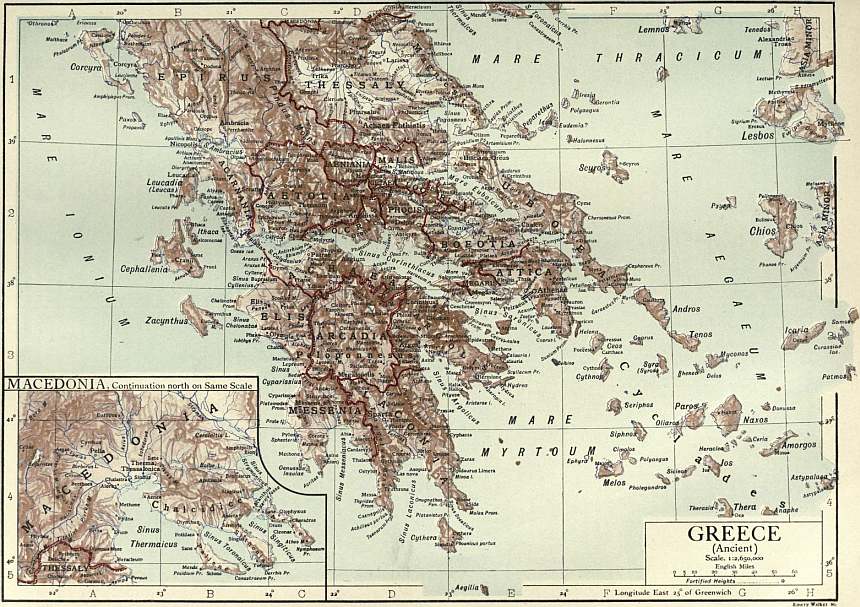
(Click to enlarge.)
If, then, by “Greek history” is to be understood the history of the lands occupied in later times by the Greek race (i.e. the Greek peninsula and the Aegean basin), the beginnings of the history must be carried back some 2000 years before Grote’s proposed starting-point. If, however, “Greek history” is taken to mean the history of the Greek people, the determination of the starting-point is far from easy. For the question to which archaeology does not as yet supply any certain answer is the question of race. Were the creators of the Minoan and Mycenaean civilization Greeks or were they not? In some degree the Minoan evidence has modified the answer suggested by the Mycenaean. Although wide differences of opinion as to the origin of the Mycenaean civilization existed among scholars when the results of Schliemann’s labours were first given to the world, a general agreement had gradually been arrived at in favour of the view which would identify Mycenaean with Achaean or Homeric. In presence of the Cretan evidence it is no longer possible to maintain this view with the same confidence. The two chief difficulties in the way of attributing either the Minoan or the Mycenaean civilization to an Hellenic people are connected respectively with the script and the religion. The excavations at Cnossus have yielded thousands of tablets written in the linear script. There is evidence that this script was in use among the Mycenaeans as well. If Greek was the language spoken at Cnossus and Mycenae, how is it that all attempts to decipher the script have hitherto failed? The Cretan excavations, again, have taught us a great deal as to the religion of the Minoan age; they have, at the same time, thrown a new light upon the evidence supplied by Mycenaean sites. It is no longer possible to ignore the contrast between the cults of the Minoan and Mycenaean ages, and the religious conceptions which they imply, and the cults and religious conceptions prevalent in the historical period. On the other hand, it may safely be asserted that the argument derived from the Mycenaean art, in which we seem to trace a freedom of treatment which is akin to the spirit of the later Greek art, and is in complete contrast to the spirit of Oriental art, has received striking confirmation from the remains of Minoan art. The decipherment of the script would at once solve the problem. We should at least know whether the dominant race in Crete in the Minoan age spoke an Hellenic or a non-Hellenic dialect. And what could be inferred with regard to Crete in the Minoan age could almost certainly be inferred with regard to the mainland in the Mycenaean age. In the meanwhile, possibly until the tablets are read, at any rate until further evidence is forthcoming, any answer that can be given to the question must necessarily be tentative and provisional. (See Aegean Civilization.)
It has already been implied that this period of the history of Greece may be subdivided into a Minoan and a Mycenaean age. Whether these terms are appropriate is a question of comparatively little importance. They at least serve to remind us of the part played by the discoveries at Mycenae and Cnossus in the reconstruction of the history. The term “Mycenaean,” it is true, has other associations than those of locality. It may seem to imply that the civilization disclosed in the excavations at Mycenae is Achaean in character, and that it is to be connected with the Pelopid dynasty to which Agamemnon belonged. In its scientific use, the term must be cleared of all such associations. Further, as opposed to “Minoan” it must be understood in a more definite sense than that in which it has often been employed. It has come to be generally recognized that two different periods are to be distinguished in Schliemann’s discoveries at Mycenae itself. There is an earlier period, to which belong the objects found in the shaft-graves, and there is a later period, to which belong the beehive tombs and the remains of the palaces. It is the latter period which is “Mycenaean” in the strict sense; i.e. it is “Mycenaean” as opposed to “Minoan.” To this period belong also the palace at Tiryns, the beehive-tombs discovered elsewhere on the mainland of Greece and one of the cities on the site of Troy (Schliemann’s sixth). The pottery of this period is as characteristic of it, both in its forms (e.g. the “stirrup” or “false-necked” form of vase) and in its peculiar glaze, as is the architecture of the palaces and the beehive-tombs. Although the chief remains have been found on the mainland of Greece itself, the art of this period is found to have extended as far north as Troy and as far east as Cyprus. On the other hand, hardly any traces of it have been discovered on the west coast of Asia Minor, south of the Troad. The Mycenaean age, in this sense, may be regarded as extending from 1600 to 1200 B.C. The Minoan age is of far wider extent. Its latest period includes both the earlier and the later periods of the remains found at Mycenae. This is the period called by Dr Evans “Late Minoan.” To this period belong the Great Palace at Cnossus and the linear system of writing. The “Middle Minoan” period, to which the earlier palace belongs, is characterized by the pictographic system of writing and by polychrome pottery of a peculiarly beautiful kind. Dr Evans proposes to carry back this period as far as 2500 B.C. Even behind it there are traces of a still earlier civilization. Thus the Minoan age, even if limited to the middle and later periods, will cover at least a thousand years. Perhaps the most surprising result of the excavations in Crete is the discovery that Minoan art is on a higher level than Mycenaean art. To the scholars of a generation ago it seemed a thing incredible that the art of the shaft-graves, and the architecture of the beehive-tombs and the palaces, could belong to the age before the Dorian invasion. The most recent discoveries seem to indicate that the art of Mycenae is a decadent art; they certainly prove that an art, hardly inferior in its way to the art of the classical period, and a civilization which implies the command of great material resources, were flourishing in the Aegean perhaps a thousand years before the siege of Troy.
To the question, “What is the origin of this civilization? Is it of foreign derivation or of native growth?” it is not possible to give a direct answer. It is clear, on the one hand that it was developed, by a gradual process of Oriental influence. differentiation, from a culture which was common to the whole Aegean basin and extended as far to the west as Sicily. It is equally clear, on the other hand, that foreign influences contributed largely to the process of development. Egyptian influences, in particular, can be traced throughout the “Minoan” and “Mycenaean” periods. The developed art, however, both in Crete and on the mainland, displays characteristics which are the very opposite of those which are commonly associated with the term “oriental.” Egyptian work, even of the best period, is stiff and conventional; in the best Cretan work, and, in a less degree, in Mycenaean work, we find an originality and a freedom of treatment which remind one of the spirit of the Greek artists. The civilization is, in many respects, of an advanced type. The Cretan architects could design on a grand scale, and could carry out their designs with no small degree of mechanical skill. At Cnossus we find a system of drainage in use, which is far in advance of anything known in the modern world before the 19th century. If the art of the Minoan age falls short of the art of the Periclean age, it is hardly inferior to that of the age of Peisistratus. It is a civilization, too, which has long been familiar with the art of writing. But it is one that belongs entirely to the Bronze Age. Iron is not found until the very end of the Mycenaean period, and then only in small quantities. Nor is this the only point of contrast between the culture of the earliest age and that of the historical period in Greece. The chief seats of the early culture are to be found either in the island of Crete, or, on the mainland, at Tiryns and Mycenae. In the later history Crete plays no part, and Tiryns and Mycenae are obscure. With the great names of a later age, Argos, Sparta and Athens, no great discoveries are connected. In northern Greece, Orchomenos rather than Thebes is the centre of influence. Further points of contrast readily suggest themselves. The so-called Phoenician alphabet, in use amongst the later Greeks, is unknown in the earliest age. Its systems of writing, both the earlier and the later one, are syllabic in character, and analogous to those in vogue in Asia Minor and Cyprus. In the art of war, the chariot is of more importance than the foot-soldier, and the latter, unlike the Greek hoplite, is lightly clad, and trusts to a shield large enough to cover the whole body, rather than to the metal helmet, breastplate and greaves of later times (see Arms and Armour: Greek). The political system appears to have been a despotic monarchy, and the realm of the monarch to have extended to far wider limits than those of the “city-states” of historical Greece. It is, perhaps, in the religious practices of the age, and in the ideas implied in them, that the contrast is most apparent. Neither in Crete nor on the mainland is there any trace of the worship of the “Olympian” deities. The cults in vogue remind us rather of Asia than of Greece. The worship of pillars and of trees carries us back to Canaan, while the double-headed axe, so prominent in the ritual of Cnossus, survives in later times as the symbol of the national deity of the Carians. The beehive-tombs, found on many sites on the mainland besides Mycenae, are evidence both of a method of sepulture and of ideas of the future state, which are alien to the practice and the thought of the Greeks of history. It is only in one region—in the island of Cyprus—that the culture of the Mycenaean age is found surviving into the historical period. As late as the beginning of the 5th century B.C. Cyprus is still ruled by kings, the alphabet has not yet displaced a syllabary, the characteristic forms of Mycenaean vases still linger on, and the chief deity of the island is the goddess with attendant doves whose images are among the common objects of Mycenaean finds.
3. The Homeric Age.—Alike in Crete and on the mainland the civilization disclosed by excavation comes abruptly to an end. In Crete we can trace it back from c. 1200 B.C. to the Neolithic period. From the Stone Age to the end of the Minoan Age the development is continuous and uninterrupted.4 But between the culture of the Early Age and the culture of the Dorians, who occupied the island in historical times, no connexion whatever can be established. Between the two there is a great gulf fixed. It would be difficult to imagine a greater contrast than that presented by the rude life of the Dorian communities in Crete when it is compared with the political power, the material resources and the extensive commerce of the earlier period. The same gap between the archaeological age and the historical exists on the mainland also. It is true that the solution of continuity is here less complete. Mycenaean art continues, here and there, in a debased form down to the 9th century, a date to which we can trace back the beginnings of the later Greek art. On one or two lines (e.g. architecture) it is even possible to establish some sort of connexion between them. But Greek art as a whole cannot be evolved from Mycenaean art. We cannot bridge over the interval that separates the latter art, even in its decline, from the former. It is sufficient to compare the “dipylon” ware (with which the process of development begins, which culminates in the pottery of the Great Age) with the Mycenaean vases, to satisfy oneself that the gulf exists. What then is the relation of the Heroic or Homeric Age (i.e. the age whose life is portrayed for us in the poems of Homer) to the Earliest Age? It too presents many contrasts to the later periods. On the other hand, it presents contrasts to the Minoan Age, which, in their way, are not less striking. Is it then to be identified with the Mycenaean Age? Schliemann, the discoverer of the Mycenaean culture, unhesitatingly identified Mycenaean with Homeric. He even identified the shaft-graves of Mycenae with the tombs of Agamemnon and Clytemnestra. Later inquirers, while refusing to discover so literal a correspondence between things Homeric and things Mycenaean, have not hesitated to accept a general correspondence between the Homeric Age and the Mycenaean. Where it is a case of comparing literary evidence with archaeological, an exact coincidence is not of course to be demanded. The most that can be asked is that a general correspondence should be established. It may be conceded that the case for such a correspondence appears prima facie a strong one. There is much in Homer that seems to find confirmation or explanation in Schliemann’s finds. Mycenae is Agamemnon’s city; the plan of the Homeric house agrees fairly well with the palaces at Tiryns and Mycenae; the forms and the technique of Mycenaean art serve to illustrate passages in the poems; such are only a few of the arguments that have been urged. It is the great merit of Professor Ridgeway’s work (The Early Age of Greece) that it has demonstrated, once and for all, that Mycenaean is not Homeric pure and simple. He insists upon differences as great as the resemblances. Iron is in common use in Homer; it is practically unknown to the Mycenaeans. In place of the round shield and the metal armour of the Homeric soldier, we find at Mycenae that the warrior is lightly clad in linen, and that he fights behind an oblong shield, which covers the whole body; nor are the chariots the same in form. The Homeric dead are cremated; the Mycenaean are buried. The gods of Homer are the deities of Olympus, of whose cult no traces are to be found in the Mycenaean Age. The novelty of Professor Ridgeway’s theory is that for the accepted equation, Homeric = Achaean = Mycenaean, he proposes to substitute the equations, Homeric = Achaean = post-Mycenaean, and Mycenaean = pre-Achaean = Pelasgian. The Mycenaean civilization he attributes to the Pelasgians, whom he regards as the indigenous population of Greece, the ancestors of the later Greeks, and themselves Greek both in speech and blood. The Homeric heroes are Achaeans, a fair-haired Celtic race, whose home was in the Danube valley, where they had learned the use of iron. In Greece they are newcomers, a conquering class comparable to the Norman invaders of England or Ireland, and like them they have acquired the language of their subjects in the course of a few generations. The Homeric civilization is thus Achaean, i.e. it is Pelasgian (Mycenaean) civilization, appropriated by a ruder race; but the Homeric culture is far inferior to the Mycenaean. Here, at any rate, the Norman analogy breaks down. Norman art in England is far in advance of Saxon. Even in Normandy (as in Sicily), where the Norman appropriated rather than introduced, he not only assimilated but developed. In Greece the process must have been reversed.
The theory thus outlined is probably stronger on its destructive side than on its constructive. To treat the Achaeans as an immigrant race is to run counter to the tradition of the Greeks themselves, by whom the Achaeans were regarded as indigenous (cf. Herod. viii. 73). Nor is the Pelasgian part of the theory easy to reconcile with the Homeric evidence. If the Achaeans were a conquering class ruling over a Pelasgian population, we should expect to find this difference of race a prominent feature in Homeric society. We should, at least, expect to find a Pelasgian background to the Homeric picture. As a matter of fact, we find nothing of the sort. There is no consciousness in the Homeric poems of a distinction of race between the governing and the subject classes. There are, indeed, Pelasgians in Homer, but the references either to the people or the name are extraordinarily few. They appear as a people, presumably in Asia Minor, in alliance with the Trojans; they appear also, in a single passage, as one of the tribes inhabiting Crete. The name survives in “Pelasgicon Argos,” which is probably to be identified with the valley of the Spercheius,5 and as an epithet of Zeus of Dodona. The population, however, of Pelasgicon Argos and of Dodona is no longer Pelasgian. Thus, in the age of Homer, the Pelasgians belong, so far as Greece proper is concerned, to a past that is already remote. It is inadmissible to appeal to Herodotus against Homer. For the conditions of the Homeric age Homer is the sole authoritative witness. If, however, Professor Ridgeway has failed to prove that “Mycenaean” equals “Pelasgian,” he has certainly proved that much that is Homeric is post-Mycenaean. It is possible that different strata are to be distinguished in the Homeric poems. There are passages which seem to assume the conditions of the Mycenaean age; there are others which presuppose the conditions of a later age. It may be that the latter passages reflect the circumstances of the poet’s own times, while the former ones reproduce those of an earlier period. If so, the substitution of iron for bronze must have been effected in the interval between the earlier and the later periods.
It has already been pointed out that the question whether the makers of the Minoan and Mycenaean civilizations were Greeks must still be regarded as an open one. No such question can be raised as to the Homeric Age. The Homeric state. The Achaeans may or may not have been Greek in blood. What is certain is that the Achaean Age forms an integral part of Greek history. Alike on the linguistic, the religious and the political sides, Homer is the starting-point of subsequent developments. In the Greek dialects the great distinction is that between the Doric and the rest. Of the non-Doric dialects the two main groups are the Aeolic and Ionic, both of which have been developed, by a gradual process of differentiation, from the language of the Homeric poems. With regard to religion it is sufficient to refer to the judgment of Herodotus, that it was Homer and Hesiod who were the authors of the Greek theogony (ii. 53 οὗτοί εἰσι οἱ ποιήσαντες θεογονίην Ἔλλησι). It is a commonplace that Homer was the Bible of the Greeks. On the political side, Greek constitutional development would be unintelligible without Homer. When Greek history, in the proper sense, begins, oligarchy is almost universal. Everywhere, however, an antecedent stage of monarchy has to be presupposed. In the Homeric system monarchy is the sole form of government; but it is monarchy already well on the way to being transformed into oligarchy. In the person of the king are united the functions of priest, of judge and of leader in war. He belongs to a family which claims divine descent and his office is hereditary. He is, however, no despotic monarch. He is compelled by custom to consult the council (boulē) of the elders, or chiefs. He must ask their opinion, and, if he fails to obtain their consent, he has no power to enforce his will. Even when he has obtained the consent of the council, the proposal still awaits the approval of the assembly (agora), of the people.
Thus in the Homeric state we find the germs not only of the oligarchy and democracy of later Greece, but also of all the various forms of constitution known to the Western world. And a monarchy such as is depicted in the Homeric society. Homeric poems is clearly ripe for transmutation into oligarchy. The chiefs are addressed as kings (βασιλῆες), and claim, equally with the monarch, descent from the gods. In Homer, again, we can trace the later organization into tribe (φυλή), clan (γένος), and phratry, which is characteristic of Greek society in the historical period, and meets us in analogous forms in other Aryan societies. The γένος corresponds to the Roman gens, the φυλή to the Roman tribe, and the phratry to the curia. The importance of the phratry in Homeric society is illustrated by the well-known passage (Iliad ix. 63) in which the outcast is described as “one who belongs to no phratry” (ἀφρήτωρ). It is a society that is, of course, based upon slavery, but it is slavery in its least repulsive aspect. The treatment which Eumaeus and Eurycleia receive at the hands of the poet of the Odyssey is highly creditable to the humanity of the age. A society which regarded the slave as a mere chattel would have been impatient of the interest shown in a swineherd and a nurse. It is a society, too, that exhibits many of the distinguishing traits of later Greek life. Feasting and quarrels, it is true, are of more moment to the heroes than to the contemporaries of Pericles or Plato; but “music” and “gymnastic” (though the terms must be understood in a more restricted sense) are as distinctive of the age of Homer as of that of Pindar. In one respect there is retrogression in the historical period. Woman in Homeric society enjoys a greater freedom, and receives greater respect, than in the Athens of Sophocles and Pericles.