VOLUME XI SLICE I Franciscans to French Language (continued 9)
Reading edition
Denmark.—In November 1894 an area of about 150 acres at Copenhagen was opened as a free port, and great facilities are afforded for shipping and commercial operations in order that the Baltic trade may centre there.
France.—Marseilles was a free port in the middle ages, and so was Dunkirk when it formed part of Flanders. In 1669 these privileges were confirmed, and extended to Bayonne. In 1784 there was a fresh confirmation, and Lorient and St Jean de Luz were included in the ordonnance. The National Assembly in 1790 maintained this policy, and created free ports in the French West Indies. In 1795, however, all such privileges were abolished, but large bonding facilities were allowed at Marseilles to favour the Levant trade. The government of Louis XVIII. in 1814 restored, and in 1871 again revoked, the free port privileges of Marseilles. There are now no free ports in France or in French possessions; the bonding system is in force.
Germany.—Bremen, Hamburg and Lübeck were reconstituted free towns and ports under the treaties of 1814-1815. Certain minor ports, and several landing-stages on the Rhine and the Neckar, were also designated free. As the Zollverein policy became accepted throughout Germany, previous privileges were gradually lessened, and since 1888 only Hamburg remains a free port. There an area of about 2500 acres is exempt from customs duties and control, and is largely used for shipping and commercial purposes. Bremerhaven has a similar area of nearly 700 acres. Brake, Bremen, Cuxhaven, Emden, Geestemünde, Neufahrwasser and Stettin possess Freibezirke areas, portions of the larger port. Heligoland is outside the Zollverein—practically a foreign country.
In Italy free ports were numerous and important, and possessed privileges which varied at different dates. They were—Ancona, during the period 1696-1868; Brindisi, 1845-1862; Leghorn (in the 17th and 18th centuries a very important Mediterranean harbour), 1675-1867; Messina, 1695-1879; Senigallia, 1821-1868, during the month of the local fair. Venice possessed warehouses, equivalent to bonded stores, for German and Turkish trade during the Republic, and was a free port 1851-1873. Genoa was a free port in the time of the Republic and under the French Empire, and was continued as such by the treaties of 1814-1815. The free port was, however, changed into a “deposito franco” by a law passed in 1865, and only storing privileges now remain.
Rumania.—Braila, Galatz and Kustenji were free ports (for a period of about forty years) up to 1883, when bonded warehouses were established by the Rumanian government. Sulina remains free.
Russia.—Archangel was a free port, at least for English goods, from 1553 to 1648. During this period English products were admitted into Russia via Archangel without any customs payment for internal consumption, and also in transit to Persia. The tsar Alexis revoked this grant on the execution of Charles I. Free ports were opened in 1895 at Kola, in Russian Lapland. Dalny, adjoining Port Arthur, was a free port during the Russian occupation; and Japan after the war decided to renew this privilege as soon as practicable.
The number of free ports outside Europe has also lessened. The administrative policy of European countries has been gradually adopted in other parts of the world, and customs duties have become almost universal, conjoined with bonding and transhipment facilities. In British colonies and possessions, under an act of parliament passed in 1766, and repealed in 1867, two ports in Dominica and four in Jamaica were free, Malacca, Penang and Singapore have been free ports since 1824, Hong-Kong since 1842, and Weihaiwei since it was leased to Great Britain in 1898. Zanzibar was a free port during 1892-1899. Aden, Gibraltar, St Helena and St Thomas (West Indies) are sometimes designated free ports. A few duties are, however, levied, which are really octroi rather than customs charges. These places are mainly stations for coaling and awaiting orders.
Some harbours in the Netherlands East Indies were free ports between 1829 and 1899; but these privileges were withdrawn by laws passed in 1898-1899, in order to establish uniformity of customs administration. Harbours where custom houses are not maintained will be practically closed to foreign trade, though the governor-general may in special circumstances vary the application of the new regulations.
Macao has been a free port since 1845. Portugal has no other harbour of this character.
The American Republics have adopted the bonding system. In 1896 a free wharf was opened at New Orleans in imitation of the recent European plan. Livingstone (Guatemala) was a free port during the period 1882-1888.
The privileges enjoyed under the old free port system benefited the towns and districts where they existed; and their abolition has been, locally, injurious. These places were, however, “foreign” to their own country, and their inland intercourse was restricted by the duties levied on their products, and by the precautions adopted to prevent evasion of these charges. With fiscal usages involving preferential and deferential treatment of goods and places, the drawbacks thus arising did not attract serious attention. Under the limited means of communication within and beyond the country, in former times, these conveniences were not much felt. But when finance departments became more completely organized, the free port system fell out of favour with fiscal authorities: it afforded opportunities for smuggling, and impeded uniformity of action and practice. It became, in fact, out of harmony with the administrative and financial policy of later times. Bonding and entrepot facilities, on a scale commensurate with local needs, now satisfy trade requirements. In countries where high customs duties are levied, and where fiscal regulations are minute and rigid, if an extension of foreign trade is desired, and the competition which it involves is a national aim, special facilities must be granted for this purpose. In these circumstances a free zone sufficiently large to admit of commercial operations and transhipments on a scale which will fulfil these conditions (watched but not interfered with by the customs) becomes indispensable. The German government have, as we have seen, maintained a free zone of this nature at Hamburg. And when the free port at Copenhagen was opened, counter measures were adopted at Danzig and Stettin. An agitation has arisen in France to provide at certain ports free zones similar to those at Copenhagen and Hamburg, and to open free ports in French possessions. A bill to this effect was submitted to the chamber of deputies on the 12th of April 1905. Colonial free ports, such as Hong-Kong and Singapore, do not interfere with the uniformity of the home customs and excise policy. These two harbours in particular have become great shipping resorts and distributing centres. The policy which led to their establishment as free ports has certainly promoted British commercial interests.
See the Parliamentary Paper on “Continental Free Ports,” 1904.
(C. M. K.)
1 In China at the present time (1902) certain ports are designated “free and open.” This phrase means that the ports in question are (1) open to foreign trade, and (2) that vessels engaged in oversea voyages may freely resort there. Exemption from payment of customs duties is not implied, which is a matter distinct from the permission granted under treaty engagements to foreign vessels to carry cargoes to and from the “treaty ports.”
FREE REED VIBRATOR (Fr. anche libre, Ger. durchschlagende Zunge, Ital. ancia or lingua libera), in musical instruments, a thin metal tongue fixed at one end and vibrating freely either in surrounding space, as in the accordion and concertina, or enclosed in a pipe or channel, as in certain reed stops of the organ or in the harmonium. The enclosed reed, in its typical and theoretical form, is fixed over an aperture of the same shape but just large enough to allow it to swing freely backwards and forwards, alternately opening and closing the aperture, when driven by a current of compressed air. We have to deal with air under three different conditions in considering the phenomenon of the sound produced by free reeds. (1) The stationary column or stratum in pipe or channel containing the reed, which is normally at rest. (2) The wind or current of air fed from the bellows with a variable velocity and pressure, which is broken up into periodic air puffs as its entrance into pipe or channel is alternately checked or allowed by the vibrator. (3) The disturbed condition of No. 1 when acted upon by the metal vibrator and by No 2, whereby the air within the pipe is forced into alternate pulses of condensation and rarefaction. The free reed is therefore not the tone-producer but only the exciting agent, that is to say, the sound is not produced by the communication of the free reed’s vibrations to the surrounding air,1 as in the case of a vibrating string, but by the series of air puffs punctuated by infinitesimal pauses, which it produces by alternately opening and almost closing the aperture.2 A musical sound is thus produced the pitch of which depends on the length and thickness of the metal tongue; the greater the length, the slower the vibrations and the lower the pitch, while on the contrary, the thicker the reed near the shoulder at the fixed end, the higher the pitch. It must be borne in mind that the periodic vibrations of the reed determine the pitch of the sound solely by the frequency per second they impose upon the pulses of rarefaction and condensation within the pipe.
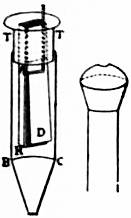
From J. B. Biot, Traité de physique expérimentale.
Fig. 1.—Grenie’s organ pipe fitted with free-reed vibrator.
A, Tuning wire. D, Free reed. R, Reed-box. B, C, Feed pipe with conical foot. T, Part of resonating pipe, the upper end with cap and vent hole being shown separately at the side.
The most valuable characteristic of the free reed is its power of producing all the delicate gradations of tone between forte and piano by virtue of a law of acoustics governing the vibration of free reeds, whereby increased pressure of wind produces a proportional increase in the volume of tone. The pitch of any sound depends upon the frequency of the sound-waves, that is, the number per second which reach the ear; the fullness of sound depends upon the amplitude of the waves, or, more strictly speaking, of the swing of the transmitting particles of the medium—greater pressure in the air current (No. 2 above) which sets the vibrator in motion producing amplitude of vibration in the air within the receptacle (No. 3 above) serving as resonating medium. The sound produced by the free reed itself is weak and requires to be reinforced by means of an additional stationary column or stratum of air. Free reed instruments are therefore classified according to the nature of the resonant medium provided:—(1) Free reeds vibrating in pipes, such as the reed stops of church organs on the continent of Europe (in England the reed pipes are generally provided with beating reeds, see Reed Instruments and Clarinet). (2) Free reeds vibrating in reed compartments and reinforced by air chambers of various shapes and sizes as in the harmonium (q.v.). (3) Instruments like the accordion and concertina having the free reed set in vibration through a valve, but having no reinforcing medium.
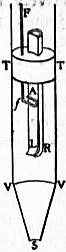
Fig. 2.—Organ pipe fitted with beating reed.
AL, Beating reed. R, Reed box. Ff, Tuning wire. TV, Feed pipe. VV, Conical foot. S, Hole through which compressed air is fed.
The arrangement of the free reed in an organ pipe is simple, and does not differ greatly from that of the beating reed shown in fig. 2 for the purpose of comparison. The reed-box, a rectangular wooden pipe, is closed at the bottom and covered on one face with a thin plate of copper having a rectangular slit over which is fixed the thin metal vibrating tongue or reed as described above. The reed-box, itself open at the top, is enclosed in a feed pipe having a conical foot pierced with a small hole through which the air current is forced by the action of the bellows. The impact of the incoming compressed air against the reed tongue sets it swinging through the slit, thus causing a disturbance or series of pulsations within the reed-box. The air then finds an escape through the resonating medium of a pipe fitting over the reed-box and terminating in an inverted cone covered with a cap in the top of which is pierced a small hole or vent. The quality of tone of free reeds is due to the tendency of air set in periodic pulsations to divide into aliquot vibrations or loops, producing the phenomenon known as harmonic overtones or upper partials, which may, in the highly composite clang of free reeds, be discerned as far as the 16th or 20th of the series. The more intermittent and interrupted the air current becomes, the greater the number of the upper partials produced.3 The power of the overtones and their relation to the fundamental note depend greatly upon the form of the tongue, its position and the amount of the clearance left as it swings through the aperture.
Free reeds not associated with resonating media as in the concertina are peculiarly rich in harmonics, but as the higher harmonics lie very close together, disagreeable dissonances and a harsh tone result. The resonating pipe or chamber when suitably accommodated to the reed greatly modifies the tone by reinforcing the harmonics proper to itself, the others sinking into comparative insignificance. In order to produce a full rich tone, a resonator should be chosen whose deepest note coincides with the fundamental tone of the reed. The other upper partials will also be reinforced thereby, but to a less degree the higher the harmonics.4
For the history of the application of the free reed to keyboard instruments see Harmonium.
(K. S.)
1 See H. Helmholtz, Die Lehre von den Tonempfindungen (Brunswick, 1877), p. 166.
2 See also Ernst Heinrich and Wilhelm Weber, Wellenlehre (Leipzig, 1825), where a particularly lucid explanation of the phenomenon is given, pp. 526-530.
3 See Helmholtz, op. cit. p. 167.
4 These phenomena are clearly explained at greater length by Sedley Taylor in Sound and Music (London, 1896), pp. 134-153 and pp. 74-86. See also Friedrich Zamminer, Die Musik und die musikalischen Instrumente, &c. (Giessen, 1855), p. 261.
FREESIA, in botany, a genus of plants belonging to the Iris family (Iridaceae), and containing a single species, F. refracta, native at the Cape of Good Hope. The plants grow from a corm (a solid bulb, as in Gladiolus) which sends up a tuft of long narrow leaves and a slightly branched stem bearing a few leaves and loose one-sided spikes of fragrant narrowly funnel-shaped flowers. Several varieties are known in cultivation, differing in the colour of the flower, which is white, cream or yellow. They form pretty greenhouse plants which are readily increased from seed. They are extensively grown for the market in Guernsey, England and America. By potting successively throughout the autumn a supply of flowers is obtained through winter and spring. Some very fine large-flowered varieties, including rose-coloured ones, are now being raised by various growers in England, and are a great improvement on the older forms.
FREE SOIL PARTY, a political party in the United States, which was organized in 1847-1848 to oppose the extension of slavery into the Territories. It was a combination of the political abolitionists—many of whom had formerly been identified with the more radical Liberty party—the anti-slavery Whigs, and the faction of the Democratic party in the state of New York, called “Barnburners,” who favoured the prohibition of slavery, in accordance with the “Wilmot Proviso” (see Wilmot, David), in the territory acquired from Mexico. The party was prominent in the presidential campaigns of 1848 and 1852. At the national convention held in Buffalo, N.Y., on the 9th and 10th of August 1848, they secured the nomination to the presidency of ex-President Martin Van Buren, who had failed to secure nomination by the Democrats in 1844 because of his opposition to the annexation of Texas, and of Charles Francis Adams, of Massachusetts, for the vice-presidency, taking as their “platform” a Declaration that Congress, having “no more power to make a slave than to make a king,” was bound to restrict slavery to the slave states, and concluding, “we inscribe on our banner ‘Free Soil, Free Speech, Free Labor and Free Man,’ and under it we will fight on and fight ever, until a triumphant victory shall reward our exertions.” The Liberty party had previously, in November 1847, nominated John P. Hale and Leicester King as president and vice-president respectively, but in the spring of 1848 it withdrew its candidates and joined the “free soil” movement. Representatives of eighteen states, including Delaware, Maryland and Virginia, attended the Buffalo convention. In the ensuing presidential election Van Buren and Adams received a popular vote of 291,263, of which 120,510 were cast in New York. They received no electoral votes, all these being divided between the Whig candidate, Zachary Taylor, who was elected, and the Democratic candidate, Lewis Cass. The “free soilers,” however, succeeded in sending to the thirty-first Congress two senators and fourteen representatives, who by their ability exercised an influence out of proportion to their number.
Between 1848 and 1852 the “Barnburners” and the “Hunkers,” their opponents, became partially reunited, the former returning to the Democratic ranks, and thus greatly weakening the Free Soilers. The party held its national convention at Pittsburg, Pennsylvania, on the 11th of August 1852, delegates being present from all the free states, and from Delaware, Maryland, Virginia and Kentucky; and John P. Hale, of New Hampshire, and George W. Julian of Indiana, were nominated for the presidency and the vice-presidency respectively, on a platform which declared slavery “a sin against God and a crime against man,” denounced the Compromise Measures of 1850, the fugitive slave law in particular, and again opposed the extension of slavery in the Territories. These candidates, however, received no electoral votes and a popular vote of only 156,149, of which but 25,329 were polled in New York. By 1856 they abandoned their separate organization and joined the movement which resulted in the formation of the powerful Republican party (q.v.), of which the Free Soil party was the legitimate precursor.
FREE-STONE (a translation of the O. Fr. franche pere or pierre, i.e. stone of good quality; the modern French equivalent is pierre de taille, and Ital. pietra molle), stone used in architecture for mouldings, tracery and other work required to be worked with the chisel. The oolitic stones are generally so called, although in some countries soft sandstones are used; in some churches an indurated chalk called “clunch” is employed for internal lining and for carving.
FREETOWN, capital of the British colony of Sierra Leone, West Africa, on the south side of the Sierra Leone estuary, about 5 m. from the cape of that name, in 8° 29′ N., 13° 10′ W. Pop. (1901) 34,463. About 500 of the inhabitants are Europeans. Freetown is picturesquely situated on a plain, closed in behind by a succession of wooded hills, the Sierra Leone, rising to a height of 1700 ft. As nearly every house is surrounded by a courtyard or garden, the town covers an unusually large area for the number of its inhabitants. It possesses few buildings of architectural merit. The principal are the governor’s residence and government offices, the barracks, the cathedral, the missionary institutions, the fruit market, Wilberforce Hall, courts of justice, the railway station and the grammar school. Several of these institutions are built on the slopes of the hills, and on the highest point, Sugar Loaf Mountain, is a sanatorium. The botanic gardens form a pleasant and favourite place of resort. The roads are wide but badly kept. Horses do not live, and all wheeled traffic is done by manual labour—hammocks and sedan-chairs are the customary means of locomotion. Notwithstanding that Freetown possesses an abundant and pure water-supply, drawn from the adjacent hills, it is enervating and unhealthy, and it was particularly to the capital, often spoken of as Sierra Leone, that the designation “White Man’s Grave” applied. Since the beginning of the 20th century strenuous efforts have been made to improve the sanitary condition by a new system of drainage, a better water service, the filling up of marshes wherein the malarial mosquito breeds, and in other directions. A light railway 6 m. long, opened in 1904, has been built to Hill Station (900 ft. high), where, on a healthy site, are the residences of the government officials and of other Europeans. As a consequence the public health has improved, the highest death-rate in the years 1901-1907 being 29.6 per 1000. The town is governed by a municipality (created in 1893) with a mayor and councillors, the large majority being elective. Freetown was the first place in British West Africa granted local self-government.
Both commercially and strategically Freetown is a place of importance. Its harbour affords ample accommodation for the largest fleets, it is a coaling station for the British navy, the headquarters of the British military forces in West Africa, the sea terminus of the railway to the rich oil-palm regions of Mendiland, and a port of call for all steamers serving West Africa. Its inhabitants are noted for their skill as traders; the town itself produces nothing in the way of exports.
In consequence of the character of the original settlement (see Sierra Leone), 75% of the inhabitants are descended from non-indigenous Negro races. As many as 150 different tribes are represented in the Sierra Leonis of to-day. Their semi-Europeanization is largely the result of missionary endeavour. The only language of the lower class is pidgin-English—quite incomprehensible to the newcomer from Great Britain,—but a large proportion of the inhabitants are highly educated men who excel as lawyers, clergymen, clerks and traders. Many members of the upper, that is, the best-educated, class have filled official positions of great responsibility. The most noted citizens are Bishop Crowther and Sir Samuel Lewis, chief justice of Sierra Leone 1882-1894. Both were full-blooded Africans. The Kru-men form a distinct section of the community, living in a separate quarter and preserving their tribal customs.
Since 1861-1862 there has been an independent Episcopal Native Church; but the Church Missionary Society, which in 1804 sent out the first missionaries to Sierra Leone, still maintains various agencies. Furah Bay College, built by the society on the site of General Charles Turner’s estate (1½ m. E. of Freetown), and opened in 1828 with six pupils, one of whom was Bishop Crowther, was affiliated in 1876 to Durham University and has a high-class curriculum. The Wesleyans have a high school, a theological college, and other educative agencies. The Moslems, who are among the most law-abiding and intelligent citizens of Freetown, have several state-aided primary schools.
FREE TRADE, an expression which has now come to be appropriated to the economic policy of encouraging the greatest possible commercial intercourse, unrestricted by “protective” duties (see Protection), between any one country and its neighbours. This policy was originally advocated in France, and it has had its adherents in many countries, but Great Britain stands alone among the great commercial nations of the world in having adopted it systematically from 1846 onwards as the fundamental principle of her economic policy.
In the economic literature of earlier periods, it may be noted that the term “free trade” is employed in senses which have no relation to modern usage. The term conveyed no suggestion of unrestricted trade or national liberty when it first appeared in controversial pamphlets;1 it stood for a freedom conferred and maintained by authority—like that of a free town. The merchants desired to have good regulations for trade so that they might be free from the disabilities imposed upon them by foreign princes or unscrupulous fellow-subjects. After 1640 the term seems to have been commonly current in a different sense. When the practice which had been handed down from the middle ages—of organizing the trade with particular countries by means of privileged companies, which professed to regulate the trade according to the state of the market so as to secure its steady development in the interest of producers and traders—was seriously called in question under the Stuarts and at the Revolution, the interlopers and opponents of the companies insisted on the advantages of a “Free Trade”; they meant by this that the various branches of commerce should not be confined to particular persons or limited in amount, but should be thrown open to be pursued by any Englishman in the way he thought most profitable himself.2 Again, in the latter half of the 18th century, till Pitt’s financial reforms3 were brought into operation, the English customs duties on wine and brandy were excessive; and those who carried on a remunerative business by evading these duties were known as Fair Traders or Free Traders.4 Since 1846 the term free trade has been popularly used, in England, to designate the policy of Cobden (q.v.) and others who advocated the abolition of the tax on imported corn (see Corn Laws); this is the only one of the specialized senses of the term which is at all likely to be confused with the economic doctrine. The Anti-Corn Law movement was, as a matter of fact, a special application of the economic principle; but serious mistakes have arisen from the blunder of confusing the part with the whole, and treating the remission of one particular duty as if it were the essential element of a policy in which it was only an incident. W. E. Gladstone, in discussing the effect of improvements in locomotion on British trade, showed what a large proportion of the stimulus to commerce during the 19th century was to be credited to what he called the “liberalizing legislation” of the free-trade movement in the wide sense in which he used the term. “I rank the introduction of cheap postage for letters, documents, patterns and printed matter, and the abolition of all taxes on printed matter, in the category of Free Trade Legislation. Not only thought in general, but every communication, and every publication, relating to matters of business, was thus set free. These great measures, then, may well take their place beside the abolition of prohibitions and protective duties, the simplifying of revenue laws, and the repeal of the Navigation Act, as forming together the great code of industrial emancipation. Under this code, our race, restored to freedom in mind and hand, and braced by the powerful stimulus of open competition with the world, has upon the whole surpassed itself and every other, and has won for itself a commercial primacy more evident, more comprehensive, and more solid than it had at any previous time possessed.”5 In this large sense free trade may be almost interpreted as the combination of the doctrines of the division of labour and of laissez-faire in regard to the world as a whole. The division of labour between different countries of the world—so that each concentrates its energies in supplying that for the production of which it is best fitted—appears to offer the greatest possibility of production; but this result cannot be secured unless trade and industry are treated as the primary elements in the welfare of each community, and political considerations are not allowed to hamper them.
Stated in its simplest form, the principle which underlies the doctrine of free trade is almost a truism; it is directly deducible from the very notion of exchange (q.v.). Adam Smith and his successors have demonstrated that in every case of voluntary exchange each party gains something that is of greater value-in-use to him than that with which he parts, and that consequently in every exchange, either between individuals or between nations, both parties are the gainers. Hence it necessarily follows that, since both parties gain through exchanging, the more facilities there are for exchange the greater will be the advantage to every individual all round.6 There is no difficulty in translating this principle into the terms of actual life, and stating the conditions in which it holds good absolutely. If, at any given moment, the mass of goods in the world were distributed among the consumers with the minimum of restriction on interchange, each competitor would obtain the largest possible share of the things he procures in the world’s market. But the argument is less conclusive when the element of time is taken into account; what is true of each moment separately is not necessarily true of any period in which the conditions of production, or the requirements of communities, may possibly change. Each individual is likely to act with reference to his own future, but it may often be wise for the statesman to look far ahead, beyond the existing generation.7 Owing to the neglect of this element of time, and the allowance which must be made for it, the reasoning as to the advantages of free trade, which is perfectly sound in regard to the distribution of goods already in existence, may become sophistical,8 if it is put forward as affording a complete demonstration of the benefits of free trade as a regular policy. After all, human society is very complex, and any attempt to deal with its problems off-hand by appealing to a simple principle raises the suspicion that some important factor may have been left out of account. When there is such mistaken simplification, the reasoning may seem to have complete certainty, and yet it fails to produce conviction, because it does not profess to deal with the problem in all its aspects. When we concentrate attention on the phenomena of exchange, we are viewing society as a mechanism in which each acts under known laws and is impelled by one particular force—that of self-interest; now, society is, no doubt, in this sense a mechanism, but it is also an organism,9 and it is only for very short periods, and in a very limited way, that we can venture to neglect its organic character without running the risk of falling into serious mistakes.
The doctrine of free trade maintains that in order to secure the greatest possible mass of goods in the world as a whole, and the greatest possibility of immediate comfort for the consumer, it is expedient that there should be no restriction on the exchange of goods and services either between individuals or communities. The controversies in regard to this doctrine have not turned on its certainty as a hypothetical principle, but on the legitimacy of the arguments based upon it. It certainly supplies a principle in the light of which all proposed trade regulations should be criticized. It gives us a basis for examining and estimating the expense at which any particular piece of trade restriction is carried out; but thus used, the principle does not necessarily condemn the expenditure; the game may be worth the candle or it may not, but at least it is well that we should know how fast the candle is being burnt. It was in this critical spirit that Adam Smith examined the various restrictions and encouragements to trade which were in vogue in his day; he proved of each in turn that it was expensive, but he showed that he was conscious that the final decision could not be taken from this standpoint, since he recognized in regard to the Navigation Acts that “defence is more than opulence.”10 In more recent times, the same sort of attitude was taken by Henry Sidgwick,11 who criticizes various protective expedients in turn, in the light of free trade, but does not treat it as conveying an authoritative decision on their merits.
But other exponents of the doctrine have not been content to employ it in this fashion. They urge it in a more positive manner, and insist that free trade pure and simple is the foundation on which the economic life of the community ought to be based. By men who advocate it in this way, free trade is set forward as an ideal which it is a duty to realize, and those who hold aloof from it or oppose it have been held up to scorn as if they were almost guilty of a crime.12 The development of the material resources of the world is undoubtedly an important element in the welfare of mankind; it is an aim which is common to the whole race, and may be looked upon as contributing to the greatest happiness of the greatest number. Competition in the open market seems to secure that each consumer shall obtain the best possible terms; and again, since all men are consumers whether they produce or not, or whatever they produce, the greatest measure of comforts for each seems likely to be attainable on these lines. For those who are frankly cosmopolitan, and who regard material prosperity as at all events the prime object at which public policy should aim, the free-trade doctrine is readily transformed, from a mere principle of criticism, till it comes to be regarded as the harbinger of a possible Utopia. It was in this fashion that it was put forward by French economists and proved attractive to some leading American statesmen in the 18th century. Turgot regarded the colonial systems of the European countries as at once unfair to their dependencies and dangerous to the peace of the world. “It will be a wise and happy thing for the nation which shall be the first to modify its policy according to the new conditions, and be content to regard its colonies as if they were allied provinces and not subjects of the mother country.” It will be a wise and happy thing for the nation which is the first to be convinced that the secret of “success, so far as commercial policy is concerned, consists in employing all its land in the manner most profitable for the proprietary, all the hands in the manner most advantageous to the workman personally, that is to say, in the manner in which each would employ them, if we could let him be simply directed by his own interest, and that all the rest of the mercantile policy is vanity and vexation of spirit. When the entire separation of America shall have forced the whole world to recognize this truth and purged the European nations of commercial jealousy there will be one great cause of war less in the world.”13 Pitt, under the influence of Adam Smith, was prepared to admit the United States to the benefit of trade with the West Indian Colonies; and Jefferson, accepting the principles of his French teachers, would (in contradistinction to Alexander Hamilton) have been willing to see his country renounce the attempt to develop manufactures of her own.14 It seemed as if a long step might be taken towards realizing the free-trade ideal for the Anglo-Saxon race; but British shipowners insisted on the retention of their privileges, and the propitious moment passed away with the failure of the negotiations of 1783.15 Free trade ceased to be regarded as a gospel, even in France, till the ideal was revived in the writings of Bastiat, and helped to mould the enthusiasm of Richard Cobden.16 Through his zealous advocacy, the doctrine secured converts in almost every part of the world; though it was only in Great Britain that a great majority of the citizens became so far satisfied with it that they adopted it as the foundation of the economic policy of the country.
It is not difficult to account for the conversion of Great Britain to this doctrine; in the special circumstances of the first half of the 19th century it was to the interest of the most vigorous factors in the economic life of the country to secure the greatest possible freedom for commercial intercourse. Great Britain had, through her shipping, access to all the markets of the world; she had obtained such a lead in the application of machinery to manufactures that she had a practical monopoly in textile manufactures and in the hardware trades; by removing every restriction, she could push her advantage to its farthest extent, and not only undersell native manufactures in other lands, but secure food, and the raw materials for her manufactures, on the cheapest possible terms. Free trade thus seemed to offer the means of placing an increasing distance between Britain and her rivals, and of rendering the industrial monopoly which she had attained impregnable. The capitalist employer had superseded the landowner as the mainstay of the resources and revenue of the realm, and insisted that the prosperity of manufactures was the primary interest of the community as a whole. The expectation, that a thoroughgoing policy of free trade would not only favour an increase of employment, but also the cheapening of food, could only have been roused in a country which was obliged to import a considerable amount of corn. The exceptional weakness, as well as the exceptional strength, of Great Britain, among European countries, made it seem desirable to adopt the principle of unrestricted commercial intercourse, not merely in the tentative fashion in which it had been put in operation by Huskisson, but in the thoroughgoing fashion in which it at last commended itself to the minds of Peel and Gladstone. The “Manchester men” saw clearly where their interest lay; and the fashionable political economy was ready to demonstrate that in pursuing their own interest they were conferring the benefit of cheap clothing on all the most poverty-stricken races of mankind. It seemed probable, in the ’forties and early ’fifties, that other countries would take a similar view of their own interests and would follow the example which Great Britain had set.17 That they have not done so, is partly due to the fact that none of them had such a direct, or such a widely diffused, interest in increased commercial intercourse as existed in Great Britain; but their reluctance has been partly the result of the criticism to which the free-trade doctrine has been subjected. The principles expressed in the writings of Friedrich List have taken such firm hold, both in America and in Germany, that these countries have preferred to follow on the lines by which Great Britain successfully built up her industrial prosperity in the 17th and 18th century, rather than on those by which they have seen her striving to maintain it since 1846.
Free trade was attractive as an ideal, because it appeared to offer the greatest production of goods to the world as a whole, and the largest share of material goods to each consumer; it is cosmopolitan, and it treats consumption, and the interest of the consumer, as such, as the end to be considered. Hence it lies open to objections which are partly political and partly economic.
As cosmopolitan, free-trade doctrine is apt to be indifferent to national tradition and aspiration. In so far indeed as patriotism is a mere aesthetic sentiment, it may be tolerated, but in so far as it implies a genuine wish and intention to preserve and defend the national habits and character to the exclusion of alien elements, the cosmopolitan mind will condemn it as narrow and mischievous. In the first half of the 19th century there were many men who believed that national ambitions and jealousies of every kind were essentially dynastic, and that if monarchies were abolished there would be fewer occasions of war, so that the expenses of the business of government would be enormously curtailed. For Cobden and his contemporaries it was natural to regard the national administrative institutions as maintained for the benefit of the “classes” and without much advantage to the “masses.” But in point of fact, modern times have shown the existence in democracies of a patriotic sentiment which is both exclusive and aggressive; and the burden of armaments has steadily increased. It was by means of a civil war that the United States attained to a consciousness of national life; while such later symptoms as the recent interpretations of the Monroe doctrine, or the war with Spain, have proved that the citizens of that democratic country cannot be regarded as destitute of self-aggrandizing national ambition.
In Germany the growth of militarism and nationalism have gone on side by side under constitutional government, and certainly in harmony with predominant public opinion. Neither of these communities is willing to sink its individual conception of progress in those of the world at large; each is jealous of the intrusion of alien elements which cannot be reconciled with its own political and social system. And a similar recrudescence of patriotic feeling has been observable in other countries, such as Norway and Hungary: the growth of national sentiment is shown, not only in the attempts to revive and popularize the use of a national language, but still more decidedly in the determination to have a real control over the economic life of the country. It is here that the new patriotism comes into direct conflict with the political principles of free trade as advocated by Bastiat and Cobden; for them the important point was that countries, by becoming dependent on one another, would be prevented from engaging in hostilities. The new nations are determined that they will not allow other countries to have such control over their economic condition, as to be able to exercise a powerful influence on their political life. Each is determined to be the master in his own house, and each has rejected free trade because of the cosmopolitanism which it involves.
Economically, free trade lays stress on consumption as the chief criterion of prosperity. It is, of course, true that goods are produced with the object of being consumed, and it is plausible to insist on taking this test; but it is also true that consumption and production are mutually interdependent, and that in some ways production is the more important of the two. Consumption looks to the present, and the disposal of actual goods; production looks to the future, and the conditions under which goods can continue to be regularly provided and thus become available for consumption in the long run. As regards the prosperity of the community in the future it is important that goods should be consumed in such a fashion as to secure that they shall be replaced or increased before they are used up; it is the amount of production rather than the amount of consumption that demands consideration, and gives indication of growth or of decadence. In these circumstances there is much to be said for looking at the economic life of a country from the point of view which free-traders have abandoned or ignore. It is not on the possibilities of consumption in the present, but on the prospects of production in the future, that the continued wealth of the community depends; and this principle is the only one which conforms to the modern conception of the essential requirements of sociological science in its wider aspect (see Sociology). This is most obviously true in regard to countries of which the resources are very imperfectly developed. If their policy is directed to securing the greatest possible comfort for each consumer in the present, it is certain that progress will be slow; the planting of industries for which the country has an advantage may be a tedious process; and in order to stimulate national efficiency temporary protection—involving what is otherwise unnecessary immediate cost to the consumer—may seem to be abundantly justified. Such a free trader as John Stuart Mill himself admits that a case may be made out for treating “infant industries” as exceptions;18 and if this exception be admitted it is likely to establish a precedent. After all, the various countries of the world are all in different stages of development; some are old and some are new; and even the old countries differ greatly in the progress they have made in distinct arts. The introduction of machinery has everywhere changed the conditions of production, so that some countries have lost and others have gained a special advantage. Most of the countries of the world are convinced that the wisest economy is to attend to the husbanding of their resources of every kind, and to direct their policy not merely with a view to consumption in the present, but rather with regard to the possibilities of increased production in the future.
This deliberate rejection of the doctrine of free trade between nations, both in its political and economic aspects, has not interfered, however, with the steady progress of free commercial intercourse within the boundaries of a single though composite political community. “Internal free trade,” though the name was not then current in this sense, was one of the burning questions in England in the 17th century; it was perhaps as important a factor as puritanism in the fall of Charles I. Internal free trade was secured in France in the 18th century; thanks to Hamilton,19 it was embodied in the constitution of the United States; it was introduced into Germany by Bismarck; and was firmly established in the Dominion of Canada and the Commonwealth of Australia. It became in consequence, where practicable, a part of the modern federal idea as usually interpreted. There are thus great areas, externally self-protecting, where free trade, as between internal divisions, has been introduced with little, if any, political difficulty, and with considerable economic advantage. These cases are sometimes quoted as justifying the expectation that the same principle is likely to be adopted sooner or later in regard to external trading relations. There is some reason, however, for raising the question whether free trade has been equally successful, not only in its economic, but in its social results, in all the large political communities where it has been introduced. In a region like the United States of America, it is probably seen at its best; there is an immense variety of different products throughout that great zone of the continent, so that the mutual co-operation of the various parts is most beneficial, while the standard of habit and comfort is so far uniform20 throughout the whole region, and the facilities for the change of employment are so many, that there is little injurious competition between different districts. In the British empire the conditions are reversed; but though the great self-governing colonies have withdrawn from the circle, in the hope of building up their own economic life in their own way, free trade is still maintained over a very large part of the British empire. Throughout this area, there are very varied physical conditions; there is also an extraordinary variety of races, each with its own habits, and own standard of comfort; and in these circumstances it may be doubted whether the free competition, involved in free trade, is really altogether wholesome. Within this sphere the ideal of Bastiat and his followers is being realized. England, as a great manufacturing country, has more than held her own; India and Ireland are supplied with manufactured goods by England, and in each case the population is forced to look to the soil for its means of support, and for purchasing power. In each case the preference for tillage, as an occupation, has rendered it comparatively easy to keep the people on the land; but there is some reason to believe that the law of diminishing returns is already making itself felt, at all events in India, and is forcing the people into deeper poverty.21 It may be doubtful in the case of Ireland how far the superiority of England in industrial pursuits has prevented the development of manufactures; the progress in the last decades of the 18th century was too short-lived to be conclusive; but there is at least a strong impression in many quarters that the industries of Ireland might have flourished if they had had better opportunities allowed them.22 In the case of India we know that the hereditary artistic skill, which had been built up in bygone generations, has been stamped out. It seems possible that the modern unrest in India, and the discontent in Ireland, may be connected with the economic conditions in these countries, on which free trade has been imposed without their consent. So far the population which subsists on the cheaper food, and has the lower standard of life, has been the sufferer; but the mischief might operate in another fashion. The self-governing colonies at all events feel that competition in the same market between races with different standards of comfort has infinite possibilities of mischief. It is easy to conjure up conditions under which the standard of comfort of wage-earners in England would be seriously threatened.
Since the 9th edition of the Encyclopaedia Britannica was published it has become clear that the free-trade doctrines of Bastiat and Cobden have not been gaining ground in the world at large, and at the opening of the 20th century it could hardly be said with confidence that the question was “finally settled” so far as England was concerned. As to whether the interests of Great Britain still demanded that she should continue on the line she adopted in the exceptional conditions of the middle of the 19th century, expert opinion was conspicuously divided;23 but there remained no longer the old enthusiasm for free trade as the harbinger of an Utopia. The old principles of the bourgeois manufacturers had been taken up by the proletariat and shaped to suit themselves. Socialism, like free trade, is cosmopolitan in its aims, and is indifferent to patriotism and hostile to militarism. Socialism, like free trade, insists on material welfare as the primary object to be aimed at in any policy, and, like free trade, socialism tests welfare by reference to possibilities of consumption. In one respect there is a difference; throughout Cobden’s attack on the governing classes there are signs of his jealousy of the superior status of the landed gentry, but socialism has a somewhat wider range of view and demands “equality of opportunity” with the capitalist as well.
Bibliography.—Reference has already been made to the principal works which deal critically with the free-trade policy. Professor Fawcett’s Free Trade is a good exposition of free-trade principles; so also is Professor Bastable’s Commerce of Nations. Among authors who have restated the principles with special reference to the revived controversy on the subject may be mentioned Professor W. Smart, The Return to Protection, being a Restatement of the Case for Free Trade (2nd ed., 1906), and A. C. Pigou, Protective and Preferential Import Duties (1906).
(W. Cu.)
1 E. Misselden, Free Trade or the Meanes to make Trade Flourish (1622), p. 68; G. Malynes, The Maintenance of Free Trade (1622), p. 105.
2 H. Parker, Of a Free Trade (1648), p. 8.
3 (1787), 27 Geo. III. c. 13.
4 Sir Walter Scott, Guy Mannering, chapter v.
5 Gladstone, “Free Trade, Railways and Commerce,” in Nineteenth Century (Feb. 1880), vol. vii. p. 370.
6 Parker states a similar argument in the form in which it suited the special problem of his day. “If merchandise be good for the commonweal, then the more common it is made, the more open it is laid, the more good it will convey to us.” Op. cit. 20.
7 Schmoller, Grundriss der allgemeinen Volkswirtschaftslehre (1904), ii. 607.
8 Byles, Sophisms of Free Trade; L. S. Amery, Fundamental Fallacies of Free Trade, 13.
9 W. Cunningham, Rise and Decline of the Free Trade Movement, PP. 5-11.
10 Wealth of Nations, book iv. chap. ii.
11 Principles of Political Economy, 485.
12 J. Morley, Life of Cobden, i. 230.
13 “Mémoire,” 6 April 1776, in Œuvres, viii. 460.
14 Jefferson, Notes on Virginia, 275. See also the articles on Jefferson and Hamilton, Alexander.
15 One incidental effect of the failure to secure free trade was that the African slave trade, with West Indies as a depot for supplying the American market, ceased to be remunerative, and the opposition to the abolition of the trade was very much weaker than it would otherwise have been; see Hochstetter, “Die wirtschaftlichen und politischen Motive für die Abschaffung des britischen Sklavenhandels,” in Schmoller, Staats und Sozialwissenschaftliche Forschungen, xxv. i. 37.
16 J. Welsford, “Cobden’s Foreign Teacher,” in National Review (December 1905).
17 Compatriot Club Lectures (1905), p. 306.
18 J. S. Mill, Principles of Political Economy, book v. chapter x. § 1.
19 F. S. Oliver, Alexander Hamilton, 142.
20 The standard is, of course, lower among the negroes and mean whites in the South than in the North and West.
21 F. Beauclerk, “Free Trade in India,” in Economic Review (July 1907), xvii. 284.
22 A. E. Murray, History of the Commercial and Financial Relations between England and Ireland, 294.
23 For the tariff reform movement in English politics see the article on Chamberlain, J. Among continental writers G. Schmoller (Grundriss der allgemeinen Volkswirtschaftslehre, ii. 641) and A. Wagner (Preface to M. Schwab’s Chamberlains Handelspolitik) pronounce in favour of a change, as Fuchs did by anticipation. Schulze-Gaevernitz (Britischer Imperialismus und englischer Freihandel), Aubry (Étude critique de la politique commerciale de l’Angleterre à l’égard de ses colonies), and Blondel (La politique Protectionniste en Angleterre un nouveau danger pour la France) are against it.
FREGELLAE, an ancient town of Latium adiectum, situated on the Via Latina, 11 m. W.N.W. of Aquinum, near the left branch of the Liris. It is said to have belonged in early times to the Opici or Oscans, and later to the Volscians. It was apparently destroyed by the Samnites a little before 330 B.C., in which year the people of Fabrateria Vetus (mod. Ceccano) besought the help of Rome against them, and in 328 B.C. a Latin colony was established there. The place was taken in 320 B.C. by the Samnites, but re-established by the Romans in 313 B.C. It continued henceforward to be faithful to Rome; by breaking the bridges over the Liris it interposed an obstacle to the advance of Hannibal on Rome in 212 B.C., and it was a native of Fregellae who headed the deputation of the non-revolting colonies in 209 B.C. It appears to have been a very important and flourishing place owing to its command of the crossing of the Liris, and to its position in a fertile territory, and it was here that, after the rejection of the proposals of M. Fulvius Flaccus for the extension of Roman burgess-rights in 125 B.C., a revolt against Rome broke out. It was captured by treachery in the same year and destroyed; but its place was taken in the following year by the colony of Fabrateria Nova, 3 m. to the S.E. on the opposite bank of the Liris, while a post station Fregellanum (mod. Ceprano) is mentioned in the itineraries; Fregellae itself, however, continued to exist as a village even under the empire. The site is clearly traceable about ½ m. E. of Ceprano, but the remains of the city are scanty.
See G. Colasanti, Fregellae, storia e topografia (1906).
(T. As.)
FREIBERG, or Freyberg, a town of Germany in the kingdom of Saxony, on the Münzbach, near its confluence with the Mulde, 19 m. S.W. of Dresden on the railway to Chemnitz, with a branch to Nossen. Pop. (1905) 30,896. Its situation, on the rugged northern slope of the Erzgebirge, is somewhat bleak and uninviting, but the town is generally well built and makes a prosperous impression. A part of its ancient walls still remains; the other portions have been converted into public walks and gardens. Freiberg is the seat of the general administration of the mines throughout the kingdom, and its celebrated mining academy (Bergakademie), founded in 1765, is frequented by students from all parts of the world. Connected with it are extensive collections of minerals and models, a library of 50,000 volumes, and laboratories for chemistry, metallurgy and assaying. Among its distinguished scholars it reckons Abraham Gottlob Werner (1750-1817), who was also a professor there, and Alexander von Humboldt. Freiberg has extensive manufactures of gold and silver lace, woollen cloths, linen and cotton goods, iron, copper and brass wares, gunpowder and white-lead. It has also several large breweries. In the immediate vicinity are its famous silver and lead mines, thirty in number, and of which the principal ones passed into the property of the state in 1886. The castle of Freudenstein or Freistein, as rebuilt by the elector Augustus in 1572, is situated in one of the suburbs and is now used as a military magazine. In its grounds a monument was erected to Werner in 1851. The cathedral, rebuilt in late Gothic style after its destruction by fire in 1484 and restored in 1893, was founded in the 12th century. Of the original church a magnificent German Romanesque doorway, known as the Golden Gate (Goldene Pforte), survives. The church contains numerous monuments, among others one to Prince Maurice of Saxony. Adjoining the cathedral is the mausoleum (Begräbniskapelle), built in 1594 in the Italian Renaissance style, in which are buried the remains of Henry the Pious and his successors down to John George IV., who died in 1694. Of the other four Protestant churches the most noteworthy is the Peterskirche which, with its three towers, is a conspicuous object on the highest point of the town. Among the other public buildings are the old town-hall, dating from the 15th century, the antiquarian museum, and the natural history museum. There are a classical and modern, a commercial and an agricultural school, and numerous charitable institutions.
Freiberg owes its origin to the discovery of its silver mines (c. 1163). The town, with the castle of Freudenstein, was built by Otto the Rich, margrave of Meissen, in 1175, and its name, which first appears in 1221, is derived from the extensive mining franchises granted to it about that time. In all the partitions of the territories of the Saxon house of Wettin, from the latter part of the 13th century onward, Freiberg always remained common property, and it was not till 1485 (the mines not till 1537) that it was definitively assigned to the Albertine line. The Reformation was introduced into Freiberg in 1536 by Henry the Pious, who resided here. The town suffered severely during the Thirty Years’ War, and again during the French occupation from 1806 to 1814, during which time it had to support an army of 700,000 men and find forage for 200,000 horses.
See H. Gerlach, Kleine Chronik von Freiberg (2nd ed., Freiberg, 1898); H. Ermisch, Das Freiberger Stadtrecht (Leipzig, 1889); Ermisch and O. Posse, Urkundenbuch der Stadt Freiberg, in Codex diplom. Sax. reg. (3 vols., Leipzig, 1883-1891); Freibergs Berg- und Hüttenwesen, published by the Bergmännischer Verein (Freiberg, 1883); Ledebur, Über die Bedeutung der Freiberger Bergakademie (ib. 1903); Steche, Bau- und Kunstdenkmäler der Amtshauptmannschaft Freiberg (Dresden, 1884).
FREIBURG, a town of Germany in Prussian Silesia, on the Polsnitz, 35 m. S.W. of Breslau, on the railway to Halbstadt. Pop. (1905) 9917. It has an Evangelical and Roman Catholic church, and its industries include watch-making, linen-weaving and distilling. In the neighbourhood are the old and modern castles of the Fürstenstein family, whence the town is sometimes distinguished as Freiburg unter dem Fürstenstein. At Freiburg, on the 22nd of July 1762, the Prussians defended themselves successfully against the superior forces of the Austrians.
FREIBURG IM BREISGAU, an archiepiscopal see and city of Germany in the grand duchy of Baden, 12 m. E. of the Rhine, beautifully situated on the Dreisam at the foot of the Schlossberg, one of the heights of the Black Forest range, on the railway between Basel and Mannheim, 40 m. N. of the former city. Pop. (1905) 76,285. The town is for the most part well built, having several wide and handsome streets and a number of spacious squares. It is kept clean and cool by the waters of the river, which flow through the streets in open channels; and its old fortifications have been replaced by public walks, and, what is more unusual, by vineyards. It possesses a famous university, the Ludovica Albertina, founded by Albert VI., archduke of Austria, in 1457, and attended by about 2000 students. The library contains upwards of 250,000 volumes and 600 MSS., and among the other auxiliary establishments are an anatomical hall and museum and botanical gardens. The Freiburg minster is considered one of the finest of all the Gothic churches of Germany, being remarkable alike for the symmetry of its proportions, for the taste of its decorations, and for the fact that it may more correctly be said to be finished than almost any other building of the kind. The period of its erection probably lies for the most part between 1122 and 1252; but the choir was not built till 1513. The tower, which rises above the western entrance, is 386 ft. in height, and it presents a skilful transition from a square base into an octagonal superstructure, which in its turn is surmounted by a pyramidal spire of the most exquisite open work in stone. In the interior of the church are some beautiful stained glass windows, both ancient and modern, the tombstones of several of the dukes of Zähringen, statues of archbishops of Freiburg, and paintings by Holbein and by Hans Baldung (c. 1470-1545), commonly called Grün. Among the other noteworthy buildings of Freiburg are the palaces of the grand duke and the archbishop, the old town-hall, the theatre, the Kaufhaus or merchants’ hall, a 16th-century building with a handsome façade, the church of St Martin, with a graceful spire restored 1880-1881, the new town-hall, completed 1901, in Renaissance style, and the Protestant church, formerly the church of the abbey of Thennenbach, removed hither in 1839. In the centre of the fish-market square is a fountain surmounted by a statue of Duke Berthold III. of Zähringen; in the Franziskaner Platz there is a monument to Berthold Schwarz, the traditional discoverer here, in 1259, of gunpowder; the Rotteck Platz takes its name from the monument of Karl Wenzeslaus von Rotteck (1775-1840), the historian, which formerly stood on the site of the Schwarz statue; and in Kaiser Wilhelm Strasse a bronze statue was erected in 1876 to the memory of Herder, who in the early part of the 19th century founded in Freiburg an institute for draughtsmen, engravers and lithographers, and carried on a famous bookselling business. On the Schlossberg above the town there are massive ruins of two castles destroyed by the French in 1744; and about 2 m. to the N.E. stands the castle of Zähringen, the original seat of the famous family of the counts of that name. Situated on the ancient road which runs by the Höllenpass between the valleys of the Danube and the Rhine, Freiburg early acquired commercial importance, and it is still the principal centre of the trade of the Black Forest. It manufactures buttons, chemicals, starch, leather, tobacco, silk thread, paper, and hempen goods, as well as beer and wine.
Freiburg is of uncertain foundation. In 1120 it became a free town, with privileges similar to those of Cologne; but in 1219 it fell into the hands of a branch of the family of Urach. After it had vainly attempted to throw off the yoke by force of arms, it purchased its freedom in 1366; but, unable to reimburse the creditors who had advanced the money, it was, in 1368, obliged to recognize the supremacy of the house of Hapsburg. In the 17th and 18th centuries it played a considerable part as a fortified town. It was captured by the Swedes in 1632, 1634 and 1638; and in 1644 it was seized by the Bavarians, who shortly after, under General Mercy, defeated in the neighbourhood the French forces under Enghien and Turenne. The French were in possession from 1677 to 1697, and again in 1713-1714 and 1744; and when they left the place in 1748, at the peace of Aix-la-Chapelle, they dismantled the fortifications. The Baden insurgents gained a victory at Freiburg in 1848, and the revolutionary government took refuge in the town in June 1849, but in the following July the Prussian forces took possession and occupied it until 1851. Since 1821 Freiburg has been the seat of an archbishop with jurisdiction over the sees of Mainz, Rottenberg and Limburg.
See Schreiber, Geschichte und Beschreibung des Münsters zu Freiburg (1820 and 1825); Geschichte der Stadt und Universität Freiburgs (1857-1859); Der Schlossberg bei Freiburg (1860); and Albert, Die Geschichtsschreibung der Stadt Freiburg (1902).
Battles of Freiburg, 3rd, 5th and 10th of August 1644.—During the Thirty Years’ War the neighbourhood of Freiburg was the scene of a series of engagements between the French under Louis de Bourbon, due d’Enghien (afterwards called the great Condé), and Henri de la Tour d’Auvergne, vicomte de Turenne, and the Bavarians and Austrians commanded by Franz, Freiherr von Mercy.
At the close of the campaign of 1643 the French “Army of Weimar,” having been defeated and driven into Alsace by the Bavarians, had there been reorganized under the command of Turenne, then a young general of thirty-two and newly promoted to the marshalate. In May 1644 he opened the campaign by recrossing the Rhine and raiding the enemy’s posts as far as Überlingen on the lake of Constance and Donaueschingen on the Danube. The French then fell back with their booty and prisoners to Breisach, a strong garrison being left in Freiburg. The Bavarian commander, however, revenged himself by besieging Freiburg (June 27th), and Turenne’s first attempt to relieve the place failed. During July, as the siege progressed, the French government sent the duc d’Enghien, who was ten years younger still than Turenne, but had just gained his great victory of Rocroy, to take over the command. Enghien brought with him a veteran army, called the “Army of France,” Turenne remaining in command of the Army of Weimar. The armies met at Breisach on the 2nd of August, by which date Freiburg had surrendered. At this point most commanders of the time would have decided not to fight, but to manœuvre Mercy away from Freiburg; Enghien, however, was a fighting general, and Mercy’s entrenched lines at Freiburg seemed to him a target rather than an obstacle. A few hours after his arrival, therefore, without waiting for the rearmost troops of his columns, he set the combining armies in motion for Krozingen, a village on what was then the main road between Breisach and Freiburg. The total force immediately available numbered only 16,000 combatants. Enghien and Turenne had arranged that the Army of France was to move direct upon Freiburg by Wolfenweiter, while the Army of Weimar was to make its way by hillside tracks to Wittnau and thence to attack the rear of Mercy’s lines while Enghien assaulted them in front. Turenne’s march (August 3rd, 1644) was slow and painful, as had been anticipated, and late in the afternoon, on passing Wittnau, he encountered the enemy. The Weimarians carried the outer lines of defence without much difficulty, but as they pressed on towards Merzhausen the resistance became more and more serious. Turenne’s force was little more than 6000, and these were wearied with a long day of marching and fighting on the steep and wooded hillsides of the Black Forest. Thus the turning movement came to a standstill far short of Uffingen, the village on Mercy’s line of retreat that Turenne was to have seized, nor was a flank attack possible against Mercy’s main line, from which he was separated by the crest of the Schönberg. Meanwhile, Enghien’s army had at the prearranged hour (4 P.M.) attacked Mercy’s position on the Ebringen spur. A steep slope, vineyards, low stone walls and abatis had all to be surmounted, under a galling fire from the Bavarian musketeers, before the Army of France found itself, breathless and in disorder, in front of the actual entrenchments of the crest. A first attack failed, as did an attempt to find an unguarded path round the shoulder of the Schönberg. The situation was grave in the extreme, but Enghien resolved on Turenne’s account to renew the attack, although only a quarter of his original force was still capable of making an effort. He himself and all the young nobles of his staff dismounted and led the infantry forward again, the prince threw his baton into the enemy’s lines for the soldiers to retrieve, and in the end, after a bitter struggle, the Bavarians, whose reserves had been taken away to oppose Turenne in the Merzhausen defile, abandoned the entrenchments and disappeared into the woods of the adjoining spur. Enghien hurriedly re-formed his troops, fearing at every moment to be hurled down the hill by a counter-stroke; but none came. The French bivouacked in the rain, Turenne making his way across the mountain to confer with the prince, and meanwhile Mercy quietly drew off his army in the dark to a new set of entrenchments on the ridge on which stood the Loretto Chapel. On the 4th of August the Army of France and the Army of Weimar met at Merzhausen, the rearmost troops of the Army of France came in, and the whole was arranged by the major-generals in the plain facing the Loretto ridge. This position was attacked on the 5th. Enghien had designed his battle even more carefully than before, but as the result of a series of accidents the two French armies attacked prematurely and straight to their front, one brigade after another, and though at one moment Enghien, sword in hand, broke the line of defence with his last intact reserve, a brilliant counterstroke, led by Mercy’s brother Kaspar (who was killed), drove out the assailants. It is said that Enghien lost half his men on this day and Mercy one-third of his, so severe was the battle. But the result could not be gainsaid; it was for the French a complete and costly failure.
For three days after this the armies lay in position without fighting, the French well supplied with provisions and comforts from Breisach, the Bavarians suffering somewhat severely from want of food, and especially forage, as all their supplies had to be hauled from Villingen over the rough roads of the Black Forest. Enghien then decided to make use of the Glotter Tal to interrupt altogether this already unsatisfactory line of supply, and thus to force the Bavarians either to attack him at a serious disadvantage, or to retreat across the hills with the loss of their artillery and baggage and the disintegration of their army by famine and desertion. With this object, the Army of Weimar was drawn off on the morning of the 9th of August and marched round by Betzenhausen and Lehen to Langen Denzling. The infantry of the Army of France, then the trains, followed, while Enghien with his own cavalry faced Freiburg and the Loretto position.
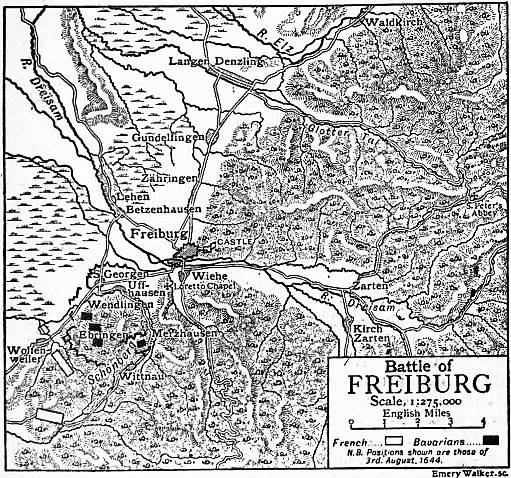
Before dawn on the 10th the advance guard of Turenne’s army was ascending the Glotter Tal. But Mercy had divined his adversary’s plan, and leaving a garrison to hold Freiburg, the Bavarian army had made a night march on the 9/10th to the Abbey of St Peter, whence on the morning of the 10th Mercy fell back to Graben, his nearest magazine in the mountains. Turenne’s advanced guard appeared from the Glotter Tal only to find a stubborn rearguard of cavalry in front of the abbey. A sharp action began, but Mercy hearing the drums and fifes of the French infantry in the Glotter Tal broke it off and continued his retreat in good order. Enghien thus obtained little material result from his manœuvre. Only two guns and such of Mercy’s wagons that were unable to keep up fell into the hands of the French. Enghien and Turenne did not continue the chase farther than Graben, and Mercy fell back unmolested to Rothenburg on the Tauber.
The moral results of this sanguinary fighting were, however, important and perhaps justified the sacrifice of so many valuable soldiers. Enghien’s pertinacity had not achieved a decision with the sword, but Mercy had been so severely punished that he was unable to interfere with his opponent’s new plan of campaign. This, which was carried out by the united armies and by reinforcements from France, while Turenne’s cavalry screened them by bold demonstrations on the Tauber, led to nothing less than the conquest of the Rhine Valley from Basel to Coblenz, a task which was achieved so rapidly that the Army of France and its victorious young leader were free to return to France in two months from the time of their appearance in Turenne’s quarters at Breisach.
FREIDANK (Vrîdanc), the name by which a Middle High German didactic poet of the early 13th century is known. It has been disputed whether the word, which is equivalent to “free-thought,” is to be regarded as the poet’s real name or only as a pseudonym; the latter is probably the case. Little is known of Freidank’s life. He accompanied Frederick II. on his crusade to the Holy Land, where, in the years 1228-1229, a portion at least of his work was composed; and it is said that on his tomb (if indeed it was not the tomb of another Freidank) at Treviso there was inscribed, with allusion to the character of his style, “he always spoke and never sang.” Wilhelm Grimm originated the hypothesis that Freidank was to be identified with Walther von der Vogelweide; but this is no longer tenable. Freidank’s work bears the name of Bescheidenheit, i.e. “practical wisdom,” “correct judgment,” and consists of a collection of proverbs, pithy sayings, and moral and satirical reflections, arranged under general heads. Its popularity till the end of the 16th century is shown by the great number of MSS. extant.
Sebastian Brant published the Bescheidenheit in a modified form in 1508. Wilhelm Grimm’s edition appeared in 1834 (2nd ed. 1860), H. F. Bezzenberger’s in 1872. A later edition is by F. Sandvoss (1877). The old Latin translation, Fridangi Discretio, was printed by C. Lemcke in 1868; and there are two translations into modern German, A. Bacmeister’s (1861) and K. Simrock’s (1867). See also F. Pfeiffer, Über Freidank (Zur deutschen Literaturgeschichte, 1855), and H. Paul, Über die ursprüngliche Anordnung von Freidanks Bescheidenheit (1870).
FREIENWALDE, a town of Germany, in the kingdom of Prussia, on the Oder, 28 m. N.E. of Berlin, on the Frankfort-Angermünde railway. Pop. (1905) 7995. It has a small palace, built by the Great Elector, an Evangelical and a Roman Catholic church, and manufactures of furniture, machinery, &c. The neighbouring forests and its medicinal springs make it a favourite summer resort of the inhabitants of Berlin. A new tower commands a fine view of the Oderbruch (see Oder). Freienwalde, which must be distinguished from the smaller town of the same name in Pomerania, first appears as a town in 1364.
FREIESLEBENITE, a rare mineral consisting of sulphantimonite of silver and lead, (Pb, Ag2)5Sb4S11. The monoclinic crystals are prismatic in habit, with deeply striated prism and dome faces. The colour is steel-grey, and the lustre metallic; hardness 2½, specific gravity 6.2. It occurs with argentite, chalybite and galena in the silver veins of the Himmelsfürst mine at Freiberg, Saxony, where it has been known since 1720. The species was named after J. K. Freiesleben, who had earlier called it Schilf-Glaserz. Other localities are Hiendelaencina near Guadalajara in Spain, Kapnik-Bánya in Hungary, and Guanajuato in Mexico. A species separated from freieslebenite by V. von Zepharovich in 1871, because of differences in crystalline form, is known as diaphorite (from διαφορά, “difference”); it is very similar to freieslebenite in appearance and has perhaps the same chemical composition (or possibly Ag2PbSb2S5), but is orthorhombic in crystallization. A third mineral also very similar to freieslebenite in appearance is the orthorhombic andorite, AgPbSb3S6, which is mined as a silver ore at Oruro in Bolivia.
FREIGHT, (pronounced like “weight”; derived from the Dutch vracht or vrecht, in Fr. fret, the Eng. “fraught” being the same word, and formerly used for the same thing, but now only as an adjective = “laden”), the lading or cargo of a ship, and the hire paid for their transport (see Affreightment); from the original sense of water-transport of goods the word has also come to be used for land-transit (particularly in America, by railroad), and by analogy for any load or burden.
FREILIGRATH, FERDINAND (1810-1876), German poet, was born at Detmold on the 17th of June 1810. He was educated at the gymnasium of his native town, and in his sixteenth year was sent to Soest, with a view to preparing him for a commercial career. Here he had also time and opportunity to acquire a taste for French and English literature. The years from 1831 to 1836 he spent in a bank at Amsterdam, and 1837 to 1839 in a business house at Barmen. In 1838 his Gedichte appeared and met with such extraordinary success that he gave up the idea of a commercial life and resolved to devote himself entirely to literature. His repudiation of the political poetry of 1841 and its revolutionary ideals attracted the attention of the king of Prussia, Frederick William IV., who, in 1842, granted him a pension of 300 talers a year. He married, and, to be near his friend Emanuel Geibel, settled at St Goar. Before long, however, Freiligrath was himself carried away by the rising tide of liberalism. In the poem Ein Glaubensbekenntnis (1844) he openly avowed his sympathy with the political movement led by his old adversary, Georg Herwegh; the day, he declared, of his own poetic trifling with Romantic themes was over; Romanticism itself was dead. He laid down his pension, and, to avoid the inevitable political persecution, took refuge in Switzerland. As a sequel to the Glaubensbekenntnis he published Ça ira! (1846), which strained still further his relations with the German authorities. He fled to London, where he resumed the commercial life he had broken off seven years before. When the Revolution of 1848 broke out, it seemed to Freiligrath, as to all the liberal thinkers of the time, the dawn of an era of political freedom; and, as may be seen from the poems in his collection of Politische und soziale Gedichte (1849-1851), he welcomed it with unbounded enthusiasm. He returned to Germany and settled in Düsseldorf; but it was not long before he had again called down upon himself the ill-will of the ruling powers by a poem, Die Toten an die Lebenden (1848). He was arrested on a charge of lèse-majesté, but the prosecution ended in his acquittal. New difficulties arose; his association with the democratic movement rendered him an object of constant suspicion, and in 1851 he judged it more prudent to go back to London, where he remained until 1868. In that year he returned to Germany, settling first in Stuttgart and in 1875 in the neighbouring town of Cannstatt, where he died on the 18th of March 1876.
As a poet, Freiligrath was the most gifted member of the German revolutionary group. Coming at the very close of the Romantic age, his own purely lyric poetry re-echoes for the most part the familiar thoughts and imagery of his Romantic predecessors; but at an early age he had been attracted by the work of French contemporary poets, and he reinvigorated the German lyric by grafting upon it the orientalism of Victor Hugo. In this reconciliation of French and German romanticism lay Freiligrath’s significance for the development of the lyric in Germany. His remarkable power of assimilating foreign literatures is also to be seen in his translations of English and Scottish ballads, of the poetry of Burns, Mrs Hemans, Longfellow and Tennyson (Englische Gedichte aus neuerer Zeit, 1846; The Rose, Thistle and Shamrock, 1853, 6th ed. 1887); he also translated Shakespeare’s Cymbeline, Winter’s Tale and Venus and Adonis, as well as Longfellow’s Hiawatha (1857). Freiligrath is most original in his revolutionary poetry. His poems of this class suffer, it is true, under the disadvantage of all political poetry—purely temporary interest and the unavoidable admixture of much that has no claim to be called poetry at all—but the agitator Freiligrath, when he is at his best, displays a vigour and strength, a power of direct and cogent poetic expression, not to be found in any other political singer of the age.
Freiligrath’s Gedichte have passed through some fifty editions, and his Gesammelte Dichtungen, first published in 1870, have reached a sixth edition (1898). Nachgelassenes (including a translation of Byron’s Mazeppa) was published in 1883. A selection of Freiligrath’s best-known poems in English translation was edited by his daughter, Mrs Freiligrath-Kroeker, in 1869; also Songs of a Revolutionary Epoch were translated by J. L. Joynes in 1888. Cp. E. Schmidt-Weissenfels, F. Freiligrath, eine Biographie (1876); W. Buchner, F. Freiligrath, ein Dichterleben in Briefen (2 vols., 1881); G. Freiligrath, Erinnerungen an F. Freiligrath (1889); P. Besson, Freiligrath (Paris, 1899); K. Richter, Freiligrath als Übersetzer (1899).
(J. G. R.)
FREIND, JOHN (1675-1728), English physician, younger brother of Robert Freind (1667-1751), headmaster of Westminster school, was born in 1675 at Croton in Northamptonshire. He made great progress in classical knowledge under Richard Busby at Westminster, and at Christ Church, Oxford, under Dean Aldrich, and while still very young, produced, along with Peter Foulkes, an excellent edition of the speeches of Aeschines and Demosthenes on the affair of Ctesiphon. After this he began the study of medicine, and having proved his scientific attainments by various treatises was appointed a lecturer on chemistry at Oxford in 1704. In the following year he accompanied the English army, under the earl of Peterborough, into Spain, and on returning home in 1707, wrote an account of the expedition, which attained great popularity. Two years later he published his Prelectiones chimicae, which he dedicated to Sir Isaac Newton. Shortly after his return in 1713 from Flanders, whither he had accompanied the British troops, he took up his residence in London, where he soon obtained a great reputation as a physician. In 1716 he became fellow of the college of physicians, of which he was chosen one of the censors in 1718, and Harveian orator in 1720. In 1722 he entered parliament as member for Launceston in Cornwall, but, being suspected of favouring the cause of the exiled Stuarts, he spent half of that year in the Tower. During his imprisonment he conceived the plan of his most important work, The History of Physic, of which the first part appeared in 1725, and the second in the following year. In the latter year he was appointed physician to Queen Caroline, an office which he held till his death on the 26th of July 1728.
A complete edition of his Latin works, with a Latin translation of the History of Physic, edited by Dr John Wigan, was published in London in 1732.
FREINSHEIM [Freinshemius], JOHANN (1608-1660), German classical scholar and critic, was born at Ulm on the 16th of November 1608. After studying at the universities of Marburg, Giessen and Strassburg, he visited France, where he remained for three years. He returned to Strassburg in 1637, and in 1642 was appointed professor of eloquence at Upsala. In 1647 he was summoned by Queen Christina to Stockholm as court librarian and historiographer. In 1650 he resumed his professorship at Upsala, but early in the following year he was obliged to resign on account of ill-health. In 1656 he became honorary professor at Heidelberg, and died on the 31st of August 1660. Freinsheim’s literary activity was chiefly devoted to the Roman historians. He first introduced the division into chapters and paragraphs, and by means of carefully compiled indexes illustrated the lexical peculiarities of each author. He is best known for his famous supplements to Quintus Curtius and Livy, containing the missing books written by himself. He also published critical editions of Curtius and Florus.
FREIRE, FRANCISCO JOSÉ (1719-1773), Portuguese historian and philologist, was born at Lisbon on the 3rd of January 1719. He belonged to the monastic society of St Philip Neri, and was a zealous member of the literary association known as the Academy of Arcadians, in connexion with which he adopted the pseudonym of Candido Lusitano. He contributed much to the improvement of the style of Portuguese prose literature, but his endeavour to effect a reformation in the national poetry by a translation of Horace’s Ars poëtica was less successful. The work in which he set forth his opinions regarding the vicious taste pervading the current Portuguese prose literature is entitled Maximas sobre a Arte Oratoria (1745) and is preceded by a chronological table forming almost a social and physical history of Portugal. His best known work, however, is his Vida do Infante D. Henrique (1758), which has given him a place in the first rank of Portuguese historians, and has been translated into French (Paris, 1781). He also wrote a poetical dictionary (Diccionario poetico) and a translation of Racine’s Athalie (1762), and his Réflexions sur la langue portugaise was published in 1842 by the Lisbon society for the promotion of useful knowledge. He died at Mafra on the 5th of July 1773.
FREISCHÜTZ, in German folklore, a marksman who by a compact with the devil has obtained a certain number of bullets destined to hit without fail whatever object he wishes. As the legend is usually told, six of the Freikugeln or “free bullets” are thus subservient to the marksman’s will, but the seventh is at the absolute disposal of the devil himself. Various methods were adopted in order to procure possession of the marvellous missiles. According to one the marksman, instead of swallowing the sacramental host, kept it and fixed it on a tree, shot at it and caused it to bleed great drops of blood, gathered the drops on a piece of cloth and reduced the whole to ashes, and then with these ashes added the requisite virtue to the lead of which his bullets were made. Various vegetable or animal substances had the reputation of serving the same purpose. Stories about the Freischütz were especially common in Germany during the 14th, 15th and 16th centuries; but the first time that the legend was turned to literary profit is said to have been by Apel in the Gespensterbuch or “Book of Ghosts.” It formed the subject of Weber’s opera Der Freischütz (1821), the libretto of which was written by Friedrich Kind, who had suggested Apel’s story as an excellent theme for the composer. The name by which the Freischütz is known in French is Robin des Bois.
See Kind, Freyschützbuch (Leipzig, 1843); Revue des deux mondes (February 1855); Grässe, Die Quelle des Freischütz (Dresden, 1875).
FREISING, a town of Germany, in the kingdom of Bavaria, on the Isar, 16 m. by rail N.N.E. of Munich. Pop. (1905) 13,538. Among its eight Roman Catholic churches the most remarkable is the cathedral, which dates from about 1160 and is famous for its curious crypt. Noteworthy also are the old palace of the bishops, now a clerical seminary, the theological lyceum and the town-hall. There are several schools in the town, and there is a statue to the chronicler, Otto of Freising, who was bishop here from 1138 to 1158. Freising has manufactures of agricultural machinery and of porcelain, while printing and brewing are carried on. Near the town is the site of the Benedictine abbey of Weihenstephan, which existed from 725 to 1803. This is now a model farm and brewery. Freising is a very ancient town and is said to have been founded by the Romans. After being destroyed by the Hungarians in 955 it was fortified by the emperor Otto II. in 976 and by Duke Welf of Bavaria in 1082. A bishopric was established here in 724 by St Corbinianus, whose brother Erimbert was consecrated second bishop by St Boniface in 739. Later on the bishops acquired considerable territorial power and in the 17th century became princes of the Empire. In 1802 the see was secularized, the bulk of its territories being assigned to Bavaria and the rest to Salzburg, of which Freising had been a suffragan bishopric. In 1817 an archbishopric was established at Freising, but in the following year it was transferred to Munich. The occupant of the see is now called archbishop of Munich and Freising.
See C. Meichelbeck, Historiae Frisingensis (Augsburg, 1724-1729, new and enlarged edition 1854).
FRÉJUS, a town in the department of the Var in S.E. France. Pop. (1906) 3430. It is 28½ m. S.E. of Draguignan (the chief town of the department), and 22½ m. S.W. of Cannes by rail. It is only important on account of the fine Roman remains that it contains, for it is now a mile from the sea, its harbour having been silted up by the deposits of the Argens river. Since the 4th century it has been a bishop’s see, which is in the ecclesiastical province of Aix en Provence. In modern times the neighbouring fishing village at St Raphaël (2½ m. by rail S.E., and on the seashore) has become a town of 4865 inhabitants (in 1901); in 1799 Napoleon disembarked there, on his return from Egypt, and reembarked for Elba in 1814, while nowadays it is much frequented as a health resort, as is also Valescure (2 m. N.W. on the heights above). The cathedral church in part dates from the 12th century, but only small portions of the old medieval episcopal palace are now visible, as it was rebuilt about 1823. The ramparts of the old town can still be traced for a long distance, and there are fragments of two moles, of the theatre and of a gate. The amphitheatre, which seated 12,000 spectators, is in a better state of preservation. The ruins of the great aqueduct which brought the waters of the Siagnole, an affluent of the Siagne, to the town, can still be traced for a distance of nearly 19 m. The original hamlet was the capital of the tribe of the Oxybii, while the town of Forum Julii was founded on its site by Julius Caesar in order to secure to the Romans a harbour independent of that of Marseilles. The buildings of which ruins exist were mostly built by Caesar or by Augustus, and show that it was an important naval station and arsenal. But the town suffered much at the hands of the Arabs, of Barbary pirates, and of its inhabitants, who constructed many of their dwellings out of the ruined Roman buildings. The ancient harbour (really but a portion of the lagoons, which had been deepened) is now completely silted up. Even in early times a canal had to be kept open by perpetual digging, while about 1700 this was closed, and now a sandy and partly cultivated waste extends between the town and the seashore.
See J. A. Aubenas, Histoire de Fréjus (Fréjus, 1881); Ch. Lenthéric, La Provence Maritime ancienne et moderne (Paris, 1880), chap. vii.
(W. A. B. C.)
FRELINGHUYSEN, FREDERICK THEODORE (1817-1885), American lawyer and statesman, of Dutch descent, was born at Millstone, New Jersey, on the 4th of August 1817. His grandfather, Frederick Frelinghuysen (1753-1804), was an eminent lawyer, one of the framers of the first New Jersey constitution, a soldier in the War of Independence, and a member (1778-1779 and 1782-1783) of the Continental Congress from New Jersey, and in 1793-1796 of the United States senate; and his uncle, Theodore (1787-1862), was attorney-general of New Jersey from 1817 to 1829, was a United States senator from New Jersey in 1829-1835, was the Whig candidate for vice-president on the Clay ticket in 1844, and was chancellor of the university of New York in 1839-1850 and president of Rutgers College in 1850-1862. Frederick Theodore, left an orphan at the age of three, was adopted by his uncle, graduated at Rutgers in 1836, and studied law in Newark with his uncle, to whose practice he succeeded in 1839, soon after his admission to the bar. He became attorney for the Central Railroad of New Jersey, the Morris Canal and Banking Company, and other corporations, and from 1861 to 1867 was attorney-general of New Jersey. In 1861 he was a delegate to the peace congress at Washington, and in 1866 was appointed by the governor of New Jersey, as a Republican, to fill a vacancy in the United States senate. In the winter of 1867 he was elected to fill the unexpired term, but a Democratic majority in the legislature prevented his re-election in 1869. In 1870 he was nominated by President Grant, and confirmed by the senate, as United States minister to England to succeed John Lothrop Motley, but declined the mission. From 1871 to 1877 he was again a member of the United States senate, in which he was prominent in debate and in committee work, and was chairman of the committee on foreign affairs during the Alabama Claims negotiations. He was a strong opponent of the reconstruction measures of President Johnson, for whose conviction he voted (on most of the specific charges) in the impeachment trial. He was a member of the joint committee which drew up and reported (1877) the Electoral Commission Bill, and subsequently served as a member of the commission. On the 12th of December 1881 he was appointed secretary of state by President Arthur to succeed James G. Blaine, and served until the inauguration of President Cleveland in 1885. Retiring, with his health impaired by overwork, to his home in Newark, he died there on the 20th of May, less than three months after relinquishing the cares of office.
FREMANTLE, a seaport of Swan county, Western Australia, at the mouth of the Swan river, 12 m. by rail S.W. of Perth. It is the terminus of the Eastern railway, and is a town of some industrial activity, shipbuilding, soap-boiling, saw-milling, smelting, iron-founding, furniture-making, flour-milling, brewing and tanning being its chief industries. The harbour, by the construction of two long moles and the blasting away of the rocks at the bar, has been rendered secure. The English, French and German mail steamers call at the port. Fremantle became a municipality in 1871; but there are now three separate municipalities—Fremantle, with a population in 1901 of 14,704; Fremantle East (2494); and Fremantle North (3246). At Rottnest Island, off the harbour, there are government salt-works and a residence of the governor, also penal and reformatory establishments.
FRÉMIET, EMMANUEL (1824- ), French sculptor, born in Paris, was a nephew and pupil of Rude; he chiefly devoted himself to animal sculpture and to equestrian statues in armour. His earliest work was in scientific lithography (osteology), and for a while he served in times of adversity in the gruesome office of “painter to the Morgue.” In 1843 he sent to the Salon a study of a “Gazelle,” and after that date was very prolific in his works. His “Wounded Bear” and “Wounded Dog” were produced in 1850, and the Luxembourg Museum at once secured this striking example of his work. From 1855 to 1859 Frémiet was engaged on a series of military statuettes for Napoleon III. He produced his equestrian statue of “Napoleon I.” in 1868, and of “Louis d’Orléans” in 1869 (at the Château de Pierrefonds) and in 1874 the first equestrian statue of “Joan of Arc,” erected in the Place des Pyramides, Paris; this he afterwards (1889) replaced with another and still finer version. In the meanwhile he had exhibited his masterly “Gorilla and Woman” which won him a medal of honour at the Salon of 1887. Of the same character, and even more remarkable, is his “Ourang-Outangs and Borneo Savage” of 1895, a commission from the Paris Museum of Natural History. Frémiet also executed the statue of “St Michael” for the summit of the spire of the Église St Michel, and the equestrian statue of Velasquez for the Jardin de l’Infante at the Louvre. He became a member of the Académie des Beaux-Arts in 1892, and succeeded Barye as professor of animal drawing at the Natural History Museum of Paris.