VOLUME XI SLICE I Franciscans to French Language (continued 10)
Reading edition
FRÉMONT, JOHN CHARLES (1813-1890), American explorer, soldier and political leader, was born in Savannah, Georgia, on the 21st of January 1813. His father, a native of France, died when the boy was in his sixth year, and his mother, a member of an aristocratic Virginia family, then removed to Charleston, South Carolina. In 1828, after a year’s special preparation, young Frémont entered the junior class of the college of Charleston, and here displayed marked ability, especially in mathematics; but his irregular attendance and disregard of college discipline led to his expulsion from the institution, which, however, conferred upon him a degree in 1836. In 1833 he was appointed teacher of mathematics on board the sloop of war “Natchez,” and was so engaged during a cruise along the South American coast which was continued for about two and a half years. Soon after returning to Charleston he was appointed professor of mathematics in the United States navy, but he chose instead to serve as assistant engineer of a survey undertaken chiefly for the purpose of finding a pass through the mountains for a proposed railway from Charleston to Cincinnati. In July 1838 he was appointed second lieutenant of Topographical Engineers in the United States army, and for the next three years he was assistant to the French explorer, Jean Nicholas Nicollet (1786-1843), employed by the war department to survey and map a large part of the country lying between the upper waters of the Mississippi and Missouri rivers. In 1841 Frémont surveyed, for the government, the lower course of the Des Moines river. In the same year he married Jessie, the daughter of Senator Thomas H. Benton of Missouri, and it was in no small measure through Benton’s influence with the government that Frémont was enabled to accomplish within the next few years the exploration of much of the territory between the Mississippi Valley and the Pacific Ocean.
When the claim of the United States to the Oregon territory was being strengthened by occupation, Frémont was sent, at his urgent request, to explore the frontier beyond the Missouri river, and especially the Rocky Mountains in the vicinity of the South Pass, through which the American immigrants travelled. Within four months (1842) he surveyed the Pass and ascended to the summit of the highest of the Wind River Mountains, since known as Frémont’s Peak, and the interest aroused by his descriptions was such that in the next year he was sent on a second expedition to complete the survey across the continent along the line of travel from Missouri to the mouth of the Columbia river. This time he not only carried out his instructions but, by further explorations together with interesting descriptions, dispelled general ignorance with respect to the main features of the country W. of the Rocky Mountains: the Great Salt Lake, the Great Basin, the Sierra Nevada Mountains, and the fertile river basins of the Mexican province of California.
His report of this expedition upon his return to Washington, D.C., in 1844, aroused much solicitude for California, which, it was feared, might, in the event of war then threatening between the United States and Mexico, be seized by Great Britain. In the spring of 1845 Frémont was despatched on a third expedition for the professed purposes of further exploring the Great Basin and the Pacific Coast, and of discovering the easiest lines of communication between them, as well as for the secret purpose of assisting the United States, in case of war with Mexico, to gain possession of California. He and his party of sixty-two arrived there in January 1846. Owing to the number of American immigrants who had settled in California, the Mexican authorities there became suspicious and hostile, and ordered Frémont out of the province. Instead of obeying he pitched his camp near the summit of a mountain overlooking Monterey, fortified his position, and raised the United States flag. A few days later he was proceeding toward the Oregon border when new instructions from Washington caused him to retrace his steps and, perhaps, to consider plans for provoking war. The extent of his responsibility for the events that ensued is not wholly clear, and has been the subject of much controversy; his defenders have asserted that he was not responsible for the seizure of Sonoma or for the so-called “Bear-Flag War”; and that he played a creditable part throughout. (For an opposite view see California.) Commodore John D. Sloat, after seizing Monterey, transferred his command to Commodore Robert Field Stockton (1795-1866), who made Frémont major of a battalion; and by January 1847 Stockton and Frémont completed the conquest of California. In the meantime General Stephen Watts Kearny (1794-1848) had been sent by the Government to conquer it and to establish a government. This created a conflict of authority between Stockton and Kearny, both of whom were Frémont’s superior officers. Stockton, ignoring Kearny, commissioned Frémont military commandant and governor. But Kearny’s authority being confirmed about the 1st of April, Frémont, for repeated acts of disobedience, was sent under arrest to Washington, where he was tried by court-martial, found guilty (January 1847) of mutiny, disobedience and conduct prejudicial to military discipline, and sentenced to dismissal from the service. President Polk approved of the verdict except as to mutiny, but remitted the penalty, whereupon Frémont resigned.
With the mountain-traversed region he had been exploring acquired by the United States, Frémont was eager for a railway from the Atlantic to the Pacific, and in October 1848 he set out at his own and Senator Benton’s expense to find passes for such a railway along a line westward from the headwaters of the Rio Grande. But he had not gone far when he was led astray by a guide, and after the loss of his entire outfit and several of his men, and intense suffering of the survivors from cold and hunger, he turned southward through the valley of the Rio Grande and then westward through the valley of the Gila into southern California. Late in the year 1853, however, he returned to the place where the guide had led him astray, found passes through the mountains to the westward between latitudes 37° and 38° N., and arrived in San Francisco early in May 1854. From the conclusion of his fourth expedition until March 1855, when he removed to New York city, he lived in California, and in December 1849 was elected one of the first two United States senators from the new state. But as he drew the short term, he served only from the 10th of September 1850 to the 3rd of March 1851. Although a candidate for re-election, he was defeated by the pro-slavery party. His opposition to slavery, however, together with his popularity—won by the successes, hardships and dangers of his exploring expeditions, and by his part in the conquest of California—led to his nomination, largely on the ground of “availability,” for the presidency in 1856 by the Republicans (this being their first presidential campaign), and by the National Americans or “Know-Nothings.” In the ensuing election he was defeated by James Buchanan by 174 to 114 electoral votes.
Soon after the Civil War began, Frémont was appointed major-general and placed in command of the western department with headquarters at St Louis, but his lack of judgment and of administrative ability soon became apparent, the affairs of his department fell into disorder, and Frémont seems to have been easily duped by dishonest contractors whom he trusted. On the 30th of August 1861 he issued a proclamation in which he declared the property of Missourians in rebellion confiscated and their slaves emancipated. For this he was applauded by the radical Republicans, but his action was contrary to an act of congress of the 6th of August and to the policy of the Administration. On the 11th of September President Lincoln, who regarded the action as premature and who saw that it might alienate Kentucky and other border states, whose adherence he was trying to secure, annulled these declarations. Impelled by serious charges against Frémont, the president sent Montgomery Blair, the postmaster-general, and Montgomery C. Meigs, the quartermaster-general, to investigate the department; they reported that Frémont’s management was extravagant and inefficient; and in November he was removed. Out of consideration for the “Radicals,” however, Frémont was placed in command of the Mountain Department of Virginia, Kentucky and Tennessee. In the spring and summer of 1862 he co-operated with General N. P. Banks against “Stonewall” Jackson in the Shenandoah Valley, but showed little ability as a commander, was defeated by General Ewell at Cross Keys, and when his troops were united with those of Generals Banks and McDowell to form the Army of Virginia, of which General John Pope was placed in command, Frémont declined to serve under Pope, whom he outranked, and retired from active service. On the 31st of May 1864 he was nominated for the presidency by a radical faction of the Republican party, opposed to President Lincoln, but his following was so small that on the 21st of September he withdrew from the contest. From 1878 to 1881 he was governor of the territory of Arizona, and in the last year of his life he was appointed by act of congress a major-general and placed on the retired list. He died in New York on the 13th of July 1890.
See J. C. Frémont, Report of the Exploring Expedition to the Rocky Mountains, 1842, and to Oregon and North California, 1843-1844 (Washington, 1845); Frémont’s Memoirs of my Life (New York, 1887); and J. Bigelow, Memoirs of the Life and Public Services of John C. Frémont (New York, 1856).
FREMONT, a city and the county-seat of Dodge county, Nebraska, U.S.A., about 37 m. N.W. of Omaha, on the N. bank of the Platte river, which here abounds in picturesque bluffs and wooded islands. Pop. (1890) 6747; (1900) 7241 (1303 foreign-born); (1910) 8718. It is on the main line of the Union Pacific railway, on a branch of the Chicago, Burlington & Quincy system, and on the main western line of the Chicago & North-Western railway, several branches of which (including the formerly independent Fremont, Elkhorn & Missouri Valley and the Sioux City & Pacific) converge here. The city has an attractive situation and is beautifully shaded. It has a public library and is the seat of the Fremont College, Commercial Institute and School of Pharmacy (1875), a private institution. There is considerable local trade with the rich farming country of the Platte and Elkhorn valleys; and the wholesale grain interests are especially important. Among the manufactures are flour, carriages, saddlery, canned vegetables, furniture, incubators and beer. The city owns and operates its electric-lighting plant and water-works. Fremont was founded in 1856, and became the county-seat in 1860. It was chartered as a city (second-class) in 1871, and became a city of the first class in 1901.
FREMONT, a city and the county-seat of Sandusky county, Ohio, U.S.A., on the Sandusky river, 30 m. S.E. of Toledo. Pop. (1890) 7141; (1900) 8439, of whom 1074 were foreign-born; (1910 census) 9939. Fremont is served by the Lake Shore & Michigan Southern, the Lake Shore Electric, the Lake Erie & Western, and the Wheeling & Lake Erie railways. The river is navigable to this point. Spiegel Grove, the former residence of Rutherford B. Hayes, is of interest, and the city has a public library (1873) and parks, in large measure the gifts of his uncle, Sardis Birchard. Fremont is situated in a good agricultural region; oil and natural gas abound in the vicinity; and the city has various manufactures, including boilers, electro-carbons, cutlery, bricks, agricultural implements, stoves and ranges, safety razors, carriage irons, sash, doors, blinds, furniture, beet sugar, canned vegetables, malt extract, garters and suspenders. The total factory product was valued at $2,833,385 in 1905, an increase of 23.4% over that of 1900. Fremont is on the site of a favourite abode of the Indians, and a trading post was at times maintained here; but the place is best known in history as the site of Fort Stephenson, erected during the War of 1812, and on the 2nd of August 1813 gallantly and successfully defended by Major George Croghan (1791-1849), with 160 men, against about 1000 British and Indians under Brigadier-General Henry A. Proctor. In 1906 Croghan’s remains were re-interred on the site of the old fort. Until 1849, when the present name was adopted in honour of J. C. Frémont, the place was known as Lower Sandusky; it was incorporated as a village in 1829 and was first chartered as a city in 1867.
FRÉMY, EDMOND (1814-1894), French chemist, was born at Versailles on the 29th of February 1814. Entering Gay-Lussac’s laboratory in 1831, he became préparateur at the École Polytechnique in 1834 and at the Collège de France in 1837. His next post was that of répétiteur at the École Polytechnique, where in 1846 he was appointed professor, and in 1850 he succeeded Gay-Lussac in the chair of chemistry at the Muséum d’Histoire Naturelle, of which he was director, in succession to M. E. Chevreul, from 1879 to 1891. He died at Paris on the 3rd of February 1894. His work included investigations of osmic acid, of the ferrates, stannates, plumbates, &c., and of ozone, attempts to obtain free fluorine by the electrolysis of fused fluorides, and the discovery of anhydrous hydrofluoric acid and of a series of acides sulphazotés, the precise nature of which long remained a matter of discussion. He also studied the colouring matters of leaves and flowers, the composition of bone, cerebral matter and other animal substances, and the processes of fermentation, in regard to the nature of which he was an opponent of Pasteur’s views. Keenly alive to the importance of the technical applications of chemistry, he devoted special attention as a teacher to the training of industrial chemists. In this field he contributed to our knowledge of the manufacture of iron and steel, sulphuric acid, glass and paper, and in particular worked at the saponification of fats with sulphuric acid and the utilization of palmitic acid for candle-making. In the later years of his life he applied himself to the problem of obtaining alumina in the crystalline form, and succeeded in making rubies identical with the natural gem not merely in chemical composition but also in physical properties.
FRENCH, DANIEL CHESTER (1850- ), American sculptor, was born at Exeter, New Hampshire, on the 20th of April 1850, the son of Henry Flagg French, a lawyer, who for a time was assistant-secretary of the United States treasury. After a year at the Massachusetts Institute of Technology, French spent a month in the studio of John Q. A. Ward, then began to work on commissions, and at the age of twenty-three received from the town of Concord, Massachusetts, an order for his well-known statue “The Minute Man,” which was unveiled (April 19, 1875) on the centenary of the battle of Concord. Previously French had gone to Florence, Italy, where he spent a year with Thomas Ball. French’s best-known work is “Death Staying the Hand of the Sculptor,” a memorial for the tomb of the sculptor Martin Milmore, in the Forest Hills cemetery, Boston; this received a medal of honour at Paris, in 1900. Among his other works are: a monument to John Boyle O’Reilly, Boston; “Gen. Cass,” National Hall of Statuary, Washington; “Dr Gallaudet and his First Deaf-Mute Pupil,” Washington; the colossal “Statue of the Republic,” for the Columbian Exposition at Chicago; statues of Rufus Choate (Boston), John Harvard (Cambridge, Mass.), and Thomas Starr King (San Francisco, California), a memorial to the architect Richard M. Hunt, in Fifth Avenue, opposite the Lenox library, New York, and a large “Alma Mater,” near the approach to Columbia University, New York. In collaboration with Edward C. Potter he modelled the “Washington,” presented to France by the Daughters of the American Revolution; the “General Grant” in Fairmount Park, Philadelphia, and the “General Joseph Hooker” in Boston. French became a member of the National Academy of Design (1901), the National Sculpture Society, the Architectural League, and the Accademia di San Luca, of Rome.
FRENCH, NICHOLAS (1604-1678), bishop of Ferns, was an Irish political pamphleteer, who was born at Wexford. He was educated at Louvain, and returning to Ireland became a priest at Wexford, and before 1646 was appointed bishop of Ferns. Having taken a prominent part in the political disturbances of this period, French deemed it prudent to leave Ireland in 1651, and the remainder of his life was passed on the continent of Europe. He acted as coadjutor to the archbishops of Santiago de Compostella and Paris, and to the bishop of Ghent, and died at Ghent on the 23rd of August 1678. In 1676 he published his attack on James Butler, marquess of Ormonde, entitled “The Unkinde Desertor of Loyall Men and True Frinds,” and shortly afterwards “The Bleeding Iphigenia.” The most important of his other pamphlets is the “Narrative of the Earl of Clarendon’s Settlement and Sale of Ireland” (Louvain, 1668).
The Historical Works of Bishop French, comprising the three pamphlets already mentioned and some letters, were published by S. H. Bindon at Dublin in 1846. See T. D. McGee, Irish Writers of the 17th Century (Dublin, 1846); Sir J. T. Gilbert, Contemporary History of Affairs in Ireland, 1641-1652 (Dublin, 1879-1880); and T. Carte, Life of James, Duke of Ormond (new ed., Oxford, 1851).
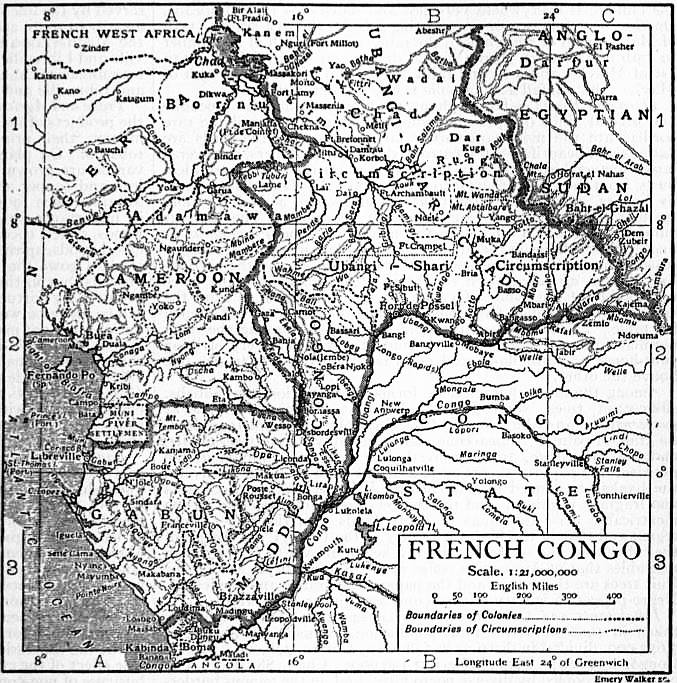
FRENCH CONGO, the general name of the French possessions in equatorial Africa. They have an area estimated at 700,000 sq. m., with a population, also estimated, of 6,000,000 to 10,000,000. The whites numbered (1906) 1278, of whom 502 were officials. French Congo, officially renamed French Equatorial Africa in 1910, comprises—(1) the Gabun Colony, (2) the Middle Congo Colony, (3) the Ubangi-Shari Circumscription, (4) the Chad Circumscription. The two last-named divisions form the Ubangi-Shari-Chad Colony.
The present article treats of French Congo as a unit. It is of highly irregular shape. It is bounded W. by the Atlantic, N. by the (Spanish) Muni River Settlements, the German colony of Cameroon and the Sahara, E. by the Anglo-Egyptian Sudan, and S. by Belgian Congo and the Portuguese territory of Kabinda. In the greater part of its length the southern frontier is the middle course of the Congo and the Ubangi and Mbomu, the chief northern affluents of that stream, but in the south-west the frontier keeps north of the Congo river, whose navigable lower course is partitioned between Belgium and Portugal. The coast line, some 600 m. long, extends from 5° S. to 1° N. The northern frontier, starting inland from the Muni estuary, after skirting the Spanish settlements follows a line drawn a little north of 2° N. and extending east to 16° E. North of this line the country is part of Cameroon, German territory extending so far inland from the Gulf of Guinea as to approach within 130 m. of the Ubangi. From the intersection of the lines named, at which point French Congo is at its narrowest, the frontier runs north and then east until the Shari is reached in 10° 40′ N. The Shari then forms the frontier up to Lake Chad, where French Congo joins the Saharan regions of French West Africa. The eastern frontier, separating the colony from the Anglo-Egyptian Sudan, is the water-parting between the Nile and the Congo. The Mahommedan sultanates of Wadai and Bagirmi occupy much of the northern part of French Congo (see Wadai and Bagirmi).
Physical Features.—The coast line, beginning in the north at Corisco Bay, is shortly afterwards somewhat deeply indented by the estuary of the Gabun, south of which the shore runs in a nearly straight line until the delta of the Ogowé is reached, where Cape Lopez projects N.W. From this point the coast trends uniformly S.E. without presenting any striking features, though the Bay of Mayumba, the roadstead of Loango, and the Pointe Noire may be mentioned. A large proportion of the coast region is occupied by primeval forest, with trees rising to a height of 150 and 200 ft., but there is a considerable variety of scenery—open lagoons, mangrove swamps, scattered clusters of trees, park-like reaches, dense walls of tangled underwood along the rivers, prairies of tall grass and patches of cultivation. Behind the coast region is a ridge which rises from 3000 to 4500 ft., called the Crystal Mountains, then a plateau with an elevation varying from 1500 to 2800 ft., cleft with deep river-valleys, the walls of which are friable, almost vertical, and in some places 760 ft. high.
The coast rivers flowing into the Atlantic cross four terraces. On the higher portion of the plateau their course is over bare sand; on the second terrace, from 1200 to 2000 ft. high, it is over wide grassy tracts; then, for some 100 m., the rivers pass through virgin forest, and, lastly, they cross the shore region, which is about 10 m. broad. The rivers which fall directly into the Atlantic are generally unnavigable. The most important, the Ogowé (q.v.), is, however, navigable from its mouth to N’Jole, a distance of 235 m. Rivers to the south of the Ogowé are the Nyanga, 120 m. long, and the Kwilu. The latter, 320 m. in length, is formed by the Kiasi and the Luété; it has a very winding course, flowing by turns from north to south, from east to west, from south to north-west and from north to south-west. It is encumbered with rocks and eddies, and is navigable only over 38 m., and for five months in the year. The mouth is 1100 ft. wide. The Muni river, the northernmost in the colony, is obstructed by cataracts in its passage through the escarpment to the coast.
Nearly all the upper basin of the Shari (q.v.) as well as the right bank of the lower river is within French Congo. The greater part of the country belongs, however, to the drainage area of the Congo river. In addition to the northern banks of the Mbomu and Ubangi, 330 m. of the north shore of the Congo itself are in the French protectorate as well as numerous subsidiary streams. For some 100 m. however, the right bank of the Sanga, the most important of these subsidiary streams, is in German territory (see Congo).
Geology.—Three main divisions are recognized in the French Congo:—(1) the littoral zone, covered with alluvium and superficial deposits and underlain by Tertiary and Cretaceous rocks; (2) the mountain zone of the Crystal Mountains, composed of granite, metamorphic and ancient sediments; (3) the plateau of the northern portion of the Congo basin, occupied by Karroo sandstones. The core of the Crystal Mountains consists of granite and schists. Infolded with them, and on the flanks, are three rock systems ascribed to the Silurian, Devonian and Carboniferous. These are unfossiliferous, but fossils of Devonian age occur on the Congo (see Congo Free State). Granite covers wide areas north-west of the Crystal Mountains. The plateau sandstones lie horizontally and consist of a lower red sandstone group and an upper white sandstone group. They have not yielded fossils. Limestones of Lower Cretaceous age, with Schloenbachia inflata, occur north of the Gabun and in the Ogowé basin. Marls and limestones with fossils of an Eocene facies overlie the Cretaceous rocks on the Gabun. A superficial iron-cemented sand, erroneously termed laterite, covers large areas in the littoral zone, on the flanks of the mountains and on the high plateau.
Climate.—The whole of the country being in the equatorial region, the climate is everywhere very hot and dangerous for Europeans. On the coast four seasons are distinguished: the dry season (15th of May to 15th of September), the rainy season (15th of September to 15th of January), then a second dry season (15th of January to 1st of March), and a second rainy season (1st of March to 15th of May). The rainfall at Libreville is about 96 in. a year.
Flora and Fauna.—The elephant, the hippopotamus, the crocodile and several kinds of apes—including the chimpanzee and the rare gorilla—are the most noteworthy larger animals; the birds are various and beautiful—grey parrots, shrikes, fly-catchers, rhinoceros birds, weaver birds (often in large colonies on the palm-trees), ice-birds, from the Cecyle Sharpii to the dwarfish Alcedo cristata, butterfly finches, and helmet-birds (Turacus giganteus), as well as more familiar types. Snakes are extremely common. The curious climbing-fish, which frequents the mangroves, the Protopterus or lung-fish, which lies in the mud in a state of lethargy during the dry season, the strange and poisonous Tetrodon guttifer, and the herring-like Pellona africana, often caught in great shoals—are the more remarkable of the fishes. Oysters are got in abundance from the lagoons, and the huge Cardisoma armatum or heart-crab is fattened for table. Fireflies, mosquitoes and sandflies are among the most familiar forms of insect life. A kind of ant builds very striking bent-house or umbrella-shaped nests rising on the tree trunks one above the other.
Among the more characteristic forms of vegetation are baobabs, silk-cotton trees, screw-pines and palms—especially Hyphaene guineensis (a fan-palm), Raphia (the wine-palm), and Elaeis guineensis (the oil-palm). Anonaceous plants (notably Anona senegalensis), and the pallabanda, an olive-myrtle-like tree, are common in the prairies; the papyrus shoots up to a height of 20 ft. along the rivers; the banks are fringed by the cottony Hibiscus tiliaceus, ipomaeas and fragrant jasmines; and the thickets are bound together in one inextricable mass by lianas of many kinds. In the upper Shari region, and that of the Kotto tributary of the Ubangi, are species of the coffee tree, one species attaining a height of over 60 ft. Its bean resembles that of Abyssinian coffee of medium quality. Among the fruit trees are the mango and the papaw, the orange and the lemon. Negro-pepper (a variety of capsicum) and ginger grow wild.
Inhabitants and Chief Towns.—A census, necessarily imperfect, taken in 1906 showed a total population, exclusive of Wadai, of 3,652,000, divided in districts as follows:—Gabun, 376,000; Middle Congo, 259,000; Ubangi-Shari, 2,130,000; Chad, 885,000. The country is peopled by diverse negro races, and, in the regions bordering Lake Chad and in Wadai, by Fula, Hausa, Arabs and semi-Arab tribes. Among the best-known tribes living in French Congo are the Fang (Fans), the Bakalai, the Batekes and the Zandeh or Niam-Niam. Several of the tribes are cannibals and among many of them the fetish worship characteristic of the West African negroes prevails. Their civilization is of a low order. In the northern regions the majority of the inhabitants are Mahommedans, and it is only in those districts that organized and powerful states exist. Elsewhere the authority of a chief or “king” extends, ordinarily, little beyond the village in which he lives. (An account of the chief tribes is given under their names.) The European inhabitants are chiefly of French nationality, and are for the most part traders, officials and missionaries.
The chief towns are Libreville (capital of the Gabun colony) with 3000 inhabitants; Brazzaville, on the Congo on the north side of Stanley Pool (opposite the Belgian capital of Leopoldville), the seat of the governor-general; Franceville, on the upper Ogowé; Loango, an important seaport in 4° 39′ S.; N’Jole, a busy trading centre on the lower Ogowé; Chekna, capital of Bagirmi, which forms part of the Chad territory; Abeshr, the capital of Wadai, Bangi on the Ubangi river, the administrative capital of the Ubangi-Shari-Chad colony. Kunde, Lame and Binder are native trading centres near the Cameroon frontier.
Communications.—The rivers are the chief means of internal communication. Access to the greater part of the colony is obtained by ocean steamers to Matadi on the lower Congo, and thence round the falls by the Congo railway to Stanley Pool. From Brazzaville on Stanley Pool there is 680 m. of uninterrupted steam navigation N.E. into the heart of Africa, 330 m. being on the Congo and 350 m. on the Ubangi. The farthest point reached is Zongo, where rapids block the river, but beyond that port there are several navigable stretches of the Ubangi, and for small vessels access to the Nile is possible by means of the Bahr-el-Ghazal tributaries. The Sanga, which joins the Congo, 270 m. above Brazzaville, can be navigated by steamers for 350 m., i.e. up to and beyond the S.E. frontier of the German colony of Cameroon. The Shari is also navigable for a considerable distance and by means of its affluent, the Logone, connects with the Benue and Niger, affording a waterway between the Gulf of Guinea and Lake Chad. Stores for government posts in the Chad territory are forwarded by this route. There is, however, no connecting link between the coast rivers—Gabun, Ogowé and Kwilu and the Congo system. A railway, about 500 m. long, from the Gabun to the Sanga is projected and the surveys for the purpose made. Another route surveyed for a railway is that from Loango to Brazzaville. A narrow-gauge line, 75 m. long, from Brazzaville to Mindule in the cataracts region was begun in November 1908, the first railway to be built in French Congo. The district served by the line is rich in copper and other minerals. From Wadai a caravan route across the Sahara leads to Bengazi on the shores of the Mediterranean. Telegraph lines connect Loango with Brazzaville and Libreville, there is telegraphic communication with Europe by submarine cable, and steamship communication between Loango and Libreville and Marseilles, Bordeaux, Liverpool and Hamburg.
Trade and Agriculture.—The chief wealth of the colony consists in the products of its forests and in ivory. The natives, in addition to manioc, their principal food, cultivate bananas, ground nuts and tobacco. On plantations owned by Europeans coffee, cocoa and vanilla are grown. European vegetables are raised easily. Gold, iron and copper are found. Copper ores have been exported from Mindule since 1905. The chief exports are rubber and ivory, next in importance coming palm nuts and palm oil, ebony and other woods, coffee, cocoa and copal. The imports are mainly cotton and metal goods, spirits and foodstuffs. In the Gabun and in the basin of the Ogowé the French customs tariff, with some modifications, prevails, but in the Congo basin, that is, in the greater part of the country, by virtue of international agreements, no discrimination can be made between French and other merchandise, whilst customs duties must not exceed 10% ad valorem.1 In the Shari basin and in Wadai the Anglo-French declaration of March 1899 accorded for thirty years equal treatment to British and French goods. The value of the trade rose in the ten years 1896-1905 from £360,000 to £850,000, imports and exports being nearly equal. The bulk of the export trade is with Great Britain, which takes most of the rubber, France coming second and Germany third. The imports are in about equal proportions from France and foreign countries.
Land Tenure. The Concessions Régime.—Land held by the natives is governed by tribal law, but the state only recognizes native ownership in land actually occupied by the aborigines. The greater part of the country is considered a state domain. Land held by Europeans is subject to the Civil Code of France except such estates as have been registered under the terms of a decree of the 28th of March 1899, when, registration having been effected, the title to the land is guaranteed by the state. Nearly the whole of the colony has been divided since 1899 into large estates held by limited liability companies to whom has been granted the sole right of exploiting the land leased to them. The companies holding concessions numbered in 1904 about forty, with a combined capital of over £2,000,000, whilst the concessions varied in size from 425 sq. m. to 54,000 sq. m. One effect of the granting of concessions was the rapid decline in the business of non-concessionaire traders, of whom the most important were Liverpool merchants established in the Gabun before the advent of the French. As by the Act of Berlin of 1885, to which all the European powers were signatories, equality of treatment in commercial affairs was guaranteed to all nations in the Congo basin, protests were raised against the terms of the concessions. The reply was that the critics confused the exercise of the right of proprietorship with the act of commerce, and that in no country was the landowner who farmed his land and sold the produce regarded as a merchant. Various decisions by the judges of the colony during 1902 and 1903 and by the French cour de cassation in 1905 confirmed that contention. The action of the companies was, however, in most cases, neither beneficial to the country nor financially successful, whilst the native cultivators resented the prohibition of their trading direct with their former customers. The case of the Liverpool traders was taken up by the British government and it was agreed that the dispute should be settled by arbitration. In September 1908 the French government issued a decree reorganizing and rendering more stringent the control exercised by the local authorities over the concession companies, especially in matters concerning the rights of natives and the liberty of commerce.
History.—The Gabun was visited in the 15th century by the Portuguese explorers, and it became one of the chief seats of the slave trade. It was not, however, till well on in the 19th century that Europeans made any more permanent settlement than was absolutely necessary for the maintenance of their commerce. In 1839 Captain (afterwards Admiral) Bouët-Willaumez obtained for France the right of residence on the left bank, and in 1842 he secured better positions on the right bank. The primary object of the French settlement was to secure a port wherein men-of-war could revictual. The chief establishment, Libreville, was founded in 1849, with negroes taken from a slave ship. The settlement in time acquired importance as a trading port. In 1867 the troops numbered about 1000, and the civil population about 5000, while the official reports about the same date claimed for the whole colony an area of 8000 sq. m. and a population of 186,000. Cape Lopez had been ceded to France in 1862, and the colony’s coast-line extended, nominally, to a length of 200 m. In consequence of the war with Germany the colony was practically abandoned in 1871, the establishment at Libreville being maintained as a coaling depot merely. In 1875, however, France again turned her attention to the Gabun estuary, the hinterland of which had already been partly explored. Paul du Chaillu penetrated (1855-1859 and 1863-1865) to the south of the Ogowé; Walker, an English merchant, explored the Ngunye, an affluent of the Ogowé, in 1866. In 1872-1873 Alfred Marche, a French naturalist, and the marquis de Compiègne2 explored a portion of the Ogowé basin, but it was not until the expedition of 1875-1878 that the country east of the Ogowé was reached. This expedition was led by Savorgnan de Brazza (q.v.), who was accompanied by Dr Noel Eugène Ballay, and, for part of the time, by Marche. De Brazza’s expedition, which was compelled to remain for many months at several places, ascended the Ogowé over 400 m., and beyond the basin of that stream discovered the Alima, which was, though the explorers were ignorant of the fact, a tributary of the Congo. From the Alima, de Brazza and Ballay turned north and finally reached the Gabun in November 1878, the journey being less fruitful in results than the time it occupied would indicate. Returning to Europe, de Brazza learned that H. M. Stanley had revealed the mystery of the Congo, and in his next journey, begun December 1879, the French traveller undertook to find a way to the Congo above the rapids via the Ogowé. In this he was successful, and in September 1880 reached Stanley Pool, on the north side of which Brazzaville was subsequently founded. Returning to the Gabun by the lower Congo, de Brazza met Stanley. Both explorers were nominally in the service of the International African Association (see Congo Free State), De Brazza’s treaties. but de Brazza in reality acted solely in the interests of France and concluded treaties with Makoko, “king of the Batekes,” and other chieftains, placing very large areas under the protection of that country. The conflicting claims of the Association (which became the Congo Free State) and France were adjusted by a convention signed in February 1885.3 In the meantime de Brazza and Ballay had more fully explored the country behind the coast regions of Gabun and Loango, the last-named seaport being occupied by France in 1883. The conclusion of agreements with Germany (December 1885 and February-March 1894) and with Portugal (May 1886) secured France in the possession of the western portion of the colony as it now exists, whilst an arrangement with the Congo Free State in 1887 settled difficulties which had arisen in the Ubangi district.
The extension of French influence northward towards Lake Chad and eastward to the verge of the basin of the Nile followed, though not without involving the country in serious disputes with the other European powers possessing rights in The advance towards the Nile: Fashoda. those regions. By creating the posts of Bangi (1890), Wesso and Abiras (1891), France strengthened her hold over the Ubangi and the Sanga. But at the same time the Congo Free State passed the parallel of 4° N.—which, after the compromise of 1887, France had regarded as the southern boundary of her possessions—and, occupying the sultanate of Bangasso (north of the Ubangi river), pushed on as far as 9° N. The dispute which ensued was only settled in 1894 and after the signature of the convention between Great Britain and the Congo State of the 12th of May of that year, against which both the German and the French governments protested, the last named because it erected a barrier against the extension of French territory to the Nile valley. By a compromise of the 14th of August the boundary was definitely drawn and, in accordance with this pact, which put the frontier back to about 4° N., France from 1895 to 1897 took possession of the upper Ubangi, with Bangasso, Rafai and Zemio. Then began the French encroachment on the Bahr-el-Ghazal; the Marchand expedition, despatched to the support of Victor Liotard, the lieutenant-governor of the upper Ubangi, reached Tambura in July 1897 and Fashoda in July 1898. A dispute with Great Britain arose, and it was decided that the expedition should evacuate Fashoda. The declaration of the 21st of March 1899 finally terminated the dispute, fixing the eastern frontier of the French colony as already stated. Thus, after the Franco-Spanish treaty of June 1900 settling the limits of the Spanish territory on the coast, the boundaries of the French Congo on all its frontiers were determined in broad outline. The Congo-Cameroon frontier was precisely defined by another Franco-German agreement in April 1908, following a detailed survey made by joint commissioners in 1905 and 1906. For a comprehensive description of these international rivalries see Africa, § 5, and for the conquest of the Chad regions see Bagirmi and Rabah Zobeir. In the other portions of the colony French rule was accepted by the natives, for the most part, peaceably. For the relations of France with Wadai see that article.
Following the acquisitions for France of de Brazza, the ancient Gabun colony was joined to the Congo territories. From 1886 to 1889 Gabun was, however, separately administered. By decree of the 11th of December 1888 the whole of the French possessions were created one “colony” under the style of Congo français, with various subdivisions; they were placed under a commissioner-general (de Brazza) having his residence at Brazzaville. This arrangement proved detrimental to the economic development of the Gabun settlements, which being outside the limits of the free trade conventional basin of the Congo (see Africa, § 5) enjoyed a separate tariff. By decree of the 29th of December 1903 (which became operative in July 1904) Congo français was divided into four parts as named in the opening paragraph. The first commissioner-general under the new scheme was Emile Gentil, the explorer of the Shari and Chad. In 1905 de Brazza was sent out from France to investigate charges of cruelty and maladministration brought against officials of the colony, several of which proved well founded. De Brazza died at Dakar when on his way home. The French government, after considering the report he had drawn up, decided to retain Gentil as commissioner-general, making however (decree of 15th of February 1906) various changes in administration with a view to protect the natives and control the concession companies. Gentil, who devoted the next two years to the reorganization of the finances of the country and the development of its commerce, resigned his post in February 1908. He was succeeded by M. Merlin, whose title was changed (June 1908) to that of governor-general.
Administration and Revenue.—The governor-general has control over the whole of French Congo, but does not directly administer any part of it, the separate colonies being under lieutenant-governors. The Gabun colony includes the Gabun estuary and the whole of the coast-line of French Congo, together with the basin of the Ogowé river. The inland frontier is so drawn as to include all the hinterland not within the Congo free-trade zone (the Chad district excepted). The Middle Congo has for its western frontier the Gabun colony and Cameroon, and extends inland to the easterly bend of the Ubangi river; the two circumscriptions extend east and north of the Middle Congo. There is a general budget for the whole of French Congo; each colony has also a separate budget and administrative autonomy. As in other French colonies the legislative power is in the French chambers only, but in the absence of specific legislation presidential decrees have the force of law. A judicial service independent of the executive exists, but the district administrators also exercise judicial functions. Education is in the hands of the missionaries, upwards of 50 schools being established by 1909. The military force maintained consists of natives officered by Europeans.
Revenue is derived from taxes on land, rent paid by concession companies, a capitation or hut tax on natives, and customs receipts, supplemented by a subvention from France. In addition to defraying the military expenses, about £100,000 a year, a grant of £28,000 yearly was made up to 1906 by the French chambers towards the civil expenses. In 1907 the budget of the Congo balanced at about £250,000 without the aid of this subvention. In 1909 the chambers sanctioned a loan for the colony of £840,000, guaranteed by France and to be applied to the establishment of administrative stations and public works.
Bibliography.—Fernand Rouget, L’Expansion coloniale au Congo français (Paris, 1906), a valuable monograph, with bibliography and maps; A. Chevalier, L’Afrique centrale française (Paris, 1907). For special studies see Lacroix, Résultats minéralogiques et zoologiques des récentes explorations de l’Afrique occidentale française et de la région du Tchad (Paris, 1905); M. Barrat, Sur la géologie du Congo français (Paris, 1895), and Ann. des mines, sér. q. t. vii. (1895); J. Cornet, “Les Formations post-primaires du bassin du Congo,” Ann. soc, géol. belg. vol. xxi. (1895). The Paris Bulletin du Muséum for 1903 and 1904 contains papers on the zoology of the country. For flora see numerous papers by A. Chevalier in Comptes rendus de l’académie des sciences (1902-1904), and the Journal d’agriculture pratique des pays chauds (1901, &c.). For history, besides Rouget’s book, see J. Ancel, “Étude historique. La formation de la colonie du Congo français, 1843-1882,” containing an annotated bibliography, in Bull. Com. l’Afrique française, vol. xii. (1902); the works cited under Brazza; and E. Gentil, La Chute de l’empire de Rabah (Paris, 1902). Of earlier books of travels the most valuable are:—Paul du Chaillu, Explorations and Adventures in Equatorial Africa (London, 1861); A Journey to Ashonga Land (London, 1867); and Sir R. Burton, Two Trips to Gorilla Land (London, 1876). Of later works see Mary H. Kingsley, Travels in West Africa (London, 1897); A. B. de Mézières, Rapport de mission sur le Haut Oubangui, le M’Bomou et le Bahr-el-Ghazal (Paris, 1903); and C. Maistre, A travers l’Afrique centrale du Congo au Niger, 1892-1893 (Paris, 1895). For the story of the concession companies see E. D. Morel, The British Case in French Congo (London, 1903).
(F. R. C.)
1 Berlin Act of 1885; Brussels conference of 1890 (see Africa: History).
2 Louis Eugène Henri Dupont, marquis de Compiègne (1846-1877), on his return from the West coast replaced Georg Schweinfurth at Cairo as president of the geographical commission. Arising out of this circumstance de Compiègne was killed in a duel by a German named Mayer.
3 A Franco-Belgian agreement of the 23rd of Dec. 1908 defined precisely the frontier in the lower Congo. Bamu Island in Stanley Pool was recognized as French.
FRENCH GUINEA, a French colony in West Africa, formerly known as Rivières du Sud. It is bounded W. by the Atlantic, N. by Portuguese Guinea and Senegal, E. by Upper Senegal and the Ivory Coast, and S. by Liberia and Sierra Leone. With a sea-board running N.N.W. and S.S.E. from 10° 50′ N. to 9° 2′ N., a distance, without reckoning the indentations, of 170 m., the colony extends eastward 450 m. in a straight line and attains a maximum width N. to S. of nearly 300 m., covering fully 100,000 sq. m., and containing a population estimated at 2,000,000 to 2,500,000.
Physical Features.—Though in one or two places rocky headlands jut into the sea, the coast is in general sandy, low, and much broken by rivers and deep estuaries, dotted with swampy islands, giving it the appearance of a vast delta. In about 9° 30′ N., off the promontory of Konakry, lie the Los Islands (q.v.), forming part of the colony. The coast plain, formed of alluvial deposits, is succeeded about 30 m. inland by a line of cliffs, the Susu Hills, which form the first step in the terrace-like formation of the interior, culminating in the massif of Futa Jallon, composed chiefly of Archean and granite rocks. While the coast lands are either densely forested or covered with savannas or park-like country, the Futa Jallon tableland is mainly covered with short herbage. This tableland, the hydrographic centre of West Africa, is most elevated in its southern parts, where heights of 5000 ft. are found. Near the Sierra Leone frontier this high land is continued westward to within 20 m. of the sea, where Mount Kakulima rises over 3300 ft. East and south of Futa Jallon the country slopes to the basin of the upper Niger, the greater part of which is included in French Guinea. The southern frontier is formed by the escarpments which separate the Niger basin from those of the coast rivers of Liberia. Besides the Niger, Gambia and Senegal, all separately noticed, a large number of streams running direct to the Atlantic rise in Futa Jallon. Among them are the Great and Little Scarcies, whose lower courses are in Sierra Leone, and the Rio Grande which enters the sea in Portuguese Guinea. Those whose courses are entirely in French Guinea include the Cogon (or Componi), the Rio Nuñez, the Fatalla (which reaches the sea through an estuary named Rio Pongo), the Konkure, whose estuary is named Rio Bramaya, the Forekaria and the Melakori. The Cogon, Fatallah and Konkure are all large rivers which descend from the plateaus through deep, narrow valleys in rapids and cataracts, and are only navigable for a few miles from their mouth.
Climate.—The climate of the coast district is hot, moist and unhealthy, with a season of heavy rain lasting from May to November, during which time variable winds, calms and tornadoes succeed one another. The mean temperature in the dry season, when the “harmattan” is frequent, is 62° Fahr., in the wet season 86°. Throughout the year the humidity of the air is very great. There is much rain in the Futa Jallon highlands, but the Niger basin is somewhat drier. In that region and in the highlands the climate is fairly healthy for Europeans and the heat somewhat less than on the coast.
Flora and Fauna.—The seashore and the river banks are lined with mangroves, but the most important tree of the coast belt is the oil-palm. The dense forests also contain many varieties of lianas or rubber vines, huge bombax and bamboos. Gum-producing and kola trees are abundant, and there are many fruit trees, the orange and citron growing well in the Susu and Futa Jallon districts. The cotton and coffee plants are indigenous; banana plantations surround the villages. The baobab and the karite (shea butter tree) are found only in the Niger districts. The fauna is not so varied as was formerly the case, large game having been to a great extent driven out of the coast regions. The elephant is rare save in the Niger regions. The lion is now only found in the northern parts of Futa Jallon; panthers, leopards, hyenas and wild cats are more common and the civet is found. Hippopotamus, otter and the wild boar are numerous; a species of wild ox of small size with black horns and very agile is also found. The forests contain many kinds of monkeys, including huge chimpanzees; antelope are widespread but rather rare. Serpents are very common, both venomous and non-venomous; the pythons attain a great size. Fights between these huge serpents and the crocodiles which infest all the rivers are said to be not uncommon. Turtles are abundant along the coasts and in the Los Islands. Oysters are found in large numbers in the estuaries and fixed to the submerged parts of the mangroves. Freshwater oysters, which attain a large size, are also found in the rivers, particularly in the Niger. Fish are abundant, one large-headed species, in the Susu tongue called khokon, is so numerous as to have given its name to a province, Kokunia. Birds are very numerous; they include various eagles, several kinds of heron, the egret, the marabout, the crane and the pelican; turacos or plantain-eaters, are common, as are other brilliantly plumaged birds. Green and grey parrots, ravens, swallows and magpies are also common.
Inhabitants.—On the banks of the Cogon dwell the Tendas and Iolas, primitive Negro tribes allied to those of Portuguese Guinea (q.v.). All other inhabitants of French Guinea are regarded as comparatively late arrivals from the interior who have displaced the aborigines.1 Among the earliest of the new comers are the Baga, the Nalu, the Landuman and the Timni, regarded as typical Negroes (q.v.). This migration southward appears to have taken place before the 17th century. To-day the Baga occupy the coast land between the Cogon and the Rio Pongo, and the Landuman the country immediately behind that of the Baga. The other tribes named are but sparsely represented in French Guinea, the coast region south of the Nuñez and all the interior up to Futa Jallon being occupied by the Susu, a tribe belonging to the great Mandingan race, which forced its way seaward about the beginning of the 18th century and pressed back the Timni into Sierra Leone. Futa Jallon is peopled principally by Fula (q.v.), and the rest of the country by Malinké and other tribes of Mandingo (q.v.). The Mandingo, the Fula and the Susu are Mahommedans, though the Susu retain many of their ancient rites and beliefs—those associated with spirit worship and fetish, still the religion of the Baga and other tribes. In the north-west part of Futa Jallon are found remnants of the aborigines, such as the Tiapi, Koniagui and the Bassari, all typical Negro tribes. The white inhabitants number a few hundreds only and are mainly French. Many of the coast peoples show, however, distinct traces of white blood, the result chiefly of the former presence of European slave traders. Thus at the Rio Pongo there are numerous mulattos. South of that river the coast tribes speak largely pidgin English.
Towns.—The principal towns are Konakry the capital, Boké, on the Rio Nuñez, Dubreka, on the coast, a little north of Konakry, Benty, on the Melakori, Timbo and Labe, the chief towns of Futa Jallon, Heremakono and Kindia, on the main road to the Niger, Kurussa and Siguiri, on a navigable stretch of that river, and Bissandugu, formerly Samory’s capital, an important military station east of the Niger. Konakry, in 9° 30′ N., 13° 46′ W., population about 20,000, is the one port of entry on the coast. It is built on the little island of Tombo which lies off the promontory of Konakry, the town being joined to the mainland by an iron bridge. During the administration of Noël Ballay (1848-1902), governor of the colony 1890-1900, Konakry was transformed from a place of small importance to one of the chief ports on the west coast of Africa and a serious rival to Freetown, Sierra Leone. It has since grown considerably, and is provided with wharves and docks and a jetty 1066 ft. long. There is an ample supply of good water, and a large public garden in the centre of the town. In front of Government House is a statue of M. Ballay. Konakry is a port of call for French, British and German steamship companies, and is in telegraphic communication with Europe. It is the starting-point of a railway to the Niger (see below). The retail trade is in the hands of Syrians. The town is governed by a municipality.
Products and Industry.—French Guinea possesses a fertile soil, and is rich in tropical produce. The chief products are rubber, brought from the interior, and palm oil and palm kernels, obtained in the coast regions. Cotton is cultivated in the Niger basin. Gum copal, ground-nuts and sesame are largely cultivated, partly for export. Among minor products are coffee, wax and ivory. Large herds of cattle and flocks of sheep are raised in Futa Jallon; these are sent in considerable numbers to Sierra Leone, Liberia and French Congo. The trade in hides is also of considerable value. The chief grain raised is millet, the staple food of the people. The rubber is mainly exported to England, the palm products to Germany, and the ground-nuts to France.
The principal imports are cotton goods, of which 80% come from Great Britain, rice, kola nuts, chiefly from Liberia, spirits, tobacco, building material, and arms and ammunition, chiefly “trade guns.” The average annual value of the trade for the period 1900-1907 was about £1,250,000, the annual export of rubber alone being worth £400,000 or more. The great bulk of the trade of the colony is with France and Great Britain, the last-named country taking about 45% of the total; Germany comes third. Since April 1905 a surtax of 7% has been imposed on all goods of other than French origin.
Communications.—The railway from Konakry to the Niger at Kurussa, by the route chosen a distance of 342 m., was begun in 1900, and from 1902 has been built directly by the colony. The first section to Kindia, 93 m., was opened in 1904. The second section, to near Timbo in Futa Jallon, was completed in 1907, and the rails reached Kurussa in 1910. From Kurussa the Niger is navigable at high water all the way to Bamako in Upper Senegal, whence there is communication by rail and river with St Louis and Timbuktu. Besides the railway there is an excellent road, about 390 m. long, from Konakry to Kurussa, the road in its lower part being close to the Sierra Leone frontier, with the object of diverting trade from that British colony. Several other main roads have been built by the French, and there is a very complete telegraphic system, the lines having been connected with those of Senegal in 1899.
History.—This part of the Guinea coast was made known by the Portuguese voyagers of the 15th century. In consequence, largely, of the dangers attending its navigation, it was not visited by the European traders of the 16th-18th centuries so frequently as other regions north and east, but in the Rio Pongo, at Matakong (a diminutive island near the mouth of the Forekaria), and elsewhere, slave traders established themselves, and ruins of the strongholds they built, and defended with cannon, still exist. When driven from other parts of Guinea the slavers made this difficult and little known coast one of their last resorts, and many barracoons were built in the late years of the 18th century. It was not until after the restoration of Goree to her at the close of the Napoleonic wars that France evinced any marked interest in this region. At that time the British, from their bases at the Gambia and Sierra Leone, were devoting considerable attention to these Rivières du Sud (i.e. south of Senegal) and also to Futa Jallon. René Caillié, who started his journey to Timbuktu from Boké in 1827, did much to quicken French interest in the district, and from 1838 onward French naval officers, Bouët-Willaumez and his successors, made detailed studies of the coast. About the time that the British government became wearied of its efforts to open up the interior of West Africa, General Faidherbe was appointed governor of Senegal (1854), and under his direction vigorous efforts were made to consolidate French influence. Already in 1848 treaty relations had been entered into with the Nalu, and between that date and 1865 treaties of protectorate were signed with several of the coast tribes. During 1876-1880 new treaties were concluded with the chief tribes, and in 1881 the almany (or emir) of Futa Jallon placed his country under French protection, the French thus effectually preventing the junction, behind the coast lands, of the British colonies of the Gambia and Sierra Leone. The right of France to the littoral as far south as the basin of the Melakori was recognized by Great Britain in 1882; Germany (which had made some attempt to acquire a protectorate at Konakry) abandoned its claims in 1885, while in 1886 the northern frontier was settled in agreement with Portugal, which had ancient settlements in the same region (see Portuguese Guinea). In 1899 the limits of the colony were extended, on the dismemberment of the French Sudan, to include the upper Niger districts. In 1904 the Los Islands were ceded by Great Britain to France, in part return for the abandonment of French fishing rights in Newfoundland waters. (See also Senegal: History.)
French Guinea was made a colony independent of Senegal in 1891, but in 1895 came under the supreme authority of the newly constituted governor-generalship of French West Africa. Guinea has a considerable measure of autonomy and a separate budget. It is administered by a lieutenant-governor, assisted by a nominated council. Revenue is raised principally from customs and a capitation tax, which has replaced a hut tax. The local budget for 1907 balanced at £205,000. Over the greater part of the country the native princes retain their sovereignty under the superintendence of French officials. The development of agriculture and education are objects of special solicitude to the French authorities. In general the natives are friendly towards their white masters.
See M. Famechon, Notice sur la Guinée française (Paris, 1900); J. Chautard, Étude géophysique et géologique sur le Fouta-Djallon (Paris, 1905); André Arcin, La Guinée française (Paris, 1906), a valuable monograph; J. Machat, Les Rivières du Sud et la Fouta-Diallon (Paris, 1906), another valuable work, containing exhaustive bibliographies. Consult also F. Rouget, La Guinée (Paris, 1908), an official publication, the annual Reports on French West Africa, published by the British Foreign Office, and the Carte de la Guinée française by A. Méunier in 4 sheets on the scale 1:500,000 (Paris, 1902).
1 Numerous remains of a stone age have been discovered, both on the coast and in the hinterland. See L. Desplagnes, “L’Archéologie préhistorique en Guinée française,” in Bull. Soc. Géog. Comm. de Bordeaux, March 1907, and the authorities there cited.
FRENCH LANGUAGE. I. Geography.—French is the general name of the north-north-western group of Romanic dialects, the modern Latin of northern Gaul (carried by emigration to some places—as lower Canada—out of France). In a restricted sense it is that variety of the Parisian dialect which is spoken by the educated, and is the general literary language of France. The region in which the native language is termed French consists of the northern half of France (including Lorraine) and parts of Belgium and Switzerland; its boundaries on the west are the Atlantic Ocean and the Celtic dialects of Brittany; on the north-west and north, the English Channel; on the north-east and east the Teutonic dialects of Belgium, Germany and Switzerland. In the south-east and south the boundary is to a great extent conventional and ill-defined, there being originally no linguistic break between the southern French dialects and the northern Provençal dialects of southern France, north-western Italy and south-western Switzerland. It is formed partly by spaces of intermediate dialects (some of whose features are French, others Provençal), partly by spaces of mixed dialects resulting from the invasion of the space by more northern and more southern settlers, partly by lines where the intermediate dialects have been suppressed by more northern (French) and more southern (Provençal) dialects without these having mixed. Starting in the west at the mouth of the Gironde, the boundary runs nearly north soon after passing Bordeaux; a little north of Angoulême it turns to the east, and runs in this direction into Switzerland to the north of Geneva.
II. External History.—(a) Political.—By the Roman conquests the language of Rome was spread over the greater part of southern and western Europe, and gradually supplanted the native tongues. The language introduced was at first nearly uniform over the whole empire, Latin provincialisms and many more or less general features of the older vulgar language being suppressed by the preponderating influence of the educated speech of the capital. As legions became stationary, as colonies were formed, and as the natives adopted the language of their conquerors, this language split up into local dialects, the distinguishing features of which are due, as far as can be ascertained (except, to some extent, as to the vocabulary), not to speakers of different nationalities misspeaking Latin, each with the peculiarities of his native language, but to the fact that linguistic changes, which are ever occurring, are not perfectly uniform over a large area, however homogeneous the speakers. As Gaul was not conquered by Caesar till the middle of the first century before our era, its Latin cannot have begun to differ from that of Rome till after that date; but the artificial retention of classical Latin as the literary and official language after the popular spoken language had diverged from it, often renders the chronology of the earlier periods of the Romanic languages obscure. It is, however, certain that the popular Latin of Gaul had become differentiated from that of central Italy before the Teutonic conquest of Gaul, which was not completed till the latter half of the 5th century; the invaders gradually adopted the language of their more civilized subjects, which remained unaffected, except in its vocabulary. Probably by this time it had diverged so widely from the artificially preserved literary language that it could no longer be regarded merely as mispronounced Latin; the Latin documents of the next following centuries contain many clearly popular words and forms, and the literary and popular languages are distinguished as latina and romana. The term gallica, at first denoting the native Celtic language of Gaul, is found applied to its supplanter before the end of the 9th century, and survives in the Breton gallek, the regular term for “French.” After the Franks in Gaul had abandoned their native Teutonic language, the term francisca, by which this was denoted, came to be applied to the Romanic one they adopted, and, under the form française, remains its native name to this day; but this name was confined to the Romanic of northern Gaul, which makes it probable that this, at the time of the adoption of the name francisca, had become distinct from the Romanic of southern Gaul. Francisca is the Teutonic adjective frankisk, which occurs in Old English in the form frencise; this word, with its umlauted e from a with following i, survives under the form French, which, though purely Teutonic in origin and form, has long been exclusively applied to the Romanic language and inhabitants of Gaul. The German name franzose, with its accent on, and o in, the second syllable, comes from françois, a native French form older than français, but later than the Early Old French franceis. The Scandinavian settlers on the north-west coast of France early in the 10th century quickly lost their native speech, which left no trace except in some contributions to the vocabulary of the language they adopted. The main feature since is the growth of the political supremacy of Paris, carrying with it that of its dialect; in 1539 Francis I. ordered that all public documents should be in French (of Paris), which then became the official language of the whole kingdom, though it is still foreign to nearly half its population.
The conquest of England in 1066 by William, duke of Normandy, introduced into England, as the language of the rulers and (for a time) most of the writers, the dialects spoken in Normandy (see also Anglo-Norman Literature). Confined in their native country to definite areas, these dialects, following their speakers, became mixed in England, so that their forms were used to some extent indifferently; and the constant communication with Normandy maintained during several reigns introduced also later forms of continental Norman. As the conquerors learned the language of the conquered, and as the more cultured of the latter learned that of the former, the Norman of England (including that of the English-speaking Lowlands of Scotland) became anglicized; instead of following the changes of the Norman of France, it followed those of English. The accession in 1154 of Henry II. of Anjou disturbed the Norman character of Anglo-French, and the loss of Normandy under John in 1204 gave full play to the literary importance of the French of Paris, many of whose forms afterwards penetrated to England. At the same time English, with a large French addition to its vocabulary, was steadily recovering its supremacy, and is officially employed (for the first time since the Conquest) in the Proclamation of Henry III., 1258. The semi-artificial result of this mixture of French of different dialects and of different periods, more or less anglicized according to the date or education of the speaker or writer, is generally termed “the Anglo-Norman dialect”; but the term is misleading for a great part of its existence, because while the French of Normandy was not a single dialect, the later French of England came from other French provinces besides Normandy, and being to a considerable extent in artificial conditions, was checked in the natural development implied by the term “dialect.” The disuse of Anglo-French as a natural language is evidenced by English being substituted for it in legal proceedings in 1362, and in schools in 1387; but law reports were written in it up to about 1600, and, converted into modern literary French, it remains in official use for giving the royal assent to bills of parliament.
(b) Literary.—Doubtless because the popular Latin of northern Gaul changed more rapidly than that of any other part of the empire, French was, of all the Romanic dialects, the first to be recognized as a distinct language, and the first to be used in literature; and though the oldest specimen now extant is probably not the first, it is considerably earlier than any existing documents of the allied languages. In 813 the council of Tours ordered certain homilies to be translated into Rustic Roman or into German; and in 842 Louis the German, Charles the Bald, and their armies confirmed their engagements by taking oaths in both languages at Strassburg. These have been preserved to us by the historian Nithard (who died in 853); and though, in consequence of the only existing manuscript (at Paris) being more than a century later than the time of the author, certain alterations have occurred in the text of the French oaths, they present more archaic forms (probably of North-Eastern French) than any other document. The next memorials are a short poem, probably North-Eastern, on St Eulalia, preserved in a manuscript of the 10th century at Valenciennes, and some autograph fragments (also at Valenciennes) of a homily on the prophet Jonah, in mixed Latin and Eastern French, of the same period. To the same century belong a poem on Christ’s Passion, apparently in a mixed (not intermediate) language of French and Provençal, and one, probably in South-Eastern French, on St Leger; both are preserved, in different handwritings, in a MS. at Clermont-Ferrand, whose scribes have introduced many Provençal forms. After the middle of the 11th century literary remains are comparatively numerous; the chief early representative of the main dialects are the following, some of them preserved in several MSS., the earliest of which, however (the only ones here mentioned), are in several cases a generation or two later than the works themselves. In Western French are a verse life of St Alexius (Alexis), probably Norman, in an Anglo-Norman MS. at Hildesheim; the epic poem of Roland, possibly also Norman, in an A.-N. MS. at Oxford; a Norman verbal translation of the Psalms, in an A.-N. MS. also at Oxford; another later one, from a different Latin version, in an A.-N. MS. at Cambridge; a Norman translation of the Four Books of Kings, in a probably A.-N. MS. at Paris. The earliest work in the Parisian dialect is probably the Travels of Charlemagne, preserved in a late Anglo-Norman MS. with much altered forms. In Eastern French, of rather later date, there are translations of the Dialogues of Pope Gregory, in a MS. at Paris, containing also fragments of Gregory’s Moralities, and (still later) of some Sermons of St Bernard, in a MS. also in Paris. From the end of the 12th century literary and official documents, often including local charters, abound in almost every dialect, until the growing influence of Paris caused its language to supersede in writing the other local ones. This influence, occasionally apparent about the end of the 12th century, was overpowering in the 15th, when authors, though often displaying provincialisms, almost all wrote in the dialect of the capital; the last dialect to lose its literary independence was the North-Eastern, which, being the Romanic language of Flanders, had a political life of its own, and (modified by Parisian) was used in literature after 1400.
III. Internal History.—Though much has been done in recent years, in the scientific investigation of the sounds, inflexions, and syntax of the older stages and dialects of French, much still remains to be done, and it must suffice here to give a sketch, mainly of the dialects which were imported into England by the Normans—in which English readers will probably take most interest, and especially of the features which explain the forms of English words of French origin. Dates and places are only approximations, and many statements are liable to be modified by further researches. The primitive Latin forms given are often not classical Latin words, but derivatives from these; and reference is generally made to the Middle English (Chaucerian) pronunciation of English words, not the modern.
(a) Vocabulary.—The fundamental part of the vocabulary of French is the Latin imported into Gaul, the French words being simply the Latin words themselves, with the natural changes undergone by all living speech, or derivatives formed at various dates. Comparatively few words were introduced from the Celtic language of the native inhabitants (bec, lieue from the Celtic words given by Latin writers as beccus, leuca), but the number adopted from the language of the Teutonic conquerors of Gaul is large (guerre = werra; laid = laidh; choisir = kausjan). The words were imported at different periods of the Teutonic supremacy, and consequently show chronological differences in their sounds (haïr = hatan; français = frankisk; écrevisse = krebiz; échine = skina). Small separate importations of Teutonic words resulted from the Scandinavian settlement in France, and the commercial intercourse with the Low German nations on the North Sea (friper = Norse hripa; chaloupe = Dutch sloop; est = Old English eást). In the meantime, as Latin (with considerable alterations in pronunciation, vocabulary, &c.) continued in literary, official and ecclesiastical use, the popular language borrowed from time to time various more or less altered classical Latin words; and when the popular language came to be used in literature, especially in that of the church, these importations largely increased (virginitet Eulalia = virginitātem; imagena Alexis = imāginem—the popular forms would probably have been vergedet, emain). At the Renaissance they became very abundant, and have continued since, stifling to some extent the developmental power of the language. Imported words, whether Teutonic, classical Latin or other, often receive some modification at their importation, and always take part in all subsequent natural phonetic changes in the language (Early Old French adversarie, Modern French adversaire) . Those French words which appear to contradict the phonetic laws were mostly introduced into the language after the taking place (in words already existing in the language) of the changes formulated by the laws in question; compare the late imported laïque with the inherited lai, both from Latin laicum. In this and many other cases the language possesses two forms of the same Latin word, one descended from it, the other borrowed (meuble and mobile from mōbilem). Some Oriental and other foreign words were brought in by the crusaders (amiral from amir); in the 16th century, wars, royal marriages and literature caused a large number of Italian words (soldat = soldato; brave = bravo; caresser = carezzare) to be introduced, and many Spanish ones (alcôve = alcoba; hâbler = hablar). A few words have been furnished by Provençal (abeille, cadenas), and several have been adopted from other dialects into the French of Paris (esquiver Norman or Picard for the Paris-French eschiver). German has contributed a few (blocus = blochūs; choucroute = sūrkrūt); and recently a considerable number have been imported from England (drain, confortable, flirter). In Old French, new words are freely formed by derivation, and to a less extent by composition; in Modern French, borrowing from Latin or other foreign languages is the more usual course. Of the French words now obsolete some have disappeared because the things they express are obsolete; others have been replaced by words of native formation, and many have been superseded by foreign words generally of literary origin; of those which survive, many have undergone considerable alterations in meaning. A large number of Old French words and meanings, now extinct in the language of Paris, were introduced into English after the Norman Conquest; and though some have perished, many have survived—strife from Old French estrif (Teutonic strīt); quaint from cointe (cognitum); remember from remembrer (rememorāre); chaplet (garland) from chapelet (Modern French “chaplet of beads”); appointment (rendezvous) from appointement (now “salary”). Many also survive in other French dialects.
(b) Dialects.—The history of the French language from the period of its earliest extant literary memorials is that of the dialects composing it. But as the popular notion of a dialect as the speech of a definite area, possessing certain peculiarities confined to and extending throughout that area, is far from correct, it will be advisable to drop the misleading divisions into “Norman dialect,” “Picard dialect” and the like, and take instead each important feature in the chronological order (as far as can be ascertained) of its development, pointing out roughly the area in which it exists, and its present state. The local terms used are intentionally vague, and it does not, for instance, at all follow that because “Eastern” and “Western” are used to denote the localities of more than one dialectal feature, the boundary line between the two divisions is the same in each case. It is, indeed, because dialectal differences as they arise do not follow the same boundary lines (much less the political divisions of provinces), but cross one another to any extent, that to speak of the dialect of a large area as an individual whole, unless that area is cut off by physical or alien linguistic boundaries, creates only confusion. Thus the Central French of Paris, the ancestor of classical Modern French, agrees with a more southern form of Romanic (Limousin, Auvergne, Forez, Lyonnais, Dauphiné) in having ts, not tsh, for Latin k (c) before i and e; tsh, not k, for k (c) before a; and with the whole South in having gu, not w, for Teutonic w; while it belongs to the East in having oi for earlier ei; and to the West in having é, not ei, for Latin a; and i, not ei, from Latin ĕ + i. It may be well to denote that Southern French does not correspond to southern France, whose native language is Provençal. “Modern French” means ordinary educated Parisian French.
(e) Phonology.—The history of the sounds of a language is, to a considerable extent, that of its inflections, which, no less than the body of a word, are composed of sounds. This fact, and the fact that unconscious changes are much more reducible to law than conscious ones, render the phonology of a language by far the surest and widest foundation for its dialectology, the importance of the sound-changes in this respect depending, not on their prominence, but on the earliness of their date. For several centuries after the divergence between spoken and written Latin, the history of these changes has to be determined mainly by reasoning, aided by a little direct evidence in the misspellings of inscriptions the semi-popular forms in glossaries, and the warnings of Latin grammarians against vulgarities. With the rise of Romanic literature the materials for tracing the changes become abundant, though as they do not give us the sounds themselves, but only their written representations, much difficulty, and some uncertainty, often attach to deciphering the evidence. Fortunately, early Romanic orthography, that of Old French included (for which see next section), was phonetic, as Italian orthography still is; the alphabet was imperfect, as many new sounds had to be represented which were not provided for in the Roman alphabet from which it arose, but writers aimed at representing the sounds they uttered, not at using a fixed combination of letters for each word, however they pronounced it.
The characteristics of French as distinguished from the allied languages and from Latin, and the relations of its sounds, inflections and syntax to those of the last-named language, belong to the general subject of the Romanic languages. It will be well, however, to mention here some of the features in which it agrees with the closely related Provençal, and some in which it differs. As to the latter, it has already been pointed out that the two languages glide insensibly into one another, there being a belt of dialects which possess some of the features of each. French and Provençal of the 10th century—the earliest date at which documents exist in both—agree to a great extent in the treatment of Latin final consonants and the vowels preceding them, a matter of great importance for inflections (numerous French examples occur in this section), (1) They reject all vowels, except a, of Latin final (unaccented) syllables, unless preceded by certain consonant combinations or followed by nt (here, as elsewhere, certain exceptions cannot be noticed); (2) they do not reject a similarly situated; (3) they reject final (unaccented) m; (4) they retain final s. French and Northern Provençal also agree in changing Latin ü from a labio-guttural to a labio-palatal vowel; the modern sound (German ü) of the accented vowel of French lune, Provençal luna, contrasting with that in Italian and Spanish luna, appears to have existed before the earliest extant documents. The final vowel laws generally apply to the unaccented vowel preceding the accented syllable, if it is preceded by another syllable, and followed by a single consonant—matin (mātūtinum), dortoir (dormītōrium), with vowel dropped; canevas (cannabāceum), armedure, later armëure, now armure (armātūram), with e = ǝ, as explained below.
On the other hand, French differs from Provençal: (1) in uniformly preserving (in Early Old French) Latin final t, which is generally rejected in Provençal—French aimet (Latin amat), Provençal ama; aiment (amant), Prov. aman; (2) in always rejecting, absorbing or consonantizing the vowel of the last syllable but one, if unaccented; in such words as angele (often spelt angle), the e after the g only serves to show its soft sound—French veintre (now vaincre, Latin vincere), Prov. vencer, with accent on first syllable; French esclandre (scandalum), Prov. escandol; French olie (dissyllabic, i = y consonant, now huile), Prov. oli (oleum); (3) in changing accented a not in position into ai before nasals and gutturals and not after a palatal, and elsewhere into é (West French) or ei (East French), which develops an i before it when preceded by a palatal—French main (Latin manum), Prov. man; aigre (ācrem), agre; ele (ālam), East French eile, Prov. ala; meitié (medietātem), East French moitieit, Prov. meitat; (4) in changing a in unaccented final syllables into the vowel ǝ, intermediate to a and e; this vowel is written a in one or two of the older documents, elsewhere e—French aime (Latin amā), Prov. ama; aimes (amās), Prov. amas; aimet (amat), Prov. ama; (5) in changing original au into ò—French or (aurum), Prov. aur; rober (Teutonic raubōn), Prov. raubar; (6) in changing general Romanic é, from accented ē and ĭ not in position, into ei—French veine (vēnam), Prov. vena; peil (pilum), Prov. pel.
As some of the dialectal differences were in existence at the date of the earliest extant documents, and as the existing materials, till the latter half of the 11th century, are scanty and of uncertain locality, the chronological order (here adopted) of the earlier sound-changes is only tentative.
(1) Northern French has tsh (written c or ch) for Latin k (c) and t before palatal vowels, where Central and Southern French have ts (written c or z)—North Norman and Picard chire (cēram), brach (brāchium), plache (plateam); Parisian, South Norman, &c., cire, braz, place. Before the close of the Early Old French period (12th century) ts loses its initial consonant, and the same happened to tsh a century or two later; with this change the old distinction is maintained—Modern Guernsey and Picard chire, Modern Picard plache (in ordinary Modern French spelling); usual French cire, place. English, having borrowed from North and South Norman (and later Parisian), has instances of both tsh and s, the former in comparatively small number—chisel (Modern French ciseau = (?) caesellum), escutcheon (écusson, scūtiōnem); city (cité, cīvitātem), place. (2) Initial Teutonic w is retained in the north-east and along the north coast; elsewhere, as in the other Romance languages, g was prefixed—Picard, &c., warde (Teutonic warda), werre (werra); Parisian, &c., guarde, guerre. In the 12th century the u or w of gu dropped, giving the Modern French garde, guerre (with gu = g); w remains in Picard and Walloon, but in North Normandy it becomes v—Modern Guernsey vâson, Walloon wazon, Modern French gazon (Teutonic wason). English has both forms, sometimes in words originally the same—wage and gage (Modern French gage, Teutonic wadi); warden and guardian (gardien, warding). (3) Latin b after accented a in the imperfect of the first conjugation, which becomes v in Eastern French, in Western French further changes to w, and forms the diphthong ou with the preceding vowel—Norman amowe (amābam), portout (portābat); Burgundian ameve, portevet. -eve is still retained in some places, but generally the imperfect of the first conjugation is assimilated to that of the others—amoit, like avoit (habēbat). (4) The palatalization of every then existing k and g (hard) when followed by a, i or e, after having caused the development of i before the e (East French ei) derived from a not in position, is abandoned in the north, the consonants returning to ordinary k or g, while in the centre and south they are assibilated to tsh or dzh—North Norman and Picard cachier (captiāre), kier (cārum), cose (causam), eskiver (Teutonic skiuhan), wiket (Teutonic wik + ittum), gal (gallum), gardin (from Teutonic gard); South Norman and Parisian chacier, chier, chose, eschiver, guichet, jal, jardin. Probably in the 14th century the initial consonant of tsh, dzh disappeared, giving the modern French chasser, jardin with ch = sh and j = zh; but tsh is retained in Walloon, and dzh in Lorraine. The Northern forms survive—Modern Guernsey cachier, gardìn; Picard cacher, gardin. English possesses numerous examples of both forms, sometimes in related words—catch and chase; wicket, eschew; garden, jaundice (jaunisse, from galbanum). (5) For Latin accented a not in position Western French usually has é, Eastern French ei, both of which take an i before them when a palatal precedes—Norman and Parisian per (parem), oiez (audiātis); Lorraine peir, oieis. In the 17th and 18th centuries close é changed to open è, except when final or before a silent consonant—amer (amārum) now having è, aimer (amāre) retaining é. English shows the Western close é—peer (Modern French pair, Old French per), chief (chef, caput); Middle High German the Eastern ei—lameir (Modern French l’amer, l’aimer, la mer = Latin mare). (6) Latin accented e not in position, when it came to be followed in Old French by i unites with this to form i in the Western dialects, while the Eastern have the diphthongs ei—Picard, Norman and Parisian pire (pejor), piz (pectus); Burgundian peire, peiz. The distinction is still preserved—Modern French pire, pis; Modern Burgundian peire, pei. English words show always i—price (prix, pretium) spite (dépit, dēspectum). (7) The nasalization of vowels followed by a nasal consonant did not take place simultaneously with all the vowels. A and e before ṇ (guttural n, as in sing), ñ (palatal n), n and m were nasal in the 11th century, such words as tant (tantum) and gent (gentem) forming in the Alexis assonances to themselves, distinct from the assonances with a and e before non-nasal consonants. In the Roland umbre (ombre, umbram) and culchet (couche, collocat), fier (ferum) and chiens (canēs), dit (dictum) and vint (vēnit), ceinte (ciṇctam) and veie (voie, viam), brun (Teutonic brūn) and fut (fuit) assonate freely, though o (u) before nasals shows a tendency to separation. The nasalization of i and u (= Modern French u) did not take place till the 16th century; and in all cases the loss of the following nasal consonant is quite modern, the older pronunciation of tant, ombre being tãnt, õmbrǝ, not as now tã, õbrh. The nasalization took place whether the nasal consonant was or was not followed by a vowel, femme (fēminam), honneur (honōrem) being pronounced with nasal vowels m the first syllable till after the 16th century, as indicated by the doubling of the nasal consonant in the spelling and by the phonetic change (in femme and other words) next to be mentioned. English generally has au (now often reduced to a) for Old French ã—vaunt (vanter, vānitāre), tawny (tanné (?) Celtic). (8) The assimilation of ē (nasal e) to ã (nasal a) did not begin till the middle of the 11th century, and is not yet universal, in France, though generally a century later. In the Alexis nasal a (as in tant) is never confounded with nasal e (as in gent) in the assonances, though the copyist (a century later) often writes a for nasal e in unaccented syllables, as in amfant (enfant, infantem); in the Roland there are several cases of mixture in the assonances, gent, for instance, occurring in ant stanzas, tant in ent ones. English has several words with a for e before nasals—rank (rang, Old French renc, Teutonic hriṇga), pansy (pensée, pēnsātam); but the majority show e—enter (entrer, intrāre), fleam (flamme, Old French fleme, phlebotomum). The distinction is still preserved in the Norman of Guernsey, where an and en, though both nasal, have different sounds—lànchier (lancer, laṇceāre), but mèntrie (Old French menterie, from mentīrī). (9) The loss of s, or rather z, before voiced consonants began early, s being often omitted or wrongly inserted in 12th century MSS.—Earliest Old French masle (masculum), sisdre (sīceram); Modern French mâle, cidre. In English it has everywhere disappeared—male, cider; except in two words, where it appears, as occasionally in Old French, as d—meddle (mêler, misculāre), medlar (néflier, Old French also meslier, mespilārium). The loss of s before voiceless consonants (except f) is about two centuries later, and it is not universal even in Parisian—Early Old French feste (festam), escuier (scūtārium); Modern French fête, écuyer, but espérer (spērāre). In the north-east s before t is still retained—Walloon chestai (château, castellum), fiess (fête). English shows s regularly—feast, esquire. (10) Medial dh (soft th, as in then), and final th from Latin t or d between vowels, do not begin to disappear till the latter half of the 11th century. In native French MSS. dh is generally written d, and th written t; but the German scribe of the Oaths writes adjudha (adjūtam), cadhuna (Greek katá and ūnam); and the English one of the Alexis cuntretha (contrātam), lothet (laudātum), and that of the Cambridge Psalter heriteth (hērēditātem). Medial dh often drops even in the last-named MSS., and soon disappears; the same is true for final th in Western French—Modern French contrée, loué. But in Eastern French final th, to which Latin t between vowels had probably been reduced through d and dh, appears in the 12th century and later as t, rhyming on ordinary French final t—Picard and Burgundian pechiet (peccātum) apeleit (appellātum). In Western French some final ths were saved by being changed to f—Modern French soif (sitim), mœuf (obsolete, modum). English has one or two instances of final th, none of medial dh—faith (foi, fidem); Middle English cariteþ (charité, caritātem), drutð (Old French dru, Teutonic drūd); generally the consonant is lost—country, charity. Middle High German shows the Eastern French final consonant—moraliteit (moralité, mōrālitātem). (11) T from Latin final t, if in an Old French unaccented syllable, begins to disappear in the Roland, where sometimes aimet (amat), sometimes aime, is required by the metre, and soon drops in all dialects. The Modern French t of aime-t-il and similar forms is an analogical insertion from such forms as dort-il (dormit), where the t has always existed. (12) The change of the diphthong ai to èi and afterwards to èè (the doubling indicates length) had not taken place in the earliest French documents, words with ai assonating only on words with a; in the Roland such assonances occur, but those of ai on è are more frequent—faire (facere) assonating on parastre (patraster) and on estes (estis); and the MS. (half a century later than the poem) occasionally has ei and e for ai—recleimet (reclāmat), desfere (disfacere), the latter agreeing with the Modern French sound. Before nasals (as in laine = lānam) and ié (as in payé = pācātum), ai remained a diphthong up to the 16th century, being apparently ei, whose fate in this situation it has followed. English shows ai regularly before nasals and when final, and in a few other words—vain (vain, vānum), pay (payer, pācāre), wait (guetter, Teutonic wahtēn); but before most consonants it has usually èè—peace (pais, pācum), feat (fait, factum). (13) The loss or transposition of i (= y-consonant) following the consonant ending an accented syllable begins in the 12th century—Early Old French glorie (glōriam), estudie (studium), olie (oleum); Modern French gloire, étude, huile. English sometimes shows the earlier form—glory, study; sometimes the later—dower (douaire, Early Old French doarie, dōtārium), oil (huile). (14) The vocalization of l preceded by a vowel and followed by a consonant becomes frequent at the end of the 12th century; when preceded by open è, an a developed before the l while this was a consonant—11th century salse (salsa), beltet (bellitatem), solder (solidāre); Modern French sauce, beauté, souder. In Parisian, final èl followed the fate of èl before a consonant, becoming the triphthong èau, but in Norman the vocalization did not take place, and the l was afterwards rejected—Modern French ruisseau, Modern Guernsey russé (rīvicellum). English words of French origin sometimes show l before a consonant, but the general form is u—scald (échauder, excalidāre), Walter (Gautier, Teutonic Waldhari); sauce, beauty, soder. Final èl is kept—veal (veau, vitellum), seal (sceau, sigillum). (15) In the east and centre éi changes to òi, while the older sound is retained in the north-west and west—Norman estreit (étroit, strictum), preie (proie, praedam), 12th century Picard, Parisian, &c., estroit, proie. But the earliest (10th century) specimens of the latter group of dialects have éi—pleier (ployer, plicāre) Eulalia, mettreiet (mettrait, mittere habēbat) Jonah. Parisian òi, whether from ei or from Old French òi, ói, became in the 15th century uè (spellings with oue or oe are not uncommon—mirouer for miroir, mīrātōrium), and in the following, in certain words, è, now written ai—français, connaître, from françois (franceis, franciscum), conoistre (conuistre, cognōscere); where it did not undergo the latter change it is now ua or wa—roi (rei, rēgem), croix (cruis, crūcem). Before nasals and palatal l, ei (now = è) was kept—veine (vēna), veille (vigilā), and it everywhere survives unlabialized in Modern Norman—Guernsey ételle (étoile, stēlla) with é, ser (soir, sērum) with è. English shows generally ei (or ai) for original ei—strait (estreit), prey (preie); but in several words the later Parisian oi—coy (coi, qviētum), loyal (loyal, lēgālem). (16) The splitting of the vowel-sound from accented Latin ō or u not in position, represented in Old French by o and u indifferently, into u, o (before nasals), and eu (the latter at first a diphthong, now = German ö), is unknown to Western French till the 12th century, and is not general in the east. The sound in 11th century Norman was much nearer to u (Modern French ou) than to ó (Modern French ô), as the words borrowed by English show uu (at first written u, afterwards ou or ow), never óó; but was probably not quite u, as Modern Norman shows the same splitting of the sound as Parisian. Examples are—Early Old French espose or espuse (spōnsam), nom or num (nōmen), flor or flur (flōrem); Modern French épouse, nom, fleur; Modern Guernsey goule (gueule, gulam), nom, flleur. Modern Picard also shows u, which is the regular sound before r—flour; but Modern Burgundian often keeps the original Old French ó—vo (vous, vōs). English shows almost always uu—spouse, noun, flower (Early Middle English spuse, nun, flur); but nephew with éu (neveu, nepōtem). (17) The loss of the u (or w) of qu dates from the end of the 12th century—Old French quart (qvartum), quitier (qviētāre) with qu = kw, Modern French quart, quitter with qu = k. In Walloon the w is preserved—couâr (quart), cuitter; as is the case in English—quart, quit. The w of gw seems to have been lost rather earlier, English having simple g—gage (gage, older guage, Teutonic wadi), guise (guise, Teutonic wīsa). (18) The change of the diphthong òu to uu did not take place till after the 12th century, such words as Anjou (Andegāvum) assonating in the Roland on fort (fortem); and did not occur in Picardy, where òu became au caus from older còus, còls (cous, collōs) coinciding with caus from calz (chauds, calidōs). English keeps òu distinct from uu—vault for vaut (Modern French voûte, volvitam), soder (souder, solidāre). (19) The change of the diphthong ié to simple é is specially Anglo-Norman, in Old French of the Continent these sounds never rhyme, in that of England they constantly do, and English words show, with rare exceptions, the simple vowel—fierce (Old French fiers, ferus), chief (chief, caput), with ie = ee; but pannier (panier, panārium). At the beginning of the modern period, Parisian dropped the i of ie when preceded by ch or j—chef, abréger (Old French abregier, abbreviāre); elsewhere (except in verbs) ie is retained—fier (ferum), pitié (pietātem). Modern Guernsey retains ie after ch—ap’rchier (approcher, adpropeāre).(20) Some of the Modern French changes have found their places under older ones; those remaining to be noticed are so recent that English examples of the older forms are superfluous. In the 16th century the diphthong au changed to ao and then to ó, its present sound, rendering, for instance, maux (Old French mals, malōs) identical with mots (muttōs). The au of eau underwent the same change, but its e was still sounded as ǝ (the e of que); in the next century this was dropped, making veaux (Old French vëels, vitellōs) identical with vaux (vals, vallēs). (21) A more general and very important change began much earlier than the last; this is the loss of many final consonants. In Early Old French every consonant was pronounced as written; by degrees many of them disappeared when followed by another consonant, whether in the same word (in which case they were generally omitted in writing) or in a following one. This was the state of things in the 16th century; those final consonants which are usually silent in Modern French were still sounded, if before a vowel or at the end of a sentence or a line of poetry, but generally not elsewhere. Thus a large number of French words had two forms; the Old French fort appeared as fòr (though still written fort) before a consonant, fòrt elsewhere. At a later period final consonants were lost (with certain exceptions) when the word stood at the end of a sentence or of a line of poetry; but they are generally kept when followed by a word beginning with a vowel. (22) A still later change is the general loss of the vowel (written e) of unaccented final syllables; this vowel preserved in the 16th century the sound ǝ, which it had in Early Old French. In later Anglo-Norman final ǝ (like every other sound) was treated exactly as the same sound in Middle English; that is, it came to be omitted or retained at pleasure, and in the 15th century disappeared. In Old French the loss of final ǝ is confined to a few words and forms; the 10th century saveiet (sapēbat for sapiēbat) became in the 11th saveit, and ore (ad hōram), ele (illam) develop the abbreviated or, el. In the 15th century ǝ before a vowel generally disappears—mûr, Old French mëur (mātūrum); and in the 16th, though still written, ǝ after an unaccented vowel, and in the syllable ent after a vowel, does the same—vraiment, Old French vraiement (vērācā mente); avoient two syllables, as now (avaient), in Old French three syllables (as habēbant). These phenomena occur much earlier in the anglicized French of England—13th century aveynt (Old French aveient). But the universal loss of final e, which has clipped a syllable from half the French vocabulary, did not take place till the 18th century, after the general loss of final consonants; fort and forte, distinguished at the end of a sentence or line in the 16th century as fòrt and fòrtǝ, remain distinguished, but as fòr and fòrt. The metre of poetry is still constructed on the obsolete pronunciation, which is even revived in singing; “dîtes, la jeune belle,” actually four syllables (dit, la zhœn bèl), is considered as seven, fitted with music accordingly, and sung to fit the music (ditǝ, la zhœna bèlǝ). (23) In Old French, as in the other Romanic languages, the stress (force, accent) is on the syllable which was accented in Latin; compare the treatment of the accented and unaccented vowels in latrō amās, giving lére, áime, and in latrōnem, amātis, giving larón, améz, the accented vowels being those which rhyme or assonate. At present, stress in French is much less marked than in English, German or Italian, and is to a certain extent variable; which is partly the reason why most native French scholars find no difficulty in maintaining that the stress in living Modern French is on the same syllable as in Old French. The fact that stress in the French of to-day is independent of length (quantity) and pitch (tone) largely aids the confusion; for though the final and originally accented syllable (not counting the silent e as a syllable) is now generally pronounced with less force, it very often has a long vowel with raised pitch. In actual pronunciation the chief stress is usually on the first syllable (counting according to the sounds, not the spelling), but in many polysyllables it is on the last but one; thus in caution the accented (strong) syllable cau, in occasion it is ca. Poetry is still written according to the original place of the stress; the rhyme-syllables of larron, aimez are still ron and mez, which when set to music receive an accented (strong) note, and are sung accordingly, though in speech the la and ai generally have the principal stress. In reading poetry, as distinguished from singing, the modern pronunciation is used, both as to the loss of the final ǝ and the displacement of the stress, the result being that the theoretical metre in which the poetry is written disappears. (24) In certain cases accented vowels were lengthened in Old French, as before a lost s; this was indicated in the 16th century by a circumflex—bête, Old French beste (bestiam), âme, Old French anme (anima). The same occurred in the plural of many nouns, where a consonant was lost before the s of the flection; thus singular coc with short vowel, plural cos with long. The plural cos, though spelt cogs instead of cô (= kóó), is still sometimes to be heard, but, like other similar ones, is generally refashioned after the singular, becoming kòk. In present French, except where a difference of quality has resulted, as in côte (Old French coste, costam) with ò and cotte (Old French cote), with ò, short and long vowels generally run together, quantity being now variable and uncertain; but at the beginning of this century the Early Modern distinctions appear to have been generally preserved.