VOLUME X SLICE IV Finland to Fleury, André (continued 8)
Reading edition
Other Countries.—The most general and important of the various national flags are figured in the Plate. In the top line representing Great Britain are shown the royal standard, the Union Jack (the national flag), the white ensign of the royal navy, the blue ensign of government service, and the red ensign of the commercial marine, colonial flags being shown in the case of the two latter ensigns. The two Japanese flags shown are the man-of-war ensign—a rising sun, generally known as the sun-burst—and the flag of the mercantile marine, in which the red ball is used without the rays and placed in the centre of the white field. The imperial standard of Japan is a golden chrysanthemum on a red field. It is essential that the chrysanthemum should invariably have sixteen petals. Heraldry in Japan is of a simpler character than that of Europe, and is practically limited to the employment of “Mon,” which correspond very nearly to the “crests” of European heraldry. The great families of Japan possess at least one, and in many cases even three, “Mon.” The imperial family use two, the one Kiku no go Mon (the august chrysanthemum crest) and Kiri no go Mon (the august Kiri crest). The first represents the sixteen-petalled chrysanthemum, and, although the use of the chrysanthemum flower as a badge is not necessarily confined to the imperial family, they alone have the right to use the sixteen-petalled form. If used by any other family, or society or corporation, it must be with a number of petals less or more than sixteen. The second imperial “Mon” is composed of three leaves and three flower spikes of the Kiri (Paulownia imperialis). This, however, is not displayed as an official emblem, that being reserved for the chrysanthemum. The Kiri is used for more private purposes. For example, the chrysanthemum figures in the imperial standard, and the Kiri “Mon” adorns the harness of the emperor’s horses. It is very probable that the chrysanthemum crest did not originally represent the chrysanthemum flower at all but the sun with sixteen rays, and it will be noticed that in the “sun-burst” flag the sun’s rays are sixteen in number. The use of the number sixteen is probably traceable to Chinese geomantic ideas.
The German imperial navy and mercantile marine flags are next depicted. The “iron cross” in the navy flag is that of the Teutonic Order, and dates from the close of the 12th century. For five centuries black and white have been the Hohenzollern colours, and the first verse of the German war song, Ich bin ein Preusse, runs:—
“I am a Prussian! Know ye not my banner? Before me floats my flag of black and white! My fathers died for freedom, ’twas their manner, So say these colours floating in your sight.”
The mercantile marine tricolour of black, white and red is emblematic of the joining of the Hohenzollern black and white with the red and white, which was the ensign of the Hanseatic League. This flag came into being when the North German Confederacy was established (November 25th, 1867) at the close of the Austro-Prussian War.
The German imperial standard has the iron cross with its white border displayed on a yellow field, diapered over in each of the four quarters with three black eagles and a crown. In the centre of the cross is a shield bearing the arms of Prussia surmounted by a crown, and surrounded by a collar of the Order of the Black Eagle. In the four arms of the crown are the legend Gott mit uns 1870. The United States flag and the tricolour of France have already been fully dealt with, and in both countries the one flag is common to both men-of-war and ships of the mercantile marine.
The next depicted are the imperial navy and the mercantile marine flags of the Austro-Hungarian empire. In the latter the introduction of the green half stripe denotes the combination of the Austrian red, white and red with the Hungarian red, white and green. The shields with which the flag is charged contain respectively the arms of Austria and of Hungary. The former shield only is borne on the man-of-war ensign, and displays the heraldic device of the ancient dukes of Austria, which dates back to the year 1191. The Austrian imperial standard has, on a yellow ground, the black double-headed eagle, on the breast and wings of which are imposed shields bearing the arms of the provinces of the empire. The flag is bordered all round, the border being composed of equal-sided triangles with their apices alternately inwards and outwards, those with their apices pointing inwards being alternately yellow and white, the others alternately scarlet and black.
The green, white and red Italian tricolour was adopted in 1805, when Napoleon I. formed Italy into one kingdom. It was adopted again in 1848 by the Nationalists of the peninsula, accepted by the king of Sardinia, and, charged by him with the arms of Savoy, it became the flag of a united Italy. The man-of-war flag is precisely similar to that of the mercantile marine, except that in the case of the former the shield of Savoy is surmounted by a crown. The royal standard is a blue flag. In the centre is a black eagle crowned and displaying on its breast the arms of Savoy, the whole surrounded by the collar of the Most Sacred Annunziata, the third in rank of all European orders. In each corner of the flag is the royal crown.
For Portugal the flag is one of the few national flags that are parti-coloured. It is half blue, half white, with, in the centre, the arms of Portugal surmounted by the royal crown, and it is the same both in the mercantile marine and in the Portuguese navy. The royal standard of Portugal is an all-red flag charged in the centre with the royal arms, as shown in the national flag.
In the Spanish ensigns red and yellow are the prevailing colours, and here again the arrangement differs from that generally used. The navy flag has a yellow central stripe, with red above and below. To be correct the yellow should be half the width of the flag, and each of the red stripes a quarter of the width of the flag. The central yellow stripe is charged in the hoist with an escutcheon containing the arms of Castile and Leon, and surmounted by the royal crown. In the mercantile flag the yellow centre is without the escutcheon, and is one-third of the entire depth of the flag, the remaining thirds being divided into equal stripes of red and yellow, the yellow above in the upper part of the flag, the red in the lower. Of all royal standards that of Spain is the most elaborate, for it contains quarterings of the Spanish royal escutcheon, many of the bearings being as much an anachronism as if the royal arms of England were to-day to be quartered with the fleur-de-lis. In all, the quarterings displayed are those of Leon, Castile, Aragon, Sicily, Austria, Burgundy, Flanders, Antwerp, Brabant, Portugal and France. The flag is usually depicted as composed entirely of the quarterings. We believe, however, that it is more correctly a purple flag in the centre of which the quarterings are displayed on an oval shield surmounted by a crown and encircled by the collar of the order of the Golden Fleece.
The flag of the Russian mercantile marine is a horizontal tricolour of white, blue and red. Originally, it was a tricolour of blue, white and red, and it is said that the idea of its colouring was taken by Peter the Great when learning shipbuilding in Holland, for as the flag then stood it was simply the Dutch ensign reversed. Later, to make it more distinctive, the blue and white stripes changed places, leaving the tricolour as it stands to-day. The flag of the Russian navy is the blue saltire of St Andrew on a white ground. St Andrew is the patron saint of Russia, from whence the emblem. The imperial standard is of a character akin to that of Austria; the ground is yellow, and the centre bears the imperial double-headed eagle, a badge that dates back to 1472, when Ivan the Great married a niece of Constantine Palaeologus and assumed the arms of the Greek empire. On the breast of the eagle is an escutcheon charged with the emblem of St George and the Dragon on a red ground, and this is surrounded by the collar of the order of St Andrew. On the splayed wings of the eagle are small shields bearing the arms of the various provinces of the empire.
The Rumanian flag is a blue, yellow and red tricolour, the stripes vertical, with the blue stripe forming the fly. The Servian flag is a horizontal tricolour, the top stripe red, the middle blue and the lower white. When these tricolours are flown as royal standards the royal arms are displayed on the central stripe. The flag of Montenegro is a horizontal tricolour, the top stripe red, the centre blue, the lowermost white. The Bulgarian flag is a similar tricolour, white, green and red, the white stripe uppermost, but when flown as a war ensign there is a canton in the upper corner of the hoist in which is a golden lion on a red ground.
The flags of all the three Scandinavian kingdoms are somewhat similar in design. That of Denmark, the Dannebrog, has been already alluded to, and it is shown in our illustration as flown by the Danish navy. The mercantile marine flag is precisely similar, but rectangular instead of being swallow-tailed. The Swedish flag is a yellow cross on a blue ground. When flown from a man-of-war it is forked as in the Danish, but the longer arm of the cross is not cut off but pointed, thus making it a three-pointed flag as illustrated. For the mercantile marine the flag is rectangular. When Norway separated from Denmark in 1814, the first flag was red with a white cross on it, and the arms of Norway in the upper corner of the hoist, but as this was found to resemble too closely the Danish flag, a blue cross with a white border was substituted for the white cross. This, it will be seen, is the Danish flag with a blue cross imposed upon the white one. For a man-of-war the flag is precisely similar to that of Sweden in shape; that is to say, converted from the rectangular into the three-pointed design. While Sweden and Norway remained united the flag of each remained distinct, but each bore in the top canton of the hoist a union device, being the combination of the Norwegian and Swedish national colours and crosses. In each of the three above nationalities the flag used for a royal standard is the man-of-war flag with the royal arms imposed on the centre of the cross.
The Belgian tricolour is vertical, the stripes being black next the hoist, yellow in the centre and red in the fly. That of the Netherlands is a horizontal tricolour, red above, white in the centre and blue below. In both countries the same flag is common to both navy and mercantile marine, but when the flag is used as a royal standard the royal arms are displayed in the central stripe. The black, yellow and red of the Belgian flag are the colours of the duchy of Brabant, and were adopted in 1831 when the monarchy was founded. The original Dutch colours adopted when Holland declared its independence were orange, white and blue, the colours of the house of Orange, and when and how the orange became red is not quite clear, though it was certainly prior to 1643.
The blue and white which form the colouring of the Greek flag shown in our illustration are the colours of the house of Bavaria, and were adopted in 1832, when Prince Otho of Bavaria was elected to the throne of Greece. The stripes are nine in number—five blue and four white—with, in the upper corner of the hoist, a canton bearing a white cross on a blue ground. The flag for the royal navy is similar to that flown by the mercantile marine, with the exception that it has the addition of a golden crown in the centre of the cross. The royal standard is a blue flag with a white cross, on the centre of which the royal arms are imposed. The cross is exactly similar to that in the Danish flag, that is to say, the arms of the cross are not of equal length, the shorter end being in the hoist of the flag.
The very simple flag of Switzerland is one of great antiquity, for it was the emblem of the nation as far back as 1339, and probably considerably earlier. In addition to the national flag of the Swiss confederation, each canton has its own cantonal colours. In each case the flag has its stripes disposed horizontally. Basel, for instance, is half black, half white; Berne, half black, half red; Glarus, red, black and white, &c., &c.
The Turkish crescent moon and star were the device adopted by Mahomet II. when he captured Constantinople in 1453. Originally they were the symbol of Diana, the patroness of Byzantium, and were adopted by the Ottomans as a triumph, for they had always been the special emblem of Constantinople, and even now in Moscow and elsewhere the crescent emblem and the cross may be seen combined in Russian churches, the crescent badge, of course, indicating the Byzantine origin of the Russian church. The symbol originated at the time of the siege of Constantinople by Philip the father of Alexander the Great, when a night attempt of the besiegers to undermine the walls was betrayed by the light of a crescent moon, and in acknowledgment of their escape the Byzantines raised a statue to Diana, and made her badge the symbol of the city. Both the man-of-war and mercantile marine flags are the same, but the imperial standard of the sultan is scarlet, and bears in its centre the device of the reigning sovereign. This device is known as the “Tughra,” and consists of the name of the sultan, the title of khan, and the epithet al-Muzaffar Daima, which means “the ever victorious.” The origin of the “Tughra” is that the sultan Murad I., who was not of scholarly parts, signed a treaty by wetting his open hand with ink, and pressing it on the paper, the first, second and third fingers making smears close together, the thumb and fourth finger leaving marks apart. Within the marks thus made the scribes wrote in the name of Murad, his title, and the epithet above quoted. The “Tughra” dates from the latter part of the 14th century. The smaller characters in the “Tughra” change, of course, on the accession of every fresh sovereign, but the leading form of the device always remains the same, namely, rounded lines to the left denoting the thumb, lines to the right denoting where the little finger made impression, and three upright lines indicating the other fingers.
The Mahommedan states tributary to Turkey also display the crescent and star. Morocco, Muscat and other Arab states where they use an ensign display a red flag, that of the Zanzibar protectorate having the British union in the centre of the red field.
The Persian flag is white with a border, green on the upper edge of the flag and in the fly, and red in the hoist and on the lower edge. On the white ground are the lion and sun.
The flag of Siam is a white elephant on a red ground. That of Korea, a white flag with, in the centre, a ball, half red, half blue, the colours being curiously intermixed, the whole being precisely as if two large commas of equal size, one red and the other blue, were united to form a complete circle.
The Chinese flag is a yellow one, bearing on it the emblem of the dragon devouring the sun. As at present used, it is a square flag, but an earlier version was a triangular right-angled flag, hoisted with the right-angle in the base of the hoist. The merchant flag is red with a yellow ball in the centre.
Among the South American republics the Brazilian flag is peculiar inasmuch as it is the only national flag which carries a motto.
Mexico flies precisely the same tricolour as Italy, but plain in the case of the merchant ensign, and charged on the central stripe with the Mexican arms (as illustrated) when flown as a man-of-war ensign.
The Argentine flag is as illustrated flown by the navy, but, when used by the mercantile marine, the sun emblazoned on the central white stripe is omitted, the flag otherwise being precisely the same.
The Venezuelan flag shown is also that of the navy. The flag of the mercantile marine is the same, but the shield bearing the arms of the state is not introduced into the yellow top stripe in the corner near the hoist, as in the naval flag.
The Chilean ensign illustrated is used alike by men-of-war and vessels in the mercantile marine, but, when flown as the standard of the president, the Chilean arms and supporters are placed in the centre of the flag.
The plain red, white, red in vertical stripes, is the flag of the mercantile marine of Peru, and becomes the naval ensign when charged on the central stripe with the Peruvian arms as shown in our illustration. In fact, in nearly every case with the South American republics, the ordinary mercantile marine flag becomes that of the war navy by the addition of the national arms, and in some cases is used in the same way as a presidential flag.
In nearly every case the flags of the lesser American republics are tricolours, and in a very great many of them the flags are by no means such combinations as would meet with the approval of European heralds. All flag devising should be in accordance with heraldic laws, and one of the most important of these is that colour should not be placed on colour, nor metal on metal, yellow in blazonry being the equivalent of gold and white of silver. Hence, properly devised tricolours are such as, for example, those of France, where the red and blue are divided by white, or Belgium, where the black and red are divided by yellow. On the other hand, the yellow, blue, red of Venezuela is heraldically an abomination.
Manufacture and Miscellaneous Uses.—Flags, the manufacture, of which is quite a large industry, are almost invariably made from bunting, a very light, tough and durable woollen material. The regulation bunting as used in the navy is made in 9 in. widths, and the flag classes in size according to the number of breadths of bunting of which it is composed. The great centre of the manufacture of flags, as far as the royal navy is concerned, is the dockyard at Chatham. Ensigns and Jacks are made in different sizes; the largest ensign made is 33 ft. long by 16½ ft. in width; the largest Jack issued is 24 ft. long and 12 ft. wide.
The dimensions of a flag according to heraldry should be either square or in the proportion of two to one, and it is this latter dimension that is used in the navy and generally.
Signalling flags are dealt with elsewhere (see Signal), and here it will only be necessary to make brief allusion to some international customs with regard to the use of flags to indicate certain purposes. For long a blood-red flag has always been used as a symbol of mutiny or of revolution. The black flag was in days gone by the symbol of the pirate; to-day, in the only case in which it survives, it is flown after an execution to indicate that the requirements of the law have been duly carried out. All over the world a yellow flag is the signal of infectious illness. A ship hoists it to denote that there are some on board suffering from yellow fever, cholera or some such infectious malady, and it remains hoisted until she has received quarantine. This flag is also hoisted on quarantine stations. The white flag is universally used as a flag of truce.
At the sea striking of the flag denotes surrender. When the flag of one country is placed over that of another the victory of the former is denoted, hence in time of peace it would be an insult to hoist the flag of one friendly nation above that of another. If such were done by mistake, say in “dressing ship” for instance, an apology would have to be made. This custom of hoisting the flag of the vanquished beneath that of the victor is of comparatively modern date, as up to about a century ago the sign of victory was to trail the enemy’s flag over the taffrail in the water. Each national flag must be flown from its own flagstaff, and this is often seen when the allied forces of two or more powers are in joint occupation of a town or territory. To denote honour and respect a flag is “dipped.” Ships at sea salute each other by “dipping” the flag, that is to say, by running it smartly down from the masthead, and then as quickly replacing it. When troops parade before the sovereign the regimental flags are lowered as they salute him. A flag flying half-mast high is the universal symbol of mourning. When a ship has to make the signal of distress, this is done by hoisting the national ensign reversed, that is to say, upside down. If it is wished to accentuate the imminence of the danger it is done by making the flag into a “weft,” that is, by knotting it in the middle. This means of showing distress at sea is of very ancient usage, for in naval works written as far back as the reign of James I. we find the “weft” mentioned as a method of showing distress.
We have already alluded to the Union Jack as used for denoting nationality, and as a flag of command, but it also serves many other purposes. For instance, if a court-martial is being held on board any ship the Union Jack is displayed while the court is sitting, its hoisting being accompanied by the firing of a gun. In a fleet in company the ship that has the guard for the day flies it. With a white border it forms the signal for a pilot, and in this case is known as a Pilot Jack. In all combinations of signalling flags which denote a ship’s name the Union Jack forms a unit. Lastly, it figures as the pall of every sailor or soldier of the empire who receives naval or military honours at his funeral.
Bibliography.—See Flags: Some Account of their History and Uses, by A. MacGeorge (1881); National Banners: Their History and Construction, by W. Bland (1892) (one of a series of Heraldic Tracts, 1850-1892, Br. Museum Library, No. 9906, b. 9; this pamphlet gives the design of the national banners of St George, St Andrew and St Patrick, and illustrates and tells the story of the composition of the three flags into the great union flag, commonly known as the Union Jack); Our Flags: Their Origin, Use and Traditions, by Rear-Admiral S. Eardley-Wilmot (1901), an excellent treatise, historical and narrative, on all the flags of the British empire; A History of the Flag of the United States (Boston, 1872), by G.H. Preble; Flags of the World: Their History, Blazonry and Associations, by Edward Hulme, F.L.S., F.S.A. (1897), a most complete monograph on the subject, illustrated with a very complete series of plates; Admiralty Book of Flags of all Nations, printed for H.M. Stationery office, 1889, kept up to date by the publication periodically of Errata, officially issued under an admiralty covering letter; Flags of Maritime Nations, prepared by the Bureau of Equipment department of the navy, printed by authority (Washington, 1899). The last two works have no letterpress beyond titles, but contain, to scale, delineations of all the flags at present used officially by all nations. Between the two there are no discrepancies, and the delineation of a flag taken from either may be assumed as absolutely correct. Both are respectively the guides for flag construction in the royal navy and the United States navy.
(H. L. S.)
1 By the admission of Oklahoma as a state in 1907 the number of stars became 46, arranged from the top in horizontal rows thus: 8, 7, 8, 7, 8, 8 = 46.
FLAGELLANTS (from Lat. flagellare, to whip), in religion, the name given to those who scourge themselves, or are scourged, by way of discipline or penance. Voluntary flagellation, as a form of exalted devotion, occurs in almost all religions. According to Herodotus (ii. 40. 61), it was the custom of the ancient Egyptians to beat themselves during the annual festival in honour of their goddess Isis. In Sparta children were flogged before the altar of Artemis Orthia till the blood flowed (Plutarch, Instit. Laced. 40). At Alea, in the Peloponnese, women were flogged in the temple of Dionysus (Pausanias, Arcad. 23). The priests of Cybele, or archigalli, submitted to the discipline in the temple of the goddess (Plutarch, Adv. Colot. p. 1127; Apul., Metam. viii. 173). At the Roman Lupercalia women were flogged by the celebrants to avert sterility or as a purificatory ceremony (W. Mannhardt, Mythol. Forsch., Strassburg, 1884, p. 72 seq.).
Ritual flagellation existed among the Jews, and, according to Buxtorf (Synagoga judaica, Basel, 1603), was one of the ceremonies of the day of the Great Pardon. In the Christian church flagellation was originally a punishment, and was practised not only by parents and schoolmasters, but also by bishops, who thus corrected offending priests and monks (St Augustine, Ep. 159 ad Marcell.; cf. Conc. Agd. 506, can. ii.). Gradually, however, voluntary flagellation appeared in the libri poenitentiales as a very efficacious means of penance. In the 11th century this new form of devotion was extolled by some of the most ardent reformers in the monastic houses of the west, such as Abbot Popon of Stavelot, St Dominic Loricatus (so called from his practice of wearing next his skin an iron lorica, or cuirass of thongs), and especially Cardinal Pietro Damiani. Damiani advocated the substitution of flagellation for the recitation of the penitential psalms, and drew up a scale according to which 1000 strokes were equivalent to ten psalms, and 15,000 to the whole psalter. The majority of these reformers exemplified their preaching in their own persons, and St Dominic gained great renown by inflicting upon himself 300,000 strokes in six days. The custom of collective flagellation was introduced into the monastic houses, the ceremony taking place every Friday after confession.
The early Franciscans flagellated themselves with characteristic rigour, and it is no matter of surprise to find the Franciscan, St Anthony of Padua, preaching the praises of this means of penance. It is incorrect, however, to suppose that St Anthony took any part in the creation of the flagellant fraternities, which were the result of spontaneous popular movements, and later than the great Franciscan preacher; while Ranieri, a monk of Perugia, to whom the foundation of these strange communities has been attributed, was merely the leader of the flagellant brotherhood in that region. About 1259 these fraternities were distributed over the greater part of northern Italy. The contagion spread very rapidly, extending as far as the Rhine provinces, and, across Germany, into Bohemia. Day and night, long processions of all classes and ages, headed by priests carrying crosses and banners, perambulated the streets in double file, reciting prayers and drawing the blood from their bodies with leathern thongs. The magistrates in some of the Italian towns, and especially Uberto Pallavicino at Milan, expelled the flagellants with threats, and for a time the sect disappeared. The disorders of the 14th century, however, the numerous earthquakes, and the Black Death, which had spread over the greater part of Europe, produced a condition of ferment and mystic fever which was very favourable to a recrudescence of morbid forms of devotion. The flagellants reappeared, and made the state of religious trouble in Germany, provoked by the struggle between the papacy and Louis of Bavaria, subserve their cause. In the spring of 1349 bands of flagellants, perhaps from Hungary, began their propaganda in the south of Germany. Each band was under the command of a leader, who was assisted by two lieutenants; and obedience to the leader was enjoined upon every member on entering the brotherhood. The flagellants paid for their own personal maintenance, but were allowed to accept board and lodging, if offered. The penance lasted 33½ days, during which they flogged themselves with thongs fitted with four iron points. They read letters which they said had fallen from heaven, and which threatened the earth with terrible punishments if men refused to adopt the mode of penance taught by the flagellants. On several occasions they incited the populations of the towns through which they passed against the Jews, and also against the monks who opposed their propaganda. Many towns shut their gates upon them; but, in spite of discouragement, they spread from Poland to the Rhine, and penetrated as far as Holland and Flanders. Finally, a band of 100 marched from Basel to Avignon to the court of Pope Clement VI., who, in spite of the sympathy shown them by several of his cardinals, condemned the sect as constituting a menace to the priesthood. On the 20th of October 1349 Clement published a bull commanding the bishops and inquisitors to stamp out the growing heresy, and in pursuance of the pope’s orders numbers of the sectaries perished at the stake or in the cells of the inquisitors and the episcopal justices. In 1389 the leader of a flagellant band in Italy called the bianchi was burned by order of the pope, and his following dispersed. In 1417, however, the Spanish Dominican St Vincent Ferrer pleaded the cause of the flagellants with great warmth at the council of Constance, and elicited a severe reply from John Gerson (Epistola ad Vincentium), who declared that the flagellants were showing a tendency to slight the sacramental confession and penance, were refusing to perform the cultus of the martyrs venerated by the church, and were even alleging their own superiority to the martyrs.
The justice of Gerson’s protest was borne out by events. In Germany, in 1414, there was a recrudescence of the epidemic of flagellation, which then became a clearly-formulated heresy. A certain Conrad Schmidt placed himself at the head of a community of Thuringian flagellants, who took the name of Brethren of the Cross. Schmidt gave himself out as the incarnation of Enoch, and prophesied the approaching fall of the Church of Rome, the overthrow of the ancient sacraments, and the triumph of flagellation as the only road to salvation. Numbers of Beghards joined the Brethren of the Cross, and the two sects were confounded in the rigorous persecution conducted in Germany by the inquisitor Eylard Schöneveld, who almost annihilated the flagellants. This mode of devotion, however, held its ground among the lower ranks of Catholic piety. In the 16th century it subsisted in Italy, Spain and southern France. Henry III. of France met with it in Provence, and attempted to acclimatize it at Paris, where he formed bands divided into various orders, each distinguished by a different colour. The king and his courtiers joined in the processions in the garb of penitents, and scourged themselves with ostentation. The king’s encouragement seemed at first to point to a successful revival of flagellation; but the practice disappeared along with the other forms of devotion that had sprung up at the time of the league, and Henry III.’s successor suppressed the Paris brotherhood. Flagellation was occasionally practised as a means of salvation by certain Jansenist convulsionaries in the 18th century, and also, towards the end of the 18th century, by a little Jansenist sect known as the Fareinists, founded by the brothers Bonjour, curés of Fareins, near Trévoux (Ain). In 1820 a band of flagellants appeared during a procession at Lisbon; and in the Latin countries, at the season of great festivals, one may still see brotherhoods of penitents flagellating themselves before the assembled faithful.
For an account of flagellation in antiquity see S. Reinach, Cultes, mythes et religions (vol. i. pp. 173-183, 1906), which contains a bibliography of the subject. For a bibliography of the practice in medieval times, see M. Röhricht, “Bibliographische Beiträge zur Gesch. der Geissler” in Briegers Zeitschrift für Kirchengeschichte, i. 313.
(P. A.)
FLAGELLATA, the name given to the Protozoa whose dominant phase is a “flagellula,” or cell-body provided with one, few or rarely many long actively vibratile, cytoplasmic processes. Nutrition is variable:—(1) “Holozoic”; food taken in by ingestion, by amoeboid action either unspecialized or at one or more well-defined oral spots, or through an aperture (mouth); (2) “Saprophytic”; food taken in in solution through the general surface of the body; (3) “Holophytic”; food-material formed in the coloured plasm by fixation of carbon from the medium, with liberation of oxygen, in presence of light, as in green plants. Fission in the “active” state occurs and is usually longitudinal. Multiple fission rarely occurs save in a sporocyst, and produces microzoospores, which in some cases may conjugate with others as isogametes or with larger forms (megagametes). “Hypnocysts” to tide over unfavourable conditions are not infrequent, but have no necessary relation to reproduction. Many have a firm pellicle which may form a hard shell: again a distinct cell-wall of chitin or cellulose may be formed: finally, an open cup, “theca,” of firm or gelatinous material may be present, with or without a stalk: such a cup and stalk are often found in colonial species, and are subject to much the same conditions as in Infusoria. The nucleus is simple in most cases; but in Haemoflagellates it is connected with a second nucleus, which again is in immediate relation with the motile apparatus; the former is termed the “tropho-nucleus,” the latter the “kineto-nucleus.”
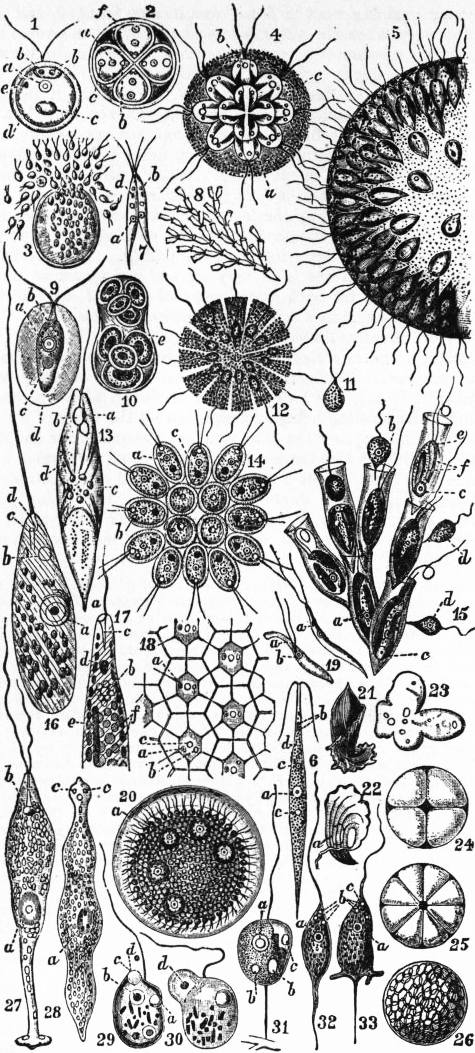
Fig. 1.—Flagellata.
1. Chlamydomonas pulvisculus, Ehr. (Chlamydomonadidae) free-swimming individual. a = nucleus. b = contractile vacuole. c = starch corpuscle. d = cellulose investment. e = stigma (eye-spot). 2. Resting stage of the same, with fourfold division of the cell-contents. Letters as before. 3. Breaking up of the cell-contents into minute biflagellate swarm-spores, which escape, and whose history is not further known. 4. Syncrypta volvox, Ehr. (Chrysomonadidae). A colony enclosed by a common gelatinous test c. a = stigma. b = vacuole (non-contractile). 5. Uroglena volvox, Ehr. (Chrysomonadidae). Half of a large colony, the flagellates embedded in a common jelly. 6. Chlorogonium euchlorum, Ehr. (Chlamydomonadidae). a = nucleus. b = contractile vacuole. c = starch grain. d = eye-spot. 7. Chlorogonium euchlorum, Ehr. (Chlamydomonadidae). Copulation of two liberated microgonidia. a = nucleus. b = contractile vacuole. d = eye-spot (so-called). 8. Colony of Dinobryon sertularia, Ehr. (Chrysomonadidae). 9. Haematococcus palustris, Girod (= Chlamydococcus, Braun, Protococcus, Cohn), one of the Chrysomonadidae; ordinary individual with widely separated test. a = nucleus. b = contractile vacuole. c = amylon nucleus (pyrenoid). 10. Dividing resting stage of the same, with eight fission products in the common test e. 11. A microgonidium of the same. 12. Phalansterium consociatum, Cienk. (Choanoflagellata); × 325. Disk-like colony. 13. Euglena viridis, Ehr.; × 300 (Euglenidae). a = pigment spot (stigma). b = clear space. c = paramylum granules. d = chromatophor (endochrome plate). 14. Gonium pectorale, O. F. Müller (Volvocineae). Colony seen from the flat side; × 300. a = nucleus. b = contractile vacuole. c = amylon nucleus. 15. Dinobryon sertularia, Ehr. (Chrysomonadidae). a = nucleus. b = contractile vacuole. c = amylon nucleus. d = free colourless flagellates, probably not belonging to Dinobryon. e = stigma (eye-spot). f = chromatophors. 16. Peranema trichophorum, Ehr. (Peranemidae), creeping individual seen from the back; × 140. c = pharynx. d = mouth. 17. Anterior end of Euglena acus, Ehr., in profile. a = mouth. b = vacuoles. c = pharynx. d = stigma (eye-spot). e = paramylum-body. f = chlorophyll corpuscles. 18. Part of the surface of a colony of Volvox globator, L. (Volvocidae), showing the intercellular connective fibrils. a = nucleus. b = contractile vacuole. c = starch granule. 19. Two microgametes (spermatozoa) of Volvox globator, L. a = nucleus. b = contractile vacuole. 20. Ripe asexually produced daughter-individual of Volvox minor, Stein, still enclosed in the cyst of the partheno-gonidium. a = young, partheno-gonidia. 21. 22. Trypanosoma sanguinis, Gruby (Haematoflagellates), from the blood of Rana esculenta. a = nucleus; × 500. 23-26. Reproduction of Bodo caudatus, Duj. (Bodonidae), after Dallinger and Drysdale:—23, fusion of several individuals (plasmodium); 24, encysted fusion-product dividing into four; 25, later into eight; 26, cyst filled with swarm-spores. 27. Distigma proteus, Ehbg., O.F. Müller (Euglenidae); × 440. Individual with the two flagella, and strongly contracting hinder region of the body. 28. The same devoid of flagella. c, c = the two dark pigment spots (so-called eyes) near the mouth. 29. Oicomonas termo (Monas termo) Ehr. (one of the Oicomonadidae). c = food-ingesting vacuole. d = food-particle; × 440. 30. The food-particle d has now been ingested by the vacuole. 31. Oicomonas mutabilis, Kent (Oicomonadidae), with adherent stalk. a = nucleus. b = contractile vacuole. c = food-particle in food vacuole. 32, 33. Cercomonas crassicauda, Duj. (Oicomonadidae), showing two conditions of the pseudo-podium-protruding tail. a = nucleus. b = contractile vacuoles. c = mouth.
As reserves the protoplasm may contain oil, starch, paramylum, leucosin (a substance soluble in water, and of doubtful composition), proteid granules. In the holophytic forms the cytoplasm contains specialized parts of more or less definite form, known generally as “plastids” or “chromatophores” impregnated with a lipochrome pigment, whether green (chlorophyll), yellow or brown (diatomin or some allied pigment), or again red (chlorophyll with phycoerythrin). In the active condition of such coloured holophytic forms there is usually at least one anterior “eye-spot,” of a refractive globule embedded behind in a collection of red pigment granules. The single anterior “flagellum tractellum” of so many of the larger forms acts by the bending over of its free end in consecutive meridians, so as to describe a hollow cone with its apex backwards: we may imitate this by bending the head of a slender sapling round and round while it is implanted in the soil; and the result is to push the water backwards, or in other words to pull the body forwards, the whole rotating on its longitudinal axis as it moves on (Y. Delage). An anterior lateral trailing flagellum may modify this axial rotation, and help in steering. When the animal is at rest—attached by its base or with its body so curved as to resist onward motion—the current produced by the tractellum will bring suspended particles up against the protoplasm at its base of insertion. As noted by E.R. Lankester, the posterior flagellum of many Haemoflagellates, like that of the spermatozoon of Metazoa, propels the cell by a sculling motion behind; he terms it a “pulsellum.” Such flagellar motion is distinct from that of cilia, which always move backwards and forwards, with a swift downstroke and a slower recovery in the same plane; though where the flagella are numerous they may behave in this way, and indeed flagella agree with cilia in being mere vibratory extensions of cytoplasm. Symmetrically placed flagella may have a symmetrical reciprocating motion like that of cilia.
Many of the Flagellata are parasitic (some haematozoic); the majority live in the midst of putrefying organic matter in sea and fresh waters, but are not known to be active as agents of putrefaction. Dallinger and Drysdale have shown that the spores of Bodo and others will survive an exposure to a higher temperature than do any known Schizomycetes (Bacteria), viz. 250° to 300° Fahr., for ten minutes, although the adults are killed at 180°.
The Flagellata are for the most part very minute; the Protomastigopoda rarely exceeding 20 μ in length. The Euglenaceae contain the largest species, up to 130 μ in length, exclusive of the flagellum.
Our classification is modified from those of Senn (in Engler and Prantl, Pflanzenfamilien) and Hartog (in Cambridge Natural History).
I. RHIZOFLAGELLATA (PANTOSTOMATA)
Food taken in by pseudopodia at any part of the body.
Order 1.—HOLOMASTIGACEAE. Body homaxial with uniform flagella. Multicilia (Cienkowski); Grassia (Fisch, in frog’s blood and gastric mucus).
Order 2.—RHIZOMASTIGACEAE. Flagellum 1, 2 or few, diverging from anterior end. Mastigamoeba (F.E. Schulze).
II. EUFLAGELLATA
Food taken in at one or more definite mouth-spots, or by a true mouth, or by absorption; or nutrition holophytic.
Order 1.—PROTOMASTIGACEAE. Contractile vacuole simple, one or more, or absent; either holozoic, ingesting food by a mouth-spot (or 2 or more), saprophytic, or parasitic.
Family 1.—Oicomonadidae. Flagellum 1, sometimes with a tail-like posterior prominence passing into a temporary flagellum, but without other cytoplasmic processes. Oicomonas (Kent); Cercomonas (Dujardin) (Fig. 1, 32, 33); Codonoeca (James-Clark), with a gelatinous theca.
Family 2.—Bicoecidae. Differs from Oicomonadidae in a unilateral proboscidiform process next the flagellum; often thecate and stalked, forming branched colonies, like Choanoflagellates in habit. Bicoeca (J.-Cl.), Poteriodendron.
Family 3.—Choanoflagellidae (Choanoflagellata, Kent; Craspedomonadina, Stein). As in previous families, but with flagellum surrounded by an obconical or cylindrical rim of cytoplasm, at the base of which is the ingestive area. The cells of this group have the morphology of the flagellate cells (choanocytes) of sponges. They are often colonial, and in the gelatinous colony of Proterospongia, the more internal cells (Fig. 2, 15) pass into a definite “reproductive state.” Many stalked forms are epizoic on Entomostracan Crustacea.
(a) Naked forms often stalked: Monosiga (Kent), stalked solitary; Codosiga (Kent) (Fig. 2, 3), stalked social; Desmarella (Kent), unstalked, and Astrosiga (Kent), stalked, form floating colonies.
(b) Forms enclosed in a vase-like shell: Salpingoeca (J.-Cl.); (Fig. 2, 1, 6, 7) recalling the habit of Monosiga and Cod siga; Polyoeca forming a branched free swimming colony.
(c) Forms surrounded by a gelatinous sheath: Proterospongia (Kent) (Fig. 2, 15); Phalansterium (Cienk.) (Fig. 1, 12), has a slender cylindrical collar, and a branching tubular stalk.
Family 4.—Haemoflagellidae. Forms with a complex nuclear apparatus, and a muscular undulating membrane with which one or two flagella are connected, parasitic in Metazoa (often in the blood). Trypanosoma (Gruby) (Fig. 1, 21, 22), Herpetomonas(Kent), Treponema (Vuillemin)(= Spirochaete, auctt., nec. Ehrbg.).
Family 5.—Amphimonadidae. Flagella 2 anterior, both directed forward, equal and similar; in stalk sheath, &c., often recalling Choanoflagellata, Amphimonas (Kent), Diplomitus (Kent); Spongomonas (St.), with thick branching gelatinous sheath.
Family 6.—Monadidae. Flagella 2 (3), anterior all directed forwards, one long the other (or 2) accessory, short. Monas (St.); Anthophysa (Bory) (Fig. 2, 12, 13), with the stalk composed of the accumulation of faeces at the hinder end of the cells of the colony.
Family 7.—Bodonidae. Flagella 2 (or 3) 1 anterior, the other (1 or 2) antero-lateral and trailing or becoming fixed at the end to form a temporary anchor. Bodo (Ehrb.) (figs. 1, 23-26 and 2, 10). B. lens is the “hooked” and B. saltans the “springing monad” of Dallinger and Drysdale; Dallingeria (Kent) with a pair of antero-lateral flagella; Costia necatrix (Leclerq) is also 3-flagellate; causes destructive epidemics in fish-hatcheries.
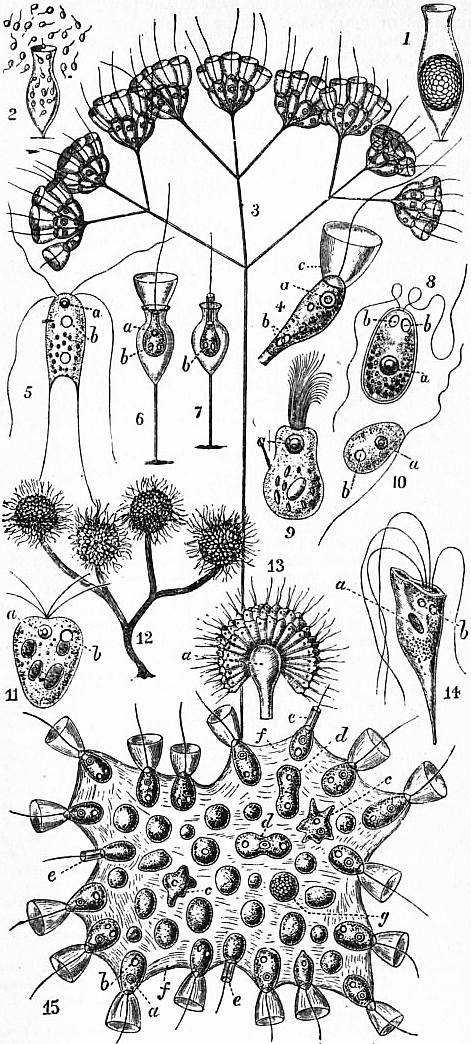
Fig. 2.—Flagellata.
1. Salpingoeca fusiformis, S. Kent (Choanoflagellata). The protoplasmic body is drawn together within the goblet-shaped shell, and divided into numerous spores. 2. Escape of the spores of the same as monoflagellate and swarm-spores. 3. Codosiga umbellata, Tatem (Choanoflagellata); adult colony formed by dichotomous growth. 4. A single zooid of the same. a = nucleus. b = contractile vacuole. c = the characteristic “collar” of naked streaming protoplasm. 5. Hexamita inflata, Duj.(Distomatidae); normal adult. 6, 7 Salpingoeca urceolata, S Kent (Choanoflagellata)—6, with collar extended; 7, with collar retracted within the stalked cup. 8 Polytoma uvella, Mull. sp. (Chlamydomonadidae). 9. Lophomonas blattarum, Stein (Trichonymphidae) from the intestine of Blatta orientalis. 10. Bodolens, Mull. (Bodonidae), the wavy filament is a tractellum, the straight one is a trailing thread. 11. Tetramitus sulcatus, Stein (Tetramitidae) 12. Anthophysa vegetans, O.F. Müller (Monadidae). A typical, erect, shortly-branching colony stock with four terminal monad-clusters. 13. Monad cluster of the same in optical section, showing the relation of the individual monads or flagellate zooids to the stem d. 14. Tetramitus rostratus, Perty (Tetramitidae). a = nucleus. b = contractile vacuole. 15. Proterospongia Haeckeli, Saville Kent (Choanoflagellata); A social colony of about forty flagellate zooids. a = nucleus. b = contractile vacuole. c = amoebiform cell sunk within the colonial gelatinous test compared by S. Kent to a mesoderm cell of the sponges. d = similar cell reproducing by transverse fission. e = normal cells, with their collars contracted. f = substance of test. g = individual reproducing by multiple fission, producing microzoospores, comparable to the spermatozoa of sponges.
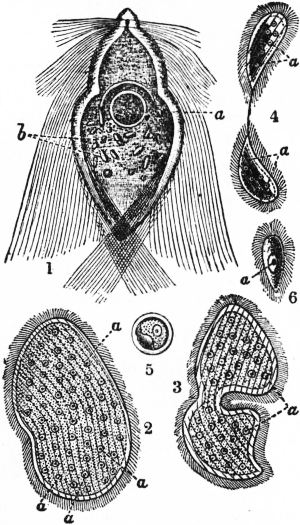
Fig. 3.
1. Trichonympha agilis, Leidy, from gut of White Ant (Termite). 2. Opalina ranarum, Purkinje parasitic in frog rectum multinucleate adult. 3, 4. Binary fissions of same, 1-nucleat individual at final stage of fission. 5. Same encysted dejected from rectum to be swallowed by tadpole. 6. Young 1-nucleate individual emerged from cyst, destined to grow, proliferating its nuclei to adult form. a = nucleus. b = food (?) particles in Fig. 1.
Family 8.—Tetramitidae. Body pyriform, the pointed end posterior; flagella 4 anterior.
Tetramitus (Perty) (T. calycinus of Kent, Fig. 2, 11, 14), is the “calycine monad” of Dallinger and Drysdale; Trichomonas, Donné, possesses a longitudinal undulating membrane, and is an innocuous human parasite; it is possibly related to Haemoflagellates on one hand and to Trichonymphidae on the other.
Family 9.—Distomatidae. Mouth-spots two, or one, with a distinct construction; flagella symmetrically arranged; nucleus bilobed or geminate. Hexamitus (Duj.) (Fig. 2, 5), saprophytic and parasitic; Trepomonas (Duj.), freshwater; Megastoma (Grassi) (= Lamblia of Blanchard), with constricted mouth-spot and blepharoplast (kineto-nucleus) parasitic in the small intestine of Mammals, including Man.
Family 10.—Trichonymphidae. Flagella numerous, sometimes accompanied by one or more undulating membranes; cytoplasm highly differentiated; contractile vacuole absent; all parasitic in insects (all except Lophomonas in Termites—the so-called White Ants.) Lophomonas(St.) (Fig. 2, 9); parasitic in the cockroach; Dinenympha (Leidy), Pyrsonympha (Leidy); Trichenympha (Leidy) (Fig. 3, 1).
Family 11.—Opalinidae. Flagella short, numerous, ciliform. uniformly distributed over the flat oval body; nuclei small, numerous, uniform. Only genus, Opalina (Purkinje and Valentin) (Fig. 3, 2-6), in bladder and cloaca of the frog (usually regarded as an aberrant ciliate, but E.R. Lankester expressed doubts as to its position in the 9th edition of this encyclopaedia).
Order 2.—CHRYSOMONADACEAE. Contractile vacuole simple (in fresh-water forms) or absent; plastids yellow or brown always present; reserves fat.
Family 1.—Chrysomonadidae. Body naked, often amoeboid in active state, or sometimes with a cup-like theca, a gelatinous investment, a firm cuticle, or silicified shell; reserves fat or leucosin (starch in Zooxanthella); eye-spot present. Chromulina (Cienk.) often forms a golden scum on tanks; Chrysamoeba (Klebs); Hydrurus (Agardh), theca of colony forming branching tubes, simulating a yellow Conferva in mountain torrents; Dinobryon (Ehrb.) (Fig. 1, 8, 15); Stylochrysalis (St.); Uroglena (Ehrb.); Syncrypta (Ehrb.), and Synura (Ehrb.) (Fig. 1, 5) form floating spherical colonies; Zooxanthella (Brandt), symbiotic as “yellow cells” in Radiolaria Foraminifera, Millepora, and many Actinozoa.
Family 2.—Coccolithophoridae. Body invested in a spherical test strengthened by calcareous elements, tangential circular plates, “coccoliths,” “discoliths,” “cyatholiths,” or radiating rods “rhabdoliths.” These are often found in Foraminiferal ooze and its fossil condition, chalk; when coherent as in the complete test, they are known as “coccospheres” and “rhabdospheres.” Coccolithophora (Lohmann), Rhabdosphaera (Haeckel).
Order 3.—CRYPTOMONADACEAE. Contractile vacuole (in freshwater forms) simple; plastids green, more rarely red, brown or absent; reserves starch; holophytic or saprophytic. Cryptomonas (Ehrb.); Paramoeba (Greeff) has yellow plastids and shows two cycles, in the one amoeboid, finally encysting to produce a brood of flagellulae; in the other flagellate, and multiplying by longitudinal fission (it differs from Mastigamoeba in possessing no flagellum in the amoeboid state, though it takes in food amoeba-fashion); Chilomonas (Ehrb.).
Order 4.—CHLOROMONADACEAE. Contractile vacuoles 1-3, a complex of variable arrangement; pellicle delicate; plastids discoid chlorophyll-bodies; reserves oil; eye-spot absent even in active state; holophytic or saprophytic, though with an anterior blind tubular depression simulating a pharynx. Coelomonas (St.), Vacuolaria (Cienk.).
Order 5.—EUGLENACEAE. Vacuole large, a reservoir for one or more accessory vacuoles, contractile and opening to the surface by a canal (“pharynx”) in which are planted one or two strong flagella; pellicle strong often striated; nucleus large, chromatophores green, complex or absent; reserves paramylum granules of definite shape, and oil; nutrition variable; body stiff or “metabolic,” never amoeboid. Among the true Flagellates these are the largest, few being below 40 μ and several attaining 130 μ in length of cell-body (excluding flagellum). Encysted condition common; the green forms sometimes multiply in this state and simulate unicellular Algae.
Family 1.—Euglenidae. Radial (monaxial) forms; nutrition saprophytic or holophytic, mostly one flagellate. (1) Chromatophore large; eye-spot conspicuous. Euglena (Ehrb.) (Fig. 1, 13, 17), with flexible cuticle and metabolic movements (this is probably Priestley’s “green matter” through which he obtained oxygen gas)—a very common genus; Colacium (Ehbg.), in its resting state epizoic on Copepoda, which it colours green; Eutreptia (Perty), biflagellate; Ascoglena (St.); Trachelomonas (Ehrb.), with a hard brown cuticle; Phacus (Nitszche), with a firm rigid pellicle, often symmetrically flattened; Cryptoglena (Ehbg.). (2) Chromatophores absent. Astasia (Duj.), body metabolic; Menoidium (Perty), body not metabolic, somewhat inflected and crescentic; Sphenomonas (Stein), with a short accessory trailing flagellum in front peeled; Distigma (Ehbg.) (Fig. 1, 27, 28), very metabolic, with two unequal flagella and two dark pigment spots.
Family 2.—Peranemidae. Bilaterally symmetrical, often creeping, pharynx highly developed, with a firm rod-like skeleton, sometimes protrusible; nutrition saprophytic and holozoic. Peranema (Ehbg.) and Urceolus (Mereschowsky), uni-flagellate creeping, very metabolic. Petalomonas (St.), uni-flagellate flattened with a deep ventral groove, not metabolic; Heteronema (Duj.) and Tropidoscyphus (St.), with a small accessory anterior trailing flagellum; Anisonema (Duj.) and Entosiphon (St.), with the trailing flagellum as long as the tractellum or even much longer.
Order 6.—VOLVOCACEAE. Contractile vacuole simple anterior; cell always enclosed in a cellulose wall (sometimes gelatinous) perforated by the two (more rarely four, five) diverging anterior flagella; reserves starch; chlorophyll almost always present, except in Polytoma, sometimes masked by a red pigment; nutrition usually holophytic, rarely saprophytic, never holozoic. Brood-division in active state common, radial.
Family 1.—Chlamydomonadidae. Cell-wall firm not gelatinous, rarely forming colonies. Fore-end of the body with two or four (seldom five) flagella. Almost always green in consequence of the presence of a very large single chromatophore. Generally a delicate shell-like envelope of membranous consistence. 1 to 2 simple contractile vacuoles at the base of the flagella. Usually one eye-speck. Division of the protoplasm within the envelope may produce four, eight or more new individuals. This may occur in the swimming or in a resting stage. Also by more continuous fission microgametes of various sizes are formed. Conjugation is frequent.
Genera.—Chlorangium (Stein), lacking green chlorophyll; Chlorogonium (Ehr.) (Fig. 1, 6, 7); Polytoma (Ehr.) (Fig. 2, 8); Chlamydomonas (Ehr.) (Fig. 1, 1, 2, 3); Haematococcus (Agardh) (= Chlamydococcus, A. Braun, Stein); Protococcus (Conn, Huxley and Martin); Chlamydomonas (Cienkowski), causes red snow and “bloody rain”; Carteria (Diesing), quadri-flagellate; Spondytomorum (Ehrb.), forming floating colonies; Coccomonas (St.); Phacotus (Perty); Zoochlorella (Brandt), is the name given to undetermined Chlamydomonads found multiplying in the resting state within and in symbiotic relation to other Protozoa, to the freshwater sponge, Ephydatia, Hydra viridis, and to the Turbellarian, Convoluta viridis (in which last species the active form has been recognized as a Carteria).
Family 2.—Volvocidae. Cell-wall gelatinous; always associated in colonies; cells, as in Family 1. The number of individuals united to form a colony varies very much, as does the shape of the colony. Reproduction by the continuous division of all or of only certain individuals of the colony, resulting in the production of a daughter colony (from each such individual). In some, probably in all, at certain times copulation of the individuals of distinct sexual colonies takes place, without or with a differentiation of the colonies and of the copulating cells as male and female. The result of the copulation is a resting zygospore (also called zygote or oospermo or fertilized egg), which after a time develops itself into one or more new colonies.
Genera.—Gonium (O.F. Müller) (Fig. 1, 14); Stephanosphaera (Cohn); Pandorina (Bory de Vine); Eudorina (Ehr.); Volvox (Ehr.) (Fig. 1, 18, 20).
The sexual reproduction of the colonies of the Volvocaceae is one of the most important phenomena presented by the Protozoa. In some families of Flagellata full-grown individuals become amoeboid, fuse, encyst, and then break up into flagellate spores which develop simply to the parental form (Fig. 1, 23 to 26). In the Chlamydomonadidae a single adult individual by division produces small individuals, so-called “microgametes.” These conjugate with one another or with similar microgametes formed by other adults (as in Chlorogonium, Fig. 1, 7); or more rarely in certain genera a microgamete conjugates with an ordinary individual megagamete. The result in either case is a “zygote,” a cell formed by fusion of two which divides in the usual way to produce new individuals. The microgamete in this case is the male element and equivalent to a spermatozoon; the megagamete is the female and equivalent to an egg-cell. The zygote is a “fertilized egg,” or oosperm. In some colony-building forms we find that only certain cells produce by division microgametes; and, regarding the colony as a multicellular individual, we may consider these cells as testis-cells and their microgametes as spermatozoa.
Cystoflagellata(Rhynchoflagellata of E.R. Lankester) and Dinoflagellata are scarcely more than subdivisions of Flagellata; but, following O. Bütschli, we describe them separately; the three groups being united into his Mastigophora.
Further Remarks on the Flagellates.—Besides the work of special Protozoologists, such as F. Cienkowski, O. Bütschli, F. v. Stein, F. Schaudinn, W. Saville Kent, &c., the Flagellates have been a favourite study with botanists, especially algologists: we may cite N. Pringsheim, F. Cohn, W.C. Williamson, W. Zopf, P.A. Dangeard, G. Klebs, G. Senn, F. Schütt; the reason for this is obvious. They present a wide range of structure, from the simple amoeboid genera to the highly differentiated cells of Euglenaceae, and the complex colonies of Proterospongia and Volvox. By some they are regarded as the parent-group of the whole of the Protozoa—a position which may perhaps better be assigned to the Proteomyxa; but they seem undoubtedly ancestral to Dinoflagellates and to Cystoflagellates, as well as to Sporozoa, and presumably to Infusoria. Moreover, the only distinction between the Chlamydomonadidae and the true green Algae or Chlorophyceae is that when the former divide in the resting condition, or are held together by gelatinization of the older cell-walls (Palmella state), they round off and separate, while the latter divide by a “party wall” so as to give rise either to a cylindrical filament when the partitions are parallel and the axis of growth constant (Conferva type), or to a plate of tissue when the directions alternate in a plane. The same holds good for the Chrysomonadaceae and Cryptomonadaceae, so that these little groups are included in all text-books of botany. Again among Fungi, the zoospores of the Zoosporous Phycomycetes (Chytrydiaceae, Peronosporaceae, Saprolegniaceae) have the characters of the Bodonidae. Thus in two directions the Flagellates lead up to undoubted Plants. Probably also the Chlamydomonads have an ancestral relation to the Conjugatae in the widest sense, and the Chrysomonadaceae to the Diatomaceae; both groups of obscure affinity, since even the reproductive bodies have no special organs of locomotion. For these reasons the Volvocaceae, Chloromonadaceae, Chrysomonadaceae and Cryptomonadaceae have been united as Phytoflagellates; and the Euglenaceae might well be added to these. It is easy to understand the relation of the saprophytic and the holophytic Flagellates to true plants. The capacity to absorb nutritive matter in solution (as contrasted with the ingestion of solid matter) renders the encysted condition compatible with active growth, and what in holozoic forms is a true hypnocyst, a state in which all functions are put to sleep, is here only a rest from active locomotion, nutrition being only limited by the supply of nutritive matter from without, and—in the case of holophytic species—by the illumination: this latter condition naturally limits the possible growth in thickness in holophytes with undifferentiated tissues. The same considerations apply indeed to the larger parasitic organisms among Sporozoa, such as Gregarines and Myxosporidia and Dolichosporidia, which are giants among Protozoa.
Literature.—W.S. Kent, Manual of the Infusoria, vol. i. Protozoa (1880-1882); O. Bütschli, Die Flagellaten (in Bronn’s Thierreich, vol. i. Protozoa, 1885); these two works contain full bibliographies of the antecedent authors. See also J. Goroschankin (on Chlamydomonads) in Bull. Soc. Nat. (Moscow, iv. v., 1890-1891); G. Klebs, “Flagellatenstudien” in Zeitsch. Wiss. Zool. lv. (1892); Doflein, Protozoen als Krankheitserreger (1900); Senn, “Flagellaten,” in Engler and Prantl’s Pflanzenfamilien, 1 Teil, Abt. 1a (1900); R. Francé, Der Organismus der Craspedomonaden (1897); Grassi and Sandias, “Trichonymphidae,” in Quart. J. Micr. Sci. xxxix.-xl. (1897); Bezzenberger, “Opa inidae” in Arch. Protist, iii. (1903); Marcus Hartog, “Protozoa,” in Cambridge Nat. Hist. vol. i. (1906).
(M. Ha.)
FLAGEOLET, in music, a kind of flute-à-bec with a new fingering, invented in France at the end of the 16th century, and in vogue in England from the end of the 17th to the beginning of the 19th century. The instrument is described and illustrated by Mersenne,1 who states that the most famous maker and player in his day was Le Vacher. The flageolet differed from the recorder in that it had four finger-holes in front and two thumb-holes at the back instead of seven finger-holes in front and one thumb-hole at the back. This fingering has survived in the French flageolet still used in the provinces of France in small orchestras and for dance music. The arrangement of the holes was as follows: 1, left thumb-hole at the back near mouthpiece; 2 and 3, finger-holes stopped by the left hand; 4, finger-hole stopped by right hand; 5, thumb-hole at the back; 6, hole near the open end. According to Dr Burney (History of Music) the flageolet was invented by the Sieur Juvigny, who played it in the Ballet comique de la Royne, 1581. Dr Edward Browne,2 writing to his father from Cologne on the 20th of June 1673, relates, “We have with us here one ... and Mr Hadly upon the flagelet, which instrument he hath so improved as to invent large ones and outgoe in sweetnesse all the basses whatsoever upon any other instrument.” About the same time was published Thomas Greeting’s Pleasant Companion; or New Lessons and Instructions for the Flagelet (London, 1675 or 1682), a rare book of which the British Museum does not possess a copy. The instrument retained its popularity until the beginning of the 19th century, when Bainbridge constructed double and triple flageolets.3 The three tubes were bored parallel through one piece of wood communicating near the mouthpiece which was common to all three. The lowest notes of the respective tubes were
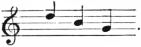
The word flageolet was undoubtedly derived from the medieval Fr. flajol, the primitive whistle-pipe.
(K. S.)
1 Harmonie universelle (Paris, 1636), bk. v. pp. 232-237.
2 See Sir Thomas Browne’s Works, vol. i. p. 206.
3 See Capt. C.R. Day, Descriptive Catalogue of Musical Instruments (London, 1891), pp. 18-22 and pl. 4; also Complete Instructions for the Double Flageolet (London, 1825); and The Preceptor, or a Key to the Double Flageolet (London, 1815).
FLAGSHIP, the vessel in a fleet which carries the flag, the symbol of authority of an admiral.
FLAHAUT DE LA BILLARDERIE, AUGUSTE CHARLES JOSEPH, Comte de (1785-1870), French general and statesman, son of Alexandre Sébastien de Flahaut de la Billarderie, comte de Flahaut, beheaded at Arras in February 1793, and his wife Adélaide Filleul, afterwards Mme de Souza (q.v.), was born in Paris on the 21st of April 1785. Charles de Flahaut was generally recognized to be the offspring of his mother’s liaison with Talleyrand, with whom he was closely connected throughout his life. His mother took him with her into exile in 1792, and they remained abroad until 1798. He entered the army as a volunteer in 1800, and received his commission after the battle of Marengo. He became aide-de-camp to Murat, and was wounded at the battle of Landbach in 1805. At Warsaw he met Anne Poniatowski, Countess Potocka, with whom he rapidly became intimate. After the battle of Friedland he received the Legion of Honour, and returned to Paris in 1807. He served in Spain in 1808, and then in Germany. Meanwhile the Countess Potocka had established herself in Paris, but Charles de Flahaut had by this time entered on his liaison with Hortense de Beauharnais, queen of Holland. The birth of their son was registered in Paris on the 21st of October 1811 as Charles Auguste Louis Joseph Demorny, known later as the due de Morny. Flahaut fought with distinction in the Russian campaign of 1812, and in 1813 became general of brigade, aide-de-camp to the emperor, and, after the battle of Leipzig, general of division. After Napoleon’s abdication in 1814 he submitted to the new government, but was placed on the retired list in September. He was assiduous in his attendance on Queen Hortense until the Hundred Days brought him into active service again. A mission to Vienna to secure the return of Marie Louise resulted in failure. He was present at Waterloo, and afterwards sought to place Napoleon II. on the throne. He was saved from exile by Talleyrand’s influence, but was placed under police surveillance. Presently he elected to retire to Germany, and thence to England, where he married Margaret, daughter of Admiral George Keith Elphinstone, Lord Keith, and after the latter’s death Baroness Keith in her own right. The French ambassador opposed the marriage, and Flahaut resigned his commission. His eldest daughter, Emily Jane, married Henry, 4th marquess of Lansdowne. The Flahauts returned to France in 1827, and in 1830 Louis Philippe gave the count the grade of lieutenant-general and made him a peer of France. He remained intimately associated with Talleyrand’s policy, and was, for a short time in 1831, ambassador at Berlin. He was afterwards attached to the household of the duke of Orleans, and in 1841 was sent as ambassador to Vienna, where he remained until 1848, when he was dismissed and retired from the army. After the coup d’état of 1851 he was again actively employed, and from 1860 to 1862 was ambassador at the court of St James’s. He died on the 1st of September 1870. The comte de Flahaut is perhaps better remembered for his exploits in gallantry, and the elegant manners in which he had been carefully trained by his mother, than for his public services, which were not, however, so inconsiderable as they have sometimes been represented to be.
See A. de Haricourt, Madame de Souza et sa famille (1907).
FLAIL (from Lat. flagellum, a whip or scourge, but used in the Vulgate in the sense of “flail”; the word appears in Dutch vlegel, Ger. Flegel, and Fr. fléau), a farm hand-implement formerly used for threshing corn. It consists of a short thick club called a “swingle” or “swipple” attached by a rope or leather thong to a wooden handle in such a manner as to enable it to swing freely. The “flail” was a weapon used for military purposes in the middle ages. It was made in the same way as a threshing-flail but much stronger and furnished with iron spikes. It also took the form of a chain with a spiked iron ball at one end swinging free on a wooden or iron handle. This weapon was known as the “morning star” or “holy water sprinkler.” During the panic over the Popish plot in England from 1678 to 1681, clubs, known as “Protestant flails,” were carried by alarmed Protestants (see Green Ribbon Club).
FLAMBARD, RANULF, or Ralph (d. 1128), bishop of Durham and chief minister of William Rufus, was the son of a Norman parish priest who belonged to the diocese of Bayeux. Migrating at an early age to England, the young Ranulf entered the chancery of William I. and became conspicuous as a courtier. He was disliked by the barons, who nicknamed him Flambard in reference to his talents as a mischief-maker; but he acquired the reputation of an acute financier and appears to have played an important part in the compilation of the Domesday survey. In that record he is mentioned as a clerk by profession, and as holding land both in Hants and Oxfordshire. Before the death of the old king he became chaplain to Maurice, bishop of London, under whom he had formerly served in the chancery. But early in the next reign Ranulf returned to the royal service. He is usually described as the chaplain of Rufus; he seems in that capacity to have been the head of the chancery and the custodian of the great seal. But he is also called treasurer; and there can be no doubt that his services were chiefly of a fiscal character. His name is regularly connected by the chroniclers with the ingenious methods of extortion from which all classes suffered between 1087 and 1100. He profited largely by the tyranny of Rufus, farming for the king a large proportion of the ecclesiastical preferments which were illegally kept vacant, and obtaining for himself the wealthy see of Durham (1099). His fortunes suffered an eclipse upon the accession of Henry I., by whom he was imprisoned in deference to the popular outcry. A bishop, however, was an inconvenient prisoner, and Flambard soon succeeded in effecting his escape from the Tower of London. A popular legend represents the bishop as descending from the window of his cell by a rope which friends had conveyed to him in a cask of wine. He took refuge with Robert Curthose in Normandy and became one of the advisers who pressed the duke to dispute the crown of England with his younger brother; Robert rewarded the bishop by entrusting him with the administration of the see of Lisieux. After the victory of Tinchebrai (1106) the bishop was among the first to make his peace with Henry, and was allowed to return to his English see. At Durham he passed the remainder of his life. His private life was lax; he had at least two sons, for whom he purchased benefices before they had entered on their teens; and scandalous tales are told of the entertainments with which he enlivened his seclusion. But he distinguished himself, even among the bishops of that age, as a builder and a pious founder. He all but completed the cathedral which his predecessor, William of St Carilef, had begun; fortified Durham; built Norham Castle; founded the priory of Mottisfout and endowed the college of Christchurch, Hampshire. As a politician he ended his career with his submission to Henry, who found in Roger of Salisbury a financier not less able and infinitely more acceptable to the nation. Ranulf died on the 5th of September 1128.
See Orderic Vitalis, Historia ecclesiastica, vols. iii. and iv. (ed. le Prévost, Paris, 1845); the first continuation of Symeon’s Historia Ecclesiae Dunelmensis (Rolls ed., 1882); William of Malmesbury in the Gesta pontificum (Rolls ed., 1870); and the Peterborough Chronicle (Rolls ed., 1861). Of modern writers E.A. Freeman in his William Rufus (Oxford, 1882) gives the fullest account. See also T.A. Archer in the English Historical Review, ii. p. 103; W. Stubbs’s Constitutional History of England, vol. i. (Oxford, 1897); J.H. Round’s Feudal England (London, 1895).
(H. W. C. D.)
FLAMBOROUGH HEAD, a promontory on the Yorkshire coast of England, between the Filey and Bridlington bays of the North Sea. It is a lofty chalk headland, and the resistance it offers to the action of the waves may be well judged by contrast with the low coast of Holderness to the south. The cliffs of the Head, however, are pierced with caverns and fringed with rocks of fantastic outline. Remarkable contortion of strata is seen at various points in the chalk. Sea-birds breed abundantly on the cliffs. A lighthouse marks the point, in 54° 7′ N., 0° 5′ W.
FLAMBOYANT STYLE, the term given to the phase of Gothic architecture in France which corresponds in period to the Perpendicular style. The word literally means “flowing” or “flaming,” in consequence of the resemblance to the curved lines of flame in window tracery. The earliest examples of flowing tracery are found in England in the later phases of the Decorated style, where, in consequence of the omission of the enclosing circles of the tracery, the carrying through of the foliations resulted in a curve of contrary flexure of ogee form and hence the term flowing tracery. In the minster and the church of St Mary at Beverley, dating from 1320 and 1330, are the earliest examples in England; in France its first employment dates from about 1460, and it is now generally agreed that the flamboyant style was introduced from English sources. One of the chief characteristics of the flamboyant style in France is that known as “interpenetration,” in which the base mouldings of one shaft are penetrated by those of a second shaft of which the faces are set diagonally. This interpenetration, which was in a sense a tour de force of French masons, was carried to such an extent that in a lofty rood-screen the mouldings penetrating the base-mould would be found to be those of a diagonal buttress situated 20 to 30 ft. above it. It was not limited, however, to internal work; in late 15th and early 16th century ecclesiastical architecture it is found on the façades of some French cathedrals, and often on the outside of chapels added in later times.
FLAME (Lat. flamma; the root flag-appears in flagrare, to burn, blaze, and Gr. φλέγειν). There is no strict scientific definition of flame, but for the purpose of this article it will be regarded as a name for gas which is temporarily luminous in consequence of chemical action. It is well known that the luminosity of gases can be induced by the electrical discharge, and with rapidly alternating high-tension discharges in air an oxygen-nitrogen flame is produced which is long and flickering, can be blown out, yields nitrogen peroxide, and is in fact indistinguishable from an ordinary flame except by its electrical mode of maintenance. The term “flame” is also applied to solar protuberances, which, according to the common view, consist of gases whose glow is of a purely thermal origin. Even with the restricted definition given above, difficulties present themselves. It is found, for example, with a hydrogen flame that the luminosity diminishes as the purity of the hydrogen is increased and as the air is freed from dust, and J.S. Stas declared that under the most favourable conditions he was only able, even in a dark room, to localize the flame by feeling for it, an observation consistent with the fact that the line spectrum of the flame lies wholly in the ultra-violet. On the other hand, there are many examples of chemical combination between gases where the attendant radiation is below the pitch of visibility, as in the case of ethylene and chlorine. It will be obvious from these facts that a strict definition of flame is hardly possible. The common distinction between luminous and non-luminous flames is, of course, quite arbitrary, and only corresponds to a rough estimate of the degree of luminosity.
The chemical energy necessary for the production of flame may be liberated during combination or decomposition. A single substance like gun-cotton, which is highly endothermic and gives gaseous products, will produce a bright flame of decomposition if a single piece be heated in an evacuated flask. Combination is the more common case, and this means that we have two separate substances involved. If they be not mixed en masse before combination, the one which flows as a current into the other is called conventionally the “combustible,” but the simple experiment of burning air in coal gas suffices to show the unreality of this distinction between combustible and supporter of combustion, which, in fact, is only one of the many partial views that are explained and perhaps justified by the dominance of oxygen in terrestrial chemistry.
Although hydrocarbon flames are the commonest and most interesting, it will be well to consider simpler flames first in order to discuss some fundamental problems. In hydrocarbon flames the complexity of the combustible, its susceptibility to change by heating, and the possibilities of fractional oxidation, create special difficulties. In the flame of hydrogen and oxygen or carbon monoxide and oxygen we have simpler conditions, though here, too, things may be by no means so simple as they seem from the equations 2H2 + O2 = 2H2O and 2CO + O2 = 2CO2. The influence of water vapour on both these actions is well known, and the molecular transactions may in reality be complicated. We shall, however, assume for the sake of clearness that in these cases we have a simple reaction taking place throughout the mass of flame. There are various ways in which a pair of gases may be burned, and these we shall consider separately. Let us first suppose the two gases to have been mixed en masse and a light to be applied to the stationary mixture. If the mixture be made within certain limiting proportions, which vary for each case, a flame spreads from the point where the light is applied, and the flame traverses the mixture. This flame may be very slow in its progress or it may attain a velocity of the order of one or two thousand metres per second. Until comparatively recent times great misunderstanding prevailed on this subject. The slow rate of movement of flame in short lengths of gaseous mixtures was taken to be the velocity of explosion, but more recent researches by M.P.E. Berthelot, E. Mallard and H.L. le Chatelier and H.B. Dixon have shown that a distinction must be made between the slow initial rate of inflammation of gaseous mixtures and the rapid rate of detonation, or rate of the explosive wave, which in many cases is subsequently set up. We shall here deal only with the slow movements of flame. The development of a flame in such a gaseous mixture requires that a small portion of it should be raised to a temperature called the temperature of ignition. Here again considerable misunderstanding has prevailed. The temperature of ignition has often been regarded as the temperature at which chemical combination begins, whereas it is really the temperature at which combination has reached a certain rate. The combination of hydrogen and oxygen begins at temperatures far below that of ignition. It may indeed be supposed that the combination occurs with extreme slowness even at ordinary temperatures, and that as the temperature is raised the velocity of the reaction increases in accordance with the general expression according to which an increase of 10°C. will approximately double the rate. However that may be, it has been proved experimentally by J.H. van’t Hoff, Victor Meyer and others that the combination of hydrogen and oxygen proceeds at perceptible rates far below the temperature of ignition. The phenomenon appears to be greatly influenced by the solid surfaces which are present; thus in a plain glass vessel the combination only began to be perceptible at 448°, whilst in a silvered glass vessel it would be detected at 182°C.
The same kind of thing is true for most oxidizable substances, including ordinary combustibles. We must look upon the application of heat to a combustible mixture as resulting in an increase of the rate of combination locally. Let us suppose that we are dealing with a stratum of the mixture in small contiguous sections. If we raise the temperature of the first section a°C., an increased rate of combination is set up. The heat produced by this combination will be dissipated by conduction and radiation, and we will suppose that it does not quite suffice to raise the adjacent section of the mixture to a°C. The combination in that section, therefore, will not be as rapid as in the first one, and so evidently the impulse to combination will go on abating as we pass along the stratum. Suppose now we start again and heat the first section of the mixture to a temperature c°C., such that the rate of combination is very rapid and the heat developed by combination suffices to raise the adjacent section of the mixture to a temperature higher than c°C. The rate of combination will then be greater than in the first section, and the impulse to combination will be intensified in the same way from section to section along the stratum until a maximum temperature is reached. It is obvious that there must be a temperature of b°C. between a° and c° which will satisfy this condition, that the heat which results from the combination stimulated in the first section just suffices to raise the temperature of the second section to b°. This temperature b° is the temperature of ignition of the mixture; so soon as it is attained by a portion of the mixture the combustion becomes self-sustaining and flame spreads through the mixture. Ignition temperature may be defined briefly as the temperature at which the initial loss of heat due to conduction, &c., is equal to the heat evolved in the same time by the chemical reaction (van’t Hoff). From the above considerations we see that the temperature of ignition will vary not only when the gases are varied, but when the proportions of the same gases are varied, and also when the pressure is varied. We can see also that outside certain limiting proportions a mixture of gases will have no practicable ignition temperature, that is to say, the cooling effect of the gas which is in excess will carry off so much heat that no attainable initial heating will suffice to set up the transmission of a constant temperature. Thus in the case of hydrogen and air, mixtures containing less than 5 and more than 72% of hydrogen are not inflammable. The theory of ignition temperature enables us to understand why in an explosive mixture a very small electric spark may not suffice to induce explosion. Combination will indeed take place in the path of the spark, but the amount of it is not sufficient to meet the loss of heat by conduction, &c. It must be added that the theory of ignition temperatures given above does not explain all the observed facts. F. Emich states that the inflammability of gaseous mixtures is not necessarily greatest when the gases are mixed in the proportions theoretically required for complete combination, and the influence of foreign gases does not appear to follow any simple law. The presence of a small quantity of a gas may exercise a profound influence on the ignition temperature as in the case of the addition of ethylene to hydrogen (Sir Edward Frankland), and again when a mixture of methane and air is raised to its ignition temperature a sensible interval (about 10 seconds) elapses before inflammation occurs.
The rate at which a flame will traverse a mixture of two gases which has been ignited depends on the proportions in which the gases are mixed. Fig. 1 (Bunte) represents this relationship for several common gases.
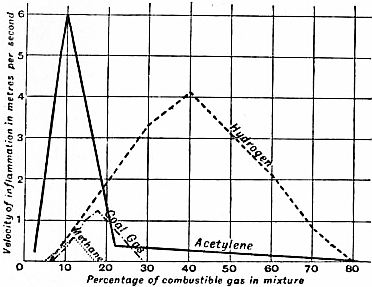
Fig. 1.—Rates of inflammation of combustible gases with air.

Fig. 2.
If a ready-made gaseous mixture is to be used for the production of a steady flame, it may be forced through a tube and ignited at the end; it is obvious that the velocity of efflux must be greater than the initial rate of inflammation of the mixture, for otherwise the mixture would fire back down the tube. If the velocity of efflux be considerably greater than the rate of inflammation, the flame will be separated from the end of the tube, and only appear as a flickering crown where the velocity and inflammability of the issuing gas have been diminished by admixture with air. With much increased velocity of efflux the flame will be blown out. J.B.A. Dumas used to show the experiment of blowing out a candle with electrolytic gas. A steady flame formed by burning a ready-made gaseous mixture at the end of a tube of circular section has the form shown in fig. 2. The small internal cone marks the lower limiting surface of the flame; it is the locus of all points where the velocity of efflux is just equal to the velocity of inflammation, and its conical form is explained by the fact that the rate of efflux of gas is greatest in the vertical axis of the tube where the flow is not retarded by friction with the walls, as well as by the further fact that the gas issuing from such an orifice spreads outwards, the inflammation proceeding directly against it. The flame, it will be seen, is of considerable thickness. If the gaseous mixture be hydrogen and oxygen, or carbon monoxide and oxygen, it will have no obvious features of structure beyond those shown in the figure; that is to say, the shaded region of burning gas has the appearance of homogeneity and uniform colour which might be expected to accompany a uniform chemical condition. Some admixture of the external air will, of course, take place, especially in the upper parts of the flame, and detectable quantities of oxides of nitrogen may be found in the products of combustion, but this is an inconsiderable feature. The flame just described is essentially that of a blowpipe.
A second way of producing a flame is the more common one of allowing one gas to stream into the other. Using the same gases as before, hydrogen or carbon monoxide with oxygen, we find again that the flame is conical in form and uniform in colour, but in this case, if the velocity of efflux be not immoderate, the burning gas only extends over a comparatively thin shell, limited on the inside by the pure combustible and on the outside by a mixture of the products of combustion with oxygen. The combustible gas has to make its own inflammable mixture with the circumambient oxygen, and we may suppose the column of gas to be burned through as it ascends. The core of unburned gas thus becomes thinner as it ascends and the flame tapers to a point. The external surface of a flame of this kind will for the same consumption of gas be larger than that of a flame where the ready-made mixture of gases is used. If a jet of one gas be sent with a sufficient velocity into another, turbulent admixture takes place and an unsteady sheet of flame of uniform colour is obtained.
A third way of forming a flame is to allow the whole of one gas, mixed with a less quantity of the second than is sufficient for complete combustion, to issue into an atmosphere of the second. This is the case with what are generally known as atmospheric burners, of which the Bunsen burner is the prototype. The development of a flame of this kind can be well studied in the case of carbon monoxide and air. The carbon monoxide is fed into a Bunsen burner with closed air-valve, the burner-tube being prolonged by affixing a glass tube to it by means of a cork. The flame consists of a single conical blue sheet. If now the air-valve be opened very slightly, an internal cone of the same blue colour makes its appearance. The air which has entered through the air-valve (“primary” air) has become mixed with the carbon monoxide and so oxidizes its quota in an internal cone, the rest of the carbon monoxide (diluted now, of course, with carbon dioxide and nitrogen) wandering into the external atmosphere to burn (with “secondary” air) in a second cone. The existence of the internal cone and the subsequent thermal effect lead to slight convexity of surface in the outer cone. If the quantity of primary air be increased more internal combustion can take place. This, however, does not lead to an enlargement of the inner cone, for the increase of air increases the rate of inflammation of the mixture, and the inner cone (which only maintains its stability because the rate of efflux of the mixture is greater than the velocity of inflammation) contracts, and will, as the proportion of primary air is increased, soon evince a tendency to enter the burner-tube. At this stage an interesting phenomenon is to be noticed. When we have reached the point of aeration where the velocity of inflammation of the mixture just surpasses the velocity of efflux, the inner cone enters the burner-tube as a disk and descends, but this downward motion checks the suction flow of air through the valve at the base of the burner, whilst it does not appreciably check the pressure flow of the carbon monoxide through the gas nozzle. The result is that a stratum of gas-mixture poor in air, and therefore of low rate of inflammation, is formed, and when the descending disk of flame meets it, the descent is arrested and the disk returns to the top of the tube, reproducing the inner cone. The full air suction is now restored and the course of events is repeated. This oscillatory action can be maintained almost indefinitely long if the pressure and other conditions be maintained constant. With still more primary air the inner cone of flame simply fires back to the burner nozzle, or, in the last stage, we may have enough air entering to produce a flame of the blast blowpipe type, namely, one where the carbon monoxide mixed with an excess of primary air burns with a single cone in a steady flame.
By means of a simple contrivance devised by A. Smithells a two-coned flame of the kind described may be resolved into its components. The apparatus is like a half-extended telescope made of two glass tubes, and it is evident that the velocity of a mixture of gases flowing through it must be greater in the narrow tube than in the wider one. If the end of the narrower tube be fixed to a Bunsen burner and the flame be formed at the end of the wider one, then when the air-supply is increased to a certain point the inner cone will descend into the wide tube and attach itself to the upper end of the narrower one. This occurs when the velocity of inflammation is just greater than the upward velocity of the gaseous stream in the wide tube and less than the upward velocity in the narrow tube. If the outer tube be now drawn down, a two-coned flame burns at the end of the inner tube; if the outer tube be slid up again, it detaches the outer cone and carries it upward. This apparatus has been of use in investigating the progress of combustion in various flames.
Temperature of Flames.—The term “flame-temperature” is used very vaguely and has no clear meaning unless qualified by some description. It is least ambiguous when used in reference to flames where the combining gases are mixed in theoretical proportions before issuing from the burner. The flame in such a case has considerable thickness and uniformity, and, though the temperature is not constant throughout, flames of this type given by different combustibles admit of comparison. In other flames where the shells of combustion are thin and envelop large regions of unburned or partly-burned gas, it is not clear how temperature should be specified. An ordinary gas-flame will not, from the point of view of the practical arts, give a sufficient temperature for melting platinum, yet a very thin platinum wire may be melted at the edge of the lower part of such a flame. The maximum temperature of the flame is therefore not in any serious sense an available temperature. It will suffice to point out here that in order to burn a gas so that it may have the highest available temperature, we must burn it with the smallest external flame-surface obtainable. This is done when the combining gases are completely mixed before issuing from the burner. Where this is impracticable we may employ a burner of the Bunsen type, and arrange matters so that a large amount of primary air is supplied. It is in this direction that modern improvements have been made with a view to obtaining hot flames for heating the Welsbach mantle. The Kern burner, for example, employs the principle of the Venturi tube. Where much primary air is drawn in it is usual to provide for it being well mixed with the gas, otherwise an unsteady flame may be produced with a great tendency to light back. The burner head is therefore usually provided with a mixing chamber and the mixture issues through a slit or a mesh. A great many modified Bunsen burners have been produced, the aim in all of them being to produce a flame which shall combine steadiness with the smallest attainable external surface.
To estimate the temperature of flames several methods have been employed. The method of calculation, based on the supposition that the whole heat of combustion is localized in the product (or products) of combustion and heats it to a temperature depending on its specific heat, cannot be applied in a simple way. Apart from the assumption (which there is reason to suppose incorrect) that none of the chemical energy assumes the radiant form directly, we have to regard the possible change of specific heat at high temperatures, the likelihood of dissociation and the time of reaction. Any practical consideration of temperature must have regard to a large assemblage of molecules and not to a single one, and therefore any influence which means delay in combination will result in reduction of temperature by radiation and conduction. It can hardly be maintained that in the present state of knowledge we have the requisite data for the calculation of flame temperature, though good approximations may be made. Many attempts have been made to determine flame temperatures by means of thermo-electric couples and by radiation pyrometers. The couple most employed is that known as H.L. le Chatelier’s, consisting of two wires, one of platinum and the other an alloy of 90% platinum and 10% of rhodium. When all possible precautions are taken it is possible by means of such thermo-couples to measure local flame temperatures with a considerable degree of accuracy. Subjoined are some results obtained at different times and by different observers with regard to the maximum temperatures of flames:—
Coal gas in Bunsen burner (Waggener, 1896) 1770° C.
” ” ” ” (Berkenbusch, 1899) 1830°
” ” ” ” (White & Traver, 1902) 1780°
” ” ” ” (Féry, 1905) 1871°
The following are given by Féry:—
Acetylene 2548° C.
Alcohol 1705°
Hydrogen (in air) 1900°
Oxy-hydrogen 2420°
Oxy-coal gas blowpipe 2200°
Source of Light in Flames.—We may consider first those flames where solid particles are out of the question; for example, the flame of carbon monoxide in air. The old idea that the luminosity was due to the thermal glow of the highly heated product of combustion has been challenged independently by a number of observers, and the view has been advanced that the emission of light is due to radiation attendant upon a kind of discharge of chemical energy between the reacting molecules. E. Wiedemann proposed the name “chemi-luminescence” for radiation of this kind. The fact is that colourless gases cannot be made to glow by any purely thermal heating at present available, and products of combustion heated to the average temperature of the flames in which they are produced are non-luminous. On the other hand, it must be remembered that in a mass of burning gas only a certain proportion of the molecules are engaged at one instant in the act of chemical combination, and that the energy liberated in such individual transactions, if localized momentarily as heat, would give individual molecules a unique condition of temperature far transcending that of the average, and the distribution of heat in a flame would be very different from that existing in the same mixture of gases heated from an external source to the same average temperature. The view advocated by Smithells is that in the chemical combination of gases the initial phase of the formation of the new molecule is a vibratory one, which directly furnishes light, and that the damping down of this vibration by colliding molecules is the source of that translatory motion which is evinced as heat. This, it will be seen, is an exact reversal of the older view.
The view of Sir H. Davy that “whenever a flame is remarkably brilliant and dense it may always be concluded that some solid matter is produced in it” can be no longer entertained. The flames of phosphorus in oxygen and of carbon disulphide in nitric oxide contain only gaseous products, and Frankland showed that the flames of hydrogen and carbon monoxide became highly luminous under pressure. From his experiments Frankland was led to the generalization that high luminosity of flames is associated with high density of the gases, and he does not draw a distinction in this respect between high density due to high molecular weight and high density due to the close packing of lighter molecules. The increased luminosity of a compressed flame is not difficult to understand from the kinetic theory of gases, but no explanation has appeared of the luminosity considered by Frankland to be due merely to high molecular weight. It is possible that the electron theory may ultimately afford a better understanding of these phenomena.
Structure of Flame.—The vagueness of the term structure, as applied to flames, is to be seen from the very conflicting accounts which are current as to the number of differentiated parts in different flames. Unless this term is restricted to sharp differences in appearance, there is no limit to the number of parts which may be selected for mention. The flame of carbon monoxide, when the gas is not mixed with air before it issues from the burner, shows no clearly differentiated structure, but is a shell of blue luminosity of shaded intensity—a hollow cone if the orifice of the burner be circular and the velocity of the gas not immoderate, or a double sheet of fan shape if the burner have a slit or two inclined pores which cause the jets of issuing gas to spread each other out. Such a flame has but one single distinct feature, and this is not surprising, as there is no reason to suppose that there is any difference in the chemical process or processes that are occurring in different quarters of the flame. The amount of materials undergoing this transformation in different parts of the flame may and does vary; the gases become diluted with products of combustion, and the molecular vibrations gradually die down. These things may cause a variation in the intensity of the light in different quarters, but the differences induced are not sharp or in any proper sense structural. A flame of this kind may develop a secondary feature of structure. If carbon monoxide be burnt in oxygen which is mixed or combined with another element there may be an additional chemical process that will give light; flames in air are sometimes surrounded by a faintly luminous fringe of a greenish cast, apparently associated with the combination of nitrogen with oxygen (H.B. Dixon). Carbon monoxide on being strongly heated begins to dissociate into carbon and carbon dioxide; if the unburnt carbon monoxide within a flame of that gas were so highly heated by its own burning walls as to reach the temperature of dissociation, we might expect to see a special feature of structure due to the separated carbon. Such a temperature does not, however, appear to be reached.