VOLUME X SLICE IV Finland to Fleury, André (continued 10)
Reading edition
His Œuvres complètes (8 vols., 1885) were printed from the original manuscripts, and included, besides the works mentioned already, the two plays, Le Candidat and Le Château des cœurs. Another edition (10 vols.) appeared in 1873-1885. Flaubert’s correspondence with George Sand was published in 1884 with an introduction by Guy de Maupassant. Other posthumous works are Par les champs et par les grèves (1885), the result of a tour in Brittany; and four volumes of Correspondance (1887-1893). See also Paul Bourget, Essais de psychologie contemporaine (1883); Émile Faguet, Flaubert (1899); Henry James, French Poets and Novelists (1878); Émile Zola, Les Romanciers naturalistes (1881); C.A. Sainte-Beuve, Causeries du lundi, vol. xiii., Nouveaux lundis, vol. iv.; and the Souvenirs littéraires (2 vols., 1882-1883) of Maxime du Camp.
(E. G.)
FLAVEL, JOHN (c. 1627-1691), English Presbyterian divine, was born at Bromsgrove in Worcestershire, probably in 1627. He was the elder son of Richard Flavel, described in contemporary records as “a painful and eminent minister.” After receiving his early education, partly at home and partly at the grammar-schools of Bromsgrove and Haslar, he entered University College, Oxford. Soon after taking orders in 1650 he obtained a curacy at Diptford, Devon, and on the death of the vicar he was appointed to succeed him. From Diptford he removed in 1656 to Dartmouth. He was ejected from his living by the passing of the Act of Uniformity in 1662, but continued to preach and administer the sacraments privately till the Five Mile Act of 1665, when he retired to Slapton, 5 m. away. He then lived for a time in London, but returned to Dartmouth, where he laboured till his death in 1691. He was married four times. He was a vigorous and voluminous writer, and not without a play of fine fancy.
His principal works are his Navigation Spiritualized (1671); The Fountain of Life, in forty-two Sermons (1672); The Method of Grace (1680); Pneumatologia, a Treatise on the Soul of Man (1698); A Token for Mourners; Husbandry Spiritualized (1699). Collected editions appeared throughout the 18th century, and in 1823 Charles Bradley edited a 2 vol. selection.
FLAVIAN I. (d. 404), bishop or patriarch of Antioch, was born about 320, most probably in Antioch. He inherited great wealth, but resolved to devote his riches and his talents to the service of the church. In association with Diodorus, afterwards bishop of Tarsus, he supported the Catholic faith against the Arian Leontius, who had succeeded Eustathius as bishop of Antioch. The two friends assembled their adherents outside the city walls for the observance of the exercises of religion; and, according to Theodoret, it was in these meetings that the practice of antiphonal singing was first introduced in the services of the church. When Meletius was appointed bishop of Antioch in 361 he raised Flavian to the priesthood, and on the death of Meletius in 381 Flavian was chosen to succeed him. The schism between the two parties was, however, far from being healed; the bishop of Rome and the bishops of Egypt refused to acknowledge Flavian, and Paulinus, who by the extreme Eustathians had been elected bishop in opposition to Meletius, still exercised authority over a portion of the church. On the death of Paulinus in 383, Evagrius was chosen as his successor, but after the death of Evagrius (c. 393) Flavian succeeded in preventing his receiving a successor, though the Eustathians still continued to hold separate meetings. Through the intervention of Chrysostom, soon after his elevation to the patriarchate of Constantinople (398), and the influence of the emperor Theodosius, Flavian was acknowledged in 399 as legitimate bishop of Antioch by the Church of Rome; but the Eustathian schism was not finally healed till 415. Flavian, who died in February 404, is venerated in both the Western and Eastern churches as a saint.
See also the article Meletius of Antioch, and the article “Flavianus von Antiochien” by Loofs in Herzog-Hauck’s Real-encyklop. (ed. 3). For the Meletian schism see also A. Harnack’s, Hist. of Dogma, iv. 95.
FLAVIAN II. (d. 518), bishop or patriarch of Antioch, was chosen by the emperor Anastasius I. to succeed Palladius, most probably in 498. He endeavoured to please both parties by steering a middle course in reference to the Chalcedon (q.v.) decrees, but was induced after great hesitation to agree to the request of Anastasius that he should accept the Henoticon, or decree of union, issued by the emperor Zeno. His doing so, while it brought upon him the anathema of the patriarch of Constantinople, failed to secure the favour of Anastasius, who in 511 found in the riots which were occurring between the rival parties in the streets of Antioch a pretext for deposing Flavian, and banishing him to Petra, where he died in 518. Flavian was soon after his death enrolled among the saints of the Greek Church, and after some opposition he was also canonized by the Latin Church.
FLAVIAN (d. 449), bishop of Constantinople, and an adherent of the Antiochene school, succeeded Proclus in 447. He presided at the council which deposed Eutyches (q.v.) in 448, but in the following year he was deposed by the council of Ephesus (the “robber synod”), which reinstated Eutyches in his office. Flavian’s death shortly afterwards was attributed, by a pious fiction, to ill treatment at the hands of his theological opponents. The council of Chalcedon canonized him as a martyr, and in the Latin Church he is commemorated on the 18th of February.
FLAVIGNY, a town of eastern France, in the department of Côte-d’Or, situated on a promontory overlooking the river Ozerain, 33 m. W.N.W. of Dijon by road. Pop. (1906) 725. Among its antiquities are the remains of an abbey of the 8th century, which has been rebuilt as a factory for the manufacture of anise, an industry connected with the town as early as the 17th century. There is also a church of the 13th and 15th centuries, containing carved stalls (15th century) and a fine rood-screen (early 16th century). A Dominican convent, some old houses and ancient gateways are also of interest. About 3 m. north-west of Flavigny rises Mont Auxois, the probable site of the ancient Alesia, where Caesar in A.D. 52 defeated the Gallic chieftain Vercingetorix, to whom a statue has been erected on the summit of the height. Numerous remains of the Gallo-Roman period have been discovered on the hill.
FLAVIN (Lat. flavus, yellow), the commercial name for an extract or preparation of quercitron bark (Quercus tinctoria), which is used as a yellow dye in place of the ground and powdered bark (see Quercitron).
FLAX. The terms flax or lint (Ger. Flachs, Fr. lin, Lat. linum) are employed at once to denote the fibre so called, and the plant from which it is prepared. The flax plant (Linum usitatissimum) belongs to the natural order Linaceae, and, like most plants which have been long under cultivation, it possesses numerous varieties, while its origin is doubtful. As cultivated it is an annual with an erect stalk rising to a height of from 20 to 40 in., with alternate, sessile, narrowly lance-shaped leaves, branching only at the top, each branch or branchlet ending in a bright blue flower. The flowers are regular and symmetrical, having five sepals, tapering to a point and hairy on the margin, five petals which speedily fall, ten stamens, and a pistil bearing five distinct styles. The fruit or boll is round, containing five cells, each of which is again divided into two, thus forming ten divisions, each of which contains a single seed. The seeds of the flax plant, well known as linseed, are heavy, smooth, glossy and of a bright greenish-brown colour. They are oval in section, but their maximum contour represents closely that of a pear with the stalk removed. The contents are of an oily nature, and when liquefied are of great commercial value.
The earliest cultivated flax was Linum angustifolium, a smaller plant with fewer and narrower leaves than L. usitatissimum, and usually perennial. This is known to have been cultivated by the inhabitants of the Swiss lake-dwellings, and is found wild in south and west Europe (including England), North Africa, and western Asia. The annual flax (L. usitatissimum) has been cultivated for at least four or five thousand years in Mesopotamia, Assyria and Egypt, and is wild in the districts included between the Persian Gulf, the Caspian Sea and the Black Sea. This annual flax appears to have been introduced into the north of Europe by the Finns, afterwards into the west of Europe by the western Aryans, and perhaps here and there by the Phoenicians; lastly, into Hindustan by the eastern Aryans after their separation from the European Aryans. (De Candolle, Origin of Cultivated Plants.)
The cultivation and preparation of flax are among the most ancient of all textile industries, very distinct traces of their existence during the stone age being preserved to the present day. “The use of flax,” says Ferdinand Keller (Lake Dwellings of Switzerland, translated by J.E. Lee), “reaches back to the very earliest periods of civilization, and it was most extensively and variously applied in the lake-dwellings, even in those of the stone period. But of the mode in which it was planted, steeped, heckled, cleansed and generally prepared for use, we can form no idea any more than we can of the mode or tools employed by the settlers in its cultivation.... Rough or unworked flax is found in the lake-dwellings made into bundles, or what are technically called heads, and, as much attention was given to this last operation, it was perfectly clean and ready for use.” As to its applications at this early period, Keller remarks: “Flax was the material for making lines and nets for fishing and catching wild animals, cords for carrying the earthenware vessels and other heavy objects; in fact, one can hardly imagine how navigation could be carried on, or the lake-dwellings themselves be erected, without the use of ropes and cords; and the erection of memorial stones (menhirs, dolmens), at whichever era, and to whatever people these monuments may belong, would be altogether impracticable without the use of strong ropes.”
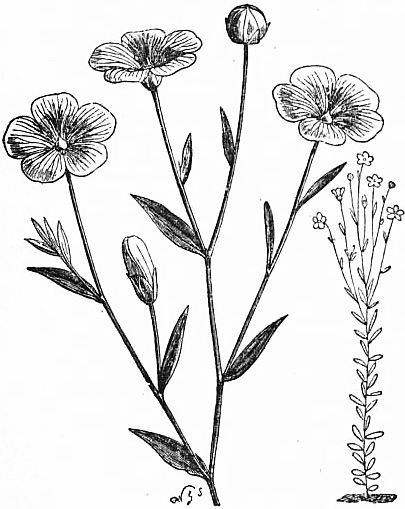
Fig. 1.—Flax Plant (Linum usitatissimum).
Manufacture.—That flax was extensively cultivated and was regarded as of much importance at a very early period in the world’s history there is abundant testimony. Especially in ancient Egypt the fibre occupied a most important place, linen having been there not only generally worn by all classes, but it was the only material the priestly order was permitted to wear, while it was most extensively used as wrappings for embalmed bodies and for general purposes. In the Old Testament we are told that Pharaoh arrayed Joseph “in vestures of fine linen” (Gen. xlii. 42), and among the plagues of Egypt that of hail destroyed the flax and barley crops, “for the barley was in the ear, and the flax was bolled” (Exod. ix. 31). Further, numerous pictorial representations of flax culture and preparation exist to the present day on the walls of tombs and in Egypt. Sir J. G. Wilkinson in his description of ancient Egypt shows clearly the great antiquity of the ordinary processes of preparing flax. “At Beni Hassan,” he says, “the mode of cultivating the plant, in the same square beds now met with throughout Egypt (much resembling our salt pans), the process of beating the stalks and making them into ropes, and the manufacture of a piece of cloth are distinctly pointed out.” The preparation of the fibre as conducted in Egypt is illustrated by Pliny, who says: “The stalks themselves are immersed in water, warmed by the heat of the sun, and are kept down by weights placed upon them, for nothing is lighter than flax. The membrane, or rind, becoming loose is a sign of their being sufficiently macerated. They are then taken out and repeatedly turned over in the sun until perfectly dried, and afterwards beaten by mallets on stone slabs. That which is nearest the rind is called stupa [’tow’], inferior to the inner fibres, and fit only for the wicks of lamps. It is combed out with iron hooks until the rind is all removed. The inner part is of a whiter and finer quality. Men are not ashamed to prepare it” (Pliny, N.H. xix. 1). For many ages, even down to the early part of the 14th century, Egyptian flax occupied the foremost place in the commercial world, being sent into all regions with which open intercourse was maintained. Among Western nations it was, without any competitor, the most important of all vegetable fibres till towards the close of the 18th century, when, after a brief struggle, cotton took its place as the supreme vegetable fibre of commerce.
Flax prospers most when grown upon land of firm texture resting upon a moist subsoil. It does well to succeed oats or potatoes, as it requires the soil to be in fresh condition without being too rich. Lands newly broken up from pasture suit it well, as these are generally freer from weeds than those that have been long under tillage. It is usually inexpedient to apply manure directly to the flax crop, as the tendency of this is to produce over-luxuriance, and thereby to mar the quality of the fibre, on which its value chiefly depends. For the same reason it must be thickly seeded, the effect of this being to produce tall, slender stems, free from branches. The land, having been ploughed in autumn, is prepared for sowing by working it with the grubber, harrow and roller, until a fine tilth is obtained. On the smooth surface the seed is sown broadcast by hand or machine, at the rate of 3 bushels per acre, and covered in the same manner as clover seeds. It is advisable immediately to hand-rake it with common hay-rakes, and thus to remove all stones and clods, and to secure a uniform close cover of plants. When these are about 2 to 3 in. long the crop must be carefully hand-weeded. This is a tedious and expensive process, and hence the importance of sowing the crop on land as free as possible from weeds of all kinds. The weeders, faces to the wind, move slowly on hands and knees, and should remove every vestige of weed in order that the flax plants may receive the full benefit of the land. When flax is cultivated primarily on account of the fibre, the crop ought to be pulled before the capsules are quite ripe, when they are just beginning to change from a green to a pale-brown colour, and when the stalks of the plant have become yellow throughout about two-thirds of their height.
The various operations through which the crop passes from this point till flax ready for the market is produced are—(1) Pulling, (2) Rippling, (3) Retting, (4) Drying, (5) Rolling, (6) Scutching.
Pulling and rippling may be dismissed very briefly. Flax is always pulled up by the root, and under no circumstances is it cut or shorn like cereal crops. The pulling ought to be done in dry clear weather; and care is to be taken in this, as in all the subsequent operations, to keep the root-ends even and the stalks parallel. At the same time it is desirable to have, as far as possible, stalks of equal length together,—all these conditions having considerable influence on the quality and appearance of the finished sample. As a general rule the removal of the “bolls” or capsules by the process of rippling immediately follows the pulling, the operation being performed in the field; but under some systems of cultivation, as, for example, the Courtrai method, alluded to below, the crop is made up into sheaves, dried and stacked, and is only boiled and retted in the early part of the next ensuing season. The best rippler, or apparatus for separating the seed capsules from the branches, consists of a kind of comb having, set in a wooden frame, iron teeth made of round-rod iron 3⁄16ths of an inch asunder at the bottom, and half an inch at the top, and 18 in. long, to allow a sufficient spring, and save much breaking of flax. The points should begin to taper 3 in, from the top. A sheet or other cover being spread on the field, the apparatus is placed in the middle of it, and two ripplers sitting opposite each other, with the machine between them, work at the same time. It is unadvisable to ripple the flax so severely as to break or tear the delicate fibres at the upper part of the stem. The two valuable commercial products of the flax plant, the seeds and the stalk, are separated at this point. We have here to do with the latter only.
Retting or rotting is an operation of the greatest importance, and one in connexion with which in recent years numerous experiments have been made, and many projects and processes put forth, with the view of remedying the defects of the primitive system or altogether supplanting it. From the earliest times two leading processes of retting have been practised, termed respectively water-retting and dew-retting; and as no method has yet been introduced which satisfactorily supersedes these operations, they will first be described.
Water-retting.—For this—the process by which flax is generally prepared—pure soft water, free from iron and other materials which might colour the fibre, is essential. Any water much impregnated with lime is also specially objectionable. The dams or ponds in which the operation is conducted are of variable size, and usually between 4 and 5 ft. in depth. The rippled stalks are tied in small bundles and packed, roots downwards, in the dams till they are quite full; over the top of the upper layer is placed a stratum of rushes and straw, or sods with the grassy side downwards, and above all stones of sufficient weight to keep the flax submerged. Under favourable circumstances a process of fermentation should immediately be set up, which soon makes itself manifest by the evolution of gaseous bubbles. After a few days the fermentation subsides; and generally in from ten days to two weeks the process ought to be complete. The exact time, however, depends upon the weather and upon the particular kind of water in which the flax is immersed. The immersion itself is a simple matter; the difficulty lies in deciding when the process is complete. If allowed to remain under water too long, the fibre is weakened by what is termed “over-retting,” a condition which increases the amount of codilla in the scutching process; whilst “under-retting” leaves part of the gummy or resinous matter in the material, which hinders the subsequent process of manufacture. As the steeping is such a critical operation, it is essential that the stalks be frequently examined and tested as the process nears completion. When it is found that the fibre separates readily from the woody “shove” or core, the beets or small bundles are ready for removing from the dams. It is drained, and then spread, evenly and equally, over a grassy meadow to dry. The drying, which takes from a week to a fortnight, must be uniform, so that all the fibres may spin equally well. To secure this uniformity, it is necessary to turn the material over several times during the process. It is ready for gathering when the core cracks and separates easily from the fibre. At this point advantage is taken of fine dry weather to gather up the flax, which is now ready for scutching, but the fibre is improved by stooking and stacking it for some time before it is taken to the scutching mill.
Dew-retting is the process by which all the Archangel flax and a large portion of that sent out from St Petersburg are prepared. By this method the operation of steeping is entirely dispensed with, and the flax is, immediately after pulling, spread on the grass where it is under the influence of air, sunlight, night-dews and rain. The process is tedious, the resulting fibre is brown in colour, and it is said to be peculiarly liable to undergo heating (probably owing to the soft heavy quality of the flax) if exposed to moisture and kept close packed with little access of air. Archangel flax is, however, peculiarly soft and silky in structure, although in all probability water-retting would result in a fibre as good or even better in quality.
The theory of retting, according to the investigations of J. Kolb, is that a peculiar fermentation is set up under the influence of heat and moisture, resulting in a change of the intercellular substance—pectose or an analogue of that body—into pectin and pectic acid. The former, being soluble, is left in the water; but the latter, an insoluble body, is in part attached to the fibres, from which it is only separated by changing into soluble metapectic acid under the action of hot alkaline ley in the subsequent process of bleaching.
To a large extent retting continues to be conducted in the primitive fashions above described, although numerous and persistent attempts have been made to improve upon it, or to avoid the process altogether. The uniform result of all experiments has only been to demonstrate the scientific soundness of the ordinary process of water-retting, and all the proposed improvements of recent times seek to obviate the tediousness, difficulties and uncertainties of the process as carried on in the open air. In the early part of the 19th century much attention was bestowed, especially in Ireland, on a process invented by Mr James Lee. He proposed to separate the fibre by purely mechanical means without any retting whatever; but after the Irish Linen Board had expended many thousands of pounds and much time in making experiments and in erecting his machinery, his entire scheme ended in complete failure. About the year 1851 Chevalier Claussen sought to revive a process of “cottonizing” flax—a method of proceeding which had been suggested three-quarters of a century earlier. Claussen’s process consisted in steeping flax fibre or tow for twenty-four hours in a weak solution of caustic soda, next boiling it for about two hours in a similar solution, and then saturating it in a solution containing 5% of carbonate of soda, after which it was immersed in a vat containing water acidulated with ½% of sulphuric acid. The action of the acid on the carbonate of soda with which the fibre was impregnated caused the fibre to split up into a fine cotton-like mass, which it was intended to manufacture in the same manner as cotton. A process to turn good flax into bad cotton had, however, on the face of it, not much to recommend it to public acceptance; and Claussen’s process therefore remains only as an interesting and suggestive experiment.
The only modification of water-retting which has hitherto endured the test of prolonged experiment, and taken a firm position as a distinct improvement, is the warm-water retting patented in England in 1846 by an American, Robert B. Schenck. For open pools and dams Schenck substitutes large wooden vats under cover, into which the flax is tightly packed in an upright position. The water admitted into the tanks is raised to and maintained at a temperature of from 75° to 95° F. during the whole time the flax is in steep. In a short time a brisk fermentation is set up, gases at first of pleasant odour, but subsequently becoming very repulsive, being evolved, and producing a frothy scum over the surface of the water. The whole process occupies only from 50 to 60 hours. A still further improvement, due to Mr Pownall, comes into operation at this point, which consists of immediately passing the stalks as they are taken out of the vats between heavy rollers over which a stream of pure water is kept flowing. By this means, not only is all the slimy glutinous adherent matter thoroughly separated, but the subsequent processes of breaking and scutching are much facilitated.
A process of retting by steam was introduced by W. Watt of Glasgow in 1852, and subsequently modified and improved by J. Buchanan. The system possessed the advantages of rapidity, being completed in about ten hours, and freedom from any noxious odour; but it yielded only a harsh, ill-spinning fibre, and consequently failed to meet the sanguine expectations of its promoters.
In connexion with improvements in retting, Mr Michael Andrews, secretary of the Belfast Flax Supply Association, made some suggestions and experiments which deserve close attention. In a paper contributed to the International Flax Congress at Vienna in 1873 he entered into details regarding an experimental rettery he had formed, with the view of imitating by artificial means the best results obtained by the ordinary methods. In brief, Mr Andrews’ method consists in introducing water at the proper temperature into the retting vat, and maintaining that temperature by keeping the air of the chamber at a proper degree of heat. By this means the flax is kept at a uniform temperature with great certainty, since even should the heat of the air vary considerably through neglect, the water in the vat only by slow degrees follows such fluctuations. “It may be remarked,” says Mr Andrews, “that the superiority claimed for this method of retting flax over what is known as the ’hot-water steeping’ is uniformity of temperature; in fact the experiments have demonstrated that an absolute control can be exercised over the means adopted to produce the artificial climate in which the vats containing the flax are situated.”
Several other attempts have been made with a view of obtaining a quick and practical method of retting flax. The one by Messrs Doumer and Deswarte appears to have been well received in France, but in Ireland the invention of Messrs Loppens and Deswarte has recently received the most attention. The apparatus consists of a tank with two chambers, the partition being perforated. The flax is placed in the upper chamber and covered by two sets of rods or beams at right angles to each other. Fresh water is allowed to enter the lower chamber immediately under the perforated partition. As the tank fills, the water enters the upper chamber and carries with it the flax and the beams, the latter being prevented from rising too high. The soluble substances are dissolved by the water, and the liquid thus formed being heavier than water, sinks to the bottom of the tank where it is allowed to escape through an outlet. By this arrangement the flax is almost continually immersed in fresh water, a condition which hastens the retting. The flow of the liquids, in and out, can be so arranged that the motion is very slow, and hence the liquids of different densities do not mix. When the operation is completed, the whole of the water is run off, and the flax remains on the perforated floor, where it drains thoroughly before being removed to dry.
The Department of Agriculture and Technical Instruction for Ireland, and the Belfast Flax Supply Association, have jointly made some experiments with this method, and the following extract from the Association’s report for 1905 shows the success which attended their efforts:—
“By desire of the department (which has taken up the position of an impartial critic of the experiment) a quantity of flax straw was divided into two equal lots. One part was retted at Millisle by the patent-system of Loppens and Deswarte; the other was sent to Courtrai and steeped in the Lys. Both lots when retted and scutched were examined by an inspector of the department and by several flax spinners. That which was retted at Millisle was pronounced superior to the other” ...
“To summarise results up to date—
1. It has been proved that flax can be thoroughly dried in the field in Ireland.
2. That the seed can be saved, and is of first quality.
3. That the system of retting (Loppens and Deswarte’s patent) is at least equal to the Lys, as to quality and yield of fibre produced.”
Since these results appear to be satisfactory, it is natural to expect further attempts with the same object of supplanting the ordinary steeping. A really good chemical, mechanical or other method would probably be the means of reviving the flax industry in the remote parts of the British Isles.
Scutching is the process by which the fibre is freed from its woody core and rendered fit for the market. For ordinary water-retted flax two operations are required, first breaking and then scutching, and these are done either by hand labour or by means of small scutching or lint mills, driven either by water or steam power. Hand labour, aided by simple implements, is still much used in continental countries; also in some parts of Ireland where labour is cheap or when very fine material is desired; but the use of scutching mills is now very general, these being more economical. The breaking is done by passing the stalks between grooved or fluted rollers of different pitches; these rollers, of which there may be from 5 to 7 pairs, are sometimes arranged to work alternately forwards and backwards in order to thoroughly break the woody material or “boon” of the straw, while the broken “shoves” are beaten out by suspending the fibre in a machine fitted with a series of revolving blades, which, striking violently against the flax, shake out the bruised and broken woody cores. A great many modified scutching machines and processes have been proposed and introduced with the view of promoting economy of labour and improving the turn-out of fibre, both in respect of cleanness and in producing the least proportion of codilla or scutching tow.
The celebrated Courtrai flax of Belgium is the most valuable staple in the market, on account of its fineness, strength and particularly bright colour. There the flax is dried in the field, and housed or stacked during the winter succeeding its growth, and in the spring of the following year it is retted in crates sunk in the sluggish waters of the river Lys. After the process has proceeded a certain length, the crates are withdrawn, and the sheaves taken out and stooked. It is thereafter once more tied up, placed in the crates, and sunk in the river to complete the retting process; but this double steeping is not invariably practised. When finally taken out, it is unloosed and put up in cones, instead of being grassed, and when quite dry it is stored for some time previous to undergoing the operation of scutching. In all operations the greatest care is taken, and the cultivators being peculiarly favoured as to soil, climate and water, Courtrai flax is a staple of unapproached excellence.
An experiment made by Professor Hodges of Belfast on 7770 lb of air-dried flax yielded the following results. By rippling he separated 1946 ℔ of bolls which yielded 910 ℔ of seed. The 5824 lb (52 cwt.) of flax straw remaining lost in steeping 13 cwt., leaving 39 cwt. of retted stalks, and from that 6 cwt. 1 qr. 2 ℔ (702 ℔) of finished flax was procured. Thus the weight of the fibre was equal to about 9% of the dried flax with the bolls, 12% of the boiled straw, and over 16% of the retted straw. One hundred tons treated by Schenck’s method gave 33 tons bolls, with 27.50 tons of loss in steeping; 32.13 tons were separated in scutching, leaving 5.90 tons of finished fibre, with 1.47 tons of tow and pluckings. The following analysis of two varieties of heckled Belgian flax is by Dr Hugo Müller (Hoffmann’s Berichte über die Entwickelung der chemischen Industrie):—
Ash 0.70 1.32
Water 8.65 10.70
Extractive matter 3.65 6.02
Fat and wax 2.39 2.37
Cellulose 82.57 71.50
Intercellular substance and pectose bodies 2.74 9.41
According to the determinations of Julius Wiesner (Die Rohstoffe des Pflanzenreiches), the fibre ranges in length from 20 to 140 centimetres, the length of the individual cells being from 2.0 to 4.0 millimetres, and the limits of breadth between 0.012 and 0.025 mm., the average being 0.016 mm.
Among the circumstances which have retarded improvement both in the growing and preparing of flax, the fact that, till comparatively recent times, the whole industry was conducted only on a domestic scale has had much influence. At no very remote date it was the practice in Scotland for every small farmer and cotter not only to grow “lint” or flax in small patches, but to have it retted, scutched, cleaned, spun, woven, bleached and finished entirely within the limits of his own premises, and all by members or dependents of the family. The same practice obtained and still largely prevails in other countries. Thus the flax industry was long kept away from the most powerful motives to apply to it labour-saving devices, and apart from the influence of scientific inquiry for the improvement of methods and processes. As cotton came to the front, just at the time when machine-spinning and power-loom weaving were being introduced, the result was that in many localities where flax crops had been grown for ages, the culture gradually drooped and ultimately ceased. The linen manufacture by degrees ceased to be a domestic industry, and began to centre in and become the characteristic factory employment of special localities, which depended, however, for their supply of raw material primarily on the operations of small growers, working, for the most part, on the poorer districts of remote thinly populated countries. The cultivation of the plant and the preparation of the fibre have therefore, even at the present day, not come under the influence (except in certain favoured localities) of scientific knowledge and experience.
Cultivation.—The approximate number of acres (1905) under cultivation in the principal flax-growing countries is as follows:—
Russia 3,500,000 acres.
Caucasia 450,000 ”
Austria 175,000 ”
Italy 120,000 ”
Poland 95,000 ”
Rumania 80,000 ”
Germany 75,000 ”
France 65,000 ”
Belgium 53,000 ”
Hungary 50,000 ”
Ireland 46,000 ”
Holland 38,000 ”
Although the amount grown in Russia exceeds considerably the combined quantity grown in the rest of the above-mentioned countries, the quality of the fibre is inferior. The fibre is cultivated in the Russian provinces of Archangel, Courland, Esthonia, Kostroma, Livonia, Novgorod, Pskov, Smolensk, Tver, Vyatka, Vitebsk, Vologda and Yaroslav or Jaroslav, while the bulk of the material is exported through the Baltic ports. Riga and St Petersburg (including Cronstadt) are the principal ports, but flax is also exported from Revel, Windau, Pernau, Libau, Narva and Königsberg. Sometimes it is exported from Archangel, but this port is frost-bound for a great period of the year; moreover, most of the districts are nearer to the Baltic.
The following Prices, taken from the Dundee Year Books, show the Change in Price of a few well-known Varieties.
Dec. 1897. Dec. 1898. Dec. 1899. Dec. 1900. Dec. 1901. Dec. 1902. Dec. 1903. Dec. 1904. Dec. 1905. Dec. 1906.
Riga— £ £ £ £ £ £ £ £ £ £
SPK 23½ 21 to 22 28 to 32 42 28 to 32 32 39 33 35 32
XHDX 27 26½ 32½ to 33 43½ 34 35 42 34 36 33
W St Petersburg— 16 to 16¼ 15½ to 16 22½ to 24 31 18 to 19 22 29 23 24 24
Bajetsky 28 to 29 26 to 27 32 to 32½ 46 37 33 49 36 42 38
Jaropol Tows— 24 to 25 23 to 23½ 30 42 32 30 42 33 35 33
Mologin 24 to 24¼ 23 to 23½ 24½ to 25 31½ 32 32 42 32 34 32½
Novgorod Archangel— 123½ to 24 123 126 to 26½ 33 31½ 32½ 41 31½ 37 34½
½ and ½ tow 25 24 to 24½ 26 to 27 32 31 32 41 31½ 32½ 31
2nd Codilla 25 24 to 24 25½ to 26 32 31 32 41 32 33 31
The raw flax is almost invariably known by the same name as the district in which it is grown, and it is further classified by special marks. The following names amongst others are given to the fibre:—Archangel, Bajetsky, Courish, Dorpat, Drogobusher, Dunaberg, Fabrichnoi, Fellin, Gjatsk, Glazoff, Griazourtz, Iwashkower, Jaransk, Janowitz, Jaropol, Jaroslav, Kama, Kashin, Königsberg, Kostroma, Kotelnitch, Kowns, Krasnoholm, Kurland (Courland), Latischki, Livonian Crowns, Malmuish, Marienberg, Mochenetz, Mologin, Newel, Nikolsky, Nolinsk, Novgorod, Opotchka, Ostroff, Ostrow, Otbornoy, Ouglitch, Pernau, Pskoff, Revel, Riga, Rjeff, St Petersburg, Seretz, Slanitz, Slobodskoi, Smolensk, Sytcheffka, Taroslav. Tchesna, Totma, Twer, Ustjuga, Viatka, Vishni, Vologda, Werro, Wiasma, Witebsk.
These names indicate the particular district in which the flax has been grown, but it is more general to group the material into classes such as Livonian Crowns, Rija Crowns, Hoffs, Wracks, Drieband, Zins, Ristens, Pernau, Archangel, &c.
The quotations for the various kinds of flaxes are made with one or other special mark termed a base mark; this usually, but not necessarily, indicates the lowest quality. The September-October 1906 quotations appeared as under:—
Livonian basis K £26 to £27 per ton,
Hoffs ” HD £21 to £22 ”
Pernau ” D £28 to £28 : 10 ”
Dorpat ” D £32 to £32 : 10 ”
cleaned.
It will, of course, be understood that the base mark is subject to variation, the ruling factors being the amount of crop, quality and demand.
The marks in the Crown flaxes have the following signification:—
K means Crown and is usually the base mark.
H ” Light and represents a rise of about £1
P ” Picked ” ” ” £3
G ” Grey ” ” ” £3
S ” Superior ” ” ” £4
W ” White ” ” ” £4
Z ” Zins ” ” ” £10
Each additional mark means a rise in the price, but it must be understood that it is quite possible for a quality denoted by two letters to be more valuable than one indicated by three or more, since every mark has not the same value.
If we take £25 as the value of the base mark, the value per ton for the different groups would be:—
K £25 HSPK £33
HK £26 GSPK £35
PK £28 WSPK £36
HPK £29 ZK £35
GPK £31 HZK £36
SPK £32 GZK £38, &c.
The Hoffs flaxes are reckoned in a similar way. Here H is for Hoffs, D for Drieband, P for picked, F for fine, S for superior, and R for Risten. In addition to these marks, an X may appear before, after or in both places. With £20 as base mark we have:—
HD £20 per ton.
PHD £23 ” ”
FPHD £26 ” ”
SFPHD £29 ” ”
XHDX £32 ” ”
XRX £35 ” ”
Of the lower qualities of Riga flax the following may be named;
W, Wrack flax. PW, Picked wrack flax.
WPW, White picked wrack. GPW, Grey picked wrack flax.
D, Dreiband (Threeband). PD, Picked Dreiband flax.
LD, Livonian Dreiband. PLD, Picked Livonian Dreiband.
SD, Slanitz Dreiband. PSD, Picked Slanitz Dreiband.
The last-named (SD and PSD) are dew-retted qualities shipped from Riga either as Lithuanian Slanitz, Wellish Slanitz or Wiasma Slanitz, showing from what district they come, as there are differences in the quality of the produce of each district. The lowest quality of Riga flax is marked DW, meaning Dreiband Wrack.
Another Russian port from which a large quantity of flax is imported is Pernau, where the marks in use are comparatively few. The leading marks are:—
LOD, indicating Low Ordinary Dreiband (Threeband).
OD, ” Ordinary Dreiband.
D, ” Dreiband.
HD, ” Light Dreiband.
R, ” Risten.
G, ” Cut.
M, ” Marienburg.
Pernau flax is shipped as Livonian and Fellin sorts, the latter being the best.
Both dew-retted and water-retted flax are exported from St Petersburg, the dew-retted or Slanitz flax being marked 1st, 2nd, 3rd and 4th Crown, also Zebrack No. 1 and Zebrack No. 2, while all the Archangel flax is dew-retted.
Some idea of the extent of the Russian flax trade may be gathered from the fact that 233,000 tons were exported in 1905. Out of this quantity a little over 53,000 tons came to the United Kingdom. The Chief British ports for the landing of flax are:—Belfast, Dundee, Leith, Montrose, London and Arbroath, the two former being the chief centres of the flax industry.
The following table, taken from the annual report of the Belfast Flax Supply Association, shows the quantities received from all sources into the different parts of the United Kingdom:—
Year. Imports to the United Kingdom. Imports to Ireland. Imports to England and Scotland.
Tons. Tons. Tons.
1895 102,622 33,506 67,116
1896 95,199 36,650 58,549
1897 98,802 37,715 61,087
1898 97,253 34,440 62,813
1899 99,052 40,145 58,907
1900 71,586 31,563 40,023
1901 75,565 28,785 46,780
1902 73,611 29,727 43,884
1903 94,701 38,168 56,533
1904 74,917 33,024 41,893
1905 90,098 40,063 50,035
The extent of flax cultivation in Ireland is considerable, but the acreage has been gradually diminishing during late years. In 1864 it reached the maximum, 301,693 acres; next year it fell to 251,433. After 1869 it declined, there being 229,252 acres in flax crop that year, and only 122,003 in 1872. From this year to 1889 it fluctuated considerably, reaching 157,534 acres in 1880 and dropping to 89,225 acres in 1884. Then for five successive years the acreage was above 108,000. From 1890 to 1905 it only once reached 100,000, while the average in 1903, 1904 and 1905 was a little over 45,000 acres.
(T. Wo.)
1 8 and 2, which means 80% of one quality and 20% of another. Sometimes other proportions obtain, while it is not unusual to have quotations for flaxes containing four different kinds.
FLAXMAN, JOHN (1755-1826), English sculptor and draughtsman, was born on the 6th of July 1755, during a temporary residence of his parents at York. The name John was hereditary in the family, having been borne by his father after a forefather who, according to the family tradition, had fought on the side of parliament at Naseby, and afterwards settled as a carrier or farmer, or both, in Buckinghamshire. John Flaxman, the father of the sculptor, carried on with repute the trade of a moulder and seller of plaster casts at the sign of the Golden Head, New Street, Covent Garden, London. His wife’s maiden name was See, and John was their second son. Within six months of his birth the family returned to London, and in his father’s back shop he spent an ailing childhood. His figure was high-shouldered and weakly, the head very large for the body. His mother having died about his tenth year, his father took a second wife, of whom all we know is that her maiden name was Gordon, and that she proved a thrifty housekeeper and kind stepmother. Of regular schooling the boy must have had some, since he is reputed as having remembered in after life the tyranny of some pedagogue of his youth; but his principal education he picked up for himself at home. He early took delight in drawing and modelling from his father’s stock-in-trade, and early endeavoured to understand those counterfeits of classic art by the light of translations from classic literature.
Customers of his father took a fancy to the child, and helped him with books, advice, and presently with commissions. The two special encouragers of his youth were the painter Romney, and a cultivated clergyman, Mr Mathew, with his wife, in whose house in Rathbone Place the young Flaxman used to meet the best “blue-stocking” society of those days, and, among associates of his own age, the artists Blake and Stothard, who became his closest friends. Before this he had begun to work with precocious success in clay as well as in pencil. At twelve years old he won the first prize of the Society of Arts for a medal, and became a public exhibitor in the gallery of the Free Society of Artists; at fifteen he won a second prize from the Society of Arts and began to exhibit in the Royal Academy, then in the second year of its existence. In the same year, 1770, he entered as an Academy student and won the silver medal. But all these successes were followed by a discomfiture. In the competition for the gold medal of the Academy in 1772, Flaxman, who had made sure of victory, was defeated, the prize being adjudged by the president, Sir Joshua Reynolds, to another competitor named Engleheart. But this reverse proved no discouragement, and indeed seemed to have had a wholesome effect in curing the successful lad of a tendency to conceit and self-sufficiency which made Thomas Wedgwood say of him in 1775: “It is but a few years since he was a most supreme coxcomb.”
He continued to ply his art diligently, both as a student in the schools and as an exhibitor in the galleries of the Academy, occasionally also attempting diversions into the sister art of painting. To the Academy he contributed a wax model of Neptune (1770); four portrait models in wax (1771); a terracotta bust, a wax figure of a child, a figure of History (1772); a figure of Comedy, and a relief of a Vestal (1773). During these years he received a commission from a friend of the Mathew family, for a statue of Alexander. But by heroic and ideal work of this class he could, of course, make no regular livelihood. The means of such a livelihood, however, presented themselves in his twentieth year, when he first received employment from Josiah Wedgwood and his partner Bentley, as a modeller of classic and domestic friezes, plaques, ornamental vessels and medallion portraits, in those varieties of “jasper” and “basalt” ware which earned in their day so great a reputation for the manufacturers who had conceived and perfected the invention. In the same year, 1775, John Flaxman the elder moved from New Street, Covent Garden, to a more commodious house in the Strand (No. 420). For twelve years, from his twentieth to his thirty-second (1775-1787), Flaxman subsisted chiefly by his work for the firm of Wedgwood. It may be urged, of the minute refinements of figure outline and modelling which these manufacturers aimed at in their ware, that they were not the qualities best suited to such a material; or it may be regretted that the gifts of an artist like Flaxman should have been spent so long upon such a minor and half-mechanical art of household decoration; but the beauty of the product it would be idle to deny, or the value of the training which the sculptor by this practice acquired in the delicacies and severities of modelling in low relief and on a minute scale.
By 1780 Flaxman had begun to earn something in another branch of his profession, which was in the future to furnish his chief source of livelihood, viz. the sculpture of monuments for the dead. Three of the earliest of such monuments by his hand are those of Chatterton in the church of St Mary Redcliffe at Bristol (1780), of Mrs Morley in Gloucester cathedral (1784), and of the Rev. T. and Mrs Margaret Ball in the cathedral at Chichester (1785). During the rest of Flaxman’s career memorial bas-reliefs of the same class occupied a principal part of his industry; they are to be found scattered in many churches throughout the length and breadth of England, and in them the finest qualities of his art are represented. The best are admirable for pathos and simplicity, and for the alliance of a truly Greek instinct for rhythmical design and composition with that spirit of domestic tenderness and innocence which is one of the secrets of the modern soul.
In 1782, being twenty-seven years old, Flaxman was married to Anne Denman, and had in her the best of helpmates until almost his life’s end. She was a woman of attainments in letters and to some extent in art, and the devoted companion of her husband’s fortunes and of his travels. They set up house at first in Wardour Street, and lived an industrious life, spending their summer holidays once and again in the house of the hospitable poet Hayley, at Eartham in Sussex. After five years, in 1787, they found themselves with means enough to travel, and set out for Rome, where they took up their quarters in the Via Felice. Records more numerous and more consecutive of Flaxman’s residence in Italy exist in the shape of drawings and studies than in the shape of correspondence. He soon ceased modelling himself for Wedgwood, but continued to direct the work of other modellers employed for the manufacture at Rome. He had intended to return after a stay of a little more than two years, but was detained by a commission for a marble group of a Fury of Athamas, a commission attended in the sequel with circumstances of infinite trouble and annoyance, from the notorious Comte-Évêque, Frederick Hervey, earl of Bristol and bishop of Derry. He did not, as things fell out, return until the summer of 1794, after an absence of seven years,—having in the meantime executed another ideal commission (a “Cephalus and Aurora”) for Mr Hope, and having sent home models for several sepulchral monuments, including one in relief for the poet Collins in Chichester cathedral, and one in the round for Lord Mansfield in Westminster Abbey.
But what gained for Flaxman in this interval a general and European fame was not his work in sculpture proper, but those outline designs to the poets, in which he showed not only to what purpose he had made his own the principles of ancient design in vase-paintings and bas-reliefs, but also by what a natural affinity, better than all mere learning, he was bound to the ancients and belonged to them. The designs for the Iliad and Odyssey were commissioned by Mrs Hare Naylor; those for Dante by Mr Hope; those for Aeschylus by Lady Spencer; they were all engraved by Piroli, not without considerable loss of the finer and more sensitive qualities of Flaxman’s own lines.
During their homeward journey the Flaxmans travelled through central and northern Italy. On their return they took a house, which they never afterwards left, in Buckingham Street, Fitzroy Square. Immediately afterwards we find the sculptor publishing a spirited protest against the scheme already entertained by the Directory, and carried out five years later by Napoleon, of equipping at Paris a vast central museum of art with the spoils of conquered Europe.
The record of Flaxman’s life is henceforth an uneventful record of private affection and contentment, and of happy and tenacious industry, with reward not brilliant but sufficient, and repute not loud but loudest in the mouths of those whose praise was best worth having—Canova, Schlegel, Fuseli. He took for pupil a son of Hayley’s, who presently afterwards sickened and died. In 1797 he was made an associate of the Royal Academy. Every year he exhibited work of one class or another: occasionally a public monument in the round, like those of Paoli (1798), or Captain Montague (1802) for Westminster Abbey, of Sir William Jones for St Mary’s, Oxford (1797-1801), of Nelson or Howe for St Paul’s; more constantly memorials for churches, with symbolic Acts of Mercy or illustrations of Scripture texts, both commonly in low relief [Miss Morley, Chertsey (1797), Miss Cromwell, Chichester (1800), Mrs Knight, Milton, Cambridge (1802), and many more]; and these pious labours he would vary from time to time with a classical piece like those of his earliest predilection. Soon after his election as associate, he published a scheme, half grandiose, half childish, for a monument to be erected on Greenwich Hill, in the shape of a Britannia 200 ft. high, in honour of the naval victories of his country. In 1800 he was elected full Academician. During the peace of Amiens he went to Paris to see the despoiled treasures collected there, but bore himself according to the spirit of protest that was in him. The next event which makes any mark in his life is his appointment to a chair specially created for him by the Royal Academy—the chair of Sculpture: this took place in 1810. We have ample evidence of his thoroughness and judiciousness as a teacher in the Academy schools, and his professorial lectures have been often reprinted. With many excellent observations, and with one singular merit—that of doing justice, as in those days justice was hardly ever done, to the sculpture of the medieval schools—these lectures lack point and felicity of expression, just as they are reported to have lacked fire in delivery, and are somewhat heavy reading. The most important works that occupied Flaxman in the years next following this appointment were the monument to Mrs Baring in Micheldever church, the richest of all his monuments in relief (1805-1811); that for the Worsley family at Campsall church, Yorkshire, which is the next richest; those to Sir Joshua Reynolds for St Paul’s (1807), to Captain Webbe for India (1810); to Captains Walker and Beckett for Leeds (1811); to Lord Cornwallis for Prince of Wales’s Island (1812); and to Sir John Moore for Glasgow (1813). At this time the antiquarian world was much occupied with the vexed question of the merits of the Elgin marbles, and Flaxman was one of those whose evidence before the parliamentary commission had most weight in favour of the purchase which was ultimately effected in 1816.
After his Roman period he produced for a good many years no outline designs for the engraver except three for Cowper’s translations of the Latin poems of Milton (1810). Other sets of outline illustrations drawn about the same time, but not published, were one to the Pilgrim’s Progress, and one to a Chinese tale in verse, called “The Casket,” which he wrote to amuse his womenkind. In 1817 we find him returning to his old practice of classical outline illustrations and publishing the happiest of all his series in that kind, the designs to Hesiod, excellently engraved by the sympathetic hand of Blake. Immediately afterwards he was much engaged designing for the goldsmiths—a testimonial cup in honour of John Kemble, and following that, the great labour of the famous and beautiful (though quite un-Homeric) “Shield of Achilles.” Almost at the same time he undertook a frieze of “Peace, Liberty and Plenty,” for the duke of Bedford’s sculpture gallery at Woburn, and an heroic group of Michael overthrowing Satan, for Lord Egremont’s house at Petworth. His literary industry at the same time is shown by several articles on art and archaeology contributed to Rees’s Encyclopaedia (1819-1820).
In 1820 Mrs Flaxman died, after a first warning from paralysis six years earlier. Her younger sister, Maria Denman, and the sculptor’s own sister,, Maria Flaxman, remained in his house, and his industry was scarcely at all relaxed. In 1822 he delivered at the Academy a lecture in memory of his old friend and generous fellow-craftsman, Canova, then lately dead; in 1823 he received from A.W. von Schlegel a visit of which that writer has left us the record. From an illness occurring soon after this he recovered sufficiently to resume both work and exhibition, but on the 3rd of December 1826 he caught cold in church, and died four days later, in his seventy-second year. Among a few intimate associates, he left a memory singularly dear; having been in companionship, although susceptible and obstinate when his religious creed—a devout Christianity with Swedenborgian admixtures—was crossed or slighted, yet in other things genial and sweet-tempered beyond most men, full of modesty and playfulness and withal of a homely dignity, a true friend and a kind master, a pure and blameless spirit.
Posterity will doubt whether it was the fault of Flaxman or of his age, which in England offered neither training nor much encouragement to a sculptor, that he is weakest when he is most ambitious, and most inspired when he makes the least effort; but so it is. Not merely does he fail when he seeks to illustrate the intensity of Dante, or to rival the tumultuousness of Michelangelo—to be intense or tumultuous he was never made; but he fails, it may almost be said, in proportion as his work is elaborate and far carried, and succeeds in proportion as it is partial and suggestive. Of his completed ideal sculptures, the “St Michael” at Petworth is the best, and is indeed admirably composed from all points of view; but it lacks fire and force, and it lacks the finer touches of the chisel; a little bas-relief like the diploma piece of the “Apollo” and “Marpessa” in the Royal Academy compares with it favourably. This is one of the very few things which he is recorded to have executed in the marble entirely with his own hand; ordinarily he entrusted the finishing work of the chisel to the Italian workmen in his employ, and was content with the smooth mechanical finish which they imitated from the Roman imitations (themselves often reworked at the Renaissance) of Greek originals. Of Flaxman’s complicated monuments in the round, such as the three in Westminster Abbey and the four in St Paul’s, there is scarcely one which has not something heavy and infelicitous in the arrangement, and something empty and unsatisfactory in the surface execution. But when we come to his simple monuments in relief, in these we find almost always a far finer quality. The truth is that he did not thoroughly understand composition on the great scale and in the round, but he thoroughly understood relief, and found scope in it for his remarkable gifts of harmonious design, and tender, grave and penetrating feeling. But if we would see even the happiest of his conceptions at their best, we must study them, not in the finished marble but rather in the casts from his studio sketches (marred though they have been by successive coats of paint intended for their protection) of which a comprehensive collection is preserved in the Flaxman gallery at University College And the same is true of his happiest efforts in the classical and poetical vein, like the well-known relief of “Pandora conveyed to Earth by Mercury.” Nay, going farther back still among the rudiments and first conceptions of his art, we can realize the most essential charm of his genius in the study, not of his modelled work at all, but of his sketches in pen and wash on paper. Of these the principal public collections are at University College, in the British Museum, and the Victoria & Albert Museum; many others are dispersed in public and private cabinets. Every one knows the excellence of the engraved designs to Homer, Dante, Aeschylus and Hesiod, in all cases save when the designer aims at that which he cannot hit, the terrible or the grotesque. To know Flaxman at his best it is necessary to be acquainted not only with the original studies for such designs as these (which, with the exception of the Hesiod series, are far finer than the engravings), but still more with those almost innumerable studies from real life which he was continually producing with pen, tint or pencil. These are the most delightful and suggestive sculptor’s notes in existence; in them it was his habit to set down the leading and expressive lines, and generally no more, of every group that struck his fancy. There are groups of Italy and London, groups of the parlour and the nursery, of the street, the garden and the gutter; and of each group the artist knows how to seize at once the structural and the spiritual secret, expressing happily the value and suggestiveness, for his art of sculpture, of the contacts, intervals, interlacements and balancings of the various figures in any given group, and not less happily the charm of the affections which link the figures together and inspire their gestures.
The materials for the life of Flaxman are scattered in various biographical and other publications; the principal are the following:—An anonymous sketch in the European Magazine for 1823; an anonymous “Brief Memoir,” prefixed to Flaxman’s Lectures (ed. 1829, and reprinted in subsequent editions); the chapter in Allan Cunningham’s Lives of the Most Eminent British Painters, &c., vol. iii.; notices in the Life of Nollekens, by John Thomas Smith; in the Life of Josiah Wedgwood, by Miss G. Meteyard (London, 1865); in the Diaries and Reminiscences of H. Crabbe Robinson (London, 1869), the latter an authority of great importance; in the Lives of Stothard, by Mrs Bray, of Constable, by Leslie, of Watson, by Dr Lonsdale, and of Blake, by Messrs Gilchrist and Rossetti; a series of illustrated essays, principally on the monumental sculpture of Flaxman, in the Art Journal for 1867 and 1868, by Mr G.F. Teniswood; Essays in English Art, by Frederick Wedmore; The Drawings of Flaxman, in 32 plates, with Descriptions, and an Introductory Essay on the Life and Genius of Flaxman, by Sidney Colvin (London, 1876); and the article “Flaxman” in the Dictionary of National Biography.
(S. C.)
FLEA (0. Eng. fléah, or fléa, cognate with flee, to run away from, to take flight), a name typically applied to Pulex irritans, a well-known blood-sucking insect-parasite of man and other mammals, remarkable for its powers of leaping, and nearly cosmopolitan. In ordinary language the name is used for any species of Siphonaptera (otherwise known as Aphaniptera), which, though formerly regarded as a suborder of Diptera (q.v.), are now considered to be a separate order of insects. All Siphonaptera, of which more than 100 species are known, are parasitic on mammals or birds. The majority of the species belong to the family Pulicidae, of which P. irritans may be taken as the type; but the order also includes the Sarcopsyllidae, the females of which fix themselves firmly to their host, and the Ceratopsyllidae, or bat-fleas.
Fleas are wingless insects, with a laterally compressed body, small and indistinctly separated head, and short thick antennae situated in cavities somewhat behind and above the simple eyes, which are always minute and sometimes absent. The structure of the mouth-parts is different from that seen in any other insects. The actual piercing organs are the mandibles, while the upper lip or labrum forms a sucking tube. The maxillae are not piercing organs, and their function is to protect the mandibles and labrum and separate the hairs or feathers of the host. Maxillary and labial palpi are also present, and the latter, together with the labrum or lower lip, form the rostrum.
Fleas are oviparous, and undergo a very complete metamorphosis. The footless larvae are elongate, worm-like and very active; they feed upon almost any kind of waste animal matter, and when full-grown form a silken cocoon. The human flea is considerably exceeded in size by certain other species found upon much smaller hosts; thus the European Hystrichopsylla talpae, a parasite of the mole, shrew and other small mammals, attains a length of 5½ millimetres; another large species infests the Indian porcupine. Of the Sarcopsyllidae the best known species is the “jigger” or “chigoe” (Dermatophilus penetrans), indigenous in tropical South America and introduced into West Africa during the second half of last century. Since then this pest has spread across the African continent and even reached Madagascar. The impregnated female jigger burrows into the feet of men and dogs, and becomes distended with eggs until its abdomen attains the size and appearance of a small pea. If in extracting the insect the abdomen be ruptured, serious trouble may ensue from the resulting inflammation. At least four species of fleas (including Pulex irritans) which infest the common rat are known to bite man, and are believed to be the active agents in the transmission of plague from rats to human beings.
(E. E. A.)
FLÈCHE (French for “arrow”), the term generally used in French architecture for a spire, but more especially employed to designate the timber spire covered with lead, which was erected over the intersection of the roofs over nave and transepts; sometimes these were small and unimportant, but in cathedrals they were occasionally of large dimensions, as in the flèche of Notre-Dame, Paris, where it is nearly 100 ft. high; this, however, is exceeded by the example of Amiens cathedral, which measures 148 ft. from its base on the cresting to its finial.
FLÉCHIER, ESPRIT (1632-1710), French preacher and author, bishop of Nîmes, was born at Pernes, department of Vaucluse, on the 10th of June 1632. He was brought up at Tarascon by his uncle, Hercule Audiffret, superior of the Congrégation des Doctrinaires, and afterwards entered the order. On the death of his uncle, however, he left it, owing to the strictness of its rules, and went to Paris, where he devoted himself to writing poetry. His French poems met with little success, but a description in Latin verse of a tournament (carrousel, circus regius), given by Louis XIV. in 1662, brought him a great reputation. He subsequently became tutor to Louis Urbain Lefèvre de Caumartin, afterwards intendant of finances and counsellor of state, whom he accompanied to Clermont-Ferrard (q.v.), where the king had ordered the Grands Jours to be held (1665), and where Caumartin was sent as representative of the sovereign. There Fléchier wrote his curious Mémoires sur les Grand Jours tenus à Clermont, in which he relates, in a half romantic, half historical form, the proceedings of this extraordinary court of justice. In 1668 the duke of Montausier procured for him the post of lecteur to the dauphin. The sermons of Fléchier increased his reputation, which was afterwards raised to the highest pitch by his funeral orations. The most important are those on Madame de Montausier (1672), which gained him the membership of the Academy, the duchesse d’Aiguillon (1675), and, above all, Marshal Turenne (1676). He was now firmly established in the favour of the king, who gave him successively the abbacy of St Séverin, in the diocese of Poitiers, the office of almoner to the dauphiness, and in 1685 the bishopric of Lavaur, from which he was in 1687 promoted to that of Nîmes. The edict of Nantes had been repealed two years before; but the Calvinists were still very numerous at Nîmes. Fléchier, by his leniency and tact, succeeded in bringing over some of them to his views, and even gained the esteem of those who declined to change their faith. During the troubles in the Cévennes (see Huguenots) he softened to the utmost of his power the rigour of the edicts, and showed himself so indulgent even to what he regarded as error, that his memory was long held in veneration amongst the Protestants of that district. It is right to add, however, that some authorities consider the accounts of his leniency to have been greatly exaggerated, and even charge him with going beyond what the edicts permitted. He died at Montpellier on the 16th of February 1710. Pulpit eloquence is the branch of belles-lettres in which Fléchier excelled. He is indeed far below Bossuet, whose robust and sublime genius had no rival in that age; he does not equal Bourdaloue in earnestness of thought and vigour of expression; nor can he rival the philosophical depth or the insinuating and impressive eloquence of Massillon. But he is always ingenious, often witty, and nobody has carried farther than he the harmony of diction, sometimes marred by an affectation of symmetry and an excessive use of antithesis. His two historical works, the histories of Theodosius and of Ximenes, are more remarkable for elegance of style than for accuracy and comprehensive insight.
The last complete edition of Fléchier’s works is by J.P. Migne (Paris, 1856); the Mémoires sur les Grands Jours was first published in 1844 by B. Gonod (2nd ed. as Mém. sur les Gr. J. d’Auvergne, with notice by Sainte-Beuve and an appendix by M. Chéruel, 1862). His chief works are: Histoire de Théodose le Grand, Oraisons funèbres, Histoire du Cardinal Ximénès, Sermons de morale, Panégyriques des saints. He left a portrait or caractère of himself, addressed to one of his friends. The Life of Theodosius has been translated into English by F. Manning (1693), and the “Funeral Oration of Marshal Turenne” in H.C. Fish’s History and Repository of Pulpit Eloquence (ii., 1857). On Fléchier generally see Antonin V.D. Fabre, La Jeunesse de Fléchier (1882), and Adolphe Fabre, Fléchier, orateur (1886); A. Delacroix, Hist, de Fléchier (1865).
FLECKEISEN, CARL FRIEDRICH WILHELM ALFRED (1820-1899), German philologist and critic, was born at Wolfenbüttel on the 23rd of September 1820. He was educated at the Helmstedt gymnasium and the university of Göttingen. After holding several educational posts, he was appointed in 1861 to the vice-principalship of the Vitzthum’sches Gymnasium at Dresden, which he held till his retirement in 1889. He died on the 7th of August 1899. Fleckeisen is chiefly known for his labours on Plautus and Terence; in the knowledge of these authors he was unrivalled, except perhaps by Ritschl, his life-long friend and a worker in the same field. His chief works are: Exercitationes Plautinae (1842), one of the most masterly productions on the language of Plautus; “Analecta Plautina,” printed in Philologus, ii. (1847); Plauti Comoediae, i., ii. (1850-1851, unfinished), introduced by an Epistula critica ad F. Ritschelium; P. Terenti Afri Comoediae (new ed., 1898). In his editions he endeavoured to restore the text in accordance with the results of his researches on the usages of the Latin language and metre. He attached great importance to the question of orthography, and his short treatise Fünfzig Artikel (1861) is considered most valuable. Fleckeisen also contributed largely to the Jahrbücher fur Philologie, of which he was for many years editor.
See obituary notice by G. Götz in C. Bursian’s Biographisches Jahrbuch für Altertumskunde (xxiii., 1901), and article by H. Usener in Allgemeine deutsche Biographie (where the date of birth is given as the 20th of September).
FLECKNOE, RICHARD (c. 1600-1678?), English dramatist and poet, the object of Dryden’s satire, was probably of English birth, although there is no corroboration of the suggestion of J. Gillow (Bibliog. Dict. of the Eng. Catholics, vol. ii., 1885), that he was a nephew of a Jesuit priest, William Flecknoe, or more properly Flexney, of Oxford. The few known facts of his life are chiefly derived from his Relation of Ten Years’ Travels in Europe, Asia, Affrique and America (1655?), consisting of letters written to friends and patrons during his travels. The first of these is dated from Ghent (1640), whither he had fled to escape the troubles of the Civil War. In Brussels he met Béatrix de Cosenza, wife of Charles IV., duke of Lorraine, who sent him to Rome to secure the legalization of her marriage. There in 1645 Andrew Marvell met him, and described his leanness and his rage for versifying in a witty satire, “Flecknoe, an English Priest at Rome.” He was probably, however, not in priest’s orders. He then travelled in the Levant, and in 1648 crossed the Atlantic to Brazil, of which country he gives a detailed description. On his return to Europe he entered the household of the duchess of Lorraine in Brussels. In 1645 he went back to England. His royalist and Catholic convictions did not prevent him from writing a book in praise of Oliver Cromwell, The Idea of His Highness Oliver ... (1659), dedicated to Richard Cromwell. This publication was discounted at the restoration by the Heroick Portraits (1660) of Charles II. and others of the Stuart family. John Dryden used his name as a stalking horse from behind which to assail Thomas Shadwell in Mac Flecknoe (1682). The opening lines run:—
“All human things are subject to decay. And, when fate summons, monarchs must obey. This Flecknoe found, who, like Augustus, young Was called to empire, and had governed long; In prose and verse was owned, without dispute, Throughout the realms of nonsense, absolute.”
Dryden’s aversion seems to have been caused by Flecknoe’s affectation of contempt for the players and his attacks on the immorality of the English stage. His verse, which hardly deserved his critic’s sweeping condemnation, was much of it religious, and was chiefly printed for private circulation. None of his plays was acted except Love’s Dominion, announced as a “pattern for the reformed stage” (1654), that title being altered in 1664 to Love’s Kingdom, with a Discourse of the English Stage. He amused himself, however, by adding lists of the actors whom he would have selected for the parts, had the plays been staged. Flecknoe had many connexions among English Catholics, and is said by Gerard Langbaine, to have been better acquainted with the nobility than with the muses. He died probably about 1678.
A Discourse of the English Stage, was reprinted in W.C. Hazlitt’s English Drama and Stage (Roxburghe Library, 1869); Robert Southey, in his Omniana (1812), protested against the wholesale depreciation of Flecknoe’s works. See also “Richard Flecknoe” (Leipzig, 1905, in Munchener Beiträge zur ... Philologie), by A. Lohr, who has given minute attention to his life and works.
FLEET, a word in all its significances, derived from the root of the verb “to fleet,” from O. Eng. fleotan, to float or flow, which ultimately derives from an Indo-European root seen in Gr. πλέειν, to sail, and Lat. pluere, to rain; cf. Dutch vliessen, and Ger. fliessen. In English usage it survives in the name of many places, such as Byfleet and Northfleet, and in the Fleet, a stream in London that formerly ran into the Thames between the bottom of Ludgate Hill and the present Fleet Street. From the idea of “float” comes the application of the word to ships, when in company, and particularly to a large number of warships under the supreme command of a single officer, with the individual ships, or groups of ships, under individual and subordinate command. The distinction between a fleet and a squadron is often one of name only. In the British navy the various main divisions are or have been called fleets and squadrons indifferently. The word is also frequently used of a company of fishing vessels, and in fishing is also applied to a row of drift-nets fastened together. From the original meaning of the word “flowing” comes the adjectival use of the word, swift, or speedy; so also “fleeting,” of something evanescent or fading away, with the idea of the fast-flowing lapse of time.
FLEET PRISON, an historic London prison, formerly situated on the east side of Farringdon Street, and deriving its name from the Fleet stream, which flowed into the Thames. Concerning its early history little is known, but it certainly dated back to Norman times. It came into particular prominence from being used as a place of reception for persons committed by the Star Chamber, and, afterwards, for debtors, and persons imprisoned for contempt of court by the court of chancery. It was burnt down in the great fire of 1666; it was rebuilt, but was destroyed in the Gordon riots of 1780 and again rebuilt in 1781-1782. In pursuance of an act of parliament (5 & 6 Vict. c. 22, 1842), by which the Marshalsea, Fleet, and Queen’s Bench prisons were consolidated into one under the name of Queen’s prison, it was finally closed, and in 1844 sold to the corporation of the city of London, by whom it was pulled down. The head of the prison was termed “the warden,” who was appointed by patent. It became a frequent practice of the holder of the patent to “farm out” the prison to the highest bidder. It was this custom which made the Fleet prison long notorious for the cruelties inflicted on prisoners. One purchaser of the office was of particularly evil repute, by name Thomas Bambridge, who in 1728 paid, with another, the sum of £5000 to John Huggins for the wardenship. He was guilty of the greatest extortions upon prisoners, and, in the words of a committee of the House of Commons appointed to inquire into the state of the gaols of the kingdom, “arbitrarily and unlawfully loaded with irons, put into dungeons, and destroyed prisoners for debt, treating them in the most barbarous and cruel manner, in high violation and contempt of the laws of this kingdom.” He was committed to Newgate, and an act was passed to prevent his enjoying the office of warden or any other office whatsoever. The liberties or rules of the Fleet were the limits within which particular prisoners were allowed to reside outside the prison walls on observing certain conditions.
Fleet Marriages.—By the law of England a marriage was recognized as valid, so long as the ceremony was conducted by a person in holy orders, even if those orders were not of the Church of England. Neither banns nor licence were necessary, and the time and place were alike immaterial. Out of this state of the marriage law, in the period of laxness which succeeded the Commonwealth, resulted innumerable clandestine marriages. They were contracted at first to avoid the expenses attendant on the public ceremony, but an act of 1696, which imposed a penalty of £100 on any clergyman who celebrated, or permitted another to celebrate, a marriage otherwise than by banns or licence, acted as a considerable check. To clergymen imprisoned for debt in the Fleet, however, such a penalty had no terrors, for they had “neither liberty, money nor credit to lose by any proceedings the bishop might institute against them.” The earliest recorded date of a Fleet marriage is 1613, while the earliest recorded in a Fleet register took place in 1674, but it was only on the prohibition of marriage without banns or licence that they began to be clandestine. Then arose keen competition, and “many of the Fleet parsons and tavern-keepers in the neighbourhood fitted up a room in their respective lodgings or houses as a chapel,” and employed touts to solicit custom for them. The scandal and abuses brought about by these clandestine marriages became so great that they became the object of special legislation. In 1753 Lord Hardwicke’s Act (26 Geo. ii. c. 33) was passed, which required, under pain of nullity, that banns should be published according to the rubric, or a licence obtained, and that, in either case, the marriage should be solemnized in church; and that in the case of minors, marriage by licence must be by the consent of parent or guardian. This act had the effect of putting a stop to these clandestine marriages, so far as England was concerned, and henceforth couples had to fare to Gretna Green (q.v.).
The Fleet Registers, consisting of “about two or three hundred large registers” and about a thousand rough or “pocket” books, eventually came into private hands, but were purchased by the government in 1821, and are now deposited in the office of the registrar-general, Somerset House. Their dates range from 1686 to 1754. In 1840 they were declared not admissible as evidence to prove a marriage.
Authorities.—J.S. Burn, The Fleet Registers; comprising the History of Fleet Marriages, and some Account of the Parsons and Marriage-house Keepers, &c. (London, 1833); J. Ashton, The Fleet: its River, Prison and Marriages (London, 1888).
FLEETWOOD, CHARLES (d. 1692), English soldier and politician, third son of Sir Miles Fleetwood of Aldwinkle, Northamptonshire, and of Anne, daughter of Nicholas Luke of Woodend, Bedfordshire, was admitted into Gray’s Inn on the 30th of November 1638. At the beginning of the Great Rebellion, like many other young lawyers who afterwards distinguished themselves in the field, he joined Essex’s life-guard, was wounded at the first battle of Newbury, obtained a regiment in 1644 and fought at Naseby. He had already been appointed receiver of the court of wards, and in 1646 became member of parliament for Marlborough. In the dispute between the army and parliament he played a chief part, and was said to have been the principal author of the plot to seize King Charles at Holmby, but he did not participate in the king’s trial. In 1649 he was appointed a governor of the Isle of Wight, and in 1650, as lieutenant-general of the horse, took part in Cromwell’s campaign in Scotland and assisted in the victory of Dunbar. The next year he was elected a member of the council of state, and being recalled from Scotland was entrusted with the command of the forces in England, and played a principal part in gaining the final triumph at Worcester. In 1652 he married 1 Cromwell’s daughter, Bridget, widow of Ireton, and was made commander-in-chief in Ireland, to which title that of lord deputy was added. The chief feature of his administration, which lasted from September 1652 till September 1655, was the settlement of the soldiers on the confiscated estates and the transplantation of the original owners, which he carried out ruthlessly. He showed also great severity in the prosecution of the Roman Catholic priests, and favoured the Anabaptists and the extreme Puritan sects to the disadvantage of the moderate Presbyterians, exciting great and general discontent, a petition being finally sent in for his recall.
Fleetwood was a strong and unswerving follower of Cromwell’s policy. He supported his assumption of the protectorate and his dismissal of the parliaments. In December 1654 he became a member of the council, and after his return to England in 1655 was appointed one of the major-generals. He approved of the “Petition and Advice,” only objecting to the conferring of the title of king on Cromwell, became a member of the new House of Lords; and supported ardently Cromwell’s foreign policy in Europe, based on religious divisions, and his defence of the Protestants persecuted abroad. He was therefore, on Cromwell’s death, naturally regarded as a likely successor, and it is said that Cromwell had in fact so nominated him. He, however, gave his support to Richard’s assumption of office, but allowed subsequently, if he did not instigate, petitions from the army demanding its independence, and finally compelled Richard by force to dissolve parliament. His project of re-establishing Richard in close dependence upon the army met with failure, and he was obliged to recall the Long Parliament on the 6th of May 1659. He was appointed immediately a member of the committee of safety and of the council of state, and one of the seven commissioners for the army, while on the 9th of June he was nominated commander-in-chief. In reality, however, his power was undermined and was attacked by parliament, which on the 11th of October declared his commission void. The next day he assisted Lambert in his expulsion of the parliament and was reappointed commander-in-chief. On Monk’s approach from the North, he stayed in London and maintained order. While hesitating with which party to ally his forces, and while on the point of making terms with the king, the army on the 24th of December restored the Rump, when he was deprived of his command and ordered to appear before parliament to answer for his conduct. The Restoration therefore took place without him. He was included among the twenty liable to penalties other than capital, and was finally incapacitated from holding any office of trust. His public career then closed, though he survived till the 4th of October 1692.
1 He had lost his first wife, Frances Smith; and later he had a third wife, Mary, daughter of Sir John Coke and widow of Sir Edward Hartopp.
FLEETWOOD, WILLIAM (1656-1723), English divine, was descended of an ancient Lancashire family, and was born in the Tower of London on New Year’s Day 1656. He received his education at Eton and at King’s College, Cambridge. About the time of the Revolution he took orders, and was shortly afterwards made rector of St Austin’s, London, and lecturer of St Dunstan’s in the West. He became a canon of Windsor in 1702, and in 1708 he was nominated to the see of St Asaph, from which he was translated in 1714 to that of Ely. He died at Tottenham, Middlesex, on the 4th of August 1723. Fleetwood was regarded as the best preacher of his time. He was accurate in learning, and effective in delivery, and his character stood deservedly high in general estimation. In episcopal administration he far excelled most of his contemporaries. He was a zealous Hanoverian, and a favourite with Queen Anne in spite of his Whiggism. His opposition to the doctrine of non-resistance brought him into conflict with the tory ministry of 1712 and with Swift, but he never entered into personal controversy.
His principal writings are—-An Essay on Miracles (1701); Chronicum preciosum (an account of the English coinage, 1707); and Free Sermons (1712), containing discourses on the death of Queen Mary, the duke of Gloucester and King William. The preface to this last was condemned to public burning by parliament, but, as No. 384 of The Spectator, circulated more widely than ever. A collected edition of his works, with a biographical preface, was published in 1737.
FLEETWOOD, a seaport and watering-place in the Blackpool parliamentary division of Lancashire, England, at the mouth of the Wyre, 230 m. N.W. by N. from London, the terminus of a joint branch of the London & North-Western and Lancashire & Yorkshire railways. Pop. (1891) 9274; (1901) 12,082. It dates its rise from 1836, and takes its name from Sir Peter Hesketh Fleetwood, by whom it was laid out. The seaward views, especially northward over Morecambe Bay, are fine, but the neighbouring country is flat and of little interest. The two railways jointly are the harbour authority. The dock is provided with railways and machinery for facilitating traffic, including a large grain elevator. The shipping traffic is chiefly in the coasting and Irish trade. Passenger steamers serve Belfast and Londonderry regularly, and the Isle of Man and other ports during the season. The fisheries are important, and there are salt-works in the neighbourhood. There is a pleasant promenade, with other appointments of a watering-place. There are also barracks with a military hospital and a rifle range. Rossall school, to the S.W., is one of the principal public schools in the north of England. Rossall Hall was the seat of Sir Peter Fleetwood, but was converted to the uses of the school on its foundation in 1844. The school is primarily divided into classical and modern sides, with a special department for preparation for army, navy or professional examinations. A number of entrance scholarships and leaving scholarships tenable at the universities are offered annually. The number of boys is about 350.
FLEGEL, EDWARD ROBERT (1855-1886), German traveller in West Africa, was born on the 1st of October 1855 at Wilna, Russia. After receiving a commercial education he obtained in 1875 a position in Lagos, West Africa. In 1879 he ascended the Benue river some 125 m. above the farthest point hitherto reached. His careful survey of the channel secured him a commission from the German African Society to explore the whole Benue district. In 1880 he went up the Niger to Gomba, and then visited Sokoto, where he obtained a safe-conduct from the sultan for his intended expedition to Adamawa. This expedition was undertaken in 1882, and on the 18th of August in that year Flegel discovered the source of the Benue at Ngaundere. In 1883-1884 he made another journey up the Benue, crossing for the second time the Benue-Congo watershed. After a short absence in Europe Flegel returned to Africa in April 1885 with a commission from the German African Company and the Colonial Society to open up the Niger-Benue district to German trade. This expedition had the support of Prince Bismarck, who endeavoured, unsuccessfully, to obtain for Germany this region, already secured as a British sphere of influence by the National African Company (the Royal Niger Company). Flegel, despite a severe illness, ascended the Benue to Yola, but was unable to accomplish his mission. He returned to the coast and died at Brass, at the mouth of the Niger, on the 11th of September 1886. (See further Goldie, Sir George.)
Flegel wrote Lose Blatter aus dem Tagebuche meiner Haussaafreunde (Hamburg, 1885), and Vom Niger-Benue. Briefe aus Afrika (edited by K. Flegel, Leipzig, 1890).
FLEISCHER, HEINRICH LEBERECHT (1801-1888), German Orientalist, was born at Schandau, Saxony, on the 21st of February 1801. From 1819 to 1824 he studied theology and oriental languages at Leipzig, subsequently continuing his studies in Paris. In 1836 he was appointed professor of oriental languages at Leipzig University, and retained this post till his death. His most important works were editions of Abulfeda’s Historia ante-Islamica (1831-1834), and of Beidhawi’s Commentary on the Koran (1846-1848). He compiled a catalogue of the oriental MSS, in the royal library at Dresden (1831); published an edition and German translation of Ali’s Hundred Sayings (1837); the continuation of Babicht’s edition of The Thousand and One Nights (vols. ix.-xii., 1842-1843); and an edition of Mahommed Ibrihim’s Persian Grammar (1847). He also wrote an account of the Arabic, Turkish and Persian MSS. at the town library in Leipzig. He died there on the 10th of February 1888. Fleischer was one of the eight foreign members of the French Academy of Inscriptions and a knight of the German Ordre pour le mérite.
FLEMING, PAUL (1609-1640), German poet, was born at Hartenstein in the Saxon Erzgebirge, on the 5th of October 1609, the son of the village pastor. At the age of fourteen he was sent to school at Leipzig and subsequently studied medicine at the university. Driven away by the troubles of the Thirty Years’ War, he was fortunate enough to become attached to an embassy despatched in 1634 by Duke Frederick of Holstein-Gottorp to Russia and Persia, and to which the famous traveller Adam Olearius was secretary. In 1639 the mission returned to Reval, and here Fleming, having become betrothed, determined to settle as a physician. He proceeded to Leiden to procure a doctor’s diploma, but died suddenly at Hamburg on his way home on the 2nd of April 1640.
Though belonging to the school of Martin Opitz, Fleming is distinguished from most of his contemporaries by the ring of genuine feeling and religious fervour that pervades his lyric poems, even his occasional pieces. In the sonnet, his favourite form of verse, he was particularly happy. Among his religious poems the hymn beginning “In allen meinen Taten lass ich den Höchsten raten” is well known and widely sung.
Fleming’s Teutsche Poëmata appeared posthumously in 1642; they are edited by J.M. Lappenberg, in the Bibliothek des litterarischen Vereins (2 vols., 1863; a third volume, 1866, contains Fleming’s Latin poems). Selections have been edited by J. Tittmann in the second volume of the series entitled Deutsche Dichter des siebzehnten Jahrhunderts (Leipzig, 1870), and by H. Österley (Stuttgart, 1885). A life of the poet will be found in Varnhagen von Ense’s Biographische Denkmale, Bd. iv. (Berlin, 1826). See also J. Straumer, Paul Flemings Leben und Orientreise (1892); L.G. Wysocky, De Pauli Flemingi Germanice scriptis et ingenio (Paris, 1892).
FLEMING, RICHARD (d. 1431), bishop of Lincoln, and founder of Lincoln College, Oxford, was born at Crofton in Yorkshire. He was descended from a good family, and was educated at University College, Oxford. Having taken his degrees, he was made prebendary of York in 1406, and the next year was junior proctor of the university. About this time he became an ardent Wycliffite, winning over many persons, some of high rank, to the side of the reformer, and incurring the censure of Archbishop Arundel. He afterwards became one of Wycliffe’s most determined opponents. Before 1415 he was instituted to the rectory of Boston in Lincolnshire, and in 1420 he was consecrated bishop of Lincoln. In 1428-1429 he attended the councils of Pavia and Siena, and in the presence of the pope, Martin V., made an eloquent speech in vindication of his native country, and in eulogy of the papacy. It was probably on this occasion that he was named chamberlain to the pope. To Bishop Fleming was entrusted the execution of the decree of the council for the exhumation and burning of Wycliffe’s remains. The see of York being vacant, the pope conferred it on Fleming; but the king (Henry V.) refused to confirm the appointment. In 1427 Fleming obtained the royal licence empowering him to found a college at Oxford for the special purpose of training up disputants against Wycliffe’s heresy. He died at Sleaford, on the 26th of January 1431. Lincoln College was, however, completed by his trustees, and its endowments were afterwards augmented by various benefactors.
FLEMING, SIR SANDFORD (1827- ), Canadian engineer and publicist, was born at Kirkcaldy, Scotland, on the 7th of January 1827, but emigrated to Canada in 1845. Great powers of work and thoroughness in detail brought him to the front, and he was from 1867 to 1880 chief engineer of the Dominion government. Under his control was constructed the Intercolonial railway, and much of the Canadian Pacific. After his retirement in 1880 he devoted himself to the study of Canadian and Imperial problems, such as the unification of time reckoning throughout the world, and the construction of a state-owned system of telegraphs throughout the British empire. After years of labour he saw the first link forged in the chain, in the opening in 1902 of the Pacific Cable between Canada and Australia. Though not a party man he strongly advocated Federation in 1864-1867, and in 1891 vehemently attacked the Liberal policy of unrestricted reciprocity with the United States. He took the deepest interest in education, and in 1880 became chancellor of Queen’s University, Kingston.
He published The Intercolonial: a History (Montreal and London, 1876); England and Canada (London, 1884); and numerous brochures and magazine articles on scientific, social and political subjects.
FLEMING, SIR THOMAS (1544-1613), English judge, was born at Newport, Isle of Wight, in April 1544, and was called to the bar at Lincoln’s Inn in 1574. He represented Winchester in parliament from 1584 to 1601, when he was returned for Southampton. In 1594 he was appointed recorder of London, and in 1595 was chosen solicitor-general in preference to Bacon. This office he retained under James I. and was knighted in 1603. In 1604 he was created chief baron of the exchequer and presided over many important state trials. In 1607 he was promoted to the chief justiceship of the king’s bench, and was one of the judges at the trial of the post-nati in 1608, siding with the majority of the judges in declaring that persons born in Scotland after the accession of James I. were entitled to the privileges of natural-born subjects in England. He was praised by his contemporaries, more particularly Coke, for his “great judgments, integrity and discretion.” He died on the 7th of August 1613 at his seat, Stoneham Park, Hampshire.
See Foss, Lives of the Judges.
FLEMISH LITERATURE. The older Flemish writers are dealt with in the article on Dutch Literature; after the separation of Belgium, however, from the Netherlands in 1830 there was a great revival of Flemish literature. The immediate result of the revolution was a reaction against everything associated with Dutch, and a disposition to regard the French language as the speech of liberty and independence. The provisional government of 1830 suppressed the official use of the Flemish language, which was relegated to the rank of a patois. For some years before 1830 Jan Frans Willems1 (1793-1846) had been advocating the claims of the Flemish language. He had done his best to allay the irritation between Holland and Belgium and to prevent a separation. As archivist of Antwerp he made use of his opportunities by writing a history of Flemish letters. After the revolution his Dutch sympathies had made it necessary for him to live in seclusion, but in 1835 he settled at Ghent, and devoted himself to the cultivation of Flemish. He edited old Flemish classics, Reinaert de Vos (1836), the rhyming Chronicles of Jan van Heelu and Jan le Clerc, &c., and gathered round him a band of Flemish enthusiasts, the chevalier Philipp Blommaert (1809-1871), Karel Lodewijk Ledeganck (1805-1847), Fr. Rens (1805-1874), F.A. Snellaert (1809-1872), Prudens van Duyse (1804-1859), and others. Blommaert, who was born at Ghent on the 27th of August 1809, founded in 1834 in his native town the Nederduitsche letteroefeningen, a review for the new writers, and it was speedily followed by other Flemish organs, and by literary societies for the promotion of Flemish. In 1851 a central organization for the Flemish propaganda was provided by a society, named after the father of the movement, the “Willemsfonds.” The Catholic Flemings founded in 1874 a rival “Davidsfonds,” called after the energetic J.B. David (1801-1866), professor at the university of Louvain, and the author of a Flemish history of Belgium (Vaderlandsche historie, Louvain, 1842-1866). As a result of this propaganda the Flemish language was placed on an equality with French in law, and in administration, in 1873 and 1878, and in the schools in 1883. Finally in 1886 a Flemish Academy was established by royal authority at Ghent, where a course in Flemish literature had been established as early as 1854.