VOLUME X SLICE IV Finland to Fleury, André (continued 2)
Reading edition
See Jean Carlyle Graham, The Problem of Fiorenzo di Lorenzo (Perugia, 1903); Edward Hutton, The Cities of Umbria (London).
(P. G. K.)
FIORENZUOLA D’ARDA, a town of Emilia, Italy, in the province of Piacenza, from which it is 14 m. S.E. by rail, 270 ft. above sea-level. Pop. (1901) 7792. It is traversed by the Via Aemilia, and has a picturesque piazza with an old tower in the centre. The Palazzo Grossi also is a fine building. Alseno lies 4 m. to the S.E., and near it is the Cistercian abbey of Chiaravalle della Colomba, with a fine Gothic church and a large and beautiful cloister (in brick and Verona marble), of the 12th-14th century.
FIORILLO, JOHANN DOMINICUS (1748-1821), German painter and historian of art, was born at Hamburg on the 13th of October 1748. He received his first instructions in art at an academy of painting at Bayreuth; and in 1761, to continue his studies, he went first to Rome, and next to Bologna, where he distinguished himself sufficiently to attain in 1769 admission to the academy. Returning soon after to Germany, he obtained the appointment of historical painter to the court of Brunswick. In 1781 he removed to Göttingen, occupied himself as a drawing-master, and was named in 1784 keeper of the collection of prints at the university library. He was appointed professor extraordinary in the philosophical faculty in 1799, and ordinary professor in 1813. During this period he had made himself known as a writer by the publication of his Geschichte der zeichnenden Künste, in 5 vols. (1798-1808). This was followed in 1815 to 1820 by the Geschichte der zeichnenden Künste in Deutschland und den vereinigten Niederlanden, in 4 vols. These works, though not attaining to any high mark of literary excellence, are esteemed for the information collected in them, especially on the subject of art in the later middle ages. Fiorillo practised his art almost till his death, but has left no memorable masterpiece. The most noticeable of his painting is perhaps the “Surrender of Briseis.” He died at Göttingen on the 10th of September 1821.
FIR, the Scandinavian name originally given to the Scotch pine (Pinus sylvestris), but at present not infrequently employed as a general term for the whole of the true conifers (Abielineae); in a more exact sense, it has been transferred to the “spruce” and “silver firs,” the genera Picea and Abies of most modern botanists.
The firs are distinguished from the pines and larches by having their needle-like leaves placed singly on the shoots, instead of growing in clusters from a sheath on a dwarf branch. Their cones are composed of thin, rounded, closely imbricated scales, each with a more or less conspicuous bract springing from the base. The trees have usually a straight trunk, and a tendency to a conical or pyramidal growth, throwing out each year a more or less regular whorl of branches from the foot of the leading shoot, while the buds of the lateral boughs extend horizontally.
In the spruce firs (Picea), the cones are pendent when mature and their scales persistent; the leaves are arranged all round the shoots, though the lower ones are sometimes directed laterally. In the genus Abies, the silver firs, the cones are erect, and their scales drop off when the seed ripens; the leaves spread in distinct rows on each side of the shoot.
The most important of the firs, in an economic sense, is the Norway spruce (Picea excelsa), so well known in British plantations, though rarely attaining there the gigantic height and grandeur of form it often displays in its native woods. Under favourable conditions of growth it is a lofty tree, with a nearly straight, tapering trunk, throwing out in somewhat irregular whorls its widespreading branches, densely clothed with dark, clear green foliage. The boughs and their side-branches, as they increase in length, have a tendency to droop, the lower tier, even in large trees, often sweeping the ground—a habit that, with the jagged sprays, and broad, shadowy, wave-like foliage-masses, gives a peculiarly graceful and picturesque aspect to the Norway spruce. The slender, sharp, slightly curved leaves are scattered thickly around the shoots; the upper one pressed towards the stem, and the lower directed sideways, so as to give a somewhat flattened appearance to the individual sprays. The elongated cylindrical cones grow chiefly at the ends of the upper branches; they are purplish at first, but become afterwards green, and eventually light brown; their scales are slightly toothed at the extremity; they ripen in the autumn, but seldom discharge their seeds until the following spring.
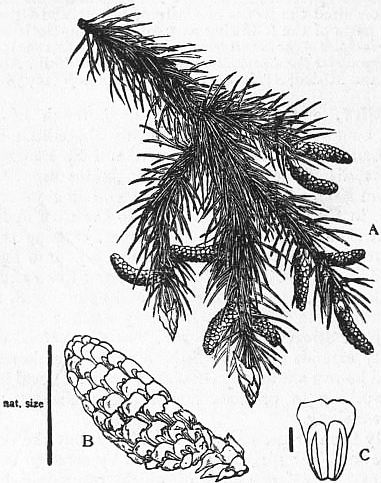
Fig. 1.—Norway Spruce (Picea excelsa). Male Flowers. A, branch bearing male cones, reduced; B, single male cone, enlarged; C, single stamen, enlarged.
The tree is very widely distributed, growing abundantly on most of the mountain ranges of northern and central Europe; while in Asia it occurs at least as far east as the Lena, and in latitude extends from the Altaic ranges to beyond the Arctic circle. On the Swiss Alps it is one of the most prevalent and striking of the forest trees, its dark evergreen foliage often standing out in strong contrast to the snowy ridges and glaciers beyond. In the lower districts of Sweden it is the predominant tree in most of the great forests that spread over so large a portion of that country. In Norway it constitutes a considerable part of the dense woods of the southern dales, flourishing, according to Franz Christian Schübeler, on the mountain slopes up to an altitude of from 2800 to 3100 ft., and clothing the shores of some of the fjords to the water’s edge; in the higher regions it is generally mingled with the pine. Less abundant on the western side of the fjelds, it again forms woods in Nordland, extending in the neighbourhood of the coast nearly to the 67th parallel; but it is, in that arctic climate, rarely met with at a greater elevation than 800 ft. above the sea, though in Swedish Lapland it is found on the slope of the Sulitelma as high as 1200 ft., its upper limit being everywhere lower than that of the pine. In all the Scandinavian countries it is known as the Gran or Grann. Great tracts of low country along the southern shores of the Baltic and in northern Russia are covered with forests of spruce. It everywhere shows a preference for a moist but well-drained soil, and never attains its full stature or luxuriance of growth upon arid ground, whether on plain or mountain—a peculiarity that should be remembered by the planter. In a favourable soil and open situation it becomes the tallest and one of the stateliest of European trees, rising sometimes to a height of from 150 to 170 ft., the trunk attaining a diameter of from 5 to 6 ft. at the base. But when it grows in dense woods, where the lower branches decay and drop off early, only a small head of foliage remaining at the tapering summit, its stem, though frequently of great height, is rarely more than 1½ or 2 ft. in thickness. Its growth is rapid, the straight leading shoot, in the vigorous period of the tree, often extending 2½ or even 3 ft. in a single season. In its native habitats it is said to endure for several centuries; but in those countries from which the commercial supply of its timber is chiefly drawn, it attains perfection in from 70 to 90 years, according to soil and situation.
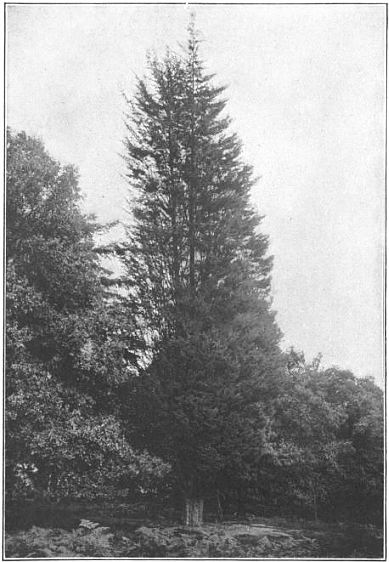
Plate I.
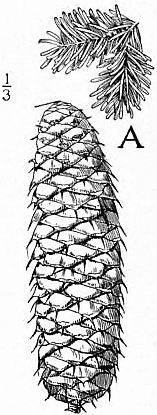
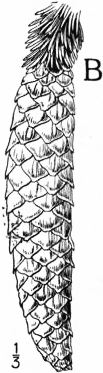
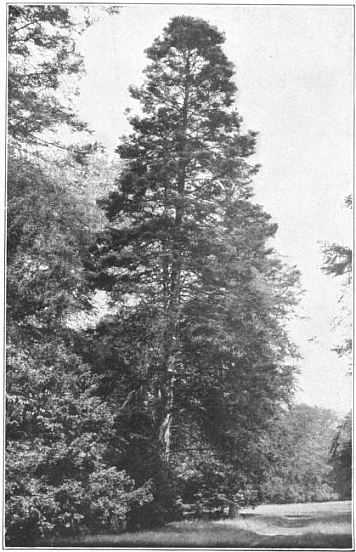
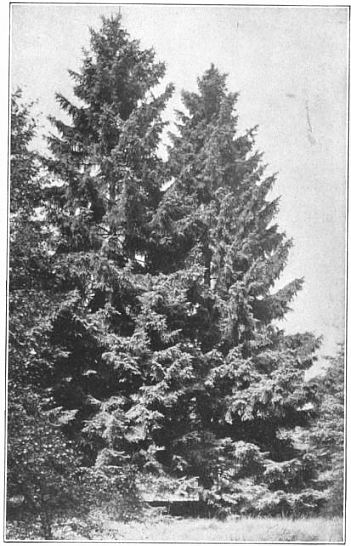
SILVER FIR (Abies pectinata). A, Cone and foliage. SPRUCE FIR (Picea excelsa). B, Cone and foliage.
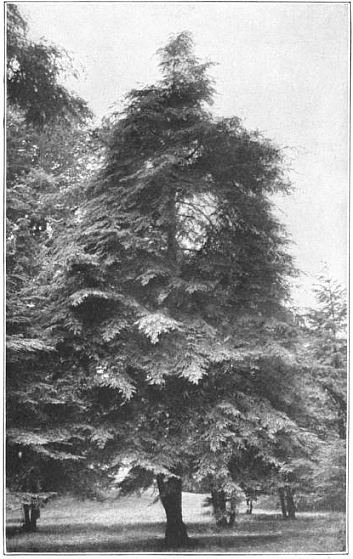
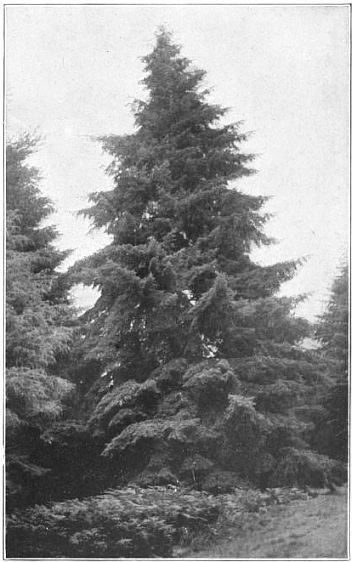
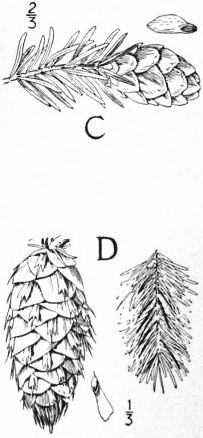
HEMLOCK SPRUCE (Tsuga canadensis) C, Cone, seed and foliage. DOUGLAS FIR (Pseudo-tsuga Douglasii). D, Cone, seed and foliage.
Photos by Henry Irving.
Plate II.
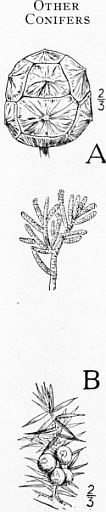
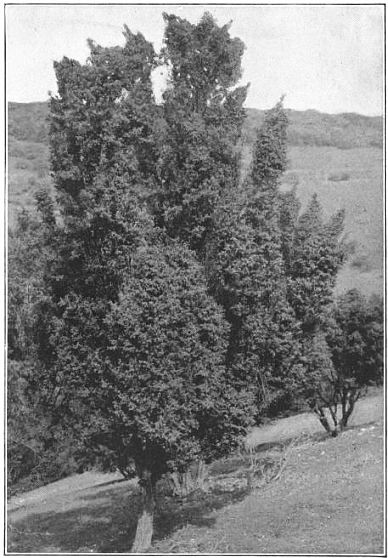
CYPRESS (Cupressus sempervirens). A, Cone and branchlets. JUNIPER (Juniperus communis). B, Fruit and foliage.
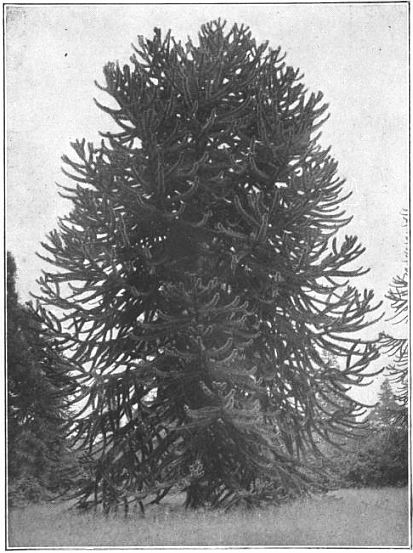
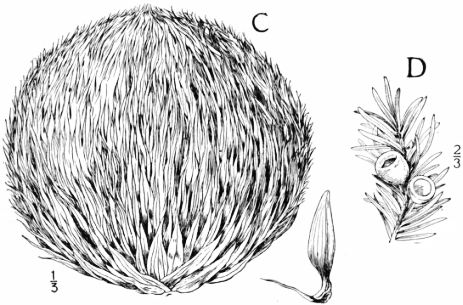
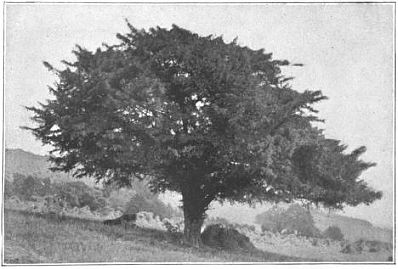
ARAUCARIA (A. imbricata, Chile pine or monkey-puzzle). C, Seed-bearing cone and a single scale with seed. YEW (Taxus baccata). D, Seed and foliage.
Photos by Henry Irving.
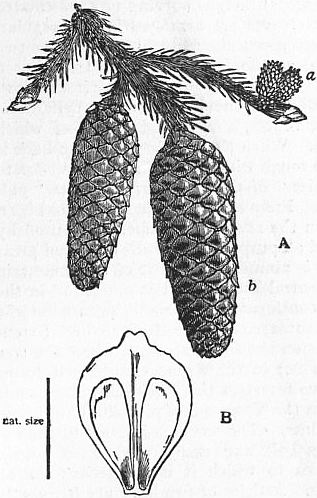
Fig. 2.—Norway Spruce (Picea excelsa). Cones; scale with seeds. A, Branch bearing (a) young female cones, (b) ripe cones, reduced. B, Ripe cone scale with seeds, enlarged.
In the most prevalent variety of the Norway spruce the wood is white, apt to be very knotty when the tree has grown in an open place, but, as produced in the close northern forests, often of fine and even grain. Immense quantities are imported into Britain from Norway, Sweden and Prussia, under the names of “white Norway,” “Christiania” and “Danzig deal.” The larger trees are sawn up into planks and battens, much used for the purposes of the builder, especially for flooring, joists and rafters. Where not exposed to the weather the wood is probably as lasting as that of the pine, but, not being so resinous, appears less adapted for out-door uses. Great quantities are sent from Sweden in a manufactured state, in the form of door and window-frames and ready-prepared flooring, and much of the cheap “white deal” furniture is made of this wood. The younger and smaller trees are remarkably durable, especially when the bark is allowed to remain on them; and most of the poles imported into Britain for scaffolding, ladders, mining-timber and similar uses are furnished by this fir. Small masts and spars are often made of it, and are said to be lighter than those of pine. The best poles are obtained in Norway from small, slender, drawn-up trees, growing under the shade of the larger ones in the thick woods, these being freer from knots, and tougher from their slower growth. A variety of the spruce, abounding in some parts of Norway, produces a red heartwood, not easy to distinguish from that of the Norway pine (Scotch fir), and imported with it into England as “red deal” or “pine.” This kind is sometimes seen in plantations, where it may be recognized by its shorter, darker leaves and longer cones. The smaller branches and the waste portion of the trunks, left in cutting up the timber, are exported as fire-wood, or used for splitting into matches. The wood of the spruce is also employed in the manufacture of wood-pulp for paper.
The resinous products of the Norway spruce, though yielded by the tree in less abundance than those furnished by the pine, are of considerable economic value. In Scandinavia a thick turpentine oozes from cracks or fissures in the bark, forming by its congelation a fine yellow resin, known commercially as “spruce rosin,” or “frankincense”; it is also procured artificially by cutting off the ends of the lower branches, when it slowly exudes from the extremities. In Switzerland and parts of Germany, where it is collected in some quantity for commerce, a long strip of bark is cut out of the tree near the root; the resin that slowly accumulates during the summer is scraped out in the latter part of the season, and the slit enlarged slightly the following spring to ensure a continuance of the supply. The process is repeated every alternate year, until the tree no longer yields the resin in abundance, which under favourable circumstances it will do for twenty years or more. The quantity obtained from each fir is very variable, depending on the vigour of the tree, and greatly lessens after it has been subjected to the operation for some years. Eventually the tree is destroyed, and the wood rendered worthless for timber, and of little value even for fuel. From the product so obtained most of the better sort of “Burgundy pitch” of the druggists is prepared. By the peasantry of its native countries the Norway spruce is applied to innumerable purposes of daily life. The bark and young cones afford a tanning material, inferior indeed to oak-bark, and hardly equal to that of the larch, but of value in countries where substances more rich in tannin are not abundant. In Norway the sprays, like those of the juniper, are scattered over the floors of churches and the sitting-rooms of dwelling-houses, as a fragrant and healthful substitute for carpet or matting. The young shoots are also given to oxen in the long winters of those northern latitudes, when other green fodder is hard to obtain. In times of scarcity the Norse peasant-farmer uses the sweetish inner bark, beaten in a mortar and ground in his primitive mill with oats or barley, to eke out a scanty supply of meal, the mixture yielding a tolerably palatable though somewhat resinous substitute for his ordinary flad-brod. A decoction of the buds in milk or whey is a common household remedy for scurvy; and the young shoots or green cones form an essential ingredient in the spruce-beer drank with a similar object, or as an occasional beverage. The well-known “Danzig-spruce” is prepared by adding a decoction of the buds or cones to the wort or saccharine liquor before fermentation. Similar preparations are in use wherever the spruce fir abounds. The wood is burned for fuel, its heat-giving power being reckoned in Germany about one-fourth less than that of beech. From the widespreading roots string and ropes are manufactured in Lapland and Bothnia: the longer ones which run near the surface are selected, split through, and then boiled for some hours in a ley of wood-ashes and salt, which, dissolving out the resin, loosens the fibres and renders them easily separable, and ready for twisting into cordage. Light portable boats are sometimes made of very thin boards of fir, sewn together with cord thus manufactured from the roots of the tree.
The Norway spruce seems to have been the “Picea” of Pliny, but is evidently often confused by the Latin writers with their “Abies,” the Abies pectinata of modern botanists. From an equally loose application of the word “fir” by our older herbalists, it is difficult to decide upon the date of introduction of this tree into Britain; but it was commonly planted for ornamental purposes in the beginning of the 17th century. In places suited to its growth it seems to flourish nearly as well as in the woods of Norway or Switzerland; but as it needs for its successful cultivation as a timber tree soils that might be turned to agricultural account, it is not so well adapted for economic planting in Britain as the Scotch fir or larch, which come to perfection in more bleak and elevated regions, and on comparatively barren ground, though it may perhaps be grown to advantage on some moist hill-sides and mountain hollows. Its great value to the English forester is as a “nurse” for other trees, for which its dense leafage and tapering form render it admirably fitted, as it protects, without overshading, the young saplings, and yields saleable stakes and small poles when cut out. For hop-poles it is not so well adapted as the larch. As a picturesque tree, for park and ornamental plantation, it is among the best of the conifers, its colour and form contrasting yet harmonizing with the olive green and rounded outline of oaks and beeches, or with the red trunk and glaucous foliage of the pine. When young its spreading boughs form good cover for game. The fresh branches, with their thick mat of foliage, are useful to the gardener for sheltering wall-fruit in the spring. In a good soil and position the tree sometimes attains an enormous size: one in Studley Park, Yorkshire, attained nearly 140 ft. in height, and the trunk more than 6 ft. in thickness near the ground. The spruce bears the smoke of great cities better than most of the Abietineae; but in suburban localities after a certain age it soon loses its healthy appearance, and is apt to be affected with blight (Eriosoma), though not so much as the Scotch fir and most of the pines.
The black spruce (Picea nigra) is a tree of more formal growth than the preceding. The branches grow at a more acute angle and in more regular whorls than those of the Norway spruce; and, though the lower ones become bent to a horizontal position, they do not droop, so that the tree has a much less elegant appearance. The leaves, which grow very thickly all round the stem, are short, nearly quadrangular, and of a dark greyish-green. The cones, produced in great abundance, are short and oval in shape, the scales with rugged indented edges; they are deep purple when young, but become brown as they ripen. The tree also occurs in the New England states and extends over nearly the whole of British North America, its northern limit occurring at about 67° N. lat., often forming a large part of the dense forests, mostly in the swampy districts. A variety with lighter foliage and reddish bark is common in Newfoundland and some districts on the mainland adjacent. The trees usually grow very close together, the slender trunks rising to a great height bare of branches; but they do not attain the size of the Norway spruce, being seldom taller than 60 or 70 ft., with a diameter of 1½ or 2 ft. at the base. This species prefers a peaty soil, and often grows luxuriantly in very moist situations. The wood is strong, light and very elastic, forming an excellent material for small masts and spars, for which purpose the trunks are used in America, and exported largely to England. The sawn timber is inferior to that of P. excelsa, besides being of a smaller size. In the countries in which it abounds, the log-houses of the settlers are often built of the long straight trunks. The spruce-beer of America is generally made from the young shoots of this tree. The small twigs, tied in bundles, are boiled for some time in water with broken biscuit or roasted grain; the resulting decoction is then poured into a cask with molasses or maple sugar and a little yeast, and left to ferment. It is often made by the settlers and fishermen of the St Lawrence region, being esteemed as a preventive of scurvy. The American “essence of spruce,” occasionally used in England for making spruce-beer, is obtained by boiling the shoots and buds and concentrating the decoction. The resinous products of the tree are of no great value. It was introduced into Britain at the end of the 17th century.
The white spruce (Picea alba), sometimes met with in English plantations, is a tree of lighter growth than the black spruce, the branches being more widely apart; the foliage is of a light glaucous green; the small light-brown cones are more slender and tapering than in P. nigra, and the scales have even edges. It is of comparatively small size, but is of some importance in the wilds of the Canadian dominion, where it is found to the northern limit of tree-vegetation growing up to at least 69°; the slender trunks yield the only useful timber of some of the more desolate northern regions. In the woods of Canada it occurs frequently mingled with the black spruce and other trees. The fibrous tough roots, softened by soaking in water, and split, are used by the Indians and voyageurs to sew together the birch-bark covering of their canoes; and a resin that exudes from the bark is employed to varnish over the seams. It was introduced to Great Britain at the end of the 17th century and was formerly more extensively planted than at present.
The hemlock spruce (Tsuga canadensis) is a large tree, abounding in most of the north-eastern parts of America up to Labrador; in lower Canada, New Brunswick and Nova Scotia it is often the prevailing tree. The short leaves are flat, those above pressed close to the stem, and the others forming two rows; they are of a rather light green tint above, whitish beneath. The cones are very small, ovate and pointed. The large branches droop, like those of the Norway spruce, but the sprays are much lighter and more slender, rendering the tree one of the most elegant of the conifers, especially when young. When old, the branches, broken and bent down by the winter snows, give it a ragged but very picturesque aspect. The trunk is frequently 3 ft. thick near the base. The hemlock prefers rather dry and elevated situations, often forming woods on the declivities of mountains. The timber is very much twisted in grain, and liable to warp and split, but is used for making plasterers’ laths and for fencing; “shingles” for roofing are sometimes made of it. The bark, split off in May or June, forms one of the most valuable tanning substances in Canada. The sprays are sometimes used for making spruce-beer and essence of spruce. It was introduced into Great Britain in about the year 1736.
The Douglas spruce (Pseudo-tsuga Douglasii), one of the finest conifers, often rises to a height of 200 ft. and sometimes considerably more, while the gigantic trunk frequently measures 8 or 10 ft. across. The yew-like leaves spread laterally, and are of a deep green tint; the cones are furnished with tridentate bracts that project far beyond the scales. It forms extensive forests in Vancouver Island, British Columbia and Oregon, whence the timber is exported, being highly prized for its strength, durability and even grain, though very heavy; it is of a deep yellow colour, abounding in resin, which oozes from the thick bark. It was introduced into Britain soon after its rediscovery by David Douglas in 1827, and has been widely planted, but does not flourish well where exposed to high winds or in too shallow soil.
Of the Abies group, the silver fir (A. pectinata), may be taken as the type,—a lofty tree, rivalling the Norway spruce in size, with large spreading horizontal boughs curving upward toward the extremities. The flat leaves are arranged in two regular, distinct rows; they are deep green above, but beneath have two broad white lines, which, as the foliage in large trees has a tendency to curl upwards, give it a silvery appearance from below. The large cones stand erect on the branches, are cylindrical in shape, and have long bracts, the curved points of which project beyond the scales. When the tree is young the bark is of a silvery grey, but gets rough with age. This tree appears to have been the true “Abies” of the Latin writers—the “pulcherrima abies” of Virgil. From early historic times it has been held in high estimation in the south of Europe, being used by the Romans for masts and all purposes for which timber of great length was required. It is abundant in most of the mountain ranges of southern and central Europe, but is not found in the northern parts of that continent. In Asia it occurs on the Caucasus and Ural, and in some parts of the Altaic chain. Extensive woods of this fir exist on the southern Alps, where the tree grows up to nearly 4000 ft.; in the Rhine countries it forms great part of the extensive forest of the Hochwald, and occurs in the Black Forest and in the Vosges; it is plentiful likewise on the Pyrenees and Apennines. The wood is inferior to that of Picea excelsa, but, being soft and easily worked, is largely employed in the countries to which it is indigenous for all the purposes of carpentry. Articles of furniture are frequently made of it, and it is in great esteem for carving and for the construction of stringed instruments. Deficient in resin, the wood is more perishable than that of the spruce fir when exposed to the air, though it is said to stand well under water. The bark contains a large amount of a fine, highly-resinous turpentine, which collects in tumours on the trunk during the heat of summer. In the Alps and Vosges this resinous semi-fluid is collected by climbing the trees and pressing out the contents of the natural receptacles of the bark into horn or tin vessels held beneath them. After purification by straining, it is sold as “Strasburg turpentine,” much used in the preparation of some of the finer varnishes. Burgundy pitch is also prepared from it by a similar process as that from Picea excelsa. A fine oil of turpentine is distilled from the crude material; the residue forms a coarse resin. Introduced into Britain at the beginning of the 17th century, the silver fir has become common there as a planted tree, though, like the Norway spruce, it rarely comes up from seed scattered naturally. There are many fine trees in Scotland; one near Roseneath, figured by Strutt in his Sylva Britannica, then measured more than 22 ft. round the trunk. In the more southern parts of the island it often reaches a height of 90 ft., and specimens exist considerably above that size; but the young shoots are apt to be injured in severe winters, and the tree on light soils is also hurt by long droughts, so that it usually presents a ragged appearance; though, in the distance, the lofty top and horizontal boughs sometimes stand out in most picturesque relief above the rounded summits of the neighbouring trees. The silver fir flourishes in a deep loamy soil, and will grow even upon stiff clay, when well drained—a situation in which few conifers will succeed. On such lands, where otherwise desirable, it may sometimes be planted with profit. The cones do not ripen till the second year.
The silver fir of Canada (A. balsamea), a small tree resembling the last species in foliage, furnishes the “Canada balsam”; it abounds in Quebec and the adjacent provinces.
Numerous other firs are common in gardens and shrubberies, and some furnish valuable products in their native countries; but they are not yet of sufficient economic or general interest to demand mention here.
For further information see Veitch’s Manual of Coniferae (2nd ed., 1900).
FIRDOUSĪ, Firdausī or Firdusī, Persian poet. Abu ’l Kāsim Mansur (or Hasan), who took the nom de plume of Firdousī, author of the epic poem the Shāhnāma, or “Book of Kings,” a complete history of Persia in nearly 60,000 verses, was born at Shadab, a suburb of Tūs, about the year 329 of the Hegira (941 A.D.), or earlier. His father belonged to the class of Dihkans (the old native country families and landed proprietors of Persia, who had preserved their influence and status under the Arab rule), and possessed an estate in the neighbourhood of Tūs (in Khorasan). Firdousī’s own education eminently qualified him for the gigantic task which he subsequently undertook, for he was profoundly versed in the Arabic language and literature and had also studied deeply the Pahlavi or Old Persian, and was conversant with the ancient historical records which existed in that tongue.
The Shāhnāma of Firdousī (see also Persia: Literature) is perhaps the only example of a poem produced by a single author which at once took its place as the national epic of the people. The nature of the work, the materials from which it was composed, and the circumstances under which it was written are, however, in themselves exceptional, and necessarily tended to this result. The grandeur and antiquity of the empire and the vicissitudes through which it passed, their long series of wars and the magnificent monuments erected by their ancient sovereigns, could not fail to leave numerous traces in the memory of so imaginative a people as the Persians. As early as the 5th century of the Christian era we find mention made of these historical traditions in the work of an Armenian author, Moses of Chorene (according to others, he lived in the 7th or 8th century). During the reign of Chosroes I. (Anushirvan) the contemporary of Mahomet, and by order of that monarch, an attempt had been made to collect, from various parts of the kingdom, all the popular tales and legends relating to the ancient kings, and the results were deposited in the royal library. During the last years of the Sassanid dynasty the work was resumed, the former collection being revised and greatly added to by the Dihkan Danishwer, assisted by several learned mobeds. His work was entitled the Khoda’ināma, which in the old dialect also meant the “Book of Kings.” On the Arab invasion this work was in great danger of perishing at the hands of the iconoclastic caliph Omar and his generals, but it was fortunately preserved; and we find it in the 2nd century of the Hegira being paraphrased in Arabic by Abdallah ibn el Mokaffa, a learned Persian who had embraced Islam. Other Guebres occupied themselves privately with the collection of these traditions; and, when a prince of Persian origin, Yakūb ibn Laith, founder of the Saffarid dynasty, succeeded in throwing off his allegiance to the caliphate, he at once set about continuing the work of his illustrious predecessors. His “Book of Kings” was completed in the year 260 of the Hegira, and was freely circulated in Khorasan and Irak. Yakūb’s family did not continue long in power; but the Samanid princes who succeeded applied themselves zealously to the same work, and Prince Nūh II., who came to the throne in 365 A.H. (A.D. 976), entrusted it to the court poet Dakiki, a Guebre by religion. Dakiki’s labours were brought to a sudden stop by his own assassination, and the fall of the Samanian house happened not long after, and their kingdom passed into the hands of the Ghaznevids. Mahmūd ibn Sabuktagin, the second of the dynasty (998-1030), continued to make himself still more independent of the caliphate than his predecessors, and, though a warrior and a fanatical Moslem, extended a generous patronage to Persian literature and learning, and even developed it at the expense of the Arabic institutions. The task of continuing and completing the collection of the ancient historical traditions of the empire especially attracted him. With the assistance of neighbouring princes and of many of the influential Dihkans, Mahmud collected a vast amount of materials for the work, and after having searched in vain for a man of sufficient learning and ability to edit them faithfully, and having entrusted various episodes for versification to the numerous poets whom he had gathered round him, he at length made choice of Firdousī. Firdousī had been always strongly attracted by the ancient Pahlavi records, and had begun at an early age to turn them into Persian epic verse. On hearing of the death of the poet Dakiki, he conceived the ambitious design of himself carrying out the work which the latter had only just commenced; and, although he had not then any introduction to the court, he contrived, thanks to one of his friends, Mahommed Lashkari, to procure a copy of the Dihkan Danishwer’s collection, and at the age of thirty-six commenced his great undertaking. Abu Mansur, the governor of Tūs, patronized him and encouraged him by substantial pecuniary support. When Mahmud succeeded to the throne, and evinced such active interest in the work, Firdousī was naturally attracted to the court of Ghazni. At first court jealousies and intrigues prevented Firdousī from being noticed by the sultan; but at length one of his friends, Mahek, undertook to present to Mahmud his poetic version of one of the well-known episodes of the legendary history. Hearing that the poet was born at Tūs, the sultan made him explain the origin of his native town, and was much struck with the intimate knowledge of ancient history which he displayed. Being presented to the seven poets who were then engaged on the projected epic, Abu ’l Kāsim was admitted to their meetings, and on one occasion improvised a verse, at Mahmud’s request, in praise of his favourite Ayāz, with such success that the sultan bestowed upon him the name of Firdousī, saying that he had converted his assemblies into paradise (Firdous). During the early days of his sojourn at court an incident happened which contributed in no small measure to the realization of his ambition. Three of the seven poets were drinking in a garden when Firdousī approached, and wishing to get rid of him without rudeness, they informed him who they were, and told him that it was their custom to admit none to their society but such as could give proof of poetical talent. To test his acquirements they proposed that each should furnish an extemporary line of verse, his own to be the last, and all four ending in the same rhyme. Firdousī accepted the challenge, and the three poets having previously agreed upon three rhyming words to which a fourth could not be found in the Persian language, ’Ansari began—
“Thy beauty eclipses the light of the sun”;
Farrakhi added—
“The rose with thy cheek would comparison shun”;
’Asjadi continued—
“Thy glances pierce through the mailed warrior’s johsun”;1
and Firdousī, without a moment’s hesitation, completed the quatrain—
“Like the lance of fierce Giv in his fight with Poshun.”
The poets asked for an explanation of this allusion, and Firdousī recited to them the battle as described in the Shāhnāma, and delighted and astonished them with his learning and eloquence.
Mahmud now definitely selected him for the work of compiling and versifying the ancient legends, and bestowed upon him such marks of his favour and munificence as to elicit from the poet an enthusiastic panegyric, which is inserted in the preface of the Shāhnāma, and forms a curious contrast to the bitter satire which he subsequently prefixed to the book. The sultan ordered his treasurer, Khojah Hasan Maimandi, to pay to Firdousī a thousand gold pieces for every thousand verses; but the poet preferred allowing the sum to accumulate till the whole was finished, with the object of amassing sufficient capital to construct a dike for his native town of Tūs, which suffered greatly from defective irrigation, a project which had been the chief dream of his childhood. Owing to this resolution, and to the jealousy of Hasan Maimandi, who often refused to advance him sufficient for the necessaries of life, Firdousī passed the later portion of his life in great privation, though enjoying the royal favour and widely extended fame. Amongst other princes whose liberal presents enabled him to combat his pecuniary difficulties, was one Rustam, son of Fakhr Addaula, the Dailamite, who sent him a thousand gold pieces in acknowledgment of a copy of the episode of Rustam and Isfendiar which Firdousī had sent him, and promised him a gracious reception if he should ever come to his court. As this prince belonged, like Firdousī, to the Shiah sect, while Mahmud and Maimandi were Sunnites, and as he was also politically opposed to the sultan, Hasan Maimandi did not fail to make the most of this incident, and accused the poet of disloyalty to his sovereign and patron, as well as of heresy. Other enemies and rivals also joined in the attack, and for some time Firdousī’s position was very precarious, though his pre-eminent talents and obvious fitness for the work prevented him from losing his post. To add to his troubles he had the misfortune to lose his only son at the age of 37.
At length, after thirty-five years’ work, the book was completed (1011), and Firdousī entrusted it to Ayāz, the sultan’s favourite, for presentation to him. Mahmud ordered Hasan Maimandi to take the poet as much gold as an elephant could carry, but the jealous treasurer persuaded the monarch that it was too generous a reward, and that an elephant’s load of silver would be sufficient. 60,000 silver dirhems were accordingly placed in sacks, and taken to Firdousī by Ayāz at the sultan’s command, instead of the 60,000 gold pieces, one for each verse, which had been promised. The poet was at that moment in the bath, and seeing the sacks, and believing that they contained the expected gold, received them with great satisfaction, but finding only silver he complained to Ayāz that he had not executed the sultan’s order. Ayāz related what had taken place between Mahmud and Hasan Maimandi, and Firdousī in a rage gave 20 thousand pieces to Ayāz himself, the same amount to the bath-keeper, and paid the rest to a beer seller for a glass of beer (fouka), sending word back to the sultan that it was not to gain money that he had taken so much trouble. On hearing this message, Mahmud at first reproached Hasan with having caused him to break his word, but the wily treasurer succeeded in turning his master’s anger upon Firdousī to such an extent that he threatened that on the morrow he would “cast that Carmathian (heretic) under the feet of his elephants.” Being apprised by one of the nobles of the court of what had taken place, Firdousī passed the night in great anxiety; but passing in the morning by the gate that led from his own apartments into the palace, he met the sultan in his private garden, and succeeded by humble apologies in appeasing his wrath. He was, however, far from being appeased himself, and determined at once upon quitting Ghazni. Returning home he tore up the draughts of some thousands of verses which he had composed and threw them in the fire, and repairing to the grand mosque of Ghazni he wrote upon the walls, at the place where the sultan was in the habit of praying, the following lines:—
“The auspicious court of Mahmud, king of Zabulistan, is like a sea. What a sea! One cannot see its shore. If I have dived therein without finding any pearls it is the fault of my star and not of the sea.”
He then gave a sealed paper to Ayāz, begging him to hand it to the sultan in a leisure moment after 20 days had elapsed, and set off on his travels with no better equipment than his staff and a dervish’s cloak. At the expiration of the 20 days Ayāz gave the paper to the sultan, who on opening it found the celebrated satire which is now always prefixed to copies of the Shāhnāma, and which is perhaps one of the bitterest and severest pieces of reproach ever penned. Mahmud, in a violent rage, sent after the poet and promised a large reward for his capture, but he was already in comparative safety. Firdousī directed his steps to Mazandaran, and took refuge with Kabus, prince of Jorjan, who at first received him with great favour, and promised him his continued protection and patronage; learning, however, the circumstances under which he had left Ghazni, he feared the resentment of so powerful a sovereign as Mahmud, who he knew already coveted his kingdom, and dismissed the poet with a magnificent present. Firdousī next repaired to Bagdad, where he made the acquaintance of a merchant, who introduced him to the vizier of the caliph, al-Qadir, by presenting an Arabic poem which the poet had composed in his honour. The vizier gave Firdousī an apartment near himself, and related to the caliph the manner in which he had been treated at Ghazni. The caliph summoned him into his presence, and was so much pleased with a poem of a thousand couplets, which Firdousī composed in his honour, that he at once received him into favour. The fact of his having devoted his life and talents to chronicling the renown of fire-worshipping Persians was, however, somewhat of a crime in the orthodox caliph’s eyes; in order therefore to recover his prestige, Firdousī composed another poem of 9000 couplets on the theme borrowed from the Koran of the loves of Joseph and Potiphar’s wife—Yūsuf and Zuleikha (edited by H. Ethé, Oxford, 1902; complete metrical translation by Schlechta-Wssehrd, Vienna, 1889). This poem, though rare and little known, is still in existence—the Royal Asiatic Society possessing a copy. But Mahmud had by this time heard of his asylum at the court of the caliph, and wrote a letter menacing his liege lord, and demanding the surrender of the poet. Firdousī, to avoid further troubles, departed for Ahwaz, a province of the Persian Irak, and dedicated his Yūsuf and Zuleikha to the governor of that district. Thence he went to Kohistan, where the governor, Nasir Lek, was his intimate and devoted friend, and received him with great ceremony upon the frontier. Firdousī confided to him that he contemplated writing a bitter exposition of his shameful treatment at the hands of the sultan of Ghazni; but Nasir Lek, who was a personal friend of the latter, dissuaded him from his purpose, but himself wrote and remonstrated with Mahmud. Nasir Lek’s message and the urgent representations of Firdousī’s friends had the desired effect; and Mahmud not only expressed his intention of offering full reparation to the poet, but put his enemy Maimandi to death. The change, however, came too late; Firdousī, now a broken and decrepit old man, had in the meanwhile returned to Tūs, and, while wandering through the streets of his native town, heard a child lisping a verse from his own satire in which he taunts Mahmud with his slavish birth:—
“Had Mahmud’s father been what he is now A crown of gold had decked this aged brow; Had Mahmud’s mother been of gentle blood, In heaps of silver knee-deep had I stood.”
He was so affected by this proof of universal sympathy with his misfortunes that he went home, fell sick and died. He was buried in a garden, but Abu’l Kasim Jurjani, chief sheikh of Tūs, refused to read the usual prayers over his tomb, alleging that he was an infidel, and had devoted his life to the glorification of fire-worshippers and misbelievers. The next night, however, having dreamt that he beheld Firdousī in paradise dressed in the sacred colour, green, and wearing an emerald crown, he reconsidered his determination; and the poet was henceforth held to be perfectly orthodox. He died in the year 411 of the Hegira (1020 A.D.), aged about eighty, eleven years after the completion of his great work. The legend goes that Mahmud had in the meanwhile despatched the promised hundred thousand pieces of gold to Firdousī, with a robe of honour and ample apologies for the past. But as the camels bearing the treasure reached one of the gates of the city, Firdousī’s funeral was leaving it by another. His daughter, to whom they brought the sultan’s present, refused to receive it; but his aged sister remembering his anxiety for the construction of the stone embankment for the river of Tūs, this work was completed in honour of the poet’s memory, and a large caravanserai built with the surplus.
Much of the traditional life, as given above, which is based upon that prefixed to the revised edition of the poem, undertaken by order of Baisingar Khan, grandson of Timur-i-Leng (Timur), is rejected by modern scholars (see T. Nöldeke, “Das iranische Nationalepos,” in W. Geiger’s Grundriss der iranischen Philologie, ii. pp. 150-158).
The Shāhnāma is based, as we have seen, upon the ancient legends current among the populace of Persia, and collected by the Dihkans, a class of men who had the greatest facilities for this purpose. There is every reason therefore to believe that Firdousī adhered faithfully to these records of antiquity, and that the poem is a perfect storehouse of the genuine traditions of the country.
The entire poem (which only existed in MS. up to the beginning of the 19th century) was published (1831-1868) with a French translation in a magnificent folio edition, at the expense of the French government, by the learned and indefatigable Julius von Mohl. The size and number of the volumes, however, and their great expense, made them difficult of access, and Frau von Mohl published the French translation (1876-1878) with her illustrious husband’s critical notes and introduction in a more convenient and cheaper form. Other editions are by Turner Macan (Calcutta, 1829), J.A. Vullers and S. Landauer (unfinished; Leiden, 1877-1883). There is an English abridgment by J. Atkinson (London, 1832; reprinted 1886, 1892); there is a verse-translation, partly rhymed and partly unrhymed, by A.G. and E. Warner (1905 foll.), with an introduction containing an account of Firdousī and the Shāhnāma; the version by A. Rogers (1907) contains the greater part of the work. The episode of Sohrab and Rustam is well known to English readers from Matthew Arnold’s poem. The only complete translation is Il Libro dei Rei, by I. Pizzi (8 vols., Turin, 1886-1888), also the author of a history of Persian poetry.
See also E.G. Browne’s Literary History of Persia, i., ii. (1902-1906); T. Nöldeke (as above) for a full account of the Shāhnāma, editions, &c.; and H. Ethé, “Neupersische Litteratur,” in the same work.
(E. H. P.; X.)
1 A sort of cuirass.
FIRE (in O. Eng. fýr; the word is common to West German languages, cf. Dutch vuur, Ger. Feuer; the pre-Teutonic form is seen in Sanskrit pū, pāvaka, and Gr. πῦρ; the ultimate origin is usually taken to be a root meaning to purify, cf. Lat. purus), the term commonly used for the visible effect of combustion (see Flame), operating as a heating or lighting agency.
So general is the knowledge of fire and its uses that it is a question whether we have any authentic instance on record of a tribe altogether ignorant of them. A few notices indeed are to be found in the voluminous literature of travel which would decide the question in the affirmative; but when they are carefully investigated, their evidence is found to be far from conclusive. The missionary Krapf was told by a slave of a tribe in the southern part of Shoa who lived like monkeys in the bamboo jungles, and were totally ignorant of fire; but no better authority has been found for the statement, and the story, which seems to be current in eastern Africa, may be nothing else than the propagation of fables about the Pygmies whom the ancients located around the sources of the Nile. Lieut. Charles Wilkes, commander of the United States exploring expedition of 1838-42, says that in Fakaafo or Bowditch Island “there was no sign of places for cooking nor any appearance of fire,” and that the natives felt evident alarm at the sparks produced by flint and steel and the smoke emitted by those with cigars in their mouths. The presence of the word afi, fire, in the Fakaafo vocabulary supplied by Hale the ethnographer of the expedition, though it might perhaps be explained as equivalent only to solar light and heat, undoubtedly invalidates the supposition of Wilkes; and the Rev. George Turner, in an account of a missionary voyage in 1859, not only repeats the word afi in his list for Fakaafo, but relates the native legend about the origin of fire, and describes some peculiar customs connected with its use. Alvaro de Saavedra, an old Spanish traveller, informs us that the inhabitants of Los Jardines, an island of the Pacific, showed great fear when they saw fire—which they did not know before. But that island has not been identified with certainty by modern explorers. It belongs, perhaps, to the Ladrones or Marianas Archipelago, where fire was unknown, says Padre Gobien, “till Magellan, wroth at the pilferings of the inhabitants, burnt one of their villages. When they saw their wooden huts ablaze, their first thought was that fire was a beast which eats up wood. Some of them having approached the fire too near were burnt, and the others kept aloof, fearing to be torn or poisoned by the powerful breath of that terrible animal.” To this Freycinet objects that these Ladrone islanders made pottery before the arrival of Europeans, that they had words expressing the ideas of flame, fire, oven, coals, roasting and cooking. Let us add that in their country numerous graves and ruins have been found, which seem to be remnants of a former culture. Thus the question remains in uncertainty: though there is nothing impossible in the supposition of the existence of a fireless tribe, it cannot be said that such a tribe has been discovered.
It is useless to inquire in what way man first discovered that fire was subject to his control, and could even be called into being by appropriate means. With the natural phenomenon and its various aspects he must soon have become familiar. The volcano lit up the darkness of night and sent its ashes or its lava down into the plains; the lightning or the meteor struck the tree, and the forest was ablaze; or some less obvious cause produced some less extensive ignition. For a time it is possible that the grand manifestations of nature aroused no feelings save awe and terror; but man is quite as much endowed with curiosity as with reverence or caution, and familiarity must ere long have bred confidence if not contempt. It is by no means necessary to suppose that the practical discovery of fire was made only at one given spot and in one given way; it is much more probable indeed that different tribes and races obtained the knowledge in a variety of ways.
It has been asserted of many tribes that they would be unable to rekindle their fires if they were allowed to die out. Travellers in Australia and Tasmania depict the typical native woman bearing always about with her a burning brand, which it is one of her principal duties to protect and foster; and it has been supposed that it was only ignorance which imposed on her the endless task. This is absurd. The Australian methods of producing fire by the friction of two pieces of wood are perfectly well known, and are illustrated in Howitt’s Native Tribes of South-East Australia, pp. 771-773. To carry a brand saves a little trouble to the men.
The methods employed for producing fire vary considerably in detail, but are for the most part merely modified applications of concussion or friction. Lord Avebury has remarked that the working up of stone into implements must have been followed sooner or later by the discovery of fire; for in the process of chipping sparks were elicited, and in the process of polishing heat was generated. The first or concussion method is still familiar in the flint and steel, which has hardly passed out of use even in the most civilized countries. Its modifications are comparatively few and unimportant. The Alaskans and Aleutians take two pieces of quartz, rub them well with native sulphur, strike them together till the sulphur catches fire, and then transfer the flame to a heap of dry grass over which a few feathers have been scattered. Instead of two pieces of quartz the Eskimos use a piece of quartz and a piece of iron pyrites. Mr Frederick Boyle saw fire produced by striking broken china violently against a bamboo, and Bastian observed the same process in Burma, and Wallace in Ternate. In Cochin China two pieces of bamboo are considered sufficient, the silicious character of the outside layer rendering it as good as native flint. The friction methods are more various. One of the simplest is what E.B. Tylor calls the stick and groove—“a blunt pointed stick being run along a groove of its own making in a piece of wood lying on the ground.” Much, of course, depends on the quality of the woods and the expertness of the manipulator. In Tahiti Charles Darwin saw a native produce fire in a few seconds, but only succeeded himself after much labour. The same device was employed in New Zealand, the Sandwich Islands, Tonga, Samoa and the Radak Islands. Instead of rubbing the movable stick backwards and forwards other tribes make it rotate rapidly in a round hole in the stationary piece of wood—thus making what Tylor has happily designated a fire-drill. This device has been observed in Australia, Kamchatka, Sumatra and the Carolines, among the Veddahs of Ceylon, throughout a great part of southern Africa, among the Eskimo and Indian tribes of North America, in the West Indies, in Central America, and as far south as the Straits of Magellan. It was also employed by the ancient Mexicans, and Tylor gives a quaint picture of the operation from a Mexican MS.—a man half kneeling on the ground is causing the stick to rotate between the palms of his hands. This simple method of rotation seems to be very generally in use; but various devices have been resorted to for the purpose of diminishing the labour and hastening the result. The Gaucho of the Pampas takes “an elastic stick about 18 in. long, presses one end to his breast and the other in a hole in a piece of wood, and then rapidly turns the curved part like a carpenter’s centre-bit.” In other cases the rotation is effected by means of a cord or thong wound round the drill and pulled alternately by this end and that. In order to steady the drill the Eskimo and others put the upper end in a socket of ivory or bone which they hold firmly in their mouth. A further advance was made by the Eskimo and neighbouring tribes, who applied the principle of the bow-drill; and the still more ingenious pump-drill was used by the Onondaga Indians. For full descriptions of these instruments and a rich variety of details connected with fire-making we must refer the reader to Tylor’s valuable chapter in his Researches. These methods of producing fire are but rarely used in Europe, and only in connexion with superstitious observances. We read in Wuttke that some time ago the authorities of a Mecklenburg village ordered a “wild fire” to be lit against a murrain amongst the cattle. For two hours the men strove vainly to obtain a spark, but the fault was not to be ascribed to the quality of the wood, or to the dampness of the atmosphere, but to the stubbornness of an old lady, who, objecting to the superstition, would not put out her night lamp; such a fire, to be efficient, must burn alone. At last the strong-minded female was compelled to give in; fire was obtained—-but of bad quality, for it did not stop the murrain.
It has long been known that the rays of the sun might be concentrated by a lens or concave mirror. Aristophanes mentions the burning-lens in The Clouds, and the story of Archimedes using a mirror to fire the ships at Syracuse is familiar to every schoolboy. If Garcilasso de la Vega can be trusted as an authority the Virgins of the Sun in Peru kindled the sacred fire with a concave cup set in a great bracelet. In China the burning-glass is in common use.
To the inquiry how mankind became possessed of fire, the cosmogonies, those records of pristine speculative thought, do not give any reply which would not be found in the relations of travellers and historians.
They say in the Tonga Islands that the god of the earthquakes is likewise the god of fire. At Mangaïa it is told that the great Maui went down to hell, where he surprised the secret of making fire by rubbing two pieces of wood together. The Maoris tell the tale differently. Maui had the fire given to him by his old blind grandmother, Mahuika, who drew it from the nails of her hands. Wishing to have a stronger one, he pretended that it had gone out, and so he obtained fire from her great toe. It was so fierce that every thing melted before the glow; even Maui and the grandmother herself were already burning when a deluge, sent from heaven, saved the hero and the perishing world; but before the waters extinguished all the blaze, Mahuika shut a few sparks into some trees, and thence men draw it now. The Maoris have also the legend that thunder is the noise of Tawhaki’s footsteps, and that lightnings flash from his armpits. At Western Point, Victoria, the Australians say the good old man Pundyil opened the door of the sun, whose light poured then on earth, and that Karakorok, the good man’s good daughter, seeing the earth to be full of serpents, went everywhere destroying serpents; but before she had killed them all, her staff snapped in two, and while it broke, a flame burst out of it. Here the serpent-killer is a fire-bringer. In the Persian Shahnama also fire was discovered by a dragon-fighter. Hushenk, the powerful hero, hurled at the monster a prodigious stone, which, evaded by the snake, struck a rock and was splintered by it. “Light shone from the dark pebble, the heart of the rock flashed out in glory, and fire was seen for the first time in the world.” The snake escaped, but the mystery of fire had been revealed.
North American legends narrate how the great buffalo, careering through the plains, makes sparks flit in the night, and sets the prairie ablaze by his hoofs hitting the rocks. We meet the same idea in the Hindu mythology, which conceives thunder to have been, among many other things, the clatter of the solar horses on the Akmon or hard pavement of the sky. The Dakotas claim that their ancestor obtained fire from the sparks which a friendly panther struck with its claws, as it scampered upon a stony hill.
Tohil, who gave the Quiches fire by shaking his sandals, was, like the Mexican Quetzelcoatl, represented by a flint stone. Guamansuri, the father of the Peruvians, produced the thunder and the lightning by hurling stones with his sling. The thunderbolts are his children. Kudai, the great god of the Altaian Tartars, disclosed “the secret of the stone’s edge and the iron’s hardness.” The Slavonian god of thunder was depicted with a silex in his hand, or even protruding from his head. The Lapp Tiermes struck with his hammer upon his own head; the Scandinavian Thor held a mallet in one hand, a flint in the other. Taranis, the Gaul, had upon his head a huge mace surrounded by six little ones. Finnish poems describe how “fire, the child of the sun, came down from heaven, where it was rocked in a tub of yellow copper, in a large pail of gold.” Ukko, the Esthonian god, sends forth lightnings, as he strikes his stone with his steel. According to the Kalewala, the same mighty Ukko struck his sword against his nail, and from the nail issued the “fiery babe.” He gave it to the Wind’s daughter to rock it, but the unwary maiden let it fall in the sea, where it was swallowed by the great pike, and fire would have been lost for ever if the child of the sun had not come to the rescue. He dragged the great pike from the water, drew out his entrails, and found there the heavenly spark still alive. Prometheus brought to earth the torch he had lighted at the sun’s chariot.
Human culture may be said to have begun with fire, of which the uses increased in the same ratio as culture itself. To save the labour expended on the initial process of procuring light, or on carrying it about constantly, primitive men hit on the expedient of a fire which should burn night and day in a public building. The Egyptians had one in every temple, the Greeks, Latins and Persians in all towns and villages. The Natchez, the Aztecs, the Mayas, the Peruvians had their “national fires” burning upon large pyramids. Of these fires the “eternal lamps” in the synagogues, in the Byzantine and Catholic churches, may be a survival. The “Regia,” Rome’s sacred centre, supposed to be the abode of Vesta, stood close to a fountain; it was convenient to draw from the same spot the two great requisites, fire and water. All civil and political interests grouped themselves around the prytaneum which was at once a temple, a tribunal, a town-hall, and a gossiping resort: all public business and most private affairs were transacted by the light and in the warmth of the common fire. No wonder that its flagstones should become sacred. Primitive communities consider as holy everything that ensures their existence and promotes their welfare, material things such as fire and water not less than others. Thus the prytaneum grew into a religious institution. And if we hear a little more of fire worship than of water worship, it is because fire, being on the whole more difficult to obtain, was esteemed more precious. The prytaneum and the state were convertible terms. If by chance the fire in the Roman temple of Vesta was extinguished, all tribunals, all authority, all public or private business had to stop immediately. The connexion between heaven and earth had been broken, and it had to be restored in some way or other—either by Jove sending down divine lightning on his altars, or by the priests making a new fire by the old sacred method of rubbing two pieces of wood together, or by catching the rays of the sun in a concave mirror. No Greek or Roman army crossed the frontier without carrying an altar where the fire taken from the prytaneum burned night and day. When the Greeks sent out colonies the emigrants took with them living coals from the altar of Hestia, and had in their new country a fire lit as a representative of that burning in the mother country.1 Not before the three curiae united their fires into one could Rome become powerful; and Athens became a shining light to the world only, we are told, when the twelve tribes of Attica, led by Theseus, brought each its brand to the altar of Athene Polias. All Greece confederated, making Delphi its central hearth; and the islands congregated around Delos, whence the new fire was fetched every year.
Periodic Fires.—Because the sun loses its force after noon, and after midsummer daily shortens the length of its circuit, the ancients inferred, and primitive populations still believe, that, as time goes on, the energies of fire must necessarily decline. Therefore men set about renewing the fires in the temples and on the hearth on the longest day of summer or at the beginning of the agricultural year. The ceremony was attended with much rejoicing, banqueting and many religious rites. Houses were thoroughly cleansed; people bathed, and underwent lustrations and purifications; new clothes were put on; quarrels were made up; debts were paid by the debtor or remitted by the creditor; criminals were released by the civil authorities in imitation of the heavenly judges, who were believed to grant on the same day a general remission of sins. All things were made new; each man turned over a new page in the book of his existence. Some nations, like the Etruscans in the Old World and the Peruvians and Mexicans in the New, carried these ideas to a high degree of development, and celebrated with magnificent ceremonies the renewal of the saecula, or astronomic periods, which might be shorter or longer than a century. Some details of the festival among the Aztecs have been preserved. On the last night of every period (52 years) every fire was extinguished, and men proceeded in solemn procession to some sacred spot, where, with awe and trembling, the priests strove to kindle a new fire by friction. It was as if they had a vague idea that the cosmos, with its sun, moon and stars, had been wound up like a clock for a definite period of time. And had they failed to raise the vital spark, they would have believed that it was because the great fire was being extinguished at the central hearth of the world. The Stoics and many other ancient philosophers thought that the world was doomed to final extinction by fire. The Scandinavian bards sung the end of the world, how at last the wolf Fenrir would get loose, how the cruel fire of Loki would destroy itself by destroying everything. The Essenes enlarged upon this doctrine, which is also found in the Sibylline books and appears in the Apocrypha (2 Esdras xvi. 15).
See Dupuis, Origine de tous les cultes (1794); Burnout, Science des religions; Grimm, Deutsche Mythologie, cap. xx. (1835); Adalbert Kuhn. Die Herabkunft des Feuers und des Göttertranks (1859); Steinthal, Über die ursprüngliche Form der Sage von Prometheus (1861); Albert Reville, “Le Mythe de Prométhée,” in Revue des deux mondes (August 1862); Michel Bréal, Hercule et Cacus (1863); Tylor, Researches into the Early History of Mankind, ch. ix. (1865); Bachofen, Die Sage von Tanaquil (1870); Lord Avebury, Prehistoric Times (6th ed., 1900); Haug, Religion of the Parsis (1878).
(E. Re.)
1 Curiously enough we see the same institution obtaining among the Damaras of South Africa, where the chiefs, who sway their people with a sort of priestly authority, commit to their daughters the care of a so-called eternal fire. From its hearth younger scions separating from the parent stock take away a burning brand to their new home. The use of a common prytaneum, of circular form, like the Roman temple of Vesta, testified to the common origin of the North American Assinais and Maichas. The Mobiles, the Chippewas, the Natchez, had each a corporation of Vestals. If the Natchez let their fire die out, they were bound to renew it from the Mobiles. The Moquis, Pueblos and Comanches had also their perpetual fires. The Redskins discussed important affairs of state at the “council fires,” around which each sachem marched three times, turning to it all the sides of his person. “It was a saying among our ancestors,” said an Iroquois chief in 1753, “that when the fire goes out at Onondaga”—the Delphi of the league—“we shall no longer be a people.”
FIRE AND FIRE EXTINCTION. Fire is considered in this article, primarily, from the point of view of the protection against fire that can be accorded by preventive measures and by the organization of fire extinguishing establishments.
History is full of accounts of devastation caused by fires in towns and cities of nearly every country in the civilized world. The following is a list of notable fires of early days:—
Great Britain and Ireland
798. London, nearly destroyed.
982. London, greater part of the city burned.
1086. London, all houses and churches from the east to the west gate burned.
1212. London, greater part of the city burned.
1666. London, “The Great Fire,” September 2-6.
It began in a wooden house in Pudding Lane, and burned for three days, consuming the buildings on 436 acres, 400 streets, lanes, &c., 13,200 houses, with St Paul’s church, 86 parish churches, 6 chapels, the guild-hall, the royal exchange, the custom-house, many hospitals and libraries, 52 companies’ halls, and a vast number of other stately edifices, together with three of the city gates, four stone bridges, and the prisons of Newgate, the Fleet, and the Poultry and Wood Street Compters. The fire swept from the Tower to Temple church, and from the N.E. gate to Holborn bridge. Six persons were killed. The total loss of property was estimated at the time to be £10,731,500.
1794. London, 630 houses destroyed at Wapping. Loss above £1,000,000.
1834. London, Houses of Parliament burned.
1861. London, Tooley Street wharves, &c., burned. Loss estimated at £2,000,000.
1873. London, Alexandra palace destroyed.
1137. York, totally destroyed.
1184. Glastonbury, town and abbey burned.
1292. Carlisle, destroyed.
1507. Norwich, nearly destroyed; 718 houses burned.
1544. Leith, burned.
1598. Tiverton, 400 houses and a large number of horses burned; 33 persons killed. Loss, £150,000.
1612. Tiverton, 600 houses burned. Loss over £200,000.
1731. Tiverton, 300 houses burned.
1700. Edinburgh, “the Great Fire.”
1612. Cork, greater part burned, and again in 1622.
1613. Dorchester, nearly destroyed. Loss, £200,000.
1614. Stratford-on-Avon, burned.
1644. Beaminster, burned. Again in 1684 and 1781.
1675. Northampton, almost totally destroyed.
1683. Newmarket, large part of the town burned.
1694. Warwick, more than half burned; rebuilt by national contribution.
1707. Lisburn, burned.
1727. Gravesend, destroyed.
1738. Wellingborough, 800 houses burned.
1743. Crediton, 450 houses destroyed.
1760. Portsmouth, dockyard burned. Loss, £400,000.
1770. Portsmouth, dockyard burned. Loss, £100,000.
1802. Liverpool, destructive fire. Loss, £1,000,000.
1827. Sheerness, 50 houses and much property destroyed.
1854. Gateshead, 50 persons killed. Loss, £1,000,000.
1875. Glasgow. Great fire. Loss, £300,000.
France
59. Lyons, burned to ashes. Nero offers to rebuild it.
1118. Nantes, greater part of the city destroyed.
1137. Dijon, burned.
1524. Troyes, nearly destroyed.
1720. Rennes, on fire from December 22 to 29. 850 houses burned.
1784. Brest. Fire and explosion in dockyard. Loss, £1,000,000.
1862. Marseilles, destructive fire.
1871. Paris. Communist devastations. Property destroyed, £32,000,000.
Central and Southern Europe
64. Rome burned during 8 days. 10 of the 14 wards of the city were destroyed.
1106. Venice, greater part of the city was burned.
1577. “ fire at the arsenal, greater part of the city ruined by an explosion.
1299. Weimar, destructive fire; also in 1424 and 1618.
1379. Memel was in large part destroyed, and again in 1457, 1540, 1678, 1854.
1405. Bern was destroyed.
1420. Leipzig lost 400 houses.
1457. Dort, cathedral and large part of the town burned.
1491. Dresden was destroyed.
1521. Oviedo, large part of the city destroyed.
1543. Komorn was burned.
1634. Fürth was burned by Austrian Croats.
1680. Fürth was again destroyed.
1686. Landau was almost destroyed.
1758. Pirna was burned by Prussians. 260 houses destroyed.
1762. Munich lost 200 houses.
1764. Königsberg, public buildings, &c., burned. Loss, £600,000.
1769. Königsberg, almost destroyed.
1784. Rokitzan (Bohemia) was totally destroyed. Loss, £300,000.
1801. Brody, 1500 houses destroyed.
1859. Brody, 1000 houses destroyed.
1803. Posen, large part of older portion of city burned.
1811. Forest fires in Tyrol destroyed 64 villages and hamlets.
1818. Salzburg was partly destroyed.
1842. Hamburg. A fire raged for 100 hours, May 5-7.
During the fire the city was in a state of anarchy. 4219 buildings, including 2000 dwellings, were destroyed. One-fifth of the population was made homeless, and 100 persons lost their lives. The total loss amounted to £7,000,000. After the fire, contributions from all Germany came in to help to rebuild the city.
1861. Glarus (Switzerland), 500 houses burned.
Northern Europe
1530. Aalborg, almost entirely destroyed.
1541. Aarhuus, almost entirely destroyed, and again in 1556.
1624. Opslo, nearly destroyed. Christiania was built on the site.
1702. Bergen, greater part of the town destroyed.
1728. Copenhagen, nearly destroyed. 1650 houses burned, 77 streets.
1794. Copenhagen, royal palace with contents burned.
1795. Copenhagen, 50 streets, 1563 houses burned.
1751. Stockholm, 1000 houses destroyed.
1759. Stockholm, 250 houses burned. Loss, 2,000,000 crowns.
1775. Åbo, 200 houses and 15 mills burned.
1827. Åbo, 780 houses burned, with the university.
1790. Carlscrona, 1087 houses, churches, warehouses, &c., destroyed.
1802. Gothenburg, 178 houses burned.
1858. Christiania. Loss estimated at £250,000.
1865. Carlstadt (Sweden), everything burned except the bishop’s residence, hospital and jail. 10 lives lost.
Russia
1736. St Petersburg, 2000 houses burned.
1862. St Petersburg, great fire. Loss, £1,000,000.
1752. Moscow, 18,000 houses burned.
1812. Moscow, The Russians fired the city on September 14 to drive out the army of Napoleon. The fire continued five days. Nine-tenths of the city was destroyed. Number of houses burned, 30,800. Loss, £30,000,000.
1753. Archangel, 900 houses burned.
1793. Archangel, 3000 buildings and the cathedral burned.
1786. Tobolsk, nearly destroyed.
1788. Milau, nearly destroyed.
1812. Riga, partly destroyed.
1834. Tula, destructive fire.
1848. Orel, large part of the town destroyed.
1850. Cracow, large part of the town burned.
1864. Novgorod, large amount of property destroyed.
Turkey
The following fires have occurred at Constantinople:—
1729. A great fire destroyed 12,000 houses and 7000 people.
1745. A fire lasted five days.
1750. In January, 10,000 houses burned; in April, property destroyed estimated from £1,000,000 to £3,000,000. Later in the year 10,000 houses were destroyed.
1751. 4000 houses were burned.
1756. 15,000 houses and 100 people destroyed. During the years 1761, 1765 and 1767 great havoc was made by fire.
1769. July 17. A fire raged for twelve hours, extending nearly 1 m. in length. Many of the palaces, some small mosques and nearly 650 houses were destroyed.
1771. A fire lasting 15 hours consumed 2500 houses and shops.
1778. 2000 houses were burned.
1782. August 12. A fire burned three days: 10,000 houses, 50 mosques and 100 corn mills destroyed; 100 lives lost. In February, 600 houses burned; in June, 7000 more.
1784. August 5. A fire burned for 26 hours and destroyed 10,000 houses, most of which had been rebuilt since the fires of 1782. In the same year, March 13, a fire in the suburb of Pera destroyed two-thirds of that quarter. Loss estimated at 2,000,000 florins.
1791. Between March and July 32,000 houses are said to have been burned, and as many in 1795.
1799. In the suburb of Pera 13,000 houses were burned and many magnificent buildings.
1816. August 16. 12,000 houses and 3000 shops in the finest quarter were destroyed.
1818. August 13. A fire destroyed several thousand houses.
1826. A fire destroyed 6000 houses.
1848. 500 houses and 2000 shops destroyed. Loss estimated at £3,000,000.
1865. A great fire destroyed 2800 houses, public buildings, &c. Over 22,000 people were left homeless.
1870. June 5. The suburb of Pera, occupied by the foreign population and native Christians, was swept by a fire which destroyed over 7000 buildings, many of them among the best in the city, including the residence of the foreign legations. Loss estimated at nearly £5,000,000.
1797. Scutari, the town of 3000 houses totally destroyed.
1763. Smyrna, 2600 houses consumed. Loss, £200,000.
1772. Smyrna, 3000 dwellings burned. 3000 to 4000 shops, &c. consumed. Loss, £4,000,000.
1796. Smyrna, 4000 shops, mosques, magazines, &c., burned.
1841. Smyrna, 12,000 houses were burned.
India
1631. Rajmahal. Palace and great part of the town burned.
1799. Manilla, vast storehouses were burned.
1833. Manilla, 10,000 huts were burned, March 26. 30,000 people rendered homeless, and 50 lives lost.
1803. Madras, more than 1000 houses burned.
1803. Bombay. Loss by fire of £600,000.
China and Japan
1822. Canton was nearly destroyed by fire.
1866. Yokohama, two-thirds of the native town and one-sixth of the foreign settlement destroyed.
1872. Yeddo. A fire occurred in April during a gale of wind, destroying buildings covering a space of 6 sq. m. 20,000 persons were made homeless.
1873. Yeddo. A fire destroyed 10,000 houses.
United States
1679. Boston. All the warehouses, 80 dwellings, and the vessels in the dockyards were consumed. Loss, £200,000.
1760. Boston. A fire caused a loss estimated at £100,000.
1787. Boston. A fire consumed 100 buildings, February 20.
1794. Boston. 96 buildings were burned. Loss, £42,000.
1872. Boston. Great fire, November 9-10. By this fire the richest quarter of Boston was destroyed.
The fire commenced at the corner of Summer and Kingston streets. The area burned over was 65 acres. 776 buildings, comprising the largest granite and brick warehouses of the city, filled with merchandise, were burned. The loss was about £15,000,000. Before the end of the year 1876 the burned district had been rebuilt more substantially than ever.
1778. Charleston (S.C.). A fire caused the loss of £100,000.
1796. Charleston, 300 houses were burned.
1838. Charleston. One-half the city was burned on April 27. 1158 buildings destroyed. Loss, £600,000.
1802. Portsmouth (N.H.), 102 buildings destroyed.
1813. Portsmouth, 397 buildings destroyed.
1820. Savannah, 463 buildings were burned. Loss, £800,000.
1835. New York. The great fire of New York began in Merchant Street, December 16, and burned 530 buildings in the business part of the city. 1000 mercantile firms lost their places of business. The area burned over was 52 acres. The loss was £3,000,000.
1845. New York. A fire in the business part of the city, July 20, destroyed 300 buildings. The loss was £1,500,000. 35 persons were killed.
1845. Pittsburg. A large part of the city burned, April 11. 20 squares, 1100 buildings destroyed. Loss, £2,000,000.
1846. Nantucket was almost destroyed.
1848. Albany. 600 houses burned, August 17. Area burned over 37 acres, one-third of the city. Loss, £600,000.
1849. St Louis. 23 steamboats at the wharves, and the whole or part of 15 blocks of the city burned, May 17. Loss, £600,000.
1851. St Louis. More than three-quarters of the city was burned, May 4. 2500 buildings. Loss, £2,200,000.
1851. St Louis, 500 buildings burned. Loss, £600,000.
1850. Philadelphia. 400 buildings burned, July 9. 30 lives lost. Loss, £200,000.
1865. Philadelphia. 50 buildings burned, February 8. 20 persons killed. Loss, £100,000.
1851. Washington. Part of the Capitol and the whole of the Congressional Library were burned.
1851. San Francisco. On May 4-5 a fire destroyed 2500 buildings. A number of lives lost. More than three-fourths of the city destroyed. Loss, upwards of £2,000,000. In June another fire burned 500 buildings. Loss estimated at £600,000.
1857. Chicago. A fire destroyed over £100,000. 14 lives lost.
1859. Chicago. Property destroyed worth £100,000, Sept. 15.
1866. Chicago. Two fires on August 10 and November 18. Loss, £100,000 each.
1871. Chicago. The greatest fire of modern times.
It began in a barn on the night of the 8th of October and raged until the 10th. The area burned over was 2124 acres, or 31⁄3 sq. m., of the very heart of the city. 250 lives were lost, 98,500 persons were made homeless, and 17,430 buildings were consumed. The buildings were one-third in number and one-half in value of the buildings of the city. Before the end of 1875 the whole burned district had been rebuilt. The loss was estimated at £39,000,000.
1862. Troy (N.Y.) was nearly destroyed by fire.
1866. Portland (Maine). Great fire on July 4. One-half of the city was burned; 200 acres were ravaged; 50 buildings were blown up to stop the progress of the fire. Loss, £2,000,000 to £2,250,000.
1871. October. Forest and prairie fires in Wisconsin and Michigan. 15,000 persons were made homeless; 1000 lives lost. Loss estimated at £600,000.
British North America
1815. Quebec was injured to the extent of £260,000.
1845. Quebec, 1650 houses were burned, May 28. One-third of the population made homeless. Loss from £400,000 to £750,000. Another fire, on June 28, consumed 1300 dwellings. 6000 persons were made homeless. 30 streets destroyed. Insurance losses, £60,770.
1866. Quebec, 2500 houses and 17 churches in French quarter burned.
1825. New Brunswick. A tract of 4,000,000 acres, more than 100 m. in length, was burned over; it included many towns. 160 persons killed, and 875 head of cattle. 590 buildings burned. Loss, about £60,000. Towns of Newcastle, Chatham and Douglastown destroyed.
1837. St John (New Brunswick). 115 houses burned, January 13, and nearly all the business part of the city. Loss, £1,000,000.
1877. St. John. Great fire on June 21. The area burned over was 200 acres. 37 streets and squares totally or in part destroyed; 10 m. of streets; 1650 dwellings. 18 lives lost. Total loss, £2,500,000. Two-fifths of the city burned.
1846. St John’s (Newfoundland) was nearly destroyed, June 9. Two whole streets burned upwards of 1 m. long. Loss estimated at £1,000,000.
1850. Montreal. A fire destroyed the finest part of the city on June 7. 200 houses were burned.
1852. Montreal. A fire on July 9 rendered 10,000 people destitute. The space burned was 1 m. in length by ½ m. in width, including 1200 houses. Loss, £1,000,000.
South America
1536. Cuzco was nearly consumed.
1861. Mendoza. A great fire followed an earthquake which had destroyed 10,000 people.
1862. Valparaiso was devastated by fire.
1863. Santiago. Fire in the Jesuit church; 2000 persons, mostly women and children, perished.
West Indies
1752. Pierre (Martinique) had 700 houses burned.
1782. Kingston (Jamaica) had 80 houses burned. Loss, £500,000.
1795. Montego Bay (Jamaica). Loss by fire of £400,000.
1805. St Thomas. 900 warehouses consumed. Loss, £6,000,000.
1808. Spanish Town (Trinidad) was totally destroyed. Loss estimated at £1,500,000.
1828. Havana lost 350 houses; 2000 persons reduced to poverty.
1843. Port Republicain (Haiti). Nearly one-third of the town was burned.
Since this list was compiled, there have been further notable fires, more particularly in North America, the great conflagrations at Chicago, Baltimore and San Francisco being terrible examples. But speaking generally, these conflagrations, extensive as they were, only repeated the earlier lessons as to the necessity of combating the general negligence of the public by attaching far greater importance to the development of fire-preventive measures even than to the better organization of the fire-fighting establishments.
It may be of interest to mention notable fires in the British empire, and London in particular, during the decade 1890 to 1899:—
Port of Spain (Trinidad) March 4, 1895
New Westminster (British Columbia) Sept. 10, 1898
Toronto (Ontario) Jan. 6, 10, and
March 3, 1895
Windsor (Nova Scotia) Oct. 17, 1897
St John’s (Newfoundland) July 8, 1892
London—Charterhouse Square Dec. 25, 1889
” St Mary Axe July 18, 1893
” Old Bailey and Fleet Street Nov. 15, 1893
” Tabernacle Street, Finsbury June 21, 1894
” Bermondsey Leather Market Sept. 13, 1894
” Bermondsey Leather Market May 17, 1895
” Minories Nov. 10, 1894
” South-West India Docks Feb. 8, 1895
” Charlotte and Leonard Streets, Finsbury June 10, 1896
” Cripplegate Nov. 19, 1897
Nottingham Nov. 17, 1894
Sheffield Dec. 21, 1893
Bradford Nov. 30, 1896
Sunderland July 18, 1898
Dublin May 4, 1894
Glasgow—Anderston Quay Jan. 16, 1897
Glasgow—Dunlop Street April 25, 1898
As to fires in any one specific class of building, the extraordinary number of fires that occurred in theatres and similar places of public entertainment up to the close of the 19th century calls for mention. Since that time, however, there has been a considerable abatement in this respect, owing to the adoption of successful measures of fire prevention. A list of some 1100 fires was published by Edwin O. Sachs in 1897 (Fires at Public Entertainments), and the results of these fires analysed. They involved a recorded loss of life to the extent of 9350 souls. About half of them (584) occurred in Europe, and the remainder in other parts of the world. Since the publication of that list extraordinary efforts have been made in all countries to reduce the risk of fires in public entertainments. The only notable disaster that has occurred since was that at the Iroquois Theatre at Chicago.
The annual drain in loss of life and in property through fires is far greater than is generally realized, and although the loss of life and property is being materially reduced from year to year, mainly by the fire-preventive measures that are now making themselves felt, the annual fire wastage of the world still averages quite £50,000,000 sterling. It is extremely difficult to obtain precise data as to the fire loss, insured and uninsured, but it may be assumed that in Great Britain the annual average loss by fire, towards the end of the 19th century (say 1897), was about £17,000,000 sterling, and that this had been materially reduced by 1909 to probably somewhere about £12,000,000 sterling. This extraordinary diminution in the fire waste of Great Britain,—in spite of the daily increasing number of houses, and the increasing amount of property in buildings—is in the main owing to the fire-preventive measures, which have led to a better class of new building and a great improvement in existing structures, and further, to a greater display of intelligence and interest in general fire precautionary measures by the public.
Notable improvements in the fire service have been effected, more particularly in London and in the country towns of the south of England since 1903. The International Fire Exhibition held in 1903 at Earl’s Court, and the Fire Prevention Congress of the same year, may be said to have revolutionized thought on the subject of fire brigade organization and equipment in the British empire; but, for all that, the advance made by the fire service has not been so rapid as the development of the fire-preventive side of fire protection.
Fire Protection.—The term “Fire Protection” is often misunderstood. Fire-extinguishing—in other words, fire brigade work—is what the majority understand by it, and many towns consider themselves well protected if they can boast of an efficiently manned fire-engine establishment. The fire brigade as such, however, has but a minor rôle in a rational system of protection. Really well-protected towns owe their condition in the first place to properly applied preventive legislation, based on the practical experience and research of architects, engineers, fire experts and insurance and municipal officials. Fire protection is a combination of fire prevention, fire combating and fire research.
Under the heading of “Fire Prevention” should be classed all preventive measures, including the education of the public; and under the heading “Fire Combating” should be classed both self-help and outside help.
Preventive measures may be the result of private initiative, but as a rule they are defined by the local authority, and contained partly in Building Acts, and partly in separate codes of fire-survey regulations—supplemented, if necessary, by special rules as to the treatment of extraordinary risks, such as the storage of petroleum, the manufacture of explosives, and theatrical performances. The education of the public may be simply such as can be begun informally at school and continued by official or semi-official warnings, and a judicious arrangement with the newspapers as to the tendency of their fire reports.
Such forms of training have already been successfully introduced. There are English towns where the authorities have, for instance, had some of the meaningless fables of the old elementary school Standard Reader replaced by more instructive ones, which warn children not to play with matches, and teach them to run for help in case of an emergency. Instructive copy-book headings have been arranged in place of the meaningless sentences so often used in elementary schools. There are a number of municipalities where regular warnings are issued every December as to the dangerous Christmas-tree. In such places every inhabitant has at least an opportunity of learning how to throw a bucket of water properly, and how to trip up a burning woman and roll her up without fanning the flames. The householder is officially informed where the nearest fire-call point is, and how long he must expect to wait till the first engine can reach his house. If he is a newspaper reader, he will also have ample opportunity of knowing the resources of his town, and the local reporter’s fire report will give him much useful information based on facts or hints supplied by the authorities.
Both self-help and outside help must be classed under the heading of “Fire Combating.” Self-help mainly deals with the protection of large risks, such as factories, stores and public places of amusement, which lend themselves to regulation. The requirements of the fire survey code may allow for hydrants or sprinklers in certain risks, and also for their regular inspection, and the means for self-help may thus be given. These means will, however, probably not be properly employed unless some of the employés engaged on the risk are instructed as to their purpose, and have confidence in the apparatus at their disposal. The possibility of proper self-help in dangerous risks may be encouraged by enforcing regular drills for the employés, and regular inspections to test their efficiency. There are towns where great reliance is placed on the efforts of such amateur firemen. In some cities they even receive extra pay and are formed into units, properly uniformed and equipped, and retained by the fire brigade as a reserve force for emergencies.
Self-help for the shopkeeper, the lodger or the householder can scarcely be regulated. The opportunities already mentioned for the education of the public, if properly utilized, would assure intelligent behaviour on the part of a large percentage of the community. There are places where, without any regulation being attempted, and thanks entirely to the influence referred to, most residences can boast of a hand-pump, a bucket, and a crowbar, the proper use of which is known to most of the household. Self-help in small risks may, however, be distinctly encouraged by the authorities, without any irksome interference with personal liberty, simply by the provision of street pillar-boxes, with the necessaries of first aid, including perhaps a couple of scaling ladders, and, further, by opportunities being given to householders to learn how to handle them. If a street pillar-box of this kind be put in a fire-station, and certain afternoons in the year be reserved on which this elementary instruction will be given, and the students afterwards shown over the fire-station or treated to a “turn-out,” a considerable number will be found to take advantage of the opportunity. No matter whether curiosity or real interest brings them, the object in view will be attained.
Under “outside” help should be understood what is organized, and not simply such as is tendered by the casual passer-by or by a neighbour. The link between self-help and outside help is the fire-call.
The Fire-Call.—The efficiency of the fire-call depends not only on the instrument employed and its position, but also on its conspicuous appearance, and the indications by which its situation may be discovered. These indications are quite as important as the instruments themselves. The conspicuousness of the instrument alone does not suffice. Of the official notifications given in the press, those in regard to the position of the call-points are among the most useful. An indication at every street corner as to the direction to take to reach the point—or perhaps better, the conspicuous advertisement Of the nearest call-point over every post pillar-box and inside every front door—may enable the veriest stranger to call assistance, and minimize the chances of time being lost in search of the instrument. It is immaterial for the moment whether the helpers are called by bell outside a fire-station, by a messenger from some special messenger service, by a call through a telephone, or by an electric or automatic appliance. Any instrument will do that ensures the call being transmitted with maximum speed and certainty and in full accord with the requirements of the locality.
Outside Help.—Organized outside help may not be limited simply to the attendance of the fire brigade. Special arrangements can be made for the attendance of the local police force, a public or private salvage corps, an ambulance, or, in some cases, a military guard. Then in some instances arrangements are made for the attendance of the water and gas companies’ servants, and even officials from the public works office, insurance surveyors, and the Press. There are places where the salvage corps arrives on the scene almost simultaneously with the fire brigade, and others where the police are generally on the spot in good force five minutes after the arrival of the first engines. There are several cities where the ambulance wagon and the steamers arrive together, and another city where the military authorities always send a fire piquet which can be turned out in a few minutes.
If all these helpers come together, no matter how high the rank of the individual commanders, the senior officer of the fire brigade, even if he holds only non-commissioned officer’s rank, should have control, and his authority be fully recognized. Unfortunately, there are not many countries where this is the case. The efficiency of outside help depends in the first instance on the clear definition of the duties and powers of all concerned—on the legal foundation, in fact; then on the organization, the theoretically as well as practically correct executive; and, last but by no means least, on the prestige, the social standing, the education of commanders and their ability to handle men. Among the rank and file of the brigade, clear-headedness, pluck, smartness and agility will be as invaluable as reckless dare-devilry; showy acrobatism, or an unhealthy ambition for public applause, will be dangerous.
Research.—Under the heading “Fire Research” should be included theoretical and experimental investigation as to materials and construction, combined with the chronicling of practical experience in fires, then the careful investigation and chronicling of the causes of fires, assisted where necessary by a power for holding fire inquests in interesting, suspicious or fatal cases. Experimental investigation as to natural and accidental causes as distinct from criminal causes can be included. Research in criminal cases may be assisted not only by a fire inquest, but also by immediate formal inquiries held on the spot, by the senior fire brigade and police officers present, or by immediate government investigations held on the same lines as inquiries into explosions and railway accidents.1 As to general research work, there are several cities which contribute substantially towards the costs of fire tests at independent testing stations. Some towns also have special commissions of experts who visit all big fires occurring within easy travelling distance, take photographs and sketches, and issue reports as to how the materials were affected. Then there are the usual statistics as to outbreaks, their recurrence and causes, and in some places such tables are supplemented by reports on experiments with oil lamps, their burners and wicks, electric wiring, and the like.
The British Fire Prevention Committee.—The British Fire Prevention Committee is an organization founded a few days after the great Cripplegate (London) fire in 1897, and incorporated in February 1899. It comprises some 500 members and subscribers. The members include civil engineers, public officials holding government appointments, fire chiefs, insurance surveyors and architects, whilst the subscribers in the main include the great public departments, such as the admiralty and war office, and municipalities, such as the important corporations of Glasgow, Liverpool and the like. Colonial government departments and municipalities are also on the roll, together with a certain number of colonial members. New Zealand has formed a special section having its own local honorary secretary. The ordinary work of the committee is carried out by a council and an executive, and the necessary funds are provided by the subscription of members and subscribers. The services of the members of council and executive are given gratuitously, no out-of-pocket expenses of any kind being refunded. Whilst the routine work deals mainly with questions of regulations, rules and publications of general technical interest, the tests are probably what have brought the committee into prominence and given it an international reputation. They are not only the recognized fire tests of Great Britain, but they rank as universal standard tests for the whole of the civilized world, and Americans, just as much as Danes, Germans or Austrians, pride themselves when some product of their country has passed the official procedure of a test by the committee. The reports of the tests, which state facts only without giving criticisms or recommendations, are much appreciated by all who have the control of public works or the specification of appliances. The committee does not limit itself solely to testing proprietary forms of construction or appliances, but has a number of tests—quite equal to the proprietary tests—of articles in general use. The ordinary concrete floor or the ordinary wooden joist floor protected by asbestos boards or slag wool receives as much attention as a patent floor; and similarly the ordinary everyday hydrant receives equal attention with the patent hydrant, or ordinary bucket of water with the special fire extinguisher. The door tests of the committee, which cover some thirty different types of doors, deal with no less than twenty ordinary wooden doors that can be made by any ordinary builder or cabinet-maker. These so-called non-proprietary tests are made at the expense of the general funds of the committee, whilst for the proprietary tests the owners have to pay about two-thirds of the expenses incurred in the form of a testing fee. The expenses incurred in a test, of course, not only comprise the actual testing operation of testing, but also the expense of producing the report, which is always a very highly finished publication with excellent blocks. The expense incurred also includes the establishment expenses of the testing station at Regent’s Park.