VOLUME X SLICE II Fairbanks, Erastus to Fens (continued 8)
Reading edition
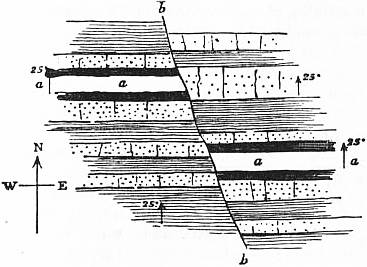
Fig. 13.—Plan of strata cut by a dip fault.
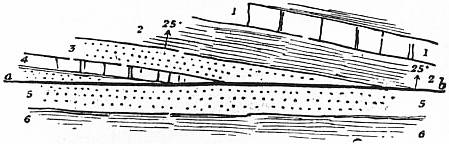
Fig. 14.—Plan of strata traversed by a diminishing strike fault.
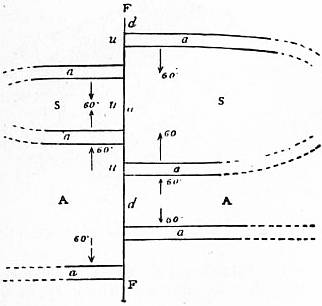
Fig. 15.—Plan of an anticline (A) and syncline (S), dislocated by a fault.
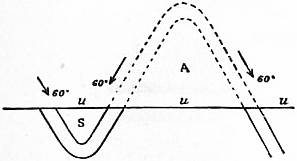
Fig. 16.—Section along the upcast side of the fault in fig. 15.
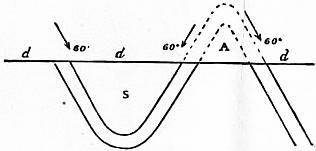
Fig. 17.—Section along the downcast side of same fault.
The effect of normal faults upon the outcrop may be thus briefly summarized:—a strike fault that hades with the direction of the dip may cause beds to be cut out at the surface on the upthrow side; if it hades against the dip direction it may repeat some of the beds on the upthrow side (figs. 11 and 12). With dip faults the crop is carried forward (down the dip) on the upthrow side. The perpendicular distance between the crop of the bed (dike or vein) on opposite sides of the fault is the “offset.” The offset decreases with increasing angle of dip and increases with increase in the throw of the fault (fig. 13). Faults which run obliquely across the direction of dip, if they hade with the dip of the strata, will produce offset with “gap” between the outcrops; if they hade in the opposite direction to the dip, offset with “overlap” is caused: in the latter case the crop moves forward (down dip) on the denuded upthrow side, in the former it moves backward. The effect of a strike fault of diminishing throw is seen in fig. 14. Faults crossing folded strata cause the outcrops to approach on the upthrow side of a syncline and tend to separate the outcrops of an anticline (figs. 15, 16, 17).
In the majority of cases the upthrown side of a fault has been so reduced by denudation as to leave no sharp upstanding ridge; but examples are known where the upthrown side still exists as a prominent cliff-like face of rock, a “fault-scarp”; familiar instances occur in the Basin ranges of Utah, Nevada, &c., and many smaller examples have been observed in the areas affected by recent earthquakes in Japan, San Francisco and other places. But although there may be no sharp cliff, the effect of faulting upon topographic forms is abundantly evident wherever a harder series of strata has been brought in juxtaposition to softer rocks. By certain French writers, the upstanding side of a faulted piece of ground is said to have a regard, thus the faults of the Jura Mountains have a “regard français,” and in the same region it has been observed that in curved faults the convexity is directed the same way as the regard. Occasionally one or more parallel faults have let down an intervening strip of rock, thereby forming “fault valleys” or Graben (Grabensenken); the Great Rift Valley is a striking example. On the other hand, a large area of rock is sometimes lifted up, or surrounded by a system of faults, which have let down the encircling ground; such a fault-block is known also as a horst; a considerable area of Greenland stands up in this manner.
Faults have often an important influence upon water-supply by bringing impervious beds up against pervious ones or vice versa, thus forming underground dams or reservoirs, or allowing water to flow away that would otherwise be conserved. Springs often rise along the outcrop of a fault. In coal and metal mining it is evident from what has already been said that faults must act sometimes beneficially, sometimes the reverse. It is a common occurrence for fault-fissures and fault-rock to appear as valuable mineral lodes through the infilling or impregnation of the spaces and broken ground with mineral ores.
In certain regions which have been subjected to very great crustal disturbance a type of fault is found which possesses a very low hade—sometimes only a few degrees from the horizontal—and, like a reversed fault, hades beneath the upthrown mass; these are termed thrusts, overthrusts, or overthrust faults (Fr. recouvrements, failles de chevauchement, charriages; Ger. Überschiebungen, Übersprünge, Wechsel, Fallenverwerfungen). Thrusts should not be confused with reversed faults, which have a strong hade. Thrusts play a very important part in the N.W. highlands of Scotland, the Scandinavian highlands, the western Alps, the Appalachians, the Belgian coal region, &c. By the action of thrusts enormous masses of rock have been pushed almost horizontally over underlying rocks, in some cases for several miles. One of the largest of the Scandinavian thrust masses is 1120 m. long, 80 m. broad, and 5000 ft. thick. In Scotland three grades of thrusts are recognized, maximum, major, and minor thrusts; the last have very generally been truncated by those of greater magnitude. Some of these great thrusts have received distinguishing names, e.g. the Moine thrust (fig. 19) and the Ben More thrust; similarly in the coal basin of Mons and Valenciennes we find the faille de Boussu and the Grande faille du midi. Overturned folds are frequently seen passing into thrusts. Bayley Willis has classified thrusts as (1) Shear thrusts, (2) Break thrusts, (3) Stretch thrusts, and (4) Erosion thrusts.
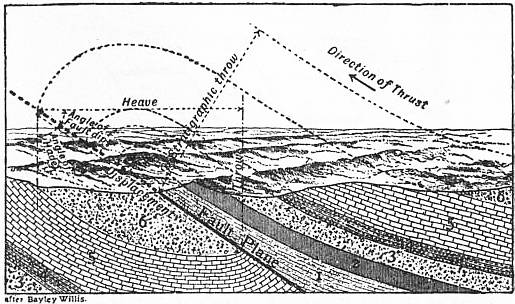
Fig. 18.—Diagram to illustrate the terminology of faults and thrusts.
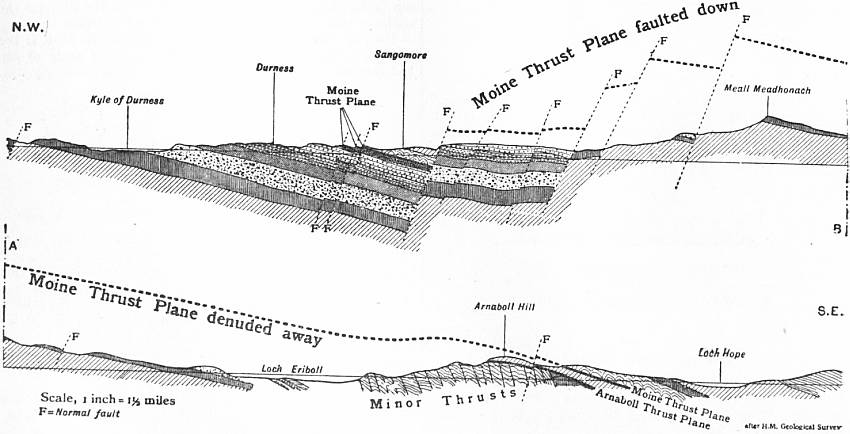
Fig. 19.—Section of a very large thrust in the Durness Eriboll district, Scotland.
Dr J.E. Marr (“Notes on the Geology of the English Lake District,” Proc. Geol. Assoc., 1900) has described a type of fault which may be regarded as the converse of a thrust fault. If we consider a series of rock masses A, B, C—of which A is the oldest and undermost—undergoing thrusting, say from south to north, should the mass C be prevented from moving forward as rapidly as B, a low-hading fault may form between C and B and the mass C may lag behind; similarly the mass B may lag behind A. Such faults Dr Marr calls “lag faults.” A mass of rock suffering thrusting or lagging may yield unequally in its several parts, and those portions tending to travel more rapidly than the adjoining masses in the same sheet may be cut off by fractures. Thus the faster-moving blocks will be separated from the slower ones by faults approximately normal to the plane of movement: these are described as “tear faults.”
Faults may occur in rocks of all ages; small local dislocations are observable even in glacial deposits, alluvium and loess. A region of faulting may continue to be so through more than one geological period. Little is known of the mechanism of faulting or of the causes that produce it; the majority of the text-book explanations will not bear scrutiny, and there is room for extended observation and research. The sudden yielding of the strata along a plane of faulting is a familiar cause of earthquakes.
See E. de Margerie and A. Heim, Les Dislocations de l’écorce terrestre (Zürich, 1888); A. Rothpletz, Geotektonische Probleme (Stuttgart, 1894); B. Willis, “The Mechanics of Appalachian Structure,” 13th Ann. Rep. U.S. Geol. Survey (1891-1892, pub. 1893). A prolonged discussion of the subject is given in Economic Geology, Lancaster, Pa., U.S.A., vols. i. and ii. (1906, 1907).
(A. Ge.; J. A. H.)
1 The fault-plane is not a plane surface in the mathematical sense; it may curve irregularly in more than one direction.
FAUNA, the name, in Roman mythology, of a country goddess of the fields and cattle, known sometimes as the sister, sometimes as the wife of the god Faunus; hence the term is used collectively for all the animals in any given geographical area or geological period, or for an enumeration of the same. It thus corresponds to the term “flora” in respect to plant life.
FAUNTLEROY, HENRY (1785-1824), English banker and forger, was born in 1785. After seven years as a clerk in the London bank of Marsh, Sibbald & Co., of which his father was one of the founders, he was taken into partnership, and the whole business of the firm was left in his hands. In 1824 the bank suspended payment. Fauntleroy was arrested on the charge of appropriating trust funds by forging the trustees’ signatures, and was committed for trial, it being freely rumoured that he had appropriated £250,000, which he had squandered in debauchery. He was tried at the Old Bailey, and, the case against him having been proved, he admitted his guilt, but pleaded that he had used the misappropriated funds to pay his firm’s debts. He was found guilty and sentenced to be hanged. Seventeen merchants and bankers gave evidence as to his general integrity at the trial, and after his conviction powerful influence was brought to bear on his behalf, and his case was twice argued before judges on points of law. An Italian named Angelini even offered to take Fauntleroy’s place on the scaffold. The efforts of his many friends were, however, unavailing, and he was executed on the 30th of November 1824. A wholly unfounded rumour was widely credited for some time subsequently to the effect that he had escaped strangulation by inserting a silver tube in his throat, and was living comfortably abroad.
See A. Griffith’s Chronicles of Newgate, ii. 294-300, and Pierce Egan’s Account of the Trial of Mr Fauntleroy.
FAUNUS (i.e. the “kindly,” from Lat. favere, or the “speaker,” from fari), an old Italian rural deity, the bestower of fruitfulness on fields and cattle. As such he is akin to or identical with Inuus (“fructifier”) and Lupercus (see Lupercalia). Faunus also revealed the secrets of the future by strange sounds from the woods, or by visions communicated to those who slept within his precincts in the skin of sacrificed lambs; he was then called Fatuus, and with him was associated his wife or daughter Fatua. Under Greek influence he was identified with Pan, and just as there was supposed to be a number of Panisci, so the existence of many Fauni was assumed—misshapen and mischievous goblins of the forest, with pointed ears, tails and goat’s feet, who loved to torment sleepers with hideous nightmares. In poetical tradition Faunus is an old king of Latium, the son of Picus (Mars) and father of Latinus, the teacher of agriculture and cattle-breeding, and the introducer of the religious system of the country, honoured after death as a tutelary divinity. Two festivals called Faunalia were celebrated in honour of Faunus, one on the 13th of February in his temple on the island in the Tiber, the other in the country on the 5th of December (Ovid, Fasti, ii. 193; Horace, Odes, iii. 18. 10). At these goats were sacrificed to him with libations of wine and milk, and he was implored to be propitious to fields and flocks. The peasants and slaves at the same time amused themselves with dancing in the meadows.
FAURE, FRANÇOIS FÉLIX (1841-1899), President of the French Republic, was born in Paris on the 30th of January 1841, being the son of a small furniture maker. Having started as a tanner and merchant at Havre, he acquired considerable wealth, was elected to the National Assembly on the 21st of August 1881, and took his seat as a member of the Left, interesting himself chiefly in matters concerning economics, railways and the navy. In November 1882 he became under-secretary for the colonies in M. Ferry’s ministry, and retained the post till 1885. He held the same post in M. Tirard’s ministry in 1888, and in 1893 was made vice-president of the chamber. In 1894 he obtained cabinet rank as minister of marine in the administration of M. Dupuy. In the January following he was unexpectedly elected president of the Republic upon the resignation of M. Casimir-Périer. The principal cause of his elevation was the determination of the various sections of the moderate republican party to exclude M. Brisson, who had had a majority of votes on the first ballot, but had failed to obtain an absolute majority. To accomplish this end it was necessary to unite among themselves, and union could only be secured by the nomination of some one who offended nobody. M. Faure answered perfectly to this description. His fine presence and his tact on ceremonial occasions rendered the state some service when in 1896 he received the Tsar of Russia at Paris, and in 1897 returned his visit, after which meeting the momentous Franco-Russian alliance was publicly announced. The latter days of M. Faure’s presidency were embittered by the Dreyfus affair, which he was determined to regard as chose jugée. But at a critical moment in the proceedings his death occurred suddenly, from apoplexy, on the 16th of February 1899. With all his faults, and in spite of no slight amount of personal vanity, President Faure was a shrewd political observer and a good man of business. After his death, some alleged extracts from his private journals, dealing with French policy, were published in the Paris press.
See E. Maillard, Le Président F. Faure (Paris, 1897); P. Bluysen, Félix Faure intime (1898); and F. Martin-Ginouvier, F. Faure devant l’histoire (1895).
FAURÉ, GABRIEL (1845- ), French musical composer, was born at Pamiers on the 13th of May 1845. He studied at the school of sacred music directed by Niedermeyer, first under Dietsch, and subsequently under Saint-Saëns. He became “maître de chapelle” at the church of the Madeleine in 1877, and organist in 1896. His works include a symphony in D minor (Op. 40), two quartets for piano and strings (Opp. 15 and 45), a suite for orchestra (Op. 12), sonata for violin and piano (Op. 13), concerto for violin (Op. 14), berceuse for violin, élégie for violoncello, pavane for orchestra, incidental music for Alexandre Dumas’ Caligula and De Haraucourt’s Shylock, a requiem, a cantata, The Birth of Venus, produced at the Leeds festival in 1898, a quantity of piano music, and a large number of songs. Fauré occupies a place by himself among modern French composers. He delights in the imprévu, and loves to wander through labyrinthine harmonies. There can be no denying the intense fascination and remarkable originality of his music. His muse is essentially aristocratic, and suggests the surroundings of the boudoir and the perfume of the hot-house.
FAURIEL, CLAUDE CHARLES (1772-1844), French historian, philologist and critic, was born at St Étienne on the 21st of October 1772. Though the son of a poor joiner, he received a good education in the Oratorian colleges of Tournon and Lyons. He was twice in the army—at Perpignan in 1793, and in 1796-1797 at Briançon, as private secretary to General J. Servan de Gerbey (1741-1808); but he preferred the civil service and the companionship of his friends and his books. In 1794 he returned to St Étienne, where, but only for a short period, he filled a municipal office; and from 1797 to 1799 he devoted himself to strenuous study, more especially of the literature and history, both ancient and modern, of Greece and Italy. Having paid a visit to Paris in 1799, he was introduced to Fouché, minister of police, who induced him to become his private secretary. Though he discharged the duties of this office to Fouché’s satisfaction, his strength was overtasked by his continued application to study, and he found it necessary in 1801 to recruit his health by a three months’ trip in the south. In resigning his office in the following year he was actuated as much by these considerations as by the scruples he put forward in serving longer under Napoleon, when the latter, in violation of strict republican principles, became consul for life. This is clearly shown by the fragments of Memoirs discovered by Ludovic Lalanne and published in 1886.
Some articles which Fauriel published in the Décade philosophique (1800) on a work of Madame de Staël’s—De la littérature considerée dans ses rapports avec les institutions sociales—led to an intimate friendship with her. About 1802 he contracted with Madame de Condorcet a liaison which lasted till her death (1822). It was said of him at the time that he gave up all his energies to love, friendship and learning. The salon of Mme de Condorcet was throughout the Consulate and the first Empire a rallying point for the dissentient republicans. Fauriel was introduced by Madame de Staël to the literary circle of Auteuil, which gathered round Destutt de Tracy. Those who enjoyed his closest intimacy were the physiologist Cabanis (Madame de Condorcet’s brother-in-law), the poet Manzoni, the publicist Benjamin Constant, and Guizot. Later Tracy introduced to him Aug. Thierry (1821) and perhaps Thiers and Mignet. During his connexion with Auteuil, Fauriel’s attention was naturally turned to philosophy, and for some years he was engaged on a history of Stoicism, which was never completed, all the papers connected with it having accidentally perished in 1814. He also studied Arabic, Sanskrit and the old South French dialects. He published in 1810 a translation of the Parthenaīs of the Danish poet Baggesen, with a preface on the various kinds of poetry; in 1823 translations of two tragedies of Manzoni, with a preface “Sur la théorie de l’art dramatique”; and in 1824-1825 his translation of the popular songs of modern Greece, with a “Discours préliminaire” on popular poetry.
The Revolution of July, which put his friends in power, opened to him the career of higher education. In 1830 he became professor of foreign literature at the Sorbonne. The Histoire de la Gaule méridionale sous la domination des conquerants germains (4 vols., 1836) was the only completed section of a general history of southern Gaul which he had projected. In 1836 he was elected a member of the Academy of Inscriptions, and in 1837 he published (with an introduction the conclusions of which would not now all be endorsed) a translation of a Provençal poem on the Albigensian war. He died on the 15th of July 1844. After his death his friend Mary Clarke (afterwards Madame J. Möhl) published his Histoire de la littérature provençale (3 vols., 1846)—his lectures for 1831-1832. Fauriel was biased in this work by his preconceived and somewhat fanciful theory that Provence was the cradle of the chansons de geste and even of the Round Table romances; but he gave a great stimulus to the scientific study of Old French and Provençal. Dante et les origines de la langue et de la littérature italiennes (2 vols.) was published in 1854.
Fauriel’s Mémoires, found with Condorcet’s papers, are in the Institute library. They were written at latest in 1804, and include some interesting fragments on the close of the consulate, Moreau, &c. Though anonymous, Lalanne, who published them (Les Derniers Jours du Consulat, 1886), proved them to be in the same handwriting as a letter of Fauriel’s in 1803. The same library has Fauriel’s correspondence, catalogued by Ad. Régnier (1900). Benjamin Constant’s letters (1802-1823) were published by Victor Glachant in 1906. For Fauriel’s correspondence with Guizot see Nouvelle Rev. (Dec. 1, 1901, by V. Glachant), and for his love-letters to Miss Clarke (1822-1844) the Revue des deux mondes (1908-1909) by E. Rod. See further Sainte-Beuve, Portraits contemporains, ii.; Antoine Guillois, Le Salon de Mme Helvétius (1894) and La Marquise de Condorcet (1897); O’Meara, Un Salon à Paris: Mme Möhl (undated); and J.B. Galley, Claude Fauriel (1909).
FAUST, or Faustus, the name of a magician and charlatan of the 16th century, famous in legend and in literature. The historical Faust forms little more than the nucleus round which a great mass of legendary and imaginative material gradually accumulated. That such a person existed there is, however, sufficient proof.1 He is first mentioned in a letter, dated August 20, 1507, of the learned Benedictine Johann Tritheim or Trithemius (1462-1516), abbot of Spanheim, to the mathematician and astrologer Johann Windung, at Hasfurt, who had apparently written about him. Trithemius, himself reputed a magician, and the author of a mystical work (published at Darmstadt in 1621 under the title of Steganographica and burnt by order of the Spanish Inquisition), speaks contemptuously of Faust, who called himself Magister Georgius Sabellicus Faustus Junior, as a fool rather than a philosopher (fatuum non philosophum), a vain babbler, vagabond and mountebank who ought to be whipped, and who had fled from the city rather than confront him. The insane conceit of the man was proved by his boast that, were all the works of Aristotle and Plato blotted from the memory of men, he could restore them with greater elegance, and that Christ’s miracles were nothing to marvel at, since he could do the like whenever and as often as he pleased; his debased character by the fact that he had been forced to flee from the school of which he had been appointed master by the discovery of his unnatural crimes. The same unflattering estimate is contained in the second extant notice of Faust, in a letter of the jurist and canon Konrad Mudt (Mutianus Rufus), of the 3rd of October 1513, to Heinrich Urbanus. Mudt, like Trithemius, simply regards Faust as a charlatan. Similar is the judgment of another contemporary, Philipp Begardi, who in the fourth chapter of his Index sanitatis (Worms, 1539) ranks Faust, with Theophrastus Paracelsus, among the “wicked, cheating, useless and unlearned doctors.”
It was Johann Gast (d. 1572), a worthy Protestant pastor of Basel, who like Mudt claims to have come into personal contact with Faust, who in his Sermones convivales (Basel, 1543) first credited the magician with genuine supernatural qualities. Gast, a man of some learning and much superstition, believed Faust to be in league with the devil, by whom about 1525 he was ultimately carried off, and declared the performing horse and dog by which the necromancer was accompanied to be familiar and evil spirits. Further information was given to the world by Johann Mannel or Manlius (d. 1560), councillor and historian to the emperor Maximilian II., in his Locorum communium collectanea (Basel, undated). Manlius reports a conversation of Melanchthon, which there is no reason to suspect of being other than genuine, in which the Reformer speaks of Faust as “a disgraceful beast and sewer of many devils,” as having been born at Kundling (Kundlingen or Knittlingen), a little town near his own native town (of Bretten), and as having studied magic at Cracow. The rest of the information given can hardly be regarded as historical, though Melanchthon, who, like Luther, was no whit less superstitious than most people of his time, evidently believed it to be so. According to him, among other marvels, Faust was killed by the devil wringing his neck. While he lived he had taken about with him a dog, which was really a devil. A similar opinion would seem to have been held of Faust by Luther also, who in Widmann’s Faust-book is mentioned as having declared that, by God’s help, he had been able to ward off the evils which Faust with his sorceries had sought to put upon him. The passage, with the omission of Faust’s name, occurs word for word in Luther’s Table-talk (ed. C.E. Förstemann, vol. i. p. 50). It is not improbable, then, that Widmann, in supplying the name of the necromancer omitted in the Table-talk, may be giving a fuller account of the conversation. Bullinger also, in his Theatrum de beneficiis (Frankf., 1569) mentions Faust as one of those “of whom the Scriptures speak, in various places, calling them magi.” Lastly Johann Weiher, Wierus or Piscinarius (1515-1588)—a pupil of Cornelius Agrippa, body physician to the duke of Cleves and a man of enlightenment, who opposed the persecution of witches—in his De praestigiis daemonum (Basel, 1563, &c.), speaks of Faust as a drunken vagabond who had studied magic at Cracow, and before 1540 had practised “this beautiful art shamelessly up and down Germany, with unspeakable deceit, many lies and great effect.” He goes on to tell how the magician had revenged himself on an unhappy parish priest, who had refused to supply him any longer with drink, by giving him a depilatory which removed not only the beard but the skin, and further, how he had insulted a poor wretch, for no better reason than that he had a black beard, by greeting him as his cousin the devil. Of his superhuman powers Weiher evidently believes nothing, but he tells the tale of his being found dead with his neck wrung, after the whole house had been shaken by a terrific din.
The sources above mentioned, which were but the first of numerous works on Faust, of more or less value, appearing throughout the next two centuries, give a sufficient picture of the man as he appeared to his contemporaries: a wandering charlatan who lived by his wits, cheiromantist, astrologer, diviner, spiritualist medium, alchemist, or, to the more credulous, a necromancer whose supernatural gifts were the outcome of a foul pact with the enemy of mankind. Whatever his character, his efforts to secure a widespread notoriety had, by the time of his death, certainly succeeded. By the latter part of the 16th century he had become the necromancer par excellence, and all that legend had to tell about the great wizards of the middle ages, Virgil, Pope Silvester, Roger Bacon, Michael Scot, or the mythic Klingsor, had become for ever associated with his name. When in 1587, the oldest Faust-book was published, the Faust legend was, in all essential particulars, already complete.
The origin of the main elements of the legend must be sought far back in the middle ages and beyond. The idea of a compact with the devil, for the purpose of obtaining superhuman power or knowledge, is of Jewish origin, dating from the centuries immediately before and after the Christian era which produced the Talmud, the Kabbalah and such magical books as that of Enoch. In the mystical rites—in which blood, as the seat of life, played a great part—that accompanied the incantations with which the Jewish magicians evoked the Satanim—the lowest grade of those elemental spirits (shedim) who have their existence beyond the dimensions of time and space—we have the prototypes and originals of all the ceremonies which occupy the books of magic down to the various versions of the Höllenzwang ascribed to Faust. The other principle underlying the Faust legend, the belief in the essentially evil character of purely human learning, has existed ever since the triumph of Christianity set divine revelation above human science. The legend of Theophilus—a Cilician archdeacon of the 6th century, who sold his soul to Satan for no better reason than to clear himself of a false charge brought against him by his bishop—was immensely popular throughout the middle ages, and in the 8th century formed the theme of a poem in Latin hexameters by the nun Hroswitha of Gandersheim, who, especially in her description of the ritual of Satan’s court, displays a sufficiently lively and original imagination. Equally widespread were the legends which gathered round the great name of Gerbert (Pope Silvester II.). Gerbert’s vast erudition, like Roger Bacon’s so far in advance of his age, naturally cast upon him the suspicion of traffic with the infernal powers; and in due course the suspicion developed into the tale, embellished with circumstantial and harrowing details, of a compact with the arch-fiend, by which the scholar had obtained the summit of earthly ambition at the cost of his immortal soul. These are but the two most notable of many similar stories,2 and, in an age when the belief in witchcraft and the ubiquitous activity of devils was still universal, it is natural that they should have been retold in all good faith of a notorious wizard who was himself at no pains to deny their essential truth. The Faust legend, however, owes something of its peculiar significance also to the special conditions of the age which gave it birth: the age of the Renaissance and the Reformation. The opinion that the religious reformers were the champions of liberty of thought against the obscurantism of Rome is the outgrowth of later experience. To themselves they were the protagonists of “the pure Word of God” against the corruptions of a church defiled by the world and the devil, and the sceptical spirit of Italian humanism was as abhorrent to them as to the Catholic reactionaries by whom it was again trampled under foot. If then, in Goethe’s drama, Faust ultimately develops into the type of the unsatisfied yearning of the human intellect for “more than earthly meat and drink,” this was because the great German humanist deliberately infused into the old story a spirit absolutely opposed to that by which it had originally been inspired. The Faust of the early Faust-books, of the ballads, the dramas and the puppet-plays innumerable which grew out of them, is irrevocably damned because he deliberately prefers human to “divine” knowledge; “he laid the Holy Scriptures behind the door and under the bench, refused to be called doctor of Theology, but preferred to be styled doctor of Medicine.” The orthodox moral of the earliest versions is preserved to the last in the puppet-plays. The Voice to the right cries: “Faust! Faust! desist from this proposal! Go on with the study of Theology, and you will be the happiest of mortals.” The Voice to the left answers: “Faust! Faust! leave the study of Theology. Betake you to Necromancy, and you will be the happiest of mortals!” The Faust legend was, in fact, the creation of orthodox Protestantism; its moral, the inevitable doom which follows the wilful revolt of the intellect against divine authority as represented by the Holy Scriptures and its accredited interpreters. Faust, the contemner of Holy Writ, is set up as a foil to Luther, the champion of the new orthodoxy, who with well-directed inkpot worsted the devil when he sought to interrupt the sacred work of rendering the Bible into the vulgar tongue.
It was doubtless this orthodox and Protestant character of the Faust story which contributed to its immense and immediate popularity in the Protestant countries. The first edition of the Historia von D. Johann Fausten, by an unknown compiler, published by Johann Spies at Frankfort in 1587, sold out at once. Though only placed on the market in the autumn, before the year was out it had been reprinted in four pirated editions. In the following year a rhymed version was printed at Tübingen, a second edition was published by Spies at Frankfort and a version in low German by J.J. Balhorn at Lübeck. Reprints and amended versions continued to appear in Germany every year, till they culminated in the pedantic compilation of Georg Rudolf Widmann, who obscured the dramatic interest of the story by an excessive display of erudition and by his well-meant efforts to elaborate the orthodox moral. Widmann’s version of 1599 formed the basis of that of Johann Nicholaus Pfitzer, published at Nuremberg in 1674, which passed through six editions, the last appearing in 1726. Like Widmann, Pfitzer was more zealous for imparting information than for perfecting a work of art, though he had the good taste to restore the episode of the evocation of Helen, which Widmann had expunged as unfit for Christian readers. Lastly there appeared, about 1712, what was to prove the most popular of all the Faust-books: The League with the Devil established by the world-famous Arch-necromancer and Wizard Dr Johann Faust. By a Christian Believer (Christlich Meynenden). This version, which bore the obviously false date of 1525, passed through many editions, and was circulated at all the fairs in Germany. Abroad the success of the story was scarcely less striking. A Danish version appeared in 1588; in England the History of the Damnable Life and Deserved Death of Dr John Faustus was published some time between 1588 and 1594; in France the translation of Victor Palma Cayet was published at Paris in 1592 and, in the course of the next two hundred years, went through fifteen editions; the oldest Dutch and Flemish versions are dated 1592; and in 1612 a Czech translation was published at Prague.
Besides the popular histories of Faust, all more or less founded on the original edition of Spies, numerous ballads on the same subject were also soon in circulation. Of these the most interesting for the English reader is A Ballad of the life and death of Dr Faustus the great congerer, published in 1588 with the imprimatur of the learned Aylmer, bishop of London. This ballad is supposed to have preceded the English version of Spies’s Faust-book, mentioned above, on which Marlowe’s drama was founded.
To Christopher Marlowe, it would appear, belongs the honour of first realizing the great dramatic possibilities of the Faust legend. The Tragicall History of D. Faustus as it hath bene acted by the Right Honourable the Earle of Nottingham his servants was first published by Thomas Bushall at London in 1604. As Marlowe died in 1593, the play must have been written shortly after the appearance of the English version of the Faust story on which it was based. The first recorded performance was on the 30th of September 1594.
As Marlowe’s Faustus is the first, so it is imcomparably the finest of the Faust dramas which preceded Goethe’s masterpiece. Like most of Marlowe’s work it is, indeed, very unequal. At certain moments the poet seems to realize the great possibilities of the story, only to sacrifice them to the necessity for humouring the prevailing public taste of the age. Faustus, who in one scene turns disillusioned from the ordinary fountains of knowledge, or flies in a dragon-drawn chariot through the Empyrean to search out the mysteries of the heavens, in another is made to use his superhuman powers to satisfy the taste of the groundlings for senseless buffoonery, to swindle a horse-dealer, or cheat an ale-wife of her score; while Protestant orthodoxy is conciliated by irrelevant insults to the Roman Church and by the final catastrophe, when Faustus pays for his revolt against the Word of God by the forfeit of his soul. This conception, which followed that of the popular Faust histories, underlay all further developments of the Faust drama for nearly two hundred years. Of the serious stage plays founded on this theme, Marlowe’s Faustus remains the sole authentic example until near the end of the 18th century; but there is plenty of evidence to prove that in Germany the Comedy of Dr Faust, in one form or another, was and continued to be a popular item in the repertories of theatrical companies until far into the 18th century. It is supposed, with good reason, that the German versions were based on those introduced into the country by English strolling players early in the 17th century. However this may be, the dramatic versions of the Faust legend followed much the same course as the prose histories. Just as these gradually degenerated into chap-books hawked at fairs, so the dramas were replaced by puppet-plays, handed down by tradition through generations of showmen, retaining their original broad characteristics, but subject to infinite modification in detail. In this way, in the puppet-shows, the traditional Faust story retained its popularity until far into the 19th century, long after, in the sphere of literature, Goethe had for ever raised it to quite another plane.
It was natural that during the literary revival in Germany in the 18th century, when German writers were eagerly on the look-out for subjects to form the material of a truly national literature, the Faust legend should have attracted their attention. Lessing was the first to point out its great possibilities;3 and he himself wrote a Faust drama, of which unfortunately only a fragment remains, the MS. of the completed work having been lost in the author’s lifetime. None the less, to Lessing, not to Goethe, is due the new point of view from which the story was approached by most of those who, after about the year 1770, attempted to tell it. The traditional Faust legend represented the sternly orthodox attitude of the Protestant reformers. Even the mitigating elements which the middle ages had permitted had been banished by the stern logic of the theologians of the New Religion. Theophilus had been saved in the end by the intervention of the Blessed Virgin; Pope Silvester, according to one version of the legend, had likewise been snatched from the jaws of hell at the last moment. Faust was irrevocably damned, since the attractions of the studium theologicum proved insufficient to counteract the fascinations of the classic Helen. But if he was to become, in the 18th century, the type of the human intellect face to face with the deep problems of human life, it was intolerable that his struggles should issue in eternal reprobation. Error and heresy had ceased to be regarded as crimes; and stereotyped orthodoxy, to the age of the Encyclopaedists, represented nothing more than the atrophy of the human intellect. Es irrt der Mensch so lang er strebt, which sums up in one pregnant line the spirit of Goethe’s Faust, sums up also the spirit of the age which killed with ridicule the last efforts of persecuting piety, and saw the birth of modern science. Lessing, in short, proclaimed that the final end of Faust must be, not his damnation, but his salvation. This revolutionary conception is the measure of Goethe’s debt to Lessing. The essential change which Goethe himself introduced into the story is in the nature of the pact between Faust and Mephistopheles, and in the character of Mephistopheles himself. The Mephistopheles of Marlowe, as of the old Faust-books, for all his brave buffoonery, is a melancholy devil, with a soul above the unsavoury hell in which he is forced to pass a hopeless existence. “Tell me,” says Faust, in the puppet-play, to Mephistopheles, “what would you do if you could attain to everlasting salvation?” And the devil answers, “Hear and despair! Were I able to attain everlasting salvation, I would mount to heaven on a ladder, though every rung were a razor edge!” Goethe’s Mephistopheles would have made no such reply. There is nothing of the fallen angel about him; he is perfectly content with his past, his present and his future; and he appears before the throne of God with the same easy insolence as he exhibits in Dame Martha’s back-garden. He is, in fact, according to his own definition, the Spirit of Denial, the impersonation of that utter scepticism which can see no distinction between high and low, between good and bad, and is therefore without aspiration because it knows no “divine discontent.” And the compact which Faust makes with this spirit is from the first doomed to be void. Faustus had bartered away his soul for a definite period of pleasure and power. The conception that underlies the compact of Faust with Mephistopheles is far more subtle. He had sought happiness vainly in the higher intellectual and spiritual pursuits; he is content to seek it on a lower plane since Mephistopheles gives him the chance; but he is confident that nothing that “such a poor devil” can offer him could give him that moment of supreme satisfaction for which he craves. He goes through the traditional mummery of signing the bond with scornful submission; for he knows that his damnation will not be the outcome of any formal compact, but will follow inevitably, and only then, when his soul has grown to be satisfied with what Mephistopheles can purvey him.
“Canst thou with lying flattery rule me Until self-pleased myself I see, Canst thou with pleasure mock and fool me, Let that hour be the last for me! When thus I hail the moment flying: ‘Ah, still delay, thou art so fair!’ Then bind me in thy chains undying, My final ruin then declare!”4
It is because Mephistopheles fails to give him this self-satisfaction or to absorb his being in the pleasures he provides, that the compact comes to nothing. When, at last, Faust cries to the passing moment to remain, it is because he has forgotten self in enthusiasm for a great and beneficent work, in a state of mind the very antithesis of all that Mephistopheles represents. In the old Faust-books, Faust had been given plenty of opportunity for repentance, but the inducements had been no higher than the exhibition of a throne in heaven on the one hand and the tortures of hell on the other. Goethe’s Faust, for all its Christian setting, departs widely from this orthodox standpoint. Faust shows no signs of “repentance”; he simply emerges by the innate force of his character from a lower into a higher state. The triumph, foretold by “the Lord” in the opening scene, was inevitable from the first, since, though
“‘Man errs so long as he is striving, A good man through obscurest aspiration Is ever conscious of the one true way.’”
A man, in short, must be judged not by the sins and follies which may be but accidents of his career, but by the character which is its essential outcome.
This idea, which inspired also the kindred theme of Browning’s Paracelsus, is the main development introduced by Goethe into the Faust legend. The episode of Gretchen, for all its tragic interest, does not belong to the legend at all; and it is difficult to deny the pertinency of Charles Lamb’s criticism, “What has Margaret to do with Faust?” Yet in spite of all that may be said of the irrelevancies, and of the discussions of themes of merely ephemeral interest, with which Goethe overloaded especially the second part of the poem, his Faust remains for the modern world the final form of the legend out of which it grew, the magnificent expression of the broad humanism which, even in spheres accounted orthodox, has tended to replace the peculiar studium theologicum which inspired the early Faust-books.
See Karl Engel, Zusammenstellung der Faust-Schriften vom 16. Jahrhundert bis Mitte 1884—a second edition of the Bibliotheca Faustiana (1874)—(Oldenburg, 1885), a complete bibliography of all published matter concerned, even somewhat remotely, with Faust; Goethe’s Faust, with introduction and notes by K.J. Schröer (2nd ed., Heilbronn, 1886); Carl Kiesewetter, Faust in der Geschichte und Tradition (Leipzig, 1893). The last book, besides being a critical study of the material for the historical and legendary story of Faust, aims at estimating the relation of the Faust-legend to the whole subject of occultism, ancient and modern. It is a mine of information on necromancy and its kindred subjects, as well as on eminent theurgists, wizards, crystal-gazers and the like of all ages.
(W. A. P.)
1 The opinion, long maintained by some, that he was identical with Johann Fust, the printer, is now universally rejected.
2 Many are given in Kiesewetter’s Faust, p. 112, &c.
3 In the Literaturbrief of Feb. 16, 1759.
4 Bayard Taylor’s trans.
FAUSTINA, ANNIA GALERIA, the younger, daughter of Antoninus Pius, and wife of Marcus Aurelius Antoninus. She is accused by Dio Cassius and Capitolinus of gross profligacy, and was reputed to have instigated the revolt of Avidius Cassius against her husband. She died in 175 or 176 (so Clinton, Fasti rom.) at Halala, near Mount Taurus, in Cappadocia, whither she had accompanied Aurelius. Charitable schools for orphan girls (hence called Faustinianae) were founded in her honour, like those established by her father Antoninus in honour of his wife, the elder Faustina. Her statue was placed in the temple of Venus, and she was numbered among the tutelary deities of Rome. From the fact that Aurelius was always devoted to her and was heartbroken at her death, it has been inferred that the unfavourable estimate of the historians is prejudiced or at least mistaken.
See Capitolinus, Marcus Aurelius; Dio Cassius lxxi. 22, lxxiv. 3; E. Renan, in Mélanges d’histoire et des voyages, 169-195.
FAVARA, a town of Sicily, in the province of Girgenti, 5 m. E. of Girgenti by road. Pop. (1901) 20,398. It possesses a fine castle of the Chiaramonte family, erected in 1280. The town has a considerable agricultural trade, and there are sulphur and other mines in the neighbourhood.
FAVART, CHARLES SIMON (1710-1792), French dramatist, was born in Paris on the 13th of November 1710, the son of a pastry-cook. He was educated at the college of Louis-le-Grand, and after his father’s death carried on the business for a time. His first success in literature was La France délivrée par la Pucelle d’Orléans, a poem which obtained a prize of the Académie des Jeux Flor ux. After the production of his first vaudeville, Les Deux Jumelles (1734), circumstances enabled him to relinquish business and devote himself entirely to the drama. He provided many pieces anonymously for the lesser theatres, and first put his name to La Chercheuse d’esprit, which was produced in 1741. Among his most successful works were Annette et Lubin, Le Coq du village (1743), Ninette à la cour (1753), Les Trois Sultanes (1761) and L’Anglais à Bordeaux (1763). Favart became director of the Opéra Comique, and in 1745 married Marie Justine Benoîte Duronceray (1727-1772), a beautiful young dancer, singer and actress, who as “Mlle Chantilly” had made a successful début the year before. By their united talents and labours the Opéra Comique rose to such a height of success that it aroused the jealousy of the rival Comédie Italienne and was suppressed. Favart, left thus without resources, accepted the proposal of Maurice de Saxe, and undertook the direction of a troupe of comedians which was to accompany his army into Flanders. It was part of his duty to compose from time to time impromptu verses on the events of the campaign, amusing and stimulating the spirits of the men. So popular were Favart and his troupe that the enemy became desirous of hearing his company and sharing his services, and permission was given to gratify them, battles and comedies thus curiously alternating with each other. But the marshal, who was an admirer of Mme Favart, began to persecute her with his attentions. To escape him she went to Paris, and the wrath of Saxe fell upon the husband. A lettre de cachet was issued against him, but he fled to Strassburg and found concealment in a cellar. Mme Favart meanwhile had been established by the marshal in a house at Vaugirard; but as she proved a fickle mistress she was suddenly arrested and confined in a convent, where she was brought to unconditional surrender in the beginning of 1750. Before the year was out the marshal died, and Mme Favart reappeared at the Comédie Italienne, where for twenty years she was the favourite actress. To her is largely due the beginnings of the change in this theatre to performances of a lyric type adapted from Italian models, which developed later into the genuine French comic opera. She was also a bold reformer in matters of stage costume, playing the peasant with bare arms, in wooden shoes and linen dress, and not, as heretofore, in court costume with enormous hoops, diamonds and long white kid gloves. With her husband, and other authors, she collaborated in a number of successful pieces, and one—La Fille mal gardée—she produced alone.
Favart survived his wife twenty years. After the marshal’s death in 1750 he had returned to Paris, and resumed his pursuits as a dramatist. It was at this time that the abbé de Voisenon became intimate with him and took part in his labours, to what extent is uncertain. He had grown nearly blind in his last days, and died in Paris on the 12th of May 1792. His plays have been several times republished in various editions and selections (1763-1772, 12 vols.; 1810, 3 vols.; 1813; 1853). His correspondence (1759-1763) with Count Durazzo, director of theatres at Vienna, was published in 1808 as Mémoires et correspondance littéraire, dramatique et anecdotique de C.S. Favart. It furnishes valuable information on the state of the literary and theatrical worlds in the 18th century.
Favart’s second son, Charles Nicolas Joseph Justin Favart (1749-1806), was an actor of moderate talent at the Comédie Française for fifteen years. He wrote a number of successful plays:—Le Diable boiteux (1782), Le Mariage singulier (1787) and, with his father, La Vieillesse d’Annette (1791). His son Antoine Pierre Charles Favart (1780-1867) was in the diplomatic service, and assisted in editing his grandfather’s memoirs; he was a playwright and painter as well.
FAVERSHAM, a market town and river-port, member of the Cinque Port of Dover, and municipal borough in the Faversham parliamentary division of Kent, England, on a creek of the Swale, 9 m. W.N.W. of Canterbury on the South-Eastern & Chatham railway. Pop. (1901) 11,290. The church of St Mary of Charity, restored by Sir G.G. Scott in 1874, is of Early English architecture, and has some remains on one of the columns of frescoes of the same period, while the 14th-century paintings in the chancel are in better preservation. Some of the brasses are very fine, and there is one commemorating King Stephen, as well as a tomb said to be his. He was buried at the abbey he founded here, of which only a wall and the foundations below ground remain. At Davington, close to Faversham, there are remains, incorporated in a residence, of the cloisters and other parts of a Benedictine priory founded in 1153. Faversham has a free grammar school founded in 1527 and removed to its present site in 1877. Faversham Creek is navigable up to the town for vessels of 200 tons. The shipping trade is considerable, chiefly in coal, timber and agricultural produce. The oyster fisheries are important, and are managed by a very ancient gild, the Company of Free Dredgermen of the Hundred and Manor of Faversham. Brewing, brickmaking and the manufacture of cement are also carried on, and there are several large powder mills in the vicinity. The town is governed by a mayor, 4 aldermen and 12 councillors. Area, 686 acres.
There was a Romano-British village on the site of Faversham. The town (Fauresfeld, Faveresham) owed its early importance to its situation as a port on the Swale, to the fertile country surrounding it, and to the neighbourhood of Watling Street. In 811 it was called the king’s town, and a witenagemot was held here under Æthelstan. In 1086 it was assessed as royal demesne, and a market was held here at this date. An abbey was built by Stephen in 1147, in which he and Matilda were buried. They had endowed it with the manor and hundred of Faversham; this grant caused many disputes between the abbot and men of Faversham concerning the abbot’s jurisdiction. Faversham was probably a member of Dover from the earliest association of the Cinque Ports, certainly as early as Henry III., who in 1252 granted among other liberties of the Cinque Ports that the barons of Faversham should plead only in Shepway Court, but ten years later transferred certain pleas to the abbot’s court. In this reign also the abbot appointed the mayor, but from the reign of Edward I. he was elected by the freemen and then installed by the abbot. The corporation was prescriptive, and a hallmote held in 1293 was attended by a mayor and twelve jurats. All the liberties of the Cinque Ports were granted to the barons of Faversham by Edward I. in 1302, and confirmed by Edward III. in 1365, and by later monarchs. The governing charter till 1835 was that of Henry VIII., granted in 1545 and confirmed by Edward VI.
FAVORINUS (2nd century A.D.), Greek sophist and philosopher, flourished during the reign of Hadrian. A Gaul by birth, he was a native of Arelate (Arles), but at an early age began his lifelong travels through Greece, Italy and the East. His extensive knowledge, combined with great oratorical powers, raised him to eminence both in Athens and in Rome. With Plutarch, who dedicated to him his treatise Περὶ τοῦ πρώτου ψυχροῦ, with Herodes Atticus, to whom he bequeathed his library at Rome, with Demetrius the Cynic, Cornelius Fronto, Aulus Gellius, and with Hadrian himself, he lived on intimate terms; his great rival, whom he violently attacked in his later years, was Polemon of Smyrna. It was Favorinus who, on being silenced by Hadrian in an argument in which the sophist might easily have refuted his adversary, subsequently explained that it was foolish to criticize the logic of the master of thirty legions. When the servile Athenians, feigning to share the emperor’s displeasure with the sophist, pulled down a statue which they had erected to him, Favorinus remarked that if only Socrates also had had a statue at Athens, he might have been spared the hemlock. Of the very numerous works of Favorinus, we possess only a few fragments (unless the Κορινθιακὸς λόγος attributed to his tutor Dio Chrysostom is by him), preserved by Aulus Gellius, Diogenes Laërtius, Philostratus, and Suïdas, the second of whom borrows from his Παντοδαπὴ ἱστορία (miscellaneous history) and his Ἀπομνημονεύματα (memoirs). As a philosopher, Favorinus belonged to the sceptical school; his most important work in this connexion appears to have been Πυρρώνειοι τρόποι (the Pyrrhonean Tropes) in ten books, in which he endeavours to show that the methods of Pyrrho were useful to those who intended to practise in the law courts.
See Philostratus, Vitae sophistarum, i. 8; Suïdas, s.v.; frags. in C.W. Müller, Frag. Hist. Graec. iii. 4; monographs by L. Legré (1900), T. Colardeau (1903).
FAVRAS, THOMAS DE MAHY, Marquis de (1744-1790), French royalist, was born on the 26th of March 1744, at Blois. He belonged to a poor family whose nobility dated from the 12th century. At seventeen he was a captain of dragoons, and saw some service in the closing campaign of the Seven Years’ War. In 1772 he became first lieutenant of the Swiss guards of the count of Provence (afterwards Louis XVIII.). Unable to meet the expenses of his rank, which was equivalent to the grade of colonel in the army, he retired in 1775. He married in 1776 Victoria Hedwig Caroline, princess of Anhalt-Bernburg-Schaumburg, whose mother, deserted by her husband Prince Carl Ludwig in 1749, had found refuge with her daughter in the house of Marshal Soubise. After his marriage he went to Vienna to press the restitution of his wife’s rights, and spent some time in Warsaw. In 1787 he was authorized to raise a patriotic legion to help the Dutch against the stadtholder William IV. and his Prussian allies. Returning to Paris at the outbreak of the Revolution, he became implicated in schemes for the escape of Louis XVI. from Paris and the dominance of the National Assembly. He was commissioned by the count of Provence through one of his gentlemen, the comte de la Châtre, to negotiate a loan of two million francs from the bankers Schaumel and Sartorius. Favras took into his confidence certain officers by whom he was betrayed; and, with his wife, he was arrested on Christmas Eve 1789 and imprisoned in the Abbaye. A fortnight later they were separated, Favras being removed to the Châtelet. It was stated in a leaflet circulated throughout Paris that Favras had organized a plot of which the count of Provence was the moving spirit. A force of 30,000 was to be raised, La Fayette and Bailly, the mayor of Paris, were to be assassinated, and Paris was to be starved into submission by cutting off supplies. The count hastened publicly to disavow Favras in a speech delivered before the commune of Paris and in a letter to the National Assembly, although there is no reasonable doubt of his complicity in the plot that did exist. In the course of a trial of nearly two months’ duration the witnesses disagreed, and even the editor of the Révolutions de Paris (No. 30) admitted that the evidence was insufficient but an armed attempt of the Royalists on the Châtelet on the 26th of January, which was defeated by La Fayette, roused the suspicious temper of the Parisians to fury, and on the 18th of February 1790, in spite of the courageous defence of his counsel, Favras was condemned to be hanged. He refused to give any information of the alleged plot, and the sentence was carried out on the Place de Grève the next day, to the delight of the populace, since it was the first instance when no distinction in the mode of execution was allowed between noble and commoner. Favras was generally regarded as a martyr to his refusal to implicate the count of Provence, and Madame de Favras was pensioned by Louis XVI. She left France, and her son Charles de Favras served in the Austrian and the Russian armies. He received an allowance from Louis XVIII. Her daughter Caroline married Rüdiger, Freiherr von Stillfried Ratènic, in 1805.
The official dossier of Favras’s trial for high treason against the nation disappeared from the Châtelet, but its substance is preserved in the papers of a clerk.
Bibliography.—For particulars see A. Tuetey, Répertoire général des sources manuscrites de l’histoire de Paris pendant la Révolution Française (vol. i., 1890, pp. 175-177); M. Tourneux, Bibl. de l’histoire de Paris pendant la Révolution Française (vol. i. pp. 196-198, 1890). His brother, M. Mahy de Cormère, published a Mémoire justificatif in 1790 and a Justification in 1791. See also a memoir by Eduard, Freiherr v. Stillfried Ratènic (Vienna, 1881), and an article by Alexis de Valon in the Revue des deux mondes (15th June 1851).
FAVRE, JEAN ALPHONSE (1815-1890), Swiss geologist, was born at Geneva on the 31st of March 1815. He was for many years professor of geology in the academy at Geneva, and afterwards president of the Federal Commission with charge of the geological map of Switzerland. One of his earliest papers was On the Anthracites of the Alps (1841), and later he gave special attention to the geology of Savoy and of Mont Blanc, and to the ancient glacial phenomena of those Alpine regions. His elucidation of the geological structure demonstrated that certain anomalous occurrences of fossils were due to repeated interfoldings of the strata and to complicated overthrust faults. In 1867 he published Recherches géologiques dans les parties de la Savoie, du Piémont et de la Suisse voisines du Mont Blanc. He died at Geneva in June 1890.
His son Ernest Favre (b. 1845) has written on the palaeontology and geology of Galicia, Savoy and the Fribourg Alps, and of the Caucasus and Crimea.
FAVRE, JULES CLAUDE GABRIEL (1809-1880), French statesman, was born at Lyons on the 21st of March 1809, and began his career as an advocate. From the time of the revolution of 1830 he openly declared himself a republican, and in political trials he seized the opportunity to express his opinions. After the revolution of 1848 he was elected deputy for Lyons to the Constituent Assembly, where he sat among the moderate republicans, voting against the socialists. When Louis Napoleon was elected President of France, Favre made himself conspicuous by his opposition, and on the 2nd of December 1851 he tried with Victor Hugo and others to organize an armed resistance in the streets of Paris. After the coup d’état he withdrew from politics, resumed his profession, and distinguished himself by his defence of Felice Orsini, the perpetrator of the attack against the life of Napoleon III. In 1858 he was elected deputy for Paris, and was one of the “Five” who gave the signal for the republican opposition to the Empire. In 1863 he became the head of his party, and delivered a number of addresses denouncing the Mexican expedition and the occupation of Rome. These addresses, eloquent, clear and incisive, won him a seat in the French Academy in 1867. With Thiers he opposed the declaration of war against Prussia in 1870, and at the news of the defeat of Napoleon III. at Sedan he demanded from the Legislative Assembly the deposition of the emperor. In the government of National Defence he became vice-president under General Trochu, and minister of foreign affairs, with the onerous task of negotiating peace with victorious Germany. He proved to be less adroit as a diplomat than he had been as an orator, and committed several irreparable blunders. His famous statement on the 6th of September 1870 that he “would not yield to Germany an inch of territory nor a single stone of the fortresses” was a piece of oratory which Bismarck met on the 19th by his declaration to Favre that the cession of Alsace and of Lorraine was the indispensable condition of peace. He also made the mistake of not having an assembly elected which would have more regular powers than the government of National Defence, and of opposing the removal of the government from Paris during the siege. In the peace negotiations he allowed Bismarck to get the better of him, and arranged for the armistice of the 28th of June 1871 without knowing the situation of the armies, and without consulting the government at Bordeaux. By a grave oversight he neglected to inform Gambetta that the army of the East (80,000 men) was not included in the armistice, and it was thus obliged to retreat to neutral territory. He gave no proof whatever of diplomatic skill in the negotiations for the treaty of Frankfort, and it was Bismarck who imposed all the conditions. He withdrew from the ministry, discredited, on the 2nd of August 1871, but remained in the chamber of deputies. Elected senator on the 30th of January 1876, he continued to support the government of the republic against the reactionary opposition, until his death on the 20th of January 1880.
His work include many speeches and addresses, notably La Liberté de la Presse (1849), Défense de F. Orsini (1866), Discours de réception à l’Académie française (1868), Discours sur la liberté intérieure (1869). In Le Gouvernement de la Défense Nationale, 3 vols., 1871-1875, he explained his rôle in 1870-1871. After his death his family published his speeches in 8 volumes.
See G. Hanotaux, Histoire de la France contemporaine (1903, &c.); also E. Benoît-Lévy, Jules Favre (1884).
FAVUS (Lat. for honeycomb), a disease of the scalp, but occurring occasionally on any part of the skin, and even at times on mucous membranes. The uncomplicated appearance is that of a number of yellowish, circular, cup-shaped crusts (scutula) grouped in patches like a piece of honeycomb, each about the size of a split pea, with a hair projecting in the centre. These increase in size and become crusted over, so that the characteristic lesion can only be seen round the edge of the scab. Growth continues to take place for several months, when scab and scutulum come away, leaving a shining bare patch destitute of hair. The disease is essentially chronic, lasting from ten to twenty years. It is caused by the growth of a fungus, and pathologically is the reaction of the tissues to the growth. It was the first disease in which a fungus was discovered—by J.L. Schönlein in 1839; the discovery was published in a brief note of twenty lines in Müllers Archiv for that year (p. 82), the fungus having been subsequently named by R. Remak Achorion Schönleinii after its discoverer. The achorion consists of slender, mycelial threads matted together, bearing oval, nucleated gonidia either free or jointed. The spores would appear to enter through the unbroken cutaneous surface, and to germinate mostly in and around the hair-follicle and sometimes in the shaft of the hair. In 1892 two other species of the fungus were described by P.G. Unna and Frank, the Favus griseus, giving rise to greyish-yellow scutula, and the Favus sulphureus celerior, causing sulphur-yellow scutula of a rapid growth. Favus is commonest among the poorer Jews of Russia, Poland, Hungary, Galicia and the East, and among the same class of Mahommedans in Turkey, Asia Minor, Syria, Persia, Egypt, Algiers, &c. It is not rare in the southern departments of France, in some parts of Italy, and in Scotland. It is spread by contagion, usually from cats, often, however, from mice, fowls or dogs. Lack of personal cleanliness is an almost necessary factor in its development, but any one in delicate health, especially if suffering from phthisis, seems especially liable to contract it. Before treatment can be begun the scabs must be removed by means of carbolized oil, and the head thoroughly cleansed with soft soap. The cure is then brought about by the judicious use of parasiticides. If the nails are affected, avulsion will probably be needed before the disease can be reached.
FAWCETT, HENRY (1833-1884), English politician and economist, was born at Salisbury on the 25th of August 1833. His father, William Fawcett, a native of Kirkby Lonsdale, in Westmorland, started life as a draper’s assistant at Salisbury, opened a draper’s shop on his own account in the market-place there in 1825, married a solicitor’s daughter of the city, became a prominent local man, took a farm, developed his north-country sporting instincts, and displayed his shrewdness by successful speculations in Cornish mining. His second son, Henry, inherited a full measure of his shrewdness, along with his masculine energy, his straightforwardness, his perseverance and his fondness for fishing. The father was active in electioneering matters, and his wife was an ardent reformer. Henry Fawcett was educated locally and at King’s College school, London, and proceeded to Peterhouse, Cambridge, in October 1852, migrating in 1853 to Trinity Hall. He was seventh wrangler in 1856, and was elected to a fellowship at his college.
He had already attained some prominence as an orator at the Cambridge Union. Before he left school he had formed the ambition of entering parliament, and, being a poor man, he resolved to approach the House of Commons through a career at the bar. He had already entered Lincoln’s Inn. His prospects, however, were shattered by a calamity which befell him in September 1858, when two stray pellets from his father’s fowling-piece passed through the glasses he was wearing and blinded him for life. Within ten minutes after his accident he had made up his mind “to stick to his old pursuits as much as possible.” He kept up all recreations contributing to the enjoyment of life; he fished, rowed, skated, took abundant walking and horse exercise, and learnt to play cards with marked packs. Soon after his accident he established his headquarters at Trinity Hall, Cambridge, entered cordially into the social life of the college, and came to be regarded by many as a typical Cambridge man. He gave up mathematics (for which he had little aptitude), and specialized in political economy. He paid comparatively little attention to economic history, but he was in the main a devout believer in economic theory, as represented by Ricardo and his school. The later philosophy of the subject he believed to be summed up in one book, Mill’s Principles of Political Economy, which he regarded as the indispensable “vade mecum” of every politician. He was not a great reader, and Mill probably never had a serious rival in his regard, though he was much impressed by Buckle’s History of Civilization and Darwin’s Origin of Species when they severally appeared. He made a great impression in 1859 with a paper at the British Association, and he soon became a familiar figure there and at various lecture halls in the north as an exponent of orthodox economic theory. Of the sincerity of his faith he gave the strongest evidence by his desire at all times to give a practical application to his views and submit them to the test of experiment. Among Mill’s disciples he was, no doubt, far inferior as an economic thinker to Cairnes, but as a popularizer of the system and a demonstrator of its principles by concrete examples he had no rival. His power of exposition was illustrated in his Manual of Political Economy (1863), of which in twenty years as many as 20,000 copies were sold. Alexander Macmillan had suggested the book, and it appeared just in time to serve as a credential, when, in the autumn of 1863, Fawcett stood and was elected for the Chair of Political Economy at Cambridge. The appointment attached him permanently to Cambridge, gave him an income, and showed that he was competent to discharge duties from which a blind man is often considered to be debarred. He was already a member of the Political Economy Club, and was becoming well known in political circles as an advanced Radical. In January 1863, after a spirited though abortive attempt in Southwark, he was only narrowly beaten for the borough of Cambridge. Early in 1864 he was adopted as one of the Liberal candidates at Brighton, and at the general election of 1865 he was elected by a large majority. Shortly after his election he became engaged to Millicent, daughter of Mr Newson Garrett of Aldeburgh, Suffolk, and in 1867 he was married. Mrs Fawcett (b. 1847) became well known for her social and literary work, and especially as an advocate, in the press and on the platform, of women’s suffrage and the higher education and independent employment of women. And after her husband’s death, as well as during his lifetime, she was a prominent leader in these movements.
Fawcett entered parliament just in time to see the close of Palmerston’s career and to hail the adoption by Gladstone of a programme of reform to which most of the laissez-faire economists gave assent. He was soon known as a forcible speaker, and quickly overcame the imputation that he was academic and doctrinaire, though it is true that a certain monotony in delivery often gave a slightly too didactic tone to his discourses. But it was as the uncompromising critic of the political shifts and expedients of his leaders that he attracted most attention. He constantly insisted upon the right of exercising private judgment, and he especially devoted himself to the defence of causes which, as he thought, were neglected both by his official leaders and by his Radical comrades. Re-elected for Brighton to the parliament of 1868-1874, he greatly hampered the government by his persistence in urging the abolition of clerical fellowships and the payment of election expenses out of the rates, and by opposing the “permissive compulsion” clauses of the Elementary Education Bill, and the exclusion of agricultural children from the scope of the act. His hatred of weak concessions made him the terror of parliamentary wirepullers, and in 1871 he was not undeservedly spoken of in The Times as the most “thorough Radical now in the House.” His liberal ideals were further shocked by the methods by which Gladstone achieved the abolition of Army Purchase. His disgust at the supineness of the cabinet in dealing with the problems of Indian finance and the growing evil of Commons Enclosures were added to the catalogue of grievances which Fawcett drew up in a powerful article, “On the Present Position of the Government,” in the Fortnightly Review for November 1871. In 1867 he had opposed the expenses of a ball given to the sultan at the India office being charged upon the Indian budget. In 1870 he similarly opposed the taxation of the Indian revenue with the cost of presents distributed by the duke of Edinburgh in India. In 1871 he went alone into the lobby to vote against the dowry granted to the princess Louise. The soundness of his principles was not impeached, but his leaders looked askance at him, and from 1871 he was severely shunned by the government whips. Their suspicion was justified when in 1873 Fawcett took a leading share in opposing Gladstone’s scheme for university education in Ireland as too denominational, and so contributed largely to a conclusive defeat of the Gladstone ministry.
From 1869 to 1880 Fawcett concentrated his energies upon two important subjects which had not hitherto been deemed worthy of serious parliamentary attention. The first of these was the preservation of commons, especially those near large towns; and the second was the responsibility of the British government for the amendment of Indian finance. In both cases the success which he obtained exhibited the sterling sense and shrewdness which made up such a great part of Fawcett’s character. In the first case Fawcett’s great triumph was the enforcement of the general principle that each annual Enclosure Act must be scrutinized by parliament and judged in the light of its conformity to the interests of the community at large. Probably no one did more than he did to prevent the disafforestation of Epping Forest and of the New Forest. From 1869 he regularly attended the meetings of the Commons Preservation Society, and he remained to the end one of its staunchest supporters. His intervention in the matter of Indian finance, which gained him the sobriquet of the “member for India,” led to no definite legislative achievements, but it called forth the best energies of his mind and helped to rouse an apathetic and ignorant public to its duties and responsibilities. Fawcett was defeated at Brighton in February 1874. Two months later, however, he was elected for Hackney, and retained the seat during his life. He was promptly replaced on the Indian Finance Committee, and continued his searching inquiries with a view to promote a stricter economy in the Indian budget, and a more effective responsibility in the management of Indian accounts.
As an opponent of the Disraeli government (1874-1880) Fawcett came more into line with the Liberal leaders. In foreign politics he gave a general adhesion to Gladstone’s views, but he continued to devote much attention to Indian matters, and it was during this period that he produced two of his best publications. His Free Trade and Protection (1878) illustrated his continued loyalty to Cobdenite ideas. At the same time his admiration for Palmerston and his repugnance to schemes of Home Rule show that he was not by any means a peace-at-any-price man. He thought that the Cobdenites had deserved well of their country, but he always maintained that their foreign politics were biased to excess by purely commercial considerations. As befitted a writer whose linguistic gifts were of the slenderest, Fawcett’s English was a sound homespun, clear and unpretentious. In a vigorous employment of the vernacular he approached Cobbett, whose writing he justly admired. The second publication was his Indian Finance (1880), three essays reprinted from the Nineteenth Century, with an introduction and appendix. When the Liberal party returned to power in 1880 Gladstone offered Fawcett a place in the new government as postmaster-general (without a seat in the cabinet). On Egyptian and other questions of foreign policy Fawcett was often far from being in full harmony with his leaders, but his position in the government naturally enforced reserve. He was, moreover, fully absorbed by his new administrative functions. He gained the sympathy of a class which he had hitherto done little to conciliate, that of public officials, and he showed himself a most capable head of a public department. To his readiness in adopting suggestions, and his determination to push business through instead of allowing it to remain permanently in the stage of preparation and circumlocution, the public is mainly indebted for five substantial postal reforms:—(1) The parcels post, (2) postal orders, (3) sixpenny telegrams, (4) the banking of small savings by means of stamps, (5) increased facilities for life insurance and annuities. In connexion with these last two improvements Fawcett, in 1880, with the assistance of Mr James Cardin, took great pains in drawing up a small pamphlet called Aids to Thrift, of which over a million copies were circulated gratis. A very useful minor innovation of his provided for the announcement on every pillar-box of the time of the “next collection.” In the post office, as elsewhere, he was a strong advocate of the employment of women. Proportional representation and the extension of franchise to women were both political doctrines which he adopted very early in his career, and never abandoned. Honours were showered upon him during his later years. He was made an honorary D.C.L. of Oxford, a fellow of the Royal Society, and was in 1883 elected lord rector of Glasgow University. But the stress of departmental work soon began to tell upon his health. In the autumn of 1882 he had a sharp attack of diphtheria complicated by typhoid, from which he never properly recovered. He resumed his activities, but on the 6th of November 1884 he succumbed at Cambridge to an attack of congestion of the lungs. He was buried in Trumpington churchyard, near Cambridge, and to his memory were erected a monument in Westminster Abbey, a statue in Salisbury market-place, and a drinking fountain on the Thames embankment.
In economic matters Fawcett’s position can best be described as transitional. He believed in co-operation almost as a panacea. In other matters he clung to the old laissez-faire theorists, and was a strong anti-socialist, with serious doubts about free education, though he supported the Factory Acts and wished their extension to agriculture. Apparent inconsistencies were harmonized to a great extent by his dominating anxiety to increase the well-being of the poor. One of his noblest traits was his kindliness and genuine affection for the humble and oppressed, country labourers and the like, for whom his sympathies seemed always on the increase. Another was his disposition to interest himself in and to befriend younger men. In the great affliction of his youth Fawcett bore himself with a fortitude which it would be difficult to parallel. The effect of his blindness was, as the event proved, the reverse of calamitous. It brought the great aim and purpose of his life to maturity at an earlier date than would otherwise have been possible, and it had a mellowing influence upon his character of an exceptional and beneficent kind. As a youth he was rough and canny, with a suspicion of harshness. The kindness evoked by his misfortune, a strongly reciprocated family affection, a growing capacity for making and keeping friends—these and other causes tended to ripen all that was best, and apparently that only, in a strong but somewhat stern character. His acerbity passed away, and in later life was reserved exclusively for official witnesses before parliamentary committees. Frank, helpful, conscientious to a fault, a shrewd gossip, and a staunch friend, he was a man whom no one could help liking. Several of his letters to his father and mother at different periods of his career are preserved in Leslie Stephen’s admirable Life (1885), and show a goodness of heart, together with a homely simplicity of nature, which is most touching. In appearance Fawcett was gaunt and tall, over 6 ft. 3 in. in height, large of bone, and massive in limb.
(T. Se.)
FAWCETT, JOHN (1768-1837), English actor and playwright, was born on the 29th of August 1768, the son of an actor of the same name (d. 1793). At the age of eighteen he ran away from school and appeared at Margate as Courtall in The Belle’s Stratagem; afterwards he joined Tate Wilkinson’s company and turned from tragedy to low comedy parts. In 1791 he appeared at Covent Garden, and in 1794 at the Haymarket. Colman, then manager of that house, wrote a number of parts designed to suit his talents, and two of Fawcett’s greatest successes were as Dr. Pangloss in The Heir at Law (1797) and as Dr Ollapod in The Poor Gentleman (1798). He retired from the stage in 1830.
FAWKES, FRANCIS (1720-1777), English poet and divine, was born at Warmsworth, near Doncaster, Yorkshire, where his father was rector, and was baptized on the 4th of April 1720. After studying at Jesus College, Cambridge, where he graduated M.A. in 1745, he took holy orders, and was successively curate of Bramham, curate of Croydon, vicar of Orpington, and rector of Hayes, and finally was made one of the chaplains to the princess of Wales. His first publication is said to have been Bramham Park, a Poem, in 1745; a volume of poems and translations appeared in 1761; and Partridge Shooting, an eclogue, in 1764. His translations of the minor Greek poets—Anacreon, Sappho, Bion and Moschus, Musaeus, Theocritus and Apollonius—acquired for him considerable fame, but they are less likely to be remembered than his fine song, “Dear Tom, this brown jug, that now foams with mild ale.” Fawkes died on the 26th of August 1777.
FAWKES, GUY (1570-1606), English “gunpowder plot” conspirator, son of Edward Fawkes of York, a member of a good Yorkshire family and advocate of the archbishop of York’s consistory court, was baptized at St Michael le Belfrey at York on the 16th of April 1570. His parents were Protestants, and he was educated at the free school at York, where, it is said, John and Christopher Wright and the Jesuit Tesimond alias Greenway, afterwards implicated in the conspiracy, were his schoolfellows. On his father’s death in 1579 he inherited his property. Soon afterwards his mother married, as her second husband, Dionis Baynbrigge of Scotton in Yorkshire, to which place the family removed. Fawkes’s stepfather was connected with many Roman Catholic families, and was probably a Roman Catholic himself, and Fawkes himself became a zealous adherent of the old faith. Soon after he had come of age he disposed of his property, and in 1593 went to Flanders and enlisted in the Spanish army, assisting at the capture of Calais by the Spanish in 1596 and gaining some military reputation. According to Father Greenway he was “a man of great piety, of exemplary temperance, of mild and cheerful demeanour, an enemy of broils and disputes, a faithful friend and remarkable for his punctual attendance upon religious observances,” while his society was “sought by all the most distinguished in the archduke’s camp for nobility and virtue.” He is described as “tall, with brown hair and auburn beard.”
In 1604 Thomas Winter, at the instance of Catesby, in whose mind the gunpowder plot had now taken definite shape, introduced himself to Fawkes in Flanders, and as “a confident gentleman,” “best able for this business,” brought him on to England as assistant in the conspiracy. Shortly afterwards he was initiated into the plot, after taking an oath of secrecy, meeting Catesby, Thomas Winter, Thomas Percy and John Wright at a house behind St Clement’s (see Gunpowder Plot and Catesby, Robert). Owing to the fact of his being unknown in London, to his exceptional courage and coolness, and probably to his experience in the wars and at sieges, the actual accomplishment of the design was entrusted to Fawkes, and when the house adjoining the parliament house was hired in Percy’s name, he took charge of it as Percy’s servant, under the name of Johnson He acted as sentinel while the others worked at the mine in December 1604, probably directing their operations, and on the discovery of the adjoining cellar, situated immediately beneath the House of Lords, he arranged in it the barrels of gunpowder, which he covered over with firewood and coals and with iron bars to increase the force of the explosion. When all was ready in May 1605 Fawkes was despatched to Flanders to acquaint Sir William Stanley, the betrayer of Deventer, and the intriguer Owen with the plot. He returned in August and brought fresh gunpowder into the cellars to replace any which might be spoilt by damp. A slow match was prepared which would give him a quarter of an hour in which to escape from the explosion. On Saturday, the 26th of October, Lord Monteagle (q.v.) received the mysterious letter which revealed the conspiracy and of which the conspirators received information the following day. They, nevertheless, after some hesitation, hoping that the government would despise the warning, determined to proceed with their plans, and were encouraged in their resolution by Fawkes, who visited the cellar on the 30th and reported that nothing had been moved or touched. He returned accordingly to his lonely and perilous vigil on the 4th of November. On that day the earl of Suffolk, as lord chamberlain, visited the vault, accompanied by Monteagle, remarked the quantity of faggots, and asked Fawkes, now described as “a very tall and desperate fellow,” who it was that rented the cellar. Percy’s name, which Fawkes gave, aroused fresh suspicions and they retired to inform the king. At about ten o’ clock Robert Keyes brought Fawkes from Percy a watch, that he might know how the anxious hours were passing, and very shortly afterwards he was arrested, and the gunpowder discovered, by Thomas Knyvett, a Westminster magistrate. Fawkes was brought into the king’s bedchamber, where the ministers had hastily assembled, at one o’clock. He maintained an attitude of defiance and of “Roman resolution,” smiled scornfully at his questioners, making no secret of his intentions, replied to the king, who asked why he would kill him, that the pope had excommunicated him, that “dangerous diseases require a desperate remedy,” adding fiercely to the Scottish courtiers who surrounded him that “one of his objects was to blow back the Scots into Scotland.” His only regret was the failure of the scheme. “He carrieth himself,” writes Salisbury to Sir Charles Cornwallis, ambassador at Madrid, “without any feare or perturbation ...; under all this action he is noe more dismayed, nay scarce any more troubled than if he was taken for a poor robbery upon the highway,” declaring “that he is ready to die, and rather wisheth 10,000 deaths, than willingly to accuse his master or any other.” He refused stubbornly on the following days to give information concerning his accomplices; on the 8th he gave a narrative of the plot, but it was not till the 9th, when the fugitive conspirators had been taken at Holbeche, that torture could wring from him their names. His imperfect signature to his confession of this date, consisting only of his Christian name and written in a faint and trembling hand, is probably a ghastly testimony to the severity of the torture (“per gradus ad ima”) which James had ordered to be applied if he would not otherwise confess and the “gentler tortures” were unavailing,—a horrible practice unrecognized by the law of England, but usually employed and justified at this time in cases of treason to obtain information. He was tried, together with the two Winters, John Grant, Ambrose Rokewood, Robert Keyes and Thomas Bates, before a special commission in Westminster Hall on the 27th of January 1606. In this case there could be no defence and he was found guilty. He suffered death in company with Thomas Winter, Rokewood and Keyes on the 31st, being drawn on a hurdle from the Tower to the Parliament House, opposite which he was executed. He made a short speech on the scaffold, expressing his repentance, and mounted the ladder last and with assistance, being weak from torture and illness. The usual barbarities practised upon him after he had been cut down from the gallows were inflicted on a body from which all life had already fled.
Bibliography.—Hist. of England, by S.R. Gardiner, vol. i.; and the same author’s What Gunpowder Plot was (1897); What was the Gunpowder Plot? by J. Gerard (1897); The Gunpowder Plot, by D. Jardine (1857); Calendar of State Pap. Dom. 1603-1610; State Trials, vol. ii.; Archaeologia, xii. 200; R. Winwood’s Memorials; Notes and Queries, vi. ser. vii. 233, viii. 136; The Fawkeses of York in the 16th Century, by R. Davies (1850); Dict. of Nat. Biog. and authorities cited there. The official account (untrustworthy in details) is the True and Perfect Relation of the Whole Proceedings against the late most Barbarous Traitors (1606), reprinted by Bishop Barlow of Lincoln as The Gunpowder Treason (1679). See also Gunpowder Plot.
The lantern said to be Guy Fawkes’s is in the Bodleian library at Oxford.
(P. C. Y.)
FÁY, ANDRÁS (1786-1864), Hungarian poet and author, was born on the 30th of May 1786, at Kohány in the county of Zemplin, and was educated for the law at the Protestant college of Sárospatak. His Mesék (Fables), the first edition of which appeared at Vienna in 1820, evinced his powers of satire and invention, and won him the well-merited applause of his countrymen. These fables, which, on account of their originality and simplicity, caused Fáy to be regarded as the Hungarian Aesop, were translated into German by Petz (Raab, 1825), and partly into English by E.D. Butler, Hungarian Poems and Fables (London, 1877). Fáy wrote also numerous poems, the chief of which are to be found in the collections Bokréta (Nosegay) (Pest, 1807), and Fris Bokréta (Fresh Nosegay) (Pest, 1818). He also composed plays and romances and tales. In 1835 Fáy was elected to the Hungarian diet, and was for a time the leader of the opposition party. It is to him that the Pest Savings Bank owes its origin, and he was one of the chief founders of the Hungarian National theatre. He died on the 26th of July 1864. His earlier works were collected at Pest (1843-1844, 8 vols.). The most noteworthy of his later works is a humorous novel entitled Jávor orvos és Bakator Ambrus szolgáia (Jávor the Doctor and his servant Ambrose Bakator), (Pest 1855, 2 vols.).
FAYAL (Faial), a Portuguese island in the Atlantic Ocean, forming part of the Azores archipelago. Pop. (1900) 22,262; area, 63 sq. m. Fayal, i.e. “the beech wood,” was so called from the former abundance of the Myrica faya, which its discoverers mistook for beech trees. It is one of the most frequented of the Azores, for it lies directly in the track of vessels crossing the Atlantic, and has an excellent harbour at Horta (q.v.), a town of 6574 inhabitants. Cedros (3278) and Féteira (2002) are the other chief towns. The so-called “Fayal wine,” which was largely exported from the Azores in the 19th century, was really the produce of Pico, a larger island lying to the east. The women of Fayal manufacture fine lace from the agave thread. They also execute carvings in snow-white fig-tree pith, and carry on the finer kinds of basket-making. A small valley, called Flemengos, perpetuates the name of the Flemish settlers, who have left their mark on the physical appearance of the inhabitants. (See Azores.)
FAYETTEVILLE, a city and the county-seat of Washington county, Arkansas, U.S.A., about 150 m. N.W. of Little Rock. Pop. (1890) 2942; (1900) 4061; (1910) 4471. It is served by the St Louis & San Francisco railway. The city lies about 1400 ft. above the sea, in the Ozark Mountain region. There is much fine scenery in the neighbourhood, there are mineral springs near by, and the place has become known as a summer resort. Fayetteville is the seat of the University of Arkansas (incorporated 1871; opened 1872; co-educational), which includes the following departments: at Fayetteville, a college of liberal arts, science and engineering, a conservatory of music and art, a preparatory school, and an agricultural college and agricultural experiment station; at Little Rock, a medical school and a law school, and at Pine Bluff, the Branch Normal College for negroes. In 1908 the university had 122 instructors and a total enrolment of 1725 students. In Fayetteville there are a National cemetery with 1236 soldiers’ graves (782 “unknown”) and a Confederate cemetery with 725 graves and a memorial monument. In the vicinity of Fayetteville there are deposits of coal; and the city is in a fine fruit-growing region, apples being the principal crop. Much of the surrounding country is still covered with timber. Among manufactures are lumber, spokes, handles, waggons, lime, evaporated fruit and flour.
The first settlement on the site of what is now Fayetteville was made between 1820 and 1825; when Washington county was created in 1828 the place became the county-seat, and it was called Washington Court-house until 1829, when it received its present name. The citizens of Fayetteville were mainly Confederate sympathizers; Fayetteville was raided by Federal cavalry on the 14th of July 1862, and was permanently occupied by Federal troops in the autumn of the same year. Confederate cavalry under Brigadier-General William Lewis Cabell attacked the city on the 18th of April 1863, but were driven off. The town was burned in August 1863, and shelled on the 3rd of November 1864, after the battle of Pea Ridge, by a detachment of General Price’s army. Fayetteville was incorporated as a town in 1841, and in 1859 received a city charter, which was abolished by act of the Legislature in 1867; under a general law of 1869 the town was re-incorporated; and in 1906 it became a city of the first class.
FAYETTEVILLE, a city and the county-seat of Cumberland county, North Carolina, U.S.A., on the W. bank of the Cape Fear river (at the head of steamboat navigation), about 80 m. N.W. of Wilmington. Pop. (1890) 4222; (1900) 4670, including 2221 negroes; (1910) 7045. It is served by the Atlantic Coast Line railway and the short Raleigh & Southport railway, and by steamboat lines to Wilmington. A scheme was set on foot for the improvement by canalization of the Cape Fear river above Wilmington under a Federal project of 1902, which provided for a channel 8 ft. deep at low water from Wilmington to Fayetteville. Below Wilmington the improvement of the river channel, 270 ft. wide and 16 ft. deep, was completed in 1889, and the project of 1889 provided for an increase in depth to 20 ft. Pine forests surround the town, and oaks and elms of more than a century’s growth shade its streets. Fayetteville has two hospitals (each with a training school for nurses), and is the seat of a state coloured normal school and of the Donaldson military school. Several creeks and the upper Cape Fear river furnish considerable water-power, and in or near Fayetteville are manufactories of cotton goods, silk, lumber, wooden-ware, turpentine, carriages, wagons, ploughs, edge tools and flour. In the earlier half of the 19th century Fayetteville was a great inland market for the western part of the state, for eastern Tennessee and for south-western Virginia. There is a large vineyard in the vicinity; truck-gardening is an important industry in the surrounding country; and Fayetteville is a shipping centre for small fruits and vegetables, especially lettuce, melons and berries. The municipality owns its water-works and its electric-lighting plant. The vicinity was settled between 1729 and 1747 by Highlanders, the settlement called Cross Creek lying within the present limits of Fayetteville. In 1762, by an act of the assembly, a town was laid out including Cross Creek, and was named Campbelltown (or “Campbeltown”); but in 1784, when Lafayette visited the town, its name was changed in his honour to Fayetteville, though the name Cross Creek continued to be used locally for many years. Flora McDonald, the famous Scottish heroine, came to Campbelltown in April 1775 with her husband and children, and here she seems to have lived during the remainder of that year. The general assembly of the state met at Fayetteville in 1787, 1788 and 1789 (Newbern, Tarboro, Hillsboro and Fayetteville all being rivals at this time for the honour of becoming the permanent capital); and in 1789 the Federal constitution was here ratified for North Carolina. In 1831 most of the town was burned. At the outbreak of the Civil War, the state authorities seized the United States Arsenal at Fayetteville, which contained 37,000 muskets and a complete equipment for a battery of light artillery. In March 1865 General W.T. Sherman and his army took possession of the town, destroyed the arsenal, and did considerable damage to property. Fayetteville was chartered as a city in 1893. A serious flood occurred in August 1908.
FAYRER, SIR JOSEPH, Bart. (1824-1907), English physician, was born at Plymouth on the 6th of December 1824. After studying medicine at Charing Cross hospital, London, he was in 1847 appointed medical officer of H.M.S. “Victory,” and soon afterwards accompanied the 3rd Lord Mount-Edgcumbe on a tour through Europe, in the course of which he saw fighting at Palmero and Rome. Appointed an assistant surgeon in Bengal in 1850, he went through the Burmese campaign of 1852 and was political assistant and Residency surgeon at Lucknow during the Mutiny. From 1859 to 1872 he was professor of surgery at the Medical College of Calcutta, and when the prince of Wales made his tour in India he was appointed to accompany him as physician. Returning from India, he acted as president of the Medical Board of the India office from 1874 to 1895, and in 1896 he was created a baronet. Sir Joseph Fayrer, who became a fellow of the Royal Society in 1877, wrote much on subjects connected with the practice of medicine in India, and was especially known for his studies on the poisonous snakes of that country and on the physiological effects produced by their virus (Thanatophidia of India, 1872). In 1900 appeared his Recollections of my Life. He died at Falmouth on the 21st of May 1907.