VOLUME X SLICE II Fairbanks, Erastus to Fens (continued 2)
Reading edition
FALCONRY (Fr. fauconnerie, from Late Lat. falco, falcon), the art of employing falcons and hawks in the chase, often termed Hawking. Falconry was for many ages one of the principal sports of the richer classes, and, since many more efficacious methods and appliances for the capture of game undoubtedly existed, it is probable that it has always been carried on as a pure sport. The antiquity of falconry is very great. There appears to be little doubt that it was practised in Asia at a very remote period, for which we have the concurrent testimony of various Chinese and Japanese works, some of the latter being most quaintly and yet spiritedly illustrated. It appears to have been known in China some 2000 years B.C., and the records of a king Wen Wang, who reigned over a province of that country 689 B.C., prove that the art was at that time in very high favour. In Japan it appears to have been known at least 600 years B.C., and probably at an equally early date in India, Arabia, Persia and Syria. Sir A.H. Layard, in his Nineveh and Babylon, considered that in a bas-relief found by him in the ruins of Khorsabad “there appeared to be a falconer bearing a hawk on his wrist,” from which it would appear to have been known there some 1700 years B.C. In all the above-mentioned countries of Asia it is practised at the present day.
Little is known of the early history of falconry in Africa, but from very ancient Egyptian carvings and drawings it seems to have been known there many ages ago. It was probably also in vogue in the countries of Morocco, Oran, Algiers, Tunis and Egypt, at the same time as in Europe. The older writers on falconry, English and continental, often mention Barbary and Tunisian falcons. It is still practised in Egypt.
Perhaps the oldest records of falconry in Europe are supplied by the writings of Pliny, Aristotle and Martial. Although their notices of the sport are slight and somewhat vague, yet they are quite sufficient to show clearly that it was practised in their days—between the years 384 B.C. and A.D. 40. It was probably introduced into England from the continent about A.D. 860, and from that time down to the middle of the 17th century falconry was followed with an ardour that perhaps no English sport has ever called forth, not even fox-hunting. Stringent laws and enactments, notably in the reigns of William the Conqueror, Edward III., Henry VIII. and Elizabeth, were passed from time to time in its interest. Falcons and hawks were allotted to degrees and orders of men according to rank and station—for instance, to the emperor the eagle and vulture, to royalty the jerfalcons, to an earl the peregrine, to a yeoman the goshawk, to a priest the sparrow-hawk, and to a knave or servant the useless kestrel. The writings of Shakespeare furnish ample testimony to the high and universal estimation in which it was held in his days. About the middle of the 17th century falconry began to decline in England, to revive somewhat at the Restoration. It never, however, completely recovered its former favour, a variety of causes operating against it, such as enclosure of waste lands, agricultural improvements, and the introduction of fire-arms into the sporting field, till it fell, as a national sport, almost into oblivion. Yet it has never been even temporarily extinct, and it is successfully practised even at the present day.
In Europe the game or “quarry” at which hawks are flown consists of grouse (confined to the British Isles), black-game, pheasants, partridges, quails, landrails, ducks, teal, woodcocks, snipes, herons, rooks, crows, gulls, magpies, jays, blackbirds, thrushes, larks, hares and rabbits. In former days geese, cranes, kites, ravens and bustards were also flown at. Old German works make much mention of the use of the Iceland falcon for taking the great bustard, a flight scarcely alluded to by English writers. In Asia the list of quarry is longer, and, in addition to all the foregoing, or their Asiatic representatives, various kinds of bustards, sand grouse, storks, ibises, spoonbills, pea-fowl, jungle-fowl, kites, vultures and gazelles are captured by trained hawks. In Mongolia and Chinese Tartary, and among the nomad tribes of central Asia, the sport still flourishes; and though some late accounts are not satisfactory either to the falconer or the naturalist, yet they leave no doubt that a species of eagle is still trained in those regions to take large game, as antelopes and wolves. Mr Atkinson, in his account of his travels in the country of the Amur, makes particular mention of the sport, as does also Mr Shaw in his work on Yarkand; and in a letter from the Yarkand embassy, under Mr Forsyth, C.B., dated Camp near Yarkand, Nov. 27, 1873, the following passage occurs:—“Hawking appears also to be a favourite amusement, the golden eagle taking the place of the falcon or hawk. This novel sport seemed very successful.” It is questionable whether the bird here spoken of is the golden eagle. In Africa gazelles are taken, and also partridges and wild-fowl.
The hawks used in England are the three great northern falcons, viz. the Greenland, Iceland and Norway falcons, the peregrine falcon, the hobby, the merlin, the goshawk and the sparrow-hawk. In former days the saker, the lanner and the Barbary or Tunisian falcon were also employed. (See Falcon.)
Of the foregoing the easiest to keep, most efficient in the field, and most suitable for general use are the peregrine falcon and the goshawk.
In all hawks, the female is larger and more powerful than the male.
Hawks are divided by falconers all over the world into two great classes. The first class comprises “falcons,” i.e. “long-winged hawks,” or “hawks of the lure,” distinguished by Eastern falconers as “dark-eyed hawks.” In these the wings are pointed, the second feather in the wing is the longest, and the iris is of a deep, dark-brown hue. Merlins must, however, be excepted; and here it would seem that the Eastern distinction is the better, for though merlins are much more falcons than they are hawks, they differ from falcons in having the third feather in the wing the longest, while they are certainly “dark-eyed hawks.”
The second class is that of “hawks,” i.e. “short-winged hawks,” or “hawks of the fist,” called by Eastern falconers “yellow (or rose) eyed hawks.” In these the wings are rounded, the fourth feather is the longest in the wing, and the iris is yellow, orange or deep-orange.
The following glossary of the principal terms used in falconry may assist the reader in perusing this notice of the practice of the art. Useless or obsolete terms are omitted:—
Austringan.—A falconer.
Bate.—A hawk is said to “bate” when she flutters off from the fist, perch or block, whether from wildness, or for exercise, or in the attempt to chase.
Bewits.—Straps of leather by which the bells are fastened to a hawk’s legs.
Bind.—A hawk is said to “bind” when she seizes a bird in the air and clings to it.
Block.—The conical piece of wood, of the form of an inverted flower-pot, used for hawks to sit upon; for a peregrine it should be about 10 to 12 in. high, 5 to 6 in diameter at top, and 8 to 9 in diameter at base.
Brail.—A thong of soft leather used to secure, when desirable, the wing of a hawk. It has a slit to admit the pinion joint, and the ends are tied together.
Cadge.—The wooden frame on which hawks, when numerous, are carried to the field.
Cadger.—The person who carries the cadge.
Calling off.—Luring a hawk (see Lure) from the hand of an assistant.
Carry.—A hawk is said to “carry” when she flies away with the quarry on the approach of the falconer.
Cast.—Two hawks which may be used for flying together are called a “cast,” not necessarily a pair.
Casting.—The oblong or egg-shaped ball, consisting of feathers, bones, &c., which all hawks (and insectivorous birds) throw up after the nutritious part of their food has been digested. Also the fur or feathers given them to assist the process.
Cere.—The naked wax-like skin above the beak.
Check.—A hawk is said to fly at “check” when she flies at a bird other than the intended object of pursuit.
Clutching.—Taking the quarry in the feet as the short-winged hawks do. Falcons occasionally “clutch.”
Come to.—A hawk is said to “come to” when she begins to get tame.
Coping.—Cutting the beak or talons of a hawk.
Crab.—To fight.
Creance.—A long line or string.
Crop, to put away.—A hawk is said to “put away her crop” when the food passes out of the crop into the stomach.
Deck feathers.—The two centre tail-feathers.
Eyas.—A hawk which has been brought up from the nest (nyas, from Fr. niais).
Eyry.—The nest of a hawk.
Foot.—A hawk is said to “foot” well or to be a “good footer” when she is successful in killing. Many hawks are very fine fliers without being “good footers.”
Frounce.—A disease in the mouth and throat of hawks.
Get in.—To go up to a hawk when she has killed her quarry.
Hack.—The state of partial liberty in which young hawks must always at first be kept.
Haggard.—A wild-caught hawk in the adult plumage.
Hood.—(See fig.)
Hoodshy.—A hawk is said to be “hoodshy” when she is afraid of, or resists, having her hood put on.
Hunger trace.—A mark, and a defect, in the tail feathers, denoting a weak point; generally due to temporary starvation as a nestling.
Imping.—The process of mending broken feathers is called “imping.” (See fig.)
Imping needle.—A piece of tough soft iron wire from about 1½ to 2½ in. long, rough filed so as to be three-sided and tapering from the middle to the ends. (See fig.)
Intermewed.—A hawk moulted in confinement is said to be “intermewed.”
Jack.—Mate of the merlin.
Jerkin.—Mate of the jerfalcon.
Jesses.—Strips of light but very tough leather, some 6 to 8 in. long, which always remain on a hawk’s legs—one on each leg. (See fig.)
Jonk.—To sleep.
Leash.—A strong leathern thong, some 2½ or 3 ft. long, with a knot or button at one end, used to secure a hawk. (See fig.)
Lure.—The instrument used for calling long-winged hawks—a dead pigeon, or an artificial lure made of leather and feathers or wings of birds, tied to a string, with meat attached to it.
Mail.—The breast feathers.
Make hawk.—A hawk is called a “make hawk” when, as a thoroughly trained and steady hawk, she is flown with young ones to teach them their work.
Man a hawk.—To tame a hawk and accustom her to strangers.
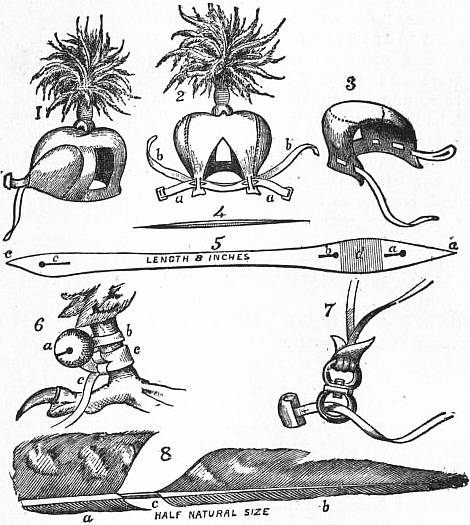
Implements used in Falconry.
1. Hood. 2. Back view of hood, showing braces a, a, b, b; by drawing the braces b, b, the hood, now open, is closed. 3. Rufter hood. 4. Imping-needle. 5. Jess; d is the space for the hawk’s leg; the point and slit a, a are brought round the leg, and passed through slit b, after which the point c and slit c, and also the whole remaining length of jess, are pulled through slits a and b; c is the slit to which the upper ring of swivel is attached. 6. Hawk’s leg with bell a, bewit b, jess c. 7. Jesses, swivel and leash. 8. Portion of first wing-feather of male peregrine falcon, “tiercel,” half natural size, in process of imping; a, the living hawk’s feather; b, piece supplied from another tiercel, with the imping needle c pushed half its length into it and ready to be pushed home into the living bird’s feather.
Mantle.—A hawk is said to “mantle” when she stretches out a leg and a wing simultaneously, a common action of hawks when at ease; also when she spreads out her wings and feathers to hide any quarry or food she may have seized from another hawk, or from man. In the last case it is a fault.
Mew.—A hawk is said to “mew” when she moults. The place where a hawk was kept to moult was in olden times called her “mew.” Buildings where establishments of hawks were kept were called “mews.”
Musket.—Male of the sparrow-hawk.
Mutes (mutings).—Excrement of hawk.
Pannel.—The stomach of a hawk, corresponding with the gizzard of a fowl, is called her pannel. In it the casting is formed.
Passage.—The line herons take over a tract of country on their way to and from the heronry when procuring food in the breeding season.
Passage hawks.—Hawks captured when on their passage or migration.
Pelt.—The dead body of any quarry the hawk has killed.
Pitch.—The height to which a hawk, when waiting for game to be flushed, rises in the air.
Plume.—A hawk is said to “plume” a bird when she pulls off the feathers.
Point.—A hawk “makes her point” when she rises in the air over the spot where quarry has saved itself from capture by dashing into a hedge, or has otherwise secreted itself.
Pounces.—A hawk’s claws.
Pull through the hood.—A hawk is said to pull through the hood when she eats with it on.
Put in.—A bird is said to “put in” when it saves itself from the hawk by dashing into covert or other place of security.
Quarry.—The bird or beast flown at.
Rake out.—A hawk is said to “rake out” when she flies, while “waiting on” (see Wait on), too far and wide from her master.
Ramage.—Wild.
Red hawk.—Hawks of the first year, in the young plumage, are called “red hawks.”
Ringing.—A bird is said to “ring” when it rises spirally in the air.
Rufter hood.—An easy fitting hood, not, however, convenient for hooding and unhooding—used only for hawks when first captured. (See fig.)
Sails.—The wings of a hawk.
Seeling.—Closing the eyes by a fine thread drawn through the lid of each eye, the threads being then twisted together above the head—a practice long disused in England.
Serving a hawk.—Driving out quarry which has taken refuge, or has “put in.”
Stoop.—The hawk’s rapid plunge upon the quarry.
Take the air.—A bird is said to “take the air” when it seeks to escape by trying to rise higher than the falcon.
Tiercel.—The male of various falcons, particularly of the peregrine, also tarcell, tassell or tercel; the term is also applied to the male of the goshawk.
Trussing.—A hawk is said to “truss” a bird when she catches it in the air, and comes to the ground with it in her talons: this term is not applied to large quarry. (See Bind.)
Varvels.—Small rings, generally of silver, fastened to the end of the jesses, and engraved with the owner’s name.
Wait on.—A hawk is said to “wait on” when she flies above her master waiting till game is sprung.
Weathering.—Hawks are “weathered” by being placed unhooded in the open air. Passage hawks which are not sufficiently reclaimed to be left out by themselves unhooded on blocks are “weathered” by being put out for an hour or two under the falconer’s eye.
Yarak.—An Eastern term, generally applied to short-winged hawks. When a hawk is keen, and in hunting condition, she is said to be “in yarak.”
The training of hawks affords much scope for judgment, experience and skill on the part of the falconer, who must carefully observe the temper and disposition as well as the constitution of each bird. It is through the appetite principally that hawks, like most wild animals, are tamed; but to fit them for use in the field much patience, gentleness and care must be used. Slovenly taming necessitates starving, and low condition and weakness are the result. The aim of the falconer must be to have his hawks always keen, and the appetite when they are brought into the field should be such as would induce the bird in a state of nature to put forth its full powers to obtain its food, with, as near as possible, a corresponding condition as to flesh. The following is an outline of the process of training hawks, beginning with the management of a wild-caught peregrine falcon. When first taken, a rufter hood should be put on her head, and she must be furnished with jesses, swivel, leash and bell. A thick glove or rather gauntlet must be worn on the left hand (Eastern falconers always carry a hawk on the right), and she must be carried about as much as possible, late into the night, every day, being constantly stroked with a bird’s wing or feather, very lightly at first. At night she should be tied to a perch in a room with the window darkened, so that no light can enter in the morning. The perch should be a padded pole placed across the room, about 4½ ft. from the ground, with a canvas screen underneath. She will easily be induced to feed in most cases by drawing a piece of beefsteak over her feet, brushing her legs at the time with a wing, and now and then, as she snaps, slipping a morsel into her mouth. Care must be taken to make a peculiar sound with the lips or tongue, or to use a low whistle as she is in the act of swallowing; she will very soon learn to associate this sound with feeding, and it will be found that directly she hears it, she will gripe with her talons, and bend down to feel for food. When the falconer perceives this and other signs of her “coming to,” that she no longer starts at the voice or touch, and steps quietly up from the perch when the hand is placed under her feet, it will be time to change her rufter hood for the ordinary hood. This latter should be very carefully chosen—an easy fitting one, in which the braces draw closely and yet easily and without jerking. An old one previously worn is to be recommended. The hawk should be taken into a very dark room—one absolutely dark is best—and the change should be made if possible in total darkness. After this she must be brought to feed with her hood off; at first she must be fed every day in a darkened room, a gleam of light being admitted. The first day, the hawk having seized the food and begun to pull at it freely, the hood must be gently slipped off, and after she has eaten a moderate quantity, it must be replaced as slowly and gently as possible, and she should be allowed to finish her meal through the hood. Next day the hood may be twice removed, and so on; day by day the practice should be continued, and more light gradually admitted, until the hawk will feed freely in broad daylight, and suffer the hood to be taken off and replaced without opposition. Next she must be accustomed to see and feed in the presence of strangers and dogs, &c. A good plan is to carry her in the streets of a town at night, at first where the gas-light is not strong, and where persons passing by are few, unhooding and hooding her from time to time, but not letting her get frightened. Up to this time she should be fed on lean beefsteak with no castings, but as soon as she is tolerably tame and submits well to the hood, she must occasionally be fed with pigeons and other birds. This should be done not later than 3 or 4 P.M., and when she is placed on her perch for the night in the dark room, she must be unhooded and left so, of course being carefully tied up. The falconer should enter the room about 7 or 8 A.M. next day, admitting as little light as possible, or using a candle. He should first observe if she has thrown her casting; if so, he will at once take her to the fist, giving her a bite of food, and re-hood her. If her casting is not thrown it is better for him to retire, leaving the room quite dark, and come in again later. She must now be taught to know the voice—the shout that is used to call her in the field—and to jump to the fist for food, the voice being used every time she is fed. When she comes freely to the fist she must be made acquainted with the lure. Kneeling down with the hawk on his fist, and gently unhooding her, the falconer casts out a lure, which may be either a dead pigeon or an artificial lure garnished with beefsteak tied to a string, to a distance of a couple or three feet in front of her. When she jumps down to it, she should be allowed to eat a little on it—the voice being used—the while receiving morsels from the falconer’s hand; and before her meal is finished she must be taken off to the hand, being induced to forsake the lure for the hand by a tempting piece of meat. This treatment will help to check her inclination hereafter to carry her quarry. This lesson is to be continued till the falcon feeds very boldly on the lure on the ground, in the falconer’s presence—till she will suffer him to walk round her while she is feeding. All this time she will have been held by the leash only, but in the next step a strong, but light creance must be made fast to the leash, and an assistant holding the hawk should unhood her, as the falconer, standing at a distance of 5 to 10 yds., calls her by shouting and casting out the lure. Gradually day after day the distance is increased, till the hawk will come 30 yds. or so without hesitation; then she may be trusted to fly to the lure at liberty, and by degrees from any distance, say 1000 yds. This accomplished, she should learn to stoop at the lure. Instead of allowing the hawk to seize upon it as she comes up, the falconer should snatch the lure away and let her pass by, and immediately put it out that she may readily seize it when she turns round to look for it. This should be done at first only once, and then progressively until she will stoop backwards and forwards at the lure as often as desired. Next she should be entered at her quarry. Should she be intended for rooks or herons, two or three of these birds should be procured. One should be given her from the hand, then one should be released close to her, and a third at a considerable distance. If she take these keenly, she may be flown at a wild bird. Care must, however, be taken to let her have every possible advantage in her first flights—wind and weather, and the position of the quarry with regard to the surrounding country, must be considered.
Young hawks, on being received by the falconer before they can fly, must be put into a sheltered place, such as an outhouse or shed. Their basket or hamper should be filled with straw. A hamper is best, with the lid so placed as to form a platform for the young hawks to come out upon to feed. This should be fastened to a beam or prop a few feet from the ground. The young hawks must be most plentifully fed on the best fresh food obtainable—good beefsteak and fresh-killed birds; the falconer when feeding them should use his voice as in luring. As they grow old enough they will come out, and perch about the roof of their shed, by degrees extending their flights to neighbouring buildings or trees, never failing to come at feeding time to the place where they are fed. Soon they will be continually on the wing, playing or fighting with one another, and later the falconer will observe them chasing other birds, as pigeons and rooks, which may be passing by. As soon as one fails to come for a meal, it must be at once caught with a bow net or a snare the first time it comes back, or it will be lost. It must be borne in mind that the longer hawks can be left at hack the better they are likely to be for use in the field—those hawks being always the best which have preyed a few times for themselves before being caught. Of course there is great risk of losing hawks when they begin to prey for themselves. When a hawk is so caught she is said to be “taken up” from hack. She will not require a rufter hood, but a good deal of the management described for the passage falcon will be necessary. She must be carefully tamed and broken to the hood in the same manner, and so taught to know the lure; but, as might be expected, very much less difficulty will be experienced. As soon as the eyas knows the lure sufficiently well to come to it sharp and straight from a distance, she must be taught to “wait on.” This is effected by letting the hawk loose in an open place, such as a down. It will be found that she will circle round the falconer looking for the lure she has been accustomed to see—perhaps mount a little in the air, and advantage must be taken of a favourable moment when the hawk is at a little height, her head being turned in towards the falconer, to let go a pigeon which she can easily catch. When the hawk has taken two or three pigeons in this way, and mounts immediately in expectation, in short, begins to wait on, she should see no more pigeons, but be tried at game as soon as possible. Young peregrines should be flown at grouse first in preference to partridges, not only because the season commences earlier, but because, grouse being the heavier birds, they are not so much tempted to “carry” as with partridges.
The training of the great northern falcons, as well as that of merlins and hobbies, is conducted much on the above principles, but the jerfalcons (gerfalcons or gyrfalcons) will seldom wait on well, and merlins will not do it at all.
The training of short-winged hawks is a simpler process. They must, like falcons, be provided with jesses, swivel, leash and bell. In these hawks a bell is sometimes fastened to the tail. Sparrow-hawks can, however, scarcely carry a bell big enough to be of any service. The hood is seldom used for short-winged hawks—never in the field. They must be made as tame as possible by carriage on the fist and the society of man, and taught to come to the fist freely when required—at first to jump to it in a room, and then out of doors. When the goshawk comes freely and without hesitation from short distances, she ought to be called from long distances from the hand of an assistant, but not oftener than twice in each meal, until she will come at least 1000 yds., on each occasion being well rewarded with some food she likes very much, as a fresh-killed bird, warm. When she does this freely, and endures the presence of strangers, dogs, &c., a few bagged rabbits should be given to her, and she will be ready to take the field. Some accustom the goshawk to the use of the lure, for the purpose of taking her if she will not come to the fist in the field when she has taken stand in a tree after being baulked of her quarry, but it ought not to be necessary to use it.
Falcons or long-winged hawks are either “flown out of the hood,” i.e. unhooded and slipped when the quarry is in sight, or they are made to “wait on” till game is flushed. Herons and rooks are always taken by the former method. Passage hawks are generally employed for flying at these birds, though sometimes good eyases are quite equal to the work. For heron-hawking a well-stocked heronry is in the first place necessary. Next an open country which can be ridden over—over which herons are in the constant habit of passing to and from their heronry on their fishing excursions, or making their “passage.” A heron found at his feeding-place at a brook or pond affords no sport whatever. If there be little water any peregrine falcon that will go straight at him will seize him soon after he rises. It is sometimes advisable to fly a young falcon at a heron so found, but it should not be repeated. If there be much water the heron will neither show sport nor be captured. It is quite a different affair when he is sighted winging his way at a height in the air over an open tract of country free from water. Though he has no chance whatever of competing with a falcon in straightforward flight, the heron has large concave wings, a very light body proportionately, and air-cells in his bones, and can rise with astonishing rapidity, more perpendicularly, or, in other words, in smaller rings, than the falcon can, with very little effort. As soon as he sees the approach of the falcon, which he usually does almost directly she is cast off, he makes play for the upper regions. Then the falcon commences to climb too to get above him, but in a very different style. She makes very large circles or rings, travelling at a high rate of speed, due to her strength and weight and power of flying, till she rises above the heron. Then she makes her attack by stooping with great force at the quarry, sometimes falling so far below it as the blow is evaded that she cannot spring up to the proper pitch for the next stoop, and has to make another ring to regain her lost command over the heron, which is ever rising, and so on—the “field” meanwhile galloping down wind in the direction the flight is taking till she seizes the heron aloft, “binds” to him, and both come down together. Absurd stories have been told and pictures drawn of the heron receiving the falcon on its beak in the air. It is, however, well known to all practical falconers that the heron has no power or inclination to fight with a falcon in the air; so long as he is flying he seeks safety solely from his wings. When on the ground, however, should the falcon be deficient in skill or strength, or have been mutilated by the coping of her beak and talons, as was sometimes formerly done in Holland with a view to saving the heron’s life, the heron may use his dagger-like bill with dangerous effect, though it is very rare for a falcon to be injured. It is never safe to fly the goshawk at a heron of any description. Short-winged hawks do not immediately kill their quarry as falcons do, nor do they seem to know where the life lies, and seldom shift their hold once taken even to defend themselves; and they are therefore easily stabbed by a heron. Rooks are flown in the same manner as herons, but the flight is generally inferior. Although rooks fly very well, they seek shelter in trees or bushes as soon as possible.
For game-hawking eyases are generally used, though undoubtedly passage or wild-caught hawks are to be preferred. The best game hawks we have seen have been passage hawks, but there are difficulties attending the use of them. It may perhaps be fairly said that it is easy to make all passage hawks “wait on” in grand style, but until they have got over a season or two they are very liable to be lost. Among the advantages attending the use of eyases are the following: they are easier to obtain and to train and keep; they also moult far better and quicker than passage hawks, while if lost in the field they will often go home by themselves, or remain about the spot where they were liberated. Experience, and, we must add, some good fortune also, are requisite to make eyases good for waiting on for game. Slight mistakes on the part of the falconer, false points from dogs, or bad luck in serving, will cause a young hawk to acquire bad habits, such as sitting down on the ground, taking stand in a tree, raking out wide, skimming the ground, or lazily flying about at no height. A good game hawk in proper flying order goes up at once to a good pitch in the air—the higher she flies the better—and follows her master from field to field, always ready for a stoop when the quarry is sprung. Hawks that have been successfully broken and judiciously worked become wonderfully clever, and soon learn to regulate their flight by the movements of their master. Eyases were not held in esteem by the old falconers, and it is evident from their writings that these hawks have been very much better understood and managed in the 19th century than in the middle ages. It is probable that the old falconers procured their passage and wild-caught hawks with such facility, having at the same time more scope for their use in days when quarry was more abundant and there was more waste land than there now is, that they did not find it necessary to trouble themselves about eyases. Here may be quoted a few lines from one of the best of the old writers, which may be taken as giving a fair account of the estimation in which eyases were generally held, and from which it is evident that the old falconers did not understand flying hawks at hack. Simon Latham, writing in 1633, says of eyases:
They will be verie easily brought to familiaritie with the man, not in the house only, but also abroad, hooded or unhooded; nay, many of them will be more gentle and quiet when unhooded than when hooded, for if a man doe but stirre or speake in their hearing, they will crie and bate as though they did desire to see the man. Likewise some of them being unhooded, when they see the man will cowre and crie, shewing thereby their exceeding fondness and fawning love towards him....
... These kind of hawks be all (for the most part) taken out of the nest while verie young, even in the downe, from whence they are put into a close house, whereas they be alwaies fed and familiarly brought up by the man, untill they bee able to flie, when as the summer approaching verie suddenly they are continued and trained up in the same, the weather being alwaies warm and temperate; thus they are still inured to familiaritie with the man, not knowing from whence besides to fetch their relief or sustenance. When the summer is ended they bee commonly put up into a house again, or else kept in some warm place, for they cannot endure the cold wind to blow upon them.... But leaving to speak of these kind of scratching hawks that I never did love should come too neere my fingers, and to return unto the faire conditioned haggard faulcon....
The author here describes with accuracy the condition of unhacked eyases, which no modern falconer would trouble himself to keep. Many English falconers in modern times have had eyases which have killed grouse, ducks and other quarry in a style almost equalling that of passage hawks. Rooks also have been most successfully flown, and some herons on passage have been taken by eyases. No sport is to be had at game without hawks that wait on well. Moors, downs, open country where the hedges are low and weak are best suited to game hawking. Pointers or setters may be used to find game, or the hawk may be let go on coming to the ground where game is known to lie, and suffered, if an experienced one, to “wait on” till game is flushed. However, the best plan with most hawks, young ones especially, is to use a dog, and to let the hawk go when the dog points, and to flush the birds as soon as the hawk is at her pitch. It is not by any means necessary that the hawk should be near the birds when they rise, provided she is at a good height, and that she is watching; she will come at once with a rush out of the air at great speed, and either cut one down with the stoop, or the bird will save itself by putting in, when every exertion must be made, especially if the hawk be young and inexperienced, to “serve” her as soon as possible by driving out the bird again while she waits overhead. If this be successfully done she is nearly certain to kill it at the second flight. Perhaps falcons are best for grouse and tiercels for partridges.
Magpies afford much sport. Only tiercels should be used for hunting magpies. A field is necessary—at the very least 4 or 5 runners to beat the magpie out, and perhaps the presence of a horseman is an advantage. Of course in open flight a magpie would be almost immediately caught by a tiercel peregrine, and there would be no sport, but the magpie makes up for his want of power of wing by his cunning and shiftiness; and he is, moreover, never to be found except where he has shelter under his lee for security from a passing peregrine. Once in a hedge or tree he is perfectly safe from the wild falcon, but the case is otherwise when the falconer approaches with his trained tiercel, perhaps a cast of tiercels, waiting on in the air, with some active runners in his field. Then driven from hedge to hedge, from one kind of shelter to another, stooped at every instant when he shows himself ever so little away from cover by the watchful tiercels overhead, his egg-stealing days are brought to an end by a fatal stroke—sometimes not before the field is pretty well exhausted with running and shouting. The magpie always manœuvres towards some thick wood, from which it is the aim of the field to cut him off. At first hawks must be flown in easy country, but when they understand their work well they will kill magpies in very enclosed country—with a smart active field a magpie may even be pushed through a small wood. Magpie hawking affords excellent exercise, not only for those who run to serve the hawks, but for the hawks also; they get a great deal of flying, and learn to hunt in company with men—any number of people may be present. Blackbirds may be hunted with tiercels in the same way. Woodcock afford capital sport where the country is tolerably open. It will generally be found that after a hawk has made one stoop at a woodcock, the cock will at first try to escape by taking the air, and will show a very fine flight. When beaten in the air it will try to get back to covert again, but when once a hawk has outflown a woodcock, he is pretty sure to kill it. Hawks seem to pursue woodcock with great keenness; something in the flight of the cock tempts them to exertion. The laziest and most useless hawks—hawks that will scarcely follow a slow pigeon—will do their best at woodcock, and will very soon, if the sport is continued, be improved in their style of flying. Snipe may be killed by first-class tiercels in favourable localities. Wild duck and teal are only to be flown at when they can be found in small pools or brooks at a distance from much water—where the fowl can be suddenly flushed by men or dogs while the falcon is flying at her pitch overhead. For duck, falcons should be used; tiercels will kill teal well.
The merlin is used for flying at larks, and there does not seem to be any other use to which this pretty little falcon may fairly be put. It is very active, but far from being, as some authors have stated, the swiftest of all hawks. Its flight is greatly inferior in speed and power to that of the peregrine. Perhaps its diminutive size, causing it to be soon lost to view, and a limited acquaintance with the flight of the wild peregrine falcon, have led to the mistake.
The hobby is far swifter than the merlin, but cannot be said to be efficient in the field; it may be trained to wait on beautifully, and will sometimes take larks; it is very much given to the fault of “carrying.”
The three great northern falcons are not easy to procure in proper condition for training. They are very difficult to break to the hood and to manage in the field. They are flown, like the peregrine, at herons and rooks, and in former days were used for kites and hares. Their style of flight is magnificent; they are considerably swifter than the peregrine, and are a most deadly “footers.” They seem, however, to lack somewhat of the spirit and dash of the peregrine.
For the short-winged hawks an open country is not required; indeed they may be flown in a wood. Goshawks are flown at hares, rabbits, pheasants, partridges and wild-fowl. Only very strong females are able to take hares; rabbits are easy quarry for any female goshawk, and a little too strong for the male. A good female goshawk may kill from 10 to 15 rabbits in a day, or more. For pheasants the male is to be preferred, certainly for partridges; either sex will take duck and teal, but the falconer must get close to them before they are flushed, or the goshawk will stand a poor chance of killing. Rabbit hawking may be practised by ferreting, and flying the hawk as the rabbits bolt, but care must be taken or the hawk will kill the ferret. Where rabbits sit out on grass or in turnip fields, a goshawk may be used with success, even in a wood when the holes are not too near. From various causes it is impossible, or nearly so, to have goshawks in England in the perfection to which they are brought in the East. In India, for instance, there is a far greater variety of quarry suited to them, and wild birds are much more approachable; moreover, there are advantages for training which do not exist in England. Unmolested—and scarcely noticed except perhaps by others of his calling or tastes—the Eastern falconer carries his hawk by day and night in the crowded bazaars, till the bird becomes perfectly indifferent to men, horses, dogs, carriages, and, in short, becomes as tame as the domestic animals.
The management of sparrow-hawks is much the same as that of goshawks, but they are far more delicate than the latter. They are flown in England at blackbirds, thrushes and other small birds; good ones will take partridges well till the birds get too wild and strong with the advancing season. In the East large numbers of quail are taken with sparrow-hawks.
It is of course important that hawks from which work in the field is expected should be kept in the highest health, and they must be carefully fed; no bad or tainted meat must on any account be given to them—at any rate to hawks of the species used in England. Peregrines and the great northern falcons are best kept on beefsteak, with a frequent change in the shape of fresh-killed pigeons and other birds. The smaller falcons, the merlin and the hobby, require a great number of small birds to keep them in good health for any length of time. Goshawks should be fed like peregrines, but rats and rabbits are very good as change of food for them. The sparrow-hawk, like the small falcons, requires small birds. All hawks require castings frequently. It is true that hawks will exist, and often appear to thrive, on good food without castings, but the seeds of probable injury to their health are being sown the whole time they are so kept. If there is difficulty in procuring birds, and it is more convenient to feed the hawks on beefsteak, they should frequently get the wings and heads and necks of game and poultry. In addition to the castings which they swallow, tearing these is good exercise for them, and biting the bones prevents the beaks from overgrowing. Most hawks, peregrines especially, require the bath. The end of a cask, sawn off to give a depth of about 6 in., makes a very good bath. Peregrines which are used for waiting on require a bath at least twice a week. If this be neglected, they will not wait long before going off in search of water to bathe, however hungry they may be.
The most agreeable and the best way, where practicable, of keeping hawks is to have them on blocks on the lawn. Each hawk’s block should stand in a circular bed of sand—about 8 ft. in diameter; this will be found very convenient for keeping them clean. Goshawks are generally placed on bow perches, which ought not to be more than 8 or 9 in. high at the highest part of the arc. It will be several months before passage or wild-caught falcons can be kept out of doors; they must be fastened to a perch in a darkened room, hooded, but by degrees as they get thoroughly tame may be brought to sit on the lawn. In England (especially in the south) peregrines, the northern falcons and goshawks may be kept out of doors all day and night in a sheltered situation. In very wild boisterous weather, or in snow or sharp frost, it will be advisable to move them to the shelter of a shed, the floor of which should be laid with sand to a depth of 3 or 4 in. Merlins and hobbies are too tender to be kept much out of doors. An eastern aspect is to be preferred—all birds enjoy the morning sun, and it is very beneficial to them. The more hawks confined to blocks out of doors see of persons, dogs, horses, &c., moving about the better, but of course only when there is no danger of their being frightened or molested, or of food being given to them by strangers. Those who have only seen wretched ill-fed hawks in cages as in zoological gardens or menageries, pining for exercise, with battered plumage, torn shoulders and bleeding ceres, from dashing against their prison bars, and overgrown beaks from never getting bones to break, can have little idea of the beautiful and striking-looking birds to be seen pluming their feathers and stretching their wings at their ease at their blocks on the falconer’s lawn, watching with their large bright keen eyes everything that moves in the sky and everywhere else within the limits of their view. Contrary to the prevailing notion, hawks show a good deal of attachment when they have been properly handled. It is true that by hunger they are in a great measure tamed and controlled, and the same may be said of all undomesticated and many domesticated animals. And instinct prompts all wild creatures when away from man’s control to return to their former shyness, but hawks certainly retain their tameness for a long time, and their memory is remarkably retentive. Wild-caught hawks have been retaken, either by their coming to the lure or upon quarry, from 2 to 7 days after they had been lost, and eyases after 3 weeks. As one instance of retentiveness of memory displayed by hawks we may mention the case of a wild-caught falcon which was recaptured after being at liberty more than 3 years, still bearing the jesses which were cut short close to the leg at the time she was released; in five days she was flying at the lure again at liberty, and was found to retain the peculiar ways and habits she was observed to have in her former existence as a trained hawk. It is useless to bring a hawk into the field unless she has a keen appetite; if she has not, she will neither hunt effectually nor follow her master. Even wild-caught falcons, however, may sometimes be seen so attached to their owner that, when sitting on their blocks on a lawn with food in their crops, they will on his coming out of the house bate hard to get to him, till he either go up to them and allow them to jump up to his hand or withdraw from their sight. Goshawks are also known to evince attachment to their owner. Another prevailing error regarding hawks is that they are supposed to be lazy birds, requiring the stimulus of hunger to stir them to action. The reverse is the truth; they are birds of very active habits, and exceedingly restless, and the notion of their being lazy has been propagated by those who have seen little or nothing of hawks in their wild state. The wild falcon requires an immense deal of exercise, and to be in wind, in order to exert the speed and power of flight necessary to capture her prey when hungry; and to this end instinct prompts her to spend hours daily on the wing, soaring and playing about in the air in all weathers, often chasing birds merely for play or exercise. Sometimes she takes a siesta when much gorged, but unless she fills her crop late in the evening she is soon moving again—before half her crop is put over. Goshawks and sparrow-hawks, too, habitually soar in the air at about 9 or 10 A.M., and remain aloft a considerable time, but these birds are not of such active habits as the falcons. The frequent bating of thoroughly tame hawks from their blocks, even when not hungry or frightened, proves their restlessness and impatience of repose. So does the wretched condition of the caged falcon (before alluded to), while the really lazy buzzards and kites, which do not in a wild state depend on activity or power of wing for their sustenance, maintain themselves for years, even during confinement if properly fed, in good case and plumage. Such being the habits of the falcon in a state of nature, the falconer should endeavour to give the hawks under his care as much flying as possible, and he should avoid the very common mistake of keeping too many hawks. In this case a favoured few are sure to get all the work, and the others, possibly equally good if they had fair play, are spoiled for want of exercise.
The larger hawks may be kept in health and working order for several years—15 or 20—barring accidents. The writer has known peregrines, shaheens and goshawks to reach ages between 15 and 20 years. Goshawks, however, never fly well after 4 or 5 seasons, when they will no longer take difficult quarry; they may be used at rabbits as long as they live. Shaheens may be seen in the East at an advanced age, killing wild-fowl beautifully. The shaheen is a falcon of the peregrine type, which does not travel, like the peregrine, all over the world. It appears that the jerfalcons also may be worked to a good age. Old Simon Latham tells us of these birds—“I myself have known one of them an excellent Hearnor (killer of herons), and to continue her goodnesse very near twentie yeeres, or full out that time.”
Authorities.—Schlegel’s Traité de fauconnerie contains a very large list of works on falconry in the languages of all the principal countries of the Old World. Bibliotheca accipitraria, by J.E. Harting (1891), gives a complete bibliography. See Coursing and Falconry in the Badminton Library; and The Art and Practice of Hawking, by E.B. Michell (1900), the best modern book on the subject. Perhaps the most useful of the old works are The Booke of Faulconrie or Hawking, by George Turberville (1575), and The Faulcon’s Lure and Cure, by Simon Latham (1633).
(E. D. R.)
FALDSTOOL (from the O.H. Ger. falden or falten, to fold, and stuol, Mod. Ger. Stuhl, a stool; from the medieval Latin faldistolium is derived, through the old form faudesteuil, the Mod. Fr. fauteuil), properly a folding seat for the use of a bishop when not occupying the throne in his own cathedral, or when officiating in a cathedral or church other than his own; hence any movable folding stool used for kneeling in divine service. The small desk or stand from which the Litany is read is sometimes called a faldstool, and a similar stool is provided for the use of the sovereign at his coronation.
FALERII [mod. Cività Castellana (q.v.)], one of the twelve chief cities of Etruria, situated about 1 m. W. of the ancient Via Flaminia,1 32 m. N. of Rome. According to the legend, it was of Argive origin; and Strabo’s assertion that the population, the Falisci (q.v.), were of a different race from the Etruscans is proved by the language of the earliest inscriptions which have been found here. Wars between Rome and the Falisci appear to have been frequent. To one of the first of them belongs the story of the schoolmaster who wished to betray his boys to Camillus; the latter refused his offer, and the inhabitants thereupon surrendered the city. At the end of the First Punic War, the Falisci rose in rebellion, but were soon conquered (241 B.C.) and lost half their territory. Zonaras (viii. 18) tells us that the ancient city, built upon a precipitous hill, was destroyed and another built on a more accessible site on the plain. The description of the two sites agrees well with the usual theory that the original city occupied the site of the present Cività Castellana, and that the ruins of Falleri (as the place is now called) are those of the Roman town which was thus transferred 3 m. to the north-west. After this time Falerii hardly appears in history. It became a colony (Junonia Faliscorum) perhaps under Augustus, though according to the inscriptions apparently not until the time of Gallienus. There were bishops of Falerii up till 1033, when the desertion of the place in favour of the present site began, and the last mention of it dates from A.D. 1064.
The site of the original Falerii is a plateau, about 1100 yds. by 400, not higher than the surrounding country (475 ft.) but separated from it by gorges over 200 ft. in depth, and only connected with it on the western side, which was strongly fortified with a mound and ditch; the rest of the city was defended by walls constructed of rectangular blocks of tufa, of which some remains still exist. Remains of a temple were found at Lo Scasato, at the highest point of the ancient town, in 1888, and others have been excavated in the outskirts. The attribution of one of these to Juno Quiritis is uncertain. These buildings were of wood, with fine decorations of coloured terra-cotta (Notizie degli scavi, 1887, p. 92; 1888, p. 414). Numerous tombs hewn in the rock are visible on all sides of the town, and important discoveries have been made in them; many objects, both from the temples and from the tombs, are in the Museo di Villa Giulia at Rome. Similar finds have also been made at Calcata, 6 m. S., and Corchiano, 5 m. N.W. The site of the Roman Falerii is now entirely abandoned. It lay upon a road which may have been (see H. Nissen, Italische Landeskunde, ii. 361) the Via Annia, a by-road of the Via Cassia; this road approached it from the south passing through Nepet, while its prolongation to the north certainly bore the name Via Amerina. The circuit of the city is about 2250 yds., its shape roughly triangular, and the walls are a remarkably fine and well-preserved specimen of Roman military architecture. They are constructed of rectangular blocks of tufa two Roman ft. in height; the walls themselves reach in places a height of 56 ft. and are 7 to 9 ft. thick. There were about 80 towers, some 50 of which are still preserved. Two of the gates also, of which there were eight, are noteworthy. Of the buildings within the walls hardly anything is preserved above ground, though the forum and theatre (as also the amphitheatre, the arena of which measured 180 by 108 ft. outside the walls) were all excavated in the 19th century. Almost the only edifice now standing is the 12th-century abbey church of S. Maria. Recent excavations have shown that the plan of the whole city could easily be recovered, though the buildings have suffered considerable devastation (Notizie degli scavi, 1903, 14).
See G. Dennis, Cities and Cemeteries of Etruria (London, 1883), i. 97; for philology and ethnology see Falisci.
(T. As.)
1 The Roman town lay 3 m. farther N.W. on the Via Annia. The Via Flaminia, which did not traverse the Etruscan city, had two post-stations near it, Aquaviva, some 2½ m. S.E., and Aequum Faliscum, 4½ m. N.N.E.; the latter is very possibly identical with the Etruscan site which G. Dennis (Cities and Cemeteries of Etruria, London, 1883, i. 121) identified with Fescennium (q.v.). See O. Cuntz in Jahreshefte des österr. arch. Inst. ii. (1899), 87.
FALERIO (mod. Falerone), an ancient town of Picenum, Italy, about 10 m. S.E. of Urbs Salvia. We know almost nothing of the place except from inscriptions, from which, and from the remains of its buildings, it appears to have been of some importance. It was probably founded as a colony by Augustus after his victory at Actium. A question arose in the time of Domitian between the inhabitants of Falerio and Firmum as to land which had been taken out of the territory of the latter (which was recolonized by the triumvirs), and, though not distributed to the new settlers, had not been given back again to the people of Firmum. The emperor, by a rescript, a copy of which in bronze was found at Falerio, decided in favour of the people of Falerio, that the occupiers of this land should remain in possession of it (Th. Mommsen in Corp. Inscr. Latin. ix., Berlin, 1883, No. 5, 420). Considerable remains of a theatre in concrete faced with brickwork, erected, according to an inscription, in 43 B.C., and 161 ft. in diameter, were excavated in 1838 and are still visible; and an amphitheatre, less well preserved, also exists, the arena of which measures about 180 by 150 ft. Between the two is a water reservoir (called Bagno della Regina) connected with remains of baths.
See G. de Minicis in Giornale Arcadico, lv. (1832), 160 seq.; Annali dell’ Istituto (1839), 5 seq.
(T. As.)
FALGUIÈRE, JEAN ALEXANDRE JOSEPH (1831-1900), French sculptor and painter, was born at Toulouse. A pupil of the École des Beaux Arts he won the Prix de Rome in 1859; he was awarded the medal of honour at the Salon in 1868 and was appointed officer of the Legion of Honour in 1878. His first bronze statue of importance was the “Victor of the Cock-Fight” (1864), and “Tarcisus the Christian Boy-Martyr” followed in 1867; both are now in the Luxembourg Museum. His more important monuments are those to Admiral Courbet (1890) at Abbeville and the famous “Joan of Arc.” Among more ideal work are “Eve” (1880), “Diana” (1882 and 1891), “Woman and Peacock,” and “The Poet,” astride his Pegasus spreading wings for flight. His “Triumph of the Republic” (1881-1886), a vast quadriga for the Arc de Triomphe, Paris, is perhaps more amazingly full of life than others of his works, all of which reveal this quality of vitality in superlative degree. To these works should be added his monuments to “Cardinal Lavigerie” and “General de La Fayette” (the latter in Washington), and his statues of “Lamartine” (1876) and “St Vincent de Paul” (1879), as well as the “Balzac,” which he executed for the Société des gens de lettres on the rejection of that by Rodin; and the busts of “Carolus-Duran” and “Coquelin cadet” (1896).
Falguière was a painter as well as a sculptor, but somewhat inferior in merit. He displays a fine sense of colour and tone, added to the qualities of life and vigour that he instils into his plastic work. His “Wrestlers” (1875) and “Fan and Dagger” (1882; a defiant Spanish woman) are in the Luxembourg, and other pictures of importance are “The Beheading of St John the Baptist” (1877), “The Sphinx” (1883), “Acis and Galatea” (1885), “Old Woman and Child” (1886) and “In the Bull Slaughter-House.” He became a member of the Institute (Académie des Beaux-Arts) in 1882. He died in 1900.
See Léonce Bénédite, Alexandre Falguière, Librairie de l’art (Paris).
FALIERO (or Falier), MARINO (1279-1355), doge of Venice, belonged to one of the oldest and most illustrious Venetian families and had served the republic with distinction in various capacities. In 1346 he commanded the Venetian land forces at the siege of Zara, where he was attacked by the Hungarians under King Louis the Great and totally defeated them; this victory led to the surrender of the city. In September 1354, while absent on a mission to Pope Innocent IV. at Avignon, Faliero was elected doge, an honour which apparently he had not sought. His reign began, as it was to end, in disaster, for very soon after his election the Venetian fleet was completely destroyed by the Genoese off the island of Sapienza, while plague and a declining commerce aggravated the situation. Although a capable commander and a good statesman, Faliero possessed a violent temper, and after his election developed great ambition. The constitutional restrictions of the ducal power, which had been further curtailed just before his election, and the insolence of the nobility aroused in him a desire to free himself from all control, and the discontent of the arsenal hands at their treatment by the nobles offered him his opportunity. In concert with a sea-captain named Bertuccio Ixarella (who had received a blow from the noble Giovanni Dandolo), Filippo Calendario, a stonemason, and others, a plot was laid to murder the chief patricians on the 15th of April and proclaim Faliero prince of Venice. But there was much ferment in the city and disorders broke out before the appointed time; some of the conspirators having made revelations, the Council of Ten proceeded to arrest the ringleaders and to place armed guards all over the town. Several of the conspirators were condemned to death and others to various terms of imprisonment. The doge’s complicity having been discovered, he was himself arrested; at the trial he confessed everything and was condemned and executed on the 17th of April 1355.
The story of the insult written by Michele Steno on the doge’s chair is a legend of which no record is found in any contemporary authority. The motives of Faliero are not altogether clear, as his past record, even in the judgment of the poet Petrarch, showed him as a wise, clear-headed man of no unusual ambition. But possibly the attitude of the aristocracy and the example offered by the tyrants of neighbouring cities may have induced him to attempt a similar policy. The only result of the plot was to consolidate the power of the Council of Ten.
Bibliography.—An account of Marino Faliero’s reign is given in S. Romanin’s Storia documentata di Venezia, lib. ix. cap. ii. (Venice, 1855); M. Sanudo, Le Vite dei Dogi in new edition of Muratori fasc, 3, 4, 5 (Citta di Castello, 1900). For special works see V. Lazzerini’s “Genealogia d. M. Faliero” in the Archivio Veneto of 1892; “M. Faliero avanti il Dogado,” ibid. (1893), and his exhaustive study “M. Faliero, la Congiura,” ibid. (1897). The most recent essay on the subject is contained in Horatio Brown’s Studies in Venetian History (London, 1907), wherein all the authorities are set forth.
(L. V.*)
FALISCI, a tribe of Sabine origin or connexions, but speaking a dialect closely akin to Latin, who inhabited the town of Falerii (q.v.), as well as a considerable tract of the surrounding country, probably reaching as far south as to include the small town of Capena. But at the beginning of the historical period, i.e. from the beginning of the 5th century B.C., and no doubt earlier, the dominant element in the town was Etruscan; and all through the wars of the following centuries the town was counted a member, and sometimes a leading member, of the Etruscan league (cf. Livy iv. 23, v. 17, vii. 17).
In spite of the Etruscan domination, the Faliscans preserved many traces of their Italic origin, such as the worship of the deities Juno Quiritis (Ovid, Fasti, vi. 49) and Feronia (Livy xxvi. n), the cult of Dis Soranus by the Hirpi or fire-leaping priests on Mount Soracte (Pliny, Nat. Hist. vii. 2, 19; Servius, ad Aen. xi. 785, 787), above all their language. This is preserved for us in some 36 short inscriptions, dating from the 3rd and 2nd centuries B.C., and is written in a peculiar alphabet derived from the Etruscan, and written from right to left, but showing some traces of the influence of the Latin alphabet. Its most characteristic signs are—

As a specimen of the dialect may be quoted the words written round the edge of a picture on a patera, the genuineness of which is established by the fact that they were written before the glaze was put on: “foied vino pipafo, era carefo,” i.e. in Latin “hodie vinum bibam, cras carebo” (R.S. Conway, Italic Dialects, p. 312, b). This shows some of the phonetic characteristics of the Faliscan dialect, viz.:—
1. The retention of medial f which in Latin became b;
2. The representation of an initial Ind.-Eur. gh by,f (foied, contrast Latin hodie);
3. The palatalization of d + consonant i into some sound denoted merely by i-the central sound of foied,.from fo-diëd;
4. The loss of final s, at all events before certain following sounds (cra beside Latin crās);
Other characteristics, appearing elsewhere, are:
5. The retention of the velars (Fal. cuando = Latin quando; contrast Umbrian pan(n)u);
6. The assimilation of some final consonants to the initial letter of the next word: “pretod de zenatuo sententiad” (Conway, lib. cit. 321), i.e. “praetor de senatus sententia” (zenatuo for senaiuos., an archaic genitive). For further details see Conway, ib. pp. 370 if., especially pp. 384-385, where the relation of the names Falisci, Falerii to the local hero Halaesus (e.g. Ovid, Fasti, iv. 73) is discussed, and where reason is given for thinking that the change of initial f (from an original bh or dh) into an initial h was a genuine mark of Faliscan dialect.
It seems probable that the dialect lasted on, though being gradually permeated with Latin, till at least 150 B.C.
In addition to the remains found in the graves (see Falerii), which belong mainly to the period of Etruscan domination and give ample evidence of material prosperity and refinement, the earlier strata have yielded more primitive remains from the Italic epoch. A large number of inscriptions consisting mainly of proper names may be regarded as Etruscan rather than Faliscan, and they have been disregarded in the account of the dialect just given. It should perhaps be mentioned that there was a town Feronia in Sardinia, named probably after their native goddess by Faliscan settlers, from some of whom we have a votive inscription found at S. Maria di Falleri(Conway, ib. p. 335).
Further information may be sought from W. Deecke, Die Falisker (a useful but somewhat uncritical collection of the evidence accessible in 1888); E. Bormann, in C.I.L. xi. pp. 465 ff., and Conway, op. cit.
(R. S. C.)
FALK, JOHANN DANIEL (1768-1826), German author and philanthropist, was born at Danzig on the 28th of October 1768, After attending the gymnasium of his native town, he entered the university of Halle with the view of studying theology, but preferring a non-professional life, gave up his theological studies and went to live at Weimar. There he published a volume of satires which procured him the notice and friendship of Wieland, and admission into literary circles. After the battle of Jena, Falk, on the recommendation of Wieland, was appointed to a civil post under the French official authorities and rendered his townsmen such good service that the duke of Weimar created him a counsellor of legation. In 1813 he established a society for friends in necessity (Gesellschaft der Freunde in der Not), and about the same time founded an institute for the care and education of neglected and orphan children, which, in 1820, was taken over by the state and still exists as the Falksches Institut. The first literary efforts of Falk took the form chiefly of satirical poetry, and gave promise of greater future excellence than was ever completely fulfilled; his later pieces, directed more against individuals than the general vices and defects of society, gradually degenerated in quality. In 1806 Falk founded a critical journal under the title of Elysium und Tartarus. He also contributed largely to contemporary journals. He enjoyed the acquaintance and intimate friendship of Goethe, and his account of their intercourse was posthumously published under the title Goethe aus näherem persönlichen Umgange dargestellt (1832) (English by S. Austin). Falk died on the 14th of February 1826.
Falk’s Satirische Werke appeared in 7 vols. (1817 and 1826); his Auserlesene Schriften (3 vols., 1819). See Johannes Falk: Erinnerungsblatter aus Briefen und Tagebüchern, gesammelt von dessen Tochter Rosalie Falk (1868); Heinzelmann, Johannes Falk und die Gesellschaft der Freunde in der Not (1879); A. Stein, J. Falk (1881); S. Schultze, Falk und Goethe (1900).
FALK, PAUL LUDWIG ADALBERT (1827-1900), German politician, was born at Matschkau, Silesia, on the 10th of August 1827. In 1847 he entered the Prussian state service, and in 1853 became public prosecutor at Lyck. In 1858 he was elected a deputy, joining the Old Liberal party. In 1868 he became a privy-councillor in the ministry of justice. In 1872 he was made minister of education, and in connexion with Bismarck’s policy of the Kultur-kampf he was responsible for the famous May Laws against the Catholics (see Germany: History). In 1879 his position became untenable, owing to the death of Pius IX. and the change of German policy with regard to the Vatican, and he resigned his office, but retained his seat in the Reichstag till 1882. He was then made president of the supreme court of justice at Hamm, where he died in 1900.
FALKE, JOHANN FRIEDRICH GOTTLIEB (1823-1876), German historian, was born at Ratzeburg on the 20th of April 1823. Entering the university of Erlangen in 1843, he soon began to devote his attention to the history of the German language and literature, and in 1848 went to Munich, where he remained five years, and diligently availed himself of the use of the government library for the purpose of prosecuting his historical studies. In 1856 he was appointed secretary of the German museum at Nuremberg, and in 1859 keeper of the manuscripts. With the aid of the manuscript collections in the museum he now turned his attention chiefly to political history, and, with Johann H. Müller, established an historical journal under the name of Zeitschrift für deutsche Kulturgeschichte (4 vols., Nuremberg, 1856-1859). To this journal he contributed a history of German taxation and commerce. On the latter subject he published separately Geschichte des deutschen Handels (2 vols., Leipzig, 1850-1860) and Die Hansa als deutsche See- und Handelsmacht (Berlin, 1862). In 1862 he was appointed secretary of the state archives at Dresden, and, a little later, keeper. He there began the study of Saxon history, still devoting his attention chiefly to the history of commerce and economy, and published Die Geschichte des Kurfürsten August von Sachsen in volkswirthschaftlicher Beziehung (Leipzig, 1868) and Geschichte des deutschen Zollwesens (Leipzig, 1869). He died at Dresden on the 2nd of March 1876.
FALKIRK, a municipal and police burgh of Stirlingshire, Scotland. Pop. (1891) 19,769; (1901) 29,280. It is situated on high ground overlooking the fertile Carse of Falkirk, 11 m. S.E. of Stirling, and about midway between Edinburgh and Glasgow. Grangemouth, its port, lies 3 m. to the N.E., and the Forth & Clyde Canal passes to the north, and the Union Canal to the south of the town. Falkirk now comprises the suburbs of Laurieston (E.), Grahamston and Bainsford (N.), and Camelon (W.). The principal structures include the burgh and county buildings, town hall, the Dollar free library and Camelon fever hospital. The present church, with a steeple 146 ft. high, dates only from 1811. In the churchyard are buried Sir John Graham, Sir John Stewart who fell in the battle of 1298, and Sir Robert Munro and his brother, Dr Duncan Munro, killed in the battle of 1746. The town is under the control of a council with provost and bailies, and combines with Airdrie, Hamilton, Lanark and Linlithgow (the Falkirk group of burghs) to return a member to parliament. The district is rich in coal and iron, which supply the predominant industries, Falkirk being the chief seat of the light casting trade in Scotland; but tanning, flour-milling, brewing, distilling and the manufacture of explosives (Nobel’s) and chemicals are also carried on. Trysts or sales of cattle, sheep and horses are held thrice a year (August, September and October) on Stenhousemuir, 3 m. N.W. They were transferred hither from Crieff in 1770, and were formerly the most important in the kingdom, but have to a great extent been replaced by the local weekly auction marts. Carron, 2 m. N.N.W., is famous for the iron-works established in 1760 by Dr John Roebuck (1718-1794), whose advising engineers were successively John Smeaton and James Watt. The short iron guns of large calibre designed by General Robert Melville, and first cast in 1779, were called carronades from this their place of manufacture.
Falkirk is a town of considerable antiquity. Its original name was the Gaelic Eaglais breac, “church of speckled or mottled stone,” which Simeon of Durham (fl. 1130) transliterated as Egglesbreth. By the end of the 13th century appears the form Faukirke (the present local pronunciation), which is merely a translation of the Gaelic fau or faw, meaning “dun,” “pale red.” The first church was built by Malcolm Canmore (d. 1093). Falkirk was made a burgh of barony in 1600 and a burgh of regality in 1646, but on the forfeiture of the earl of Linlithgow in 1715, its superiority was vested in the crown. Callender House, immediately to the S., was the seat of the earl and his ancestors. The mansion was visited by Queen Mary, captured by Cromwell, and occupied by Generals Monk and Hawley. The wall of Antoninus ran through, the grounds, and the district is rich in Roman remains, Camelon, about 2 m. W., being the site of a Roman settlement; Merchiston Hall, to the N.W., was the birthplace of Admiral Sir Charles Napier. The eastern suburb of Laurieston was first called Langtoune, then Merchistown, and received its present name after Sir Lawrence Dundas of Kerse, who had promoted its welfare. At Polmont, farther east, which gives the title of baron to the duke of Hamilton, is the school of Blair Lodge, besides coal-mines and other industries.
Batttles of Falkirk.—The battle of the 22nd of July 1298 was fought between the forces of King Edward I. of England and those of the Scottish national party under Sir William Wallace. The latter, after long baffling the king’s attempts to bring him to battle, had taken up a strong position south of the town behind a morass. They were formed in four deep and close masses (“schiltrons”) of pikemen, the light troops screening the front and flanks and a body of men-at-arms standing in reserve. It was perhaps hoped that the English cavalry would plunge into the morass, for no serious precautions were taken as to the flanks, but in any case Wallace desired no more than to receive an attack at the halt, trusting wholly to his massed pikes. The English right wing first appeared, tried the morass in vain, and then set out to turn it by a long détour; the main battle under the king halted in front of it, while the left wing under Antony Bec, bishop of Durham, was able to reach the head of the marsh without much delay. Once on the enemy’s side of the obstacle the bishop halted to wait for Edward, who was now following him, but his undisciplined barons, shouting “’Tis not for thee, bishop, to teach us war. Go say mass!” drove off the Scottish archers and men-at-arms and charged the nearest square of pikes, which repulsed them with heavy losses. On the other flank the right wing, its flank march completed, charged with the same result. But Edward, who had now joined the bishop with the centre or “main battle,” peremptorily ordered the cavalry to stand fast, and, taught by his experience in the Welsh wars, brought up his archers. The longbow here scored its first victory in a pitched battle. Before long gaps appeared in the close ranks of pike heads, and after sufficient preparation Edward again launched his men-at-arms to the charge. The shaken masses then gave way one after the other, and the Scots fled in all directions.
The second battle of Falkirk, fought on the 17th of January 1746 between the Highlanders under Prince Charles and the British forces under General Hawley, resulted in the defeat of the latter. It is remarkable only for the bad conduct of the British dragoons and the steadiness of the infantry. Hawley retreated to Linlithgow, leaving all his baggage, 700 prisoners and seven guns in the enemy’s hands.
FALKLAND, LUCIUS CARY, 2nd Viscount (c. 1610-1643), son of Sir Henry Cary, afterwards 1st Viscount Falkland (d. 1633), a member of an ancient Devonshire family, who was lord deputy of Ireland from 1622 to 1629, and of Elizabeth (1585-1639), only daughter of Sir Lawrence Tanfield, chief baron of the exchequer, was born either in 1609 or 1610, and was educated at Trinity College, Dublin. In 1625 he inherited from his grandfather the manors of Great Tew and Burford in Oxfordshire, and, about the age of 21, married Lettice, daughter of Sir Richard Morrison, of Tooley Park in Leicestershire. Involved in a quarrel with his father, whom he failed to propitiate by offering to hand over to him his estate, he left England to take service in the Dutch army, but soon returned. In 1633, by the death of his father, he became Viscount Falkland. His mother had embraced the Roman Catholic faith, to which it was now sought to attract Falkland himself, but his studies and reflections led him, under the influence of Chillingworth, to the interpretation of religious problems rather by reason than by tradition or authority. At Great Tew he enjoyed a short but happy period of study, and he assembled round him many gifted and learned men, whom the near neighbourhood of the university and his own brilliant qualities attracted to his house. He was the friend of Hales and Chillingworth, was celebrated by Jonson, Suckling, Cowley and Waller in verse, and in prose by Clarendon, who is eloquent in describing the virtues and genius of the “incomparable” Falkland, and draws a delightful picture of his society and hospitality.
Falkland’s intellectual pleasures, however, were soon interrupted by war and politics. He felt it his duty to take part on the king’s side as a volunteer under Essex in the campaign of 1639 against the Scots. In 1640 he was returned for Newport in the Isle of Wight to the Short and Long Parliaments, and took an active part on the side of the opposition. He spoke against the exaction of shipmoney on the 7th of December 1640, denouncing the servile conduct of Lord Keeper Finch and the judges.1 He supported the prosecution of Strafford, at the same time endeavouring on more than one occasion to moderate the measures of the Commons in the interests of justice, and voted for the third reading of the attainder on the 21st of April 1641. On the great question of the church he urged, in the debate of the 8th of February 1641, that the interference of the clergy in secular matters, the encroachments in jurisdiction of the spiritual courts, and the imposition by authority of unnecessary ceremonies, should be prohibited. On the other hand, though he denied that episcopacy existed jure divino, he was opposed to its abolition; fearing the establishment of the Presbyterian system, which in Scotland had proved equally tyrannical. Triennial parliaments would be sufficient to control the bishops, if they meditated any further attacks upon the national liberties, and he urged that “where it is not necessary to change, it is necessary not to change.” Even Hampden still believed that a compromise with the episcopal principle was possible, and assured Falkland that if the bill taken up to the Lords on the 1st of May 1641, excluding the bishops from the Lords and the clergy from secular offices, were passed, “there would be nothing more attempted to the prejudice of the church.” Accordingly the bill was supported by Falkland. The times, however, were not favourable to compromise. The bill was lost in the Lords, and on the 27th of May the Root and Branch Bill, for the total abolition of episcopacy, was introduced in the House of Commons. This measure Falkland opposed, as well as the second bill for excluding the bishops, introduced on the 21st of October. In the discussion on the Grand Remonstrance he took the part of the bishops and the Arminians. He was now opposed to the whole policy of the opposition, and, being reproached by Hampden with his change of attitude, replied “that he had formerly been persuaded by that worthy gentleman to believe many things which he had since found to be untrue, and therefore he had changed his opinion in many particulars as well as to things as to persons.”2
On the 1st of January 1642, immediately before the attempted arrest of the five members, of which, however, he was not cognizant, he was offered by the king the secretaryship of state, and was persuaded by Hyde to accept it, thus becoming involved directly in the king’s policy, though evidently possessing little influence in his counsels. He was one of the peers who signed the protestation against making war, at York on the 15th of June 1642. On the 5th of September he carried Charles’s overtures for peace to the parliament, when he informed the leaders of the opposition that the king consented to a thorough reformation of religion. The secret correspondence connected with the Waller plot passed through his hands. He was present with the king at Edgehill and at the siege of Gloucester. By this time the hopelessness of the situation had completely overwhelmed him. The aims and principles of neither party in the conflict could satisfy a man of Falkland’s high ideals and intellectual vision. His royalism could not suffer the substitution, as the controlling power in the state, of a parliament for the monarchy, nor his conservatism the revolutionary changes in church and state now insisted upon by the opposite faction. The fatal character and policy of the king, the most incapable of men and yet the man upon whom all depended, must have been by now thoroughly understood by Falkland. Compromise had long been out of the question. The victory of either side could only bring misery; and the prolongation of the war was a prospect equally unhappy. Nor could Falkland find any support or consolation in his own inward convictions or principles. His ideals and hopes were now destroyed, and he had no definite political convictions such as inspired and strengthened Stratford and Pym. In fact his sensitive nature shrank from contact with the practical politics of the day and prevented his rise to the place of a leader or a statesman. Clarendon has recorded his final relapse into despair. “Sitting amongst his friends, often, after a deep silence and frequent sighs (he) would with a shrill and sad accent ingeminate the word Peace, Peace, and would passionately profess that the very agony of the war, and the view of the calamities and desolation the kingdom did and must endure, took his sleep from him and would shortly break his heart.” At Gloucester he had in vain exposed himself to risks. On the morning of the battle of Newbury, on the 20th of September 1643, he declared to his friends, who would have dissuaded him from taking part in the fight, that “he was weary of the times and foresaw much misery to his own Country and did believe he should be out of it ere night.”3 He served during the engagement as a volunteer under Sir John Byron, and, riding alone at a gap in a hedge commanded by the enemy’s fire, was immediately killed.
His death took place at the early age of 33, which should be borne in mind in every estimate of his career and character. He was succeeded in the title by his eldest son Lucius, 3rd Viscount Falkland, his male descent becoming extinct in the person of Anthony, 5th viscount, in 1694, when the viscounty passed to Lucius Henry (1687-1730), a descendant of the first viscount, and the present peer is his direct descendant.
Falkland wrote a Discourse of Infallibility, published in 1646 (Thomason Tracts, E 361 [1]), reprinted in 1650, in 1651 (E 634 [1]) ed. by Triplet with replies, and in 1660 with the addition of two discourses on episcopacy by Falkland. This is a work of some importance in theological controversy, the general argument being that “to those who follow their reason in the interpretation of the Scriptures God will either give his grace for assistance to find the truth or his pardon if they miss it. And then this supposed necessity of an infallible guide (with the supposed damnation for the want of it) fall together to the ground.” Also A Letter ... 30 Sept. 1642 concerning the late conflict before Worcester (1642); and Poems, in which he shows himself a follower of Ben Jonson, edited by A.B. Grosart in Miscellanies of the Fuller Worthies Library, vol. iii. (1871).
The chief interest in Falkland does not lie in his writings or in the incidents of his career, but in his character and the distinction of his intellectual position, in his isolation from his contemporaries seeking reformation in the inward and spiritual life of the church and state and not in its outward and material form, and as the leader and chief of rationalism in an age dominated by violent intolerance and narrow dogmatism. His personal appearance, according to Clarendon, was insignificant, “in no degree attractive or promising. His stature was low and smaller than most men; his motion not graceful ... but that little person and small stature was quickly found to contain a great heart ... all mankind could not but admire and love him.”4
Authorities.—There is a Life and Times by J.A.R. Marriott (1907); see also S.R. Gardiner’s Hist, of England; Hist. of the Civil War; the same author’s article in the Dict. of Nat. Biography and references there given; Clarendon’s Hist. of the Rebellion, passim and esp. vii. 217-234; Clarendon’s Life; Rational Theology ... in the 17th Century, by John Tulloch (1874), i. 76; Life of Lady Falkland from a MS. in the imperial library at Lille (1861); Life of the same by Lady Georgiana Fullerton (1883); Jonson’s Ode Pindaric to the memory and friendship of ... Sir Lucius Cary and Sir Henry Morrison; W.J. Courthope, History of English Poetry (1903), iii. 291; Life of Falkland, by W.H. Trale in the Englishman’s Library, vol. 22 (1842); D. Lloyd, Memoires (1668), 331; and the Life of Falkland, by Lady M.T. Lewis in Lives of the Friends ... of Lord Chancellor Clarendon, vol. i. p. 3. John Duncan’s account of Lettice, Lady Falkland, was edited in 1908 by M.F. Howard.
(P. C. Y.)
1 His speeches are in the Thomason Tracts, E 196 (9), (26), (36).
2 Clarendon’s Hist. iv. 94, note.
3 Whitelocke, p. 73.
4 Life, i. 37.
FALKLAND, a royal and police burgh of Fifeshire, Scotland. Pop. (1901) 809. It is situated at the northern base of the hill of East Lomond (1471 ft. high), 2½ m. from Falkland Road station (with which there is communication by ’bus), on the North British railway company’s main line to Dundee, 21 m. N. of Edinburgh as the crow flies. It is an old-world-looking place, many of the ancient houses still standing. Its industries are chiefly concerned with the weaving of linen and the brewing of ale, for which it was once specially noted; and it has few public buildings save the town hall. The palace of the Stuarts, however—more beautiful than Holyrood and quite as romantic—lends the spot its fame and charm. The older edifice that occupied this site was a hunting-tower of the Macduffs, earls of Fife, and was transferred with the earldom in 1371 to Robert Stewart, earl of Fife and Menteith, afterwards duke of Albany, second son of Robert II. Because of his father’s long illness and the incapacity of Robert III., his brother Albany was during many years virtual ruler of Scotland, and, in the hope of securing the crown, caused the heir-apparent—David, duke of Rothesay—to be conveyed to the castle by force and there starved to death, in 1402. The conversion of the Thane’s tower into the existing palace was begun by James III. and completed in 1538. The western part had two round towers, similar to those at Holyrood, which were also built by James V., and the southern elevation was ornamented with niches and statues, giving it a close resemblance to the Perpendicular style of the semi-ecclesiastical architecture of England. The palace soon became the favourite summer residence of the Stuarts. From it James V. when a boy fled to Stirling by night from the custody of the earl of Angus, and in it he died in 1542.
Here, too, Queen Mary spent some of her happiest days, playing the country girl in its parks and woods. When the court was held at Falkland the Green was the daily scene of revelry and dance, and “To be Falkland bred” was a proverb that then came into vogue to designate a courtier. James VI. delighted in the palace and especially in the deer. He upset the schemes of the Gowrie conspirators by escaping from Falkland to St Andrews, and it was while His Majesty was residing in the palace that the fifth earl of Bothwell, in 1592, attempted to kidnap him. In September 1596 an intensely dramatic interview took place in the palace between the king and Andrew Melville and other Presbyterian ministers sent by the general assembly at Cupar to remonstrate with him on allowing the Roman Catholic lords to return to Scotland. In 1654 the eastern wing was accidentally destroyed by fire, during its tenancy by the soldiers of Cromwell, by whose orders the fine old oaks in the park were cut down for the building of a fort at Perth. Even in its neglected state the mansion impressed Defoe, who declared the Scottish kings owned more palaces than their English brothers. In 1715 Rob Roy garrisoned the palace and failed not to levy dues on the burgh and neighbourhood. Signs of decay were more evident when Thomas Carlyle saw it, for he likened it to “a black old bit of coffin or protrusive shin-bone striking through the soil of the dead past.” But a munificent protector at length appeared in the person of the third marquess of Bute, who acquired the estate and buildings in 1888, and forthwith undertook the restoration of the palace.
Falkland became a royal burgh in 1458 and its charter was renewed in 1595, and before the earlier date it had been a seat of the Templars. It gives the title of viscount to the English family of Cary, the patent having been granted in 1620 by James VI. The town’s most distinguished native was Richard Cameron, the Covenanter. His house—a three-storeyed structure with yellow harled front and thatched roof—still stands on the south side of the square in the main street. The Hackstons of Rathillet also had a house in Falkland.
FALKLAND ISLANDS (Fr. Malouines; Span. Malvinas), a group of islands in the South Atlantic Ocean, belonging to Britain, and lying about 250 m. E. of the nearest point in the mainland of South America, between 51° and 53° S., and 57° 40′ and 61° 25′ W. With the uninhabited dependency of South Georgia Island, to the E.S.E., they form the most southerly colony of the British empire. The islands, inclusive of rocks and reefs, exceed 100 in number and have a total area of 6500 sq. m.; but only two are of considerable size; the largest of these, East Falkland, is 95 m. in extreme length, with an average width of 40 m., and the smaller, West Falkland, is 80 m. long and about 25 m. wide. The area of East Falkland is about 3000 sq. m., and that of West Falkland 2300. Most of the others are mere islets, the largest 16 m. long by 8 m. wide. The two principal islands are separated by Falkland Sound, a narrow strait from 18 to 2½ m. in width, running nearly N.E. and S.W. The general appearance of the islands is not unlike that of one of the outer Hebrides. The general colouring, a faded brown, is somewhat dreary, but the mountain heights and promontories of the west display some grandeur of outline. The coast-line of both main islands is deeply indented and many of the bays and inlets form secure and well-protected harbours, some of which, however, are difficult of access to sailing ships.
East Falkland is almost bisected by two deep fjords, Choiseul and Brenton Sounds, which leave the northern and southern portions connected only by an isthmus a mile and a half wide. The northern portion is hilly, and is crossed by a rugged range, the Wickham Heights, running east and west, and rising in some places to a height of nearly 2000 ft. The remainder of the island consists chiefly of low undulating ground, a mixture of pasture and morass, with many shallow freshwater tarns, and small streams running in the valleys. Two fine inlets, Berkeley Sound and Port William, run far into the land at the north-eastern extremity of the island. Port Louis, formerly the seat of government, is at the head of Berkeley Sound, but the anchorage there having been found rather too exposed, about the year 1844 a town was laid out, and the necessary public buildings were erected on Stanley Harbour, a sheltered recess within Port William. West Falkland is more hilly near the east island; the principal mountain range, the Hornby Hills, runs north and south parallel with Falkland Sound. Mount Adam, the highest hill in the islands, is 2315 ft. high.
The little town of Stanley is built along the south shore of Stanley harbour and stretches a short way up the slope; it has a population of little more than 900. The houses, mostly white with coloured roofs, are generally built of wood and iron, and have glazed porches, gay with fuchsias and pelargoniums. Government House, grey, stone-built and slated, calls to mind a manse in Shetland or Orkney. The government barrack is a rather imposing structure in the middle of the town, as is the cathedral church to the east, built of stone and buttressed with brick. Next to Stanley the most important place on East Falkland is Darwin on Choiseul Sound—a village of Scottish shepherds and a station of the Falkland Island Company.