VOLUME X SLICE II Fairbanks, Erastus to Fens (continued 12)
Reading edition
Fénelon is the author of a number of writings, among which those of general importance are Mémoires touchant l’Angleterre et la Suisse, ou Sommaire de la négociation faite en Angleterre, l’an 1571 (containing a number of the letters of Charles and his mother, relating to Queen Elizabeth, Queen Mary and the Bartholomew massacre), published in the Mémoires of Castelnau (Paris, 1659); Négociations de la Mothe Fénelon et de Michel, sieur de Mauvissière, en Angleterre; and Dépêches de M. de la Mothe Fénelon, Instructions au sieur de la Mauvissière, both contained in the edition of Castelnau’s Mémoires, published at Brussels in 1731. The correspondence of Fénelon was published at Paris in 1838-1841, in 7 vols. 8vo.
See “Lettres de Catherine de’ Médicis,” edited by Hector de la Ferrière (1880 seq.) in the Collection de documents inédits sur l’histoire de France.
FÉNELON, FRANÇOIS DE SALIGNAC DE LA MOTHE (1651-1715), French writer and archbishop of Cambrai, was born at the château of Fénelon in Périgord on the 6th of August 1651. His father, Pons, comte de Fénelon, was a country gentleman of ancient lineage, large family and small estate. Owing to his delicate health the boy’s early education was carried on at home; though he was able to spend some time at the neighbouring university of Cahors. In 1666 he came to Paris, under charge of his father’s brother, Antoine, marquis de Fénelon, a retired soldier of distinction, well known for his religious zeal. Three years later he entered the famous theological college of Saint Sulpice. Here, while imbibing the somewhat mystical piety of the house, he had an excellent chance of carrying on his beloved classical studies; indeed, at one time he proposed to couple sacred and profane together, and go on a missionary journey to the Levant. “There I shall once more make the Apostle’s voice heard in the Church of Corinth. I shall stand on that Areopagus where St. Paul preached to the sages of this world an unknown God. But I do not scorn to descend thence to the Piraeus, where Socrates sketched the plan of his republic. I shall mount to the double summit of Parnassus; I shall revel in the joys of Tempe.” Family opposition, however, put an end to this attractive prospect. Fénelon remained at Saint Sulpice till 1679, when he was made “superior” of a “New Catholic” sisterhood in Paris—an institution devoted to the conversion of Huguenot ladies. Of his work here nothing is known for certain. Presumably it was successful; since in the winter of 1685, just after the revocation of the edict of Nantes, Fénelon was put at the head of a number of priests, and sent on a mission to the Protestants of Saintonge, the district immediately around the famous Huguenot citadel of La Rochelle. To Fénelon such employment was clearly uncongenial; and if he was rather too ready to employ unsavoury methods—such as bribery and espionage—among his proselytes, his general conduct was kindly and statesmanlike in no slight degree. But neither in his actions nor in his writings is there the least trace of that belief in liberty of conscience ascribed to him by 18th-century philosophers. Tender-hearted he might be in practice; but toleration he declares synonymous with “cowardly indulgence and false compassion.”
Meanwhile the marquis de Fénelon had introduced his nephew into the devout section of the court, dominated by Mme de Maintenon. He became a favourite disciple of Bossuet, and at the bishop’s instance undertook to refute certain metaphysical errors of Father Malebranche. Followed thereon an independent philosophical Treatise on the Existence of God, wherein Fénelon rewrote Descartes in the spirit of St Augustine. More important were his Dialogues on Eloquence, wherein he entered an eloquent plea for greater simplicity and naturalness in the pulpit, and urged preachers to take the scriptural, natural style of Bossuet as their model, rather than the coldly analytic eloquence of his great rival, Bourdaloue. Still more important was his Treatise on the Education of Girls, being the first systematic attempt ever made to deal with that subject as a whole. Hence it was probably the most influential of all Fénelon’s books, and guided French ideas on the question all through the 18th century. It holds a most judicious balance between the two opposing parties of the time. On the one side were the précieuses, enthusiasts for the “higher” education of their sex; on the other were the heavy Philistines, so often portrayed by Molière, who thought that the less girls knew the better they were likely to be. Fénelon sums up in favour of the cultivated house-wife; his first object was to persuade the mothers to take charge of their girls themselves, and fit them to become wives and mothers in their turn.
The book brought its author more than literary glory. In 1689 Fénelon was gazetted tutor to the duke of Burgundy, eldest son of the dauphin, and eventual heir to the crown. The character of this strange prince has been drawn once for all by Saint-Simon. Shortly it may be said that he was essentially a mass of contradictions—brilliant, passionate to the point of mania, but utterly weak and unstable, capable of developing into a saint or a monster, but quite incapable of becoming an ordinary human being. Fénelon assailed him on the religious side, and managed to transform him into a devotee, exceedingly affectionate, earnest and religious, but woefully lacking in tact and common sense. In justice, however, it should be added that his health was being steadily undermined by a mysterious internal complaint, and that Fénelon’s tutorship came to an end on his disgrace in 1697, before the pupil was fifteen. The abiding result of his tutorship is a code of carefully graduated moral lessons—the Fables, the Dialogues of the Dead (a series of imaginary conversations between departed heroes), and finally Télémaque, where the adventures of the son of Ulysses in search of a father are made into a political novel with a purpose. Not, indeed, that Fénelon meant his book to be the literal paper Constitution some of his contemporaries thought it. Like other Utopias, it is an easy-going compromise between dreams and possibilities. Its one object was to broaden Burgundy’s mind, and ever keep before his eyes the “great and holy maxim that kings exist for the sake of their subjects, not subjects for the sake of kings.” Here and there Fénelon carries his philanthropy to lengths curiously prophetic of the age of Rousseau—fervid denunciation of war, belief in nature and fraternity of nations. And he has a truly 18th-century belief in the all-efficiency of institutions. Mentor proposes to “change the tastes and habits of the whole people, and build up again from the very foundations.” Fénelon is on firmer ground when he leads a reaction against the “mercantile system” of Colbert, with its crushing restrictions on trade; or when he sings the praises of agriculture, in the hope of bringing back labour to the land, and thereby ensuring the physical efficiency of the race. Valuable and far-sighted as were these ideas, they fitted but ill into the scheme of a romance. Seldom was Voltaire wider of the mark than when he called Télémaque a Greek poem in French prose. It is too motivé, too full of ingenious contrivances, to be really Greek. As, in Fénelon’s own opinion, the great merit of Homer was his “amiable simplicity,” so the great merit of Télémaque is the art that gives to each adventure its hidden moral, to each scene some sly reflection on Versailles. Under stress of these preoccupations, however, organic unity of structure went very much to the wall, and Télémaque is a grievous offender against its author’s own canons of literary taste. Not that it altogether lost thereby. There is a curious richness in this prose, so full of rhythm and harmony, that breaks at every moment into verse, as it drags itself along its slow and weary way, half-fainting under an overload of epithets. And although no single feature of the book is Greek, there hangs round it a moral fragrance only to be called forth by one who had fulfilled the vow of his youth, and learnt to breathe, as purely as on “the double summit of Parnassus,” the very essence of the antique.
Télémaque was published in 1699. Four years before, Fénelon had been appointed archbishop of Cambrai, one of the richest benefices in France. Very soon afterwards, however, came the great calamity of his life. In the early days of his tutorship he had met the Quietist apostle, Mme Guyon (q.v.), and had been much struck by some of her ideas. These he developed along lines of his own, where Christian Neoplatonism curiously mingles with theories of chivalry and disinterestedness, borrowed from the précieuses of his own time. His mystical principles are set out at length in his Maxims of the Saints, published in 1697 (see Quietism). Here he argues that the more love we have for ourselves, the less we can spare for our Maker. Perfection lies in getting rid of self-hood altogether—in never thinking of ourselves, or even of the relation in which God stands to us. The saint does not love Christ as his Redeemer, but only as the Redeemer of the human race. Bossuet (q.v.) attacked this position as inconsistent with Christianity. Fénelon promptly appealed to Rome, and after two years of bitter controversy his book was condemned by Innocent XII. in 1699. As to the merits of the controversy opinion will always be divided. On the point of doctrine all good judges agree that Fénelon was wrong; though many still welcome the obiter dictum of Pope Innocent, that Fénelon erred by loving God too much, and Bossuet by loving his neighbour too little. Of late years, however, Bossuet has found powerful defenders; and if they have not cleared his character from reproach, they have certainly managed to prove that Fénelon’s methods of controversy were not much better than his. One of the results of the quarrel was Fénelon’s banishment from court; for Louis XIV. had ardently taken Bossuet’s side, and brought all the batteries of French influence to bear on the pope. Immediately on the outbreak of the controversy, Fénelon was exiled to his diocese, and during the last eighteen years of his life he was only once allowed to leave it.
To Cambrai, accordingly, all his energies were now directed. Even Saint-Simon allows that his episcopal duties were perfectly performed. Tours of inspection, repeated several times a year, brought him into touch with every corner of his diocese. It was administered with great strictness, and yet on broad and liberal lines. There was no bureaucratic fussiness, no seeking after popularity; but every man, whether great or small, was treated exactly as became his station in the world. And Saint-Simon bears the same witness to his government of his palace. There he lived with all the piety of a true pastor, yet with all the dignity of a great nobleman, who was still on excellent terms with the world. But his magnificence made no one angry, for it was kept up chiefly for the sake of others, and was exactly proportionate to his place. With all its luxuries and courtly ease, his house remained a true bishop’s palace, breathing the strictest discipline and restraint. And of all this chastened dignity the archbishop was himself the ever-present, ever-inimitable model—in all that he did the perfect churchman, in all the high-bred noble, in all things, also, the author of Télémaque.
The one great blot on this ideal existence was his persecution of the Jansenists (see Jansenism). His theories of life were very different from theirs; and they had taken a strong line against his Maxims of the Saints, holding that visionary theories of perfection were ill-fitted for a world where even the holiest could scarce be saved. To suppress them, and to gain a better market for his own ideas, he was even ready to strike up an alliance with the Jesuits, and force on a reluctant France the doctrine of papal infallibility. His time was much better employed in fitting his old pupil, Burgundy, for a kingship that never came. Louis XIV. seldom allowed them to meet, but for years they corresponded; and nothing is more admirable than the mingled tact and firmness with which Fénelon spoke his mind about the prince’s faults. This exchange of letters became still more frequent in 1711, when the wretched dauphin died and left Burgundy heir-apparent to the throne. Fénelon now wrote a series of memorable criticisms on the government of Louis XIV., accompanied by projects of reform, not always quite so wise. For his practical political service was to act as an alarm-bell. Much more clearly than most men, he saw that the Bourbons were tottering to their fall, but how to prevent that fall he did not know.
Not that any amount of knowledge would have availed. In 1712 Burgundy died, and with him died all his tutor’s hopes of reform. From this moment his health began to fail, though he mustered strength enough to write a remarkable Letter to the French Academy in the autumn of 1714. This is really a series of general reflections on the literary movement of his time. As in his political theories, the critical element is much stronger than the constructive. Fénelon was feeling his way away from the rigid standards of Boileau to “a Sublime so simple and familiar that all may understand it.” But some of his methods were remarkably erratic; he was anxious, for instance, to abolish verse, as unsuited to the genius of the French. In other respects, however, he was far before his age. The 17th century has treated literature as it treated politics and religion; each of the three was cooped up in a water-tight compartment by itself. Fénelon was one of the first to break down these partition-walls, and insist on viewing all three as products of a single spirit, seen at different angles.
A few weeks after the Letter was written, Fénelon met with a carriage-accident, and the shock proved too much for his enfeebled frame. On the 7th of January 1715 he died at the age of 63. Ever since, his character has been a much-discussed enigma. Bossuet can only be thought of as the high-priest of authority and common-sense; but Fénelon has been made by turns into a sentimentalist, a mystical saint, an 18th-century philosophe, an ultramontane churchman and a hysterical hypocrite. And each of these views, except the last, contains an element of truth. More than most men, Fénelon “wanders between two worlds—one dead, the other powerless to be born.” He came just at a time when the characteristic ideas of the 17th century—the ideas of Louis XIV., of Bossuet and Boileau—had lost their savour, and before another creed could arise to take their place. Hence, like most of those who break away from an established order, he seems by turns a revolutionist and a reactionary. Such a man expresses his ideas much better by word of mouth than in the cold formality of print; and Fénelon’s contemporaries thought far more highly of his conversation than his books. That downright, gossiping German princess, the duchess of Orleans, cared little for the Maxims; but she was enraptured by their author, and his “ugly face, all skin and bone, though he laughed and talked quite unaffectedly and easily.” An observer of very different mettle, the great lawyer d’Aguesseau, dwells on the “noble singularity, that gave him an almost prophetic air. Yet he was neither passionate nor masterful. Though in reality he governed others, it was always by seeming to give way; and he reigned in society as much by the attraction of his manners as by the superior virtue of his parts. Under his hand the most trifling subjects gained a new importance; yet he treated the gravest with a touch so light that he seemed to have invented the sciences rather than learnt them, for he was always a creator, always original, and himself was imitable of none.” Still better is Saint-Simon’s portrait of Fénelon as he appeared about the time of his appointment to Cambrai—tall, thin, well-built, exceedingly pale, with a great nose, eyes from which fire and genius poured in torrents, a face curious and unlike any other, yet so striking and attractive that, once seen, it could not be forgotten. There were to be found the most contradictory qualities in perfect agreement with each other—gravity and courtliness, earnestness and gaiety, the man of learning, the noble and the bishop. But all centred in an air of high-bred dignity, of graceful, polished seemliness and wit—it cost an effort to turn away one’s eyes.
Authorities.—The best complete edition of Fénelon was brought out by the abbé Gosselin of Saint Sulpice (10 vols., Paris, 1851). Gosselin also edited the Histoire de Fénelon, by Cardinal Bausset (4 vols., Paris, 1850). Modern authorities are Fénelon à Cambrai (Paris, 1885), by Emmanuel de Broglie; Fénelon, by Paul Janet (Paris, 1892); Bossuet et Fénelon, by L. Crouslé (2 vols., Paris, 1894); J. Lemaître, Fénelon (1910). In English there are: Fénelon, his Friends and Enemies, by E.K. Sanders (1901); and François de Fénelon, by Lord St Cyres (1906); see also the Quarterly Review for January 1902, and M. Masson, Fénelon et Madame Guyon (1907). (St. C.)
FENESTELLA, Roman historian and encyclopaedic writer, flourished in the reign of Tiberius. If the notice in Jerome be correct, he lived from 52 B.C. to A.D. 19 (according to others 35 B.C.-A.D. 36). Taking Varro for his model, Fenestella was one of the chief representatives of the new style of historical writing which, in the place of the brilliant descriptive pictures of Livy, discussed curious and out-of-the-way incidents and customs of political and social life, including literary history. He was the author of an Annales, probably from the earliest times down to his own days. The fragments indicate the great variety of subjects discussed: the origin of the appeal to the people (provocatio); the use of elephants in the circus games; the wearing of gold rings; the introduction of the olive tree; the material for making the toga; the cultivation of the soil; certain details as to the lives of Cicero and Terence. The work was very much used (mention is made of an abridged edition) by Pliny the elder, Asconius Pedianus (the commentator on Cicero), Nonius, and the philologists.
Fragments in H. Peter, Historicorum Romanorum fragmenta (1883); see also monographs by L. Mercklin (1844) and J. Poeth (1849); M. Schanz, Geschichte der röm. Litt. ed. 2 (1901); Teuffel, Hist. of Roman Literature, p. 259. A work published under the name of L. Fenestella (De magistratibus et sacerdotiis Romanorum, 1510) is really by A.D. Fiocchi, canon and papal secretary, and was subsequently published as by him (under the latinized form of his name, Floccus), edited by Aegidius Witsius (1561).
FENESTRATION (from O. Fr. fenestre, modern fenêtre, Lat. fenestra, a window, connected with Gr. φαίνειν, to show), an architectural term applied to the arrangement of windows on the front of a building, more especially when, in the absence of columns or pilasters separating them, they constitute its chief architectural embellishment. The term “fenestral” is given to a frame or “chassis” on which oiled paper or thin cloth was strained to keep out wind and rain when the windows were not glazed.
FENIANS, or Fenian Brotherhood, the name of a modern Irish-American revolutionary secret society, founded in America by John O’Mahony (1816-1877) in 1858. The name was derived from an anglicized version of fiann, féinne, the legendary band of warriors in Ireland led by the hero Find Mac Cumaill (see Finn Mac Cool; and Celt: Celtic Literature: Irish); and it was given to his organization of conspirators by O’Mahony, who was a Celtic scholar and had translated Keating’s History of Ireland in 1857. After the collapse of William Smith O’Brien’s attempted rising in 1848, O’Mahony, who was concerned in it, escaped abroad, and since 1852 had been living in New York. James Stephens, another of the “men of 1848,” had established himself in Paris, and was in correspondence with O’Mahony and other disaffected Irishmen at home and abroad. A club called the Phoenix National and Literary Society, with Jeremiah Donovan (afterwards known as O’Donovan Rossa) among its more prominent members, had recently been formed at Skibbereen; and under the influence of Stephens, who visited it in May 1858, it became the centre of preparations for armed rebellion. About the same time O’Mahony in the United States established the “Fenian Brotherhood,” whose members bound themselves by an oath of “allegiance to the Irish Republic, now virtually established,” and swore to take up arms when called upon and to yield implicit obedience to the commands of their superior officers. The object of Stephens, O’Mahony and other leaders of the movement was to form a great league of Irishmen in all parts of the world against British rule in Ireland. The organization was modelled on that of the French Jacobins at the Revolution; there was a “Committee of Public Safety” in Paris, with a number of subsidiary committees, and affiliated clubs; its operations were conducted secretly by unknown and irresponsible leaders; and it had ramifications in every part of the world, the “Fenians,” as they soon came to be generally called, being found in Australia, South America, Canada, and above all in the United States, as well as in the large centres of population in Great Britain such as London, Manchester and Glasgow. It is, however, noteworthy that Fenianism never gained much hold on the tenant-farmers or agricultural labourers in Ireland, although the scurrilous press by which it was supported preached a savage vendetta against the landowners, who were to be shot down “as we shoot robbers and rats.”1 The movement was denounced by the priests of the Catholic Church.
It was, however, some few years after the foundation of the Fenian Brotherhood before it made much headway, or at all events before much was heard of it outside the organization itself, though it is probable that large numbers of recruits had enrolled themselves in its “circles.” The Phoenix Club conspiracy in Kerry was easily crushed by the government, who had accurate knowledge from an informer of what was going on. Some twenty ringleaders were put on trial, including Donovan, and when they pleaded guilty were, with a single exception, treated with conspicuous leniency. But after a convention held at Chicago under O’Mahony’s presidency in November 1863 the movement began to show signs of life. About the same time the Irish People, a revolutionary journal of extreme violence, was started in Dublin by Stephens, and for two years was allowed without molestation by the government to advocate armed rebellion, and to appeal for aid to Irishmen who had had military training in the American Civil War. At the close of that war in 1865 numbers of Irish who had borne arms flocked to Ireland, and the plans for a rising matured. The government, well served as usual by informers, now took action. In September 1865 the Irish People was suppressed, and several of the more prominent Fenians were sentenced to terms of penal servitude; Stephens, through the connivance of a prison warder, escaped to France. The Habeas Corpus Act was suspended in the beginning of 1866, and a considerable number of persons were arrested. Stephens issued a bombastic proclamation in America announcing an imminent general rising in Ireland; but he was himself soon afterwards deposed by his confederates, among whom dissension had broken out. A few Irish-American officers, who landed at Cork in the expectation of commanding an army against England, were locked up in gaol; some petty disturbances in Limerick and Kerry were easily suppressed by the police.
In the United States, however, the Fenian Brotherhood, now under the presidency of W.R. Roberts, continued plotting. They raised money by the issue of bonds in the name of the “Irish Republic,” which were bought by the credulous in the expectation of their being honoured when Ireland should be “a nation once again.” A large quantity of arms was purchased, and preparations were openly made for a raid into Canada, which the United States government took no steps to prevent. It was indeed believed that President Andrew Johnson was not indisposed to turn the movement to account in the settlement of the Alabama claims. The Fenian “secretary for war” was General T.W. Sweeny (1820-1892), who temporarily (Jan. 1865-Nov. 1866) was struck off the American army list. The command of the expedition was entrusted to John O’Neill, who crossed the Niagara river at the head of some 800 men on the 1st of June 1866, and captured Fort Erie. But large numbers of his men deserted, and at Ridgeway the Fenians were routed by a battalion of Canadian volunteers. On the 3rd of June the remnant surrendered to the American warship “Michigan”; and the tardy issue of President Johnson’s proclamation enforcing the laws of neutrality brought the raid to an ignominious end; the prisoners were released, and the arms taken from the raiders were, according to Henri Le Caron, “returned to the Fenian organization, only to be used for the same purpose some four years later.” In December 1867, John O’Neill became president of the Brotherhood in America, which in the following year held a great convention in Philadelphia attended by over 400 properly accredited delegates, while 6000 Fenian soldiers, armed and in uniform, paraded the streets. At this convention a second invasion of Canada was determined upon; while the news of the Clerkenwell explosion in London (see below) was a strong incentive to a vigorous policy. Le Caron (q.v.), who, while acting as a secret agent of the English government, held the position of “inspector-general of the Irish Republican Army,” asserts that he “distributed fifteen thousand stands of arms and almost three million rounds of ammunition in the care of the many trusted men stationed between Ogdensburg and St Albans,” in preparation for the intended raid. It took place in April 1870, and proved a failure not less rapid or complete than the attempt of 1866. The Fenians under O’Neill’s command crossed the Canadian frontier near Franklin, Vt., but were dispersed by a single volley from Canadian volunteers; while O’Neill himself was promptly arrested by the United States authorities acting under the orders of President Grant.
Meantime in Ireland, after the suppression of the Irish People, disaffection had continued to smoulder, and during the latter part of 1866 Stephens endeavoured to raise funds in America for a fresh rising planned for the following year. A bold move on the part of the Fenian “circles” in Lancashire had been concerted in co-operation with the movement in Ireland. An attack was to be made on Chester, the arms stored in the castle were to be seized, the telegraph wires cut, the rolling stock on the railway to be appropriated for transport to Holyhead, where shipping was to be seized and a descent made on Dublin before the authorities should have time to interfere. This scheme was frustrated by information given to the government by the informer John Joseph Corydon, one of Stephens’s most trusted agents. Some insignificant outbreaks in the south and west of Ireland brought “the rebellion of 1867” to an ignominious close. Most of the ringleaders were arrested, but although some of them were sentenced to death none was executed. On the 11th of September 1867, Colonel Thomas J. Kelly, “deputy central organizer of the Irish Republic,” one of the most dangerous of the Fenian conspirators, was arrested in Manchester, whither he had gone from Dublin to attend a council of the English “centres,” together with a companion, Captain Deasy. A plot to effect the rescue of these prisoners was hatched by Edward O’Meaher Condon with other Manchester Fenians; and on the 18th of September, while Kelly and Deasy were being conveyed through the city from the court-house, the prison van was attacked by Fenians armed with revolvers, and in the scuffle police-sergeant Brett, who was seated inside the van, was shot dead. Condon, Allen, Larkin, Maguire and O’Brien, who had taken a prominent part in the rescue, were arrested. All five were sentenced to death; but Condon, who was an American citizen, was respited at the request of the United States government, his sentence being commuted to penal servitude for life, and Maguire was granted a pardon. Allen, Larkin, and O’Brien were hanged on the 23rd of November for the murder of Brett. Attempts were made at the time, and have since been repeated, to show that these men were unjustly sentenced, the contention of their sympathizers being, first, that as “political offenders” they should not have been treated as ordinary murderers; and, secondly, that as they had no deliberate intention to kill the police-sergeant, the shot that caused his death having been fired for the purpose of breaking open the lock of the van, the crime was at worst that of manslaughter. But even if these pleas rest on a correct statement of the facts they have no legal validity, and they afford no warrant for the title of the “Manchester martyrs” by which these criminals are remembered among the more extreme nationalists in Ireland and America. Kelly and Deasy escaped to the United States, where the former obtained employment in the New York custom-house.
In the same month, November 1867, one Richard Burke, who had been employed by the Fenians to purchase arms in Birmingham, was arrested and lodged in Clerkenwell prison in London. While he was awaiting trial a wall of the prison was blown down by gunpowder, the explosion causing the death of twelve persons, and the maiming of some hundred and twenty others. This outrage, for which Michael Barrett suffered the death penalty, powerfully influenced W.E. Gladstone in deciding that the Protestant Church of Ireland should be disestablished as a concession to Irish disaffection. In 1870, Michael Davitt (q.v.) was sentenced to fifteen years’ penal servitude for participation in the Fenian conspiracy; and before he was released on ticket of leave the name Fenian had become practically obsolete, though the “Irish Republican Brotherhood” and other organizations in Ireland and abroad carried on the same tradition and pursued the same policy in later years. In 1879, John Devoy, a member of the Fenian Brotherhood, promoted a “new departure” in America, by which the “physical force party” allied itself with the “constitutional movement” under the leadership of C.S. Parnell (q.v.); and the political conspiracy of the Fenians was combined with the agrarian revolution inaugurated by the Land League.
See William O’Connor Morris, Ireland from 1798 to 1898 (London, 1898); Two Centuries of Irish History, 1601-1870, edited by R. Barry O’Brien (London, 1907); Henri Le Caron, Twenty-five Years in the Secret Service (London, 1892); Patrick J.P. Tynan, The Irish National Invincibles and their Times (London, 1896); Justin M‘Carthy, A History of our own Times (4 vols., London, 1880).
(R. J. M.)
1 William O’Connor Morris, Ireland 1798-1898, p. 195.
FENNEL, Foeniculum vulgare (also known as F. capillaceum), a perennial plant of the natural order Umbelliferae, from 2 to 3 or (when cultivated) 4 ft. in height, having leaves three or four times pinnate, with numerous linear or awl-shaped segments, and glaucous compound umbels of about 15 or 20 rays, with no involucres, and small yellow flowers, the petals incurved at the tip. The fruit is laterally compressed, five-ridged, and has a large single resin-canal or “vitta” under each furrow. The plant appears to be of south European origin, but is now met with in various parts of Britain and the rest of temperate Europe, and in the west of Asia. The dried fruits of cultivated plants from Malta have an aromatic taste and odour, and are used for the preparation of fennel water, valued for its carminative properties. It is given in doses of 1 to 2 oz., the active principle being a volatile oil which is probably the same as oil of anise. The shoots of fennel are eaten blanched, and the seeds are used for flavouring. The fennel seeds of commerce are of several sorts. Sweet or Roman fennel seeds are the produce of a tall perennial plant, with umbels of 25-30 rays, which is cultivated near Nismes in the south of France; they are elliptical and arched in form, about 2⁄5 in. long and a quarter as broad, and are smooth externally, and of a colour approaching a pale green. Shorter and straighter fruits are obtained from the annual variety of F. vulgare known as F. Panmorium (Panmuhuri) or Indian fennel, and are employed in India in curries, and for medicinal purposes. Other kinds are the German or Saxon fruits, brownish-green in colour, and between 1⁄5 and ¼ in. in length, and the broader but smaller fruits of the wild or bitter fennel of the south of France. A variety of fennel, F. dulce, having the stem compressed at the base, and the umbel 6-8 rayed, is grown in kitchen-gardens for the sake of its leaves.
Giant fennel is the name applied to the plant Ferula communis, a member of the same natural order, and a fine herbaceous plant, native in the Mediterranean region, where the pith of the stem is used as tinder. Hog’s or sow fennel is the species Peucedanum officinale, another member of the Umbelliferae.
FENNER, DUDLEY (c. 1558-1587), English puritan divine, was born in Kent and educated at Cambridge University. There he became an adherent of Thomas Cartwright (1535-1603), and publicly expounded his presbyterian views, with the result that he was obliged to leave Cambridge without taking his degree. For some months he seems to have assisted the vicar of Cranbrook, Kent, but it is doubtful whether he received ordination. He next followed Cartwright to Antwerp, and, having received ordination according to rite of the Reformed church, assisted Cartwright for several years in preaching to the English congregation there. The leniency shown by Archbishop Grindal to puritans encouraged him to return to England, and he became curate of Cranbrook in 1583. In the same year, however, he was one of seventeen Kentish ministers suspended for refusing to sign an acknowledgment of the queen’s supremacy and of the authority of the Prayer Book and articles. He was imprisoned for a time, but eventually regained his liberty and spent the remainder of his life as chaplain in the Reformed church at Middleburgh.
A list of his authentic works is given in Cooper’s Athenae Cantabrigienses (Cambridge, 1858-1861). They rank among the best expositions of the principles of puritanism.
FENNY STRATFORD, a market town in the Buckingham parliamentary division of Buckinghamshire, England, 48 m. N.W. by N. of London on a branch of the London & North-Western railway. Pop. of urban district (1901), 4799. It lies in an open valley on the west (left) bank of the Ouzel, where the great north-western road from London, the Roman Watling Street, crosses the stream, and is 1 m. E. of Bletchley, an important junction on the main line of the North-Western railway. The church of St Martin was built (c. 1730) on the site of an older church at the instance of Dr Browne Willis, an eminent antiquary (d. 1760), buried here; but the building has been greatly enlarged. A custom instituted by Willis on St Martin’s Day (November 11th) includes a service in the church, the firing of some small cannon called the “Fenny Poppers,” and other celebrations. The trade of the town is mainly agricultural.
FENRIR, or Fenris, in Scandinavian mythology, a water-demon in the shape of a huge wolf. He was the offspring of Loki and the giantess Angurboda, who bore two other children, Midgard the serpent, and Hel the goddess of death. Fenrir grew so large that the gods were afraid of him and had him chained up. But he broke the first two chains. The third, however, was made of the sound of a cat’s footsteps, a man’s beard, the roots of a mountain, a fish’s breath and a bird’s spittle. This magic bond was too strong for him until Ragnarok (Judgment Day), when he escaped and swallowed Odin and was in turn slain by Vidar, the latter’s son.
FENS,1 a district in the east of England, possessing a distinctive history and peculiar characteristics. It lies west and south of the Wash, in Lincolnshire, Huntingdonshire, Cambridgeshire and Norfolk, and extends over more than 70 m. in length (Lincoln to Cambridge) and some 35 m. in maximum breadth. (Stamford to Brandon in Suffolk), its area being considerably over half a million acres. Although low and flat, and seamed by innumerable water-courses, the entire region is not, as the Roman name of Metaris Aestuarium would imply, a river estuary, but a bay of the North Sea, silted up, of which the Wash is the last remaining portion. Hydrographically, the Fens embrace the lower parts of the drainage-basins of the rivers Witham, Welland, Nene and Great Ouse; and against these streams, as against the ocean, they are protected by earthen embankments, 10 to 15 ft. high. As a rule the drainage water is lifted off the Fens into the rivers by means of steam-pumps, formerly by windmills.
General History.—According to fairly credible tradition, the first systematic attempt to drain the Fens was made by the Romans. They dug a catchwater drain (as the artificial fenland water-courses are called), the Caer or Car Dyke, from Lincoln to Ramsey (or, according to Stukeley, as far as Cambridge), along the western edge of the Fens, to carry off the precipitation of the higher districts which border the fenland, and constructed alongside the Welland and on the seashore earthen embankments, of which some 150 m. survive. Mr S.H. Miller is disposed to credit the native British inhabitants of the Fens with having executed certain of these works. The Romans also carried causeways over the country. After their departure from Britain in the first half of the 5th century the Fens fell into neglect; and despite the preservation of the woodlands for the purposes of the chase by the Norman and early Plantagenet kings, and the unsuccessful attempt which Richard de Rulos, chamberlain of William the Conqueror, made to drain Deeping Fen, the fenland region became almost everywhere waterlogged, and relapsed to a great extent into a state of nature. In addition to this it was ravaged by serious inundations of the sea, for example, in the years 1178, 1248 (or 1250), 1288, 1322, 1335, 1467, 1571. Yet the fenland was not altogether a wilderness of reed-grown marsh and watery swamp. At various spots, more particularly in the north and in the south, there existed islands of firmer and higher ground, resting generally on the boulder clays of the Glacial epochs and on the inter-Glacial gravels of the Palaeolithic age. In these isolated localities members of the monastic orders (especially at a later date the Cistercians) began to settle after about the middle of the 7th century. At Medeshampstead (i.e. Peterborough), Ely, Crowland, Ramsey, Thorney, Spalding, Peakirk, Swineshead, Tattershall, Kirkstead, Bardney, Sempringham, Bourne and numerous other places, they made settlements and built churches, monasteries and abbeys. In spite of the incursions of the predatory Northmen and Danes in the 9th and 10th centuries, and of the disturbances consequent upon the establishment of the Camp of Refuge by Hereward the Wake in the fens of the Isle of Ely in the 11th century, these scattered outposts continued to shed rays of civilization across the lonely Fenland down to the dissolution of the monasteries in the reign of Henry VIII. Then they, too, were partly overtaken by the fate which befell the rest of the Fens; and it was only in the end of the 18th and the beginning of the 19th century that the complete drainage and reclamation of the Fen region was finally effected. Attempts on a considerable scale were indeed made to reclaim them in the 17th century, and the work as a whole forms one of the most remarkable chapters of the industrial history of England. Thus, the reclamation of the Witham Fens was taken up by Sir Anthony Thomas, the earl of Lindsey, Sir William Killigrew, King Charles I., and others in 1631 and succeeding years; and that of the Deeping or Welland Fens in 1638 by Sir W. Ayloff, Sir Anthony Thomas and other “adventurers,” after one Thomas Lovell had ruined himself in a similar attempt in the reign of Queen Elizabeth. The earl of Lindsey received 24,000 acres for his work. Charles I., declaring himself the “undertaker” of the Holland Fen, claimed 8000 out of its 22,000 acres as his share.
A larger work than these, however, was the drainage of the fens of the Nene and the Great Ouse, comprehending the wide tract known as the Bedford level. This district took name from the agreement of Francis, earl of Bedford, the principal land-holder, and thirteen other adventurers, with Charles I. in 1634, to drain the level, on condition of receiving 95,000 acres of the reclaimed land. A partial attempt at drainage had been made (1478-1490) by John Morton, when bishop of Ely, who constructed Morton’s Leam, from Peterborough to the sea, to carry the waters of the Nene, but this also proved a failure. An act was passed, moreover, in 1602 for effecting its reclamation; and Lord Chief-Justice Popham (whose name is preserved in Popham’s Eau, S.E. of Wisbech) and a company of Londoners began the work in 1605; but the first effectual attempt was that of 1634. The work was largely directed by the Dutch engineer Cornelius Vermuyden, who had begun work in the Fens in 1621, and was knighted in 1628.
Three years after the agreement of the earl of Bedford and his partners with the king, after an outlay of £100,000 on the part of the company, the contract was annulled, on the fraudulent plea that the works were insufficient; and an offer was made by King Charles to undertake its completion on condition of receiving 57,000 acres in addition to the amount originally agreed on. This unjust attempt was frustrated by the breaking out of the civil war; and no further attempt at drainage was made until 1649, when the parliament reinstated the earl of Bedford’s successor in his father’s rights. After an additional outlay of £300,000, the adventurers received 95,000 acres of reclaimed land, according to the contract, which, however, fell far short of repaying the expense of the undertaking. In 1664 a royal charter was obtained to incorporate the company, which still exists, and carries on the concern under a governor, 6 bailiffs, 20 conservators, and a commonalty, each of whom must possess 100 acres of land in the level, and has a voice in the election of officers. The conservators must each possess not less than 280 acres, the governor and bailiffs each 400 acres. The original adventurers had allotments of land according to their interest of the original 95,000 acres; but Charles II., on granting the charter, took care to secure to the crown a lot of 12,000 acres out of the 95,000, which, however, is held under the directors, whereas the allotments are not held in common, though subject to the laws of the corporation. The level was divided in 1697 into three parts, called the North, Middle, and South Levels—the second being separated from the others by the Nene and Old Bedford rivers.
These attempts failed owing to the determined opposition of the native fenmen (“stilt-walkers”), whom the drainage and appropriation of the unenclosed fenlands would deprive of valuable and long-enjoyed rights of commonage, turbary (turf-cutting), fishing, fowling, &c. Oliver Cromwell is said to have put himself at their head and succeeded in stopping all the operations. When he became Protector, however, he sanctioned Vermuyden’s plans, and Scottish prisoners taken at Dunbar, and Dutch prisoners taken by Blake in his victory over Van Tromp, were employed as the workers. Vermuyden’s system, however, was exclusively Dutch; and while perfectly suited to Holland it did not meet all the necessities of East Anglia. He confined his attention almost exclusively to the inland draining and embankments, and did not provide sufficient outlet for the waters themselves into the sea.
Holland and other Fens on the west side of the Witham were finally drained in 1767, although not without much rioting and lawlessness; and a striking account of the wonderful improvements effected by a generation later is recorded in Arthur Young’s General View of the Agriculture of the County of Lincoln (London, 1799). The East, West and Wildmore Fens on the east side of the Witham were drained in 1801-1807 by John Rennie, who carried off the precipitation which fell on the higher grounds by catchwater drains, on the principle of the Roman Car Dyke, and improved the outfall of the river, so that it might the more easily discharge the Fen water which flowed or was pumped into it. The Welland or Deeping Fens were drained in 1794, 1801, 1824, 1837 and other years. Almost the only portion of the original wild Fens now remaining is Wicken Fen, which lies east of the river Cam and south-east of the Isle of Ely.
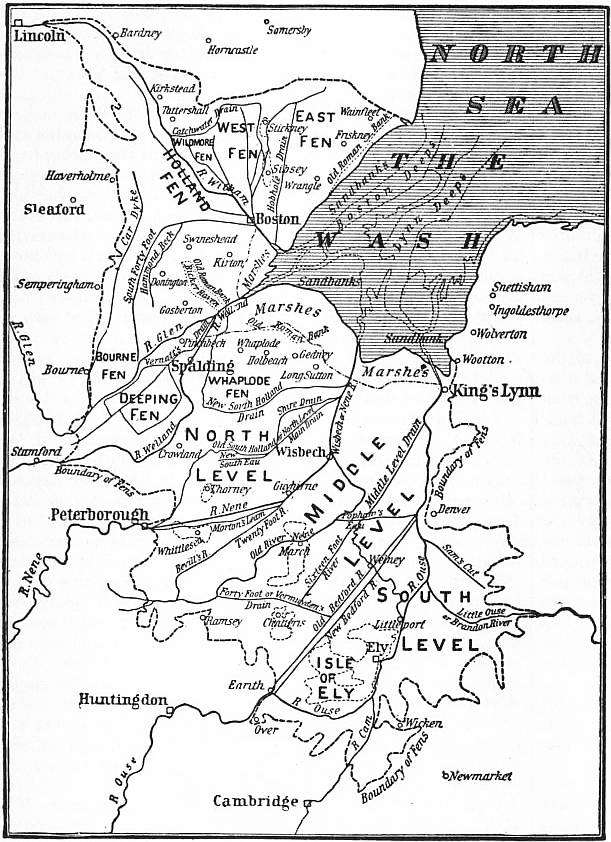
The Fen Rivers.—The preservation of the Fens depends in an intimate and essential manner upon the preservation of the rivers, and especially of their banks. The Witham, known originally as the Grant Avon, also called the Lindis by Leyland (Itinerary, vol. vii. p. 41), and in Jean Ingelow’s High Tide on the Lincolnshire Coast, is some 80 m. long, and drains an area of 1079 sq. m. It owes its present condition to engineering works carried out in the years 1762-1764, 1865, 1881, and especially in 1880-1884. In 1500 the river was dammed immediately above Boston by a large sluice, the effect of which was not only to hinder free navigation up to Lincoln (to which city sea-going vessels used to penetrate in the 14th and 15th centuries), but also to choke the channel below Boston with sedimentary matter. The sluice, or rather a new structure made in 1764-1766, remains; but the river below Boston has been materially improved (1880-1884), first by the construction of a new outfall, 3 m. in length, whereby the channel was not only straightened, but its current carried directly into deep water, without having to battle against the often shifting sandbanks of the Wash; and secondly, by the deepening and regulation of the river-bed up to Boston. The Welland, which is about 70 m. long, and drains an area of 760 sq. m., was made to assume its present shape and direction in 1620, 1638, 1650, 1794, and 1835 and following years. The most radical alteration took place in 1794, when a new outfall was made from the confluence of the Glen (30 m. long) to the Wash, a distance of nearly 3 m. The Nene, 90 m. long, and draining an area of some 1077 sq. m., was first regulated by Bishop Morton, and it was further improved in 1631, 1721, and especially, under plans by Rennie and Telford, in 1827-1830 and 1832. The work done from 1721 onward consisted in straightening the lower reaches of the stream and in directing and deepening the outfall. The Ouse (q.v.) or Great Ouse, the largest of the fenland rivers, seems to have been deflected, at some unknown period, from a former channel connecting via the Old Croft river with the Nene, into the Little Ouse below Littleport; and the courses of the two streams are now linked together by an elaborate network of artificial drains, the results of the great engineering works carried out in the Bedford Level in the 17th century. The old channel, starting from Earith, and known as the Old West river, carries only a small stream until, at a point above Ely, it joins the Cam. The salient features of the plan executed by Vermuyden2 for the earl of Bedford in the years 1632-1653 were as follows: taking the division of the area made in 1697-1698 into (i.) the North Level, between the river Welland and the river Nene; (ii.) the Middle Level, between the Nene and the Old Bedford river (which was made at this time, i.e. 1630); and (iii.) the South Level, from the Old Bedford river to the south-eastern border of the fenland. In the North Level the Welland was embanked, the New South Eau, Peakirk Drain, and Shire Drain made, and the existing main drains deepened and regulated. In the Middle Level the Nene was embanked from Peterborough to Guyhirn, also the Ouse from Earith to Over, both places at the south-west edge of the fenland; the New Bedford river was made from Earith to Denver, and the north side of the Old Bedford river and the south side of the New Bedford river were embanked, a long narrow “wash,” or overflow basin, being left between them; several large feeding-drains were dug, including the Forty Foot or Vermuyden’s Drain, the Sixteen Foot river, Bevill’s river, and the Twenty Foot river; and a new outfall was made for the Nene, and Denver sluice (to dam the old circuitous Ouse) constructed. In the South Level Sam’s Cut was dug and the rivers were embanked. Since that period the mouth of the Ouse has been straightened above and below King’s Lynn (1795-1821), a new straight cut made between Ely and Littleport, the North Level Main Drain and the Middle Level Drain constructed, and the meres of Ramsey, Whittlesey (1851-1852), &c., drained and brought under cultivation. A considerable barge traffic is maintained on the Ouse below St Ives, on the Cam up to Cambridge, the Lark and Little Ouse, and the network of navigable cuts between the New Bedford river and Peterborough. The Nene, though locked up to Northampton, and connected from that point with the Grand Junction canal, is practically unused above Wansford, and traffic is small except below Wisbech.
The effect of the drainage schemes has been to lower the level of the fenlands generally by some 18 in., owing to the shrinkage of the peat consequent upon the extraction of so much of its contained water; and this again has tended, on the one hand, to diminish the speed and erosive power of the fenland rivers, and, on the other, to choke up their respective outfalls with the sedimentary matters which they themselves sluggishly roll seawards.
The Wash.—From this it will be plain that the Wash (q.v.) is being silted up by riverine detritus. The formation of new dry land, known at first as “marsh,” goes on, however, but slowly. During the centuries since the Romans are believed to have constructed the sea-banks which shut out the ocean, it is computed that an area of not more than 60,000 to 70,000 acres has been won from the Wash, embanked, drained and brought more or less under cultivation. The greatest gain has been at the direct head of the bay, between the Welland and the Great Ouse, where the average annual accretion is estimated at 10 to 11 lineal feet. On the Lincolnshire coast, farther north, the average annual gain has been not quite 2 ft.; whilst on the opposite Norfolk coast it has been little more than 6 in. annually. On the whole, some 35,000 acres were enclosed in the 17th century, about 19,000 acres during the 18th, and about 10,000 acres during the 19th century.
The first comprehensive scheme for regulating the outfall channels and controlling the currents of the Fen rivers seems to be that proposed by Nathaniel Kinderley in 1751. His idea3 was to link the Nene with the Ouse by means of a new cut to be made through the marshland, and guide the united stream through a further new cut “under Wotten and Wolverton through the Marshes till over against Inglesthorp or Snetsham, and there discharge itself immediately into the Deeps of Lyn Channel.” In a similar way the Witham, “when it has received the Welland from Spalding,” was to be carried “to some convenient place over against Wrangle or Friskney, where it may be discharged into Boston Deeps.” This scheme was still further improved upon by Sir John Rennie, who, in a report which he drew up in 1839, recommended that the outfalls of all four rivers should be directed by means of fascined channels into one common outfall, and that the land lying between them should be enclosed as rapidly as it consolidated. By this means he estimated that 150,000 acres would be won to cultivation. But beyond one or two abortive or half-hearted attempts, e.g. by the Lincolnshire Estuary Company in 1851, and in 1876 and subsequent years by the Norfolk Estuary Company, no serious effort has ever been made to execute either of these schemes.
Climate.—The annual mean temperature, as observed at Boston, in the period 1864-1885, is 48.7° F.; January, 36.5°; July, 62.8°; and as observed at Wisbech, for the period 1861-1875, 49.1°. The average mean rainfall for the seventy-one years 1830-1900, at Boston, was 22.9 in.; at Wisbech for the fifteen years 1860-1875, 24.2 in., and for the fifteen years 1866-1880, 26.7 in.; and at Maxey near Peterborough, 21.7 for the nineteen years 1882-1900. Previous to the drainage of the Fens, ague, rheumatism, and other ailments incidental to a damp climate were widely prevalent, but at the present day the Fen country is as healthy as the rest of England; indeed, there is reason to believe that it is conducive to longevity.
Historical Notes.—The earliest inhabitants of this region of whom we have record were the British tribes of the Iceni confederation; the Romans, who subdued them, called them Coriceni or Coritani. In Saxon times the inhabitants of the Fens were known (e.g. to Bede) as Gyrvii, and are described as traversing the country on stilts. Macaulay, writing of the year 1689, gives to them the name of Breedlings, and describes them as “a half-savage population ... who led an amphibious life, sometimes wading, sometimes rowing, from one islet of firm ground to another.” In the end of the 18th century those who dwelt in the remoter parts were scarcely more civilized, being known to their neighbours by the expressive term of “Slodgers.” These rude fen-dwellers have in all ages been animated by a tenacious love of liberty. Boadicea, queen of the Iceni, the worthy foe of the Romans; Hereward the Saxon, who defied William the Conqueror; Cromwell and his Ironsides, are representative of the fenman’s spirit at its best. The fen peasantry showed a stubborn defence of their rights, not only when they resisted the encroachments and selfish appropriations of the “adventurers” in the 17th century, in the Bedford Level, in Deeping Fen, and in the Witham Fens, and again in the 18th century, when Holland Fen was finally enclosed, but also in the Peasants’ Rising of 1381, and in the Pilgrimage of Grace in the reign of Henry VIII. So long as the Fens were unenclosed and thickly studded with immense “forests” of reeds, and innumerable marshy pools and “rows” (channels connecting the pools), they abounded in wild fowl, being regularly frequented by various species of wild duck and geese, garganies, polchards, shovelers, teals, widgeons, peewits, terns, grebes, coots, water-hens, water-rails, red-shanks, lapwings, god-wits, whimbrels, cranes, bitterns, herons, swans, ruffs and reeves. Vast numbers of these were taken in decoys4 and sent to the London markets. At the same time equally vast quantities of tame geese were reared in the Fens, and driven by road5 to London to be killed at Michaelmas. Their down, feathers and quills (for pens) were also a considerable source of profit. The Fen waters, too, abounded in fresh-water fish, especially pike, perch, bream, tench, rud, dace, roach, eels and sticklebacks. The Witham, on whose banks so many monasteries stood, was particularly famous for its pike; as were certain of the monastic waters in the southern part of the Fens for their eels. The soil of the reclaimed Fens is of exceptional fertility, being almost everywhere rich in humus, which is capable not only of producing very heavy crops of wheat and other corn, but also of fattening live-stock with peculiar ease. Lincolnshire oxen were famous in Elizabeth’s time, and are specially singled out by Arthur Young,6 the breed being the shorthorn. Of the crops peculiar to the region it must suffice to mention the old British dye-plant woad, which is still grown on a small scale in two or three parishes immediately south of Boston; hemp, which was extensively grown in the 18th century, but is not now planted; and peppermint, which is occasionally grown, e.g. at Deeping and Wisbech. In the second half of the 19th century the Fen country acquired a certain celebrity in the world of sport from the encouragement it gave to speed skating. Whenever practicable, championship and other racing meetings are held, chiefly at Littleport and Spalding. The little village of Welney, between Ely and Wisbech, has produced some of the most notable of the typical Fen skaters, e.g. “Turkey” Smart and “Fish” Smart.
Apart from fragmentary ruins of the former monastic buildings of Crowland, Kirkstead and other places, the Fen country of Lincolnshire (division of Holland) is especially remarkable for the size and beauty of its parish churches, mostly built of Barnack rag from Northamptonshire. Moreover, in the possession of such buildings as Ely cathedral and the parish church of King’s Lynn, other parts of the Fens must be considered only less rich in ecclesiastical architecture. Using these fine opportunities, the Fen folk have long cultivated the science of campanology.
Dialect.—Owing to the comparative remoteness of their geographical situation, and the relatively late period at which the Fens were definitely enclosed, the Fenmen have preserved several dialectal features of a distinctive character, not the least interesting being their close kinship with the classical English of the present day. Professor E.E. Freeman (Longman’s Magazine, 1875) reminded modern Englishmen that it was a native of the Fens, “a Bourne man, who gave the English language its present shape.” This was Robert Manning, or Robert of Brunne, who in or about 1303 wrote The Handlynge Synne. Tennyson’s dialect poems, The Northern Farmer, &c., do not reproduce the pure Fen dialect, but rather the dialect of the Wold district of mid Lincolnshire.
Authorities.—Sir William Dugdale, History of Imbanking and Draining (2nd ed., London, 1772); W. Elstobb, A Historical Account of the Great Level (Lynn, 1793); W. Chapman, Facts and Remarks relative to the Witham and the Welland (Boston, 1800); S. Wells, History and Drainage of the Great Level of the Fens (2 vols., London, 1828 and 1830); P. Thompson, History of Boston (Boston, 1856); Baldwin Latham, Papers on the Drainage of the Fens, read before the Society of Engineers, 3rd November 1862; N. and A. Goodman, Handbook of Fen Skating (London, 1882); Moore, Associated Architectural Societies’ Reports and Papers (1893); Fenland Notes and Queries, and Lincolnshire Notes and Queries, passim; W.H. Wheeler, A History of the Fens of South Lincolnshire, pp. 223 et seq. (2nd ed., Boston, 1897). Various phases of Fen life, mostly of the past, are described in Charles Kingsley’s Hereward the Wake (Cambridge, 1866); Baring Gould’s Cheap-Jack Zita (London, 1893); Manville Fenn’s Dick o’ the Fens (London, 1887); and J.T. Bealby’s A Daughter of the Fen (London, 1896).
(J. T. Be.)
1 The word “fen,” a general term for low marshy land or bog, is common to Teutonic languages, cf. Dutch ven or veen, Ger. Fenne, Fehn, Goth. fani, mud; the Indo-European root is seen in Gr. πῆλος, mud, Lat. palus, marsh. The word “bog” is from the Irish or Gaelic bogach, formed from Celtic bog, soft, and meaning therefore soft, swampy ground.
2 The principles upon which he proceeded are set forth in his Discourse touching the Draining of the Great Fennes (1642), reprinted in Fenland Notes and Queries (1898), pp. 26-38 and 81-87.
3 Set forth in The Present State of the Navigation of the Towns of Lyn, Wisbeach, Spalding and Boston (2nd ed., London, 1851), pp. 82 seq.
4 For descriptions of these see Oldfield, Appendix, pp. 2-4, of A Topographical and Historical Account of Wainfleet (London, 1829); and Miller and Skertchly, The Fenland, pp. 369-375.
5 See De Foe’s account in A Tour through the Eastern Counties, 1722 (1724-1725).
6 General View, pp. 174-194 and 288-304.