VOLUME VIII SLICE X Echinoderma to Edward (continued 7)
Reading edition
Parliament House, begun in 1632 and completed in 1640, in which the later assemblies of the Scottish estates took place until the dissolution of the parliament by the Act of Union of 1707, has since been set apart as the meeting-place of the supreme courts of law. The great hall, with its fine open-timbered oak roof, is adorned with a splendid stained-glass window and several statues of notable men, including one (by Louis François Roubiliac) of Duncan Forbes of Culloden, lord president of the court of session (1685-1747), and now forms the ante-room for lawyers and their clients. The surrounding buildings, including the courtrooms, the Advocates’ and the Signet libraries, are all modern additions. The Advocates’ library is the finest in Scotland. Founded in 1682, at the instance of Sir George Mackenzie, king’s advocate under Charles II., and then dean of the faculty, it is regarded as the national library, and is one of the five entitled by the Copyright Act to receive a copy of every work published in Great Britain.
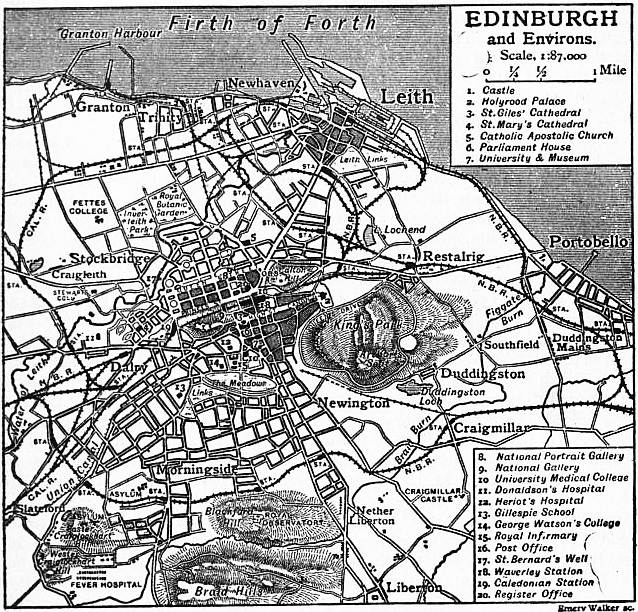
The General Register House for Scotland, begun in 1774 from designs by Robert Adam, stands at the east end of Princes Street. It contains, in addition to the ancient national records, adequate accommodation, in fireproof chambers, for all Scottish title-deeds, entails, contracts and mortgages, and for general statistics, including those of births, deaths and marriages.
The Royal Institution, in the Doric style, surmounted by a colossal stone statue Of Queen Victoria by Sir John Steell, formerly furnished official accommodation for the Board of Trustees for Manufactures and the Board of Fishery, and also for the school of art, and the libraries and public meetings of the Royal Society (founded in 1783), and the Society of Antiquaries of Scotland (founded in 1780). In 1910 it was renamed and appropriated to the uses of the Royal Scottish Academy of Painting, Sculpture and Architecture, which was instituted in 1826, and incorporated by royal charter in 1838, on the model of the Royal Academy in London. It is situated on the Mound close to the National Gallery, of which the prince consort laid the foundation stone in 1850. These collections, especially rich in Raeburn’s works, include also Alexander Nasmyth’s portrait of Robert Burns, Gainsborough’s “The Hon. Mrs. Graham” (see Painting, Plate VI. fig. 20), Sir Noel Paton’s “Quarrel” and “Reconciliation of Oberon and Titania,” several works by William Etty, Robert Scott Lauder and Sam Bough, Sir Edwin Landseer’s “Rent Day in the Wilderness,” and the diploma pictures of the academicians, besides many specimens of the modern Scottish school. The National Portrait Gallery and Antiquarian Museum are housed in Queen Street, in a building designed by Sir Rowand Anderson and constructed at the expense of J.R. Findlay of Aberlour (1824-1898), the government providing the site.
Churches.—In conformity with the motto of the city, Nisi Dominus frustra, there are numerous handsome places of public worship. St Giles’s church, which was effectively restored (1879-1883) by the liberality of Dr William Chambers the publisher, has interesting historical and literary associations. The regent Moray, the marquess of Montrose, and Napier of Merchiston were buried within its walls and are commemorated by monuments, and among the memorial tablets is one to R.L. Stevenson by Augustus St Gaudens. The choir (restored in 1873 by public subscription) is a fine example of 15th-century architecture, and the Gothic crown surmounting the central tower forms one of the most characteristic features in every view of the city. Just outside the church in Parliament Square, the supposed grave of John Knox is indicated by a stone set in the pavement bearing his initials, and in the pavement to the west a heart indicates the site of the old Tolbooth,1 which figures prominently in Scott’s Heart of Midlothian. Other churches having historical associations are the two Greyfriars churches, which occupy the two halves of one building; Tron church, the scene of midnight hilarity at the new year; St Cuthbert’s church; St Andrew’s church in George Street, whence set out, on a memorable day in 1843, that long procession of ministers and elders to Tanfield Hall which ended in the founding of the Free Church; St George’s church in Charlotte Square, a good example of the work of Robert Adam. The United Free Church claims no buildings of much historic interest, but St George’s Free was the scene of the ministrations of Dr Robert S. Candlish (1806-1873), Dr Oswald Dykes (b. 1835), Dr Alexander Whyte (b. 1837), a man of great mark and influence in the city, and his successor Hugh Black (b. 1868). Preachers like Robert Candlish, Thomas Guthrie (1803-1873), Marcus Dods (b. 1834), occupied many pulpits, besides those of the particular congregations whom each served. The most imposing structure belonging to the Scottish Episcopal Church is St Mary’s cathedral, built on ground and chiefly from funds left by the Misses Walker of Coates, and opened for worship in 1879. It is in the Early Pointed style, by Sir Gilbert Scott, is 278 ft. long, and is surmounted by a spire 275 ft. high. The old-fashioned mansion of East Coates, dating from the 17th century, still stands in the close, and is occupied by functionaries of the cathedral. St John’s Episcopal church at the west end of Princes Street was the scene of the ministrations of Dean Ramsay, and St Paul’s Episcopal church of the Rev. Archibald Alison, father of the historian. The Catholic Apostolic church at the foot of Broughton Street is architecturally noticeable, and one of its features is a set of mural paintings executed by Mrs Traquair. The Central Hall at Tollcross testifies to Methodist energy. John Knox’s house at the east end of High Street is kept in excellent repair, and contains several articles of furniture that belonged to the reformer. The Canongate Tolbooth adjoins the parish church, in the burial-ground of which is the tombstone raised by Burns to the memory of Robert Fergusson, and where Dugald Stewart, Adam Smith and other men of note were buried. Almost opposite to it stands Moray House, from the balcony of which the 8th earl of Argyll watched Montrose led to execution (1650). The city gaol, a castellated structure on the black rock of Calton Hill, forms one of the most striking groups of buildings in the town. In the Music Hall in George Street, Carlyle, as lord rector of the university, delivered his stimulating address on books to the students, and Gladstone addressed the electors in his Midlothian campaigns. St Bernard’s Well, on the Water of Leith, was embellished and restored (1888) at the cost of Mr William Nelson. A sum of £100,000 was bequeathed by Mr Andrew Usher (1826-1898) for a hall to be called the Usher Hall and to supplement the municipal buildings. The library of the solicitors to the supreme courts presents to the Cowgate a lofty elevation in red sandstone. The Sheriff Court Buildings stand on George IV. Bridge, and facing them is Mr Andrew Carnegie’s free library (1887-1889). At the corner of High Street and George IV. Bridge stand the County buildings. The Scotsman newspaper is housed in an ornate structure in North Bridge Street, the building of which necessitated the demolition of many old alleys and wynds, such as Fleshmarket Close and Milne Square. Ramsay Gardens, a students’ quarter fostered by Prof. Patrick Geddes (b. 1854), grew out of the “goose-pie” house where Allan Ramsay lived, and with its red-tiled roof and effective lines adds warmth to the view of the Old Town from Princes Street. Not the least interesting structure is the old City Cross (restored at the cost of W.E. Gladstone), which stands in High Street, adjoining St Giles’s. Several of the quaint groups of buildings of Auld Reekie have been carefully restored, such as the White Horse Close in the Canongate; the mass of alleys on the north side of the Lawnmarket, from Paterson’s Close to James’s Court have been connected, and here Lord Rosebery acquired and restored the 17th-century dwelling which figures in the legend of My Aunt Margaret’s Mirror. Another model restoration of a historic close is found in Riddle’s Close, which contains a students’ settlement. If these and other improvements have led to the disappearance of such old-world picturesque buildings as Allan Ramsay’s shop “at the sign of the Mercury, opposite Niddry Wynd,” Cardinal Beaton’s palace, the old Cunzie House, or mint, the beautiful timber-fronted “land” that stood at the head of the West Bow, and even such “howffs” as Clerihugh’s tavern, where Mr Counsellor Pleydell and the rest played the “high jinks” described in Guy Mannering, it must be conceded that the changes in the Old Town (many of a drastic nature) have been carried out with due regard to the character of their environment.
Monuments.—Edinburgh is particularly rich in monuments of every description and quality. Of these by far the most remarkable is the Scott monument in East Princes Street Gardens, designed by George Meikle Kemp (1795-1844); it is in the form of a spiral Gothic cross with a central canopy beneath which is a seated statue of Scott with his dog “Maida” at his side, by Sir John Steell, the niches being occupied by characters in Sir Walter’s writings. A column, 136 ft. high, surmounted by a colossal figure of Viscount Melville, Pitt’s first lord of the Admiralty, rises from the centre of St Andrew Square. At the west end of George Street, in the centre of Charlotte Square, stands the Albert Memorial, an equestrian statue of the prince consort, with groups at each of the four angles of the base. Burns’s monument, in the style of a Greek temple, occupies a prominent position on the Regent Road, on the southern brow of the lower terrace of Calton Hill. It was originally intended to form a shrine for Flaxman’s marble statue of the poet (now in the National Portrait Gallery), but it proved to be too confined to afford a satisfactory view of the sculptor’s work and was at length converted into a museum of Burnsiana (afterwards removed to the municipal buildings). On Calton Hill are a number of finely placed monuments. The stateliest is the national monument to commemorate the victory of Waterloo, originally intended to be a reproduction of the Parthenon. The plan was abandoned for lack of funds, after twelve out of the twenty-four Greek pillars had been erected, but it is perhaps more effective in its unfinished state than if it had been completed. The Nelson monument, an elongated turreted structure, stands on the highest cliff of the hill. Close by is the monument to Dugald Stewart, a copy of the choragic monument of Lysicrates. Sir John Steell’s equestrian statue of the duke of Wellington stands in front of the Register House, and in Princes Street Gardens are statues of Livingstone, Christopher North, Allan Ramsay, Adam Black and Sir J.Y. Simpson. In George Street are Chantrey’s figures of Pitt and George IV., and a statue of Dr Chalmers; the 5th duke of Buccleuch stands beside St Giles’s. Charles II. surveys the spot where Knox was buried; the reformer himself is in the quadrangle of New College: Sir David Brewster adorns the quadrangle of the university; Dr William Chambers is in Chambers Street, and Frederick, duke of York (1763-1827), and the 4th earl of Hopetoun are also commemorated.
Cemeteries.—Obviously the churchyards surrounding the older and more important parish churches—such as Greyfriars’, St Cuthbert’s and the Canongate, contain the greatest number of memorials of the illustrious dead. In Greyfriars’ churchyard the Solemn League and Covenant was signed, and among its many monuments are the Martyrs’ monument, recording the merits of the murdered covenanters, and the tomb of “Bluidy” Mackenzie. To the three named should be added the Calton burying-ground, with its Roman tomb of David Hume, and the obelisk raised in 1844 to the memory of Maurice Margarot, Thomas Muir (1765-1798), Thomas Fyshe Palmer (1747-1802), William Skirving and Joseph Gerrald (1765-1796), the political martyrs transported towards the end of the 18th century for advocating parliamentary reform. The Scottish dead in the American Civil War are commemorated in a monument bearing a life-sized figure of Abraham Lincoln and a freed slave. The cemeteries are all modern. In Warriston cemetery (opened in 1843) in the New Town, were buried Sir James Young Simpson, Alexander Smith the poet, Horatio McCulloch, R.S.A., the landscape painter, the Rev. James Millar, the last Presbyterian chaplain of the castle, and the Rev. James Peddie, the pastor of Bristo Street church. In Dean cemetery, partly laid out on the banks of the Water of Leith, and considered the most beautiful in the city (opened 1845), were interred Lords Cockburn, Jeffrey and Rutherford; “Christopher North,” Professor Aytoun, Edward Forbes the naturalist, John Goodsir the anatomist; Sir William Allan, Sam Bough, George Paul Chalmers, the painters; George Combe, the phrenologist; Playfair, the architect; Alexander Russel, editor of the Scotsman; Sir Archibald Alison, the historian; Captain John Grant, the last survivor of the old Peninsular Gordon Highlanders; Captain Charles Gray, of the Royal Marines, writer of Scottish songs; Lieutenant John Irving, of the Franklin expedition, whose remains were sent home many years after his death by Lieut. Frederick Schwatka, U.S. navy; and Sir Hector Macdonald, “Fighting Mac” of Omdurman. In the south side are the Grange, Newington or Echobank, and Morningside cemeteries. In the Grange repose the ashes of Chalmers, Guthrie and Lee, Sir Thomas Dick Lauder, Sir Hope Grant, Hugh Miller and the 2nd Lord Dunfermline.
Parks and Open Spaces.—Edinburgh is exceptionally well provided with parks and open spaces. The older are Princes Street Gardens, covering the old Nor’ Loch, Calton Hill, the Meadows and the Bruntsfield Links. The municipal golf links are on the Braid Hills. On the southern side Blackford Hill has been set apart for public use. Here stands the Royal Observatory, in which the great Dunecht telescope was erected in 1896. Harrison Park is a breathing spot for the congested district of Fountainbridge, and the park at Saughton Hall, opened in 1905, for the western district of the city. To the north of the Water of Leith lie Inverleith Park, the Arboretum and the Royal Botanical Garden. This institution has undergone four changes of site since its foundation in 1670 by Sir Andrew Balfour and Sir Robert Sibbald, and now occupies an area of 34 acres in Inverleith Row. It includes a herbarium and palm house, with an extensive range of hot-houses, a museum of economic botany, a lecture-room and other requisites for the study of botany. The most important open spaces, however, surround Arthur’s Seat (822 ft.). This basaltic hill, the name of which is believed to commemorate the British king Arthur, who from its height is said to have watched the defeat of the Picts by his followers, is shaped like a lion couchant, with head towards the north. It is separated from the narrow valley, in which lie the Canongate and Holyrood Palace, by Salisbury Crags, named after Edward III.’s general William Montacute, 1st earl of Salisbury (1301-1344). At their base is the Queen’s Drive (3½ m. long), named by Queen Victoria. Adjoining Holyrood Palace is the King’s Park, used as a parade ground. Facing the crags on the south-west are the spots familiar to readers of The Heart of Midlothian, where stood Jeanie Deans’s cottage, and between the crags and Arthur’s Seat lies Hunter’s Bog, used as a shooting range. Near here too are three small lakes, Duddingston, Dunsappie and St Margaret’s, the last overlooked by the ruins of St Anthony’s chapel.
Environs.—In several directions many places once to be described among the environs have practically become suburbs of Edinburgh. Newhaven (population of parish, 7636), so called from the harbour constructed in the reign of James IV., had a shipbuilding yard of some repute in former times. The village has always been a fishing-place of importance, the “fishwives” in their picturesque garb being, till recently, conspicuous figures in the streets of the capital. It used to be a popular resort for fish dinners, and it plays a prominent part in Charles Reade’s novel of Christie Johnstone. To the west lies Granton (pop. 1728), where the 5th duke of Buccleuch constructed a magnificent harbour. Before the building of the Forth Bridge the customary approach to Fifeshire and the north-east of Scotland was by means of a steam ferry from Granton to Burntisland, which is still used to some extent. There is regular communication with Iceland, the continental ports and London. A marine station here was established by Sir John Murray, but has been discontinued. Still farther west lies the village of Cramond (pop. of parish, 3815), at the mouth of the river Almond, where Roman remains have often been found. It was the birthplace of several well-known persons, among others of John Law (1671-1729), originator of the Mississippi scheme, Lauriston Castle being situated in the parish. Cramond Brig was the scene of one of the “roving” adventures of James V., when the life of the “Gudeman of Ballengeich” was saved by Jock Howieson of the Braehead. Corstorphine (pop. 2725), once noted for its cream and also as a spa, is now to all intents and purposes a western suburb of the capital. The parish church contains the tombs of the Forresters, of old the leading family of the district, with full-length sculptured figures, and at the base of Corstorphine Hill—from one point of which (“Rest and be Thankful”) is to be had one of the best views of Edinburgh—are the seats of several well-known families. Among these are Craigcrook Castle (where Lord Jeffrey spent many happy years, and the gardens of which are said to have given Scott a hint for Tullyveolan in Waverley), and Ravelston House, the home of the Keiths. To the south of the metropolis are Colinton (pop. 5499), on the Water of Leith, with several mansions that once belonged to famous men, such as Dreghorn Castle and Bonally Tower; and Currie (pop. 2513), which was a Roman station and near which are Curriehill Castle (held by the rebels against Queen Mary), the ruins of Lennox Tower, and Riccarton, the seat of the Gibson-Craigs, one of the best-known Midlothian families. At Dalmahoy Castle, near Ratho (pop. 1946), the seat of the earl of Morton, are preserved the only extant copy of the bible of the Scottish parliament and the original warrant for committing Queen Mary to Lochleven Castle in Kinross-shire. Craigmillar, though situated in the parish of Liberton, is really a part of Edinburgh. Its picturesque castle, at least the oldest portion of it, probably dates from the 12th century. Its principal owners were first the Prestons and latterly the Gilmours. After playing a varied rôle in local and national story, now as banqueting-house and now as prison, it fell gradually into disrepair. It was advertised as to let in 1761, and early in the 19th century, along with the chapel adjoining, was in ruins, but has been restored by Colonel Gordon-Gilmour. It was a favourite residence of Mary Stuart, and its associations with the hapless queen give it a romantic interest. Duddingston (pop. 2023), once a quiet village, has become a centre of the distilling and brewing industries. The parish church, effectively situated on an eminence by the side of the lake, was the scene of the ministration of the Rev. John Thomson (1778-1840), the landscape painter, who numbered Sir Walter Scott among his elders. Duddingston House is a seat of the duke of Abercorn. Liberton (pop. of parish, 7233), a name that recalls the previous existence of a leper’s hospital, is prominently situated on the rising ground to the south of Edinburgh, the parish church being a conspicuous landmark. Adjoining is the village of Gilmerton (pop. 1482), which used to supply Edinburgh with yellow sand, when sanded floors were a feature in the humbler class of houses. Portobello (pop. 9180), being within 3 m. of the capital, must always enjoy a large share of public patronage, though it is not in such favour as a watering-place as it once was. Its beautiful stretch of sands is flanked by a promenade extending all the way to Joppa. The beach was at one time used for the purpose of reviews of the yeomanry. The town dates from the middle of the 18th century, when a cottage was built by a sailor and named Portobello in commemoration of Admiral Vernon’s victory in 1739. The place does a considerable trade in the making of bricks, bottles, earthenware, pottery, tiles and paper. Joppa, which adjoins it, has salt works, but is chiefly a residential neighbourhood. Inveresk (pop. 2939), finely situated on the Esk some 6 m. from Edinburgh, is a quaint village with several old-fashioned mansions and beautiful gardens. Alexander Carlyle, the famous divine (1772-1805), whose Memorials of his Times still affords fascinating reading, ministered for fifty-five years in the parish church, in the graveyard of which lies David Macbeth Moir (1798-1851), who under the pen-name of “Delta” wrote Mansie Wauch, a masterpiece of Scots humour and pathos. Lasswade (pop. of parish, 9708), partly in the Pentlands, famous for its oatmeal, was often the summer resort of Edinburgh worthies. Here Sir Walter Scott lived for six years and De Quincey for nineteen, and William Tennant (1784-1848), author of Anster Fair, was the parish dominie. Many interesting mansions were and are in the vicinity, amongst them Melville Castle, the seat of the Dundas Melvilles, and Auchendinny, where Henry Mackenzie, author of The Man of Feeling, resided. The two most celebrated resorts, however, amongst the environs of Edinburgh are Roslin (pop. 1805) and Hawthornden. Roslin Castle is romantically situated on the beautifully wooded precipitous banks of the Esk. It dates from the 12th century and is a plain, massive ruin, architecturally insignificant. Partially destroyed by fire in 1447 and afterwards rebuilt, it was sacked in 1650 and again in 1688, and then gradually fell into decay. The chapel, higher up the bank, a relic of great beauty, was founded in 1446 by William St Clair, 3rd earl of Orkney. It is believed to be the chancel of what was intended to be a large church. Although it suffered at the hands of revolutionary fanatics in 1688, the damage was confined mainly to the external ornament, and the chapel, owing to restoration in judicious taste, is now in perfect condition. The Gothic details are wonderful examples of the carver’s skill, the wreathed “Prentice’s pillar” being the subject of a well-known legend. The walk to Hawthornden, about 1½ m. distant, through the lovely glen by the river-side, leads to the mansion of the Drummonds, perched high on a lofty cliff falling sheer to the stream. The caverns in the sides of the precipice are said to have afforded Wallace and other heroes (or outlaws) refuge in time of trouble, but the old house is most memorable as the home of the poet William Drummond, who here welcomed Ben Jonson; the tree beneath which the two poets sat still stands. Near Swanston, on the slopes of the Pentlands, where R.L. Stevenson when a boy used to make holiday occasionally, is a golf-course which was laid out by the Lothianburn Club. The Pentland range contains many points of interest and beauty, but these are mostly accessible only to the pedestrian, although the hills are crossed by roads, of which the chief are those by Glencorse burn and the Cauld Stane Slap. Habbie’s Howe, the scene of Allan Ramsay’s pastoral The Gentle Shepherd, is some 2 m. from Carlops, and Rullion Green is noted as the field on which the Covenanters were defeated in 1666. At Penicuik (pop. 5097), where the Clerks were long the ruling family, S.R. Crockett was minister until he formally devoted himself to fiction. The town is, industrially, remarkable for its paper mills and mines of coal and other minerals.
Communications.—The two trunk railways serving Edinburgh are the North British and the Caledonian. The North British station is Waverley, to which the trains of the Great Northern, North Eastern and the Midland systems run from England. The Caledonian station is Princes Street, where the through trains from the London & North-Western system of England arrive. Leith, Granton and Grangemouth serve as the chief passenger seaports for Edinburgh. Tramways connect the different parts of the city with Leith, Newhaven, Portobello and Joppa; and the Suburban railway, starting from Waverley station, returns by way of Restalrig, Portobello, Duddingston, Morningside and Haymarket. In summer, steamers ply between Leith and Aberdour and other pleasure resorts; and there is also a service to Alloa and Stirling. In the season brakes constantly run to Queensferry (for the Forth Bridge) and to Roslin, and coaches to Dalkeith, Loanhead and some Pentland villages.
Population.—In 1801 the number of inhabitants was 66,544; in 1851 it was 160,302; in 1881 it was 234,402; and in 1901 it was 316,479. In 1900 the birth-rate was 26.90 per thousand, 7.8% of the births being illegitimate; the death-rate was 19.40 per thousand, and the marriage-rate 10 per thousand.
The area of the city has been enlarged by successive extensions of its municipal boundaries, especially towards the west and south. An important accession of territory was gained in 1896, when portions of the parishes of Liberton and Duddingston and the police burgh of Portobello were incorporated. Under the Edinburgh Corporation Act 1900, a further addition of nearly 1800 acres was made. This embraced portions of South Leith parish (landward) and of Duddingston parish, including the village of Restalrig and the ground lying on both sides of the main road from Edinburgh to Portobello; and also part of Cramond parish, in which is contained the village and harbour of Granton. The total area of the city is 10,597½ acres. The increase in wealth may best be measured by the rise in assessed valuation. In 1880 the city rental was £1,727,740, in 1890 it was £2,106,395, and in 1900-1901 £2,807,122.
Government.—By the Redistribution Act of 1885 the city was divided for parliamentary purposes into East, West, Central and South Edinburgh, each returning one member; the parliamentary and municipal boundaries are almost identical. The town council, which has its headquarters in the Municipal Buildings in the Royal Exchange, consists of fifty members, a lord provost, seven bailies, a dean of guild, a treasurer, a convener of trades, seven judges of police, and thirty-two councillors. The corporation has acquired the gas-works, the cable tramways (leased to a company), the electric lighting of the streets, and the water-supply from the Pentlands (reinforced by additional sources in the Moorfoot Hills and Talla Water). Among other duties, the corporation has a share in the management of the university, and maintains the Calton Hill observatory.
May Meetings.—During the establishment of Episcopacy in Scotland, Edinburgh was the seat of a bishop, and the ancient collegiate church of St Giles rose to the dignity of a cathedral. But the annual meeting of the General Assembly of the Church of Scotland at Edinburgh is now the public manifestation of the predominance of Presbyterianism as the national church. In May each year the sovereign appoints a representative as lord high commissioner to the General Assembly of the Established Church, who takes up his abode usually in the palace of Holyrood, and thence proceeds to the High Church, and so to the assembly hall on the Castle Hill. The lord provost and magistrates offer to him the keys of the city, and levees, receptions and state dinners revive in some degree the ancient glories of Holyrood. The General Assembly of the United Free Church is usually held at the same time.
University.—The university of Edinburgh, the youngest of the Scottish universities, was founded in 1583 by a royal charter granted by James IV., and its rights, immunities and privileges have been remodelled, ratified and extended at various periods. In 1621 an act of the Scottish parliament accorded to the university all rights and privileges enjoyed by other universities in the kingdom, and these were renewed under fresh guarantees in the treaty of union between England and Scotland, and in the Act of Security. Important changes were made in the constitution by acts passed in 1858 and 1889. It was one of the first universities to admit women students to its classes and degrees, and its alumni are brought into close bonds of sympathy and activity by a students’ union. The number of students averages nearly three thousand a year. As a corporation it consists of a chancellor, vice-chancellor, lord rector (elected by the students every three years), principal, professors, registered graduates and matriculated students. The chancellor is elected for life by the general council, of which he is head; and the rights of the city as the original founder have been recognized by giving to the town council the election of four of the seven curators, with whom rest the appointment of the principal, the patronage of seventeen of the chairs, and a share in other appointments. Along with that of St Andrews, the university sends one member to parliament. While the college, as such, bears the name of the College of King James, or King’s college, and James VI. is spoken of as its founder, it really originated in the liberality of the citizens of Edinburgh. William Little of Craigmillar, and his brother Clement Little, advocate, along with James Lawson, the colleague and successor of John Knox, may justly be regarded as true founders. In 1580 Clement Little gave all his books, three hundred volumes, for the beginning of a library, and this was augmented by other valuable benefactions, one of the most interesting of which was the library of Drummond of Hawthornden. The library now contains upwards of 220,000 volumes, and more than 7000 MSS. The buildings of the university occupy the site of the ancient collegiate church of St. Mary in the Field (the “Kirk of Field”), the scene of the murder of Darnley. The present structure, the foundation-stone of which was laid in 1789, is a classical building, enclosing an extensive quadrangle. The older parts of it, including the east front, are from the design of Robert Adam, his plans being revised and modified by W.H. Playfair (1789-1857), but it was not till 1883 that the building was completed by the dome, crowned by the bronze figure of Youth bearing the torch of Knowledge, on the façade in South Bridge Street. This edifice affords accommodation for the lecture rooms in the faculties of arts, law and theology, and for the museums and library. The opening up of the wide thoroughfare of Chambers Street, on the site of College Wynd and Brown and Argyll Squares, cleared the precincts of unsightly obstructions and unsavoury neighbours. The Royal Scottish Museum, structurally united to the university, contains collections illustrative of industry, art, science and natural history; and Minto House college and Heriot-Watt college are practically adjuncts of the university. The library hall was restored and decorated, largely through the generosity of Sir William Priestley (1829-1900), formerly M.P. for the university; while munificent additions to the academic funds and resources were made by the 15th earl of Moray (1840-1901), Sir William Fraser (1816-1898), and others. The university benefits also, like the other Scottish universities, from Mr Andrew Carnegie’s endowment fund. The medical school stands in Teviot Row, adjoining George Square and the Meadows. To this spacious and well-equipped group of buildings the faculty of medicine was removed from the college. The medical school is in the Italian Renaissance style from the designs of Sir Rowand Anderson. The magnificent hall used for academic and public functions was the gift of William M’Ewan, some time M.P. for the Central division of Edinburgh. Closely associated with the medical school, and separated from it by the Middle Meadow Walk, is the Royal Infirmary, designed by David Bryce, R.S.A. (1803-1876), removed hither from Infirmary Street. Its wards, in which nearly ten thousand patients receive treatment annually, are lodged in a series of turreted pavilions, and cover a large space of ground on the margin of the Meadows, from which, to make room for it, George Watson’s College—the most important of the Merchant Company schools—was removed to a site farther west, while the Sick Children’s hospital was moved to the southern side of the Meadows.
Scientific Institutions.—The old Observatory is a quaint structure on Calton Hill, overlooking the district at the head of Leith Walk. The City Observatory stands close by, and on Blackford Hill is the newer building of the Royal Observatory. The Astronomer-Royal for Scotland also holds the chair of practical astronomy.
The museum and lecture-rooms of the Royal College of Surgeons occupy a handsome classical building in Nicolson Street. The college is an ancient corporate body, with a charter of the year 1505, and exercises the powers of instructing in surgery and of giving degrees. Its graduates also give lectures on the various branches of medicine and science requisite for the degree of doctor of medicine, and those extra-academical courses are recognized, under certain restrictions, by the University Court, as qualifying for the degree. The museum contains a valuable collection of anatomical and surgical preparations.
The Royal College of Physicians is another learned body organized, with special privileges, by a charter of incorporation granted by Charles II. in 1681. In their hall in Queen Street are a valuable library and a museum of materia medica. But the college as such takes no part in the educational work of the university.
Educational Institutions.—After the Disruption in 1843, and the formation of the Free Church, New College was founded in connexion with it for training students in theology. Since the amalgamation of the United Presbyterian and the Free Churches, under the designation of the United Free Church of Scotland, New College is utilized by both bodies. New College buildings, designed in the Pointed style of the 16th century, and erected on the site of the palace of Mary of Guise, occupy a prominent position at the head of the Mound.
Edinburgh has always possessed exceptional educational facilities. The Royal high school, the burgh school par excellence, dates from the 16th century, but the beautiful Grecian buildings on the southern face of Calton Hill, opened in 1829, are its third habitation. It was not until 1825, when the Edinburgh Academy was opened, that it encountered serious rivalry. Fettes College, an imposing structure in a 16th-century semi-Gothic style, designed by David Bryce and called after its founder Sir William Fettes (1750-1836), is organized on the model of the great English public schools. Merchiston Academy, housed in the old castle of Napier, the inventor of logarithms, is another institution conducted on English public school lines. For many generations the charitable foundations for the teaching and training of youth were a conspicuous feature in the economy of the city. Foremost among them was the hospital founded by George Heriot—the “Jingling Geordie” of Scott’s Fortunes of Nigel—the goldsmith and banker of James VI. At his death in 1624 Heriot left his estate in trust to the magistrates and ministers of Edinburgh for the maintenance and teaching of poor fatherless sons of freemen. The quadrangular edifice in Lauriston, sometimes ascribed to Inigo Jones, is one of the noblest buildings in the city. Even earlier than Heriot’s hospital was the Merchant Maiden hospital, dating from 1605, which gave to the daughters of merchants similar advantages to those which Heriot’s secured for burgesses’ sons. In 1738 George Watson’s hospital for boys was founded; then followed the Trades’ Maiden hospital for burgesses’ daughters, John Watson’s, Daniel Stewart’s, the Orphans’, Gillespie’s,2 Donaldson’s3 hospitals, and other institutions founded by successful merchants of the city, in which poor children of various classes were lodged, boarded and educated. Nearly all these buildings are characterized by remarkable distinction and beauty of design. This is especially true of Donaldson’s hospital at the Haymarket, which has accommodation for three hundred children. As the New Town expanded, the Heriot Trust—whose revenues were greatly benefited thereby—erected day-schools in different districts, in which thousands of infants and older children received a free education, and, in cases of extreme poverty, a money grant towards maintenance. Public opinion as to the “hospital” system of board and education, however, underwent a revolutionary change after the Education Act of 1872 introduced school boards, and the Merchant Company—acting as governors for most of the institutions—determined to board out the children on the foundation with families in the town, and convert the buildings into adequately equipped primary and secondary day-schools. This root-and-branch policy proved enormously successful, and George Watson’s college, Stewart’s college, Queen Street ladies’ college, George Square ladies’ college, Gillespie’s school, and others, rapidly took a high place among the educational institutions of the city. Nor did the Heriot Trust neglect the claims of technical and higher education. The Heriot-Watt college is subsidized by the Trust, and Heriot’s hospital is occupied as a technical school. Concurrently with this activity in higher branches, the school board provided a large number of handsome buildings in healthy surroundings. The Church of Scotland and the United Free Church have training colleges.
Charities.—Besides the Royal Infirmary there are a considerable number of more or less specialized institutions, two of the most important being situated at Craiglockhart. On the Easter Hill stands the Royal Edinburgh asylum for the insane, which formerly occupied a site in Morningside, while the City infectious diseases hospital is situated at Colinton Mains. The Royal blind asylum at Powburn in its earlier days tenanted humbler quarters in Nicolson Street. Chalmers’s hospital in Lauriston was founded in 1836 by George Chalmers for the reception of the sick and injured. The home for incurables is situated in Salisbury Place. The infirmary convalescents are sent to the convalescent house in Corstorphine. Other institutions are the Royal hospital for sick children, the home for crippled children, the Royal maternity hospital, and the deaf and dumb asylum. Though Trinity hospital no longer exists as a hospital with resident pensioners, the trustees disburse annually pensions to certain poor burgesses and their wives and children; and the trust controlling the benevolent branch of the Gillespie hospital endowment is similarly administered.
Industries.—Although Edinburgh is a residential rather than a manufacturing or commercial centre, the industries which it has are important and flourishing. From 1507, when Walter Chapman, the Scottish Caxton, set up the first press, to the present day, printing has enjoyed a career of almost continuous vitality, and the great houses of R. & R. Clark, T. & A. Constable, the Ballantyne Press, Morrison & Gibb, Turnbull & Spears, and others, admirably maintain the traditional reputation of the Edinburgh press. Publishing, on the other hand, has drifted away, only a few leading houses—such as those of Blackwood, Chambers and Nelson—still making the Scottish capital their headquarters. Mapmakers, typefounders, bookbinders and lithographers all contribute their share to the prosperity of the city. Brewing is an industry of exceptional vigour, Edinburgh ale being proverbially good. The brewers and distillers, such as M’Ewan, Usher and Ure, have been amongst the most generous benefactors of the city. The arts and crafts associated with furniture work, paper-making and coach-building may also be specified, whilst tanneries, glassworks, india-rubber and vulcanite factories, brass-founding, machinery works, the making of biscuits, tea-bread and confectionery are all prominent. In consequence of the large influx of tourists every year the North British and Caledonian railway companies give employment to an enormous staff. Building and the allied trades are chronically brisk, owing to the constant development of the city. Fine white freestone abounds in the immediate vicinity (as at Craigleith, from the vast quarry of which, now passing into disuse, the stone for much of the New Town was obtained) and furnishes excellent building material; while the hard trap rock, with which the stratified sandstones of the Coal formation have been extensively broken up and overlaid, supplies good materials for paving and road-making. On this account quarrying is another industry which is seldom dormant. Owing to the great changes effected during the latter part of the 19th century, some of the old markets were demolished and the system of centralizing trade was not wholly revived. The Waverley Market for vegetables and fruit presents a busy scene in the early morning, and is used for monster meetings and promenade and popular concerts. Slaughter-houses, cattle markets and grain markets have been erected at Gorgie, thus obviating the driving of flocks and herds through the streets, which was constantly objected to. An infantry regiment is always stationed in the castle, and there are in addition the barracks at Piers-hill (or “Jock’s Lodge”), half-way between Edinburgh and Portobello.
Social Life.—Edinburgh society still retains a certain old-fashioned Scottish exclusiveness. It has been said that the city is “east-windy” and the folk “west-endy.” But this criticism needs judicious qualification. The local patriotism and good taste of the citizens have regulated recreation and have also preserved in pristine vigour many peculiarly Scottish customs and pastimes. Classical concerts and concerts of the better sort, chiefly held in the M’Ewan and Music Halls, are well attended, and lectures are patronized to a degree unknown in most towns. In theatrical matters in the old days of stock companies the verdict of an Edinburgh audience was held to make or mar an actor or a play. This is no longer the case, but the Lyceum theatre in Grindlay Street and the Theatre Royal at the head of Leith Walk give good performances. Variety entertainments are also in vogue, and in Nicolson Street and elsewhere there are good music halls. Outdoor recreations have always been pursued with zest. The public golf-course on Braid Hills and the private courses of the Lothianburn club at Swanston and the Barnton club at Barnton are usually full on Saturdays and holidays. The numerous bowling-greens are regularly frequented and are among the best in Scotland—the first Australian team of bowlers that visited the mother country (in 1901) pronouncing the green in Lutton Place the finest on which they had played. Cricket is played by the university students, at the schools, and by private clubs, of which the Grange is the oldest and best. In winter the game of curling is played on Duddingston Loch, and Dunsappie, St Margaret’s Loch, Lochend and other sheets of water are covered with skaters. Rugby football is in high favour, Edinburgh being commonly the scene of the international matches when the venue falls to Scotland. Hockey claims many votaries, there usually being on New Year’s day a match at shinty, or camanachd, between opposing teams of Highlanders resident in the city. The central public baths in Infirmary Street, with branch establishments in other parts of the town, including Portobello, are largely resorted to, and the proximity of the Firth of Forth induces the keener swimmers to visit Granton every morning. Facilities for boating are limited (excepting on the Forth), but rowing clubs find opportunity for practice and races on the Union Canal, where, however, sailing is scarcely possible. Edinburgh maintains few newspapers, but the Scotsman, which may be said to reign alone, has enjoyed a career of almost uninterrupted prosperity, largely in consequence of a succession of able editors, like Charles Maclaren, Alexander Russel, Robert Wallace and Charles Cooper. The Edinburgh Evening News and the Evening Dispatch are popular sheets. In the past the Edinburgh Evening Courant, the chief organ of the Tory party, of which James Hannay was editor for a few years, had a high reputation. The Witness, edited by Hugh Miller, the Daily Review, edited first by J.B. Manson and afterwards by Henry Kingsley, and the Scottish Leader, were conducted more or less as Liberal organs with a distinct bias in favour of the then Free Church, but none of these was long-lived. Volunteering has always attracted the younger men, and the highest awards at Wimbledon and Bisley have been won by the Queen’s Edinburgh.
History.—In remote times the seaboard from the Tyne to the Forth was occupied by the Ottadeni, a Welsh tribe of the Brigantes, the territory immediately to the west of it being peopled by the Gadeni. It is probable that the Ottadeni built a fort or camp on the rock on which Edinburgh Castle now stands, which was thus the nucleus around which, in course of time, grew a considerable village. Under the protection of the hill-fort, a native settlement was established on the ridge running down to the valley at the foot of Salisbury Crags, and another hamlet, according to William Maitland (1693-1757), the earliest historian of Edinburgh, was founded in the area at the north-western base of the rock, a district that afterwards became the parish of St Cuthbert, the oldest in the city. The Romans occupied the country for more than three hundred years, as is evidenced by various remains; but James Grant (1822-1887), in Old and New Edinburgh, doubts whether they ever built on the castle rock. When they withdrew, the British tribes reasserted their sway, and some authorities go so far as to suggest that Arthur was one of their kings. The southern Picts ultimately subdued the Britons, and the castle became their chief stronghold until they were overthrown in 617 (or 629) by the Saxons under Edwin, king of Northumbria, from whom the name of Edinburgh is derived. Symeon of Durham (854) calls it Edwinesburch, and includes the church of St Cuthbert within the bishopric of Lindisfarne. Its Gaelic name was Dunedin. This name is probably a translation of the Saxon name. James Grant’s view that it may have been the earlier name of the castle, from dun (“the fort”), and edin (“on the slope”), conflicts with the more generally received opinion that the Britons knew the fortress as Castelh Mynedh Agnedh (“the hill of the plain”), a designation once wrongly interpreted as the “castle of the maidens” (castrum puellarum), in allusion to the supposed fact that the Pictish princesses were lodged within it during their education. In the 16th century the latinized form Edina was invented and has been used chiefly by poets, once notably by Burns, whose “Address” begins “Edina! Scotia’s darling seat.” Long after Edwin’s conquest the lowland continued to be debatable territory held by uncertain tenure, but at length it was to a large extent settled anew by Anglo-Saxon and Norman colonists under Malcolm Canmore and his sons.
In the reign of Malcolm Canmore the castle included the king’s palace. There his pious queen, Margaret, the grand-niece of Edward the Confessor, died in 1093. It continued to be a royal residence during the reigns of her three sons, and hence the first rapid growth of the upper town may be referred to the 12th century. The parish church of St Giles is believed to have been erected in the reign of Alexander I., about 1110, and the huge Norman keep of the castle, built by his younger brother, David I., continued to be known as David’s Tower till its destruction in the siege of 1572. Soon after his accession to the Scottish throne David I. founded the abbey of Holyrood (1128), which from an early date received the court as its guests. But notwithstanding the attractions of the abbey and the neighbouring chase, the royal palace continued for centuries to be within the fortress, and there both the Celtic and Stuart kings frequently resided. Edinburgh was long an exposed frontier town within a territory only ceded to Malcolm II. about 1020; and even under the earlier Stuart kings it was still regarded as a border stronghold. Hence, though the village of Canongate grew up beside the abbey of David I., and Edinburgh was a place of sufficient importance to be reckoned one of the four principal burghs as a judicatory for all commercial matters, nevertheless, even so late as 1450, when it became for the first time a walled town, it did not extend beyond the upper part of the ridge which slopes eastwards from the castle. So long, however, as its walls formed the boundary, and space therefore was limited, the citizens had to provide house-room by building dwellings of many storeys. These tall tenements on both sides of what is now High Street and Canongate are still a prominent characteristic of the Old Town. The streets were mostly very narrow, the main street from the castle to Holyrood Palace and the Cowgate alone permitting the passage of wheeled carriages. In the narrow “wynds” the nobility and gentry paid their visits in sedan chairs, and proceeded in full dress to the assemblies and balls, which were conducted with aristocratic exclusiveness in an alley on the south side of High Street, called the Assembly Close, and in the assembly rooms in the West Bow. Beyond the walls lay the burghs of Calton, Easter and Wester Portsburgh, the villages of St Cuthbert’s, Moutrie’s Hill, Broughton, Canonmills, Silvermills and Deanhaugh—all successively swallowed up in the extension of the modern city. The seaport of Leith, though a distinct burgh, governed by its own magistrates, and electing its own representative to parliament, has also on its southern side become practically united to its great neighbour.
The other three royal burghs associated with Edinburgh were Stirling, Roxburgh and Berwick; and their enactments form the earliest existing collected body of Scots law. The determination of Edinburgh as the national capital, and as the most frequent scene of parliamentary assemblies, dates from the death of James I. in 1436. Of the thirteen parliaments summoned by that sovereign, only one, the last, was held at Edinburgh, but his assassination in the Blackfriars’ monastery at Perth led to the abrupt transfer of the court and capital from the Tay to the Forth. The coronation of James II. was celebrated in Holyrood Abbey instead of at Scone, and the widowed queen took up her residence, with the young king, in the castle. Of fourteen parliaments summoned during this reign, only one was held at Perth, five met at Stirling and the rest at Edinburgh; and, notwithstanding the favour shown for Stirling as a royal residence in the following reign, every one of the parliaments of James III. was held at Edinburgh. James II. conferred on the city various privileges relating to the holding of fairs and markets, and the levying of customs; and by a royal charter of 1452 he gave it pre-eminence over the other burghs. Further immunities and privileges were granted by James III.; and by a precept of 1482, known as the Golden Charter, he bestowed on the provost and magistrates the hereditary office of sheriff, with power to hold courts, to levy fines, and to impose duties on all merchandise landed at the port of Leith. Those privileges were renewed and extended by various sovereigns, and especially by a general charter granted by James VI. in 1603.
James III. was a great builder, and, in the prosperous era which followed his son’s accession to the throne, the town reached the open valley to the south, with the Cowgate as its chief thoroughfare. But the death of James IV. in 1513, along with other disastrous results of the battle of Flodden, brought this era of prosperity to an abrupt close. The citizens hastened to construct a second line of wall, enclosing the Cowgate and the heights beyond, since occupied by Greyfriars churches and Heriot’s hospital, but still excluding the Canongate, as pertaining to the abbey of Holyrood. In the 16th century the movements connected with John Knox and Mary, queen of Scots, made Edinburgh a castle of much activity. With the departure, however, of the sixth James to fill the English throne in 1603, the town lost for a long period its influence and prestige. Matters were not bettered by the Act of Union signed in a cellar in High Street in 1707, amidst the execrations of the people, and it was not till the hopes of the Jacobites were blasted at Culloden (1746) that the townsfolk began to accept the inevitable. This epoch, when grass grew even in High Street, long lingered in the popular memory as the “dark age.”
By the accession of George III. (1760), Edinburgh showed signs of revived enterprise. In 1763 the first North Bridge, connecting the Old Town with the sloping ground on which afterwards stood the Register House and the theatre in Shakespeare Square, was opened; a little later the Nor’ Loch was partially drained, and the bridging of the Cowgate in 1785 encouraged expansion southwards. Towards the end of the 18th century the New Town began to take shape on the grand, if formal, lines which had been planned by James Craig (d. 1795), the architect, nephew of the poet Thomson, and the erection of Regent Bridge in Waterloo Place (formally opened in 1819 on the occasion of the visit of Prince Leopold, afterwards king of the Belgians) gave access to Calton Hill. The creation of Princes Street, one of the most beautiful thoroughfares in the world, led to further improvement. The earth and débris from the excavation of the sites for the houses in this and adjoining streets had been “dumped” in the centre of the drained Nor’ Loch. This unsightly mass of rubbish lay for a while as an eye-sore, until the happy thought arose of converting it into a broad way joining the new road at Hanover Street with the Old Town at the Lawnmarket. Upon this street, which divides Princes Street and its gardens into east and west, and which received the title of the Mound, were erected the National Gallery and the Royal Institution. Speaking generally, the New Town was resorted to by professional men—lawyers, doctors and artists,—and in its principal streets will be found the head offices of the leading banks and insurance offices, all lodged in buildings of remarkable architectural pretensions. The Commercial, the Union and the Clydesdale banks are in George Street, the National Bank of Scotland, the Royal Bank of Scotland, and the British Linen Company’s Bank are in St Andrew Square, the Bank of Scotland is at the head of the Mound. The extensive building operations engaged in by the town council in the early part of the 19th century resulted in the insolvency of the city in 1833. The property of the corporation was valued at £271,658 against a debt of £425,195, which was compounded for by the issue of 3% annuity bonds—the loss to the creditors amounting to 25% of their claims.
Meanwhile the progress of letters, science and learning manifested the recovery of the city. The names of Knox (d. 1572), Buchanan (1582), Alexander Montgomery (1605), Drummond of Hawthornden (1649), Allan Ramsay (1757), Smollett (1771), Fergusson (1774), and Burns (1796), carried on the literary associations of the Scottish capital nearly to the close of the 18th century, when various causes combined to give them new significance and value. The university was served by a body of teachers and investigators who won for it a prominent position among European schools. Then succeeded the era of Scott’s Marmion and The Lady of the Lake, followed by the Waverley novels and the foundation of Blackwood’s Magazine and the Edinburgh Review.
Modern conditions have changed the character of Edinburgh society. In Scott’s early days a journey to London was beset with difficulties and even dangers; but railways have now brought it within a few hours’ distance, and Scottish artists and literary men are tempted to seek a wider field. Nevertheless, the influence of the past survives in many ways. Edinburgh is not markedly a manufacturing city, but preserves its character as the Scottish capital.
Authorities.—James Grant, Old and New Edinburgh (London, 1880 et seq.); W. Maitland, History of Edinburgh (1753); Hugo Arnot, History of Edinburgh (1789); B. Chambers, Traditions of Edinburgh (1824); D. Wilson, Memorials of Edinburgh in the Olden Time (1846-1848); O. Smeaton, Edinburgh and its Story (1904). The Municipal Buildings of Edinburgh, by Robert Miller, Lord Dean of Guild, printed by order of the town council (Edinburgh, 1895); Royal Edinburgh, by Mrs Oliphant, illustrations by Sir George Reid, R.S.A. (London, 1890).
1 The original Tolbooth was completed in 1501, but a new one took its place in 1563-1564, and was subsequently altered. At first occupied by the parliament and courts of justice, it served later as a prison, and was removed in 1817.
2 James Gillespie (1726-1797) was a tobacco and snuff manufacturer, and when he set up his carriage Henry Erskine suggested as a motto the homely couplet:—
“Wha wad hae thocht it, That noses wad bocht it?”
3 James Donaldson (1751-1830) was a printer who bequeathed nearly the whole of his large fortune for the purposes of a hospital for poor boys and girls, and the trustees have usually selected half of the children admitted from the ranks of the deaf and dumb.
EDINBURGHSHIRE, or Midlothian, a county of Scotland, bounded N. by the Firth of Forth, E. by the shires of Haddington, or East Lothian, and Berwick, S.E. by Roxburghshire, S. by Selkirkshire, Peeblesshire and Lanarkshire, S.W. by Lanarkshire, and W. by Linlithgowshire or West Lothian. Its area is 234,339 acres or 3662 sq. m. The island of Cramond belongs to the county. There are no mountains, but the Pentland Hills advance boldly from the south-west to within 5 m. of the sea. The loftiest summits are Scald Law (1898 ft.), Carnethy (1881), West and East Cairn Hill (1844 and 1839), and West Kip (1806). They are generally of rounded form, and covered with heath or grass. The Moorfoot Hills, in the south-east, are a continuation of the Lammermuirs, and attain in Blackhope Scar a height of 2136 ft. Of more or less isolated eminences there are the Braid Hills (698 ft.), Blackford Hill (500), Arthur’s Seat (822), Corstorphine Hill (500)—all practically within Edinburgh—and Dalmahoy Craig (800), 7 m. south-west of the city. Of the rivers the Gala rises on the south-east of the Moorfoot Hills and flows south to join the Tweed, and the Tyne after a course of 7 m. passes into Haddingtonshire. All the others flow into the Firth of Forth. Of these the Esk, which is the longest, drains the district between the Pentlands and the Moorfoot Hills, and empties into the sea at Musselburgh. The southern branch has its source near Blackhope Scar, receives on its right Gore Water and, on its left, Dalhousie Burn, and flows past Newbattle Abbey; the northern rises in the Pentlands, and proceeds through much picturesque scenery past Penicuik, Roslin, Hawthornden and Lasswade; the two streams uniting within the grounds of Dalkeith Palace. Braid Burn from Capelaw Hill passes between the Braid Hills and Blackford Hill, and reaches the sea at Portobello. The Water of Leith, with its head streams on the western slope of the Pentlands, flows past Balerno, Currie, Juniper Green, Colinton, Edinburgh and Leith. The Almond, rising in Lanarkshire, and its right-hand tributary, Breich Water, form the boundary between Midlothian and Linlithgowshire. Several of these streams, especially the Esk and the Water of Leith, furnish much water power. The only loch is that at Duddingston, but there are several large reservoirs connected with the water supply of Edinburgh. Cobbinshaw reservoir, situated at the head of Bog Burn, a tributary of the Almond, is used for the supply of the Union Canal connecting the Forth with the Clyde.
Geology.—The southern portion of the county, embracing the Moorfoot Hills and a large part of the catchment basin of the Gala Water, lies within the Silurian tableland of the south of Scotland. From Bowland northwards to Crookston in the Gala valley the Silurian strata are mainly of Tarannon age and consist of greywackes, grits, flags and shales, with thin dark seams which yield graptolites sparingly. To the north of this area, older sediments, comprising Arenig cherts, black shales, greywackes and grits of Llandeilo and Caradoc age, rise from underneath the Tarannon strata and spread over the hills north to the margin of the tableland. In some of the folds of Arenig cherts diabase lavas appear, which occupy small lenticular areas. All the Silurian strata are repeated by folds striking north-east and south-west and frequently dipping in one direction, to the north-west as in the Gala valley. North of the Silurian tableland and within the area occupied by the younger palaeozoic rocks of the Pentland Hills, there are various inliers of Upper Silurian strata. These isolated patches occur (1) in the North Esk section, (2) at Loganlee reservoir, (3) near Bavelaw Castle, and (4) in Bavelaw Burn. The section in the North Esk is by far the most complete, as the strata embrace Wenlock, Ludlow and Downtonian rocks with a north-east strike similar to that of the beds in the Silurian tableland. The Wenlock rocks have yielded a rich suite of organic remains. In the Pentland Hills the folded and denuded Silurian strata are covered unconformably by Lower Old Red Sandstone rocks, comprising conglomerates and red sandstones, which are succeeded by a great volcanic series, the latter extending from the West Kip Hill to the Braid Hills. The pebbles of the basal conglomerates are derived chiefly from the underlying platform of greywackes and shales and from the Radiolarian cherts and volcanic rocks in the tableland to the south. The contemporaneous igneous rocks include olivine basalts, andesites, trachytes, rhyolites and tuffs, which are pierced by the microgranite of the Black Hill and by several vents filled with agglomerate, as near Swanston.
The Upper Old Red Sandstone rests unconformably on all older formations. The red sandstones and cornstones of this division form the Cairn Hills, and are traceable north-eastwards along the north-west slope of the Pentland Hills towards the Clubbiedean reservoir, where they are overlapped by Carboniferous strata. They occupy the south part of the city of Edinburgh, they occur in the lower slope of Salisbury Crags, and south by Craigmillar and Liberton towards Mortonhall. Recently the horizon of these beds has been proved by the discovery of fish remains (Holoptychius), a zonal form of the Upper Old Red Sandstone. The remainder of the county embracing the fertile low ground west of the city of Edinburgh and along the basin of the Esk is occupied by Carboniferous strata and various igneous rocks associated with that formation. The Pentland Hills, formed of older Palaeozoic deposits, appear as a prominent ridge, throwing off the Carboniferous beds to the north-west and south-east. In the former direction only the Calciferous Sandstone series is represented, and in the latter all the Carboniferous divisions are well developed. The lowest subdivision of the Calciferous Sandstone series, consisting of sandstones, red and green shales, marls and cement-stones, appears in the ridge of the old part of the city between the Castle and Holyrood, in the Hunter’s Bog and on the north-west side of the Pentland Hills. Intercalated in this series near the top, there are interbedded volcanic rocks, comprising olivine basalts, mugearites, tuffs and agglomerates, which form conspicuous features on Arthur’s Seat, on Calton Hill, at Craiglockhart and Corston Hill south of Mid Calder. Next in order come the Granton sandstones and Wardie shales, which are best seen on the shore at Granton, and extend up the Water of Leith in the direction of Colinton, where they are succeeded by the Hailes sandstone. The upper portion of the Calciferous Sandstone series, overlying the Hailes sandstone, embraces the valuable oil-shales, which give rise to one of the chief industries of the Lothians. Recently, however, it has been proved that some of the bands in the Wardie shales give a low yield of oil and sulphate of ammonia. The oil-shale-fields in the county lie partly along its west margin from Mid Calder south to Breich and also on the south-east side of the Pentland Hills between Straiton and Carlops along the west side of the Midlothian basin. From an economic point of view the Midlothian coalfield is of special importance, the strata being arranged in a syncline, the long axis of which trends north-north-east and south-south-west. In the centre of the basin lie the Coal-Measures covered by the barren red sandstone of Dalkeith, probably on the same horizon as the red sandstones of Wemyss in Fife (Middle Coal-Measures). The underlying Millstone Grit and Carboniferous Limestone series with its middle-coal-bearing group rise from underneath the Coal-Measures, forming parallel bands curving round the basin. Along the west side of the syncline, the strata dip at high angles to the south-east, are sometimes vertical and even in some cases inverted, while in the centre they become flat and rise at gentle angles towards the east. The Coal Measures and the coal-bearing group of the Carboniferous Limestone series contain numerous valuable coals and ironstones, and there still remains a large field for development. The intrusive igneous rocks forming prominent features in the county are divisible into two main groups, which are separated from each other by a considerable interval of time. The coarse agglomerate filling the old volcano on the top of Arthur’s Seat is associated with the eruption of the volcanic rocks of Calciferous Sandstone age near Edinburgh. The fine grained basalt appearing as a plug on the Castle Rock closely resembles the basalt on the top of Arthur’s Seat, and is likewise of the same age. The intrusive sheets of Salisbury Crags and Corstorphine Hill composed of olivine-dolerite belong to the same general period. But the quartz-dolerites represented by the Ratho sill are in all probability of late Carboniferous age.
Climate and Agriculture.—In the hill country the average rainfall is 37.4 in., but on the coast only 28.4 in. The average temperature ranges from 38° F. in January to 59°.5 in July, the mean for the year being 47.7. The north-east and easterly winds prevailing in spring are, especially in Edinburgh and its vicinity, remarkable for their cold and blighting character. Excepting in the uplands, snow seldom lies long, but frosts sometimes occur at night as late as the beginning of June, and severe enough to destroy the young shoots of seedling trees in nurseries. But the winter is often astonishingly mild. The common snowdrop (Galanthus nivalis) blossoms as early as the 25th of January, the kidney liverleaf (Hepatica triloba) by the 31st of January and the rhododendron (R. nobleanum) by the 25th of February. On the shores of the Forth along the Almond and the Esk, and on some of the richer flats, grain crops ripen early; 2 m. nearer the hills and 200 ft. higher the harvest is ten days later; and at 600 ft. still another week later. High farming is the rule in the three Lothians. All the area on which wheat can be profitably grown is so occupied; oats, however, is the predominant grain crop, though barley is also raised. Turnips and potatoes are the chief roots, and beans are grown to a limited extent. A large area is occupied by pasture and sown grasses, fallow land having practically disappeared. Near Edinburgh sewage farming has been largely developed. There are 200 acres at Craigentinny between Restalrig and the Forth, besides smaller tracts under similar treatment at Lochend, Dalry and the Grange. The produce consists principally of natural grasses. Sheep and cattle raising is an important pursuit. In the neighbourhood of the capital dairy farming is conducted on an extensive scale. Horse breeding flourishes, several of the studs being of excellent character, Clydesdales predominating. Pig-keeping has grown considerably and poultry-farming is carried on near Edinburgh. The nursery gardens are extensive, and, besides market gardening, which prospers near the capital, there are many orchards.
Other Industries.—Though as a whole not a mining county, Midlothian possesses some mineral wealth. Coal is extensively mined at various points on the North Esk, like Penicuik, Loanhead, Bonnyrigg, Eskbank and at Gorebridge, Newbattle, Newbigging, Niddrie, Gilmerton, Mid and West Calder. Ironstone is obtained chiefly at Lasswade and Penicuik and fire-clay occurs at various points. In the vicinity of West Calder there is a large amount of valuable oil-bearing shale. Limestone is of frequent occurrence—at Esperston, Cousland, Crichton near Dalkeith, Burdiehouse, Gilmerton near Edinburgh, the Camps in Kirknewton parish, and at Muirieston and Leven Seat in the south-west. Freestone is quarried at Craigleith, Hailes, Redhall and Craigmillar. It is used for pavements and stairs, and for the great docks at Leith. Barnton Mount supplies large blocks of whinstone, also used for docks and for fortifications; the causeway stones for the streets of Edinburgh are mainly procured from the quarries at Ratho; and a number of smaller quarries for the supply of road-material are scattered throughout the county. Owing no doubt to the growth of printing and publishing in the metropolis, the chief manufacturing industry in Midlothian is paper-making. Most of the mills are extensive and equipped with the most modern processes and have an enormous yearly output. The most important mills, some of them dating from the beginning of the 18th century, are situated on the North Esk between Penicuik and Musselburgh, and on the South Esk at Newbattle. At Balerno, Currie, Colinton and elsewhere on the Water of Leith there are several mills, as well as near Mid Calder and at Portobello. The ancient vat-mill called Peggy’s Mill, at Cramond, produces handmade papers. There are carpet factories on the Esk at Roslin and at Lasswade. The manufacture of gunpowder is also carried on at Roslin, the works being distributed in recesses on the Esk. Iron foundries exist at Dalkeith, Westfield, Loanhead, Penicuik, Millerhill and in the suburbs of Edinburgh; brick and tile works at Portobello, Millerhill, Newbattle, Bonnyrigg and Rosewell; and candle works at Dalkeith and Loanhead. Leather also is tanned at Edinburgh and Dalkeith. The shipping trade is concentrated at Leith and Granton, and Newhaven is still an important fishery centre, while there are also fleets at Fisherrow and Granton.
Population and Government.—The population in 1891 was 434,276, and in 1901 488,796, of whom 5765 spoke both Gaelic and English, and 75 Gaelic only. The chief towns, besides Edinburgh, the capital (pop. in 1901, 316,837), are Bonnyrigg (1924), Dalkeith (6812), Leith (77,439), Loanhead (3071), Musselburgh (11,711), Newton Grange (2406), Penicuik (3574), and West Calder (2652). The county forms a single parliamentary constituency, exclusive of Edinburgh city and Leith burghs. It has been divided by the county council into four county districts (Calder, Gala Water, Lasswade, Suburban) for the purposes of the Roads and Bridges Act 1878, and the Public Health Acts. The management of special districts formed for water supply, drainage and other sanitary purposes is entrusted to sub committees appointed by the respective district committees. The grant under the Local Taxation (Customs and Excise) Act is administered by the Technical Education Committee appointed by the Council; and, subject to the same authority, the Secondary Education Committee provides for the distribution of the grant under the Local Taxation (Scotland) Act. In respect of education the shire is under school-board jurisdiction.
History and Antiquities.—Cramond was once a Roman seaport, and various objects of Roman art and workmanship have been discovered in its vicinity and along the banks of the Almond. On several heights are remains of early military works—the most important being that on Dalmahoy Hill, Braidwood Castle in the parish of Penicuik, and Castle Greg on the Harburn estate in Mid Calder parish. Picts’ houses are found at Crichton Mains, at Borthwick Castle, near Middleton House and elsewhere, the first being especially interesting from the fact that some of the stones bear marks of Roman masonry. There are hut-circles and a fort on Kaimes Hill, near Ratho; a large tumulus, with three upright stones, at Old Liston; a smaller tumulus at Newbattle; a cistvaen or stone burial chest at Carlowrie; and standing stones at Lochend, at Comiston (the Caiy stone), and the “Cat Stane” near Kirkliston. Temple, on the South Esk, was at one time the chief seat of the Knights Templars in Scotland for whom David I. here built a church, now in ruins.
The history of the county is almost identical with that of the capital. Traces of Celtic occupation are obvious in such names as Inveresk, Almond, Leith, Dalry, Dalmahoy, Dalkeith and others; though most of the villages, hamlets and castles received their present designation from Saxon possessors. The termination ton is very frequent. Following upon the withdrawal of the Romans the land was the scene of intertribal strife, but it was in a measure subdued by the Saxons and passed under the rule of the Northumbrian kings, who held it till 1020, when the Lothians were handed over to the Scottish king, Malcolm II. The people of the Lothians, however, stipulated that they were to retain their manners and customs, and in this way the south-eastern lowlands became the centre from which Anglo-Saxon and Norman civilization gradually spread throughout Scotland, and hence, too, was assured the pre-eminence of Edinburgh. Within the county lie the battlefields of Roslin, where (in 1303) the English suffered three reverses in one day; Burghmuir, where the English were defeated by the earl of Moray in 1334; Pinkie near Inveresk, where (in 1547) the duke of Somerset inflicted heavy loss upon the Scots; and Rullion Green, on the eastern slopes of the Pentlands, where (in 1666) the Covenanters were routed by the royal troops under General Dalziel.
See James Grant, Old and New Edinburgh (London, 1880 et seq.); Miss Warrender, Walks near Edinburgh (Edinburgh, 1890); J.C. Oliphant, Rambles round Edinburgh (Edinburgh, 1892); J.M. Bell, Castles of the Lothians (Edinburgh, 1893); W. Baird, Annals of Duddingston and Portobello (Edinburgh, 1898); J. Geddie, The Water of Leith (Edinburgh, 1896); Rev. J. Dickson, Ruined Castles of Midlothian (Edinburgh, 1895); The Islands of the Forth (Edinburgh 1899).
EDISON, THOMAS ALVA (1847- ), American inventor, was born on the 11th of February 1847, at Milan, Erie county, Ohio, of mixed Dutch and Scottish descent; but his parents moved to Port Huron, Michigan, when he was seven years old. At the age of twelve he became a train news-boy on the railway to Detroit, and managed to gratify his youthful interest in chemistry by performing experiments while travelling. At fifteen he became a telegraph operator, and was employed in many cities in the United States and Canada, but frequently neglected his duties in order to carry on studies and experiments in electrical science. Before he was twenty-one he had constructed an automatic repeater, by means of which a message could be transferred from one wire to another without the aid of an operator; and he had also directed his attention to the problem of duplex telegraphy, of which he later invented a successful system. In 1869 Edison came to New York city, and soon afterwards became connected with the Gold & Stock Company. He invented an improved printing telegraph for stock quotations, for which he received $40,000. He then established a laboratory and factory in Newark, N.J., for further experiments and for the manufacture of his inventions. In 1876 he removed to Menlo Park, and later to West Orange, N.J., where he continued his experiments. Since then his name has been prominently associated with all kinds of novelties in practical electricity. Among his principal inventions are his system of duplex telegraphy, which he later developed into quadruplex and sextuplex transmission; his carbon telephone transmitter; the microtasimeter, for the detection of small variations in temperature; the phonograph, which records and reproduces all manner of sounds; the cinematograph, which his improvements made practicable; and his method of preparing carbon filaments for the incandescent electric lamp. In 1878 Edison was made a chevalier of the Legion of Honour by the French government.
EDMONTON, the capital city of the province of Alberta, Canada, which was constituted in 1905. Pop. (1901) 2652; (1906) 11,167. It is picturesquely situated on the north bank of the North Saskatchewan river in 113° 37′ W. and 53° 32′ N. It is on a high tableland which rises 200 ft. above the river, and overlooks the thickly wooded valley of the North Saskatchewan river—at this point a mile in width, the river itself being one-eighth of a mile wide. Directly opposite Edmonton on the south bank of the river stands Strathcona, a town with a population of 2927. The streets of Edmonton are wide and laid out in rectangular form. Its excellent drainage makes street grading an easy matter. In 1896 it was scarcely a village; in 1901 it assumed some importance, but three-quarters of the city were built between 1901 and 1906. Its choice as capital in 1905 gave it a great impetus. The buildings, largely of brick, give a substantial appearance to the place. The public school buildings, high school and Alberta College are attractive. The church buildings, many in number, include several architecturally beautiful. Three well planned and commodious hospital buildings represent the benevolent work of the community. The banks and the wholesale warehouses are well built, and many beautiful private residences are worthy of note. Its growth may be realized from the fact that during a part of 1906, $806,015 worth of building permits were granted; the customs receipts, $57,994 in 1905, grew to $104,416 in 1906; the mail parcels handled increased from 6800 to 12,079; and the express parcels handled from 1277 to 2347. Edmonton is the depot of the fur traders for the great region on the north and west. The Hudson’s Bay Company has great interest in Edmonton, but is vigorously opposed by a strong French firm, Revillon Frères of Paris. These two companies have their posts wide spread over the north country. The city, being incorporated, is governed by a mayor and a board of aldermen. It operates its own water service, electric light plant, and telephone system. Its schools are managed by an elected public school board.
Edmonton was begun as a post of the North West Company about the year 1778. Early in the 19th century the Hudson’s Bay Company also established a fort at this point. On the union of the two companies under the name of the latter, Fort Edmonton sprang into new importance. It became a north-western centre, and in its neighbourhood many employees of the fur company, both Scottish and French, took up land as settlers. As freighters for the Hudson’s Bay Company many of these settlers made, with their ox or pony carts, the long journey over the natural prairie roads to Fort Garry, fording or swimming the streams, carrying furs for a thousand miles or more on the eastern trip, and returning brought loads of merchandise for the company. Its inaccessibility made the Edmonton settlement grow very slowly, so that its great increase in population belongs to the period subsequent to 1896.
EDMONTON, an urban district in the Enfield parliamentary division of Middlesex, England, suburban to London, 7½ m. N. of London Bridge, on the Old North Road, on the west side of the Lea Valley. Pop. (1891) 25,381; (1901) 46,899. There are numerous factories in the valley, and Edmonton consists largely of the cottages of artisans. The church of All Saints has been extensively restored, but retains part of the ancient fabric of Perpendicular and earlier date. It contains brasses of interest, and in the churchyard is the memorial of Charles Lamb, who lived and died (1834) at Edmonton, and his sister. Cowper and Keats were also residents, and the Bell Inn is famed through Cowper’s poem John Gilpin.
EDMUND, SAINT [Edmund Rich] (d. 1240), English saint and archbishop of Canterbury, was born at Abingdon, near Oxford, about 1175. His father was a merchant of that town who retired, with his wife’s consent, to the monastery of Eynsham, leaving in her hands the education of their family. Her name was Mabel; she was a devout woman who lived an ascetic life and encouraged her children to do the same. Both her daughters took the veil; three of her sons served the church in different capacities. Edmund, her first-born, began his education in a grammar school at Oxford. Of weak health and a contemplative disposition, he showed, from his earliest years, a remarkable taste for learning and religious exercises. He saw visions while still at school, and at the age of twelve took a vow of perpetual chastity in the Virgin’s church at Oxford. Later he was sent, with his brother Robert, to study the liberal arts at Paris. His mother’s death and family affairs recalled him for a time to England; but he afterwards graduated at Paris. For six years he lectured in the liberal arts, partly in Paris and partly in Oxford; his career as an Oxford teacher commenced before 1205, and is noteworthy for the fact that he was the first who lectured there on Aristotle. He then returned to Paris for a course of theological studies, and rapidly made himself proficient in that branch of learning.
After spending a year in retirement with the Augustinian canons of Merton (Surrey) he became a theological lecturer in Oxford. In this capacity he gained some reputation, and it is related that his audience were often moved to tears by his eloquence. He spent the fees which he received in charity, and refused to spend upon himself the revenues which he derived from several benefices. He not infrequently retired for solitude to Reading Abbey; it is probable that he would have become a monk if that profession had afforded more scope for his gifts as a preacher and expositor. As his fame increased he became alarmed by the temptations which it threw in his way. He ceased to lecture in Oxford, and about 1222 accepted, at the invitation of Bishop Richard Poore, the treasurership of Salisbury cathedral. Little is known of his life for the next ten years. But he attracted the notice of the Roman court, and was appointed in 1227 to preach the Crusade in England; he formed a friendship with Ella, countess of Salisbury, and her husband, William Longsword, and he won general admiration by his works of charity and the austerity of his life.
In 1233 he was elected archbishop of Canterbury at the express suggestion of Gregory IX., after the monks of Canterbury had in vain suggested three other candidates for the pope’s approval. Edmund at once leaped into prominence by the outspoken manner in which he rebuked the king for following the advice of foreign favourites. In common with the baronial opposition he treated Henry III. as responsible for the tragic fate of Richard Marshal, earl of Pembroke, and threatened the king with excommunication. The king bowed before the storm, dismissed the foreign counsellors, made peace with Marshal’s adherents, and was publicly reconciled with the barons. But the new ministers were as unpopular as the old; nor was the archbishop allowed that political influence which he claimed in virtue of his office. It was with the object of emancipating himself from Edmund’s control that the king asked the pope to send him a legate (1236). On the arrival of Cardinal Otho (1237) the archbishop found himself thwarted and insulted at every point. The marriage between Simon de Montfort and the Princess Eleanor, which Edmund had pronounced invalid, was ratified at Rome upon appeal. The king and legate upheld the monks of Canterbury in their opposition to the archbishop’s authority. On all public occasions the legate took precedence of the archbishop. By the advice of his suffragans Edmund laid a protest before the king, and excommunicated in general terms all who had infringed the liberties of Canterbury. These measures led to no result; nor could the pope be moved to reverse the legate’s decisions. Edmund complained that the discipline of the national church was ruined by this conflict of powers, and began to meditate retiring. He was confirmed in this intention by the papal encroachments of the year 1240, when the English clergy were required to pay a subsidy of a fifth for the war against Frederick II., and simultaneously three hundred Romans were “provided” with English benefices in return for their political services to the Holy See. Edmund withdrew to Pontigny in the summer of 1240. A little later the state of his health compelled him to seek the cooler air of Soissy (near Provins). Here he died on the 16th of November 1240.
His canonization was at once demanded by his admirers, and only delayed (till 1247) through the opposition of Henry III. The honour was well deserved. He is one of the most saintly and attractive figures in the history of the English church. It was his misfortune to be placed at the head of the national hierarchy in a crisis for which he had not been prepared by practical training or experience. As archbishop he showed no great capacity or force of character; but the purity of his motives and the loftiness of his ideals commanded universal respect.
See the Life printed by Martène and Durand in the Thesaurus novus anecdotorum (1717). Other lives of importance exist in manuscript at the British Museum, in the Cambridge University library and in that of St John’s College, Cambridge. The last-named is printed by W. Wallace in the appendix to his Life of St Edmund (1893). An account of the manuscript lives and many extracts (translated) will be found in the Rev. B. Ward’s St Edmund (1903). See also St Edmund of Abingdon (1898), by the Baroness Paravicini; and the English Historical Review, xxii. pp. 84 ff.
(H. W. C. D.)
EDMUND, king of East Anglia (c. 840-870), succeeded to the East Anglian throne in 855 while he was yet but a boy. According to Abbo, followed by Florence of Worcester, he was “ex antiquorum Saxonum prosapia,” which would seem to mean that he was of foreign origin and that he belonged to the Old Saxons of the continent. This very doubtful tradition was expanded later into a fuller legend which spoke of his Old Saxon parentage, his birth at Nuremberg, his nomination as successor to Offa, king of East Anglia, and his landing at Hunstanton to claim his kingdom. His coronation took place in the next year at “Burna” (i.e. probably Bures St Mary, Suffolk), which was then the royal capital.
Of the life of St Edmund during the next fourteen years we know nothing. In the year 870 the Danes, who had been wintering at York, marched through Mercia into East Anglia and took up their quarters at Thetford. Edward engaged them fiercely in battle, but the Danes under their leaders Ubba and Inguar were victorious and remained in possession of the field of battle. The king himself was slain, whether on the actual field of battle or in later martyrdom is not certain, but the widely current version of the story which makes him fall a martyr to the Danish arrows when he had refused to renounce his faith or hold his kingdom as a vassal from the heathen overlords, may very probably be true. The story is a very old one, and according to Abbo of Fleury (945-1004), St Edmund’s earliest biographer, it was told him by Dunstan, who heard it from the lips of Edmund’s own standard-bearer. This is chronologically just possible, but that is all. The battle was fought at Hoxne, some 20 m. south-east of Thetford, and the king’s body was ultimately interred at Beadoricesworth, the modern Bury St Edmunds. The shrine of Edmund soon became one of the most famous in England and the reputation of the saint was European. The date of his canonization is unknown, but churches dedicated to his memory are found all over England.
See Asser’s Life of Alfred, ed. W.H. Stevenson; Annals of St Neots; Saxon Chronicle; Memorials of St Edmund’s Abbey (Rolls Series), including the Passio Sancti Edmundi of Abbo of Fleury; and the Corolla Sancti Eadmundi, edited by Lord Francis Hervey (1907).
(A. Mw.)
EDMUND I., king of the English (d. 946), was the son of Eadgifu, third wife of Edward the Elder, and half-brother to his predecessor Æthelstan. He succeeded to the throne in 940, but had already played an active part in the previous reign, especially when he fought by the side of his half-brother in the great battle of Brunanburh.
In the first year of his reign Edmund had trouble with Olaf or Anlaf Sihtricsson, called Cuaran. The latter had just crossed from Ireland and had been chosen king by the Northumbrians, who threw off their allegiance to Edmund. Anlaf took York, besieged Northampton and destroyed Tamworth, but was met by Edmund at Leicester. The enemy escaped, but a peaceful settlement was made by the good offices of Odo of Canterbury and Wulfstan of York. Simeon of Durham states that a division of the kingdom was now made, whereby Edmund took England south of Watling Street and Anlaf the rest. This division seems incredible, especially in face of the poem inserted in the chronicle (sub anno 942). There can be little doubt that the story told there of the reconquest of Northern Mercia by Edmund refers to the compact with Anlaf, made as a result of the campaign, and it is probable that Simeon’s statement is a wide exaggeration, due in part at least to a confused reminiscence of the earlier pact between Alfred and Guthrum. All Mercia south of a line from Dore (near Sheffield), through Whitwell to the Humber, was now in Edmund’s hands, and the five Danish boroughs, which had for some time been exposed to raids from the Norwegian kings of Northumbria, were now freed from that fear. The peace was confirmed by the baptism of Kings Anlaf and Rægenald, Edmund standing as sponsor, but in 944 or 945 the peace was broken and Edmund expelled Anlaf and Rægenald from Northumbria.
In 945 Edmund ravaged Strathclyde, and entrusted it all to Malcolm, king of Scotland, “on condition that he should be his fellow-worker by sea and land,” the object of this policy being apparently to detach the king of Scots from any possible confederacy such as had been formed in 937.
On the 26th of May 946 Edmund’s brief but energetic reign came to a tragic conclusion when he was stabbed at the royal villa of Pucklechurch, in Gloucestershire, by an exiled robber named Liofa, who had returned to the court unbidden. Edmund, the “deed-doer” as the chronicle calls him, “Edmundus magnificus” as Florence of Worcester describes him, perhaps translating the Saxon epithet, was buried at Glastonbury, an abbey which he had entrusted in 943 to the famous Dunstan.
Edmund was twice married; first to Ælfgifu, the mother of Eadwig and Edgar; second to Æthelflæd “æt Damerhame” (i.e. of Damerham, Co. Wilts). Ælfgifu died in 944, according to Ethelwerd.
Authorities.—Anglo-Saxon Chronicle (ed. Earle and Plummer, Oxford); Simeon of Durham (Rolls Series); A.S. Laws, ed. Liebermann, pp. 184-191; Birch, Cartularium Saxonicum, Nos. 745-817; Dictionary of National Biography, s.v.
(A. Mw.)
EDMUND, or Eadmund (c. 980-1016), called Ironside, king of the English, was the son of Æthelred II. by his first wife Ælfgifu. When Canute invaded England in 1015, Edmund sought to resist him, but, paralysed by the treachery and desertion of the ealdorman Edric, he could do nothing, and Wessex submitted to the Danish king. Next year Canute and Edric together harried Mercia, while Edmund with infinite difficulty gathered an army. Returning into Northumbria, he in his turn harried the districts which had submitted to the invader, but a march northward by Canute brought about the speedy submission of Northumbria and the return of Edmund to London. The death of Æthelred on the 23rd of April 1016 was followed by a double election to the English crown. The citizens of London and those members of the Witan who were present in the city chose Edmund, the rest of the Witan meeting at Southampton elected Canute. In the warfare which ensued Edmund fought at the severest disadvantage, for his armies dispersed after every engagement, whatever its issue. Canute at once fiercely besieged London, but the citizens successfully resisted all attacks. Edmund meanwhile marched through Wessex and received its submission. At Pen in Somersetshire he engaged the Danes and defeated them. Canute now raised the siege of London and soon afterwards encountered Edmund at Sherston in Wiltshire. The battle was indecisive, but Canute marched back to London and left Edmund in possession of Wessex. Edmund hastened after him and relieved London, which he had again besieged. He defeated the Danes at Brentford and again at Otford, and drove them into Sheppey. He was now joined by Edric, in conjunction with whom he followed the Danes into Essex, overtaking them at Assandun (or Ashington). In the battle which ensued Edric again played the traitor, and the English were routed with terrible slaughter. Edmund retired into Gloucestershire, whither he was followed by Canute. He himself was anxious to continue the struggle, but Edric and the Witan persuaded him to accept a reconciliation. At Olney the two rivals swore friendship, and a division of the kingdom was effected—Canute taking the north, Edmund the south. Soon afterwards Edmund died (30th of November 1016), probably from natural causes, though later historians hint at foul play.
(C. S. P.*)
EDMUND, king of Sicily and earl of Lancaster (1245-1296), was the second son of Henry III. of England by Eleanor of Provence. At ten years of age Edmund was invested by Pope Alexander IV. with the kingdom of Sicily (April 1255); the pecuniary obligations which Henry III. undertook on his son’s behalf were not the least among the causes which led to the Provisions of Oxford and the Barons’ War. Alexander annulled his grant in 1258, but still pressed Henry for the discharge of unpaid arrears of subsidies. In 1265, after Montfort’s fall, Edmund received the earldom of Leicester, and two years later was created earl of Lancaster. He joined the crusade of his elder brother, the Lord Edward (1271-1272); and Edward, on his accession, found in Edmund a loyal supporter. In 1275, two years after the death of his first wife, Aveline de Fortibus, Edmund married Blanche of Artois, the widow of Henry III. of Navarre and Champagne. Although the county of Champagne had descended to his wife’s infant daughter, Joan, Edmund assumed the title “Count Palatine of Champagne and Brie,” and is described in the English patent rolls as earl of Lancaster and Champagne. Until 1284 he held, in his wife’s right, the custody of Champagne. This he was compelled to renounce upon the marriage of Joan to Philip the Fair, the heir to the crown of France. But he retained the possession of his wife’s dowerlands in Champagne, and is described in an official document of Champagne so late as the year 1287, as “the Count Edmund.” He was employed by his brother as a mediator with Philip the Fair in 1293-1294. When Philip’s court pronounced that the king of England had forfeited Gascony, Edmund renounced his homage to Philip and withdrew with his wife to England. He was appointed lieutenant of Gascony in 1296, but died in the same year, leaving a son Thomas to succeed him in his English possessions.
See “Edmund, Earl of Lancaster,” by W.E. Rhodes, in the English Historical Review, vol. x. pp. 19, 209.
EDMUNDS, GEORGE FRANKLIN (1828- ), American lawyer and political leader, was born in Richmond, Vermont, on the 1st of February 1828. He began the practice of law in 1849. He was a member of the Vermont House of Representatives in 1854, 1855, 1857, 1858 and 1859, acting for the last two years as speaker, and was a member and president pro tem. of the state Senate in 1861-1862. In 1866 he became a member, as a Republican, of the United States Senate, where he remained until 1891, when he resigned in order to have more time for the practice of his profession. He took an active part in the attempt to impeach President Johnson. He was influential in providing for the electoral commission to decide the disputed presidential election of 1876, and became one of the commissioners. In the national Republican nominating conventions of 1880 and 1884 he was a candidate for the presidential nomination. From 1882 to 1885 he was president pro tem. of the Senate. As senator he was conspicuous on account of his legal and parliamentary attainments, his industry and his liberal opinions. He was the author of the so-called Edmunds Act (22nd of March 1882) for the suppression of polygamy in Utah, and of the anti-trust law of 1890, popularly known as the Sherman Act.