VOLUME VIII SLICE VIII Dubner to Dyeing (continued 5)
Reading edition
DUMORTIERITE, a mineral described in 1881 by M.F. Gonnard, who named it after Eugène Dumortier, a palaeontologist of Lyons, France. It is essentially a basic aluminium borosilicate, belonging to the orthorhombic system; it occurs usually in fibrous forms, of smalt-blue, greenish-blue, lavender or almost black colour, and exhibits strong pleochroism. According to W.T. Schaller (Amer. Journ. Sci., 1905 (iv.), 19, p. 211) a purple colour may be due to the presence of titanium. Analyses of some specimens point to the formula (SiO4)3Al(AlO)7(BO)H, which, written in this form, explains the analogy with andalusite and the alteration into muscovite. Dumortierite occurs in gneiss at Chaponost, near Lyons, and at a few other European localities; it is found also in the United States, being known from near New York City, from Riverside and San Diego counties, California, and from Yuma county, Arizona. The last-named locality yields the mineral in some quantity in the form of dense fibres embedded in quartz, to which it imparts a blue colour. The mineral aggregate is polished as an ornamental stone, rather resembling lapis-lazuli.
DUMOULIN, CHARLES [Molinaeus] (1500-1566), French jurist, was born in Paris in 1500. He began practice as an advocate before the parlement of Paris. Dumoulin turned Calvinist, and when the persecution of the Protestants began he went to Germany, where for a long time he taught law at Strassburg, Besançon and elsewhere. He returned to France in 1557. Dumoulin had, in 1552, written Commentaire sur l’édit du roi Henri II sur les petites dates, which was condemned by the Sorbonne, but his Conseil sur le fait du concile de Trente created a still greater stir, and aroused against him both the Catholics and the Calvinists. He was imprisoned by order of the parlement until 1564. It was as a jurist that Dumoulin gained his great reputation, being regarded by his contemporaries as the “prince of jurisconsults.” His remarkable erudition and breadth of view had a considerable effect on the subsequent development of French law. He was a bitter enemy of feudalism, which he attacked in his De feudis (Paris, 1539). Other important works were his commentaries on the customs of Paris (Paris, 1539, 1554; Frankfort, 1575; Lausanne, 1576), valuable as the only commentary on those in force in 1510, and the Extricatio labyrinthi dividui et individui, a treatise on the law of surety.
A collected edition of Dumoulin’s works was published in Paris in 1681 (5 vols.).
DUMOURIEZ, CHARLES FRANÇOIS (1739-1823), French general, was born at Cambray in 1739. His father was a commissary of the royal army, and educated his son most carefully in various branches of learning. The boy continued his studies at the college of Louis-le-Grand, and in 1757 began his military career as a volunteer in the campaign of Rossbach. He received a commission for good conduct in action, and served in the later German campaigns of the Seven Years’ War with distinction; but at the peace he was retired as a captain, with a small pension and the cross of St Louis. Dumouriez then visited Italy and Corsica, Spain and Portugal, and his memorials to the duc de Choiseul on Corsican affairs led to his re-employment on the staff of the French expeditionary corps sent to the island, for which he gained the rank of lieutenant-colonel. After this he became a member of the Secret du roi, the secret service under Louis XV., where his fertility of diplomatic resource had full scope. In 1770 he was sent on a mission into Poland, where in addition to his political business he organized a Polish militia. The fall of Choiseul brought about his recall, and somewhat later he was imprisoned in the Bastille, where he spent six months, occupying himself with literary pursuits. He was then removed to Caen, where he was detained until the accession of Louis XVI.
Upon his release in 1774 he married his cousin Mlle de Broissy, but he was neglectful and unfaithful, and in 1789 the pair separated, the wife taking refuge in a convent. Meanwhile Dumouriez had devoted his attention to the internal state of his own country, and amongst the very numerous memorials which he sent in to the government was one on the defence of Normandy and its ports, which procured him in 1778 the post of commandant of Cherbourg, which he administered with much success for ten years. He became maréchal de camp in 1788; but his ambition was not satisfied, and at the outbreak of the Revolution, seeing the opportunity for carving out a career, he went to Paris, where he joined the Jacobin Club. The death of Mirabeau, to whose fortunes he had attached himself, was a great blow to him; but, promoted to the rank of lieutenant-general and commandant of Nantes, his opportunity came after the flight to Varennes, when he attracted attention by offering to march to the assistance of the Assembly. He now attached himself to the Girondist party, and on the 15th of March 1792 was appointed minister of foreign affairs. He was mainly responsible for the declaration of war against Austria (April 20), and the invasion of the Low Countries was planned by him. On the dismissal of Roland, Clavière and Servan (June 13), he took the latter’s post of minister of war, but resigned it two days later on account of the king’s refusal to come to terms with the Assembly, and went to join the army of Marshal Lückner. After the émeute of August 10 and Lafayette’s flight he was appointed to the command of the “Army of the Centre,” and at the same moment the Coalition assumed the offensive. Dumouriez acted promptly. His subordinate Kellermann repulsed the Prussians at Valmy (September 20, 1792), and he himself severely defeated the Austrians at Jemappes (November 6). Returning to Paris, he was received with a popular ovation; but he was out of sympathy with the extremists in power, his old-fashioned methodical method of conducting war exposed him to the criticism of the ardent Jacobins, and a defeat would mean the end of his career. Defeat coming to him at Neerwinden in January 1793, he ventured all on a desperate stroke. Arresting the commissaries of the Convention sent to inquire into his conduct, he handed them over to the enemy, and then attempted to persuade his troops to march on Paris and overthrow the revolutionary government. The attempt failed, and Dumouriez, with the duc de Chartres (afterwards King Louis Philippe) and his brother the duc de Montpensier, fled into the Austrian camp.
He now wandered from country to country, occupied in ceaseless intrigues with Louis XVIII., or for setting up an Orleanist monarchy, until in 1804 he settled in England, where the government conferred on him a pension of £1200 a year. He became a valuable adviser to the War Office in connexion with the struggle with Napoleon, though the extent to which this went was only known in public many years later. In 1814 and 1815 he endeavoured to procure from Louis XVIII. the bâton of a marshal of France, but was refused. He died at Turville Park, near Henley-on-Thames, on the 14th of March 1823. His memoirs were published at Hamburg in 1794. An enlarged edition, La Vie et les mémoires du Général Dumouriez, appeared at Paris in 1823. Dumouriez was also the author of a large number of political pamphlets.
See A. von Boguslawski, Das Leben des Generals Dumouriez (Berlin, 1878-1879); Revue des deux mondes (15th July, 1st and 15th August 1884); H. Welschinger, Le Roman de Dumouriez (1890); A. Chuquet, La Première Invasion, Valmy, La Retraite de Brunswick, Jemappes, La Trahison de Dumouriez (Paris, 1886-1891); A. Sorel, L’Europe et la Révolution française (1885-1892); J. Holland Rose and A.M. Broadley, Dumouriez and the Defence of England (1908); E. Daudet, La Conjuration de Pichegru et les complots royalistes du midi et du l’est, 1795-1797 (Paris, 1901).
DUMP. (1) (Of obscure origin; corresponding in form and possibly connected with the word, are the Mid. Dutch domp, mist or haze, and the Ger. dumpf, dull or dazed), a state of wonder, perplexity or melancholy. The word thus occurs particularly in the plural, in such phrases as “doleful dumps.” It was also formerly used for a tune, especially one of a mournful kind, a dirge. (2) (Connected with “dumpy,” but appearing later than that word, and also of obscure origin), something short and thick, and hence used of many objects such as a lead counter or medal, of a coin formerly used in Australia, formed by punching a circular piece out of a Spanish dollar, and of a short thick bolt used in shipbuilding. (3) (Probably of Norse origin, cf. Nor. dumpa, and Dan. dumpe, meaning “to fall” suddenly, with a bump), to throw down in a heap, and hence particularly applied to the depositing of any large quantity of material, to the shooting of rubbish, or tilting a load from a cart. It is thus used of the method of disposal of the masses of gravel, &c., disintegrated by water in the hydraulic method of gold mining. A “dump” or “dumping-ground” is thus the place where such waste material is deposited. The use of the term “dumping” in the economics of international trade has come into prominence in the tariff reform controversy in the United Kingdom. It is sometimes used loosely of the importing of foreign goods at prices below those ruling in the importing country; but strictly the term is applied to the importing, at a price below the cost of production, of the surplus of manufactures of a foreign country over and above what has been disposed of in its home market. The ability to sell such a surplus in a foreign market below the cost of production depends on the prices of the home market being artificially sustained at a sufficiently high level by a monopoly or by a tariff or by bounties. An essential factor in the operation of “dumping” is the lessening of the whole cost of production by manufacture on a large scale.
DUNASH, the name of two Jewish scholars of the 10th century.
1. Dunash Ben Labraṭ, grammarian and poet, belonged to the brilliant circle attracted to Cordova by Ḥasdai, and took a large share in promoting the Jewish “Golden Age” under the Moors in Andalusia. Dunash not only helped in the foundation of a school of scientific philology, but adapted Arabian metres to Hebrew verse, and thereby gave an impulse to the neo-Hebraic poetry, which reached its highest level in Spain.
2. Dunash Ibn Tamim was, like the preceding, a leader in the critical study of language among Arabic-speaking Jews. Professor Bacher says of him: “In the history of Hebrew philology, Ibn Tamim ranks as one of the first representatives of the systematic comparison of Hebrew and Arabic.” The philological researches of the 10th century were closely associated with the Spanish-Moorish culture of the period.
(I. A.)
DUNBAR, GEORGE (1774-1851), English classical scholar and lexicographer, was born at Coldingham in Berwickshire. In early life he followed the humble profession of gardening, but, having been permanently injured by an accident, devoted himself to the study of the classics. When about thirty years of age, he settled in Edinburgh, where he obtained a tutorship in the family of Lord Provost Fettes. In 1807 he succeeded Andrew Dalzel as professor of Greek in the university. Dunbar held his appointment till his death on the 6th of December 1851. Although a man of great energy and industry, Dunbar did not produce anything of permanent value. He deserves mention, however, for his Greek-English and English-Greek lexicon (1840), on the compilation of which he spent eight years. Although now superseded, it was the best work of its kind that had appeared in England.
The little that is known of Dunbar’s life will be found in the Caledonian Mercury (8th of December 1851).
DUNBAR, PAUL LAURENCE (1872-1906), American author, of negro descent, was born in Dayton, Ohio, on the 27th of June 1872. He graduated (1891) from the Dayton high school, had a varied experience as elevator boy, mechanic and journalist, and in 1897-1898 held a position on the staff of the Library of Congress, resigning in December 1898 to devote himself to literary work. He died of consumption at his home in Dayton on the 8th of February 1906. His poetry was brought to the attention of American readers by William Dean Howells, who wrote an appreciative introduction to his Lyrics of Lowly Life (1896). Subsequently Dunbar published eleven other volumes of verse, three novels and five collections of short stories. Some of his short stories and sketches, especially those dealing with the American negro, are charming; they are far superior to his novels, which deal with scenes in which the author is not so much at home. His most enduring work, however, is his poetry. Some of this is in literary English, but the best is in the dialect of his people. In it he has preserved much of their very temperament and outlook on life, usually with truth and freshness of feeling, united with a happy choice of language and much lyrical grace and sweetness, and often with rare humour and pathos. These poems of the soil are a distinct contribution to American literature, and entitle the author to be called pre-eminently the poet of his race in America.
See Life and Works of Paul Laurence Dunbar (Naperville, Ill., 1907), with a biography by L.K. Wiggins.
DUNBAR, WILLIAM (c. 1460-c. 1520), Scottish poet, was probably a native of East Lothian. This is assumed from a satirical reference in the Flyting of Dunbar and Kennedie, where, too, it is hinted that he was a member of the noble house of Dunbar. His name appears in 1477 in the Register of the Faculty of Arts at St Andrews, among the Determinants or Bachelors of Arts, and in 1479 among the masters of the university. Thereafter he joined the order of Observantine Franciscans, at St Andrews or Edinburgh, and proceeded to France as a wandering friar. He spent a few years in Picardy, and was still abroad when, in 1491, Bothwell’s mission to secure a bride for the young James IV. reached the French court. There is no direct evidence that he accompanied Blackadder, archbishop of Glasgow, on a similar embassy to Spain in 1495. On the other hand, we know that he proceeded with that prelate to England on his more successful mission in 1501. Dunbar had meanwhile (about 1500) returned to Scotland, and had become a priest at court, and a royal pensioner. His literary life begins with his attachment to James’s household. All that is known of him from this date to his death about 1520 is derived from the poems or from entries in the royal registers of payments of pension and grants of livery. He is spoken of as the Rhymer of Scotland in the accounts of the English privy council dealing with the visit of the mission for the hand of Margaret Tudor, rather because he wrote a poem in praise of London, than because, as has been stated, he held the post of laureate at the Scottish court. In 1511 he accompanied the queen to Aberdeen and commemorated her visit in verse. Other pieces such as the Orisoun (“Quhen the Gouernour past in France”), apropos of the setting out of the regent Albany, are of historical interest, but they tell us little more than that Dunbar was alive. The date of his death is uncertain. He is named in Lyndsay’s Testament and Complaynt of the Papyngo (1530) with poets then dead, and the reference precedes that to Douglas who had died in 1522. He certainly survived his royal patron. We may not be far out in saying that he died about 1520.
Dunbar’s reputation among his immediate successors was considerable. By later criticism, stimulated in some measure by Scott’s eulogy that he is “unrivalled by any which Scotland has produced,” he has held the highest place among the northern makars. The praise, though it has been at times exaggerated, is on the whole just, certainly in respect of variety of work and mastery of form. He belongs, with James I., Henryson and Douglas, to the Scots Chaucerian school. In his allegorical poems reminiscences of the master’s style and literary habit are most frequent. Yet, even there, his discipleship shows certain limitations. His wilder humour and greater heat of blood give him opportunities in which the Chaucerian tradition is not helpful, or even possible. His restlessness leads us at times to a comparison with Skelton, not in respect of any parallelism of idea or literary craftsmanship, but in his experimental zeal in turning the diction and tuning the rhythms of the chaotic English which only Chaucer’s genius had reduced to order. The comparison must not, however, be pushed too far. Skelton’s work carries with it the interest of attempt and failure. Dunbar’s command of the medium was more certain. So that while we admire the variety of his work, we also admire the competence of his effort.
One hundred and one poems have been ascribed to Dunbar. Of these at least ninety are generally accepted as his: of the eleven attributed to him it would be hard to say that they should not be considered authentic. Most doubt has clung to his verse tale The Freiris of Berwik.
Dunbar’s chief allegorical poems are The Goldyn Targe and The Thrissil and the Rois. The motif of the former is the poet’s futile endeavour, in a dream, to ward off the arrows of Dame Beautee by Reason’s “scheld of gold.” When wounded and made prisoner, he discovers the true beauty of the lady: when she leaves him, he is handed over to Heaviness. The noise of the ship’s guns, as the company sails off, wakes the poet to the real pleasures of a May morning. Dunbar works on the same theme in a shorter poem, known as Beauty and the Prisoner. The Thrissil and the Rois is a prothalamium in honour of James IV. and Margaret Tudor, in which the heraldic allegory is based on the familiar beast-parliament.
The greater part of Dunbar’s work is occasional—personal and social satire, complaints (in the style familiar in the minor verse of Chaucer’s English successors), orisons and pieces of a humorous character. The last type shows Dunbar at his best, and points the difference between him and Chaucer. The best specimen of this work, of which the outstanding characteristics are sheer whimsicality and topsy-turvy humour, is The Ballad of Kynd Kittok. This strain runs throughout many of the occasional poems, and is not wanting in odd passages in Dunbar’s contemporaries; and it has the additional interest of showing a direct historical relationship with the work of later Scottish poets, and chiefly with that of Robert Burns. Dunbar’s satire is never the gentle funning of Chaucer: more often it becomes invective. Examples of this type are The Satire on Edinburgh, The General Satire, the Epitaph on Donald Owre, and the powerful vision of The Dance of the Sevin Deidlie Synnis. In the Flyting of Dunbar and Kennedie, an outstanding specimen of a favourite northern form, analogous to the continental estrif, or tenzone, he and his rival reach a height of scurrility which is certainly without parallel in English literature. This poem has the additional interest of showing the racial antipathy between the “Inglis”-speaking inhabitants of the Lothians and the “Scots” or Gaelic-speaking folk of the west country.
There is little in Dunbar which may be called lyrical, and little of the dramatic. His Interlud of the Droichis [Dwarf’s] part of the Play, one of the pieces attributed to him, is supposed to be a fragment of a dramatic composition. It is more interesting as evidence of his turn for whimsicality, already referred to, and may for that reason be safely ascribed to his pen. If further selection be made from the large body of miscellaneous poems, the comic poem on the physician Andro Kennedy may stand out as one of the best contributions to medieval Goliardic literature; The Two Mariit Wemen and the Wedo, as one of the richest and most effective pastiches in the older alliterative style, then used by the Scottish Chaucerians for burlesque purposes; Done is a battell on the Dragon Blak, for religious feeling expressed in melodious verse; and the well-known Lament for the Makaris. The main value of the last is historical, but it too shows Dunbar’s mastery of form, even when dealing with lists of poetic predecessors.
The chief authorities for the text of Dunbar’s poems are:— (a) the Asloan MS. (c. 1515); (b) the Chepman and Myllar Prints (1508) preserved in the Advocates’ library, Edinburgh; (c) Bannatyne MS. (1568) in the same; (d) the Maitland Folio MS. (c. 1570-1590) in the Pepysian library, Magdalene College, Cambridge. Some of the poems appear in the Makculloch MS. (before 1500) in the library of the university of Edinburgh; in MS. Cotton Vitellius A. xvi., appendix to Royal MSS. No. 58, and Arundel 285, in the British Museum; in the Reidpath MS. in the university library of Cambridge; and in the Aberdeen Register of Sasines. The first complete edition was published by David Laing (2 vols., Edinburgh, 1834) with a supplement (Edinburgh, 1865). This has been superseded by the Scottish Text Society’s edition (ed. John Small, Aeneas J.G. Mackay and Walter Gregor, 3 vols., Edinburgh, 1893), and by Dr Schipper’s 1 vol. edition (Vienna; Kais. Akad. der Wissenschaften, 1894). The editions by James Paterson (Edinburgh, 1860) and H.B. Baildon (Cambridge, 1907) are of minor value. Selections have been frequently reprinted since Ramsay’s Ever-Green (1724) and Hailes’s Ancient Scottish Poems (1817). For critical accounts see Irving’s History of Scottish Poetry, Henderson’s Vernacular Poetry of Scotland, Gregory Smith’s Transition Period, J.H. Millar’s Literary History of Scotland, and the Cambridge History of English Literature, vol. ii. (1908). Professor Schipper’s William Dunbar, sein Leben und seine Gedichte (with German translations of several of the poems), appeared at Berlin in 1884.
(G. G. S.)
DUNBAR (Gaelic, “the fort on the point”), a royal, municipal and police burgh, and seaport of Haddingtonshire, Scotland. Pop. (1901) 3581. It is situated on the southern shore of the entrance to the Firth of Forth, 29¼ m. E. by N. of Edinburgh by the North British railway. Dunbar is said to have the smallest rainfall in Scotland and is a favourite summer resort. The ruins of the castle, and the remains of the Grey Friars’ monastery, founded in 1218, at the west end of the town, and Dunbar House in High Street, formerly a mansion of the Lauderdales, but now used as barracks, are of historic interest. The parish church, a fine structure in red sandstone, the massive tower of which, 107 ft. high, is a landmark for sailors, dates only from 1819, but occupies the site of what was probably the first collegiate church in Scotland, and contains the large marble monument to Sir George Home, created earl of Dunbar and March by James VI. in 1605. Among other public buildings are the town hall, assembly rooms, St Catherine’s hall, the Mechanics’ institute and library.
There are two harbours, difficult of access owing to the number of reefs and sunken rocks. Towards the cost of building the eastern or older harbour Cromwell contributed £300. The western or Victoria harbour is a refuge for vessels between Leith Roads and the Tyne. On the advent of steam the shipping declined, and even the herring fishery, which fostered a large curing trade, has lost much of its prosperity. The industries are chiefly those of agricultural-implement making, rope-making, brewing and distilling, but a considerable business is done in the export of potatoes. Dunbar used to form one of the Haddington district group of parliamentary burghs, but its constituency was merged in that of the county in 1885.
About 4 m. S.W. is the village of Biel, where, according to some authorities, William Dunbar the poet was born. One mile to the S.E. of the town is Broxmouth Park (or Brocksmouth House), the first position of the English left wing in the battle of 1650, now belonging to the duke of Roxburghe.
The site of Dunbar is so commanding that a castle was built on the cliffs at least as early as 856. In 1070 Malcolm Canmore gave it to Cospatric, earl of Northumberland, ancestor of the earls of Dunbar and March. The fortress was an important bulwark against English invasion, and the town—which was created a royal burgh by David II.—grew up under its protection. The castle was taken by Edward I., who defeated Baliol in the neighbourhood in 1296, and it afforded shelter to Edward II. after Bannockburn. In 1336 it was besieged by the English under William, Lord Montacute, afterwards 1st earl of Salisbury, but was successfully defended by Black Agnes of Dunbar, countess of March, a member of the Murray family. Joanna Beaufort, widow of James I., chose it for her residence, and in 1479, after his daring escape from Edinburgh Castle, the duke of Albany concealed himself within its walls, until he contrived to sail for France. In 1567 Mary made Bothwell keeper of the castle, and sought its shelter herself after the murder of Rizzio and again after her flight from Borthwick Castle. When she surrendered at Carberry Hill the stronghold fell into the hands of the regent Moray, by whom it was dismantled in 1568, but its ruins are still a picturesque object on the hill above the harbour.
The Battle of Dunbar was fought on the 3rd (13th) of September 1650 between the English army under Oliver Cromwell and the Scots under David Leslie, afterwards Lord Newark. It took place about 3 m. S.E. of the centre of the town, where between the hills and the sea coast there is a plain about 1 m. wide, through the middle of which the main road from Dunbar to Berwick runs. The plain and the road are crossed at right angles by the course of the Brocksburn, or Spott Burn, which at first separated the hostile armies. Rising from the right bank of the Brock is Doon Hill (650 ft.), which overlooks the lower course of the stream and indeed the whole field. For the events preceding the battle, see Great Rebellion.
Cromwell, after a war of manœuvre near Edinburgh, had been compelled by want of supplies to withdraw to Dunbar; Leslie pursued and took up a position on Doon Hill, commanding the English line of retreat on Berwick. The situation was more than difficult for Cromwell. Some officers were for withdrawing by sea, but the general chose to hold his ground, though his army was enfeebled by sickness and would have to fight on unfavourable terrain against odds of two to one. Leslie, however, who was himself in difficulties on his post among the bare hills, and was perhaps subjected to pressure from civil authorities, descended from the heights on the 2nd of September and began to edge towards his right, in order first to confront, and afterwards to surround, his opponent. The cavalry of his left wing stood fast, west of Doon Hill, as a pivot of manœuvre, the northern face of Doon (where the ground rises from the burn at an average slope of fifteen degrees and is even steeper near the summit) he left unoccupied. The centre of infantry stood on the forward slope of the long spur which runs east from Doon, and beyond them, practically on the plain, was the bulk of the Scottish cavalry. In the evening Cromwell drew up his army, under 11,000 effective men, along the ravine, and issued orders to attack the Scots at dawn of the 3rd (13th). The left of the Scots was ineffective, as was a part of their centre of foot on the upper part of the hillside, and the English commander proposed to deal with the remainder. Before dawn the English advanced troops crossed the ravine, attacked Doon, and pinned Leslie’s left; under cover of this the whole army began its manœuvre. The artillery was posted on the Dunbar side of the burn, directly opposite and north of Doon, the infantry and cavalry crossed where they could, and formed up gradually in a line south of and roughly parallel to the Berwick road, the extreme left of horse and foot, acting as a reserve, crossed at Brocksmouth House on the outer flank. The Scots were surprised in their bivouacs, but quickly formed up, and at first repulsed both the horse and the foot. But ere long Cromwell himself arrived with his reserve, and the whole English line advanced again. The fresh impulse enabled it to break the Scottish cavalry and repulse the foot, and Leslie’s line of battle was gradually rolled up from right to left. In the words of an English officer, “The sun appearing upon the sea, I heard Nol say, ‘Now let God arise, and let His enemies be scattered,’ and following us as we slowly marched I heard him say, ‘I profess they run.’” Driven into the broken ground, and penned between Doon Hill and the ravine, the Scots were indeed helpless. “They routed one another after we had done their work on their right wing,” says the same officer. Ten thousand men, including almost the whole of the Scottish foot, surrendered, and their killed numbered three thousand. Few of the English were killed. “I do not believe,” wrote Cromwell, “that we have lost twenty men.”
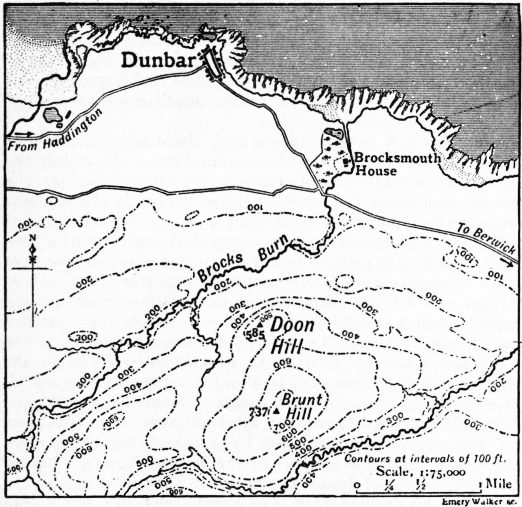
The account of the battle of Dunbar here followed is that of C.H. Firth, for which see his Cromwell, pp. 281 ff. and references there given. For other accounts see Carlyle, Cromwell’s Letters and Speeches, letter cxl.; Hoenig, Cromwell; Baldock, Cromwell as a Soldier; and Gardiner, Hist. of the Commonwealth and Protectorate, vol. i.
DUNBLANE, a police burgh of Perthshire, Scotland, on the left bank of Allan Water, a tributary of the Forth, 5 m. N. by W. of Stirling by the Caledonian railway. Pop. (1901) 2516. It is a place of great antiquity, with narrow streets and old-fashioned houses. The leading industry is the manufacture of woollens. The cathedral is situated by the side of the river, and was one of the few ecclesiastical edifices that escaped injury at the hands of the Reformers. The first church is alleged to have been erected by Blane, a saint of the 7th century, but the cathedral was founded by David I. in 1141, and almost entirely rebuilt about 1240 by Bishop Clemens. Excepting the tower, which is Early Norman and was probably incorporated from the earlier structure, the building is of the Early Pointed style. It consists of a nave (130 ft. long, 58 ft. wide, 50 ft. high), aisles, choir (80 ft. long by 30 ft. wide), chapter-house and tower. Ruskin considered that there was “nothing so perfect in its simplicity” as the west window, the design of which resembles a leaf. After the decline of episcopacy the building was neglected for a long period, but the choir, which contains some carved oak stalls of the 16th century, was restored in 1873, and the nave roofed and restored in 1892-1895, under the direction of Sir Rowand Anderson, the architect. From the time of the Reformation the choir had been used as the parish church, but since its restoration the whole cathedral has been devoted to this purpose. The new oak roof is emblazoned with the arms of the Scottish and later British monarchs, and of the old earls of Strathearn. Several members of the families of Strathearn and Strathallan were buried in the cathedral, and three stones of blue marble in the floor of the choir are supposed to mark the graves of Lady Margaret Drummond (b. 1472), mistress of James IV., and her two sisters, daughters of Lord Drummond, who were mysteriously poisoned in 1501. An ancient Celtic cross, 6½ ft. high, stands in the north-western corner of the nave. Robert Leighton was the greatest of the bishops of Dunblane, and held the see from 1661 to 1670. The library of 1500 volumes which he bequeathed to the clergy of the diocese is housed in a building with an outside stair, standing near the cathedral, and the Bishop’s Walk by the river also perpetuates his memory. Of the bishop’s palace only a few ruins remain. The battlefield of Sheriffmuir is about 2½ m. E. of the town. A mile and a half S. of Dunblane is the estate of Keir which belonged to Sir William Stirling-Maxwell, the historian and art critic. The duke of Leeds derives the title of one of his viscounties from Dunblane.
DUNCAN, the name of two Scottish kings.
Duncan I. (d. 1040) was a son of Crinan or Cronan, lay abbot of Dunkeld, and became king of the Scots in succession to his maternal grandfather, Malcolm II., in 1034, having previously as rex Cumbrorum ruled in Strathclyde. His accession was “the first example of inheritance of the Scottish throne in the direct line.” Duncan is chiefly known through his connexion with Macbeth, which has been immortalized by Shakespeare. The feud between these two princes originated probably in a dispute over the succession to the throne; its details, however, are obscure, and the only fact which can be ascertained with any certainty is that Duncan was slain by Macbeth in 1040. Two of Duncan’s sons, Malcolm III. Canmore and Donald V. Bane, were afterwards kings of the Scots.
Duncan II. (d. 1094) was a son of Malcolm III. and therefore a grandson of Duncan I. For a time he lived as a hostage in England and became king of the Scots after driving out his uncle, Donald Bane, in 1093, an enterprise in which he was helped by some English and Normans. He was killed in the following year.
See W.F. Skene, Celtic Scotland (1876-1880), and A. Lang, History of Scotland, vol. i. (1900).
DUNCAN, ADAM DUNCAN, 1st Viscount (1731-1804), British naval commander, was born on the 1st of July 1731, at Lundie, in Forfarshire, Scotland. After receiving the rudiments of his education at Dundee, he was in 1746 placed under Captain Haldane, of the “Shoreham” frigate, and in 1749 he became a midshipman in the “Centurion.” In 1755 he was appointed second lieutenant of the “Norwich,” but on the arrival of that ship in America, whither, with the rest of Keppel’s squadron, it had convoyed General Braddock’s forces, he was transferred to the “Centurion.” Once again in England, he was promoted to be second lieutenant of the “Torbay,” and after three years on the home station he assisted in the attack on the French settlement of Goree, on the African coast, in which he was slightly wounded. He returned to England as first lieutenant of the “Torbay”; and in 1759 was made a commander, and in 1761 a post-captain. His vessel, the “Valiant” (74), was Commodore Keppel’s flag-ship in the expedition against Belle-Ile en Mer in that year, and also in 1762, when it took an important part in the capture of Havana. In 1778, on the recommencement of war with France, Captain Duncan was appointed to the “Suffolk” (74), whence before the close of the year he removed to the “Monarch” (74), one of the Channel Fleet. On the 16th of January 1780, in an action off Cape St Vincent, between a Spanish squadron under Don Juan de Langara and the British fleet under Sir George Rodney, Captain Duncan in the “Monarch” was the first to engage the enemy; and in 1782, as captain of the “Blenheim” (90), he took part in Lord Howe’s relief of Gibraltar. From the rank of rear-admiral of the blue, received in 1789, he was gradually promoted until, in 1799, he became admiral of the white. In February 1795 he hoisted his flag as commander-in-chief of the North Sea fleet, appointed to harass the Batavian navy. Towards the end of May 1797, though, in consequence of the widespread mutiny in the British fleet, he had been left with only the “Adamant” (50), besides his own ship the “Venerable” (74), Admiral Duncan proceeded to his usual station off the Texel, where lay at anchor the Dutch squadron of fifteen sail of the line, under the command of Vice-Admiral de Winter. From time to time he caused signals to be made, as if to the main body of a fleet in the offing, a stratagem which probably was the cause of his freedom from molestation until, in the middle of June, reinforcements arrived from England. On the 3rd of October the admiral put into Yarmouth Roads to refit and victual his ships, but, receiving information early on the 9th that the enemy was at sea, he immediately hoisted the signal for giving him chase. On the morning of the 11th de Winter’s fleet, consisting of 4 seventy-fours, 7 sixty-fours, 4 fifty-gun ships, 2 forty-four-gun frigates, and 2 of thirty-two guns, besides smaller vessels, was sighted lying about 9 m. from shore, between the villages of Egmont and Camperdown. The British fleet numbered 7 seventy-fours, 7 sixty-fours, 2 fifties, 2 frigates, with a sloop and several cutters, and was slightly superior in force to that of the Dutch. Shortly after mid-day the British ships, without waiting to form in order, broke through the Dutch line, and an engagement commenced which, after heavy loss on both sides, resulted in the taking by the British of eleven of the enemy’s vessels. When the action ceased the ships were in nine fathoms water, within 5 m. of a lee shore, and there was every sign of an approaching gale. So battered were the prizes that it was found impossible to fit them for future service, and one of them, the “Delft,” sank on her way to England. In recognition of this victory, Admiral Duncan was, on the 21st of October, created Viscount Duncan of Camperdown and baron of Lundie, with an annual pension of £3000 to himself and the two next heirs to his title. The earldom of Camperdown was created for his son Robert (1785-1859) in 1831, and is still in the possession of his descendants. In 1800 Lord Duncan withdrew from naval service. He died on the 4th of August 1804.
See Charnock, Biog. Nav. (1794-1796); Collins, Peerage of England, p. 378 (1812); W. James, Naval History of Great Britain (1822); Yonge, History of the British Navy, vol. i. (1863); Earl of Camperdown, Admiral Duncan (1898), vol. xvi. of the Navy Record Soc. Publications, contains the logs of the ships engaged in the battle of Camperdown.
DUNCAN, PETER MARTIN (1824-1891), English palaeontologist, was born on the 20th of April 1824 at Twickenham, and was educated partly at the local grammar school and partly in Switzerland. Having entered the medical department of King’s College, London, in 1842, he obtained the degree of M.B. (Lond.) in 1846, and then acted for a short time as assistant to a doctor at Rochester. Subsequently he practised at Colchester (1848-1860), and during this period he served for a year as mayor of the city. Returning to London in 1860 he practised for a few years at Blackheath, and then gave his time entirely to scientific research, first in botany, and later in geology and palaeontology. His attention was directed especially to fossil corals, and in 1863 he contributed to the Geological Society of London the first of a series of papers on the fossil corals of the West Indian Islands in which he not only described the species, but discussed their bearings on the physical geography of the Tertiary period. Corals from various parts of the world and from different geological formations were subsequently dealt with by Duncan, and he came to be regarded as a leading authority on these fossils. He prepared also for the Palaeontographical Society (1866-1872) an important work on British fossil corals, as a supplement to the monograph by Henri Milne-Edwards and Jules Haime. He was elected F.R.S. in 1868. In 1870 he was chosen professor of geology at King’s College. He was president of the Geological Society (1876-1877), and in 1881 was awarded the Wollaston medal. In addition to papers on fossil corals, he dealt with some of the living forms, also with the Echinoidea and other groups, recent and fossil. He edited the six volumes of Cassell’s Natural History (1877, &c.). He died at Gunnersbury on the 28th of May 1891.
DUNCAN, THOMAS (1807-1845), Scottish portrait and historical painter, was born at Kinclaven, in Perthshire. He was educated at the Perth Academy, and began the study of the law, but abandoned it for art. Beginning under the instruction of Sir William Allan, he early attained distinction as a delineator of the human figure; and his first pictures established his fame so completely, that at a very early age he was appointed professor of colouring, and afterwards of drawing, in the Trustees’ Academy of Edinburgh. In 1840 he painted one of his finest pictures, “Prince Charles Edward and the Highlanders entering Edinburgh after the Battle of Prestonpans,” which secured his election as an associate of the Royal Academy in 1843. In the same year he produced his picture of “Charles Edward asleep after Culloden, protected by Flora MacDonald,” which, like many other of his works, has been often engraved. In 1844 appeared his “Cupid” and his “Martyrdom of John Brown of Priesthill.” His last work was a portrait of himself, now in the National Gallery in Edinburgh. He particularly excelled in his portraits of ladies and children. He died in Edinburgh on the 25th of May 1845.
DUNCE, a slow or stupid person, one incapable of learning. The word is derived from the name of the great schoolman, John Duns Scotus, whose works on logic, theology and philosophy were accepted text-books in the universities from the 14th century. “Duns” or “Dunsman” was a name early applied by their opponents to the followers of Duns Scotus, the Scotists, and hence was equivalent to one devoted to sophistical distinctions and subtleties. When, in the 16th century, the Scotists obstinately opposed the “new learning,” the term “duns” or “dunce” became, in the mouths of the humanists and reformers, a term of abuse, a synonym for one incapable of scholarship, a dull blockhead.
DUNCKER, MAXIMILIAN WOLFGANG (1811-1886), German historian and politician, eldest son of the publisher Karl Duncker, was born at Berlin on the 15th of October 1811. He studied at the universities of Bonn and Berlin till 1834, was then accused of participation in the students’ societies, which the government was endeavouring to suppress, and was condemned to six years’ imprisonment, afterwards reduced to six months. He had already begun his labours as a historian, but after serving his sentence in 1837, found himself debarred till 1839 from completing his course at Halle, where in 1842 he obtained a professorship. Elected to the National Assembly at Frankfort in 1848, he joined the Right Centre party, and was chosen reporter of the projected constitution. He sat in the Erfurt assembly in 1850, and in the second Prussian chamber from 1849 to 1852. During the crisis in Schleswig and Holstein in 1850 he endeavoured in person to aid the duchies in their struggles. An outspoken opponent of the policy of Manteuffel, he was refused promotion by the Prussian government, and in 1857 accepted the professorship of history at Tubingen. In 1859, however, he was recalled to Berlin as assistant in the ministry of state in the Auerswald cabinet, and in 1861 was appointed councillor to the crown prince. In 1867 he became director of the Prussian archives, with which it was his task to incorporate those of Hanover, Hesse and Nassau. He retired on the 1st of January 1875, and died at Ansbach on the 21st of July 1886. Duncker’s eminent position among German historians rests mainly on his Geschichte des Alterthums (1st ed., 1852-1857); 5th ed. in 9 vols., 1878-1886; (English translation by Evelyn Abbott, 1877-1882). He edited, with J.G. Droysen, Preussische Staatsschriften, Politische Correspondenz Friedrichs des Grossen, and Urkunden und Actenstucke zur Geschichte des Kurfursten Friedrich Wilhelm von Brandenburg. To the period of his political activity belong Zur Geschichte der deutschen Reichsversammlung in Frankfurt (1849); Heinrich von Gagern (1850), in the series of Manner der Gegenwart; and the anonymous Vier Monate auswartiger Politik (1851). His other works include Origines Germanicae (1840); the lectures Die Krisis der Reformation (1845) and Feudalitat und Aristokratie (1858); Aus der Zeit Friedrichs des Grossen und Friedrich Wilhelms III. Abhandlungen zur preussischen Geschichte (1876); followed after his death by Abhandlungen aus der griechischen Geschichte and Abhandlungen aus der neueren Geschichte (1887).
DUNCKLEY, HENRY (1823-1896), English journalist, was born at Warwick on the 24th of December 1823. Educated at the Baptist college at Accrington, Lancashire, and at Glasgow University, he became in 1848 minister of the Baptist church at Salford, Lancashire. Here he closely investigated the educational needs of the working-classes, embodying the results of his inquiries in an essay, The Glory and the Shame of Britain (1851), which gained a prize offered by the Religious Tract Society. In 1852 he won the Anti-Corn-law League’s prize with an essay on the results of the free-trade policy, published in 1854 under the title The Charter of the Nations. In 1855 he abandoned the ministry to edit the Manchester Examiner and Times, a prominent Liberal newspaper, in charge of which he remained till 1889. For twenty years he wrote, over the signature “Verax,” weekly letters to the Manchester papers; those on The Crown and the Cabinet (1877) and The Crown and the Constitution (1878) evoked so much enthusiasm that a public subscription was set on foot to present the writer with a handsome testimonial for his public services. In 1878 Dunckley, who had often declined to stand for parliament, was elected a member of the Reform Club in recognition of his services to the Liberal party, and in 1883 he was made an LL.D. by Glasgow University. He died at Manchester on the 29th of June 1896.
DUNCOMBE, SIR CHARLES (c. 1648-1711), English politician, was a London apprentice, who became a goldsmith and a banker; he amassed great wealth in his calling and was chosen an alderman of the city of London in 1683. Duncombe’s parliamentary career began in 1685, when he was elected member of parliament for Hedon, and he was afterwards one of the representatives of Yarmouth in the Isle of Wight and of Downton in Wiltshire. He was made receiver of the customs, and upon the flight of James II. from England in 1688 refused to forward to him the sum of £1500 as requested; accordingly his name alone was excepted from the pardon issued by the exiled king in 1692. A strong Tory, Duncombe held for a short time the office of receiver of the excise, and in this capacity he profited slightly by a transaction over some exchequer bills which had been falsely endorsed. Consequently he was imprisoned by the House of Commons, and expelled from parliament; and having been released by order of the House of Lords, where his friends were more powerful, he was again imprisoned by the Commons. Tried before the court of king’s bench he was found “not guilty” on two occasions and the matter was allowed to drop. Duncombe made three unsuccessful attempts to enter parliament as member for the city of London, and then represented Downton a second time from 1702 until his death. In 1699 he was knighted, and in 1709 he served as lord mayor of London. Upon retiring from business in 1695 Duncombe caused some stir by giving the representatives of the duke of Buckingham a high price for an estate at Helmsley in Yorkshire, where he built a magnificent house.
He died at his residence at Teddington on the 9th of April 1711, and much of his great wealth passed to his sister, Ursula, wife of Thomas Browne, who took the name of Duncombe. Ursula’s great-grandson, Charles Duncombe (1764-1841), was created Baron Feversham in 1826, and in 1868 his grandson, William Ernest, the 3rd baron (b. 1829), was made earl of Feversham. Sir Charles Duncombe’s nephew, Anthony Duncombe (c. 1695-1763), who was made a baron in 1747, left an only daughter, Anne (1757-1829), who married Jacob Pleydell-Bouverie, 2nd earl of Radnor, by whom she was the ancestress of the succeeding earls of Radnor.
A celebrated member of the Duncombe family was Thomas Slingsby Duncombe (1796-1861), a Radical politician, who was member of parliament for Hertford from 1826 to 1832 and for Finsbury from 1834 until his death. Duncombe defended Lord Durham’s administration of Canada; he sought to obtain the release of John Frost and other Chartists, whose immense petition he presented to parliament in 1842; and he interested himself in the affairs of Charles II., the deposed duke of Brunswick. He showed a practical sympathy with Mazzini, whose letters had been opened by order of the English government, by urging for an inquiry into this occurrence; and also with Kossuth. He died at Lancing on the 13th of November 1861.
See Life and Correspondence of T.S. Duncombe, edited by T.H. Duncombe (1868).
DUNDALK, a seaport of Co. Louth, Ireland, in the north parliamentary division, on the Castletown river near its mouth in Dundalk Bay. Pop. of urban district (1901), 13,076. It is an important junction on the Great Northern railway, by the main line of which it is 54 m. N. from Dublin. The company has its works here, and a line diverges to the north-west of Ireland. Dundalk is connected with the port of Greenore (for Holyhead) by a line owned by the London & North-Western railway company of England. The parish church is an old and spacious edifice with a curious wooden steeple covered with copper; and the Roman Catholic chapel is a handsome building in the style of King’s College chapel, Cambridge. There are ruins of a Franciscan priory, with a lofty tower. Adjacent to the town are several fine parks and demesnes. Until 1885 a member was returned to parliament. A brisk trade, chiefly in agricultural and dairy produce, is carried on, and the town contains some manufactories. Distilling and brewing are the principal industrial works, and there are besides a flax and jute-spinning mill, salt works, &c. The port is the seat of a considerable trade, mainly in agricultural produce and live stock. It is also the centre of a sea-fishery district and of salmon fisheries. Dundalk was a borough by prescription, and received charters from Edward III. and successive monarchs. Edward Bruce, having invaded Ireland from Scotland in 1315, proceeded south from his landing-place in Antrim, ravaging as he came, to Dundalk, which he stormed, and proclaimed himself king here. In this neighbourhood, too, he was defeated and killed by the English under Sir John de Bermingham in 1318, and at Faughart near Dundalk, near the ruined church of St Bridget, he is buried.
DUNDEE, JOHN GRAHAM OF CLAVERHOUSE, Viscount (c. 1649-1689), Scottish soldier, was the elder son of Sir William Graham and Lady Madeline Carnegie. Of his youth little record has been kept; but in the year 1665 he became a student at the university of St Andrews. His education was upon the whole good, as appears from the varied and valuable correspondence of his later years. Young Graham was destined for a military career; and after about four years he proceeded abroad as a volunteer in the service of France. In 1673 or 1674 he went to Holland, and obtained a cornetcy, and he was soon raised to the rank of captain, as a reward for having saved the life of the prince of Orange at the battle of Seneff. A few years later, being disappointed in his hopes of obtaining a regiment, Graham resigned his commission. In the beginning of 1677 he returned to England, bearing, it is said, letters of strong recommendation from the prince to Charles II. and the duke of York. In 1678 he became a lieutenant, and soon afterwards captain of a troop, in the regiment commanded by his relative the marquis of Montrose. The task before him was the suppression of the Covenanters’ rebellion. To this he brought, over and above the feelings of romantic loyalty and the cavalier spirit, which in his case was free from its usual defects, a hatred of the Covenanters which was based largely on his hero-worship of the great Montrose. Further, his uncompromising disposition and unmistakable capacity at once marked him out as a leader upon whom the government could rely. But the difficulties of his task, the open or secret hostility of the whole people, and the nature and extent of the country he was required to watch, were too great for the leader of a small body of cavalry, and in spite of his vigorous and energetic action, Graham accomplished but little. He entered, however, upon his occupation with zest, and interpreted consistently the orders he received. There is evidence, also, that his efforts were appreciated at headquarters in his appointment, jointly with the laird of Earlshall, his subaltern, to the office of sheriff-depute of Dumfries and Annandale in March 1679, with powers—specially narrated in his commission—anent “separation,” conventicles, “disorderly baptisms and marriages,” and the like.
For some years thereafter the position of Graham was in the highest degree difficult and delicate. In the midst of enemies, and in virtue of the most erroneous but direct orders of his government, he combined the functions of soldier, spy, prosecutor and judge. Shortly after the murder of Archbishop Sharp (1679), he was summoned to increased activity. There were reports of rebels gathering near Glasgow, and Graham went in pursuit. On the 1st of June, the Covenanters being in a well-protected position upon the marshy ground of Drumclog, Graham advanced to the attack. Hindered by the ground, he had to wait till the impatience of his adversaries induced them to commence an impetuous attack. The charge of the Covenanters routed the royal cavalry, who turned and fled, Graham himself having a narrow escape. This was the only regular engagement he had with the Covenanters. The enthusiasm raised by this victory was the beginning of a serious and open rebellion.
On the 22nd of June Graham was present at the battle of Bothwell Bridge, at the head of his own troop. Immediately thereafter he was commissioned to search the south-western shires for those who had taken part in the insurrection. In this duty he seems to have been engaged till the early part of 1680, when he disappears for a time from the record of these stringent measures. The wide powers given to him by his commission were most sparingly used, and the gravest accusation made against him in reference to this period is that he was a robber.
He was, in any case, an advocate of rigorous measures, and his own systematic and calculated terrorism, directed principally against the ringleaders, proved far more efficacious than the irregular and haphazard brutalities of other commanders. During these months he was despatched to London, along with Lord Linlithgow, to influence the mind of Charles II. against the indulgent method adopted by Monmouth with the extreme Covenanting party. The king seems to have been fascinated by his loyal supporter, and from that moment Graham was destined to rise in rank and honours. Early in 1680 he obtained a royal grant of the barony of the outlawed Macdougal of Freuch, and the grant was after some delay confirmed by subsequent orders upon the exchequer in Scotland. In April 1680 it appears that his roving commission had been withdrawn by the privy council. He is thus free from all concern with the severe measures which followed the Sanquhar Declaration of the 22nd of June 1680.
The turbulence occasioned by the passing of the Test Act of 1681 required to be quelled by a strong hand; and in the beginning of the following year Graham was again commissioned to act in the disaffected districts. In the end of January he was appointed to the sheriffships of Wigtown, Dumfries, Kirkcudbright and Annandale. He retained his commission in the army—the pernicious combination of his offices being thus repeated. He appears further to have had powers of life and death in virtue of a commission of justiciary granted to him about the same time. These powers he exercised strictly and in conformity with the tenor of his orders, which were not more severe than he himself desired. He quartered on the rebels, rifled their houses, and, to use his own words, “endeavoured to destroy them by eating up their provisions.” The effect of his policy, if we believe his own writ, is not overstated as
“Death, desolation, ruin and decay.”
The result of a bitter quarrel between Graham and Sir John Dalrymple, who, with many others of the gentry, was far from active in the execution of the government’s orders, confirmed his prestige. Graham was acquitted by the privy council of the charges of exaction and oppression preferred against him, and Sir John condemned to fine and imprisonment for interference with his proceedings. In December 1682 Graham was appointed colonel of a new regiment raised in Scotland. He had still greater honours in view. In January 1683 the case of the earl of Lauderdale, late Maitland of Hatton, was debated in the House of Lords. Maitland was proprietor of the lands and lordship of Dundee and Dudhope, and the decree of the Lords against him was in March 1683 issued for the sum of £72,000. Graham succeeded in having part of the property of the defaulter transferred to him by royal grant, and in May he was nominated to the privy council of Scotland.
Shortly afterwards Claverhouse was appointed to be present at the sittings of the Circuit Court of Justiciary in Stirling, Glasgow, Dumfries and Jedburgh, recently instituted for the imposition of the test and the punishment of rebels. Several were sentenced to death. During the rest of the year he attended the meetings of council, in which he displayed the spirit of an obedient soldier rather than that of a statesman capable of independent views. There is, however, one record of his direct and efficacious interference. He declared decisively against the proposal to let loose the Highland marauders upon the south of Scotland.
In June 1684 he was again at his old employment—the inspection of the southern shires; and in August he was commissioned as second in command of the forces in Ayr and Clydesdale to search out the rebels. By this time he was in possession of Dudhope, and on the 10th of June he married Lady Jean, daughter of William, Lord Cochrane. As constable of Dundee he recommended the remission of extreme punishment in the case of many petty offences. He issued from his retirement to take part in a commission of lieutenancy which perambulated the southern districts as a criminal court; and in the end of the year he was again in the same region on the occasion of disturbances in the town of Kirkcudbright.
Shortly after the death of Charles II. (February 1685) Graham incurred a temporary disgrace by his deposition from the office of privy councillor; but in May he was reinstated, although his commission of justiciary, which had expired, was not renewed.
In May 1685 he was ordered with his cavalry to guard the borders, and to scour the south-west in search of rebels. By act of privy council, a certificate was required by all persons over sixteen years of age to free them from the hazard of attack from government officials. Without that they were at once liable to be called upon oath to abjure the declaration of Renwick, which was alleged to be treasonable. While on this mission he pursued and overtook two men, one of whom, John Brown, called the “Christian carrier,” having refused the abjuration oath, was shot dead. The order was within the authorized powers of Graham.
In 1686 he was promoted to the rank of major-general, and had added to his position of constable the dignity of provost of Dundee. In 1688 he was second in command to General Douglas in the army which had been ordered to England to aid the falling dynasty of the Stuarts.
His influence with James II. was great and of long standing, and amid the hurry of events in this critical time he was created Viscount Dundee on the 12th of November 1688. Throughout the vexed journeyings of the king, Dundee is found accompanying or following him, endeavouring in vain to prompt him to make his stand in England, and fight rather than flee from the invader. At last James announced his resolve to go to France, promising that he would send Dundee a commission to command the troops in Scotland.
Dundee returned to Scotland in anticipation of the meeting of the convention, and at once exerted himself to confirm the waning resolution of the duke of Gordon with regard to holding Edinburgh Castle for the king. The convention proving hostile (March 16th, 1688), he conceived the idea of forming another convention at Stirling to sit in the name of James II., but the hesitancy of his associates rendered the design futile, and it was given up. Previous to this, on the 18th of March, he had left Edinburgh at the head of a company of fifty dragoons, who were strongly attached to his person. He was not long gone ere the news was brought to the alarmed convention that he had been seen clambering up the castle rock and holding conference with the duke of Gordon. In excitement and confusion order after order was despatched in reference to the fugitive. Dundee retired to Dudhope. On the 30th of March he was publicly denounced as a traitor, and in the latter half of April attempts were made to secure him at Dudhope, and at his residence in Glen Ogilvy. But the secrecy and speed of his movements outwitted his pursuers, and he retreated to the north.
In the few years which had elapsed since 1678 he had risen, despite the opposition of his superiors in rank, from the post of captain and the social status of a small Scottish laird to positions as a soldier and statesman and the favourite of his sovereigns, of the greatest dignity, influence and wealth. In this period he had, justly or unjustly, earned the reputation of being a cruel and ruthless oppressor. When the ruling dynasty changed, and he had himself become an outlaw and a rebel, he supported the cause of his exiled monarch with such skill and valour that his name and death are recorded as heroic.
In the Highlands his diplomatic skill was used with effect amongst the chieftains. General Hugh Mackay was now in the field against him, and a Highland chase began. The campaign resembled those of Montrose forty years earlier. The regular troops were at a great disadvantage in the wild Highland country, and Dundee, like Montrose, invariably anticipated his enemy. But, as usual, the army of the clans required the most careful management. After the first few weeks of operations, Dundee’s army melted away, and Mackay, unable to follow his opponent, retired also.
Throughout the whole of the campaign Dundee was indefatigable in his exertions with the Highland chiefs and his communications with his exiled king. To the day of his death he believed that formidable succour for his cause was about to arrive from Ireland and France. He justly considered himself at the head of the Stewart interest in Scotland, and his despatches form a record of the little incidents of the campaign, strangely combined with a revelation of the designs of the statesman. It mattered little to him that on the 24th of July a price of £20,000 had been placed upon his head. The clans had begun to reassemble; he was now in command of a considerable force, and in July both sides took the field again. A contest for the castle of Blair forced on the decision. Mackay, in his march towards that place, entered the pass of Killiecrankie, the battleground selected by Dundee and his officers. Here, on the 17th-27th of July 1689, was fought the battle of Killiecrankie (q.v.). The Highlanders were completely victorious, but their leader, in the act of encouraging his men, was pierced beneath the breastplate by a bullet of the enemy, and fell dying from his horse. Dundee asked “How goes the day?” of a soldier, who replied, “Well for King James, but I am sorry for your lordship.” The dying general replied, “If it goes well for him, it matters the less for me.” Dundee was conveyed to the castle of Blair, where he died on the night of the battle. Within an hour or two of his death he wrote a short account of the engagement to King James. The battle, disastrous as it was to the government forces, was in reality the end of the insurrection, for the controlling and commanding genius of the rebellion was no more. The death of Dundee, in the mist and the confusion of a cavalry charge, formed the subject of numerous legends, the best known of which is the long prevalent tradition that he was invulnerable to all bullets and was killed by a silver button from his own coat.
See Mark Napier, Memorials and Letters of Graham of Claverhouse (1859-1862); Bannatyne Club, Letters of the Viscount Dundee (1826); C.S. Terry, John Graham of Claverhouse, Viscount Dundee; and authorities quoted in Dict. Nat. Biogr., s.v. “Graham of Claverhouse.”
DUNDEE, a royal, municipal and police burgh, county of a city, and seaport of Forfarshire, Scotland. Pop. (1891) 153,587; (1901) 161,173. It lies on the north shore of the Firth of Tay, 59¼ m. N. by E. of Edinburgh by the North British railway via the Forth and Tay bridges. The Caledonian railway finds access to the city by way of Perth, which is distant about 22 m. W. by S. The general disposition of the town is from east to west, with a frontage on the water of 4 m. The area northwards that has already been built over varies in depth from half a mile to nearly 2½ m. (from Esplanade Station to King’s Cross). The city rises gradually from the river to Dundee Law and Balgay Hill. Since the estuary to the E. of Tay bridge is 1½ m. wide, and the commodious docks—in immediate contact with the river at all stages of the tide—are within 12 m. of the sea, the position of the city eminently adapts it to be the emporium of a vast trade by land and sea. But its prosperity is due in a far greater measure to its manufactures of jute and linen—of which it is the chief seat in the United Kingdom—than to its shipping.
Public Buildings.—The town-hall, built in 1734 from the designs of Robert Adam, stands in High Street. It is surmounted by a steeple 140 ft. high, carrying a good peal of bells, and beneath it is a piazza. The old Town Cross, a shaft 15 ft. high, bearing a unicorn with the date of 1586, once stood in High Street also, but was re-erected within the enclosure on the S.W. of Town Churches (see below). Albert Square, with statues of Robert Burns, George Kinloch, the first member for Dundee in the Reform Parliament (both by Sir John Steell), and James Carmichael (1776-1853), inventor of the fan-blast (by John Hutchison, R.S.A.), contains several good buildings, among them the Royal Exchange in Flemish Pointed (erected in 1853-1856), the Eastern Club-house, and the Albert Institute, founded in memory of the prince consort. The last, built mainly from designs by Sir Gilbert Scott, is one of the most important edifices in the city, since it embraces the art gallery, free library, reference library, museum and several halls. On the north side of the building is the seated figure, in bronze, of Queen Victoria, on a polished red granite pedestal containing bas-reliefs of episodes in Her Majesty’s life, the work of Harry Bates, A.R.A. The custom house, near the docks, is in Classical style and dates from 1843. The Sheriff Court buildings and Police Chambers, a structure of Grecian design, with a bold portico, was erected in 1864-1865. The halls used for great public meetings are the Volunteer Drill Hall in Parker Square, and Kinnaird Hall in Bank Street. Of the newer streets, Commercial, Reform, Whitehall, Bank and Lindsay contain many buildings of good design and the principal shops. In Bank Street are the offices of the Dundee Advertiser, the leading newspaper in the north-east of Scotland; and in Lindsay Street the headquarters of the Dundee Courier. In Dock Street stands the Royal Arch, an effective structure, erected to commemorate the visit of Queen Victoria in 1844. Among places of amusement are the Theatre Royal, the People’s Palace theatre, the Music Hall, the Circus and the Gymnasium. The cattle market and slaughter-houses, both on an extensive scale, are in the east end of the city, not far from Camperdown Dock. Dudhope Castle, once the seat of the Scrymgeours, hereditary constables of the burgh—one of whom (Sir Alexander) was a companion-in-arms of Wallace,—was granted by James II. to John Graham of Claverhouse. On his death it reverted to the crown, and at a later date was converted into barracks. When the new barracks at Dudhope Park were occupied, the Castle was transformed into an industrial museum. Though Dundee was once a walled town, the only relic of its walls is the East Port, the preservation of which was due to the tradition that George Wishart preached from the top of it during the plague of 1544.
Churches.—Of the many churches and chapels the most interesting is Town Churches—St Mary’s, St Paul’s and St Clement’s, the three under one roof—surmounted by the noble square tower, 156 ft. high, called the Old Steeple, once the belfry of the church which was erected on this spot by David, earl of Huntingdon, as a thank-offering for his escape from shipwreck on the shoals at the mouth of the Tay (1193). The church perished, but the bell-tower remained and was restored in 1871-1873 by Sir Gilbert Scott. The fine Roman Catholic pro-cathedral of St Andrew’s is in Early English style, and St Paul’s Episcopal church, in Decorated Gothic style, with a spire 211 ft. high, from designs by Sir Gilbert Scott, was due to the zeal of Bishop Forbes (1817-1875), who transferred the headquarters of the see of Brechin to Dundee. It occupies the site of the old castle. Memorial churches commemorate the work of Robert Murray McCheyne (1813-1843) and of George Gilfillan (1813-1878), long ministers in Dundee. John Glas (1695-1773), founder of the Glasites (q.v.), ministered here from 1730 to 1733.
Cemeteries.—The ancient burying-ground in the centre of the city is called the Howff. It has long been closed, but contains several interesting monuments and epitaphs. Not far from it the New Cemetery was laid out in West Bell Street; to the east of Baxter Park lies the Eastern Cemetery; and the Western Cemetery was constructed in Perth Road. The most beautifully situated of all the burying-grounds, however, is the Western Necropolis, which occupies the western portion of the hill of Balgay. A bridge over the ravine connects it with Balgay Park.
Public Parks and Open Spaces.—On the N. of the city rises Dundee Law (571 ft.), the property of the Corporation, a prominent landmark, on the summit of which are traces of an old vitrified fort. The surrounding park covers 18 acres. Near the eastern boundary of the city lies Baxter Park, of 37 acres, presented to the town by Sir David Baxter (1793-1872), a leading manufacturer, and his sisters. It was laid out by Sir Joseph Paxton, and contains a statue of Sir David by Sir John Steell, erected by public subscription. In the west the finely wooded hill of Balgay was acquired in 1869 and 36 acres of the area were converted into a park. Immediately adjoining it on the north is Lochee Park, of 25 acres, given to the city in 1891 by Messrs Cox Brothers of Camperdown Works. In the extreme north lies the park of Fair Muir, of 12 acres, which was secured in 1890, and nearer to the heart of the town is Dudhope or Barrack Park, purchased in 1893. Near the north end of the Tay bridge is Magdalen Green, an old common of 17 acres, and along the shore of the estuary there runs for a distance of 2½ m. from Magdalen Point to beyond Craig Pier a promenade called the Esplanade.
Education.—University College in Nethergate, founded in 1880 by Miss Baxter of Balgavies (d. 1884) and Dr John Boyd Baxter, was opened in 1883, and united to the university of St Andrews in 1890. The affiliation was cancelled in 1895 owing to divergence of view in the governing body, but this was overcome and the college finally incorporated in 1897. The staff consists of a principal, professors and lecturers, and the curriculum, which may be taken by students of both sexes, is especially concerned with medicine and natural and applied science. The endowments exceed £250,000. Adjoining the buildings is the Technical Institute, built and endowed by Sir David Baxter and opened in 1888. In connexion with the high school, a building in the Doric style, dating from 1833, there is a museum which was endowed in 1880 by Mr William Harris. Morgan hospital, a structure in the Scots Baronial style, situated immediately to the north of Baxter Park, was founded in 1868 by John Morgan, a native of Dundee, for the board and education of a hundred boys, sons of indigent tradesmen, but was acquired by the school board and transformed into a secondary school. Besides a high school for girls and Roman Catholic and Episcopalian schools, there are numerous efficient and thoroughly equipped board schools.
Charitable Institutions.—One of the most conspicuous buildings in the city, occupying a prominent position in the centre, is the Royal Infirmary, a fine structure in the Tudor style. On the southern face of Balgay Hill stands the Royal Victoria hospital for incurables, opened in 1889. In addition to the maternity hospital and nurses’ home, there are several institutions devoted to special afflictions and diseases—among them the Blind and the Deaf and Dumb institutions, the Royal asylum, the fever hospital at King’s Cross, and, in the parish of Mains—beyond the municipal boundary—the Baldovan asylum for imbeciles, founded in 1854 by Sir John Ogilvy and said to be the earliest of its kind in Scotland, besides the smallpox and cholera hospital. The large Dundee hospital adjoins the poorhouse, and an epidemic hospital has been built in the Fair Muir district. One of the convalescent homes is situated at Broughty Ferry. Among other institutions are the Royal Orphan and the Wellburn Charitable institutions, the rescue home for females, the sailors’ home and Lady Jane Ogilvy’s orphanage in Mains.
Trade.—Hector Boece, in his History and Croniklis of Scotland, thus quaintly writes of the manufactures of Dundee in the opening of the 16th century—“Dunde, the toun quhair we wer born; quhair mony virtewus and lauborius pepill ar in, making of claith.” Jute is, par excellence, the industry of the city. Enormous quantities of the raw material—estimated at 300,000 tons a year—are imported directly from India in a fleet solely devoted to this trade, and many of the factories in Bengal are owned by Dundee merchants. Fabrics in jute range from the roughest sacking to carpets of almost Oriental beauty. Another staple industry is the linen manufacture, which is also one of the oldest, although it was not till the introduction of steam power that headway was made. Bell Mill, erected in 1806, was the first work of any importance, and the first power-loom factory dates from 1836. Now factories and mills are to be counted by the score, and the jute, hemp and flax manufactures alone employ about 50,000 hands, while the value of the combined annual output exceeds £6,000,000. Some of the works are planned on a colossal scale, and many of the buildings in respect of design and equipment are among the finest and most complete in the world. In the thriving quarter of Lochee are situated the Camperdown Linen Works, covering an immense area and employing more than 5000 hands. The chimney-stalk (282 ft. high), in the style of an Italian campanile, built of parti-coloured bricks with stone cornices, is a conspicuous feature. The chief textile products are drills, ducks, canvas (for which the British navy is the largest customer), ropes, sheetings, sackings and carpets. Dundee is also celebrated for its confectionery and preserves, especially marmalade. Among other prominent industries are bleaching and dyeing, engineering, shipbuilding, tanning, the making of boots and shoes and other goods in leather, foundries, breweries, corn and flour mills, and the construction of motor-cars.
Shipping.—By reason of its excellent docking facilities Dundee can cope with a shipping trade of the largest proportions. On the front wharves and harbour works extend for 2 m., and the docks cover an area of 35½ acres, made up thus—Earl Grey Dock, 5¼ acres; King William IV. Dock, 6¼ acres; Tidal Harbour, 4¾ acres; Victoria Dock, 10¾ acres; Camperdown Dock, 8½ acres. There are, besides, graving docks, the Ferry harbour and timber ponds. The warehouses are capacious and the ample quays equipped with steam cranes and other modern appliances. In 1898 there entered and cleared 2914 vessels of 1,390,331 tons; in 1904 the numbers were 2428 vessels of 1,227,429 tons. At the close of 1904 the registered shipping of the port was 131 vessels of 109,885 tons. Dundee is the seat of the Arctic fishery, once an important and lucrative business, but now shrunk to the most meagre dimensions in consequence of the increasing scarcity of whales and seals. There is regular communication by steamer with London, Hull, Newcastle, Liverpool and Leith, besides Rotterdam, Hamburg and other continental ports. Of the local excursions the two hours’ run to Perth is the favourite summer trip.
Local Government.—Dundee returns two members to parliament. The city council consists of the lord provost, bailies and councillors. The corporation owns the gas and water supplies (the latter drawn from the loch of Lintrathen, 18 m. to the N.W.) and the electric tramcars.
History.—There appears to be some doubt as to the origin of the name of Dundee. It is extravagant to trace it to the Latin Donum Dei, “the gift of God,” as some have done, or the Celtic Dun Dhia, “the hill of God.” More probably it is the Gaelic Dun Taw, “the fort of the Tay,” of which the Latin Taodunum is a transliteration—the derivation pointing to the fact of a Pictish settlement on the site. The earliest authentic mention of the city is in a deed of gift by David, earl of Huntingdon, younger brother of William the Lion, dated about 1200, in which it is designated as “Dunde.” Shortly afterwards it was erected into a royal burgh by William the Lion. When Edward I. visited it, however, as he did twice (in 1296 and 1303) with hostile intent, he is said to have removed its charter. Consequently Robert Bruce and successive kings confirmed its privileges and rights, and Charles I. finally granted it its great charter. Dundee played a prominent part in the War of Scottish Independence. Here Wallace finished his education, and here he slew young Selby, son of the English constable, in 1291, for which deed he was outlawed. In that year the town fell into the hands of the English, and it was whilst engaged in besieging the castle in 1297 that Wallace withdrew to fight the battle of Stirling Bridge. In their incursion into Scotland under John of Gaunt the English captured and partially destroyed the town in 1385, but retreated to meet a counter-invasion of their own country. The English seized it again for a brief space during one of the 1st earl of Hertford’s devastating raids in the reign of Edward VI. Dundee bore such a prominent part in propagating the Reformed doctrines that it was styled “the Scottish Geneva.” It saw more trouble at the time of the Civil War, for the marquess of Montrose sacked it in 1645, and then gave a considerable portion of it to the flames. Charles II. spent a few days in the castle after his crowning at Scone (January 1st, 1651). In the same year General Monk demanded the submission of the town to Cromwell, and on its refusal captured it after an obstinate resistance and visited it with condign punishment. More than one-sixth of the inhabitants and garrison, including its governor Lumsden, were put to the sword, and no fewer than 60 vessels were seized and filled with plunder; but the ships, says Gumble in his Life of Monk, “were cast away within sight of the town and that great wealth perished.” In 1684 John Graham of Claverhouse—whose family derived its name from the lands of Claverhouse in the parish of Mains immediately to the north of the town—became constable, and in 1688 provost. In the same year James II. created him Viscount Dundee. Thenceforward the annals of the town cease to touch national history, save at very rare intervals. The greatest local disaster of modern times was the destruction of the first Tay bridge (see Tay).
Many interesting old documents have been preserved in the Town House, such as certain characteristic despatches from Edward I. and Edward II., the original charter of Robert Bruce, dated 1327, a papal order from Leo X., and a letter from Queen Mary, dated 1564, providing for extra-mural interments. It may be mentioned that to describe Claverhouse himself as “bonnie Dundee” is a modern invention, the old song from which Sir Walter Scott borrowed a hint for his refrain referring solely to the town.
Since the middle and particularly during the last quarter of the 19th century many of the more unsightly districts have been demolished. In the process several picturesque but insanitary buildings, narrow winding streets and unsavoury closes disappeared, along with a few structures of more or less historic interest, like the castle, the mint and numerous convents. The wholesale clearances, however, improved both the public health and the appearance of the city, some of the new thoroughfares vieing with the finest business streets of the largest commercial centres in the United Kingdom. Queen Victoria granted a charter to Dundee, dated the 25th of January 1889, erecting it to the status of a city, and since 1892 its chief magistrate has been styled lord provost.
Among men more or less eminent who were born in Dundee may be named Hector Boece (1465-1536), the historian; George Dempster of Dunnichen (1732-1818), the agriculturist, a former owner of Skibo; Thomas Dick (1774-1857), the author of The Christian Philosopher; Admiral Lord Duncan (1731-1804); Viscount Dundee (1643-1689); James Halyburton (1518-1589), the Scottish Reformer, who was provost of the town for thirty-three years; Sir James Ivory (1765-1842), the mathematician, who bequeathed his science library to the town, and his nephew Lord Ivory (1792-1866), the judge; Sir George Mackenzie (1636-1691), the celebrated lawyer; Sir Alexander Scrymgeour (d. 1310), Wallace’s standard-bearer, and many of the Scrymgeours, his successors, who were constables of the town; James (1495-1553), John (1500-1556) and Robert Wedderburn (1510-1557), the poets, who were all concerned in the authorship or collection of the book of Gude and Godlie Ballatis published in 1578; Sir John Wedderburn (1599-1679), the physician; and Sir Peter Wedderburn (1616-1679), the judge. Many well-known persons lived for longer or shorter periods in the town. James Chalmers (1782-1853), the inventor of the adhesive postage stamp (1834), was a bookseller in Castle Street. George Constable of Wallace Craigie, the prototype of Jonathan Oldbuck in Sir Walter Scott’s Antiquary, had a residence in the east end of Seagate, the house standing until about 1820. Thomas Hood’s father was a native and the poet spent part of his youth in the town, his first literary effort appearing in the Dundee Advertiser about 1816. James Bowman Lindsay (1799-1862), electrician and philologist, carried on his experiments for many years in Dundee, where he died. Robert Nicoll (1814-1837), the poet, kept a circulating library in Castle Street; and William Thom (1798-1848), the writer of The Rhymes of a Handloom Weaver, was buried in the Western Cemetery.
Suburbs.—Close to the municipal boundaries on the N.W. lies Benvie, where John Playfair (1748-1819), the mathematician, was born, and which has a mineral well that once enjoyed considerable repute. Camperdown House, the seat of the earl of Camperdown, a fine building of Greek design, standing in beautiful grounds, is situated in the parish. Fowlis, 5 m. N.W., is remarkable for its church, which dates from the 15th century, but has even been assigned to the 12th. It contains a carved ambry and rood-screen (with a curious representation of the Crucifixion), decorated font, crocketed door canopy and several pictures. The ruined castle adjoining the church ultimately became a dwelling for labourers. The Dell of Balruddery is rich in geological and botanical specimens. Lundie, 3 m. farther out in the same direction, contains several lakelets, and its kirkyard is the burial-place of the earls of Camperdown. Tealing, 4 m. N. of Dundee, was the scene of the ministry of John Glas before he was deposed for heresy.
Authorities.—David Barrie, The City of Dundee Illustrated (Dundee, 1890); Alexander Maxwell, Old Dundee (Dundee, 1891); A.C. Lamb, Dundee: its Quaint and Historic Buildings (Dundee, 1895); A.H. Millar, Roll of Eminent Burgesses of Dundee (Dundee, 1887).
DUNDERLANDSDAL, a valley of northern Norway, in Nordland amt (county), draining south-westward from the neighbouring glaciers to the Ranenfjord (lat. 66° 20′ N.). There are deposits of iron ore, the working of which was undertaken in 1902 by the Dunderland Iron Ore Company, water-power being provided by the strong Dunderland river. There are also pyrites mines. At the mouth of the river is Mo, a considerable trading village. The valley is remarkable for several stalactite caverns in the limestone, some of the tributary streams flowing for considerable distances underground. From Mo a fine road crosses the mountains to the head-lake of the great Ume river, draining to the Baltic, and from the head of Dunderlandsdal a sequestered bridle-path runs to Saltdal on the Skjerstadfjord, with a branch through the magnificent Junkersdal.
DUNDONALD, THOMAS COCHRANE, 10th Earl of (1775-1860), British admiral, was born at Annsfield in Lanarkshire on the 14th of December 1775. He came of an old Scottish family, the first earl having been Sir William Cochrane (d. 1686), a soldier who was created Baron Cochrane in 1647 and earl of Dundonald in 1669. He was the son of Archibald Cochrane, 9th Earl (1749-1831), who is remembered as a most ingenious, but also most unfortunate, scientific speculator and inventor, who was before his time in suggesting and attempting new processes of alkali manufacture, and various other uses of applied science. The family was greatly impoverished owing to his losses over these schemes, but still possessed a good deal of interest. By the help of friends Thomas was provided with a commission in an infantry regiment, and at the same time put on the books of a man-of-war by his uncle, Captain A.F.I. Cochrane (1758-1832), while still a boy. He finally chose the navy, and went to sea in his uncle’s ship, the “Hind,” in 1793. He could already count nearly five years’ nominal service, an example of those naval abuses which he was to denounce (and to profit by) during a large part of his career. His promotion was rapid. He became a lieutenant in 1796. While in that rank he was led by his self-assertive temper into a quarrel with his superior, Lieutenant Philip Beaver (1766-1813), for which he was sent before a court-martial. A warning to avoid flippancy in future was, however, the worst that happened to him.
In 1800 he was appointed to the command of the “Speedy” brig, a small vessel in which he gained a great and deserved reputation as a daring and skilful officer. His capture of the Spanish frigate “El Gamo” (32) on the 6th of May 1801 was indeed a feat of unparalleled audacity. His promotion to post rank followed on the 8th of August. Though he was apt to represent himself as disliked and neglected by the admiralty, and was frequently insolent towards his superiors, he was, as a matter of fact, pretty constantly employed, and he more than justified his appointments by his activity and success as captain of the “Pallas” (32) and “Impérieuse” (38) on the ocean and in the Mediterranean. Unfortunately for himself he secured his return to parliament as member for Honiton in 1806 and for Westminster in 1807. In the House of Commons he soon made his mark as a radical, and as a denouncer of naval abuses. But his views did not prevent him from profiting to the utmost by one very bad abuse, for he did his utmost to secure the retention of his frigate in port, in order that he might be able to attend parliament. In spite of his radical opinions he made a furious attack on the admiralty for the new prize money regulations which diminished the shares of the captains to the advantage of the men. In April 1809 he was engaged in the attack on the French squadron in the Basque Roads, which was very ill conducted by Lord Gambier. The conduct of Lord Cochrane, as he was called till the death of his father, was brilliant and was rewarded by the order of the Bath, but his aggressive temper led him into making attacks on the admiral which necessitated a court-martial on Gambier. The admiral was acquitted, and Cochrane naturally fell into disfavour with the admiralty. He was not employed again till 1813, when he was named to the command of the “Tonnant,” which was ordered for service as flagship on the coast of America. In the interval he was restlessly active in parliament in denouncing naval abuses, and was also, most disastrously for himself, led into speculations on the Stock Exchange, by which he was brought at the beginning of 1814 into pressing danger of total ruin.
At this moment a notorious fraud was perpetrated on the Stock Exchange by an uncle of his and by other persons with whom he habitually acted in his speculations. Lord Cochrane was brought to trial with the others before Lord Ellenborough on the 8th of June 1814 and all were condemned. He was sentenced to an hour in the pillory, which was remitted, and to fine and imprisonment, which were enforced. He continued to assert his innocence, and to protest that he had been unjustly condemned, but he was expelled from parliament and the order of the Bath. He was, however, almost immediately re-elected member for Westminster, but he had to serve his term (one year) of imprisonment, and, after escaping and being recaptured, he regained his liberty in 1815 on payment of the fine of £1000 to which he had been sentenced.
In 1817 he accepted the invitation of the Chileans, who were then in revolt against Spain, to take command of their naval forces, and remaining in their service until 1822 contributed largely to their success. His capture of the Spanish frigate “Esmeralda” (40) in the harbour of Callao, on the 5th of November 1820, was an achievement of signal daring. In 1823 he transferred his services to Brazil, where he helped the emperor Dom Pedro I. to shake off the yoke of Portugal; but by the end of 1825 he had fallen out with the Brazilians, and he returned to Europe. His activity was next devoted to the aid of the Greeks, then at the end of their struggle with the Turks, but he found no opportunity for distinguishing himself, and in 1828 he returned home. His efforts were now steadily directed to securing his restoration to the navy, and in this he succeeded in 1832; but though he was granted a “free pardon” he failed to obtain the new trial for which he was anxious, or to secure the arrears of pay he claimed.1 He was restored to his place in the order of the Bath in 1847. In 1848 he was appointed to the command of the North American and West India station, which he retained till 1851. At various periods of his life he occupied himself with scientific invention. He took out patents for lamps to burn oil of tar, for the propulsion of ships at sea, for facilitating excavation, mining and sinking, for rotary steam-engines and for other purposes; and so early as 1843 he was an advocate of the employment of steam and the screw propeller in war-ships. During the Crimean War he revived his “secret war plan” for the total destruction of an enemy’s fleet, and offered to conduct in person an attack on Sevastopol and destroy it in a few hours without loss to the attacking force. This plan, the details of which have never been divulged, he had proposed so far back as 1811, and the committee which was then appointed to consider it reported on it as effective but inhuman. Lord Dundonald died in London on the 30th of October 1860, and was buried in Westminster Abbey. No one ever excelled him in daring and resource as a naval officer, but he suffered from serious defects of character, and even those who think him guiltless of the charge on which he was convicted in 1814 must feel that he had his own imprudence and want of self-command to thank for many of his misfortunes.
He was succeeded in the title by his son Thomas as 11th earl (d. 1885), and the latter by his son Douglas (b. 1852) as 12th earl, a distinguished cavalry officer who became a lieutenant-general in 1907.
The 10th earl’s Autobiography of a Seaman (2 vols., 1860-1861), the main source for his Life (1869, by his son and heir), is written with spirit, but it was composed at the end of his career when his memory was failing, and was chiefly executed by others. He also wrote Notes on the Mineralogy, Government and Condition of the British West India Islands (1851), and a Narrative of Services in the Liberation of Chili, Peru and Brazil (1858). The whole story of his trial and of the Stock Exchange fraud for which he was condemned has been examined by Mr J.B. Atlay in The Trial of Lord Cochrane before Lord Ellenborough (1897).
1 In 1878, as the result of the report of a select committee of the House of Commons appointed in 1877, a grant of £5000 was made to the then Lord Cochrane “in respect of the distinguished services of his grandfather, the late earl of Dundonald.”
DUNEDIN, a city of New Zealand, capital of the provincial district of Otago, and the seat of a bishop, in Taieri county. Pop (1906) 36,070, including suburbs, 56,020. It lies 15 m. from the open sea, at the head of Otago harbour, a narrow inlet (averaging 2 m. in width) on the south-eastern coast of South Island. The situation was chosen on the consideration of this harbour alone, for the actual site offered many difficulties, steep forest-clad hills rising close to the sea, and rendering reclamation necessary. The hills give the town a beautiful appearance, as the forest was allowed to remain closely embracing it, being preserved in the public ground named the Town Belt. The principal thoroughfare is comprised in Prince’s Street and George Street, running straight from S.W. to N.E., and passing through the Octagon, which is surrounded by several of the principal buildings. From these streets others strike at right angles down to the harbour, while others again lead obliquely up towards the Belt, beyond which are extensive suburbs. There are several handsome commercial and banking houses. The town hall, Athenaeum and museum are noteworthy buildings, the last having a fine biological collection. The university, founded in 1869, built mainly of basalt, has schools of arts, medicine, chemistry and mineralogy. It is in reality a university college, for though it was originally intended to have the power of conferring degrees, it was subsequently affiliated to the New Zealand University. The churches are numerous and some are particularly handsome; such as the First church, which overlooks the harbour, and is so named from its standing on the site of the church of the original settlers; St Paul’s, Knox church and the Roman Catholic cathedral of St Joseph. Finally, one of the most striking buildings in the city is the high school (1885) with its commanding tower. The white Oamaru stone is commonly used in these buildings. The primary and secondary schools of the town are excellent, and there is a small training college for state teachers. Besides the Belt there are several parks and reserves, including botanical and acclimatization gardens, the so-called Ocean Beach, and two race-courses.