VOLUME VIII SLICE VIII Dubner to Dyeing (continued 3)
Reading edition
From October 1882 to May 1883 he was himself in Egypt as British commissioner to report on a scheme of reorganization; and his recommendations—drawn up in a somewhat elaborate State paper—formed the basis of the subsequent reforms. In 1884 he was appointed viceroy of India, succeeding Lord Ripon, whose zeal on behalf of the natives had created a good deal of antagonism among the officials and the Anglo-Indian community. Lord Dufferin, though agreeing in the main with Lord Ripon’s policy, was excellently fitted for the task of restoring confidence without producing any undesirable reaction, and in domestic affairs his viceroyalty was a period of substantial progress, in the reform of the evils of land tenure and in other directions. He was responsible also for initiating stable relations with Afghanistan, and settling the crisis with Russia arising out of the Panjdeh incident (1885), which led to the delimitation of the north-west frontier (1887). The most striking event of his administration was, however, the annexation of Burma, resulting from the Burmese War of 1885; and this procured him, on his resignation, the title of marquess of Dufferin and Ava (1888). His viceroyalty was also memorable for Lady Dufferin’s work, and the starting of a fund called by her name, for providing better medical treatment for native women. In 1888 he was made ambassador at Rome, and in 1892 he was promoted to be ambassador in Paris, a post which he retained till 1896, when he retired from the public service.
Lord Dufferin was one of the most admired public servants of his time. A man of great natural gifts, he had a special talent for diplomacy, though he has no claim to a place in the first rank of statesmen. He was remarkable for tact and amiability, and had a florid and rather elaborately literary style of oratory, which also characterized his despatches and reports. For purposes of ceremony his courtliness, dignity and charm of manner were invaluable, and both in public and in private life he was a conspicuous “great gentleman.” His last years, spent mainly at his Irish home, were clouded by the death of his eldest son, the earl of Ava, at Ladysmith in the Boer War (1900), and by business troubles. He was so ill-advised as to become chairman in 1897 of the “London and Globe Finance Corporation,” a financial company which most good judges in the city of London thought to be too much in the hands of its managing director, Mr Whitaker Wright, whose methods had been a good deal criticized. At last there came a complete crash, and an exposure before the liquidator, which ultimately led to Mr Whitaker Wright’s trial for fraud in 1904, and his suicide within the precincts of the court on being found guilty. Lord Dufferin did not live to see this final catastrophe. The affairs of the company were still under investigation in bankruptcy when, on the 12th of February 1902, he died. He had been in failing health for two or three years, but, having once become chairman of the “London and Globe,” he had insisted upon standing by his colleagues when difficulties arose. Incautious as he had been in accepting the position, no reflections were felt to be possible on Lord Dufferin’s personal honour; he was a serious loser by the failure, and he had followed his predecessor in the chairmanship, Lord Loch, in confiding too wholly in the masterful personality of Mr Wright. He was succeeded in the title by his second son Terence (b. 1866).
The official Life of Lord Dufferin, by Sir Alfred Lyall, appeared in 1905. There are two Canadian histories of his Canadian administration, one by George Stewart (1878), the other by W. Leggo (1878). Lady Dufferin brought out Our Viceregal Life in India in 1889, and My Canadian Journal in 1891. See also the articles on India; History; Canada: History; and Egypt: History.
(H. Ch.)
1 One branch of the Blackwood family emigrated to France; the head of this line being Adam Blackwood (d. 1613), jurist, poet and divine, and senator of the presidial court of Poitiers.
DUFF-GORDON, LUCIE (1821-1869), English woman of letters, daughter of John and Sarah Austin (q.v.), was born on the 24th of June 1821. Her chief playfellows as a child were her cousin, Henry Reeve, and John Stuart Mill, who lived next door in Queen Square, London. In 1834 the Austins went to Boulogne, and at table d’hôte Lucie found herself next to Heinrich Heine. The poet and the little girl became fast friends, and years afterwards she contributed to Lord Houghton’s Monographs Personal and Social a touching account of a renewal of their friendship when Heine lay dying in Paris. Her parents went to Malta in 1836, and Lucie Austin was left in England at school, but her unconventional education made the restrictions of a girls’ school exceedingly irksome. She showed her independence of character by joining the English Church, though this step was certain to cause pain to her parents, who were Unitarians, and to many of her friends. She married in 1840 Sir Alexander Duff-Gordon (1811-1872). With her mother’s beauty she had inherited her social gifts, and she gathered round her a brilliant circle of friends. George Meredith has analysed and described her extraordinary success as a hostess, and the process by which she reduced too ardent admirers to “happy crust-munching devotees.” “In England, in her day,” he says, “while health was with her, there was one house where men and women conversed. When that house perforce was closed, a light had gone out in our country.” After her father’s death, she fell into weak health and was obliged to seek sunnier climes. She went in 1860 to the Cape of Good Hope, and later to Egypt, where she died on the 14th of July 1869. She had translated among other works Ancient Grecian Mythology (1839) from the German of Niebuhr; Mary Schweidler; The Amber Witch (1844) from the German of Wilhelm Meinhold; and Stella and Vanessa (1850) from the French of A.F.L. de Wailly. Her Letters from the Cape (1862-1863) appeared in 1865; and in 1865 her Letters from Egypt, edited by her mother, attracted much attention. Last Letters from Egypt (1875) contained a memoir by her daughter, Mrs Janet Ross. Lady Duff-Gordon won the hearts of her Arab dependents and neighbours. She doctored their sick, taught their children, and sympathized with their sorrows.
The Letters front Egypt were not originally published in a complete form. A fuller edition than had before been possible, with an introduction by George Meredith, was edited in 1902 by Mrs Janet Ross. See also Mrs Ross’s Three Generations of Englishwomen (1886).
DUFFTOWN, a municipal and police burgh of Banffshire, Scotland, on the Fiddich, 64 m. W.N.W. of Aberdeen by the Great North of Scotland railway. Pop. (1901) 1823. It dates from 1817 and bears the name of its founder, James Duff, 4th earl of Fife. Although planned in the shape of a cross, with a square and tower in the middle, the arms of the cross are not straight, the constructor holding the ingenious opinion that, in order to prevent little towns from being taken in at a glance, their streets should be crooked. The leading industries are lime-works and distilleries, the water being specially fitted for the making of whisky. The town has considerable repute as a health resort, owing partly to its elevation (737 ft.) and partly to the natural charms of the district. The parish of Mortlach, in which Dufftown is situated, is rich in archaeological and historical associations. What is called the Stone of Mortlach is traditionally believed to have been erected to commemorate the success of Malcolm II. over the Danes in 1010. The three large stones known as “The King’s Grave,” a hill-fort, and cairns are of interest to the antiquary. The old church of Mortlach, though restored and almost renewed, still contains some lancet windows and a round-headed doorway, besides monuments dating from 1417. A portion of old Balvenie Castle, a ruin, is considered to be of Pictish origin, but most of it is in the Scots Baronial. It has associations with Alexander Stewart, earl of Buchan and lord of Badenoch (1343-1405), son of Robert II., whose ruffianly conduct in Elginshire earned him the designation of the Wolf of Badenoch, the Comyns, the Douglases (to whom it gave the title of baron in the 15th century), the Stuarts and the Duffs. The new castle, an uninteresting building, was erected in 1724 by the earl of Fife, and though untenanted is maintained in repair. Two miles to the S.E. of Dufftown is the ruined castle of Auchindown, finely situated on a limestone crag, 200 ft. high, of which three sides are washed by the Fiddich and the fourth was protected by a moat. It dates from the 11th century, and once belonged to the Ogilvies, from whom it passed in 1535 to the Gordons. The Gothic hall with rows of fluted pillars is in fair preservation. Ben Rinnes (2755 ft.) and several other hills of lesser altitude all lie within a few miles of Dufftown. About 4 m. to the N.W. is Craigellachie—Gaelic for “the rock of alarm”—(pop. 454), on the confines of Elginshire. It is situated on the Spey amidst scenery of surpassing loveliness. The slogan of the Grants is “Stand fast Craigellachie!” The place has become an important junction of the Great North of Scotland railway system.
DUFFY, SIR CHARLES GAVAN (1816-1903), Irish and colonial politician, was born in Monaghan, Ireland, on the 12th of April 1816. At an early age he became connected with the press, and was one of the founders (1842) of the Nation, a Dublin weekly which was remarkable for its talent, for its seditious tendencies, and for the fire and spirit of its political poetry. In 1844 Duffy was included in the same indictment with O’Connell, and shared his conviction in Dublin and his acquittal by the House of Lords upon a point of law. His ideas, nevertheless, were too revolutionary for O’Connell; a schism took place in 1846, and Duffy united himself to the “Young Ireland” party. He was tried for treason-felony in 1848, but the jury were unable to agree. Duffy continued to agitate in the press and in parliament, to which he was elected in 1852, but his failure to bring about an alliance between Catholics and Protestants upon the land question determined him in 1856 to emigrate to Victoria. There he became in 1857 minister of public works, and after an active political career, in the course of which he was prime minister from 1871 to 1873, when he was knighted, he was elected speaker of the House of Assembly in 1877, being made K.C.M.G. in the same year. In 1880 he resigned and returned to Europe, residing mostly in the south of France. He published The Ballad Poetry of Ireland (1845), several works on Irish history, Conversations with Carlyle (1892), Memoirs (1898), &c. In 1891 he became first president of the Irish Literary Society. He was married three times, his third wife dying in 1889. He died on the 9th of February 1903.
DUFOUR, WILHELM HEINRICH [Guillaume Henri] (1787-1875), Swiss general, was born at Constance of Genevese parents temporarily in exile, on the 15th of September 1787. In 1807 he went to the École Polytechnique at Paris, Switzerland being then under French rule, taking the 140th place only in his entrance examination. By two years’ close study he so greatly improved his position that he was ranked fifth in the exit examination. Immediately on leaving the school he received a commission in the engineers, and was sent to serve in Corfu, which was blockaded by the English. During the Hundred Days he attained the rank of captain, and was employed in raising fortifications at Grenoble. After the peace that followed Waterloo he resumed his status as a Swiss citizen, and devoted himself to the military service of his native land. From 1819 to 1830 he was chief instructor in the military school of Thun, which had been founded mainly through his instrumentality. Among other distinguished foreign pupils he instructed Louis Napoleon, afterwards emperor of the French. In 1827 he was raised to the rank of colonel, and commanded the Federal army in a series of field manœuvres. In 1831 he became chief of the staff, and soon afterwards he was appointed quartermaster-general. Two years later the diet commissioned him to superintend the execution of a complete trigonometrical survey of Switzerland. He had already made a cadastral survey of the canton of Geneva, and published a map of the canton on the scale of 1⁄25000. The larger work occupied thirty-two years, and was accomplished with complete success. The map in 25 sheets on the scale of 1⁄100000 was published at intervals between 1842 and 1865, and is an admirable specimen of cartography. In recognition of the ability with which Dufour had carried out his task, the Federal Council in 1868 ordered the highest peak of Monte Rosa to be named Dufour Spitze. In 1847 Dufour was made general of the Federal Army, which was employed in reducing the revolted Catholic cantons. The quickness and thoroughness with which he performed the painful task, and the wise moderation with which he treated his vanquished fellow-countrymen, were acknowledged by a gift of 60,000 francs from the diet and various honours from different cities and cantons of the confederation. In politics he belonged to the moderate conservative party, and he consequently lost a good deal of his popularity in 1848. In 1864 he presided over the international conference which framed the Geneva Convention as to the treatment of the wounded in time of war, &c. He died on the 14th of July 1875. His De la fortification permanente (1850) is an important and original contribution to the science of fortification, and he was also the author of a Mémoire sur l’artillerie des anciens et sur celle du moyen âge (1840), Manuel de tactique pour les officiers de toutes armes (1842), and various other works in military science. His memoir, La Campagne du Sonderbund (Paris, 1876), is prefaced by a biographical notice. An equestrian statue of General Dufour was erected after his death at Geneva by national subscription.
DUFRÉNOY, OURS PIERRE ARMAND PETIT (1792-1857), French geologist and mineralogist, was born at Sevran, in the department of Seine-et-Oise, in France, on the 5th of September 1792. After leaving the Imperial Lyceum, in 1811, he studied till 1813 at the École Polytechnique, and then entered the Corps des Mines. He subsequently assisted in the management of the École des Mines, of which he was professor of mineralogy and afterwards director. He was also professor of geology at the École des Ponts et Chaussés. In conjunction with Élie de Beaumont he in 1841 published a great geological map of France, the result of investigations carried on during thirteen years (1823-1836). Five years (1836-1841) were spent in writing the text to accompany the map, the publication of the work with two quarto vols. of text extending from 1841-1848; a third volume was issued in 1873. The two authors had already together published Voyage métallurgique en Angleterre (1827, 2nd ed. 1837-1839), Mémoires pour servir à une description géologique de la France, in four vols. (1830-1838), and a Mémoire on Cantal and Mont-Dore (1833). Other literary productions of Dufrénoy are an account of the iron mines of the eastern Pyrenees (1834), and a treatise on mineralogy (3 vols. and atlas, 1844-1845; 2nd ed., 4 vols. and atlas, 1856-1859), in which the geological relations as well as the physical and chemical properties of minerals were dealt with; he likewise contributed numerous papers to the Annales des mines and other scientific publications, one of the most interesting of which is entitled Des terrains volcaniques des environs de Naples. Dufrénoy was a member of the Academy of Sciences, a commander of the Legion of Honour, and an inspector-general of mines. He died in Paris on the 20th of March 1857.
DUFRESNY, CHARLES, Sieur de la Rivière (1648-1724), French dramatist, was born in Paris in 1648. The allegation that his grandfather was an illegitimate son of Henry IV. procured him the liberal patronage of Louis XIV., who gave him the post of valet de chambre, and affixed his name to many lucrative privileges. Dufresny’s expensive habits neutralized all efforts to enrich him, and as if to furnish a piquant commentary on the proverb that poverty makes us acquainted with strange bedfellows, he married, as his second wife, a washerwoman, in discharge of her bill—a whimsicality which supplied Le Sage with an episode in the Diable boiteux, and was made the subject of a comedy by J.M. Deschamps (Charles Rivière Dufresny, ou le mariage impromptu). He died in Paris on the 6th of October 1724. His plays, destitute for the most part of all higher qualities, abound in sprightly wit and pithy sayings. In the six volumes of his Théâtre (Paris, 1731), some of the best are L’Esprit de contradiction (1700), Le Double Veuvage (1701), La Joueuse (1709), La Coquette de village (1715), La Réconciliation normande (1719) and Le Mariage fait et rompu (1721). A volume of Poésies diverses, two volumes of Nouvelles historiques (1692), and Les Amusements sérieux et comiques d’un Siamois (1705), a work to which Montesquieu was indebted for the idea of his Lettres persanes, complete the list of Dufresny’s writings. The best edition of his works is that of 1747 (4 vols.). His Théâtre was edited (1882) by Georges d’Heylli.
DUGAZON [Jean Henri Gourgaud] (1746-1809), French actor, was born in Marseilles on the 15th of November 1746, the son of the director of military hospitals there. He began his career in the provinces, making his début in 1770 at the Comédie Française, where he aspired to leading comedy roles. He pleased the public at once and was made sociétaire in 1772. Dugazon was an ardent revolutionist, helped the schism which divided the company, and went with Talma and the others to what became the Théâtre de la République. After the closing of this theatre, and the dissolution of the Comédie Française, he took refuge at the Théâtre Feydeau until (1799) he returned to the restored Comédie. He retired in 1807, and died insane at Sandillon in 1809. Dugazon wrote three mediocre comedies of a political character, performed at the Théâtre de la République. He married, in 1776, Louis Rose Lefèvre, but was soon divorced and then married again. The first Madame Dugazon (1755-1821), the daughter of a Berlin dancing master, was a charming actress. Her first appearance on the stage was made at the age of twelve as a dancer. It was as an actress “with songs” that she made her début at the Comédie Italienne in 1774 in Grétry’s Sylvain. She was at once admitted pensionnaire and in 1776 sociétaire. Madame Dugazon delighted all Paris, and nightly crowded the Comédie Italienne for more than twenty years. The two kinds of parts with which she was especially identified—young mothers and women past their first youth—are still called “dugazons” and “mères dugazons.” Examples of the first are Jenny in La Dame blanche and Berthe de Simiane in Les Mousquetaires de la reine; of the second, Marguerite in Le Pré aux clercs and the queen in La Part du diable.
Dugazon’s sister, Marie Rose Gourgaud (1743-1804), was an actress who first played at Stuttgart, where she married Angelo, brother of Gaétano Vestris, the dancer. Under the protection of the dukes of Choiseul and Duras, she was commanded to make her début at the Comédie Française in 1768, where she created important parts in a number of tragedies.
DUGDALE, SIR WILLIAM (1605-1686), English antiquary, was born at Shustoke, near Coleshill, in Warwickshire, on the 12th of September 1605, the son of a country gentleman of an old Lancashire stock; he was educated at Coventry. To please his father, who was old and infirm, he married at seventeen. He lived with his wife’s family until his father’s death in 1624, when he went to live at Fillongley, near Shustoke, an estate formerly purchased for him by his father. In 1625 he purchased the manor of Blythe, Shustoke, and removed thither in 1626. He had early shown an inclination for antiquarian studies, and in 1635, meeting Sir Symon Archer (1581-1662), himself a learned antiquary, who was then employed in collecting materials for a history of Warwickshire, he accompanied him to London. There he made the acquaintance of Sir Christopher (afterwards Lord) Hatton, comptroller of the household, and Thomas, earl of Arundel, then earl marshal of England. In 1638 Dugdale was created a pursuivant of arms extraordinary by the name of Blanch Lyon, and in 1639 rouge croix pursuivant in ordinary. He now had a lodging in the Heralds’ Office, and spent much of his time in London examining the records in the Tower and the Cottonian and other collections of MSS. In 1641 Sir Christopher Hatton, foreseeing the war and dreading the ruin and spoliation of the Church, commissioned him to make exact drafts of all the monuments in Westminster Abbey and the principal churches in England, including Peterborough, Ely, Norwich, Lincoln. Newark, Beverley, Southwell, Kingston-upon-Hull, York, Selby, Chester, Lichfield, Tamworth and Warwick. In June 1642 he was summoned to attend the king at York. When war broke out Charles deputed him to summon to surrender the castles of Banbury and Warwick, and other strongholds which were being rapidly filled with ammunition and rebels. He went with Charles to Oxford, remaining there till its surrender in 1646. He witnessed the battle of Edgehill, where he made afterwards an exact survey of the field, noting how the armies were drawn up, and where and in what direction the various movements took place, and marking the graves of the slain. In November 1642 he was admitted M.A. of the university, and in 1644 the king created him Chester herald. During his leisure at Oxford he collected material at the Bodleian and college libraries for his books. In 1646 Dugdale returned to London and compounded for his estates, which had been sequestrated, by a payment of £168. After a visit to France in 1648 he continued his antiquarian researches in London, collaborating with Richard Dodsworth in his Monasticon Anglicanum, which was published successively in single volumes in 1655, 1664 and 1673. At the Restoration he obtained the office of Norroy king-at-arms, and in 1677 was created garter principal king-at-arms, and was knighted. He died “in his chair” at Blythe Hall on the 10th of February 1686.
Dugdale’s most important works are Antiquities of Warwickshire (1656); Monasticon Anglicanum (1655-1673); History of St Paul’s Cathedral (1658); and Baronage of England (1675-1676). His Life, written by himself up to 1678, with his diary and correspondence, and an index to his manuscript collections, was edited by William Hamper, and published in 1827.
DUGONG, one of the two existing generic representatives of the Sirenia, or herbivorous aquatic mammals. Dugongs are distinguished from their cousins the manatis by the presence in the upper jaw of the male of a pair of large tusks, which in the female are arrested in their growth, and remain concealed. There are never more than five molar teeth on each side of either jaw, or twenty in all, and these are flat on the grinding surface. The flippers are unprovided with nails, and the tail is broad, and differs from that of the manati in being crescent-shaped instead of rounded. The bones are hard and firm, and take a polish equal to that of ivory. Dugongs frequent the shallow waters of the tropical seas, extending from the east coast of Africa north of the mouth of the Zambezi, along the shores of the Indian, Malayan and Australian seas, where they may be seen basking on the surface of the water, or browsing on submarine pastures of seaweed, for which the thick obtuse lips and truncated snout pre-eminently fit them. They are gregarious, feeding in large numbers in localities where they are not often disturbed. The female produces a single young one at a birth, and is remarkable for the great affection it shows for its offspring, so that when the young dugong is caught there is no difficulty in capturing the mother. Three species—the Indian dugong (Halicore dugong), the Red Sea dugong (H. tabernaculi) and the Australian dugong (H. australis)—are commonly recognized. The first is abundant along the shores of the Indian Ocean, and is captured in large numbers by the Malays, who esteem its flesh a great delicacy; the lean portions, especially of young specimens, are regarded by Europeans as excellent eating. It is generally taken by spearing, the main object of the hunter being to raise the tail out of the water, when the animal becomes perfectly powerless. It seldom attains a length of more than 8 or 10 ft. The Australian dugong is a larger species, attaining sometimes a length of 15 ft.; it occurs along the Australian coast from Moreton Bay to Cape York, and is highly valued by the natives, who hunt it with spears, and gorge themselves with its flesh, when they are fortunate enough to secure a carcase. Of late years the oil obtained from the blubber of this species has been largely used in Australia as a substitute for cod-liver oil. It does not contain iodine, but is said to possess all the therapeutic qualities of cod-liver oil without its nauseous taste. A full-grown dugong yields from 10 to 12 gallons of oil, and this forms in cold weather a thick mass, and requires to be melted before a fire previous to being used. The flesh of the Australian dugong is easy of digestion, the muscular fibre when fresh resembling beef, and when salted having the flavour of bacon. In the earliest Australian dugong-fishery natives were employed to harpoon these animals, which soon, however, became too wary to allow themselves to be approached near enough for this purpose, and the harpoon was abandoned for the net. The latter is spread at night, and in its meshes dugongs are caught in considerable numbers.
(R. L.*)
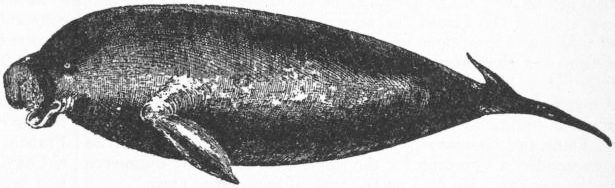
The Dugong.
DUGUAY-TROUIN, RENÉ (1673-1736), French sea captain, belonged to a well-known family of merchants and sea captains of St Malo. He was born at St Malo on the 10th of June 1673. He was originally intended for the church, and studied with that view at Rennes and Caen; but on the breaking out of the war with England and Holland in 1689 he went to sea in a privateer owned by his family. During the first three months his courage was tried by a violent tempest, an imminent shipwreck, the boarding of an English ship, and the threatened destruction of his own vessel by fire. The following year, as a volunteer in a vessel of 28 guns, he was present in a bloody combat with an English fleet of five merchant vessels. The courage he then showed was so remarkable that in 1691, at the age of eighteen, his family gave him a corsair of 14 guns; and having been thrown by a tempest on the coast of Ireland, he burned two English ships in the river Limerick. In 1694 his vessel of 40 guns was captured by the English, and, being taken prisoner, he was confined in the castle of Plymouth. He escaped, according to his own account, by the help of a pretty shopwoman and her lover, a French refugee in the English service. He then obtained command of a vessel of 48 guns, and made a capture of English vessels on the Irish coast. In 1696 he made a brilliant capture of Dutch vessels, and the king hearing an account of the affair gave him a commission as capitaine de frégate (commander) in the royal navy. In 1704-1705 he desolated the coasts of England. In 1706 he was raised to the rank of captain of a vessel of the line. In 1707 he was made chevalier of the order of St Louis, and captured off the Lizard the greater part of an English convoy of troops and munitions bound for Portugal. His most glorious action was the capture in 1711 of Rio Janeiro, on which he imposed a heavy contribution. In 1715 he was made chef d’escadre, the rank which in the French navy answered to the English commodore, and in 1728 commander of the order of St Louis and lieutenant général des armées navales. In 1731 he commanded a squadron for the protection of French commerce in the Levant. He died on the 27th of September 1736.
See his own Mémoires (1740); and J. Poulain, Duguay-Trouin (1882).
DU GUESCLIN, BERTRAND (c. 1320-1380), constable of France, the most famous French warrior of his age, was born of an ancient but undistinguished family at the castle of La Motte-Broons (Dinan). The date of his birth is doubtful, the authorities varying between 1311 and 1324. The name is spelt in various ways in contemporary records, e.g. Claquin, Klesquin, Guescquin, Glayaquin, &c. The familiar form is found on his monument at St Denis, and in some legal documents of the time. In his boyhood Bertrand was a dull learner, spending his time in open-air sports and exercises, and could never read or write. He was remarkable for ugliness, and was an object of aversion to his parents. He first made himself a name as a soldier at the tournament held at Rennes in 1338 to celebrate the marriage of Charles of Blois with Jeanne de Penthièvre, at which he unseated the most famous competitors. In the war which followed between Charles of Blois and John de Montfort, for the possession of the duchy of Brittany, he served his apprenticeship as a soldier (1341). As he was not a great baron with a body of vassals at his command, he put himself at the head of a band of adventurers, and fought on the side of Charles and of France. He distinguished himself by a brilliant action at the siege of Vannes in 1342; and after that he disappears from history for some years.
In 1354, having shortly before been made a knight, he was sent into England with the lords of Brittany to treat for the ransom of Charles of Blois, who had been defeated and captured by the English in 1347. When Rennes and Dinan were attacked by the duke of Lancaster in 1356, Du Guesclin fought continuously against the English, and at this time he engaged in a celebrated duel with Sir Thomas Canterbury. He finally forced his way with provisions and reinforcements into Rennes, which he successfully defended till June 1357, when the siege was raised in pursuance of the truce of Bordeaux. For this service he was rewarded with the lordship of Pontorson. Shortly afterwards he passed into the service of France, and greatly distinguished himself at the siege of Melun (1359), being, however, taken prisoner a little later by Sir Robert Knollys. In 1360, 1361 and 1362 he was continually in the field, being again made prisoner in 1360. In 1364 he married, but was soon again in the field, this time against the king of Navarre. In May 1364 he won an important victory over the Navarrese at Cocherel, and took the famous Captal de Buch prisoner. He had previously been made lord of La Roche-Tesson (1361) and chamberlain (1364); he was now made count of Longueville and lieutenant of Normandy. Shortly afterwards, in aiding Charles of Blois, Du Guesclin was taken prisoner by Sir John Chandos at the battle of Auray, in which Charles was killed. The close of the general war, however, had released great numbers of mercenaries (the great companies) from control, and, as they began to play the part of brigands in France, it was necessary to get rid of them. Du Guesclin was ransomed for 100,000 crowns, and was charged to lead them out of France. He marched with them into Spain, supported Henry of Trastamara against Pedro the Cruel, set the former upon the throne of Castile (1366), and was made constable of Castile and count of Trastamara. In the following year he was defeated and captured by the Black Prince, ally of Pedro, at Navarette, but was soon released for a heavy ransom. Once more he fought for Henry, won the battle of Montiel (1369), reinstated him on the throne, and was created duke of Molinas.
In May 1370, at the command of Charles V., who named him constable of France, he returned to France. War had just been declared against England, and Du Guesclin was called to take part in it. For nearly ten years he was engaged in fighting against the English in the south and the west of France, recovering from them the provinces of Poitou, Guienne and Auvergne, and thus powerfully contributing to the establishment of a united France. In 1373, when the duke of Brittany sought English aid against a threatened invasion by Charles V., Du Guesclin was sent at the head of a powerful army to seize the duchy, which he did; and two years later he frustrated the attempt of the duke with an English army to recover it. Finding in 1379 that the king entertained suspicions of his fidelity to him, he resolved to give up his constable’s sword and retire to Spain. His resolution was at first proof against remonstrance; but ultimately he received back the sword, and continued in the service of France. In 1380 he was sent into Languedoc to suppress disturbances and brigandage, provoked by the harsh government of the duke of Anjou. His first act was to lay siege to the fortress of Châteauneuf-Randon, but on the eve of its surrender the constable died on the 13th of July 1380. His remains were interred, by order of the king, in the church of St Denis. Du Guesclin lost his first wife in 1371, and married a second in 1373, but he left no legitimate children.
See biography by D.F. Jamison (Charleston, 1863), which was translated into French (1866) by order of Marshal Count Randon, minister of war; also S. Luce, Histoire de B. du Guesclin (Paris, 1876).
DUHAMEL, JEAN BAPTISTE (1624-1706), French physicist, was born in 1624 at Vire in Normandy. He studied at Caen and Paris; wrote at eighteen a tract on the Spherics of Theodosius of Tripolis; then became an Oratorian priest, and fulfilled with great devotion for ten years (1653-1663) the duties of curé at Neuilly-sur-Marne. He was appointed in 1656 almoner to the king, and in 1666 perpetual secretary to the newly founded Academy of Sciences. He died on the 6th of August 1706. He published among other works: Astronomia physica (1660) and De meteoris et fossilibus (1660), both in dialogue form; De consensu veteris et novae philosophiae (1663); De corporum affectionibus (1672); De mente humana (1673); Regiae scientiarum Academiae historia, 1666-1696 (1698), new edition brought down to 1700 (1701); Institutiones biblicae (1698); followed by annotated editions of the Psalms (1701), of the Book of Wisdom, &c. (1703), and of the entire Bible in 1705.
DUHAMEL DU MONCEAU, HENRI LOUIS (1700-1782), French botanist and engineer, son of Alexandre Duhamel, lord of Denainvilliers, was born at Paris in 1700. Having been requested by the Academy of Sciences to investigate a disease which was destroying the saffron plant in Gâtinais, he discovered the cause in a parasitical fungus which attached itself to the roots, and this achievement gained him admission to the Academy in 1728. From then until his death he busied himself chiefly with making experiments in vegetable physiology. Having learned from Sir Hans Sloane that madder possesses the property of giving colour to the bones, he fed animals successively on food mixed and unmixed with madder; and he found that their bones in general exhibited concentric strata of red and white, whilst the softer parts showed in the meantime signs of having been progressively extended. From a number of experiments he was led to believe himself able to explain the growth of bones, and to demonstrate a parallel between the manner of their growth and that of trees. Along with the naturalist Buffon, he made numerous experiments on the growth and strength of wood, and experimented also on the growth of the mistletoe, on layer planting, on smut in corn, &c. He was probably the first, in 1736, to distinguish clearly between the alkalis, potash and soda. From the year 1740 he made meteorological observations, and kept records of the influence of the weather on agricultural production. For many years he was inspector-general of marine, and applied his scientific acquirements to the improvement of naval construction. He died at Paris on the 13th of August 1782.
His works are nearly ninety in number, and include many technical handbooks. The principal are:—Traité des arbres et arbustes qui se cultivent en France en pleine terre; Éléments de l’architecture navale; Traité général des pêches maritimes et fluviatiles; Éléments d’agriculture; La Physique des arbres; Des Semis et plantations des arbres et de leur culture; De l’exploitation des bois; Traité des arbres fruitiers.
DÜHRING, EUGEN KARL (1833-1901), German philosopher and political economist, was born on the 12th of January 1833 at Berlin. After a legal education he practised at Berlin as a lawyer till 1859. A weakness of the eyes, ending in total blindness, occasioned his taking up the studies with which his name is now connected. In 1864 he became docent of the university of Berlin, but, in consequence of a quarrel with the professoriate, was deprived of his licence to teach in 1874. Among his works are Kapital und Arbeit (1865); Der Wert des Lebens (1865); Natürliche Dialektik (1865); Kritische Geschichte der Philosophie (1869); Kritische Geschichte der allgemeinen Principien der Mechanik (1872)—one of his most successful works; Kursus der National- und Sozialökonomie (1873); Kursus der Philosophie (1875), entitled in a later edition Wirklichkeitsphilosophie; Logik und Wissenschaftstheorie (1878); Der Ersatz der Religion durch Vollkommeneres (1883). He published his autobiography in 1882 under the title Sache, Leben und Feinde; the mention of “Feinde” (enemies) is characteristic. Dühring’s philosophy claims to be emphatically the philosophy of reality. He is passionate in his denunciation of everything which, like mysticism, tries to veil reality. He is almost Lucretian in his anger against religion which would withdraw the secret of the universe from our direct gaze. His “substitute for religion” is a doctrine in many points akin to Comte and Feuerbach, the former of whom he resembles in his sentimentalism. Dühring’s opinions changed considerably after his first appearance as a writer. His earlier work, Natürliche Dialektik, in form and matter not the worst of his writings, is entirely in the spirit of the Critical Philosophy. Later, in his movement towards Positivism, he strongly repudiates Kant’s separation of phenomenon from noumenon, and affirms that our intellect is capable of grasping the whole reality. This adequacy of thought to things is due to the fact that the universe contains but one reality, i.e. matter. It is to matter that we must look for the explanation both of conscious and of physical states. But matter is not, in his system, to be understood with the common meaning, but with a deeper sense as the substratum of all conscious and physical existence; and thus the laws of being are identified with the laws of thought. In this materialistic or quasi-materialistic system Dühring finds room for teleology; the end of Nature, he holds, is the production of a race of conscious beings. From his belief in teleology he is not deterred by the enigma of pain; he is a determined optimist. Pain exists to throw pleasure into conscious relief. In ethics Dühring follows Comte in making sympathy the foundation of morality. In political philosophy he teaches an ethical communism, and attacks the Darwinian principle of struggle for existence. In economics he is best known by his vindication of the American writer H.C. Carey, who attracts him both by his theory of value, which suggests an ultimate harmony of the interests of capitalist and labourer, and also by his doctrine of “national” political economy, which advocates protection on the ground that the morals and culture of a people are promoted by having its whole system of industry complete within its own borders. His patriotism is fervent, but narrow and exclusive. He idolized Frederick the Great, and denounced Jews, Greeks, and the cosmopolitan Goethe. Dühring’s clear, incisive writing is disfigured by arrogance and ill-temper, failings which may be extenuated on the ground of his physical affliction. He died in 1901.
See H. Druskowitz, Eugen Dühring (Heidelberg, 1888); E. Döll, Eugen Dühring (Leipzig, 1892); F. Engels, Eugen D.’s Umwalzung der Wissenschaft (3rd ed., Stuttgart, 1894); H. Vaihinger, Hartmann, Dühring und Lange (1876).
(H. St.)
DUIGENAN, PATRICK (1735-1816), Irish lawyer and politician, was the son of a Leitrim Roman Catholic farmer named O’Duibhgeannain. Through the tuition of the local Protestant clergyman, who was interested in the boy, he got a scholarship in 1756 at Trinity College, Dublin, and subsequently became a fellow. He was called to the Irish bar in 1767 and obtained a rich practice. He is remembered, however, mainly as a politician, on account of his opposition to Grattan, his support of the Union, and his violent antagonism to Catholic emancipation. He was elected member for Armagh in the first united parliament, and was a well-known character at Westminster till he died on the 11th of April 1816.
DUIKER (diver), or Duikerbok, the Dutch name of a small S. African antelope, scientifically known as Cephalophus grimmi; the popular name alluding to its habit of diving into and threading its way through thick bush. Scientifically the name is extended to include all the members of the African genus Cephalophus, which, together with the Indian chousingha, or four-horned antelope (Tetraceros), constitutes the subfamily Cephalophinae. Duikers are animals of small or medium size, usually frequenting thick forest. The horns, usually present in both sexes, are small and straight, situated far back on the forehead; and between them rises the crest-like tuft of hair from which the genus takes its scientific name. The common or true duiker (C. grimmi) is found in bush-country from the Cape to the Zambezi and Nyasaland, and ranges northward on the west coast to Angola. The banded duiker (C. doriae) from West Africa is golden brown with black transverse bands on the back and loins. C. sylvicultor, of West Africa, is the largest species, and approaches a donkey in size. (See Antelope.)
(R. L.*)
DUILIUS (or Duellius), GAIUS, Roman general during the first Carthaginian War and commander in the first Roman naval victory. In 260 B.C., when consul in command of the land forces in Sicily, he was appointed to supersede his colleague Cn. Cornelius Scipio Asina, commander of the fleet, who had been captured in the harbour of Lipara. Recognizing that the only chance of victory lay in fighting under conditions as similar as possible to those of a land engagement, he invented a system of grappling irons (corvi) and boarding bridges, and gained a brilliant victory over the Carthaginian fleet off Mylae on the north coast of Sicily. He was accorded a triumph and the distinction of being accompanied, when walking in the streets during the evening, by a torchbearer and a flute-player. A memorial column (columna rostrata), adorned with the beaks of the captured ships, was set up in honour of his victory. The inscription upon it (see Latin Language, section 3, “The Language as Recorded”) has been preserved in a restored form in pseudo-archaic language, ascribed to the reign of Claudius.
See Corpus Inscriptionum Latinarum, i. No. 195; Polybius i. 22; Diod. Sic. xvii. 44; Frontinus, Strat. ii. 3; Florus ii. 2; Cicero, De senectute, 13; Silius Italicus vi. 667; and Punic Wars.
DUISBURG, a town of Germany in the kingdom of Prussia, 15 m. by rail N. from Düsseldorf, between the Rhine and the Ruhr, with which rivers it communicates by a canal. It is an important railway centre. Pop. (1885) 47,519; (1900) 92,729; (1905), including many outlying townships then recently incorporated, 191,551. It has six Roman Catholic and six Protestant churches, among the latter the fine Gothic Salvatorkirche, of the 15th century. It is well furnished with schools, which include a school of machinery. Of modern erections, the concert hall, the law courts and a memorial fountain to the cartographer Gerhard Kremer (Mercator) are worthy of mention. There are important foundries, rolling mills for copper, steel and brass plates, chemical works, saw-milling, shipbuilding, tobacco, cotton, sugar, soap and other manufactures.
Duisburg was known to the Romans as Castrum Deutonis, and mentioned under the Frankish kings as Dispargum. In the 12th century it attained the rank of an imperial free town, but on being mortgaged in 1290 to Cleves it lost its privileges. At the beginning of the 17th century it was transferred to Brandenburg, and during the Thirty Years’ War was alternately occupied by the Spaniards and the Dutch. In 1655 the elector Frederick William of Brandenburg founded here a Protestant university, which flourished until 1802.
DUK-DUK, a secret society of New Britain or New Pomerania, Bismarck Archipelago, in the South Pacific. The society has religious and political as well as social objects. It represents a rough sort of law and order through its presiding spirit Duk-Duk, a mysterious figure dressed in leaves to its waist, with a helmet like a gigantic candle-extinguisher made of network. Upon this figure women and children are forbidden to look. Women, who are entitled in New Britain to their own earnings and work harder than men, are the special victims of Duk-Duk, who levies blackmail upon them if they are about during its visits. These are generally timed to coincide with the hours at which the women are out in the fields and therefore cannot help seeing the figure. Justice is executed, fines extorted, taboos, feasts, taxes and all tribal matters are arranged by the Duk-Duk members, who wear hideous masks or chalk their faces. In carrying out punishments they are allowed to burn houses and even kill people. Only males can belong to Duk-Duk, the entrance fees of which vary from 50 to 100 fathoms of dewarra (small cowrie shells strung on strips of cane). The society has its secret signs and ritual, and festivals at which the presence of a stranger would mean his death. Duk-Duk only appears with the full moon. The society is now much discredited and is fast dying out.
See “Duk-Duk and other Customs or Forms of Expression of the Melanesian’s Intellectual Life,” by Graf von Pfeil (Journ. of Anthrop. Instit. vol. 27, p. 181).
DUKE (corresponding to Fr. duc, Ital. duca, Ger. Herzog), the title of one of the highest orders of the European nobility, and of some minor sovereign princes. The word “duke,” which is derived from the Lat. dux, a leader, or general, through the Fr. duc (O. Fr. dusc, ducs, dus), originally signified a leader, and more especially a military chief, and in this latter sense was the equivalent of the A.S. heretoga (here, an army, and teon, from togen, to draw; Ger. ziehen, zog; Goth, tiuhan; Lat. ducere) and the old Ger. herizog. In this general sense the word survived in English literature until the 17th century, but is now obsolete.
The origin of modern dukes is twofold. The dux first appears in the Roman empire under the emperor Hadrian, and by the time of the Gordians has already a recognized place in the official hierarchy. He was the general appointed to the command of a particular expedition and his functions were purely military. In the 4th century, after the separation of the civil and military administrations, there was a duke in command of the troops quartered in each of the frontier provinces of the empire, e.g. the dux Britanniarum. The number of dukes continually increased, and in the 6th and 7th centuries there were duces at Rome, Naples, Rimini, Venice and Perugia. Gradually, too, they became charged with civil as well as military functions, and even exercised considerable authority in ecclesiastical administration. Under the Byzantine emperors they were the representatives in all causes of the central power. The Roman title of duke was less dignified than that of count (comes, companion) which implied an honourable personal relation to the emperor (see Count). Both titles were borrowed by the Merovingian kings for the administrative machinery of the Frank empire, and under them the functions of the duke remained substantially unaltered. He was a great civil and military official, charged to watch, in the interests of the crown, over groups of several comitatus, or countships, especially in the border provinces. The sphere of the dukes was never rigidly fixed, and their commission was sometimes permanent, sometimes temporary. Under the Carolingians the functions of the dukes remained substantially the same; but with the decay of the royal power in the 10th century, both dukes and counts gained in local authority; the number of dukes became for the time fixed, and finally title and office were made hereditary, the relation to the crown being reduced to that of more or less shadowy vassalage. (See Feudalism.)
Side by side with these purely official dukedoms, however, there had continued to exist, or had sprung up, either independently or in more or less of subjection to the Frank rulers, national dukedoms, such as those of the Alemanni, the Aquitanians, and, later, of the Bavarians and Thuringians. These were developed from the early Teutonic custom by which the herizog was elected by the nation as leader for a particular campaign, as in the case of the heretogas who had led the first Saxon invaders into Britain. Tacitus says of the ancient Germans reges ex nobilitate, duces ex virtute sumunt; i.e. they elected their dukes for their warlike prowess only, and as purely military chiefs, whereas their kings were chosen from a royal family of divine descent. Sometimes the dukes so chosen succeeded in making their power permanent without taking the style of king. To this national category belong, besides the great German dukedoms, the dukes of Normandy, and the Lombard dukes of Spoleto and Benevento, who traced their origin, not to an administrative office, but to the leadership of Teutonic war bands. With the development of the feudal system the distinction between the official and the national dukedoms was more and more obliterated. By the 13th and 14th centuries the title had become purely territorial, and implied no necessary overlordship over counts and other nobles, who existed side by side with the dukes as tenants-in-chief of the crown. From this time the significance of the ducal title varies widely in different countries. Whenever the crown got the better of the feudal spirit of independence, as in France or Naples, it sank from being a sovereign title to a mere social distinction, implying no political power, and not necessarily any territorial influence. In northern Italy and in Germany, on the other hand, where the crown had proved too weak to combat the forces of disruption, it came ultimately to imply independent sovereignty.
The abolition of the Holy Empire in 1806 removed even the shadow of vassalage from the German reigning dukes, who retain their sovereign status under the new empire. Only one, however, the grand duke of Luxemburg, is now both sovereign and independent. Besides the sovereign dukes in Germany there are certain “mediatized” ducal houses, e.g. that of Ratibor, which share with the dispossessed families of the Italian sovereign duchies certain royal privileges, notably that of equality of blood (Ebenbürtigkeit). In Italy, where titles of nobility give no precedence at court, that of duke (duca) has lost nearly all even of its social significance owing to lavish creations by the popes and minor sovereigns, and to the fact that the title often passes by purchase with a particular estate. Political significance it has none. Some great Italian nobles are dukes, notably the heads of the great Roman ducal families, but not all Italian dukes are great nobles.
In France the title duke at one time implied vast territorial power, as with the dukes of Burgundy, Normandy, Aquitaine and Brittany, who asserted a practical independence against the crown, though it was not till the 12th century that the title duke was definitely regarded as superior to others. At first (in the 10th and 11th centuries) it had no defined significance, and even a baron of the higher nobility called himself in charters duke, count or even marquis, indifferently. In any case the strengthening of the royal power gradually sapped the significance of the title, until on the eve of the Revolution it implied no more than high rank and probably territorial wealth.
There were, under the ancien régime, three classes of dukes in France: (1) dukes who were peers (see Peerage) and had a seat in the parlement of Paris; (2) hereditary dukes who were not peers; (3) “brevet” dukes, created for life only. The French duke ranks in Spain with the “grandee” (q.v.), and vice versa. In republican France the already existing titles are officially recognized, but they are now no more than the badges of distinguished ancestry. Besides the descendants of the feudal aristocracy there are in France certain ducal families dating from Napoleon I.’s creation of 1806 (e.g. ducs d’Albufera, de Montebello, de Feltre), from Louis Philippe (duc d’Isly, and duc d’Audiffret-Pasquier), and from Napoleon III. (Malakoff, Magenta, Morny).
In England the title of duke was unknown till the 14th century, though in Saxon times the title ealdorman, afterwards exchanged for “earl,” was sometimes rendered in Latin as dux,1 and the English kings till John’s time styled themselves dukes of Normandy, and dukes of Aquitaine even later. In 1337 King Edward III. erected the county of Cornwall into a duchy for his son Edward the Black Prince, who was thus the first English duke. The second was Henry, earl of Lancaster, Derby, Lincoln and Leicester, who was created duke of Lancaster in 1351. In Scotland the title of duke was first bestowed in 1398 by Robert III. on his eldest son David, who was made duke of Rothesay, and on his brother, who became duke of Albany.
British dukes rank next to princes and princesses of the blood royal, the two archbishops of Canterbury and York, the lord Chancellor, &c., but beyond this precedence they have no special privileges which are not shared by peers of lower rank (see Peerage). Though their full style as proclaimed by the herald is “most high, potent and noble prince,” and they are included in the Almanach de Gotha, they are not recognized as the equals in blood of the crowned or mediatized dukes of the continent, and the daughter of an English duke marrying a foreign royal prince can only take his title by courtesy, or where, under the “house-laws” of certain families, a family council sanctions the match. The eldest son of an English duke takes as a rule by courtesy the second title of his father, and ranks, with or without the title, as a marquess. The other sons and daughters bear the titles “Lord” and “Lady” before their Christian names, also by courtesy. A duke in the British peerage, if not royal, is addressed as “Your Grace” and is styled “the Most Noble.” (See Archduke, Grand Duke, and, for the ducal coronet, Crown and Coronet.)
(W. A. P.)
1 So Ego Haroldus dux, Ego Tostinus dux, in a charter of Edward the Confessor (1060), Hist. MSS. Comm. 12th rep. app. pt. ix. p. 581.
DUKE OF EXETER’S DAUGHTER, a nickname applied to a 15th-century instrument of torture resembling the rack (q.v.). Blackstone says (Commentaries, ii. sec. 326): “The trial by rack is utterly unknown to the law of England, though once when the dukes of Exeter and Suffolk, and other ministers of Henry VI., had laid a design to introduce the civil (i.e. Roman) law into the kingdom as the rule of government, for a beginning thereof they erected a rack for torture, which was called in derision the duke of Exeter’s daughter, and still remains in the Tower of London, where it was used as an engine of state, not of law, more than once in Queen Elizabeth’s reign. But when, upon the assassination of Villiers, duke of Buckingham, by Felton, it was proposed in the privy council to put the assassin to the rack, in order to discover his accomplices, the judges being consulted, declared unanimously that no such proceeding was allowable by the laws of England.”
DUKER, CARL ANDREAS (1670-1752), German classical scholar and jurist, was born at Unna in Westphalia. He studied at the university of Franeker under Jacob Perizonius. In 1700 he was appointed teacher of history and eloquence at the Herborn gymnasium, in 1704 vice-principal of the school at the Hague, and in 1716 he succeeded (with Drakenborch as colleague) to the professorship formerly held by Peter Burmann at Utrecht. After eighteen years’ tenure he resigned his post, and lived in retirement at Ysselstein and Vianen. His health finally broke down under excessive study, and he died, almost blind, at the house of a relative in Meiderich near Duisburg, on the 5th of November 1752. His chief classical works were editions of Florus (1722) and Thucydides (1731, considered his best). He brought out the 2nd edition of Perizonius’s Origines Babylonicae et Aegyptiacae (1736) and his commentary on Pomponius Mela (1736-1737). Duker was also an authority on ancient law, and published Opuscula varia de latinitate veterum jurisconsultorum (1711), and a revision of the Leges Atticae of S. Petit (1741).
See C. Saxe, Onomasticon litterarium, vi. 267; articles in Allgemeine deutsche Biographie and in Ersch and Gruber’s Allgemeine Encyklopadie.
DUKERIES, THE, a name given to a district in the N.W. of Nottinghamshire, England; included within the ancient Sherwood Forest (q.v.). The name is taken from the existence of several adjacent demesnes of noblemen, and the character of the Forest is to some extent preserved here. On the north is the Sheffield-Retford branch of the Great Central railway, serving the town of Worksop, connecting at Retford with the Great Northern railway, while on the south the Great Central railway serves the small market town of Ollerton, and connects with the Great Northern at Dukeries Junction. The following demesnes are comprised in the district. Worksop Manor formerly belonged to the dukes of Norfolk. Welbeck Abbey is the seat of the dukes of Portland, to whom it came from the Cavendish family (dukes of Newcastle); the mansion is mainly classic in style, dating from the early 17th century, but with many subsequent additions; the fifth duke of Portland (d. 1879) built the curious series of subterranean corridors and chambers beneath the grounds. Clumber House, the seat of the dukes of Newcastle, is beautifully placed above a lake in a fine park. Thoresby House is the seat of the earls Manvers, to whom it came on the extinction of the dukedom of Kingston; part of this demesne is a splendid tract of wild woodland.
DUKES, LEOPOLD (1810-1891), Hungarian critic of Jewish literature. He spent about twenty years in England, and from his researches in the Bodleian library and the British Museum (which contain two of the most valuable Hebrew libraries in the world) Dukes was able to complete the work of Zunz (q.v.). The most popular work of Dukes was his Rabbinische Blumenlese (1844), in which he collected the rabbinic proverbs and illustrated them from the gnomic literatures of other peoples. Dukes made many contributions to philology, but his best work was connected with the medieval Hebrew poetry, especially Ibn Gabirol.
(I. A.)
DUKINFIELD, a municipal borough of Cheshire, England, within the parliamentary borough of Stalybridge, 6 m. E. of Manchester. Pop. (1901) 18,929. It lies in the densely populated district in the north-east of the county, between Stalybridge and Ashton-under-Lyne, and is served by the London & North Western and Great Central railways. There are extensive collieries, and the other industries include cotton manufactures, calico-printing, hat-making, iron-founding, engineering and the manufacture of firebricks and tiles. A portion remains of the old timbered Dukinfield Hall, in the chapel of which Samuel Eaton (d. 1665) taught the first congregational church in the north of England. The chapel, much enlarged, is still used by this denomination. The borough, incorporated in 1899, is under a mayor, 6 aldermen and 18 councillors. Area, 1405 acres.
DULCIGNO (Servian, Ultsin, Turk. Olgun), a seaport of Montenegro, on the Adriatic Sea, 8 m. W. of the Albanian frontier. Pop. (1900) about 5000. Shut in by hills and forests, and built partly on a promontory overlooking its bay, partly along the shore, Dulcigno is the prettiest of Montenegrin towns. Its narrow crooked lanes, however, with its bazaars, mosques, minarets and veiled women, give to its picturesqueness a decidedly Turkish air. The old quarter, on the promontory, is walled, and has a medieval castle, once of great strength. Turks form the bulk of the inhabitants, although their numbers decreased steadily after 1880, when the population numbered about 8000. Albanians and Italians are fairly numerous. Dulcigno has a Roman Catholic cathedral and an ancient Latin church. The Austrian Lloyd steamers call at intervals, and some shipbuilding and fishing are carried on; but the harbour lacks shelter and is liable to deposits of silt.
To the Romans, who captured it in 167 B.C., Dulcigno was known as Ulcinium or Olcinium; in the middle ages it was a noted haunt of pirates; in the 17th century it was the residence of Sabbatai Zebi (d. 1676), a Jew who declared himself to be the Messiah but afterwards embraced Islam. In 1718 Dulcigno was the scene of a great Venetian defeat. It belonged to the Turks until 1880, when its cession, according to the terms of the treaty of Berlin (1878), was enforced by the “Dulcigno demonstration,” in which the fleets of Great Britain, France, Germany, Austria and Russia took part.
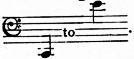
DULCIMER (Fr. tympanon; Ger. Hackbrett, Cymbal; Ital. cembalo, timpanon or salterio tedesco), the prototype of the pianoforte, an instrument consisting of a horizontal sound-chest over which are stretched a varying number of wire strings set in vibration by strokes of little sticks or hammers. The dulcimer differed from the psalterium or psaltery chiefly in the manner of playing, the latter having the strings plucked by means of fingers or plectrum. The shape of the dulcimer is a trapeze or truncated triangle, having the bass strings stretched parallel with the base, which measures from 3 to 4 ft.; the strings decrease gradually in length, the shortest measuring from about 18 to 24 in. at the truncated apex. The sound-board has one or two rose sound-holes; the strings are attached on one side to hitch pins and at the other to the larger tuning pins firmly fixed in the wrest plank. The strings of fine brass or iron wire are in groups of two to five unisons to each note; the vibrating lengths of the strings are determined by means of two bridges. The dulcimer is placed upon a table in front of the performer, who strikes the strings with a little hammer mounted on a metal rod and covered on one side with hard and on the other with soft leather for forte and piano effects. The compass, now chromatic throughout, varies according to the size of the instrument; the large cymbalom of the Hungarian gipsies has a range of four chromatic octaves, .
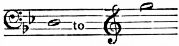
The origin of the dulcimer is remote, and must be sought in the East. In the bas-reliefs from Kuyunjik, now in the British Museum, are to be seen musicians playing on dulcimers of ten strings with long sticks curved at the ends, and damping the strings with their hands. This is the pisantir of the days of Nebuchadrezzar, translated “psaltery” in Dan. iii. 5, &c., and rendered “psalterion” in the Septuagint, a confusion which has given rise to many misconceptions.1 In the Septuagint no less than four different instruments are rendered psalterion (from Gr. ψάλλω, pluck, pull), i.e. ugab, nebel, pisantir and toph, two stringed, one wind and one percussion. The use of the word in Greek for a musical instrument is not recorded before the 4th century B.C. The modern santir of the Persians, almost identical with the German hackbrett, has a compass from according to Fétis.2 The Persians place its origin in the highest antiquity. Carl Engel3 gives an illustration said to be taken from a very old painting.4
The dulcimer was extensively used during the middle ages in England, France, Italy, Germany, Holland and Spain, and although it had a distinctive name in each country, it was everywhere regarded as a kind of psalterium. The importance of the method of setting the strings in vibration by means of hammers, and its bearing on the acoustics of the instrument, were recognized only when the invention of the pianoforte had become a matter of history. It was then perceived that the psalterium in which the strings were plucked, and the dulcimer in which they were struck, when provided with keyboards, gave rise to two distinct families of instruments, differing essentially in tone quality, in technique and in capabilities: the evolution of the psalterium stopped at the harpsichord, that of the dulcimer gave us the pianoforte. The dulcimer is described and illustrated by Mersenne,5 who calls it psaltérion; it has thirteen courses of pairs of unisons or octaves; the first strings were of brass wire, the others of steel. The curved stick was allowed to fall gently on to the strings and to rebound many times, which, Mersenne remarks, produces an effect similar to the trembling or tremolo of other instruments. Praetorius6 figures a hackbrett having a body in the shape of a truncated triangle, with a bridge placed between two rose sound-holes, and played by means of two sticks. Another kind of hackbrett7 (a psaltery), which was played with the fingers, was known to Praetorius. The pantaleon, a double dulcimer, named after the inventor, Pantaleon Hebenstreit of Eisleben, a violinist, had two sound-boards, 185 strings, one scale of overspun catgut, the other of wire. Hebenstreit travelled to Paris with his monster dulcimer in 1705 and played before Louis XIV., who baptized it Pantaléon. Quantz8 and Quirin of Blankenburg9 both gave descriptions of the instrument.
(K. S.)
1 The names of the musical instruments in those verses of the Book of Daniel have formed the basis of a controversy as to the authenticity of the book.
2 Histoire de la musique (Paris, 1869), vol. ii. p. 131.
3 Music of the most Ancient Nations (London, 1864), pp. 42-3.
4 Hommaire de Hell, Voyage en Perse, p. lxii.
5 L’Harmonie universelle (Paris, 1636), livre iii. p. 174.
6 Syntagma musicum (Wolfenbüttel, 1618), pl. 18 (3).
7 Pl. 36 (1).
8 “Herrn Joh. Joachim Quantzens Lebenslauf von ihm selbst entworfen,” in Fr. W. Marpurg’s Histor. kritische Beytrage, Bd. i p. 207 (1754-1755).
9 Elementa musica, chap. xxvi.
DÜLKEN, a town of Germany, in the Prussian Rhine Province, 11 m. by rail S.W. from Crefeld. Pop. 10,000. It has a (Roman Catholic) Gothic parish church. There are manufactures of linen, cotton, silk and velvet, &c., ironworks and foundries.
DULONG, PIERRE LOUIS (1785-1838), French chemist and physicist, was born at Rouen on the 12th (or 13th) of February 1785. He began as a doctor in one of the poorest districts of Paris, but soon abandoned medicine for scientific research. After acting as assistant to Berthollet, he became successively professor of chemistry at the faculty of sciences and the normal and veterinary schools at Alfort, and then (1820) professor of physics at the École Polytechnique, of which he was appointed director in 1830. He died in Paris on the 18th (or 19th) of July 1838. His earliest work was chemical in character. In 1811 he discovered chloride of nitrogen; during his experiments serious explosions occurred twice, and he lost one eye, besides sustaining severe injuries to his hand. He also investigated the oxygen compounds of phosphorus and nitrogen, and was one of the first to hold the hydrogen theory of acids. In 1815, in conjunction with Alexis Thérèse Petit (1791-1820), the professor of physics at the École Polytechnique, he made careful comparisons between the mercury and the air thermometer. The first published research (1816) dealt with the dilatation of solids, liquids and gases and with the exact measurement of temperature, and it was followed by another in 1818 on the measurement of temperature and the communication of heat, which was crowned by the French Academy. In a third, “On some important points in the theory of heat” (1819), they stated that the specific heats of thirteen solid elements which they had investigated were nearly proportional to their atomic weights—a fact otherwise expressed in the “law of Dulong and Petit” that the atoms of simple substances have equal capacities for heat. Subsequent papers by Dulong were concerned with “New determinations of the proportions of water and the density of certain elastic fluids” (1820, with Berzelius); the property possessed by certain metals of facilitating the combination of gases (1823 with Thénard); the refracting powers of gases (1826); and the specific heats of gases (1829). In 1830 he published a research, undertaken with Arago for the academy of sciences, on the elastic force of steam at high temperatures. For the purposes of this determination he set up a continuous column of mercury, constructed with 13 sections of glass tube each 2 metres long and 5 mm. in diameter, in the tower of the old church of St Geneviève in the Collège Henri IV. The apparatus was first used to investigate the variation in the volume of air with pressure, and the conclusion was that up to twenty-seven atmospheres, the highest pressure attained in the experiments, Boyle’s law holds good. In regard to steam, the old tower was so shaky that it was considered unwise to risk the effects of an explosion, and therefore the mercury column was removed bodily to a court in the observatory. The original intention was to push the experiments to a pressure equivalent to thirty atmospheres, but owing to the signs of failure exhibited by the boiler the limit actually reached was twenty-four atmospheres, at which pressure the thermometers indicated a temperature of about 224°C. In his last paper, published posthumously in 1838, Dulong gave an account of experiments made to determine the heat disengaged in the combination of various simple and compound bodies, together with a description of the calorimeter he employed.
DULSE (Ir. and Gael. duileasg), in botany, Rhodymenia palmata, one of the red seaweeds, consisting of flat solitary or tufted purplish-red fronds, fan-shaped in general outline and divided into numerous segments, which are often again and again divided in a forked manner. It varies very much in size and degree of branching, ranging from 5 or 6 to 12 or more inches long. It grows on rocks, shell-fish or larger seaweeds, and is used by the poor in Scotland and Ireland as a relish with their food. It is commonly dried and eaten raw, the flavour being brought out by long chewing. In the Mediterranean it is used cooked in ragouts and made dishes.
See W.H. Harvey, Phycologica Britannica, vol. ii. plates 217, 218.
DULUTH, a city and the county-seat of St Louis county, Minnesota, U.S.A., at the W. end of Lake Superior, at the mouth of the St Louis river, about 150 m. N.E. of Minneapolis and St Paul. Pop. (1880) 3483; (1890) 33,115; (1900) 52,969, of whom 20,983 were foreign-born and 357 were negroes; (1910 census) 78,466. Of the 20,983 foreign-born in 1900, 5099 were English-Canadians, 5047 Swedes, 2655 Norwegians, 1685 Germans, and 1285 French-Canadians. Duluth is served by the Duluth and Iron Range, the Duluth, Missabe & Northern, the Duluth, South Shore & Atlantic, the Chicago & North-Western (the North-Western line), the Great Northern, and the Northern Pacific railways. Situated attractively on the side and along the base of a high bluff rising 600 ft. above the lake level, Duluth lies at the W. end of Superior Bay (here called Duluth Harbour), directly opposite the city of Superior, Wisconsin. A narrow strip of land known as Minnesota Point, 7 m. in length and extending toward Wisconsin Point, which projects from the Wisconsin shore, separates the bay from the lake and forms with St Louis Bay one of the finest natural harbours in the world. The natural entrance to the harbour is the narrow channel between the two points, but there is also a ship-canal across Minnesota Point, spanned by a curious aerial bridge 400 ft. long and 186 ft. above the water.
The unusually favourable position for lake transportation, and the extensive tributary region in the N.W., with ample rail connexions, make Duluth-Superior one of the greatest commercial ports in the country. The two cities constitute the largest coal-distributing centre in the N.W., and have some of the largest coal-docks in the world. Upwards of twenty grain elevators, with a net capacity of nearly 35,000,000 bushels, which receive enormous quantities of grain from the Red River Valley, Manitoba, and the Dakotas, either for home manufacture or for transhipment to the East, are among the noteworthy sights of the place; and extensive ore-docks are required for handling the enormous and steadily increasing shipments of iron ore from the rich Vermilion and Mesabi iron ranges first opened about 1890. In 1907 more than 29,000,000 tons of iron ore were shipped from this port. Duluth is also an important hay market. There are flour and lumber mills, foundries and machine shops, wooden ware, cooperage, sash, door and blind, lath and shingle factories, and shipyards. In 1909 great mills of the Minnesota Steel Co. were begun here. In 1905 the factory product of Duluth was valued at $10,139,009, an increase of 29.8% over that of 1900. The St Louis river furnishes one of the finest water-powers in the United States.
The commanding heights upon which the principal residential section of the city is built render it at once attractive in appearance and healthful; there is a fine system of parks and boulevards, the chief of the former being Lester, Fairmount, Portland, Cascade, Lincoln and Chester. The popular Boulevard drive at the back of Duluth commands excellent views of city and lake. Among the principal buildings are the court house, the Masonic temple, chamber of commerce, board of trade, Lyceum theatre, Federal, Providence, Lonsdale, Torrey, Alworth, Sellwood and Wolvin buildings, St. Mary’s hospital, St. Luke’s hospital and Spalding Hotel. There is a public (Carnegie) library with 50,000 volumes in 1908. The building of the central high school (classical), one of the finest in the United States, erected at a cost of about $500,000, has a square clock tower 230 ft. high, and an auditorium seating 2000. The city also has a technical high school, and in addition to the regular high school courses there are departments of business, manual training and domestic science. At Duluth also is a state normal school, erected in 1902. The federal government maintains here a life-saving station on Minnesota Point, and an extensive fish hatchery.
The first Europeans to visit the site of Duluth were probably French coureurs-des-bois, possibly the adventurous Radisson and Groseilliers. The first visitor certainly known to have been here was Daniel Greysolon, Sieur Du Lhut (d. 1709), a French trader and explorer, who about 1678 skirted Lake Superior and built a stockaded trading-post at the mouth of Pigeon river on the N. shore. From him the place received its name. A trading-post was established near the present city, at Fond du Lac, about 1752, and this eventually became a depôt of Astor’s American Fur Company. There was no permanent settlement at Duluth proper, however, until 1853, and in 1860 there were only 80 inhabitants. Incorporated in 1870, in which year railway connexion with the South was established, its growth was slow for some years, the increase for the decade 1870-1880 being very slight (from 3131 to 3483); but the extension of railways into the north-western wheat region, the opening up of Lake Superior to commerce, and finally the development of the Vermilion and Mesabi iron ranges, brought on a period of almost unparalleled growth, marked by the remarkable increase in population of more than 850% between 1880 and 1890; between 1890 and 1900 the increase was 60%.
See J.R. Carey, History of Duluth and Northern Minnesota (Duluth, 1898); Leggett and Chipman, Duluth and its Environs (Duluth, 1895); and J.D. Ensign, History of St Louis County (Duluth, 1900).
DULWICH, a district in the metropolitan borough of Camberwell, London, England. The manor, which had belonged to the Cluniac monks of Bermondsey, passed through various hands to Edward Alleyn (q.v.) in 1606. His foundation of the College of God’s Gift, commonly called Dulwich College, was opened with great state on the 13th of September 1619, in the presence of Lord Chancellor Bacon, Lord Arundell, Inigo Jones and other distinguished men. According to the letters patent the almspeople and scholars were to be chosen in equal proportions from the parishes of St Giles (Camberwell), St Botolph without Bishopsgate, and St Saviour’s (Southwark), and “that part of the parish of St Giles without Cripplegate which is in the county of Middlesex.” By a series of statutes signed in 1626, a few days before his death, Alleyn ordained that his school should be for the instruction of 80 boys consisting of three distinct classes:— (1) the twelve poor scholars; (2) children of inhabitants of Dulwich, who were to be taught freely; and (3) “towne or foreign schollers,” who were “to pay such allowance as the master and wardens shall appoint.” The almspeople consisted of six “poor brethren” and six “poor sisters,” and the teaching and governing staff of a master and a warden, who were always to be of the founder’s surname, and four fellows, all “graduates and divines,” among whom were apportioned the ministerial work of the chapel, the instruction of the boys, and the supervision of the almspeople. That it was the founder’s intention to establish a great public school upon the model of Westminster and St Paul’s, with provision for university training, is shown by the statutes; but for more than two centuries the educational benefits of God’s Gift College were restricted to the twelve poor scholars. Successive actions at law resulted in the ruling that it was not within the competence of the founder to divert any portion of the revenues of his foundation to the use of others than the members thereof, as specified in the letters patent. In 1842, however, some effort was made towards the realization of Alleyn’s schemes, and in 1858 the foundation was entirely reconstituted by act of parliament. It comprises two schools, the “Upper” and the “Lower,” now called respectively Dulwich College and Alleyn’s school. In the Upper school, now one of the important English “public schools,” there are classical, modern, science and engineering sides. The Lower school is devoted to middle-class education. The buildings of the Upper school, by Charles Barry, contain a fine hall. The college possesses a splendid picture gallery, bequeathed by Sir P.F. Bourgeois, R.A., in 1811, with a separate endowment. The pictures include some exquisite Murillos and choice specimens of the Dutch school. The surplus income of the gallery fund is devoted to instruction in drawing and design in the two schools.
See W.H. Blanch, Dulwich College and Edward Alleyn (London, 1877); R. Hovenden, The History of Dulwich College, with a short biography of its founder (London, 1873).
DUMAGUETE, the capital town of the province of Negros Oriental, island of Negros, Philippine Islands, on Tañón Strait. Pop. (1903) 14,894. The town of Sibulan (pop. in 1903, 8413) was annexed to Dumaguete in 1903, after the census had been taken. Dumaguete lies in the midst of a fertile agricultural district. The inhabitants are chiefly natives, but the shops are kept by Chinese merchants. The public buildings, which include an interesting watch-tower and belfry, are large, substantial and well cared for.
DUMANJUG, a town of the province of Cebú, island of Cebú, Philippine Islands, on the W. coast, at the mouth of the Dumanjug river, about 40 m. S.W. of the town of Cebú. Pop. (1903) 22,203. In 1903, after the census had been taken, the adjacent town of Ronda (pop. 9662) was annexed to Dumanjug. Dumanjug is in communication with the town of Sibonga, on the opposite shore of one of the few passes through the mountains of the interior. Indian corn and sugar-cane are grown successfully in the neighbouring country, and the town has an important coast trade.
DU MARSAIS, CÉSAR CHESNEAU, Sieur (1676-1756), French philologist, was born at Marseilles on the 17th of July 1676. He was educated in his native town by the Fathers of the Oratory, into whose congregation he entered; but he left it at the age of twenty-five and went to Paris, where he married and was admitted an advocate (1704). He was tutor to the sons successively of the président de Maisons, of John Law, the projector, and of the marquis de Bauffremont. He then opened a boarding school in the faubourg St Victor, which scarcely afforded him the means of subsistence. He made contributions of great value on philological and philosophical subjects to the Encyclopédie, and after vain attempts to secure a competence from the court he was insured against want by the generosity of a private patron. He died in Paris on the 11th of June 1756. The researches of Du Marsais are distinguished by considerable individuality. He held sensible views on education and elaborated a system of teaching Latin, which, although open to grave criticism, was a useful protest against current methods of teaching. His best works are his Principes de grammaire and his Des tropes, ou des différents sens dans lesquels on peut prendre un mot (1730).
An edition of his works (7 vols.) was collected by Duchosal and Millon, and was published with an éloge on Du Marsais by D’Alembert at Paris in 1797.
DUMAS, ALEXANDRE [Alexandre Davy de la Pailleterie] (1802-1870), French novelist and dramatist, was born at Villers-Cotterets (Aisne) on the 24th of July 1802. His father, the French general, Thomas Alexandre Dumas (1762-1806)—also known as Alexandre Davy de la Pailleterie—was born in Saint Domingo, the natural son of Antoine Alexandre Davy, marquis de la Pailleterie, by a negress, Marie Cessette Dumas, who died in 1772. In 1780 he accompanied the marquis to France, and there the father made a mésalliance which drove the son into enlisting in a dragoon regiment. Thomas Alexandre Dumas was still a private at the outbreak of the revolution, but he rose rapidly and became general of division in 1793. He was general-in-chief of the army of the western Pyrenees, and was transferred later to commands in the Alps and in La Vendée. Among his many exploits was the defeat of the Austrians at the bridge of Clausen on the 22nd of April 1797, where he commanded Joubert’s cavalry. He lost Napoleon’s favour by plain speaking in the Egyptian campaign, and presently returned to France to spend the rest of his days in retirement at Villers Cotterets, where he had married in 1792 Marie Élisabeth Labouret.
The novelist, who was the offspring of this union, was not four years old when General Dumas died, leaving his family with no further resource than 30 acres of land. Mme Dumas tried to obtain help from Napoleon, but in vain, and lived with her parents in narrow circumstances. Alexandre received the rudiments of education from a priest, and entered the office of a local solicitor. His chief friend was Adolphe de Leuven, the son of an exiled Swedish nobleman implicated in the assassination of Gustavus III. of Sweden, and the two collaborated in various vaudevilles and other pieces which never saw the footlights. Leuven returned to Paris, and Dumas was sent to the office of a solicitor at Crépy. When in 1823 Dumas contrived to visit his friend in Paris, he was received to his great delight by Talma. He returned home only to break with his employer, and to arrange to seek his fortune in Paris, where he sought help without success from his father’s old friends. An introduction to the deputy of his department, General Foy, procured for him, however, a place as clerk in the service of the duke of Orleans at a salary of 1200 francs. He set to work to rectify his lack of education and to collaborate with Leuven in the production of vaudevilles and melodramas. Madame Dumas presently joined her son in Paris, where she died in 1838.
Soon after his arrival in Paris Dumas had entered on a liaison with a dressmaker, Marie Catherine Labay, and their son, the famous Alexandre Dumas fils (see below), was born in 1824. Dumas acknowledged his son in 1831, and obtained the custody of him after a lawsuit with the mother.
The first piece by Dumas and Leuven to see the footlights was La Chasse et l’amour (Ambigu-Comique, 22nd of Sept. 1825), and in this they had help from other writers. Dumas had a share in another vaudeville, La Noce et l’enterrement (Porte Saint-Martin, 21st of Nov. 1826). It was under the influence of the Shakespeare plays produced in Paris by Charles Kemble, Harriet Smithson (afterwards Mme Berlioz) and an English company that the romantic drama of Christine was written. The subject was suggested by a bas relief of the murder of Monaldeschi exhibited at the Salon of 1827. The piece was accepted by Baron Taylor and the members of the Comédie Française with the stipulation that it should be subject to revision by another dramatist because of its innovating tendencies. But the production of the piece was deferred. Meanwhile Dumas had met with the story of the ill-fated Saint-Mégrin and the duchess of Guise in Anquetil’s history, and had written, in prose, Henri III. et sa cour, which was immediately accepted by the Comédie Française and produced on the 11th of February 1829. It was the first great triumph of the romantic drama. The brilliant stagecraft of the piece and its admirable historical setting delighted an audience accustomed to the decadent classical tragedy, and brought him the friendship of Hugo1 and Vigny. His literary efforts had met with marked disapproval from his official superiors, and he had been compelled to resign his clerkship before the production of Henri III. The duke of Orleans had, however, been present at the performance, and appointed him assistant-librarian at the Palais Royal. Christine was now recast as a romantic trilogy in verse in five acts with a prologue and epilogue, with the sub-title of Stockholm, Fontainebleau, Rome, and was successfully produced by Harel at the Odéon in March 1830.
The revolution of 1830 temporarily diverted Dumas from letters. The account of his exploits should be read in his Mémoires, where, though the incidents are true in the main, they lose nothing in the telling. During the fighting in Paris he attracted the attention of La Fayette, who sent him to Soissons to secure powder. With the help of some inhabitants he compelled the governor to hand over the magazine, and on his return to Paris was sent by La Fayette on a mission to raise a national guard in La Vendée. The advice he gave to Louis Philippe on this subject was ill-received, and after giving offence by further indiscretions he finally alienated himself from the Orleans government by being implicated in the disturbances which attended the funeral of General Lamarque in June 1832, and he received a hint that his absence from France was desirable. A tour in Switzerland undertaken on this account furnished material for the first of a long series of amusing books of travel. Dumas remained, however, on friendly and even affectionate terms with the young duke of Orleans until his death in 1842.
Meanwhile he had produced Napoléon Bonaparte (Odéon, 10th of Jan 1831), his unwillingness to make a hero of the man who had slighted his father having been overcome by Harel, who put him under lock and key until the piece was finished. His next play, Antony, had a real importance in the history of the romantic theatre. It was put in rehearsal by Mlle Mars, but so unsatisfactorily that Dumas transferred it to Bocage and Mme Dorval, who played it magnificently at the Porte Saint-Martin theatre on the 3rd of May 1831. The Byronic hero Antony was a portrait of himself in his relations with Mme Mélanie Waldor, the wife of an officer, and daughter of the journalist M.G.T. de Villenave, except of course in the extravagantly melodramatic dénouement, when Antony, to save his mistress’s honour, kills her and exclaims, “Elle me résistait, je l’ai assassinée.” He produced more than twenty more plays alone or in collaboration before 1845, exclusive of dramatizations from his novels. Richard Darlington (Porte Saint Martin, 10th of Dec 1831), the first idea of which was drawn from Sir Walter Scott’s Chronicles of the Canongate, owed part of its great success to the admirable acting of Frédérick Lemaître. La Tour de Nesle (Porte Saint-Martin, 29th of May 1832), announced as by MM. × × × and Gaillardet, was the occasion of a duel and a law-suit with the original author, Frédéric Gaillardet, whose MS. had been revised, first by Jules Janin and then by Dumas. In rapidity of movement, and in the terror it inspired, the piece surpassed Henri III. and Antony. A lighter drama, Mademoiselle de Belle-Isle (Théâtre Français, 2nd of April 1839), still remains in the repertory.
In 1840 Dumas married Ida Ferrier, an actress whom he had imposed on the theatres that took his pieces. The amiable relations which had subsisted between them for eight years were disturbed by the marriage, which is said to have been undertaken in consequence of a strong hint from the duke of Orleans, and Mme Dumas lived in Italy separated from her husband.
As a novelist Dumas began by writing short stories, but his happy collaboration with Auguste Maquet,2 which began in 1839, led to the admirable series of historical novels in which he proposed to reconstruct the whole course of French history. In 1844 he produced, with Maquet’s help, that most famous of “cloak and sword” romances, Les Trois Mousquetaires (8 vols.), the material for which was discovered in the Mémoires de M. d’Artagnan (Cologne, 1701-1702) of Courtils de Sandras. The adventures of d’Artagnan and the three musketeers, the gigantic Porthos, the clever Aramis, and the melancholy Athos, who unite to defend the honour of Anne of Austria against Richelieu and the machinations of “Milady,” are brought down to the murder of Buckingham in 1629. Their admirers were gratified by two sequels, Vingt ans après (10 vols., 1845) and Dix ans plus tard, ou le vicomte de Bragelonne (26 pts., 1848-1850), which opens in 1660, showing us a mature d’Artagnan, a respectable captain of musketeers, and contains the magnificent account of the heroic death of Porthos. The three musketeers are as famous in England as in France. Thackeray could read about Athos from sunrise to sunset with the utmost contentment of mind, and R.L. Stevenson and Andrew Lang have paid tribute to the band in Memories and Portraits and Letters to Dead Authors. Before 1844 was out Dumas had completed a second great romance in 12 volumes, Le Comte de Monte-Cristo, in which he had help from Fiorentino as well as from Maquet. The idea of the intrigue was suggested by Peuchet’s Police dévoilée, and the stress laid on the earlier incidents, Dantès, Danglars and the Château d’If, is said to have been an afterthought. Almost as famous as these two romances is the set of Valois novels of which Henri IV. is the central figure, beginning with La Reine Margot (6 vols., 1845), which contains the history of the struggle between Catherine of Medicis and Henry of Navarre; the history of the reign of Henry III. is told in La Dame de Monsoreau (8 vols., 1846), generally known in English as Chicot the Jester, from its principal character; and in Les Quarante-cinq (10 vols., 1847-1848), in which Diane de Monsoreau avenges herself on the duke of Anjou for the death of her former lover, Bussy d’Amboise.
Much has been written about the exact share which Dumas had in the novels which bear his name. The Dumas-Maquet series is undoubtedly the best, but Maquet alone never accomplished anything to approach them in value. The MSS. of the novels still exist in Dumas’s handwriting, and the best of them bear the unmistakable stamp of his unrivalled skill as a narrator. The chief key to his enormous output is to be found in his untiring industry and amazing fertility of invention, not in the system of wholesale collaboration which was exposed with much exaggeration by Quérard in his Superchéries littéraires and by “Eugène de Mirecourt” (C.B.J. Jacquot) in his misleading Fabrique de romans, maison Alexandre Dumas et cie (1845). His assistants, in fact, supplied him with outlines of romances on plans drawn up by himself, and he then rewrote the whole thing. That this method was never abused it would be impossible to say; Les Deux Diane, for instance, a prelude to the Valois novels, is said to have been written entirely by Paul Meurice, although Dumas’s name appears on the title-page.
The latter part of Dumas’s life is a record of excessive toil to meet prodigal expenditure and accumulated debts. His disasters began with the building of a house in the Renaissance style, with a Gothic pavilion and an “English” park, at Saint Germain-en-Laye. This place, called Monte-Cristo, was governed by a crowd of hangers-on of both sexes, who absorbed Dumas’s large earnings and left him penniless. Dumas also founded the Théâtre Historique chiefly for the performance of his own works. The enterprise was under the patronage of the duc de Montpensier, and was under the management of Hippolyte Hostein, who had been the secretary of the Comédie Française. The theatre was opened in February 1847 with a dramatic version of La Reine Margot. Meanwhile Dumas had been the guest of the duc de Montpensier at Madrid, and made a quasi-official tour to Algeria and Tunis in a government vessel, which caused much comment in the press. Dumas had never changed his republican opinions. He greeted the revolution of 1848 with delight, and was even a candidate for electoral honours in the department of the Yonne. But the change was fatal to his theatrical enterprise, for the failure of which in 1850 he was made financially responsible. His son, Alexandre Dumas, was at that time living with his mother Mlle Labay, who was eventually reconciled with the elder Dumas. Father and son, though always on affectionate terms when they met, were too different in their ideas to see much of one another. After the coup d’état of 1851 Dumas crossed the frontier to Brussels, and two years of rapid production, and the economy of his secretary, Noël Parfait, restored something like order to his affairs. On his return to Paris in the end of 1853 he established a daily paper, Le Mousquetaire, for the criticism of art and letters. It was chiefly written by Dumas, whose Mémoires first appeared in it, and survived until 1857, when it was succeeded by a weekly paper, the Monte-Cristo (1857-1860). In 1858 Dumas travelled through Russia to the Caucasus, and in 1860 he joined Garibaldi in Sicily. After an expedition to Marseilles in search of arms for the insurgents, he returned to Naples, where Garibaldi nominated him keeper of the museums. After four years’ residence in Naples he returned to Paris, and after the war of ’66 he visited the battlefields and produced his story of La Terreur prussienne. But his powers were beginning to fail, and in spite of the 1200 volumes which he told Napoleon he had written, he was at the mercy of his creditors, and of the succession of theatrical ladies who tyrannized over him and feared nothing except the occasional visits of Dumas fils. He was finally rescued from these by his daughter, Mme Petel, who came to live with him in 1868; and two years later, on the 5th of December 1870, he died in his son’s house at Puys, near Dieppe.