VOLUME VIII SLICE VIII Dubner to Dyeing (continued 2)
Reading edition
Embryology.—The spleen is developed in the dorsal mesogastrium (see Coelom and Serous Membranes) from the mesenchyme, or that portion of the mesoderm, the cells of which lie scattered in a matrix. Large lymphoid cells are early seen among those of the mesenchyme, but whether these migrate from the coelomic epithelium, or are originally mesenchymal is doubtful, though the former seems more probable. The network of the spleen seems certainly to be derived from cells of the mesenchyme which lose their nuclei.
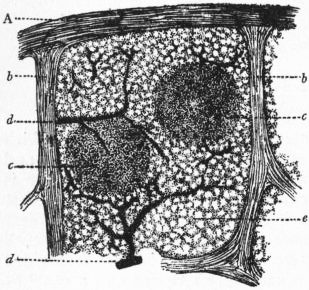
Fig. 2.—Section of the Spleen seen under a low power.
A, Fibrous capsule. b, Trabeculae. c, Malpighian corpuscles. d, Blood-vessels. e, Spleen pulp.
Comparative Anatomy.—The spleen is regarded as the remains of a mass of lymphoid tissue which, in a generalized type of vertebrate, stretched all along the alimentary canal. It is absent as a distinct gland in the Acrania and Cyclostomata. In the fishes it is closely applied to the U-shaped stomach, and in some of the Elasmobranchs, e.g. the basking and porbeagle sharks (Selache and Lamna), it is divided into small lobules. In Protopterus among the Dipnoi it is enclosed within the walls of the stomach. In the Anura (frogs and toads) among the Amphibia it is a spherical mass close to the rectum, and this may be explained by regarding it as derived from a different part of the original mass, already mentioned, to that which persists in other vertebrates. In the Iguana among the reptiles the organ has many notches, and each one corresponds to the point of entrance of a vessel. In Mammals the notches, when they are present, so frequently correspond to the points of entrance of arteries at the hilum that the present writer believes that the former are determined by the latter in many cases (see F.G. Parsons on the Notches of the Spleen, J. Anat. and Phys. vol. 35, p. 416; also Charnock Bradley, Proceedings of R. Soc. Edin., vol. 24, pt. 6, p. 521). The Monotremata and Marsupialia have curious Y-shaped spleens. As a rule flesh-eating animals have larger and more notched spleens than vegetable feeders, though among the Cetacea the spleen is relatively very small.
Adrenal Glands
The adrenal glands or suprarenal capsules are two conical bodies, flattened from before backward, resting on the upper poles of the kidneys close to the sides of the vertebral column; each has an anterior and posterior surface and a concave base which is in contact with the kidney. When viewed from in front the right gland is triangular and the left crescentic. On the anterior surface there is a transverse sulcus or hilum from which a large vein emerges. The arteries are less constant in their points of entry, and are derived from three sources, the phrenic, the abdominal aorta and the renal arteries. The glands are entirely retro-peritoneal, though the right one, even on its anterior surface, is very little covered by peritoneum. In a vertical transverse section each gland is seen to consist of two parts, cortical and medullary. The cortical substance is composed of bundles of cells, separated by a stroma, which have a different appearance in different parts. Most superficially is the zona glomerulosa, then the zona fascicularis, and most deeply the zona reticularis. These names convey a fair idea of the appearance of the bundles. To the naked eye the cortical part is yellow while the medullary is red. The medullary part consists of small islets of cells, which resemble columnar epithelium lying among venous sinuses; these cells are said to be in close connexion with the sympathetic nerve filaments from the great solar plexus.
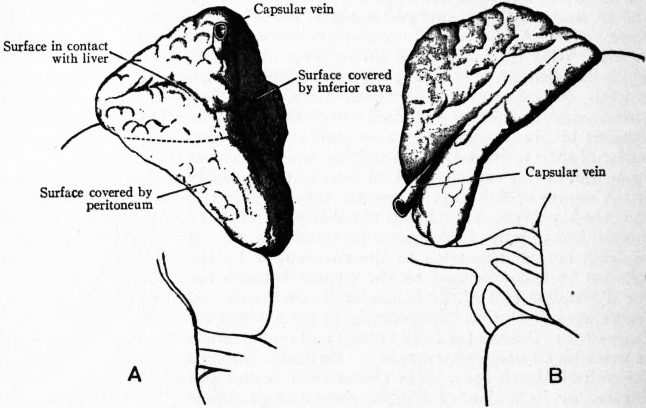
From D.J. Cunningham, Cunningham’s Text-book of Anatomy.
Fig. 3.—A, Anterior surface of right suprarenal capsule. B, Anterior surface of left suprarenal capsule. The upper and inner parts of each kidney are indicated in outline. On the right capsule the dotted line indicates the upper limit of the peritoneal covering.
Embryology.—The generally accepted opinion at present is that the cortical substance is derived from the coelomic epithelium covering the mesoderm of the upper (cephalic) portion of the Wolffian body, and corresponds to the nephrostomes of mesonephridial tubules (see Urinary System), while the medullary part grows out from the sympathetic ganglia and so is probably ectodermal in origin. J. Janosik, however (Archiv. f. mikrosk. Anat. bd. xxii. 1883 and Sitzungsber. d. Wiener Akad., 1885), thinks that the cortical part is derived from the germ epithelium covering the upper part of the genital ridge. C.S. Minot (Human Embryology, 1897) believes that the original cells which grow in from the sympathetic disappear later, and that the adult medullary cells are derived from the cortical.
In the early human embryo the adrenals are larger than the kidneys, and at birth they are proportionately much larger than in the adult. (For literature see. Development of the Human Body, J.P. McMurrich, London, 1906; and Handbuch der Entwickelungslehre, by O. Hertwig, Jena.)
Comparative Anatomy.—Adrenals are unknown in Amphioxus and the Dipnoi (mud fish). In the Cyclostomata (hags and lampreys) they are said by some to arise in connexion with the cephalic part of the pronephros, though other writers deny their presence at all (see W.E. Collinge and Swale Vincent, Anat. Anz. bd. xii., 1896). In the Elasmobranchs and Holocephali the medullary and cortical parts are apparently distinct, the former being represented by a series of organs situated close to the intercostal arteries, while the latter may be either median or paired, and, as they are placed between the kidneys, are often spoken of as interrenals. In the Amphibia the glands are sunk into the surface of the kidney. In reptiles and birds they are long lobulated bodies lying close to the testis or ovary and receiving an adrenal portal vein. In the lower mammals they are not as closely connected with the kidneys as they are in man, and their shape is usually oval or spherical.
The Thyroid Gland
The thyroid body or gland is a deep red glandular mass consisting of two lobes which lie one on each side of the upper part of the trachea and lower part of the larynx; these are joined across the middle line by the isthmus which lies in front of the second and third rings of the trachea. Occasionally, from the top of the isthmus, a nearly but not quite median pyramidal lobe runs up toward the hyoid bone, while in other cases the isthmus may be absent. The gland is relatively larger in women and children than in the adult male. It is enclosed in a capsule of cervical fascia and is supplied by the superior and inferior thyroid arteries on each side, though occasionally a median thyroidea ima artery is present. On microscopical examination the gland shows a large number of closed tubular alveoli, lined by columnar epithelial cells, unsupported by a basement membrane, and filled with colloid or jelly-like material. These are supported by fibrous septa growing in from the true capsule, which is distinct from the capsule of cervical fascia. The lymphatic vessels are large and numerous, and have been shown by E.C. Baber (Phil. Trans., 1881) to contain the same colloid material as the alveoli. Accessory thyroids, close to the main gland, are often found.
Embryology.—The median part of the gland is developed from a tube which grows down in the middle line from the junction of the buccal and pharyngeal parts of the tongue (q.v.), between the first and second branchial arches. This tube is called the thyro-glossal duct and is entodermal in origin. The development of the hyoid bone obliterates the middle part of the duct, leaving its upper part as the foramen caecum of the tongue, while its lower part bifurcates, and so the asymmetrical arrangement of the pyramidal lobe is accounted for. A. Kanthack (J. Anat. and Phys. vol. xxv., 1891) has denied the existence of this duct, but on slender grounds. The lateral parts of the gland are developed from the entoderm of the fourth visceral clefts, and, joining the median part, lose their pharyngeal connexion. Nearly, but not quite, the whole of the lateral lobes probably belong to this part. (For literature and further details see Quain’s Anatomy, London, 1892, and J.P. McMurrich’s Development of the Human Body, London, 1906.)
Comparative Anatomy.—The endostyle or hypobranchial groove of Tunicata (sea squirts) and Acrania (Amphioxus) is regarded as the first appearance of the median thyroid; this is a median entodermal groove in the floor of the pharynx, secreting a glairy fluid in which food particles become entangled and so pass into the intestine. In the larval lamprey (Ammocoetes) among the Cyclostomata the connexion with the pharynx is present, but in the adult lamprey (Petromyzon), as in all adult vertebrates, this connexion is lost. In the Elasmobranchs the single median thyroid lies close to the mandibular symphysis, but in the bony fish (Teleostei) it is paired. In the mud fish (Dipnoi) there is also an indication of a division into two lobes. In the Amphibia the thyroid forms numerous vesicles close to the anterior end of the pericardium. In Reptilia it lies close to the trachea, and in the Chelonia and Crocodilia is paired. In birds it is also paired and lies near the origin of the carotid arteries. In Mammalia the lateral lobes make their first appearance. In the lower orders of this class the isthmus is often absent. (For further details and literature see R. Wiedersheim’s Vergleichende Anatomie der Wirbeltiere, Jena, 1902, and also for literature, Quain’s Anatomy, London, 1896.)
Parathyroid Glands
These little oval bodies, of considerable physiological importance, are two in number on each side. From their position they are spoken of as postero-superior and antero-inferior; the postero-superior are embedded in the thyroid at the level of the lower border of the cricoid cartilage, while the antero-inferior may be embedded in the lower edge of the lateral lobes of the thyroid or may be found a little distance below in relation to the inferior thyroid veins. They are often very difficult to find, but it is easiest to do so in a perfectly fresh, full-term foetus or young child. Microscopically they consist of solid masses of epithelioid cells with numerous blood-vessels between, while, embedded in their periphery, are often found masses of thymic tissue including the concentric corpuscles of Hassall. They have been regarded as undeveloped portions of thyroid tissue in an embryonic state, but the experiments of Gley (Comptes rendus de la Soc. de Biol. No. 11, 1895) and of W. Edmunds (Proc. Physiol. Soc.—Journ. Phys. vol. xviii., 1895) do not confirm this. They are developed from the entoderm of the third and fourth branchial grooves.
Parathyroids have been found in the orders of Primates, Cheiroptera, Carnivora, Ungulata and Rodentia among the Mammalia, and also in Birds. In the other classes of vertebrates little is known of them. The fullest and most recent account of these bodies is that of D.A. Welsh in Journ. Anat. and Phys. vol. 32, 1898, pp. 292 and 380.
The Thymus Gland
The thymus gland (Gr. θύμος, from a fancied resemblance to the corymbs of the Thyme) is a light pink gland, consisting of two unequal lobes, which lies in the superior and anterior mediastina of the thorax in front of the pericardium and great vessels; it also extends up into the root of the neck to within a short distance of the thyroid gland. It continues to grow until the second year of life, after which it remains stationary until puberty, when it usually degenerates rapidly. The writer has seen it perfectly well developed in a man between 40 and 50, though such cases are rare; probably, however, some patches of its tissue remain all through life. Each lobe is divided into a large number of lobules divided by areolar tissue, and each of these, under the microscope, is seen to consist of a cortical and medullary part. The cortex is composed of lymphoid tissue and resembles the structure of a lymphatic gland (see Lymphatic System); it is imperfectly divided into a number of follicles. In the medulla the lymphoid cells are fewer, and nests of epithelial cells are found, called the concentric corpuscles of Hassall. The vascular supply is derived from all the vessels in the neighbourhood, the lymphatics are very large and numerous, but the nerves, which come from the sympathetic and vagus, are few and small. H. Watney (Phil. Trans., 1882) has discovered haemoglobin, and apparently developing red blood corpuscles, in the thymus. (For further details see Gray’s or Quain’s Anatomy.)
Embryology.—The thymus is formed from a diverticulum, on each side, from the entoderm lining the third branchial groove, but the connexion with the pharynx is soon lost. The lymphoid cells and concentric corpuscles are probably the derivatives of the original cells lining the diverticulum.
Comparative Anatomy.—The thymus is always a paired gland. In most fishes it rises from the dorsal part of all five branchial clefts; in Lepidosiren (Dipnoi), from all except the first; in Urodela from 3rd, 4th and 5th, and in Anura from the 2nd only (see T.H. Bryce, “Development of Thymus in Lepidosiren,” Journ. Anat. and Phys. vol. 40, p. 91). In all fishes, including the Dipnoi (mud fish) it is placed dorsally to the gill arches on each side. In the Amphibia it is found close to the articulation of the mandible. In the Reptilia it is situated by the side of the carotid artery; but in young crocodiles it is lobulated and extends all along the neck, as it does in birds, lying close to the side of the oesophagus. In Mammals the Marsupials are remarkable for having a well-developed cervical as well as thoracic thymus (J. Symington, J. Anat. and Phys. vol. 32, p. 278). In some of the lower mammals the gland does not disappear as early as it does in man. The thymus of the calf is popularly known as “the chest sweetbread.”
Carotid Bodies
These are two small bodies situated, one on each side, between the origins of the external and internal carotid arteries. Microscopically they are divided into nodules or cell balls by connective tissue, and these closely resemble the structure of the parathyroids, but are without any thymic tissue. The blood-vessels in their interior are extremely large and numerous. The modern view of their development is that they are part of the sympathetic system, and the reaction of their cells to chromium salts bears this out. (See Kohn, Archiv f. mikr. Anat. lxx., 1907.)
In the Anura there is a rete or network into which the carotid artery breaks up in the position of the carotid body, and this has an important effect on the course of the circulation. It is probable, however, that this structure has nothing to do with the carotid body of Mammalia.
Coccygeal Body
This is a small median body, about the size of a pea, situated in front of the apex of the coccyx and between the insertions of the levatores ani muscles. It resembles the carotid body in its microscopical structure, but is not so vascular. Concentric corpuscles, like those of the thymus, have been recorded in it. It derives its arteries from the middle sacral and its nerves from the sympathetic. Of its embryology and comparative anatomy little is known, though J.W. Thomson Walker has recently shown that numerous, outlying, minute masses of the same structure lie along the course of the middle sacral artery (Archiv f. mikroscop. Anat. Bd. lxiv.). The probability is that, like the carotid body, it is sympathetic in origin. (Quain’s Anatomy gives excellent illustrations of the histology of this as well as of all the other ductless glands.)
For the literature on and further details concerning the foregoing structures the following works should be consulted: Quain’s Anatomy, vol. 1 (1908, London, Longman & Co.); McMurrich’s Development of the Human Body (London, Rebman, 1906); Wiedersheim’s Vergleich. Anat. der Wirbeltiere (Jena, 1898).
(F. G. P.)
DUDERSTADT, a town of Germany, in the Prussian province of Hanover, situated in a beautiful and fertile valley (formerly called Goldene Mark) watered by the Hahle, and on the railway Wulften-Leinefelde. Pop. (1905) 5327. It is an interesting medieval town with many ancient buildings. Notable are the two Roman Catholic churches, beautiful Gothic edifices of the 14th century, the Protestant church, and the handsome town-hall. Its chief industries are woollen and cotton manufactures, sugar-refining and cigar-making; it has also a trade in singing-birds. Duderstadt was founded by Henry I. (the Fowler) in 929, passed later to the monastery of Quedlinburg, and then to Brunswick. It was a member of the Hanseatic League, and during the Thirty Years’ War became a stronghold of the Imperialists. It was taken by Duke William of Weimar in 1632; in 1761 its walls were dismantled, and, after being alternately Prussian and Hanoverian, it passed finally in 1866 with Hanover to Prussia.
DUDLEY, BARONS AND EARLS OF. The holders of these English titles are descended from John de Sutton (c. 1310-1359) of Dudley castle, Staffordshire, who was summoned to parliament as a baron in 1342. Sutton was the son of another John de Sutton, who had inherited Dudley Castle through his marriage with Margaret, sister and heiress of John de Somery (d. 1321); he was called Lord Dudley, or Lord Sutton of Dudley, the latter being doubtless the correct form. However, his descendants, the Suttons, were often called by the name of Dudley; and from John Dudley of Atherington, Sussex, a younger son of John Sutton, the 5th baron, the earls of Warwick and the earl of Leicester of the Dudley family are descended.
John Sutton or Dudley (c. 1400-1487), the 5th baron, was first summoned to parliament in 1440, having been viceroy of Ireland from 1428 to 1430. He served Henry VI. as a diplomatist and also as a soldier, being taken prisoner at the first battle of St Albans in 1455, but this did not prevent him from enjoying the favour of Edward IV. He died on the 30th of September 1487. He was succeeded as 6th baron by his grandson Edward (c. 1459-1532), and one of his sons, William Dudley, was bishop of Durham from 1476 until his death in 1483. His descendant Edward Sutton or Dudley, the 9th baron (1567-1643), had several illegitimate sons. Among them was Dud Dudley (1599-1684), who in 1665 published Metallum Martis, describing a process of making iron with “pit-coale, sea-coale, &c.” which was put in operation at his father’s ironworks at Pensnet, Worcestershire, of which he was manager. His success aroused much opposition on the part of other ironmasters, and his commercial ventures at Himley, at Askew Bridge and at Bristol ended in loss and disaster. During the Civil War he was a colonel in the army of Charles I.
Dying without lawful male issue in June 1643, the 9th baron was succeeded in the barony by his grand-daughter, Frances (1611-1697); she married Humble Ward (c. 1614-1670), the son of a London goldsmith, who was created Baron Ward of Birmingham in 1644. Their son Edward (1631-1701) succeeded both to the barony of Dudley and to that of Ward, but these were separated when his grandson William died unmarried in May 1740. The barony of Dudley passed to a nephew, Ferdinando Dudley Lea, falling into abeyance on his death in October 1757; that of Ward passed to the heir male, John Ward (d. 1774), a descendant of Humble Ward. In 1763 Ward was created Viscount Dudley, and in April 1823 his grandson, John William Ward (1781-1833), became the 4th viscount.
Educated at Oxford, John William Ward entered parliament in 1802, and except for a few months he remained in the House of Commons until he succeeded his father in the peerage. In 1827 he was minister for foreign affairs under Canning and then under Goderich and under Wellington, resigning office in May 1828. As foreign minister he was only a cipher, but he was a man of considerable learning and had some reputation as a writer and a talker. Dudley took an interest in the foundation of the university of London, and his Letters to the bishop of Llandaff were published by the bishop (Edward Copleston) in 1840 (new ed. 1841). He was created Viscount Ednam and earl of Dudley in 1827, and when he died unmarried on the 6th of March 1833 these titles became extinct. His barony of Ward, however, passed to a kinsman, William Humble Ward (1781-1835), whose son, William (1817-1885), inheriting much of the dead earl’s great wealth, was created Viscount Ednam and earl of Dudley in 1860. The 2nd earl of Dudley in this creation was the latter’s son William Humble (b. 1866), who was lord-lieutenant of Ireland from 1902 to 1906, and in 1908 was appointed governor-general of Australia.
See H.S. Grazebrook in the Herald and Genealogist, vols. ii., v. and vi.; in Notes and Queries, 2nd series, vol. xi.; and in vol. ix. of the publications of the William Salt Society (1888).
DUDLEY, EDMUND (c. 1462-1510), minister of Henry VII. of England, was a son of John Dudley of Atherington, Sussex, and a member of the great baronial family of Sutton or Dudley. After studying at Oxford and at Gray’s Inn, Dudley came under the notice of Henry VII., and is said to have been made a privy councillor at the early age of twenty-three. In 1492 he helped to negotiate the treaty of Etaples with France and soon became prominent in assisting the king to check the lawlessness of the barons, and at the same time to replenish his own exchequer. He and his colleague Sir Richard Empson (q.v.) are called fiscales judices by Polydore Vergil, and owing to their extortions they became very unpopular. Dudley, who was speaker of the House of Commons in 1504, in addition to aiding Henry, amassed a great amount of wealth for himself, and possessed large estates in Sussex, Dorset and Lincolnshire. When Henry VII. died in April 1509, he was thrown into prison by order of Henry VIII. and charged with the crime of constructive treason, being found guilty and attainted. After having made a futile attempt to escape from prison, he was executed on the 17th or 18th of August 1510. Dudley’s nominal crime was that during the last illness of Henry VII. he had ordered his friends to assemble in arms in case the king died, but the real reason for his death was doubtless the unpopularity caused by his avarice. During his imprisonment he sought to gain the favour of Henry VIII. by writing a treatise in support of absolute monarchy called The Tree of Commonwealth. This never reached the king’s hands, and was not published until 1859, when it was printed privately in Manchester. Dudley’s first wife was Anne, widow of Roger Corbet of Morton, Shropshire, by whom he had a daughter, Elizabeth, who married William, 6th Lord Stourton. By his second wife, Elizabeth, daughter of Edward Grey, Viscount Lisle, he had three sons: John, afterwards duke of Northumberland (q.v.); Andrew (d. 1559), who was made a knight and held various important posts during the reign of Edward VI.; and Jasper.
See Francis Bacon, History of Henry VII., edited by J.R. Lumby (Cambridge, 1881); and J.S. Brewer, The Reign of Henry VIII., edited by J. Gairdner (London, 1884).
DUDLEY, SIR ROBERT (1573-1649), titular duke of Northumberland and earl of Warwick, English explorer, engineer and author, was the son of Robert Dudley, earl of Leicester (q.v.), the favourite of Queen Elizabeth. His mother was Lady Douglas Sheffield, daughter of Thomas, first Baron Howard of Effingham. Leicester, who deserted Lady Douglas Sheffield for Lettice Knollys, widow of the first earl of Essex, denied that they were married. She asserted that they were, at Esher in Surrey, but her marriage with Sir Edward Stafford of Grafton, after her desertion by Leicester, would seem to be a tacit confession that her claim had no foundation. Her son Robert was born in May 1573, was recognized by Leicester, and sent to Christ Church, Oxford, in 1587. He inherited all Leicester’s property under the earl’s will at his death in 1588, and in the following year the property of Ambrose Dudley, earl of Warwick. In 1594 he made a voyage to the West Indies, and in 1596 he took part in the expedition to Cadiz and was knighted. In 1592 he had married a sister of Thomas Cavendish the circumnavigator. On her death he married Alicia Leigh in 1596, by whom he had four daughters. After the death of Elizabeth he endeavoured to secure recognition of his legitimacy, and of his right to inherit the titles of his father and uncle. The proceedings were quashed by the Star Chamber. In 1605 he obtained leave to travel abroad, and went to Italy accompanied by the beautiful Miss Elizabeth Southwell, daughter of Sir Robert Southwell of Woodrising, in the dress of a page. When ordered to return home and to provide for his deserted wife and family, he refused, was outlawed, and his property was confiscated. On the continent he avowed himself a Roman Catholic, married Elizabeth Southwell at Lyons, and entered the service of Cosimo II., grand-duke of Tuscany. In the service of the grand-duke he is said to have done some fighting against the Barbary pirates, and he was undoubtedly employed in draining the marshes behind Leghorn, and in the construction of the port. In 1620 the emperor Ferdinand II. gave him a patent recognizing his claim not only to the earldom of Warwick but to the duchy of Northumberland, which had been held by his grandfather, who was executed by Queen Mary Tudor. In Italy Dudley was known as Duca di Nortombria and Conte di Warwick. He died near Florence on the 6th of September 1649, leaving a large family of sons and daughters. His deserted wife, Alicia, was created duchess of Dudley by Charles I. in 1644, and died in 1670, when the title became extinct. Through a daughter who married the Marquis Paleotti, Dudley was the ancestor of the wife of the first duke of Shrewsbury (of the revolution of 1688), and of her brother who was executed at Tyburn for murder on the 17th of March 1718. Dudley was the author of a pamphlet addressed to King James I., showing how the “impertinences of parliament” could be bridled by military force. But his chief claim to memory is the magnificent Arcano dell mare, published in Italian at Florence in 1645-1646 in three volumes folio. It is a collection of all the naval knowledge of the age, and is particularly remarkable for a scheme for the construction of a navy in five rates which Dudley designed and described. It was reprinted in Florence in two volumes folio in 1661 without the charts of the first edition.
Authorities.—G.L. Craik, Romance of the Peerage (London, 1848-1850), vol. iii.; Sir N.H. Nicolas, Report of Proceedings on the Claim to the Barony of L’Isle (London, 1829); and The Italian Biography of Sir R. Dudley, published anonymously, privately and without date or name of place, but known to have been written by Doctor Vaughan Thomas, vicar of Stoneleigh, who died in 1858.
(D. H.)
DUDLEY, THOMAS (1576-1653), British colonial governor of Massachusetts, was born in Northampton, England, in 1576, a member of the elder branch of the family to the younger branch of which Robert Dudley, earl of Leicester, belonged. He was the son of a country gentleman of some means and high standing, was captain of an English company in the French expedition of 1597, serving under Henry of Navarre, and eventually became the steward of the earl of Lincoln’s estates, which he managed with great success for many years. Having been converted to Puritanism, he became a strict advocate of its strictest tenets. About 1627 he associated himself with other Lincolnshire gentlemen who in 1629 entered into an agreement to settle in New England provided they were allowed to take the charter with them. This proposal the general court of the Plymouth Company agreed to, and in April 1630 Dudley sailed to America in the same ship with John Winthrop, the newly appointed governor, Dudley himself at the last moment being chosen deputy-governor in place of John Humphrey (or Humfrey), the earl of Lincoln’s son-in-law, whose departure was delayed. Dudley was for many years the most influential man in the Massachusetts Bay colony, save Winthrop, with whose policy he was more often opposed than in agreement. He was deputy-governor in 1629-1634, in 1637-1640, in 1646-1650 and in 1651-1653, and was governor four times, in 1634, 1640, 1645 and 1650. Soon after his arrival in the colony he settled at Newton (Cambridge), of which he was one of the founders; he was also one of the earliest promoters of the plan for the establishment of Harvard College. Winthrop’s decision to make Boston the capital instead of Newton precipitated the first of the many quarrels between the two, Dudley’s sterner and harsher Puritanism, being in strong contrast to Winthrop’s more tolerant and liberal views. He was an earnest and persistent heresy-hunter—not only the Antinomians, but even such a good Puritan as John Cotton, against whom he brought charges, feeling the weight of his stern and remorseless hand. His position he himself best expressed in the following brief verse found among his papers:
“Let men of God in courts and churches watch O’er such as do a Toleration hatch, Lest that ill egg bring forth a Cockatrice To poison all with heresy and vice.”
He died at Roxbury, Massachusetts, on the 31st of July 1653.
See Augustine Jones, Life and Work of Thomas Dudley, the Second Governor of Massachusetts (Boston, 1899); and the Life of Mr Thomas Dudley, several times Governor of the Colony of Massachusetts, written as is supposed by Cotton Mather, edited by Charles Deane (Cambridge, 1870). Dudley’s interesting and valuable “Letter to the Countess of Lincoln,” is reprinted in Alexander Young’s Chronicles of the Planters of the Colony of Massachusetts Bay (Boston, 1846), and in the New Hampshire Historical Society Collections, vol. iv. (1834).
His son Joseph Dudley (1647-1720), colonial governor of Massachusetts, was born in Roxbury, Massachusetts, on the 23rd of September 1647. He graduated at Harvard College in 1665, became a member of the general court, and in 1682 was sent by Massachusetts to London to prevent the threatened revocation of her charter by Charles II. There, with an eye to his personal advancement, he secretly advised the king to annul the charter; this was done, and Dudley, by royal appointment, became president of the provisional council. With the advent of the new governor, Sir Edmund Andros, Dudley became a judge of the superior court and censor of the press. Upon the deposition of Andros, Dudley was imprisoned and sent with him to England, but was soon set free. In 1691-1692 he was chief-justice of New York, presiding over the court that condemned Leisler and Milburn. Returning to England in 1693, he was lieutenant-governor of the Isle of Wight and a member of parliament, and in 1702, after a long intrigue, secured from Queen Anne a commission as governor of Massachusetts, serving until 1715. His administration was marked, particularly in the earlier years, by ceaseless conflict with the general court, from which he demanded a regular fixed salary instead of an annual grant. He was active in raising volunteers for the so-called Queen Anne’s War, and in 1707 sent a fruitless expedition against Port Royal. He was accused by the Boston merchants, who petitioned for his removal, of being in league with smugglers and illicit traders, and in 1708 a bitter attack on his administration was published in London, entitled The Deplorable State of New England by reason of a Covetous and Treacherous Governor and Pusillanimous Counsellors. His character may be best summed up in the words of one of his successors, Thomas Hutchinson, that “he had as many virtues as can consist with so great a thirst for honour and power.” He died at Roxbury on the 2nd of April 1720.
Joseph Dudley’s son, Paul Dudley (1675-1751), graduated at Harvard in 1690, studied law at the Temple in London, and became attorney-general of Massachusetts (1702 to 1718). He was associate justice of the superior court of that province from 1718 to 1745, and chief justice from 1745 until his death. He was a member of the Royal Society (London), to whose Transactions he contributed several valuable papers on the natural history of New England, and was the founder of the Dudleian lectures on religion at Harvard.
The best extended account of Joseph Dudley’s administration is in J.G. Palfrey’s History of New England, vol. iv. (Boston, 1875).
DUDLEY, a municipal, county and parliamentary borough and market-town of Worcestershire, England, in a portion of that county enclaved in Staffordshire, 8 m. W.N.W. of Birmingham, and 121 N.W. of London by the London & North Western railway. The Great Western railway also serves the town. Pop. (1891) 45,724; (1901) 48,733. Dudley lies on an elevated ridge, in the midst of the district of the midlands known as the Black Country, which is given up to ironworks and coal mines. The “ten-yard” coal, in the neighbourhood, is the thickest seam worked in England. Limestone is extensively quarried, fire-clay is abundant; and iron-founding, brass-founding, engineering works, glass works and brick works are comprised in the industries. Among the principal buildings are the churches of the five parishes into which the town is divided, the town hall, county court, free libraries, and school of art, grammar school with university and foundation scholarships, technical school, mechanics’ institute, Guest hospital (founded by Joseph Guest, a citizen, in 1868), and a dispensary. In the market-place stands a large domed fountain, erected by the earl of Dudley (1867). There is a geological society with a museum, for the neighbourhood of Dudley is full of geological interest, the Silurian limestone abounding in fossils. To the north of the town are extensive remains of an ancient castle, surrounded by beautiful grounds. The hill on which it stands is of limestone, which by quarrying has been hollowed out in extensive chambers and galleries. The view from the castle is remarkable. The whole district is seen to be set with chimneys, pit-buildings and factories; and at night the glare of furnaces reveals the tireless activity of the Black Country. Dudley and its environs are connected by a tramway system, and water communication is afforded by the Dudley canal with Birmingham and with the river Severn.
Included in the parliamentary borough, but in Staffordshire, and 2½ m. by rail S.W. of Dudley, is Brierley Hill, a market-town on the river Stour and the Stourbridge and Birmingham Canals. Its chief buildings are the modern church of St Michael, standing on a hill, the Roman Catholic church of St Mary, by A.W. Pugin, the town hall and free library. Between this and Dudley lie the great ironworks of Roundoak, and the extensive suburb of Netherton in the enclaved portion of Worcestershire. The industries are similar to those of Dudley. Three miles W. of Dudley is Kingswinford, a mining township, with large brick works, giving name to a parliamentary division of Staffordshire. The parliamentary borough of Dudley returns one member. The town itself is governed by a mayor, 10 aldermen and 30 councillors. Area 3546 acres.
In medieval times the importance of Dudley (Dudelei) depended on the castle, which is mentioned in the Domesday Survey. Before the Conquest Earl Eadwine held the manor, which in 1086 belonged to William FitzAnsculf, from whom it passed, probably by marriage, to Fulk Paynel, afterwards to the Somerys, Suttons and Wards, whose descendants (earls of Dudley) now hold it. The first mention of Dudley as a borough occurs in an inquisition taken after the death of Roger de Somery in 1272. This does not give a clear account of the privileges held by the burgesses, but shows that they had probably been freed from some or all of the services required from them as manorial tenants, in return for a fixed rent. In 1865 Dudley was incorporated. Before that time it was governed by a high and low bailiff appointed every year at the court leet of the manor. Roger de Somery evidently held a market by prescription in Dudley before 1261, in which year he came to terms with the dean of Wolverhampton, who had set up a market in Wolverhampton to the disadvantage of Roger’s market at Dudley. According to the terms of the agreement the dean might continue his market on condition that Roger and his tenants should be free from toll there. Two fairs, on the 21st of September and the 21st of April, were granted in 1684 to Edward Lord Ward, lord of the manor. Dudley was represented in the parliament of 1295, but not again until the privilege was revived by the Reform Act of 1832. Mines of sea-coal in Dudley are mentioned as early as the reign of Edward I., and by the beginning of the 17th century mining had become an important industry.
DUDO, or Dudon (fl. c. 1000), Norman historian was dean of St Quentin, where he was born about 965. Sent in 986 by Albert I. count of Vermandois, on an errand to Richard I., duke of Normandy, he succeeded in his mission, and, having made a very favourable impression at the Norman court, spent some years in that country. During a second stay in Normandy Dudo wrote his history of the Normans, a task which Duke Richard I. had urged him to undertake. Very little else is known about his life, except that he died before 1043. Written between 1015 and 1030, his Historia Normannorum, or Libri III. de moribus et actis primorum Normanniae ducum, was dedicated to Adalberon, bishop of Laon. Dudo does not appear to have consulted any existing documents for his history, but to have obtained his information from oral tradition, much of it being supplied by Raoul, count of Ivry, a half-brother of Duke Richard I. Consequently the Historia partakes of the nature of a romance, and on this ground has been regarded as untrustworthy by such competent critics as E. Dummler and G. Waitz. Other authorities, however, e.g. J. Lair and J. Steenstrup, while admitting the existence of a legendary element, regard the book as of considerable value for the history of the Normans. Although Dudo was acquainted with Virgil and other Latin writers, his Latin is affected and obscure. The Historia, which is written alternately in prose and in verse of several metres, is divided into four parts, and deals with the history of the Normans from 852 to the death of Duke Richard I. in 996. It glorifies the Normans, and was largely used by William of Jumièges, Wace, Robert of Torigni, William of Poitiers and Hugh of Fleury in compiling their chronicles, and was first published by A. Duchesne in his Historiae Normannorum scriptores antiqui, at Paris in 1619. Another edition is in the Patrologia Latina, tome cxli. of J.P. Migne (Paris, 1844), but the best is perhaps the one edited by J. Lair (Caen, 1865).
See E. Dümmler, “Zur Kritik Dudos von St Quentin” in the Forschungen zur deutschen Geschichte, Bande vi. and ix. (Göttingen, 1866); G. Waitz, “Über die Quellen zur Geschichte der Begrundung der normannischen Herrschaft in Frankreich,” in the Gottinger gel. Anzeigen (Göttingen, 1866); J.C.H.R. Steenstrup, Normannerne, Band i. (Copenhagen, 1876); J. Lair, Étude critique et historique sur Dudon (Caen, 1865); G. Kortung, Über die Quellen des Roman de Rou (Leipzig, 1867); W. Wattenbach, Deutschlands Geschichtsquellen, Band i. (Berlin, 1904); and A. Molinier, Les Sources de l’histoire de France, tome ii. (Paris, 1902).
DUDWEILER, a town of Germany, in the Prussian Rhine province, on the Sulzbach, 4 m. by rail N.E. from Saarbrücken. It has extensive coal mines and ironworks and produces fire-proof bricks. Pop. (1905) 16,320.
DUEL (Ital. duello, Lat. duellum—old form of bellum—from duo, two), a prearranged encounter between two persons, with deadly weapons, in accordance with conventional rules, with the object of voiding a personal quarrel or of deciding a point of honour. The first recorded instance of the word occurs in Coryate’s Crudities (1611), but Shakespeare has duello in this sense, and uses “duellist” of Tybalt in Romeo and Juliet. In its earlier meaning of a judicial combat we find the word latinized in the Statute of Wales (Edw. I., Act 12), “Placita de terris in partibus istis non habent terminari per duellum.”
Duels in the modern sense were unknown to the ancient world, and their origin must be sought in the feudal age of Europe. The single combats recorded in Greek and Roman history and legend, of Hector and Achilles, Aeneas and Turnus, the Horatii and Curiatii, were incidents in national wars and have nothing in common with the modern duel. It is, however, noteworthy that in Tacitus (Germania, cap. x.) we find the rudiments of the judicial duel (see Wager, for the wager of battle). Domestic differences, he tells us, were settled by a legalized form of combat between the disputants, and when a war was impending a captive from the hostile tribe was armed and pitted against a national champion, and the issue of the duel was accepted as an omen. The judicial combat was a Teutonic institution, and it was in fact an appeal from human justice to the God of battles, partly a sanction of the current creed that might is right, that the brave not only will win but deserve to win. It was on these grounds that Gundobald justified, against the complaints of a bishop, the famous edict passed at Lyons (A.D. 501) which established the wager of battle as a recognized form of trial. It is God, he argued, who directs the issue of national wars, and in private quarrels we may trust His providence to favour the juster cause. Thus, as Gibbon comments, the absurd and cruel practice of judicial duels, which had been peculiar to some tribes of Germany, was propagated and established in all the monarchies of Europe from Sicily to the Baltic. Yet in its defence it may be urged that it abolished a worse evil, the compurgation by oath which put a premium on perjury, and the ordeal, or judgment of God, when the cause was decided by blind chance, or more often by priestcraft.
Those who are curious to observe the formalities and legal rules of a judicial combat will find them described at length in the 28th book of Montesquieu’s Esprit des lois. On these regulations he well remarks that, as there are an The judicial combat. infinity of wise things conducted in a very foolish manner, so there are some foolish things conducted in a very wise manner. For our present purpose it is sufficient to observe the development of the idea of personal honour from which the modern duel directly sprang. In the ancient laws of the Swedes we find that if any man shall say to another, “You are not a man equal to other men,” or “You have not the heart of a man,” and the other shall reply, “I am a man as good as you,” they shall meet on the highway, and then follow the regulations for the combat. What is this but the modern challenge? By the law of the Lombards if one man call another arga, the insulted party might defy the other to mortal combat. What is arga but the dummer Junger of the German student? Beaumanoir thus describes a legal process under Louis le Débonnaire:—The appellant begins by a declaration before the judge that the appellee is guilty of a certain crime; if the appellee answers that his accuser lies, the judge then ordains the duel. Is not this the modern point of honour, by which to be given the lie is an insult which can only be wiped out by blood?
From Germany the judicial combat rapidly spread to France, where it flourished greatly from the 10th to the 12th century, the period of customary law. By French kings it was welcomed as a limitation of the judicial powers of their half independent vassals. It was a form of trial open to all freemen and in certain cases, as under Louis VI., the privilege was extended to serfs. Even the church resorted to it not unfrequently to settle disputes concerning church property. Abbots and priors as territorial lords and high justiciaries had their share in the confiscated goods of the defeated combatant, and Pope Nicholas when applied to in 858 pronounced it “a just and legitimate combat.” Yet only three years before the council of Valence had condemned the practice, imposing the severest penance on the victor and refusing the last rites of the church to the vanquished as to a suicide. In 1385 a duel was fought, the result of which was so preposterous that even the most superstitious began to lose faith in the efficacy of such a judgment of God. A certain Jacques Legris was accused by the wife of Jean Carrouge of having introduced himself by night in the guise of her husband whom she was expecting on his return from the Crusades. A duel was ordained by the parlement of Paris, which was fought in the presence of Charles VI. Legris was defeated and hanged on the spot. Not long after, a criminal arrested for some other offence confessed himself to be the author of the outrage. No institution could long survive so open a confutation, and it was annulled by the parlement. Henceforward the duel in France ceases to be an appeal to Heaven, and becomes merely a satisfaction of wounded honour. Under Louis XII. and Francis I. we find the first vestiges of tribunals of honour. The last instance of a duel authorized by the magistrates, and conducted according to the forms of law, was the famous one between François de Vivonne de la Châtaignerie and Guy Chabot de Jarnac. The duel was fought on the 10th of July 1547 in the courtyard of the château of St Germain-en-Laye, in the presence of the king and a large assembly of courtiers. It was memorable in two ways. It enriched the French language with a new phrase; a sly and unforeseen blow, such as that by which de Jarnac worsted La Châtaignerie, has since been called a coup de Jarnac. And Henry, grieved at the death of his favourite, swore a solemn oath that he would never again permit a duel to be fought. This led to the first of the many royal edicts against duelling. By a decree of the council of Trent (cap. xix.) a ban was laid on “the detestable use of duels, an invention of the devil to compass the destruction of souls together with a bloody death of the body.”
In England, it is now generally agreed, the wager of battle did not exist before the time of the Norman Conquest. Some previous examples have been adduced, but on examination they will be seen to belong rather to the class of single combats between the champions of two opposing armies. One such instance is worth quoting as a curious illustration of the superstition of the time. It occurs in a rare tract printed in London, 1610, The Duello, or Single Combat. “Danish irruptions and the bad aspects of Mars having drencht the common mother earth with her sonnes’ blood streames, under the reigne of Edmund, a Saxon monarch, misso in compendium (so worthy Camden expresseth it) bello utriusque gentis fata Edmundo Anglorum et Canuto Danorum regibus commissa fuerunt, qui singulari certamine de summa imperij in hac insula (that is, the Eight in Glostershire) depugnarunt.” By the laws of William the Conqueror the trial by battle was only compulsory when the opposite parties were both Normans, in other cases it was optional. As the two nations were gradually merged into one, this form of trial spread, and until the reign of Henry II. it was the only mode for determining a suit for the recovery of land. The method of procedure is admirably described by Shakespeare in the opening scene in Richard II., where Henry of Bolingbroke, duke of Hereford, challenges Thomas, duke of Norfolk; in the mock-heroic battle between Horner the Armourer and his man Peter in Henry VI.; and by Sir W. Scott in the Fair Maid of Perth, where Henry Gow appears before the king as the champion of Magdalen Proudfute. The judicial duel never took root in England as it did in France. In civil suits it was superseded by the grand assize of Henry II., and in cases of felony by indictment at the prosecution of the crown. One of the latest instances occurred in the reign of Elizabeth, 1571, when the lists were actually prepared and the justices of the common pleas appeared at Tothill Fields as umpires of the combat. Fortunately the petitioner failed to put in an appearance, and was consequently nonsuited (see Spelman, Glossary, s.v. “Campus”). As late as 1817 Lord Ellenborough, in the case of Thornton v. Ashford, pronounced that “the general law of the land is that there shall be a trial by battle in cases of appeal unless the party brings himself within some of the exceptions.” Thornton was accused of murdering Mary Ashford, and claimed his right to challenge the appellant, the brother of the murdered girl, to wager of battle. His suit was allowed, and, the challenge being refused, the accused escaped. Next year the law was abolished (59 Geo. III., c. 46).
In sketching the history of the judicial combat we have traced the parentage of the modern duel. Strip the former of its legality, and divest it of its religious sanction, and the latter remains. We are justified, then, in dating The duel of honour. the commencement of duelling from the abolition of the wager of battle. To pursue its history we must return to France, the country where it first arose, and the soil on which it has most flourished. The causes which made it indigenous to France are sufficiently explained by the condition of society and the national character. As Buckle has pointed out, duelling is a special development of chivalry, and chivalry is one of the In France. phases of the protective spirit which was predominant in France up to the time of the Revolution. Add to this the keen sense of personal honour, the susceptibility and the pugnacity which distinguish the French race. Montaigne, when touching on this subject in his essays, says, “Put three Frenchmen together on the plains of Libya, and they will not be a month in company without scratching one another’s eyes out.” The third chapter of d’Audiguier’s Ancien usage des duels is headed, “Pourquoi les seuls Français se battent en duel.” English literature abounds with allusions to this characteristic of the French nation. Lord Herbert of Cherbury, who was ambassador at the court of Louis XIII., says, “There is scarce a Frenchman worth looking on who has not killed his man in a duel.” Ben Jonson, in his Magnetic Lady, makes Compass, the scholar and soldier, thus describe France, “that garden of humanity”:—
“There every gentleman professing arms Thinks he is bound in honour to embrace The bearing of a challenge for another, Without or questioning the cause or asking Least colour of a reason.”
Duels were not common before the 16th century. Hallam attributes their prevalence to the barbarous custom of wearing swords as a part of domestic dress, a fashion which was not introduced till the later part of the 15th century. In 1560 the states-general at Orleans supplicated Charles IX. to put a stop to duelling. Hence the famous ordinance of 1566, drawn up by the chancellor de l’Hôpital, which served as the basis of the successive ordinances of the following kings. Under the frivolous and sanguinary reign of Henry III., “who was as eager for excitement as a woman,” the rage for duels spread till it became almost an epidemic. In 1602 the combined remonstrances of the church and the magistrates extorted from the king an edict condemning to death whoever should give or accept a challenge or act as second. But public opinion was revolted by such rigour, and the statue remained a dead letter. A duel forms a fit conclusion to the reign. A hair-brained youth named L’Isle Marivaux swore that he would not survive his beloved king, and threw his cartel into the air. It was at once picked up, and Marivaux soon obtained the death he had courted. Henry IV. began his reign by an edict against duels, but he was known in private to favour them; and, when de Créqui asked leave to fight Don Philip of Savoy, he is reported to have said, “Go, and if I were not a king I would be your second.” Fontenay-Mareuil says, in his Mémoires, that in the eight years between 1601 and 1609, 2000 men of noble birth fell in duels. In 1609 a more effective measure was taken at the instance of Sully by the establishment of a court of honour. The edict decrees that all aggrieved persons shall address themselves to the king, either directly or through the medium of the constables, marshals, &c.; that the king shall decide, whether, if an accommodation could not be effected, permission to fight should be given; that the aggressor, if pronounced in the wrong, shall in any case be suspended from any public office or employment, and be mulcted of one-third of his revenue till he has satisfied the aggrieved party; that any one giving or receiving a challenge shall forfeit all right of reparation and all his offices; that any one who kills his adversary in an unauthorized duel shall suffer death without burial, and his children shall be reduced to villanage; that seconds, if they take part in a duel, shall suffer death, if not, shall be degraded from the profession of arms. This edict has been pronounced by Henri Martin “the wisest decree of the ancient monarchy on a matter which involves so many delicate and profound questions of morals, politics, and religion touching civil rights” (Histoire de France, x. 466).
In the succeeding reign the mania for duels revived. Rostand’s Cyrano is a life-like modern portraiture of French bloods in the first half of the 17th century. De Houssaye tells us that in Paris when friends met the first question was, “Who fought yesterday? who is to fight to-day?” They fought by night and day, by moonlight and by torch-light, in the public streets and squares. A hasty word, a misconceived gesture, a question about the colour of a riband or an embroidered letter, such were the commonest pretexts for a duel. The slighter and more frivolous the dispute, the less were they inclined to submit them to the king for adjudication. Often, like gladiators or prize-fighters, they fought for the pure love of fighting. A misunderstanding is cleared up on the ground. “N’importe,” cry the principals, “puisque nous sommes ici, battons-nous.” Seconds, as Montaigne tells us, are no longer witnesses, but must take part themselves unless they would be thought wanting in affection or courage; and he goes on to complain that men are no longer contented with a single second, “c’était anciennement des duels, ce sont à cette heure rencontres et batailles.” There is no more striking instance of Richelieu’s firmness and power as a statesman than his conduct in the matter of duelling. In his Testament politique he has assigned his reasons for disapproving it as a statesman and ecclesiastic. But this disapproval was turned to active detestation by a private cause. His elder brother, the head of the house, had fallen in a duel stabbed to the heart by an enemy of the cardinal. Already four edicts had been published under Louis XIII. with little or no effect, when in 1626 there was published a new edict condemning to death any one who had killed his adversary in a duel, or had been found guilty of sending a challenge a second time. Banishment and partial confiscation of goods were awarded for lesser offences. But this edict differed from preceding ones not so much in its severity as in the fact that it was the first which was actually enforced. The cardinal began by imposing the penalties of banishment and fines, but, these proving ineffectual to stay the evil, he determined to make a terrible example. To quote his own words to the king, “Il s’agit de couper la gorge aux duels ou aux édits de votre Majesté.” The count de Boutteville, a renommist who had already been engaged in twenty-one affairs of honour, determined out of pure bravado to fight a twenty-second time. The duel took place at midday on the Place Royale. Boutteville was arrested with his second, the count de Chapelles; they were tried by the parlement of Paris, condemned and, in spite of all the influence of the powerful house of Montmorenci, of which de Boutteville was a branch, they were both beheaded on the 21st of June 1627. For a short time the ardour of duellists was cooled. But the lesson soon lost its effect. Only five years later we read in the Mercure de France that two gentlemen who had killed one another in a duel were, by the cardinal’s orders, hanged on a gallows, stripped and with their heads downwards, in the sight of all the people. This was a move in the right direction, since, for fashionable vices, ridicule and ignominy is a more drastic remedy than death. It was on this principle that Caraccioli, prince of Melfi, when viceroy of Piedmont, finding that his officers were being decimated by duelling, proclaimed that all duels should be fought on the parapet of the Ponte Vecchio, and if one of the combatants chanced to fall into the river he should on no account be pulled out.
Under the long reign of Louis XIV. many celebrated duels took place, of which the most remarkable were that between the duke of Guise and Count Coligny, the last fought on the Place Royale, and that between the dukes of Beaufort and Nemours, each attended by four friends. Of the ten combatants, Nemours and two others were killed on the spot, and none escaped without some wound. No less than eleven edicts against duelling were issued under le Grand Monarque. That of 1643 established a supreme court of honour composed of the marshals of France; but the most famous was that of 1679, which confirmed the enactments of his predecessors, Henry IV. and Louis XII. At the same time a solemn agreement was entered into by the principal nobility that they would never engage in a duel on any pretence whatever. A medal was struck to commemorate the occasion, and the firmness of the king, in refusing pardon to all offenders, contributed more to restrain this scourge of society than all the efforts of his predecessors.
The subsequent history of duelling in France may be more shortly treated. In the preamble to the edict of 1704 Louis XIV. records his satisfaction at seeing under his reign an almost entire cessation of those fatal combats which by the inveterate force of custom had so long prevailed. Addison (Spectator, 99) notes it as one of the most glorious exploits of his reign to have banished the false point of honour. Under the regency of Louis XV. there was a brief revival. The last legislative act for the suppression of duels was passed on the 12th of April 1723. Then came the Revolution, which in abolishing the ancien régime fondly trusted that with it would go the duel, one of the privileges and abuses of an aristocratic society. Dupleix, in his Military Law concerning the Duel (1611), premises that these have no application to lawyers, merchants, financiers or justices. This explains why in the legislation of the National Assembly there is no mention of duels. Camille Desmoulins when challenged shrugged his shoulders and replied to the charge of cowardice that he would prove his courage on other fields than the Bois de Boulogne. The two great Frenchmen whose writings preluded the French Revolution both set their faces against it. Voltaire had indeed, as a young man, in obedience to the dictates of society, once sought satisfaction from a nobleman for a brutal insult, and had reflected on his temerity in the solitude of the Bastille.1 Henceforward he inveighed against the practice, not only for its absurdity, but also for its aristocratic exclusiveness. Rousseau had said of duelling, “It is not an institution of honour, but a horrible and barbarous custom, which a courageous man despises and a good man abhors.” Napoleon was a sworn foe to it. “Bon duelliste mauvais soldat” is one of his best known sayings; and, when the king of Sweden sent him a challenge, he replied that he would order a fencing-master to attend him as plenipotentiary. After the battle of Waterloo duels such as Lever loves to depict were frequent between disbanded French officers and those of the allies in occupation. The restoration of the Bourbons brought with it a fresh crop of duels. Since then duels have been frequent in France—more frequent, however, in novels than in real life—fought mainly between politicians and journalists, and with rare exceptions bloodless affairs. If fought with pistols, the distance and the weapons chosen render a hit improbable; and, if fought with rapiers, honour is generally satisfied with the first blood drawn. Among Frenchmen famous in politics or letters who have “gone out” may be mentioned Armand Carrel, who fell in an encounter with Émile Girardin; Thiers, who thus atoned for a youthful indiscretion; the elder Dumas; Lamartine; Ste Beuve, who to show at once his sangfroid and his sense of humour, fought under an umbrella; Ledru Rollin; Edmond About; Clément Thomas; Veuillot, the representative of the church militant; Rochefort; and Boulanger, the Bonapartist fanfaron, whose discomfiture in a duel with Floquet resulted in a notable loss of popular respect.
Duelling did not begin in England till some hundred years after it had arisen in France. There is no instance of a private duel fought in England before the 16th century, and they are rare before the reign of James I. A very In England. fair notion of the comparative popularity of duelling, and of the feeling with which it was regarded at various periods, might be gathered by examining the part it plays in the novels and lighter literature of the times. The earliest duels we remember in fiction are that in the Monastery between Sir Piercie Shafton and Halbert Glendinning, and that in Kenilworth between Tressilian and Varney. (That in Anne of Geierstein either is an anachronism or must reckon as a wager by battle.) Under James I. we have the encounter between Nigel and Lord Dalgarno. The greater evil of war, as we observed in French history, expels the lesser, and the literature of the Commonwealth is in this respect a blank. With the Restoration there came a reaction against Puritan morality, and a return to the gallantry and loose manners of French society, which is best represented by the theatre of the day. The drama of the Restoration abounds in duels. Passing on to the reign of Queen Anne, we find the subject frequently discussed in the Tatler and the Spectator, and Addison points in his happiest way the moral to a contemporary duel between Mr Thornhill and Sir Cholmeley Dering. “I come not,” says Spinomont to King Pharamond, “I come not to implore your pardon, I come to relate my sorrow, a sorrow too great for human life to support. Know that this morning I have killed in a duel the man whom of all men living I love best.” No reader of Esmond can forget Thackeray’s description of the doubly fatal duel between the duke of Hamilton and Lord Mohun, which is historical, or the no less life-like though fictitious duel between Lord Mohun and Lord Castlewood. The duel between the two brothers in Stevenson’s Master of Ballantrae is one of the best conceived in fiction. Throughout the reigns of the Georges they are frequent. Richardson expresses his opinion on the subject in six voluminous letters to the Literary Repositor. Sheridan, like Farquhar in a previous generation, not only dramatized a duel, but fought two himself. Byron thus commemorates the bloodless duel between Tom Moore and Lord Jeffrey:—
“Can none remember that eventful day, That ever glorious almost fatal fray, When Little’s leadless pistols met the eye, And Bow Street myrmidons stood laughing by?”
There are no duels in Miss Austen’s novels, but in those of Miss Edgeworth, her contemporary, there are three or four. As we approach the 19th century they become rarer in fiction. Thackeray’s novels, indeed, abound in duels. “His royal highness the late lamented commander-in-chief” had the greatest respect for Major Macmurdo, as a man who had conducted scores of affairs for his acquaintance with the greatest prudence and skill; and Rawdon Crawley’s duelling pistols, “the same which I shot Captain Marker,” have become a household word. Dickens, on the other hand, who depicts contemporary English life, and mostly in the middle classes, in all his numerous works has only three; and George Eliot never once refers to a duel. Tennyson, using a poet’s privilege, laid the scene of a duel in the year of the Crimean War, but he echoes the spirit of the times when he stigmatizes “the Christless code that must have life for a blow.” Browning, who delights in cases of conscience, has given admirably the double moral aspect of the duel in his two lyrics entitled “Before” and “After.”
To pass from fiction to fact we will select the most memorable English duels of the last century and a half. Lord Byron killed Mr Chaworth in 1765; Charles James Fox and Mr Adams fought in 1779; duke of York and Colonel Lennox, 1789; William Pitt and George Tierney, 1796; George Canning and Lord Castlereagh, 1809; Mr Christie killed John Scott, editor of the London Magazine, 1821; duke of Wellington and earl of Winchelsea, 1829; Mr Roebuck and Mr Black, editor of Morning Chronicle, 1835; Lord Alvanley and a son of Daniel O’Connell in the same year; Earl Cardigan wounded Captain Tuckett, was tried by his peers, and acquitted on a legal quibble, 1840.
The year 1808 is memorable in the annals of duelling in England. Major Campbell was sentenced to death and executed for killing Captain Boyd in a duel. In this case it is true that there was a suspicion of foul play; but in the case of Lieutenant Blundell, who was killed in a duel in 1813, though all had been conducted with perfect fairness, the surviving principal and the seconds were all convicted of murder and sentenced to death, and, although the royal pardon was obtained, they were all cashiered. The next important date is the year 1843, when public attention was painfully called to the subject by a duel in which Colonel Fawcett was shot by his brother-in-law, Lieutenant Monro. The survivor, whose career was thereby blasted, had, it was well known, gone out most reluctantly, in obedience to the then prevailing military code. A full account of the steps taken by the prince consort, and of the correspondence which passed between him and the duke of Wellington, will be found in the Life of the Prince by Sir Theodore Martin. The duke, unfortunately, was not an unprejudiced counsellor. Not only had he been out himself, but, in writing to Lord Londonderry on the occasion of the duel between the marquess and Ensign Battier in 1824, he had gone so far as to state that he considered the probability of the Hussars having to fight a duel or two a matter of no consequence. In the previous year there had been formed in London the association for the suppression of duelling. It included leading members of both houses of parliament and distinguished officers of both services. The first report, issued in 1844, gives a memorial of the association presented to Queen Victoria through Sir James Graham, and in a debate in the House of Commons (15th of March 1844) Sir H. Hardinge, the secretary of war, announced to the House that Her Majesty had expressed herself desirous of devising some expedient by which the barbarous practice of duelling should be as much as possible discouraged. In the same debate Mr Turner reckoned the number of duels fought during the reign of George III. at 172, of which 91 had been attended with fatal results; yet in only two of these cases had the punishment of death been inflicted. But though the proposal of the prince consort to establish courts of honour met with no favour, yet it led to an important amendment of the articles of war (April 1844). The 98th article ordains that “every person who shall fight or promote a duel, or take any steps thereto, or who shall not do his best to prevent duel, shall, if an officer, be cashiered, or suffer such other penalty as a general court-martial may award.” These articles, with a few verbal changes, were incorporated in the consolidated Army Act of 1879 (section 38), which is still in force.
In the German army duels are still authorized by the military code as a last resort in grave cases. A German officer who is involved in a difficulty with another is bound to notify the circumstance to a council of honour at the In Germany. latest as soon as he has either given or received a challenge. A council of honour consists of three officers of different ranks and is instructed, if possible, to bring about a reconciliation. If unsuccessful it must see that the conditions of the duel are not out of proportion to the gravity of the quarrel. Public opinion was greatly roused by a tragic duel fought by two officers of the reserve in 1896; and the German emperor in a cabinet order of 1897, confirmed in 1901, enforced the regulation of the military court of honour, and gave warning that any infringement would be visited with the full penalties of the law. It is, notwithstanding, still the fact that a German officer who is not prepared to accept a challenge and fight, if the opinion of his regiment demands it, must leave the service. The German penal code (Reichsstrafgesetzbuch, pars. 101-110) only punishes a duel when it is fought with lethal weapons; and much controversy has raged round the question of the Mensuren or students’ duels, which, as being conducted with sharpened rapiers, have, despite the precautions taken, in the way of bandaging the vital parts of the body which a cut would reach, to reduce the risk of a fatal issue to a minimum, been declared by the Supreme Court of the Empire to fall under the head of duels, and as such to be punishable.
The Mensuren (German students’ duels) above referred to are frequently misunderstood. They bear little resemblance, save in form, to the duel à outrance, and should rather be considered in the light of athletic games, in which the overflow of high animal spirits in young Germany finds its outlet. These combats are indulged in principally by picked representatives of the “corps” (recognized clubs), and according to the position and value of the Schmisse (cuts which have landed) points are awarded to either side. Formerly these so-called duels could be openly indulged in at most universities without let or hindrance. Gradually, however, the academic authorities took cognizance of the illegality of the practice, and in many cases inflicted punishment for the offence. Nowadays, owing to the decision of the supreme court reserving to the common law tribunals the power to deal with such cases, the governing bodies at the universities have only a disciplinary control, which is exercised at the various seats of learning in various degrees: in some the practice is silently tolerated, or at most visited by reprimand; in others, again, by relegation or carcer—with the result that the students of one university frequently visit another, in order to be able to fight out their battles under less rigorous surveillance.
Any formal discussion of the morality of duelling is, in England at least, happily superfluous. No fashionable vice has been so unanimously condemned both by moralists and divines, and in tracing its history we are reminded Modern views. of the words of Tacitus, “in civitate nostra et vetabitur semper et retinebitur.” Some, however, of the problems, moral and social, which it suggests may be shortly noticed. That duelling flourished so long in England the law is, perhaps, as much to blame as society. It was doubtless from the fact that duels were at first a form of legal procedure that English law has refused to take cognizance of private duels. A duel in the eye of the law differs nothing from an ordinary murder. The greatest English legal authorities, from the time of Elizabeth downwards, such as Coke, Bacon and Hale, have all distinctly affirmed this interpretation of the law. But here as elsewhere the severity of the penalty defeated its own object. The public conscience revolted against a Draconian code which made no distinction between wilful murder and a deadly combat wherein each party consented to his own death or submitted to the risk of it. No jury could be found to convict when conviction involved in the same penalty a Fox or a Pitt and a Turpin or a Brownrigg. Such, however, was the conservatism of English publicists that Bentham was the first to point out clearly this defect of the law, and propose a remedy. In his Introduction to the Principles of Morals and Legislation, published in 1789, Bentham discusses the subject with his usual boldness and logical precision. In his exposition of the absurdity of duelling considered as a branch of penal justice, and its inefficiency as a punishment, he only restates in a clearer form the arguments of Paley. So far there is nothing novel in his treatment of the subject. But he soon parts company with the Christian moralist, and proceeds to show that duelling does, however rudely and imperfectly, correct and repress a real social evil. “It entirely effaces a blot which an insult imprints upon the honour. Vulgar moralists, by condemning public opinion upon this point, only confirm the fact.” He then points out the true remedy for the evil. It is to extend the same legal protection to offences against honour as to offences against the person. The legal satisfactions which he suggests are some of them extremely grotesque. Thus for an insult to a woman, the man is to be dressed in a woman’s clothes, and the retort to be inflicted by the hand of a woman. But the principle indicated is a sound one, that in offences against honour the punishment must be analogous to the injury. Doubtless, if Bentham were now alive, he would allow that the necessity for such a scheme of legislation had in a great measure passed away. That duels have since become extinct is no doubt principally owing to social changes, but it may be in part ascribed to improvements in legal remedies in the sense which Bentham indicated. A notable instance is Lord Campbell’s Act of 1843, by which, in the case of a newspaper libel, a public apology coupled with a pecuniary payment is allowed to bar a plea. In the Indian Code there are special enactments concerning duelling, which is punishable not as murder but as homicide.
Suggestions have from time to time been made for the establishment of courts of honour, but the need of such tribunals is doubtful, while the objections to them are obvious. The present tendency of political philosophy is to contract rather than extend the province of law, and any interference with social life is justly resented. Real offences against reputation are sufficiently punished, and the rule of the lawyers, that mere scurrility or opprobrious words, which neither of themselves import nor are attended with any hurtful effects, are not punishable, seems on the whole a wise one. What in a higher rank is looked upon as a gross insult may in a lower rank be regarded as a mere pleasantry or a harmless joke. Among the lower orders offences against honour can hardly be said to exist; the learned professions have each its own tribunal to which its members are amenable; and the highest ranks of society, however imperfect their standard of morality may be, are perfectly competent to enforce that standard by means of social penalties without resorting either to trial by law or trial by battle.
The duel, which in a barbarous age may be excused as “a sort of wild justice,” was condemned by Bacon as “a direct affront of law and tending to the dissolution of magistracy.” It survived in more civilized times as a class distinction and as an ultimate court of appeal to punish violations of the social code. In a democratic age and under a settled government it is doomed to extinction. The military duels of the European continent, and the so-called American duel, where the lot decides which of the two parties shall end his life, are singular survivals. For real offences against reputation law will provide a sufficient remedy The learned professions will have each its own tribunal to which its members are amenable. Social stigma is at once a surer and a juster defence against conduct unworthy of a gentleman. Yet the duel dies hard, and even to-day it is approved or palliated by some notable publicists and professors in France and Germany. M.H. Marion (La Grande Encyclopédie), in an article strongly condemnatory of duels, still holds that the wrongdoer is bound to accept a challenge, though he may not take the offensive, and further allows that obligatory duels may be the only way of evoking a sense of honour and of maintaining discipline in the army. Dr Paulsen goes much further, and not only defends the duels of university students (Mensuren) as an encouragement of physical exercise, a proof of courage and a protest of worth against wealth, but maintains generally that the duel should be retained as an expedient in those exceptional cases when a man cannot bring himself to drag before a law court the outrage done to his personal honour. But in such cases Dr Paulsen would have the courts hold the injured person scathless, whether he be challenger or challenged, and visit the aggressor with condign punishment.
Bibliography.—Castillo, Tractatus de duello (Turin, 1525); J.P. Pigna, Il Duello (1554); Muzio Girolamo, Traité du duel (Venice, 1553): Boyssat, Recherches sur les duels (Lyons, 1610); J. Savaron, Traité contre les duels (Paris, 1610); Brantôme, Mémoire sur les duels rodomontades; F. Bacon, Charge concerning Duels, &c. (1614); d’Audiguier, Le Vray et ancien usage des duels (Paris, 1617); His Majesties Edict and severe Censure against private combats (London, 1618); Cockburn, History of Duels (London, 1720); Brillat Savarin, Essai sur le duel (1819); Châteauvillard, Essai sur le duel (1836); Colombey, Histoire anecdotique du duel (Paris); Fourgeroux de Champigneules, Histoire des duels anciens et modernes (2 vols., Paris, 1835-1837); Millingen, History of Duelling (London, 1841); L. Sabine, Notes on Duels (Boston, 1855); Steinmetz, Romance of Duelling (London, 1868). See also Eugène Cauchy, Du duel, &c. (1846), a learned and philosophic treatise by a French lawyer; G. Letainturier-Fradin, Le Duel à travers les âges (Paris, 1892); Mackay, History of Popular Delusions, Duels and Ordeals; and for a valuable list of authorities, Buckle, History of Civilization in England, ii. 137, note 71. For judicial combats see Gibbon, Decline and Fall, ch. xxxviii. For courts of honour see Armed Strength of the German Empire (1876). For Mensur, see Paulsen, The German Universities (1906), ch. vi.
(F. S.)
1 Voltaire met the chevalier Rohan-Chabot at the house of the Marquis of Sully. The chevalier, offended by Voltaire’s free speech, insolently asked the marquis, “Who is that young man?” “One,” replied Voltaire, “who if he does not parade a great name, honours that he bears.” The chevalier said nothing at the time, but, seizing his opportunity, inveigled Voltaire into his coach, and had him beaten by six of his footmen. Voltaire set to work to learn fencing, and then sought the chevalier in the theatre, and publicly challenged him. A bon-mot at the chevalier’s expense was the only satisfaction that the philosopher could obtain. “Monsieur, si quelque affaire d’intérêt ne vous a point fait oublier l’outrage dont j’ai à me plaindre, j’espère que vous m’en rendrez raison.” The chevalier was said to employ his capital in petty usury.
DUENNA (Span. dueña, a married lady or mistress, Lat. domina), specifically the chief lady-in-waiting upon the queen of Spain. The word is more widely applied, however, to an elderly lady in Spanish and Portuguese households (holding a position midway between a governess and companion) appointed to take charge of the young girls of the family; and “duenna” is thus used in English as a synonym for chaperon (q.v.).
DUET (an adaptation of the Ital. duetto, from Lat. duo, two), a term in music for a composition for two performers, both either vocal or instrumental. The term is not properly applied to a composition for one voice and one instrument, the latter being regarded as an accompaniment, though in the modern evolution of this latter form of composition it often has the same character. Both parts must be of equal importance; if one is subordinated to the other it becomes an accompaniment and the work ceases to be a duet. Instrumental duets are written either for two different instruments, such as Mozart’s duets for violin and piano, or for two similar instruments. Duets written for the pianoforte are either for two performers on two separate instruments or for two performers on the same instrument, when they are termed “duets à quatre mains.”
DUFAURE, JULES ARMAND STANISLAS (1798-1881), French statesman, was born at Saujon (Charente-Inférieure) on the 4th of December 1798. He became an advocate at Bordeaux, where he won a great reputation by his oratorical gifts, but soon abandoned law for politics, and in 1834 was elected deputy. In 1839 he became minister of public works in the Soult ministry, and succeeded in freeing railway construction in France from the obstacles which till then had hampered it. Losing office in 1840, Dufaure became one of the leaders of the Opposition, and on the outbreak of the revolution of 1848 he frankly accepted the Republic, and joined the party of moderate republicans. On October 13th he became minister of the interior under G. Cavaignac, but retired on the latter’s defeat in the presidential election. During the Second Empire Dufaure abstained from public life, and practised at the Paris bar with such success that he was elected bâtonnier in 1862. In 1863 he succeeded to Pasquier’s seat in the French Academy. In 1871 he became a member of the Assembly, and it was on his motion that Thiers was elected President of the Republic. Dufaure became the minister of justice as chief of the party of the “left-centre,” and his tenure of office was distinguished by the passage of the jury-law. In 1873 he fell with Thiers, but in 1875 resumed his former post under L.J. Buffet, whom he succeeded on the 9th of March 1876 as president of the council. In the same year he was elected a life senator. On December the 12th he withdrew from the ministry owing to the attacks of the republicans of the left in the chamber and of the conservatives in the senate. After the check which the conservatives received on the 16th of May he returned to power on the 24th of December 1877. Early in 1879 Dufaure took part in compelling the resignation of Marshal MacMahon, but immediately afterwards (1st February), worn out by opposition, he himself retired. He died in Paris on the 28th of June 1881.
See G. Picot, M. Dufaure, sa vie et ses discours (Paris, 1883).
DUFF, ALEXANDER (1806-1878), Scottish missionary in India, was born on the 26th of April 1806, at Auchnahyle in the parish of Moulin, Perthshire. At St Andrews University he came under the influence of Dr Chalmers. He then accepted an offer made by the foreign mission committee of the general assembly to become their first missionary to India. He was ordained in August 1829, and started at once for India, but was twice shipwrecked before he reached Calcutta in May 1830, and lost all his books and other property. Making Calcutta the base of his operations, he at once identified himself with a policy which had far-reaching results. Up to this time Protestant missions in India had been successful only in reaching low-caste and outcaste peoples, particularly in Tinevelly and south Travancore. The Hindu and Mahommedan communities had been practically untouched. Duff saw that, to reach these communities, educational must take the place of evangelizing methods, and he devised the policy of an educational mission. The success of his work had the effect (1) of altering the policy of the government of India in matters of education, (2) of securing the recognition of education as a missionary agency by Christian churches at home, and (3) of securing entrance for Christian ideas into the minds of high-caste Hindus. He first opened an English school in which the Bible was the centre of the school work, and along with it all kinds of secular knowledge were taught from the rudiments upwards to a university standard. The English language was used on the ground that it was destined to be the great instrument of higher education in India, and also as giving the Hindu the key of Western knowledge. The school soon began to expand into a missionary college, and a government minute was adopted on the 7th of March 1835, to the effect that in higher education the object of the British government should be the promotion of European science and literature among the natives of India, and that all funds appropriated for purposes of education would be best employed on English education alone. Duff wrote a pamphlet on the question, entitled “A New Era of the English Language and Literature in India.” He returned home in 1834 broken in health, but succeeded in securing the approval of his church for his educational plans, and also in arousing much interest in the work of foreign missions.
In 1840 he returned to India. In the previous year the earl of Auckland, governor-general, had yielded to the “Orientalists” who opposed Duff, and adopted a policy which was a compromise between the two. At the Disruption of 1843 Duff sided with the Free Church, gave up the college buildings, with all their effects, and with unabated courage set to work to provide a new institution. He had the support of Sir James Outram and Sir Henry Lawrence, and the encouragement of seeing a new band of converts, including several young men of high caste. In 1844 Viscount Hardinge opened government appointments to all who had studied in institutions similar to Duff’s foundation. In the same year Duff took part in founding the Calcutta Review, of which from 1845 to 1849 he was editor. In 1849 he returned home. He was moderator of the Free Church assembly in 1851. He gave evidence before various Indian committees of parliament on matters of education. This led to an important despatch by Viscount Halifax, president of the board of control, to the marquess of Dalhousie, the governor-general, authorizing an educational advance in primary and secondary schools, the provision of technical and scientific teaching, and the establishment of schools for girls.
In 1854 Duff visited the United States, where what is now New York University gave him the degree of LL.D.; he was already D.D. of Aberdeen. In 1856 he returned to India, where the mutiny soon broke out; his descriptive letters were collected in a volume entitled The Indian Mutiny, its Causes and Results (1858). Duff gave much thought and time to the university of Calcutta, which owes its examination system and the prominence given to physical sciences to his influence. In 1863 Sir Charles Trevelyan offered him the post of vice-chancellor of the University, but his health compelled him to leave India. As a memorial of his work the Duff Hall was erected in the centre of the educational buildings of Calcutta; and a fund of £11,000 was raised for his disposal, the capital of which was afterwards to be used for invalided missionaries of his own church. In 1864 Duff visited South Africa, and on his return became convener of the foreign missions committee of the Free Church. He raised £10,000 to endow a missionary chair at New College, Edinburgh, and himself became first professor. Among other missionary labours of his later years, he helped the Free Church mission on Lake Nyassa, travelled to Syria to inspect a mission at Lebanon, and assisted Lady Aberdeen and Lord Polwarth to establish the Gordon Memorial Mission in Natal. In 1873 the Free Church was threatened with a schism owing to negotiations for union with the United Presbyterian Church. Duff was called to the chair, and guided the church happily through this crisis. He also took part in forming the alliance of Reformed Churches holding the Presbyterian system. He died on the 12th of February 1878. By his will he devoted his personal property to found a lectureship on foreign missions on the model of the Bampton Lectures.
See his Life, by George Smith (2 vols.).
(D. Mn.)
DUFFERIN AND AVA, FREDERICK TEMPLE HAMILTON-TEMPLE-BLACKWOOD, 1st Marquess of (1826-1902), British diplomatist, son of Price Blackwood, 4th Baron Dufferin, was born at Florence, Italy, on the 21st of June 1826. The Irish Blackwoods were of old Scottish stock,1 tracing their descent back to the 14th century. John Blackwood of Bangor (1591-1663), the ancestor of the Irish line, made a fortune and acquired landed property in county Down, and his great-grandson Robert was created a baronet in 1763. Sir Robert’s son, Sir John, married the heiress of the Hamiltons, earls of Clanbrassil and viscounts of Clandeboye (“clan of yellow Hugh”), and thus brought into the family a large property in the borough of Killyleagh and barony of Dufferin, county Down. Sir John Blackwood (d. 1799) declined a peerage, and so did his heir James at the time of the Union, but the Irish title of Baroness Dufferin was conferred (1800) on Sir John’s widow, and James (d. 1836) succeeded as second baron in 1808. His brother Hans (d. 1839) became third baron, and by his marriage with Miss Temple (a descendant of the Temples of Stowe) was the father of Price Blackwood, 4th baron. Among other distinguished members of the family was Admiral Sir Henry Blackwood, Bart. (1770-1832)—a brother of James and Hans—one of Nelson’s captains, who commanded the “Euryalus” at Trafalgar. Price Blackwood, too, was in the Navy; his marriage in 1825 with Helen Selina Sheridan, a daughter of Thomas Sheridan, and granddaughter of Richard Brinsley Sheridan, the dramatist and politician, was against his parents’ wishes, but his young wife’s talents and beauty soon won them over.
Frederick went to Eton (1839-1843) and Christ Church, Oxford (1845-1847), where he took a pass school and was President of the Union. His father died in 1841, and the influence of his mother—one of three unusually accomplished sisters, the other two being the duchess of Somerset and Mrs Norton (q.v.)—was very marked on his mental development; she lived till 1867 and is commemorated by the “Helen’s Tower” erected by her son in her honour at Clandeboye (the Irish seat of the Blackwoods) in 1861, and adorned with epigraphical verses written by Tennyson, Browning and others. On leaving Oxford Lord Dufferin busied himself for some little while with the management of his Irish estates. In 1846-1848 he was active in relieving the distress in Ireland due to the famine, and he was always generous and liberal in his relations with his tenants. In 1855 he already advocated compensation for disturbance and for improvements; but while supporting reasonable reform, he demanded justice for the landowners. In later years (1868-1881) he wrote much, in opposition to J.S. Mill, on behalf of Irish landlordism, and, when Gladstone adopted Home Rule, Lord Dufferin, who had been attached throughout his career to the Liberal party, regarded the new policy as fatal both to Ireland and to the United Kingdom, though, being then an ambassador, he took no public part in opposing it.
Starting with every personal and social advantage, Lord Dufferin quickly became a favourite both at Court and in London society; and in 1849 he was made a lord-in-waiting. In political life he followed Lord John Russell, and in 1850 was further attached to the party by being created a peer of the United Kingdom as Baron Clandeboye. In 1855 Lord John Russell took him as attaché on his special mission to the Vienna Conference. Meanwhile Lord Dufferin was enlarging his experience by foreign travel, and in 1856 he went on a yachting-tour to Iceland, which he described with much humour and graphic power in his successful book, Letters from High Latitudes; this volume made his reputation as a writer, though his only other purely literary publication was his memorial edition (1894) of his mother’s Poems and Verses. In 1860 Lord John Russell sent him as British representative on a joint commission of the powers appointed to inquire into the affairs of the Lebanon (Syria), where the massacres of Christian Maronites by the Mussulman Druses had resulted in the landing of a French force and the possibility of a French occupation. Lord Dufferin was associated with French, Russian, Prussian and Turkish colleagues, and his difficult diplomatic position was made none the less delicate by his conscientious endeavour to be just to all parties. Even if he had not satisfied himself that the Mahommedans were by no means wholly to blame, the question of punishment was in any case complicated by the problem of future administration. His own proposal to put the whole Syrian province under a responsible governor, appointed by the sultan for a term of years, with unfettered jurisdiction, was rejected; but at last it was agreed to place a Christian governor, subordinate to the Porte, over the Lebanon district, and to set up local administrative councils. In May 1861 the French forces departed, and Lord Dufferin was thanked for his services by the government.
In 1862 he married Hariot, daughter of Captain A. Rowan Hamilton, of Killyleagh Castle, Down. He held successively the posts of under-secretary for India (1864-1866) and under-secretary for war (1866) in Lord Palmerston’s and Earl Russell’s ministries; and he was chancellor of the duchy of Lancaster, outside the cabinet, under Mr Gladstone (1868-1872). In 1871 he was created earl of Dufferin.
In 1872 he was appointed governor-general of Canada. There his tact and personal charm and genial hospitality were invaluable. He had already become known as a powerful and graceful orator, and a man of culture and political distinction; and his abilities were brilliantly displayed in dealing with the problems of the newly united provinces of the Canadian Dominion. At a time when a weak or unattractive governor-general might easily have damaged the imperial connexion, he admittedly strengthened and consolidated it. Lord Dufferin left Canada in 1878, and in 1879, rather to the annoyance of his old party leader, he accepted from the conservative prime minister, Lord Beaconsfield, the appointment of ambassador to Russia. At St Petersburg he did useful diplomatic work for a couple of years, and then, in 1881, was transferred to Constantinople as ambassador to Turkey. He was soon involved in the negotiations connected with the situation in Egypt caused by Arabi’s revolt and the intervention of Great Britain. It was Lord Dufferin’s task to arrange matters at Constantinople, so that no international friction should be created by any inconvenient assertion by the sultan of his position as suzerain, while it was also necessary to avoid offending either the sultan or the other powers by any appearance of ignoring their rights. He was considerably helped by Turkish ineptitude, and by the accomplished fact of British military successes in Egypt, but his own diplomacy was responsible for securing the necessary freedom of action for the British government.