VOLUME VIII slice III Destructor to Diameter (continued 3)
Reading edition
He continued to hold the office of lord president of the council till the 3rd of October 1903, when he resigned on account of differences with Mr Balfour (q.v.) over the latter's attitude towards free trade. As Mr Chamberlain had retired from the cabinet, and the duke had not thought it necessary to join Lord George Hamilton and Mr Ritchie in resigning a fortnight earlier, the defection was unanticipated and was sharply criticized by Mr Balfour, who, in the rearrangement of his ministry, had only just appointed the duke's nephew and heir, Mr Victor Cavendish, to be secretary to the treasury. But the duke had come to the conclusion that while he himself was substantially a free-trader,[1] Mr Balfour did not mean the same thing by the term. He necessarily became the leader of the Free Trade Unionists who were neither Balfourites nor Chamberlainites, and his weight was thrown into the scale against any association of Unionism with the constructive policy of tariff reform, which he identified with sheer Protection. A struggle at once began within the Liberal Unionist organization between those who followed the duke and those who followed Mr Chamberlain (q.v.); but the latter were in the majority and a reorganization in the Liberal Unionist Association took place, the Unionist free-traders seceding and becoming a separate body. The duke then became president of the new organizations, the Unionist Free Food League and the Unionist Free Trade Club. In the subsequent developments the duke played a dignified but somewhat silent part, and the Unionist rout in 1906 was not unaffected by his open hostility to any taint of compromise with the tariff reform movement. But in the autumn of 1907 his health gave way, and grave symptoms of cardiac weakness necessitated his abstaining from public effort and spending the winter abroad. He died, rather suddenly, at Cannes on the 24th of March 1908.
The head of an old and powerful family, a wealthy territorial magnate, and an Englishman with thoroughly national tastes for sport, his weighty and disinterested character made him a statesman of the first rank in his time, in spite of the absence of showy or brilliant qualities. He had no self-seeking ambitions, and on three occasions preferred not to become prime minister. Though his speeches were direct and forcible, he was not an orator, nor "clever"; and he lacked all subtlety of intellect; but he was conspicuous for solidity of mind and straightforwardness of action, and for conscientious application as an administrator, whether in his public or private life. The fact that he once yawned in the middle of a speech of his own was commonly quoted as characteristic; but he combined a great fund of common sense and knowledge of the average opinion with a patriotic sense of duty towards the state. Throughout his career he remained an old-fashioned Liberal, or rather Whig, of a type which in his later years was becoming gradually more and more rare.
There was no issue of his marriage, and he was succeeded as 9th duke by his nephew Victor Christian Cavendish (b. 1868), who had been Liberal Unionist member for West Derbyshire since 1891, and was treasurer of the household (1900 to 1903) and financial secretary to the treasury (1903 to 1905); in 1892 he married a daughter of the marquess of Lansdowne, by whom he had two sons.
(H. Ch.)
DEVONSHIRE (Devon), a south-western county of England, bounded N.W. and N. by the Bristol Channel, N.E. by Somerset and Dorset, S.E. and S. by the English Channel, and W. by Cornwall. The area, 2604.9 sq. m., is exceeded only by those of Yorkshire and Lincolnshire among the English counties. Nearly the whole of the surface is uneven and hilly. The county contains the highest land in England south of Derbyshire (excepting points on the south Welsh border); and the scenery, much varied, is in most parts striking and picturesque. The heather-clad uplands of Exmoor, though chiefly within the borders of Somerset, extend into North Devon, and are still the haunt of red deer, and of the small hardy ponies called after the district. Here, as on Dartmoor, the streams are rich in trout. Dartmoor, the principal physical feature of the county, is a broad and lofty expanse of moorland which rises in the southern part. Its highest point, 2039 ft., is found in the north-western portion. Its rough wastes contrast finely with the wild but wooded region which immediately surrounds the granite of which it is composed, and with the rich cultivated country lying beyond. Especially noteworthy in this fertile tract are the South Hams, a fruitful district of apple orchards, lying between the Erme and the Dart; the rich meadow-land around Crediton, in the vale of Exeter; and the red rocks near Sidmouth. Two features which lend a characteristic charm to the Devonshire landscape are the number of picturesque old cottages roofed with thatch; and the deep lanes, sunk below the common level of the ground, bordered by tall hedges, and overshadowed by an arch of boughs. The north and south coasts of the county differ much in character, but both have grand cliff and rock scenery, not surpassed by any in England or Wales, resembling the Mediterranean seaboard in its range of colour. As a rule the long combes or glens down which the rivers flow seaward are densely wooded, and the country immediately inland is of great beauty. Apart from the Tamar, which constitutes the boundary between Devon and Cornwall, and flows into the English Channel, after forming in its estuary the harbours of Devonport and Plymouth, the principal rivers rise on Dartmoor. These include the Teign, Dart, Plym and Tavy, falling into the English Channel, and the Taw flowing north towards Bideford Bay. The river Torridge, also discharging northward, receives part of its waters from Dartmoor through the Okement, but itself rises in the angle of high land near Hartland point on the north coast, and makes a wide sweep southward. The lesser Dartmoor streams are the Avon, the Erme and the Vealm, all running south. The Exe rises on Exmoor in Somersetshire; but the main part of its course is through Devonshire (where it gives name to Exeter), and it is joined on its way to the English Channel by the lesser streams of the Culm, the Creedy and the Clyst. The Otter, rising on the Blackdown Hills, also runs south, and the Axe, for part of its course, divides the counties of Devon and Dorset. These eastern streams are comparatively slow; while the rivers of Dartmoor have a shorter and more rapid course.
Geology.—The greatest area occupied by any one group of rocks in Devonshire is that covered by the Culm, a series of slates, grits and greywackes, with some impure limestones and occasional radiolarian cherts as at Codden Hill; beds of "culm," an impure variety of coal, are found at Bideford and elsewhere. This series of rocks occurs at Bampton, Exeter and Chudleigh and extends thence to the western boundary. North and south of the Culm an older series of slates, grits and limestones appears; it was considered so characteristic of the county that it was called the Devonian system (q.v.), the marine equivalent of the Old Red Sandstone of Hereford and Scotland. It lies in the form of a trough with its axis running east and west. In the central hollow the Culm reposes, while the northern and southern rims rise to the surface respectively north of the latitude of Barnstaple and South Molton and south of the latitude of Tavistock. These Devonian rocks have been subdivided into upper, middle and lower divisions, but the stratigraphy is difficult to follow as the beds have suffered much crumpling; fine examples of contorted strata may be seen almost anywhere on the north coast, and in the south, at Bolt Head and Start Point they have undergone severe metamorphism. Limestones are only poorly developed in the north, but in the south important masses occur, in the middle and at the base of the upper subdivisions, about Plymouth, Torquay, Brixham and between Newton Abbot and Totnes. Fossil corals abound in these limestones, which are largely quarried and when polished are known as Devonshire marbles.
On the eastern side of the county is found an entirely different set of rocks which cover the older series and dip away from them gently towards the east. The lower and most westerly situated members of the younger rocks is a series of breccias, conglomerates, sandstones and marls which are probably of lower Bunter age, but by some geologists have been classed as Permian. These red rocks are beautifully exposed on the coast by Dawlish and Teignmouth, and they extend inland, producing a red soil, past Exeter and Tiverton. A long narrow strip of the same formation reaches out westward on the top of the Culm as far as Jacobstow. Farther east, the Bunter pebble beds are represented by the well-known pebble deposit of Budleigh Salterton, whence they are traceable inland towards Rockbeare. These are succeeded by the Keuper marls and sandstones, well exposed at Sidmouth, where the upper Greensand plateau is clearly seen to overlie them. The Greensand covers all the high ground northward from Sidmouth as far as the Blackdown Hills. At Beer Head and Axmouth the Chalk is seen, and at the latter place is a famous landslip on the coast, caused by the springs which issue from the Greensand below the Chalk. The Lower Chalk at Beer has been mined for building stone and was formerly in considerable demand. At the extreme east of the county, Rhaetic and Lias beds make their appearance, the former with a "bone" bed bearing the remains of saurians and fish.
Dartmoor is a mass of granite that was intruded into the Culm and Devonian strata in post-Carboniferous times and subsequently exposed by denudation. Evidences of Devonian volcanic activity are abundant in the masses of diabase, dolerite, &c., at Bradford and Trusham, south of Exeter, around Plymouth and at Ashprington. Perhaps the most interesting is the Carboniferous volcano of Brent Tor near Tavistock. An Eocene deposit, the product of the denudation of the Dartmoor Hills, lies in a small basin at Bovey Tracey (see Bovey Beds); it yields beds of lignite and valuable clays.
Raised beaches occur at Hope's Nose and the Thatcher Stone near Torquay and at other points, and a submerged forest lies in the bay south of the same place. The caves and fissures in the Devonian limestone at Kent's Hole near Torquay, Brixham and Oreston are famous for the remains of extinct mammals; bones of the elephant, rhinoceros, bear and hyaena have been found as well as flint implements of early man.
Minerals.—Silver-lead was formerly worked at Combe Martin near the north coast, and elsewhere. Tin has been worked on Dartmoor (in stream works) from an unknown period. Copper was not much worked before the end of the 18th century. Tin occurs in the granite of Dartmoor, and along its borders, but rather where the Devonian than where the Carboniferous rocks border the granite. It is found most plentifully in the district which surrounds Tavistock, which, for tin and other ores, is in effect the great mining district of the county. Here, about 4 m. from Tavistock, are the Devon Great Consols mines, which from 1843 to 1871 were among the richest copper mines in the world, and by far the largest and most profitable in the kingdom. The divided profits during this period amounted to £1,192,960. But the mining interests of Devonshire are affected by the same causes, and in the same way, as those of Cornwall. The quantity of ore has greatly diminished, and the cost of raising it from the deep mines prevents competition with foreign markets. In many mines tin underlies the general depth of the copper, and is worked when the latter has been exhausted. The mineral products of the Tavistock district are various, and besides tin and copper, ores of zinc and iron are largely distributed. Great quantities of refined arsenic have been produced at the Devon Great Consols mine, by elimination from the iron pyrites contained in the various lodes. Manganese occurs in the neighbourhood of Exeter, in the valley of the Teign and in N. Devon; but the most profitable mines, which are shallow, are, like those of tin and copper, in the Tavistock district.
The other mineral productions of the county consist of marbles, building stones, slates and potters' clay. Among building stones, the granite of Dartmoor holds the foremost place. It is much quarried near Princetown, near Moreton Hampstead on the N.E. of Dartmoor and elsewhere. The annual export is considerable. Hard traps, which occur in many places, are also much used, as are the limestones of Buckfastleigh and of Plymouth. The Roborough stone, used from an early period in Devonshire churches, is found near Tavistock, and is a hard, porphyritic elvan, taking a fine polish. Excellent roofing slates occur in the Devonian series round the southern part of Dartmoor. The chief quarries are near Ashburton and Plymouth (Cann quarry). Potters' clay is worked at King's Teignton, whence it is largely exported; at Bovey Tracey; and at Watcombe near Torquay. The Watcombe clay is of the finest quality. China clay or kaolin is found on the southern side of Dartmoor, at Lee Moor, and near Trowlesworthy. There is a large deposit of umber close to Ashburton.
Climate and Agriculture.—The climate varies greatly in different parts of the county, but everywhere it is more humid than that of the eastern or south-eastern parts of England. The mean annual temperature somewhat exceeds that of the midlands, but the average summer heat is rather less than that of the southern counties to the east. The air of the Dartmoor highlands is sharp and bracing. Mists are frequent, and snow often lies long. On the south coast frost is little known, and many half hardy plants, such as hydrangeas, myrtles, geraniums and heliotropes, live through the winter without protection. The climate of Sidmouth, Teignmouth, Torquay and other watering places on this coast is very equable, the mean temperature in January being 43.6° at Plymouth. The north coast, exposed to the storms and swell of the Atlantic, is more bracing; although there also, in the more sheltered nooks (as at Combe Martin), myrtles of great size and age flower freely, and produce their annual crop of berries.
Rather less than three-quarters of the total area of the county is under cultivation; the cultivated area falling a little below the average of the English counties. There are, however, about 160,000 acres of hill pasture in addition to the area in permanent pasture, which is more than one-half that of the cultivated area. The Devon breed of cattle is well adapted both for fattening and for dairy purposes; while sheep are kept in great numbers on the hill pastures. Devonshire is one of the chief cattle-farming and sheep-farming counties. It is specially famous for two products of the dairy—the clotted cream to which it gives its name, and junket. Of the area under grain crops, oats occupy about three times the acreage under wheat or barley. The bulk of the acreage under green crops is occupied by turnips, swedes and mangold. Orchards occupy a large acreage, and consist chiefly of apple-trees, nearly every farm maintaining one for the manufacture of cider.
Fisheries.—Though the fisheries of Devon are less valuable than those of Cornwall, large quantities of the pilchard and herrings caught in Cornish waters are landed at Plymouth. Much of the fishing is carried on within the three-mile limit; and it may be asserted that trawling is the main feature of the Devonshire industry, whereas seining and driving characterize that of Cornwall. Pilchard, cod, sprats, brill, plaice, soles, turbot, shrimps, lobsters, oysters and mussels are met with, besides herring and mackerel, which are fairly plentiful. After Plymouth, the principal fishing station is at Brixham, but there are lesser stations in every bay and estuary.
Other Industries.—The principal industrial works in the county are the various Government establishments at Plymouth and Devonport. Among other industries may be noted the lace-works at Tiverton; the manufacture of pillow-lace for which Honiton and its neighbourhood has long been famous; and the potteries and terra-cotta works of Bovey Tracey and Watcombe. Woollen goods and serges are made at Buckfastleigh and Ashburton, and boots and shoes at Crediton. Convict labour is employed in the direction of agriculture, quarrying, &c., in the great prison of Dartmoor.
Communications.—The main line of the Great Western railway, entering the county in the east from Taunton, runs to Exeter, skirts the coast as far as Teignmouth, and continues a short distance inland by Newton Abbot to Plymouth, after which it crosses the estuary of the Tamar by a great bridge to Saltash in Cornwall. Branches serve Torquay and other seaside resorts of the south coast; and among other branches are those from Taunton to Barnstaple and from Plymouth northward to Tavistock and Launceston. The main line of the London & South-Western railway between Exeter and Plymouth skirts the north and west of Dartmoor by Okehampton and Tavistock. A branch from Yeoford serves Barnstaple, Ilfracombe, Bideford and Torrington, while the Lynton & Barnstaple and the Bideford, Westward Ho & Appledore lines serve the districts indicated by their names. The branch line to Princetown from the Plymouth-Tavistock line of the Great Western company in part follows the line of a very early railway—that constructed to connect Plymouth with the Dartmoor prison in 1819-1825, which was worked with horse cars. The only waterways of any importance are the Tamar, which is navigable up to Gunnislake (3 m. S.W. of Tavistock), and the Exeter ship canal, noteworthy as one of the oldest in England, for it was originally cut in the reign of Elizabeth.
Population and Administration.—The area of the ancient county is 1,667,154 acres, with a population in 1891 of 631,808, and 1901 of 661,314. The area of the administrative county is 1,671,168 acres. The county contains 33 hundreds. The municipal boroughs are Barnstaple (pop. 14,137), Bideford (8754), Dartmouth (6579), Devonport, a county borough (70,437), Exeter, a city and county borough (47,185), Torrington, officially Great Torrington (3241), Honiton (3271), Okehampton (2569), Plymouth, a county borough (107,636), South Molton (2848), Tiverton (10,382), Torquay (33,625), Totnes (4035). The other urban districts are Ashburton (2628), Bampton (1657), Brixham (8092), Buckfastleigh (2520), Budleigh Salterton (1883), Crediton (3974), Dawlish (4003), East Stonehouse (15,111), Exmouth (10,485), Heavitree (7529), Holsworthy (1371), Ilfracombe (8557), Ivybridge (1575), Kingsbridge (3025), Lynton (1641), Newton Abbot (12,517), Northam (5355), Ottery St Mary (3495), Paignton (8385), Salcombe (1710), Seaton (1325), Sidmouth (4201), Tavistock (4728), Teignmouth (8636). The county is in the western circuit, and assizes are held at Exeter. It has one court of quarter sessions, and is divided into twenty-four petty sessional divisions. The boroughs of Barnstaple, Bideford, Devonport, Exeter, Plymouth, South Molton, and Tiverton have separate commissions of the peace and courts of quarter sessions, and those of Dartmouth, Great Torrington, Torquay and Totnes have commissions of the peace only. There are 461 civil parishes. Devonshire is in the diocese of Exeter, with the exception of small parts in those of Salisbury and Truro; and there are 516 ecclesiastical parishes or districts wholly or in part within the county. The parliamentary divisions are the Eastern or Honiton, North-eastern or Tiverton, Northern or South Molton, North-western or Barnstaple, Western or Tavistock, Southern or Totnes, Torquay, and Mid or Ashburton, each returning one member; and the county also contains the parliamentary boroughs of Devonport and Plymouth, each returning two members, and that of Exeter, returning one member.
History.—The Saxon conquest of Devonshire must have begun some time before the 8th century, for in 700 there existed at Exeter a famous Saxon school. By this time, however, the Saxons had become Christians, and established their supremacy, not by destructive inroads, but by a gradual process of colonization, settling among the native Welsh and allowing them to hold lands under equal laws. The final incorporation of the district which is now Devonshire with the kingdom of Wessex must have taken place about 766, but the county, and even Exeter, remained partly Welsh until the time of Æthelstan. At the beginning of the 9th century Wessex was divided into definite pagi, probably corresponding to the later shires, and the Saxon Chronicle mentions Devonshire by name in 823, when a battle was fought between the Welsh in Cornwall and the people of Devonshire at Camelford. During the Danish invasions of the 9th century aldermen of Devon are frequently mentioned. In 851 the invaders were defeated by the fyrd and aldermen of Devon, and in 878, when the Danes under Hubba were harrying the coast with a squadron of twenty-three ships, they were again defeated with great slaughter by the fyrd. The modern hundreds of Devonshire correspond in position very nearly with those given in the Domesday Survey, though the names have in many cases been changed, owing generally to alterations in their places of meeting. The hundred of Bampton formerly included estates west of the Exe, now transferred to the hundred of Witheridge. Ten of the modern hundreds have been formed by the union of two or more Domesday hundreds, while the Domesday hundred of Liston has had the new hundred of Tavistock severed from it since 1114. Many of the hundreds were separated by tracts of waste and forest land, of which Devonshire contained a vast extent, until in 1204 the inhabitants paid 5000 marks to have the county disafforested, with the exception only of Dartmoor and Exmoor.
Devonshire in the 7th century formed part of the vast bishopric of Dorchester-on-Thames. In 705 it was attached to the newly created diocese of Sherborne, and in 910 Archbishop Plegmund constituted Devonshire a separate diocese, and placed the see at Crediton. About 1030 the dioceses of Devonshire and Cornwall were united, and in 1049 the see was fixed at Exeter. The archdeaconries of Exeter, Barnstaple and Totnes are all mentioned in the 12th century and formerly comprised twenty-four deaneries. The deaneries of Three Towns, Collumpton and Ottery have been created since the 16th century, while those of Tamerton, Dunkeswell, Dunsford and Plymptre have been abolished, bringing the present number to twenty-three.
At the time of the Norman invasion Devonshire showed an active hostility to Harold, and the easy submission which it rendered to the Conqueror accounts for the exceptionally large number of Englishmen who are found retaining lands after the Conquest. The many vast fiefs held by Norman barons were known as honours, chief among them being Plympton, Okehampton, Barnstaple, Harberton and Totnes. The honour of Plympton was bestowed in the 12th century on the Redvers family, together with the earldom of Devon; in the 13th century it passed to the Courtenay family, who had already become possessed of the honour of Okehampton, and who in 1335 obtained the earldom. The dukedom of Exeter was bestowed in the 14th century on the Holland family, which became extinct in the reign of Edward IV. The ancestors of Sir Walter Raleigh, who was born at Budleigh, had long held considerable estates in the county.
Devonshire had an independent sheriff, the appointment being at first hereditary, but afterwards held for one year only. In 1320 complaint was made that all the hundreds of Devonshire were in the hands of the great lords, who did not appoint a sufficiency of bailiffs for their proper government. The miners of Devon had independent courts, known as stannary courts, for the regulation of mining affairs, the four stannary towns being Tavistock, Ashburton, Chagford, and Plympton. The ancient miners' parliament was held in the open air at Crockern's Tor.
The castles of Exeter and Plympton were held against Stephen by Baldwin de Redvers, and in the 14th and 15th centuries the French made frequent attacks on the Devonshire coast, being repulsed in 1404 by the people of Dartmouth. In the Wars of the Roses the county was much divided, and frequent skirmishes took place between the earl of Devon and Lord Bonville, the respective champions of the Lancastrian and Yorkist parties. Great disturbances in the county followed the Reformation of the 16th century and in 1549 a priest was compelled to say mass at Sampford Courtney. On the outbreak of the Civil War the county as a whole favoured the parliament, but the prevailing desire was for peace, and in 1643 a treaty for the cessation of hostilities in Devonshire and Cornwall was agreed upon. Skirmishes, however, continued until the capture of Dartmouth and Exeter in 1646 put an end to the struggle. In 1688 the prince of Orange landed at Torbay and was entertained for several days at Ford and at Exeter.
The tin mines of Devon have been worked from time immemorial, and in the 14th century mines of tin, copper, lead, gold and silver are mentioned. Agriculturally the county was always poor, and before the disafforestation rendered especially so through the ravages committed by the herds of wild deer. At the time of the Domesday Survey the salt industry was important, and there were ninety-nine mills in the county and thirteen fisheries. From an early period the chief manufacture was that of woollen cloth, and a statute 4 Ed. IV. permitted the manufacture of cloths of a distinct make in certain parts of Devonshire. About 1505 Anthony Bonvis, an Italian, introduced an improved method of spinning into the county, and cider-making is mentioned in the 16th century. In 1680 the lace industry was already flourishing at Colyton and Ottery St Mary, and flax, hemp and malt were largely produced in the 17th and 18th centuries.
Devonshire returned two members to parliament in 1290, and in 1295 Barnstaple, Exeter, Plympton, Tavistock, Torrington and Totnes were also represented. In 1831 the county with its boroughs returned a total of twenty-six members, but under the Reform Act of 1832 it returned four members in two divisions, and with ten boroughs was represented by a total of eighteen members. Under the act of 1868 the county returned six members in three divisions, and four of the boroughs were disfranchised, making a total of seventeen members.
Antiquities.—In primeval antiquities Devonshire is not so rich as Cornwall; but Dartmoor abounds in remains of the highest interest, the most peculiar of which are the long parallel alignments of upright stones, which, on a small scale, resemble those of Carnac in Brittany. On Dartmoor the lines are invariably straight, and are found in direct connexion with cairns, and with circles which are probably sepulchral. These stone avenues are very numerous. Of the so-called sacred circles the best examples are the "Longstones" on Scorhill Down, and the "Grey Wethers" under Sittaford Tor. By far the finest cromlech is the "Spinster's Rock" at Drewsteignton, a three-pillared cromlech which may well be compared with those of Cornwall. There are numerous menhirs or single upright stones; a large dolmen or holed stone lies in the bed of the Teign, near the Scorhill circle; and rock basins occur on the summit of nearly every tor on Dartmoor (the largest are on Kestor, and on Heltor, above the Teign). It is, however, tolerably evident that these have been produced by the gradual disintegration of the granite, and that the dolmen in the Teign is due to the action of the river. Clusters of hut foundations, circular, and formed of rude granite blocks, are frequent; the best example of such a primitive village is at Batworthy, near Chagford; the type resembles that of East Cornwall. Walled enclosures, or pounds, occur in many places; Grimspound is the most remarkable. Boundary lines, also called trackways, run across Dartmoor in many directions; and the rude bridges, formed of great slabs of granite, deserve notice. All these remains are on Dartmoor. Scattered over the county are numerous large hill castles and camps,—all earthworks, and all apparently of the British period. Roman relics have been found from time to time at Exeter (Isca Damnoniorum), the only large Roman station in the county.
The churches are for the most part of the Perpendicular period, dating from the middle of the 14th to the end of the 15th century. Exeter cathedral is of course an exception, the whole (except the Norman towers) being very beautiful Decorated work. The special features of Devonshire churches, however, are the richly carved pulpits and chancel screens of wood, in which this county exceeded every other in England, with the exception of Norfolk and Suffolk. The designs are rich and varied, and the skill displayed often very great. Granite crosses are frequent, the finest and earliest being that of Coplestone, near Crediton. Monastic remains are scanty; the principal are those at Tor, Buckfast, Tavistock and Buckland Abbeys. Among domestic buildings the houses of Wear Gilford, Bradley and Dartington of the 15th century; Bradfield and Holcombe Rogus (Elizabethan), and Forde (Jacobean), deserve notice. The ruined castles of Okehampton (Edward I.), Exeter, with its vast British earthworks, Berry Pomeroy (Henry III., with ruins of a large Tudor mansion), Totnes (Henry III.) and Compton (early 15th century), are all interesting and picturesque.
Authorities.—T. Westcote, Survey of Devon, written about 1630, and first printed in 1845; J. Prince, Worthies of Devon (Exeter, 1701); Sir W. Pole, Collections towards a History of the County of Devon (London, 1791); R. Polwhele, History of Devonshire (3 vols. Exeter, 1797, 1798-1800); T. Moore, History of Devon from the Earliest Period to the Present Time (vols, i., ii., London, 1829-1831); G. Oliver, Historic Collections relating to the Monasteries in Devon (Exeter, 1820); D. and S. Lysons, Magna Britannia (vol. vi., London, 1822); Ecclesiastical Antiquities in Devon (Exeter, 1844); Mrs Bray, Traditions of Devonshire, in a series of letters to Robert Southey (London, 1838); G. C. Boase, Devonshire Bibliography (London, 1883); Sir W. R. Drake, Devonshire Notes and Notelets (London, 1888); S. Hewett, Peasant Speech of Devon (London, 1892); R. N. Worth, History of Devonshire (London, 1886, new edition, 1895); C. Worthy, Devonshire Parishes (Exeter, 1887); Devonshire Wills (London, 1896); Victoria County History, Devonshire.
DEVRIENT, the name of a family of German actors.
Ludwig Devrient (1784-1832), born in Berlin on the 15th of December 1784, was the son of a silk merchant. He was apprenticed to an upholsterer, but, suddenly leaving his employment, joined a travelling theatrical company, and made his first appearance on the stage at Gera in 1804 as the messenger in Schiller's Braut von Messina. By the interest of Count Brühl, he appeared at Rudolstadt as Franz Moor in Schiller's Räuber, so successfully that he obtained a permanent engagement at the ducal theatre in Dessau, where he played until 1809. He then received a call to Breslau, where he remained for six years. So brilliant was his success in the title-parts of several of Shakespeare's plays, that Iffland began to fear for his own reputation; yet that great artist was generous enough to recommend the young actor as his only possible successor. On Iffland's death Devrient was summoned to Berlin, where he was for fifteen years the popular idol. He died there on the 30th of December 1832. Ludwig Devrient was equally great in comedy and tragedy. Falstaff, Franz Moor, Shylock, King Lear and Richard II. were among his best parts. Karl von Holtei in his Reminiscences has given a graphic picture of him and the "demoniac fascination" of his acting.
See Z. Funck, Aus dem Leben zweier Schauspieler, Ifflands und Devrients (Leipzig, 1838); H. Smidt in Devrient-Novellen (3rd ed., Berlin, 1882); R. Springer in the novel Devrient und Hoffmann (Berlin, 1873), and Eduard Devrient's Geschichte der deutschen Schauspielkunst (Leipzig, 1861).
Three of the nephews of Ludwig Devrient, sons of his brother, a merchant, were also connected with the stage. Karl August Devrient (1797-1872) was born at Berlin on the 5th of April 1797. After being for a short time in business, he entered a cavalry regiment as volunteer and fought at Waterloo. He then joined the stage, making his first appearance on the stage in 1819 at Brunswick. In 1821 he received an engagement at the court theatre in Dresden, where, in 1823, he married Wilhelmine Schröder (see Schröder-Devrient). In 1835 he joined the company at Karlsruhe, and in 1839 that at Hanover. His best parts were Wallenstein and King Lear. He died on the 5th of April 1872. His brother Philipp Eduard Devrient (1801-1877), born at Berlin on the 11th of August 1801, was for a time an opera singer. Turning his attention to theatrical management, he was from 1844 to 1846 director of the court theatre in Dresden. Appointed to Karlsruhe in 1852, he began a thorough reorganization of the theatre, and in the course of seventeen years of assiduous labour, not only raised it to a high position, but enriched its repertory by many noteworthy librettos, among which Die Gunst des Augenblicks and Verirrungen are the best known. But his chief work is his history of the German stage—Geschichte der deutschen Schauspielkunst (Leipzig, 1848-1874). He died on the 4th of October 1877. A complete edition of his works—Dramatische und dramaturgische Schriften—was published in ten volumes (Leipzig, 1846-1873).
The youngest and the most famous of the three nephews of Ludwig Devrient was Gustav Emil Devrient (1803-1872), born in Berlin on the 4th of September 1803. He made his first appearance on the stage in 1821, at Brunswick, as Raoul in Schiller's Jungfrau von Orleans. After a short engagement in Leipzig, he received in 1829 a call to Hamburg, but after two years accepted a permanent appointment at the court theatre in Dresden, to which he belonged until his retirement in 1868. His chief characters were Hamlet, Uriel Acosta (in Karl Gutzkow's play), Marquis Posa (in Schiller's Don Carlos), and Goethe's Torquato Tasso. He acted several times in London, where his Hamlet was considered finer than Kemble's or Edmund Kean's. He died on the 7th of August 1872.
Otto Devrient (1838-1894), another actor, born in Berlin on the 3rd of October 1838, was the son of Philipp Eduard Devrient. He joined the stage in 1856 at Karlsruhe, and acted successively in Stuttgart, Berlin and Leipzig, until he received a fixed appointment at Karlsruhe, in 1863. In 1873 he became stage manager at Weimar, where he gained great praise for his mise en scène of Goethe's Faust. After being manager of the theatres in Mannheim and Frankfort he retired to Jena, where in 1883 he was given the honorary degree of doctor of philosophy. In 1884 he was appointed director of the court theatre in Oldenburg, and in 1889 director of dramatic plays in Berlin. He died at Stettin on the 23rd of June 1894.
DEW. The word "dew" (O.E. deaw; cf. Ger. Tau) is a very ancient one and its meaning must therefore be defined on historical principles. According to the New English Dictionary, it means "the moisture deposited in minute drops upon any cool surface by condensation of the vapour of the atmosphere; formed after a hot day, during or towards night and plentiful in the early morning." Huxley in his Physiography makes the addition "without production of mist." The formation of mist is not necessary for the formation of dew, nor does it necessarily prevent it. If the deposit of moisture is in the form of ice instead of water it is called hoarfrost. The researches of Aitken suggest that the words "by condensation of the vapour in the atmosphere" might be omitted from the definition. He has given reasons for believing that the large dewdrops on the leaves of plants, the most characteristic of all the phenomena of dew, are to be accounted for, in large measure at least, by the exuding of drops of water from the plant through the pores of the leaves themselves. The formation of dewdrops in such cases is the continuation of the irrigation process of the plant for supplying the leaves with water from the soil. The process is set up in full vigour in the daytime to maintain tolerable thermal conditions at the surface of the leaf in the hot sun, and continued after the sun has gone.
On the other hand, the most typical physical experiment illustrating the formation of dew is the production of a deposit of moisture, in minute drops, upon the exterior surface of a glass or polished metal vessel by the cooling of a liquid contained in the vessel. If the liquid is water, it can be cooled by pieces of ice; if volatile like ether, by bubbling air through it. No deposit is formed by this process until the temperature is reduced to a point which, from that circumstance, has received a special name, although it depends upon the state of the air round the vessel. So generally accepted is the physical analogy between the natural formation of dew and its artificial production in the manner described, that the point below which the temperature of a surface must be reduced in order to obtain the deposit is known as the "dew-point."
In the view of physicists the dew-point is the temperature at which, by being cooled without change of pressure, the air becomes saturated with water vapour, not on account of any increase of supply of that compound, but by the diminution of the capacity of the air for holding it in the gaseous condition. Thus, when the dew-point temperature has been determined, the pressure of water vapour in the atmosphere at the time of the deposit is given by reference to a table of saturation pressures of water vapour at different temperatures. As it is a well-established proposition that the pressure of the water vapour in the air does not vary while the air is being cooled without change of its total external pressure, the saturation pressure at the dew-point gives the pressure of water vapour in the air when the cooling commenced. Thus the artificial formation of dew and consequent determination of the dew-point is a recognized method of measuring the pressure, and thence the amount of water vapour in the atmosphere. The dew-point method is indeed in some ways a fundamental method of hygrometry.
The dew-point is a matter of really vital consequence in the question of the oppressiveness of the atmosphere or its reverse. So long as the dew-point is low, high temperature does not matter, but when the dew-point begins to approach the normal temperature of the human body the atmosphere becomes insupportable.
The physical explanation of the formation of dew consists practically in determining the process or processes by which leaves, blades of grass, stones, and other objects in the open air upon which dew may be observed, become cooled "below the dew-point."
Formerly, from the time of Aristotle at least, dew was supposed to "fall." That view of the process was not extinct at the time of Wordsworth and poets might even now use the figure without reproach. To Dr Charles Wells of London belongs the credit of bringing to a focus the ideas which originated with the study of radiation at the beginning of the 19th century, and which are expressed by saying that the cooling necessary to produce dew on exposed surfaces is to be attributed to the radiation from the surfaces to a clear sky. He gave an account of the theory of automatic cooling by radiation, which has found a place in all text-books of physics, in his first Essay on Dew published in 1818. The theory is supported in that and in a second essay by a number of well-planned observations, and the essays are indeed models of scientific method. The process of the formation of dew as represented by Wells is a simple one. It starts from the point of view that all bodies are constantly radiating heat, and cool automatically unless they receive a corresponding amount of heat from other bodies by radiation or conduction. Good radiators, which are at the same time bad conductors of heat, such as blades of grass, lose heat rapidly on a clear night by radiation to the sky and become cooled below the dew-point of the atmosphere.
The question was very fully studied by Melloni and others, but little more was added to the explanation given by Wells until 1885, when John Aitken of Falkirk called attention to the question whether the water of dewdrops on plants or stones came from the air or the earth, and described a number of experiments to show that under the conditions of observation in Scotland, it was the earth from which the moisture was probably obtained, either by the operation of the vascular system of plants in the formation of exuded dewdrops, or by evaporation and subsequent condensation in the lowest layer of the atmosphere. Some controversy was excited by the publication of Aitken's views, and it is interesting to revert to it because it illustrates a proposition which is of general application in meteorological questions, namely, that the physical processes operative in the evolution of meteorological phenomena are generally complex. It is not radiation alone that is necessary to produce dew, nor even radiation from a body which does not conduct heat. The body must be surrounded by an atmosphere so fully supplied with moisture that the dew-point can be passed by the cooling due to radiation. Thus the conditions favourable for the formation of dew are (1) a good radiating surface, (2) a still atmosphere, (3) a clear sky, (4) thermal insulation of the radiating surface, (5) warm moist ground or some other provision to produce a supply of moisture in the surface layers of air.
Aitken's contribution to the theory of dew shows that in considering the supply of moisture we must take into consideration the ground as well as the air and concern ourselves with the temperature of both. Of the five conditions mentioned, the first four may be considered necessary, but the fifth is very important for securing a copious deposit. It can hardly be maintained that no dew could form unless there were a supply of water by evaporation from warm ground, but, when such a supply is forthcoming, it is evident that in place of the limited process of condensation which deprives the air of its moisture and is therefore soon terminable, we have the process of distillation which goes on as long as conditions are maintained. This distinction is of some practical importance for it indicates the protecting power of wet soil in favour of young plants as against night frost. If distillation between the ground and the leaves is set up, the temperature of the leaves cannot fall much below the original dew-point because the supply of water for condensation is kept up; but if the compensation for loss of heat by radiation is dependent simply on the condensation of water from the atmosphere, without renewal of the supply, the dew-point will gradually get lower as the moisture is deposited and the process of cooling will go on.
In these questions we have to deal with comparatively large changes taking place within a small range of level. It is with the layer a few inches thick on either side of the surface that we are principally concerned, and for an adequate comprehension of the conditions close consideration is required. To illustrate this point reference may be made to figs. 1 and 2, which represent the condition of affairs at 10.40 P.M. on about the 20th of October 1885, according to observations by Aitken. Vertical distances represent heights in feet, while the temperatures of the air and the dew-point are represented by horizontal distances and their variations with height by the curved lines of the diagram. The line marked 0 is the ground level itself, a rather indefinite quantity when the surface is grass. The whole vertical distance represented is from 4 ft. above ground to 1 ft. below ground, and the special phenomena which we are considering take place in the layer which represents the rapid transition between the temperature of the ground 3 in. below the surface and that of the air a few inches above ground.
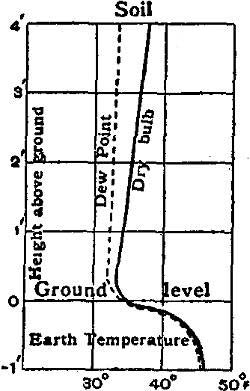
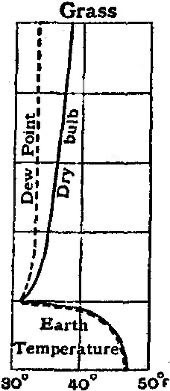
Fig. 1. Fig. 2.
The point of interest is to determine where the dew-point curve and dry-bulb curve will cut. If they cut above the surface, mist will result; if they cut at the surface, dew will be formed. Below the surface, it may be assumed that the air is saturated with moisture and any difference in temperature of the dew-point is accompanied by distillation. It may be remarked, by the way, that such distillation between soil layers of different temperatures must be productive of the transference of large quantities of water between different levels in the soil either upward or downward according to the time of year.
These diagrams illustrate the importance of the warmth and moisture of the ground in the phenomena which have been considered. From the surface there is a continual loss of heat going on by radiation and a continual supply of warmth and moisture from below. But while the heat can escape, the moisture cannot. Thus the dry-bulb line is deflected to the left as it approaches the surface, the dew-point line to the right. Thus the effect of the moisture of the ground is to cause the lines to approach. In the case of grass, fig. 2, the deviation of the dry-bulb line to the left to form a sharp minimum of temperature at the surface is well shown. The dew-point line is also shown diverted to the left to the same point as the dry-bulb; but that could only happen if there were so copious a condensation from the atmosphere as actually to make the air drier at the surface than up above. In diagram 1, for soil, the effect on air temperature and moisture is shown; the two lines converge to cut at the surface where a dew deposit will be formed. Along the underground line there must be a gradual creeping of heat and moisture towards the surface by distillation, the more rapid the greater the temperature gradient.
The amount of dew deposited is considerable, and, in tropical countries, is sometimes sufficiently heavy to be collected by gutters and spouts, but it is not generally regarded as a large percentage of the total rainfall. Loesche estimates the amount of dew for a single night on the Loango coast at 3 mm., but the estimate seems a high one. Measurements go to show that the depth of water corresponding with the aggregate annual deposit of dew is 1 in. to 1.5 in. near London (G. Dines), 1.2 in. at Munich (Wollny), 0.3 in. at Montpellier (Crova), 1.6 in. at Tenbury, Worcestershire (Badgley).
With the question of the amount of water collected as dew, that of the maintenance of "dew ponds" is intimately associated. The name is given to certain isolated ponds on the upper levels of the chalk downs of the south of England and elsewhere. Some of these ponds are very ancient, as the title of a work on Neolithic Dewponds by A. J. and G. Hubbard indicates. Their name seems to imply the hypothesis that they depend upon dew and not entirely upon rain for their maintenance as a source of water supply for cattle, for which they are used. The question has been discussed a good deal, but not settled; the balance of evidence seems to be against the view that dew deposits make any important contribution to the supply of water. The construction of dew ponds is, however, still practised on traditional lines, and it is said that a new dew pond has first to be filled artificially. It does not come into existence by the gradual accumulation of water in an impervious basin.
Authorities.—For Dew, see the two essays by Dr Charles Wells (London, 1818), also "An Essay on Dew," edited by Casella (London, 1866), Longmans', with additions by Strachan; Melloni, Pogg. Ann. lxxi. pp. 416, 424 and lxxiii. p. 467; Jamin, "Compléments à la théorie de la rosée," Journal de physique, viii. p. 41; J. Aitken, on "Dew," Trans. Roy. Soc. of Edinburgh, xxxiii., part i. 2, and "Nature," vol. xxxiii. p. 256; C. Tomlinson, "Remarks on a new Theory of Dew," Phil. Mag. (1886), 5th series, vol. 21, p. 483 and vol. 22, p. 270; Russell, Nature, vol 47, p. 210; also Met. Zeit. (1893), p. 390; Homén, Bodenphysikalische und meteorologische Beobachtungen (Berlin, 1894), iii.; Taubildung, p. 88, &c.; Rubenson, "Die Temperatur-und Feuchtigkeitsverhältnisse in den unteren Luftschichten bei der Taubildung," Met. Zeit. xi. (1876), p. 65; H. E. Hamberg, "Température et humidité de l'air à différentes hauteurs à Upsal," Soc. R. des sciences d'Upsal (1876); review in Met. Zeit. xii. (1877), p. 105.
For Dew Ponds, see Stephen Hales, Statical Essays, vol. i., experiment xix., pp. 52-57 (2nd ed., London, 1731); Gilbert White, Natural History and Antiquities of Selborne, letter xxix. (London, 1789); Dr C. Wells, An Essay on Dew (London, 1818, 1821 and 1866); Rev. J. C. Clutterbuck, "Prize Essay on Water Supply," Journ. Roy. Agric. Soc., 2nd series, vol. i. pp. 271-287 (1865); Field and Symons, "Evaporation from the Surface of Water," Brit. Assoc. Rep. (1869), sect., pp. 25, 26; J. Lucas, "Hydrogeology: One of the Developments of Modern Practical Geology," Trans. Inst. Surveyors, vol. ix. pp. 153-232 (1877); H. P. Slade, "A Short Practical Treatise on Dew Ponds" (London, 1877); Clement Reid, "The Natural History of Isolated Ponds," Trans. Norfolk and Norwich Naturalists' Society, vol. v. pp. 272-286 (1892); Professor G. S. Brady, On the Nature and Origin of Freshwater Faunas (1899); Professor L. C. Miall, "Dew Ponds," Reports of the British Association (Bradford Meeting, 1900), pp. 579-585; A. J. and G. Hubbard, "Neolithic Dewponds and Cattle-Ways" (London, 1904, 1907).
(W. N. S.)
DEWAN or Diwan, an Oriental term for finance minister. The word is derived from the Arabian diwan, and is commonly used in India to denote a minister of the Mogul government, or in modern days the prime minister of a native state. It was in the former sense that the grant of the dewanny to the East India Company in 1765 became the foundation of the British empire in India.
DEWAR, SIR JAMES (1842- ), British chemist and physicist, was born at Kincardine-on-Forth, Scotland, on the 20th of September 1842. He was educated at Dollar Academy and Edinburgh University, being at the latter first a pupil, and afterwards the assistant, of Lord Playfair, then professor of chemistry; he also studied under Kekulé at Ghent. In 1875 he was elected Jacksonian professor of natural experimental philosophy at Cambridge, becoming a fellow of Peterhouse, and in 1877 he succeeded Dr J. H. Gladstone as Fullerian professor of chemistry in the Royal Institution, London. He was president of the Chemical Society in 1897, and of the British Association in 1902, served on the Balfour Commission on London Water Supply (1893-1894), and as a member of the Committee on Explosives (1888-1891) invented cordite jointly with Sir Frederick Abel. His scientific work covers a wide field. Of his earlier papers, some deal with questions of organic chemistry, others with Graham's hydrogenium and its physical constants, others with high temperatures, e.g. the temperature of the sun and of the electric spark, others again with electro-photometry and the chemistry of the electric arc. With Professor J. G. M'Kendrick, of Glasgow, he investigated the physiological action of light, and examined the changes which take place in the electrical condition of the retina under its influence. With Professor G. D. Liveing, one of his colleagues at Cambridge, he began in 1878 a long series of spectroscopic observations, the later of which were devoted to the spectroscopic examination of various gaseous constituents separated from atmospheric air by the aid of low temperatures; and he was joined by Professor J. A. Fleming, of University College, London, in the investigation of the electrical behaviour of substances cooled to very low temperatures. His name is most widely known in connexion with his work on the liquefaction of the so-called permanent gases and his researches at temperatures approaching the zero of absolute temperature. His interest in this branch of inquiry dates back at least as far as 1874, when he discussed the "Latent Heat of Liquid Gases" before the British Association. In 1878 he devoted a Friday evening lecture at the Royal Institution to the then recent work of L. P. Cailletet and R. P. Pictet, and exhibited for the first time in Great Britain the working of the Cailletet apparatus. Six years later, in the same place, he described the researches of Z. F. Wroblewski and K. S. Olszewski, and illustrated for the first time in public the liquefaction of oxygen and air, by means of apparatus specially designed for optical projection so that the actions taking place might be visible to the audience. Soon afterwards he constructed a machine from which the liquefied gas could be drawn off through a valve for use as a cooling agent, and he showed its employment for this purpose in connexion with some researches on meteorites; about the same time he also obtained oxygen in the solid state. By 1891 he had designed and erected at the Royal Institution an apparatus which yielded liquid oxygen by the pint, and towards the end of that year he showed that both liquid oxygen and liquid ozone are strongly attracted by a magnet. About 1892 the idea occurred to him of using vacuum-jacketed vessels for the storage of liquid gases, and so efficient did this device prove in preventing the influx of external heat that it is found possible not only to preserve the liquids for comparatively long periods, but also to keep them so free from ebullition that examination of their optical properties becomes possible. He next experimented with a high-pressure hydrogen jet by which low temperatures were realized through the Thomson-Joule effect, and the successful results thus obtained led him to build at the Royal Institution the large refrigerating machine by which in 1898 hydrogen was for the first time collected in the liquid state, its solidification following in 1899. Later he investigated the gas-absorbing powers of charcoal when cooled to low temperatures, and applied them to the production of high vacua and to gas analysis (see Liquid Gases). The Royal Society in 1894 bestowed the Rumford medal upon him for his work in the production of low temperatures, and in 1899 he became the first recipient of the Hodgkins gold medal of the Smithsonian Institution, Washington, for his contributions to our knowledge of the nature and properties of atmospheric air. In 1904 he was the first British subject to receive the Lavoisier medal of the French Academy of Sciences, and in 1906 he was the first to be awarded the Matteucci medal of the Italian Society of Sciences. He was knighted in 1904, and in 1908 he was awarded the Albert medal of the Society of Arts.
DEWAS, two native states of India, in the Malwa Political Charge of Central India, founded in the first half of the 18th century by two brothers, Punwar Mahrattas, who came into Malwa with the peshwa, Baji Rao, in 1728. Their descendants are known as the senior and junior branches of the family, and since 1841 each has ruled his own portion as a separate state, though the lands belonging to each are so intimately entangled, that even in Dewas, the capital town, the two sides of the main street are under different administrations and have different arrangements for water supply and lighting. The senior branch has an area of 446 sq. m. and a population of 62,312, while the area of the junior branch is 440 sq. m. and its population 54,904.
DEWBERRY, Rubus caesius, a trailing plant, allied to the bramble, of the natural order Rosaceae. It is common in woods, hedges and the borders of fields in England and other countries of Europe. The leaves have three leaflets, are hairy beneath, and of a dusky green; the flowers which appear in June and July are white, or pale rose-coloured. The fruit is large, and closely embraced by the calyx, and consists of a few drupules, which are black, with a glaucous bloom; it has an agreeable acid taste.
DEW-CLAW, the rudimentary toes, two in number, or the "false hoof" of the deer, sometimes also called the "nails." In dogs the dew-claw is the rudimentary toe or hallux (corresponding to the big toe in man) hanging loosely attached to the skin, low down on the hinder part of the leg. The origin of the word is unknown, but it has been fancifully suggested that, while the other toes touch the ground in walking, the dew-claw merely brushes the dew from the grass.
D'EWES, SIR SIMONDS, Bart. (1602-1650), English antiquarian, eldest son of Paul D'Ewes of Milden, Suffolk, and of Cecilia, daughter and heir of Richard Simonds, of Coaxdon or Coxden, Dorsetshire, was born on the 18th of December 1602, and educated at the grammar school of Bury St Edmunds, and at St John's College, Cambridge. He had been admitted to the Middle Temple in 1611, and was called to the bar in 1623, when he immediately began his collections of material and his studies in history and antiquities. In 1626 he married Anne, daughter and heir of Sir William Clopton, of Luton's Hall in Suffolk, through whom he obtained a large addition to his already considerable fortune. On the 6th of December he was knighted. He took an active part as a strong Puritan and member of the moderate party in the opposition to the king's arbitrary government in the Long Parliament of 1640, in which he sat as member for Sudbury. On the 15th of July he was created a baronet by the king, but nevertheless adhered to the parliamentary party when war broke out, and in 1643 took the Covenant. He was one of the members expelled by Pride's Purge in 1648, and died on the 18th of April 1650. He had married secondly Elizabeth, daughter of Sir Henry Willoughby, Bart., of Risley in Derbyshire, by whom he had a son, who succeeded to his estates and title, the latter becoming extinct on the failure of male issue in 1731. D'Ewes appears to have projected a work of very ambitious scope, no less than the whole history of England based on original documents. But though excelling as a collector of materials, and as a laborious, conscientious and accurate transcriber, he had little power of generalization or construction, and died without publishing anything except an uninteresting tract, The Primitive Practice for Preserving Truth (1645), and some speeches. His Journals of all the Parliaments during the Reign of Queen Elizabeth, however, a valuable work, was published in 1682. His large collections, including transcripts from ancient records, many of the originals of which are now dispersed or destroyed, are in the Harleian collection in the British Museum. His unprinted Diaries from 1621-1624 and from 1643-1647, the latter valuable for the notes of proceedings in parliament, are often the only authority for incidents and speeches during that period, and are amusing from the glimpses the diarist affords of his own character, his good estimation of himself and his little jealousies; some are in a cipher and some in Latin.
Extracts from his Autobiography and Correspondence from the MSS. in the British Museum were published by J. O. Halliwell-Phillips in 1845, by Hearne in the appendix to his Historia vitae et regni Ricardi II. (1729), and in the Bibliotheca topographica Britannica, No. xv. vol. vi. (1783); and from a Diary of later date, College Life in the Time of James I. (1851). His Diaries have been extensively drawn upon by Forster, Gardiner, and by Sanford in his Studies of the Great Rebellion. Some of his speeches have been reprinted in the Harleian Miscellany and in the Somers Tracts.
DE WET, CHRISTIAN (1854- ), Boer general and politician, was born on the 7th of October 1854 at Leeuwkop, Smithfield district (Orange Free State), and later resided at Dewetsdorp. He served in the first Anglo-Boer War of 1880-81 as a field cornet, and from 1881 to 1896 he lived on his farm, becoming in 1897 member of the Volksraad. He took part in the earlier battles of the Boer War of 1899 in Natal as a commandant and later, as a general, he went to serve under Cronje in the west. His first successful action was the surprise of Sanna's Post near Bloemfontein, which was followed by the victory of Reddersburg a little later. Thenceforward he came to be regarded more and more as the most formidable leader of the Boers in their guerrilla warfare. Sometimes severely handled by the British, sometimes escaping only by the narrowest margin of safety from the columns which attempted to surround him, and falling upon and annihilating isolated British posts, De Wet continued to the end of the war his successful career, striking heavily where he could do so and skilfully evading every attempt to bring him to bay. He took an active part in the peace negotiations of 1902, and at the conclusion of the war he visited Europe with the other Boer generals. While in England the generals sought, unavailingly, a modification of the terms of peace concluded at Pretoria. De Wet wrote an account of his campaigns, an English version of which appeared in November 1902 under the title Three Years' War. In November, 1907 he was elected a member of the first parliament of the Orange River Colony and was appointed minister of agriculture. In 1908-9 he was a delegate to the Closer Union Convention.
DE WETTE, WILHELM MARTIN LEBERECHT (1780-1849), German theologian, was born on the 12th of January 1780, at Ulla, near Weimar, where his father was pastor. He was sent to the gymnasium at Weimar, then at the height of its literary glory. Here he was much influenced by intercourse with Johann Gottfried Herder, who frequently examined at the school. In 1799 he entered on his theological studies at Jena, his principal teachers being J. J. Griesbach and H. E. G. Paulus, from the latter of whom he derived his tendency to free critical inquiry. Both in methods and in results, however, he occupied an almost solitary position among German theologians. Having taken his doctor's degree, he became privat-docent at Jena; in 1807 professor of theology at Heidelberg, where he came under the influence of J. F. Fries (1773-1843); and in 1810 was transferred to a similar chair in the newly founded university of Berlin, where he enjoyed the friendship of Schleiermacher. He was, however, dismissed from Berlin in 1819 on account of his having written a letter of consolation to the mother of Karl Ludwig Sand, the murderer of Kotzebue. A petition in his favour presented by the senate of the university was unsuccessful, and a decree was issued not only depriving him of the chair, but banishing him from the Prussian kingdom. He retired for a time to Weimar, where he occupied his leisure in the preparation of his edition of Luther, and in writing the romance Theodor oder die Weihe des Zweiflers (Berlin, 1822), in which he describes the education of an evangelical pastor. During this period he made his first essay in preaching, and proved himself to be possessed of very popular gifts. But in 1822 he accepted the chair of theology in the university of Basel, which had been reorganized four years before. Though his appointment had been strongly opposed by the orthodox party, De Wette soon won for himself great influence both in the university and among the people generally. He was admitted a citizen, and became rector of the university, which owed to him much of its recovered strength, particularly in the theological faculty. He died on the 16th of June 1849.
De Wette has been described by Julius Wellhausen as "the epoch-making opener of the historical criticism of the Pentateuch." He prepared the way for the Supplement-theory. But he also made valuable contributions to other branches of theology. He had, moreover, considerable poetic faculty, and wrote a drama in three acts, entitled Die Entsagung (Berlin, 1823). He had an intelligent interest in art, and studied ecclesiastical music and architecture. As a Biblical critic he is sometimes classed with the destructive school, but, as Otto Pfleiderer says (Development of Theology, p. 102), he "occupied as free a position as the Rationalists with regard to the literal authority of the creeds of the church, but that he sought to give their due value to the religious feelings, which the Rationalists had not done, and, with a more unfettered mind towards history, to maintain the connexion of the present life of the church with the past." His works are marked by exegetical skill, unusual power of condensation and uniform fairness. Accordingly they possess value which is little affected by the progress of criticism.
The most important of his works are:—Beiträge zur Einleitung in das Alte Testament (2 vols., 1806-1807); Kommentar über die Psalmen (1811), which has passed through several editions, and is still regarded as of high authority; Lehrbuch der hebräisch-jüdischen Archäologie (1814); Über Religion und Theologie (1815); a work of great importance as showing its author's general theological position; Lehrbuch der christlichen Dogmatik (1813-1816); Lehrbuch der historisch-kritischen Einleitung in die Bibel (1817); Christliche Sittenlehre (1819-1821); Einleitung in das Neue Testament (1826); Religion, ihr Wesen, ihre Erscheinungsform, und ihr Einfluss auf das Leben (1827); Das Wesen des christlichen Glaubens (1846); and Kurzgefasstes exegetisches Handbuch zum Neuen Testament (1836-1848). De Wette also edited Luther's works (5 vols., 1825-1828).
See K. R. Hagenbach in Herzog's Realencyklopädie; G. C. F. Lücke's W. M. L. De Wette, zur freundschaftlicher Erinnerung (1850); and D. Schenkel's W. M. L. De Wette und die Bedeutung seiner Theologie für unsere Zeit (1849). Rudolf Stähelin, De Wette nach seiner theol. Wirksamkeit und Bedeutung (1880); F. Lichtenberger, History of German Theology in the Nineteenth Century (1889); Otto Pfleiderer, Development of Theology (1890), pp. 97 ff.; T. K. Cheyne, Founders of the Old Testament Criticism, pp. 31 ff.
DEWEY, DAVIS RICH (1858- ), American economist and statistician, was born at Burlington, Vermont, U.S.A., on the 7th of April 1858. He was educated at the university of Vermont and at Johns Hopkins University, and afterwards became professor of economics and statistics at the Massachusetts Institute of Technology. He was chairman of the state board on the question of the unemployed (1895), member of the Massachusetts commission on public, charitable and reformatory interests (1897), special expert agent on wages for the 12th census, and member of a state commission (1904) on industrial relations. He wrote an excellent Syllabus on Political History since 1815 (1887), a Financial History of the U.S. (1902), and National Problems (1907).
DEWEY, GEORGE (1837- ), American naval officer, was born at Montpelier, Vermont, on the 26th of December 1837. He studied at Norwich University, then at Norwich, Vermont, and graduated at the United States Naval Academy in 1858. He was commissioned lieutenant in April 1861, and in the Civil War served on the steamsloop "Mississippi" (1861-1863) during Farragut's passage of the forts below New Orleans in April 1862, and at Port Hudson in March 1863; took part in the fighting below Donaldsonville, Louisiana, in July 1863; and in 1864-1865 served on the steam-gunboat "Agawam" with the North Atlantic blockading squadron and took part in the attacks on Fort Fisher in December 1864 and January 1865. In March 1865 he became a lieutenant-commander. He was with the European squadron in 1866-1867; was an instructor in the United States Naval Academy in 1868-1869; was in command of the "Narragansett" in 1870-1871 and 1872-1875, being commissioned commander in 1872; was light-house inspector in 1876-1877; and was secretary of the light-house board in 1877-1882. In 1884 he became a captain; in 1889-1893 was chief of the bureau of equipment and recruiting; in 1893-1895 was a member of the light-house board; and in 1895-1897 was president of the board of inspection and survey, being promoted to the rank of commodore in February 1896. In November 1897 he was assigned, at his own request, to sea service, and sent to Asiatic waters. In April 1898, while with his fleet at Hong Kong, he was notified by cable that war had begun between the United States and Spain, and was ordered to "capture or destroy the Spanish fleet" then in Philippine waters. On the 1st of May he overwhelmingly defeated the Spanish fleet under Admiral Montojo in Manila Bay, a victory won without the loss of a man on the American ships (see Spanish-American War). Congress, in a joint resolution, tendered its thanks to Commodore Dewey, and to the officers and men under his command, and authorized "the secretary of the navy to present a sword of honor to Commodore George Dewey, and cause to be struck bronze medals commemorating the battle of Manila Bay, and to distribute such medals to the officers and men of the ships of the Asiatic squadron of the United States." He was promoted rear-admiral on the 10th of May 1898. On the 18th of August his squadron assisted in the capture of the city of Manila. After remaining in the Philippines under orders from his government to maintain control, Dewey received the rank of admiral (March 3, 1899)—that title, formerly borne only by Farragut and Porter, having been revived by act of Congress (March 2, 1899),—and returned home, arriving in New York City, where, on the 3rd of October 1899, he received a great ovation. He was a member (1899) of the Schurman Philippine Commission, and in 1899 and 1900 was spoken of as a possible Democratic candidate for the presidency. He acted as president of the Schley court of inquiry in 1901, and submitted a minority report on a few details.
DEWEY, MELVIL (1851- ), American librarian, was born at Adams Center, New York, on the 10th of December 1851. He graduated in 1874 at Amherst College, where he was assistant librarian from 1874 to 1877. In 1877 he removed to Boston, where he founded and became editor of The Library Journal, which became an influential factor in the development of libraries in America, and in the reform of their administration. He was also one of the founders of the American Library Association, of which he was secretary from 1876 to 1891, and president in 1891 and 1893. In 1883 he became librarian of Columbia College, and in the following year founded there the School of Library Economy, the first institution for the instruction of librarians ever organized. This school, which was very successful, was removed to Albany in 1890, where it was re-established as the State Library School under his direction; from 1888 to 1906 he was director of the New York State Library and from 1888 to 1900 was secretary of the University of the State of New York, completely reorganizing the state library, which he made one of the most efficient in America, and establishing the system of state travelling libraries and picture collections. His "Decimal System of Classification" for library cataloguing, first proposed in 1876, is extensively used.
DEWING, THOMAS WILMER (1851- ), American figure painter, was born in Boston, Massachusetts, on the 4th of May 1851. He was a pupil of Jules Lefebvre in Paris from 1876 to 1879; was elected a full member of the National Academy of Design in 1888; was a member of the society of Ten American Painters, New York; and received medals at the Paris Exhibition (1889), at Chicago (1893), at Buffalo (1901) and at St Louis (1904). His decorative genre pictures are notable for delicacy and finish. Among his portraits are those of Mrs Stanford White and of his own wife. Mrs Dewing (b, 1855), née Maria Oakey, a figure and flower painter, was a pupil of John La Farge in New York, and of Couture in Paris.
DE WINT, PETER (1784-1849), English landscape painter, of Dutch extraction, son of an English physician, was born at Stone, Staffordshire, on the 21st of January 1784. He studied art in London, and in 1809 entered the Academy schools. In 1812 he became a member of the Society of Painters in Watercolours, where he exhibited largely for many years, as well as at the Academy. He married in 1810 the sister of William Hilton, R.A. He died in London on the 30th of January 1849. De Wint's life was devoted to art; he painted admirably in oils, and he ranks as one of the chief English water-colourists. A number of his pictures are in the National Gallery and the Victoria and Albert Museum.
DE WINTER, JAN WILLEM (1750-1812), Dutch admiral, was born at Kampen, and in 1761 entered the naval service at the age of twelve years. He distinguished himself by his zeal and courage, and at the revolution of 1787 he had reached the rank of lieutenant. The overthrow of the "patriot" party forced him to fly for his safety to France. Here he threw himself heart and soul into the cause of the Revolution, and took part under Dumouriez and Pichegru in the campaigns of 1792 and 1793, and was soon promoted to the rank of brigadier-general. When Pichegru in 1795 overran Holland, De Winter returned with the French army to his native country. The states-general now utilized the experience he had gained as a naval officer by giving him the post of adjunct-general for the reorganization of the Dutch navy. In 1796 he was appointed vice-admiral and commander-in-chief of the fleet. He spared no efforts to strengthen it and improve its condition, and on the 11th of October 1797 he ventured upon an encounter off Camperdown with the British fleet under Admiral Duncan. After an obstinate struggle the Dutch were defeated, and De Winter himself was taken prisoner. He remained in England until December, when he was liberated by exchange. His conduct in the battle of Camperdown was declared by a court-martial to have nobly maintained the honour of the Dutch flag.
From 1798 to 1802 De Winter filled the post of ambassador to the French republic, and was then once more appointed commander of the fleet. He was sent with a strong squadron to the Mediterranean to repress the Tripoli piracies, and negotiated a treaty of peace with the Tripolitan government. He enjoyed the confidence of Louis Bonaparte, when king of Holland, and, after the incorporation of the Netherlands in the French empire, in an equal degree of the emperor Napoleon. By the former he was created marshal and count of Huessen, and given the command of the armed forces both by sea and land. Napoleon gave him the grand cross of the Legion of Honour and appointed him inspector-general of the northern coasts, and in 1811 he placed him at the head of the fleet he had collected at the Texel. Soon afterwards De Winter was seized with illness and compelled to betake himself to Paris, where he died on the 2nd of June 1812. He had a splendid public funeral and was buried in the Pantheon. His heart was enclosed in an urn and placed in the Nicolaas Kerk at Kampen.
DE WITT, CORNELIUS (1623-1672), brother of John de Witt (q.v.), was born at Dort in 1623. In 1650 he became burgomaster of Dort and member of the states of Holland and West Friesland. He was afterwards appointed to the important post of ruwaard or governor of the land of Putten and bailiff of Beierland. He associated himself closely with his greater brother, the grand pensionary, and supported him throughout his career with great ability and vigour. In 1667 he was the deputy chosen by the states of Holland to accompany Admiral de Ruyter in his famous expedition to Chatham. Cornelius de Witt on this occasion distinguished himself greatly by his coolness and intrepidity. He again accompanied De Ruyter in 1672 and took an honourable part in the great naval fight at Sole Bay against the united English and French fleets. Compelled by illness to leave the fleet, he found on his return to Dort that the Orange party were in the ascendant, and he and his brother were the objects of popular suspicion and hatred. An account of his imprisonment, trial and death, is given below.
DE WITT, JOHN (1625-1672), Dutch statesman, was born at Dort, on the 24th of September 1625. He was a member of one of the old burgher-regent families of his native town. His father, Jacob de Witt, was six times burgomaster of Dort, and for many years sat as a representative of the town in the states of Holland. He was a strenuous adherent of the republican or oligarchical states-right party in opposition to the princes of the house of Orange, who represented the federal principle and had the support of the masses of the people. John was educated at Leiden, and early displayed remarkable talents, more especially in mathematics and jurisprudence. In 1645 he and his elder brother Cornelius visited France, Italy, Switzerland and England, and on his return he took up his residence at the Hague, as an advocate. In 1650 he was appointed pensionary of Dort, an office which made him the leader and spokesman of the town's deputation in the state of Holland. In this same year the states of Holland found themselves engaged in a struggle for provincial supremacy, on the question of the disbanding of troops, with the youthful prince of Orange, William II. William, with the support of the states-general and the army, seized five of the leaders of the states-right party and imprisoned them in Loevestein castle; among these was Jacob de Witt. The sudden death of William, at the moment when he had crushed opposition, led to a reaction. He left only a posthumous child, afterwards William III. of Orange, and the principles advocated by Jacob de Witt triumphed, and the authority of the states of Holland became predominant in the republic.
At this time of constitutional crisis such were the eloquence, sagacity and business talents exhibited by the youthful pensionary of Dort that on the 23rd of July 1653 he was appointed to the office of grand pensionary (Raadpensionaris) of Holland at the age of twenty-eight. He was re-elected in 1658, 1663 and 1668, and held office until his death in 1672. During this period of nineteen years the general conduct of public affairs and administration, and especially of foreign affairs, such was the confidence inspired by his talents and industry, was largely placed in his hands. He found in 1653 his country brought to the brink of ruin through the war with England, which had been caused by the keen commercial rivalry of the two maritime states. The Dutch were unprepared, and suffered severely through the loss of their carrying trade, and De Witt resolved to bring about peace as soon as possible. The first demands of Cromwell were impossible, for they aimed at the absorption of the two republics into a single state, but at last in the autumn of 1654 peace was concluded, by which the Dutch made large concessions and agreed to the striking of the flag to English ships in the narrow seas. The treaty included a secret article, which the states-general refused to entertain, but which De Witt succeeded in inducing the states of Holland to accept, by which the provinces of Holland pledged themselves not to elect a stadtholder or a captain-general of the union. This Act of Seclusion, as it was called, was aimed at the young prince of Orange, whose close relationship to the Stuarts made him an object of suspicion to the Protector. De Witt was personally favourable to this exclusion of William III. from his ancestral dignities, but there is no truth in the suggestion that he prompted the action of Cromwell in this matter.
The policy of De Witt after the peace of 1654 was eminently successful. He restored the finances of the state, and extended its commercial supremacy in the East Indies. In 1658-59 he sustained Denmark against Sweden, and in 1662 concluded an advantageous peace with Portugal. The accession of Charles II. to the English throne led to the rescinding of the Act of Seclusion; nevertheless De Witt steadily refused to allow the prince of Orange to be appointed stadtholder or captain-general. This led to ill-will between the English and Dutch governments, and to a renewal of the old grievances about maritime and commercial rights, and war broke out in 1665. The zeal, industry and courage displayed by the grand pensionary during the course of this fiercely contested naval struggle could scarcely have been surpassed. He himself on more than one occasion went to sea with the fleet, and inspired all with whom he came in contact by the example he set of calmness in danger, energy in action and inflexible strength of will. It was due to his exertions as an organizer and a diplomatist quite as much as to the brilliant seamanship of Admiral de Ruyter, that the terms of the treaty of peace signed at Breda (July 31, 1667), on the principle of uti possidetis, were so honourable to the United Provinces. A still greater triumph of diplomatic skill was the conclusion of the Triple Alliance (January 17, 1668) between the Dutch Republic, England and Sweden, which checked the attempt of Louis XIV. to take possession of the Spanish Netherlands in the name of his wife, the infanta Maria Theresa. The check, however, was but temporary, and the French king only bided his time to take vengeance for the rebuff he had suffered. Meanwhile William III. was growing to manhood, and his numerous adherents throughout the country spared no efforts to undermine the authority of De Witt, and secure for the young prince of Orange the dignities and authority of his ancestors.
In 1672 Louis XIV. suddenly declared war, and invaded the United Provinces at the head of a splendid army. Practically no resistance was possible. The unanimous voice of the people called William III. to the head of affairs, and there were violent demonstrations against John de Witt. His brother Cornelius was (July 24) arrested on a charge of conspiring against the prince. On the 4th of August John de Witt resigned the post of grand pensionary that he had held so long and with such distinction. Cornelius was put to the torture, and on the 19th of August he was sentenced to deprivation of his offices and banishment. He was confined in the Gevangenpoort, and his brother came to visit him in the prison. A vast crowd on hearing this collected outside, and finally burst into the prison, seized the two brothers and literally tore them to pieces. Their mangled remains were hung up by the feet to a lamp-post. Thus perished, by the savage act of an infuriated mob, one of the greatest statesmen of his age.
John de Witt married Wendela Bicker, daughter of an influential burgomaster of Amsterdam, in 1655, by whom he had two sons and three daughters.
Bibliography.—J. Geddes, History of the Administration of John de Witt, (vol. i. only, London, 1879); A. Lefèvre-Pontalis, Jean de Witt, grand pensionnaire de Hollande (2 vols., Paris, 1884); P. Simons, Johan de Witt en zijn tijd (3 vols., Amsterdam, 1832-1842); W. C. Knottenbelt, Geschiedenis der Staatkunde van J. de Witt (Amsterdam, 1862); J. de Witt, Brieven ... gewisselt tusschen den Heer Johan de Witt ... ende de gevolgmaghtigden v. d. staedt d. Vereen. Nederlanden so in Vranckryck, Engelandt, Sweden, Denemarken, Poolen, enz. 1652-69 (6 vols., The Hague, 1723-1725); Brieven ... 1650-1657 (1658) eerste deel bewerkt den R. Fruin uitgegeven d., C. W. Kernkamp (Amsterdam, 1906).
DEWLAP (from the O.E. læppa, a lappet, or hanging fold; the first syllable is of doubtful origin and the popular explanation that the word means "the fold which brushes the dew" is not borne out, according to the New English Dictionary, by the equivalent words such as the Danish doglaeb, in Scandinavian languages), the loose fold of skin hanging from the neck of cattle, also applied to similar folds in the necks of other animals and fowls, as the dog, turkey, &c. The American practice of branding cattle by making a cut in the neck is known as a "dewlap brand." The skin of the neck in human beings often becomes pendulous with age, and is sometimes referred to humorously by the same name.
DEWSBURY, a market town and municipal and parliamentary borough in the West Riding of Yorkshire, England, on the river Calder, 8 m. S.S.W. of Leeds, on the Great Northern, London & North-Western, and Lancashire & Yorkshire railways. Pop. (1901) 28,060. The parish church of All Saints was for the most part rebuilt in the latter half of the 18th century; the portions still preserved of the original structure are mainly Early English. The chief industries are the making of blankets, carpets, druggets and worsted yarn; and there are iron foundries and machinery works. Coal is worked in the neighbourhood. The parliamentary borough includes the adjacent municipal borough of Batley, and returns one member. The municipal borough, incorporated in 1862, is under a mayor, 6 aldermen and 18 councillors. Area, 1471 acres. Paulinus, first archbishop of York, about the year 627 preached in the district of Dewsbury, where Edwin, king of Northumbria, whom he converted to Christianity, had a royal mansion. At Kirklees, in the parish, are remains of a Cistercian convent of the 12th century, in an extensive park, where tradition relates that Robin Hood died and was buried.
DEXIPPUS, PUBLIUS HERENNIUS (c. A.D. 210-273), Greek historian, statesman and general, was an hereditary priest of the Eleusinian family of the Kerykes, and held the offices of archon basileus and eponymus in Athens. When the Heruli overran Greece and captured Athens (269), Dexippus showed great personal courage and revived the spirit of patriotism among his degenerate fellow-countrymen. A statue was set up in his honour, the base of which, with an inscription recording his services, has been preserved (Corpus Inscrr. Atticarum, iii. No. 716). It is remarkable that the inscription is silent as to his military achievements. Photius (cod. 82) mentions three historical works by Dexippus, of which considerable fragments remain: (1) Τὰ μετ᾽ Ἀλέξανδρον, an epitome of a similarly named work by Arrian; (2) Σκυθικά, a history of the wars of Rome with the Goths (or Scythians) in the 3rd century; (3) Χρονικὴ ἱστορία, a chronological history from the earliest times to the emperor Claudius Gothicus (270), frequently referred to by the writers of the Augustan history. The work was continued by Eunapius of Sardis down to 404. Photius speaks very highly of the style of Dexippus, whom he places on a level with Thucydides, an opinion by no means confirmed by the fragments (C. W. Müller, F.H.G. iii. 666-687).
DEXTER, HENRY MARTYN (1821-1890), American clergyman and author, was born in Plympton, Massachusetts, on the 13th of August 1821. He graduated at Yale in 1840 and at the Andover Theological Seminary in 1844; was pastor of a Congregational church in Manchester, New Hampshire, in 1844-1849, and of the Berkeley Street Congregational church, Boston, in 1849-1867; was an editor of the Congregationalist in 1851-1866, of the Congregational Quarterly in 1859-1866, and of the Congregationalist, with which the Recorder was merged, from 1867 until his death in New Bedford, Mass., on the 13th of November 1890. He was an authority on the history of Congregationalism and was lecturer on that subject at the Andover Theological Seminary in 1877-1879; he left his fine library on the Puritans in America to Yale University. Among his works are: Congregationalism, What it is, Whence it is, How it works, Why it is better than any other Form of Church Government, and its consequent Demands (1865), The Church Polity of the Puritans the Polity of the New Testament (1870), As to Roger Williams and His "Banishment" from the Massachusetts Colony (1876), Congregationalism of the Last Three Hundred Years, as seen in its Literature (1880), his most important work, A Handbook of Congregationalism (1880), The True Story of John Smyth, the "Se-Baptist" (1881), Common Sense as to Woman Suffrage (1885), and many reprints of pamphlets bearing on early church history in New England, especially Baptist controversies. His The England and Holland of the Pilgrims was completed by his son, Morton Dexter (b. 1846), and published in 1905.
DEXTER, TIMOTHY (1747-1806), American merchant, remarkable for his eccentricities, was born at Malden, Massachusetts, on the 22nd of February 1747. He acquired considerable wealth by buying up quantities of the depreciated continental currency, which was ultimately redeemed by the Federal government at par. He assumed the title of Lord Dexter and built extraordinary houses at Newburyport, Mass., and Chester, New Hampshire. He maintained a poet laureate and collected inferior pictures, besides erecting in one of his gardens some forty colossal statues carved in wood to represent famous men. A statue of himself was included in the collection, and had for an inscription "I am the first in the East, the first in the West, and the greatest philosopher in the Western World." He wrote a book entitled Pickle for the Knowing Ones. It was wholly without punctuation marks, and as this aroused comment, he published a second edition, at the end of which was a page displaying nothing but commas and stops, from which the readers were invited to "peper and solt it as they plese." He beat his wife for not weeping enough at the rehearsal of his funeral, which he himself carried out in a very elaborate manner. He died at Newburyport on the 26th of October 1806.
DEXTRINE (British Gum, Starch Gum, Leiocome), (C6H10O5)x, a substance produced from starch by the action of dilute acids, or by roasting it at a temperature between 170° and 240° C. It is manufactured by spraying starch with 2% nitric acid, drying in air, and then heating to about 110°. Different modifications are known, e.g. amylodextrine, erythrodextrine and achroodextrine. Its name has reference to its powerful dextrorotatory action on polarized light. Pure dextrine is an insipid, odourless, white substance; commercial dextrine is sometimes yellowish, and contains burnt or unchanged starch. It dissolves in water and dilute alcohol; by strong alcohol it is precipitated from its solutions as the hydrated compound, C6H10O5.H2O. Diastase converts it eventually into maltose, C12H22O11; and by boiling with dilute acids (sulphuric, hydrochloric, acetic) it is transformed into dextrose, or ordinary glucose, C6H12O6. It does not ferment in contact with yeast, and does not reduce Fehling's solution. If heated with strong nitric acid it gives oxalic, and not mucic acid. Dextrine much resembles gum arabic, for which it is generally substituted. It is employed for sizing paper, for stiffening cotton goods, and for thickening colours in calico printing, also in the making of lozenges, adhesive stamps and labels, and surgical bandages.
See Otto Lueger, Lexikon der gesamten Technik.
DEY (an adaptation of the Turk, dāī, a maternal uncle), an honorary title formerly bestowed by the Turks on elderly men, and appropriated by the janissaries as the designation of their commanding officers. In Algeria the deys of the janissaries became in the 17th century rulers of that country (see Algeria: History). From the middle of the 16th century to the end of the 17th century the ruler of Tunisia was also called dey, a title frequently used during the same period by the sovereigns of Tripoli.
DHAMMAPĀLA, the name of one of the early disciples of the Buddha, and therefore constantly chosen as their name in religion by Buddhist novices on their entering the brotherhood. The most famous of the Bhikshus so named was the great commentator who lived in the latter half of the 5th century A.D. at the Badara Tittha Vihdāra, near the east coast of India, just a little south of where Madras now stands. It is to him we owe the commentaries on seven of the shorter canonical books, consisting almost entirely of verses, and also the commentary on the Netti, perhaps the oldest Pāli work outside the canon. Extracts from the latter work, and the whole of three out of the seven others, have been published by the Pdāli Text Society. These works show great learning, exegetical skill and sound judgment. But as Dhammapāla confines himself rigidly either to questions of the meaning of words, or to discussions of the ethical import of his texts, very little can be gathered from his writings of value for the social history of his time. For the right interpretation of the difficult texts on which he comments, they are indispensable. Though in all probability a Tamil by birth, he declares, in the opening lines of those of his works that have been edited, that he followed the tradition of the Great Minster at Anurdādhapura in Ceylon, and the works themselves confirm this in every respect. Hsüan Tsang, the famous Chinese pilgrim, tells a quaint story of a Dhammapdāla of Kdānchipura (the modern Konjevaram). He was a son of a high official, and betrothed to a daughter of the king, but escaped on the eve of the wedding feast, entered the order, and attained to reverence and distinction. It is most likely that this story, whether legendary or not (and Hsüan Tsang heard the story at Kdānchipura nearly two centuries after the date of Dhammapdāla), referred to this author. But it may also refer, as Hsüan Tsang refers it, to another author of the same name. Other unpublished works, besides those mentioned above, have been ascribed to Dhammapdāla, but it is very doubtful whether they are really by him.
Authorities.—T. Watters, On Yuan Chwang (ed. Rhys Davids and Bushell, London, 1905), ii. 169, 228; Edmund Hardy in Zeitschrift der deutschen morgenländischen Gesellschaft (1898), pp. 97 foll.; Netti (ed. E. Hardy, London, Pāli Text Society, 1902), especially the Introduction, passim; Therī Gdāthdā Commentary, Peta Vatthu Commentary, and Vimdāna Vatthu Commentary, all three published by the Pāli Text Society.
(T. W. R. D.)
DHANIS, FRANCIS, Baron (1861-1909), Belgian administrator, was born in London in 1861 and passed the first fourteen years of his life at Greenock, where he received his early education. He was the son of a Belgian merchant and of an Irish lady named Maher. The name Dhanis is supposed to be a variation of D'Anvers. Having completed his education at the École Militaire he entered the Belgian army, joining the regiment of grenadiers, in which he rose to the rank of major. As soon as he reached the rank of lieutenant he volunteered for service on the Congo, and in 1887 he went out for a first term. He did so well in founding new stations north of the Congo that, when the government decided to put an end to the Arab domination on the Upper Congo, he was selected to command the chief expedition sent against the slave dealers. The campaign began in April 1892, and it was not brought to a successful conclusion till January 1894. The story of this war has been told in detail by Dr Sydney Hinde, who took part in it, in his book The Fall of the Congo Arabs. The principal achievements of the campaign were the captures in succession of the three Arab strongholds at Nyangwe, Kassongo and Kabambari. For his services Dhanis was raised to the rank of baron, and in 1895 was made vice-governor of the Congo State. In 1896 he took command of an expedition to the Upper Nile. His troops, largely composed of the Batetela tribes who had only been recently enlisted, and who had been irritated by the execution of some of their chiefs for indulging their cannibal proclivities, mutinied and murdered many of their white officers. Dhanis found himself confronted with a more formidable adversary than even the Arabs in these well-armed and half-disciplined mercenaries. During two years (1897-1898) he was constantly engaged in a life-and-death struggle with them. Eventually he succeeded in breaking up the several bands formed out of his mutinous soldiers. Although the incidents of the Batetela operations were less striking than those of the Arab war, many students of both think that the Belgian leader displayed the greater ability and fortitude in bringing them to a successful issue. In 1899 Baron Dhanis returned to Belgium with the honorary rank of vice governor-general. He died on the 14th of November 1909.