VOLUME VIII slice III Destructor to Diameter (continued 2)
Reading edition
The Sèvre Niortaise and its tributary the Mignon furnish 19 m. of navigable waterway. The department is served by the Ouest-État railway. It contains a large proportion of Protestants, especially in the south-east. The four arrondissements are Niort, Bressuire, Melle and Parthenay; the cantons number 31, and the communes 356. Deux-Sèvres is part of the region of the IX. army corps, and of the diocese and the académie (educational circumscription) of Poitiers, where also is its court of appeal.
Niort (the capital), Bressuire, Melle, Parthenay, St Maixent, Thouars and Oiron are the principal places in the department. Several other towns contain features of interest. Among these are Airvault, where there is a church of the 12th and 14th centuries which once belonged to the abbey of St Pierre, and an ancient bridge built by the monks; Celles-sur-Belle, where there is an old church rebuilt by Louis XI., and again in the 17th century; and St Jouin-de-Marnes, with a fine Romanesque church with Gothic restoration, which belonged to one of the most ancient abbeys of Gaul.
DEVA (Sanskrit "heavenly"), in Hindu and Buddhist mythology, spirits of the light and air, and minor deities generally beneficent. In Persian mythology, however, the word is used for evil spirits or demons. According to Zoroaster the devas were created by Ahriman.
DEVA (mod. Chester), a Roman legionary fortress in Britain on the Dee. It was occupied by Roman troops about A.D. 48 and held probably till the end of the Roman dominion. Its garrison was the Legio XX. Valeria Victrix, with which another legion (II. Adjutrix) was associated for a few years, about A.D. 75-85. It never developed, like many Roman legionary fortresses, into a town, but remained military throughout. Parts of its north and east walls (from Morgan's Mount to Peppergate) and numerous inscriptions remain to indicate its character and area.
See F. J. Haverfield, Catalogue of the Grosvenor Museum, Chester (Chester, 1900), Introduction.
DEVADATTA, the son of Suklodana, who was younger brother to the father of the Buddha (Mahāvastu, iii. 76). Both he and his brother Ānanda, who were considerably younger than the Buddha, joined the brotherhood in the twentieth year of the Buddha's ministry. Four other cousins of theirs, chiefs of the Sākiya clan, and a barber named Upāli, were admitted to the order at the same time; and at their own request the barber was admitted first, so that as their senior in the order he should take precedence of them (Vinaya Texts, iii. 228). All the others continued loyal disciples, but Devadatta, fifteen years afterwards, having gained over the crown prince of Magadha, Ajātasattu, to his side, made a formal proposition, at the meeting of the order, that the Buddha should retire, and hand over the leadership to him, Devadatta (Vinaya Texts, iii. 238; Jātaka, i. 142). This proposal was rejected, and Devadatta is said in the tradition to have successfully instigated the prince to the execution of his aged father and to have made three abortive attempts to bring about the death of the Buddha (Vinaya Texts, iii. 241-250; Jātaka, vi. 131), shortly afterwards, relying upon the feeling of the people in favour of asceticism, he brought forward four propositions for ascetic rules to be imposed on the order. These being refused, he appealed to the people, started an order of his own, and gained over 500 of the Buddha's community to join in the secession. We hear nothing further about the success or otherwise of the new order, but it may possibly be referred to under the name of the Gotamakas, in the Anguttara (see Dialogues of the Buddha i. 222), for Devadatta's family name was Gotama. But his community was certainly still in existence in the 4th century A.D., for it is especially mentioned by Fa Hien, the Chinese pilgrim (Legge's translation, p. 62). And it possibly lasted till the 7th century, for Hsüan Tsang mentions that in a monastery in Bengal the monks then followed a certain regulation of Devadatta's (T. Watters, On Yuan Chwang, ii. 191). There is no mention in the canon as to how or when Devadatta died; but the commentary on the Jātaka, written in the 5th century A.D., has preserved a tradition that he was swallowed up by the earth near Sāvatthi, when on his way to ask pardon of the Buddha (Jātaka, iv. 158). The spot where this occurred was shown to both the pilgrims just mentioned (Fa Hien, loc. cit. p. 60; and T. Watters, On Yuan Chwang, i. 390). It is a striking example of the way in which such legends grow, that it is only the latest of these authorities, Hsüan Tsang, who says that, though ostensibly approaching the Buddha with a view to reconciliation, Devadatta had concealed poison in his nail with the object of murdering the Buddha.
Authorities.—Vinaya Texts, translated by Rhys Davids and H. Oldenberg (3 vols., Oxford, 1881-1885); The Jātaka, edited by V. Fausböll (7 vols., London, 1877-1897); T. Watters, On Yuan Chwang (ed. Rhys Davids and Bushell, 2 vols., London, 1904-1905); Fa Hian, translated by J. Legge (Oxford, 1886); Mahāvastu (ed. Tenant, 3 vols., Paris, 1882-1897).
(T. W. R. D.)
DEVAPRAYAG (Deoprayag), a village in Tehri State of the United Provinces, India. It is situated at the spot where the rivers Alaknanda and Bhagirathi unite and form the Ganges, and as one of the five sacred confluences in the hills is a great place of pilgrimage for devout Hindus. Devaprayag stands at an elevation of 2265 ft. on the side of a hill which rises above it 800 ft. On a terrace in the upper part of the village is the temple of Raghunath, built of huge uncemented stones, pyramidical in form and capped by a white cupola.
DEVENS, CHARLES (1820-1891), American lawyer and jurist, was born in Charlestown, Massachusetts, on the 4th of April 1820. He graduated at Harvard College in 1838, and at the Harvard law school in 1840, and was admitted to the bar in Franklin county, Mass., where he practised from 1841 to 1849. In the year 1848 he was a Whig member of the state senate, and from 1849 to 1853 was United States marshal for Massachusetts, in which capacity he was called upon in 1851 to remand the fugitive slave, Thomas Sims, to slavery. This he felt constrained to do, much against his personal desire; and subsequently he attempted in vain to purchase Sims's freedom, and many years later appointed him to a position in the department of justice at Washington. Devens practised law at Worcester from 1853 until 1861, and throughout the Civil War served in the Federal army, becoming colonel of volunteers in July 1861 and brigadier-general of volunteers in April 1862. At the battle of Ball's Bluff (1861) he was severely wounded; he was again wounded at Fair Oaks (1862) and at Chancellorsville (1863), where he commanded a division. He later distinguished himself at Cold Harbor, and commanded a division in Grant's final campaign in Virginia (1864-65), his troops being the first to occupy Richmond after its fall. Breveted major-general in 1865, he remained in the army for a year as commander of the military district of Charleston, South Carolina. He was a judge of the Massachusetts superior court from 1867 to 1873, and was an associate justice of the supreme court of the state from 1873 to 1877, and again from 1881 to 1891. From 1877 to 1881 he was attorney-general of the United States in the cabinet of President Hayes. He died at Boston, Mass., on the 7th of January 1891.
See his Orations and Addresses, with a memoir by John Codman Ropes (Boston, 1891).
DEVENTER, a town in the province of Overysel, Holland, on the right bank of the Ysel, at the confluence of the Schipbeek, and a junction station 10 m. N. of Zutphen by rail. It is also connected by steam tramway S.E. with Brokulo. Pop. (1900) 26,212. Deventer is a neat and prosperous town situated in the midst of prettily wooded environs, and containing many curious old buildings. There are three churches of special interest: the Groote Kerk (St Lebuinus), which dates from 1334, and occupies the site of an older structure of which the 11th-century crypt remains; the Roman Catholic Broederkerk, or Brothers' Church, containing among its relics three ancient gospels said to have been written by St Lebuinus (Lebwin), the English apostle of the Frisians and Westphalians (d. c. 773); and the Bergkerk, dedicated in 1206, which has two late Romanesque towers. The town hall (1693) contains a remarkable painting of the town council by Terburg. In the fine square called the Brink is the old weigh-house, now a school (gymnasium), built in 1528, with a large external staircase (1644). The gymnasium is descended from the Latin school of which the celebrated Alexander Hegius was master in the third quarter of the 15th century, when the young Erasmus was sent to it, and at which Adrian Floreizoon, afterwards Pope Adrian VI., is said to have been a pupil about the same time. Another famous educational institution was the "Athenaeum" or high school, founded in 1630, at which Henri Renery (d. 1639) taught philosophy, while Johann Friedrich Gronov (Gronovius) (1611-1671) taught rhetoric and history in the middle of the same century. The "Athenaeum" disappeared in 1876. In modern times Deventer possessed a famous teacher in Dr Burgersdyk (d. 1900), the Dutch translator of Shakespeare. The town library, also called the library of the Athenaeum, includes many MSS. and incunabula, and a 13th-century copy of Reynard the Fox. The archives of the town are of considerable value. Besides a considerable agricultural trade, Deventer has important iron foundries and carpet factories (the royal manufactory of Smyrna carpets being especially famous); while cotton-printing, rope-making and the weaving of woollens and silks are also carried on. A public official is appointed to supervise the proper making of a form of gingerbread known as "Deventer Koek," which has a reputation throughout Holland. In the church of Bathmen, a village 5 m. E. of Deventer, some 14th-century frescoes were discovered in 1870.
In the 14th century Deventer was the centre of the famous religious and educational movement associated with the name of Gerhard Groot (q.v.), who was a native of the town (see Brothers of Common Life.).
DE VERE, AUBREY THOMAS (1814-1902), Irish poet and critic, was born at Curragh Chase, Co. Limerick, on the 10th of January 1814, being the third son of Sir Aubrey de Vere Hunt (1788-1846). In 1832 his father dropped the final name by royal licence. Sir Aubrey was himself a poet. Wordsworth called his sonnets the "most perfect of the age." These and his drama, Mary Tudor, were published by his son in 1875 and 1884. Aubrey de Vere was educated at Trinity College, Dublin, and in his twenty-eighth year published The Waldenses, which he followed up in the next year by The Search after Proserpine. Thenceforward he was continually engaged, till his death on the 20th of January 1902, in the production of poetry and criticism. His best-known works are: in verse, The Sisters (1861); The Infant Bridal (1864); Irish Odes (1869); Legends of St Patrick (1872); and Legends of the Saxon Saints (1879); and in prose, Essays chiefly on Poetry (1887); and Essays chiefly Literary and Ethical (1889). He also wrote a picturesque volume of travel-sketches, and two dramas in verse, Alexander the Great (1874); and St Thomas of Canterbury (1876); both of which, though they contain fine passages, suffer from diffuseness and a lack of dramatic spirit. The characteristics of Aubrey de Vere's poetry are "high seriousness" and a fine religious enthusiasm. His research in questions of faith led him to the Roman Church; and in many of his poems, notably in the volume of sonnets called St Peter's Chains (1888), he made rich additions to devotional verse. He was a disciple of Wordsworth, whose calm meditative serenity he often echoed with great felicity; and his affection for Greek poetry, truly felt and understood, gave dignity and weight to his own versions of mythological idylls. But perhaps he will be chiefly remembered for the impulse which he gave to the study of Celtic legend and literature. In this direction he has had many followers, who have sometimes assumed the appearance of pioneers; but after Matthew Arnold's fine lecture on "Celtic Literature," nothing perhaps did more to help the Celtic revival than Aubrey de Vere's tender insight into the Irish character, and his stirring reproductions of the early Irish epic poetry.
A volume of Selections from his poems was edited in 1894 (New York and London) by G. E. Woodberry.
DEVICE, a scheme, plan, simple mechanical contrivance; also a pattern or design, particularly an heraldic design or emblem, often combined with a motto or legend. "Device" and its doublet "devise" come from the two Old French forms devis and devise of the Latin divisa, things divided, from dividere, to separate, used in the sense of to arrange, set out, apportion. "Devise," as a substantive, is now only used as a legal term for a disposition of property by will, by a modern convention restricted to a disposition of real property, the term "bequest" being used of personalty (see Will). This use is directly due to the Medieval Latin meaning of dividere = testamento disponere. In its verbal form, "devise" is used not only in the legal sense, but also in the sense of to plan, arrange, scheme.
DEVIL (Gr. διάβολος, "slanderer," from διαβάλλειν, to slander), the generic name for a spirit of evil, especially the supreme spirit of evil, the foe of God and man. The word is used for minor evil spirits in much the same sense as "demon." From the various characteristics associated with this idea, the term has come to be applied by analogy in many different senses. From the idea of evil as degraded, contemptible and doomed to failure, the term is applied to persons in evil plight, or of slight consideration. In English legal phraseology "devil" and "devilling" are used of barristers who act as substitutes for others. Any remuneration which the legal "devil" may receive is purely a matter of private arrangement between them. In the chancery division such remuneration is generally in the proportion of one half of the fee which the client pays; "in the king's bench division remuneration for 'devilling' of briefs or assisting in drafting and opinions is not common" (see Annual Practice, 1907, p. 717). In a similar sense an author may have his materials collected and arranged by a literary hack or "devil." The term "printer's devil" for the errand boy in a printing office probably combines this idea with that of his being black with ink. The common notions of the devil as black, ill-favoured, malicious, destructive and the like, have occasioned the application of the term to certain animals (the Tasmanian devil, the devil-fish, the coot), to mechanical contrivances (for tearing up cloth or separating wool), to pungent, highly seasoned dishes, broiled or fried. In this article we are concerned with the primary sense of the word, as used in mythology and religion.
The primitive philosophy of animism involves the ascription of all phenomena to personal agencies. As phenomena are good or evil, produce pleasure or pain, cause weal or woe, a distinction in the character of these agencies is gradually recognized; the agents of good become gods, those of evil, demons. A tendency towards the simplification and organization of the evil as of the good forces, leads towards belief in outstanding leaders among the forces of evil. When the divine is most completely conceived as unity, the demonic is also so conceived; and over against God stands Satan, or the devil.
Although it is in connexion with Hebrew and Christian monotheism that this belief in the devil has been most fully developed, yet there are approaches to the doctrine in other religions. In Babylonian mythology "the old serpent goddess 'the lady Nina' was transformed into the embodiment of all that was hostile to the powers of heaven" (Sayce's Hibbert Lectures, p. 283), and was confounded with the dragon Tiamat, "a terrible monster, reappearing in the Old Testament writings as Rahab and Leviathan, the principle of chaos, the enemy of God and man" (Tennant's The Fall and Original Sin, p. 43), and according to Gunkel (Schöpfung und Chaos, p. 383) "the original of the 'old serpent' of Rev. xii. 9." In Egyptian mythology the serpent Apap with an army of monsters strives daily to arrest the course of the boat of the luminous gods. While the Greek mythology described the Titans as "enchained once for all in their dark dungeons" yet Prometheus' threat remained to disturb the tranquillity of the Olympian Zeus. In the German mythology the army of darkness is led by Hel, the personification of twilight, sunk to the goddess who enchains the dead and terrifies the living, and Loki, originally the god of fire, but afterwards "looked upon as the father of the evil powers, who strips the goddess of earth of her adornments, who robs Thor of his fertilizing hammer, and causes the death of Balder the beneficent sun." In Hindu mythology the Maruts, Indra, Agni and Vishnu wage war with the serpent Ahi to deliver the celestial cows or spouses, the waters held captive in the caverns of the clouds. In the Trimurti, Brahmă (the impersonal) is manifested as Brahmā (the personal creator), Vishnu (the preserver), and Siva (the destroyer). In Siva is perpetuated the belief in the god of Vedic times Rudra, who is represented as "the wild hunter who storms over the earth with his bands, and lays low with arrows the men who displease him" (Chantepie de la Saussaye's Religionsgeschichte, 2nd ed., vol. ii. p. 25). The evil character of Siva is reflected in his wife, who as Kali (the black) is the wild and cruel goddess of destruction and death. The opposition of good and evil is most fully carried out in Zoroastrianism. Opposed to Ormuzd, the author of all good, is Ahriman, the source of all evil; and the opposition runs through the whole universe (D'Alviella's Hibbert Lectures, pp. 158-164).
The conception of Satan (Heb. שטן, the adversary, Gr. Σατανᾶς, or Σατᾶν, 2 Cor. xii. 7) belongs to the post-exilic period of Hebrew development, and probably shows traces of the influence of Persian on Jewish thought, but it has also its roots in much older beliefs. An "evil spirit" possesses Saul (1 Sam. xvi. 14), but it is "from the Lord." The same agency produces discord between Abimelech and the Shechemites (Judges ix. 23). "A lying spirit in the mouth of all his prophets" as Yahweh's messenger entices Ahab to his doom (1 Kings xxii. 22). Growing human corruption is traced to the fleshy union of angels and women (Gen. vi. 1-4). But generally evil, whether as misfortune or as sin, is assigned to divine causality (1 Sam. xviii. 10; 2 Sam. xxiv. 1; 1 Kings xxii. 20; Isa. vi. 10, lxiii. 17). After the Exile there is a tendency to protect the divine transcendence by the introduction of mediating angelic agency, and to separate all evil from God by ascribing its origin to Satan, the enemy of God and man. In the prophecy of Zechariah (iii. 1-2) he stands as the adversary of Joshua, the high priest, and is rebuked by Yahweh for desiring that Jerusalem should be further punished. In the book of Job he presents himself before the Lord among the sons of God (ii. 1), yet he is represented both as accuser and tempter. He disbelieves in Job's integrity, and desires him to be so tried that he may fall into sin. While, according to 2 Sam. xxiv. 1, God himself tests David in regard to the numbering of the people, according to 1 Chron. xxi. 1 it is Satan who tempts him.
The development of the conception continued in later Judaism, which was probably more strongly influenced by Persian dualism. It is doubtful, however, whether the Asmodeus (q.v.) of the book of Tobit is the same as the Aēshma Daēwa of the Bundahesh. He is the evil spirit who slew the seven husbands of Sara (iii. 8), and the name probably means "Destroyer." In the book of Enoch Satan is represented as the ruler of a rival kingdom of evil, but here are also mentioned Satans, who are distinguished from the fallen angels and who have a threefold function, to tempt, to accuse and to punish. Satan possesses the ungodly (Ecclesiasticus xxi. 27), is identified with the serpent of Gen. iii. (Wisdom ii. 24), and is probably also represented by Asmodeus, to whom lustful qualities are assigned (Tobit vi. 14); Gen. iii. is probably referred to in Psalms of Solomon xvii. 49, "a serpent speaking with the words of transgressors, words of deceit to pervert wisdom." The Book of the Secrets of Enoch not only identifies Satan with the Serpent, but also describes his revolt against God, and expulsion from heaven. In the Jewish Targums Sammael, "the highest angel that stands before God's throne, caused the serpent to seduce the woman"; he coalesces with Satan, and has inferior Satans as his servants. The birth of Cain is ascribed to a union of Satan with Eve. As accuser affecting man's standing before God he is greatly feared.
This doctrine, stripped of much of its grossness, is reproduced in the New Testament. Satan is the διάβολος (Matt. xiii. 39; John xiii. 2; Eph. iv. 27; Heb. ii. 14; Rev. ii. 10), slanderer or accuser, the πειράζων (Matt. iv. 3; 1 Thess. iii. 5), the tempter, the πονηρός (Matt. v. 37; John xvii. 15; Eph. vi. 16), the evil one, and the ἐχθρός (Matt. xiii. 39), the enemy. He is apparently identified with Beelzebub (or Beelzebul) in Matt. xii. 26, 27. Jesus appears to recognize the existence of demons belonging to a kingdom of evil under the leadership of Satan "the prince of demons" (Matt. xii. 24, 26, 27), whose works in demonic possessions it is his function to destroy (Mark i. 34, iii. 11, vi. 7; Luke x. 17-20). But he himself conquers Satan in resisting his temptations (Matt. iv. 1-11). Simon is warned against him, and Judas yields to him as tempter (Luke xxii. 31; John xiii. 27). Jesus's cures are represented as a triumph over Satan (Luke x. 18). This Jewish doctrine is found in Paul's letters also. Satan rules over a world of evil, supernatural agencies, whose dwelling is in the lower heavens (Eph. vi. 12): hence he is the "prince of the power of the air" (ii. 2). He is the tempter (1 Thess. iii. 5; 1 Cor. vii. 5), the destroyer (x. 10), to whom the offender is to be handed over for bodily destruction (v. 5), identified with the serpent (Rom. xvi. 20; 2 Cor. xi. 3), and probably with Beliar or Belial (vi. 15); and the surrender of man to him brought death into the world (Rom. v. 17). Paul's own "stake in the flesh" is Satan's messenger (2 Cor. xii. 7). According to Hebrews Satan's power over death Jesus destroys by dying (ii. 14). Revelation describes the war in heaven between God with his angels and Satan or the dragon, the "old serpent," the deceiver of the whole world (xii. 9), with his hosts of darkness. After the overthrow of the Beast and the kings of the earth, Satan is imprisoned in the bottomless pit a thousand years (xx. 2). Again loosed to deceive the nations, he is finally cast into the lake of fire and brimstone (xx. 10; cf. Enoch liv. 5, 6; 2 Peter ii. 4). In John's Gospel and Epistles Satan is opposed to Christ. Sinner and murderer from the beginning (1 John iii. 8) and liar by nature (John viii. 44), he enslaves men to sin (viii. 34), causes death (verse 44), rules the present world (xiv. 30), but has no power over Christ or those who are his (xiv. 30, xvi. 11; 1 John v. 18). He will be destroyed by Christ with all his works (John xvi. 33; 1 John iii. 8).
In the common faith of the Gentile churches after the Apostolic Age "the present dominion of evil demons, or of one evil demon, was just as generally presupposed as man's need of redemption, which was regarded as a result of that dominion. The tenacity of this belief may be explained among other things by the living impression of the polytheism that surrounded the communities on every side. By means of this assumption too, humanity seemed to be unburdened, and the presupposed capacity for redemption could, therefore, be justified in its widest range" (Harnack's History of Dogma, i. p. 181). While Christ's First Advent delivered believers from Satan's bondage, his overthrow would be completed only by the Second Advent. The Gnostics held that "the present world sprang from a fall of man, or from an undertaking hostile to God, and is, therefore, the product of an evil or intermediate being" (p. 257). Some taught that while the future had been assigned by God to Christ, the devil had received the present age (p. 309). The fathers traced all doctrines not held by the Catholic Church to the devil, and the virtues of heretics were regarded as an instance of the devil transforming himself into an angel of light (ii. 91). Irenaeus ascribes Satan's fall to "pride and arrogance and envy of God's creation"; and traces man's deliverance from Satan to Christ's victory in resisting his temptations; but also, guided by certain Pauline passages, represents the death of Christ "as a ransom paid to the 'apostasy' for men who had fallen into captivity" (ii. 290). He does not admit that Satan has any lawful claim on man, or that God practised a deceit on him, as later fathers taught. This theory of the atonement was formulated by Origen. "By his successful temptation the devil acquired a right over men. God offered Christ's soul for that of men. But the devil was duped, as Christ overcame both him and death" (p. 367). It was held by Gregory of Nyssa, Ambrose, who uses the phrase pia fraus, Augustine, Leo I., and Gregory I., who expresses it in its worst form. "The humanity of Christ was the bait; the fish, the devil, snapped at it, and was left hanging on the invisible hook, Christ's divinity" (iii. 307). In Athanasius the relation of the work of Christ to Satan retires into the background, Gregory of Nazianzus and John of Damascus felt scruples about this view. It is expressly repudiated by Anselm and Abelard. Peter the Lombard asserted it, disregarding these objections. Bernard represents man's bondage to Satan "as righteously permitted as a just retribution for sin," he being "the executioner of the divine justice." Another theory of Origen's found less acceptance. The devil, as a being resulting from God's will, cannot always remain a devil. The possibility of his redemption, however, was in the 5th century branded as a heresy. Persian dualism was brought into contact with Christian thought in the doctrine of Mani; and it is permissible to believe that the gloomy views of Augustine regarding man's condition are due in some measure to this influence. Mani taught that Satan with his demons, sprung from the kingdom of darkness, attacked the realm of light, the earth, defeated man sent against him by the God of light, but was overthrown by the God of light, who then delivered the primeval man (iii. 324). "During the middle ages," says Tulloch, "the belief in the devil was absorbing—saints conceived themselves and others to be in constant conflict with him." This superstition, perhaps at its strongest in the 13th to the 15th century, passed into Protestantism. Luther was always conscious of the presence and opposition of Satan. "As I found he was about to begin again," says Luther, "I gathered together my books, and got into bed. Another time in the night I heard him above my cell walking on the cloister, but as I knew it was the devil I paid no attention to him and went to sleep." He held that this world will pass away with its pleasures, as there can be no real improvement in it, for the devil continues in it to ply his daring and seductive devices (vii. 191). I. A. Dorner (Christian Doctrine, iii. p. 93) sums up Protestant doctrine as follows:—"He is brought into relation with natural sinfulness, and the impulse to evil thoughts and deeds is ascribed to him. The dominion of evil over men is also represented as a slavery to Satan, and this as punishment. He has his full power in the extra-Christian world. But his power is broken by Christ, and by his word victory over him is to be won. The power of creating anything is also denied the devil, and only the power of corrupting substances is conceded to him. But it is only at the Last Judgment that his power is wholly annihilated; he is himself delivered up to eternal punishment." This belief in the devil was specially strong in Scotland among both clergy and laity in the 17th century. "The devil was always and literally at hand," says Buckle, "he was haunting them, speaking to them, and tempting them. Go where they would he was there."
In more recent times a great variety of opinions has been expressed on this subject. J. S. Semler denied the reality of demonic possession, and held that Christ in his language accommodated himself to the views of the sick whom he was seeking to cure. Kant regarded the devil as a personification of the radical evil in man. Daub in his Judas Ishcarioth argued that a finite evil presupposes an absolute evil, and the absolute evil as real must be in a person. Schelling regarded the devil as, not a person, but a real principle, a spirit let loose by the freedom of man. Schleiermacher was an uncompromising opponent of the common belief. "The problem remains to seek evil rather in self than in Satan, Satan only showing the limits of our self-knowledge." Dorner has formulated a theory which explains the development of the conception of Satan in the Holy Scriptures as in correspondence with an evolution in the character of Satan. "Satan appears in Scripture under four leading characters:—first as the tempter of freedom, who desires to bring to decision, secondly as the accuser, who by virtue of the law retorts criminality on man; thirdly as the instrument of the Divine, which brings evil and death upon men; fourthly and lastly he is described, especially in the New Testament, as the enemy of God and man." He supposes "a change in Satan in the course of the history of the divine revelation, in conflict with which he came step by step to be a sworn enemy of God and man, especially in the New Testament times, in which, on the other hand, his power is broken at the root by Christ." He argues that "the world-order, being in process as a moral order, permits breaches everywhere into which Satan can obtain entrance" (pp. 99, 102). H. L. Martensen gives even freer rein to speculation. "The evil principle," he says, "has in itself no personality, but attains a progressively universal personality in its kingdom; it has no individual personality, save only in individual creatures, who in an especial manner make themselves its organs; but among these is one creature in whom the principle is so hypostasized that he has become the centre and head of the kingdom of evil" (Dogmatics, p. 199). A. Ritschl gives no place in his constructive doctrine to the belief in the devil; but recognizes that the mutual action of individual sinners on one another constitutes a kingdom of sin, opposed to the Kingdom of God (A. E. Garvie, The Ritschlian Theology, p. 304). Kaftan affirms that a "doctrine about Satan can as little be established as about angels, as faith can say nothing about it, and nothing is gained by it for the dogmatic explanation of evil. This whole province must be left to the immediate world-view of the pious. The idea of Satan will on account of the Scriptures not disappear from it, and it would be arrogant to wish to set it aside. Only let everyone keep the thought that Satan also stands under the commission of the Almighty God, and that no one must suppose that by leading back his sins to a Satanic temptation he can get rid of his own guilt. To transgress these limits is to assail faith" (Dogmatik, p. 348). In the book entitled Evil and Evolution there is "an attempt to turn the light of modern science on to the ancient mystery of evil." The author contends that the existence of evil is best explained by assuming that God is confronted with Satan, who in the process of evolution interferes with the divine designs, an interference which the instability of such an evolving process makes not incredible. Satan is, however, held to be a creature who has by abuse of his freedom been estranged from, and opposed to his Creator, and who at last will be conquered by moral means. W. M. Alexander in his book on demonic possession maintains that "the confession of Jesus as the Messiah or Son of God is the classical criterion of genuine demonic possession" (p. 150), and argues that, as "the Incarnation indicated the establishment of the kingdom of heaven upon earth," there took place "a counter movement among the powers of darkness," of which "genuine demonic possession was one of the manifestations" (p. 249).
Interesting as these speculations are, it may be confidently affirmed that belief in Satan is not now generally regarded as an essential article of the Christian faith, nor is it found to be an indispensable element of Christian experience. On the one hand science has so explained many of the processes of outer nature and of the inner life of man as to leave no room for Satanic agency. On the other hand the modern view of the inspiration of the Scriptures does not necessitate the acceptance of the doctrine of the Scriptures on this subject as finally and absolutely authoritative. The teaching of Jesus even in this matter may be accounted for as either an accommodation to the views of those with whom he was dealing, or more probably as a proof of the limitation of knowledge which was a necessary condition of the Incarnation, for it cannot be contended that as revealer of God and redeemer of men it was imperative that he should either correct or confirm men's beliefs in this respect. The possibility of the existence of evil spirits, organized under one leader Satan to tempt man and oppose God, cannot be denied; the sufficiency of the evidence for such evil agency may, however, be doubted; the necessity of any such belief for Christian thought and life cannot, therefore, be affirmed. (See also Demonology; Possession.)
(A. E. G.*)
DEVIZES, a market town and municipal borough in the Devizes parliamentary division of Wiltshire, England, 86 m. W. by S. of London by the Great Western railway. Pop. (1901) 6532. Its castle was built on a tongue of land flanked by two deep ravines, and behind this the town grew up in a semicircle on a stretch of bare and exposed tableland. Its main streets, in which a few ancient timbered houses are left, radiate from the market place, where stands a Gothic cross, the gift of Lord Sidmouth in 1814. The Kennet and Avon Canal skirts the town on the N., passing over the high ground through a chain of thirty-nine locks. St John's church, one of the most interesting in Wiltshire, is cruciform, with a massive central tower, based upon two round and two pointed arches. It was originally Norman of the 12th century, and the chancel arch and low vaulted chancel, in this style, are very fine. In the interior several ancient monuments of the Suttons and Heathcotes are preserved, besides some beautiful carved stone work, and two rich ceilings of oak over the chapels. St Mary's, a smaller church, is partly Norman, but was rebuilt in the 15th and again in the 19th century. Its lofty clerestoried nave has an elaborately carved timber roof, and the south porch, though repaired in 1612, preserves its Norman mouldings. The woollen industries of Devizes have lost their prosperity; but there is a large grain trade, with engineering works, breweries, and manufactures of silk, snuff, tobacco and agricultural implements. The town is governed by a mayor, six aldermen and eighteen councillors. Area, 906 acres.
Devizes (Divisis, la Devise, De Vies) does not appear in any historical document prior to the reign of Henry I., when the construction of a castle of exceptional magnificence by Roger, bishop of Salisbury, at once constituted the town an important political centre, and led to its speedy development. After the disgrace of Roger in 1139 the castle was seized by the Crown; in the 14th century it formed part of the dowry of the queens of England, and figured prominently in history until its capture and demolition by Cromwell in the Civil War of the 17th century. Devizes became a borough by prescription, and the first charter from Matilda, confirmed by successive later sovereigns, merely grants exemption from certain tolls and the enjoyment of undisturbed peace. Edward III. added a clause conferring on the town the liberties of Marlborough, and Richard II. instituted a coroner. A gild merchant was granted by Edward I., Edward II. and Edward III., and in 1614 was divided into the three companies of drapers, mercers and leathersellers. The present governing charters were issued by James I. and Charles I., the latter being little more than a confirmation of the former, which instituted a common council consisting of a mayor, a town clerk and thirty-six capital burgesses. These charters were surrendered to Charles II., and a new one was conferred by James II., but abandoned three years later in favour of the original grant. Devizes returned two members to parliament from 1295, until deprived of one member by the Representation of the People Act of 1867, and of the other by the Redistribution Act of 1885. The woollen manufacture was the staple industry of the town from the reign of Edward III. until the middle of the 18th century, when complaints as to the decay of trade began to be prevalent. In the reign of Elizabeth the market was held on Monday, and there were two annual fairs at the feasts of the Purification of the Virgin and the Decollation of John the Baptist. The market was transferred to Thursday in the next reign, and the fairs in the 18th century had become seven in number.
See Victoria County History, Wiltshire; History of Devizes (Devizes, 1859).
DEVOLUTION, WAR OF (1667-68), the name applied to the war which arose out of Louis XIV.'s claims to certain Spanish territories in right of his wife Maria Theresa, upon whom the ownership was alleged to have "devolved." (See, for the military operations, Dutch Wars.) The war was ended by the treaty of Aix-la-Chapelle in 1668.
DEVON, EARLS OF. From the family of De Redvers (De Ripuariis; Riviers), who had been earls of Devon from about 1100, this title passed to Hugh de Courtenay (c. 1275-1340), the representative of a prominent family in the county (see Gibbon's "digression" in chap. lxi. of the Decline and Fall, ed. Bury), but was subsequently forfeited by Thomas Courtenay (1432-1462), a Lancastrian who was beheaded after the battle of Towton. It was revived in 1485 in favour of Edward Courtenay (d. 1509), whose son Sir William (d. 1511) married Catherine, daughter of Edward IV. Too great proximity to the throne led to his attainder, but his son Henry (c. 1498-1539) was restored in blood in 1517 as earl of Devon, and in 1525 was created marquess of Exeter; his second wife was a daughter of William Blount, 4th Lord Mountjoy. The title again suffered forfeiture on Henry's execution, but in 1553 it was recreated for his son Edward (1526-1556). At the latter's death it became dormant in the Courtenay family, till in 1831 a claim by a collateral branch was allowed by the House of Lords, and the earldom of Devon was restored to the peerage, still being held by the head of the Courtenays. The earlier earls of Devon were referred to occasionally as earls of Devonshire, but the former variant has prevailed, and the latter is now solely used for the earldom and dukedom held by the Cavendishes (see Devonshire, Earls and Dukes of, and also the article Courtenay).
DEVONIAN SYSTEM, in geology, the name applied to series of stratified fossiliferous and igneous rocks that were formed during the Devonian period, that is, in the interval of time between the close of the Silurian period and the beginning of the Carboniferous; it includes the marine Devonian and an estuarine Old Red Sandstone series of strata. The name "Devonian" was introduced in 1829 by Sir R. Murchison and A. Sedgwick to describe the older rocks of Cornwall and Devon which W. Lonsdale had shown, from an examination of the fossils, to be intermediate between the Silurian and Carboniferous. The same two workers also carried on further researches upon the same rocks of the European continent, where already several others, F. Roemer, H. E. Beyrich, &c., were endeavouring to elucidate the succession of strata in this portion of the "Transition Series." The labours of these earlier workers, including in addition to those already mentioned, the brothers F. and G. von Sandberger, A. Dumont, J. Gosselet, E. J. A. d'Archiac, E. P. de Verneuil and H. von Dechen, although somewhat modified by later students, formed the foundation upon which the modern classification of the Devonian rocks is based.
Stratigraphy of the Devonian Facies.
Notwithstanding the fact that it was in Devonshire and Cornwall that the Devonian rocks were first distinguished, it is in central Europe that the succession of strata is most clearly made out, and here, too, their geological position was first indicated by the founders of the system, Sedgwick and Murchison.
Continental Europe.—Devonian rocks occupy a large area in the centre of Europe, extending from the Ardennes through the south of Belgium across Rhenish Prussia to Darmstadt. They are best known from the picturesque gorges which have been cut through them by the Rhine below Bingen and by the Moselle below Treves. They reappear from under younger formations in Brittany, in the Harz and Thuringia, and are exposed in Franconia, Saxony, Silesia, North Moravia and eastern Galicia. The principal subdivisions of the system in the more typical areas are indicated in Table I.
This threefold subdivision, with a central mass of calcareous strata, is traceable westwards through Belgium (where the Calcaire de Givet represents the Stringocephalus limestone of the Eifel) and eastwards into the Harz. The rocks reappear with local petrographical modifications, but with a remarkable persistence of general palaeontological characters, in Eastern Thuringia, Franconia, Saxony, Silesia, the north of Moravia and East Galicia. Devonian rocks have been detected among the crumpled rocks of the Styrian Alps by means of the evidence of abundant corals, cephalopods, gasteropods, lamellibranchs and other organic remains. Perhaps in other tracts of the Alps, as well as in the Carpathian range, similar shales, limestones and dolomites, though as yet unfossiliferous, but containing ores of silver, lead, mercury, zinc, cobalt and other metals, may be referable to the Devonian system.
In the centre of Europe, therefore, the Devonian rocks consist of a vast thickness of dark-grey sandy and shaly rocks, with occasional seams of limestone, and in particular with one thick central calcareous zone. These rocks are characterized in the lower zones by numerous broad-winged spirifers and by peculiar trilobites (Phacops, Homalonotus, &c.) which, though generically like those of the Silurian system, are specifically distinct. The central calcareous zone abounds in corals and crinoids as well as in numerous brachiopods. In the highest bands a profusion of coiled cephalopods (Clymenia) occurs in some of the limestones, while the shales are crowded with a small but characteristic ostracod crustacean (Cypridina). Here and there traces of fishes have been found, more especially in the Eifel, but seldom in such a state of preservation as to warrant their being assigned to any definite place in the zoological scale. Subsequently, however, E. Beyrich has described from Gerolstein in the Eifel an undoubted species of Pterichthys, which, as it cannot be certainly identified with any known form, he names P. Rhenanus. A Coccosteus has been described by F. A. Roemer from the Harz, and still later one has been cited from Bicken near Herborn by V. Koenen; but, as Beyrich points out, there may be some doubt as to whether the latter is not a Pterichthys. A Ctenacanthus, seemingly undistinguishable from the C. Bohemicus of Barrande's Étage G, has also been obtained from the Lower Devonian "Nereitenschichten" of Thuringia. The characteristic Holoptychius nobilissimus has been detected in the Psammite de Condroz, which in Belgium forms a characteristic sandy portion of the Upper Devonian rocks. These are interesting facts, as helping to link the Devonian and Old Red Sandstone types together. But they are as yet too few and unsupported to warrant any large deduction as to the correlations between these types.
It is in the north-east of Europe that the Devonian and Old Red Sandstone appear to be united into one system, where the limestones and marine organisms of the one are interstratified with the fish-bearing sandstones and shales of the other. In Russia, as was shown in the great work Russia and the Ural Mountains by Murchison, De Verneuil and Keyserling, rocks intermediate between the Upper Silurian and Carboniferous Limestone formations cover an extent of surface larger than the British Islands. This wide development arises not from the thickness but from the undisturbed horizontal character of the strata. Like the Silurian formations described elsewhere, they remain to this day nearly as flat and unaltered as they were originally laid down. Judged by mere vertical depth, they present but a meagre representative of the massive Devonian greywacke and limestone of Germany, or of the Old Red Sandstone of Britain. Yet vast though the area is over which they form the surface rock, it is probably only a small portion of their total extent; for they are found turned up from under the newer formations along the flank of the Ural chain. It would thus seem that they spread continuously across the whole breadth of Russia in Europe. Though almost everywhere undisturbed, they afford evidence of some terrestrial oscillation between the time of their formation and that of the Silurian rocks on which they rest, for they are found gradually to overlap Upper and Lower Silurian formations.
Table I.
Stages. Ardennes. Rhineland. Brittany and Normandy. Bohemia. Harz.
Upper Devonian. Famennienc (Clymenia beds). Limestone of Etrœungt. Psammites of Condroz (sandy series). Slates of Famenne (shaly series). Cypridina slates. Pön sandstone (Sauerland). Crumbly limestone (Kramen- zelkalk) with Clymenia. Neheim slates in Sauerland, and diabases, tuffs, &c., in Dillmulde, &c. Slates of Rostellec. Cypridina slates. Clymenia limestone and limestone of Altenau.
Frasnien (Intumes- cens beds). Slates of Matagne. Limestones, marls and shale of Frasne, and red marble of Flanders. Adorf limestone of Waldeck and shales with Goniatites (Eifel and Aix) = Budesheimer shales. Marls, limestone and dolomite with Rhynchonella cuboides (Flinz in part). Iberg limestone of Dillmulde. Limestone of Cop- Choux and green slates of Travuliors. Iberg limestone and Winterberg lime- stone; also Adorf limestone and shales (Budesheim).
Middle Devonian. Givérien (Stringo- cephalus beds). Limestone of Givet. Stringocephalus limestone, ironstone of Brilon and Lahnmulde. Upper Lenne shales, crinoidal limestone of Eifel, red sandstones of Aix. Tuffs and diabases of Brilon and Lahnmulde. Red conglomerate of Aix. Limestones of Chalonnes, Montjean and l'Ecochère. H2 (of Barrande) dark plant-bearing shales. H1. Stringocephalus shales with Flaser and Knollenkalk. Wissenbach slates.
Eifélien (Calceola beds). Calceola slates and limestones of Couvin. Greywacke with Spirifer cultrijugatus. Calceola beds, Wissenbach slates, Lower Lenne beds, Güntroder limestone and clay slate of Lahnmulde, Dillmulde, Wildungen, Griefenstein limestone, Ballersbach limestone. Slates of Porsguen, greywacke of Fret. G3 Cephalopod limestone. G2 Tentaculite limestone. G3 Knollenkalk and mottled Mnenian limestone. Calceola beds. Nereite slates, slates of Wieda and lime- stones of Hasselfeld.
Lower Devonian. Coblentzien Greywacke of Hierges. Shales and conglomer- ate of Burnot with quartzite, of Bierlé and red slates of Vireux, greywacke of Vireux, greywacke of Montigny, sand- stone of Anor. Upper Coblentz slates. Red sandstone of Eifel, Coblentz quartzite, lower Coblentz slates. Hunsrück and Siegener greywacke and slates. Taunus quartzite and greywacke. Limestones of Erbray, Brulon, Viré and Néhou, greywacke of Faou, sandstone of Gahard. F2 of Barrande. White Konjeprus Limestone with Hercynian fauna. Haupt quartzite (of Lossen) = Rammelsberg slates, Schallker slates = Kahleberg sandstone. Hercynian slates and limestones.
Gédinnien Slates of St Hubert and and Fooz, slates of Mondrepuits, arkose of Weismes, conglomerate of Fèpin. Slates of Gédinne. Slates and quartzites of Plougastel.
The chief interest of the Russian rocks of this age lies in the fact, first signalized by Murchison and his associates, that they unite within themselves the characters of the Devonian and the Old Red Sandstone types. In some districts they consist largely of limestones, in others of red sandstones and marls. In the former they present molluscs and other marine organisms of known Devonian species; in the latter they afford remains of fishes, some of which are specifically identical with those of the Old Red Sandstone of Scotland. The distribution of these two palaeontological types in Russia is traced by Murchison to the lithological characters of the rocks, and consequent original diversities of physical conditions, rather than to differences of age. Indeed cases occur where in the same band of rock Devonian shells and Old Red Sandstone fishes lie commingled. In the belt of the formation which extends southwards from Archangel and the White Sea, the strata consist of sands and marls, and contain only fish remains. Traced through the Baltic provinces, they are found to pass into red and green marls, clays, thin limestones and sandstones, with beds of gypsum. In some of the calcareous bands such fossils occur as Orthis striatula, Spiriferina prisca, Leptaena productoides, Spirifer calcaratus, Spirorbis omphaloides and Orthoceras subfusiforme. In the higher beds Holoptychius and other well-known fishes of the Old Red Sandstone occur. Followed still farther to the south, as far as the watershed between Orel and Voronezh, the Devonian rocks lose their red colour and sandy character, and become thin-bedded yellow limestones, and dolomites with soft green and blue marls. Traces of salt deposits are indicated by occasional saline springs. It is evident that the geographical conditions of the Russian area during the Devonian period must have closely resembled those of the Rhine basin and central England during the Triassic period. The Russian Devonian rocks have been classified in Table II. There is an unquestionable passage of the uppermost Devonian rocks of Russia into the base of the Carboniferous system.
Table II.
North-West Russia. Central Russia. Petchoraland. Ural Region.
Upper. Red sandstone (Old Red). Limestones with Spirifer Verneuili and Sp. Archiaci. Limestones with Arca oreliana Limestones with Sp. Verneuili and Sp. Archiaci. Domanik slates and limestones with Sp. Verneuili. Cypridina slates, Clymenia limestones (Famennien). Limestones with Gephyoceras intumescens and Rhynchonella cuboides (Frasnien).
Middle. Dolomites and limestones with Spirifer Anossofi. Marl with Spirifer Anossofi and corals. Limestones and slates with Sp. Anossofi (Givétien). Limestones and slates with Pentamerus baschkiricus (Eifélien).
Lower sandstone (Old Red).
Lower. Absent. Limestones and slates of the Yuresan and Ufa rivers, slate and quartzite, marble of Byclaya and of Bogoslovsk, phyllitic schists and quartzite.
The Lower Devonian of the Harz contains a fauna which is very different from that of the Rhenish region; to this facies the name "Hercynian" has been applied, and the correlation of the strata has been a source of prolonged discussion among continental geologists. A similar fauna appears in Lower Devonian of Bohemia, in Brittany (limestone of Erbray) and in the Urals. The Upper Devonian of the Harz passes up into the Culm.
In the eastern Thuringian Fichtelgebirge the upper division is represented by Clymenia limestone and Cypridina slates with Adorf limestone, diabase and Planschwitzer tuff in the lower part. The middle division has diabases and tuffs at the top with Tentaculite and Nereite shales and limestones below. The upper part of the Lower Devonian, the sandy shale of Steinach, rests unconformably upon Silurian rocks. In the Carnic Alps are coral reef limestones, the equivalents of the Iberg limestone, which attain an enormous thickness; these are underlain by coral limestones with fossils similar to those of the Konjeprus limestone of Bohemia; below these are shales and nodular limestones with goniatites. The Devonian rocks of Poland are sandy in the lower, and more calcareous in the upper parts. They are of interest because while the upper portions agree closely with the Rhenish facies, from the top of the Coblentzien upwards, in the sandy beds near the base Old Red Sandstone fishes (Coccosteus, &c.) are found. In France Devonian rocks are found well developed in Brittany, as indicated in the table, also in Normandy and Maine; in the Boulonnais district only the middle and upper divisions are known. In south France in the neighbourhood of Cabrières, about Montpellier and in the Montagne Noire, all three divisions are found in a highly calcareous condition. Devonian rocks are recognized, though frequently much metamorphosed, on both the northern and southern flanks of the Pyrenees; while on the Spanish peninsula they are extensively developed. In Asturias they are no less than 3280 ft. thick, all three divisions and most of the central European subdivisions are present. In general, the Lower Devonian fossils of Spain bear a marked resemblance to those of Brittany.
Asia.—From the Ural Mountains eastward, Devonian rocks have been traced from point to point right across Asia. In the Altai Mountains they are represented by limestones of Coblentzien age with a fauna possessing Hercynian features. The same features are observed in the Devonian of the Kougnetsk basin, and in Turkestan. Well-developed quartzites with slates and diabases are found south of Yarkand and Khotan. Middle and Upper Devonian strata are widespread in China. Upper Devonian rocks are recorded from Persia, and from the Hindu Kush on the right bank of the Chitral river.
England.—In England the original Devonian rocks are developed in Devon and Cornwall and west Somerset. In north Devonshire these rocks consist of sandstones, grits and slates, while in south Devon there are, in addition, thick beds of massive limestone, and intercalations of lavas and tuffs. The interpretation of the stratigraphy in this region is a difficult matter, partly on account of the absence of good exposures with fossils, and partly through the disturbed condition of the rocks. The system has been subdivided as shown in Table III.
Table III.
North Devon and West Somerset. South Devon.
Upper. Pilton group. Grits, slates and thin limestones. Baggy group. Sandstones and slates. Pickwell Down group. Dark slates and grits. Morte slates (?). Ashburton slates. Livaton slates. Red and green Entomis slates (Famennien). Red and grey slates with tuffs. Chudleigh goniatite limestone Petherwyn beds (Frasnien).
Middle. Ilfracombe slates with lenticles of limestone. Combe Martin grits and slates. Torquay and Plymouth limestones and Ashprington volcanic series. (Givétien and Eifélien.) Slates and limestones of Hope's Nose.
Lower. Hangman grits and slates. Lynton group, grits and calcareous slates. Foreland grits and slates. Looe beds (Cornwall). Meadfoot, Cockington and Warberry series of slates and greywackes. (Coblentzien and Gédinnien.)
The fossil evidence clearly shows the close agreement of the Rhenish and south Devonshire areas. In north Devonshire the Devonian rocks pass upward without break into the Culm.
North America.—In North America the Devonian rocks are extensively developed; they have been studied most closely in the New York region, where they are classified according to Table IV.
The classification below is not capable of application over the states generally and further details are required from many of the regions where Devonian rocks have been recognized, but everywhere the broad threefold division seems to obtain. In Maryland the following arrangement has been adopted—(1) Helderberg = Coeymans; (2) Oriskany; (3) Romney = Erian; (4) Jennings = Genesee and Portage; (5) Hampshire = Catskill in part. In the interior the Helderbergian is missing and the system commences with (1) Oriskany, (2) Onondaga, (3) Hamilton, (4) Portage (and Genesee), (5) Chemung.
The Helderbergian series is mainly confined to the eastern part of the continent; there is a northern development in Maine, and in Canada (Gaspé, New Brunswick, Nova Scotia and Montreal); an Appalachian belt, and a lower Mississippian region. The series as a whole is mainly calcareous (2000 ft. in Gaspé), and thins out towards the west. The fauna has Hercynian affinities. The Oriskany formation consists largely of coarse sandstones; it is thin in New York, but in Maryland and Virginia it is several hundred feet thick. It is more widespread than the underlying Helderbergian. The Lower Devonian appears to be thick in northern Maine and in Gaspé, New Brunswick and Nova Scotia, but neither the palaeontology nor the stratigraphy has been completely worked out.
In the Middle Devonian the thin clastic deposits at the base, Esopus and Schoharie grits, have not been differentiated west of the Appalachian region; but the Onondaga limestones are much more extensive. The Erian series is often described as the Hamilton series outside the New York district, where the Marcellus shales are grouped together with the Hamilton shales, and numerous local subdivisions are included, as in Ohio, Kentucky and Tennessee. The rocks are mostly shales or slates, but limestones predominate in the western development. In Pennsylvania the Hamilton series is from 1500 ft. to 5000 ft. thick, but in the more calcareous western extension it is much thinner. The Marcellus shales are bituminous in places.
The Senecan series is composed of shallow-water deposits; the Tully limestone, a local bed in New York, thins out in places into a layer of pyrites which contains a remarkable dwarfed fauna. The bituminous Genesee shales are thickest in Pennsylvania (300 ft.); 25 ft. on Lake Erie. The shales and sandstones of the Portage formation reach 1000 ft. to 1400 ft. in western New York. In the Chautauquan series the Chemung formation is not always clearly separable from the Portage beds, it is a sandstone and conglomerate formation which reaches its maximum thickness (8000 ft.) in Pennsylvania, but thins rapidly towards the west. In the Catskill region the Upper Devonian has an Old Red facies—red shales and sandstones with a freshwater and brackish fauna.
Table IV.
Groups. Formations. Probable European Equivalent.
Upper. Chautauquan. Chemung beds with Catskill as a local facies. Famennien.
Senecan. Portage beds (Naples, Ithaca and Oneonta shales as local facies). Genesee shales. Tully limestone. Frasnien.
Middle. Erian. Hamilton shale. Marcellus shale. Givétien.
Ulsterian. Onondaga (Corniferous) limestone. Schoharie grit. Esopus grit (Caudagalli grit). Eifélien.
Lower. Oriskanian. Oriskany sandstone. Coblentzien.
Helderbergian. Kingston beds. Becraft limestone. New Scotland beds. Coeymans limestone. Gédinnien.
Although the correlation of the strata has only advanced a short distance, there is no doubt as to the presence of undifferentiated Devonian rocks in many parts of the continent. In the Great Plains this system appears to be absent, but it is represented in Colorado, Utah, Nevada, Wyoming, Montana, California and Arizona; Devonian rocks occur between the Sierras and the Rocky Mountains, in the Arbuckle Mountains of Oklahoma and in Texas. In the western interior limestones predominate; 6000 ft. of limestone are found at Eureka, Nevada, beneath 2000 ft. of shale. On the Pacific coast metamorphism of the rocks is common, and lava-flows and tuffs occur in them.
In Canada, besides the occurrences previously mentioned in the eastern region, Devonian strata are found in considerable force along the course of the Mackenzie river and the Canadian Rockies, whence they stretch out into Alaska. It is probable, however, that much that is now classed as Devonian in Canada will prove on fossil evidence to be Carboniferous.
South America, Africa, Australia, &c.—In South America the Devonian is well developed; in Argentina, Bolivia, Brazil, Peru and the Falkland Islands, the palaeontological horizon is about the junction of the Lower and Middle divisions, and the fauna has affinities with the Hamilton shales of North America. Nearly allied to the South American Devonian is that of South Africa, where they are represented by the Bokkeveld beds in the Cape system. In Australia we find Lower Devonian consisting of coarse littoral deposits with volcanic rocks; and a Middle division with coral limestones in Victoria, New South Wales and Queensland; an Upper division has also been observed. In New Zealand the Devonian is well exposed in the Reefton mining field; and it has been suggested that much of the highly metamorphosed rock may belong to this system.
Stratigraphy of the Old Red Sandstone Facies.
The Old Red Sandstone of Britain, according to Sir Archibald Geikie, "consists of two subdivisions, the lower of which passes down conformably into the Upper Silurian deposits, the upper shading off in the same manner into the base of the Carboniferous system, while they are separated from each other by an unconformability." The Old Red strata appear to have been deposited in a number of elongated lakes or lagoons, approximately parallel to one another, with a general alignment in a N.E.-S.W. direction. To these areas of deposit Sir A. Geikie has assigned convenient distinctive names.
In Scotland the two divisions of the system are sharply separated by a pronounced unconformability which is probably indicative of a prolonged interval of erosion. In the central valley between the base of the Highlands and the southern uplands lay "Lake Caledonia." Here the lower division is made up of some 20,000 ft. of shallow-water deposits, reddish-brown, yellow and grey sandstones and conglomerates, with occasional "cornstones," and thin limestones. The grey flagstones with shales are almost confined to Forfarshire, and are known as the "Arbroath flags." Interbedded volcanic rocks, andesites, dacites, diabases, with agglomerates and tuffs constitute an important feature, and attain a thickness of 6000 ft. in the Pentland and Ochil hills. A line of old volcanic vents may be traced in a direction roughly parallel to the trend of the great central valley. On the northern side of the Highlands was "Lake Orcadie," presumably much larger than the foregoing lake, though its boundaries are not determinable. It lay over Moray Firth and the east of Ross and Sutherland, and extended from Caithness to the Orkney Islands and S. Shetlands. It may even have stretched across to Norway, where similar rocks are found in Sognefjord and Dalsfjord, and may have had communications with some parts of northern Russia. Very characteristic of this area are the Caithness flags, dark grey and bituminous, which, with the red sandstones and conglomerates at their base, probably attain a thickness of 16,000 ft. The somewhat peculiar fauna of this series led Murchison to class the flags as Middle Devonian. In the Shetland Islands contemporaneous volcanic rocks have been observed. Over the west of Argyllshire lay "Lake Lorne"; here the volcanic rocks predominate, they are intercalated with shallow-water deposits. A similar set of rocks occupy the Cheviot district.
The upper division of the Old Red Sandstone is represented in Shropshire and South Wales by a great series of red rocks, shales, sandstones and marls, some 10,000 ft. thick. They contain few fossils, and no break has yet been found in the series. In Scotland this series was deposited in basins which correspond only partially with those of the earlier period. They are well developed in central Scotland over the lowlands bordering the Moray Firth. Interbedded lavas and tuffs are found in the island of Hoy. An interesting feature of this series is the occurrence of great crowds of fossil fishes in some localities, notably at Dura Den in Fife. In the north of England this series rests unconformably upon the Lower Old Red and the Silurian.
Flanking the Silurian high ground of Cumberland and Westmorland, and also in the Lammermuir hills and in Flint and Anglesey, a brecciated conglomerate, presenting many of the characters of a glacial deposit in places, has often been classed with the Old Red Sandstone, but in parts, at least, it is more likely to belong to the base of the Carboniferous system. In Ireland the lower division appears to be represented by the Dingle beds and Glengariff grits, while the Kerry rocks and the Kiltorcan beds of Cork are the equivalents of the upper division. Rocks of Old Red type, both lower and upper, are found in Spitzbergen and in Bear Island. In New Brunswick and Nova Scotia the Old Red facies is extensively developed. The Gaspé sandstones have been estimated at 7036 ft. thick. In parts of western Russia Old Red Sandstone fossils are found in beds intercalated with others containing marine fauna of the Devonian facies.
Devonian and Old Red Sandstone Faunas.
The two types of sediment formed during this period—the marine Devonian and the lagoonal Old Red Sandstone—representing as they do two different but essentially contemporaneous phases of physical condition, are occupied by two strikingly dissimilar faunas. Doubtless at all times there were regions of the earth that were marked off no less clearly from the normal marine conditions of which we have records; but this period is the earliest in which these variations of environment are made obvious. In some respects the faunal break between the older Silurian below and the younger Carboniferous above is not strongly marked; and in certain areas a very close relationship can be shown to exist between the older Devonian and the former, and the younger Devonian and the latter. Nevertheless, taken as a whole, the life of this period bears a distinct stamp of individuality.
The two most prominent features of the Devonian seas are presented by corals and brachiopods. The corals were abundant individually and varied in form; and they are so distinctive of the period that no Devonian species has yet been found either in the Silurian or in the Carboniferous. They built reefs, as in the present day, and contributed to the formation of limestone masses in Devonshire, on the continent of Europe and in North America. Rugose and tabulate forms prevailed; among the former the cyathophyllids (Cyathophyllum) were important, Phillipsastraea, Zaphrentis, Acervularia and the curious Calceola (sandalina), an operculate genus which has given palaeontologists much trouble in its diagnosis, for it has been regarded as a pelecypod (hippurite) and a brachiopod. The tabulate corals were represented by Favosites, Michelinia, Pleurodictyum, Fistulipora, Pachypora and others. Heliolites and Plasmopora represent the alcyonarians. Stromatoporoids were important reef builders. A well-known fossil is Receptaculites, a genus to which it has been difficult to assign a definite place; it has been thought to be a sponge, it may be a calcareous alga, or a curious representative of the foraminifera.
In the Devonian period the brachiopods reached the climax of their development: they compose three-quarters of the known fauna, and more than 1100 species have been described. Changes were taking place from the beginning of the period in the relative importance of genera; several Silurian forms dropped out, and new types were coming in. A noticeable feature was the development of broad-winged shells in the genus Spirifer, other spiriferids were Ambocoelia, Uncites, Verneuilia. Orthids and pentamerids were waning in importance, while the productids (Productella, Chonetes, Strophalosia) were increasing. The strophomenids were still flourishing, represented by the genera Leptaena, Stropheodonta, Kayserella, and others. The ancient Lingula, along with Crania and Orbiculoidea, occur among the inarticulate forms. Another long-lived and wide-ranging species is Atrypa reticularis. The athyrids were very numerous (Athyris, Retzia, Merista, Meristella, Kayserina, &c.); and the rhynchonellids were well represented by Pugnax, Hypothyris, and several other genera. The important group of terebratulids appears in this system; amongst them Stringocephalus is an eminently characteristic Devonian brachiopod; others are Dielasma, Cryptonella, Rensselaeria and Oriskania.
The pelecypod molluscs were represented by Pterinea, abundant in the lower members along with other large-winged forms, and by Cucullella, Buchiola and Curtonotus in the upper members of the system. Other genera are Actinodesma, Cardiola, Nucula, Megalodon, Aviculopecten, &c. Gasteropods were becoming more important, but the simple capulid forms prevailed: Platyceras (Capulus), Straparollus, Pleurotomaria, Murchisonia, Macrocheilina, Euomphalus. Among the pteropods, Tentaculites was very abundant in some quarters; others were Conularia and Styliolina. In the Devonian period the cephalopods began to make a distinct advance in numbers, and in development. The goniatites appear with the genera Anarcestes, Agoniatites, Tornoceras, Bactrites and others; and in the upper strata the clymenoids, forerunners of the later ammonoids, began to take definite shape. While several new nautiloids (Homaloceras, Ryticeras, &c.) made their appearance several of the older genera still lived on (Orthoceras, Poterioceras, Actinoceras).
Crinoids were very abundant in some parts of the Devonian sea, though they were relatively scarce in others; they include the genera Melocrinus, Haplocrinus, Cupressocrinus, Calceocrinus and Eleuthrocrinus. The cystideans were falling off (Proteocystis, Tiaracrinus), but blastoids were in the ascendant (Nucleocrinus, Codaster, &c.). Both brittle-stars, Ophiura, Palaeophiura, Eugaster, and true starfishes, Palaeaster, Aspidosoma, were present, as well as urchins (Lepidocentrus).
When we turn to the crustaceans we have to deal with two distinct assemblages, one purely marine, trilobitic, the other mainly lacustrine or lagoonal with a eurypteridian facies. The trilobites had already begun to decline in importance, and as happens not infrequently with degenerating races of beasts and men, they began to develop strange eccentricities of ornamentation in some of their genera. A number of Silurian genera lived on into the Devonian period, and some gradually developed into new and distinctive forms; such were Proëtus, Harpes, Cheirurus, Bronteus and others. Distinct species of Phacops mark the Lower and Upper Devonian respectively, while the genus Dalmania (Odontochile) was represented by species with an almost world-wide range. The Ostracod Entomis (Cypridina) was extremely abundant in places—Cypridinen-Schiefer—while the true Cypridina was also present along with Beyrichia, Leperditia, &c. The Phyllocarids, Echinocaris, Eleuthrocaris, Tropidocaris, are common in the United States. It is in the Old Red Sandstone that the eurypterids are best preserved; foremost among these was Pterygotus; P. anglicus has been found in Scotland with a length of nearly 6 ft.; Eurypterus, Slimonia, Stylonurus were other genera.
Insects appear well developed, including both orthopterous and neuropterous forms, in the New Brunswick rocks. Mr Scudder believed he had obtained a specimen of Orthoptera in which a stridulating organ was present. A species of Ephemera, allied to the modern may-fly, had a spread of wing extending to 5 in. In the Scottish Old Red Sandstone myriapods, Kampecaris and Archidesmus, have been described; they are somewhat simpler than more recent forms, each segment being separate, and supplied with only one pair of walking legs. Spiders and scorpions also lived upon the land.
The great number of fish remains in the Devonian and Old Red strata, coupled with the truly remarkable characters possessed by some of the forms, has caused the period to be described as the "age of fishes." As in the case of the crustaceans, referred to above, we find one assemblage more or less peculiar to the freshwater or brackish conditions of the Old Red, and another characteristic of the marine Devonian; on the whole the former is the richer in variety, but there seems little doubt that quite a number of genera were capable of living in either environment, whatever may have been the real condition of the Old Red waters. Foremost in interest are the curious ostracoderms, a remarkable group of creatures possessing many of the characteristics of fishes, but more probably belonging to a distinct class of organisms, which appears to link the vertebrates with the arthropods. They had come into existence late in Silurian times; but it is in the Old Red strata that their remains are most fully preserved. They were abundant in the fresh or brackish waters of Scotland, England, Wales, Russia and Canada, and are represented by such forms as Pteraspis, Cephalaspis, Cyathaspis, Tremataspis, Bothriolepis and Pterichthys.
In the lower members of the Old Red series Dipterus, and in the upper members Phaneropleuron, represented the dipnoid lung-fishes; and it is of extreme interest to note that a few of these curious forms still survive in the African Protopterus, the Australian Ceratodus and the South American Lepidosiren,—all freshwater fishes. Distantly related to the lung-fishes were the singular arthrodirans, a group possessing the unusual faculty of moving the head in a vertical plane. These comprise the wide-ranging Coccosteus with Homosteus and Dinichthys, the largest fish of the period. The latter probably reached 20 ft. in length; it was armed with exceedingly powerful jaws provided with turtle-like beaks. Sharks were fairly prominent denizens of the sea; some were armed with cutting teeth, others with crushing dental plates; and although they were on the whole marine fishes, they were evidently able to live in fresher waters, like some of their modern representatives, for their remains, mostly teeth and large dermal spines, are found both in the Devonian and Old Red rocks. Mesacanthus, Diplacanthus, Climatius, Cheiracanthus are characteristic genera. The crossopterygians, ganoids with a scaly lobe in the centre of the fins, were represented by Holoptychius and Glyptopomus in the Upper Old Red, and by such genera as Diplopterus, Osteolepis, Gyroptychius in the lower division. The Polypterus of the Nile and Calamoichthys of South Africa are the modern exemplars of this group. Cheirolepis, found in the Old Red of Scotland and Canada, is the only Devonian representative of the actinopterygian fishes. The cyclostome fishes have, so far, been discovered only in Scotland, in the tiny Palaeospondylus. Amphibian remains have been found in the Devonian of Belgium; and footprints supposed to belong to a creature of the same class (Thinopus antiquus) have been described by Professor Marsh from the Chemung formation of Pennsylvania.
Plant Life.—In the lacustrine deposits of the Old Red Sandstone we find the earliest well-defined assemblage of terrestrial plants. In some regions so abundant are the vegetable remains that in places they form thin seams of veritable coal. These plants evidently flourished around the shores of the lakes and lagoons in which their remains were buried along with the other forms of life. Lycopods and ferns were the predominant types; and it is important to notice that both groups were already highly developed. The ferns include the genera Sphenopteris, Megalopteris, Archaeopteris, Neuropteris. Among the Lycopods are Lycopodites, Psilophyton, Lepidodendron. Modern horsetails are represented by Calamocladus, Asterocalamites, Annularia. Of great interest are the genera Cordaites, Araucarioxylon, &c., which were synthetic types, uniting in some degree the Coniferae and the Cycadofilicales. With the exception of obscure markings, aquatic plants are not so well represented as might have been expected; Parka, a common fossil, has been regarded as a water plant with a creeping stem and two kinds of sporangia in sessile sporocarps.
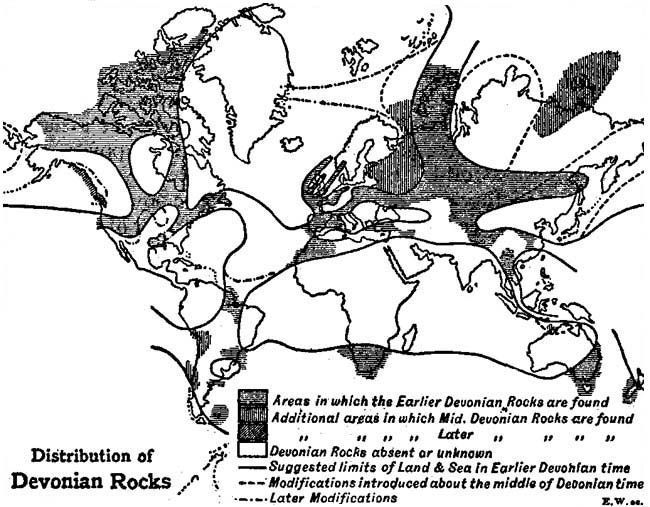
Physical Conditions, &c.—Perhaps the most striking fact that is brought out by a study of the Devonian rocks and their fossils is the gradual transgression of the sea over the land, which took place quietly in every quarter of the globe shortly after the beginning of the period. While in most places the Lower Devonian sediments succeed the Silurian formations in a perfectly conformable manner, the Middle and Upper divisions, on account of this encroachment of the sea, rest unconformably upon the older rocks, the Lower division being unrepresented. This is true over the greater part of South America, so far as our limited knowledge goes, in much of the western side of North America, in western Russia, in Thuringia and other parts of central Europe. Of the distribution of land and sea and the position of the coast lines in Devonian times we can state nothing with precision. The known deposits all point to shallow waters of epicontinental seas; no abyssal formations have been recognized. E. Kayser has pointed out the probability of a Eurasian sea province extending through Europe towards the east, across north and central Asia towards Manitoba in Canada, and an American sea province embracing the United States, South America and South Africa. At the same time there existed a great North Atlantic land area caused partly by the uplift of the Caledonian range just before the beginning of the period, which stretched across north Europe to eastern Canada; on the fringe of this land the Old Red Sandstone was formed.
In the European area C. Barrois has indicated the existence of three zones of deposition: (1) A northern, Old Red, region, including Great Britain, Scandinavia, European Russia and Spitzbergen; here the land was close at hand; great brackish lagoons prevailed, which communicated more or less directly with the open sea. In European Russia, during its general advance, the sea occasionally gained access to wide areas, only to be driven off again, during pauses in the relative subsidence of the land, when the continued terrigenous sedimentation once more established the lagoonal conditions. These alternating phases were frequently repeated. (2) A middle region, covering Devonshire and Cornwall, the Ardennes, the northern part of the lower Rhenish mountains, and the upper Harz to the Polish Mittelgebirge; here we find evidence of a shallow sea, clastic deposits and a sublittoral fauna. (3) A southern region reaching from Brittany to the south of the Rhenish mountains, lower Harz, Thuringia and Bohemia; here was a deeper sea with a more pelagic fauna. It must be borne in mind that the above-mentioned regions are intended to refer to the time when the extension of the Devonian sea was near its maximum. In the case of North America it has been shown that in early and middle Devonian time more or less distinct faunas invaded the continent from five different centres, viz. the Helderberg, the Oriskany, the Onondaga, the southern Hamilton and the north-western Hamilton; these reached the interior approximately in the order given.
Towards the close of the period, when the various local faunas had mingled one with another and a more generalized life assemblage had been evolved, we find many forms with a very wide range, indicating great uniformity of conditions. Thus we find identical species of brachiopods inhabiting the Devonian seas of England, France, Belgium, Germany, Russia, southern Asia and China; such are, Hypothyris (Rhynchonella) cuboides, Spirifer disjunctus and others. The fauna of the Calceola shales can be traced from western Europe to Armenia and Siberia; the Stringocephalus limestones are represented in Belgium, England, the Urals and Canada; and the (Gephyroceras) intumescens shales are found in western Europe and in Manitoba.
The Devonian period was one of comparative quietude; no violent crustal movements seem to have taken place, and while some changes of level occurred towards its close in Great Britain, Bohemia and Russia, generally the passage from Devonian to Carboniferous conditions was quite gradual. In later periods these rocks have suffered considerable movement and metamorphism, as in the Harz, Devonshire and Cornwall, and in the Belgian coalfields, where they have frequently been thrust over the younger Carboniferous rocks. Volcanic activity was fairly widespread, particularly during the middle portion of the period. In the Old Red rocks of Scotland there is a great thickness (6000 ft.) of igneous rocks, including diabases and andesitic lavas with agglomerates and tuffs. In Devonshire diabases and tuffs are found in the middle division. In west central Europe volcanic rocks are found at many horizons, the most common rocks are diabases and diabase tuffs, schalstein. Felsitic lavas and tuffs occur in the Middle Devonian of Australia. Contemporaneous igneous rocks are generally absent in the American Devonian, but in Nova Scotia and New Brunswick there appear to be some.
There is little evidence as to the climate of this period, but it is interesting to observe that local glacial conditions may have existed in places, as is suggested by the coarse conglomerate with striated boulders in the upper Old Red of Scotland. On the other hand, the prevalence of reef-building corals points to moderately warm temperatures in the Middle Devonian seas.
The economic products of Devonian rocks are of some importance: in many of the metamorphosed regions veins of tin, lead, copper, iron are exploited, as in Cornwall, Devon, the Harz; in New Zealand, gold veins occur. Anthracite of Devonian age is found in China and a little coal in Germany, while the Upper Devonian is the chief source of oil and gas of western Pennsylvania and south-western New York. In Ontario the middle division is oil-bearing. Black phosphates are worked in central Tennessee, and in England the marls of the "Old Red" are employed for brick-making.
References.—The literature of the Devonian rocks and fossils is very extensive; important papers have been contributed by the following geologists: J. Barrande, C. Barrois, F. Béclard, E. W. Benecke, L. Beushausen, A. Champernowne, J. M. Clarke, Sir J. W. Dawson, A. Denckmann, J. S. Diller, E. Dupont, F. Frech, J. Fournet, Sir A. Geikie, G. Gürich, R. Hoernes, E. Kayser, C. and M. Koch, A. von Koenen, Hugh Miller, D. P. Oehlert, C. S. Prosser, P. de Rouville, C. Schuchert, T. Tschernyschew, E. O. Ulrich, W. A. E. Ussher, P. N. Wenjukoff, G. F. Whidborne, J. F. Whiteaves and H. S. Williams. Sedgwick and Murchison's original description appeared in the Trans. Geol. Soc. (2nd series, vol. v., 1839). Good general accounts will be found in Sir A. Geikie's Text-Book of Geology (vol. ii., 4th ed., 1903), in E. Kayser's Lehrbuch der Geologie (vol. ii., 2nd ed., 1902), and, for North America, in Chamberlin and Salisbury's Geology (vol. ii., 1906). See the Index to the Geological Magazine (1864-1903), and in subsequent annual volumes; Geological Literature added to the Geological Society's Library (London), annually since 1893; and the Neues Jahrbuch für Min., Geologie und Paläontologie (Stuttgart, 2 annual volumes). The U.S. Geological Survey publishes at intervals a Bibliography and Index of North American Geology, &c., and this (e.g. Bulletin 301,—the Bibliog. and Index for 1901-1905) contains numerous references for the Devonian system in North America.
(J. A. H.)
DEVONPORT, a municipal, county and parliamentary borough of Devonshire, England, contiguous to East Stonehouse and Plymouth, the seat of one of the royal dockyards, and an important naval and military station. Pop. (1901) 70,437. It is situated immediately above the N.W. angle of Plymouth Sound, occupying a triangular peninsula formed by Stonehouse Pool on the E. and the Hamoaze on the W. It is served by the Great Western and the London & South Western railways. The town proper was formerly enclosed by a line of ramparts and a ditch excavated out of the limestone, but these are in great part demolished. Adjoining Devonport are East Stonehouse (an urban district, pop. 15,111), Stoke and Morice Town, the two last being suburbs of Devonport. The town hall, erected in 1821-1822 partly after the design of the Parthenon, is distinguished by a Doric portico; while near it are the public library, in Egyptian style, and a conspicuous Doric column built of Devonshire granite. This monument, which is 100 ft. high, was raised in commemoration of the naming of the town in 1824. Other institutions are the Naval Engineering College, Keyham (1880); the municipal technical schools, opened in 1899, the majority of the students being connected with the dockyard; the naval barracks, Keyham (1885); the Raglan barracks and the naval and military hospitals. On Mount Wise, which was formerly defended by a battery (now a naval signalling station), stands the military residence, or Government House, occupied by the commander of the Plymouth Coast Defences; and near at hand is the principal naval residence, the naval commander-in-chief's house. The prospect from Mount Wise over the Hamoaze to Mount Edgecumbe on the opposite shore is one of the finest in the south of England. The most noteworthy feature of Devonport, however, is the royal dockyard, originally established by William III. in 1689 and until 1824 known as Plymouth Dock. It is situated within the old town boundary and contains four docks. To this in 1853 was added Keyham steamyard, situated higher up the Hamoaze beyond the old boundary and connected with the Devonport yard by a tunnel. In 1896 further extensions were begun at the Keyham yard, which became known as Devonport North yard. Before these were begun the yard comprised two basins, the northern one being 9 acres and the southern 7 acres in area, and three docks, having floor-lengths of 295, 347 and 413 ft., together with iron and brass foundries, machinery shops, engineer students' shop, &c. The new extensions, opened by the Prince of Wales on the 21st of February 1907, cover a total area of 118 acres lying to the northward in front of the Naval Barracks, and involved the reclamation of 77 acres of mudflats lying below high-water mark. The scheme presented three leading features—a tidal basin, a group of three graving docks with entrance lock, and a large enclosed basin with a coaling depôt at the north end. The tidal basin, close to the old Keyham north basin, is 740 ft. long with a mean width of 590 ft., and has an area of 10 acres, the depth being 32 ft. at low water of spring tides. It affords access to two graving docks, one with a floor-length of 745 ft. and 20½ ft. of water over the sill, and the other with a length of 741 ft. and 32 ft. of water over the sill. Each of these can be subdivided by means of an intermediate caisson, and (when unoccupied) may serve as an entrance to the closed basin. The lock which leads from the tidal to the closed basin is 730 ft. long, and if necessary can be used as a dock. The closed basin, out of which opens a third graving dock, 660 ft. long, measures 1550 ft. by 1000 ft. and has an area of 35½ acres, with a depth of 32 ft. at low-water springs; it has a direct entrance from the Hamoaze, closed by a caisson. The foundations of the walls are carried down to the rock, which in some places lies covered with mud 100 ft. or more below coping level. Compressed air is used to work the sliding caissons which close the entrances of the docks and closed basin. A ropery at Devonport produces half the hempen ropes used in the navy.
By the Reform Act of 1832 Devonport was erected into a parliamentary borough including East Stonehouse and returning two members. The ground on which it stands is for the most part the property of the St Aubyn family (Barons St Levan), whose steward holds a court leet and a court baron annually. The town is governed by a mayor, sixteen aldermen and forty-eight councillors. Area, 3044 acres.
DEVONPORT, EAST and WEST, a town of Devon county, Tasmania, situated on both sides of the mouth of the river Mersey, 193 m. by rail N.W. of Hobart. Pop. (1901), East Devonport, 673, West Devonport, 2101. There is regular communication from this port to Melbourne and Sydney, and it ranks as the third port in Tasmania. A celebrated regatta is held on the Mersey annually on New Year's day.
DEVONSHIRE, EARLS AND DUKES OF. The Devonshire title, now in the Cavendish family, had previously been held by Charles Blount (1563-1606), 8th Lord Mountjoy, great-grandson of the 4th Lord Mountjoy (d. 1534), the pupil of Erasmus; he was created earl of Devonshire in 1603 for his services in Ireland, where he became famous in subduing the rebellion between 1600 and 1603; but the title became extinct at his death. In the Cavendish line the 1st earl of Devonshire was William (d. 1626), second son of Sir William Cavendish (q.v.), and of Elizabeth Hardwick, who afterwards married the 6th earl of Shrewsbury. He was created earl of Devonshire in 1618 by James I., and was succeeded by William, 2nd earl (1591-1628), and the latter by his son William (1617-1684), a prominent royalist, and one of the original members of the Royal Society, who married a daughter of the 2nd earl of Salisbury.
William Cavendish, 1st duke of Devonshire (1640-1707), English statesman, eldest son of the earl of Devonshire last mentioned, was born on the 25th of January 1640. After completing his education he made the tour of Europe according to the custom of young men of his rank, being accompanied on his travels by Dr Killigrew. On his return he obtained, in 1661, a seat in parliament for Derbyshire, and soon became conspicuous as one of the most determined and daring opponents of the general policy of the court. In 1678 he was one of the committee appointed to draw up articles of impeachment against the lord treasurer Danby. In 1679 he was re-elected for Derby, and made a privy councillor by Charles II.; but he soon withdrew from the board with his friend Lord Russell, when he found that the Roman Catholic interest uniformly prevailed. He carried up to the House of Lords the articles of impeachment against Lord Chief-Justice Scroggs, for his arbitrary and illegal proceedings in the court of King's bench; and when the king declared his resolution not to sign the bill for excluding the duke of York, afterwards James II., he moved in the House of Commons that a bill might be brought in for the association of all his majesty's Protestant subjects. He also openly denounced the king's counsellors, and voted for an address to remove them. He appeared in defence of Lord Russell at his trial, at a time when it was scarcely more criminal to be an accomplice than a witness. After the condemnation he gave the utmost possible proof of his attachment by offering to exchange clothes with Lord Russell in the prison, remain in his place, and so allow him to effect his escape. In November 1684 he succeeded to the earldom on the death of his father. He opposed arbitrary government under James II. with the same consistency and high spirit as during the previous reign. He was withdrawn from public life for a time, however, in consequence of a hasty and imprudent act of which his enemies knew how to avail themselves. Fancying that he had received an insulting look in the presence chamber from Colonel Colepepper, a swaggerer whose attendance at court the king encouraged, he immediately avenged the affront by challenging the colonel, and, on the challenge being refused, striking him with his cane. This offence was punished by a fine of £30,000, which was an enormous sum even to one of the earl's princely fortune. Not being able to pay he was imprisoned in the king's bench, from which he was released only on signing a bond for the whole amount. This was afterwards cancelled by King William. After his discharge the earl went for a time to Chatsworth, where he occupied himself with the erection of a new mansion, designed by William Talman, with decorations by Verrio, Thornhill and Grinling Gibbons. The Revolution again brought him into prominence. He was one of the seven who signed the original paper inviting the prince of Orange from Holland, and was the first nobleman who appeared in arms to receive him at his landing. He received the order of the Garter on the occasion of the coronation, and was made lord high steward of the new court. In 1690 he accompanied King William on his visit to Holland. He was created marquis of Hartington and duke of Devonshire in 1694 by William and Mary, on the same day on which the head of the house of Russell was created duke of Bedford. Thus, to quote Macaulay, "the two great houses of Russell and Cavendish, which had long been closely connected by friendship and by marriage, by common opinions, common sufferings and common triumphs, received on the same day the highest honour which it is in the power of the crown to confer." His last public service was assisting to conclude the union with Scotland, for negotiating which he and his eldest son, the marquis of Hartington, had been appointed among the commissioners by Queen Anne. He died on the 18th of August 1707, and ordered the following inscription to be put on his monument:—
Willielmus Dux Devon, Bonorum Principum Fidelis Subditus, Inimicus et Invisus Tyrannis.
He had married in 1661 the daughter of James, duke of Ormonde, and he was succeeded by his eldest son William as 2nd duke, and by the latter's son William as 3rd duke (viceroy of Ireland, 1737-1744). The latter's son William (1720-1764) succeeded in 1755 as 4th duke; he married the daughter and heiress of Richard Boyle, earl of Burlington and Cork, who brought Lismore Castle and the Irish estates into the family; and from November 1756 to May 1757 he was prime minister, mainly in order that Pitt, who would not then serve under the duke of Newcastle, should be in power. His son William (1748-1811), 5th duke, is memorable as the husband of the beautiful Georgiana Spencer, duchess of Devonshire (1757-1806), and of the intellectual Elizabeth Foster, duchess of Devonshire (1758-1824), both of whom Gainsborough painted. His son William, 6th duke (1790-1858), who died unmarried, was sent on a special mission to the coronation of the tsar Nicholas at Moscow in 1826, and became famous for his expenditure on that occasion; and it was he who employed Sir Joseph Paxton at Chatsworth. The title passed in 1858 to his cousin William (1808-1891), 2nd earl of Burlington, as 7th duke, a man who, without playing a prominent part in public affairs, exercised great influence, not only by his position but by his distinguished abilities. At Cambridge in 1829 he was second wrangler, first Smith's prizeman, and eighth classic, and subsequently he became chancellor of the university.
Spencer Compton Cavendish, 8th duke (1833-1908), born on the 23rd of July 1833, was the son of the 7th duke (then earl of Burlington) and his wife Lady Blanche Howard (sister of the earl of Carlisle). In 1854 Lord Cavendish, as he then was, took his degree at Trinity College, Cambridge; in 1856 he was attached to the special mission to Russia for the new tsar's accession; and in 1857 he was returned to parliament as Liberal member for North Lancashire. At the opening of the new parliament of 1859 the marquis of Hartington (as he had now become) moved the amendment to the address which overthrew the government of Lord Derby. In 1863 he became first a lord of the admiralty, and then under-secretary for war, and on the formation of the Russell-Gladstone administration at the death of Lord Palmerston he entered it as war secretary. He retired with his colleagues in July 1866; but upon Mr Gladstone's return to power in 1868 he became postmaster-general, an office which he exchanged in 1871 for that of secretary for Ireland. When Mr Gladstone, after his defeat and resignation in 1874, temporarily withdrew from the leadership of the Liberal party in January 1875, Lord Hartington was chosen Liberal leader in the House of Commons, Lord Granville being leader in the Lords. Mr W. E. Forster, who had taken a much more prominent part in public life, was the only other possible nominee, but he declined to stand. Lord Hartington's rank no doubt told in his favour, and Mr Forster's education bill had offended the Nonconformist members, who would probably have withheld their support. Lord Hartington's prudent management in difficult circumstances laid his followers under great obligations, since not only was the opposite party in the ascendant, but his own former chief was indulging in the freedom of independence. After the complete defeat of the Conservatives in the general election of 1880, a large proportion of the party would have rejoiced if Lord Hartington could have taken the Premiership instead of Mr Gladstone, and the queen, in strict conformity with constitutional usage (though Gladstone himself thought Lord Granville should have had the preference), sent for him as leader of the Opposition. Mr Gladstone, however, was clearly master of the situation: no cabinet could be formed without him, nor could he reasonably be expected to accept a subordinate post. Lord Hartington, therefore, gracefully abdicated the leadership, and became secretary of state for India, from which office, in December 1882, he passed to the war office. His administration was memorable for the expeditions of General Gordon and Lord Wolseley to Khartum, and a considerable number of the Conservative party long held him chiefly responsible for the "betrayal of Gordon." His lethargic manner, apart from his position as war minister, helped to associate him in their minds with a disaster which emphasized the fact that the government acted "too late"; but Gladstone and Lord Granville were no less responsible than he. In June 1885 he resigned along with his colleagues, and in December was elected for the Rossendale Division of Lancashire, created by the new reform bill. Immediately afterwards the great political opportunity of Lord Hartington's life came to him in Mr Gladstone's conversion to home rule for Ireland. Lord Hartington's refusal to follow his leader in this course inevitably made him the chief of the new Liberal Unionist party, composed of a large and influential section of the old Liberals. In this capacity he moved the first resolution at the famous public meeting at the opera house, and also, in the House of Commons, moved the rejection of Mr Gladstone's Bill on the second reading. During the memorable electoral contest which followed, no election excited more interest than Lord Hartington's for the Rossendale division, where he was returned by a majority of nearly 1500 votes. In the new parliament he held a position much resembling that which Sir Robert Peel had occupied after his fall from power, the leader of a small, compact party, the standing and ability of whose members were out of all proportion to their numbers, generally esteemed and trusted beyond any other man in the country, yet in his own opinion forbidden to think of office. Lord Salisbury's offers to serve under him as prime minister (both after the general election, and again when Lord Randolph Churchill resigned) were declined, and Lord Hartington continued to discharge the delicate duties of the leader of a middle party with no less judgment than he had shown when leading the Liberals during the interregnum of 1875-1880. It was not until 1895, when the differences between Conservatives and Liberal Unionists had become almost obliterated by changed circumstances, and the habit of acting together, that the duke of Devonshire, as he had become by the death of his father in 1891, consented to enter Lord Salisbury's third ministry as president of the council. The duke thus was the nominal representative of education in the cabinet at a time when educational questions were rapidly becoming of great importance; and his own technical knowledge of this difficult and intricate question being admittedly superficial, a good deal of criticism from time to time resulted. He had however by this time an established position in public life, and a reputation for weight of character, which procured for him universal respect and confidence, and exempted him from bitter attack, even from his most determined political opponents. Wealth and rank combined with character to place him in a measure above party; and his succession to his father as chancellor of the university of Cambridge in 1892 indicated his eminence in the life of the country. In the same year he had married the widow of the 7th duke of Manchester.