VOLUME VI SLICE VII Columbus to Condottiere (continued 9)
Reading edition
The commonest aggregates are broken stone and natural flint gravel. Broken bricks or tiles and broken furnace slag are sometimes used, the essential points being that the aggregate should be hard, clean and sound. Generally speaking, broken stones will be rough and angular, whereas the stones in flint gravel will be comparatively smooth and round. It might be supposed, therefore, that the broken stone will necessarily be the better aggregate, but this does not always follow. Experience shows that, although spherical pebbles are to be avoided, Portland cement adheres tightly to smooth flint surfaces, and that rough stones often give a less compact concrete than smooth ones on account of the difficulty of bedding them into the matrix when laying the concrete. In mixing concrete there is always a tendency for the stones to separate themselves from the sand and cement, and to form “pockets” of honeycombed concrete which are neither water-tight nor strong. These are much more liable to occur when the stones are flat and angular than when they are round. Modern engineers favour the practice of having the stones of various sizes instead of being uniform, because if these sizes are wisely proportioned the whole mixture can be made more solid, and the rough “pockets” avoided. For first-class work, however, and especially in steel concrete, it is customary to reject very large stones, and to insist that all shall pass through a ring 7/8 of an inch in diameter.
The water, like all the other constituents of concrete, should be clean and free from vegetable matter. At one time sea-water was thought to be injurious, but modern investigation finds no objection to it except on the score of appearance, efflorescence being more likely to occur when it is used.
Sometimes in massive concrete structures large and heavy stones as big as a man can lift are buried in the concrete after it is laid in position but while it is still wet. The stones should be hard and clean, and care must be taken that they are completely surrounded. Such concrete is known as rubble concrete.
In proportioning the quantities of matrix to aggregate the ideal to be aimed at is to get a concrete in which the voids or air-spaces shall be as small as possible; and as the lime or cement is usually by far the most expensive item, it is desirable Proportions. to use as little of it as is consistent with strength. When natural flint gravel containing both stones and sand is used, it is usual to mix so much gravel with so much lime or cement. The proportions in practice generally run from 3 to 1 for very strong work, down to 12 to 1 for unimportant work. Some engineers have the sand separated from the stones by screens or sieves and then remixed in definite proportions. When stones and sand are obtained from different sources, their relative proportions have to be decided upon. A common way of doing this is first to choose a proportion of sand to cement, which will probably vary from 1 to 1 up to 4 to 1. It then remains to determine what proportion of stones should be added. For this purpose a large can, whose volume is known, is filled loosely with stones, and the volume of the voids between them is determined by measuring how much water the can will hold in addition to the stones. It is then assumed that the quantity of sand and cement should be equal to the voids. Moreover, the volume of sand and cement together is generally assumed to be equal to that of the sand alone, as the cement to a large extent fills up voids in the sand. For example, suppose it is resolved to use 2 parts of sand to 1 of cement, and suppose that experiment shows that in a pailful of stones two-fifths of the volume consists of voids, then 2 parts of sand (or sand with cement) will fill voids in 5 parts of stones, and the proportion of cement, sand, stones becomes 1:2:5. There are several weak points in this reasoning, and a more accurate way of determining the best proportions is to try different mixtures of cement, stones and sand, filling them into different pails of the same size, and then ascertaining, by weighing the pails, which mixture is the densest.
In determining the amount of water to be added, several things must be considered. The amount required to combine chemically with the cement is about 16% by weight, but in practice much more than this is used, because of loss by evaporation, and the difficulty of ensuring that the water shall be uniformly distributed. If the situation is cool, the stone hard, and the concrete carefully rammed directly it is laid down and kept moist with damp cloths, only just sufficient to moisten the whole mass is required. On the other hand, water should be given generously in hot weather, also when absorbent stone is used or when the concrete is not rammed. In these cases the concrete should be allowed to take all it can, but an excess of water which would flow away, carrying the cement with it, should be avoided.
The thorough mixing of the constituents is a most important item in the production of good concrete. Its object is to distribute all the materials evenly throughout the mass, and it is performed in many different ways, both by Mixing. hand and by machine. The relative values of hand and machine work are often discussed. Roughly it may be said that where a large mass of concrete is to be mixed at one or two places a good machine will be of great advantage. On the other hand, where the mixing platform has to be constantly shifted, hand mixing is the more convenient way. In hand mixing it is usual to measure out from gauge boxes the sand, stones and cement or lime in a heap on a wooden platform. Then they are turned once or twice in their dry state by men with shovels. Next water is carefully added, and the mixture again turned, when it is ready for depositing. For important work and especially for thin structures the number of turnings should be increased. Many types of mixing machines are obtainable; the favourite type is one in which the materials are placed in a large iron box which is made to rotate, thus tumbling the matrix and aggregate over each other again and again. Another simple apparatus is a large vertical pipe or shoot in which sloping baffle plates or shelves are placed at intervals. The materials are fed in at the top of the shoot and fall from shelf to shelf, the mixing being effected by the various shocks thus given. When mixed the concrete is carried at once to the position required, and if the matrix is quick-setting Portland cement this operation must not be delayed.
One of the few drawbacks of concrete is that, unlike brickwork or masonry, it has nearly always to be deposited within moulds or framing which give it the required shape, and which are removed after it is set. Indeed, the trouble Moulds. and expense of these moulds sometimes prohibit its use. It is essential that they shall be strong and stiff, so as not to yield at all from the pressure of the wet concrete. The moulds for the face of a wall consist generally of wooden shutters, leaning against upright timbers which are secured by horizontal or raking struts to firm ground, or to anything that will bear the weight. If a smooth and neat face is wanted other precautions must be taken. The shutters must be planed, and coated with a mixture of soap and oil, so as to come away easily after the concrete is set. Moreover, when depositing the concrete, a shovel or other tool must be worked between the wet concrete and the shutter. This draws sand and water to the face and prevents the rough stones from showing themselves. Sometimes rough concrete is rendered over with a plaster of cement and sand after the shutters have been removed, but this is liable to peel off and should be avoided.
The method of depositing depends on the situation. If for important walls, or for small scantlings such as steel concrete generally involves, the concrete should be deposited in quite small quantities and very carefully rammed Depositing. into position. If for massive walls, it is usual to tip it out in large quantities from a barrow or wagon, and simply spread it in layers about a foot thick. Depositing concrete under water for breakwaters and bridge foundations requires special skill and special appliances. It is usually done in one of three ways:—(a) By moulding the concrete ashore into large blocks, which, when sufficiently hard, are lowered through the water into position by a crane or similar machine with the aid of divers. The most notable instance of this type of construction was at the port of Dublin, where Mr B. B. Stoney made blocks no less than 350 tons in weight. Each block formed a piece of the quay wall 12 ft. long and 27 ft. high, being made on shore and then deposited in position by floating sheers of special design. (b) By moulding the concrete into what are called “bag-blocks.” In this system the concrete is filled into bags, which are at once lowered through the water like the blocks. But in this case the concrete being still wet can adapt itself more or less to the shape of the adjoining bags, and strong rough walls can be built in this way. Sometimes the bags are made of enormous size, as at Aberdeen breakwater, where the contents of each bag weighed 50 tons. The canvas was laid in a hopper barge and there filled with the concrete and sewn up. The enormous bag was then dropped through a door in the bottom of the barge upon the breakwater foundation. (c) By depositing the wet concrete through the water between temporary upright timber frames which form the two faces of the wall. In this case very great care has to be taken to prevent the cement from being washed away from the other constituents when passing through the water. Indeed, this is bound to happen more or less, but it is guarded against by lowering the concrete slowly in a special box, the bottom of which is opened as it reaches the ground on which the concrete is to be laid. This method can only be carried out in still water, and where strong and tight framing can be built which will prevent the concrete from escaping. For small work the box can be replaced by a canvas bag secured by a special tripping noose which can be loosened when the bag has reached the ground. The concrete escapes from the bag, which is then drawn up and refilled.
Concrete may be compared with other building materials like masonry or timber from various points of view, such as strength, durability, convenience of building, fire-resistance, appearance and cost. Its strength varies Strength. within very wide limits according to the quality and proportions of the constituents, and the skill shown in mixing and placing them. To give a rough idea, however, it may be said that its safe crushing load would be about ½ cwt. per sq. in. for lime concrete, and 1 to 5 cwt. for Portland cement concrete. The safe tensile strength of Portland cement concrete would be something like one-tenth of its compressive strength, and might be far less. On this account it is usual to neglect the tensile strength of concrete in designing structures, and to arrange the material in such a way that tensile stresses are avoided. Hence slabs or beams of long span should not be built of plain concrete, though when reinforced with steel it is admirably adapted for these purposes.
In regard to durability good Portland cement concrete is one of the most durable materials known. Neither hot, cold, nor wet weather has practically any effect whatever upon it. Frost will not injure it after it has once set, though Durability. it is essential to guard it from frost during the operations of mixing and depositing. The same praise cannot, however, be given to lime concrete. Even though the best hydraulic lime be used it is wise to confine it to places where it is not exposed to the air, or to running water, and indeed for important structures the use of lime should be avoided. Good Portland cement is so much stronger than any lime that there are few situations where it is not cheaper as well as better to use the former, because, although cement is the more expensive matrix, a smaller proportion of it will suffice for use. Lime should never be used in work exposed to sea-water, or to water containing chemicals of any kind. Portland cement concrete, on the other hand, may be used without fear in sea-water, provided that certain reasonable precautions are taken. Considerable alarm was created about the year 1887 by the failure of two or three large structures of Portland cement concrete exposed to sea-water, both in England and other countries. The matter was carefully investigated, and it was found that the sulphate of magnesia in the sea-water has a decomposing action on Portland cements, especially those which contain a large proportion of lime or even of alumina. Indeed, no Portland cement is free from the liability to be decomposed by sea-water, and on a moderate scale this action is always going on more or less. But to ensure the permanence of structures in sea-water the great object is to choose a cement containing as little lime and alumina as possible, and free from sulphates such as gypsum; and more important still to proportion the sand and stones in the concrete in such a way that the structure is practically non-porous. If this is done there is really nothing to fear. On the other hand, if the concrete is rough and porous the sea-water will gradually eat into the heart of the structure, especially in a case like a dam, where the water, being higher on one side than the other, constantly forces its way through the rough material, and decomposes the Portland cement it contains.
As regards its convenience for building purposes it may be said roughly that in “mass” work concrete is vastly more convenient than any other material. But concrete is hampered by the fact that the surface always has to Convenience and appearance. be formed by means of wooden or other framing, and in the case of thin walls or floors this framing becomes a serious item, involving expense and delay. In appearance concrete can rarely if ever rival stone or brickwork. It is true that it can be moulded to any desired shape, but mouldings in concrete generally give the appearance of being unsatisfactory imitations of stone. Moreover, its colour is not pleasing. These defects will no doubt be overcome as concrete grows in popularity as a building material and its aesthetic treatment is better understood. Concrete pavings are being used in buildings of first importance, the aggregate being very carefully selected, and in many cases the whole mixture coloured by the use of pigments. Care must be taken in their selection, however, as certain colouring matters such as red lead are destructive to the cement. One of the great objections to the appearance of concrete is the fact that soon after its erection irregular cracks invariably appear on its surface. These cracks are probably due to shrinkage while setting, aggravated by changes in temperature. They occur no less in structures of masonry and brickwork, but in these cases they generally follow the joints, and are almost imperceptible. In the case of a smooth concrete face there are no joints to follow, and the cracks become an ugly feature. They are sometimes regulated by forming artificial “joints” in the structure by embedding strips of wood or sheet iron at regular intervals, thus forming “lines of weakness,” at which the cracks therefore take place. A pleasing “rough” appearance can be given to concrete by brushing it over soon after it has set with a stiff brush dipped in water or dilute acid. Or, if hard, its surface can be picked all over with a bush hammer.
At one time Portland cement concrete was considered to be lacking in fireproof qualities, but now it is regarded as one of the best fire-resisting materials known. Although experiments on this matter are badly needed, there is little Resistance to fire. doubt that good steel concrete is very nearly indestructible by fire. The matrix should be Portland cement, and the nature of the aggregate is important. Cinders have been and are still much favoured for this purpose. The reason for this preference lies in the fact that being porous and full of air, they are a good non-conductor. But they are weak, and modern experience goes to show that a strong concrete is the best, and that probably materials like broken clamp bricks or burnt clay, which are porous and yet strong, are far better than cinders as a fireproof aggregate. Limestone should be avoided, as it soon splits under heat. The steel reinforcement is of immense importance in fireproof work, because, if properly designed, it enables the concrete to hold together and do its work even when it has been cracked by fire and water. On the other hand, the concrete, being a non-conductor, preserves the steel from being softened and twisted by excessive temperature.
Only very general remarks can be made on the subject of cost, as this item varies greatly in different situations and with the market price of the materials used. But in England it may be said that for massive work such as big walls Cost. and foundations concrete is nearly always cheaper than brickwork or masonry. On the other hand, for reasons already given, thin walls, such as house walls, will cost more in concrete. Steel concrete is even more difficult to generalize about, as its use is comparatively new, but even in the matter of first cost it is proving a serious rival to timber and to plate steel work, in floors, bridges and tanks, and to brickwork and plain concrete in structures such as culverts and retaining walls, towers and domes.
Artificial Stones.—There are many varieties of concrete known as “artificial stones” which can now be bought ready moulded into the form of paving slabs, wall blocks and pipes: they are both pleasing in appearance and very durable, being carefully made by skilled workmen. Granolithic, globe granite and synthetic stone are examples of these. Some, such as victoria stone, imperial stone and others, are hardened and rendered non-porous after manufacture by immersion in a solution of silicate of soda. Others, like Ford’s silicate of limestone, are practically lime mortars of excellent quality, which can be carved and cut like a sandstone of fine quality.
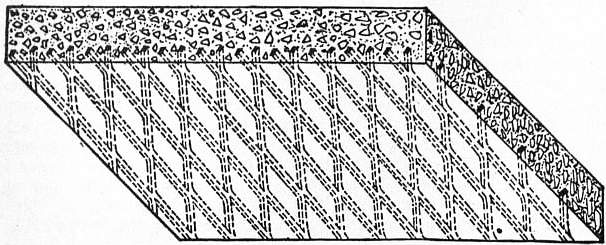
Fig. 1.—Expanded Steel Concrete Slab.
Steel Concrete.—The introduction of steel concrete (also known as ferroconcrete, armoured concrete, or reinforced concrete) is generally attributed to Joseph Monier, a French gardener, who about the year 1868 was anxious to build some concrete water basins. In order to reduce the thickness of the walls and floor he conceived the idea of strengthening them by building in a network of iron rods. As a matter of fact other inventors were at work before Monier, but he deserves much credit for having pushed his invention with vigour, and for having popularized the use of this invaluable combination. The important point of his idea was that it combined steel and concrete in such a way that the best qualities of each material were brought into play. Concrete is readily procured and easily moulded into shape. It has considerable compressive or crushing strength, but is somewhat deficient in shearing strength, and distinctly weak in tensile or pulling strength. Steel, on the other hand, is easily procurable in simple forms such as long bars, and is exceedingly strong. But it is difficult and expensive to work up into various forms. Concrete has been avoided for making beams, slabs and thin walls, just because its deficiency in tensile strength doomed it to failure in such structures. But if a concrete slab be “reinforced” with a network of small steel rods on its under surface where the tensile stresses occur (see fig. 1) its strength will be enormously increased. Thus the one point of weakness in the concrete slab is overcome by the addition of steel in its simplest form, and both materials are used to their best advantage. The scientific and practical value of this idea was soon seized upon by various inventors and others, and the number of patented systems of combining steel with concrete is constantly increasing. Many of them are but slight modifications of the older systems, and no attempt will be made here to describe them in full. In England it is customary to allow the patentee of one or other system to furnish his own designs, but this is as much because he has gained the experience needed for success as because of any special virtue in this or that system. The majority of these systems have emanated from France, where steel concrete is largely used. America and Germany adopted them readily, and in England some very large structures have been erected with this material.
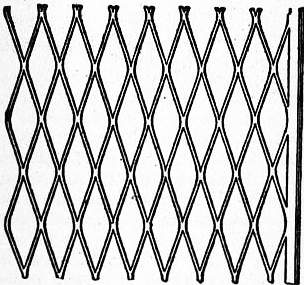
Expanded Metal.
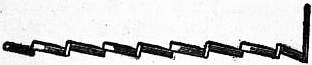
Section through Intersection. Fig. 2.
The concrete itself should always be the very best quality, and Portland cement should be used on account of its superiority to all others. The aggregate should be the best obtainable and of different sizes, the stones being freshly crushed and screened to pass through a 7/8 in. ring. Very special care should be taken so to proportion the sand as to make a perfectly impervious mixture. The proportions generally used are 4 to 1 and 5 to 1 in the case of gravel concrete, or 1:2:4 or 1:2½:6 in the case of broken stone concrete. But, generally speaking, in steel concrete the cost of the cement is but a small item of the whole expense, and it is worth while to be generous with it. If It is used in piles or structures where it is likely to be bruised the proportion of cement should be increased. The mixing and laying should all be done very thoroughly; the concrete should be rammed in position, and any old surface of concrete which has to be covered should be cleaned and coated with fresh cement.
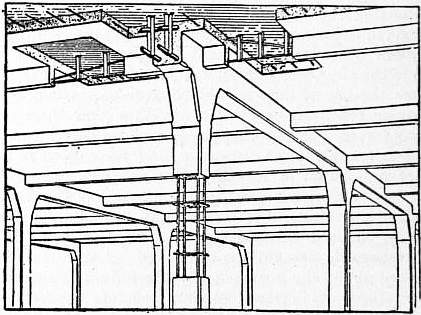
Fig. 3.—Hennebique System.
The reinforcement mostly consists of mild steel and sometimes of wrought iron: steel, however, is stronger and generally cheaper, so that in English practice it holds the field. It should be mild and is usually specified to have a breaking (tensile) strength of 28 to 32 tons per sq. in., with an elongation of at least 20% in 8 in. Any bar should be capable of being bent cold to the shape of the letter U without breaking it. The steel is generally used in the form of long bars of circular section. At first it was feared that such bars would have a tendency to slip through the concrete in which they were embedded, but experiments have shown that if the bar is not painted but has a natural rusty surface a very considerable adhesion between the concrete and steel—as much as 2 cwt. per sq. in. of contact surface—may be relied upon. Many devices are used, however, to ensure the adhesion between concrete and bar being perfect. (1) In the Hennebique system of construction the bars are flattened at the end and split to form a “fish tail.” (2) In the Ransome system round bars are rejected in favour of square bars, which have been twisted in a lathe in “barley sugar” fashion. (3) In the Habrick system a flat bar similarly twisted is used. (4) In the Thacher system a flat bar with projections like rivet heads is specially rolled for this purpose. (5) In the Kahn system a square bar with “branches” is used. (6) In the “expanded metal” system no bars are used, but instead a strong steel netting is manufactured in large sheets by special machinery. It is made by cutting a series of long slots at regular intervals in a plain steel plate, which is then forcibly stretched out sideways until the slots become diamond-shaped openings, and a trellis work of steel without any joints is the result (fig. 2).
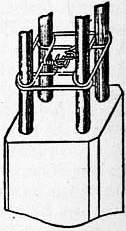
Fig. 4. Hennebique System.
The structures in which steel concrete is used may be analysed as consisting essentially of (1) walls, (2) columns, (3) piles, (4) beams, (5) slabs, (6) arches. The designs differ considerably according to which of these purposes the structure is to fulfil.
The effect of reinforcing walls with steel is that they can be made much thinner. The steel reinforcement is generally applied in the form of vertical rods built in the wall at intervals, with lighter horizontal rods which cross the vertical ones, and thus form a network of steel which is buried in the concrete. These rods assist in taking the weight, and the whole network binds the concrete together and prevents it from cracking under a heavy load. The vertical rods should not be quite in the middle of the wall but near the inner and outer faces alternately. Care must be taken, however, that all the rods are covered by at least an inch of concrete to preserve them from damage by rust or fire. In the Cottancin system the concrete is replaced by bricks pierced with holes through which the vertical rods are threaded; the horizontal tie-rods are also used, but these do not merely cross the vertical ones, but are woven in and out of them.

Fig. 5.—Steel and Concrete Pile (Williams System).
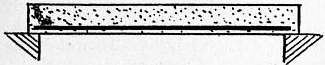
Fig. 6.

Fig. 7.
Columns have generally to bear a heavier weight than walls, and have to be correspondingly stronger. They have usually been made square with a vertical steel rod at each corner. To prevent these rods from spreading apart they must be tied together at frequent intervals. In some systems this is done by loops of stout wire connecting each rod to its neighbour, and placed one above the other about every 10 in. up the column (figs. 3 and 4). In other systems a stout wire is wound continuously in a spiral form round the four rods. Modern investigation goes to prove that the latter is theoretically the more economical way of using the steel, as the spiral binding wire acts like the binding of a wire gun, and prevents the concrete which it encloses from bursting even under very great loads.
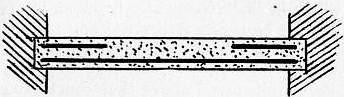
Fig. 8.
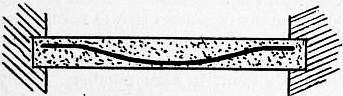
Fig. 9.
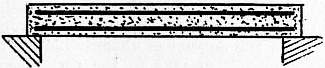
Fig. 10.
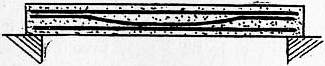
Fig. 11.
That steel concrete can be used for piles is perhaps the most astonishing feature in this invention. The fact that a comparatively brittle material like concrete can be subjected not only to heavy loads but also to the jar and vibration from the blows of a heavy pile ram makes it appear as if its nature and properties had been changed by the steel reinforcement. In a sense this is undoubtedly the case. A. G. Considère’s experiments have shown that concrete when reinforced is capable of being stretched, without fracture, about twenty times as much as plain concrete. Most of the piles driven in Great Britain have been made on the Hennebique system with four or six longitudinal steel rods tied together by stirrups or loops at frequent intervals. Piles made on the Williams system have a steel rolled joist of I section buried in the heart of the pile, and round it a series of steel wire hoops at regular intervals (fig. 5). Whatever system is used, care must be taken not to batter the head of the pile to pieces with the heavy ram. To prevent this an iron “helmet” containing a lining of sawdust is fitted over the head of the pile. The sawdust adapts itself to the rough shape of the concrete, and deadens the blow to some extent.
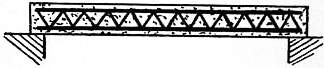
Fig. 12.
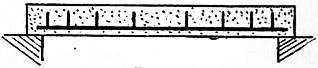
Fig. 13.
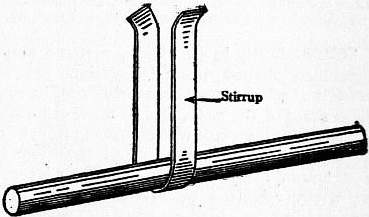
Fig. 14.—Stirrup (Hennebique System).
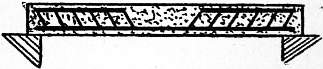
Fig. 15.
But it is in the design of steel concrete beams that the greatest ingenuity has been shown, and almost every patentee of a “system” has some new device for arranging the steel reinforcement to the best advantage. Concrete by itself, though strong in compression, can offer but little resistance to tensile and shearing stresses, and as these stresses always occur in beams the problem arises how best to arrange the steel so as to assist the concrete in bearing them. To meet tensile stresses the steel is nearly always inserted in the form of bars running along the beam. Figs. 6 to 9 show how they are arranged for different loading. In each case the object is to place the bars as nearly as possible where the tensile stresses occur. In cases where all the stresses are heavy, that portion of the beam which is under compression is similarly reinforced, though with smaller bars (figs. 10 and 11). But as these tension and compression bars are generally placed near the under and upper surface of the beam they are of little use in helping to resist the shearing stresses which are greatest at its neutral axis. (See Bridges.) These shearing stresses in a heavily loaded beam would cause it to split horizontally at or near the centre. To prevent this many ingenious devices have been introduced. (1) Perhaps one of the most efficient is a diagonal bracing of steel wire passing to and fro between the upper and lower bars and firmly secured to each by lapping or otherwise (fig. 12); this device is used in the Coignet and other French systems. (2) In the Hennebique system (which has found great favour in England) vertical bands or “stirrups,” as they are generally called, of hoop steel are used (fig. 13). They are of U shape, and passing round the tension bars extend to the top of the beam (figs. 14 and 3). They are exceedingly thin, but being buried in concrete no danger of their perishing from rust is to be feared. (3) In the Boussiron system a similar stirrup is used, but instead of being vertical the two parts are spread so that each is slightly inclined. (4) In the Coularon system, the stirrups are inclined as in fig. 15, and consist of rods, the ends of which are hooked over the tension and compression bars. (5) In the Kahn system the stirrups are similarly arranged, but instead of being merely secured to the tension bar, they form an integral part of it like branches on a stem, the bar being rolled to a special section to admit of this. (6) In many systems such as the “expanded metal” system, the tension and compression rods together with the stirrups are all abandoned in favour of a single rolled steel joist of I section, buried in concrete (see fig. 16). Probably the weight of steel used in this way is excessive, but the joists are cheap, readily procurable and easy to handle.
Floor slabs may be regarded as wide and shallow beams, and the remarks made about the stresses in the one apply to the other also; accordingly, the various devices which are used for strengthening beams recur in the slabs. But in a thin slab, with its comparatively small span and light load, the concrete is generally strong enough to bear the shearing stresses unaided, and the reinforcement is devoted to assisting it where the tensile stresses occur. For this purpose many designers simply use the modification of the Monier system, consisting of a horizontal network of crossed steel rods buried in the concrete. “Expanded metal” too is admirably adapted for the purpose (fig. 1). In the Matrai system thin wires are used instead of rods, and are securely fastened to rolled steel joists, which form the beams on which the slabs rest; moreover, the wires instead of being stretched tight from side to side of the slab are allowed to sag as much as the thickness of the concrete will allow. In the Williams system small flat bars are used, which are not quite horizontal, but pass alternately over and under the rolled joists which support the slabs.
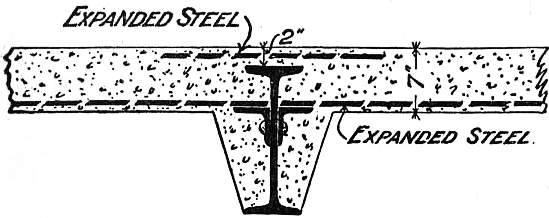
Fig. 16.
A concrete arch is reinforced in much the same way as a wall, the stresses being somewhat similar. The reinforcing rods are generally laid both longitudinally and circumferentially. In the case of a culvert the circumferential rods are sometimes laid continuously in the form of a spiral as in the Bordenave system.
To those wishing to pursue the subject further, the following books among others may be suggested:—Sabin, Cement and Concrete (New York); Taylor and Thompson, Concrete, Plain and Reinforced (London); Sutcliffe, Concrete, Nature and Uses (London); Marsh and Dunn, Reinforced Concrete (London); Twelvetrees, Concrete Steel (London); Paul Christophe, Le Béton armé (Paris); Buel and Hill, Reinforced Concrete Construction (London).
(F. E. W.-S.)
CONCRETION, in petrology, a name applied to nodular or irregularly shaped masses of various size occurring in a great variety of sedimentary rocks, differing in composition from the main mass of the rock, and in most cases obviously formed by some chemical process which ensued after the rock was deposited. As these bodies present so many variations in composition and in structure, it will conduce to clearness if some of the commonest be briefly adverted to. In sandstones there are often hard rounded lumps, which separate out when the rock is broken or weathered. They are mostly siliceous, but sometimes calcareous, and may differ very little in general appearance from the bulk of the sandstone. Through them the bedding passes uninterrupted, thus showing that they are not pebbles; often in their centres shells or fragments of plants are found. Argillaceous sandstones and flagstones very frequently contain “clay galls” or concretionary lumps richer in clay than the remainder of the rock. Nodules of pyrites and of marcasite are common in many clays, sandstones and marls. Their outer surfaces are tuberculate; internally they commonly have a radiate fibrous structure. Usually they are covered with a dark brown crust of limonite produced by weathering; occasionally imperfect crystalline faces may bound them. Not infrequently (e.g. in the Gault) these pyritous nodules contain altered fossils. In clays also siliceous and calcareous concretions are often found. They present an extraordinary variety of shapes, often grotesquely resembling figures of men or animals, fruits, &c, and have in many countries excited popular wonder, being regarded as of supernatural origin (“fairy-stones,” &c.), and used as charms.
Another type of concretion, very abundant in many clays and shales, is the “septarian nodule.” These are usually flattened disk-shaped or ovoid, often lobulate externally like the surface of a kidney. When split open they prove to be traversed by a network of cracks, which are usually filled with calcite and other minerals. These white infillings of the fissures resemble partitions; hence the name from the Latin septum, a partition. Sometimes the cracks are partly empty. They vary up to half an inch in breadth, and are best seen when the nodule is cut through with a saw. These concretions may be calcareous or may consist of carbonate of iron. The former are common in some beds of the London Clay, and were formerly used for making cement. The clay-ironstone nodules or sphaerosiderites are very abundant in some Carboniferous shales, and have served in some places as iron ores. Some of the largest specimens are 3 ft. in diameter. In the centre of these nodules fossils are often found, e.g. coprolites, pieces of plants, fish teeth and scales. Phosphatic concretions are often present in certain limestones, clays, shelly sands and marls. They occur, for example, in the Cambridge Greensand, and at the base of certain of the Pliocene beds in the east of England. In many places they have been worked, under the name of “coprolite-beds,” as sources of artificial manures. Bones of animals more or less completely mineralized are frequent in these phosphatic concretions, the commonest being fragments of extinct reptilia. Their presence points to a source for the phosphate of lime.
Another very important series of concretionary structures are the flint nodules which occur in chalk, and the patches and bands of chert which are found in limestones. Flints consist of dark-coloured cryptocrystalline silica. They weather grey or white by the removal of their more soluble portions by percolating water. Their shapes are exceedingly varied, and often they are studded with tubercules and nodosities. Sometimes they have internal cavities, and very frequently they contain shells of echinoderms, molluscs, &c., partly or entirely replaced by silica, but preserving their original forms. Chert occurs in bands and tabular masses rather than in nodules; it often replaces considerable portions of a bed of limestone (as in the Carboniferous Limestones of Ireland). Corals and other fossils frequently occur in chert, and when sliced and microscopically examined both flint and chert often show silicified foraminifera, polyzoa &c., and sponge spicules. Flints in chalk frequently lie along joints which may be vertical or may be nearly horizontal and parallel to the bedding. Hence they increase the stratified appearance of natural exposures of chalk.
It will be seen from the details given above that concretions may be calcareous, siliceous, argillaceous and phosphatic, and they may consist of carbonate or sulphide of iron. In the red clay of the deep sea bottom concretionary masses rich in manganese dioxide are being formed, and are sometimes brought up by the dredge. In clays large crystals of gypsum, having the shape of an arrow-head, are occasionally found in some numbers. They bear a considerable resemblance to some concretions, e.g. crystalline marcasite and pyrite nodules. These examples will indicate the great variety of substances which may give rise to concretionary structures.
Some concretions are amorphous, e.g. phosphatic nodules; others are cryptocrystalline, e.g. flint and chert; others finely crystalline, e.g. pyrites, sphaerosiderite; others consist of large crystals, e.g. gypsum, barytes, pyrites and marcasite. From this it is clear that the formation of concretions is not closely dependent on any single inorganic substance, or on any type of crystalline structure. Concretions seem to arise from the tendency of chemical compounds to be slowly dissolved by interstitial water, either while the deposit is unconsolidated or at a later period. Certain nuclei, present in the rock, then determine reprecipitation of these solutions, and the deposit once begun goes on till either the supply of material for growth is exhausted, or the physical character of the bed is changed by pressure and consolidation till it is no longer favourable to further accretion. The process resembles the growth of a crystal in a solution by slowly attracting to itself molecules of suitable nature from the surrounding medium. But in the majority of cases it is not the crystalline forces, or not these alone, which attract the particles. The structure of a flint, for example, shows that the material had so little tendency to crystallize that it remained permanently in cryptocrystalline or sub-crystalline state. That the concretions grew in the solid sediment is proved by the manner in which lines of bedding pass through them and not round them. This is beautifully shown by many siliceous and calcareous nodules out of recent clays. That the sediment was in a soft condition may be inferred from the purity and perfect crystalline form of some of these bodies, e.g. gypsum, pyrites, marcasite. The crystals must have pushed aside the yielding matrix as they gradually enlarged. In deep-sea dredgings concretions of phosphate of lime and manganese dioxide are frequently brought up; this shows that concretionary action operates on the sea floor in muddy sediments, which have only recently been laid down. The phosphatic nodules seem to originate around the dead bodies of fishes, and manganese incrustations frequently enclose teeth of sharks, ear-bones of whales, &c. This recalls the occurrence of fossils in septarian nodules, flints, phosphatic concretions, &c., in the older strata. Probably the decomposing organic matter partly supplied substances for the growth of the nodules (phosphates, carbonates, &c.), partly acted as reducing agents, or otherwise determined mineral precipitation in those places where organic remains were mingled with the sediment.
(J. S. F.)
CONCUBINAGE (Lat. concubina, a concubine; from con-, with, and cubare, to lie), the state of a man and woman cohabiting as married persons without the full sanctions of legal marriage. In early historical times, when marriage laws had scarcely advanced beyond the purely customary stage, the concubine was definitely recognized as a sort of inferior wife, differing from those of the first rank mainly by the absence of permanent guarantees. The history of Abraham’s family shows us clearly that the concubine might be dismissed at any time, and her children were liable to be cast off equally summarily with gifts, in order to leave the inheritance free for the wife’s sons (Genesis xxi. 9 ff., xxv. 5 ff.).
The Roman law recognized two classes of legal marriage: (1) with the definite public ceremonies of confarreatio or coemptio, and (2) without any public form whatever and resting merely on the affectio maritalis, i.e. the fixed intention of taking a particular woman as a permanent spouse.1 Next to these strictly lawful marriages came concubinage as a recognized legal status, so long as the two parties were not married and had no other concubines. It differed from the formless marriage in the absence (1) of affectio maritalis, and therefore (2) of full conjugal rights. For instance, the concubine was not raised, like the wife, to her husband’s rank, nor were her children legitimate, though they enjoyed legal rights forbidden to mere bastards, e.g. the father was bound to maintain them and to leave them (in the absence of legitimate children) one-sixth of his property; moreover, they might be fully legitimated by the subsequent marriage of their parents.
In the East, the emperor Leo the Philosopher (d. 911) insisted on formal marriage as the only legal status; but in the Western Empire concubinage was still recognized even by the Christian emperors. The early Christians had naturally preferred the formless marriage of the Roman law as being free from all taint of pagan idolatry; and the ecclesiastical authorities recognized concubinage also. The first council of Toledo (398) bids the faithful restrict himself “to a single wife or concubine, as it shall please him”;2 and there is a similar canon of the Roman synod held by Pope Eugenius II. in 826. Even as late as the Roman councils of 1052 and 1063, the suspension from communion of laymen who had a wife and a concubine at the same time implies that mere concubinage was tolerated. It was also recognized by many early civil codes. In Germany “left-handed” or “morganatic” marriages were allowed by the Salic law between nobles and women of lower rank. In different states of Spain the laws of the later middle ages recognized concubinage under the name of barragania, the contract being lifelong, the woman obtaining by it a right to maintenance during life, and sometimes also to part of the succession, and the sons ranking as nobles if their father was a noble. In Iceland, the concubine was recognized in addition to the lawful wife, though it was forbidden that they should dwell in the same house. The Norwegian law of the later middle ages provided definitely that in default of legitimate sons, the kingdom should descend to illegitimates. In the Danish code of Valdemar II., which was in force from 1280 to 1683, it was provided that a concubine kept openly for three years shall thereby become a legal wife; this was the custom of hand vesten, the “handfasting” of the English and Scottish borders, which appears in Scott’s Monastery. In Scotland, the laws of William the Lion (d. 1214) speak of concubinage as a recognized institution; and, in the same century, the great English legist Bracton treats the “concubina legitima” as entitled to certain rights.3 There seems to have been at times a pardonable confusion between some quasi-legitimate unions and those marriages by mere word of mouth, without ecclesiastical or other ceremonies, which the church, after some natural hesitation, pronounced to be valid.4 Another and more serious confusion between concubinage and marriage was caused by the gradual enforcement of clerical celibacy (see Celibacy). During the bitter conflict between laws which forbade sacerdotal marriages and long custom which had permitted them, it was natural that the legislators and the ascetic party generally should studiously speak of the priests’ wives as concubines, and do all in their power to reduce them to this position. This very naturally resulted in a too frequent substitution of clerical concubinage for marriage; and the resultant evils form one of the commonest themes of complaint in church councils of the later middle ages.5 Concubinage in general was struck at by the concordat between the Pope Leo X. and Francis I. of France in 1516; and the council of Trent, while insisting on far more stringent conditions for lawful marriage than those which had prevailed in the middle ages, imposed at last heavy ecclesiastical penalties on concubinage and appealed to the secular arm for help against contumacious offenders (Sessio xxiv. cap. 8).
Authorities.—Besides those quoted in the notes, the reader may consult with advantage Du Cange’s Glossarium, s.v. Concubina, the article “Concubinat” in Wetzer and Welte’s Kirchenlexikon (2nd ed., Freiburg i/B., 1884), and Dr H. C. Lea’s History of Sacerdotal Celibacy (3rd ed., London, 1907).
(G. G. Co.)
CONDÉ, PRINCES OF. The French title of prince of Condé, assumed from the ancient town of Condé-sur-l’Escaut, was borne by a branch of the house of Bourbon. The first who assumed it was the famous Huguenot leader, Louis de Bourbon (see below), the fifth son of Charles de Bourbon, duke of Vendôme. His son, Henry, prince of Condé (1552-1588), also belonged to the Huguenot party. Fleeing to Germany he raised a small army with which in 1575 he joined Alençon. He became leader of the Huguenots, but after several years’ fighting was taken prisoner of war. Not long after he died of poison, administered, according to the belief of his contemporaries, by his wife, Catherine de la Trémouille. This event, among others, awoke strong suspicions as to the legitimacy of his heir and namesake, Henry, prince of Condé (1588-1646). King Henry IV., however, did not take advantage of the scandal. In 1609 he caused the prince of Condé to marry Charlotte de Montmorency, whom shortly after Condé was obliged to save from the king’s persistent gallantry by a hasty flight, first to Spain and then to Italy. On the death of Henry, Condé returned to France, and intrigued against the regent, Marie de’ Medici; but he was seized, and imprisoned for three years (1616-1619). There was at that time before the court a plea for his divorce from his wife, but she now devoted herself to enliven his captivity at the cost of her own liberty. During the rest of his life Condé was a faithful servant of the king. He strove to blot out the memory of the Huguenot connexions of his house by affecting the greatest zeal against Protestants. His old ambition changed into a desire for the safe aggrandizement of his family, which he magnificently achieved, and with that end he bowed before Richelieu, whose niece he forced his son to marry. His son Louis, the great Condé, is separately noticed below.
The next in succession was Henry Jules, prince of Condé (1643-1709), the son of the great Condé and of Clémence de Maillé, niece of Richelieu. He fought with distinction under his father in Franche-Comté and the Low Countries; but he was heartless, avaricious and undoubtedly insane. The end of his life was marked by singular hypochondriacal fancies. He believed at one time that he was dead, and refused to eat till some of his attendants dressed in sheets set him the example. His grandson, Louis Henry, duke of Bourbon (1692-1740), Louis XV.’s minister, did not assume the title of prince of Condé which properly belonged to him.
The son of the duke of Bourbon, Louis Joseph, prince of Condé (1736-1818), after receiving a good education, distinguished himself in the Seven Years’ War, and most of all by his victory at Johannisberg. As governor of Burgundy he did much to improve the industries and means of communication of that province. At the Revolution he took up arms in behalf of the king, became commander of the “army of Condé,” and fought in conjunction with the Austrians till the peace of Campo Formio in 1797, being during the last year in the pay of England. He then served the emperor of Russia in Poland, and after that (1800) returned into the pay of England, and fought in Bavaria. In 1800 Condé arrived in England, where he resided for several years. On the restoration of Louis XVIII. he returned to France. He died in Paris in 1818. He wrote Essai sur la vie du grand Condé (1798).
Louis Henry Joseph, duke of Bourbon (1756-1830), son of the last named, was the last prince of Condé. Several of the earlier events of his life, especially his marriage with the princess Louise of Orleans, and the duel that the comte d’Artois provoked by raising the veil of the princess at a masked ball, caused much scandal. At the Revolution he fought with the army of the emigrés in Liége. Between the return of Napoleon from Elba and the battle of Waterloo, he headed with no success a royalist rising in La Vendée. In 1829 he made a will by which he appointed as his heir the due d’Aumale, and made some considerable bequests to his mistress, the baronne de Feuchères (q.v.). On the 27th of August 1830 he was found hanged on the fastening of his window. A crime was generally suspected, and the princes de Rohan, who were relatives of the deceased, disputed the will. Their petition, however, was dismissed by the courts.
Two cadet branches of the house of Condé played an important part: those of Soissons and Conti. The first, sprung from Charles of Bourbon (b. 1566), son of Louis I., prince of Condé, became extinct in the legitimate male line in 1641. The second took its origin from Armand of Bourbon, born in 1629, son of Henry II., prince of Condé, and survived up to 1814.
See Muret, L’Histoire de l’armée de Condé; Chamballand, Vie de Louis Joseph, prince de Condé; Crétineau-Joly, Histoire des trois derniers princes de la maison de Condé; and Histoire des princes de Condé, by the due d’Aumale (translated by R. B. Borthwick, 1872).
CONDÉ, LOUIS DE BOURBON, Prince of (1530-1569), fifth son of Charles de Bourbon, duke of Vendôme, younger brother of Antoine, king of Navarre (1518-1562), was the first of the famous house of Condé (see above). After his father’s death in 1537 Louis was educated in the principles of the reformed religion. Brave though deformed, gay but extremely poor for his rank, Condé was led by his ambition to a military career. He fought with distinction in Piedmont under Marshal de Brissac; in 1552 he forced his way with reinforcements into Metz, then besieged by Charles V.; he led several brilliant sorties from that town; and in 1554 commanded the light cavalry on the Meuse against Charles. In 1557 he was present at the battle of St Quentin, and did further good service at the head of the light horse. But the descendants of the constable de Bourbon were still looked upon with suspicion in the French court, and Condé’s services were ignored. The court designed to reduce his narrow means still further by despatching him upon a costly mission to Philip II. of Spain. His personal griefs thus combined with his religious views to force upon him a rôle of political opposition. He was concerned in the conspiracy of Amboise, which aimed at forcing from the king the recognition of the reformed religion. He was consequently condemned to death, and was only saved by the decease of Francis II. At the accession of the boy-king Charles IX., the policy of the court was changed, and Condé received from Catherine de’ Medici the government of Picardy. But the struggle between the Catholics and the Huguenots soon began once more, and henceforward the career of Condé is the story of the wars of religion (see France: History). He was the military as well as the political chief of the Huguenot party, and displayed the highest generalship on many occasions, and notably at the battle of St Denis. At the battle of Jarnac, with only 400 horsemen, Condé rashly charged the whole Catholic army. Worn out with fighting, he at last gave up his sword, and a Catholic officer named Montesquiou treacherously shot him through the head on the 13th of March 1569.
CONDÉ, LOUIS II. DE BOURBON, Prince of (1621-1686), called the Great Condé, was the son of Henry, prince of Condé, and Charlotte Marguerite de Montmorency, and was born at Paris on the 8th of September 1621. As a boy, under his father’s careful supervision, he studied diligently at the Jesuits’ College at Bourges, and at seventeen, in the absence of his father, he governed Burgundy. The duc d’Enghien, as he was styled during his father’s lifetime, took part with distinction in the campaigns of 1640 and 1641 in northern France while yet under twenty years of age.
During the youth of Enghien all power in France was in the hands of Richelieu; to him even the princes of the blood had to yield; and Henry of Condé sought with the rest to win the cardinal’s favour. Enghien was forced to conform. He was already deeply in love with Mlle. Marthe du Vigean, who in return was passionately devoted to him, yet, to flatter the cardinal, he was compelled by his father, at the age of twenty, to give his hand to Richelieu’s niece, Claire Clémence de Maillé-Brézé, a child of thirteen. He was present with Richelieu during the dangerous plot of Cinq Mars, and afterwards fought in the siege of Perpignan (1642).
In 1643 Enghien was appointed to command against the Spaniards in northern France. He was opposed by experienced generals, and the veterans of the Spanish army were accounted the finest soldiers in Europe; on the other hand, the strength of the French army was placed at his command, and under him were the best generals of the service. The great battle of Rocroy (May 18) put an end to the supremacy of the Spanish army and inaugurated the long period of French military predominance. Enghien himself conceived and directed the decisive attack, and at the age of twenty-two won his place amongst the great captains of modern times. After a campaign of uninterrupted success, Enghien returned to Paris in triumph, and in gallantry and intrigues strove to forget his enforced and hateful marriage. In 1644 he was sent with reinforcements into Germany to the assistance of Turenne, who was hard pressed, and took command of the whole army. The battle of Freiburg (Aug.) was desperately contested, but in the end the French army won a great victory over the Bavarians and Imperialists commanded by Count Mercy. As after Rocroy, numerous fortresses opened their gates to the duke. The next winter Enghien spent, like every other winter during the war, amid the gaieties of Paris. The summer campaign of 1645 opened with the defeat of Turenne by Mercy, but this was retrieved in the brilliant victory of Nördlingen, in which Mercy was killed, and Enghien himself received several serious wounds. The capture of Philipsburg was the most important of his other achievements during this campaign. In 1646 Enghien served under the duke of Orleans in Flanders, and when, after the capture of Mardyck, Orleans returned to Paris, Enghien, left in command, captured Dunkirk (October 11th).
It was in this year that the old prince of Condé died. The enormous power that fell into the hands of his successor was naturally looked upon with serious alarm by the regent and her minister. Condé’s birth and military renown placed him at the head of the French nobility; but, added to that, the family of which he was chief was both enormously rich and master of no small portion of France. Condé himself held Burgundy, Berry and the marches of Lorraine, as well as other less important territory; his brother Conti held Champagne, his brother-in-law, Longueville, Normandy. The government, therefore, determined to permit no increase of his already overgrown authority, and Mazarin made an attempt, which for the moment proved successful, at once to find him employment and to tarnish his fame as a general. He was sent to lead the revolted Catalans. Ill-supported, he was unable to achieve anything, and, being forced to raise the siege of Lerida, he returned home in bitter indignation. In 1648, however, he received the command in the important field of the Low Countries; and at Lens (Aug. 19th) a battle took place, which, beginning with a panic in his own regiment, was retrieved by Condé’s coolness and bravery, and ended in a victory that fully restored his prestige.
In September of the same year Condé was recalled to court, for the regent Anne of Austria required his support. Influenced by the fact of his royal birth and by his arrogant scorn for the bourgeois, Condé lent himself to the court party, and finally, after much hesitation, he consented to lead the army which was to reduce Paris (Jan. 1649).
On his side, insufficient as were his forces, the war was carried on with vigour, and after several minor combats their substantial losses and a threatening of scarcity of food made the Parisians weary of the war. The political situation inclined both parties to peace, which was made at Rueil on the 20th of March (see Fronde, The). It was not long, however, before Condé became estranged from the court. His pride and ambition earned for him universal distrust and dislike, and the personal resentment of Anne in addition to motives of policy caused the sudden arrest of Condé, Conti and Longueville on the 18th of January 1650. But others, including Turenne and his brother the duke of Bouillon, made their escape. Vigorous attempts for the release of the princes began to be made. The women of the family were now its heroes. The dowager princess claimed from the parlement of Paris the fulfilment of the reformed law of arrest, which forbade imprisonment without trial. The duchess of Longueville entered into negotiations with Spain; and the young princess of Condé, having gathered an army around her, obtained entrance into Bordeaux and the support of the parlement of that town. She alone, among the nobles who took part in the folly of the Fronde, gains our respect and sympathy. Faithful to a faithless husband, she came forth from the retirement to which he had condemned her, and gathered an army to fight for him. But the delivery of the princes was brought about in the end by the junction of the old Fronde (the party of the parlement and of Cardinal de Retz) and the new Fronde (the party of the Condés); and Anne was at last, in February 1651, forced to liberate them from their prison at Havre. Soon afterwards, however, another shifting of parties left Condé and the new Fronde isolated. With the court and the old Fronde in alliance against him, Condé found no resource but that of making common cause with the Spaniards, who were at war with France. The confused civil war which followed this step (Sept. 1651) was memorable chiefly for the battle of the Faubourg St Antoine, in which Condé and Turenne, two of the foremost captains of the age, measured their strength (July 2, 1652), and the army of the prince was only saved by being admitted within the gates of Paris. La Grande Mademoiselle, daughter of the duke of Orleans, persuaded the Parisians to act thus, and turned the cannon of the Bastille on Turenne’s army. Thus Condé, who as usual had fought with the most desperate bravery, was saved, and Paris underwent a new investment. This ended in the flight of Condé to the Spanish army (Sept. 1652), and thenceforward, up to the peace, he was in open arms against France, and held high command in the army of Spain. But his now fully developed genius as a commander found little scope in the cumbrous and antiquated system of war practised by the Spaniards, and though he gained a few successes, and manœuvred with the highest possible skill against Turenne, his disastrous defeat at the Dunes near Dunkirk (14th of June 1658), in which an English contingent of Cromwell’s veterans took part on the side of Turenne, led Spain to open negotiations for peace. After the peace of the Pyrenees in 1659, Condé obtained his pardon (January 1660) from Louis, who thought him less dangerous as a subject than as possessor of the independent sovereignty of Luxemburg, which had been offered him by Spain as a reward for his services.
Condé now realized that the period of agitation and party warfare was at an end, and he accepted, and loyally maintained henceforward, the position of a chief subordinate to a masterful sovereign. Even so, some years passed before he was recalled to active employment, and these years he spent on his estate at Chantilly. Here he gathered round him a brilliant company, which included many men of genius—Molière, Racine, Boileau, La Fontaine, Nicole, Bourdaloue and Bossuet. About this time negotiations between the Poles, Condé and Louis were carried on with a view to the election, at first of Condé’s son Enghien, and afterwards of Condé himself, to the throne of Poland. These, after a long series of curious intrigues, were finally closed in 1674 by the veto of Louis XIV. and the election of John Sobieski. The prince’s retirement, which was only broken by the Polish question and by his personal intercession on behalf of Fouquet in 1664, ended in 1668. In that year he proposed to Louvois, the minister of war, a plan for seizing Franche-Comté, the execution of which was entrusted to him and successfully carried out. He was now completely re-established in the favour of Louis, and with Turenne was the principal French commander in the celebrated campaign of 1672 against the Dutch. At the forcing of the Rhine passage at Tollhuis (June 12) he received a severe wound, after which he commanded in Alsace against the Imperialists. In 1673 he was again engaged in the Low Countries, and in 1674 he fought his last great battle at Seneff against the prince of Orange (afterwards William III. of England). This battle, fought on the 11th of August, was one of the hardest of the century, and Condé, who displayed the reckless bravery of his youth, had three horses killed under him. His last campaign was that of 1675 on the Rhine, where the army had been deprived of its general by the death of Turenne; and where by his careful and methodical strategy he repelled the invasion of the Imperial army of Montecucculi. After this campaign, prematurely worn out by the toils and excesses of his life, and tortured by the gout, he returned to Chantilly, where he spent the eleven years that remained to him in quiet retirement. In the end of his life he specially sought the companionship of Bourdaloue, Nicole and Bossuet, and devoted himself to religious exercises. He died on the 11th of November 1686 at the age of sixty-five. Bourdaloue attended him at his death-bed, and Bossuet pronounced his éloge.
The earlier political career of Condé was typical of the great French noble of his day. Success in love and war, predominant influence over his sovereign and universal homage to his own exaggerated pride, were the objects of his ambition. Even as an exile he asserted the precedence of the royal house of France over the princes of Spain and Austria, with whom he was allied for the moment. But the Condé of 1668 was no longer a politician and a marplot; to be first in war and in gallantry was still his aim, but for the rest he was a submissive, even a subservient, minister of the royal will. It is on his military character, however, that his fame rests. This changed but little. Unlike his great rival Turenne, Condé was equally brilliant in his first battle and in his last. The one failure of his generalship was in the Spanish Fronde, and in this everything united to thwart his genius; only on the battlefield itself was his personal leadership as conspicuous as ever. That he was capable of waging a methodical war of positions may be assumed from his campaigns against Turenne and Montecucculi, the greatest generals of the predominant school. But it was in his eagerness for battle, his quick decision in action, and the stern will which sent his regiments to face the heaviest loss, that Condé is distinguished above all the generals of his time. In private life he was harsh and unamiable, seeking only the gratification of his own pleasures and desires. His enforced and loveless marriage embittered his life, and it was only in his last years, when he had done with ambition, that the more humane side of his character appeared in his devotion to literature.
Condé’s unhappy wife had some years before been banished to Châteauroux. An accident brought about her ruin. Her contemporaries, greedy as they were of scandal, refused to believe any evil of her, but the prince declared himself convinced of her unfaithfulness, placed her in confinement, and carried his resentment so far that his last letter to the king was to request him never to allow her to be released.
Authorities.—See, besides the numerous Mémoires of the time, Puget de la Serre, Les Sièges, les batailles, &c., de Mr. le prince de Condé (Paris, 1651); J. de la Brune, Histoire de la vie, &c., de Louis de Bourbon, prince de Condé (Cologne, 1694); P. Coste, Histoire de Louis de Bourbon, &c. (Hague, 1748); Desormeaux, Histoire de Louis de Bourbon, &c. (Paris, 1768); Turpin, Vie de Louis de Bourbon, &c. (Paris and Amsterdam, 1767); Éloge militaire de Louis de Bourbon (Dijon, 1772); Histoire du grand Condé, by A. Lemercier (Tours, 1862); J. J. E. Roy (Lille, 1859); L. de Voivreuil (Tours, 1846); Fitzpatrick, The Great Condé, and Lord Mahon, Life of Louis, prince of Condé (London, 1845). Works on the Condé family by the prince de Condé and de Sevilinges (Paris, 1820), the due d’Aumale, and Guibout (Rouen, 1856), should also be consulted.
CONDÉ, the name of some twenty villages in France and of two towns of some importance. Of the villages, Condé-en-Brie (Lat. Condetum) is a place of great antiquity and was in the middle ages the seat of a principality, a sub-fief of that of Montmirail; Condé-sur-Aisne (Condatus) was given in 870 by Charles the Bald to the abbey of St Ouen at Rouen, gave its name to a seigniory during the middle ages, and possessed a priory of which the church and a 12th-century chapel remain; Condé-sur-Marne (Condate), once a place of some importance, preserves one of its parish churches, with a fine Romanesque tower. The two towns are:—
1. Condé-sur-l’Escaut, in the department of Nord, at the junction of the canals of the Scheldt and of Condé-Mons. Pop. (1906) town, 2701; commune, 5310. It lies 7 m. N. by E. of Valenciennes and 2 m. from the Belgian frontier. It has a church dating from the middle of the 18th century. Trade is in coal and cattle. The industries include brewing, rope-making and boat-building, and there is a communal college. Condé (Condate) is of considerable antiquity, dating at least from the later Roman period. Taken in 1676 by Louis XIV., it definitely passed into the possession of France by the treaty of Nijmwegen two years later, and was afterwards fortified by Vauban. During the revolutionary war it was besieged and taken by the Austrians (1793); and in 1815 it again fell to the allies. It was from this place that the princes of Condé (q.v.) took their title. See Perron-Gelineau, Condé ancien et moderne (Nantes, 1887).
2. Condé-sur-Noireau, in the department of Calvados, at the confluence of the Noireau and the Drouance, 33 m. S.S.W. of Caen on the Ouest-État railway. Pop. (1906) 5709. The town is the seat of a tribunal of commerce, a board of trade-arbitration and a chamber of arts and manufactures, and has a communal college. It is important for its cotton-spinning and weaving, and carries on dyeing, printing and machine-construction; there are numerous nursery-gardens in the vicinity. Important fairs are held in the town. The church of St Martin has a choir of the 12th and 15th centuries, and a stained-glass window (15th century) representing the Crucifixion. There is a statue to Dumont d’Urville, the navigator (b. 1790), a native of the town. Throughout the middle ages Condé (Condatum, Condetum) was the seat of an important castellany, which was held by a long succession of powerful nobles and kings, including Robert, count of Mortain, Henry II. and John of England, Philip Augustus of France, Charles II. (the Bad) and Charles III. of Navarre. The place was held by the English from 1417 to 1449. Of the castle some ruins of the keep survive. See L. Huet, Hist. de Condé-sur-Noireau, ses seigneurs, son industrie, &c. (Caen, 1883).
CONDE, JOSÉ ANTONIO (1766-1820), Spanish Orientalist, was born at Peraleja (Cuenca) on the 28th of October 1766, and was educated at the university of Alcalá. His translation of Anacreon (1791) obtained him a post in the royal library in 1795, and in 1796-1797 he published paraphrases from Theocritus, Bion, Moschus, Sappho and Meleager. These were followed by a mediocre edition of the Arabic text of Edrisi’s Description of Spain (1799), with notes and a translation. Conde became a member of the Spanish Academy in 1802 and of the Academy of History in 1804, but his appointment as interpreter to Joseph Bonaparte led to his expulsion from both bodies in 1814. He escaped to France in February 1813, and returned to Spain in 1814, but was not allowed to reside at Madrid till 1816. Two years later he was re-elected by both academies; he died in poverty on the 12th of June 1820. His Historia de la Dominación de los Árabes en España was published in 1820-1821. Only the first volume was corrected by the author, the other two being compiled from his manuscript by Juan Tineo. This work was translated into German (1824-1825), French (1825) and English (1854). Conde’s pretensions to scholarship have been severely criticized by Dozy, and his history is now discredited. It had, however, the merit of stimulating abler workers in the same field.
CONDENSATION OF GASES. If the volume of a gas continually decreases at a constant temperature, for which an increasing pressure is required, two cases may occur:—(1) The volume may continue to be homogeneously Critical temperature. filled. (2) If the substance is contained in a certain volume, and if the pressure has a certain value, the substance may divide into two different phases, each of which is again homogeneous. The value of the temperature T decides which case will occur. The temperature which is the limit above which the space will always be homogeneously filled, and below which the substance divides into two phases, is called the critical temperature of the substance. It differs greatly for different substances, and if we represent it by Tc, the condition for the condensation of a gas is that T must be below Tc. If the substance is divided into two phases, two different cases may occur. The denser phase may be either a liquid or a solid. The limiting temperature for these two cases, at which the division into three phases may occur, is called the triple point. Let us represent it by T3; if the term “condensation of gases” is taken in the sense of “liquefaction of gases”—which is usually done—the condition for condensation is Tc > T > T3. The opinion sometimes held that for all substances T3 is the same fraction of Tc (the value being about ½) has decidedly not been rigorously confirmed. Nor is this to be expected on account of the very different form of crystallization which the solid state presents. Thus for carbon dioxide, CO2, for which Tc = 304° on the absolute scale, and for which we may put T3 = 216°, this fraction is about 0.7; for water it descends down to 0.42, and for other substances it may be still lower.
If we confine ourselves to temperatures between Tc and T3, the gas will pass into a liquid if the pressure is sufficiently increased. When the formation of liquid sets in we call the gas a saturated vapour. If the decrease of volume is continued, the gas pressure remains constant till all the vapour has passed into liquid. The invariability of the properties of the phases is in close connexion with the invariability of the pressure (called maximum tension). Throughout the course of the process of condensation these properties remain unchanged, provided the temperature remain constant; only the relative quantity of the two phases changes. Until all the gas has passed into liquid a further decrease of volume will not require increase of pressure. But as soon as the liquefaction is complete a slight decrease of volume will require a great increase of pressure, liquids being but slightly compressible.
The pressure required to condense a gas varies with the temperature, becoming higher as the temperature rises. The highest pressure will therefore be found at Tc and the lowest at T3. We shall represent the pressure at Critical pressure. Tc by pc. It is called the critical pressure. The pressure at T3 we shall represent by p3. It is called the pressure of the triple point. The values of Tc and pc for different substances will be found at the end of this article. The values of T3 and p3 are accurately known only for a few substances. As a rule p3 is small, though occasionally it is greater than 1 atmosphere. This is the case with CO2, and we may in general expect it if the value of T3/Tc is large. In this case there can only be a question of a real boiling-point (under the normal pressure) if the liquid can be supercooled.
We may find the value of the pressure of the saturated vapour for each T in a geometrical way by drawing in the theoretical isothermal a straight line parallel to the v-axis in such a way that ∫v2v1 pdv will have the same value whether the straight line or the theoretical isothermal is followed. This construction, given by James Clerk Maxwell, may be considered as a result of the application of the general rules for coexisting equilibrium, which we owe to J. Willard Gibbs. The construction derived from the rules of Gibbs is as follows:—Construe the free energy at a constant temperature, i.e. the quantity - ∫pdv as ordinate, if the abscissa represents v, and determine the inclination of the double tangent. Another construction derived from the rules of Gibbs might be expressed as follows:—Construe the value of pv - ∫pdv as ordinate, the abscissa representing p, and determine the point of intersection of two of the three branches of this curve.
As an approximate half-empirical formula for the calculation of the pressure, -log10 p/pc = ∫(Tc - T)/T may be used. It would follow from the law of corresponding states that in this formula the value of f is the same for all substances, the molecules of which do not associate to form larger molecule-complexes. In fact, for a great many substances, we find a value for ∫, which differs but little from 3, e.g. ether, carbon dioxide, benzene, benzene derivatives, ethyl chloride, ethane, &c. As the chemical structure of these substances differs greatly, and association, if it takes place, must largely depend upon the structure of the molecule, we conclude from this approximate equality that the fact of this value of ∫ being equal to about 3 is characteristic for normal substances in which, consequently, association is excluded. Substances known to associate, such as organic acids and alcohols, have a sensibly higher value of ∫. Thus T. Estreicher (Cracow, 1896) calculates that for fluor-benzene ∫ varies between 3.07 and 2.94; for ether between 3.0 and 3.1; but for water between 3.2 and 3.33, and for methyl alcohol between 3.65 and 3.84, &c. For isobutyl alcohol ∫ even rises above 4. It is, however, remarkable that for oxygen ∫ has been found almost invariably equal to 2.47 from K. Olszewski’s observations, a value which is appreciably smaller than 3. This fact makes us again seriously doubt the correctness of the supposition that ∫ = 3 is a characteristic for non-association.
It is a general rule that the volume of saturated vapour decreases when the temperature is raised, while that of the coexisting liquid increases. We know only one exception to this rule, and that is the volume of water Critical volume. below 4° C. If we call the liquid volume vl, and the vapour vv, vv - vl decreases if the temperature rises, and becomes zero at Tc. The limiting value, to which vl and vv converge at Tc, is called the critical volume, and we shall represent it by vc. According to the law of corresponding states the values both of vl/vc and vv/vc must be the same for all substances, if T/Tc has been taken equal for them all. According to the investigations of Sydney Young, this holds good with a high degree of approximation for a long series of substances. Important deviations from this rule for the values of vv/vl are only found for those substances in which the existence of association has already been discovered by other methods. Since the lowest value of T, for which investigations on vl and vv may be made, is the value of T3; and since T3/Tc, as has been observed above, is not the same for all substances, we cannot expect the smallest value of vl/vc to be the same for all substances. But for low values of T, viz. such as are near T3, the influence of the temperature on the volume is but slight, and therefore we are not far from the truth if we assume the minimum value of the ratio vl/vc as being identical for all normal substances, and put it at about 1⁄3. Moreover, the influence of the polymerization (association) on the liquid volume appears to be small, so that we may even attribute the value 1⁄3 to substances which are not normal. The value of vv/vc at T = T3 differs widely for different substances. If we take p3 so low that the law of Boyle-Gay Lussac may be applied, we can calculate v3/vc by means of the formula p3v3/T3 = k · pcvc/Tc, provided k be known. According to the observations of Sydney Young, this factor has proved to be 3.77 for normal substances. In consequence v3/vc = 3.77 pc/p3 · T3/Tc. A similar formula, but with another value of k, may be given for associating substances, but with another value of k, may be given for associating substances, provided the saturated vapour does not contain any complex molecules. But if it does, as is the case with acetic acid, we must also know the degree of association. It can, however, only be found by measuring the volume itself.
E. Mathias has remarked that the following relation exists between the densities of the saturated vapour and of Rule of the rectilinear diameter. the coexisting liquid:—
ρl + ρv = 2ρc {1 + a(1 - T/Tc)},
and that, accordingly, the curve which represents the densities at different temperatures possesses a rectilinear diameter. According to the law of corresponding states, a would be the same for all substances. Many substances, indeed, actually appear to have a rectilinear diameter, and the value of a appears approximatively to be the same. In a Mémoire présentê à la société royale à Liège, 15th June 1899, E. Mathias gives a list of some twenty substances for which a has a value lying between 0.95 and 1.05. It had been already observed by Sydney Young that a is not perfectly constant even for normal substances. For associating substances the diameter is not rectilinear. Whether the value of a, near 1, may serve as a characteristic for normal substances is rendered doubtful by the fact that for nitrogen a is found equal to 0.6813 and for oxygen to 0.8. At T = Tc/2, the formula of E. Mathias, if ρv be neglected with respect to ρl, gives the value 2 + a for ρl/ρc.
The heat required to convert a molecular quantity of liquid coexisting with vapour into saturated vapour at the same temperature is called molecular latent heat. It decreases with the rise of the temperature, because at a higher Latent heat. temperature the liquid has already expanded, and because the vapour into which it has to be converted is denser. At the critical temperature it is equal to zero on account of the identity of the liquid and the gaseous states. If we call the molecular weight m and the latent heat per unit of weight r, then, according to the law of corresponding states, mr/T is the same for all normal substances, provided the temperatures are corresponding. According to F. T. Trouton, the value of mr/T is the same for all substances if we take for T the boiling-point. As the boiling-points under the pressure of one atmosphere are generally not equal fractions of Tc, the two theorems are not identical; but as the values of pc for many substances do not differ so much as to make the ratios of the boiling-points under the pressure of one atmosphere differ greatly from the ratios of Tc, an approximate confirmation of the law of Trouton may be compatible with an approximate confirmation of the consequence of the law of corresponding states. If we take the term boiling-point in a more general sense, and put T in the law of Trouton to represent the boiling-point under an arbitrary equal pressure, we may take the pressure equal to pc for a certain substance. For this substance mr/T would be equal to zero, and the values of mr/T would no longer show a trace of equality. At present direct trustworthy investigations about the value of r for different substances are wanting; hence the question whether as to the quantity mr/T the substances are to be divided into normal and associating ones cannot be answered. Let us divide the latent heat into heat necessary for internal work and heat necessary for external work. Let r′ represent the former of these two quantities, then:—
r = r′ + p(vv - vl).
Then the same remark holds good for mr′/T as has been made for mr/T. The ratio between r and that part that is necessary for external work is given in the formula,
r = T dp .
p(vv - vl) p dT
By making use of the approximate formula for the vapour tension:—logε p/pc = ∫′ [(Tc - T) / T], we find—
r = ∫′ Tc .
p(vv - vl) T
At T = Tc we find for this ratio ∫′, a value which, for normal substances is equal to 3/0.4343 = 7. At the critical temperature the quantities r and vv-vl are both equal to 0, but they have a finite ratio. As we may equate p(vv - vl) with pvv = RT at very low temperatures, we get, if we take into consideration that R expressed in calories is nearly equal to 2/m, the value 2∫′Tc = 14Tc as limiting value for mr for normal substances. This value for mr has, however, merely the character of a rough approximation—especially since the factor ∫′ is not perfectly constant.
All the phenomena which accompany the condensation of gases into liquids may be explained by the supposition, that the condition of aggregation which we call liquid differs only in quantity, and not in quality, from that which Nature of a liquid. we call gas. We imagine a gas to consist of separate molecules of a certain mass μ, having a certain velocity depending on the temperature. This velocity is distributed according to the law of probabilities, and furnishes a quantity of vis viva proportional to the temperatures. We must attribute extension to the molecules, and they will attract one another with a force which quickly decreases with the distance. Even those suppositions which reduce molecules to centra of forces, like that of Maxwell, lead us to the result that the molecules behave in mutual collisions as if they had extension—an extension which in this case is not constant, but determined by the law of repulsion in the collision, the law of the distribution, and the value of the velocities. In order to explain capillary phenomena it was assumed so early as Laplace, that between the molecules of the same substance an attraction exists which quickly decreases with the distance. That this attraction is found in gases too is proved by the fall which occurs in the temperature of a gas that is expanded without performing external work. We are still perfectly in the dark as to the cause of this attraction, and opinion differs greatly as to its dependence on the distance. Nor is this knowledge necessary in order to find the influence of the attraction, for a homogeneous state, on the value of the external pressure which is required to keep the moving molecules at a certain volume (T being given). We may, viz., assume either in the strict sense, or as a first approximation, that the influence of the attraction is quite equal to a pressure which is proportional to the square of the density. Though this molecular pressure is small for gases, yet it will be considerable for the great densities of liquids, and calculation shows that we may estimate it at more than 1000 atmos., possibly increasing up to 10,000. We may now make the same supposition for a liquid as for a gas, and imagine it to consist of molecules, which for non-associating substances are the same as those of the rarefied vapour; these, if T is the same, have the same mean vis viva as the vapour molecules, but are more closely massed together. Starting from this supposition and all its consequences, van der Waals derived the following formula which would hold both for the liquid state and for the gaseous state:—
(p + a/v²) (v - b) = RT.
It follows from this deduction that for the rarefied gaseous state b would be four times the volume of the molecules, but that for greater densities the factor 4 would decrease. If we represent the volume of the molecules by β, the quantity b will be found to have the following form:—
b = 4β { 1 - γ1 (4β/v) + γ2 (4β/v)² &c. }
Only two of the successive coefficients γ1, γ2, &c., have been worked out, for the determination requires very lengthy calculations, and has not even led to definitive results (L. Boltzmann, Proc. Royal Acad. Amsterdam, March 1899). The latter formula supposes the molecules to be rigid spheres of invariable size. If the molecules are things which are compressible, another formula for b is found, which is different according to the number of atoms in the molecule (Proc. Royal Acad. Amsterdam, 1900-1901). If we keep the value of a and b constant, the given equation will not completely represent the net of isothermals of a substance. Yet even in this form it is sufficient as to the principal features. From it we may argue to the existence of a critical temperature, to a minimum value of the product pv, to the law of corresponding states, &c. Some of the numerical results to which it leads, however, have not been confirmed by experience. Thus it would follow from the given equation that pcvc/Tc = 3⁄8 · pv/T, if the value of v is taken so great that the gaseous laws may be applied, whereas Sydney Young has found 1⁄3.77 for a number of substances instead of the factor 3⁄8. Again it follows from the given equation, that if a is thought to be independent of the temperature, Tc/pc · (dp/dT)c = 4, whereas for a number of substances a value is found for it which is near 7. If we assume with Clausius that a depends on the temperature, and has a value a′ · 273/T, we find Tc/pc · (dp/dT)c = 7.
That the accurate knowledge of the equation of state is of the highest importance is universally acknowledged, because, in connexion with the results of thermodynamics, it will enable us to explain all phenomena relating to ponderable matter. This general conviction is shown by the numerous efforts made to complete or modify the given equation, or to replace it by another, for instance, by R. Clausius, P. G. Tait, E. H. Amagat, L. Boltzmann, T. G. Jager, C. Dieterici, B. Galitzine, T. Rose Innes and M. Reinganum.
If we hold to the supposition that the molecules in the gaseous and the liquid state are the same—which we may call the supposition of the identity of the two conditions of aggregation—then the heat which is given out by the condensation at constant T is due to the potential energy lost in consequence of the coming closer of the molecules which attract each other, and then it is equal to a(1/vl - 1/vv). If a should be a function of the temperature, it follows from thermodynamics that it would be equal to (a - T·da/dT) (1/vl - 1/vv). Not only in the case of liquid and gas, but always when the volume is diminished, a quantity of heat is given out equal to a(1/v1 - 1/v2) or (a - T·da/dT) (1/v1 - 1/v2).
If, however, when the volume is diminished at a given temperature, and also during the transition from the gaseous to the liquid state, combination into larger molecule-complexes takes place, the total internal heat may be considered Associating substances. as the sum of that which is caused by the combination of the molecules into greater molecule-complexes and by their approach towards each other. We have the simplest case of possible greater complexity when two molecules combine to one. From the course of the changes in the density of the vapour we assume that this occurs, e.g. with nitrogen peroxide, NO2, and acetic acid, and the somewhat close agreement of the observed density of the vapour with that which is calculated from the hypothesis of such an association to double-molecules, makes this supposition almost a certainty. In such cases the molecules in the much denser liquid state must therefore be considered as double-molecules, either completely so or in a variable degree depending on the temperature. The given equation of state cannot hold for such substances. Even though we assume that a and b are not modified by the formation of double-molecules, yet RT is modified, and, since it is proportional to the number of the molecules, is diminished by the combination. The laws found for normal substances will, therefore, not hold for such associating substances. Accordingly for substances for which we have already found an anormal density of the vapour, we cannot expect the general laws for the liquid state, which have been treated above, to hold good without modification, and in many respects such substances will therefore not follow the law of corresponding states. There are, however, also substances of which the anormal density of vapour has not been stated, and which yet cannot be ranged under this law, e.g. water and alcohols. The most natural thing, of course, is to ascribe the deviation of these substances, as of the others, to the fact that the molecules of the liquid are polymerized. In this case we have to account for the following circumstance, that whereas for NO2 and acetic acid in the state of saturated vapour the degree of association increases if the temperature falls, the reverse must take place for water and alcohols. Such a difference may be accounted for by the difference in the quantity of heat released by the polymerization to double-molecules or larger molecule-complexes. The quantity of heat given out when two molecules fall together may be calculated for NO2 and acetic acid from the formula of Gibbs for the density of vapour, and it proves to be very considerable. With this the following fact is closely connected. If in the pv diagram, starting from a point indicating the state of saturated vapour, a geometrical locus is drawn of the points which have the same degree of association, this curve, which passes towards isothermals of higher T if the volume diminishes, requires for the same change in T a greater diminution of volume than is indicated by the border-curve. For water and alcohols this geometrical locus will be found on the other side of the border-curve, and the polymerization heat will be small, i.e. smaller than the latent heat. For substances with a small polymerization heat the degree of association will continually decrease if we move along the border-curve on the side of the saturated vapour in the direction towards lower T. With this, it is perfectly compatible that for such substances the saturated vapour, e.g. under the pressure of one atmosphere, should show an almost normal density. Saturated vapour of water at 100° has a density which seems nearly 4% greater than the theoretical one, an amount which is greater than can be ascribed to the deviation from the gas-laws. For the relation between v, T, and x, if x represents the fraction of the number of double-molecules, the following formula has been found (“Moleculartheorie,” Zeits. Phys. Chem., 1890, vol. v):
log x(v - b) = 2 E1 - E2 + C,
(1 - x)² R1T
from which
T ( dv ) = -2 E1-E2 ,
v - b dT x R1T
which may elucidate what precedes.
By far the majority of substances have a value of Tc above the ordinary temperature, and diminution of volume (increase of pressure) is sufficient to condense such gaseous substances into liquids. If Tc is but little above the Condensation of substances with low Tc. ordinary temperature, a great increase of pressure is in general required to effect condensation. Substances for which Tc is much higher than the ordinary temperature T0, e.g. Tc > 5⁄3 T0, occur as liquids, even without increase of pressure; that is, at the pressure of one atmosphere. The value 5⁄3 is to be considered as only a mean value, because of the inequality of pc. The substances for which Tc is smaller than the ordinary temperature are but few in number. Taking the temperature of melting ice as a limit, these gases are in successive order: CH4, NO, O2, CO, N2 and H2 (the recently discovered gases argon, helium, &c., are left out of account). If these gases are compressed at 0° centigrade they do not show a trace of liquefaction, and therefore they were long known under the name of “permanent gases.” The discovery, however, of the critical temperature carried the conviction that these substances would not be “permanent gases” if they were compressed at much lower T. Hence the problem arose how “low temperatures” were to be brought about. Considered from a general point of view the means to attain this end may be described as follows: we must make use of the above-mentioned circumstance that heat disappears when a substance expands, either with or without performing external work. According as this heat is derived from the substance itself which is to be condensed, or from the substance which is used as a means of cooling, we may divide the methods for condensing the so-called permanent gases into two principal groups.