VOLUME VI SLICE VII Columbus to Condottiere (continued 2)
Reading edition
There is no difficulty in extending the graphical method to three Extension to three dimensions. dimensions, and we have then a theory of a special kind of partition of multipartite numbers. Of such kind is the partition
(a1a2a3..., (b1b2b3..., (c1c2c3..., ...)
of the multipartite number
(a1 + b1 + c1 + ..., a2 + b2 + c2 + ..., a3 + b3 + c3 + ..., ...)
if
a1 ≥ a2 ≥ a3 ≥ ...; b1 ≥ b2 ≥ b3 ≥ ..., ... a3 ≥ b3 ≥ c3 ≥ ...,
for then the graphs of the parts a1a2a3..., b1b2b3..., ... are superposable, and we have what we may term a regular graph in three dimensions. Thus the partition (643, 632, 411) of the multipartite (16, 8, 6) leads to the graph
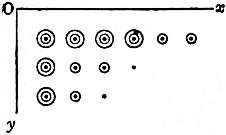
and every such graph is readable in six ways, the axis of z being perpendicular to the plane of the paper.
Ex. Gr.
Plane parallel to xy, direction Ox reads (643, 632, 411)
” ” xy, ” Oy ” (333211, 332111, 311100)
” ” yz, ” Oy ” (333, 331, 321, 211, 110, 110)
” ” yz, ” Oz ” (333, 322, 321, 310, 200, 200)
” ” zx, ” Oz ” (333322, 322100, 321000)
” ” zx, ” Ox ” (664, 431, 321)
the partitions having reference to the multipartite numbers 16, 8, 6, 976422, 13, 11, 6, which are brought into relation through the medium of the graph. The graph in question is more conveniently represented by a numbered diagram, viz.—
3 3 3 3 2 2
3 2 2 1
3 2 1
and then we may evidently regard it as a unipartite partition on the points of a lattice,
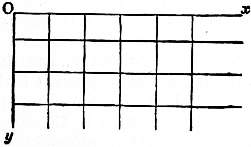
the descending order of magnitude of part being maintained along every line of route which proceeds from the origin in the positive directions of the axes.
This brings in view the modern notion of a partition, which has enormously enlarged the scope of the theory. We consider any number of points in plano or in solido connected (or not) by lines in pairs in any desired manner and fix upon any condition, such as is implied by the symbols ≥, >, =, <, ≤, ≷, as affecting any pair of points so connected. Thus in ordinary unipartite partition we have to solve in integers such a system as
α1 ≥ α2 ≥ α3 ≥ ... ... αn α1 + α2 + α3 + ... + αn = n,
the points being in a straight line. In the simplest example of the three-dimensional graph we have to solve the system
α1 ≥ α2
≚ ≙ α1 + α2 + α3 + α4 = n,
α3 ≥ α4
and a system for the general lattice constructed upon the same principle. The system has been discussed by MacMahon, Phil. Trans. vol. clxxxvii. A, 1896, pp. 619-673, with the conclusion that if the numbers of nodes along the axes of x, y, z be limited not to exceed the numbers m, n, l respectively, then writing for brevity 1 - xs = (s), the generating function is given by the product of the factors
x
(l + 1) . (l + 2) .... (l + m)
(1) (2) (m)
(l + 2) . (l + 3) .... (l + m + 1)
(2) (3) (m + 1)
. . .... .
. . .... .
. . .... .
(l + n) . (l + n + 1) .... (l + m + n - 1)
(n) (n + 1) (m + n - 1)
y
one factor appearing at each point of the lattice.
In general, partition problems present themselves which depend upon the solution of a number of simultaneous relations in integers of the form
λ1α1 + λ2α2 + λ3α3 + ... ≥ 0,
the coefficients λ being given positive or negative integers, and in some cases the generating function has been determined in a form which exhibits the fundamental solutions of the problems from which all other solutions are derivable by addition. (See MacMahon, Phil. Trans. vol. cxcii. (1899), pp. 351-401; and Trans. Camb. Phil. Soc. vol. xviii. (1899), pp. 12-34.)
The number of distributions of n objects (p1p2p3 ...) into parcels Method of symmetric functions. (m) is the coefficient of bm(p1p2p3 ...)xn in the development of the fraction
1
(1 - bαx. 1 - bβx. 1 - bγx ... )
× (1 - bα²x². 1 - bαβx². 1 - bβ²x² ... )
× (1 - bα³x³. 1 - bα²βx³. 1 - bαβγx³ ... )
......
and if we write the expansion of that portion which involves products of the letters α, β, γ, ... of degree r in the form
1 + hr1 bxr + hr2 b2x2r + ... ,
we may write the development
Π r = ∞r = 1 (1 + hr1 bxr + hr2 b2x2r + ...),
and picking out the coefficient of bm xn we find
Σ hτ1hτ2hτ3 ... , t1 t2 t3
where
Σ τ = m, Σ rt = n.
The quantities h are symmetric functions of the quantities α, β, γ, ... which in simple cases can be calculated without difficulty, and then the distribution function can be formed.
Ex. Gr.—Required the enumeration of the partitions of all multipartite numbers (p1p2p3 ...) into exactly two parts. We find
h2² = h4 - h3h1 + h²2 h3² = h6 - h5h1 + h4h2 h4² = h8 - h7h1 + h6h2 + h5h3 + h²4,
and paying attention to the fact that in the expression of hr2 the term h²r is absent when r is uneven, the law is clear. The generating function is
h2x2 + h2h1x3 + (h4 + h22)x4 + (h4h1 + h3h2)x5 + (h6 + 2h4h2)x6 + (h6h1 + h5h2 + h4h3)x7 + (h8 + 2h6h2 + h24)x8 + ...
Taking
h4 + h22 = h4 + {(2) + (12)}2 = 2(4) + 3(31) + 4(22) + 5(212) + 7(14),
the term 5(21²) indicates that objects such as a, a, b, c can be partitioned in five ways into two parts. These are a | a, b, c; b | a; a, c; c | a, a, b; a, a | b, c; a, b | a, c. The function hrs has been studied. (See MacMahon, Proc. Lond. Math. Soc. vol. xix.) Putting x equal to unity, the function may be written (h2 + h4 + h6 + ...) (1 + h1 + h2 + h3 + h4 + ...), a convenient formula.
The method of differential operators, of wide application to problems of combinatorial analysis, has for its leading idea the designing of a function and of a differential operator, Method of differential operators. so that when the operator is performed upon the function a number is reached which enumerates the solutions of the given problem. Generally speaking, the problems considered are such as are connected with lattices, or as it is possible to connect with lattices.
To take the simplest possible example, consider the problem of finding the number of permutations of n different letters. The function is here xn, and the operator (d/dx)n = δnx , yielding δn x xn = n! the number which enumerates the permutations. In fact—
δxxn = δx . x . x . x . x . x . x . ...,
and differentiating we obtain a sum of n terms by striking out an x from the product in all possible ways. Fixing upon any one of these terms, say x . x . x . x . ..., we again operate with δx by striking out an x in all possible ways, and one of the terms so reached is x . x . x . x . x . .... Fixing upon this term, and again operating and continuing the process, we finally arrive at one solution of the problem, which (taking say n = 4) may be said to be in correspondence with the operator diagram—
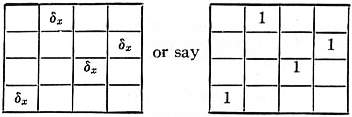
the number in each row of cempartments denoting an operation of δx. Hence the permutation problem is equivalent to that of placing n units in the compartments of a square lattice of order n in such manner that each row and each column contains a single unit. Observe that the method not only enumerates, but also gives a process by which each solution is actually formed. The same problem is that of placing n rooks upon a chess-board of n² compartments, so that no rook can be captured by any other rook.
Regarding these elementary remarks as introductory, we proceed to give some typical examples of the method. Take a lattice of m columns and n rows, and consider the problem of placing units in the compartments in such wise that the sth column shall contain λs units (s = 1, 2, 3, ... m), and the tth row p1 units (t = l, 2, 3, ... n).
Writing
1 + a1x + a2x² + ... + ... = (1 + a1x) (1 + a2x)(1 + a3x) ...
and Dp = 1/p! (δα1 + α1δα2 + α2δα3 + ...)p, the multiplication being symbolic, so that Dp is an operator of order p, the function is
aλ1aλ2aλ3 ... aλm,
and the operator Dp1Dp2Dp3 ... Dpn. The number Dp1Dp2 ... Dpnaλ1aλ2aλ3 ... aλm enumerates the solutions. For the mode of operation of Dp upon a product reference must be made to the section on “Differential Operators” in the article Algebraic Forms. Writing
aλ1aλ2 ... aλm = ... ΑΣ αp11 αp22 ... αpnn + ...,
or, in partition notation,
(1λ1) (1λ2) ... (1λm) = ... + Α(p1p2 ... pn) ... + Dp1Dp2 ... Dpn (1λ1) (1λ2) ... (1λm) = Α
and the law by which the operation is performed upon the product shows that the solutions of the given problem are enumerated by the number A, and that the process of operation actually represents each solution.
Ex. Gr.—Take
λ1 = 3, λ2 = 2, λ3 = 1, p1 = 2, p2 = 2, p3 = 1, p4 = 1, D²2D²1 a3a2a1 = 8,
and the process yields the eight diagrams:—
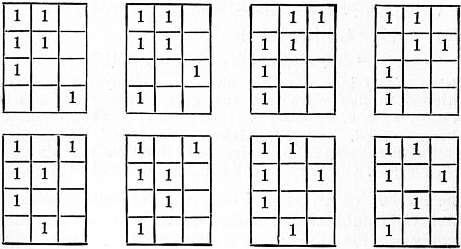
viz. every solution of the problem. Observe that transposition of the diagrams furnishes a proof of the simplest of the laws of symmetry in the theory of symmetric functions.
For the next example we have a similar problem, but no restriction is placed upon the magnitude of the numbers which may appear in the compartments. The function is now hλ1hλ2 ... hλm, hλm being the homogeneous product sum of the quantities a, of order λ. The operator is as before
Dp1Dp2 ... Dpn,
and the solutions are enumerated by
Dp1Dp2 ... Dpn hλ1hλ2 ... hλm.
Putting as before λ1 = 2, λ2 = 2, λ3 = 1, p1 = 2, p2 = 2, p3 = 1, p4 = 1, the reader will have no difficulty in constructing the diagrams of the eighteen solutions.
The next and last example of a multitude that might be given shows the extraordinary power of the method by solving the famous problem of the “Latin Square,” which for hundreds of years had proved beyond the powers of mathematicians. The problem consists in placing n letters a, b, c, ... n in the compartments of a square lattice of n² compartments, no compartment being empty, so that no letter occurs twice either in the same row or in the same column. The function is here
(Σ α12 n-1 α22 n-2 ... α2n-1 αn)n,
and the operator Dn2 n-1, the enumeration being given by
Dn2 n-1 (Σ α12 n-1 α22 n-2 ... α2n-1 αn)n.
See Trans. Camb. Phil. Soc. vol. xvi. pt. iv. pp. 262-290.
Authorities.—P. A. MacMahon, “Combinatory Analysis: A Review of the Present State of Knowledge,” Proc. Lond. Math. Soc. vol. xxviii. (London, 1897). Here will be found a bibliography of the Theory of Partitions. Whitworth, Choice and Chance; Édouard Lucas, Théorie des nombres (Paris, 1891); Arthur Cayley, Collected Mathematical Papers (Cambridge, 1898), ii. 419; iii. 36, 37; iv. 166-170; v. 62-65, 617; vii. 575; ix. 480-483; x. 16, 38, 611; xi. 61, 62, 357-364, 589-591; xii. 217-219, 273-274; xiii. 47, 93-113, 269; Sylvester, Amer. Jour, of Math. v. 119 251; MacMahon, Proc. Lond. Math. Soc. xix. 228 et seq.; Phil. Trans. clxxxiv. 835-901; clxxxv. 111-160; clxxxvii. 619-673; cxcii. 351-401; Trans. Camb. Phil. Soc. xvi. 262-290.
(P. A. M.)
COMBUSTION (from the Lat. comburere, to burn up), in chemistry, the process of burning or, more scientifically, the oxidation of a substance, generally with the production of flame and the evolution of heat. The term is more customarily given to productions of flame such as we have in the burning of oils, gas, fuel, &c., but it is conveniently extended to other cases of oxidation, such as are met with when metals are heated for a long time in air or oxygen. The term “spontaneous combustion” is used when a substance smoulders or inflames apparently without the intervention of any external heat or light; in such cases, as, for example, in heaps of cotton-waste soaked in oil, the oxidation has proceeded slowly, but steadily, for some time, until the heat evolved has raised the mass to the temperature of ignition.
The explanation of the phenomena of combustion was attempted at very early times, and the early theories were generally bound up in the explanation of the nature of fire or flame. The idea that some extraneous substance is essential to the process is of ancient date; Clement of Alexandria (c. 3rd century A.D.) held that some “air” was necessary, and the same view was accepted during the middle ages, when it had been also found that the products of combustion weighed more than the original combustible, a fact which pointed to the conclusion that some substance had combined with the combustible during the process. This theory was supported by the French physician Jean Ray, who showed also that in the cases of tin and lead there was a limit to the increase in weight. Robert Boyle, who made many researches on the origin and nature of fire, regarded the increase as due to the fixation of the particles of fire. Ideas identical with the modern ones were expressed by John Mayow in his Tractatus quinque medico-physici (1674), but his death in 1679 undoubtedly accounts for the neglect of his suggestions by his contemporaries. Mayow perceived the similarity of the processes of respiration and combustion, and showed that one constituent of the atmosphere, which he termed spiritus nitro-aereus, was essential to combustion and life, and that the second constituent, which he termed spiritus nitri acidi, inhibited combustion and life. At the beginning of the 18th century a new theory of combustion was promulgated by Georg Ernst Stahl. This theory regarded combustibility as due to a principle named phlogiston (from the Gr. φλογιστός, burnt), which was present in all combustible bodies in an amount proportional to their degree of combustibility; for instance, coal was regarded as practically pure phlogiston. On this theory, all substances which could be burnt were composed of phlogiston and some other substance, and the operation of burning was simply equivalent to the liberation of the phlogiston. The Stahlian theory, originally a theory of combustion, came to be a general theory of chemical reactions, since it provided simple explanations of the ordinary chemical processes (when regarded qualitatively) and permitted generalizations which largely stimulated its acceptance. Its inherent defect—that the products of combustion were invariably heavier than the original substance instead of less as the theory demanded—was ignored, and until late in the 18th century it dominated chemical thought. Its overthrow was effected by Lavoisier, who showed that combustion was simply an oxidation, the oxygen of the atmosphere (which was isolated at about this time by K. W. Scheele and J. Priestley) combining with the substance burnt.
COMEDY, the general term applied to a type of drama the chief object of which, according to modern notions, is to amuse. It is contrasted on the one hand with tragedy and on the other with farce, burlesque, &c. As compared with tragedy it is distinguished by having a happy ending (this being considered for a long time the essential difference), by quaint situations, and by lightness of dialogue and character-drawing. As compared with farce it abstains from crude and boisterous jesting, and is marked by some subtlety of dialogue and plot. It is, however, difficult to draw a hard and fast line of demarcation, there being a distinct tendency to combine the characteristics of farce with those of true comedy. This is perhaps more especially the case in the so-called “musical comedy,” which became popular in Great Britain and America in the later 19th century, where true comedy is frequently subservient to broad farce and spectacular effects.
The word “comedy” is derived from the Gr. κωμῳδία, which is a compound either of κῶμος (revel) and ἀοιδός (singer; ἀείδειν, ᾄδειν, to sing), or of κώμη (village) and ἀοιδός: it is possible that κῶμος itself is derived from κώμη, and originally meant a village revel. The word comes into modern usage through the Lat. comoedia and Ital. commedia. It has passed through various shades of meaning. In the middle ages it meant simply a story with a happy ending. Thus some of Chaucer’s Tales are called comedies, and in this sense Dante used the term in the title of his poem, La Commedia (cf. his Epistola X., in which he speaks of the comic style as “loquutio vulgaris, in qua et mulierculae communicant”; again “comoedia vero remisse et humiliter”; “differt a tragoedia per hoc, quod t. in principio est admirabilis et quieta, in fine sive exitu est foetida et horribilis”). Subsequently the term is applied to mystery plays with a happy ending. The modern usage combines this sense with that in which Renaissance scholars applied it to the ancient comedies.
The adjective “comic” (Gr. κωμικός), which strictly means that which relates to comedy, is in modern usage generally confined to the sense of “laughter-provoking”: it is distinguished from “humorous” or “witty” inasmuch as it is applied to an incident or remark which provokes spontaneous laughter without a special mental effort. The phenomena connected with laughter and that which provokes it, the comic, have been carefully investigated by psychologists, in contrast with other phenomena connected with the emotions. It is very generally agreed that the predominating characteristics are incongruity or contrast in the object, and shock or emotional seizure on the part of the subject. It has also been held that the feeling of superiority is an essential, if not the essential, factor: thus Hobbes speaks of laughter as a “sudden glory.” Physiological explanations have been given by Kant, Spencer and Darwin. Modern investigators have paid much attention to the origin both of laughter and of smiling, babies being watched from infancy and the date of their first smile being carefully recorded. For an admirable analysis and account of the theories see James Sully, On Laughter (1902), who deals generally with the development of the “play instinct” and its emotional expression.
See Drama; also Humour; Caricature; Play, &c.
COMENIUS (or Komensky), JOHANN AMOS (1592-1671), a famous writer on education, and the last bishop of the old church of the Moravian and Bohemian Brethren, was born at Comna, or, according to another account, at Niwnitz, in Moravia, of poor parents belonging to the sect of the Moravian Brethren. Having studied at Herborn and Heidelberg, and travelled in Holland and England, he became rector of a school at Prerau, and after that pastor and rector of a school at Fulnek. In 1621 the Spanish invasion and persecution of the Protestants robbed him of all he possessed, and drove him into Poland. Soon after he was made bishop of the church of the Brethren. He supported himself by teaching Latin at Lissa, and it was here that he published his Pansophiae prodromus (1630), a work on education, and his Janua linguarum reserata (1631), the latter of which gained for him a widespread reputation, being produced in twelve European languages, and also in Arabic, Persian and Turkish. He subsequently published several other works of a similar kind, as the Eruditionis scholasticae janua and the Janua linguarum trilinguis. His method of teaching languages, which he seems to have been the first to adopt, consisted in giving, in parallel columns, sentences conveying useful information, in the vernacular and the languages intended to be taught (i.e. in Comenius’s works, Latin and sometimes Greek). In some of his books, as the Orbis sensualium pictus (1658), pictures are added; this work is, indeed, the first children’s picture-book. In 1638 Comenius was requested by the government of Sweden to draw up a scheme for the management of the schools of that country; and a few years after he was invited to join the commission that the English parliament then intended to appoint, in order to reform the system of education. He visited England in 1641, but the disturbed state of politics prevented the appointment of the commission, and Comenius passed over to Sweden in August 1642. The great Swedish minister, Oxenstjerna, obtained for him a pension, and a commission to furnish a plan for regulating the Swedish schools according to his own method. Devoting himself to the elaboration of his scheme, Comenius settled first at Elbing, and then at Lissa; but, at the burning of the latter city by the Poles, he lost nearly all his manuscripts, and he finally removed to Amsterdam, where he died in 1671.
As an educationist, Comenius holds a prominent place in history. He was disgusted at the pedantic teaching of his own day, and he insisted that the teaching of words and things must go together. Languages should be taught, like the mother tongue, by conversation on ordinary topics; pictures, object lessons, should be used; teaching should go hand in hand with a happy life. In his course he included singing, economy, politics, world-history, geography, and the arts and handicrafts. He was one of the first to advocate teaching science in schools.
As a theologian, Comenius was greatly influenced by Boehme. In his Synopsis physicae ad lumen divinum reformatae he gives a physical theory of his own, said to be taken from the book of Genesis. He was also famous for his prophecies and the support he gave to visionaries. In his Lux in tenebris he published the visions of Kotterus, Dabricius and Christina Poniatovia. Attempting to interpret the book of Revelation, he promised the millennium in 1672, and guaranteed miraculous assistance to those who would undertake the destruction of the Pope and the house of Austria, even venturing to prophesy that Cromwell, Gustavus Adolphus, and Rakoczy, prince of Transylvania, would perform the task. He also wrote to Louis XIV., informing him that the empire of the world should be his reward if he would overthrow the enemies of God.
Comenius also wrote against the Socinians, and published three historical works—Ratio disciplinae ordinisque in unitate fratrum Bohemorum, which was republished with remarks by Buddaeus, Historia persecutionum ecclesiae Bohemicae (1648), and Martyrologium Bohemicum. See Raumer’s Geschichte der Pädogogik, and Carpzov’s Religionsuntersuchung der böhmischen und mährischen Brüder.
COMET (Gr. κομήτης, long-haired), in astronomy, one of a class of seemingly nebulous bodies, moving under the influence of the sun’s attraction in very eccentric orbits. A comet is visible only in a small arc of its orbit near perihelion, differing but slightly from the arc of a parabola. An obvious but not sharp classification of comets is into bright comets visible to the naked eye, and telescopic comets which can be seen only with a telescope. The telescopic class is much the more numerous of the two, only from 20 to 30 bright comets usually appearing in any one century, while several telescopic comets, frequently 6 or 8, are generally observed in the course of a year.
A bright comet consists of (1) a star-like nucleus; (2) a nebulous haze, called the coma, surrounding this nucleus, the latter fading into the haze by insensible gradations; (3) a tail or luminous stream flowing from the coma in a direction opposite to that of the sun. The nuclei and comae of different comets exhibit few peculiarities to the unaided vision except in respect to brightness; but the tails of comets differ widely, both in brightness and in extent. They range from a barely visible brush or feather of light to a phenomenon extending over a considerable arc of the heavens, which, comparatively bright near the head of the comet, becomes gradually fainter and more diffuse towards its end, fading out by gradations so insensible that a precise length cannot be assigned to it. When a telescopic comet is first discovered the nucleus is frequently invisible, the object presenting the appearance of a faint nebulous haze, scarcely distinguishable in aspect from a nebula. When the nucleus appears it may at first be only a comparatively faint condensation, and may or may not develop into a point of light as the comet approaches the sun. A tail also is generally not seen at great distances from the sun, but gradually develops as the comet approaches perihelion, to fade away again as the comet recedes from the sun.
A few comets are known to revolve in orbits with a regular period, while, in the case of others, no evidence is afforded by observation that the orbit deviates from a parabola. Were the orbit a parabola or hyperbola the comet would never return (see Orbit). Periodicity may be recognized in two ways: observations during the apparition may show that the motion is in an elliptic and not in a parabolic orbit; or a comet may have been observed at more than one return. In the latter case the comet is recognized as distinctly periodic, and therefore a member of the solar system. The shortest periods range between 3 and 10 years. The majority of comets which have been observed are shown by observation to be periodic; the period is usually very long, being sometimes measured by centuries, but generally by thousands of years. It is conceivable that a comet might revolve in a hyperbolic orbit. Although there are several of these bodies observations on which indicate such an orbit, the deviation from the parabolic form has not in any case been so well marked as to be fully established. Circumstances lead to the classification of newly appearing comets as expected and unexpected. An expected comet is a periodic one of which the return is looked for at a determinate time and in a certain region of the heavens. When this is not the case the comet is an unexpected one.
Physical Constitution of Comets.—The subject of the physical constitution of these bodies is one as to the details of which much uncertainty still exists. The considerations on which conclusions in this field rest are very various, and can best be set forth by beginning with what we may consider to be the best established facts.
We must regard it as well established that comets are not, like planets and satellites, permanent in mass, but are continuously losing minute portions of the matter which belongs to them, through a progressive dissipation—at least when they are in the neighbourhood of the sun. When near perihelion the matter of a comet is seen to be undergoing a process in the nature of evaporation, successive envelopes of vapour rising from the nucleus to form the coma, and then gradually repelled from the sun to form the tail. If this process went on indefinitely every comet would, in the course of ages, be entirely dissipated. This result has actually happened in the case of some known comets, the best established example of which is that of Biela, in which the process of disintegration was clearly followed. As the amount of matter lost by a comet at any one return cannot be estimated, and may be very small, it is impossible to set any limit to the period during which its life may continue. It is still an unsettled question whether, in every case, the evaporation will ultimately cease, leaving a residuum as permanent as any other mass of matter.
The next question in logical order is one of great difficulty. It is whether the nucleus of a comet is an opaque solid body, a cluster of such bodies, or a mass of particles of extreme tenuity. Some light is thrown on this and other questions by the spectroscope. This instrument shows in the spectrum of nearly every comet three bright bands, recognized as those of hydrocarbons. The obvious conclusion is that the light forming these bands is not reflected sunlight, but light radiated by the gaseous hydrocarbons. Since a gas at so great a distance from the sun cannot be heated to incandescence, the question arises how incandescence is excited. The generalizations of recent years growing out of the phenomena of radioactivity make it highly probable that the source is to be found in some form of electrical excitation, produced by electrons or other corpuscles thrown out by the sun. The resemblance of the cometary spectrum to the spectrum of hydrocarbons in the Geissler tube lends great plausibility to this view. It is remarkable that the great comet of 1882 also showed the bright lines of sodium with such intensity that they were observed in daylight by R. Copeland and W. O. Lohse. In addition to these gaseous spectra, all but the fainter comets show a continuous spectrum, crossed by the Fraunhofer lines, which is doubtless due to reflected sunlight. It happens that, since the spectroscope has been perfected, no comet of great brilliancy has been favourably situated for observation. Until the opportunity is offered, the conclusions to be derived from spectroscopic observation cannot be further extended.
Plate I.
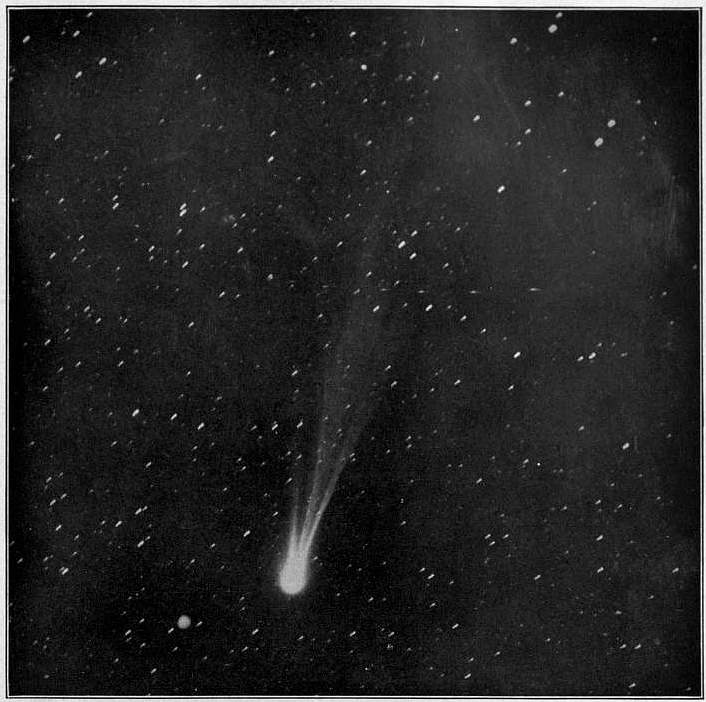
Fig. 1.—COMET 1892, I. (SWIFT), 1892, APRIL 26.
By permission of Lick Observatory (E. E. Barnard)
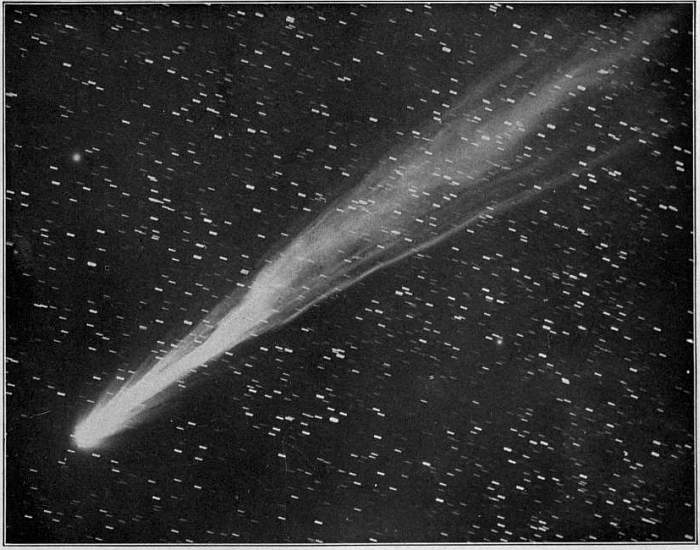
Fig. 2.—COMET C, 1908, NOV. 16d. 13h. 10m.
By permission of Yerkes Observatory (E. E. Barnard).
Plate II.
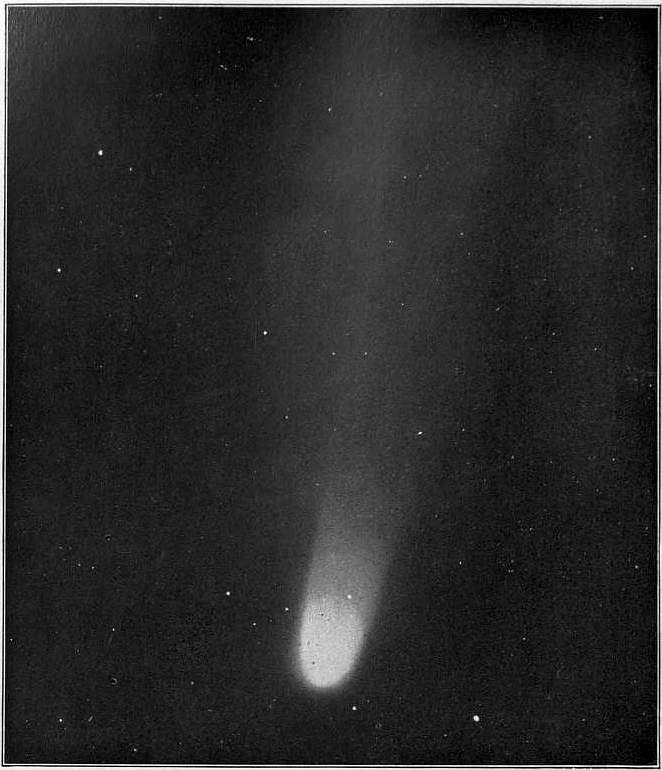
Fig. 3.—HALLEY’S COMET, 1910, APRIL 27.
By permission of Helwân Observatory, Egypt.
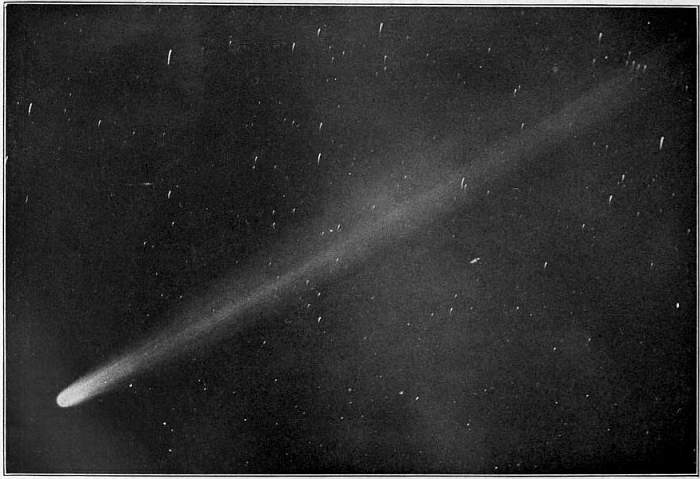
Fig. 4.—HALLEY’S COMET, 1910, MAY 4.
By permission of Yerkes Observatory (E. E. Barnard).
In the telescope the nucleus of a bright comet appears as an opaque mass, one or more seconds in diameter, the absolute dimensions comparing with those of the satellites of the planets, sometimes, indeed, equal to our moon. But the actual results of micrometric measures are found to differ very widely. In the case of Donati’s comet of 1858 the nucleus seemed to grow smaller as perihelion was approached. This is evidently due to the fact that the coma immediately around the nucleus was so bright as apparently to form a part of it at considerable distances from the sun. G. P. Bond estimated the diameter of the actual nucleus at 500 m. That the nucleus is a body of appreciable mass seems to be made probable by the fact that, except for the central attraction of such a body, a comet would speedily be dissipated by the different attractions of the sun on different parts of the mass, which would result in each particle pursuing an orbit of its own. It follows that there must be a mass sufficient to hold the parts of the comet, if not absolutely together, at least in each other’s immediate neighbourhood. How great a central mass may be required for this is a subject not yet investigated. It might be supposed that the amount of matter must be sufficient to make the nucleus quite opaque. But two considerations based on observations militate against this view. One is that an opaque body, reflecting much sunlight, would show a brighter continuous spectrum than has yet been found in any comet. Another and yet more remarkable observation is on record which goes far to prove not only the tenuity, but the transparency of a cometary nucleus. The great comet of 1882 made a transit over the sun on the 17th of September, an occurrence unique in the history of astronomy. But the fact of the transit escaped attention except at the observatory of the Cape of Good Hope. Here the comet was watched by W. H. Finlay and by W. L. Elkin as it approached the sun, and was kept in sight until it came almost or quite in contact with the sun’s disk, when it disappeared. It should, if opaque, have appeared a few minutes later, projected on the sun’s disk; but not a trace of it could be seen. The sun was approaching Table Mountain at the critical moment, and its limb was undulating badly, making the detection of a minute point difficult. The possibility of a very small opaque nucleus is therefore still left open; yet the remarkable conclusion still holds, that, immediately around a possible central nucleus, the matter of the head of the comet was so rare as not to intercept any appreciable fraction of the sun’s light. This result seems also to show that, with the possible exception of a very small central mass, what seems to telescopic vision as a nucleus is really only the central portion of the coma, which, as the distance from the centre increases, becomes less and less dense by imperceptible gradations.
Another fact tending towards this same conclusion is that after this comet passed perihelion it showed several nuclei following each other. Evidently the powerful attraction of the sun had separated the parts of the apparent nucleus, which were following each other in nearly the same orbit. As they could not have been completely brought together again, we may suppose that in such cases the smaller nuclei were permanently separated from the main body. In addition to this, the remarkable similarity of the orbit of this comet to that of several others indicates a group of bodies moving in nearly the same orbit. The other members of the group were the great comets of 1843, 1880 and 1887. The latter, though so bright as to be conspicuous to the naked eye, showed no nucleus whatever. The closely related orbits of the four bodies are also remarkable for approaching nearer the sun at perihelion than does the orbit of any other known body. All of these comets pass through the matter of the sun’s corona with a velocity of more than 100 m. per second without suffering any retardation. As it is beyond all reasonable probability that several independent bodies should have moved in orbits so nearly the same, the conclusion is that the comets were originally portions of one mass, which gradually separated in the course of ages by the powerful attraction of the sun as the collection successively passed the perihelion. It may be remarked that observations on the comet of 1843 seemed to show a slight ellipticity of the orbit, corresponding to a period of several centuries; but the deviation of all the orbits from a parabola is too slight to be established by observations. The periods of the comets are therefore unknown except that they must be counted by centuries and possibly by thousands of years.
Another fact which increases the complexity of the question is the well-established connexion of comets with meteoric showers. The shower of November 13-15, now known as the Leonids, which recurred for several centuries at intervals of about one-third of a century, are undoubtedly due to a stream of particles left behind by a comet observed in 1866. The same is true of Biela’s comet, the disintegrated particles of which give rise to the Andromedids, and probably true also of the Perseids, or August meteors, the orbits of which have a great similarity to a comet seen in 1862. The general and well-established conclusion seems to be that, in addition to the visible features of a comet, every such body is followed in its orbit by a swarm of meteoric particles which must have been gradually detached and separated from it. (See Meteor.)
The source of the repulsive force by which the matter forming the tail of a comet is driven away from the sun is another question that has not yet been decisively answered. Two causes have been suggested, of which one has only recently been brought to light. This is the repulsion of the sun’s rays, a form of action the probability of which was shown by J. Clerk Maxwell in 1870, and which was experimentally established about thirty years later. The intensity of this action on a particle is proportional to the surface presented by the particle to the rays, and therefore to the square of its diameter, while its mass, and therefore its gravitation to the sun, are proportional to the cube of the diameter. It follows that if the size and mass of a particle in space are below a certain limit, the repulsion of the rays will exceed the attraction of the sun, and the particle will be driven off into space. But, in order that this repulsive force may act, the particles, however minute they may be, must be opaque. Moreover, theory shows that there is a lower as well as an upper limit to their magnitude, and that it is only between certain definable limits of magnitude that the force acts. Conceiving the particle to be of the density of water, and considering its diameter as a diminishing variable, theory shows that the repulsion will balance gravity when the diameter has reached 0.0015 of a millimetre. As the diameter is reduced below this limit the ratio of the repulsive to the attractive force increases, but soon reaches a maximum, after which it diminishes down to a diameter of 0.00007 mm., when the two actions are again balanced. Below this limit the light speedily ceases to act. It follows that a purely gaseous body, such as would emit a characteristic bright line spectrum, would not be subject to the repulsion. We must therefore conclude that both the solid and gaseous forms of matter are here at play, and this view is consonant with the fact that the comet leaves behind it particles of meteoric matter.
Another possible cause is electrical repulsion. The probability of this cause is suggested by recent discoveries in radioactivity and by the fact that the sun undoubtedly sends forth electrical emanations which may ionize the gaseous molecules rising from the nucleus, and lead to their repulsion from the sun, thus resulting in the phenomena of the tail. But well-established laws are not yet sufficiently developed to lead to definite conclusions on this point, and the question whether both causes are combined, and, if not, to which one the phenomena in question are mainly due, must be left to the future.
A curious circumstance, which may be explained by a duplex character of the matter forming a cometary tail, is the great difference between the visual and photographic aspect of these bodies. The soft, delicate, feathery-like form which the comet with its tail presents to the eye is wanting in a photograph, which shows principally a round head with an irregularly formed tail much like the knotted stalk of a plant. It follows that the light emitted by the central axis of the tail greatly exceeds in actinic power the diffuse light around it. A careful comparison of the form and intensity of the photographic and visual tails may throw much light on the question of the constitution of these bodies, but no good opportunity of making the comparison has been afforded since the art of celestial photography has been brought to its present state of perfection.
The main conclusion to which the preceding facts and considerations point is that the matter of a comet is partly solid and partly gaseous. The gaseous form is shown conclusively by the spectroscope, but in view of the extreme delicacy of the indications with this instrument no quantitative estimate of the gas can be made. As there is no central mass sufficient to hold together a continuous atmosphere of elastic gas of any sort, it seems probable that the gaseous molecules are only those rising from the coma, possibly by ordinary evaporation, but more probably by the action of the ultra-violet and other rays of the sun giving rise to an ionization of disconnected gaseous molecules. The matter cannot be wholly gaseous because in this case there could be no central force sufficient to keep the parts of the comet together.
The facts also point to the conclusion that the solid matter of a comet is formed of a swarm or cloud of small disconnected masses, probably having much resemblance to the meteoric masses which are known to be flying through the solar system and possibly of the same general kind as these. The question whether there is any central solid of considerable mass is still undecided; it can only be said that if so, it is probably small relative to cosmic masses in general—more likely less than greater than 100 m. in diameter. The light of the comet therefore proceeds from two sources: one the incandescence of gases, the other the sunlight reflected from the solid parts. No estimate can be formed of the ratio between these two kinds of light until a bright comet shall be spectroscopically observed during an entire apparition.
Origin and Orbits of Comets.—The great difference which we have pointed out between comets and the permanent bodies of the solar system naturally suggested the idea that these bodies do not belong to that system at all, but are nebulous masses, scattered through the stellar spaces, and brought one by one into the sphere of the sun’s attraction. The results of this view are easily shown to be incompatible with the observed facts. The sun, carrying the whole solar system with it, is moving through space with a speed of about 10 m. per second. If it approached a comet nearly at rest the result would be a relative motion of this amount which, as the comet came nearer, would be constantly increased, and would result in the comet describing relative to the sun a markedly hyperbolic orbit, deviating too widely from a parabola to leave any doubt, even in the most extreme cases. Moreover, a large majority of comets would then have their aphelia in the direction of the sun’s motion, and therefore their perihelia in the opposite direction. Neither of these results corresponds to the fact. The conclusion is that if we regard a comet as a body not belonging to the solar system, it is at least a body which before its approach to the sun had the same motion through the stellar spaces that the sun has. As this unity of motion must have been maintained from the beginning, we may regard comets as belonging to the solar system in the sense of not being visitors from distant regions of space.
The acceptance of this seemingly inevitable conclusion leads to another: that no comet yet known moves in a really hyperbolic orbit, but that the limit of eccentricity must be regarded as 1, or that of the parabola. It is true that seeming evidence of hyperbolic eccentricity is sometimes afforded by observations and regarded by some astronomers as sufficient. The objections to the reality of the hyperbolic orbit are two: (1) A comet moving in a decidedly hyperbolic orbit must have come from so great a distance within a finite time, say a few millions of years, as to have no relation to the sun, and must after its approach to the sun return into space, never again to visit our system. In this case the motion of the sun through space renders it almost infinitely improbable that the orbit would have been so nearly a parabola as all such orbits are actually found to be. (2) The apparent deviation from a very elongated ellipse has never been in any case greater than might have been the result of errors of observation on bodies of this class.
This being granted, a luminous view of the causes which lead to the observed orbits of comets is readily gained by imagining these bodies to be formed of nebulous masses, which originally accompanied the sun in its journey through space, but at distances, in most cases, vastly greater than that of the farthest planet. Such a mass, when drawn towards the sun, would move round it in a nearly parabolic orbit, similar to the actual orbits of the great majority of comets. The period might be measured by thousands, tens of thousands, or hundreds of thousands of years, according to the distances of the comet in the beginning; but instead of bodies extraneous to the system, we should have bodies properly belonging to the system and making revolutions around the sun.
Were it not for the effect of planetary attraction long periods like these would be the general rule, though not necessarily universal. But at every return to perihelion the motion of a comet will be to some extent either accelerated or retarded by the action of Jupiter or any other planet in the neighbourhood of which it may pass. Commonly the action will be so slight as to have little influence on the orbit and the time of revolution. But should the comet chance to pass the orbit of Jupiter just in front of the planet, its motion would be retarded and the orbit would be changed into one of shorter period. Should it pass behind the planet, its motion would be accelerated and its period lengthened. In such cases the orbit might be changed to a hyperbola, and then the comet would never return. It follows that there is a tendency towards a gradual but constant diminution in the total number of comets. If we call Δe the amount by which the eccentricity of a cometary orbit is less than unity, Δe will be an extremely minute fraction in the case of the original orbits. If we call ± δ the change which the eccentricity 1 - Δe undergoes by the action of the planets during the passage of the comet through our system, it will leave the system with the eccentricity 1 - Δe ± δ. The possibilities are even whether δ shall be positive or negative. If negative, the eccentricity will be diminished and the period shortened. If positive, and greater than Δe, the eccentricity 1 - Δe + δ will be greater than 1, and then the comet will be thrown into a hyperbolic orbit and become for ever a wanderer through the stellar spaces.
The nearer a comet passes to a planet, especially to Jupiter, the greatest planet, the greater δ may be. If δ is a considerable negative fraction, the eccentricity will be so reduced that the comet will after the approach be one of short period. It follows that, however long the period of a comet may be, there is a possibility of its becoming one of short period if it approaches Jupiter. There have been several cases of this during the past two centuries, the most recent being that of Brooks’s comet, 1889, V. Soon after its discovery this body was found to have a period of only about seven years. The question why it had not been observed at previous returns was settled after the orbit had been determined by computing its motion in the past. It was thus found that in October 1886 the comet had passed in the immediate neighbourhood of Jupiter, the action of which had been such as to change its orbit from one of long period to the short observed period. A similar case was that of Lexel’s comet, seen in 1770. Originally moving in an unknown orbit, it encountered the planet Jupiter, made two revolutions round the sun, in the second of which it was observed, then again encountered the planet, to be thrown out of its orbit into one which did not admit of determination. The comet was never again found.
A general conclusion which seems to follow from these conditions, and is justified by observations, so far as the latter go, is that comets are not to be regarded as permanent bodies like the planets, but that the conglomerations of matter which compose them are undergoing a process of gradual dissipation in space. This process is especially rapid in the case of the fainter periodic comets. It was first strikingly brought out in the case of Biela’s comet. This object was discovered in 1772, was observed to be periodic after several revolutions had been made, and was observed with a fair degree of regularity at different returns until 1852. At the previous apparition it was found to have separated into two masses, and in 1852 these masses were so widely separated that they might be considered as forming two comets. Notwithstanding careful search at times and places when the comet was due, no trace of it has since been seen. An examination of the table of periodic comets given at the end of this article will show that the same thing is probably true of several other comets, especially Brorsen’s and Tempel’s, which have each made several revolutions since last observed, and have been sought for in vain.
In view of the seemingly inevitable dissipation of comets in the course of ages, and of the actually observed changes of their orbits by the attraction of Jupiter, the question arises whether the orbits of all comets of short period may not have been determined by the attraction of the planets, especially of Jupiter. In this case the orbit would, for a period of several centuries, have continued to nearly intersect that of the planet. We find, as a matter of fact, that several periodic comets either pass near Jupiter or have their aphelia in the neighbourhood of the orbit of Jupiter. The approach, however, is not sufficiently close to have led to the change unless in former times the proximity of the orbits was much greater than it is now. As the orbits of all the bodies of the solar system are subject to a slow secular change of their form and position, this may only show that it must have been thousands of years since the comet became one of short period. The two cases of most difficulty are those of Halley’s and Encke’s comets. The orbit of the former is so elongated and so inclined to the general plane of the planetary orbits that its secular variation must be very slow indeed. But it does not pass near the orbit of any planet except Venus; and even here the proximity is far from being sufficient to have produced an appreciable change in the period. The orbit of Encke’s comet is entirely within the orbit of Jupiter, and it also cannot have passed near enough to a planet for thousands of years to have had its orbit changed by the action in question. It therefore seems difficult to regard these two comets as other than permanent members of the solar system.
Special Periodic Comets.—One of the most remarkable periodic comets with which we are acquainted is that known to astronomers as Halley’s. Having perceived that the elements of the comet of 1682 were nearly the same as those of two comets which had respectively appeared in 1531 and 1607, Edmund Halley concluded that all the three orbits belonged to the same comet, of which the periodic time was about 76 years. After a rough estimate of the perturbations it must sustain from the attraction of the planets, he predicted its return for 1757,—a bold prediction at that time, but justified by the event, for the comet again made its appearance as was expected, though it did not pass through its perihelion till the month of March 1759, the attraction of Jupiter and Saturn having caused, as was computed by Clairault previously to its return, a retardation of 618 days. This comet had been observed in 1066, and the accounts which have been preserved represent it as having then appeared to be four times the size of Venus, and to have shone with a light equal to a fourth of that of the moon. History is silent respecting it from that time till the year 1456, when it passed very near to the earth: its tail then extended over 60° of the heavens, and had the form of a sabre. It returned to its perihelion in 1835, and was well observed in almost every observatory. But its brightness was far from comparing with the glorious accounts of its former apparitions. That this should have been due to the process of dissipation does not seem possible in so short a period; we must therefore consider either that the earlier accounts are greatly exaggerated, or that the brightness of the comet is subject to changes from some unknown cause. Previous appearances of Halley’s comet have been calculated by J. R. Hind, and more recently by P. H. Cowell and A. C. D. Crommelin of Greenwich, the latter having carried the comet back to 87 B.C. with certainty, and to 240 B.C. with fair probability. It was detected by Max Wolf at Heidelberg on plates exposed on Sept. 11, 1909, and subsequently on a Greenwich plate of Sept. 9.
The known comet of shortest period bears the name of J. F. Encke, the astronomer who first investigated its orbit and showed its periodicity. It was originally discovered in 1789, but its periodicity was not recognized until 1818, after it had been observed at several returns. This comet has given rise to a longer series of investigations than any other, owing to Encke’s result that the orbit was becoming smaller, and the revolutions therefore accelerated, by some unknown cause, of which the most plausible was a resisting medium surrounding the sun. As this comet is almost the only one that passes within the orbit of Mercury, it is quite possible that it alone would show the effect of such a medium. Recent investigations of this subject have been made at the Pulkova Observatory, first by F. E. von Asten and later by J. O. Backlund who, in 1909, was awarded the Gold Medal of the Royal Astronomical Society for his researches in this field. During some revolutions there was evidence of a slight acceleration of the return, and during others there was not.
The following is a list (compiled in 1909) of comets which are well established as periodic, through having been observed at one or more returns. In addition to what has already been said of several comets in this list the following remarks may be made. Tuttle’s comet was first seen by P. F. A. Méchain in 1790, but was not recognized as periodic until found by Tuttle in 1858, when the resemblance of the two orbits led to the conclusion of the identity of the bodies, the period of which was soon made evident by continued observations. The comets of Pons and Olbers are remarkable for having an almost equal period. But their orbits are otherwise totally different, so that there does not seem to be any connexion between them. Brorsen’s comet seems also to be completely dissipated, not having been seen since 1879.
List of Periodic Comets observed at more than one Return.
Designation. 1st Perih. Passage. Last Perih. Passage obs. Period Years. Least Dist. Ast. Units. Gr. Dist. Ast. Units.
Halley 1456 June 8.2 1835 Nov. 15.9 75.9 0.58 35.42
Biela 1772 Feb. 16.7 1852 Sept. 23.4 6.67 0.98 6.18
Encke 1786 Jan. 30.9 1905 Jan. 11.4 3.29 0.34 4.08
Tuttle 1790 Jan. 30.9 1899 May 4.5 13.78 1.03 10.53
Poris 1812 Sept. 15.3 1884 Jan. 25.7 72.28 0.78 33.70
Olbers 1815 April 26.0 1887 Oct. 8.5 73.32 1.21 33.99
Winnecke 1819 July 18.9 1898 Mar. 20.4 5.67 0.77 5.55
Faye 1843 Oct. 17.1 1896 Mar. 19.3 7.50 1.69 5.93
De Vico 1844 Sept. 2.5 1894 Oct. 12.2 5.66 1.19 5.01
Brorsen 1846 Feb. 11.1 1879 Mar. 30.5 5.52 0.65 5.63
D’Arrest 1851 July 8.7 1897 May 21.7 6.56 1.17 5.71
Tempel I. 1867 May 23.9 1879 May 7.0 5.84 1.56 4.82
Tempel-Swift 1869 Nov. 18.8 1891 Nov. 15.0 5.51 1.06 5.16
Tempel II. 1873 June 25.2 1904 Nov. 10.5 5.28 1.34 4.66
Wolf 1884 Nov. 17.8 1898 July 4.6 6.80 1.59 5.57
Finlay 1886 Nov. 22.4 1893 July 12.2 6.64 0.99 6.17
Brooks 1889 Sept. 30.3 1903 Dec. 6.5 7.10 1.95 5.44
Holmes 1892 June 13.2 1899 April 28.1 6.89 2.14 4.50
There are also a number of cases in which a comet has been observed through one apparition, and found to be apparently periodic, but which was not seen to return at the end of its supposed period. In some of these cases it seems likely that the comet passed near the planet Jupiter and thus had its orbit entirely changed. It is possible that in other cases the apparent periodicity is due to the unavoidable errors of observation to which, owing to their diffused outline, the nuclei of comets are liable.
(S. N.)
COMET-SEEKER, a small telescope (q.v.) adapted especially to searching for comets: commonly of short focal length and large aperture, in order to secure the greatest brilliancy of light.
COMILLA, or Kumilla, a town of British India, headquarters of Tippera district in Eastern Bengal and Assam, situated on the river Gumti, with a station on the Assam-Bengal railway, 96 m. from the coast terminus at Chittagong. Pop. (1901) 19,169. The town has many large tanks and an English church, built in 1875.
COMINES, or Commines (Flem. Komen), a town of western Flanders, 13 m. N.N.W. of Lille by rail. It is divided by the river Lys, leaving one part on French (department of Nord), the other on Belgian territory (province of West Flanders). Pop. of the French town 6359 (1906); of the Belgian town, 6453 (1904). The former has a belfry of the 14th century, restored in the 17th and 19th centuries, and remains of a chateau. Comines carries on the spinning of flax, wool and cotton.
COMITIA, the name applied, always in technical and generally in popular phraseology, to the most formal types of gathering of the sovereign people in ancient Rome. It is the plural of comitium, the old “meeting-place” (Lat. cum, together, ire, to go) on the north-west of the Forum. The Romans had three words for describing gatherings of the people. These were concilium, comitia and contio. Of these concilium had the most general significance. It could be applied to any kind of meeting and is often used to describe assemblies in foreign states. It was, therefore, a word that might be employed to denote an organized gathering of a portion of the Roman people such as the plebs, and in this sense is contrasted with comitia, which when used strictly should signify an assembly of the whole people. Thus the Roman draughtsman who wishes to express the idea “magistrates of any kind as president of assemblies” writes “Magistratus queiquomque comitia conciliumve habebit” (Lex Latina tabulae Bantinae, l. 5), and formalism required that a magistrate who summoned only a portion of the people to meet him should, in his summons, use the word concilium. This view is expressed by Laelius Felix, a lawyer probably of the age of Hadrian, when he writes “Is qui non universum populum, sed partem aliquam adesse jubet, non comitia, sed concilium edicere debet” (Gellius, Noctes Atticae, xv. 27). But popular phraseology did not conform to this canon, and comitia, which gained in current Latin the sense of “elections” was sometimes used of the assemblies of the plebs (see the instances in Botsford, distinction between Comitia and Concilium, p. 23). The distinction between comitia and contio was more clearly marked. Both were formal assemblies convened by a magistrate; but while, in the case of the comitia, the magistrate’s purpose was to ask a question of the people and to elicit their binding response, his object in summoning a contio was merely to bring the people together either for their instruction or for a declaration of his will as expressed in an edict (“contionem habere est verba facere ad populum sine ulla rogatione,” Gell. op. cit. xiii. 6). The word comitia merely means “meetings.”
The earliest comitia was one organized on the basis of parishes (curiae) and known in later times as the comitia curiata. The curia voted as a single unit and thus furnished the type for that system of group-voting which runs through all the later organization of the popular assemblies. This comitia must originally have been composed exclusively of patricians (q.v.); but there is reason to believe that, at an early period of the Republic, it had, in imitation of the centuriate organization, come to include plebeians (see Curia). The organization which gave rise to the comitia centuriata was the result of the earliest steps in the political emancipation of the plebs. Three stages in this process may be conjectured. In the first place the plebeians gained full rights of ownership and transfer, and could thus become freeholders of the land which they occupied and of the appurtenances of this land (res mancipi). This legal capacity rendered them liable to military service as heavy-armed fighting men, and as such they were enrolled in the military units called centuriae. When the enrolment was completed the whole host (exercitus) was the best organized and most representative gathering that Rome could show. It therefore either usurped, or became gradually invested with voting powers, and gained a range of power which for two centuries (508-287 B.C.) made it the dominant assembly in the state. But its aristocratic organization, based as this was on property qualifications which gave the greatest voting power to the richest men, prevented it from being a fitting channel for the expression of plebeian claims. Hence the plebs adopted a new political organization of their own. The tribunate called into existence a purely plebeian assembly, firstly, for the election of plebeian magistrates; secondly, for jurisdiction in cases where these magistrates had been injured; thirdly, for presenting petitions on behalf of the plebs through the consuls to the comitia centuriata. This right of petitioning developed into a power of legislation. The stages of the process (marked by the Valerio-Horatian laws of 449 B.C., the Publilian law of 339 B.C., and the Hortensian law of 287 B.C.) are unknown; but it is probable that the two first of the laws progressively weakened the discretionary power of senate and consuls in admitting such petitions; and that the Hortensian law fully recognized the right of resolutions of the plebs (plebiscita) to bind the whole community. The plebeian assembly, which had perhaps originally met by curiae, was organized on the basis of the territorial tribes in 471 B.C. This change suggested a renewed organization of the whole people for comitial purposes. The comitia tributa populi was the result. This assembly seems to have been already in existence at the epoch of the Twelve Tables in 451 B.C., its electoral activity is perhaps attested in 447 B.C., and it appears as a legislative body in 357 B.C.
In spite of the formal differences of these four assemblies and the real distinction springing from the fact that patricians were not members of the plebeian bodies, the view which is appropriate to the developed Roman constitution is that the people expressed its will equally through all, although the mode of expression varied with the channel. This will was in theory unlimited. It was restricted only by the conservatism of the Roman, by the condition that the initiative must always be taken by a magistrate, by the de facto authority of the senate, and by the magisterial veto which the senate often had at its command (see Senate). There were no limitations on the legislative powers of the comitia except such as they chose to respect or which they themselves created and might repeal. They never during the Republican period lost the right of criminal jurisdiction, in spite of the fact that so many spheres of this jurisdiction had been assigned in perpetuity to standing commissions (quaestiones perpetuae). This power of judging exercised by the assemblies had in the main developed from the use of the right of appeal (provocatio) against the judgments of the magistrates. But it is probable that, in the developed procedure, where it was known that the judgment pronounced might legally give rise to the appeal, the magistrate pronounced no sentence, but brought the case at once before the people. The case was then heard in four separate contiones. After these hearings the comitia gave its verdict. Finally, the people elected to every magistracy with the exception of the occasional offices of Dictator and Interrex. The distribution of these functions amongst the various comitia, and the differences in their organization, were as follows:—
The comitia curiata had in the later Republic become a merely formal assembly. Its main function was that of passing the lex curiata which was necessary for the ratification both of the imperium of the higher magistracies of the people, and of the potestas of those of lower rank. This assembly also met, under the name of the comitia calata and under the presidency of the pontifex maximus, for certain religious acts. These were the inauguration of the rex sacrorum and the flamens, and that abjuration of hereditary worship (detestatio sacrorum) which was made by a man who passed from his clan (gens) either by an act of adrogation (see Roman Law and Adoption) or by transition from the patrician to the plebeian order. For the purpose of passing the lex curiata, and probably for its other purposes as well, this comitia was in Cicero’s day represented by but thirty lictors (Cic. de Lege Agraria, ii. 12, 31).
The comitia centuriata could be summoned and presided over only by the magistrates with imperium. The consuls were its usual presidents for elections and for legislation, but the praetors summoned it for purposes of jurisdiction. It elected the magistrates with imperium and the censors, and alone had the power of declaring war. According to the principle laid down in the Twelve Tables (Cicero, de Legibus, iii. 4. 11) capital cases were reserved for this assembly. It was not frequently employed as a legislative body after the two assemblies of the tribes, which were easier to summon and organize, had been recognized as possessing sovereign rights. The internal structure of the comitia centuriata underwent a great change during the Republic—a change which has been conjecturally attributed to the censorship of Flaminius in 220 B.C. (Mommsen, Staatsrecht, iii. p. 270). In the early scheme, at a time when a pecuniary valuation had replaced land and its appurtenances (res mancipi) as the basis of qualification, five divisions (classes) were recognized whose property was assessed respectively at 100,000, 75,000, 50,000, 25,000 and 11,000 (or 12,500) asses. The first class contained 80 centuries; the second, third and fourth 20 each; the fifth 30. Added to these were the 18 centuries of knights (see Equites). The combined vote of the first class and the knights was thus represented by 98 centuries; that of the whole of the other classes (including 4 or 5 centuries of professional corporations connected with the army, such as the fabri and 1 century of proletarii, i.e. of all persons below the minimum census) was represented by 95 or 96 centuries. Thus the upper classes in the community possessed more than half the votes in the assembly. The newer scheme aimed at a greater equality of voting power; but it has been differently interpreted. The interpretation most usually accepted, which was first suggested by Pantagathus, a 17th-century scholar, is based on the view that the five classes were distributed over the tribes in such a manner that there were 2 centuries of each class in a single tribe. As the number of the tribes was 35, the total number of centuries would be 350. To these we must add 18 centuries of knights, 4 of fabri, &c., and 1 of proletarii. Here the first class and the knights command but 88 votes out of a total of 373. Mommsen’s interpretation (Staatsrecht, iii. p. 275) was different. He allowed the 70 votes for the 70 centuries of the first class, but thought that the 280 centuries of the other classes were so combined as to form only 100 votes. The total votes in the comitia would thus be 70 + 100 + 5 (fabri, &c.) + 18 (knights), i.e. 193, as in the earlier arrangement. In 88 B.C. a return was made to the original and more aristocratic system by a law passed by the consuls Sulla and Pompeius. At least this seems to be the meaning of Appian (Bellum Civile, i. 59) when he says έσηγοῦντο ... τὰς χειροτονίας μὴ κατὰ φυλὰς ἀλλὰ κατὰ λόχους ... γίγνεσθαι. But this change was not permanent as the more liberal system prevails in the Ciceronian period.
The comitia tributa was in the later Republic the usual organ for laws passed by the whole people. Its presidents were the magistrates of the people, usually the consuls and praetors, and, for purposes of jurisdiction, the curule aediles. It elected these aediles and other lower magistrates of the people. Its jurisdiction was limited to monetary penalties.
The concilium plebis, although voting, like this last assembly, by tribes, could be summoned and presided over only by plebeian magistrates, and never included the patricians. Its utterances (plebiscita) had the full force of law; it elected the tribunes of the plebs and the plebeian aediles, and it pronounced judgment on the penalties which they proposed. The right of this assembly to exercise capital jurisdiction was questioned; but it possessed the undisputed right of pronouncing outlawry (aquae et ignis interdictio) against any one already in exile (Livy xxv. 4, and xxvi. 3).
When the tenure of the religious colleges—formerly filled up by co-optation—was submitted to popular election, a change effected by a lex Domitia of 104 B.C., a new type of comitia was devised for this purpose. The electoral body was composed of 17 tribes selected by lot from the whole body of 35.
There was a body of rules governing the comitia which were concerned with the time and place of meeting, the forms of promulgation and the methods of voting. Valid meetings might be held on any of the 194 “comitial” days of the year which were not market or festal days (nundinae, feriae). The comitia curiata and the two assemblies of the tribes met within the walls, the former usually in the Comitium, the latter in the Forum or on the Area Capitolii; but the elections at these assemblies were in the later Republic held in the Campus Martius outside the walls. The comitia centuriata was by law compelled to meet outside the city and its gathering place was usually the Campus. Promulgation was required for the space of 3 nundinae (i.e. 24 days) before a matter was submitted to the people. The voting was preceded by a contio at which a limited debate was permitted by the magistrate. In the assemblies of the curiae and the tribes the voting of the groups took place simultaneously, in that of the centuries in a fixed order. In elections as well as in legislative acts an absolute majority was required, and hence the candidate who gained a mere relative majority was not returned.
The comitia survived the Republic. The last known act of comitial legislation belongs to the reign of Nerva (A.D. 96-98). After the essential elements in the election of magistrates had passed to the senate in A.D. 14, the formal announcement of the successful candidates (renuntiatio) still continued to be made to the popular assemblies. Early in the 3rd century Dio Cassius still saw the comitia centuriata meeting with all its old solemnities (Dio Cassius lviii. 20).
Bibliography.—Mommsen, Römisches Staatsrecht, iii. p. 300 foll. (3rd ed., Leipzig, 1887), and Römische Forschungen, Bd. i. (Berlin, 1879); Soltau, Entstehung und Zusammensetzung der altrömischen Volksversammlungen, and Die Gültigkeit der Plebiscite (Berlin, 1884); Huschke, Die Verfassung des Königs Servius Tullius als Grundlage zu einer römischen Verfassungsgeschichte (Heidelberg, 1838); Borgeaud, Le Plébiscite dans l’antiquité. Grèce et Rome (Geneva, 1838); Greenidge, Roman Public Life, p. 65 foll., 102, 238 foll. and App. i. (1901); G. W. Botsford, Roman Assemblies (1909).
(A. H. J. G.)
COMITY (from the Lat. comitas, courtesy, from cemis, friendly, courteous), friendly or courteous behaviour; a term particularly used in international law, in the phrase “comity of nations,” for the courtesy of nations towards each other. This has been held by some authorities to be the basis for the recognition by courts of law of the judgments and rules of law of foreign tribunals (see International Law, Private). “Comity of nations” is sometimes wrongly used, from a confusion with the Latin comes, a companion, for the whole body or company of nations practising such international courtesy.
COMMA (Gr. κομμα, a thing stamped or cut off, from κόπτειν, to strike), originally, in Greek rhetoric, a short clause, something less than the “colon”; hence a mark (,), in punctuation, to show the smallest break in the construction of a sentence. The mark is also used to separate numerals, mathematical symbols and the like. Inverted commas, or “quotation-marks,” i.e. pairs of commas, the first inverted, and the last upright, are placed at the beginning and end of a sentence or word quoted, or of a word used in a technical or conventional sense; single commas are similarly used for quotations within quotations. The word is also applied to comma-shaped objects, such as the “comma-bacillus,” the causal agent in cholera.
COMMANDEER (from the South African Dutch kommanderen, to command), properly, to compel the performance of military duty in the field, especially of the military service of the Boer republics (see Commando); also to seize property for military purposes; hence used of any peremptory seizure for other than military purposes.
COMMANDER, in the British navy, the title of the second grade of captains. He commands a small vessel, or is second in command of a large one. A staff commander is entrusted with the navigation of a large ship, and ranks above a navigating lieutenant. Since 1838 the officer next in rank to a captain in the U.S. navy has been called commander.
COMMANDERY (through the Fr. commanderie, from med. Lat. commendaria, a trust or charge), a division of the landed property in Europe of the Knights Hospitallers (see St John of Jerusalem). The property of the order was divided into “priorates,” subdivided into “bailiwicks,” which in turn were divided into “commanderies”; these were placed in charge of a “commendator” or commander. The word is also applied to the emoluments granted to a commander of a military order of knights.
COMMANDO, a Portuguese word meaning “command,” adopted by the Boers in South Africa through whom it has come into English use, for military and semi-military expeditions against the natives. More particularly a “commando” was the administrative and tactical unit of the forces of the former Boer republics, “commandeered” under the law of the constitutions which made military service obligatory on all males between the ages of sixteen and sixty. Each “commando” was formed from the burghers of military age of an electoral district.
COMMEMORATION, a general term for celebrating some past event. It is also the name for the annual act, or Encaenia, the ceremonial closing of the academic year at Oxford University. It consists of a Latin oration in commemoration of benefactors and founders; of the recitation of prize compositions in prose and verse, and the conferring of honorary degrees upon English or foreign celebrities. The ceremony, which is usually on the third Wednesday after Trinity Sunday, is held in the Sheldonian Theatre, in Broad St., Oxford. “Commencement” is the term for the equivalent ceremony at Cambridge, and this is also used in the case of American universities.
COMMENDATION (from the Lat. commendare, to entrust to the charge of, or to procure a favour for), approval, especially when expressed to one person on behalf of another, a recommendation. The word is used in a liturgical sense for an office commending the souls of the dying and dead to the mercies of God. In feudal law the term is applied to the practice of a freeman placing himself under the protection of a lord (see Feudalism), and in ecclesiastical law to the granting of benefices in commendam. A benefice was held in commendam when granted either temporarily until a vacancy was filled up, or to a layman, or, in case of a monastery or abbey, to a secular cleric to enjoy the revenues and privileges for life (see Abbot), or to a bishop to hold together with his see. An act of 1836 prohibited the holding of benefices in commendam in England.
COMMENTARII (Lat. = Gr. ὑπομνήματα), notes to assist the memory, memoranda. This original idea of the word gave rise to a variety of meanings: notes and abstracts of speeches for the assistance of orators; family memorials, the origin of many of the legends introduced into early Roman history from a desire to glorify a particular family; diaries of events occurring in their own circle kept by private individuals,—the day-book, drawn up for Trimalchio in Petronius (Satyricon, 53) by his actuarius (a slave to whom the duty was specially assigned) is quoted as an example; memoirs of events in which they had taken part drawn up by public men,—such were the “Commentaries” of Caesar on the Gallic and Civil wars, and of Cicero on his consulship. Different departments of the imperial administration and certain high functionaries kept records, which were under the charge of an official known as a commentariis (cf. a secretis, ab epistulis). Municipal authorities also kept a register of their official acts.
The Commentarii Principis were the register of the official acts of the emperor. They contained the decisions, favourable or unfavourable, in regard to certain citizens; accusations brought before him or ordered by him; lists of persons in receipt of special privileges. These must be distinguished from the commentarii diurni, a daily court-journal. At a later period records called ephemerides were kept by order of the emperor; these were much used by the Scriptores Historiae Augustae (see Augustan History). The Commentarii Senatus, only once mentioned (Tacitus, Annals, xv. 74) are probably identical with the Acta Senatus (q.v.). There were also Commentarii of the priestly colleges: (a) Pontificum, collections of their decrees and responses for future reference, to be distinguished from their Annales, which were historical records, and from their Acta, minutes of their meetings; (b) Augurum, similar collections of augural decrees and responses; (c) Decemvirorum; (d) Fratrum Arvalium. Like the priests, the magistrates also had similar notes, partly written by themselves, and partly records of which they formed the subject. But practically nothing is known of these Commentarii Magistratuum. Mention should also be made of the Commentarii Regum, containing decrees concerning the functions and privileges of the kings, and forming a record of the acts of the king in his capacity of priest. They were drawn up in historical times like the so-called leges regiae (jus Papirianum), supposed to contain the decrees and decisions of the Roman kings.
See the exhaustive article by A. von Premerstein in Pauly-Wissowa, Realencyclopädie (1901); Teuffel-Schwabe, Hist. of Roman Lit. (Eng. trans.), pp. 72, 77-79; and the concise account by H. Thédenat in Daremberg and Saglio, Dictionnaire des antiquités.
COMMENTRY, a town of central France, in the department of Allier, 42 m. S.W. of Moulins by the Orléans railway. Pop. (1906) 7581. Commentry gives its name to a coalfield over 5000 acres in extent, and has important foundries and forges.
COMMERCE (Lat. commercium, from cum, together, and merx, merchandise), in its general acceptation, the international traffic in goods, or what constitutes the foreign trade of all countries as distinct from their domestic trade.
In tracing the history of such dealings we may go back to the early records found in the Hebrew Scriptures. Such a transaction as that of Abraham, for example, weighing down “four hundred shekels of silver, current with the merchant,” for the field of Ephron, is suggestive of a group of facts and ideas indicating an advanced condition of commercial intercourse,—property in land, sale of land, arts of mining and purifying metals, the use of silver of recognized purity as a common medium of exchange, and merchandise an established profession, or division of labour. That other passage in which we read of Joseph being sold by his brethren for twenty pieces of silver to “a company of Ishmaelites, coming from Gilead, with their camels bearing spicery and balm and myrrh to Egypt,” extends our vision still farther, and shows us the populous and fertile Egypt in commercial relationship with Chaldaea, and Arabians, foreign to both, as intermediaries in their traffic, generations before the Hebrew commonwealth was founded.
The first foreign merchants of whom we read, carrying goods and bags of silver from one distant region to another, were the southern Arabs, reputed descendants of Ishmael and Esau. The first notable navigators and maritime carriers of goods were the Phoenicians. In the commerce of the ante-Christian ages the Jews do not appear to have performed any conspicuous part. Both the agricultural and the theocratic constitution of their society were unfavourable to a vigorous prosecution of foreign trade. In such traffic as they had with other nations they were served on their eastern borders by Arabian merchants, and on the west and south by the Phoenician shippers. The abundance of gold, silver and other precious commodities gathered from distant parts, of which we read in the days of greatest Hebrew prosperity, has more the character of spoils of war and tributes of dependent states than the conquest by free exchange of their domestic produce and manufacture. It was not until the Jews were scattered by foreign invasions, and finally cast into the world by the destruction of Jerusalem, that they began to develop those commercial qualities for which they have since been famous.
There are three conditions as essential to extensive international traffic as diversity of natural resources, division of labour, accumulation of stock, or any other primal element—(1) means of transport, (2) freedom of labour Primary conditions of commerce. and exchange, and (3) security; and in all these conditions the ancient world was signally deficient.
The great rivers, which became the first seats of population and empire, must have been of much utility as channels of transport, and hence the course of human power of which they are the geographical delineation, and probably the idolatry with which they were sometimes honoured. Nor were the ancient rulers insensible of the importance of opening roads through their dominions, and establishing post and lines of communication, which, though primarily for official and military purposes, must have been useful to traffickers and to the general population. But the free navigable area of great rivers is limited, and when diversion of traffic had to be made to roads and tracks through deserts, there remained the slow and costly carriage of beasts of burden, by which only articles of small bulk and the rarest value could be conveyed with any hope of profit. Corn, though of the first necessity, could only be thus transported in famines, when beyond price to those who were in want, and under this extreme pressure could only be drawn from within a narrow sphere, and in quantity sufficient to the sustenance of but a small number of people. The routes of ancient commerce were thus interrupted and cut asunder by barriers of transport, and the farther they were extended became the more impassable to any considerable quantity or weight of commodities. As long as navigation was confined to rivers and the shores of inland gulfs and seas, the oceans were a terra incognita, contributing nothing to the facility or security of transport from one part of the world to another, and leaving even one populous part of Asia as unapproachable from another as if they had been in different hemispheres. The various routes of trade from Europe and north-western Asia to India, which have been often referred to, are to be regarded more as speculations of future development than as realities of ancient history. It is not improbable that the ancient traffic of the Red Sea may have been extended along the shores of the Arabian Sea to some parts of Hindustan, but that vessels braved the Indian Ocean and passed round Cape Comorin into the Bay of Bengal, 2000 or even 1000 years before mariners had learned to double the Cape of Good Hope, is scarcely to be believed. The route by the Euxine and the Caspian Sea has probably never in any age reached India. That by the Euphrates and the Persian Gulf is shorter, and was besides the more likely from passing through tracts of country which in the most remote times were seats of great population. There may have been many merchants who traded on all these various routes, but that commodities were passed in bulk over great distances is inconceivable. It may be doubted whether in the ante-Christian ages there was any heavy transport over even 500 m., save for warlike or other purposes, which engaged the public resources of imperial states, and in which the idea of commerce, as now understood, is in a great measure lost.
The advantage which absolute power gave to ancient nations in their warlike enterprises, and in the execution of public works of more or less utility, or of mere ostentation and monumental magnificence, was dearly purchased by the sacrifice of individual freedom, the right to labour, produce and exchange under the steady operation of natural economic principles, which more than any other cause vitalizes the individual and social energies, and multiplies the commercial resource of communities. Commerce in all periods and countries has obtained a certain freedom and hospitality from the fact that the foreign merchant has something desirable to offer; but the action of trading is reciprocal, and requires multitudes of producers and merchants, as free agents, on both sides, searching out by patient experiment wants more advantageously supplied by exchange than by direct production, before it can attain either permanence or magnitude, or can become a vital element of national life. The ancient polities offered much resistance to this development, and in their absolute power over the liberty, industry and property of the masses of their subjects raised barriers to the extension of commerce scarcely less formidable than the want of means of communication itself. The conditions of security under which foreign trade can alone flourish equally exceeded the resources of ancient civilization. Such roads as exist must be protected from robbers, the rivers and seas from pirates; goods must have safe passage and safe storage, must be held in a manner sacred in the territories through which they pass, be insured against accidents, be respected even in the madness of hostilities; the laws of nations must give a guarantee on which traders can proceed in their operations with reasonable confidence; and the governments, while protecting the commerce of their subjects with foreigners as if it were their own enterprise, must in their fiscal policy, and in all their acts, be endued with the highest spirit of commercial honour. Every great breach of this security stops the continuous circulation, which is the life of traffic and of the industries to which it ministers. But in the ancient records we see commerce exposed to great risks, subject to constant pillage, hunted down in peace and utterly extinguished in war. Hence it became necessary that foreign trade should itself be an armed force in the world; and though the states of purely commercial origin soon fell into the same arts and wiles as the powers to which they were opposed, yet their history exhibits clearly enough the necessity out of which they arose. Once organized, it was inevitable that they should meet intrigue with intrigue, and force with force. The political empires, while but imperfectly developing industry and traffic within their own territories, had little sympathy with any means of prosperity from without. Their sole policy was either to absorb under their own spirit and conditions of rule, or to destroy, whatever was rich or great beyond their borders. Nothing is more marked in the past history of the world than this struggle of commerce to establish conditions of security and means of communication with distant parts. When almost driven from the land, it often found both on the sea; and often, when its success had become brilliant and renowned, it perished under the assault of stronger powers, only to rise again in new centres and to find new channels of intercourse.
While Rome was giving laws and order to the half-civilized tribes of Italy, Carthage, operating on a different base, and by other methods, was opening trade with less accessible parts of Europe. The strength of Rome was in her Carthage. legions, that of Carthage in her ships; and her ships could cover ground where the legions were powerless. Her mariners had passed the mythical straits into the Atlantic, and established the port of Cadiz. Within the Mediterranean itself they founded Carthagena and Barcelona on the same Iberian peninsula, and ahead of the Roman legions had depots and traders on the shores of Gaul. After the destruction of Tyre, Carthage became the greatest power in the Mediterranean, and inherited the trade of her Phoenician ancestors with Egypt, Greece and Asia Minor, as well as her own settlements in Sicily and on the European coasts. An antagonism between the great naval and the great military power, whose interests crossed each other at so many points, was sure to occur; and in the three Punic wars Carthage measured her strength with that of Rome both on sea and on land with no unequal success. But a commercial state impelled into a series of great wars has departed from its own proper base; and in the year 146 B.C. Carthage was so totally destroyed by the Roman conquests. Romans that of the great city, more than 20 m. in circumference, and containing at one period near a million of inhabitants, only a few thousands were found within its ruined walls. In the same year Corinth, one of the greatest of the Greek capitals and seaports, was captured, plundered of vast wealth and given to the flames by a Roman consul. Athens and her magnificent harbour of the Piraeus fell into the same hands 60 years later. It may be presumed that trade went on under the Roman conquests in some degree as before; but these were grave events to occur within a brief period, and the spirit of the seat of trade in every case having been broken, and its means and resources more or less plundered and dissipated—in some cases, as in that of Carthage, irreparably—the most necessary commerce could only proceed with feeble and languid interest under the military, consular and proconsular licence of Rome at that period. Tyre, the great seaport of Palestine, having been destroyed by Alexander the Great, Palmyra, the great inland centre of Syrian trade, was visited with a still more complete annihilation by the Roman Emperor Aurelian within little more than half a century after the capture and spoliation of Athens. The walls were razed to their foundations; the population—men, women, children and the rustics round the city—were all either massacred or dispersed; and the queen Zenobia was carried captive to Rome. Palmyra had for centuries, as a centre of commercial intercourse and transit, been of great service to her neighbours, east and west. In the wars of the Romans and Parthians she was respected by both as an asylum of common interests which it would have been simple barbarity to invade or injure; and when the Parthians were subdued, and Palmyra became a Roman annexe, she continued to flourish as before. Her relations with Rome were more than friendly; they became enthusiastic and heroic; and her citizens having inflicted signal chastisement on the king of Persia for the imprisonment of the emperor Valerian, the admiration of this conduct at Rome was so great that their spirited leader Odaenathus, the husband of Zenobia, was proclaimed Augustus, and became co-emperor with Gallienus. It is obvious that the destruction of Palmyra must not only have doomed Palmyra. Palestine, already bereft of her seaports, to greater poverty and commercial isolation than had been known in long preceding ages, but have also rendered it more difficult to Rome herself to hold or turn to any profitable account her conquests in Asia; and, being an example of the policy of Rome to the seats of trade over nearly the whole ancient world, it may be said to contain in graphic characters a presage of what came to be the actual event—the collapse and fall of the Roman empire itself.
The repeated invasions of Italy by the Goths and Huns gave rise to a seat of trade in the Adriatic, which was to sustain during more than a thousand years a history of unusual splendour. The Veneti cultivated fertile lands on the Venice. Po, and built several towns, of which Padua was the chief. They appear from the earliest note of them in history to have been both an agricultural and trading people; and they offered a rich prey to the barbarian hordes when these broke through every barrier into the plains of Italy. Thirty years before Attila razed the neighbouring city of Aquileia, the consuls and senate of Padua, oppressed and terrified by the prior ravages of Alaric, passed a decree for erecting Rialto, the largest of the numerous islets at the mouth of the Po, into a chief town and port, not more as a convenience to the islanders than as a security for themselves and their goods. But every fresh incursion, every new act of spoliation by the dreaded enemies, increased the flight of the rich and the industrious to the islands, and thus gradually arose the second Venice, whose glory was so greatly to exceed that of the first. Approachable from the mainland only by boats, through river passes easily defended by practised sailors against barbarians who had never plied an oar, the Venetian refugees could look in peace on the desolation which swept over Italy; their warehouses, their markets, their treasures were safe from plunder; and stretching their hands over the sea, they found in it fish and salt, and in the rich possessions of trade and territory which it opened to them more than compensation for the fat lands and inland towns which had long been their home. The Venetians traded with Constantinople, Greece, Syria and Egypt. They became lords of the Morea, and of Candia, Cyprus and other islands of the Levant. The trade of Venice with India, though spoken of, was probably never great. But the crusades of the 12th and 13th centuries against the Saracens in Palestine extended her repute more widely east and west, and increased both her naval and her commercial resources. It is enough, indeed, to account for the grandeur of Venice that in course of centuries, from the security of her position, the growth and energy of her population, and the regularity of her government at a period when these sources of prosperity were rare, she became the great emporium of the Mediterranean—all that Carthage, Corinth and Athens had been in a former age on a scene the most remarkable in the world for its fertility and facilities of traffic,—and that as Italy and other parts of the Western empire became again more settled her commerce found always a wider range. The bridge built from the largest of the islands to the opposite bank became the “Rialto,” or famous exchange of Venice, whose transactions reached farther, and assumed a more consolidated form, than had been known before. There it was where the first public bank was organized; that bills of exchange were first negotiated, and funded debt became transferable; that finance became a science and book-keeping an art. Nor must the effect of the example of Venice on other cities of Italy be left out of account. Genoa, following her steps, rose into great prosperity and power at the foot of the Maritime Alps, and became her rival, and finally her enemy. Naples, Gaeta, Florence, many other towns of Italy, and Rome herself, long after her fall, were encouraged to struggle for the preservation of their municipal freedom, and to foster trade, arts and navigation, by the brilliant success set before them on the Adriatic; but Venice, from the early start she had made, and her command of the sea, had the commercial pre-eminence.