VOLUME VI SLICE VII Columbus to Condottiere (continued 8)
Reading edition
In biology conception is the coalescence of the male and female generative elements, producing pregnancy.
CONCEPTUALISM (from “Concept”), in philosophy, a term applied by modern writers to a scholastic theory of the nature of universals, to distinguish it from the two extremes of Nominalism and Realism. The scholastic philosophers took up the old Greek problem as to the nature of true reality—whether the general idea or the particular object is more truly real. Between Realism which asserts that the genus is more real than the species, and that particulars have no reality, and Nominalism according to which genus and species are merely names (nomina, flatus vocis), Conceptualism takes a mean position. The conceptualist holds that universals have a real existence, but only in the mind, as the concepts which unite the individual things: e.g. there is in the mind a general notion or idea of boats, by reference to which the mind can decide whether a given object is, or is not, a boat. On the one hand “boat” is something more than a mere sound with a purely arbitrary conventional significance; on the other it has, apart from particular things to which it applies, no reality; its reality is purely abstract or conceptual. This theory was enunciated by Abelard in opposition to Roscellinus (nominalist) and William of Champeaux (realist). He held that it is only by becoming a predicate that the class-notion or general term acquires reality. Thus similarity (conformitas) is observed to exist between a number of objects in respect of a particular quality or qualities. This quality becomes real as a mental concept when it is predicated of all the objects possessing it (“quod de pluribus natum est praedicari”). Hence Abelard’s theory is alternatively known as Sermonism (sermo, “predicate”). His statement of this position oscillates markedly, inclining sometimes towards the nominalist, sometimes towards the realist statement, using the arguments of the one against the other. Hence he is described by some as a realist, by others as a nominalist. When he comes to explain that objective similarity in things which is represented by the class-concept or general term, he adopts the theological Platonic view that the ideas which are the archetypes of the qualities exist in the mind of God. They are, therefore, ante rem, in re and post rem, or, as Avicenna stated it, universalia ante multiplicitatem, in multiplicitate, post multiplicitatem. (See Logic, Metaphysics.)
CONCERT (through the French from Lat. con-, with, and certare, to strive), a term meaning, in general, co-operation, agreement or union; the more specific usages being, in music, for a public performance by instrumentalists, vocalists or both combined, and in diplomacy, for an understanding or agreement for common action between two or more states, whether defined by treaty or not. The term “Concert of Europe” has been commonly applied, since the congress of Vienna (1814-1815), to the European powers consulting or acting together in questions of common interest. (See Alliance and Europe: History.)
CONCERTINA, or Melodion (Fr. concertina, Ger. Ziehharmonica or Bandoneon), a wind instrument of the seraphine family with free reeds, forming a link in the evolution of the harmonium from the mouth organ, intermediate links being the cheng and the accordion. The concertina consists of two hexagonal or rectangular keyboards connected by a long expansible bellows of many folds similar to that of the accordion. The keyboards are furnished with rows of knobs, which, on being pressed down by the fingers, open valves admitting the air compressed by the bellows to the free reeds, which are thus set in vibration. These free reeds consist of narrow tongues of brass riveted by one end to the inside surface of the keyboard, and having their free ends slightly bent, some outwards, some inwards, the former actuated by suction when the bellows are expanded, the latter by compression. The pitch of the note depends upon the length and thickness of the reeds, reduction of the length tending to sharpen the pitch of the note, while reduction of the thickness lowers it. The bellows being unprovided with a valve can only draw in and emit the air through the reed valves. In order to produce the sound, the concertina is held horizontally between the hands, the bellows being by turns compressed and expanded. The English concertina, invented and patented by Sir Charles Wheatstone in 1829, the year of the reputed invention of the accordion (q.v.), is constructed with a double action, the same note being produced on compressing and expanding the bellows, whereas in the German concertina or accordion two different notes are given out. Concertinas are made in complete families—treble, tenor, bass and double bass, having a combined total range of nearly seven octaves. The compass is as follows:—
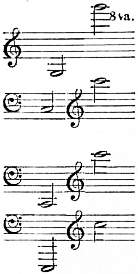
Treble concertina, double action
Tenor concertina, single action
Bass concertina, single action
Double bass concertina, single action
The timbre of the concertina is penetrating but soft, and capable of the most delicate gradations of tone. This quality is due to a law of acoustics governing the vibration of free reeds by means of which fortes and pianos are obtained by varying the pressure of the wind, as is also the case with the double reed or the single or beating reed, while the pressure of the reed with the lips combined with greater pressure of wind produces the harmonic overtones which are not given out by free reeds. The English concertina possesses one peculiarity which renders it unsuitable for playing with instruments tuned according to the law of equal temperament, such as the pianoforte, harmonium or melodion, i.e. it has enharmonic intervals between G♯ and A♯ and between D♭ and E♭. The German concertina is not constructed according to this system; its compass extends down to C or even B♭, but it is not provided with double action. It is possible on the English concertina to play diatonic and chromatic passages or arpeggios in legato or staccato style with rapidity, shakes single and double in thirds; it is also possible to play in parts as on the pianoforte or organ and to produce very rich chords. Concertos were written for concertina with orchestra by Molique and Regondi, a sonata with piano by Molique, while Tschaikowsky scored in his second orchestral suite for four accordions.
The aeola, constructed by the representatives of the original firm of Wheatstone, is a still more artistically developed concertina, having among other improvements steel reeds instead of brass, which increase the purity and delicacy of the timbre.
See also Accordion; Cheng; Harmonium; Free-Reed Vibrator.
(K. S.)
CONCERTO (Lat. concertus, from certare, to strive, also confused with concentus), in music, a term which appears as early as the beginning of the 17th century, at first as a title of no very definite meaning, but which early acquired a sense justified by its etymology and became applied chiefly to compositions in which unequal instrumental or vocal forces are brought into opposition.
Although by Bach’s time the concerto as a polyphonic instrumental form was thoroughly established, the term frequently appears in the autograph title-pages of his church cantatas, even when the cantata contains no instrumental prelude. Indeed, so entirely does the actual concerto form, as Bach understands it, depend upon the opposition of masses of tone unequal in volume with a compensating inequality in power of commanding attention, that Bach is able to rewrite an instrumental movement as a chorus without the least incongruity of style. A splendid example of this is the first chorus of a university festival cantata, Vereinigte Zwietracht der wechselnden Saiten, the very title of which (“united contest of turn-about strings”) is a perfect definition of the earlier form of concerto grosso, in which the chief mass of the orchestra was opposed, not to a mere solo instrument, but to a small group called the concertino, or else the whole work was for a large orchestral mass in which tutti passages alternate with passages in which the whole orchestra is dispersed in every possible kind of grouping. But the special significance of this particular chorus is that it is arranged from the second movement of the first Brandenburg concerto; and that while the orchestral material is unaltered except for transposition of key, enlargement of force and substitution of trumpets and drums for the original horns, the whole chorus part has been evolved from the solo part for a kit violin (violino piccolo). This admirably illustrates Bach’s grasp of the true idea of a concerto, namely, that whatever the relations may be between the forces in respect of volume or sound, the whole treatment of the form must depend upon the healthy relation of function between that force which commands more and that which commands less attention. Ceteris paribus the individual, suitably placed, will command more attention than the crowd, whether in real life, drama or instrumental music. And in music the human voice, with human words, will thrust any orchestral force into the background, the moment it can make itself heard at all. Hence it is not surprising that the earlier concerto forms should show the closest affinity (not only in general aesthetic principle, but in many technical details) with the form of the vocal aria, as matured by Alessandro Scarlatti. And the treatment of the orchestra is, mutatis mutandis, exactly the same in both. The orchestra is entrusted with a highly pregnant and short summary of the main contents of the movement, and the solo, or the groups corresponding thereto, will either take up this material or first introduce new themes to be combined with it, and, in short, enter into relations with the orchestra very like those between the actors and the chorus in Greek drama. If the aria before Mozart may be regarded as a single large melody expanded by the device of the ritornello so as to give full expression to the power of a singer against an instrumental accompaniment, so the polyphonic concerto form may be regarded as an expansion of the aria form to a scale worthy of the larger and purely instrumental forces employed, and so rendered capable of absorbing large polyphonic and other types of structure incompatible with the lyric idea of the aria. The da capo form, by which the aria had attained its full dimensions through the addition of a second strain in foreign keys followed by the original strain da capo, was absorbed by the polyphonic concerto on an enormous scale, both in first movements and finales (see Bach’s Klavier concerto in E, Violin concerto in E, first movement), while for slow movements the ground bass (see Variations), diversified by changes of key (Klavier concerto in D minor), the more melodic types of binary form, sometimes with the repeats ornamentally varied or inverted (Concerto for 3 klaviers in D minor, Concerto for klavier, flute and violin in A minor), and in finales the rondo form (Violin concerto in E major, Klavier concerto in F minor) and the binary form (3rd Brandenburg concerto) may be found.
When conceptions of musical form changed and the modern sonata style arose, the peculiar conditions of the concerto gave rise to problems the difficulty of which only the highest classical intellects could appreciate or solve. The number and contrast of the themes necessary to work out a first movement of a sonata are far too great to be contained within the single musical sentence of Bach’s and Handel’s ritornello, even when it is as long as the thirty bars of Bach’s Italian concerto (a work in which every essential of the polyphonic concerto is reproduced on the harpsichord by means of the contrasts between its full register on the lower of its two keyboards and its solo stops on both). Bach’s sons had taken shrewd steps in forming the new style; and Mozart, as a boy, modelled himself closely on Johann Christian Bach, and by the time he was twenty was able to write concerto ritornellos that gave the orchestra admirable opportunity for asserting its character and resource in the statement in charmingly epigrammatic style of some five or six sharply contrasted themes, afterwards to be worked out with additions by the solo with the orchestra’s co-operation and intervention. As the scale of the works increases the problem becomes very difficult, because the alternation between solo and tutti easily produces a sectional type of structure incompatible with the high degree of organization required in first movements; yet frequent alternation is evidently necessary, as the orchestral solo is audible only above a very subdued orchestral accompaniment, and it would be highly inartistic to use the orchestra for no other purpose. Hence in the classical concerto the ritornello is never abandoned, in spite of the enormous dimensions to which the sonata style expanded it. And though from the time of Mendelssohn onwards most composers have seemed to regard it as a conventional impediment easily abandoned, it may be doubted whether any modern concerto, except the four magnificent examples of Brahms, and Dr Joachim’s Hungarian concerto, possesses first movements in which the orchestra seems to enjoy breathing space. And certainly in the classical concerto the entry of the solo instrument, after the long opening tutti, is always dramatic in direct proportion to its delay. The great danger in handling so long an orchestral prelude is that the work may for some minutes be indistinguishable from a symphony and thus the entry of the solo may be unexpected without being inevitable. This is especially the case if the composer has treated his opening tutti like the exposition of a sonata movement, and made a deliberate transition from his first group of themes to a second group in a complementary key, even if the transition is only temporary, as in Beethoven’s C minor concerto. Mozart keeps his whole tutti in the tonic, relieved only by his mastery of sudden subsidiary modulation; and so perfect is his marshalling of his resources that in his hands a tutti a hundred bars long passes by with the effect of a splendid pageant, of which the meaning is evidently about to be revealed by the solo. After the C minor concerto, Beethoven grasped the true function of the opening tutti and enlarged it to his new purposes. With an interesting experiment of Mozart’s before him, he, in his G major concerto, Op. 53, allowed the solo player to state the opening theme, making the orchestra enter pianissimo in a foreign key, a wonderful incident which has led to the absurd statement that he “abolished the opening tutti,” and that Mendelssohn in so doing has “followed his example.” In this concerto he also gave considerable variety of key to the opening tutti by the use of an important theme which executes a considerable series of modulations, an entirely different thing from a deliberate modulation from material in one key to material in another. His fifth and last pianoforte concerto, in E flat, commonly called the “Emperor,” begins with a rhapsodical introduction of extreme brilliance for the solo player, followed by a tutti of unusual length which is confined to the tonic major and minor with a strictness explained by the gorgeous modulations with which the solo subsequently treats the second subject. In this concerto Beethoven also dispenses with the only really conventional feature of the form, namely, the cadenza, a custom elaborated from the operatic aria, in which the singer was allowed to extemporize a flourish on a pause near the end. A similar pause was made in the final ritornello of a concerto, and the soloist was supposed to extemporize what should be equivalent to a symphonic coda, with results which could not but be deplorable unless the player (or cadenza writer) were either the composer himself, or capable of entering into his intentions, like Joachim, who has written the finest extant cadenza of classical violin concertos.
Brahms’s first concerto in D minor, Op. 15, was the result of an immense amount of work, and, though on a mass of material originally intended for a symphony, was nevertheless so perfectly assimilated into the true concerto form that in his next essay, the violin concerto, Op. 77, he had no more to learn, and was free to make true innovations. He succeeds in presenting the contrasts even of remote keys so immediately that they are serviceable in the opening tutti and give the form a wider range in definitely functional key than any other instrumental music. Thus in the opening tutti of the D minor concerto the second subject is announced in B flat minor. In the B flat pianoforte concerto, Op. 83, it appears in D minor, and in the double concerto, Op. 102, for violin and violoncello in A minor it appears in F major. In none of these cases is it in the key in which the solo develops it, and it is reached with a directness sharply contrasted with the symphonic deliberation with which it is approached in the solo. In the violin concerto, Op. 77, Brahms develops a counterplot in the opposition between solo and orchestra, inasmuch as after the solo has worked out its second subject the orchestra bursts in, not with the opening ritornello, but with its own version of the material with which the solo originally entered. In other words we have now not only the development by the solo of material stated by the orchestra but also a counter-development by the orchestra of material stated by the solo. This concerto is, on the other hand, remarkable as being the last in which a blank space is left for a cadenza, Brahms having in his friend Joachim a kindred spirit worthy of such trust. In the pianoforte concerto in B flat, and in the double concerto,1 Op. 102, the idea of an introductory statement in which the solo takes part before the opening tutti is carried out on a large scale, and in the double concerto both first and second subjects are thus suggested. It is unnecessary to speak of the other movements of concerto form, as the sectional structure that so easily results from the opposition between solo and orchestra is not of great disadvantage to slow movements and finales, which accordingly do not show important differences from the ordinary types of symphonic and chamber music. The scherzo, on the other hand, is normally of too small a range of contrast for successful adaptation to concerto form, and the solitary great example of its use is the second movement of Brahms’s B flat pianoforte concerto.
Nothing is more easy to handle with inartistic or pseudo-classic effectiveness than the opposition between a brilliant solo player and an orchestra; and, as the inevitable tendency of even the most artistic concerto has been to exhaust the resources of the solo instrument in the increased difficulty of making a proper contrast between solo and orchestra, so the technical difficulty of concertos has steadily increased until even in classical times it was so great that the orthodox definition of a concerto is that it is “an instrumental composition designed to show the skill of an executant, and one which is almost invariably accompanied by orchestra.” This idea is in flat violation of the whole history and aesthetics of the form, which can never be understood by means of a study of averages. In art the average is always false, and the individual organization of the greatest classical works is the only sound basis for generalizations, historic or aesthetic.
(D. F. T.)
CONCH (Lat. concha, Gr. κόγχη), a shell, particularly one of a mollusc; hence the term “conchology,” the science which deals with such shells, more used formerly when molluscs were studied and classified according to the shell formation; the word is chiefly now used for the collection of shells (see Mollusca, and such articles as Gastropoda, Malacostraca, &c.). Large spiral conchs have been from early times used as a form of trumpet, emitting a very loud sound. They are used in the West Indies and the South Sea Islands. The Tritons of ancient mythology are represented as blowing such “wreathed horns.” In anatomy, the term concha or “conch” is used of the external ear, or of the hollowed central part leading to the meatus; and, in architecture, it is sometimes given to the half dome over the semicircular apse of the basilica. In late Roman work at Baalbek and Palmyra and in Renaissance buildings shells are frequently carved in the heads of circular niches. A low class of the negro or other inhabitants of the Bahamas and the Florida Keys are sometimes called “Conches” or “Conks” from the shell-fish which form their staple food.
CONCHOID (Gr. κόγχη, shell, and εἶδος, form), a plane curve invented by the Greek mathematician Nicomedes, who devised a mechanical construction for it and applied it to the problem of the duplication of the cube, the construction of two mean proportionals between two given quantities, and possibly to the trisection of an angle as in the 8th lemma of Archimedes. Proclus grants Nicomedes the credit of this last application, but it is disputed by Pappus, who claims that his own discovery was original. The conchoid has been employed by later mathematicians, notably Sir Isaac Newton, in the construction of various cubic curves.
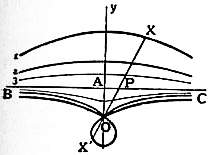
The conchoid is generated as follows:—Let O be a fixed point and BC a fixed straight line; draw any line through O intersecting BC in P and take on the line PO two points X, X′, such that PX = PX′ = a constant quantity. Then the locus of X and X′ is the conchoid. The conchoid is also the locus of any point on a rod which is constrained to move so that it always passes through a fixed point, while a fixed point on the rod travels along a straight line. To obtain the equation to the curve, draw AO perpendicular to BC, and let AO = a; let the constant quantity PX = PX′ = b. Then taking O as pole and a line through O parallel to BC as the initial line, the polar equation is r = a cosec θ ± b, the upper sign referring to the branch more distant from O. The cartesian equation with A as origin and BC as axis of x is x²y² = (a + y)² (b² - y²). Both branches belong to the same curve and are included in this equation. Three forms of the curve have to be distinguished according to the ratio of a to b. If a be less than b, there will be a node at O and a loop below the initial point (curve 1 in the figure); if a equals b there will be a cusp at O (curve 2); if a be greater than b the curve will not pass through O, but from the cartesian equation it is obvious that O is a conjugate point (curve 3). The curve is symmetrical about the axis of y and has the axis of x for its asymptote.
CONCIERGE (a French word of unknown origin; the Latinized form was concergius or concergerius), originally the guardian of a house or castle, in the middle ages a court official who was the custodian of a royal palace. In Paris, when the Palais de la Cité ceased about 1360 to be a royal residence and became the seat of the courts of justice, the Conciergerie was turned into a prison. In modern usage a “concierge” is a hall-porter or janitor.
CONCINI, CONCINO (d. 1617), Count Della Penna, Marshal d’Ancre, Italian adventurer, minister of King Louis XIII. of France, was a native of Florence. He came to France in the train of Marie de’ Medici, and married the queen’s lady-in-waiting, Leonora Dori, known as Galigai. The credit which his wife enjoyed with the queen, his wit, cleverness and boldness made his fortune. In 1610 he had purchased the marquisate of Ancre and the position of first gentleman-in-waiting. Then he obtained successively the governments of Amiens and of Normandy, and in 1614 the bâton of marshal. From then first minister of the realm, he abandoned the policy of Henry IV., compromised his wise legislation, allowed the treasury to be pillaged, and drew upon himself the hatred of all classes. The nobles were bitterly hostile to him, particularly Condé, with whom he negotiated the treaty of Loudun in 1616, and whom he had arrested in September 1616. This was done on the advice of Richelieu, whose introduction into politics was favoured by Concini. But Louis XIII., incited by his favourite Charles d’Albert, due de Luynes, was tired of Concini’s tutelage. The baron de Vitry received in the king’s name the order to imprison him. Apprehended on the bridge of the Louvre, Concini was killed by the guards on the 24th of April 1617. Leonora was accused of sorcery and sent to the stake in the same year.
In 1767 appeared at Brescia a De Concini vita, by D. Sandellius. On the rôle of Concini see the Histoire de France, published under the direction of E. Lavisse, vol. vi. (1905), by Mariéjol.
CONCLAVE (Lat. conclave, from cum, together, and clavis, a key), strictly a room, or set of rooms, locked with a key; in this sense the word is now obsolete in English, though the New English Dictionary gives an example of its use so late as 1753. Its present loose application to any private or close assembly, especially ecclesiastical, is derived from its technical application to the assembly of cardinals met for the election of the pope, with which this article is concerned.
Conclave is the name applied to that system of strict seclusion to which the electors of the pope have been and are submitted, formerly as a matter of necessity, and subsequently as the result of a legislative enactment; hence the word has come to be used of the electoral assembly of the cardinals. This system goes back only as far as the 12th century.
Election of the Popes in Antiquity.—The very earliest episcopal nominations, at Rome as elsewhere, seem without doubt to have been made by the direct choice of the founders of the apostolic Christian communities. But this exceptional method was replaced at an early date by that of election. At Rome the method of election was the same as in other towns: the Roman clergy and people and the neighbouring bishops each took part in it in their several capacities. The people would signify their approbation or disapprobation of the candidates more or less tumultuously, while the clergy were, strictly speaking, the electoral body, met to elect for themselves a new head, and the bishops acted as presidents of the assembly and judges of the election. The choice had to meet with general consent; but we can well imagine that in an assembly of such size, in which the candidates were acclaimed rather than elected by counting votes, the various functions were not very distinct, and that persons of importance, whether clerical or lay, were bound to influence the elections, and sometimes decisively. Moreover, this form of election lent itself to cabals; and these frequently gave rise to quarrels, sometimes involving bloodshed and schisms, i.e. the election of antipopes, as they were later called. Such was the case at the elections of Cornelius (251), Damasus (366), Boniface (418), Symmachus (498), Boniface II. (530) and others. The remedy for this abuse was found in having recourse, more or less freely, to the support of the civil power. The emperor Honorius upheld Boniface against his competitor Eulalius, at the same time laying down that cases of contested election should henceforth be decided by a fresh election; but this would have been a dangerous method and was consequently never applied. Theodoric upheld Symmachus against Laurentius because he had been elected first and by a greater majority. The accepted fact soon became law, and John II. recognized (532) the right of the Ostrogothic court of Ravenna to ratify the pontifical elections. Justinian succeeded to this right together with the kingdom which he had destroyed; he demanded, together with the payment of a tribute of 3000 golden solidi, that the candidate elected should not receive the episcopal consecration till he had obtained the confirmation of the emperor. Hence arose long vacancies of the See, indiscreet interference in the elections by the imperial officials, and sometimes cases of simony and venality. This bondage became lighter in the 7th century, owing rather to the weakening of the imperial power than to any resistance on the part of the popes.
9th to 12th Centuries.—From the emperors of the East the power naturally passed to those of the West, and it was exercised after 824 by the descendants of Charlemagne, who claimed that the election should not proceed until the arrival of their envoys. But this did not last long; at the end of the 9th century, Rome, torn by factions, witnessed the scandal of the posthumous condemnation of Formosus. This deplorable state of affairs lasted almost without interruption till the middle of the 11th century. When the emperors were at Rome, they presided over the elections; when they were away, the rival factions of the barons, the Crescentii and the Alberici especially, struggled for the spiritual power as they did for the temporal. During this period were seen cases of popes imposed by a faction rather than elected, and then, at the mercy of sedition, deposed, poisoned and thrown into prison, sometimes to be restored by force of arms.
The influence of the Ottos (962-1002) was a lesser evil; that of the emperor Otto III. was even beneficial, in that it led to the election of Gerbert (Silvester II., in 999). But this was only a temporary check in the process of decadence, and in 1146 Clement II., the successor of the worthless Benedict IX., admitted that henceforth not only the consecration but even the election of the Roman pontiffs could only take place in presence of the emperor. In fact, after the death of Clement II. the delegates of the Roman clergy did actually go to Polden to ask Henry III. to give them a pope, and similar steps were taken after the death of Damasus II., who reigned only twenty days. Fortunately on this occasion Henry III. appointed, just before his death, a man of high character, his cousin Bruno, bishop of Toul, who presented himself in Rome in company with Hildebrand. From this time began the reform. Hildebrand had the elections of Victor II. (1055), Stephen IX. (1057), and Nicholas II. (1058) carried out according to the canonical form, including the imperial ratification. The celebrated bull In nomine Domini of the 13th of April 1059 determined the electoral procedure; Election reserved to the cardinals. it is curious to observe how, out of respect for tradition, it preserves all the former factors in the election though their scope is modified: “In the first place, the cardinal bishops shall carefully consider the election together, then they shall consult with the cardinal clergy, and afterwards the rest of the clergy and the people shall by giving their assent confirm the new election.” The election, then, is reserved to the members of the higher clergy, to the cardinals, among whom the cardinal bishops have the preponderating position. The consent of the rest of the clergy and the people is now only a formality. The same was the case of the imperial intervention, in consequence of the phrase: “Saving the honour and respect due to our dear son Henry (Henry IV.), according to the concession we have made to him, and equally to his successors, who shall receive this right personally from the Apostolic See.” Thus the emperor has no rights save those he has received as a concession from the Holy See. Gregory VII., it is true, notified his election to the emperor; but as he set up a series of five antipopes, none of Gregory’s successors asked any more for the imperial sanction. Further, by this bull, the emperors would have to deal with the fait accompli; for it provided that, in the event of disturbances aroused by mischievous persons at Rome preventing the election from being carried out there freely and without bias, the cardinal bishops, together with a small number of the clergy and of the laity, should be empowered to go and hold the election where they should think fit; that should difficulties of any sort prevent the enthronement of the new pope, the pope elect would be empowered immediately to act as if he were actually pope. This legislation was definitely accepted by the emperor by the concordat of Worms (1119).
A limited electoral body lends itself to more minute legislation than a larger body; the college for electing the pope, thus reduced so as to consist in practice of the cardinals only, was subjected as time went on to laws of increasing severity. Two points of great importance were established by Alexander III. at the Lateran Council of 1179. The constitution Licet de vitanda discordia makes all the cardinals equally electors, and no longer mentions the lower clergy or the people; it also requires a majority of two-thirds of the votes to decide an election. This latter provision, which still holds good, made imperial antipopes henceforth impossible.
Abuses nevertheless arose. An electoral college too small in numbers, which no higher power has the right of forcing to haste, can prolong disagreements and draw out the course of the election for a long time. It is this The conclave. period during which we actually find the Holy See left vacant most frequently for long spaces of time. The longest of these, however, gave an opportunity for reform and the remedy was found in the conclave, i.e. in the forced and rigid seclusion of the electors. As a matter of fact, this method had previously been used, but in a mitigated form: in 1216, on the death of Innocent III., the people of Perugia had shut up the cardinals; and in 1241 the Roman magistrates had confined them within the “Septizonium”; they took two months, however, to perform the election. Celestine IV. died after eighteen days, and this time, in spite of the seclusion of the cardinals, there was an interregnum of twenty months. After the death of Clement IV. in 1268, the cardinals, of whom seventeen were gathered together at Viterbo, allowed two years to pass without coming to an agreement; the magistrates of Viterbo again had recourse to the method of seclusion: they shut up the electors in the episcopal palace, blocking up all outlets; and since the election still delayed, the people removed the roof of the palace and allowed nothing but bread and water to be sent in. Under the pressure of famine and of this strict confinement, the cardinals finally agreed, on the 1st of September 1271, to elect Gregory X., after an interregnum of two years, nine months and two days.
Taught by experience, the new pope considered what steps could be taken to prevent the recurrence of such abuses; in 1274, at the council of Lyons, he promulgated the constitution Ubi periculum, the substance of which Laws made by Gregory X. was as follows: At the death of the pope, the cardinals who were present are to await their absent colleagues for ten days; they are then to meet in one of the papal palaces in a closed conclave; none of them is to have to wait on him more than one servant, or two at most if he were ill; in the conclave they are to lead a life in common, not even having separate cells; they are to have no communication with the outer world, under pain of excommunication for any who should attempt to communicate with them; food is to be supplied to the cardinals through a window which would be under watch; after three days, their meals are to consist of a single dish only; and after five days, of bread and water, with a little wine. During the conclave the cardinals are to receive no ecclesiastical revenue. No account is to be taken of those who are absent or have left the conclave. Finally, the election is to be the sole business of the conclave, and the magistrates of the town where it was held are called upon to see that these provisions be observed. Adrian V. and John XX. were weak enough to suspend the constitution Ubi periculum; but the abuses at once reappeared; the Holy See was again vacant for long periods; this further proof was therefore decisive, and Celestine V., who was elected after a vacancy of more than two years, took care, before abdicating the pontificate, to revive the constitution of Gregory X., which was inserted in the Decretals (lib. i. tit. vi., de election. cap. 3).
Since then the laws relating to the conclave have been observed, even during the great schism; the only exception was the election of Martin V., which was performed by the cardinals of the three obediences, to which the council of Constance added five prelates of each of the six nations represented in that assembly. The same was the case up to the 16th century. At this period the Italian republics, later Spain, and finally the other powers, took an intimate interest in the choice of the holder of what was a considerable political power; and each brought more or less honest means to bear, sometimes that of simony. It was against simony that Julius II. directed the bull Julius II. Cum tam divino (1503), which directed that simoniacal election of the pope should be declared null; that any one could attack it; that men should withdraw themselves from the obedience of a pope thus elected; that simoniacal agreements should be invalid; that the guilty cardinals should be excommunicate till their death, and that the rest should proceed immediately to a new election. The purpose of this measure was good, but the proposed remedy extremely dangerous; it was fortunately never applied. Similarly, Paul IV. endeavoured by severe punishments to check the intriguing and plotting for the election of a new pope while his predecessor was still living; but the bull Cum secundum (1558) was of no effect.
Pius IV. undertook the task of reforming and completing the legislation of the conclave. The bull In eligendis (of October 1st, 1562), signed by all the cardinals, is a model of precision and wisdom. In addition to the points Pius IV. already stated, we may add the following: that every day there was to be a scrutiny, i.e. a solemn voting by specially prepared voting papers (concealing the name of the voter, and to be opened only in case of an election being made at that scrutiny), and that this was to be followed by the “accessit,” i.e. a second voting, in which the cardinals might transfer their suffrages to those who had obtained the greatest number of votes in the first. Except in case of urgent matters, the election was to form the whole business of the conclave. The cells were to be assigned by lot. The functionaries of the conclave were to be elected by the secret vote of the Sacred College. The most stringent measures were to be taken to ensure seclusion. The bull Aeterni Patris of Gregory XV. (15th of November 1621) Gregory XV. is a collection of minute regulations. In it is the rule compelling each cardinal, before giving his vote, to take the oath that he will elect him whom he shall judge to be the most worthy; it also makes rules for the forms of voting and of the voting papers, for the counting, the scrutiny, and in fact all the processes of the election. A second bull, Decet Romanum Pontificem, of the 12th of March 1622, fixed the ceremonial of the conclave with such minuteness that it has not been changed since.
All previous legislation concerning the conclave was codified and renewed by Pius X.’s bull, Vacante Sede Apostolico (Dec. 25, 1904), which abrogates the earlier texts, except Leo XIII.’s constitution Praedecessores Nostri (May 24, 1882), authorizing occasional derogations in circumstances of difficulty, e.g. the death of a pope away from Rome or an attempt to interfere with the liberty of the Sacred College. The bull of Pius X. is rather a codification than a reform, the principal change being the abolition of the scrutiny of accession and the substitution of a second ordinary scrutiny during the same session.
On some occasions exceptional circumstances have given rise to transitory measures. In 1797 and 1798 Pius VI. authorized the cardinals to act contrary to such of the laws concerning the conclave as a majority of them should decide not to observe, as being impossible in practice. Similarly Pius IX., by means of various acts which remained secret up till 1892, had taken the most minute precautions in order to secure a free and rapid election, and to avoid all interference on the part of the secular powers. We know that the conclaves in which Leo XIII. and Pius X. were elected enjoyed the most complete liberty, and the hypothetical measures foreseen by Pius IX. were not applied.
Until after the Great Schism the conclaves were held in various towns outside of Rome; but since then they The conclave at Rome. have all been held in Rome, with the single exception of the conclave of Venice (1800), and in most cases in the Vatican.
There was no place permanently established for the purpose, but removable wooden cells were installed in the various apartments of the palace, grouped around the Sistine chapel, in which the scrutinies took place. The arrangements prepared in the Quirinal in 1823 did duty only three times, and for the most recent conclaves it was necessary to arrange an inner enclosure within the vast but irregular palace of the Vatican. Each cardinal is accompanied by a clerk or secretary, known for this reason as a conclavist, and by one servant only. With the officials of the conclave, this makes about two hundred and fifty persons who enter the conclave and have no further communication with the outer world save by means of turning-boxes. Since 1870 the solemn ceremonies of earlier times have naturally not been seen; for instance the procession which used to celebrate Modern procedure. the entry into conclave; or the daily arrival in procession of the clergy and the brotherhoods to enquire at the “rota” (turning-box) of the auditors of the Rota: “Habemusne Pontificem?” and their return accompanied by the chanting of the “Veni Creator”; or the “Marshal of the Holy Roman Church and perpetual guardian of the conclave” visiting the churches in state. But a crowd still collects morning and evening in the great square of St Peter’s, towards the time of the completion of the vote, to look for the smoke which rises from the burning of the voting-papers after each session; when the election has not been effected, a little straw is burnt with the papers, and the column of smoke then apprises the spectators that they have still no pope. Within the conclave, the cardinals, alone in the common hall, usually the Sistine chapel, proceed morning and evening to their double vote, the direct vote and the “accessit.” Sometimes these sessions have been very numerous; for example, in 1740, Benedict XIV. was only elected after 255 scrutinies; on other occasions, however, and notably in the case of the last few popes, a well-defined majority has soon been evident, and there have been but few scrutinies. Each vote is immediately counted by three scrutators, appointed in rotation, the most minute precautions being taken to ensure that the voting shall be secret and sincere. When one cardinal has at last obtained two-thirds of the votes, the dean of the cardinals formally asks him whether he accepts his election, and what name he wishes to assume. As soon as he has accepted, the first “obedience” or “adoration” takes place, and immediately after the first cardinal deacon goes to the Loggia of St Peter’s and announces the great news to the assembled people. The conclave is dissolved; on the following day take place the two other “obediences,” and the election is officially announced to the various governments. If the pope be not a bishop (Gregory XVI. was not), he is then consecrated; and finally, a few days after his election, takes place the coronation, from which the pontificate is officially dated. The pope then receives the tiara with the triple crown, the sign of his supreme spiritual authority. The ceremony of the coronation goes back to the 9th century, and the tiara, in the form of a high conical cap, is equally ancient (see Tiara).
In conclusion, a few words should be said with regard to the right of veto. In the 16th and 17th centuries the character of the conclaves was determined by the influence of what were then known as the “factions,” i.e. the formation The right of veto. of the cardinals into groups according to their nationality or their relations with one of the Catholic courts of Spain, France or the Empire, or again according as they favoured the political policy of the late pope or his predecessor. These groups upheld or opposed certain candidates. The Catholic courts naturally entrusted the cardinals “of the crown,” i.e. those of their nation, with the mission of removing, as far as lay in their power, candidates who were distasteful to their party; the various governments could even make public their desire to exclude certain candidates. But they soon claimed an actual right of formal and direct exclusion, which should be notified in the conclave in their name by a cardinal charged with this mission, and should have a decisive effect; this is what has been called the right of veto. We cannot say precisely at what time during the 16th century this transformation of the practice into a right, tacitly accepted by the Sacred College, took place; it was doubtless felt to be less dangerous formally to recognize the right of the three sovereigns each to object to one candidate, than to face the inconvenience of objections, such as were formulated on several occasions by Philip II., which, though less legal in form, might apply to an indefinite number of candidates. The fact remains, however, that it was a right based on custom, and was not supported by any text or written concession; but the diplomatic right was straightforward and definite, and was better than the intrigues of former days. During the 19th century Austria exercised, or tried to exercise, the right of veto at all the conclaves, except that which elected Leo XIII. (1878); it did so again at the conclave of 1903. On the 2nd of August Cardinal Rampolla had received twenty-nine votes, when Cardinal Kolzielsko Puzina, bishop of Cracow, declared that the Austrian government opposed the election of Cardinal Rampolla; the Sacred College considered that it ought to yield, and on the 4th of August elected Cardinal Sarto, who took the name of Pius X. By the bull Commissum Nobis (January 20, 1904), Pius X. suppressed all right of “veto” or “exclusion” on the part of the secular governments, and forbade, under pain of excommunication reserved to the future pope, any cardinal or conclavist to accept from his government the charge of proposing a “veto,” or to exhibit it to the conclave under any form.
Bibliography.—The best and most complete work is Lucius Lector, Le Conclave, origine, histoire, organisation, législation ancienne et moderne (Paris, 1894). See also Ferraris, Prompta Bibliotheca, s. v. Papa, art. i.; Moroni, Dizionario di erudizione storico-ecclesiastica, s. v. Conclave, Conclavisti, Cella, Elezione, Esclusiva; Bouix, De Curia Romana, part i. c. x.; De Papa, part vii. (Paris, 1859, 1870); Barbier de Montault, Le Conclave (Paris, 1878). On the conclave of Leo XIII., R. de Cesare, Conclave di Leone XIII. (Rome, 1888). On the conclave of Pius X.: an eye-witness (Card. Mathieu), Les Derniers Jours de Léon XIII et le conclave (Paris, 1904). See further, for the right of veto: Phillips, Kirchenrecht, t. v. p. 138; Sägmüller, Die Papstwahlen und die Staate (Tübingen, 1890); Die Papstwahlbullen und das staatliche Recht des Exclusive (Tübingen, 1892); Wahrmund, Ausschliessungsrecht der katholischen Staaten (Vienna, 1888).
(A. Bo.*)
CONCORD, a township of Middlesex county, Massachusetts, U.S.A., about 20 m. N.W. of Boston. Pop. (1900) 5652; (1910, U.S. census) 6421. Area 25 sq. m. It is traversed by the Boston & Maine railway. Where the Sudbury and Assabet unite to form the beautiful little Concord river, celebrated by Thoreau, is the village of Concord, straggling, placid and beautiful, full of associations with the opening of the War of Independence and with American literature. Of particular interest is the “Old Manse,” built in 1765 for Rev. William Emerson, in which his grandson R. W. Emerson wrote Nature, and Hawthorne his Mosses from an Old Manse, containing a charming description of the building and its associations. At Concord there is a state reformatory, whose inmates, about 800 in number, are employed in manufacturing various articles, but otherwise the town has only minor business and industrial interests. The introduction of the “Concord” grape, first produced here by Ephraim Bull in 1853, is said to have marked the beginning of the profitable commercial cultivation of table grapes in the United States. Concord was settled and incorporated as a township in 1635, and was (with Dedham) the first settlement in Massachusetts back from the sea-coast. A county convention at Concord village in August 1774 recommended the calling of the first Provincial Congress of Massachusetts—one of the first independent legislatures of America—which assembled here on the 11th of October 1774, and again in March and April 1775. The village became thereafter a storehouse of provisions and munitions of war, and hence became the objective of the British expedition that on the 19th of April 1775 opened with the armed conflict at Lexington (q.v.) the American War of Independence. As the British proceeded to Concord the whole country was rising, and at Concord about 500 minute-men confronted the British regulars who were holding the village and searching for arms and stores. Volleys were exchanged, the British retreated, the minute-men hung on their flanks and from the hillsides shot them down, driving their columns on Lexington. A granite obelisk, erected in 1837, when Emerson wrote his ode on the battle, marks the spot where the first British soldiers fell; while across the stream a fine bionze “Minute-Man” (1875) by D. C. French (a native of Concord) marks the spot where once “the embattled farmers stood and fired the shot heard round the world” (Emerson). Concord was long one of the shire-townships of Middlesex county, losing this honour in 1867. The village is famous as the home of R. W. Emerson, Nathaniel Hawthorne, Henry D. Thoreau, Louisa M. Alcott and her father, A. Bronson Alcott, who maintained here from 1879 to 1888 (in a building still standing) the Concord school of philosophy, which counted Benjamin Peirce, W. T. Harris, Mrs J. W. Howe, T. W. Higginson, Professor William James and Emerson among its lecturers. Emerson, Hawthorne, Thoreau and the Alcotts are buried here in the beautiful Sleepy Hollow Cemetery. Of the various orations (among others one by Edward Everett in 1825) that have been delivered at Concord anniversaries perhaps the finest is that of George William Curtis, delivered in 1875.
See A. S. Hudson, The History of Concord, vol. i. (Concord, 1904); G. B. Bartlett, Concord: Historic, Literary and Picturesque (Boston, 1885); and Mrs J. L. Swayne, Story of Concord (Boston, 1907).
CONCORD, a city and the county-seat of Cabarrus county, North Carolina, U.S.A., on the Rocky river, about 150 m. W.S.W. of Raleigh. Pop. (1890) 4339; (1900) 7910 (1789 negroes); (1910) 8715. It is served by the Southern railway. Concord is situated in a cotton-growing region, and its chief interest is in the manufacture of cotton goods. The city is the seat of Scotia seminary (for negro girls), founded in 1870 and under the care of the Presbyterian Board of Missions for Freedmen, Pittsburgh Pa. Concord was laid out in 1793 and was first incorporated in 1851.
CONCORD, the capital of New Hampshire, U.S.A., and the county-seat of Merrimack county, on both sides of the Merrimac river, about 75 m. N.W. of Boston, Massachusetts. Pop. (1890) 17,004; (1900) 19,632, of whom 3813 were foreign-born; (1910, census) 21,497. Concord is served by the Boston & Maine railway. The area of the city in 1906 was 45.16 sq. m. Concord has broad streets bordered with shade trees; and has several parks, including Penacook, White, Rollins and the Contoocook river. Among the principal buildings are the state capitol, the state library, the city hall, the county court-house, the post-office, a public library (17,000 vols.), the state hospital, the state prison, the Centennial home for the aged, the Margaret Pillsbury memorial hospital, the Rolfe and Rumford asylum for orphan girls, founded by Count Rumford’s daughter, and some fine churches, including the Christian Science church built by Mrs Eddy. There are a soldiers’ memorial arch, a statue of Daniel Webster by Thomas Ball, and statues of John P. Hale, John Stark, and Commodore George H. Perkins, the last by Daniel C. French; and at Penacook, 6 m. N.W. of Concord, there is a monument to Hannah Dustin (see Haverhill). Among the educational institutions are the well-known St Paul’s school for boys (Protestant Episcopal, 1853), about 2 m. W. of the city, and St Mary’s school for girls (Protestant Episcopal, 1885). From 1847 to 1867 Concord was the seat of the Biblical Institute (Methodist Episcopal), founded in Newbury, Vermont, in 1841, removed to Boston as the Boston Theological Seminary in 1867, and after 1871 a part of Boston University. The city has various manufactures, including flour and grist mill products, silver ware, cotton and woollen goods, carriages, harnesses and leather belting, furniture, wooden ware, pianos and clothing; the Boston & Maine Railroad has a large repair shop in the city, and there are valuable granite quarries in the vicinity. In 1905 Concord ranked third among the cities of the state in the value of its factory products, which was $6,387,372, being an increase of 51.7% since 1900. When first visited by the English settlers, the site of Concord was occupied by Penacook Indians; a trading post was built here about 1660. In 1725 Massachusetts granted the land in this vicinity to some of her citizens; but this grant was not recognized by New Hampshire, whose legislature issued (1727) a grant (the Township of Bow) overlapping the Massachusetts grant, which was known as Penacook or Penny Cook. The New Hampshire grantees undertook to establish here a colony of Londonderry Irish; but the Massachusetts settlers were firmly established by the spring of 1727, Massachusetts definitely assumed jurisdiction in 1731, and in 1734 her general court incorporated the settlement under the name of Rumford. The conflicting rights of Rumford and Bow gave rise to one of the most celebrated of colonial land cases, and although the New Hampshire authorities enforced their claims of jurisdiction, the privy council in 1755 confirmed the Rumford settlers in their possession. In 1765 the name was changed to the “parish of Concord,” and in 1784 the town of Concord was incorporated. Here, for some years before the War of American Independence, lived Benjamin Thompson, later Count Rumford. In 1778 and again in 1781-1782 a state constitutional convention met here; the first New Hampshire legislature met at Concord in 1782; the convention which ratified for New Hampshire the Federal Constitution met here in 1788; and in 1808 the state capital was definitely established here. The New Hampshire Patriot, founded here in 1808 (and for twenty years edited) by Isaac Hill (1788-1851), who was a member of the United States Senate in 1831-1836, and governor of New Hampshire in 1836-1839, became one of the leading exponents of Jacksonian Democracy in New England. In 1814 the Middlesex Canal, connecting Concord with Boston, was completed. A city charter granted by the legislature in 1849 was not accepted by the city until 1853.
See J. O. Lyford, The History of Concord, New Hampshire (City History Commission) (2 vols., Concord, 1903); Concord Town Records, 1732-1820 (Concord, 1894); J. B. Moore, Annals of Concord, 1726-1823 (Concord, 1824); and Nathaniel Bouton, The History of Concord (Concord, 1856).
CONCORD, BOOK OF (Liber Concordiae), the collective documents of the Lutheran confession, consisting of the Confessio Augustana, the Apologia Confessionis Augustanae, the Articula Smalcaldici, the Catechismi Major et Minor and the Formula Concordiae. This last was a formula issued on the 25th of June 1580 (the jubilee of the Augsburg Confession) by the Lutheran Church in an attempt to heal the breach which, since the death of Luther, had been widening between the extreme Lutherans and the Crypto-Calvinists. Previous attempts at concord had been made at the request of different rulers, especially by Jacob Andreä with his Swabian Concordia in 1573, and Abel Scherdinger with the Maulbronn Formula in 1575. In 1576 the elector of Saxony called a conference of theologians at Torgau to discuss these two efforts and from them produce a third. The Book of Torgau was evolved, circulated and criticized; a new committee, prominent on which was Martin Chemnitz, sitting at Bergen near Magdeburg, considered the criticisms and finally drew up the Formula Concordiae. It consists of (a) the “Epitome,” (b) the “Solid Repetition and Declaration,” each part comprising twelve articles; and was accepted by Saxony, Württemberg, Baden among other states, but rejected by Hesse, Nassau and Holstein. Even the free cities were divided, Hamburg and Lübeck for, Bremen and Frankfort against. Hungary and Sweden accepted it, and so finally did Denmark, where at first it was rejected, and its publication made a crime punishable by death. In spite of this very limited reception the Formula Concordiae has always been reckoned with the five other documents as of confessional authority.
See P. Schaff, Creeds of Christendom, i. 258-340, iii. 92-180.
CONCORDANCE (Late Lat. concordantia, harmony, from cum, with, and cor, heart), literally agreement, harmony; hence derivatively a citation of parallel passages, and specifically an alphabetical arrangement of the words contained in a book with citations of the passages in which they occur. Concordances in this last sense were first made for the Bible. Originally the word was only used in this connexion in the plural concordantiae, each group of parallel passages being properly a concordantia. The Germans distinguish between concordances of things and concordances of words, the former indexing the subject matter of a book (“real” concordance), the latter the words (“verbal” concordance).
The original impetus to the making of concordances was due to the conviction that the several parts of the Bible are consistent with each other, as parts of a divine revelation, and may be combined as harmonious elements in one system of spiritual truth. To Anthony of Padua (1195-1231) ancient tradition ascribes the first concordance, the anonymous Concordantiae Morales, of which the basis was the Vulgate. The first authentic work of the kind was due to Cardinal Hugh of St Cher, a Dominican monk (d. 1263), who, in preparing for a commentary on the Scriptures, found the need of a concordance, and is reported to have used for the purpose the services of five hundred of his brother monks. This concordance was the basis of two which succeeded in time and importance, one by Conrad of Halberstadt (fl. c. 1290) and the other by John of Segovia in the next century. This book was published in a greatly improved and amplified form in the middle of the 19th century by David Nutt, of London, edited by T. P. Dutripon. The first Hebrew concordance was compiled in 1437-1445 by Rabbi Isaac Nathan b. Kalonymus of Arles. It was printed at Venice in 1523 by Daniel Bomberg, in Basel in 1556, 1569 and 1581. It was published under the title Meir Natib, “The Light of the Way.” In 1556 it was translated into Latin by Johann Reuchlin, but many errors appeared in both the Hebrew and the Latin edition. These were corrected by Marius de Calasio, a Franciscan friar, who published a four volume folio Concordantiae Sacr. Bibl. Hebr. et Latin. at Rome, 1621, much enlarged, with proper names included. Another concordance based on Nathan’s was Johann Buxtorf the elder’s Concordantiae Bibl. Ebraicae nova et artificiosa methodo dispositae, Basel, 1632. It marks a stage in both the arrangement and the knowledge of the roots of words, but can only be used by those who know the massoretic system, as the references are made by Hebrew letters and relate to rabbinical divisions of the Old Testament. Calasio’s concordance was republished in London under the direction of William Romaine in 1747-1749, in four volumes folio, under the patronage of all the monarchs of Europe and also of the pope. In 1754 John Taylor, D.D., a Presbyterian divine in Norwich, published in two volumes the Hebrew Concordance adapted to the English Bible, disposed after the manner of Buxtorf. This was the most complete and convenient concordance up to the date of its publication. In the middle of the 19th century Dr Julius Fürst issued a thoroughly revised edition of Buxtorf’s concordance. The Hebräischen und chaldäischen Concordanz zu den Heiligen Schriften Alten Testaments (Leipzig, 1840) carried forward the development of the concordance in several directions. It gave (1) a corrected text founded on Hahn’s Vanderhoogt’s Bible; (2) the Rabbinical meanings; (3) explanations in Latin, and illustrations from the three Greek versions, the Aramaic paraphrase, and the Vulgate; (4) the Greek words employed by the Septuagint as renderings of the Hebrew; (5) notes on philology and archaeology, so that the concordance contained a Hebrew lexicon. An English translation by Dr Samuel Davidson was published in 1867. A revised edition of Buxtorf’s work with additions from Fürst’s was published by B. Bär (Stettin, 1862). A new concordance embodying the matter of all previous works with lists of proper names and particles was published by Solomon Mandelkern in Leipzig (1896); a smaller edition of the same, without quotations, appeared in 1900. There are also concordances of Biblical proper names by G. Brecher (Frankfort-on-Main, 1876) and Schusslovicz (Wilna, 1878).
A Concordance to the Septuagint was published at Frankfort in 1602 by Conrad Kircher of Augsburg; in this the Hebrew words are placed in alphabetical order and the Greek words by which they are translated are placed under them. A Septuagint concordance, giving the Greek words in alphabetical order, was published in 1718 in two volumes by Abraham Tromm, a learned minister at Groningen, then in the eighty-fourth year of his age. It gives the Greek words in alphabetical order; a Latin translation; the Hebrew word or words for which the Greek term is used by the Septuagint; then the places where the words occur in the order of the books and chapters; at the end of the quotations from the Septuagint places are given where the word occurs in Aquila, Symmachus and Theodotion, the other Greek translations of the O. T.; and the words of the Apocrypha follow in each case. Besides an index to the Hebrew and Chaldaic words there is another index which contains a lexicon to the Hexapla of Origen. In 1887 (London) appeared the Handy Concordance of the Septuagint giving various readings from Codices Vaticanus, Alexandrinus, Sinaiticus and Ephraemi, with an appendix of words from Origen’s Hexapla, not found in the above manuscripts, by G. M., without quotations. A work of the best modern scholarship was brought out in 1897 by the Clarendon Press, Oxford, entitled A Concordance to the Septuagint and the other Greek versions of the Old Testament including the Apocryphal Books, by Edwin Hatch and H. A. Redpath, assisted by other scholars; this was completed in 1900 by a list of proper names.
The first Greek concordance to the New Testament was published at Basel in 1546 by Sixt Birck or Xystus Betuleius (1500-1554), a philologist and minister of the Lutheran Church. This was followed by Stephen’s concordance (1594) planned by Robert Stephens and published by Henry, his son. Then in 1638 came Schmied’s ταμιεῖον, which has been the basis of subsequent concordances to the New Testament. Erasmus Schmied or Schmid was a Lutheran divine who was professor of Greek in Wittenberg, where he died in 1637. Revised editions of the ταμιεῖον were published at Gotha in 1717, and at Glasgow in 1819 by the University Press. In the middle of the 19th century Charles Hermann Bruder brought out a beautiful edition (Tauchnitz) with many improvements. The apparatus criticus was a triumph of New Testament scholarship. It collates the readings of Erasmus, R. Stephens’ third edition, the Elzevirs, Mill, Bengel, Webster, Knapp, Tittman, Scholz, Lachmann. It also gives a selection from the most ancient patristic MSS. and from various interpreters. No various reading of critical value is omitted. An edition of Bruder with readings of Samuel Prideaux Tregelles was published in 1888 under the editorship of Westcott and Hort. The Englishman’s Greek Concordance of the New Testament, and the Englishman’s Hebrew and Chaldee Concordance, are books intended to put the results of the above-mentioned works at the service of those who know little Hebrew or Greek. Every word in the Bible is given in Hebrew or Greek, the word is transliterated, and then every passage in which it occurs is given—the word, however it may be translated, being italicized. They are the work of George V. Wigram assisted by W. Burgh and superintended by S. P. Tregelles, B. Davidson and W. Chalk (1843; 2nd ed. 1860). Another book which deserves mention is, A Concordance to the Greek Testament with the English version to each word; the principal Hebrew roots corresponding to the Greek words of the Septuagint, with short critical notes and an index, by John Williams, LL.D., Lond. 1767.
In 1884 Robert Young, author of an analytical concordance mentioned below, brought out a Concordance to the Greek New Testament with a dictionary of Bible Words and Synonyms: this contains a concise concordance to eight thousand changes made in the Revised Testament. Another important work of modern scholarship is the Concordance to the Greek Testament, edited by the Rev. W. F. Moulton and A. E. Geden, according to the texts adopted by Westcott and Hort, Tischendorf, and the English revisers.
The first concordance to the English version of the New Testament was published in London, 1535, by Thomas Gybson. It is a black-letter volume entitled The Concordance of the New Testament most necessary to be had in the hands of all soche as delyte in the communicacion of any place contayned in ye New Testament.
The first English concordance of the entire Bible was John Marbeck’s, A Concordance, that is to saie, a worke wherein by the order of the letters of the A.B.C. ye maie redely find any worde conteigned in the whole Bible, so often as it is there expressed or mentioned, Lond. 1550. Although Robert Stephens had divided the Bible into verses in 1545, Marbeck does not seem to have known this and refers to the chapters only. In 1550 also appeared Walter Lynne’s translation of the concordance issued by Bullinger, Jude, Pellican and others of the Reformers. Other English concordances were published by Cotton, Newman, and in abbreviated forms by John Downham or Downame (cd. 1652), Vavasor Powell (1617-1670), Jackson and Samuel Clarke (1626-1701). In 1737 Alexander Cruden (q.v.), a London bookseller, born and educated in Aberdeen, published his Complete Concordance to the Holy Scriptures of the Old and New Testament, to which is added a concordance to the books called Apocrypha. This book embodied, was based upon and superseded all its predecessors. Though the first edition was not remunerative, three editions were published during Cruden’s life, and many since his death. Cruden’s work is accurate and full, and later concordances only supersede his by combining an English with a Greek and Hebrew concordance. This is done by the Critical Greek and English Concordance prepared by C. F. Hudson, H. A. Hastings and Ezra Abbot, LL.D., published in Boston, Mass., and by the Critical Lexicon and Concordance to the English and Greek New Testament, by E. L. Bullinger, 1892. The Interpreting Concordance to the New Testament, edited by James Gall, shows the Greek original of every word, with a glossary explaining the Greek words of the New Testament, and showing their varied renderings in the Authorized Version. The most convenient of these is Young’s Analytical Concordance, published in Edinburgh in 1879, and since revised and reissued. It shows (1) the original Hebrew or Greek of any word in the English Bible; (2) the literal and primitive meaning of every such original word; (3) thoroughly reliable parallel passages. There is a Students’ Concordance to the Revised Version of the New Testament showing the changes embodied in the revision, published under licence of the universities; and a concordance to the Revised Version by J. A. Thoms for the Christian Knowledge Society.
Biblical concordances having familiarized students with the value and use of such books for the systematic study of an author, the practice of making concordances has now become common. There are concordances to the works of Shakespeare, Browning and many other writers.
(D. Mn.)
CONCORDAT (Lat. concordatum, agreed upon, from con-, together, and cor, heart), a term originally denoting an agreement between ecclesiastical persons or secular persons, but later applied to a pact concluded between the ecclesiastical authority and the secular authority on ecclesiastical matters which concern both, and, more specially, to a pact concluded between the pope, as head of the Catholic Church, and a temporal sovereign for the regulation of ecclesiastical affairs in the territory of such sovereign. It is to concordats in this later sense that this article refers.
No one now questions the profound distinction that exists between the two powers, spiritual and temporal, between the church and the state. Yet these two societies are none the less in inevitable relation. The same men go to compose both; and the church, albeit pursuing a spiritual end, cannot dispense with the aid of temporal property, which in its nature depends on the organization of secular society. It follows of necessity that there are some matters which may be called “mixed,” and which are the legitimate concern of the two powers, such as church property, places of worship, the appointment and the emoluments of ecclesiastical dignitaries, the temporal rights and privileges of the secular and regular clergy, the regulation of public worship, and the like. The existence of such mixed matters gives rise to inevitable conflicts of jurisdiction, which may lead, and sometimes have led, to civil war. It is, therefore, to the general interest that all these matters should be settled pacifically, by a common accord; and hence originated those conventions between the two powers which are known by the significant name of concordat, the official name being pactum concordatum or solemnis conventio. In theory these agreements may result from the spontaneous and pacific initiative of the contracting parties, but in reality their object has almost always been to terminate more or less acute conflicts and remedy more or less disturbed situations. It is for this reason that concordats always present a clearly marked character of mutual concession, each of the two powers renouncing certain of its claims in the interests of peace.
For the purposes of a concordat the state recognizes the official status of the church and of its ministers and tribunals; guarantees it certain privileges; and sometimes binds itself to secure for it subsidies representing compensation for past spoliations. The pope on his side grants the temporal sovereign certain rights, such as that of making or controlling the appointment of dignitaries; engages to proceed in harmony with the government in the creation of dioceses or parishes; and regularizes the situation produced by the usurpation of church property &c. The great advantage of concordats—indeed their principal utility—consists in transforming necessarily unequal unilateral claims into contractual obligations analogous to those which result from an international convention. Whatever the obligations of the state towards the ecclesiastical society may be in pure theory, in practice they become more precise and stable when they assume the nature of a bilateral convention by which the state engages itself with regard to a third party. And reciprocally, whatever may be the absolute rights of the ecclesiastical society over the appointment of its dignitaries, the administration of its property, and the government of its adherents, the exercise of these rights is limited and restricted by the stable engagements and concessions of the concordatory pact, which bind the head of the church with regard to the nations.
A concordat may assume divers forms,—historically, three. The most common in modern times is that of a diplomatic convention debated between the authorized mandatories of the high contracting parties and subsequently ratified by the latter; as, for example, the French concordat of 1801. Or, secondly, the concordat may result from two identical separate acts, one emanating from the pope and the other from the sovereign; this was the form of the first true concordat, that of Worms, in 1122. A third form was employed in the case of the concordat of 1516 between Leo X. and Francis I. of France; a papal bull published the concordat in the form of a concession by the pope, and it was afterwards accepted and published by the king as law of the country. The shades which distinguish these three forms are not without significance, but they in no way detract from the contractual character of concordats.
Since concordats are contracts they give rise to that special mutual obligation which results from every agreement freely entered into; for a contract is binding on both parties to it. Concordats are undoubtedly conventions of a particular nature. They may make certain concessions or privileges once given without any corresponding obligation; they constitute for a given country a special ecclesiastical law; and it is thus that writers have sometimes spoken of concordats as privileges. Again, it is quite certain that the spiritual matters upon which concordats bear do not concern the two powers in the same manner and in the same degree; and in this sense concordats are not perfectly equal agreements. Finally, they do not assume the contracting parties to be totally independent, i.e. regard is had to the existence of anterior rights or duties. But with these reservations it must unhesitatingly be said that concordats are bilateral or synallagmatic contracts, from which results an equal mutual obligation for the two parties, who enter into a juridical engagement towards each other. Latterly certain Catholics have questioned this equality of the concordatory obligation, and have aroused keen discussion. According to Maurice de Bonald (Deux questions sur le concordat de 1801, Geneva, 1871), who exaggerates the view of Cardinal Tarquini (Instit. juris publ. eccl., 1862 and 1868), concordats would be pure privileges granted by the pope; the pope would not be able to enter into agreements on spiritual matters or impose restraints upon the power of his successors; and consequently he would not bind himself in any juridical sense and would be able freely to revoke concordats, just as the author of a privilege can withdraw it at his pleasure. This exaggerated argument found a certain number of supporters, several of whom nevertheless sensibly weakened it. But the best canonists, from the Roman professor De Angelis (Prael. juris canon. i. 106) onwards, and all jurists, have victoriously refuted this theory, either by insisting on the principles common to all agreements or by citing the formal text of several concordats and papal acts, which are as explicit as possible. They have thus upheld the true contractual nature of concordats and the mutual juridical obligation which results from them.
The foregoing statements must not be taken to mean that concordats are in their nature perpetual, and that they cannot be broken or denounced. They have the perpetuity of conventions which contain no time limitation; but, like every human convention, they can be denounced, in the form in use for international treaties, and for good reasons, which are summed up in the exigencies of the general good of the country. Nevertheless, there is no example of a concordat having been denounced or broken by the popes, whereas several have been denounced or broken by the civil powers, sometimes in the least diplomatic manner, as in the case of the French concordat in 1905. The rupture of the concordat at once terminates the obligations which resulted from it on both sides; but it does not break off all relation between the church and the state, since the two societies continue to coexist on the same territory. To the situation defined by concordat, however, succeeds another situation, more or less uncertain and more or less strained, in which the two powers legislate separately on mixed matters, sometimes not without provoking conflicts.
We cannot describe in detail the objects of concordatory conventions. They bear upon very varied matters,1 and we must confine ourselves here to a brief résumé. In the first place is the official recognition by the state of the Catholic religion and its ministers. Sometimes the Catholic religion is declared to be the state religion, and at least the free and public exercise of its worship is guaranteed. Several conventions guarantee the free communication of the bishops, clergy and laity with the Holy See; and this admits of the publication and execution of apostolic letters in matters spiritual. Others define those affairs of major importance which may be or must be referred to the Holy See by appeal, or the decision of which is reserved to the Holy See. On several occasions concordats have established a new division of dioceses, and provided that future erections or divisions should be made by a common accord. Analogous provisions have been made with regard to the territorial divisions within the dioceses; parishes have been recast, and the consent of the two authorities has been required for the establishment of new parishes. As regards candidates for ecclesiastical offices, the concordats concluded with Catholic nations regularly give the sovereign the right to nominate or present to bishoprics, often also to other inferior benefices, such as canonries, important parishes and abbeys; or at least the choice of the ecclesiastical authority is submitted to the approval of the civil power. In all cases canonical institution (which confers ecclesiastical jurisdiction) is reserved to the pope or the bishops. In countries where the head of the state is not a Catholic, the bishops are regularly elected by the chapters, but the civil power has the right to strike out objectionable names from the list of candidates which is previously submitted to it. Other conventions secure the exercise of the jurisdiction of the bishops in their diocese, and determine precisely their authority over seminaries and other ecclesiastical establishments of instruction and education, as well as over public schools, so far as concerns the teaching of religion. Certain concordats deal with the orders and congregations of monks and nuns with a view to subjecting them to a certain control while securing to them the legal exercise of their activities. Ecclesiastical immunities, such as reservation of the criminal cases of the clergy, exemption from military service and other privileges, are expressly maintained in a certain number of pacts. One of the most important subjects is that of church property. An agreement is come to as to the conditions on which pious foundations are able to be made; the measure in which church property shall contribute to the public expenses is indicated; and, in the 19th century, the position of those who have acquired confiscated church property is regularized. In exchange for this surrender by the church of its ancient property the state engages to contribute to the subsistence of the ministers of public worship, or at least of certain of them.
Scholars agree in associating the earliest concordats with the celebrated contest about investitures (q.v.), which so profoundly agitated Christian Europe in the 11th and 12th centuries. The first in date is that which was concluded for England with Henry I. in 1107 by the efforts of St Anselm. The convention of Sutri of 1111 between Pope Paschal II. and the emperor Henry V. having been rejected, negotiations were resumed by Pope Calixtus II. and ended in the concordat of Worms (1122), which was confirmed in 1177 by the convention between Alexander III. and the emperor Frederick I. In this concordat a distinction was made between spiritual investiture, by the ring and pastoral staff, and lay or feudal investiture, by the sceptre. The emperor renounced investiture by ring and staff, and permitted canonical elections; the pope on his part recognized the king’s right to perform lay investiture and to assist at elections. Analogous to this convention was the concordat concluded between Nicholas IV. and the king of Portugal in 1289.
The lengthy discussions on ecclesiastical benefices in Germany ended finally in the concordat of Vienna, promulgated by Nicholas V. in 1448. Already at the council of Constance attempts had been made to reduce the excessive papal reservations and taxes in the matter of benefices, privileges which had been established under the Avignon popes and during the Great Schism; for example, Martin V. had had to make with the different nations special arrangements which were valid for five years only, and by which he renounced the revenues of vacant benefices. The council of Basel went further: it suppressed annates and all the benefice reservations which did not appear in the Corpus Juris. Eugenius IV. repudiated the Basel decrees, and the negotiations terminated in what was called the “concordat of the princes,” which was accepted by Eugenius IV. on his death-bed (bulls of February 5 and 7, 1447). In February 1448 Nicholas V. concluded the arrangement, which took the name of the concordat of Vienna. This concordat, however, was not received as law of the Empire. In Germany the concessions made to the pope and the reservations maintained by him in the matter of taxes and benefices were deemed excessive, and the prolonged discontent which resulted was one of the causes of the success of the Lutheran Reformation.
In France the opposition to the papal exactions had been still more marked. In 1438 the Pragmatic Sanction of Bourges adopted and put into practice the Basel decrees, and in spite of the incessant protests of the Holy See the Pragmatic was observed throughout the 15th century, even after its nominal abolition by Louis XI. in 1461. The situation was modified by the concordat of Bologna, which was personally negotiated by Leo X. and Francis I. of France at Bologna in December 1515, inserted in the bull Primitiva (August 18, 1516), and promulgated as law of the realm in 1517, but not without rousing keen opposition. All bishoprics, abbeys and priories were in the royal nomination, the canonical institution belonging to the pope. The pope preserved the right to nominate to vacant benefices in curia and to certain benefices of the chapters, but all the others were in the nomination of the bishops or other inferior collators. However, the exercise of the pope’s right of provision still left considerable scope for papal intervention, and the pope retained the annates.
In the 17th century we have only to mention the concordat between Urban VIII. and the emperor Ferdinand II. for Bohemia in 1640. In the 18th century concordats are numerous: there are two for Spain, in 1737 and 1753; two for the duchy of Milan, in 1757 and 1784; one for Poland, in 1736; five for Sardinia and Piedmont, in 1727, 1741, 1742, 1750 and 1770; and one for the kingdom of the Two Sicilies in 1741.
After the political and territorial upheavals which marked the end of the 18th century and the beginning of the 19th, all these concordats either fell to the ground or had to be recast. In the 19th century we find a long series of concordats, of which a good number are still in force. The first in date and importance is that of 1801, concluded for France between Napoleon, First Consul, and Pius VII. after laborious negotiations. Save in the provisions relating to ecclesiastical benefices, all the property of which had been confiscated, it reproduced the concordat of 1516. The pope condoned those who had acquired church property; and by way of compensation the government engaged to give the bishops and curés suitable salaries. The concordat was solemnly promulgated on Easter Day 1802, but the government had added to it unilateral provisions of Gallican tendencies, which were known as the Organic Articles. After having been the law of the Church of France for a century, it was denounced by the French government in 1905. It remains, however, partly in force for Belgium and Alsace-Lorraine, which formed part of French territory in 1801.
We conclude with a brief chronological survey of the concordats during the 19th century, some now abrogated or replaced, others maintained. It must be observed that the denunciation of a concordat by a nation does not necessarily entail the separation of the church and the state in that country or the rupture of diplomatic relations with Rome.
1803. For the Italian republic, between Napoleon and Pius VII., analogous to the French concordat; abrogated.
1813. It is impossible to designate as a concordat the concessions which were wrested by violence from Pius VII. when ill and in seclusion at Fontainebleau, and which he at once retracted.
1817. For Bavaria; still in force.
1817. New French concordat, in which Louis XVIII. endeavoured to revive the concordat of 1516; but it was not put to the vote in the chambers, and never came into force.
1817. For Piedmont, completed in 1836 and 1841; was suppressed, like all other Italian concordats, by the formation of the kingdom of Italy.
1818. For the Two Sicilies, completed in 1834; lasted until the invasion of the kingdom of Naples by Piedmont.
1821. For Prussia; still in force.
1821. For the Rhine provinces not incorporated in Prussia, with the special object of regulating episcopal elections; concerned Württemberg, Baden, Hesse, Saxony, Nassau, Frankfort, the Hanseatic towns, Oldenburg and Waldeck. This first concordat was immediately suspended, and was not ratified until 1827; it is partially maintained. It had to be replaced by new concordats concluded with Württemberg in 1857 and the grand-duchy of Baden in 1859; but these conventions, not having been ratified by those countries, never came into force.
1824. For the kingdom of Hanover; maintained.
1827. For Belgium and Holland; abandoned by a common accord.
1828 and 1845. For Switzerland, for the reorganization of the bishoprics of Basel and Soleure; in force.
1847. For Russia, never applied by Russia. It was followed by several partial conventions.
1851. For Tuscany; lasted until the formation of the kingdom of Italy.
1851. For Spain, completed in 1859 and 1888; in force.
A convention on the religious orders was concluded in 1904, but had not received the assent of the Senate in 1908.
1855. For Austria; denounced in 1870. Several of its provisions are maintained by unilateral Austrian laws. The emperor of Austria continues to nominate to bishoprics by virtue of rights anterior to this concordat.
1857. For Portugal, completed in 1886 for the Portuguese possessions in the Indies; in force.
1886. For Montenegro; in force.
The numerous concordats concluded towards the middle of the 19th century with several of the South American republics either have not come into force or have been denounced and replaced by a more or less pacific modus vivendi.
For texts see Vincenzio Nussi, Quinquaginta conventiones de rebus ecclesiasticis (Rome, 1869; Mainz, 1870); Branden, Concordata inter S. Sedem et inclytam nationem Germaniae, &c. (undated). On the nature and obligation of concordats see Mgr. Giobbio, I Concordati (Monza, 1900); idem, Lezioni di diplomazia ecclesiastica (Rome, 1899-1903); Cardinal Cavagnis, Institutiones juris publici ecclesiastici (Rome, 1906). For the French concordats see A. Baudrillard, Quatre cents ans de concordat (Paris, 1905); Boulay de la Meurthe, Documents sur la négociation du concordat et sur les autres rapports de la France avec le Saint-Siège (Paris, 1891-1905); Cardinal Mathieu, Le Concordat de 1801 (Paris, 1903); E. Sevestre, Le Concordat de 1801, l’histoire, le texte, la destinée (Paris, 1905). On the relations between the church and the state in various countries see Vering, Kirchenrecht, §§ 30-53.
(A. Bo.*)
CONCORDIA, a Roman goddess, the personification of peace and goodwill. Several temples in her honour were erected at Rome, the most ancient being one on the Capitol, dedicated to her by Camillus (367 B.C.), subsequently restored by Livia, the wife of Augustus, and consecrated by Tiberius (A.D. 10). Other temples were frequently built to commemorate the restoration of civil harmony. Offerings were made to Concordia on the birthdays of emperors, and Concordia Augusta was worshipped as the promoter of harmony in the imperial household. Concordia was represented as a matron holding in her right hand a patera or an olive branch, and in her left a cornu copiae or a sceptre. Her symbols were two hands joined together, and two serpents entwined about a herald’s staff.
CONCORDIA (mod. Concordia Sagittaria), an ancient town of Venetia, in Italy, 16 ft. above sea-level, 31 m. W. of Aquileia, at the junction of roads to Altinum and Patavium, to Opitergium (and thence either to Vicetia and Verona, or Feltria and Tridentum), to Noricum by the valley of the Tilaventus (Tagliamento), and to Aquileia. It was a mere village until the time of Augustus, who made it a colony. Under the later empire it was one of the most important towns of Italy; it had a strong garrison and a factory of missiles for the army. The cemetery of the garrison has been excavated since 1873, and a large number of important inscriptions, the majority belonging to the end of the 4th and the beginning of the 5th centuries, have been discovered. It was taken and destroyed by Attila in A.D. 452. Considerable remains of the ancient town have been found—parts of the city walls, the sites of the forum and the theatre, and probably that of the arms factory. The objects found are preserved at Portogruaro, 1¼ m. to the N. The see of Concordia was founded at an early period, and transferred in 1339 to Portogruaro, where it still remains. The baptistery of Concordia was probably erected in 1100.
See Ch. Hülsen in Pauly-Wissowa, Realencyclopädie, iv. (Stuttgart, 1901) 830.
(T. As.)
CONCRETE (Lat. concretus, participle of concrescere, to grow together), a term used in various technical senses with the general significance of combination, conjunction, solidity. Thus the building material made up of separate substances combined into one is known as concrete (see below). In mathematics and music, the adjective has been used as synonymous with “continuous” as opposed to “discrete,” i.e. “separate,” “discontinuous.” This antithesis is no doubt influenced by the idea that the two words derive from a common origin, whereas “discrete” is derived from the Latin discernere. In logic and also in common language concrete terms are those which signify persons or things as opposed to abstract terms which signify qualities, relations, attributes (so J. S. Mill). Thus the term “man” is concrete, while “manhood” and “humanity” are abstract, the names of the qualities implied. Confusions between abstract and concrete terms are frequent; thus the word “relation,” which is strictly an abstract term implying connexion between two things or persons, is often used instead of the correct term “relative” for people related to one another. Concrete terms are further subdivided as Singular, the names of things regarded as individuals, and General or Common, the names which a number of things bear in common in virtue of their possession of common characteristics. These latter terms, though concrete in so far as they denote the persons or things which are known by them (see Denotation), have also an abstract sense when viewed connotatively, i.e. as implying the quality or qualities in isolation from the individuals. The ascription of adjectives to the class of concrete terms, upheld by J. S. Mill, has been disputed on the ground that adjectives are applied both to concrete and to abstract terms. Hence some logicians make a separate class for adjectives, as being the names neither of things nor of qualities, and describe them as Attributive terms.
CONCRETE, the name given to a building material consisting generally of a mixture of broken stone, sand and some kind of cement. To these is added water, which combining chemically with the cement conglomerates the whole mixture into a solid mass, and forms a rough but strong artificial stone. It has thus the immense advantage over natural stone that it can be easily moulded while wet to any desired shape or size. Moreover, its constituents can be obtained in almost any part of the world, and its manufacture is extremely simple. On account of these properties, builders have come to give it a distinct preference over stone, brick, timber and other building materials. So popular has it become that besides being used for massive constructions like breakwaters, dock walls, culverts, and for foundations of buildings, lighthouses and bridges, it is also proving its usefulness to the architect and engineer in many other ways. A remarkable extension of the use of concrete has been made possible by the introduction of scientific methods of combining it with steel or iron. The floors and even the walls of important buildings are made of this combination, and long span bridges, tall factory chimneys, and large water-tanks are among the many novel uses to which it has been put. Piles made of steel concrete are driven into the ground with blows that would shatter the best of timber. A fuller description of the combination of steel and concrete will be given later.
The constituents of concrete are sometimes spoken of as the matrix and the aggregate, and these terms, though somewhat old-fashioned, are convenient. The matrix is the lime or cement, whose chemical action with the added water causes the concrete to solidify; and the aggregate is the broken stone or hard material Constituents. which is embedded in the matrix. The matrix most commonly used is Portland cement, by far the best and strongest of them all. The subject of its manufacture and examination is a most important and interesting one, and the special article dealing with it should be studied (see Cement), Here it will only be said that before using Portland cement very careful tests should be made to ascertain its quality and condition. Moreover, it should be kept in a damp-proof store for a few weeks; and when taken out for use it should be mixed and placed in position as quickly as possible, because rain, or even moist air, spoils it by causing it to set prematurely. The oldest of all the matrices is lime, and many splendid examples of its use by the Romans still exist. It has been to a great extent superseded by Portland cement, on account of the much greater strength of the latter, though lime concrete is still used in many places for dry foundations and small structures. To be of service the lime should be what is known as “hydraulic,” that is, not pure or “fat,” but containing some argillaceous matter, and should be carefully slaked with water before being mixed with the aggregate. To ensure this being properly done, the lumps of lime should be broken up small, and enough water to slake them should be added, the lime then being allowed to rest for about forty-eight hours, when the water changes the particles of quicklime to hydrate of lime, and breaks up the hard lumps into a powder. The hydrated lime, after being passed through a fine screen to sort out any lumps unaffected by the water, is ready for concrete making, and if not required at once should be stored in a dry place. Other matrices are slag cement, a comparatively recent invention, and some other natural and artificial cements which find occasional advocates. Materials like tar and pitch are sometimes employed as a matrix; they are used hot and without water, the solidifying action being due to cooling and to evaporation of the mineral oils contained in them. Whatever matrix is used, it is almost invariably “diluted” with sand, the grains of which become coated with the finer particles of the matrix. The sand should be coarse-grained and hard. It should be free from dirt—that is to say, free from clay or soft mud, for instance, which prevents the cement adhering to its particles, or again from sewage matter or any substance which will chemically destroy the matrix. The grains should show no signs of decay, and by preference should be of an angular shape. The sand obtained by crushing granite and hard stones is excellent. When lime is used as a matrix, certain natural earths such as pozzuolana or trass, or, failing these, powdered bricks or tiles, may be used instead of sand with great advantage. They have the property of entering into chemical combination with the lime, forming a hard setting compound, and increasing the hardness of the resulting concrete.