VOLUME VI SLICE II Chicago, University of to Chiton (continued 9)
Reading edition
The ruin wrought in Peking during the two months’ fighting was appalling. Apart from the wholesale destruction of foreign property in the Tatar city, and of Chinese as well as European buildings in the vicinity of the legations, the Looting of Peking. wealthiest part of the Chinese city had been laid in ashes. The flames from a foreign drug store fired by the Boxers had spread to the adjoining buildings, and finally consumed the whole of the business quarter with all its invaluable stores of silks, curiosities, furs, &c. The retribution which overtook Peking after its capture by the international forces was scarcely less terrible. Looting was for some days almost universal. Order was, however, gradually restored, first in the Japanese and then in the British and American quarters, though several months elapsed before there was any real revival of native confidence.
So unexpected had been the rapid and victorious advance of the allies, that the dowager-empress with the emperor and the rest of the court did not actually leave Peking until the day after the legations had been relieved. But Flight of the Chinese court. the northern and western portions of the Tatar city had not yet been occupied, and the fugitives made good their escape on the 15th. When the allies some days later marched through the Forbidden City, they only found a few eunuchs and subordinate officials in charge of the imperial apartments. At the end of September, Field Marshal Count von Waldersee, with a German expeditionary force of over 20,000 men, arrived to assume the supreme command conferred upon him with the more or less willing assent of the other powers.
The political task which confronted the powers after the occupation of Peking was far more arduous than the military one. The action of the Russians in Manchuria, even in a treaty port like Niu-chwang, the seizure of the railway Restoration of order. line not only to the north of the Great Wall, but also from Shan-hai-kwan to Peking, by the Russian military authorities, and the appropriation of an extensive line of river frontage at Tientsin as a Russian “settlement,” were difficult to reconcile with the pacific assurances of disinterestedness which Russia, like the rest of the powers, had officially given. Great anxiety prevailed as to the effect of the flight of the Chinese court in other parts of the empire. The anti-foreign movement had not spread much beyond the northern provinces, in which it had had the open support of the throne and of the highest provincial officials. But among British and Americans alone, over 200 defenceless foreigners, men, women and children, chiefly missionaries, had fallen victims to the treachery of high-placed mandarins like Yü Hsien, and hundreds of others had had to fly for their lives, many of them owing their escape to the courageous protection of petty officials and of the local gentry and peasantry. In the Yangtsze valley order had been maintained by the energy of the viceroys of Nanking and Wu-chang, who had acted throughout the critical period in loyal co-operation with the British consuls and naval commanders, and had courageously disregarded the imperial edicts issued during the ascendancy of the Boxers. After some hesitation, an Indian brigade, followed by French, German and Japanese contingents, had been landed at Shanghai for the protection of the settlements, and though the viceroy, Liu Kun-yi, had welcomed British support, and even invited the joint occupation of the Yangtsze forts by British and Chinese troops, the appearance of other European forces in the Yangtsze valley was viewed with great suspicion. In the south there were serious symptoms of unrest, especially after Li Hung-Chang had left Canton for the north, in obedience, as he alleged at the time, to an imperial edict which, there is reason to believe, he invented for the occasion. The Chinese court, after one or two intermediate halts, had retired to Si-gan-fu, one of the ancient capitals of the empire, situated in the inaccessible province of Shen-si, over 600 m. S.W. of Peking. The influence of the ultra-reactionaries, headed by Prince Tuan and General Tung-fu-hsiang, still dominated its councils, although credentials were sent to Prince Ching and to Li Hung-Chang, who, after waiting upon events at Shanghai, had proceeded to Peking, authorizing them to treat with the powers for the re-establishment of friendly relations.
The harmony of the powers, which had been maintained with some difficulty up to the relief of the legations, was subjected to a severe strain as soon as the basis of negotiations with the Chinese government came to be discussed. Measures of reparation. While for various reasons Russia, Japan and the United States were inclined to treat China with great indulgence, Germany insisted upon the signal punishment of the guilty officials as a conditio sine qua non, and in this she had the support not only of the other members of the Triple Alliance, but also of Great Britain, and to some extent even of France, who, as protector of the Roman Catholic Church in Eastern countries, could not allow the authors of the atrocities committed upon its followers to escape effectual punishment. It was not until after months of laborious negotiations that the demands to be formally made upon the Chinese government were embodied in a joint note signed by all the foreign ministers on the 20th and 21st of December 1900. The demands were substantially as follows:
Honourable reparation for the murder of von Ketteler and of Mr Sugiyama, to be made in a specified form, and expiatory monuments to be erected in cemeteries where foreign tombs had been desecrated. “The most severe punishment befitting their crimes” was to be inflicted on the personages designated by the decree of the 21st of September, and also upon others to be designated later by the foreign ministers, and the official examinations were to be suspended in the cities where foreigners had been murdered or ill-treated. An equitable indemnity, guaranteed by financial measures acceptable to the powers, was to be paid to states, societies and individuals, including Chinese who had suffered because of their employment by foreigners, but not including Chinese Christians who had suffered only on account of their faith. The importation or manufacture of arms or matériel was to be forbidden; permanent legation guards were to be maintained at Peking, and the diplomatic quarter was to be fortified, while communication with the sea was to be secured by a foreign military occupation of the strategic points and by the demolition of the Chinese forts, including the Taku forts, between the capital and the coast. Proclamations were to be posted throughout China for two years, threatening death to the members of anti-foreign societies, and recording the punishment of the ringleaders in the late outrages: and the viceroys, governors and provincial officials were to be declared by imperial edict responsible, on pain of immediate dismissal and perpetual disability to hold office, for anti-foreign outbreaks or violations of treaty within their jurisdictions. China was to facilitate commercial relations by negotiating a revision of the commercial treaties. The Tsung-Li-Yamen was to be reformed and the ceremonial for the reception of foreign ministers modified as the powers should demand. Compliance with these terms was declared to be a condition precedent to the arrangement of a time limit to the occupation of Peking and of the provinces by foreign troops.
Under instructions from the court, the Chinese plenipotentiaries affixed their signatures on the 14th of January 1901 to a protocol, by which China pledged herself to accept these terms in principle, and the conference of ministers then proceeded to discuss the definite form in which compliance with them was to be exacted. This further stage of the negotiations proved even more laborious and protracted than the preliminary proceedings. No attempt was made to raise the question of the dowager-empress’s responsibility for the anti-foreign movement, as Russia had from the first set her face against the introduction of what she euphemistically termed “the dynastic question.” But even with regard to the punishment of officials whose guilt was beyond dispute, grave divergences arose between the powers. The death penalty was ultimately waived in the case even of such conspicuous offenders as Prince Tuan and Tung-fu-hsiang, but the notorious Yü Hsien and two others were decapitated by the Chinese, and three other metropolitan officials were ordered to commit suicide, whilst upon others sentences of banishment, imprisonment and degradation were passed, in accordance with a list drawn up by the foreign representatives. The question of the punishment of provincial officials responsible for the massacre of scores of defenceless men, women and children was unfortunately reserved for separate treatment, and when it came up for discussion it became impossible to preserve even the semblance of unanimity, the Russian minister at once taking issue with his colleagues, although he had originally pledged himself as formally as the others to the principle. Count Lamsdorff frankly told the British ambassador at St Petersburg that Russia took no interest in missionaries, and as the foreigners massacred in the provinces belonged mostly to that class, she declined to join in the action of the other powers.
The real explanation of Russia’s cynical secession from the concert of powers on this important issue must be sought in her anxiety to conciliate the Chinese in view of the separate negotiations in which she was at the same time engaged Russia and Manchuria. with China in respect of Manchuria. When the Boxer movement was at its height at the end of June 1900, the Chinese authorities in Manchuria had wantonly “declared war” against Russia, and for a moment a great wave of panic seems to have swept over the Russian administration, civil and military, in the adjoining provinces. The reprisals exercised by the Russians were proportionately fierce. The massacre at Blagovyeshchensk, where 5000 Chinese—men, women and children—were flung into the Amur by the Cossacks, was only one incident in the reign of terror by which the Russians sought to restore their power and their prestige. The resistance of the Chinese troops was soon overcome, and Russian forces overran the whole province, occupying even the treaty port of Niu-chwang. The Russian government officially repudiated all responsibility for the proclamations issued by General Gribsky and others, foreshadowing, if not actually proclaiming, the annexation of Chinese territory to the Russian empire. But Russia was clearly bent on seizing the opportunity for securing a permanent hold upon Manchuria. In December 1900 a preliminary agreement was made between M. Korostovetz, the Russian administrator-general, and Tseng, the Tatar general at Mukden, by which the civil and military administration of the whole province was virtually placed under Russian control. In February 1901 negotiations were opened between the Russian government and the Chinese minister at St Petersburg for the conclusion of a formal convention of a still more comprehensive character. In return for the restoration to China of a certain measure of civil authority in Manchuria, Russia was to be confirmed in the possession of exclusive military, civil and commercial rights, constituting in all but name a protectorate, and she was also to acquire preferential rights over all the outlying provinces of the Chinese empire bordering on the Russian dominions in Asia. The clauses relating to Chinese Turkestan, Kashgar, Yarkand, Khotan and Mongolia were subsequently stated to have been dropped, but the convention nevertheless provoked considerable opposition both in foreign countries and amongst the Chinese themselves. Most of the powers, including Germany, who, however, denied that the Anglo-German agreement of the 16th of October 1900 applied to Manchuria,54 advised the Chinese government not to pursue separate negotiations with one power whilst collective negotiations were in progress at Peking, and both Japan and Great Britain pressed for definite information at St Petersburg with regard to the precise tenor of the proposed convention. At the same time the two viceroys of the lower Yangtsze memorialized the throne in the strongest terms against the convention, and these protests were endorsed not only by the great majority of Chinese officials of high rank throughout the provinces, but by popular meetings and influential guilds and associations. Ultimately the two viceroys, Chang Chih-tung and Liu Kun-yi,55 took the extreme step of warning the throne that they would be unable to recognize the convention, even if it were ratified, and notwithstanding the pressure exercised in favour of Russia by Li Hung-Chang, the court finally instructed the Chinese minister at St Petersburg to decline his signature. The attitude of Japan, where public feeling ran high, was equally significant, and on the 3rd of April the Russian government issued a circular note to the powers, stating that, as the generous intentions of Russia had been misconstrued, she withdrew the proposed convention.
The work of the conference at Peking, which had been temporarily disturbed by these complications, was then resumed. Friction between European troops of different nationalities and an Anglo-Russian dispute over the construction The peace protocol, 1901. of certain roads and railway sidings at Tientsin showed that an international occupation was fraught with manifold dangers. The question of indemnities, however, gave rise to renewed friction. Each power drew up its own claim, and whilst Great Britain, the United States and Japan displayed great moderation, other powers, especially Germany and Italy, put in claims which were strangely out of proportion to the services rendered by their military and naval forces. It was at last settled that China should pay altogether an indemnity of 450 million taels, to be secured (1) on the unhypothecated balance of the customs revenue administered by the imperial maritime customs, the import duties being raised forthwith to an effective 5% basis; (2) on the revenues of the “native” customs in the treaty ports; (3) on the total revenues of the salt gabelle. Finally the peace protocol was drawn up in a form which satisfied all the powers as well as the Chinese court. The formal signature was, however, delayed at the last moment by a fresh difficulty concerning Prince Chun’s penitential mission to Berlin. This prince, an amiable and enlightened youth,56 son of the Prince Chun who was the emperor Hien-fêng’s brother, and thus himself half-brother to the emperor Kwang-su, had reached Basel towards the end of August on his way to Germany, when he was suddenly informed that he and his suite would be expected to perform kowtow before the German emperor. The prince resented this unexpected demand, and referred home for instructions. The Chinese court appear to have remained obdurate, and the German government perceived the mistake that had been made in exacting from the Chinese prince a form of homage which Western diplomacy had for more than a century refused to yield to the Son of Heaven, on the ground that it was barbarous and degrading. The point was waived, and Prince Chun was received in solemn audience by the emperor William at Potsdam on the 4th of September. Three days later, on the 7th of September, the peace protocol was signed at Peking.
The articles recorded the steps to be taken to satisfy the demands of the powers as to commerce. Article 11 provided for the amendment of existing treaties of commerce and navigation, and for river conservancy measures at Tientsin and Shanghai. The British government appointed a special commission, with Sir J. Mackay, member of the council of India, as chief commissioner, to proceed to Shanghai to carry on the negotiations, and a commercial treaty was signed at Shanghai on the 6th of September 1902, by which existing obstacles to foreign trade, such as likin, &c., were removed, regulations were made for facilitating steamer navigation on inland waters, and several new ports were opened to foreign commerce.
In accordance with the terms of the protocol, all the foreign troops, except the legation guards, were withdrawn from Peking on the 17th of September, and from the rest of Chih-li, except the garrisons at the different points specified along the line of communications, by the 22nd of September. On the 7th of October it was announced that the Chinese court had left Si-gan-fu on its way back to the northern capital. A month later (7th of November) the death of Li Hung-Chang at Peking removed, if not the greatest of Chinese statesmen, at any rate the one who had enjoyed the largest share of the empress-dowager’s confidence.
(V. C.)
(E)—From 1901 to 1910.
The events connected with the Boxer rising and its suppression demonstrated even more forcibly than had the war with Japan in 1894-1895 the necessity for the adoption of Western methods in many departments of life and administration if China was to maintain the position of a great power. “Awakening of China.” The necessity for a thorough reform of the administration was widely recognized in 1901, and among the progressive classes of the community much disappointment was manifested because the powers had failed to insist, in the conditions of peace, on a reorganization of the machinery of government. The Yangtsze viceroys, the viceroy at Canton, Yuan Shih-kai and other high mandarins repeatedly memorialized the throne to grant effective reforms. While at Si-gan-fu the court did in fact issue several reform decrees, but at the same time all authority remained in the hands of reactionaries. There had been an awakening in China, but another lesson—afforded a few years later by the Russo-Japanese War—was needed before the reform party was able to gain real power.
For three or four years following the signing of the peace protocol of 1901 it seemed indeed that there would be little change in the system of government, though in some directions a return to the old state of affairs was neither possible nor desired. On the 7th of January 1902 the court returned to Peking—a step which marked the restoration, more or less, of normal conditions. The failure of the Boxer movement, in which, as has been shown, she was deeply implicated, had impressed upon the dowager empress the need for living on better terms with foreign powers, but the reform edicts issued from Si-gan-fu remained largely inoperative, though some steps were taken to promote education on Western lines, to readjust the land tax, and especially to reorganize the military forces (though on provincial rather than on a national basis). The building of railways was also pushed on, but the dowager empress was probably at heart as reactionary as she had proved in 1898. The emperor himself from his return to Peking until the day of his death appeared to have little influence on public affairs. The most disquieting feature of the situation in the years immediately following the return of the court to Peking was the continued efforts of Russia to obtain full control of Manchuria and a predominant influence in north China. The Chinese government was powerless to stem the advance of Russia, and the dowager empress herself was credited with indifference to the fate of Manchuria. It was the menace to other powers, notably Japan, involved in Russia’s action which precipitated an issue in which the destinies of China were involved. Before considering the results of that struggle (the Russo-Japanese War) the chief events of the years 1902-1905 may be outlined.
The dowager empress from the day of her return from Si-gan-fu set herself to conciliate the foreign residents in Peking. Many foreign onlookers were gathered on the wall of the Tatar city to witness the return of the court, and to Relations with Europeans. these the dowager empress made a deep bow twice, an apparently trivial incident which made a lasting impression. On the 1st of February following the dowager empress received the ladies of the various embassies, when she bewailed the attack on the legations, entertained her guests to tea and presented each with articles of jewelry, and from that time onward, as occasion offered, Tsz‘e Hsi exchanged compliments and civilities with the foreign ladies in Peking. Moreover, Sir Robert Hart—after having been nearly forty years in China—was now presented at court, as well as Bishop Favier and others. Henceforth attacks on foreigners received no direct encouragement at court. Tung Fu-hsiang,57 who had been banished to the remote province of Kan-suh, had at his command there his old Boxer troops, and his attitude caused anxiety at the end of 1902. He was said to have received support from Prince Tuan—who had been obliged to retire to Mongolia—but events proved that the power or the intention of these reactionaries to create trouble had been miscalculated. There were indeed serious Boxer disturbances in Sze-ch‘uen in 1902, but they were put down by a new viceroy sent from Peking. Notwithstanding the murder of fifteen missionaries during 1902-1905, there was in general a marked improvement in the relations between the missionaries, the official classes and the bulk of the people, and an eagerness was shown in several provinces to take advantage of their educational work. This was specially marked in Hu-nan, a province which had been for long hostile to missionary endeavours. Illustrative of the attitude of numbers of high officials was the attendance of the viceroy of Sze-ch‘uen, with the whole of his staff, at the opening in 1905 at Cheng-tu of new buildings of the Canadian Methodist Mission. This friendly attitude towards the missions was due in part to the influence of Chinese educated abroad and also, to a large extent, to the desire to take advantage of Western culture. The spread of this new spirit was coincident with an agitation for independence of foreign control and the determination of the Chinese to use modern methods to attain their ends. Thus in 1905 there was an extensive boycott of American goods throughout China, as a retaliatory measure for the exclusion of Chinese from the United States. Regarding China as a whole the attitude of the people towards Europeans was held to indicate that the general view was, not that the Boxer teaching was false, but that the spirits behind Western religion were more powerful than those behind Boxer-dom. The spiritual prestige of Christianity and respect for the power of the foreigner were direct outcomes of the failure of the Boxers.58 The British expedition to Tibet in 1904, the occupation of Lhassa in August of that year, the flight of the Dalai Lama to Mongolia, gave grave concern to the Chinese government—which showed much persistence in enforcing its suzerain rights in Tibet—but did not, apparently, cause any ill-feeling towards Great Britain among the Chinese people—who viewed with seeming equanimity the flight of the head of the Buddhist religion from the headquarters of that faith. The country generally was peaceful, a rebellion in Kwang-si—where a terrible famine occurred in 1903—being suppressed in 1904 by the forces of the viceroy at Canton.
The expiatory measures required of China in connexion with the Boxer rising were carried through. China during 1902 recovered possession of the Peking-Tientsin railway and of the city of Tientsin, which was evacuated by the Commercial and railway progress. foreign troops in August of that year. The foreign troops were also all withdrawn from Shanghai by January 1903. The conclusion of a new commercial treaty between Great Britain and China in September 1902 has already been recorded. The payment of the indemnity instalments occasioned some dispute owing to the fall in silver in 1902, but the rise in the value of the tael in subsequent years led China to agree to the payment of the indemnity on a gold basis. The increase in revenue was a notable feature of the maritime customs in 1903-1905. This result was in part due to the new arrangements under the commercial treaty of 1902, and in part to the opening up of the country by railways. In especial the great trunk line from Peking to Hankow was pushed on. The line, including a bridge nearly 2 m. long over the Yellow river was completed and opened for traffic in 1905. The first section of the Shanghai-Nanking railway was opened in the same year. At this time the Chinese showed a strong desire to obtain the control of the various lines. During 1905, for instance, the Canton-Hankow railway concession was repurchased by the Chinese government from an American company, while the Pekin Syndicate, a British concern, also sold their railway in Ho-nan to the Chinese government.
Russia’s action regarding Manchuria overshadowed, however, all other concerns during this period. The withdrawal of the proposed Russo-Chinese agreement of 1901 has been chronicled. The Russian government had, however, no intention of abandoning its hold on Manchuria. It aimed not only at effective military control but the reservation to Russian subjects of mining, railway and commercial rights. Both the sovereignty of China and the commercial interests of other nations were menaced. This led to action by various powers. The preamble of the Anglo-Japanese treaty of the 30th of January 1902 declared the main motives of the contracting parties to be the maintenance of the independence and territorial integrity of China and Korea, and Manchuria. the securing of equal opportunities in those countries for the commerce and industry of all nations, i.e. the policy of the “open door.” Protests were lodged by Great Britain, Japan and the United States against the grant of exclusive rights to Russian subjects in Manchuria. Russia asserted her intention to respect the commercial rights of other nations, and on the 8th of April 1902 an agreement was signed at Peking which appeared to show the good faith of the Russian government, as it provided for the withdrawal of the Russian troops in Manchuria within eighteen months from that date. In accordance with this agreement the Shan-hai-kwan-Niu-chwang railway was transferred to China in October 1902 and the district between Shan-hai-kwan and the Liao river evacuated by Russia. But it soon appeared that Russia’s hold on the country had not relaxed. Advantage was taken of the terms of concession granted in August 1896 to the Russo-Chinese Bank59 to erect towns for Russian colonists and to plant garrisons along the line of railway, and to exclude Chinese jurisdiction altogether from the railway zone. The so-called evacuation became in fact the concentration of the Russian forces along the line of railway. Moreover, the maritime customs at Niu-chwang were retained by the Russo-Chinese Bank despite protests from the Chinese imperial authorities, and a Russian civil administration was established at that port. The evacuation of southern Manchuria should have taken place in April 1903, but in that month, instead of fulfilling the conditions of the 1902 agreement, the Russian chargé d’affaires in Peking made a series of further demands upon China, including the virtual reservation of the commerce of Manchuria for Russian subjects. Though Russia officially denied to the British and American governments that she had made these demands, it was demonstrated that they had been made. The United States and Japan thereupon insisted that China should conclude with them commercial treaties throwing open Mukden and two ports on the Yalu river to foreign trade. The American treaty was signed on the 8th of October 1903—the day fixed for the complete evacuation of Manchuria by Russia—and the Japanese treaty on the day following. Both treaties provided that the ports should be opened after ratifications had been exchanged. From fear of Russia China, however, delayed the ratification of the treaties. Meantime, in August 1903, a regular through railway service between Moscow and Port Arthur was established. In the same month a Russian Viceroyalty of the Far East was created which in effect claimed Manchuria as a Russian province. In September Russia withdrew some of the demands she had made in April, but her concessions proved illusory. When the 8th of October passed and it was seen that the Russians had not withdrawn their troops60 there issued for a time threats of war from Peking. Yuan Shih-kai, the viceroy of Chih-li, who had at his command some 65,000 troops trained by Japanese officers, pressed on the government the necessity of action. At this point Japan intervened. Her interests were vitally affected by Russia’s action not only in Manchuria, but in Korea, and seeing that China was powerless the Japanese government negotiated directly with St Petersburg. In these negotiations Russia showed that she would not yield her position in either country except to force. Japan chose the issue of war and proved successful.
The Russo-Japanese War did not very greatly alter China’s position in Manchuria. In the southern part of that country Japan succeeded to the special privileges Russia had wrung from China (including the lease of Port Arthur); in the north Russia remained in possession of the railway zone. For Japan’s position as at once the legatee of special privileges Lessons of the Russo-Japanese War. and the champion of China’s territorial integrity and “the open door” see Japan, § History. However, the attitude of Japan was more conciliatory than that of Russia had been; Mukden and other places were thrown open to foreign trade and Chinese civil administration was re-established. The important results of the war, so far as China was concerned, were not to be looked for in Manchuria, but in the new spirit generated in the Chinese. They had been deeply humiliated by the fact that in the struggle between Russia and Japan China had been treated as a negligible quantity, and that the war had been fought on Chinese territory. The lesson which the loot of Peking and the fall of the Boxers in 1900 had half taught was now thoroughly mastered; the awakening of China was complete. The war had shown that when an Eastern race adopted Western methods it was capable of defeating a European nation.
It was fortunate that among the influential advisers of the throne at this time (1905-1908) were Prince Chun (the prince who had visited Germany in 1901), Yuan Shih-kai, the viceroy of Chih-li, and Chang Chih-tung, the viceroy of Hu-kwang (i.e. the provinces of Hu-peh and Hu-nan), all men of enlightened and strong character. In 1907 both the viceroys named were summoned to Peking and made members of the grand council, of which Prince Ching, a man of moderate views, was president. Yuan Shih-kai was an open advocate of a reform of the civil service, of the abolition of Manchu privileges, of education and other matters. He had specially advocated the reconstitution of the military forces of the empire, and in Chih-li in 1905 he demonstrated before a number of foreign military attachés the high efficiency attained by the forces of the metropolitan province. The success achieved by Yuan Shih-kai in this direction incited Chang Chih-tung to follow his example, while a decree from the throne called upon the princes and nobles of China to give their sons a military education. The formerly despised military profession was thus made honourable, and with salutary effects. The imperial princes sought high commands, officers were awarded ranks and dignities comparable with those of civil servants, and the pay of the troops was increased. The new Army reform. foreign drilled northern army was called upon to furnish a large proportion of a force sent under Prince Su into Mongolia—a country which had been on the point of falling into the hands of Russia, but over which, as one result of the Russo-Japanese War, China recovered control. In 1906 a step was taken towards the formation of a national army by withdrawing portions of the troops from provincial control and placing them under officers responsible to the central government, which also took over the charge of the provincial arsenals. In the years which followed further evidence was given of the earnestness and success with which the military forces were being reorganized. Less attention was given to naval affairs, but in the autumn of 1909 a naval commission under Tsai Hsün, a brother of the emperor Kwang-su, was sent to Europe to report on the steps necessary for the re-establishment of a fleet. Previously (in 1907) societies had been started in several provinces to collect funds for naval purposes.
The most striking evidence of the change which had occurred was, however, the appointment (in 1905) of an Imperial Commission, headed by Prince Tsai Tse, to study the administrative systems of foreign countries with a view to the possible establishment of a representative government in China. The revolutionary nature of this proposal excited indignation among the adherents to the old order, and a bomb was thrown among the commissioners as they were preparing to leave Peking.61 After visiting Japan, America and Europe the commission returned to Peking in July 1906.62 A committee over which Prince Ching presided was appointed to study the commission’s report, and A parliamentary constitution promised. on the 1st of September following an edict was issued in which the establishment of a parliamentary form of government was announced, at a date not fixed. To fit the country for this new form of government (the edict went on to declare) the administration must be reformed, the laws revised, education promoted and the finances regulated. This edict, moreover, was but one of many edicts issued in 1906 and following years which showed how great a break with the past was contemplated. In November 1906 two edicts were issued with the object of reorganizing the central administrative offices. Their effect was to simplify the conduct of business, many useless posts being abolished, while an audit board was created to examine the national accounts. In November 1907 another edict was promulgated stating that for the present the formation of Houses of Lords and of Commons to determine all public questions was not practicable, but that it was proposed, as a preliminary measure, to create an Imperial Assembly. At the same time a scheme of provincial councils was ordered to be prepared. A more definite step followed in 1908 when a decree (dated the 27th of August) announced the convocation of a parliament in the ninth year from that date.
One of the changes made in the public offices brought China into conflict with Great Britain. On the 9th of May 1906 a decree appointed Chinese commissioners to control the Imperial Maritime Customs.63 This was the only The control of the Maritime Customs. department of the government under European (British) control, and the only department also against which no charge of inefficiency or corruption could be brought. The change decreed by China was in accord with the new national sentiment, but by all the foreign powers interested it was felt that it would be a retrograde step if the customs were taken out of the control of Sir Robert Hart (q.v.), who had been since 1863 inspector-general of the customs. The British secretary of state for foreign affairs (Sir Edward Grey) at once protested against the decree of the 6th of May, pointing out that the continuation of the established system had been stipulated for in the loan agreements of 1896 and 1898. As a result of this and other representations the Board of Control of the Customs was late in 1906 made a department of the Board of Finance. The Chinese controllers-general continued in office, and despite the assurances given to Great Britain by China (in a note of the 6th of June 1906) that the appointment of the controllers-general was not intended to interfere with the established system of administration, the absolute authority of Sir Robert Hart was weakened.64 Sir Robert Hart returned to England in 1908 “on leave of absence,” Sir Robert Bredon, the deputy inspector-general, being placed in charge of the service under the authority of the Board of Control, of which on the 5th of April 1910 it was announced that he had been appointed a member. This step was viewed with disfavour by the British government, for, unless Sir Robert Bredon’s post was to be merely a sinecure, it imposed two masters on the maritime customs. On the 20th of April Sir Robert Bredon severed his connexion with the Board of Control. At the same time Mr F.A. Aglen (the Commissioner of Customs at Hankow) became acting Inspector General (Sir Robert Hart being still nominally head of the service). The attempt on the part of the Chinese to control the customs was evidence of the strength of the “young China” or Recovery of Rights party—the party which aspired to break all the chains, such as extra-territoriality, which stamped the country as not the equal of the other great nations.65
In the steps taken to suppress opium smoking evidence was forthcoming of the earnestness with which the governing body in China sought to better the condition of the people. Opium smoking followed, in China, the introduction of The anti-opium agitation. tobacco smoking, and is stated to have been introduced from Java and Formosa in the early part of the 17th century. The first edict against the habit was issued in 1729. At that time the only foreign opium introduced was by the Portuguese from Goa, who exported about 200 chests66 a year. In 1773 English merchants in India entered into the trade, which in 1781 was taken over by the East India Company—the import in 1790 being over 4000 chests. In 1796 the importation of foreign opium was declared contraband, and between 1839 and 1860 the central government attempted, without success, to suppress the trade. It was legalized in 1858 after the second “opium war” with Great Britain. At that time the poppy was extensively grown in China, and the bulk of the opium smoked was, and continued to be, of home manufacture. But after 1860 the importation of opium from India greatly increased. Opium was also imported from Persia (chiefly to Formosa, which in 1895 passed into the possession of Japan). The total foreign import in 1863 was some 70,000 piculs,67 in 1879 it was 102,000 piculs, but in 1905 had fallen to 56,000 piculs. The number of opium smokers in China in the early years of the 20th century was estimated at from 25 to 30 millions. The evil effects of opium smoking were fully recognized, and Chang Chih-tung, one of the most powerful of the opponents of the habit, was high in the councils of the dowager-empress. On the 20th of September 1906 an edict was issued directing that the growth, sale and consumption of opium should cease in China within ten years, and ordering the officials to take measures to execute the imperial will. The measures promulgated, in November following, made the following provisions:—
(1) The cultivation of the poppy to be restricted annually by one-tenth of its existing area; (2) all persons using opium to be registered; (3) all shops selling opium to be gradually closed, and all places where opium is smoked to discontinue the practice within six months; (4) anti-opium societies to be officially encouraged, and medicines distributed to cure the opium-smoking habit; (5) all officials were requested to set an example to the people, and all officials under sixty were required to abandon opium smoking within six months or to withdraw from the service of the state.
It was estimated that the suppression of opium smoking would entail a yearly loss of revenue of over £1,600,000, a loss about equally divided between the central and provincial governments. The first step taken to enforce the edict was the closing of the opium dens in Peking on the last day of 1906.
During 1907 the opium dens in Shanghai, Canton, Fu-chow and many other large cities were closed, and restrictions on the issue of licences were introduced in the foreign settlements; even the eunuchs of the palace were prohibited from smoking opium under severe penalties. The central government continued during 1908 and 1909 to display considerable energy in the suppression of the use of opium, but the provincial authorities were not all equally energetic. It was noted in 1908 that while in some provinces—even in Yun-nan, where its importance tc trade and commerce and its use as currency seemed to render it very difficult to do anything effective—the governor and officials were whole-hearted in carrying out the imperial regulations, in other provinces—notably in Kwei-chow and in the provinces of the lower Yangtsze valley—great supineness was exhibited in dealing with the subject. Lord William Cecil, however, stated that travelling in 1909 between Peking and Hankow, through country which in 1907 he had seen covered with the poppy, he could not then see a single poppy flower, and that going up the Yangtsze he found only one small patch of poppy cultivation.68 The Peking correspondent of The Times, in a journey to Turkestan in the early part of 1910, found that in Shen-si province the people’s desire to suppress the opium trade was in advance of the views of the government. Every day trains of opium carts were passed travelling under official protection. But in the adjoining province of Shan-si there had been complete suppression of poppy cultivation and in Kan-suh the officials were conducting a very vigorous campaign against the growth of the poppy.69
In their endeavours to suppress opium smoking the Chinese government appealed to the Indian government for help, and in 1907 received a promise that India would decrease the production of opium annually by one-tenth for four years and subsequently if China did likewise. The Indian government also assented to Indian opium being taxed equally with Chinese opium, but China did not raise the duty on foreign opium. In 1908 the Indian government undertook to reduce the amount of opium exported by 5100 chests yearly. In the same year the opium dens in Hong-Kong were closed. In February 1909, on the initiative of the United States, an international conference was held at Shanghai to consider the opium trade and habit. At this conference the Chinese representative claimed that the consumption of opium had already been reduced by one-half—a claim not borne out by the ascertained facts. The conference was unable to suggest any heroic measures, but a number of proposals were agreed to (including the closing of opium dens in the foreign settlements), tending to the restriction of the opium trade. The conference also dealt with another and growing habit in China—the use of morphia.70 Japan agreed to prohibit the export of morphia to China, a prohibition to which the other powers had previously agreed.
The attempts to reform the educational system of China on a comprehensive scale date from the year of the return of the court to Peking after the Boxer troubles. In 1902 regulations were sanctioned by the emperor which Education. aimed at remodelling the methods of public instruction. These regulations provided among other things for the establishment at Peking of a university giving instruction in Western learning, a technical college, and a special department for training officials and teachers. A much more revolutionary step was taken in September 1905 when a decree appeared announcing as from the beginning of 1906 the abolition of the existing method of examinations. The new system was to include the study of modern sciences, history, geography and foreign languages, and in the higher grades political economy and civil and international law. Thousands of temples were converted to educational purposes. In Canton, in 1907, the old examination hall was demolished to make way for a college with every appliance on Western lines. Equal zeal was noticeable in such conservative cities as Si-gan-fu, and in remote provinces like Kan-suh. By May 1906 fifteen so-called universities had been founded. Moreover, many young Chinese went abroad to acquire education—in Japan alone in 1906 there were 13,000 students. In the same year primary schools for girls were established.71 Perhaps the most striking evidence of the new spirit regarding education was the tenour of a communication to the throne from the head of the Confucian family. On the 31st of December 1906 an imperial edict had appeared raising Confucius to the same rank as Heaven and Earth—an action taken to indicate the desire of the government to emphasize the value of ethical training. In thanking the throne for the honour conferred on his ancestor the head of the family urged that at the new college founded at the birth-place of Confucius the teaching should include foreign languages, physical culture, political science and military drill.72
While China, with the consent of the emperor and the empress-dowager, and under the guidance of Prince Ching, Yuan Shih-kai and Chang Chih-tung, was endeavouring to bring about internal reforms, her attitude to foreign powers was one of reserve and distrust. This was especially marked in the negotiations with Japan and with Russia concerning Manchuria, and was seen also in the negotiations with Great Britain concerning Tibet. It was not until April 1908, after four years’ negotiations, that a convention with Great Britain respecting Tibet was signed, Chinese suzerain rights being respected. In September the Dalai Lama arrived in Peking from Mongolia and was received by the emperor, who also gave audience to a Nepalese mission.73
The emperor Kwang-su had witnessed, without being able to guide, the new reform movement. In August 1908 an edict was issued in his name announcing the convocation of a parliament in nine years’ time. In November he Death of the emperor and of the dowager empress. died. His death occasioned no surprise, as disquieting reports about his health had been current since July, but the announcement that the dowager empress died on the 15th of November (the day after that on which the emperor was officially stated to have died) was totally unexpected. She had celebrated her birthday on the 3rd of November and appeared then to be in good health. The empress dowager had taken part in the choice of a successor to the throne, Kwang-su’s valedictory edict had been drawn up under her supervision, and it is believed that the emperor died some days previous to the date officially given for his death. Kwang-su died childless and was succeeded by his infant nephew Pu-Yi (born on the 8th of February 1906), a son of Prince Chun, who was appointed regent. Prince Chun—himself then only twenty-six years old—had exercised considerable influence at court since his mission to Germany in 1901, and was one of the most enlightened of the Manchu princes. The death of the dowager empress removed a powerful obstacle to a reformed regime, and with her passed away the last prominent representative of the old era in China.
The accession to the throne of Pu-Yi, who was given as reigning title Hsuan Tung (“promulgating universally”), was unaccompanied by disturbances, save for an outbreak at Ngan-king, easily suppressed. Prince Chun had Accession of Hsuan Tung. the support of Yuan Shih-kai and Chang Chih-tung,74 the two most prominent Chinese members of the government at Peking—and thus a division between the Manchus and Chinese was avoided. On the 2nd of December 1908 the young emperor was enthroned with the usual rites. On the day following another edict, which, it was stated, had had the approval of the late dowager empress, was issued, reaffirming that of the 27th of August regarding the grant of a parliamentary constitution in nine years’ time, and urging the people to prepare themselves for the change. Other edicts sought to strengthen the position of the regent as de facto emperor. Yuan Shih-kai and Chang Chih-tung received the title of Grand Guardians of the Heir, and the year 1908 closed with the chief Chinese members of the government working, apparently, in complete harmony with the regent.
On the 1st of January 1909, however, the political situation was rudely disturbed by the dismissal from office of Yuan Shih-kai. This step led to representations by the British and American ministers to Prince Ching, the head of Dismissal of Yuan Shih-kai. the foreign office, by whom assurances were given that no change of policy was contemplated by China, while the regent in a letter to President Taft reiterated the determination of his government to carry through its reform policy. The dismissal of Yuan Shih-kai was believed by the Chinese to be due to his “betrayal” of the emperor Kwang-su in the 1898 reform movement. He had nevertheless refused to go to extremes on the reactionary side, and in 1900, as governor of Shan-tung, he preserved a neutrality which greatly facilitated the relief of the Peking legations. During the last years of the life of the dowager empress it was his influence which largely reconciled her to the new reform movement. Yet Kwang-su had not forgotten the coup d’état of 1898, and it is alleged that he left a testament calling upon his brother the prince regent to avenge the wrongs he had suffered.75 During the Agreement with Japan. greater part of the year there was serious estrangement between China and Japan, but on the 4th of September a convention was signed which settled most of the points in dispute respecting Manchuria and Korea. In Korea the boundary was adjusted so that Chientao, a mountainous district in eastern Manchuria regarded as the ancestral home of the reigning families of China and Korea, was definitely assigned to China; while in Manchuria, both as to railways and mines, a policy of co-operation was substituted for one of opposition.76 Although Japan had made substantial concessions, those made by China in return provoked loud complaints from the southern provinces—the self-government society calling for the dismissal of Prince Ching. In northern Manchuria the Russian authorities had assumed territorial jurisdiction at Harbin, but on the 4th of May an agreement was signed recognizing Chinese jurisdiction.77
The spirit typified by the cry of “China for the Chinese” was seen actively at work in the determined efforts made to exclude foreign capital from railway affairs. The completion in October 1909 of the Peking-Kalgan railway was The control of railways. the cause of much patriotic rejoicing. The railway, a purely Chinese undertaking, is 122 m. long and took four years to build. It traversed difficult country, piercing the Nan K‘ow Pass by four tunnels, one under the Great Wall being 3580 ft. long. There was much controversy between foreign financiers, generally backed by their respective governments, as to the construction of other lines. In March 1909 the Deutschasiatische Bank secured a loan of £3,000,000 for the construction of the Canton-Hankow railway. This concession was contrary to an undertaking given in 1905 to British firms and was withdrawn, but only in return for the admittance of German capital in the Sze-ch‘uen railway. After prolonged negotiations an agreement was signed in Paris on the 24th of May 1910 for a loan of £6,000,000 for the construction of the railway from Hankow to Sze-ch‘uen, in which British, French, German and American interests were equally represented. In January 1910 the French line from Hanoi to Yunnan-fu was opened;78 the railway from Shanghai to Nanking was opened for through traffic in 1909.
The progress of the anti-opium movement and the dispute over the control of the Imperial Maritime Customs have already been chronicled. A notable step was taken in 1909 by the institution of elected assemblies in each of the Provincial Assemblies constituted. A senate formed. provinces. The franchise on which the members were elected was very limited, and the assemblies were given consultative powers only. They were opened on the 14th of October (the 1st day of the 9th moon). The businesslike manner in which these assemblies conducted their work was a matter of general comment among foreign observers in China.79 In February 1910 decrees appeared approving schemes drawn up by the Commission for Constitutional Reforms, providing for local government in prefectures and departments and for the reform of the judiciary. This was followed on the 9th of May by another decree summoning the senate to meet for the first time on the 1st day of the 9th moon (the 3rd of October 1910). All the members of the senate were nominated, and the majority were Manchus. Neither to the provincial assemblies nor to the senate was any power of the purse given, and the drawing up of a budget was postponed until 1915.80
The efforts of the central government to increase the efficiency of the army and to re-create a navy were continued in 1910. China was credited with the intention of spending £40,000,000 on the rehabilitation of its naval and military forces. It was estimated in March 1910 that there were about 200,000 foreign-trained men, but their independent spirit and disaffection constituted a danger to internal peace. The danger was accentuated by the mutual jealousy of the central and provincial governments. The anti-dynastic agitation, moreover, again seemed to be growing in strength. In April 1910 there was serious rioting at Changsha, Hu-nan, a town whence a few years previously had issued a quantity of anti-foreign literature of a vile kind. The immediate causes of the riots seem to have been many: rumours of the intention of the foreign powers to dismember China, the establishment of foreign firms at Changsha Anti-dynastic movements. Riots in Hu-nan. competing with native firms and exporting rice and salt at a time when the province was suffering from famine, and the approach of Halley’s comet. Probably famine precipitated the outbreak, which was easily crushed, as was also a rising in May at Yung chow, a town in the south of Hu-nan. Much mission and mercantile property was wrecked at Changsha, but the only loss of life was the accidental drowning of three Roman Catholic priests.
An edict of the 17th of August 1910 effected considerable and unexpected changes in the personnel of the central government. Tang Shao-yi, a former lieutenant of Yuan Shih-kai, was appointed president of the Board of Communications, and to him fell the difficult task of reconciling Chinese and foreign interests in the development of the railway system. Sheng Kung-pao regarded as the chief Chinese authority on currency questions, and an advocate of the adoption of a gold standard, was attached to the Board of Finance to help in the reforms decreed The regent’s policy. by an edict of May of the same year (see ante, Currency). The issue of the edict was attributed to the influence with the regent of Prince Tsai-tao, who had recently returned from a tour in Europe, where he had specially studied questions of national defence. The changes made among the high officials tended greatly to strengthen the central administration. The government had viewed with some disquiet the Russo-Japanese agreement of the 4th of July concerning Manchuria (which was generally interpreted as in fact lessening the authority of China in that country); it had become involved in another dispute with Great Britain, which regarded some of the measures taken to suppress opium smoking as a violation of the terms of the Chifu convention, and its action in Tibet had caused alarm in India. Thus the appointment to high office of men of enlightenment, pledged to a reform policy, was calculated to restore confidence in the policy of the Peking authorities. This confidence would have been greater had not the changes indicated a struggle for supreme power between the regent and the dowager empress Lung Yu, widow of Kwang-su.
The strength of the various movements at work throughout China was at this time extremely difficult to gauge; the intensity of the desire for the acquisition of Western knowledge was equalled by the desire to secure the independence of the country from foreign control. The second of these desires gave the force it possessed to the anti-dynastic movement. At the same time some of the firmest supporters of reform were found among the Manchus, nor did there seem to be any reason to doubt the intention of the regent—if he retained power—to guide the nation through the troubled period of transition into an era of constitutional government and the full development of the resources of the empire.
(X.)
Bibliographical Note.—Knowledge of the ancient history of China is necessarily derived from the native writers on the subject. Fortunately, the Chinese have always regarded the preservation of the national records as a matter of supreme importance. Confucius set an example in this respect, and has preserved for us in the Spring and Autumn Annals and the Shu-king, or Book of History, records of his country’s progress during the past and then present centuries. The celebrated emperor Shih Hwang-ti, in establishing the empire, attempted to strengthen his cause by destroying all works on the national history. But so strongly was the historical sense inculcated in the people that immediately on the death of the tyrant the nation’s records were again brought to light, and have been carefully preserved and edited since that time. Prof. Legge’s translation of the Spring and Autumn Annals and the Shu-king, or Book of History, in the “Sacred Books of the East” series, have opened for students the stores of historical knowledge which were at the command of Confucius, and European writers on Chinese history have found in the dynastic annals a never-failing source of valuable information. It was from these works and epitomes of these that de Maillac gathered the facts for his celebrated Histoire générale de la Chine, and it is from similar sources that all other writers on Chinese history have drawn their inspiration.
The following works on ancient and modern Chinese history may be specially mentioned: J.A. de Moyria de Maillac, Histoire générale de la Chine (1777), &c.; J B. du Halde, General History of China (4 vols., 1736); M. de Guignes, Voyages à Péking ... (3 vols., 1808); D. Boulger, A History of China (3 vols., 1881); Valentine Chirol, The Far Eastern Question (1896); E.R. Huc, The Chinese Empire (2 vols., 1855); T.T. Meadows, The Chinese and their Rebellions (1856); G. Pauthier, Histoire des relations politiques de la Chine avec les puissances occidentales depuis les temps les plus anciens jusqu’à nos jours ... (1859); Sir George Staunton, Notes of Proceedings and Occurrences during the British Embassy to Peking in 1816 (1824); Chinese Expansion historically reviewed, a paper read before the Central Asian Society by Baron Suyematsu on January 11, 1905; F. Hirth, Ancient History of China (New York, 1908); Prof. Herbert A. Giles’s Chinese Biographical Dictionary (1897) is a storehouse of biographical detail and anecdote.
For Chinese relations with foreign powers see H. Cordier, Histoire des relations de la Chine avec les puissances occidentales, 1860-1902 (3 vols., Paris, 1901-1902); Hertslet’s China Treaties. Treaties, &c., between Great Britain and China, and between China and Foreign Powers, and Orders in Council, &c., affecting British Interests in China (3rd ed., revised by G.G.P. Hertslet and E. Parkes, London, 1908); J.O. Bland and E. Backhouse, China under the Empress Dowager (London, 1910). More general works are Sir R.K. Douglas, China, history since the time of Marco Polo (London, 1899); E.H. Parker, China; Her History, Diplomacy and Commerce (London, 1901); China, Past and Present (London, 1903); A.J. Sargent, Anglo-Chinese Commerce and Diplomacy—mainly in the 19th century (Oxford, 1907). For current affairs see the authorities cited in the footnotes.
Plate I.
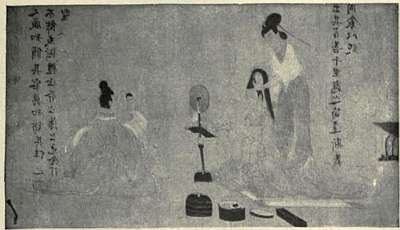
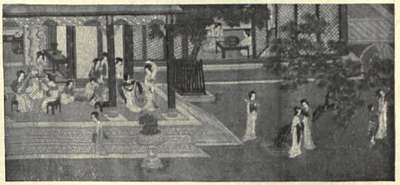
Fig. 1.—KU K‘AI-CHIH. TOILET SCENE. British Museum. 4th Cent. A.D.). Fig. 6.—KIU YING. COURT LADIES. (British Museum. 15th Cent.)
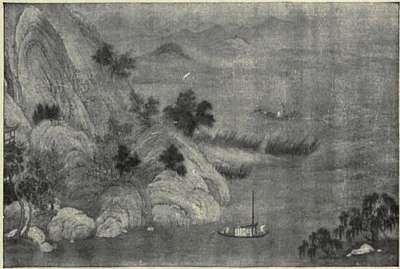
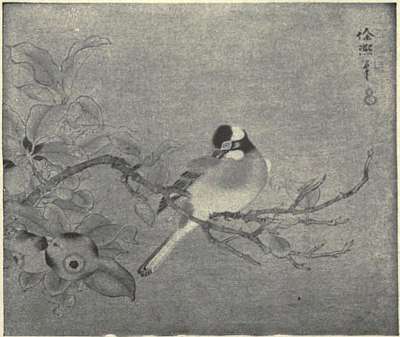
Fig. 3.—CHAO MÊNG-FU, AFTER WANG WEI (8th CENT.). SCENE ON THE WANG CH‘UAN. (Dated 1309. British Museum.) Fig.4.—HSÜ HSI. BIRD ON APPLE-BOUGH. (10th Cent.)
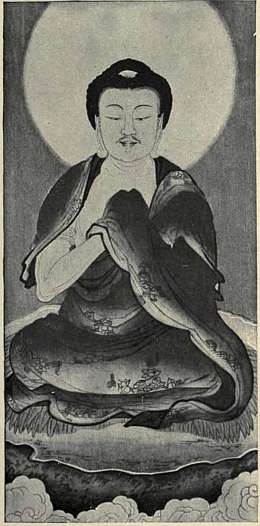
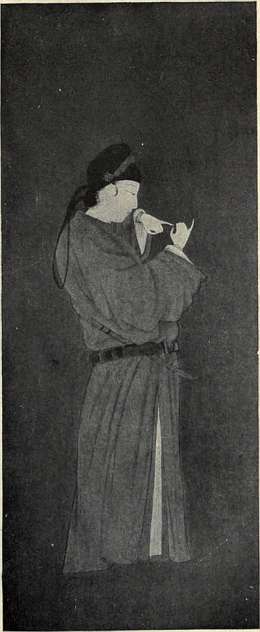
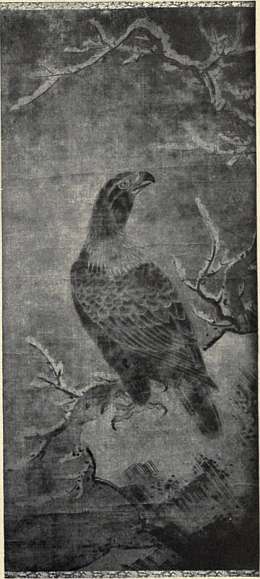
Fig. 2.—ATTRIBUTED TO WU TAOTZÜ. SAKYAMUNI. (8th Cent.) Fig. 5.—CHIEN SHUN-CHU. THE EMPEROR HUAN-YEH. (15th Cent.) Fig. 7.—EAGLE. By LIN LIANG. (15th Cent. British Museum.)
Figs. 2, 4, and 5 are reproduced by permission of the Kokka Company, Tokyo.
Plate II
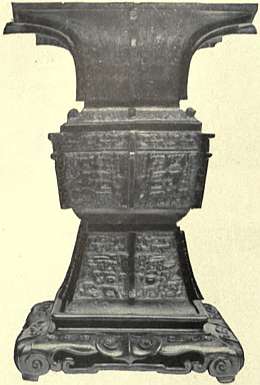
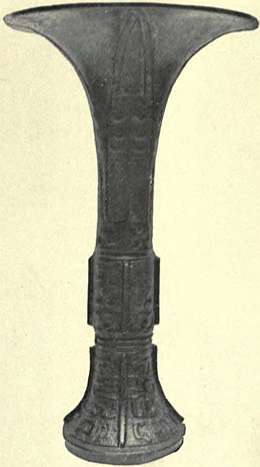
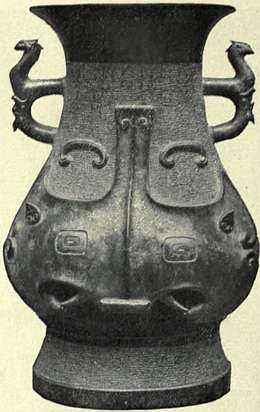
Fig. 9.—TEMPLE VASE (c. 1200 B.C.). Fig. 10.—WINE VASE (c. 1000 B.C.). Fig. 11—WINE VASE (c. 600 B.C.).
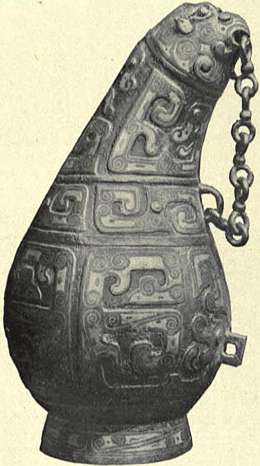
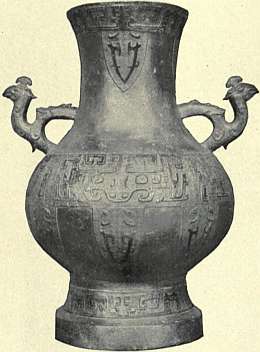
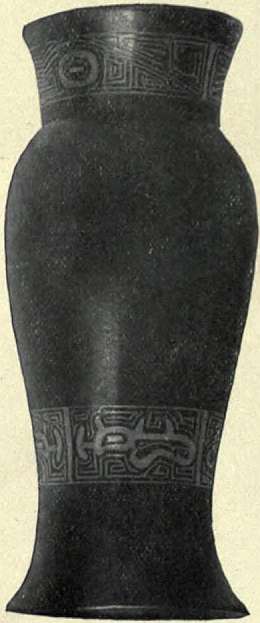
Fig. 12.—INLAID VESSEL (C. 500 B.C.). Fig. 13.—WINE VESSEL (c. 100 B.C.). Fig. 14.—INLAID VASE (c. 200 A.D.). In possession of C.J. Holmes.
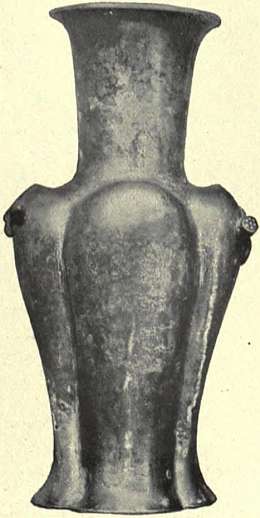
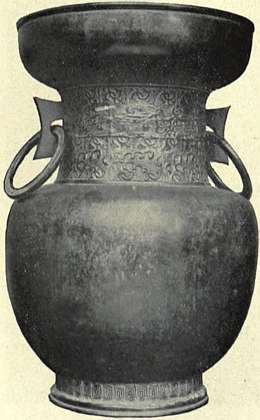
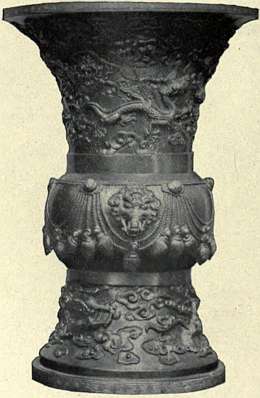
Fig. 15.—VASE (c. 1450 A.D.). Fig. 16.—WINE VESSEL (c. 1450 A.D.). Fig. 17.—TEMPLE VASE (c. 1700 A.D.).
Figs. 9-13 and 15-17 are from originals in the Victoria and Albert Museum, South Kensington.
VI. Chinese Art
1. Painting.—Painting is the pre-eminent art of China, which can boast of a succession of great painters for at least twelve centuries. Though the Chinese have an instinctive gift for harmonious colour, their painting is above all an art of line. It is intimately connected with writing, itself a fine art demanding the same skill and supple power in the wielding of the brush. The most typical expression of the Chinese genius in painting is the ink sketch, such as the masters of the Sung dynasty most preferred and the Japanese from the 15th century adopted for an abiding model. Utmost vigour of stroke was here combined with utmost delicacy of modulation. Rich colour and the use of gold are an integral part of the Buddhist pictures, though in the masterpieces of the religious painters a grand rhythm of linear design gives the fundamental character. Exquisite subdued colour is also found in the “flower and bird pieces” and still-life subjects of the Sung artists, and becomes more emphatic and variegated in the decorative artists of the Ming period.
Not to represent facts, but to suggest a poetic idea (often perfumed, so to speak, with reminiscence of some actual poem), has ever been the Chinese artist’s aim. “A picture is a voiceless poem” is an old saying in China, where very frequently the artist was a literary man by profession. Oriental critics lay more stress on loftiness of sentiment and tone than on technical qualities. This idealist temper helps to explain the deliberate avoidance of all emphasis on appearances of material solidity by means of chiaroscuro, &c., and the exclusive use of the light medium of water-colour. The Chinese express actual dislike for the representation of relief. Whoever compares the painting of Europe with that of Asia (and Chinese painting is the central type for the one continent, as Italian may claim to be for the other) must first understand this contrast of aim. The limitations of the Chinese are great, but these limitations save them from mistaking advances in science for advances in art, and from petty imitation of fact. Their religious painting has great affinity with the early religious art of Italy (e.g. that of Siena). But the ideas of the Renaissance, its scientific curiosity, its materialism, its glorification of human personality, are wholly missing in China. For Europe, Man is ever the hero and the foreground—hence the dominant study of the nude, and the tendency to thronged compositions, with dramatic motives of effort and conflict. The Chinese artists, weak in the plastic, weak in the architectural sense, paint mostly in a lyric mood, with a contemplative ideal. Hence the value given to space in their designs, the semi-religious passion for nature, and the supremacy of landscape. Beauty is found not only in pleasant prospects, but in wild solitudes, rain, snow and storm. The life of things is contemplated and portrayed for its own sake, not for its uses in the life of men. From this point of view the body of Chinese painting is much more modern in conception than that of Western art. Landscape was a mature and free art in China more than a thousand years ago, and her school of landscape is the loftiest yet known to the world. Nor was man ever dissociated from nature. As early as the 4th century Ku K‘ai-chih says that in painting a certain noble character he must give him a fit background of great peaks and deep ravines. Chinese painting, in sum, finely complements rather than poorly supplements that of Europe; where the latter is strong, it is weak; but in certain chosen provinces it long ago found consummate expression for thoughts and feelings scarcely yet expressed with us.
The origin of Chinese painting is lost in legend, though there is no reason to doubt its great antiquity. References in literature prove that by the 3rd century B.C. it was a developed art. To this period is ascribed the invention History: Early periods (to A.D. 618). of the hair-brush, in the use of which as an instrument both for writing and drawing the Chinese have attained marvellous skill; the usual material for the picture being woven silk, or, less often and since the 1st century A.D., paper. In early times wood panels were employed; and large compositions were painted on walls prepared with white lime. These mural decorations have all disappeared. History and portraiture seem to have been the prevailing subjects; a secular art corresponding to the social ideals of Confucianism. Yet long before the introduction of Buddhism (A.D. 67) with its images and pictures, we find that the two great symbolic figures of the Chinese imagination, the Tiger and the Dragon—typifying the forces of Nature and the power of the Spirit—had been evolved in art; and to imaginative minds the mystic ideas of Lao Tzü and the legends of his hermit followers proved a fruitful field for artistic motives of a kind which Buddhism was still more to enrich and multiply. Early classifications rank Buddhist and Taoist subjects together as one class.
With the 2nd century A.D. we come to individual names of artists and to the beginnings of landscape. Ku K‘ai-chih (4th century) ranks as one of the greatest names of Chinese art. A painting by him now in the British Museum (Plate I. fig. 1) shows a maturity which has nothing tentative about it. The dignified and elegant types are rendered with a mastery of sensitive brush-line which is not surpassed in later art. Ku K‘ai-chih painted all kinds of subjects, but excelled in portraiture. During the next century the criticism of painting was formulated in six canons by Hsieh Ho. Rhythm, organic or structural beauty, is the supreme quality insisted on.
During the T‘ang dynasty the empire expanded to its utmost limits, stretching as far as the Persian Gulf. India was invaded; Buddhism, taught by numbers of Indian missionaries, became firmly established, and controlled T‘ang dynasty (A.D. 618-907). the ideals and imaginations of the time. The vigorous style of a great era was impressed upon the T‘ang art, which culminated in Wu Taotzü, universally acknowledged as the greatest of all Chinese painters. It is doubtful if any of his work remains. The picture reproduced (Plate I. fig. 2) was long attributed to him, but is now thought to be of later date, like the two landscapes well known under his name in Japan. Wu Taotzü seems to have given supreme expression to the central subject of Buddhist art, the Nirvana of Buddha, who lies serenely asleep, with all creation, from saints and kings to birds and beasts, passionately bewailing him. The composition is known from Japanese copies; and it is in fact from the early religious schools of Japan that we can best conjecture the grandeur of the T‘ang style. Wu Taotzü excelled in all subjects: other masters are best known for some particular one. Han Kan was famous for his horses, the models for succeeding generations of painters, both Chinese and Japanese. A specimen of his brush is in the British Museum; and in the same collection is a long roll which gives a glimpse of the landscape of this age. It is a copy by a great master of the Yuen dynasty, Chao Mêng-fu, from a famous painting by Wang Wei, representing scenes on the Wang Ch‘uan, the latter’s home (Plate I. fig. 3 shows a fragment). With the T‘ang age landscape matured, and two schools arose, one headed by Wang Wei, the other by Li Ssü-hsün. The style of Wang Wei, who was equally famous as a poet, had a romantic idealist character—disdainful of mere fact—which in later developments created the “literary man’s picture” of the Southern school, as opposed to the vigorous naturalism of the North.
Next come five brief dynasties, memorable less for any corporate style or tradition, than for some fine painters like Hsü Hsi, famous for his flowers, and Huang Five dynasties (A.D. 907-960). Ch‘uan, a great master in a delicate style. Two pictures by him, fowls and peonies, of extraordinary beauty, are in the British Museum.
The empire, which had been broken up, was reunited, though shorn of its outer dependencies, under the house of Sung. This was an age of culture in which the freedom of Sung dynasty (A.D. 960-1280). the individual was proclaimed anew; glorious in art as in poetry and philosophy; the period which for Asia stands in history as the Periclean age for Europe.
The religious paintings of Li Lung-mien, the grandest of Sung masters, if less forcible than those of T‘ang, were unsurpassed in harmonious rhythm of design and colour. But the most characteristic painting of this period is in landscape and nature-subjects. With a passion unmatched in Europe till Wordsworth’s day, the Sung artists portrayed their delight in mountains, mists, plunging torrents, the flight of the wild geese from the reed-beds, the moonlit reveries of sages in forest solitudes, the fisherman in his boat on lake or stream. To them also, steeped in the Zen philosophy of contemplation, a flowering branch was no mere subject for a decorative study, but a symbol of the infinite life of nature. A mere hint to the spectator’s imagination is often all that they rely on; proof of the singular fulness and reality of the culture of the time. The art of suggestion has never been carried farther. Such traditional subjects as “Curfew from a Distant Temple” and “The Moon over Raging Waves” indicate the poetic atmosphere of this art. Ma Yuan, Hsia Kuei and the emperor Hwei-tsung are among the greatest landscape artists of this period. They belong to the South Sung school, which loved to paint the gorges and towering rock-pinnacles of the Yangtsze. The sterner, less romantic scenery of the Hwang-Ho inspired the Northern school, of which Kuo Hsi and Li Ch‘eng were famous among many others. Muh Ki was one of the greatest masters of the ink sketch; Chao Tan Lin was famed for his tigers; Li Ti for his flowers as for his landscapes; Mao I for still-life: to name a few among a host.
The Mongol dynasty continues in art the Sung tradition. Chao Mêng-fu, the greatest master of his time, belongs to both periods, and ranks with the highest names in Chinese painting. A landscape by him, copied from Wang Yuen dynasty (A.D. 1280-1368). Wei, has been already mentioned as in the British Museum, which also has two specimens of Yen Hui, a painter less known in his own country than in Japan. He painted especially figures of Taoist legend. The portrait by Ch‘ien Shun-chü (Plate I. fig. 5) is a fine example of purity of line and lovely colour, reminding us of Greek art.
The simplicity of motive and directness of execution which had been the strength of the Sung art gradually gave way during the Ming era to complicated conceptions and elaborate effects. The high glow of life faded; the lyrical temper Ming dynasty (A.D. 1368-1644). and impassioned work of the Sung time were replaced by love of ornament and elegance. In this respect Kiu Ying is typical of the period, with his richly coloured scenes from court life (Plate I. fig. 6). None the less, there were a number of painters who still upheld the grander style of earlier ages. The greatest of these was Lin Liang (Plate I. fig. 7), whose brush work, if somewhat coarser, is as powerful as that of the Sung masters. But though individual painters of the first rank preserved the Ming age from absolute decline, it cannot be said that any new development of importance took place in a vitalizing direction.
The present dynasty prolongs the history of Ming art. The literary school of the South became more prominent, sending out offshoots in Japan. There has been no movement Tsing dynasty (from A.D. 1644). of national life to be reflected in art, though a great body of admirable painting has been produced, down to the present day. The four landscape masters known as the “four Wangs,” Yün Shou-p‘ing and Wu Li are pre-eminent names.
Sources and Authorities.—While the designs on porcelain, screens, &c., have long been admired in the West, the paintings of which these are merely reproductions have been utterly ignored. Ignorance has gained authority with time, till the very existence of a great school of Chinese painting has been denied. Materials for study are scanty. Fires, wars and the recent armed ravages of Western civilization have left but little. The profound indifference of the Chinese to European admiration has prevented their collections from being known. The Japanese, always enthusiastic students and collectors of the continental art, claim (whether justly or not, is hard to ascertain) that the finest specimens are now in their country. Many of these are reproduced in the invaluable Tokyo publications, the Kokka, Mr Tajima’s Select Relics, &c., with Japanese criticisms in English. Of actual paintings the British Museum possesses a fair number, and the Louvre a few, of real importance. Copies and forgeries abound.
See H.A. Giles, Introduction to the History of Chinese Pictorial Art (1905); F. Hirth, Scraps from a Collector’s Note-Book (1905), (supplements Giles’s work and especially valuable for the art of the Ch‘ing dynasty); S.W. Bushell, Chinese Art, vol. ii. (1906); K. Okakura, Ideals of the East (1903); M. Paléologue, L‘Art chinois (1887); W. Anderson, Catalogue of Japanese and Chinese Paintings (1886); Sei-ichi Taki, “Chinese Landscape Painting,” The Kokka, Nos. 191, &c. (1906); Chinesische Malereien aus der Sammlung Hirth (Catalogue of an exhibition held at Dresden) (1897); W. von Seidlitz, article in Kunstchronik (1896-1897), No. 16.
2. Engraving.—According to native historians, the art of printing from wooden blocks was invented in China in the 6th century A.D., when it was employed for the publication of texts. The earliest evidence we have for the existence of woodcuts made to reproduce pictures or drawings is a passage in a work by Chang Yen-yüan, from which it appears that these were not made before the beginning of the T‘ang dynasty, under which that author lived. The method employed was to cut the design with a knife on the plank of the wood, in the manner followed by European artists till the end of the 18th century, when engraving with a burin on boxwood ousted the older process. The Japanese borrowed the art from China; and in Japan a whole school of artists arose who worked specially for the woodcutters and adapted their designs to the limitations of the material employed. In China the art has remained merely reproductive, and its history is therefore of less interest. Printing in colours was known to the Chinese in the 17th century, and probably earlier. In the British Museum is a set of prints brought from the East by Kaempfer in 1693, in which eight colours and elaborate gauffrage are used. Some fine albums of colour prints have been issued in China, but nothing equal in beauty to the prints produced in Japan by the co-operation of woodcutter and designer. Engraving on copper was introduced to China by the Jesuits, and some well-known sets of prints illustrating campaigns in Mongolia were made in the 18th century. But the method has never proved congenial to the artists of the Far East.
See Sir R.K. Douglas, Guide to the Chinese and Japanese Illustrated Books (British Museum, 1887); W. Anderson, Japanese Wood Engraving (1895).
3. Architecture.—In architecture the Chinese genius has found but limited and uncongenial expression. A nation of painters has built picturesquely, but this picturesqueness has fought against the attainment of the finest architectural qualities. There has been little development; the arch, for instance, though known to the Chinese from very early times, has been scarcely used as a principle of design, and the cupola has been undiscovered or ignored; and though foreign architectural ideas were introduced under the influence of the Buddhist and Mahommedan religions, these were more or less assimilated and subdued to the dominant Chinese design. Ruins scarcely exist and no building earlier than the 11th century A.D. is known; but we know from records that the forms of architecture still prevalent imitate in essentials those of the 4th and 5th centuries B.C. and doubtless represent an immemorial tradition.
The grand characteristic of Chinese architecture is the pre-eminent importance of the roof. The t‘ing is the commonest model of building. The roof is the main feature; in fact the t‘ing consists of this roof, massive and immense, with recurved edges, and the numerous short columns on which the roof rests. The columns are of wood, the straight stems of the nanmu being specially used for this purpose. The walls are not supports, but merely fill in, with stone or brickwork, the spaces between the columns. The scheme of construction is thus curiously like that of the modern American steel-framed building, though the external form may be derived from the tent of primitive nomads. The roof, being the preponderant feature, is that on which the art of the architect has been concentrated. A double or a triple roof may be devised; the ridges and eaves may be decorated with dragons and other fantastic animals, and the eaves underlaid with carved and lacquered woodwork; the roof itself is often covered with glazed tiles of brilliant hue. In spite of efforts, sometimes desperate, to give variety and individual character by ornament and detail, the general impression is one of poverty of design. “Chinese buildings are usually one-storeyed and are developed horizontally as they are increased in size or number. The principle which determines the plan of projection is that of symmetry” (Bushell). All important buildings must face the south, and this uniform orientation increases the general architectural monotony produced by a preponderance of horizontal lines.
A special characteristic of Chinese architecture is the pai-lou, an archway erected only by special authority, usually to commemorate famous persons. The pai-lou is commonly made of wood with a tiled roof, but sometimes is built entirely of stone, as is the gateway at the avenue of the Ming tombs. A magnificent example of the pai-lou is that on the avenue leading to Wo Fo Ssü, the temple of the Sleeping Buddha, near Peking. This is built of marble and glazed terra-cotta. The pai-lou, like the Japanese torii, derives its origin from the toran of Indian stupas. Lofty towers called t‘ai, usually square and of stone, seem to have been a common type of important building in early times. They are described in old books as erected by the ancient kings and used for various purposes. The towers of the Great Wall are of the same character, and are made of stone, with arched doors and windows. Stone, though plentiful in most provinces of the empire, has been singularly little used by the Chinese, who prefer wood or brick. M. Paléologue attributes this preference of light and destructible materials to the national indifference of the Chinese to posterity and the future, their enthusiasm being wholly devoted to their ancestors and the past.
Temples are designed on the general t‘ing model. The Temple of Heaven is the most imposing of the Confucian temples, conspicuous with its covering of deep-blue tiles and its triple roof. Near this is the great Altar of Heaven, consisting of three circular terraces with marble balustrades. Buddhist temples are built on the general plan of secular residences, and consist of a series of rectangular courts with the principal building in the centre, the lesser at the sides. Lama temples differ little from these except in the interior decorations and symbolism. Mahommedan mosques are far simpler and severer in internal arrangement, but outwardly these also are in the Chinese style.
The pagoda (Chinese taa), the type of Chinese architecture most familiar to the West, probably owes its peculiar form to Buddhist influence. In the pagoda alone may be found some trace of a religious imagination such as in Europe made Gothic architecture so full and splendid an expression of the aspiring spirit. The most famous pagoda was the Porcelain Tower of Nanking, destroyed by the T‘aip‘ing rebels in 1854. This was covered with slabs of faience coated with coloured glazes. The ordinary pagoda is built of brick on a stone foundation; it is octagonal with thirteen storeys.
No Chinese buildings show more beauty than some of the graceful stone bridges for which the neighbourhood of Peking has been famous for centuries.
See M. Paléologue, L’Art chinois (1887): S.W. Bushell, Chinese Art, vol. i. (1904); J. Fergusson, History of Architecture; Professor Chûta Itô, articles in The Kokka, Nos. 197, 198.
(L.B.)
4. Sculpture.—Except in the casting and decoration of bronze vessels the Chinese have not obtained distinction as sculptors. They have practised sculpture in stone from an early period, but the incised reliefs of the 2nd century B.C., a number of which are figured in Professor E. Chavannes’s standard work,81 while they display a certain spirit, lack the true plastic sense, and though the power of the Chinese draughtsmen increased rapidly under the T‘ang and Sung dynasties, their work in stone showed no parallel progress. The feeling for solidity, which in Japan was a natural growth, was always somewhat exotic in China. With the impulse given to the arts by Buddhism a school of sculpture arose. The pilgrim Fa Hsien records sculpture of distinctive Chinese type in the 5th century. But Indian models dominated the art. Colossal Buddhas of stone were typical of the T‘ang era. Little, however, remains of these earlier times, and such true sculpture in stone, wood or ivory as we know dates from the 14th and succeeding centuries. The well-known sculptures on the arch at Chu Yung Kuan (A.D. 1345) are Hindu in style, though not without elements of breadth and strength, which seem to promise a greater development than actually took place. The colossal figures guarding the approach to the Ming tombs (15th century) show that the national taste rapidly became conventional and petrified so far as monumental sculpture was concerned, though occasional examples of devotional or portrait sculpture on a smaller scale in wood and ivory are found, which in power, grace, sincerity and restraint can rank with the work of more gifted nations. Such pieces, however, are extremely rare, and at South Kensington the ivory “Kwanyin and Child” (274. 1898) is a solitary example. As a rule the Chinese sculptor valued his art in proportion to the technical difficulties it conquered. He thus either preferred intractable materials like jade or rock-crystal, or, if he wrought in wood, horn or ivory, sought to make his work curious or intricate rather than beautiful. There is, nevertheless, beauty of a kind in Chinese bowls of jade, and there is dignity in some of the pieces of rock-crystal, but the bulk of the carving done in wood, horn and ivory does not deserve a moment’s serious thought from the aesthetic point of view. The few fine specimens may be referred to the earlier part of the Ming dynasty when Chinese art in general was sincere and simple. After the middle of the 15th century there set in the taste for profuse ornament which injured all subsequent Chinese work, and wholly ruined Chinese sculpture.
Bronzes.—In Chinese bronzes we have a more consistent and exceptional form of plastic art, which can be traced continuously for some three thousand years. These bronzes take the form of ritual or honorific vessels, and the archaic shapes used in the service of the prehistoric religion of the country are repeated and copied with slight changes in decoration or detail to the present day.
The oldest extant specimens, chiefly derived from the sack of the Summer Palace at Peking, may be referred to the Shang and Chow dynasties (1766-255 B.C.). These ancient pieces have a certain savage monumental grandeur of design, are usually covered with a rich and thick patina of red, green and brown, and are decorated with simple patterns—scrolls, zigzag lines and a form of what is known as the Greek key-pattern symbolizing respectively waves, mountains and storm clouds. The animal forms used are those of the tao-tieh (glutton), a fabulous monster (possibly a conventionalized tiger) representing the powers of the earth, the serpent and the bull. These two last in later pieces combine to form the dragon, representing the power of the air. In the Chow dynasty libation vessels were also made in the form of a deer, a ram or a rhinoceros. These characteristics are shown in figures 9-17, Plate II. Fig. 9 is a temple vessel of a shape still in use, but which must date from before 1000 B.C. With this massive piece may be contrasted the flower-like wine vase shown in fig. 10, a favourite shape which is the prototype of some of the most graceful forms of Chinese porcelain and Japanese bronze. Its date is about 1000 B.C. The large wine vase shown in fig. 11 is some 400 years later. On the body appears the head of the tao-tieh, on the handles are superbly modelled serpents. The technique, which in the previous pieces was somewhat rude, has now become perfect, yet the menacing majestic feeling remains. We see it no less clearly in fig. 12, a marvellous vessel richly inlaid with gold and silver and covered with an emerald-green patina. It may date from about 500 B.C., and indicates that even in this remote epoch the Chinese were not only daring and powerful artists but also master-craftsmen in metal.
It is indeed at this period that the art reaches its climax. The monumental grandeur of the Shang specimens is often allied to clumsiness; the later work, if more elaborate, is always less powerful. Nevertheless, it is to a later period that ninety-nine out of a hundred Chinese bronzes must be referred, and the great majority belong either to the Han and succeeding dynasties (220 B.C.-A.D. 400), or to the Renaissance of the arts which culminated under the Ming dynasty a thousand years later.
The characteristics of the first of these periods is the free use of small solid figures of animals as decoration—the phoenix, the elephant, the frog, the ox, the tortoise, and occasionally men; shapes grow less austere and less significant, as a comparison between figures 11 and 13 will indicate; then towards the end of the 2nd century A.D. the influence of Buddhism is felt in the general tendency towards suavity of form (fig. 14). This vase is most delicately though sparingly inlaid with silver and a few touches of gold. Some small pieces, very richly and delicately inlaid and covered with a magnificent emerald-green patina, belonging to this period, form a connecting link between the inlaid work of the Chow dynasty and that of the Sung and Ming dynasties. The mirrors with Graeco-Bactrian designs, a conclusive proof of the external influences brought to bear upon Chinese art, are also attributed to the Han epoch.
The troubled period between A.D. 400 and A.D. 960, in spite of the interval of activity under the T‘ang dynasty, produced, it would seem, but few bronzes, and those few were of no distinct or noteworthy style. Under the Sung dynasty the arts revived, and to this time some of the most splendid specimens of inlaid work belong—pieces of workmanship and taste no less perfect than that of the Japanese, in which the gold and silver of the earlier work are occasionally reinforced with malachite and lapis-lazuli. The coming of Kublai Khan and the Yuen dynasty (1280-1367) once more brought the East into contact with the West, and to this time we may assign certain fine pieces of Persian form such as pilgrim bottles. The vessels bearing Arabic inscriptions belong to the Ming dynasty (1368-1644), with which the modern history of Chinese art begins.
The work done while the Ming dynasty was still young provides the student of Chinese art with many problems, and in one or two cases even the South Kensington authorities assign to pre-Christian times pieces that are clearly of Ming workmanship. The tendency of the period was eclectic and archaistic. The products of earlier days were reproduced with perfect technical command of materials, and with admirable taste; it is indeed by an excess of these qualities that archaistic Ming work may be distinguished from the true archaic. In fig. 15 we see how the Ming bronze worker took an earlier Buddhistic form of vase and gave it a new grace that amounted almost to artifice. A parallel might be found among the products of the so-called art nouveau of to-day, in which old designs are revived with just that added suavity or profusion of curvature that robs them of character. Fig. 16 again might be mistaken almost for a piece of the Chow dynasty, were not the grandeur of its form modified by just so much harmony in the curvature of the body and neck, and by just so much finish in the details as to rob the design of the old majestic vigour and to mark it as the splendid effort of an age of culture, and not the natural product of a period of strength.
It is, however, in the inlaid pieces that the difference tells most clearly. Here we find the monstrous forms of the Shang and Chow dynasties revived by men who appreciated their spirit but could not help making the revival an excuse for the display of their own superior skill. The monstrous vases and incense-burners of the past thus appear once more, but are now decorated with a delicate embroidery of inlay, are polished and finished to perfection, but lose therewith just the rudeness of edge and outline which made the older work so gravely significant. At times even some grandly planned vessel will appear with such a festoon of pretty tracery wreathed about it that the incongruity is little short of ridiculous, and we recognize we have passed the turning-point to decline.
Decline indeed came rapidly, and to the latter part of the Ming epoch we must assign those countless bronzes where dragons and flowers and the stock symbols of happiness, good luck and longevity sprawl together in interminable convolutions. When once we reach this stage of contortion, of elaborate pierced and relief work, we come to the place in history of Chinese bronzes where serious study may cease, except in so far as the study of the symbols themselves throws light upon the history of Chinese procelain (see Ceramics). One class of bronze alone needs a word of notice, namely, the profusely decorated pieces which have a Tibetan origin, and are obviously no older than the end of the Ming period. Of these fig. 17 will serve as a specimen, and a comparison with fig. 9 will show how the softer rounded forms and jewelled festoons of Hindu-Greek taste enervated the grand primitive force of the earlier age, and that neither the added delicacy of texture and substance nor the vastly increased dexterity of workmanship can compensate for the vanished majesty.
(C. J. H.)
VII. The Chinese Language
Colloquial.—In treating of Chinese, it will be found convenient to distinguish, broadly, the spoken from the written language and to deal with each separately. This is a distinction which would be out of place if we had to do with any European, or indeed most Oriental languages. Writing, in its origin, is merely a symbolic representation of speech. But in Chinese, as we shall see, for reasons connected with the peculiar nature ot the script, the two soon began to move along independent and largely divergent lines. This division, moreover, will enable us to employ different methods of inquiry more suited to each. With regard to the colloquial, it is hardly possible to do more than consider it in the form or forms in which it exists at the present day throughout the empire of China. Although Chinese, like other living languages, must have undergone gradual changes in the past, so little can be stated with certainty about these changes that an accurate survey of its evolution is quite out of the question. Obviously a different method is required when we come to the written characters. The familiar line, “Litera scripta manet, volat irrevocabile verbum,” is truer perhaps of Chinese than of any other tongue. We have hardly any clue as to how Chinese was spoken or pronounced in any given district 2000 years ago, although there are written remains dating from long before that time; and in order to gain an insight into the structure of the characters now existing, it is necessary to trace their origin and development.
Beginning with the colloquial, then, and taking a linguistic survey of China, we find not one spoken language but a number of dialects, all clearly of a common stock, yet differing from one another as widely as the various Romance The dialects. languages in southern Europe—say, French, Italian and Spanish. Most of these dialects are found fringing the coast-line of China, and penetrating but a comparatively short way into the interior. Starting from the province of Kwang-tung in the south, where the Cantonese and farther inland the Hakka dialects are spoken, and proceeding northwards, we pass in succession the following dialects: Swatow, Amoy—these two may almost be regarded as one—Foochow, Wenchow and Ningpo. Farther north we come into the range of the great dialect popularly known as Mandarin (Kuan hua or “official language”), which sweeps round behind the narrow strip of coast occupied by the various dialects above-mentioned, and dominates a hinterland constituting nearly four-fifths of China proper. Mandarin, of which the dialect of Peking, the capital since 1421, is now the standard form, comprises a considerable number of sub-dialects, some of them so closely allied that the speakers of one are wholly intelligible to the speakers of another, while others (e.g. the vernaculars of Yangchow, Hankow or Mid-China and Ssŭ-ch‘uan) may almost be considered as separate dialects. Among all these, Cantonese is supposed to approximate most nearly to the primitive language of antiquity, whereas Pekingese perhaps has receded farthest from it. But although philologically and historically speaking Cantonese and certain other dialects may be of greater interest, for all practical purposes Mandarin, in the widest sense of the term, is by far the most important. Not only can it claim to be the native speech of the majority of Chinamen, but it is the recognized vehicle of oral communication between all Chinese officials, even in cases where they come from the same part of the country and speak the same patois. For these reasons, all examples of phraseology in this article will be given in Pekingese.
So far, stress has been laid chiefly on the dissimilarity of the dialects. On the other hand, it must be remembered that they proceed from the same parent stem, are spoken by members of the same race, and are united by the bond of writing which is the common possession of all, and cannot be regarded as derived from one more than from another. They also share alike in the two most salient features of Chinese as a whole: (1) they are all monosyllabic, that is, each individual word consists of only one syllable; and (2) they are strikingly poor in vocables, or separate sounds for the conveyance of speech. The number of these vocables varies from between 800 and 900 in Cantonese to no more than 420 in the vernacular of Peking. This scanty number, however, is eked out by interposing an aspirate between certain initial consonants and the vowel, so that for instance p‘u is distinguished from pu. The latter is pronounced with little or no emission of breath, the “p” approximating the farther north one goes (e.g. at Niuchwang) more closely to a “b.” The aspirated p‘u is pronounced more like our interjection “Pooh!” To the Chinese ear, the difference between the two is very marked. It will be found, as a rule, that an Englishman imparts a slight aspirate to his p’s, t’s, k’s and ch’s, and therefore has greater difficulty with the unaspirated words in Chinese. The aspirates are better learned by the ear than by the eye, but in one way or another it is essential that they be mastered by any one who wishes to make himself intelligible to the native.
The influence of the Mongolian population, assisted by the progress of time, has slowly but surely diminished the number of vocables in Pekingese. Thus the initials ts and k, when followed by the vowel i (with its continental value) have gradually become softer and more assimilated to each other, and are now all pronounced ch. Again, all consonantal endings in t and k, such as survive in Cantonese and other dialects, have entirely disappeared from Pekingese, and n and ng are the only final consonants remaining. Vowel sounds, on the other hand, have been proportionately developed, such compounds as ao, ia, iao, iu, ie, ua occurring with especial frequency. (It must be understood, of course, that the above are only equivalents, not in all cases very exact, for the sounds of a non-alphabetic language.)