VOLUME VI SLICE II Chicago, University of to Chiton (continued 7)
Reading edition
It has hitherto been extremely difficult to obtain anything like trustworthy figures for the whole revenue of China, for the reason that no complete statistics are published by the central government at Peking.41 The only available data are, first, the returns published by the imperial maritime customs for the duties levied on foreign trade; and, secondly, the memorials sent to Peking by the provincial authorities on revenue matters, certain of which are published from time to time in the Peking Gazette. These are usually fragmentary, being merely reports which the governor has received from his subordinates, detailing, as the case may be, the yield of the land tax or the likin for his particular district, with a dissertation on the causes which have made it more or less than for the previous period. Or the return may be one detailing the expenditure of such and such a department, or reporting the transmission of a sum in reply to a requisition of the board of revenue, with a statement of the source from which it has been met. It is only by collating these returns over a long period that anything like a complete statement can be made up. And even then these returns do not represent anything like the total of taxation paid by the people, but, as far as they go, they may be taken to represent the volume of taxation on which the Peking government can draw revenue.
The following table, taken from a memorandum by Sir Robert Hart, dated the 25th of March 1901, shows the latest official estimate (up to 1910) of the revenue and expenditure of China:—
Revenue.
Taels.42
Land tax 26,500,000
Provincial duties 1,600,000
Provincial receipts (various) 1,000,000
Grain commutation 3,100,000
Salt gabelle 13,500,000
Li-kin 16,000,000
Native customs 2,700,000
Maritime customs:—
General cargo 17,000,000
Foreign opium 5,000,000
Native opium 1,800,000
————
Total 88,200,000
Expenditure.
Taels.
Provincial 20,000,000
Military and naval 35,000,000
Metropolitan 10,000,000
Bannermen (Manchu “soldiers”) 1,380,000
Palace 1,100,000
Customs 3,600,000
Legations 1,000,000
River works 940,000
Railways 800,000
Loans 24,000,000
Contingent reserve 3,300,000
————
Total 101,120,000
A calculation of revenue from all sources published by the Shanghai Shen Pao in 1908, apparently derived from official sources, gave a total revenue of 105,000,000 taels, or about 15 million sterling. This sum is obviously less than the actual figures. In 1907 Mr H.B. Morse, commissioner of customs and statistical secretary in the inspectorate general of customs, drew up the following table based on the amounts presumed to be paid by the tax payer:—
Imperial Administration. Provincial Administration. Local Administration.
Taels. Taels. Taels.
I. Land Tax 25,887,000 67,060,000 9,315,000
II. Tribute 7,420,000 15,582,000 2,300,000
III. Native Customs 3,790,000 1,290,000 249,000
IV. Salt Gabelle 13,050,000 26,000,000 25,000,000
V. Miscellaneous 3,856,000 5,998,000 985,000
VI. Foreign Customs 31,169,000 3,942,000 1,230,000
VII. Li-kin 13,890,060 22,502,000 3,639,000
Total 99,062,000 142,374,000 42,718,000
Mr Morse adds that the grand total shown, taels 284,150,00043 “is an obviously insufficient sum on which to maintain the fabric of government in an empire like China, but it has been reached by calculations based on a few known facts and ... is offered as throwing some light on a subject veiled in obscurity.”44
The service of the foreign debt, together with the pressure of other needs—such as the cost of education and the army—made more manifest than previously the chaos of the Chinese fiscal system. A scheme to reform the national finances was promulgated under an edict of the 11th of January 1909, but it did not appear to be of a practical character.
Sources of Revenue. I. Land Tax.—In China, as in most oriental countries, the land has from time immemorial been the mainstay of the revenue. In the early years of the present dynasty there was levied along with the land tax a poll tax on all adult males, but in 1712 the two were amalgamated, and the whole burden was thrown upon land, families not possessing land being thereafter exempted from taxation. At the same time it was decreed that the amount of the land tax as then fixed should be permanent and settled for all time coming. It would appear from the records that this promise has been kept as far as the central government has been concerned. In all its many financial difficulties it does not seem ever to have tried to increase the revenue by raising the land tax. The amount of tax leviable on each plot is entered on the title deed, and, once entered, it cannot be changed.45 The tax on almost all lands is thus stated to be so much in silver and so much in rice, wheat or whatever the principal crop may be. Except in two provinces, however, the grain tax is now commuted and paid in silver. The exceptions are Kiang-su and Cheh-kiang, which still send forward their taxes in grain. The value of the grain forwarded (generally called tribute rice) is estimated at taels 6,500,000. The total collection in silver, as reported by the responsible officials, amounts in round numbers to taels 25,000,000. The total yield of the land tax, therefore, is taels 31,500,000, or say £4,725,000. It will readily be granted that for such a large country as China this is a very insignificant one. In India the land tax yields about £20,000,000, and China has undoubtedly a larger cultivated area, a larger population, and soil that is on the whole more fertile; but it is certain that this sum by no means represents the amounts actually paid by the cultivators. It is the sum which the various magistrates and collectors have to account for and remit in hard cash. But as nothing is allowed them for the costs of collection, they add on a percentage beforehand to cover the cost. This they usually do by declaring the taxes leviable not in silver, but in copper “cash”, which indeed is the only currency that circulates in country places, and by fixing the rate of exchange to suit themselves. Thus while the market rate is, say, 1500 cash to the tael, they declare by general proclamation that for tax-paying purposes cash will be received at the rate of 3500 or 4000 to the tael. Thus while the nominal land tax in silver remains the same it is in effect doubled or trebled, and, what is worse, no return is made or account required of the extra sums thus levied. Each magistrate or collector is in effect a farmer. The sum standing opposite the name of his district is the sum which he is bound to return under penalty of dismissal, but all sums which he can scrape together over and above are the perquisites of office less his necessary expenses. Custom, no doubt, sets bounds to his rapacity. If he went too far he would provoke a riot; but one may safely say there never is any reduction, what change can be effected being in the upward direction. According to the best information obtainable a moderate estimate of the sums actually paid by the cultivators would give two shillings per acre. This on an estimate of the area under cultivation should give for the eighteen provinces £19,000,000 as being actually levied, or more than four times what is returned.
2. The Salt Duty.—The trade in salt is a government monopoly. Only licensed merchants are allowed to deal in it, and the import of foreign salt is forbidden by the treaties. For the purpose of salt administration China is divided into seven or eight main circuits, each of which has its own sources of production. Each circuit has carefully defined boundaries, and salt produced in one circuit is not allowed to be consigned into or sold in another. There are great differences in price between the several circuits, but the consumer is not allowed to buy in the cheapest market. He can only buy from the licensed merchants in his own circuit, who in turn are debarred from procuring supplies except at the depot to which they belong. Conveyance from one circuit to another is deemed smuggling, and subjects the article to confiscation.
Duty is levied under two heads, the first being a duty proper, payable on the issue of salt from the depot, and the second being likin levied on transit or at the place of destination. The two together amount on an average to about taels 1.50 per picul of 133½ ℔ or 3s. 9d. per cwt. The total collection returned by the various salt collectorates amounts to taels 13,500,000 (£2,025,000) per annum. The total consumption of salt for all China is estimated at 25 million piculs, or nearly 1½ million tons, which is at the rate of 9 ℔ per annum per head of the population. If the above amount of taels 1.50 were uniformly levied and returned, the revenue would be 37½ million taels instead of 13½. In this calculation, however, no allowance is made for the cost of collection.
3. Likin on General Merchandise.—By the term likin is meant a tax on inland trade levied while in transit from one district to another. It was originally a war tax imposed as a temporary measure to meet the military expenditure required by the T‘aip‘ing and Mahommedan rebellions of 1850-1870. It is now one of the permanent sources of income, but at the same time it is in form as objectionable as a tax can be, and is equally obnoxious to the native and to the foreign merchant. Tolls or barriers are erected at frequent intervals along all the principal routes of trade, whether by land or water, and a small levy is made at each on every conceivable article of commerce. The individual levy is small, but over a long transit it may amount to 15 or 20%. The objectionable feature is the frequent stoppages with overhauling of cargo and consequent delays. By treaty, foreign goods may commute all transit dues for a single payment of one-half the import tariff duty, but this stipulation is but indifferently observed. It must also be remembered, per contra, that dishonest foreign merchants will take out passes to cover native-owned goods. The difficulty in securing due observance of treaty rights lies in the fact that the likin revenue is claimed by the provincial authorities, and the transit dues when commuted belong to the central government, so that the former are interested in opposing the commutation by every means in their power. As a further means of neutralizing the commutation they have devised a new form of impost, viz. a terminal tax which is levied on the goods after the termination of the transit. The amount and frequency of likin taxation are fixed by provincial legislation—that is, by a proclamation of the governor. The levy is authorized in general terms by an imperial decree, but all details are left to the local authorities. The yield of this tax is estimated at taels 13,000,000 (£l,950,000), a sum which probably represents one-third of what is actually paid by the merchants, the balance being costs of collection.
4. Imperial Maritime Customs.—The maritime customs is the one department of finance in China which is managed with probity and honesty, and this it owes to the fact that it is worked under foreign control. It collects all the duties leviable under the treaties on the foreign trade of China, and also all duties on the coasting trade so far as carried on by vessels of foreign build, whether Chinese or foreign owned. It does not control the trade in native craft, the so-called junk trade, the duties on which are still levied by the native custom-house officials. By arrangement between the British and Chinese governments the foreign customs levy at the port of entry a likin on Indian opium of taels 80 per chest, in addition to the tariff duty of taels 30. This levy frees the opium from any further duty on transit into the interior. The revenue of the maritime customs rose from taels 8,200,000 in 1865 to taels 35,111,000 in 1905.
5. Native Customs,—The administration of the native customs continues to be similar to what prevailed in the maritime customs before the introduction of foreign supervision. Each collector is constituted a farmer, bound to account for a fixed minimum sum, but practically at liberty to retain all he may collect over and above. If he returns more he may claim certain honorary rewards as for extra diligence, but he generally manages to make out his accounts so as to show a small surplus, and no more. Only imperfect and fragmentary returns of the native collectorates have been published, but the total revenue accruing to the Chinese government from this source did not appear up to 1900 much to exceed two million taels (£300,000). In November 1901 native customs offices within 15 m. of a treaty port were placed under the control of the maritime customs, their revenues having been hypothecated for the service of the Boxer indemnity. The result was that the amount of the native customs collected by the commissioners of customs increased from taels 2,206,000 in 1902 to taels 3,699,000 in 1906.
6. Duty on Native Opium.—The collection of the duty on opium is in the hands of the provincial officials, but they are required to rendera separate account of duty and likin collected on the drug, and to hold the sum at the disposal of the board of revenue at Peking. The annual import into China of Indian opium used to amount to about 50,000 chests, the exact amount of opium imported in 1904 being 54,750 piculs, on which the Chinese government received from duty and likin combined about 5½ million taels (£825,000). The total amount of native-grown opium was estimated in 1901 at about 400,000 chests (53,000,000 lb), and if this were taxed at taels 60 per chest, which in proportion to its price was a similar rate to that levied on Indian opium, it should give a revenue of 24 million taels. Compared with this the sums actually levied, or at least returned by the local officials as levied, were insignificant. The returns gave a total levy for all the eighteen provinces of only taels 2,200,000 (£330,000). The anti-opium smoking campaign initiated by the Chinese government in 1905 affected the revenue both by the decreased importation of the drug and the decrease in the area under poppy cultivation in China. In 1908 the opium likin revenue had fallen to taels 3,800,000.
7. Miscellaneous.—Besides the main and regular sources of income, the provincial officials levy sums which must in the aggregate amount to a very large figure, but which hardly find a place in the returns. The principal are land transfer fees, pawnbrokers’ and other licences, duties on reed flats, commutation of corvée and personal services, &c. The fee on land transfers is 3%, and it could be shown, from a calculation based on the extent and value of the arable land and the probable number of sales, that this item alone ought to yield an annual return of between one and two millions sterling. Practically the whole of this is absorbed in office expenses. Under this heading should also be included certain items which though not deemed part of the regular revenue, have been so often resorted to that they cannot be left out of account. These are the sums derived from sale of office or of brevet rank, and the subscriptions and benevolences which under one plea or another the government succeeds in levying from the wealthy. Excluding these, the government is always ready to receive subscriptions, rewarding the donor with a grant of official rank entitling him to wear the appropriate “button.” The right is much sought after, and indeed there are very few Chinamen of any standing that are not thus decorated, for not only does the button confer social standing, but it gives the wearer certain very substantial advantages in case he should come into contact with the law courts. The minimum price for the lowest grade is taels 120 (£18), and more of course for higher grades. The proceeds of these sales go directly to the Peking government, and do not as a rule figure in the provincial returns. The total of the miscellaneous items accruing for the benefit of the government is estimated at taels 5,500,000.
Expenditure.—In regard to expenditure a distinction has to be drawn between that portion of the revenue which is controlled by the central government, and that controlled by the several provincial authorities. As the provinces collect the revenue, and as the authorities there are held responsible for the peace, order and good government of their respective territories, it follows that the necessary expenses of the provinces form a sort of first charge on the revenue. (As the tables given show, the provinces spend the greater part of the revenue collected.) The board of revenue at Peking, which is charged with a general supervision of finance matters all over the empire, makes up at the end of the year a general estimate of the funds that will be required for imperial purposes during the ensuing year, and apportions the amount among the several provinces and the several collectorates in each province. The estimate is submitted to the emperor, and, when sanctioned, instructions are sent to all the viceroys and governors in that sense, who, in turn, pass them on to their subordinate officers. In ordinary times these demands do not materially vary from year to year, and long practice has created a sort of equilibrium between imperial and provincial demands. The remittances to the capital are, as a rule, forwarded with reasonable regularity, mostly in the form of hard cash. There is, however, a constant pull going on between Peking and the provinces—the former always asking for more, the latter resisting and pleading impecuniosity, yet generally able to find the amounts required. The expenses which the central government has to meet are:—(1) Imperial household; (2) pay of the Manchu garrison in and about Peking; (3) costs of the civil administration in the capital; (4) cost of the army so far as the expenses are not borne by the provinces; (5) naval expenses;46 (6) foreign loans—interest and sinking fund. To meet all these charges the Peking government for several years up to 1900 drew on the provinces for about taels 20,000,000 (£3,000,000), including the value of the tribute rice, which goes to the support of the Manchu bannermen.47 No estimates are furnished of the sums allowed under such heading. The imperial household appears to receive in silver about taels 1,500,000 (£225,000) but it draws besides large supplies in kind from the provinces, e.g. silks and satins from the imperial factories at Su-chow and Hangchow, porcelain from the Kiang-si potteries, &c., the cost of which is defrayed by the provinces. The imperial government has also at its disposal the revenue of the foreign customs. Prior to the Chino-Japanese war of 1894-95 this revenue, which, after allowing for the costs of collection, amounted to about 20,000,000 taels (£3,000,000), was nominally shared with the provinces in the proportion of four-tenths and six-tenths. The whole of the customs revenue is now pledged to foreign bondholders and absorbed by the service of the several loans. Besides supplying its own wants the imperial government has to provide for outlying portions of the empire which are unable to maintain themselves—(1) Manchuria, (2) Kan-suh and the central Asian dominion, (3) the south-western provinces of Yun-nan, Kwei-chow and Kwang-si. Manchuria, or, as it is termed, the north-east frontier defence, costs about taels 2,000,000 over and above its own resources. The central Asian territories constitute a drain on the imperial government of about taels 4,000,000 a year. This is met by subsidies from Sze-ch‘uen, Shan-si, Ho-nan and other wealthy provinces. Yun-nan, Kwei-chow and Kwang-si require aids aggregating taels 2,000,000 to keep things going.
External Debt.—Prior to the war with Japan in 1894 the foreign debt of China was almost nil. A few trifling loans had been contracted at 7 and 8%, but they had been punctually paid off, and only a fraction of one remained. The expenses of the war, however, and the large indemnity of taels 230,000,000 (£34,500,000) which Japan exacted, forced China for the first time into the European market as a serious borrower. The sum of £6,635,000 was raised in 1894-1895 in four small loans at 6 or 7% interest. In 1895 a Franco-Russian loan of fr. 440,000,000 (£15,820,000) was raised in Paris. Two Anglo-German loans, each of £16,000,000 (one in 1896, the other in 1898) were raised through the Hong Kong and Shanghai Bank. The Franco-Russian loan bears 4% interest, the first Anglo-German 5%, the second 4½%. The foreign loans contracted up to 1900 amounted altogether to £54,455,000. The charges for interest and sinking fund, which amounted to over £3,000,000, were secured on the revenue of the maritime customs, and on the likin taxes of certain specified provinces. The net income from these two sources amounted to over taels 24,000,000, equivalent at existing rate of exchange to £3,400,000, which was amply sufficient.
Between 1899 and 1907 (both years inclusive) £12,200,000 was raised on loan for railway purposes. The charges on the first loan—for £2,300,000—were secured on the revenue of the Imperial Northern railway, the interest being 5%. The same interest was secured on the other loans, save one for £1,000,000 in which the Hong Kong government was concerned, which bears 4% interest.
The foreign debt also includes the indemnities exacted in 1901 by the powers for the Boxer outrages. These indemnities, secured on imperial revenue, are divided into five series amounting altogether to £67,500,000, the amount payable on these indemnities (at 4% interest) in 1907 being £2,824,425. The burden of meeting this amount was apportioned between the eighteen provinces—the sums allocated ranging from taels 2,500,000 for Kiang-su to taels 300,000 for Kwei-chow. In 1909 the grand total of China’s indebtedness exceeded £140,000,000 and the interest called for the payment of £7,427,450 in gold.
Banks and Banking.—Native banks for purposes of inland exchange are to be found in most large cities. They are private banks using their own capital, and seldom receiving deposits from the public. The best known are the Shan-si banks, which have branches all over the empire. They work on a small capital, seldom over £50,000 each, and do a small but profitable business by selling their drafts on distant places. None of them issues notes, although they are not debarred from doing so by law. They lend money on personal security, but do not advance against shipments of goods. In some places there are small local banks, usually called cash shops, which issue paper notes for small sums and lend money out on personal security. The notes never reach more than a very limited local circulation, and pass current merely on the credit of the institution. There is no law regulating the formation of banks or the issue of notes. Pawnshops occupy a prominent position in the internal economy of China. They lend on deposit of personality at very high rates, 18 and 24%, and they receive deposits of money from the public, usually allowing 6 to 10%. They are the real banks of deposit of the country, and the better class enjoy good credit. Foreign Banks do a large business at Shanghai and other treaty ports, and a Government Bank has been established at Peking.
Currency.—In the commercial treaty between Great Britain and China of 1902 China agreed to provide a uniform national coinage. An imperial decree of October 1908 commanded the introduction of a uniform tael currency; but another decree of May 1910 established a standard currency dollar weighing 72 candareens (a candareen is the 100th part of the tael ounce) and subsidiary coins of fixed values in decimal ratio. This decree properly enforced would introduce a much needed stability into the monetary system of China.
The actual currency (1910) consists of (l) Silver, which may be either uncoined ingots passing current by weight, or imported coins, Mexican dollars and British dollars; and (2) Copper “cash,” which has no fixed relation to silver. The standard is silver, the unit being the Chinese ounce or tael, containing 565 grains. The tael is not a coin, but a weight. Its value in sterling consequently fluctuates with the value of silver; in 1870 it was worth about 6s. 8d., in 1907 it was worth 3s. 3d.48 The name given in China to uncoined silver in current use is “sycee.” It is cast for convenience sake into ingots weighing one to 50 taels. Its average fineness is 916.66 per 1000. When foreign silver is imported, say into Shanghai, it can be converted into currency by a very simple process. The bars of silver are sent to a quasi-public office termed the “Kung K‘u,” or public valuers, and by them melted down and cast into ingots of the customary size. The fineness is estimated, and the premium or betterness, together with the exact weight, is marked in ink on each ingot. The whole process only occupies a few hours, and the silver is then ready to be put into use. The Kung K‘u is simply a local office appointed by the bankers of the place, and the weight and fineness are only good for that locality. The government takes no responsibility in the matter, but leaves merchants and bankers to adjust the currency as they please. For purposes of taxation and payment of duties there is a standard or treasury tael, which is about 10% heavier than the tael of commerce in use at Shanghai. Every large commercial centre has its own customary tael, the weight and therefore the value of which differ from that of every other. Silver dollars coined in Mexico, and British dollars coined in Bombay, also circulate freely at the open ports of trade and for some distance inland, passing at a little above their intrinsic value. Carolus dollars, introduced long ago and no longer coined, are retained in current use in several parts of the interior, chiefly the tea-growing districts. Being preferred by the people, and as the supply cannot be added to, they have reached a considerable premium above their intrinsic value. Provincial mints in Canton, Wuchang, and other places have issued silver coins of the same weight and touch as the Mexican dollar, but very few have gone into use. As they possess no privilege in debt-paying power over imported Mexican dollars there is no inducement for the people to take them up unless they can be had at a cheaper rate than the latter, and these are laid down at so small a cost above the intrinsic value that no profit is left to the mint. The coinage has in consequence been almost discontinued. Subsidiary coins, however, came largely into use, being issued by the local mints. One coin “the hundredth part of a dollar” proved very popular (the issue to the end of 1906 being computed at 12,500,000,000), but at rates corresponding closely to the intrinsic value of the metal in it. The only coin officially issued by the government—up to 1910—was the so-called copper cash. It is a small coin which by regulation should weigh 1/16 of a tael, and should contain 50 parts of copper, 40 of zinc, and 10 of lead or tin, and it should bear a fixed ratio to silver of 1000 cash to one tael of silver. In practice none of these conditions was observed. Being issued from a number of mints, mostly provincial, the standard was never uniform, and in many cases debased. Excessive issues lowered the value of the coins, and for many years the average exchange was 1600 or more per tael. The rise in copper led to the melting down of all the older and superior coins, and as for the same reason coining was suspended, the result was an appreciation of the “cash,” so that a tael in 1909 exchanged for about 1220 cash or about 35 to a penny English. Inasmuch as the “cash” bore no fixed relation to silver, and was, moreover, of no uniform composition, it formed a sort of mongrel standard of its own, varying with the volume in circulation.
(G .J.; X.)
V. History
(A)—European Knowledge of China up to 1615.
China as known to the Ancients.—The spacious seat of ancient civilization which we call China has been distinguished by different appellations, according as it was reached by the southern sea-route or by the northern land-route traversing the longitude of Asia. In the former aspect the name has nearly always been some form of the name Sin, Chin, Sinoe, China. In the latter point of view the region in question was known to the ancients as the land of the Seres, to the middle ages as the empire of Cathay. The name of Chin has been supposed (doubtfully) to be derived from the dynasty of Ts‘in, which a little more than two centuries before the Christian era enjoyed a vigorous existence, uniting all the Chinese provinces under its authority, and extending its conquests far beyond those limits to the south and the west. The mention of the Chinas in ancient Sanskrit literature, both in the laws of Manu and in the Mahābhārata, has often been supposed to prove the application of the name long before the predominance of the Ts‘in dynasty. But the coupling of that name with the Daradas, still surviving as the people of Dardistan, on the Indus, suggests it as more probable that those Chinas were a kindred race of mountaineers, whose name as Shinas in fact likewise remains applied to a branch of the Dard races. Whether the Sinim of the prophet Isaiah should be interpreted of the Chinese is probably not susceptible of any decision; by the context it appears certainly to indicate a people of the extreme east or south. The name probably came to Europe through the Arabs, who made the China of the farther east into Sîn, and perhaps sometimes into Thîn. Hence the Thîn of the author of the Periplus of the Erythraean Sea, who appears to be the first extant writer to employ the name in this form (i.e. assuming Max Müller’s view that he belongs to the 1st century); hence also the Sinae and Thinae of Ptolemy.
It has often indeed been denied that the Sinae of Ptolemy really represented the Chinese. But if we compare the statement of Marcianus of Heraclea (a mere condenser of Ptolemy), when he tells us that the “nations of the Sinae lie at the extremity of the habitable world, and adjoin the eastern Terra Incognita,” with that of Cosmas, who says, in speaking of Tzinista, a name of which no one can question the application to China, that “beyond this there is neither habitation nor navigation”—we cannot doubt the same region to be meant by both. The fundamental error of Ptolemy’s conception of the Indian Sea as a closed basin rendered it impossible but that he should misplace the Chinese coast. But considering that the name of Sin has come down among the Arabs from time immemorial as applied to the Chinese, considering that in the work of Ptolemy this name certainly represented the farthest known East, and considering how inaccurate are Ptolemy’s configurations and longitudes much nearer home, it seems almost as reasonable to deny the identity of his India with ours as to deny that his Sinae were Chinese.
If we now turn to the Seres we find this name mentioned by classic authors much more frequently and at an earlier date, for the passages of Eratosthenes (in Strabo), formerly supposed to speak of a parallel passing through Thinae—διά Θινῶν—are now known to read correctly δι᾽Αθηνῶν. The name Seres indeed is familiar to the Latin poets of the Augustan age, but always in a vague way, and usually with a general reference to Central Asia and the farther East. We find, however, that the first endeavours to assign more accurately the position of this people, which are those of Mela and Pliny, gravitate distinctly towards China in its northern aspect as the true ideal involved. Thus Mela describes the remotest east of Asia as occupied by the three races (proceeding from south to north), Indians, Seres and Scyths; just as in a general way we might still say that eastern Asia is occupied by the Indies, China and Tartary.
Ptolemy first uses the names of Sera and Serice, the former for the chief city, the latter for the country of the Seres, and as usual defines their position with a precision far beyond what his knowledge justified—the necessary result of his system. Yet even his definition of Serice is most consistent with the view that this name indicated the Chinese empire in its northern aspect, for he carries it eastward to the 180th degree of longitude, which is also, according to his calculation, in a lower latitude the eastern boundary of the Sinae.
Ammianus Marcellinus devotes some paragraphs to a description of the Seres and their country, one passage of which is startling at first sight in its seeming allusion to the Great Wall, and in this sense it has been rashly interpreted by Lassen and by Reinaud. But Ammianus is merely converting Ptolemy’s dry tables into fine writing, and speaks only of an encircling rampart of mountains within which the spacious and happy valley of the Seres lies. It is true that Ptolemy makes his Serice extend westward to Imaus, i.e. to Pamir. But the Chinese empire did so extend at that epoch, and we find Lieut. John Wood in 1838 speaking of “China” as lying immediately beyond Pamir, just as the Arabs of the 8th century spoke of the country beyond the Jaxartes as “Sin,” and as Ptolemy spoke of “Serice” as immediately beyond Imaus.
If we fuse into one the ancient notices of the Seres and their country, omitting anomalous statements and manifest fables, the result will be somewhat as follows: “The region of the Seres is a vast and populous country, touching on the east the ocean and the limits of the habitable world, and extending west to Imaus and the confines of Bactria. The people are civilized, mild, just and frugal, eschewing collisions with their neighbours, and even shy of close intercourse, but not averse to dispose of their own products, of which raw silk is the staple, but which included also silk-stuffs, fine furs, and iron of remarkable quality.” That is manifestly a definition of the Chinese.
That Greek and Roman knowledge of the true position of so remote a nation should at best have been somewhat hazy is nothing wonderful. And it is worthy of note that the view entertained by the ancient Chinese of the Roman empire and its inhabitants, under the name of Ta-thsin, had some striking points of analogy to those views of the Chinese which are indicated in the classical descriptions of the Seres. There can be no mistaking the fact that in this case also the great object was within the horizon of vision, yet the details ascribed to it are often far from being true characteristics, being only the accidents of its outer borders.
The Medieval Cathay.—”Cathay” is the name by which the Chinese empire was known to medieval Europe, and it is in its original form (Kitai) that China is still known in Russia and to most of the nations of Central Asia. West of Russia this name has long ceased to be a geographical expression, but it is associated with a remarkable phase in the history of geography and commerce. The name first became known to Europe in the 13th century, when the vast conquests of Jenghiz Khan and his house drew a new and vivid attention to Asia. For some three centuries previously the northern provinces of China had been detached from indigenous rule, and subject to northern conquerors. The first of these foreign dynasties was of a race called Khitán issuing from the basin of the Sungari river, and supposed (but doubtfully) to have been of the blood of the modern Tunguses. The rule of this race endured for two centuries and originated the application of the name Khitât or Khitâï to northern China. The dynasty itself, known in Chinese history as Liao, or “Iron,” disappeared from China 1123, but the name remained attached to the territory which they had ruled.
The Khitán were displaced by the Nüchih (Nyûché or Chûrché) race, akin to the modern Manchus. These reigned, under the title of Kin, or “Golden,” till Jenghiz and his Mongols invaded them in turn. In 1234 the conquest of the Kin empire was completed, and the dynasty extinguished under Ogdai (Ogotai), the son and successor of Jenghiz Khan. Forty years later, in the reign of Kublai, grandson and ablest successor of Jenghiz, the Mongol rule was extended over southern China (1276), which till then had remained under a native dynasty, the Sung, holding its royal residence in a vast and splendid city, now known as Hang-chow, but then as Ling-nan, or more commonly as King-sze, i.e. the court. The southern empire was usually called by the conquerors Mantzi (or as some of the old travellers write, Mangi), a name which western Asiatics seem to have identified with Mâchîn (from the Sanskrit Mahâchîn), one of the names by which China was known to the traders from Persian and Arabian ports.
The conquests of Jenghiz and his successors had spread not only over China and the adjoining East, but westward also over all northern Asia, Persia, Armenia, part of Asia Minor and Russia, threatening to deluge Christendom. Though the Mongol wave retired, as it seemed almost by an immediate act of Providence, when Europe lay at its feet, it had levelled or covered all political barriers from the frontier of Poland to the Yellow Sea, and when western Europe recovered from its alarm, Asia lay open, as never before or since, to the inspection of Christendom. Princes, envoys, priests—half-missionary, half-envoy—visited the court of the great khan in Mongolia; and besides these, the accidents of war, commerce or opportunity carried a variety of persons from various classes of human life into the depths of Asia. “’Tis worthy of the grateful remembrance of all Christian people,” says an able missionary friar of the next age (Ricold of Monte Croce), “that just at the time when God sent forth into the Eastern parts of the world the Tatars to slay and to be slain, He also sent into the West his faithful and blessed servants, Dominic and Francis, to enlighten, instruct and build up in the faith.” Whatever on the whole may be thought of the world’s debt to Dominic, it is to the two mendicant orders, but especially to the Franciscans, that we owe a vast amount of information about medieval Asia, and, among other things, the first mention of Cathay. Among the many strangers who reached Mongolia were (1245-1247) John de Plano Carpini and (1253) William of Rubruk (Rubruquis) in French Flanders, both Franciscan friars of high intelligence, who happily have left behind them reports of their observations.
Carpini, after mentioning the wars of Jenghiz against the Kitai, goes on to speak of that people as follows: “Now these Kitai are heathen men, and have a written character of their own... They seem, indeed, to be kindly and polished folks enough. They have no beard, and in character of countenance have a considerable resemblance to the Mongols” [are Mongoloid, as our ethnologists would say], “but are not so broad in the face. They have a peculiar language. Their betters as craftsmen in every art practised by man are not to be found in the whole world. Their country is very rich in corn, in wine, in gold and silver, in silk, and in every kind of produce tending to the support of mankind.” The notice of Rubruk, shrewder and more graphic, runs thus: “Farther on is Great Cathay, which I take to be the country which was anciently called the Land of the Seres. For the best silk stuffs are still got from them... The sea lies between it and India. Those Cathayans are little fellows, speaking much through the nose, and, as is general with all those eastern people, their eyes are very narrow. They are first-rate artists in every kind, and their physicians have a thorough knowledge of the virtues of herbs, and an admirable skill in diagnosis by the pulse... The common money of Cathay consists of pieces of cotton-paper, about a palm in length and breadth, upon which certain lines are printed, resembling the seal of Mangu Khan. They do their writing with a pencil, such as painters paint with, and a single character of theirs comprehends several letters, so as to form a whole word.”
Here we have not only what is probably the first European notice of paper-money, but a partial recognition of the peculiarity of Chinese writing, and a perception that puts to shame the perverse boggling of later critics over the identity of these Cathayans with the Seres of classic fame.
But though these travellers saw Cathayans in the bazaars in the great khan’s camps, the first actual visitors of Cathay itself were the Polo family, and it is to the book of Marco Polo’s recollections mainly that Cathay owed the growing familiarity of its name in Europe during the 14th and 15th centuries. It is, however, a great mistake to suppose, as has often been assumed, that the residence of the Polos in that country remained an isolated fact. They were but the pioneers of a very considerable intercourse, which endured till the decay of the Mongol dynasty in Cathay, i.e. for about half a century.
We have no evidence that either in the 13th or 14th century Cathayans, i.e. Chinese, ever reached Europe, but it is possible that some did, at least in the former century. For, during the campaigns of Hulagu in Persia (1256-1265), and the reigns of his successors, Chinese engineers were employed on the banks of the Tigris, and Chinese astrologers and physicians could be consulted at Tabriz. Many diplomatic communications passed between the Hulaguid Ilkhans and the princes of Christendom. The former, as the great khan’s liegemen, still received from him their seals of state; and two of their letters which survive in the archives of France exhibit the vermilion impressions of those seals in Chinese characters—perhaps affording the earliest specimen of that character which reached western Europe.
Just as the Polos were reaching their native city (1295), after an absence of a quarter of a century, the forerunner of a new series of travellers was entering southern China by way of the Indian seas. This was John of Monte Corvino, another Franciscan who, already some fifty years of age, was plunging single-handed into that great ocean of paganism to preach the gospel according to his lights. After years of uphill and solitary toil converts began to multiply; coadjutors joined him. The Papal See became cognizant of the harvest that was being reaped in the far East. It made Friar John archbishop in Cambaluc (or Peking), with patriarchal authority, and sent him batches of suffragan bishops and preachers of his own order. The Roman Church spread; churches and Minorite houses were established at Cambaluc, at Zayton or Tsuan-chow in Fu-kien, at Yang-chow and elsewhere; and the missions flourished under the smile of the great khan, as the Jesuit missions did for a time under the Manchu emperors three centuries and a half later. Archbishop John was followed to the grave, about 1328, by mourning multitudes of pagans and Christians alike. Several of the bishops and friars who served under him have left letters or other memoranda of their experience, e.g. Andrew, bishop of Zayton, John of Cora, afterwards archbishop of Sultania in Persia, and Odoric of Pordenone, whose fame as a pious traveller won from the vox populi at his funeral a beatification which the church was fain to seal. The only ecclesiastical narrative regarding Cathay, of which we are aware, subsequent to the time of Archbishop John, is that which has been gathered from the recollections of Giovanni de’ Marignolli, a Florentine Franciscan, who was sent by Pope Benedict XII. with a mission to the great khan, in return for one from that potentate which arrived at Avignon from Cathay in 1338, and who spent four years (1342-1346) at the court of Cambaluc as legate of the Holy See. These recollections are found dispersed incoherently over a chronicle of Bohemia which the traveller wrote by order of the emperor Charles IV., whose chaplain he was after his return.
But intercourse during the period in question was not confined to ecclesiastical channels. Commerce also grew up, and flourished for a time even along the vast line that stretches from Genoa and Florence to the marts of Cheh-kiang and Fu-kien. The record is very fragmentary and imperfect, but many circumstances and incidental notices show how frequently the remote East was reached by European traders in the first half of the 14th century—a state of things which it is very difficult to realize when we see how all those regions, when reopened to knowledge two centuries later, seemed to be discoveries as new as the empires which, about the same time, Cortes and Pizarro were conquering in the West.
This commercial intercourse probably began about 1310-1320. John of Monte Corvino, writing in 1305, says it was twelve years since he had heard any news from Europe; the only Western stranger who had arrived in all that time being a certain Lombard chirurgeon (probably one of the Patarini who got hard measure at home in those days), who had spread the most incredible blasphemies, about the Roman Curia and the order of St Francis. Yet even on his first entrance to Cathay Friar John had been accompanied by one Master Peter of Lucolongo, whom he describes as a faithful Christian man and a great merchant, and who seems to have remained many years at Peking. The letter of Andrew, bishop of Zayton (1326), quotes the opinion of Genoese merchants at that port regarding a question of exchanges. Odoric, who was in Cathay about 1323-1327, refers for confirmation of the wonders which he related of the great city of Cansay (i.e. King-sze, or Hang-chow) to the many persons whom he had met at Venice since his return, who had themselves been witnesses of those marvels. And Marignolli, some twenty years later, found attached to one of the convents at Zayton, in Fu-kien, a fondaco or factory for the accommodation of the Christian merchants.
But by far the most distinct and notable evidence of the importance and frequency of European trade with Cathay, of which silk and silk goods formed the staple, is to be found in the commercial hand-book (c. 1340) of Francesco Balducci Pegolotti, a clerk and factor of the great Florentine house of the Bardi, which was brought to the ground about that time by its dealings with Edward III. of England. This book, called by its author Libro di divisamenti di Paesi, is a sort of trade-guide, devoting successive chapters to the various ports and markets of his time, detailing the nature of imports and exports at each, the duties and exactions, the local customs of business, weights, measures and money. The first two chapters of this work contain instructions for the merchant proceeding to Cathay; and it is evident, from the terms used, that the road thither was not unfrequently travelled by European merchants, from whom Pegolotti had derived his information. The route which he describes lay by Azov, Astrakhan, Khiva, Otrar (on the Jaxartes), Almálik (Gulja in Ili), Kan-chow (in Kan-suh), and so to Hang-chow and Peking. Particulars are given as to the silver ingots which formed the currency of Tatary, and the paper-money of Cathay. That the ventures on this trade were not insignificant is plain from the example taken by the author to illustrate the question of expenses on the journey, which is that of a merchant investing in goods there to the amount of some £12,000 (i.e. in actual gold value, not as calculated by any fanciful and fallacious equation of values).
Of the same remarkable phase of history that we are here considering we have also a number of notices by Mahommedan writers. The establishment of the Mongol dynasty in Persia, by which the great khan was acknowledged as lord paramount, led (as we have already noticed in part) to a good deal of intercourse. And some of the Persian historians, writing at Tabriz, under the patronage of the Mongol princes, have told us much about Cathay, especially Rashiduddin, the great minister and historian of the dynasty (died 1318). We have also in the book of the Moorish traveller Ibn Batuta, who visited China about 1347-1348, very many curious and in great part true notices, though it is not possible to give credence to the whole of this episode in his extensive travels.
About the time of the traveller first named the throne of the degenerate descendants of Jenghiz began to totter to its fall, and we have no knowledge of any Frank visitor to Cathay in that age later than Marignolli; missions and merchants alike disappear from the field. We hear, indeed, once and again of ecclesiastics despatched from Avignon, but they go forth into the darkness, and are heard of no more. Islam, with all its jealousy and exclusiveness, had recovered its grasp over Central Asia; the Nestorian Christianity which once had prevailed so widely was vanishing, and the new rulers of China reverted to the old national policy, and held the foreigner at arm’s length. Night descended upon the farther East, covering Cathay with those cities of which the old travellers had told such marvels, Cambaluc and Cansay, Zayton and Chinkalan. And when the veil rose before the Portuguese and Spanish explorers of the 16th century, those names are heard no more. In their stead we have China, Peking, Hangchow, Chinchew, Canton. Not only were the old names forgotten, but the fact that those places had ever been known before was forgotten also. Gradually new missionaries went forth from Rome—Jesuits and Dominicans now; new converts were made, and new vicariates constituted; but the old Franciscan churches, and the Nestorianism with which they had battled, had alike been swallowed up in the ocean of pagan indifference. In time a wreck or two floated to the surface—a MS. Latin Bible or a piece of Catholic sculpture; and when the intelligent missionaries called Marco Polo to mind, and studied his story, one and another became convinced that Cathay and China were one.
But for a long time all but a sagacious few continued to regard Cathay as a region distinct from any of the new-found Indies; whilst map-makers, well on into the 17th century, continued to represent it as a great country lying entirely to the north of China, and stretching to the Arctic Sea.
It was Cathay, with its outlying island of Zipangu (Japan), that Columbus sought to reach by sailing westward, penetrated as he was by his intense conviction of the smallness of the earth, and of the vast extension of Asia eastward; and to the day of his death he was full of the imagination of the proximity of the domain of the great khan to the islands and coasts which he had discovered. And such imaginations are curiously embodied in some of the maps of the early 16th century, which intermingle on the same coast-line the new discoveries from Labrador to Brazil with the provinces and rivers of Marco Polo’s Cathay.
Cathay had been the aim of the first voyage of the Cabots in 1496, and it continued to be the object of many adventurous voyages by English and Hollanders to the N.W. and N.E. till far on in the 16th century. At least one memorable land-journey also was made by Englishmen, of which the exploration of a trade-route to Cathay was a chief object—that in which Anthony Jenkinson and the two Johnsons reached Bokhara by way of Russia in 1558-1559. The country of which they collected notices at that city was still known to them only as Cathay, and its great capital only as Cambaluc.
Cathay as a supposed separate entity may be considered to come to an end with the journey of Benedict Goës, the lay-Jesuit. This admirable person was, in 1603, despatched through Central Asia by his superiors in India with the specific object of determining whether the Cathay of old European writers and of modern Mahommedans was or was not a distinct region from that China of which parallel marvels had now for some time been recounted. Benedict, as one of his brethren pronounced his epitaph, “seeking Cathay found Heaven.” He died at Suchow, the frontier city of China, but not before he had ascertained that China and Cathay were the same. After the publication of the narrative of his journey (in the Expeditio Christiana apud Sinas of Trigault, 1615) inexcusable ignorance alone could continue to distinguish between them, but such ignorance lingered many years longer.
(H. Y.)
(B)—Chinese Origins.
Chinese literature contains no record of any kind which might justify us in assuming that the nucleus of the nation may have immigrated from some other part of the world; and the several ingenious theories pointing to Babylonia, Egypt, India, Khotan, and other seats of ancient civilization as the starting-points of ethnical wanderings must be dismissed as untenable. Whether the Chinese were seated in their later homes from times immemorial, as their own historians assume, or whether they arrived there from abroad, as some foreign scholars have pretended, cannot be proved to the satisfaction of historical critics. Indeed, anthropological arguments seem to contradict the idea of any connexion with Babylonians, Egyptians, Assyrians, or Indians. The earliest hieroglyphics of the Chinese, ascribed by them to the Shang dynasty (second millennium B.C.), betray the Mongol character of the nation that invented them by the decided obliquity of the human eye wherever it appears in an ideograph. In a pair of eyes as shown in the most ancient pictorial or sculptural representations in the west, the four corners may be connected by a horizontal straight line; whereas lines drawn through the eyes of one of the oldest Chinese hieroglyphics cross each other at a sharp angle, as shown in the accompanying diagrams:—
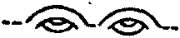
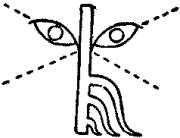
Chinese. Egyptian.
This does not seem to speak for racial consanguinity any more than the well-known curled heads and bearded faces of Assyrian sculptures as compared to the straight-haired and almost beardless Chinese. Similarities in the creation of cultural elements may, it is true, be shown to exist on either side, even at periods when mutual intercourse was probably out of the question; but this may be due to uniformity in the construction of the human brain, which leads man in different parts of the world to arrive at similar ideas under similar conditions, or to prehistoric connexions which it is as impossible for us to trace now as is the origin of mankind itself. Our standpoint as regards the origin of the Chinese race is, therefore, that of the agnostic. All we can do is to reproduce the tradition as it is found in Chinese literature. This tradition, as applying to the very earliest periods, may be nothing more than historical superstition, yet it has its historical importance. Supposing it were possible to prove that none of the persons mentioned in the Bible from Adam down to the Apostles ever lived, even the most sceptical critic would still have to admit that the history of a great portion of the human race has been materially affected by the belief in the examples of their alleged lives. Something similar may be said of the alleged earliest history of the Chinese with its model emperors and detestable tyrants, the accounts of which, whether based on reality or not, have exercised much influence on the development of the nation.
The Chinese have developed their theories of prehistoric life. Speculation as to the origin and gradual evolution of their civilization has resulted in the expression of views by authors who may have reconstructed their systems from remnants of ancestral life revealed by excavations, or from observation of neighbouring nations living in a state of barbarism. This may account for a good deal of the repetition found in the Chinese mythological and legendary narratives, the personal and chronological part of which may have been invented merely as a framework for illustrating social and cultural progress. The scene of action of all the prehistoric figures from P‘an-ku, the first human being, down to the beginning of real history has been laid in a part of the world which has never been anything but Chinese territory. P‘an-ku’s epoch, millions of years ago, was followed by ten distinct periods of sovereigns, including the “Heavenly emperors,” the “Terrestrial emperors,” and the “Human emperors,” the Yu-ch‘au or “Nest-builders,” and Sui-jön, the “Fire Producer,” the Prometheus of the Chinese, who borrowed fire from the stars for the benefit of man. Several of the characteristic phases of cultural progress and social organization have been ascribed to this mythological period. Authors of less fertile imagination refer them to later times, when the heroes of their accounts appear in shapes somewhat resembling human beings rather than as gods and demigods.
The Chinese themselves look upon Fu-hi as their first historical emperor; and they place his lifetime in the years 2852-2738 B.C. Some accounts represent him as a supernatural being; and we see him depicted as a human figure with a fish tail something like a mermaid. He is credited with having established social order among his people, who, before him, had lived like animals in the wilds. The social chaos out of which Chinese society arose is described as being characterized by the absence of family life; for “children knew only their mothers and not their fathers.” Fu-hi introduced matrimony; and in so doing he placed man as the husband at the head of the family and abolished the original matriarchate. This quite corresponds with his views on the dualism in natural philosophy, of which he is supposed to have laid the germs by the invention of the so-called pa-kua, eight symbols, each consisting of three parallel lines, broken or continuous. The continuous lines represented the male element in nature; the broken ones, the female. It is characteristic that the same ruler who assigned to man his position as the head of the family is also credited with the invention of that natural philosophy of the “male and female principles,” according to which all good things and qualities were held to be male, while their less sympathetic opposites were female, such as heaven and earth, sun and moon, day and night, south and north. If these traditions really represent the oldest prehistoric creations of the popular mind, it would almost seem that the most ancient Chinese shared that naïve sentiment which caused our own forefathers to invent gender. The difference is that, with us, the conception survives merely in the language, where the article or suffixes mark gender, whereas with the Chinese, whose language does not express gender, it survives in their system of metaphysics. For all their attempts at fathoming the secrets of nature are based on the idea that male or female powers are inherent in all matter.
To the same Emperor Fu-hi are ascribed many of the elementary inventions which raise man from the life of a brute to that of a social being. He taught his people to hunt, to fish, and to keep flocks; he constructed musical instruments, and replaced a kind of knot-writing previously in use by a system of hieroglyphics. All this cannot of course be considered as history; but it shows that the authors of later centuries who credited Fu-hi with certain inventions were not quite illogical in starting from the matriarchal chaos, after which he is said to have organized society with occupations corresponding to those of a period of hunting, fishing and herding. This period was bound to be followed by a further step towards the final development of the nation’s social condition; and we find it quite logically succeeded by a period of agricultural life, personified in the Emperor, Shön-nung, supposed to have lived in the twenty-eighth century B.C. His name may be freely translated as “Divine Labourer”; and to him the Chinese ascribe the invention of agricultural implements, and the discovery of the medicinal properties of numerous plants.
The third historical emperor was Huang-ti, the “Yellow emperor,” according to the literal translation. Ssï-ma Ts‘ién, the Herodotus of the Chinese, begins his history with him; but Fu-hi and Shön-nung are referred to in texts much older than this historian, though many details relating to their alleged reigns have been added in later times. Huang-ti extended the boundaries of the empire, described as being originally confined to a limited territory near the banks of the Yellow river and the present city of Si-an-fu. Here were the sites of cities used as capitals of the empire under various names during long periods since remote antiquity. To Huang-ti, whose reign is said to have commenced in 2704 according to one source and in 2491 according to another, are ascribed most of the cultural innovations which historians were not able otherwise to locate within historical times. Under Huang-ti we find the first mention of a nation called the Hun-yü, who occupied the north of his empire and with whom he is represented to have engaged in warfare. The Chinese identify this name with that of the Hiung-nu, their old hereditary enemy and the ancestors of Attila’s Huns. Even though the details of these legendary accounts may deserve little confidence, there must have been an old tradition that a nation called the Hun-yü, occupying the northern confines of China, were the ancestors of the Hiung-nu tribes, well known in historical times, a scion of whose great khans settled in territory belonging to the king of Sogdiana during the first century B.C., levied tribute from his neighbours, the Alans, and with his small but warlike horde initiated that era of migrations which led to the overrunning of Europe with Central-Asiatic Tatars.
Fu-hi, Shön-nung and Huang-ti represent a group of rulers comprised by the Chinese under the name of San-huang, i.e. “The Three Emperors.” Although we have no reason to deny their existence, the details recorded concerning them contain enough in the way of improbabilities to justify us in considering them as mythical creations. The chronology, too, is apparently quite fictitious; for the time allotted to their reigns is much too long as a term of government for a single human life, and, on the other hand, much too short, if we measure it by the cultural progress said to have been brought about in it. Fu-hi’s period of hunting life must have lasted many generations before it led to the agricultural period represented by the name Shön-nung; and this period in turn could not possibly have led within a little more than one hundred years to the enormous progress ascribed to Huang-ti. Under the latter ruler a regular board of historians is said to have been organized with Ts‘ang-kié as president, who is known also as Shi-huang, i.e. “the Emperor of Historians,” the reputed inventor of hieroglyphic writing placed by some authors into the Fu-hi period and worshipped as Tz‘ï-shön, i.e. “God of writing,” to the present day. Huang-ti is supposed to have been the first builder of temples, houses and cities; to have regulated the calendar, to which he added the intercalary month; and to have devised means of traffic by cars drawn by oxen and by boats to ply on the lakes and rivers of his empire. His wife, known as “the lady of Si-ling,” is credited with the invention of the several manipulations in the rearing of silkworms and the manufacture of silk. The invention of certain flutes, combined to form a kind of reed organ, led to a deeper study of music; and in order to construct these instruments with the necessary accuracy a system of weights and measures had to be devised. Huang-ti’s successors, Shau-hau, Chuan-hü, and Ti-k‘u, were less prominent, though each of them had their particular merits.
The Model Emperors.—Most of the stories regarding the “Three Emperors” are told in comparatively late records. The Shu-king, sometimes described as the “Canon of History,” our oldest source of pre-Confucian history, supposed to have been edited by Confucius himself, knows nothing of Fu-hi, Shön-nung and Huang-ti; but it begins by extolling the virtues of the emperor Yau and his successor Shun. Yau and Shun are probably the most popular names in Chinese history as taught in China. Whatever good qualities may be imagined of the rulers of a great nation have been heaped upon their heads; and the example of their lives has at all times been held up by Confucianists as the height of perfection in a sovereign’s character. Yau, whose reign has been placed by the fictitious standard chronology of the Chinese in the years 2357-2258, and about 200 years later by the less extravagant “Annals of the Bamboo Books,” is represented as the patron of certain astronomers who had to watch the heavenly bodies; and much has been written about the reputed astronomical knowledge of the Chinese in this remote period. Names like Deguignes, Gaubil, Biot and Schlegel are among those of the investigators. On the other side are the sceptics, who maintain that later editors interpolated statements which could have been made only with the astronomical knowledge possessed by their own contemporaries. According to an old legend, Shun banished “the four wicked ones” to distant territories. One of these bore the name T‘au-t‘ié, i.e. “Glutton”; called also San-miau. T‘au-t‘ié is also the name of an ornament, very common on the surface of the most ancient bronze vessels, showing the distorted face of some ravenous animal. The San-miau as a tribe are said to have been the forefathers of the Tangutans, the Tibetans and the Miau-tz‘ï in the south-west of China. This legend may be interpreted as indicating that the non-Chinese races in the south-west have come to their present seats by migration from Central China in remote antiquity. During Yau’s reign a catastrophe reminding one of the biblical deluge threatened the Chinese world. The emperor held his minister of works, Kun, responsible for this misfortune, probably an inundation of the Yellow river such as has been witnessed by the present generation. Its horrors are described with poetical exaggeration in the Shu-king. When the efforts to stop the floods had proved futile for nine years, Yau wished to abdicate, and he selected a virtuous young man of the name of Shun as his successor. Among the legends told about this second model emperor is the story that he had a board before his palace on which every subject was permitted to note whatever faults he had to find with his government, and that by means of a drum suspended at his palace gate attention might be drawn to any complaint that was to be made to him. Since Kun had not succeeded in stopping the floods, he was dismissed and his son Yü was appointed in his stead. Probably the waters began to subside of their own accord, but Yü has been praised up as the national hero who, by his engineering works, saved his people from utter destruction. His labours in this direction are described in a special section of the Confucian account known as Yü-kung, i.e. “Tribute of Yü.” Yü’s merit has in the sequel been exaggerated so as to credit him with more than human powers. He is supposed to have cut canals through the hills, in order to furnish outlets to the floods, and to have performed feats of engineering compared to which, according to Von Richthofen, the construction of the St Gotthard tunnel without blasting materials would be child’s play, and all this within a few years.
The Hia Dynasty.—As a reward for his services Yü was selected to succeed Shun as emperor. He divided the empire into nine provinces, the description of which in the Yü-kung chapter of the “Canon of History” bears a suspicious resemblance to later accounts. Yü’s reign has been assigned to the years 2205-2198, and the Hia Dynasty, of which he became the head, has been made to extend to the overthrow in 1766 B.C. of Kié, its eighteenth and last emperor, a cruel tyrant of the most vicious and contemptible character. Among the Hia emperors we find Chung-k‘ang (2159-2147), whose reign has attracted the attention of European scholars by the mention of an eclipse of the sun, which his court astronomers had failed to predict. European astronomers and sinologues have brought much acumen to bear on the problem involved in the Shu-king account in trying to decide which of the several eclipses known to have occurred about that time was identical with the one observed in China under Chung-k‘ang.
The Shang, or Yin, Dynasty.—This period, which preceded the classical Chóu dynasty, is made to extend from 1766 to 1122 B.C. We must now be prepared to see an energetic or virtuous ruler at the head of a dynasty and either a cruel tyrant or a contemptible weakling at the end of it. It seems natural that this should be so; but Chinese historians, like the writers of Roman history, have a tendency to exaggerate both good and bad qualities. Ch‘öng-tang, its first sovereign, is represented as a model of goodness and of humane feeling towards his subjects. Even the animal world benefited by his kindness, inasmuch as he abolished all useless torture in the chase. His great minister I Yin, who had greatly assisted him in securing the throne, served two of his successors. P‘an-köng (1401) and Wu-ting (1324) are described as good rulers among a somewhat indifferent set of monarchs. The Shang dynasty, like the Hia, came to an end through the reckless vice and cruelty of a tyrant (Chóu-sin with his consort Ta-ki). China had even in those days to maintain her position as a civilized nation by keeping at bay the barbarous nations by which she was surrounded. Chief among these were the ancestors of the Hiung-nu tribes, or Huns, on the northern and western boundaries. To fight them, to make pacts and compromises with them, and to befriend them with gifts so as to keep them out of the Imperial territories, had been the rôle of a palatinate on the western frontier, the duchy of Chóu, while the court of China with its vicious emperor gave itself up to effeminate luxury. Chóu-sin’s evil practices had aroused the indignation of the palatine, subsequently known as Wön-wang, who in vain remonstrated with the emperor’s criminal treatment of his subjects. The strength and integrity of Wön-wang’s character had made him the corner-stone of that important epoch; and his name is one of the best known both in history and in literature. The courage with which he spoke his mind in rebuking his unworthy liege lord caused the emperor to imprison him, his great popularity alone saving his life. During his incarceration, extending over three years, he compiled the I-king, or “Canon of Changes,” supposed to be the oldest book of Chinese literature, and certainly the one most extensively studied by the nation. Wön-wang’s son, known as Wu-wang, was destined to avenge his father and the many victims of Chóu-sin’s cruelty. Under his leadership the people rose against the emperor and, with the assistance of his allies, “men of the west,” possibly ancestors of the Huns, overthrew the Shang dynasty after a decisive battle, whereupon Chóu-sin committed suicide by setting fire to his palace.
Chóu Dynasty.—Wu-wang, the first emperor of the new dynasty, named after his duchy of Chóu on the western frontier, was greatly assisted in consolidating the empire by his brother, Chóu-kung, i.e. “Duke of Chóu.” As the loyal prime-minister of Wu-wang and his successor the duke of Chóu laid the foundation of the government institutions of the dynasty, which became the prototype of most of the characteristic features in Chinese public and social life down to recent times. The brothers and adherents of the new sovereign were rewarded with fiefs which in the sequel grew into as many states. China thus developed into a confederation, resembling that of the German empire, inasmuch as a number of independent states, each having its own sovereign, were united under one liege lord, the emperor, styled “The Son of Heaven,” who as high priest of the nation reigned in the name of Heaven. The emperor represented the nation in sacrificing and praying to God. His relations with his vassals and government officials, and those of the heads of the vassal states with their subjects as well as of the people among themselves were regulated by the most rigid ceremonial. The dress to be worn, the speeches to be made, and the postures to be assumed on all possible occasions, whether at court or in private life, were subject to regulations. The duke of Chóu, or whoever may have been the creator of this system, showed deep wisdom in his speculations, if he based that immutability of government which in the sequel became a Chinese characteristic, on the physical and moral immutability of individuals by depriving them of all spontaneous action in public and private life. Originally and nominally the emperor’s power as the ruler over his vassals, who again ruled in his name, was unquestionable; and the first few generations of the dynasty saw no decline of the original strength of central power. A certain loyalty based on the traditional ancestral worship counteracted the desire to revolt. The rightful heir to the throne was responsible to his ancestors as his subjects were to theirs. “We have to do as our ancestors did,” the people argued; “and since they obeyed the ancestors of our present sovereign, we have to be loyal to him.” Interference with this time-honoured belief would have amounted to a rupture, as it were, in the nation’s religious relations, and as long as the people looked upon the emperor as the Son of Heaven, his moral power would outweigh strong armies sent against him in rebellion. The time came soon enough when central power depended merely on this spontaneous loyalty.
Not all the successors of Wu-wang profited by the lessons given them by past history. Incapacity, excessive severity and undue weakness had created discontent and loosened the relations between the emperor and his vassals. Increase in the extent of the empire greatly added to this decline of central power. For the emperor’s own dominion was centrally situated and surrounded by the several confederate states; its geographical position prevented it from participating in the general aggrandisement of China, and increase in territory, population and prestige had become the privilege of boundary states. Tatar tribes in the north and west and the aboriginal Man barbarians in the south were forced by warfare to yield land, or enticed to exchange it for goods, or induced to mingle with their Chinese neighbours, thus producing a mixed population combining the superior intelligence of the Chinese race with the energetic and warlike spirit of barbarians. These may be the main reasons which gradually undermined the Imperial authority and brought some of the confederate states to the front, so as to overshadow the authority of the Son of Heaven himself, whose military and financial resources were inferior to those of several of his vassals. A few out of the thirty-five sovereigns of the Chóu dynasty were distinguished by extraordinary qualities. Mu-wang of the 10th century performed journeys far beyond the western frontier of his empire, and was successful in warfare against the Dog Barbarians, described as the ancestors of the Hiung-nu, or Huns. The reign of Süan-wang (827-782 B.C.) was filled with warfare against the Tangutans and the Huns, called Hién-yün in a contemporaneous poem of the “Book of Odes”; but the most noteworthy reign in this century is that of the lascivious Yu-wang, the oppressiveness of whose government had caused a bard represented in the “Book of Odes” to complain about the emperor’s evil ways. The writer of this poem refers to certain signs showing that Heaven itself is indignant at Yu-wang’s crimes. One of these signs was an eclipse of the sun which had recently occurred, the date and month being clearly stated. This date corresponds exactly with August 29, 776 B.C.; and astronomers have calculated that on that precise date an eclipse of the sun was visible in North China. This, of course, cannot be a mere accident; and since the date falls into the sixth year of Yu-wang’s reign, the coincidence is bound to increase our confidence in that part of Chinese history. Our knowledge of it, however, is due to mere chance; for the record of the eclipse would probably not have been preserved until our days had it not been interpreted as a kind of tekel upharsin owing to the peculiarity of the political situation. It does not follow, therefore, as some foreign critics assume, that the historical period begins as late as Yu-wang’s reign. China has no architectural witnesses to testify to her antiquity as Egypt has in her pyramids and temple ruins; but the sacrificial bronze vessels of the Shang and Chóu dynasties, with their characteristic ornaments and hieroglyphic inscriptions, seem to support the historical tradition inasmuch as natural development may be traced by the analysis of their artistic and paleographic phases. Counterfeiters, say a thousand years later, could not have resisted the temptation to introduce patterns and hieroglyphic shapes of later periods; and whatever bronzes have been assigned to the Shang dynasty, i.e. some time in the second millennium B.C., exhibit the Shang characteristics. The words occurring in their inscriptions, carefully collected, may be shown to be confined to ideas peculiar to primitive states of cultural life, not one of them pointing to an invention we may suspect to be of later origin. But, apart from this, it seems a matter of individual judgment how far back beyond that indisputable year 776 B.C. a student will date the beginning of real history.
In the 7th century central authority had declined to such an extent that the emperor was merely the nominal head of the confederation, the hegemony in the empire falling in turn to one of the five principal states, for which reason the Chinese speak of a period of the “Five Leaders.” The state of Ts‘i, corresponding to North Shan-tung, had begun to overshadow the other states by unprecedented success in economic enterprise, due to the prudent advice of its prime minister, the philosopher Kuan-tzï. Other states attained leadership by success in warfare. Among these leaders we see duke Mu of T‘sin (659 B.C.), a state on the western boundary which was so much influenced by amalgamation with its Hunnic neighbours that the purely Chinese states regarded it as a barbarian country. The emperor was in those days a mere shadow; several of his vassals had grown strong enough to claim and be granted the title “king,” and they all tried to annihilate their neighbours by ruse in diplomacy and by force of arms, without referring to their common ruler for arbitration, as they were in duty bound. In this bellum omnium contra omnes the state of Ts‘in, in spite of repeated reverses, remained in possession of the field.
The period of this general struggle is spoken of by Chinese historians as that of “The Contending States.” Like that of the “Five Leaders” it is full of romance; and the examples of heroism, cowardice, diplomatic skill and philosophical equanimity which fill the pages of its history have become the subject of elegant literature in prose and poetry. The political development of the Chóu dynasty is the exact counterpart of that of its spiritual life as shown in the contemporaneous literature. The orthodox conservative spirit which reflects the ethical views of the emperor and his royal partisans is represented by the name Confucius (551-479 B.C.). The great sage had collected old traditions and formulated the moral principles which had been dormant in the Chinese nation for centuries. His doctrines tended to support the maintenance of central power; so did those of other members of his school, especially Mencius. Filial love showed itself as obedience to the parents in the family and as loyalty to the emperor and his government in public life. It was the highest virtue, according to the Confucian school. The history of the nation as taught in the Shu-king was in its early part merely an illustration of Confucianist ideas about good and bad government. The perpetual advice to rulers was: “Be like Yau, Shun and Yü, and you will be right.” Confucianism was dominant during the earlier centuries of the Chóu dynasty, whose lucky star began to wane when doctrines opposed to it got the upper hand. The philosophical schools built up on the doctrines of Lau-tzï had in the course of generations become antagonistic, and found favour with those who did not endorse that loyalty to the emperor demanded by Mencius; so had other thinkers, some of whom had preached morals which were bound to break up all social relations, like the philosopher of egotism, Yang Chu, according to Mencius disloyalty personified and the very reverse of his ideal, the duke of Chóu. The egotism recommended by Yang Chu to the individual had begun to be practised on a large scale by the contending states, their governments and sovereigns, some of whom had long discarded Confucian rites under the influence of Tatar neighbours. It appears that the anti-Confucian spirit which paved the way towards the final extinction of Wu-wang’s dynasty received its chief nourishment from the Tatar element in the population of the northern and western boundary states. Among these Ts‘in was the most prominent. Having placed itself in the possession of the territories of nearly all of the remaining states, Ts‘in made war against the last shadow emperor, Nan-wang who had attempted to form an alliance against the powerful usurper, with the result that the western part of the Chóu dominion was lost to the aggressor.
Nan-wang died soon after (256 B.C.), and a relative whom he had appointed regent was captured in 249 B.C., when the king of Ts‘in put an end to this last remnant of the once glorious Chóu dynasty by annexing its territory. The king had already secured the possession of the Nine Tripods, huge bronze vases said to have been cast by the emperor Yü as representing the nine divisions of his empire and since preseryed in the treasuries of all the various emperors as a symbol of Imperial power. With the loss of these tripods Nan-wang had forfeited the right to call himself “Son of Heaven.” Another prerogative was the offering of sacrifice to Shang-ti, the Supreme Ruler, or God, with whom only the emperor was supposed to communicate. The king of Ts‘in had performed the ceremony as early as 253 B.C.
(F. H.*)
(C)—From the Ts‘in Dynasty to 1875.
After the fall of the Chóu dynasty a kind of interregnum followed during which China was practically without an emperor. This was the time when the state of Ts‘in asserted itself as the leader and finally as the master of all the Ts‘in dynasty 249-210 B.C. contending states. Its king, Chau-siang, who died in 251 B.C., though virtually emperor, abstained from adopting the imperial title. He was succeeded by his son, Hiao-wên Wang, who died after a three days’ reign. Chwan-siang Wang, his son and successor, was a man of no mark. He died in 246 B.C. giving place to Shi Hwang-ti, “the first universal emperor.” This sovereign was then only thirteen, but he speedily made his influence felt everywhere. He chose Hien-yang, the modern Si-gan Fu, as his capital, and built there a Shi Hwang-ti. magnificent palace, which was the wonder and admiration of his contemporaries. He abolished the feudal system, and divided the country into provinces over whom he set officers directly responsible to himself. He constructed roads through the empire, he formed canals, and erected numerous and handsome public buildings.
Having settled the internal affairs of his kingdom, he turned his attention to the enemies beyond his frontier. Chief among these were the Hiung-nu Tatars, whose attacks had for years disquieted the Chinese and neighbouring principalities. Against these foes he marched with an army of 300,000 men, exterminating those in the neighbourhood of China, and driving the rest into Mongolia. On his return from this campaign he was called upon to face a formidable rebellion in Ho-nan, which had been set on foot by the adherents of the feudal princes whom he had dispossessed. Having crushed the rebellion, he marched southwards and subdued the tribes on the south of the Nan-shan ranges, i.e. the inhabitants of the modern provinces of Fu-kien, Kwang-tung and Kwang-si. The limits of his empire were thus as nearly as possible those of modern China proper. One monument remains to bear witness to his energy. Finding that the northern states of Ts‘in, Chao and Yen were building lines of fortification along their northern frontier for protection against the Hiung-nu, he conceived the idea of building one gigantic wall, which was to stretch across the whole northern limit of the huge empire from the sea to the farthest western corner of the modern province of Kan-suh. This work was begun under his immediate supervision in 214 B.C. His reforming zeal made him unpopular with the upper classes. Schoolmen and pedants held up to the admiration of the people the heroes of the feudal times and the advantages of the system they administered. Seeing in this propaganda danger to the state Shi Hwang-ti determined to break once and for all with the past. To this end he ordered the destruction of all books having reference to the past history of the empire, and many scholars were put to death for failing in obedience to it. (See infra § Chinese Literature, §§ History.) The measure was unpopular and on his death (210 B.C.) rebellion broke out. His son and successor Erh-shi, a weak and debauched youth, was murdered after having offered a feeble resistance to his enemies. His son Tsze-yung surrendered to Liu Pang, the prince of Han, one of the two generals who were the leaders of the rebellion. He afterwards fell into the hands of Hiang Yu, the other chieftain, who put him and his family and associates to death. Hiang Yu aspiring to imperial honours, war broke out between him and Liu Pang. After five years’ conflict Hiang Yu was killed in a decisive battle before Wu-kiang. Liu Pang was then proclaimed emperor (206 B.C.) under the title of Kao-ti, and the new line was styled the Han dynasty.
Kao-ti established his capital at Lo-yang in Ho-nan, and afterwards removed it to Chang-an in Shen-si. Having founded his right to rebel on the oppressive nature of the laws promulgated by Shi Hwang-ti, he abolished the Han dynasty 206 B.C. ordinances of Ts‘in, except that referring to the destruction of the books—for, like his great predecessor, he dreaded the influence exercised by the literati—and he exchanged the worship of the gods of the soil of Ts‘in for that of those of Han, his native state. His successor Hwei-ti (194-179 B.C.), however, gave every encouragement to literature, and appointed a commission to restore as far as possible the texts which had been destroyed by Shi Hwang-ti. In this the commission was very successful. It was discovered that in many cases the law had been evaded, while in numerous instances scholars were found to write down from memory the text of books of which all copies had been destroyed, though in some cases the purity of the text is doubtful and in other cases there were undoubted forgeries. A period of repose was now enjoyed by the empire. There was peace within its borders, and its frontiers remained unchallenged, except by the Hiung-nu, who suffered many severe defeats. Thwarted in their attacks on China, these marauders attacked the kingdom of the Yueh-chi, which had grown up in the western extremity of Kan-suh, and after much fighting drove their victims along the T‘ien-shan-nan-lu to the territory between Turkestan and the Caspian Sea. This position of affairs suggested to the emperor the idea of forming an offensive and defensive alliance with the Yueh-chi against the Hiung-nu. With this object the general Chang K‘ien was sent as an ambassador to western Tatary. After having been twice imprisoned by the Hiung-nu he returned to China. Chang K‘ien had actually reached the court of the Yueh-chi, or Indo-Scythians as they were called owing to their having become masters of India later on, and paid a visit to the kingdom of Bactria, recently conquered by the Yueh-chi. His report on the several kingdoms of western Asia opened up a new world to the Chinese, and numerous elements of culture, plants and animals were then imported for the first time from the west into China. While in Bactria Chan K‘ien’s attention was first drawn to the existence of India, and attempts to send expeditions, though at first fruitless, finally led to its discovery. Under Wu-ti (140-86 B.C.) the power of the Hiung-nu was broken and eastern Turkestan changed into a Chinese colony, through which caravans could safely pass to bring back merchandise and art treasures from Persia and the Roman market. By the Hans the feudal system was restored in a modified form; 103 feudal principalities were created, but they were more or less under the jurisdiction of civil governors appointed to administer the thirteen chows (provinces) into which the country was divided. About the beginning of the Christian era Wang Mang rose in revolt against the infant successor of P‘ing-ti (A.D. 1), and in A.D. 9 proclaimed himself emperor. He, however, only gained the suffrages of a portion of the nation, and before long his oppressive acts estranged his supporters. In A.D. 23 Liu Siu, one of the princes of Han, completely defeated him. His head was cut off, and his body was torn in pieces by his own soldiery.
Liu Siu, was proclaimed emperor under the title of Kwang-wu-ti, reigned from A.D. 58 to 76. Having fixed on Lo-yang in Ho-nan as his capital, the line of which he was the first emperor became known as the Eastern Han Eastern Han dynasty, A.D. 23. dynasty. It is also known as the Later Han dynasty. During the reign of his successor Ming-ti, A.D. 65, Buddhism was introduced from India into China (see ante § Religion). About the same time the celebrated general Pan Ch‘ao was sent on an embassy to the king of Shen-shen, a small state of Turkestan, near the modern Pidjan. Before long he added the states of Shen-shen, Khotan, Kucha and Kashgar as apanages to the Chinese crown, and for a considerable period the country enjoyed prosperity. The Han dynasty (including in the term the Eastern Han dynasty) has been considered the first national dynasty and is one of the most famous in China; nor has any ruling family been more popular. The Chinese, especially the northern Chinese, still call themselves “the sons of Han.” The wealth and trade as well as the culture of the country was greatly developed, and the competitive examinations for literary degrees instituted. The homogeneity of the nation was so firmly established that subsequent dissensions and conquests could not alter fundamentally the character of the nation.
Towards the end of the 2nd century the power of the Eastern Hans declined. In 173 a virulent pestilence, which continued for eleven years, broke out. A magical cure for this plague was said to have been discovered by a Taoist priest named Chang Chio, who in a single month won a sufficiently large following to enable him to gain possession of the northern provinces of the empire. He was, however, defeated by Ts‘aou Ts‘aou, another aspirant to imperial honours, whose son, Ts‘aou P‘ei, on the death of Hien-ti (A.D. 220), proclaimed himself emperor, adopting the title of Wei as the appellation Wei dynasty. of his dynasty. There were then, however, two other claimants to the throne, Liu Pei and Sun Ch‘üan, and the three adventurers agreed to divide the empire between them. Ts‘aou P‘ei, under the title of Wên-ti, ruled over the kingdom of Wei (220), which occupied the whole of the central and northern portion of China. Liu Pei established the Shuh Han dynasty in the modern province of Sze-ch‘uen (221), and called himself Chao-lieh-ti; and to Sun Ch‘üan fell the southern provinces of the empire, from the Yangtsze-kiang southwards, including the modern Tongking, which he formed into the kingdom of Wu with Nan-king for his capital, adopting for himself the imperial style of Ta-tê (A.D. 222).
China during the period of the “Three Kingdoms” was a house divided against itself. Liu Pei, as a descendant of the house of Han, looked upon himself as the rightful sovereign of the whole empire, and he despatched an army under “Three kingdom” period. Chu-ko Liang to support his claims. This army was met by an Oppossing force under the Wei commander Sze-ma I, of whom Chinese historians say that “he led armies like a god,” and who, by adopting a Fabian policy, completely discomfited his adversary. But the close of this campaign brought no peace to the country. Wars became chronic, and the reins of power slipped out of the hands of emperors into those of their generals. Foremost among these were the members of the Sze-ma family of Wei. Sze-ma I left a son, Sze-ma Chao, scarcely less distinguished than himself, and when Sze-ma Chao died his honours descended to Sze-ma Yen, who deposed the ruling sovereign of Wei, and proclaimed himself emperor of China (A.D. 265). His dynasty he styled the Western Tsin dynasty, and he adopted for himself the title of Wu-ti. The most noticeable event in this reign was the advent of the ambassadors of the emperor Diocletian in 284. For some years the neighbouring states appear to have transferred their allegiance from the house of Wei to that of Tsin. Wu-ti’s successors proving, however, weak and incapable, the country soon fell again into disorder. The Hiung-nu renewed incursions into the empire at the beginning of the 4th Western Tsin dynasty. century, and in the confusion which followed, an adventurer named Liu Yuen established himself (in 311) as emperor, first at P‘ing-yang in Shan-si and afterwards in Lo-yang and Chang-an. The history of this period is very chaotic. Numerous states sprang into existence, some founded by the Hiung-nu and others by the Sien-pi tribe, a Tungusic clan, inhabiting a territory to the north of China, which afterwards established the Liao dynasty in China. In 419 the Eastern Tsin dynasty came to an end, and with it disappeared for nearly two hundred years all semblance of united authority. The country became divided into two parts, the north and the south. In the north four families reigned successively, two of which were of Sien-pi origin, viz. the Wei and the How Chow, the other two, the Pih Ts‘i and the How Liang, being Chinese. In the south five different houses supplied rulers, who were all of Chinese descent.
This period of disorder was brought to a close by the establishment of the Suy dynasty (590). Among the officials of the ephemeral dynasty of Chow was one Yang Kien, who on his daughter becoming empress (578) was created duke of Suy. Two Suy dynasty. years later Yang Kien proclaimed himself emperor. The country, weary of contention, was glad to acknowledge his undivided authority; and during the sixteen years of his reign the internal affairs of China were comparatively peaceably administered. The emperor instituted an improved code of laws, and added 5000 volumes to the 10,000 which composed the imperial library. Abroad, his policy was equally successful. He defeated the Tatars and chastised the Koreans, who had for a long period recognized Chinese suzerainty, but were torn by civil wars and were disposed to reject her authority. After his death in 604 his second son forced the heir to the throne to strangle himself, and then seized the throne. This usurper, Yang-ti, sent expeditions against the Tatars, and himself headed an expedition against the Uighurs, while one of his generals annexed the Lu-chu Islands to the imperial crown. During his reign the volumes in the imperial library were increased to 54,000, and he spent vast sums in erecting a magnificent palace at Lo-yang, and in constructing unprofitable canals. These and other extravagances laid so heavy a burden on the country that discontent began again to prevail, and on the emperor’s return from a successful expedition against the Koreans, he found the empire divided into rebellious factions. In the troubles which followed General Li Yuen became prominent. On the death of the emperor by assassination this man set Kung-ti, the rightful heir, on the throne (617) until such time as he should have matured his schemes.