VOLUME III SLICE IV Basso-relievo to Bedfordshire (continued 8)
Reading edition
For the most part the clergy of the Roman obedience shave clean, as have done the popes for two centuries and more. But missionary bishops cultivate the long beard with some pride, and the orders have varying customs, the Dominican shaving and the Franciscan allowing the hair to grow. The Roman Catholic clergy of Dalmatia, secular and regular, are allowed to wear the moustache without beard or whiskers, as a concession to national prejudices.
Amongst English people, always ready to be swayed by fashion, the hair of the face has been, age by age, cherished or shaved away, curled or clipped into a hundred devices. Before the immigration from Sleswick the Briton knew the use of the razor, sometimes shaving his chin, but leaving the moustaches long. The old English also wore moustaches and forked beards, but, save for aged men, the beard had passed out of fashion before the Norman Conquest. Thus, in the Bayeux needlework, Edward the king is venerable with a long beard, but Harold and his younger fighting men have their chins reaped. “The English,” says William of Malmesbury, “leave the upper lip unshaven, suffering the hair continually to increase,” and to Harold’s spies the Conqueror’s knights, who had “the whole face with both lips shaven,” were strange and priest-like. Matthew Paris had a strange idea that the beard was distinctive of Englishmen; he asserts that those who remained in England were compelled to shave their beards, while the native nobles who went into exile kept their beards and flowing locks “like the Easterns and especially the Trojans.” He even believed that “William with the beard,” who headed a rising in London under Richard I., came of a stock which had scorned to shave, out of hatred for the Normans, a statement which Thierry developed.
The Chanson de Roland shows us “the pride of France” as “that good bearded folk,” with their beards hanging over coats of mail, and it makes the great emperor swear to Naimes by his beard. It was only about the year 1000, according to Rodolf Glaber, that men began in the north of France to wear short hair and shave “like actors”; and even in the Bayeux tapestry the old Norman shipwrights wear the beard. But so rare was hair on the face amongst the Norman invaders that William, the forefather of the Percys, was known in his lifetime and remembered after his death as William “Asgernuns” or “Oht les gernuns,” i.e. “William with the moustaches,” the epithet revived by one of his descendants making our modern name of Algernon. Count Eustace of Boulogne was similarly distinguished. Fashion swung about after the Conquest, and, in the day of Henry I., Serle the bishop could compare bearded men of the Norman-English court with “filthy goats and bristly Saracens.” The crusades, perhaps, were accountable for the beards which were oddly denounced as effeminate in the young courtiers of William Rufus. Not only the Greeks but the Latins in the East sometimes adopted the Saracen fashion, and the siege of Antioch (1098) was as unfavourable to the use of the razor as that of Sevastopol. When the Latins stormed the town by night, bearded knights owed their death to the assumption that every Christian would be a shaven man. But for more than four centuries diversity is allowed, beards, moustaches and shaven faces being found side by side, although now and again one fashion or another comes uppermost to be followed by those nice in such matters. Henry II. is a close-shaven king, and Richard II.’s effigy shows but a little tuft on each side of the chin, tufts which are two curled locks on the chin of Henry IV. But Henry III. is long-bearded, Edward II. curls his beard in three great ringlets, and the third Edward’s long forked beard flows down his breast in patriarchal style. The mid-13th century, as seen in the drawings attributed to Matthew Paris, is an age of many full and curled beards, although the region about the lips is sometimes clipped or shaved. The beard is common in the 14th century, the forked pattern being favoured and the long drooping moustache. Amongst those who ride with him to Canterbury, Chaucer, a bearded poet, notes the merchant’s “forked beard,” the white beard of the franklin and the red beard of the miller, but the reeve’s beard is “shave as ny as ever he can.” Henry of Monmouth and his son are shaven, and thereafter beards are rare save with a few old folk until they come slowly back with the 16th century. In Ireland the statute enacted by a parliament at Trim in 1447 recited that no manner of man who will be taken for an Englishman should have beard above his mouth—the upper lip must be shaven at least every fortnight or be of equal growth with the nether lip,—and this statute remained unrepealed for nigh upon two hundred years. Henry VIII., always a law to himself, brought back the beard to favour, Stowe’s annals giving 1535 as the year in which he caused his beard “to be knotted and no more shaven,” his hair being polled at the same time. Many portraits give his fashion of wearing a thin moustache, whose ends met a short and squarely trimmed beard parted at the chin, a fashion in which he was followed by his brother-in-law Charles Brandon. But it is remarkable that those about him rarely imitated their most dread sovereign. While Cromwell and Howard the Admiral go clean shaven, the Seymour brothers, Denny and Russell, have the beard long and flowing. Even the forty shilling a year man, says Hooper in 1548, will waste his morning time while he sets his beard in order. About this time the clergy began to break with the long tradition of smooth faces. A priest in 1531 is commanded to abstain from wearing a beard, and Cardinal Pole, coming from the court of a bearded pope, appears bearded like a Greek patriarch. The law too, the church’s kinswoman, begins to forbid, a sign of the change, and from 1542 the society of Lincoln’s Inn makes rules for fining and expelling those who appear bearded at their mess, rules which the example of exalted lawyers caused to be withdrawn in 1560.
The age of Elizabeth saw lawyers, soldiers, courtiers and merchants all bearded. Her Cecils, Greshams, Raleighs, Drakes, Dudleys and Walsinghams have the beard. A shaven chin such as that seen in the portrait of Philip Howard, earl of Arundel, is rare, but the beards take a hundred fashions, and satirists and Puritan pamphleteers were busy with them and with the men who wasted hours in perfuming or starching them, in dusting them with orris powder, in curling them with irons and quills. Stubbs gives them a place amongst his abuses. “It is a world to consider how their mowchatowes must be preserved or laid out from one cheek to another and turned up like two horns towards the forehead.” Of the English variety of beards Harrison has a good word: “beards of which some are shaven from the chin like those of Turks, not a few cut short like to the beard of Marquess Otto, some made round like a rubbing brush, others with a pique de vant (O! fine fashion) or now and then suffered to grow long, the barbers being grown to be so cunning in this behalf as the tailors. And therefore if a man have a lean and straight face, a Marquess Otto’s cut will make it broad and large; if it be platter-like, a long slender beard will make it seem the narrower; if he be weasel-becked, then much hair left on the cheeks will make the owner look big like a bowdled hen, and as grim as a goose, if Cornelis of Chelmersford say true.” Nevertheless he adds that “many old men do wear no beards at all.” The Elizabethan fashions continued under King James, the beard trimmed to a point being common wear; but under King Charles there is a certain reaction, and the royal style of shaving the cheeks and leaving the moustache whose points sweep upward and the chin beard like a downward flame is followed by most of the gentry. With some the beard disappears altogether or remains a mere fleck below the lip. Archbishop Laud has a cavalier-like chin tuft and upturned moustache, but Abbot his predecessor wore the spade beard, the “cathedral beard” of Randle Holme, seen in all its dignity on the Chigwell brass of Samuel Harsnett, archbishop of York (died 1631), a grim figure with his angry moustache and a long and broad beard, cut square at the bottom.
From the Restoration year the razor comes more into use. Young men shave clean. The restored king curls a few dark hairs of a moustache over each cheek, but his brother James is shaven. With the reign of Queen Anne the country enters the beardless age, and beards, moustaches and whiskers are no more seen. In the 18th century the moustache indicated a soldier from beyond sea. A Jew or a Turk was known by the beard, an appendage loathsome as comic. Matthew Robinson, the second Lord Rokeby, was indeed wearing a beard in 1798, but he was reckoned a madman therefor, and Phillips’s Public Character pictures him as “the only peer and perhaps the only gentleman of either Great Britain or Ireland who is thus distinguished.” That George III. in his madness should have been left unshaved was a circumstance of his misery that wrung the hearts of all loyal folk. But in the very year of 1798, when Lord Rokeby’s image was engraved for the curious, the Worcestershire militia officers quartered near Brighton were copying the Austrian moustache of the foreign troops, and we may note that the hair of the face, which disappeared when wigs came in, began to reappear as wigs went out. Early in the 19th century the bucks began to show a patch of whisker beside the ear, and the soldier’s moustache became a common sight. Before Waterloo, guardsmen were complaining that officers of humbler regiments imitated their fashion of the moustache, and by the Waterloo year most young cavalry officers were moustached. The Horse Artillery were the next moustached corps, the rest of the army, already whiskered, following their example in the ’fifties. But for a civilian to grow a moustache was long reckoned a piece of unseemly swagger. Clive Newcome, it will be remembered, wore one until the taunting question whether he was “going in the Guards” shamed him into shaving clean. When in 1840 Mr George Frederick Muntz appeared in parliament with a full beard there were those who felt that this tall Radical had taken his own strange method of insulting English parliamentary institutions. James Ward, R.A. (d. 1859), painter of animals, was another breaker of the unwritten law, defending his beard in a pamphlet of eighteen arguments as a thing pleasing at once to the artist and to his Creator. Freedom in these matters only came when the troops were home from the Crimea, when officers who had grown beards and acquired the taste for tobacco during the long months in the trenches showed their beards and their cigars in Piccadilly. Then came the Volunteer movement, and every man was a soldier, taking a soldier’s licence. The dominant fashion was the moustache, worn with long and drooping whiskers. But the “Piccadilly weepers” of the ’sixties were out of the mode for the younger men when the ’eighties began, and by the end of the century whiskers were seen in the army only upon a few veteran officers. The fashion of clean shaving had made some way, the popularity of the shaven actor having a part in this. In 1909 all modes of dealing with the hair of the face might be recognized, but the full beard had become somewhat rare in England and the full whiskers rarer still. The upper class showed an inclination to shave clean, although the army grudgingly recognized a rule which ordered the moustache to be worn. Naval men, by regulation, shaved or wore both beard and moustache, but their beards were always trimmed. Most barristers shaved the lips, although the last judge unable to hear an advocate whose voice a moustache interrupted had left the bench. Clergymen followed the lay fashions as they did under the first Stuart kings, although there was still some prejudice against the moustache as an ornament military and inappropriate. A newspaper of 1857, describing the appearance of Livingstone the missionary at a Mansion House meeting, records that he came wearing a moustache, “braving the prejudices of his countrymen and thus evincing a courage only inferior to that exhibited by him amongst the savages of Central Africa.” Even as late as 1884 the Pall Mall Gazette has some surprised comments on the beard of Bishop Ryle, newly consecrated to the see of Liverpool.
The footman, whose full-dress livery is the court dress of a hundred years ago, must show no more than the rudimentary whisker of the early eighteen-hundreds, and butler, coachman and groom come under the same rule. The jockey and the hunt whip are shaven likewise, but the courier has the whiskers and moustache that once marked him as a foreigner in the English milor’s service, and the chauffeur, a servant with no tradition behind him, is often moustached.
Lastly, we may speak of the practice of the royal house since England came out of the beardless century. The regent took the new fashion, and sat “in whiskered state,” but his brother and successor shaved clean and disliked even the hussar’s moustache. The prince consort wore the moustache as a young man, adding whiskers in later years. King Edward VII. wore moustache and trimmed beard, and his heir apparent also followed the fashion of many fellow admirals.
(O. Ba.)
BEARDSLEY, AUBREY VINCENT (1872-1898), English artist in black and white, was born at Brighton on the 24th of August 1872. In 1883 his family settled in London, and in the following year he appeared in public as an “infant musical phenomenon,” playing at several concerts with his sister. In 1888 he obtained a post in an architect’s office, and afterwards one in the Guardian Life and Fire Insurance Company (1889). In 1891, under the advice of Sir Edward Burne-Jones and Puvis de Chavannes, he took up art as a profession. In 1892 he attended the classes at the Westminster School of Art, then under Professor Brown; and from 1893 until his death, at Mentone, on the 16th of March 1898, his work came continually before the public, arousing a storm of criticism and much hostile feeling. Beardsley had an unswerving tendency towards the fantastic of the gloomier and “unwholesome” sort. His treatment of most subjects was revolutionary; he deliberately ignored proportion and perspective, and the “freedom from convention” which he displayed caused his work to be judged with harshness. In certain phases of technique he especially excelled; and his earlier methods of dealing with the single line in conjunction with masses of black are in their way unsurpassed, except in the art of Japan, the country which probably gave his ideas some assistance. He was always an ornamentist, rather than an illustrator; and his work must be judged from that point of view. His frontispiece to Volpone is held by some to be, from this purely technical standpoint, one of the best pen-drawings of the age. His posters for the Avenue theatre and for Mr Fisher Unwin were among the first of the modern cult of that art.
The following are the chief works which are illustrated with drawings by Beardsley: the Bon Mot Library, The Pall Mall Budget, and The Studio (1893), Sir Thomas Malory’s Morte d’Arthur (1893-1894), Salomé (1894), The Yellow Book (1894-1895), The Savoy Magazine (1896), The Rape of the Lock (1896).
See also J. Pennell, The Studio (1893); Symons, Aubrey Beardsley (1898); R. Ross, Volpone (1898); H.C. Marillier, The Early Work of Aubrey Beardsley (1899); Smithers, Reproductions of Drawings by Aubrey Beardsley; John Lane, The Later Works of Aubrey Beardsley (1901); R. Ross, Aubrey Beardsley (1908).
(E. F. S.)
BEARDSTOWN, a city of Cass county, Illinois, U.S.A., in the W. part of the state, on the E. bank of the Illinois river, about 111 m. N. of St Louis, Missouri. It is served by the Baltimore & Ohio South-Western, and the Burlington (Chicago, Burlington & Quincy) railways, and by steamboats plying between it and St. Louis. Pop. (1890) 4226; (1900) 4827 (444 foreign-born); (1910) 6107. The industrial establishments of the city include flour, planing and saw mills, the machine shops (of the St Louis division) of the Chicago, Burlington & Quincy railway, ice factories, pearl button factories and a shoe factory. The fishing interests are also important. Beardstown was laid out in 1827 and was incorporated as a city in 1896. It was named in honour of Thomas Beard, who settled in the vicinity in 1820. During the Black Hawk War (1832) it was a base of supplies for the Illinois troops. The old court house in which Abraham Lincoln, in 1854, won his famous “Armstrong murder case,” is now used for a city hall.
BEARER, strictly “one who carries,” a term used in India for a palanquin-bearer, and now especially for a body-servant. The term is also used in connexion with military ambulances, and “bearer” companies formed part of the Royal Army Medical Corps until amalgamated with the field-hospitals to form field-ambulances (1905). In banking and commerce the word is applied to the holder or presenter of a cheque or draft not made payable to a specific person; it has also a technical use, as in printing, of anything that supports pressure in machinery, &c.
BEARINGS. In engineering a “bearing” is that particular kind of support which, besides carrying the load imposed upon it by the shaft associated with it, allows the shaft freedom to revolve. Or, put in another way, a bearing forms with the shaft a pair of elements having one degree of freedom to turn relatively to one another about their common axis. The part of the shaft in the bearing is commonly called the journal. The component parts of a small bearing, pillow block, plummer block or pedestal, as it is variously styled, are illustrated in fig. 1, and these parts, put together, are further illustrated in fig. 2 with the shaft added. Corresponding parts are similarly lettered in the two illustrations. The shaft (S) is encircled by the brasses (B1 and B2) made of gun metal, phosphor bronze or other suitable material. The lower brass fits into the main casting (A) in the semicircular seat provided for it, and is prevented from moving endways by the flanges (F, F) and from turning with the shaft by the projections (P, P), which fit into corresponding recesses in the casting (A), one of which is shown at p. After the shaft has been placed in position, the upper brass (B2) and the cap (C) are put on and both are held in place by the bolts (Q1, Q2). The brasses are bedded into the main casting (A) and the cap (C) respectively at the surfaces D, D, D, D. The complete bearing is held to the framework of the machine by bolts (R1, R2) passing through holes (H, H) which are slotted to allow endwise adjustment of the whole bearing in order to facilitate the alignment of the shaft. Oil or other lubricant is introduced through the hole (G), and it passes through the top brass to grooves or oilways cut into the surface of the brass for the purpose of distributing the oil uniformly to the journal.
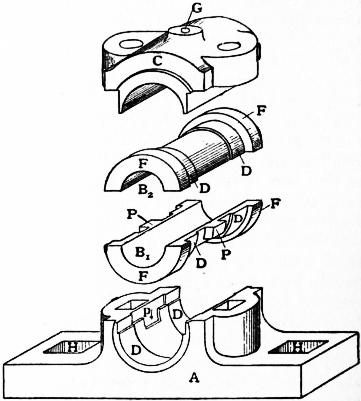
Fig. 1.
Some form of lubricator is usually fitted at G in order to supply oil to the bearing continuously. A form of lubricator used for this purpose is shown in place, fig. 2, and an enlarged section is shown in fig. 3. It will be seen that the lubricator consists essentially of a cup the base of which is pierced centrally by a tube which reaches to within a small distance of the lid of the cup inside, and projects into the oilway leading to the journal outside. The annular space round the tube inside is filled with oil which is transferred to the central tube and thence to the bearing by the capillary action of a cotton wick thrust down on a piece of wire. It is only necessary to withdraw the wick from the central tube to stop the supply of oil. The lubricator is fitted through a hole in the lid which is usually plugged with a piece of cane or closed by more elaborate means. A line of shafting would be supported by several bearings of the kind illustrated, themselves supported by brackets projecting from or rigidly fixed to the walls of the workshop, or on frames resting on the floor, or on hangers attached to the roof girders or principals.
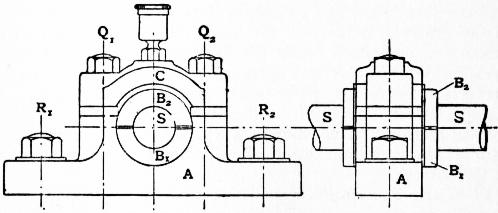
Fig. 2.
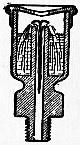
Fig. 3.
In bearings of modern design for supporting a line shaft the general arrangement shown in fig. 1 is modified so that the alignments of the shaft can be made both vertically or horizontally by means of adjusting screws, and the brass is jointed with the supporting main body so that it is free to follow the small deflections of the shaft which take place when the shaft is working. Another modern improvement is the formation of an oil reservoir or well in the base of the bearing itself, and the transference of the oil from this well to the shaft by means of one or two rings riding loosely on the shaft. The bottom part of the ring dips into the oil contained in the well of the bearing and, as the shaft rotates, the ring rolls on the shaft and thus carries oil up to the shaft continuously, from which it finds its way to the surfaces of the shaft and bearing in contact. It should be understood that the upper brass is slotted crossways to allow the ring to rest on the shaft. When the direction of the load carried by the bearing is constant it is unnecessary to provide more than one brass, and the construction is modified accordingly. Figs. 4 and 5 show an axle box used for goods wagons on the Great Eastern railway, and they also illustrate the method of pad lubrication in general use for this kind of bearing. The main casting, A, is now uppermost, and is designed so that the upper part supports and constrains the spring buckle through which the load W is transmitted to the bearing, and the lower part inside is arranged to support the brass, B. The brass is jointed freely with the main casting by means of a hemispherical hump resting in a corresponding recess in the casting. What may be called the cap, C, forms the lower part of the axle box, but instead of supporting a second brass it is formed into an oil reservoir in which is arranged a pad of cotton wick woven on a tin frame. The upper part of the pad is formed into a kind of brush, shaped to fit the underside of the journal, whilst the lower part consists of streamers of wick resting in the oil. The oil is fed to the brush by the capillary action of the streamers. The reservoirs are filled with oil through the apertures P and O. The bottom cap is held in position by the T-headed bolts Q1 and Q2 (fig. 5). By slackening the nuts and turning the T-heads fair with the slots in the cap, the cap comes right away and the axle may be examined. A leather ring L is fitted as shown to prevent dust from entering the axle box.
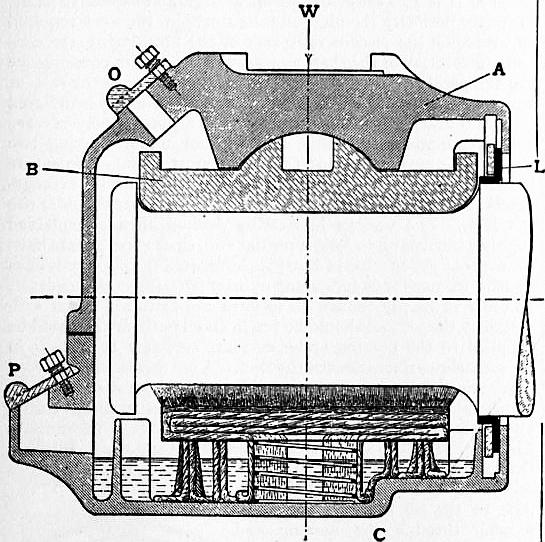
Fig. 4.
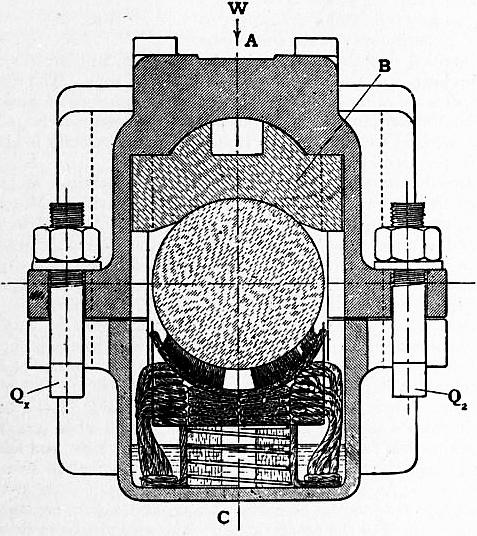
Fig. 5.
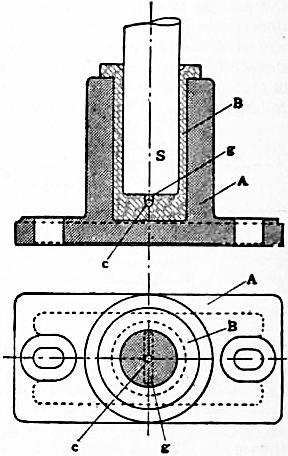
Fig. 6.
Footsteps.—A bearing arranged to support the lower end of a vertical shaft is called a footstep, sometimes a pivot bearing. A simple form of footstep is shown in fig 6. A casting A, designed so that it can be conveniently bolted to a foundation block, cross beam, or bracket is bored out and fitted with a brass B, which is turned inside to carry the end of the shaft S. The whole vertical load on the shaft is carried by the footstep, so that it is important to arrange efficient lubricating apparatus. Results of experiments made on a footstep, reported in Proc. Inst. Mech. Eng., 1891, show that if a diametral groove be cut in the brass, as indicated at g (fig 6), and if the oil is led to the centre of this groove by a channel c communicating with the exterior, the rotation of the shaft draws in a plentiful supply of oil which radiates from the centre and makes its way vertically between the shaft and the brass and finally overflows at the top of the brass. The overflowing oil may be led away and may be re-introduced into the footsteps at c. The rotation of the shaft thus causes a continuous circulation of oil through the footstep. One experiment from the report mentioned above may be quoted. A 3-in. shaft, revolving 128 times per minute and supported on a manganese bronze bearing lubricated in the way explained above sustained increasing loads until, at a load of 300 pounds per square inch of the area of the end of the shaft, it seized. The mechanical details of a footstep may be varied for purposes of adjustment in a variety of ways similarly to the variations of a common bearing already explained.
Thrust Block Bearing.—In cases where a bearing is required to resist a longitudinal movement of the shaft through it, as for example in the case of the propeller shaft of a marine engine or a vertical shaft supporting a heavy load not carried on a footstep, the shaft is provided with one or more collars which are grooved with corresponding recesses in the brasses of the bearing. A general sketch of a thrust block for a propeller shaft is shown in fig. 7. There are seven collars turned on the shaft and into the circumferential grooves between them fit corresponding circumferential projections on the brasses, these projections being formed in the case illustrated by means of half rings which are fitted into grooves turned in the brasses. This method of construction allows an individual ring to be replaced or adjusted if it should get hot. The total area of the rubbing surfaces should be proportioned so that the average load is not more than from 50 to 70 ℔ per sq. in. Arrangements are usually made for cooling a thrust block with water in case of heating. The spindles of drilling machines, boring machine spindles, turbine shafts may be cited as examples of vertical shafts supported on one collar. Experiments on the friction of a collar bearing have been made by the Research Committee of the Institution of Mechanical Engineers (Proc. Inst. Mech. Eng., 1888).
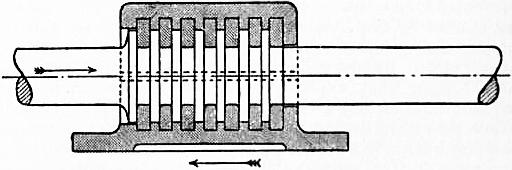
Fig. 7.
Roller and Ball Bearings.—If rollers are placed between two surfaces having relative tangential motion the frictional resistance to be overcome is the small resistance to rolling. The rollers move along with a velocity equal to one half the relative velocity of the surfaces. This way of reducing frictional resistance has been applied to all kinds of mechanical contrivances, including bearings for shafts, railway axle boxes, and axle boxes for tramcars. An example of a roller bearing for a line shaft is illustrated in figs. 8 and 9. The main casting, A, and cap, C, bolted together, form a spherical seating for the part of the bearing E corresponding to the brasses in a bearing of the usual type. Between the inside of the casting E and the journal are placed rollers held in position relatively to one another by a “squirrel cage” casting, the section of the bars of which are clearly shown in the half sectional elevation, fig. 9. This squirrel cage ensures that the several axes of the rollers keep parallel to the axis of the journal during the rolling motion. The rollers are made of hard tool steel, and the surfaces of the journal and bearing between which they roll are hardened.
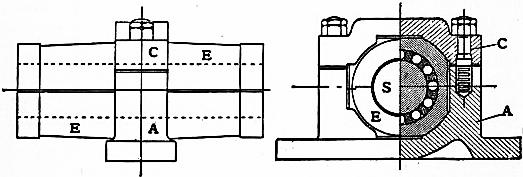
Fig. 8. Fig. 9.
Two rings of balls may be used instead of a single ring of rollers, and the kind of ball bearing thus obtained is in general use principally in connexion with bicycles and motor cars (see Bicycle). In ball bearings the load is concentrated at a few points, the points where the balls touch the race, and in the roller bearing at a few lines, the lines of contact between the rollers and the surfaces of the journal and bearing; consequently the load which bearings of this kind carry must not be great enough to cause any indentation at the points or lines of contact. Both rollers and balls, and the paths on which they roll, therefore, are made of hard material; further, balls and rollers must all be exactly the same size in an individual bearing in order to distribute the load between the points or lines of contact as uniformly as possible. The finest workmanship is required therefore to make good roller or good ball bearings.
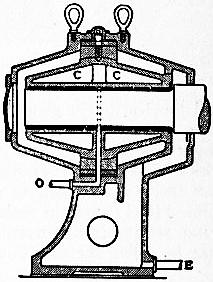
Fig. 10.
Bearings for High Speeds and Forced Lubrication.—When the shaft turns the metallic surfaces of the brass and the journal are prevented from actual contact by a film of oil which is formed and maintained by the motion of the shaft and which sustains the pressure between the journal and the brass provided the surfaces are accurately formed and the supply of oil is unlimited. This film changes what would otherwise be the friction between metallic surfaces into a viscous resistance within the film itself. When through a limited supply of oil or imperfect lubrication this film is imperfect or fails altogether and allows the journal to make metallic contact with the brass, the friction increases; and it may increase so much that the bearing rapidly becomes hot and may ultimately seize, that is to say the rubbing surfaces may become stuck together. With the object of reducing the friction at the points of metallic contact and of confining the damage of a hot bearing to the easily renewable brass, the latter is partially, sometimes wholly, lined with a soft fusible metal, technically known as white metal, which melts away before actual seizure takes place, and thus saves the journal which is more expensive because it is generally formed on a large and expensive shaft. However perfectly the film fulfils its function, the work required to overcome the viscous resistance of the film during the continuous rotation of the shaft appears as heat, and in consequence the temperature of the bearing gradually rises until the rate at which heat is produced is equal to the rate at which it is radiated from the bearing. Hence in order that a journal may revolve with a minimum resistance and without undue heating two precautions must be taken: (1) means must be taken to ensure that the film of oil is complete and never fails; and (2) arrangements must be made for controlling the temperature should it rise too high. The various lubricating devices already explained supply sufficient oil to form a partial film, since experiments have shown that the friction of bearings lubricated in this way is akin to solid friction, thus indicating at least partial metallic contact. In order to supply enough oil to form and maintain a film with certainty the journal should be run in an oil bath, or oil should be supplied to the bearing under pressure sufficient to force it in between the surfaces against the load. A bearing to which forced lubrication and water cooling are applied is illustrated in fig. 10, which represents one of the bearings of a Westinghouse turbo-alternator installed at the power station of the Underground Electric Railways Company of London at Lots Road, Chelsea. Oil flows under pressure from a tank on the top of a tower along a supply pipe to the oil inlet O, and after passing through the bearing and performing its duty as a film it falls away from each end of the journal into the bottom of the main casting, from which a pipe, E, conveys the oil back to the base of the tank tower where it is cooled and finally pumped back into the tank. There is thus a continuous circulation of oil through the bearing. The space C is for cooling water; in fact the bearing is water jacketed and the jacket is connected to a supply pipe and a drain pipe so that a continuous circulation may be maintained if desired. This bearing is 12 in. in diameter and 48 in. long, and it carries a load of about 12.8 tons. The rise in temperature of the bearing under normal conditions of working without water circulating in the jacket is approximately 38° F. The speed of rotation is such that the surface velocity is about 50 ft. per second.
Forced lubrication in connexion with the bearings of high-speed engines was introduced in 1890 by Messrs Belliss & Morcom, Ltd., under patents taken out in the name of A.C. Pain. It should be understood that providing the film of oil in the bearing of an engine can be properly maintained a double-acting engine can be driven at a high speed without any knocking, and without perceptible wear of the rubbing surfaces. Fig. 11 shows that the general arrangement of the bearings of a Belliss & Morcom engine arranged for forced lubrication. A small force-pump F, driven from the eccentric strap X, delivers oil into the pipe P, along which it passes to A, the centre of the right-hand main bearing. There is a groove turned on the inside of the brass from which a slanting hole leads to B. The oil when it arrives at A thus has two paths open to it, one to the right and left of the groove through the bearing, the other along the slanting hole to B. At B it divides again into two streams, one stream going upwards to the eccentric sheave, and a part continuing up the pipe Q to the eccentric pin. The second stream from B follows the slanting hole in the crank shaft to C, where it is led to the big end journal through the pipe R to the crosshead pin, and through the slanting hole to D, where it finds its way into the left main bearing. The oil forced through each bearing falls away to the right and to the left of the journal and drops into the bottom of the engine framing, whence it is again fed to the pump through a strainer. The parts of an engine lubricated in this way must be entirely enclosed.
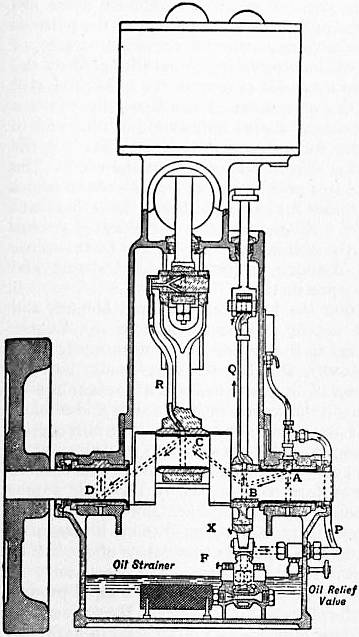
Fig. 11.
Load on bearings.—The distribution of pressure over the film of lubricant separating the rubbing surfaces of a bearing is variable, being greatest at a point near but not at the crown of the brass, and falling away to zero in all directions towards the boundaries of the film. It is usual in practice to ignore this variation of pressure through the film, and to indicate the severity with which the bearing is loaded by stating the load per square inch of the rubbing surfaces projected on to the diametral plane of the journal. Thus the projected area of the surfaces of a journal 6 in. in diameter and 8 in. long is 48 sq. in., and if the total load carried by the bearing is 20,000 pounds, the bearing would be said to carry a load of 417 pounds per square inch. When a shaft rotates in a bearing continuously in one direction the load per square inch with which it is safe to load the bearing in order to avoid undue heating is much less than if the motion is intermittent. A table of a few values of the bearing loads used in practice is given in the article Lubricants.
Bearing Friction.—If W is the total load on a bearing, and if µ is the coefficient of friction between the rubbing surfaces, the tangential resistance to turning is expressed by the product µW. If v is the relative velocity of the rubbing surfaces, the work done per second against friction is µWv foot pounds. This quantity of work is converted into heat, and the heat produced per second is therefore µWv/778 British Thermal Units. The coefficient µ is a variable quantity, and bearing in mind that a properly lubricated journal is separated from its supporting brass by a film of lubricant it might be expected that µ would have values characteristic of the coefficient of friction between two metallic surfaces, merging into the characteristics properly belonging to fluid friction, according as the oil film varied from an imperfect to a perfect condition, that is, according as the lubrication is partial or complete, completeness being attained by the use of an oil bath or by some method of forced lubrication. This expectation is entirely borne out by experimental researches. Beauchamp Tower (“Report on Friction Experiments,” Proc. Inst. Mech. Eng., November 1883) found that when oil was supplied to a bearing by means of a pad the coefficient of friction was approximately constant with the value of 1⁄100, thus following the law of solid friction; but when the journal was lubricated by means of an oil bath the coefficient of friction varied nearly inversely as the load on the bearing, thus making µW = constant. The tangential resistance in this case is characteristic of fluid friction since it is independent of the pressure. Tower’s experiments were carried out at a nearly constant temperature. The later experiments of O. Lasche (Zeitsch. Verein deutsche Ingenieure, 1902, 46, pp. 1881 et seq.) show how µ depends upon the temperature. Lasche’s main results with regard to the variation of µ are briefly:—µW is a constant quantity, thus confirming Tower’s earlier experiments; µ is practically independent of the relative velocity of the rubbing surfaces within the limits of 3 to 50 ft. per second; and the product µt is constant, t being the temperature of the bearing. Writing p for the load per unit of projected area of the bearing, Lasche found that the result of the experiments could be expressed by the simple formula pµt = constant = 2, where p = the pressure in kilograms per square centimetre, and t = the temperature in degrees centigrade. If p is changed to pounds per square inch the constant in the expression is approximately 30. The expression is valid between limits of pressure 14 to 213 pounds per square inch, limits of temperature 30° to 100° C., and between limits of velocity 3 to 50 ft. per second.
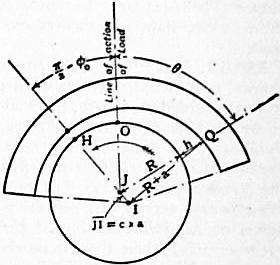
Fig. 12.
Theory of Lubrication.—After the publication of Tower’s experiments on journal friction Professor Osborne Reynolds showed (Phil. Trans., 1886, p. 157) that the facts observed in connexion with a journal lubricated by means of an oil bath could be explained by a theory based upon the general principles of the motion of a viscous fluid. It is first established as an essential part of the theory that the radius of the brass must be slightly greater than the radius of the journal as indicated in fig. 12, where J is the centre of the journal and I the centre of the brass. Given this difference of curvature and a sufficient supply of oil, the rotation of the journal produces and maintains an oil film between the rubbing surfaces, the circumferential extent of which depends upon the rate of the oil supply and the external load. With an unlimited supply of oil, that is with oil-bath lubrication, the film extends continuously to the extremities of the brass, unless such extension would lead to negative pressures and therefore to a discontinuity, in which case the film ends where the pressures in the film become negative. The minimum distance between the journal and the brass occurs at the point H (fig. 12), on the off side of the point O where the line of action of the load cuts the surface of the journal. To the right and left of H the thickness of the film gradually increases, this being the condition that the oil-flow to and from the film may be automatically maintained. With an unlimited supply of oil the point H moves farther from O as the load increases until it reaches a maximum distance, and then it moves back again towards O as the load is further increased until a limiting load is reached at which the pressure in the film becomes negative at the boundaries of the film, when the boundaries recede from the edges of the brass as though the supply of oil were limited.
In the mathematical development of the theory it is first necessary to define the coefficient of viscosity. This is done as follows:—If two parallel surfaces AB, CD are separated by a viscous film, and if whilst CD is fixed AB moves in a tangential direction with velocity U, the surface of the film in contact with CD clings to it and remains at rest, whilst the lower surface of the film clings to and moves with the surface AB. At intermediate points in the film the tangential motion of the fluid will vary uniformly from zero to U, and the tangential resistance will be F = µU/h, where µ is the coefficient of viscosity and h is the thickness of the film. With this definition of viscosity and from the general equations representing the stress in a viscous fluid, the following equation is established, giving the relations between p, the pressure at any point in the film, h the thickness of the film at a point x measured round the circumference of the journal in the direction of relative motion, and U the relative tangential velocity of the surfaces,
d (h³ dp ) = 6µU dh
dx dx dx
(1)
In this equation all the quantities are independent of the co-ordinate parallel to the axis of the journal, and U is constant. The thickness of the film h is some function of x, and for a journal Professor Reynolds takes the form,
h = a {1 + c sin(θ − φ0)},
in which the various quantities have the significance indicated in fig. 12. Reducing and integrating equation (1) with this value of h it becomes
dp = 6RµUc {sin(θ − φ0) − sin(φ1 − φ0)}
dθ a²{1 + c sin(θ − φ0)}³
(2)
φ1 being the value of θ for which the pressure is a maximum. In order to integrate this the right-hand side is expanded into a trigonometrical series, the values of the coefficients are computed, and the integration is effected term by term. If, as suggested by Professor J. Perry, the value of h is taken to be h = h0 + ax², where h0 is the minimum thickness of the film, the equation reduces to the form
− dp = 6µU + C
dx (h0 + ax²)² (h0 + ax²)³
(3)
and this can be integrated. The process of reduction from the form (1) to the form (3) with the latter value of h, is shown in full in The Calculus for Engineers by Professor Perry (p. 331), and also the final solution of equation (3), giving the pressure in terms of x.
Professor Reynolds, applying the results of his investigation to one of Tower’s experiments, plotted the pressures through the film both circumferentially and longitudinally, and the agreement with the observed pressure of the experiment was exceedingly close. The whole investigation of Professor Reynolds is a remarkable one, and is in fact the first real explanation of the fact that oil is able to insinuate itself between the journal and the brass of a bearing carrying a heavy load. (See also Lubrication.)
(W. E. D.)
BEAR-LEADER, formerly a man who led bears about the country. In the middle ages and Tudor times these animals were chiefly used in the brutal sport of bear-baiting and were led from village to village. Performing bears were also common, and are even still sometimes seen perambulating the country with their keepers, generally Frenchmen or Italians. The phrase “bear-leader” has now come colloquially to mean a tutor or guardian, who escorts any lad of rank or wealth on his travels.
BÉARN, formerly a small frontier province in the south of France, now included within the department of Basses-Pyrénées. It was bounded on the W. by Soule and Lower Navarre, on the N. by Chalosse, Tursan and Astarac, E. by Bigorre and S. by the Pyrénées. Its name can be traced back to the town of Beneharnum (Lescar). The civitas Beneharnensium was included in the Novempopulania. It was conquered by the Vascones in the 6th century, and in 819 became a viscounty dependent on the dukes of Aquitaine—a feudal link which was broken in the 11th century, when the viscounts ceased to acknowledge any suzerain. They then reigned over the two dioceses of Lescar and Oloron; but their capital was Morlaas, where they had a mint which was famous throughout the middle ages. In the 13th century Gaston VII., of the Catalonian house of Moncade, made Orthez his seat of government. His long reign (1229-1290) was a perpetual struggle with the kings of France and England, each anxious to assert his suzerainty over Béarn. As Gaston left only daughters, the viscounty passed at his death to the family of Foix, from whom it was transmitted through the houses of Grailly and Albret to the Bourbons, and they, in the person of Henry IV., king of Navarre, made it an apanage of the crown of France. It was not formally incorporated in the royal domains, however, until 1620. None of these political changes weakened the independent spirit of the Béarnais. From the 11th century onward, they were governed by their own special customs or fors. These were drawn up in the language of the country, a Romance dialect (1288 being the date of the most ancient written code), and are remarkable for the manner in which they define the rights of the sovereign, determining the reciprocal obligations of the viscount and his subjects or vassals. Moreover, from the 12th century Béarn enjoyed a kind of representative government, with cours plénières composed of deputies from the three estates. From 1220 onward, the judiciary powers of these assemblies were exercised by a cour majour of twelve barons jurats charged with the duty of maintaining the integrity of the fors. When Gaston-Phoebus wished to establish a regular annual hearth-tax (fouage) in the viscounty, he convoked the deputies of the three estates in assemblies called états. These soon acquired extensive political and financial powers, which continued in operation till 1789. Although, when Béarn was annexed to the domains of the crown, it was granted a conseil d’état and a parlement, which sat at Pau, the province also retained its fors until the Revolution.
See also Olhagaray, Histoire de Foix, Béarn et Navarre (1609); Pierre de Marca, Histoire de Béarn (1640). This work does not go beyond the end of the 13th century; it contains a large number of documents. Faget de Baure, Essais historiques sur le Béarn (1818); Les Fors de Béarn, by Mazure and Hatoulet (1839), completed by J. Brissaud and P. Rogé in Textes additionnels aux anciens Fors de Béarn (1905); Léon Cadier, Les États de Béarn depuis leur origine jusqu’au commencement du XVIe siècle (1888).
(C. B.*)
BEAS or Bias, a river of India. The Beas, which was the Hyphasis of the Greeks, is one of the Five Rivers of the Punjab. It issues in the snowy mountains of Kulu at an altitude of 13,326 ft. above sea-level, flows through the Kangra valley and the plains of the Punjab, and finally joins the Sutlej after a course of 290 m. It is crossed by a railway bridge near Jullundur.
BEAT (a word common in various forms to the Teutonic languages; it is connected with the similar Romanic words derived from the Late Lat. battere), a blow or stroke; from the many applications of the verb “to beat” come various meanings of the substantive, in some of which the primary sense has become obscure. It is applied to the throbbing of the pulse or heart, to the beating of a drum, either for retreat, or charge, or to quarters; in music to the alternating sound produced by the striking together of two notes not exactly of the same pitch (see Sound), and also to the movement of the baton by which a conductor of an orchestra or chorus indicates the time, and to the divisions of a bar. As a nautical term, a “beat” is the zigzag course taken by a ship in sailing against the wind. The application of the word to a policeman’s or sentry’s round comes either from beating a covert for game and hence the term means an exhaustive search of a district, or from the repeated strokes of the foot in constantly walking up and down. In this sense the word is used in America, particularly in Alabama and Mississippi, of a voting precinct.
BEATIFICATION (from the Lat. beatus, happy, blessed, and facere, to make), the act of making blessed; in the Roman Catholic Church, a stage in the process of canonization (q.v.).
BEATON (or Bethune), DAVID, (c. 1494-1546), Scottish cardinal and archbishop of St Andrews, was a younger son of John Beaton of Balfour in the county of Fife, and is said to have been born in the year 1494. He was educated at the universities of St Andrews and Glasgow, and in his sixteenth year was sent to Paris, where he studied civil and canon law. About this time he was presented to the rectory of Campsie by his uncle James Beaton, then archbishop of Glasgow. When James Beaton was translated to St Andrews in 1522 he resigned the rich abbacy of Arbroath in his nephew’s favour, under reservation of one half of the revenues to himself during his lifetime. The great ability of Beaton and the patronage of his uncle ensured his rapid promotion to high offices in the church and kingdom. He was sent by King James V. on various missions to France, and in 1528 was appointed keeper of the privy seal. He took a leading part in the negotiations connected with the king’s marriages, first with Madeleine of France, and afterwards with Mary of Guise. At the French court he was held in high estimation by King Francis I., and was consecrated bishop of Mirepoix in Languedoc in December 1537. On the 20th of December 1538 he was appointed a cardinal priest by Pope Paul III., under the title of St Stephen in the Coelian Hill. He was the only Scotsman who had been named to that high office by an undisputed right, Cardinal Wardlaw, bishop of Glasgow, having received his appointment from the anti-pope Clement VII. On the death of Archbishop James Beaton in 1539, the cardinal was raised to the primatial see of Scotland.
Beaton was one of King James’s most trusted advisers, and it was mainly due to his influence that the king drew closer the French alliance and refused Henry VIII.’s overtures to follow him in his religious policy. On the death of James in December 1542 he attempted to assume office as one of the regents for the infant sovereign Mary, founding his pretensions on an alleged will of the late king; but his claims were disregarded, and the earl of Arran, head of the great house of Hamilton, and next heir to the throne, was declared regent by the estates. The cardinal was, by order of the regent, committed to the custody of Lord Seaton; but his imprisonment was merely nominal, and he was soon again at liberty and at the head of the party opposed to the English alliance. Arran too was soon won over to his views, dismissed the preachers by whom he had been surrounded, and joined the cardinal at Stirling, where in September 1543 Beaton crowned the young queen. In the same year he was raised to the office of chancellor of Scotland, and was appointed protonotary apostolic and legate a latere by the pope. Had Beaton confined himself to secular politics, his strenuous opposition to the plans of Henry VIII. for the subjugation of Scotland would have earned him the lasting gratitude of his countrymen. Unfortunately politics were inextricably interwoven with the religious controversies of the time, and resistance to English influence involved resistance to the activities of the reformers in the church, whose ultimate victory has obscured the cardinal’s genuine merits as a statesman. During the lifetime of his uncle, Beaton had shared in the efforts of the hierarchy to suppress the reformed doctrines, and pursued the same line of conduct still more systematically after his elevation to the primacy. The popular accounts of the persecution for which he was responsible are no doubt exaggerated, and it sometimes ceased for considerable periods so far as capital punishments were concerned. When the sufferers were of humble rank not much notice was taken of them. It was otherwise when a more distinguished victim was selected in the person of George Wishart. Wishart had returned to Scotland, after an absence of several years, about the end of 1544. His sermons produced a great effect, and he was protected by several barons of the English faction. These barons, with the knowledge and approbation of King Henry, were engaged in a plot to assassinate the cardinal, and in this plot Wishart is now proved to have been a willing agent. The cardinal, though ignorant of the details of the plot, perhaps suspected Wishart’s knowledge of it, and in any case was not sorry to have an excuse for seizing one of the most eloquent supporters of the new opinions. For some time he was unsuccessful; but at last, with the aid of the regent, he arrested the preacher, and carried him to his castle of St Andrews. On the 28th of February 1546 Wishart was brought to trial in the cathedral before the cardinal and other judges, the regent declining to take any active part, and, being found guilty of heresy, was condemned to death and burnt.
The death of Wishart produced a deep effect on the Scottish people, and the cardinal became an object of general dislike, which encouraged his enemies to proceed with the design they had formed against him. Naturally resolute and fearless, he seems to have under-estimated his danger, the more so since his power had never seemed more secure. He crossed over to Angus, and took part in the wedding of his illegitimate daughter with the heir of the earl of Crawford. On his return to St Andrews he took up his residence in the castle. The conspirators, the chief of whom were Norman Leslie, master of Rothes, and William Kirkaldy of Grange, contrived to obtain admission at daybreak of the 29th of May 1546, and murdered the cardinal under circumstances of horrible mockery and atrocity.
The character of Beaton has already been indicated. As a statesman he was able, resolute, and in his general policy patriotic. As an ecclesiastic he maintained the privileges of the hierarchy and the dominant system of belief conscientiously, but always with harshness and sometimes with cruelty. His immoralities, like his acts of persecution, were exaggerated by his opponents; but his private life was undoubtedly a scandal to religion, and has only the excuse that it was not worse than that of most of his order at the time. The authorship of the writings ascribed to him in several biographical notices rests on no better authority than the apocryphal statements of Thomas Dempster.
Beaton’s uncle, James Beaton, or Bethune (d. 1539), archbishop of Glasgow and St Andrews, was lord treasurer of Scotland before he became archbishop of Glasgow in 1509, was chancellor from 1513 to 1526, and was appointed archbishop of St Andrews and primate of Scotland in 1522. He was one of the regents during the minority of James V., and was chiefly responsible for this king’s action in allying himself with France and not with England. He burned Patrick Hamilton and other heretics, and died at St Andrews in September 1539.
This prelate must not be confused with another, James Beaton, or Bethune (1517-1603), the last Roman Catholic archbishop of Glasgow. A son of John Bethune of Auchmuty and a nephew of Cardinal Beaton, James was a trusted adviser of the Scottish regent, Mary of Lorraine, widow of James V., and a determined foe of the reformers. In 1552 he was consecrated archbishop of Glasgow, but from 1560 until his death in 1603 he lived in Paris, acting as ambassador for Scotland at the French court.
See John Knox, Hist. of the Reformation in Scotland, ed. D. Laing (1846-1864); John Spottiswoode, archbishop of St Andrews, Hist. of the Church of Scotland (Spottiswoode Soc., 1847-1851); Art. in Dict. of Nat. Biog. and works there quoted; and A. Lang, Hist. of Scotland, vols. i. and ii. (1900-1902).
BEATRICE, a city and the county-seat of Gage county, in S.E. Nebraska, U.S.A., about 40 m. S. of Lincoln. Pop. (1900) 7875 (852 foreign-born); (1910) 9356. It is served by the Chicago, Burlington & Quincy, the Chicago, Rock Island & Pacific, and the Union Pacific railways. Beatrice is the seat of the state institute for feeble-minded youth, and has a Carnegie library. The city is very prettily situated in the valley of the Big Blue river, in the midst of a fine agricultural region. Among its manufactures are dairy products (there is a large creamery), canned goods, flour and grist mill products, gasoline engines, well-machinery, barbed wire, tiles, ploughs, windmills, corn-huskers, and hay-balers. Beatrice was founded in 1857, becoming the county-seat in the same year. It was reached by its first railway and was incorporated as a town in 1871, was chartered as a city in 1873, and in 1901 became a city of the first class.
BEATTIE, JAMES (1735-1803), Scottish poet and writer on philosophy, was born at Laurencekirk, Kincardine, Scotland, on the 25th of October 1735. His father, a small farmer and shopkeeper, died when he was very young; but an elder brother sent him to Marischal College, Aberdeen, where he gained a bursary. In 1753 he was appointed schoolmaster of Fordoun in his native county. Here he had as neighbours the eccentric Francis Garden (afterwards Lord Gardenstone, judge of the supreme court of Scotland), and Lord Monboddo. In 1758 he became an usher in the grammar school of Aberdeen, and two years later he was made professor of moral philosophy at Marischal College. Here he became closely acquainted with Dr Thomas Reid, Dr George Campbell, Dr Alexander Gérard and others, who formed a kind of literary or philosophic society known as the “Wise Club.” They met once a fortnight to discuss speculative questions, David Hume’s philosophy being an especial object of criticism. In 1761 Beattie published a small volume of Original Poems and Translations, which contained little work of any value. Its author in later days destroyed all the copies he found. In 1770 Beattie published his Essay on the Nature and Immutability of Truth in opposition to sophistry and scepticism, the object of which, as explained by its author, was to “prove the universality and immutability of moral sentiment” (letter to Sir W. Forbes, 17th January 1765). It was in fact a direct attack on Hume, and part of its great popularity was due to the fact. Hume is said to have justly complained that Beattie “had not used him like a gentleman,” but made no answer to the book, which has no philosophical value. Beattie’s portrait, by Sir Joshua Reynolds, hangs at Marischal College, Aberdeen. The philosopher is painted with the Essay on Truth in his hand, while a figure of Truth thrusts down three figures representing, according to Sir W. Forbes, sophistry, scepticism and infidelity. Reynolds in a letter to Beattie (February 1774) intimates that he is well enough pleased that one of the figures is identified with Hume, and that he intended Voltaire to be one of the group. Beattie visited London in 1773, and was received with the greatest honour by George III., who conferred on him a pension of £200 a year. In 1771 and 1774 he published the first and second parts of The Minstrel, a poem which met with great and immediate success. The Spenserian stanza in which it is written is managed with smoothness and skill, and there are many fine descriptions of natural scenery. It is entirely on his poetry that Beattie’s reputation rests. The best known of his minor poems are “The Hermit” and “Retirement.”
In 1773 he was offered the chair of moral philosophy at Edinburgh University, but did not accept it. Beattie made many friends, and lost none. “We all love Beattie,” said Dr Johnson. “Mrs Thrale says, if ever she has another husband she will have him.” He was in high favour too with Mrs Montagu and the other bas bleus. Beattie was unfortunate in his domestic life. Mary Dunn, whom he married in 1767, became insane, and his two sons died just as they were attaining manhood. The elder, James Hay Beattie, a young man of great promise, who at the age of nineteen had been associated with his father in his professorship, died in 1790. In 1794 the father published Essays and Fragments in Prose and Verse by James Hay Beattie with a touching memoir. The younger brother died in 1796. Beattie never recovered from this second bereavement. His mind was seriously affected, and, although he continued to lecture occasionally, he neither wrote nor studied. In April 1799 he had a stroke of paralysis, and died on the 18th of August 1803.
Beattie’s other poetical works include The Judgment of Paris (1765), and “Verses on the death of [Charles] Churchill,” a bitter attack which the poet afterwards suppressed. The best edition is the Poetical Works (1831, new ed. 1866) in the Aldine Edition of the British Poets, with an admirable memoir by Alexander Dyce.
See also An Account of the Life of James Beattie (1804), by A. Bower; and An Account of the Life and Writings of James Beattie (1807), by Sir William Forbes; a quantity of new material is to be found in Beattie and his Friends (1904), by the poet’s great-grand-niece, Margaret Forbes; and James Beattie, the Minstrel. Some Unpublished Letters, edited by A. Mackie (Aberdeen, 1908).
BEATUS, of Liebana and Valcavado, Spanish priest and monk, theologian and geographer, was born about 730, and died in 798. About 776 he published his Commentaria in Apocalypsin, containing one of the oldest Christian world-maps. He took a prominent part in the Adoptionist controversy, and wrote against the views of Felix of Urgel, especially as upheld by Elipandus of Toledo. As confessor to Queen Adosinda, wife of King Silo of Oviedo (774-783), and as the master of Alcuin and Etherius of Osma, Beatus exercised wide influence. His original map, which was probably intended to illustrate, above all, the distribution of the Apostolic missions throughout the world—depicting the head of Peter at Rome, of Andrew in Achaia, of Thomas in India, of James in Spain, and so forth—has survived in ten more or less modified copies. One only of these—the “Osma” of 1203—preserves the Apostolic pictures; among the remaining examples, that of “St Sever,” now at Paris, and dating from about 1030, is the most valuable; that of “Valcavado,” recently in the Ashburnham Library, executed in 970, is the earliest; that of “Turin,” dating from about 1100, is perhaps the most curious. Three others—“Valladolid” of about 1035, “Madrid” of 1047, and “London” of 1109—are derivatives of the “Valcavado-Ashburnham” of 970; the eighth, “Paris II,” is connected, though not very intimately, with “St Sever,” otherwise “Paris I”; the ninth and tenth, “Gerona” and “Paris III,” belong to the Turin group of Beatus maps. All these works are emphatically of “dark-age” character; very seldom do they suggest the true forms of countries, seas, rivers or mountains, but they embody some useful information as to early medieval conditions and history. St Isidore appears to be their principal authority; they also draw, directly or indirectly, from Orosius, St Jerome, St Augustine, and probably from a lost map of classical antiquity, represented in a measure by the Peutinger Table of the 13th century.
The chief MSS. of the Commentaria in Apocalypsin are (1-3) Paris, National Library, Lat. 8878; Lat. nouv. acq. 1366 and 2290; (4) Ashburnham MSS. xv.; (5) London, B. Mus., Addit. MSS. 11695; (6) Turin, National Library 1, ii. (1); (7) Valladolid, University Library, 229; (8) the MS. in the Episcopal Library at Osma, in Old Castile.
There is only one complete edition of the text, that by Florez (Madrid, 1770). See also Konrad Miller, Die Weltkarte des Beatus, Heft I. of Mappaemundi: die ältesten Weltkarten (Stuttgart, 1895); d’Avezac in Annales de ... géographie (June 1870); Beazley, Dawn of Modern Geography, i. 387-388 (1897); ii. 549-559; 591-605 (1901).
(C. R. B.)
BEAUCAIRE, a town of south-eastern France, in the department of Gard, 17 m. E. by S. of Nîmes on the Paris-Lyon railway. Pop. (1906) 7284. Beaucaire is situated on the right bank of the Rhone, opposite Tarascon, with which it is connected by two handsome bridges, a suspension-bridge of four spans and 1476 ft. in length, and a railway bridge. A triangular keep, a chapel, and other remains of a château (13th and 14th centuries) of the counts of Toulouse stand on the rocky pine-clad hill which rises to the north of the town; the chapel, dedicated to St Louis, belongs to the latest period of Romanesque architecture, and contains fine sculptures. The town derives celebrity from the great July fair, which has been held here annually since the 12th century, but has now lost its former importance (see Fair). Beaucaire gives its name to the canal which communicates with the sea (near Aigues-Mortes) and connects it with the Canal du Midi, forming part of the line of communication between the Rhone and the Garonne. The town is an important port on the Rhone, and its commerce, the chief articles of which are wine, and freestone from quarries in the vicinity, is largely water-borne. Among its industries are distilling and the manufacture of furniture, and the preparation of vermicelli, sausages and other provisions.
Beaucaire occupies the site of the ancient Ugernum, and several remains of the Roman city have been discovered, as well as (in 1734) the road that led from Nîmes. The present name is derived from Bellum Quadrum, a descriptive appellation applied in the middle ages either to the château or to the rock on which it stands. In 1125 Beaucaire came into the possession of the counts of Toulouse, one of whom, Raymund VI., established the importance of its fairs by the grant of privileges. In the Wars of the League it suffered severely, and in 1632 its castle was destroyed by Richelieu.
BEAUCE (Lat. Belsia), a physical region of north-central France, comprising large portions of the departments of Eure-et-Loir and Loir-et-Cher, and also extending into those of Loiret and Seine-et-Oise. It has an area of over 2800 sq. m., its limits being roughly defined by the course of the Essonne on the E., of the Loire on the S., and of the Brenne, the Loir and the Eure towards the W., though in the latter direction it extends somewhat beyond these boundaries. The Beauce is a treeless, arid and monotonous plain of limestone formation; windmills and church spires are the only prominent features of the landscape. Apart from the rivers on its borders, it is watered by insignificant streams, of which the Conie in the west need alone be mentioned. The inhabitants live in large villages, and are occupied in agriculture, particularly in the cultivation of wheat, for which the Beauce is celebrated. Clover and lucerne are the other leading crops, and large flocks of sheep are kept in the region. Chartres is its chief commercial centre.
BEAUCHAMP, the name of several important English families. The baronial house of Beauchamp of Bedford was founded at the Conquest by Hugh de Beauchamp, who received a barony in Bedfordshire. His eldest son Simon left a daughter, whose husband Hugh (brother of the count of Meulan) was created earl of Bedford by Stephen. But the heir-male, Miles de Beauchamp, nephew of Simon, held Bedford Castle against the king in 1137-1138. From his brother Payn descended the barons of Bedford, of whom William held Bedford Castle against the royal forces in the struggle for the Great Charter, and was afterwards made prisoner at the battle of Lincoln, while John, who sided with the barons under Simon de Montfort, fell at Evesham. With him the line ended, but a younger branch was seated at Eaton Socon, Beds., where the earthworks of their castle remain, and held their barony there into the 14th century.
The Beauchamps of Elmley, Worcestershire, the greatest house of the name, were founded by the marriage of Walter de Beauchamp with the daughter of Urise d’Abetot, a Domesday baron, which brought him the shrievalty of Worcestershire, the office of a royal steward, and large estates. His descendant William, of Elmley, married Isabel, sister and eventually heiress to William Mauduit, earl of Warwick, and their son succeeded in 1268 to Warwick Castle and that earldom, which remained with his descendants in the male line till 1445. The earls of the Beauchamp line played a great part in English history. Guy, the 2nd, distinguished himself in the Scottish campaigns of Edward I., who warned him at his death against Piers Gaveston. Under Edward II. he was one of the foremost foes of Piers, who had styled him “the black cur of Arden,” and with whose death he was closely connected. As one of the “lords ordainers” he was a recognized leader of the opposition to Edward II. By the heiress of the Tonis he left at his death in 1315 a son Earl Thomas, who distinguished himself at Crécy and Poitiers, was marshal of the English host, and, with his brother John, one of the founders of the order of the Garter. In 1369 his son Earl Thomas succeeded; from 1376 to 1379 he was among the lords striving for reform, and in the latter year he was appointed governor to the king. Under Richard II. he joined the lords appellant in their opposition to the king and his ministers, and was in power with them 1388-1389; treacherously arrested by Richard in 1397, he was imprisoned in the Tower of London (the Beauchamp Tower being called after him), but liberated by Henry IV. on his triumph (1399). In 1401 he was succeeded by his son Earl Richard, a brave and chivalrous warrior, who defeated Owen Glendower, fought the Percys at Shrewsbury, and, after travelling in state through Europe and the Holy Land, was employed against the Lollards and afterwards as lay ambassador from England to the council of Constance (1414). He held command for a time at Calais, and took an active part in the French campaigns of Henry V., who created him earl and count of Aumale in Normandy. He had charge of the education of Henry VI., and in 1437 was appointed lieutenant of France and of Normandy. Dying at Rouen in 1439, he left by Isabel, widow of Richard Beauchamp, earl of Worcester, a son, Earl Henry, who was created duke of Warwick, 1445, and is alleged, but without authority, to have been crowned king of the Isle of Wight by Henry VI. He died, the last of his line, in June 1445. On the death of Anne, his only child, in 1449, his vast inheritance passed to Anne, his sister of the whole blood, wife of Richard Neville, earl of Salisbury (“the Kingmaker”), who thereupon became earl of Warwick.
Of the cadet branches of the house, the oldest was that of Powyke and Alcester, which obtained a barony in 1447 and became extinct in 1496; from it sprang the Beauchamps, Lords St. Amand from 1448, of whom was Richard, bishop of Salisbury, first chancellor of the order of the Garter, and who became extinct in 1508, being the last known male heirs of the race. Another cadet was Sir John Beauchamp of Holt, minister of Richard II., who was created Lord Beauchamp of Kidderminster (the first baron created by patent) 1387, but beheaded 1388; the barony became extinct with his son in 1400. Roger, Lord Beauchamp of Bletsoe, summoned in 1363, is said to have been descended from the Powyke branch; his line ended early in the 15th century. Later cadets were John, brother of the 3rd earl, who carried the standard at Crécy, became captain of Calais, and was summoned as a peer in 1350, but died unmarried; and William, brother of the 4th earl, who was distinguished in the French wars, and succeeding to the lands of the Lords Abergavenny was summoned in that barony 1392; his son was created earl of Worcester in 1420, but died without male issue in 1422; from his daughter, who married Sir Edward Neville, descended the Lords Abergavenny.
The Lords Beauchamp of “Hache” (1299-1361) were so named from their seat of Hatch Beauchamp, Somerset, and were of a wholly distinct family. Their title, “Beauchamp of Hache,” was revived for the Seymours in 1536 and 1559. The title of “Beauchamp of Powyke” was revived as a barony in 1806 for Richard Lygon (descended through females from the Beauchamps of Powyke), who was created Earl Beauchamp in 1815.
See Sir W. Dugdale, Baronage (1675-1676) and Warwickshire (2nd ed., 1730); G.E. C[okayne], Complete Peerage (1887-1898); W. Courthope, Rows Roll (1859); and J.H. Round, Geoffrey de Mandeville (1892).
(J. H. R.)
BEAUCHAMP, ALPHONSE DE, French historian and man of letters, was born at Monaco in 1767, and died in 1832. In 1784 he entered a Sardinian regiment of marines, but on the outbreak of war with the French Republic, he refused to fight in what he considered an unjust cause, and was imprisoned for several months. After being liberated he took up his residence in Paris, where he obtained a post in one of the government offices. On the fall of Robespierre, Beauchamp was transferred to the bureau of the minister of police, and charged with the superintendence of the press. This situation opened up to him materials of which he made use in his first and most popular historical work, Histoire de la Vendée et des Chouans, 3 vols., 1806. The book, received with great favour by the people, was displeasing to the authorities. The third edition was confiscated; its writer was deprived of his post, and in 1809 was compelled to leave Paris and take up his abode in Reims. In 1811 he obtained permission to return, and again received a government appointment. This he had to resign on the Restoration, but was rewarded with a small pension, which was continued to his widow after his death.
Beauchamp wrote extensively for the public journals and for the magazines. His biographical and historical works are numerous, and those dealing with contemporary events are valuable, owing to the sources at his disposal. They must, however, be used with great caution. The following are worth mention:—Vie politique, militaire et privée du général Moreau (1814); Catastrophe de Murat, ou Récit de la dernière révolution de Naples (1815); Histoire de la guerre d’Espagne et du Portugal, 1807-1813 (2 vols., 1810); Collection de mémoires relatifs aux révolutions d’Espagne (2 vols., 1824); Histoire de la révolution de Piémont (2 vols., 1821, 1823); Mémoires secrets et inédits pour servir à l’histoire contemporaine (2 vols., 1825). The Mémoires de Fouché have also been ascribed to him, but it seems certain that he only revised and completed a work really composed by Fouché himself.
See an article by Louis Madelin in La Revolution française (1900).
BEAUFORT, the name of the family descended from the union of John of Gaunt, duke of Lancaster, with Catherine, wife of Sir Hugh Swynford, taken from a castle in Anjou which belonged to John of Gaunt. There were four children of this union—John, created earl of Somerset and marquess of Dorset; Henry, afterwards bishop of Winchester and cardinal (see Beaufort, Henry); Thomas, made duke of Exeter and chancellor; and Joan, who married Ralph Neville, first earl of Westmorland, and died in 1440. In 1396, some years after the birth of these children, John of Gaunt and Catherine were married, and in 1397 the Beauforts were declared legitimate by King Richard II. In 1407 this action was confirmed by their half-brother, King Henry IV., but on this occasion they were expressly excluded from the succession to the English throne.
John Beaufort, earl of Somerset (c. 1373-1410), assisted Richard II. in 1397 when the king attacked the lords appellants, and made himself an absolute ruler. For these services he was made marquess of Dorset, but after the deposition of Richard in 1399, he was degraded to his former rank as earl. In 1401, however, he was declared loyal, and appeared later in command of the English fleet. He married Margaret, daughter of Thomas Holland, second earl of Kent, and died in March 1410, leaving three sons, Henry, John, and Edmund, and two daughters, Jane or Joan, who married James I., king of Scotland, and Margaret, who married Thomas Courtenay, earl of Devon.
Thomas Beaufort (d. 1426) held various high offices under Henry IV., and took a leading part in suppressing the rising in the north in 1405. He became chancellor in 1410, but resigned this office in January 1412 and took part in the expedition to France in the same year. He was then created earl of Dorset, and when Henry V. became king in 1413, he was made lieutenant of Aquitaine and took charge of Harfleur when this town passed into the possession of the English. In 1416 he became lieutenant of Normandy, and was created duke of Exeter; and returning to England he compelled the Scots to raise the siege of Roxburgh. Crossing to France in 1418 with reinforcements for Henry V., he took an active part in the subsequent campaign, was made captain of Rouen, and went to the court of France to treat for peace. He was then captured by the French at Baugé, but was soon released and returned to England when he heard of the death of Henry V. in August 1422. He was one of Henry’s executors, and it is probable that the king entrusted his young son, King Henry VI., to his care. However this may be, Exeter did not take a very prominent part in the government, although he was a member of the council of regency. Having again shared in the French war, the duke died at Greenwich about the end of the year 1426. He was buried at Bury St. Edmunds, where his remains were found in good condition 350 years later. He married Margaret, daughter of Sir Thomas Neville of Nornby, but left no issue. The Beaufort family was continued by Henry Beaufort (1401-1419), the eldest son of John Beaufort, earl of Somerset, who was succeeded as earl of Somerset by his brother John Beaufort (1403-1444). The latter fought under Henry V. in the French wars, and having been taken prisoner remained in France as a captive until 1437. Soon after his release he returned to the war, and after the death of Richard Beauchamp, earl of Warwick, in 1439, acted as commander of the English forces, and, with his brother Edmund, was successful in recapturing Harfleur. Although chagrined when Richard, duke of York, was made regent of France, Beaufort led an expedition to France in 1442, and in 1443 was made duke of Somerset. He died, probably by his own hand, in May 1444. He married Margaret, daughter of Sir John Beauchamp, and left a daughter, Margaret Beaufort, afterwards countess of Richmond and Derby, who married, for her first husband, Edmund Tudor, earl of Richmond, by whom she became the mother of King Henry VII. In this way the blood of the Beauforts was mingled with that of the Tudors, and of all the subsequent occupants of the English throne.
The title of earl of Somerset descended on the death of John Beaufort in 1444 to his brother Edmund Beaufort, duke of Somerset (q.v.), who was killed at St Albans in 1455. By his marriage with Eleanor Beauchamp, daughter of the fifth earl of Warwick, he left three sons, Henry, Edmund and John, and a daughter, Margaret.
Henry Beaufort (1436-1464) became duke of Somerset in 1455, and soon began to take part in the struggle against Richard, duke of York, but failed to dislodge Richard’s ally, Richard Neville, earl of Warwick, from Calais. He took part in the victory of the Lancastrians at Wakefield in 1460, escaped from the carnage at Towton in 1461, and shared the attainder of Henry VI. in the same year. In May 1464 he was captured at Hexham and was beheaded immediately after the battle. The title of duke of Somerset was assumed by his brother, Edmund Beaufort (c. 1438-1471), who fled from the country after the disasters to the Lancastrian arms, but returned to England in 1471, in which year he fought at Tewkesbury, and in spite of a promise of pardon was beheaded after the battle on the 6th of May 1471. His younger brother John Beaufort had been killed probably at this battle, and so on the execution of Edmund the family became extinct.
Margaret Beaufort married Humphrey, earl of Stafford, and was the mother of Henry Stafford, duke of Buckingham. Henry Beaufort, third duke of Somerset (d. 1464), left an illegitimate son, Charles Somerset, who was created earl of Worcester by Henry VIII. in 1514. His direct descendant, Henry Somerset, fifth earl of Worcester, was a loyal partisan of Charles I. and in 1642 was created marquess of Worcester. His grandson, Henry, the third marquess, was made duke of Beaufort in 1682, and the present duke of Beaufort is his direct descendant.
See Thomas Walsingham, Historia Anglicana, edited by H.T. Riley (London, 1863-1864); W. Stubbs, Constitutional History of England, vols. ii. and iii. (Oxford, 1895); The Paston Letters, edited by James Gairdner (London, 1904).
BEAUFORT, FRANÇOIS DE VENDÔME, Duc de (1616-1669), a picturesque figure in French history of the 17th century, was the second son of César de Vendôme, and grandson of Henry IV., by Gabrielle d’Estrées. He began his career in the army and served in the first campaigns of the Thirty Years’ War, but his ambitions and unscrupulous character soon found a more congenial field in the intrigues of the court. In 1642 he joined in the conspiracy of Cinq Mars against Richelieu, and upon its failure was obliged to live in exile in England until Richelieu’s death. Returning to France, he became the centre of a group, known as the “Importants,” in which court ladies predominated, especially the duchess of Chevreuse and the duchess of Montbazon. For an instant after the king’s death, this group seemed likely to prevail, and Beaufort to be the head of the new government. But Mazarin gained the office, and Beaufort, accused of a plot to murder Mazarin, was imprisoned in Vincennes, in September 1643. He escaped on the 31st of May 1648, just in time to join the Fronde, which began in August 1648. He was then with the parlement and the princes, against Mazarin. His personal appearance, his affectation of popular manners, his quality of grandson (legitimized), of Henry IV., rendered him a favourite of the Parisians, who acclaimed him everywhere. He was known as the Roi des Halles (“king of the markets”), and popular subscriptions were opened to pay his debts. He had hopes of becoming prime minister. But among the members of the parlement and the other leaders of the Fronde, he was regarded as merely a tool. His intelligence was but mediocre, and he showed no talent during the war. Mazarin, on his return to Paris, exiled him in October 1652; and he was only allowed to return in 1654, when the cardinal had no longer any reason to fear him. Henceforth Beaufort no longer intrigued. In 1658 he was named general superintendent of navigation, or chief of the naval army, and faithfully served the king in naval wars from that on. In 1664 he directed the expedition against the pirates of Algiers. In 1669 he led the French troops defending Candia against the Turks, and was killed in a night sortie, on the I5th of June 1669. His body was brought back to France with great pomp, and official honours rendered it.
See the memoirs of the time, notably those of La Rochefoucauld, the Cardinal de Retz, and Madame de Motteville. Also D’Avenel, Richelieu et la monarchic absolue (1884); Cheruel, La France sous le ministère Mazarin (1879); and La France sous la minorité de Louis XIV (1882).
BEAUFORT, HENRY (c. 1377-1447), English cardinal and bishop of Winchester, was the second son of John of Gaunt, duke of Lancaster, by Catherine, wife of Sir Hugh Swynford. His parents were not married until 1396, and in 1397 King Richard II. declared the four children of this union to be legitimate. Henry spent some of his youth at Aix la-Chapelle, and having entered the church received various appointments, and was consecrated bishop of Lincoln in July 1398. When his half-brother became king as Henry IV. in 1399, Beaufort began to take a prominent place in public life; he was made chancellor in 1403, but he resigned this office in 1404, when he was translated from Lincoln to Winchester as the successor of William of Wykeham. He exercised considerable influence over the prince of Wales, afterwards King Henry V., and although he steadily supported the house of Lancaster he opposed the party led by Thomas Arundel, archbishop of Canterbury. A dispute over money left by John Beaufort, marquess of Dorset, caused or widened a breach in the royal family which reached a climax in 1411. The details are not quite clear, but it seems tolerably certain that the prince and the bishop, anxious to retain their power, sought to induce Henry IV. to abdicate in favour of his son. Angry at this request, the king dismissed his son from the council, and Beaufort appears to have shared his disgrace. When Henry V. ascended the throne in 1413 the bishop again became chancellor and took a leading part in the government until 1417, when he resigned his office, and proceeded to the council which was then sitting at Constance. His arrival had an important effect on the deliberations of this council, and the compromise which was subsequently made between the rival parties was largely his work. Grateful for Beaufort’s services, the new pope Martin V. offered him a cardinal’s hat which Henry V. refused to allow him to accept. Returning to England, he remained loyal to Henry; and after the king’s death in 1422 became a member of the council and was the chief opponent of the wild and selfish schemes of Humphrey, duke of Gloucester. In 1424 he became chancellor for the third time, and was mainly responsible for the conduct of affairs during Gloucester’s expedition to Hainaut. He was disliked by the citizens of London; and this ill-feeling was heightened when Gloucester, who was a favourite of the Londoners, returned to England and was doubtless reproached by Beaufort for the folly of his undertaking. A riot took place in London, and at the bishop’s entreaty, the protector, John, duke of Bedford, came back to England. As this dispute was still unsettled when the parliament met at Leicester in February 1426, Bedford and the lords undertook to arbitrate. Charged by Gloucester with treason against Henry IV. and his successors, Beaufort denied the accusations. But although a reconciliation was effected, the bishop evidently regarded this as a defeat; and having resigned the chancellorship his energies were diverted into another channel.
Anxious to secure his aid for the crusade against the Hussites, Pope Martin again offered him a cardinal’s hat, which Beaufort accepted. He went to France in 1427, and was then appointed papal legate for Germany, Hungary and Bohemia; and proceeding eastwards, he made a bold but futile effort to rally the crusaders at Tachau. Returning to England to raise money for a fresh crusade, he was received with great state in London; but his acceptance of the cardinalate had weakened his position and Gloucester refused to recognize his legatine commission. Beaufort gave way on this question, but an unsuccessful attempt was made in 1429 to deprive him of his see. Having raised some troops he set out for Bohemia; but owing to the disasters which had just attended the English arms in France, he was induced to allow these soldiers to serve in the French war; and in February 1431 the death of Martin V. ended his commission as legate. Meanwhile an attempt on the part of Gloucester to exclude the cardinal from the council had failed, and it was decided that his attendance was required except during the discussion of questions between the king and the papacy. He accompanied King Henry VI. to Normandy in April 1430, and in December 1431 crowned him king of France. About this time Gloucester made another attempt to deprive Beaufort of his see, and it was argued in the council that as a cardinal he could not hold an English bishopric. The general council was not inclined to press the case against him; but the privy council, more clerical and more hostile, sealed writs of praemunire and attachment against him, and some of his jewels were seized. On his return to England he attended the parliament in May 1432, and asked to hear the charges against him. The king declared him loyal, and a statute was passed freeing him from any penalties which he might have incurred under the Statute of Provisors or in other ways. He supported Bedford in his attempts to restore order to the finances. In August 1435 he attended the congress at Arras, but was unable to make peace with France; and after Bedford’s death his renewed efforts to this end were again opposed by Gloucester, who favoured a continuance of the war. On two occasions the council advised the king to refuse him permission to leave England, but in 1437 he obtained a full pardon for all his offences. In 1439 and 1440 he went to France on missions of peace, and apparently at his instigation the English council decided to release Charles, duke of Orleans. This step further irritated Gloucester, who drew up and presented to the king a long and serious list of charges against Beaufort; but the council defended the policy of the cardinal and ignored the personal accusations against him. Beaufort, however, gradually retired from public life, and after witnessing the conclusion of the treaty of Troyes died at Wolvesey palace, Winchester, on the 10th of April 1447. The “black despair” which Shakespeare has cast round his dying hours appears to be without historical foundation. He was buried in Winchester cathedral, the building of which he finished. He also refounded and enlarged the hospital of St Cross near Winchester.
Beaufort was a man of considerable wealth, and on several occasions he lent large sums of money to the king. He was the lover of Lady Alice Fitzalan, daughter of Richard, earl of Arundel, by whom he had a daughter, Joan, who married Sir Edward Stradling of St Donat’s in Glamorganshire. His interests were secular and he was certainly proud and ambitious; but Stubbs has pictured the fairer side of his character when he observes that Beaufort “was merciful in his political enmities, enlightened in his foreign policy; that he was devotedly faithful, and ready to sacrifice his wealth and labour for the king; that from the moment of his death everything began to go wrong, and went worse and worse until all was lost.”
See Historiae Croylandensis continuatio, translated by H.T. Riley (London, 1854); Proceedings and Ordinances of the Privy Council, edited by N.H. Nicolas (London, 1834-1837); Aeneas Sylvius Piccolomini, Historica Bohemica (Frankfort and Leipzig, 1707); W. Stubbs, Constitutional History, vol. iii. (Oxford, 1895): M. Creighton, A History of the Papacy during the Period of the Reformation (London, 1897); and L.B. Radford, Henry Beaufort (1908).
BEAUFORT, LOUIS DE (d. 1795), French historian, of whose life little is known. In 1738 he published at Utrecht a Dissertation sur l’incertitude des cinq premiers siècles de l’histoire romaine, in which he showed what untrustworthy guides even the historians of highest repute, such as Livy and Dionysius of Halicarnassus, were for that period, and pointed out by what methods and by the aid of what documents truly scientific bases might be given to its history. This was an ingenious plea, bold for its time, against traditional history such as Rollin was writing at that very moment. A German, Christopher Saxius, endeavoured to refute it in a series of articles published in vols. i.-iii. of the Miscellanea Liviensia. Beaufort replied by some brief and ironical Remarques in the appendix to the second edition of his Dissertation (1750). Beaufort also wrote an Histoire de César Germanicus (Leyden, 1761), and La République romaine, ou plan général de L’ancien gouvernement de Rome (The Hague, 1766, 2 vols. quarto). Though not a scholar of the first rank, Beaufort has at least the merit of having been a pioneer in raising the question, afterwards elaborated by Niebuhr, as to the credibility of early Roman history.
BEAUFORT SCALE, a series of numbers from 0 to 12 arranged by Admiral Sir Francis Beaufort (1774-1857) in 1805, to indicate the strength of the wind from a calm, force 0, to a hurricane, force 12, with sailing directions such as “5, smacks shorten sails” for coast purposes, and “royals, &c., ‘full and by’” for the open sea. An exhaustive report was made in 1906 by the Meteorological Office on the relation between the estimates of wind-force according to Beaufort’s scale and the velocities recorded by anemometers belonging to the office, from which the following table is taken:—
Beaufort scale. Corresponding wind. Limits of hourly velocity.
Numbers. Miles per hour.
0 Calm Under 2
1-3 Light breeze 2-12
4-5 Moderate wind 13-23
6-7 Strong wind 24-37
8-9 Gale 38-55
10-11 Storm 56-75
12 Hurricane Above 75
BEAUFORT WEST, in Cape province, South Africa, the capital of a division of this name, 339 m. by rail N.E. of Cape Town. Pop.(1904) 5481. The largest town in the western part of the Great Karroo, it lies, at an elevation of 2792 ft., at the foot of the southern slopes of the Nieuwveld mountains. It has several fine public buildings and the streets are lined with avenues of pear trees, while an abundant supply of water, luxuriant orchards, fields and gardens give it the appearance of an oasis in the desert. It is a favourite resort of invalids. The town was founded in 1819, and in its early days was largely resorted to by Griquas and Bechuana for the sale of ivory, skins and cattle. The Beaufort West division has an area of 6374 sq. m. and a pop. (1904) of 10,762, 45% being whites. Sheep-farming is the principal industry.
BEAUGENCY, a town of central France, in the department of Loiret, 16 m. S.W. of Orleans on the Orleans railway, between that city and Blois. Pop. (1906) 2993. It is situated at the foot of vine-clad hills on the right bank of the Loire, to the left bank of which it is united by a bridge of twenty-six arches, many of them dating from the 13th century. The chief buildings are the château, mainly of the 15th century, of which the massive donjon of the 11th century known as the Tour de César is the oldest portion; and the abbey-church of Notre-Dame, a building in the Romanesque style of architecture, frequently restored. Some of the buildings of the Benedictine abbey, to which this church belonged, remain. The hôtel de ville, the façade of which is decorated with armorial bearings of Renaissance carving, and the church of St Étienne, an unblemished example of Romanesque architecture, are of interest. Several old houses, some remains of the medieval ramparts and the Tour de l’Horloge, an ancient gateway, are also preserved. The town carries on trade in grain, and has flour mills.