VOLUME III SLICE IV Basso-relievo to Bedfordshire (continued 3)
Reading edition
For the literature of baths in earlier periods we may refer to the Architecture of Vitruvius, and to Lucian’s Hippias; see art. “Bäder” in Pauly-Wissowa, Realencyclopadie (1896), by A. Mau; “Balneum” in Daremberg and Saglio, Dict. des antiquités J. Marquardt Das Privalleben der Römer (1886), pp. 269-297; Backer’s Gallus, and the article “Balneae” by Rich, in Dr Smith’s Dictionary of Greek and Roman Antiquities (rev. ed. 1890); also the bibliography to Hydropathy.
1 The figure represents four strigils, in which the hollow for collecting the oil or perspiration from the body may be observed. There is also a small ampulla or vessel containing oil, meant to keep the strigils smooth, and a small flat patera or drinking vessel out of which it was customary to drink after the bathing was finished.
BATHURST, EARLS. Allen Bathurst, 1st Earl Bathurst (1684-1775), was the eldest son of Sir Benjamin Bathurst (d. 1704), by his wife, Frances (d. 1727), daughter of Sir Allen Apsley of Apsley, Sussex, and belonged to a family which is said to have settled in Sussex before the Norman Conquest. He was educated at Trinity College, Oxford, and became member of parliament for Cirencester in May 1705, retaining his seat until December 1711, when he was created Baron Bathurst of Battlesden, Bedfordshire. As a zealous Tory he defended Atterbury, bishop of Rochester, and in the House of Lords was an opponent of Sir Robert Walpole. After Walpole left office in 1742 he was made a privy councillor, and in August 1772 was created Earl Bathurst, having previously received a pension of £2000 a year chargeable upon the Irish revenues. He died on the 16th of September 1775, and was buried in Cirencester church. In July 1704 Bathurst married his cousin, Catherine (d. 1768), daughter of Sir Peter Apsley, by whom he had four sons and five daughters. The earl associated with the poets and scholars of the time. Pope, Swift, Prior, Sterne, and Congreve were among his friends. He is described in Sterne’s Letters to Eliza; was the subject of a graceful reference on the part of Burke speaking in the House of Commons; and the letters which passed between him and Pope are published in Pope’s Works, vol. viii. (London, 1872).
Henry, 2nd Earl Bathurst (1714-1794), was the eldest surviving son of the 1st earl. Educated at Balliol College, Oxford, he was called to the bar, and became a K.C. in 1745. In April 1735 he had been elected member of parliament for Cirencester, and was rewarded for his opposition to the government by being made solicitor-general and then attorney-general to Frederick, prince of Wales. Resigning his seat in parliament in April 1754 he was made a judge of the court of common pleas in the following month, and became lord high chancellor in January 1771, when he was raised to the peerage as Baron Apsley. Having become Earl Bathurst by his father’s death in September 1775, he resigned his office somewhat unwillingly in July 1778 to enable Thurlow to join the cabinet of Lord North. In November 1779 he was appointed lord president of the council, and left office with North in March 1782. He died at Oakley Grove near Cirencester on the 6th of August 1794. Bathurst was twice married, and left two sons and four daughters. He was a weak lord chancellor, but appears to have been just and fair in his distribution of patronage.
Henry, 3rd Earl Bathurst (1762-1834), the elder son of the second earl, was born on the 22nd of May 1762. In April 1789 he married Georgiana (d. 1841), daughter of Lord George Henry Lennox, and was member of parliament for Cirencester from 1783 until he succeeded to the earldom in August 1794. Owing mainly to his friendship with William Pitt, he was a lord of the admiralty from 1783 to 1789; a lord of the treasury from 1789 to 1791; and commissioner of the board of control from 1793 to 1802. Returning to office with Pitt in May 1804 he became master of the mint, and was president of the Board of Trade and master of the mint during the ministries of the duke of Portland and Spencer Perceval, only vacating these posts in June 1812 to become secretary for war and the colonies under the earl of Liverpool. For two months during the year 1809 he was in charge of the foreign office. He was secretary for war and the colonies until Liverpool resigned in April 1827; and deserves some credit for improving the conduct of the Peninsular War, while it was his duty to defend the government concerning its treatment of Napoleon Bonaparte. Bathurst’s official position caused his name to be mentioned frequently during the agitation for the abolition of slavery, and with regard to this traffic he seems to have been animated by a humane spirit. He was lord president of the council in the government of the duke of Wellington from 1828 to 1830, and favoured the removal of the disabilities of Roman Catholics, but was a sturdy opponent of the reform bill of 1832. The earl, who had four sons and two daughters, died on the 27th of July 1834. Bathurst was made a knight of the Garter in 1817, and held several lucrative sinecures.
His eldest son, Henry George, 4th Earl Bathurst (1790-1866), was member of parliament for Cirencester from 1812 to 1834. He died unmarried on the 25th of May 1866, and was succeeded in the title by his brother, William Lennox, 5th Earl Bathurst (1791-1878), member of parliament for Weobley from 1812 to 1816, and clerk of the privy council from 1827 to 1860, who died unmarried on the 24th of February 1878.
Allen Alexander. 6th Earl Bathurst (1832-1892), was the son of Thomas Seymour Bathurst, and grandson of the 3rd earl. He was member of parliament for Cirencester from 1857 until he became Earl Bathurst in February 1878, and died on the 2nd of August 1892, when his eldest son, Seymour Henry (b. 1864), became 7th Earl Bathurst.
BATHURST, a city of Bathurst county, New South Wales, Australia, 144 m. by rail W.N.W. of Sydney on the Great Western railway. Pop. (1901) 9223. It is situated on the south bank of the Macquarie river, at an elevation of 2153 ft., in a fertile undulating plain on the west side of the Blue Mountains. Bathurst has broad streets,, crossing one another at right angles, with a handsome park in the centre of the town, while many of the public buildings, specially the town hall, government buildings, and Anglican and Roman Catholic cathedrals, are noteworthy. Bathurst is the centre of the chief wheat-growing district of New South Wales, while gold, copper and silver are extensively mined in its vicinity. There are railway works, coach factories, tanneries, breweries, flour-mills and manufactures of boots and shoes and other commodities. The town was founded in 1815 by Governor Macquarie, taking its name from the 3rd Earl Bathurst, then secretary of state for the colonies, and it has been a municipality since 1862.
BATHVILLITE, a naturally occurring organic substance. It is an amorphous, opaque, and very friable material of fawn-brown colour, filling cavities in the torbanite or Boghead coal of Bathville, Scotland. It has a specific gravity of 1.01, and is insoluble in benzene.
BATHYBIUS (βαθύς, deep, and βίος, life), a slimy substance at one time supposed to exist in great masses in the depths of the ocean and to consist of undifferentiated protoplasm. Regarding it as an organism which represented the simplest form of life, Huxley about 1868 named it Bathybius Haeckelii. But investigations carried out in connexion with the “Challenger” expedition indicated that it was an artificial product, composed of a flocculent precipitate of gypsum thrown down from sea-water by alcohol, and the hypothesis of its organic character was abandoned by most biologists, Huxley included.
BATHYCLES, an Ionian sculptor of Magnesia, was commissioned by the Spartans to make a marble throne for the statue of Apollo at Amyclae, about 550 B.C. Pausanias (iii. 18) gives us a detailed description of this monument, which is of the greatest value to us, showing the character of Ionic art at the time. It was adorned with scenes from mythology in relief and supporting figures in the round.
For a reconstruction, see Furtwängler, Meisterwerke der griech Plastik, p. 706.
BATLEY, a municipal borough in the West Riding of Yorkshire, England, within the parliamentary borough of Dewsbury, 8 m. S.S.W. of Leeds, on the Great Northern, London & North Western, and Lancashire & Yorkshire railways. Pop. (1900) 30,321. Area 2039 acres. The church of All Saints is mainly Perpendicular, and contains some fine woodwork, mostly of the 17th century, and some good memorial tombs. The market square contains an excellent group of modern buildings, including the town hall, public library, post office and others. The town is a centre of the heavy woollen trade, and has extensive manufactures of army cloths, pilot cloths, druggets, flushings, &c. The working up of old material as “shoddy” is largely carried on. There are also iron foundries, manufactures of machinery, and stone quarries. The town lies on the south-west Yorkshire coalfield, and there are a number of collieries in the district. The borough is governed by a mayor, six aldermen, and eighteen councillors.
BATON (Fr. bâton, baston, from Late Lat. basto, a stick or staff), the truncheon carried by a field marshal as a sign of authority, by a police constable, &c.; in music, the stick with which the conductor of an orchestra beats time; in heraldry, the fourth part of a bend, frequently broken off short at the ends so as to be shaped like a rod; in English coats of arms, only as a mark of illegitimacy, the “baton sinister.”
BATONI, POMPEO GIROLAMO (1708-1787), Italian painter, was born at Lucca. He was regarded in Italy as a great painter in the 18th century, and unquestionably did much to rescue the art from the intense mannerism into which it had fallen during the preceding century. His paintings, however, are not of the highest order of merit, though they are generally graceful, well designed, and harmoniously coloured. His best production is thought to be his group of “Peace and War.” Batoni painted an unusual number of pictures, and was also celebrated for his portraits.
BATON ROUGE, the capital of Louisiana, U.S.A., and of East Baton Rouge parish, on the E. bank of the Mississippi river, about 70 m. N.W. of New Orleans. Pop. (1890) 10,478; (1900) 11,269, of whom 6596 were of negro descent; (1910 census) 14,897. It is served by the Yazoo & Mississippi Valley railway and by the Louisiana Railway & Navigation Company; and the Texas & Pacific enters Port Alien, just across the river. The city lies on the river bluff, secure against the highest floods. Old houses in the Spanish style give quaintness to its appearance. The state capitol was built in 1880-1882, replacing another burned in 1862. At Baton Rouge is the State University and Agricultural and Mechanical College (1860), of which the Audubon Sugar School, “for the highest scientific training in the growing of sugar cane and in the technology of sugar manufacture,” is an important and distinctive feature. The university grew out of the Louisiana State Seminary of Learning and Military Academy, founded in 1855 near Alexandria and opened in 1860 under the charge of W.T. Sherman. In 1869 the institution was removed to Baton Rouge, and in 1877 it was united with the Agricultural and Mechanical College, established in 1873 and in 1874 opened at New Orleans. The campus of the university is the former barracks of the Baton Rouge garrison, occupied by the college since 1886 and transferred to it by the Federal government in 1902. The enrolment of the university in 1907-1908 was 636. Other important institutions at Baton Rouge are a State Agricultural Experiment Station, asylums and schools for the deaf and dumb, for the blind, and for orphans, and the state penitentiary. The surrounding bluff and alluvial country is very rich. Sugar and cotton plantations and sub-tropic fruit orchards occupy the front-lands on the river. The manufactures include lumber and cotton seed products, and sugar. The value of the city’s factory products increased from $717,368 in 1900 to $1,383,061 in 1905 or 92.8%. The city is governed under a charter granted by the legislature in 1898. This charter is peculiar in that it gives to the city council the power to elect various administrative boards—of police, finance, &c.—from which the legislative council of most cities is separated.
Baton Rouge was one of the earliest French settlements in the state. As a part of West Florida, it passed into the hands of the British in 1763, and in 1779 was captured by Bernardo Galvez, the Spanish governor of Louisiana. The town was incorporated in 1817. In 1849 it was made the state capital, remaining so until 1862, when Shreveport became the Confederate state capital. In 1864 the Unionists made New Orleans the seat of government. The Secession Ordinance of Louisiana was passed on the 26th of January 1861 by a convention that met at Baton Rouge. On the and of May 1862 the city was captured by the forces of the United States under Col. Benjamin H. Grierson (b. 1826), who had led raiders thither from Tennessee; on the 12th of May it was formally occupied by troops from New Orleans, and was successfully defended by Brig.-Gen. Thomas Williams (1815-1862) against an attack by Confederate forces under General John C. Breckinridge on the 5th of August 1862; Gen. Williams, however, was killed during the attack. Baton Rouge was soon abandoned for a month, was then reoccupied, and was held throughout the rest of the war. It became the state capital again in 1882, in accordance with the state constitution of 1879. For several years after 1840 Zachary Taylor made his home on a plantation near Baton Rouge.
BATRACHIA. The arguments adduced by T.H. Huxley, in his article on this subject in the ninth edition of the Encyclopaedia Britannica, for applying the name Amphibia to those lung-breathing, pentadactyle vertebrates which had been first severed from the Linnaean Amphibia by Alexandre Brongniart, under the name of Batrachia, have not met with universal acceptance. Although much used in text-books and anatomical works in Great Britain and in Germany, the former name has been discarded in favour of the latter by the principal authors on systematic herpetology, such as W. Peters, A. Günther and E.D. Cope, and their lead is followed in the present article. Bearing in mind that Linnaeus, in his use of the name Amphibia, was not alluding to the gill-breathing and air-breathing periods through which most frogs and newts pass in the course of their existence, but only wished to convey the fact that many of the constituents of the group resort to both land and water (e.g. crocodiles), it seems hard to admit that the term may be thus diverted from its original signification, especially when such a change results in discarding the name expressly proposed by Brongniart to denote the association which has ever since been universally adopted either as an order, a sub-class or a class. Many authors who have devoted special attention to questions of nomenclature therefore think Reptilia and Batrachia the correct names of the two great classes into which the Linnaean Amphibia have been divided, and consider that the latter term should be reserved for the use of those who, like that great authority, the late Professor Peters, down to the time of his death in 1883, would persist in regarding reptiles and batrachians as mere sub-classes (1). However extraordinary it may appear, especially to those who bring the living forms only into focus, that opposition should still be made to Huxley’s primary division of the vertebrates other than mammals into Sauropsida (birds and reptiles) and Ichthyopsida (batrachians and fishes), it is certain that recent discoveries in palaeontology have reduced the gap between batrachians and reptiles to such a minimum as to cause the greatest embarrassment in the attempt to draw a satisfactory line of separation between the two; on the other hand the hiatus between fishes and batrachians remains as wide as it was at the time Huxley’s article Amphibia (Encyclopaedia Britannica, 9th ed.) was written.
The chief character which distinguishes the Batrachians from the reptiles, leaving aside the metamorphoses, lies in the arrangement of the bones of the palate, where a large parasphenoid extends forwards as far or nearly as far as the vomers and widely separates the pterygoids. The bones which bear the two occipital condyles have given rise to much discussion, and the definition given by Huxley in the previous edition—“two occipital condyles, the basi-occipital region of the skull either very incompletely or not at all ossified”—requires revision. Some authors have held that the bone on which the occipital condyles have been found most developed in some labyrinthodonts (2) represents a large basi-occipital bearing two knobs for the articulation with the first vertebra, whilst the skull of the batrachians of the present day has lost the basi-occipital, and the condyles are furnished by the exoccipitals. On the other hand, some reptiles have the occipital condyle divided into two and produced either by the basi-occipital or by the exoccipitals. But the recent find of a well preserved skull of a labyrinthodont (Capitosaurus stantonensis) from the Trias of Staffordshire has enabled A.S. Woodward (3) to show that, in that form at any rate, the condyles are really exoccipital, although they are separated by a narrow basi-occipital. It is therefore very probable that the authors quoted in (2) were mistaken in their identification of the elements at the base of the foramen magnum. The fact remains, however, that some if not all of the stegocephalous batrachians have an ossified basi-occipital.
As a result of his researches on the anomodont reptiles and the Stegocephalia (4), as the extinct order that includes the well known labyrinthodonts is now called, we have had the proposal by H.G. Seeley (5) to place the latter with the reptiles instead of with the batrachians, and H. Gadow, in his most recent classification (6), places some of them among the reptiles, others being left with the batrachians; whilst H. Credner, basing his views on the discovery by him of various annectent forms between the Stegocephalia and the Rhynchocephalian reptiles, has proposed a class, Eotetrapoda, to include these forms, ancestors of the batrachians proper on the one hand, of the reptiles proper on the other. Yet, that the Stegocephalia, notwithstanding their great affinity to the reptiles, ought to be included in the batrachians as commonly understood, seems sufficiently obvious from the mere fact of their passing through a branchiate condition, i.e. undergoing metamorphosis (7). The outcome of our present knowledge points to the Stegocephalia, probably themselves derived from the Crossopterygian fishes (8), having yielded on the one hand the true batrachians (retrogressive series), with which they are to a certain extent connected through the Caudata and the Apoda, on the other hand the reptiles (progressive series), through the Rhynchocephalians and the Anomodonts, the latter being believed, on very suggestive evidence, to lead to the mammals (9).
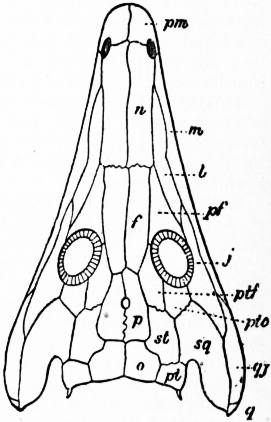
Fig. 1.—Upper view of Archegosaurus Decheni.
(Outlines after Gredner.)
pm, Praemaxilla. n, Nasal. m, Maxilla. l, Lachrymal. pf, Praefrontal. f, Frontal. j, Jugal ptf, Postfrontal. p, Parietal. st, Supratemporal. sq, Squamosal. pto, Postorbital. qj, Quadrato-jugal. o, Occipital. pt, Post-temporal. q, Quadrate.
The division of the class Amphibia or Batrachia into four orders, as carried out by Huxley, is maintained, with, however, a change of names: Stegocephalia, for the assemblage of minor groups that cluster round the Labyrinthodonta of R. Owen, which name is restricted to the forms for which it was originally intended; Peromela, Urodela, Anura, are changed to Apoda, Caudata, Ecaudata, for the reason that (unless obviously misleading, which is not the case in the present instance) the first proposed name should supersede all others for higher groups as well as for genera and species, and the latter set have the benefit of the law of priority. In the first subdivision of the batrachians into two families by C. Duméril in 1806 (Zool. Anal. pp. 90-94) these are termed “Anoures” and “Urodeles” in French, Ecaudati and Caudati in Latin. When Duméril’s pupil, M. Oppel, in 1811 (Ordn. Rept. p. 72), added the Caecilians, he named the three groups Apoda, Ecaudata and Caudata. The Latin form being the only one entitled to recognition in zoological nomenclature, it follows that the last-mentioned names should be adopted for the three orders into which recent batrachians are divided.
I. Stegocephalia (10).—Tailed, lacertiform or serpentiform batrachians, with the temporal region of the skull roofed over by postorbital, squamosal, and supratemporal plates similar to the same bones in Crossopterygian fishes, and likewise with paired dermal bones (occipitals and post-temporals) behind the parietals and supratemporals. A parietal foramen; scales or bony scutes frequently present, especially on the ventral region, which is further protected by three large bony plates—interclavicle and clavicles, the latter in addition to cleithra.
Extinct, ranging from the Upper Devonian to the Trias. Our knowledge of Devonian forms is still extremely meagre, the only certain proof of the existence of pentadactyle vertebrates at that period resting on the footprints discovered in Pennsylvania and described by O.C. Marsh (11) as Tinopus antiquus. Sundry remains from Belgium, as to the identification of which doubts are still entertained, have been regarded by M. Lohest (12) as evidence of these batrachians in the Devonian. Over 200 species are now distinguished, from the Carboniferous of Europe and North America, the Permian of Spitsbergen, Europe, North America and South Africa, and the Trias of Europe, America, South Africa, India and Australia. The forms of batrachians with which we are acquainted show the vertebral column to have been evolved in the course of time from a notochordal condition with segmented centra similar to that of early bony ganoid fishes (e.g. Caturus, Eurycormus), to biconcave centra, and finally to the socket-and-ball condition that prevails at the present day. However, owing to the evolution of the vertebral column in various directions, and to the inconstant state of things in certain annectent groups, it is not possible, it seems, to apply the vertebral characters to taxonomy with that rigidity which E.D. Cope and some other recent authors have attempted to enforce. This is particularly evident in the case of the Stegocephalians; and recent batrachians, tailed and tailless, show the mode of articulation of the vertebrae, whether amphicoelous, opisthocoelous or procoelous, to be of but secondary systematic importance in dealing with these lowly vertebrates. The following division of the Stegocephalians into five sub-orders is therefore open to serious criticism; but it seems on the whole the most natural to adopt in the light of our present knowledge.
A. Rhachitomi, (figs. 1, 2), in which the spinal cord rests on the notochord, which persists uninterrupted and is surrounded by three bony elements in addition to the neural arch: a so-called pleurocentrum on each side, which appears to represent the centrum proper of reptiles and mammals, and an intercentrum or hypocentrum below, which may extend to the neural arch, and probably answers to the hypapophysis, as it is produced into chevrons in the caudal region. Mostly large forms, of Carboniferous and Permian age, with a more or less complex infolding of the walls of the teeth. Families: Archegosauridae, Eryopidae, Trimerorhachidae, Dissorhophidae. The last is remarkable for an extraordinary endo- and exo-skeletal carapace, Dissorhophus being described by Cope (13) as a “batrachian armadillo.”
B. Embolomeri, with the centra and intercentra equally developed disks, of which there are thus two to each neural arch; these disks perforated in the middle for the passage of the notochord. This type may be directly derived from the preceding, with which it appears to be connected by the genus Diplospondylus. Fam.: Cricotidae, Permian.
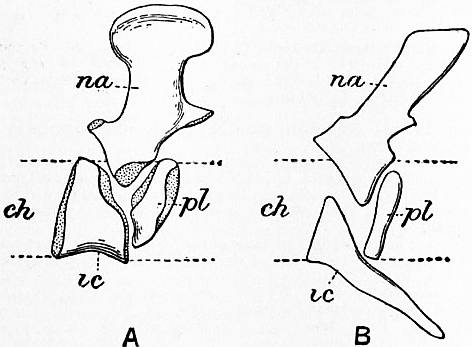
Fig. 2.—A, Dorsal vertebrae. B, Caudal vertebra of Archegosaurus. na, Neural arch; ch, chorda; pl, pleurocentrum; ic, intercentrum.
(Outline after Jaekel.)
C. Labyrinthodonta, with simple biconcave vertebral disks, very slightly pierced by a remnant of the notochord and supporting the loosely articulated neural arch. This condition is derived from that of the Rhachitomi, as shown by the structure of the vertebral column in young specimens. Mostly large forms from the Trias (a few Permian), with true labyrinthic dentition. Families: Labyrinthodontidae, Anthracosauridae, Dendrerpetidae, Nyraniidae.
D. Microsauria, nearest the reptiles, with persistent notochord completely surrounded by constricted cylinders on which the neural arch rests. Teeth hollow, with simple or only slightly folded walls. Mostly of small size and abundant in the Carboniferous and Lower Permian. Families: Urocordylidae, Limnerpetidae, Hylonomidae (fig. 3), Microbrachidae, Dolichosomatidae, the latter serpentiform, apodal.
E. Branchiosauria, nearest to the true batrachians; with persistent non-constricted notochord, surrounded by barrel-shaped, bony cylinders formed by the neural arch above and a pair of intercentra below, both these elements taking an equal share in the formation of a transverse process on each side for the support of the rib. This plan of structure, apparently evolved out of the rhachitomous type by suppression of the pleurocentra and the downward extension of the neural arch, leads to that characteristic of frogs in which, as development shows, the vertebra is formed wholly or for the greater part by the neural arch (14). Small forms from the Upper Carboniferous and Permian formations. A single family: Branchiosauridae.
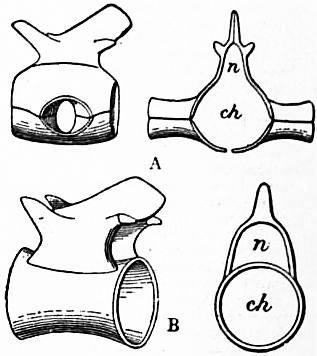
Fig. 3.—A, Dorsal vertebra of Hylonomus (side view and front view). B, Dorsal vertebra of Branchiosaurus (side view and front view). n, Neural canal; ch, chorda.
(After Credner.)
II. Apoda (15).—No limbs. Tail vestigial or absent. Frontal bones distinct from parietals; palatines fused with maxillaries. Male with an intromittent copulatory organ. Degraded, worm-like batrachians of still obscure affinities, inhabiting tropical Africa, south-eastern Asia and tropical America. Thirty-three species are known. No fossils have yet been discovered. It has been attempted of late to do away with this order altogether and to make the Caecilians merely a family of the Urodeles. This view has originated out of the very remarkable superficial resemblance between the Ichthyophis-larva and the Amphiuma. Cope (16) regarded the Apoda as the extremes of a line of degeneration from the Salamanders, with Amphiuma as one of the annectent forms. In the opinion of P. and F. Sarasin (17), whose great work on the development of Ichthyophis is one of the most important recent contributions to our knowledge of the batrachians, Amphiuma is a sort of neotenic Caecilian, a larval form become sexually mature while retaining the branchial respiration. If the absence of limbs and the reduction of the tail were the only characteristic of the group, there would be, of course, no objection to unite the Caecilians with the Urodeles; but, to say nothing of the scales, present in many genera of Apodals and absent in all Caudates, which have been shown by H. Credner to be identical in structure with those of Stegocephalians, the Caecilian skull presents features which are not shared by any of the tailed batrachians. G.M. Winslow (18), who has made a study of the chondrocranium of Ichthyophis, concludes that its condition could not have been derived from a Urodele form, but points to some more primitive ancestor. That this ancestor was nearly related to, if not one of, the Stegocephalians, future discovery will in all probability show.
III. Caudata (19).—Tailed batrachians, with the frontals distinct from the parietals and the palatines from the maxillary. Some of the forms breathe by gills throughout their existence, and were formerly regarded as establishing a passage from the fishes to the air-breathing batrachians. They are now considered as arrested larvae descended from the latter. One of the most startling discoveries of the decade 1890-1900 was the fact that a number of forms are devoid of both gills and lungs, and breathe merely by the skin and the buccal mucose membrane (20). Three blind cave-forms are known: one terrestrial—Typhlotriton, from North America, and two perennibranchiate—Proteus in Europe and Typhlomolge in North America.
This order contains about 150 species, referred to five families: Hylaeobatrachidae, Salamandridae, Amphiumidae, Proteidae, Sirenidae.
Fossil remains are few in the Upper Eocene and Miocene of Europe and the Upper Cretaceous of North America. The oldest Urodele known is Hylaeobatrachus Dollo (21) from the Lower Wealden of Belgium. At present this order is confined to the northern hemisphere, with the exception of two Spelerpes from the Andes of Ecuador and Peru, and a Plethodon from Argentina.
IV. Ecaudata (22).—Frogs and toads. Four limbs and no tail. Radius confluent with ulna, and tibia with fibula; tarsus (astragalus and calcaneum) elongate, forming an additional segment in the hind limb. Caudal vertebrae fused into a urostyle or coccyx. Frontal bones confluent with parietals.
This order embraces about 1300 species, of which some 40 are fossil, divided into two sub-orders and sixteen families:—
A. Aglossa,—Eustachian tubes united into a single ostium pharyngeum; no tongue. Dactylethridae, Pipidae.
B. Phaneroglossa,—Eustachian tubes separated; tongue present. Discoglossidae, Pelobatidae, Hemiphractidae, Amphignathodontidae, Hylidae, Bufonidae, Dendrophryniscidae, Cystignathidae, Dyscophidae, Genyophrynidae, Engystomatidae, Ceratobatrachidae, Ranidae, Dendrobatidae.
The Phaneroglossa are divided into two groups; Arcifera and Firmisternia, representing two stages of evolution. The family characters are mainly derived from the dilatation or non-dilatation of the sacral diapophyses, and the presence of teeth in one or both jaws, or their absence. The Discoglossidae are noteworthy for the presence of short ribs to some of the vertebrae, and in some other points also they approach the tailed batrachians; they may be safely regarded as, on the whole, the most generalized of known Ecaudata. Distinct ribs are present at an early age in the Aglossa, as discovered by W.G. Ridewood (23). The recent addition of a third genus of Aglossa, Hymenochirus (24) from tropical Africa, combining characters of Pipa and Xenopus, has removed every doubt as to the real affinity which connects these genera. Hymenochirus is further remarkable for the presence of only six distinct pieces in the vertebral column, which is thus the most abbreviated among all the vertebrata.
Frogs and toads occur wherever insect food is procurable, and their distribution is a world-wide one, with the exception of many islands. Thus New Caledonia, which has a rich and quite special lizard-fauna, has no batrachians of its own, although the Australian Hyla aurea has been introduced with success. New Zealand possesses only one species (Liopelma hochstetteri), which appears to be rare and restricted to the North Island. The forest regions of southern Asia, Africa and South America are particularly rich in species.
According to our present knowledge, the Ecaudata can be traced about as far back in time as the Caudata. An unmistakable batrachian of this order, referred by its describer to Palaeobatrachus, a determination which is only provisional, has been discovered in the Kimmeridgian of the Sierra del Montsech, Catalonia (25), in a therefore somewhat older formation than the Wealden Caudata Hylaeobatrachus.
Apart from a few unsatisfactory remains from the Eocene of Wyoming, fossil tailless batrachians are otherwise only known from the Oligocene, Miocene and Pliocene of Europe and India. These forms differ very little from those that live at the present day in the same part of the world, and some of the genera (Discoglossus, Bufo, Oxyglossus, Rana) are even identical. Palaeobatrachus (26), of which a number of species represented by skeletons of the perfect form and of the tadpole have been described from Miocene beds in Germany, Bohemia and France, seems to be referable to the Pelobatidae; this genus has been considered as possibly one of the Aglossa, but the absence of ribs in the larvae speaks against such an association.
Numerous additions have been made to our knowledge of the development and nursing habits, which are extremely varied, some forms dispensing with or hurrying through the metamorphoses and hopping out of the egg in the perfect condition (27).
Skeleton.—In the earliest forms of this order, the Stegocephalia, we meet with considerable variety in the constitution of the vertebrae, and these modifications have been used for their classification. All agree, however, in having each vertebra formed of at least two pieces, the suture between which persists throughout life. In this they differ from the three orders which have living representatives. Even the inferior arches or chevrons of the tail of salamanders are continuously ossified with the centra. As a matter of fact, these vertebrae have no centra proper, that part which should correspond with the centrum being formed, as a study of the development has shown (H. Gadow, 14), by the meeting and subsequent complete co-ossification of the two chief dorsal and ventral pairs of elements (tail-vertebrae of Caudata), or entirely by the pair of dorsal elements. In the Ecaudata, the vertebrae of the trunk are formed on two different plans. In some the notochord remains for a long time exposed along the ventral surface, and, owing to the absence of cartilaginous formation around it, disappears without ever becoming invested otherwise than by a thin elastic membrane; it can be easily stripped off below the vertebrae in larval specimens on the point of metamorphosing. This has been termed the epichordal type. In others, which represent the perichordal type, the greater share of the formation of the whole vertebra falls to the (paired) dorsal cartilage, but there is in addition a narrow ventral or hypochordal cartilage which fuses with the dorsal or becomes connected with it by calcified tissue; the notochord is thus completely surrounded by a thick sheath in tadpoles with imperfectly developed limbs. This mode of formation of both the arch and the greater part or whole of the so-called centrum from the same cartilage explains why there is never a neuro-central suture in these batrachians.
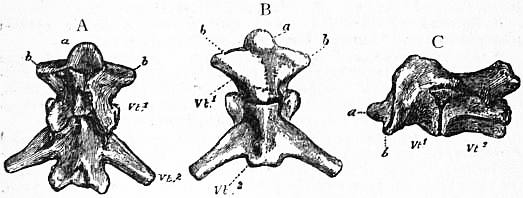
Fig. 4.—The first two vertebrae of Necturus. Vt1, Atlas; Vt2, second vertebrae; a, intercondyloid process of the atlas; b, the articular surfaces for the occipital condyles. The ribs of the second vertebra are not represented. A, Dorsal; B, ventral; C, lateral view.
During segmentation of the dorsal cartilages mentioned above, which send out the transverse processes of diapophyses, there appears between each two centra an intervertebral cartilage, out of which the articulating condyle of the centrum is formed, and becomes attached either to the vertebra anterior (precoelous type) or posterior (opisthocoelous type) to it, if not remaining as an independent, intervertebral, ossified sphere, as we sometimes find in specimens of Pelobatidae.
In the Caudata and Apoda, cartilage often persists between the vertebrae; this cartilage may become imperfectly separated into a cup-and-ball portion, the cup belonging to the posterior end of the vertebra. In such cases the distinction between amphicoelous and opisthocoelous vertebrae rests merely on a question of ossification, and has occasionally given rise to misunderstandings in the use of these terms.
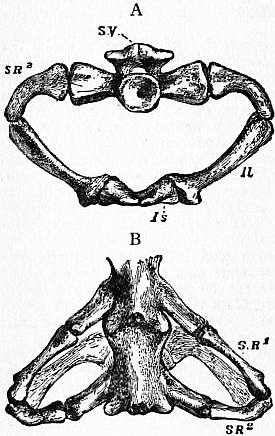
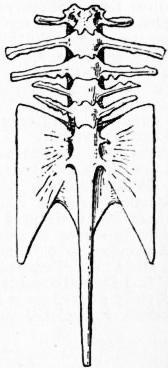
Fig. 5.—Necturus. Posterior (A) and ventral (B) views of the sacral vertebrae (S.V.); S.R.1, S.R.2, sacral ribs; Il, ilium; Is, ischium. Fig. 6.-Vertebral column of Hymenochtrus (ventral view).
Amphicoelous (bi-concave) vertebrae are found in the Apoda and in some of the Caudata; opisthocoelous (convexo-concave) vertebrae in the higher Caudata and in the lower Ecaudata; whilst the great majority of the Ecaudata have procoelous (concavo-convex) vertebrae.
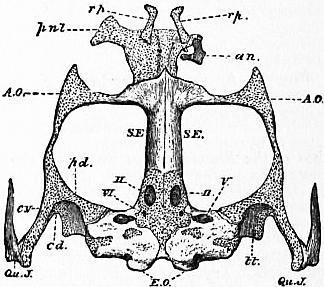
Fig. 7.—Chondrocranium of Rana esculenta—ventral aspect.
rp, The rhinal process. pnl, The praenasal processes. an, The alinasal processes, shown by the removal of part of the floor of the left nasal chamber. AO., The antorbital process. pd, The pedicle of the suspensorium continued into cv, the ventral crus of the suspensorium. cd, Its dorsal crus. tt, The tegmen tympani. SE, The sphen-ethmoid. EO., The exoccipitals. Qu.J., The quadratojugal. II. V. VI. Foramina by which the optic, trigeminal and abortio dura, and abducens nerves leave the skull.
All living batrachians, and some of the Stegocephalia, have transverse processes on the vertebrae that succeed the atlas (fig. 4), some of which, in the Caudata, are divided into a dorsal and a ventral portion. Ribs are present in the lower Ecaudata (Discoglossidae and larval Aglossa), but they are never connected with a sternum. It is in fact doubtful whether the so-called sternum of batrachians, in most cases a mere plate of cartilage, has been correctly identified as such. When limbs are present, one vertebra, rarely two (fig. 5) or three, are distinguished as sacral, giving attachment to the ilia. In the Ecaudata, the form of the transverse processes of the sacral vertebra varies very considerably, and has afforded important characters to the systematist. In accordance with the saltatorial habits of the members of this order, the vertebrae, which number from 40 to 60 in the Caudata, to upwards of 200 in the Apoda, have become reduced to 10 as the normal number, viz., eight praecaudal, one sacral and an elongate coccyx or urostyle, formed by coalescence of at least two vertebrae. In some genera this coccyx is fused with the ninth vertebra, and contributes to the sacrum, whilst in a few others the number of segments is still further reduced by the co-ossification of one or two vertebrae preceding that corresponding to the normal sacral and by the fusion of the two first vertebrae, the extreme of reduction being found in the genus Hymenochirus, the vertebral column of which is figured here (fig 6.)
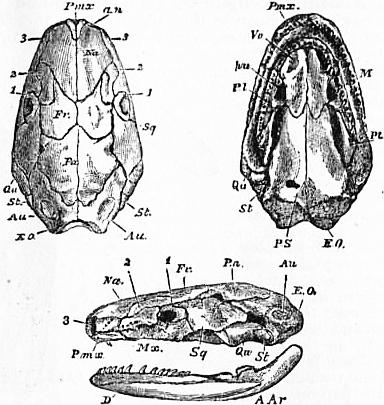
Fig. 8.—The skull of Ichthyophis glutinosus A, Dorsal; B, ventral; C, lateral view. The letters have the same signification as below.
As stated above in the definition of the order, the Stegocephalia have retained most of the cranial bones which are to be found in the Crossopterygian fishes, and it is worthy of note that the bones termed post-temporals may give attachment to a further bone so prolonged backwards as to suggest the probability of the skull being connected with the shoulder-girdle, as in most teleostome fishes. This supposition is supported by a specimen from the Lower Permian of Autun, determined as Actinodon frossardi, acquired in 1902 by the British Museum, which shows a bone, similar to the so-called “epiotic cornu” of the microsaurians, Ceraterpeton and Scincosaurus, to have the relations of the supra-cleithrum of fishes, thus confirming a suggestion made by C.W. Andrews (28). As in fishes also, the sensory canal system must have been highly developed on the skulls of many labyrinthodonts, and the impressions left by these canals have been utilized by morphologists for homologizing the various elements of the cranial roof with those of Crossopterygians. The pineal foramen, in the parietal bones, is as constantly present as it is absent in the other orders. Although not strictly forming part of the skull, allusion should be made here to the ring of sclerotic plates which has been found in many of the Stegocephalia, and which is only found elsewhere in a few Crossopterygian fishes as well as in many reptiles and birds.
In the orders which are still represented at the present day, the bones of the skull are reduced in number and the “primordial skull,” or chondrocranium (fig. 7), remains to a greater or less extent unossified, even in the adult. Huxley’s figures of the skull of a caccilian (Ichthyophis glutinosus), fig. 8, of a perennibranchiate urodele (Necturus maculosus = Menobranchus lateralis), fig. 9, and of a frog (Rana esculenta), fig. 10, are here given for comparison.
The skull, in the Apoda, is remarkably solid and compact, and it possesses a postorbital or postfrontal bone (marked 1 in the figure) which does not exist in any of the other living batrachians. The squamosal bone is large and either in contact with the frontals and parietals or separated from them by a vacuity; the orbit is sometimes roofed over by bone. The presence, in some genera, of a second row of mandibular teeth seems to indicate the former existence of a splenial element, such as exists in Siren among the Caudata and apparently in the labyrinthodonts.
In the Caudata, the frontals remain likewise distinct from the parietals, whilst in the Ecaudata the two elements are fused into one, and in a few forms (Aglossa, some Pelobalidae) the paired condition of these bones has disappeared in the adult. Prefrontal bones are present in the Salamandridae and Amphiumidae, but absent (or fused with the nasals) in the other Caudata and in the Ecaudata. In most of the former the palatines fuse with the vomers, whilst they remain distinct, unless entirely lost, in the latter. The vomer is single, or absent, in the Aglossa. In the lower jaw of most of the Ecaudata the symphysial cartilages ossify separately from the dentary bones, forming the so-called mento-meckelian bones; but these symphysial bones, so distinct in the frog, are less so in the Hylidae and Bufonidae, almost indistinguishable in the Pelobatidae and Discoglossidae, whilst in the Aglossa they do not exist any more than in the other orders of batrachians.
No batrachian is known to possess an ossified azygous supra-occipital.
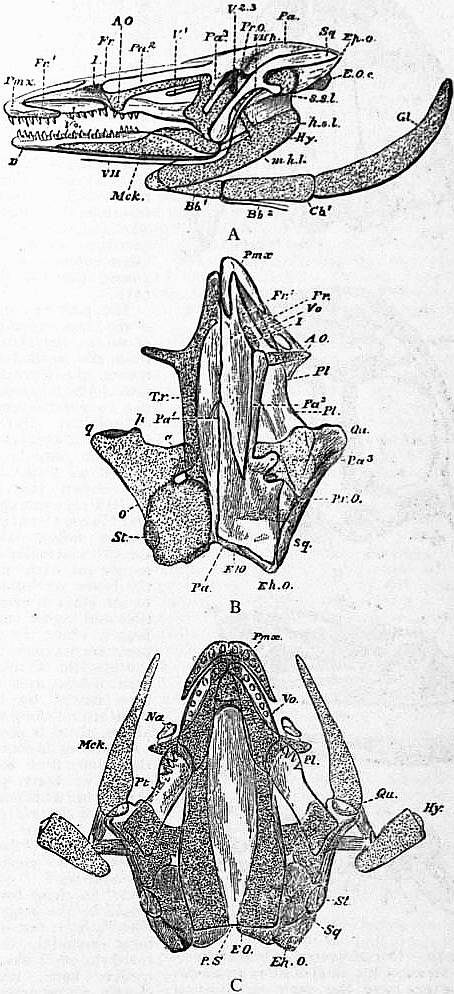
Fig. 9.—Lateral, dorsal and ventral views of the cranium of Necturus maculosus. In the dorsal view, the bones are removed from the left half of the skull, in the ventral view, the parasphenoid, palato-pterygoid, and vomers are given in outline. The letters have, for the most part, the same signification as before.
VII.p, Posterior division of the seventh nerve. VII. Chorda tympani V1, V2, V3, First, second and third divisions of the trigeminal. s.s.l, Stapedio-suspensorial ligament. h.s.l, Hyo-suspensorial ligament. m.h.l, Mandibulo-hyoid ligament. a, Ascending process of the suspensorium. p, Pterygo-palatine process. o, Otic process. Na, Posterior nares. Mck, Meckel’s cartilage. Gl (fig. 10), The position of the glottis. Bb1, Bb2, Basilbranchials.
Although there are four branchial arches in all the larval forms of the three orders, and throughout life in the Sirenidae, the perennibranchiate Proteidae have only three (see fig. 11). In the adult Apoda these arches and the hyoid fuse into three transverse, curved or angular bones (see fig. 13), the two posterior disconnected from the hyoid. In the Ecaudata, as shown by F. Gaupp (29) and by W.G. Ridewood (30), the whole hyobranchial apparatus forms a cartilaginous continuum, and during metamorphosis the branchialia disappear without a trace. The hyoid of the adult frog (fig. 12) consists of a plate of cartilage with two slender cornua, three processes on each side, and two long bony rods behind, termed the thyro-hyals, which embrace the larynx. In the Aglossa, which are remarkable for the large size and complexity of the larynx, the thyro-hyal bones are incorporated into the laryngeal apparatus, whilst the recently discovered Hymenochirus is further remarkable for the large size and ossification of the hyoidean cornua (ceratohyals), a feature which, though not uncommon among the salamanders, is unique among the Ecaudata (31).
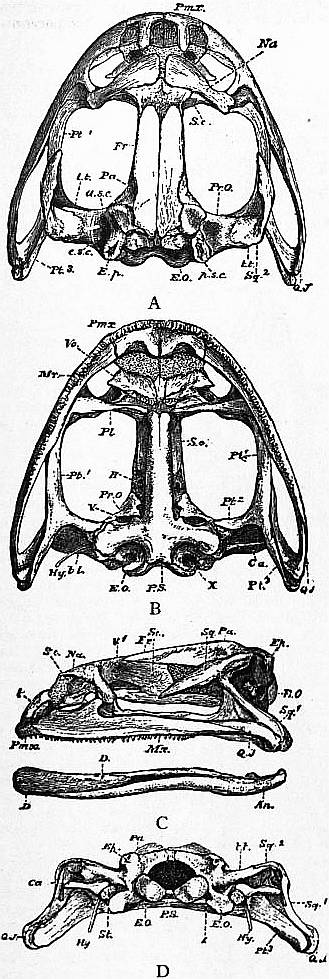
Fig. 10—Dorsal, ventral, lateral, and posterior views of the skull of Rana esculenta. The letters have the same signification throughout.
Pmx, Premaxilla. Mx, Maxilla. Vo, Vomer. Na, Nasal. S.e, Sphen-ethmoid. Fr, Frontal. Pa, Parietal. E.O, Exoccipital. Ep, Epiotic process. Pr.O, Pro-otic. t.t, Tegmentympani. Sq, Squamosal. Q.J, Quadrato-jugal. Pt1, Pterygoid, anterior process. Pt2, Internal process. Pt3, Posterior or external process. Ca, Columella auris. St, Stapes. Hy, Hyoidean cornu. P.S, Parasphenoid. An, Angulate. D, Dentale. V, Foramen of exit of the trigeminal. H, Of the optic. X, Of the pneumogastric and glosso-pharyngeal nerves. V1. Foramen by which the orbito-nasal or first division of the fifth passes to the nasal cavity.
The pectoral girdle of the Stegocephalia is, of course, only known from the ossified elements, the identification of which has given rise to some diversity of opinion. But C. Gegenbaur’s (32) interpretation may be regarded as final. He has shown that, as in the Crossopterygian and Chondrostean ganoid fishes, there are two clavicular elements on each side; the lower corresponds to the clavicle of reptiles and higher vertebrates, whilst the upper corresponds to the clavicle of teleostean fishes, and has been named by him “cleithrum.” As stated above, there is strong evidence in favour of the view that some forms at least possessed in addition a “supracleithrum,” corresponding to the supra-clavicle of bony fishes. The element often termed “coracoid” in these fossils would be the scapula. The clavicles rest on a large discoidal, rhomboidal, or T-shaped median bone, which clearly corresponds to the interclavicle of reptiles.
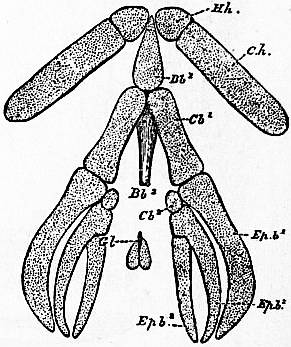
Fig. 11.—Hyoid and branchial apparatus of Necturus maculosus.
Hh, Hypo-hyal. Ch, Cerato-hyal. Bb1, First basibranchial. Bb2, Ossified second basibranchial. Ep.b1, Ep.b2, Ep.b3, First, second and third epibranchials. Gl, Glottis.
The pectoral girdle of the living types of batrachians is distinguishable into a scapular, a coracoidal, and a praecoracoidal region. In most of the Caudata the scapular region alone ossifies, but in the Ecaudata the coracoid is bony and a clavicle is frequently developed over the praecoracoid cartilage. In these batrachians the pectoral arch falls into two distinct types—the arciferous, in which the precoracoid (+ clavicle) and coracoid are widely separated from each other distally and connected by an arched cartilage (the epicoracoid), the right usually overlapping the left; and the firmisternal, in which both precoracoid and coracoid nearly abut on the median line, and are only narrowly separated by the more or less fused epicoracoids. The former type is exemplified by the toads and the lower Ecaudata, whilst the latter is characteristic of the true frogs (Ranidae), although when quite young these batrachians present a condition similar to that which persists throughout life in their lower relatives. A cartilage in the median line in front of the precoracoids, sometimes supported by a bony style, is the so-called Omosternum; a large one behind the cora-coids, also sometimes provided with a bony style, has been called the sternum. But these names will probably have to be changed when the homologies of these parts are better understood.
The pelvic arch of some of the Stegocephalia contained a well ossified pubic element, whilst in all other batrachians only the ilium, or the ilium and the ischium are ossified. In the Ecaudata the ilium is greatly elongated and the pubis and ischium are flattened, discoidal, and closely applied to their fellows by their inner surfaces; the pelvic girdle looks like a pair of tongs.
The long bones of the limbs consist of an axis of cartilage; the extremities of the cartilages frequently undergo calcification and are thus converted into epiphyses. In the Ecaudata the radius and ulna coalesce into one bone. The carpus, which remains cartilaginous in many of the Stegocephalia and Caudata, contains six to eight elements when the manus is fully developed, whilst the number is reduced in those forms which have only two or three digits. Except in some of the Stegocephalia, there are only four functional digits in the manus, but the Ecaudata have a more or less distinct rudiment of pollex; in the Caudata it seems to be the outer digit which has been suppressed, as atavistic reappearance of a fifth digit takes place on the outer side of the manus, as it does on the pes in those forms in which the toes are reduced to four. The usual number of phalanges is 2, 2, 3, 2 in the Stegocephalia and Caudata, 2, 2, 3, 3 in the Ecaudata. In the foot the digits usually number five, and the phalanges 2, 2, 3, 3, 2 in the Caudata, 2, 2, 3, 4, 3 in the Stegocephalia and Ecaudata. There are occasionally intercalary ossifications between the two distal phalanges (33). There are usually nine tarsal elements in the Caudata; this number is reduced in the Ecaudata, in which the two bones of the proximal row (sometimes coalesced) are much elongated and form an additional segment to the greatly lengthened hind-limb, a sort of crus secundarium. In the Ecaudata also, the tibia and fibula coalesce into one bone, and two or three small bones on the inner side of the tarsus form what has been regarded as a rudimentary digit or “prehallux.”
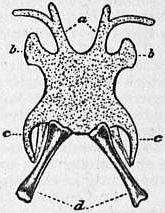
Fig. 12.—Ventral view of the hyoid of Rana esculenta. a, Anterior; b, lateral; c, posterior processes; d, thyro-hyals.
Integument.—In all recent batrachians, the skin is naked, or if small scales are present, as in many of the Apoda, they are concealed in the skin. The extinct Stegocephalia, on the other hand, were mostly protected, on the ventral surface at least, by an armour of overlapping round, oval, or rhomboidal scales, often very similar to those of Crossopterygian or ganoid fishes, and likewise disposed in transverse oblique lines converging forwards on the middle line of the belly. Sometimes these scales assumed the importance of scutes and formed a carapace, as in the “batrachian armadillo” discovered by E.D. Cope. A few frogs have the skin of the back studded with stellate bony deposits (Phyllomedusa, Nototrema), whilst two genera are remarkable for possessing a bony dorsal shield, free from the vertebrae (Ceratorphrys) or ankylosed to them (Brachycephalus). None of the Stegocephalia appears to have been provided with claws, but some living batrachians (Onychodactylus, Xenopus, Hymenochirus) have the tips of some or all of the digits protected by a claw-like horny sheath.
The integument of tailed and tailless batrachians is remarkable for the great abundance of follicular glands, of which there may be two kinds, each having a special secretion, which is always more or less acrid and irritating, and affords a means of defence against the attacks of many carnivorous animals. A great deal has been published on the poisonous secretion of batrachians (34), which is utilized by the Indians of South America for poisoning their arrows. Some of the poison-secreting glands attain a greater complication of structure and are remarkable for their large size, such as the so-called “parotoid” glands on the back of the head in toads and salamanders.

Fig. 13.—Ventral view of the head and trunk of Ichthyophis glutinosus.
Mn, Mandible. Hy, Hyoid. Br1 Br2, Br3, Branchial arches. Gl, Glottis. Tr, Trachea. Ivc, Inferior vena cava. V, Ventricle. Au, Auricles. Rsvc, Lsvc, right and left superior cavae. Ta, Truncus arteriosus. Ao, Left aortic arch. P.A. Right pulmonary artery. The pericardium (lightly shaded) extends as far as the bifurcation of the synangium.
In all larval forms, in the Caudata, and in a few of the Ecaudata (Xenopus, for instance), the epidermis becomes modified in relation with the termination of sensory nerves, and gives rise to organs of the same nature as those of the lateral line of fishes. In addition to diffuse pigment (mostly in the epidermis), the skin contains granular pigment stored up in cells, the chromatophores, restricted to the cutis, which are highly mobile and send out branches which, by contraction and expansion, may rapidly alter the coloration, most batrachians being in this respect quite comparable to the famous chameleons. Besides white (guanine) cells, the pigment includes black, brown, yellow and red. The green and blue, so frequent in frogs and newts, are merely subjective colours, due to interference. On the mechanism of the change of colour, cf. W. Biedermann (35).
One of the interesting recent discoveries is that of the “hairy” frog (Trichobatrachus), in which the sides of the body and limbs are covered with long villosities, the function of which is still unknown (36).
The nuptial horny asperities with which the males of many batrachians are provided, for the purpose of clinging to the females, will be noticed below, under the heading Pairing and Oviposition.
Dentition.—In the Microsauria and Branchiosauria among the Stegocephalia, as in the other orders, the hollow, conical or slightly curved teeth exhibit simple or only slightly folded walls. But in the Labyrinthodonta, grooves are more or less marked along the teeth and give rise to folds of the wall which, extending inwards and ramifying, produce the complicated structure, exhibited by transverse sections, whence these batrachians derive their name; a somewhat similar complexity of structure is known in some holoptychian (dendrodont) Crossopterygian fishes. In the remarkable salamander Autodax, the teeth in the jaws are compressed, sharp-edged, lancet shaped. The teeth are not implanted in sockets, but become ankylosed with the bones that bear them, and are replaced by others developed at their bases. Teeth are present in the jaws of all known Stegocephalia and Apoda and of nearly all Caudata, Siren alone presenting plates of horn upon the gingival surfaces of the premaxillae and of the dentary elements of the mandible. But they are nearly always absent in the lower jaw of the Ecaudata (exceptions in Hemiphractus, Amphignathodon, Amphodus, Ceratobatrachus, the male of Dimorphognathus), many of which (toads, for instance) are entirely edentulous.
There is great variety in the distribution of the teeth on the palate. They may occur simultaneously on the vomers, the palatines, the pterygoids and the parasphenoid in some of the Stegocephalia (Dawsonia, Seeleya, Acanthostoma), on the vomers, palatines and parasphenoid in many salamandrids (Plethodontinae and Desmognathinae), on the vomers, pterygoids and parasphenoid (some Pelobates), on the vomers and parasphenoid (Triprion, Amphodus), whilst in the majority or other batrachians they are confined to the vomers and palatines or to the vomers alone (37).
As regards the alimentary organs, it will suffice to state, in this very brief sketch, that all batrachians being carnivorous in their perfect condition, the intestine is never very long and its convolutions are few and simple. But the larvae of the Ecaudata are mainly herbivorous and the digestive tract is accordingly extremely elongate and coiled up like the spring of a watch. The gullet is short, except in the Apoda. The tongue is rudimentary in the perennibranchiatea Caudata, well developed, and often protrusile, in the Salamandridae and most of the Ecaudata, totally absent in the Aglossa.
The organs of circulation cannot be dealt with here; the most important addition made to our knowledge in recent years being found in the contributions of F. Hochstetter (38) and of G.B. Howes (39), dealing with the azygous (posterior) cardinal veins in salamanders and some of the Ecaudata. The heart is situated quite forward, in the gular or pectoral region, even in those tailed batrachians which have a serpentiform body, whilst in the Apoda (fig. 13) it is moved back to a distance which is comparable to that it occupies in most of the snakes.
The Respiratory Organs.—The larynx, which is rudimentary in most of the Caudata and in the Apoda, is highly developed in the Ecaudata, and becomes the instrument of the powerful voice with which many of the frogs and toads are provided. The lungs are long simple tubes in some of the perennibranchiate Caudata; they generally shorten or become cellular in the salamandrids, and attain their highest development in the Ecaudata, especially in such forms as the burrowing Pelobates. Although the lungs are present in such forms as preserve the gills throughout life, it is highly remarkable that quite a number of abranchiate salamanders, belonging mostly to the subfamilies Desmognathinae and Plethodontinae, are devoid of lungs and breathe entirely by the skin and by the bucco-pharyngeal mucose membrane (20). Some of the Salamandrinae show the intermediate conditions which have led to the suppression of the trachea and lungs. In the Apoda, as in many serpentiform reptiles, one of the lungs, either the right or the left, is much less developed than the other, often very short.
Urino-genital Organs.—The genital glands, ovaries and testes, are attached to the dorsal wall of the body-cavity, in the immediate vicinity of the kidneys, with which the male glands are intimately connected. The oviducts are long, usually more or less convoluted tubes which open posteriorly into the cloaca, while their anterior aperture is situated far forward, sometimes close to the root of the lung; their walls secrete a gelatinous substance which invests the ova as they descend. In most male batrachians the testes are drained by transverse canals which open into a longitudinal duct, which also receives the canals of the kidneys, so that this common duct conveys both sperma and urine. In some of the discogloesid frogs, however, the seminal duct is quite independent of the kidney, which has its own canal, or true ureter. Many of the Ecaudata have remnants of oviducts, or Müllerian ducts, most developed in Bufo, which genus is also remarkable as possessing a problematic organ, Bidder’s organ, situated between the testis and the adipose or fat-bodies that surmount it. This has been regarded by some anatomists as a rudimentary ovary. Female salamandrids are provided with a receptaculum seminis. Copulatory organs are absent, except in the Apoda, in which a portion of the cloaca can be everted and acts as a penis. The urinary bladder is always large.
The spermatozoa have received a great share of attention, on the part not only of anatomists and physiologists, but even of systematic workers (40). This is due to the great amount of difference in structure and size between these elements in the various genera, and also to the fact that otherwise closely allied species may differ very considerably in this respect. The failure to obtain hybrids between certain species of Rana has been attributed principally to these differences. The spermatozoa of Discoglossus are remarkable for their great size, measuring three millimetres in length.
Pairing and Oviposition—Batrachians may be divided into four categories under this head:—(1) no amplexation; (2) amplexation without internal fecundation; (3) amplexation with internal fecundation; (4) copulation proper. The first category embraces many aquatic newts, the second nearly all the Ecaudata, the third the rest of the Caudata, and the fourth the Apoda.
In the typical newts (Molge) of Europe, the males are adorned during the breeding season with bright colours and crests or other ornamental dermal appendages, and, resorting to the water, they engage in a lengthy courtship accompanied by lively evolutions around the females, near which they deposit their spermatozoa in bundles on a gelatinous mass, the spermatophore, probably secreted by the cloacal gland. This arrangement facilitates the internal fecundation of the female without copulation, the female absorbs the spermatozoa by squeezing them out of the spermatophore between the cloacal lips. Other newts, and many salamanders, whether terrestrial or aquatic, pair, the male embracing the female about the fore limbs or in the pelvic region, and the males of such forms are invariably devoid of ornamental secondary sexual characters; but in spite of this amplexation the same mode of fecundation by means of a spermatophore is resorted to, although it may happen that the contents of the spermatophore are absorbed direct from the cloaca of the male. The spermatozoa thus reach the eggs in the oviducts, where they may develop entirely, some of the salamanders being viviparous.
In all the tailless batrachians (with the exception of a single known viviparous toad), the male clings to the female round the breast, at the arm-pits, or round the waist, and awaits, often for hours or days, the deposition of the ova, which are immediately fecundated by several seminal emissions.
The fourth category is represented by the Apoda or Caecilians in which, as we have stated above, the male is provided with an intromittent organ. Some of these batrachians are viviparous.
In those species in which the embrace is of long duration the limbs of the male, usually the fore limbs (pleurodele newt, Ecaudata), rarely the hind limbs (a few American and European newts), according to the mode of amplexation, acquire a greater development, and are often armed with temporary horny excrescences which drop off after the pairing season. These asperities usually form brush-like patches on the inner side of one or more of the digits, but may extend over the inner surface of the limbs and on the breast and chin; the use of them on these parts is sufficiently obvious, but they are sometimes also present, without apparent function, on various parts of the foot, as in Discoglossus, Bombinator, and Pelodytes. In some species of the South American frogs of the genus Leptodactylus the breast and hands are armed with very large spines, which inflict deep wounds on the female held in embrace.
In most of the Caudata, the eggs are deposited singly in the axils of water plants or on leaves which the female folds over the egg with her hind limbs. The eggs are also deposited singly in some of the lower Ecaudata. In many of the Ecaudata, and in a few of the Caudata and Apoda, the eggs are laid in strings or bands which are twined round aquatic plants or carried by the parent; whilst in other Ecaudata they form large masses which either float on the surface of the water or sink to the bottom.
A few batrachians retain the ova within the oviducts until the young have undergone part or the whole of the metamorphosis. Viviparous parturition is known among the Caudata (Salamandra, Spelerpes fuscus), and the Apoda (Dermophis thomensis, Typhlonectes compressicauda); also in a little toad (Pseudophryne vivipara) recently discovered in German East Africa (41).
Development and Metamorphosis.—In a great number of batrachians, including most of the European species, the egg is small and the food-yolk is in insufficient quantity to form an external appendage of the embryo. But in a few European and North American species, and in a great many inhabitants of the tropics, the egg is large and a considerable portion of it persists for a long time as a yolk-sac. Although the segmentation is always complete, it is very irregular in these types, some of which make a distinct approach to the meroblastic egg.
With the exception of a number of forms in which the whole development takes place within the egg or in the body of the mother, batrachians undergo metamorphoses, the young passing through a free-swimming, gill-breathing period of considerable duration, during which their appearance, structure, and often their régime, are essentially different from those of the mature form. Even the fossil Stegocephalia underwent metamorphosis, as we know from various larval remains first described as Branchiosaurus. They are less marked or more gradual in the Apoda and Caudata than in Ecaudata, in which the stage known as tadpole is very unlike the frog or toad into which it rather suddenly passes (see Tadpole). In the Caudata, external gills (three on each side) persist until the close of the metamorphosis, whilst in the Apoda and Ecaudata they exist only during the earlier periods, being afterwards replaced by internal gills.
Many cases are known in which the young batrachian enters the world in the perfect condition, as in the black salamander of the Alps (Salamandra atra), the cave salamander (Spelerpes fuscus), the caecinan Typhlonectes, and a number of frogs, such as Pipa, Rhinoderma, Hylodes, some Nototrema, Rana opisthodon, &c. A fairly complete bibliographical index to these cases and the most remarkable instances of parental care in tailless batrachians will be found in the interesting articles by Lilian V. Sampson (42), and by G. Brandes and W. Schoenichen (43). It will suffice to indicate here in a synoptic form, as was done by the present writer many years ago, when our knowledge of these wonders of batrachian life was far less advanced than it is now, the principal modes of protection which are resorted to:—
1. Protection by means of nests or nurseries.
A. In enclosures in the water.—Hylafaber.
B. In nests in holes near the water.—Rhacophorus, Leptodactylus.
C. In nests overhanging the water.—Rhacophorus, Chiromantis, Phyllpmedusa.
D. On trees or in moss away from the water.—Rana opisthodon, Hylodes, Hylelia platycephala.
E. In a gelatinous bag in the water.—Phrynixalus, Salamandrella.
2. Direct nursing by the parents.
A Tadpoles transported from one place to another.—Dendrebates, Phyllobates, Sooglossus.
B. Eggs protected by the parents who coil themselves round or “sit” on them.—Mantophryne, Desmognathus, Autodax, Plethodon, Cryptobranchus, Amphiuma, Ichthyophis, Hypogeophis, Siphonops.
C. Eggs carried by the parents.
(a) Round the legs, by the male.—Alytes.
(b) On the back, by the female.
(1) Exposed.—Hyla goeldii, H. evansii, Ceratohyla.
(2) In cell-like pouches.—Pipa.
(3) In a common pouch.—Nototrema, Amphignathodon.
(c) On the belly.
(1) Exposed, by the female.—Rhacophorus reticulatus.
(2) In a pouch (the produced vocal sac), by the male.—Rhinoderma.
(d) In the mouth, by the female.—Hylambates brevirostris.
Geographical Distribution.—If a division of the world according to its batrachian faunae were to be attempted, it would differ very considerably from that which would answer for the principal groups of reptiles, the lizards especially. We should have four great realms:—(1) Europe and Northern and Temperate Asia, Africa north of the Sahara (palaearctic region) and North and Central America (nearctic region); (2) Africa and South-Eastern Asia (Ethiopian and Indian region); (3) South America (neotropical region); and (4) Australia (Australian region). The first would be characterized by the Caudata, which are almost confined to it (although a few species penetrate into the Indian and neotropical regions), the Discoglossidae, mostly Europaeo-Asiatic, but one genus in California, and the numerous Pelobatidae; the second by the presence of Apoda, the prevalence of firmisternal Ecaudata and the absence of Hylidae; the third by the presence of Apoda, the prevalence of arciferous Ecaudata and the scarcity of Ranidae, the fourth by the prevalence of arciferous Ecaudata and the absence of Ranidae, as well as by the absence of either Caudata or Apoda. Madagascar might almost stand as a fifth division of the world, characterized by the total absence of Caudata, Apoda, and arciferous Ecaudata. But the close relation of its very rich frog-fauna to that of the Ethiopian and Indian regions speaks against attaching too great importance to these negative features. It may be noted here that no two parts of the world differ so considerably in their Ecaudata as do Madagascar and Australia, the former having only Firmisternia, the latter only Arcifera. Although there is much similarity between the Apoda of Africa and of South America, one genus being even common to both parts of the world, the frogs are extremely different, apart from the numerous representatives of the widely distributed genus Bufo. It may be said that, on the whole, the distribution of the batrachians agrees to some extent with that of fresh-water fishes, except for the much less marked affinity between South America and Africa, although even among the former we have the striking example of the distribution of the very natural group of the aglossal batrachians, represented by Pipa in South America and by Xenopus and Hymenochirus in Africa.
Bibliography.—(1) On the use of the names Batrachia and Amphibia, cf. E.D. Cope, Geol. Mag. (3) ii., 1885, p. 575; G. Baur, Science (2), vi., 1897, pp. 170, 372; B.G. Wilder, t.c. p. 295; T Gill, t.c. p. 446; O.P. Hay, t.c. p. 773; T. Gill, Science (2), xx., 1900, p. 730; L. Steineger, op. cit. xx., 1904, p. 924. (2) E. Fraas, “Die Labyrinthodonten der schwäbischen Trias,” Palaeontogr. xxxvi., 1889, p. 1. (3) Proc. Zool. Soc., 1904, ii. p. 170. (4) E.D. Cope, “Synopsis of the Extinct Batrachia of North America,” Proc. Ac. Philad., 1868, p. 208. (5) “Researches on the Structure, Organization and Classification of the Fossil Reptilia, vii” Phil. Trans. clxxxiii. (B), 1892, p. 311. (6) Cambridge Natural History, viii. (1901). (7) “Die Urvierfüssler (Eotetrapoda) des sächsischen Rotliegenden,” Allgem. verständl. naturh. Abh., Berlin, 1891, No. 15; “Die Entwicklungsgeschichte von Branchiosaurus amblystomus,” Zeitschr. deutsch. geol. Ges., 1886, p. 576. (8) C. Emery, “Über die Beziehungen des Chiropterygium zum Ichthyopterygium,” Zool. Anz. x., 1887, p. 185; E.D. Cope, “On the Phylogeny of the Vertebrata,” Proc. Amer. Philos. Soc. xxx., 1892, p. 280; H.B. Pollard, “On the Anatomy and Phylogenetic Position of Polypterus,” Zool. Jahrb. Anat. v., 1892, p. 414; G. Baur, “The Stegocephali: a Phylogenetic Study,” Anat. Anz. xi., 1896, p. 657; L. Dollo, “Sur le phylogénie des dipneustes,” Mém. soc. belge géol. ix., 1895, p. 79; T. Gill, “On the Derivation of the Pectoral Member in Terrestrial Vertebrates,” Rep. Brit. Ass., 1897, p. 697. (9) E.D. Cope, “The Origin of the Mammalia,” Proc. Amer. Philos. Soc. xxii., 1884, p. 43; cf. Discussion on Origin of Mammals, Proc. Intern. Congr. Zool., Cambridge, 1898; also H. Gadow, “The Origin of the Mammalia,” Z. f. Morphol. iv., 1902, p. 345; and R. Broom, Rep. Brit. Ass., 1905, p. 437. (10) A. Fritsch, Fauna der Gaskohle und der Kalksleine der Permformation Böhmens, vols. i. and ii (Prague, 1879-1885, 4to); H. Credner, “Die Stegocephalen aus dem Rotliegenden des Plauenschen Grundes bei Dresden,” Zeitschr. deutsch. geol. Ges., 1881-1894; J.W. Dawson, “On the Results of Recent Explorations of Erect Trees containing Animal Remains in the Coal Formation of Nova Scotia,” Phil. Trans. clxxiii., 1882, p. 621; H.B. Geinitz and J.V. Deichmüller, “Die Saurier der unteren Dyas von Sachsen,” Palaeontogr. xxix., 1882, p. 1; A. Gaudry, Les Enchaînements du monde animal dans les temps géologiques, fossiles primaires (Paris, 1883, 8vo), p. 251; E.D. Cope, “The Batrachia of the Permian Period of North America,” Amer. Nat. xviii., 1884, p. 26; E. Fraas, “Die Labyrinthodonten der schwäbischen Trias,” Palaeontogr. xxxvi., 1889, p. 1; L.v. Ammon, Die permischen Amphibien der Rheinpfalz (Munich, 1889-1891, 4to); R. Lydekker, Catalogue of the Fossil Reptilia and Amphibia in the British Museum, part iv. (London, 1890, 8vo); E. Fraas, Die schwäbischen Trias-Saurier nach dem Material der k. Naturalien-Sammlung in Stuttgart zusammengestellt (Stuttgart, 1896, 4to); O. Jaekel, “Die Organization von Archegosaurus,” Zeitschr. deutsch. geol. Ges. xlviii., 1896, p. 505; F. Broili, “Ein Beitrag zur Kenntnis von Eryops megacephalus,” Palaeontogr. xlvi., 1899, p. 61. (11) “Amphibian Footprints from the Devonian,” Amer. Journ. Sci. ii., 1896, p. 374. (12) “Découverte du plus ancien amphibien connu ... dans le famennien supérieur de Modave,” Bull. soc. beige géol. xv., 1888, p. cxx, (13) “A Batrachian Armadillo,” Amer. Nat. xxix., 1895, p. 998. (14) C. Gegenbaur, Untersuchungen zur vergleichenden Anatomie der Wirbelsaule bei Amphibien und Reptilien (Leipzig, 1862, 4to); H. Gadow, “On the Evolution of the Vertebral Column of Amphibia and Amniota,” Phil. Trans. clxxxvii. (B), 1896, p. 1. (15) R. Wiedersheim, Die Anatomie der Gymnophionen (Jena, 1879, 4to); W. Peters, “Über die Einteilung der Caecilien,” Mon. Berl. Ac., 1879, p. 924; G.A. Boulenger, Catalogue of Batrachia Gradientia s. Caudata and Batrachia Apoda in the Collection of the British Museum (London, 1882, 8vo), and “A Synopsis of the Genera and Species of Apodal Batrachians,” P. Z. S., 1895, p. 401. (16) “On the Structure and Affinities of the Amphiumidae” Proc. Amer. Philos. Soc. xxiii., 1886, p. 442. (17) Ergebnisse naturwissenschaftlicher Forschungen auf Ceylon, ii. (Wiesbaden, 1887-1890, 4to), (18) “The Chondrocranium of the Ichthyopsida,” Stud. Biol. Lab. Tufts Coll. No. 5, 1898, p. 147. (19) G.A. Boulenger, Catalogue, &c., 1882. (20) H.H. Wilder, “Lungenlose Salamandriden,” Anat. Anz. ix., 1894, p. 216; L. Camerano, “Ricerche anatomofisiologiche intorno ai Salamandridi normalmente apneumoni,” Atti Acc. Torin. xxix., 1894, p. 705, and xxxi., 1896, p. 512; H.H. Wilder, “Lungless Salamanders,” Anat. Anz. xii., 1896, p. 182; E. Loennberg, “Notes on Tailed Batrachians without Lungs,” Zool. Anz. xix., 1896, p. 33. (21) “Note sur le batracien de Bernissart,” Bull. mus. belg. iii., 1884, p. 85. (22) G.A. Boulenger, Catalogue of Batrachia Salientia s. Ecaudata in the Collection of the British Museum (London, 1882, 8vo). (23) “On the Development of the Vertebral Column in Pipa and Xenopus,” Anat. Anz. xiii., 1898, p. 359. (24) G.A. Boulenger, “On Hymenochirus, a New Type of Aglossal Batrachians,” Ann. and Mag. N. H. (7), iv., 1899, p. 122. (25) L.M. Vidal, Mem. Ac. Barcelona (3), iv., 1902, No. 18, pl. iv. (26) W. Wolterstorff, “Über fossile Frösche, insbesondere Palaeobatrachus,” Jahresb. Nat. Ver. Magdeb., 1885 and 1886. (27) W. Peters, “Über die Entwickelung eines Batrachiers. Hylodes martinicensis, ohne Metamorphose,” Mon. Berl. Ac., 1876, p. 709; A. Kappler, “Die Tierwelt im holländischen Guiana,” Das Ausland, 1885, p. 358; G.A. Boulenger, “Reptiles and Batrachians of the Solomon Islands,” Trans. Zool. Soc. xii., 1886, p. 51; H. v. Ihering, “On the Oviposition of Phyllomedusa iheringii,” Ann. and Mag. N.H. (5), xvii., 1886, p. 461; H.H. Smith, “On Oviposition and Nursing in the Batrachian genus Dendrobates,” Amer. Nat. xxi., 1887, p. 307; G.B. Howes, “Notes on the Gular Brood-pouch of Rhinoderma darwini,” P.Z.S., 1888, p. 231; W.J. Holland, “Arboreal Tadpoles,” Amer. Nat. xxiii., 1889, p. 383; E.A. Goeldi, “Contribution to the Knowledge of the Breeding Habits of some Tree-frogs of the Serra dos Orgaos, Rio de Janeiro, Brazil,” P.Z.S., 1895. p. 89; G.A. Boulenger, “On the Nursing Habits of two South American Frogs,” P.Z.S., 1895, p. 209; A. Brauer, “Ein neuer Fall von Brutpflege bei Fröschen,” Zool. Jahrb. Syst. xi., 1898, p. 89; S. Ikeda, “Notes on the Breeding Habit and Development of Rhacophorus schlegelii,” Annot. Zool. Japan, i., 1898, p. 113; G. Brandes, “Larven zweier Nototrema-Arten,” Verh. deutsch. zool. Ges., 1899, p. 288; L. v. Méhely, “Beiträge zur Kenntnis der Engystomatiden von Neu-Guinea,” Termes. Fuzetek, Budapest, xxiv., 1901, p. 216; G.A. Boulenger, “Ceratohyla bubalus carrying eggs on its back,” P.Z.S., 1903, ii. p. 115; Idem. “Description of a new Tree-frog of the genus Hyla, from British Guiana, carrying eggs on the back,” op. cit., 1904, ii. p. 106; H.S. Ferguson, “Travancore Batrachians,” J. Bombay N.H. Soc. xv., 1904, p. 499. (28) Geol. Mag. iv., ii., 1895, p. 83. (29) “Das Hyobranchial-Skelett der Anura,” Morph. Arb. iii., 1894, p. 399. (30) “On the Structure and Development of the Hyobranchial Skeleton of the Parsley Frog,” P.Z.S., 1897, p. 577. (31) W.G. Ridewood, “On the Hyobrachial Skeleton and Larynx of Hymenochirus,” J. Linn. Soc. xxviii., 1899, p. 454. (32) Morphol. Jahrb. xxiii., 1895, p. 1. (33) G.B. Howes and A.M. Davies, P.Z.S., 1888, p. 495. (34) G.A. Boulenger, “The Poisonous Secretion of Batrachians,” Nat. Science, i., 1892, p. 185; F. Gidon, Venins multiples et toxicité humorale chez les batraciens (Paris, 1897, 8vo). (35) Arch. Ges. Physiol. li., 1892, p. 455. (36) G.A. Boulenger, P.Z.S., 1900, p. 433, and 1901, ii. p. 709; H. Gadow, Anat. Anz. xviii., 1900, p. 588. (37) G.A. Boulenger, “On the Presence of Pterygoid Teeth in a Tailless Batrachian, with remarks on the Localization of Teeth on the Palate,” P.Z.S., 1890, p. 664. (38) Morphol. Jahrb. xiii., 1887, p. 119. (39) P.Z.S., 1888, p. 122. (40) G.A. Boulenger, Tailless Batrachians of Europe (1897), p. 75. (41) G. Tornier, “Pseudophryne vivipara, ein lebendig gebärender Frosch,” Sitzb. Ak. Ber. xxxix., 1905, p. 855. (42) “Unusual Modes of Breeding and Development among Anura,” Amer. Nat. xxxiv., 1900, p. 405. (43) “Brutpflege der schwanzlosen Batrachier,” Abh. Nat. Ges. Halle, xxii., 1901, p. 395.
(G. A. B.)
BATRACHOMYOMACHIA (Gr. βάτραχος, “frog,” μῦς, “mouse,” and μάχη, “battle”), the “Battle of Frogs and Mice,” a comic epic or parody on the Iliad, definitely attributed to Homer by the Romans, but according to Plutarch (De Herodoti Malignitate, 43) the work of Pigres of Halicarnassus, the brother (or son) of Artemisia, queen of Caria and ally of Xerxes. Some modern scholars, however, assign it to an anonymous poet of the time of Alexander the Great.
Edition by A. Ludwich (1896).
BATTA, an Anglo-Indian military term, probably derived from the Canarese bhatta (rice in the husk), meaning a special allowance made to officers, soldiers, or other public servants in the field.
BATTAGLIA, a town of Venetia, Italy, in the province of Padua, 11 m. S.S.W. by rail from Padua. Pop. (1901) 4456. It lies at the edge of the volcanic Euganean Hills, and is noted for its warm saline springs and natural vapour grotto. A fine palace was erected in the Palladian style in the 17th century by Marchese Benedetto Selvatico-Estense, then owner of the springs.
BATTAKHIN, African “Arabs” of Semitic stock. They occupy the banks of the Blue Nile near Khartum, and it was against them that General Gordon fought most of his battles near the town. Their sheikh, El Obeid, routed Gordon’s troops on the 4th of September 1884, a defeat which led to the close investment of Khartum. In the 18th century James Bruce described them as “a thieving, pilfering lot.”
BATTALION, a unit of military organization consisting of four or more companies of infantry. The term is used in nearly every army, and is derived through Fr. from It. battaglione, Med. Lat. battalia (see Battle). “Battalion” in the 16th and 17th centuries implied a unit of infantry forming part of the line of battle, but at first meant an unusually large battalia or a single large body of men formed of several battalias. In the British regular service the infantry battalion is commanded by a lieut.-colonel, who is assisted by an adjutant, and consists at war strength of about 1000 bayonets in eight companies. Engineers, train, certain kinds of artillery, and more rarely cavalry are also organized in battalions in some countries.
BATTAMBANG, or Battambong (locally Phralabong), the chief town of the north-western division of Cambodia, formerly capital of Monton Kmer, i.e. “The Cambodian Division,” one of the eastern provinces of Siam, now included in the French protectorate of Cambodia. It is situated in 103° 6′ E., 13° 6′ N., in the midst of a fertile plain and on the river Sang Ke, which flows eastwards and falls into the Tonle or Talé Sap, the great lake of Cambodia. The town is a collection of bamboo houses of no importance, but there is a walled enceinte of some historical interest. Trade is small and is carried on by Chinese settlers, chiefly overland with Bangkok, but to a small extent also by water with Saigon. The population is about 5000, two-thirds Cambodian and the remainder Chinese and Siamese. The language is Cambodian.
Battambang was taken by the Siamese when they overran the kingdom of Cambodia towards the end of the 18th century, and was recognized by the French as belonging to Siam when the frontier of Cambodia was adjusted by treaty in 1867-1872. In another treaty in 1893, Siam bound herself to maintain no armed forces there other than police, but this arrangement was annulled by the treaty of 1904, by which Battambang was definitely admitted to lie within the French sphere of influence. Under a further treaty in March 1907 (see Siam), the district of Battambang was finally ceded to the French.
BATTANNI, or Bhitani, a small tribe on the Waziri border of the North-West Frontier Province of India. The Battannis hold the hills on the borders of Tank and Bannu in the Dera Ismail Khan district, from the Gabar mountain on the north to the Gomal valley on the south. They are only 3000 fighting men strong, and are generally regarded as the jackals of the Waziris. Their chief importance arises from the fact that no raids can be carried into British districts by the Mahsud Waziris without passing through Battanni territory. A small British expedition against the Battannis was led by Lt.-Col. Rynd in 1880. Under the excitement caused by the preaching of a fanatical mullah the Mahsud Waziris had attacked the town of Gomal. The Battannis failed to supply information as to their movements, and gave them a passage through their lands. The British troops accordingly stormed the Hinis Tangi defile in face of opposition, and burned the village of Jandola.
BATTAS (Dutch Battaks), the inhabitants of the formerly independent Batta country, in the central highlands of Sumatra, now for the most part subjugated to the Dutch government. The still independent area extends from 98°-99° 35′ E., and 2°-3° 25′ S. North-east of Toba Lake dwell the Timor Battas, and west of it the Pakpak, but on its north (in the mountains which border on the east coast residency) the Karo Battas form a special group, which, by its dialects and ethnological character, appears to be allied to the Gajus and Allas occupying the interior of Achin. The origin of the Battas is doubtful. It is not known whether they were settled in Sumatra before the Hindu period. Their language contains words of Sanskrit origin and others referable to Javanese, Malay and Tagal influence. Their domain has been doubtless much curtailed, and their absorption into the Achin and Malay population seems to have been long going on. The Battas are undoubtedly of Malayan stock, and by most authorities are affiliated to that Indonesian pre-Malayan race which peopled the Indian Archipelago, expelling the aboriginal negritos, and in turn themselves submitting to the civilized Malays. In many points the Battas are physically quite different from the Malay type. The average height of the men is 5 ft. 4 in.; of the women 4 ft. 8 in. In general build they are rather thickset, with broad shoulders and fairly muscular limbs. The colour of the skin ranges from dark brown to a yellowish tint, the darkness apparently quite independent of climatic influences or distinction of race. The skull is rather oval than round. In marked contrast to the Malay type are the large, black, long-shaped eyes, beneath heavy, black or dark brown eyebrows. The cheek-bones are somewhat prominent, but less so than among the Malays. The Battas are dirty in their dress and dwellings and eat any kind of food, though they live chiefly on rice. They are remarkable as a people who in many ways are cultured and possess a written language of their own, and yet are cannibals. The more civilized of them around Lake Toba are good agriculturists and stock-breeders, and understand iron-smelting. They weave and dye cotton, make jewellery and krisses which are often of exquisite workmanship, bake pottery, and build picturesque chalet-like houses of two storeys. They have an organized government, hereditary chiefs, popular assemblies, and a written civil and penal code. There is even an antiquated postal system, the letter-boxes being the hollow tree trunks at crossroads. Yet in spite of this comparative culture the Battas have long been notorious for the most revolting forms of cannibalism. (See Memoirs of the Life, &c., of Sir T.S. Raffles, 1830.)
The Battas are the only lettered people of the Indian Archipelago who are not Mahommedans. Their religion is mainly confined to a belief in evil spirits; but they recognize three gods, a Creator, a Preserver and a Destroyer, a trinity suggestive of Hindu influence.
Up to the publication of Dr H.N. van der Tuuk’s essay, Over schrift en uitspraak der Tobasche taal (1855), our knowledge of the Batta language was confined to lists of words more or less complete, chiefly to be found in W. Marsden’s Miscellaneous Works, in F.W. Junghuhn’s Battalander, and in the Tijdschrift van het Bataviaasch Genootschap, vol. iii. (1855). By his exhaustive works (Bataksch Leesboek, in 4 vols., 1861-1862; Bataksch-nederduitsch Woordenboek, 1861; Tobasche Spraakkunst, 1864-1867) van der Tuuk made the Batta language the most accessible of the various tongues spoken in Sumatra. According to him, it is nearest akin to the old Javanese and Tagal, but A. Schreiber (Die Battas in ihrem Verhältnis zu den Malaien von Sumatra, 1874) endeavoured to prove its closer affinity with the Malay proper. Like most languages spoken by less civilized tribes, Batta is poor in general terms, but abounds in terms for special objects. The number of dialects is three, viz. the Toba, the Mandailing and the Dairi dialects; the first and second have again two subdivisions each. The Battas further possess six peculiar or recondite modes of speech, such as the hata andung, or language of the wakes, and the hata poda or the soothsayer’s language. A fair acquaintance with reading and writing is very general among them. Their alphabet is said, with the Rejang and Lampong alphabets, to be of Indian origin. The language is written on bark or bamboo staves from bottom to top, the lines being arranged from left to right. The literature consists chiefly in books on witchcraft, in stories, riddles, incantations, &c., and is mostly in prose, occasionally varied by verse.1
See also “Reisen nach dem Toba See,” Petermanns Mitteil. (1883); Modigliani, Fra i Batacchi indipendenti (Rome, 1892); Neumann, “Het Pane- en Bilastroomgebied,” Tydschr. Aardr. Gen., 1885-1887; Van Dijk in the same periodical (1890-1895); Wing Easton in the Jaarboek voor het Mynwezen, 1894; Niemann in the Encyclopaedia van Nederlandsch-Indie, under the heading Bataks, with very detailed bibliography; Baron J. v. Brenner, Besuch bei den Kannibalen Sumatras (Würzburg, 1893); H. Breitenstein, 21 Jahre in Indien, Java, Sumatra (Leipzig, 1899-1900); G.P. Rouffaer, Die Batik-Kunst in niederlandisch-Indien und ihre Geschichte (Haarlem, 1899).
1 Mr C.A. van Ophuijsen has published (in Bijd. tot Land-, Taalen Volken-Kunde, 1886) an interesting collection of Battak poetry. He describes a curious leaf language used by Battak lovers, in which the name of some leaf or plant is substituted for the word with which it has greatest phonetic similarity.
BATTEL, or Battels (of uncertain origin, possibly connected with “battle,” a northern English word meaning to feed, or “batten”), a word used at Oxford University for the food ordered by members of the college as distinct from the usual “commons”; and hence college accounts for board and provisions supplied from kitchen and buttery, and, generally, the whole of a man’s college accounts. “Batteler,” now a resident in a college, was originally a rank of students between commoners and servitors who, as the name implies, were not supplied with “commons,” but only such provisions as they ordered for themselves.
BATTEN, SIR WILLIAM (floruit 1626-1667), British sailor, son of Andrew Batten, master in the royal navy, first appears as taking out letters of marque in 1626, and in 1638 he obtained the post of surveyor to the navy, probably by purchase. In March 1642 he was appointed second-in-command under the earl of Warwick, the parliamentary admiral who took the fleet out of the king’s hands. It was Vice-Admiral Batten’s squadron which bombarded Scarborough when Henrietta Maria landed there. He was accused (it appears unjustly) by the Royalists of directing his fire particularly on the house occupied by the queen, and up to the end of the First Civil War showed himself a steady partisan of the parliament. To the end of the First Civil War, Batten continued to patrol the English seas, and his action in 1647 in bringing into Portsmouth a number of Swedish ships of war and merchantmen, which had refused the customary salute to the flag, was approved by parliament. When the Second Civil War began he was distrusted by the Independents and removed from his command, though he confessed his continued willingness to serve the state. When part of the fleet revolted against the parliament, and joined the prince of Wales in Holland, May 1648, Batten went with them. He was knighted by the prince, but being suspected by the Royalists, was put ashore mutinously in Holland and returned to England. He lived in retirement during the Commonwealth period. At the Restoration Sir William Batten became once more surveyor of the navy. In this office he was in constant intercourse with Pepys, whose diary frequently mentions him; but the insinuations of Pepys against him must not be taken too seriously, as there is no evidence to show that Batten in making a profit from his office fell below the standards of the time. In 1661 he became M.P. for Rochester, and in 1663 he was made master of the Trinity House. He died in 1667.
There is no separate life of Batten, but many notices of him will be found in Penn’s Life of Sir W. Penn, and in Pepys’ Diary.
BATTEN, (1) A term (a form of “baton”) used in joinery (q.v.) for a board not more than 4 to 7 in. broad or 3 in. thick, used for various purposes, such as for strengthening or holding together laths and other wood-work; and specially, on board ship, a strip of wood nailed to a mast to prevent rubbing, or fixing down a tarpaulin over a hatchway, in rough weather, to keep out water. (2) A verb (the root is found in words of several Teutonic languages meaning profit or improvement, and also in the English “better” and “boot”) meaning to improve in condition, especially in the case of animals by feeding; so, to feed gluttonously; the word is used figuratively of prospering at the expense of another.
BATTENBERG, the name of a family of German counts which died out about 1314, whose seat was the castle of Kellerburg, near Battenberg, a small place now in the Prussian province of Hesse-Nassau. The title was revived in 1851, when Alexander (1823-1888), a younger son of Louis II., grand-duke of Hesse, contracted a morganatic marriage with a Polish lady, Countess Julia Theresa von Haucke (1825-1895), who was then created countess of Battenberg. Raised to the rank of a princess in 1858, the countess and her children were allowed to style themselves princes and princesses of Battenberg, with the addition of Durchlaucht or Serene Highness. The eldest son of this union, Louis Alexander (b. 1854), married in 1884 Victoria, daughter of Louis IV., grand-duke of Hesse, and became an admiral in the British navy. The second son, Alexander Joseph (q.v.), was prince of Bulgaria from 1879 to 1886. The third son, Henry Maurice, was born in 1858, and married on the 23rd of July 1885 Beatrice, youngest daughter of Victoria, queen of England. He died at sea on the 20th of January 1896 when returning from active service with the British troops during the Ashanti War, and left three sons and a daughter, Victoria Eugénie, who was married in 1906 to Alphonso XIII., king of Spain. The fourth son, Francis Joseph, born in 1861, married in 1897 Anna, daughter of Nicholas I., prince of Montenegro, and is the author of Die volkswirtschaftliche Entwickelung Bulgariens von 1879 bis zur Gegenwart (Leipzig, 1891). The only daughter of the princess of Battenberg, Marie Caroline, born in 1852, was married in 1871 to Gustavus Ernest, prince and count of Erbach-Schönberg.
BATTER, an architectural term of unknown origin, used of the face of a wall which is slightly inclined to the perpendicular. It is most commonly employed in retaining walls, the lower courses of which are laid at right angles to the batter, so as to resist the thrust of the earth inside. For aesthetic reasons it is often adopted in the lowest or basement porticos of a great building. From a historical point of view it is the most ancient system employed, as throughout Egypt and Chaldaea all the temples built in unburnt brick were perforce obliged to be thicker at the bottom, and this gave rise to the batter or raking side which was afterwards in Egypt copied in stone. For defensive purposes the walls of the lower portions of a fortress were built with a batter as in the case of the tower of David and some of the walls built by Herod at Jerusalem. The Crusaders also largely adopted the principle, which was followed in some of the castles of the middle ages throughout Europe.
BATTERING RAM (Lat. aries, ram), a military engine used before the invention of cannon, for beating down the walls of besieged fortresses. It consisted of a long heavy beam of timber, armed at the extremity with iron fashioned something like the head of a ram. In its simplest form the beam was carried in the hands of the soldiers, who assailed the walls with it by main force. The improved ram was composed of a longer beam, in some cases extending to 120 ft., shod with iron at one end, and suspended, either by the middle or from two points, from another beam laid across two posts. This is the kind described by Josephus as having been used at the siege of Jerusalem (B.J. iii. 7. 19). The ram was shielded from the missiles of the besieged by a penthouse (vinea) or other overhead protection. It was often mounted on wheels, which greatly facilitated its operations. A hundred soldiers at a time, and sometimes even a greater number, were employed to work it, and the parties were relieved in constant succession. No wall could resist the continued application of the ram, and the greatest efforts were always made to destroy it by various means, such as dropping heavy stones on the head of the ram and on the roof of the penthouse; another method being to seize the ram head with grapnels and then haul it up to a vertical position by suitable windlasses on the wall of the fortress. Sometimes the besieged ran countermines under the ram penthouse; this if successful would cause the whole engine to fall into the excavation. In medieval warfare the low penthouse, called cat, was generally employed with some form of ram.
BATTERSEA, a south-western metropolitan borough of London, England, bounded N. by the Thames, N.E. by Lambeth, and S.E., S., and W. by Wandsworth. Pop. (1901) 168,907. The principal thoroughfares are Wandsworth Road and Battersea Park and York Roads from east to west, connected north and south with the Victoria or Chelsea, Albert and Battersea bridges over the Thames. The two first of these three are handsome suspension bridges; the third, an iron structure, replaced a wooden bridge of many arches which was closed in 1881, after standing a little over a century. Battersea is a district mainly consisting of artisans’ houses, and there are several large factories by the river. The parish church of St Mary, Church Road (1776), preserves from an earlier building stained glass and monuments, including one to Henry St John, Viscount Bolingbroke (d. 1751), and his second wife, who had a mansion close by. Of this a portion remains on the riverside, containing a room associated with Pope, who is said to have worked here upon the “Essay on Man.” Wandsworth Common and Clapham Common (220 acres) lie partly within the borough, but the principal public recreation ground is Battersea Park, bordering the Thames between Albert and Victoria Bridges, beautifully laid out, containing a lake and subtropical garden, and having an area of nearly 200 acres. It was constructed with difficulty by embanking the river and raising the level of the formerly marshy ground, and was opened in 1858. Among institutions are the Battersea Polytechnic, the Royal Masonic Institution for girls, founded in 1788, and Church of England and Wesleyan Training Colleges. Battersea is in the parliamentary borough of Battersea and Clapham, including the whole of the Battersea division and part of the Clapham division. The borough council consists of a mayor, 9 aldermen and 54 councillors. Area, 2160.3 acres.
An early form of the name is Patricsey or Peter’s Island; the manor at the time of the Domesday survey, and until the suppression of the monasteries, belonging to the abbey of St Peter, Westminster. It next passed to the crown, and subsequently to the family of St John and to the earls Spencer. York Road recalls the existence of a palace of the archbishops of York, occasionally occupied by them between the reigns of Edward IV. and Mary. Battersea Fields, bordering the river, were formerly a favourite resort, so that the park also perpetuates a memory. The art of enamelling was introduced, c. 1750, at works in Battersea, examples from which are highly valued.
BATTERY (Fr. batterie, from battre, to beat), the action of beating, especially in law the unlawful wounding of another (see Assault). The term is applied to the apparatus used in battering, hence its use in military organization for the unit of mobile artillery of all kinds. This consists of from four to eight guns with their personnel, wagons and train. In the British service the term is applied to field, horse, field-howitzer, heavy and mountain artillery units. “Battery” is also used to imply a mass of guns in action, especially in connexion with the military history of the 18th and early 19th centuries. In siegecraft, a battery is simply an emplacement for guns, howitzers or mortars, constructed for the purposes of the siege, and protected as a rule by a parapet. In fortification the term is applied similarly to permanent or semi-permanent emplacements for the artillery of the defence. In all these senses the presence of artillery is implied in the use of the word (see Artillery, and Fortification and Siegecraft). The word is also used for the “pitcher” and “catcher” in baseball; for a collection of utensils, primarily of hammered copper or brass, especially in the French term batterie de cuisine; and for the instruments of percussion in an orchestra.
Electric Battery—This term was applied by the old electricians to a collection of Leyden jars, but is now used of a device for generating electricity by chemical action, or more exactly, of a number of such devices joined up together. There are two main classes of electric battery. In primary batteries, composed of a number of galvanic or voltaic “cells,” “couples” or “elements,” on the completion of the interactions between the substances on which the production of electricity depends, the activity of the cells comes to an end, and can only be restored with the aid of a fresh supply of those substances; in secondary batteries, also called storage batteries or accumulators (q.v.), the substances after the exhaustion of the cells can be brought back to a condition in which they will again yield an electric current, by means of an electric current passed through them in the reverse direction. The first primary battery was constructed about 1799 by Alessandro Volta. In one form, the “voltaic pile,” he placed a series of pairs of copper and zinc disks one above the other, separating each pair from the one above it by a piece of cloth moistened with a solution of common salt. In another form, the “couronne de tasses,” he took a number of vessels or cells containing brine or dilute acid, and placed in each a zinc plate and a copper plate; these plates were not allowed to touch each other within the vessels, but each zinc plate was connected to the copper plate of the adjoining vessel. In both these arrangements an electric current passes through a wire which is connected to the terminal plates at the two ends of the series. The direction of this current is from copper to zinc; within each cell itself it is from zinc to copper. The plate to which the current flows within the cell is the negative plate, and that from which it flows the positive plate; but the point on the negative plate at which the current enters the external wire is the positive pole, and the point on the positive plate at which it leaves the external circuit the negative pole. During the time that the external connexion is maintained between the two poles and the current passes in the wire, the zinc or positive plates are gradually dissolved, and hydrogen gas is liberated at the surface of the copper or negative plates; but when the external connexion is broken this action ceases. If the materials used in the cells were perfectly pure, probably the cessation would be complete. In practice, however, only impure commercial zinc is available, and with this corrosion continues to some extent, even though the external circuit is not closed, thus entailing waste of material. This “local action” is explained as due to the fact that the impurities in the zinc plate form miniature voltaic couples with the zinc itself, thus causing its corrosion by voltaic action; and an early improvement in the voltaic cell was the discovery, applied by W. Sturgeon in 1830, that the evil was greatly reduced if the surface of the zinc plates was amalgamated, by being rubbed with mercury under dilute sulphuric acid. Another disadvantage of the simple cell composed of copper and zinc in dilute acid is that the current it yields rapidly falls off. The hydrogen formed by the operation of the cell does not all escape, but some adheres as a film to the negative plate, and the result is the establishment of a counter or reverse electromotive force which opposes the main current flowing from the zinc plate and diminishes its force. This phenomenon is known as “polarization,” and various remedies have been tried for the evils it introduces in the practical use of primary batteries. Alfred Smee in 1839 modified the simple copper-zinc couple excited by dilute sulphuric acid by substituting for the copper thin leaves of platinum or platinized silver, whereby the elimination of the hydrogen is facilitated; and attempts have also been made to keep the plates free from the gas by mechanical agitation. The plan usually adopted, however, is either to prevent the formation of the film, or to introduce into the cell some “depolarizer” which will destroy it as it is formed by oxidizing the hydrogen to water (see also Electrolysis).