VOLUME III SLICE IV Basso-relievo to Bedfordshire (continued 6)
Reading edition
Contemporary lives of Bayard are the following:—“Le loyal serviteur” (? Jacques de Maille); La très joyeuse, plaisante, et récréative histoire ... des faiz, gestes, triumphes et prouesses du bon chevalier sans paour et sans reproche, le gentil seigneur de Bayart (original edition printed at Paris, 1527; the modern editions are very numerous, those of M.J. Roman and of L. Larchey appeared in 1878 and 1882); Symphorien Champier, Les Gestes, ensemble la vie du preulx chevalier Bayard (Lyons, 1525); Aymar du Rivail, Histoire des Allobroges (edition of de Terrebasse, 1844); see Bayard in Répertoire des sources historiques, by Ulysse Chevalier, and in particular A. de Terrebasse, Hist. de Pierre Terrail, seigneur de Bayart (1st ed., Paris, 1828; 5th ed., Vienna, 1870).
BAYARD, THOMAS FRANCIS (1828-1898), American diplomatist, was born in Wilmington, Delaware, on the 29th of October 1828. His great-grandfather, Richard Bassett (1745-1815), governor of Delaware; his grandfather, James Asheton Bayard (1767-1815), a prominent Federalist, and one of the United States commissioners who negotiated the treaty of Ghent with Great Britain after the War of 1812; his uncle, Richard Henry Bayard (1796-1868); and his father, James Asheton Bayard (1799-1880), a well-known constitutional lawyer, all represented Delaware in the United States Senate. Intending to go into business, he did not receive a college education; but in 1848 he began the study of law in the office of his father, and was admitted to the bar in 1851. Except from 1855 to 1857, when he was a partner of William Shippen in Philadelphia, he practised chiefly in Wilmington. He was a United States senator from Delaware from 1869 to 1885, and in 1881 was (October 10th to 13th) president pro tempore of the Senate. His abilities made him a leader of the Democrats in the Senate, and his views on financial and legal questions gave him a high reputation for statesmanship. He was a member of the electoral commission of 1877. In the Democratic national conventions of 1872, 1876, 1880 and 1884 he received votes for nomination as the party candidate for the presidency. He was secretary of state, 1885-1889, during the first administration of President Cleveland, and pursued a conservative policy in foreign affairs, the most important matter with which he was called upon to deal being the Bering Sea controversy. As ambassador to Great Britain, 1893-1897, his tall dignified person, unfailing courtesy, and polished, if somewhat deliberate, eloquence made him a man of mark in all the best circles. He was considered indeed by many Americans to have become too partial to English ways; and, for the expression of some criticisms regarded as unfavourable to his own countrymen, the House of Representatives went so far as to pass, on the 7th of November 1895, a vote of censure on him. The value of Mr Bayard’s diplomacy was, however, fully recognized in the United Kingdom, where he worthily upheld the traditions of a famous line of American ministers. He was the first representative of the United States in Great Britain to hold the diplomatic rank of an ambassador. He died in Dedham, Massachusetts, on the 28th of September 1898.
See Edward Spencer, Public Life and Services of T.F. Bayard (New York, 1880).
BAYAZID, or Bajazet, a border fortress of Asiatic Turkey, chief town of a sanjak of the Erzerum vilayet, situated close to the frontiers of Russia and Persia, and looking across a marshy plain to the great cone of Ararat, at a general altitude of 6000 ft. It occupies a site of great antiquity, as the cuneiform inscriptions on the neighbouring rocks testify; it stands on the site of the old Armenian town of Pakovan. It is picturesquely situated in an amphitheatre of sharp, rocky hills. The great trade route from Trebizond by Erzerum into N.W. Persia crosses the frontier at Kizil Dize a few miles to the south and does not enter the town. A knoll above the town is occupied by the half-ruined fort or palace of former governors, built for Mahmud Pasha by a Persian architect and considered one of the most beautiful buildings in Turkey. It contains two churches and a monastery, the Kasa Kilissa, famous for its antiquity and architectural grandeur. The cuneiform inscriptions are on the rock pinnacles above the town, with some rock chambers, indicating a town or fortress of the Vannic period. The population has lately decreased and now numbers about 4000. A Russian consul resides here and the town is a military station. It was captured during the Russian campaigns of 1828 and 1854, also in 1878, but was then recaptured by the Turks, who subjected the Russian garrison to a long siege; the place was ultimately relieved, but a massacre of Christians then took place in the streets. Bayazid was restored to Turkey by the treaty of Berlin.
BAYBAY, a town of the province of Leyte, island of Leyte, Philippine Islands, on the W. coast. Pop. (1903) 22,990. The town proper is situated at the mouth of the Pagbañganan river, 45 m. S.S.W. of Tacloban, the provincial capital. A superior grade of hemp is exported. Other products are rice, corn, copra, cacao, sugar, cattle and horses. The Cebú dialect of the Visayan language is spoken.
BAY CITY, a city and the county seat of Bay county, Michigan, U.S.A., on the Saginaw river, about 2 m. from its entrance into Saginaw Bay and about 108 m. N.N.W. of Detroit. Pop. (1890) 27,839; (1900) 27,628, of whom 8483 were foreign-born, including 2413 English-Canadians, 1743 Germans, 1822 Poles—the city has a Polish weekly newspaper—and 1075 French-Canadians; (1910, census) 45,166. Bay City is served by the Michigan Central, the Père Marquette, the Grand Trunk and the Detroit & Mackinac railways, and by lake steamers. The city extends for several miles along both sides of the river, and is in a good farming district, with which it is connected by stone roads. Among the public buildings are the Federal building, the city hall and the public library. The city has lumber and fishing interests (perch, whitefish, sturgeon, pickerel, bass, &c. being caught in Saginaw Bay), large machine shops and foundries (value of products in 1905, $1,743,155, or 31% of the total of the city’s factory products), and various manufactures, including ships (wooden and steel), wooden ware, wood-pipe, veneer, railroad machinery, cement, alkali and chicory. A salt basin underlies the city, and, next to the lumber industry, the salt industry was the first to be developed, but its importance has dwindled, the product value in 1905 being $20,098 out of $5,620,866 for all factory products. Near the city are valuable coal mines, and there is one within the city limits. At Essexville (pop. in 1910, 1477), N.E., at Banks, N.W., and at Salzbury, S.W. of Bay City, are beet-sugar factories—sugar beets are extensively grown in the vicinity. Alcohol is made from the refuse molasses obtained from these beet-sugar factories. The municipality owns and operates the water-works and electric-lighting plant. The settlements of Lower Saginaw and Portsmouth were made in 1837, and were later united to form Bay City, which was incorporated as a village in 1859, and chartered as a city in 1865. In 1905 West Bay City (pop. 1900, 13,119) and Bay City were consolidated.
BAYEUX, a town of north-western France, capital of an arrondissement in the department of Calvados, 18 m. N.W. of Caen on the Western railway. Pop. (1906) 6930. Bayeux is situated on the Aure, 5 m. from the English Channel. Its majestic cathedral was built in the 13th century on the site of a Romanesque church, to which the lateral arcades of the nave and the two western towers with their high stone spires belonged. A third and still loftier tower, the upper part of which, in the florid Gothic style, is modern, surmounts the crossing. The chancel, surrounded with radiating chapels, is a fine example of early Gothic. Underneath it there is a crypt of the 11th century restored in the 15th century. The oak stalls in the choir are fine examples of late 16th-century carving. The former bishop’s palace, parts of which are of great age though the main building is of the 18th century, serves as law-court and hôtel de ville. Bayeux possesses many quaint, timbered houses and stone mansions in its quiet streets. The museum contains the celebrated Bayeux tapestry (see below). The town is the seat of a bishop and of a sub-prefect; it has tribunals of first instance and of commerce, an ecclesiastical seminary, a communal college and a chamber of arts and manufactures. Dyeing, leather-dressing, lace-making and the manufacture of porcelain for household and laboratory purposes are carried on.
Till the 4th century Bayeux bore the name of Augustodurum, but afterwards, when it became the capital of the two tribes of the Baiocasses and Viducasses, took the name of Civitas Baiocassium. Its bishopric dates from the latter half of the 4th century. Before the Norman invasion it was governed by counts. Taken in 890 by the Scandinavian chief, Rollo, it was soon after peopled by the Normans and became a residence of the dukes of Normandy, one of whom, Richard I., built about 960 a castle which survived till the 18th century. During the quarrels between the sons of William the Conqueror it was pillaged and sacked by Henry I. in 1106, and in later times it underwent siege and capture on several occasions during the Hundred Years’ War and the religious wars of the 16th century. Till 1790 it was the capital of the Bessin, a district of lower Normandy.
BAYEUX TAPESTRY, THE. This venerable relic consists of a band of linen, 231 ft. long and 20 in. wide, now light brown with age, on which have been worked with a needle, in worsteds of eight colours, scenes representing the conquest of England by the Normans. Of these scenes there are seventy-two, beginning with Harold’s visit to Bosham on his way to Normandy, and ending with the flight of the English from the battle of Hastings, though the actual end of the strip has perished. Along the top and the bottom run decorative borders with figures of animals, scenes from fables of Aesop and of Phaedrus, from husbandry and the chase, and occasionally from the story of the Conquest itself (see Embroidery; Plate I. fig. 7). Formerly known as the Toile de St Jean, it was used on certain feast days to decorate the nave of Bayeux cathedral. Narrowly escaping the perils of the Revolution, it was exhibited in Paris, by Napoleon’s desire, in 1803-1804, and has since been in civil custody at Bayeux, where it is now exhibited under glass. In the Franco-German War (1871) it was hastily taken down and concealed.
“The noblest monument in the world relating to our old English history,” as William Stukeley described it in 1746, it has been repeatedly described, discussed and reproduced, both in France and in England since 1730. The best coloured reproduction is that by C.A. Stothard in 1818, published in the sixth volume of Vetusta Monumenta; but in 1871-1872 the “tapestry” was photographed for the English education authorities by E. Dossetter.
Local tradition assigned the work to the Conqueror’s wife. F. Pluquet, in his Essai historique sur la ville de Bayeux (Caen, 1829), was the first to reject this belief, and to connect it with the Conqueror’s half-brother Odo, bishop of Bayeux, and this view, which is now accepted, is confirmed by the fact that three of the bishop’s followers mentioned in Domesday Book are among the very few named figures on the tapestry. That Odo had it executed for his cathedral seems tolerably certain, but whether it was worked by English fingers or not has been disputed, though some of the words upon it have been held to favour that view. Freeman emphatically pronounced it to be “a contemporary work,” and historically “a primary authority ... in fact the highest authority on the Norman side.” As some of its evidence is unique, the question of its authority is important, and Freeman’s conclusions have been practically confirmed by recent discussion. In 1902 M. Marignan questioned, on archaeological grounds, the date assigned to the tapestry, as the Abbé de la Rue had questioned it ninety years before; but his arguments were refuted by Gaston Paris and M. Lanore, and the authority of the tapestry was vindicated. The famous relic appears to be the solitary survivor of a class, for Abbot Baudri described in Latin verse a similar work executed for Adela, daughter of the Conqueror, and in earlier days the widow of Brihtnoth had wrought a similar record of her husband’s exploits and death at the hard-fought battle of Maldon (991).
Plate I.
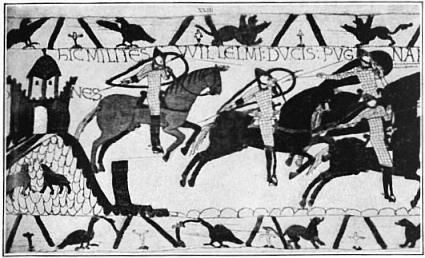
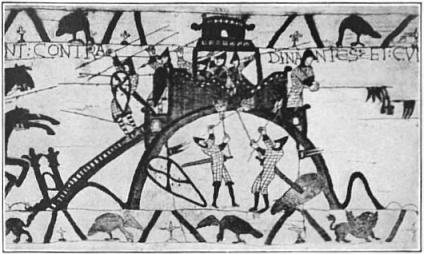
1. SIEGE OF DINANT. Note the wooden castle on a mound, and the knight handing over the keys on his lance tip.
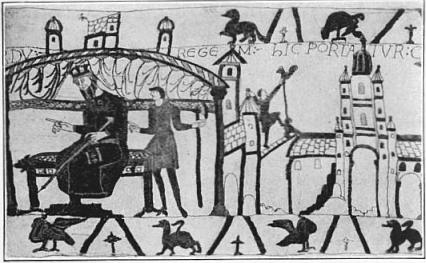
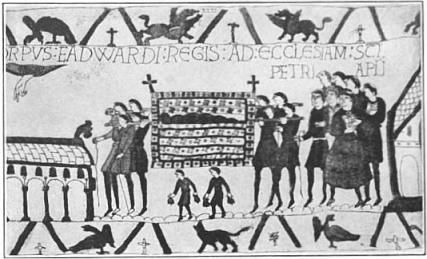
2. THE FUNERAL OF EDWARD THE CONFESSOR AT WESTMINSTER ABBEY.
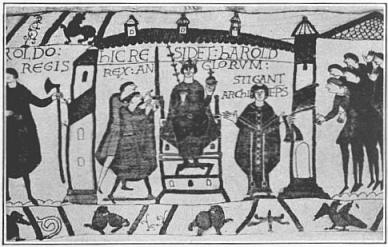
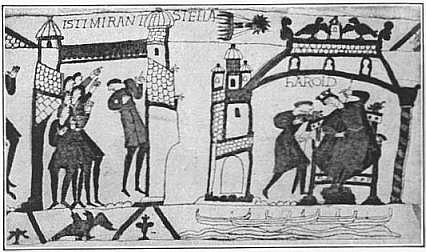
3. CORONATION OF HAROLD. 4. APPEARANCE OF HALLEY’S COMET.
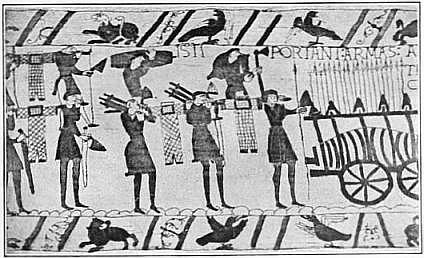
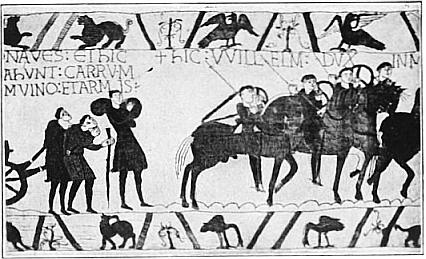
5. THE NORMANS CARRY THEIR ARMS TO THE SHIPS.
(By permission of G, Bell & Sons.)
Plate II.
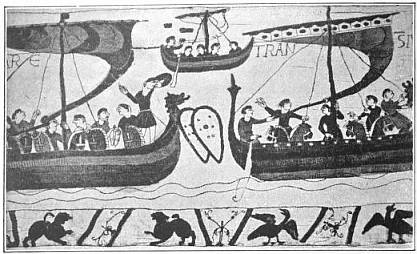
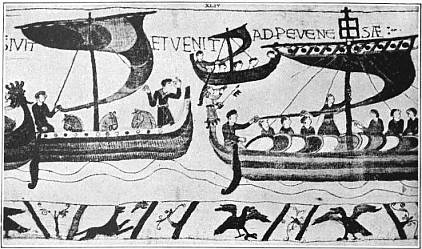
6. THE NORMANS CROSS TO PEVENSEY.
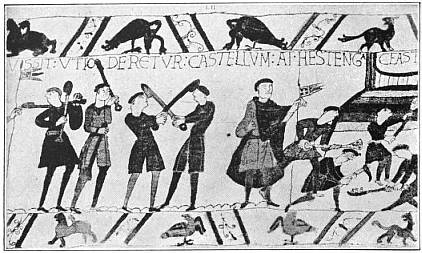
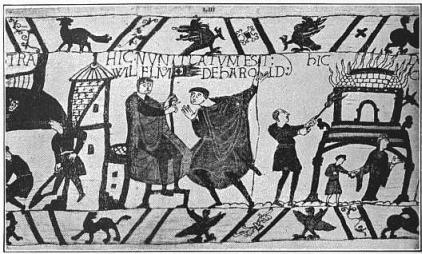
7. BUILDING OF HASTINGS CASTLE. 8. HAROLD’S ADVANCE ANNOUNCED TO WILLIAM. THE BURNING OF HASTINGS.
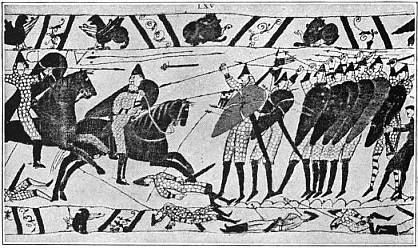
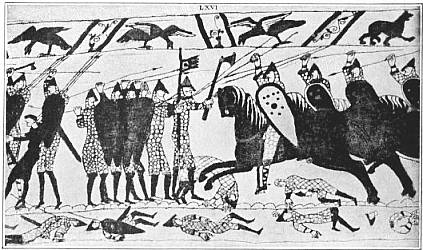
9. THE NORMAN CAVALRY ATTACKS THE ENGLISH SHIELD WALL.
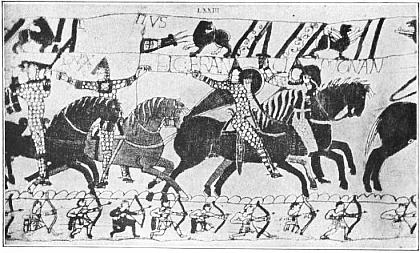
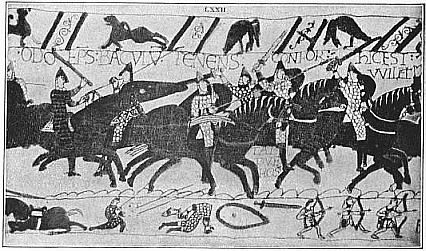
10. WILLIAM RAISES HIS HELMET TO RALLY HIS MEN. 11. ODO, BISHOP OF BAYEUX, WIELDING HIS MACE.
(By permission of G. Bell & Sons.)
See E.A. Freeman, Norman Conquest, vol. iii. (ed. 1875), with summary of the discussion to date; Archaeologia, vols. xvii.—xix.; Dawson Turner, Tour in Normandy (1820); C.A. Stothard’s illustrations in Vetusta Monumenta, vol. vi.; Gentleman’s Magazine, 1837; Bolton Corney, Researches and Conjectures on the Bayeux Tapestry (1836-1838); A. de Caumont, “Un mot sur ... la tapisserie de Bayeux,” in Bulletin monumental de Vinstilut des provinces, vol. viii. (1841); J. Laffetay, Notice historique et descriptive sur la tapisserie ... (1874); J. Comte, Tapisserie de Bayeux; F.R. Fowke, The Bayeux Tapestry (ed. 1898); Marignan, Tapisserie de Bayeux (1902); G. Pans, “Tapisserie de Bayeux,” in Romania, vol. xxxi.; Lanore, “La Tapisserie de Bayeux,” in Bibliothèque de l’école des chartes, vol. lxiv. (1903); and J.H. Round, “The Bayeux Tapestry,” in Monthly Review, xvii. (1904).
(J. H. R.)
BAYEZID I. (1347-1403), Ottoman sultan, surnamed Yilderim or “LIGHTNING,” from the great rapidity of his movements, succeeded his father Murad I. on the latter’s assassination on the field of Kossovo, 1389, and signalized his accession by ordering at once the execution of his brother Yakub, who had distinguished himself in the battle. His arms were successful both in Europe and Asia, and he was the first Ottoman sovereign to be styled “sultan,” which title he induced the titular Abbasid caliph to confer on him. After routing the chivalry of Christendom at the battle of Nikopoli in 1396, he pursued his victorious career in Greece, and Constantinople would doubtless have fallen before his attack, had not the emperor Manuel Palaeologus bought him off by timely concessions which reduced him practically to the position of Bayezid’s vassal. But his conquests met with a sudden and overpowering check at the hands of Timur (Tamerlane). Utterly defeated at Angora by the Mongol invader, Bayezid became his prisoner, and died in captivity some months later, in March 1403.
Bayezid first married Devlet Shah Khatun, daughter of the prince of Kermian, who brought him in dowry Kutaiah and its dependencies. Two years before his accession he also married a daughter of the emperor John Palaeologus.
BAYEZID II. (1447-1512), sultan of Turkey, was the son of Mahommed II., whom he succeeded in 1481, but only after gaining over the janissaries by a large donative, which henceforth became for centuries the invariable prerogative of that undisciplined body on the accession of a new sultan. Before he could establish himself on the throne a long struggle ensued with his brother Prince Jem. Being routed, Jem fled for refuge to the knights of St John at Rhodes, who, in spite of a safe-conduct granted to him, accepted a pension from Bayezid as the price for keeping him a close prisoner. (See Aubusson, Pierre d’.)
So long as Jem lived he was a perpetual menace to the sultan’s peace, and there was considerable rivalry among the sovereigns of Europe for the possession of so valuable an instrument for bringing pressure to bear upon the Porte for the purpose of extracting money or concessions. By common consent the prince was ultimately entrusted to Pope Innocent VIII., who used him not only to extract an annual tribute out of the sultan, but to prevent the execution of Bayezid’s ambitious designs in the Mediterranean. His successor, Alexander VI., used him for a more questionable purpose, namely, not only to extract the arrears of the pension due for Jem’s safe-keeping, but, by enlarging on Charles V.’s intention of setting him up as sultan, to persuade Bayezid to aid him against the emperor. There appears, however, to be no truth in the report that Bayezid succeeded in bribing the pope to have Jem poisoned. The prince, who had lived on excellent terms with Alexander, died at Naples in February 1495, possibly as the result of excesses in which he had been deliberately encouraged by the pope.
Whether as a result of his fear of the rivalry of Jem, or of his personal character, Bayezid showed little of the aggressive spirit of his warlike predecessors; and Machiavelli said that another such sultan would cause Turkey to cease being a menace to Europe. He abandoned the attack on Rhodes at the first check, made concessions, for the sake of peace, to Venice and reduced the tribute due fiom Ragusa. His wars were of the nature of raids, on the Dalmatian coast and into Croatia, Hungary, Moldavia and Poland. The threat of the growing power in the Aegean of Venice, which had acquired Cyprus in 1489, at last roused him to a more serious effort; and in 1499 the war broke out with the republic, which ended in 1502 by the annexation to Turkey of Lepanto and Modon, Coron and Navarino in the Morea. Bayezid himself conducted the siege of Modon in 1500.
The comparative inactivity of Bayezid in the direction of Europe was partly due to preoccupation elsewhere. In the south he was threatened by the dangerous rivalry of Kait Bey, the Mameluke sultan of Egypt, who had extended his power northwards as far as Tarsus and Adana. In 1488 he gained a great victory over the Ottomans, and in 1491 a peace was made which was not again broken till after Bayezid’s death. On the side of Persia too, where the decisive battle of Shurur (1502) had raised to power Ismail, the first of the modern line of shahs, danger threatened the sultan, and the latter years of his reign were troubled by the spread, under the influence of the new Persian power, of the Shi’ite doctrine in Kurdistan and Asia Minor. The forces destined to maintain his authority in Asia had been entrusted by Bayezid to his three sons, Ahmed, Corcud and Selim; and the sultan’s declining years were embittered by their revolts and rivalry. Soon after the great earthquake of 1509, which laid Constantinople in ruins, Selim, the ungovernable pasha of Trebizond, whose vigorous rule in Asia had given Europe an earnest of his future career as sultan, appeared before Adrianople, where Bayezid had sought refuge. The sultan had designated Ahmed as his successor, but Selim, though temporarily defeated, succeeded in winning over the janissaries. On the 25th of April 1512 Bayezid was forced to abdicate in his favour, and died a few days later.
See J.B. Bury in the Cambridge Modern History, vol. i. chap. iii. and bibliography p. 700.
BAY ISLANDS (Islas de la Bahía), a small archipelago in the Caribbean Sea, off the coast of Honduras, of which country it forms an administrative district. Pop. (1905) about 3000, including 500 Indians. The archipelago consists of Roatan or Ruatan, Guanaja or Bonacca, Utilla, Barbareta, Helena, Morat, the Puercos or Hog Islands, and many cays or islets. The Bay Islands have a good soil, a fine climate and an advantageous position. Roatan, the largest, is about 30 m. long by 9 m. broad, with mountains rising to the height of 900 ft., covered with valuable woods and abounding with deer and wild hogs. Its chief towns are Coxen Hole and Puerto Real. Its trade is chiefly with New Orleans in plantains, cocoa-nuts, pineapples and other fruit. Guanaja is 9 m. long by 5 m. broad; it lies 15 m. E.N.E. of Roatan. Wild hogs abound in its thickly-wooded limestone hills. The other islands are comparatively small, and may, in some cases, be regarded as detached parts of Roatan, with which they are connected by reefs. Guanaja was discovered in 1502 by Columbus, but the islands were not colonized until the 17th century, when they were occupied by British logwood cutters from Belize, and pearlers from the Mosquito Coast. Forts were built on Roatan in 1742, but abandoned in 1749. In 1852 the islands were annexed by Great Britain. In 1859 they were ceded to Honduras.
BAYLE, PIERRE (1647-1706), French philosopher and man of letters, was born on the 18th of November 1647, at le Carla-le-Comte, near Pamiers (Ariège). Educated by his father, a Calvinist minister, and at an academy at Puylaurens, he afterwards entered a Jesuit college at Toulouse, and became a Roman Catholic a month later (1669). After seventeen months he resumed his former religion, and, to avoid persecution, fled to Geneva, where he became acquainted with Cartesianism. For some years he acted under the name of Bèle as tutor in various Parisian families, but in 1675 he was appointed to the chair of philosophy at the Protestant university of Sedan. In 1681 the university at Sedan was suppressed, but almost immediately afterwards Bayle was appointed professor of philosophy and history at Rotterdam. Here in 1682 he published his famous Pensées diverses sur la comète de 1680 and his critique of Maimbourg’s work on the history of Calvinism. The great reputation achieved by this critique stirred the envy of Bayle’s colleague, P. Jurieu, who had written a book on the same subject. In 1684 Bayle began the publication of his Nouvelles de la république des lettres, a kind of journal of literary criticism. In 1690 appeared a work entitled Avis important aux refugiés, which Jurieu attributed to Bayle, whom he attacked with animosity. After a long quarrel Bayle was deprived of his chair in 1693. He was not depressed by this misfortune, especially as he was at the time closely engaged in the preparation of the Historical and Critical Dictionary (Dictionnaire historique et critique). The remaining years of Bayle’s life were devoted to miscellaneous writings, arising in many instances out of criticisms made upon his Dictionary. He died in exile at Rotterdam on the 28th of December 1706. In 1906 a statue in his honour was erected at Pamiers, “la réparation d’un long oubli.” Bayle’s erudition, despite the low estimate placed upon it by Leclerc, seems to have been very considerable. As a constructive thinker, he did little. As a critic he was second to none in his own time, and even yet one can admire the delicacy and the skill with which he handles his subject. The Nouvelles de la république des lettres (see Louis P. Betz, P. Bayle und die Nouvelles de la république des lettres, Zürich, 1896) was the first thorough-going attempt to popularize literature, and it was eminently successful. The Dictionary, however, is Bayle’s masterpiece.
Editions.—Historical and Critical Dictionary (1695-1697; 1702, enlarged; best that of P. des Maizeaux, 4 vols., 1740); Les Œuvres de Bayle (3 vols., The Hague); see des Maizeaux, Vie de Bayle; L.A. Feuerbach, Pierre Bayle (1838); Damiron, La Philosophie en France au XVIIe siècle (1858-1864); Sainte-Beuve, “Du génie critique et de Bayle” (Revue des deux mondes, 1st Dec. 1835); A. Deschamps, La Génèse du scepticisme érudit chez Bayle (Liége, 1878); J. Denis, Bayle et Jurieu (Paris, 1886); F. Brunetière, La Critique littéraire au XVIIIe siècle (vol. i., 1890), and La Critique de Bayle (1893); Émile Gigas, Choix de la correspondance inédite de Pierre Bayle (Paris, 1890, reviewed in Revue critique, 22nd Dec. 1890); de Budé, Lettres inédites adressées à J.A. Turretini (Paris, 1887); J.F. Stephen, Horae Sabbaticae (London, 1892, 3rd ser. pp. 174-192); A. Cazes, P. Bayle, sa vie, ses idées, &c. (1905).
BAYLO (Lat. bajulus or baillivus; cf. Ital. balio, Fr. bailli, Eng. bailiff), in diplomacy, the title borne by the Venetian representative at Constantinople. His functions were originally in the nature of those of a consul-general, but from the 16th century onwards he had also the rank and functions of a diplomatic agent of the first class. “Under the name of bayle,” says A. de Wicquefort, “he performs also the functions of consul and judge; not only between members of his own nation, but also between all the other merchants who trade in the Levant under the flag of St Mark.” (See Diplomacy.)
BAYLY, THOMAS HAYNES (1797-1839), English songwriter and dramatist, was born at Bath on the 13th of October 1797. He was educated at Winchester and at St Mary Hall, Oxford, with a view to entering the church. While on a visit to Dublin, however, he discovered his ability to write ballads, and on his return to England in 1824 he quickly gained a wide reputation with “I’d be a butterfly,” following this up with “We met—’twas in a crowd,” “She wore a wreath of roses,” “Oh, no, we never mention her,” and other light and graceful songs for which his name is still remembered. He set some of his songs to music himself; a well-known example is “Gaily the troubadour.” Bayly also wrote two novels, The Aylmers and A Legend of Killarney, and numerous plays. His most successful dramatic piece was Perfection, which was produced by Madame Vestris and received high praise from Lord Chesterfield. Bayly had married in 1826 an Irish heiress, but her estates were mismanaged and the anxiety caused by financial difficulties undermined his health. He died on the 22nd of April 1839.
His Collected Works (1844) contain a memoir by his wife.
BAYNES, THOMAS SPENCER (1823-1887), English editor and man of letters, the son of a Baptist minister, was born at Wellington, Somerset, on the 24th of March 1823. He studied at Edinburgh University, where he was a pupil of Sir William Hamilton, whose assistant he became and of whose views on logic he became the authorized exponent. This teaching was embodied in his Essay on the New Analytic of Logical Forms, published in 1850, the same year in which he took his London University degree. This was followed in the next year by a translation of Arnauld’s Port Royal Logic. In 1850 he had become editor of the Edinburgh Guardian, but after four years’ work his health gave way. He spent two years in Somerset and then went to London, becoming, in 1858, assistant editor of the Daily News. In 1864 he was appointed professor of logic metaphysics and English literature at the university of St Andrews, and in 1873 the editorship of the ninth edition of the Encyclopaedia Britannica was entrusted to him. He conducted it singly until 1881, when the decline of his health rendered it necessary to provide him with a coadjutor in the person of Prof. W. Robertson Smith. Baynes, however, continued to be engaged upon the work until his death on the 31st May 1887, shortly before its completion. His article on Shakespeare (Encyclopaedia Britannica, 9th ed.) was republished in 1894, along with other essays on Shakespearian topics and a memoir by Prof. Lewis Campbell.
BAYONET, a short thrusting weapon, fixed to the muzzle or fore-end of a rifle or musket and carried by troops armed with the latter weapons. The origin of the word is disputed, but there is some authority for the supposition that the name is derived from the town of Bayonne, where the short dagger called bayonnette was first made towards the end of the 15th century. The elder Puységur, a native of Bayonne, says (in his Memoirs, published posthumously in Paris, 1747) that when he was commanding the troops at Ypres in 1647 his musketeers used bayonets consisting of a steel dagger fixed in a wooden haft, which fitted into the muzzle of the musket—in fact plug-bayonets. Courts-martial were held on some English soldiers at Tangier in 1663-1664 for using their daggers on their comrades. As bayonets were at first called daggers, and as there were few or no pikemen in Tangier until 1675, the probable conclusion is that the troops in Tangier used plug-bayonets. In 1671 plug-bayonets were issued to the French regiment of fusiliers then raised. They were issued to part of an English dragoon regiment raised in 1672 and disbanded in 1674, and to the Royal Fusiliers when raised in 1685. The danger incurred by the use of this bayonet (which put a stop to all fire) was felt so early that the younger Puységur saw a ring-bayonet in 1678 which could be fixed without stopping the fire. The English defeat at Killiecrankie in 1689 was due (among other things) to the use of the plug-bayonet; and shortly afterwards the defeated leader, General Mackay, introduced a ring-bayonet of his own invention. A trial with badly-fitting socket or zigzag bayonets was made after the battle of Fleurus, 1690, in the presence of Louis XIV., who refused to adopt them. Shortly after the peace of Ryswick (1697) the English and Germans abolished the pike and introduced these bayonets, and plates of them are given in Surirey de St Remy’s Mémoires d’Artillerie, published in Paris in that year; but owing to a military cabal they were not issued to the French infantry until 1703. Henceforward the bayonet became, with the musket or other firearm, the typical weapon of infantry. This bayonet remained in the British service until 1805, when Sir John Moore introduced a bayonet fastened to the musket by a spring clip. The triangular bayonet (so called from the cross-section of its blade) was used in the British army until the introduction of the magazine rifle, when it was replaced by the sword-bayonet or dagger-bayonet. Sword-bayonets—weapons which could be used as sword or dagger apart from the rifle—had long been in use by special troops such as engineers and rifles, and many ingenious attempts have been made to produce a bayonet fitted for several uses. A long curved sword-bayonet with a saw-edged back was formerly used by the Royal Engineers, but all troops are now supplied with the plain sword-bayonet. The bayonet is usually hung in a scabbard on the belt of the soldier and only fixed during the final stages of a battle; the reason for this is that the “jump” of the rifle due to the shock of explosion is materially altered by the extra weight at the muzzle, which thus deranges the sighting. In the short Lee-Enfield rifle of 1903, the bayonet, not being directly attached to the barrel, does not influence accuracy, but with the long rifles, when the bayonet is fixed, the sight must be raised by two or three graduations to ensure correct elevation. In the Russian army troops almost invariably carry the bayonet (triangular) fixed; the model (1891) of Italian carbine has an inseparable bayonet; the United States rifle (the new short model of 1903) has a knife bayonet, the model of 1905, which is 20.5875 in. long, with the lower edge of the blade sharpened along its entire length and the upper edge sharpened 5 in. from the point; this bayonet is carried in a wooden and leather scabbard attached to the cartridge belt. The British bayonet (pattern 1903) has a blade 1 ft. in length. The length of the rifle and bayonet together, considered as an arme blanche, varies considerably, that of the French Lebel pattern of 1886 being 6 ft., as against the 4 ft. 8¾ in. of the British short Lee-Enfield of 1903. The German rifles (1898) have a length with bayonet of 5 ft. 9¾ in.; the Russian (1894) 5 ft. 9 in.; and the Japanese 5 ft. 5½ in. In 1908 a new British bayonet was approved, 5 in. longer than its predecessor of 1903, the shape of the point being modified to obtain the thrusting effect of a spear or lance head.
BAYONNE, a town of south-western France, capital of an arrondissement in the department of Basses-Pyrénées, 66 m. W.N.W. of Pau on the Southern railway. Pop. (1906) 21,779. Bayonne, a first-class fortified place, is situated at the confluence of the Adour and its left-hand tributary, the Nive, about 3 m. from the sea. The two rivers divide the town into three nearly equal parts, communicating with each other by bridges. Grand Bayonne lies on the left bank of the Nive; the two squares which lie close together at the mouth of that river constitute the most animated quarter of the town. Petit Bayonne lies between the right bank of the Nive and the Adour; Saint Esprit, dominated by a citadel which is one of the finest works of Vauban, occupies the right bank of the Adour. The last is inhabited partly by a colony of Jews dating at least from the early 16th century. To the north-west of the town are the Allées Marines, fine promenades which border the Adour for a mile and a quarter, and the Allées Paulmy, skirting the fortifications. The cathedral of Ste Marie in Grand Bayonne is an imposing Gothic structure of the 13th, 14th and 15th centuries. It consists of a choir with deambulatory and apsidal chapels (the oldest part of the church), a transept, nave and aisles. The towers at the west end were only completed during the general restoration which took place in the latter half of the 19th century. A fine cloister of the 13th century adjoins the south side of the church. Ste Marie contains glass windows of the 15th and 16th centuries and other rich decoration. The Vieux-Château, also in Grand Bayonne, dates from the 12th and 15th centuries and is built upon a portion of the old Roman fortifications; it is used for military purposes. The Château Neuf (15th and 16th centuries) serves as barracks and prison. Bayonne is the seat of a bishopric and of a sub-prefect; it has tribunals of first instance and of commerce, a chamber of commerce, a lycée, a school of music, a library, an art museum with a large collection of the works of the painter Léon Bonnat, and a branch of the Bank of France. There are consulates of the chief nations of Europe, of the United States of America and of several Central and South American republics. The town also possesses an important military arsenal and military hospital. The commerce of Bayonne is much more important than its industries, which include the manufacture of leather and of chocolate. The port consists of an outer harbour, the so-called “rade” (roadstead) and the port proper, and occupies the course of the Adour from its mouth, which is obstructed by a shifting bar, to the Pont St Esprit, and the course of the Nive as far as the Pont Mayou. Above these two bridges the rivers are accessible only to river navigation. Vessels drawing from 16 to 22 ft. can make the port in normal weather. In the five years 1901-1905 the average value of the imports was £502,000, of the exports £572,000; for the five years 1896-1900 the average value of imports was £637,000, of exports £634,000. Exports include timber, mine-props, turpentine, resinous material from the Pyrénées and Landes and zinc ore; leading imports are the coal and Spanish minerals which supply the large metallurgical works of Le Boucau at the mouth of the river, the raw material necessary for the chemical works of the same town, wine, and the cereals destined for the flour mills of Pau, Peyrehorade and Orthez. During the early years of the 20th century the shipping of the port increased considerably in tonnage. In 1900 there entered 741 vessels, tonnage 277,959; and cleared 743, tonnage 276,992. In 1907 there entered 661 vessels, tonnage, 336,773; cleared 650, tonnage 335,849.
In the 3rd century Bayonne (Lapurdum) was a Roman military post and the principal port of Novempopulana. In the middle ages it belonged to the dukes of Aquitaine and then to the kings of England, one of whom, John, granted it full communal rights in 1216. In 1451 it offered a strenuous opposition to the French, by whom it was eventually occupied. By this time its maritime commerce had suffered disaster owing to the silting up of its port and the deflection of the Adour. New fortifications were constructed under Louis XII. and Francis I., and in 1523 the town was able to hold out against a Spanish army. In 1565 it was the scene of an interview between Charles IX. and Catherine de’ Medici on the one hand and Elizabeth, queen of Spain, and the duke of Alva on the other. It is thought that on this occasion the plans were formed for the massacres of St Bartholomew, a crime in which Bayonne took no part, in 1572. In 1808 Napoleon met Charles IV., king of Spain, and his son Ferdinand at the Château de Marrac, near the town, and induced them to renounce their rights to the crown of Spain, which fell to Napoleon’s brother Joseph. In 1814, after a severe siege, Bayonne was occupied by the English (see Peninsular War).
See J. Balasque and E. Dulaurens, Études historiques sur la ville de Bayonne (3 vols., Bayonne, 1862-1875); E. Ducéré, Bayonne historique et pittoresque (Bayonne, 1893), Histoire topographigue et anecdotique des rues de Bayonne (Bayonne, 1894); H. Léon, Histoire des juifs de Bayonne (Paris, 1893).
BAYONNE, a city of Hudson county, New Jersey, U.S.A., occupying the peninsula (about 5½ m. long and about ¾ m. wide) between New York harbour and Newark Bay, and immediately adjoining the south boundary of Jersey City, from which it is partly separated by the Morris Canal. It is separated from Staten Island only by the narrow strip of water known as the Kill van Kull, and it has a total water frontage of about 10 m. Pop. (1890) 19,033; (1900) 32,722, of whom 10,786 were foreign-born (3168 Irish, 1868 Russian, 1656 German); (1910) 55,545. Land area about 4 sq. m. Bayonne is served by the Central of New Jersey and by the Lehigh Valley railways (the latter for freight only), and by electric railway lines to Newark and Jersey City. The principal public buildings are the city hall, the public library, the post-office and the city hospital. Besides having a considerable share in the commerce of the port of New York, Bayonne is an important manufacturing centre; among its manufactures are refined petroleum, refined copper and nickel (not from the ore), refined borax, foundry and machine-shop products, tubular boilers, electric launches and electric motors, chemicals (including ammonia and sulphuric and nitric acids), iron and brass products, wire cables and silk goods. In 1905 the value of its factory product was $60,633,761, an increase of 57.1% over that of 1900, Bayonne ranking third in 1905 among the manufacturing cities of the state. It is the principal petroleum-distributing centre on the Atlantic seaboard, the enormous refineries and storehouses of the Standard Oil Company, among the largest in the world, being located here; there are connecting pipe lines with the Ohio and Pennsylvania oil fields, and with New York, Baltimore, Philadelphia and Washington. Much coal is shipped from the city. Bayonne, which comprises several former villages (Bayonne, Bergen Point, Pamrapo and Centerville), was settled about 1665-1670 by the Dutch. Originally a part of Bergen, it was set off as a township in 1861. It was chartered as a city in 1869.
BAYOU (pronounced bai-yoo, probably a corruption of Fr. boyau, gut), an “ox-bow” lake left behind by a river that has abandoned its old channel in the lower stages of its course. Good examples are found in Palmyra Lake, in the Mississippi valley below Vicksburg, and in Osage river, Missouri. As a river swings from side to side in a series of curves which widen laterally where the current is slow and the country more or less level, there is a tendency in flood times for the water to impinge more strongly upon the convex bank where the curve leaves the main channel. This bank will be eaten away, and the process will be repeated until the base of the “isthmus” is cut through, and the descending channel meets the returning curve, which is thus left stranded and filled with dead water, while the stream runs directly past it in the shorter course cut by the flood waters that deepen the new channel, and leave an isolated ox-bow lake in the old curve.
BAYREUTH, or Baireuth, a town of Bavaria, Germany, district of Upper Franconia, 58 m. by rail N.N.E. from Nuremberg. Pop. (1900) 29,384. In Richard-Wagner-strasse is Wagner’s house, with his grave in the garden. Franz Liszt (1811-1886) is buried here, as well as Jean Paul Friedrich Richter, who is commemorated by a monument (1841). His house was in Friedrichstrasse. Most of the buildings are of comparatively modern date, the city having suffered severely from the Hussites in 1430 and from a conflagration in 1621. There should be mentioned the palace of Duke Alexander of Württemberg, the administrative offices, the statue of King Maximilian II. (1860) and the collections of the historical society Among the ecclesiastical buildings, the Stadt-Pfarrkirche, dating from 1439, and containing the monuments of the margraves of Bayreuth, is the most important. Bayreuth is a railway junction and has an active trade, chiefly in grain and horses. It manufactures woollen, linen and cotton goods, leather, delft and other earthenware, and tobacco, and has also several breweries and distilleries. The village of St Georgen is a suburb to the north east noted for its marble works; and about 2 m. to the east is the Hermitage, a fanciful building, erected in 1715 by the margrave George William (d. 1726), with gardens containing terraces, statues and fountains. Bayreuth was formerly the capital of a principality of the same name, which was annexed in 1791 to the kingdom of Prussia. In 1807 it was ceded by Prussia to France, which kept possession of it till 1810, when it was transferred to Bavaria.
The Wagner Theatre.—Among the many advantages which Wagner gained from his intimacy with Ludwig II., king of Bavaria, not the least was the practical support given to his plan of erecting a theatre for the ideal performance of his own music-dramas. The first plan of building a new theatre for the purpose in Munich itself was rejected, because Wagner rightly felt that the appeal of his advanced works, like the Nibelungen trilogy, would be far stronger if the comparatively small number of people who wished to hear them were removed from the distractions of a large capital; Bayreuth possessed the desired seclusion, being on a line of railway that could not be approached from any quarter without changing. The municipality furthered Wagner’s scheme in every way, and in May 1872 the foundation stone of the Festspielhaus was laid, the event being commemorated by a notable performance of Beethoven’s Choral Symphony in the old opera-house. The funds for the erection of the theatre were raised in part by the issue of 1000 certificates of patronage (Patronatscheine), but the bulk of the sum was raised by founding “Wagner Societies” from St Petersburg to Cairo, from London to New York; these societies sprang up with such success that the theatre was opened in the summer of 1876 with the first complete performance of Der Ring des Nibelungen. The theatre, which stands on a height a little under a mile from the town, is built from the plans of Gustav Semper, the idea of the design being Wagner’s own, an experiment indeed, but one which succeeded beyond all expectation. The seats are arranged on a kind of sloping wedge, in such a manner that every one has an almost equally good view of the stage, for there are no boxes, and the only galleries are quite at the back, one, the Fürstenloge, being reserved for distinguished guests, the other, above it, for the townspeople. Immediately in front of the foremost row of seats a hood or sloping screen of wood covers a part of the orchestra, and another hood of similar shape starts from the front of the stage at a slightly lower level. Thus there is left a space between the two hoods through which the sound of the orchestra ascends with wonderfully blended effect; the conductor, sitting at the highest point of the orchestra, though under the screen, has a complete view of the stage as well as of his instrumentalists, and the sound of the orchestra is sent most forcibly in the direction of the stage, so that the voices are always well supported.
As an important addition to the work of the theatre, a permanent school has been established at Bayreuth for the sake of training young musicians to take part in the festival performances, which were at first exclusively, and then partially, undertaken by artists from other German and foreign theatres. The special feature upon which most stress has been laid, ever since Wagner’s death in 1883, has been not so much the musical as the dramatic significance of the works; it is contended by the inmost circle of Wagnerian adherents that none but they can fully realize the master’s intentions or hand down his traditions. What is called the “Bayreuth Idea” is set forth in much detail from this point of view by Houston Stewart Chamberlain, in his Richard Wagner (1897 and 1900).
BAZA, a town of southern Spain, in the province of Granada; in the Hoya de Baza, a fruitful valley of the Sierra Nevada, not far from the small river Gallego, and at the terminus of a railway from Lorca. Pop. (1900) 12,770. The dome-shaped mountain of Javaleon (4715 ft.) overlooks the town from the north-west. The ancient collegiate church of San Maximo occupies the traditional site of a cathedral founded by the Visigothic king Reccared about 600, and afterwards converted into a mosque. There is a brisk local trade in farm produce, and in the linen, hempen goods and pottery manufactured in Baza. The town nearly doubled its population in the last quarter of the 10th century. Sulphurous springs exist in the vicinity.
Baza is the Roman Basti, the medieval Basta or Bastiana; and numerous relics of antiquity, both Roman and medieval, have been found in the neighbourhood. Its bishopric was founded in 306. Under Moorish rule (c. 713-1489) it was one of the three most important cities in the kingdom of Granada, with an extensive trade, and a population estimated at 50,000. In 1489, after a stubborn defence lasting seven months, it was captured by the Spaniards under Isabella of Castile, whose cannon still adorn the Alameda or public promenade. On the 10th of August 1810 the French under Marshal Soult defeated a large Spanish force close to the town.
BAZAAR (Pers. bazar, market), a permanent market or street of shops, or a group of short narrow streets of stalls under one roof. The word has spread westward into Arabic, Turkish and, in special senses, into European languages, and eastward it has invaded India, where it has been generally adopted. In southern India and Ceylon bazaar means a single shop or stall. The word seems to have early reached South Europe (probably through Turkish), for F. Balducci Pegolotti in his mercantile handbook (c. 1340) gives “bazarra” as a Genoese word for market-place. The Malayan peoples have adopted the word as pazar. The meaning of the word has been much extended in English, where it is now equivalent to any sale, for charitable or mere commercial purposes, of mixed goods and fancy work.
BAZAINE, ACHILLE FRANÇOIS (1811-1888), marshal of France, was born at Versailles on the 13th of February 1811. He entered the army as a private soldier in 1831, with a view to service in Algeria, and received a commission as sub-lieutenant in 1833. By his gallantry in action he won the cross of the Legion of Honour, and he was promoted lieutenant in 1835. He served two campaigns with the Foreign Legion against the Carlists in Spain in 1837-38, returning to Africa as captain in 1839. During the succeeding decade he saw continual active service in Africa, and rose to be a brigadier-general with the charge of the district of Tlemçen. In the Crimean War he commanded a brigade, and maintained his reputation in the trenches before Sevastopol. On the capture of the south side he was appointed governor of the place, and was promoted general of division. He also commanded the French forces in the expedition to Kinburn. In Lombardy in 1859 he was wounded when in command of a division at Melegnano, and took a conspicuous part in the battle of Solferino. For his services in the campaign he received the grand cross of the Legion of Honour, of which he was already (1855) a commander. He commanded with great distinction the first division under General (afterwards marshal) Forey in the Mexican expedition in 1862, succeeded him in supreme command in 1863, and became marshal and senator of France in the following year. He at first pursued the war with great vigour and success, entering Mexico in 1863 and driving President Juarez to the frontier. The marshal’s African experience as a soldier and as an administrator stood him in good stead in dealing with the guerrilleros of the Juarez party, but he was less successful in his relations with Maximilian, with whose court the French headquarters was in constant strife. Here, as later in his own country, Bazaine’s policy seems to have been directed, at least in part, to his own establishment in the rôle of a mayor of the palace. His own army thought that he aspired to play the part of a Bernadotte. His marriage to a rich Mexican lady, whose family were supporters of Juarez, still further complicated his relations with the unfortunate emperor, and when at the close of the American Civil War the United States sent a powerful war-trained army to the Mexican frontier, the French forces were withdrawn (see Mexico, History). Bazaine skilfully conducted the retreat and embarkation at Vera Cruz (1867). On his return to Paris he was but coldly received by his sovereign; public opinion was, however, in his favour, and he was held to have been made a scapegoat for the faults of others.
At the outbreak of the Franco-German War (q.v.) Marshal Bazaine was placed in command of the III. corps of the Army of the Rhine. He took no part in the earlier battles, but Napoleon III. soon handed over the chief command of the army to him. How far his inaction was the cause of the disaster of Spicheren is a matter of dispute. The best that can be said of his conduct is that the evil traditions of warfare on a small scale and the mania for taking up “strong positions,” common to the French generals of 1870, were in Bazaine’s own case emphasized by his personal dislike for the “schoolmaster” Frossard, lately the Prince Imperial’s tutor and now commander of the army corps posted at Spicheren. Frossard himself, the leader of the “strong positions” school, could only blame his own theories for the paralysis of the rest of the army, which left the corps at Spicheren to fight unsupported. Bazaine, indeed, when called upon for help, moved part of his corps forward, but only to “take up strong positions,” not to strike a blow on the battlefield. A few days later he took up the chief command, and his tenure of it is the central act in the tragedy of 1870. He found the army in retreat, ill-equipped and numerically at a great disadvantage, and the generals and staffs discouraged and distrustful of one another. There was practically no chance of success. The question was one of extricating the army and the government from a disastrous adventure, and Bazaine’s solution of it was to bring back his army to Metz. For the events which led up to the battles before Metz and the investment of Bazaine’s whole army in the fortress, see Franco-german War and Metz, Battles.
It seems to be clearly established that the charges of treason to which later events gave so strong a colour had, as yet, no foundation in fact. Nor, indeed, can his unwillingness to leave the Moselle region, while there was yet time to slip past the advancing enemy, be considered even as proof of special incompetence. The resolution to stay in the neighbourhood of Metz was based on the knowledge that if the slow-moving French army ventured far out it would infallibly be headed off and brought to battle in the open by superior numbers. In “strong positions” close to his stronghold, however, Bazaine hoped that he could inflict damaging repulses and heavy slaughter on the ardent Germans, and in the main the result justified the expectation. The scheme was creditable, and even heroic, but the execution throughout all ranks, from the marshal to the battalion commanders, fell far short of the idea. The minutely cautious methods of movement, which Algerian experience had evolved suitable enough for small African desert columns, which were liable to surprise rushes and ambushes, reduced the mobility of a large army, which had favourable marching conditions, to 5 m. a day as against the enemy’s rate of 15. When, before he had finally decided to stay in Metz, Bazaine attempted half-heartedly to begin a retreat on Verdun, the staff work and organization of the movement over the Moselle was so ineffective that when the German staff calculated that Bazaine was nearing Verdun, the French had in reality barely got their artillery and baggage trains through the town of Metz. Even on the battlefield the marshal forbade the general staff to appear, and conducted the fighting by means of his personal orderly officers. After the cumbrous army had passed through Metz it encountered an isolated corps of the enemy, which was commanded by the brilliant leader Constantin von Alvensleben, and promptly attacked the French. At almost every moment of the day victory was in Bazaine’s hands. Two corps of the Germans fought all day for bare existence. But Bazaine had no confidence in his generals or his troops, and contented himself with inflicting severe losses on the most aggressive portions of the German army. Two days later, while the French actually retreated on Metz—taking seven hours to cover 5 to 6 m.—the masses of the Germans gathered in front of him, intercepting his communication with the interior of France. This Bazaine expected, and feeling certain that the Germans would sooner or later attack him in his chosen position, he made no attempt to interfere with their concentration. The great battle was fought, and having inflicted severe punishment on his assailants, Bazaine fell back within the entrenched camp of Metz. But although he made no appeals for help, public opinion, alarmed and excited, condemned the only remaining army of France, Marshal MacMahon’s “Army of Châlons,” to rescue Bazaine at all costs. The adventure ended at Sedan, and with Sedan the Third Empire collapsed.
Up to this point Bazaine had served his country perhaps as well as circumstances allowed, and certainly with enough skill and a sufficient measure of success to justify his appointment. His experience, wide as it was, had not fitted him for the command of a large army in a delicate position. Since his Mexican expedition, moreover, he had himself fallen into a state of moral and physical lethargy, which, imperceptible on the field of battle, because his reputation for impassive bearing under fire was beyond question, was only too obvious in the staff offices, where the work of manoeuvring the army and framing plans and orders was chiefly done. But, in spite of these defects, it cannot be asserted that any one of Bazaine’s subordinates would have done better, with the possible exception of Ladmirault, and Ladmirault was one of the junior corps commanders.
Bazaine, therefore, in the main justified his reputation for ability. He was now to justify his reputation for intriguing and underhand diplomacy. If in Mexico he aspired to the rôle of mayor of the palace, it was far more so in Metz, where, as commander of the only organized army of France, he conceived himself to be the ruler of the country’s destiny. Accordingly he engaged in a series of diplomatic intrigues, some of which to this day have never been properly cleared up. Negotiations passed between the outer world and the besieged commander, the purport of which remains still to some extent obscure, but it is beyond question that he proposed with the permission of the Germans to employ his army in “saving France from herself.” The scheme, however, collapsed, and the army of the Rhine became prisoners of war to the number of 140,000. At the moment of the surrender a week’s further resistance would have enabled the levies of the National Defence government to crush the weak forces of the Germans on the Loire and to relieve Paris. But the army of Prince Frederick Charles, set free by the surrender, hurried up in time to check and to defeat the great effort at Orleans (q.v.). The responsibility for this crushing blow was naturally enough, and justly enough, placed on Bazaine’s shoulders, and although, when he returned from captivity, the marshal enjoyed a brief immunity, he was in 1873 brought to trial before a military court. He was found guilty of negotiating with and capitulating to the enemy before doing all that was prescribed by duty and honour, and sentenced to degradation and death, but very strongly recommended to mercy. His sentence was commuted to twenty years’ seclusion, and the humiliating ceremonies attending degradation were dispensed with. He was incarcerated in the Ile Sainte-Marguérite and treated rather as an exile than as a convict; thence he escaped in 1874 to Italy. He finally took up his abode in Madrid, where he was treated with marked respect by the government of Alfonso XII. He died there on the 23rd of September 1888. He published Épisodes de la guerre de 1870 (Madrid, 1883). He also wrote L’Armée du Rhin (Paris, 1872).
See the bibliography appended to the article Franco-German War; also memoir by C. Pelletan in La Grande Encyclopédie; for Bazaine’s conduct see Bazaine et l’armée du Rhin (1873); J. Valfrey, Le Maréchal et l’armée du Rhin (1873); Count A. de la Guerronière, L’Homme de Metz (1871); Rossel, Les Derniers Jours de Metz (1871). See also the article Bourbaki for the curious Regnier episode connected with the surrender of Metz.
BAZALGETTE, SIR JOSEPH WILLIAM (1819-1891), English engineer, was born at Enfield on the 28th of March 1819. At the age of seventeen he was articled to an engineer, and a few years later he began to practise successfully on his own account. His name is best known for the engineering works he carried out in London, especially for the construction of the main drainage system and the Thames embankment. In 1848 the control of London drainage, which had hitherto been divided among eight distinct municipal bodies, was consolidated under twelve commissioners, who were in 1849 superseded by a second commission. Under the latter Bazalgette accepted an appointment which he continued to hold under the three successive commissions which in the course of a year or two followed the second one, and when finally in 1855 these bodies were replaced by the Metropolitan Board of Works, he was at once appointed its chief engineer. His plans were ready, but the work was delayed by official obstruction and formality until 1858. Once begun, however, it was vigorously pushed on, and in 1865 the system was formally opened. It consisted of 83 m. of large intercepting sewers, draining more than 100 sq. m. of buildings, and calculated to deal with 420 million gallons a day. The cost was £4,600,000. Almost simultaneously Bazalgette was engaged on the plans for the Thames embankment. The section between Westminster and Vauxhall on the Surrey side was built between 1860 and 1869, and the length between Westminster and Blackfriars was declared open by the prince of Wales in 1870. The Chelsea embankment followed in 1871-1874, and in 1876 Northumberland Avenue was formed. The total outlay on the scheme exceeded £2,000,000. Bazalgette was also responsible for various other engineering works in the metropolitan area, designing, for example, new bridges at Putney and Battersea, and the steam ferry between north and south Woolwich. He also prepared plans for a bridge over the river near the Tower and for a tunnel under it at Blackwall, but did not live to see either of these projects carried out. He died on the 15th of March 1891 at Wimbledon.
BAZARD, AMAND (1791-1832), French socialist, the founder of a secret society in France corresponding to the Carbonari of Italy, was born at Paris. He took part in the defence of Paris in 1815, and afterwards occupied a subordinate situation in the prefecture of the Seine. About 1820 he united some patriotic friends into a society, called Amis de la vérité. From this was developed a complete system of Carbonarism, the peculiar principles of which were introduced from Italy by two of Bazard’s friends. Bazard himself was at the head of the central body, and, while taking a general lead, contributed extensively to the Carbonarist journal, L’Aristarque. An unsuccessful outbreak at Belfort ruined the society, and the leaders were compelled to conceal themselves. Bazard, after remaining for some time in obscurity in Paris, came to the conclusion that the ends of those who wished well to the people would be most easily attained, not through political agitation, but by effecting a radical change in their social condition. This train of thinking naturally drew him towards the socialist philosophers of the school of Saint-Simon, whom he joined. He contributed to their journal, Le Producteur; and in 1828 began to give public lectures on the principles of the school (see Saint-Simon). His opposition to the emancipation of women brought about a quarrel with Enfantin (q.v.) in 1831, and Bazard found himself almost deserted by the members of the society. He attacked Enfantin violently, and in a warm discussion between them he was struck down by apoplexy. After lingering for a few months he died on the 29th of July 1832.
BAZAS, a town of south-western France, in the department of Gironde, 38½ m. S.S.E. of Bordeaux by rail. Pop. (1906) town, 2505; commune, 4684. The town, which was the seat of a bishop from at least the beginning of the 6th century till 1790, has a Gothic church (formerly the cathedral) dating from the 13th to the 16th centuries. There are remains of ramparts (15th and 16th centuries) and several old houses of the 16th century. The vineyards of the vicinity produce white wine. The town is capital of an arrondissement, and carries on tanning, &c., and trade in the well-known Bazadais cattle.
Bazas (Cossio) was capital of the ancient tribe of the Vasates, and under the Romans one of the twelve cities of Novempopuluna. In later times it was capital of the district of Bazadais. It was the scene of much bloodshed during the religious wars of the 16th century.
BAZIGARS, a nomad gipsy-folk of India, found throughout the peninsula, and variously known as Bazigars, Panchpiri, Nats, Bediyas, &c. They live a life apart from the surrounding Hindu population, and still preserve a certain ethnical identity, scarcely justified by any indications given by their physique. They make a living as jugglers, dancers, basket-weavers and fortune-tellers; and in true European gipsy fashion each clan has its king.
BAZIN, RENÉ (1853- ), French novelist and man of letters, was born at Angers on the 26th of December 1853. He studied law in Paris, and on his return to Angers became professor of law in the Catholic university there. He contributed to Parisian journals a series of sketches of provincial life and descriptions of travel, but he made his reputation by Une Tache d’encre (1888), which received a prize from the Academy. Other novels of great charm and delicacy followed: La Sarcelle bleue (1892); Madame Corentine (1893); Humble Amour (1894); De toute son âme (1897); La Terre qui meurt (1899); Les Oberlé (1901), an Alsatian story which was dramatized and acted in the following year; L’Âme alsacienne (1903); Donatienne (1903); L’Isolée (1905); Le Blé qui lève (1907); Mémoires d’une vieille fille (1908). La Terre qui meurt, a picture of the decay of peasant farming and a story of La Vendée, is an indirect plea for the development of provincial France. A volume of Questions littéraires et sociales appeared in 1906. René Bazin was admitted to the Academy on the 28th of April 1904.
BAZIRE, CLAUDE (1764-1794), French revolutionist, was deputy for the Côte d’Or in the Legislative Assembly, and made himself prominent by denouncing the court and the “Austrian committee” of the Tuileries. On the 20th of June 1792 he spoke in favour of the deposition of the king. In the Convention he sat with the Mountain, opposed adjourning the trial of Louis XVI., and voted for his death. He joined in the attack upon the Girondists, but, as member of the committee of general security, he condemned the system of the Terror. He was implicated by François Chabot in the falsification of a decree relative to the East India Company, and though his share seems to have been simply that he did not reveal the plot, of which he knew but part, he was accused before the Revolutionary Tribunal at the same time as Danton and Camille Desmoulins, and was executed on the 5th of April 1794.
BDELLIUM (βδέλλιον, used by Pliny and Dioscorides as the name of a plant which exuded a fragrant gum), a name applied to several gums or gum-resins that simulate and are sometimes found as adulterants of true myrrh (q.v.).
BEACH, a word of unknown origin; probably an old dialect word meaning shingle, hence, by transference, the place covered by shingle. Beach sometimes denotes the material thrown up by the waves, sometimes the long resulting ridge, but more frequently the area between high and low water, or even the area between land and sea covered with material thrown up by exceptional storms.
The actual character of beach material depends upon the nature and structure of the rocks inshore, the strength and direction of currents, and the force of the waves. The southern shore of the Isle of Wight furnishes a good example. The island ends westward in the well-known “Needles,” consisting of chalk with flints. The disintegration of this rock by wave action separates the finer chalk, which is carried seawards in suspension, from the hard flint, which is piled in rough shingle upon the shore. The currents sweep constantly eastward up channel, and the rough flint shingle is rolled along by wave action toward the Ventnor rampart, and ground finer and finer until it arrives as a very fine flinty gravel at Ventnor pier. The sweep of Sandown Bay follows, where the cliffs are composed for the most part of greensand, and here the beach at low water is sandy and smooth. The eastern end of the island is again composed of chalk with flints, and here the beach material as at the western end consists of very coarse flint shingle. In this, as in similar cases, the material has been dragged seawards from the land by constant action of the undertow that accompanies each retreating tide and each returning wave. The resulting accumulated ridge is battered by every storm, and thrown above ordinary high-water mark in a ridge such as the Chesil Bank or the long grass-grown mound that has blocked the old channel of the Yar and diverted its waters into Yaverland Bay. Sandown furnishes an instructive example of the power of the eastward currents carrying high-storm waves. The groins built to preserve the foreshore are piled to the top with coarse shingle on the western side, while there is a drop of over 8 ft. on to the sands east of the wall, many thousands of tons of shingle having been moved bodily by the waves and deposited against each groin. The force of the waves has been measured on the west coast of Scotland and found to be as much as 3 tons per square foot. Against these forces the preservation of the shore from the advance of the sea becomes an extremely difficult and often a hopeless undertaking, since blocks of rock over 100 tons in weight have been moved by the waves. The beach is therefore unstable in its position. It advances in front of the encroaching sea, burying former beaches under the sand and mud of the now deeper water, or it retreats when the sea is withdrawn from the land or the land rises locally, leaving the old shingle stranded in a “raised beach,” but its formation is in all cases due to the form and structure of the shore, the sapping action of the waves, the backward drag of the undertow plastering the shore with material, which is in turn bombarded by waves and swept by currents that cover the finer débris of the undertow with a layer of coarse fragments that are re-sorted by the daily action of currents and tides.
BEACHY HEAD, a promontory on the coast of Sussex, England, S.W. of Eastbourne, about 3 m. from the centre of the town. It consists of a perpendicular chalk cliff 532 ft. high, and forms the eastern termination of the hill-range known as the South Downs. The old Bell Tout lighthouse, 285 ft. above high-water mark, erected in 1831 on the second cliff to the westward, in 0° 10′ 18″ E., 50° 43′ 30″ N., has been superseded by a new lighthouse built in the sea at the foot of the head itself.
Battle of Beachy Head.—This naval battle, known to the French as Bévisier (a corruption of Pevensey), was fought on the 30th of June 1690. An allied force of 37 British sail of the line, under command of the earl of Torrington (Arthur Herbert), and of 22 Dutch under C. Evertsen, was at anchor under the headland, while a French fleet of over 70 sail, commanded by the comte de Tourville, was anchored some miles off to the south-west. The French fleet had orders to co-operate with an expected Jacobite rising in England. Torrington, to whom the general direction of the allied fleet belonged, was much disturbed by the enemy’s superiority in number, and on the 26th had written to the Council of Regency suggesting that he ought to retire to the Gunfleet at the mouth of the Thames, and observe the enemy from a distance till he could be reinforced. The council, which had the support of Admiral Russell, afterwards earl of Orford, considered that a retreat to the Gunfleet would have fatal consequences, by which they no doubt meant that it would leave the French free to land troops for the support of the Jacobites. They therefore ordered Herbert not to lose sight of the enemy, but rather to fight if he could secure an advantage of position. The admiral, who was on very bad terms with the council, elected to treat this as a peremptory order to fight. At daybreak on the 30th he got under way and bore down on the enemy. The wind was at north-east and gave him the weather-gage. As his fleet was only 57 sail in all he was not able to engage the enemy from end to end, but as the French were arranged in a line from east to west he could have fallen on the end nearest him, and could have guarded himself by telling off a part of his ships to watch the remainder. Torrington preferred to bring his fleet down in such a way that his van, consisting of the Dutch ships, should be opposite the enemy’s van, his centre opposite their centre, and his rear should engage their rear. The inferiority of the allies in numbers made it therefore inevitable that there should be gaps between the different divisions. As the fleets actually did come to action, the Dutch with a few English ships pressed on the French van, their leading ship being abreast of the ninth or tenth Frenchman. Torrington took his station opposite the rear of the French centre, leaving a great gap between himself and the ships in the van. Being apprehensive that the French centre would tack and pass this gap so as to put him between two fires, he kept a long way off so as to be free to manoeuvre against them if they made the attempt. The English rear division, consisting of the English blue squadron under Sir Ralph Delaval, fought a close action with the French opposite to them. In the meantime the French ships, ahead of the leading Dutchman, succeeded in turning to windward and putting part of Evertsen’s squadron between two fires. The Dutch ships suffered heavily, and one of them which was dismasted drifted among the French and was taken. More severe loss would have followed if the better average seamanship of the English and Dutch had not stood them in good stead. The tide turned from flood to ebb during the action, and the surface current which in the Channel sets to the west with the ebb began to carry the fleets with it. The Dutch and English dropped anchor. The French, who were not equally alert, did not and were carried westward. When the tide turned the allies retreated to the Thames, abandoning several of the most damaged ships in Pevensey Bay. The pursuit of the French was ineffective, for Tourville persisted in keeping his ships in line of battle, which forced them to regulate their speed by the slowest among them. Torrington was tried for his conduct but acquitted.
A full account of the battle of Beachy Head, written with ample quotation of documents, and for the purpose of vindicating Herbert, will be found in Admiral Colomb’s Naval Warfare (London, 1899).
(D. H.)
BEACON (from the O. Eng. béacn, a sign, cf. “beckon,” another form of the same word), a signal, especially a fire lit on a high hill, structure or building for the purpose of sending a message of alarm or of important news over long distances. Such was the courier-fire (ἄγγαρος πῦρ) that brought the news of the fall of Troy to Argos (Aeschylus, Agamemnon), or the chain of signals that told of the approach of the Spanish Armada, or which circled the British Isles in the jubilee years of 1887 and 1897. The word occurs in many names for lofty and conspicuous hills, such as Dunkery Beacon in Somerset, the highest point on Exmoor. On many such hills the remains of old beacon towers and cressets are still found. The word is used generally of a lighthouse, but technically it means either a small unattended light, a superstructure on a floating buoy, such as a staff and cage, or staff and globe, or an unlighted structure, forming a conspicuous object at sea, used in each case to guide or warn sailors. (See Lighthouse and Buoy.)
BEACONSFIELD, BENJAMIN DISRAELI, Earl of (1804-1881), British statesman, second child and eldest son of Isaac D’Israeli (q.v.) and Maria Basevi, who were married in 1802, was born at No. 6 John Street, Bedford Row, on the 21st of December 1804. Of Isaac D’Israeli’s other children, Sarah was born in 1802, Naphtali in 1807, Ralph (Raphael) in 1809, and James (Jacob) in 1813. None of the family was akin to Benjamin for genius and character, except Sarah, to whom he was deeply indebted for a wise, unswerving and sympathetic devotion, when, in his earlier days, he needed it most. All Isaac D’Israeli’s children were born into the Jewish communion, in which, however, they were not to grow up. It is a reasonable inference from Isaac’s character that he was never at ease in the ritual of Judaism. His father died in the winter of 1816, and soon afterwards Isaac formally withdrew with all his household from the Jewish church. His son Benjamin, who had been admitted to it with the usual rites eight days after his birth, was baptized at St Andrew’s church in Holborn on the 31st of July 1817. One of Isaac D’Israeli’s reasons for quitting the tents of his people was that rabbinical Judaism, with its unyielding laws and fettering ceremonies, “cuts off the Jews from the great family of mankind.” Little did he know, when therefore he cut off the D’Israeli family from Judaism, what great things he was doing for one small member of it. The future prime minister was then short of thirteen years old, and there was yet time to provide the utmost freedom which his birth allowed for the faculties and ambitions he was born with. Taking the worldly view alone, of course, most fortunate for his aspirations in youth was his withdrawal from Judaism in childhood. That it was fully sanctioned by his intellect at maturity is evident; but the vindication of unbiased choice would not have been readily accepted had Disraeli abandoned Judaism of his own will at the pushing Vivian Grey period or after. And though a mind like Disraeli’s might work to satisfaction with Christianity as “completed Judaism,” it could but dwell on a breach of continuity which means so much to Jews and which he was never allowed to forget amongst Christians. With all, he was proud of his race as truly, if not as vehemently, as his paternal grandmother detested it. Family pride contributed to the feeling in his case; for in his more speculative moods he could look back upon an ancestry which was of those, perhaps, who colonized the shores of the Mediterranean from before the time of the Captivity. More definite is the history of descent from an ennobled Spanish family which escaped from the Torquemada persecutions to Venice, there found a new home, took a new name, and prospered for six generations. The Benjamin D’Israeli, Lord Beaconsfield’s grandfather, who came to England in 1748, was a younger son sent at eighteen to try his fortune in London. “A man of ardent character, sanguine, courageous, speculative, fortunate, with a temper which no disappointment could disturb” (so Lord Beaconsfield described him), he soon made the beginnings of a handsome fortune and turned country gentleman. That his grandson exaggerated his prosperity is highly probable; but that he became a man of wealth and consideration is certain. He married twice. His second wife was Sarah Siprout de Gabay, “a beautiful woman of strong intellect” and importunate ambitions, who hated the race she belonged to because it was despised by others. She felt so keenly the social disabilities it brought upon her, and her husband’s indifference to them, that “she never pardoned him his name.” Her literary son Isaac suffered equally or even more; for though he had ambitions he had none that she could recognize as such. She could ridicule him for the aspirations which he had not and for those which he had; on the other hand, he never heard from her a tender word “though she lived to be eighty.” Nor did any other member of her family, according to her grandson.
Isaac D’Israeli was devoted to the reading and writing of books in domestic quiet; and his son Benjamin suffered appreciably from his father’s gentle preoccupations. As a child—unruly and disturbing no doubt—he was sent to a school of small account at Blackheath, and was there “for years” before he was recalled at the age of twelve on the death of his grandfather. Isaac D’Israeli was his father’s sole heritor, but change of fortune seems to have awakened in him no ambitions for the most hopeful of his sons. At fifteen, not before, Benjamin was sent to a Unitarian school at Walthamstow—a well-known school, populous enough to be a little world of emulation and conflict but otherwise unfit. Not there, nor in any similar institution at that illiberal time, perhaps, was a Jewish boy likely to make a fortunate entry into “the great family of mankind.” His name, the foreign look of him, and some pronounced incompatibilities not all chargeable to young Disraeli (as afterwards the name came to be spelt), soon raised a crop of troubles. His stay at Walthamstow was brief, his departure abrupt, and he went to school no more. With the run of his father’s library, and the benefits of that born bookman’s guidance, he now set out to educate himself. This he did with an industry stiffened by matchless self-confidence and by ambitions fully mature before he was eighteen. Yet he yielded to an attempt to make a man of business of him. He was barely seventeen when (in November 1821) he was taken into the office of Messrs Swain, Stevens and Co., solicitors, in Frederick’s Place, Old Jewry. Here he remained for three years—“most assiduous in his attention to business,” said one of the partners, “and showing great ability in the transaction of it.” It was then determined that he should go to the bar; and accordingly he was entered at Lincoln’s Inn in 1824. But Disraeli had found other studies and an alien use for his pen. Though “assiduous in his attention to business” in Frederick’s Place, he found time to write for the printer. Dr Smiles, in his Memoirs of John Murray, tells of certain pamphlets on the brightening prospects of the Spanish South American colonies, then in the first enjoyment of emancipation—pamphlets seemingly written for a Mr Powles, head of a great financial firm, whose acquaintance Disraeli had made. In the same year, apparently, he wrote a novel—his first, and never published. Aylmer Papillon was the title of it, Dr Smiles informs us; and he prints a letter from Disraeli to the John Murray of that day, which indicates its character pretty clearly. The last chapter, its author says, is taken up with “Mr Papillon’s banishment under the Alien Act, from a ministerial misconception of a metaphysical sonnet.” About the same time he edited a History of Paul Jones, originally published in America, the preface of the English edition being Disraeli’s first appearance as an author. Murray could not publish Aylmer Papillon, but he had great hopes of its boyish writer (Isaac D’Israeli was an old friend of his), “took him into his confidence, and related to him his experiences of men and affairs.” Disraeli had not completed his twenty-first year when (in 1825) Murray was possessed by the idea of bringing out a great daily newspaper; “The Representative.” and if his young friend did not inspire that idea he keenly urged its execution, and was entrusted by Murray with the negotiation of all manner of preliminaries, including the attempt to bring Lockhart in as editor. The title of the paper, The Representative, was Disraeli’s suggestion. He chose reporters, looked to the setting-up of a printing-office, busied himself in all ways to Murray’s great satisfaction, and, as fully appears from Dr Smiles’s account of the matter, with extraordinary address. But when these arrangements were brought to the point of completion, Disraeli dropped out of the scheme and had nothing more to do with it. He was to have had a fourth share of the proprietorship, bringing in a corresponding amount of capital. His friend Mr Powles, whom he had enlisted for the enterprise, was to have had a similar share on the same conditions. Neither seems to have paid up, and that, perhaps, had to do with the quarrel which parted Benjamin Disraeli and John Murray before a sheet of the luckless Representative was printed. Many years afterwards (1853) Disraeli took an active interest in The Press, a weekly journal of considerable merit but meagre fortunes.
At the death of the elder Benjamin (1817), his son Isaac had moved from the King’s Road, Gray’s Inn (now Theobald’s Road), to No. 6 Bloomsbury Square. Here he entertained the many distinguished friends, literary and political, who had been drawn to him by his “Curiosities” and other ingenious works, and here his son Benjamin also had their acquaintance and conversation. In Bloomsbury Square lived the Austens, and to their house, a great resort of similar persons, Mrs Austen cordially welcomed him. Murray’s friendship and associations helped him in like manner, no doubt; and thus was opened to Disraeli the younger a world in which he was to make a considerable stir. The very much smaller society of that day was, of course, more comprehensible to sight and hearing, when once you were within its borders, than the society of this. Reverberations of the gossip of St James’s and Mayfair extended to Bloomsbury in those days. Yet Disraeli’s range of observation “Vivan Grey.” must have been not only brief but limited when he sat down at twenty or twenty-one to write Vivian Grey. It is therefore a probable conjecture that Mrs Austen, a clever woman of the world, helped him from her knowledge. His own strongly perceptive imagination (the gift in which he was to excel every other politician of his time) and the bent of political reading and aspiration from boyhood completed his equipment; and so the wonder that so young a man in Disraeli’s social position should write a book like Vivian Grey is accounted for. It was published in 1826. The success of this insolently clever novel, the immediate introduction of its author to the great world, and the daring eccentricities of dress, demeanour, and opinion by which he fixed attention on himself there, have always been among the most favourite morsels of Disraeli’s history. With them it began, and successive generations of inquirers into a strange career and a character still shrouded and baffling refer to them as settled starting-points of investigation. What was the man who, in such a society and with political aspirations to serve, could thrive by such vagaries as these, or in spite of them? If unaffected, what is to be thought of them as keys to character? If affected, what then? Inquiry still takes this shape, and when any part of Disraeli’s career is studied, the laces and essences, the rings over gloves, the jewelled satin shirt-fronts, the guitareries and chibouqueries of his early days are never remote from memory. The report of them can hardly be doubted; and as the last relation was made (to the writer of this article) not with intent to ridicule Mr Disraeli’s taste but to illustrate his conquering abilities, the story is repeated here. One of Disraeli’s first friends in the world of fashion and genius was Sir Edward Lytton Bulwer. “And,” said Sir Henry Bulwer (“Pelham’s” brother), “we heard so much at the time of Edward’s amazingly brilliant new friend that we were the less inclined to make his acquaintance.” At length, however, Sir Edward got up a little dinner-party to convince the doubters. It was to meet at the early hour of those days at one of the Piccadilly hotels. “There was my brother, Alexander Cockburn, myself and (I think) Milnes; but for a considerable time no Mr Disraeli. Waiting for Mr Disraeli did not enhance the pleasure of meeting him, nor when he did arrive did his appearance predispose us in his favour. He wore green velvet trousers, a canary-coloured waistcoat, low shoes, silver buckles, lace at his wrists, and his hair in ringlets.” The description of the coat is forgotten. “We sat down. Not one of us was more than five-and-twenty years old. We were all—if you will allow me to include myself—on the road to distinction, all clever, all ambitious, and all with a perfect conceit of ourselves. Yet if on leaving the table we had been severally taken aside and asked which was the cleverest of the party, we should have been obliged to say ‘the man in the green velvet trousers.’” This story is a little lamp that throws much light. Here we see at their sharpest the social prejudices that Disraeli had to fight against, provocation of them carried to its utmost in every way open to him, and complete conquest in a company of young men less likely to admit superiority in a wit of their own years, probably, than any other that could have been brought together at that time.
Soon after the publication of Vivian Grey, Disraeli, who is said by Froude to have been “overtaken by a singular disorder,” marked by fits of giddiness (“once he fell into a trance, and did not recover for a week”), went with the Austens on a long summer tour in France, Switzerland and Italy. Returning to a quiet life at Bradenham—an old manor-house near High Wycombe, which his father had taken—Disraeli put law in abeyance and resumed novel-writing. His weakest book, and two or three other productions, brief, but in every literary sense the finest of his works, were written in the next two or three years. But for Ixion in Heaven, The Infernal Marriage, and Popanilla, Disraeli could not be placed among the greater writers of his kind; yet none of his imaginative books have been so little read as these. The mysterious malady continued, and Disraeli set out with William Travel. Meredith, who was to have married Sarah Disraeli, for a tour in southern Europe and the nearer East. He saw Cadiz, Seville, Granada, Athens, Constantinople, Jerusalem, Cairo, Thebes; played the corsair with James Clay on a yacht voyage from Malta to Corfu; visited the terrible Reschid, then with a Turkish army in the Albanian capital; landed in Cyprus, and left it with an expectation in his singularly prescient mind that the island would one day be English. These travels must have profited him greatly, and we have our share of the advantage; not so much, however, in The Wondrous Tale of Alroy or Tancred, or the “Revolutionary Epic” which he was inspired to write on “the windy plains of Troy,” but in the letters he sent home to his sister. These letters, written with the utmost freedom and fullness to the one whose affection and intellect he trusted more than any, are of the greatest value for interpreting the writer. Together with other letters also published some time after Disraeli’s death, they tell more of him than anything that can be found in print elsewhere. They show, for example, that his extraordinary exuberances were unforced, leaping by natural impulse from an overcharged source. They also show that his Oriental fopperies were not so much “purposed affectation” as Froude and others have surmised. That they were so in great part is confessed again and again in these letters, but confessed in such a way as to reveal that they were permitted for his own enjoyment of them as much as planned. The “purposed affectation” sprang from an unaffected delight in gauds of attire, gauds of fancy and expression. It was not only to startle and impress the world that he paraded his eccentricities of splendour. His family also had to be impressed by them. It was to his sober father that he wrote, at the age of twenty-six: “I like a sailor’s life much, though it spoils the toilette.” It is in a letter from Gibraltar to the same hand that we read of his two canes—“a morning and an evening cane”—changed as the gun fires. And the same correspondent must be told that “Ralph’s handkerchief which he brought me from Paris is the most successful thing I ever wore.”
When Disraeli returned to England in 1831, all thought of the law was abandoned. The pen of romance was again taken up—the poet’s also and the politician’s. In the next five years he wrote Contarini Fleming, the Revolutionary Epick, Alroy, Henrietta Temple, What is He? (a Literary production. pamphlet expository of his opinions), the Runnymede Letters, a Vindication of the British Constitution, and other matter of less note. The epic, begun in great hope and confidence, was ended in less, though its author was to the last unwilling that it should be forgotten. The novels revived the success he had with Vivian Grey, and restored him to his place among the brilliancies and powers of the time. The political writing, too, much of it in a garish, extravagant style, exercised his deeper ambitions, and stands as witness to the working of original thought and foresight. Both qualities are conspicuous in What is He? and the Vindication, of which it has been truly said that in these pages he “struck the keynote to the explanations he afterwards consistently offered of all his apparent inconsistencies.” Here an interpretation of Tory principles as capable of running with the democratic idea, and as called upon to do so, is ingeniously attempted. The aristocratic principle of government having been destroyed by the Reform Bill, and the House of Lords being practically “abrogated” by that measure, it became necessary that Toryism should start from the democratic basis, from which it had never been alien. The filched liberties of the crown and the people should be restored, and the nation redeemed from the oligarchies which had stolen from both. When at the beginning of all this writing Disraeli entered the political arena as candidate for High Wycombe (1832), he was nominated by a Tory and seconded by a Radical—in vain; and vain were two subsequent attempts in the autumn of 1832 and in 1834. In the first he was recommended to the electors by Daniel O’Connell and the Radical Hume. In his last candidature at Wycombe he stood on more independent ground, commending himself by a series of speeches which fully displayed his quality, though the prescience which gemmed them with more than one prophetic passage was veiled from his contemporaries. Among Disraeli’s great acquaintances were many—Lyndhurst at their head—whose expectations of his future were confirmed by the Wycombe speeches. He was “thought of” for various boroughs, Marylebone among the number, but his democratic Toryism seems to have stood in his way in some places and his inborn dislike of Radicalism in others. It was an impracticable situation—no getting on from it; and so, at Lyndhurst’s persuasion, as he afterwards acknowledged, he determined to side with the Tories. Accordingly, when in the spring of 1835 a vacancy occurred at Taunton, Disraeli contested the seat in the Tory interest with Carlton Club support. Here again he failed, but with enhanced reputation as a fighting politician and with other consequences good for notoriety. It was at Taunton that Disraeli fell upon O’Connell, rather ungratefully; whereupon the Liberator was roused to retort on his assailant vehemently as “a liar,” and humorously as a probable descendant of the impenitent thief. And then followed the challenge which, when O’Connell declined it, was fastened on his son Morgan, and the interruption of the duel by seizure of Mr Disraeli in his bed, and his famous appearance in the Marylebone police court. He declared himself very well satisfied with this episode, but nothing in it can really have pleased him, not even the noise it made.
Here the first period of Disraeli’s public life came to an end, a period of preliminaries and flourishes, and of what he himself called sowing his political wild oats. It was a more mature Disraeli who in the general election of 1837 was Enters Parliament. returned for Maidstone as the colleague of his providential friend Mr Wyndham Lewis. Though the fortunes of the Tory party were fast reviving under Peel’s guidance, the victory was denied him on this occasion; but, for once, the return of the Whigs to power was no great disappointment for the junior member for Maidstone. To gain a footing in the House of Commons was all that his confident spirit ever asked, and Froude vouches for it that he succeeded only just in time to avert financial ruin. His electioneering ventures, the friendly backing of bills, and his own expense in keeping up appearances, had loaded him with debt. Yet (mark his worldly wisdom) “he had never entangled his friends in his financial dealings. He had gone frankly to the professional money-lenders, who made advances to him in a speculation on his success”: they were to get their money back with large interest or lose it altogether. Such conditions were themselves incitement enough to a prompt redemption of the promise of parliamentary distinction, even without the restless spurring of ambition. And Disraeli had another promise to redeem: that which he uttered when he told O’Connell that they would meet again at Philippi. Therefore when, three weeks after the session began, a debate on Irish election petitions gave him opportunity, Disraeli attempted that first House of Commons speech which imagination still dwells upon as something wondrous strange. That he should not have known better, even by hearsay, than to address the House of Commons in fantastic phrase from the mouth of a fantastic figure is indeed remarkable, but not that he retained self-confidence enough to tell the unwitting crew who laughed him down that a time would come when they would hear him. It was one of the least memorable of his prophecies. The speech was a humiliating but not an oppressive failure. In about a week afterwards he spoke again, which shows how little damage he felt, while the good sense, brevity, and blameless manner of the speech (on a copyright bill) announced that he could learn. And for some time thereafter he affected no importance in the House, though not as withdrawing from attention.