Volume 3 — [E-Text Edition of Volume III - Part 1 of 2, Slice 3 of 3 - BANKS to BASSOON] (continued 9)
Reading edition
The height of the barometer is expressed in English inches Barometric readings. in England and America, but the metric system is used in all scientific work excepting in meteorology. In France and most European countries, the height is given in millimetres, a millimetre being the thousandth part of a metre, which equals 39.37079 English inches. Up to 1869 the barometer was given in half-lines in Russia, which, equalling the twentieth of an English inch, were readily reduced to English inches by dividing by 20. The metric barometric scale is now used in Russia. In a few European countries the French or Paris line, equalling 0.088814 in., is sometimes used. The English measure of length being a standard at 62° Fahr., the old French measure at 61.2°, and the metric scale at 32°, it is necessary, before comparing observations made with the three barometers, to reduce them to the same temperature, so as to neutralize the inequalities arising from the expansion of the scales by heat.
The sympiezometer was invented in 1818 by Adie of Edinburgh. Sympiezometer. It is a revived form of Hooke's marine barometer. It consists of a glass tube, with a small chamber at the top and an open cistern below. The upper part of the tube is filled with air, and the lower part and cistern with glycerin. When atmospheric pressure is increased, the air is compressed by the rising of the fluid; but when it is diminished the fluid falls, and the contained air expands. To correct for the error arising from the increased pressure of the contained air when its temperature varies, a thermometer and sliding-scale are added, so that the instrument may be adjusted to the temperature at each observation. It is a sensitive instrument, and well suited for rough purposes at sea and for travelling, but not for exact observation. It has long been superseded by the Aneroid, which far exceeds it in handiness.
Fig. 4.—Aneroid Barometer.
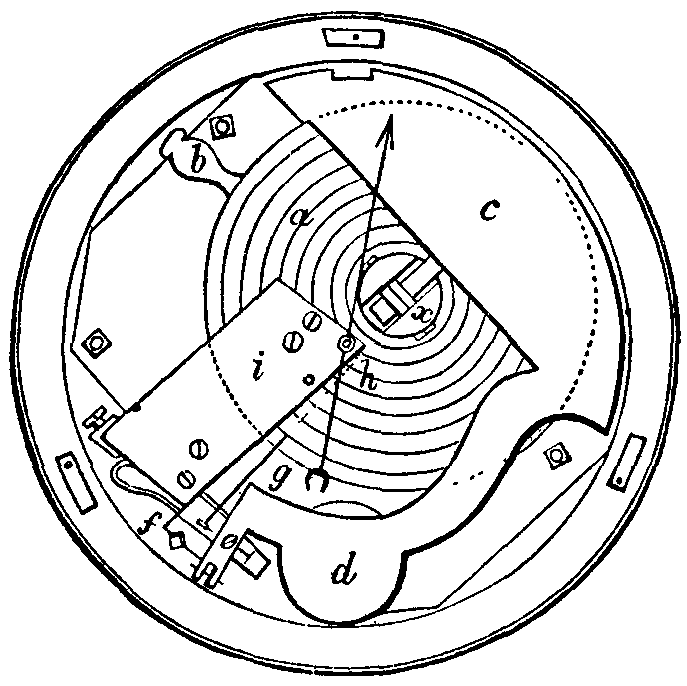
Aneroid Barometer.—Much obscurity surrounds the invention of barometers in which variations in pressure are rendered apparent by the alteration in the volume of an elastic chamber. The credit of the invention is usually given to Lucien Vidie, who patented his instrument in 1845, but similar instruments were in use much earlier. Thus in 1799 Nicolas Jacques Conté (1755-1805), director of the aerostatical school at Meudon, and a man of many parts—a chemist, mechanician and painter,—devised an instrument in which the lid of the metal chamber was supported by internal springs; this instrument was employed during the Egyptian campaign for measuring the altitudes of the war-balloons. Although Vidie patented his device in 1845, the commercial manufacture of aneroids only followed after E. Bourdon's patent of the metallic manometer in 1849, when Bourdon and Richard placed about 10,000 aneroids on the market. The production was stopped by an action taken by Vidie against Bourdon for infringing the former's patent, and in 1858 Vidie obtained 25,000 francs (£1000) damages.
Fig. 4 represents the internal construction, as seen when the face is removed, but with the hand still attached, of an aneroid which differs only slightly from Vidie's form. a is a flat circular metallic box, having its upper and under surfaces corrugated in concentric circles. This box or chamber being partially exhausted of air, through the short tube b, which is subsequently made air-tight by soldering, constitutes a spring, which is affected by every variation of pressure in the external atmosphere, the corrugations on its surface increasing its elasticity. At the centre of the upper surface of the exhausted chamber there is a solid cylindrical projection x, to the top of which the principal lever cde is attached. This lever rests partly on a spiral spring at d; it is also supported by two vertical pins, with perfect freedom of motion. The end e of the lever is attached to a second or small lever f, from which a chain g extends to h, where it works on a drum attached to the axis of the hand, connected with a hair spring at h, changing the motion from vertical to horizontal, and regulating the hand, the attachments of which are made to the metallic plate i. The motion originates in the corrugated elastic box a, the surface of which is depressed or elevated as the weight of the atmosphere is increased or diminished, and this motion is communicated through the levers to the axis of the hand at h. The spiral spring on which the lever rests at d is intended to compensate for the effects of alterations of temperature. The actual movement at the centre of the exhausted box, whence the indications emanate, is very slight, but by the action of the levers is multiplied 657 times at the point of the hand, so that a movement of the 220th part of an inch in the box carries the point of the hand through three inches on the dial. The effect of this combination is to multiply the smallest degrees of atmospheric pressure, so as to render them sensible on the index. Vidie's instrument has been improved by Vaudet and Hulot. Eugène Bourdon's aneroid depends on the same principle. The aneroid requires, however, to be repeatedly compared with a mercurial barometer, being liable to changes from the elasticity of the metal chamber changing, or from changes in the system of levers which work the pointer. Though aneroids are constructed showing great accuracy in their indications, yet none can lay any claim to the exactness of mercurial barometers. The mechanism is liable to get fouled and otherwise go out of order, so that they may change 0.300 in. in a few weeks, or even indicate pressure so inaccurately and so irregularly that no confidence can be placed in them for even a few days, if the means of comparing them with a mercurial barometer be not at hand.
The mercurial barometer can be made self-registering by concentrating Barographs. the rays from a source of light by a lens, so that they strike the top of the mercurial column, and having a sheet of sensitized paper attached to a frame and placed behind a screen, with a narrow vertical slit in the line of the rays. The mercury being opaque throws a part of the paper in the shade, while above the mercury the rays from the lamp pass unobstructed to the paper. The paper being carried steadily round on a drum at a given rate per hour, the height of the column of mercury is photographed continuously on the paper. From the photograph the height of the barometer at any instant may be taken. The principle of the aneroid barometer has been applied to the construction of barographs. The lever attached to the collapsible chamber terminates in an ink-fed style which records the pressure of the atmosphere on a moving ribbon. In all continuously registering barometers, however, it is necessary, as a check, to make eye-observations with a mercury standard barometer hanging near the registering barometer from four to eight times daily.
See Marvin, Barometers and the Measurement of Atmospheric Pressure (1901); and C. Abbe, Meteorological Apparatus (1888). Reference may also be made to B. Stewart and W. W. H. Gee, Practical Physics (vol. i. 1901), for the construction of standard barometers, their corrections and method of reading.
BAROMETRIC LIGHT, the luminous glow emitted by mercury in a barometer tube when shaken. It was first observed by Jean Picard, and formed the subject of many experiments at the hands of Francis Hawksbee. The latter showed that the Torricellian vacuum was not essential to the phenomenon, for the same glow was apparent when mercury was shaken with air only partially rarefied. The glow is an effect of the electricity generated by the friction of the mercury and the air in the barometer tube.
BARON, MICHEL (1653-1729), French actor (whose family name originally was Boyron), was born in Paris, the son of a leading actor (d. 1655) and of a talented actress (d. 1662). At the age of twelve he joined the company of children known as the Petits Comédiens Dauphins, of which he was the brightest star. Molière was delighted with his talent, and with the king's permission secured him for his own company. In consequence of a misunderstanding with Molière's wife, the actor withdrew from the dramatist's company, but rejoined it in 1670, reappearing as Domitien in Corneille's Tite et Bérénice, and in his Psyche. He remained in this company until Molière's death. He then became a member of the company at the Hôtel de Bourgogne, and from this time until his retirement in 1691 was undisputed master of the French stage, creating many of the leading rôles in Racine's tragedies, besides those in two of his own comedies, L'Homme à bonnes fortunes (1686), and La Coquette (1687). He also wrote Les Enlèvements (1685), Le Débauché (1689), and translated and acted two plays of Terence. In 1720 Baron reappeared at the Palais Royal, and his activity on the stage was renewed in a multitude of parts. He died on the 22nd of December 1729.
His son Étienne Michel Baron (1676-1711) was also a fine actor, and left a son and two daughters who all played at the Comédie Française.
See George Monval, Un Comédien amateur d'art (1893); also the Abbé d'Allamial's Lettres à mylord XXX. sur Baron et la demoiselle Lecouvreur, in F. G. J. S. Andrieux's Collection des mémoires sur l'art dramatique (1822).
BARON. This word, of uncertain origin, was introduced into England at the Conquest to denote "the man" (i.e. one who had done him "homage") of a great lord, and more especially of the king. All who held "in chief" (i.e. directly) of the king were alike barones regis, bound to perform a stipulated service, and members, in theory at least, of his council. Great nobles, whether earls or not, also spoke of their tenants as "barons," where lesser magnates spoke of their "men" (homines). This was especially the case in earldoms of a palatine character, such as Chester, where the earl's barons were a well-recognized body, the Venables family, "barons of Kinderton," continuing in existence down to 1679. In the palatinate of Durham also, the bishop had his barons, among whom the Hiltons of Hilton Castle were usually styled "Barons of Hilton" till extinct in 1746. Other families to whom the title was accorded, independently of peerage dignity and on somewhat uncertain grounds, were "the barons of Greystock," "the barons of Stafford," and the Cornwalls, "barons of Burford." Fantosme makes Henry II. speak of "mes baruns de Lundres"; John's charter granting permission to elect a mayor speaks of "our barons of our city of London," and a London document even speaks of "the greater barons of the city." The aldermen seem to have been loosely deemed equivalent to barons and were actually assessed to the poll-tax as such under Richard II. In Ireland the palatine character of the great lordships made the title not uncommon (e.g. the barons of Galtrim, the barons of Slane, the barons of the Naas).
As all those who held direct of the crown by military service (for those who held "by serjeanty" appear to have been classed apart), from earls downwards, were alike "barons," the great difference in their position and importance must have led, from an early date, to their being roughly divided into "greater" and "lesser" barons, and indeed, under Henry II., the Dialogus de Scaccario already distinguishes their holdings as "greater" or "lesser" baronies. Within a century of the Conquest, as we learn from Becket's case (1164), there arose the practice of sending to the greater barons a special summons to the council, while the lesser barons, it is stipulated in Magna Carta (1215), were to be summoned only through the sheriffs. Thus was introduced a definite distinction, which eventually had the effect of restricting to the greater barons the rights and privileges of peerage.
Thus far the baron's position was connected with the tenure of land; in theory the barons were those who held their lands of the king; in practice, they were those who so held a large amount of land. The great change in their status was effected when their presence in that council of the realm which became the House of Lords was determined by the issue of a writ of summons, dependent not on the tenure of land, but only on the king's will. Camden's statement that this change was made by Henry III. after "the Barons' War" was long and widely accepted, but it is now assigned, as by Stubbs, to Edward I., and the earliest writs accepted as creating hereditary baronies are those issued in his reign. It must not, however, be supposed that those who received such summons were as yet distinguished from commoners by any style or title. The only possible prefix at that time was Dominus (lord), which was regularly used by simple knights, and writs of summons were still issued to the lowest order of peers as knights (chevaliers) only. The style of baron was first introduced by Richard II. in 1387, when he created John de Beauchamp, by patent, Lord de Beauchamp and baron of Kidderminster, to make him "unum parium et baronum regni nostri." But it was not till 1433 that the next "baron" was created, Sir John Cornwall being then made baron of Fanhope. In spite, however, of these innovations, the former was only summoned to parliament by the style of "John Beauchamp of Kidderminster," and the latter by that of "John Cornwall, knight." Such creations became common under Henry VI., a transition period in peerage styles, but "Baron" could not evict "Sire," "Chevalier" and "Dominus." Patents of creation contained the formula "Lord A. (and) Baron of B.," but the grantee still styled himself "Lord" only, and it is an historically interesting fact that to this day a baron is addressed in correspondence, not by that style, but as "the Lord A.," although all peers under the rank of Duke are spoken of as "lords," while they are addressed in correspondence by their proper styles. To speak of "Baron A." or "Baron B." is an unhistorical and quite recent practice. When a barony, however, is vested in a lady it is now the recognized custom to speak of her as baroness, e.g. Baroness Berkeley.
The solemn investiture of barons created by patent was performed by the king himself, by enrobing the peer in the scarlet "robe of estate" during the reading of the patent, and this form continued till 13 Jac. I., when the lawyers declared that the delivery of the letters patent without ceremony was sufficient. The letters patent express the limits of inheritance of the barony. The usual limit is to the grantee and heirs male of his body, occasionally, in default of male issue, to a collateral male relative (as in the case of Lord Brougham, 1860) or (as in the case of Lord Basset, 1797, and Lord Burton, 1897) to the heirs-male of a daughter, and occasionally (as in the case of Lord Nelson, 1801) to the heirs-male of a sister. Sometimes also (as in the case of the barony of Rayleigh, 1821) the dignity is bestowed upon a lady with remainder to the heirs-male of her body. The coronation robes of a baron are the same as those of an earl, except that he has only two rows of spots on each shoulder; and, in like manner, his parliamentary robes have but two guards of white fur, with rows of gold lace; but in other respects they are the same as those of other peers. King Charles II. granted to the barons a coronet, having six large pearls set at equal distances on the chaplet. A baron's cap is the same as a viscount's. His style is "Right Honourable"; and he is addressed by the king or queen, "Right Trusty and Well-beloved." His children are by courtesy entitled to the prefix "The Honourable."
Barons of the Exchequer were formerly six judges (a chief baron and five puisne barons) to whom the administration of justice was committed in causes betwixt the king and his subjects relative to matters of revenue. Selden, in his Titles of Honour, conjectures that they were originally chosen from among the barons of the kingdom, and hence their name; but it would probably be more exact to say that they were officers of a branch of the king's Curia, which was theoretically composed of his "barons." The title has become obsolete since 1875, when the court of exchequer was merged in the High Court of Judicature.
Barons of the Cinque Ports (originally Hastings, Dover, Hythe, Romney and Sandwich) were at first the whole body of their freemen, who were so spoken of in royal charters. But the style was afterwards restricted to their mayors, jurats, and (prior to 1831) members of the House of Commons elected by the Cinque Ports, two for each port. Their right to the title is recognized in many old statutes, but in 1606 the use of the term in a message from the Lower House drew forth a protest from the peers, that "they would never acknowledge any man that sitteth in the Lower House to the right or title of a baron of parliament" (Lords' Journals). It was the ancient privilege of these "barons" to bear a canopy over the sovereign at his or her coronation and retain it as their perquisite. They petitioned as "barons of the Cinque Ports" to attend the coronation of Edward VII., and a deputation was allowed to do so.
Baron and Feme, in English law, is a phrase used for husband and wife, in relation to each other, who are accounted as one person. Hence, by the old law of evidence, the one party was excluded from giving evidence for or against the other in civil questions, and a relic of this is still preserved in the criminal law.
Baron and Feme, in heraldry, is the term used when the coats-of-arms of a man and his wife are borne per pale in the same escutcheon, the man's being always on the dexter side, and the woman's on the sinister. But in this case the woman is supposed not to be an heiress, for then her coat must be borne by the husband on an escutcheon of pretence. (See Heraldry.)
The foreign title of baron is occasionally borne by English subjects, but confers no precedence in the United Kingdom. It may be Russian, e.g. Baron Dimsdale (1762); German, e.g. Baron Stockmar, Baron Halkett (Hanoverian); Austrian, e.g. Baron Rothschild (1822), Baron de Worms; Italian, e.g. Baron Heath; French, e.g. Baron de Teissier; French-Canadian, e.g. Baron de Longueil (1700); Dutch, e.g. Baron Mackay (Lord Reay).
(J. H. R.)
The Foreign Title.—On the continent of Europe the title baron, though the same in its origin, has come, owing to a variety of causes, to imply a rank and status very different from its connotation in the United Kingdom, and again varies considerably in different countries. Originally baro meant no more than "man," and is so used in the Salic and other "barbarian" laws; e.g. Si quis mortaudit barum vel feminam, &c. (Lex Aleman. tit. 76). In this way, too, it was long preserved in the sense of "husband," as in the Assize of Jerusalem (MSS. cap. 98): Si l'on appelle aucune chose femme qui aura baron, et il la veut deffendre, il la peut deffendre de son cors, &c. Gradually the word seems to have come to mean a "strong or powerful man," and thus generally "a magnate." Finally, in France in the 12th century the general expression barones was introduced in a restricted sense, as applied properly to all lords possessing an important fief, subject to the rule of primogeniture and thus not liable to be divided up, and held of one overlord alone. Sometimes it included ecclesiastical lordships of the first rank. In the 13th century the Register of King Philip Augustus places the barones regis Francie next to the dukes and counts holding in chief, the title being limited to vassals of the second rank. Towards the end of the century the title had come to mean that its bearer held his principal fief direct from the crown, and was therefore more important than that of count, since many counts were only mediate vassals. Thus the kings in granting a duchy or countship as an apanage to their brothers or sons used the phrase in comitatum et baroniam. From this period, however, the title tends to sink in comparative importance. When, in the 14th century, the feudal hierarchy was completed and stereotyped, the barons are ranked not only below counts, but below viscounts, though in power and possessions many barons were superior to many counts. In any case, until the 17th century, the title of baron could only be borne by the holder of a territorial barony; and it was Louis XIV. who first cheapened the title in France by creating numerous barons by royal letters. This entire dissociation of the title from the idea of feudal rights and obligations was completed by Napoleon's decree of March 1, 1808, reviving the ancient titles. By this instrument the title of baron was to be borne ex officio by a number of high officials, e.g. ministers, senators, councillors of state, archbishops and bishops. It was given to the 37 mayors who attended the coronation, and could be claimed by any mayor who had served to the emperor's satisfaction for ten years, and by any member of an electoral college who had attended three sessions. The title was made to descend in order of primogeniture to legitimate or adopted sons and to the nephews of bishops, the sole condition being that proof must be presented of an actual income of 15,000 fr., of which one-third should descend with the title. The creation of barons was continued by Louis XVIII., Charles X. and Louis Philippe, and, suspended at the revolution of 1848, was revived again on a generous scale by Napoleon III. The tolerant attitude of the Third Republic towards titles, which it does not officially recognize, has increased the confusion by facilitating the assumption of the title on very slender grounds of right. The result has been that in France the title of Baron, unless borne by the recognized representative of a historic name, not only involves no political status, but confers also but very slight social distinction.
The same is true, mutatis mutandis, of most other European countries, and notably of Italy. In Austria and Germany the case is somewhat different. Though in Latin documents of the middle ages the term barones for liberi domini was used, it was not until the 17th century that the word Baron, perhaps under the influence of the court of Versailles, began to be used as the equivalent of the old German Freiherr, or free lord of the Empire. The style Freiherr (liber dominus) implied originally a dynastic status, and many Freiherren held countships without taking the title of count. When the more important of them styled themselves counts, the Freiherren sank into an inferior class of nobility. The practice of conferring the title Freiherr by imperial letters was begun in the 16th century by Charles V., was assumed on the ground of special imperial concessions by many of the princes of the Empire, and is now exercised by all the German sovereigns. Though the practice of all the children taking the title of their father has tended to make that of Baron comparatively very common, and has dissociated it from all idea of territorial possession, it still implies considerable social status and privilege in countries where a sharp line is drawn between the caste of "nobles" and the common herd, whom no wealth or intellectual eminence can place on the same social level with the poorest Adeliger. In Japan the title baron (Dan) is the lowest of the five titles of nobility introduced in 1885, on the European model. It was given to the least important class of territorial nobles, but is also bestowed as a title of honour without reference to territorial possession.
See du Cange, Glossarium, s. "Baro" (ed. Niort, 1883); John Selden, Titles of Honor, p. 353 (ed. 1672); Achille Luchaire, Manuel des institutions françaises (Paris, 1892); Maurice Prou, art. "Baron" in La Grande Encyclopédie.
(W. A. P.)
BARONET. Although the origin of this title has been the subject of learned speculation, it is not known for certain why it was selected as that of "a new Dignitie between Barons and Knights" created by James I. The object of its institution was to raise money for the crown, as was also done by the sale of peerage dignities under this sovereign. But the money was professedly devoted to the support of troops in Ulster, that is, each grantee was to be liable for the pay of thirty men, at 8d. a day for three years. This amounted to £1095, which was the sum paid for the honour. When it was instituted, in May 1611, the king, to keep the baronetage select, covenanted that he would not create more than two hundred, and that only those who had £1000 a year in landed estate and whose paternal grandfathers had borne arms should receive the honour. But these qualifications were before long abandoned. As an inducement to apply for it, it was made to confer the prefix of "Sir" and "Lady" (or "Dame"), and was assigned precedence above knights, though below the younger sons of barons. Eight years later (30th of September 1619), the baronetage of Ireland was instituted, the king pledging himself not to create more than a hundred baronets. Meanwhile, questions had arisen as to the exact precedence of the baronets, and James by royal decree (28th of May 1612) had announced that it was his intention to rank them below the younger sons of barons. As this had the effect of stopping applications for the honour, James issued a fresh commission (18th of November 1614) to encourage them, and finally, as "the Kinges wants might be much relieved out of the vanities and ambition of the gentrie" (in Chamberlain's words), he granted, in 1616, the further privilege that the heirs apparent of baronets should be knighted on coming of age.
The baronetage of Nova Scotia was devised in 1624 as a means of promoting the "plantation" of that province, and James announced his intention of creating a hundred baronets, each of whom was to support six colonists for two years (or pay 2000 marks in lieu thereof) and also to pay 1000 marks to Sir William Alexander (afterwards earl of Stirling), to whom the province had been granted by charter in 1621. For this he was to receive a "free barony" of 16,000 acres in Nova Scotia, and to become a baronet of "his Hienes Kingdom of Scotland." James dying at this point, Charles I. carried out the scheme, creating the first Scottish baronet on the 28th of May 1625, covenanting in the creation charter that the baronets "of Scotland or of Nova Scotia" should never exceed a hundred and fifty in number, that their heirs apparent should be knighted on coming of age, and that no one should receive the honour who had not fulfilled the conditions, viz. paid 3000 marks (£166, 13s. 4d.) towards the plantation of the colony. Four years later (17th of November 1629) the king wrote to "the contractors for baronets," recognizing that they had advanced large sums to Sir William Alexander for the plantation on the security of the payments to be made by future baronets, and empowering them to offer a further inducement to applicants; and on the same day he granted to all Nova Scotia baronets the right to wear about their necks, suspended by an orange tawny ribbon, a badge bearing an azure saltire with a crowned inescutcheon of the arms of Scotland and the motto "Fax mentis honestae gloria." As the required number, however, could not be completed, Charles announced in 1633 that English and Irish gentlemen might receive the honour, and in 1634 they began to do so. Yet even so, he was only able to create a few more than a hundred and twenty in all. In 1638 the creation ceased to carry with it the grant of lands in Nova Scotia, and on the union with England (1707) the Scottish creations ceased, English and Scotsmen alike receiving thenceforth baronetcies of Great Britain.
It is a matter of dispute whether James I. had kept faith with the baronets of England as to limiting their number; but his son soon rejected the restriction freely. Creations became one of his devices for raising money; blank patents were hawked about, and in 1641 Nicholas wrote that baronetcies were to be had for £400 or even for £350; a patent was offered about this time to Mr Wrottesley of Wrottesley for £300. On the other hand, the honour appears to have been bestowed for nothing on some ardent royalists when the great struggle began.
Cromwell created a few baronets, but at the Restoration the honour was bestowed so lavishly that a letter to Sir Richard Leveson (3rd of June 1660) describes it as "too common," and offers to procure it for any one in return for £300 or £400. Sir William Wiseman, however, is said to have given £500.
The history of the baronetage was uneventful till 1783, when in consequence of the wrongful assumption of baronetcies, an old and then increasing evil, a royal warrant was issued (6th of December) directing that no one should be recognized as a baronet in official documents till he had proved his right to the dignity, and also that those created in future must register their arms and pedigree at the Heralds' College. In consequence of the opposition of the baronets themselves, the first of these two regulations was rescinded and the evil remained unabated. Since the union with Ireland (1800) baronets have been created, not as of Great Britain or of Ireland, but as of the United Kingdom.
In 1834 a movement was initiated by Mr Richard Broun (whose father had assumed a Nova Scotia baronetcy some years before), to obtain certain privileges for the order, but on the advice of the Heralds' College, the request was refused. A further petition, for permission to all baronets to wear a badge, as did those of Nova Scotia, met with the same fate in 1836. Meanwhile George IV. had revoked (19th of December 1827), as to all future creations the right of baronets' eldest sons to claim knighthood. Mr Broun claimed it as an heir apparent in 1836, and on finally meeting with refusal, publicly assumed the honour in 1842, a foolish and futile act. In 1854 Sir J. Kingston James was knighted as a baronet's son, and Sir Ludlow Cotter similarly in 1874, on his coming of age; but when Sir Claude de Crespigny's son applied for the honour (17th of May 1895), his application was refused, on the ground that the lord chancellor did not consider the clause in the patent (1805) valid. The reason for this decision appears to be unknown.
Mr Broun's subsequent connexion with a scheme for reviving the territorial claims of the Nova Scotia baronets as part of a colonizing scheme need not be discussed here. A fresh agitation was aroused in 1897 by an order giving the sons of life peers precedence over baronets, some of whom formed themselves, in 1898, into "the Honourable Society of the Baronetage" for the maintenance of its privileges. But a royal warrant was issued on the 15th of August 1898, confirming the precedence complained of as an infringement of their rights. The above body, however, has continued in existence as the "Standing Council of the Baronetage," and succeeded in obtaining invitations for some representatives of the order to the coronation of King Edward VII. It has been sought to obtain badges or other distinctions for baronets and also to purge the order of wrongful assumptions, an evil to which the baronetage of Nova Scotia is peculiarly exposed, owing to the dignity being descendible to collateral heirs male of the grantee as well as to those of his body. A departmental committee at the home office was appointed in 1906 to consider the question of such assumptions and the best means of stopping them.
All baronets are entitled to display in their coat of arms, either on a canton or on an inescutcheon, the red hand of Ulster, save those of Nova Scotia, who display, instead of it, the saltire of that province. The precedency of baronets of Nova Scotia and of Ireland in relation to those of England was left undetermined by the Acts of Union, and appears to be still a moot point with heralds. The premier baronet of England is Sir Hickman Bacon, whose ancestor was the first to receive the honour in 1611.
See Pixley's History of the Baronetage; Playfair's "Baronetage" (in British Family Antiquity, vols. vi.-ix.); Foster's Baronetage; G. E. Cokayne's Complete Baronetage; Nichols, "The Dignity of Baronet" (in Herald and Genealogist, vol. iii.)
(J. H. R.)
BARONIUS, CAESAR (1538-1607), Italian cardinal and ecclesiastical historian, was born at Sora, and was educated at Veroli and Naples. At Rome he joined the Oratory in 1557 under St Philip Neri (q.v.) and succeeded him as superior in 1593. Clement VIII., whose confessor he was, made him cardinal in 1596 and librarian of the Vatican. At subsequent conclaves he was twice nearly elected pope, but on each occasion was opposed by Spain on account of his work On the Monarchy of Sicily, in which he supported the papal claims against those of the Spanish government. Baronius is best known by his Annales Ecclesiastici, undertaken by the order of St Philip as an answer to the Magdeburg Centuries. After nearly thirty years of lecturing on the history of the Church at the Vallicella and being trained by St Philip as a great man for a great work, he began to write, and produced twelve folios (1588-1607). In the Annales he treats history in strict chronological order and keeps theology in the background. In spite of many errors, especially in Greek history, in which he had to depend upon secondhand information, the work of Baronius stands as an honest attempt to write history, marked with a sincere love of truth. Sarpi, in urging Casaubon to write against Baronius, warns him never to charge or suspect him of bad faith, for no one who knew him could accuse him of disloyalty to truth. Baronius makes use of the words of St Augustine: "I shall love with a special love the man who most rigidly and severely corrects my errors." He also undertook a new edition to the Roman martyrology (1586), which he purified of many inaccuracies.
His Annales, which end in 1198, were continued by Rinaldi (9 vols., 1676-1677); by Laderchi (3 vols., 1728-1737); and by Theiner (3 vols., 1856). The most useful edition is that of Mansi (38 vols., Lucca, 1738-1759), giving Pagi's corrections at the foot of each page.
(E. Tn.)
BARONY, the domain of a baron (q.v.). In Ireland counties are divided into "baronies," which are equivalent to the "hundreds" (q.v.) in England, and seem to have been formed out of the territories of the Irish chiefs, as each submitted to English rule (General Report of the Census of England, iv. 181, 1873). In Scotland the term is applied to any large freehold estate even when held by a commoner. Barony also denotes the rank or dignity of a baron, and the feudal tenure "by barony."
BAROQUE, a technical term, chiefly applicable to architecture, furniture and household decoration. Apparently of Spanish origin—a barrueco is a large, irregularly-shaped pearl—the word was for a time confined to the craft of the jeweller. It indicates the more extravagant fashions of design that were common in the first half of the 18th century, chiefly in Italy and France, in which everything is fantastic, grotesque, florid or incongruous—irregular shapes, meaningless forms, an utter lack of restraint and simplicity. The word suggests much the same order of ideas as rococo.
BAROSS, GABOR (1848-1892), Hungarian statesman, was born at Trencsén on the 6th of July 1848, and educated at Esztergom. He was for a time one of the professors there under Cardinal Kolos Vaszary. After acquiring considerable local reputation as chief notary of his county, he entered parliament in 1875. He at once attached himself to Kálmán Tisza and remained faithful to his chief even after the Bosnian occupation had alienated so many of the supporters of the prime minister. It was he who drew up the reply to the malcontents on this occasion, for the first time demonstrating his many-sided ability and his genius for sustained hard work. But it was in the field of economics that he principally achieved his fame. In 1883 he was appointed secretary to the ministry of ways and communications. Baross, who had prepared himself for quite another career, and had only become acquainted with the civilized West at the time of the Composition of 1867, mastered, in an incredibly short time, the details of this difficult department. His zeal, conscientiousness and energy were so universally recognized, that on the retirement of Gábor Kemény, in 1886, he was appointed minister of ways and communications. He devoted himself especially to the development of the national railways, and the gigantic network of the Austro-Hungarian railway system and its unification is mainly his work. But his most original creation in this respect was the zone system, which immensely facilitated and cheapened the circulation of all wares and produce, and brought the remotest districts into direct communication with the central point at Budapest. The amalgamation of the ministry of commerce with the ministry of ways in 1889 further enabled Baross to realize his great idea of making the trade of Hungary independent of foreign influences, of increasing the commercial productiveness of the kingdom and of gaining every possible advantage for her export trade by a revision of tolls. This patriotic policy provoked loud protests both from Austria and Germany at the conference of Vienna in 1890, and Baross was obliged somewhat to modify his system. This was by no means the only instance in which his commercial policy was attacked and even hampered by foreign courts. But wherever he was allowed a free hand he introduced epoch-making reforms in all the branches of his department, including posts, telegraphs, &c. A man of such strength of character was not to be turned from his course by any amount of opposition, and he rather enjoyed to be alluded to as "the iron-handed minister." The crowning point of his railway policy was the regulation of the Danube at the hitherto impassable Iron-Gates Rapids by the construction of canals, which opened up the eastern trade to Hungary and was an event of international importance. It was while inspecting his work there in March 1892 that he caught a chill, from which he died on the 8th of May. The day of his burial was a day of national mourning, and rightly so, for Baross had dedicated his whole time and genius to the promotion of his country's prosperity.
See László Petrovics, Biography of Gabriel Baross (Hung. Eperies, 1892).
(R. N. B.)
BAROTAC NUEVO, a town of the province of Iloílo, Panay, Philippine Islands, near the Jalaur river, above its mouth on the S.E. coast, and about 15 m. N.E. of Iloílo, the capital. Pop. (1903) 9904; in 1903 after the census had been taken the neighbouring town of Dumangas (pop. 12,428) was annexed to Barotac Nuevo. The town lies in a fertile plain and deals in rice, trepang and pina. Here, in what was formerly Dumangas, are a fine church and convent, built of iron, pressed brick and marble. Dumangas was destroyed by fire in June 1900, during a fight with insurgents, but its rebuilding was begun in May 1901.
BAROTSE, BAROTSELAND, a people and country of South Central Africa. The greater part of the country is a British protectorate, forming part of Rhodesia. The Barotse are the paramount tribe in the region of the Upper Zambezi basin, but by popular usage the name is also applied to contiguous subject tribes, Barotseland being the country over which the Barotse paramount chief exercises authority. The present article treats (1) of the people, (2) of the country, (3) of the establishment of the British protectorate and of subsequent developments.
1. The Barotse.—These people, originally known as Aälui, have occupied the extensive plain through which the Zambezi passes from 14° 35′ S. to 16° 25′ S. throughout the reigns of twenty-two successive paramount chiefs and therefore approximately since the commencement of the 17th century. Previously, for an indefinite period, they dwelt on the Kabompo river, 200 m. to the N.E. of their present country, and here the descendants of a section of the tribe which did not migrate still remain, under the name Balokwakwa (men of the ambuscade), formerly known as Aälukolui. That the Barotse at a still more remote period emigrated from the far north-east is indicated by vague tradition as well as by a certain similarity in type and language to some tribes living in that direction, though the fact that natives from Mashonaland can understand those at Lialui (the Barotse capital) has led to the assumption by some writers that the Barotse are an offshoot of the Mashona. The variety in type among the Mashona and the homogeneity of the Barotse would rather point to an opposite conclusion.
Early in the 19th century a section of the Basuto tribe known as Makololo trekked from the south of what is now the Orange River Colony and fought their way through Bechuanaland and the Kalahari to the land of the Barotse, whom they ultimately subdued. Their chief, Sebituane, who as an administrator and general was far in advance of his compeers, established the rule of his house for some forty years, until about 1865 an organized rebellion of the Barotse led to the almost complete extinction of this Makololo oligarchy and the reinstatement of the original dynasty. It was the Makololo who gave the Barotse their present name (Rotse, plain—Burotse, country of the plain—Murotse, man of the plain—Marotse, people of the plain, the latter being inaccurately rendered Barotse, Ba being the equivalent of Ma in certain other languages).
The Barotse proper are comparatively few in number, but as is inferred from the fact that for many generations they have held in sway a country two and a half times the size of Great Britain, they are the intellectual and physical superiors of the vast majority of the negro races of Africa. Very black, tall in stature, deep in chest and comparatively speaking refined in feature, a Barotse is readily distinguishable amidst a mixed group of natives. Being numerically small they form an oligarchy in which, with few exceptions, each man holds rank in a chieftainship of which there are three grades. Next to the chiefs rank their descendants who have not themselves acquired chief's rank and hold an intermediate position as freeborn; all others, whether members of the subject-tribes or prisoners of war, being, up to 1906, mere slaves. This class was also graded. Slaves might own slaves who in their turn might own slaves, the highest grade always being directly responsible to some Barotse chief. As a reward of gallantry or ability the paramount chief occasionally conferred chief's rank on individuals not of Barotse birth, and these ipso facto assumed the name and privileges of the Barotse. It was a counterpart of the feudal system of Europe in which every grade from king to serf found a place. In 1906 the paramount chief, by proclamation, abolished the state of slavery, an act which, however, left untouched the predominant position of the Barotse and their rights to chieftainship. The paramount chief shares with a queen (Mokwai) his authority and prerogatives. The Mokwai is not the wife but the eldest sister of the ruling chief. With his death her privileges lapse. Theoretically, these co-rulers are equal, neither may promulgate a national decree without the assent of the other, but each has a capital town, councillors and absolute authority in a province, the two having joint authority over all other provinces. In their code of laws the Barotse show an advance on the standard of probably any other African negro state. By right, an accused chief is tried by his peers, each of whom in rotation from junior to senior gives his verdict, after which the president reports the finding of the court to the paramount chief, who passes sentence. As to their religious beliefs the Barotse imagine the sun to be the embodiment of a great god whose sole care is for the amelioration of man. Him they worship, though more pains are taken to appease evil spirits, in whose existence they also believe, to whom every evil to which man is heir is attributed. The spirits of ancestors—especially of deceased chiefs—are also objects of worship. Christianity, of a Protestant evangelical type, was first introduced into the country in 1884 by François Coillard and has made some progress among the people, among the converts being Letia, eldest son and heir of Lewanika, the paramount chief.
2. Barotseland.—This term includes, in the sense of the country in which the authority of the paramount Barotse chief is acknowledged, not only the lands of the Barotse proper, but the territory of fifteen contiguous and subject tribes. This vast territory extends approximately from the Kwito river in the west to the Kafue river in the east, and from the Congo-Zambezi watershed in the north to the Linyante or Kwando river and Zambezi in the south, and may be divided into three groups:—
(a) Central provinces directly administered by the paramount chief from the capital Lialui (a town on the Zambezi), by the Mokwai from Nalolo, and by two chiefs of the blood from Sesheke;
(b) Outlying provinces over which, in the absence of a central local system of government, Barotse chiefs administer districts under the direction of the paramount chief; and
(c) Tribes over which the local chiefs are permitted to retain their position subject to the payment of annual tribute and to their doing homage in person at Lialui when called upon to do so.
With the publication of the king of Italy's award in 1905 in the Anglo-Portuguese Barotse Boundary dispute (see below), the term Barotseland may be said to have acquired a second meaning. By this award the western and part of the northern section of Barotseland as described above were declared to be outside the dominion of the paramount chief and therefore not in the British sphere of influence, while tribal boundaries were complicated by the introduction of a longitudinal and latitudinal frontier. Though this award altered the political boundaries, ethnologically Barotseland remains much as above described. The area of the country under British protection is about 182,000 sq. m.
Excluding the ridge of high ground running east and west which, culminating at a height of 5000 ft., forms the Congo-Zambezi water-parting, the extreme east (Batoka) and the district in the immediate vicinity of the Victoria Falls (q.v.) throughout which, with local variations, a red laterite clay predominates, the main physical features of Barotseland may be described as a series of heavy white sand undulations covered with subtropical forest vegetation. These are intersected by alluvium-charged valleys through which streams and rivers flow inwards towards the central basin of the Upper Zambezi. There is evidence that this has at one time been the site of a large lake. These valleys, which towards the close of the wet season become inundated, afford rich cattle pasture, the succulence of which prevents cattle losing condition towards the end of the dry season, as is the case in many parts of Africa. There seems to be little or no indication of mineral wealth in the white sand area, but in the north and east there is not only every prospect of a great agricultural and pastoral future but also of considerable mining development. Though basalt predominates in the neighbourhood of the Victoria Falls and large fields of granite crop up on the Batoka plateau and elsewhere, there is every indication of the existence of useful minerals in these districts. Gold, copper, tin, lead, zinc and iron have been discovered.
Much of the area of Barotseland is within the healthy zone, the healthiest districts being the Batoka and Mashikolumbwe plateaus in the east with extreme altitudes of 4400 and 4150 ft. respectively, and the line of the Congo-Zambezi watershed which rises to 5000 ft. in many places. The Zambezi valley from the Victoria Falls (3000 ft.) to the Kabompo confluence (3500 ft.), though involving little or no risk to health to the traveller, cannot be considered suitable for white settlement. Taking into consideration the relative value of altitude to latitude, the plateauland of Barotseland compares very favourably with existing conditions elsewhere, being several degrees more temperate than would be expected. Approximately the mean maximum and minimum temperatures stand at 80° and 55° F. respectively, with an extreme range of 100° to 35° and a mean annual temperature of 68° to 70°. The rainfall varies according to district from 22 to 32 in. a year and has shown extraordinary stability. Since 1884, the first year in which a record was taken by François Coillard, Barotseland has known no droughts, though South Africa has suffered periodically in this respect.
The Zambezi, as would be expected, forms a definite boundary line in the distribution of many species of fauna and flora. In these respects, as well as from an ethnological standpoint, Barotseland essentially belongs not to South but to Central Africa. The great river has also served to prevent the spread from South Africa into Barotseland of such disastrous cattle diseases as tick fever and lung sickness.
3. The Establishment of British Suzerainty.—By the charter granted to the British South Africa Company in October 1889, the company was allowed to establish its rule in the regions north of the Middle Zambezi not included in the Portuguese dominions, and by a treaty of the 11th of June 1891 between Great Britain and Portugal it was declared that the Barotse kingdom was within the British sphere of influence. The dispute between the contracting powers as to what were the western limits of Barotseland was eventually referred to the arbitration of the king of Italy, who by his award of the 30th of May 1905, fixed the frontier at the Kwando river as far north as 22° E., then that meridian up to the 13° S., which parallel it follows as far east as 24° E., and then that meridian to the Belgian Congo frontier. In the meantime the British South Africa Company had entered into friendly relations with Lewanika (q.v.), the paramount chief of the Barotse, and an administrator was appointed on behalf of the company to reside in the country. A native police force under the command of a British officer was raised and magistrates and district commissioners appointed. In the internal affairs of the Barotse the company did not interfere, and the relations between the British and Barotse have been uniformly friendly. The pioneers of Western civilization were not, however, the agents of the Chartered Company, but missionaries. F. S. Arnot, an Englishman, spent two years in the country (1882-1884) and in 1884 a mission, fruitful of good results, was established by the Société des Missions Evangéliques de Paris. Its first agent was François Coillard (1834-1904), who had previously been engaged in mission work in Basutoland and who devoted the rest of his life to the Barotse. Though always an admirer of British institutions and anxious that the country should ultimately fall under British jurisdiction, Coillard in the interests of his mission was in the first instance anxious to delay the advent of white men into the country. It was contrary to his advice that Lewanika petitioned the "Great White Queen" to assume a protectorate over his dominions, but from the moment Great Britain assumed responsibility and the advance of European civilization became inevitable, all the influence acquired by Coillard's exceptional personal magnetism and singleness of purpose was used to prepare the way for the extension of British rule. Only those few pioneers who knew the Barotse under the old conditions can fully realise what civilization and England owe to the co-operation of this high-minded Frenchman.
Under the Chartered Company's rule considerable progress has been made in the development of the resources of the country, especially in opening up the mining districts in the north. The seat of the administration, Kalomo, is on the "Cape to Cairo" railway, about midway between the Zambezi and Kafue rivers. The railway reached the Broken Hill copper mines, 110 m. N. of the Kafue in 1906, and the Belgian Congo frontier in 1910. From Lobito Bay in Portuguese West Africa a railway was being built in 1909 which would connect with the main line near the Congo frontier. This would not only supply Barotseland with a route to the sea alternative to the Beira and Cape Town lines, but while reducing the land route by many hundred miles would also supply a seaport outlet 1700 m. nearer England than Cape Town and thus create a new and more rapid mail route to southern Rhodesia and the Transvaal. The Zambezi also, with Kebrabasa as its one bar to navigation between Barotseland and the sea, will supply a cheap line of communication. (See Rhodesia.)
See David Livingstone, Missionary Travels and Researches in South Africa (London, 1857); Major Serpa Pinto, How I crossed Africa (London, 1881); F. Coillard, On the Threshold of Central Africa (London, 1897); Major A. St H. Gibbons, Exploration and Hunting in Central Africa (London, 1898), Africa South to North through Marotseland (London, 1904); "Journeys in Marotseland," Geographical Journal, 1897; "Travels in the Upper Zambezi Basin," Geographical Journal, 1901; A. Bertrand, Aux pays des Barotse, haut Zambèze (Paris, 1898); Col. Colin Harding, In Remotest Barotseland, (London, 1905); C. W. Mackintosh, Coillard of the Zambesi (London, 1907), with a bibliography; L. Decle, Three Years in Savage Africa (London, 1898). Consult also the annual reports of the British South Africa Company, published in London.
(A. St H. G.)
BAROUCHE (Ger. barutsche, Span. barrocho, Ital. baroccio; from Lat. bi-rotus, double-wheeled), the name of a sort of carriage, with four wheels and a hood, arranged for two couples to sit inside facing one another.
BARQUISIMETO, a city of western Venezuela, capital of the state of Lara, on the Barquisimeto river, 101 m. by rail S.W. of Tucacas, its port on the Caribbean coast. Pop. (est. 1899) 40,000. It is built in a small, fertile valley of the Merida Cordilleras, 1985 ft. above sea-level, has a temperate, healthy climate with a mean annual temperature of 78° F., and is surrounded by a highly productive country from which are exported coffee, sugar, cacao and rum. It is also an important distributing centre for neighbouring districts. The city is the seat of a bishopric, is regularly laid out and well built, and is well provided with educational and charitable institutions. Barquisimeto was founded in 1522 by Juan de Villegas, who was exploring the neighbourhood for gold, and it was first called Nueva Segovia after his native city. In 1807 its population had risen to 15,000, principally through its commercial importance, but on the 26th of March 1812 it was totally destroyed by an earthquake, and with it 1500 lives, including a part of the revolutionary forces occupying the town. It was soon rebuilt and is one of the few cities of Venezuela which have recovered from the ravages of the war of independence and subsequent disorders.
BARR, a town of Germany, in the imperial province of Alsace-Lorraine, on the Kirneck, 13 m. N. from Schlettstadt by rail. It has an Evangelical and a Roman Catholic church and considerable tanneries. There is an active trade in wine and timber. Pop. (1900) 5243.
BARRA, or Barray (Scand. Baraey, isle of the ocean), an island of the outer Hebrides, Inverness-shire, Scotland. Pop. (1901) 2362. It lies about 5 m. S.W. of South Uist, is 8 m. in length and from 2 to 4 m. in breadth, save at the sandy isthmus 2 m. below Scurrival Point, where it is only a few hundred yards broad. The rock formation is gneiss. The highest hill is Heaval (1260 ft.) and there are several small lochs. The chief village is Castlebay, at which the Glasgow steamer calls once a week. This place derives its name from the castle of Kishmul standing on a rock in the bay, which was once the stronghold of the McNeills of Barra, one of the oldest of Highland clans. There are remains of ancient chapels, Danish duns and Druidical circles on the island. There is communication by ferry with South Uist. The parish comprises a number of smaller islands and islets—among them Frida, Gighay, Hellisay, Flodda to the N.E., and Vatersay, Pabbay, Mingalay (pop. 135) and Berneray to the S.E.—and contains 4000 acres of arable land and 18,000 acres of meadow and hill pasture. The cod, ling and herring fisheries are important, and the coasts abound with shell-fish, especially cockles, for which it has always been famous. On Barra Head, the highest point of Berneray, and also the most southerly point of the outer Hebrides chain, is a lighthouse 680 ft. above high water.
BARRACKPUR, a town and magisterial subdivision of British India, in the district of Twenty-four Parganas, Bengal. The town is the largest cantonment in Lower Bengal, having accommodation for two batteries of artillery, the wing of a European regiment and two native battalions. Its name is said to be derived from the fact of troops having been stationed here since 1772. It is a station on the Eastern Bengal railway. Job Charnock, the founder of Calcutta, erected a bungalow and established a small bazaar here in 1689. The cantonment is situated on the left bank of the Hugli; it has also a large bazaar and several large tanks, and also a parade ground. To the south of the cantonment is situated the park, created by the taste and public spirit of Lord Wellesley. Within the park is situated the Government House, a noble building begun by Lord Minto, and enlarged into its present state by the marquess of Hastings. The park is beautifully laid out, and contains a small menagerie. Its most interesting feature is now Lady Canning's tomb. Barrackpur played an important part in the two Sepoy mutinies of 1824 and 1857, but the details of these belong to the general history of British rule in India. North Barrackpur had a population in 1901 of 12,600 and south Barrackpur of 19,307.
Barrackpur subdivision was formed in 1904. It contains an area of 190 sq. m., which, at the census of 1901, had a population of 206,311, a large proportion being workers in the mills on the left bank of the Hugli.
BARRACKS (derived through the French from the Late Lat. barra, a bar), the buildings used for the accommodation of military or naval forces, including the quarters for officers, warrant officers, non-commissioned officers and men, with their messes and recreation establishments, regimental offices, shops, stores, stables, vehicle sheds and other accessory buildings for military or domestic purposes. The term is usually applied to permanent structures of brick or stone used for the peace occupation of troops; but many hut barracks of corrugated iron lined with wood have been built, generally in connexion with a training ground for troops, and in these the accommodation given is somewhat less than in permanent barracks, and conditions more nearly approach those of a military encampment.
British System.—The accommodation to be given in British military barracks is scheduled in the Barrack Synopsis, which contains "statements of particulars, based upon decisions which have, from time to time, been laid down by authority, as regards the military buildings authorized for various units, and the accommodation and fittings to be provided in connexion therewith." Each item of ordinary accommodation is described in the synopsis, and the areas and cubic contents of rooms therein laid down form the basis of the designs for any new barrack buildings. Supplementary to the synopsis is a series of "Standard Plans," which illustrate how the accommodation may be conveniently arranged; the object of the issue of these plans is to put in convenient form the best points of previous designs, and to avoid the necessity of making an entirely fresh design for each building that is to be erected, by using the standard type modified to suit local conditions. External appearance is considered with regard to the materials to be used, and the position the buildings are to occupy; convenience of plan and sound sanitary construction being the principal objects rather than external effect, designs are usually simple, and depend for architectural effect more on the grouping and balance of the parts than on ornamentation such as would add to expense. The synopsis and standard plans are from time to time revised, and brought up to date as improvements suggest themselves, and increases in scale of accommodation are authorized, after due consideration of the financial effect; so that systematic evolution of barrack design is carried on.
Modern British Barracks.—A description of a modern barrack for a battalion of infantry will give an idea of the standard of accommodation which is now authorized, and to which older barracks are gradually remodelled as funds permit. The unmarried soldiers are quartered in barrack-rooms usually planned to contain twelve men in each; this number forms a convenient division to suit the organization of the company, and is more popular with the men than the larger numbers which were formerly the rule in each barrack-room; there is a greater privacy, whilst the number is not too small to keep up the feeling of barrack-room comradeship which plays an important part in the soldier's training. The rooms give 600 cub. ft. of air per man, and have windows on each side: the beds are spaced between the windows so that only one bed comes in a corner, and not more than two between any two windows: inlet ventilators are fixed high up in the side walls, and an extract shaft warmed by the chimney flue keeps up a circulation of air through the room: the door is usually at one end of the room and the fireplace at the opposite end: over each man's bed is a locker and shelf where he keeps his kit, and his rifle stands near the head of his bed. Convenient of access from the door to the barrack-room is the ablution-room with basins and foot-bath; also disconnected by a lobby is a water-closet and urinal for night use, others for day use being provided in separate external blocks. Baths are usually grouped in a central bath-house adjacent to the cook-house, and have hot water laid on. For every two or four barrack-rooms, a small single room is provided for the occupation of the sergeant in charge, who is responsible for the safety of a small store, where men may leave their rifle and kit when going on furlough. Adjacent to the barrack blocks and next to the cook-house are arranged the dining-rooms where the men assemble for their meals; no food is now served in the barrack-rooms, and the air in them is thus kept much purer and fresher than under the old system. The dining-rooms are lofty and well ventilated, and are warmed by hot water; tables and forms are arranged so as to make the most of the space, and room is provided for all the men to dine simultaneously.
Barracks
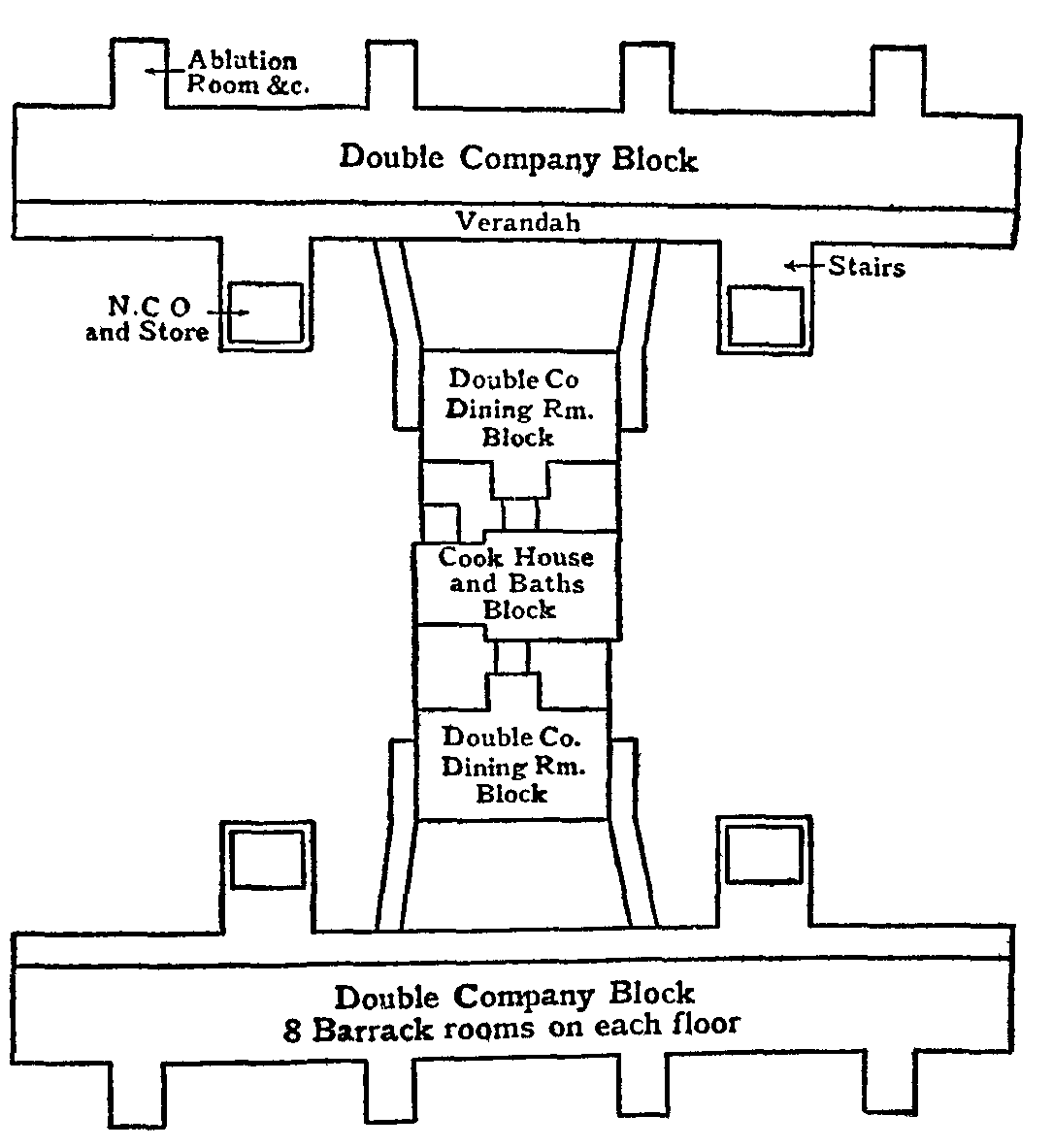
Next to the dining-room is the cook-house where the meals for a half battalion are cooked, and served direct to the dining-rooms on each side. Wash-up rooms are arranged off the serving-lobby with plate-racks and shelves for the storage of the crockery after it has been washed. The cooking apparatus is designed for economical use of coal fuel, and, if carefully used, consumes little more than ½ lb of coal per man per day. The cook-house is well lighted and ventilated by a top lantern; tables, dressers, and pastry slab are provided for preparing and serving the meals, and a sink for washing kitchen utensils. Under the kitchen block is a basement containing the boiler for heating the dining-rooms and another for the supply of hot water to baths and sinks, with in some cases also a hot-air furnace for heating drying-rooms, for drying the men's clothing when they come in wet from a route-march or field day. Not far from the barrack blocks is placed the recreation establishment or soldiers' club, where the rank and file may go for relaxation and amusement when off duty; this establishment has, on the ground floor, a large and lofty room with a stage at one end for lectures or entertainments, and at the other end is a supper bar, extending across the room, where mineral waters and other light refreshments are sold; tables are also arranged for suppers. A grocery shop is provided where the men and their families may purchase goods bought under regimental arrangements at wholesale prices, and sold without more profit than is necessary to keep the institution self-supporting. On the first floor are billiard and games room, reading-room and library, and writing-room. The manager's quarter and kitchen premises complete the establishment. Near the recreation establishment is the canteen, devoted solely to the sale of beer, and not permitted to vie in attractiveness with the recreation establishment. A bar is provided for the soldiers, a separate room for corporals, and a jug department for the supply of the families; this building also has a manager's quarter attached to it, and an office for the checking of accounts.
For the senior non-commissioned officers a sergeants' mess is provided, containing dining-room, reading-room and billiard-room, with kitchen premises and liquor store, which also has a jug department for the sergeants' families. The single non-commissioned officers have all their meals in this mess, and the married members also use it as a club. The warrant officers, and the proportion of non-commissioned officers and men who are on the married establishment, are provided with accommodation at some little distance from the men's barracks. In all recent schemes, on open sites, self-contained cottages have been built, and these are more popular than the older pattern of tenement buildings approached by common staircases or verandahs. The warrant officers are allowed a living-room, kitchen, and scullery, with three bedrooms and a bathroom. The married soldiers have a living-room, scullery, and one, two, or three bedrooms according to the size of their families. A laundry is provided adjacent to the married quarters, equipped with washing-troughs, wringer, drying-closet, and ironing-room; and the women are encouraged to use this in preference to doing washing in their cottages.
Officers' Quarters.—At a little distance from the men's barracks, and usually looking over the parade or cricket ground, is the officers' mess. This building has an entrance-hall with band alcove, where the band plays on guest nights; on one side of the hall is the mess-room (or dining-room), and on the other the anteroom (or reading-room), whilst the billiard-room and kitchen are kept to the back so that lantern lights can be arranged for. A mess office is provided, and all the accessories required for the mess waiters' department, including pantry, plate-closet and cellarage, and for the kitchen or mess-man's department, with also a quarter for the mess-man. The officers' quarters are usually arranged in wings extending the frontage of the mess building, and in a storey over the mess itself. Each officer has a large room, part of which is partitioned off for a bedroom, and the field officers are allowed two rooms. The soldier servant, told off to each officer, has a small room allotted for cleaning purposes, and bathrooms, supplied with hot water from the mess kitchen, are centrally situated. A detached house, containing three sitting-rooms, seven bed- and dressing-rooms, bathroom, kitchen, servants' hall, and the usual accessories, is provided for the commanding officer: also a smaller house, having two sitting-rooms, four bedrooms, bath, kitchen, &c., for the quartermaster. Other regimental married officers are not provided for, and have to arrange to house themselves, a lodging allowance being usually granted.
Regimental Accessories.—Apart from the buildings providing accommodation, others are required for administrative and military purposes. These are the guard house and regimental offices, the small-arm ammunition store, the fire-engine house, the drill and gymnastic hall, and the medical inspection block with dispensary, where the sick are seen by a medical officer and either prescribed for or sent into hospital, as may be necessary. Stables are provided for the officers' and transport horses, and a vehicle shed and storehouse for the mobilization equipment. Stores are required for bread, meat, coal, clothing, and for musketry, signalling, and general small stores under the quartermaster's charge—also workshops for armourers, carpenters, plumbers, painters and glaziers, shoemakers, and tailors. Mention of the fives court, recreation ground and parade ground completes the description of a battalion barrack.
Cavalry Barracks.—The accommodation provided for cavalry is very similar to that already described for infantry. The barrack blocks are arranged to suit the organization of the regiment, and are placed so that the men can turn out readily and get to their horses. Detached buildings are provided for cavalry troop stables, one block for the horses of each troop. Formerly stables were often built for convenience with the barrack-rooms over them; but this system has been abandoned on sanitary grounds, to the benefit of both men and horses. Each horse is given 1500 cub. ft. of air space, the horses' heads are turned to the outer walls, and provision is made, by traversed air-ducts below the mangers, for fresh air to be supplied to the horses while lying down. Above the horses' heads are windows which are arranged to open inwards, being hinged at the bottom and fitted with hopper checks to avoid direct draught. Ridge ventilation and skylights are given, so that all parts of the stable are well lighted and airy.
Cast-iron mangers and hay-racks are provided, and the horses are separated by bails, with chains to manger brackets and heel posts; saddle brackets are fixed to the heel posts. Each stable has a troop store, where spare saddles and gear are kept; also an expense forage store, in which the day's ration, after issue in bulk from the forage barn, is kept until it is given out in feeds. The stables are paved with blue Staffordshire paving bricks, graded to a collecting channel carrying the drainage well clear of the building, before it is taken into a gully.
The space between the blocks of stables is paved with cement concrete to form a yard, and horse-troughs, litter-sheds and dung-pits are provided. Officers' stables are built in separate blocks, and usually have only one row of stalls; the stalls are divided by partitions, and separate saddle-rooms are provided. Stalls and loose boxes in infirmary stables give 2000 cub. ft. of air space per horse and are placed at some distance from the troop stables in a separate enclosure. A forge and shoeing shed is provided in a detached block near the troop stables. A forage barn and granary is usually built to hold a fortnight's supply, and a chaff-cutter driven by horse power is fixed close by. Cavalry regiments each have a large covered riding school, and a number of open manèges, for exercise and riding instruction.
Artillery, &c.—The accommodation provided for horse and field artillery is arranged to suit their organization in batteries and brigades, and is generally similar to that already described, with the addition of vehicle sheds for guns and ammunition wagons, and special shops for wheelers and saddlers. Accommodation for other units follows the general lines already laid down, but has to be arranged to suit the particular organization and requirements of each unit.
Garrison Accessories.—In every large military station in addition to the regimental buildings which have been described, a number of buildings and works are required for the service of the garrison generally. Military hospitals are established at home and abroad for the treatment of sick officers and soldiers as well as their wives and families. Military hospitals are classified as follows:—First-grade hospitals are large central hospitals serving important districts. These hospitals are complete in themselves and fully equipped for the carrying out of operations of all kinds; they generally contain wards for officers, and may have attached to them separate isolation hospitals for the treatment of infectious cases, and military families' hospitals for women and children. Second-grade hospitals are smaller in size and less fully equipped, but are capable of acting independently and have operation rooms. Third-grade hospitals or reception stations are required for small stations principally, to act as feeders to the large hospitals, and to deal with accident and non-transportable cases. The principles of construction of military hospitals do not differ materially from the best modern civil practice; all are now built on the pavilion system with connecting corridors arranged so as to interfere as little as possible with the free circulation of air between the blocks. The site is carefully selected and enclosed with railings. The administration block is centrally placed, with ward blocks on each side, and accessory buildings placed where most convenient; the isolation wards are in a retired position and divided off from the hospital enclosure. Ward blocks usually have two storeys, and the ordinary large wards provide 1200 cub. ft. of air space per patient. A due proportion of special case and other special wards is arranged in which the space per patient is greater or less, as necessary.
Army schools are built to give slightly more liberal accommodation than is laid down as the minimum by the Board of Education, but the principles of planning are much the same as in civil elementary schools. Schools are usually placed between the married quarters and the barracks, so as to serve both for the instruction of the men, when working for educational certificates, and for the education of the children of the married soldiers. Garrison churches are built when arrangements for the troops to attend divine service at neighbouring places of worship cannot well be made. Only two military prisons now remain, viz. Dover and Curragh, and these are for soldiers discharged from the service with ignominy. For ordinary sentences detention barracks and branch detention barracks are attached to the military commands and districts: these are constructed in accordance with the home office regulations; but crime in the army fortunately continues to decrease, and little accommodation has recently been added. Barrack expense stores for the issue of bedding, utensils and other stores for which the troops depend upon the Army Service Corps, are necessary in all barracks; and in large stations a supply depot for the issue of provisions, with abattoir and bakery attached to it, may be necessary. An engineer office with building yard and workshops to deal with the ordinary duties in connexion with the upkeep of War Department property is required at every station, and for large stations such as Aldershot, it may be necessary to undertake special water supply schemes, works for disposal of sewage, and for the supply of electricity or gas for lighting the barracks. The system of roads, pipes and mains within the barracks are in all cases maintained by the Royal Engineers, as well as the buildings themselves. District and brigade offices are necessary for the administration of large units, and quarters for the general officer commanding and the headquarters staff may sometimes be required.
Location of Barracks.—The selection of a healthy site for a barrack building or new military station is a matter of great importance. In the earlier days of barrack construction, barracks were, for political reasons, usually built in large towns, where troops would be at hand for putting down disturbances, and cramped and inconvenient buildings of many storeys, were erected on a small piece of ground often surrounded by the worst slums of the city; such, for example, were the Ship Street barracks in Dublin, and the cavalry barracks at Hulme, Manchester. Worse still were cases where an existing building, such as the Linen Hall in Dublin, was purchased, and converted into barracks with little regard for the convenience of the occupants, and a total disregard for the need of a free circulation of pure air in and about the buildings, which is the first condition of health. In the present day, except in a few cases where strong local influence is allowed to prevail to retain troops in towns, where their presence, and perhaps the money they spend, are appreciated for patriotic or other motives, every opportunity is taken to move troops from the vicinity of crowded towns, and quarter them in barracks or hutments built in the open country. Due regard can then be given to sanitary location, and military training can more effectively be carried out. With improvements in communication by rail, road and telegraph, support to the civil power in case of disturbance can always be afforded in good time, without permanently stationing troops in the actual locality where their assistance may be needed. It has been recognized ever since the Crimean War, that the leading principle of barrack policy must, in the future, be to facilitate in peace time the training of the army for war, and that this can only be done by quartering troops in large bodies, including all branches of the service, in positions where they have space for training, gun and rifle practice, and manœuvring. The camps at Aldershot, Colchester, Shorncliffe and Curragh were accordingly started between 1856 and 1860, and the same policy has since been continued by the acquisition of Strensall Common, near York, Kilworth domain, near Fermoy, the lease of a portion of Dartmoor and a large area at Glen Imaal in Co. Wicklow, and the purchase of the Stobs estate in Scotland and of a large part of Salisbury Plain.
Barrack Construction.—The history of barrack construction in Great Britain is an interesting study, but can only be touched on briefly. As long as operations in the field were carried on by troops levied especially for the war in hand, no barracks apart from fortifications were required, except those for the royal bodyguard; and even after the standing army exceeded those limits, the necessity for additional barracks was often avoided by having recourse to the device of billeting, i.e. quartering the soldiers on the populations of the towns where they were posted. This, however, was a device burdensome to the people, subversive of discipline, and prejudicial to military efficiency in many ways, while it exposed the scattered soldiers to many temptations to disloyalty. Hence barracks were gradually provided, at first in places where such an arrangement was most necessary owing to the paucity of the population, or where concentration of troops was most important, owing to the disaffection of some of the inhabitants. The earliest barracks of which there is any record as regards England, were those for the foot guards, erected in 1660. Among the earliest of those still existing are the Royal Barracks at Dublin, dating from 1700, and during the 18th century barracks were built in several parts of Ireland; but in England it was at the end of the 18th and beginning of the 19th century that most of the earlier barracks were constructed. So long as barracks were mainly in connexion with fortresses their construction naturally fell to the duty of the King's Engineers, afterwards the Corps of Engineers, working under the master-general of the ordnance. About 1796, however, a special civil department was formed under the commissioners for the affairs of barracks, to deal with barracks apart from fortifications. In 1816 we find a warrant appointing a civilian comptroller of the barrack department to deal with the erection and upkeep of barracks and barrack hospitals not within fortified places. This warrant gives one of the earliest records of the nature of accommodation provided, and a few extracts from it are worth notice. No definite regulations as to cubic or floor space per man are laid down; but in the infantry, twelve men, and in the cavalry, eight men are allotted to one room. "Bedsteads or berths" are allowed, "a single one to each man, or a double one to two men," or "hammocks where necessary." The married soldier's wife is barely recognized, as shown by the following extract:—"The Comptroller of the barrack department may, if he sees fit, and when it in no shape interferes with or straitens the accommodation of the men, permit (as an occasional indulgence, and as tending to promote cleanliness, and the convenience of the soldier) four married women per troop or company of sixty men, and six per troop or company of a hundred men, to be resident within the barracks; but no one article shall on this account be furnished by the barrack-masters, upon any consideration whatever. And if the barrack-masters perceive that any mischief, or damage, arises from such indulgence, the commanding officer shall, on their representation, displace such women. Nor shall any dogs be suffered to be kept in the rooms of any barrack or hospital." Another regulation says: "Where kitchens are provided for the soldiers, they shall not be allowed to dress their provisions in any other places." In about 1818 the civil barrack department was abolished on account of abuses which had grown up, and the duke of Wellington as master-general of the ordnance and commander-in-chief transferred to the corps of Royal Engineers the duties of construction and maintenance of barracks. In 1826 a course of practical architecture was started at the school of military engineering at Chatham under Lieutenant-Colonel (afterwards Sir Charles) Pasley, the first commandant of the school, who himself wrote an outline of the course. Wellington interested himself in the barrack question, and under his orders single iron bedsteads were substituted for the wooden berths, two tiers high, in which two men slept in the same bed, then a certain cubical space per man was allotted, and cook-houses and ablution-rooms were added. Next, sergeants' messes were started, and ball courts allowed for the recreation of the men. It was not, however, till after the Crimean War that public attention was directed by the report dated 1857 of the royal commission on the sanitary state of the army, to the high death-rate, and certain sanitary defects in barracks and hospitals, such as overcrowding, defective ventilation, bad drainage and insufficient means of cooking and cleanliness, to which this excessive mortality was among other causes assigned.
In 1857 a commission appointed for improving the sanitary condition of barracks and hospitals made an exhaustive inspection of the barracks in the United Kingdom, and reported in 1861. This was followed by similar commissions to examine the barracks in the Mediterranean stations and in India. These commissions, besides making valuable recommendations for the improvement of almost every barrack inspected by them, laid down the general sanitary principles applicable to the arrangement and construction of military barracks and hospitals; and in spite of the lapse of time, the reports repay close study by any one interested in sanitary science as applied to the construction and improvement of such buildings. The names of Sidney Herbert (afterwards Lord Herbert of Lea), Captain (afterwards Sir Douglas) Gallon, R.E., and John Sutherland, M.D., stand out prominently among those who contributed to the work. The commission was constituted a standing body in 1862, and continues its work to the present day, under the name of the Army Sanitary Committee, which advises the secretary of state for war on all sites for new barracks or hospitals, also upon type plans, especially as to sanitary details, and principles of sanitary construction and fitments. A definite standard of accommodation was laid down, which formed the basis of the first issue of the Barrack Synopsis in 1865. A general order dated 1845 had directed that a space of 450 to 500 cub. ft. per man should be provided in all new barracks at home stations; but this had not been applied in existing barracks or buildings appropriated as such, and when detailed examination was made, it was found that some men had actually less than 250 cub. ft., and out of accommodation for nominally 76,813 soldiers, 2003 only had 600 cub. ft. per man, which was the minimum scale now laid down by the royal commission of 1857. To give every soldier his allotted amount of 600 cub. ft., meant a reduction in accommodation of the barracks by nearly one-third the number. Many buildings were condemned as being entirely unsuitable for use as barracks; in other cases improvements were possible by alterations to buildings and opening-up of sites. Ventilation of the rooms was greatly improved, cook-houses, ablution-rooms and sanitary accessories were carefully examined and a proper scale laid down. Separate quarters for the married soldiers did not exist in many barracks, and in some instances married men's beds were found in the men's barrack-rooms without even a screen to separate them; in other cases, married people were accommodated together in a barrack-room, with only a blanket hung on a cord as a screen between the different families. The recommendations of the committee resulted in a single room being allotted to all married soldiers, and this accommodation has gradually improved up to the comfortable cottage now provided.
From the time of this first thorough inquiry into barrack accommodation, steady and systematic progress has been made. Although lack of funds has always hampered rapid progress, and keeps the accommodation actually existing below the standard aimed at, much has been done to improve the soldiers' condition in this respect. Numerous regimental depots and other barracks were built under the Military Forces Localization Act of 1872. The Barracks Act of 1890 replaced the worn-out huts at Aldershot, Colchester, Shorncliffe and Curragh by convenient and sanitary permanent buildings, and further additions and improvements have been made under the Military Works Acts of 1897, 1899 and 1901. As some evidence of the practical result of the care and money that has been expended on this work, it is interesting to note that while, in 1857, the annual rate of mortality in the army at home per 1000 men was 17.5 (compared with 9.2 for the civil male population of corresponding age), forty years later, in 1897, the rate of mortality in the army was only 3.42 per 1000. No doubt, improved barrack accommodation contributed greatly to this result. Barrack construction work remained in the hands of the Corps of Royal Engineers until 1904, when a civil department was again formed under an architect styled "director of barrack construction," to deal with the construction of barracks at home stations, and the construction and maintenance of military hospitals.
British Colonial.—Barracks at colonial stations are governed by the general scale of accommodation in the Barrack Synopsis, modified according to the climate of the station, in the direction of increase in floor area and height of rooms. In the planning of rooms for occupation in tropical or sub-tropical countries provision has to be made for the freest possible circulation of air through the buildings. The walls have to be protected by verandahs from the direct rays of the sun, and the special local domestic arrangements have to be taken into consideration. For example, in hot countries it is usually undesirable to have kitchens directly attached to the dwelling-houses, sanitary arrangements vary according to the method's adopted, and in some cases it is necessary to provide a free circulation of air below the ground floors of all inhabited buildings by raising them off the ground some 4 ft. The aspect of the buildings will usually be arranged so as to catch the prevailing wind, and the mode of construction varies greatly according to the custom and resources of the country.
Indian Barracks.—In India, barracks for the British troops are built by the Royal Engineer officers detailed for military work duties, assisted by military foremen, who pass through the civil engineering colleges, and by a native subordinate staff. The scale of accommodation to be provided is laid down in the Indian army regulations, and is for the private soldier more liberal than is allowed by the home government for any of the colonial stations. The barrack-rooms are lofty and airy, with verandahs all round, and clerestory windows. Roofs are usually of double tiling. The allowance of space is 90 sq. ft. per man in rooms 16 ft. high, with, in addition, a day room adjoining for the use of the men for their meals or as a sitting-room. Recreation establishments are liberally provided for, and other means of recreation, such as bowling and skittle alleys, fives courts, plunge baths and cricket grounds, are given. Separate blocks of married quarters are provided, and schools for the children. Hospital accommodation on a higher scale than at home is necessary; but hill sanatoria have in recent years done much to improve the health of the troops by giving change of air, during the hot weather, to a large proportion of the men and families. Piped water supplies have replaced the old wells at many stations, and attention is being directed to improved cooking and sanitary arrangements.
Naval Barracks.—In recent years, large naval barracks have been built, notably at Portsmouth, Chatham and Devonport. These differ from military barracks principally in that they keep up the system of board-ship life to which the men are accustomed. Large barrack-rooms are provided with caulked floors like ships' decks, and have rows of hammocks slung across them; these are stowed in the day-time, when the rooms are used as mess-rooms. Ablution and sanitary arrangements are grouped together on the basement floors. Fine recreation establishments and canteens have been built. The officers' messes have splendid public rooms, but the officers' quarters are not so large as in military barracks, though no doubt spacious to the naval officer, accustomed as he is to a small cabin. Married quarters for the men are not provided except in connexion with coastguard stations.
Other Countries.—A great number of the German and French barracks are erected in the form of a large block of three or four storeys containing all the accommodation and accessories for officers, married and single non-commissioned officers and men, of a complete battalion or regiment in one building. Some of the modern barracks, however, are arranged more on the pavilion system with separate blocks; but the single block system is well liked on account of its compactness and the facility it gives for supervision; it is also more satisfactory from the architectural point of view. The system of allotment and arrangement of accommodation for these two great armies does not differ much, except in detail, from that adopted by the British army. The floor and cubic space allotted per man is a little less; accommodation for officers is not usually provided, except to a limited extent, unless the barracks are on a country site. The German army, however, now provides every regiment with a fine officers' mess-house furnished at the public expense. Married quarters for some of the non-commissioned officers are provided, but not for privates. American barracks are interesting, as providing for perhaps a higher class of recruit than usual; they are well designed and superior finish internally is given. The barracks are arranged usually on the separate block system, and centre round a post-exchange or soldiers' club, which is a combined recreation establishment, gymnasium and sergeants' mess, with bath-house attached. Canteens for the sale of liquor were abolished in 1901.
See The Barrack Synopsis (1905); The Handbook of Design and Construction of Military Buildings (1905); The Army Regulations, India, vol. xii.
(E. N. S.)
BARRANDE, JOACHIM (1799-1883), Austrian geologist and palaeontologist, was born at Saugues, Haute Loire, on the 11th of August 1799, and educated in the École Polytechnique at Paris. Although he had received the training of an engineer, his first appointment was that of tutor to the duc de Bordeaux (afterwards known as the comte de Chambord), grandson of Charles X., and when the king abdicated in 1830, Barrande accompanied the royal exiles to England and Scotland, and afterwards to Prague. Settling in that city in 1831, he became occupied in engineering works, and his attention was then attracted to the fossils from the Lower Palaeozoic rocks of Bohemia. The publication in 1839 of Murchison's Silurian System incited Barrande to carry on systematic researches on the equivalent strata in Bohemia. For ten years (1840-1850) he made a detailed study of these rocks, engaging workmen specially to collect fossils, and in this way he obtained upwards of 3500 species of graptolites, brachiopoda, mollusca, crustacea (particularly trilobites) and fishes. The first volume of his great work, Système silurien du centre de la Bohême (dealing with trilobites), appeared in 1852; and from that date until 1881, he issued twenty-one quarto volumes of text and plates. Two other volumes were issued after his death in 1887 and 1894. It is estimated that he spent nearly £10,000 on these works. In addition he published a large number of separate papers. In recognition of his important researches the Geological Society of London in 1855 awarded to him the Wollaston medal.
The term Silurian was employed by Barrande, after Murchison, in a more comprehensive sense than was justified by subsequent knowledge. Thus the Silurian rocks of Bohemia were divided into certain stages (A to H)—the two lowermost, A and B without fossils (Azoic), succeeded by the third stage, C, which included the primordial zone, since recognized as part of the Cambrian of Sedgwick. The fourth stage (Étage D), the true lower Silurian, was described by Barrande as including isolated patches of strata with organic remains like those of the Upper Silurian. These assemblages of fossils were designated "Colonies," and regarded as evidence of the early introduction into the area of species from neighbouring districts, that became locally extinct, and reappeared in later stages. The interpretation of Barrande was questioned in 1854 by Edward Forbes, who pointed to the disturbances, overturns and crumplings in the older rocks as affording a more reasonable explanation of the occurrence of strata with newer fossils amid those containing older ones. Other geologists subsequently questioned the doctrine of "Colonies." In 1880 Dr J. E. Marr, from a personal study in the field, brought forward evidence to show that the repetitions of the fossiliferous strata on which the "Colonies" were based were due to faults. The later stages of Barrande, F, G and H, have since been shown by Emanuel Friedrich Heinrich Kayser (b. 1845) to be Devonian.
Despite these modifications in the original groupings of the strata, it is recognized that Barrande "made Bohemia classic ground for the study of the oldest fossiliferous formations." He died at Frohsdorf on the 5th of October 1883.
See "Sketch of the Life of Joachim Barrande," Geol. Mag. (1883), p. 529 (with portrait).
BARRANQUILLA, a city and port of Colombia, South America, capital of a province of the same name in the department of Atlantico, on the left bank of the Magdalena river about 7 m. above its mouth and 18½ m. by rail from its seaport, Puerto Colombia. Pop. (est. 1902) 31,000. Owing to a dangerous bar at the mouth of the Magdalena the trade of the extensive territory tributary to that river, which is about 60% of that of the entire country, must pass in great part through Barranquilla and its seaport, making it the principal commercial centre of the republic. Savanilla was used as a seaport until about 1890, when shoals caused by drifting sands compelled a removal to Puerto Colombia, a short distance westward, where a steel pier, 4000 ft. in length, has been constructed to facilitate the handling of freight. The navigation of the Magdalena is carried on by means of light-draught steamboats which ascend to Yeguas, 14 m. below Honda, where goods are transhipped by rail to the latter place, and thence by pack animals to Bogotá, or by smaller boats to points farther up the river. Barranquilla was originally founded in 1629, but attracted no attention as a commercial centre until about the middle of the 19th century, when efforts were initiated to secure the trade passing through Cartagena. The city is built on a low plain, is regularly laid out, and has many fine warehouses, public buildings and residences, but its greater part, however, consists of mud-walled cabins supported by bamboo (guadua) framework and thatched with rushes. The water-supply is drawn from the Magdalena, and the city is provided with telephone, electric light and tram services. Owing to periodical inundations, the surrounding country is but little cultivated, and the greater part of the population, which is of the mixed type common to the lowlands of Columbia, is engaged in no settled productive occupation.