Volume 3 — [E-Text Edition of Volume III - Part 1 of 2, Slice 3 of 3 - BANKS to BASSOON] (continued 6)
Reading edition
BARBICAN (from Fr. barbacane, probably of Arabic or Persian origin), an outwork for the defence of a gate or drawbridge; also a sort of pent-house or construction of timber to shelter warders or sentries from arrows or other missiles.
BARBIER, ANTOINE ALEXANDRE (1765-1825), French librarian and bibliographer, was born on the 11th of January 1765 at Coulommiers (Seine-et-Marne). He took priest's orders, from which, however, he was finally released by the pope in 1801. In 1794 he became a member of the temporary commission of the arts, and was charged with the duty of distributing among the various libraries of Paris the books that had been confiscated during the Revolution. In the execution of this task he discovered the letters of Huet, bishop of Avranches, and the MSS. of the works of Fénelon. He became librarian successively to the Directory, to the Conseil d'État, and in 1807 to Napoleon, from whom he carried out a number of commissions. He produced a standard work in his Dictionnaire des ouvrages anonymes et pseudonymes (4 vols., 1806-1809; 3rd edition 1872-1879). Only the first part of his Examen critique des dictionnaires historiques (1820) was published. He had a share in the foundation of the libraries of the Louvre, of Fontainebleau, of Compiègne and Saint-Cloud; under Louis XVIII. he became administrator of the king's private libraries, but in 1822 he was deprived of all his offices. Barbier died in Paris on the 5th of December 1825.
See also a notice by his son, Louis Barbier, and a list of his works prefixed to the 3rd edition of the Dict. des ouvrages anonymes et pseudonymes.
BARBIER, HENRI AUGUSTE (1805-1882), French dramatist and poet, was born in Paris on the 29th of April 1805. Inspired by the revolution of July he poured forth a series of eager, vigorous poems, denouncing, crudely enough, the evils of the time. They are spoken of collectively as the Iambes (1831), though the designation is not strictly applicable to all. As the name suggests, they are modelled on the verse of André Chénier. They include La Curée, La Popularité, L'Idole, Paris, Dante, Quatre-vingt-treize and Varsovie. The rest of Barbier's poems are forgotten, and when, in 1869, he received the long delayed honour of admission to the Academy, Montalembert expressed the general sentiment in his Barbier? mais il est mort! It was even asserted, though without foundation, that he was not the real author of the Iambes. He died at Nice on the 13th of February 1882. He collaborated with Léon de Wailly in the libretto of Berlioz's opera, Benvenuto Cellini, and his works include two series of poems on the political and social troubles of Italy and England, printed in later editions of Iambes et poèmes.
See also Sainte-Beuve, Portraits Contemporains, vol. ii.
BARBIER, LOUIS, known as the Abbé de la Rivière (1593-1670), French bishop, was born of humble parents in Vaudelaincourt, near Compiègne. He entered the church and made his way by his wit and cleverness, until he was appointed tutor, and then became the friend and adviser, of Gaston d'Orléans, brother of Louis XIII. He thus gained an entrance to the court, became grand almoner of the queen, and received the revenue of rich abbeys. In March 1655 he was named bishop of Langres, but he spent his time at court, where his wit was always in demand, and where he gained great sums by gambling. He died very rich.
BARBIERI, GIOVANNI FRANCESCO (otherwise called Guercino, from his squinting), (1591-1666), Italian historical painter, was born at Cento, a village not far from Bologna. His artistic powers were developed very rapidly, and at the age of seventeen he was associated with Benedetto Gennari (1550-1610), a well-known painter of the Bolognese school. The fame of the young painter spread beyond his native village, and in 1615 he removed to Bologna, where his paintings were much admired. His first style was formed after that of the Caracci; but the strong colouring and shadows employed by Caravaggio made a deep impression on his mind, and for a considerable period his productions showed evident traces of that painter's influence. Some of his latest pieces approach rather to the manner of his great contemporary Guido, and are painted with more lightness and clearness. Guercino was esteemed very highly in his lifetime, not only by the nobles and princes of Italy, but by his brother artists, who placed him in the first rank of painters. He was remarkable for the extreme rapidity of his execution; he completed no fewer than 106 large altar-pieces for churches, and his other paintings amount to about 144. His most famous piece is thought to be the St Petronilla, which was painted at Rome for Gregory XV. and is now in the Capitol. In 1626 he began his frescoes in the Duomo at Piacenza. Guercino continued to paint and teach up to the time of his death in 1666. He had amassed a handsome fortune by his labours. His life, by J. A. Calvi, appeared at Bologna in 1808.
His brother, Paolo Antonio Barbieri (1603-1649), was a celebrated painter of still life and animals. He chose for his subjects fruits, flowers, insects and animals, which he painted after nature with a lively tint of colour, great tenderness of pencil, and a strong character of truth and life.
BARBITON, or Barbitos (Gr. βάρβιτον or βάρβιτος; Lat. barbitus; Pers. barbat, barbud), an ancient stringed instrument known to us from the Greek and Roman classics, but derived from Persia. Theocritus (xvi. 45), the Sicilian poet, calls it an instrument of many strings, i.e. more than seven, which was by the Hellenes accounted the perfect number, as in the cithara of the best period. Anacreon,[1] (a native of Teos in Asia Minor) sings that his barbitos only gives out erotic tones. Pollux (Onomasticon iv. chap. 8, § 59) calls the instrument barbiton or barymite (from βαρύς, heavy and μίτος, a string), an instrument producing deep sounds; the strings were twice as long as those of the pectis and sounded an octave lower. Pindar (in Athen. xiv. p. 635), in the same line wherein he attributes the introduction of the instrument into Greece to Terpander, tells us one could magadize, i.e. play in two parts at an interval of an octave on the two instruments. The word barbiton was frequently used for the lyre itself. Although in use in Asia Minor, Italy, Sicily, and Greece, it is evident that the barbiton never won for itself a place in the affections of the Greeks of Hellas; it was regarded as a barbarian instrument affected by those only whose tastes in matters of art were unorthodox. It had fallen into disuse in the days of Aristotle,[2] but reappeared under the Romans.
In spite of the few meagre shreds of authentic information extant concerning this somewhat elusive instrument, it is possible nevertheless to identify the barbiton as it was known among the Greeks and Romans. From the Greek writers we know that it was an instrument having some feature or features in common with the lyre, which warranted classification with it. From the Persians and Arabs we learn that it was a kind of rebab or lute, or a chelys-lyre,[3] first introduced into Europe through Asia Minor by way of Greece, and centuries later into Spain by the Moors, amongst whom it was in the 14th century known as al-barbet.[4] There is a stringed instrument, as yet unidentified by name, of which there are at least four different representations in sculpture,[5] which combines the characteristics of both lyre and rebab, having the vaulted back and gradual narrowing to form a neck which are typical of the rebab and the stringing of the lyre. In outline it resembles a large lute with a wide neck, and the seven strings of the lyre of the best period, or sometimes nine, following the decadent lyre. Most authors in reproducing these sculptures showing the barbiton represent the instrument as boat-shaped and without a neck, as, for instance, Carl Engel. This is due to the fact that the part of the instrument where neck joins body is in deep shadow, so that the correct outline can hardly be distinguished, being almost hidden by hand on one side and drapery on the other.
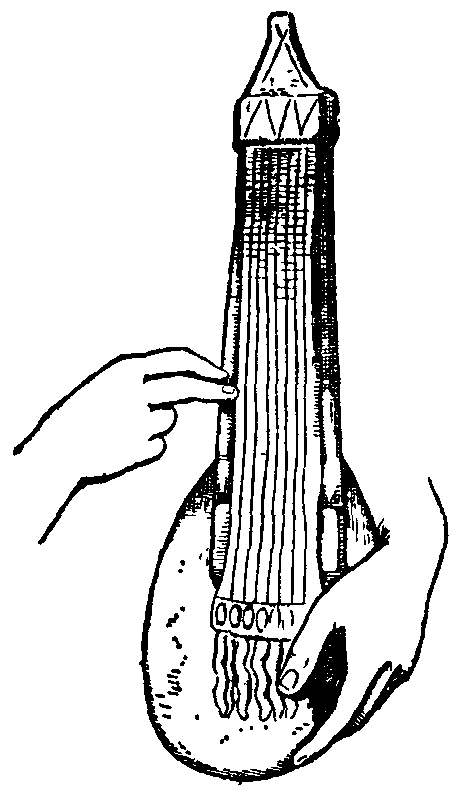
Barbiton, from a bas-relief in the Louvre, "Achilles at Scyros."
The barbiton, as pictured here, had probably undergone considerable modification at the hands of the Greeks and had diverged from the archetype. The barbiton, however, although it underwent many changes, retained until the end the characteristics of the instruments of the Greek lyre whose strings were plucked, whereas the rebab was sounded by means of the bow at the time of its introduction into Europe. At some period not yet determined, which we can but conjecture, the barbat approximated to the form of the large lute (q.v.). An instrument called barbiton was known in the early part of the 16th[6] and during the 17th century. It was a kind of theorbo or bass-lute, but with one neck only, bent back at right angles to form the head. Robert Fludd[7] gives a detailed description of it with an illustration:—"Inter quas instrumenta non nulla barbito simillima effinxerunt cujus modi sunt illa quae vulgo appellantur theorba, quae sonos graviores reddunt chordasque nervosas habent." The people called it theorbo, but the scholar having identified it with the instrument of classic Greece and Rome called it barbiton. The barbiton had nine pairs of gut strings, each pair being in unison. Dictionaries of the 18th century support Fludd's use of the name barbiton. G. B. Doni[8] mentions the barbiton, defining it in his index as Barbitos seu major chelys italice tiorba, and deriving it from lyre and cithara in common with testudines, tiorbas and all tortoiseshell instruments. Claude Perrault,[9] writing in the 18th century, states that "les modernes appellent notre luth barbiton" (the moderns call our lute barbiton). Constantijn Huygens[10] declares that he learnt to play the barbiton in a few weeks, but took two years to learn the cittern.
The barbat was a variety of rebab (q.v.), a bass instrument, differing only in size and number of strings. This is quite in accordance with what we know of the nomenclature of musical instruments among Persians and Arabs, with whom a slight deviation in the construction of an instrument called for a new name.[11] The word barbud applied to the barbiton is said to be derived[12] from a famous musician living at the time of Chosroes II. (A.D. 590-628), who excelled in playing upon the instrument. From a later translation of part of the same authority into German[13] we obtain the following reference to Persian musical instruments: "Die Sänger stehen bei seinem Gastmahl; in ihrer Hand Barbiton(i.) und Leyer(ii.) und Laute(iii.) und Flöte(iv.) und Deff (Handpauke)." Mr Ellis, of the Oriental Department of the British Museum, has kindly supplied the original Persian names translated above, i.e. (i.) barbut, (ii.) chang, (iii.) rubāb, (iv.) nei. The barbut and rubab thus were different instruments as late as the 19th century in Persia. There were but slight differences if any between the archetypes of the pear-shaped rebab and of the lute before the application of the bow to the former—both had vaulted backs, body and neck in one, and gut strings plucked by the fingers.
(K. S.)
BARBIZON, a French village, near the forest of Fontainebleau, which gave its name to the "Barbizon school" of painters, whose leaders were Corot, Rousseau, Millet and Daubigny, together with Diaz, Dupré, Jacque, Français, Harpignies and others. They put aside the conventional idea of "subject" in their pictures of landscape and peasant life, and went direct to the fields and woods for their inspiration. The distinctive note of the school is seen in the work of Rousseau and of Millet, each of whom, after spending his early years in Paris, made his home in Barbizon. Unappreciated, poor and neglected, it was not until after years of struggle that they attained recognition and success. They both died at Barbizon—Rousseau in 1867 and Millet in 1875. It is difficult now to realize that their work, so unaffected and beautiful, should have been so hardly received. To understand this, it is necessary to remember the conflicts that existed between the classic and romantic schools in the first half of the 19th century, when the classicists, followers of the tradition of David, were the predominant school. The romantic movement, with Géricault, Bonington and Delacroix, was gaining favour. In 1824 Constable's pictures were shown in the Salon, and confirmed the younger men in their resolution to abandon the lifeless pedantry of the schools and to seek inspiration from nature. In those troubled times Rousseau and Millet unburdened their souls to their friends, and their published lives contain many letters, some extracts from which will express the ideals which these artists held in common, and show clearly the true and firmly-based foundation on which their art stands. Rousseau wrote, "It is good composition when the objects represented are not there solely as they are, but when they contain under a natural appearance the sentiments which they have stirred in our souls.... For God's sake, and in recompense for the life He has given us, let us try in our works to make the manifestation of life our first thought: let us make a man breathe, a tree really vegetate." And Millet—"I try not to have things look as if chance had brought them together, but as if they had a necessary bond between themselves. I want the people I represent to look as if they really belonged to their station, so that imagination cannot conceive of their ever being anything else. People and things should always be there with an object. I want to put strongly and completely all that is necessary, for I think things weakly said might as well not be said at all, for they are, as it were, deflowered and spoiled—but I profess the greatest horror for uselessness (however brilliant) and filling up. These things can only weaken a picture by distracting the attention toward secondary things." In another letter he says—"Art began to decline from the moment that the artist did not lean directly and naively upon impressions made by nature. Cleverness naturally and rapidly took the place of nature, and decadence then began.... At bottom it always comes to this: a man must be moved himself in order to move others, and all that is done from theory, however clever, can never attain this end, for it is impossible that it should have the breath of life." The ideas of the "Barbizon school" only gradually obtained acceptance, but the chief members of it now rank among the greater artists of their time.
See D. Croal Thomson, The Barbizon School (1891), with a full list of the French authorities to be consulted; Jules Breton, Nos peintres du siècle, Paris, 1900.
BARBON, NICHOLAS (c. 1640-1698), English economist, probably the son of Praise-god Barbon, was born in London, studied medicine at Leiden, graduated M.D. at Utrecht in 1661, and was admitted an honorary fellow of the College of Physicians in 1664. He took a considerable part in the rebuilding of London after the great fire of 1666, and has a claim to be considered the institutor of fire-insurance in England, which he started somewhere about 1680. He was M.P. for Bramber in 1690 and 1695. He founded a land bank which, according to contemporaries, was fairly successful and was united with that of John Briscoe in 1696. He died in 1698. His writings are interesting as expressing views much in advance of his time and very near akin to those of modern times on such important topics as value, rent and foreign trade. The more important were Apology for the Builder; or a Discourse showing the Cause and Effects of the Increase of Building (1685); A Discourse of Trade (1690); and A Discourse Concerning Coining the New Money Lighter (1696).
BARBON (Barebone or Barebones), PRAISE-GOD (c. 1596-1679), English leather-seller and Fifth Monarchy man, was admitted freeman of the Leathersellers Company on the 20th of January 1623 and liveryman on the 13th of October 1634. About the same time he became minister to a congregation which assembled at his own house, "The Lock and Key," in Fleet Street, where his preaching attracted large audiences. The exact nature of his religious opinions is not perfectly clear. He is styled by his enemies a Brownist and Anabaptist, i.e. probably Baptist, but he wrote two books in support of paedobaptism, and his congregation had separated from a larger one of Baptists on that point of controversy. Later he belonged to the sect of Fifth Monarchy men. He was the object of the abuse and ridicule of the opposite party, and his meetings were frequently disturbed by riots. On the 20th of December 1641 his house was stormed by a mob and he narrowly escaped with his life. Barbon, who was a man of substantial property, was summoned by Cromwell on the 6th of June 1653 as a member for London to the assembly of nominees called after him in derision Barebone's Parliament. His name is occasionally mentioned, but he appears to have taken no part in the debates. In 1660 he showed great activity in endeavouring to prevent the Restoration. He published Needham's book, News from Brussels in a Letter from a Near Attendant on His Majesty's Person ..., which retailed unfavourable anecdotes relating to Charles's morals, and on the 9th of February he presented the petition to the Parliament, which proposed that all officials should abjure the Stuarts, and all publicly proposing the Restoration should be deemed guilty of high treason. His conduct drew upon him several royalist attacks. On the 31st of March he was obliged to sign an engagement to the council not to disturb the peace, and on the 26th of November 1661 he was arrested, together with John Wildman and James Harrington, and was imprisoned in the Tower till the 27th of July 1662, when he was released on bail. Barbon, who was married, was buried on the 5th of January 1680. He was the author of A Discourse tending to prove ... Baptism ... to be the ordinance of Jesus Christ. As also that the Baptism of Infants is warentable (1642), the preface of which shows a spirit of wide religious tolerance; and A Reply to the Frivolous and Impertinent answer of R. B. and E. B. to the Discourse of P. B. (1643).
BARBOUR, JOHN (? 1316-1395), Scottish poet, was born, perhaps in Aberdeenshire, early in the 14th century, approximately 1316. In a letter of safe-conduct dated 1357, allowing him to go to Oxford for study, he is described as archdeacon of Aberdeen. He is named in a similar letter in 1364 and in another in 1368 granting him permission to pass to France, probably for further study, at the university of Paris. In 1372 he was one of the auditors of exchequer, and in 1373 a clerk of audit in the king's household. In 1375 (he gives the date, and his age as 60) he composed his best known poem The Brus, for which he received, in 1377, the gift of ten pounds, and, in 1378, a life-pension of twenty shillings. Additional rewards followed, including the renewal of his exchequer auditorship (though he may have continued to enjoy it since his first appointment) and ten pounds to his pension. The only biographical evidence of his closing years is his signature as a witness to sundry deeds in the "Register of Aberdeen" as late as 1392. According to the obit-book of the cathedral of Aberdeen, he died on the 13th of March 1395. The state records show that his life-pension was not paid after that date.
Considerable controversy has arisen regarding Barbour's literary work. If he be the author of the five or six long poems which have been ascribed to him by different writers, he adds to his importance as the father of Scots poetry the reputation of being one of the most voluminous writers in Middle English, certainly the most voluminous of all Scots poets.
(1) The Brus, in twenty books, and running to over 13,500 four-accent lines, in couplets, is a narrative poem with a purpose partly historical, partly patriotic. It opens with a description of the state of Scotland at the death of Alexander III. (1286) and concludes with the death of Douglas and the burial of the Bruce's heart (1332). The central episode is the battle of Bannockburn. Patriotic as the sentiment is, it is in more general terms than is found in later Scots literature. The king is a hero of the chivalric type common in contemporary romance; freedom is a "noble thing" to be sought and won at all costs; the opponents of such freedom are shown in the dark colours which history and poetic propriety require; but there is none of the complacency of the merely provincial habit of mind. The lines do not lack vigour; and there are passages of high merit, notably the oft-quoted section beginning "A! fredome is a noble thing." Despite a number of errors of fact, notably the confusion of the three Bruces in the person of the hero, the poem is historically trustworthy as compared with contemporary verse-chronicle, and especially with the Wallace of the next century. No one has doubted Barbour's authorship of the Brus, but argument has been attempted to show that the text as we have it is an edited copy, perhaps by John Ramsay, a Perth scribe, who wrote out the two extant texts, preserved in the Advocates' library, Edinburgh, and in the library of St John's College, Cambridge. Extensive portions of the poem have been incorporated by Wyntoun (q.v.) in his Chronicle. The first printed edition extant is Charteris's (Edinburgh, 1571); the second is Hart's (Edinburgh, 1616).
(2) Wyntoun speaks (Chronicle III. iii.) of a "Treteis" which Barbour made by way of "a genealogy" of "Brutus lynagis"; and elsewhere in that poem there are references to the archdeacon's "Stewartis Oryginale." This "Brut" is unknown; but the reference has been held by some to be to (3) a Troy-book, based on Guido da Colonna's Historia Destructionis Troiae. Two fragments of such a work have been preserved in texts of Lydgate's Troy-book, the first in MS. Camb. Univ. Lib. Kk. v. 30, the second in the same and in MS. Douce 148 in the Bodleian library, Oxford. This ascription was first made by Henry Bradshaw, the librarian of Cambridge University; but the consensus of critical opinion is now against it. Though it were proved that these Troy fragments are Barbour's, there remains the question whether their identification with the book on the Stewart line is justified. The scale of the story in these fragments forces us to doubt this identification. They contain 595 + 3118 = 3713 lines and are concerned entirely with "Trojan" matters. This would be an undue allowance in a Scottish "genealogy."
(4) Yet another work was added to the list of Barbour's works by the discovery in the university library of Cambridge, by Henry Bradshaw, of a long Scots poem of over 33,000 lines, dealing with Legends of the Saints, as told in the Legenda Aurea and other legendaries. The general likeness of this poem to Barbour's accepted work in verse-length, dialect and style, and the facts that the lives of English saints are excluded and those of St Machar (the patron saint of Aberdeen) and St Ninian are inserted, made the ascription plausible. Later criticism, though divided, has tended in the contrary direction, and has based its strongest negative judgment on the consideration of rhymes, assonance and vocabulary (see bibliography). That the "district" of the author is the north-east of Scotland cannot be doubted in the face of a passage such as this, in the fortieth legend (St Ninian), 11, 1359 et seq.
"A lytil tale ȝet herd I tel, þat in to my tyme befel, of a gudman, in murrefe [Moray] borne in elgyne [Elgin], and his kine beforne, and callit was a faithful man vith al þame þat hyme knew than; & þis mare trastely I say, for I kend hyme weile mony day. John balormy ves his name, a man of ful gud fame."
But whether this north-east Scots author is Barbour is a question which we cannot answer by means of the data at present available.
(5) If Barbour be the author of the Legends, then (so does one conclusion hang upon another) he is the author of a Gospel story with the later life of the Virgin, described in the prologue to the Legends and in other passages as a book "of the birth of Jhesu criste" and one "quhare-in I recordit the genology of our lady sanct Mary."
(6) In recent years an attempt has been made to name Barbour as the author of the Buik of Alexander (a translation of the Roman d'Alexandre and associated pieces, including the Vœux du Paon), as known in the unique edition, c. 1580, printed at the Edinburgh press of Alexander Arbuthnot. The "argument" as it stands is nothing more than an exaggerated inference from parallel-passages in the Bruce and Alexander; and it makes no allowance for the tags, epithets and general vocabulary common to all writers of the period. Should the assumption be proved to be correct, and should it be found that the "Troy fragments were written first of all, followed by Alexander and Bruce or Bruce and Alexander, and that the Legends end the chapter," it will be by "evidence" other than that which has been produced to this date.
For Barbour's life see Exchequer Rolls of Scotland, ii. and iii.; Registrum Episcopatus Aberdonensis (Spalding Club); Rymer's Foedera.
Works.—(1)The Brus MSS. and early editions u.s. Modern editions: J. Pinkerton, 3 vols. (1790) (called by the editor "the first genuine edition," because printed from the Advocates' Library text, but carelessly); Jamieson (1820); Cosmo Innes (Spalding Club, 1856); W. W. Skeat (Early English Text Society, 1870-1889; reprinted, after revision by the editor, by the Scottish Text Society, 1893-1895). On the question of the recension of Barbour's text, see J. T. T. Brown, The Wallace and The Bruce restudied (Bonn, 1900). (2 and 3) Troy Fragments. C. Horstmann has printed the text in his Legendensammlung (ut infra). See Bradshaw, Transactions of the Cambridge Antiquarian Society (1866); the prolegomena in Horstmann's edition; Skeat, Brus (S. T. S. edit. u.s. pp. xlvi. et seq.); Köppel, "Die Fragmente von Barbours Trojanerkrieg," in Englische Studien, x. 373; Panton and Donaldson, The Gest Historiale of the Destruction of Troye (E. E. T. S. pt. ii. Introd. pp. x. et seq.); G. Neilson (ut infra); and J. T. T. Brown (ut supra) passim. (4) Legends of the Saints. C. Horstmann, who upholds Barbour's authorship, has printed the text in his Barbours des schottischen Nationaldichters Legendensammlung nebst den Fragmenten seines Trojanerkrieges, 2 vols. (Heilbronn, 1881-1882), and that of the legend of St Machor in his Altenglische Legenden. Neue Folge (Heilbronn, 1881) pp. 189-208. A later edition by W. M. Metcalfe, who disputes Barbour's claim, appeared in 1896 (Legends of the Saints in the Scottish Dialect of the Fourteenth Century, 3 vols., Scottish Text Society). See the introductions to these editions; also Skeat and Koppel u.s., and P. Buss, Sind die von Horstmann herausgegebenen schottischen Legenden ein Werk Barberes? (Halle, 1886) (cf. Anglia, ix. 3, 1886). (5) For the Gospel-story evidence see Metcalfe, u.s. I. xxix. (6) On the Alexander Book and its assumed relationships, see G. Neilson, John Barbour, Poet and Translator (1900) (a reprint from the Transactions of the Philological Society); J. T. T. Brown u.s., "Postscript," pp. 156-171; and Athenaeum, 17th of November, 1st and 8th December 1900, and the 9th of February 1901.
(G. G. S.)
BARBUDA, an island in the British West Indies. It lies 25 m. N. of Antigua, of which it is a dependency, in 17° 33′ N. and 61° 43′ W., and it has an area of 62 sq. m. Pop. (1901) 775. It is flat and densely wooded. On the western side there is a large lagoon, separated from the sea by a spit of sand. The part of the island under cultivation is very fertile, and the air is remarkable for its purity. Cattle and horses are bred and wild deer are still found. Salt and phosphates of lime are exported. The island was annexed by Great Britain in 1628 and was bestowed in 1680 upon the Codrington family who, for more than 200 years, held it as a kind of feudal fief.
BARBY, a town of Germany, in the kingdom of Prussia, on the left bank of the Elbe, 82 m. S.W. of Berlin on the direct railway to Cassel. Pop. (1900) 5136. It has two evangelical churches and a seminary for school teachers, which is housed in the former castle of the lords of Barby. The industries are mainly agricultural, but there are sugar factories and breweries. Here from 1749 to 1809 was a settlement of the Herrnhut evangelical brotherhood.
BARCA (mod. Merj), an ancient city founded in the territory of Cyrene in the middle of the 6th century B.C. Rising quickly to importance it became a rival of the older city, and gave its name to the western province of the latter's territory. The name as a provincial designation is still in occasional use, but is now applied to all the province of Bengazi. Barca is said to have owed its origin to Greek refugees flying from the tyranny of Arcesilaus II. (see Cyrene), but it is certain that it was rather a Libyan than a Greek town at all times. A Persian force invited by the notorious Pheretima, mother of Arcesilaus III., in revenge for Barcan support of a rival faction, sacked it towards the close of the 6th century and deported a number of its inhabitants to Bactria. Under Ptolemaic rule it began to decline, like Cyrene, and its port Ptolemais (Tolmeita) took its place: but after the Arab conquest (A.D. 641) it became the chief place of the Cyrenaica for a time and a principal station on the Kairawan road. Though now a mere village, Merj is still the chief centre of administration inland, and has a fort and small garrison. No ruins of earlier period than the late Roman and early Arab seem to be visible on the site. The latter lies, like Cyrene, about ten miles from the coast on the crest of Jebel Akhdar, here sunk to a low downland. It owed its early prosperity to its easy access to the sea, and to the fact that natural conditions in Cyrenaica and the Sahara behind it, tend to divert trade to the west of the district—a fact which is exemplified by the final survival of Berenice (mod. Bengazi). Merj stands in a rich but ill-cultivated stretch of red soil.
(D. G. H.)
BARCAROLE, or Barcarolle (Ital. barcaruola, a boat-song) properly a musical term for the songs sung by the Venetian gondoliers, and hence for an instrumental or vocal composition, generally in 6-8 time, written in imitation of their characteristic rhythm.
BARCELONA, a maritime province of north-eastern Spain, formed in 1833 out of districts belonging to the ancient kingdom of Catalonia, and bounded on the N.E. and E. by Gerona; S. by the Mediterranean Sea; S.W. by Tarragona; and W. and N.W. by Lérida. Pop. (1900) 1,054,541; area 2968 sq. m. Apart from a few tracts of level country along the coast and near Igualada, Manresa, Sabadell and Vich, almost the whole surface consists of mountain ranges, often densely wooded, rich in minerals and intersected by deep ravines. These ranges are outliers of the Pyrenees, which extend along the northern frontier, forming there the lofty Sierra del Cadi with the peak of Tosa (8317 ft.). Towards the sea, the altitudes become gradually less, although not with a uniform decrease; for several isolated peaks and minor ranges such as Montserrat and Monseny rise conspicuously amid the lower summits to a height of 4000-6000 ft. The central districts are watered by the Llobrégat, which rises at the base of the Sierra del Cadi, and flows into the sea near Barcelona, the capital, after receiving many small tributaries. The river Ter crosses the eastern extremity of the province.
Barcelona can be divided into three climatic zones; a temperate one near the sea, where even palm and orange trees grow; a colder one in the valleys and plains, more inland; and a colder still among the mountains, where not a few peaks are snow-clad for a great part of the year. Agriculture and stock-keeping are comparatively unimportant in this province, which is the centre of Spanish industry and commerce. In every direction the country looks like a veritable hive of human activity and enterprise, every town and village full of factories, and alive with the din of machinery. Lead, zinc, lignite, coal and salt are worked, and there are numerous mineral springs; but the prosperity of the province chiefly depends on its transit trade and manufactures. These are described in detail in articles on the chief towns. Barcelona (pop. 1900, 533,000), Badalona (19,240), Cardona (3855), Igualada (10,442), Manresa (23,252), Mataró (19,704), Sabadell (23,294), Tarrasa (15,956), Vich (11,628) and Villanueva y Geltru (11,856). Berga (5465), perhaps the Roman Castrum Bergium, on the Llobrégat, is the home of the Catalonian cotton industry. None of the rivers is navigable, and the roads are in general indifferent and insufficient. The province is better off in regard to railways, of which there are 349 m. Important lines radiate from the city of Barcelona north-east along the coast to Gerona and to Perpignan in France; south-west along the coast to Tarragona and Valencia; and west to Saragossa and Madrid. Several local railways link together the principal towns. For a general description of the people, and for the history of this region see Catalonia. The population is greater and increases more rapidly than that of any other Spanish province, a fact due not to any large excess of births over deaths, but to the industrial life which attracts many immigrants. In the last quarter of the 19th century the increase exceeded 200,000, while the average yearly number of emigrants was below 2000. In point of education this province is quite among the first in Spain, and as far back as 1880 there were 97,077 children enrolled on the school registers; the figures have since steadily increased.
BARCELONA, formerly the capital of Catalonia, and since 1833 the capital of the province of Barcelona in eastern Spain, in 41° 23′ N. and 2° 11′ E., on the Mediterranean Sea, and at the head of railways from Madrid, Saragossa, and Perpignan in France. Pop. (1900) 533,000. Barcelona is a flourishing city and the principal seaport of Spain. It is built on the sloping edge of a small plain between the rivers Besós, on the north, and Llobrégat, on the south. Immediately to the south-west the fortified hills of Montjuich rise to an altitude of 650 ft., while the view is bounded on the west by the heights which culminate in Tibidabo (1745 ft.), and on the north-east by the Montañas Matas. The greater part of the space thus enclosed is occupied by comparatively modern suburbs and gardens of almost tropical luxuriance, strongly contrasting with the huge factories and busy port of the original city in their midst.
Barcelona was formerly surrounded by a strong line of ramparts, and defended, or more correctly, overawed by a citadel on the north-east, erected in 1715 by Philip V.; but these fortifications being felt as a painful restriction on the natural development of the city, were, in spite of the opposition of the central government, finally abolished by the local authorities in 1845. The walls of the moat were utilized for the cellars of the houses which soon occupied the site of the ramparts, and the ground, which had been covered by the citadel, was laid out in gardens. A rapid extension of the city to the north-west took place, and in 1860 an elaborate plan for the laying out of new districts received the royal sanction. Barcelona thus comprises an old town, still consisting for the most part of irregular and narrow streets, and a new town built with all the symmetry and precision of a premeditated scheme. The buildings of the old town are chiefly of brick, from four to five storeys in height, with flat roofs, and other oriental peculiarities; while in the new town hewn stone is very largely employed, and the architecture is often of a modern English style. To the east, on the tongue of land that helps to form the port, lies the suburb of Barceloneta. It owes its origin to the marquis de la Mina, who, about 1754, did much for the city, and is regularly laid out, the houses being built of brick after a uniform pattern. The main street or axis of the old town is the Rambla, which has a fine promenade planted with plane-trees running down the middle, and contains the principal hotels and theatres of the city. The most important suburbs are Grácia, Las Corts de Sarriá, Horta, San Andrés de Palomar, San Gervasio de Cassolas, San Martin de Provensals and Sans. Exclusive of these, the city contains about 334,000 inhabitants, an increase of nearly 150,000 since 1857. Large numbers of immigrant artisans joined the population during the latter half of the 19th century, attracted by the great development of industry. Barcelona is the see of a bishop, and, like most Spanish towns, has a large number of ecclesiastical buildings, though by no means so many as it once possessed. No fewer than eighteen convents were still standing in 1873. The cathedral, erected between 1298 and 1448 on Monte Taber, an oval hill which forms the highest point of the Rambla, is one of the finest examples of Spanish Gothic; although it is not designed on a great scale and some parts have been freely modernized. It contains the early 14th-century tomb of Santa Eulalia, the patron saint of the city, besides many other monuments of artistic or historical interest. Its stained glass windows are among the finest in Spain, and it possesses archives of great value. Santa Maria del Mar, Santa Ana, Santos Justo y Pastor, San Pedro de las Puellas, and San Pablo del Campo are all churches worthy of mention.
The educational institutions of Barcelona have from an early period been numerous and important. The university (Universidad Literaria), which was originally founded in 1430 by the magistracy of the city, and received a bull of confirmation from Pope Nicholas V. in 1450, possessed at that time four faculties and thirty-one chairs all endowed by the corporation. It was suppressed in 1714, but restored in 1841, and now occupies an extensive building in the new town. There are, besides, an academy of natural sciences, a college of medicine and surgery—confirmed by a bull of Benedict XIII. in 1400—an academy of fine arts, a normal school, a theological seminary, an upper industrial school, an institution for the education of deaf-mutes, a school of navigation and many minor establishments. Gratuitous instruction of a very high order is afforded by the Board of Trade to upwards of 2000 pupils. The principal charitable foundations are the Casa de Caridad or house of charity, the hospital general, dating from 1401, and the foundling hospital. The principal civic and commercial buildings are the Casa Consistorial, a fine Gothic hall (1369-1378), the Lonja or exchange (1383), and the Aduana or custom-house (1792). At the seaward end of the Rambla is a large ancient structure, the Atarazanas or Arsenals, which was finished about 1243, and partly demolished in the 19th century to give a better view to the promenade. Remains of the former royal state of Barcelona are found in the Palacio Real of the kings of Aragon and the Palacio de la Reina. At the highest part of the city, in the Calle del Paradis, are some magnificent columns, and other Roman remains, which, however, are hidden by the surrounding buildings. Means of public recreation are abundantly supplied. There are many theatres, the two most important being the Teatro Principal, and the Teatro del Liceo, a very fine building, originally erected in 1845 on the site of a convent of Trinitarian monks. The number of restaurants and similar places of evening resort is very great, and there are several public courts where the Basque game of pelota can be witnessed.
The so-called port of Barcelona was at first only an open beach, on the east, slightly sheltered by the neighbouring hills, but at an early period the advantage of some artificial protection was felt. In 1438 Don Alphonso V. granted the magistracy a licence to build a mole; and in 1474 the Moll de Santa Creu was officially begun. Long after this, however, travellers speak of Barcelona as destitute of a harbour; and it is only in the 17th century that satisfactory works were undertaken. Until modern times all the included area was shut off from the open sea by a sand-bank, which rendered the entrance of large vessels impossible. An extension of the former mole, and the construction of another from the foot of Montjuich, have embraced a portion of the sea outside of the bank, and a convenient shelter is thus afforded for the heaviest battleships. From 1873 the work of extension and improvement was carried on systematically, with the addition of new quays, greater storage room, and better means for handling cargo. After thirty years of steady development, further plans were approved in 1903. At this time the port included an inner harbour, with a depth of 18 to 30 ft. at low tide, and an outer harbour with a depth of 20 to 35 ft. In the following year 8075 vessels of nearly 5,000,000 tons entered the port. Barcelona is well supplied with inland communication by rail, and the traffic of its streets is largely facilitated by tramway lines running from the port as far as Grácia and the other chief suburbs.
Barcelona has long been the industrial and commercial centre of eastern Spain—a pre-eminence which dates from the 12th and 13th centuries. It received a temporary check from the disasters of the Spanish-American War of 1898; but less than a year later it paid about £550,000 in industrial and commercial taxes, or more than 11% of the whole amount thus collected in the kingdom; and within five years it had become a port of regular call for thirty-five important shipping companies. It also contained the head offices of thirteen other lines, notably those of the Transatlantic Mail Company, which possessed a fleet of twenty-five fine steamships. Trades and industries give occupation to more than 150,000 hands of both sexes. The spinning and weaving of wool, cotton and silk are the principal industries, but the enterprising spirit of the Catalans has compelled them to try almost every industry in which native capital could attempt to compete with foreign, especially since the institution of the protectionist tariffs of 1892. The native manufacturers are quite able to compete in peninsular markets with foreign rivals. This prosperity has been in part due to the great development of means of communication around the city and in the four Catalan provinces. Comestibles, raw materials, and combustibles form the greater part of the imports, but this great manufactory also imports a considerable quantity of foreign manufactured goods. The principal exports are wines, cereals, olive-oil, cotton goods, soap, cigarette-paper, furniture and barrels, boots, shoes and leather goods, and machinery.
Barcino, the ancient name of the city, is usually connected with that of the Carthaginian Hamilcar Barca, its traditional founder in the 3rd century B.C. After the Roman conquest, it received from Augustus (27 B.C.-A.D. 14) the name of Julia Faventia (afterwards Augusta and Pia), with the status of a Roman colony; and thenceforward it rapidly grew to be the leading mart of the western Mediterranean, rivalling Tarraco (Tarragona) and Massilia (Marseilles) as early as the 2nd century A.D. As its remains testify, the Roman city occupied Monte Taber. The bishopric of Barcelona was founded in 343. In 415 and 531, the Visigoths chose Barcelona as their temporary capital; in 540 and 599 church councils were held there. Barcinona or Bardjaluna, as it was then called, was captured by the Moors in 713, and in 801 it passed, with the rest of Catalonia, under the dominion of the Franks. From 874 the counts of Barcelona ruled as independent monarchs. But the accession of larger resources due to the union between Catalonia and Aragon in 1149, brought the city to the zenith of its fame and wealth. Its merchant ships vied with those of Genoa, Venice and Ragusa, trading as far west as the North Sea and the Baltic, and as far east as Alexandria. In 1258 James I. of Aragon empowered Barcelona to issue its famous Consulado del Mar, a code of maritime law recognized as authoritative by many European states. Consuls represented Barcelona at the principal commercial centres on or near the Mediterranean; and the city was among the first communities to adopt the practice of marine insurance. But the union of Castile and Aragon in 1479 favoured other cities of Spain at the expense of Barcelona, whose commercial supremacy was transferred to the ports of western Spain by the discovery of America in 1492. The citizens attributed their misfortunes to the "Castilian" government, and a strong party among them favoured annexation by France. In 1640 Barcelona was the centre of the Catalonian rebellion against Philip IV., and threw itself under French protection. In 1652 it returned to its allegiance, but was captured by the duke of Vendôme in 1697. At the peace of Ryswick, in the same year, it was restored to the Spanish monarchy. During the War of the Succession (1701-1714) Barcelona adhered to the house of Austria. The seizure of Montjuich in 1705, and the subsequent capture of the city by the earl of Peterborough, formed one of his most brilliant achievements. In 1714 it was taken after an obstinate resistance by the duke of Berwick in the interests of Philip V., and at the close of the war was reluctantly reconciled to the Bourbon dynasty. In 1809 the French invaders of Spain obtained possession of the fortress and kept the city in subjection until 1814. Since then it has shared in most of the revolutionary movements that have swept over Spain, and has frequently been distinguished by the violence of its civic commotions. For the historic antagonism between the Catalans and the other inhabitants of Spain was strengthened by the industrial development of Barcelona. Among the enterprising and shrewd Catalans, who look upon their rulers as reactionary, and reserve all their sympathies for the Provençal neighbours whom they so nearly resemble in race, language and temperament, French influence and republican ideals spread rapidly; taking the form partly of powerful labour and socialist organizations, partly of less reputable bodies, revolutionary and even anarchist. Strikes are very common, seventy-three having occurred in such a year of comparative quiet as 1903; but the causes of disturbance are almost as often political as economic, and the annals of the city include a long list of revolutionary riots and bomb outrages. A strange contrast is presented by the co-existence of these turbulent elements with the more old-fashioned Spanish society of Barcelona. Church festivals, civic and ecclesiastical processions are almost as animated and picturesque as in Seville itself; and many medieval customs continue to flourish side by side with the most modern features of industrial life, giving to Barcelona a character altogether unique among Spanish cities.
The literature relating to Barcelona is extensive. For a general description of the city, see A. A. P. Arimon, Barcelona antigua y moderna, two illustrated folio volumes (Madrid, 1850); and J. Artigas y Feiner, Guia itineraria de Barcelona (Barcelona, 1888). For the antiquities, see S. Sampere, Topografia antigua de Barcelona (1890). The economic history of the city is dealt with by A. Capmany in his Memorias historicas sobra la marina, comercio, y artes de la antigua ciudad de Barcelona (Madrid, 1779-1792); and, for its political history, the same work should be consulted, together with Historias e conquestas dels comtes de Barcelona, by T. Tomich (Barcelona, 1888), and the Colecció de documents inédits del Arxin municipal de la ciutat de Barcelona (Barcelona, 1892). The spread of the revolutionary movement is traced by M. Gil Maestre, in his El Anarquismo en España, y el especial de Barcelona (Madrid, 1897), and in his La Criminalidad en Barcelona (Barcelona, 1886).
BARCELONA, a town and port of Venezuela, capital of the state of Bermudez, on the Neveri river, 3 m. from its mouth and 12 m. by rail from the port of Guanta, which has superseded the incommodious river port in the trade of this district. Pop. (est. 1904) 13,000. Built on the border of a low plain and having a mean annual temperature of 82° F., the town has the reputation of being unhealthy. There are salt works and important coal deposits in its vicinity, the latter at Naricual and Capiricual, 12 m. distant by rail. Though the adjacent country is fertile, its prosperity has greatly declined, and the exports of coffee, sugar, cacao and forest products are much less important than formerly. The town dates from 1637, when it was located at the foot of the Cerro Santo and was called Nueva Barcelona; it reached a state of much prosperity and commercial importance before the end of the century. The War of Independence, however, and the chronic political disorders that followed nearly ruined its industries and trade.
BARCELONNETTE, a town in the department of Basses-Alpes, in the S.E. of France. Pop. (1906) 2075. It is built at a height of 3717 ft. on the right bank of the Ubaye river, on which it is the most important place. It is situated in a wide and very fertile valley, and is surrounded by many villas, built by natives who have made their fortune in Mexico, and are locally known as les Américains. The town itself is mainly composed of a long street (flanked by two others), which is really the road from Grenoble to Cuneo over the Col de l'Argentière (6545 ft.). The only remarkable buildings in the town are a striking clock-tower of the 15th century (the remains of a Franciscan convent) and the Musée Chabrand, which contains a very complete collection of birds, both European and extra-European.
Refounded in 1231 by Raymond Bérenger IV., count of Provence (he was of the family of the counts of Barcelona, whence the name of the town he rebuilt), Barcelonnette passed to Savoy in 1388 (formal cession in 1419), and in 1713 by the treaty of Utrecht was ceded to France in exchange for the valleys of Exilles, Fénestrelles, and Château Dauphin (Casteldelfino). It was the birth-place of J. A. Manuel (1775-1827), the well-known Liberal orator at the time of the Restoration of 1815, after whom the principal square of the town is named.
See F. Arnaud, Barcelonnette et ses environs (Guide du C. A. F.) (1898), and La Vallée de Barcelonnette (1900).
(W. A. B. C.)
BARCLAY, ALEXANDER (c. 1476-1552), British poet, was born about 1476. His nationality is matter of dispute, but William Bulleyn, who was a native of Ely, and probably knew him when he was in the monastery there, asserts that he was born "beyonde the cold river of Twede"; moreover, the spelling of his name and the occasional Scottish words in his vocabulary point to a northern origin. His early life was spent at Croydon, but it is not certain whether he was educated at Oxford or Cambridge. It may be presumed that he took his degree, as he uses the title of "Syr" in his translation of Sallust, and in his will he is called doctor of divinity. From the numerous incidental references in his works, and from his knowledge of European literature, it may be inferred that he spent some time abroad. Thomas Cornish, suffragan bishop in the diocese of Bath and Wells, and provost of Oriel College, Oxford, from 1493 to 1507, appointed him chaplain of the college of St Mary Ottery, Devonshire. Here he translated Sebastian Brant's Ship of Fools, and even introduced his neighbours into the satire:—
"For if one can flatter, and beare a Hauke on his fist, He shall be parson of Honington or Cist."
The death of his patron in 1513 apparently put an end to his connexion with the west, and he became a monk in the Benedictine monastery of Ely. In this retreat he probably wrote his eclogues, but in 1520 "Maistre Barkleye, the Blacke Monke and Poete" was desired to devise "histoires and convenient raisons to florisshe the buildings and banquet house withal" at the meeting between Henry VIII. and Francis I. at the Field of the Cloth of Gold. He at length became a Franciscan monk of Canterbury. It is presumed that he conformed with the change of religion, for he retained under Edward VI. the livings of Great Baddow, Essex, and of Wokey, Somerset, which he had received in 1546, and was presented in 1552 by the dean and chapter of Canterbury to the rectory of All Hallows, Lombard Street, London. He died shortly after this last preferment at Croydon, Surrey, where he was buried on the 10th of June 1552. All the evidence in Barclay's own work goes to prove that he was sincere in his reproof of contemporary follies and vice, and the gross accusations which John Bale[1] brings against his moral character may be put down to his hatred of Barclay's cloth.
The Ship of Fools was as popular in its English dress as it had been in Germany. It was the starting-point of a new satirical literature. In itself a product of the medieval conception of the fool who figured so largely in the Shrovetide and other pageants, it differs entirely from the general allegorical satires of the preceding centuries. The figures are no longer abstractions; they are concrete examples of the folly of the bibliophile who collects books but learns nothing from them, of the evil judge who takes bribes to favour the guilty, of the old fool whom time merely strengthens in his folly, of those who are eager to follow the fashions, of the priests who spend their time in church telling "gestes" of Robin Hood and so forth. The spirit of the book reflects the general transition between allegory and narrative, morality and drama. The Narrenschiff of Sebastian Brant was essentially German in conception and treatment, but his hundred and thirteen types of fools possessed, nevertheless, universal interest. It was in reality sins and vices, however, rather than follies that came under his censure, and this didactic temper was reflected in Barclay. The book appeared in 1494 with woodcuts said to have been devised and perhaps partly executed by Brant himself. In these illustrations, which gave an impulse to the production of "enblems" and were copied in the English version, there appears a humour quite absent from the text. In the Latin elegiacs of the Stultifera Navis (1497) of Jacob Locher the book was read throughout Europe. Barclay's The Shyp of Folys of the Worlde was first printed by Richard Pynson in 1509. He says he translated "oute of Laten, Frenche, and Doche," but he seems to have been most familiar with the Latin version. He used a good deal of freedom in his translation, "sometyme addynge, sometyme detractinge and takinge away suche thinges as semeth me necessary and superflue." The fools are given a local colour, and Barclay appears as the unsparing satirist of the social evils of his time. At the end of nearly every section he adds an envoi of his own to drive home the moral more surely. The poem is written in the ordinary Chaucerian stanza, and in language which is more modern than the common literary English of his day.
Certayne Ecloges of Alexander Barclay, Priest, written in his youth, were probably printed as early as 1513, although the earliest extant edition is that in John Cawood's reprint (1570) of the Ship of Fools. They form, with the exception of Henryson's Robin and Makyn, the earliest examples of the English pastoral. The first three eclogues, in the form of dialogues between Coridon and Cornix, were borrowed from the Miseriae Curialium of Aeneas Sylvius Piccolomini (Pope Pius II.), and contain an eulogy of John Alcock, bishop of Ely, the founder of Jesus College, Cambridge. The fourth is based on Mantuan's eclogue, De consuetudine divitum erga poetas, with large additions. It contains the "Descrypcion of the towre of Virtue and Honour," an elegy on Sir Edward Howard, lord high admiral of England, who perished in the attack on the French fleet in the harbour of Brest in 1513. The fifth, printed by Wynkyn de Worde, also without date, is entitled the "Fyfte Eglog of Alexandre Barclay of the Cytezen and the uplondyshman" and is also based on Mantuan. Two shepherds, Amintas and Faustus, discuss the familiar theme of the respective merits of town and country life, and relate a quaint fable of the origin of the different classes of society. Barclay's pastorals contain many pictures of rustic life as he knew it. He describes for instance the Sunday games in the village, football, and the struggle for food at great feasts; but his eclogues were, like his Italian models, also satires on social evils. The shepherds are rustics of the Colin Clout type, and discuss the follies and corruptions around them. Barclay had, however, no sympathy with the anti-clerical diatribes of John Skelton, whom he more than once attacks. Bale mentions an Anti-Skeltonum which is lost. His other works are:—The Castell of Laboure (Wynkyn de Worde, 1506), from the French of Pierre Gringoire; the Introductory to write and to pronounce Frenche (Robert Copland, 1521); The Myrrour of Good Maners (Richard Pynson, not dated), a translation of the De quatuor virtutibus of Dominicus Mancinus; Cronycle compyled in Latyn by the renowned Sallust (Richard Pynson, no date), a translation of the Bellum Jugurthinum, The Lyfe of the glorious Martyr Saynt George (R. Pynson, c. 1530). The Lyfe of Saynte Thomas, and Haython's Cronycle, both printed by Pynson, are also attributed to Barclay, but on very doubtful grounds.
See T. H. Jamieson's edition of the Ship of Fools (Edinburgh, 1874), which contains an account of the author and a bibliography of his works; and J. W. Fairholt's edition of The Cytezen and Uplondyshman (Percy Soc. 1847), which includes large extracts from the other eclogues; also Zarncke's edition of Brant (Leipzig, 1854); and Dr Fedor Fraustadt, Über das Verhältnis von Barclays Ship of Fools zu den lateinischen, französischen und deutschen Quellen (1894). A prose version of Locher's Stultifera Navis, by Henry Watson, was printed by Wynkyn de Worde in 1518.
BARCLAY, JOHN (1582-1621), Scottish satirist and Latin poet, was born, on the 28th of January 1582, at Pont-à-Mousson, where his father William Barclay held the chair of civil law. His mother was a Frenchwoman of good family. His early education was obtained at the Jesuit College. While there, at the age of nineteen, he wrote a commentary on the Thebaid of Statius. In 1603 he crossed with his father to London. Barclay had persistently maintained his Scottish nationality in his French surroundings, and probably found in James's accession an opportunity which he would not let slip. He did not remain long in England, where he is supposed to have published the first part of his Satyricon, for in 1605 when a second edition of that book appeared in Paris, he was there, having already spent some time in Angers, and being now the husband of a French girl, Louise Debonaire. He returned to London with his wife in 1606, and there published his Sylvae, a collection of Latin poems. In the following year the second part of the Satyricon appeared in Paris. Barclay remained on in London till 1616. In 1609 he edited the De Potestate Papae, an anti-papal treatise by his father, who had died in the preceding year, and in 1611 he issued an Apologia or "third part" of the Satyricon, in answer to the attacks of the Jesuits and others who were probably embittered by the tone of the earlier parts of the satire. A so-called "fourth part," with the title of Icon Animorum, appeared in 1614. James I. is said to have been attracted by his scholarship, but particulars of this, or of his life in London generally, are not available. In 1616 he went to Rome, for some reason unexplained, and there resided till his death on the 15th of August 1621. He appears to have been on better terms with the Church and notably with Bellarmine; for in 1617 he issued, from a press at Cologne, a Paraenesis ad Sectarios, an attack on the position of Protestantism. The literary effort of his closing years was his best-known work the Argenis, completed about a fortnight before his death, which has been said to have been hastened by poison. The romance was printed in Paris in the same year.
Barclay's contemporary reputation as a writer was of the highest; by his strict scholarship and graceful style he has deserved the praise of modern students. The Satyricon, a severe satire on the Jesuits, is modelled on Petronius and catches his lightness of touch, though it shows little or nothing of the tone of its model, or of the unhesitating severity and coarseness of the humanistic satire of Barclay's age. The Argenis is a long romance, with a monitory purpose on the dangers of political intrigue, probably suggested to him by his experiences of the league in France, and by the catholic plot in England after James's accession. The work has been praised by all parties; and it enjoyed for more than a century after his death a remarkable popularity. Most of the innumerable editions are supplied with a key to the characters and names of the story. Thus Aneroëtus is Clement VIII; Arx non eversa is the Tower of London; Hippophilus and Radirobanes are the names of the king of Spain; Hyanisbe is Queen Elizabeth; Mergania, by an easy anagram, is Germany; Usinulca, by another, is Calvin. The book is of historical importance in the development of 17th century romance, including especially Fénelon's Télémaque. Ben Jonson appears, from an entry at Stationers' Hall on the 2nd of October 1623, to have intended to make a translation. Barclay's shorter poems, in two books, were printed in the Delitiae Poetarum Scotorum (Amsterdam, 1637, i. pp. 76-136). In the dedication, to Prince Charles of England, he refers to his earlier publication, the Sylvae.
The best account of Barclay is the preface by Jules Dukas in his bibliography of the Satyricon (Paris, 1889). This supersedes the life in Bayle's Dictionary, which had been the sole authority. A "fifth part" of the Satyricon appears in most of the editions, by Alethophilus (Claude Morisot). For the Argenis, see the dissertations by Léon Boucher (Paris, 1874), and Dupond (Paris, 1875). The Icon Animorum was Englished by Thomas May in 1631 (The Mirrour of Mindes, or Barclay's Icon Animorum). Barclay's works have never been collected.
BARCLAY, JOHN (1734-1798), Scottish divine, was born in Perthshire and died at Edinburgh. He graduated at St Andrews, and after being licensed became assistant to the parish minister of Errol in Perthshire. Owing to differences with the minister, he left in 1763 and was appointed assistant to Antony Dow of Fettercairn, Kincardine. In this parish he became very popular, but his opinions failed to give satisfaction to his presbytery. In 1772 he was rejected as successor to Dow, and was even refused by the presbytery the testimonials requisite in order to obtain another living. The refusal of the presbytery was sustained by the General Assembly, and Barclay thereupon left the Scottish church and founded congregations at Sauchyburn, Edinburgh and London. His followers were sometimes called Bereans, because they regulated their conduct by a diligent study of the Scriptures (Acts xvii. 11). They hold a modified form of Calvinism.
His works, which include many hymns and paraphrases of the psalms, and a book called Without Faith, without God, were edited by J. Thomson and D. Macmillan, with a memoir (1852).
BARCLAY, ROBERT (1648-1690), one of the most eminent writers belonging to the Society of Friends, or Quakers, was born in 1648 at Gordonstown in Morayshire. His father had served under Gustavus Adolphus, and pursued a somewhat tortuous course through the troubles of the civil war. Robert was sent to finish his education in Paris, and it appears he was at one time inclined to accept the Roman Catholic faith. In 1667, however, he followed the example of his father, and joined the recently-formed Society of Friends. In 1670 he married a Quaker lady, Christian Mollison of Aberdeen. He was an ardent theological student, a man of warm feelings and considerable mental powers, and he soon came prominently forward as the leading apologist of the new doctrine, winning his spurs in a controversy with one William Mitchell. The publication of fifteen Theses Theologiae (1676) led to a public discussion in Aberdeen, each side claiming a victory. The most prominent of the Theses was that bearing on immediate revelation, in which the superiority of this inner light to reason or scripture is sharply stated. His greatest work, An Apology for the True Christian Divinity, was published in Latin at Amsterdam in 1676, and was an elaborate statement of the grounds for holding certain fundamental positions laid down in the Theses. It was translated by its author into English in 1678, and is "one of the most impressive theological writings of the century." It breathes a large tolerance and is still perhaps the most important manifesto of the Quaker Society. Barclay experienced to some extent the persecutions inflicted on the new society, and was several times thrown into prison. He travelled extensively in Europe (once with Penn and George Fox), and had several interviews with Elizabeth, princess palatine. In later years he had much influence with James II., who as duke of York had given to twelve members of the society a patent of the province of East New Jersey, Barclay being made governor (1682-88). He is said to have visited James with a view to making terms of accommodation with William of Orange, whose arrival was then imminent. He died on the 3rd of October 1690.
BARCLAY, WILLIAM (1546-1608) Scottish jurist, was born in Aberdeenshire in 1546. Educated at Aberdeen University, he went to France in 1573, and studied law under Cujas, at Bourges, where he took his doctor's degree. Charles III., duke of Lorraine, appointed him professor of civil law in the newly-founded university of Pont-à-Mousson, and also created him counsellor of state and master of requests. In 1603, however, he was obliged to quit France, having incurred the enmity of the Jesuits, through his opposition to their proposal to admit his son John (q.v.) a member of their society. Returning to England, he was offered considerable preferment by King James on condition of becoming a member of the Church of England. This offer he refused, and returned to France in 1604, when he was appointed professor of civil law in the university of Angers. He died at Angers in 1608. His principal works were De Regno et Regali Potestate, &c. (Paris, 1600), a strenuous defence of the rights of kings, in which he refutes the doctrines of George Buchanan, "Junius Brutus" (Hubert Languet) and Jean Boucher; and De Potestate Papae, &c. (London, 1609), in opposition to the usurpation of temporal powers by the pope, which called forth the celebrated reply of Cardinal Bellarmine; also commentaries on some of the titles of the Pandects.
BARCLAY DE TOLLY, MICHAEL ANDREAS, called by the Russians Michael, Prince Bogdanovich (1761-1818), Russian field marshal, was born in Livonia in 1761. He was a descendant of a Scottish family which had settled in Russia in the 17th century. He entered the Russian army at an early age. In 1788-1789 he served against the Turks, in 1790 and 1794 against the Swedes and Poles. He became colonel in 1798 and major-general in 1799. In the war of 1806 against Napoleon, Barclay took a distinguished part in the battle of Pultusk and was wounded at Eylau, where his conduct won him promotion to the rank of lieut.-general. In 1808 he commanded against the Swedes in Finland, and in 1809 by a rapid and daring march over the frozen Gulf of Bothnia he surprised and seized Umeo. In 1810 he was made minister of war, and he retained the post until 1813. In 1812 Barclay was given command of one of the armies operating against Napoleon. There was very keen opposition to the appointment of a foreigner as commander-in-chief, and after he was defeated at Smolensk the outcry was so great that he resigned his command and took a subordinate place under the veteran Kutusov. Barclay was present at Borodino, but left the army soon afterwards. In 1813 he was re-employed in the field and took part in the campaign in Germany. After the battle of Bautzen he was reinstated as commander-in-chief of the Russian forces, and in this capacity he served at Dresden, Kulm and Leipzig. After the last battle he was made a count. He took part in the invasion of France in 1814 and at Paris received the baton of a field marshal. In 1815 he was again commander-in-chief of the Russian army which invaded France, and he was made a prince at the close of the war. He died at Insterburg in Prussia on the 14th (16th) of May 1818.
BARCOCHEBAS, Bar-Cochab, or Bar Kokba ("son of a star"), the name given in Christian sources to one Simeon, the leader in the Jewish revolt against Rome in the time of Hadrian (A.D. 132-135). The name does not appear in the Roman historians. In Rabbinic sources he is called Bar (Ben) Coziba, "son of deceit," which perhaps reflects the later verdict of condemnation recorded after his failure (root כזב "to be false"). Cochab is, therefore, the name either of his father or of his home. But it is recorded that the Rabbi ‛Aqība (q.v.), who recognized him as Messiah, applied Num. xxiv. 17 to him, reading not Cochab ("a star"), but Cosiba ("goes forth from Jacob"); thus Bar-cochab is a Messianic title of the "man of Cozeba" (cf. Chron. iv. 22) whose original name was recalled by later Rabbis with sinister intention. At first the Romans paid little attention to the insurgents, who were able to strike coins in the name of Simeon, prince of Israel, and Eleazar the priest, and to persecute the Christians, who refused to join the revolt. But troops were collected and the various fortresses occupied by the Jews were successively reduced. The end came with the fall of Beth-thar (Bethar). Extraordinary stories were told of the prowess of Barcochebas and of the ordeals to which he subjected his soldiers in the way of training.
See Eusebius H.E. iv. 6; Dio Cassius xix. 12-14; Schürer, Gesch. d. jüd. Volkes, 3rd ed. i. 682 ff.; Derenbourg, Hist. de la Palest. 423 ff. (distinguishes Barcochebas from Simeon); Schlattler, Gesch. Israels, 2nd ed. 303 ff.; articles Jews and Palestine, History; also art. s.v. "Bar Kokba" in Jewish Encyc. (S. Krauss).
BARD, a word of Celtic derivation (Gaelic baird, Cymric bardh, Irish bard) applied to the ancient Celtic poets, though the name is sometimes loosely used as synonymous with poet in general. So far as can be ascertained, the title bards, and some of the privileges peculiar to that class of poets, are to be found only among Celtic peoples. The name itself is not used by Caesar in his account of the manners and customs of Gaul and Britain, but he appears to ascribe the functions of the bards to a section of the Druids, with which class they seem to have been closely connected. Later Latin authors, such as Lucan (Phar. p. 447), Festus (De Verb. Sign. s.v.), and Ammianus Marcellinus (bk. xv.), used the term Bardi as the recognized title of the national poets or minstrels among the peoples of Gaul and Britain. In Gaul, however, the institution soon disappeared; the purely Celtic peoples were swept back by the waves of Latin and Teutonic conquest, and finally settled in Wales, Ireland, Brittany and the north of Scotland. There is clear evidence of the existence of bards in all these places, though the known relics belong almost entirely to Wales and Ireland, where the institution was more distinctively national. In Wales they formed an organized society, with hereditary rights and privileges. They were treated with the utmost respect and were exempt from taxes or military service. Their special duties were to celebrate the victories of their people and to sing hymns of praise to God. They thus gave poetic expression to the religious and national sentiments of the people, and therefore exercised a very powerful influence. The whole society of bards was regulated by laws, said to have been first distinctly formulated by Hywell Dha, and to have been afterwards revised by Gruffydd ap Conan. At stated intervals great festivals were held, at which the most famous bards from the various districts met and contended in song, the umpires being generally the princes and nobles. Even after the conquest of Wales, these congresses, or Eisteddfodau, as they were called (from the Welsh eistedd, to sit), continued to be summoned by royal commission, but from the reign of Elizabeth the custom has been allowed to fall into abeyance. They have not been since summoned by royal authority, but were revived about 1822, and are held regularly at the present time. In modern Welsh, a bard is a poet whose vocation has been recognized at an Eisteddfod. In Ireland also the bards were a distinct class with peculiar and hereditary privileges. They appear to have been divided into three great sections: the first celebrated victories and sang hymns of praise; the second chanted the laws of the nation; the third gave poetic genealogies and family histories. The Irish bards were held in high repute, and frequently were brought over to Wales to give instruction to the singers of that country.
In consequence, perhaps, of Lucan's having spoken of carmina bardi, the word bard began to be used, early in the 17th century, to designate any kind of a serious poet, whether lyric or epic, and is so employed by Shakespeare, Milton and Pope. On the other hand, in Lowland Scots it grew to be a term of contempt and reproach, as describing a class of frenzied vagabonds.
See Ed. Jones, Relics of the Welsh Bards (1784); Walker, Memoirs of the Irish Bards (1786); Owen Jones, Myvyrian Archaeology of Wales (3 vols., 1801-1807); W. F. Skene, Four Ancient Books of Wales (2 vols., 1868).
BARDAIṢĀN, an early teacher of Christianity in Mesopotamia, the writer of numerous Syriac works which have entirely perished[1] (with one possible exception, the Hymn of the Soul in the Acts of Thomas), and the founder of a school which was soon branded as heretical. According to the trustworthy Chronicle of Edessa, he was born in that city on the 11th Tammuz (July), A.D. 154. His parents were of rank and probably pagan; according to Barhebraeus, he was in youth a priest in a heathen temple at Mabbōg. Another probable tradition asserts that he shared the education of a royal prince who afterwards became king of Edessa—perhaps Abgar bar Manu, who reigned 202-217. He is said to have converted the prince to Christianity, and may have had an important share in christianizing the city. Epiphanius and Barhebraeus assert that he was first an orthodox Christian and afterwards an adherent of Valentinus; but Eusebius and the Armenian Moses of Chorene reverse the order, stating that in his later days he largely, but not completely, purged himself of his earlier errors. The earliest works attributed to him (by Eusebius and others) are polemical dialogues against Marcionism and other heresies; these were afterwards translated into Greek. He also wrote, probably under Caracalla, an apology for the Christian religion in a time of persecution. But his greatest title to fame was furnished by his hymns, which, according to St Ephrem, numbered 150 and were composed in imitation of the Davidic psalter. He thus became the father of Syriac hymnology, and from the favour enjoyed by his poems during the century and a half that intervened between him and St Ephrem we may conclude that he possessed original poetic genius. This would be clearly proved if (as is not unlikely) the beautiful Hymn of the Soul incorporated in the apocryphal Acts of Thomas could be regarded as proceeding from his pen; it is practically the only piece of real poetry in Syriac that has come down to us. Perhaps owing to the persecution under Caracalla mentioned above, Bardaiṣān for a time retreated into Armenia, and is said to have there preached Christianity with indifferent success, and also to have composed a history of the Armenian kings. Porphyry states that on one occasion at Edessa he interviewed an Indian deputation who had been sent to the Roman emperor, and questioned them as to the nature of Indian religion. He was undoubtedly a man of wide culture. He died (according to the patriarch Michael) in 222.
For our knowledge of Bardaiṣān's doctrine we are mainly dependent on the hostile witness of St Ephrem, and on statements by Greek writers who had no acquaintance with his works in their original form. His teaching had certain affinities with gnosticism. Thus he certainly denied the resurrection of the body; and so far as we can judge by the obscure quotations from his hymns furnished by St Ephrem he explained the origin of the world by a process of emanation from the supreme God whom he called "the Father of the living." On the other hand the dialogue known as the Book of the Laws of the Countries, which was written by a disciple and is quoted by Eusebius as a genuine exposition of the master's teaching—while it recognizes the influence of the celestial bodies over the body of man and throughout the material sphere and attributes to them a certain delegated authority[2]—upholds the freedom of the human will and can in the main be reconciled with orthodox Christian teaching. On this M. Nau has based his effort (see Une Biographie inédite de Bardesane l'astrologue, Paris, 1897; Le Livre des lois des pays, Paris, 1899) to clear Bardaiṣān of the reproach of gnosticism, maintaining that the charge of heresy arises from a misunderstanding of certain astrological speculations. It must be admitted that it is impossible to reconstruct Bardaiṣān's system from the few fragments remaining of his own work and therefore a certain verdict cannot be given. But the ancient testimony to the connexion of Bardaiṣān with Valentinianism is strong, and the dialogue probably represents a modification of Bardesanist teaching in the direction of orthodoxy. The later adherents of the school appear to have moved towards a Manichean dualism.
The subject is exhaustively discussed in Hort's article "Bardaisan" in Dict. Christ. Biog., and a full collection of the ancient testimonies will be found in Harnack's Altchristliche Litteratur, vol. i. pp. 184 ff.
(N. M.)
BARDILI, CHRISTOPH GOTTFRIED (1761-1808), German philosopher, was born at Blaubeuren in Württemberg, and died at Stuttgart. His system has had little influence in Germany; Reinhold (q.v.) alone expounded it against the attacks of Fichte and Schelling. Yet in some respects his ideas opened the way for the later speculations of Schelling and Hegel. He dissented strongly from the Kantian distinction between matter and form of thought, and urged that philosophy should consider only thought in itself, pure thought, the ground or possibility of being. The fundamental principle of thought is, according to him, the law of identity; logical thinking is real thinking. The matter upon which thought operated is in itself indefinite and is rendered definite through the action of thought. Bardili worked out his idea in a one-sided manner. He held that thought has in itself no power of development, and ultimately reduced it to arithmetical computation. He published Grundriss der ersten Logik (Stuttgart, 1800); Über die Gesetze der Ideenassociation (Tübingen, 1796); Briefe über den Ursprung der Metaphysik (Altona, 1798); Philos. Elementarlehre (Landshut, 1802-1806); Beiträge zur Beurteilung des gegenwärtigen Zustandes der Vernunftlehre (Landshut, 1803).
See C. L. Michelet, Geschichte der letzten Systeme; J. E. Erdmann, Versuch einer Geschichte d. neu. Phil. Bd. iii. pt. i.; B's und Reinholds Briefwechsel.
BARDOUX, AGÉNOR (1820-1897), French statesman, was a native of Bourges. Established as an advocate at Clermont, he did not hesitate to proclaim his republican sympathies. In 1871 he was elected deputy of the National Assembly, and re-elected in 1876 and in 1877. In the chamber he was president of the group of the left centre, standing strongly for the republic but against anti-clericalism. After the coup d'état of the 16th of May, he was one of the leaders of the "363." In the republican chamber elected after the 16th of May, he became minister of public instruction (December 1877), and proposed various republican laws, notably on compulsory primary education. He resigned in 1879. He was not re-elected in 1881, but in December 1882 was named senator for life. He wrote essays on Les Légistes et leur influence sur la société française (1878); Le Comte de Montlosier et le Gallicanisme (1881); and published in 1882 his Dix Années de vie politique.
BARDOWIEK, a village of Germany, in the Prussian province of Hanover, 3 m. N. of Lüneburg on the navigable Ilmenau. Pop. 2000. Its trade consists entirely in agricultural produce. The Gothic parish church (c. 1400) incorporates remains of a cathedral of vast dimensions.
Bardowiek was founded in the 8th century by Charlemagne, who established a bishopric in it, and until its destruction by Henry the Lion in 1189, it was the most prosperous commercial city of north Germany. Its name is derived from the Longobardi, the tribe for whom it was the home and centre, and from it the colonization of Lombardy started.
BARDSEY (i.e. "Bards' Island": cf. Anglesey, "Angles' Island"; Welsh, Ynys Enlli, "isle of the current"), an island at the northern extremity of Cardigan Bay. The "sound" between Aberdaron point and the island is some 4 m. wide. Bardsey is included in Carnarvonshire, North Wales (but traditionally in S. Wales). On the N.W. side it has high cliffs. It is about 2½ m. long by ¾ m. broad, with an area of some 370 acres, a third of which is hilly. Barley and oats are grown. On the S.E. side is a fairly deep harbour. On the N.E. are the ruins of the tower of St Mary's abbey (13th century). There is no Anglican church, the inhabitants being Dissenters. They are farmers and fishermen. The lighthouse, with fixed light, 140 ft. high and visible for 17 m., is locally celebrated. The rectory of Aberdaron (on the mainland, opposite Bardsey), Penmachno and Llangwnadl (Llangwynhoedl), in Lleyn (S. Carnarvonshire), belong to St John's College, Cambridge. St Dubricius made the sanctuary famous, and died here in 612. Here was the burial-place of all the monks whose friends could afford to go thither with their bodies. All the great abbeys of England sent their quota. Roads to Bardsey—with the monks' wells, found at intervals of 7 to 9 m.—run from north, east and south. The remnant of priests fled thither (after the great massacre of Bangor-is-coed in 613, by Ethelfride of Northumbria) by the road of the Rivals (Yn Eifl) hill, S. Carnarvonshire, on which Pistyll farm still gives food gratis to all pilgrims or travellers. A part of the isle is one great cemetery of about 3 to 4 acres, with rude, rough graves as close to each other as possible, with slabs upon them. Though Aberdaron rectory does not belong to the isle, the farm "Cwrt" (Court), where the abbot held his court, still goes with Bardsey, which was granted to John Wynn of Bodvel, Carnarvonshire, after the battle and partial sack of Norwich by the Puritans in the Civil War; passing through Mary Bodvel to her husband, the earl of Radnor, who sold it to Dr Wilson of York. The doctor, in turn, sold it to Sir John Wynn, of Glynllifon and Bodfean Hall, Carnarvonshire. One of the Wynns, the 3rd Baron Newborough, was, at his wish, buried here. The archaeology and history of the isle are voluminous. Lady Guest's Mabinogion translation (i. p. 115, ed. of 1838) gives an account of the (legendary) Bardsey House of Glass, into which Merlin (Myrddin) took a magic ring, originally kept at Caerleon-on-Usk.
BARÈGES, a town of south-western France, in the department of Hautes-Pyrénées, in the valley of the Bastan, 25 m. S.S.W. of Bagnères-de-Bigorre by road. The town, which is situated at an altitude of 4040 ft., is hardly inhabited in the winter. It is celebrated for its warm sulphurous springs (75° to 111° F.), which first became generally known in 1675 when they were visited by Madame de Maintenon and the duke of Maine, son of Louis XIV. The waters, which are used for drinking and in baths, are efficacious in the treatment of wounds and ulcers and in cases of scrofula, gout, skin diseases, &c. There is a military hospital, founded in 1760. The town was formerly much exposed to avalanches and floods, which are now less frequent owing to the construction of embankments and replanting of the hillsides. It is a centre for mountain excursions. The light silk and wool fabric called barège takes its name from the place, where it was first made.
BAREILLY, or Bareli, a city and district of British India in the Bareilly or Rohilkhand division of the United Provinces. The city is situated on the Ramganga river, 812 m. N.W. from Calcutta by rail. Pop. (1901) 131,208. The principal buildings are two mosques built in the 17th century; a modern fort overlooking the cantonments; the railway station, which is an important junction on the Oudh and Rohilkhand line; the palace of the nawab of Rampur, and the government college. Bareilly is the headquarters of a brigade in the 7th division of the eastern army corps. The chief manufactures are furniture and upholstery. Bareilly college is a seat of upper class learning for the surrounding districts. It is conducted by an English staff, and its course includes the subjects for degrees in the Calcutta University.
The district of Bareilly has an area of 1580 sq. m. It is a level country, watered by many streams, the general slope being towards the south. The soil is fertile and highly cultivated, groves of noble trees abound, and the villages have a neat, prosperous look. A tract of forest jungle, called the tarai, stretches along the extreme north of the district, and teems with large game, such as tigers, bears, deer, wild pigs, &c. The river Sarda or Gogra forms the eastern boundary of the district and is the principal stream. Next in importance is the Ramganga, which receives as its tributaries most of the hill torrents of the Kumaon mountains. The Deoha is another great drainage artery and receives many minor streams. The Gomati or Gumti also passes through the district. The population in 1901 was 1,090,117. The Mahommedans are chiefly the descendants of Yusafzai Afghans, called the Rohilla Pathans, who settled in the country about the year 1720. The Rohillas were formerly the ruling race of the tract of country called Rohilkhand, and are men of a taller stature, a fairer complexion and a more arrogant air than the general inhabitants of the district. Bishop Heber described them as follows:—"The country is burdened with a crowd of lazy, profligate, self-called sawars (cavaliers), who, though many of them are not worth a rupee, conceive it derogatory to their gentility and Pathan blood to apply themselves to any honest industry, and obtain for the most part a precarious livelihood by sponging on the industrious tradesmen and farmers, on whom they levy a sort of blackmail, or as hangers-on to the wealthy and noble families yet remaining in the province. These men have no visible means of maintenance, and no visible occupation except that of lounging up and down with their swords and shields, like the ancient Highlanders, whom in many respects they much resemble." The Rohillas, after fifty years' precarious independence, were subjugated in 1774 by the confederacy of British troops with the nawab of Oudh's army, which formed so serious a charge against Warren Hastings. Their territory was in that year annexed to Oudh. In 1801 the nawab of Oudh ceded it to the Company in commutation of the subsidy money. During the Mutiny of 1857 the Rohillas took a very active part against the English, but since then they have been disarmed. Both before and after that year, however, the Bareilly Mahommedans have distinguished themselves by fanatical tumults against the Hindus. The district is irrigated from the Rohilkhand system of government canals. There are no manufactures except for domestic use and little external trade. Several lines of the Oudh and Rohilkhand railway pass through the district.
BARENTIN, a town of northern France, in the department of Seine-Inférieure, 11 m. N.N.W. of Rouen by rail. Pop. (1906) 5245. The town is situated in the valley of the Austreberthe, a small affluent of the Seine, here crossed at a height of 100 ft. by a fine railway viaduct 540 yds. long. The manufacture of cotton fabrics is the principal industry.
BARENTS, WILLEM (d. 1597), Dutch navigator, was born about the middle of the 16th century. In 1594 he left Amsterdam with two ships to search for a north-east passage to eastern Asia. He reached the west coast of Novaya Zemlya, and followed it northward, being finally forced to turn back when near its northern extremity. In the following year he commanded another expedition of seven ships, which made for the strait between the Asiatic coast and Vaygach Island, but was too late to find open water; while his third journey equally failed of its object and resulted in his death. On this occasion he had two ships, and on the outward journey sighted Bear Island and Spitsbergen, where the ships separated. Barents' vessel, after rounding the north of Novaya Zemlya, was beset by ice and he was compelled to winter in the north; and as his ship was not released early in 1597, his party left her in two open boats on the 13th of June and most of its members escaped. Barents himself, however, died on the 30th of June 1597. In 1871 the house in which he wintered was discovered, with many relics, which are preserved at the Hague, and in 1875 part of his journal was found.
See The Three Voyages of Barents, by Gerrit de Veer, translated by the Hakluyt Society (1876) from de Veer's text (Amsterdam, 1598).
BARENTS SEA, that part of the Arctic Ocean which is demarcated by the north coast of Europe, the islands of Novaya Zemlya, Franz Josef Land and Spitsbergen, and smaller intervening islands; it was named after the Dutch navigator. Omitting the great inlet of the White Sea in the south, it extends from about 67° to 80° N., and from 20° to 60° E. The southern part, off the Murman coast of the Kola peninsula, is sometimes called the Murman Sea.
BARÈRE DE VIEUZAC, BERTRAND (1755-1841), one of the most notorious members of the French National Convention, was born at Tarbes in Gascony on the 10th of September 1755. The name of Barère de Vieuzac, by which he continued to call himself long after the renunciation of feudal rights on the famous 4th of August, was assumed from a small fief belonging to his father, a lawyer at Vieuzac. He began to practise as an advocate at the parlement of Toulouse in 1770, and soon earned a considerable reputation as an orator; while his brilliant and flowing style as a writer of essays led to his election as a member of the Academy of Floral Games of Toulouse in 1788. At the age of thirty he married. Four years later, in 1789, he was elected deputy by the estates of Bigorre to the states-general, which met in May. He had made his first visit to Paris in the preceding year. His personal appearance, his manners, social qualities and liberal opinions, gave him a good standing among the multitude of provincial deputies then thronging into Paris. He attached himself at first to the constitutional party; but he was less known as a speaker in the Assembly than as a journalist. His paper, however, the Point du Jour, according to Aulard, owes its reputation not so much to its own qualities as to the fact that the painter David, in his famous picture of the "Oath in the Tennis Court," has represented Barère kneeling in the corner and writing a report of the proceedings as though for posterity. The reports of the debates of the National Assembly in the Point du Jour, though not inaccurate, are as a matter of fact very incomplete and very dry. After the flight of the king to Varennes, Barère passed over to the republican party, though he continued to keep in touch with the duke of Orleans, to whose natural daughter, Paméla, he was tutor. Barère, however, appears to have been wholly free from any guiding principle; conscience he had none, and his conduct was regulated only by the determination to be on the side of the strongest. After the close of the National Assembly he was nominated one of the judges of the newly instituted court of cassation from October 1791 to September 1792. In 1792 he was elected deputy to the National Convention for the department of the Hautes-Pyrénées. At first he voted with the Girondists, attacked Robespierre, "a pygmy who should not be set on a pedestal," and at the trial of the king voted with the Mountain for the king's death "without appeal and without delay." He closed his speech with a sentence which became memorable: "the tree of liberty could not grow were it not watered with the blood of kings." Appointed member of the Committee of Public Safety on the 7th of April 1793, he busied himself with foreign affairs; then, joining the party of Robespierre, whose resentment he had averted by timely flatteries, he played an important part in the second Committee of Public Safety—after the 17th of July 1793—and voted for the death of the Girondists. He was thoroughly unscrupulous, stopping at nothing to maintain the supremacy of the Mountain, and rendered it great service by his rapid work, by the telling phases of his oratory, and by his clear expositions of the problems of the day. On the 9th Thermidor (July 27th, 1794) Barère hesitated, then he drew up the report outlawing Robespierre. In spite of this, in Germinal of the year III. (the 21st of March to the 4th of April 1795), the Thermidorians decreed the accusation of Barère and his colleagues of the Terror, Collot d'Herbois and Billaud-Varenne, and he was sent to the Isle of Oléron. He was removed to Saintes, and thence escaped to Bordeaux, where he lived in concealment for several years. In 1795 he was elected member of the Council of Five Hundred, but was not allowed to take his seat. Later he was used as a secret agent by Napoleon I., for whom he carried on a diplomatic correspondence. On the fall of Napoleon, Barère played the part of royalist, but on the final restoration of the Bourbons in 1815 he was banished for life from France as a regicide, and then withdrew to Brussels and temporary oblivion. After the revolution of July 1830 he reappeared in France, was reduced by a series of lawsuits to extreme indigence, accepted a small pension assigned him by Louis Philippe (on whom he had heaped abuse and railing), and died, the last survivor of the Committee of Public Safety, on the 13th of January 1841. (See also French Revolution.)