Volume 3 — [E-Text Edition of Volume III - Part 1 of 2, Slice 3 of 3 - BANKS to BASSOON] (continued 8)
Reading edition
Gospel of Barnabas.—We read in antiquity, e.g. in the Decretum Gelasii, of an apocryphal Gospel of Barnabas (see Apocryphal Literature), but we have no knowledge of its contents. There exists, however, in a single MS. in Italian a longish gospel with this title, written from a Mahommedan standpoint, but probably embodying materials partly Gnostic in character and origin. The Italian MS. was found by the Deist, John Toland, in a private collection at Amsterdam (see his Nazarenus, 1718); subsequently it came into the possession of Prince Eugene of Savoy, and finally was obtained with Eugene's library by the imperial library at Vienna. It has been edited, with an English translation (1907) by (Rev.) Lonsdale and Laura Ragg, who hold that it was the work of a Christian renegade to Mahommedanism about the 13th-16th century. See also preliminary notice in the Journal of Theol. Studies, vi. 424 ff. The old view held by Toland and others that the Italian was a translation from the Arabic is demonstrably wrong. The Arabic marginal notes are apparently partly pious ejaculations, partly notes for the aid of Arabic students. The work is highly imaginative and often grotesque, but it is pervaded by an unusually high ethical enthusiasm.
(J. V. B.)
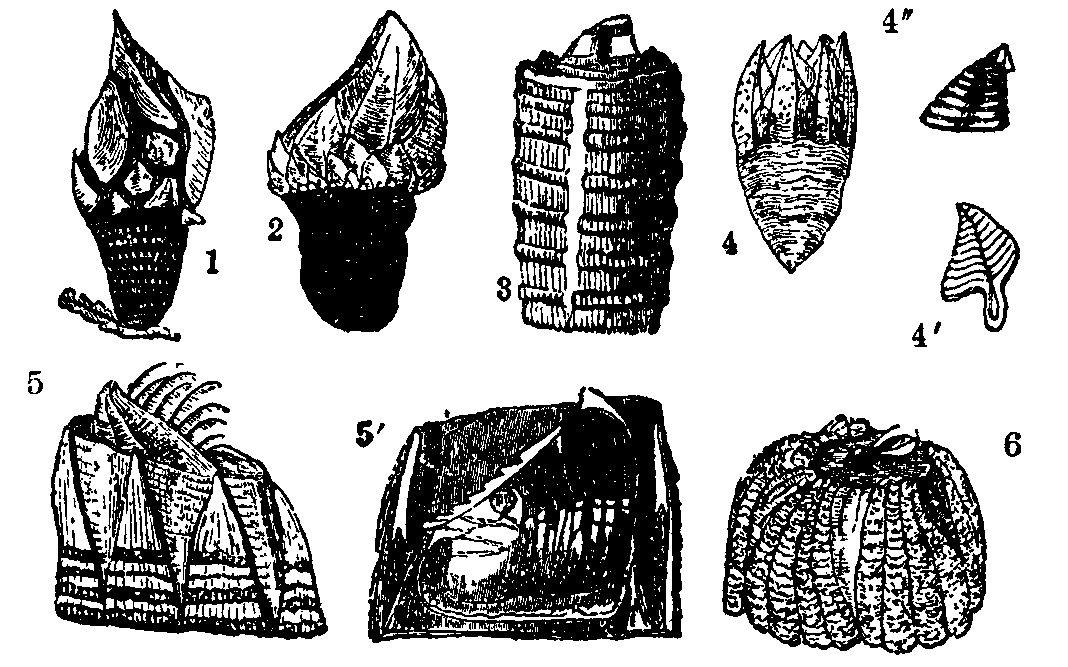
1. Scalpellum rostratum, Darwin, Philippine Islands. 2. Pollicipes cornucopiae, Leach, European seas. 3. Tubicinella trachealis, Shaw, attached to whales. 4. Acasta sulcata, Lamk., in sponges, New South Wales; (4′), tergum; (4″), scutum. 5. Balanus tintinnabulum, Linn., Atlantic. 5′. Section of Balanus, Linn. 6. Coronula diadema, Linn., attached to whales.
BARNACLE, a name applied to Crustacea of the division Cirripedia or Thyrostraca. Originally, the name was given to the stalked barnacles (Lepadidae of C. Darwin), which attach themselves in great numbers to drift-wood and other objects floating in the sea and are one of the chief agents in the fouling of ships' bottoms during long voyages. The sessile barnacles (Balanidae of Darwin) or "acorn-shells" are found in myriads, encrusting the rocks between tide-marks on all coasts. One of the most extraordinary and persistent myths of medieval natural history, dating back to the 12th century at least, was the cause of transferring to these organisms the name of the barnack or bernacle goose (Bernicla branta). This bird is a winter visitor to Britain, and its Arctic nesting-places being then unknown, it was fabled to originate within the shell-like fruit of a tree growing by the sea-shore. In some variants of the story this shell is said to grow as a kind of mushroom on rotting timber in the sea, and is obviously one of the barnacles of the genus Lepas. Even after the scientific study of zoology had replaced the fabulous tales of medieval writers, it was a long time before the true affinities of the barnacles were appreciated, and they were at first classed with the Mollusca, some of which they closely resemble in external appearance. It was not till Vaughan Thompson demonstrated, in 1830, their development from a free-swimming and typically Crustacean larva that it came to be recognized that, in Huxley's graphic phrase, "a barnacle may be said to be a Crustacean fixed by its head and kicking the food into its mouth with its legs." For a systematic account of the barnacles and their allies, see the article Thyrostraca.
(W. T. Ca.)
BARNARD, LADY ANNE (1750-1825), author of the ballad "Auld Robin Gray," the eldest daughter of James Lindsay, 5th earl of Balcarres, was born at Balcarres House, Fife, on the 12th of December 1750. She was married in 1793 to Andrew Barnard, a son of the bishop of Limerick, for whom she obtained from Henry Dundas (1st Viscount Melville) an appointment as colonial secretary at the Cape of Good Hope. Thither the Barnards went in March 1797, Lady Anne remaining at the Cape until January 1802. A remarkable series of letters written by Lady Anne thence to Dundas, then secretary for war and the colonies, was published in 1901 under the title South Africa a Century Ago. In 1806, on the reconquest of the Cape by the British, Barnard was reappointed colonial secretary, but Lady Anne did not accompany him thither, where he died in 1807. The rest of her life was passed in London, where she died on the 6th of May 1825. "Auld Robin Gray" was written by her in 1772, to music by the Rev. William Leeves (1748-1828), as he admitted in 1812. It was published anonymously in 1783, Lady Anne only acknowledging the authorship of the words two years before her death in a letter to Sir Walter Scott, who subsequently edited it for the Bannatyne Club with two continuations.
See the memoir by W. H. Wilkins, together with the original text of "Auld Robin Gray," prefixed to South Africa a Century Ago.
BARNARD, FREDERICK AUGUSTUS PORTER (1809-1889), American scientist and educationalist, was born in Sheffield, Massachusetts, on the 5th of May 1809. In 1828 he graduated, second on the honour list, at Yale. He was then in turn a tutor at Yale, a teacher (1831-1832) in the American Asylum for the Deaf and Dumb at Hartford, Connecticut, and a teacher (1832-1838) in the New York Institute for the Instruction of the Deaf and Dumb. From 1838 to 1848 he was professor of mathematics and natural philosophy, and from 1848 to 1854 was professor of chemistry and natural history in the University of Alabama, for two years, also, filling the chair of English literature. In 1854 he was ordained as deacon in the Protestant Episcopal Church. In the same year he became professor of mathematics and natural philosophy in the University of Mississippi, of which institution he was chancellor from 1856 until the outbreak of the Civil War, when, his sympathies being with the North, he resigned and went to Washington. There for some time he was in charge of the map and chart department of the United States Coast Survey. In 1864 he became the tenth president of Columbia College (now Columbia University) in New York City, which position he held until the year before his death, his service thus being longer than that of any of his predecessors. During this period the growth of the college was rapid; new departments were established; the elective system was greatly extended; more adequate provision was made for graduate study and original research, and the enrolment was increased from about 150 to more than 1000 students. Barnard strove to have educational privileges extended by the university to women as well as to men, and Barnard College, for women (see Columbia University), established immediately after his death, was named in his honour. He died in New York City on the 27th of April 1889. Barnard was a versatile man, of catholic training, a classical and English scholar, a mathematician, a physicist, and a chemist, a good public speaker, and a vigorous but somewhat prolix writer on various subjects, his annual reports to the Board of Trustees of Columbia being particularly valuable as discussions of educational problems. Besides being the editor-in-chief, in 1872, of Johnson's Universal Cyclopaedia, he published a Treatise on Arithmetic (1830); an Analytical Grammar with Symbolic Illustration (1836); Letters on Collegiate Government (1855); and Recent Progress in Science (1869).
See John Fulton's Memoirs of Frederick A. P. Barnard (New York, 1896).
BARNARD, GEORGE GREY (1863- ), American sculptor, was born at Bellefonte, Pennsylvania, on the 24th of May 1863. He first studied at the Art Institute, Chicago, and in 1883-1887 worked in P. T. Cavelier's atelier at Paris. He lived in Paris for twelve years, returning to America in 1896; and with his first exhibit at the Salon of 1894 he scored a great success. His principal works include, "The Boy" (1885); "Cain" (1886), later destroyed; "Brotherly Love," sometimes called "Two Friends" (1887); the allegorical "Two Natures" (1894, in the Metropolitan Museum, New York City); "The Hewer" (1902, at Cairo, Illinois); "Great God Pan" (in Central Park, New York City); the "Rose Maiden"; the simple and graceful "Maidenhood"; and sculptural decorations for the new Capitol building for the state of Pennsylvania at Harrisburg.
BARNARD, HENRY (1811-1900), American educationalist, was born in Hartford, Connecticut, on the 24th of January 1811. He graduated at Yale in 1830, and in 1835 was admitted to the Connecticut bar. In 1837-1839 he was a member of the Connecticut legislature, effecting in 1838 the passage of a bill, framed and introduced by himself, which provided for "the better supervision of the common schools" and established a board of "commissioners of common schools" in the state. Of this board he was the secretary from 1838 till its abolition in 1842, and during this time worked indefatigably to reorganize and reform the common school system of the state, thus earning a national reputation as an educational reformer. In 1843 he was appointed by the governor of Rhode Island agent to examine the public schools of the state, and recommended improvements; and his work resulted in the reorganization of the school system two years later. From 1845 to 1849 he was the first commissioner of public schools in the state, and his administration was marked by a decided step in educational progress. Returning to Connecticut, he was, from 1851 to 1855, "superintendent of common schools," and principal of the State Normal School at New Britain, Conn. From 1859 to 1860 he was chancellor of the University of Wisconsin and agent of the board of regents of the normal school fund; in 1866 he was president of St John's College, Annapolis, Maryland; and from 1867 to 1870 he was the first United States commissioner of education, and in this position he laid the foundation for the subsequent useful work of the Bureau of Education. His chief service to the cause of education, however, was rendered as the editor, from 1855 to 1881, of the American Journal of Education, the thirty-one volumes of which are a veritable encyclopaedia of education, one of the most valuable compendiums of information on the subject ever brought together through the agency of any one man. He also edited from 1838 to 1842, and again from 1851 to 1854, the Connecticut Common School Journal, and from 1846 to 1849 the Journal of the Rhode Island Institute of Instruction. He died at Hartford, Conn., on the 5th of July 1900. Among American educational reformers, Barnard is entitled to rank next to Horace Mann of Massachusetts.
See a biographical sketch by A. D. Mayo in the Report of the Commissioner of Education for 1896-1897 (Washington, 1898), and W. S. Monroe's Educational Labours of Henry Barnard (Syracuse, 1893).
BARNARD, JOHN, English musician, was a minor canon of St Paul's in the reign of Charles I. He was the first to publish a collection of English cathedral music. It contains some of the finest 16th-century masterpieces, ranging from the "faux-bourdon" style of Tallis's Pieces and Responses to the most developed types of full anthem. The text, however, is not trustworthy.
BARNARD CASTLE, a market-town in the Barnard Castle parliamentary division of Durham, England, 17 m. W. of Darlington by a branch of the North Eastern railway. Pop. of urban district (1901) 4421. It is beautifully situated on the steep left bank of the Tees. A noteworthy building in the town is the octagonal town-hall, dating from 1747. There are a few picturesque old houses, and a fragment of an Augustinian convent. St Mary's church, in a variety of styles from Norman onward, contains some curious monuments; but the building of chief interest is the castle, which gives the town its name, and is the principal scene of Sir Walter Scott's Rokeby. The remains extend over a space of more than six acres. A remarkable building known as the Bowes' Mansion and Museum, bequeathed in 1874 to the town by a descendant of Sir George Bowes, contains a valuable collection of works of art. In the vicinity of the town are Egglestone Abbey, beautifully situated on the Yorkshire bank of the river, Rokeby Park on the same bank, at the confluence of the Greta, and the massive 14th century castle of Raby to the north-east. The principal manufacture is shoe-thread. The corn-market is important.
As part of the lordship of Gainford, Barnard Castle is said to have been granted by William Rufus to Guy Baliol Bernard, son of Guy Baliol, who built the castle, and called it after himself, Castle Bernard. To the men of the town which grew up outside the castle walls he gave, about the middle of the 12th century, a charter making them burgesses and granting them the same privileges as the town of Richmond in Yorkshire. This charter was confirmed by Bernard Baliol, son of the above Bernard. Other confirmation charters were granted to the town by Hugh, John, and Alexander Baliol. The castle and lordship remained in the hands of the Baliols until John Baliol, king of Scotland, forfeited them with his other English estates in 1296. Barnard Castle was then seized by Anthony, bishop of Durham, as being within his palatinate of Durham. Edward I., however, denied the bishop's rights and granted the castle and town to Guy Beauchamp, earl of Warwick, whose descendants continued to hold them until they passed to the crown by the marriage of Anne Nevill with Richard III., then duke of Gloucester. In 1630 Barnard Castle was sold to Sir Henry Vane, and in the same year the castle is said to have been unroofed and dismantled for the sake of the materials of which it was built. Tanning leather was formerly one of the chief industries of the town. In 1614 an act for "knights and burgesses to have place in parliament for the county palatine and city of Durham and borough of Barnard Castle" was brought into the House of Commons, but when the act was finally passed for the county and city of Durham, Barnard Castle was not included.
BARNARDO, THOMAS JOHN (1845-1905), English philanthropist, and founder and director of homes for destitute children, was born at Dublin, Ireland, in 1845. His father was of Spanish origin, his mother being an Englishwoman. With the intention of qualifying for medical missionary work in China, he studied medicine at the London hospital, and later at Paris and Edinburgh, where he became a fellow of the Royal College of Surgeons. His medical work in the east end of London during the epidemic of cholera in 1865 first drew his attention to the great numbers of homeless and destitute children in the cities of England. Encouraged by the support of the seventh earl of Shaftesbury and the first Earl Cairns, he gave up his early ambition of foreign missionary labour, and began what was to prove his life's work. The first of the "Dr Barnardo's Homes" was opened in 1867 in Stepney Causeway, London, where are still the headquarters of the institution. From that time the work steadily increased until, at the time of the founder's death, in 1905, there were established 112 district "Homes," besides mission branches, throughout the United Kingdom. The object for which these institutions were started was to search for and to receive waifs and strays, to feed, clothe, educate, and, where possible, to give an industrial training suitable to each child. The principle adopted has been that of free and immediate admission; there are no restrictions of age or sex, religion or nationality; the physically robust and the incurably diseased are alike received, the one necessary qualification being destitution. The system under which the institution is carried on is broadly as follows:—the infants and younger girls and boys are chiefly "boarded out" in rural districts; girls above fourteen years of age are sent to the industrial training homes, to be taught useful domestic occupations; boys above seventeen years of age are first tested in labour homes and then placed in employment at home, sent to sea or emigrated; boys of between thirteen and seventeen years of age are trained for the various trades for which they may be mentally or physically fitted. Besides the various branches necessary for the foregoing work, there are also, among others, the following institutions:—a rescue home for girls in danger, a convalescent seaside home, and a hospital for sick waifs. In 1872 was founded the girls' village home at Barkingside, near Ilford, with its own church and sanatorium, and between sixty and seventy cottage homes, forming a real "garden city"; and there Barnardo himself was buried. In 1901, through the generosity of Mr E. H. Watts, a naval school was started at North Elmham, near Norwich, to which boys are drafted from the homes to be trained for the navy and the mercantile marine. Perhaps the most useful of all the varied work instituted by Barnardo is the emigration system, by which means thousands of boys and girls have been sent to British colonies, chiefly to Canada, where there are distributing centres at Toronto and Winnipeg, and an industrial farm of some 8000 acres near Russell in Manitoba. The fact that in Canada less than 2% of the children sent out proved failures confirmed Barnardo's conviction that "if the children of the slums can be removed from their surroundings early enough, and can be kept sufficiently long under training, heredity counts for little, environment for almost everything." In 1899 the various institutions and organizations were legally incorporated under the title of "The National Association for the reclamation of Destitute Waif Children," but the institution has always been familiarly known as "Dr Barnardo's Homes." Barnardo laid great stress on the religious teaching of the children under his care. Each child is brought up under the influence and teaching of the denomination of the parents. The homes are divided into two sections for religious teaching, Church of England and Nonconformists; children of Jewish and Roman Catholic parentage are, where possible, handed over to the care of the Jewish Board of Guardians in London, and to Roman Catholic institutions, respectively. From the foundation of the homes in 1867 to the date of Barnardo's death, nearly 60,000 children had been rescued, trained and placed out in life. Barnardo died of angina pectoris in London on the 19th of September 1905. A national memorial was instituted to form a fund of £250,000 to relieve the various institutions of all financial liability and to place the entire work on a permanent basis. Dr William Baker, formerly the chairman of the council, was selected to succeed the founder of the homes as director. Barnardo was the author of many books dealing with the charitable work to which he devoted his life.
His biography (1907) was written by his wife (the daughter of Mr William Elmslie) and J. Marchant.
BARNAUL, a town of Asiatic Russia, government of Tomsk, standing in a plain bounded by offshoots of the Altai Mountains, and on the Barnaulka river, at its confluence with the Ob, in lat. 53° 20′ N. and long. 83° 46′ E., 220 m. S. of Tomsk. It is the capital of the Altai mining districts, and besides smelting furnaces possesses glassworks, a bell-foundry and a mint. It has also a meteorological observatory, established in 1841, a mining school and a museum with a rich collection of mineral and zoological specimens. Barnaul was founded in 1730 by A. Demidov, to whose memory a monument has been erected. Pop. (1900) 29,850.
BARNAVE, ANTOINE PIERRE JOSEPH MARIE (1761-1793), one of the greatest orators of the first French Revolution, was born at Grenoble in Dauphiné, on the 22nd of October 1761. He was of a Protestant family. His father was an advocate at the parlement of Grenoble, and his mother was a woman of high birth, superior ability and noble character. He was educated by his mother because, being a Protestant, he could not attend school, and he grew up at once thoughtful and passionate, studious and social, handsome in person and graceful in manners. He was brought up to the law, and at the age of twenty-two made himself favourably known by a discourse pronounced before the local parlement on the division of political powers. Dauphiné was one of the first of the provinces to feel the excitement of the coming revolution; and Barnave was foremost to give voice to the general feeling, in a pamphlet entitled Esprit des édits enregistrés militairement le 20 mai 1788. He was immediately elected deputy, with his father, to the states of Dauphiné, and took a prominent part in their debates. A few months later he was transferred to a wider field of action. The states-general were convoked at Versailles for the 5th of May 1789, and Barnave was chosen deputy of the tiers état for his native province. He soon made an impression on the Assembly, became the friend of most of the leaders of the popular party, and formed with Adrien Duport and Alexandre Lameth (q.v.) the group known during the Constituent Assembly as "the triumvirate." He took part in the conference on the claims of the three orders, drew up the first address to the king, and supported the proposal of Sieyès that the Assembly should declare itself National. Until 1791 he was one of the principal members of the club known later as the Jacobins, of which he drew up the manifesto and first rules (see Jacobins). Though a passionate lover of liberty, he hoped to secure the freedom of France and her monarchy at the same time. But he was almost unawares borne away by the mighty currents of the time, and he took part in the attacks on the monarchy, on the clergy, on church property, and on the provincial parlements. With the one exception of Mirabeau, Barnave was the most powerful orator of the Assembly. On several occasions he stood in opposition to Mirabeau. After the fall of the Bastille he wished to save the throne. He advocated the suspensory veto, and the establishment of trial by jury in civil causes, but voted with the Left against the system of two chambers. His conflict with Mirabeau on the question of assigning to the king the right to make peace or war (from the 16th to the 23rd of May 1791) was one of the most striking scenes in the Assembly. In August 1790, after a vehement debate, he fought a duel with J. A. M. de Cazalès, in which the latter was slightly wounded. About the close of October 1790 Barnave was called to the presidency of the Assembly. On the death of Mirabeau a few months later, Barnave paid a high tribute to his worth and public services, designating him the Shakespeare of oratory. On the arrest of the king and the royal family at Varennes, while attempting to escape from France, Barnave was one of the three appointed to conduct them back to Paris. On the journey he was deeply affected by the mournful fate of Marie-Antoinette, and resolved to do what he could to alleviate their sufferings. In one of his most powerful speeches he maintained the inviolability of the king's person. His public career came to an end with the close of the Constituent Assembly, and he returned to Grenoble at the beginning of 1792. His sympathy and relations with the royal family, to whom he had submitted a plan for a counter-revolution, and his desire to check the downward progress of the Revolution, brought on him suspicion of treason. Denounced (15th of August 1792) in the Legislative Assembly, he was arrested and imprisoned for ten months at Grenoble, then transferred to Fort Barraux, and in November 1793 to Paris. The nobility of his character was proof against the assaults of suffering. "Better to suffer and to die," he said, "than lose one shade of my moral and political character." On the 28th of November he appeared before the Revolutionary Tribunal. He was condemned on the evidence of papers found at the Tuileries and executed the next day, with Duport-Dutertre.
Barnave's Œuvres posthumes were published in 1842 by Bérenger (de la Drôme) in 4 vols. See F. A. Aulard, Les Orateurs de l'assemblée constituante (Paris, 1882).
BARNBY, SIR JOSEPH (1838-1896), English musical composer and conductor, son of Thomas Barnby, an organist, was born at York on the 12th of August 1838. He was a chorister at York minster from the age of seven, was educated at the Royal Academy of Music under Cipriani Potter and Charles Lucas, and was appointed in 1862 organist of St Andrew's, Wells Street, London, where he raised the services to a high degree of excellence. He was conductor of "Barnby's Choir" from 1864, and in 1871 was appointed, in succession to Gounod, conductor of the Albert Hall Choral Society, a post he held till his death. In 1875 he was precentor and director of music at Eton, and in 1892 became principal of the Guildhall School of Music, receiving the honour of knighthood in July of that year. His works include an oratorio Rebekah, Ps. xcvii., many services and anthems, and two hundred and forty-six hymn-tunes (published in 1897 in one volume), as well as some part-songs (among them the popular "Sweet and Low"), and some pieces for the organ. As a conductor he possessed the qualities as well as the defects of the typical north-countryman; if he was wanting in the higher kind of imagination or ideality, he infused into those who sang under him something of his own rectitude and precision. He was largely instrumental in stimulating the love for Gounod's sacred music among the less educated part of the London public, although he displayed little practical sympathy with opera. On the other hand, he organized a remarkable concert performance of Parsifal at the Albert Hall in London in 1884. He conducted the Cardiff Festivals of 1892 and 1895. He died in London on the 28th of January 1896, and after a special service in St Paul's cathedral was buried in Norwood Cemetery.
BARNES, ALBERT (1798-1870), American theologian, was born at Rome, New York, on the 1st of December 1798. He graduated at Hamilton College, Clinton, N.Y., in 1820, and at the Princeton Theological Seminary in 1823, was ordained as a Presbyterian minister by the presbytery of Elizabethtown, New Jersey, in 1825, and was the pastor successively of the Presbyterian Church in Morristown, New Jersey (1825-1830) and of the First Presbyterian Church of Philadelphia (1830-1867). He held a prominent place in the New School branch of the Presbyterians, to which he adhered on the division of the denomination in 1837; he had been tried (but not convicted) for heresy in 1836, the charge being particularly against the views expressed by him in Notes on Romans (1835) of the imputation of the sin of Adam, original sin and the atonement; the bitterness stirred up by this trial contributed towards widening the breach between the conservative and the progressive elements in the church. He was an eloquent preacher, but his reputation rests chiefly on his expository works, which are said to have had a larger circulation both in Europe and America than any others of their class. Of the well-known Notes on the New Testament it is said that more than a million volumes had been issued by 1870. The Notes on Job, the Psalms, Isaiah and Daniel, found scarcely less acceptance. Displaying no original critical power, their chief merit lies in the fact that they bring in a popular (but not always accurate) form the results of the criticism of others within the reach of general readers. Barnes was the author of several other works of a practical and devotional kind, and a collection of his Theological Works was published in Philadelphia in 1875. He died in Philadelphia on the 24th of December 1870.
BARNES, BARNABE (1569?-1609), English poet, fourth son of Dr Richard Barnes, bishop of Durham, was born in Yorkshire, perhaps at Stonegrave, a living of his father's, in 1568 or 1569. In 1586 he was entered at Brasenose College, Oxford, where Giovanni Florio was his servitor, and in 1591 went to France with the earl of Essex, who was then serving against the prince of Parma. On his return he published Parthenophil and Parthenophe, Sonnettes, Madrigals, Elegies and Odes (ent. on Stationers' Register 1593), dedicated to his "dearest friend," William Percy, who contributed a sonnet to the eulogies prefixed to a later work, Offices. Parthenophil was possibly printed for private circulation, and the copy in the duke of Devonshire's library is believed to be unique. Barnes was well acquainted with the work of contemporary French sonneteers, to whom he is largely indebted, and he borrows his title, apparently, from a Neapolitan writer of Latin verse, Hieronymus Angerianus. It is possible to outline a story from this series of love lyrics, but the incidents are slight, and in this case, as in other Elizabethan sonnet-cycles, it is difficult to dogmatize as to what is the expression of a real personal experience, and what is intellectual exercise in imitation of Petrarch. Parthenophil abounds in passages of great freshness and beauty, although its elaborate conceits are sometimes over-ingenious and strained. Barnes took the part of Gabriel Harvey and even experimented in classical metres. This partisanship is sufficient to account for the abuse of Thomas Nashe, who accused him, apparently on no proof at all, of stealing a nobleman's chain at Windsor, and of other things. Barnes's second work, A Divine Centurie of Spirituall Sonnetts, appeared in 1595. He also wrote two plays:—The Divil's Charter (1607), a tragedy dealing with the life of Pope Alexander VI., which was played before the king; and The Battle of Evesham (or Hexham), of which the MS., traced to the beginning of the 18th century, is lost. In 1606 he dedicated to King James Offices enabling privat Persons for the speciall service of all good Princes and Policies, a prose treatise containing, among other things, descriptions of Queen Elizabeth and of the earl of Essex. Barnes was buried at Durham in December 1609.
His Parthenophil and Spirituall Sonnetts were edited by Dr A. B. Grosart in a limited issue in 1875; Parthenophil was included by Prof. E. Arber in vol. v. of An English Garner; see also the new edition of An English Garner (Elizabethan Sonnets, ed. S. Lee, 1904, pp. lxxv. et seq.). Professor E. Dowden contributed a sympathetic criticism of Barnes to The Academy of Sept. 2, 1876.
BARNES, SIR EDWARD (1776-1838), British soldier, entered the 47th regiment in 1792, and quickly rose to field rank. He was promoted lieutenant-colonel in 1807, and colonel in 1810, and two years later went to the Peninsula to serve on Wellington's staff. His services in this capacity gained him further promotion, and as a major-general he led a brigade at Vittoria and in the Pyrenean battles. He had the cross and three clasps for his Peninsula service. As adjutant-general he served in the campaign of 1815 and was wounded at Waterloo. Already a K.C.B., he now received the Austrian order of Maria Theresa, and the Russian order of St Anne. In 1819 began his connexion with Ceylon, of which island he was governor from 1824 to 1831. He directed the construction of the great military road between Colombo and Kandy, and of many other lines of communication, made the first census of the population, and introduced coffee cultivation on the West Indian system (1824). In 1831 he received the G.C.B., and from 1831 to 1853 he was commander-in-chief in India, with the local rank of general. On his return home, after two unsuccessful attempts to secure the seat, he became M.P. for Sudbury in 1837, but he died in the following year. Sir Edward Barnes' portrait was painted, for Ceylon, by John Wood, and a memorial statue was erected in Colombo.
BARNES, JOSHUA (1654-1712), English scholar, was born in London on the 10th of January 1654. Educated at Christ's Hospital and at Emmanuel College, Cambridge, he was in 1695 chosen regius professor of Greek, a language which he wrote and spoke with the utmost facility. One of his first publications was entitled Gerania; a New Discovery of a Little Sort of People, anciently discoursed of, called Pygmies (1675), a whimsical sketch to which Swift's Voyage to Lilliput possibly owes something. Among his other works are a History of that Most Victorious Monarch Edward III. (1688), in which he introduces long and elaborate speeches into the narrative; editions of Euripides (1694) and of Homer (1711), also one of Anacreon (1705) which contains titles of Greek verses of his own which he hoped to publish. He died on the 3rd of August 1712, at Hemingford, near St Ives, Hunts.
BARNES, ROBERT (1495-1540), English reformer and martyr, born about 1495, was educated at Cambridge, where he was a member, and afterwards prior of the convent of Austin Friars, and graduated D.D. in 1523. He was apparently one of the Cambridge men who were wont to gather at the White Horse Tavern for Bible-reading and theological discussion early in the third decade of the 16th century. In 1526, he was brought before the vice-chancellor for preaching a heterodox sermon, and was subsequently examined by Wolsey and four other bishops. He was condemned to abjure or be burnt; and preferring the former alternative, was committed to the Fleet prison and afterwards to the Austin Friars in London. He escaped thence to Antwerp in 1528, and also visited Wittenberg, where he made Luther's acquaintance. He also came across Stephen Vaughan, an agent of Thomas Cromwell and an advanced reformer, who recommended him to Cromwell: "Look well," he wrote, "upon Dr Barnes' book. It is such a piece of work as I have not yet seen any like it. I think he shall seal it with his blood" (Letters and Papers of Henry VIII. v. 593). In 1531 Barnes returned to England, and became one of the chief intermediaries between the English government and Lutheran Germany. In 1535 he was sent to Germany, in the hope of inducing Lutheran divines to approve of Henry's divorce from Catherine of Aragon, and four years later he was employed in negotiations connected with Anne of Cleves's marriage. The policy was Cromwell's, but Henry VIII. had already in 1538 refused to adopt Lutheran theology, and the statute of Six Articles (1539), followed by the king's disgust with Anne of Cleves (1540), brought the agents of that policy to ruin. An attack upon Bishop Gardiner by Barnes in a sermon at St Paul's Cross was the signal for a bitter struggle between the Protestant and reactionary parties in Henry's council, which raged during the spring of 1540. Barnes was forced to apologize and recant; and Gardiner delivered a series of sermons at St Paul's Cross to counteract Barnes' invective. But a month or so later Cromwell was made earl of Essex, Gardiner's friend, Bishop Sampson, was sent to the Tower, and Barnes reverted to Lutheranism. It was a delusive victory. In July, Cromwell was attainted, Anne of Cleves was divorced and Barnes was burnt (30th July 1540). He also had an act of attainder passed against him, a somewhat novel distinction for a heretic, which illustrates the way in which Henry VIII. employed secular machinery for ecclesiastical purposes, and regarded heresy as an offence against the state rather than against the church. Barnes was one of six executed on the same day: two, William Jerome and Thomas Gerrard, were, like himself, burnt for heresy under the Six Articles; three, Thomas Abel, Richard Fetherstone and Edward Powell, were hanged for treason in denying the royal supremacy. Both Lutherans and Catholics on the continent were shocked. Luther published Barnes' confession with a preface of his own as Bekenntnis des Glaubens (1540), which is included in Walch's edition of Luther's Werke xxi. 186.
See Letters and Papers of Henry VIII. vols. iv.-xv. passim; Wriothesley's Chronicle; Foxe's Acts and Monuments, ed. G. Townsend Burnet's Hist. of the Ref., ed. Pocock; Dixon's Hist. of the Church; Gairdner's Church in the XVIth Century; Pollard's Henry VIII. and Cranmer; Herzog-Hauck, Realencyklopadie, 3rd ed.
(A. F. P.)
BARNES, THOMAS (1785-1841), British journalist, was born about 1785. Educated at Christ's Hospital and Pembroke College, Cambridge, he came to London and soon joined the famous literary circle of which Hunt, Lamb and Hazlitt were prominent members. Upon the retirement of Dr Stoddart in 1817 he was appointed editor of The Times, a position which he held until his death, when he was succeeded by Delane. Lord Lyndhurst gave expression to a very widely-held opinion when he described him as "the most powerful man in the country." He died on the 7th of May 1841.
BARNES, WILLIAM (1800-1886), the Dorsetshire poet, was born on the 22nd of February 1800, at Rushay, near Pentridge in Dorset, the son of John Barnes and Grace Scott, of the farmer class. He was a delicate child, in direct contrast to a strong race of forebears, and inherited from his mother a refined, retiring disposition and a love for books. He went to school at Sturminster Newton, where he was considered the clever boy of the school; and when a solicitor named Dashwood applied to the master for a quick-witted boy to join him as pupil, Barnes was selected for the post. He worked with the village parson in his spare hours at classics and studied music under the organist. In 1818 he left Sturminster for the office of one Coombs at Dorchester, where he continued his evening education with another kindly clergyman. He also made great progress in the art of wood-engraving, and with the money he received for a series of blocks for a work called Walks about Dorchester, he printed and published his first book, Orra, a Lapland Tale, in 1822. In the same year he became engaged to Julia Miles, the daughter of an excise officer. In 1823 he took a school at Mere in Wiltshire, and four years later married and settled in Chantry House, a fine old Tudor mansion in that town. The school grew in numbers, and Barnes occupied all his spare time in assiduous study, reading during these years authors so diverse in character as Herodotus, Sallust, Ovid, Petrarch, Buffon and Burns. He also began to write poetry, and printed many of his verses in the Dorset County Chronicle. His chief studies, however, were philological; and in 1829 he published An Etymological Glossary of English Words of Foreign Derivation. In 1832 a strolling company of actors visited Mere, and Barnes wrote a farce, The Honest Thief, which they produced, and a comedy which was played at Wincanton. Barnes also wrote a number of educational books, such as Elements of Perspective, Outlines of Geography, and in 1833 first began his poems in the Dorsetshire dialect, among them the two eclogues "The 'Lotments" and "A Bit o' Sly Coorten," in the pages of the local paper. In 1835 he left Mere, and returned to Dorchester, where he started another school, removing in 1837 into larger quarters. In 1844 he published Poems of Rural Life in the Dorset Dialect. Three years later Barnes took holy orders, and was appointed to the cure of Whitcombe, 3 m. from Dorchester. He had been for some years upon the books of St John's College, Cambridge, and took the degree of B.D. in 1850. He resigned Whitcombe in 1852, finding the work too hard in connexion with his mastership; and in June of that year he sustained a severe bereavement by the death of his wife. Continuing his studies in the science of language, he published his Philological Grammar in 1854, drawing examples from more than sixty languages. For the copyright of this erudite work he received £5. The second series of dialect poems, Hwomely Rhymes, appeared in 1859 (2nd ed. 1863). Hwomely Rhymes contained some of his best-known pieces, and in the year of its publication he first began to give readings from his works. As their reputation grew he travelled all over the country, delighting large audiences with his quaint humour and natural pathos. In 1861 he was awarded a civil list pension of £70 a year, and in the next year published Tiw, the most striking of his philological studies, in which the Teutonic roots in the English language are discussed. Barnes had a horror of Latin forms in English, and would have substituted English compounds for many Latin forms in common use. In 1862 he broke up his school, and removed to the rectory of Winterborne Came, to which he was presented by his old friend, Captain Seymour Dawson Damer. Here he worked continuously at verse and prose, contributing largely to the magazines. A new series of Poems of Rural Life in the Dorset Dialect appeared in 1862, and he was persuaded in 1868 to publish a series of Poems of Rural Life in Common English, which was less successful than his dialect poems. These latter were collected into a single volume in 1879, and on the 7th of October 1886 Barnes died at Winterborne Came. His poetry is essentially English in character; no other writer has given quite so simple and sincere a picture of the homely life and labour of rural England. His work is full of humour and the clean, manly joy of life; and its rusticity is singularly allied to a literary sense and to high technical finish. He is indeed the Victorian Theocritus; and, as English country life is slowly swept away before the advance of the railway and the telegraph, he will be more and more read for his warm-hearted and fragrant record of rustic love and piety. His original and suggestive books on the English language, which are valuable in spite of their eccentricities, include:—Se Gefylsta: an Anglo-Saxon Delectus (1849); A Grammar and Glossary of the Dorset Dialect (1864); An Outline of English Speech-Craft (1878); and A Glossary of the Dorset Dialect (Dorchester, 1886).
See The Life of William Barnes, Poet and Philologist (1887), by his daughter, Lucy E. Baxter, who is known as a writer on art by the pseudonym of Leader Scott; and a notice by Thomas Hardy in the Athenaeum (16th of October 1886).
BARNET, a residential district in the mid or St Albans parliamentary division of Hertfordshire, England; 10 m. N. of London, served by the main line and branches of the Great Northern railway. The three chief divisions are as follows:—(1) Chipping or High Barnet, a market town and urban district (Barnet), pop. (1901) 7876. The second epithet designates its position on a hill, but the first is given it from the market granted to the abbots of St Albans to be kept there, by Henry II. Near the town, round a point marked by an obelisk, was fought in 1471 the decisive battle between the houses of York and Lancaster, in which the earl of Warwick fell and the Lancastrians were totally defeated. The town is on the Great North Road, on which it was formerly an important coaching station. A large annual horse and cattle fair is held. (2) East Barnet, 2 m. S.E. of Chipping Barnet, has an ancient parish church retaining Norman portions, though enlarged in modern times. Pop. of East Barnet Valley urban district, 10,094. (3) New Barnet lies 1 m. E. by S. from Chipping Barnet.
Friern Barnet, in the Enfield parliamentary division of Middlesex, lies 3 m. S. of Chipping Barnet. Pop. of urban district, 11,566. The prefix recalls the former lordship of the manor possessed by the friary of St John of Jerusalem in Clerkenwell, London. Friern Barnet adjoins Finchley on the north and Whetstone on the south, the whole district being residential.
BARNETT, JOHN (1802-1890), English musical composer, son of a Prussian named Bernhard Beer, who changed his name on settling in England as a jeweller, was born at Bedford, and at the age of eleven sang on the Lyceum stage in London. His good voice led to his being given a musical education, and he soon began writing songs and lighter pieces for the stage. In 1834 he published a collection of Lyrical Illustrations of the Modern Poets, His Mountain Sylph—with which his name is chiefly connected—received a warm welcome when produced at the Lyceum on August 25, 1834, as the first modern English opera: and it was followed by another opera Fair Rosamund in 1837, and by Farinelli in 1839. He had a large connexion as a singing-master at Cheltenham, and published Systems and Singing-masters (1842) and School for the Voice (1844). He died on the 16th of April 1890.
His nephew, John Francis Barnett (1837- ), son of John's brother, Joseph Alfred, also a professor of music, carried on the traditions of the family as a composer and teacher. He obtained a queen's scholarship at the Royal Academy of Music, and developed into an accomplished pianist, visiting Germany to study in 1857 and playing at a Gewandhaus concert at Leipzig in 1860. He came into notice as a composer with his symphony in A minor (1864), and followed this with a number of compositions for orchestra, strings or pianoforte. His cantata The Ancient Mariner was brought out at Birmingham in 1867, and another, Paradise and the Peri, in 1870, both with great success. In 1873 his most important work, the oratorio The Raising of Lazarus, was written, and in 1876 produced at Hereford. Many other cantatas, pianoforte pieces, &c. were composed by him, and successfully brought out; and he took an active part as a professor in the work of the Guildhall School of Music and Royal College of Music.
BARNETT, SAMUEL AUGUSTUS (1844- ), English clergyman and social reformer, was born at Bristol on the 8th of February 1844, the son of Francis Augustus Barnett, an iron manufacturer. After leaving Wadham College, Oxford, in 1866, he visited the United States. Next year he was ordained to the curacy of St Mary's, Bryanston Square, and took priest's orders in 1868. In 1872 he became vicar of St Jude's, Commercial Street, Whitechapel, and in the next year married Henrietta Octavia Rowland, who had been a co-worker with Miss Octavia Hill and was no less ardent a philanthropist than her husband. Mr and Mrs Barnett worked hard for the poor of their parish, opening evening schools for adults, providing them with music and reasonable entertainment, and serving on the board of guardians and on the managing committees of schools. Mr Barnett did much to discourage outdoor relief, as tending to the pauperization of the neighbourhood. At the same time the conditions of indoor relief were improved, and the various charities were co-ordinated, by co-operation with the Charity Organization Society and the parish board of guardians. In 1875 Arnold Toynbee paid a visit, the first of many, to Whitechapel, and Mr Barnett, who kept in constant touch with Oxford, formed in 1877 a small committee, over which he presided himself, to consider the organization of university extension in London, his chief assistants being Leonard Montefiore, a young Oxford man, and Frederick Rogers, a member of the vellum binders' trade union. The committee received influential support, and in October four courses of lectures, one by Dr S. R. Gardiner on English history, were given in Whitechapel. The Barnetts were also associated with the building of model dwellings, with the establishment of the children's country holiday fund and the annual loan exhibitions of fine art at the Whitechapel gallery. In 1884 an article by Mr Barnett in the Nineteenth Century discussed the question of university settlements. This resulted in July in the formation of the University Settlements Association, and when Toynbee Hall was built shortly afterwards Mr Barnett became its warden. He was a select preacher at Oxford in 1895-1897, and at Cambridge in 1900; he received a canonry in Bristol cathedral in 1893, but retained his wardenship of Toynbee Hall, while relinquishing the living of St Jude's. In June 1906 he was preferred to a canonry at Westminster, and when in December he resigned the wardenship of Toynbee Hall the position of president was created so that he might retain his connexion with the institution. Among Canon Barnett's works is Practicable Socialism (1888, 2nd ed. 1894), written in conjunction with his wife.
BARNFIELD, RICHARD (1574-1627), English poet, was born at Norbury, Staffordshire, and baptized on the 13th of June 1574. His obscure though close relationship with Shakespeare has long made him interesting to students and has attracted of late years further attention from the circumstance that important discoveries regarding his life have been made. Until recently nothing whatever was known about the facts of Barnfield's career, whose very existence had been doubted. It was, however, discovered by the late Dr A. B. Grosart that the poet was the son of Richard Barnfield (or Barnefield) and Maria Skrymsher, his wife, who were married in April 1572. They resided in the parish of Norbury, in Staffordshire, on the borders of Salop, where the poet was baptized on the 13th of June 1574. The mother died in giving birth to a daughter early in 1581, and her unmarried sister, Elizabeth Skrymsher, seems to have devoted herself to the care of the children. In November 1589 Barnfield matriculated at Brasenose College, Oxford, and took his degree in February 1592. He "performed the exercise for his master's gown," but seems to have left the university abruptly, without proceeding to the M.A. It is conjectured that he came up to London in 1593, and became acquainted with Watson, Drayton, and perhaps with Spenser. The death of Sir Philip Sidney had occurred while Barnfield was still a school-boy, but it seems to have strongly affected his imagination and to have inspired some of his earliest verses. In November 1594, in his twenty-first year, Barnfield published anonymously his first work, The Affectionate Shepherd, dedicated with familiar devotion to Penelope, Lady Rich. This was a sort of florid romance, in two books of six-line stanza, in the manner of Lodge and Shakespeare, dealing at large with "the complaint of Daphnis for the love of Ganymede." As the author expressly admitted later, it was an expansion or paraphrase of Virgil's second eclogue—
"Formosum pastor Corydon ardebat Alexin."
This poem of Barnfield's was the most extraordinary specimen hitherto produced in England of the licence introduced from Italy at the Renaissance. Although the poem was successful, it did not pass without censure from the moral point of view. Into the conventional outlines of The Affectionate Shepherd the young poet has poured all his fancy, all his epithets, and all his coloured touches of nature. If we are not repelled by the absurd subject, we have to admit that none of the immediate imitators of Venus and Adonis has equalled the juvenile Barnfield in the picturesqueness of his "fine ruff-footed doves," his "speckled flower call'd sops-in-wine," or his desire "by the bright glimmering of the starry light, to catch the long-bill'd woodcock." Two months later, in January 1595, Barnfield published his second volume, Cynthia, with certain Sonnets, and this time signed the preface, which was dedicated, in terms which imply close personal relations, to William Stanley, the new earl of Derby. This is a book of extreme interest; it exemplifies the earliest study both of Spenser and Shakespeare. "Cynthia" itself, a panegyric on Queen Elizabeth, is written in the Spenserian stanza, of which it is probably the earliest example extant outside The Faerie Queene. This is followed by a sequence of twenty sonnets, which have the extraordinary interest that, while preceding the publication of Shakespeare's sonnets by fourteen years, they are closer to them in manner than are any others of the Elizabethan age. They celebrate, with extravagant ardour, the charms of a young man whose initials seem to have been J. U. or J. V., and of whom nothing else seems known. These sonnets, which preceded even the Amoretti of Spenser, are of unusual merit as poetry, and would rank as high in quality as in date of publication if their subject-matter were not so preposterous. They show the influence of Drayton's Idea, which had appeared a few months before; in that collection also, it is to be observed, there had appeared amatory sonnets addressed to a young man. If editors would courageously alter the gender of the pronouns, several of Barnfield's glowing sonnets might take their place at once in our anthologies. Before the publication of his volume, however, he had repented of his heresies, and had become enamoured of a "lass" named Eliza (or Elizabeth), whom he celebrates with effusion in an "Ode." This is probably the lady whom he presently married, and as we find him a grandfather in 1626 it is unlikely that the wedding was long delayed. In 1598 Barnfield published his third volume, The Encomion of Lady Pecunia, a poem in praise of money, followed by a sort of continuation, in the same six-line stanza, called "The Complaint of Poetry for the Death of Liberality." In this volume there is already a decline in poetic quality. But an appendix of "Poems in diverse Humours" to this volume of 1598 presents some very interesting features. Here appears what seems to be the absolutely earliest praise of Shakespeare in a piece entitled "A Remembrance of some English Poets," in which the still unrecognized author of Venus and Adonis is celebrated by the side of Spenser, Daniel and Drayton. Here also are the sonnet, "If Music and sweet Poetry agree," and the beautiful ode beginning "As it fell upon a day," which were until recently attributed to Shakespeare himself. In the next year, 1599, The Passionate Pilgrim was published, with the words "By W. Shakespeare" on the title-page. It was long supposed that this attribution was correct, but Barnfield claimed one of the two pieces just mentioned, not only in 1598, but again in 1605. It is certain that both are his, and possibly other things in The Passionate Pilgrim also; Shakespeare's share in the twenty poems of that miscellany being doubtless confined to the five short pieces which have been definitely identified as his. In the opinion of the present writer the sonnet beginning "Sweet Cytherea" has unmistakably the stamp of Barnfield, and is probably a gloss on the first rapturous perusal of Venus and Adonis; the same is to be said of "Scarce had the sun," which is aut Barnfield, aut diabolus. One or two other contributions to The Passionate Pilgrim may be conjectured, with less confidence, to be Barnfield's. It has been stated that the poet was now studying the law at Gray's Inn, but for this the writer is unable to discover the authority, except that several members of that society are mentioned in the course of the volume of 1598. In all probability Barnfield now married and withdrew to his estate of Dorlestone (or Darlaston), in the county of Stafford, a house romantically situated on the river Trent, where he henceforth resided as a country gentleman. In 1605 he reprinted his Lady Pecunia, and this was his latest appearance as a man of letters. His son Robert Barnfield and his cousin Elinor Skrymsher were his executors when his will was proved at Lichfield; his wife, therefore, doubtless predeceased him. Barnfield died at Dorlestone Hall, and was buried in the neighbouring parish church of St Michael's, Stone, on the 6th of March 1627. The labours of Dr Grosart and of Professor Arber have thrown much light on the circumstances of Barnfield's career. He has taken of late years a far more prominent place than ever before in the history of English literature. This is due partly to the remarkable merit of his graceful, melodious and highly-coloured verse, which was practically unknown until it was privately printed in 1876 (ed. Grosart, Roxburghe Club), and at length given to the public in 1882 (ed. Arber, English Scholars' Library). It is also due to the mysterious personal relation of Barnfield to Shakespeare, a relation not easy to prove in detail, as it is built up on a great variety of small indications. It is, however, obvious that Barnfield warmly admired Shakespeare, whose earliest imitator he may be said to have been, and that between 1595 and 1600 the younger poet was so close to the elder that the compositions of the former could be confused with those of the latter. Barnfield died, as a poet, in his twenty-fifth year. Up to that time he had displayed a talent which, if he had pursued it, might have placed him very high among the English poets. As it is, he will always interest a certain number of readers as being, in his languid "Italianate" way, a sort of ineffectual Meleager in the rich Elizabethan anthology.
Besides the editions already cited, The Affectionate Shepherd was edited by Mr J. O. Halliwell-Phillipps for the Percy Society (Early English Poetry, vol. xx.); The Encomion of Pecunia and some other poems by J. Boswell (Roxburghe Club, 1816); and by J. P. Collier in Illustrations of Old English Literature (vol. i., 1866).
(E. G.)
BARNIM, the name of a district between the Spree, the Oder and the Havel, which was added to the mark of Brandenburg during the 13th century. In the 15th century it was divided into upper and lower Barnim, and these names are now borne by two circles (Kreise) in the kingdom of Prussia.
BARNIM, the name of thirteen dukes who ruled over various divisions of the duchy of Pomerania. The following are the most important:—
Barnim I. (c. 1209-1278), called the Good, was the son of Bogislaus II., duke of Pomerania-Stettin, and succeeded to this duchy on his father's death in 1220. After he became of age he was engaged in a long struggle with external enemies, and in 1250 was compelled to recognize the supremacy of the margrave of Brandenburg. Having in 1264 united the whole of Pomerania under his rule, Barnim devoted his energies to improving its internal condition. He introduced German settlers and customs into the duchy, founded many towns, and was extremely generous towards ecclesiastical foundations. He died on the 13th or 14th of November 1278.
Barnim III. (c. 1303-1368), called the Great, was the son of Otto I., duke of Pomerania-Stettin, and took a prominent part in the defence and government of the duchy before his father's death in 1344. A long and intermittent struggle with the representatives of the emperor Louis IV., who had invested his own son Louis with the mark of Brandenburg, enabled him to gain military experience and distinction. A victory gained by him in August 1332 was mainly instrumental in freeing Pomerania for a time from the vexatious claim of Brandenburg to supremacy over the duchy, which moreover he extended by conquest. Barnim assisted the emperor Charles IV. in his struggle with the family of Wittelsbach. He died on the 24th of August 1368.
Barnim XI. (1501-1573), son of Bogislaus X., duke of Pomerania, became duke on his father's death in 1523. He ruled for a time in common with his elder brother George; and after George's death in 1531 he shared the duchy with his nephew Philip I., retaining for himself the duchy of Pomerania-Stettin. The earlier years of his rule were troubled by a quarrel with the margrave of Brandenburg, who wished to annex Pomerania. In 1529, however, a treaty was made which freed Pomerania from the supremacy of Brandenburg on condition that if the ducal family became extinct the duchy should revert to Brandenburg. Barnim adopted the doctrines of Martin Luther, and joined the league of Schmalkalden, but took no part in the subsequent war. But as this attitude left him without supporters he was obliged to submit to the emperor Charles V., to pay a heavy fine, and to accept the Interim, issued from Augsburg in May 1548. In 1569 Barnim handed over his duchy to his grand-nephew, John Frederick, and died at Stettin on the 2nd of June 1573.
BARNSLEY (Black, or properly Bleak Barnsley), a market town and municipal borough in the Barnsley parliamentary division of the West Riding of Yorkshire, England, 15 m. N. of Sheffield. Pop. (1891) 35,427; (1901) 41,086. It is served by the Midland, Great Central, Lancashire & Yorkshire, Great Northern, and Hull & Barnsley railways. It is in the parish of Silkstone, which gives name to important collieries. It is situated on rising ground west of the river Dearne, and, though it loses in attraction owing to its numerous factories, its neighbourhood has considerable natural beauty. Among the principal buildings and institutions are several churches, of which the oldest, the parish church of St Mary, was built in 1821 on an early site; court house, public hall, institute and free library. Among several educational institutions, the free grammar school dates from 1665; and a philosophical society was founded in 1828. A monument was erected in 1905 to prominent members of the Yorkshire Miners' Association. The park was presented in 1862 by the widow of Joseph Locke, M.P. The manufacture of iron and steel, and the weaving of linen and other cloth, are the two principal industries; but there are also bleachfields, printfields, dyeworks, sawmills, cornmills and malt-houses; and the manufacture of glass, needles and wire is carried on. There are large coalfields in the neighbourhood, which, indeed, extend under the town. Coal and coke are largely exported to London and Hull. In the vicinity, Monk Bretton Priory, a Cluniac foundation of 1157, retains a Perpendicular gatehouse, some Decorated domestic remains, and fragments of the church. Wentworth Castle, built in 1730 by Thomas, earl of Strafford, stands in a singularly beautiful park, and contains a fine collection of portraits of historical interest. Besides the communications afforded by railway, Barnsley has the advantage of connexion with the Aire and Calder Navigation system of canals. The borough is under a mayor, six aldermen and eighteen councillors. Area, 2385 acres.
At the time of the Domesday survey Ilbert de Lacy held Barnsley by gift of William the Conqueror as part of the honour of Pontefract, and the overlordship remained in his family until the reign of Stephen, when it was granted by Henry de Lacy to the monks of Pontefract. Henry III. in 1249 granted the prior and convent of Pontefract a market every Wednesday at Barnsley, and a fair on the vigil and feast of St Michael and two following days, and Henry VIII. in 1512 granted them a new fair on the day of the Conversion of St Paul and two following days. The monastery evidently also held another fair there called St Ellen's fair, for in 1583 Queen Elizabeth granted this fair and St Paul's fair and the market "lately belonging to the dissolved monastery of Pontefract" to one Henry Burdett, and Ralph and Henry his sons for their lives. Besides these charters and others granting land in Barnsley to the monks of Pontefract there is very little history of the town, since it was not until after the introduction of the linen manufacture in 1744 that it became really important. Before that time the chief industry had been wire-drawing, but this trade began to decrease about the end of the 18th century, just as the linen trade was becoming important. In 1869 Barnsley was incorporated.
See Rowland Jackson, The History of the Town and Township of Barnsley (1858); Victoria County History—Yorkshire.
BARNSTABLE, a seaport township and the county-seat of the county of the same name, in Massachusetts, U.S.A. Pop. (1900) 4364, of whom 391 were foreign-born; (1910, U.S. census) 4676. Barnstable is served by the New York, New Haven & Hartford Railway. It is situated between Cape Cod Bay on the N. and Nantucket Sound on the S., extending across Cape Cod. The soil of the township, unlike that of other parts of the county, is well adapted to agriculture, and the principal industry is the growing of vegetables and the supplying of milk and poultry for its several villages, nearly all of which are summer resorts. At Hyannis is a state normal school (1897; co-educational). Cranberries are raised in large quantities, and there are oyster and other shell fisheries. In the 17th century the mackerel and whale fisheries were the basis of economic life; the latter gave way later to the cod and other fisheries, but the fishing industry is now relatively unimportant. Much of the county is a region of sands, salt-marshes, beach-grass and scattered woods. From 1865 to 1895 the county diminished 20.1% in population. Barnstable was settled and incorporated in 1639 (county created 1685), and includes among its natives James Otis and Lemuel Shaw.
See F. Freeman, The History of Cape Cod: the Annals of Barnstable County (2 vols., Boston, 1858, 1862; and other impressions 1860 to 1869).
BARNSTAPLE, a seaport, market town and municipal borough, in the Barnstaple parliamentary division of Devonshire, England, on the river Taw, near the north coast. Pop. (1901) 14,137. It is served by the London & South-Western, the Great Western, and the Lynton & Barnstaple railways. The Taw is here crossed by a stone bridge of sixteen arches, said to have been built in the 12th or 13th century. The town manufactures lace, gloves, sail-cloth and fishing-nets, and has extensive potteries, tanneries, sawmills and foundries, while shipbuilding is also carried on. The harbour admits only small coasting vessels. The public buildings and institutions include a guildhall (1826), a free grammar school and a large market-place. The poet John Gay was born in the vicinity, and received his education at the grammar school, which at an earlier period had numbered Bishop Jewel among its pupils. It was founded in the 14th century, in connexion with a chantry. There are also some curious Jacobean almshouses. The borough is under a mayor, six aldermen and eighteen councillors. Area, 2236 acres.
Barnstaple (Berdestaple, Barnstapol, Barstaple, also Barum) ranks among the most ancient of royal boroughs. As early as Domesday, where it is several times mentioned, there were forty burgesses within the town and nine without, who rendered 40s. Tradition claims that King Athelstan threw up defensive earthworks here, but the existing castle is attributed to Joel of Totnes, who held the manor during the reign of William the Conqueror, and also founded a Cluniac priory, dedicated to St Mary Magdalene. From this date the borough and priory grew up side by side, but each preserving its independent privileges and rights of government until the dissolution of the latter in 1535. In Edward II.'s reign the burgesses petitioned for the restoration of rights bestowed by a pretended charter from Athelstan. The existence of this charter was denied, but the desired privileges were conceded, including the right to elect a mayor. The earliest authenticated charter is that of Henry I., which was confirmed in a charter of Henry II. The later charter states that the burgesses should have customs similar to those granted to London, and further charters confirmed the same right. A charter of Queen Mary in 1556 added some new privileges, and specified that the common council should consist of a mayor, two aldermen and twenty-four chief burgesses. James I., by a charter dated 1610, increased the number of chief burgesses to twenty-five and instituted a recorder, a clerk of the market, justices of the peace and other officers. This charter was confirmed in 1611 and 1689, and held force until the Municipal Corporations Act of 1835, which established six aldermen and eighteen councillors. The borough sent two members to parliament in 1295, and so continued to do until the Redistribution of Seats Act of 1885, when the representation was merged in that of the county. Barnstaple was once famous for its woollen trade, now entirely declined, and as early as the reign of Edward III. was an important naval port, with an extensive shipping trade. That this prosperity was not altogether uninterrupted is testified by the fact that, at the time of the Armada, the mayor pleaded inability to contribute three ships, on account of injuries to trade consequent on the war with Spain. The Friday market and the annual four days' fair in September are held by immemorial prescription.
See J. B. Gribble, Memorials of Barnstaple (Barnstaple, 1830).
BARNUM, PHINEAS TAYLOR (1810-1891), American showman, was born in Bethel, Connecticut, on the 5th of July 1810, his father being an inn- and store-keeper. Barnum first started as a store-keeper, and was also concerned in the lottery mania then prevailing in the United States. After failing in business, he started in 1829 a weekly paper, The Herald of Freedom, in Danbury; after several libel suits and a prosecution which resulted in imprisonment, he moved to New York in 1834, and in 1835 began his career as a showman, with his purchase and exploitation of a coloured woman, Joyce Heth, reputed to have been the nurse of George Washington, and to be over a hundred and sixty years old. With this woman and a small company he made well-advertised and successful tours in America till 1839, though Joyce Heth died in 1836, when her age was proved to be not more than seventy. After a period of failure, he purchased Scudder's American Museum, New York, in 1841; to this he added considerably, and it became one of the most popular shows in the United States. He made a special hit by the exhibition, in 1842, of Charles Stratton, the celebrated "General Tom Thumb" (see Dwarf). In 1844 Barnum toured with the dwarf in England. A remarkable instance of his enterprise was the engagement of Jenny Lind to sing in America at $1000 a night for one hundred and fifty nights, all expenses being paid by the entrepreneur. The tour began in 1850. Barnum retired from the show business in 1855, but had to settle with his creditors in 1857, and began his old career again as showman and museum proprietor. In 1871 he established the "Greatest Show on Earth," a travelling amalgamation of circus, menagerie and museum of "freaks," &c. This show, incorporated in the name of "Barnum, Bailey & Hutchinson," and later as "Barnum & Bailey's" toured all over the world. In 1907 the business was sold to Ringling Brothers. Barnum wrote several books, such as The Humbugs of the World (1865), Struggles and Triumphs (1869), and his Autobiography (1854, and later editions). He died on the 7th of April 1891.
BAROCCHIO (or Barozzi), GIACOMO, called Da Vignola (1507-1573), Italian architect, was born at Vignola in the Modenese territory on the 1st of October 1507. His early work was conducted at Bologna, Piacenza, Assisi and Perugia, until he was summoned to Rome as papal architect under Pope Julius III. In 1564 he succeeded Michelangelo as the architect of St Peter's, and executed various portions of that fabric, besides a variety of works in Rome. The designs for the Escorial were also supplied by him. He is the author of an excellent work on the Five Orders of Architecture (Rome, 1563), and another work on Practical Perspective (Rome, 1583). To his extensive acquirements and exquisite taste were superadded an amenity of manners and a noble generosity that won the affection and admiration of all who knew him. He died in Rome on the 7th of July 1573. He was an eminent upholder of the classic style at a period when the style known as baroque was corrupting the architecture of Italy. The term baroque owes its origin to the Spanish word barrueco or berrueco, an imperfectly round pearl, and is not derived from the architect Barocchio, whose name so much resembles it. Yet it is curious that it was much used to describe a debased form of architecture encouraged by the Jesuits whose church in Rome was built by Barocchio.
BAROCCI (or Baroccio), FEDERIGO (1528-1612), Italian painter, was born at Urbino, where the genius of Raphael inspired him. In his early youth he travelled to Rome, where he painted in fresco and was warmly commended by Michelangelo. He then returned to Urbino, where, with the exception of some short visits to Rome, he continued to reside till his death. He acquired great fame by his paintings of religious subjects, in the style of which he to some extent imitated Correggio. His own followers were very numerous, but according to Lanzi (Hist. of Painting) carried their master's peculiarities to excess. Barocci also etched from his own designs a few prints, which are highly finished, and executed with great softness and delicacy.
BARODA, a native state of India, within the Gujarat province of Bombay, but in direct relations with the governor-general. It consists of four isolated divisions, each of which is interlaced in the most intricate fashion with British territory or with other native states. Three of these divisions—Kadi, Baroda and Nausari—are in Gujarat proper; the fourth, Amreli with Okhamandal, is in the peninsula of Kathiawar. The total area covers 8099 sq. m. In 1901 the population was 1,952,692, showing a decrease of 19% in the decade, compared with an increase of 11% in the preceding decade. This decrease was due partly to the famines of 1896-1897 and 1900-1901, partly to the epidemics of cholera and fever which accompanied them, and partly to the plague which attacked the state in as great measure as the surrounding presidency.
The princes of Baroda were one of the chief branches of the Mahratta confederacy, which in the 18th century spread devastation and terror over India. About 1721 one Pilaji gaekwar carved a fertile slice of territory out of Gujarat, and afterwards received the title of "Leader of the Royal Troops" from the peshwa. During the last thirty-two years of the century the house fell a prey to one of those bitter and unappeasable family feuds which are the ruin of great Indian families. In 1800 the inheritance descended to a prince feeble in body and almost idiotic in mind. British troops were sent in defence of the hereditary ruler against all claimants; a treaty was signed in 1802, by which his independence of the peshwa and his dependence on British government were secured. Three years later these and various other engagements were consolidated into a systematic plan for the administration of the Baroda territory, under a prince with a revenue of three-quarters of a million sterling, perfectly independent in all internal matters, but practically kept on his throne by subsidiary British troops. For some time the history of the gaekwars was very much the same as that of most territorial houses in India: an occasional able minister, more rarely an able prince; but, on the other hand, a long dreary list of incompetent heads, venal advisers and taskmasters oppressive to the people. At last a fierce family feud came to a climax. In 1873 an English committee of inquiry was appointed to investigate various complaints of oppression against the gaekwar, Malhar Rao, who had recently succeeded to the throne after being for a long time kept in prison by his brother, the former gaekwar. No real reform resulted, and in 1874 an attempt at poisoning the British resident led to the gaekwar being formally accused of the crime and tried by a mixed commission. The result of the trial (1875) was a failure to obtain a unanimous verdict on the charge of poisoning; the viceroy, Lord Northbrook, however, decided to depose Malhar Rao on the ground of gross misgovernment, the widow of his brother and predecessor, Khande Rao, being permitted to adopt an heir from among the descendants of the founder of the family. This heir, by name Sayaji Rao, then a boy of twelve years in the humble home of a Deccani cultivator, was educated by an English tutor, the administration being meanwhile placed for eight years under the charge of Sir T. Madhava Rao, formerly diwan of Travancore, one of the ablest and most enlightened of Indian statesmen. The result was a conspicuous success. The gaekwar showed himself a model prince, and his territories became as well governed and prosperous as a British district. He repeatedly visited Europe in company with his wife. In 1887 the queen-empress conferred upon him at Windsor the insignia of G.C.S.I., and in 1892 upon his wife the Imperial order of the crown of India.
The gross revenue of the state is more than a million sterling. In 1901 the state currency of Babashai rupees was withdrawn, and the British rupee was introduced. The regular military force consists of a field battery, with several regiments of cavalry and battalions of infantry. In addition, there is an irregular force of horse and foot. Compulsory education has been carried on experimentally since 1893 in the Amreli division with apparent success, the compulsory age being 7 to 12 for boys and 7 to 10 for girls. Special measures are also adopted for the education of low castes and aboriginal tribes. There is a female training college under a Christian lady superintendent. The Kala Bhavan, or technical school, has departments for drawing, carpentry, dyeing, weaving and agriculture. There is also a state museum under a European director, and a state library. Portions of the state are crossed by the Bombay & Baroda and the Rajputana railways. In addition, the state has constructed three railways of its own, on three different gauges. Other railways are in contemplation. The state possesses a cotton mill.
The city of Baroda is situated on the river Viswamitri, a station on the Bombay & Baroda railway, 245 m. N. of Bombay by rail. Pop. (1901) 103,790. The whole aspect of the city has been changed by the construction of handsome public buildings, the laying-out of parks and the widening of the streets. An excellent water-supply is provided from the Ajwa lake. The cantonments, garrisoned by a native infantry regiment, are under British jurisdiction, and have a population of 4000. The city contains a college and many schools. The chief hospitals are called after the countess of Dufferin, Sayaji Rao and Jamnabai, the widow of Khande Rao.
See Baroda Gazetteer, 1908.
BAROMETER (from Gr. βάρος, pressure, and μέτρον, measure), an instrument by which the weight or pressure of the atmosphere is measured. The ordinary or mercurial barometer consists of a tube about 36 in. long, hermetically closed at the upper end and containing mercury. In the "cistern barometer" the tube is placed with its open end in a basin of mercury, and the atmospheric pressure is measured by the difference of the heights of the mercury in the tube and the cistern. In the "siphon barometer" the cistern is dispensed with, the tube being bent round upon itself at its lower end; the reading is taken of the difference in the levels of the mercury in the two limbs. The "aneroid" barometer (from the Gr. α- privative, and νηρός, wet) employs no liquid, but depends upon the changes in volume experienced by an exhausted metallic chamber under varying pressures. "Baroscopes" simply indicate variations in the atmospheric pressure, without supplying quantitative data. "Barographs" are barometers which automatically record any variations in pressure.
Philosophers prior to Galileo had endeavoured to explain the Historical. action of a suction pump by postulating a principle that "Nature abhorred a vacuum." When Galileo observed that a common suction pump could not raise water to a greater height than about 32 ft. he considered that the "abhorrence" was limited to 32 ft., and commended the matter to the attention of his pupil Evangelista Torricelli. Torricelli perceived a ready explanation of the observed phenomenon if only it could be proved that the atmosphere had weight, and the pressure which it exerted was equal to that of a 32-ft. column of water. He proved this to be the correct explanation by reasoning as follows:—If the atmosphere supports 32 feet of water, then it should also support a column of about 2½ ft. of mercury, for this liquid is about 13½ times heavier than water. This he proved in the following manner. He selected a glass tube about a quarter of an inch in diameter and 4 ft. long, and hermetically sealed one of its ends; he then filled it with mercury and, applying his finger to the open end, inverted it in a basin containing mercury. The mercury instantly sank to nearly 30 in. above the surface of the mercury in the basin, leaving in the top of the tube an apparent vacuum, which is now called the Torricellian vacuum; this experiment is sometimes known as the Torricellian experiment. Torricelli's views rapidly gained ground, notwithstanding the objections of certain philosophers. Valuable confirmation was afforded by the variation of the barometric column at different elevations. René Descartes and Blaise Pascal predicted a fall in the height when the barometer was carried to the top of a mountain, since, the pressure of the atmosphere being diminished, it necessarily followed that the column of mercury sustained by the atmosphere would be diminished also. This was experimentally observed by Pascal's brother-in-law, Florin Périer (1605-1672), who measured the height of the mercury column at various altitudes on the Puy de Dôme. Pascal himself tried the experiment at several towers in Paris,—Notre Dame, St Jacques de la Boucherie, &c. The results of his researches were embodied in his treatises De l'équilibre des liqueurs and De la pesanteur de la masse d'air, which were written before 1651, but were not published till 1663 after his death. Corroboration was also afforded by Marin Mersenne and Christiaan Huygens. It was not long before it was discovered that the height of the column varied at the same place, and that a rise or fall was accompanied by meteorological changes. The instrument thus came to be used as a means of predicting the weather, and it was frequently known as the weather-glass. The relation of the barometric pressure to the weather is mentioned by Robert Boyle, who expressed the opinion that it is exceedingly difficult to draw any correct conclusions. Edmund Halley, Leibnitz, Jean André Deluc (1727-1817) and many others investigated this subject, giving rules for predicting the weather and attempting explanations for the phenomena. Since the height of the barometric column varies with the elevation of the station at which it is observed, it follows that observations of the barometer afford a means for measuring altitudes. The early experiments of Pascal were developed by Edmund Halley, Edme Mariotte, J. Cassini, D. Bernoulli, and more especially by Deluc in his Recherches sur les modifications de l'atmosphère (1772), which contains a full account of the early history of the barometer and its applications. More highly mathematical investigations have been given by Laplace, and also by Richard Ruhlmann (Barometrischen Hohenmessung., Leipzig, 1870). The modern aspects of the relation between atmospheric pressure and the weather and altitudes are treated in the article Meteorology.
Many attempts have been made by which the variation in the height of the mercury column could be magnified, and so more exact measurements taken. It is not possible to enumerate in this article the many devices which have been proposed; and the reader is referred to Charles Hutton's Mathematical and Philosophical Dictionary (1815), William Ellis's paper on the history of the barometer in the Quarterly Journal of the Royal Meteorological Society, vol. xii. (1886), and E. Gerland and F. Traumüller's Geschichte der physikalischen Experimentierkunst (1899). Descartes suggested a method which Huygens put into practice. The barometer tube was expanded into a cylindrical vessel at the top, and into this chamber a fine tube partly filled with water was inserted. A slight motion of the mercury occasioned a larger displacement of the water, and hence the changes in the barometric pressure were more readily detected and estimated. But the instrument failed as all water-barometers do, for the gases dissolved in the water coupled with its high vapour tension destroy its efficacy. The substitution of methyl salicylate for the water has been attended with success. Its low vapour tension (Sir William Ramsay and Sydney Young give no value below 70° C.), its low specific gravity (1.18 at 10° C.), its freedom from viscosity, have contributed to its successful use. In the form patented by C. O. Bartrum it is claimed that readings to .001 of an inch of mercury can be taken without the use of a vernier.
The diagonal barometer, in which the upper part of the tube is inclined to the lower part, was suggested by Bernardo Ramazzini (1633-1714), and also by Sir Samuel Morland (or Moreland). This form has many defects, and even when the tube is bent through 45° the readings are only increased in the ratio of 7 to 5. The wheel barometer of Dr R. Hooke, and the steel-yard barometer, endeavour to magnify the oscillation of the mercury column by means of a float resting on the surface of the mercury in the cistern; the motion of the float due to any alteration in the level of the mercury being rendered apparent by a change in the position of the wheel or steel-yard. The pendant barometer of G. Amontons, invented in 1695, consists of a funnel-shaped tube, which is hung vertically with the wide end downwards and closed in at the upper end. The tube contains mercury which adjusts itself in the tube so that the length of the column balances the atmospheric pressure. The instability of this instrument is obvious, for any jar would cause the mercury to leave the tube.

Fig. 1. Siphon Barometer.
The Siphon Barometer (fig. 1) consists of a tube bent in the form of a siphon, and is of the same diameter throughout. A graduated scale passes along the whole length of the tube, and the height of the barometer is ascertained by taking the difference of the readings of the upper and lower limbs respectively. This instrument may also be read by bringing the zero-point of the graduated scale to the level of the surface of the lower limb by means of a screw, and reading off the height at once from the surface of the upper limb. This barometer requires no correction for errors of capillarity or capacity. Since, however, impurities are contracted by the mercury in the lower limb, which is usually in open contact with the air, the satisfactory working of the instrument comes soon to be seriously interfered with.
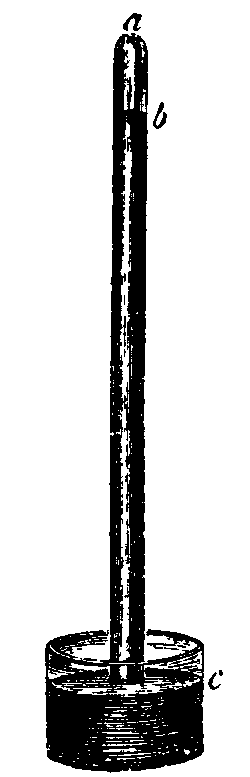
Fig. 2. Cistern Barometer.
Fig. 2 shows the Cistern Barometer in its essential and simplest form. This barometer is subject to two kinds of error, the one arising from capillarity, and the other from changes in the level of the surface of the cistern as the mercury rises and falls in the tube, the latter being technically called the error of capacity. If a glass tube of small bore be plunged into a vessel containing mercury, it will be observed that the level of the mercury in the tube is not in the line of that of the mercury in the vessel, but somewhat below it, and that the surface is convex. The capillary depression is inversely proportional to the diameter of the tube. In standard barometers, the tube is about an inch in diameter, and the error due to capillarity is less than .001 of an inch. Since capillarity depresses the height of the column, cistern barometers require an addition to be made to the observed height, in order to give the true pressure, the amount depending, of course, on the diameter of the tube.
The error of capacity arises in this way. The height of the barometer is the perpendicular distance between the surface of the mercury in the cistern and the upper surface of the mercurial column. Now, when the barometer falls from 30 to 29 inches, an inch of mercury must flow out of the tube and pass into the cistern, thus raising the cistern level; and, on the other hand, when the barometer rises, mercury must flow out of the cistern into the tube, thus lowering the level of the mercury in the cistern. Since the scales of barometers are usually engraved on their brass cases, which are fixed (and, consequently, the zero-point from which the scale is graduated is also fixed), it follows that, from the incessant changes in the level of the cistern, the readings would be sometimes too high and sometimes too low, if no provision were made against this source of error.
A simple way of correcting the error of capacity is—to ascertain (1) the neutral point of the instrument, or that height at which the zero of the scale is exactly at the height of the surface of the cistern, and (2) the rate of error as the barometer rises or falls above this point, and then apply a correction proportional to Fortin's Barometer. this rate. The instrument in which the error of capacity is satisfactorily (indeed, entirely) got rid of is Fortin's Barometer. Fig. 3 shows how this is effected. The upper part of the cistern is formed of a glass cylinder, through which the level of the mercury may be seen. The bottom is made like a bag, of flexible leather, against which a screw works. At the top of the interior of the cistern is a small piece of ivory, the point of which coincides with the zero of the scale. By means of the screw, which acts on the flexible cistern bottom, the level of the mercury can be raised or depressed so as to bring the ivory point exactly to the surface of the mercury in the cistern. In some barometers the cistern is fixed, and the ivory point is brought to the level of the mercury in the cistern by raising or depressing the scale.
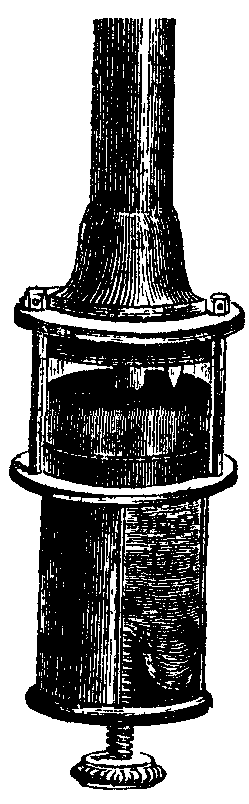
Fig. 3.—Fortin's Barometer.
In constructing the best barometers three materials are employed, viz.:—(1) brass, for the case, on which the scale is engraved; (2) glass, for the tube containing the mercury; and (3) the mercury itself. It is evident that if the coefficient of expansion of mercury and brass were the same, the height of the mercury as indicated by the brass scale would be the true height of the mercurial column. But this is not the case, the coefficient of expansion for mercury being considerably greater than that for brass. The result is that if a barometer stand at 30 in. when the temperature of the whole instrument, mercury and brass, is 32°, it will no longer stand at 30 in. if the temperature be raised to 69°; in fact, it will then stand at 30.1 in. Corrections of the barometer reading. This increase in the height of the column by the tenth of an inch is not due to any increase of pressure, but altogether to the greater expansion of the mercury at the higher temperature, as compared with the expansion of the brass case with the engraved scale by which the height is measured. In order, therefore, to compare with each other with exactness barometric observations made at different temperatures, it is necessary to reduce them to the heights at which they would stand at some uniform temperature. The temperature to which such observations are reduced is 32° Fahr. or 0° cent.
If English units be used (Fahrenheit degrees and inches), this correction is given by the formula
x = -H.09T - 2.56,
1000
in the centigrade-centimetre system the correction is .0001614 HT (H being the observed height and T the observed temperature). Devices have been invented which determine these corrections mechanically, and hence obviate the necessity of applying the above formula, or of referring to tables in which these corrections for any height of the column and any temperature are given.
The standard temperature of the English yard being 62° and not 32°, it will be found in working out the corrections from the above formula that the temperature of no correction is not 32° but 28.5°. If the scale be engraved on the glass tube, or if the instrument be furnished with a glass scale or with a wooden scale, different corrections are required. These may be worked out from the above formula by substituting for the coefficient of the expansion of brass that of glass, which is assumed to be 0.00000498, or that of wood, which is assumed to be 0. Wood, however, should not be used, its expansion with temperature being unsteady, as well as uncertain.
If the brass scale be attached to a wooden frame and be free to move up and down the frame, as is the case with many siphon barometers, the corrections for brass scales are to be used, since the zero-point of the scale is brought to the level of the lower limb; but if the brass scale be fixed to a wooden frame, the corrections for brass scales are only applicable provided the zero of the scale be fixed at (or nearly at) the zero line of the column, and be free to expand upwards. In siphon barometers, with which an observation is made from two readings on the scale, the scale must be free to expand in one direction. Again, if only the upper part of the scale, say from 27 to 31 in., be screwed to a wooden frame, it is evident that not the corrections for brass scales, but those for wooden scales must be used. No account need be taken of the expansion of the glass tube containing the mercury, it being evident that no correction for this expansion is required in the case of any barometer the height of which is measured from the surface of the mercury in the cistern.
In fixing a barometer for observation, it is indispensable that Position of barometer. it be hung in a perpendicular position, seeing that it is the perpendicular distance between the surface of the mercury in the cistern and the top of the column which is the true height of the barometer. The surface of the mercury column is convex, and in noting the height of the barometer, it is not the chord of the curve, but its tangent which is taken. This is done by setting the straight lower edge of the vernier, an appendage with which the barometer is furnished, as a tangent to the curve. The vernier is made to slide up and down the scale, and by it the height of the barometer may be read true to 0.002 or even to 0.001 in.
It is essential that the barometer is at the temperature shown by the attached thermometer. No observation can be regarded as good if the thermometer indicates a temperature differing from that of the whole instrument by more than a degree. For every degree of temperature the attached thermometer differs from the barometer, the observation will be faulty to the extent of about 0.003 in., which in discussions of diurnal range, &c., is a serious amount.
Before being used, barometers should be thoroughly examined as to the state of the mercury, the size of cistern (so as to admit of low readings), and their agreement with some known standard instrument at different points of the scale. The pressure of the atmosphere is not expressed by the weight of the mercury sustained in the tube by it, but by the perpendicular height of the column. Thus, when the height of the column is 30 in., it is not said that the atmospheric pressure is 14.7 lb on the square inch, or the weight of the mercury filling a tube at that height whose transverse section equals a square inch, but that it is 30 in., meaning that the pressure will sustain a column of mercury of that height.
It is essential in gasometry to fix upon some standard pressure to which all measurements can be reduced. The height of the standard mercury column commonly used is 76 cms. (29.922 in.) of pure mercury at 0°; this is near the average height of the barometer. Since the actual force exerted by the atmosphere varies with the intensity of gravity, and therefore with the position on the earth's surface, a place must be specified in defining the standard pressure. This may be avoided by expressing the force as the pressure in dynes due to a column of mercury, one square centimetre in section, which is supported by the atmosphere. If H cms. be the height at 0°, and g the value of gravity, the pressure is 13.596 Hg dynes (13.596 being the density of mercury). At Greenwich, where g = 981.17, the standard pressure at 0° is 1,013,800 dynes. At Paris the pressure is 1,013,600 dynes. The closeness of this unit to a mega-dyne (a million dynes) has led to the suggestion that a mega-dyne per square centimetre should be adopted as the standard pressure, and it has been adopted by some modern writers on account of its convenience of calculation and independence of locality.