Volume 3 — VOLUME III
Reading edition
AUSTRIA, LOWER (Ger. Niederösterreich or Österreich unter der Enns, "Austria below the river Enns"), an archduchy and crownland of Austria, bounded E. by Hungary, N. by Bohemia and Moravia, W. by Bohemia and Upper Austria, and S. by Styria. It has an area of 7654 sq. m. and is divided into two parts by the Danube, which enters at its most westerly point, and leaves it at its eastern extremity, near Pressburg. North of this line is the low hilly country, known as the Waldviertel, which lies at the foot and forms the continuation of the Bohemian and Moravian plateau. Towards the W. it attains in the Weinsberger Wald, of which the highest point is the Peilstein, an altitude of 3478 ft., and descends towards the valley of the Danube through the Gföhler Wald (2368 ft.) and the Manhartsgebirge (1758 ft.). Its most south-easterly offshoots are formed by the Bisamberg (1180 ft.), near Vienna, just opposite the Kahlenberg. The southern division of the province is, in the main, mountainous and hilly, and is occupied by the Lower Austrian Alps and their offshoots. The principal groups are: the Voralpe (5802 ft.), the Dürrenstein (6156 ft.), the Ötscher (6205 ft.), the Raxalpe (6589 ft.) and the Schneeberg (6806 ft.), which is the highest summit in the whole province. To the E. of the famous ridge of Semmering are the groups of the Wechsel (5700 ft.) and the Leithagebirge (1674 ft.). The offshoots of the Alpine group are formed by the Wiener Wald, which attains an altitude of 2929 ft. in the Schöpfl and ends N.W. of Vienna in the Kahlenberg (1404 ft.) and Leopoldsberg (1380 ft.).
Lower Austria belongs to the watershed of the Danube, which with the exception of the Lainsitz, which is a tributary of the Moldau, receives all the other rivers of the province. Its principal affluents on the right are: the Enns, Ybbs, Erlauf, Pielach, Traisen, Wien, Schwechat, Fischa and Leitha; on the left the Isper, Krems, Kamp, Göllersau and the March. Besides the Danube, only the Enns and the March are navigable rivers. Amongst the small Alpine lakes, the Erlaufsee and the Lunzer See are worth mentioning. Of its mineral springs, the best known are the sulphur springs of Baden, the iodine springs of Deutsch-Altenburg, the iron springs of Pyrawarth, and the thermal springs of Vöslau. In general the climate, which varies with the configuration of the surface, is moderate and healthy, although subject to rapid changes of temperature. Although 43.4% of the total area is arable land, the soil is only of moderate fertility and does not satisfy the wants of this thickly-populated province. Woods occupy 34.2%, gardens and meadows 13.1% and pastures 3.2%. Vineyards occupy 2% of the total area and produce a good wine, specially those on the sunny slopes of the Wiener Wald. Cattle-rearing is not well developed, but game and fish are plentiful. Mining is only of slight importance, small quantities of coal and iron-ore being extracted in the Alpine foothill region; graphite is found near Mühldorf. From an industrial point of view, Lower Austria stands, together with Bohemia and Moravia, in the front rank amongst the Austrian provinces. The centre of its great industrial activity is the capital, Vienna (q.v.); but in the region of the Wiener Wald up to the Semmering, owing to its many waters, which can be transformed into motive power, many factories are spread. The principal industries are, the metallurgic and textile industries in all their branches, milling, brewing and chemicals; paper, leather and silk; cloth, objets de luxe and millinery; physical and musical instruments; sugar, tobacco factories and foodstuffs. The very extensive commerce of the province has also its centre in Vienna. The population of Lower Austria in 1900 was 3,100,493, which corresponds to 405 inhabitants per sq. m. It is, therefore, the most densely populated province of Austria. According to the language in common use, 95% of the population was German, 4.66% was Czech, and the remainder was composed of Poles, Slovaks, Ruthenians, Croatians and Italians. According to religion 92.47% of the inhabitants were Roman Catholics; 5.07% were Jews; 2.11% were Protestants and the remainder belonged to the Greek church. In the matter of education, Lower Austria is one of the most advanced provinces of Austria, and 99.8% of the children of school-going age attended school regularly in 1900. The local diet is composed of 78 members, of which the archbishop of Vienna, the bishop of St Pölten and the rector of the Vienna University are members ex officio. Lower Austria sends 64 members, to the Imperial Reichsrat at Vienna. For administrative purposes, the province is divided into 22 districts and three towns with autonomous municipalities: Vienna (1,662,269), the capital (since 1905 including Floridsdorf, 36,599), Wiener-Neustadt (28,438) and Waidhofen on the Ybbs (4447). Other principal towns are: Baden (12,447), Bruck on the Leitha (5134), Schwechat (8241), Korneuburg (8298), Stokerau (10,213), Krems (12,657), Mödling (15,304), Reichenau (7457), Neunkirchen (10,831), St Pölten (14,510) and Klosterneuburg (11,595).
The original archduchy, which included Upper Austria, is the nucleus of the Austrian empire, and the oldest possession of the house of Habsburg in its present dominions.
See F. Umlauft, Das Erzherzogtum Österreich unter der Enns, vol. i. of the collection Die Lander Österreich-Ungarns in Wort und Bild (Vienna, 1881-1889, 15 vols.); Die österreichisch-ungarische Monarchie in Wort und Bild, vol. 4. (Vienna. 1886-1902, 24 vols.); M. Vansca, Gesch. Nieder- u. Ober-Österreichs (in Heeren's Staatengesch., Gotha, 1905).
AUSTRIA, UPPER (Ger. Oberösterreich or Österreich ob der Enns, "Austria above the river Enns"), an archduchy and crown-land of Austria, bounded N. by Bohemia, W. by Bavaria, S. by Salzburg and Styria, and E. by Lower Austria. It has an area of 4631 sq. m. Upper Austria is divided by the Danube into two unequal parts. Its smaller northern part is a prolongation of the southern angle of the Bohemian forest and contains as culminating points the Plöcklstein (4510 ft.) and the Sternstein (3690 ft.). The southern part belongs to the region of the Eastern Alps, containing the Salzkammergut and Upper Austrian Alps, which are found principally in the district of Salzkammergut (q.v.). To the north of these mountains, stretching towards the Danube, is the Alpine foothill region, composed partly of terraces and partly of swelling undulations, of which the most important is the Hausruckwald. This is a wooded chain of mountains, with many branches, rich in brown coal and culminating in the Göblberg (2950 ft.). Upper Austria belongs to the watershed of the Danube, which flows through it from west to east, and receives here on the right the Inn with the Salzach, the Traun, the Enns with the Steyr and on its left the Great and Little Mühl rivers. The Schwarzenberg canal between the Great Mühl and the Moldau establishes a direct navigable route between the Danube and the Elbe. The climate of Upper Austria, which varies according to the altitude, is on the whole moderate; it is somewhat severe in the north, but is mild in Salzkammergut. The population of the duchy in 1900 was 809,918, which is equivalent to 174.8 inhabitants per sq. m. It has the greatest density of population of any of the Alpine provinces. The inhabitants are almost exclusively of German stock and Roman Catholics. For administrative purposes, Upper Austria is divided into two autonomous municipalities, Linz (58,778) the capital, and Steyr (17,592) and 12 districts. Other principal towns are Wels (12,187), Ischl (9646) and Gmunden (7126). The local diet, of which the bishop of Linz is a member ex officio, is composed of 50 members and the duchy sends 22 members to the Reichsrat at Vienna. The soil in the valleys and on the lower slopes of the hills is fertile, indeed 35.08% of the whole area is arable. Agriculture is well developed and relatively large quantities of the principal cereals are produced. Upper Austria has the largest proportion of meadows in all Austria, 18.54%, while 2.49% is lowland and Alpine pasturage. Of the remainder, woods occupy 34.02%, gardens 1.99% and 4.93% is unproductive. Cattle-breeding is also in a very advanced stage and together with the timber-trade forms a considerable resource of the province. The principal mineral wealth of Upper Austria is salt, of which it extracts nearly 50% of the total Austrian production. Other important products are lignite, gypsum and a variety of valuable stones and clays. There are about thirty mineral springs, the best known being the salt baths of Ischl and the iodine waters at Hall. The principal industries are the iron and metal manufactures, chiefly centred at Steyr. Next in importance are the machine, linen, cotton and paper manufactures, the milling, brewing and distilling industries and shipbuilding. The principal articles of export are salt, stone, timber, live-stock, woollen and iron wares and paper.
See Edlbacher, Landeskunde von Oberösterreich (Linz, 2nd ed., 1883); Vansca, op. cit. in the preceding article.
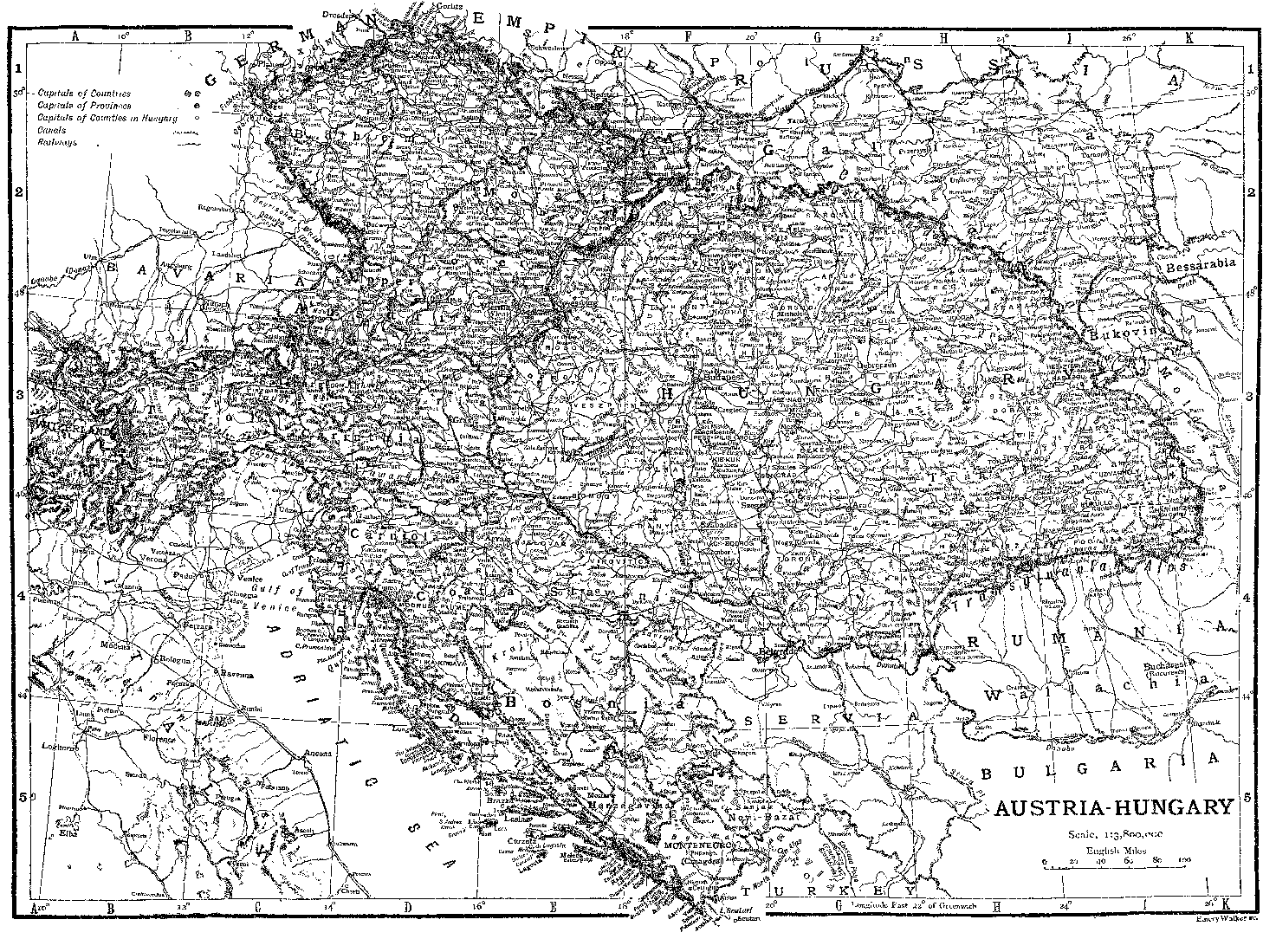
AUSTRIA-HUNGARY, or the Austro-Hungarian Monarchy (Ger. Österreichisch-ungarische Monarchie or Österreichisch-ungarisches Reich), the official name of a country situated in central Europe, bounded E. by Russia and Rumania, S. by Rumania, Servia, Turkey and Montenegro, W. by the Adriatic Sea, Italy, Switzerland, Liechtenstein, and the German Empire, and N. by the German Empire and Russia. It occupies about the sixteenth part of the total area of Europe, with an area (1905) of 239,977 sq. m. The monarchy consists of two independent states: the kingdoms and lands represented in the council of the empire (Reichsrat), unofficially called Austria (q.v.) or Cisleithania; and the "lands of St Stephen's Crown," unofficially called Hungary (q.v.) or Transleithania. It received its actual name by the diploma of the emperor Francis Joseph I. of the 14th of November 1868, replacing the name of the Austrian Empire under which the dominions under his sceptre were formerly known. The Austro-Hungarian monarchy is very often called unofficially the Dual Monarchy. It had in 1901 a population of 45,405,267 inhabitants, comprising therefore within its borders, about one-eighth of the total population of Europe. By the Berlin Treaty of 1878 the principalities of Bosnia and Herzegovina with an area of 19,702 sq. m., and a population (1895) of 1,591,036 inhabitants, owning Turkey as suzerain, were placed under the administration of Austria-Hungary, and their annexation in 1908 was recognized by the Powers in 1909, so that they became part of the dominions of the monarchy.
Government.—The present constitution of the Austro-Hungarian monarchy (see Austria) is based on the Pragmatic Sanction of the emperor Charles VI., first promulgated on the 19th of April 1713, whereby the succession to the throne is settled in the dynasty of Habsburg-Lorraine, descending by right of primogeniture and lineal succession to male heirs, and, in case of their extinction, to the female line, and whereby the indissolubility and indivisibility of the monarchy are determined; is based, further, on the diploma of the emperor Francis Joseph I. of the 20th of October 1860, whereby the constitutional form of government is introduced; and, lastly, on the so-called Ausgleich or "Compromise," concluded on the 8th of February 1867, whereby the relations between Austria and Hungary were regulated.
The two separate states—Austria and Hungary—are completely independent of each other, and each has its own parliament and its own government. The unity of the monarchy is expressed in the common head of the state, who bears the title Emperor of Austria and Apostolic King of Hungary, and in the common administration of a series of affairs, which affect both halves of the Dual Monarchy. These are: (1) foreign affairs, including diplomatic and consular representation abroad; (2) the army, including the navy, but excluding the annual voting of recruits, and the special army of each state; (3) finance in so far as it concerns joint expenditure.
For the administration of these common affairs there are three joint ministries: the ministry of foreign affairs and of the imperial and royal house, the ministry of war, and the ministry of finance. It must be noted that the authority of the joint ministers is restricted to common affairs, and that they are not allowed to direct or exercise any influence on affairs of government affecting separately one of the halves of the monarchy. The minister of foreign affairs conducts the international relations of the Dual Monarchy, and can conclude international treaties. But commercial treaties, and such state treaties as impose burdens on the state, or parts of the state, or involve a change of territory, require the parliamentary assent of both states. The minister of war is the head for the administration of all military affairs, except those of the Austrian Landwehr and of the Hungarian Honveds, which are committed to the ministries for national defence of the two respective states. But the supreme command of the army is vested in the monarch, who has the power to take all measures regarding the whole army. It follows, therefore, that the total armed power of the Dual Monarchy forms a whole under the supreme command of the sovereign. The minister of finance has charge of the finances of common affairs, prepares the joint budget, and administers the joint state debt. (Till 1909 the provinces of Bosnia and Herzegovina were also administered by the joint minister of finance, excepting matters exclusively dependent on the minister of war.) For the control of the common finances, there is appointed a joint supreme court of accounts, which audits the accounts of the joint ministries.
Budget.—Side by side with the budget of each state of the Dual Monarchy, there is a common budget, which comprises the expenditure necessary for the common affairs, namely for the conduct of foreign affairs, for the army, and for the ministry of finance. The revenues of the joint budget consist of the revenues of the joint ministries, the net proceeds of the customs, and the quota, or the proportional contributions of the two states. This quota is fixed for a period of years, and generally coincides with the duration of the customs and commercial treaty. Until 1897 Austria contributed 70%, and Hungary 30% of the joint expenditure, remaining after-deduction of the common revenue. It was then decided that from 1897 to July 1907 the quota should be 66-46/49 for Austria, and 33-2/49 for Hungary. In 1907 Hungary's contribution was raised to 36.4%. Of the total charges 2% is first of all debited to Hungary on account of the incorporation with this state of the former military frontier.
The Budget estimates for the common administration were as follows in 1905:—
Revenue—
Ministry of Foreign Affairs £21,167
Ministry of War 305,907
Ministry of Finance 4,870
Board of Control 18
The Customs 4,780,000
Proportional contributions 15,650,448
—————
Total £20,762,410
—————
Expenditure—
Ministry of Foreign Affairs £485,480
Ministry of War:—
Army 12,679,160
Navy 2,306,100
Ministry of Finance 177,000
Board of Control 13,250
Extraordinary Military Expenditure 4,785,500
Extraordinary Military Expenditure in Bosnia 315,920
—————
Total £20,762,410
—————
The following table gives in thousands sterling the joint budget for the years 1875-1905:—
Expenditure.
1875. 1885. 1895. 1900. 1905.
Ministry of Foreign Affairs 396 368.7 333 433.4 493.8
Ministry of War (Army and Navy) 9005.4 10,085 12,539 13,887.5 18,087.7
Ministry of Finance 154.2 167.2 170.4 175 177.1
Supreme Court of Accounts 10.5 10.6 10.7 12.5 13.3
Total 9566.1 10,631.5 13,053.1 14,508.4 20,430.3
Revenue.
For the above Departments 432 258.2 260.7 260.3 331.9
Customs 997.4 402.2 4476 5202.3 4799.7
Proportional Contributions 8136.7 9971.1 8316.4 9045.8 15,650.4
Total 9566.1 10,631.5 13,053.1 14,508.4 20,430.3
Debt.—Besides the debts of each state of the Dual Monarchy, there is a general debt, which is borne jointly by Austria and Hungary. The following table gives in millions sterling the amount of the general debt for the years 1875-1905:—
1875. 1885. 1895. 1900. 1905.
232.41 231.02 229.67 226.81 224.31
Delegations.—The constitutional right of voting money applicable to the common affairs and of its political control is exercised by the Delegations, which consist each of sixty members, chosen for one year, one-third of them by the Austrian Herrenhaus (Upper House) and the Hungarian Table of Magnates (Upper House), and two-thirds of them by the Austrian and the Hungarian Houses of Representatives. The delegations are annually summoned by the monarch alternately to Vienna and to Budapest. Each delegation has its separate sittings, both alike public. Their decisions are reciprocally communicated in writing, and, in case of non-agreement, their deliberations are renewed. Should three such interchanges be made without agreement, a common plenary sitting is held of an equal number of both delegations; and these collectively, without discussion, decide the question by common vote. The common decisions of both houses require for their validity the sanction of the monarch. Each delegation has the right to formulate resolutions independently, and to call to account and arraign the common ministers. In the exercise of their office the members of both delegations are irresponsible, enjoying constitutional immunity.
Army.—The military system of the Austro-Hungarian monarchy is similar in both states, and rests since 1868 upon the principle of the universal and personal obligation of the citizen to bear arms. Its military force is composed of the common army (K. und K.); the special armies, namely the Austrian (K.K.) Landwehr, and the Hungarian Honveds, which are separate national institutions, and the Landsturm or levy-in-mass. As stated above, the common army stands under the administration of the joint minister of war, while the special armies are under the administration of the respective ministries of national defence. The yearly contingent of recruits for the army is fixed by the military bills voted by the Austrian and Hungarian parliaments, and is generally determined on the basis of the population, according to the last census returns. It amounted in 1905 to 103,100 men, of which Austria furnished 59,211 men, and Hungary 43,889. Besides 10,000 men are annually allotted to the Austrian Landwehr, and 12,500 to the Hungarian Honveds. The term of service is 2 years (3 years in the cavalry) with the colours, 7 or 8 in the reserve and 2 in the Landwehr; in the case of men not drafted to the active army the same total period of service is spent in various special reserves.
For the military and administrative service of the army the Dual Monarchy is divided into 16 military territorial districts (15 of which correspond to the 15 army corps) and 108 supplementary districts (105 for the army, and 3 for the navy). In 1902, since which year no material change was made in the formal organization of the army, there were 5 cavalry divisions and 31 infantry divisions, formed in 15 army corps, which are located as follows:—I. Cracow, II. Vienna, III. Graz, IV. Budapest, V. Pressburg, VI. Kaschau, VII. Temesvár, VIII. Prague, IX. Josefstadt, X. Przemysl, XI. Lemberg, XII. Herrmannstadt, XIII. Agram, XIV. Innsbruck, XV. Serajewo. In addition there is the military district of Zara. The usual strength of the corps is, 2 infantry divisions (4 brigades, 8 or 9 regiments, 32 or 36 battalions), 1 cavalry brigade (18 squadrons), and 1 artillery brigade (16-18 batteries or 128-144 field-guns), besides technical and departmental units and in some cases fortress artillery regiments. The infantry is organized into line regiments, Jäger and Tirolese regiments, the cavalry into dragoons, lancers, Uhlans and hussars, the artillery into regiments. The Austrian Landwehr (which retains the old designation K.K., formerly applied to the Austrian regular army) is organized in 8 divisions of varying strength, the "Royal Hungarian" Landwehr or Honveds in 7 divisions, both Austrian and Hungarian Landwehr having in addition cavalry (Uhlans and hussars) and artillery. It is probable that a Landwehr or Honveds division will, in war, form part of each army corps except in the case of the Vienna corps, which has 3 divisions in peace. The remaining men of military age (up to 42) as usual form the Landsturm. It is to be noted that this Landsturm comprises many men who would elsewhere be classed as Landwehr.
The strength of the Austro-Hungarian army on a peace footing was as follows in 1905:—
Officers. Men. Horses. Guns.
Infantry—
Common Army 10,801 187,604 1,152 ..
Austrian Landwehr 1,883 23,905 174 ..
Hungarian Honveds 2,258 21,149 262 ..
Cavalry—
Common Army 1,890 45,486 40,740 ..
Austrian Landwehr 170 1,861 1,282 ..
Hungarian Honveds 390 4,170 3,510 ..
Field Artillery 1,630 27,612 14,520 1,048
Fortress Artillery 408 7,722 131 ..
Technical troops (Pioneers, and Railway and Telegraph Regiment) 588 9,935 19 ..
Transport Service 461 4,312 3,097 ..
Sanitary Service 85 3,062 .. ..
Total 20,564 336,818 64,887 1,048
Belonging to the
Common Army 15,863 285,733 59,659 1,048
Austrian Landwehr 2,053 25,766 1,456 ..
Hungarian Honveds 2,648 25,319 3,772 ..
The troops stationed in Bosnia and Herzegovina in 1905 (376 officers and 6372 men) are included in the total for the common army.
The peace strength of the active army in combatants is thus about 350,000 officers and men, inclusive of the two Landwehrs and of the Austrian "K.K." guards, the Hungarian crown guards, the gendarmerie, &c. The numbers of the Landsturm and the war strength of the whole armed forces are not published. It is estimated that the first line army in war would consist of 460,000 infantry, 49,000 cavalry, 78,000 artillery, 21,000 engineers, &c., beside train and non-combatant soldiers. The Landwehr and Honved would yield 219,000 infantry and 18,000 cavalry, and other reserves 223,000 men. These figures give an approximate total strength of 1,147,000, not inclusive of Landsturm.
Fortifications.—The principal fortifications in Austria-Hungary are: Cracow and Przemysl in Galicia; Komárom, the centre of the inland fortifications, Pétervárad, Ó-Arad and Temesvár in Hungary; Serajewo, Mostar and Bilek in Bosnia-Herzegovina. The Alpine frontiers, especially those in Tirol, have numerous fortifications, whose centre is formed by Trent and Franzensfeste; while all the military roads leading into Carinthia have been provided with strong defensive works, as at Malborgeth, Predil Pass, &c. The two capitals, Vienna and Budapest, are not fortified. On the Adriatic coast, the naval harbour of Pola is strongly fortified with sea and land defences; then come Trieste, and several places in Dalmatia, notably Zara and Cattaro.
Navy.—The Austro-Hungarian navy is mainly a coast defence force, and includes also a flotilla of monitors for the Danube. It is administered by the naval department of the ministry of war. It consisted in 1905 of 9 modern battleships, 3 armoured cruisers, 5 cruisers, 4 torpedo gunboats, 20 destroyers and 26 torpedo boats. There was in hand at the same time a naval programme to build 12 armourclads, 5 second-class cruisers, 6 third-class cruisers, and a number of torpedo boats. The headquarters of the fleet are at Pola, which is the principal naval arsenal and harbour of Austria; while another great naval station is Trieste.
Trade.—On the basis of the customs and commercial agreement between Austria and Hungary, concluded in 1867 and renewable every ten years, the following affairs, in addition to the common affairs of the monarchy, are in both states treated according to the same principles:—Commercial affairs, including customs legislation; legislation on the duties closely connected with industrial production—on beer, brandy, sugar and mineral oils; determination of legal tender and coinage, as also of the principles regulating the Austro-Hungarian Bank; ordinances in respect of such railways as affect the interests of both states. In conformity with the customs and commercial compact between the two states, renewed in 1899, the monarchy constitutes one identical customs and commercial territory, inclusive of Bosnia and Herzegovina and the principality of Liechtenstein.
The foreign trade of the Austro-Hungarian monarchy is shown in the following table:—
Year. Imports. Exports.
1900 £70,666,000 £80,916,000
1901 68,833,000 78,841,000
1902 71,666,000 79,708,000
1903 78,200,000 88,600,000
1904 85,200,000 86,200,000
1905 89,430,000 93,500,000
The following tables give the foreign trade of the Austro-Hungarian monarchy as regards raw material and manufactured goods:—
Imports.
Articles. Value in Millions Sterling.
1900. 1901. 1902. 1903. 1904.
Raw material (including articles of food; raw material for agriculture and industry; and mining and smelting products. 41.5 40.5 41.8 45.9 51.9

Semi-manufactured goods 9.6 9.6 10.3 10.6 10.8
Manufactured goods 19.5 18.7 19.5 21.6 22.5
Exports.
Articles. Value in Millions Sterling.
1900. 1901. 1902. 1903. 1904.
Raw material (as above) 34.1 34.1 35.9 39 35.3
Semi-manufactured goods 12.6 11.1 11.1 12.4 12.6
Manufactured goods. 34.2 33.3 32.8 37.2 38.3
The most important place of derivation and of destination for the Austro-Hungarian trade is the German empire with about 40% of the imports, and about 60% of the exports. Next in importance comes Great Britain, afterwards India, Italy, the United States of America, Russia, France, Switzerland, Rumania, the Balkan states and South America in about the order named. The principal articles of import are cotton and cotton goods, wool and woollen goods, silk and silk goods, coffee, tobacco and metals. The principal articles of export are wood, sugar, cattle, glass and glassware, iron and ironware, eggs, cereals, millinery, fancy goods, earthenware and pottery, and leather goods.
The Austro-Hungarian Bank.—Common to the two states of the monarchy is the "Austro-Hungarian Bank," which possesses a legal exclusive right to the issue of bank-notes. It was founded in 1816, and had the title of the Austrian National Bank until 1878, when it received its actual name. In virtue of the new bank statute of the year 1899 the bank is a joint-stock company, with a stock of £8,780,000. The bank's notes of issue must be covered to the extent of two-fifths by legal specie (gold and current silver) in reserve; the rest of the paper circulation, according to bank usage. The state, under certain conditions, takes a portion of the clear profits of the bank. The management of the bank and the supervision exercised over it by the state are established on a footing of equality, both states having each the same influence. The accounts of the bank at the end of 1900 were as follows: capital, £8,750,000; reserve fund, £428,250; note circulation, £62,251,000; cash, £50,754,000. In 1907 the reserve fund was £548,041; note circulation, £84,501,000; cash, £60,036,625. The charter of the bank, which expired in 1897, was renewed until the end of 1910. In the Hungarian ministerial crisis of 1909 the question of the renewal of the charter played a conspicuous part, the more extreme members of the Independence party demanding the establishment of separate banks for Austria and Hungary with, at most, common superintendence (see History, below).
(O. Br.)
History
I. The Whole Monarchy.
The empire of Austria, as the official designation of the The title "Emperor of Austria." territories ruled by the Habsburg monarchy, dates back only to 1804, when Francis II., the last of the Holy Roman emperors, proclaimed himself emperor of Austria as Francis I. His motive in doing so was to guard against the great house of Habsburg being relegated to a position inferior to the parvenus Bonapartes, in the event of the final collapse of the Holy Roman Empire, or of the possible election of Napoleon as his own successor on the throne of Charlemagne. The title emperor of Austria, then, replaced that of "Imperator Romanorum semper Augustus" when the Holy Empire came to an end in 1806. From the first, however, it was no more than a title, which represented but ill the actual relation of the Habsburg sovereigns to their several states. Magyars and Slavs never willingly recognized a style which ignored their national rights and implied the superiority of the German elements of the monarchy; to the Germans it was a poor substitute for a title which had represented the political unity of the German race under the Holy Empire. For long after the Vienna Congress of 1814-1815 the "Kaiser" as such exercised a powerful influence over the imaginations of the German people outside the Habsburg dominions; but this was because the title was still surrounded with its ancient halo and the essential change was not at once recognized. The outcome of the long struggle with Prussia, which in 1866 finally broke the spell, and the proclamation of the German empire in 1871 left the title of emperor of Austria stripped of everything but a purely territorial significance. It had, moreover, by the compact with Hungary of 1867, ceased even fully to represent the relation of the emperor to all his dominions; and the title which had been devised to cover the whole of the Habsburg monarchy sank into the official style of the sovereign of but a half; while even within the Austrian empire proper it is resented by those peoples which, like the Bohemians, wish to obtain the same recognition of their national independence as was conceded to Hungary. In placing the account of the origin and development of the Habsburg monarchy under this heading, it is merely for the sake of convenience.
The first nucleus round which the present dominions of the Origin of the name Austria. house of Austria gradually accumulated was the mark which lay along the south bank of the Danube, east of the river Enns, founded about A.D. 800 as a defence for the Frankish kingdom against the Slavs. Although its total length from east to west was only about 60 m., it was associated in the popular mind with a large and almost unbroken tract of land in the east of Europe. This fact, together with the position of the mark with regard to Germany in general and to Bavaria in particular, accounts for the name Österreich (Austria), i.e. east empire or realm, a word first used in a charter of 996, where the phrase in regione vulgari nomine Ostarrichi occurs. The development of this small mark into the Austro-Hungarian monarchy was a slow and gradual process, and falls into two main divisions, which almost coincide with the periods during which the dynasties of Babenberg and Habsburg have respectively ruled the land. The energies of the house of Babenberg were chiefly spent in enlarging the area and strengthening the position of the mark itself, and when this was done the house of Habsburg set itself with remarkable perseverance and marvellous success to extend its rule over neighbouring territories. The many vicissitudes which have attended this development have not, however, altered the European position of Austria, which has remained the same for over a thousand years. Standing sentinel over the valley of the middle Danube, and barring the advance of the Slavs on Germany, Austria, whether mark, duchy or empire, has always been the meeting-place of the Teuton and the Slav. It is this fact which gives it a unique interest and importance in the history of Europe, and which unites the ideas of the Germans to-day with those of Charlemagne and Otto the Great.
The southern part of the country now called Austria was Early inhabitants. inhabited before the opening of the Christian era by the Taurisci, a Celtic tribe, who were subsequently called the Norici, and who were conquered by the Romans about 14 B.C. Their land was afterwards included in the provinces of Pannonia and Noricum, and under Roman rule, Vindobona, the modern Vienna, became a place of some importance. The part of the country north of the Danube was peopled by the Marcomanni and the Quadi, and both of these tribes were frequently at war with the Romans, especially during the reign of the emperor Marcus Aurelius, who died at Vindobona in A.D. 180 when campaigning against them. Christianity and civilization obtained entrance into the land, but the increasing weakness of the Roman empire opened the country to the inroads of the barbarians, and during the period of the great migrations it was ravaged in quick succession by a number of these tribes, prominent among whom were the Huns. The lands on both banks of the river shared the same fate, due probably to the fact to which Gibbon has drawn attention, that at this period the Danube was frequently frozen over. About 590 the district was settled by the Slovenes, or Corutanes, a Slavonic people, who formed part of the kingdom of Samo, and were afterwards included in the extensive kingdom of the Avars. The Franks claimed some authority over this people, and probably some of the princes of the Slovenes had recognized this claim, but it could not be regarded as serious while the Avars were in possession of the land. In 791 Charlemagne, after he had established his authority over the Bajuvarii or Bavarians, crossed the river Enns, and moved against the Avars. This attack was followed by campaigns on the part of his lieutenants, and in 805 the Avars were finally subdued, and their land incorporated with the Frankish empire. Establishment of the East Mark. This step brought the later Austria definitely under the rule of the Franks, and during the struggle Charlemagne erected a mark, called the East Mark, to defend the eastern border of his empire. A series of margraves ruled this small district from 799 to 907, but as the Frankish empire grew weaker, the mark suffered more and more from the ravages of its eastern neighbours. During the 9th century the Frankish supremacy vanished, and the mark was overrun by the Moravians, and then by the Magyars, or Hungarians, who destroyed the few remaining traces of Frankish influence.
A new era dawned after Otto the Great was elected German The house of Babenberg. king in 936, and it is Otto rather than Charlemagne who must be regarded as the real founder of Austria. In August 955 he gained a great victory over the Magyars on the Lechfeld, freed Bavaria from their presence, and refounded the East Mark for the defence of his kingdom. In 976 his son, the emperor Otto II., entrusted the government of this mark, soon to be known as Austria, to Leopold, a member of the family of Babenberg (q.v.), and its administration was conducted with vigour and success. Leopold and his descendants ruled Austria until the extinction of the family in 1246, and by their skill and foresight raised the mark to an important place among the German states. Their first care was to push its eastern frontier down the Danube valley, by colonizing the lands on either side of the river, and the success of this work may be seen in the removal of their capital from Pöchlarn to Melk, then to Tulln, and finally about 1140 to Vienna. The country as far as the Leitha was subsequently incorporated with Austria, and in the other direction the district between the Enns and the Inn was added to the mark in 1156, an important date in Austrian history. Duchy of Austria created, 1156. Anxious to restore peace to Germany in this year, the new king, Frederick I., raised Austria to the rank of a duchy, and conferred upon it exceptional privileges. The investiture was bestowed not only upon Duke Henry but upon his second wife, Theodora; in case of a failure of male heirs the duchy was to descend to females; and if the duke had no children he could nominate his successor. Controlling all the jurisdiction of the land, the duke's only duties towards the Empire were to appear at any diet held in Bavaria, and to send a contingent to the imperial army for any campaigns in the countries bordering upon Austria. In 1186 Duke Leopold I. made a treaty with Ottakar IV., duke of Styria, an arrangement which brought Styria and upper Austria to the Babenbergs in 1192, and in 1229 Duke Leopold II. purchased some lands from the bishop of Freising, and took the title of lord of Carniola. When the house of Babenberg became extinct in 1246, Austria, stretching from Passau almost to Pressburg, had the frontiers which it retains to-day, and this increase of territory had been accompanied by a corresponding increase in wealth and general prosperity. The chief reason for this prosperity was the growth of trade along the Danube, which stimulated the foundation, or the growth, of towns, and brought considerable riches to the ruler. Under the later Babenbergs Vienna was regarded as one of the most important of German cities, and it was computed that the duke was as rich as the archbishop of Cologne, or the margrave of Brandenburg, and was surpassed in this respect by only one German prince, the king of Bohemia. The interests of the Austrian margraves and dukes were not confined to the acquisition of wealth either in land or chattels. Vienna became a centre of culture and learning, and many religious houses were founded and endowed. Duke Leopold II. The acme of the early prosperity of Austria was reached under Duke Leopold II., surnamed the Glorious, who reigned from 1194 to 1230. He gave a code of municipal law to Vienna, and rights to other towns, welcomed the Minnesingers to his brilliant court, and left to his subjects an enduring memory of valour and wisdom. Leopold and his predecessors were enabled, owing to the special position of Austria, to act practically as independent rulers. Cherishing the privilege of 1156, they made treaties with foreign kings, and arranged marriages with the great families of Europe. With full control of jurisdiction and of commerce, no great bishopric nor imperial city impeded the course of their authority, and the emperor interfered only to settle boundary disputes.
The main lines of Austrian policy under the Babenbergs were warfare with the Hungarians and other eastern neighbours, and a general attitude of loyalty towards the emperors. The story of the Hungarian wars is a monotonous record of forays, of assistance given at times to the Babenbergs by the forces of the Empire, and ending in the gradual eastward advance of Austria. Duke Frederick II., the Quarrelsome. The traditional loyalty to the emperors, which was cemented by several marriages between the imperial house and the Babenbergs, was, however, departed from by the margrave Leopold II., and by Duke Frederick II. During the investiture struggle Leopold deserted the emperor Henry IV., who deprived him of Austria and conferred it upon Vratislav II., duke of the Bohemians. Unable to maintain his position, Vratislav was soon driven out, and in 1083 Leopold again obtained possession of the mark, and was soon reconciled with Henry. Very similar was the result of the conflict between the emperor Frederick II. and Duke Frederick II. Ignoring the the privilege of 1156, the emperor claimed certain rights in Austria, and summoned the duke to his Italian diets. Frederick, who was called the Quarrelsome, had irritated both his neighbours and his subjects, and complaints of his exactions and confiscations reached the ears of the emperor. After the duke had three times refused to appear before the princes, Frederick placed him under the ban, declared the duchies of Austria and Styria to be vacant, and, aided by the king of Bohemia, the duke of Bavaria and other princes, invaded the country in 1236. End of the House of Babenberg. He met with very slight opposition, declared the duchies to be immediately dependent upon the Empire, made Vienna an imperial city, and imposed other changes upon the constitution of Austria. After his departure, however, the duke returned, and in 1239 was in possession of his former power, while the changes made by the emperor were ignored. Continuing his career of violence and oppression, Duke Frederick was killed in battle by the Hungarians in June 1246, when the family of Babenberg became extinct.
The duchies of Austria and Styria were now claimed by the Dispute as to the Austrian succession. emperor Frederick II. as vacant fiefs of the Empire, and their government was entrusted to Otto II., duke of Bavaria. Frederick, however, who was in Italy, harassed and afflicted, could do little to assert the imperial authority, and his enemy, Pope Innocent IV., bestowed the two duchies upon Hermann VI., margrave of Baden, whose wife, Gertrude, was a niece of the last of the Babenbergs. Hermann was invested by the German king, William, count of Holland, but he was unable to establish his position, and law and order were quickly disappearing from the duchies. The deaths of Hermann and of the emperor in 1250, however, paved the way for a settlement. Weary of struggle and disorder, and despairing of any help from the central authority, the estates of Austria met at Trübensee in 1251, and chose Ottakar, son of Wenceslaus I., king of Bohemia, as their duke. Ottakar of Bohemia, duke. This step was favoured by the pope, and Ottakar, eagerly accepting the offer, strengthened his position by marrying Margaret, a sister of Duke Frederick II., and in return for his investiture promised his assistance to William of Holland. Styria appears at this time to have shared the fortunes of Austria, but it was claimed by Bela IV., king of Hungary, who conquered the land, and made a treaty with Ottakar in 1254 which confirmed him in its possession. The Hungarian rule was soon resented by the Styrians, and Ottakar, who had become king of Bohemia in 1253, took advantage of this resentment, and interfered in the affairs of the duchy. A war with Hungary was the result, but on this occasion victory rested with Ottakar, and by a treaty made with Bela, in March 1261, he was recognized as duke of Styria. In 1269 Ottakar inherited the duchy of Carinthia on the death of Duke Ulrich III., and, his power having now become very great, he began to aspire to the German throne. He did something to improve the condition of the duchies by restoring order, introducing German colonists into the eastern districts, and seeking to benefit the inhabitants of the towns.
In 1273 Rudolph, count of Habsburg, became German king, Rudolph of Habsburg. and his attention soon turned to Ottakar, whose power menaced the occupant of the German throne. Finding some support in Austria, Rudolph questioned the title of the Bohemian king to the three duchies, and sought to recover the imperial lands which had been in the possession of the emperor Frederick II. Ottakar was summoned twice before the diet, the imperial court declared against him, and in July 1275 he was placed under the ban. War was the result, and in November 1276 Ottakar submitted to Rudolph, and renounced the duchies of Austria, Styria and Carinthia. For some time the three duchies were administered by Rudolph in his capacity as head of the Empire, of which they formed part. Not content with this tie, however, which was personal to himself alone, the king planned to make them hereditary possessions of his family, and to transfer the headquarters of the Habsburgs from the Rhine to the Danube. The Habsburgs established in Austria, 1282. Some opposition was offered to this scheme; but the perseverance of the king overcame all difficulties, and one of the most important events in European history took place on the 27th of December 1282, when Rudolph invested his sons, Rudolph and Albert, with the duchies of Austria and Styria. He retained Carinthia in his own hands until 1286, when, in return for valuable services, he bestowed it upon Meinhard IV., count of Tirol. The younger Rudolph took no part in the government of Austria and Styria, which was undertaken by Albert, until his election as German king in 1298. Albert appears to have been rather an arbitrary ruler. In 1288 he suppressed a rising of the people of Vienna, and he made the fullest use of the ducal power in asserting his real or supposed rights. At this time the principle of primogeniture was unknown in the house of Habsburg, and for many years the duchies were ruled in common by two, or even three, members of the family. After Albert became German king, his two elder sons, Rudolph and Frederick, were successively associated with him in the government, and after his death in 1308, his four younger sons shared at one time or another in the administration of Austria and Styria. In 1314 Albert's son, Frederick, was chosen German king in opposition to Louis IV., duke of Upper Bavaria, afterwards the emperor Louis IV., and Austria was weakened by the efforts of the Habsburgs to sustain Frederick in his contest with Louis, and also by the struggle carried on between another brother, Leopold, and the Swiss. A series of deaths among the Habsburgs during the first half of the 14th century left Duke Albert II. and his four sons as the only representatives of the family. Albert ruled the duchies alone from 1344 to 1356, and after this date his sons began to take part in the government. Duke Rudolph IV. The most noteworthy of these was Duke Rudolph IV., a son-in-law of the emperor Charles IV., who showed his interest in learning by founding the university of Vienna in 1365. Rudolph's chief aim was to make Austria into an independent state, and he forged a series of privileges the purport of which was to free the duchy from all its duties towards the Empire. A sharp contest with the emperor followed this proceeding, and the Austrian duke, annoyed that Austria was not raised to the dignity of an electorate by the Golden Bull of 1356, did not shrink from a contest with Charles. In 1361, however, he abandoned his pretensions, but claimed the title of archduke (q.v.) and in 1364 declared that the possessions of the Habsburgs were indivisible. Meanwhile the acquisition of neighbouring territories had been steadily pressed on. In 1335 the duchy of Carinthia, and a part of Carniola, were inherited by Dukes Albert II. and Otto, and in 1363 Rudolph IV. obtained the county of Tirol. In 1364 Carniola was made into an hereditary duchy; in 1374 part of Istria came under the rule of the Habsburgs; in 1382 Trieste submitted voluntarily to Austria, and at various times during the century, other smaller districts were added to the lands of the Habsburgs.
Rudolph IV. died childless in 1365, and in 1379 his two remaining brothers, Leopold III. and Albert III., made a division of their lands, by which Albert retained Austria proper and Carniola, and Leopold got Styria, Carinthia and Tirol. Leopold was killed in 1386 at the battle of Sempach, and Albert became guardian for his four nephews, who subsequently ruled their lands in common. The senior line which ruled in Austria was represented after the death of Duke Albert III. in 1395 by his son, Duke Albert IV., and then by his grandson, Duke Albert V., who became German king as Albert II. in 1438. Minority of Ladislaus. Albert married Elizabeth, daughter of Sigismund, king of Hungary and Bohemia, and on the death of his father-in-law assumed these two crowns. He died in 1439, and just after his death a son was born to him, who was called Ladislaus Posthumus, and succeeded to the duchy of Austria and to the kingdoms of Hungary and Bohemia. William and Leopold, the two eldest sons of Duke Leopold III., and, with their younger brothers Ernest and Frederick, the joint rulers of Styria, Carinthia and Tirol, died early in the 15th century, and in 1406 Ernest and Frederick made a division of their lands. Ernest became duke of Styria and Carinthia, and Frederick, count of Tirol. Ernest was succeeded in 1424 by his sons, Frederick and Albert, and Frederick in 1439 by his son, Sigismund, and these three princes were reigning when King Albert II. died in 1439. Frederick, who succeeded Albert Regency of the emperor Frederick III. as German king, and was soon crowned emperor as Frederick III., acted as guardian for Sigismund of Tirol, who was a minor, and also became regent of Austria in consequence of the infancy of Ladislaus. His rule was a period of struggle and disorder, owing partly to the feebleness of his own character, partly to the wish of his brother, Albert, to share his dignities. The Tirolese soon grew weary of his government, and, in 1446, Sigismund was declared of age. Popular revolt under Ulrich Eiczing and Count Ulrich of Cilli. The estates of Austria were equally discontented and headed an open revolt, the object of which was to remove Ladislaus from Frederick's charge and deprive the latter of the regency. The leading spirit in this movement was Ulrich Eiczing (Eitzing or von Eiczinger, d. before 1463), a low-born adventurer, ennobled by Albert II., in whose service he had accumulated vast wealth and power. In 1451 he organized an armed league, and in December, with the aid of the populace, made himself master of Vienna, whither he had summoned the estates. In March 1452 he was joined by Count Ulrich of Cilli, while the Hungarians and the powerful party of the great house of Rosenberg in Bohemia attached themselves to the league. Frederick, who had hurried back from Italy, was besieged in August in the Vienna Neustadt, and was forced to deliver Ladislaus to Count Ulrich, whose influence had meanwhile eclipsed that of Eiczing. Ladislaus now ruled nominally himself, under the tutelage of Count Ulrich. The country was, however, distracted by quarrels between the party of the high aristocracy, which recognized the count of Cilli as its chief, and that of the lesser nobles, citizens and populace, who followed Eiczing. In September 1453 the latter, by a successful émeute, succeeded in ousting Count Ulrich, and remained in power till February 1455, when the count once more entered Vienna in triumph. Ulrich of Cilli was killed before Belgrade in November 1456; a year later Ladislaus himself died (November 1457). Meanwhile Styria and Carinthia Austria created an archduchy. were equally unfortunate under the rule of Frederick and Albert; and the death of Ladislaus led to still further complications. Austria, which had been solemnly created an archduchy by the emperor Frederick in 1453, was claimed by the three remaining Habsburg princes, and lower Austria was secured by Frederick, while Albert obtained upper Austria. Both princes were unpopular, and in 1462 Frederick was attacked by the inhabitants of Vienna, and was forced to surrender lower Austria to Albert, whose spendthrift habits soon made his rule disliked. A further struggle between the brothers was prevented by Albert's death in 1463, when the estates did homage to Frederick. Hungarian conquest of Austria. The emperor was soon again at issue with the Austrian nobles, and was attacked by Matthias Corvinus, king of Hungary, who drove him from Vienna in 1485. Although hampered by the inroads of the Turks, Matthias pressed on, and by 1487 was firmly in possession of Austria, Styria and Carinthia, which seemed quite lost to the Habsburgs.
The decline in the fortunes of the family, however, was The emperor Maximilian I. to be arrested by Frederick's son, Maximilian, afterwards the emperor Maximilian I., who was the second founder of the greatness of the house of Habsburg. Like his ancestor, Rudolph, he had to conquer the lands over which his descendants were destined to rule, and by arranging a treaty of succession to the kingdoms of Hungary and Bohemia, he pointed the way to power and empire in eastern Europe. Soon after his election as king of the Romans in 1486, Maximilian attacked the Hungarians, and in 1490 he had driven them from Austria, and recovered his hereditary lands. In the same year he made an arrangement with his kinsman, Sigismund of Tirol, by which he brought this county under his rule, and when the emperor Frederick died in 1493, Maximilian united the whole of the Austrian lands under his sway. Continuing his acquisitions of territory, he inherited the possessions of the counts of Görz in 1500, added some districts to Tirol by intervening in a succession war in Bavaria, and acquired Gradisca in 1512 as the result of a struggle with Venice. He did much for the better government of the Austrian duchies. Bodies were established for executive, financial and judicial purposes, the Austrian lands constituted one of the imperial circles which were established in 1512, and in 1518 representatives of the various diets (Landtage) met at Innsbruck, a proceeding which marks the beginning of an organic unity in the Austrian lands. In these ways Maximilian proved himself a capable and energetic ruler, although his plans for making Austria into a kingdom, or an electorate, were abortive.
At the close of the middle ages the area of Austria had increased Austria at the close of the middle ages. to nearly 50,000 sq. m., but its internal condition does not appear to have improved in proportion to this increase in size. The rulers of Austria lacked the prestige which attached to the electoral office, and, although five of them had held the position of German king, the four who preceded Maximilian had added little or nothing to the power and dignity of this position. The ecclesiastical organization of Austria was imperfect, so long as there was no archbishopric within its borders, and its clergy owed allegiance to foreign prelates. The work of unification which was so successfully accomplished by Maximilian was aided by two events, the progress of the Turks in south-eastern Europe, and the loss of most of the Habsburg possessions on the Rhine. The first tended to draw the separate states together for purposes of defence, and the second turned the attention of the Habsburgs to the possibilities of expansion in eastern Europe.
(A. W. H.*)
At the time of the death of the emperor Maximilian in 1519 Austria under Charles V. and Ferdinand. the Habsburg dominions in eastern Germany included the duchies of Upper and Lower Austria, Styria, Carinthia, Carniola and the county of Tirol. Maximilian was succeeded as archduke of Austria as well as emperor by his grandson Charles of Spain, known in history as the emperor Charles V. To his brother Ferdinand Charles resigned all his Austrian lands, including his claims on Bohemia and Hungary. Mohács and its results. Austria and Spain were thus divided, and, in spite of the efforts of the archduke Charles in the Spanish Succession War, were never again united, for at the battle of Mohács, on the 28th of August 1526, Suleiman the Magnificent defeated and killed Louis, king of Bohemia and of Hungary, whose sister Anne had married Ferdinand. By this victory the Turks conquered and retained, till the peace of Karlowitz in 1699, the greater part of Hungary. During most of his life Ferdinand was engaged in combating the Turks and in attempting to secure Hungary. In John Zápolya, who was supported by Suleiman, Ferdinand found an active rival. The Turks besieged Vienna in 1530 and made several invasions of Hungary and Austria. At length Ferdinand agreed to pay Suleiman an annual tribute for the small portion—about 12,228 sq. m.—of Hungary which he held. Charles V. and Austria. During Charles V.'s struggles with the German Protestants, Ferdinand preserved a neutral attitude, which contributed to gain Germany a short period of internal peace. Though Ferdinand himself did not take a leading part in German religious or foreign politics, the period was one of intense interest to Austria. Throughout the years from 1519 to 1648 there are, said Stubbs, two distinct ideas in progress which "may be regarded as giving a unity to the whole period.... The Reformation is one, the claims of the House of Austria is the other." Austria did not benefit from the reign of Charles V. The emperor was too much absorbed in the affairs of the rest of his vast dominions, notably those of the Empire, rent in two by religious differences and the secular ambitions for which those were the excuse, to give any effective attention to its needs. The peace of Augsburg, 1555, which recognized a dualism within the Empire in religion as in politics, marked the failure of his plan of union (see Charles V.; Germany; Maurice of Saxony); and meanwhile he had been able to accomplish nothing to rescue Hungary from the Turkish yoke. It was left for his brother Ferdinand, a ruler of consummate wisdom (1556-1564) "to establish the modern Habsburg-Austrian empire with its exclusive territorial interests, its administrative experiments, its intricacies of religion and of race."
Before his death Ferdinand divided the inheritance of the The policy of Ferdinand and Maximillian II. German Habsburgs between his three sons. Austria proper was left to his eldest son Maximilian, Tirol to the archduke Ferdinand; and Styria with Carinthia and Carniola to the archduke Charles. Under the emperor Maximilian II. (1564-1576), who was also king of Bohemia and Hungary, a liberal policy preserved peace, but he was unable to free his government from its humiliating position of a tributary to the Turk, and he could do nothing to found religious liberty within his dominions on a permanent basis. The whole of Austria and nearly the whole of Styria were mainly Lutheran; in Bohemia, Silesia and Moravia, various forms of Christian belief struggled for mastery; and Catholicism was almost confined to the mountains of Tirol. The reign of Rudolph II. The accession of Rudolph II.[1] (1576-1612), a fanatical Spanish Catholic, changed the situation entirely. Under him the Jesuits were encouraged to press on the counter-Reformation. In the early part of his reign there was hardly any government at all. In Bohemia a state of semi-independence existed, while Hungary preferred The family compact, 1606. the Turk to the emperor. In both kingdoms Rudolph had failed to assert his sovereign power except in fitful attempts to extirpate heresy. With anarchy prevalent within the Austrian dominions some action became necessary. Accordingly in 1606 the archdukes made a compact agreeing to acknowledge the archduke Matthias as head of the family. This arrangement proved far from successful. Matthias, who was emperor from 1612 to 1619, proved unable to restore order, and when he died Bohemia was practically independent. His successor Ferdinand II. (1619-1637) was strong of will; and resolved to win back Germany to the Catholic faith. As archduke of Styria he had crushed out Protestantism The Thirty Years' War. in that duchy, and having been elected king of Bohemia in 1618 was resolved to establish there the rule of the Jesuits. His attempt to do so led to the outbreak of the Thirty Years' War (see Bohemia; Thirty Years' War). Till 1630 the fortunes of Austria brightened under the active rule of Ferdinand, who was assisted by Maximilian of Bavaria and the Catholic League, and by Wallenstein. The Palatinate was conquered, the Danish king was overthrown, and it seemed that Austria would establish its predominance over the whole of Germany, and that the Baltic would become an Austrian lake. The fortunes of Austria never seemed brighter than in 1628 when Wallenstein began the siege of Stralsund. The Swedish and French intervention. His failure, followed by the arrival of Gustavus Adolphus in Germany in 1630, proved the death blow of Austrian hopes. In 1632 Gustavus Adolphus was killed, in 1634 Wallenstein was assassinated, and in 1635 France entered into the war. The Thirty Years' War now ceased to be a religious struggle between Catholicism and Protestantism; it resolved itself into a return to the old political strife between France and the Habsburgs. The peace of Westphalia, 1648. Till 1648 the Bourbon and Habsburg powers continued the war, and at the peace of Westphalia Austria suffered severe losses. Ferdinand III. (1637-1657) was forced to yield Alsace to France, to grant territorial supremacy, including the right of making alliances, to the states of the Empire, and to acknowledge the concurrent jurisdiction of the imperial chamber and the Aulic council. The disintegration of the Holy Roman Empire was now practically accomplished, and though the possession of the imperial dignity continued to give the rulers of Austria prestige, the Habsburgs henceforward devoted themselves to their Austrian interests rather than to those of the Empire.
In 1657 Leopold I., who had already ruled the Austrian Leopold I. dominions for two years, succeeded his father Ferdinand and was crowned emperor in the following year. His long reign of 48 years was of great importance for Austria, as determining both the internal character and the external policy of the monarchy. The long struggle with France to which the ambitions of Louis XIV. gave rise, and which culminated in the War of Spanish Succession, belongs less to the history of Austria proper than to that of Germany and of Europe. Wars with Turkey. Of more importance to Austria itself was the war with Sweden (1657-60) which resulted in the peace of Oliva, by which the independence of Poland was secured and the frontier of Hungary safeguarded, and the campaigns against the Turks (1662-64 and 1683-99), by which the Ottoman power was driven from Hungary, and the Austrian attitude towards Turkey and the Slav peoples of the Balkans determined for a century to come. The first war, due to Ottoman aggression in Transylvania, ended with Montecuculi's victory over the grand vizier at St Gothard on the Raab on the 1st of August 1664. The general political situation prevented Leopold from taking full advantage of this, and the peace of Vasvár (August 10) left the Turks in possession of Nagyvarad (Grosswardein) and the fortress of Érsekujvár (Neuhäusel), Transylvania being recognized as an independent principality. The next Turkish war was the direct outcome of Leopold's policy in Hungary, where the persecution of the Protestants and the suppression of the constitution in 1658, led to a widespread conspiracy. This was mercilessly suppressed; and though after a period of arbitrary government (1672-1679), the palatinate and the constitution, with certain concessions to the Protestants, were restored, the discontent continued. In 1683, invited by Hungarian malcontents and spurred on by Louis XIV., the Turks burst into Hungary, overran the country and appeared before the walls of Vienna. The victory of the 12th of September, gained over the Turks by John Sobieski (see John III. Sobieski, King of Poland) not only saved the Austrian capital, but was the first of a series of successes which drove the Turks permanently beyond the Danube, and established the power of Austria in the East. The victories of Charles of Lorraine at Párkány (1683) and Esztergom (Gran) (1685) were followed by the capture of Budapest (1686) and the defeat of the Ottomans at Mohács (1688). In 1688 the elector took Belgrade; in 1691 Louis William I. of Baden won the battle of Slankamen, and on the 11th of September 1697 Prince Eugene gained the crowning victory of Zenta. This was followed, on the 26th of January 1699, by the peace of Karlowitz, by which Slavonia, Transylvania and all Hungary, except the banat of Temesvár, were ceded to the Austrian crown. Leopold had wisely decided to initiate a conciliatory policy in Hungary. At the diet of Pressburg (1687-1688) the Hungarian crown had been made hereditary in the house of Habsburg, and the crown prince Joseph had been crowned hereditary king of Hungary (q.v.). In 1697 Transylvania was united to the Hungarian monarchy. A further fact of great prospective importance was the immigration, after an abortive rising against the Turks, of some 30,000 Slav and Albanian families into Slavonia and southern Hungary, where they were granted by the emperor Leopold a certain autonomy and the recognition of the Orthodox religion.
By the conquest of Hungary and Transylvania Leopold completed the edifice of the Austrian monarchy, of which the foundations had been laid by Ferdinand I. in 1526. He had also done much for its internal consolidation. By the death of the archduke Sigismund in 1665 he not only gained Tirol, but a considerable sum of money, which he used to buy back the Silesian principalities of Oppeln and Ratibor, pledged by Ferdinand III. to the Poles. In the administration of his dominions, too, Leopold succeeded in strengthening the authority of the central government. The old estates, indeed, survived; but the emperor kept the effective power in his own hands, and to his reign are traceable the first beginnings of that system of centralized bureaucracy which was established under Maria Theresa and survived, for better or for worse, till the revolution of 1848. It was under Leopold, also, that the Austrian standing army was established in spite of much opposition; the regiments raised in 1672 were never disbanded. For the intellectual life of the country Leopold did much. In spite of his intolerant attitude towards religious dissent, he proved himself an enlightened patron of learning. He helped in the establishment of the universities of Innsbruck and Olmütz; and under his auspices, after the defeat of the Turks in 1683, Vienna began to develop from a mere frontier fortress into one of the most brilliant capitals of Europe. (See Leopold I.)
Leopold died in 1705 during the war of Spanish Succession War of Spanish Succession. (1702-13), which he left as an evil inheritance to his sons Joseph I. (d. 1711) and Charles VI. The result of the war was a further aggrandizement of the house of Austria; but not to the extent that had been hoped. Apart from the fact that British and Austrian troops had been unable to deprive Philip V. of his throne, it was from the point of view of Europe at large by no means desirable that Charles VI. should succeed in reviving the empire of Charles V. By the treaty of Utrecht, accordingly, Spain was left to the House of Bourbon, while that of Austria received the Spanish Netherlands, Sardinia and Naples.
The treaty of Karlowitz, and the settlement of 1713-1714, Austria from 1715 to 1740. marked a new starting-point in the history of Austria. The efforts of Turkey to regain her ascendancy in eastern Europe at the expense of the Habsburgs had ended in failure, and henceforward Turkish efforts were confined to resisting the steady development of Austria in the direction of Constantinople. The treaties of Utrecht, Rastadt and Baden had also re-established and strengthened the position of the Austrian monarchy in western Europe. The days of French invasions of Germany had for the time ceased, and revenge for the attacks made by Louis XIV. was found in the establishment of Austrian supremacy in Italy and in the substitution of Austrian for Spanish domination in the Netherlands.
The situation, though apparently favourable, was full of difficulty, and only a statesman of uncommon dexterity could have guided Austria with success through the ensuing years. Composed of a congeries of nationalities which included Czechs, Magyars, Ruthenes, Rumanians, Germans, Italians, Flemings and other races, and with territories separated by many miles, the Habsburg dominions required from their ruler patience, tolerance, administrative skill and a full knowledge of the currents of European diplomacy. Charles VI. possessed none of these qualities; and when he died in 1740, the weakness of the scattered Habsburg empire rendered it an object of the cupidity of the continental powers. Yet, though the War of Spanish Succession had proved a heavy drain on the resources of the hereditary dominions of the Austrian crown, Charles VI. had done much to compensate for this by the successes of his arms in eastern Europe. In 1716, in alliance with Venice, he declared war on the Turks; Eugene's victory at Peterwardein involved the conquest of the banat of Temesvár, and was followed in 1717 by the capture of Belgrade. By the treaty signed at Passarowitz on the 21st of July 1718, the banat, which rounded off Hungary and Belgrade, with the northern districts of Servia, were annexed to the Habsburg monarchy.
Important as these gains were, the treaty none the less once more illustrated the perpetual sacrifice of the true interests of the hereditary dominions of the house of Habsburg to its European entanglements. Had the war continued, Austria would undoubtedly have extended her conquests down the Danube. But Charles was anxious about Italy, then in danger from Spain, which under Alberoni's guidance had occupied Sardinia and Sicily. On the 2nd of August 1718, accordingly, Charles joined the Triple Alliance, henceforth the Quadruple Alliance. The coercion of Spain resulted in a peace by which Charles obtained Sicily in exchange for Sardinia. The shifting of the balance of power that followed belongs to the history of Europe (q.v.); for Austria the only important outcome was that in 1731 Charles found himself isolated. The Pragmatic Sanction. Being without a son, he was now anxious to secure the throne for his daughter Maria Theresa, in accordance with the Pragmatic Sanction of the 19th of April 1713, in which he had pronounced the indivisibility of the monarchy, and had settled the succession on his daughter, in default of a male heir. It now became his object to secure the adhesion of the powers to this instrument. In 1731 Great Britain and Holland agreed to respect it, in return for the cession of Parma, Piacenza and Guastalla to Don Carlos; but the hostility of the Bourbon powers continued, resulting in 1733 in the War of Polish Succession, the outcome of which was the acquisition of Lorraine by France, and of Naples, Sicily and the Tuscan ports by Don Carlos, while the power of the Habsburg monarchy in northern Italy was strengthened by the acquisition of Parma, Piacenza and Guastalla. At the same time Spain and Sardinia adhered to the Pragmatic Sanction. Francis, the dispossessed duke of Lorraine, was to be compensated with Tuscany. On the 12th of February 1736 he was married to the archduchess Maria Theresa, and on the 11th of May following he signed the formal act ceding Lorraine to France.
The last years of Charles VI. were embittered by the disastrous Treaty of Belgrade, 1739. outcome of the war with Turkey (1738-1739), on which he had felt compelled to embark in accordance with the terms of a treaty of alliance with Russia signed in 1726. After a campaign of varying fortunes the Turks beat the imperial troops at Krotzka on the 23rd of July 1739 and laid siege to Belgrade, where on the 1st of September a treaty was signed, which, with the exception of the banat, surrendered everything that Austria had gained by the treaty of Passarowitz. On the 20th of October 1740, Charles died, leaving his dominions in no condition to resist the attacks of the powers, which, in spite of having adhered to the Pragmatic Sanction, now sought to profit from their weakness. Yet for their internal development Charles had done much. His religious attitude was moderate and tolerant, and he did his best to promote the enlightenment of his subjects. He was zealous, too, for the promotion of trade and industry, and, besides the East India Company which he established at Ostend, he encouraged the development of Trieste and Fiume as sea-ports and centres of trade with the Levant.
The accession of Maria Theresa to the throne of the Habsburgs Maria Theresa. marks an important epoch in the history of Austria. For a while, indeed, it seemed that the monarchy was on the point of dissolution. To the diplomacy of the 18th century the breach of a solemn compact was but lightly regarded; and Charles VI. had neglected the advice of Prince Eugene to leave an effective army of 200,000 men as a more solid guarantee of the Pragmatic Sanction than the signatures of the powers. As it was, the Austrian forces, disorganized in the long confusion of the Turkish wars, were in no condition to withstand Frederick the Great, when in 1740, at the head of the splendid army bequeathed to him by his father, he invaded Silesia (see Austrian Succession, War of). The Prussian victory at Mollwitz (April 10, 1741) brought into the field against Austria all the powers which were ambitious of expansion at her expense: France, Bavaria, Spain, Saxony and Sardinia. Nor was the peril wholly external. Apart from the perennial discontents of Magyars and Slavs, the confusion and corruption of the administration, and the misery caused by the ruin of the finances, had made the Habsburg dynasty unpopular even in its German states, and in Vienna itself a large section of public opinion was loudly in favour of the claims of Charles of Bavaria. Yet the war, if it revealed the weakness of the Austrian monarchy, revealed also unexpected sources of strength. Not the least of these was the character of Maria Theresa herself, who to the fascination of a young and beautiful woman added a very masculine resolution and judgment. In response to her personal appeal, and also to her wise and timely concessions, the Hungarians had rallied to her support, and for the first time in history awoke not only to a feeling of enthusiastic loyalty to a Habsburg monarch, but also to the realization that their true interests were bound up with those of Austria (see Hungary: History). Although, then, as the result of the war, Silesia was by the treaty of Dresden transferred from Austria to Prussia, while in Italy by the treaty of Aix-la-Chapelle in 1748 cessions were made at the expense of the house of Habsburg to the Spanish Don Philip and to Sardinia, the Austrian monarchy as a whole had displayed a vitality that had astonished the world, and was in some respects stronger than at the beginning of the struggle, notably in the great improvement in the army and in the possession of generals schooled by the experience of active service.
The period from 1747 to 1756, the year of the outbreak of the Seven Years' War, was occupied in preparations for carrying into effect the determination of Maria Theresa to recover the lost provinces. To give any chance of success, it was recognized that a twofold change of system was necessary: in internal and in external affairs. To strengthen the state internally a complete revolution of its administration was begun under the auspices of Count F. W. Haugwitz (1700-1765); the motley system which had survived from the middle ages was gradually replaced by an administrative machinery uniformly organized and centralized; and the army especially, hitherto patched together from the quotas raised and maintained by the various diets and provincial estates, was withdrawn from their interference. These reforms were practically confined to the central provinces of the monarchy; for in Hungary, as well as in the outlying territories of Lombardy and the Netherlands, it was recognized that the conservative temper of the peoples made any revolutionary change in the traditional system inadvisable.
Meanwhile, in foreign affairs, it had become clear that for Austrian-French alliance, and Seven Years' War. Austria the enemy to be dreaded was no longer France, but Prussia, and Kaunitz prepared the way for a diplomatic revolution, which took effect when, on the 1st of May 1756, Austria and France concluded the first treaty of Versailles. The long rivalry between Bourbons and Habsburgs was thus ended, and France and Austria remained in alliance or at peace until the outbreak of the French Revolution. So far as Austria was concerned, the Seven Years' War (q.v.) in which France and Austria were ranged against Prussia and Great Britain, was an attempt on the part of Maria Theresa to recover Silesia. It failed; and the peace of Hubertsburg, signed on the 15th of February 1763, left Germany divided between Austria and Prussia, whose rivalry for the hegemony was to last until the victory of Königgrätz (1866) definitely decided the issue in favour of the Hohenzollern monarchy.
The loss of Silesia led Austria to look for "compensation" Austria and Bavaria. elsewhere. The most obvious direction in which this could be sought was in Bavaria, ruled by the decadent house of Wittelsbach, the secular rival of the house of Habsburg in southern Germany. The question of the annexation of Bavaria by conquest or exchange had occupied the minds of Austrian statesmen throughout the century: it would not only have removed a perpetual menace to the peace of Austria, but would have given to the Habsburg monarchy an overwhelming strength in South Germany. The matter came to an issue in 1777, on the death of the elector Maximilian III. The heir was the elector palatine Charles Theodore, but Joseph II., who had been elected emperor in 1765, in succession to his father, and appointed co-regent with his mother—claimed the inheritance, and prepared to assert his claims by force. The result was the so-called War of Bavarian Succession. As a matter of fact, however, though the armies under Frederick and Joseph were face to face in the field, the affair was settled without actual fighting; Maria Theresa, fearing the chances of another struggle with Prussia, overruled her son at the last moment, and by the treaty of Teschen agreed to be content with the cession of the Quarter of the Inn (Innviertel) and some other districts.
Meanwhile the ambition of Catherine of Russia, and the war Russia, Austria and the Ottoman Empire. with Turkey by which the empire of the tsars was advanced to the Black Sea and threatened to establish itself south of the Danube, were productive of consequences of enormous importance to Austria in the East. Russian control of the Danube was a far more serious menace to Austria than the neighbourhood of the decadent Ottoman power; and for a while the policy of Austria towards the Porte underwent a change that foreshadowed her attitude towards the Eastern Question in the 19th century. In spite of the reluctance of Maria Theresa, Kaunitz, in July 1771, concluded a defensive alliance with the Porte. He would have exchanged this for an active co-operation with Turkey, could Frederick the Great have been persuaded to promise at least neutrality in the event of a Russo-Austrian War. But Frederick was unwilling to break with Russia, with whom he was negotiating the partition of Poland; Austria in these circumstances dared not take the offensive; and Maria Theresa was compelled to purchase the modification of the extreme claims of Russia in Turkey by agreeing to, and sharing in, the spoliation of Poland. Partition of Poland. Her own share of the spoils was the acquisition, by the first treaty of partition (August 5, 1772), of Galicia and Lodomeria. Turkey was left in the lurch; and Austrian troops even occupied portions of Moldavia, in order to secure the communication between the new Polish provinces and Transylvania. At Constantinople, too, Austria once more supported Russian policy, and was rewarded, in 1777, by the acquisition of Bukovina from Turkey. In Italy the influence of the House of Austria had been strengthened by the marriage of the archduke Ferdinand with the heiress of the d'Estes of Modena, and the establishment of the archduke Leopold in the grand-duchy of Tuscany.
In internal affairs Maria Theresa may be regarded as the Internal reforms under Maria Theresa. practical founder of the unified Austrian state. The new system of centralization has already been referred to. It only remains to add that, in carrying out this system, Maria Theresa was too wise to fall into the errors afterwards made by her son and successor. She was no doctrinaire, and consistently acted on the principle once laid down by Machiavelli, that while changing the substance, the prince should be careful to preserve the form of old institutions. Alongside the new bureaucracy, the old estates survived in somnolent inactivity, and even in Hungary, though the ancient constitution was left untouched, the diet was only summoned four times during the reign, and reforms were carried out, without protest, by royal ordinance. It was under Maria Theresa, too, that the attempt was first made to make German the official language of the whole monarchy; an attempt which was partly successful even in Hungary, especially so far as the army was concerned, though Latin remained the official tongue of the diet, the county-assemblies and the courts.
The social, religious and educational reforms of Maria Theresa also mark her reign as the true epoch of transition from medieval to modern conditions in Austria. In religious matters the empress, though a devout Catholic and herself devoted to the Holy See, was carried away by the prevailing reaction, in which her ministers shared, against the pretensions of the papacy. The anti-papal tendency, known as Febronianism (q.v.), had made immense headway, not only among the laity but among the clergy in the Austrian dominions. By a new law, papal bulls could not be published without the consent of the crown, and the direct intercourse of the bishops with Rome was forbidden; the privileges of the religious orders were curtailed; and the education of the clergy was brought under state control. It was, however, only with reluctance that Maria Theresa agreed to carry out the papal bull suppressing the Society of Jesus; and, while declaring herself against persecution, she could never be persuaded to accept the views of Kaunitz and Joseph in favour of toleration. Parallel with the assertion of the rights of the state as against the church, was the revolution effected in the educational system of the monarchy. This, too, was taken from the control of the church; the universities were remodelled and modernized by the introduction of new faculties, the study of ecclesiastical law being transferred from that of theology to that of jurisprudence, and the elaborate system of elementary and secondary education was established, which survived with slight modification till 1869.
The death of Maria Theresa in 1780 left Joseph II. free to Joseph II. and "Josephinism." attempt the drastic revolution from above, which had been restrained by the wise statesmanship of his mother. He was himself a strange incarnation at once of doctrinaire liberalism and the old Habsburg autocracy. Of the essential conditions of his empire he was constitutionally unable to form a conception. He was a disciple, not of Machiavelli, but of Rousseau; and his scattered dominions, divided by innumerable divergences of racial and class prejudice, and encumbered with traditional institutions to which the people clung with passionate conservatism, he regarded as so much vacant territory on which to build up his ideal state. He was, in fact, a Revolutionist who happened also to be an emperor. "Reason" and "enlightenment" were his watchwords; opposition to his wise measures he regarded as obscurantist and unreasonable, and unreason, if it proved stubborn, as a vice to be corrected with whips. In this spirit he at once set to work to reconstruct the state, on lines that strangely anticipated the principles of the Constituent Assembly of 1789. He refused to be crowned or to take the oath of the local constitutions, and divided the whole monarchy into thirteen departments, to be governed under a uniform system. In ecclesiastical matters his policy was also that of "reform from above," the complete subordination of the clergy to the state, and the severance of all effective ties with Rome. This treatment of the "Fakirs and Ulemas" (as he called them in his letters), who formed the most powerful element in the monarchy, would alone have ensured the failure of his plans, but failure was made certain by the introduction of the conscription, which turned even the peasants, whom he had done much to emancipate, against him. The threatened revolt of Hungary, and the actual revolt of Tirol and of the Netherlands (see Belgium: History) together with the disasters of the war with Turkey, forced him, before he died, to the formal reversal of the whole policy of reform.
In his foreign policy Joseph II. had been scarcely less unhappy. In 1784 he had resumed his plan of acquiring Bavaria for Austria by negotiating with the elector Charles Theodore its exchange for the Netherlands, which were to be erected for his benefit into a "Kingdom of Burgundy." The elector was not unwilling, but the scheme was wrecked by the opposition of the heir to the Bavarian throne, the duke of Zweibrücken, in response to whose appeal Frederick the Great formed, on the 23rd of July 1785, a confederation of German princes (Fürstenbund) for the purpose of opposing the threatened preponderance of Austria. Prussia was thus for the first time formally recognized as the protector of the German states against Austrian ambition, and had at the same time become the centre of an anti-Austrian alliance, which embraced Sweden, Poland and the maritime powers. In these circumstances the war with Turkey, on which Joseph embarked, in alliance with Russia, in 1788, would hardly have been justified by the most brilliant success. The first campaign, however, which he conducted in person was a dismal failure; the Turks followed the Austrian army, disorganized by disease, across the Danube, and though the transference of the command to the veteran marshal Loudon somewhat retrieved the initial disasters, his successes were more than counterbalanced by the alliance, concluded on the 31st of January 1790, between Prussia and Turkey. Three weeks later, on the 20th of February 1790, Joseph died broken-hearted.
The situation needed all the statesmanship of the new ruler, Leopold II. Leopold II. This was less obvious in his domestic than in his foreign policy, though perhaps equally present. As grand-duke of Tuscany Leopold had won the reputation of an enlightened and liberal ruler; but meanwhile "Josephinism" had not been justified by its results, and the progress of the Revolution in France was beginning to scare even enlightened princes into reaction. Leopold, then, reverted to the traditional Habsburg methods; the old supremacy of the Church, regarded as the one effective bond of empire, was restored; and the Einheitsstaat was once more resolved into its elements, with the old machinery of diets and estates, and the old abuses. It was the beginning of that policy of "stability" associated later with Metternich, which was to last till the cataclysm of 1848. For the time, the policy was justified by its results. The spirit of revolutionary France had not yet touched the heart of the Habsburg empire, and national rivalries were expressed, not so much in expansive ambitions, as in a somnolent clinging to traditional privileges. Leopold, therefore, who made his début on the European stage as the executor of the ban of the Empire against the insurgent Liégeois, was free to pose as the champion of order against the Revolution, without needing to fear the resentment of his subjects. He played this role with consummate skill in the negotiations that led up to the treaty of Reichenbach (August 15, 1790), which ended the quarrel with Prussia and paved the way to the armistice of Giurgevo with Turkey (September 10). Leopold was now free to deal with the Low Countries, which were reduced to order before the end of the year. On the 4th of August 1791, was signed at Sistova the definitive peace with Turkey, which practically established the status quo.
On the 6th of October 1700, Leopold had been crowned Roman Austria and the French Revolution. emperor at Frankfort, and it was as emperor, not as Habsburg, that he first found himself in direct antagonism to the France of the Revolution. The fact that Leopold's sister, Marie Antoinette, was the wife of Louis XVI. had done little to cement the Franco-Austrian alliance, which since 1763 had been practically non-existent; nor was it now the mainspring of his attitude towards revolutionary France. But by the decree of the 4th of August, which in the general abolition of feudal rights involved the possessions of many German princes enclavés in Alsace and Lorraine, the Constituent Assembly had made the first move in the war against the established European system. Leopold protested as sovereign of Germany; and the protest was soon enlarged into one made in the name of Europe. The circular letter of Count Kaunitz, dated the 6th of July 1791, calling on the sovereigns to unite against the Revolution, was at once the beginning of the Concert of Europe, and in a sense the last manifesto of the Holy Roman Empire as "the centre of political unity." But the common policy proclaimed in the famous declaration of Pillnitz (August 27), was soon wrecked upon the particular interests of the powers. Both Austria and Prussia were much occupied with the Polish question, and to have plunged into a crusade against France would have been to have left Poland, where the new constitution had been proclaimed on the 3rd of May, to the mercy of Russia. Towards the further development of events in France, therefore, Leopold assumed at first a studiously moderate attitude; but his refusal to respond to the demand of the French government for the dispersal of the corps of émigrés assembled under the protection of the German princes on the frontier of France, and the insistence on the rights of princes dispossessed in Alsace and Lorraine, precipitated the crisis. On the 25th of January 1792 the French Assembly adopted the decree declaring that, in the event of no satisfactory reply having been received from the emperor by the 1st of March, war should be declared. On the 7th of February Austria and Prussia signed at Berlin an offensive and defensive treaty of alliance. Thus was ushered in the series of stupendous events which were to change the face of Europe and profoundly to affect the destinies of Austria. Leopold himself did not live to see the beginning of the struggle; he died on the 1st of March 1792, the day fixed by the Legislative Assembly as that on which the question of peace or war was to be decided.
The events of the period that followed, in which Austria Effects of the Revolutionary Wars. necessarily played a conspicuous part, are dealt with elsewhere (see Europe, French Revolutionary Wars, Napoleon, Napoleonic Campaigns). Here it will only be necessary to mention those which form permanent landmarks in the progressive conformation of the Austrian monarchy. Such was the second partition of Poland (January 23, 1793), which eliminated the "buffer state" on which Austrian statesmanship had hitherto laid such importance, and brought the Austrian and Russian frontiers into contact. Such, too, was the treaty of Campo Formio (October 17, 1797) which ended the first revolutionary war. By this treaty the loss of the Belgian provinces was confirmed, and though Austria gained Venice, the establishment of French preponderance in the rest of Italy made a breach in the tradition of Habsburg supremacy in the peninsula, which was to have its full effect only in the struggles of the next century. The rise of Napoleon, and his masterful interference in Germany, produced a complete and permanent revolution in the relations of Austria to the German states. The campaigns which issued in the treaty of Lunéville (February 9, 1801) practically sealed the fate of the old Empire. Even were the venerable name to survive, it was felt that it would pass, by the election of the princes now tributary to France, from the house of Habsburg to that of Bonaparte. The "Empire of Austria." Francis II. determined to forestall the possible indignity of the subordination of his family to an upstart dynasty. On the 14th of May 1804, Napoleon was proclaimed emperor of the French; on the 11th of August Francis II. assumed the style of Francis I., hereditary emperor of Austria. End of the Holy Roman Empire. Two years later, when the defeat of Austerlitz had led to the treaty of Pressburg (January 1st, 1806) by which Austria lost Venice and Tirol, and Napoleon's Confederation of the Rhine had broken the unity of Germany, Francis formally abdicated the title and functions of Holy Roman emperor (August 6, 1806).
Austria had to undergo further losses and humiliations, notably by the treaty of Vienna (1809), before the outcome of Napoleon's Russian campaign in 1812 gave her the opportunity for recuperation and revenge. The skilful diplomacy of Metternich, who was now at the head of the Austrian government, enabled Austria to take full advantage of the situation created by the disaster to Napoleon's arms. His object was to recover Austria's lost possessions and if possible to add to them, a policy which did not necessarily involve the complete overthrow of the French emperor. Austria, therefore, refused to join the alliance between Russia and Prussia signed on the 17th of March 1813, but pressed on her armaments so as to be ready in any event. Her opportunity came after the defeats of the Allies at Lützen and Bautzen and the conclusion of an armistice at Pleswitz. Between 200,000 and 300,000 Austrian troops were massed in Bohemia; and Austria took up the rôle of mediator, prepared to throw the weight of her support into the scale of whichever side should prove most amenable to her claims. The news of the battle of Vittoria, following on the reluctance of Napoleon to listen to demands involving the overthrow of the whole of his political system in Central Europe, decided Austria in favour of the Allies. By this fateful decision Napoleon's fall was assured. By the treaty of Trachenberg (July 12, 1813) the Grand Alliance was completed; on the 16th, 17th and 18th of October the battle of Leipzig was fought; and the victorious advance into France was begun, which issued, on the 11th of April 1814, in Napoleon's abdication. (See Napoleon, Napoleonic Campaigns, Europe.)
It was a recognition of the decisive part played by Austria Congress of Vienna. in these great events that Vienna was chosen as the scene of the great international congress summoned (September 1814) for the purpose of re-establishing the balance of power in Europe, which Napoleon's conquests had upset. An account of the congress is given elsewhere (see Vienna, Congress of). The result for Austria was a triumphant vindication of Metternich's diplomacy. He had, it is true, been unable to prevent the retention of the grand-duchy of Warsaw by Alexander of Russia; but with the aid of Great Britain and France (secret treaty of January 3, 1815) he had frustrated the efforts of Prussia to absorb the whole of Saxony, Bavaria was forced to disgorge the territories gained for her by Napoleon at Austria's expense, Illyria and Dalmatia were regained, and Lombardy was added to Venetia to constitute a kingdom under the Habsburg crown; while in the whole Italian peninsula French was replaced by Austrian influence. In Germany the settlement was even more fateful for Austria's future. The Holy Empire, in spite of the protests of the Holy See, was not restored, Austria preferring the loose confederation of sovereign states (Staatenbund) actually constituted under her presidency. Such a body, Metternich held, "powerful for defence, powerless for offence," would form a guarantee of the peace of central Europe—and of the preponderance of Austria; and in its councils Austrian diplomacy, backed by the weight of the Habsburg power beyond the borders of Germany, would exercise a greater influence than any possible prestige derived from a venerable title that had become a by-word for the union of unlimited pretensions with practical impotence. Moreover, to the refusal to revive the Empire—which shattered so many patriotic hopes in Germany—Austria added another decision yet more fateful. By relinquishing her claim to the Belgian provinces and other outlying territories in western Germany, and by acquiescing in the establishment of Prussia in the Rhine provinces, she abdicated to Prussia her position as the bulwark of Germany against France, and hastened the process of her own gravitation towards the Slavonic East to which the final impetus was given in 1866.
In order to understand the foreign policy of Austria, inseparably Internal affairs of Austria under Francis II. and Metternich. associated with the name of Metternich, during the period from the close of the congress of Vienna to the outbreak of the revolutions of 1848, it is necessary to know something of the internal conditions of the monarchy before and during this time. In 1792 Leopold II. had been succeeded by his son Francis II. His popular designation of "our good Kaiser Franz" this monarch owed to a certain simplicity of address and bonhomie which pleased the Viennese, certainly not to his serious qualities as a ruler. He shared to the full the autocratic temper of the Habsburgs, their narrow-mindedness and their religious and intellectual obscurantism; and the qualities which would have made him a kindly, if somewhat tyrannical, father of a family, and an excellent head clerk, were hardly those required by the conditions of the Austrian monarchy during a singularly critical period of its history.
The personal character of the emperor, moreover, gained a special importance owing to the modifications that were made in the administrative system of the empire. This had been originally organized in a series of departments: Aulic chanceries for Austria, for Hungary and Transylvania, a general Aulic chamber for finance, domains, mines, trade, post, &c., an Aulic council of war, a general directory of accounts, and a chancery of the household, court and state. The heads of all these departments had the rank of secretaries of state and met in council under the royal presidency. In course of time, however, this body became too unwieldy for an effective cabinet, and Maria Theresa established the council of state. During the early years of the reign of Francis, the emperor kept himself in touch with the various departments by means of a cabinet minister; but he had a passion for detail, and after 1805 he himself undertook the function of keeping the administration together. At the same time he had no personal contact with ministers, who might communicate with him only in writing, and for months together never met for the discussion of business. The council of state was, moreover, itself soon enlarged and subdivided; and in course of time the emperor alone represented any synthesis of the various departments of the administration. The jurisdiction of the heads of departments, moreover, was strictly defined, and all that lay outside this was reserved for the imperial decision. Whatever was covered by established precedent could be settled by the department at once; but matters falling outside such precedent, however insignificant, had to be referred to the throne.[2] A system so inelastic, and so deadening to all initiative, could have but one result. Gradually the officials, high and low, subjected to an elaborate system of checks, refused to take any responsibility whatever; and the minutest administrative questions were handed up, through all the stages of the bureaucratic hierarchy, to be shelved and forgotten in the imperial cabinet. For Francis could not possibly himself deal with all the questions of detail arising in his vast empire, even had he desired to do so. In fact, his attitude towards all troublesome problems was summed up in his favourite phrase, "Let us sleep upon it": questions unanswered would answer themselves.