Volume 3 — VOLUME III (continued 12)
Reading edition
Bach died of apoplexy on the 28th of July 1750. His loss was deplored as that of one of the greatest organists and clavier players of his time. Of his compositions comparatively little was known. At his death his MS. works were divided amongst his sons, and many of them have been lost; only a small fraction of his greater works was recovered when, after the lapse of nearly a century, the verdict of his neglectful posterity was reversed by the modern upholders of polyphonic art. Even now some important works are still apparently irrecoverable.
The rediscovery of Bach is closely connected with the name Work and influence. of Mendelssohn, who was amongst the first to proclaim by word and deed the powers of a genius too gigantic to be grasped by three generations. By the enthusiastic endeavours of Mendelssohn, Schumann and others, and in England still earlier by the performances and publications of Wesley and Crotch, the circle of Bach's worshippers rapidly increased. In 1850, a century after his death, a society was started for the correct publication of all Bach's remaining works. Robert Franz, the great song-writer, did good service in arranging some of Bach's finest works for modern performance, until the experience of a purer scholarship could prove not only the possibility but the incomparably greater beauty of a strict adherence to Bach's own scoring. The Porson of Bach-scholarship, however, is Wilhelm Rust (grandson of the interesting composer of that name who wrote polyphonic suites and fantasias early in the 19th century). During the fourteen years of his editorship of the Bach-Gesellschaft he displayed a steadily increasing insight into Bach's style which has never since been rivalled. In more than one case he has restored harmonies of priceless value from incomplete texts, by means of research and reasoning which he sums up in a modest footnote that reads as something self-evident. His prefaces to the Bach-Gesellschaft volumes are perhaps the most valuable contributions to the criticism of 18th-century music ever written, Spitta's great biography not excepted.
Bach's importance in the history of music cannot be exaggerated. His art, neglected as old-fashioned and crabbed by his younger contemporaries, survived only in certain limited aspects as the subject of a desultory and unintelligent academic study, until its re-discovery by Mendelssohn. And yet, whatever disguise may have been foisted on it by corrupt traditions and ignorance of its idioms, whenever any fragment of it gained the inner ear of a true composer the effect on the history of music was immediate and profound. Indeed his influence is by no means chiefly manifested in the time when his work became known in its larger aspects, though the Bach-revival is very obviously connected with certain tendencies in the "Romantic" movement in music. But, however clear we may consider Bach's claim to the title of "the first of Romanticists," the full influence of his whole work has hardly yet begun to show itself. Schumann died before even such enthusiasts as the editors of the Bach-Gesellschaft began to find more beauty than extravagance in Bach's ordinary musical language (see, for example, Hauptmann's letters passim, The Letters of a Leipzig Cantor, trans. by A. D. Coleridge, London, Novello, Ewer, 1892), or, indeed, to grasp the main features of his designs.[3] The labours of the Bach-Gesellschaft have occupied more than fifty years, during which about four-fifths of Bach's choral works have been published for the first time; and it would be surprising if another fifty years sufficed to make these adequately known to the world at large. It is difficult to make an anthology of such bulky works as church-cantatas, nor does an anthology meet the purpose where the whole work so constantly attains that excellence for which the anthologist seeks. Except for practical difficulties (as when Bach writes for obsolete instruments) the only reason why some cantatas are better known than others is that a beginning must be made somewhere. Indeed, a cantata was recently selected, on the ground of its popularity, for a choral competition in a small English country town the year before it was performed as a novelty in Berlin!
It is clear, then, that the influence of Bach's art as an understood whole is still undeveloped. In the past history of music his part was hardly suspected except by the great composers themselves; and, to any one contemplating the art of the generation after him, it might have seemed that both he and Handel had worked in vain. Yet his was the most subtle and universal force in the development of music, even when his musical language seemed hopelessly forgotten. Mozart, when rapidly advancing to the height of his mastery, had but to read the Baron von Swieten's manuscript copies of the motets and of the Wohltemperirtes Klavier, and his style, quite apart from his immediate essays in the old art-forms, and apart also from the influence of his study of Handel, developed a new polyphonic richness and depth of harmony which steadily increased until his untimely death. Beethoven studied all the accessible works of Bach profoundly, and frequently quoted them in his sketch-books, often with a direct bearing on his own works. His rendering of the Wohltemperirtes Klavier is said to be recorded in the marks of expression and tempo given in Czerny's edition; and if that record is true, Beethoven must have been completely in the dark as to Bach's meaning in many important respects; but art is full of such illustrations of the way in which great minds influence each other in spite of every barrier which diversity of language and time can set. Beethoven's great Thirty-three Variations on a Waltz by Diabelli were actually described in the publisher's puff as worthy of their kinship with the "Goldberg Variations" of Bach; and that kinship is revealed in its truest light by a comparison between Beethoven's 31st variation and Bach's 25th; for here, just where the resemblance is most obvious, each composer utters his most intimate expression of feeling.
In the same way, Chopin is nowhere more characteristic than where he shows his love of the Wohltemperirtes Klavier in his Études and Preludes; and so subtle is the influence of polyphonic style even over a writer so little apt to make direct use of it as Chopin, that one of Schumann's few plagiarisms occurs in his use of a phrase from Chopin's F minor Étude (written for the Méthode des méthodes) as the subject of a fugue (Op. 72, No. 3). And, apart from fugues, which Schumann cultivated assiduously at a late stage in his career, the influence of Bach pervades the texture and rhythm of his work in more ways than can easily be followed.
In a more external, but not less significant way, the Passion according to St Matthew made its mark on Mendelssohn from the time when he discovered it at the age of twelve, and suggested to him many features in the general design of oratorios, by means of which he rescued that branch of art from the operatic influences that ruined Beethoven's Mount of Olives. Without the example of Bach, Wagner's schemes of Leitmotif would never in his lifetime have become woven into that close polyphonic texture which secures for his music a flow as continuous as that of drama itself:—and intimately connected with this is the whole subject of Wagner's harmonization, which in many of its boldest characteristics was foreshadowed by Bach. A close study of the texture of Brahms's work shows that he develops Bach's and Beethoven's artistic devices pari passu, and that the result is a complete unification of that opposition between polyphony and form which in the infancy of the sonata (as in every transitional stage in musical history) threatened to wreck the art as a false antithesis wrecks a philosophy. Perhaps the only great composers who escaped the direct influence of Bach are Gluck and Berlioz. Even Gluck reproduced in every detail of harmony and figure the first twelve bars of the Gigue of Bach's B flat Clavier-Partita in the aria "Je t'implore et je tremble" in Iphigénie en Tauride. But plagiarism, however unconscious, is a very different thing from that profound indebtedness which makes a great man attain his truest originality; and Gluck's training practically deprived him of Bach's direct influence, useful as that would have been to the attainment of his aims in harmonic and choral expression. The indirect influence no one could escape, for whatever in modern music is not traceable to Sebastian Bach is traceable to his sons, who were encouraged by their father in the cultivation of those infant art-forms which were so soon to dazzle the world into the belief that his own work was obsolete.
Bach's place in music is thus far higher than that of a reformer, or even of an inventor of new forms. He is a spectator of all musical time and existence, to whom it is not of the smallest importance whether a thing be new or old, so long as it is true. It is doubtful whether even the forms most peculiar to him (such as the arpeggio-prelude) are of his invention. Yet he left no form as he found it,—not even that most conventional of all, the Da Capo Aria, which he did not outwardly alter in the least. On the other hand, with every form he touched he said the last word. All the material that could be assimilated into a mature art he vitalized in his own way, and he had no imitators. The language of music changed at his death, and his influence became all-pervading just because he was not the prophet of the new art, but an unbiassed seeker of truth. Whether so great a man becomes "progressive" or "reactionary" depends on the artistic resources of his time. He will always work at the kind of art that is most complete and consistent in all its aspects. The same spirit of truthfulness that makes Sebastian Bach hold himself aloof from the progressive art which he encourages in his sons, drives Beethoven to invent new forms and new means of expression with every work he writes. Gluck abolished the Da Capo Aria, because it was unfit for dramatic music. Bach did not abolish it, because he did not intend to write dramatic music in the strict sense of the term. Mature musical art in Bach's time could not be dramatic, except in the loose sense in which the term may be applied to an epic poem. Dramatic expression, properly so called, can only be attained in music by the full development of resources that do not blend with those of Bach's art at all. Meanwhile there are many things unsuitable for the stage which are nevertheless valuable on purely musical grounds; and the Da Capo Aria was one. Bach developed it in a great variety of ways, while retaining even the minor details of what in other hands had long before become its conventional form; but the one thing he did not do was to abuse it according to time-honoured custom as the staple form for opera. For that he had too much dramatic insight. His treatment of other important art-forms is illustrated in the articles on Contrapuntal Forms; Concerto and Instrumentation. Here we may attempt to illustrate his methods by such forms and characteristics as cannot be classified under those headings.
1. The toccatas of Buxtehude and his predecessors show how Illustrations of Bach's method. an effective musical scheme may be suggested by running over the keyboard of an organ as if to try (toccare) the touch, then bursting out into sustained and full harmony, and at last settling down to a fugue. But before Bach no one seemed able to keep the fugue in motion long enough to make a convincing climax. Very soon it collapsed and the process of quasi-extemporization began again, to culminate in a new fugue which often gave the whole work a happy but deceptive suggestion of organic unity by being founded on an ingenious variation of the subject of the first fugue. But in Bach's hands the toccata becomes one of the noblest and most plastic of forms. The introductory runs may be disjointed and exaggerated to grotesqueness, until the gaps between them gradually fill out, and they build themselves up into grand piles of musical architecture, as in the organ toccata in C; or they may be worked out on an enormous scale in long and smooth canonic passages with a definite theme, as in the greatest of all toccatas, that in F for organ, which is most artistically followed by a fugue unusually quiet for its size. In one instance, the toccata at the beginning of the E minor clavier-partita, the introductory runs, though retaining much of the extempore character from which the form derives its name, take shape in a highly organized and rounded-off group of contrasted themes. The fugue follows without change of time, and is developed in so leisurely a manner that it is fully as long as a normal fugue on a large scale by the time it reaches what sounds like its central episode. At this point some of the introductory matter quietly enters, and leads to a recapitulation of the whole introduction in the key now reached. The obvious sequel would be a counter-development of the fugue, at least as long as what has gone before, as in the clavier-toccata in C minor; but Bach does not choose to weary the hearer and weaken the impression of breadth he has already made here. Instead, he expands this restatement of the introduction, and makes its harmonies deliberately return to the fundamental key, and thus in an astonishingly short time the toccata is brought to a close with the utmost effect of climax and finality. The same grasp of all the possible meanings of an artistic device shows itself in his treatment of the other features of toccata form. With his variety of proportion and flow he has no need to break off the fugue like earlier composers: but all the old devices by which the division into sections was managed are turned to account by him, and almost every toccata has its own scheme of contrasted movements, always based on the old natural idea of the growth of an organized music from a chaos of extemporization.
If this is Bach's treatment of a comparatively small and specialized art-form, it is obviously impossible to reduce the scantiest account of the rest of his work into practical limits here, nor is there as yet a sufficient body of accepted criticism of Bach for such an account to carry further conviction than an expression of individual opinion. Fortunately, however, Bach was constantly re-arranging his own compositions; indeed he evidently regards adaptability to fresh environment as the test of his finest work: and we cannot do better than review the evidence thus given to us,—evidence which only Beethoven's sketch-books surpass in significance.
2. The successful transplanting of a work of art to a fresh environment is obviously a convincing test of our definitions of the art-forms concerned, if only we take care to distinguish between the alterations produced by the change of environment and those that imply the composer's dissatisfaction with the original version. In Bach's case this seldom causes much difficulty; his methods of adaptation are so logical and so varied as to form a scheme of musical morphology with all the interest and none of the imperfections of the geological record; and the few cases in which a work owes its changes to the need for improvement as well as adaptation cause no confusion, but rather form a link between the pure adaptations and the numerous revisions of his favourite works without change of medium. There is, for example, no difficulty in separating the element of corrective criticism from that of the impulse to give an already successful composition a larger or more permanent form, in such cases as the transformations undergone by the movements of the birthday cantata, Was mir behagt ist nur die muntre Jagd, during their distribution among the church cantatas, Also hat Gott die Welt geliebt and Man singet mit Freuden vom Sieg. The fine bass aria, "Ein Fürst ist seines Landes Pan," was obviously ill-proportioned, with its breakneck return to the tonic and its perfunctory close; and Bach's chief concern in adapting it for its place as the aria, "Du bist geboren mir zu Gute," in Also hat Gott, was to remedy this defect. On the other hand, the use of the delightful ritornello for violoncello from the little aria, "Weil die wollenreichen Heerden," in the birthday cantata, and the restoration of the rejected long instrumental fugato that was to follow, were obviously brought about by the conception of the entirely new material for the voice in the famous aria, "Mein gläubiges Herze." And when the last chorus of Was mir behagt became the first chorus of Man singet mit Freuden, it was expanded to the proportions necessary for a triumphant opening (as distinguished from a cheerful finale) by the adroit insertion of new material between every joint in the design. This material, being new, could not produce the effect of diffuseness that would result from the expansion of the old material already complete in its simplest form, and thus this instance does not imply criticism.
A highly interesting example of pure self-criticism is the Passion according to St John, which was twice revised, and each time reduced to a smaller scale by the omission of some of its finest numbers. The final result was a work of perfect proportions, and of the rejected numbers one (a magnificent aria with chorale) remained unused, two were replaced by finer substitutes, others took shape as one of the most complete and remarkable of the church cantatas, Du wahrer Gott, while the greatest of the figured chorales was transferred to the Passion according to St Matthew, of which it now crowns the first part.
3. Such instances of self-criticism might be paralleled in the works of other composers; but there is no parallel in music to Bach's power of reproducing already perfect works in different media. Here Bach reveals to us identities in difference which we should otherwise never have suspected. Of course it is possible to arrange works in different ways without illustrating any profound identities at all. Handel, for instance, collected several of his favourite choruses in an enormous instrumental concerto (see vol. 46 of the Händel-Gesellschaft), and the result in the case of a chorus like "Lift up your Heads" was ridiculous. Bach, however, does not arrange old work merely to please a court where it was already admired. He never leaves it in a state of mere make-shift, though he cannot always attain his evident aim of a new originality. His methods of orchestration and the profoundly significant identity of certain forms of chorus with certain concerto forms may better be described under their proper headings (see articles Instrumentation and Concerto). Here we will attempt first to show, by illustrations of Bach's power of adding parts to already complete harmonic and contrapuntal schemes, what was his conception of the nature of an art-form, and secondly, by means of a short analysis of cases in which he adapts the same music to different words, to define his range of expression.
Bach arranged all his violin concertos for clavier, including two that are lost in the original version. Here his power of providing new and apparently necessary material for the left hand of the cembalist (or, in the double concertos, two left hands) without disturbing the already complete score, is astonishing; and it fails only in the slow movements, which he prefers to leave obviously in the condition of an arrangement rather than to spoil their broad cantabile style by a too polyphonic bass.
But these cases are insignificant compared with such transformations as that of the prelude of the E major partita for unaccompanied violin into the sinfonia for organ obligato accompanied by full orchestra (including three trumpets and a pair of drums) at the beginning of the church cantata, Wir danken dir, Gott. The original version is perhaps the most complete and natural of the violin solos, for its arpeggios produce full harmony without recourse to that constant attempt to play on all four strings at once, which makes the performance of the polyphonic movements a tour de force in which steady rhythm is nearly impossible. Yet in the sinfonia its proportions seem to reveal themselves for the first time. Not a bar is displaced and not a note of the new accompaniment is unnecessary. The whole is almost entirely without themes; for even this, the largest of all arpeggio-preludes, consists essentially of the gradual unfolding of a scheme of harmony in which rhythmic and melodic organization is reduced to a minimum. Only in the first line does the incisive initial figure persist a little longer in the new accompaniment than in the original solo, but on the last page it reappears and pervades the whole orchestra, even the drums thundering out its rhythm at the climax where the holding-notes of the trumpet span the torrent of harmony like a rainbow.
Deeper still is the thought that underlies the transformation of two movements of the great violin-concerto in D minor (unfortunately lost except in its splendid arrangement for clavier) into parts of the church cantata, Wir müssen durch viel Trübsal in das Reich Gottes eingehen. In both movements the violin is replaced by the organ an octave lower, the orchestral accompaniment remaining where it was. This treatment, with the addition of new and plaintive parts for wind instruments, turns the already very long and sombre first movement into an impressive idealization of the "much tribulation" that lies between us and the kingdom of heaven. The slow movement is still more solemn, and is arranged in the same way as regards the instruments; but from the first note to the last a four-part chorus sings, to the words of the title, a mass of quite new material (except for the bass and for numerous imitations of the solo-part), treated with every variety of vocal colouring and a grandeur of conception which is not dwarfed even by the Passion according to St Matthew.
4. The four short masses, the Christmas oratorio and the B minor mass, contain every variety of adaptation from earlier work. The four short masses are indeed obviously compiled for use in a church where the orchestra was small. Only four movements in the whole collection are not traceable to other extant works; all the rest comes from church cantatas. The adaptations are not always significant; no attempt, for example, is made in the G minor mass to conceal how unfit for a Kyrie eleison is the tremendous denunciatory chorus, Herr, deine Augen sehen nach dem Glauben. But the F major and G major masses are very instructive; and the A major mass, except for the damage done to the instrumentation, is a work that no one would conceive to be not original. The Kyrie is one of Bach's most individual utterances and could surely never have fitted any other text, but we should say the same of the Gloria if we did not possess the church cantata, Halt im Gedächtniss. The Gloria begins with a triumphant polyphonic chorus accompanied by a spirited symphony for strings. At the words "et in terra pax" the time changes, and two flutes softly accompany a single solemn melody in the altos. At the "laudamus te" the material of the beginning returns, and is interrupted again by the calm slow movement, this time in another key and for another voice, at the words "adoramus te." Twice the "laudamus" and "adoramus" alternate in a finely proportioned design; at last the words "gratias agimus tibi propter magnam gloriam tuam" are set for the full chorus to the music of the slow movement, the strings join with the flutes, and this most appropriate setting of those words is finished. And yet it is quite impossible to regard this as superseding the last chorus of Halt im Gedächtniss. Not one bar or harmony of the framework differs; yet the two versions are two independent works of art. In the cantata the beginning is for instruments only; when the slow movement (here adequately scored for a flute and two oboe d' amore) begins, the basses, permanently separated from the rest of the chorus, sing "Peace be unto you." The other voices then sing the triumph of the faithful helped by the Saviour in their battle against the world. The slow movement is, of course, set for bass alone throughout, and at the last recurrence of the allegro the bass continues to sing "Friede sei mit euch" through the rest of the chorus, as if leading the chorus of humanity through strife to the kingdom of heaven, and then the single voice of peace remains to the end. Hardly a bar of the chorus-material is on the same themes in the two versions.
The study of the sources of the Christmas oratorio will complete the evidence on which we support our estimate of Bach's methods and range of expression. It is certain that the occasional cantatas, from which all except the chorale-tune numbers and those set to words from the Bible were taken, date from shortly before the oratorio; and that Bach, being incapable of putting inferior work even into birthday odes, rescued it from oblivion by having the verses for the oratorio numbers built on the same rhythms as those of the odes in order that he might use those occasional works as a sketch (see B.-G., Jahr. xxxiv. preface). Be this as it may, the alterations are confined to details even where an aria is transposed a fourth or fifth; but the effect of them is startling. Pleasure (Wollust) sings a lovely soprano aria to allure Hercules from the paths of Virtue, to which Hercules replies indignantly with an aria in a spirited staccato style. It is no doubt a shock to our feelings to find that Wollust's aria became the Virgin's cradle-song, while Hercules's reply became the alto aria in which Zion is bidden to "prepare for the Bridegroom." But it does not warrant the inference that Bach's music lacks definite characterization: on the contrary, these two arias are the best demonstration of his profound insight into the possibilities of musical expression within his range. It is no part of his conception of art that Wollust should be represented by a Wagnerian Venusberg-music; the obvious way to represent Pleasure was by writing pleasant music, and with Bach's ideas of pleasance the step from this to the solemn beauty of the sacred cradle-song was a mere matter of change of colour and tempo. The key is lowered from B flat to G, the strings are veiled with the tender reed tone of a group of oboe d' amore, the soprano becomes an alto whose notes are, as it were, surrounded with a nimbus by being doubled in the upper octave by a flute; and the aria becomes worthy of its new purpose, not by losing a grossness which it never possessed, but by gaining the richness which distinguishes the perfect work from the boldly executed draft.
As to the aria of Hercules the change is in manner, while the character, in the human sense of the term, is quite rightly the same. Both Hercules and the faithful Christian of the oratorio are renouncing pomps and vanities for the claims of a higher life; in the one case indignantly, in the other case inspired "mit zärtlichem Triebe." A change to a legato style, the substitution of a single oboe d' amore for tutti violins, the addition of delicate ornaments indicative of a slower pace, and the noble stream of melody preserve its identity while changing its aspect. Bach's larger designs react on their changing contents as a cathedral reacts on the impressiveness of the rites performed within it, or as nature reacts on a poet's thoughts; and in the same way Bach's melody is greater than any possible mood of the moment, not because of that vague and negative pseudo-classical quality misnamed "reserve," but because of its vital individuality. In their proper directions its changes are limitless; elsewhere change is inconceivable. No amount of "Umarbeitung" could, for instance, turn the aria of Hercules into the Virgin's cradle-song, or Wollust's aria into the exhortation of Zion to prepare for the Bridegroom. In short, Bach's melodies are characteristic, not like a mask with a set expression, but like a living face that is the more individual for the mobility of its features.
Within these limits, that is, short of dramatic expression in just so far as "the end of drama is not character but action," there is nothing good that Bach's art does not express. He has plenty of humour, if the term may be applied to art which is, so to speak, always literal,—art in which a jest is a jest and serious things are treated with familiar directness, and all, whether in jest or earnest, is primarily beautiful. In Der Streit zwischen Phoebus und Pan Bach answers the critics who censured him for his pedantry and provincial ignorance of the grand Italian operatic style, by making effective use of that style in Pan's prize-aria ("Zum Tanze, zum Sprunge, so wack-ack-ack-ackelt das Herz"), nobly representing his own style in Phoebus's aria, and promptly caricaturing it in the second part of Pan's ("Wenn der Ton zu mühsam klingt"). Midas votes for Pan—"denn nach meinen beiden Ohren singt er unvergleichlich schön." At the word "Ohren" the violins give a pianissimo "hee-haw" which is fully as witty in its musical aptness as Mendelssohn's clown-theme in the Overture to the Midsummer Night's Dream; and in the ensuing dialogue their prophecy is verified. As with many other great artists, Bach's playfulness occasionally showed itself inconveniently where little things shock little minds. The hilarious aria, "Ermuntre dich," in the church cantata, Schmücke dich, o liebe Seele, is one instance, and the quaint representation of the words "dimisit inanes" in the Magnificat is another. This great work, one of the most terse and profound things Bach ever wrote, contains, among many other subtle inspirations, one conception with which we may fitly end our survey, for it strongly suggests Bach himself and the destiny of all that work which he finished so lovingly, with no prospect of its becoming more than a family heirloom and a salutary tradition in his Leipzig choir-school. In the Magnificat he sets the words "quia respexit humilitatem ancillae suae" to a touchingly appropriate soprano solo accompanied by his favourite oboe d'amore. With the next sentence "ecce enim beatam me dicent" the tone brightens to a quiet joy, but Bach takes advantage of the syntax of the Latin in a way that defies translation, and the sentence is finished by the chorus. "Omnes generationes" seem indeed to pass before us in the crowded fugue which rises in perpetual stretto, the incessant entries of its subject now mounting the whole scale, each part a step higher than the last, and now collecting in unison with a climax of closeness and volume overwhelming in its impression of time and multitude.
SUMMARY OF BACH'S WORKS
No attempt is here made at chronological sequence. The changes in Bach's style, though clear and important, are almost impossible to describe in untechnical language; nor are they of such general interest as to make it worth while to expand this summary by an attempt to apportion its contents among the Arnstadt-Mühlhausen period, the Weimar period, the Cöthen period (chiefly remarkable for instrumental music and comparatively uninteresting in its easy-going choral music), and the last period (1733-1750) in which, while the choral works became at once more numerous and more terse (e.g. Jesu, der du meine Seele) the instrumental music, though never diffuse, shows an increasing preference for designs on a large scale. (Compare, for example, the second book of the Wohltemperirtes Klavier, 1744, with the first, 1722.)
I.—Church Music
A. With Orchestra
190 church cantatas: besides several which are only known from fragmentary sets of parts. Of the 190, 40 are for solo voices, about 60 (including some solo cantatas) are more or less founded on chorales, and the rest, though almost invariably containing a chorale (for congregational singing), are practically short oratorios and frequently so entitled by Bach himself.
3 wedding cantatas: the Easter oratorio (exactly like the above-mentioned oratorio-cantatas; and the Christmas oratorio (six similar cantatas forming a connected design for performance on six separate days).
The Passions according to St Matthew and St John.
Funeral ode for the Duchess Eberhardine (now known to be arranged from portions of the lost Passion according to St Mark).
4 short masses (i.e. Kyrie and Gloria only) mainly compiled from church cantatas.
Mass in B minor. Magnificat in D. A few other ecclesiastical Latin choruses.
B. Without Orchestra
5 motets a capella (but there is reason to believe that these, except Komm Jesu komm, were intended to be partly supported by the organ). A sixth motet has an obligato figured-bass accompaniment.
A few early choruses, mostly turned to account in later works.
A large collection of plain chorales, including several original melodies.
II.—Secular Vocal Music
Der Streit zwischen Phoebus und Pan and Der zufrieden gestellte Aeolus; both entitled Dramma per Musica, but showing no more essential connexion with the stage than Handel's Acis and Galatea.
7 solo and 7 choral cantatas, of which latter three were almost entirely absorbed into the Christmas oratorio and the B minor mass. Of the solo cantatas two are Italian (one of these being Bach's only developed work for voice and clavier) and two are burlesque.
Several tunes with clavier bass, almost foreshadowing the modern song.
III.—Instrumental Music
A. Orchestral
7 clavier concertos arranged from violin concertos and other sources.
3 concertos for two claviers (two being arranged from concertos for two violins).
2 concertos for three claviers.
The 6 Brandenburg concertos, for various combinations.
2 violin concertos, and a colossal torso of a concerted violin-movement forming the prelude to a lost church cantata.
1 concerto for two violins.
4 orchestral suites. (The symphony in F in the same volume of the B. G. is only an earlier version of the first Brandenburg concerto.)
B. Chamber Music
3 sonatas for clavier and flute; a suite and 6 sonatas for clavier and violin, 3 for clavier and viola da gamba; 2 trios with figured bass; 2 flute-sonatas and a violin suite with figured bass; 6 sonatas (i.e. 3 sonatas and 3 partitas) for violin alone; 6 suites for violoncello alone.
C. Clavier and Organ Music
Bach's own collections are:—
1. Das wohltemperirte Klavier for clavichord: two books each containing 24 preludes and fugues, one in each major and minor key; with the object of stimulating tuning by "equal temperament" instead of sacrificing the euphony of remoter keys to that of the more usual ones.
2. Klavier-Übung (chiefly for harpsichord) in four books comprising: (i.) 15 two-part inventions and 15 three-part symphonies, (ii.) 6 partitas, (iii.) The "Goldberg" variations. 4 duets, and an important collection of organ choral-preludes, with the "St Anne" prelude and fugue in E flat, (iv.) The Italian concerto and French overture.
3. The 6 "French" and 6 "English" suites.
The other clavier works fill two Jahrgänge of the B.-G.
Bach's collections of organ music are (besides that included in the third part of the Klavier-Übung):—(1) 6 sonatas. (2) 4 groups of 6 organ preludes and fugues. (3) Das Orgelbüchlein, a collection of short choral-preludes carefully planned—all the blank pages of the autograph being headed with the titles of the chorales intended for them—but not half executed. (The projected whole would have been a larger volume than the Wohltemperirtes Klavier). (4) 18 larger chorale-preludes, including Bach's last composition. (5) The 6 "Schübler" chorales, all arranged from movements of cantatas.
Besides these there are the three great independent toccatas and the Passacaglia. The remaining choral-preludes fill one Jahrgang, and the other organ works two more.
D. Unclassified
Two important instrumental works cannot be classified, viz. Das musikalische Opfer, the volume of compositions (two great fugues, various puzzle-canons, and a splendid trio for flute, violin and figured bass) on the theme given to Bach by Frederick the Great; and Die Kunst der Fuge, a progressive series of fugues on one and the same subject, written in open score as if entirely abstract studies, but all (except the extreme contrapuntal tours de force) in admirable clavier style and of great musical value.
IV.—Lost Works
A. Choral
J. N. Forkel's statement that Bach wrote 5 Jahrgange of church cantatas (i.e. enough to provide one for each Sunday and holy day for five years) would indicate that some 80 are lost, but there is reason to believe that this is a great exaggeration. Not more than six or seven cantatas are known to be lost, by the evidence of fragments, text-books, &c.
Forkel also says that Bach wrote five Passions. Besides the great Matthew and John Passions there is in an indisputable Bach autograph one according to St Luke; but it is so worthless that the best plea for its authenticity offered by responsible critics is that only a personal interest could have induced Bach to make a copy of it.
The lost Passion according to St Mark must, judging by the movements preserved in the Trauer-Ode, have been larger than that according to St John.
Was there a genuine Lucas-Passion? If so, Forkel's report of five Passions would be explained. Several lost secular works are partly preserved in those portions of the Christmas oratorio of which the sources are not definitely known, but which, like the other duplicated numbers, are fair copies in the autograph.
B. Instrumental
Three violin concertos and one for two violins; known only from the wonderful clavier versions.
Most of the first movement of the A major sonata for clavier and flute which was written in the spare staves at the bottom of a larger score. Some of these have been cut off.
V.—Arrangements of Works by other Composers
Arrangements for harpsichord alone of 16 concertos, generally described as by Vivaldi, but including several by other composers.
4 Vivaldi concertos arranged for organ.
Many of these arrangements contain much original matter, such as entirely new slow movements, large cadenzas, &c.
Concerto in A minor for 4 claviers and orchestra, from Vivaldi's B minor concerto for 4 violins. This, though the most faithful to its original, is the richest and most Bach-like of all these arrangements, and is well worth performing in public.
2 sonatas from the Hortus Musicus of Reinken, arranged for clavier. (The ends of the slow movements are Bach.)
Finishing touches to cantatas by his uncle Johann Ludwig Bach. Also a very characteristic complete "Christe eleison" inserted in Kyrie of Johann Ludwig's.
VI.—Doubtful and Spurious Works
Bach's autographs give the name of the composer on the outside sheet only. He was constantly making copies of all that interested him; and where the outside sheet is lost, only the music itself can tell us whether it is his or not. The above-mentioned Passion according to St Luke is the chief case in point. The little music-books he and his second wife wrote for their children are full of pieces in the most various styles, and the editors of the Bach-Gesellschaft have not completely identified them, even Couperin's well-known "Les Bergeries" escaping their scrutiny. A sonata for two claviers by Bach's eldest son, Wilhelm Friedermann, was detected by the editors after its inclusion in Jahrgang xliv. The second of the 3 sonatas for clavier and flute is extremely suggestive of Bach's sons, but Philipp Emanuel ascribes it to his father. However, he might easily have docketed it wrongly while arranging copies of his father's works. It has a twin brother (B.-G. ix. Anhang ii.) for which he has not vouched.
Four absurd church cantatas are printed for conscience' sake in Jahrgang xliii. More important than these, because by no means too obviously ridiculous to deceive a careless listener, is the well-known 8-part motet, Lob, Ehr' und Weisheit (blessing and glory and wisdom). A closer acquaintance shows that it is really very poor stuff; and it was finally crowned with absurdity by the discovery that its composer was a contemporary of Bach,—and that his name was Wagner.
The beautiful motet, Ich lasse dich nicht, has long been known to be by one of Bach's uncles (Johann Christoph).
Editions
Almost the only works of Bach published during his lifetime were the instrumental collections, most of which he engraved himself. Of the church cantatas only one, Gott ist mein König (written when he was nineteen, but a very great work), was published in his lifetime.
Of modern editions that of the Bach-Gesellschaft is, of course, the only complete one. It is, inevitably, of very unequal merit. Its first editors could not realize their own ignorance of Bach's language; their immediate admiration of his larger choruses seemed to them proof of their competence to retain or dismiss details of ornamentation, figured bass, variants between score and parts, &c., without always stopping to see what light these might shed on questions of tempo and style—especially in the arias and recitatives, which they regarded as archaic almost in direct proportion to the depth of thought really displayed in them. In the 9th Jahrgang Wilhelm Rust introduced scholarly methods, with the happiest results. The Wohltemperirtes Klavier (Jahrgang xiv.) was edited by Kroll, who also made his text accessible in the Edition Peters (which till then had only Czerny's—an amazing result of corrupt tradition, still widely accepted). Kroll's and Rust's volumes are far the best in the B. G. On Rust's death the standard deteriorated; his immediate successor seems more interested in reprinting in full an early version of a work of which Rust had given only the variants, than in digesting his own materials (Jahrgang xxix.); and in his next volume (Jahrgang xxx. p. 109) the bass and violin are a bar apart for a whole line. The last ten volumes, however, are again satisfactory, and in Jahrgang xliv. the French and English suites are re-edited. Part of the B minor mass was also worked over again; and Kroll's text of the Wohltemperirtes Klavier was supplemented by the evidence of the British Museum autograph. The Steingräber edition of the clavier works, edited by Dr Hans Bischoff, is incomparably the best, giving all the variants in footnotes and clearly distinguishing the extremely intelligent nuances and phrasing signs of the editor from the rare but significant indications of Bach himself. Nor does this wealth of scholarship interfere with the presentation of a straightforward, single text; though in addition there is every necessary explanation of the ornaments and kindred matters.
We have seen no other editions that distinguish Bach's text from the editor's taste—the disappointing publications of the Neue Bachgesellschaft[4] by no means excepted. We may remark that the older vocal scores of cantatas in the Edition Peters are, though unfortunately but a selection, far better than the complete series issued by Breitkopf and Härtel in conformity with the Bach Gesellschaft, and therefore accepted as authoritative (see Instrumentation). The English vocal scores published by Novello are generally very good though covering but small ground. The Novello score of the Christmas oratorio contains a fine analytic preface by Sir George Macfarren.
Bibliography.—J. N. Forkel, Über Bach's Leben, Kunst und Kunstwerke, translated (London, 1820); C. H. Bitter, John Sebastian Bach (Berlin, 1865); Ernest David, La Vie et les œuvres de Bach (Paris, 1882); P. Spitta, Johann Sebastian Bach (Leipzig, 1873 and 1880); E. Heinrich, Sebastian Bach's Leben (Berlin, 1885); A. Pirro, L'Esthétique de Jean Sebastian Bach (Paris, 1907); and L'Orgue de Jean Sebastian Bach (Paris, 1907); A. Schweitzer, J. S. Bach: Le Musicien poète. Spitta's biography superseded everything written before it and has not since been approached. With corrections in the light of Rust's B. G. prefaces it contains everything worth knowing about Bach, except the music itself.
(D. F. T.)
BACH, KARL PHILIPP EMANUEL (1714-1788), German musician and composer, the third son of Johann Sebastian Bach, was born at Weimar on the 14th of March 1714. When he was ten years old he entered the Thomasschule at Leipzig, of which in 1723 his father had become cantor, and continued his education as a student of jurisprudence at the universities of Leipzig (1731) and of Frankfort on the Oder (1735). In 1738 he took his degree, but at once abandoned all prospects of a legal career and determined to devote himself to music. A few months later he obtained an appointment in the service of the crown prince of Prussia, on whose accession in 1740 he became a member of the royal household. He was by this time one of the first clavier-players in Europe, and his compositions, which date from 1731, included about thirty sonatas and concerted pieces for his favourite instrument. His reputation was established by the two sets of sonatas which he dedicated respectively to Frederick the Great (1742) and to the grand duke of Württemberg (1744); in 1746 he was promoted to the post of Kammermusikus, and for twenty-two years shared with Karl Heinrich, Graun, Johann Joachim, Quantz and Johann Gottlieb Naumann the continued favour of the king. During his residence at Berlin he wrote a fine setting of the Magnificat (1749), in which he shows more traces than usual of his father's influence, an Easter cantata (1756), several symphonies and concerted works, at least three volumes of songs,—Geistliche Oden und Lieder, to words by Gellert (1758), Oden mit Melodien (1762) and Sing-Oden (1766), and a few secular cantatas and other pièces d'occasion. But his main work was concentrated on the clavier, for which he composed, at this time, nearly two hundred sonatas and other solos, including the set mit veränderten Reprisen (1760-1768) and a few of those für Kenner und Liebhaber. Meanwhile he placed himself in the forefront of European critics by his Versuch über die wahre Art das Clavier zu spielen (first part 1753, second, with the first reprinted, 1762), a systematic and masterly treatise which by 1780 had reached its third edition, and which laid the foundation for the methods of Clementi and Cramer. In 1768 Bach succeeded Georg Philipp Telemann as Kapellmeister at Hamburg, and in consequence of his new office began to turn his attention more towards church music. Next year he produced his oratorio Die Israeliten in der Wüste, a composition remarkable not only for its great beauty but for the resemblance of its plan to that of Mendelssohn's Elijah, and between 1769 and 1788 added over twenty settings of the Passion, a second oratorio Der Auferstehung und Himmelfahrt Jesu (1777), and some seventy cantatas, litanies, motets and other liturgical pieces. At the same time his genius for instrumental composition was further stimulated by the career of Haydn, to whom he sent a letter of high appreciation, and the climax of his art was reached in the six volumes of sonatas für Kenner und Liebhaber, to which he devoted the best work of his last ten years. He died at Hamburg on the 14th of December 1788.
Through the latter half of the 18th century the reputation of K. P. E. Bach stood very high. Mozart said of him, "He is the father, we are the children"; the best part of Haydn's training was derived from a study of his work; Beethoven expressed for his genius the most cordial admiration and regard. This position he owes mainly to his clavier sonatas, which mark an important epoch in the history of musical form. Lucid in style, delicate and tender in expression, they are even more notable for the freedom and variety of their structural design; they break away altogether from the exact formal antithesis which, with the composers of the Italian school, had hardened into a convention, and substitute the wider and more flexible outline which the great Viennese masters showed to be capable of almost infinite development. The content of his work, though full of invention, lies within a somewhat narrow emotional range, but it is not less sincere in thought than polished and felicitous in phrase. Again he was probably the first composer of eminence who made free use of harmonic colour for its own sake, apart from the movement of contrapuntal parts, and in this way also he takes rank among the most important pioneers of the school of Vienna. His name has now fallen into undue neglect, but no student of music can afford to disregard his Sonaten für Kenner und Liebhaber, his oratorio Die Israeliten in der Wüste, and the two concertos (in G major and D major) which have been republished by Dr Hugo Riemann.
A list of his voluminous compositions may be found in Eitner's Quellen Lexikon, and a critical account of them is given in Bitter's C. P. E. und W. F. Bach und deren Bruder (2 vols., Berlin, 1868), a mine of valuable though ill-arranged information.
Four more of Johann Sebastian Bach's sons grew to manhood and became musicians. The eldest of them, Wilhelm Friedermann Bach (1710-1784) was by common repute the most gifted; a famous organist, a famous improvisor and a complete master of counterpoint. But, unlike the rest of the family, he was a man of idle and dissolute habits, whose career was little more than a series of wasted opportunities. Educated at Leipzig, he was appointed in 1733 organist of the Sophienkirche at Dresden, and in 1747 became musical director of the Liebfrauenkirche at Halle. The latter office he was compelled to resign in 1764, and thenceforward he led a wandering life until, on the 1st of July 1784, he died in great poverty at Berlin. His compositions, very few of which were printed, include many church cantatas and instrumental works, of which the most notable are the fugues, polonaises and fantasias for clavier, and an interesting sestet for strings, clarinet and horns. Several of his manuscripts are preserved in the Royal library at Berlin; and a complete list of his works, so far as they are known, may be found in Eitner's Quellen Lexikon.
The fourth son, Johann Gottfried Bernhard Bach (1715-1739) was, like his elder brothers, born at Weimar and educated at Leipzig. From 1735 to 1738 he held successively the organistships at Mühlhausen and Sangerhausen; in 1738 he threw up his appointment and went to study law at Jena; in 1739 he died, aged 24.
Johann Christoph Friedrich Bach (1732-1795), the ninth son, was born at Leipzig, studied at the Thomasschule and the university, and in 1750 was appointed Kapellmeister at Bückeburg. He was an industrious composer, especially of church-music and opera, whose work reflects no discredit on the family name.
Johann Christian Bach (1735-1782), the eleventh son, was born at Leipzig, and on the death of his father in 1750 became the pupil of his brother Emanuel at Berlin. In 1754 he went to Italy where he studied under Padre Martini, and from 1760 to 1762 held the post of organist at Milan cathedral, for which he wrote two Masses, a Requiem, a Te Deum and other works. Having also gained some reputation as a composer of opera, he was in 1762 invited to London and there spent the rest of his life. For twenty years he was the most popular musician in England, his dramatic works, produced at the King's theatre, were received with great cordiality, he was appointed music-master to the queen, and his concerts, given in partnership with Abel at the Hanover Square rooms, soon became the most fashionable of public entertainments. He is of some historical interest as the first composer who preferred the pianoforte to the older keyed-instruments; but his works, though elegant and pleasing, were ephemeral in character and have been deservedly forgotten.
A full account of J. C. Bach's career is given in the fourth volume of Burney's History of Music, and a catalogue of his compositions in an article by Max Schwarz, published in the Sammelbände of the Internationale Musik-Gesellschaft, Jhrg. ii. p. 401.
(W. H. Ha.)
BACHARACH, YAIR (1639-1702), German rabbi, was the author of Ḥawwoth Yaīr (a collection of Responsa) and other works. Bacharach was a man of wide culture, and holds an honourable place among the pioneers of the Jewish Renaissance which was inaugurated towards the end of the 18th century.
BACHARACH, a town of Germany, in the Prussian Rhine Province, romantically situated on the left bank of the Rhine, 30 m. above Coblenz on the railway to Mainz. Pop. 2000. There is an interesting church, a basilica, dating from the beginning of the 13th century. There are also ruins of a Gothic church of the 13th and 15th centuries. The ruined castle of Stahleck, crowning the heights above the town, is celebrated in history as the scene of the marriage between Henry, eldest son of Henry the Lion (shortly before the latter's death in 1195) and Agnes of Hohenstaufen, which effected a temporary reconciliation between the houses of Welf and Hohenstaufen. Other ruined castles are those of Fürstenberg and Stahlberg. All three belonged to the counts palatine. The wines of Bacharach were once held in the greatest esteem, and it is still one of the chief markets of the Rhenish wine trade.
BACHAUMONT, LOUIS PETIT DE (1690-1771), French littérateur, was of noble family and was brought up at the court of Versailles. He passed his whole life in Paris as the centre of the salon of Madame Doublet de Persan (1677-1771), where criticism of art and literature took the form of malicious gossip. A sort of register of news was kept in a journal of the salon, which dealt largely in scandals and contained accounts of books suppressed by the censor. Bachaumont's name is commonly connected with the first volumes of this register, which was published anonymously under the title Mémoires secrets pour servir à l'histoire de la République des Lettres, but his exact share in the authorship is a matter of controversy. It was continued by Pidansat de Mairobert (1707-1779) and others, until it reached 36 volumes (1774-1779). It is of some value as a historical source, especially for prohibited literature. Extracts were published by P. Lacroix in one volume, 1859. An incomplete edition (4 vols.) was undertaken in 1830 by Ravenal.
See, in addition to the memoirs of the time, especially the Correspondance littéraire of Grimm, Diderot, d'Alembert and others (new ed., Paris, 1878, 17 vols.); Ch. Aubertin, L'Esprit public au XVIIIe siècle (Paris, 1872).
BACHE, ALEXANDER DALLAS (1806-1867), American physicist, great-grandson of Benjamin Franklin, was born at Philadelphia on the 19th of July 1806. After graduating at the United States Military Academy at West Point in 1825, he acted as assistant professor there for some time, and as a lieutenant in the corps of engineers he was engaged for a year or two in the erection of coast fortifications. He occupied the post of professor of natural philosophy and chemistry in the University of Pennsylvania in 1828-1841 and in 1842-1843. For the trustees of what in 1848 was to become Girard College, but had not yet been opened, he spent the years 1836-1838 in Europe, examining European systems of education, and on his return published a very valuable report. In 1843, on the death of Professor F. R. Hassler (1770-1843), he was appointed superintendent of the United States coast survey. He succeeded in impressing Congress with a sense of the great value of this work, and by means of the liberal aid it granted, he carried out a singularly comprehensive plan with great ability and most satisfactory results. By a skilful division of labour, and by the erection of numerous observing stations, the mapping out of the whole coast proceeded simultaneously under the eye of the general director, and in addition a vast mass of magnetic and meteorological observations was collected. He died at Newport, Rhode Island, on the 17th of February 1867.
BACHE, FRANCIS EDWARD (1833-1858), English musical composer, was born in Birmingham on the 14th of September 1833. The pupil of Alfred Mellon for violin and Sterndale Bennett for composition, he afterwards went to Leipzig in 1853 and studied with Hauptmann and Plaidy. Considering the early age at which he died, his compositions are fairly numerous, and the best, a trio for piano and strings, is still held in high esteem. Two operettas, a piano concerto and a number of published pianoforte pieces and songs do little more than show how great was his promise. He died at Birmingham of consumption on the 24th of August 1858. His younger brother, Walter Bache (1842-1888), was born in Birmingham on the 19th of June 1842, and followed him to the Leipzig Conservatorium, where he became an excellent pianist. From 1862 to 1865 he studied with Liszt in Rome, and for many years devoted himself to the task of winning popularity for his master's works in England. At his annual concerts in London nearly all Liszt's larger works were heard for the first time in England, and on the occasion of Liszt's last visit to England in 1886, he was entertained by Bache at a memorable reception at the Grosvenor Gallery. Walter Bache was professor of the pianoforte at the Royal Academy of Music for some years before his death, and the foundation of the Liszt scholarship at that institution was mainly due to his efforts. He died in London on the 26th of March 1888.
An interesting memoir of the two brothers, by Miss Constance Bache, appeared in 1901 under the title Brother Musicians.
BACHELOR (from Med. Lat. baccalarius, with its late and rare variant baccalaris—cf. Ital. baccalare—through O. Fr. bacheler), in the most general sense of the word, a young man. The word, however, as it possesses several widely distinct applications, has passed through many meanings, and its ultimate origin is still involved in a certain amount of obscurity. The derivation from Welsh bach, little, is mentioned as "possible" by Skeat (Etymological Dictionary), but is "definitely discarded" by the New English Dictionary, and that given here is suggested as probable. The word baccalarius was applied to the tenant of a baccalaria (from baccalia, a herd of cows, bacca being a Low Latin variant of vacca), which was presumably at first a grazing farm and was practically the same as a vaselleria, i.e. the fief of a sub-vassal. Just, however, as the character and the size of the baccalaria varied in different ages, so the word baccalarius changed its significance; thus in the 8th century it was applied to the rustici, whether men or women (baccalariae), who worked for the tenant of a mansus. Throughout all its meanings the word has retained the idea of subordination suggested in this origin. Thus it came to be applied to various categories of persons as follows.—(1) Ecclesiastics of an inferior grade, e.g. young monks or even recently appointed canons (Severtius, de episcopis Lugdunensibus, p. 377, in du Cange). (2) Those belonging to the lowest stage of knighthood. Knights bachelors were either poor vassals who could not afford to take the field under their own banner, or knights too young to support the responsibility and dignity of knights bannerets (see Knighthood and Chivalry). (3) Those holding the preliminary degree of a university, enabling them to proceed to that of master (magister) which alone entitled them to teach. In this sense the word baccalarius or baccalaureus first appears at the university of Paris in the 13th century in the system of degrees established under the auspices of Pope Gregory IX., as applied to scholars still in statu pupillari. Thus there were two classes of baccalarii: the baccalarii cursores, i.e. theological candidates passed for admission to the divinity course, and the baccalarii dispositi, who, having completed this course, were entitled to proceed to the higher degrees. In modern universities the significance of the degree of bachelor, in relation to the others, varies; e.g. at Oxford and Cambridge the bachelor can proceed to his mastership by simply retaining his name on the books and paying certain fees; at other universities a further examination is still necessary. But in no case is the bachelor a full member of the university. The degree of bachelor (of arts, &c.) is borne by women also. (4) The younger or inferior members of a trade gild or city company, otherwise known as "yeomen" (now obsolete). (5) Unmarried men, since these presumably have their fortunes yet to make and are not full citizens. The word bachelor, now confined to men in this connotation, was formerly sometimes used of women also.
Bachelors, in the sense of unmarried men, have in many countries been subjected to penal laws. At Sparta, citizens who remained unmarried after a certain age suffered various penalties. They were not allowed to witness the gymnastic exercises of the maidens; and during winter they were compelled to march naked round the market-place, singing a song composed against themselves and expressing the justice of their punishment. The usual respect of the young to the old was not paid to bachelors (Plut. Lyc. 15). At Athens there was no definite legislation on this matter; but certain minor laws are evidently dictated by a spirit akin to the Spartan doctrine (see Schömann, Gr. Alterth. i. 548). At Rome, though there appear traces of some earlier legislation in the matter, the first clearly known law is that called the Lex Julia, passed about 18 B.C. It does not appear to have ever come into full operation; and in A.D. 9 it was incorporated with the Lex Papia et Poppaea, the two laws being frequently cited as one, Lex Julia et Papia Poppaea. This law, while restricting marriages between the several classes of the people, laid heavy penalties on unmarried persons, gave certain privileges to those citizens who had several children, and finally imposed lighter penalties on married persons who were childless. Isolated instances of such penalties occur during the middle ages, e.g. by a charter of liberties granted by Matilda I., countess of Nevers, to Auxerre in 1223, an annual tax of five solidi is imposed on any man qui non habet uxorem et est bachelarius. In Britain there has been no direct legislation bearing on bachelors; but, occasionally, taxes have been made to bear more heavily on them than on others. Instances of this are the act (6 and 7 Will. III.) passed in 1695; the tax on servants, 1785; and the income tax, 1798.
BACHIAN (Dutch Batjan), one of the Molucca Islands, in the residency of Ternate, Dutch East Indies, in the Molucca Sea, in 0°13′-0°55′ S. and 127°22′-128° E. With its subordinate islands, Mandioli, Tawali and others, it lies west of the southern peninsula of the island of Halmahera or Jilolo, and has an area of 914 sq. m. It is of irregular form, consisting of two distinct mountainous parts, united by a low isthmus, which a slight subsidence would submerge. The island is in part of volcanic formation, and the existence of hot springs points to volcanic activity. There are, however, especially in the southern portion, ancient and non-volcanic rocks. The highest elevation occurs at the south of the island, the mountain of Labua reaching 6950 ft. Coal and other minerals have been discovered. A large portion of the island is richly wooded, and sago, cocoa-nuts and cloves (which are indigenous) are abundantly produced. Bachian is remarkable as the most eastern point on the globe inhabited by any of the Quadrumana, a black ape occurring here as in Celebes. The island is very rich in birds and insects. The interior of the island is uninhabited and none of the dwellers on the coast are indigenous. They consist of the Sirani or Christian descendants of the Portuguese, of Malays, with a Papuan element, Galela men from the north of Halmahera, immigrants from Celebes, with some Chinese and Arabs. The total number of inhabitants is about 13,000. The chief village, called Amasing by the inhabitants, but also called Bachian, is situated on the west side of the isthmus. Bachian is the most important island of a group formerly governed by a sultan, but since 1889 by a committee of chiefs under the control of a Dutch contrôleur. From 1882 onwards a Batjan company attempted to exploit the island, but unsuccessfully, owing to a deficient knowledge of the soil and its capabilities and a lack of labourers.
BACK-BOND, or Back-Letter, in Scots law, a deed qualifying the terms of another deed, or declaratory of the purposes for which another deed has been granted. Thus an ex facie absolute disposition, qualified by a back-bond expressing the limited nature of the right actually held by the person to whom the disposition is made, would constitute what in England is termed a deed of trust.
BACK-CHOIR, Retro-Choir, a space behind the high altar in the choir of a church, in which there is, or was, a small altar standing back to back with the other.
BACKERGUNJE, or Bakarganj, a district of British India in the Dacca division of Eastern Bengal and Assam. It forms part of the joint delta of the Ganges and the Brahmaputra, and its area is 4542 sq. m. The general aspect of the district is that of a flat even country, dotted with clusters of bamboos and betel-nut trees, and intersected by a perfect network of dark-coloured and sluggish streams. There is not a hill or hillock in the whole district, but it derives a certain picturesque beauty from its wide expanses of cultivation, and the greenness and freshness of the vegetation. This is especially conspicuous in the rains, but at no time of the year does the district present a dried or burnt-up appearance. The villages, which are always walled round by groves of bamboos and betel-nut palms, have often a very striking appearance; and Backergunje has many beauties of detail which strike a traveller in passing through the country. The level of the country is low, forming as it does a part of the great Gangetic delta; and the rivers, streams and water-courses are so numerous that it is very difficult to travel except by boat at any season of the year. Every natural hollow is full of water, around the margin of which long grasses, reeds and other aquatic plants grow in the greatest profusion, often making it difficult to say where the land ends and the water begins. Towards the north-west the country is very marshy and nothing is to be seen for miles but tracts of unreclaimed swamps and rice lands, with a few huts scattered here and there and raised on mounds of earth. In the south of the district, along the coast of the Bay of Bengal, lie the forest tracts of the Sundarbans, the habitation of tigers, leopards and other wild beasts.
The principal rivers of the district are the Meghna, the Arial Khan and the Haringhata or Baleswar, with their numerous offshoots. The Meghna represents the accumulated waters of the Brahmaputra and Ganges. It flows along the eastern boundary of the district in a southerly direction for about 100 m. till it debouches into the Bay of Bengal. During the latter part of its course this noble river expands into a large estuary containing many islands, the principal of which is that of Dakshin Shahbazpur. The islands on the sea-front are exposed to devastation by cyclonic storm-waves. The Arial Khan, a branch of the Ganges, enters the district from the north, and flows generally in a south-easterly direction till it falls into the estuary of the Meghna. The main channel of the Arial Khan is about 1700 yds. in width in the dry season, and from 2000 to 3000 yds. in the rains. It receives a number of tributaries, sends off several offshoots, and is navigable throughout the year by native cargo boats of the largest size. The Haringhata, Baleswar, Madhumati and Garai are various local names for the same river in different parts of its course and represent another great offshoot of the Ganges. It enters Backergunje near the north-west corner of the district, whence it forms its western boundary, and runs south, but with great windings in its upper reaches, till it crosses the Sundarbans, and finally falls into the Bay of Bengal by a large and deep estuary, capable of receiving ships of considerable burden. In the whole of its course through the district the river is navigable by native boats of large tonnage, and by large sea-going ships as high up as Morrellganj, in the neighbouring district of Jessore. Among its many tributaries in Backergunje the most important is the Kacha, itself a considerable stream and navigable by large boats all the year round, which flows in a southerly direction for 20 m., when it falls into the Baleswar. Other rivers of minor importance are the Barisal, Bishkhali, Nihalganj, Khairabad, Ghagar, Kumar, &c. All the rivers in the district are subject to tidal action from the Meghna on the north, and from the Bay of Bengal on the south, and nearly all of them are navigable at high tide by country boats of all sizes. The rise of the tide is very considerable in the estuary of the Meghna, and many of the creeks and water-courses in the island of Dakshin Shahbazpur, which are almost dry at ebb tide, contain 18 or 19 ft. of water at the flood. A very strong "bore" or tidal wave runs up the estuary of the Meghna at spring tides, and a singular sound like thunder, known as the "Barisal guns," is often heard far out at sea about the time it is coming in. There are numerous marshes in the district, of great size and depth, and abounding in fish.
The Mussulmans of Backergunje are among the worst of their creed, steeped in ignorance and prejudice, easily excited to violence and murder, very litigious and grossly immoral. On account of an epidemic of murders disarmament had to be enforced in the district. The Faraizis or Puritan sect of Mahommedans are exceedingly numerous in the district. The Buddhist population consists of Maghs or the people of Arakan, who first settled in Backergunje about 1800, and have made themselves very useful in the clearing of the Sundarbans. A gipsy-like tribe called the Bebajias are rather numerous in this district. They live principally in boats, travelling from place to place, profess Mahommedanism, and gain their subsistence by wood-cutting in the Sundarbans, fishing, fortune-telling and trading in trinkets. In 1901 the population was 2,291,752, showing an increase of 6% in the decade.
A number of small trading villages exist throughout the district, and each locality has its periodical fairs for purposes of traffic. The material condition of the people is good. Every inhabitant is a small landholder and cultivates sufficient rice and other necessaries for the support of his family. Owing to this reason, hired labour is very scarce. Rice is the great crop of the district, and three harvests are obtained annually—the aman, or winter rice; aus, or autumn crop; and boro, or spring rice. The climate of Backergunje is one of the healthiest in Eastern Bengal, owing to the strong south-west monsoon, which comes up directly from the Bay of Bengal, and keeps the atmosphere cool; but the heavy rainfall and consequent humidity of the atmosphere, combined with the use of bad water, are fruitful sources of disease. The average annual temperature varies from 78° to 85° F. The thermometer ranges from 62° to 98°.
Barisal, the headquarters station, situated on the west bank of the Barisal river, had a population in 1901 of 18,978. The next largest town is Pirojpur (14,119).
BACKGAMMON, a game played with draughtsmen and a special board, depending on the throw of dice. It is said to have been invented about the 10th century (Strutt). A similar game (Ludus duodecim scriptorum, the "twelve-line game") was known to the Romans, and Plato (Republic, bk. x.) alludes to a game in which dice were thrown and men were placed after due consideration. The etymology of the word "backgammon" is disputed; it is probably Saxon—baec, back, gamen, game; i.e. a game in which the players are liable to be sent back. Other derivations are, Dan. bakke, tray, gammen, game (Wedgwood); and Welsh bach, little, cammaun, battle (Henry). Chaucer alludes to a game of "tables," played with three dice, in which "men" were moved from the opponent's "tables," the game (ludus Anglicorum) being described in the Harleian MSS. (1527). The French name for backgammon is trictrac, imitative of the rattle of the dice.
Backgammon is played by two persons. The "board" (see diagram) is divided into four "tables," each table being marked with six "points" coloured differently. The inner and outer tables are separated from each other by a projecting bar. The board (in the ordinary form of the game) is furnished with fifteen white and fifteen black men, "set" or arranged as in the diagram. It is usual to make the inner table the one nearest to the light. Two dice-boxes are required, one for each player, and a pair of dice, which are used by both players. The dice are marked with numbers on their six sides, from one to six, number one being called, "ace"; two, "deuce": three, "trey." Formerly the four was called "quatre" (pronounced "cater"); the five, "cinque" (pronounced either "sank" or "sink"); and the six, "six" (size).
For the right to start each player throws one or two dice; the one who throws the higher number has the right of playing first; and he may either adopt the numbers thrown or he may throw again, using both dice.
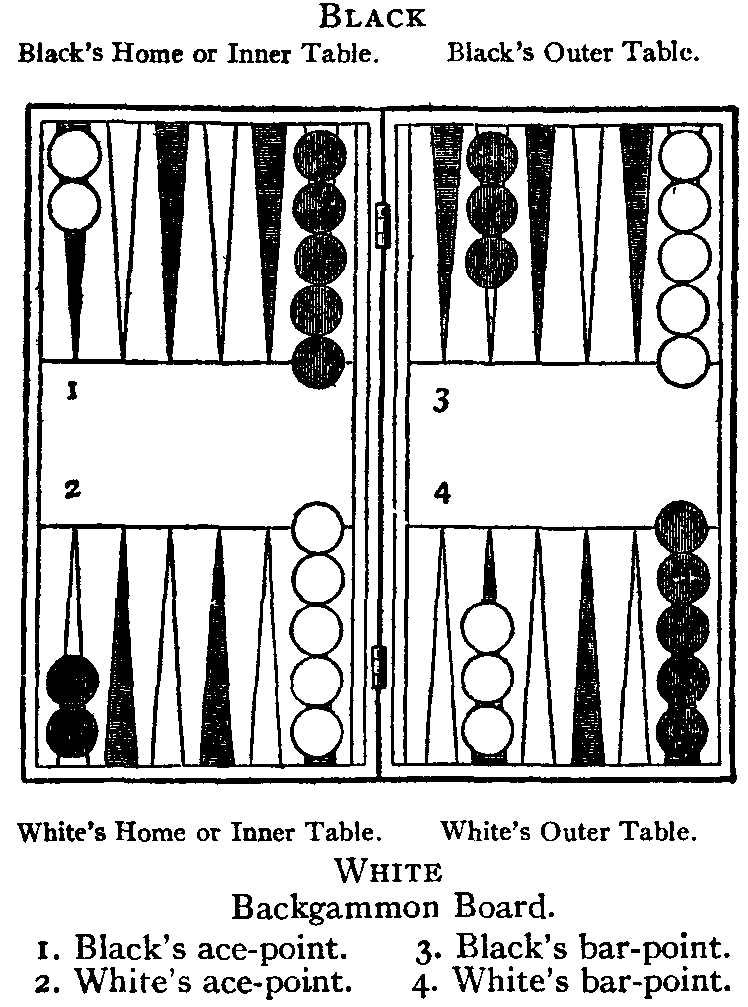
The men are moved on from point to point, according to the throws of the dice made by the players alternately. White moves from black's inner table to black's outer, and from this to white's outer table, and so on to white's inner table; and all black's moves must be in the contrary direction. A player may move any of his men a number of points corresponding to the numbers thrown by him, provided the point to which the move would bring him is not blocked by two or more of his adversary's men being on it. The whole throw may be taken with one man, or two men maybe moved, one the exact number of points on one die, the other the number on the other die. If doublets are thrown (e.g. two sixes), four moves of that number (e.g. four moves of six points) may be made, either all by one man or separately by more. Thus, suppose white throws five, six, he may move one of his men from the left-hand corner of the black's inner table to the left-hand corner of black's outer table for six; he may, again, move the same man five points farther on, when his move is completed; or he may move any other man five points. But white cannot move a man for five from the black's ace-point, because the six-point in that table is blocked. Any part of the throw which cannot be moved is of no effect, but it is compulsory for a player to move the whole throw unless blocked. Thus if the men were differently placed, and white could move a six, and having done so could not move a five, his move is completed. If, however, by moving the five first, he can afterwards move a six, he must make the move in that manner.
When a player so moves as to place two men on the same point, he is said to "make a point."
When there is only a single man on a point, it is called a "blot." When a blot is left, the man there may be taken up (technically the blot may be "hit") by the adversary if he throws a number which will enable him to place a man on that point. The man hit is placed on the bar, and has to begin again by entering the adversary's home table again at the next throw should it result in a number that corresponds to an unblocked point. The points in the home tables count for this purpose as 1, 2, 3, 4, 5, 6, beginning from the ace-point. A player is not allowed to move any other man while he has one to enter. It is, therefore, an advantage to have made all the points in your own board, so that your adversary, if you take a man up, cannot enter; and you can then continue throwing until a point is opened.
The game proceeds until one of the players gets all his men into his inner table or home. Then he begins to take his men off the board, or to bear them, i.e. to remove a man from any point that corresponds in number with his throw. If such a point is unoccupied, a move must be made, if there is room for it, and a move may be taken, instead of bearing a man, at any time; but when six is empty, if six is thrown a man may be borne from five and so on. If, after a player has commenced throwing off his men, he should be hit on a blot, he must enter on his adversary's inner table and must bring the man taken up into his own inner table before he can bear further.
Whoever first takes off all his men wins the game:—a single game (a "hit") if his adversary has begun bearing; a double game (a "gammon") if the adversary has not borne a man; and a triple game (a "backgammon") if, at the time the winner bears his last man, his adversary, not having borne a man, has one in the winner's inner table, or has a man up. When a series of games is played, the winner of a hit has the first throw in the succeeding game; but if a gammon is won, the players each throw a single die to determine the first move of the next game.
In order to play backgammon well, it is necessary to know all the chances on two dice and to apply them in various ways. The number of different throws that can be made is thirty-six. By taking all the combinations of these throws which include given numbers, it is easily discovered where blots may be left with the least probability of being hit. For example, to find the chance of being hit where a blot can only be taken up by an ace, the adversary may throw two aces, or ace in combination with any other number up to six, and he may throw each of these in two different ways, so that there are in all eleven ways in which an ace may be thrown. This, deducted from thirty-six (the total number of throws), leaves twenty-five; so that it is 25 to 11 against being hit on an ace. It is very important to bear in mind the chance of being hit on any number. The following table gives the odds against being hit on any number within the reach of one or two dice: -
It is 25 to 11, or about 9 to 4, against being hit on 1
" 24 " 12, or 2 " 1, " 2
" 22 " 14, or about 3 " 2, " 3
" 21 " 15, or 7 " 5, " 4
" 21 " 15, " 7 " 5, " 5
" 19 " 17, " 9½ " 8½, " 6
" 30 " 6, " 5 " 1, " 7
" 30 " 6, " 5 " 1, " 8
" 31 " 5, or about 6 " 1, " 9
" 33 " 3, or 11 " 1, " 10
" 34 " 2, " 17 " 1, " 11
" 33 " 3, " 11 " 1, " 12
The table shows that if a blot must be left within the reach of one die, the nearer it is left to the adversary's man the less probability there is of its being hit. Also, that it is long odds against being hit on a blot which is only to be reached with double dice, and that, in that case (on any number from 7 to 11), the farther off the blot is, the less chance there is of its being hit.
The table assumes that the board is open for every possible throw. If part of the throw is blocked by an intervening point being held by adverse men, the chance of being hit is less.
Two principles, then, have to be considered in moving the men:— (1) To make points where there is the best chance of obstructing the opponent. (2) When obliged to leave blots, to choose the position in which they are least likely to be hit.
The best points to secure are the five-point in your own inner table and the five-point in your adversary's inner table. The next best is your own bar-point; and the next best the four in your own inner table.
The best move for some throws at the commencement of a game is as follows:—Aces (the best of all throws), move two on your bar-point and two on your five-point. This throw is often given to inferior players by way of odds.
Ace, trey: make the five-point in your inner table.
Ace, six: make your bar-point.
Deuces: move two on the four-point in your inner table, and two on the trey-point in your opponent's inner table.
Deuce, four: make the four-point in your own table.
Threes: play two on the five-point in your inner table, and two on the four-point of your adversary's inner table, or make your bar-point.
Trey, five: make the trey-point in your own table.
Trey, six: bring a man from your adversary's ace-point as far as he will go.
Fours: move on two on the five-point in your adversary's inner table, and two from the five in his outer table.
Four, five and four, six: carry a man from your adversary's ace-point as far as he will go.
Fives: move two men from the five in your adversary's outer table to the trey-point in your inner table.
Five, six: move a man from your adversary's ace-point as far as he will go.
Sixes (the second-best throw): move two on your adversary's bar-point and two on your own bar-point.
In carrying the men home carry the most distant man to your adversary's bar-point, to the six-point in your outer table, and then to the six-point in your inner table. By following this rule as nearly as the throws admit, you will carry the men to your inner table in the fewest number of throws.
Avoid carrying many men upon the trey or deuce-point in your own tables, as these men are out of play.
Whenever you have taken up two of your adversary's men, and two or more points made in your inner table, spread your other men in the hope of making another point in your tables, and of hitting the man your adversary enters.
Always take up a man if the blot you leave in making the move can only be hit with double dice, but if you already have two of your opponent's men in your tables it is unwise to take up a third.
In entering a man which it is to your adversary's advantage to hit, leave the blot upon the lowest point you can, e.g. ace-point in preference to deuce-point.
When your adversary is bearing his men, and you have two men in his table, say, on his ace-point, and several men in the outer table, it is to your advantage to leave one man on the ace-point, because it prevents his bearing his men to the greatest advantage, and gives you the chance of his leaving a blot. But if you find that you can probably save the gammon by bringing both your men out of his table, do not wait for a blot. Eight points is the average throw.
The laws of backgammon (as given by Hoyle) are as follows:—
1. When a man is touched by the caster it must be played if possible; if impossible no penalty. 2. A man is not played till it is placed upon a point and quitted. 3. If a player omits a man from the board there is no penalty. 4. If he bears any number of men before he has entered a man taken up, men so borne must be entered again. 5. If he has mistaken his throw and played it, and his adversary has thrown, it is not in the choice of either of the players to alter it, unless they both agree to do so. 6. If one or both dice are "cocked," i.e. do not lie fairly and squarely on the table, a fresh throw is imperative.
Russian Backgammon varies from the above game in that the men, instead of being set as in the diagram, are entered in the same table by throws of the dice, and both players move in the same direction round to the opposite table. There are various rules for this game. By some a player is not obliged to enter all his men before he moves any; he can take up blots at any time on entering, but while he has a man up, he must enter it before entering any more or moving any of those already entered. If he cannot enter the man that is up, he loses the benefit of the throw.
A player who throws doublets must play or enter not only the number thrown, but also doublets of the number corresponding to the opposite side of the dice; thus, if he throws sixes, he must first enter or move the sixes, as the case may be, and then aces, and he also has another throw. Some rules allow him to play either doublets first, but he must always complete one set before playing the other. If a player cannot play the whole of his throw, his adversary is sometimes allowed to play the unplayed portion, in which cases the caster is sometimes allowed to come in and complete his moves, if he can, and in the event of his having thrown deuce-ace or doublets to throw again. If he throws doublets a second time, he moves and throws again, and so on. The privilege is sometimes restricted by not allowing this advantage to the first doublets thrown by each player. It is sometimes extended by allowing the thrower of the deuce-ace to choose any doublets he likes on the opposite side of the dice, and to throw again. The restriction with regard to the first doublets thrown does not apply to deuce-ace, nor does throwing it remove the restriction with regard to first doublets. A player must first be able to complete the doublets thrown. If the player cannot move the whole throw he cannot take the corresponding doublets, and he is not allowed another throw if he cannot move all the points to which he is entitled.
BACKHUYSEN, or Bakhuisen, LUDOLF (1631-1708), Dutch painter, was born at Emden, in Hanover. He was brought up as a merchant at Amsterdam, but early discovered so strong a genius for painting that he relinquished business and devoted himself to art. He studied first under Allart van Everdingen and then under Hendrik Dubbels, two eminent masters of the time, and soon became celebrated for his sea-pieces. He was an ardent student of nature, and frequently exposed himself on the sea in an open boat in order to study the effects of tempests. His compositions, which are very numerous, are nearly all variations of one subject, and in a style peculiarly his own, marked by intense realism or faithful imitation of nature. In his later years Backhuysen employed his time in etching and calligraphy. He died in Amsterdam on the 17th of November 1708.
BACKNANG, a town of Germany, in the kingdom of Württemberg, 19 m. by rail N.E. from Stuttgart. Pop. (1900) 7650. It has an interesting church, dating from the 12th century, and notable tanneries and leather factories, woollen and cloth mills. In 1325 Backnang was ceded to Württemberg by Baden. In the vicinity is the Wilhelmsheim sanatorium for consumptives.
BACKSCRATCHER, a long slender rod of wood, whalebone, tortoiseshell, horn or cane, with a carved human hand, usually of ivory, mounted at the extremity. Its name suggests the primary use of the implement, but little is known of its history, and it was unquestionably also employed as a kind of rake to keep in order the huge "heads" of powdered hair worn by ladies during a considerable portion of the 18th and the early part of the 19th centuries. The backscratcher varies in length from 12 to 20 in., and the more elaborate examples, which were occasionally hung from the waist, are silver-mounted, and in rare instances the ivory fingers bear carved rings. The hand is sometimes outstretched, and sometimes the fingers are flexed; the modelling is frequently good, the fingers delicately formed and the nails well defined. As a rule the rod is finished off with a knob. The hand was now and again replaced by a rake or a bird's claw. The hand was indifferently dexter or sinister, but the Chinese variety usually bears a right hand. Like most of the obsolete appliances of daily life, the backscratcher, or scratch-back, as it is sometimes called, has become scarce, and it is one of the innumerable objects which attract the attention of the modern collector.
BACK'S RIVER (Thlewechodyeth, or "Great Fish"), a river in Mackenzie and Keewatin districts, Canada, rising in Sussex lake, a small body of water in 108° 20′ W. and 64° 25′ N., and flowing with a very tortuous course N.E. to an inlet of the Arctic Ocean, passing through several large lake-expansions—Pelly, Carry, MacDougall and Franklin. Like the Coppermine, the only other large river of this part of Canada, it is rendered unnavigable by a succession of rapids and rocks. It was discovered and explored by Sir George Back in 1834. Its total length is 560 m.
BACKWARDATION, or, as it is more often called for brevity, Back, a technical term employed on the London Stock Exchange to express the amount charged for the loan of stock from one account to the other, and paid to the purchaser by the seller on a bear account (see Account) in order to allow the seller to defer the delivery of the stock. The seller, having sold for delivery on a certain date, stocks or shares which probably he does not possess, in the hope that he may be able, before the day fixed for delivery, to buy them at a cheaper price and so earn a profit, finds on settling-day that the prices have not gone down according to his expectation, and therefore pays the purchaser an agreed amount of interest (backwardation) for the privilege of deferring the delivery, either in order to procure the stock, or else in the hope that there will be a shrinkage in the price which will enable him to gain a profit. (See also Stock Exchange).
BACON, FRANCIS (Baron Verulam, Viscount St Albans) (1561-1626), English philosopher, statesman and essayist, was born at York House in the Strand, London, on the 22nd of January 1560/1. He was the youngest son of Sir Nicholas Bacon (q.v.). His mother, the second wife of Sir Nicholas, was a daughter of Sir Anthony Cooke, formerly tutor to Edward VI. She was a woman of considerable culture, well skilled in the classical studies of the period, and a warm adherent of the Reformed or Puritan Church. Very little is known of Bacon's early life and education. His health being then, as always, extremely delicate, he probably received much of his instruction at home. In April 1573 he was entered at Trinity College, Cambridge, where for three years he resided with his brother Anthony. At Cambridge he applied himself diligently to the several sciences as then taught, and came to the conclusion that the methods employed and the results attained were alike erroneous. Although he preserved a reverence for Aristotle (of whom, however, he seems to have known but little), he learned to despise the current Aristotelian philosophy. It yielded no fruit, was serviceable only for disputation, and the end it proposed to itself was a mistaken one. Philosophy must be taught its true purpose, and for this purpose a new method must be devised. With the first germs of this great conception in his mind, Bacon left the university.
On the 27th of June 1576 he and his brother Anthony were entered de societate magistrorum at Gray's Inn, and a few months later he was sent abroad with Sir Amyas Paulet, the English ambassador at Paris. The disturbed state of government and society in France at that time afforded him valuable political instruction. It was formerly supposed that certain Notes on the State of Christendom, usually printed in his works, contain the results of his observations, but Spedding has shown that there is no reason for ascribing these Notes to him, and that they may be attributed with more probability to one of his brother Anthony's correspondents.
The sudden death of his father in February 1578/9 necessitated Bacon's return to England, and exercised a very serious influence on his fortunes. A considerable sum of money had been laid up by Sir Nicholas for the purchase of an estate for his youngest son, the only one otherwise unprovided for. Owing to his sudden death, this intention was not carried out, and a fifth only of the money descended to Francis. This was one of the gravest misfortunes of his life; he started with insufficient means, acquired a habit of borrowing and was never afterwards out of debt. As it had become necessary that he should adopt some profession, he selected that of law, and took up his residence at Gray's Inn in 1579.
In the fragment De Interpretation Naturae Prooemium (written probably about 1603) Bacon analyses his own mental character and lays before us the objects he had in view when he entered on public life. If his opening sentence, "Ego cum me ad utilitates humanas natum existimarem" ("since I thought myself born to be of advantage to mankind"), seems at first sight a little arrogant, it must be remembered that it is the arrogance of Aristotle's μεγαλόψυχος,[1] who thinks himself worthy of great things, and is worthy. The ideal of production of good to the human race through the discovery of truth, was combined in him with the practical desire to be of service to his country. He purposed, therefore, to obtain, if possible, some honourable post in the state which would give him the means of realizing these projects, and would enable him to do somewhat for the church, the third of the objects whose good he had at heart. The constant striving after these three ends is the key to Bacon's life. His qualifications for accomplishing the task were not small. His intellect was far-seeing and acute, quick and yet cautious, meditative, methodical and free from prejudice. If we add to this account that he seems to have been of an unusually amiable disposition we have a fairly complete picture of his mental character at this critical period of his life.
In 1580 he appears to have taken the first step in his career by applying, through his uncle, Burghley, the lord treasurer, for some post at court. His suit, though well received by the queen, was unsuccessful; the particulars are totally unknown. For two years after this disappointment he worked quietly at Gray's Inn, and in 1582 was admitted an outer barrister. In 1584 he took his seat in parliament for Melcombe in Dorsetshire, but the notes for the session do not disclose what reputation he gained. About the same time he made another application to Burghley, apparently with a view to expediting his progress at the bar. His uncle, who appears to have "taken his zeal for ambition," wrote him a severe letter, taking him to task for arrogance and pride, qualities which Bacon vehemently disclaimed. As his advancement at the bar was unusually rapid, his uncle's influence may have been exerted in his behalf. In 1589 he received the first substantial piece of patronage from his powerful kinsman, the reversion of the clerkship of the Star Chamber. The office was worth about £1600 a year; but it did not become vacant for nearly twenty years. A considerable period of his life thus slipped away, and his affairs had not prospered. He had written on the condition of parties in the church; he had set down his thoughts on philosophical reform in the lost tract, Temporis Partus Maximus; but he had failed in obtaining the position which he looked upon as an indispensable condition of success. A long and eloquent letter to Burghley[2] throws additional light upon his character, and gives a hint as to the cause of his uncle's slackness in promoting him.