Volume 3 — VOLUME III (continued 9)
Reading edition
See G. Juritsch, Geschichte der Babenberger und ihrer Länder (Innsbruck, 1894); M. Schmitz, Oesterreichs Scheyern-Wittelsbacher oder die Dynastie der Babenberger (Munich, 1880).
BABER, or Babar (1483-1530), a famous conqueror of India and founder of the so-called Mogul dynasty. His name was Zahir ud-din-Mahomet, and he was given the surname of Baber, meaning the tiger. Born on the 14th of February 1483, he was a descendant of Timur, and his father, Omar Sheik, was king of Ferghana, a district of what is now Russian Turkestan. Omar died in 1495, and Baber, though only twelve years of age, succeeded to the throne. An attempt made by his uncles to dislodge him proved unsuccessful, and no sooner was the young sovereign firmly settled than he began to meditate an extension of his own dominions. In 1497 he attacked and gained possession of Samarkand, to which he always seems to have thought he had a natural and hereditary right. A rebellion among his nobles robbed him of his native kingdom, and while marching to recover it his troops deserted him, and he lost Samarkand also. After some reverses he regained both these places, but in 1501 his most formidable enemy, Shaibani (Sheibani) Khan, ruler of the Uzbegs, defeated him in a great engagement and drove him from Samarkand. For three years he wandered about trying in vain to recover his lost possessions; at last, in 1504, he gathered some troops, and crossing the snowy Hindu Kush besieged and captured the strong city of Kabul. By this dexterous stroke he gained a new and wealthy kingdom, and completely re-established his fortunes. In the following year he united with Hussain Mirza of Herat against Shaibani. The death of Hussain put a stop to this expedition, but Baber spent a year at Herat, enjoying the pleasures of that capital. He returned to Kabul in time to quell a formidable rebellion, but two years later a revolt among some of the leading Moguls drove him from his city. He was compelled to take to flight with very few companions, but his great personal courage and daring struck the army of his opponents with such dismay that they again returned to their allegiance and Baber regained his kingdom. Once again, in 1510, after the death of Shaibani, he endeavoured to obtain possession of his native country. He received considerable aid from Shah Ismael of Persia, and in 1511 made a triumphal entry into Samarkand. But in 1514 he was utterly defeated by the Uzbegs and with difficulty reached Kabul. He seems now to have resigned all hopes of recovering Ferghana, and as he at the same time dreaded an invasion of the Uzbegs from the west, his attention was more and more drawn towards India. Several preliminary incursions had been already made, when in 1521 an opportunity presented itself for a more extended expedition. Ibrahim, emperor of Delhi, had made himself detested, even by his Afghan nobles, several of whom called upon Baber for assistance. He at once assembled his forces, 12,000 strong, with some pieces of artillery and marched into India. Ibrahim, with 100,000 soldiers and numerous elephants, advanced against him. The great battle was fought at Panipat on the 21st of April 1526, when Ibrahim was slain and his army routed. Baber at once took possession of Agra. A still more formidable enemy awaited him; the Rana Sanga of Mewar collected the enormous force of 210,000 men, with which he moved against the invaders. On all sides there was danger and revolt, even Baber's own soldiers, worn out with the heat of this new climate, longed for Kabul. By vigorous measures and inspiriting speeches he restored their courage, though his own heart was nearly failing him, and in his distress he abjured the use of wine, to which he had been addicted. At Kanwaha, on the 10th of March 1527, he won a great victory and made himself absolute master of northern India. The remaining years of his life he spent in arranging the affairs and revenues of his new empire and in improving his capital, Agra. He died on the 26th of December 1530 in his forty-eighth year. Baber was above the middle height, of great strength and an admirable archer and swordsman. His mind was as well cultivated as his bodily powers; he wrote well, and his observations are generally acute and accurate; he was brave, kindly and generous.
Full materials for his life are found in his Memoirs, written by himself (translated into English by Leyden and Erskine (London, 1826); abridged in Caldecott, Life of Baber (London, 1844). See also Lane-Poole, Baber (Rulers of India Series), 1899.
BABEUF, FRANÇOIS NOEL (1760-1797), known as Gracchus Babeuf, French political agitator and journalist, was born at Saint Quentin on the 23rd of November 1760. His father, Claude Babeuf, had deserted the French army in 1738 and taken service under Maria Theresa, rising, it is said, to the rank of major. Amnestied in 1755 he returned to France, but soon sank into dire poverty, being forced to earn a pittance for his wife and family as a day labourer. The hardships endured by Babeuf during early years do much to explain his later opinions. He had received from his father the smatterings of a liberal education, but until the outbreak of the Revolution he was a domestic servant, and from 1785 occupied the invidious office of commissaire à terrier, his function being to assist the nobles and priests in the assertion of their feudal rights as against the unfortunate peasants. On the eve of the Revolution Babeuf was in the employ of a land surveyor at Roye. His father had died in 1780, and he was now the sole support, not only of his wife and two children, but of his mother, brothers and sisters. In the circumstances it is not surprising that he was the life and soul of the malcontents of the place. He was an indefatigable writer, and the first germ of his future socialism is contained in a letter of the 21st of March 1787, one of a series—mainly on literature—addressed to the secretary of the Academy of Arras. In 1789 he drew up the first article of the cahier of the electors of the bailliage of Roye, demanding the abolition of feudal rights. Then, from July to October, he was in Paris superintending the publication of his first work: Cadastre perpétuel, dédié à l'assemblée nationale, l'an 1789 et le premier de la liberté française, which was written in 1787 and issued in 1790. The same year he published a pamphlet against feudal aids and the gabelle, for which he was denounced and arrested, but provisionally released. In October, on his return to Roye, he founded the Correspondant picard, the violent character of which cost him another arrest. In November he was elected a member of the municipality of Roye, but was expelled. In March 1791 he was appointed commissioner to report on the national property (biens nationaux) in the town, and in September 1792 was elected a member of the council-general of the department of the Somme. Here, as everywhere, the violence of his attitude made his position intolerable to himself and others, and he was soon transferred to the post of administrator of the district of Montdidier. Here he was accused of fraud for having substituted one name for another in a deed of transfer of national lands. It is probable that his fault was one of negligence only; but, distrusting the impartiality of the judges of the Somme, he fled to Paris, and on the 23rd of August 1793 was condemned in contumaciam to twenty years' imprisonment. Meanwhile he had been appointed secretary to the relief committee (comité des subsistances) of the commune of Paris. The judges of Amiens, however, pursued him with a warrant for his arrest, which took place in Brumaire of the year II. (1794). The court of cassation quashed the sentence, through defect of form, but sent Babeuf for a new trial before the Aisne tribunal, by which he was acquitted on the 18th of July.
Babeuf now returned to Paris, and on the 3rd of September 1794 published the first number of his Journal de la liberté de la presse, the title of which was altered on the 5th of October to Le Tribun du peuple. The execution of Robespierre on the 28th of July had ended the Terror, and Babeuf—now self-styled "Gracchus" Babeuf—defended the men of Thermidor and attacked the fallen terrorists with his usual violence. But he also attacked, from the point of view of his own socialistic theories, the economic outcome of the Revolution. This was an attitude which had few supporters, even in the Jacobin club, and in October Babeuf was arrested and sent to prison at Arras. Here he came under the influence of certain terrorist prisoners, notably of Lebois, editor of the Journal de l'égalité, afterwards of the Ami du peuple, papers which carried on the traditions of Marat. He emerged from prison a confirmed terrorist and convinced that his Utopia, fully proclaimed to the world in No. 33 of his Tribun, could only be realized through the restoration of the constitution of 1793. He was now in open conflict with the whole trend of public opinion. In February 1795 he was again arrested, and the Tribun du peuple was solemnly burnt in the Théâtre des Bergères by the jeunesse dorée, the young men whose mission it was to bludgeon Jacobinism out of the streets and cafés. But for the appalling economic conditions produced by the fall in the value of assignats, Babeuf might have shared the fate of other agitators who were whipped into obscurity.
It was the attempts of the Directory to deal with this economic crisis that gave Babeuf his real historic importance. The new government was pledged to abolish the vicious system by which Paris was fed at the expense of all France, and the cessation of the distribution of bread and meat at nominal prices was fixed for the 20th of February 1796. The announcement caused the most wide-spread consternation. Not only the workmen and the large class of idlers attracted to Paris by the system, but rentiers and government officials, whose incomes were paid in assignats on a scale arbitrarily fixed by the government, saw themselves threatened with actual starvation. The government yielded to the outcry that arose; but the expedients by which it sought to mitigate the evil, notably the division of those entitled to relief into classes, only increased the alarm and the discontent. The universal misery gave point to the virulent attacks of Babeuf on the existing order, and at last gained him a hearing. He gathered round him a small circle of his immediate followers known as the Société des Égaux, soon merged with the rump of the Jacobins, who met at the Pantheon; and in November 1795 he was reported by the police to be openly preaching "insurrection, revolt and the constitution of 1793."
For a time the government, while keeping itself informed of his activities, left him alone; for it suited the Directory to let the socialist agitation continue, in order to frighten the people from joining in any royalist movement for the overthrow of the existing regime. Moreover the mass of the ouvriers, even of extreme views, were repelled by Babeuf's bloodthirstiness; and the police agents reported that his agitation was making many converts—for the government. The Jacobin club of the Faubourg Saint-Antoine refused to admit Babeuf and Lebois, on the ground that they were "égorgeurs." With the development of the economic crisis, however, Babeuf's influence increased. After the club of the Pantheon was closed by Bonaparte, on the 27th of February 1796, his aggressive activity redoubled. In Ventôse and Germinal he published, under the nom de plume of "Lalande, soldat de la patrie," a new paper, the Éclaireur du peuple, ou le défenseur de vingt-cinq millions d'opprimés, which was hawked clandestinely from group to group in the streets of Paris. At the same time No. 40 of the Tribun excited an immense sensation. In this he praised the authors of the September massacres as "deserving well of their country," and declared that a more complete "September 2nd" was needed to annihilate the actual government, which consisted of "starvers, bloodsuckers, tyrants, hangmen, rogues and mountebanks." The distress among all classes continued to be appalling; and in March the attempt of the Directory to replace the assignats (q.v.) by a new issue of mandats created fresh dissatisfaction after the breakdown of the hopes first raised. A cry went up that national bankruptcy had been declared, and thousands of the lower class of ouvrier began to rally to Babeuf's flag. On the 4th of April it was reported to the government that 500,000 people in Paris were in need of relief. From the 11th Paris was placarded with posters headed Analyse de la doctrine de Babœuf (sic), tribun du peuple, of which the opening sentence ran: "Nature has given to every man the right to the enjoyment of an equal share in all property," and which ended with a call to restore the constitution of 1793. Babeuf's song Mourant de faim, mourant de froid (Dying of hunger, dying of cold), set to a popular air, began to be sung in the cafés, with immense applause; and reports were current that the disaffected troops in the camp of Grenelle were ready to join an émeute against the government. The Directory thought it time to act; the bureau central had accumulated through its agents, notably the ex-captain Georges Grisel, who had been initiated into Babeuf's society, complete evidence of a conspiracy for an armed rising fixed for Floréal 22, year IV. (11th of May 1796), in which Jacobins and socialists were combined. On the 10th of May Babeuf was arrested with many of his associates, among whom were A. Darthé and P. M. Buonarroti, the ex-members of the Convention, Robert Lindet, J. A. B. Amar, M. G. A. Vadier and Jean Baptiste Drouet, famous as the postmaster of Saint-Menehould who had arrested Louis XVI., and now a member of the Council of Five Hundred.
The coup was perfectly successful. The last number of the Tribun appeared on the 24th of April, but Lebois in the Ami du peuple tried to incite the soldiers to revolt, and for a while there were rumours of a military rising. The trial of Babeuf and his accomplices was fixed to take place before the newly constituted high court of justice at Vendôme. On Fructidor 10 and 11 (27th and 28th of August), when the prisoners were removed from Paris, there were tentative efforts at a riot with a view to rescue, but these were easily suppressed. The attempt of five or six hundred Jacobins (7th of September) to rouse the soldiers at Grenelle met with no better success. The trial of Babeuf and the others, begun at Vendôme on the 20th of February 1797, lasted two months. The government for reasons of their own made the socialist Babeuf the leader of the conspiracy, though more important people than he were implicated; and his own vanity played admirably into their hands. On Prairial 7 (26th of April 1797) Babeuf and Darthé were condemned to death; some of the prisoners, including Buonarroti, were exiled; the rest, including Vadier and his fellow-conventionals, were acquitted. Drouet had succeeded in making his escape, according to Barras, with the connivance of the Directory. Babeuf and Darthé were executed at Vendôme on Prairial 8 (1797).
Babeuf's character has perhaps been sufficiently indicated above. He was a type of the French revolutionists, excitable, warm-hearted, half-educated, who lost their mental and moral balance in the chaos of the revolutionary period. Historically, his importance lies in the fact that he was the first to propound socialism as a practical policy, and the father of the movements which played so conspicuous a part in the revolutions of 1848 and 1871.
See V. Advielle, Hist. de Gracchus Babeuf et de Babouvisme (2 vols., Paris, 1884); P. M. Buonarroti, Conspiration pour l'égalité, dite de Babeuf (2 vols., Brussels, 1828; later editions, 1850 and 1869), English translation by Bronterre O'Brien (London, 1836); Cambridge Modern History, vol. viii.; Adolf Schmidt, Pariser Zustände wahrend der Revolutionszeit von 1789-1800 (Jena, 1874). French trans. by P. Viollet, Paris pendant la Révolution d'après les rapports de la police secrète, 1789-1800 (4 vols., 1880-1894); A. Schmidt, Tableaux de la Révolution française, &c. (Leipzig, 1867-1870), a collection of reports of the secret police on which the above work is based. A full report of the trial at Vendôme was published in four volumes at Paris in 1797, Débats du procès, &c.
(W. A. P.)
BÁBÍISM, the religion founded in Persia in A.D. 1844-1845 by Mírzá ‛Alí Muhammad of Shíráz, a young Sayyid who was at that time not twenty-five years of age. Before his "manifestation" (zuhúr), of which he gives in the Persian Bayán a date corresponding to 23rd May 1844, he was a disciple of Sayyid Kázim of Rasht, the leader of the Shaykhís, a sect of extreme Shí‛ites characterized by the doctrine (called by them Rukn-i-rábi‛, "the fourth support") that at all times there must exist an intermediary between the twelfth Imám and his faithful followers. This intermediary they called "the perfect Shí‛ite," and his prototype is to be found in the four successive Bábs or "gates" through whom alone the twelfth Imám, during the period of his "minor occultation" (Ghaybat-i-sughrá, A.D. 874-940), held communication with his partisans. It was in this sense, and not, as has been often asserted, in the sense of "Gate of God" or "Gate of Religion," that the title Báb was understood and assumed by Mírzá ‛Alí Muhammad; but, though still generally thus styled by non-Bábís, he soon assumed the higher title of Nuqta ("Point"), and the title Báb, thus left vacant, was conferred on his ardent disciple, Mullá Husayn of Bushrawayh.
The history of the Bábís, though covering a comparatively short period, is so full of incident and the particulars now available are so numerous, that the following account purports to be only the briefest sketch. The Báb himself was in captivity first at Shíráz, then at Mákú, and lastly at Chihríq, during the greater part of the six years (May 1844 until July 1850) of his brief career, but an active propaganda was carried on by his disciples, which resulted in several serious revolts against the government, especially after the death of Muhammad Sháh in September 1848. Of these risings the first (December 1848-July 1849) took place in Mázandarán, at the ruined shrine of Shaykh Tabarsí, near Bárfurúsh, where the Bábís, led by Mullá Muhammad ‛Alí of Bárfurúsh and Mullá Husayn of Bushrawayh ("the first who believed"), defied the shah's troops for seven months before they were finally subdued and put to death. The revolt at Zanján in the north-west of Persia, headed by Mullá Muhammad ‛Ali Zanjání, also lasted seven or eight months (May-December 1850), while a serious but less protracted struggle was waged against the government at Níríz in Fárs by Agá Sayyid Yahyá of Níríz. Both revolts were in progress when the Báb, with one of his devoted disciples, was brought from his prison at Chihríq to Tabríz and publicly shot in front of the arg or citadel. The body, after being exposed for some days, was recovered by the Bábís and conveyed to a shrine near Tehrán, whence it was ultimately removed to Acre in Syria, where it is now buried. For the next two years comparatively little was heard of the Bábís, but on the 15th of August 1852 three of them, acting on their own initiative, attempted to assassinate Násiru'd-Dín Sháh as he was returning from the chase to his palace at Niyávarán. The attempt failed, but was the cause of a fresh persecution, and on the 31st of August 1852 some thirty Bábís, including the beautiful and talented poetess Qurratu'l-'Ayn, were put to death in Tehrán with atrocious cruelty. Another of the victims of that day was Hájji Mírzá Jání of Káshán, the author of the oldest history of the movement from the Bábí point of view. Only one complete MS. of his invaluable work (obtained by Count Gobineau in Persia) exists in any public library, the Bibliothèque Nationale at Paris. The so-called "New History" (of which an English translation was published at Cambridge in 1893 by E. G. Browne) is based on Mírzá Jání's work, but many important passages which did not accord with later Bábí doctrine or policy have been suppressed or modified, while some additions have been made. The Báb was succeeded on his death by Mírzá Yahyá of Núr (at that time only about twenty years of age), who escaped to Bagdad, and, under the title of Subh-i-Ezel ("the Morning of Eternity"), became the pontiff of the sect. He lived, however, in great seclusion, leaving the direction of affairs almost entirely in the hands of his elder half-brother (born 12th November 1817), Mírzá Husayn ‛Alí, entitled Bahá' u'lláh ("the Splendour of God"), who thus gradually became the most conspicuous and most influential member of the sect, though in the Iqán, one of the most important polemical works of the Bábís, composed in 1858-1859, he still implicitly recognized the supremacy of Subh-i-Ezel. In 1863, however, Bahá declared himself to be "He whom God shall manifest" (Man Yuz-hiruhu'lláh, with prophecies of whose advent the works of the Báb are filled), and called on all the Bábís to recognize his claim. The majority responded, but Subh-i-Ezel and some of his faithful adherents refused. After that date the Bábís divided into two sects, Ezelís and Bahá'ís, of which the former steadily lost and the latter gained ground, so that in 1908 there were probably from half a million to a million of the latter, and at most only a hundred or two of the former. In 1863 the Bábís were, at the instance of the Persian government, removed from Bagdad to Constantinople, whence they were shortly afterwards transferred to Adrianople. In 1868 Bahá and his followers were exiled to Acre in Syria, and Subh-i-Ezel with his few adherents to Famagusta in Cyprus, where he was still living in 1908. Bahá'u'lláh died at Acre on the 16th of May 1892. His son ‛Abbás Efendí (also called ‛Abdu'l-Bahá, "the servant of Bahá") was generally recognized as his successor, but another of his four sons, Muhammad ‛Alí, put forward a rival claim. This caused a fresh and bitter schism, but ‛Abbás Efendí steadily gained ground, and there could be little doubt as to his eventual triumph. The controversial literature connected with this latest schism is abundant, not only in Persian, but in English, for since 1900 many Americans have adopted the religion of Bahá. The original apostle of America was Ibráhím George Khayru'lláh, who began his propaganda at the Chicago Exhibition and later supported the claims of Muhammad ‛Alí. Several Persian missionaries, including the aged and learned Mírzá Abu'l-Fazl of Gulpáyagán, were thereupon despatched to America by ‛Abbás Efendí, who was generally accepted by the American Bahá'ís as "the Master." The American press contained many notices of the propaganda and its success. An interesting article on the subject, by Stoyan Krstoff Vatralsky of Boston, Mass., entitled "Mohammedan Gnosticism in America," appeared in the American Journal of Theology for January 1902, pp. 57-58.
A correct understanding of the doctrines of the early Bábís (now represented by the Ezelís) is hardly possible save to one who is conversant with the theology of Islám and its developments, and especially the tenets of the Shí‛a. The Bábís are Muhammadans only in the sense that the Muhammadans are Christians or the Christians Jews; that is to say, they recognize Muhammad (Mahomet) as a true prophet and the Qur'án (Koran) as a revelation, but deny their finality. Revelation, according to their view, is progressive, and no revelation is final, for, as the human race progresses, a fuller measure of truth, and ordinances more suitable to the age, are vouchsafed. The Divine Unity is incomprehensible, and can be known only through its Manifestations; to recognize the Manifestation of the cycle in which he lives is the supreme duty of man. Owing to the enormous volume and unsystematic character of the Bábí scriptures, and the absence of anything resembling church councils, the doctrine on many important points (such as the future life) is undetermined and vague. The resurrection of the body is denied, but some form of personal immortality is generally, though not universally, accepted. Great importance was attached to the mystical values of letters and numbers, especially the numbers 18 and 19 ("the number of the unity") and 19² = 361 ("the number of all things"). In general, the Báb's doctrines most closely resembled those of the Isma‛ílís and Hurúfís. In the hands of Bahá the aims of the sect became much more practical and ethical, and the wilder pantheistic tendencies and metaphysical hair-splittings of the early Bábís almost disappeared. The intelligence, integrity and morality of the Bábís are high, but their efforts to improve the social position of woman have been much exaggerated. They were in no way concerned (as was at the time falsely alleged) in the assassination of Násiru'd-Dín Sháh in May 1896. Of recent persecutions of the sect the two most notable took place at Yazd, one in May 1891, and another of greater ferocity in June 1903. Some account of the latter is given by Napier Malcolm in his book Five Years in a Persian Town (London, 1905), pp. 87-89 and 186. In the constitutional movement in Persia (1907) the Bábís, though their sympathies are undoubtedly with the reformers, wisely refrained from outwardly identifying themselves with that party, to whom their open support, by alienating the orthodox mujtahids and mullás, would have proved fatal. Here, as in all their actions, they clearly obeyed orders issued from headquarters.
Literature.—The literature of the sect is very voluminous, but mostly in manuscript. The most valuable public collections in Europe are at St Petersburg, London (British Museum) and Paris (Bibliothèque Nationale), where two or three very rare MSS. collected by Gobineau, including the precious history of the Báb's contemporary, Hájji Mírzá Jání of Káshán, are preserved. For the bibliography up to 1889, see vol. ii. pp. 173-211 of the Traveller's Narrative, written to illustrate the Episode of the Báb, a Persian work composed by Bahá's son, ‛Abbás Efendí, edited, translated and annotated by E. G. Browne (Cambridge, 1891). More recent works are:—Browne, The New History of the Báb (Cambridge, 1893); and "Catalogue and Description of the 27 Bábí Manuscripts," Journal of R. Asiat. Soc. (July and October 1892); Andreas, Die Bábí's in Persien (1896); Baron Victor Rosen, Collections scientifiques de l'Institut des Langues orientales, vol. i. (1877), pp. 179-212; vol. iii. (1886), pp. 1-51; vol. vi. (1891), pp. 141-255; "Manuscrits Bâbys"; and other important articles in Russian by the same scholar; and by Captain A. G. Toumansky in the Zapiski vostochnava otdyèleniya Imperatorskava Russkava Archeologicheskava Obshchestva (vols. iv.-xii., St Petersburg, 1890-1900); also an excellent edition by Toumansky, with Russian translation, notes and introduction, of the Kitáb-i-Aqdas (the most important of Bahá's works), &c. (St Petersburg, 1899). Mention should also be made of an Arabic history of the Bábís (unsympathetic but well-informed) written by a Persian, Mírzá Muhammad Mahdí Khan, Za‛imu'd-Duwla, printed in Cairo in A.H. 1321 (= A.D. 1903-1904). Of the works composed in English for the American converts the most important are:—Bahá'u'lláh (The Glory of God), by Ibráhím Khayru'lláh, assisted by Howard MacNutt (Chicago, 1900); The Three Questions (n.d.) and Facts for Baháists (1901), by the same; Life and Teachings of ‛Abbás Efendí, by Myron H. Phelps, with preface by E. G. Browne (New York, 1903); Isabella Brittingham, The Revelations of Bahá'u'lláh, in a Sequence of Four Lessons (1902); Laura Clifford Burney, Some Answered Questions Collected [in Acre, 1904-1906] and Translated from the Persian of ‛Abdu'l-Bahá [i.e. ‛Abbás Efendí] (London, 1908). In French, A. L. M. Nicolas (first dragoman at the French legation at Tehrán) has published several important translations, viz. Le Livre des sept preuves de la mission du Báb (Paris, 1902); Le Livre de la certitude (1904); and Le Beyân arabe (1905); and there are other notable works by H. Dreyfus, an adherent of the Bábí faith. Lastly, mention should be made of a remarkable but scarce little tract by Gabriel Sacy, printed at Cairo in June 1902, and entitled Du règne de Dieu et de l'Agneau, connu sous le nom de Babysme.
(E. G. B.)
BABINGTON, ANTHONY (1561-1586), English conspirator, son of Henry Babington of Dethick in Derbyshire, and of Mary, daughter of George, Lord Darcy, was born in October 1561, and was brought up secretly a Roman Catholic. As a youth he served at Sheffield as page to Mary queen of Scots, for whom he early felt an ardent devotion. In 1580 he came to London, attended the court of Elizabeth, and joined the secret society formed that year supporting the Jesuit missionaries. In 1582 after the execution of Father Campion he withdrew to Dethick, and attaining his majority occupied himself for a short time with the management of his estates. Later he went abroad and became associated at Paris with Mary's supporters who were planning her release with the help of Spain, and on his return he was entrusted with letters for her. In April 1586 he became, with the priest John Ballard, leader of a plot to murder Elizabeth and her ministers, and organize a general Roman Catholic rising in England and liberate Mary. The conspiracy was regarded by Mendoza, the Spanish ambassador, one of its chief instigators, and also by Walsingham, as the most dangerous of recent years; it included, in its general purpose of destroying the government, a large number of Roman Catholics, and had ramifications all over the country. Philip II. of Spain, who ardently desired the success of an enterprise "so Christian, just and advantageous to the holy Catholic faith,"[1] promised to assist with an expedition directly the assassination of the queen was effected. Babington's conduct was marked by open folly and vanity. Desirous of some token of appreciation from Mary for his services, he entered into a long correspondence with her, which was intercepted by the spies of Walsingham. On the 4th of August Ballard was seized and betrayed his comrades, probably under torture. Babington then applied for a passport abroad, for the ostensible purpose of spying upon the refugees, but in reality to organize the foreign expedition and secure his own safety. The passport being delayed, he offered to reveal to Walsingham a dangerous conspiracy, but the latter sent no reply, and meanwhile the ports were closed and none allowed to leave the kingdom for some days. He was still allowed his liberty, but one night while supping with Walsingham's servant he observed a memorandum of the minister's concerning himself, fled to St John's Wood, where he was joined by some of his companions, and after disguising himself succeeded in reaching Harrow, where he was sheltered by a recent convert to Romanism. Towards the end of August he was discovered and imprisoned in the Tower. On the 13th and 14th of September he was tried with Ballard and five others by a special commission, when he confessed his guilt, but strove to place all the blame upon Ballard. All were condemned to death for high treason. On the 19th he wrote to Elizabeth praying for mercy, and the same day offered £1000 for procuring his pardon; and on the 20th, having disclosed the cipher used in the correspondence between himself and Mary, he was executed with the usual barbarities in Lincoln's Inn Fields. The detection of the plot led to Mary's own destruction. There is no positive documentary proof in Mary's own hand that she had knowledge of the intended assassination of Elizabeth, but her circumstances, together with the tenour of her correspondence with Babington, place her complicity beyond all reasonable doubt.
BABINGTON, CHURCHILL (1821-1889), English classical scholar and archaeologist, was born at Roecliffe, in Leicestershire, on the 11th of March 1821. He was educated by his father till he was seventeen, when he was placed under the tuition of Charles Wycliffe Goodwin, the orientalist and archaeologist. He entered St John's College, Cambridge, in 1839, and graduated B.A. in 1843, being seventh in the first class of the classical tripos and a senior optime. In 1845 he obtained the Hulsean Prize for his essay The Influence of Christianity in promoting the Abolition of Slavery in Europe. In 1846 he was elected to a fellowship and took orders. He proceeded to the degree of M.A. in 1846 and D.D. in 1879. From 1848 to 1861 he was vicar of Horningsea, near Cambridge, and from 1866 to his death on the 12th of January 1889, vicar of Cockfield in Suffolk. From 1865 to 1880 he held the Disney professorship of archaeology at Cambridge. In his lectures, illustrated from his own collections of coins and vases, he dealt chiefly with Greek and Roman pottery and numismatics.
Dr Babington was a many-sided man and wrote on a variety of subjects. His early familiarity with country life gave him a taste for natural history, especially botany and ornithology. He was also an authority on conchology. He was the author of the appendices on botany (in part) and ornithology in Potter's History and Antiquities of Charnwood Forest (1842); Mr Macaulay's Character of the Clergy ... considered (1849), a defence of the clergy of the 17th century, which received the approval of Mr Gladstone, against the strictures of Macaulay. He also brought out the editio princeps of the speeches of Hypereides Against Demosthenes (1850), On Behalf of Lycophron and Euxenippus (1853), and his Funeral Oration (1858). It was by his edition of these speeches from the papyri discovered at Thebes (Egypt) in 1847 and 1856 that Babington's fame as a Greek scholar was made. In 1855 he published an edition of Benefizio della Morte di Cristo, a remarkable book of the Reformation period, attributed to Paleario, of which nearly all the copies had been destroyed by the Inquisition. Babington's edition was a facsimile of the editio princeps published at Venice in 1543, with Introduction and French and English versions. He also edited the first two volumes of Higden's Polychronicon (1858) and Bishop Pecock's Repressor of Overmuch Blaming of the Clergy (1860), undertaken at the request of the Master of the Rolls; Introductory Lecture on Archaeology (1865); Roman Antiquities found at Rougham [1872]; Catalogue of Birds of Suffolk (1884-1886); Flora of Suffolk (with W. M. Hind, 1889), and (1855, 1865) some inscriptions found in Crete by T. A. B. Spratt, the explorer of the island. In addition to contributing to various classical and scientific journals, he catalogued the classical MSS. in the University Library and the Greek and English coins in the Fitzwilliam museum.
Old Male Babirusa (Babirusa alfurus).
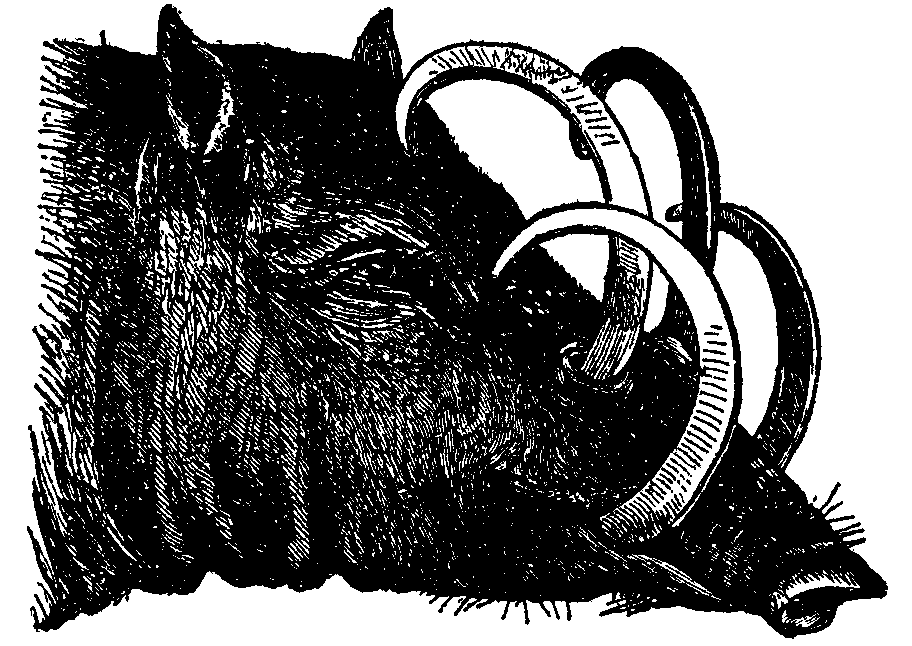
BABIRUSA ("pig-deer"), the Malay name of the wild swine of Celebes and Buru, which has been adopted in zoology as the scientific designation of this remarkable animal (the only representative of its genus), in the form of Babirusa alfurus. The skin is nearly naked, and very rough and rugged. The total number of teeth is 34, with the formula i.2/3. c.1/1. p.2/3. m.3/3. The molars, and more especially the last, are smaller and simpler than in the pigs of the genus Sus, but the peculiarity of this genus is the extraordinary development of the canines, or tusks, of the male. These teeth are ever-growing, long, slender and curved, and without enamel. Those of the upper jaw are directed upwards from their bases, so that they never enter the mouth, but pierce the skin of the face, thus resembling horns rather than teeth; they curve backwards, downwards, and finally often forwards again, almost or quite touching the forehead. Dr A. R. Wallace remarks that "it is difficult to understand what can be the use of these horn-like teeth. Some of the old writers supposed that they served as hooks by which the creature could rest its head on a branch. But the way in which they usually diverge just over and in front of the eye has suggested the more probable idea, that they serve to guard these organs from thorns and spines while hunting for fallen fruits among the tangled thickets of rattans and other spiny plants. Even this, however, is not satisfactory, for the female, who must seek her food in the same way, does not possess them. I should be inclined to believe rather that these tusks were once useful, and were then worn down as fast as they grew, but that changed conditions of life have rendered them unnecessary, and they now develop into a monstrous form, just as the incisors of the beaver and rabbit will go on growing if the opposite teeth do not wear them away. In old animals they reach an enormous size, and are generally broken off as if by fighting." On this latter view we may regard the tusks of the male babirusa as examples of redundant development, analogous to that of the single pair of lower teeth in some of the beaked whales. Unlike ordinary wild pigs, the babirusa produces uniformly coloured young. (See Swine.)
(R. L.*)
BABOON (from the Fr. babuin, which is itself derived from Babon, the Egyptian deity to whom it was sacred), properly the designation of the long-muzzled, medium-tailed Egyptian monkey, scientifically known as Papio anubis; in a wider sense applied to all the members of the genus Papio (formerly known as Cynocephalus) now confined to Africa and Arabia, although in past times extending into India. Baboons are for the most part large terrestrial monkeys with short or medium-sized tails, and long naked dog-like muzzles, in the truncated extremity of which are pierced the nostrils. As a rule, they frequent barren rocky districts in large droves, and are exceedingly fierce and dangerous to approach. They have large cheek-pouches, large naked callosities, often brightly coloured, on the buttocks, and short thick limbs, adapted rather to walking than to climbing. Their diet includes practically everything eatable they can capture or kill. The typical representative of the genus is the yellow baboon (P. cynocephalus, or babuin), distinguished by its small size and grooved muzzle, and ranging from Abyssinia to the Zambezi. The above-mentioned anubis baboon, P. anubis (with the subspecies neumanni, pruinosus, heuglini and doguera), ranging from Egypt all through tropical Africa, together with P. sphinx, P. olivaceus, the Abyssinian P. lydekkeri, and the chacma, P. porcarius of the Cape, represent the subgenus Choeropithecus. The named Arabian baboon, P. hamadryas of North Africa and Arabia, dedicated by the ancient Egyptians to the god Thoth, and the South Arabian P. arabicus, typify Hamadryas; while the drill and mandrill of the west coast, P. leucophaeus and P. maimon, constitute the subgenus Maimon. The anubis baboons, as shown by the frescoes, were tamed by the ancient Egyptians and trained to pluck sycamore-figs from the trees. (See Primates; Chacma; Drill; Gelada and Mandrill).
(R. L.*)
BABRIUS, author of a collection of fables written in Greek. Practically nothing is known of him. He is supposed to have been a Roman, whose gentile name was possibly Valerius, living in the East, probably in Syria, where the fables seem first to have gained popularity. The address to "a son of King Alexander" has caused much speculation, with the result that dates varying between the 3rd century B.C. and the 3rd century A.D. have been assigned to Babrius. The Alexander referred to may have been Alexander Severus (A.D. 222-235), who was fond of having literary men of all kinds about his court. "The son of Alexander" has further been identified with a certain Branchus mentioned in the fables, and it is suggested that Babrius may have been his tutor; probably, however, Branchus is a purely fictitious name. There is no mention of Babrius in ancient writers before the beginning of the 3rd century A.D., and his language and style seem to show that he belonged to that period. The first critic who made Babrius more than a mere name was Richard Bentley, in his Dissertation on the Fables of Aesop. In a careful examination of these prose Aesopian fables, which had been handed down in various collections from the time of Maximus Planudes, Bentley discovered traces of versification, and was able to extract a number of verses which he assigned to Babrius. Tyrwhitt (De Babrio, 1776) followed up the researches of Bentley, and for some time the efforts of scholars were directed towards reconstructing the metrical original of the prose fables. In 1842 M. Minas, a Greek, the discoverer of the Philosophoumena of Hippolytus, came upon a MS. of Babrius in the convent of St Laura on Mount Athos, now in the British Museum. This MS. contained 123 fables out of the supposed original number, 160. They are arranged alphabetically, but break off at the letter O. The fables are written in choliambic, i.e. limping or imperfect iambic verse, having a spondee as the last foot, a metre originally appropriated to satire. The style is extremely good, the expression being terse and pointed, the versification correct and elegant, and the construction of the stories is fully equal to that in the prose versions. The genuineness of this collection of the fables was generally admitted by scholars. In 1857 Minas professed to have discovered at Mount Athos another MS. containing 94 fables and a preface. As the monks refused to sell this MS., he made a copy of it, which was sold to the British Museum, and was published in 1859 by Sir G. Cornewall Lewis. This, however, was soon proved to be a forgery. Six more fables were brought to light by P. Knöll from a Vatican MS. (edited by A. Eberhard, Analecta Babriana, 1879).
Editions.—Boissonade (1844); Lachmann (1845); Schneider (1853); Eberhard (1876); Gitlbauer (1882); Rutherford (1883); Knöll, Fabularum Babrianarum Paraphrasis Bodleiana (1877); Feuillet (1890); Desrousseaux (1890); Passerat (1892); Croiset (1892); Crusius (1897). See also Mantels, Über die Fabeln des B. (1840); Crusius, De Babrii Aetate (1879); Ficus, De Babrii Vita (1889); J. Weiner, Quaestiones Babrianae (1891); Conington, Miscellaneous Writings, ii. 460-491; Marchiano, Babrio (1899); Fusci, Babrio (1901); Christoffersson, Studia de Fabulis Babrianis (1901). There are translations in English by Davies (1860) and in French by Levèque (1890), and in many other languages.
BABU, a native Indian clerk. The word is really a term of respect attached to a proper name, like "master" or "Mr," and Babu-ji is still used in many parts of India, meaning "sir"; but without the suffix the word itself is now generally used contemptuously as signifying a semi-literate native, with a mere veneer of modern education.
BABY-FARMING,[1] a term meaning generally the taking in of infants to nurse for payment, but usually with an implication of improper treatment. Previous to the year 1871 the abuse of the practice of baby-farming in England had grown to an alarming extent, while the trials of Margaret Waters and Mary Hall called attention to the infamous relations between the lying-in houses and the baby-farming houses of London. The evil was, no doubt, largely connected with the question of illegitimacy, for there was a wide-spread existence of baby-farms where children were received without question on payment of a lump sum. Such children were nearly all illegitimate, and in these cases it was to the pecuniary advantage of the baby-farmer to hasten the death of the child. It had become also the practice for factory operatives and mill-hands to place out their children by the day, and since in many cases the children were looked upon as a burden and a drain on their parents' resources, too particular inquiry was not always made as to the mode in which the children were cared for. The form was gone through too of paying a ridiculously insufficient sum for the maintenance of the child. In 1871 the House of Commons found it necessary to appoint a select committee "to inquire as to the best means of preventing the destruction of the lives of infants put out to nurse for hire by their parents." "Improper and insufficient food," said the committee, "opiates, drugs, crowded rooms, bad air, want of cleanliness, and wilful neglect are sure to be followed in a few months by diarrhoea, convulsions and wasting away." These unfortunate children were nearly all illegitimate, and the mere fact of their being hand-nursed, and not breast-nursed, goes some way (according to the experience of the Foundling hospital and the Magdalene home) to explain the great mortality among them. Such children, when nursed by their mothers in the workhouse, generally live. The practical result of the committee of 1871 was the act of 1872, which provided for the compulsory registration of all houses in which more than one child under the age of one year were received for a longer period than twenty-four hours. No licence was granted by the justices of the peace, unless the house was suitable for the purpose, and its owner a person of good character and able to maintain the children. Offences against the act, including wilful neglect of the children even in a suitable house, were punishable by a fine of £5 or six months' imprisonment with or without hard labour. In 1896 a select committee of the House of Lords sat and reported on the working of this act. In consequence of this report the act of 1872 was repealed and superseded by the Infant Life Protection Act 1897, which did away with the system of registration and substituted for it one of notice to a supervening authority. By the act all persons retaining or receiving for hire more than one infant under the age of five had to give written notice of the fact to the local authority. The local authorities were empowered to appoint inspectors, and required to arrange for the periodical inspection of infants so taken in, while they could also fix the number of infants which might be retained. By a special clause any person receiving an infant under the age of two years for a sum of money not exceeding twenty pounds had to give notice of the fact to the local authority. If any infants were improperly kept, the inspector might obtain an order for their removal to a work-house or place of safety until restored to their parents or guardians, or otherwise legally disposed of. The act of 1897 was repealed and amended by the Children Act 1908, which codified the law relating to children, and added many new provisions. This act is dealt with in the article Children, Law relating to.
In the United States the law is noticeably strict in most states. In Massachusetts, a law of 1891 directs that "every person who receives for board, or for the purpose of procuring adoption, an infant under the age of three years shall use diligence to ascertain whether or not such infant is illegitimate, and if he knows or has reason to believe it to be illegitimate shall forthwith notify the State Board of Charity of the fact of such reception; and said board and its officers or agents may enter and inspect any building where they may have reason to believe that any such illegitimate infant is boarded, and remove such infant when, in their judgment, such removal is necessary by reason of neglect, abuse or other causes, in order to preserve the infant's life, and such infant so removed shall be in the custody of said Board of Charity, which shall make provision therefor according to law." The penal code of the state of New York requires a licence for baby-farming to be issued by the board of health of the city or town where such children are boarded or kept, and "every person so licensed must keep a register wherein he shall enter the names and ages of all such children, and of all children born on such premises, and the names and residences of their parents, as far as known, the time of reception and the discharge of such children, and the reasons therefor, and also a correct register of every child under five years of age who is given out, adopted, taken away, or indentured from such place to or by any one, together with the name and residence of the person so adopting" (Pen. Code, § 288, subsec. 4).
Persons neglecting children may be prosecuted under § 289 of the N.Y. penal code, which provides that any person who "wilfully causes or permits the life or limb of any child, actually or apparently under the age of sixteen years, to be endangered, or its health to be injured, or its morals to become depraved ... is guilty of a misdemeanour."
In Australia particular care has been taken by most of the states to prevent the evils of baby-farming. In South Australia there is a State Children's Council, which, under the State Children Act of 1895, has large powers with respect to the oversight of infants under two years boarded out by their mother. "Foster-mothers," as the women who take in infants as boarders are called, must be licensed, while the number of children authorized to be kept by the foster-mother is fixed by licence; every licensed foster-mother must keep a register containing the name, age and place of birth of every child received by her, the names, addresses and description of the parents, or of any person other than the parents from or to whom the child was received or delivered over, the date of receipt or delivery over, particulars of any accident to or illness of the child, and the name of the medical practitioner (if any) by whom attended. In New South Wales the Children's Protection Act of 1892, with the amendments of 1902, requires the same state supervision over the homes in which children are boarded out, with licensing of foster-mothers. In Victoria an act was passed in 1890 for "making better provision for the protection of infant life." In New Zealand, there is legislation to the same effect by the "Adoption of Children Act 1895" and the "Infant Life Protection Act 1896."
BABYLON (mod. Hillah), an ancient city on the left bank of the Euphrates, about 70 m. S. of Bagdad. "Babylon" is the Greek form of Babel or Bab-ili, "the gate of the god" (sometimes incorrectly written "of the gods"), which again is the Semitic translation of the original Sumerian name Ka-dimirra. The god was probably Merodach or Marduk (q.v.), the divine patron of the city. In an inscription of the Kassite conqueror Gaddas the name appears as Ba-ba-lam, as if from the Assyrian babalu, "to bring"; another foreign Volksetymologie is found in Genesis xi. 9, from balbal, "to confound." A second name of the city, which perhaps originally denoted a separate village or quarter, was Su-anna, and in later inscriptions it is often represented ideographically by E-ki, the pronunciation and meaning of which are uncertain. One of its oldest names, however, was Din-tir, of which the poets were especially fond; Din-tir signifies in Sumerian "the life of the forest," though a native lexicon translates it "seat of life." Uru-azagga, "the holy city," was also a title sometimes applied to Babylon as to other cities in Babylonia. Ka-dimirra, the Semitic Bab-ili, probably denoted at first E-Saggila, "the house of the lofty head," the temple dedicated to Bel-Merodach, along with its immediate surroundings. Like the other great sanctuaries of Babylonia the temple had been founded in pre-Semitic times, and the future Babylon grew up around it. Since Merodach was the son of Ea, the culture god of Eridu near Ur on the Persian Gulf, it is possible that Babylon was a colony of Eridu. Adjoining Babylon was a town called Borsippa (q.v.).
The earliest mention of Babylon is in a dated tablet of the reign of Sargon of Akkad (3800 B.C.), who is stated to have built sanctuaries there to Anunit and Aē (or Ea), and H. Winckler may be right in restoring a mutilated passage in the annals of this king so as to make it mean that Babylon owed its name to Sargon, who made it the capital of his empire. If so, it fell back afterwards into the position of a mere provincial town and remained so for centuries, until it became the capital of "the first dynasty of Babylon" and then of Khammurabi's empire (2250 B.C.). From this time onward it continued to be the capital of Babylonia and the holy city of western Asia. The claim to supremacy in Asia, however real in fact, was not admitted de jure until the claimant had "taken the hands" of Bel-Merodach at Babylon, and thereby been accepted as his adopted son and the inheritor of the old Babylonian empire. It was this which made Tiglath-pileser III. and other Assyrian kings so anxious to possess themselves of Babylon and so to legitimize their power. Sennacherib alone seems to have failed in securing the support of the Babylonian priesthood; at all events he never underwent the ceremony, and Babylonia throughout his reign was in a constant state of revolt which was finally suppressed only by the complete destruction of the capital. In 689 B.C. its walls, temples and palaces were razed to the ground and the rubbish thrown into the Arakhtu, the canal which bordered the earlier Babylon on the south. The act shocked the religious conscience of western Asia; the subsequent murder of Sennacherib was held to be an expiation of it, and his successor Esar-haddon hastened to rebuild the old city, to receive there his crown, and make it his residence during part of the year. On his death Babylonia was left to his elder son Samas-sum-yukin, who eventually headed a revolt against his brother Assur-bani-pal of Assyria. Once more Babylon was besieged by the Assyrians and starved into surrender. Assur-bani-pal purified the city and celebrated a "service of reconciliation," but did not venture to "take the hands" of Bel. In the subsequent overthrow of the Assyrian empire the Babylonians saw another example of divine vengeance.
With the recovery of Babylonian independence under Nabopolassar a new era of architectural activity set in, and his son Nebuchadrezzar made Babylon one of the wonders of the ancient world. It surrendered without a struggle to Cyrus, but two sieges in the reign of Darius Hystaspis, and one in the reign of Xerxes, brought about the destruction of the defences, while the monotheistic rule of Persia allowed the temples to fall into decay. Indeed part of the temple of E-Saggila, which like other ancient temples served as a fortress, was intentionally pulled down by Xerxes after his capture of the city. Alexander was murdered in the palace of Nebuchadrezzar, which must therefore have been still standing, and cuneiform texts show that, even under the Seleucids, E-Saggila was not wholly a ruin. The foundation of Seleucia in its neighbourhood, however, drew away the population of the old city and hastened its material decay. A tablet dated 275 B.C. states that on the 12th of Nisan the inhabitants of Babylon were transported to the new town, where a palace was built as well as a temple to which the ancient name of E-Saggila was given. With this event the history of Babylon comes practically to an end, though more than a century later we find sacrifices being still performed in its old sanctuary.
Our knowledge of its topography is derived from the classical writers, the inscriptions of Nebuchadrezzar, and the excavations of the Deutsche Orientgesellschaft, which were begun in 1899. The topography is necessarily that of the Babylon of Nebuchadrezzar; the older Babylon which was destroyed by Sennacherib having left few, if any, traces behind. Most of the existing remains lie on the E. bank of the Euphrates, the principal being three vast mounds, the Babil to the north, the Qasr or "Palace" (also known as the Mujelliba) in the centre, and the Ishān ‛Amran ibn ‛Ali, with the outlying spur of the Jumjuma, to the south. Eastward of these come the Ishān el-Aswad or "Black Mound" and three lines of rampart, one of which encloses the Babil mound on the N. and E. sides, while a third forms a triangle with the S.E. angle of the other two. W. of the Euphrates are other ramparts and the remains of the ancient Borsippa.
We learn from Herodotus and Ctesias that the city was built on both sides of the river in the form of a square, and enclosed within a double row of lofty walls to which Ctesias adds a third. Ctesias makes the outermost wall 360 stades (42 m.) in circumference, while according to Herodotus it measured 480 stades (56 m.), which would include an area of about 200 sq. m. The estimate of Ctesias is essentially the same as that of Q. Curtius (v. 1. 26), 368 stades, and Clitarchus (ap. Diod. Sic. ii. 7), 365 stades; Strabo (xvi. 1. 5) makes it 385 stades. But even the estimate of Ctesias, assuming the stade to be its usual length, would imply an area of about 100 sq. m. According to Herodotus the height of the walls was about 335 ft. and their width 85 ft; according to Ctesias the height was about 300 ft. The measurements seem exaggerated, but we must remember that even in Xenophon's time (Anab. iii. 4. 10) the ruined wall of Nineveh was still 150 ft high, and that the spaces between the 250 towers of the wall of Babylon (Ctes. 417, ap. Diod. ii. 7) were broad enough to let a four-horse chariot turn (Herod. i. 179). The clay dug from the moat served to make the bricks of the wall, which had 100 gates, all of bronze, with bronze lintels and posts. The two inner enclosures were faced with enamelled tiles and represented hunting-scenes. Two other walls ran along the banks of the Euphrates and the quays with which it was lined, each containing 25 gates which answered to the number of streets they led into. Ferry-boats plied between the landing-places of the gates, and a movable drawbridge (30 ft. broad), supported on stone piers, joined the two parts of the city together.
The account thus given of the walls must be grossly exaggerated and cannot have been that of an eye-witness. Moreover, the two walls—Imgur-Bel, the inner wall, and Nimitti-Bel, the outer—which enclosed the city proper on the site of the older Babylon have been confused with the outer ramparts (enclosing the whole of Nebuchadrezzar's city), the remains of which can still be traced to the east. According to Nebuchadrezzar, Imgur-Bel was built in the form of a square, each side of which measured "30 aslu by the great cubit"; this would be equivalent, if Professor F. Hommel is right, to 2400 metres. Four thousand cubits to the east the great rampart was built "mountain high," which surrounded both the old and the new town; it was provided with a moat, and a reservoir was excavated in the triangle on the inner side of its south-east corner, the western wall of which is still visible. The Imgur-Bel of Sargon's time has been discovered by the German excavators running south of the Qasr from the Euphrates to the Gate of Ishtar.
The German excavations have shown that the Qasr mound represents both the old palace of Nabopolassar, and the new palace adjoining it built by Nebuchadrezzar, the wall of which he boasts of having completed in 15 days. They have also laid bare the site of the "Gate of Ishtar" on the east side of the mound and the little temple of Nin-Makh (Beltis) beyond it, as well as the raised road for solemn processions (A-ibur-sabu) which led from the Gate of Ishtar to E-Saggila and skirted the east side of the palace. The road was paved with stone and its walls on either side lined with enamelled tiles, on which a procession of lions is represented. North of the mound was a canal, which seems to have been the Libilkhegal of the inscriptions, while on the south side was the Arakhtu, "the river of Babylon," the brick quays of which were built by Nabopolassar.
The site of E-Saggila is still uncertain. The German excavators assign it to the ‛Amrān mound, its tower having stood in a depression immediately to the north of this, and so place it south of the Qasr; but E. Lindl and F. Hommel have put forward strong reasons for considering it to have been north of the latter, on a part of the site which has not yet been explored. A tablet copied by George Smith gives us interesting details as to the plan and dimensions of this famous temple of Bel; a plan based on these will be found in Hommel's Grundriss der Geographie und Geschichte des alten Orients, p. 321. There were three courts, the outer or great court, the middle court of Ishtar and Zamama, and the inner court on the east side of which was the tower of seven stages (known as the House of the Foundation of Heaven and Earth), 90 metres high according to Hommel's calculation of the measurements in the tablet; while on the west side was the temple proper of Merodach and his wife Sarpanit or Zarpanit, as well as chapels of Anu, Ea and Bel on either side of it. A winding ascent led to the summit of the tower, where there was a chapel, containing, according to Herodotus, a couch and golden table (for the showbread) but no image. The golden image of Merodach 40 ft. high, stood in the temple below, in the sanctuary called E-Kua or "House of the Oracle," together with a table, a mercy-seat and an altar—all of gold. The deities whose chapels were erected within the precincts of the temple enclosure were regarded as forming his court. Fifty-five of these chapels existed altogether in Babylon, but some of them stood independently in other parts of the city.
There are numerous gates in the walls both of E-Saggila and of the city, the names of many of which are now known. Nebuchadrezzar says that he covered the walls of some of them with blue enamelled tiles "on which bulls and dragons were pourtrayed," and that he set up large bulls and serpents of bronze on their thresholds.
The Babil mound probably represents the site of a palace built by Nebuchadrezzar at the northern extremity of the city walls and attached to a defensive outwork 60 cubits in length. Since H. Rassam found remains of irrigation works here it might well be the site of the Hanging Gardens. These consisted, we are told, of a garden of trees and flowers, built on the topmost of a series of arches some 75 ft. high, and in the form of a square, each side of which measured 400 Greek ft. Water was raised from the Euphrates by means of a screw (Strabo xvi. 1. 5; Diod. ii. 10. 6). In the Jumjuma mound at the southern extremity of the old city the contract and other business tablets of the Egibi firm were found.
See C. J. Rich, Memoir on the Ruins of Babylon (1816), and Collected Memoirs (1839); A. H. Layard, Nineveh and Babylon (1853); C. P. Tiele, De Hoofdtempel van Babel (1886); A. H. Sayce, Religion of the Ancient Babylonians, App. ii. (1887); C. J. Ball in Records of the Past (new ser. iii. 1890); Mittheilungen der deutschen Orientgesellschaft (1899-1906); F. Delitzsch, Im Lande des einstigen Paradieses (1903); F. H. Weissbach, Das Stadtbild von Babylon (1904); F. Hommel, Grundriss der Geographie und Geschichte des alten Orients (1904).
(A. H. S.)
BABYLONIA AND ASSYRIA. I. Geography.—Geographically as well as ethnologically and historically, the whole district enclosed between the two great rivers of western Asia, the Tigris and Euphrates, forms but one country. The writers of antiquity clearly recognized this fact, speaking of the whole under the general name of Assyria, though Babylonia, as will be seen, would have been a more accurate designation. It naturally falls into two divisions, the northern being more or less mountainous, while the southern is flat and marshy; the near approach of the two rivers to one another, at a spot where the undulating plateau of the north sinks suddenly into the Babylonian alluvium, tends to separate them still more completely. In the earliest times of which we have any record, the northern portion was included in Mesopotamia; it was definitely marked off as Assyria only after the rise of the Assyrian monarchy. With the exception of Assur, the original capital, the chief cities of the country, Nineveh, Calah and Arbela, were all on the left bank of the Tigris. The reason of this preference for the eastern bank of the Tigris was due to its abundant supply of water, whereas the great Mesopotamian plain on the western side had to depend upon the streams which flowed into the Euphrates. This vast flat, the modern El-Jezireh, is about 250 miles in length, interrupted only by a single limestone range, rising abruptly out of the plain, and branching off from the Zagros mountains under the names of Sarazūr, Hamrin and Sinjar. The numerous remains of old habitations show how thickly this level tract must once have been peopled, though now for the most part a wilderness. North of the plateau rises a well-watered and undulating belt of country, into which run low ranges of limestone hills, sometimes arid, sometimes covered with dwarf-oak, and often shutting in, between their northern and north-eastern flank and the main mountain-line from which they detach themselves, rich plains and fertile valleys. Behind them tower the massive ridges of the Niphates and Zagros ranges, where the Tigris and Euphrates take their rise, and which cut off Assyria from Armenia and Kurdistan.
The name Assyria itself was derived from that of the city of Assur (q.v.) or Asur, now Qal`at Sherqat (Kaleh Shergat), which stood on the right bank of the Tigris, midway between the Greater and the Lesser Zab. It remained the capital long after the Assyrians had become the dominant power in western Asia, but was finally supplanted by Calah (Nimrūd), Nineveh (Nebi Yunus and Kuyunjik), and Dur-Sargina (Khorsabad), some 60 m. farther north (see Nineveh).
In contrast with the arid plateau of Mesopotamia, stretched the rich alluvial plain of Chaldaea, formed by the deposits of the two great rivers by which it was enclosed. The soil was extremely fertile, and teemed with an industrious population. Eastward rose the mountains of Elam, southward were the sea-marshes and the Kaldā or Chaldaeans and other Aramaic tribes, while on the west the civilization of Babylonia encroached beyond the banks of the Euphrates, upon the territory of the Semitic nomads (or Suti). Here stood Ur (Mugheir, more correctly Muqayyar) the earliest capital of the country; and Babylon, with its suburb, Borsippa (Birs Nimrūd), as well as the two Sipparas (the Sepharvaim of Scripture, now Abu Habba), occupied both the Arabian and Chaldaean sides of the river (see Babylon). The Arakhtu, or "river of Babylon," flowed past the southern side of the city, and to the south-west of it on the Arabian bank lay the great inland freshwater sea of Nejef, surrounded by red sandstone cliffs of considerable height, 40 m. in length and 35 in breadth in the widest part. Above and below this sea, from Borsippa to Kufa, extend the famous Chaldaean marshes, where Alexander was nearly lost (Arrian, Exp. Al. vii. 22; Strab. xvi. 1, § 12); but these depend upon the state of the Hindiya canal, disappearing altogether when it is closed.
Eastward of the Euphrates and southward of Sippara, Kutha and Babylon were Kis (Uhaimir, 9 m. E. of Hillah), Nippur (Niffer)—where stood the great sanctuary of El-lil, the older Bel—Uruk or Erech (Warka) and Larsa (Senkera) with its temple of the sun-god, while eastward of the Shatt el-Hai, probably the ancient channel of the Tigris, was Lagash (Tello), which played an important part in early Babylonian history. The primitive seaport of the country, Eridu, the seat of the worship of Ea the culture-god, was a little south of Ur (at Abu Shahrain or Nowāwis on the west side of the Euphrates). It is now about 130 m. distant from the sea; as about 46 m. of land have been formed by the silting up of the shore since the foundation of Spasinus Charax (Muhamrah) in the time of Alexander the Great, or some 115 ft. a year, the city would have been in existence at least 6000 years ago. The marshes in the south like the adjoining desert were frequented by Aramaic tribes; of these the most famous were the Kaldā or Chaldaeans who under Merodach-baladan made themselves masters of Babylon and gave their name in later days to the whole population of the country. The combined stream of the Euphrates and Tigris as it flowed through the marshes was known to the Babylonians as the nār marrati, "the salt river" (cp. Jer. l. 21), a name originally applied to the Persian Gulf.
The alluvial plain of Babylonia was called Edin, the Eden of Gen. ii., though the name was properly restricted to "the plain" on the western bank of the river where the Bedouins pastured the flocks of their Babylonian masters. This "bank" or kisad, together with the corresponding western bank of the Tigris (according to Hommel the modern Shatt el-Hai), gave its name to the land of Chesed, whence the Kasdim of the Old Testament. In the early inscriptions of Lagash the whole district is known as Gu-Edinna, the Sumerian equivalent of the Semitic Kisad Edini. The coast-land was similarly known as Gu-ābba (Semitic Kisad tamtim), the "bank of the sea." A more comprehensive name of southern Babylonia was Kengi, "the land," or Kengi Sumer, "the land of Sumer," for which Sumer alone came afterwards to be used. Sumer has been supposed to be the original of the Biblical Shinar; but Shinar represented northern rather than southern Babylonia, and was probably the Sankhar of the Tell el-Amarna tablets (but see Sumer). Opposed to Kengi and Sumer were Urra (Uri) and Akkad or northern Babylonia. The original meaning of Urra was perhaps "clayey soil," but it came to signify "the upper country" or "highlands," kengi being "the lowlands." In Semitic times Urra was pronounced Uri and confounded with uru, "city"; as a geographical term, however, it was replaced by Akkadu (Akkad), the Semitic form of Agadē—written Akkattim in the Elamite inscriptions—the name of the elder Sargon's capital, which must have stood close to Sippara, if indeed it was not a quarter of Sippara itself. The rise of Sargon's empire was doubtless the cause of this extension of the name of Akkad; from henceforward, in the imperial title, "Sumer and Akkad" denoted the whole of Babylonia. After the Kassite conquest of the country, northern Babylonia came to be known as Kar-Duniyas, "the wall of the god Duniyas," from a line of fortification similar to that built by Nebuchadrezzar between Sippara and Opis, so as to defend his kingdom from attacks from the north. As this last was "the Wall of Semiramis" mentioned by Strabo (xi. 14. 8), Kar-Duniyas may have represented the Median Wall of Xenophon (Anab. ii. 4. 12), traces of which were found by F. R. Chesney extending from Faluja to Jibbar.
The country was thickly studded with towns, the sites of which are still represented by mounds, though the identification of most of them is still doubtful. The latest to be identified are Bismya, between Nippur and Erech, which recent American excavations have proved to be the site of Udab (also called Adab and Usab) and the neighbouring Fāra, the site of the ancient Kisurra. The dense population was due to the elaborate irrigation of the Babylonian plain which had originally reclaimed it from a pestiferous and uninhabitable swamp and had made it the most fertile country in the world. The science of irrigation and engineering seems to have been first created in Babylonia, which was covered by a network of canals, all skilfully planned and regulated. The three chief of them carried off the waters of the Euphrates to the Tigris above Babylon,—the Zabzallat canal (or Nahr Sarsar) running from Faluja to Ctesiphon, the Kutha canal from Sippara to Madain, passing Tell Ibrahim or Kutha on the way, and the King's canal or Ar-Malcha between the other two. This last, which perhaps owed its name to Khammurabi, was conducted from the Euphrates towards Upi or Opis, which has been shown by H. Winckler (Altorientalische Forschungen, ii. pp. 509 seq.) to have been close to Seleucia on the western side of the Tigris. The Pallacopas, called Pallukkatu in the Neo-Babylonian texts, started from Pallukkatu or Faluja, and running parallel to the western bank of the Euphrates as far as Iddaratu or Teredon (?) watered an immense tract of land and supplied a large lake near Borsippa. B. Meissner may be right in identifying it with "the Canal of the Sun-god" of the early texts. Thanks to this system of irrigation the cultivation of the soil was highly advanced in Babylonia. According to Herodotus (i. 193) wheat commonly returned two hundred-fold to the sower, and occasionally three hundred-fold. Pliny (H. N. xviii. 17) states that it was cut twice, and afterwards was good keep for sheep, and Berossus remarked that wheat, sesame, barley, ochrys, palms, apples and many kinds of shelled fruit grew wild, as wheat still does in the neighbourhood of Anah. A Persian poem celebrated the 360 uses of the palm (Strabo xvi. 1. 14), and Ammianus Marcellinus (xxiv. 3) says that from the point reached by Julian's army to the shores of the Persian Gulf was one continuous forest of verdure.
II. Classical Authorities.—Such a country was naturally fitted to be a pioneer of civilization. Before the decipherment of the cuneiform texts our knowledge of its history, however, was scanty and questionable. Had the native history of Berossus survived, this would not have been the case; all that is known of the Chaldaean historian's work, however, is derived from quotations in Josephus, Ptolemy, Eusebius and the Syncellus. The authenticity of his list of 10 antediluvian kings who reigned for 120 sari or 432,000 years, has been partially confirmed by the inscriptions; but his 8 postdiluvian dynasties are difficult to reconcile with the monuments, and the numbers attached to them are probably corrupt. It is different with the 7th and 8th dynasties as given by Ptolemy in the Almagest, which prove to have been faithfully recorded:—
1. Nabonassar (747 B.C.) 14 years
2. Nadios 2 "
3. Khinziros and Poros (Pul) 5 "
4. Ilulaeos 5 "
5. Mardokempados (Merodach-Baladan) 12 "
6. Arkeanos (Sargon) 5 "
7. Interregnum 2 "
8. Hagisa 1 month
9. Belibos (702 B.C.) 3 years
10. Assaranadios (Assur-nadin-sum) 6 "
11. Rēgebelos 1 year
12. Mesēsimordakos 4 years
13. Interregnum 8 "
14. Asaridinos (Esar-haddon) 13 "
15. Saosdukhinos (Savul-sum-yukin) 20 "
16. Sinēladanos (Assur-bani-pal) 22 "
The account of Babylon given by Herodotus is not that of an eye-witness, and his historical notices are meagre and untrustworthy. He was controverted by Ctesias, who, however, has mistaken mythology for history, and Greek romance owed to him its Ninus and Semiramis, its Ninyas and Sardanapalus. The only ancient authority of value on Babylonian and Assyrian history is the Old Testament.
III. Modern Discovery.—The excavations of P. E. Botta and A. H. Layard at Nineveh opened up a new world, coinciding as they did with the successful decipherment of the cuneiform system of writing. Layard's discovery of the library of Assur-bani-pal put the materials for reconstructing the ancient life and history of Assyria and Babylonia into the hands of scholars. He also was the first to excavate in Babylonia, where C. J. Rich had already done useful topographical work. Layard's excavations in this latter country were continued by W. K. Loftus, who also opened trenches at Susa, as well as by J. Oppert on behalf of the French government. But it was only in the last quarter of the 19th century that anything like systematic exploration was attempted. After the death of George Smith at Aleppo in 1876, an expedition was sent by the British Museum (1877-1879), under the conduct of Hormuzd Rassam, to continue his work at Nineveh and its neighbourhood. Excavations in the mounds of Balawāt, called Imgur-Bel by the Assyrians, 15 m. east of Mosul, resulted in the discovery of a small temple dedicated to the god of dreams by Assur-nazir-pal III. (883 B.C.), containing a stone coffer or ark in which were two inscribed tables of alabaster of rectangular shape, as well as of a palace which had been destroyed by the Babylonians but restored by Shalmaneser II. (858 B.C.). From the latter came the bronze gates with hammered reliefs, which are now in the British Museum. The remains of a palace of Assur-nazir-pal III. at Nimrūd (Calah) were also excavated, and hundreds of enamelled tiles were disinterred. Two years later (1880-1881) Rassam was sent to Babylonia, where he discovered the site of the temple of the sun-god of Sippara at Abu-Habba, and so fixed the position of the two Sipparas or Sepharvaim. Abu-Habba lies south-west of Bagdad, midway between the Euphrates and Tigris, on the south side of a canal, which may once have represented the main stream of the Euphrates, Sippara of the goddess Anunit, now Dēr, being on its opposite bank.
Meanwhile (1877-1881) the French consul, de Sarzec, had been excavating at Tello, the ancient Lagash, and bringing to light monuments of the pre-Semitic age, which included the diorite statues of Gudea now in the Louvre, the stone of which, according to the inscriptions upon them, had been brought from Magan, the Sinaitic peninsula. The subsequent excavations of de Sarzec in Tello and its neighbourhood carried the history of the city back to at least 4000 B.C., and a collection of more than 30,000 tablets has been found, which were arranged on shelves in the time of Gudea (c. 2700 B.C.). In 1886-1887 a German expedition under Dr Koldewey explored the cemetery of El Hibba (immediately to the south of Tello), and for the first time made us acquainted with the burial customs of ancient Babylonia. Another German expedition, on a large scale, was despatched by the Orientgesellschaft in 1899 with the object of exploring the ruins of Babylon; the palace of Nebuchadrezzar and the great processional road were laid bare, and Dr W. Andrae subsequently conducted excavations at Qal`at Sherqat, the site of Assur. Even the Turkish government has not held aloof from the work of exploration, and the Museum at Constantinople is filled with the tablets discovered by Dr V. Scheil in 1897 on the site of Sippara. J. de Morgan's exceptionally important work at Susa lies outside the limits of Babylonia; not so, however, the American excavations (1903-1904) under E. J. Banks at Bismya (Udab), and those of the university of Pennsylvania at Niffer (see Nippur) first begun in 1889, where Mr J. H. Haynes has systematically and patiently uncovered the remains of the great temple of El-lil, removing layer after layer of débris and cutting sections in the ruins down to the virgin soil. Midway in the mound is a platform of large bricks stamped with the names of Sargon of Akkad and his son Naram-Sin (3800 B.C.); as the débris above them is 34 ft. thick, the topmost stratum being not later than the Parthian era (H. V. Hilprecht, The Babylonian Expedition, i. 2, p. 23), it is calculated that the débris underneath the pavement, 30 ft. thick, must represent a period of about 3000 years, more especially as older constructions had to be levelled before the pavement was laid. In the deepest part of the excavations, however, inscribed clay tablets and fragments of stone vases are still found, though the cuneiform characters upon them are of a very archaic type, and sometimes even retain their primitive pictorial forms.
IV. Chronology.[1] The later chronology of Assyria has long been fixed, thanks to the lists of limmi, or archons, who gave their names in succession to their years of office. Several copies of these lists from the library of Nineveh are in existence, the earliest of which goes back to 911 B.C., while the latest comes down to the middle of the reign of Assur-bani-pal. The beginning of a king's reign is noted in the lists, and in some of them the chief events of the year are added to the name of its archon. Assyrian chronology is, therefore, certain from 911 B.C. to 666, and an eclipse of the sun which is stated to have been visible in the month Sivan, 763 B.C., is one that has been calculated to have taken place on the 15th of June of that year. The system of reckoning time by limmi was of Assyrian origin, and recent discoveries have made it clear that it went back to the first days of the monarchy. Even in the distant colony at Kara Euyuk near Kaisariyeh (Caesarea) in Cappadocia cuneiform tablets show that the Assyrian settlers used it in the 15th century B.C. In Babylonia a different system was adopted. Here the years were dated by the chief events that distinguished them, as was also the case in Egypt in the epoch of the Old Empire. What the event should be was determined by the government and notified to all its officials; one of these notices, sent to the Babylonian officials in Canaan in the reign of Samsu-iluna, the son of Khammurabi, has been found in the Lebanon. A careful register of the dates was kept, divided into reigns, from which dynastic lists were afterwards compiled, giving the duration of each king's reign as well as that of the several dynasties. Two of these dynastic compilations have been discovered, unfortunately in an imperfect state.[2] In addition to the chronological tables, works of a more ambitious and literary character were also attempted of the nature of chronicles. One of these is the so-called "Synchronous History of Assyria and Babylonia," consisting of brief notices, written by an Assyrian, of the occasions on which the kings of the two countries had entered into relation, hostile or otherwise, with one another; a second is the Babylonian Chronicle discovered by Dr Th. G. Pinches, which gave a synopsis of Babylonian history from a Babylonian point of view, and was compiled in the reign of Darius. It is interesting to note that its author says of the battle of Khalulē, which we know from the Assyrian inscriptions to have taken place in 691 or 690 B.C., that he does "not know the year" when it was fought: the records of Assyria had been already lost, even in Babylonia. The early existence of an accurate system of dating is not surprising; it was necessitated by the fact that Babylonia was a great trading community, in which it was not only needful that commercial and legal documents should be dated, but also that it should be possible to refer easily to the dates of former business transactions. The Babylonian and Assyrian kings had consequently no difficulty in determining the age of their predecessors or of past events. Nabonidus (Nabunaid), who was more of an antiquarian than a politician, and spent his time in excavating the older temples of his country and ascertaining the names of their builders, tells us that Naram-Sin, the son of Sargon of Akkad, lived 3200 years before himself (i.e. 3750 B.C.), and Sagarakti-suryas 800 years; and we learn from Sennacherib that Shalmaneser I. reigned 600 years earlier, and that Tiglath-pileser I. fought with Merodach-nadin-akhi (Marduk-nadin-akhē) of Babylon 418 years before the campaign of 689 B.C.; while, according to Tiglath-pileser I., the high-priest Samas-Hadad, son of Isme-Dagon, built the temple of Anu and Hadad at Assur 701 years before his own time. Shalmaneser I. in his turn states that the high-priest Samas-Hadad, the son of Bel-kabi, governed Assur 580 years previously, and that 159 years before this the high-priest Erisum was reigning there. The raid of the Elamite king Kutur-Nakhkhuntē is placed by Assur-bani-pal 1635 years before his own conquest of Susa, and Khammurabi is said by Nabonidus to have preceded Burna-buryas by 700 years.
V. History.—In the earliest period of which we have any Early Sumerian period. knowledge Babylonia was divided into several independent states, the limits of which were defined by canals and boundary stones. Its culture may be traced back to two main centres, Eridu in the south and Nippur in the north. But the streams of civilization which flowed from them were in strong contrast. El-lil, around whose sanctuary Nippur had grown up, was lord of the ghost-land, and his gifts to mankind were the spells and incantations which the spirits of good or evil were compelled to obey. The world which he governed was a mountain; the creatures whom he had made lived underground. Eridu, on the other hand, was the home of the culture-god Ea, the god of light and beneficence, who employed his divine wisdom in healing the sick and restoring the dead to life. Rising each morning from his palace in the deep, he had given man the arts and sciences, the industries and manners of civilization. To him was due the invention of writing, and the first law-book was his creation. Eridu had once been a seaport, and it was doubtless its foreign trade and intercourse with other lands which influenced the development of its culture. Its cosmology was the result of its geographical position: the earth, it was believed, had grown out of the waters of the deep, like the ever-widening coast at the mouth of the Euphrates. Long before history begins, however, the cultures of Eridu and Nippur had coalesced. While Babylon seems to have been a colony of Eridu, Ur, the immediate neighbour of Eridu, must have been colonized from Nippur, since its moon-god was the son of El-lil of Nippur. But in the admixture of the two cultures the influence of Eridu was predominant.
We may call the early civilization of Babylonia Sumerian. The race who first developed it spoke an agglutinative language, and to them was due the invention of the pictorial hieroglyphs which became the running-hand or cuneiform characters of later days, as well as the foundation of the chief cities of the country and the elements of its civilization. The great engineering works by means of which the marshes were drained and the overflow of the rivers regulated by canals went back to Sumerian times, like a considerable part of later Babylonian religion and the beginnings of Babylonian law. Indeed Sumerian continued to be the language of religion and law long after the Semites had become the ruling race.
Arrival of the Semites.—When the Semites first entered the Semitic Influence. Edin or plain of Babylonia is uncertain, but it must have been at a remote period. The cuneiform system of writing was still in process of growth when it was borrowed and adapted by the new comers, and the Semitic Babylonian language was profoundly influenced by the older language of the country, borrowing its words and even its grammatical usages. Sumerian in its turn borrowed from Semitic Babylonian, and traces of Semitic influence in some of the earliest Sumerian texts indicate that the Semite was already on the Babylonian border. His native home was probably Arabia; hence Eridu ("the good city") and Ur ("the city") would have been built in Semitic territory, and their population may have included Semitic elements from the first. It was in the north, however, that the Semites first appear on the monuments. Here in Akkad the first Semitic empire was founded, Semitic conquerors or settlers spread from Sippara to Susa, Khana to the east of the Tigris was occupied by "West Semitic" tribes, and "out of" Babylonia "went forth the Assyrian." As in Assyria, so too in the states of Babylonia the patesi or high-priest of the god preceded the king. The state had grown up around a sanctuary, the god of which was nominally its ruler, the human patesi being his viceregent. In course of time many of the high-priests assumed the functions and title of king; while retaining their priestly office they claimed at the same time to be supreme in the state in all secular concerns. The god remained nominally at its head; but even this position was lost to him when Babylonia was unified under Semitic princes, and the earthly king became an incarnate god. A recollection of his former power survived, however, at Babylon, where Bel-Merodach adopted the king before his right to rule was allowed.
Early Princes.—The earliest monuments that can be approximately Ur-ninā dynasty. dated come from Lagash (Tello). Here we hear of a "king of Kengi," as well as of a certain Me-silim, king of Kis, who had dealings with Lugal-suggur, high-priest of Lagash, and the high-priest of a neighbouring town, the name of which is provisionally transcribed Gis-ukh (formerly written Gis-ban and confounded with the name of Opis). According to Scheil, Gis-ukh is represented by Jokha, south of Fāra and west of the Shatt el-Hai, and since two of its rulers are called kings of Tē on a seal-cylinder, this may have been the pronunciation of the name.[3] At a later date the high-priests of Lagash made themselves kings, and a dynasty was founded there by Ur-Ninā. In the ruins of a building, attached by him to the temple of Ninā, terra-cotta bas-reliefs of the king and his sons have been found, as well as the heads of lions in onyx, which remind us of Egyptian work and onyx plates. These were "booty" dedicated to the goddess Bau. E-anna-du, the grandson of Ur-Ninā, made himself master of the whole of southern Babylonia, including "the district of Sumer" together with the cities of Erech, Ur and Larsa (?). He also annexed the kingdom of Kis, which, however, recovered its independence after his death. Gis-ukh was made tributary, a certain amount of grain being levied upon each person in it, which had to be paid into the treasury of the goddess Ninā and the god Ingurisa. The so-called "Stele of the Vultures," now in the Louvre, was erected as a monument of the victory. On this various incidents in the war are represented. In one scene the king stands in his chariot with a curved weapon in his right hand formed of three bars of metal bound together by rings (similar, as M. L. Heuzey has pointed out, to one carried by the chief of an Asiatic tribe in a tomb of the 12th dynasty at Beni-Hasan in Egypt), while his kilted followers with helmets on their heads and lances in their hands march behind him. In another a flock of vultures is feeding on the bodies of the fallen enemy; in a third a tumulus is being heaped up over those who had been slain on the side of Lagash. Elsewhere we see the victorious prince beating down a vanquished enemy, and superintending the execution of other prisoners who are being sacrificed to the gods, while in one curious scene he is striking with his mace a sort of wicker-work cage filled with naked men. In his hand he holds the crest of Lagash and its god—a lion-headed eagle with outstretched wings, supported by two lions which are set heraldically back to back. The sculptures belong to a primitive period of art.
E-anna-du's campaigns extended beyond the confines of Babylonia. He overran a part of Elam and took the city of Az on the Persian Gulf. Temples and palaces were repaired or erected at Lagash and elsewhere, the town of Ninā—which probably gave its name to the later Ninā or Nineveh—was rebuilt, and canals and reservoirs were excavated. He was succeeded by his brother En-anna-tum I., under whom Gis-ukh once more became the dominant power. As En-anna-tum has the title only of high-priest, it is probable that he acknowledged Ur-lumma of Gis-ukh as his suzerain. His son and successor Entemena restored the prestige of Lagash. Gis-ukh was subdued and a priest named Illi was made its governor. A tripod of silver dedicated by Entemena to his god is now in the Louvre. A frieze of lions devouring ibexes and deer, and incised with great artistic skill, runs round the neck, while the eagle crest of Lagash adorns the globular part. The vase is a proof of the high degree of excellence to which the goldsmith's art had already attained. A vase of calcite, also dedicated by Entemena, has been found at Nippur.
The eighth successor of Ur-Ninā was Uru-duggina, who was overthrown and his city captured by Lugal-zaggisi, the high-priest of Gis-ukh. Lugal-zaggisi was the founder of the first empire in Asia of which we know. He made Erech his capital and calls himself king of Kengi. In a long inscription which he caused to be engraved on hundreds of stone vases dedicated to El-lil of Nippur, he declares that his kingdom extended "from the Lower Sea of the Tigris and Euphrates," or Persian Gulf, to "the Upper Sea" or Mediterranean. It was at this time that Erech received the name of "the City," which it continued to bear when written ideographically.
Semitic Empire of Sargon of Akkad.—The next empire founded Sargon. in western Asia was Semitic. Semitic princes had already established themselves at Kis, and a long inscription has been discovered at Susa by J. de Morgan, belonging to one of them, Manistusu, who like Lugal-zaggisi was a contemporary of Uru-duggina. Another Semitic ruler of Kis of the same period was Alusarsid (or Urumus) who "subdued Elam and Barahsē." But the fame of these early establishers of Semitic supremacy was far eclipsed by that of Sargon of Akkad and his son, Naram-Sin. The date of Sargon is placed by Nabonidus at 3800 B.C. He was the son of Itti-Bel, and a legend related how he had been born in concealment and sent adrift in an ark of bulrushes on the waters of the Euphrates. Here he had been rescued and brought up by "Akki the husbandman"; but the day arrived at length when his true origin became known, the crown of Babylonia was set upon his head and he entered upon a career of foreign conquest. Four times he invaded Syria and Palestine, and spent three years in thoroughly subduing the countries of "the west," and in uniting them with Babylonia "into a single empire." Images of himself were erected on the shores of the Mediterranean in token of his victories, and cities and palaces were built at home out of the spoils of the conquered lands. Elam and the northern part of Mesopotamia were also subjugated, and rebellions were put down both in Kazalla and in Babylonia itself. Contract tablets have been found dated in the years of the campaigns against Palestine and Sarlak, king of Gutium or Kurdistan, and copper is mentioned as being brought from Magan or the Sinaitic peninsula.
Sargon's son and successor, Naram-Sin, followed up the Naram-Sin. successes of his father by marching into Magan, whose king he took captive. He assumed the imperial title of "king of the four zones," and, like his father, was addressed as a god. He is even called "the god of Agadē" (Akkad), reminding us of the divine honours claimed by the Pharaohs of Egypt, whose territory now adjoined that of Babylonia. A finely executed bas-relief, representing Naram-Sin, and bearing a striking resemblance to early Egyptian art in many of its features, has been found at Diarbekr. Babylonian art, however, had already attained a high degree of excellence; two seal cylinders of the time of Sargon are among the most beautiful specimens of the gem-cutter's art ever discovered. The empire was bound together by roads, along which there was a regular postal service; and clay seals, which took the place of stamps, are now in the Louvre bearing the names of Sargon and his son. A cadastral survey seems also to have been instituted, and one of the documents relating to it states that a certain Uru-Malik, whose name appears to indicate his Canaanitish origin, was governor of the land of the Amorites, as Syria and Palestine were called by the Babylonians. It is probable that the first collection of astronomical observations and terrestrial omens was made for a library established by Sargon.