Chapter II · (continued 2)
Edward L. (Edward Leroy) Schaub translation
A further phenomenon of great importance for the development of exogamous marriage laws must here be mentioned—one that occurs throughout the entire realm of totemic culture but is particularly prominent among the Australian totem groups. This phenomenon consists in totem friendships. Certain totem groups regard themselves as in particularly close relations with certain other groups. Friendships similar to these, in a general way, are to be found even in connection with the highest forms of political organization. For modern States themselves enter into political alliances or friendships, and these, as is well known, are subject to change. Such alliances occur from the beginnings of totemism on up to the advanced plane of modern international culture. Though these affiliations eventually come to be determined primarily by the commercial relations of peoples, the determining factors at the outset were faith and cult. In both cases, however, the friendships are not of a personal nature, but are relations based on common interests. This common interest may consist, for example, in the fact that, as has been observed among some of the Australian totem alliances, the member of a totem may slay the totem animal in the hunt, but may not eat of it, though the member of the friendly totem may do so. Thus, the interest in cult becomes also a means for the satisfaction of wants, as well as a bond that unites more closely the particular totem groups.
These facts help to explain how the unlimited exogamy which first arises from marriage by capture comes to pass over into a 'limited exogamy,' as it does immediately upon the appearance of conditions that regulate the forceful capture and substitute for it the friendly exchange of women. These factors, however, always come into play whenever the intercourse between tribal members becomes closer, and particularly when the struggle with strange tribes keeps in check the strife between individuals of the same tribal association. In such cases, exchange, or, in later development, purchase, proves the means of putting an end to force. Thus, blood revenge, which persists into far later times, is displaced by the wergild which the murderer pays to the kin of his victim. This transition is precisely the same, in its own field, as that which occurs in the institution of marriage, for in the former case also the strife involves members of the same tribe. The passion, however, which causes the murder and which creates the demand for vengeance, sometimes prevented the introduction of peaceful means of settlement. In the case of marriage by capture, however, a marriage relationship, unrestricted and friendly in character, was doubtless first developed between the two clans, particularly wherever tribal division and clan were identical. And though marriage by capture was for a time still occasionally practised—since all changes of this sort are gradual—such marriages, nevertheless, more and more assumed a playful character. The actual capture everywhere finally gave way to exchange and later to the gift. When, however, the totem groups, and with them the cult associations that established a bond between clan and clan, gained the ascendancy, the totem groups naturally displaced the clan in respect to marriage arrangements; those totems who maintained close cult relations with one another, entered also into a marriage relationship. Thus, exogamy became limited; the members of a totem of clan A married only into the friendly totem of clan B, and this usage became an established norm whose violation might result in the death of the guilty person, unless he escaped this fate by flight. This transition of exogamy from clan to totem group, and from the unlimited to the limited form, came only gradually. This is clearly shown by the conditions among the Dieri. Certain of their totems have already entered upon the stage of limited marriage relationship, whereas others have not advanced beyond unlimited exogamy.
But even after the development had reached its final form and limited totemic exogamy was completely established, further changes ensued. For the basis of such exogamy, we may conjecture, is the fact that certain totem groups of associated clans enjoy particularly close relations with one another. Even on these primitive levels, however, the friendships of such groups are not absolutely permanent any more than are the political friendships of modern civilized states, though their degree of permanence is probably greater than that of the latter. Migrations, changes in hunting-grounds, and other conditions, were doubtless operative also in totemic culture, loosening the bonds between friendly totems and cementing others in their stead. This led to changes in the exogamous relations of totem groups. Instead of groups n and r of clans A and B, n and q might then come to have exogamous connections (see diagram III on p. 148). But the severance of the old connection did not immediately obliterate the tradition of the former relationship. The influence of the latter would naturally continue to be felt, not in connection with acts of a transitory nature, such as wooing and marriage, but in matters permanent in character and thus affecting the traditional organization of the tribe. Such a permanent relation, however, is totem affiliation. This explains how it happens that, even after the old totem connection gave way to the new, it nevertheless continued to exercise a claim on the totem membership of the children born under the new marriage conditions; hence also the recognition of the claim on the part of custom. In one respect, indeed, such recognition was impossible. More firmly established than any form of exogamy was the law that children belonged to the mother, or, in the case of paternal descent, to the father. This law could not be violated. Hence exogamous and parental tribal membership became differentiated. The latter ordained that children in every case belong to the totem of the parent who determines descent; the tradition of the former decreed that children belong, not to the parental totem, but to some other totem of the same clan. Such a condition of dual totem membership might, of course, arise from a great variety of conditions, just as may the similarly overlapping social relations within our own modern culture—such, for example, as the military and the so-called civil station of a man. The customary designation of the first two forms of limited exogamy as exogamy with direct maternal descent, and of the third as exogamy with indirect maternal descent, is plainly inappropriate and may easily give rise to misunderstandings. For it may suggest that the maternal totem disposes of its rights in respect to marriage arrangements to another totem group, and that eventually this even occurs in accordance with a definite agreement. But this is certainly not the case. For maternal descent or, speaking more generally, the fact that children belong to the parents, obtains invariably. It would be preferable, therefore, simply to distinguish the parental totem connection from the traditional exogamous connection, or one system in which the exogamous and the parental connections coincide, from a second in which they differ.
The conjecture, therefore, that a traditional marriage relation, differing from that based on parentage, grew up out of a previous totem friendship, is based primarily on the importance which totemic cult alliances in general possessed within the totemic tribal organization. Other causes, of course, may also have co-operated. Two further points must be noticed. In the first place, it is not at all likely that the transition from the parental exogamous relation to the traditional form occurred at the same time in all the totem groups. This is not only highly improbable in itself, but is also absolutely irreconcilable with the fact, shown by the example of the Dieri, that the earlier transition from unlimited to limited exogamy was gradual. Moreover, one must bear in mind that the transition from parental to traditional exogamy, represented by diagram III (p. 148), not only underwent several repeated transformations, but that, due to the power which tradition always exerts, a traditional exogamous union of two totems, after it once arose, may have persisted throughout several changing cult friendships. An existing marriage relation may not at all have corresponded to the cult friendship that immediately preceded it; it may have been based on any earlier friendship whatsoever that had been favoured by conditions and that had received a firm place in tradition. These facts show that the hypothetical 'wise ancestors' of the present-day Australians—sages who are said to have invented this complicated organization in the immemorial past for the purpose of avoiding endogamy—are just as superfluous as they are improbable. The phenomena arose in the course of a long period of time, out of conditions immanent in the life and in the cult of these tribes. The various forms of exogamy appearing in the course of this period were not the causes but the effects of the phenomena in question.
7. THE FORMS OF POLYGAMY.
Unless external influences have changed his mode of life, primitive man, as we have seen, is both monogamous and endogamous, the latter term being used in a relative sense as denoting a condition in which marriages are permitted between blood relations as well as between non-relations. As a result of the external conditions of life, however, particularly the common habitation of the same protective cave and the use of adjacent hunting-grounds, unions within a wider joint family generally predominate. Following upon the rise of exogamy, polygamy also regularly appears. These two practices give to the marriage and family relations of totemic society an essentially different character from that which they possess under primitive conditions. Even in the totemic era, indeed, polygamy is not universal; monogamy continues to survive. Monogamy, however, ceases to be a norm of custom. It is everywhere set aside, to a greater or less extent, in favour of the two forms of polygamy—polygyny and polyandry.
Now it is apparent that precisely the same conditions that underlie the development of the various forms of exogamy also generate polygyny and polyandry. From the standpoint of the general human impulses determining the relations of the sexes, both sorts of polygamy are manifestly connected very closely with the origin of exogamy. Here, again, the fact that exogamy originated in marriage by capture from within the tribe is of decisive importance. It is precisely this friendly form of the capture of brides, as we may learn from the example of the Australians and of others, that is never carried out by the individual alone, whether the custom be still seriously practised or exists only in playful survivals. The companions of the captor aid him, and he, in turn, reciprocates in similar undertakings. Thereby the companion, according to a view that long continued to be held, gains a joint right to the captured woman. Hence the original form of polygamy was probably not polygyny—the only form, practically, that later occurs—but polyandry. At first this polyandry, which originates in capture, was probably only temporary in character. Nevertheless it inevitably led to a loosening of the marriage bond, the result of which might easily be the introduction of polygyny. The man who has gained a wife for his permanent possession seeks to indemnify himself, so far as possible, for the partial loss which he suffers through his companions. Here, then, two motives co-operate to introduce the so-called 'group-marriage'—the dearth of women, which may also act as a secondary motive in the claim of the companions to the captured woman, and the impulse for sexual satisfaction, which is, in turn, intensified by the lack of women. Similarly, the right to the possession of a woman, even though only temporarily, also has two sources. In the first place, the helper demands a reward for his assistance. This reward, according to the primitive views of barter and exchange, can consist only in a partial right to the spoils, which, in this case, means the temporary joint possession of the woman. In the second place, however, the individual is a member of the clan, and what he gains is therefore regarded as belonging also to the others. Thus the right of the closest companions may broaden into a right of the clan. Indeed, where strict monogamy does not prevent, phenomena similar to marriage by capture persist far beyond this period into a later civilization. Thus, in France and Scotland, down to the seventeenth century, the lord possessed the right of jus primæ noctis in the case of all his newly married vassals. In place of the clan of an earlier period we here find the lord; to him has been transmitted the right of the clan. At the time when these phenomena were in their early beginnings, the temporary relation might very easily have become permanent. It is thus that group-marriage originates—an institution of an enduring character which not only survives the early marriage by capture but which is reinforced and probably first made permanent by its substitute, namely, marriage by purchase. In this instance again, Australian custom offers the clearest evidence. In the so-called 'Pirrauru marriage' of Australia, a man, M, possesses a chief wife, C1, called 'Tippamalku.' Another man, N, likewise has a chief wife, C2. This wife, C2, is, however, at the same time a secondary wife, S1, or 'Pirrauru' of M. In like manner the chief wife, C1, may, in turn, be a secondary wife, S2, of N. This is the simplest form of group-marriage. Two men have two wives, of whom one is the chief wife of M and the secondary wife of N, and the other is the chief wife of N and the secondary wife of M. Into such a group yet a third man, O, may occasionally enter with a chief wife, C3, whom he gives to M as a secondary wife, S3, and eventually to N as a secondary wife, S4, without himself participating further in the group. In this way there may well be innumerable different relations. But the marriage is a 'Pirrauru marriage' whenever a man possesses not only a chief wife but also one or more secondary wives who are at the same time the wives of other men. 'Pirrauru marriage' is a
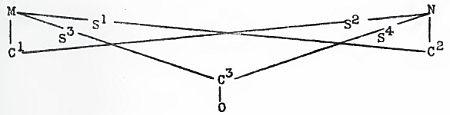
form of group-marriage, for it involves an exchange of women between the men of a group according to the reciprocal relation of chief and secondary wives. The very manner in which 'Pirrauru marriage' originates, however, indicates that in all probability its basis is monogamy, and not, as is supposed by many ethnologists and sociologists, 'promiscuity,' or the total absence of all marriage. In harmony with this interpretation is the fact that in numerous regions of Australia, especially in the northern districts, it is not group-marriage but monogamy that prevails. There is also, of course, a form of group-marriage that differs from 'Pirrauru marriage,' and is apparently simpler. In it, the differences between chief and secondary wives disappear; several men simply possess several wives in common. Because this form of group-marriage is the simpler, it is also usually regarded as the earlier. This view, however, is not susceptible of proof. The supposition rests simply and alone upon the consideration that, if a state of absolutely promiscuous sexual intercourse originally prevailed, the transition to an undifferentiated group-marriage without distinction of chief and secondary wives would be the next stage of development. The reverse, however, would obtain were monogamy the original custom. For the group-marriage with chief and secondary wives is, of course, more similar to monogamy than is undifferentiated group-marriage. Moreover, this order of succession is also in greater consonance with the general laws underlying social changes of this sort. As a matter of fact, it would scarcely be possible to find grounds for a transition from undifferentiated group-marriage to the 'Pirrauru system.' If we assume that there was a growing inclination for single marriage, it would be difficult to understand why the circuitous path of 'Pirrauru marriage' should have been chosen. On the other hand, it is very easy to see that the distinction between chief and secondary wives might gradually disappear. Indeed, this is what has almost universally happened wherever pure polygyny prevails. Wherever polygyny may be traced back to its beginnings, it always seems to have its origin in the combination of a chief wife with several secondary wives. Later, however, when the wife comes to be regarded as property, we find a formal co-ordination of the wives. Or, there may be a distinction that arises from the accidental preference of the husband, as in the case of the Sultan's favourite wife, though in modern times such choice has again been displaced by a law of more ancient tradition. The latter change, however, was the result of the external influence of the culture of Western Europe. Such a retrogressive movement, in the sense of a reapproach to monogamy, is foreign to the motives immanent in the development itself. Furthermore, 'Pirrauru marriage' is very easily explicable by reference to the same condition that best explains the origin of exogamy, namely, the custom of marriage by capture as practised between groups enjoying a tribal or cult relationship. The captured wife is the Tippamalku, or chief wife, of the captor; to the companions who assist the latter she becomes a Pirrauru, or secondary wife. This latter relation is at first only temporary, though it later becomes permanent, probably as a result, in part, of a dearth of women. By rendering his companions a similar service, the original captor in turn gains the chief wives of the former as his secondary wives. As frequently happens, the custom which thus arises outlives the conditions of its origin. This is all the more likely to happen in this case, because the general motives to polyandry and polygyny persist and exercise a constant influence.
Proof that this is the forgotten origin of group-marriage may perhaps be found in a remarkable feature of the customs of these tribes—one that is for the most part regarded as an inexplicable paradox. Marriage with the chief wife is not celebrated by ceremonies or festivals, as is the union with the secondary wife. Thus, the celebration occurs, not in connection with that marriage which is of primary importance even to the Australian, but, on the contrary, on the occasion of the union which is in itself of less importance. The solution of this riddle can lie only in the origin of the two forms of marriage. And, in fact, the two result from radically different causes, if it be true that capture from a friendly clan is the origin of the Tippamalku marriage and that assistance rendered to an allied companion underlies Pirrauru marriage. Capture is an act which precludes all ceremony; alliance with a companion is a contract, perhaps the very first marriage contract that was ever concluded—one that was made, not with the woman or with her parents, but with her husband. The consummation of such a contract, however, is an act which in early times was always accompanied by ceremonial performances. These accompanying phenomena may also, of course, persist long after their source has been lost to memory. Thus, the difference between the two forms of primitive group-marriage also indirectly confirms the supposition that monogamy lies at the basis of group-marriage in general.
After a man has won one or more secondary wives in addition to his chief wife, in Pirrauru marriage, there will doubtless be a tendency for him to seek additional chief wives. This will be particularly apt to occur where, on the one hand, marriage by capture gives way to marriage by barter and later to marriage by purchase, and where, on the other hand, group-marriage is on the wane. Custom may then either recur to monogamy, or it may advance to a polygyny which is pure and not, as in the case of group-marriage, combined with polyandry. Whether the former or the latter will occur, will depend, now that marriage by purchase has become predominant, upon might and property. Since these are also the factors which insure man's supremacy within the family, the older forms of combined polyandry and polygyny almost universally (with few exceptions, conditioned by the dearth of women) give way, with the advance of culture, to simple polygyny, which is then practised alongside of monogamy. This polygyny, in turn, also finally recedes in favour of monogamy. The circle of development, accordingly, may be represented by the following diagram:—
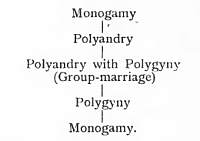
As an intermediate stage between monogamy and group-marriage, pure polyandry, it should be remarked, is doubtless a very transitory phenomenon. Nevertheless, it has a priority over polygyny in so far as it first furnishes the motives for the additional practice, and thus for the very origin, of the latter.
As a matter of fact, the ethnological distribution of the forms of marriage entirely confirms, as a general rule, the truth of this diagram. Even in Australia the phenomena of Pirrauru and of group-marriage are confined particularly to the southern regions. In the northerly regions, where immigration and racial fusion have played a greater rôle, both monogamy and polygyny may be found. The same is true of America and of Africa, monogamy decidedly predominating in the former and polygyny in the latter. The influence of marriage by purchase then constantly becomes stronger, with the result that the woman comes to be regarded from the point of view of property. The rich man is able to buy more wives than the poor man. In all polygynous countries and fields of culture, therefore, even in the present domain of Islamism, the poor man, as a rule, lives in monogamy, the rich man in polygyny. Only the wealthiest and most aristocratic allow themselves a real harem with a considerable number of wives.
Linked with these influences is yet a further change. Its beginnings are to be found as early as Australian culture; in America, it has progressed somewhat farther; in the other regions of totemism, it has finally succeeded in crowding out the original conditions with the exception of meagre remnants and survivals of customs. The change to which I refer is the transition from maternal descent, which, in all probability, was originally universal, to paternal descent. Maternal descent is in direct harmony with the natural feeling that the children who are born of the mother, and whose early care rests with her alone, should also belong to her. In this sense, mother-right represents the earliest of all conceptions of property. At the same time it precludes the possibility of that marriage which was avoided even by primitive man, and which, on higher cultural levels, is abhorred beyond all the other unions forbidden by the exogamous norms of custom—marriage between son and mother. The decisive external factor in connection with maternal descent, however, is the subordinate position of the family as compared with the association of the age-companions of the same sex, particularly the men's club. Because of its tribal struggles, whose increasing importance is externally reflected in the character of the weapon, it is precisely the totemic era that tends to loosen the natural family ties of the preceding primitive age, and, as a result, to allot the child to the mother. This tendency is clearly expressed in certain transitional phenomena that may occasionally be observed; they occur more frequently in Melanesia and America, however, than in Australia. The child, in these cases, inherits the totem of the mother as well as that of the father; or the son, though continuing to inherit the totem of the mother, nevertheless passes over into the clan of the father. These are intermediate phenomena, preparatory to the general transition from maternal to paternal descent. At the same time, the fact that membership is inherited in the paternal clan, in spite of the custom whereby the mother determines the totem, directly suggests that the bond uniting the men may become a force which counteracts maternal descent and then readily leads to paternal descent. This transition is bound to occur, particularly under the co-operation of other favouring conditions. Such conditions, as a matter of fact, are present; for social organization gains an increasing influence upon the whole of life's relations. There are primarily three factors that militate against the original custom of maternal descent. The first of these consists in the increasing authority of the man over his family, particularly over the son, who was generally subject to stricter regulations than was the daughter. This authority begins to manifest itself at that time, especially, when the man's relations with his family again become closer, and the associations which originally embraced, without exception, all the men of the clan, are displaced by family groups subject to the control of a family elder. Coincident with these changes and with the resulting transition to a patriarchal order, there occurs also the gradual dissolution of the general system of totemic tribal organization. Now, the system of maternal descent was closely bound up with totemic tribal organization from the very beginning. With the disappearance of the latter, therefore, the former loses its power of resistance against the forces making for its destruction. Finally, as a third factor, there is the gradually increasing prominence of personal property. Just as the wife becomes the property of the man, so also does the child. So great was this emphasis of the property conception, combined with the notion of authority, that even among the Romans the pater familias had power extending over the life of his children. Beginnings of such conceptions, however, are to be found even in more primitive societies. Polynesian custom, for example, permitted the murder of new-born children, and free advantage was taken of the permission. Only after the child had lived for a short time was infanticide prohibited. The decision, however, as to whether or not the child should be allowed to live rested primarily with the father.
8. THE DEVELOPMENTAL FORMS OF TOTEMISM.
Our discussions thus far have been restricted to those aspects of totemism which are directly related to tribal organization. But however important these phases may be, particularly in so far as they affect marriage regulations, they are, after all, but an external indication of the all-pervading influence of totemism upon life as a whole. Moreover, tribal totemism leaves many things unexplained, especially the origin of totemic belief. At any rate, the fact that totem groups were originally cult associations unmistakably points to inner motives of which the influence of totemism upon tribal organization and upon exogamy is but the outer expression. To answer the question concerning the nature of these motives, however, we must first call to mind the various sorts of totemic ideas. An analysis of these ideas may proceed in either of two directions. It may concern itself either with the social unit that regards itself as in relation to the totem or with the nature of the object that constitutes the totem. So far as the social unit is concerned, it may be a particular group of individuals—whether constituting a cult association independent of the real tribal organization, as in Australia, or, as in America, representing one of the tribal divisions themselves—that takes the name of a particular animal or, less frequently, of a plant for its totemic designation. The individual, however, may also possess a personal totem. Furthermore, the totemic idea may be associated with the birth of an individual, conception being regarded as an act in which the totem ancestor passes over into the germ as a magic being. This particular form of totemic belief is generally known as conception totemism. It supposes either that the totem ancestor co-operates with the father in the begetting of the child or that the father has no connection with procreation, the child being the direct offspring of the mother and the totem ancestor. There is, finally, also a fourth, though a relatively uncommon, form of totemism, generally called 'sex totemism.' Sex totemism also is social in nature, though in this case it is not different cult or tribal associations that possess separate totems, but the sexes, the men and women of a tribe or clan. The men have a totem, as have also the women, or there may be several totems for each sex.
Intercrossing with this classification based on the social factor, on whether the totem is associated with the tribe, the individual, or the procreation of the individual, there is a second classification. The latter concerns itself with the nature of the objects that are regarded as totems. These objects are of various sorts. Here again, moreover, we must doubtless recognize a development in totemic conceptions. The original totem, and the one that is by far the most common, is the animal. Numerous peoples possess no totems except animals. In many communities, however, plant totems have been adopted, and in certain regions they have gradually become predominant. Of the plant totems, the most important are the nutritious plants. In addition to these two classes of totemic objects, there is, finally, another, though an exceedingly rare, sort of totem. The totem that is conceived as an animal ancestor may give way to other fanciful ancestral ideas or may intercross with them. Various forms of such phenomena are to be found, particularly in Australia. In this region, such ancestors, which, doubtless, are for the most part regarded as anthropomorphic, are sometimes called Mura-mura or also Alcheringa. They are apparently imaged as mighty human beings possessed of magic powers. They are believed to have introduced totemism and to have instructed the forbears of the Australians in magic ceremonies. Mura-mura is the name that occurs especially in Southern Australia; the term, Alcheringa, prevails in the north, where the age of these mythical ancestors is often directly referred to as the Alcheringa age. At times, apparently, it is believed that these ancestors merely singled out as totems certain already existing animals. In other cases, however, animals, as well as mankind, are held to have been created by the magic-working beings out of formless matter, doubtless earth. It is commonly believed that the creatures that were thus created were at first lifeless, but became animals and men when placed in the sun. These various ideas are for the most part so intertangled in Australian legend that no coherent history of creation is anywhere discoverable. The legends plainly embody merely a number of detached fanciful ideas.
Closely connected with these original ancestors there is a third sort of totem or of totemic objects which we may briefly designate as inanimate. The objects are regarded as possessing magical powers and as having been bequeathed by the original ancestors, thus representing a legacy of the magical Alcheringa age. It is particularly stones and pieces of wood that are held to be the abode of these totemic spirits and that are represented by legend as having at one time been entrusted to the custody of the forefathers. These ideas abound particularly in northern Australia, where the magical objects are called churingas (or tjurungas). Churingas play an important rôle in the ceremonies of the totem festivals. For the most part, they consist of symmetrically shaped stones, somewhat similar to the boomerang; yet other objects also may be found, particularly such as are somehow striking in form. These churingas are also associated with other totemic ideas, particularly with conception totemism. The original ancestor is supposed to continue his existence, as it were, in the churinga, so that when this comes into contact with the mother he may pass over directly into the child.
If, now, we compare with each other the two extreme forms of the first class of totemic ideas—namely, tribal and individual totemism—we at once face the question, Which is the earlier, the original form? The ideas connected with the individual totem are certainly much more widely disseminated than is tribal totemism. Guardian spirits, particularly demoniacal, protective animals, may be found in many regions of the earth where there is little or no trace of the tribal totem. This is true especially of many regions of North America and of southern Africa, and likewise of numerous islands of Oceania. In these localities the individual totem is sometimes regarded as a sort of double of the individual person. If the totem animal dies, the man whose totem it is must also die. Closely related to this conception are a vast number of ideas reaching far down into later mythology, particularly into Germanic lore—ideas according to which the soul of a man lies hidden in some external object, perhaps in a plant or in an animal, and, when this vehicle of the soul is destroyed, the man, or the god or demon who has assumed human form, must die.
In these various modifications, individual totemism is doubtless more widespread than is tribal totemism. Nevertheless, this by no means implies that the latter developed from the former. On the contrary, both may possibly be equally original, grounded as they are in universal human motives that run parallel and independent courses. For this very reason, however, it is also possible that tribal totemism is the older form, for on somewhat higher cultural levels it recedes in favour of the belief in protective spirits of individuals. In questions such as this it is helpful to adduce parallels from later cults whose mode of origin is more familiar. In the present instance, leaving out of account the animal ideas, the two forms of totemism are closely analogous to the Roman Catholic worship of saints. The saints also are regarded partly as guardians of communities and partly as personal protectors. Thus, on the one hand, we have the patrons of cities, of monasteries, of vocations, and of classes; on the other hand, the individual also may possess a particular patron saint. We know of a certainty, however, that the patron saints of individuals did not antecede those of the Church itself. It was this most inclusive community that first elected the saints, whereupon smaller groups and finally individuals, guided by motives that were frequently quite external, selected specific patron saints from among the number of ecclesiastical saints. When the Church set apart a certain day of the year for the particular worship of one of its saints, this day was called by the name of the saint; to those individuals who were named after him, the day became sacred. Thus, the patron saint of the individual appeared later than the more universal saint. This order of development, moreover, is in harmony with the general nature of custom, language, and myth, according to which the individual succeeds the universal; only secondarily may the process occasionally be reversed. Usually, however, it is cult associations and their common cult objects that are first in origin. Our contention is unaffected by the fact that individual cult objects, as well as individual totems, may continue to survive after tribal cults and tribal totems have disappeared. For the need of a personal protector is generally much more permanent than are the social conditions that gave it birth. Again we may find verification in the analogous development of saint worship. Nowadays the patron saints of the vocations, classes, and cities have more and more passed into oblivion. Among the Roman Catholic rural population, however, the individual still frequently has his patron saint, and, even where the saint has disappeared, the celebration of the 'name-day' has been retained. It is particularly in the religious realm that personal need gains a greater and greater ascendancy over community need. Everything seems to indicate that such a change took place even within totemism, especially under the influence of the gradual dissolution of the original totemic tribal organization—a change analogous to that which occurred in the case of saint worship as a result of the decay of mediæval guilds. These arguments, of course, cannot lay claim to more than probability. No one can show how the individual totem developed out of the group totem. Certain indications, however, suggest that the above was the course of development. In Australia, the stronghold of original tribal totemism, a youth is frequently given a personal totem, in addition to the tribal totem, upon the occasion of his initiation into manhood. The personal totem is frequently a matter of secrecy, being known only to the medicine-men or to the elders of the tribe. The fact that this is true indicates that such a personal totem possesses no public significance and, moreover, that it is probably bound up with the idea that the real essence of a man is contained in his name, just as it is in his picture, so that the mere speaking of the name might bring harm to the person. It is doubtless probable, therefore, that, after groups came to be formed within the primitive horde, they were at once bound together by relations of cult. As Australian conditions indicate, the origin of totems in the sense of cult groups is at least as old as tribal organization, if not older.
The same cannot be said of the much more remarkable, though also rarer, forms of totemism, conception and sex totemism. The former of these may be regarded as a modification of individual totemism, inasmuch as it relates to the procreation of the individual. However, it also forms a sort of intermediate stage between tribal and individual totemism. A woman receives the totem of the child on a specific occasion, of which she usually has knowledge. Among the Aranda, the conception may occur at any place whatsoever; among the Warramunga, the woman retires to a certain spot, the totem place, where the ancestral spirits dwell. Either during the day or, especially, during the night and in sleep, the spirit of the ancestor passes over into her. The word 'spirit,' which is employed by English writers, is not, of course, an accurate rendering of the Australian term, and may easily lead to a misconception. The German missionary Strehlow has probably done better in using the word 'germ.' The germ of the child is thought to pass over into the body of the mother independently of any act of the father, or, at most, the participation of the latter is held to be merely secondary, and not essential.
Adherents of the theory of original promiscuity have interpreted these ideas also as a survival of unrestrained sexual conditions, and thus as indicative of the fact that paternity was at one time unknown. A closer acquaintance with the phenomena, however, shows that this can scarcely be the case. Thus, the idea of the Warramunga that it is the totem ancestors of a woman's husband and not those of any other man that pass over into her, clearly presupposes a state of marriage, as does also the further fact that these same tribes reckon descent in the line of the father and not in that of the mother. Moreover, the passing of the totem ancestor into the woman is generally accompanied by magical ceremonies, such as the swinging of bull-roarers, or contact with churingas. Or, the totem ancestor may appear to the woman in sleep or in a waking vision. On the Banks Islands, strange to say, we find conception totemism without any trace of tribal totemism. The manner of reception of the totem ancestor also differs; the woman eats of the flesh of her husband's totem animal, which, since there is no tribal totemism, is in this case a personal, protective totem. Thus, conception totemism represents something of an exception in that the eating of the totem is not forbidden, as it generally is, but rather constitutes a sort of cult act, as it also does in certain other cases. In Australia, moreover, conception totemism is to be found only among several of the northern tribes, to whom it may at one time have come from Melanesia. Because of the primitive nature of the ideas connected with conception totemism, particularly when, as among the Aranda, the husband is ignored and it is believed that conception is mediated only by the totem ancestor, the northern tribes just referred to have sometimes been regarded as the most primitive. There are some writers, on the other hand, by whom the possibility of such ideas is denied on the ground that these very tribes must be familiar with the process of procreation in the animal world. But this does not prove the case. When, however, we learn that the older men of the tribe themselves no longer entertain the belief in magical generation, particularly as the exclusive factor, whereas, on the other hand, this is still taught to the young men, and especially to the children, we may well call to mind our own childish notions about the stork that brings the babies. Why might something similar not occur among the Australians, and the belief possibly retain credence somewhat beyond the age of childhood?
Sex totemism, similarly to conception totemism, is also of somewhat limited distribution, and seems to occur principally in those regions where tribal totemism proper is lacking or is at least strongly recedent. Among the Kurnai of southern Australia, for example, no tribal totemism has been discovered, though sex totemism occurs and actually forms the basis of certain marriage ceremonies. Sex totemism probably has its origin in the individual totem, especially in the appearance of this totem in dreams. If, after such a totem has appeared to an individual man or woman, it is then adopted by others of the same sex, specific sex totems may well come into being, particularly under the influence of the separate associations of men and women. It is also significant that in the case of sex totemism nocturnal animals predominate. The totem of the women is usually the bat; that of the men, the owl. This fact is indicative of a dream origin and of a genesis from the individual totem. Diurnal birds may, of course, also appear in dreams. Whether or not this occurs depends solely upon concomitant circumstances. At the stage of culture, however, when man is accustomed to sleep in the open, it is probable that the nocturnal birds which circle about him will also appear in his dreams. A further characteristic phenomenon of the regions where sex totemism prevails, is the manner in which marriage is consummated. In this case also, the woman eats of the totem of the man. This causes a struggle between the man and the woman, which is really a mere mock-fight ending with an offer of reconciliation on the part of the man. With this, the marriage is concluded. Such customs likewise point back to individual totemism as their original source, and probably also to marriage by capture. The fact that tribal totemism everywhere receded with the dominance of individual totems, explains why sex and tribal totemism seem to be mutually exclusive. Of the two rare forms of totemism, accordingly, it is probable that conception totemism was the earlier, and that sex totemism belongs to a relatively late stage of development. A further indication of the primitive nature of conception totemism is to be found in the fact that the Aranda possess a tribal organization in which the grouping of totems to form clan divisions follows a principle which elsewhere obtains only in the case of the two tribal halves. Two clans, A and B, that enjoy exogamous relations with each other, do not have different totem groups, as they do among all other tribes; their totem groups are largely the same. Among the Aranda, therefore, a man of one totem may, under certain circumstances, marry a woman of the same totem, provided only she belongs to the other clan. True, phenomena are not lacking—such particularly as those of plant totems, to be mentioned below, and the ceremonial festivals connected with them—which indicate that these northern tribes were affected by Papuan immigrations and by race-mixture. But influences of this kind are the less apt to lead to the submergence of primitive views and customs according as they are instrumental, particularly when they are operative at an early age, in maintaining conditions which might otherwise possibly disappear as a result of further development.
The second mode of classifying the forms of totemism is based on the objects which are used as totems and leads to an essentially different analysis of totem beliefs. Each of the forms which the classification distinguishes is, of course, also subsumable under one of the kinds of totemism already discussed. The earliest totem objects, as has already been mentioned, are without doubt animals. In America, as in Australia, there are practically no totems except animals; in other places also it is the animal that plays the principal rôle in totemic mythology. In part, the animal continues to remain predominant even after the age of actual totemism has passed. Nevertheless, plant totemism has found its way into certain regions. Here also the facts are most clearly traceable in Australia, our most important source of information regarding the history of the development of totemic ideas. In southern Australia, there are no totems except animals; towards the north, plant totems gradually begin to make their appearance, until finally, among the most northerly peoples of central Australia, such totems have the dominance. Plant totems, moreover, are also found particularly in Melanesia, from which place they might easily have come to Australia across the chain of islands which extends from New Guinea to the north coast of the island-continent. That plants play an unusually large rôle in the regions of Oceania, in connection with totemism as well as otherwise, is directly due to external conditions. These islands are poor in fauna; true, they possess great numbers of birds, but these are of little value to the hunter. On the other hand, they have a luxuriant flora. From early times on, therefore, it is chiefly the plant world that has been the centre of interest and that has left its stamp upon myth and custom. Clearly, plant totemism had its origin on these islands. From them it was introduced into Australia, where it combined with animal totemism. But the regions into which plant totemism was introduced underwent a great change in their totemic cults. It is probably only with the appearance of plant totems that those cult ceremonies arose which are celebrated, not, as the festivals of tribal totemism originally were, mainly at the adolescence of youths, but primarily for the sake of effecting a multiplication of the totems. Annually, at stated times, the members of allied clans unite in magical ceremonies and cult dances, the well-known 'corroborees,' as they are called by those who practise them. The primary aim of such cults is to bring about by magical means an increase of the totem plants and animals. Doubtless we may regard it as highly probable that this ceremony represents a borrowing on the part of animal totemism from plant totemism. For the hunter, similarly, desires that there be a very great abundance of game animals. Yet it is mainly plants that are the object of concern—a concern caused by the changes in weather, with its incalculable oscillations between life-bringing rain and the withering glare of the sun. These are the motives that find expression in the festivals designed for the multiplication of the totems, the 'Intichiuma' festivals. The motives to these ancient cults still frequently find their counterparts in the customs of the cultural peoples of the present. When, in times of a long drought, processions pass over the fields and supplicate Heaven for rain, as occurs even to-day in some regions, we certainly have an analogous phenomenon. The only difference is that the Australian tribes invoke their totems instead of Heaven; they call upon the plants which are to increase and upon the animals which are to be available for hunting, with the aim of thus exercising a magical influence upon them.
In connection with the Australian ceremonies designed to multiply the food plants and game animals, we come upon still a third kind of totem objects. They differ from those of the two preceding classes in that they are not regarded as independent totems, but merely as vehicles of the same sort of magical power as is possessed by animal and plant totems. In distinction from the latter, we may briefly call them inanimate totems. They consist of stones and sticks. These are utilized as magical objects in the Australian Intichiuma festivals, and also, under the above-mentioned name of 'churingas,' in connection with conception totemism. They differ from animate totems in that the latter are in themselves endowed with magical properties, whereas the former are always held to derive these powers from living magicians, from the anthropomorphic or zoömorphic ancestors of antiquity. These magicians are thought to have transmitted the objects to later generations for the use of the latter in the practice of magic. Thus, the churingas have a peculiar status, intermediate between magical beings and magical implements. They are carefully preserved because—as is indicated by their use in connection with conception totemism—they are regarded as legacies left by ancestors; moreover, they are also supposed to harbour the demoniacal power of these ancestors. One of the factors determining the selection of these objects is doubtless generally their shape, which is frequently of a striking nature, such as to arouse astonishment. Ejected into the object itself, this astonishment becomes a wonder-working power. Later, the desire to secure such magical means of aid may become a supplementary factor in the selection of these objects, and, as widespread phenomena of a similar nature show, may eventually suffice of itself to constitute an object the bearer of magical powers. Thus, it is these inanimate vehicles of a magic derived from totem ancestors, that form the transition from the totem object to the so-called fetish.
Each of the three kinds of totem objects just described, the plant totem, the animal totem, and the totemic fetish, may assert itself in connection with the three above-mentioned social forms of totemism. Moreover, the three kinds of objects may also, to a certain extent, combine with one another. For, though the animal is very commonly the only totem, plant totems never occur except in connection with animal totems, even though there are certain conditions under which they attain the dominance. Finally, the totemic fetish is always associated in totemic regions with animal and plant totems, and is also closely connected with the idea, even here permeating totemic belief, that there were anthropomorphic ancestors who left these fetishes as magic-working legacies. Thus, totemism passes over, on the one hand, into ancestor-worship, and, on the other, into fetishism, with which it combines, particularly in the 'Intichiuma' festivals, to form a composite cult. Tribal totemism is the source of the individual totem; the latter, probably as a result of animistic ideas that displace tribal totemism, gives rise, as an occasional offshoot, to the sex totem. This is the conclusion to which we are led by the fact that the choice of the sex totem is influenced by the dream. The last important product of individual totemism, in combination with tribal totemism, is an incipient ancestor worship, which is accompanied by peculiar forms of fetishism. In view of its origin, we may perhaps refer to this cult as 'totemic fetishism.' The following diagram illustrates this genetic relationship:—
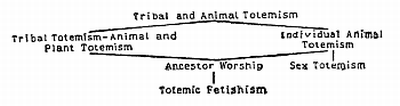
9. THE ORIGIN OF TOTEMIC IDEAS.
We have attempted to trace the succession of the various forms of totemism by reference to the characteristics which these forms reveal. Closely connected with this problem is the question concerning the origin of totemic ideas. With respect to this question, however, widely different hypotheses have been proposed. Of these, those that belong to an earlier stage of our ethnological knowledge concerning this subject can here receive but brief mention. Herbert Spencer held that the entire institution of totemism arose out of the totem names of individuals, such, for example, as wolf, deer, eagle, or, among the Australians, emu, kangaroo, etc. These animal names, according to him, were at first perhaps nicknames, such as are occasionally to be found even to-day. Out of the individual totem arose the tribal totem. The name then became identical with the thing itself—that is, with the animal, which thus became a protective and ancestral animal. Though rejecting the idea that the origin of totemism is to be found in nicknames and epithets, Andrew Lang retained the belief that the name was primary, and that the substitution of the animal or the plant for the name occurred only later. This theory is not so strange as it might appear. As a matter of fact, it is quite characteristic of primitive thought closely to associate a name and its object. Primitive man regards his name as a part of himself; this idea is similar to that which underlies the terror that he sometimes manifests when a sketch is made of him, a terror due to the belief that a part of his soul is being carried away in the picture of the artist. And yet there is prima facie little probability that a phenomenon so widely prevalent and so highly ramified as totemism could have its source in a fact of this kind, which is, after all, only incidental. Moreover, in one of the chief centres of tribal totemism, in the eastern part of North America, as, for example, among the Iroquois, we find very clearly defined personal names. These names, however, are never identical with those of the totems, nor even, as a rule, with those of animals. Sometimes they are borrowed from the names of flowers, although there are no plant totems in America; or, they are flattering appellatives such as we still find in higher civilizations. Moreover, there is no indication that they ever came to be used for the designation of totems.
The view held by Howitt and by Spencer and Gillen, scholars deserving of high esteem for their knowledge of Australian totemism, is an essentially different one. In their opinions, it is the conditions of a hunting life that are reflected in totemic beliefs. They maintain that the animals of the chase were the first to become totem animals. Wherever plant food gained great importance, plant totems were then added. The evidence for this view is based mainly on those Intichiuma ceremonies and festivals by means of which the Australians aim to secure a multiplication of the totems. In these festivals, for example, grass seed is scattered broadcast by members of the grass seed totem, or a huge lizard is formed of clay by the members of the lizard totem, and pieces of it are strewn about. These are magic ceremonies that, in a certain sense, anticipate the sowing and harvest festivals of later times. The only difference consists in the fact that these primitive magic usages are not directed to the rain-bringing clouds or to celestial deities in petition for a blessing upon the crops, but to the objects themselves, to the animals and plants. Magic powers are ascribed to the latter; by virtue of these powers they are to multiply themselves. In regions where sowing and harvest do not as yet exist, but where man gains his food solely by gathering that which the earth of itself brings forth, such festivals and ceremonies are to a certain extent the natural precursors of the later vegetation festivals.
In view of these facts, the hypothesis of the above-mentioned investigators seems to have much in its favour. There is a very important consideration, however, that obviously speaks against it. It is highly probable that these very ceremonies for the multiplication of totem objects are not indigenous to Australia, the chief centre of totemism, but that they, along with the plant totem, were introduced from without. These plant totems, as was remarked above, appear to have come from the Melanesian Islands, where the animal totem plays a small rôle, because the fauna is meagre and man is dependent in great measure upon plant food. Besides animal and particularly bird totems, therefore, which also occur on the Melanesian Islands, we find plant totems throughout the whole of northern Australia. These totems, as we may suppose, are the result of Papuan immigrations, to which are due also other objects of Melanesian culture to be found in the Australian continent. In the south, where there are no totems other than animals, Intichiuma ceremonies receive small emphasis. In entire harmony with our contentions are the conditions in America, where no festivals of this sort are connected with the totems themselves; an analogous significance is gained only later by the great vegetation festivals, and these presuppose agriculture, together with the beginnings of a celestial mythology.
In more recent times, therefore, Frazer, whose great work, "Totemism and Exogamy," has assembled the richest collection of facts concerning totemic culture, has turned to an essentially different theory. He traces all forms of totemism back to conception totemism. Since the latter, as we have already stated, probably arose out of individual totemism, we are again confronted by an individualistic view, much as in the hypothesis of the origin from names. Frazer derives conception totemism from the dreams which mothers are supposed occasionally to have experienced before the birth of a child. The animal appearing in such a dream is thought to have become the totem or guardian animal of the child. But, though conception totemism, as well as sex totemism, may possibly have some connection with such phenomena—the fact that the animals here concerned are chiefly nocturnal animals suggests that such may be the case—totemism as a whole may, nevertheless, scarcely be derived from dreams. Still less can this hypothesis be harmonized with the fact that conception totemism is an anomaly. The ideas centred about it are but of rare occurrence within the system of totemic culture as a whole. Moreover, as Frazer also has assumed, they never appear except as an offshoot of individual totemism, and this in turn, when viewed in all its phases, cannot be regarded otherwise than as a product of tribal totemism. In its reference to the dream, however, this hypothesis may perhaps contain an element of truth, inasmuch as it involves ideas that obviously play an important rôle in totemism. This is shown particularly by reference to the totem animals that are found most commonly in Australia, and that suggest a relation between totemism and animistic ideas of the soul.
As a matter of fact, the totem is already itself the embodiment of a soul. Either the soul of an ancestor or that of a protective being is regarded as incorporated in the animal. The other totems, such as plants or totem fetishes (churingas), are obviously derivative phenomena, and the same is true of those legendary beings that inhabit the churingas as spirits, or that gave them to the ancestors for the purposes of magic. Now, originally, the totem was probably always an animal. But a survey of the great mass of animistic conceptions prevalent in all parts of the world shows that in this case also it is particularly the animal that is represented as capable of becoming the receptacle of a human soul after death. Animals, of course, are not all equally suited to this purpose. Some are more apt than others to be regarded as soul animals, particularly such as are characterized by rapid movement, flight through the air, or by other features that arouse surprise or uncanny dread. Thus, even in the popular belief of to-day, it is especially the snake, the lizard, and the mouse, in addition to the birds, that are counted among the soul animals. If, now, with these facts in mind, we cast a glance over the list of totem animals, we are at once struck by the fact that the most common among them are soul animals. In Australia, we find the hawk, the crow, and the lizard; in America, the eagle, the falcon, and the snake.
In respect to these ideas, the totemic age marks an important turning-point in the history of soul conceptions. Primitive man regards that which we have succinctly called the 'corporeal soul' (p. 82) as the principal, and perhaps originally as the only, soul. At death, the soul is believed to remain in the body, wherefore primitive man flees in terror from the corpse. Even at this stage, of course, we occasionally find traces of a different idea. The soul may also be regarded as active outside of the body, in the form of a demoniacal being. But as yet these ideas are generally fluctuating and undefined. There then comes a change, dependent, just as are the other cultural transformations, on the strife and warfare arising as a result of tribal migrations. This change, as we may suppose, is due to the fact that tribal struggles bring with them the impressive spectacle of sudden death. One who is killed in battle exhibits the contrast between life and death so directly that, even though the belief in the continued existence of the soul within the body still survives, it nevertheless permits the co-presence of other more advanced conceptions. Thus two sets of ideas come to be developed. On the one hand, the soul is believed to depart with the blood. In place of the entire body, therefore, the blood comes to be the chief vehicle of the soul. Blood magic, which by itself constitutes an extensive chapter in the history of magic beliefs, and which is prevalent in all periods of culture, has its source in this conception. Further factors then enter into the development. In addition to the blood, the inner parts of the body, which are exposed in cases of violent death, become vehicles of the soul. The idea of the sudden departure of the soul is then transferred from the one who is killed to the dying person in general. With the exhalation of his last breath, his soul is thought to depart from him. The soul is therefore conceived as a moving form, particularly as an animal, a bird, a rapidly gliding snake, or a lizard.
In dealing, later, with the soul conceptions of the totemic age, we will consider these several motives in their independent influence as well as in their reciprocal action upon one another. Here we can touch upon them only in so far as they harbour the sources of totemism itself. But in this connection two facts are of decisive importance. In the first place, the original totem, and the one which continues to remain most common, is the animal; and, secondly, the earliest totem animals are identical with soul animals. But in addition to soul animals, other animals also may later readily come to be regarded as totems, particularly such as continually claim man's attention, as, for example, game animals. Thus, the soul motives are brought into interplay with other influences, springing in part from the emotions associated with the search for daily food, though primarily with success or failure in the chase. As a result, the soul motives obviously become less prominent, and the totem animal, freed from this association, acquires its own peculiar significance, which fluctuates between the ancestral idea and that of a protective demon. The concern for food, which was at first operative only as a secondary motive, was heightened in certain localities where the natural environment was poor, and, with the influx of immigrant tribes, it assumed ever greater prominence. In this way, plant totems came to be added to animal totems; finally, as a result of certain relations of these two totems to inanimate objects, there arose a fetishistic offshoot of totemism. This again brought totemism into close connection with ancestor ideas, and contributed also towards the transition from animal to human ancestors.
Thus, then, totemic ideas arise as a result of the diremption of primitive soul ideas into the corporeal soul and the breath- and shadow-soul. That the two latter are associated, is proven also by the history of totemism. Folk belief, even down to the present, holds that the soul of the dying person issues in his last breath and that it possesses the form of an animal. The soul of one who has recently died, however, appears primarily in dreams and as a phantom form. Now, the totem animal has its genesis in the transformation of the breath-soul into an animal. The shadow-soul of the dream, moreover, exercises an influence on individual totemism, as it does also on conception totemism and on sex totemism.
Thus, totemism is directly connected with the belief in souls—that is to say, with animism. It represents that branch of animism which exercised a long-continuing influence on the tribal organization as well as on the beliefs of peoples. But before turning to these final aspects of totemism and their further developments, it is necessary to consider another group of ideas which, in their beginnings, occupied an important place within the circle of totemic beliefs. The ideas to which I refer are those connected with the custom of taboo.
10. THE LAWS OF TABOO.
It is a significant fact that 'totem' and 'taboo' are concepts for which our cultural languages possess no adequate words. Both these terms are taken from the languages of so-called natural peoples, 'totem' from an idiom of the North American Indians, and 'taboo' from the Polynesian languages. The word 'totem' is as yet relatively uncommon in literature, with the exception of books on ethnology and folk psychology; the word 'taboo,' on the other hand, is much in use. A thing is called taboo when it may not be touched, or when it must be avoided for some reason, whether because of its peculiar sanctity or contrariwise because its harmful influence renders it 'impure,' defiling every one who comes into contact with it. Thus, two opposing ideas are combined in the conception of taboo: the idea of the sacred as something to be avoided because of its sanctity, and that of the impure or loathsome, which must be avoided because of its repulsive or harmful nature. These ideas combine in the conception of fear. There is, indeed, one sort of fear which we call awe, and another termed aversion. Now, the history of taboo ideas leaves no doubt that in this case awe and aversion sprang from the same source. That which aroused aversion at a later age was in the totemic period chiefly an object of awe, or, at any rate, of fear—that is, of a feeling in which aversion and awe were still undifferentiated. That which is designated by the simplest word [Scheu] is also earliest in origin; awe [Ehrfurcht] and aversion [Abscheu] developed from fear [Scheu].
If, now, we associate the term 'taboo' in a general way with an object that arouses fear, the earliest object of taboo seems to have been the totem animal. One of the most elemental of totemic ideas and customs consists in the fact that the members of a totem group are prohibited from eating the flesh of the totem, and sometimes also from hunting the totem animal. This prohibition, of course, can have originated only in a general feeling of fear, as a result of which the members of a totemic group are restrained from eating or killing the totem animal. In many regions, where the culture, although already totemic, is, nevertheless, primitive, the totem animal appears to be the only object of taboo. This fact alone makes it probable that totemism lies at the basis of taboo ideas. The protective animal of the individual long survived the tribal totem and sometimes spread to far wider regions. Similarly, the taboo, though closely related to tribal organization in origin, underwent further developments which continued after the totemic ideas from which it sprang had either entirely disappeared or had, at any rate, vanished with the exception of meagre traces. This accounts for the fact that it is not in Australia, the original home of the totem, that we find the chief centre of taboo customs, nor in Melanesian territory, where the totem is still fairly common, nor in North America, but in Polynesia.
It is in Polynesia, therefore, that we can most clearly trace the spread of taboo ideas beyond their original starting-point. The taboo of animals is here only incidental; man himself is the primary object of taboo—not every individual, but the privileged ones, the superiors, the priest, the chieftain. Closely related to the fact that man is thus held taboo, is the development of chieftainship and the gradual growth of class differences. The higher class becomes taboo to the lower class. This fear is then carried over from the man himself to his possessions. The property of the nobleman is taboo to every other person. The taboo has not merely the force of a police law, similar to that whereby, in other localities, men of superior rank prohibit entrance to their parks; it is a religious law, whose transgression is eventually punished by death. It is particularly the chief and his property that are objects of taboo. Where the taboo regulations were strict, no one was allowed to venture close to the chief or even to speak his name. Thus, the taboo might become an intolerable constraint. In Hawaii, the chief was not allowed to raise his own food to his mouth, for he was taboo and his contact with the food rendered this also taboo. Hence the Hawaian chief was obliged to have a servant feed him. The objects which he touched became taboo to all individuals. In short, he became the very opposite of a despotic ruler, namely, the slave of a despotic custom.
From the individual person, the taboo was further extended to localities, houses, and lands. A member of the aristocratic class might render taboo not only his movable property but also his land. The temple, in particular, was taboo, and, together with the priests, it retained this character longer than any other object. The taboo concerned with the eating of certain animals, however, also remained in force for a long time. Though these animals were at first avoided as sacred, the taboo of the sacred, in this case, later developed into that of the impure. Thus, this conception recurs, in a sense, to its beginning. For the fear that is associated with the animals which the totem group regards as sacred, is here combined with the fear that the eating of the flesh is harmful. Sickness or even death is believed to follow a transgression of such a taboo regulation. Even in its original home, however, the taboo assumes wider forms. It subjects to its influence the demon-ideas that reach back even to pretotemic times. The corpse particularly, and the sick person also, are held taboo because of the demoniacal magic proceeding from them. Likewise the priest and the chief are taboo, because of their sacredness. Thus, the taboo gains a circle of influence that widens according as totemic ideas proper recede. The taboo which the upper classes placed upon their property had come to be such a preponderant factor in Polynesian custom that the first investigators of these regions believed the taboo in general to be chiefly an institution whereby the rich aimed to protect their property by taking advantage of the superstition of the masses.
One of the most remarkable extensions of the scope of taboo is the taboo which rests on relations by marriage. The history of exogamy, whose earliest stages are represented by the totemic marriage laws of the Australians, clearly teaches that the aversion to marriage between blood relations was not the cause but at most, to a great extent, the effect of exogamous customs that everywhere reach back into a distant past. But there is a second class of marriage prohibitions, and this likewise has found a place even in present-day legislation—the prohibition of unions between relations by marriage. Such prohibitions are from the very beginning outside the pale of exogamous laws. Indeed, it is clear that all unions of this sort—such, for example, as are forbidden by our present laws—were permitted by the totem and clan exogamy of the Australians and that of the American Indians. In the case of maternal descent, the group from which a man must select his wife included his mother-in-law as well as his wife. Similarly, in the case of paternal descent, the husband and father-in-law were totem associates. There is another set of customs, however, which is generally connected with even the earliest forms of exogamy, and which fills out in a very remarkable way the gap that appears in the original totemic exogamy when this is compared with present-day legislation. These customs are no other than the laws of taboo. One of the earliest and most common of these regulations is the taboo of the mother-in-law. Corresponding to it, not so common and yet obviously a parallel phenomenon occasionally connected with it, is the taboo of the father-in-law. The relative distribution of the two taboos is analogous to that of maternal and paternal descent in the primitive condition of society, for it is maternal descent that is dominant. This is not at all meant to imply that there is any casual[1] relation between these phenomena. Rather is it true, probably, that they are based upon similar motives, and that these motives, just as in the case of marriage between relations, are more potent in the case of the mother than in that of the father. In general, however, the taboo of parents-in-law signifies that the husband must so far as possible avoid meeting his mother-in-law, and the wife, her father-in-law. Now, it is evident that in so far as this avoidance excludes the possibility of marriage, the custom is, in a way, supplementary to exogamy. Wherever maternal descent prevails, no one may marry his mother; and, where taboo of the mother-in-law exists, no one may marry his mother-in-law. The same holds of father and daughter, and of father and daughter-in-law, in the case of paternal descent. This analogy may possibly indicate the correct clue to the interpretation of the phenomena. It would certainly be erroneous to regard the taboo of the mother-in-law as a regulation intentionally formulated to prevent unions between direct relations by marriage. Yet there is evidence here of a natural association by virtue of which the fear of marriage with one's own mother, which, though not caused by the exogamous prohibition, is nevertheless greatly strengthened by it, is directly carried over to the mother-in-law. Between a woman and the husband of her daughter there thus arises a state of taboo such as is impossible between mother and son because, from the time of his birth on, they are in close and constant relation with each other. In consequence of the above-mentioned association, mother and mother-in-law, or father and father-in-law, form a unity analogous to that which obtains between man and wife. What is true of the husband, is also true in the case of the wife; similarly, what holds for the mother of the husband holds no less for the mother of the wife.
Striking evidence of the effect of an association of ideas that is perfectly analogous to the one underlying the taboo of the mother-in-law, is offered by a custom which is doubtless generally only local in scope and yet is found in the most diverse parts of the earth, thus showing plainly that it is autochthonous in character. I refer to the custom of so-called father-confinement or 'couvade.' This custom prevails in various places, occurring even in Europe, where it is practised by the Basques of the Pyrenées, a remarkable fragment of a pre-Indo-Germanic population of Europe. Due, probably, to the heavier tasks which these people impose upon women, it here occasionally occurs in an exaggerated form. Even after the mother has already begun to attend to her household duties, the father, lying in the bed to which he has voluntarily retired, receives the congratulations of the relatives. Custom also demands that he subject himself to certain ascetic restrictions, namely, that he avoid the eating of certain kinds of food. The custom of couvade is clearly the result of an ideational association between husband and wife—one that is absolutely analogous to that between the two mothers of the married couple. The child owes its existence to both father and mother. Both, therefore, must obey the regulations which surround birth, and thus they are also subject to the same taboo. Just as there is very commonly a taboo on the mother and her new-born child, so also, in the regions where couvade exists, is this transferred to the husband.
As is well known, the last vestiges of the taboo of the mother-in-law have not yet disappeared, though they survive only in humour, as do many other customs that were once seriously practised. In fact, there is no other form of relationship, whether by blood or by marriage, that is so subjected to the satire of daily life as well as to the witticisms and jokes of comic papers as is that of the unfortunate mother-in-law. Thus, the primitive taboo resting on the mother-in-law and also, even though in lesser degree, on the father-in-law, has registered itself in habits that are relatively well known. Graver results of the regulations of ancient custom are doubtless to be found in those prohibitions of union between relatives by marriage that still constitute essential elements of present-day laws. This, of course, does not mean that these prohibitions are unjustifiable or that they do not reflect natural feelings. They but exemplify the fact that every law presupposes a development which, as a rule, goes back to a distant past, and that the feelings which we to-day regard as natural and original had a definite origin and assumed their present character as the outcome of many changes.
Alongside of these later forms of the taboo, and outlasting them, we have its most primitive form. This is the taboo which rests on the eating of certain foods, particularly the flesh of certain animals, though less frequently it applies also to occasional plants. The latter, however, probably represents a transference, just as does plant totemism. A particular example of such a taboo is the avoidance of the bean by the Grecian sect of Orphians and by the Pythagoreans whom they influenced. The taboo of certain animals survived much longer. But it was just in this case that there came an important shift of ideas which gave to the taboo a meaning almost the opposite of that which it originally possessed. Proof of such a change is offered by the Levitical Priests' Code of Israel. The refined casuistry of the priests prescribed even to details what the Israelite might eat and what was taboo for him. For the Israelite, however, this taboo was not associated with the sacred but with the unclean. The original taboo on the eating of the flesh of an animal related, in the totemic period, to the sacred animal. This is the taboo in its original form. The Australian shrinks from eating the flesh of his totem animal, not because it is unclean, but because he fears the revenge of demons if he consumes the protective animal of his group. In the Priests' Code, the sacred object has become entirely transmuted into an unclean object, supposed to contaminate all who eat of it. It is a striking fact, however, that the animals which are regarded as unclean are primarily the early totem animals—the screech-owl, the bat, the eagle, the owl, etc. Of the animals that live in or near the sea, only those may be eaten that have scales, that is, only fish proper, and not the snake-like fish. The snake itself and the snake-like reptiles are taboo, as well as numerous birds—all of which were at a very early period totem animals. Heading the list of the animals that may be eaten, on the other hand, are the ox, the sheep, the goat—in short, the animals of an agricultural and sheep-raising culture. Thus, as the original magical motives of taboo disappear, their place is taken by the emotion of fear, which causes the object arousing it to appear as unclean. Whoever touches such an object is polluted in a physical as well as a moral sense, and requires a cleansing purification according to rites prescribed by cult. We cannot avoid the impression, accordingly, that the unclean animals held to be taboo by the Priests' Code, are the same as those which this same people regarded as sacred soul and totem animals at an earlier stage of culture. Thus, these prohibitions with reference to food are analogous to the impassioned preaching against false idolatry—both refer back to an earlier cult. In this category belongs also the prohibition of consuming the blood of animals in the eating of their flesh. This likewise is the survival of a very common belief—certainly prevalent also among the Israelites at one time—that with the blood of an animal one might appropriate its spirit-power. The priestly law transforms this motive into its direct opposite. For the text expressly says: "In the blood is the life; but ye shall not destroy the life together with the flesh."
Thus, the significance of the taboo shifts from the sacred, which evokes man's fear, to the unclean and demoniacal, which also arouse fear but in the form of aversion. Closely related to this change is a group of views and customs resulting from this last form of taboo and reaching down, as its after-effects, far into the later religious development. These are the purification rites connected with the ideas of clean and unclean. The word lustratio, by which the Romans designated these rites, is really more appropriate than the German word Reinigung, since it suggests more than merely the one aspect of these usages. Indeed, the idea of purification is not even primary, any more than the conception of the unclean is the initial stage in the development of the taboo. On the other hand, the idea that a man might be exposed to demoniacal powers by touching an object or by eating a certain food, such, for example, as the flesh of certain animals, is in entire accord with such primitive notions as are expressed in the fear of the corpse and of sickness, as well as in other similar phenomena. The essential thing is to escape the demon who is harboured in the particular object of concern. This impulse is so irresistible that, whenever the idea of taboo arises, the conception of lustration, of a magic counteraction to the demoniacal power, is also evolved. Thus, magic and counter-magic, here, as everywhere, stand in antithesis. The means of such counter-magic are not only very similar throughout the most remote parts of the earth, but externally they remain the same even throughout the various stages of culture. There are only three means by which an individual may free himself from the effects of a violation of taboo—water, fire, and magical transference.
Of these means, the one which is the most familiar to us is water. Just as water removes physical uncleanness, so also does it wash away soul or demoniacal impurity—not symbolically, for primitive man has no symbols in our sense of the word, but magically. As water is the most common element, so also is it the most common magical means of lustration. Besides water, fire also is employed; generally it is regarded as the more potent element—in any event, its use for this purpose anteceded that of water. Fire, no less than water, is supposed to remove the impurity or the demoniacal influences to which a man has been exposed. It is especially peculiar to fire, however, that it is held not only to free an individual from an impurity which he has already contracted, but also to protect him from the possibility of contamination. This preventive power, of course, later came to be ascribed to water also. Indeed, all the various means of lustration may come to be substituted for one another, so that each of them may eventually acquire properties that originally belonged exclusively to one of the others. The third form of purification, finally, consists in a magical transference of the impurity from man to other objects or to other beings, as, for example, from a man to an animal. Closely associated with such a transference are a considerable number of other magic usages. These have even found their way down into modern superstition. We need but refer to the above-mentioned cord-magic, by which a sickness, for example, is transferred to a tree by tying a cord around it.
In the primitive cult ceremonies of the Australians, lustration is effected almost exclusively by fire. In America also fire still plays an important rôle, particularly in the cult ceremonies of the Pueblo peoples. They kindle a great fire, about which they execute dances. In the initiation ceremonies of the Australians, the youths must approach very close to the fire or, at times, leap over it. In this way they are made proof against future attacks. Such fire-magic reaches down even into later civilizations. A survival of this sort is the St. John's fire still prevalent in many regions of Europe and, in view of its origin, still frequently called 'solstice fire' in southern Germany. On these occasions also, the young men and maidens leap over the fire and expose themselves to the danger of its flames, in the belief that whatever they may wish at the time will come to pass. Here again, as in the Australian initiation ceremonies, lustration by fire signifies a magic act having reference to the future.
Water is a far more common means of lustration than fire. It everywhere gained the ascendancy and at the same time very largely preserved its original significance. From early times on it combined the power of removing the impurities resulting from the violation of a taboo, or, more widely applied, of cleansing from guilt, with the power of protecting against impending impurity and guilt. Thus, even in the beginnings of taboo usages, the bath, or ablution, was a universal means of purification. The sprinkling with water, on the other hand, which has held its place even in Christian cult, is a means of purification directed primarily to the future. In the so-called Jordan festivals of the Greek Catholic Church, ordinary water is changed into Jordan water by the magic of the priest. The believer is confident that if he is sprinkled with this water he will commit no sin in the course of the following year.
Less common, on the whole, is the third form of lustration, that by magical transference. Israelitic legend affords a striking example of such lustration in the goat which, laden with the sins of Israel, is driven by Aaron into the wilderness. He takes the goat, lays both his hands on its head, and whispers the sins of Israel into its ear. The goat is then driven into the wilderness, where it is to bury the sins in a distant place. An analogous New Testament story, moreover, is related in St. Matthew's Gospel. We are here told that, in Galilee, a man who was possessed of many demons was freed from them by Jesus, who commanded them to pass into a herd of swine that happened to be near by. Since the demons had previously begged Jesus not to destroy them, they were banished into these animals. The swine, however, plunged into an adjacent sea, and thus the demons perished with them.
Totem, taboo, lustration, and counter-magic, accordingly, were originally closely related to one another, though each of them proved capable of initiating new tendencies and of undergoing a further independent development. The totem, for example, gave rise to numerous sorts of protective demons; the taboo was transferred to the most diverse objects, such as aroused feelings of fear and aversion; lustration led to the various counter agencies that freed men's minds from the ideas of contamination and guilt. These institutions, however, were themselves based upon certain more elementary ideas whose influence was far from being exhausted in them. On the one hand, totemic belief grew out of the belief in souls; on the other hand, totemic ideas were the precursors of further developments. The activity of totem ancestors was associated with certain inanimate objects, such as the Australian churingas, to which magical powers were held to have been transmitted. Inasmuch as the totem animal was also an ancestral animal, it formed the transition to the elevation of human ancestors into cult objects, first on a par with animal ancestors and later exalted above them. Thus, there are three sets of ideas which, in part, form the bases of totemism, and, in part, reach out beyond it, constituting integral factors of further developments of the most diverse character. These ideas may be briefly designated as animism, fetishism, and ancestor worship. Animism, as here used, refers to the various forms of the belief in souls. By fetishism, on the other hand, is universally meant the belief in the demoniacal power of inanimate objects. Ancestor worship, finally, is the worship in cult of family or tribal ancestors. The original totemism passes over into the higher ancestor worship, which, in turn, issues in hero cult, and finally in the cult of the gods.
11. SOUL BELIEFS OF THE TOTEMIC AGE.
Soul ideas, as we have already noted, constitute the basis of totem belief, and may thus be said to date back into the pretotemic age, even though it is obviously only within the totemic period that they attain to their more complete development. If we include the whole of the broad domain of soul belief under the term animism, the latter, in its many diverse forms, may be said to extend from the most primitive to the highest levels of culture. It is fitting, however, to enter upon a connected account of animism at this point, because the development of the main forms of soul belief and of their transformations takes place within the totemic age. Moreover, not only is totemism closely dependent from the very beginning upon soul conceptions, but the development of soul conceptions is to an equal degree affected by totemism.
Soul belief, thus, constitutes an imperishable factor in all mythology and religion. This accounts for the fact that there are some mythologists as well as certain psychologists of religion who actually trace all mythology and religion to animism, believing that soul ideas first gave rise to demon and ancestor cults, and then to the worship of the gods. This view is maintained by Edward Tylor, Herbert Spencer, Julius Lippert, and a number of others. Undeniable as it is that soul belief has exerted an important influence upon mythological and religious thought, it nevertheless represents but one factor among others. For this very reason, however, we must consider separately its own peculiar conditions, since it is thus alone that we can gain an understanding of its relation to the other factors of mythological thought. The fittest place for examining this general interconnection is just at this point, where we are in the very midst of totemic ideas, and where we encounter the transformations of soul ideas in a specially pronounced form. Everything goes to show that the most important change in the history of the development of soul belief falls within the totemic period. This change consists in the distinction between a soul that is bound to the body, and which, because of this permanent attachment, we will briefly call the corporeal soul, and a soul which may leave the body and continue its existence independently of it. Moreover, according to an idea particularly peculiar to the totemic age, this latter soul may become embodied in other living beings, especially in animals, but also in plants, and even in inanimate objects. We will call this soul psyche, the breath or shadow soul. It is a breath soul because it was the exhalation of the breath, perhaps, that first suggested these ideas; it is a shadow soul since it was the dream image, in particular, that gave to this soul the form of a shadowy, visible but intangible, counterpart of man. As a fleeting form, rapidly appearing and again disappearing, the shadow soul is a variety of breath soul. The two readily pass over into each other, and are therefore regarded as one and the same psyche.
There is ground for the conjecture that the distinction between these two main forms of the soul, the corporeal and the breath or shadow soul, is closely bound up with the changed culture of the totemic age. Primitive man flees from the corpse—indeed, even from those who are sick, if he sees that death is approaching. The corpse is left where it lies, and even the mortally ill are abandoned in their helpless condition. The living avoid the places where death has entered. All this changes in an age that has become familiar with struggle and death, and particularly with the sudden death which follows upon the use of weapons. This is exemplified even by the natives of Australia, who are armed with spear and shield. The warrior who falls before the deadly weapon, whose blood flows forth, and who expires in the midst of his fellow-combatants, arouses an entirely different impression from the man of the most primitive times who dies in solitude, and from whose presence the living flee. In addition to the original ideas of a soul that is harboured in the body, and that after death wanders about the neighbourhood as an invisible demon, we now have a further set of ideas. The soul is believed to leave the body in the form of the blood. But it may take an even more sudden departure, being sometimes supposed to leave in the last breath. In this case, it is held to be directly perceptible as a small cloud or a vapour, or as passing over into some animal that is swift of movement or possesses such characteristics as arouse an uncanny feeling. This idea of a breath soul readily leads to the belief that the psyche, after its separation from the body, appears in the dream image, again temporarily assuming, in shadowy form, the outlines of its original body.
Now the most remarkable feature of this entire development is the fact that the idea of the corporeal soul in no wise disappears, as one might suppose, with the origin of the breath or shadow soul. On the contrary, both continue to exist without any mutual interference. This is noticeable particularly in the case of death in war. The belief that the soul leaves the body with the blood may here be directly combined with the belief that it departs with the breath, though the two ideas fall under entirely different categories. Even in Homer this combination of ideas is still clearly in evidence. The breath soul is said to descend to Hades, there to continue its unconscious existence as a dreamlike shadow, while at the same time the corporeal soul is thought to inhere not only in the blood but also in other parts of the body. Certain particular organs of the body are held to be vehicles of the soul; among these are the heart, the respiratory organs, and the diaphragm, the latter probably in connection with the immediately adjacent kidneys, which these primitive soul ideas usually represent as an important centre of soul powers. The believer in animism was not in the least aware of any contradiction in holding, as he did for a long time, that these two forms, the corporeal soul and the breath soul, exist side by side. His concern was not with concepts that might be scientifically examined in such a way as to effect a reconciliation of the separate ideas or a resolution of their contradictions. Even the ancient Egyptians, with their high civilization, preserved a firm belief in a corporeal soul, and upon this belief they based their entire practice of preserving bodies by means of embalmment. The reason for leaving the mouth of the mummy open was to enable the deceased person to justify himself before the judge of the dead. That the mummy was very carefully enclosed in its burial chamber and thus removed from the sphere of intercourse of the living, indicates a survival of the fear of demoniacal power which is characteristic of the beginnings of soul belief. The Egyptians, however, also developed the idea of a purely spiritual soul. The latter was held to exist apart from the body in a realm of the dead, from which it was supposed occasionally to return to the mummy. It was by this simple expedient of an intercourse between the various souls that mythological thought here resolved the contradiction between unity and multiplicity as affecting its soul concepts—a contradiction which even later frequently claimed the attention of philosophy.