Part 2 — CHAPTER XXI (continued 2)
Reading edition
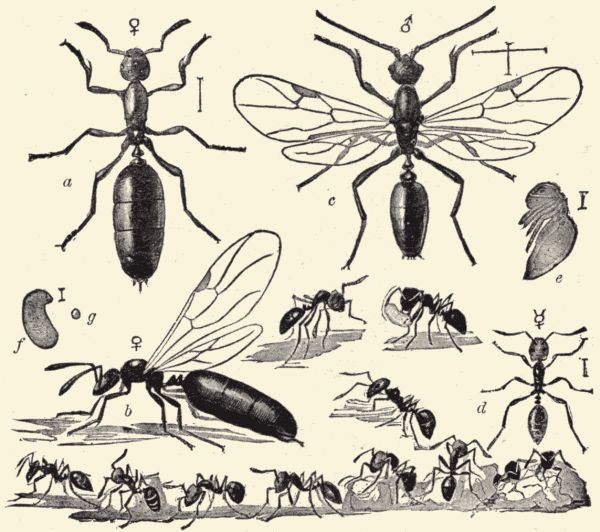
Fig. 84.—The little black ant, Monomorium minutum; a, female, b, female with wings, c, male, d, workers, e, pupa, f, larva, g, egg of worker, all enlarged. (From Marlatt.)
The ants are among the most warlike of insects. Battles between communities of different species are numerous, and the victorious community takes possession of the food-stores of the conquered. Some species of ants live wholly by war and robbery. In the case of the remarkable robber-ant (Eciton), found in tropical and subtropical regions, most of the workers are soldiers, and no longer do any work but fighting. The whole community lives exclusively by pillage. Some kinds of ants go even farther than mere robbery of food-stores: they make slaves of the conquered ants. There are numerous species of these slave-making ants. They attack a nest of another species and carry into their own nest the eggs and larvæ and pupæ of the conquered community, and when these come to maturity they act as slaves of the victors, collecting food, building additions to the nest, and caring for the young of the slave-makers.
As with the honey-bee the larval ants are helpless grubs and are cared for and fed by nurses. The so-called "ants' eggs," the little white oval masses which we often see being carried in the mouths of ants in and out of an ants' nest, are not eggs, but are the pupæ which are being brought out to enjoy the warmth and light of the sun or being taken back into the nest afterward.
There are in this country numerous species of ants showing much variety of habit and offering excellent opportunities for most interesting field observations. For an account of several of the common species see Comstock's "Manual of Insects," pp. 633-643. Ants may be readily kept in the schoolroom in an artificial nest or formicary and their life-history and habits closely watched. For full directions for making and keeping a simple and inexpensive formicary see Comstock's "Insect Life," pp. 278-281. For an interesting account of some of the habits of the social insects see Lubbock's "Ants, Bees, and Wasps."
Class Myriapoda: The Myriapods, or Centipeds and Millipeds.

Fig. 85.—Peripatus eiseni (Mexico). (From specimen.)
Belonging to the branch Arthropoda, with the classes Crustacea and Insecta, are three other classes, of which one, the Onychophora, is represented by a single genus Peripatus (Fig. 85), of extremely interesting animals. However, as these animals are not found in the United States we cannot study them. The other two classes are the Myriapoda, including the centipeds and millipeds or thousand-legged worms, and the Arachnida, including the scorpions, spiders, mites, and ticks. All these animals are often spoken of as insects, but though related to them they are not true insects.
Technical Note.—From under stones or logs obtain specimens of millipeds, or thousand-legged worms (large blackish, cylindrical, worm-like animals with each body-segment back of the fourth bearing two pairs of jointed legs); also specimens of centipeds or hundred-legged worms (flattened, usually brownish or pale worm-like animals with the body-segments bearing only one pair of legs each) in the same places. Examine the external structure; note number of body-rings; division into body-regions; presence of antennæ; character and number of eyes; character of mouth-parts; character and arrangement of legs. In the centipeds the first pair of legs is modified to form a pair of poison-fangs. They appear to belong to the mouth-parts. The internal anatomy will be found to be, if examined, much like that of insects and can be studied from the account of the anatomy of the water-scavenger beetle and butterfly larva. Compare the Myriapods with the Hexapods or true insects. What are the points of resemblance? what are the points of difference?
The Myriapoda are land-animals breathing by means of tracheæ like the insects. In them the body-segments are nearly uniform in character with the exception of the head, which, as in the insects, bears the mouth-parts and antennæ. There is no grouping of the body-segments into regions except as the head is opposed to the rest of the body. (In a few myriapods there are indications of a division of the hind body into thorax and abdomen.) The presence of true legs on all the segments of the hinder region of the body and the lack of the three-region division of the body are the principal external structural characteristics which distinguish myriapods from insects. The internal anatomy corresponds in general character with that of insects.
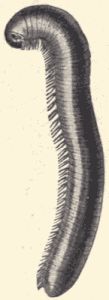
Fig. 86.—A galley-worm (milliped), Julus sp. (From specimen.)
The most familiar myriapods are the millipeds, and the lithobians and centipeds. The millipeds are cylindrical in shape, have two pairs of legs on most of the body-segments and are vegetable feeders, though some may feed on dead animal matter. The galley-worms (Julus) (fig. 86), large, blackish, cylindrical millipeds found under stones and logs and leaves and in loose soil, are familiar forms. They crawl slowly and when disturbed curl up and emit a malodorous fluid. They can easily be kept alive in shallow glass vessels with a layer of earth in the bottom, and their habits and life-history may thus be studied. They should be fed sliced apples, green leaves, grass, strawberries, fresh ears of corn, etc. They are not poisonous and may be handled with impunity. They lay their eggs in little spherical cells or nests in the ground. An English species of which the life-history has been studied lays from 60 to 100 eggs at a time. The eggs of this species hatch in about twelve days.
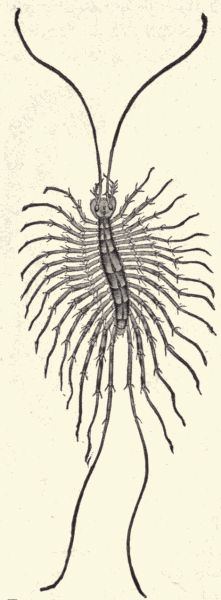
Fig. 87.—The skein centiped, Scutigera forceps, natural size, common in houses and conservatories. (From Marlatt.)
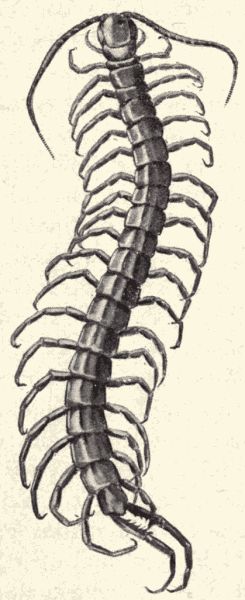
Fig. 88.—A centiped, Scolopendra sp. (From specimen.)
The lithobians and centipeds are flattened and have but a single pair of legs on each body-ring. They are predaceous in habit, catching and killing insects, snails, earthworms, etc. They can run rapidly, and have the first pair of legs modified into a pair of poison-claws, which are bent forward so as to lie near the mouth. The common "skein" centiped (Scutigera forceps) (fig. 87) is yellowish and has fifteen pairs of legs, long 40-segmented antennæ, and nine large and six smaller dorsal segmental plates. The true centipeds (Scolopendra) (fig. 88) have twenty-one to twenty-three body-rings, each with a pair of legs, and the antennæ have seventeen to twenty joints. They live in warm regions, some growing to be very large, as long as twelve inches or more. The "bite" or wound made by the poison-claws is fatal to insects and other small animals, their prey, and painful or even dangerous to man. The popular notion that a centiped "stings" with all of its feet is fallacious. It is recorded by Humboldt that centipeds are eaten by some of the South American Indians.
Class Arachnida: The Scorpions, Spiders, Mites, and Ticks.
Technical Note.—Obtain specimens of various spiders; the running or hunting spiders may be found on the ground, especially under stones and boards, the web-makers on their snares. Get also spiders' "cocoons" (egg-sacs). Examine the external structure of the spider; note the two body-regions; the number and character of legs; the absence of antennæ; the number and arrangement of the eyes (which are simple, not compound); the mouth-parts, especially the large mandibles; the spinnerets at the tip of the abdomen (examine a cut off spinneret under the microscope to see the spinning-tubes); note the breathing openings or spiracles on under side of abdomen. Obtain also a scorpion if possible, and some ticks and mites. Compare with the spiders and note that in the scorpion the body is plainly seen (especially in the abdomen) to be composed of segments. Note the extreme fusion of the segments and body-regions in the mites and ticks. The common red spider of hothouses and gardens is a mite; ticks may sometimes be found on dogs. Observe various kinds of spider-webs, and try to observe the process of web-making (this can be observed early in the morning or about dusk) by one of the orb-weaving garden-spiders. Live spiders can be kept in the schoolroom and their feeding habits and perhaps web-making habits observed.
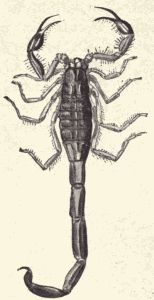
Fig. 89.—A scorpion, Centrurus sp., from California. (From specimen.)
The class Arachnida is composed of Arthropods whose body-segments are grouped into two regions, a cephalothorax bearing the mouth-parts, eyes, and legs, and an abdomen. The segments composing these two parts are so fused that, except in the scorpions, they are usually indistinguishable. There are no antennæ, the eyes are simple, the mouth-parts fitted for biting, and there are four pairs of legs. In their internal anatomy the arachnids show in some forms a peculiar modification of the respiratory organs, the tracheæ being flat and leaf-like and massed together in a few groups rather than being tubular and ramifying through the body.
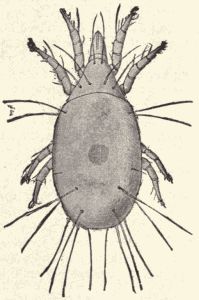
Fig. 90.—The cheese-mite, Tyroglyphus siro, greatly enlarged. (After Berlese.)
The dorsal vessel or heart usually has a few blood-vessels or arteries running from it. This class is divided into three orders, the Arthrogastra, or scorpions, the Acarina, or mites and ticks, and the Araneina, or spiders.
The scorpions (fig. 89) have the posterior six segments of the abdomen much narrower than the seven anterior segments and forming a tail which bears at its tip a poison-fang or sting. This sting is used to kill prey, insects and other small animals. The tail can be darted forwards over the body to strike prey which has been previously seized by the large pincer-like maxillary palpi. Scorpions are common in warm regions, about twenty species being known in southern North America. Their sting though painful is not dangerous to man. The young are born alive and are carried about by the mother for some time after birth.
The mites (figs. 90 and 91) and ticks (fig. 92) are mostly small obscure animals, which live more or less parasitically. The common red spider of house-plants as well as the sugar- and cheese-mites, the dreaded itch-mite and the chigger are familiar examples of these degraded arachnids, and the wood-ticks, dog- and chicken-ticks are common examples of the larger bloodsucking forms. The body in both mites and ticks is very compact, the two body-regions, cephalothorax and abdomen, being closely fused.
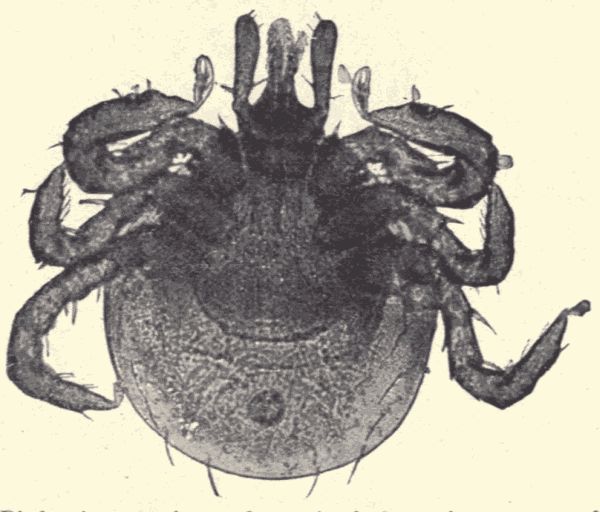
Fig. 91.—Bird mite, species undetermined, from the gnome-owl, Glaucidium gnomus. (Photo-micrograph by Geo. O. Mitchell.)
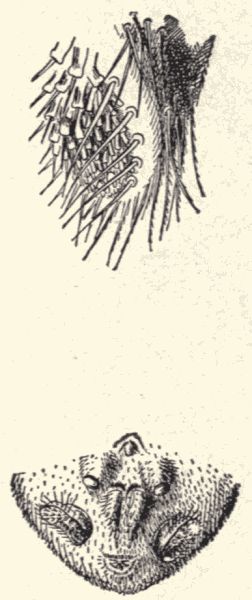
The spiders have the abdomen distinctly set off from the cephalothorax. The eyes (fig. 93) vary in number and arrangement, the mandibles are large, each being composed of two parts, a basal hair-covered part, the falx, and a terminal smooth, shining, slender, sharp-pointed part, the fang, which is movably articulated with the falx (fig. 93). In the falx is a poison-sac from which poison flows through the hollow fang and out at its tip. The legs vary in relative length in different spiders, and each is made up of seven joints. The spinnerets (fig. 94), which are situated at the tip of the abdomen, are six in number (a few spiders have only four), and are like little short fingers. They have at their tips many fine little spinning-tubes from each of which a fine silken thread issues when the spider is spinning. These many fine threads fuse as they issue to form a single strong cable or sometimes a flat rather broad band. The spinnerets are movable, and by their manipulation the desired kind of line is produced. The silk comes from many silk-glands in the abdomen, from each of which a fine duct runs to a spinning-tube.
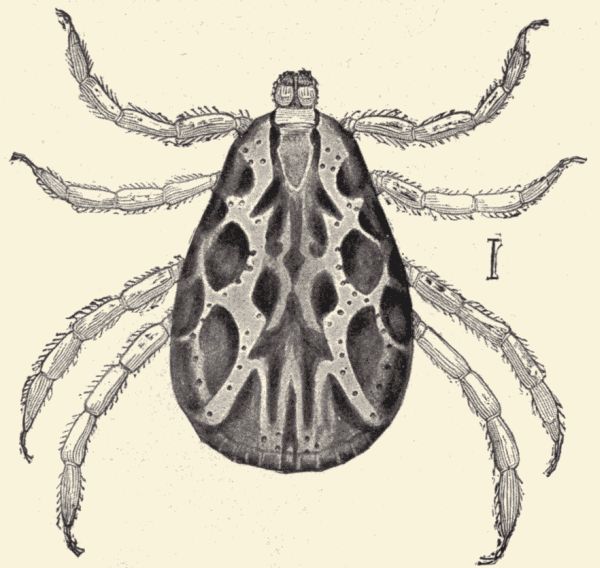
Fig. 92.—The dog or wood tick, Dermacentor americanus male, the most common tick in the Northern States. (After Osborn.)
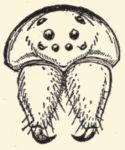
Fig. 93.—The eyes and jaws, showing falx and fang of a spider. (From Jenkins and Kellogg.)
The spiders may be divided into two groups according to their habits, viz., the wandering or hunting spiders, which do not spin webs to catch their prey, and the sedentary or web-weaving spiders, which spin snares to catch their prey. The wandering spiders can spin silk, however, and often do so to line their burrows, to make nests, or to make egg-sacs.
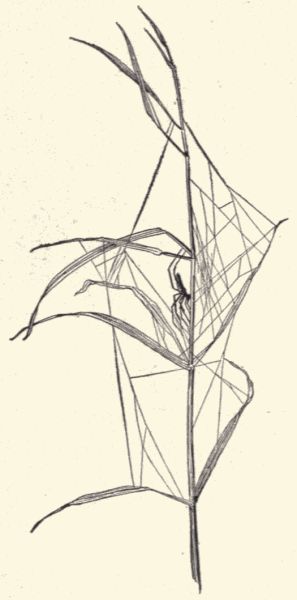
Fig. 94.—The six spinnerets (below) of a spider, with one spinneret enlarged (above) to show the spinning "spools" or tubes. (From Jenkins and Kellogg.) Fig. 95.—A long-legged spider, Tetragnatha sp., on its web. (From life.)
The hairy tarantulas and the trap-door spiders of similar appearance are among the most interesting of the hunting spiders. They live in vertical burrows or tunnels in the ground which are lined with silk, and which in the case of the trap-door spider are covered with a door or lid made of silk and soil. The top of this door is always covered with soil or bits of leaves or twigs so that it is nearly indistinguishable from the surface of the ground about it. When the nest is in ground covered with moss the spider covers the door with moss. The tarantulas hunt at night and rest in the burrow in the daytime. They are very large, sometimes having an expanse of legs of 6 inches.
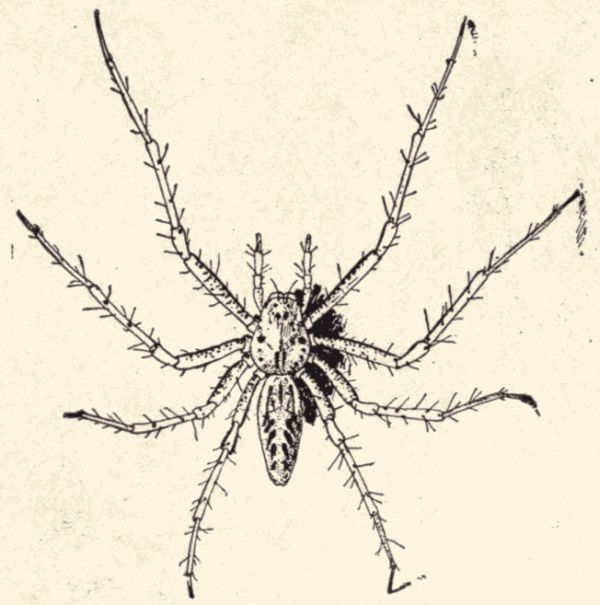
Fig. 96.—A running spider (Lycosidæ). (From life.)
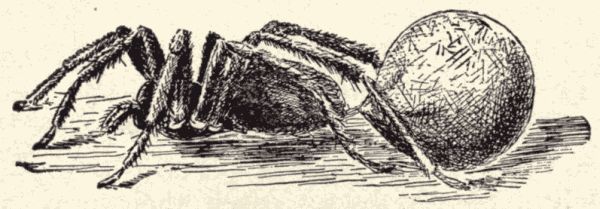
Fig. 97.—A female running spider (Lycosidæ) carrying its egg-sac about attached to its spinnerets. (From Jenkins and Kellogg.)
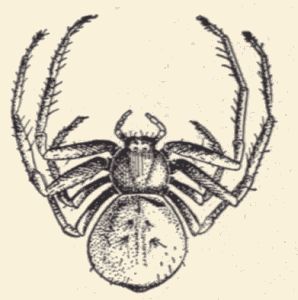
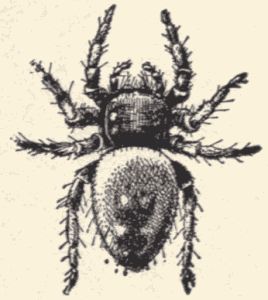
The common, rather large swift black spiders found under stones and boards are hunting spiders, belonging to the family Lycosidæ and are called the running spiders (fig. 96). They live in burrows in the ground, coming out to stalk and chase their prey. The eggs are laid in globular egg-sacs which are often carried about, attached to the spinnerets, by the female (fig. 97). The young spiderlings after hatching, in some species, climb on to the mother's back and are carried by her for some time. Other kinds of wandering or hunting spiders are the crab-spiders (Thomisidæ) (fig. 98), which run sidewise or backward as well as forward, and the black and red, fierce-eyed stout-bodied little jumping spiders (Attidæ) (fig. 99), which leap on their prey.
Fig. 98.—A crab-spider (Thomisidæ). (From Jenkins and Kellogg.) Fig. 99.—A jumping spider (Attidæ). (From Jenkins and Kellogg.)
The sedentary or web-weaving spiders are of various kinds. They may be grouped according to their spinning habits into cobweb weavers (Therididæ), small slim-legged spiders which make the familiar unsymmetrical cobwebs of houses and outbuildings; funnel-web weavers (Agalenidæ), larger long-legged spiders of meadow and field which spin a flat or concave horizontal web in the grass with a silken tube leading down to the ground; the curled-thread weavers (Dictynidæ), which use in addition to the usual lines peculiar broad lines made of waved or curled threads in their irregular webs made in fence-corners and on plants; and finally orb-weavers (Epeiridæ) (fig. 100), the host of variously colored and patterned stout-bodied garden-spiders which spin the beautiful symmetrical circular webs familiar to all (fig. 101). If a complete uninjured orb web be examined it will be found to consist of a small central hub either open or closed, from which run radii to the outer edges of the web. Around the hub is an open or free zone, and farther out a spiral zone, so called because a line running in close spiral turns fills in the space between the radii. This is the real prey-catching part of the snare, and the silken line here is sticky, while the radii and some other parts of the web are made of silk that is not sticky. The web is supported by strong foundation-lines, attached to leaves, stems, or whatever is firm in the neighborhood of the web. The spider either rests on the web, usually in the centre, or lies concealed in a nest or tent near at hand from which a special path-line runs to the centre of the web. The building of one of these orb webs is a great work, and is done with extraordinary nicety of manipulation by the use of feet and spinnerets. For account of web-making, etc., see McCook's "American Spiders and their Spinning Work."
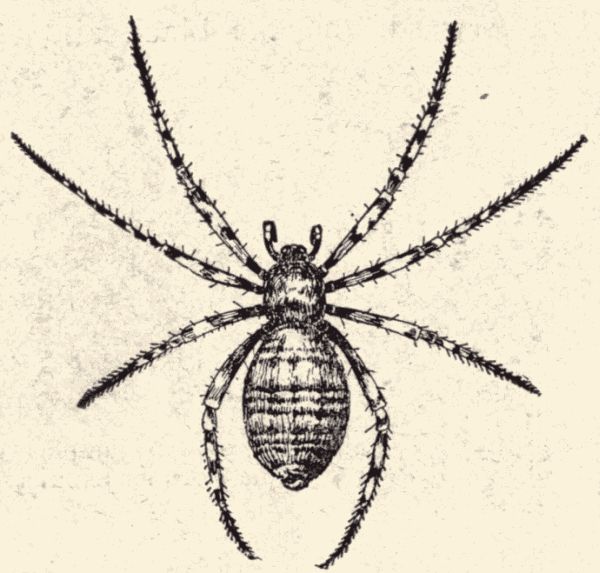
Fig. 100.—Argiope sp., a large orb-weaver (Epeiridæ). (From Jenkins and Kellogg.)
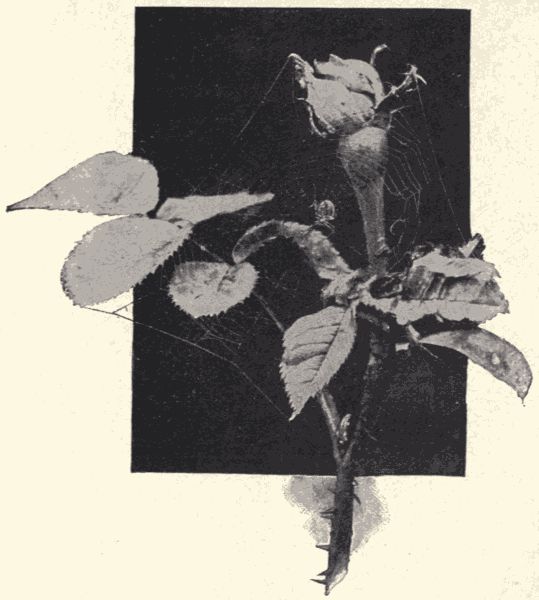
Fig. 101.—Spider and its web in a rose-bush. (Photograph from life by Cherry Kearton; from "Wild Life at Home," by permission of Cassell & Co.).
The habits and instincts of spiders in connection with the care of the young, the building of webs and nests, ballooning by means of silken lines, the active stalking and catching of prey, etc., are very interesting and offer a good field for independent observation and study by the student.
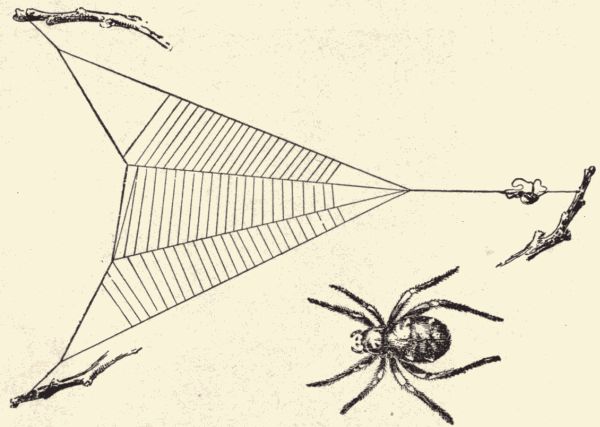
Fig. 102.—The triangle spider, Hyptiotes sp. (California), with its web; the spider rests on the taut guy-line, with a loop of the line held between its fore and hind legs; when an insect gets into the web the spider loosens the hold of its hind feet on the guy-line, thus allowing the web to spring forward sharply and further entangle the prey. (From Jenkins and Kellogg.)