EDGAR THE READY (continued 4)
Reading edition
"The missing clues I think we can supply, Sir John," said Edgar, "though I greatly fear they will in no wise lessen our apprehensions."
"Ye know, then, this man that Matthew had seen before?"
"Yes, he is a man we believe to be in league with thine enemy, Sir Gervaise de Maupas."
"Ah!--that man again!" cried Sir John, starting to his feet in indignation. His strength, however, was unequal to the effort, and he sank back again immediately with his hand pressed against his thigh.
"What is it, Father, what is it?" cried Gertrude anxiously.
"Only my wound, child. It is far from healed, and I must put no strain upon it for a while. But go on, Edgar. We must think out what is to be done. We must act quickly if we are to act at all."
"I told thee, sir, the offer De Maupas made to me in exchange for thy life and mine? It was, thou wilt remember, my support in persuading thee to agree to his marriage with thy ward--her lands being taken in exchange for his claims to thine. The capture of the lady Beatrice is, I see clearly, but one more link in the infamous plan. With her safely in his clutches, he doubtless thought he would be in a still stronger position to dictate his terms. Moreover, if we consented, he could make certain that we should never be able to repudiate the promise as having been made under compulsion, by calling in a priest and having the ceremony performed offhand. A right deadly plan it hath been, and it hath all but succeeded--even now it may succeed, for with the lady Beatrice in his hands he is almost as strong as with us all."
"Then ye think Beatrice hath been taken to Ruthènes?" said Sir John, after a long and painful pause.
"Yes, I am sure of it. She must have arrived there soon after we escaped."
"'Tis dire news. How dreadful that place is none of us would like to admit to any but ourselves! What, then, will it be to a maid? Edgar, thou didst accomplish the impossible in rescuing me--canst do anything to rescue the maid? Be sure that they will be doubly on the alert this time."
"I am ready and more than ready to try, Sir John."
"I would send to the earl and implore his aid, did I think it likely that he would help me. But he hath his hands full and would not care to send a force into a spot so remote as Ruthènes. No, I fear 'tis on ourselves alone that we must depend."
"I will go, Sir John. I will take Peter and fresh horses. Where we have penetrated once we can penetrate again. Besides, this time we know the secret way into the castle, and may avoid the untimely capture into which we blundered so badly last time."
"Be cautious and not too sanguine. The guards will be doubled, thou mayst be sure. When canst start? Forgive me for sending thee away so soon after bringing me into safety, but it is dreadful to me to think of Beatrice immured in some lonely chamber of yon blood-stained fortalice."
"I can start at once, Sir John. All I want is a little money, some food for the journey, and another mount."
"Thou shalt have all thou canst want. Gertrude, give the lad money from my own purse. Food and another horse thou canst get, Edgar, as thou art passing through the camp. Delay not, lad, for I am on fire with impatience to know that something is being done. I would that I were strong enough to go."
"Farewell then, Sir John! I hope that when we return thou wilt be well and strong again, and ready to join in the earl's advance."
Edgar hurriedly withdrew, and leaving Peter to dispose of the horse and cart and to follow as soon as he could, he mounted their one charger and rode out of the city into the camp to the lines of the Wolsingham contingent. Calling one of the men-at-arms, he instructed him to saddle and make ready another of Sir John's chargers and to prepare a store of food while he occupied himself in selecting his best weapons and a spare suit of mail. This suit he did not wear, but had it packed up with a few pieces of mail for Peter in two portions, one of which was to be borne on either horse. By the time his preparations were complete, Peter had joined him, and without any further delay the two mounted and rode out of the camp upon the road to Ruthènes once more.
CHAPTER XVI
A New Quest
"Now, dear Father," cried Gertrude, as soon as Edgar had left, "now that thou art in my charge I must bid thee to bed. All is done that can be done, and thou canst rest content."
"All is done for the moment, and I will indeed obey thee, my Gertrude. But I have yet to make my peace with the earl. I must dispatch a missive to Sir James d'Arcy, one of the marshals of the tournament. To him I can explain how 'twas I failed, like a poltroon, to answer to the challenge of Sir Gervaise de Maupas. When he seeth my condition and heareth my tale, I have hopes that he will believe me."
"Hath not Edgar then----?" began Gertrude, opening her eyes in amaze.
"Hath not Edgar what; maiden? Is anything wrong?" cried Sir John, a sudden look of apprehension coming into his face. "Surely the earl hath not made proclamation of my disgrace because of my non-appearance in the lists? Tell me quickly!"
"Nay, nay, Father, 'tis far from that. Indeed there is no need to trouble Sir James or the earl. Thine honour is safe. Edgar should have told thee all and not left it to me."
"Gertrude," cried Sir John, with a touch of sternness, "there is some mystery here. Tell me what it may mean. Delay not, girl."
Without more ado Gertrude related to her father the events that followed the first discovery of his disappearance--how, as the hours passed by, they had grown convinced that De Maupas in some way had had him removed with the object of disgracing him by his failure to appear in the lists, and how at last Edgar, to save his honour, had determined to personate him.
"What!" interrupted Sir John at this point. "Personate me! But surely not in the combat in the lists?"
"Yes, yes, in the lists. 'Twas to save thine honour, and to punish Sir Gervaise."
"'Twas a bold thought," murmured Sir John in wonderment. "But how could he hope for aught but defeat against such a lance as De Maupas? And yet he seemeth to have come to no great harm."
"He did not, Father. The first onset was terrific, but neither gained much advantage, though Sir Gervaise's steed lost its balance and rolled over. But in the encounter on foot Edgar handled Sir Gervaise most roughly, and with a single axe-blow felled him senseless to the ground."
"What! He won?" cried Sir John in utter astonishment. "You tell me he won? Truly never have I heard the like since the days of the paladins of old. Ah, it must be to his extraordinary earnestness to learn that he oweth so great a victory. His hard schooling at Gaspard's and his constant practice elsewhere--ho! ho! De Maupas was well repaid, and that right quickly, for his black treachery."
"None know the truth but ourselves," Gertrude went on. "Everyone believed that Sir John Chartris left the camp immediately after the encounter to pay the visit to Faucigny for which he had a few days before obtained the earl's permission. All is well, Father, and thou canst take up the threads where they fell when thou wert stolen away."
"Not so, my child," said Sir John thoughtfully. "I cannot allow laurels undeserved to be bestowed upon me so freely. I must let the earl know the truth. Think not that I am the less indebted to Edgar for his daring and successful championing of my cause. Had De Maupas been allowed to win his bloodless victory, a dark cloud of disgrace and suspicion would have gathered about my poor name, and hard to disperse should I have found it. A few might have believed my tale, but the greater part would have continued to shake their heads dubiously whenever my name was mentioned. As it is, I can tell the earl the story of my capture at the same time that I tell him 'twas not I that appeared in the lists. All will thus be well. Scarce a soul but will then believe the tale."
"Edgar will surely be sorry. He will think thou art flinging away the fruits of his victory."
"Nay, he will understand, for 'twould be what he would do himself were he in my place. Sorrow not for him, for he will be the gainer. The earl will love the tale, even though 'twill make him pull a wry face to think how he and they all were fooled. My hopes rise, Gertrude. Urged on by such daring and energy as this, truly we may well look to Edgar to bring back our Beatrice. May God speed him!"
"May God keep him out of the hands of De Maupas!" replied Gertrude feelingly; and Sir John echoed her words with deepest emphasis.
* * * * *
Riding to the limit of the endurance of their horses, Edgar and Peter made rapid progress, and were soon back again in the neighbourhood of Ruthènes. This time they did not ride directly into the village, but, when within a mile or so, led their horses into a thick covert and tied them to a tree. They then set off on foot for the castle, keeping well away from the village.
"Tread silently, Peter, and keep a vigilant watch. I would not that any saw us, especially of those belonging to the castle."
As soon as they came within sight of the castle Edgar gave the signal to stop, and, keeping well out of sight of watchers on the wall, the two young men reconnoitred it eagerly.
"There are more sentinels than ever," said Edgar, after a long and earnest scrutiny. "I feared as much. Well, let us now work round to the tree which masks the entrance to the underground passage. If that way is still open to us, all is well."
"But surely they will have found the keys we left behind in the last scramble up the steps cut within the tree trunk?" asked Peter. "They will have locked the doors, and we shall be barred out."
"Doubtless, but I care not for that so long as there is no watcher posted at the doors. With patience we can win a way through the stoutest barriers. But if a sentinel is there, our hope of a silent entry is gone."
Presently Edgar stopped and looked about him in some perplexity. "'Twas near here, was it not, Peter, that the great tree spread its branches? Nevertheless, I can see nothing of it."
"Yes, 'twas certainly near here, Master Edgar. Yon clump of undergrowth--was it not through that we made our way out of sight and reach of Black Eustace and De Maupas?"
"I fear they have cut down the tree and carried it away," said Edgar forebodingly. "Search for the scar in the ground--ah, here 'tis, carefully covered with leaves and twigs, to show no sign."
The two young men gazed down at the smooth patch of loose earth in silent consternation. It was on the continued existence of the secret passage that they had built most of their hopes, for in all their discussions they had agreed that it would be almost an impossibility for them to make their way over the walls and into the castle a second time. Their first attempt had ended in capture, and it was not likely that a second, with the garrison on the alert, would be any more successful.
"They have filled up the passage," cried Peter despondently. "What hope is there now to find a way into the castle? Would that we had wings!"
"This is a heavy blow," said Edgar slowly. "I can think of no way in at present. But we have always one thing to fall back on, so lose not hope so soon, lad."
Peter looked up quickly. "Mean you to----"
"Yes, to throw in our lot with the priest. If we cannot win our way in by strategy we must fall back on force of arms. But before the die is cast for an assault upon the castle, let me think if there is no other means possible."
For half an hour Edgar paced up and down the tiny glade formed by the removal of the great tree whose hollow trunk had been so cunningly made use of by the builders of the castle. From every point of view he conned over in his mind the defences of the castle, and wrestled with the problem of circumventing them. But he could think of no way that offered any real hope of success, save by waiting and watching for some special opportunity. This, however, was out of the question, for the thought of the delicate and high-spirited Beatrice d'Alençon confined in a castle whose gloom had weighed heavily upon the spirits even of men inured to war and hardship was simply intolerable.
"Come, Peter," Edgar cried at last in the brisk voice of one who has made up his mind, "come; I see no way in but by the sword, and while that castle holdeth Sir Gervaise de Maupas little do I regret it. Let us now seek Father Armand, and place ourselves by his side."
Peter gave a suppressed cheer, and followed with an eagerness that showed that the prospect of an assault upon the castle appealed to him not one whit less than it did to his master.
As soon as they had found their horses the two young men mounted and rode quietly into the village. At the house which served as an inn they stopped, and, calling the landlord, enquired for Father Armand.
"He is away from the village," replied the man, eyeing them narrowly. "What want ye the good father for?"
"We desire a few words with him," replied Edgar. "It is most important. Canst not fetch him or take us to him?"
The man shook his head.
"Perchance he is at the cave," suggested Edgar quietly. "If so, we will go ourselves, for he hath told us the way."
The man's attitude changed at once. "Yes, sir, he is at the cave. I did not know he had told thee all. I will go with thee and lead thy horses. It will not be well to leave them in the village--thou know'st why," he added, again eyeing Edgar narrowly.
Edgar nodded and accepted the man's offer to accompany them, though he guessed it was made more with a view to keeping them under observation than to assisting them. The man's attitude indicated plainly that the priest had been as good as his word, and that the banner of revolt, if it had not already been raised, was at least being nailed ready to the staff.
At the cave they came upon a scene of animation. Yards of bush had been cleared away, and in the open space scores of men were at work drilling or furbishing up their arms. The drilling was of a most crude and primitive nature, and would have appeared ludicrous to Edgar under other circumstances. But he was too well aware of the cruelty and oppression under which these men had groaned for so many years to smile at the poor figure they cut in a soldier's eyes.
Moreover, he knew that nothing but the determination born of despair could have brought them to the pitch of assaulting a strong and well-garrisoned castle, unequipped as they were with any of the engines of war. For a moment or two he could not see Father Armand, but presently he espied him, with hood flung back and gown tucked up, explaining and demonstrating to some of the more stupid of his levies what they were expected to do when he gave certain orders. The moment he saw Edgar and Peter he left his work and ran quickly forward to meet them.
"Sir Squire," he cried eagerly, "doth thy return mean that thou art----?"
"Yes, yes, Father," cried Edgar, grasping the hands which the priest extended to him, and pressing them warmly. The sight of the kindly face, with its lines that told of care and sorrow, stirred him strangely. How gallant was the old man thus to take up the sword in what must have seemed almost a forlorn hope to one unused to any sort of warfare but that of the spirit! "Yes, Father, we have come to throw in our lot with you. For weal or woe, we are members of your band."
"Not members--leaders," cried the priest impetuously. "We sadly lack skill and knowledge, and of these I know ye possess as much as, if not more than, our ancient enemy. Come, let me tell my people the brave news. It will cheer their hearts, for, though they have answered to my call willingly and eagerly, it is more the willingness of men to go to death rather than remain in soul-destroying bondage than that of men marching forward with the expectation of victory."
Calling to the assembled bands, the priest bade them form in two lines in something approaching military formation. Then he told them the story of Edgar's and Peter's first coming, and how they had, single-handed, made entry into the castle and, in spite of capture and alarums, succeeded in bringing away him whom they had set out to rescue.
Though Edgar could not follow the whole of the priest's patois, he could see that the story was well and graphically told, and that it made a deep impression on the listeners. Then the priest went on to tell of how he had made request to the two strangers to stop and assist them in their undertakings, and how, in loyalty to their sick master, they had reluctantly refused. Finally he told them that they had now returned and placed themselves at his disposal in their righteous war for freedom.
A roar of applause rose as the priest paused for a moment and placed his hand on Edgar's shoulder.
"They have knowledge of war, and must lead us," he went on. "This man I appoint to lead us in the field. He shall be co-equal with me. I shall command, except when we move forward to battle, when Sir Squire will take the lead, and I shall fight by his side."
There was another roar of enthusiastic applause, and the men broke ranks and crowded eagerly about the newcomers. Seeing that something seemed to be expected of him, Edgar sprang upon the back of his horse and held up his hand. The spirit of the priest and his men and their just cause had so stirred him that he forgot for the moment that he was a simple esquire with little experience of warfare and small claims to ability to lead an attack upon a powerful castle. He only knew that he was ready to do whatever was asked of him--to lead or to follow, he cared not which, so that he might aid a plucky people struggling to be free.
In a few words, simple and slow, from his imperfect knowledge of the local dialect, he told them that victory could never be theirs unless all were ready to give prompt obedience to their leaders, to work hard, to fight to the death, and to think, not of plunder, but only of victory and justice. The speech was well received, and Edgar dropped back to the ground with the feeling that, though he and his men might be beaten, it would be from lack of skill rather than from lack of courage and determination.
"Shall we move to the attack at once?" cried the priest, his eyes flashing with eagerness. "Our numbers are almost complete--one hundred and fifty all told."
"Nay, good Father, let us hold council of war. Nothing will be lost by waiting an hour or so."
"Come, then, let us to the cave and hold council forthwith. Our men are full of eagerness now, and I would that thou couldst see thy way to an attack at once."
Moving to the entrance of the cave the priest, Edgar, and Peter took counsel together.
"What food have ye collected to feed this great host of thy people, Father Armand?" asked Edgar quietly. He could see that the priest was over-excited, and wished to bring him back to cooler thoughts as well as to find out exactly how matters lay with his new command.
"But little, I fear," replied the priest. "We are so poor that food and money can only be gathered in the smallest quantities. Any man that hath more than his starving fellows is soon relieved of his surplus by the arch-robbers of the castle."
"Men cannot fight well with half-starved bodies," responded Edgar, shaking his head. "Nevertheless we must do the best we can with the means at our disposal. How are the enemy off for food? How often do they receive fresh supplies? I should dearly love to begin the campaign by capturing the wagons bringing to them their ill-gotten stores."
"I know not when the next falls due, but always of late they have sent mounted men-at-arms to escort the wagons to the castle. Several armed guards, too, accompany their cattle when they are driven forth and back to pasture every morning."
"Ha! Where pasture they the cattle?"
"At a field a short way along the road in the opposite direction to the village."
"Those cattle must be captured, Father. 'Twill be a blow to the enemy, and at the same time provide us with food for our starving levies."
Many more questions Edgar asked, until he had a full grasp of the situation and could help to plan for the great attack. Presently from their discussions a plan emerged and took shape, and when the council of war broke up a definite course of action, which seemed to give the priest, at any rate, full satisfaction, had been decided upon.
The drilling was resumed, this time under Edgar's direction, and arms were again inspected under the experienced eye of the armourer's assistant. It soon became generally understood that the morrow was to witness the opening of the attack, and the men went about their tasks with a zest and eagerness that had been absent an hour or two before. With scarce a moment's intermission the preparations continued till night came and a semblance of peace fell upon the warlike scene.
CHAPTER XVII
The Opening of the Attack
"Let every man understand that silence is of far more importance than speed," said Edgar to the priest the following morning, as the latter put himself at the head of a body of forty men carrying spades in addition to their weapons. "If you do your work thoroughly and silently Peter and I will see that you are not disturbed."
"The work shall be done, and done well," responded the priest cheerfully. "See thou, Sir Squire, to thy part. To thee the conflict--and let it be victory, for defeat at the outset will be hard indeed to bear."
"Father," responded Edgar quietly, "I have told thee why I have come again and why I must enter yon castle. With such responsibility resting on my shoulders, am I likely to submit to failure while there is a chance of victory? Can I return to my master alive and unsuccessful?"
The priest grasped Edgar by the hand and wrung it warmly. "For thee as well as for me it is victory or the grave," he said simply. Then he gave the word to his men and the band marched steadily away.
Peter's band followed next. It numbered only about thirty strong, but was composed of the younger and more alert-looking men. Lastly came the largest body, commanded by Edgar. This was clearly composed of the toughest fighting material among the peasantry, and appeared to be intended to bear the brunt of any fighting that might ensue.
While the men were on the move, spies came and reported that the cattle belonging to the castle had, as usual, been driven to their pasture, escorted by a body of ten mounted men-at-arms.
"The guard waxes stronger every day," said the priest meaningly. "They must, I fear, have an inkling of what is afoot."
Edgar nodded. "It may only be an inkling," he said.
The three bodies of men presently arrived at the road which led from the castle gates through the thick woods for about four hundred yards before it branched in two, the one track leading to the village and the other to the fields in which the castle cattle grazed. A few paces from the point where the roads separated a halt was made, and the priest's contingent flung down their weapons and grasped their spades. A section of the roadway was pointed out to them, and, using the utmost caution, that no sound might penetrate to the castle, the men began to dig with a suppressed energy which told how much their hearts were in their work.
Satisfied that they understood the need for silence and could be relied upon, Edgar dispatched Peter and his band along the road for a hundred yards or so in the direction of the castle. Their office was to intercept and capture all who came that way, and, at all costs, to prevent their return to the castle with news of what was proceeding.
Edgar then gave the word to his own men and marched them off upon the road taken by the cattle and their escort. A few hundred yards from the field in which the animals were pastured he called a halt, and posted the men in the woods on either side of the track, ready to ambush the men-at-arms on their return to the castle.
Free for the moment, he made his way to the edge of the woods overlooking the field, and stood for some time watching the escort of men-at-arms. In the ordinary way one of their number would have been set to watch while the others flung themselves down to rest or to dice away their time. Instead of that, however, they had gathered together in a group, and appeared to be eagerly discussing some matter of absorbing interest. It seemed only too clear that by some means the castle had gained an inkling of what was going on, and equally clear that the difficulties and dangers of the peasants' task had been increased fourfold.
The morning wore on until the time for the return of the cattle arrived. They were collected and, preceded by two men, were driven back along the road by which they had come, the rest of the guard following behind.
Suddenly and without warning a shrill whistle sounded. A rush of men from the undergrowth on each side of the road instantly followed. The men-at-arms forming the escort were not unready, but they were spread out two deep, and the attackers were among them before they could gather thickly in defence. A wild and confused struggle ensued. Edgar's own dash forward brought him into contact with two soldiers, the farther one of whom instantly snatched a horn from his belt and placed it to his lips. Guessing that the man was about to signal for assistance, Edgar charged impetuously, cut down the man nearest to him, and sprang upon the one sounding the alarm.
The action, swift as it was, came too late, and for some moments the note of the horn resounded unchecked high above the din of the conflict. Without pausing in his attack Edgar listened eagerly for a reply, and in a few seconds caught the answering note of a horn wound long and full. The sound came from the direction of the castle, and, as it ceased, in its place he seemed to hear the deeper note of a loud cheer of encouragement.
The encouragement came too late, however, for by that time all resistance was at an end. Seven of the men-at-arms had been cut down, and the remainder overwhelmed and forced to surrender.
"Re-form into rank, men--onward!" cried Edgar, and without waiting to count the cost of the victory, the band was rapidly marched back the way it had come, six men being left behind to guard the prisoners and to take charge of the captured cattle.
"Hark!" suddenly cried one of the men, raising his hand in the air.
The harsh, unmistakable rattle of the chains of the castle drawbridge could plainly be heard, followed in a few seconds by the hollow, distant beat of horses' hoofs upon the planking, as though a troop of horsemen was spurring vigorously across.
"Follow me," cried Edgar, breaking into a run, and at top speed the men sped down the track towards the place where a few hours before they had left the band commanded by the priest hard at work.
Rounding a bend they came in full sight of the spot, but before them the roadway stretched, to all appearances, as firm and unbroken as ever. Could their comrades have failed them? Not a soul was in sight until, in the distance, a strong body of men-at-arms, headed by two knights clad in full armour, appeared galloping rapidly towards them. At the sight of the loose body of armed peasantry in front of them the knights and their following sent up a savage cheer of exultation, and, setting spurs to their horses, thundered furiously down upon the others.
At the grim, heart-shaking spectacle, Edgar felt his men involuntarily check their speed.
"Rally, men, and charge the tyrants!" he cried loudly, and, echoing his words, his men recovered their nerve and pressed along after him.
Rapidly the two forces closed in upon one another until but a few yards of the roadway separated them. Sir Eustace, who, with De Maupas, headed the castle garrison, had even levelled his lance full at Edgar's breast, when all of a sudden the very ground seemed to open beneath his feet! There was a rending crash as a framework of branches, covered with straw and earth, concealing a pit dug in the roadway, gave beneath his weight and sent him crashing headlong into the chasm. De Maupas and many of the men-at-arms behind, unable to stop their furious advance, fell headlong after him until the yawning pit was choked with a mass of struggling men and horses.
"Charge home!" cried Edgar, and with a wild cheer he and his men sprang upon the struggling mass and towards the files spurring to their aid. Another and more desperate combat began. From both sides and the rear sprang the men of the priest's and Peter's bands, as they issued forth from their leafy screens and attacked the astounded garrison.
Edgar's first object was to keep the men-at-arms still in the saddle from rescuing the two knights struggling in the pit. Desperately he fought, but the men-at-arms as desperately charged forward, and with all their weight and impetus swept him and his men violently back. The two knights, clad in full armour, were little hurt by their heavy fall, and in a few minutes they were successfully extricated from the struggling mass and helped upon spare horses. Then with loud cries of encouragement to one another, the men-at-arms re-formed in a solid body and began to forge their way slowly and irresistibly back to the castle.
Time after time Edgar flung himself into their ranks, attended by such of his men as dared to follow, and strove to break up their formation and keep them from winning their way back to shelter. But though his vastly superior swordplay enabled him easily to vanquish individuals, a surge forward of several men each time flung him roughly backwards, and at last the survivors of the garrison reached the edge of the wood, and were able to gallop unchecked across the sward to the castle drawbridge. The bridge was still down, and the battered remnant filed sullenly and silently back into the castle courtyard. The gates crashed to behind them, and with many jolts and jars the drawbridge was drawn up, interposing the still waters of the moat between them and their exulting foes.
CHAPTER XVIII
The Plight of Beatrice
It was known that the garrison of the castle numbered some fifty men all told, exclusive of the two knights. In the attack on the cattle guard ten men had been accounted for, and in the battle about the pit seventeen had been killed outright or had fallen into the hands of their enemies. The garrison was thus reduced to less than half its former strength. Confident that there was now no likelihood of a sally of a body of mounted men which might prove disastrous on the open ground about the castle, Edgar re-formed his men and led them in a solid body out of the woods towards the castle gates. After so decisive a victory it seemed well to try to overawe the garrison by a demonstration of strength, in the hope that some of their number might sue for terms.
Horns were blown, and, after a few minutes' interval, two figures appeared on the outer walls above the gates. They were Sir Eustace de Brin and Sir Gervaise de Maupas.
Sir Eustace appeared almost beside himself with rage and humiliation. Shaking his mailed fist at the men ranged in rank upon the green sward below, he shouted furiously:
"Brood of vipers--who commands?"
Edgar looked at the priest, who motioned him to reply.
"Father Armand and I, Edgar Wintour, esquire of Wolsingham, command."
"And bitterly shall ye rue the day ye lifted hand against Eustace de Brin. Think ye to overcome me? Think ye I have no friends who will send hosts of men-at-arms to trample you into the mud whence ye came?"
"Sir Eustace de Brin," replied Edgar calmly, "think well over thy situation. No word will we allow to reach the outer world from this castle, and the men-at-arms of which thou speakest will never come to thine aid."
"Ha! Thy cleverness, Sir Squire, is already outmatched. Hours ago a messenger left this castle to seek aid."
"He is our prisoner, Sir Eustace."
"Dog!" cried the knight violently, "I tell thee that my friends will soon miss my visits and send to enquire the reason. Withdraw from before this castle, and I will then see how lenient I can be even to braggart rebels such as ye."
"The Earl of Derby is advancing into the lands of the King of France, and all the men-at-arms that can be spared will be sorely needed to rally to his standard. None of thy friends will think of aught but the enemy of France in this time of trouble. Thine is a sad plight, Sir Eustace, and thou wouldst do well to recognize it."
Gulping down his rage with an effort, the knight replied in a calmer tone:
"What meanest thou? What wantest thou? Speak!"
"We want thy surrender----"
"What! Darest thou suggest that Eustace de Brin surrender his castle of Ruthènes to a rabble of rebel vassals? Base and renegade esquire--one who warrest against those of his own station on behalf of dogs of rebels--I tell thee thou knowest not our strength nor how far the arm of chivalry can reach. Withdraw from the ranks of these peasants, or it will most surely reach thee."
"Chivalry will ne'er support thee when it knows of thy black crimes, Eustace de Brin," replied Edgar, altogether unmoved. "It is I who represent chivalry this day, for, as thou shouldst know, it is the proud boast of chivalry to take the part of the weak and oppressed. But it is not of this that I wished to speak. We demand thy surrender and that of the ladies so basely torn from their friends by the false knight who stands by thy side. Surrender is the only course that can save the lives of the soldiers of the garrison, and the only course that will give thee a chance to plead thy case before thy countrymen. Sir Gervaise de Maupas, too, will have at least an opportunity of answering a charge of treachery before the English earl. Persist in thy refusal and thou art lost, for once the blood of this people thou hast oppressed is inflamed against thee, neither Father Armand nor I may be able to restrain them."
"Bah! These walls laugh thee and thy rabble to scorn. Do thy worst, Master Squire. Here is our first greeting."
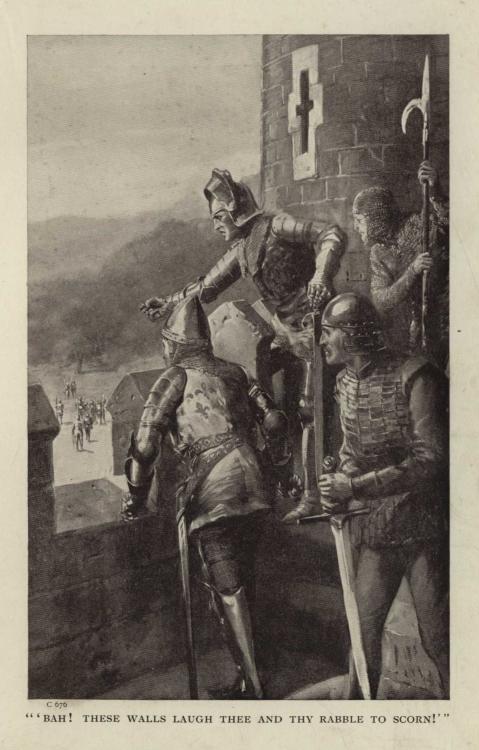
"'BAH! THESE WALLS LAUGH THEE AND THY RABBLE TO SCORN!'"
As he spoke, the knight raised his arm as a signal, and a number of men, who had evidently been secretly preparing all the time the parley had been proceeding, crowded to the walls. In their hands they bore stones and rocks, which they instantly began to rain violently down upon the men on the ground beneath.
"Back--out of range," cried Edgar, immediately he saw the men-at-arms appear, and amid the hurtling missiles the men rushed to the shelter of the edge of the woods. A reply to the fusillade was not at once possible, as, like the garrison, scarcely any of the peasants were able to use the bow with any degree of success. To return the fire with stones would be wellnigh useless, as the height of the walls would rob the missiles of all their power and momentum.
"We cannot assault the castle yet?" said the priest to Edgar enquiringly. "There must be preparations?"
"Yes; we can do nothing until we have filled in a portion of the moat. Didst not tell me once that the moat is a stream dammed back below the castle?"
"Yes, that is so."
"Then I would that a few men be sent to break down the dam at once. That will aid us famously in our onslaught upon the moat. A half-empty moat will be a good step forward."
"It will indeed. I will see to it, Sir Squire."
"Are any of thy folk skilled in carpentry or woodfelling? If so, let them get to work cutting down trees and preparing timber without delay, for I like not that our men should be unable to reply to the showers of missiles from the walls."
"What wouldst do then?"
"I would build mangonels. I saw many in the camp outside Bordeaux, and had a fancy to see how they were put together. I think we can construct them with success. They will hurl rocks that will blister the walls even of yon fortress, and if they fall into the courtyard may do dire execution."
"The men shall be found," cried the priest exultingly. "Our cause advances. I believe that Heaven will give us the victory."
* * * * *
So well arranged and so swift had been the capture of Beatrice d'Alençon that her defenders had been stricken down and all was over before she had fully grasped that they were attacked. It was not indeed until she had ridden for some distance with one of her captors on either side that she realized that she and her maid were prisoners in the hands of unknown men, who seemed, from the purposeful way in which they rode, to have a definite and well-planned object in view. To escape was her first impulse, but a grip of iron fell upon the bridle the instant she attempted to turn her horse's head.
"What meaneth this?" she cried out at last in indignation and distress. "Where are you taking me, and with what purpose?"
A stolid silence, broken only by the trampling of the steeds, met her cry.
More alarmed still, if possible, by the silence of her captors, Beatrice dragged desperately at her bridle and made her horse plunge violently.
With a savage word one of the men (it was Baulch) tore the bridle roughly from her grasp. "Be still!" he cried. "Play me that trick again and thou shalt ride in front of my saddle. Ha, ha! Perchance that will suit thee better, maiden?" he added with a leer.
"Ruffian," cried Beatrice with a shudder of disgust, "ruffian, what meaneth this shameful assault upon my retainers, and why drag ye me thus away from all my friends? Answer me."
"Remain still or not a word wilt thou get," growled the man who had before spoken. "We are taking thee to a friend of thy guardian. Ha, ha!--a friend who hath watched over his welfare right carefully of late, and one, too, who knoweth thee well, and who desireth to know thee better. Ha, ha, ha!"
So hateful to Beatrice was the man's coarse laugh and evil look that she preferred to remain silent rather than provoke another sally. Without further resistance or attempt to find out whither she was going, she allowed herself to be led across country for mile after mile. Her maid, weeping hysterically, rode behind in charge of another of the ruffians, and even the consolation of closer intercourse was for some time denied them.
To Beatrice's surprise, and even more to her utter consternation, the strange journey went on, not for hours but for days, and it was not until some five days after her capture that the party reached what she guessed to be their destination. This was a castle of so grim and gloomy an appearance that the sight of it made her heart sink with terror and apprehension. What fate might not be in store for her in a place so remote and in a prison looking so strong and ruthless?
"Is this, then, the vile prison-house to which thou hast been leading me?" she cried to Baulch, as she drew rein in front of the drawbridge and looked wildly about her for some possible way of escape from her captors.
"It is, lady. Lead on," responded Baulch grimly, as he forced her horse on to the drawbridge and led it across into the castle courtyard. "This is thy new home. My advice to thee is to make the best of it."
Dismounting, Beatrice and her maid were led to the door of the central donjon and up the stone staircase to a chamber almost on a level with the outer walls. The door was flung open, and they were roughly bidden to enter. They did so, feeling that it was useless to resist, and feeling, too, that at any rate matters would now soon come to a head and end their pitiable state of uncertainty and suspense. Immediately the door was clanged to and bolted behind them.
The room in which they found themselves was small and sparsely furnished, but was not uninviting. The number of rich rugs which plentifully bestrewed the floors seemed to indicate that at least an attempt had been made to give an air of something approaching comfort to a room otherwise plain and bare. This fact might have reassured them somewhat had it not indicated the far more terrifying fact that they had been expected. Who he might be, and what his purpose, that had stretched out so long and powerful an arm as to drag them to this remote and lonely spot, Beatrice could not even hazard a guess. Nevertheless, in spite of the mystery and terrifying uncertainty in which she found herself, she strove to keep a brave heart, as much for the sake of her maid--to whom she was much attached--as for her own.
About an hour after their arrival, footsteps were heard approaching the chamber. They came to a stop at the door, and a moment later a man entered.
It was Sir Gervaise de Maupas.
At the sight of this man, whom she both knew and dreaded, Beatrice involuntarily sprang up from the couch on which she had been reclining.
"Thou!" she cried, in a voice in which anger, scorn, and fear all had a place.
"Yea, lady, who else should it be?" replied De Maupas in a soft voice, as he bowed with the utmost gallantry and advanced into the centre of the room. "Who else would risk his all--name, career, and life--out of love for thee? None but Sir Gervaise de Maupas, knight of England, I do venture to assert."
As he spoke, De Maupas drew himself up with dignity. He was clad in a richly inlaid suit of armour, over which a splendid cloak had been carelessly flung. But for the hawk-like and cruel expression of his thin face, he would have looked a goodly and martial sight enough.
"Love for me? What dost mean, sir?" cried Beatrice roundly, though for all her boldness her limbs trembled beneath her.
"Most assuredly. I have long worshipped thee in secret. It is only my unhappy enmity with thy guardian that hath prevented me from approaching thee, and hath forced me to resort to this expedient to enable me to proffer thee my love. As doubtless thou know'st, I am a knight of good lineage, and one whose lands, if thy guardian granted my rightful claims, would be both wide and rich."
"Thy love hath no attractions for me, Sir Gervaise de Maupas," cried Beatrice, with difficulty restraining a desire to sink back upon the couch. "I believe thee to be nothing less than a traitor. What hast done with Sir John? I believe thee to be at the bottom of his disappearance."
For a moment De Maupas appeared startled. But after a moment's pause in indecision he replied calmly: "I do not wish to deny it, lady. 'Twas indeed I who arranged his capture. But 'tis said that all is fair in love and war, and to love for thee and war towards Sir John I must ascribe the deed."
"Where is he?" cried Beatrice breathlessly.
"He is here."
"In this castle?"
"In this castle, lady."
There was a momentary pause. Beatrice's lips trembled so that they would scarcely frame her words. Then she resolutely mastered her emotion and asked:
"How is it named?"
De Maupas hesitated for a moment. Then he shrugged his shoulders and went on: "I see no harm in letting thee know. This castle is called Ruthènes."
"Oh!"
The tone of the interjection was so singular that De Maupas stared at Beatrice in astonishment. She had turned slightly aside, and was looking not at him but at the door.
"The name seemeth familiar," he said coolly. "Perchance Sir John's hot-headed esquire, Edgar Wintour, hath mentioned it to thee?"
As he spoke De Maupas toyed with the sword girded at his side, and, with a sickening shock, Beatrice recognized the weapon. It was Edgar's! He, too, must then be a prisoner!
"I see thou dost recognize the weapon," said De Maupas grimly, as he noticed with secret satisfaction how the blood had left her face and how she had to bite her lips to subdue their trembling.
"Is he then also a prisoner in this castle?" she asked after a pause, during which she managed to regain a semblance of composure.
"Yes," replied De Maupas, without a blush. "He and that limping youth of his are both fast in the dungeons of Ruthènes. I fear they will never see the light unless----" He stopped and shook his head forebodingly. Then he walked slowly to the window, and stood gazing out as though lost in thought.
Beatrice waited for some minutes for De Maupas to finish, but he seemed to have forgotten her existence.
"What dost intend to do with Sir John and his esquire?" she asked presently in a pleading voice. "Surely thou wouldst not do harm to thine own countrymen?"
"That question, lady, is not so much for me as for the owner of this castle to answer," replied De Maupas with an air of regret. "Hark! He is at the door; we will enquire his intentions concerning his prisoners."
The door opened and Sir Eustace de Brin entered. He was clad from head to foot in black armour, without any sort of relief or ornament whatever, and the effect was grim and forbidding to the last degree. If the two poor captives had needed anything further to destroy their last hopes, the sight of this grim-visaged, black-bearded, and black-mailed knight would have supplied it. Indeed, at the sight of him Jeanette screamed aloud and Beatrice sank down upon the couch and covered her face with her hands.
Turning towards the maid, De Brin gave her so fierce a look that she was reduced to instant silence. Then he turned to De Maupas and asked:
"Doubtless the lady Beatrice gladly welcometh thy suit, friend De Maupas?"
"Not exactly, Sir Eustace. She was, however, asking after Sir John and his esquire as thou wert entering. She would wish to know what thou dost intend concerning them."
"Their fate? Spies and enemies of my beloved France? They must die," replied De Brin instantly.
"Would nothing move thee from thy purpose?" asked De Maupas persuadingly. "If what I desire cometh to pass, their fate will become of some moment to me. Wouldst then, for our friendship's sake, allow me to intercede for their lives?"
De Brin slowly paced the length of the room and back again.
"Eustace de Brin never turned a deaf ear to the pleading of a friend," he said in a quieter tone. "For our friendship's sake, then, if thou dost intercede for their lives' on behalf of thy wife I will listen. If 'tis for aught else I will not move one single hair's breadth from my purpose."
"Hearest thou, Beatrice? Wilt thou----?"
De Maupas stopped and looked enquiringly at his formidable companion. De Brin had given a sudden start, and appeared to be gazing at the window with an intent expression on his face.
Roused by De Maupas's sudden silence, Beatrice lifted her face from her hands and looked at the two men. Both were listening intently, and she caught a sound as of the winding of a distant horn. It ceased as though broken off short, and the two men looked significantly at one another.
"Didst hear?" said De Maupas laconically.
"Yes--an attack," growled De Brin, grinding his teeth with fury. "So much the worse for the attackers. Come--to horse, De Maupas; we have tarried with this obstinate girl too long already;" and with a dark look at Beatrice, De Brin hurried from the room, followed closely by his companion. The moment they were gone Beatrice rushed to the window and peered eagerly out. The trampling of steeds on the flagstones of the courtyard, the winding of horns, and the shouting and cheering of the men-at-arms indicated that the garrison were about to issue forth in force. Clearly something had occurred to alarm the inmates of the castle seriously. What could it be? Think as she would, Beatrice could find no satisfactory answer.
CHAPTER XIX
The Assault
"The dam is down!" cried Father Armand excitedly, rejoining Edgar in the woods opposite the castle gateway as the latter was superintending the construction of two great mangonels. "The dam is down and the water is rushing away like a mill sluice."
"'Tis well," replied Edgar; "in an hour or so the moat will be half-empty, and we can begin to make ready for the first assault."
"So soon?" enquired the priest in surprise.
"Yes, good Father. I am on fire with impatience. While the lady Beatrice d'Alençon is held in yon fortalice how can I be aught else? Think not that I shall endanger our cause by my hastiness. The garrison hath had a rude shock this day, and if we can deliver another before they have had time to recover, the advantage is all on our side."
"Say on, then, Sir Squire. Thy counsel hath been good hitherto, and I am most ready to listen. What is next to be done?"
"Set all the men but those at the mangonels to work cutting great bundles of undergrowth. Let the women and children also help, and let the faggots be cut at some little distance, so that the thickness of the woods here, which is our protection against a sortie, be not destroyed. The bundles of undergrowth we must use to fill up the moat and give us a foothold for the assault upon the gates and walls."
"Yes, yes; I thought that would be the next move."
"Then I want thee to strip a wagon of its strongest pair of wheels. Leave them on the axle. Then fell a tall young tree, with trunk about the thickness of a man's thigh. Lop off all its branches and cap the end with iron. Then lay it across the axle and lash it there. Running easily on its wheels, and thrust by a score of men, the tree will make a battering-ram that will, I promise thee, reduce the drawbridge and gates of Castle Ruthènes to splinters within the space of a few minutes."
"Ha! but will not the wheels of thy ram sink into the filled-in moat and there stick fast?"
"Nay; make the ram so long that ere the wheels shall reach the edge of the moat the battering end will reach drawbridge and gates. I tell thee, good Father, we shall get to grips beneath yon frowning gateway before many hours are past. Have thy men the spirit for a conflict, stark and grim, waged with trained men in a narrow space where numbers are of little avail?"
"I will answer for them, Sir Squire," replied the priest quickly. "They have no training, but they have desperation, and that will carry them on."
"Aye, I think so too. And now let us to work, and make ready as quickly as we can."
All the remainder of the day the preparation for the assault upon the castle went on with untiring energy. In the depths of the woods the women and children of the village and district laboured at a work to which they were well accustomed, cutting down young saplings and undergrowth and carrying them to a point in the roadway near the castle gates, where men bound them firmly into great bundles.
Close by, a few yards from either side of the roadway, at the very edge of the wood, and masked only by a thin screen of bushes, men were hard at work constructing mangonels under Edgar's supervision. At another point a gang of men were making ready the great ram on wheels which was expected to do such execution, and at still another a number were constructing ladders which were intended to be placed against the walls to draw off some of the garrison from the fight about the gates. Even after nightfall the work was continued, and none thought of rest until the preparations were complete.
The first streaks of dawn had scarcely appeared in the sky before the men were aroused from their slumbers and marshalled for the beginning of the assault. Eagerly they answered to the call. The first fight had been won, and every man was impatient to begin the main and final attack upon the stronghold which harboured the last of their lifelong foes.
Suddenly, at a signal from Edgar, streams of men bearing huge bundles of faggots issued from the woods at a point nearest the castle gateway, and advanced rapidly towards the moat. Loud cries of alarm sounded from the walls, followed by a hurried call to arms. Undeterred by these signs of resistance, the lines of men hastened to the half-empty moat, flung their burdens in, and sped rapidly back for more. In a moment or two the walls were lined with men-at-arms, and missiles began to whistle through the air downwards upon the scurrying men below. But the bundles of undergrowth held up in front were a full protection to the men, and it was only when returning that the missiles could take effect. Naturally, however, the return journey was made at top speed by the unencumbered men, and comparatively few were hit, and these for the most part were but slightly injured.
Scarcely had the garrison had time to warm to their work before, to their utter astonishment, a loud whirring noise was heard, and a great rock came singing upwards with a momentum that sent it over walls and donjon into the woods on the other side of the castle. Ere they had recovered from their amazement another rock, better aimed, swept a man bodily off the walls and plunged heavily against the upper part of the keep.
In sudden consternation, not knowing how many engines there might be casting the great stones, the garrison fled under cover, and left their opponents free to do their work as they listed. Finding, however, that there were only two engines, the men-at-arms presently ventured back and resumed their task. Forced to take refuge ever and anon from the great stones cast upwards, their own missiles lost much of their power, and the work of the attackers went on wellnigh unchecked.
After little more than an hour's work the moat, for a hundred yards on either side of the gates, was filled and piled up to a height of three or four feet.
To allow the garrison breathing space was no part of Edgar's policy, and with scarce a pause he ordered his men to get ready for the assault. He and Peter had donned full armour, as it had been arranged that they should lead the attack upon the gateway as soon as bridge and gates were down. The priest was to direct the attack upon the walls, and try to call off as many of the garrison as possible from the deadlier conflict beneath the gateway.
The battering-ram was wheeled out, and twenty of the strongest peasants, covered by a line of men on either side bearing big wooden shields, advanced, cheering loudly, to the attack.
Again there was a shout of alarm from the garrison at the sight of this new danger, and after a few minutes' commotion the master of the castle, Sir Eustace, appeared on the walls above the gate. He was clad in full armour, and, recklessly exposing himself to the fire of the mangonels, strove to encourage his retainers by himself taking the lead in hurling great stones at the bearers of the ram. His example was followed, and with shouts of encouragement to one another the defenders crowded to the ramparts and recommenced the fusillade with the greatest energy. A perfect rain of stones and rocks descended upon the men driving the ram, and for a moment the advance was checked.
"Hang not back, men," cried Edgar with energy. "Press forward the more quickly and our task will be the sooner ended. Forward!"
With a shout the line of men bent to their work, and the great tree rolled forward with terrific weight and momentum. The ram was well aimed, and with a mighty crash struck the raised drawbridge full in the centre and split it from top to bottom.
"Back a dozen yards and then press to the attack again," cried Edgar, and the tree, moving with comparative ease upon the big wheels, swung back and was urged forward once more. Again the ram struck the drawbridge, widening the cracks and bending its timbers back towards the great gates behind. Six times the ram was swung before the last remnants of the bridge gave way before its onslaught, leaving naught but a pile of splintered boards and a few pieces of woodwork dangling from the chains on either side of the gateway.
The attack had not been without its penalties. Eight men had fallen crushed and bruised beneath the stones flung with such furious energy by the defenders. Their places had been instantly taken by fresh men, for the blood of the peasants was now up, and none recked of the danger so long as the attack went on unchecked.
"Now for the gates, men!" cried Edgar cheerily, as they prepared to swing forward for the seventh time. The fusillade from the walls had now slackened, for the imminence of an attack upon the gates had compelled the defenders to withdraw half the men from the ramparts and to station them in the courtyard ready for the moment when the gates had been battered down. No one, not even the defenders, believed that the gates were capable of withstanding the onslaughts of the deadly weapon devised by the attackers.
Missing the grim figure of De Brin from the walls, Edgar hoped, with no little satisfaction, that they would soon meet hand to hand beneath the gateway. So far all had gone as he had anticipated. Every surprise had been sprung by the attackers, but, to his sorrow, he had yet to find that the defenders had one or two things left to them that he had not taken full account of. So uniform had been his success thus far that it seemed that but one more effort need be made, and the castle would be won.
Four times, with four tremendous crashes, the ram was swung against the iron-plated gates, and still they held. The fifth time they gave, and fell inwards so suddenly and completely that the ram rolled forward almost unchecked until the wheels sank to the axles in the mud and brushwood of the filled-in moat.
Loudly the horns were wound, and every man of the peasants' force rushed to do his appointed work. The men commanded by Father Armand advanced in little clusters from a dozen points and planted great ladders in position against the walls. Led by the priest in person, they began to mount with every sign of determination. Again the move was evidently unexpected by the garrison, for the few men now left upon the walls shouted loudly to their comrades for aid. A number answered to the call, and set about repelling the attack with the utmost desperation. Some essayed to lever out with their halberds the ladders weighted with their loads of climbing men, and strove to cast them bodily backwards. Others occupied themselves in casting down great stones in the hope of smashing the ladders or sweeping their occupants downwards to destruction.
The ladder by which the priest was himself mounting was one of the first singled out for attention. Ere he had reached the top and could lift a hand to interfere, two men who had been savagely thrusting at it with all their might succeeded in lifting it outward a couple of feet. Unable to thrust it farther, they gave it a savage side jerk and let go. Down it fell with a crash, bringing with it another ladder just reared a yard or two away.
Fortunately most of the men fell upon the brushwood, and were more shaken than hurt. The priest himself, nothing daunted, again sprang to the attack with a fresh ladder, and with varying fortunes the fight went on. Once or twice a footing was gained upon the walls, but every time a combined rush by the defenders flung the attackers backwards before the footing could be made good.
Beneath the gateway the conflict was even more fierce and deadly. The instant the gates were down Edgar and Peter had sprung forward, followed by the best and strongest fighters among the peasantry. They were met by the most heavily armed of the men-at-arms among the garrison, and were opposed with fierce determination. The defenders knew only too well how their merciless cruelties had inflamed the countryside against them, and feared that if the castle were won their own chances of mercy were slight indeed. Thus they bent to their work with the fierce stubbornness born of despair.
Of De Maupas or De Brin Edgar could catch no glimpse, and though he called their names aloud as he fought, and challenged them to meet him hand to hand, there was no response. Concluding at last that they must be directing operations from the walls, our hero devoted all his energies to overcoming the resistance of the defenders at the gate and winning a way through to the courtyard. Once a footing could be obtained inside, the continued defence of the walls would be useless.
Inch by inch, foot by foot, Edgar and his band fought their way onward. Most of the execution was done by his own and Peter's sword, for the peasantry had neither the skill nor the weapons to oppose the men-at-arms with much success in a hand-to-hand combat. The front of the fighting beneath the gates was a narrow one, and the peasants could fight only man to man, and were unable to bring their superior numbers into play. In spite of this disadvantage, however, the defenders were driven back slowly and surely, until Edgar felt that the moment for the final effort had come.
"On, on! Strike home!" he cried loudly, and at the call his men gave a surge forward that gained a couple of yards and brought them almost through the gateway into the courtyard.
Suddenly a shrill whistle sounded, and, as though by a prearranged signal, the defenders disengaged themselves from the conflict and fled at the top of their speed down the courtyard and round an angle of the donjon.
With loud shouts of exultation, the peasants surged unchecked through the gateway and began to advance along the courtyard in pursuit of their beaten foes. Scarcely, however, had they taken a dozen steps when there came a terrible interruption. From the roof of the keep fell showers of molten lead! In streams and showers, burning, blinding, and scorching, the fearful liquid fell, and the shouts of joy were turned into screams of dreadful agony. With one thought but to escape the fearful hail, the men who had won their way with such dauntless courage into the courtyard turned and flung themselves madly back into the gateway, struggling and fighting with those still pouring in. Their flight was assisted by more showers of the metal, flung in burning streams upon those massed in the gateway, until, with one accord, the victorious body of peasantry turned tail in utter panic and fled headlong back across the moat to the cover of the woods.
At this moment the thunder of horses' hoofs was heard, and round the angle of the courtyard swept a body of armour-clad horsemen. Eustace de Brin, De Maupas, and wellnigh a dozen men-at-arms clad in full armour, in a line stretching from wall to wall, bore down upon the already fleeing men like a living wall of steel. Edgar and Peter alone, shoulder to shoulder, stood fast--not because their courage was more unquenchable than that of their followers, but because their mail had enabled them to endure the burning showers better. The charge of the horsemen swept them headlong against the walls of the keep.
Peter received a stunning blow upon the helmet, and, dizzy and sick, was forced to cling to the wall to save himself from falling. Wielding a battleaxe he had snatched from a stricken man-at-arms, Edgar beat off those who assailed him, and the horsemen, unable to stop their impetuous charge, swept heavily onwards past him. Some thundered through the gateway hot upon the track of the fleeing peasants, whilst others, after careering a dozen yards along the courtyard, checked their steeds and prepared to charge back again upon the only two of their enemies yet remaining on their feet within the four walls of the castle.
To Edgar all seemed lost. The peasants were in hopeless flight, and the way to safety through the castle gates was barred by the horsemen already spurring through. De Maupas was one of the horsemen who had refrained from following up the fleeing peasantry, and seeing the hopeless plight of the young esquire, he gave a cry of savage joy and shouted to his companions to spur down upon him and beat him into the dust.
To rush for the gateway, and to strive to escape that way, meant being caught in the rear by the charging horsemen. This was obvious, and, with the speed of thought, Edgar seized upon another opening so bold and desperate that it appeared the counsel of sheer despair.
"Quick, Peter!" he cried in sentences short and sharp, like the jab of a sword. "To the donjon--we must take refuge there! Rouse thyself, or we are sped!"
Shaking off his dizziness as best he could, Peter tottered towards the open door of the keep a yard or two away. It was guarded by two men-at-arms, but Edgar had already attacked them with the energy born of despair and of the ruin of all his plans. Swinging his axe with a strength that crushed down all his opposition, he clove his way through the doorway, seized the great iron-plated door, and, as Peter sprang through, flung it violently to behind him.
"A hand here, Peter, if thou canst!" he cried rapidly, indicating a number of great blocks of stone piled against the wall to halfway up the stairs. Dropping his axe and seizing one with both hands, he swung it against the door. Another and another followed, until in a few seconds the strength of the door was doubled and trebled by the weight of a solid mass of great stones piled behind.
Peter was now almost himself again, and seeing that entry by the main gateway was effectually barred for a time, cried excitedly:
"But what of the door from the courtyard to the dungeons, Master Edgar? Will they not enter there? If 'tis only to sell our lives dearly that thou hast fought thy way in here, let us climb upwards and defend ourselves upon the summit of the keep."
"'Tis not that alone, Peter, that made me dash in hither instead of meeting De Maupas and settling our account once and for all. 'Tis more because I saw a glimmer of hope, remote but clear. As for the other door, 'twill be fast locked, and what jailer would carry his keys to the battle? Nay, we have a few minutes' respite--let us use it well. Upward, Peter, upward! 'Tis the lady Beatrice we must next seek and succour if we can."
So saying, Edgar took the lead and sprang quickly up the stairs. He knew where to look, for while in the very midst of the mêlée raging about the outer gates he had caught a glimpse of a hand, small and white, stretched out in mute appeal from a little window high up in the walls of the mighty donjon.
CHAPTER XX
The Last Hope
"Hark!" cried Beatrice, springing from the couch on which she had passed her second night at Ruthènes. "Hark, Jeannette, the call to arms is once more sounding! Dawn is breaking, and some deadly conflict is, I feel sure, about to begin outside."
From all sides indeed the blare of trumpets and the shouts of the men-at-arms, as they roused themselves from their slumbers and hastened excitedly to obey the call, resounded through the air. To one accustomed to the routine of castles it was clear that something of tremendous moment was happening, and hurrying to the little window of their chamber, Beatrice strove to catch a glimpse of what was afoot.
The thickness of the walls, however, was so great that, strain as she would, she could see no more than a few feet of the courtyard about the gates, and here, save for a few men-at-arms passing to and fro, nothing unusual was going on. Upward upon the outer walls, however, men were clustering more thickly, and in a moment or two they began to busy themselves in hurling down stones upon some enemy beyond. It was evident that the castle was attacked. But De Maupas had said that Edgar Wintour was a captive: who, then, could be the enemy? Suddenly there was a tremendous thud against the walls a few yards above her head, and splinters of stone flew in all directions.
"Oh, the castle is being battered down!" cried Jeannette in alarm.
"Yes; that must have been a great stone cast by a mangonel or catapult, Jeannette. 'Twill go hard with us if one strikes here. 'Tis fortunate our window is not above the level of the outer walls."
"Hist, mistress--someone is at the door!"
It was true someone was at the door--someone, too, who appeared on secrecy bent, for the approach had been made without a sound and the key was being turned with the greatest caution. At last the door swung open and De Maupas entered.
He appeared to be labouring under great excitement, for his bearing was nervous and his looks were disordered.
"Maiden," he cried, speaking rapidly, "I must have thine answer to my proposal. Wilt thou become my bride and save the lives of Sir John and his esquire? Choose quickly, for we are attacked by a cruel and infuriated peasantry, who will spare neither age nor sex. At any moment they may break through our defences, for the castle is but half-manned and the peasants are fighting like men possessed. If thou wilt consent I am able to convey you all to safety outside the castle by a secret way. Decide quickly, or it will be too late.
"But wouldst desert thy friend?" cried Beatrice with cool disdain. "Perchance this is some new ruse to obtain my consent to a proposal I abhor. This castle is strong--why shouldst thou be so anxious to leave it?"
"Lady, 'tis no ruse. Your peril is great, for as I have said, though the castle is strong the garrison is weak. More than half our men did we lose in a skirmish outside the walls but yesterday.
"This is brave news thou art telling me, Sir Gervaise," cried Beatrice, whose serene bearing was in such contrast to the agitation of De Maupas that their situations appeared to have been reversed. "These peasants will not make war upon the tyrant's prisoners. They will accept as friends the victims of their oppressor."
"Think not so, lady," cried De Maupas vehemently. "Thou know'st not this rabble. They hate those of gentle blood with so deadly a hatred that all inside these walls who are not of themselves they will destroy. Sir John and Edgar Wintour will perish beneath the burning ruins, if they have not been dragged out of their cells and slain before the work of the torch begins."
For a moment Beatrice covered her face with her hands, as though the thought appalled her. Then she answered bravely:
"I prefer the mercies of the revolted peasantry to thine, Sir Gervaise. As for Sir John and his esquire, I refuse to believe that the rage of the peasants will extend even to the poor creatures buried alive in the castle dungeons. Besides----"
Beatrice stopped suddenly, for loud insistent shouts for De Maupas rang within the donjon and outside in the castle courtyard.
"'Tis De Brin calling me," cried De Maupas savagely, as he rushed hastily to the door. "Think not that thou wilt escape me," he added vengefully over his shoulder as he left the chamber. "If the worst comes to the worst I will bear thee hence by force."
A cry from Jeannette, who had gone to the window while her mistress had been parleying with De Maupas, brought back Beatrice's attention to the conflict being waged outside.
"The gates are down, Mistress Beatrice!" the maid cried in a voice shrill with excitement. "See, the defenders are gathering thickly in the breach."
Beatrice craned her neck to see, just in time to catch the first glimpse of the great rush of the peasantry which followed closely upon the battering-in of the gates. A confused medley of fiercely-fighting men was all she could make out for some minutes, but presently, as the defenders were driven back inch by inch towards the courtyard, two figures began to stand out from the press, and she recognized with a thrill of astonishment and joy--Edgar Wintour and his servant, Peter! De Maupas had lied--and they were alive and free! Then might not Sir John also----?
The fight at the gates was growing in intensity, and all her thoughts became concentrated on the exciting scene. Would they win a way through? Beatrice was a knight's daughter and could gauge a warrior's powers at a glance. She could see that the real strength of the attack lay in Edgar and Peter alone, and that the ill-armed peasantry, brave though they were, could make little impression on the mail-clad and well-disciplined men-at-arms.
Nevertheless she felt, with a certainty that surprised her, that victory would at last reward the attackers and that the castle would be won. She seemed to feel that one who could play such a part as Edgar Wintour in the lists of Bordeaux was not born to be defeated here. But see!--the attackers were gathering for a last leap forward--Edgar had raised his battle cry--Hurrah! the defenders were fleeing headlong down the courtyard, and the castle was won----
Ere Beatrice could cry aloud in the joy of victory, a sudden fearful change swept over the scene. From the roof of the donjon, somewhere above her head, a burning hail of molten lead swept down, and the cries of victory were quenched and smothered in a louder burst of screams and wails. So dreadful were the anguished cries of many of the poor creatures, scorched and withered by the burning blast, that Beatrice, completely unnerved, cowered down upon the floor and wept.
Jeannette replaced her at the lattice and, with many ejaculations of disappointment, told of the charge of the armour-clad horsemen and the defeat and destruction of the broken remnants of the gallant peasants. Of Edgar and Peter she could see nothing. Knowing how loath they would be to flee, Beatrice felt, with a crushing sense of sorrow and disappointment, that even if they had escaped the showers of molten lead they must of a certainty have been overwhelmed and slain by the charging horsemen.
She was aroused from her prostration by another cry from Jeannette, who had turned from the window and was hearkening, not to the clangour outside, but to a noise that had attracted her attention within the donjon.
"It must be De Maupas," she cried excitedly. "I hear footsteps--doubtless it is De Maupas returning to press his suit now that the peasants are destroyed?"
Beatrice jumped quickly to her feet. Her prostration had vanished, and she faced the door with her eyes flashing and her little hands clenched. Jeannette could see that something had roused her beyond measure.
"Let not De Maupas approach me after slaying my poor friends!" she cried, stamping her foot with anger. "Refuse him admittance--tell him I abhor him and will not see him."
Jeannette fled to do her bidding. As she reached the door, however, it suddenly opened and a man strode hastily in, brushing aside the hand which the maid put out to detain him. It was Edgar Wintour.
At the sight of him Beatrice gave a gasp and looked as though she were about to fall. Edgar darted instantly to her side and took her gently by the arms. "Come, Beatrice," he cried, with breathless rapidity. "Our cause is lost, but if thou wilt trust thyself to me I will strive yet to save thee. The hope is indeed faint, but at the worst if I fail they can but compel me to surrender thee again."
[Illustration: "'COME, BEATRICE, I WILL STRIVE YET TO SAVE THEE.'" (missing from book)
"I would come," replied Beatrice vehemently, "though there had been no hope. But how canst dream of escape when the courtyard is held by the enemy?"
"Because a few days since a secret way led from out this donjon beneath courtyard and moat into the shelter of the woods. If 'tis not destroyed we may yet escape thence."
"It is not destroyed," cried Beatrice triumphantly. "'Tis but an hour since De Maupas besought me to let him bear me to safety through it."
"Then we shall yet escape," cried Edgar joyously. "Come--no more delay, for even now Black Eustace and his men are thundering at the gate. Onward, Peter--bring Jeannette, for we must be gone."
He sprang to the door and, taking Beatrice by the hand, hurried her along the passages towards the stone staircase by which he had escaped with Sir John but a few days before. As they passed the main stairway leading to the gate, the sound of axe and hammer strokes reverberating upwards made him pause.
"The door is giving way," he cried anxiously. "I fear they will be hotfoot upon our track in a few moments." Raising his voice he bade Peter hasten and hurried his companion on downwards to the vaults below. Scarcely had they reached them when there was a sudden crash from above, followed by a roar of savage cheers.
At the dread sound, Jeannette gave a scream of terror and almost collapsed.
"Hush!" cried Edgar sharply. "Dost wish to bring them upon us? Be silent as the tomb, or we are lost."
In another moment they reached the level of the dungeons and were within sight of the flight of steps leading downwards to the door of the underground passage. Most anxiously Edgar gazed before him into the gloom. It might well be that a guard had been posted.
No sign of a guard was to be seen, but a barricade of some sort appeared to have been erected at the head of the stairs. Could it be that the way was blocked after all? Running quickly to the spot, Edgar saw that what he had taken to be a barricade was a pile of great blocks of stone, similar to those heaped about the staircase, no doubt placed ready to fling down and block the way of an enemy advancing through the underground passage. The steps themselves were clear, and with a deep sigh of relief Edgar turned to his companions and once more bade them hasten.
There was of a truth no time to lose. The cheers from above had died away, but the more ominous rattle and clank of armed and mail-clad men advancing down the winding staircase was to be heard in its place. It was clear that De Brin or De Maupas had guessed that Edgar's object in taking refuge in the keep had been to escape by the underground passage, and that they were seeking him first in that direction. A bare half-minute would see them upon the scene.
"Canst not hew down the door?" cried Peter, as Edgar hesitated for a moment.
"Take my axe and give me thy sword," replied Edgar curtly. "Do thou hew it down while I defend the passage against our pursuers. Thou shalt save time. On, Peter, on!"
Peter seized the axe, sprang down the steps, and without an instant's pause attacked the door. After the first blow he gave a startled exclamation.
"What is it?" cried Edgar, turning as he was about to advance towards the enemy now almost at the foot of the stone stairway.
"The door is open!" cried Peter in an awed tone. "I fear a trap!"
"Either 'tis a trap or there is a sentinel stationed at the farther end," cried Edgar. "But we cannot now draw back. Onward, lad, and win a way through. Maidens, I beseech ye heed not the darkness but descend and follow closely upon Peter."
Peter moved onwards into the gloomy cavern, followed by the shrinking maidens, while Edgar stayed where he was, leaning quietly against the blocks of stone. For all his easy posture, the half darkness of the underground passage hid a face grown pale and anxious, for the peril in which the party now stood was extreme. It was not the advance of the body of men, who, carrying torches and headed by Sir Eustace de Brin in person, were now bearing rapidly down upon him, that filled him with anxiety. These he was prepared to oppose with the utmost desperation. It was the thought that sentinels might be posted at the farther end of the tunnel, and that Peter might be unable to cleave a way to freedom with his charges, that made his heart sink with a sickening feeling of dread.
CHAPTER XXI
Through the Darkness
Meanwhile events were moving with equal rapidity above-ground. The charge of Sir Eustace and his men-at-arms across the filled-in moat had completely dispersed the last of the peasants still remaining in the open. The priest had done his best to rally his men and to resist the horsemen, but his followers were infected by the panic which had seized upon those who had been engaged in storming the gates, and would not stand. He himself was wounded and must have been slain had not several of the more courageous of his band seized him and dragged him into the woods by force.
Once in the thickets the peasants were safe, and, realizing the folly of pursuing them with so small a force as he had at his disposal, De Brin contented himself with leading his men against the peasants still working at the mangonels. These fled hastily at his approach, and his men promptly proceeded to heap faggots around the machines. A light was procured, and, amid the cheers of the men-at-arms, the flames shot up until the engines were in the midst of a huge bonfire.
At this moment De Maupas spurred rapidly from out the castle and sought De Brin. His vizor was raised, and on his face was a look of savage joy. "Ho, there, Eustace!" he cried. "Their leader, this Edgar Wintour, hath taken refuge in the donjon. Doubtless he hopeth to escape through the underground passage. Quick, close this end, and he will be snugly trapped!"
"Ha, ha!" laughed De Brin. "If 'tis so, then he hath saved us much trouble, and mayhap provided us with some rare sport. Do thou, De Maupas, remain here, and see that he receiveth a warm reception if he seeketh to emerge this end. I, for my part, will see that his hot blood runs chilly in his veins before we have done with him. Ha, ha! But first we must seal him up completely within the cavern."
With a look of cruel anticipation upon his face that might of itself have chilled Edgar's blood had he been there to see it, Black Eustace spurred back through the gates and took charge of the men already engaged in hewing down the door of the donjon. As soon as the door showed signs of weakening, he drew aside two of the men and sent them on an errand that took them outside the walls.
Here the men looked about them for some moments before seizing upon one of the big ladders constructed by the peasants. The uprights were thick and strong, and one of these was knocked away from the crosspieces and the end carefully pointed. For what purpose these preparations were made was not apparent, but, from the haste with which the men completed their work, it seemed that they had at least some connection with the plight of the two fugitives in the castle donjon.
De Maupas had for some moments gazed thoughtfully around him before he set about his part of the task of destroying the fugitives. His eyes fell upon the great bonfire which now marked the spot whence the mangonels had discharged their deadly missiles, and with a grim smile he directed the men about him to pick up some of the big bundles of brushwood that had been left over when the filling-in of the moat had been accomplished. Then he led the way to the tiny glade where the tree with the hollow trunk had stood when Edgar had escaped with Sir John a short time before. Pointing to a certain spot in the ground, he directed his men to fling down their bundles and scoop away the earth. A large flagstone was soon disclosed, and on its being lifted a black pit, down which led a flight of steep stone steps, yawned before them. Kneeling, De Maupas called:
"Bruyard! Ho, there! Bruyard!"
After a moment's pause, a muffled voice replied:
"Who calleth?"
"De Maupas. Come hither!"
The noise of the opening and shutting of a door next ascended to the ears of the men above, and presently a man-at-arms appeared. He climbed the steep steps in leisurely fashion, and then stood blinking in the sunlight.
"What is it ye want, Sir Knight?" he asked surlily.
"Hast locked the door?" asked De Maupas impatiently.
"Nay, I have not. What need, if the enemy is driven off?"
"No matter," replied De Maupas shortly. "Come, men, pile your faggots about these steps, and hasten back for more. We will make a merry blaze, for I expect visitors from yon dismal depths. Pile the faggots high, and let us see if they will escape by the secret way a second time."
With a roar of savage enjoyment the men hastened to obey. They now saw the object of the move, and with many a joke to one another they hauled great bundles of wood to the fatal spot with every sign of gusto.
A brand was brought from the blazing mangonels, and the pile ignited. It blazed up and burned fiercely. Heavier and thicker pieces of wood were then flung on until the exit from the tunnel was ringed about with a veritable wall of fire. Satisfied that any man who attempted to plunge through such a furnace must perish miserably, De Maupas strolled up and down, awaiting with some impatience the news that the fugitives had indeed taken refuge in the tunnel, and that De Brin had succeeded in sealing up the castle end.
As he paced the greensward he noticed the two men who had been sent upon an errand by De Brin. They were just then busily engaged in sharpening the end of a long thick pole which they had obtained.
"What is this?" asked De Maupas. "Who set ye on to this, and for what purpose?"
"De Brin," replied one of the men laconically, giving his thumb a jerk in the direction of the castle gates. Then he indicated the moat, and ejaculated: "Cold water."
De Maupas stared at the man for a moment in some perplexity. Then the truth dawned upon him, and he went off into a fit of laughter.
"Ha, ha! Now I see what De Brin meant. Chill his hot blood--ha, ha! But even he knoweth not the final reception we have prepared for his uninvited guests. Ha, ha, ha!"
* * * * *
"Yield thyself!" cried De Brin, bearing down upon Edgar as he stood, sword in hand, at the head of the stairs leading to the underground tunnel. "Yield thyself, for thou art trapped!"
"I will yield myself when thou hast vanquished me, De Brin," replied Edgar, fencing vigorously as their blades clashed together. "How hast thou trapped me?"
"Thou seekest to escape through the passage, as once before. Know then that the farther end is guarded by thine enemy, De Maupas, and a dozen men. Thy friend, the priest, and all his flock are in full flight, and all is lost."
Edgar could not but believe. He had hoped that his pursuers would ransack the donjon for him before coming to the conclusion that he had flown to the tunnel for refuge. But unfortunately for him they had guessed that he would make for the passage, and had sealed it up. And with him were the two maidens.
The responsibility of their charge was crushing. Had there been only Peter he would, with a light heart enough, have dashed for the farther end in an attempt to break through, though to be unsuccessful was death. But his heart almost failed him when he thought of the terrible situation of the ladies. In his preoccupation he gave ground before De Brin's onslaught, and in a minute or two was driven back to the head of the flight of steps. Here he stood his ground for a few moments, and then, after feinting fiercely and compelling De Brin to give back, sprang down the steps to the open door below.
At this moment a man-at-arms pressed through the body of men about their leader, and whispered a few words in the knight's ear.
The effect was electrical.
"Ho, there! Edgar Wintour!" cried De Brin furiously. "Madman that thou art, they tell me that thou hast carried away the lady Beatrice and her maid with thee. 'Tis to certain death thou art dragging them. Yield them up, fool! There is escape neither for them nor for thee."
"If thou wilt promise to let them ride hence in peace, I will yield them up," replied Edgar quickly.
"Bah!" cried De Brin. "Thou hast yet to learn how completely thou art trapped. Let this teach thee!"
As he spoke the black knight set his weight against one of the huge blocks of stone piled by the head of the flight of steps. It moved, and bounded down the slope with tremendous weight and force. Luckily for Edgar it struck the massive doorpost, and did not come full into the doorway, or he must have been struck down and perhaps killed outright. Dreading lest such a mass of stone should bound along the tunnel and perhaps reach the ladies, our hero whipped the door to and put his weight against it.
Somewhat to Edgar's surprise, De Brin made no attempt to force the door, but instead ordered his men to hurl down upon it the piled-up blocks of stone. For some minutes a perfect avalanche of these rolled and bounded down upon the door, and every minute Edgar feared that it would be burst open. In the hope of adding a little to its strength he kept his weight against it, though the shock of each stone jarred him to the bone. At last the well formed by the steps began to be filled, and the jar and shock lessened until but a slight tremor followed as the rocks were still flung down. Soon the work was complete, and the castle end of the passage was blocked by a mass of stone that it would take hours' work by a score of men to clear away.
There was no more to be done there, and with a heavy heart Edgar left the door, and made his way along the tunnel. In the far distance a light had sprung up, and he guessed that Peter had managed to obtain a spark and had lit one of the torches they had been careful to snatch from the wall before they left the upper room.
"What was that dreadful noise?" asked Beatrice anxiously, as Edgar joined them. "It echoed along the passage until we thought giants indeed must be battering at the door."