EDGAR THE READY (continued 3)
Reading edition
"But what are ye here for? Ye say ye are not visitors to the castle. Yet art thou, sir, if I am not mistaken, a man trained to war, and your steeds tell the same tale. What else can there be in this remote spot that would attract thee save the castle? Thy patois is strange and unfamiliar to me, for I have travelled little; but undoubtedly thou hast journeyed here from afar."
Edgar smiled. His knowledge of the French tongue had been for the most part acquired at Wolsingham, where several had a good knowledge of it. On to this, however, had been grafted, since his arrival, a strong Gascon flavour that more than possibly assorted somewhat ill with his previous acquirements.
The priest was waiting for a reply, and Edgar quickly made up his mind to confide in him the true reason for his presence there. It was practically certain that did he not do so the priest would have him watched, and that, he felt, would be disastrous.
"Yes," he said, "I have travelled here from afar. Like you, I am at enmity with those who shelter behind the walls of Castle Ruthènes, and, like you, I seek to outmanoeuvre them. They hold prisoner one whom I must rescue at all costs." Then Edgar went on to describe briefly what had happened to Sir John, and how he had come to believe that he had been carried away to Ruthènes.
The priest listened attentively to the end. "Then your interests are identical with ours," he said in a voice which rang with triumph. "Why should ye not throw in your lot with us and aid us to fling down yon frowning battlements? Your knight shall thus be saved and my poor downtrodden folk delivered from the oppressor. Ye are trained to war, to the siege of castles, and to the command of men: take command of my people jointly with me. 'Tis a righteous cause--unhesitatingly I proclaim it."
Moved in spite of himself by the priest's deep earnestness and sincerity, Edgar for some moments could find no words with which to reply. He had heard many tales of the misery and degradation of the poorer classes of France, and their truth had been brought home by the sights that had met his gaze on the long journey thither. There could be little doubt that that unhappy condition was due in a very large measure to unjust extortion and oppression by the ruling classes. But his first duty was to Sir John.
"I fear it cannot be," he said presently. "I must accomplish the rescue of my master at once, or I may find it too late. Then, when I have delivered him, I shall be at his disposal, and can therefore make no promise of aid to thee. Your folk, if I mistake not, are not yet ready for the rising ye project. They are not organized, they have not been taught to obey any given set of signals, and they have no belief in one another. There must be weeks of patient work ere they can be led to attack a fortalice defended by trained and resolute men. Nay, victory cannot be snatched by a rising on the spur of the moment. There must be much work of patient preparation."
There was a long pause. Then the priest, his face full of trouble, rose from the bench on which he had been sitting, and began feverishly to pace the room.
"It is so," he said. "I feel it, though I am impatient to get to grips with the evildoers. I must begin at once, though when we are ready we shall still lack leaders. But mayhap ye will have failed to succour your knight, and will be glad to fall back upon our aid. Who knows?"
"Who knows, indeed? But I hope and believe not. If I have not rescued my master by then, I fear it will be because I am either dead or captured. But canst tell me aught of this castle? Is it strong? Doth it consist of a single donjon, or hath it outer walls?"
"It is an ancient castle, the origin of which is buried in the obscurity of the past. It hath a central donjon and also outer walls, most of it and all the stronger parts being built in its later days in imitation of the castles built by the Northmen in other parts of France. 'Tis strong, I know, for I have studied it with intent to discover its weakest spots."
"Hast discovered aught? I would fain learn, Sir Priest, any points that would help me in my quest. In return I will joyfully impart to you such knowledge as may come to me in my enterprise."
"I fear it hath no weak spots worthy of the name. Nothing save hard fighting can win yon fortalice, unless, as has of late been the case, the garrison wax careless from long inaction and freedom from alarums."
"Stratagem might effect its capture. It is on stratagem that I rely most for my own venture. But I would now fain bid thee good night, Sir Priest, and thank thee for thy kindly information. Perchance we shall meet again. Come, Peter!"
"Good night, Sir Squire! May ye prosper and win your way both in and out of the blood-stained lair of Black Eustace! God speed!"
CHAPTER XII
Castle Ruthènes
Early on the following day Edgar, accompanied by Peter, reconnoitred Castle Ruthènes from the shelter of the thick woods which stretched to within less than a hundred yards of its walls. In the light of his knowledge of the castles of the time, Edgar could study the stronghold with a real appreciation of its strong and weak points. Its chief characteristic was a square central donjon, apparently of great age, which towered high above the outer walls. These were somewhat low, though of a very massive build, and appeared to belong to a later date than the donjon, having probably been thrown out as an additional screen against a surprise attack.
About the walls ran a moat, fairly wide and apparently deep, formed by a stream from the mountains being dammed back and looped, so as to complete the circumference of the walls. The castle stood in a hollow, and the moat ran sluggishly at a level with the surrounding land, which was boggy and springy, as though the water often overflowed and covered it inches deep. The place seemed to reek with moisture, the walls being mossgrown and discoloured; while the thick woods, encroaching closely upon the narrow patch of grassy plain, seemed to add to the forbidding, cheerless air of the gloomy fortalice.
The outer walls were pierced in one spot only, and that was at the main gateway. Here the moat was spanned by a drawbridge of modern appearance, but Edgar could see no traces of a portcullis, its place being taken by heavy oaken gates faced with plates of iron.
Struck by the gloomy, unhealthy look of the castle, Edgar could not help exclaiming in a voice of deep concern:
"I hope, Peter, they have treated Sir John well. The dungeons of such castles usually lie deep below the level of the moat. If they have immured him in one of those I fear for him. Sir John's health hath suffered much from his many campaigns."
"I hope not, Master Edgar. But we must hasten the more to release him, though how 'tis to be done I know not."
"We, or I, might perhaps gain entrance in disguise, though that would mean a daylight entry, and we should be under observation, and could hardly hope to effect much. Besides, since the simple old priest so quickly penetrated our disguise, I have lost faith in our abilities in that direction--our tongue, I fear, betrayeth us all too quickly."
Peter nodded in agreement.
"Come, let us make the full circuit of the walls, Peter, keeping well within the shadow of the woods. So far, I can see no way in save by scaling the walls themselves."
"By a ladder?" queried Peter.
"Nay, a ladder would betray us, if not before we entered, certainly at dawn the following morning. Nay, but a rope and grapnel in patient hands should win an entrance."
"A rope and grapnel!" cried Peter. "A rope we can doubtless obtain from someone among the country folk, but where may we obtain a grapnel?"
"We can improvise one. A sword wrapped in cloths might be well lodged in the spaces betwixt those blocks on the summit of the wall--thy steel scabbard, Peter, with the rope tied to its middle, flung up and properly lodged, would easily take the weight of one of us. Ha, 'tis easy after all!"
"But could we fling scabbard and rope to the summit of the wall from the distance of the edge of the moat?"
"'Twill certainly be a long throw. Is there no place where a bank at the bottom of the wall will give us a footing? Look closely, Peter, and see if thou canst discern such a bank anywhere. If we can see none we must, when the time comes, swim the whole circle of the walls and feel for one. A footing in mud and water will serve our turn."
"I see something, Master Edgar. See--where that clump of reeds shows a foot above the water against the walls--the bottom must be near the surface there."
"Maybe--unless there be but soft mud. Look again, Peter--we must, if we can, find a place where we can swing our rope full freely."
Before the circuit of the walls had been completed, a place had been found where a low bank lay between the moat and the foot of the wall. This was hailed with satisfaction as a step in the direction of scaling the outer defences of the castle, and during the remainder of the day Edgar and Peter sat down to watch all that went on, and particularly what sentries were posted and how far their observation extended.
Ere the day was out they had made up their minds that a good watch was kept, and that the slackness referred to by the priest had either never existed or had recently, from one cause or another, been entirely removed. Two men-at-arms were always upon the walls, keeping watch from opposite angles, from which the whole extent of the outer defences could be easily surveyed. Another man was posted at the gateway, to operate the drawbridge and to keep a lookout upon all who came to claim admittance. These sentries, too, were not only present, but appeared to be watchful and alert to all that went forward. Depressed at the evidence of the keen watch kept, but elated at finding a bank from which the rope and grapnel might be cast with some chance of success, Edgar and Peter returned to the poor dwelling at which they had obtained temporary shelter, there to await the time when their first attempt should be made.
As on the evening before, the priest appeared and supped with them, more for company's sake on this occasion, it seemed, than with any desire to keep watch upon them and their movements. Feeling a good deal of confidence in the kindly, careworn face with the steady grey eyes, Edgar told the priest what they had learned and how he proposed to effect an entrance. The news that the garrison was keeping a careful watch seemed to fill the priest with surprise and some concern.
"Can it be that they have heard of your arrival?" he said. "And yet if that were so 'twould not be the posting of extra guards that I should expect, but the sally of a score of their blood-stained men-at-arms, who would pour into this village in an iron stream as they have done so often before. Ye would have been routed out, and within five minutes the branches of the nearest tree would have groaned beneath your weight. That is what has been before. Why, then, have they posted sentinels? Nothing else hath occurred save the arrival at the castle of a man who must indeed be of some consequence, seeing that he was accompanied by an escort of two men-at-arms."
"When did this man arrive?" asked Edgar quickly.
"On the morning of the day of your arrival--that is, yesterday."
"Canst describe him to me?"
"I did not see the man, and those who reported it to me, as all do the most trifling events, said that they could see little of him, as his head was swathed in bandages."
"It is he," murmured Edgar half to himself.
"Who? Whom dost mean? Dost know the man?" cried the priest sharply.
"I fear so. I think it must be this evil knight of whom I have told thee. The blow with which I worsted him in the lists at Bordeaux was severe, and I know that his head had to be much bandaged. Then before I left I learned that he had already gone. 'Tis he of a surety. He hath followed his victim."
"Can he know that thou art here?"
"I think not; but one cannot be sure, and he will guess that I would not remain idle."
"Then it is this knight, this enemy of thine, who hath caused the watch to be doubled. 'Twill be the harder for thee to find a way in by thy stratagem. Hast brought a rope with thee?"
"No. I must make enquiries and obtain one."
"I will do so for thee. Thou wilt only arouse suspicion and make folk talk. Leave it to me, Sir Squire."
Edgar thanked the priest warmly, and stipulated that it should be both light and strong. Then they went on to talk of other things, and the priest told Edgar stories of his work amongst the poor peasantry. Some were humoursome, others bright stories illustrating the homely virtues of the folk and their generosity one to another; but the greater part were tales of cruelty and oppression, which made Edgar's blood boil--tales of men tortured into revealing where their little store of worldly wealth, laid by with much self-denial, had been hidden away; and tales of men done to death for their "obstinacy", when they had no store whose whereabouts they could reveal to satisfy their relentless persecutors. It all seemed almost incredible to Edgar, until he recollected the stories he had heard handed down of the deeds done in his own land but a century or two before.
It was three days before Edgar obtained a rope that he thought gave him the least hope of success in the venture he had in hand. The good priest did all in his power, and scarce a rope in the neighbourhood but was brought in and tried. But the ropes that the peasants possessed were rough and heavy and in no way suited to Edgar's purpose. In despair, at last he saddled his steed and rode away to the nearest town and purchased one there, returning by a forced march the same day.
That same night Peter and he, accompanied by the priest, made their way into the woods surrounding Castle Ruthènes. By a stroke of good fortune the night was a favourable one. Heavy clouds shrouded the light of the moon, and made even the biggest objects loom black and indistinct. A watcher on the walls would need the sharpest eyes to see a figure at the foot, and with the comforting feeling that all was so far going in their favour the two young men took leave of the priest at the edge of the wood and stole across the narrow strip of sward.
"God be with thee!" the priest had whispered, and with a pressure of the hand that Edgar now knew to be the hand of a friend, he had bade them adieu.
The point at which they left the woods was, they knew, in a line with that part of the moat where the low bank rose at the foot of the wall, and as soon as they reached the edge of the water, both slipped noiselessly in and swam gently towards the castle walls.
Both were good swimmers, even Peter, in spite of his infirmity, having long since learned to keep himself afloat without difficulty. Edgar carried the line and the improvised grapnel, which had been well swathed in cloths to ensure its falling dully wherever it struck. He also, wore his shirt of mail and his sword. The weight was considerable, but he was too practised a swimmer for that to trouble him for a few dozen yards, and he had a decided objection to being quite defenceless when he had gained entry into the enemy's quarters.
The water struck chill. Heavy weeds that appeared almost to choke the stream clung to their legs and impeded their progress. They could see nothing save a wall of blackness that rose before them forbiddingly. All seemed to be as silent as the tomb.
They were slow in making the passage, as their one desire was to make no sound, but presently they reached the side. Touching bottom in several feet of mud, they slowly raised themselves out of the water and began to crawl up the bank.
Suddenly they were startled beyond measure by a tremendous screech and flutter which arose from right under their very noses. In their amazement and alarm they sprang back a couple of feet into deep water with a splash, and then saw, or rather heard, a flock of frightened ducks rise with a whirr and cackle from the bank and fly above their heads round the angle of the castle walls.
Deeply chagrined, the two young men crawled from the moat upon the bank and lay there listening intently. Such a mischance they had never dreamed of, and it seemed more than possible that it might have alarmed one of the guards and brought him to the spot to learn the cause of the birds' alarm. With deepest annoyance Edgar upbraided himself for not observing that a flock of half-wild ducks belonging to the castle had made a home on the bank he had counted upon in his plans.
For half an hour the two lay in the mud and water without stirring, listening with all their ears and gazing up at the outline of the top of the walls, which they could discern dimly against the sky. But the peering figures of the sentinels that they half-expected to appear never came.
"All is well after all, I think, Peter," said Edgar at last. "That was a bad start indeed, and had I not thought Sir John's need a most urgent one, I should have been tempted to try another night. But as 'tis, if any have marked the flutter and scare they have doubtless thought them due to winged enemies of the wild fowl, and not to those with intent to disturb the peace of the castle. Now let us try the powers of the line and grapnel we obtained after so much time and trouble. 'Twould be hard indeed to find them fail us now."
The outer walls were comparatively low, little more than twenty feet or so in height, and the throw of the grapnel was not a very difficult one. But it proved exceedingly difficult to obtain a lodgment with it. Time after time it was thrown with success well over the wall, but the darkness of the night forced them to fling it at random, and as soon as a strain was put upon it, down it fell again.
At last, however, it held fast even when the weight of both was tried upon it, and, overjoyed, Edgar instantly began to haul himself up hand over hand until he reached the top. Here he rested arms and shoulders on the wall while he paused a moment to listen. All was quiet, however, and drawing himself right up he signalled to Peter with the rope that all was clear for him to ascend in his turn.
In a few minutes both were safely on the wall, crouching in the deepest shadows they could find. The first stage of their enterprise had been successfully accomplished, and though cold and wet and shivering as with the ague, they felt elated that they were well on the way to the accomplishment of their formidable task.
"Draw up and coil the rope, Peter. We must take it with us, for doubtless we shall need it 'gainst our return."
Peter silently obeyed.
"Now follow me quietly, lad," and Edgar led the way softly along the wall, keeping well in the shadow, until they reached a narrow flight of stone steps that led down to the castle courtyard. Against them loomed the deep shadow of a corner turret, and, thinking that this might possibly be a likely place for a man-at-arms to be stationed on the watch, Edgar paused and listened intently.
"Forward, Peter," he whispered; "Black Eustace and his men are asleep, I verily believe."
"Black Eustace never sleeps," echoed a rough voice from the blackness of the turret, and a dark form sprang suddenly upon Edgar and nearly brought him to the ground. Other figures followed, and in a twinkling Edgar and Peter were struggling in the grip of half a dozen men.
"Slay them not--at present," commanded the deep voice of the man who had first spoken. "Bring torches and bind them well. Then shall we see who hath dared to set foot upon the walls of the castle of Eustace de Brin--Black Eustace, one of the knaves called me, did he? We shall see. Mayhap he will be right."
It was but a spring from the walls to safety, and Edgar struggled fiercely to fling off his many assailants. A desperate effort freed his right arm, and a heavy blow rid him of one of them for a time. But he was no nearer even temporary freedom, for one of the men had clutched him firmly round the waist from behind with one hand while with the other he seized him by the hair and dragged his head forcibly back. Slowly but surely, notwithstanding his most frantic efforts, Edgar found his head dragged relentlessly back until his neck seemed on the point of snapping beneath the cruel strain. To struggle on was hopeless, and, weak from his exertions and with his senses nearly gone, Edgar allowed his arms to be drawn behind his back and there secured without further resistance.
Torches were brought. One was thrust close to Edgar's face--so close that his hair was singed and his cheek scorched--and a man peered searchingly at him.
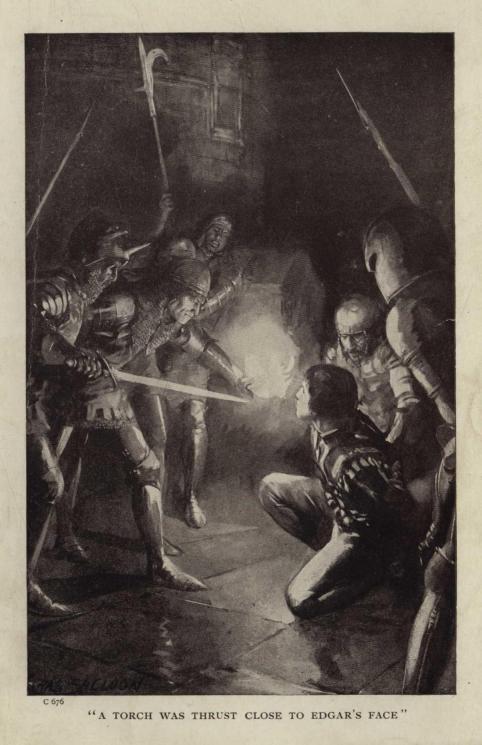
"A TORCH WAS THRUST CLOSE TO EDGAR'S FACE"
"I know not the varlet," he growled, and Edgar recognized the voice of the man who had first spoken and who had admitted himself to be Eustace de Brin. "He seemeth not to belong to these dogs of peasants who would dearly love to bite the hand of their master an they got the chance. Here, camarade, perchance this is one of the hounds thou hast feared might be on thy track."
A man who had held aloof from the struggle came forward at the call, and Edgar, whose head had now been released from its intolerable strain, had no difficulty in recognizing, in spite of his bandages, the fierce eyes and harsh visage of Sir Gervaise de Maupas. The recognition was mutual, for with a shout of astonishment and savage joy, the knight cried:
"It is! It is! This is none other than that braggart esquire of whom I told thee, Eustace."
"What! The boy who gave thee that clout in the lists that nearly sent thee where thou art so eagerly awaited?" cried De Brin with a loud laugh.
"Nay, Eustace," cried De Maupas, giving the speaker no very friendly look. "He is the boy who played me a base trick that by an unfortunate mischance I could not frustrate. But he will play me no more. Give him to me, Eustace, as an earnest of the goodwill thou hast so often spoken of, but of which I have seen little enough solid evidence; as some slight return, too, for the many profitable ventures I have put thee in the way of."
"Well, well, we will talk more of that anon, camarade Gervaise. The disposal of the boy's body is nothing to me, so long as he is punished for his insolent daring in scaling the walls of my castle; but first I must know how we stand in this business. D'ye know the other man?"
Peter was next examined. "Yes," growled the knight, "this dog is one of the plotters. He is somewhat of a cripple--Baulch hath told me of him--but is not too crippled to give us trouble. Guard him well, Eustace, or thou wilt regret it."
"Ha! ha! ha! friend Gervaise, thou wilt, when thou know'st me better, find that I have a shorter way than that with those who might inconvenience me did they but get the chance."
The words were spoken with meaning, and De Maupas looked doubtfully at the speaker, as though neither liking nor understanding what he meant. "If thou meanest to imply----" he began at length.
"Lead on, men," cried Eustace de Brin, taking no notice of his friend. "Conduct the prisoners to the strongest cell beneath the donjon and see them fast. Duprez, thou wilt have to answer for them--so guard them well."
Down the stone steps Edgar and Peter were marched until they reached the courtyard. Here several of the men-at-arms left them, and, escorted only by Duprez and one other, they skirted the massive walls of the donjon until they came to a small low door. Through this door they were hurried, and found themselves in what seemed to be a vast system of underground passages and vaults which must have dated back to the remoter days of the first beginnings of the castle. Some of the vaults were below the donjon, while others seemed to burrow beneath the flagstones of the courtyard.
By the light of a single torch they were conducted along a passage whose gloomy arched walls echoed back the sound of their footsteps with a sullen insistence that seemed to make them contract yet more closely upon the unhappy prisoners. Presently they reached an ancient, monastic-looking cell, which they judged to be one of those situated beneath the courtyard. Into this they were roughly thrust. The torch was stuck into an iron ring above the doorway, and by its light Duprez and his assistant proceeded to release the arms of their prisoners from their bonds, and to load them afresh with heavy iron shackles which had been hanging ready for use from a hook upon the wall. The chamber was dank and heavy with moisture, and the shackles were thickly coated with rust, wet and smeary to the touch.
"Thou wilt find these safe enough for all their looks," growled Duprez, as he shackled Edgar's right arm to his left leg and his left arm to his right leg, so that he could barely stand upright. "These shackles have held secure captives as strong as thou--aye, and men of noble and knightly birth. Not once in my time has their grip relaxed until death claimed their victims. Sir Eustace said I would have to answer for thee--I object not to that, ha! ha!"
"'Tis a poor thing to make merry at thy prisoners' expense," replied Edgar shortly.
Duprez stared at him as though scarcely comprehending his meaning. Probably the sentiment was foreign to him. Then he turned to Peter and trussed him in similar fashion, growling half to himself:
"Cripple though thou art, 'twill be as well to shackle thee. After all, 'tis an honour to treat thee as a man of sound limbs, so let that thought comfort thee 'gainst thy pleasant stay in the dungeons of Ruthènes. Come, Rolfe, pick up their swords and daggers, and let us be off to our beds. Long enough have we spent over this business."
Sardonically bidding them good night, Duprez and his man left the chamber, carrying with them the torch and the weapons they had taken from their prisoners. The door clanged heavily to behind them, and Edgar and Peter were left in total darkness to think over their most perilous situation, and to wonder for how much of it they had to thank their old foe, Sir Gervaise de Maupas.
CHAPTER XIII
Prisoners
Worn out and dispirited, Edgar and Peter sank to the floor and lay there motionless. Their sudden capture, after so successful a beginning, was a stunning blow, and though neither was easily discouraged, they needed time and thought to recover from it.
After a time they grew drowsy, and presently forgot their troubles in sleep. When they awoke they judged it to be broad daylight. Their cell was still in semi-darkness, the only light that entered coming from a grating high up at the summit of the arched stone roof. This grating, Edgar calculated from his recollection of the trend of the passages they had traversed, was on a level with the flagstones of the courtyard.
The priest had told Edgar something of the history of the castle, and from the appearance of the cell he came to the conclusion that the network of underground dungeons and passages belonged to its more ancient days, and had been left intact when it had been partially pulled down and rebuilt. The conclusion brought him little additional hope, for the walls were massively built of stone, and seemed to have been but slightly affected by the lapse of time.
"Canst think of any plan, Peter, by which we may effect our escape?" asked Edgar, when he had carefully weighed all the chances in his own mind.
"Nay, unless we can reach up to the grating by standing on one another's shoulders."
"With these shackles? I fear there is little hope there, unless we can first rid ourselves of these irons."
"Yes, we must knock off our shackles first. As thou know'st, Master Edgar, I was an armourer's assistant, and know something of chains and rivets. If there be any weak spots I can find them, and shall know how to deal with them. Had they left us but a dagger it would not have been long, I'll warrant thee, before we moved our limbs in freedom."
"Yes, yes; but it must be done without a dagger. And before we start we must have some plan by which to escape when our shackles are off. 'Twould be useless to remove them only to be discovered by Duprez on his next visit. They would be replaced by a stronger pair, and our plight would be hopeless indeed. We must have a plan first. What doth the door offer? Let us examine it carefully."
Both moved eagerly to the door. As they did so their chains clanked hideously, making a sound that seemed to strike into their hearts with dread, bringing irresistibly home to them their desperate position.
"Of a truth, it would be worth much to be rid of these shameful bonds alone," cried Edgar passionately. "Nevertheless, we must not think of it until we have our plans ready formed to our hands, Peter. Ha! 'Tis as I feared. This door belongeth not to the age when these walls were built. It is of far later make, and seems prodigiously strong--shake it and feel its weight, Peter."
Peter did so, and then stood back and gave a despondent shake of the head. "Had they left us a piece of metal, however small, Master Edgar, we might in time have scraped a hole through the door around the lock and so opened it. But they have left nothing with me. Art sure they have left thee nothing?"
"They have left me nothing, Peter. They have taken my purse and all it contains, so that not even a coin remains for such a task. But stay--they have not touched my shirt of mail. Perchance we might do something with a few of its links, small as they are."
"Let us try--but hush, Master Edgar, someone approaches. I hear footsteps in the passage outside."
Both held their peace, and then, at a gesture from Edgar, sat down again on the stones in an attitude of dejection. A key grated in the lock of the door, and with much creaking and groaning the door was opened. Two men were outside--Duprez and another man, a stranger to Edgar. One bore an armful of rugs and the other some rough cakes and a pitcher, probably containing water.
"Thy bedding," grunted Duprez surlily. "Here, Guilbert, fling it in yon corner. Thou art lucky," he went on, turning to Edgar, "to get as much."
"Lucky indeed," replied Edgar in a tone of weary indifference; "but can thine other prisoner spare the rugs?"
"Aye, they belong not--But what know ye--why talk ye of another prisoner?" cried Duprez savagely, as he began to suspect that he had told too much.
"Oh, nothing! Surely one might guess ye had other prisoners in so large a castle. Is this our food, friend Duprez? They do not intend to starve us at any rate. Doubtless we may expect a meal twice or thrice in the day?"
"Ye may expect me when ye see me," cried the man harshly. "Ye would like me to tell ye all, I make no doubt. Get ye to your food, and cease to bandy words with me, or it may chance you will lose all appetite."
"Hast ever found thy prisoners kept their appetites in such noisome and dismal dungeons as these?" cried Edgar indignantly. "Didst thou take away the desire to eat, doubtless 'twould but do the work this cell will do as surely in a few short weeks."
"Ha! ha! ha!" laughed Duprez with great zest. "Thou art a sharp fellow. 'Tis very true. My customers soon lose appetite, and finding they do not appreciate my trouble in bringing them their food, sometimes I forget it for a day or two. Ha! ha! It saves a lot of trouble in the end, and Sir Eustace makes no bones."
"Begone! callous brute that ye are," cried Edgar, jumping to his feet in a burst of involuntary indignation. "Kill us outright an ye be a man."
Duprez's merriment instantly vanished, and was succeeded by a burst of passion that he made no attempt to hold in check. "Silence, knave!" he cried savagely, as he struck Edgar violently on the mouth with his clenched fist. He then gave the pitcher his man had brought a vicious kick that dashed it into fragments, and, turning on his heel, sullenly left the cell.
* * * * *
As soon as they had eaten the cakes still left to them, Edgar and Peter began to ponder means of escape. The shirt of mail was tried, and several links obtained after much labour, but they were so small and so unsuited to the purpose the two had dimly in view that after a few minutes' trial the idea was given up in disgust. Even if it escaped detection, an attempt by such means would have taken so long as to be almost hopeless of success.
During the remainder of the day Duprez never came near the prisoners. Doubtless he had counted upon his destruction of the pitcher inflicting much suffering upon them. But happily the water had splashed upon the oaten cakes, and had wetted them so thoroughly that they had rather helped to assuage the pangs of thirst than added to them.
As near as the pair could judge, it was late on the afternoon of the second day when they again heard footsteps outside the door. Their first thought was that Duprez and his man were returning at last; but as the footsteps came nearer they gathered that only one person was approaching, and that probably that someone was more lightly shod than either of their jailers. The door opened, and to their astonishment Sir Gervaise de Maupas entered.
At the sight of him Edgar involuntarily sprang to his feet, dominated for the moment by feelings of anger and excitement.
De Maupas raised his hand and calmly waved him back. "It seems thou art surprised to see me," he said easily. "Thou wilt, I think, be more so when thou hast learned somewhat of mine errand and found how magnanimous I can be."
With an effort, Edgar mastered his indignation and simply nodded his head as though waiting to hear more before accepting such a statement. The knight spoke with quiet confidence. Most of his bandages were now gone, and he seemed himself again and sure that the errand on which he had come would end as he desired.
"What ye have learned of me," he went on, pacing slowly up and down the narrow limits of the cell, "doubtless ye have learned from Sir John. Well, know this, that Sir John is the lifelong enemy of me and mine, and the fault of it lies not with me but with him. Aught that he hath told ye to my disadvantage is therefore not to be relied upon, for he hateth me and maligns me for his own base purposes. He is no true knight, and ye are mistaken in espousing his cause. I have told you the truth, so that ye may know that ye are honourably released from all allegiance to him."
"But if thou art the true knight thou sayest, how comes it that thou art staying as a friend in the castle of this Eustace de Brin, a knight of ill reputation and one of the enemies of our country?"
De Maupas frowned and momentarily checked his stride. "That is a long story," he said. "I am here out of no alliance with the enemies of our country; rather indeed to further its interests, for I am gaining much useful knowledge. But thou art indeed right when thou sayest the owner of this grim castle is a man of ill reputation. The scenes these cells have beheld would appal the stoutest heart could they be unfolded. Beware, then, that thou sharest not the fate of thy predecessors. Sir Eustace, I know, is deeply enraged with thee. He says thou art the first man to dare enter his castle without his permission, and he purposes to slay thee. Knowing thee for a fellow countryman, I intervened, and with such influence as I possess begged him to allow me to offer thee a hope of life--life in the open air and sunshine, not cooped within the narrow limits of a cell that must sooner or later drive thee mad. Say then, dost desire to accept my offer?"
"What is this offer?" asked Edgar shortly. "We are ready enough to leave this cell, as thou canst well imagine. But we must carry our honour unsullied with us."
"I will watch over thine honour as I would over mine own," cried De Maupas emphatically. Then, not noticing the half-smile his declaration had conjured up, he went on, "Ye may have heard that I claim to be the rightful owner of the estates now held by Sir John Chartris? Mine they are, and I hold that he is keeping me out of them by nothing less than trickery and fraud. I have vowed to meet trickery by trickery, fraud by fraud, and I have, as ye know, captured Sir John and am holding him to ransom. My price for his release is an acknowledgment of my better claim to the estates. What could be more reasonable? Unfortunately, for himself as well as for me, he is proving obstinate. He will not yield his ill-gotten lands, and in my good nature, desiring not to do him hurt, I have cast about and found a way out of the difficulty. He shall keep the lands, but must assist me to the best of his power to win compensation in another direction. That is most fair, is it not, young sir? You see, I am trusting you fully, well knowing the justice of my cause."
"Yes, yes," replied Edgar quickly, "but what is this compensation?" The knight's tone and bearing were so smooth and peaceable, and he seemed in so reasonable a frame of mind, that Edgar's opinion of him, well grounded though it was, was almost shaken.
"'Tis simply this. I am deeply enamoured of his ward, Beatrice d'Alençon, and would fain win her hand in marriage. All I ask are his good offices and influence to aid my suit. Could I be more magnanimous towards one whom I regard as a lifelong foe?"
Utterly astounded at the extraordinary change of front, for a moment Edgar could but gape. Then he recovered himself and asked quickly, "But thou know'st not the lady D'Alençon. Thou hast, to my knowledge, spoken not one word to her. How then canst say thou art enamoured of her?"
"How could I approach her? My enmity with Sir John was so great that I should but have exposed myself to humiliation had I tried to make her closer acquaintance. As it was, I was forced to worship from afar."
"De Maupas, thou art twice her age and more, and I find it hard indeed to believe thy story. Her lands are wide, and in their breadth alone I fear thy love has found its birth."
"It is not so, Edgar Wintour. I have a real fancy for the maid, though I would not deny that her lands are of importance in my eyes. But I am a knight of birth; one too, who, if he had his rights, would own lands as wide and rich as hers. Therefore it seemeth to me that I am a fitting match for Beatrice d'Alençon. But enough of explanations. I am about to make the offer to Sir John, and to thee I make an offer no less generous. Aid me in persuading Sir John and after, and ye shall both go free. Refuse, and ye must rot in this loathsome dungeon--rot or go mad: one or other is as certain in the course of a few weeks as it is certain that Gervaise de Maupas stands before thee."
Our hero was undoubtedly staggered at the offer so skilfully held out as an honourable exchange for Sir John's life and the claims De Maupas had long laid to his estates. Sir John's life was all important in Edgar's eyes, and could a means be found by which it might be honourably saved the loss of the estates of either ward or guardian weighed with him but little by comparison. The offer of De Maupas was therefore not one to be dismissed without consideration. He therefore took refuge in silence, while he tried to wrest any hidden motives for the offer there might be from the network of clever words in which he half-feared De Maupas had shrouded his real plans.
There could be no doubt that Sir John had refused to purchase his life at the expense of his estates and the rights of his successors. That much was clear from De Maupas's presence in the cell that moment. Foiled in his first move, and unwilling to take Sir John's life while some profit might be made of it, he had bethought him of a plan by which he might purchase his rights and influence over his ward, the lady Beatrice. Her lands were even wider and richer than her guardian's, and the wily plotter had hit upon a way of obtaining them that would, he knew, pass muster readily enough as knightly and honourable.
The story of his passion for her was doubtless trumped up for the occasion, to give an air of romance and honourable dealing to what was little more than barefaced robbery. Nevertheless, it was a story that would be widely believed, though that Beatrice must and always would loathe the man, Edgar felt not the slightest doubt.
It was more than probable, too, that De Maupas had already broached his plan to Sir John, and, meeting with a rebuff, had bethought him of Edgar and hoped to obtain his aid in persuading his master. The more Edgar thought over the scheme, however, and the more he stripped it of its trappings of pretended love and romance, the more he felt it to be every whit as shameful as the first plan by which De Maupas had sought to obtain the Wolsingham lands by threats and violence.
"What is to be your answer to my generous offer, young sir?" said De Maupas at length. He still paced slowly to and fro the length of the cell, and his bearing was as easy and confident as ever. Edgar, however, had been not unheedful of the quick furtive glances he had cast at him every now and again as he turned in his stride.
"I will have no part in this matter, De Maupas," Edgar replied quickly. "I trust thee not, and much of thy story I cannot believe. More than that, I am not ready to purchase my life at another's expense."
"It is Sir John's life, too, that thou art casting away like a fool," cried De Maupas angrily.
"Sir John hath, I doubt not, already told thee that he prefers death to dishonour. I, his esquire, say the same, on both his account and my own."
A malignant look flamed up on the knight's face, and Edgar knew that he had judged his plans and motives aright.
"Death thou certainly shalt have, boy--I have sworn it long since," cried De Maupas furiously, placing his hand on his dagger as though he longed to carry his threat into instant execution. "But if thou think'st to obtain an honourable death with thy blood coursing warmly through thy veins, thou wilt be mistaken. Slowly, inch by inch, in silence and despair, shalt thou die--not with the plaudits of thousands ringing in thine ears as when, like a mad fool, thou didst brave my lifelong anger. Bah! I shall yet see thee blench and, cringing at my feet, beg for thy life and a glimpse of open air and sky. I can tell thee that the past has shown that these monkish walls have a secret of their own for crushing wills stronger far than thine."
As he spoke the last few words the knight eyed Edgar with a gaze so stern and menacing that it seemed as though he hoped by its very intensity to cow him into submission.
"Never will I cringe to thee, Gervaise de Maupas," cried Edgar hotly, returning him look for look.
"We shall see," growled De Maupas savagely, as he turned sharply on his heel and left the cell, jerking the door to with a dull crash behind him.
CHAPTER XIV
A Desperate Venture
As soon as the excitement caused by the sudden appearance of De Maupas had begun to subside, Edgar recollected something that he had heard while the interview was proceeding, but which he had then no time to dwell upon. This was a strange sound, muffled and indistinct as though coming from a distance, which, having no opportunity for listening attentively, he had been unable to define. It might have been, he now thought, the cry of an animal or even of some human being in distress.
"Didst hear what sounded like distant cries while the door stood open, Peter?"
"I did, Master Edgar. They sounded strange and unearthly and I could make nothing of them. I heard the like when Duprez brought us food yesterday, but took no heed."
"Ah! Can it be that they are torturing Sir John to compel him to yield compliance with their infamous projects?" exclaimed Edgar, beginning to pace restlessly up and down the cell as well as his shackles would permit. "De Maupas and this Black Eustace are, I verily believe, capable of deeds every whit as base and pitiless."
"Thinkest thou so?" cried Peter excitedly. "Then let us spring upon our jailers and, if need be, perish in an effort to save our master from so fearful a fate."
"Truly it is intolerable that we should remain supine here," replied Edgar in a voice vibrating with emotion, "but to attack our jailers, shackled as we are, would mean, I fear, but certain defeat. Would I could think of some way--but, yes, I have 't! Dost see yon bracket above the door?"
"Aye, sir, what wouldst do? Tear it down and use it as a weapon?"
"Nay, it looks to be embedded so deeply in the masonry that 'twould need weeks of work to loosen it. My thought was that could I climb upon it I might, at his next entry, spring upon Duprez all unawares. My weight and the shock of it might well rid us of him for the time and leave us two, shackled and without weapons, to face one man armed. Joyfully will we not accept the odds?"
"Aye, to that," cried Peter eagerly. "The plan soundeth well if the bracket will hold thy weight, and thou canst reach up to get upon it all cumbered with thine irons."
"Let us try, Peter. Stand close against the door and let me climb upon thy shoulders. Though I cannot move my hands higher than my waist, I think I can yet make shift to clamber up."
The bracket above the door on to which Edgar was endeavouring to climb consisted of a thick bar of iron with a socket, into which Duprez had thrust the torch when he had first entered the cell with his prisoners. It was thickly crusted with rust, but was so massive that it seemed likely enough that it would more than bear Edgar's weight.
After a few minutes' clambering he managed to perch himself upon the bar, and by resting his back flat against the wall, could hold himself steady in his difficult position. Did Duprez and his man enter while he was in that position, it seemed easy to leap upon one of them and to bear him to the ground with crushing force.
"It offers good hopes of freedom, Peter!" exclaimed Edgar exultingly as he clambered with difficulty down from his dizzy position. "If we can overcome our two jailers, we shall be able to don their cloaks and issue forth freely. Did we only dare wait for darkness, we should, I doubt not, be able to reach the walls with little chance of discovery."
"They have taken our ropes," observed Peter.
"A plunge from the walls into the moat will not come amiss if Sir John be not injured. We can flounder out and be hidden in the woods ere ever the drawbridge can be lowered. What is it, Peter? Hast heard something?"
"Yes, yes, I think I can hear footsteps in the distance outside. Quickly, Master Edgar--wilt thou not clamber up above the door and be ready?"
Hastily Edgar prepared to climb, but before he was halfway up he heard sounds that brought him leaping to the ground. Placing his ear to one of the cracks of the door, he listened with agonized attention. Again in the distance he could hear the strange wails and screams which he had heard before.
"Listen, Peter, and tell me what ye think."
Peter obeyed. "I can make no more of it than before," he remarked after a pause. "The sounds seem like nothing that I----But hark! I can hear the sound of footsteps coming and going. We shall have Duprez here anon."
But the two prisoners were left undisturbed. The noise of footsteps died away, and with it the strange sounds that had so puzzled and alarmed Edgar--nay, alarmed him still, for he could not help connecting the sounds with Sir John, and feared that his ruthless enemies might be torturing or tormenting him into acquiescence in their plans. The more he thought of it the more he felt that such might be the case, and the more impatient he became to escape and hasten to his master's aid.
"Come, Peter," he cried at last, "we shall do little more by taking thought. At the next visit of Duprez we must try conclusions. Aid me to practise mounting rapidly to the bracket, so that when we next hear footsteps I may be prepared for action without loss of time."
For half an hour Edgar practised until he could clamber up and get ready with great rapidity. Night had by that time fallen, and as it seemed unlikely that Duprez would visit them again that day, they gathered the rugs together and disposed themselves to sleep.
Scarcely had they dozed off, however, when they were awakened by the sound of footsteps close at hand and by the glint of a light beneath the door. The moment of their opportunity had come! Duprez was doubtless at the door.
With feverish impatience, Edgar hastened to the door and began to clamber up to his station. His movements were cramped and impeded by his shackles and the absolute necessity that no clanking of chains should warn their jailers that the prisoners were up and doing. Ere he had fully gained his coign of vantage the key was grating in the lock, and Peter had barely time to scuttle back to the farthest corner of the cell and to crouch down among the rugs, feigning sleep, before the door began to swing back upon its hinges.
"Come, ye proud varlets, ye are honoured tonight. Sir Eustace desires speech with you. Ha, ha! Much comfort to you 'twill be, I'll warrant."
As he spoke Duprez strode into the cell, followed by another man who carried a torch, which he raised above his head to catch a glimpse of the prisoners.
With a sudden spring, Edgar flung himself down upon the torchbearer, landing full upon him and crushing him to the ground with stunning force. The torch spun from his hand into a corner, and lay there spluttering in the damp, shedding a feeble, fitful light upon the scene. With a loud shout of alarm, Duprez grasped his sword by the hilt and strove to pluck it from its sheath. Before he could do so, however, Edgar had sprung upon him from the rear, whilst Peter seized him round the legs from the front. Down he went headlong, struggling furiously and shouting for aid, until Edgar grasped him by the throat and choked the sound with a grip of iron. Meanwhile the man who had borne the torch lay without a movement. His forehead had struck the flagstones with a force that had rendered him unconscious.
"Tear me some strips from yon rugs," cried Edgar in a minute or two, when Duprez, half-choked and fully mastered, had begun to relax his struggles. "Take this dagger--quick!"
Peter drew the dagger from its sheath, and in a few seconds had slit off some strips of hide from the rough sheepskin rugs. With these Edgar bound Duprez's arms securely behind his back. The other man was then trussed in similar fashion, though, so far, he had shown no sign of returning consciousness.
"Peter," continued Edgar with breathless energy as soon as their jailers were secure, "place the torch upright against the wall and bend all thine energies to ridding thyself and me of our shackles. We have two swords and a dagger. That should be sufficient for an armourer's assistant. Get quickly to work, or it will be too late. Be silent if thou canst."
He then turned to Duprez.
"Dost wish to live, scoundrel?" he said sternly. "Thou knowest as certainly as we do that our lives are forfeit if taken--dost then think we are likely to spare thee? What dost bid for thy life?"
"What want ye?" gasped Duprez, whose face was livid and full of fear as the wild shackled figure stooped over him, grasping a dagger snatched from the belt of the other man.
"A few words--no more. But they may spell life to thee."
"Ask."
"Where is Sir John Chartris?"
"The other prisoner--the man who came a week agone?"
"Yes, a man of knightly bearing, aged some forty years."
"He is in this donjon, in a room near Sir Eustace. He was in one of these cells but a few hours since."
"What! Was his, then, the voice we heard? You have tortured him, inhuman monsters!" and Edgar, in his anger, thrust the point of the dagger so close to Duprez's neck that the man winced with fear.
"Nay, nay, good sir, we have tortured him not. He contracted a fever two days after he came, and is wild with delirium. Sir Eustace feared to lose him if he kept him in these dungeons, and had him taken to a room halfway up the keep."
"Ah! Tell me how I may reach this room."
Sullenly the man obeyed.
"These keys at thy belt. Which is the key of Sir John's room?"
Again the man gave the information desired, and Edgar, satisfied that he had obtained all that he required, stripped him of his cloak and then gagged him effectively with pieces torn from the rugs. In his elation he could have shouted for joy. Sir John was ill, but if all went well before another hour had gone he would at least be free.
By this time Peter had rid himself of one of his shackles and the other was nearly shorn through. The shackles, though thick and heavy, were soft and rusty, and were an easy problem to an armourer's assistant in possession of well-tempered swords and a dagger. In a few more minutes he was free to attack Edgar's bonds in their turn. Soon he also could stretch his limbs in freedom.
"Well done, Peter! Now strip that man of his cloak and put it on. Gird on sword and dagger, roll up the rugs, and let us be off. Sir Eustace is awaiting us, and unless we act at once our chance will be lost for ever."
"'Tis so, Master Edgar. We have indeed little time to lose. If Sir Eustace waxeth impatient, he may send other men to look for the first."
"Yes, 'tis unfortunate that it was to fetch us to Sir Eustace that Duprez came; but that cannot be helped, and at least 'tis night, and the greater part of the castle inmates will be asleep. In these cloaks we shall be able to pass along unmolested, if so be we can avoid Black Eustace whilst bringing out Sir John."
Taking up the torch, Edgar left the grim cell, closely followed by Peter, and shut the door behind him. They were free for the moment--free until Sir Eustace grew impatient at the tardy return of his messengers and set out to enquire the reason.
As rapidly as possible the two young men traversed the ghostly underground passages and ascended a narrow winding staircase of stone towards the room in which Duprez had said Sir John was now lodged. It was found without difficulty, for, to their horror, as they neared the spot they heard the selfsame cries that had so startled them before. It seemed that Duprez had spoken truly, and as he reached the door it was with a trembling hand that Edgar thrust the key into the lock.
The room was in darkness, but by the light of the torch held on high he saw Sir John. He was alone, but on a table near by were food and drink, which seemed to have been placed there not long since. The knight lay on a couch fully clothed, and was staring straight up at the ceiling, tossing his arms and shouting. At the noise of Edgar's entry and the light of the torch, he ceased for a moment, and, lifting his head, stared at the newcomers with eyes that seemed to search without the power of thought. Then his head fell back, and he resumed his wild shouting and tossing.
"Thou shalt see, false knight--think'st to bend to thy will a true knight of England? Infamous proposals! Worthy Gervaise de Maupas and grim Eustace of Ruthènes! The earl shall know--at last I tell thee--the time will come."
"Sir John, Sir John," cried Edgar breathlessly, "we are come to set thee free! Canst bear to be lifted, my lord?"
"Hark, I hear the tramp of men! From the woods and mountains--they come--black knight of Ruthènes. They come to avenge--dreadful deeds. Full reparation shall they exact----"
"Be silent, I beseech thee, Sir John!" cried Edgar in desperation, as he realized how fearfully difficult would be the task of conveying the sick knight from out the castle did he persist in his wild cries. Then he placed his arm round him soothingly and tried to still his restless tossings, talking quietly to him the while. "See, now, Sir John, we are going to take thee to the lady Gertrude. She shall tend thee. Keep thee still and all shall be well. Talk not so, dear Sir John, but rest thy head on my shoulder. Soon shall we be out of this fearsome castle and breathe freely the open air of heaven." Then in an urgent whisper he went on: "Come, Peter, there is not an instant to be lost. He is quieting. Wrap those rugs around him and take him gently by the legs. I will bear his head and shoulders."
For the moment the knight's cries sank into indistinct murmurs. He seemed to feel that friends at last were around him, and to be content to resign himself quietly into their hands.
"Whither shall I lead?" whispered Peter, as he opened the door and prepared to issue forth.
"Boldly down the stairs, which should be at the end of the passage. They lead to the main door into the courtyard. If any see us 'twill be Duprez and his man conveying the sick prisoner to another chamber. If any seek to know more we must silence them, and then on."
"Dare we ascend the walls with Sir John in such sore plight, Master Edgar?"
"Nay, 'tis to the drawbridge we must go. We cannot lower a sick man from the walls into the castle moat. We must surprise the sentinel at the gates, and lower away before the alarm is sounded. If only Sir John will keep as quiet as he is now, we may count upon taking the guard unawares. He will doubtless be facing outwards to the foe, and not inwards to the silent courtyard."
Leaving their torch behind them, the two young men crept slowly and silently along the passage with their burden. Halfway along they turned a corner and came full upon a door which stood half-open close by. Light streamed forth, and inside they could hear the regular thud of ironclad heels as a man paced slowly up and down.
Somehow the sound seemed to excite the sick knight they were bearing beyond endurance. Springing suddenly half out of their arms, he cried with tremendous energy:
"To-morrow--in the lists--shalt thou answer for thy crimes, Gervaise de Maupas. At the point of lance or sword--will I prove thy baseness. Laissez aller! On! on! Good steed--stout lance--do thy devoir. Hah! De Maupas, thou art down--yield thee----"
"What have we here?" came in a voice of thunder from the room, and the door was flung wide open by a hand rough and strong. In the doorway, standing out clearly against the light, appeared the short, thick figure of Eustace de Brin, clad from head to foot in dull black armour.
"Back, Peter, back!" whispered Edgar in a voice of desperation. "Carry Sir John, and return the way we came. I must defend the rear against this wolf of Ruthènes. Be rapid, on thy life and ours!"
Relinquishing his share of the burden to his companion, Edgar drew his sword and prepared to defend himself against the attack he knew must come from Sir Eustace. For a moment, however, the latter could see nothing save shadowy figures hovering in the gloom. Sir John had again fallen silent, as though exhausted by his furious outburst.
"Is that thee, Duprez? Art come at last, ye tardy rascal? And what was yon shouting? It sounded like the voice of the mad knight, Chartris. Speak, man! hast lost thy voice?"
Receiving no answer, the speaker, with an angry threat, plunged back into his room, and, plucking a torch from the wall, sprang out into the passage, sword in hand.
Edgar instantly attacked him. Aiming at the torch held on high, he severed it in twain at the first blow. The lighted end dropped down upon the black knight's chest, and from thence to the floor in front of him. Lunging forward to the attack once more, Edgar set his foot upon it and plunged the passage in total darkness, while his sword rattled vengefully against Sir Eustace's harness.
With a cry of impotent fury Sir Eustace sprang back into the room he had left. In the light of the falling torch he had recognized in his adversary the esquire whom he had imprisoned and for whom he was even at that moment impatiently waiting. He had come, indeed, but scarcely in the manner he had expected.
"Thou art mine still!" he shouted madly over his shoulder. "Dearly shalt thou pay for thine insolence!"
Freed for the moment, Edgar turned and sped down the passage as fast as the pitchy darkness would allow. But before he had caught up Peter the quick sharp clang of the alarm bell of the castle rang out with insistent clangour upon the stillness of the night. Instantly shouts and cries arose from all sides as the Ruthènes household and garrison sprang excitedly from their beds. Sir Eustace had lost no time in summoning the castle to arms, and to all appearances Edgar and his companions were caught in the iron jaws of a trap.
"We are lost, Master Edgar," cried Peter despairingly, as Edgar caught him up at the head of the winding staircase which, led downward to the dungeons they had left. "The alarm is sounded, and 'tis impossible that we can escape in face of the castle garrison."
"Courage, Peter!" cried Edgar. "Let me aid thee with Sir John. There is still a slender thread of hope left to us, and we must follow it."
"But why to our dungeons? Dost desire only to sell our lives as dearly as possible?"
"Nay, Peter. Dost not remember that just before we parted from the priest he spoke of a legend among his folk which told of the existence of an underground passage leading from out the castle? As we came from our dungeon a while since, didst not note the flight of stone steps that plunged yet deeper into the bowels of the earth? Our only chance is that the legend is true, and I feel a mighty hope that 'tis so. Onward, lad, onward!"
"But surely there will be gates to either end which we must pass?"
"We have Duprez's keys, and by God's will they will open all doors. Press on! Already I hear the tramp of men along the passages above. See, 'tis the glint of torches in the distance. We are but a minute ahead of despair."
As he spoke they reached level ground at the foot of the winding stairs, and at the entrance to the passage which led into the labyrinth of dungeons. Feeling about, Edgar found the stone steps which he had noticed as he passed, and which at the time had made him wonder momentarily whither they could lead, yet deeper into the earth. Groping and stumbling, the two lads found their way to the bottom with their burden. As they had half-expected, they found farther progress barred by a massive iron-studded door.
Groping down the side, Edgar found a keyhole and inserted a key. It did not fit. Another and another he tried with feverish impatience. The sound of voices and approaching footsteps every moment grew in volume. The search party was already at the foot of the winding staircase, and entering the passage to the dungeons. The light of the torches they carried grew until Edgar could dimly make out the outline of the door which alone, for the moment, stood between them and safety.
Another key--and with a sigh of relief Edgar felt it sink into the lock. A turn with all his strength, and the rusty wards slowly and gratingly yielded. At the very moment when the pursuers reached the head of the stairs above them the door slowly opened, letting out a waft of dank, earthy air that even in their extremity gave them pause. Pitchy foul blackness stretched before them, but behind were the savage retainers of the black knight of Ruthènes.
Suddenly a torch was flung down the narrow flight of steps. Doubtless someone among the searchers above had heard a noise, or suspected that the darkness below perhaps hid the fugitives they sought. The torch fell upon the bottom steps and blazed up, revealing as with the light of day the three crouching figures. There was a wild, irregular shout of surprise and exultation from the men above.
[Illustration: THE TORCH FELL UPON THE BOTTOM STEPS, REVEALING THE THREE CROUCHING FIGURES. (missing from book)]
"Onward with Sir John, Peter!" cried Edgar, as he once more turned back, sword in hand, to hold the rear. As he did so a sudden thought struck him. Darting forward, he snatched up the blazing torch, sprang back through the doorway, and, dropping his sword, heaved at the door with all his strength. With a dull thud it swung to, shutting out all sight of their pursuers and deadening to a murmur the shout of fury that went up as Sir Eustace and his men saw further pursuit for the time hopelessly blocked.
"Back to the drawbridge!" cried Sir Eustace, almost beside himself with rage. "Pounce upon them as they emerge at the other end." Then, realizing that the secret of the underground passage would be at an end did the garrison sally out indiscriminately, he gulped down his anger, and commanded: "Nay, watch yon door lest the rascals return. Sir Gervaise, and you, Duprez, and Manton, follow me across the drawbridge!"
* * * * *
By the light of the captured torch, Edgar and Peter made rapid progress along the underground passage. The air was so foul and noisome that even the torch burned dim, but their lives were in such jeopardy that they had no thought but to press on. The passage was cut straight through the earth, and was lined with stone. It seemed of great age. Big clumps of fungi studded the walls, and water stood in pools at their feet. Though in reality but a few minutes, it seemed an age before they reached another door, which they guessed marked the farther end of the tunnel. Once through this they doubted not that they would be safely out of the castle.
Edgar rapidly tried the keys until he found the one to fit. Again the lock turned, though slowly and unwillingly, as though it had been years since any had passed that way, and through the door they staggered, gasping. The air was comparatively fresh on the other side, and above their heads, in a tiny patch, they could see the stars. Holding up the torch, Edgar saw a row of ladder-like steps leading straight upwards. By the side of the steps a heavy iron chain hung down. Sending Peter up in advance, Edgar took Sir John, laid him over his shoulder, and grasping the chain with both hands, clambered painfully up. As he reached the top of what seemed like a wooden chimney, he heard a dull rattle and roar in the distance.
"'Tis the drawbridge, Peter," he cried. "Where are we now?"
"At the top of the trunk of a hollow tree, Master Edgar. We are in the woods."
"Hold Sir John while I clamber down. Then lower him down to me, and, if I cannot reach him, let him drop. There is no time to think of a better plan."
Ere their pursuers had reached the edge of the woods Sir John had been safely lowered into Edgar's arms, and Peter, in his turn, had successfully clambered down. Bearing their burden between them, the two lads moved quietly away among the trees. Fortunately for them, Sir John had fallen quite silent and lay inert, as though in his weak state the foul air of the tunnel had overcome him. Their escape was effected just in time, for their pursuers were only a few yards away, their presence betrayed by their angry mutterings.
"Surround the tree!" they heard Sir Eustace order. "They can scarcely be out so soon, bearing a sick man. Keep in the shadow of the undergrowth, and fall upon them unawares. They are still ours to crush, how and when we will."
Filled with a thankfulness too great for words at having safely escaped from a dreadful fate, Edgar and Peter moved softly away until they could feel that they were safe. Then they sank upon the ground, overcome by an exhaustion that their imminent peril had not allowed them to heed until safety was assured.
CHAPTER XV
Ill News at Bordeaux
After half an hour's rest Edgar judged it time to make a move. It was clearly dangerous to keep Sir John in the chill night air longer than was absolutely necessary, well wrapped up though he was. The village was little more than half a mile away, and towards this the two lads made their way through the woods, with many a stumble in the darkness. Just as they were beginning to think that they had mistaken the direction in which it lay, they suddenly came upon it.
"Shall we make for the innhouse?" enquired Peter.
"Nay, let us first seek the priest. It may be that Sir Eustace will think that we have come from the village and will return there. He may send in a messenger or a body of men to intercept us. Let us first seek advice of the priest. I know his house; it lieth on the outskirts, to the south."
Struggling on for a few more minutes, the two lads found themselves at last at the priest's house. It was in darkness, but presently, in response to cautious knocks, a light appeared, and the door was unbolted and opened.
"Who seeks Father Armand at this late hour?" he asked.
"The two strangers. We are back from Ruthènes and seek thine aid. We have rescued the prisoner, but he is sick and sorely needs attention."
"What! Escaped from Ruthènes?" cried the priest, as he stepped quickly outside the house and laid his hand on Edgar's arm. "Warmly do I felicitate you, for verily ye are the first that ever did so. And hast rescued the prisoner ye sought? Marvel of marvels! But if that is so 'tis dangerous for you to stay here a minute longer. When Sir Eustace finds you have escaped he will lose little time in riding in and searching this village through and through. Come--I will accompany you--ye must return to the woods awhile until ye can ride away in safety."
"Thank you, good father! But the knight is sick, and I fear 'twill be bad indeed for him to lie abroad in the woods."
"The night is dry, and there is no alternative, unless ye wish him to be dragged back to Ruthènes. Come--demur not, for ye will, I hope, be off at daybreak. Your horses are safe, for I have had them sent away to a secret place in the woods, knowing well that were they found at the inn-house nothing could save them."
Warmly Edgar thanked the priest for his kindness.
"Thank me not, Sir Squire. I am always most ready to aid the enemies of the castle; and besides, I still nourish hopes that ye may throw in your lot with us. Come, now, let us get away into the woods while there is time."
Following the priest's lead, Edgar and Peter bore Sir John back within the shelter of the woods. A comfortable litter was then constructed from two of the rugs stretched across young saplings, and the march began towards the secret place where the horses had been sent. After an hour's slow travelling the party came to a steep cliff in a spur of the mountains where a landslip appeared to have hollowed out a shallow cave. The dying embers of a fire still glowed in the entrance, and as the party approached, a man sprang to his feet, knife in hand.
"Peace, brother!" said the priest quietly. "Where hast stabled the horses?"
"Yonder," replied the man, pointing to another similar cave a few yards away.
"'Tis well," responded the priest. Then turning to Edgar he explained: "This place is often used as a refuge by the villagers when they fear interference. It is fairly close at hand, and provides a temporary shelter for man and beast."
"It will serve us well until we can obtain a wagon in which to carry Sir John to Bordeaux," replied Edgar. "If he can be moved, I am most anxious to start at once. Doubtless thou wilt know someone who has a horse and cart to lend or sell?"
"Yes, I can obtain you what you want. But sit ye down by the fire and sup. Jules here will give us of his store so far as it will go, and meanwhile I will attend to your sick knight. I have some knowledge of herbs and simples, and often have to tend the sick in body as well as the diseased in mind."
Fresh wood was thrown upon the fire, and by its light the party made themselves and Sir John comfortable. Barely half an hour had elapsed since they reached the cave when the man Jules held up a warning finger.
"Hark!" he said.
All stopped and listened intently. In the distance, borne clearly on the still air, could be heard a noise as of shouts and cries. It came from the direction of the village.
"My people!" cried the priest in a voice of anguish. "My people again being harried by the hirelings of the castle! I must go to them. Scant respect do they give me indeed, but what I can do I must do. Farewell, young sir!"
With hasty tread he strode off into the woods, leaving Edgar most uncomfortable and perplexed, and sorely tempted to follow him. It was clear that the raid upon the village was due to his escape from the castle, and the thought that innocent men and women were suffering for his success was most distressing. The priest, too, in his eagerness to protect his flock and in his hatred of the tyrants might well be betrayed into a zeal that would bring down upon him the more active hostility of the garrison. Edgar shuddered to think what might then happen.
For some time the cries continued unabated, and then they gradually died away until all was still once more. Feeling the tension somewhat relaxed, Edgar and Peter, after seeing that Sir John was as comfortable as it was possible to make him, threw themselves down and slept until daybreak.
Soon after they had risen and had made a few preparations for breakfast, the priest strode quickly up. Edgar could see that something was wrong by his quick irregular tread and by the way in which his hood was drawn well forward over his face. He came to a pause as he reached the cave, and after replying with a gesture of the hand to Edgar's salutations, remained standing for some minutes in silence, as though in deep and anxious thought.
"I hope there hath been no bloodshed," said Edgar earnestly, when the silence of the priest had become almost insupportable.
"There hath been little actual bloodshed," replied the priest in a hollow voice; "merely a repetition of the scenes of violence and cruelty that I have had to witness for years past, but which I was hoping were gone for good. I am in doubt. I know not whether to raise the banner of revolt without delay or to wait, as ye counselled, until our forces have some sort of organization. I now incline to begin the fight at once, for I fear that the spirit of my people will be broken beyond redemption if such cruelties are allowed to go on much longer unchecked."
Wearily he seated himself on the ground, unconsciously throwing back his hood and revealing a livid weal which ran across his face from one side to the other.
"They have ill-used thee," cried Edgar, with a burst of indignation. "The cowards have struck thee with their whips--and I am to blame. 'Tis on my account that they have ridden into the village and done violence to thy poor folk."
"My hurt is nothing," replied the priest, contemptuously waving his hand as though to thrust the idea aside. "'Tis true it is the first time I have received actual violence at their hands, but I care nothing for that. But my poor people have not, I fear, my hope in the future, and upon them the stripes fall with a deadly sting that toucheth me not. You say you fear 'tis on your account that these things have been done. Regard it not. Perchance 'tis the spark that setteth alight the fire to make us free. I would though, Sir Squire, that thou wouldst throw in thy lot with us, for 'tis a heavy thing for a priest, untutored in the art of war, to lead the people he loveth to what may be defeat and destruction. If thou dost feel thy responsibility for the night's violence--fling thy sword into the balance, and thou wilt have paid back thy debt in full."
"My hands are tied," replied Edgar, shaking his head. "My master there hath first claim upon my services, and until he hath been put in a place of safety I dare think of naught else."
"I will see to his welfare in a place of safety," exclaimed the priest. "Higher up the mountains I know several such places, and, tended by one or two of our folk, he will mend rapidly and well."
"Nay, I must take him back to his kinsfolk," replied Edgar decidedly. "Even then 'tis doubtful whether he will give me permission to ride back hither to engage in a private war on the side of a people at war with my countrymen. With all my heart I desire thy success and the deliverance of thy people, good father, but my duty is elsewhere. Press me not, I beg, but let me on."
The priest inclined his head. "Be it so," he said sadly. "Thou art still a friend though thou canst not, or wilt not, stand shoulder to shoulder with me in the conflict. Thou shall return as quickly as my help can compass it. We will not talk more of this matter; but let me see to thy master. A happy man is he to have won such unswerving loyalty."
With a touch as light and gentle as that of a woman, the priest tended the sick knight. His mind yet wandered, but he seemed to be easier than when Edgar and Peter had first entered his chamber in the donjon of Ruthènes. By some subtle means he seemed to know that he was now in friendly hands, and had grown more restful and contented.
For two days Edgar remained at the cave watching over Sir John. At the end of that time the priest pronounced the knight well enough to travel, and within a few hours a horse and cart were ready waiting in the road at the point nearest to the mountain refuge.
Sir John was placed upon the litter, gently carried to the cart, and there comfortably ensconced on a thick bed of dry leaves covered with a rug. Then with a most cordial farewell to Father Armand, Edgar mounted the cart and drove away. Peter rode alongside on one of their chargers, their second having been left behind as payment for the horse and cart. After six days' travelling by slow and easy stages they entered the gates of the city of Bordeaux.
During the first two days of the return journey, Sir John's mind still wandered. On the third day, however, to Edgar's great delight, he awoke with his mind clear and lucid, although he was still very weak and feeble. He said nothing more than a bare half-dozen words of greeting all that day, but seemed content to lie there and let his eyes wander from the lads' faces to cart and tree and sky, as though well satisfied to be where he was. The following day he showed more animation, and talked about the villages and scenery through which they passed. He said no word of Ruthènes, however, and appeared to wish to avoid the subject as if it were a painful one that he was anxious to put away from him as long as possible.
The day before the party reached Bordeaux, on Edgar mentioning that he hoped they would arrive in time to join the ladies just before they sat down to their midday meal, Sir John seemed to come to a sudden decision within himself. Struggling into a half-sitting posture upon his bed of leaves and rugs, he said in a firm and steady voice: "Edgar, I wish you now to tell me all--how you came to be at Ruthènes and how I came to be released. I have some fears that the story will bring me no credit, but I desire thee to tell me everything."
Although Edgar did not quite know what Sir John meant by his last remark, he took no notice, but told the whole story from the time of his setting out with Peter up to the last desperate dash to safety through the underground passage.
When he had finished, Sir John gave so deep a sigh of relief that Edgar could not help looking at him with some astonishment.
"Thou art surprised at my relief, lad," observed Sir John, with a faint smile. "Well, then, thou shalt know how it is my mind feels so relieved that I could almost shout for joy. Ever since I was able to think connectedly, I have had at the back of my mind the fear that away there in Ruthènes I had given way to the tortures and threats of De Maupas and Eustace de Brin--given way, and passed my knightly word to further their base schemes at the expense of my successors or of the lady Beatrice. How else could I account for my freedom save by supposing that I had played the dastard, and had been handed over to thee in payment of the debt and to complete the bond? Now ye tell me that I have been rescued and that my honour is still my own. Canst now understand my relief, Edgar? 'Tis more difficult for me to understand how thou couldst have rescued me. It seems marvellous to one who for days tramped frantically up and down his cell like a caged beast, impotent to find a way of escape."
"Talk not nor think of that, Sir John, or thou wilt retard thy recovery. We, too, felt the dread spell of those fearful dungeons, but we were two, and could support one another's drooping spirits."
There was a pause for a few minutes, and then Sir John said suddenly: "What of the tournament, Edgar? What thought they of me when I appeared not? Did they think I blenched from the combat?"
"Nay, nay, Sir John--not one," evasively replied Edgar, who rather shrank from the recital of his masquerade as Sir John. It seemed so likely that the knight might resent the liberty, undertaken in his interest though it had been.
"He will have gained nothing by the trick," said Sir John, half to himself, in a despondent tone. "I will see to it that the earl doth know of his baseness, and I doubt if he will dare again to cross my path. Better will it be for him to stay at Ruthènes, where he is in safety among companions as base as himself."
"I could wish that thou wouldst tell me how they made thee prisoner, Sir John," said Edgar, anxious to change the subject. "Thou wert wounded, I know, for when the priest tended thee he found that great gash in thy thigh."
"Aye. Nicely was I tricked. I was riding at my ease along a narrow lane when an old woman stopped me and asked an alms. As I stooped, two men, with swords drawn, sprang out upon me from the shelter of some bushes near by. I was quick enough to be ready for their onslaught, but as I slashed at them, my horse sank suddenly to the ground--hamstrung by a third man whose approach I had not seen. As I fell, I received a swordthrust in the thigh, and before I could rise I was seized by so many hands that all resistance was futile. I was bound hand and foot, conveyed to a farmer's wagon in waiting close by, and flung unceremoniously into it. Two men mounted, and we drove on for days, whither I knew not, until we reached yon gloomy castle. Then came De Maupas's offer and my refusal. What befell after that thou know'st better than I, for what with my wound, my rage against De Maupas, and the dreadful gloom and dampness of my cell, I fell sick and my senses left me. It all seems like an evil dream. Were it not for my weakness and this cart, I should look to wake up at Wolsingham or Bordeaux once again."
In due course the wagon and its occupants arrived at the inn where the ladies Gertrude and Beatrice had made their temporary home. Gaily Edgar hailed the good man, for their troubles seemed to be at an end. Sir John was back again and, though still weak and feeble, had been rapidly on the mend ever since he had been taken from the castle.
"The ladies Chartris and D'Alençon, landlord! Tell them the knight Sir John is back," cried Edgar, springing down from his seat on the wagon and aiding Peter to lift Sir John down and carry him into the inn.
"Ah! sir----" cried the landlord. Then he stopped and stared uncomfortably from Edgar to Sir John and back again.
"What is it, man?" cried Sir John, with sudden apprehension. "Doth aught ail them? Which is it? Speak!"
"Oh, my lord, 'tis not the lady Gertrude--she is above. 'Tis the lady Beatrice."
"Ah! But what has chanced? Canst not speak? Is she dead?"
"Nay, nay--she is not dead. She hath been carried off by robbers or outlaws--none knoweth by whom. The lady Gertrude is in despair. We have done all we could to find where she hath been taken, but without avail."
"Woe, woe!" cried the knight, sinking back on the couch on which he had been placed. "Enemies seem to encompass me and mine. She was placed in my charge and I have failed in my duty. Why didst leave the ladies all unguarded, Edgar, to come to my aid? That was not well thought of. I cannot value my rescue if it hath been obtained at the expense of my ward's life and honour."
"I gave the ladies into Matthew's charge, Sir John," replied Edgar brokenly. "How could I think aught would befall? Reproach me not, I beg of thee, for I feel I cannot forgive myself--and yet, could I let thee perish without a blow struck?"
"Let it pass, Edgar. 'Twas in my despair that I reproached thee. It was not just. 'Tis Matthew who shall feel the weight of my displeasure. Landlord, fetch down the lady Gertrude, for we must know all and see if there be aught that can still be done."
In a minute or two Gertrude appeared, wild with joy at hearing that her father had at last returned. "Father, Father, how glad I am that thou hast come back!" she cried, throwing herself on her knees and winding her arms about him in joyous rapture. Then, seeing how thin and weak and ill he looked, her gladness gave place to anxiety and concern. "Thou must come back with me to England," she said persuasively, "and let me nurse thee back to health and strength. Thou hast done enough for a little while. How I wish poor Beatrice were here to welcome thee and share my gladness!"
"Tell us of the dreadful event," said Sir John, after the first greetings were over. "We must consider what is best to be done. Tell us everything."
The story was short enough. It appeared that the day after Edgar's departure, Beatrice, knowing that he could not be back for a week or more, suddenly determined that she would pay the expected visit to her castle home at Faucigny. Her maid accompanied her, and, at Gertrude's desire, she took Matthew and another of the Wolsingham men-at-arms as an escort, the forward move of the English forces not having yet begun. Three leagues beyond Bordeaux, whilst passing through a small wood, the party was suddenly ambushed by four men.
The man-at-arms was struck down before he could lift a hand in his defence, and on Matthew fell the whole brunt of the attack. He made a splendid defence but was eventually overcome and, covered with wounds, left for dead upon the field. What then happened to the lady Beatrice and her maid no one knew. Fortunately, Matthew was discovered by passing peasants a few hours later and was carried to a hovel a mile or two away. Here he was tended until the arrival of a search party which had been sent out the instant the riderless horse of the man-at-arms galloped back into the camp with blood upon saddle and flank.
As soon as he could speak Matthew was eagerly questioned, but was able to tell them little. He could not say what had become of the lady Beatrice. He only knew that one of the ruffians had held her horse by the bridle whilst the other three occupied themselves in overpowering all resistance. Of their assailants all he could tell was that he was certain that he had seen one of them before. This man, too, appeared to be their leader, and he fancied that he must be a man he had once or twice seen lurking about the camp.
At this piece of news Edgar and Peter exchanged glances full of anxious significance.
"Did he ever describe the man, Mistress Gertrude?" asked Edgar.
"Yes. He said he was a tall and sparely built man with an evil-looking face. Nobody else about the camp, however, seemeth to know the man, and although we have made enquiries far and wide, we have found no clue save at a village many miles away to the south-east. Here an old man and a boy said that, while working in the fields, four men and two women, all on horseback, rode past them across country, as though purposely avoiding the roads. That hath been all that we could discover, and it is little enough, even if the two women with the band were indeed those we sought."