EDGAR THE READY (continued 2)
Reading edition
"Ha, yes! He did mention it, but I paid no heed. Didst not then feel satisfied with Sir Percy's teaching?"
"Yes, sir; but after a time I thought that I might learn more, and might obtain a knowledge of more varied forms of attack and defence, did I seek other practices."
"Thou wert right. 'Tis well not to move in too narrow a circle. I found that out, overlate, in my first battle, and for the lack I paid heavily in blood and pain. However, I learned my lessons in time. But how dost fare at Gaspard's? Art put quite in the shade?"
"He tells me," replied Edgar slowly, and flushing slightly, "that I am his most promising pupil. Oftentimes he asks me to have a bout with visitors who have heard of his school and who would try how far his instruction extends."
"Ha! That sounds vastly to thy credit. And dost win these bouts or dost lose?"
"I lose sometimes," replied Edgar evasively, wishing the knight would not press the point so far.
"I must see this Gaspard," said Sir John reflectively. "My sword hath been idle of late, and 'twould not come amiss to practise on his pupils ere I join our forces in Guienne; but, ha! at any rate I can practise on his most promising pupil. Get thy sword, Edgar, and I will test thy prowess for myself."
"Nay, sir, I beg thou wilt not; 'twere scarce seemly for esquire----"
"Ho! ho! Thou fearest to beat me?--or dost fear to be put to the test? Nay, 'tis not the latter; I wrong thee there, I am sure. Well, never mind, lad, I have other matters to think of for the moment. I purpose to make thee my esquire. What dost think of it?"
Edgar gave a start for sheer joy.
"Think of it, Sir John? It is all I could desire in all the world. I will serve thee--I do not say well, but as well as it is in my power to do."
"There are other things than fighting and riding to be done, Edgar. Thou mayst have to stay behind when I go campaigning, to look after the ladies and to see to my interests. For this I need a cool head and a devoted heart. Canst fulfil these conditions?"
"I will try so to do, Sir John."
"Very well. I appoint thee my esquire. Every morning thou wilt come to me for thy instructions. In three weeks, if the weather favours our projects, we set sail for Guienne, and in those three weeks we must have furbished up our arms, selected the men-at-arms and archers who are to accompany us, and hied us to the coast."
Edgar's joy was so great that he could scarcely collect his thoughts, but at last he managed to stammer out his thanks.
"Say no more, Edgar. Now go, and see thou keep'st the peace with thy comrades. They will be sorely disappointed, but thou hast earned thy reward and they have not. I am glad 'tis thee, Edgar Wintour, who wilt accompany me, for thy father's sake as well as for thine own. Thou know'st what he did for me? Well, he desired that thou shouldst make thy way by thine own efforts, without help from me, and so far thou hast done so indeed. Now go, and bear thyself generously towards thy less fortunate comrades."
The next two weeks were weeks of delight to Edgar. In all that appertained to the expedition to Guienne he became Sir John's lieutenant; and when, some three days before the time came to march for the coast, Sir John was called away to London to consult with the Earl of Derby, Edgar was left in sole charge of the contingent of twenty men and the ladies of the household who were to accompany them.
On the day on which it had been arranged for the march to the coast to commence Sir John had not returned. Word soon arrived, however, that he had been detained, and would make the journey direct in the train of the Earl of Derby. Edgar was to set out at once with the Wolsingham men-at-arms and ladies, and was to meet him at Dover.
Gaily the company mustered. The men-at-arms were all picked men, well armed, and in the best of spirits at the prospect of the stirring times before them. The ladies were wild with delight at the change from the dull round of their life, spent mainly behind the walls of the castle. The glitter of weapons and the gleam of armour, the bright dresses of the ladies and the glossy coats of the horses, made a pretty picture against the sombre, massive walls of the castle, and Edgar, as he slowly convinced himself that he really was, for the time at any rate, to command this little force, was dazzled at his wonderful good fortune. Looking as unconcerned as he could, however, he bade his comrades and Geoffrey a most cordial farewell, and then gave the word to march. With deafening fanfare of trumpets the cavalcade wound round the courtyard, under the frowning portcullis, and across the drawbridge to the sunny countryside. All seemed to smile in happiness to Edgar as he rode in the rear, his heart bounding with gladness and hope. Could he have looked forward a few months and become aware of the strange vicissitudes and heart-shaking adventures he would have to face in the sunny south of France, it may be that he would have been less glad and a little more thoughtful.
CHAPTER VII
To Guienne
"What wouldst do, Sir Edgar?" enquired Beatrice d'Alençon in a tone of formality, but with a lurking air of mock respect, as Edgar, in riding towards the front of the column, passed by the steeds of the two ladies. "What wouldst do an we were to disobey thy commands? Oh, I know thou art said to be wonderful with thy sword, but though that may impress the men-at-arms, it is naught to us."
Edgar smiled and made as though to pass on without speaking.
"Answer me, sir, for I have a mind to go my own way now that we are free from Sir John and that odious Geoffrey."
"Thou wilt not disobey," replied Edgar quietly.
"Oho!--that is soon decided. Dost see yon hill, Edgar Wintour? I am tired of trotting along this dusty lane, and have made up my mind to a gallop across these fields to its summit. The view is doubtless charming. Come, Gertrude--let us see who will reach it first."
"Maiden, do no such thing," cried Edgar, quickly grasping the young girl's bridle as she turned her steed.
Quick as lightning Beatrice gave his horse a sharp cut with her whip, and the animal plunged so violently that Edgar involuntarily let go his hold.
With a ringing laugh of triumph, Beatrice urged on her steed, bounded across the low bushes which bordered the roadway, and made straight for the hill.
Stung to anger at being tricked, and still more so at sundry sly chuckles from one or two of the men-at-arms, Edgar gave instant chase and galloped furiously after. But though he did not spare his steed, the fugitive was not overtaken until she had reached the summit of the hill and had drawn rein to admire the prospect.
"'Tis fine, is it not, Edgar?" enquired the young girl, flushed and sparkling with the sharp gallop, as she pretended to admire the prospect while glancing furtively at the young esquire.
"I will not have it, Beatrice," cried Edgar, as he grasped her bridle with a grip that he did not mean to be shaken off. "What catastrophe may I not have to report to Sir John if thou goest on so wilfully?"
"Release my bridle," commanded Beatrice indignantly. "Thou wilt make me wish that Aymery or Roland were Sir John's esquire instead of thee, Edgar Wintour."
"'Twould be strange if thou didst not do so a'ready," replied Edgar calmly. "I have no claims to their flattering tongues or courtly ways. But if ever a time of stress cometh mayhap thou wilt then be the less discontented."
"Art going to lead me back to our party with hand on my bridle?" cried Beatrice haughtily, albeit with a hint of pleading in her voice.
"Nay, I will not so humiliate thee. But remember, Beatrice, ours is an expedition of war, and not a pleasure excursion. Obedience must needs be given."
"Surely thou art taking thy first command over-seriously," replied Beatrice scoffingly. "What need is there to exact obedience from Gertrude and me? We are not men-at-arms."
"This reason, Beatrice. At our last stop I was informed that the district was infested with robbers and brigands, who had become much emboldened since interest had been so centred in the war. What then if ye had become lost and had fallen into their hands?"
"I would that the robbers would capture thee, Edgar Wintour," cried Beatrice quickly, as she galloped back to Gertrude's side.
Edgar laughed, though somewhat ruefully, and followed her example.
The rest of the journey passed without incident. Oftentimes, however, Edgar found his energies taxed to the utmost to keep the spirits of his young charges within reasonable bounds. Sometimes they scoffed at him and sometimes defied him, but with the aid of a half hint that if the worst came to the worst they would have to ride behind a man-at-arms, he managed to keep them in fair order. It was with a sigh of relief, so far as they were concerned, however, that he rode into Dover town.
Sir John had arrived and was awaiting their coming at the rendezvous agreed upon. After the first greetings were over, and the ladies were as comfortably disposed of as the crowded state of the inns would allow, he led Edgar aside.
"How went the journey hither? Are the ladies well and the men-at-arms of good hap? I hope thou didst maintain a firm discipline, Edgar."
"The ladies are well and the journey passed without mishap. I had no trouble with the men, though I fear the ladies were inclined to be somewhat unruly. I hope thou art well also, Sir John?"
"Well enough, lad. We embark to-morrow, and all told the Earl of Derby will muster a force of three thousand men. We shall land at Bayonne, and probably march on to Bordeaux. That is as much as it behoves me to tell thee of the expedition at present. There is, however, one other thing I must acquaint thee of at once, as it is closely concerned, I do greatly fear, with mine own personal safety. During this expedition, it is like enough that my life will be in constant jeopardy, not from the enemy but from one amongst my own side. The truth is, I have an enemy, and I look to thee, lad, to aid me to frustrate his evil designs."
"I will indeed do all I can, Sir John. But who is this dastard who in time of war would aim at the life of one of his own countrymen? Tell me his name, I pray thee, so that I may know him and thus be able to guard thee the more certainly."
"'Tis Sir Gervaise de Maupas. He is unknown to thee at present, but before we are through with this expedition thou art likely to know him only too well. He is a man of evil character, unless my judgment and that of some others are at fault, though he well knoweth how to ingratiate himself into the good opinion of those in authority. He hath already gained the ear of the earl, and that alone bodeth ill for me. The cause of our enmity dateth back many years, to the time when his father was dispossessed of his estates for treason and they were bestowed upon my father. He hath been trained from childhood to consider me and mine as his most bitter enemies, and he seemeth to have learned his lesson well. More than that, we have had high words on two occasions, and once we have met in single combat. He was worsted, and since then he hath lost no opportunity of revenging himself most fully.
"I have been stabbed in the back on English soil by a miscreant whose object was certainly not robbery. I was turning as he struck or I should not be here now. The man escaped, but I caught a fleeting glimpse of him, and two months later I saw talking with Sir Gervaise a man who resembled him most uncomfortably. Until now, fortunately for me, I have never been in the same quarter of the field as Sir Gervaise, but now that we are thrown together it behoves us to keep watch and ward--Hist! This is he, Edgar."
Startled by the sudden change of tone, Edgar glanced quickly in the direction in which Sir John was looking and saw a tall and somewhat gaunt knight sauntering easily towards them. He was dressed in silks in the height of fashion and made a brave show, though the expression of his strongly marked features seemed to Edgar to consort but ill with his dainty attire. As he came closer, his evil expression intensified and became so ugly and insolent a scowl that Edgar saw Sir John's hand steal involuntarily to his sword hilt. Noticing the action, Sir Gervaise's face relaxed into a smile hardly less forbidding than his frown, as he snarled:
"Never fear, thou shalt soon have opportunity an thou dost desire it."
"I do desire it, De Maupas. Thine insolence alone merits chastisement, but besides and above all that there is a matter between us that can never be wiped away until thou hast bit the dust."
"Thou art right, Sir John. The deeds of thy grasping forbears stand between us, and one of us, I swear, shall be humiliated before many months are past."
"I speak of far viler things than those, things too of more recent date--things that, could I but prove them, would send thee hotfoot to a felon's cell."
Sir Gervaise ground his teeth as he glanced uneasily from Sir John to his esquire.
"Darest thou make such shameful allegations against me openly? Darest thou speak out boldly to the earl, or must thou, like a baseborn coward, hint darkly and secretly against mine honour?"
"Thou well knowest I can prove nothing, Sir Gervaise, until I prove it on thy body. Wilt meet me in single combat à outrance?"
"I will. And I swear to punish thee. The earl purposes a tourney when he doth enter Bordeaux. Then thy chance will come unless thou hast thought better of it. Ha! Ha! Perchance when the time cometh, Sir John Chartris may not be so eager to meet Sir Gervaise de Maupas face to face and lance to lance in a fight to the death?"
"Thou wilt see. At Bordeaux I will challenge thee publicly, and thou wilt be compelled to answer for thy ill deeds with lance, sword, and dagger."
With a smile which seemed to Edgar one of malicious triumph, Sir Gervaise turned on his heel and sauntered slowly away. Sir John looked after him for a minute with a frowning face which showed plainly how deeply his anger had been stirred. Then he turned to Edgar and said:
"I would not miss meeting Sir Gervaise for all I possess, Edgar. What I fear most, however, is that he may find some pretext for avoiding a conflict, so do thou make it public that at the earl's tourney Sir John Chartris will issue a challenge to Sir Gervaise de Maupas to a combat à outrance. Thus only, when all are agog with expectation, can we be sure that he will not disappoint us."
"I will see to it, Sir John. I will make the encounter so public that it will be hard indeed for De Maupas to find a way out with honour."
The next day the whole of the expeditionary force embarked, and sail was set for the south of France. Edgar was kept very busy, for Sir John, who was often in attendance on the Earl of Derby, left in his hands all the arrangements for the accommodation of the Wolsingham ladies and their maids on shore and afloat, the victualling of the Wolsingham men-at-arms and their horses during the voyage, and the responsibility of seeing to the general comfort and wellbeing of the whole of the party.
He carried out his many duties, however, with a thoroughness that soon earned him the respect and affection of all concerned, except perhaps of the ladies, who may have missed the gallantries of Aymery and Roland and have found Edgar's directness not altogether to their liking. Certainly the lady Beatrice more than once rallied him severely upon a devotion to duty that scarce, she said, permitted him to smile at a merry thrust.
But Edgar lightly passed the matter off, for he was indeed far too absorbed in the coming campaign to care to take the place of either Aymery or Roland. The mention of a tourney, too, had given him much food for thought. It seemed possible that some place might be found for esquires in the proceedings, and might not he as well as his master figure in the conflicts? Full of the idea, and dreading lest he might be getting somewhat out of practice with the sword--for since he had been esquire to Sir John he had been so busy that he had had fewer opportunities for practising than formerly--Edgar set Peter to make enquiries and to find out if any men-at-arms or esquires of especial note for skill with weapons were accompanying the expedition.
After a voyage swift and pleasant, though quite devoid of incident, the fleet arrived at Bayonne, where the earl's force landed and marched along the coast to Bordeaux. Here the army encamped, and, having joined forces with the available troops of the province, mustered quite a goodly array. To Sir John's stern delight, it was not long before the Earl of Derby proposed a tournament, with the object of interesting the townspeople in the campaign and of strengthening the warlike spirit of his men in readiness for active operations. His proposals were received with general acclamation, and, a date being fixed, the arrangements proceeded with the greatest speed and enthusiasm.
From the first day of his arrival at the camp Edgar had put into operation his scheme for obtaining useful practice, and several old campaigners among both the English and Gascon forces had been induced by offers of sundry good cheer to venture a bout with the eager esquire. Most of the men he found were hardly up to their reputations, but from some he was able to glean useful knowledge of yet more varied modes of attack and defence. At the same time the practices served excellently to keep him in perfect trim and fitness.
The reward for this diligence came when it was presently announced that the tourney would open with a contest of esquires before the more serious work of the day was entered upon.
The contest of honour between Sir John Chartris and Sir Gervaise de Maupas was fixed for the afternoon, immediately after the contest between knights on foot. By general consent this encounter was regarded as the most important and interesting of the whole tourney, partly because of the well-established reputations of the two knights, but more especially because the bad blood existing between them made it certain that the encounter would be fought out to the bitter end.
Some three days before the date fixed for the tourney, Peter drew Edgar aside.
"I fear there is something afoot, Master Edgar, that bodeth ill for someone."
"Oh, and what is that, Peter?"
"There have been two men of hangdog looks haunting this end of the camp for several days. As thou know'st, I have lived in the midst of cutthroats and ruffians and know something of their ways, and methinks these men are seeking an opportunity to plunder."
"But to plunder whom?"
"Sir John, I fear. Know'st thou if he hath brought much money or valuables with him?"
"I have not heard of it, and if I know not I see not how others can have learned it."
"Then I must be mistaken. It is doubtless some other knight they wish to rob, for that they are after something of the sort I am wellnigh certain."
Suddenly Edgar recollected what Sir John had told him of the attempt upon his life which had, he thought, been planned by Sir Gervaise. It seemed improbable that De Maupas would again make such an attempt, especially as he would so soon have ample opportunity for revenge in the encounter in the lists. Still, it would be well that no stone should be left unturned that might affect his master's safety.
"After all, Peter, keep a close watch upon these men. Though their evil designs may not be directed against us, I would still frustrate them an we can. Keep an eye upon them without being thyself seen, and find out whether they have any friends within the camp."
"I will, sir;" and Peter limped off with the air of one setting about a task especially congenial to him.
Nothing, however, occurred in any way suspicious until the very eve of the tournament. By that time everything in connection with the arrangements had been settled, and the esquires of the English army had been rendered wild with excitement at the news that the proceedings would be opened by a mêlée between seven esquires chosen from amongst their number and a like number selected from among their Gascon allies.
Originally this spectacular encounter had been intended for knights, but, fearing that the victory of either side might lead to jealousy and hinder the harmonious working of the two branches of his army, the Earl of Derby prohibited the engagement in the form proposed, and substituted for it a general mêlée in which the members of the two competing bodies were drawn promiscuously from amongst the knights of both nations.
The projectors of the original scheme, however, unwilling to abandon their proposal altogether, urged that the objections brought against it hardly applied to a contest amongst esquires. To this the earl assented, and it was finally arranged that in the esquires' mêlée the two sides should be drawn from amongst the English and Gascon troops respectively. The news was received with acclamation, and it soon became abundantly evident that, although the contest was one for esquires only, its unusual character had invested it with much more than the usual interest.
On the English side some thirty of the better-known esquires were quickly selected, and invited to compete among themselves for the honour of representing their nation in the coming contest. Edgar was one of those invited to compete, and, doing well in all his encounters, eventually found himself one of the seven chosen representatives of the squirehood of the English army.
Scarcely had he had time to receive the congratulations of his friends upon his good fortune, and to indulge in pleasant dreams of the stirring encounters and ultimate victory that he confidently believed awaited his side, before an event happened that drove the whole thing from his mind almost as completely as though it had never been even mooted.
It has already been observed that it was not until the very eve of the tournament that Edgar had any suspicions that aught was in any way amiss with Sir John or his affairs. He was in his tent at the time, about to retire for the night somewhat earlier than usual, in anticipation of the trying ordeal of the morrow, when someone tapped at the canvas.
"Enter," responded Edgar.
Peter entered, and from his heaving chest and anxious face Edgar saw at once that something had happened.
"What is it, Peter?" he cried quickly.
"The ladies Gertrude and Beatrice have sent me hither to enquire whether aught hath been seen of Sir John. He hath not yet returned, though he was expected long since. As thou know'st, he always sups with them at their inn in the town before he returns to the camp for the night."
"I know. So he hath not yet returned? He went for his usual ride about the countryside this afternoon, and, not seeing him more, I thought he must be in the town with the ladies. What can have occurred to keep him?"
"Dost think those evilly-disposed men have had aught to do with it, Master Edgar?"
The same thought had occurred to Edgar, but, dreading it, he had tried to put it away from him. It came back with the force of a blow when he found that the same idea had struck Peter.
"It may be so, Peter," he replied reluctantly. "I hope it may only be that he hath been detained--perchance because his horse hath cast a shoe--but I cannot help a feeling of dread lest it be that those men have had something to do with it. Didst ever find out aught concerning them?"
"Nothing, save that one of them spoke one day to Sir Gervaise de Maupas; but as he flew into a violent rage at the man accosting him, I did not think there could be any connection between them."
"Ah!" groaned Edgar. "Then I fear the worst. I have not told thee, Peter--and heavy is my responsibility for it--that emissaries of Sir Gervaise did once attempt Sir John's life. Sir John told me in order that I might the better watch over his safety, and right badly have I done it!"
"But scarce could we have prevented this, Master Edgar. None would have thought of watching over Sir John while he was in the saddle and fully armed."
"Nay, but I might have warned him that assassins were on the lurk. But this is no time for self-reproachings. I must do all I can to repair the mischief done. Bring me a spare horse, Peter, and tell Matthew to be in the saddle and ready waiting for me outside the north gate of the town in a quarter of an hour. Late as it is, we must scour the countryside. Sir John may be lying wounded in some lonely wood, or be yet defending himself against cowardly adversaries. Quickly, Peter, for thy master's life!"
Peter limped away at the top of his speed, and Edgar quickly threw off his outer clothes and put on a light shirt of mail made of tiny links of interlaced steel, similar to that which Sir John, as a precaution against his enemy, usually wore when not in armour. The shirt of mail fitted closely, and when his doublet was donned once more no one would have guessed that so thorough a protection lay hidden beneath its folds.
Quick as he was, the lad was back with his horse as soon as he was ready, and Edgar instantly mounted and rode off into the town of Bordeaux, first bidding Peter set to work to find, if possible, some trace of the suspected men.
On arriving at the inn where the ladies Gertrude and Beatrice were staying, Edgar found them still up, anxiously awaiting news.
"He hath not yet returned, then?" he cried, as he saw their anxious faces.
"No. Surely someone hath seen him?" cried Gertrude in alarm.
"No one. But do not distress thyself so soon. I am going to sally out with Matthew to scour the countryside, and if Sir John is anywhere near, surely we shall come upon him. Doubtless he hath merely met with some trifling accident that keepeth him back for a few hours."
"Yes, Gertrude," put in Beatrice, laying her hand on her friend's arm, "thy father is too hardy and experienced a warrior and horseman easily to come to harm. I will warrant he will be back ere day dawns. Nevertheless," she went on, turning to Edgar, "thou hadst better make search as thou hast purposed, Master Wintour, unless, indeed, thou art fearful of spoiling thy chances in the mêlée to-morrow by passing the night thus."
"I care not a fig for the mêlée, so be it I can see Sir John back safe and sound," cried Edgar hastily, considerably nettled at the smile which accompanied the last remark, and, saluting, he turned on his heel and strode from the room. Here he paused for a moment, and, retracing his steps, told the ladies it would be useless for them to wait up longer, as the gates of the city would shortly close, and no one would be able to pass either in or out before daybreak.
For some hours the night was moonlit, and Edgar and Matthew, dividing the countryside between them, scoured it for miles and miles around. Full of anxiety, for Edgar had communicated his fears to the man-at-arms, they rode hard and fast, with little regard for their own necks or the limits of the horses they bestrode, and by the time the sky clouded over so that further real progress was impossible, they had become convinced that Sir John was nowhere in the vicinity. Returning to the camp, Edgar called Peter to him.
"Well, Peter, didst find out aught?"
"Nay, sir. None hath seen the two men of late, so perchance they know naught of this matter, after all."
"That, at least, is good news, and it may well turn out that nothing serious hath happened to Sir John. Now, Peter, I am going to lie down for an hour or two. Rouse me at daybreak, for I must acquaint the ladies Gertrude and Beatrice of the poor success of my search as soon as the city gates are open."
Peter nodded and retired, and Edgar flung himself down just as he was, and almost instantly fell into a deep slumber.
It was long after sunrise when he awoke, and furious with Peter for letting him sleep so long, he hurried to the lad's tent.
"Why did ye not call me, Peter?" he cried angrily.
"All is well, Master Edgar. I have been into the town, and have told the ladies that there is no news, and that thou wert worn out with searching, and sleeping heavily. I have hopes that thou wilt make thy name in the mêlée to-day; but what chance would there be of thy doing thyself justice after wearing thyself out riding all night long?"
Too angry to bandy words with the lad, and realizing, too, that it was out of regard for him that he had disobeyed his orders, Edgar strode back to his tent, hastily washed himself, and then rode into the town. He had no good news to tell, and the ladies could not help but feel that something serious must be keeping Sir John, or he would certainly have either appeared in person or have sent someone to tell them of his detention elsewhere. It was for them a time of anxiety and perplexity, and Edgar could do little save suggest all sorts of accidents that might have kept the knight back for a few hours.
One thing besides his master's life, however, Edgar felt he had to consider, and that was his honour. With the contest of the afternoon Sir John's honour was now closely bound up. The utmost publicity had been given to the affair, and did he not appear and answer to the challenge of Sir Gervaise de Maupas, he would be regarded on all sides as a dishonoured knight. Edgar felt this most keenly, and resolved that at all costs he would keep the secret of Sir John's disappearance from becoming known, so that if he returned at the last moment, as he might well do, idle tongues would have had no cause to wag against him.
No one besides the ladies, Matthew, and Peter knew that Sir John was missing, and all these he swore to silence. They were ready enough to agree, for none could think that so experienced a warrior as Sir John could have been overcome so easily as to disappear and leave no trace. In fact, Matthew roundly declared that an hour or so before the contest with Sir Gervaise was timed to commence would see him back, and the others fervently hoped that he might prove to be right.
CHAPTER VIII
The Lists of Bordeaux
Completely forgetting that he was one of the seven chosen to do battle for the English esquires against the best of their Gascon allies, Edgar spent the little time left of the morning in making enquiries of all who might have seen Sir John at any point during his afternoon's ride--countrymen coming in with carts laden with farm produce, the men who had kept watch during the afternoon and evening along the outer side of the camp, and any others who might possibly have some news to tell, however meagre. His enquiries were quite fruitless, however, and his fears that there might have been foul play gradually returned to him as the morning wore on. At last he returned to the camp and sent for Peter.
"Peter," he said, "I want thee now to keep close watch to see who doth visit Sir Gervaise de Maupas. I begin to feel once more that he is at the bottom of the mischief; and it hath occurred to me that if his emissaries have waylaid Sir John they will, if they have not done so already, come to him to report the result of their vile plot. Keep watch, then, and see who the men are, and if thou canst do so quietly, call Matthew and scruple not to seize them on some pretext or another. Pick a quarrel with them--anything, so long as ye lay hands on them and keep them till I come."
Peter nodded, as though in entire approval, and limped off upon his errand, and Edgar turned to find Arthur Pomeroy, mounted and armed, waiting for him with every sign of impatience a pace or two away.
"So this is the way thou dost spend the precious moments--gibbering with stableboys and camp followers, Edgar Wintour," he cried in a voice of disgust. "'Tis but twenty minutes short of noon, and thou not in the saddle and not a piece of thine armour girded on. Hast gone daft, man, or forgotten that the onset sounds at noon?"
"I have been busy, Arthur, and could wish that thou wouldst find some other to take my place. Let the best of those who were tried and passed over take the lance in my stead--each of them was well worthy to represent our squirehood to-day."
"Tush, Edgar, talk not such nonsense! Rather would I hold back our whole band until thou wert ready, though 'twere an hour. Get on thine armour without more ado. Where is thy boy?"
"I have sent him upon an errand of great import to me. Give me a hand and I will soon be ready."
With an angry snort Arthur set spurs to his horse and galloped away through the camp like a whirlwind. In half a minute he was back, and two lads following at top speed proclaimed that he had not been idle.
"Come hither, varlets, and gird on this armour. Quickly, now, unless ye wish the Frenchmen to get the better of us."
Rapidly the pieces of armour were strapped and buckled on until Edgar stood complete, a wall of shining steel.
"Where is thy gage?"
"I have none."
"What? Hast thou no damsel to watch for thine entry into the lists?"
"Nay."
Arthur shrugged his shoulders in perplexity. "Well, every man to his taste. Where is now thy horse? Where dost stable it?"
"Straight along the lines a furlong. Let the youths bring the gear, and for the nonce I will walk to it."
It was still five minutes short of noon when Edgar mounted and, closely shepherded by Arthur Pomeroy, who seemed to fear he might yet escape, rode off to the competitors' enclosure adjoining the lists.
"Thou must know," said Arthur, "that I have agreed with the leader of the Gascon esquires that our men shall be placed facing opponents of the same relative powers. 'Twould be a poor spectacle if our best were pitted against their weakest and their strongest against our tail end; so we have, for the first onset only, arranged that best shall meet best, and so forth. Thou art matched against Gaston Dugarde."
"I know nothing of him," replied Edgar. "Is he weak?"
"Weak! Thou wilt see. We have not thrown thee away."
Exactly how to take the reply Edgar hardly knew, but he was too full of his great trouble and too anxious to be through with the present encounter to care to enquire further. The intense eagerness with which he had looked forward to so thrilling a mêlée had gone, and he now only wished it over, that he might continue his enquiries respecting Sir John.
As they cantered into the enclosure, however, he felt his enthusiasm revive. No one could view the glittering scene unmoved, and to Edgar, who had never been to a tournament before, the scene was full of meaning and interest. The wide sweep of the lists, the towering stands at the middle, the dense masses of spectators--a large proportion of whom were soldiers--the glitter of armour, and the tramp of spirited chargers, all struck the fullest note of chivalry and warriorhood.
"Come, Arthur," cried one of the English esquires impatiently, "thou art behindhand. Guy de Parfrey hath marshalled his men, and awaits us."
"No matter, Stephen, since we are now seven. Now, comrades all, wheel into line in the order agreed upon. Forget not the rules--I would not that we scored by transgressing them. Strike home, and remember 'tis St. George for England!"
The English esquires wheeled into their places and, headed by their captain, Arthur Pomeroy, cantered gaily into the lists in single file simultaneously with their adversaries. Amidst a gay fanfare of trumpets, the two lines of steel-clad horsemen filed, saluting, before the Earl of Derby. Then, without a pause, they diverged to their own ends of the lists, each man halting his steed and turning as the line passed his own position. In a very few seconds the files of prancing horsemen became two lines of motionless figures with lances couched, facing one another watchfully.
There was but a slight pause, and then the marshals gave the signal for the onset. And loud the trumpets blared!
With a thunder of hoofs, the two walls of steel dashed swiftly inwards, as though drawn by a gigantic magnet, and met in the centre of the lists with a crash that could be heard for miles. Indeed, men passing to and fro in the city streets and alleys heard the noise, and stopped to question one another as to what it portended.
Five men--two English and three Gascons--bit the dust in that first terrific onset, and the survivors, with few thoughts for the vanquished, rode at one another fiercely, and with sword, lance, or axe, whichever was most to their user's liking, hewed and thrust at one another with heartiest goodwill.
Edgar struck his opponent full on the shield with the point of his lance, and, to his surprise, the impact lifted his opponent out of the saddle and sent him crashing backwards to the ground. The shock must have been great, for the unfortunate esquire lay just where he had fallen, motionless, and apparently senseless. Fearing lest he might be trampled upon in the mêlée, for the dust was rising and the combatants could scarce see what was under their horses' feet, Edgar slipped quickly from his saddle, raised the fallen man, and bore him away out of the press.
His temporary withdrawal made the two forces again equal, but this equality was of very short duration, for one of the Gascons, who was known as Guilbert "Strongarm", was an esquire of great bulk and tremendous strength, and with two successive swings of his huge battleaxe smote two of the English esquires so strongly that they dropped half-fainting from their saddles.
Arthur Pomeroy, who, as captain, kept watch over what was happening to others of his force while fighting his own battle, saw that his side was in immediate peril of being vanquished offhand, and called loudly to Edgar to resume the combat.
"Mount, Edgar! Mount and aid us!"
Though he had not seen the deadly strokes that had so altered the complexion of affairs, Edgar guessed that things were going ill, and hastily handed the stricken man to pages who hovered on the outskirts of the fight. His horse had followed him, and, vaulting into the saddle, he spurred once more into the conflict.
His re-entry was somewhat unexpected to the Gascons, and, still possessing the lance that had already done such good service, he could easily have unhorsed Guilbert from the rear. But disdaining to defeat a foe so ingloriously, Edgar smartly tapped his lance upon his backplate and waited. Guilbert and one of his comrades were busily hacking at Arthur Pomeroy, who was fighting desperately and wheeling his steed continuously in his efforts to keep the twain at bay. Astounded at the buffet from the rear, Guilbert hastily turned and rode at Edgar, leaning over in his saddle and swinging his great battleaxe in readiness for a telling blow.
Dropping his lance, Edgar drew his sword and, as Guilbert came within reach and aimed a blow at him, turned his horse and avoided the stroke by a hairbreadth. The axe, meeting no resistance, swung down nearly to the ground, drawing Guilbert downward with it. Simultaneously Edgar turned in his saddle, and, reaching out, smote his adversary so shrewdly on the wrist that he was compelled to drop his axe. Ere he could draw his sword with his left hand--for his right was bruised and almost useless--Edgar had twice gently smitten him upon headpiece and breastplate, and, acknowledging defeat, Guilbert rode sullenly out of the conflict.
Another man on either side had by this time fallen, and of the fourteen men who had entered upon the mêlée only two English and two Gascons remained.
Arthur Pomeroy was the second survivor of the English esquires, and in spite of the exertions he had made, was still in good fighting trim. Edgar had not received a scratch, and was virtually as fresh as when he started. The two Gascons, on the other hand, were both bleeding, and one appeared to be scarce fit to continue the combat.
"Come now, Edgar," cried Arthur exultingly, "one more charge and the battle is ours. St. George for England! On! on!"
Side by side the two esquires rode down upon their adversaries, who, wounded as they were, made ready to meet them right gallantly.
Suddenly the earl raised his hand.
"Desist, desist!" he cried.
At a signal from the marshals the trumpets again blared, and all knew that the conflict was at an end.
Cheering and counter-cheering had been well-nigh continuous all the time the stirring encounter had been proceeding, but at the signal for the cessation of hostilities the burst of sound threatened to rend the skies. For some minutes it continued unabated, and it was not until the earl stood up as though about to speak that the volume of sound died gradually away.
"Ye have all done right well," cried the earl warmly, "and I have no wish that ye should push matters to extremities in your friendly rivalries. Ye started equal and ye have finished equal; right nobly doth the result speak for the valour of both wings of our army. I hail it as the happiest augury for the campaign that lies before us."
Loud and hearty cheers greeted his words. His politic intervention had relaxed the tension between the English and Gascon spectators, and, with the honour of both well saved, they could cheer the well-fought fight without bitterness and without stint.
"Let the victors approach," commanded the earl, and the four esquires cantered to the stand and dismounted.
Pages assisted them to unhelm, and they were led forward by the marshal up the steps to the platform where the earl stood. It was remarked by all those near enough to observe that while the faces of the two Gascon esquires were pale and blood-streaked, and Pomeroy's was flushed with exertion, Edgar's showed no sign of the conflict whatever.
With a few words of hearty commendation, the earl presented each esquire with a jewelled dagger and a purse of gold as tokens of the esteem in which their victorious emergence from the conflict had caused them to be held. Then they again mounted and, with heads still uncovered, made a full circuit of the lists before withdrawing to their own enclosure. Loud cheers and shouts of approval followed them, and Edgar, preoccupied as he had again become at the uncertainty of his master's fate now that the combat was over, could not help feeling a thrill of pleasure at having borne his part in upholding his country's fair renown in the domains of chivalry.
"Grammercy, my fair Edgar, thou didst almost lose us the fight," cried Arthur Pomeroy, as the two filed across to their comrades' side of the greensward. "I thought our friend the 'strong-arm' had me of a surety when thou didst call him off just in time. 'Twas a near thing betwixt victory and defeat."
"Not victory, Arthur. 'Tis an honourable draw."
"We held the winning position--that is enough for me. Come now, where art bound? Let us first go and congratulate our comrades the Gascons on the stout fight they provided us withal. Then, if they agree, perchance we may retire to the esquires' pavilion and celebrate the mêlée in a manner fitting to the occasion."
"Right willingly will I join in thy congratulations of our friends the enemy," cried Edgar; "but I must beg thee to excuse me from taking part in any celebrations. I have not time, even had I the inclination, to join thee there. I have matters on foot that claim attention without delay, and I must be off the instant I have added my meed of praise to thine."
In a few minutes the esquires of both bands were clustered together, eagerly discussing the many exciting incidents of the encounter, and Edgar was presently able to make good his exit without attracting special attention.
CHAPTER IX
The Encounter with Sir Gervaise
When Edgar reached his tent, he found that Peter had not yet returned since he had sent him off to keep watch upon all who came and went at Sir Gervaise's quarters. A meal had, however, been laid for him, probably by Matthew, so, hardly knowing what was to be his next move and feeling that he might soon need all his strength, Edgar sat down and ate a hearty dinner. Then, as Peter had still not put in an appearance, he returned to the scene of the tournament and made his way to the stand where seats had been allotted to Sir John and his party. Somewhat to his surprise, he found both Gertrude and Beatrice in their places.
"Hath any news good or ill reached you?" he asked, as he took his place by their side.
"None," replied Beatrice quickly. "We came hither because we could not rest at the inn, and, besides, we thought that news might be most plentiful where so many people were gathered together. We feel little like enjoying the tourney, brilliant though it is, but we both were glad to see thee gain the day in thine encounters."
"I had not intended to take part," replied Edgar, "but our captain, Arthur Pomeroy, sought me out and dragged me with him to the lists. Nevertheless, while it lasted, I enjoyed it right well."
"Thy part was well done, but best of all, to my mind, was thy succouring of poor Gaston Dugarde and the chance thou didst give to the mighty Guilbert to meet thee face to face. Those deeds have been the talk of the stand--far more so than thy powers with lance and sword. The one rings of true chivalry, the other is known by a lesser name."
"Mayhap," replied Edgar, "but, even so, skill is not to be despised, for often 'tis that that makes the other possible. But 'twas not of the fight I wished to speak. I have forebodings that Sir Gervaise de Maupas knoweth something of Sir John's disappearance. I have set Peter to watch his tent and to let me know who hath called upon him this morning. He hath not yet returned, and, feeling impatient, I came to tell you and to learn if perchance you had aught of news for me."
"If thou thinkest 'tis De Maupas, wilt thou not denounce him to the earl?" cried both Gertrude and Beatrice with one voice. "Surely so dastardly a deed----"
"Nay, nay, ladies, there is no evidence upon which I could cast such an aspersion upon the name of a knight of fair fame. 'Twould be useless, and would but put him upon his guard. Nay, I must proceed much more cautiously."
"But why should Sir Gervaise seek to do him harm in secret when he hath full chance to defeat him in the lists?" objected Beatrice.
"But could he defeat him? And even if he did, would Sir John's honour have received so foul a blow as when he fails to answer to Sir Gervaise's challenge? No, the thing is planned to ruin Sir John's honour, and right well do I fear it will do so."
"He will come," cried Gertrude in desperation. "He will strain every nerve to be in his place at the appointed time. Still will I look for him."
"I too hope--but surely, Edgar Wintour, there is something to be done!" cried Beatrice impetuously. "Thou canst act well and strongly in the lists--art lost when the real need comes outside? Thou art Sir John's esquire--appointed in the face of all thy comrades--and he looks to thee for aid. Prove thy title. Once thou didst boast that when a time of stress came upon us thou wouldst show thy worth."
"I have done all that man could do," cried Edgar, flushing deeply at the bitter rebuke.
"Sir John must be found," cried Beatrice, giving a reckless stamp of her little foot.
Deeply mortified and not a little angry, Edgar bowed low, retired from the stand, and strode wrathfully back to his tent. His way took him not far from Sir Gervaise's quarters, and as he went it occurred to him that he might pass by and see what he could of Peter. As he drew near he saw that Sir Gervaise stood at the door already half-armed, for the hour of his encounter approached apace; and Edgar looked steadily at him to discern, if possible, some sign of consciousness of villainy in his strongly-marked features. Their eyes met, and Sir Gervaise beckoned him to approach.
"See that thy master is ready and well equipped," he said, with a smile that maddened Edgar, "for I will humble his proud spirit this day--mark well my words."
Gulping back the torrent of speech that rushed to his lips, Edgar turned and hurried on his way. In the second that he had met Sir Gervaise eye to eye, a half-formed idea had hardened and tempered into a firm resolve. Sir John's life should be saved and Sir John's honour should not be lost.
Peter was awaiting him at his tent, his face aflame with eagerness and excitement.
"Sir," he cried breathlessly, "one of the men we suspected rode in from the country but a half-hour agone and had speech with Sir Gervaise. I lay down at the tent door as though sleeping in the sun, but could hear naught. When the man came out, however, he was clinking money in his hand and smiling."
"Didst follow him?"
"I did; and I have learned both his name and his haunts."
"Good! Say no more now, Peter, but call Matthew, for other and starker work lieth before us."
In a moment Matthew appeared.
"Saddle Sir John's best charger, 'Furore', and fetch it hither," cried Edgar. "Then bring out its armour and trappings, and make it ready for the lists."
"Ha," cried Matthew joyously, "then thou hast news of Sir John!" and he hurried off to do the esquire's bidding.
"Now, Peter," cried Edgar, flinging off his outer garments, "aid me to don Sir John's armour--quickly, lad, on thy life!"
"But Sir John----"
"I am Sir John this day. See thou sayest no more to anyone save Matthew. Sir John's honour must be saved, and saved it shall be if my utmost efforts can compass it. With vizor down, who shall know that the well-known horse and coat-armour hold not the knight, and that the shield that beareth his blazonings is borne by another?"
Speechless with amazement, Peter strapped and buckled with might and main, and Edgar was almost ready when Matthew entered for the horse's trappings.
When he saw who it was that was donning Sir John's armour, he gave a gasp of astonishment. Then gathering from Edgar's set face the full significance of the proceeding, his own took on a grim smile as, without a word, he seized the horse's gear and hurried from the tent.
"Wilt take thine own weapons?" enquired Peter presently.
"Nay. I will take Sir John's and give no loophole to suspicion. Their weight is little more than mine, and I feel strung to a pitch that would make them feel light were they twice the weight."
"And for gage? Wilt wear the lady Gertrude's colours?"
"Nay. I fear I cannot do that, or she will be sure 'tis Sir John. I will wear none, as in the mêlée. See now if 'Furore' be ready."
The horse was ready, and, carefully closing his vizor, Edgar stepped outside and vaulted into the saddle. Shield and lance were handed up to him, and after testing his charger's gear to see that all was fast, he prepared to start. Sir John's armour was somewhat heavier than his own, but he was so accustomed to wearing armour in his practices and so tense with excitement and determination that he scarcely noticed it.
Edgar was now nineteen, and well grown and well developed. Though Sir John was a man of more weighty build, he was no broader and but a fraction taller. The armour, therefore, fitted the esquire well, and, mounted upon "Furore" and with vizor closed, scarce his most intimate friend would have known him from his master. The horse was a splendid animal, far better than Edgar's, and bore the weight of armour and rider with ease and spirit.
It was now the hour for the encounter with Sir Gervaise, and in the distance Edgar could hear the trumpets of the heralds announcing the combat. He could picture De Maupas riding majestically into the lists, confident of adding to his prestige by a victory by default against so well-known an antagonist as Sir John Chartris. How he would make his steed curvet and prance before the populace, as he rode round the lists waiting in vain for his foe to answer to the challenge!
A second time the trumpets of the heralds rang out, and, setting spurs to his horse, Edgar rode straight for the enclosure. "Furore" seemed to enter fully into the spirit of the enterprise, and it was at a swinging gallop that Edgar dashed suddenly into the lists.
A roar of applause arose from the whole circle of the spectators, who were just beginning to wonder where Sir John Chartris might be. Without a pause, Edgar rode to the earl's stand and saluted. Then he paced on down to his own end of the lists, saluting the Wolsingham ladies as he passed them by.
"He hath come!" cried Gertrude, tense with excitement, the instant horse and man appeared in the lists.
Beatrice followed her gaze, and for one instant joyfully agreed. Then she began to doubt.
"Nay, nay, Gertrude, this cannot be Sir John. Where are thy colours?"
"He hath had no time----"
"But Sir John is waxing on in years, and rideth heavily in his saddle. This man rideth with an ease and spring as though younger and of a lighter make. Hush--cry not out--'tis Edgar Wintour, of a certainty! 'Tis to this that I have goaded him on!"
"But why should----?"
"To save Sir John's honour. Didst not feel as though even death were better than his dishonour a moment agone when the heralds cried his name in vain? Hurrah--I could cry aloud to think that that vile Sir Gervaise will not gain a bloodless victory! But yet--after all--surely he cannot fail to conquer one who is but an esquire?"
Gertrude answered not, and both maidens sat still and held their breaths as the stirring scenes passed before their gaze.
It was observed by more than one that on the sudden entry of his antagonist Sir Gervaise showed signs of excitement. He seemed agitated and shook--with gusts of anger, those who noticed it supposed--and for some moments his charger reared and backed unmanageably, as though sharing his master's fierce emotions.
After a moment or two, however, the knight regained control over his steed, and with cruel jabs of the spur urged him back into position. The charger had been celebrated in the past for its unusual power and strength, and to this fact the reputation of Sir Gervaise was in a great measure due. It had now, however, passed its prime, and De Maupas could no longer count upon its excellence giving him the advantage of his competitors.
Edgar had profited by the moments occupied by Sir Gervaise in regaining the mastery over his steed, and had settled down quietly into position. His thoughts had flown back to the sacrifice his father had made to save Sir John at Sluys, and he resolved that he would be as ready as his father to lay down his life, if necessary, in this his own moment of call. Firmly grasping his lance, he fixed his eyes warily upon his adversary through his vizor slits. Horse and man seemed as steady and immovable as a rock, in striking contrast to Sir Gervaise, who fidgeted with his weapons and seemed impatient during the trying pause before the onset sounded: "Laissez aller".
With the speed of arrows the steel-clad warriors crashed together in the middle of the lists. Each man aimed his lance at the centre of his opponent's shield, and both struck fair and true. The impact hurled the chargers violently back upon their haunches and forced their riders backwards to the limit of endurance, while their stout ash lances were bent and split from end to end! De Maupas, for the moment, kept his seat successfully, but his horse, pawing the air and snorting frantically, struggled in vain to regain its balance, and presently rolled over ignominiously upon the ground. Edgar, on the other hand, though the shock had been just as severe, managed, by dint of voice and spur, to aid his steed's recovery, and in a few seconds it was on its feet, with its rider ready for the foe.
Disentangling himself from his horse's trappings, Sir Gervaise drew sword, and, furious at his undignified mischance, sprang towards his adversary, thirsting to retrieve his fallen fortunes.
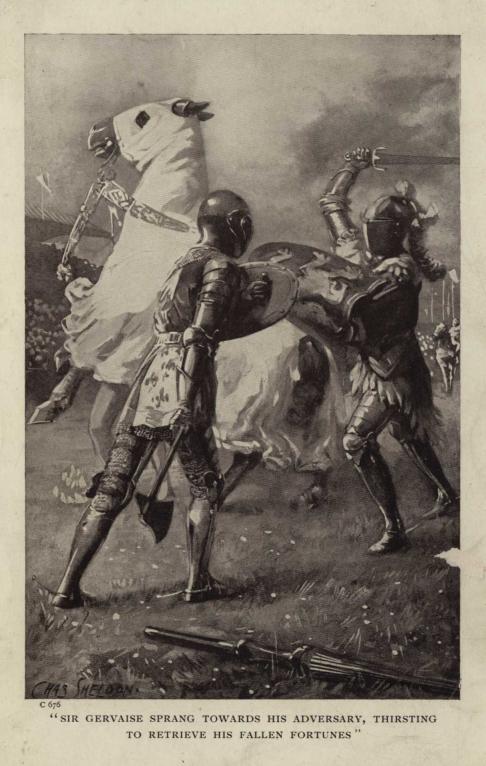
"SIR GERVAISE SPRANG TOWARDS HIS ADVERSARY, THIRSTING TO RETRIEVE HIS FALLEN FORTUNES"
Disdaining to meet him at any advantage, Edgar flung away the fragments of his lance, seized Sir John's heavy battleaxe, and slipped lightly from the saddle. Scarce had he faced Sir Gervaise when the furious knight was upon him with sword up-raised. Knowing that his battleaxe was almost useless for defence, Edgar heeded not the blow, but, half-turning, swung his own heavy weapon sideways at his opponent's head. The knight's blow fell first with a stroke that bit deep into Edgar's casque, but before De Maupas could spring back out of reach, the axe stroke smote him on the side of his helmet with a weight and momentum that sent him crashing headlong to the ground.
A dull roar of applause arose from the whole circle of the lists.
Dropping his axe, Edgar snatched his dagger from his belt and sprang towards the fallen man. Kneeling upon his chest he cried aloud:
"Yield thee vanquished, Sir Gervaise de Maupas!" Then in a low voice, but in tones thrilling with resolve, he went on, "Tell me where Sir John if, or thy life is forfeit!"
There was no response.
"Desist, Sir John," cried one of the marshals of the lists, hurriedly approaching, "he is stunned, if not dead. Thou art acknowledged victor--retire while we see to the stricken man."
Heavy with disappointment at being thwarted at the moment when he hoped all might be won, Edgar mechanically mounted and rode slowly round the lists. The air still rang with the plaudits of the spectators, and, as he passed along, loud cries reached him, some, wishing to do him the more honour, calling upon him to unhelm.
Fearing that his refusal at least to lower his vizor might cause some adverse comment, Edgar dropped it an inch or so and left it, hoping that it might be thought that the blow his headpiece had received had damaged the hinges of his vizor. With a final salute, first to the earl and then to the Wolsingham ladies, he rode dully from the lists. The cheers of the spectators fell on deaf ears, for though he had defeated Sir Gervaise and upheld Sir John's honour, he felt that he was still as far as ever from solving the mystery of his master's disappearance.
As he reached the door of his tent, Matthew and Peter came running up, their faces wreathed with smiles at their young master's victory.
"Aid me to strip off this armour," cried Edgar, the moment he had entered the tent, "and remember that Sir John is gone--gone upon the visit to Faucigny Castle, in the lands of the lady Beatrice, that he has had all along in mind. He gained the earl's permission some time since, as he told me himself. Thus at least we gain some precious days in which to continue our enquiries."
"Pardon, Master Edgar," cried Peter, suddenly stopping, "with thy permission I will hie me to Sir Gervaise's tent. It may well be that this is a time when it might advantage us to keep close watch upon those about him."
"Go, Peter. His esquire will be bringing him back in a few minutes. He is but stunned. Listen for what thou canst hear. Who knows but that a few chance words may tell us all?"
Waiting for no more, Peter sped off upon his errand, and when, a half-hour later, Sir Gervaise was carried into his tent, he was snugly ensconced beneath a pile of horse's trappings at the very door.
CHAPTER X
News of Sir John
The dusk of evening was falling as Sir Gervaise raised himself from the couch upon which he had been restlessly tossing ever since he had been carried in. His head was swathed in bandages, and the light of the single lamp showed a face pale beneath its sunburn, in which a pair of fierce black eyes burned with an unnatural brightness.
"I have waited in suspense long enough," he muttered to himself. Then, in a louder key, he called to his esquire who was in attendance upon him.
"Arnaud, I have business that I must transact this night. Fetch me hither, then, the varlet James Baulch, and then betake thyself to thy tent. Stay, first fill up my cup, for my head still throbs consumedly from the blow that trickster Chartris gave me."
The esquire obeyed, and in a minute the wounded knight was alone. Freed from the restraint of his esquire's presence, Sir Gervaise groaned aloud with the pain of his bruised and swollen head, and muttered savagely to himself what sounded like threats and imprecations against his successful foe and also the varlet James, who seemed somehow to have incurred his especial displeasure.
Presently the man arrived escorted by the esquire, who seemed to look somewhat askance at his charge. He glanced significantly at his master as he was about to leave the tent, and, interpreting the look, the knight cried as he scowled savagely at the man: "Yes, Arnaud, remain outside within call. I may require thy services."
Arnaud bowed and retired, and the knight, raising himself, not without difficulty, into a sitting posture and placing a dagger ready to his hand, beckoned the man to approach.
"So thou hast played me false, James Baulch, murderer and vagabond?" he cried in a voice thick with rage. "Thou, whom I have but to lift a finger to consign to the gibbet--thou hast dared to lie to me."
The man cowered before the knight's pallid face and gleaming eyes. "There is some mistake," he stammered, "I----"
"Aye--thou art right," cried the knight savagely, "'tis the mistake I made when, with a trumped-up tale, I snatched thee from the sheriff's men. I had better have let thee hang and moulder--but 'tis not yet too late. The arm of the law is strong and swift even in Gascony, and on the word of a knight thy shrift----"
"My lord! My lord!" cried the man, grovelling in terror on the floor. "I swear there is some mistake. With mine own eyes at dawn this morning I saw Sir John, bound and helpless, lying at the bottom of a wagon. I rode straight hither, and he who fought with thee must be some other. My lord, it must be so."
"Bah! Scoundrel! That is but a tale--another lie--to save thy wretched neck from the gallows."
"It is not--it is not!" almost shrieked the man. "Didst not mark--but thou wert senseless--has not, then, thine esquire told thee that he who fought as Sir John did not drop his vizor even when he saluted the earl?"
"Say'st thou so?" cried the knight, startled. "Strange!" he went on, muttering to himself. "I seemed to feel a difference as he entered the lists. Both horse and man seemed doubly full of fire, while Sir John always rode heavily."
"Yes, yes," cried the man eagerly. "It was noticed by others. I heard two men say that Sir John was riding lighter in the saddle than he used to."
"Can this be the explanation?" went on De Maupas, still speaking half to himself. "I never thought of such a daring ruse being played upon me. Who can the man be? Doubtless one of Sir John's friends--but who? 'Twill be the worse for him an I find out the truth," he ended darkly, clenching his teeth with suppressed rage.
"Give me leave to find out the knight's name, my lord," interrupted Baulch in an eager voice.
Sir Gervaise for a minute or two made no reply, but gazed at his accomplice with so gloomy and menacing a look that the man literally shook with fear.
"Very well, Baulch," he said sternly after a pause, "thy neck may rest at peace on thy shoulders for a space, while thou art finding out who it was that masqueraded as Sir John. Find out, I say, find out! Dare to bungle a second time, and the gallows that gape for thee shall have thee fast!"
With trembling lips the man hastily promised to find out the truth.
Nodding carelessly, Sir Gervaise went on to talk of other matters. There could be no doubt that his confidence in the ascendancy he had obtained over the man was not misjudged. The man was obviously under a spell, mastered by a hidden terror so great that all else was completely swallowed up.
* * * * *
It was noon the following day when the man again made his appearance and requested Arnaud to tell Sir Gervaise that James Baulch craved a few minutes' further speech. Arnaud complied, though from the expression of his face it might have been inferred that the desire to kick the man was the feeling uppermost in his mind.
"Well, Baulch?" growled the knight, who still reclined upon a couch, and whose temper seemed in no way improved by his night's rest. "Hast news to tell? If not 'twill be the worse for thee."
"I have news, my lord--strange news. Whether 'twill please thee or not, I cannot say, but----"
"Peace, knave! Tell thy news and madden me not with thy thoughts of what pleases me."
"'Twas Edgar Wintour fought with thee in the lists," blurted out the man hurriedly. "I have heard words let fall that make the matter clear."
"Edgar Wintour--and who is Edgar Wintour?" cried the knight with savage impatience.
"He is Sir John's esquire."
The look that came into the knight's face made Baulch regret the success of his enquiries. De Maupas gasped, grew even paler than before, and clutched convulsively at the couch on which he lay. Then a sudden passion seemed to galvanize him into activity and he rose to his feet almost with a bound.
"What!" he thundered. "Dare ye tell me that----?"
But his strength was unequal to the effort, and clutching at his bandages with both hands, as though his head were about to split in twain, he sank slowly and painfully back upon the couch.
"A pretty debt I owe the boy if thy tale is true," he muttered at last in a changed voice. "Art sure of thy facts?"
"Sure, my lord. I saw him mounted upon Sir John's charger early this morning, and the way he rode made me think at once of the spring and fire of thine adversary yesterday. Then I heard some words let drop by one Matthew, a man-at-arms of Sir John, and I knew 'twas so."
"So that was what was in his mind when he gave me that strange look yesterday," muttered De Maupas to himself. "It was on my lips to demand an explanation. Would I had done so! I might have forced the quarrel then and there with the advantage on my side, mailed and ready for a conflict as I was."
"Canst not let the good earl know of the trick he played?" said the man presently. "Surely he would punish him for daring so to dupe the marshals of the lists?"
"Be silent, fool! Dost think I want all the world to know that I, a knight, was beaten by an unfledged esquire? See to it that no word of it is breathed by thee."
For some time Sir Gervaise remained silent, staring viciously at the ground the while. The expression on his face was not good to see, and it might have been as well had Edgar Wintour been there to see it.
"Baulch," said the knight at last, "Baulch, I gave thee money for Sir John Chartris--alive. I offer thee double the sum for this Edgar Wintour--dead. Dost understand?"
The tone of the knight's voice was low and measured, but the expression of his face was so deadly that the blackest rage would have seemed less implacable. Baulch seemed to have no great stomach for the task put to him, but one furtive look at the knight's face was sufficient, and he answered hastily:
"I understand, my lord."
"Then begone."
* * * * *
"Couldst hear no more than that, Peter? Nothing save a few words of angry reproach against the man when De Maupas's voice rang highest?"
"No, sir. I could get no nearer, for De Maupas's esquire, Arnaud, paced to and fro outside, doubtless by his master's orders. Most of the time the two spake only of the tournament, though once I feel sure they talked of Sir John, but they dropped their voices and only formless words reached my ears."
"Ah! Then I fear it behoves us to find out," cried Edgar in a decided tone. "We cannot afford to go on like this, Peter. The Wolsingham ladies are becoming most anxious, and if we cannot soon get news, we must acquaint the earl of the truth and implore his aid, though I fear it will bring us little comfort. Ye say ye know where this man Baulch lives?"
"Yes, he lives at a low inn in the lowest and most rascally quarter of the town."
"Good! 'Tis the better for our purpose. At nightfall, Peter, I must visit this inn, and see what stratagem or the sword will accomplish. Tell me how I may find it, and then be off and get me some peasant's clothing, old and soiled with use, and have it ready an hour or two before the gates are closed."
At the time appointed Peter produced a bundle of clothing, and Edgar was soon well disguised as a young countryman on a visit to the town to make his purchases. The clothing was somewhat malodorous, but as this added considerably to the realistic effect, Edgar recked little of that. His own sword was far too well made and well finished to be taken, so Peter obtained for him the least pretentious amongst those carried by Sir John's men-at-arms. This was buckled on in an awkward and clumsy manner, so as to give as unwarlike an air to a warlike weapon as possible.
Foreseeing the possibility of a fight in a locality of such unsavoury reputation, Edgar took the precaution to don his light flexible shirt of steel mail before putting on the peasant's garments, and to have a dagger concealed beneath his clothes ready to hand in case of an attack too sudden and at too close quarters to allow him to draw his sword.
It was a few minutes short of the hour at which the gates of the city closed when, as a peasant, he rapped loudly at the door of a low-lying, rambling, single-story structure overlooking the river Garonne. The street was in complete darkness, save for the dim light emitted through the shuttered windows of one or two of the hovels and crazy dwellings which huddled together along each side of the narrow roadway.
After a short delay the door opened, and one of the most villainous-looking men Edgar had ever set eyes on made his appearance.
"What seek ye?" he enquired, peering suspiciously first at the newcomer and then over his shoulder, as though to find out whether he was alone.
"Some of thy good cheer, landlord. I was seeking another inn which a neighbour of mine speaks well of, but lost my way, and a man I chanced upon by good hap outside sent me to thee. Give me sup of thy best; I have money and can pay," and Edgar, assuming an air of pride and importance, flaunted a handful of coins under the man's eyes.
"Thou shalt have it, noble sir," cried the landlord, with a leer which was meant to encourage his guest, and he led the way into a long room, bare of furniture save for a couple of tables and some rough benches. The room was fairly lofty, but numbers of smoked hams and other objects hanging from the rafters made it appear low and gloomy. Half a dozen men, amongst whom Edgar was quick to discern James Baulch, lounged upon the benches drinking and dicing.
Edgar took stock of his surroundings as the landlord led him to the end of the room farthest from the other occupants, and, fetching a chair from a side room and carefully placing it in position at the table, invited his guest to take a seat.
In a few minutes some food, rough and unpalatable, was brought, and Edgar made shift to eat it, as though with a good appetite. Then he leaned back in his chair, and, half-shutting his eyes, pretended to be nearly asleep. He hoped that most of the men would soon leave, and that he might have an opportunity of accosting Baulch alone or of following him to his room, wherever that might be.
Presently he missed one of the men, and shortly after the others broke into a rough drinking song. Edgar then realized, with something of a shock, that instead of being the pursuer he was now the pursued. It was not the mere withdrawal of one of the men that made him think this, but the quiet, stealthy manner in which the man must have left, and the way in which the other men began their song simultaneously, as though at a signal. It almost seemed that the song was intended to cloak something, perhaps the arrival of a further band of ruffians. Edgar began to regret that he had exhibited his money so freely--or could it be that Baulch had seen through his disguise?
A slight rustling noise close to him attracted his attention, and giving up the pretence of being nearly asleep, he opened his eyes wide and looked warily about him. The men had stopped their song, and were gazing in his direction with an air of covert expectation. Something was going on--that much was clear as noonday. Another slight rustle, and Edgar looked quickly above him into the blackness beyond the hams and other objects hanging from the rafters. He was just in time to catch a glimpse of something as it dropped down over his head. It was a rope!
Before he had time to spring to his feet and fling it off his shoulders, it was drawn tightly round his neck with a quick jerk, and he was lifted almost off his feet. The peril was extreme, and realizing in a flash that only the most desperate exertions could save him, Edgar grasped the rope above the slip knot with his left hand, while with his right he drew his dagger and reached up to cut the rope, straining on tiptoe to get a purchase.
Suddenly a trapdoor, upon which his chair had evidently been placed, gave way beneath his feet, and the whole of his weight fell upon his left arm. Choking, half-strangled, with eyes starting from his head, Edgar strove to cut the rope with his dagger. One stroke, feeble from his straining position and reeling brain--a second stroke--then a third, into which all his remaining strength was put--and like a stone he fell half-fainting through the trapdoor into a cellar below.
For a moment or two he was unable to move. Half-strangled and half-dazed by the dread attack and sudden fall, he was in so helpless a condition that he could not have lifted a hand to save his life. The noise of footsteps on the stone stairs leading to the cellar and the harsh grating of a key in the lock roused him a little, however, and he feebly extricated himself from the legs of the chair upon which he had fallen. Scarcely had he done so before two men, one of whom bore a torch, ran hurriedly in and rushed at him with knives upraised. The man bearing the light Edgar recognized as James Baulch.
Against their attack Edgar at first could defend himself but feebly. His hand still clutched the dagger with which he had severed the rope, but before he was in a condition to use it he had received several body thrusts that would have dispatched him outright had it not been for the shirt of steel mail he wore beneath his clothing.
Every moment, however, his strength came back, and, watching his chance, presently he parried a blow from Baulch's companion, and brought the hilt of his own dagger down upon the ruffian's head with all his strength. The man dropped prone in his tracks amid a yell of wrath from the men in the room above, who were eagerly peering down at the conflict from the opening in the floor.
Feeling that his chance had come, Edgar sprang fiercely upon Baulch and flung him to the floor, the torch spinning from his hand to the other end of the cellar. Kneeling upon the man's chest and placing his dagger at his throat, Edgar cried sternly:
"Tell me where is Sir John Chartris, or thou shall die."
The man gasped with amazement and fear, and cried hastily: "At Ruthènes."
"Where is this Ruthènes?" cried Edgar quickly.
But the man seemed already to have repented that he had told so much, and with an effort made shift to grasp the hand that held the threatening dagger. Doubtless he had seen the faces of his four friends above disappear from the trap, and had heard the scurry of their feet as they rushed across the room and made for the stairs. It could be but a matter of seconds before they were on the scene. Edgar, too, had heard the scurry of feet, and realized at once that he could get no more information before it would be too late. Wrenching himself free from Baulch's grasp and springing to his feet, he seized the chair and placed it upright beneath the trapdoor.
The instant he was free Baulch scrambled to his feet, and, emboldened by the approach of help--for the others' footsteps now sounded loudly upon the stairs--rushed at Edgar with a yell, and tried to prevent him mounting upon the chair.
"We will have thee yet, Edgar Wintour," he cried exultingly.
Edgar had flung away his dagger, but at this attack he turned and shot out his arm with all his strength. The blow caught the man full in the face, and felled him headlong.
The first of the men, leaping down the stairs, burst into the cellar just as Edgar, seizing the edge of the floor above with his hands, sprang off the chair, head and shoulders, into the room overhead. Flinging up his right leg and making another effort, he lifted himself until he stood upright upon the floor.
For the moment the room was empty, but the men below, mad with rage at being again tricked, were already in pursuit, shouting like wild beasts, and there was no time to be lost. Without an instant's delay, therefore, Edgar sprang to the window, flung aside the shutters, and looked eagerly out. As he expected, the gleam of water met his gaze, and, placing one hand upon the sill, he sprang headlong out and vanished into the waters of the Garonne.
CHAPTER XI
In Pursuit
An hour later a weary-looking, soaked figure knocked loudly and insistently at the door of the inn which sheltered the ladies Gertrude and Beatrice. It was Edgar, exhausted by a long swim in sodden garments and shirt of mail, which had well nigh dragged him to the bottom of the river. After a short parley the landlord admitted him, and, seeing his sorry condition, proceeded to light a fire to dry his wet garments, and good-naturedly lent him others until they were ready for use.
"Dost wish me to tell Sir John's ladies that thou art come?" he asked presently.
"Nay, I will spend the night before this fire, and speak to them early in the morning. Tell me when ye hear them stirring."
Long before Edgar awoke in the morning Peter had arrived, anxious to know if anything had been heard of his master. Seeing him asleep, and hearing of the exhausted condition in which he had arrived, he sat down patiently to wait until he should awake.
"Hast learned aught?" he cried as soon as Edgar opened his eyes.
"Aye, though what 'tis worth I know not;" and Edgar related the incidents of the attack and escape the night before. "Baulch said that Sir John was at Ruthènes, or a place that sounded much like it. Whatever that name may be worth to us, it would seem that Sir John is at least still alive."
"Ruthènes!" echoed Peter thoughtfully. "Methinks I have heard a word that sounded like that before. Yes, I have it; it was a word spoken more than once by De Maupas to that rascal Baulch. I could not catch it fully, but now I know the word, I feel sure it was that they were repeating."
"Then we are on the right track," cried Edgar joyfully. "Now we must find where Ruthènes is. Call mine host."
The landlord was called and asked if he knew of a place called Ruthènes. After a moment's thought he announced that he had heard of it as a castle of evil reputation situated on the lower slopes of the Pyrenees many leagues distant. It belonged to a knight named Eustace de Brin, who appeared to be better known amongst the country folk and peasantry as Black Eustace. Exactly why he should have earned so terrible a name, however, the landlord was unable to say.
Satisfied that Baulch had not lied to him, Edgar desired the landlord to send someone to arouse the ladies, and to tell them that Sir John's esquire begged a few minutes' audience with them upon a matter of great importance. Then he turned to Peter and instructed him to return to the camp, to saddle Sir John's two best horses, and to make all ready for a long journey. On his way through the town he was to obtain more countrymen's clothes of a better cut and quality than his last purchase--such, indeed, as might be worn by small traders travelling on business from one part of the country to another.
Very shortly both the ladies appeared, eager to know why Edgar had come to them so early in the day, and guessing that he must have news to tell.
In a few brief sentences Edgar described the scene at the inn, and the means by which he had extracted one single word from Baulch, which, he hoped, contained the key to Sir John's whereabouts. Then he announced that he had made up his mind to set out forthwith for Castle Ruthènes, accompanied only by Peter, and to do all in his power to deliver Sir John from his captors.
"But will not this Eustace offer him to ransom?" cried Beatrice. "We will gladly pay a ransom, however great, so long as we can get him safely back."
"I much misdoubt me whether Sir John would consent to a ransom being paid to dishonourable captors," replied Edgar. "'Tis not as though he had been captured in fair fight. Besides, would De Maupas consider himself avenged by a share in a ransom, for, of course, he must be in league with this Black Eustace?"
"I know not," cried Beatrice, stamping her foot in vexation. "But what seek ye to do? How can ye two carry Sir John away by force from a stronghold such as Castle Ruthènes seems to be?"
"By stratagem, backed by force if need be. There is naught else to be done. The earl is not yet ready to move, and even if he were, he could not move for months into so remote a part of the enemy's country as the district in which Ruthènes lies."
"Well, then, go, Edgar. Gertrude and I will pray for thy success even more heartily than in the combat with De Maupas. But trust not to thy sword too much. Ye hotheaded esquires think far too much of prowess in arms."
"I thank thee, maiden. I will try to remember thy counsels," replied Edgar, with a slight smile.
"But what are we to tell those who enquire for my father?" cried Gertrude.
"That is already settled. A day or two before he disappeared Sir John obtained leave from the earl to visit the lands of the lady Beatrice in Faucigny. Many called to congratulate him on his defeat of De Maupas, but hearing that he had left, supposed that he had already gone thence. I think it would be best if the lady Beatrice went to Faucigny for a time, and that thou didst return to Wolsingham."
"Nay, I shall not return home until I know what hath befallen my father," cried Gertrude decidedly. "Beatrice may please herself whether she visits her tenants at Faucigny, but I remain here. If the earl moves forward in thy absence the men-at-arms must go, but Matthew I shall keep with me."
A few more words and Edgar bade the ladies adieu, bidding them be of good cheer for the news he had brought showed that at any rate Sir John was alive. A rescue would, he trusted, only be a matter of time. Though the ladies were unable to accept so hopeful a statement, yet they felt a real thrill of hope. The dash and daring of the young esquire in the lists outside Bordeaux, the determination displayed by him in his onslaught upon the miscreant Baulch in the riverside inn, and the not less striking success which had attended both ventures gave them a ground for hoping at which they would have laughed a week ago.
Two hours later Edgar left the camp, accompanied by Peter, and took the road which led in the direction of Ruthènes. Both were dressed as small traders, though it must be confessed that their mounts were vastly superior to the steeds such men usually bestrode. Both carried sword and dagger, and Edgar wore beneath his outer garments the light shirt of steel mail which had already done him such good service. Permission to leave had readily been granted to him on the understanding that he was en route to rejoin Sir John Chartris.
Before he left, Edgar called Matthew and gave him strict instructions to keep vigilant watch and ward over the Wolsingham ladies, and especially to see that neither went abroad unaccompanied by a proper escort. His fears for them, however, largely vanished when Matthew told him that De Maupas had recovered sufficiently to leave the camp for a destination which he had been unable to discover. The man Baulch appeared to have been left behind.
After a three-days' journey over rough roads, oftentimes mere tracks, Edgar and Peter reached a village in the vicinity of the castle of Ruthènes. Their arrival created something of a stir, for the village and district were so remote from the trade routes and highways that strangers were hardly ever seen. Somewhat disturbed that they were not able, as they wished, to pass unnoticed about their business, Edgar enquired whether the village boasted an inn. It did not, but the house which performed the nearest approach to that office was pointed out to him, and they made their way there and dismounted. A target for curiosity, and also, apparently, for barely concealed hostility, the two sat down to the poor hospitality the place afforded, feeling that the difficulties before them were greater even than they had anticipated.
It was evening when they arrived, and they had scarcely been there half an hour before no less a personage than the village priest called, ostensibly as a chance visitor, but really, as Edgar shrewdly suspected, to examine the two strangers, and to ascertain, if possible, what their visit portended.
"Ye are strangers here," remarked the priest, as he brought a mess of soup to the table at which Edgar and Peter were seated, and sat down himself.
Edgar assented and went on with his meal, though he kept a watchful eye upon the priest. The man was past middle age, tall and well built to all appearances, and had a kindly and pleasant, though careworn, face. Kindly as he looked, Edgar felt anxious to keep the real object of his visit there a secret from this man more than any other, for of all those in the village it was most probable that the local priest was on friendliest terms with the lord of the soil at Castle Ruthènes.
"Doubtless 'tis to visit the castle, and not us poor villagers, that ye are come," said the priest quietly, after a few minutes' pause.
"Nay, we know not Sir Eustace, and though we should like to see so fine a castle before we pass on, we shall not seek his hospitality."
"Are ye for us or against us?" asked the priest suddenly, fixing a pair of steady grey eyes upon Edgar.
"I know not what ye mean," said Edgar uncomfortably.
"I mean, are ye for the downtrodden and oppressed, or do ye uphold those who grind and ill-use the weak and helpless?"
"Certainly not the latter," cried Edgar quickly.
"Then join thyself to us, and make thyself famous in aiding a noble cause," cried the priest, his face flushing and his eyes sparkling like those of a zealot.
"What is this cause of which ye speak?" asked Edgar warily.
"It is to deliver these downtrodden folk amongst whom it is my sad lot to work. Have ye not heard of the ill fame of this Black Eustace, as he is called--and rightly called? Tell me that ye are not of his party--but I am sure ye are not, otherwise I would not have spoken so plainly."
"I am not. 'Tis but three days since I heard his name for the first time."
"Ah! then ye know not that he is the scourge of all this land, and doth kill and burn and flay without let or hindrance? He hath powerful friends, and never a thing is done when he ill-uses the poor ignorant folk who inhabit the land he calls his own. I have seen things with my own eyes that call aloud to heaven for vengeance, and yet the time cometh not."
"The country folk would then like to be rid of Sir Eustace?"
"Aye, they would like to rid themselves of him if only it were possible to poor and ill-armed men. Woe to me, a priest, that I should have to uphold the meeting of violence by violence! but I have tried to find another way and failed. I have been told that such a state as exists here exists in many other parts of France. If that be so, terrible things will be witnessed in the years to come.[1#] I cannot believe, however, that things can be so bad elsewhere as they are here, for whereas we are poor and ignorant, in other places the people are rich and powerful, and can resist oppression in many ways."
[#] The priest was right. In the rising of the "Jacquerie", which took place a few years later, dreadful scenes of violence and bloodshed were witnessed.
"Undoubtedly," murmured Edgar, nodding his head in agreement.
"But what we most lack is leaders," went on the priest in a still more earnest tone. "There is no one here, save myself, who stands out from the herd of poor miserable folk, and without leaders men with no knowledge of warfare are doubly useless. We want leaders," he reiterated in a meaning tone, fixing his eyes upon Edgar in a way that made that young man feel most uncomfortable.
"Yes, yes," replied Edgar in a soothing tone. "Doubtless the leaders ye need will be forthcoming when the time comes."
"The time has come, but the leaders are absent," cried the priest; and he was apparently about to say more when he stopped suddenly, as though with a great effort, and stared frowningly at the table.
Devoutly hoping that the priest had done and would spare them any further confidences, Edgar turned towards Peter and began to talk upon other topics. In a minute or two, however, the priest raised his head and went on: