Reduction of Population
Reading edition
The abrupt reduction in the population of woodrats on the Reservation cannot be explained conclusively with available data. Probably weather played a major part, but other unknown factors must have been important also. It is certain that the population of woodrats was high, if not at an all-time peak, in 1947. In late February, 1948, when one of us (Fitch) first visited the area on a preliminary inspection trip (not concerned primarily with woodrats), houses of these rats were found to be unusually numerous and those seen seemed to be occupied and well repaired. Possibly the population was drastically reduced within the next few weeks, as unseasonably cold and stormy weather occurred in early March. For the first 12 days of March, 1948, temperature averaged 20° below that of average March weather, and even colder than the average for January or February. A reading of -5°F. on March 11 set a new low locally for the month since records were begun in 1869. The record low temperatures were accompanied by 12.8 inches of snow. This spell of unusually severe weather in early March coincided with the period in which first litters of young usually are born, as most females breed in early February and the gestation period is in the neighborhood of five weeks. That most of these first-litter young may have been eliminated by the unfavorable extreme of weather at the most critical stage in the life cycle may be readily imagined although definite proof is lacking. However, the mortality must have extended beyond newborn young. Loss of first litters ordinarily would be compensated for by the end of the season, since a female usually breeds more than once in the course of a season. In any case, by autumn, when the actual field study of woodrats was initiated, many houses were already deserted and in disrepair. Although the rats were still moderately abundant, they were, seemingly, much below the population peak of the preceding year.
Further drastic reduction of adults and subadults took place in the winter of 1948-49. In the course of live-trapping operations from mid-October into early December, 51 individuals were caught and marked. Chiefly because of unfavorable weather conditions, field work was discontinued in mid-December, and live-trapping was not resumed until early March. Subsequently, only 12 of the woodrats previously marked could be recaptured, and the population had become noticeably sparse. Seemingly, more than three-fourths of the population present in late autumn had been eliminated in the interval. In January, weather was exceptionally severe; on the ninth and tenth the worst sleet storm in twelve years occurred. Sleet fell in small granules, while the temperature remained several degrees below freezing. Partial thawing on January 12, 13 and 14 was followed by a steady drizzling rain on the fifteenth. On the following day the temperature dropped to -7°F. Ice still remained from the sleet storm, and the slush again froze. On the night of January 18, there was one of the worst snow storms on record and temperature reached a low of 2°F. Exceptionally low temperatures persisted through January 24, with more sleet on January 25. Ice from the earlier storm still remained. On January 30, the temperature dropped to -7° and a three-inch cover of snow still remained over the coat of ice. The month of January, 1949, had the heaviest precipitation in 81 years (5.09 inches) and a cover of ice remained for at least 21 days. There were other sleet storms of lesser proportions on February 2 and again on February 21.
Ordinarily sleet would not seriously damage woodrats living in houses in woodland habitats and less suitable hedge rows because it usually freezes as it falls and coats only the surface of the house. Gradual thawing would allow normal runoff without much penetration. Because the sleet during the storm described above did not form a glaze as it fell, the ice particles penetrated many houses. It has been observed many times that captive woodrats refused food that was frozen or were unable to eat it. Woodrats in live-traps in winter rapidly weaken unless a large supply of food is available. If food supplies became sealed over by ice, woodrats would have died by starvation or by falling an easy prey to predators. The rats were more accessible to several predators than were smaller mammals such as meadow voles which were difficult to obtain because of the coating of ice over the fields.
The decimated population surviving into the breeding season of 1949 failed to make substantial gains. In fact, during the following four-year period the general trend of the population over the Reservation as a whole seemed to be one of gradual further decline.
In November, 1949, the rats were almost gone from the area of north slope and hilltop in oak-hickory-elm woodland where the most intensive live-trapping and other field work had been done the previous year. The following descriptions of houses remaining on the area at that time give some idea of the habitat, and of the course of events correlated with the fluctuations in numbers of woodrats.
No. 1. At the hilltop outcrop, partly on a substrate of limestone boulders, built around an elm of two-foot DBH, which lent support to one side. A hackberry sapling one inch in stem diameter grew through the middle of the house, providing further support. The house was two feet high and six feet in diameter, and was in obvious disrepair, with a hole several inches in diameter in its top. It had been occupied in the autumn of 1948. It was constructed mainly of sticks, ranging in diameter from approximately one inch to straw size. Many of the sticks, from .4 to .5 inches in diameter and one to two feet long, seemingly would have been heavy burdens for a rat, although they were of light-weight wood, sumac and elm. Mixed with the sticks were quantities of dry leaves, bark, and chips of wood, all material appearing old and weathered. This house was in elm-oak-hickory woods 50 feet from a cultivated field on the hilltop to the east and south. To the north and west the escarpment sloped away abruptly. There was a coralberry thicket beneath the trees on the adjacent hilltop.
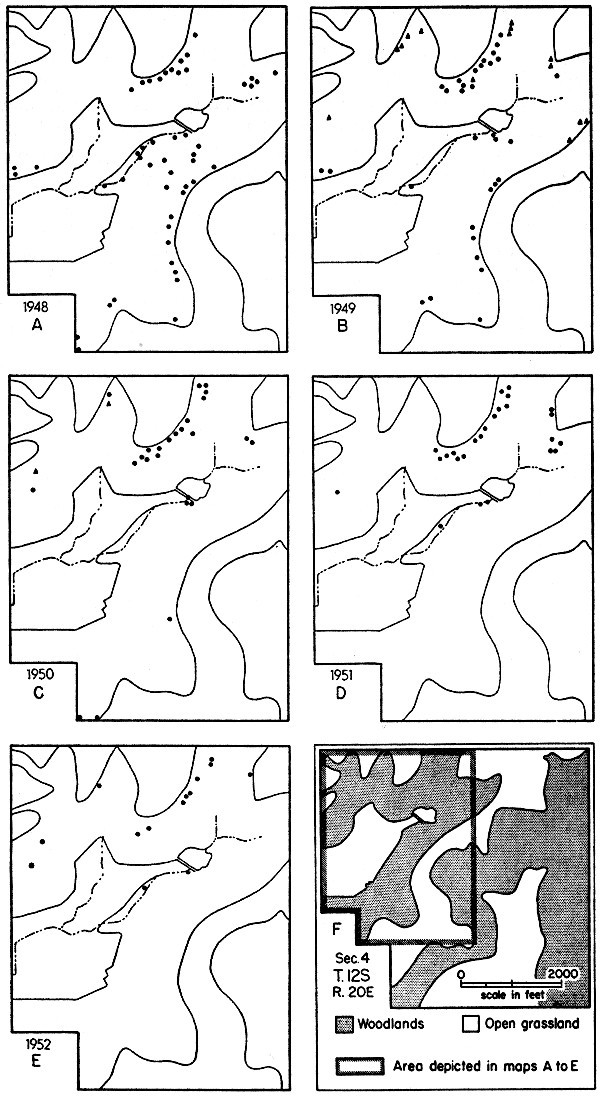
Figure 1
(A) Map of part of University of Kansas Natural History Reservation, showing first-capture sites for all woodrats live-trapped in the autumn of 1948. Because of the short time involved and the few traps available, much of the area shown was not thoroughly trapped. Woodrats were abundant, though much less so than in 1947, as shown by the large number of deserted houses.
(B) Map of woodrat study area, same as shown in (A), showing first-capture sites for all woodrats live-trapped in 1949. Woodrats were still moderately abundant, but much below the level of the previous year. Triangles indicate those capture sites not sampled in 1948.
(C) Map of woodrat study area, same as shown in (A), showing first-capture sites for all woodrats live-trapped in 1950. Numbers were medium-low, having undergone drastic reduction from the peak level. Triangles indicate those capture sites where trapping was not done in earlier years.
(D) Map of woodrat study area, same as shown in (A), showing first-capture sites for all woodrats live-trapped in 1951. The population was low, but had not yet reached its lowest ebb.
(E) Map of woodrat study area, same as shown in (A), showing first-capture sites for all woodrats live-trapped in 1952, when the population had declined to relatively low numbers and disappeared from much of its former habitat.
(F) Map of the 590-acre Natural History Reservation, showing the area where woodrats were studied.
No. 2. On gently sloping hilltop edge 15 feet from the outcrop and escarpment, built around a forked walnut sapling having both trunks approximately five inches in diameter. The sapling, coming up through the center of the house at a 45° angle, evidently had been bent by the accumulated weight of the debris at an early stage of its growth, many years before. Trees were small in this part of the woods, with a well developed understory thicket of coralberry and sumac. This house approximately one foot high and six feet wide, was constructed mainly of sticks and was similar in composition to No. 1, but appeared considerably older with all the sticks blackened and rotten. In the autumn of 1948 this house was used by woodrats, but probably only as a temporary stopping place, because it was already in disrepair then.
No. 3. At edge of escarpment, 25 feet from No. 2, on a flat boulder approximately six feet long, three feet wide and one foot thick. The decaying and much flattened mass of sticks was mainly on top of the boulder, but also spilled over its edges. Fresh sign was noted at this house in the autumn of 1948, but the house was already in disrepair then, and seemingly it was used only as a stopping place.
No. 4. At the hilltop outcrop where an elm had fallen across it. The decaying log remaining was approximately 12 feet long and 15 inches thick. This log passed diagonally through the house, providing its main support. The house was approximately 39 inches high, its summit extending a little above the level of the top of the outcrop. The house was approximately seven feet wide along the outcrop. This house was somewhat intermediate between the typical dome-shaped stick piles that the rat builds in open situations and the formless accumulations of sticks with which some rats living in deep rock crevices line the entrances. Part of the accumulation was beneath the limestone boulders and outcropping slabs. Approximately half of the material used in the house consisted of sticks and the remainder of pieces of bark and chips of wood, mostly gathered from the fallen elm. This house had shrunken noticeably from decay and settling in the months since it was occupied, in the autumn of 1948. The house was surrounded by a thicket of fragrant sumac, dogwood, and hackberry saplings.
No. 5. At edge of a protruding boulder one foot thick at the hilltop outcrop of the west facing escarpment, and 100 feet back in the woods from the edge of a corn field, in undergrowth of dogwood, wild currant, and coralberry. The house consisted of a pile of rotten twigs, 3 inches deep and 30 inches wide on the upper side of the boulder, and a lining of similar material at the lower edge of the boulder, partly blocking the crevice beneath it. The twigs composing the house were old and rotten. However, a few dry but still green hackberry leaves were stored in the crevice beneath the boulder. In a bare space atop the boulder were several recent woodrat droppings, small and obviously produced by an immature individual, which, perhaps, had recently settled at this old house site.
No. 6. In hilltop woods, 30 feet from a corner adjoining a pasture and a corn field, at the base of an osage orange tree of one foot DBH, and also over a hollow cottonwood log one foot in diameter and three feet from the osage orange tree. Suspended mats of grape and smilax vines, and the thorny, dead, lower branches of the tree provided additional shelter. The house was composed of sticks and twigs, mostly of osage orange, with spines still present; slabs of bark, wood chips, and dry leaves also made up part of it. Materials on the exterior of the house appeared old and weathered, but the house was conical and solid. Seven fresh corn cobs were on the house or near its base, suggesting that corn from the nearby field had figured importantly in the diet of the occupant. A well beaten path led from the base of the house alongside the log, to a large cottonwood tree 15 feet from the house. This evidence that the house was occupied was verified by live-trapping the occupant. Late in 1948, also, the house was occupied by another individual, but seemingly was deserted for a period of months thereafter.
No. 7. On upper part of north slope where a hickory seven inches in diameter had fallen across an old sunken log approximately one foot in diameter. The house, composed mainly of hickory twigs 1/4-inch to 1/2-inch in diameter, mixed with bark, wood chips, and leaves, was partly decayed, with no fresh sign and was in a thicket of greenbrier, saplings of hickory and hackberry, and cut tops of hickories. The top was flattened to less than four inches above the level of the supporting hickory log. There were large cavities in the side of the house. When first discovered in the autumn of 1948, this house was occupied by a subadult female rat, but she moved away permanently, and the house had been deserted for approximately a year when these observations were recorded.
No. 8. In middle of northwest slope, in thick branches of broken top of a black oak. This house had become flattened by decay and settling to form a mound approximately one foot high and five feet in diameter. Only the top protruded through the carpet of dry leaves. Once well protected and partly concealed by the branches and twigs of the oak top, this house was now fully exposed by the disintegration of the top. The house consisted chiefly of oak twigs. In October, 1948, a woodrat was live-trapped at this house, but probably it was a wanderer. The house had then already undergone much deterioration.