Movements
Reading edition
The woodrat is dependent on the stick houses that it constructs for shelter. For each individual the house constitutes a home base to which it is attached, and about which its movements revolve. The area within which routine daily movements are confined constitutes the home range, which is variable in size and shape. An individual may, and usually does, alter its home range over periods of time. The home range is somewhat nebulous because the rat may at any time move far beyond the small area to which its activities are largely confined. It may be motivated by sexual urge or other voluntary wandering; it may be enticed by a food supply or some other specific attraction not available near its house; or it may be forcibly displaced by an intruder or may abandon in favor of an offspring.
An occupied house normally has several runways radiating from it. These are well worn paths, smoothed by use, and cleared of obstructions, and the rat tends to keep to them in its foraging expeditions. Usually a trail leads to a bush or tree showing evidence of heavy use by the rat. Ordinarily such a trail cannot be traced more than 30 feet from the house, and it seems that the most concentrated foraging occurs within this short radius. Experience in live-trapping has indicated that the distance covered by a woodrat in its normal foraging for food is ordinarily less than 75 feet in any direction from the house.
Usually the rats can be caught in traps only at their houses or nearby places that they frequent, as indicated by their sign. When travelling, woodrats make use of overhead cover as much as possible. Storing of food seems to be associated with the animal's reluctance to wander far from home. When a rat is gathering preferred food for storage the home range may be enlarged (or the animal may travel beyond the limits of its regular home range). In any case the rat may find it necessary to traverse an additional area in order to reach the food source. This may involve, in part, extension vertically, as when the rat obtains food from trees directly over the house. The home range is thus somewhat three-dimensional; both trails and feeding places are often above ground. Because of dependency on cover, woodrats do not forage randomly in all directions from the house.
Although the house and its immediate environs are defended as a territory by the occupant, possession may be soon relinquished. A woodrat may shift frequently from one house to another, especially if unoccupied houses are readily available. Because woodrats had undergone drastic reduction in numbers, as discussed on p. 505, unoccupied houses in various stages of disrepair were numerous throughout the woodland in 1948 and 1949, and the rats that were present then seemed especially inclined to wander. Even old houses that are collapsed and disintegrating may be used temporarily, or may be taken over and repaired. Houses that are in sites exceptionally favorable in that they provide food and shelter may be occupied more or less permanently, with a succession of woodrats over many generations.
Shifts to new areas are perhaps most often motivated by a search for mates. Such shifts are, on the average, longer and more frequent in males. Males must range farther in search of females when numbers are low. On the other hand, when numbers are high and most of the best sites are occupied, newly independent young and displaced adults are forced to travel greater distances in search of homes. Some of the larger and more powerful males move far greater distances than smaller males. The longest distances recorded were mostly for large adult males in breeding condition. The average maximum distance between successive points of capture for 27 adult males was 345 feet. For 39 females (adults and subadults) the corresponding figure was 143 feet. The extremes for males were 0 to 1080 feet and for females, 0 to 650 feet. Of the 27 males, five moved the maximum distance in a single night. Most of the long movements by males did not constitute clear-cut shifts in home range, and many returned to their original locations.
The average distance between points of first and last captures for 72 subadult and adult males was 165 feet. A similar figure for 72 subadult and adult females was 133 feet. Of the males 23.7 per cent were at the same place at the first and last captures; for females the percentage was 36.1. These figures are from the combined data of our trapping records, but the trends differed sharply in the two sets of records. In Fitch's records, movements averaged longer and difference between the sexes was much less: 189 feet for 41 males and 178 feet for 42 females. Corresponding figures from Rainey's records were: 141 feet for 31 males and 74 feet for 30 females. In Fitch's field work, opportunities to record exceptionally long movements obviously were better because the trap line encompassed a larger area, approximately half a square mile, whereas Rainey's live-trapping was concentrated on relatively small areas. The reason for the greater vagility of females in Fitch's records is less evident. However, the data were obtained within the period of drastic population reduction, at a time when there were numerous empty houses throughout the woodland, facilitating travel, and shifts from one home range to another where conditions were, temporarily at least, more favorable. Rainey found that the females in the small colony in woodland where he trapped, moved much less than did those that lived along the hilltop outcrop, which provided a natural travel route.
Following are several examples of males and females with long histories showing individual variation in frequency and distance of movements.
Males
(1.) First captured October 14, 1951, and last captured 327 days later on September 6, 1952. He was taken 12 times. For the first seven captures (October 14, 1951, to July 15, 1952), no movements were recorded. In the following seven days he moved 367 feet. Within the next 21 days he returned to within 114 feet of the site of original capture. Less than one month later he was caught for the last time, at this same site.
(2.) This large male was captured twelve times over a period of 827 days (March 16, 1952, to June 21, 1954). He tended to wander more than other males and was absent from the trapping area from early 1952 to May 1953. One round trip made in a two-weeks period, amounted to a linear distance of 1894 feet if the rat followed natural cover. The return trip of 947 feet was the greatest distance traversed in a single night in any of the woodrats we recorded. Other movements between successive captures were: 722, 397, 356, 293, 253 and 144 feet (the latter shift made three different times). Sexual urge probably motivated most of his wandering, since numbers of females were low.
(3.) For this male the span of records was 143 days, with 18 captures. For the first eight recaptures, extending over a period of 39 days, he was still at the original location. Four days later he had moved 120 feet and was visiting a female. A week later he returned. In the following month he was recorded as making two more moves, of 115 feet and 215 feet. He was last recorded at the hilltop outcrop.
(4.) The records of this male extended over 465 days, with 13 captures. For the entire period only one movement, of 163 feet, was recorded. Twelve of the 13 captures were at the same house.
(5.) This male was captured 16 times over a span of 130 days. After the second capture he moved 144 feet along the outcrop and was caught there for the next 14 times, having developed a "trap habit."
(6.) This male was in the area 210 days (13 captures) and shifted his range. He was first captured on August 17, 1952, at a house at the rock fence 433 feet from the outcrop. Between this date and October 12, 1952, he moved to the outcrop and established residence in a vacant house. He was recorded as making six more moves, the longest of which was only 40 feet.
(7.) This male was first caught in June, 1949, as a juvenile probably between two and three months old (weighing 96 grams) and hence probably still at the maternal house. In September, grown to adult size, he was caught twice, still at this same place. In October, November, December, and in February, 1950, he was caught 11 times at eight places all within a 90-foot radius of his original location. In April, 1950, he was caught at points 550 feet WSW and 700 feet SW. In October he was caught within 150 feet of the original location. In November, 1950, and in March and April, 1951, he was caught four times at a place 900 feet SW from his original location.
(8.) This subadult male was first caught at the hilltop outcrop on October 4, 1949. Two days later he had moved 160 feet north along the outcrop. A month later he had shifted 600 feet south; in three more days 1040 feet north. On November 15 he was 105 feet south of the November 8 location; on November 16, he had moved 70 feet north. On November 17 he had moved 900 feet back south, but had returned on the 18th to the November 16 location. On November 22, he had again shifted 900 feet south. All capture sites were at the hilltop outcrop.
(9.) This male was caught as a juvenile (75 grams) on October 8, 1950. On November 9 he had moved 220 feet, from the lower outcrop to the upper, and he was recaptured at or near this same site on November 10, 28 and 29, and on January 11 and February 9, 1951. On November 21, 1951, grown to maximum adult size, he was caught at a new location 1080 feet from the original.
(10.) This male was caught as a subadult twice at the same place on November 30 and December 14. By the following autumn he had shifted to a new location 180 feet south along the outcrop, and he was caught there on September 22 and October 18, 1951, and on January 20 and February 2, 1952.
Females
(11.) This female was captured 27 times over a span of 211 days. She moved back and forth considerably between two houses 40 feet apart but made only one substantial movement of 245 feet; at this time she was in breeding condition. Nearly seven months after the first capture she was seen for the last time only 16 feet from the original site of capture. It was assumed she fell prey to spotted skunks which were raiding traps.
(12.) First captured on March 24, 1951, she remained on the area 105 days in which period she was live-trapped 25 times. Sixty per cent of the total captures were at the same house and the longest movement recorded was only 56 feet. She was last caught in a trap 25 feet from the site of original capture.
(13.) This young adult remained at her house at the rock fence approximately four months. In this period she was captured 11 times. On March 16, 1952, she had moved 410 feet to a house at the eastern section of outcrop, probably searching for a male. She was never seen again.
(14.) This subadult female moved from the site of original capture to a house 253 feet away on the same outcrop. She was probably in search of a new home when caught the first time. She was recorded at another house 40 feet away on one occasion.
(15.) Over a span of 90 days and 15 captures this female was not recorded as making any movement. She was living in one of the woodland houses. Mature males were numerous in the area and she was visited by at least two.
(16.) This female was also living in the woodland section and was first caught on March 30, 1952, in one of the less favorable houses. She was trapped 17 times over a period of 85 days. One movement of 68 feet to a new home site was recorded, but the area of foraging probably did not change. She was caught here four times and then disappeared.
(17.) This female was first trapped as a subadult on October 5, 1948, at a house in brush on the upper part of a north slope. On November 24 she had shifted 590 feet to the bottom of the slope and was living in the recess beneath an undermined honey locust on a gully bank. On November 25 she was caught in a similar situation 100 feet farther east along the gully bank. She was recaptured at the gully on November 26 and 30, December 1, 3, 22, and March 8 and 9, and in all she shifted six times between the two gully-bank dens.
(18.) This female was first trapped as an adult on November 18, 1948, in a gully-bank den. She was recaptured at this same place a year later, on November 18 and 30, 1949. On February 19, 1950, she was caught at a hollow sycamore 650 feet farther up the gully, and she was recaptured there on February 25 and April 7, and on June 15, 1951. On August 6, 1951, she was caught at a house in a thicket on the gully bank, between the first and second locations and 150 feet from the latter.
(19.) This female was recorded only twice; on October 15, 1948, she was at a hilltop rock outcrop. On July 14, 1950, she had moved 1480 feet and was living in a rock pile at the base of the slope, near the same hollow sycamore where female No. 18 had been caught.
(20.) This female was first caught as an adult on April 5, 1950, at a large boulder of a hillside rock outcrop. On October 7, 1950, she had shifted 110 feet to a house at an osage orange tree on the hilltop rock outcrop. On November 9 she was back at the first location and on November 28 she had moved 70 feet south along the hillside outcrop. On January 11 and February 9, 1951, she was back at the original location. On November 9, and 21, 1951, she was again at the site 70 feet south, and was still there at her last capture on February 3, 1952.
Ordinarily each house that is in use harbors only a single woodrat. To a greater degree than any other kind of mammal on this area woodrats show intraspecific intolerance. On various occasions when captives were placed in the same or adjacent cages, they focused their attention on each other with evident hostility, the more powerful or aggressive individuals attacking or pursuing. Several times the confinement of two rats in the same live-trap or cage resulted in the death of the weaker individual, and seemingly this is the normal outcome unless the attacked rat is able to escape. On various other occasions two or more rats have been caught in the same trap simultaneously but in every instance these were either: a pair of adults, the female appearing to be in oestrus; a lactating female and one or more of her young; or young less than half-grown, that were obviously litter mates. Older woodrats, especially males, often have their ears torn and punctured from fighting.
Territoriality involves, primarily, defense of the house itself. An individual that ventures into an occupied house may be quickly routed by the occupant even though the latter is smaller. Chasing has been observed occasionally, but it is doubtful whether any individual is able consistently to defend the entire area over which it forages. Because each rat spends most of its time within the shelter of its house, an intruder might venture onto its home range unchallenged and undetected, so long as it did not enter the nest cavity.
An adult female was live-trapped on October 14, 1951, beside her house at the outcrop. As soon as she was released, she disappeared within the house. After approximately two minutes, a soft, high pitched whine was heard and immediately another woodrat dashed into view closely followed by the female. The chase continued for several seconds in the vicinity of the house, but the woodrat being chased soon left the area via the outcrop. Probably this intruder had moved into the house in the night while the female was in the trap.
On June 17, 1952, an adult male was found in a live-trap set at one of the brush pile houses in the woodland area. This house was occupied by an adult female. He ran into the house after release, and immediately there was a loud squeal. He ran outside and paused under some limbs approximately 15 feet from the house, and remained there for 15 minutes before clipping off an ironweed 12 inches long, which he carried to the house. He did not enter the house but stopped beneath overhanging sticks at the edge, eating leaves from the plant. He made another attempt to enter the house but loud squeals and rustling followed and he returned to the ironweed plant and was still eating when observations were halted. In another instance, squeals and rustling indicated that the occupant and intruder were in combat.
Fig. 2. Diagram illustrating spacing (due to territoriality or intolerance of the rats) in twelve woodrat houses in a hedge row extending south from south boundary of the Reservation at the middle.
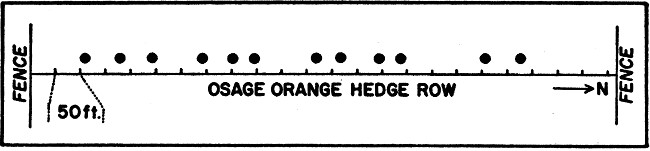
Although home ranges may overlap to some extent, intraspecific intolerance tends to maintain a certain minimum interval between houses. The arrangement of twelve houses along a hedge row 1170 feet long is diagrammatically represented in Figure 2. The average interval was 78.5 feet (minimum 42; maximum 171). The habitat was uniform. Home ranges probably overlap somewhat, and the spacing is the expression of the need for an otherwise unoccupied area in which there is sufficient space to live. Because individuals tend to fight whenever they meet, there is probably a psychological tendency for sequestration which results in spacing of houses and reduces social contact thereby avoiding a depletion of energy that would be detrimental to the population. Whereas condition of the hedge row determines whether or not it will be inhabited by woodrats, length determines the number of occupants. The spacing of houses in a hedge row must be attributed to something other than restriction of sites because the number of sites available always exceeds the number that are in use. Although rock outcrops situated in areas of uniform habitat have not been observed to the extent that hedge rows have, a similar spacing seems to exist and the sites available for houses always exceed the actual number found. This behavior pattern limits the number of houses and is probably advantageous to the species through preventing overcrowding and possible critical depletion of the food supply.
Eleven of the young that weighed 100 grams or less when originally captured and were presumably still living at the mothers' houses, were recaptured repeatedly over periods of weeks or months, providing a limited amount of information regarding dispersal. They followed no definite pattern. In seven instances (five males and two females) the young stayed on at the house beyond the age when they were completely independent of the female. In at least two instances the female was known to have moved away while the young remained. One female shifted to a house 58 feet from the one where she had reared her litter of two, and was accompanied by the young male, while the young female stayed on in possession of the maternal house. Two months later this young female was caught at a house 90 feet away, and an adult male was in possession of her former house. One young male shifted to a house 220 feet from his original home and remained there several months, but was recaptured once back at the original location. Another male made a series of moves over a period of weeks and finally settled in a house 490 feet from his first home. One male who stayed in the maternal house all summer, and reached adult size there, later moved several times, and was last recorded 900 feet away. One young female shifted 110 feet. In several instances juveniles appeared abruptly in houses known to have been unoccupied previously, and some of these houses were in poor repair. These young had wandered from their maternal houses, for unknown reasons. On one occasion a young woodrat was caught in a mouse trap set in a meadow, a habitat into which adult woodrats would scarcely be expected to venture.