Growth
Reading edition
At birth woodrats weigh approximately 10 grams or a little more. In a litter born in captivity and kept by Rainey, the average gain amounted to a little more than 1.5 grams per day during the first two months, but in the third month it was somewhat less. As this was an unusually large litter, of five young, one more than the female's teats could accommodate, their growth may have been a little less rapid than in most of those under natural conditions. At an age of three months they averaged approximately 120 grams. The three males consistently exceeded the two females.
Fig. 3. Typical growth curves for male and female woodrats; early stages are based on the litter of a captive female, later stages on average gains of recaptured juveniles and subadults, excluding those that seemed to be stunted. Solid line represents males and broken line represents females.
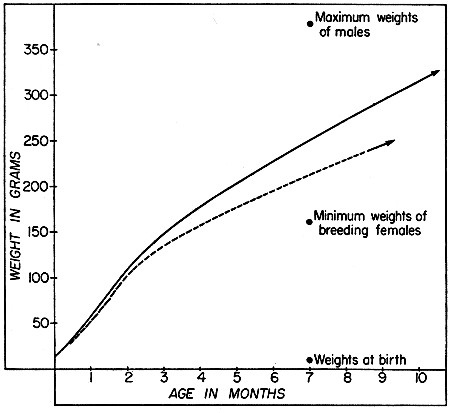
Young weighing less than 100 grams are rarely caught in live-traps. Four young, all males, first caught at an average weight of 80 grams, gained on the average, 1.39 grams per day over intervals that averaged 44 days. Six other young males first caught while in the weight range of 100 to 149 grams, were recaptured after intervals of 17 to 45 days and they had gained, on the average, .92 grams per day. The corresponding figure for four young females in the same size range was .71 grams per day. In seven young males in the weight range 150 to 250 grams, that were caught after intervals averaging 66 days, the gain in weight amounted to .83 grams per day. In seven females in the range 150 to 199 grams, gains averaged only .68 grams per day. Fully grown females that are not pregnant weigh, most typically, a little less than 250 grams while fully grown adult males average a little more than 300 grams. Growth rate and adult weight both are influenced to a large extent by season and even more by individual differences. The underlying causes are obscure in most instances, but individual rats that are still short of adult size may stop growing for periods of months, and some individuals grow much more rapidly than others. One male that weighed 108 grams when he was first caught on July 3, 1951, was estimated to have been born in early May. He was last captured 152 days later on December 2, 1951, and by then his weight was 300 grams, representing an increase of 1.2 grams per day. Another male that weighed only 75 grams when he was caught on October 8, 1950, may have been less than two months old then. By November 21, 1951, at a probable age of 15 months, he weighed 350 grams having attained almost the maximum size. Other exceptionally large individuals were known to be less than two years old, while those rats that survived longest on the study areas did not much exceed average adult size. These records seem to show that exceptionally large woodrats are usually not those of advanced age, but are individuals which have grown most rapidly through fortuitous circumstances, probably depending upon both innate and environmental factors.
None of the woodrats handled was excessively fat, nor were any emaciated. The habit of keeping on hand stores of food at all seasons perhaps obviates the necessity for storing quantities of fat. Seasonal trends in weight vary among individuals, and are not wholly consistent from year to year. Rainey found that in late autumn and winter, rats steadily gain weight reaching a peak in late February or March. However, in the winters of 1948-49 and 1949-50, Fitch found that most rats lost weight and hardly any, even those that were short of adult size, made gains.
The following records of a male born in the spring of 1949 show rapid growth and attainment of adult size in his first summer, cessation of growth during the winter, and resumption of growth, with attainment of near-maximum size the following spring.
June 16, 194996 gms.
September 26, 1949230 gms.
September 27, 1949230 gms.
October 18, 1949260 gms.
October 27, 1949250 gms.
October 29, 1949220 gms.
November 8, 1949235 gms.
November 15, 1949245 gms.
November 24, 1949240 gms.
November 26, 1949240 gms.
November 30, 1949240 gms.
December 20, 1949260 gms.
February 18, 1950230 gms.
April 5, 1950290 gms.
April 7, 1950300 gms.
October 7, 1950320 gms.
November 29, 1950345 gms.
March 23, 1951340 gms.
Another example, showing winter cessation of growth in a male at even smaller size is shown below. This was in the winter of 1950-1951.
November 9145 gms.
November 28175 gms.
November 29165 gms.
January 10180 gms.
January 11175 gms.
March 1225 gms.
March 23200 gms.