PREACHERS (continued 2)
Reading edition
Since his retirement, Dr. Abbott seems to have been none the less busy. He has been addressing large audiences continually. He has delivered twelve lectures before the Lowell Institute, Boston, has been “preacher to the University” at Yale, at Harvard, at Cornell, and elsewhere, year after year, and at other important places all over the country has been a welcome speaker and, what is better than all, he has given, “without money and without price,” an extensive course of lectures before the People’s Institute, Cooper Union, New York, where thousands have rushed to hear him and many have been obliged to turn away because the houses were filled on each occasion long before the time to begin. This great crowd contains as intelligent people as exist anywhere, most of whom have seen better days, and who show their appreciation of their opportunities by expressions of joy that can come only from true, loving hearts. The poor have the gospel preached to them by Dr. Lyman Abbott.
NEWELL DWIGHT HILLIS
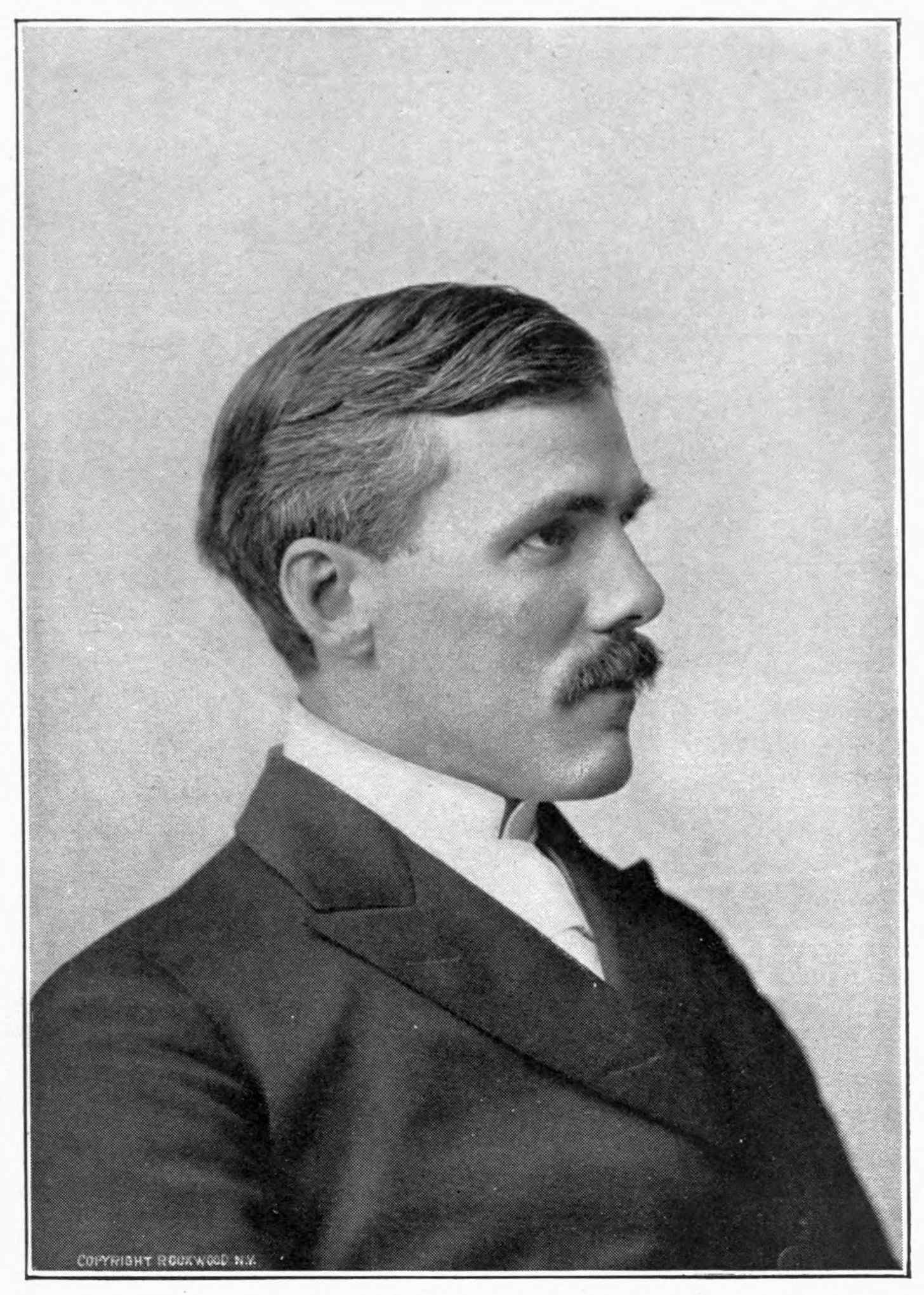
REV. NEWELL DWIGHT HILLIS, third and present pastor of Plymouth Church (A.D. 1900), is one of whom I hardly dare attempt to write or prophesy, as I fear my heart may outrun my head. He came to Plymouth Church in April, 1899, and has been preaching twice every Sunday to a congregation that tests the capacity of the famous church—the most critical and intelligent congregation to preach to that exists in Christendom—a congregation that seldom heard and never could endure a dull sermon from any of its pastors.
Twelve years ago the public believed that the work of Plymouth Church was sustained and carried on mainly through the tremendous personality of Henry Ward Beecher, and that it must greatly suffer by his death; yet Dr. Lyman Abbott surprised the religious world by infusing into the work of that church increased vigor and strength for ten years longer. Now comes this young minister from the West (more markedly Western than either of his predecessors), born in Iowa thirty-seven years ago, and takes up the work laid down by Henry Ward Beecher and Dr. Lyman Abbott, and carries it on as vigorously as ever. Truly he must be a great man to do this thing.
His preaching differs widely from any other that this generation has heard. It is nineteenth century preaching, embellished by all the intellectual appliances conceivable. I remember that while I was a printer, away back in the fifties, the New York Sun announced a cylinder press that could print two thousand papers in an hour. What a sensation in the daily newspaper world! Now, one hundred thousand are printed on one machine in that time, and the demand for an increased output has constantly kept ahead of achievement The same wonderful progress in facilities for travel, in telephony and telegraphy and other applications of electricity, multiplying the efficiency of every conceivable faculty and resource, in every line of thought and invention, has extended even to the pulpit of Dr. Hillis. Such preaching! So much preaching, and such sound and commonsense preaching! Such showers of words and finished sentences, epigrammatic outpourings of sound thoughts, quotations from the best books on all subjects, ancient and modern! His head is a storehouse of knowledge. Such an encyclopedia of words and facts it seems impossible for one man to be. There is enough in a single sermon to make four good ones for four good ministers, and then there would be enough left over to supply four more.
I sit, just one in that great crowd, and listen spellbound, for it will not do to lose one of those sparkling sentences. I want him to stop, for he has given me more than I can possibly digest in one week; but yet I want him to go on, too, for it seems wrong to break the spell of enchantment. I catch a suggestion that I might surely profit by, but I cannot remember it, there is so much else that I must hear crowding it out. I risk a turn of my head to see if all the crowd are as intensely interested as I am. None of them see me, so intent is each one to catch every word. So it goes on for an hour. When he suddenly stops with, “Let us pray,” the whole congregation gives one simultaneous long breath. It is a short prayer. Then there is a hymn by the united choir and congregation—old Plymouth congregational singing, nowhere else to be heard. The great crowd rises to go away. I look in front of me and see there this young minister, meeting and shaking hands with the crowd that is rushing forward to greet him, as placid and quiet and as gently receiving his friends as though he had but just now stepped into the hall. There is not the slightest show of fatigue. And here I discover the greatest element in all this young man’s attractiveness. Dominating all else is his personality. All who meet him and have the privilege of speaking to him and shaking his hand are his devoted, loving friends.
Such is Dr. Hillis, and this the dawn of his career. What will he be at high meridian?
THE REV. DR. JOSEPH PARKER, minister of City Temple, London, and the greatest of living pulpit orators—I do not say the greatest preacher, for I think that distinction has belonged to Plymouth Church, Brooklyn, during the past fifty-three years—has eccentricities that have retarded his friendships among strangers. Dr. Parker and his congregation in London were loyal, staunch friends of Mr. Beecher and his church during the time of the great preacher’s deepest sorrow. In 1886, while in England with Henry Ward Beecher, I engaged Dr. Parker to come over here and make a lecture tour.
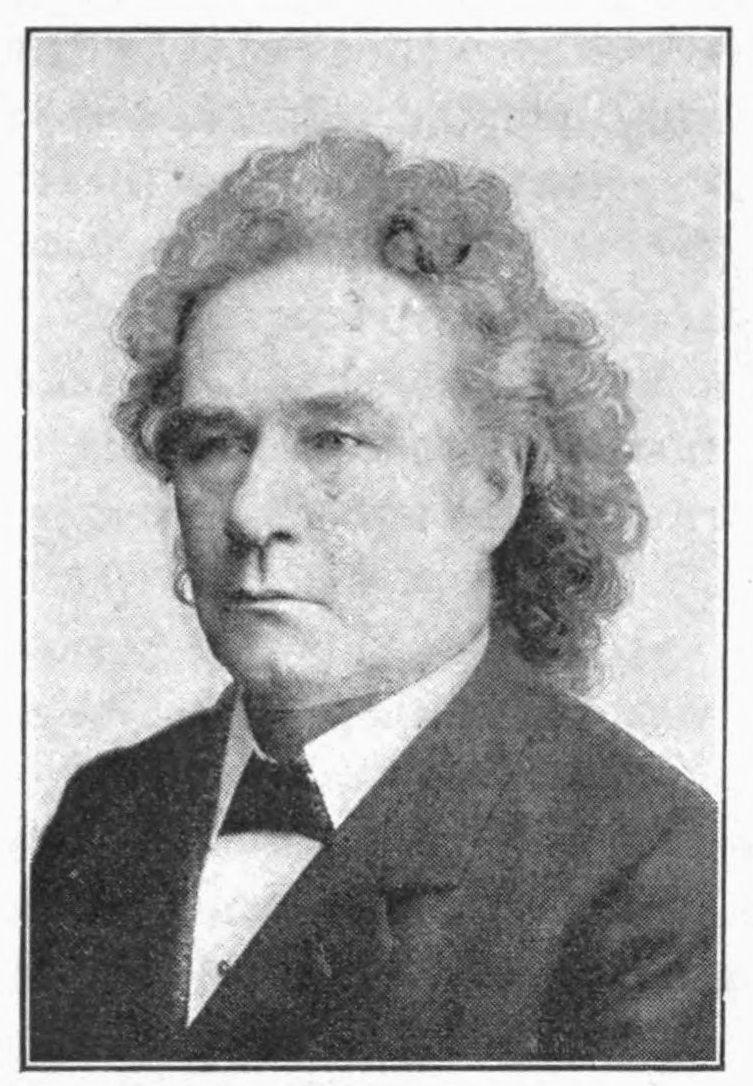
Meanwhile his friend, Mr. Beecher, died, and as Dr. Parker was coming to America, it was arranged that he should deliver a eulogy on his friend in the Academy of Music, Brooklyn. The net proceeds I was to present to the Beecher Statue Fund, then being raised. It was the Doctor’s first appearance on the tour, and a large audience of Mr. Beecher’s friends nearly filled the Academy. The net proceeds were subsequently turned over to the Statue Fund as a contribution from me.
At the end of the first week I paid Dr. Parker for five lectures, which included the Beecher eulogy. I made no objections to this. In fact, I knew I had a perfect right to do so. Nothing was said about it in settlement. The Doctor delivered five lectures and I had paid him. The net proceeds of the first lecture I had donated to the Beecher Statue Fund. I should have sent in a check as the net receipts of the lecture, with no further explanation, and then everything would have been all right and no questions asked; but as many thought the net receipts—about $1,100—looked small for so large a house, and did not take into consideration the expense of the Academy of Music rental, advertising, etc., I made a confidential statement to a member of the Statue Committee of all items, including the fee of the speaker. The secretary happened to be the very last man I should have trusted. He at once had an item for the newspapers, and rushed to the office, and that evening appeared in all the daily papers sensational headlines:
“DR. PARKER TAKES PAY FOR EULOGIZING HIS FRIEND.” “MAJOR POND WITHHOLDS MONEY BELONGING TO THE BEECHER STATUE.” “DEACON WHITE DENOUNCES THE THIEF AND ACCOMPLICE, ETC.”
It was exciting. Dr. Parker was on the road filling lecture engagements. Reporters and interviewers found him in Chicago and told him he was charged with refusing to deliver a eulogy on his friend for less than $250. Had he any money belonging to the Beecher Statue Fund? He declared he had none.
The Doctor had been lecturing to crowded houses, but now the reporters completely demoralized him. He telegraphed me that he must stop. He was ill and could not go farther. He returned to New York. Reporters haunted him there. Every interview made matters worse. He engaged passage and sailed back home in a very few days. There was due to Dr. Parker $1,100 for lectures that he had delivered. Of course I had been making money on his lectures, and to stop and cancel was a financial loss to me; but as in all contracts, “illness or unavoidable circumstances render this agreement null and void,” I could only settle with Dr. Parker by paying what was due him. I made out the statement and accompanying check for $1,100. He sent for me the day before he sailed. As I came into his dignified and sombre presence the Doctor said:
“Major Pond, I sail for my home to-morrow. My health is such that I cannot go on. The long voyages frighten me, and I am so completely collapsed when I arrive at the end of a day’s journey that I cannot address my audiences. Under these conditions, and with this certificate of one of your most eminent physicians, I am legally released from any obligation to you. You owe me $1,100 according to this statement. I propose to go away from America owing no one and having no one owe me, and you wish to pay me? You give me this check, which I suppose is good.”
Holding the check in his hand, he proceeded to tear it up. “You are an honorable man. I want you to feel welcome at all times in my house in London. As to what you owe me, I propose to give you five hundred years to pay me, and if when due you cannot meet it I will renew it five hundred years more.”
That was Dr. Parker’s eccentric business way.
Comparisons were sometimes made between Mr. Beecher and Dr. Parker from the standpoint of pulpit and church resemblances. There were, in fact, few if any points of similarity. In the Englishman’s manner there is the note of social dominance and a full gamut of ecclesiastical supremacy. Mr. Beecher had none of this, but in his relation to the public exhibited only a loving paternalism. Dr. Parker directs as well as teaches. Beecher advised and sympathized.
In public affairs, taking their different conditions into view, Dr. Joseph Parker and Henry Ward Beecher would bear a closer comparison, not at all unfavorable to Beecher’s British compeer.
Dr. Parker was Mr. Beecher’s personal friend of many years’ standing, and was his host in England on several occasions, the last being in 1886. During Beecher’s English campaign in defence of the Union cause, in 1863, Dr. Parker, then living and preaching in Manchester, was among Mr. Beecher’s firmest and most active supporters. As a speaker, Dr. Parker’s manner, though essentially dramatic, is never melodramatic like that of Dr. Talmage. His intellect, and therefore his voice and style, is that of action—insistent, believing, combative, even aggressive. His manner is more emphatic and his tones deeper than were Mr. Beecher’s, striking as the latter’s often were. The small piercing eyes and peculiar voice hold his audience strongly; even the burr in his tones helps the orator’s control. It intensifies the air of sagacity, the expression of intellectual shrewdness, as well as sincerity, which make him one of the more notable personages I have been able to bring into the arena of brain and speech which our lecture forum offers. Dr. Parker does not possess the amazing versatility which made Mr. Beecher so attractive and gave him such a mental charm, nor does he possess at all times the sunny sweetness of disposition which men loved in Mr. Beecher.
Dr. Parker’s sincerity is always as apparent as his ability of thought and expression. He gives the impression that all his preparation and power are aimed merely to give suitable expression to the opinions and convictions that are his. Words, tones, mannerisms, gestures, are all simply vehicles. It is the thought and its purpose that dominate all, and this is the secret of his strength, success, and power.
His imagery is English; his poesy belongs to their flowers and verdure; the ruggedness of his speech and manner is that of the bleak moors of the north of England. A middle-class Englishman, the Doctor is the personification of all their sterling traits and sturdy characteristics. His speech is studied, polished, finished; his gestures are trained, and all climaxes are carefully arranged. One can only imagine what might be if the speaker ever broke loose; but he never did so far as I know. Our Beecher, on the contrary, was, while obedient to the law of his themes, free as the wind, fresh as the air, full of fancy and illustration as all out of doors, alive with the human glory and glow of life, sweeping in grandeur, glowing with sunshine or melting as with the dew and the joy of the eve. All these, and the deep, lifting, surging soul of the man were in his utterances.
But when all is said for Mr. Beecher, it must not be forgotten that Dr. Parker is a power, a unique personality, gifted with a remarkable intellect and endowed with a temperamental quality which makes all characteristics effective for his work. He is a contemporary whose force and value can be measured only by a comparison with one like Mr. Beecher. And I found him an honorable man.
T. DEWITT TALMAGE
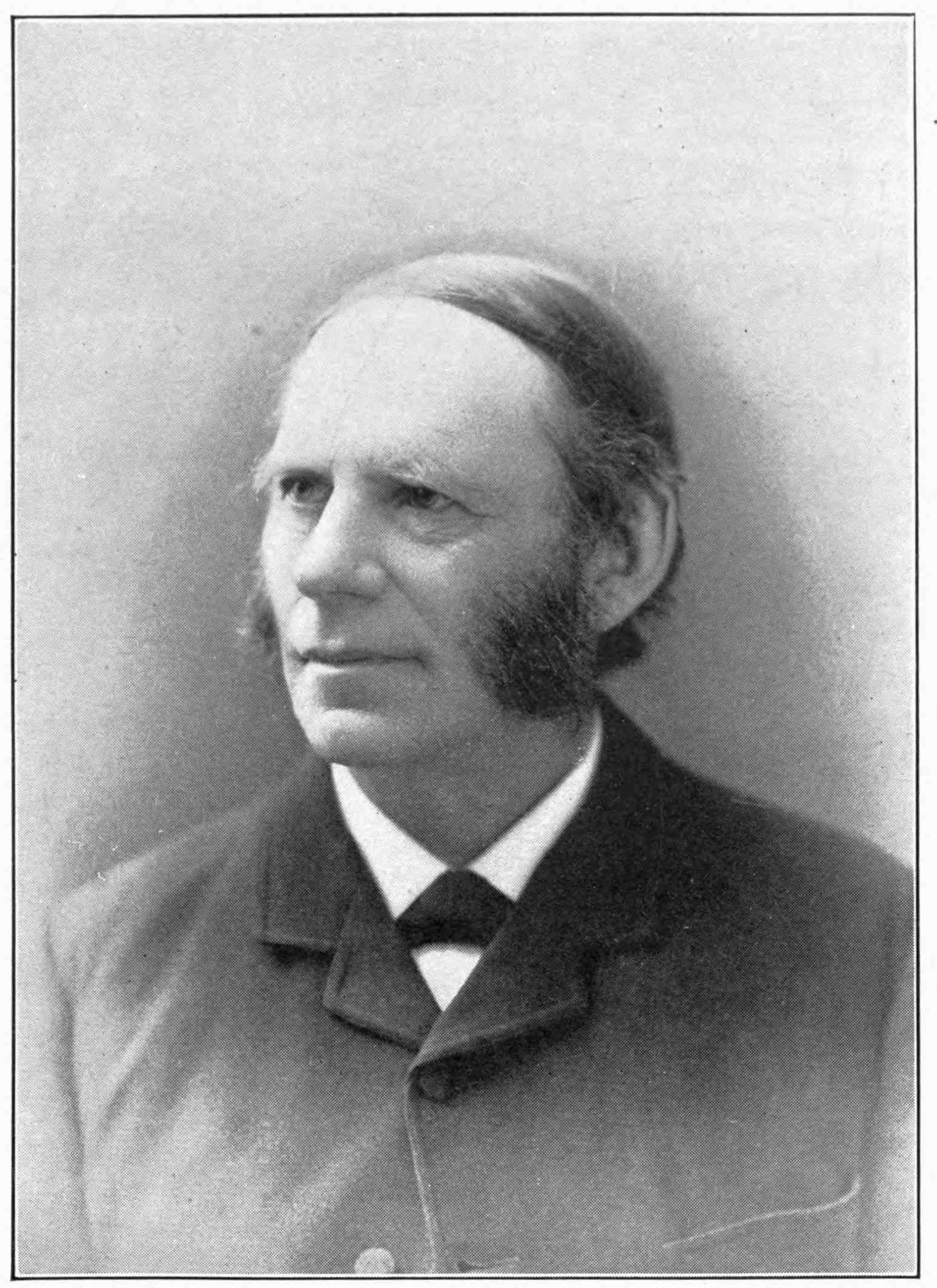
THE REV. T. DEWITT TALMAGE made a lecture tour under my management in England in the summer of 1879.
One morning in early June of that summer I was passing a news stand in front of the Astor House in New York and was attracted toward a small placard which read “Christian Herald and Signs of the Times. Circulation half a million. Only authorized publication of the Rev. Dr. Talmage’s sermons in England.” I bought the paper, and read the attractive headlines of the sermons, and a leader by its editor, the Rev. Dr. Baxter, a clergyman of the Church of England, eulogizing the great preacher, describing his popularity as a preacher and lecturer in America and his extensive influence on the religious thought of Great Britain. I was on my way to Brooklyn, and while reading the paper on the ferryboat, I concluded to call on Dr. Talmage and see if he would not like to do some lecturing in England. I found him in his study, very affable, and disposed to look favorably on a proposition to go abroad. He had never crossed the ocean, but had heard that his sermons were extensively published and read in Great Britain. In fact, the last mail had brought a letter from the general secretary of the Y. M. C. A. at Leeds asking if he would consider a proposition to deliver ten lectures under the auspices of his association in the larger cities of England, Ireland, and Scotland, offering to pay his passage and give him £10 a lecture—£100 for ten cities ($500). The Doctor asked me to write out a proposition and to call in the morning. I sat down and wrote on a sheet of paper in his study, as follows:
“Rev. T. DeWitt Talmage.
“Dear Sir: I will give you $10,000 for one hundred lectures in Great Britain this summer, paying all the travelling and hotel expenses for yourself and Mrs. Talmage from the time you sail from America until you return; settlement to be made weekly.
“Yours truly, “J. B. Pond.”
The following morning I called again at No. 1 South Oxford Street, Brooklyn, the Doctor’s home, and he read me a letter which he had prepared in duplicate:
“J. B. Pond.
Dear Sir: I will deliver one hundred lectures for you in Great Britain, beginning within three weeks, for $100 a lecture, you paying the expenses of myself, wife, and daughter from the time we sail until you return.
“Signed, “T. DeWitt Talmage.”
I mailed a note accepting his proposition, and he gave me the subjects of his lectures. He wrote a note to the secretary of the Leeds Y. M. C. A., saying that I would soon be in England, and that all arrangements must be made with me. He told me that he had already secured passage on the Gallia, to sail in about a week.
The next morning found me on board the City of Berlin bound for England for the first time. While on the steamer I wrote a letter to the editor of The Christian Herald and Signs of the Times stating that I was coming over to see if arrangements could be made for some lectures by Dr. Talmage, and that I would stop at the Westminster Palace Hotel and hoped to pay my respects to him soon after my arrival. I also wrote Mr. John Lobb, whose address Dr. Talmage had given me, editor of a new religious paper, The Christian Globe, who had also asked permission to print some of Dr. Talmage’s sermons.
Upon my arrival at the hotel in London, I found several gentlemen waiting to see me: Dr. Baxter, of The Christian Herald; John Lobb, of The Christian Globe, and Henry Thorn (brother of Charley Thorn, belonging to the family of famous actors of that name), who was secretary of the Leeds Y. M. C. A. All wanted a private interview then and there, but I was very tired. It was past midnight, and I set a time for meeting them the following morning.
The next morning the first and earliest caller was Dr. Baxter, who apologized for the unseasonableness of the hour—8 A.M. He thought he would come early, as possibly he might be of service, as his paper was going to press that day and if I wished any announcement made of Dr. Talmage’s coming, its columns were at my service. I replied that I should like to announce that the Rev. Dr. T. DeWitt Talmage would be available to lecture in Great Britain during his summer vacation. Any parties desiring to secure him might address Major J. B. Pond, Westminster Palace Hotel, London. This at once he agreed to, and then asked if I would sell him the right to place on the benches of all the halls where the Doctor lectured copies of The Christian Herald. I told him that I had no idea as to the value of such a franchise in his country, and asked him what he considered a fair price. He offered me £50 ($250). So large a sum almost stunned me. However, I showed no signs of the shock, but intimated that a Mr. Lobb, of The Christian Globe, had some proposition to make. He replied, “Yes, Mr. Lobb has a new paper, but I consider the established circulation of half a million copies of The Christian Herald a great medium for Dr. Talmage, as it prints his sermons regularly.” I asked if he paid the Doctor for his sermons. He replied that at one time he had sent him £100. There was no international copyright law then. He then said that if I would accept £100 ($500) for the right, he would give me a check then and there. I concluded to do this, and the first half hour’s business talk in London found me in possession of $500, without the slightest expense on my part. Then Dr. Baxter offered another £100 for the sole privilege of Dr. and Mrs. Talmage’s and their daughter’s photographs, to print on the first page of his paper. I told him that I was not authorized to sell the right, but as he was the Doctor’s publisher, I would risk the acceptance of his offer. As I gave Dr. Baxter a receipt for £100 for the sole right to publish these portraits in Great Britain during the tour, I at once telegraphed Dr. Talmage on board the Gallia at Queenstown what I had done, and to consider no overtures from publishers who had already gone to Queenstown to meet and to welcome him.
That afternoon Dr. Baxter brought me a copy of The Christian Herald and Signs of the Times, fresh from the press, with the little announcement that I had given him inserted at the head of the editorial column. It was not long before ministers began to call and to inquire terms and the possibility of securing a lecture. I had not even time to inquire as to the best hall for a first London appearance. Mr. Thorn, general secretary of the Leeds Y. M. C. A., had come by first train, after receiving my letter mailed at Queenstown. He wanted the first ten lectures in Great Britain, and offered me £20 each for those to be given in the largest cities. When I informed him that I paid the Doctor far more than that amount, he seemed amazed. He said that £20 was the highest fee ever paid for a lecture in England. I told him I was prepared to speculate unless I could get my price. He asked time to wait upon his associates in Exeter Hall, promising to return in an hour. On his return he said that he was authorized to pay me £50 each, for one lecture in each of the ten cities of Nottingham, Birmingham, Manchester, Liverpool, Glasgow, Leeds, Edinburgh, Newcastle-on-Tyne, Bradford, and Sheffield.
Being unacquainted with the country and its lecture system, and knowing the offer to be a substantial one, and that there was $1,200 profit in it for me, I closed the contract, fixing the first date in Nottingham on Wednesday, June 18.
I had been kept in my hotel all day by the crowd of waiting applicants for lectures without a chance even to look out on a London street. I was recognized and addressed by all visitors as Dr. Talmage’s “secretary.” Such patronage from such a class of men was indescribably overwhelming; they were all ministers from suburban churches. I saw success and profit assured in my venture already in the first twelve hours in London.
That evening I went out into the London streets for the first time in my life. “London by Gaslight” I had read about, and now the reality had suddenly burst upon me! No wonder so much has been said and written of it. I got into a hansom cab for the first time, and told my driver to show me as much of London as he could in an hour. We went over Westminster Bridge to Spurgeon’s Tabernacle. I wanted to see that famous edifice first. It was not lighted, and to me presented a dreary appearance. Then back over the bridge down Whitehall to Trafalgar Square, Picadilly Circus, and out Oxford Street to Holborn Viaduct we went. I wanted to see City Temple, where the Rev. Dr. Joseph Parker preached. That was dark, too, but oh! the flying street traffic of cabs and vehicles of all kinds!
What an amazing sight!
Many handcarts were drawn by men and women in the streets, something entirely new to me. The streets were bordered on each side with cablights—a yellow border when looking in one direction and red in the opposite. All those in motion were being driven with such rapid speed that collision and accident seemed inevitable, but I got safely back to my hotel having seen more in sixty minutes than my eyes had ever before beheld in as many months. I tried to get sleep that night, but sleep would not come. What if the Gallia should go down, or Dr. Talmage get ill, or any other accident? I was alone in London, too. I had no one to talk to. I wanted to vent my feelings and could not. It was a long night.
I was up early next morning, but there was no sign of life about the hotel or in the street. I asked the first person I met: “What is the matter—is it Sunday? Where are all the people? “He informed me that it was only 7 o’clock, and that nobody was supposed to be moving about London before 9. It seemed strange to a Yankee. I started out and got lost in Westminster Abbey. How time dragged along. I wanted breakfast, but could get nothing for an hour, so I waited and wondered.
At 8:30 I got into the dining room and gave an order for breakfast and a morning paper. While reading my paper a man in uniform, whom I found to be “boots,” approached me with a salute, asking if I were Major Pond?
“Yes,” I replied.
“The post has just brought your letters; where shall I take them, sir?”
“Bring them to me here,” I said.
“But I can’t. There are several baskets full.”
“What!” said I. “You must be mistaken. I am expecting no such mail.”
“Aren’t you Major J. B. Pond?” he again politely inquired.
“Yes; I’m that man. What’s the matter?”
“You have several hundred letters, sir. Shall I take them to your room?”
I accompanied “boots” to the office, and there, to my astonishment, were between four and five hundred letters, nearly enough to fill a barrel, and they were all addressed to me, and from every part of England, Scotland, and Ireland, and many telegrams. All were seeking to secure the Rev. Dr. Talmage for a lecture, and all from the two-line announcement in The Christian Herald and Signs of the Times the day before.
About 10 o’clock Dr. Baxter called and I showed him what I considered a sight—more letters than I could open and read in two days. He expressed no surprise, but kindly offered to put one or two stenographers and a permanent secretary at my disposal, free of any expense. About noon three young men arrived from Dr. Baxter’s with notes of introduction; these were the stenographers and a secretary at my service. “Who am I?” I thought. Such patronage and politeness I was unaccustomed to. It required change of position and getting out into the lobby for a free breath very often.
I began opening letters. They were from everywhere in the British islands, invariably addressing me in words of welcome to Dr. Talmage and his worthy secretary, and asking terms for the Doctor to preach or lecture. Many of them were admirably written, showing that their respect and welcome for Dr. Talmage knew no bounds. I wondered if it were possible that there could be so many ministers who knew and read of Dr. Talmage. I felt certain that the Doctor had no idea of his popularity over there. Callers flocked in and crowded the lobby of the hotel, waiting answers to their cards. I could not see half of them. I put them off with asking them to write and promising to answer.
I soon discovered that I had made a mistake, and that my contract with Mr. Thorn for the first ten lectures had cost me $5,000, for that was just what the Leeds Y.M.C.A. cleared on them.
I got the letters open. I also got a map of Great Britain and an “A.B.C. Guide,” which tells more of that country than all our American guides can tell in many times the space. With the aid of secretaries and map, I was soon enabled to see that I could easily fill five hundred lecture engagements, if I only had them. I replied to the smaller cities that no proposition for lectures would be considered under a guarantee of £100, and cities like London, Liverpool, Manchester, Bristol, Glasgow, Edinburgh and other large ones would require £300. I received acceptances from Belfast and Dublin of my proposition of £200; of that for £300 from Manchester, Liverpool, and Bristol. In all replies to the applications I was non-commital and careful to state that when terms were accepted and contracts forwarded and signed, there must be an accompanying deposit of twenty-five per cent. of the amount of each sum contracted for. Many correspondents were so eager to secure contracts at once that they sent checks by return mail. So many of these checks of deposit came in that it caused great embarrassment and confusion. In some instances they were sent back to me a second time, with the assurance that I was held to produce Dr. Talmage or I would have the law applied to force me. Such a scramble for an attraction I had never dreamed of before. During all the first two days at every mail “Boots” brought in armsful of letters. I decided to wait a day or two and let applications accumulate. On Dr. Baxter’s recommendation I accepted an invitation for Dr. Talmage to preach in the Islington Presbyterian Church, Colebrooke Road, Beside-the-Angel (a part of London). He was to have £10 for that. The Sunday business was not mine, and the secular days were all I cared to be interested in.
The Gallia arrived at Queenstown in due time, and I received a despatch from the Doctor that deputations were there to meet him from all parts of Great Britain and he had referred all to me. A day later I met him and Mrs. Talmage and Miss Jessie Talmage at the Northwestern Station in London, safe and well, but very tired. He said he had had a narrow escape of his life; that as soon as the steamer arrived in Queenstown delegations of ministers and deacons and secretaries of Y.M.C.A.’s had rushed aboard the boat and down to his and Mrs. Talmage’s stateroom. He heard them coming, shouting:
“Welcome, Talm-o-d-ge.” (They all give the broad sound of “o” to the middle “a” of his name.) “Welcome! Welcome! God bless you! God bless Mrs. Talm-o-d-ge. God bless Miss Talm-o-d-ge. Where is the Doctor?”
And rushing into the room they got hold of Mrs. Talmage’s arm, she being in the lower berth, and nearly jerked it out of the socket before they knew or cared to know their mistake. They got hold of the Doctor and pulled him out of his room before they let go, and shook his hands, and pulled his shirt nearly off, shouting, “Welcome! God bless you,” and kept it up all day on the steamer and on the cars to London, arriving at the Westminster Palace Hotel about 6 P.M., where Dr. Baxter was in waiting. Arrangements had been made for dinner and a reception at the Doctor’s house that evening, so our party was obliged to hurry and dress. We drove in hansoms about four miles. Dr. Baxter’s father, a noted barrister, seemed to be the head of the household. Ministers and clergymen were assembled to do the guests honor. Lord Shaftsbury was the first lord I ever recalled seeing. Dinner was at a long table, with not much sociability; all wore serious, pious expressions. I think I never saw Talmage so uncomfortable. He asked the blessing, and after dinner in the parlors came a season of prayer. The circle of kneeling visitors was to me as tiresome as the old frontier country prayer meetings of my boyhood days, and there was less feeling in them. Each prayed in his turn, and thus for two long hours there was a contest of appeals to the throne for God’s servant, “Talm-o-d-ge.” It was twelve o’clock when we got into our cabs to make our way back to our hotel. It was the first chance I had to speak to Talmage alone; but as it was Saturday night, and he was to preach the next afternoon in the Islington Presbyterian Church, he retired at once.
I did not see him the next morning, as he was preparing for the afternoon sermon. An hour’s drive, with Dr. Baxter as pilot, and Dr. and Mrs. Talmage in an open carriage, Miss Jessie and I following in a second carriage, brought us to a point where we could look across an open space to a hillside where stood a church. That hillside was black with thousands of people, they all wear black on Sunday there, and as we came in sight the crowd began to move, and soon I saw we were being surrounded by what seemed an impassable mob. Coming nearer, Talmage was recognized, and a shout arose:
“Talm-o-d-ge! Talm-o-d-ge! God bless Talm-o-d-ge!” and the crowd came rushing on. Some jumped on the carriage and grabbed his hands and hung on to them; some got hold of Mrs. Talmage, and some one got hold of Talmage’s coat and succeeded in tearing off a piece of his coat-tail. “I want this for a souvenir,” shouted that maniac.
They then unhooked the horses, tied a long rope to the carriage, and hauled the great divine through a jam of humanity, and amid uproars and noises that Niagara Falls could hardly have drowned. Finally the preacher was lifted from the carriage, carried bodily over the heads of the mob, and thrust into the crowded church. After he was out of sight, the crowd gave way, and not long afterward a committee succeeded in getting Mrs. Talmage into a side door, but Miss Jessie and I preferred to wait outside in our carriage until after the service. What took place inside can be inferred from the following item, which appeared in The Dally News next day (June 16th):
“The public announcement that the Rev. Dr. Talmage, of Brooklyn, U. S., would preach attracted yesterday evening a very large number of persons to the outside at least of the Islington Presbyterian Church, of which Dr. Thain Davidson is the minister. The seat-holders and a few others having received tickets were enabled to get in sideways, and between them they filled about all the seats almost two hours before the service commenced. Thousands of unprivileged persons either went away altogether or remained to take their chances among the public rush at a quarter past six, the services commencing at half past. The church, which seats about seven hundred and fifty persons, then quickly became crammed, amid cries and shrieks here and there for help in consequence of the pressure, and a few windows had to be broken to increase the ventilation. Many persons were reported injured.”
The same performance was gone through after service except that the horses were allowed to be hitched back on the carriage. The mob followed for at least half a mile, shouting praises for “Talmodge” as we drove away. Dr. Baxter left us at the hotel and for the first time our party was left alone free from visitors. The Doctor was very tired. At dinner both he and Mrs. Talmage could talk of nothing but this “overwhelmingly cordial greeting to an American minister.” “Major, did you ever hear of such greeting to a minister?” I was asked, and I certainly never had.
“This is going to be awful. How can I ever live through a succession of ovations like that?” he said to all of us.
“DeWitt, you never can endure it,” said Mrs. Talmage; “I am sure you cannot.”
This was the burden of the conversation at dinner. When I retired to the reading room the Doctor soon followed me, to remark:
“Major Pond, was ever such an ovation given to an American minister in London before?”
“Never,” said I instantly and emphatically.
“Major, what would the American papers say of this if they knew the facts? Hadn’t some account of this tremendous reception better be cabled to the Associated Press?”
The next morning the following despatch appeared in the New York Herald:
“London, June 15, 1879.
“Herald, New York:
“Rev. T. DeWitt Talmage preached to-day at the Islington Presbyterian Church, Colebrooke Road, to an enormous congregation. Much curiosity was evinced by the people to see the famous American preacher; a dense crowd blockaded the streets leading to the church. The enthusiasm was immense. Half a mile before the Presbyterian church was reached the carriage of the reverend gentleman was lifted from the ground and carried bodily to the church. It was one of the most tremendous ovations ever paid to an American minister in London.”
That Sunday evening Dr. Talmage and I walked out and had our first private business talk. We crossed the street to Westminster Abbey and walked all around it, discussing the wonders of the historic Abbey for some time, when the Doctor suddenly changed the subject.
“Wasn’t that the most tremendous, overwhelming reception that a minister ever had?” he said to me. “This excitement is going to use me all up. I never can stand it. What have you done?”
I replied that I had fixed my first ten nights with the Leeds Y. M. C. A., all in the large cities.
“I cannot stand it. I am sure it will break me down. How much am I to get out of it?”
I replied, “You get your $100 a night and your expenses; isn’t that our contract?”
“Oh, I can’t do that. It would be the ruin of my health; and you would be getting rich and I have nothing.”
“Wait, my dear Dr. Talmage, and see how it starts. I came here under terms of a contract with you, and now you don’t seem to consider it binding.”
“I can’t do it. I can’t stand it, and must give the whole thing up unless I can have at least $250 a lecture.”
“That’s all I get for the first ten lectures, and by that time we don’t know whether they will be worth any more. Let’s try under our contract and see if it is as great as your prediction. I am ready to do the fair thing. I certainly will make no new contract until we see if the one in existence is any good.”
“Very well; stop it all. I will take Mrs. Talmage and Jessie and go to Paris and get rest, which I need and must have.”
So we sat on the steps of Westminster Abbey until 2 o’clock Monday morning and the Doctor was booked to lecture in Nottingham that night.
When we separated he asked me what hour he had better start for Nottingham, if he went. I told him 9:30. “I’ll see you at breakfast at 8 and tell you finally,” he said.
When he and Mrs. Talmage came down to breakfast in their travelling clothes I knew he was going to Nottingham. I felt so, any way. Applications were pouring in, and I saw that I could obtain certainties of from £100 to £200 a lecture after the ten Leeds lectures had been given, so I was prepared to make concessions to the Doctor, if he showed any disposition to be fair. As we sat down to the table the Doctor handed me a note written by his own hand on a narrow strip of paper. It read as follows:
“Pay me $200 a lecture and my expenses, not those of my family, and I will go on for one hundred lectures. Put this note in your pocket.” I read and replied:
“All right, Dr. Talmage. I accept. Mrs. Talmage, do you know about this?”
“Yes, Major Pond. I am so glad you and the Doctor have come to an agreement.”
So we started for Nottingham. Mr. Thorn met us at the station there and drove the Talmages to some gentleman’s house where, they were entertained. Mr. Thorn returned and dined with me at my hotel. I asked him how the bookings were. He replied that everything was full. I asked if he sold reserved seats. He said:
“No; the people had filled the house early that afternoon and not another person could be got in. He and his committee had been all the afternoon collecting the entrance fee from the crowd now in their seats. He was ready for Dr. Talmage to go on at any time.”
When he went to the hall there were thousands of the same human strata that had been seen the Sunday before, waiting to set eyes on Dr. Talmage, and they were enthusiastic to the verge of insanity. The police had protected a back entrance, so that the chairman, mayor, and speaker could get in. I was obliged to stand until I could bear it no longer, and went out.
I arranged with Thorn to pay me for the two following lectures in Birmingham and Manchester, so I could return to London and proceed to fill the balance of the time, and he to look after the welfare of the “star” while I agreed to join them on the following Saturday in Liverpool. At my London hotel I found great stacks of letters, but as my time and route were all mapped out, they did not trouble me. Still all the letters must be opened in order to know which of them most needed attention. There were many applications with accompanying checks for from £20 to £40. It seemed incredible that there could be such a craze over a minister, and yet that it caused no comment whatever in the daily newspapers or the secular press in any way. I expected to read blazing headlines of the first great occasion in the London morning papers, but there was not a word. The London secular press seldom mentions religious doings.
I then set to work to finish booking the time. There was much to do in arranging ninety one-night stands for a great attraction, and surely I had the greatest one I had ever known. I was working into midnight when a telegram came up. I would not have opened it had it been a seasonable hour. It was from the Doctor, and read:
“Birmingham, June 19, 1879. “J. B. Pond, Westminster Palace Hotel, London.
“Stop everything. To-night surpasses all.
“Signed, “T. DeWitt Talmage.”
He was booked for Manchester the following evening, and a great audience was expected. I replied:
“Must keep the Manchester engagement. Will meet you there to-morrow.”
So I left London and arrived in Manchester about 5 o’clock the next afternoon. Passing the City Hall and public buildings my “cabby” drove into a dense crowd of thousands massed together. I never saw the like. I asked my driver what that crowd meant. He said a Yankee minister was to lecture there by the name of “Talm-o-d-ge.” I asked the name of the building. He said it was Free Trade Hall.
I discharged the cab and tried to get into the outskirts of the crowd. I had a small handbag. The crowd was not noisy, but simply made a rush for the door, which had been burst open, and filled the hall with all that could get in. Every now and then I could hear some one say, “I will see Talm-o-d-ge,” and then he would make a break, only to be crowded back. I slipped up to a policeman and asked what this all meant. He told me the same story, of a Yankee minister that was to lecture. He had never before heard of “Talm-o-d-ge,” but the crowd evidently had. I said to him, so as not to be overheard: “I am a Yankee. I am Dr. Talmage’s secretary.” He didn’t even wait to look at me, but with both hands in the air he shouted:
“This is Dr. Talm-o-d-ge’s secretary! Here! Here! Dr. Talin-o-d-ge’s secretary! Here! Here! “ Just then the crowd within hearing turned their eyes on me and made a rush, all shouting, “Dr. Talm-o-d-ge’s secretary! Here! Here!”
The next thing I knew I was being carried above the heads of that crowd and shot along head first. So I was carried over and on these heads, until I was nearly in the centre of great Free Trade Hall. How they found a place for my feet I don’t know. They passed me on by their hands until there was a place to alight. “Dr. Talm-o-d-ge’s secretary,” was the cry. The crowd was orderly and numbered about six thousand, or as many as could possibly get inside of Free Trade Hall, which is one of the greatest auditoriums in the world. They were singing “Hold the Fort,” while the Y. M. C. A. committee, in their shirt sleeves, were collecting the admission fees, ranging from one shilling to half a crown. No objections were made to paying, for everybody expected to do that, but the rush of thousands was more than the hall could accommodate.
I remained there until Dr. Talmage and Mr. Lee, his host, who was to preside, and family arrived. I heard the lecture, and it was the first one of Dr. Talmage’s that I ever heard through. The people cheered as he came in, and it seemed for minutes as though the roof would be fairly raised. I never heard such cheering. After the lecture it was midnight before the crowd would let up on shaking hands and becoming enthusiastic over the Doctor. It was a scene that could not be produced in America.
The Doctor saw me after the lecture and asked where I was stopping. I told him at the Queen’s. He said he was stopping with Mr. William Lee, a distinguished resident of Manchester, and that he and Mrs. Talmage would call in the morning. I went back to my hotel. About 11 o’clock the next morning Dr. and Mrs. Talmage arrived and came up to my room. There was very little ceremony. The Doctor struck right out from the shoulder. It was business!
“You have got to pay me $350 a lecture or I go home from here. I cannot stand this tremendous succession of ovations.”
“If you can do it for $350, can’t you stand the same thing for the price agreed upon in London? I am paying you twice the amount of our original agreement,” I said.
“I am killing myself and making you or somebody else rich. I get nothing for it. Say yes or no.” He was positive but good natured. I didn’t hurry to reply, but related my experience of being suspended over the heads of that multitude for half an hour yesterday, remarking that it seemed days.
Mrs. Talmage, always a loyal wife, would often remind her husband that it was no use attempting to go on. He could not stand it. I did not get angry. I really enjoyed it, only there were people waiting outside to see me. Dr. Baxter wanted to buy a return date in Manchester, and did buy it then and there while the Talmages waited. In a side room he gave me his check for £300, and I signed a contract. I returned and invited Dr. and Mrs. Talmage to lunch. They accepted. The conversation between them was as to what steamers sailed first and which was the most desirable route. I heard it all. This was an open date, Saturday. He was to preach in Manchester the following Sunday, so I did not hurry.
I felt sure the tour would pay if the people did not get disgusted. They had expected a great Calvinistic divine to give them religious lectures. Many made unkind expressions at his provoking so much laughter and at the secular tendency of his address. I felt a little uncertain, but finally said: “Dr. Talmage, I am getting $250 each for this series of ten lectures, as you know. Thorn is making the fortune—not I. I am getting tired of this, but I will give you your $250 each for the one hundred lectures; no more.” He said nothing, but waited. Finally getting up, he said, “Well, that’s the best you will do, is it?”
“Yes, sir; and I may change my mind in ten minutes. If you do this, I will hire an English lawyer to draw up papers that will hold.”
“All right, then, make your contract and I will sign it.”
This had been a long siege. I went out, and by direction of the hotel proprietor found a solicitor, who came to my room, got all the details, and went back. He must have worked all night on the document. It was a remarkable paper, drawn up in the English form, with many pages of “whereases,” “said party,” etc., having a long ribbon and large red wax seal about the size of a Boston cracker attached. The party of the second part (Talmage) after hearing it read, signed it, as I also did. When all was over, the Doctor said very pleasantly that he was glad that there was an understanding at last.
We went together to Liverpool, Glasgow, and other cities in Scotland. Such crowds! He missed the train for Perth. I had told him that he must take a certain train in order to be on time. A party had taken them to the Trossachs, and when the hour arrived to begin the lecture in Perth, a telegram came from the Doctor stating that he had missed the train and would arrive about 10. The audience, which congested the hall, seemed quite patient for two hours. The time was late and the curfew bell said 11 o’clock. Many demanded their money back, and got it to the amount of £40; but still there was a large audience waiting, and the Doctor got through a little after midnight. The following Sunday we spent in Glasgow. The Doctor preached in the morning and in the afternoon we settled up.
The tenth lecture of the tour concluded my contract with the Leeds Y. M. C. A. at $250 a lecture. On this ten lectures I had made nothing, but during that time I had booked the balance of the tour of ninety more lectures at a very handsome profit, the lowest fee being £80 a lecture, and in some instances £250. The final lecture in England was sold in Liverpool to the Y. M. C. A. for £400, to be September 11. Eleven weeks booked for five lectures a week, twenty-five per cent. of the guarantees paid in advance and in my bank in London. Good prospects indeed.
Secretary Thorn, of the Leeds Y. M. C. A., who had managed the first ten lectures, presided at a dinner given to Dr. Talmage in Leeds three weeks later. In his official report, which he read on that occasion, he stated that the Association had netted about £1,000 ($5,000). This was $500 profit on each lecture. At the low prices paid for admission to lectures in Great Britain, 1s, 2s 6d to 3s 6d, it shows that the crowds must have been enormous. As the lectures were all sold to local committees in the towns yet to be visited, I felt certain that in most cases these parties had pretty heavy responsibility, especially as the religious press was complaining of the lack of piety in the Doctor’s discourses. His lecture on “The Bright Side of Things” had provoked laughter where many had expected sacred things. I feared a reaction, for in all the crowds I heard expressions of bitter disappointment.
From Leeds, after two lectures in near cities, we came to London. Dr. Baxter, of The Christian Herald and Signs of the Times, was to pay me £200 for the first London lecture in Exeter Hall, which was crowded. Dr. Talinage had already preached in the same hall, with the usual large gathering of disappointed outsiders.
When we arrived in London I found there was quite a feeling against Dr. Talmage, aroused by the Rev. Dr. Joseph Parker on account of the questionable verdict in his ecclesiastical trial by the New York Presbytery just before he left. But the Rev. Charles Wood, a young Presbyterian minister visiting London at that time, now in Philadelphia, succeeded in bringing Dr. Parker around, and Talmage was invited to preach in City Temple, but had not the open date and had to forego the honor. However, the ladies of both sides exchanged friendly calls, and all went well.
After our return to London and the Exeter Hall lecture the business from this time began to decline. It was difficult in many instances to collect the guarantees, and I often felt like a thief when accepting money that responsible parties had guaranteed with a reasonable assurance that it would prove profitable. Then again, others had persisted in having dates, and threatened the law if I did not make the contract and accept the twenty-five per cent. advance payment. Some of these I enjoyed holding to the terms they had almost compelled me to make.
Several causes contributed to the revulsion of public opinion and the depreciation of the Doctor’s value. Chief among these was the disappointment in his religious zeal. These religious “lower” classes, whose only literature is the penny religious weekly, had pictured him as an ideal man of God. With his marvellous insight into the human heart of the nineteenth century, he had, through his sermons, touched chords beyond the reach of any other man of his time. He had shown that he knew the burdens, the temptations, the bitternesses of men and women who gain their daily bread only by a struggle. With this master key he had unlocked their hearts, and they sought his presence very much in the same spirit that the multitude followed Christ into the wilderness. I believe I witnessed marvellous, unmatched scenes in old England that summer. Such tribute as was laid at Talmage’s feet was never paid to any other religious leader, and when these people came to find the lectures more of a secular, not religious character their disappointment knew no bounds. His final lecture in Liverpool was a dismal failure. Four responsible men had signed the contract for $2,000. I settled for $500, and if Dr. Talmage had not refunded that amount to the Y. M. C. A. committee I believe he would have been mobbed. The crowd gathered outside the Northwestern Hotel, calling for Talmage, and it seemed as though every vituperative adjective the English language possesses was applied to him by these religious fanatics. He had made the feeling. If he had only emulated his own teachings instead of using an old American lyceum lecture, he might have had a triumphant home-coming instead of the one he did have; but he seemed to disregard in every way the wishes of the people who paid to see or hear him. The result to the management was simply a loss of the time. The Doctor got all that was made on the tour. Instead of one hundred lectures the tour was shortened to seventy, for which Dr. Talmage received $17,500, the management “his labor for his pains.” Had Dr. Talmage kept his original agreement he would have netted $7,000, but by his “eccentricity” he made $10,500 more than he expected when he started on the journey.
I have made very few engagements for Dr. Talmage since his memorable season.
Dr. Talmage’s sermons have been more widely read and circulated during the past thirty years than those of any other minister that has lived in his time. The Christian Herald and Signs of the Times, of London, has sent out from five hundred thousand to nearly a million a week since 1870. Next to The Christian World it is the greatest religious newspaper property in Great Britain. The price is a penny, and it sells almost wholly to the lower classes, who depend upon it for their only reading, both religious and secular. It is printed in muddy black with cheap, coarse zinc cuts. It now has an American edition, edited ostensibly by Dr. Talmage, with a circulation equal, if not greater, than that in Great Britain. This is a reproduction of the English edition, but on much finer paper and beautifully printed—an essential feature for a religious household paper in America, no matter how remote or primitive the fireside it reaches. This American edition prints one of Dr. Talmage’s sermons every week. It is most skillfully managed and considered a great property. It is seldom seen in the public reading rooms or library, or among the upper middle class homes, but drive out into the country among the farmers and stop at a farmhouse for a drink of water, and while you wait the first object to attract your attention is a copy of The Christian Herald and Signs of the Times. From the Atlantic to the Pacific this religious paper has found its way into the houses of the poor religious classes, and, of course, must do incalculable good.
Another means of disseminating Dr. Talmage’s sermons for the past two decades has been the “patent insides” of country newspapers. Over six thousand different weekly papers by this method send out his weekly sermon, and while the doctor had a pulpit his sermon appeared in one of the Monday morning papers in every large city.
“Dr. Talmage’s Sermon in the Great Tabernacle yesterday. By special telegraph to The Courier-Journal,” etc.
Dr. Talmage has the greatest congregation of readers of his sermons of any man living, and this is his means of advertising. To gather up a large audience for him in the western country all that is needed is a railroad junction where cars can be run from all directions, the erection of a temporary amphitheatre, and the announcement that Dr. Talmage is to preach, and all the facilities for bringing out crowds will be tested to their fullest capacity. Under these conditions the doctor is the greatest one-man attraction in America, and what cares he for such comment as the following from The Congregationalist, the New England organ of that denomination:
“If in humility it may be done without violence to the feelings of our Presbyterian brethren—whose particular funeral it is—we feel called upon to inquire if it be not nearly time for the reign of ordinary propriety to set in as to the Talmage business. It was bad enough to have a lot of old sermons weekly stereotyped through the land on Monday mornings during his late tour to the Holy Land, as having been delivered by him on the previous day on Mars Hill and elsewhere; and to have accounts so gorgeous as to be manifestly fictitious in their coloring, sent abroad as the great man’s intercourse by the way with kindred great men. But now that this dazzling pulpit light is once more shining and shimmering at home, we think the world at large could manage, without overwhelming grief, to dispense with Mr. Louis Klopsch’s Boswellian columns, detailing the amazing Talmage experiences, and recounting the tremendous Talmage remarks at various places along that route, which has been beatified and forevermore advertised as that of his travels.”
The Toledo Blade, one of the papers which published Talmage’s sermons during this Palestine tour, came out with a frank explanation that none of them were cabled, and that they were all prepared before the doctor left home. The Blade further made matters interesting by admissions that some of them, including the one credited to Mars Hill, were never delivered at all.
What cares Dr. Talmage for all this? He has his public, that he has educated, adamantine in its faith in him. He is said to be the richest minister in the world, and he has earned it all himself.
CHARLES H. SPURGEON was, to me, a name, next to that of Beecher, to conjure with. When I arrived in London for the first time, June 3, 1879, and started out to see the sights, the first place I instructed my “cabby” to drive to was Spurgeon’s Tabernacle.
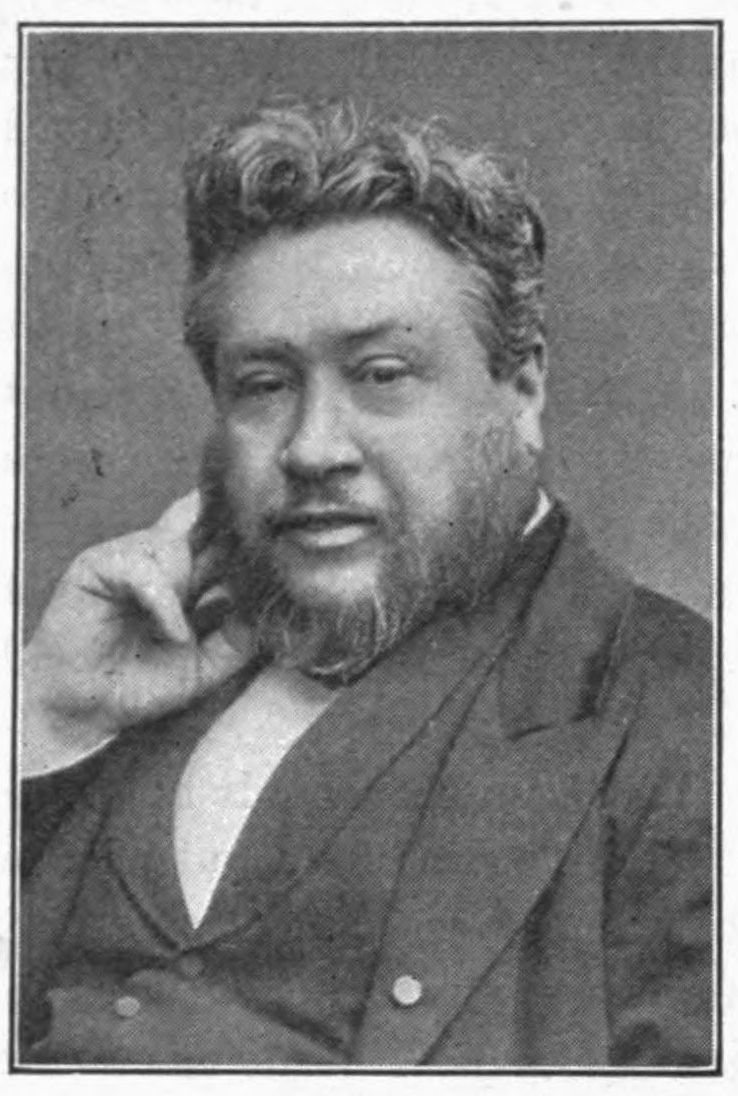
It was about sunset when I first set eyes on the famous building. I know I felt a disappointment. It was not what I expected to see. The surroundings were not attractive. The high iron gates suggested more a prison than an invitation to go up to the house of the Lord. I made no stop, but directed my driver to show me the City Temple, on Holburn Viaduct, where the great Dr. Joseph Parker preached. It was in the gloaming that I first saw this famous “church.” It was not as large as I expected. In most of our cities it would be considered a very ordinary, comfortable house of worship.
“Do you call that a large church?” I asked the cabby.
“It isn’t a church, sir; it’s a chapel. There’s a church,” he said, pointing to a still smaller edifice on the adjoining corner. “That’s where the lord mayor worships.” I learned then and there that only the Church of England has the right to the name of church for their places of worship (all others are chapels), and that there are no church bells or chimes except in the Established Church. I drove back through Oxford Street and Picadilly Circus to the Westminster Palace Hotel.
On returning to my hotel I sat down and addressed the following letter to Mr. Spurgeon:
“Westminster Palace Hotel, June 3, 1879.
“Rev. C. H. Spurgeon, Nightingale Lane.
“My Dear Sir: I am in London for the first time in my life and have set my eyes on the great Tabernacle, which was the first object of interest I wished to visit, as your name and your church have been almost a part of my life for a number of years, being a fellow-Baptist.
“Inasmuch as you thought enough of a letter that I wrote you to publish it in one of your books, I write to ask if I could have the pleasure of an interview with you at your convenience. Meanwhile, if a note from you would facilitate my getting a comfortable seat to hear you next Sabbath, I would very much appreciate it.
“I am, yours very truly, “J. B. Pond.”
The next morning I received the following letter from Mr. Spurgeon:
“Nightingale Lane, Balham, Surrey, June 5, 1879.
“Dear Sir: It will only be a waste of time for you to see me, as I am not at all in your line, and I am happy to enclose your cards.
“Yours truly, “C. H. Spurgeon.”
“Major J. B. Pond, Westminster Palace Hotel.”
There were two printed admission tickets to the Tabernacle. When Sunday morning arrived, in company with a friend, I went early to the Tabernacle in hopes of getting a comfortable seat. There was a great throng on the steps, hundreds of people having already congregated there while waiting for the doors to open. I noticed near the church an open gate, through which people were passing to a side door. I tried to pass in, but was stopped by a large, somewhat plain spoken, typical Englishman, who told me that my tickets were good when the front doors were opened.
I said, “Why can I not pass in here the same as others do?”
“Oh, you can by dropping something in the box.”
I then saw that people were dropping pieces of silver into the box and passing in. I said to him, “How much am I expected to drop in?”
He replied, “Anything you please. A half crown is the usual amount.”
So dropping in two half crowns ($1.25) I was enabled to pass in at this side door of the great Tabernacle, where a gentlemanly usher gave our party good seats. Already several hundred people had entered in this way, and before the doors were open the lower floor was about filled with these contributors.
When the main doors were thrown open, there was a general rush of men and women in all directions, carrying umbrellas and jumping over the pews to get to the very nearest available seats, and almost immediately every seat in the church was occupied and great crowds were standing against the wall in the back galleries. I think I never witnessed such a squabble of people rushing into a building. They created a dust that was almost suffocating.
Very soon the great preacher appeared on a plain platform with no rostrum or pulpit except a small table at his side, where lay a hymn book and a Bible. Mr. Spurgeon immediately pronounced the invocation and then read a hymn, which the congregation sang without organ accompaniment or any other music except their voices. As the congregation rose, clouds of dust seemed to rise with it, so that it was almost impossible to distinguish the people in the top gallery.
It was a remarkable scene—a very devout crowd of worshippers who entered into the spirit of the occasion and did worship the Lord and Mr. Spurgeon with tremendous intensity.
I saw a number of Plymouth Church people near where I sat. I remember asking one or two of them how this compared with Plymouth Church. They all expressed disappointment. For intelligence, the congregation was not to be compared with Plymouth; it was another class of people, of a much lower order than I supposed could possibly form the congregation to which Mr. Spurgeon had preached so many years.
Passing out through the crowd I shook hands with Mr. Spurgeon. He didn’t recognize me. The following day I wrote him that before leaving England I should very much like to pay my respects to the man I had read and admired many years, making no reference whatever to my business. In reply I received the following strange letter, which showed that the great preacher really impugned my motives and thought I was bound to secure him for a lecture tour in America:
“Nightingale Lane, Balham, Surrey, June 6, 1879.
“Dear Sir: I am not at all afraid of anything you could say by way of temptation to preach or lecture for money, for the whole of the United States in bullion would not lead me to deliver one such lecture. It would only waste your time and mine for you to see me, though I feel sure you are one of the pleasantest men on earth. Your good-natured pertinacity is so admirable that I trust you will not waste it upon an impossible object, but be content to have my acknowledgment that if success could have been achieved, you would have achieved it.
“Yours very truly, “C. H. Spurgeon. “Major J. B. Pond, Westminster Palace Hotel.”
I returned home without the sight.
I revisited England in 1886 with the Rev. Henry Ward Beecher. Remembering the cordial letter Mr. Spurgeon had written me on my previous visit, I thought it no more than proper to drop him a line, stating that I was again in London and asking if he was of the same opinion still, and disinclined to allow me the privilege of a call to pay my respects, stating that I was visiting England with the Rev. Henry Ward Beecher. I didn’t even suggest that Mr. Beecher would like to meet him, as that was not a part of my interests. I received the following letter in reply:
“Westwood, Beulah Hill, Upper Norwood, July 13, 1886.
“Dear Sir: I have, in as plain a manner as possible, on former occasions declined to make your acquaintance, and I beg with all courtesy and decision to do the same again. I know your business, and I have no wish to enter upon it further. I can communicate with Mr. Beecher myself should I wish to do so. At present I have no object for which to seek an interview.
“Yours truly, “C. H. Spurgeon.”
The morning I received the above letter from Mr. Spurgeon I breakfasted with Dr. and Mrs. Parker at their home in Daleham Gardens, where a number of distinguished ministers and friends had been invited to meet Mr. and Mrs. Beecher. There were present Mr. James Clarke, editor of The Christian World; the Rev. Dr. Simon, pastor of Westminster Chapel; the Rev. Dr. Henry Allon, Union Chapel, Islington; and the Rev. Dr. Clifford, Westbourne Park Chapel.
During the conversation some of the ministers present were of the opinion that Mr. Beecher should deliver his last lecture in London in the great Tabernacle, as it was the most appropriate auditorium in London and could accommodate the largest number of people. I said that I thought it impossible for Mr. Beecher to preach in the Tabernacle, as I did not believe that Mr. Spurgeon was friendly to Mr. Beecher. This seemed to surprise Dr. Parker, as well as the other representative ministers present. Dr. Parker suggested that Dr. Allon and Mr. Spurgeon were the greatest of friends, and he was sure that Mr. Spurgeon would be delighted to extend the invitation to Mr. Beecher; and Dr. Allon was of the same opinion. I remember that he said, “ Most assuredly Mr. Spurgeon would expect to invite Mr. Beecher to occupy the Tabernacle.” I handed to Mr. Beecher Spurgeon’s letter, which I had just received. As he read, I noticed a smile come on his face. He passed the letter to Dr. Parker, who also read it, and then to Dr. Allon, who, I think, passed it back to me. The enthusiasm for Mr. Spurgeon and the Tabernacle suddenly ceased.
On the occasion of Mr. Beecher’s first sermon in London, July 4, the congregation was admitted by ticket—the church members first and then the public, to the capacity of the auditorium. Hundreds, and I might say thousands, came who had to be turned away. As the congregation had to be admitted by ticket, and as many were unable to secure these, a rumor easily started in one of the religious papers that Mr. Beecher was preaching the Gospel for money, and that the tickets to hear him preach were sold at the doors of the house of the Lord. The secular press took it up. Newspaper correspondents cabled it to their representative journals across the Atlantic. London Truth enlarged upon it, and Labouchere’s letter to The New York Herald repeated it.
One of the first comments on the story was in The Baptist, a paper of which Mr. Spurgeon was supposed to be one of the editorial writers—an article which found a place in nearly all of the leading papers where Mr. Beecher was booked to lecture or preach. So I wrote the following letter to that paper, which was published without comment:
CHARGING TO HEAR THE GOSPEL.
“31 Montague St., London, W. C., July 25, 1886.
“To the Editor of The Baptist.
“Dear Sir: May I be allowed to correct a statement made in your excellent paper of the 23d inst. concerning Mr. Beecher and his lectures and sermons?
“Mr. Beecher does not charge for preaching outside his own pulpit in Plymouth Church, Brooklyn. I have managed all his lecture tours for the past eleven years, and I have always arranged that he should preach on the Sabbath while absent from home, and that under no circumstances was there to be a charge of any kind made for hearing him preach the Gospel. True, when in other cities, in order to protect pew-holders and members of the regular congregations, it has been necessary to issue tickets of admission to the side doors before the house was opened to the general public.
“Mr. Beecher is a lecturer as well as preacher. He delivers on an average one hundred and fifty lectures a year, and has during some seasons lectured upward of two hundred times, besides preaching every Sabbath. He lectures because he finds it profitable both to himself and to those who are glad to pay their money to hear him; but never has he received a penny for preaching outside his own pulpit; and if London were bullion, and he could have it for preaching one sermon here, it would not even tempt him.
“Mr. Beecher receives from me the same pay per lecture that I give him in America. My business is furnishing lectures and high-class entertainments to lyceums and lecture associations in America. I supply lecture and musical societies throughout the United States with the best talent to be had. It is part of the American system of education, and the Americans are educated to it, and generally prefer it to trashy shows. They expect great men to address them; and when Dean Stanley, Professor Huxley, and Herbert Spencer came to America, I had hundreds of applications from all parts of the land asking their terms and approximate date; and when I replied that these men could not be secured, many of my constituents accused me of shiftlessness and neglect of business, and poured upon me all sorts of abuse because I did not supply them. I have ‘imported’ a great deal of English talent: George Dawson, Canon Kingsley, Bellew, Matthew Arnold, and last season Canon Farrar, who made a great deal of money in America, lectured every day and preached twice every Sabbath for three months. He was not abused nor falsely accused because of his success. Thousands tried to get tickets to hear him preach. They were not to be had, as the church congregations where he preached had them for themselves and friends. Canon Farrar received £200 each for his last three lectures in America, and the management made something too. The public were not only satisfied, but grateful that so rare an opportunity had been offered them.
“Mr. Beecher is not a rich man, nor a money-lover. He does not know what becomes of his money. He lives the Gospel that he preaches. He has many drafts on his purse that he would like to meet. He does all that he can to assist the needy. He has two thousand eight hundred members in his church, all as dear as his children to him. Reverses overtake many. His name is the first that goes on a note to give a deserving friend a new start in life. Could you but know a hundredth part of the good he is constantly doing, you would be as ardent a believer as I am. I bring him to England during his summer vacation to lecture. He gets every penny from me for his lectures that he gets from any service in Great Britain. He wants to preach every Sunday, so I leave Saturdays open, and place the Sundays where he likes to preach. If it were money we were after, I would have him lecture Saturdays and rest Sundays, and make £25 to £100 myself, and be £50 better off (every week) so far as this world’s goods are concerned. The ministers for whom he preaches manage their own congregations, and Mr. Beecher does not know as much about it as you do.
“Referring to Mr. Spurgeon on this subject of ‘charging to hear a sermon,’ where ‘the managers charged a shilling to hear him preach,’ and he remarked that ‘if he had known it he never would have preached,’ I will ask you to kindly explain the difference between charging a shilling and doing as I have on two different occasions when I went with some friends to hear Mr. Spurgeon. By putting money in a box at the side door I was allowed to go in and get seats, and I always found that a good-sized congregation was accommodated in this way by ‘paying what they liked,’ before the main doors were opened to the general public.
“If this is not charging an admission, I want to know what it is. I certainly could not have got a comfortable seat unless I complied with this custom.
“I am, yours very truly, “J. B. Pond, “Manager of Henry Ward Beecher’s Lectures.”
RT. REV. HENRY C. POTTER
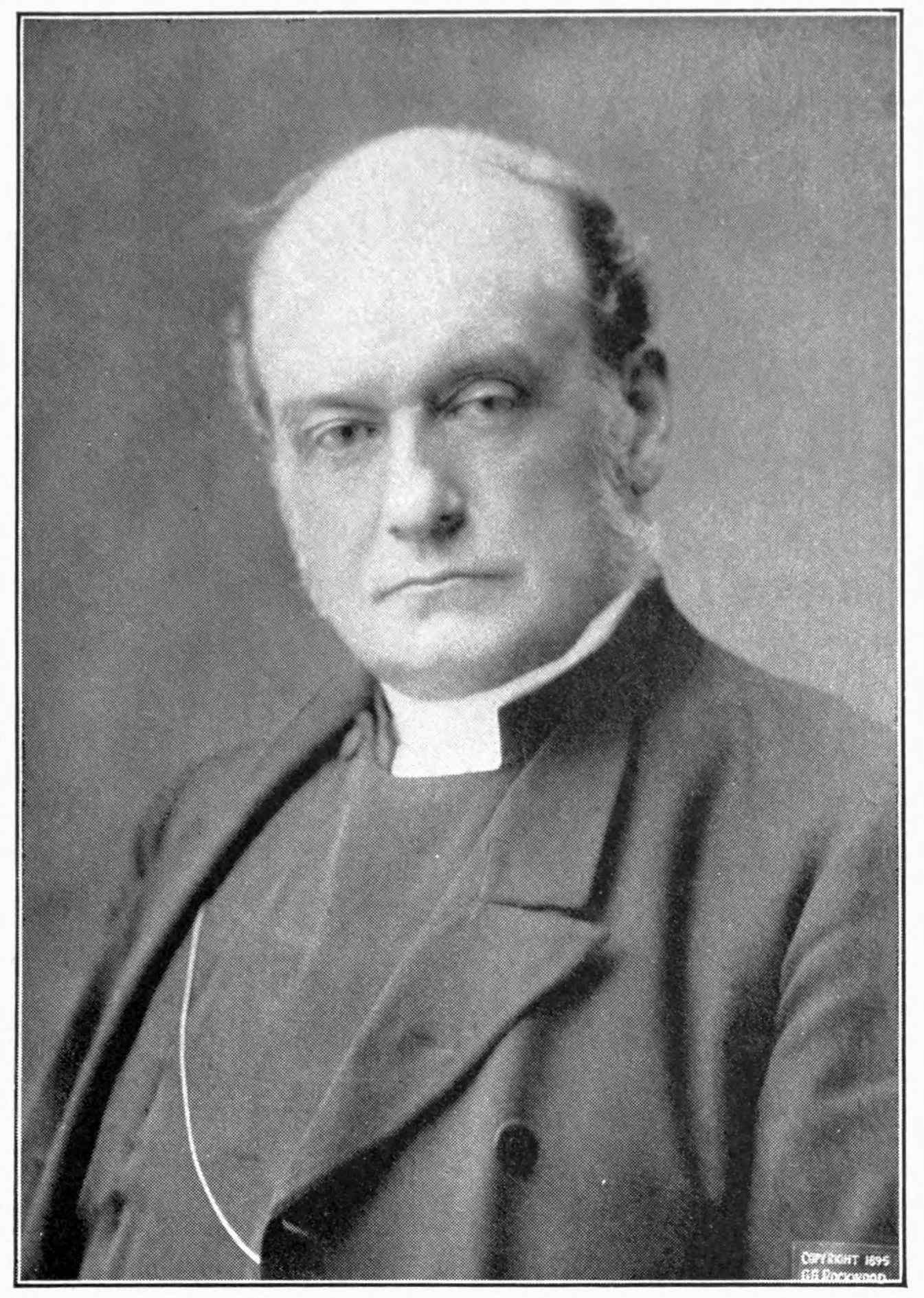
BISHOP HENRY C. POTTER of New York is the one clergyman of all that I know whom I most wish was a lyceum lecturer. It seems as though he is about the only one of his class of great and lovable clergymen that has been spared to us, now that Chapin, Beecher, and Phillips Brooks have passed away. He is ever going about doing good, and is as much at home and as well appreciated among the very poorest people as among those in the very highest station of life.
He is recognized by all who meet him on the street, and something kind is said as he passes by. If he would only be a lecturer! Thousands would pay to see and hear him, because they would know that they were to have something worth while in return for what they gave.
There is no great function, public or private, that he is not one of the first to be invited. He marries sons and daughters of the millionaires, and the poorest people as well, and all along the intermediate classes. In the Episcopalian families no name is more generally known, respected and loved.
The bishop is one of our very best public speakers. His addresses under all conditions abound with wit, humor and pathos, and sound sense. It is the simplicity, modesty, and real manliness of his make up that causes him to be just what he is and what he cannot help being. In every sense that the word implies, to every one who knows the meaning of the word, he is a man.
He told me of an incident that occurred as he was passing along Fourth Avenue. Some urchins were playing in the street, and he overheard one of them say: “There goes the Bish. He’s no chump.” I would rather have that eulogy from that urchin than from any statesman I know of.
THE VERY REV. S. REYNOLDS HOLE, dean of Rochester, was engaged by me for a lecture tour in America during the season of 1894-95. Since Canon Farrar lectured in America there has been no clergyman of the Church of England that I considered of sufficiently high standing to supply the demand that came most especially from the Episcopalian churches and societies. One of the best proofs that Dean Hole was such a man, if he could be secured, was the fact that as soon as it became known that negotiations were pending, the Lotus Club wrote to him tendering him a dinner on his arrival.
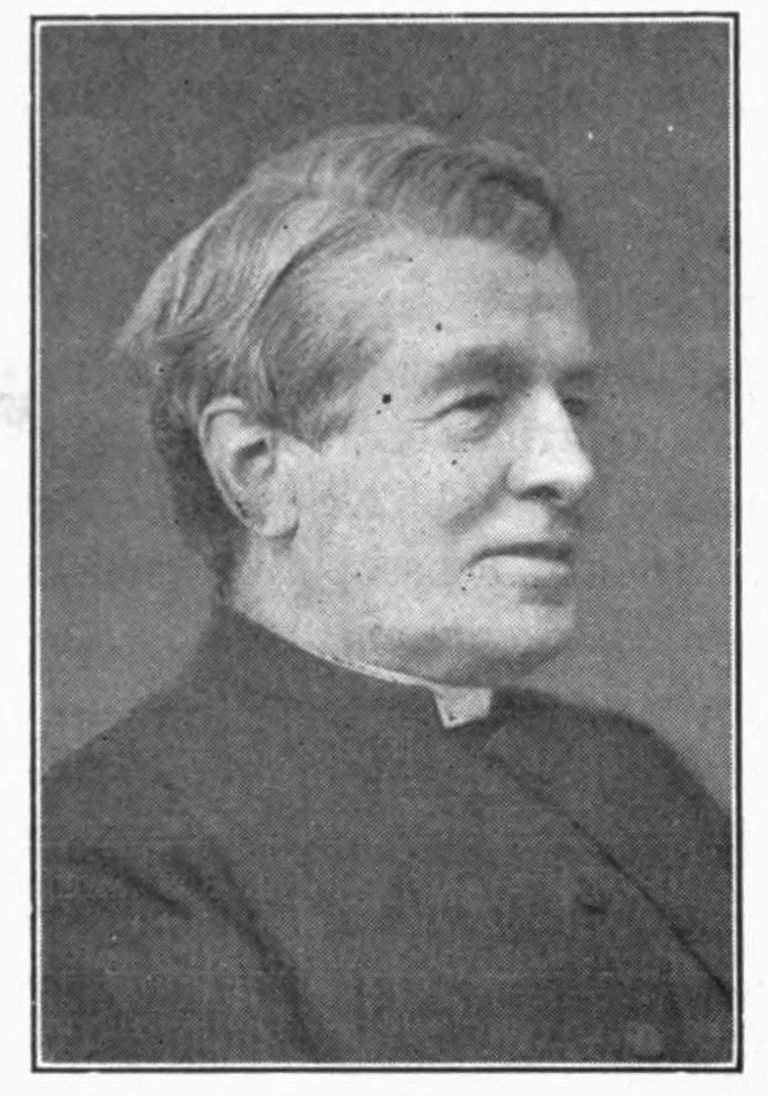
He came in October, with Mrs. Hole, and put up at the Everett House. He arrived on the 24th, and he was at once interviewed by representatives of all the newspapers. The next day he and Mrs. Hole received calls from many clergymen and their wives, and from nearly all the horticulturists in the vicinity. Roses in great profusion, of every form and variety, were sent in, for the Dean is known all over the world as the king of rose growers. Never was there a finer collection of roses than those which came to the Everett House during the Dean’s stay.
Then he yielded to Sarony’s invitation to come over and be photographed. The scene between the Dean and Sarony was indeed picturesque. “When the great photographer and artist found an interesting subject his enthusiasm was intense. The magnificent stature of the Dean fairly captivated him. He reached up (whoever knew Sarony will understand) and caught the Dean’s hand, exclaiming, as he looked at me:
“Major Pond, you have at last brought me a subject that I can enjoy. We’re going to have a good time.”
“I’d just like to hug you, sir,” said the artist, turning again to the Dean.
“I’ve not the slightest objection,” the Dean replied, and Sarony tried to encircle the big man with his arms. The famous artist, Mr. Herbert A. Olivier, who accompanied the party from England, made a sketch of the scene at that time, which is as correct in detail as a photograph could be.
On Saturday, the 27th, came the dinner at the Lotus Club. Dean Hole’s “Reminiscences” had made him widely known as the friend of Dickens, Thackeray, Leech, and other great Englishmen of the past generation. A distinguished company gathered to meet him, including the president, Frank R. Lawrence, the Rev. Morgan Dix, rector of Trinity Church; Dr. Arthur Brooks, Rev. Dr. David H. Greer, President Schurman, of Cornell University; the Rev. Dr. James MacArthur, and many other distinguished guests of the club.
Even at his advanced age Dean Hole looked stout and lusty. He is six feet three inches in height, and his body is built on the typical lines of John Bull. As one of the New York journals expressed it, he “is certainly one of the finest specimens of Elizabethan ecclesiastical architecture that England has ever sent to this country.” His head is large and covered with a mass of silvery gray hair. His features are strong and have an expression of benevolence and good humor.
In introducing the guest, Mr. Lawrence said:
“Two occasions come to my mind this evening—the Lotus Club’s receptions to Charles Kingsley and Dean Stanley. To-night we are equally honored in the privilege of meeting Dean Hole. We cannot greet him without recalling the facts which his ‘Reminiscences’ have made familiar here. We recall him as one who clasped hands with Thackeray and was the friend of Dickens; but it is his own individuality as a man and author that makes him dear to us.”
The Dean, on rising, said:
“I can assure you, gentlemen, that when I received your invitation, having heard so much of the literary, artistic, and social amenities of your famous club, I resembled in feelings—not in feature—the beautiful bride of Burleigh, when—
“‘A trouble weighed upon her, And perplexed her night and morn, With the burden of an honor Unto which she was not born.’
“I could have quoted the words of the mate in Hood’s ‘Up the Rhine,’ when, during a storm at sea, a titled lady sent for him, and asked him if he could swim. ‘Yes, my lady,’ says he, ‘like a duck.’ ‘That being the case,’ says she, ‘I shall condescend to lay hold of your arm all night.’ ‘Too great an honor for the likes of me,’ says the mate.
“Even when I came into this building—though I am not a shy man, having been educated at Brazennose College, and preposterously flattered throughout my life, most probably on account of my size—I had lost this sense of unworthiness; but your gracious reception has not only reassured me, but has induced a delicious hallucination that, at some period forgotten, in some unconscious condition, I have said something, or done something, or written something, which really deserved your approbation. To be serious, I am, of course, aware why this great privilege has been conferred upon me. It is because you have associated me with those great men with whom I was in happy intercourse that you have made my heart glad to-night.
“It has ever been my ambition to blend my life, as the great painter does his colors, ‘with brains, sir,’ and I venture to think that such a yearning is a magnificent proof that we are not wholly destitute of this article, as when the poor wounded soldier exclaimed on hearing the doctor say that he could see his brains: ‘Oh, please write home and tell father, for he has always said I never had any.’ Be that as it may, my appreciation of my superiors has evoked from them a marvellous sympathy, has led to the formation of very precious friendships, and has been my elevator unto the higher abodes of brightness and freshness, as it is to-night.
“Yes, my brothers, it is delightful to dwell ‘with brains, sir,’ condensed in books in that glorious world—a library—a world which we can traverse without being sick at sea, or footsore on land; in which we can reach the heights of science without leaving our easy chair, hear the nightingales, the poets, with no risk of catarrh, survey the great battlefields of the world unscathed; a world in which we are surrounded by those who, whatever their temporal rank may have been, are its true kings and real nobility, and which places within our reach a wealth more precious than rubies, for all the things thou canst desire are not to be compared with it.
“In this happy world I met Washington Irving, Fenimore Cooper, Hawthorne, Willis, Longfellow, Whittier, and all your great American authors, historical, poetical, pathetic, humorous, and ever since I have rejoiced to hold converse with them. Nevertheless, it is with our living companions, with our fellow-men, who love books, as we do, that this fruition is complete, and so it comes to pass, in the words of one whose name I speak with a full heart, Oliver Wendell Holmes, that ‘a dinner table made up of such material as this is the last triumph of civilization over barbarism.’
“We feel, as our witty Bishop, afterward Archbishop, Magee described himself, when he said, ‘I am just now in such a sweet, genial disposition that even a curate might play with me.’ We are bold enough to state with Artemus Ward of his regiment, composed exclusively of major generals, that ‘we will rest muskets with anybody.’
“‘Linger, I cried, O radiant Time, thy power Hath nothing else to give. Life is complete. Let but the happy present, hour by hour, Itself remember and itself repeat.’
“And yet one more quotation, wherewith to make some amends for the stupidity of him who quotes lines most appropriate, by Tennyson, from ‘The Lotus Eaters,’ and repeated by one who has just crossed the Atlantic:
“‘We have had enough of action and of motion we, Tossed to starboard, tossed to larboard, when the surge was seething free, And the wallowing monster spouted his foam fountain on the sea; Let us swear an oath, and keep it with an equal mind; In this hollow Lotus land to live and lie reclined (Here where the Queen of Clubs so royally we’ve dined), On the hills, like gods together, careless of mankind.’
“And now, gentlemen, let me give—
“‘Evermore thanks, the exchequer of the poor.’”
Then President Schurman of Cornell welcomed the Dean on behalf of the universities. He was followed by Dr. MacArthur, who made a fine speech and paid a splendid tribute to the guest of the evening. Mr. Brooks was the next speaker. Dr. Greer raised many a laugh by his witty remarks.
Dean Hole’s first lecture in America was in Calvary Baptist Church, Fifty-seventh Street, New York. Notwithstanding that the rain came down in torrents, the great church was crowded. The Rev. Dr. Morgan Dix introduced the speaker. The good Dean entertained his audience fairly well, but was a disappointment to many, due largely, I thought, to his bad advisers. He had been told that the more he amused American audiences and made them laugh, the better satisfied they would be. It is often a misfortune to a clergyman to be a wit. There were on the platform and in the audience people as learned as the one who addressed them. In his Rochester congregation he had been accustomed to addressing a different audience—an audience that he must talk down to. It took him only a short time to discover that in America the pews are as high as the pulpit, and he gave his audiences a scholarly and delightful entertainment. His popularity increased to the end of his tour.
He did not come to America for gain. All his earnings on the tour were applied to the restoration of an arch in the tower of the Rochester Cathedral, where the good Dean is fond of showing his Yankee visitors his American lecture proceeds.
It was Mrs. Pond’s and my privilege, during our visit to England in the summer of 1897, to be guests for three days at the Deanery. During our stay a garden party was given in our honor by the Dean and Mrs. Hole. We were shown on the place over a thousand varieties of roses, and we thought they must certainly be the very choicest in all the world; but the morning of the day of the garden party, a number of wagons and carts came driving in, loaded with banks and boxes of roses from various persons whom the Dean said were his disciples. They were displayed in a large basement room of the Deanery, and we were invited to view them. The great room was filled with tables on which the roses were displayed. It was certainly the most beautiful floral display that we ever saw, and the Dean assured us that nothing could be more perfect.
“You see,” said the Dean, “my dear Major and Mrs. Pond, the fruits of our efforts in rose culture; our disciples have all outgrown their teachers.” There was every color and almost every variety of rose. How I wish I could adequately describe them!
The garden party was a magnificent affair. The parishioners and best citizens of Rochester and its neighborhood were there—about four hundred—Rochester’s “Four Hundred,” I presume. The guests’ table was under an immense rose-tree as large as a common apple-tree, in full bloom. It was the first and only large rose-tree I have seen in blossom.
Among the guests were Mr. John Morgan Richards of London, and his daughter, Mrs. Craigie (“John Oliver Hobbes “); a Mr. Arnold, brother of Sir Edwin Arnold, a scholarly gentleman and poet, who would be famous were he not eclipsed by his brother, and Mr. Latham, an English gentleman who now owns and lives in the famous Dickens home at Gad’s Hill, near by, who, the day before, had shown us all over the place and through the house, the unique Dickens library, the dining room, and the chair at the head of the table where the great novelist died.
I was never so impressed with the fact that there is more in this life than just to live and breathe and have a being, and that when life’s efforts are made in the right direction, what should be called “higher life” is almost within the reach of all who desire to attain it.
I must declare that of all the visits I have ever made in Europe, and of all the hosts and hostesses whose hospitality it has been my honor to enjoy, the Deanery at Rochester, Dean Hole (now past eighty), and his estimable wife, are among the very brightest of my memories. May they long be spared to us!
I copy from the good Dean’s book, “A Little Tour in America,” the following anecdote, which will give his estimate of one of our American plays that he saw while here:
“I had also the gratification of seeing those popular favorites, Mr. and Mrs. Kendal, in ‘Lady Clancarty,’ and was specially delighted with Mr. Denman Thompson in ‘The Old Homestead.’ Toward the end of the play, his manager came to my box with an invitation to an interview, and I had the pleasure of thanking Mr. Thompson for his humorous, pathetic, bright, and wholesome performance, and of telling him how much he resembled in many ways the greatest comic actor of his day, Mr. Buckstone.
“Next morning there appeared in the New York Herald a paragraph headed, ‘A Dean Behind the Scenes,’ and shortly afterward I was gently rebuked by a brother clergyman as having imperilled the dignity of my office. As counsel for the defence, I made answer, ‘Reverend sir, in the play entitled “The Old Homestead,” two young fellows, who had been making fools of themselves and had gone to the bad, were brought back to a right mind—to their home and duty. They were shown the misery and degradation of vice, and then, in contrast, the happiness and the honor of a righteous life. I went behind the scenes to thank the teacher of that object lesson, and if you, my brother, will prove to me that by one of your sermons you have persuaded two prodigals to get away from the husks of the swine and return to their Father’s house, I shall rejoice to pay my respects to you in the vestry, or wherever we may meet.’”
THE BISHOP OF RIPON, DR. BOYD CARPENTER, the Queen’s favorite minister, is regarded as the most eloquent man in the English clergy. I visited him at his palace during 1897. He said he wished to visit America soon, but had three hundred and ten parsons to look after, and did not know just how soon he could arrange to make the trip.
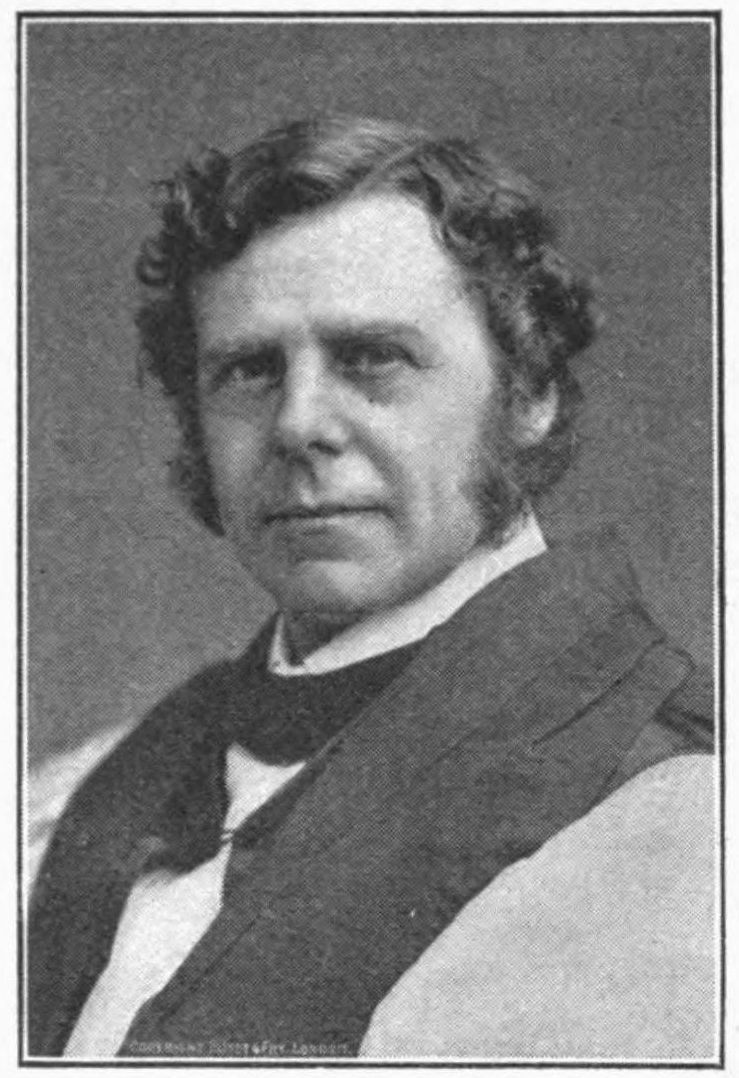
His great theme is Dante. A distinguished woman told me that she had heard him deliver a course of five lectures on Dante, and she thought she had never heard a man so intensely interested in his subject or so eloquent. His palace is a sort of public hotel for all members of the clergy, and Mrs. Carpenter told me that though a yearly income of £10,000 seemed enormous for a Bishop, she was often put to it to know how to make both ends meet. She kept count one year, and they entertained more than six thousand persons.
The Bishop writes a personal letter to the Queen every month, and receives one in reply. He has a copy of every photograph that Queen Victoria ever had taken, with her autograph written on each one.
A warm feeling of personal friendship exists between the Bishop of Ripon and the Dean of Ely, yet the two men are very unlike. The wide difference between their points of view is apparent from these few words in one of Dr. Carpenter’s letters to me:
“Dean Stubbs is a man well known for his strong social sympathies. He has been the champion of the agricultural laborer, and in all questions he, as such, has taken a strangely liberal line.”
The Bishop of Ripon has had invitations to deliver the Noble course of lectures at Harvard University, and the Lowell Institute lectures in Boston. I know that he would be pleased to come to our country, but he is such a very busy man that up to this time he has not found it possible.
THE VERY REVEREND CHARLES WILLIAM STUBBs, D.D., Dean of Ely, is a most charming gentleman and esteemed as one of the most accomplished English pulpit orators of the Church of England. Through the Rev. Dr. John Watson I induced him to come to America in the fall of 1899 to give a series of lectures to fill the demand which seemed to me had long existed in this country to hear from the platform one of the ablest lecturers of the Church of England.
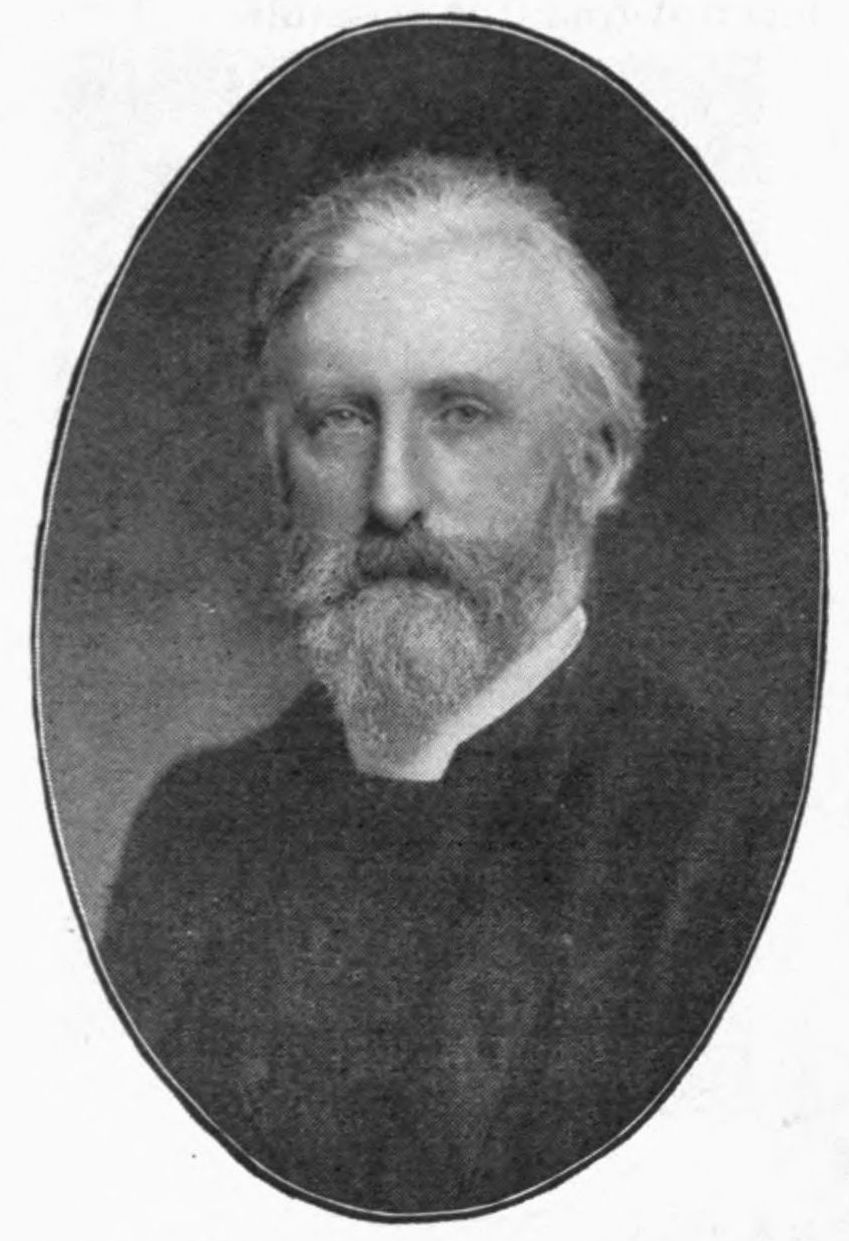
Besides being a fine pulpit orator, the Dean of Ely is a pleasing platform speaker, with but little English mannerism, a scholar of fine type, an essayist of gentle humor and kindly wit, a man of practical affairs, and a sympathetic poet in touch with history and humanity. As a poet he has the ballad quality, the lyric tone.
Not only were his prepared lectures polished and scholarly, but when called upon suddenly he was always ready, with wit and humor and anecdote, for any occasion, as is attested by the following portion of an impromptu speech made at a banquet tendered by the Lotus Club to Sir Henry Irving in New York on the evening of the day of the Dean’s arrival:
“Mr. President, Sir Henry, Gentlemen of the Lotus Club: In this atmosphere of resistless eloquence and wit and humor and good fellowship and eulogy, I confess I find myself somewhat embarrassed—embarrassed by the generosity of your kindly feeling toward me, expressed by your president, but embarrassed especially because your president has treated me with not even that amount of generosity which he extended to the gentleman who spoke last and who needed no such generosity. I have not even had a twenty-minutes’ grace in which to concoct any impromptu humorous remarks. What, then, can I do? I think it was one of your own prophets—shall I say one of your own poets?—one of the greatest of your literary men, an ambassador to England some years ago, a man of whom I am always glad to think as a personal friend of my own, Mr. James Russell Lowell, who once said that an after-dinner speech should consist of an anecdote, a commonplace, and a quotation. Now, how can I fulfil those canons of speech to-night?